Subscribe to the Bombay Chartered Accountant Journal Subscribe Now!

PART A: ORDERS OF CIC & the court

fiogf49gjkf0d
• Appeal –Section 19(3) of the RTI Act:

The Appellant through an RTI application dated 19-12-2012 sought certain information regarding a notification dated 15-09-2011 by which Bharat Petroleum Corporation Ltd, public authority had invited the applications for dealership within the range of 2 kilometer of Bhaniyawala NH 72. The application made included queries such as how many applications have been received for the dealership; to provide name, address and telephone numbers of applicants; when was the site inspection conducted; to provide the name, strength and designation of the officers who were part of the Inspection Committee, to provide a copy of Inspection report and so on.

The CPIO furnished the information sought but the appellant was dissatisfied with the information supplied to him by the CPIO.

In the appeal before the CIC, the appellant not only requested that the full information sought be provided to him but also sought some additional information like, yardstick being followed for giving dealership in respect of highways; a copy of objection raised by the Site Inspection Committee in respect of yardstick etc.

During the hearing, the Respondents pointed out that the Appellant in his present appeal before the Commission has sought additional information which he had not sought in his original RTI application. At that stage, he is not allowed to seek information other than sought in his RTI application.

The Commission ruled:
“The Commission agrees with the Respondents that the information now sought by the Appellant in the present appeal did not form part of his original RTI application. Therefore, the Commission is not in a position to allow the disclosure of the information which had not even been sought by the appellant in his RTI application. An information seeker cannot be allowed to expand the scope of his RTI enquiry at appeal stage. No disclosure can, therefore, be directed to be made in the present appeal of the Appellant. The Appellant, however, may file a fresh RTI application, if he so desires.”

[Harish Prasad Divedi vs. Bharat Petroleum Corporation Ltd. Appeal No CIC/LS/A/2013/001477-SS decided on 28-01-2014: (RTIR I (2014)132(CIC)]

• Section 7(9) of the RTI Act:

Section 7(9) of the Right to Information Act reads as under:

7(9) An information shall ordinarily be provided in the form in which it is sought unless it would disproportionately divert the resources of the public authority or would be detrimental to the safety or preservation of the record in question.

In the writ petition, the petitioner sought expeditious disposal of petitioner’s appeal under the Right to Information Act, 2005 as well as a direction to respondents to pay amount of ` 3,01,000/- as compensation. Petitioner had also prayed for a direction to take disciplinary action against respondent No.1.

The petitioner had sought the information under 23 different items. The petitioner stated that he is a financier who gives advances to various contactors working with Director General, Deference estates.

The Court held:
“Keeping in view the width and amplitude of the information sought by the petitioner, it is apparent that the prayers in the writ petition are nothing short of an abuse of process of law and motivated if not an attempt to intimidate the respondent.”

“In the opinion of this Court, the primary duty of the officials of Ministry of Defence is to protect the sovereignty and integrity of India. If the limited manpower and resources of the Directorate General, Defence Estates as well as the Cantonment Board are devoted to address such meaningless queries, this Court is of the opinion that the entire office of the Directorate General, Defence Estates and Cantonment Board would come to stand still.” The court then reproduced the relevant Paragraph, from the Supreme Court decision in CBSE vs. Aditya Bandopadhyay, [(2011) 8 SCC 497].

Then it quoted para 39 of the Supreme Court decision in ICAI vs. Shaunak H. Satya, [(2011) 8 SCC 781], as under:

39. “We however agree that it is necessary to make a distinction in regard to information intended to bring transparency, to improve accountability and to reduce corruption, falling u/s. 4(1) (b) and (c) and other information which may not have a bearing on accountability or reducing corruption. The competent authorities under the RTI Act will have to maintain a proper balance so that while achieving transparency, the demand for information does not reach unmanageable proportions affecting other public interests, which include efficient operation of public authorities and the Government, preservation of confidentiality of sensitive information and optimum use of limited fiscal resources.”

Consequently, the Court deemed it appropriate to refuse to exercise its Writ Jurisdiction, and the petition was dismissed. This Court was also of the view that “misuse of the RTI Act has to be appropriately dealt with, otherwise the public would lose faith and confidence in this sunshine Act. A beneficent Statute, when made a tool for mischief and abuse must be checked in accordance with law.”

[Shail Sahni vs.Sanjeev Kumar and Ors. W.P. (C) 845/2014 decided by the High Court of Delhi on 05-02-2014. (RTIR I (2014) 220 (Delhi)]

levitra

From published accounts

fiogf49gjkf0d
Section B:

• Disclosure as per AS 29 SKF India Ltd (year ended 31st December 2013)

From Notes to Financial Statements
Additional disclosures relating to other provisions (as per Accounting Standard 29)

(Rs. in million)

(i) Provision for disputed statutory and other matters: This represents provisions made for probable liabilities/claims arising out of pending disputes/litigations with various regulatory authorities and those arising out of commercial transactions with vendors/others. Above provisions are affected by numerous uncertainties and the management has taken all the efforts to make a best estimate. The timing of outflow of resources will depend upon the timing of decision of cases.

(ii) Provision for warranties: A provision is estimated for expected warranty claims in respect of products sold during the year on the basis of a technical evaluation and past experience regarding failure trends of products and costs of rectification or replacement. The timing and amount of cash flows that will arise from these matters will be determined at the time of receipt of claims.

(iii)The provision for other obligations is on account of coupons given on products sold by the Company and other retailers and distributors incentive schemes. The provision for coupons is based on the historic data/estimated figures. The timing and amount of the cash flows that will arise will be determined at the time of receipt of claims from customers.

• Disclosure of foreign currency exposures and contracts
Nestle India Ltd. (year ended 31st December 2013)

From Notes to Financial Statements

(a) Category wise quantitative data*

(b) All the forward contracts are for hedging foreign exchange exposures relating to the underlying transactions and firm commitments or highly probable forecast transactions.

(c) Foreign currency exposures remaining unhedged at the year-end*

• Disclosure under AS 18 regarding dependence on Related Party Transactions

Honeywell Automation India Ltd (year ended 31st December 2013)

From Notes to Financial Statements

Note below AS 18 disclosures

The Company generates a large percentage of its sales and profits from its business with the Honeywell group (Honeywell), its major shareholder. Sales to Honeywell accounted for approximately 30% and 35% of our total net sales in the fiscal years 2013 and 2012 respectively. The Company’s ability to maintain or grow its business with Honeywell depends upon a number of performance factors. However, the Company cannot be assured that its level of sales and profits associated with its relationship with Honeywell will continue. Honeywell-specific business consideration (independent of its shareholding in the Company), including changes in Honeywell’s strategies regarding utilisation of alternate opportunities available to it to source products and services currently provided by the Company (including from alternate sources which Honeywell may acquire or develop within its own group), may also reduce the level and/or mix of Honeywell’s business with the Company.

levitra

From the President

fiogf49gjkf0d
Dear members,

With the Indian summer in full bloom, scorching heat is pervading throughout the country and has pushed behind glimpses of the pleasant weather witnessed earlier due to the erratic climate. A similar scene is perhaps being enacted in the political spectrum that has suddenly become very heated.

Even though the Loksabha passed the Right to Fair Compensation and Transparency in Land Acquisition, Rehabilitation and Resettlement (Amendment) Bill, 2015 [the LARR (Amendment) Bill, 2015] on 10th March, 2015, the debate over it seems to be continuing putting the ruling NDA alliance in a tight spot. An extremely unfortunate and sad incident of the death of a protestor has further vitiated the atmosphere.

My discussions about this grave issue with few CA friends made me realise as concerned citizens that we need to understand the issues involved in the greater detail and its impact the nation’s economic development.

The land acquisition process hitherto carried out under the Land Acquisition Act, 1894 has been viewed as unfair, bureaucratic and inadequate. As per reports, over 50% of the land acquired between 2006 and 2013 for SEZs lie unused. The CAG in its report has commented that the land appeared to be the most crucial and attractive component of the SEZ scheme and listed many cases where the land acquired was sold off or put to other uses.

The Land Acquisition Act, 1894 empowered the Government to acquire land for ‘public purpose’ as the justified reason for the acquisition of private lands, but provided inadequate safeguards against forced acquisition or for proper resettlement and rehabilitation. The phrase ‘public purpose’ was not explained properly in the act, and its determination was entirely left to the Executive. Various studies have established failure on the part of the State machinery in showing any empathy towards the rural people who lose lands and livelihood.

Given increasing discontentment, the Government adopted the National Rehabilitation and Resettlement Policy, 2007 and initiated the process to amend the land acquisition law and provide for effective safeguards and adequate rehabilitation and resettlement. This process culminated in the enactment of the Right to Fair Compensation and Transparency in Land Acquisition, Rehabilitation and Resettlement Act, 2013 [the LARR Act, 2013]. This 2013 law required the compulsory consent of the landowners – 80% for private projects and 70% for public-private partnership projects. It also made the Social Impact Assessment (SIA) necessary for all projects with very few exceptions. This 2013 law has been perceived to have made the land acquisition process extremely difficult. It has been blamed for stalled projects and labelled as a roadblock to the development.

The land issues coincide with the severe crisis faced by the farmers. A study by the Centre for Study of Developing Societies (CSDS) conducted last year has reported that given an option, over 60% of farmers would prefer to migrate to cities as that would give them access to better education, health and employment avenues there. They cited reasons such as inadequate income, bleak future and stress, for giving up farming.

Despite a significant growth India has witnessed in last two decades or so, it continues to depend significantly on agriculture. The 4th Annual Employment and Unemployment Survey Report for 2013-14 published on 7th January 2015 estimates that approx. 47% persons (all India) are employed in the primary sector consisting of agriculture, forestry and fishing.

A research report by McKinsey published in February 2014 states that there are too few job opportunities outside the farm sector, a factor that limits the economic opportunities available. It estimates that a faster shift of labour from farm to non-farm jobs (matching China’s pace) could have lifted 10 crore more people above the Empowerment Line, a line marginally higher than the Poverty Line, from 2005 to 2012.

Amartya Sen, the well-known Nobel Laureate in economics, opines that prohibiting the use of fertile agricultural land for industries is ultimately self-defeating. He further argues that in countries such as Australia, the US or Canada, where agriculture has prospered by increasing productivity and efficiency, only a very tiny population is involved in agriculture. When people move out of agriculture, total production does not go down; rather, per capita income increases. Sen makes a case that for the prosperity of industry, agriculture and the economy, India needs industrialisation.

The above discussion brings us to the conclusion that the creation of job opportunities remains an important goal for any government. Increasingly, this goal is becoming more challenging. The Economic Survey for 2014-15 avers that there has been a decline in long-run employment growth in the 2000s relative to the 1990s along with a decline in the employment elasticity of growth.

In order to address the challenges of reviving the limping economy and push for the creation of jobs, the present NDA Government brought this 2015 amendment to the LARR Act of 2013. It attempts to make the land acquisition less onerous and thereby to ease the cost of doing business in India.

The amendment mainly exempts projects in five categories such as defence and infrastructure from the mandatory consent provision. It also permits the government to exempt projects in these five categories from the requirement to conduct a Social Impact Assessment and certain restrictions on the acquisition of irrigated multicropped land and other agricultural land.

Past bureaucratic hurdles, inordinate delays and abuse of law have resulted in the widespread reservation in the masses against the land bill. As a result, there is widespread opposition to vesting of any additional discretionary power. It is imperative that the present Government to manage the tightrope walk well and navigates this piece of crucial reform through the legislative process. It is equally essential for the Government to improve urgently the governance and infuse confidence amongst the suffering lot. Let’s hope the promises made and expectations raised by the NDA Government will come true.

On the other front, the issue of applicability of MAT on foreign companies is getting vexed. The tax administration seems to be further drifting from the coveted objectives of predictability, stability and certainty so vehemently espoused in the reports of the Tax Administration Reforms Commission (TAR C).

Talking about summer heat, this is also the time for exam fever. I hope all of you whose children have appeared for school/college examinations are now breathing easy and that the children will fare very well in the exams. Best wishes to those children appearing for their CA examinations.

As I am about to complete writing this page, the news of the devastating earthquake in Nepal and also parts of India, one of the worst in recent times, has deeply saddened us. It is a grim reminder of the mankind’s frailty against the fury of nature. At the same time, the human race continues to come together, show resilience to rise again and recover. Let’s direct our prayers and thoughts to the brave people of Nepal and help them in any way we can.

Once again, I look forward to receiving your feedback and views.

With warm regards,

levitra

Ethics and You

fiogf49gjkf0d
Procedure of Enquiry (Continued) – Part IV

Arjun (A) — Oh My God! This heat is unbearable. And also this humidity.

Shrikrishna —Why don’t you go to some hill station? April must be a ‘cool’ month for you CAs.

A — Kaash, yeh sach hota!

S — Why? Isn’t the work load less now?

A
— Maybe, yes. No deadlines. But bank audits, service tax returns and
whatever nonsense tax assessments are completed in March, we need to
submit appeals, stay applications, and what not!

S — H ow was bank audit experience this year?

A—
T hat is a nightmare. Big branches to be completed in 4 to 5 days; with
just one or two assistants. Bank staff never co-operates. Bhagwaan ka
naam le ke hi sign karna padta hai.

S— I agree. Your profession is difficult.

A—
By the way, you have so far explained to me how a disciplinary case
starts. Apart from complaint, there could be suo moto ‘information’
cases as well. I have also understood upto the stage of ‘Prima facie
opinion’ and the types of punishments for various items of misconduct.

S— T oday, I wish to explain how the actual enquiry is conducted.

A— Y es, yes! I wanted to know that. It must be a dreadful experience.

S—
A ctually, it is not so frightful. It is not a police enquiry. It is a
plain fact finding exercise. No need to be nervous if you have acted
diligently.

A— But there are many mistakes that occur unknowingly. If they are exposed, it could be serious!

S—
Y es. It depends on the nature of offence. It is held in a conference
hall; not like a court where the judges sit on a raised platform.

A— So, it is across the table. Good.

S—
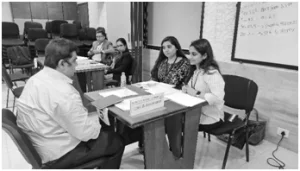
Y es. On one side of the table, the Members of the Board of Discipline
(BOD) or Disciplinary Committee (DC) sit. They are assisted by the
Secretariat. The complainant, his counsel, respondent and his counsel
sit in front of the BOD/DC on the other side of the table.

A— A nd how does it start?

S—
E verything is tape-recorded. Also, there is a stenographer. Everyone
has to speak into a mike. First of all, all parties are required to
identify themselves. Then, Complainant and Respondent are put on oath.

A— A re there witnesses?

S—
See, in the Misconduct Procedure Rules, for First Schedule Offence,
before BOD, there is no provision for witnesses. But for Second Schedule
items before DC, one can call witnesses.

A— Both the parties?

S— Y es. Not only the parties but even the Committee can call its witnesses.

A— Ohh!

S—
A fter this, the complainant is asked to explain his charges. Committee
asks him questions so as to define the exact charges. A— What next? S— R
espondent is asked whether he has understood the charges. He is asked
to state whether he pleads guilty or he wants to defend himself.

A— What is he expected to say?

S—
I f Respondent wants to accept his guilt, well and good. He has to say
so. If he wants to argue or defend, he can say accordingly.

A— T hen what happens?

S—
I f it is to be defended, the Respondent is allowed to speak and
explain his position. His counsel may also speak on his behalf.

A— D o they ask questions?

S—
O f course. Previously, it used to be formal like in a court. There was
examination, cross-examination and so on. However, cross examination is
permitted. Nowadays, they adopt a summary procedure.

A— What about witnesses?

S—
A s I told you, witnesses are called and examined. All parties can
question the witnesses. But one cannot ask leading questions except in a
cross-examination.

A— What about new evidences or new documents?

S—
See, Arjun. One must keep in mind that it is an enquiry into the
conduct of a member of the Institute. It is not a law suit – civil or
criminal. So ordinarily everything is entertained in a fair and
transparent manner. But complainant is not allowed to make a new charge
or allegation. One cannot enlarge the scope of the complaint.

A— What is the value of precedents?

S—
F rankly, in my opinion there is not much value to the precedents. Each
case is unique on its facts. There are so many shades of human
behaviour. Misconduct is to be viewed on the facts and in the
circumstances of each case.

A— I s it advisable to have a lawyer with us?

S—
I t depends. Sometimes, a respondent gets psychologically nervous. Many
times they cannot express themselves clearly and properly. So a
counsel’s presence does help.

A— But who can be a counsel?

S—
N ormally, any other member of your Institute; or a company secretary,
cost accountant or a lawyer is engaged as counsel. But lawyers need to
understand that a very legalistic approach does not help. It is a
fact-finding process.

A— Like what?

S— F or example,
while doing audit, you may take a view in respect of some provision of
company law or income tax. There, you may argue in a legalistic way. But
petty matters of procedures should not be given too much importance.
They allow you every reasonable opportunity to submit any documents,
information, explanation and so on. You are allowed to speak without any
pressure or tension.

A— H ow long does the hearing last?

S— R anging from half-an-hour to even 2 to 3 days! D epending upon the nature of allegation, number of witnesses and so on.

A— I need to know many more things about these proceedings. I will bring my friends also to listen to all this.

S—
R emember that all the proceedings are recorded and you get verbatim
minutes. These are called Notes of Hearing. One has to apply to the
Director Discipline to get these minutes.

Om Shanti !!!

levitra

From Published Accounts

Section b: Illustration of Auditors’ Report as per The Companies Act, 2015 for 2 Companies infosys ltd. (31-3-2015))

Report of The financial Statements
We have audited the accompanying standalone financial statements of infosys Limited (‘the Company’), which comprise the balance sheet as at 31st march 2015, the statement of profit and loss and the cash flow statement for the year then ended, and a summary of significant accounting policies and other explanatory information.

Management’s Responsibility for the Financial Statements
the  Company’s  Board  of  directors  is  responsible  for the matters stated in section 134(5) of the Companies act, 2013 (“the act”) with respect to the preparation and presentation of these standalone financial statements that give a true and fair view of the financial position, financial performance and cash flows of the Company in accordance with the accounting principles generally accepted in india, including the accounting Standards specified u/s. 133 of the Act, read with Rule 7 of the Companies  (accounts)  rules,  2014.  This  responsibility also includes maintenance of adequate accounting records in accordance with the provisions of the act for safeguarding the assets of the Company and for preventing and detecting frauds and other irregularities; selection and application of appropriate accounting policies; making judgments and estimates that are reasonable and prudent; and design, implementation and maintenance of adequate internal financial controls, that were operating effectively for ensuring the accuracy and completeness of the accounting records, relevant to the preparation and presentation of the financial statements that give a true and fair view and are free from material misstatement, whether due to fraud or error.

Auditor’s Responsibility
Our responsibility is to express an opinion on these standalone financial statements based on our audit. We have taken into account the provisions of the act, the accounting and auditing standards and matters which are required to be included in the audit report under the provisions of the act and the rules made thereunder.

We conducted our audit in accordance with the Standards on Auditing specified u/s. 143(10) of the Act. those  Standards  require  that  we  comply  with  ethical requirements and plan and perform the audit to obtain reasonable assurance about whether the financial statements are free from material misstatement.

An audit involves performing procedures to obtain audit evidence about the amounts and the disclosures in the financial statements. The procedures selected depend on the auditor’s judgment,  including  the  assessment  of the risks of material misstatement of the financial statements, whether due to fraud or error. in making those risk assessments, the auditor considers internal financial control relevant to the Company’s preparation of the financial statements that give a true and fair view in order to design audit procedures that are appropriate in the circumstances, but not for the purpose of expressing an opinion on whether the Company has in place an adequate internal financial controls system over financial reporting and the operating effectiveness of such controls. an audit also includes evaluating the appropriateness of the accounting policies used  and  the  reasonableness of the accounting estimates made by the Company’s directors, as well as evaluating the overall presentation of the financial statements.

We believe that the audit evidence we have obtained is sufficient and appropriate to provide a basis for our audit opinion on the standalone financial statements.

Opinion
In our opinion and to the best of our information and according to the explanations given to us, the aforesaid standalone financial statements give the information required by the act in the manner so required and give   a true and fair view in conformity with the accounting principles generally accepted in india, of the state of affairs of the Company as at 31st march 2015 and its profit and its cash flows for the year ended on that date.

Report on Other legal and Regulatory Requirements
1.    As  required  by  the  Companies  (auditor’s  report) order, 2015 (“the order”) issued by the Central Government of india in terms of sub-section (11) of section 143 of the act, we give in the annexure a statement on the matters specified in the paragraph 3 and 4 of the order, to the extent applicable.

2.    As required by section 143(3) of the act, we report that:

a)    We have sought and obtained all the information and explanations which to the best of our knowledge and belief were necessary for the purposes of our audit.
b)    In our opinion, proper books of account as required by law have been kept by the Company so far as it appears from our examination of those books;
c)    The balance sheet, the statement of profit and loss and the cash flow statement dealt with by this report are in agreement with the books of account;
d)    In our opinion, the aforesaid standalone financial statements comply with the accounting Standards specified u/s. 133 of the Act, read with Rule 7 of the Companies (accounts) rules, 2014;
e)    On the basis of the written representations received from the directors as on 31st march 2015 taken on record by the Board of directors, none  of the directors is disqualified as on 31st March 2015 from being appointed as a director in terms of section 164 (2) of the act; and
f)    With respect to the other matters to be included in the auditor’s report in accordance with rule 11 of the Companies (audit and auditors) rules, 2014, in our opinion and to the best of our information and according to the explanations given to us:
i.    The Company has disclosed the impact of pending litigations on its financial position in its financial statements  –  refer  note  2.20  and  2.37  to  the financial statements;
ii.    The Company has made provision, as required under the applicable law or accounting standards, for material foreseeable losses, if any, on long- term contracts including derivative contracts – Refer Note 2.7 to the financial statements;
 
iii.    There has been no delay in transferring amounts, required to be transferred, to the investor education and Protection fund by the Company.

Annexure To The Independent Auditors’ Report
The  annexure  referred  to  in  our  independent  auditors’ report to the members of the Company on the standalone financial statements for the year ended 31st March 2015, we report that:

i.    (a) The Company has maintained proper records showing full particulars, including quantitative details and situation of fixed assets.
(b)  The  Company  has  a  regular  programme  of physical verification of its fixed assets by which fixed assets are verified in a phased manner over a period of three years. in accordance with this programme, certain fixed assets were verified during the year and no material discrepancies were noticed on such verification. In our opinion, this periodicity of physical verification is reasonable having regard to the size of the Company and the nature of its assets.

ii.    The  Company  is  a  service  company,  primarily rendering software services. accordingly, it does not hold any physical inventories. thus, paragraph 3(ii) of the order is not applicable.

iii.    (a) The Company has granted loans to three bodies corporate covered in the register maintained u/s.189 of the Companies act, 2013 (‘the act’).
(b)    In the case of the loans granted to the bodies corporate listed in the register maintained u/s.189 of the act, the borrowers have been regular in the payment  of  the  interest  as  stipulated.  The  terms of arrangements do not stipulate any repayment schedule and the loans are repayable on demand. Accordingly, paragraph 4(iii)(c) of the order is not applicable to the Company in respect of repayment of the principal amount.
(c)    There  are  no  overdue  amounts  of  more  than Rs. 1 lakh in respect of the loans granted to the bodies corporate listed in the register maintained u/s. 189 of the act.

iv.    In our opinion and according to the information and explanations given to us, there is an adequate internal control system commensurate with the size of the Company and the nature of its business with regard to purchase of fixed assets and sale of  services.  The  activities  of  the  Company  do not involve purchase of inventory and the sale of goods. We have not observed any major weakness in the internal control system during the course of the audit.

v.    The Company has not accepted any deposits from the public.

vi.    The  Central  Government  has  not  prescribed  the maintenance of cost records u/s. 148(1) of the act, for any of the services rendered by the Company.

vii.    (a) According to the information and explanations given to us and on the basis of our examination of the records of the Company, amounts deducted/ accrued in the books of account in respect of undisputed statutory dues including provident fund, income tax, sales tax, wealth tax, service tax, duty of customs, value added tax, cess and other material statutory dues have been regularly deposited during the year by the Company with the appropriate authorities. As explained to  us, the Company did not have any dues on account of employees’ state insurance and duty of excise. According to the information and explanations given to us, no undisputed amounts payable in respect of provident fund, income tax, sales tax, wealth tax, service tax, duty of customs, value added tax, cess and other material  statutory  dues were in arrears as at 31st march 2015 for a period of more than six months from the date they became payable.

(b)    According to the information and explanations given to us, there are no material dues of wealth tax, duty of customs and cess which have not been deposited with the appropriate  authorities on account of any  dispute.  however,  according to information and explanations given to us, the following dues of income tax, sales tax, service tax and value added tax have not been deposited by the Company on account of  disputes:  (List not reproduced)

(c)    According to the information and explanations given to us the  amounts  which  were  required  to be transferred to the investor education and protection fund in accordance with the relevant provisions of the Companies act, 1956 (1 of 1956) and rules there under has been transferred to such fund within time.

viii.    The  Company  does  not  have  any  accumulated losses at the end of the financial year and has not incurred cash losses in the financial year and in the immediately preceding financial year.

ix.    The Company did not have any outstanding dues to financial institutions, banks or debenture holders during the year.

x.    In our opinion and according to the information and the explanations given to us, the Company has not given any guarantee for loans taken by others from banks or financial institutions.

xi.    The   Company   did   not   have   any   term   loans outstanding during the year.

xii.    According to the information and explanations given to us, no material fraud on or by the Company has been noticed or reported during the course of our audit.

Gruh Finance ltd. (31-3-2015)

Report of the financial Statements
We have audited the accompanying financial statements of   Gruh   finance   Limited   (“the   Company”),   which comprise the Balance Sheet as at 31st march, 2015,  and the Statement of Profit and Loss and Cash Flow Statement for the year then ended, and a summary of significant accounting policies and other explanatory information.

Management’s Responsibility for the financial Statements
The  Company’s  Board  of  directors  is  responsible  for the matters stated in section 134(5) of the Companies act, 2013 (“the act”) with respect to the preparation of these financial statements that give a true and fair view of the financial position, financial performance and cash flows of the Company in accordance with the accounting principles generally accepted in india, including the Accounting Standards specified u/s. 133 of the Act read with  rule  7  of  the  Companies  (accounts)  rules,  2014. this responsibility also includes maintenance of adequate accounting records in accordance with the provisions of the act for safeguarding the assets of the Company and for preventing and detecting frauds and other irregularities, selection and application of appropriate accounting policies, making judgments and estimates that are reasonable and prudent, and design, implementation and maintenance of adequate internal financial controls, that were operating effectively for ensuring the accuracy and completeness of the accounting records, relevant to the preparation and presentation of the financial statements that give a true and fair view and are free from material misstatement, whether due to fraud or error.

Auditor’s Responsibility
Our responsibility is to express an opinion on these financial statements based on our audit.

We have taken into account the provisions of the act, the accounting and auditing standards and matters which are required to be included in the audit report under the provisions of the act and the rules made thereunder.

We conducted our audit in accordance with the Standards on Auditing specified u/s. 143(10) of the Act. Those  Standards  require  that  we  comply  with  ethical requirements and plan and perform the audit to obtain reasonable assurance about whether the financial statements are free from material misstatement.

An audit involves performing procedures to obtain audit evidence about the amounts and the disclosures in the financial statements. The procedures selected depend on the auditor’s judgment,  including  the  assessment  of the risks of material misstatement of the financial statements, whether due to fraud or error. In making those risk assessments, the auditors considers internal financial control relevant to the Company’s preparation of the financial statements that give a true and fair view in order to design audit procedures that are appropriate in the circumstances, but not for the purpose of expressing an opinion on whether the Company has in place an adequate internal financial controls system over financial reporting and the operating effectiveness of such controls. an audit also includes evaluating the appropriateness of the accounting policies used  and  the  reasonableness of the accounting estimates made by the Company’s directors, as well as evaluating the overall presentation of the financial statements. We believe that the audit evidence we have obtained is sufficient and appropriate to provide a basis for our audit opinion on the financial statements.

Opinion
In our opinion and to the best of our information and according to the explanations given to us, the aforesaid financial statements give the information required by the act in the manner so required and give a true and fair view in conformity with the accounting principles generally accepted in india, of the state of affairs of the Company as at 31st March, 2015, and its profit and its cash flows for the year ended on that date.

Report on Other legal and Regulatory Requirements
1.    As required by the Companies (auditor’s report) order, 2015 (“the order”) issued by the Central Government of india in terms of sub-section (11) of section 143 of the act, we give in the annexure a statement on the matters specified in paragraphs 3 and 4 of the order.

2.    As required by section 143(3) of the act, we report that:

(a)    We have sought and obtained all the information and explanations which to the best of our knowledge and belief were necessary for the purposes  of our audit.

(b)    In our opinion, proper books of account as required by law have been kept by the Company so far as it appears from our examination of those books and proper returns adequate for the purposes of our audit have been received from the branches not visited by us.

(c)    The Balance Sheet, the Statement of Profit and Loss,  and  the  Cash  flow  Statement  dealt  with by this report are in agreement with the books of account and with the returns received from the branches not visited by us.

(d)    In our opinion the aforesaid financial statements comply with the Accounting Standards specified u/s.  133  of  the act,  read  with  the  rule  7  of  the Companies (accounts) rules, 2014.

(e)    On the basis of the written representations received from the directors as on 31st march, 2015 taken on record by the Board of directors, none  of the directors is disqualified as on 31st March, 2015 from being appointed as a director in terms of section 164(2) of the act.

(f)    With respect to the other matters to be included in the auditor’ s report in accordance with rule 11 of the Companies (audit and auditors) rules, 2014, in our opinion and to the best of our information and according to the explanations give to us:

i.    The   Company   has   disclosed   the   impact   of pending litigations on its financial position in its financial statements – Refer Note 27.1 to the financial statements.

ii.    The   Company   did   not   have   any   long-term contracts including derivative contracts for which there were any material foreseeable losses;

iii.    There has been no delay in transferring amounts, required to be transferred, to the investor education and Protection fund by the Company.

Annexure to the Independent Auditors’ report
Referred to in Paragraph 1 under the heading “report on other legal and regulatory requirements” of our report of even date,

(i)    (a) The Company has maintained proper records showing full particulars, including quantitative details and situation of fixed assets.

(b) All the fixed assets were physically verified by the management during the year. We are informed that no material discrepancies were noticed on such verification.

(ii)    (a)   The   stocks   of   acquired   and/or   developed properties have been physically verified during the year by the management. In our opinion, the frequency of verification is reasonable.

(b)    The procedures of physical verification of stock of acquired and/or developed properties followed by the management are reasonable and adequate in relation to the size of the Company and the nature of its business.

(c)    The  Company  is  maintaining  proper  records of acquired and developed properties. no discrepancy was noticed on verification between the physical properties and the book records.

(iii)    The Company has not granted any loans, secured and unsecured to Companies, firms or other parties covered in the register maintained u/s. 189 of the act. Consequently, requirement of clauses (iii,a) and (iii,b) of paragraph 3 of the order are  not applicable.

(iv)    In our opinion and according to the information and explanations given to us, there exists an adequate internal control system commensurate with the size of the Company and the nature of its business with regard to acquisition of properties, fixed assets and with regard to the sale of properties and services. During the course of our audit, we have not observed any continuing failure to correct major weaknesses in internal controls.

(v)    In our opinion and according to the information and explanations given to us, the Company has complied with the provisions of sections 73 to 76 of  the act  and  the  housing  finance  Companies (NHB) directions, 2010 with regard to the deposits accepted from the public. No order has been passed by the Company Law Board or national Company Law tribunal or reserve Bank of india or any Court or any other tribunal.

(vi)    The   Company   is   not   engaged   in   production, processing, manufacturing or mining activities. Therefore, the provisions of clause (vi) of paragraph 3 of the order are not applicable.

(vii)    (a)  The  Company  is  regular  in  depositing  with appropriate authorities undisputed statutory dues including Provident fund, investor education and Protection fund, income tax, Wealth tax, Service tax,   CESS   and   other   material   statutory   dues applicable to it. according to the information and explanations given to US, no undisputed amounts payable in respect of outstanding statutory dues were in arrears as at 31st march, 2015 for a period of more than six months from the date they became payable.

(b)    According to the information and explanations given to us, following amounts have not been deposited as on 31st March, 2015 on account of any dispute:

(c)    According to the information and explanations given to us, the amount required to be transferred to investor education and protection fund in accordance with the relevant provisions of the Companies act, 1956 (1 of 1956) and rules made thereunder has been transferred to such fund within time.

(viii)    The   Company   neither   has   any   accumulated losses nor has incurred any cash losses during the financial year covered by our audit and the immediately preceding financial year.

(ix)    According to the information and explanations given to us, the Company has not defaulted in repayment of dues to banks or debentures holders.

(x)    To  the  best  of  our  knowledge  and  belief  and according to the information and explanations given to us, the Company has not given any guarantee for loans taken by others from bank or financial institutions.

(xi)    To  the  best  of  our  knowledge  and  belief  and according to the information and explanations given to us, in our opinion, the term loans obtained during the year were, prima facie, applied by the Company for the purpose for which they were obtained, other than temporary deployment pending application.

(xii)    To  the  best  of  our  knowledge  and  belief  and according to the information and explanations given to us, no fraud on or by the Company has been noticed or reported during the year, although there have been few instances of loans becoming doubtful of recovery consequent upon fraudulent misrepresentation by borrowers, the amounts whereof are not material in the context and size of the Company and the nature of its business and which have been provided for.

Lecture Meeting

fiogf49gjkf0d
Lecture Meeting on Success in CA Exams by Nilesh Vikamsey on 19th March 2014

Speaker
Mr. Nilesh Vikamsey, Chartered Accountant dealt with various aspects of
getting success in CA Exams. He explained various methods with examples
for preparing for various subjects in better ways. More than 350
students benefited from the expert analysis and knowledge shared by the
speaker. The presentation and video of the lecture is available at
www.bcasonline.org & www. bcasonline.tv, respectively, for the
benefit of all Students, Members and Web TV Subscribers.

Lecture Meeting on Taxation of Expatriates on 9th April 2014

Speaker
Mr. Sushil Lakhani, Chartered Accountant explained various aspects of
Taxation of Expatriates both inbound as well as out bound expatriates.
At this lecture meeting, a publication titled “Taxation of Expatriates
(Including certain Non-Tax aspects)” was also released at the hands of
Mr. S. E. Dastur, Senior Advocate. The publication has been Coauthored
by Mr. Sushil Lakhani, Mr. Nitin Shingala, Mr. Nandkishore Hegde &
Ms. Niji Arora, Chartered Accountants. This publication was the 25th
Publication under the auspices of Shailesh Kapadia Publication Memorial
fund.

More than 300 participants benefited from the speaker’s
vast knowledge and experience. The presentation and video of the lecture
is made available at www.bcasonline.org & www.bcasonline. tv,
respectively, for the benefit of all members and Web TV subscribers.

Other Programs:

Full day Workshop on “Practical Issues in Tax Deduction at Source” on 21st March 2014

A
full day workshop was organised by the Taxation Committee of BCAS. The
objective of the workshop was to keep the Members & Students updated
with recent changes in the regulatory as well as compliance aspects of
TDS provisions.

The following topics were discussed:

536
participants benefited from the Workshop. The video of the full
workshop is made available at www.bcasonline.tv for the benefit of all
Students,

Members and Web TV Subscribers.

Human Resources
Committee of BCAS organised this workshop where the learned speaker Mr.
Mihir Sheth, Chartered Accountant dealt with the various aspects of
good business etiquettes. The objective of the workshop was to make
participants deal with many such protocols and business etiquette
practices which can help them to carry effortlessly while dealing with
their counter part from other countries.

36 participants
attended the workshop and gained immensely from the knowledge shared by
the speaker. Seminar on Charitable Trust on 22nd March 2014 A full day
seminar on “Charitable Trusts” was organised jointly with The Chamber of
Tax Consultants. The objective of the seminar was to understand various
statutory provisions relating to Formation, Registration, Taxation and
Compliance by the Charitable Trusts and to discuss and deliberate upon
the various issues faced in day to day practice. 127 participants
attended the seminar.


Professional Accountant Course Batch XVI, Convocation on 25th March 2014

Human
Resources Committee of the Society and HR College of Commerce &
Economics has successfully completed XVI Batch of Professional
Accountants Course. The convocation was held at HR College where
participants shared their experiences with dignitaries present on the
dais like Mr. Nitin Shingala.

levitra

ICAI And Its Members

fiogf49gjkf0d
The Disciplinary Committee (DC) of ICAI has decided some cases. These cases are reported in the publication of the ICAI “Disciplinary Cases” VOL- 1. The page Nos. Given below are from this book. The names of Members are not given, in order to maintain confidentiality.

(I) Case of Mr. T. G.

In this case, a Public Sector Bank had complained that the Member, being the concurrent auditor of a Branch, failed to report in their Audit Report for January about certain exceptional and fraudulent transactions. If reported, the Bank could have averted the huge loss suffered by it. Some of the items of high withdrawals by certain parties, some return of large value clearing cheques, kite flying operations of the above parties and some of the other irregularities were listed by the Bank in its complaint.

The defence of the Member was that these irregularities started prior to his appointment as a concurrent auditor. He was not getting enough co-operation from the Branch Staff. Therefore, after submitting the report for one month he had resigned. Further, in one month’s audit it was not possible to unearth a deliberately concealed irregularity. After a detailed inquiry, the DC was not satisfied with the explanation given by the Member and held him guilty of professional misconduct under Clauses (7) and (8) of Part I of the Second Schedule to C.A. Act. However, the DC considered the facts that (i) although the Member was appointed as a concurrent Auditor for the year, he conducted audit for one month only and then resigned, as he did not get sufficient co-operation from the staff of the Branch, (ii) in one month’s span it was not feasible to unearth a perpetual fraud which had been going on for many years and (iii) the role of the member was limited to one month’s audit. On these facts, the DC awarded punishment by way of ‘Reprimand’ only . (P. 114 – 125 of Part I of Vol. -I ) (ii) Case of Mr. S. S. G. In this case, the Excise Intelligence Department had reported that (a) the Member had given an opinion to S.A. Ltd. that no service tax was payable by the company, (b) the Company did not deposit this tax which amounted to evasion of the service tax of about Rs. 142.45 crore and (c) the member had admitted that he had isued the opinion. Before the DC, the Member explained that he was appointed as a retainer of the Group. He also stated that the opinion was given to the company on the query whether the services provided by the company would be liable to service tax under the head Advertising Agency. Thus, the scope was limited to this one category of service. Further, the opinion was not given to the Excise Department but to the company. The Member also explained that this opinion was based on the decision in the reported case of Advertising Club vs. CBEC ( 6 STT 196-MAD). After a detailed enquiry, the DC accepted the submission of the Member and held that he was not guilty of professional misconduct. (P. 98 to 103 of Part II of Vol.I). (iii) Case of Mr. S. J. In this case, the Joint Commissioner of Sales tax filed the complaint against the Member. It was alleged that the Member had certified two different sets of financial statements of BPP Ltd. for 2004-05, 2005-06 and 2006-07 in the name two Firms viz. M/s. J & D and M/s. M.R. & Co. The first set signed in the name of M/s. J & D was filed by the company with the bank and the second set was filed with the Sales Tax Department. This amounted to Professional Misconduct. Before the DC, the Member explained as under: (a) The firm of M/s. J & D was dissolved on 01-04-2005 when it merged with M/s. M.R. & Co. (b) He had signed financial statements of BPP Ltd. as

(ii) Case of Mr. S. S. G.

In this case, the Excise Intelligence Department had reported that (a) the Member had given an opinion to S.A. Ltd. that no service tax was payable by the company, (b) the Company did not deposit this tax which amounted to evasion of the service tax of about Rs. 142.45 crore and (c) the member had admitted that he had isued the opinion. Before the DC, the Member explained that he was appointed as a retainer of the Group. He also stated that the opinion was given to the company on the query whether the services provided by the company would be liable to service tax under the head Advertising Agency. Thus, the scope was limited to this one category of service. Further, the opinion was not given to the Excise Department but to the company. The Member also explained that this opinion was based on the decision in the reported case of Advertising Club vs. CBEC ( 6 STT 196-MAD). After a detailed enquiry, the DC accepted the submission of the Member and held that he was not guilty of professional misconduct. (P. 98 to 103 of Part II of Vol.I).

(iii) Case of Mr. S. J.

In this case, the Joint Commissioner of Sales tax filed the complaint against the Member. It was alleged that the Member had certified two different sets of financial statements of BPP Ltd. for 2004-05, 2005-06 and 2006-07 in the name two Firms viz. M/s. J & D and M/s. M.R. & Co. The first set signed in the name of M/s. J & D was filed by the company with the bank and the second set was filed with the Sales Tax Department. This amounted to Professional Misconduct. Before the DC, the Member explained as under:

(a) The firm of M/s. J & D was dissolved on 01-04-2005 when it merged with M/s. M.R. & Co.
(b) He had signed financial statements of BPP Ltd. as Partner of M/s M.R & Co. for 2004-05 to 2006-07.
(c) The financial statements, alleged to have been signed by him as partner of M/s. J & D for these three years and filed by the company with the Bank were forged by someone. The firm of M/s. J & D was not in existence from 01-04-2005 onwards.

The DC, after examining the evidence produced before it, came to the conclusion that the financial statements filed by the company with the Bank, which were alleged to have been signed by the Member as partner of J & D were forged by someone. On this finding, the DC held that the Member was not guilty of professional misconduct ( P. 111 to 117 Part II of Vol. I).

levitra

From the President

fiogf49gjkf0d
Dear members of BCAS family,

Chai-Chunauti-Chunav

By the time this President’s page reaches your desks, the bulk of the voting would have been over and post counting on 16th May 2014, we will all see round two of this long winding tamasha. Horse trading will begin if no clear majority emerges. But that’s another story. All of us were so caught up with this well-orchestrated frenzy that talking about anything else was just not possible. We have done our bit by voting. Now, it’s out of our hands. Phew! But this message is not about that.

Trimurti

Our Government consists of three branches; the Executive, the Legislative and the Judiciary. According to the Constitution, the Legislative branch is to make the laws, the Judicial branch is to review the laws and make sure that they are Constitutional, and the Executive branch is to enforce the laws. We have all seen and read a lot about the current state of our Executive and the Legislative. I haven’t read much about the Judiciary. By the 73rd and 74th amendments to the Constitution, the Panchayat Raj system has become an institution for local governance, which makes our Judiciary very unique. We are all aware about the statistics of the pending cases, the pace of the discharge cases and many other issues that fraught our legal system. A Judicial Reform is the next big leap in our evolution that we are all waiting for. But this message is not about that.

UttejitUchhatamNyayalay

My message is about the emerging role of the Supreme Court (SC) in India. But before I progress, a few disclaimers:

1. These are my personal views and not that of the Bombay Chartered Accountants’ Society.

2. In the unlikely event of this message causing any kind of legal or other issue, the Editor of this journal be completely absolved of any repercussion.

3. I have the highest respect for our judiciary, in particular the Supreme Court.

4. Contempt of Court is not intended. As we all know, according to the Constitution, the role of the Supreme Court is that of a guardian of Constitution and that of a federal court. The Supreme Court has extensive original jurisdiction in regard to the enforcement of the fundamental rights. The Supreme Court also has the power to take cognisance of matters on its own.

NyayikSakriyata

The SC has come a long way since then. It has been playing an exemplary role in our democracy in discharging its constitutional duties. Nature abhors vacuum and hence, in recent times, time and again, we have seen that the SC has gone beyond deciding on the legality of a case. Many judgments have preambles which are ‘sermons’ to the Executive, Legislative or the society. Here are a few examples of such recent judgments which were sent to me by my friend CA. Anup Shah (he is an unwitting partner to this and he too maybe absolved).

1. Sahara’s case: the Court has placed Subroto Roy under its custody and is personally monitoring the repayment schedule proposed by Sahara.
2. Black Money / Liechtenstein Bank Accounts Case – the Court has again pulled up the Government for failing to reveal the names of all Liechtenstein Bank Account Holders.
3. 2G Case – Spectrum Allocation Case was personally monitored by the Apex Court.
4. Open Spaces in Mumbai –6 mt. wide open skirting around building projects and minimum 10% of project to be kept open to the sky.
5. Lal Batti – The Supreme Court slammed the indiscriminate use of the Red Beacon on Cars.
6. Vishaka’s Case: The Supreme Court laid down the law on Sexual Harassment in the absence of any legislation on the subject at that time.

One respects all the judgments and most of these sermons. But doesn’t this reek of Judicial Activism? Black’s Law Dictionary defines judicial activism as a “philosophy of judicial decision-making whereby judges allow their personal views about public policy, among other factors, to guide their decisions.”India has a recent history of judicial activism, originating after the Emergency which saw attempts made by the Government to control everything, including the judiciary. During the emergency period, the Government passed the 39th Amendment, which sought to limit judicial review for the election of the Prime Minister. Subsequently, the parliament, with most opposition members in jail during the emergency, passed the 42nd amendment which prevented any court from reviewing any amendment to the Constitution with the exception of procedural issues concerning ratification. A few years after the emergency, however, the SC rejected the absoluteness of the 42nd Amendment and reaffirmed its power of judicial review in the Minerva Mills case (1980). Another example of activism is the Public Interest Litigation which was an instrument devised by the courts to reach out directly to the public, and take cognizance though the litigant may not be the victim. Suo moto cognisance allows the courts to take up such cases on its own.

JiskaKaamUsikoSaaje

The original intent was that the three branches would be able to check and balance one another so that no single branch would be able to claim too much power. And this balance is sought to be changed time and again. At times the SC takes on the Legislative (Eg: drafting the Vishaka Guidelines) and the Executive (Eg: taking Subroto Roy in the SC custody) roles. The SC can uphold or overturn decisions of all lower courts. This highest of courts can make decisions that cannot easily be overturned. But the Legislative tends to reign supreme and the retrospective amendments post Vodafone judgment is an example of how the Government of India, instead of accepting the SC verdict, made retrospective amendments in the Incometax Act to nullify the effect of Vodafone’s case.

The trend has been supported as well as criticised.The New York Times author Gardiner Harris sums this up as “India’s judges have sweeping powers and a long history of judicial activism that would be all but unimaginable in the United States. In recent years, judges required Delhi’s auto-rickshaws to convert to natural gas to help cut down on pollution, closed much of the country’s iron-ore-mining industry to cut down on corruption and ruled that politicians facing criminal charges could not seek re-election. Indeed, India’s SC and Parliament have openly battled for decades, with the Parliament passing multiple constitutional amendments to respond to various SC rulings.”

We are glad that there is at least one wing of the government which has a conscience and has the courage to act upon it.Having said that, this trend is neither intended nor desired. If each wing of the government discharged its role diligently then this debate and tussle would not arise. We need the courts to discharge their primary duties, an area where there is a lot of scope for improvement. The vast number of pending cases is an area that needs highest attention. If the courts get distracted by activism then this issue will only get more severe. Justice delayed is justice denied.

Errata: In my previous communique I erroneously referred to Mr. Nandan Nilekani as CA. Correct examples would have been Mr. Rahman Khan,
Mr. Suresh Prabhu, Mr. Piyush Goyal and Mr. Harish Salve. I thank my friend Narayan Pasari for pointing out this error.

Here’s wishing everyone happiness and love.

With Warm Regards
Naushad A. Panjwani

levitra

Glimpses Of Supreme Court Rulings

5.  (2018) 400 ITR 9 (SC)

DIT
vs. S.R.M.B. Dairy Farming (P.) Ltd.

Dated:
23.11.2017


Appeal to
the High Court – Monetary Limits for Litigation by Department – Circular would
apply even to the pending matters but subject to two caveats provided in Surya
Herbal case

The
Supreme Court was concerned with the implementation of Instruction No.3 of
2011, dated February 9, 2011, providing for appeals not to be filed before the
High Court(s) where the tax impact was less than Rs.10 lakh which was issued in
supersession of the earlier Instruction No. 1979 of 2000, dated March 27, 2000.

The instruction/circular in
question was stated to have a prospective effect as per the revenue and, thus,
cases which were pending in the High Court and had been filed prior to the
instruction in question (Instruction No.3) but had tax effect of less than
Rs.10 lakh were, thus, required to be determined on their merits and not be
dismissed by applying the circular/instruction. 

The Supreme Court noted
that there had been a divergence of legal opinion on this aspect amongst the
High Courts.

The Madras High Court,
Kerala High Court, Chhattisgarh High Court and the Punjab and Haryana High Court
had taken a view that the existing circular/instruction prevailing at the
relevant time when the appeal/reference was made would apply and there would be
no retrospective application of the circular. 

On the other hand, the line
of reasoning adopted by the Bombay High Court, Madhya Pradesh High Court, Delhi
High Court and the Karnataka High Court was, that as the value of money went
down and the cases of the Revenue increased, the choking docket required such
an endeavour and there was no reason why the same policy should not be applied
to old matters to achieve the objective of the policy laid down by the Central
Board of Direct Taxes (“CBDT”). An earlier circular dated June 5, 2007 issued
by the Central Board of Direct Taxes was also taken note of which required all
the appeals pending before the court to be examined, with a direction to
withdraw the cases wherein the criteria for monetary limit as per the
prevailing instructions was not satisfied unless the question of law involved
or raised in the appeal referred to the High Court was of recurring nature, and
therefore, required to be settled by a higher court.

The Supreme Court noted
that the view adopted by the Delhi Court making the  Circular applicable to pending matters came
up before a three-Judges Bench of the Supreme Court in SLP(C) No.CC 13694 of
2011 titled CIT vs. Surya Herbal Ltd. (2013) 350 ITR 300 (SC).

According to the Supreme
Court, the aforesaid order, should have laid the controversy to rest. The
retrospective applicability of the Circular dated February 9, 2011 was not
interfered with, but with two caveats – (i) Circular should not be applied by
the High Courts ipso facto when the matter had a cascading effect; (ii)
where common principles may be involved in subsequent group of matters or a
large number of matters. In that matter it was opined that in such cases, the
attention of the High Court would be drawn and the Department was even given
liberty to move the High Court in two weeks.

The Supreme Court was of
the view that this order held the field and should continue to hold the field.
According to the Supreme Court therefore, the Circular would apply even to the
pending matters but subject to two caveats provided in Surya Herbal case (supra).      


6.  (2018) 400 ITR 26 (SC)

Mathur
Marketing Pvt. Ltd. vs. CIT

Dated:
12.09.2017


Appeal to
High Court – If an issue is raised specifically before the High Court and it
has not been taken into consideration by the High Court in passing the order,
the appropriate remedy for the aggrieved party would be to file an application
for review of the said order

Vide order dated August 10,
2017, the Supreme Court had permitted the appellant to examine as to whether
the oral arguments were advanced on substantial question No.3 raised in the
memo of appeal filed before the High Court u/s. 260A of the Income-tax Act,
1961.

An affidavit had been filed
on behalf of the appellant in which it had been stated that the issue of powers
of the Commissioner (Appeals) had come in appeal under Rule 46A and were
specifically raised before the High Court.

In that view of the matter,
the Supreme Court was of the opinion that, if indeed such issue was raised
specifically before the High Court and it had not been taken into consideration
by the High Court in passing the impugned order dated January 17, 2006, the
appropriate remedy for the appellant would be to file an application for review
of the said order.


7.  (2018) 400 ITR 23 (SC)

CIT
vs. Chet Ram (HUF)

Dated:
12.09.2017

Capital
Gains – Compulsory Acquisition – Enhancement of Compensation

In the appeals before the
Supreme Court, the only question that arose for consideration was as to whether
the respondents-assessees who had received some amount of enhanced compensation
as also interest thereon under an interim order passed by the High Court in
pending appeals relating to land acquisition matter were liable to be assessed for
income-tax in the year in which it has been received or not.

The Supreme Court noted
that in the case of CIT vs. Ghanshyam (HUF) (2009) 315 ITR 1 (SC), it
had considered the provisions of section 45(5) of the Act and had held that in
view of the amendment in the Act, the person who has received enhanced
compensation and interest thereon even by an interim order passed by the court
would be assessed to tax for that enhanced compensation.

Following the above
decision, the Supreme Court allowed the appeals setting aside the orders of the
High Court as also for the Tribunal and held that the Respondents were liable
to pay tax on enhanced amount of compensation and interest received by them
during the year in question.


8.  (2018) 400 ITR 141 (SC)

DCIT
vs. ACE Multi Axes Systems Ltd.      
A.Y.: 2005-06 Dated: 05.12.2017

Section
80IB – Deduction in respect of SSI – The scheme of the statute does not in any
manner indicate that the incentive provided has to continue for 10 consecutive
years irrespective of continuation of eligibility conditions. Applicability of
incentive is directly related to the eligibility and not de hors the same. If
an industrial undertaking does not remain small scale undertaking or if it does
not earn profits, it cannot claim the incentive

The
respondent-assessee was engaged in manufacture and sale of components/parts of
CNC lathes and similar machines. Its income was assessed for the assessment
year 2005-2006 at Rs. 1,79,82,653/-. However, the Commissioner of Income Tax,
interfered with the assessment u/s. 263 to the extent it allowed deduction u/s.
80IB(3) of the Act and directed fresh decision on the said issue vide order
dated 16th January, 2009. Thereafter, the Assessing authority on 14th
December, 2009 disallowed the claim of Rs. 75,81,910/- towards deduction u/s.
80IB(3). The same was upheld by the Commissioner in appeal and the Income Tax
Appellate Tribunal in second appeal. However, the High Court had reversed the
said orders and upheld the claim.

The issue before Supreme
Court was when once the eligible business of an assessee is granted the benefit
of deduction u/s. 80-IB on satisfaction of requisite conditions (including the
condition of being small-scale industry) in the initial assessment years,
whether such benefit can be denied for subsequent years [during the qualifying
period of ten consecutive years] when it ceases to be a small-scale industry.

The Supreme Court observed
that the scheme of the statute does not in any manner indicate that the
incentive provided has to continue for 10 consecutive years irrespective of
continuation of eligibility conditions. Applicability of incentive is directly
related to the eligibility and not de hors the same. If an industrial
undertaking does not remain small scale undertaking or if it does not earn
profits, it cannot claim the incentive. No doubt, certain qualifications are
required only in the initial assessment year, e.g. requirements of initial
constitution of the undertaking. Clause 2 limits eligibility only to those
undertakings as are not formed by splitting up of existing business, transfer
to a new business of machinery or plant previously used. Certain other
qualifications have to continue to exist for claiming the incentive such as
employment of particular number of workers as per sub-clause 4(i) of Clause 2
in an assessment year. For industrial undertakings other than small scale
industrial undertakings, not manufacturing or producing an Article or things
specified in 8th Schedule is a requirement of continuing nature.

The Supreme Court on
examination of the scheme of the provision held that there is no manner of
doubt that incentive meant for small scale industrial undertakings cannot be
availed by industrial undertakings which do not continue as small scale
industrial undertakings during the relevant period. Each assessment year is a
different assessment year, except for block assessment.

The Supreme Court was
unable to appreciate the logic of the observations made by the High Court that
the object of legislature is to encourage industrial expansion which implies
that incentive should remain applicable even where on account of industrial
expansion small scale industrial undertakings ceases to be small scale
industrial undertakings. According to the Supreme Court, incentive is given to
a particular category of industry for a specified purpose. An incentive meant
for small scale industrial undertaking cannot be availed by an Assessee which
is not such an undertaking. It does not, in any manner, mean that the object of
permitting industrial expansion is defeated, if benefit is not allowed to other
undertakings.


9.  (2018) 400 ITR 279 (SC)

CIT
vs. Chaphalkar Brothers

Dated:
07.12.2017

Capital or
revenue receipt – Subsidy – The object of the grant of the subsidy was in order
that persons come forward to construct Multiplex Theatre Complexes, the idea
being that exemption from entertainment duty for a period of three years and
partial remission for a period of two years should go towards helping the
industry to set up such highly capital intensive entertainment centres – The
fact that the subsidy took a particular form and the fact that it was granted
only after commencement of production would make no difference – The subsidy
was capital in nature

The Supreme Court was
concerned with a batch of appeals arising from the judgements dealing with
cases came from Maharashtra and West Bengal.

The Civil Appeals relating
to Maharashtra were concerned with the subsidy scheme of the State Government
which took the form of an exemption of entertainment duty in Multiplex Theatre
Complexes newly set up, for a period of three years, and thereafter payment of
entertainment duty @ 25% for the subsequent two years. The necessary amendment
in the Bombay Entertainments Duty Act to effectuate the aforesaid subsidy
scheme was first done by way of an ordinance before 4th December,
2001, which ultimately became part of an Amendment Act.

For the sake of
convenience, the Supreme Court took the facts of one of the matters before it,
namely, Civil Appeal Nos. 6513-6514 of 2012, the assessment order in that case
(dated 21.01.2006) found that the aforesaid scheme was really to support the
on-going activities of the multiplex and not for its construction. Since the
scheme took the form of a charge on the gross value of the ticket and
contributed towards the day to-day running expenses, the Assessing Officer held
that it was in the nature of a revenue receipt. The appeal filed before the
Commissioner met with the same fate and was dismissed substantially on the same
reasoning. However, the Income-Tax Appellate Tribunal by its judgment dated
30.06.2009, went into the matter in some detail, and after setting out the
object of the aforesaid scheme allowed the appeal of the assessee. The appeal
before the High Court was dismissed.

The Supreme Court applying
the tests contained in both Sahney Steel and Press Works Ltd. vs. CIT (228
ITR 253 (SC)
as well as CIT vs. Ponni Sugars and Chemicals Ltd. (2008)
306 ITR 392 (SC
), was of the view that the object, as stated in the
statement of objects and reasons, of the amendment ordinance was that since the
average occupancy in cinema theatres has fallen considerably and hardly any new
theatres have been started in the recent past, the concept of a Complete Family
Entertainment Centre, more popularly known as Multiplex Theatre Complex, has
emerged. These complexes offer various entertainment facilities for the entire
family as a whole. It was noticed that these complexes are highly capital
intensive and their gestation period is quite long and therefore, they need
Government support in the form of incentives qua entertainment duty. It
was also added that government with a view to commemorate the birth centenary
of late Shri V. Shantaram decided to grant concession in entertainment duty to
Multiplex Theatre Complexes to promote construction of new cinema houses in the
State. According to the Supreme Court the aforesaid object was clear and
unequivocal. The object of the grant of the subsidy was in order that persons
come forward to construct Multiplex Theatre Complexes, the idea being that
exemption from entertainment duty for a period of three years and partial
remission for a period of two years should go towards helping the industry to
set up such highly capital intensive entertainment centres. This being the
case, it was difficult to accept Revenue’s argument that it is only the
immediate object and not the larger object which must be kept in mind in that
the subsidy scheme kicks in only post construction, that is when cinema tickets
are actually sold. The Supreme Court opined that the object of the scheme is
only one-there was no larger or immediate object. According to the Supreme
Court the fact that object was carried out in a particular manner was
irrelevant, as had been held in both Ponni Sugar and Sahney Steel.

The Supreme Court therefore
had no hesitation in holding that the finding of the Jammu and Kashmir High
Court in Shree Balaji Alloys vs. CIT (2011) 333 ITR 335 (J&K) on the
facts of the incentive subsidy contained in that case was absolutely correct.
Once the object of the subsidy was to industrialise the State and to generate
employment in the State, the fact that the subsidy took a particular form and
the fact that it was granted only after commencement of production would make
no difference.

The Supreme Court further held that
since the subsidy scheme in the West Bengal case was similar to the scheme in
the Maharashtra case, being to encourage development of Multiplex Theatre
Complexes which are capital intensive in nature, and since the subsidy scheme
in that case was also similar to the Maharashtra cases, in that the amount of
entertainment tax collected was to be retained by the new Multiplex Theatre
Complexes for a period not exceeding four years, the West Bengal cases must
follow the judgement that had been delivered in the Maharashtra case.


From the President


Dear Members,

April was a remarkable month with a golden
lining. At BCAS, we celebrated the golden anniversary of our monthly journal –
BCAJ. And India celebrated a sporting victory as it struck gold 26 times at the
21st Commonwealth Games in Australia. After a dismal performance at
Rio, India showed its true mettle by winning 66 medals and surged to the third
place behind Australia and UK. The 200 strong Indian contingent fought hard and
performed brilliantly, ensuring a steady stream of good news in the media. In
addition to many veterans, there were many first timers that did India proud.
BCAS extends its congratulations to all the sports people, coaches and
officials who kept the Indian flag flying high!

It has been a dream for millions of Indians
in lakhs of villages. A dream that was shared by Prime Minister Modi too! On 28th
April, that dream became a reality with Manipur’s Leisang village getting
connected to India’s mainline power supply network. Now all of India’s approx.
6 lakhs inhabited villages scattered across the length and breadth of the
nation have access to power. Taking to Twitter, the Prime Minister proudly
revealed, with a sense of satisfaction and achievement that, “we fulfilled a
commitment due to which the lives of several Indians will be transformed
forever.” Overcoming numerous obstacles and defying tremendous odds, the
Government left no stone unturned in ensuring all villages get electricity in
1000 days, starting 15th August 2015. The next step is providing
connections to all households and ensuring adequate supply to the villages.

Last year the world was on the edge, as North
Korean leader Kim Jong-un defiantly tested nuclear devices and missiles. The
geopolitical tensions had stock indices plummeting, erasing trillions in equity
markets. The recently concluded Inter-Korean Summit seems to have dissolved a
lot of those tensions. North Korea’s Kim has declared to President Moon of
South Korea that he will abandon nuclear weapons, if the US would formally end
the Korean war and agree not to invade his country. Last week, Kim and Moon
signed a joint declaration recognising “a nuclear free Korean peninsula and
complete denuclearisation” as a common goal of both Koreas.

However, Kim has a long way to go in winning
the world’s confidence. Critics have discounted the genuineness of Kim’s
actions and are sceptical of Kim’s sugary overtures – underlining that he never
publicly renounced his nuclear weapons. It is hoped that Kim will be sincere in
his actions and help his impoverished country to progress as the region enjoys
greater stability.

There are many reasons why India’s justice
delivery is becoming rigid and unresponsive — there are over 3.2 crore cases
pending across courts, of which over a quarter are pending for over five years
at the district courts and the high courts. Judicial-strength gaps are one. The
Government clogging the courts with mindless litigation are another. The fact
that 46% of all pending cases have been filed by the Centre and State
governments makes the “State” the most prolific litigant in the country.

Noting how frivolous and prolific litigation
by the Government has clogged justice delivery, the SC advised the Union
Government to be mindful of the burden on ordinary litigants who have to fork
out “a small fortune” to get justice, thanks to long drawn trials. To be sure,
fixing the government’s ‘fondness’ for litigation needs a raft of policy
changes.

The National Litigation Policy 2010—which
talked of making the Government an “efficient and responsible” litigant—is
hanging fire. The 2015 review was supposed to remove the anomalies of the 2010
proposal, by including provisions such as fines for officers engaged in drawing
the Government into needless litigation. But with the policy itself pending,
there seems to be no template with which the flow of government litigation can
be fixed.

On the economic front too, India has been
inching upwards! The International Monetary Fund (IMF) in its latest “World
Economic Outlook” has projected that India will grow at 7.4% in 2018 and ascend
to 7.8% in 2019. IMF acknowledges that India’s growth is the direct result of
the continued implementation of structural reforms that will raise productivity
and incentivise private investment.

India’s biggest challenge in the months ahead
is to broaden inclusiveness. Efforts have also to be directed towards achieving
fiscal consolidation and budget deficit targets. Key to sustained growth will
also revolve around the Government’s ability to ease labour market rigidities
and reduce infrastructural bottlenecks. Clearly the best is yet to come!

Data is the ‘new gold’. This surprising
revelation has surfaced in the aftermath of the data privacy scandal that has
sent shock waves across the world, even India. The crux of the matter revolves
around the unethical compilation and analysis of personal data from Facebook,
without the permission of the users. Applying complex algorithms, data
scientists were able to unlock the psychographics of the targeted people, who
were then bombarded with appropriate content to alter their preferences. This
process of personality profiling is extremely subtle and has been used to
manipulate minds during elections.

Clearly the need of the
hour is stringent regulation that will ensure that data privacy is
uncompromisingly safeguarded and not viciously employed to manipulate
commercial or political success.


In keeping with his aim of building and reinforcing relationships with
countries across the world, Prime Minister Modi made his second trip to the UK
this year. PM Modi had bilateral meeting with British PM, Theresa May where
India and the UK signed multiple agreements and MoUs. Both countries decided to
deepen ties, especially in the areas of technology, trade and investment. The
PM also attended the Commonwealth Summit – making him the first Indian PM to
attend in a decade. As UK gets ready to exit the EU, the summit is seen as an
opportunity for Britain to boost its trade and increase its diplomatic clout
with all Commonwealth countries.

For India, visa liberalisation was on top of
the agenda. New Delhi has been pushing for many years an increase in the number
of student visas and the simplification of the process. India’s participation
at the summit was also useful as it gives it the chance to talk to other Asian
countries without China ‘being in the room’. Britain is keen on signing a trade
agreement with India, as it has to aggressively explore new markets once it
leaves the EU.

By the time this edition of the Journal
reaches you the exams for the CA IPC and Finals must have resumed. I take this
opportunity to request you to convey my best wishes to all the students
connected with you for these exams.

Please feel free to
write to me at president@bcasonline.org

With kind regards

CA. Narayan Pasari

President


Indirect Taxes

Service Tax Updates

18. Amendment under Service Tax (Advance Rulings) Rules, 2003

Notification No. 12/2017-ST dated 31. 03. 2017

For the purpose of cases in
relation to service tax, CBEC has classified advance ruling authority as the
authority established under the Customs Act which mainly deals with the matters
in relation to the central excise & customs.

19. Amendment under Service Tax (Settlement of Cases) Rules,
2012

Notification No. 13/2017-ST dated 12. 04. 2017

CBEC has amended the form of
application for settlement of cases for service tax. The said amendment is
effective 12.04.2017.

20. Determination of point
of taxation in case of services provided by a person located in non-taxable
territory to a person in non-taxable territory

Notification No. 14/2017-ST dated 13. 04. 2017

The point of taxation in respect
of services provided by a person located in non-taxable territory to a person
in non-taxable territory by way of transportation of goods by a vessel from a
place outside India up to the customs station of clearance in India, shall be
the date of bill of lading of such goods in the vessel at the port of
export.  The same is effective
retrospective from 22.01.2017.

21. Amendments under Reverse Charge Mechanism

Notification No. 15/2017-ST dated 13. 04. 2017 [Effective
from 23.04.2017]

The business entity located in the
taxable territory who is litigant, applicant or petitioner who receives legal
services shall be treated as the person liable for payment of service tax.
Further, non-assessee online recipient has been defined. Further, importer is
liable for payment of service tax for services provided by a person located in
non-taxable territory to a person in non-taxable territory by way of
transportation of goods by a vessel from a place outside India up to the
customs station of clearance in India.

22. Amendments under Service Tax Rules, 1994

Notification No. 16/2017-ST dated 13. 04. 2017 [Effective
from 23. 04. 2017]

The definition of “person liable
to pay service tax” has been amended to include importer as such person for
services provided by a person located in non-taxable territory to a person in
non-taxable territory by way of transportation of goods by a vessel from a
place outside India up to the customs station of clearance in India.

Further, such importer shall have
the option to pay an amount calculated at the rate of 1.4% of the sum of cost,
insurance and freight (CIF) value of such imported goods.

23. Order No: 1/2017 dated 25th April, 2017

Extension of due date for filing Service Tax Returns

The due date for filing service
tax returns for the period from October 2016 
to March 2017 is  extended by 5
days and therefore the revised due date for filing service tax returns for the
above mentioned period is 30th April, 2017.

MVAT Updates

24. Exemption from payment of late fee u/s 20(6) of the MVAT
Act, 2002

Trade Circular 9T of 2017 dated 01.4.2017

The whole of the Late Fee is
exempt if it is filed as per revised dates which  for 
Monthly returns from April-2016 to February -2017 is up to 10.4.2017;
for quarterly returns April to June-2016 & July to September-2016 is up to
10.4.2017 and for monthly return March-2017 is up to 30.4.2017.

Quarterly return also made
available for October to December 2016 and may be filed up to 21.4.2017.
Quarterly return also made available for January to March  – 2017 and may be filed up to 10.5.2017.

25. Changes in the rate of tax, extension to exempted
commodities and changes in taxation of liquor under the Maharashtra Value Added
Tax Act, 2002

Trade Circular 10T of 2017 dated 06. 04. 2017

Giving effect to the budget
proposal for the year 2017-18 amendments to Schedules A, C & D have been
explained in this Circular.

26.  Maharashtra Act
No. XXXI of  2017

Notification No. VAT-1517/CR-10/Taxn-1 dated 28.2.2017

Amendments to Maharashtra Value Added Tax Act, Sugarcane
Purchase Tax Act, Profession Tax Act and Entry Tax Rules

Trade Circular 11T of 2017 dated 20. 04. 2017

To amend the above referred Acts/Rules A Bill
(L. A . Bill No. XVIII of 2017) has been passed by the legislature and has
received assent of the Governor on 15.4.2017.The Act (Maharashtra Act No. XXXI
of 2017) is published in the Maharashtra Government Gazette dated 15.4.2017.

Direct Taxes

14.  Salary income
accrued by a seafarer for services rendered outside India is not taxable in
India merely because it is received in a NRE account maintained with a bank in
India

Circular No. 13/2017 dated 11. 04. 2017

15. Finance Bill 2017 received Presidential Assent on
31.3.2017

16.  Guidelines for
waiver of interest u/s. 201(1A) of the Act 

Circular No. 11/2017 dated 24. 03. 2017

CBDT has prescribed certain guidelines to be followed by
CCITs and DGITs while considering the applications for waiver of interest u/s.
201 (1A) of the Act in following cases:

   Search and seizure cases where the assessee
was unable to ascertain the TDS liability to deduct and pay it.

   As on date of deduction of TDS, the law
prevailing was favouring the assessee and the demand has arisen due to change
of law retrospectively or due to larger bench of jurisdictional Court’s /
Supreme Court’s order against the case of the assessee.

   Default on account of non-deduction or lower
deduction of tax payment to non resident under prescribed circumstances.

It has been clarified that the waiver application would be
considered even if the assessee has paid the interest.

17.  CBDT issues FAQs
to clarify issues relating to ICDS 

Circular No. 10/2017 dated 23. 03. 2017

Miscellanea

1. Economy

6.  Salesforce Is Getting Into Blockchain. Here’s
Why That Matters

Salesforce.com (NYSE:CRM)
CEO Marc Benioff often talks about having a beginner’s mind — trying to view
the world like it’s a new place you’ve never experienced before. That thinking
is leading the company toward developing a blockchain and cryptocurrency
solution that Benioff hopes will be ready for the company’s Dreamforce 2018
software conference this September. For investors, that means Salesforce could
be the latest way to take advantage of the cryptocurrency boom … without
having to buy any bitcoin.

7.  Cryptography  and  
blockchain and  cryptocurrency, oh
my!

Cryptocurrencies are
virtual currencies, and there are lots of them — more than 1,500 as of this
writing. In some ways, they are no different than any other form of currency,
like the dollar or the euro. People agree they are worth something and they can
be exchanged for things of value.

Where cryptocurrencies
differ is that they’re completely digital and decentralized — not controlled
by a central bank or backed by a government. Instead, the currency exists in a
type of public ledger called a blockchain, and that ledger can only be altered
if certain conditions are met. Alterations are made using cryptography, the
science of encoding data to keep it safe from theft or other manipulation.

Cryptocurrencies and the
blockchain technology making them possible have garnered lots of interest and
it’s not surprising Salesforce is looking to create a product for this market.
And Salesforce has had great success starting and quickly growing new business
segments over the years, so the thought of Salesforce becoming a major player
in blockchain technology and cryptocurrency isn’t far-fetched

(Source:
International Business Times dated 19.04.2018)


2.  Technology

8.  One plus 6 to launch in Mumbai on May 17

OnePlus has confirmed the
launch of the OnePlus 6 for the Indian market. The company says it will be
hosting the product launch event at the Dome at NSCI, Mumbai on May 17.

OnePlus has confirmed the
launch of the OnePlus 6 for the Indian market. The company says it will be
hosting the product launch event at the Dome at NSCI, Mumbai on May 17. The
launch event will begin at 15:00 and will be live streamed across its official
social channels. OnePlus 6 will start selling in India via Amazon India
starting 12:00 IST on 21 May 2018. However, users should keep in mind that the
sale will be limited to Amazon Prime members.

OnePlus is also giving its
fans a chance to attend the launch event. The entry vouchers to attend the
event will be available via oneplus.in from 10:00 IST on Tuesday, 8 May 2018.
In addition, those who will attend the launch event will get a gift hamper full
of super add-ons and exclusive Marvel Avengers merchandise.

(Source:
The Indian Express dated 26.04.2018)

9.  Why we need to have regulation and
legislation on AI (Artificial Intelligence) and quick

Our laws will eventually
need to be amended or new laws for artificial intelligence technologies and
processes will need to be adopted to fill up existing lacunae.

Artificial Intelligence
(AI) is a global technological wave and there’s no disputing the fact that it
has entered the Indian market. India has not advanced as far as giving
citizenship rights to a robot (case in point –Sophia from Saudi Arabia), but
personalised chatbots have flooded the market, AI has forayed into the medical
stream and it is also being used to protect the cyberspace.

With greater explorations
into the space of AI, the world is moving towards a goal of near-complete
automation of services. The element of end-to-end ‘human involvement’ has been
insisted upon by most AI advanced countries such as Canada, in order to ensure
accountability and security of AI systems. AI is wholly based on data generated
and gathered from various sources. Hence, a biased data set could evidently
lead to a biased decision by the system or an incorrect response by a chatbot.

Pratik Jain, co-founder of
Morph.ai, a Gurgaon-based AI startup, says if the chatbot does not respond
correctly once deployed by the business, a human fallback is provided to
correct the error based on the data generated and provided by the business.

(Source:
The Indian Express dated 26.04.2018)

10.  Amazon Teases Fire TV Cube, A Set-Top Box
Powered By Alexa

Amazon has confirmed the
existence of a new product called “Fire TV Cube.” It’s being speculated that
the upcoming device will be a new high-end Fire TV set-top box that comes with
Amazon’s Alexa voice assistant.

Amazon has set up a new
teaser page that asks visitors “what is Fire TV Cube?” The webpage says that
details about the device will become available soon and visitors will be able
to sign up to receive an update on the upcoming product. Amazon’s new teaser
page was first discovered by AFTVNews, which appears to have already leaked the
device way back in September.

Last fall, AFTVNews posted
a leaked image of a new Fire TV dongle and a cube-shaped Fire TV set-top box.
The dongle turned out to be the 2017 Fire TV, which Amazon officially launched
in October. As for the set-top box, it wasn’t released alongside the new Fire
TV because its release date may have been pushed back to 2018. It’s now being
speculated that the set-top box will be the Fire TV Cube that Amazon is
currently teasing about.

Amazon has not confirmed
anything yet about the Fire TV Cube, but it was previously rumored to arrive
with voice recognition technology, specifically Amazon’s Alexa voice assistant.
The leaked image from last year appears to show the device as having far-field microphones,
a built-in speaker and an LED light indicator. On top, it features buttons for
volume controls, turning off the microphones and a trigger for Alexa. The
device is said to feature an IR (infrared) emitter, which suggests that users
will be able to control it with other IR remote controllers. The device looks a
lot like a cube-shaped Amazon Echo speaker.

It’s being speculated that
the Fire TV Cube will let users have hands-free interaction with Alexa to
search and play video content. Alexa might also be able to provide hands-free
playback control for music and videos. The device is also expected to arrive
with its own voice remote, which features a microphone button to trigger and
interact with Alexa.

One of Engadget’s readers
sent the site scans of a user manual for his Amazon Ethernet adapter. One of
the pages appears to show an illustration of the Fire TV Cube, and it suggests
that the new device will have an HDMI port, a power port and a port simply
marked as “Infrared.” The device also appears to have a microUSB port, which
can only be used for the Amazon Ethernet Adapter.

Amazon didn’t say when
exactly it will unveil the Fire TV Cube. But based on the teaser page and the
device’s appearance in a recent user manual, it seems like the Fire TV Cube
might launch very soon.

(Source: International Business
Times dated 25.04.2018)

Corporate Law Corner

4. 
(2018) 142 CLA 78 (NCLT – New Delhi)

Axis Bank Ltd. vs. Edu Smart Services Pvt.
Ltd.

Date of Order: 27th October, 2017

Regulations 12 and 13 of Insolvency and
Bankruptcy Board of India (Insolvency Resolution Process for Corporate Persons)
Regulations, 2016 – Corporate guarantee provided by Corporate debtor matured
after the commencement of insolvency resolution process – claim to accept the
invocation could not be accepted as the insolvency resolution process had
commenced prior to crystallization of liability


FACTS

E Ltd.   had  
provided   A Ltd.   a 
corporate  guarantee  of Rs. 396.76 crore in respect of loan
advanced by A Ltd. to group concern of E Ltd. A Ltd. filed a claim before the
Insolvency Resolution Professional (“IRP”) which was turned down by it. A Ltd.
filed an application before the National Company Law Tribunal (“NCLT” or the
“Tribunal”) in order to invoke a corporate guarantee after the date of
commencement of Corporate Insolvency Resolution Process (“CIRP”). The date of
commencement of the insolvency process was 27.06.2017 whereas the corporate
guarantee was invoked on 21.07.2017. E Ltd. sent a letter stating that
corporate guarantee could not be invoked as CIRP had been initiated and
moratorium was in force.

The loan agreement provides that in the
event of default by the Borrower the guarantor shall be liable to pay the
amounts payable by the Borrower. Accordingly, A Ltd. invoked the guarantee
which was not accepted by the IRP owing to the fact that date of invocation of
guarantee was much after the date of commencement of CIRP.

IRP argued that Regulations 12 and 13 of
Insolvency and Bankruptcy Board of India (Insolvency Resolution Process for
Corporate Persons) Regulations, 2016 (“the Regulations”) which deal with
submission of proof of claims and verification of claims clearly postulate that
IRP is required to verify only those claims which are existing as on the
insolvency commencement date. Accordingly, any claims which have not matured as
on the date of commencement of CIRP cannot be accepted.

IRP further pointed out that A Ltd. had
separately filed for recovery against the Borrower in a separate insolvency
proceeding and which claim has been accepted in the application filed before
NCLT.


HELD

The limited issue before the Tribunal was
whether A Ltd. was entitled to make a claim against E Ltd. by invoking the
corporate guarantee after the date of commencement of the insolvency process.

The Tribunal perused the terms of the loan
documents, as well as Regulations 12 and 13. It held that in order to qualify
as a ‘debt’, the provisions of the corporate guarantee must be satisfied by
raising a demand which is expressed by invoking the corporate guarantee and the
date of its invocation has to precede the insolvency commencement date. In the
present case, although CIRP commenced on 27.06.2017, the corporate guarantee
was only invoked on 21.07.2017. IRP would not be in a position to verify the
claim as it will not be reflected in the books of accounts which are supposed
to be updated as on 27.06.2017. In the absence of any record to verify the
claim, it would be impossible for the IRP to accept any such claim which became
a debt after 27.06.2017.

The Tribunal further examined the provisions
of section 3(6), 3(8), 3(10), 3(11) and 3(12) of Insolvency and Bankruptcy
Code, 2016 which defined the terms claim, corporate debtor, creditor, debt and
default in order to conclude that a debt did not exist on the date insolvency
process commenced.

A Ltd. argued that liability of guarantor
under the Indian Contract Act, 1872 is joint and several and accordingly it had
a right to enforce the liability against E Ltd. However, Tribunal held that
liability only crystallised after the commencement of CIRP and the argument put
forth had no merit. A Ltd. further urged that there is no provision in the Code
declaring the insolvency commencement date as the date to determine the claims
of the parties. The Tribunal however observed that invocation of corporate
guarantee against E Ltd. would result in enforcing of security interest and it
would thus, be in violation of the moratorium provision of section 14(1)(c) of
the Code.

The Tribunal also observed that A Ltd. had
already filed separate proceedings against the borrower and its claim was
accepted in such separate proceedings.

The Tribunal therefore, dismissed the
application filed by A Ltd.


5. 
(2018) 1 CompLJ 36 (NCLAT – Kol)

Surojit Kumar vs. ROC

Date of Order: 08th March, 2017

Section 128(6) of Companies Act, 2013 – The
provision comes into effect from 01.04.2014 – Accordingly, penalty stipulated
therein cannot apply to offences committed up to 31.03.2014


FACTS

S and 2 other directors (for sake of brevity
referred to as S) filed an application u/s. 621A of the Companies Act, 1956
(“1956 Act”) for compounding offence for violating section 209 of the Companies
Act, 1956 during the year ending between 31.03.2011 to 31.03.2014 (“Petition
1”).

Another application was filed u/s. 621A of
1956 Act for compounding of offence for violation of section 217(2) of
Companies Act, 1956 during the year ending between 31.03.2011 to 31.03.2014
(“Petition 2”).

Petition 1 was admitted and NCLT compounded
the offence by levying a fee of Rs. 5,000 whereas Petition 2 was admitted by
NCLT and the compounding fees levied were Rs. 10,000.

S had no objections under both the petitions
in respect of financial years ending on 31.03.2011 to 31.03.2013. However, in
so far as financial year 31.03.2014 was concerned, NCLT levied the penalty
taking into consideration provisions of section 128(6) of the Companies Act,
2013. S thus, filed the present appeal to challenge the application of
Companies Act, 2013 in respect of financial year ended on 31.03.2014 by the
NCLT.


HELD

ROC before the Appellate Tribunal (NCLAT)
submitted that company regularised the mistake in the financial year ended
31.03.2015. However, NCLAT proceeded to hold that prospective regularisation
cannot be used as an excuse to apply the provisions of Companies Act, 2013
retrospectively in respect of offences which were committed prior to its coming
into force.

NCLAT held that 128(6) could not be applied
in respect of violation of section 209 committed during the financial year ended
31.03.2014. It thus set aside the order of NCLT to that extent and imposed a
fee similar to what had been laid down in respect of earlier years.

The appeal filed by S was thus accepted.

Order in matter of Insider Trading in the
Scrip Of Deep Industries Limited in respect of Rupeshbhai Kantilal Savla; Sujay
Ajitkumar Hamlai and V-Techweb India Private Limited


6. 
SEBI/WTM/MPB/IVD/ID–6/162/2018

Date of Order: 16th April, 2018

SEBI (Prohibition of Insider Trading)
Regulations, 2015 – Persons who are friends on Facebook can be regarded as
connected persons – Likes and other activity on the social media platform can
be looked into for the purpose of determining whether such persons are
“connected persons” or not


FACTS

D Ltd was engaged in the business of oil
exploration and allied activities and its shares were listed on National Stock
Exchange (NSE) as well as Bombay Stock Exchange (BSE). Between 17.07.2015 to
14.10.2015 (“Investigation period”) D Ltd. was awarded three contracts from
ONGC for hiring of mobile drilling rigs spanning across a period of several
months.

Some details in respect of these contracts
are as follows:

First contract: The bid for the same was
opened on 17.07.2015 and D Ltd. was declared as L1 bidder.

Second contract: The bid for the same was
opened on 01.07.2015. However, D Ltd. was not declared to be L1 bidder. ONGC
subsequently requested D Ltd. to match the evaluated day rate of L1 bidder on
17.08.2015. D ltd. submitted this bid on 18.08.2015.

Third contract: The bid for the same was
opened on 27.07.2015 and D Ltd. was declared as L1 bidder.

The stage at which the company was declared
as L1 bidder was the stage at which process of tendering got completed and what
remained pending was merely award of contract.

The receipt of these contracts was notified
to the stock exchanges after D Ltd. received the notification of award of
contract. The dates were 03.09.2015 for first and second contract and
14.10.2015 for third contract. Pursuant to these corporate announcements, there
was a rise in the price at which these scrips were being traded on the
exchanges.


HELD

Issues before SEBI and their disposal is as
follows:

SEBI observed that value of the two
contracts for which the announcement was made on 03.09.2015, constituted a substantial
52.47% of the annual turnover of the company for the FY 2015-16 and 87.65% of
the annual turnover for the FY 2014-15 i.e. immediately preceding financial
year. Similarly, the value of the single contract for which announcement was
made on 14.10.2015 constituted 53.40% of the annual turnover of the company for
the FY 2015-16 and 89.21% of the annual turnover for the FY 2014-15 i.e.
immediately preceding financial year. Considering the magnitude of the value of
the three contracts, the information relating to bagging of these orders by D
Ltd. constituted price sensitive information and the same was likely to
materially affect the share price of the company, once published.

UPSI periods were the periods where the
information was available with company regarding receipt of contracts and
ceased to exist on the day the same was notified to the exchanges.  Accordingly, period between 17.07.2015 and
14.10.2015 was determined as the UPSI period.

On the basis of the investigations conducted
by SEBI, R, V Ltd. and A were identified as insiders for the Investigation
period as per the Regulations.

R being the Managing director of D Ltd. was
held to be an insider as well as a connected person.

S and directors of V Ltd. were regarded as
connected persons on the basis of their being friends on social media platform
“Facebook” with R and his wife. Wife of S was also friends with wife of R. SEBI
also observed instances where they had “liked” each other’s pictures posted on
the platform. Thus, S and V Ltd. were held to be insiders and connected persons
owing to their social relationship.

SEBI observed that insiders had traded in or
brought shares of D Ltd. during the Investigation period and SEBI proceeded to
compute the gains and ordered that such gains be impounded from the insiders.


Allied Laws

6. Union of
India and Ors. vs. Manju Lata Tiwari AIR 2018 PATNA 28           

 Adhaar Card –
Sufficient identity proof. [Government Savings Bank Act, 1873, S.4-A]

A widow wanted
a refund of the money deposited in the savings account with the post office
deposited by her late husband who had not made it either a joint account or
declare the wife as the nominee. When a demand or claim was made by the wife,
it was rejected after quoting various rules.

It was
contended that the Post Office Savings Bank Manual Volume-I stated that in
absence of a nomination there was no occasion to release any amount up to Rs.
one lakh or above without production of a succession certificate or a probate
of a Will or letter of administration, and hence the widow was not entitled to
the refund.

The Court
observed that there were enough official evidences available including the
so-called Aadhar Card, which is being used for large number of Government
dealings for measure of identification. Aadhar Card is also being used for the
purposes of disbursement of funds by the Central Government to the so-called
beneficiaries, then why a hapless widow has to go through the rigmarole of
litigation, spend time, money and energy for years together by moving a civil
Court before she can beget her rightful claim of her deposit left behind by her
husband on this technicality is not appreciated by this Court.

In view of the
above, the Hon’ble Supreme Court held that the guidelines mentioned in the Post
Office Savings Bank Manual Volume-I, are only directive and the same cannot be
used for unnecessary harassment of a bona fide depositor or a legal heir.

7. Danamma
alias Suman Surpur and another vs. Amar and Ors. AIR 2018 SUPREME COURT 721

Hindu Law –
Coparcenary – Daughter – Suit for Partition – Entitled to share in property
since birth – Even though amendment came into effect after such birth. [Hindu
Succession Act, 1956 S.6]

A suit was
filed for partition for a share in the property, by the daughters of the
deceased. However, this suit was filed in the year 2002 i.e. 1 year after the
death.

It was observed
that, S.6, as amended, stipulates that on and from the commencement of the
amended Act, 2005, the daughter of a coparcener shall by birth become a
coparcener in her own right in the same manner as the son. It is apparent that
the status conferred upon sons under the old Section and the old Hindu Law was
to treat them as coparceners since birth. The amended provision now statutorily
recognises the rights of coparceners of daughters as well since birth. The
section uses the words in the same manner as the son. It should therefore be
apparent that both the sons and the daughters of a coparcener have been
conferred the right of becoming coparceners by birth. It is the very factum of
birth in a coparcenary that creates the coparcenary, and therefore the sons and
daughters of a coparcener become coparceners by virtue of birth. Devolution of
coparcenary property is the later stage of and a consequence of death of a
coparcener. The first stage of a coparcenary is obviously its creation as
explained above, and as is well recognised. One of the incidents of coparcenary
is the right of a coparcener to seek a severance of status. Hence, the rights
of coparceners emanate and flow from birth (now including daughters) as is
evident from sub-s (1)(a) and (b) of S.6.

In light of the
observation made, the Hon’ble Court held that, in the present case, the rights
of the appellants i.e. the daughters had crystalised when the amendment came
into effect. Hence, even the daughters would be entitled to 1/5th
share in the property.

8. Jayant Verma
and Ors. vs. Union of India (UOI) and Ors. AIR 2018 SUPREME COURT 1079

 Precedent –
Exparte judgment without discussion is Per incurium hence not binding.

The issue was
whether one of the judgements relied upon were binding on the Court.

It was observed
that where such a matter is not argued at all by the Respondent, and the
judgement is one of reversal, it would be hazardous to state that the law can
be declared on an ex parte appraisal of the facts and the law, as
demonstrated before the Court by the Appellant’s counsel alone. That apart,
where there is a detailed judgement of the High Court dealing with several
authorities, and it is reversed in a cryptic fashion without dealing with any
of them, the per incuriam doctrine kicks in, and the judgement loses
binding force, because of the manner in which it deals with the proposition of
law in question. Also, the ratio decidendi of a judgement is the
principle of law adopted, having regard to the line of reasoning of the Judge
which alone binds in future cases. Such principle can only be laid down after a
discussion of the relevant provisions and the case law on the subject. If only
one side is heard and a judgement is reversed, without any line of reasoning,
and certain conclusions alone are arrived at, without any reference to any case
law, it would be difficult to hold that such a judgement would be binding and
the same has to be followed.

In view of the
same, it was held by the Hon’ble court that such judgment was not binding on
them.

9. SRD Nutrients Private Limited vs. Commissioner
of Central Excise, Guwahati (2018) 1 Supreme Court Cases 105

Precedent –
Judicial Discipline – Reference to Larger Bench in case of contradicting views.

It was observed
by the Hon’ble Court that when a view was taken by one bench of the CESTAT Tribunal
on one issue then another view or a contrary view cannot be taken by the
co-ordinate bench of the CESTAT Tribunal. Judicial discipline warranted
reference of the matter to the Larger Bench.

In view of the
same, the Hon’ble Court held that it is also trite that when two views are
possible, one which favours the Assessees has to be adopted.


10. B. Sunitha vs. The State of Telengana
and Ors. (2018) 1 Supreme Court Cases 638

Professional Misconduct – Advocate –
Percentage of decretal amount. [Contract Act, 1872; S.23]

The proceedings
were initiated by the Respondent who is an advocate in whose favour the
Appellant executed a cheque allegedly towards his fee. The cheque was
dishonoured. The stand of the Appellant is that section 138 of the Act is not
attracted as there was no legally enforceable debt, as fee claimed was
exorbitant and against law. The Appellant having already paid a part of the
fee, stated that fee could not be demanded on percentage of amount awarded as
compensation to the Appellant which was in violation of the Advocate Fee Rules
and Ethics.

It was argued
that charging percentage of decretal amount by an advocate is hit by section 23
of the Contract Act being against professional ethics and public policy and
hence the cheque issued by the Appellant could not be treated as being in
discharge of any liability by the Appellant.

It was observed
that mere issuance of cheque by the client may not debar him from contesting
the liability. If liability is disputed, the advocate has to independently
prove the contract. Claim based on percentage of subject matter in litigation
cannot be the basis of a complaint u/s. 138 of the Act. Having committed a
serious professional misconduct, the Respondent i.e. the Advocate, could not be
allowed to avoid the adverse consequences which he may suffer for his
professional misconduct. The issue of professional misconduct may be dealt with at appropriate forum.

It was held by
the Hon’ble Court that the claim of the Respondent advocate being against
public policy and being an act of professional misconduct, proceedings in the
complaint filed by him have to be held to be abuse of the process of law and
have to be quashed.

From Published Accounts

Illustrative    Limited   
Review Report for a company where Interim Resolution Professional (IRP)
has been appointed under the Corporate Insolvency Resolution Process (CIRP)

Lanco Infratech
Ltd
(From Notes to Unaudited Standalone Financial
Results for the quarter ended December 31, 2017)

STATEMENT
OF STANDALONE RESULTS FOR THE QUARTER AND NINE MONTHS ENDED DECEMBER 31, 2017


Rs. Cr

PARTICULARS

Quarter Ended

Nine Months Ended

Year Ended

31.12.2017

30.09.2017

31.12.2016

31.12.2017

31.12.2016

31.03.2017

(Unaudited)

(Unaudited)

(Unaudited)

(Unaudited)

(Unaudited)

(Audited)

1

Revenue from operations                                                                 

 10.96                           

12.64

226.64

266.65

1049.07

1634.90

2

Other income                                                                                 

6.86

8.57

11.98

27.12

39.50

122.63

3

Total Income (1 + 2)                                                                                           

17.82

21.21

238.62

293.77

1088.57

1757.53

4

Expenses


Cost of Materials Consumed

14.34

8.87

167.19

80.33

589.09

750.10


Purchase of stock-in-trade

49.37


Subcontract Cost

10.05

14.57

63.33

107.87

229.13

388.20


Construction and Site
Expenses

2.86

3.79

41.01

34.95

82.81

122.21


Change in inventories of
construction work in progress

73.91

57.18

(5.40)

403.16

(180.84)

(82.81)


Employee benefits expenses

21.00

34.30

46.06

99.13

150.07

186.49


Finance cost

292.75

287.78

267.68

846.53

755.25

1032.13


Depreciation and
Amortization expense

13.01

13.86

23.53

41.93

70.31

87.78


Other expenses

16.12

45.73

23.54

110.76

59.67

133.58


Total Expenses (4)

444.04

466.08

627.14

1724.66

1755.49

2647.05

5

Profit / (Loss) before
exceptional  items and
Tax (3-4)

(426.22)

(444.87)

(388.52)

(1430.89)

(666.92)

(889.52)

6

Exceptional items

(130.56)

(1262.39)

7

Profit / (Loss) before Tax

(5 + 6)

(426.22)

(575.43)

(388.52)

(2693.28)

(666.92)

(889.52)

8

Tax Expense

9

Profit/ (Loss) for the
Period (7- 8)

(426.22)

(575.43)

(388.52)

(2693.28)

(666.92)

(889.52)

10

Other comprehensive income


Items that will not be
reclassified to profit
and loss

0.14

0.14

(0.10)

0.41

(0.31)

0.55

11

Total comprehensive income
for the period (9+10)

(426.08)

(575.29)

(388.62)

(2692.87)

(667.23)

(888.97)

12

Paid-up equity share capital
(face value of Re.1/- per share)

330.26

330.26

273.78

330.26

273.78

330.26


Earning per share (EPS) not
annualised


– Basic

(1.30)

(1.76)

(1.44)

(8.24)

(2.47)

(3.25)


– Diluted

(1.30)

(1.76)

(1.44)

(8.24)

(2.47)

(3.25)

STATEMENT
WISE REVENUE, RESULTS, ASSETS AND LIABILITIES FOR THE QUARTER AND NINE MONTHS
ENDED DECEMBER 31, 2017 – STANDALONE


Rs. Cr

PARTICULARS

Quarter Ended

Nine Months Ended

Year Ended

31.12.2017

30.09.2017

31.12.2016

31.12.2017

31.12.2016

31.03.2017

(Unaudited)

(Unaudited)

(Unaudited)

(Unaudited)

(Unaudited)

(Audited)

1

Segment
Revenue


a)                                                                                                

EPC & Construction

2.30

4.77

199.63

240.80

964.33

1533.39


b)

Power

1.55

1.36

19.57

5.72

55.17

63.63


c)

Infrastructure

7.11

6.51

7.44

20.13

29.57

37.88


Net Sales/Income from Operations

10.96

12.64

226.64

266.65

1049.07

1634.90

2

Segment
Results (Profit(+) /Loss(-) before tax and interest from each segment)


a)

EPC& Construction

(141.21)

(166.20)

(145.13)

(613.28)

5.22

(24.58)


b)

Power

(0.19)

(0.43)

9.39

0.32

24.12

27.93


c)

Infrastructure

1.07

0.97

1.12

3.02

4.44

5.68


d)

Unallocated

2.00

(1.54)

15.05

10.95


Total

(140.33)

(165.66)

(132.62)

(611.48)

48.83

19.98


Less:


i)

Interest

292.75

287.78

267.88

846.53

755.25

1032.13


ii)

Other
Un-allocable Expenses (Net of
Un-allocable income)

(6.86)

121.99

(11.98)

1235.27

(39.50)

(122.63)


Total
Profit/(Loss) Before Tax

(426.22)

(575.43)

(388.52)

(2693.28)

(666.92)

(889.52)

3

Segment
Assets


a)

EPC& Construction

5136.63

5118.20

5615.99

5136.63

5615.99

5247.78


b)

Power

63.80

64.76

456.49

63.80

456.49

69.94


c)

Infrastructure

10697.80

10693.96

11486.63

10697.80

11486.63

11336.42


d)

Unallocated

838.96

836.54

1313.36

838.96

1313.36

1413.82


16737.19

16713.46

18872.47

16737.19

18872.47

18067.96

4

Segment
Liabilities


a)

EPC& Construction

8521.27

8741.06

9144.93

8521.27

9144.93

8876.80


b)

Power

6.29

5.96

5.25

6.29

5.25

6.45


c)

Infrastructure

3.08

3.08

182.14

3.08

182.14

3.08


d)

Unallocated

9844.77

9183.28

8321.89

9844.77

8321.89

8143.97


18375.41

17933.38

17654.21

18375.41

17654.21

17030.30


1. Hon’ble National Company Law Tribunal
(NCLT), Hyderabad Bench vide order dated August 07, 2017, has initiated
Corporate Insolvency Resolution Process (CIRP) in the Company under Section 7
of the Insolvency and Bankruptcy Code, 2016 (IBC), based on the application
filed by IDBI Bank Limited, Financial Creditor of the Company. Mr. Savan
Godiawala (IP Registration No.IBBI.IPA-001/IP-P00239/2017-18/10468) was
appointed as Interim Resolution Professional (IRP) with effect from August 07,
2017 under the provisions of IBC. In the first Committee of Creditors meeting
dated September 12, 2017, Mr. Savan Godiawala has been confirmed as Resolution
Professional. The Resolution Professional has relied upon assistance provided
by members of the Audit Committee in review of the aforesaid unaudited
financial results and representations, clarifications and explanations provided
by the Managing Director & Chief Executive Officer, Chief Financial
Officer, other directors and Key Managerial Personnel of the Company in
relation to such financial results in the meetings called by the Resolution
Professional. The reviewed financial results have been examined by the
directors of the Company constituting the Board of Directors of the company
(powers of whom stand suspended in accordance with IBC) and accordingly, the
Resolution Professional, in reliance of such examination by the directors of
the Company and the aforesaid representations, clarifications and explanations,
has approved the same. It is clarified however, that the Resolution Professional
has not conducted an independent verification of these unaudited financial
results and has not certified on the truthfulness, fairness, accuracy or
completeness of these results, in so far as it pertains to the period prior to
commencement of the CIRP and his appointment. The Resolution Professional has
approved the financial results only to the limited extent of discharging the
power of the board of directors of the company which has been conferred upon
him inter alia in terms of provisions of section 17 of Insolvency and
Bankruptcy Code, 2016.


2. Exceptional item includes:

a)  
The company acquired Griffin Coal Mining Company Pty Limited and
Carpenter Mine Management Pty Limited referred as Griffin Coal Mine Operations
through its erstwhile wholly owned subsidiary Lanco Resources International Pte
Limited (LRIPL) to further invest in expansion to enhance the capacity.
Post-acquisition, many approvals were obtained for mine expansion and other
infrastructure related facilities. LRIPL along with its subsidiary companies
(Griffin Coal Mine Operations) has been incurring losses from acquisition
onwards. Due to circumstances beyond the control of company, the mine expansion
got delayed, resultantly anticipated incremental EBIDTA could not be earned,
thus increasing the loans from the lenders to meet the interest obligations.
Due to default in debt servicing, as per the Security Agreement entered by
LRIPL with lenders, lenders appointed the Receivers and Managers on April 27,
2017 and transferred the pledged shares to the nominee of the Security Agent of
the lenders. Consequent to this, during the quarter ended June 30, 2017,
impairment provision has been created against the receivables in respect of
said share transfer at carrying value of Rs.534.16 cr, Loans receivable along
with interest Rs.567.27 cr, and charged off the balance existing in the Foreign
Currency Monetary item Translation Difference account of  Rs.9.83 cr pertaining to the said loans
receivable.

b)  A
provision of Rs.20.57 cr is created in the quarter ended June 30, 2017 for
diminution in the value of investment of Lanco Wind Power Private Limited, a
subsidiary of the company.

c)   A
provision of Rs.130.56 cr is created in the previous quarter ended September
30, 2017,  for possible diminution in the
value of investment of Lanco Power Limited (LPL), a subsidiary of the company
which is holding the shares of Lanco Mandakini Hydro Energy Private Limited
(LMHEPL) directly and indirectly, on account of lenders proposal to invoke
change in management (outside SDR) by exercising the pledged shares of the
LMHEPL.

3. Mahatamil Mining and Thermal Energy
Limited (MMTEL), a subsidiary of the company had entered into Coal Mining
Services Agreement (CMSA) with Mahatamil Collieries Limited (MCl) for
developing and mining of Gare Pelma Sector II Coal block located in Raigarh
district in the state of Chhattisgarh. The allocation of said coal block was
cancelled by the Hon’ble Supreme Court’s order dated September 24, 2014. As per
CMSA, MMTEL has incurred an amount of Rs.204.66 cr till March 31, 2015 towards
exploration, infrastructure and performance security deposit. The amount
incurred has been claimed by MMTEL as per terms of the Coal Mines (Special
Provisions) Ordinance, 2014. The company’s investment of Rs.90.42 cr and other
advances amounting to Rs.80.84 cr made in MMTEL as on December 31, 2017, is
considered recoverable from MCL by the management based on the said claim. This
is an emphasis of matter in the auditor’s limited review report.

4. Lanco Hoskote Highways Limited (LHHL) and
Lanco Devihalli Highways Limited (LDHL), subsidiaries of the company,  have been incurring losses since commencement
of operations and also due to de-recognition of Capital Grant from Reserves as
per the requirement of Ind AS 11 Appendix – A on Service Concession
Arrangement, the Net Worth has eroded significantly as at December 31, 2017.
The Management is taking necessary steps to improve the profitability in future
and is of the view that the carrying value of Investment of the company along
with its subsidiaries aggregating to Rs.805.66 cr in LHHL & LDHL is
realisable at the value stated therein. Accordingly, no adjustments have been
made in these financials results. This is an emphasis of matter in the
auditor’s limited review report.

5. Lanco Hills Technology Park Private
Limited (LHTPPL), a subsidiary of the company has been incurring losses and the
Net Worth has eroded significantly as at December 31, 2017. The Management is
taking various initiatives to improve the profitability, and completion of
certain project components through development partners and is of the view that
the carrying value of the Investment Rs.1,332.08 cr in LHTPPL is realisable at
the value stated therein. Accordingly, no adjustments have been made in these
financials results. This is an emphasis of matter in the auditor’s limited
review report.

6. Lanco Kanpur Highways Limited (LKHL), a
subsidiary of the company, had entered into concession agreement with NHAI for
developing a road project in Uttar Pradesh state under BOOT mechanism. The
construction work is delayed due to right of way to be arranged by NHAI. During
the FY 2015-16, LKHL had received notice of termination of concession agreement
from NHAI, and LKHL issued a notice of termination of concession agreement to
NHAI. Arbitration proceedings have been initiated to settle the claims and the
counter claims associated with the termination as per the Concession Agreement.
Based on the expert legal opinion, the management is confident on the
recoverability of its claims submitted and is not expecting any liability on
counter claims filed by NHAI. The company invested in LKHL Rs.196.50 cr, other
advances receivable Rs.0.23 cr and received EPC contract mobilisation advance
of Rs.143.54 cr as on December 31, 2017. This is an emphasis of matter in the
auditor’s limited review report.

7. Diwakar Solar Projects Limited (DSPL), a
subsidiary of the Company engaged in setting up solar thermal power plant (100
MW); is affected on account of various factors beyond the control of the
management. DSPL has filed petition with Central Electricity Regulatory Commission
(CERC) for extension of Commercial Operation Date (COD) and to revise the Power
Purchase Agreement (PPA) Tariff for viability of the project on the ground that
the bid Direct Normal Irradiation (DNI) was different from the actual DNI. The
Management is confident upon tariff revision and extension of COD for executing
the project. In view of this, the company does not foresee any requirement for
adjustment in carrying value of investment of Rs.219.59 cr as at December 31,
2017. This is an emphasis of matter in the auditor’s limited review
report.           

8. During/the previous quarter ended
September 30, 2017, one of the lenders has recalled its loans given to the
Lanco Teesta Hydro Power Limited (LTHPL), an associate of the company and
invoked the pledged shares issued by LTHPL as security towards the loan
facility amounting to Rs.296.63 cr. Vide share purchase agreement dated March
30, 2012, shares held by the company in LTHPL were transferred to Lanco Hydro
Power Limited, a subsidiary of the company. The eventual financial obligation
on the company is yet to be determined and hence, no adjustments have been made
in these financial results. This is an emphasis of matter in the auditor’s
limited review report.


9. During the previous quarter ended
September 30, 2017, one of the lenders has recalled its loans given to the
group companies and invoked the Corporate Guarantees issued by the company in
favour of those group companies amounting to Rs.7,266.17 cr. The eventual
financial obligation on the company is yet to be determined, hence, no
adjustments have been made in these financial results including changes that
may be warranted due to exchange fluctuations. 
This is a matter of qualification in the auditor’s limited review report.   

10. During the nine months period ended
December 31, 2017, certain customers of the Company encashed Bank Guarantees
(BG) provided by the Company towards 
advances received and performance security. In the opinion of the
management against the encashed BGs, value amounting to Rs.519.69 cr is
recoverable from the customers and necessary steps are being initiated.
Consequently, no adjustments have been made in these financial results. This is
a matter of qualification in the auditor’s limited review report.


11. The Company had been referred to NCLT by
one of its lenders and consequently CIRP has been initiated, as detailed in
Note 1. During the quarter ended June 30, 2017, the Company’s Net worth has
been fully eroded. The Company’s ability to meet its contractual obligations
involving EPC Contracts, financial obligations to its lenders and investment
commitments to group companies is dependent on resolution of the matters as
part of CIRP. Currently, the Company is in the process of identifying the
resolution alternatives, and accordingly, the financial results are prepared on
a going concern basis. This is a matter of qualification in the auditor’s
limited review report.

12. 
As reported in the previous periods, during the quarter the lenders of
Lanco Kondapalli Power Limited (LKPL) converted portion of their debt into
equity shares of LKPL under Strategic Debt Restructuring Scheme (SDR), RBI
guidelines. On account of SDR, the effective shareholding of the company in
LKPL reduced to 28.15% from 58.91% and ceased to be subsidiary with effect from
November 22, 2017.

From
Independent Auditors’ Review Report on Standalone Unaudited Financial Results

1. The Hon’ble National Company Law Tribunal
(“NCLT”), Hyderabad Bench, admitted the Corporate Insolvency
Resolution Process (“CIRP”) application filed by a Financial Creditor
of Lanco Infratech Limited (“the Company”), and appointed an
Interim Resolution Professional (“IRP”), in terms of the Insolvency
and Bankruptcy Code, 2016 (“the Code”) to manage the affairs of the
Company as per the provisions of the Code. The Committee of Creditors of the
Company, in its meeting dated September 12, 2017, confirmed the IRP as the
Resolution Professional (“RP”) for the Company. In view of pendency
of the CIRP, and in view of suspension of powers of Board of Directors and as
explained to us, the powers of adoption of this standalone financial results
vests with the RP.

2. Not reproduced

3. Not reproduced

4. Without qualifying our review conclusion,
attention is invited to

a) 
Note 3 to the financial results, dealing with cancellation of coal
blocks by the Hon’ble Supreme Court, which included coal mine jointly allotted
to Tamil Nadu Electricity Board and Maharashtra State Mining Corporation
Limited (“the Allottees”). Mahatamil Mining and Thermal Energy
Limited (MMTEL), a subsidiary of the Company, entered into Coal Mining Services
Agreement with the Allottees of the mine, pursuant to which, the amount
invested and advances provided aggregating to Rs.171.26 crore, the
realisability of which is dependent on the compensation to be awarded under the
Ordinance issued by the Government of India. The Company obtained a legal
opinion in this regard, based on which, the investment is considered to be
recoverable, notwithstanding the denial of obligation by the Allottees in
regard to certain cost components, and no adjustments have been made in these
financial results, pending the final outcome of claims by MMTEL.

b) Note 4 to the financial results, in
relation to the carrying value of investments in Lanco Hoskote Highway Limited
(LHHL) and Lanco Devihalli Highways Limited (LDHL), subsidiaries of the
Company, which have been incurring losses ever since the commencement of
commercial operation and accumulated losses incurred so far eroded the net
worth significantly. Taking into consideration the management’s assessment of
the situation including its efforts towards seeking further concessions from
grantors, the management of the Company is of the view that the carrying value
of the investment is realizable at the value stated therein. Accordingly, no
adjustments have been made in these financial results.

c) Note 5 to the financial results, in
relation to the carrying value of investment in Lanco Hills Technology Park
Private Limited (LHTPPL), a subsidiary of the Company, where the accumulated
losses incurred so far eroded the net worth significantly. Taking into
consideration the management’s assessment of the situation including its
efforts to complete certain project components through development partners,
the management of the Company is of the view that the carrying value of the
investment is realisable at the value stated therein. Accordingly, no
adjustments have been made in these financial results.

d) Note 6 to the financial results, in
relation to Lanco Kanpur Highways Limited (LKHL), a subsidiary of the Company,
which has received a notice of termination to the Concession Agreement from
National Highways Authority of India (NHAl) and simultaneously, LKHL has also
issued a notice of termination to NHAI. Arbitration proceedings have been
initiated to settle the claims and the counter claims associated with the
termination as per the Concession Agreement. LKHL has incurred certain costs
towards the project during the period when the concession was in force and
subsequently, aggregating to Rs.53.19 crore, the reliability of these amounts
is dependent on the outcome of the arbitration proceedings. Accordingly, no adjustments
have been made in these financial results.

e) Note 7 to the financial results, in
relation to the carrying value of investment 
amounting to Rs.219.59 crore in Diwakar Solar Projects Ltd (DSPL), a
subsidiary of the Company, which explains the management’s efforts in obtaining
the extension of revised COD and revision in tariff. In the opinion of the
management, the execution of the project with the extended timelines for
bringing the assets to its intended use with revised tariff being considered
favourably, is still viable even after considering low implementation
activities and significant time and cost overruns. Accordingly, in the opinion
of the management, no provision is required for any diminution in the carrying
value of the investment. Pending the final outcome in the matters relating to
extension of revised COD and revision of tariff, no adjustments have been
carried out to the carrying value of the investment.

f) Note 8 to the financial results, In
regard to invocation of pledged shares of Lanco Teesta Hydro Power Limited
(LTHPL), an associate of the Company, issued by the Company in favour of the
lender of LTHPL, amounting to Rs.296.63 crore. One of the lenders of LTHPL, has
filed a petition in NCLT in terms of Section 7 of the Code, which is pending
admittance by the NCLT. In view of the factors 
detailed in the said note and pending determination of the eventual
financial obligation on the Company, no adjustments have been made to these
financial results.

Our conclusion is not qualified in respect
of the matters reported in paragraph 

5. 
Attention is invited to

a) Note 9 to the financial results, in
regard to the various Corporate Guarantees extended by the Company in favour of
one of the lenders of Group Companies. The lender has invoked these guarantees
amounting to Rs.7,266.17 crore and is pursuing recovery actions against the
Company. In view of the factors detailed in the said note and pending
determination of the eventual financial obligation on the Company, the impact
on the financial results is also not quantifiable, accordingly no adjustments
have been made to these financial results.

b) 
Note 10 to the financial results, regarding encashment of Bank Guarantee
by customers of the Company amounting to Rs.949.35 crore. The management is of
the opinion that the encashment is not in accordance with the conditions
specified in the Engineering, Procurement and Construction (EPC) contract and
is of the opinion that the encashed value of Bank Guarantee, net of advances,
is fully recoverable and no adjustments have been made in these financial
results. Pending initiatives by the management against the invocation of Bank
Guarantee, had the impact been factored in these financial results, the Loss
for the Quarter would have been higher by Rs.519.69 crore with a consequential
impact on reserves, to the same extent.

c) 
Note 11 to the financial results, regarding application by the Financial
Creditor, initiating the insolvency provisions under the Insolvency and
Bankruptcy Code, 2016 (the Code) and the consequential appointment of RP under
the Code, and adequacy of disclosure concerning the Company’s ability to meet
its contractual obligation in respect of EPC Contracts including management’s
technical estimates in regard to estimated cost to completion, realisation of
value of inventories and other financial assets, financial obligations
including repayment of various loans including invoked guarantees both by
lenders and customers, unpaid interest and the ability to fund various obligations
pertaining to operations including unpaid/overdue creditors, for
ensuring/commencing normal operations and further investments required towards
ongoing projects under construction. These matters essentially require the
Company to resolve the situations specified therein within the framework
specified through the CIRP. Under these circumstances, the possible erosion in
the carrying value of Investments is also not ascertainable at this point in
time. In the absence of any specific guidance or direction that can be assessed
out of CIRP, material uncertainties exist that may cause significant doubt on
the Company’s ability to continue as a going concern. However, the
appropriateness of preparation of financial results on a going concern basis is
subject to the Company’s ability to resolve the matters through the CIRP or
such other forum or manner as specified in the said Note.

6. Based on our review conducted as stated
above, except for possible effects of the matters specified in Paragraph 5
above, nothing has come to our attention that causes us to believe that the
accompanying statement of unaudited financial results prepared in accordance
with aforesaid Indian Accounting Standards and other accounting principles
generally accepted in India, has not disclosed the information required to be
disclosed in terms of Regulation 33 of the SEBI (Listing Obligations &
Disclosure Requirements) Regulations, 2015 as modified by Circular No.
CIR/CFD/FAC/62/2016 dated July 5, 2016, including the manner in which it is to
be disclosed, or that it contains any material misstatement.


Goods And Services Tax (GST)

I   
High Court

1.  [2018-TIOL-24-HC-MUM-GST]
Builders Association of Navi Mumbai vs. Union of India.

Writ Petition No. 12194 of
2017 dated 28th March, 2018

One time lease premium is
liable for GST


Facts


The Appellants are
builders/developers, constructing residential and commercial properties. The
projects are undertaken after the City Industrial and Development Corporation
of Maharashtra Ltd. (CIDCO) exercises the statutory function of town planning etc.
under the MRTP Act, 1966. CIDCO invites offers from entities to acquire on
lease residential cum-commercial plots allotted on long-term lease of 60 years.
One such plot of land was allotted to the Appellants and in addition to the
one-time lease premium, GST on the said amount was demanded separately and the
same is challenged. It was argued that the long-term lease of 60 years
tantamounts to sale of the immovable property, since the lessor is deprived of
the right to use, enjoy and possess the property and therefore section 7 of the
CGST Act has no application. Further, CIDCO discharges a Government/statutory
function and therefore should not be liable for GST. On the other hand, the
department argued that the law does not make any distinction between governmental
and non-governmental agencies and CIDCO cannot be treated as Government.


Held


The Hon’ble High Court
referred to section 7 of the CGST Act defining the term ‘supply’ and noted that
the definition includes activities specified in Schedule I made or agreed to be
made without consideration and activities to be treated as supply of goods or
services specified in Schedule II would be included in the definition of
supply. Section 7(1) of the Act includes all forms of supply of goods or
services or both such as sale, transfer, barter, exchange, license, rental,
lease or disposal made or agreed to be made for a consideration by a person in
the course or furtherance of business. It was observed that CIDCO is a person and in the course
or in furtherance of its business, it disposes of lands by leasing them out for
a consideration styled as one-time premium. Therefore, considering Schedule II,
section 7, Item No. 2 styled as land 
and  building and any lease,
tenancy, license to occupy land is a supply of service. It is a settled law
that the provisions have to be read together and harmoniously to understand the
nature of levy. It was noted that once the law and the schedule treats the
activity as supply of goods or supply of services, particularly in relation to
land and building and includes a lease, then, the consideration therefor as a
premium/one-time premium is a measure on which the tax is levied, assessed and
recovered. Accordingly, GST on one time premium is upheld.


2.  [2018-TIOL-23-HC-MUM-GST]
JCB India Ltd. vs. Union of India dated March 19 & 20, 2018

Clause (iv) of section
140(3) prescribing a time limit of twelve months on stocks prior to which
credit cannot be availed is not arbitrary or unreasonable


Facts


The petitioner challenges
the validity of the time period mentioned in clause (iv) of section 140(3) of
the CGST Act. The said section allows a registered dealer to avail input tax
credit of goods held in stock as on 01.07.2017 and clause(iv) of the said
section provides that such credit can be availed only when goods are purchased
after 30.06.2016. It was argued that a person who is not in possession of a
duty paying document e.g. a trader is also eligible to avail input tax credit
on a presumptive basis, but the petitioner who is in possession of all the duty
paid documents is barred from availing CENVAT credit where the invoice is
issued on or prior to 30.06.2016. This is unreasonable and results in
inequality. The ineligibility of such credit results in cascading effect of tax
and violates the mandate of Article 14 of the Constitution of India. On the
basis thereof, the present petition is filed.


Held


The Court noted that CENVAT
credit is a mere concession and it cannot be claimed as a matter of right.
Under the existing law as well there are conditions stipulated in Rule 4(7) of
the CENVAT Credit Rules, 2004 for availment of CENVAT credit. if right to
availment of CENVAT credit itself is conditional and not restricted or
absolute, then, the right to pass on that credit cannot be claimed in absolute
terms. Thus, there is no promise which was absolute and unconditional which was
breached by the executive or the State. Therefore, the impugned condition
mentioned in the transition provision does not defeat any accrued or vested
right and is accordingly not arbitrary or unreasonable. Accordingly, the
petition is dismissed.


3.  [2018] 91 taxmann.com
282 (Kerala) Ascics Trading Company vs. Assistant State Tax Officer


Detention on the ground
that the transportation of goods in the course of inter-state trade was not
accompanied by the prescribed documents under IGST Act / CGST Act / CGST Rules
could not be sustained in view of the fact that the power to prescribe documents
is conferred on the Central Government and no documents were prescribed by the
Central Government on that date


Facts


The goods belonging to the
petitioner and the vehicle carrying the goods were detained by the State
Authorities on the ground that the transportation was not accompanied by the
documents prescribed under CGST Act / IGST Act / CGST Rules. The issue for
consideration was whether the State Government was empowered to detain goods
for non-compliance with the requirement of carrying the prescribed documents
under the IGST Act.


Held


The Hon’ble High Court held
that the detention on sole reason that the transportation was not accompanied
by prescribed documents under IGST Act / CGST Act / CGST Rules cannot be
legally sustained on the ground that the power to prescribe documents that are
to accompany the transportation is conferred on the Central Government and not
on the State Government and the Central Government as on that date had not
prescribed such documents.


The Court noted that having
regard to sections 4 and 20 of IGST Act and sections 6, 129 read with Rule 138
of CGST Rules, neither the State Legislature nor the State Government would
have the power to prescribe documents to accompany transportation in the course
of inter-state trade.


4.  [2018] 91 taxmann.com
210 (Allahabad) R. R. Agro Industries vs. State of U.P.


Where the power of seizure
is clearly traceable under the relevant Act, the order for seizure cannot be
held bad in law merely because wrong provision of Act had been mentioned while
passing the same


Facts


The petitioner was engaged
in manufacturing and sale of an agriculture implement, “Tasla”. The goods and
the conveyance were detained and seized u/s. 129(1) of the Uttar Pradesh Goods
and Services Tax Act, 2017. It was submitted that since the transportation was
in the course of inter-state trade, the goods and the conveyance were not
liable to be seized under the
State Act.


Held


The Hon’ble High Court held
that the impugned order of seizure could not be held to be bad in law merely by
reason that wrong provision of the Act was mentioned in the said order as
similar provisions for power of seizure exist in CGST Act and as per section 20
of the IGST Act, in respect of matters of inspection, seizure, search and
arrest, the provisions of CGST Act shall apply mutatis mutandis. Accordingly,
the Court held that the impugned order shall be treated to have been passed
under IGST Act read with section 129 of the CGST Act.


II.    Authority
for Advance Ruling


5.  [2018-TIOL-01-AAR-GST]
Caltech Polymers Pvt. Ltd.


Recovery of canteen
expense from employees liable for GST.


Facts


The Applicant preferred an
application for Advance Ruling on whether recovery of food expenses from
employees for the canteen service provided by them comes under the definition
of outward supplies and are taxable under Goods & Service Tax Act. It was
submitted that the expenditure incurred by them in preparing the food is recovered
without any profit margin as a deduction from their monthly salary. The
facility is provided as mandatorily provided under the Factories Act, 1948. It
was contended that the activity does not fall within the scope of ‘supply’, as
the same is not in the course or furtherance of its business. They are only
facilitating the supply of food to the employees, which is a statutory
requirement, and is recovering only the actual expenditure incurred in
connection with the food supply, without making any profit. The Mega Exemption
Notification under the Finance Act, 1994 providing an exemption to food and
beverages supplied in a factory was also referred.


Held


The Authority noted that
there is no similar exemption provision under the GST law as under the Finance
Act. Further, the definition of business was analyzed and it was concluded that
the supply of food by the applicant to its employees would definitely come
under clause (b) of section 2(17) as a transaction incidental or ancillary to
the main business. It was further noted that under Schedule II to the GST Act,
supply by way of or as a part of service of goods being food is a declared
supply of service. Though there is no profit on the supply of food, the
transaction is considered to be a supply within the meaning of section 7(1) of
the CGST Act and is therefore taxable as a supply of service under GST.
 

Direct Taxes

fiogf49gjkf0d
19 CBDT provides clarification on classification of income from sale of shares as capital gains or business income –

Circular No. 6/2016 dated 29.02.16

In continuation to the earlier Instruction No. 1827, dated August 31, 1989 and Circular No. 4 of 2007 dated June 15, 2007 further clarification has been provided by CBDT for determining income from sale of shares as Capital gains or Business Income:

i) If the assesse has treated the securities in his books as stock in trade the same should be accepted.

ii) In case holding period of the securities is more than a year and the assessee wants to treat it as a Capital asset, then the AO needs to accept it provided the treatment is consistently followed by the assessee in the subsequent years.

iii) In all other cases, the earlier mentioned Instructions and Circular be considered for determination the nature of income.

iv) These guidelines would not apply to transactions where genuineness of transaction is questionable.

It is further clarified that these are broad guidelines and the determination needs to be based on the facts of each case.

20 Clarification by CBDT that the provisions of India-UK DTAA would be applicable to a partnership that is a resident of either India or UK, to the extent that the income derived by such partnership, estate or trust is subjected to tax in the State as the income of a resident, either in its own hands or in the hands of its partners or beneficiaries. –

Circular No. 02/2016 dated 25.02.2016

21 CBDT extends the benefit of higher monetary limits laid down in Circular 21 of 2015 dated 10.12.2015 for filing appeals to Cross Objections filed by Department before ITAT and references made to the High Court u/ss. 256(1) and 256(2) of the Act –

Letter No: F.No.279/Misc./M-142/2007-ITJ (Part) dated 8.03.2016

22 CBDT clarifies on the status of the EPC consortiums – when to be treated as AOP –

Circular no. 7/2016 dated 7.03. 2016

Certain broad parameters are laid down for NOT treating the EPC consortiums as AOP and thereby not taxing it as a separate entity:

i) Clear independence exists between each member in terms of responsibility, resources and risk for the scope of work defined for him.

ii) Each member earns profit/loss for his scope of work though all together can share contract price at the gross level for accounting convenience.

iii) Resources in terms of men and materials used by each member are under his risk and control parameters.

iv) There is no unified control and management of the consortium and common management is for administrative convenience and co-ordination.

v) Other facts and circumstances which point out that consortium is not an AOP.

It is further clarified that this Circular shall not be applicable in cases where all or some of the members of the consortium are Associated Enterprises within the meaning of section 92A of the Act. In such cases, the Assessing Officer will decide whether an AOP is formed or not keeping in view the relevant provisions of the Act and judicial jurisprudence on this issue.

23 Guidelines for Implementation of Transfer Pricing Provisions – Instruction No. 15/2015, dated 16th October, 2015 replaced by Instruction No. 3/2016 dated 10 March 2016 ( full text available on www.bcasonline.org

24 CBDT reaffirms its view point of not adopting coercive action against payees for TDS which is not deposited by the payer and directs the AO to follow the Directives issued in letter dated 01.06.2015. –Office memorandum – no:

F.No. 275/29/2014-IT (B) dated 11 March 2016.

25 Amendment to Rule 114E and Form No.61A – Annual Information Return Notification No. 19 dated 18.3.2016- Income-tax (7th Amendment) Rules, 2016

26 Form Sahaj (ITR-1), ITR-2, ITR-2A, ITR-3, Sugam (ITR-4S), ITR-4, ITR-5, ITR-6, ITR-7 and ITR-V notified for A.Y. 2016-17 – Notification No. 24 dated 30.04. 2016 vide Income-tax (9th Amendment) Rules, 2016

27 Procedure for registration and submission of statement as per clause (k) of sub section (1) of section 285BA read with Sub rule (7) of Rule 114G of Income-tax Rules, 1962 –

Notification No. 4 dated 6.4. 2016

From the President

fiogf49gjkf0d
Dear Members,

Greetings! It is already summer! The heat waves have been severe in many parts of the country. Bhubaneshwar, breaking a 30 year record with the temperatures touching 45.7°Celsius in April. Mumbai recorded 38°Celsius in April. About a quarter of our countrymen, spread in 10 states, are facing severe water shortage. For those of us, who receive water on tap, should certainly not take it for granted, and should rather be mindful of our water usage and support relief measures of which I have written later in this page.

ICAI Leadership visits BCAS & ICAI
The ICAI President Mr. Devaraja Reddy and Vice President Mr. Nilesh Vikamsey, both members of the Society, were kind enough to accept our invitation and visited the BCAS on 23rd April 2016. It was a wonderful opportunity to interact and exchange ideas with the leadership of our profession, get to understand their vision and extend our support in endeavours that will strengthen the profession as a whole. Both were candid, open and emphatic about challenges and pathways ahead. The new council has 15 first time entrants and we can expect a fresh set of ideas from that larger leadership. One notable development this year has been setting up of Digital Transformation initiatives which will result in superior and faster member services and experience.

You may be aware that recently Bank of Baroda cancelled the existing panel of internal auditors without giving any reasons on 30th March and launched an RfP for FY 2016-17 setting an eligibility condition of having an audit practice of Rs. 150 Cr in FY 2014-15. Obviously this is unprecedented and would disqualify most firms. The ICAI issued a notification, which was timely and required. It is worth taking a note that there could be more than what meets the eye.

The Guidance Note of CAR O 2016, was issued in record time of less than 30 days of the issue of the CARO 2016. This is commendable and deserves a special mention. I congratulate the AASB teams that worked behind the scenes. I am given to understand that several other GNs are on their way such on implementation issues in Ind AS, ICDS.

Tax Payer Data
The CBDT released an interesting paper giving data of Direct Tax collection, Contribution of Direct Taxes to total tax collection, Tax-GDP Ratio, Pre and Post Assessment collections, Cost of collection, Number of effective assessees, and disposal of cases. Although the basis and details are not adequate to decipher the exact impact, it’s a good start to see this statistically. We hope that this will develop further. You can refer to the document at: http://www.incometaxindia.gov.in/Documents/Time- Series-Data-Final.pdf

Although there is increase in number of assesses from 4.36 Cr (11-12) to 5.16 Cr (14-15) resulting in 18% growth in 3 years, it still is a low number. The cost of collection has remained around 0.60% for last 10 years in spite of rise in the tax collection by more than 3 times.

CHANGE – SPEED, EXTENT AND IMPACT
For centuries, we have thought LINEAR for growth. In recent times the growth has been EXPONENTIAL. The primary engine of this shift is the INNOVATION LIKE NEVER BEFORE. So unprecedented that it has created opportunities to leverage tools that can make an idea into a reality.

Let me explain. In 1980s the apps that your smart phone has today, would cost about $900,000 in retail. Kodak, rated as one of the top 5 brands in the world (till 1990), employed 145,000 people (in 1988), accounted for 90% of film and 80% of camera sales in America in 1976, had peak revenues of $16 billion (in 1996), but filed for bankruptcy in 2012 with 17,000 employees. In contrast, Instagram in 2012 was sold to Facebook at $1 billion, and today is valued at $35 billion. Kodak thought that its business was of chemicals and paper, whereas Instagram thought – that people wanted to store their memories (through photos) and it fulfilled that need. Paper and Chemicals were no longer needed with advancement of technology. Kodak thought that it was not worthwhile to switch from making 70 cents on a dollar to 5 cents in digital, although it invented the digital camera in 1975. A 132 years old complacent monopoly, therefore, faded forever in 2012.

The story tells us a number of things: Change – Speed – Impact. One study says that between 2010- 2020 about further 3 billion people will have access to internet. This itself, is a phenomenal opportunity. Today you can reach almost anyone, anytime, without any difficulty. Today, almost every THING is better, faster, accessible and cheaper than what they were years ago. Material has lost out to dematerialisation (tickets, paper, photos, for example), and there is huge emphasis on DEMOCRATI SATION – more and more people having access to things that seemed out of reach some years ago. Are we moving from a scarcity mindset to an era of abundance? Technology, being intangible, and changing so fast, cannot be controlled or regulated. One can control nuclear arms or drugs, but not human curiosity which drives technology. This is not causing change, but turbulence. In January, San Francisco’s largest yellow cab company was reported to be filing for bankruptcy due to Uberisation. Being UBERED is not relevant to taxi business alone, but it will reach professional services too!

Revamping of BCAS Office into a Learning Centre
In the last several months, we have launched several projects to strengthen the infrastructure at the Society. One of them was to convert the existing office into a learning centre and give more space to the administrative and support staff of the Society elsewhere. We have reached a milestone in that direction by finally converting the BCAS office at Jolly Bhavan into a learning centre which will accommodate about 90-100 people in the hall and also seat people in the overflow area outside. The renovated premises will have better infrastructure including facilities for recording and live streaming. This will allow us to have more events in house and use of technology to reach out to members where they are.

Water and Drought
To counter the drought situation, your Society is reaching out to its members through BCAS Foundation, to collect funds to support the drought affected. It will launch an appeal this month for urgent action required. We request you to support the appeal in whatever measure you can to participate in the relief work.

On the other hand, a recent water footprint numbers speak of a tragic saga. As per recent reports, 2173 litres are required for growing 1 kg of rice and we have exported 37.2 lakh tonnes of basmati. About 2 trillion litres of water out of this would be ground/surface water. Therefore, according to this report, India remains virtual exporter of water. The obvious says – we should export what we have in abundance and import that which is scarce. So the question here is should we continue to do this?

It is quite clear that there are adequate amount of water resources but not adequate amount of thought at a strategic level to see that our farmers do not suffer and die due to water shortage. Clearly, the situation is not a natural phenomena alone but has significant man made inputs.

Times have always been challenging, perhaps they will remain so for all time. There have always been opportunities, and they will remain so for all time to come. Challenges and Opportunities are embedded in the same continuum. Yet within that turbulence of change, we have Choice – to be courageous, giving, and grateful. There is something that each one of us can do, each day, to make a small difference. I leave you with the words of Tom Hanks:

When I was a kid, only Batman had a cell phone. He had a car phone. I was like: Man, can you imagine having a car phone? But technology has not altered our lives, other than how we go about them. We are still in the position of waking up and having choice: DO I MAKE THE WORLD BETTER TODAY SOMEHOW; OR DO I NOT BOTHER?

Wishing you a magnificent day, and more to come!

Corporate Law Corner

Editor’s note: For a long time, the flavour of company
law has been missing from the journal. From this issue, we recommence digesting
decisions on Company Law. We hope readers will find these useful.

1.  Esquire Electronics
vs. Netherlands India Communications Enterprises Limited

(2017) 1 CompLJ 131 (NCLT)  

Date of Order: 6th October, 2016

Sections 241 And 242 of Companies Act, 2013 – Order passed
by NCLT is a decree – Proceedings under sections 241 and 242 are in the nature
of the suit – Petition can be filed under sections 241 and 242 only if the same
is not barred by period of limitation as is prescribed under Limitation Act.

FACTS

Petitioners along with a company (SCo) and 2 other companies
entered into a Joint Venture Agreement dated 29.12.1995 wherein they decided to
establish a company in the name and style of NCo. Subsequently, all the parties
to the JV Agreement agreed to subscribe to the shares of SCo in the same
proportion as was agreed in the JV Agreement and the idea of formation of NCo
was supposedly dropped.

Petitioner alleged that NCo was secretly established in the
year 1996 with the same name as was agreed to in the JV Agreement. It was
further stated by the Petitioners that existence of this company was not
disclosed to them. Amongst other things, the Petitioners alleged various
irregularities on part of NCo such as non-conduct of Annual General Meeting
(AGM) from 2002 to 2010, non-existence of any office of NCo (violating
provisions of sections 17, 18 and 19 of Companies Act, 1956), illegal holding
of AGM in the year 2012, oppression and mismanagement by few directors of NCo,
amongst others.

Petitioners, filed a petition under sections 241 and 242 of
Companies Act, 2013 (the Act) with the National Company Law Tribunal (NCLT or
the Tribunal) against 5 respondents being NCo and its 4 directors on 25th July,
2016. The petition claims that the directors of NCo should be removed from the
company and its board be reconstituted excluding the aforesaid directors. They
have further prayed that all resolutions passed by NCo allotting shares to
various shareholders between 2000 and 2012 be declared as null and void. 

The Petitioners however, did not agitate any cause against
NCo prior to this petition.

HELD

The Tribunal observed that the last AGM of NCo was conducted
on 29.09.2012. Upon perusing the filings made to the Registrar of Companies,
the Tribunal noted that the Petitioners were neither shareholders nor directors
of NCo.  The Tribunal dismissed the
petition filed on two counts:

The Tribunal observed that section 433 of the Act makes it
patent that the Limitation Act would apply to the proceedings or appeals before
the Tribunal or the Appellate Tribunal. Referring to sections 424 and 425 of
the Act it held that it has powers vested in a Civil Court under the Code of
Civil Procedure while trying a suit in respect of specified matters and that
the orders passed by it are executable as a decree of Court. Once it is
established that the order passed by it is a decree then it follows that the
proceedings under sections 241 and 242 of the Act are necessarily proceedings
in a suit. It has all trappings of a suit. Therefore, the period of limitation
provided for suits would, ipso facto, be applicable as the Limitation
Act has been specifically made applicable by section 433 of the Act.

The Tribunal observed that since the last AGM of NCo was
conducted on 29.09.2012, in terms of Article 113 of Limitation Act, the period
of limitation would be three years from the date the right to sue accrues. The
cause of action, if any, arose to the Petitioners on 30.09.2012 and the instant
petition having been filed on 25.07.2016 was clearly beyond the period of three
years provided by Article 113 of the Limitation Act.

Further, since the Petitioners were neither directors nor
shareholders of NCo at any point of time, there was no locus standi available
for them to file the aforesaid petition.

The Tribunal, therefore, dismissed the petition with cost of
Rs. 25,000.

2.  West Hills Realty
Private Ltd. vs. Neelkamal Realtors Tower Pvt. Ltd.

[2017] 200 CompCas 179 (Bom)

Date of Order: 23rd December, 2016 

Section 433(e) of Companies Act, 1956 read with Rule 5 of
Companies (Transfer of Pending Proceedings) Rules, 2016 – Winding up petitions
which are pending before the High Court would not be transferred to NCLT if the
notice has already been served on the Respondent irrespective of whether they
have been admitted by the High Court or not

FACTS

Two company petitions were filed before the Hon’ble Bombay
High Court u/s. 433(e) r.w. section 434 of Companies Act, 1956 in April 2016
seeking winding up of respondent companies on account of inability to pay its
debts. In terms of notification dated 07.12.2016, issued by the Central
Government, all petitions relating to winding up u/s. 433(e) pending before
High Courts, and which have not been served on the Respondent as required by
Rule 26 of the Companies (Court) Rules, 1959, stand transferred to the
appropriate Bench of the National Company Law Tribunal (NCLT) exercising
territorial jurisdiction over the mater.

Respondent urged that the petitions were covered in the
mandate of the notification and stand transferred thereunder, whilst the
Petitioners submitted that the petitions having been served on the Respondent
as required by Rule 26, the transfer notification does not apply to them and
accordingly, the High Court retains its jurisdiction over them.

Since the issue would arise in several cases pending before
the Court, any interested party whose petition was pending before the Court
were allowed to appear and file submissions in this regard.

HELD

The crucial question before the Court was whether or not the
petition has been served on the Respondent “as required under Rule 26 of the Companies (Court) Rules, 1959”.

Counsel for the Respondents urged that service of petition
contemplated by Rule 26 was a post-admission service. It was submitted that the
service of a petition under Rule 26 contemplates a simultaneous service of the
notice of the petition, which, as Rule 27 provides, must be in Form No. 6 given
under the Rules. That form was to be served after the petition was admitted by
the court. It was further contended that there was no rule under the Companies
(Court) Rules, 1959, which required a pre-admission notice of the petition to
the Respondent.

Petitioner on the other hand urged that requirement under
Rule 26 was without any reference to the admission of the petition. It was
stated that service of the petition under Rule 26 and notice of the petition
under Rule 27 are two entirely different matters.

For ease of reference the said rules have been reproduced as
under:

“26. Service of petition – Every petition shall be
served on the respondent, if any, named in the petition and on such other
persons as the Act or these rules may require or as the Judge or the Registrar
may direct. Unless otherwise ordered, a copy of the petition shall be served
along with the notice of the petition.

27. Notice of petition and time of service – Notice of every
petition required to be served upon any person shall be in Form No. 6, and
shall, unless otherwise ordered by Court or provided by these Rules, be served
not less than 14 days before the date of hearing.”

The Court observed that

(i)  service of petition implied service on the
respondent or other person, as the case may be, of a copy of the petition,
whereas notice of the petition connoted notice of the hearing of the petition
before the court. Rule 26 provides for service of petition, whilst Rule 27
provides for notice of petition. 

(ii) if a respondent was named in the petition, the
requirement of service of the petition on such respondent is the requirement of
Rule 26 itself. One does not have to go to the other provisions of the Act or
the Rules or the orders of the Judge or the Registrar for such requirement.
Rule 26 has no reference to the order of admission of the petition.

Those petitions, which are pending admission and which have
been served on the respondent as required under Rule 26, shall continue to
remain in the High Court pending their admission, whilst the petitions pending
admission, which have not been served on the Respondent as required under Rule
26, shall be transferred to, and considered for admission by NCLT.

As the notice of the petitions had already been served upon
the Respondents, it held that the same were to be dealt with by the Court only.

3.  (2017) 77 taxmann.com
210 (NCLT – New Delhi)

JVA Trading (P.) Ltd., In re

Date of Order: 13th January, 2017

Sections 230, 231 and 232 of the
Companies Act, 2013 and Rules 3 and 5 of Companies (Compromise, Arrangement and
Amalgamation, Rules, 2016) – Compromise and arrangement – Tribunal does not
have the power to dispense the conduct of meeting of members / shareholders

FACTS

JCo (being a transferor) is engaged in business of trading in
electric and electronic goods whereas CS Co (being a transferee) is engaged in
the business of manufacturing the same. The Board of Directors of both the
companies had passed a resolution approving of the merger.

JCo  and CS Co  filed an application to the Tribunal under
sections 230 to 232 of the Act read with the Companies (Compromises,
Arrangements and Amalgamation) Rules, 2014 in relation to a scheme of
amalgamation proposed between JCo and CS Co 
requesting it to dispense the requirement to convene meeting of equity
shareholders of JCo and issue necessary orders / directions for conducting
meetings of creditors of JCO, equity shareholders and creditors of CS Co
amongst others. A scheme of Amalgamation was also filed with the Tribunal.

The companies also filed with the Tribunal their combined
capital structure; list of equity shareholders, secured and unsecured creditors
of both the companies; respective Memorandum and Articles of Association,
Certificate of Incorporation, provisional financial statements up to a cut off
date.  

HELD

The Tribunal upon perusing the necessary facts held that it
did not have the power to dispense with the requirement of convening the
meeting of shareholders / members under the provisions of the Companies Act,
2013.

It did proceed to give directions in respect of conduct of
meetings in respect of both the companies, appointment of Chairperson for the
aforesaid meetings, manner in which the notices would be sent, manner of
voting, amongst others.

4.  Sanjay Sadanand Varrier
vs. Power Horse India (P.) Limited [2017] 80 taxmann.com 47 (Bombay) Date of
Order: 22.03.2017

Section 433, read with sections
434 and 439 of the Companies Act, 1956 – An unpaid employee being a creditor of
the company can file a petition for winding up of the company – A winding-up
petition at instance of trade union for recovery of dues payable to its members
was maintainable

FACTS:

Petitioner (S), an employee of the Respondent Company (PCo)
was initially appointed as a Regional Sales Manager and thereafter as the
Manager, Key-Accounts and Trade Marketing. S alleged that since October 2009
till he resigned in March 2012, his entire salary was outstanding. S therefore
issued a statutory notice to PCo u/s. 434 of the Companies Act, 1956 for payment
of his dues, failing which he would initiate winding up proceedings. Since PCo
did not make the said payment, S filed a winding up petition before the High
Court. PCo relying on decision of Mumbai Labour Union vs. Indo French Time
Industries Ltd. [2002] 38 SCL 924 (Bom.)
contended that S was not a
creditor of the company and therefore, petition u/s. 439 cannot be
maintained. 

The decision rendered in the case of Mumbai Labour Union was
overruled in the case of Khandelwal Tube Mill Kamgar Sangh vs. Government of
Maharashtra [2006] 1 CLR 51
wherein it was held that workman or an
individual employee, being a creditor within the meaning of the relevant
statutory provisions of the Companies Act, can institute or file a Petition for
winding up of a Company.

The only surviving issue before the Court was whether a Trade
Union could file a Petition so as to espouse the cause of workmen who are members of such a Trade Union.

HELD:

Court examined the provisions of the Companies Act, 1956 as
well as Trade Unions Act, 1926. It was noticed that Registered Trade Unions can
prosecute or defend any legal proceeding to which the Trade Union or member
thereof is a party. The Court held that a Trade Union, though having a
legitimate claim, cannot be shut out from approaching the appropriate forum for
winding up the Company on the ground that its members have not been paid their
wages and/or salaries.

It was therefore held that an employee can maintain a
petition for winding up of a company u/s. 439 r/w sections 433(e) and 434 of
the Companies Act, 1956 as a creditor based on the claim of the recovery of his
unpaid salary and wages. Further, a winding up petition at the instance of a
Trade Union and for the dues that are payable to its members is maintainable as
it clearly fell within section 439 of the Companies Act, 1956.

5.  Shabbir Ahmed vs.
Safedabad Cold Storage and Allied Industries (P.) Ltd.

[2017] 80 taxmann.com 46 (NCLT – Kolkata)            Date of Order: 1st March,
2017

Section 13, read with sections 12 and 241, of the Companies
Act, 2013 – company having its registered officer in West Bengal had shifted
its registered office from West Bengal to state of Uttar Pradesh without
issuing any notice to a shareholder – Company had acted in a manner prejudicial
to the interest of shareholders – The shifting of office was illegal – Prayer
to shift the petition to Uttar Pradesh was not allowed

FACTS:

Directors of Respondent Company (SCo) convened an Extra
ordinary general meeting (EOGM) for shifting its registered office from the
State of West Bengal to the State of Uttar Pradesh and in the said meeting, a
special resolution was passed by the members. Petitioner (S) holding 21.76%
shares in SCo alleged that due process was not followed in convening the
meeting and that they were not served any notice of the meeting.

SCo however did not produce any proof of service of notice
upon S. S accordingly pleaded that such resolution passed should be declared as
null and void and also filed Company Petition for mismanagement and oppression
challenging the shifting of registered office amongst other things.

HELD:

SCo failed to show or prove the service of notice upon the S
or upon any other members/shareholders as was required under Rule 30 of the
Companies (Incorporation) Rules, 2014. SCo relied only on the order of Regional
Director who allowed the application for change in its registered office from
state of West Bengal to state of Uttar Pradesh.

The Tribunal also observed that office of the company was
shifted locally within Kolkata and the same was reflected in the Master data
obtained from the MCA portal. However, SCo did not produce any document to show
that due procedures were complied, in regard to the shifting of the registered
office locally within the State.

The Tribunal found that the equity was in favour of S. It
held that the conduct of the SCo and its directors was prejudicial to the
interest of the S and it would be highly unjust to allow the prayers sought by
the director of company to transfer the Company Petition to Safedabad in Uttar
Pradesh.

The Tribunal, rejecting the grant of relief stated that
relief if allowed would be highly oppressive to S as SCo had acted in the
manner not only prejudicial to the interest of the S but also acted in
violation of the established principles/procedures of law while shifting the
registered office of the company.

Company Law

1.   MCA is actively considering Aadhaar
Integration for availing various MCA21 related services. As a preparatory step,
all individual stakeholders viz. DIN holders/Directors/Key Managerial
Personnel/Professionals of the Institute of Company Secretaries of
India-Institute of Chartered Accountants of India-Institute of Cost Accountants
of India (whether in employment or in practice) are requested to obtain Aadhaar
as early as possible for integrating their details with MCA21 and also ensure
that the information in Aadhaar is in harmony with PAN. When implemented, all
MCA21 services shall be available based on Aadhaar based authentication ONLY.
The date of Aadhaar integration with MCA21 would be announced shortly.
Stakeholders are requested to plan accordingly on PRIORITY so as to avoid
future inconvenience.

2.   Form STK-2 –Form for application by company
for removing its name from register of companies is now available on the MCA
Portal.

3.   The Companies ( Registration of Charges)
Amendment Rules 2017

      The Ministry of Corporate Affairs has vide
Notification dated 7th April 2017 revised the Forms CHG-1, CHG-4 and
CHG-9. The following details are also required to be filled:

(i)   ranking of charges,

(ii)  particulars of the principal terms and
conditions of the charge,

(iii)  particulars of the property or asset(s)
charged (including complete address and location of the property),

(iv) description of document by which the
borrower/third party acquired the title etc.

(v)  If the ‘Type of Charge’ is ‘immovable property
or any interest therein’, the location parameters (Latitude and Longitude)
shall be mandatory

   The full notification can be accessed at
http://www.mca.gov.in/Ministry/pdf/companiesRegistrationofChargesAmendmentRules_08042017.pdf

4.   Form 3 (Information with regard to Limited
Liability Partnership agreement and changes, if any, made therein) has been
mandatorily filed for initial agreement before filing of Form 8 (Statement of
Account & Solvency) and Form 11 (Annual Return of Limited Liability
Partnership (LLP).

5.   The Companies ( Removal of Names of
Companies from the register of Companies ) Amendment Rules 2017

    The Ministry of Corporate Affairs has vide
Notification dated 12th April 2017 inserted the following Proviso
after the proviso to Rule 7 (1) which provides for the  publication of the Public notice pursuant to
it and  Section 248(1) and 248 (4) of the
Companies Act 2013 in the format as per Form No STK-5A

  The full notification can be accessed
athttp://www.mca.gov.in/Ministry/pdf/CompRemovalofNamesRules_13042017.pdf

6.   Companies (Meetings of Board and its Powers)
Amendment Rules, 2017.

     The Ministry of Corporate Affairs has vide
Notification dated 30th March 2017 amended the Companies (Meetings
of Board and its Powers) Rules, 2014. In rule 15, in sub-rule (3), in clause
(a)—

     in item (i), item (ii), item (iii) and
item (iv), for the words “exceeding ten per cent.” Whereverthey occur, the
words “amounting to ten per cent. or more” shall be substituted;

      and(b) in item (iii), for the words “ten
per cent. of turnover” the words “ten per cent. or more ofturnover” shall be
substituted.

   The full notification can be accessed at
http://www.mca.gov.in/Ministry/pdf/CompaniesMeetingsofBoard_31032017.pdf

7.   The Companies (Indian Accounting
Standards)(Amendment) Rules, 2017

      The Central Government, in consultation
with the National Advisory Committee on Accounting Standardshas vide
Notification dated 17th March 2017 amended the the Companies (Indian
Accounting Standards) Rules, 2015

      The full notification can be accessed at

       http://www.mca.gov.in/Ministry/pdf/CompaniesIndianAccountingStandards_21032017.pdf

8.   Section 234 of the Companies Act 2013
pertaining to Merger and Amalgamation of company with Foreign Company notified

      The Ministry of Corporate Affairs has vide
Notification dated 13th April, 2017 informed that Section 234 of
Companies Act 2013 pertaining to Merger and Amalgamation of company with
Foreign Company is effective w.e.f 13th April 2017.

      The full notification can be accessed at

      http://www.mca.gov.in/MinistryV2/companiesact2013.html

9. The Companies (Compromises, Arrangements and
Amalgamations) Amendment Rules, 2017

      The Ministry of Corporate Affairs has vide
Notification dated 13th April 2017, inserted Clause 25A pertaining
to Merger or Amalgamation of a foreign Company with a Company and vice
versa.

   The full notification can be accessed at
http://www.mca.gov.in/Ministry/pdf/CompaniesCompromises_14042017.pdf

10. Amendments to Schedule III of the Companies Act
2013

      The Central Government has vide
Notification dated 30th March 2017 
no G.S.R. 308(E) issued the following 
amendments to Schedule III of the said Act with effect from the date of
publication of this notification in the Official Gazette, namely:-

      In the Companies Act, 2013 in Schedule
III, in Division I, in Part I under the heading “General instructions for
preparation of Balance Sheet” in paragraph 6, after clause ‘W’, the following
clause shall be inserted namely:-

“X.
Every company shall disclose the details of Specified Bank Notes (SBN) held and
transacted during the period from 8th November, 2016 to 30th
December, 2016 as provided in the Table below:-


SBNs

Other
denomination

Notes


Total

Closing cash in hand as on
08.11.2016


(+) Permitted receipts


(-) Amount deposited in
Banks


Closing cash in hand as on
30.12.2016


Explanation : For the purposes of this clause, the
term ‘Specified Bank Notes’ shall have the same meaning provided in the
notification of the Government of India, in the Ministry of Finance, Department
of Economic Affairs number S.O. 3407(E), dated the 8th November, 2016.”

In the Companies Act, in Schedule III, in Division II, in
Part I under the heading “General instructions for preparation of Balance
Sheet” in paragraph 6, after clause ‘J’, the following clause shall be inserted
namely:-

“K. Every company shall disclose the details of
Specified Bank Notes (SBN) held and transacted during the period 08/11/2016 to
30/12/2016 as provided in the Table below:- 


SBNs

Other
denomination

Notes


Total

Closing cash in hand as on
08.11.2016


(+) Permitted receipts


(-) Amount deposited in
Banks


Closing cash in hand as on
30.12.2016


 Explanation : For the purposes of this clause, the
term ‘Specified Bank Notes’ shall have the same Meaning provided in the
notification of the Government of India, in the Ministry of Finance, Department
of Economic Affairs number S.O. 3407(E), dated the 8th November, 2016.”.

Full Notification can be
accessed at 
http://www.mca.gov.in/MinistryV2/companiesact2013.html

RBI /FEMA

Given below are the highlights
of certain RBI Circulars & Notifications

17.  Notification No.
FEMA.387/2017-RB dated March 09, 2017

Foreign Exchange Management
(Transfer or Issue of Security by a Person Resident outside India) (Fourth
Amendment) Regulations, 2017

This notification contains two
amendments to Notification No. FEMA 20/2000-RB dated 3rd May 2000 –
Foreign Exchange Management (Transfer or Issue of Security by a Person Resident
outside India) Regulations, 2017.

The amendments are as under: –

1.    Insertion of new sub-regulations in
Regulation 2: –

(ii E) E-commerce:

a. ‘E-commerce’ means buying and selling of goods and services including
digital products over digital & electronic network.

b. ‘E-commerce entity’ means a company incorporated under the Companies
Act, 1956 or the Companies Act, 2013 or a foreign company covered under section
2 (42) of the Companies Act, 2013 or an office, branch or agency in India as
provided in Section 2 (v) (iii) of FEMA 1999, owned or controlled by a person
resident outside India and conducting the e-commerce business.

c. ‘Inventory based model of e-commerce’ means an e-commerce activity
where inventory of goods and services is owned by e-commerce entity and is sold
to the consumers directly.

d. ‘Market place model of e-commerce’ means providing of an information
technology platform by an e-commerce entity on a digital & electronic
network to act as a facilitator between buyer and seller.

2.    Substitution of existing entry 16.2 in Annex
B to Schedule 1:
    (Table given below)

16.2

E-Commerce

%
of equity/FDI Cap

Entry
Route

16.2.1

B2B
E-commerce activities

100%

Automatic


Such
companies would engage only in Business to Business (B2B) e-commerce and not
in retail trading, inter alia implying that existing restrictions on
FDI in domestic trading would be applicable to e-commerce as well.

16.2.2

Market
place model of e-commerce

100%

Automatic

16.2.3

Other
Conditions


a)
  Digital & electronic network will
include network of computers, television channels and any other internet
application used in automated manner such as web pages, extranets, mobiles
etc.

b)
  Marketplace e-commerce entity will be
permitted to enter into transactions with sellers registered on its platform
on B2B basis.

c)
   E-commerce marketplace may provide
support services to sellers in respect of warehousing, logistics, order
fulfilment, call centre, payment collection and other services.

d)
  E-commerce entity providing a
marketplace will not exercise ownership over the inventory i.e. goods
purported to be sold. Such an ownership over the inventory will render the
business into inventory based model.

e)
  An e-commerce entity will not permit
more than 25% of the sales value on financial year basis affected through its
marketplace from one vendor or their group companies.

f)
   Goods/services made available for
sale electronically on website should clearly provide name, address and other
contact details of the seller. Post sales, delivery of goods to the customers
and customer satisfaction will be responsibility of the seller.

g)
  Payments for sale may be facilitated
by the e-commerce entity in conformity with the guidelines of the Reserve
Bank of India.

h)
  Any warranty /guarantee of goods and
services sold will be responsibility of the seller.

i)
    E-commerce entities providing
marketplace will not directly or indirectly influence the sale price of goods
or services and shall maintain level playing field.

j)     Guidelines
on cash and carry wholesale trading as given in S.No. 16.1.2 (stated above)
shall apply to B2B e-commerce activities.

Note:
FDI is not permitted in inventory based model of e-commerce.

16.2.4

Sale
of services through e-commerce shall be under automatic route subject to the
sector specific conditions, applicable laws/regulations, security and other
conditionalities.

28. A. P. (DIR Series) Circular No. 41 dated March 21, 2017 Notification
No. FEMA No.384/2017-RB dated March 17, 2017

Risk Management and Inter-bank
Dealings: Operational flexibility for Indian subsidiaries of Non-resident
Companies

This circular has amended the
provisions of Notification No. FEMA.25/RB-2000 dated May 3, 2000 dealing with
Foreign Exchange Derivatives Contracts.

This circular now permits, subject
to certain terms and conditions, a non-resident to enter into a foreign
exchange derivative contract with a bank in India to hedge an exposure to
exchange risk of and on behalf of its Indian subsidiary in respect of the said
subsidiary’s transactions.

The detailed terms and conditions,
etc. are contained in 2 Annex’s to this circular.

29. A. P. (DIR Series) Circular No. 42 dated March 30, 2017

Purchase of foreign exchange from
foreign citizens and others

This circular has withdrawn the
restrictions on purchase of foreign exchange from customers by authorised
persons and restored the position as contained in paragraph 4.4 (e) (iii) of
Annex to A.P. (DIR Series) Circular No.17 dated November 27, 2009.

The said paragraph provides as
under: –

iii) (a) Requests for payment in
cash in Indian Rupees to resident customers towards purchase of foreign
currency notes and / or Travellers’ Cheques from them may be acceded to the
extent of only US $ 1000 or its equivalent per transaction.

(b) Requests for payment in cash
by foreign visitors / Non-Resident Indians may be acceded to the extent of only
US $ 3000 or its equivalent.

(c) All purchases within one month
may be treated as single transaction for the above purpose and also for
reporting purposes.

(d) In all other cases, APs should
make payment by way of ‘Account Payee’ cheque / demand draft only.

30. A. P. (DIR Series) Circular No. 43 dated March 31, 2017

Investment by Foreign Portfolio
Investors in Government Securities

This circular has increased the
limits for investment by FPI in Central Government Securities and State
Development Loans (SDL) for the quarter April-June 2017 by Rs. 110 billion and
Rs. 60 billion respectively.

The details of the revised limits
are as under: –

Rs. Billion


Central Government securities

State
Development Loans

Aggregate


For all FPI – General Category

Additional for Long Term FPI

Total

For all FPI (including Long Term FPI)


Existing Limits

1,20

680

2,200

210

2,410

Revised limits for quarter April-June, 2017

1,565

745

2,310

270

2,580

Allied Laws

5. Precedent –
Contrary decisions of co-ordinate benches – Decision with better of reasoning
to be chosen [Central Excise Act, 1944; Section 11AC].

CCE vs. Otis Elevator Co. (I) Ltd. 2017(345) E.L.T. 512
(Bom.)(HC)

The issue in the case was with respect to application of a
provision retrospectively or prospectively. While resolving the issue, several
case laws were quoted where contrary views were expressed. However, one of the
case laws did not have threadbare discussion or reasoning.

Relying on the decision of the Court in the case of Kamleshkumar
Ishwardas Patel vs. Union of India, 1994 Mh.L.J. 1669 (FB)
, it was held
that when the Court is confronted with contrary decisions of higher courts,
both being binding on the subordinate courts by reason of their hierarchy, the
courts have to undertake the unpleasant task of choosing that one which appears
to be one with better reasoning.

6. Advocate, no
Objection Certificate of earlier Advocate not required – Appointment of New
Advocate – Party to litigation has absolute right to appoint advocate of
choice. [Constitution of India; Art.225, Advocate Act, 1961. Section 35]

Karnataka Power Transmission Corporation Ltd. Mysore vs.
M. Rajashekar and others. AIR 2017 Kar. 1

The issue in question was whether a new Advocate’s
Vakalatnama can be accepted in the absence of a no objection certificate from
the earlier advocate?

It was held that a party to the litigation has an absolute
right to appoint an advocate of his choice, to terminate his services and to
appoint a new advocate. A party has the freedom to change its advocate at any
time and for whatever reason.

However, fairness demands that the party should inform his advocate
already on record, though this is not a condition precedent to appoint a new
advocate. There is nothing known as an irrevocable Vakalatnama. The right of a
party to withdraw the authorisation given is an absolute one. On discharging
the advocate, the party has the right to have the case file returned to him.
However, if the advocate, on being discharged, has a genuine claim against the
client relating to the fee payable to him, the appropriate course for him is to
return the brief and to agitate his claim in an appropriate forum, in
accordance with law.

Hence the Registry will not ask for ‘No Objection’ of an
advocate already on record, to accept the Vakalatnama filed by a new advocate.

7. Evidence –
Newspaper Report – Only hearsay Evidence – Editor to be examined. [Evidence
Act, 1872; Section 3]

Govind Rhukhdu Ji Sirvi vs. Ranjana Baghel (Smt.) AIR 2017
Madhya Pradesh 41.

The election result of the Respondent was called in question
on several grounds w.r.t. malpractices before the Court. One of the ground was
that the respondent visited a village where she, by way of gratification of
voters, distributed currency notes of Rs.1,000/-. Photographs of the incident
were taken and distributed to various daily newspapers.

In the matter at hand, it was alleged that the respondent had
distributed currency notes which amounted to corrupt practices. The Petitioner
adduced the newspaper reports, ocular evidence and the photographs.

However, this allegation was denied by the respondent’s
Counsel on the ground that a news item as such is no evidence in the eyes of
law. Hence, the evidence should not be admissible.

It was held that a newspaper report by itself is no evidence
of its contents and that such evidence is only hearsay evidence. To prove the
contents of the newspaper reports, the reporter, editor or the publisher who
can testify as to how, when, from where and in what manner the material
published in the newspaper was collected should be examined.

8. Power of
Attorney executed outside India – Power of Attorney notarised in accordance
with law – Document to be admissible and not impoundable [Registration
Act,1908; Section 85].

Active Promoters Pvt. Ltd. vs. Assotech Reality Pvt. Ltd.
& Another AIR 2017 Punjab and Haryana 41

A Revision petition was filed before the court in a suit for
specific performance of the sale agreement. The Petitioner had moved an
application for the impounding of the special power of attorney, having been
executed outside India.

Plaintiff-Respondent filed
a suit for specific performance of the sale agreement under which the
Defendant-petitioner had agreed to sell his land. A written agreement was
executed between the parties for which the defendant-petitioner received
earnest money as well.

When the Defendant failed
to execute the sale deed, the Plaintiff filed Civil suit seeking specific
performance of the agreement to sell. Suit was at the stage of the Plaintiff’s
evidence. When the evidence of a special power of attorney was furnished, no
objection was raised for months and an issue was raised thereafter for
impounding the special power of attorney.

It was held that since the document, which was notarised by
the Notary Public of State of Florida, strictly in accordance with the laws of
America, met the requirements of law contained in section 85 and section 32 of
the Indian Evidence Act, and since no objection had been raised by the
opposition w.r.t the admission of the evidence at the inception, the evidence was
admissible.

However, any plea w.r.t. the evidentiary value could be
raised at the appropriate stage. Hence, the Special Power of Attorney was not
to be impounded by the Court.

9. Judgment – To
be pronounced in open Court, signed and dated – Mere declaration does not
amount to judgment. [Criminal Procedure Code, 1974; Section 353]

Ajay Singh and Another vs. State of Chhattisgarh and
Another AIR 2017 Supreme Court 310.

The issue was whether the Trial Court could pass an order
acquitting the accused as per a judgment typed separately.

The issue in the Trial Court was with respect to dowry death,
cruelty, etc., wherein finally the Judge passed a judgment stating in
the Order sheet that recorded that the accused persons had been acquitted as
per the judgment separately typed, signed and dated.

A complaint was filed before the Registry of the High Court,
appropriate action was taken and all the cases before the concerned Trial Judge
were transferred before the High Court for re-hearing.

Hence, two issues cropped up namely, whether the Trial Judge
had really passed an order for acquittal and whether the High Court had the
power to transfer the cases adjudicated upon by the Trial Court already, for
rehearing.

On verification, it was held that the Trial Court had not
pronounced any judgment in the open court.

According to section 353, the process and method of passing a
judgment is defined, wherein it specifies that a judgment has to be pronounced
in the Open Court, either immediately after the trial or at some subsequent
day, with prior notice given to the Parties. Section 363 provides that a copy
of judgment should be given to the accused and the other persons.

It was held that, the provisions clearly spelt
out that it was imperative on the part of the learned Trial Judge to pronounce
the judgment in the open court by delivering the whole of the judgment or by
reading out the whole the judgment or by reading out the operative part and
explaining the substance of the judgment.

From Published Accounts

Section A: 

Disclosures and reporting in financial statements for the year
ended 31st March 2017 for ‘Specified Bank Notes’ (SBN)

Compilers’ Note

The Ministry of Corporate Affairs vide notifications dated
March 30, 2017 notified the Companies (Audit and Auditors) Amendment Rules,
2017 and Amendment to Schedule III to the Companies Act, 2013. Pursuant to
these notifications, a new clause (d) has been inserted in Rule 11 of the
Companies (Audit and Auditors) Rules, 2014 requiring auditors to report on
whether the company had provided requisite disclosures in its financial
statements as to holdings as well as dealings in Specified Bank Notes during the
period from 8th November, 2016 to 30th December, 2016 and
if so, whether these are in accordance with the books of accounts maintained by
the company. Amendment has also been made to Schedule III to the Companies Act,
2013 to require that every company shall disclose the details of Specified Bank
Notes held and transacted during the period from 8th November, 2016
to 30th December, 2016 in the specified format.

The ICAI, looking to the urgency to provide guidance to
members for the disclosure and reporting as per the above MCA notifications,
has on 15th April 2017 issued an implementation guide for the
same. 
 

Given below is an illustration of disclosure and reporting
for the above in the financial statements for 2016-17.

Infosys Ltd. (financial statements dated 13th April
2017)

From Notes to Accounts

Disclosure on Specified Bank Notes (SBNs)

During the year, the company had specified bank notes or
other denomination note as defined in the MCA notification

GSR 308(E) dated March 31, 2017 on the details of Specified
Bank Notes (SBNs) held and transacted during the period from 8th November,
2016 to 30th December, 2016, the denomination wise SBNs and other
notes as per the said notification is given below:

In Rs.

Particulars

SBNs*

Other denomination notes

Total

Closing cash in hand on
November 8, 2016

232,000

352,117

581,117

(+) permitted receipts

561,236

561,236

(-) permitted
payments

(98,000)

(765,438)

(863,438)

(-) Amount deposited
in banks

(134,000)

(134,000)

Closing cash in hand as on
December 30, 2016

147,915

147,915

*For the purpose of this
clause, the term ‘Specified Bank Notes’ shall have the same meaning provided in
the notification of the Government of India, in the Ministry of Finance,
Department of Economic Affairs number SO 340E, dated the 8th
November, 2016. 

From Auditors’ Report

With respect to the other matters to be included in the
Auditor’s Report in accordance with Rule 11 of the Companies (Audit and
Auditors) Rules, 2014, in our opinion and to the best of our information and
according to the explanations given to us:

i.   

ii.  

iii.  

iv.           the
Company has provided requisite disclosures in its standalone Ind AS financial
statements as to holdings as well as dealings in Specified Bank Notes during
the period from 8th November, 2016 to 30th December, 2016
and these are in accordance with the books of accounts maintained by the
Company. Refer Note 2.27 to the standalone Ind AS financial statements.

Part D ETHICS, GOVERNANCE & ACCOUNTABILITY

fiogf49gjkf0d
Corporate Transparency
There is considerable debate on how corruption must be reduced in the government. It spawned a movement, – which shook the nation;- and subsequently a political party. Most organisations in Western countries do not have specific Vigilance departments, whereas most of our government departments cannot do without these. Since the Vigilance departments are ineffective we have an Anticorruption bureau. To ensure independent investigation we have a CBI. Since these are not adequate we have the CVC, and now the talk of a Lokpal as the panacea for corruption.

The objective of this article is to see whether a method can be evolved to curb the corruption which takes place by collusion between big business and government functionaries. This hurts the nation seriously, since it is now estimated to be in millions of dollars. As many people point out, there are basically two types of corruption in government offices:

1) Extortionist- where bribes are demanded for a legitimate service or as a price to avoid harassment.

2) Collusive- where the giver is eager to give bribes so that he can indulge in an illegal act, or enrich himself at the cost of the public. This is usually of very large value and hurts public finances significantly.

This piece is an attempt to suggest that non-government action can lead to reduction of the second kind of corruption, which results in huge scams and great cost to public exchequer. Let me make an attempt to outline how this could be achieved. I am basing my suggestions on the following assumption:

A small percentage of the corporate would collapse if corruption were to be curtailed, since their profits depend on them. A comparable number of corporate lose a lot of business opportunities to the former because of unwillingness to adopt unethical practices. Most of the corruption of the collusive kind is indulged in by the former. For corporate of the second kind, there is a business need to curtail the collusive corruption. Apart from this there may be a consideration of ethics and a genuine desire to curb corruption. If a few such companies decide to take active steps to curtail corruption, and are quite clear that they will not adopt this route of getting unfair or unjust advantage from the government, they can make a difference to the overall national scenario. Taking a proactive role to achieve this goal is in their business interest and could translate to higher profits.

Unfair advantages by collusive corruption are obtained by paying lower taxes or getting unfair reliefs in paying taxes. Another area is getting lands or other infrastructure in a manner which gives them an effective subsidy. One more avenue is to bid competitively for providing services or for public private partnerships, and subsequently changing the conditions to affect public interest adversely. The idea is that those who wish to promote honesty and look at it as their social responsibility publicly pledge to display all transactions with governments on their websites.

Companies could also declare a policy for disclosure in which they could declare that certain information, which may harm their commercial interests would not be displayed. This would be very little, which might harm the legitimate commercial interests of the companies. They could declare the kind of information in government transactions which they would not display and explain their reasons. Many business leaders regret the lack of transparency and the corruption in government. They can take the lead and demonstrate their willingness to be transparent and also to transform the nation. It would be very good if a few businesses got together and announced their commitment to be transparent in their transactions with government. If they have taken a conscious decision to refuse the route of corruption to get undue advantage they would lose nothing and certainly gain respect from citizens and peers. Businesses may well argue that citizens should get the information from the government departments. These departments usually do not give information which would reveal favours despite this being a violation of their obligation in Right to Information Act. There could be two benefits for companies who publicly announce and practice transparency in all transactions with government:

1) They would be recognized by public for their commitment to transparency and corporate social responsibility.

2) Over a period of time if more companies follow suit, it would create a pressure on others to accept this level of transparency.

As the law stands most of this information should be accessible to citizens from government departments using RTI , except that which is exempt. However, when large corruption is involved, the information is usually denied and a citizen finds it difficult to battle this unjust denial.

Private action could have the potential of curbing corruption. I am hoping a few will take the lead. Corporates can make an effective contribution to bringing transparency and accountability and reducing corruption in the nation. Will some corporate take the lead? This could also be achieved if regulatory agencies,- like SEBI in India,- make it mandatory for all companies.

Part C Information on & Around

fiogf49gjkf0d
Haryana: Charge for RTI application reduced from Rs. 50 to Rs. 10
The Haryana government has reduced the charge for filing an application under Right to Information (RTI ) Act from Rs. 50 to Rs. 10. The Haryana Right to Information Rules, 2009, has been amended and now will be known as the Haryana Right to Information (Amendment) Rules, 2016. A spokesman of the Administrative Reforms Department said that a notification to this effect had been issued. He said that according to the amendment, an application for obtaining any information would warrant a fee of Rs. 10.

Delhi HC directs Central Information Commission to start maintaining daily order sheets within six months
In a recent order, Justice Manmohan of Delhi High Court has directed the Central Information Commission to start maintaining daily order sheets within six months. The direction came while disposing the writ petition filed by R. K. Jain, a renowned authority on indirect taxation, and the Editor of Excise Law Times. In his order, Justice Manmohan held that since the CIC is a quasi-judicial body, its records must reflect a true and correct state of affairs. Dr. L. C. Singhvi, counsel for CIC, told the court that the CIC was willing to maintain daily order sheets, and sought time to evolve a procedure. Jain had complained that during hearing of his appeal in a recent case, it was allowed by the CIC, but in the order which was passed by CIC after a long delay, the appeal was dismissed.

RTI query exposes scam in appointments at CCSU
A report obtained under the Right to Information Act (RTI ) has thrown light on alleged corruption in the appointment procedure of assistant professors at Chaudhary Charan Singh University(CCSU).

As per the interview procedure, a suitable candidate is judged on the basis of his performance in the academic record & research programme and domain knowledge. In the 13 appointments made in February 2015, marks in domain knowledge were allegedly increased that led to the appointment of these aspirants.

However, a complaint was filed against one such aspirant following which the appointment was terminated. However, the remaining 12 candidates continue to be staff members.

Three Public Sector Banks With High Non-Performing Assets Rejected Most RTI Requests in 2014-15

A day after the Reserve Bank of India (RBI) submitted a list of the big defaulters – those who owe banks over Rs. 500 crore each – before the Supreme Court, with the plea that the names not be made public, an analysis of the data on the disposal of right to information (RTI ) applications has revealed that three public sector banks (PSBs), which figure high on the list of those with large non-performing assets (NPAs), rejected the most number of applications. While the rejection rate of some banks was less than 12%, many banks had a rate as high as 50%, indicating that perhaps they have something to hide, said RTI activist Venkatesh Nayak, programme coordinator at the Commonwealth Human Rights Initiative (CHRI), who examined the annual reports released by the Central Information Commission, which contains RTI application statistics submitted by 24 PSBs u/s. 25 of the RTI Act.

SIC imposes Rs. 5K fine on town planning officers

The Nagpur bench of State Information Commission (SIC) levied a fine of Rs. 5,000 on the public information officer of town planning department here for not complying with its earlier order for providing answers to queries under Right to Information (RTI ) Act, 2005. Commissioner Vasant Patil directed to recover this amount from information officer and be paid to RTI activist Mangesh Gakre, who had lodged a complaint.

Part B RTI Act, 2005

fiogf49gjkf0d

Four law students take Delhi High Court to Court over exorbitant RTI fees; win

In a landmark decision, the Division Bench headed by the Chief Justice of Delhi High Court, amended the RTI Rules 2006 of the HC, while hearing a PIL filed by four law students, bringing the fees at par with other public authorities

Students objected to the following rules:

a) Exorbitant Fees prescribed under Rule 10 of the Delhi High Court RTI Rules, 2006 i.e. Rs. 50 as application fee and Rs. 5 per page for obtaining the photocopy/ physical/ Xerox Copies.

b) No provision for supply of information at free of cost for the citizens falling below poverty line (BPL) category, which is a mandatory provision under the main Act to provide free access to information to such citizens.

c) Provision of filing separate applications for each unrelated information as per Rule 3 of the Delhi High Court RTI Rules, 2006

They filed a public interest litigation (PIL) in the Delhi High Court in October 2015. Paras Jain and Kumar Shanu argued this matter in person without taking help from any advocate before the Division Bench of Chief Justice of Delhi High Court. They got the first two rules a) and b) amended in conformity with the provisions of the main RTI Act. The Bench, however, rejected main contention of the petitioners (students) on quashing of Rule 3 of the Delhi, which requires a separate RTI application for each information.

Jain says, “There is no provision in the RTI Act for filing separate applications in case of unrelated information, but Rule 3 of the Delhi High Court Rules states that for each piece of information sought, a separate application should be made.” The Court stated that the provision was required as it prevents frivolous applications seeking roving inquiries into various subjects.

Part A Decision of CIC

fiogf49gjkf0d
CIC finally slams BCI hard for continuously failing to disclose information required by RTI Act

The Bar Council of India (BCI) has not satisfactorily complied with the Right to Information Act 2005 (RTI Act) provision which requires that it publish all its affairs on its website, held the Central Information Commission (CIC). The CIC said it is inclined to impose maximum penalty on BCI chairman Manan Kumar Mishra, if the BCI does not comply in a definite amount of time.

Chief Information Commissioner Prof Sridhar Acharyulu, formerly Registrar at Nalsar Hyderabad, stated in his 7th April, 2016 order:

“It is noticed that the Bar Council of India has not satisfactorily complied with the section 4(1) (b) requirements. It is a major breach of RTI by prestigious organization called BCI. It is also surprising that they are repeatedly taking a plea that, though they have such information in computer, they have not posted it on website. They have already exhausted 10 years of time in fulfilling this obligation. Commission directs the public authority to furnish annual report in compliance with 4(1)(b), as required u/s. 19(8)(a)(vi) and directs the PIO to show cause why maximum penalty should not be imposed for this breach of RTI. Commission directs the Chairman, BCI to file an affidavit explaining when they would be complying with 4(1)(b) on their official website. All the responses should reach the commission by May 9, 2016. If not, Commission will be compelled to initiate appropriate action against the Chairman, BCI for non-compliance of section 4(1)(b).”

Ethics and U

fiogf49gjkf0d

(Negligence)

 Shrikrishna (S) — Arjun, I met your friend the other day. The one whom you introduced to me last Sunday.

Arjun (A) —Oh! He came to my office yesterday and was very much under tension.

S — Why? Any love letter from your Institute?

A — Yes! How do you know?

S — I guessed it. He was enquiring about some formalities under the Company Law, asking me how serious it is! I could make out that he was worried about it.

A — Actually, he has a client which is a private limited company. There was a dispute between two groups of shareholders and directors.

S — That is very common. When two persons come together for business, one should take it for granted that they are bound to quarrel between themselves one day or the other.

A — You said it! Nowadays, no relation is cordial forever! It is bound to break.

S — Not even matrimonial! Ha Ha Ha! We are in kaliyug. But what happened to that company?

A — The two groups separated. The outgoing group had some loans given to the company. They started demanding it back.

S— But how was your CA friend involved?

A — The continuing group played a trick. They showed a backdated allotment of shares to the outgoing shareholders at a very high premium; and loan was adjusted.

S — Just to ensure that their shareholding does not become a majority holding. Right?

A — Absolutely. And they got the return of allotment prepared in Form No. 2. The form was certified as correct by this CA friend of mine; and uploaded to ROC!

S — Oh! But didn’t he verify the requirements?

A — He checked things like the resolution in the Board meeting, entries in the books of account and so on.

S— But did not check the share application form. Correct?

A — Yes. And I tell you Lord, in a private limited company, no one is really bothered about share application form. Everything goes on good faith. Oral understanding.

S — But when the allotment is backdated, that too at a high premium and especially in the name of a disputing group, your friend should have been more cautious.

A — The real story is that the dispute between the two groups has gone to the CLB and the CLB also has pointed out the same flaw. All other things may be there; but the basic factor is the application or consent of the allotttees.

S — Obviously. Such small things have great importance. Actually, you people tend to take it lightly, thinking that it is an internal document, not required to be submitted any where!

A — You are right. Previously, none of us used to take any appointment letter for audit assignments of small organisations. But now, for filing the forms to the ROC, we have started taking it. It’s a good thing, we now realise!

S — Actually, you feel irritated when the Regulators ask you to upload more and more things. But that brings discipline in corporate functioning; and indirectly can protect you as auditor.

A — Same is the case with Board meetings. They are just shown to have been held on paper; and minutes are written. But in reality, there are no notices on record, no signatures of attendance, no circulation of minutes.

S — Everything is doctored later on! But it is dangerous to leave such loose ends. I understand the practical realities; but one has to cover them up by timely paper work. Otherwise, it could be fatal.

A — Till the time everything is smoothly going on, nobody bothers. But once there are disputes or when any third party enters – like when you are selling out a company, all these things come to surface.

S— Especially in the case of your friend, he should have been on the guard since he was obviously aware of the dispute. It should trigger suspicion.

A — Fortunately, at the time of separation, there was a Memorandum of Understanding signed by both the parties that the unsecured loans would be covered by allotment of shares at a premium.

S— Good! Something to fall back on. So what did CLB say on this?

A — The complainant is disowning his signature on MOU. Now it is with handwriting expert; and disputed in court.

S — It is a good lesson to all of you; even the certificates required for your tax audit are not actually taken from the management.

A — True! We just say –‘Yes- certificate is obtained’. But in reality ………

S — So the Regulator is actually helping you by framing a specific question in form 3CD but you take it lightly. Many times clients disown any such confirmation given by them if it is not taken in writing.

A — I agree. Henceforth, I will also start insisting on such documents. My poor friend is being held guilty for negligence. We should, henceforth, also verify the signatures.

S— And it also brings disrepute to the profession. It is a lack of due diligence.

A — Lord! Now, you only save my friend.

S— You know that God helps only the diligent! Now, leave it to Destiny.

Don’t take things for granted.

Om shanti !!!!!

From Published Accounts

fiogf49gjkf0d
Section A :
Reporting on Internal Financial Controls as per section 143(3)(i) of the Companies Act, 2013

Compilers’ Note
Reporting u/s. 143(3)(i) by an auditor is mandatory from FY 2015-16 onwards. The said clause requires the auditors to comment, “whether the company has adequate internal financial controls system in place and the operating effectiveness of such controls”. ICAI has, in September 2015, issued a Guidance Note on Audit of Internal Financial Controls over Financial Reporting wherein the role of the auditor, procedures to be followed and manner of reporting are discussed in detail. Given below are some illustrations of such reporting for the year ended 31st March 2016.

G.M.Breweries Ltd .
In our opinion, the company has, in all material respects, an adequate internal financial controls, system over financial reporting and such internal financial control over financial reporting were operating effectively as at March 31, 2016, based on the internal control over financial reporting criteria established by the company.

Kitex Garments Ltd .
On the basis of the information and explanation of the Company provided to us, the internal financial control framework, the report of the internal auditors and in our opinion, the Company has adequate internal financial controls systems in place and the operating effectiveness of such controls.

Bajaj Corp Ltd .
With respect to the adequacy of the internal financial controls over financial reporting of the company and the operating effectiveness of such controls, refer to our separate report in Annexure B.

Annexure B
Annexure to the independent auditor’s report of even date on the Standalone financial statements of Bajaj Corp Limited Report on the Internal Financial Controls under Clause (i) of sub-section 3 of section 143 of the Companies Act, 2013 (“the Act”) We have audited the internal financial controls over financial reporting of Bajaj Corp Limited (“the Company”) as of March 31, 2016 in conjunction with our audit of the standalone financial statements of the Company for the year ended on that date.

Management’s Responsibility for Internal Financial Controls
The Company’s management is responsible for establishing and maintaining internal financial controls based on the internal control over financial reporting criteria established by the Company considering the essential components of internal control stated in the Guidance Note on Audit of Internal Financial Controls over Financial Reporting issued by the Institute of Chartered Accountants of India. These responsibilities include the design, implementation and maintenance of adequate internal financial controls that were operating effectively for ensuring the orderly and efficient conduct of its business, including adherence to company’s policies, the safeguarding of its assets, the prevention and detection of frauds and errors, the accuracy and completeness of the accounting records, and the timely preparation of reliable financial information, as required under the Act.

Auditor’s Responsibility
Our responsibility is to express an opinion on the Company’s internal financial controls over financial reporting based on our audit. We conducted our audit in accordance with the Guidance Note on Audit of Internal Financial Controls Over Financial Reporting (the “Guidance Note”) and the Standards on Auditing, issued by ICAI and deemed to be prescribed u/s. 143(10) of the Act, to the extent applicable to an audit of internal financial controls, both applicable to an audit of Internal Financial Controls and, both issued by the Institute of Chartered Accountants of India. Those Standards and the Guidance Note require that we comply with ethical requirements and plan and perform the audit to obtain reasonable assurance about whether adequate internal financial controls over financial reporting was established and maintained and if such controls operated effectively in all material respects.

Our audit involves performing procedures to obtain audit evidence about the adequacy of the internal financial controls system over financial reporting and their operating effectiveness. Our audit of internal financial controls over financial reporting included obtaining an understanding of internal financial controls over financial reporting, assessing the risk that a material weakness exists, and testing and evaluating the design and operating effectiveness of internal control based on the assessed risk. The procedures selected depend on the auditor’s judgment, including the assessment of the risks of material misstatement of the financial statements, whether due to fraud or error.

We believe that the audit evidence we have obtained is sufficient and appropriate to provide a basis for our audit opinion on the Company’s internal financial controls system over financial reporting.

Meaning of Internal Financial Controls over Financial Reporting
A company’s internal financial control over financial reporting is a process designed to provide reasonable assurance regarding the reliability of financial reporting and the preparation of financial statements for external purposes in accordance with generally accepted accounting principles. A company’s internal financial control over financial reporting includes those policies and procedures that (1) pertain to the maintenance of records that, in reasonable detail, accurately and fairly reflect the transactions and dispositions of the assets of the company; (2) provide reasonable assurance that transactions are recorded as necessary to permit preparation of financial statements in accordance with generally accepted accounting principles, and that receipts and expenditures of the company are being made only in accordance with authorisations of management and directors of the company; and (3) provide reasonable assurance regarding prevention or timely detection of unauthorised acquisition, use, or disposition of the company’s assets that could have a material effect on the financial statements.

Inherent Limitations of Internal Financial Controls over Financial Reporting
Because of the inherent limitations of internal financial controls over financial reporting, including the possibility of collusion or improper management override of controls, material misstatements due to error or fraud may occur and not be detected. Also, projections of any evaluation of the internal financial controls over financial reporting to future periods are subject to the risk that the internal financial control over financial reporting may become inadequate because of changes in conditions, or that the degree of compliance with the policies or procedures may deteriorate.

Opinion
In our opinion, the Company has, in all material respects, an adequate internal financial controls system over financial reporting and such internal financial controls over financial reporting were operating effectively as at March 31, 2016, based on the internal control over financial reporting criteria established by the Company considering the essential components of internal control stated in the Guidance Note on Audit of Internal Financial Controls over Financial Reporting issued by the Institute of Chartered Accountants of India.

Stewards & Lloyds of India Ltd
With respect to the adequacy of the internal financial controls over financial reporting of the company and the operating effectiveness of such controls, refer to our separate report in Annexure I.

Annexure I
We have audited the internal financial controls over financial reporting of Bajaj Corp Limited (“the Company”) as of March 31, 2016 in conjunction with our audit of the standalone financial statements of the Company for the year ended on that date.

Management’s Responsibility for Internal Financial Controls
Not reproduced since same as above

Auditor’s Responsibility
Not reproduced since same as above

Meaning of Internal Financial Controls over Financial Reporting
Not reproduced since same as above

Inherent Limitations of Internal Financial Controls over Financial Reporting
Not reproduced since same as above

Qualified Opinion
According to the information and explanations given to us and on our audit, the following material weaknesses have been identified as at 31st March 2016.

a) The company did not have an appropriate internal control system for review of its performance pertaining to execution of contracts resulting in customer dissatisfaction and dispute leading to recognition of revenue without establishing reasonable certainty of ultimate collection in earlier years from sundry debtors affecting cash flows adversely.

b) The internal auditor of the company has also pointed out in their report material weakness in internal financial controls stating that the company is not having any ERP system to manage the different operational activities. Due to its present condition, it is also functioning with some minimum staff strength. Accordingly, many of the operations which would have been taken care by a computer system and controls are being managed manually. Hence there is some limitation in control system and processes which have been mentioned in a separate annexure.

A material weakness is a deficiency or a combination of deficiencies in internal financial control over financial reporting such that there is reasonable possibility that a material misstatement of the Companies’ annual or interim financial statements will not be prevented or detected on timely basis.

In our opinion, except for the possible effects of the material weaknesses described above on the achievement of the objectives of the control criteria, the company has maintained in all material respects adequate internal financial controls over financial reporting and such internal financial controls over financial reporting were operating effectively as of 31st March 2016 based on the internal financial controls over financial reporting criteria established by the company considering the essential components of internal financial controls stated in the Guidance Note on audit of internal financial controls over financial reporting issued by the Institute of Chartered Accountants of India.

We have considered material weaknesses as identified and reported above in determining the nature, timing and extent of audit test applied in our audit of March 31, 2016 financial statements of the company and these material weaknesses do not affect our opinion on the financial statements of the company.

Section B:
Reporting on Companies (Auditors’ Report) Order, 2016

Compilers’ Note
The Ministry of Company Affairs has vide notification dated 29th March 2016 notified u/s. 143(11) of the Companies Act, 2013 issued the Companies (Auditors’ Report) Order (CARO, 2016). As per the said order, every report made by the auditor u/s. 143 of the Companies Act, 2013 on the accounts of every company audited by him, to which this Order applies, for the financial years commencing on or after 1st April, 2015, shall in addition, report on matters specified in paragraphs 3 and 4 of the order. Given below is an illustration of reporting as per CARO, 2016 for the year ended 31st March 2016. ICAI has also issued in April 2016 Guidance Note on CARO, 2016 which needs to be adhered to while reporting on the clauses.

Infosys Ltd (report issued before release of ICAI GN)

As required by the Companies (Auditor’s Report) Order, 2016 (“the Order”) issued by the Central Government of India in terms of sub-section (11) of section 143 of the Act, we give in the Annexure A, a statement on the matters specified in the paragraph 3 and 4 of the order.

Annexure – A to the Auditors’ Report
The Annexure referred to in Independent Auditors’ Report to the members of the Company on the standalone financial statements for the year ended 31st March 2016, we report that:

i) (a) The Company has maintained proper records showing full particulars, including quantitative details and situation of fixed assets

(b) The Company has a regular programme of physical verification of its fixed assets by which fixed assets are verified in a phased manner over a period of three years. In accordance with this programme, certain fixed assets were verified during the year and no material discrepancies were noticed on such verification. In our opinion, this periodicity of physical verification is reasonable having regard to the size of the Company and the nature of its assets.

(c) According to the information and explanations given to us and on the basis of our examination of the records of the Company, the title deeds of immovable properties are held in the name of the Company.

ii) The Company is a service company, primarily rendering software services. Accordingly, it does not hold any physical inventories. Thus, paragraph 3(ii) of the Order is not applicable to the Company.

iii) The Company has granted loans to five bodies corporate covered in the register maintained u/s. 189 of the Companies Act, 2013 (‘the Act’).

(a) In our opinion, the rate of interest and other terms and conditions on which the loans had been granted to the bodies corporate listed in the register maintained u/s. 189 of the Act were not, prima facie, prejudicial to the interest of the Company

(b) In the case of the loans granted to the bodies corporate listed in the register maintained u/s. 189 of the Act, the borrowers have been regular in the payment of the principal and interest as stipulated.

(c) There are no overdue amounts in respect of the loan granted to a body corporate listed in the register maintained u/s. 189 of the Act.

iv) In our opinion and according to the information and explanations given to us, the Company has complied with the provisions of section 185 and 186 of the Act, with respect to the loans and investments made.

v) The Company has not accepted any deposits from the public.

vi) The Central Government has not prescribed the maintenance of cost records u/s. 148(1) of the Act, for any of the services rendered by the Company.

vii) (a) According to the information and explanations given to us and on the basis of our examination of the records of the Company, amounts deducted/ accrued in the books of account in respect of undisputed statutory dues including provident fund, income-tax, sales tax, value added tax, duty of customs, service tax, cess and other material statutory dues have been regularly deposited during the year by the Company with the appropriate authorities. As explained to us, the Company did not have any dues on account of employees’ state insurance and duty of excise. According to the information and explanations given to us, no undisputed amounts payable in respect of provident fund, income tax, sales tax, value added tax, duty of customs, service tax, cess and other material statutory dues were in arrears as at 31st March 2016 for a period of more than six months from the date they became payable.

(b) According to the information and explanations given to us, there are no material dues of duty of customs which have not been deposited with the appropriate authorities on account of any dispute. However, according to information and explanations given to us, the following dues of income tax, sales tax, duty of excise, service tax and value added tax have not been deposited by the Company on account of disputes: (table not reproduced)

viii) The Company does not have any loans or borrowings from any financial institution, banks, government or debenture holders during the year. Accordingly, paragraph 3(viii) of the Order is not applicable.

ix) The Company did not raise any money by way of initial public offer or further public offer (including debt instruments) and term loans during the year. Accordingly, paragraph 3 (ix) of the Order is not applicable.

x) According to the information and explanations given to us, no material fraud by the Company or on the Company by its officers or employees has been noticed or reported during the course of our audit.

xi) According to the information and explanations give to us and based on our examination of the records of the Company, the Company has paid/provided for managerial remuneration in accordance with the requisite approvals mandated by the provisions of section 197 read with Schedule V to the Act.

xii) In our opinion and according to the information and explanations given to us, the Company is not a nidhi company. Accordingly, paragraph 3(xii) of the Order is not applicable.

xiii) According to the information and explanations given to us and based on our examination of the records of the Company, transactions with the related parties are in compliance with sections 177 and 188 of the Act where applicable and details of such transactions have been disclosed in the financial statements as required by the applicable accounting standards.

xiv) According to the information and explanations given to us and based on our examination of the records of the Company, the Company has not made any preferential allotment or private placement of shares or fully or partly convertible debentures during the year.

xv) According to the information and explanations given to us and based on our examination of the records of the Company, the Company has not entered into non-cash transactions with directors or persons connected with him. Accordingly, paragraph 3(xv) of the Order is not applicable.

xvi) The Company is not required to be registered u/s. 45- IA of the Reserve Bank of India Act 1934.

Glimpses of Supreme Court Rulings

3.  Capital or Revenue receipt – The principle
that unless the grant-in-aid received by and assessee is utilied for
acquisition of an asset, the same must be understood to be in the nature of
revenue receipt, is not applicable to all situations – Subvention monies paid
by a parent company to its loss making Indian company are to be understood to
be payments made in order to protect capital investment of the assessee-company
and could not be treated as revenue receipts

Siemens Pub.
Communication Network P. Ltd. vs. CIT[(2017) 390 ITR 1 SC)]

The  assessee 
was engaged in the business of manufacturing digital electronic
switching systems, computer software and also software services. The return of
income for the assessment year 1999-2000 was filed declaring a loss of
Rs.9,08,30,417. In the statement of computation, the assessee had shown a sum
of Rs.21,28,40,000 as monies received from Siemens AG Germany, its principal
shareholder. In the course of the assessment proceedings the assessee explained
the said sum, as “subvention payment” from principal shareholder, made for two
reasons, namely, the company was potentially sick company, and that its
capacity to borrow had reduced substantially leading to shortage of working
capital. Siemens AG in its letter explained that as a parent company it had
agreed to infuse further capital by reimbursing the accumulated loss. The assessee
contended that the subvention monies were capital receipt and could not be
treated as income.

The Assessing Officer
rejected the contention of the assessee. The first appellate authority however
allowed the appeal holding the said monies as capital receipt. The Tribunal, in
the appeal filed by the Revenue, upheld the findings of the first appellate
authority. On a further appeal by the revenue, the High Court restored the
order of the Assessing Officer by relying on the two decisions of the Supreme
Court in Sahney Steel and Press Works Ltd vs. CIT [(1997) 228 ITR 253 (SC)]
and CIT vs. Ponni Sugars and Chemicals Ltd [(2008) 306 ITR 392 (SC)] in
which it was held that unless the grant-in-aid received by the assessee is
utilised for acquisition of an asset, the same must be understood to be in the
nature of revenue receipt.

On an appeal by the
assessee, the Supreme Court held that the understanding of the High Court that
the principle of law laid down in the aforesaid two decisions was applicable to
all situations was not correct. According to the Supreme Court, the aforesaid
view overlooked the fact that in both the above decisions the subsidies
received were in the nature of grant-in-aid from public funds and not by way of
voluntary contribution by the parent company as in the present case. The above
apart, the voluntary payments made by a parent company to its loss making
Indian company could also be understood to be payments made in order to protect
capital investment of the assessee-company. If that was so, the payments made
to the assessee-company by the parent company for the assessment year in
question could not be held to be revenue receipts. The Supreme Court approved
the decision of the Delhi High Court in CIT vs. Handicrafts and Handlooms
Export Corporation of India Ltd [(2014) 360 ITR 130 (Del)]
which had taken
a similar view.

The Supreme Court allowed
the appeal setting aside the order of the High Court.

4.  Writ – Existence of alternative remedy – The
High Court was not justified in dismissing the writ petition filed by and
assessee challenging the issuance of notice u/s. 148 as not maintainable

Jeans Knit Private
Limited v. DCIT [(2017) 390 ITR 10 (SC)]

The High Courts in the
batch of cases that were before the Supreme Court had dismissed the writ
petitions preferred by the assessee challenging the issuance of notice u/s. 148
and the reasons which were recorded by the Assessing Officer for reopening the
assessment. These writ petitions were dismissed by the High Courts as not
maintainable. According to the Supreme Court, the aforesaid view taken by the
High Courts was contrary to the law laid down by the Supreme Court in Calcutta
Discount Co. Ltd. vs. ITO [(1961) 41 ITR 191 (SC)].
The Supreme Court,
therefore, set aside the impugned judgments and remitted the cases to the
respective High Courts to decide the writ petitions on merits.

The Supreme Court however clarified that it had not made any
observations on the merits of the cases, i.e. the contentions which were raised
by the assessee challenging the move of the Income-tax authorities to reopen
the assessment and that each case would be examined on its own merits keeping
in view the scope of judicial review while entertaining such matters, as laid
down by the Supreme Court in various judgments.

The Supreme Court while
coming to the aforesaid conclusion was conscious of the fact that the High
Court had referred to the judgment of the Supreme Court in CIT vs. Chhabil
Dass Agarwal [(2013) 357 ITR 357 (SC)].
According to the Supreme Court the
principle laid down in the said case did not apply to these cases.

The Supreme Court further
directed that the stay of reassessment that was granted during the pendency of
these appeals would continue till the disposal of the writ petitions before the
High Courts.

The Supreme Court allowed the appeals in the aforesaid terms.

5.  Exemption – Residential Palace – Though a
part of the residential palace is found to be in occupation of the tenant and
remaining is in occupation of the Ruler for his residence, the Ruler is
entitled to claim exemption for the whole of his residential palace u/s.
10(19A)

Maharao Bhim Singh of
Kota vs. CIT (2017) 390 ITR 532 (SC)

Principle of Res
judicata
– Though the principle of res judicata does not apply to
income-tax proceedings and each assessment year is an independent year in
itself, yet, in the absence of any valid and convincing reason, Revenue should
not pursue the same issue again to higher Courts. There should be a finality
attached to the issue once it stands decided by the higher Courts on merits.

Rule of interpretation –
If two Statutes dealing with the same subject use different language, then it
is not permissible to apply the language of one Statute to other while
interpreting such Statutes.

Rule of interpretation –
Once the Assessee is able to fulfill the conditions specified in section for
claiming exemption under the Act then provisions dealing with grant of
exemption should be construed liberally because the exemptions are for the
benefit of the Assessee.

The Appellant was the
Ruler of the princely State of Kota, now a part of State of Rajasthan. He owned
extensive properties which, inter alia, included his two residential
palaces known as “Umed Bhawan Palace” and “City Palace”.
The Appellant was using Umed Bhawan Palace for his residence.

In exercise of the powers
conferred by section 60A of the Indian Income-tax Act, 1922 (XI of 1922), the
Central Government issued an order called “The Part B States (Taxation
Concessions) Order, 1950” (hereinafter referred to as “The
Order”). It was issued essentially to grant exemptions, reductions in rate
of tax and the modifications in relation to specified kinds of income earned by
the persons (Ruler and his family members) from various sources as specified
therein. The Order was published in the Gazette of India, extraordinary, on
02.12.1950.

Paragraph 15 of the Order
dealt with various kinds of exemptions. Item (iii) of Paragraph 15, provided
that the bona fide annual value of the residential palace of the Ruler of a
State which is situated within the State and is declared by the Central
Government as his inalienable ancestral property would be exempt from payment
of Income-tax.

In pursuance of the powers
conferred under item (iii) of Paragraph 15 of the Order, the Central
Government, Ministry of Finance (Revenue Division) issued a notification
bearing No. S.R.O. 1619 dated 14.05.1954 declaring the Appellant’s
aforementioned two palaces, viz., Umed Bhawan and City Palace as his official
residences (Serial No. 21 of the Table).

On 20.09.1976, the
Ministry of Defence requisitioned portion of the Umed Bhawan Palace (918.26
Acres of the land including houses and other construction standing on the land)
for their own use and realized Rs. 80,000/- as rent by invoking the provisions
of Requisition and Exhibition of Immovable Property Act, 1952. According to the
Appellant, the period for which the land was requisitioned expired in 1993
though the land still continued to remain in the occupation of the Ministry of
Defence.

A question arose in the
Appellant’s income-tax assessment proceedings regarding taxability of the
income derived by the Appellant (Assessee) from the part of the property
requisitioned by the Defence Ministry, which was a portion of the Appellant’s
official residence (Umed Bhawan Palace). The question was whether the rental
income received by the Appellant from the requisitioned property by way of rent
was taxable in his hands. In other words, the question was as to whether the
Appellant was entitled to get full benefit of the exemption granted to him u/s.
10A(19A) of the Income-tax Act, 1961 (for short, “the I.T. Act”) from
payment of income-tax or it was confined only to that portion of palace which
was in his actual occupation as residence and the rest which was in occupation
of the tenant would be subjected to payment of tax.

The Commissioner of Income
Tax (Appeals) answered the question in Appellant’s favour and held that since
the Appellant was in occupation of part of his official residence during the
assessment year in question, he was entitled to claim full benefit of the
exemption for his official residence as provided u/s. 10(19A) of the I.T. Act
notwithstanding the fact that portion of the residence was let out to the
Defence Ministry. The Revenue, felt aggrieved, carried the matter in appeal
before the Income Tax Appellate Tribunal. The Tribunal affirmed the order of
the Commissioner of Income Tax and dismissed the Revenue’s appeal. The
Tribunal, however, on an application made by the Revenue u/s. 256(1) of the
I.T. Act referred the following question of law to the High Court of Rajasthan
for answer.

“Whether on the facts and
in the circumstances of the case, the Tribunal was justified in holding that
the rental income from Umed Bhawan Palace was exempt u/s. 10(19A) of the IT
Act, 1961?”

The Division Bench of the
High Court while hearing the reference noticed cleavage of opinion on the
question referred in this case in two earlier decisions of the High Court of
Rajasthan. One was in the case of Maharawal Laxman Singh vs. C.I.T. (1986)
160 ITR 103 (Raj.
) and Anr. was in Appellant’s own case, C.I.T.
vs. H.H. Maharao Bhim Singhji (1988) 173 ITR 79 (Raj.)
. So far as the case
of Maharwal Laxman Singh (supra) was concerned, the High Court had
answered the question in favour of the Revenue and against the Assessee,
wherein it was held that in such factual situation arising in the case, annual
value of the portion which was in the occupation of the tenant was not exempt
from payment of Income-tax and, therefore, income derived therefrom was
required to be added to the total income of the Assessee, whereas in case of
H.H. Maharao Bhim Singhji (supra), the High Court answered the question
against the Revenue and in favour of the Assessee holding therein that in such
a situation, the Assessee was entitled to claim full exemption in relation to
his palace u/s. 10(19A) of the I.T. Act notwithstanding the fact that portion
of the palace was let out to a tenant. It was held that any rental income derived
from the part of his rental property was, therefore, not liable to tax. The
Division Bench, therefore, referred the matter to the Full Bench to resolve the
conflict arising between the two decisions and answer the referred question on
merits.

The Full Bench of the High
Court answered the question against the Appellant (Assessee) and in favour of
the Revenue.

It was held that so long as the Assessee continued to remain
in occupation of his official residential palace for his own use, he would be
entitled to claim exemption available u/s. 10(19A) of the I.T. Act but when he
was found to have let out any part of his official residence and at the same
time was found to have retained its remaining portion for his own use, he
becomes disentitled to claim benefit of exemption available u/s. 10(19A) for
the entire palace. It was held that in such circumstances, he was required to
pay income-tax on the income derived by him from the portion let out in
accordance with the provisions of the I.T. Act and the benefit of exemption
remained available only to the extent of portion which was in his occupation as
residence.

The Supreme Court observed
that in order to claim exemption from payment of income-tax on the residential
palace of the Ruler u/s. 10(19A), it is necessary for the Ruler to satisfy that
first, he owns the palace as his ancestral property; second, such palace is in
his occupation as his residence; and third, the palace is declared exempt from
payment of income-tax under Paragraph 15 (iii) of the Order, 1950 by the
Central Government.

According to the Supreme
Court, where part of the residential palace is found to be in occupation of the
tenant and remaining is in occupation of the Ruler for his residence, a
question would arise as to whether in such circumstances, the Ruler is entitled
to claim exemption for the whole of his residential palace u/s. 10(19A) or such
exemption would confine only to that portion of the palace which is in his
actual occupation. In other words, whether the exemption would cease to apply
to let out portion thereby subjecting the income derived from let out portion
to payment of income-tax in the hands of the Ruler.

The Supreme Court noted that this very question was examined
by the M.P. High Court in the case of Bharatchandra Banjdeo [(1985) 154 ITR 236
(MP)] in detail. It was held that no reliance could be placed on section 5(iii)
of the Wealth Tax Act while construing section 10(19A) for the reason that the
language employed in section 5(iii) was not identical with the language of
section 10(19A) of the I.T. Act. Their Lordships distinguished the decision of
Delhi High Court rendered in the case of Mohd. Ali Khan vs. CIT (1983) 140
ITR 948 (Delhi),
which arose under the Wealth Tax Act. It was held that
even if the Ruler had let out the portion of his residential palace, yet he
would continue to enjoy the exemption in respect of entire palace because it is
not possible to split the exemption in two parts, i.e., the one in his
occupation and the other in possession of the tenant.

The Supreme Court held
that in section 10(19A) of the I.T. Act, the Legislature has used the
expression “palace” for considering the grant of exemption to the
Ruler whereas on the same subject, the Legislature has used different
expression namely “any one building” in section 5(iii) of the Wealth
Tax Act. It could not ignore this distinction while interpreting section
10(19A) which, according to the Supreme Court, was significant.

The Supreme Court was of
the view that if the Legislature intended to spilt the Palace in part(s), alike
houses for taxing the subject, it would have said so by employing appropriate
language in section 10(19A) of the I.T. Act. However, no such language was
employed in section 10(19A).

The Supreme Court noted
that section 23(2) and (3), uses the expression “house or part of a
house”. Such expression does not find place in section 10(19A) of the I.T.
Act. Likewise, there is no such expression in section 23, specifically dealing
with the cases relating to “palace”. According to the Supreme Court,
this significant departure of the words in section 10(19A) of the I.T. Act and
section 23 also suggest that the Legislature did not intend to tax portion of
the “palace” by splitting it in parts.

According to the Supreme
Court, it is a settled Rule of interpretation that if two Statutes dealing with
the same subject use different language then it is not permissible to apply the
language of one Statute to other while interpreting such Statutes. Similarly,
once the Assessee is able to fulfill the conditions specified in section for
claiming exemption under the Act then provisions dealing with grant of
exemption should be construed liberally because the exemptions are for the
benefit of the Assessee.

The Supreme Court held
that the view taken by the M.P. High Court in Bharatchandra Banjdeo’s case (supra)
and the Rajasthan High Court in H.H. Maharao Bhim Singhji’s case (supra)
was a correct view.

The Supreme Court further noted that the question involved in
this case had also arisen in previous Assessment Years’ (1973-74 till 1977-78)
and was decided in Appellant’s favour when Special Leave Petition (C) No. 3764
of 2007 filed by the Revenue was dismissed by it on 25.08.2010 by affirming the
order of the Rajasthan High Court referred supra.

In such a factual
situation where the Revenue consistently lost the matter on the issue then,
according to the Supreme Court, there was no reason much less justifiable
reason for the Revenue to have pursued the same issue any more in higher
courts.

The Supreme Court held
that though the principle of res judicata does not apply to income-tax
proceedings and each assessment year is an independent year in itself, yet, in
the absence of any valid and convincing reason, there was no justification on
the part of the Revenue to have pursued the same issue again to higher Courts.
There should be a finality attached to the issue once it stands decided by the
higher Courts on merits. This principle, according to the Supreme Court,
applied to this case on all force against the Revenue. [see Radhasoami Satsang,
Saomi Bagh, Agra’s case (1992) 193 ITR 321 (SC)].

In the light of foregoing
discussion, the Supreme Court held that the reasoning and the conclusion
arrived at by the High Court in the impugned order including the view taken by
the Rajasthan High Court in Maharaval Lakshmansingh’s case (supra) did
not lay down correct principle of law whereas the view taken by the M.P. High
Court in cases of Bharatchandra Bhanjdeo (supra), Commissioner of
Income-Tax vs. Bharatchandra Bhanjdev (1989) 176 ITR 380 (MP)
and H.H.
Maharao Bhim Singhji (supra) laid down correct principle of law.

The appeal was accordingly
allowed. The impugned order was set aside. As a consequence, the question
referred to the High Court in the reference proceedings out of which this
appeal arose was answered in favour of the Appellant (Assessee) and against the
Revenue.

From The President

Dear Members,

March 20, International Day of
Happiness
slipped by like a ship without lights in the night. There was no
deluge of messages on social media or a blast of advertisements trumpeting
‘happiness offers’ as this day has yet to be noticed and commercialized. What
caught my attention was a relatively inconspicuous piece in the newspapers
about the World Happiness Report. Going through it I felt a tinge of
unhappiness as India was poorly rated – plunging four ranks from 118 to 122…and
rubbing salt into the wound was the fact that altogether there were155
countries being ranked. 

Jeffrey Sachs, the report’s
co-editor said, “The World Happiness Report continues to draw global attention
to the need to create a sound policy for what matters most to people – their
well-being.” The happiness ranking is derived from six criteria: GDP per
capita, healthy years of life expectancy, social support, corruption level in
govt and business, freedom to make life decisions and generosity. From the
elaborate analysis, it is clear that happiness is not just about money, though
it is a part of it. This is evident in the fact that oil-rich Norway (which
toppled three-time leader Denmark) zoomed to the top despite depressed oil
prices and a gloomy future for energy.

There is a lot that is going right
with India – we have an economy that’s growing at a healthy pace; strong global
inflows into the financial markets; proven credentials in space; several
successfully implemented programs and reforms that are the envy of the world…We
are even on the verge of rolling out GST which would be another remarkable
achievement for an economy that’s so complex. So with such an upbeat scenario
why is there such a strong disconnect between happiness and Indians? More
importantly, should we sweep the World Happiness Report with all its analysis
and insights under the carpet? Hopefully not! There’s much to be gained from
tackling the demons that plague the well-being of the Indian citizens
especially the rampant corruption, meagre social welfare and ideological
repression that’s sweeping the nation.

It is a little late, but I would
like to celebrate World Happiness Day with all of you by sharing a few of my
favourite quotes that could be beacons of inspiration in riding the ‘downs’ in
our lives.

“Happiness is when what you
think, what you say and what you do are in harmony.” Mahatma Gandhi

“If you want to live a happy
life, tie it to a goal, not to people or objects.” Albert Einstein

“Folks are usually about as
happy as they make their minds up to be.” Abraham Lincoln

“Some cause happiness wherever
they go; others whenever they go.” Oscar Wilde

GST –
Inching Forward

GST is the other news that
dominates the media and is being eagerly anticipated by all – individuals and
businesses of all sizes across India. Ten years in the making, GST is set to
harmonize the indirect tax system by creating one of the largest trade zones in
the world. Prime Minister Narendra Modi is confident that GST implementation
will result in the economy notching at least two percent growth. Finance
Minister Arun Jaitley believes the economic growth in India could escalate to
over eight percent in the immediate future. Defining the immense potential of
the Indian economy, a research paper from the US Federal Reserve projects a
4.2% upswing in real GDP depending upon the tax rates…the lower the rate, the
bigger the boost!

The ball is clearly in the court
of the GST Council to ensure that the supporting rules are framed and the
applicable tax rates for different product classes and sectors are clearly
defined in good time and in a manner which will not leave much ambiguity in
classification. This is essential as both the rules and rates have to be
configured into the systems of the businesses to facilitate the seamless
transition to GST. Some businesses and opinion leaders have suggested differing
the launch to September to enable organizations to re-orient their accounting,
compliance and regulatory processes for GST.

GST is a win-win reform for
everyone. Companies are looking at a simplified tax structure that will boost
productivity and lower costs. The formalization of the economy will minimize
corruption and substantially boost tax compliance; providing larger revenues
for development. In subsuming most of the indirect taxes, GST will eliminate
tax ambiguity and improve the ease of doing business…ultimately attracting even
more investments. With the elimination of the cascading impact of taxes, Indian
exports will become more competitive and be in greater demand across the world.
However, with the states insisting on ePermits for interstate transfer of
goods, the major benefit of borderless states for goods will be lost and the
truck queues at the check nakas will still remain.

Society is going all out in
organizing workshops, seminars and lecture meetings on GST in the coming few
months. It is reaching out to various trade associations to impart systematic
training based on the NACEN guidelines. We are committed to the Government to
shoulder some of its responsibilities of training maximum trade, industry and
stakeholders to be GST ready.

Bulls
on a roll

In a not so surprising
development, a 30 kg cake was cut to celebrate the BSE bellwether index Sensex
successfully scaling the 30,000 mark. The Sensex had earlier crossed the 30,000
milestones in intra-day trading on two occasions but for the first time closed
at this level. The strong perception that the enhanced political stability will
facilitate progressive reforms and in turn channelize investments is one of the
pivotal reasons of the D-Street buoyancy.

The strong cues of a revival in
global economic growth particularly in Europe and Japan have lifted investor
sentiment, ensuring substantial inflows from foreign portfolio investors and
domestic mutual funds. Keeping pace with the Sensex, the Nasdaq Composite too
crossed the 6,000 mark for the first time reflecting Wall Street’s optimism
about President Trump’s much-awaited tax reforms. The first round of the French
presidential elections which hints at a centrist victory too has sent stocks
spiraling upwards across the globe.

Clearly, the bulls are ruling
the market right now and happy times are here again…I hope India will climb in
the World Happiness Report next year.

eLearning
platform

BCAS has initiated a programme on
how to reach out to its members who are located at far off places away from
Mumbai but are so very keen to attend the various workshops, seminars and long
duration courses organised. The Society will soon be launching an eLearning
platform which is cloud-based and works on a “responsive” framework. It will
have an option to allow the members to access content using any device, from
any location and at any time. The possibilities of its training initiative are
limitless. So, you will now be able to see and hear the expert speakers right
at your location. Through this initiative, the Society also intends to reach
out to the CA fraternity and students who are yet not the members of the
Society. I request all my dear readers to popularize this platform once
launched.

Honing
skills of CAs

There is always a comparison
between a CA and a MBA and it boils down to the conclusion that CAs are
academically much more sound and great number crunchers but lack management
skill sets due to which many a times MBAs are preferred as leaders. To put an
end to such a dogma and to equip our members to acquire management and
entrepreneurial skills, a course has been launched by BCAS along with Indian
School of Management and Entrepreneurship (ISME) termed as “Executive MBA for
CAs” – “CAMBA”. I am sure members would avail the benefit of this
course.

Warm Regards,

Chetan Shah

FROM THE PRESIDENT

Dear Members,


One more month, one more
opportunity for communication, in a slightly relaxed month of May, the
preferred month for taking vacations. Vacation for anybody is a chance to take
a break from work, see the world and enjoy time with your near and dear ones. Today’s
world is full of choices – right from the choice of destination and
accommodation to the travel options, the sight-seeing itinerary and the like.
In an attempt to optimise the vacation benefits, at times, we cramp too many
goals into one vacation. As if there is no tomorrow!


The objective of vacations
is to increase the happiness levels. The attempt is not only to increase
happiness levels but to portray happiness. Substantial time is spent in taking
selfies, photographs and updating social media rather than really sinking into
the new environment and enjoying the moment. In an attempt to capture and store
the moments, do we compromise on the real feel of the environment?


A slew of notifications was
issued under the GST Law to implement the GST Council recommendation of a lower
rate of tax for builders and developers. The objective was to simplify, but a
cursory look would suggest that the outcome is complex. The taxpayer is
expected to procure at least 80% of goods and services from registered vendors.
What is the genesis of such a provision? Is it the mindset of the taxpayer to
use every possible opportunity to optimise tax outflows or is it reflective of
the government mindset to not trust the taxpayers enough? Whatever may be the
genesis, one thing is certain, we are back to the old days of complex laws,
litigation and uncertainty. Before things really go out of hand, we need to
bring back the much desired simplicity in the law.


GST Law prescribes for a
mandatory audit in case of assessees having aggregate turnover above Rs. 2
crore. This audit represents an opportunity as well as a challenge. In view of
the implementation of GST from the middle of the financial year and the concept
of rectification in subsequent periods rather than revision of returns, the
approach towards audit will have to be fine-tuned. At the same time, by its very nature there will be substantial
transactional volume. Initial months of GST resulted in a lot of chaos. The
auditor will have to walk the tightrope of ensuring strict compliance as per
the law as well as be sensitive to the compliance and portal-related issues.
With this challenge also comes the opportunity of showcasing the abilities of
the members to rise to the occasion and provide valuable and balanced inputs through
the audit report both to the government officials and the assessees.


The renewal fees for
ordinary memberships, subscriptions for journals (including new life members)
and study circles have become due and the Society has already sent emails in
this regard. I am happy to inform that a substantial percentage of renewals are
already effected. In case you have missed the email in view of your busy
schedule, I urge you to kindly renew your memberships or subscriptions at the
earliest.


The ITF Conference to be
held in August, 2019 has already been announced. The preparations for the Jal
Erach Dastur CA Students Annual Day event “Tarang 2K19” are in full swing. This
event will be held in June, 2019 where about 500 CA students will showcase
their talent in various extra-curricular activities. The Youth RRC, specially
designed by young chartered accountants, has also been announced and is
receiving encouraging response. In addition to the above, your Society has
lined up a series of educational programmes, the details whereof are available
alongside. I would request you to participate in large numbers and take benefit
of the same.


Regards


CA.
Sunil Gabhawalla

President


SOCIETY NEWS

CORPORATE AND ALLIED LAWS COMMITTEE

“Company Law Conclave – 2019” held on 15th & 16th March, 2019

A two-day Company Law Conclave – 2019 was organised by the Corporate & Allied Laws Committee on 15th & 16th March, 2019 at Hotel Orchid, Mumbai, with distinguished speakers and panellists sharing their in-depth knowledge and experience on the subject. President CA. Sunil Gabhawalla gave the inaugural remarks, followed by opening comments from the Chairman of the Corporate and Allied Laws Committee, CA. Chetan Shah.

CA. Nilesh Vikamsey, Past President of ICAI, delivered the keynote address and highlighted the journey of various amendments in the short period since the enactment of the Companies Act, 2013 including a statistical analysis thereof; he also highlighted the challenges faced, especially by professionals, in various compliances thereunder.

The first technical session was taken up by CA. Bhavesh Vora who dealt with the topic Significant Beneficial Ownership (SBO). He explained the difference between registered owner and beneficial owner, stages of Money-laundering leading to the rationale behind the introduction of SBO declarations, the applicability and non-applicability of SBO declarations, etc. He also gave valuable insights on provisions of the Companies Act, 2013 relating to Acceptance of Deposits and Dematerialisation of Shares and touched upon the Banning of Unregulated Deposit Schemes Ordinance, 2019 which was promulgated on 21st February, 2019.

The second session was a panel discussion on Recent Trends of actions from Regulators such as SEBI, Stock Exchanges and MCA with respect to Audit Committees, Auditors and Directors, including Independent Directors. The esteemed panellists were CA. Shailesh Haribhakti, CA. Dolphy D’Souza and CA. Bhavesh Vora. The session was ably moderated by CA. Sandeep Shah who made the proceedings informative and interesting.

In the third session, CA. Manish Sampat, Vice President, BCAS, explained the relevant provisions of the Companies Act, 2013 relating to Loans and Investments, Borrowings, Related Party Transactions and Foreign Companies – establishing liaison/project/branch office in India and shared his practical experience. He also gave a brief overview of FEMA provisions.

Thereafter, Mr. Amit Tandon apprised the participants about the Dawn of proxy/voting advisory firms in India and corporate governance trends evolving in India. He expressed the view that shareholder engagement had been increasing in India in the recent past and shared specific examples of how effective shareholders’ engagement had resulted in not allowing the Board to have its own way.

In the last session on Day 1, CA. Avil Menezes dealt with Corporate Insolvency (winding up) in IBC Era. He explained the liquidation process under the IBC and responded to several queries of the participants in this regard.

Day 2 began with the session on Accounts, Audit and CSR’ under the Companies Act, 2013 by CA. Himanshu Kishnadwala. He elaborated the financial statements – AS and Ind AS, reopening of financial statements, declaration of dividend, NFRA and CSR provisions applicable to the companies, and shared insights on audit and auditors’ responsibilities and other services that can be rendered by the auditor/its affiliate or associate.

This was followed by a panel discussion on Role & Responsibilities of Directors, Conflicts of Interest other than related party transactions and Directors’ Potential Liabilities in Insolvency. The distinguished panellists, viz., CS. Shailesh Rajadhyaksha, CA. Uday Chitale and Adv. Bharat Vasani, shared their views and rich experience. Adv. Bharat Vasani, with his legal background, threw light on the Directors’ responsibilities and liabilities under the Companies Act as well as some other laws. The session was ably moderated by CA. Nawshir Mirza who made the interaction more educative and effective.

Thereafter, the session on Schemes of Compromises, Arrangements and Amalgamations – Procedural aspects was taken up by Adv. Bhumika Batra. She, inter alia, covered the benefits, governing statutes and various stages of schemes of compromise and arrangements. The concluding session on Day 2 was taken up by CS B. Renganathan on Schemes of Compromises, Arrangements and Amalgamations – Some Peculiar Illustrations. He discussed some of the path-breaking schemes of compromises and arrangements.

The event garnered good response and saw attendance from outstation participants from various cities. Overall, the Company Law Conclave was an enriching experience for the participants.

Training Session on “Practical Aspects of Bank Audit from Article’s Perspective” held on 22nd March 2019 at BCAS Conference Hall

The Students’ Forum under the auspices of the HRD Committee organised a training session on the above-mentioned topic on 22nd March, 2019 in the BCAS Conference Hall which was led by CA. Pankaj Tiwari, a proficient speaker on the subject. Ms. Divya Jadav, the student co-ordinator, introduced him to the participants. She was followed by CA. Jigar Shah, HRD Committee member, who also addressed the students.

CA Pankaj Tiwari spoke about the current banking scenario and briefed the students on various recent circulars issued by the RBI. He covered several issues and aspects which needed to be looked into by the article students while conducting a bank audit. He meticulously explained the issues involved through case studies and practical examples; he gave useful tips to the article students on how to effectively conduct Bank Audit and provided a checklist of the critical areas to be focused upon.

The training session ended with Mr. Jason Joseph, student co-ordinator, proposing the vote of thanks to the speaker for sparing his valuable time and the audience for participating in huge numbers. With the “Bank Audit season” round the corner, the topic had its own importance which could be easily seen by the tremendous response received from the students. Overall, the session was very informative and the participants benefited a lot from it.

ITF STUDY CIRCLE

Study Circle on “Agency PE – Analysis of Amendment under the Act and MLI” held on 25th March, 2019 at BCAS Conference Hall

The ITF Study Circle organised a meeting on Agency PE – Analysis of Amendment under the Act and MLI on 25th March, 2019 in the BCAS Conference Hall. It was led by the Group Leader, CA. Kartik Badiani who took the members through the various provisions of Article 12 of the Multilateral Instrument relating to the measures for preventing avoidance of a permanent establishment. He explained the commissionaire arrangement and why it is not very relevant in the Indian context.

CA. Kartik Badiani also described the expanded scope of the agency PE arising out of the new provisions, especially regarding activities of dependent agents in respect of contracts for the transfer of the ownership of, or for the granting of the right to use property owned by that enterprise, or that the enterprise has the right to use for the provision of services by that enterprise.

He then compared the MLI provisions with the newly-substituted Explanation 2(a) to section 9(1)(i) of the Income-tax Act. The scope of the substituted explanation and its applicability to purchasing activities for export or otherwise was also discussed.

The meeting was very interactive and presented a huge takeaway for the participants.

Lecture Meeting on “The Banning of Unregulated Deposit Schemes Ordinance, 2019” held on 28th March, 2019 at BCAS Conference Hall

The Bombay Chartered Accountants’ Society organised a lecture meeting on ‘The Banning of Unregulated Deposit Schemes Ordinance, 2019’ on 28th March, 2019 in the BCAS Conference Hall which was addressed by CA. Sandeep Shah.

CA. Sandeep discussed the background of the Ordinance and its applicability and then covered key definitions, the genesis, salient features, administration and challenges and confusion, as also the offences under it. He touched upon the Reserve Bank of India Act, 1934 and the Maharashtra Protection of Interest of Depositors (in Financial Establishments) Act, 1999 to put forth his views. He also talked about the types of schemes such as “Ponzy” and “Pyramid Schemes” and explained the applicability and the exemptions under the Ordinance. He described the characteristics of regulated and unregulated deposit schemes and the offences covered by the Ordinance, i.e., inducement and punishment, etc., thereof.

Thereafter, the speaker described the challenges and confusions faced in implementing the Ordinance and the administrative aspects and penalties imposed for indulging in contravention of the Ordinance, including imprisonment, fines, etc. He also outlined and emphasised the role of an auditor in stricter compliance of the Ordinance and the consequences of non-compliance with laws and regulations of the Ordinance.

The lecture was followed by a Q&A session in which the participants raised queries which were emphatically answered by the learned speaker. The participants were enlightened with the interesting and important developments in the financial domain which were effectively explained by the speaker, CA. Sandeep Shah.

“Blood Donation Drive” organised on 29th March, 2019 at BCAS Conference Hall

BCAS continues with its initiative of connecting with and contributing to the society at large for a non-professional cause. Its blood donation drive encourages a sense of “Personal Social Responsibility” (PSR) among its members, their relatives and friends.

The BCAS Foundation, along with the Seminar and Membership Development (SMD) Committee, organised its 3rd Blood Donation Drive on 29th March, 2019 at BCAS Conference Hall in collaboration with Tata Memorial Hospital (TMH), one of the renowned hospitals in Mumbai with its sophisticated blood bank facilities. TMH also provided a knowledge desk for platelet donation for the benefit of members and for creating awareness about the basics of platelet donation.

Awareness and messages were widely spread by the BCAS team for the drive, especially in all the offices, educational institutions and government offices in and around the New Marine Lines area. CA. Sunil Gabhawalla, President, BCAS, and CA. Narayan Pasari, Chairman, SMD Committee, led the drive along with some committee members and encouraged and inspired many people to become donors.

For the blood donation, the donors had to follow a step-by-step procedure covering various parameters before actually donating blood. The specialised team of doctors and supervisors from TMH was very careful with regard to the health and physical condition of the donors to ensure that he/she was fit for donating blood and also completely fit and fine after donating blood.

The donors were given Blood Donation Certificates by TMH and BCAS along with a token gift in appreciation of their participation. BCAS received an overwhelming response to the drive and TMH officials were very happy with the units of blood collected.
It was a great team effort by the 12 volunteers from TMH, the coordinators of the event from the SMD Committee, CA. Sohail Kapasi, CA. Maitri Ahuja and CA. Yogesh Patel, along with other members of the BCAS and the BCAS staff who actively extended their support. It was indeed a memorable experience through which BCAS gave an opportunity to inculcate/nurture a sense of PSR amongst members as well as non-members.

(Note: PSR can be called a “twin sister” of CSR which stands for “Corporate Social Responsibility”.)

BCAS TECH SUMMIT 2019 HELD ON 30th MARCH, 2019

The Technology Initiatives Committee of the BCAS organised the 1st BCAS Tech Summit 2019 on 30th March, 2019 at Courtyard by Marriott. The event commenced with an inaugural address by President CA. Sunil Gabhawalla, followed by the opening address by CA. Nitin Shingala, the Chairman of the Committee.

The keynote address was delivered by CA. Deepak Ghaisas, Chairman and Chief Mentor, Gencoval Group, and Vice-Chairman, i-flex Solutions. He highlighted the technological trends affecting different sectors and how each trend is an enabler for a chartered accountant to expand his practice.

The panel discussion on Accounting Softwares was led by the moderator, CA. Shariq Contractor. The participants included Ms. Aditi Puri Batra, Intuit, CA. Harsh Vardhan Dawar and CA. Prashant Gupta. The panel discussed the current requirements of the clients and ways to identify accounting software that meets a client’s needs. They also discussed the tools integrated with accounting software that would enable customisation of information. In addition, the panel highlighted transformation in the accounting software with cloud-based accounting applications.

CA. Ameet Patel led the panel discussion on Tax & Compliance Software. The panellists were CA. Raj Mullick, Reliance Industries, CA. Harit Gandhi, TCS, Mr. Rakesh Dube and Mr. Vijaya Mankaragod. While CA. Raj Mullick shared his journey of adapting to technologies to manage GST compliance, CA. Harit Gandhi spoke about developing technologies for GST and VAT compliance and offered his insights into the proposed changes in GST compliance.
Mr. Vijaya Mankaragod highlighted the practices adopted by developed countries in digitising taxation and how Indian tax administration is adapting to these changes. He described the big data analytics being adapted by tax administrations across the world and shared his views on future trends that would drive the taxation sector. Mr. Rakesh Dube, on the other hand, explained the need for having a tax compliance software that worked well with the ERPs to ensure timely compliance with various tax laws. CA. Ameet Patel made the session lively with his wit and humour.

The panel discussion on HR, Payroll & Labour Law compliance software was led by CA. Nitin Shingala, Chairman of the Technology Initiatives Committee himself, and those who took part in it were Mr. Madhu Damodaran, CA. Harish Chopra and Mr. Girish Rowjee.

CA. Nitin initiated the discussion with the current scenario impacting payroll management as nobody could go without pay day except when grounded. Mr. Madhu Damodaran shared his experiences in administering complex HR processes and ensuring employment law compliance through setting up businesses/processes/vendor management systems. CA. Harish Chopra and Mr. Girish Rowjee highlighted trends in payroll accounting and management, future opportunities available and shared tips on how to grow HR and payroll practices.

Another panel discussion, on Practice Management — Leveraging Digital Technologies for Accelerated Growth, was led by CA. Vaibhav Manek. The panellists included CA. Rajeev Sharma, Mr. Suresh Kumar and Mr. Kris Agarwala, Wolters Kluwer. They discussed the trends driving practice management by CA firms and the use of software and applications to ensure efficiency, productivity and training of the employees, when partners can focus on client management.

The session on Robotics Process Automation (RPA) was jointly led by Mr. Ashish Sharma and Mr. Prasad Godbole. They introduced participants to the future trend of robotic accounting and explained how robots can undertake end-to-end transaction processing. The future opportunities available in such a scenario were also highlighted; the case studies and examples discussed by them kept the audience engrossed.

The venue of the 1st BCAS Tech Summit 2019 also featured an exhibition section with product demonstration by Wolters Kluwer, Intuit — Quickbooks, Reliance Jio, TCS IoN, Clear Tax, Firmway, Greytip, Tax Genie and Kredence Digital, all of which opened new vistas for the participants at the event.

The sharing of insights and experiences by the experts, and also the interactions during the networking breaks brought a sense of wonder and created some unforgettable memories of the 1st BCAS Tech Summit 2019.

HUMAN DEVELOPMENT AND TECHNOLOGY INITIATIVES COMMITTEE

Human Development Study Circle meeting on “Vidur Niti from Mahabharata” held on 9th April, 2019 at BCAS Conference Hall

The Human Development Study Circle organised an interesting discussion on “Vidur Niti (containing the lessons of wisdom narrated by Vidur to Dhrutrashtra before Mahabharta War) on 9th April, 2019 at BCAS Conference Hall which was presented by CA. C. N. Vaze. The Speaker talked about some important teachings in relation to human behaviour i.e. Sandhi (Joining), Vigraha (Disconnect), Yana (Aggression), Asana (Sit on compound – non-aligned) and Dwaidhibhav (create dilemma) and also sources of happiness such as to stay healthy, fearless, debt free, in company of good people, be professional and do justice to the profession etc.

Vidur was one of the most respected gurus in the Kingdom of Hastinapur. He had vowed allegiance to the throne (and not to the person occupying it), as a result of which he had to face a lot of hardships when things started going wrong in the kingdom. Before and during the period of the Mahabharata war, he continued to live in Hastinapur – but he did not eat even a single morsel of food from the King’s kitchen. For his consumption, he grew his own grains, fruits and vegetables because he did not want to be contaminated by consuming food served by the “evil” forces that were ruling the land and the ill wind that was blowing over it. He lived by himself and was always willing to give advice in the court – but there was hardly anyone to listen to him. It was his disciples who noted down his sermons and came up with what is called “Vidur Niti”.

It was an extremely interesting session and the participants learned about several hitherto unknown aspects of the respected sage, seer and guru, Vidur.

HUMAN RESOURCE DEVELOPMENT COMMITTEE

Full-Day Workshopon “Effective Leadership and Executive Presence” held on 13th April, 2019 at the BCAS Conference Hall

The HRD Committee organised a full-day workshop for enhancing executive gravitas and developing better leadership acumen. It was conducted by the young and dynamic CA. Mudit Yadav who is a skilled and internationally-certified success coach.

He stressed on the following 4 modules:

(1) How a leader can motivate his team by making subtle changes in his vocabulary and leadership style that will inspire his team and hence get more work done.

(2) How to convey feedback in an effective manner that hurts the least but hits the most and thus being able to identify the strengths of the team and balance them with opportunities and team expectations.

(3) How to influence people like successful political leaders, by learning techniques in interpersonal interactions with the team and clients and making effective presentations, speeches and the use of a power vocabulary.

(4) What to wear, how to walk and ways to talk to enhance your presence and thus building respect and reverence in the minds of your colleagues, further addressing the body language, wardrobe and postures that leaders can apply on themselves to build greater presence.

The session was very interactive and the group activities conducted by CA. Mudit Yadav helped the participants to sharpen their skills and take home a valuable lesson at the end of the workshop.

INTERNATIONAL ECONOMICS STUDY GROUP

International Economics Study Group meeting on “How Foreign-Funded NGOs (Professional Agitators) are Hurting Economic Growth” held on 16th April, 2019 at BCAS Conference Hall

The International Economics Study Group held its meeting on 16th April, 2019 at BCAS Conference Hall to discuss “How Foreign-Funded NGOs (Professional Agitators) are Hurting Economic Growth.”

CA. Deepak Karanth led the discussions and presented his thoughts on the subject, describing how concerted efforts by select foreign-funded NGOs ran “rent-an-agitation” stirs to “take down” mega developmental projects in India in order to adversely impact the economic growth of the country.

Thousands of NGOs were involved in genuine social service and health-related activities; they had become part of a wide variety of activities: aid, development, healthcare, education, feminism, the environment, human rights, conscientisation (sic), organisation, etc. But sometime back, the Intelligence Bureau had submitted a report to the PMO suggesting that many foreign-funded NGOs protesting against coal and mining projects in the country were stalling India’s development and had negatively impacted GDP growth by 2 to 3%.

Many such “Professional Agitators” (funded by well-known philanthropies in western countries) had tried to stall large projects. These NGOs had received funds in the form of “research funding”. Cracking the whip on this trend, approximately 20,000 NGOs in the country had been barred from receiving foreign funds by the government following cancellation of their FCRA registrations, said CA. Deepak.

The Intelligence Bureau report said that among the agitations pursuing ”anti-developmental activities” were those that were against nuclear infrastructure development, coal-fired power plants, genetically-modified organisms; Posco in Orissa, Vedanta in Orissa, the Narmada Bachao Andolan; the agitations against extractive industries in the North East and the agitation against the Kudankulam Nuclear Power Project.

CA. Paresh Budhdev led the discussion on the impact of debt defaults arising out of cases like IL&FS on mutual funds’ debt schemes and provident and pension funds (government as well as privately-run employees’ PFs) and the overall debt market.

The meeting was very interactive and participants benefited a lot from the discussion.

MISCELLANEA

1. Technology


5. Amazon workers are listening to what you tell Alexa


Tens of millions of people use smart speakers and their voice software
to play games, find music or trawl for trivia. Millions more are reluctant to
invite the devices and their powerful microphones into their homes out of
concern that someone might be listening.


Sometimes, someone is.


Amazon has employed thousands of people around the world to help improve
the Alexa digital assistant powering its line of Echo speakers. The team
listens to voice recordings captured in Echo owners’ homes and offices. The
recordings are transcribed, annotated and then fed back into the software as
part of an effort to eliminate gaps in Alexa’s understanding of human speech
and help it better respond to commands.


The Alexa voice review process, described by seven people who have
worked on the programme, highlights the often-overlooked human role in training
software algorithms. In marketing materials Amazon says Alexa “lives in the
cloud and is always getting smarter.” But like many software tools built to
learn from experience, humans are doing some of the teaching.


The team comprises a mix of contractors and full-time Amazon employees
who work in outposts from Boston to Costa Rica and from India to Romania,
according to the people who signed non-disclosure agreements barring them from
speaking publicly about the programme. They work nine hours a day, with each
reviewer parsing as many as 1,000 audio clips per shift, according to two
workers based at Amazon’s Bucharest office, which takes up the top three floors
of the Global Worth building in the Romanian capital’s up-and-coming Pipera
district. The modern facility stands out amid the crumbling infrastructure and
bears no exterior sign advertising Amazon’s presence.

“We have strict technical and operational safeguards and have a zero
tolerance policy for the abuse of our system. Employees do not have direct
access to information that can identify the person or account as part of this
workflow. All information is treated with high confidentiality and we use
multi-factor authentication to restrict access, service encryption and audits
of our control environment to protect it.”


Amazon, in its marketing and privacy policy materials, doesn’t
explicitly say humans are listening to recordings of some conversations picked
up by Alexa. “We use your requests to Alexa to train our speech recognition and
natural language understanding systems,” the company says in a list of
frequently asked questions. In Alexa’s privacy settings, Amazon gives users the
option of disabling the use of their voice recordings for the development of
new features.


(Source: www.bloomberg.com; 11th April, 2019)


6. Huawei can bring 5G to India in 20 days if given the green light


At a time when Indian telecom operators are looking to speed up 5G
roll-outs, Huawei India said that it is fully prepared to bring 5G to the
Indian market and can do so in a matter of 20 days once given the green light.
Addressing the India Mobile Conclave, Huawei India CEO Jay Chen said, “We are
committed to the India market and will be happy to work with service providers
and enterprises to bring 5G faster, safer and smarter to this market.”


Chen said that India’s rapid pace of digital adoption is being driven by
the government’s commitment towards digitising key aspects of the digital
economy. “In the last couple of years almost every new innovation introduced to
this market is introduced by Huawei. Massive MIMO is a word we first introduced
in India 5 years back.”


Elaborating on the potential of 5G for an emerging digital economy like
India, Chen said that “5G is like electricity” which will enable all industries
and help realise the digital mission and the goals set by the National Digital
Communications Policy (NDCP). Huawei is a global leader in 5G and it already
has 30 5G commercial contracts globally,” Chen added.


(Source: The Economic Times; 22nd March, 2019)


2.  World News


7. Executions are falling worldwide


By one measure, at least, the world might be getting a bit less grisly.
The number of death sentences carried out worldwide fell by 30%, from 993 in
2017 to 690 last year, according to the latest annual count published by
Amnesty International, a human rights organisation. Those numbers are
consistent with the downward trend since the recent high of 2015 when 1,634
people were executed.


A reason to rejoice? Perhaps not. Amnesty’s count includes only known
executions, so it should be treated as the lowest possible estimate of judicial
killings. China, which is considered the most ruthless country when it comes to
capital punishment, has not been included in the total since 2009. Executions
there are thought to be in the thousands.


(Source: www.economist.com; 10th April, 2019)


8. Uber warns it might never make a profit


Uber Technologies has 91 million users, but growth is slowing and it may
never make a profit, the ride-hailing company said in its initial public
offering filing. The document gave the first comprehensive financial picture of
the decade-old company that was started after its founders struggled to get a
cab on a snowy night and has changed the way much of the world travels.


The S-1 filing underscores the rapid growth of Uber’s business in the
last three years and also how a string of public scandals and increased
competition from rivals have weighed on its plans to attract and retain riders.
The disclosure also highlighted how far Uber remains from turning a profit,
with the company cautioning that it expects operating expenses to
“increase significantly in the foreseeable future” and it “may
not achieve profitability”. Uber lost $ 3.03 billion ($ 4.25 billion) in
2018 from operations. The filing with the US Securities and Exchange Commission
revealed that Uber had 91 million average monthly active users on its
platforms, including for ride-hailing and Uber Eats, at the end of 2018. This
is up 33.8% from 2017, but growth slowed from 51% a year earlier. Uber in 2018
had revenue of $ 11.3 billion, up around 42% over 2017, again below the 106%
growth the previous year.


Uber set a placeholder amount of $ 1 billion but did not specify the
size of the IPO. It was reported this week that Uber plans to sell around $ 10
billion worth of stock at a valuation of between $ 90 billion and $ 100
billion. Investment bankers had previously told Uber it could be worth as much
as $ 120 billion. Uber would be the largest IPO since that of the Chinese
e-commerce company the Alibaba Group in 2014, which raised $ 25 billion.


After making the public filing, Uber will begin a roadshow of investor
presentations on April 29. The company is on track to price its IPO and begin
trading on the New York Stock Exchange in early May. Uber faces questions over
how it will navigate any transition towards self-driving vehicles, a technology
seen as potentially dramatically lowering costs but which could also disrupt
its business model.


One advantage Uber will likely seek to play up to investors is that it
is the largest player in many of the markets in which it operates. Analysts
consider building scale is crucial for Uber’s business model to become
profitable.


(Source: www.afr.com; 12th April, 2019)


9. Will technical factors push Bitcoin to $ 50,000 in the coming years?


Veteran trader Peter Brandt recently made a bold prediction, saying that
Bitcoin could reach $ 50,000 in the next two years. Credited with forecasting
Bitcoin’s more than 80% decline in 2018, Brandt cited market history and
technical analysis when providing this estimate.


“I believe that charts reflect underlying supply and demand fundamentals
and that’s how we have to look at it,” he stated on Yahoo Finance YFi PM. After
bottoming out in 2015, Bitcoin prices enjoyed a parabolic advance, emphasised
Brandt. Now, he expects crypto currencies will once again enter a parabolic
bull market.


While several analysts emphasised that Brandt’s prediction certainly
could materialise, many were understandably sceptical, emphasising their
wariness of price forecasts. “Peter Brandt’s assessment is purely based on
technical indicators and market history,” noted Joe DiPasquale, CEO of crypto
currency fund of hedge funds, BitBull Capital. “While technical analysis has a
place in all markets, past performance is no guarantee for future results,” he
stated.


“Meanwhile, however, the current rally is consolidating nicely and we
can expect further price appreciation if the trend continues,” added
DiPasquale. Several analysts emphasised the key importance of Bitcoin expanding
its user base, noting that if the digital currency makes enough progress on
this front, it could hit $ 50,000.


(Source: www.forbes.com; 10th April, 2019)


10. Vietnam orders monks to stop profiting from karma rituals


Vietnamese authorities have ordered monks at a popular Buddhist pagoda
to stop “soul summoning” and “bad karma eviction” ceremonies after an
investigation found the rituals were a scam.


Tens of thousands of worshippers have been paying the 18th
century Ba Vang pagoda in northern Quang Ninh province between one million and
several hundred million dong ($ 45 to $ 13,500) to have their bad karma
vanquished, according to the state-run Lao Dong (Labour) newspaper. The
Committee for Religious Affairs, a government body, issued a statement on its
website on Friday saying “the ritual goes against Buddhist philosophy and
violates Vietnam’s law on religion and folk beliefs.”


“It has a negative impact on social order and security,” it added.


Three times a month, monks hold a two-day ceremony to “summon wandering
souls” and “remove bad karma,” demanding donations, supposedly representing
good deeds, to help cure bad karma and make up for supposed bad deeds in
previous lives. Such rituals have been going on for years, but the practice has
drawn unfavourable attention as the amounts demanded by the monks soared to the
point where they began taking payments by bank transfers and by instalments.


Ba Vang pagoda was built on a mountain slope in Uong Bi district of
Quang Ninh province. It was recently renovated and expanded to become one of
Vietnam’s largest pagoda complexes. Only a minority of Vietnam’s 95 million
people follow Buddhism, but many non-Buddhists go to pagodas and temples and
practise a form of folk religion that includes some Buddhist practices.
Religions that are not registered with the government are prohibited. The Ba
Vang pagoda belongs to a registered Vietnamese Buddhist association.


(Source: www.apnews.com; 22nd March, 2019)


11. Black hole snapped: How the picture of one of the universe’s most
secretive objects was clicked


By definition, a black hole can’t be seen. As a cosmic gobbler of all
matter on its periphery, these sinkholes have gravitational fields so powerful
that even light cannot escape them, rendering their contents invisible. As the
concept of black holes (the cemeteries of spent stars above a certain mass and
massive cosmic objects) followed from Einstein’s theories of general
relativity, scientists have had intricate mathematical descriptions and
speculation on how they look, how many of them exist, how they behave, where
they might be located and their relationship to the universe. Based on this,
there has been a plethora of visual and artistic descriptions of black holes.
However, there has never been visual confirmation of their existence, until
now.


On 10th April, 2018 astronomers shared an image, now
christened on Indian Twitter as a “giant medu vada in the sky,” from the
black hole at Messier 87 or M87. It was a blurred, yellowish orange frame
surrounding a black centre. While this wasn’t vastly different from how
astronomers and artists have visualised black holes for decades, it’s still
great to see reality correspond to imagination. The black hole measures 40 billion
km. across – three million times the size of the earth – and is 55 million
light years from earth. (A light year is about 9.46 trillion km.). It is bigger
than our entire solar system and a scientist described it to the BBC as “the
heavyweight champion of black holes in the universe.” The image has been
analysed in six studies co-authored by 200 experts from 60-odd institutions and
published in Astrophysical Journal Letters.


Since the 1970s, astronomers have known that there are “super massive”
black holes (about a billion times heavier than the sun) in the Milky Way or
galaxies close to it. While black holes themselves are invisible, the region
around them – the luminous frenzy of charged particles from matter in their
vicinity – is, in theory, “visible”. Since black holes are the result, mostly,
of heavy stars collapsing in on themselves, radiation emitted by particles
within the disc are heated to billions of degrees as they swirl around the
black hole at close to the speed of light, before vanishing into them.


The astronomers used a technique known as interferometry, which combines
radiation from eight telescopes from around the world in a way that it appears
as one single telescope capture. What this virtual telescope could capture were
traces – electromagnetic radiation – from jets of particles spewed from the
event horizons of the black hole. This faint radiation, in the form of mostly
radio waves, would have travelled trillions of kilometres and for the telescope
to observe them would be the equivalent of trying to snap a picture of an ant
from the moon.


(Source: www.thehindu.com; 13th
April, 2019)


BOOK REVIEW

“Democracy
on the Road – A 25-Year Journey Through India” by Ruchir Sharma


Ruchir
Sharma is the head of the Emerging Markets Equity team at Morgan Stanley and is
responsible for
managing
over $ 25 billion (as AUM or assets under management). He has been with the
firm for 19 years and
is currently a member of the executive committee of Morgan’s investment
management division.


The
World Economic Forum in Davos selected him as one of the world’s “Top Young
Leaders” in 2007. In 2012,
he
was named one of the top global thinkers by Foreign Policy magazine. And
Bloomberg said in 2015 that he was one
of the “Top 50 Most Influential” people in the world.

Ruchir Sharma has been
writing for many years, drawing
on
his travels as a global investor. He typically spends one week every month in a
different emerging market where he meets
leading CEOs and top politicians, among others. He writes for the New York
Times, Foreign Affairs, The Wall
Street
Journal, Financial Times
and The Times
of India.


His
first two books, Breakout Nations (2012) and The Rise and
Fall of Nations (2016)
, were both international bestsellers.


Passionate
about politics, he is part of an informal group of senior editors and writers
who travel extensively before
major
state and national elections; logging over 1,000 miles in 4 to 5 days, they
meet with the nation’s top leaders
to get a first-hand feel of local politics. At times this group calls itself
the “limousine (or Cadillac) liberals”.


In
Democracy on the Road, Ruchir takes readers along on his travels
through India. On the eve of the landmark
2019
election, he offers an unrivalled portrait of how India and its democracy work,
drawing from two decades on the
road, chasing election campaigns across every major state, travelling the
equivalent of a lap around the earth.
Democracy takes
readers on a rollicking ride with this merry band of scribes as they talk to
farmers, shopkeepers and
CEOs from Rajasthan to Tamil Nadu and interview leaders from Narendra Modi to
Rahul Gandhi.


Few
books have traced the arc of modern India by taking readers so close to the
action. Offering an intimate glimpse
into
the lives and minds of India’s political giants and its people, he explains how
the complex forces of family, caste and community, economics and development, money
and corruption, Bollywood and godmen have conspired to elect and topple leaders
since Indira Gandhi. The most encouraging message from his travels is that while
democracy is retreating in many parts of the world, it is thriving in India.


The
book is divided into 6 parts and 40 chapters. Starting from his childhood and
student days, it provides
a
ringside view of Indian elections from 1998 onwards. The concluding part, “Back
in Balance”, deals with the current
political situation in which Ruchir summarises his observations, offers his
conclusions and shares
the
wisdom gained from a close assessment of Indian elections as an international
investor.


Here
are some nuggets from the cauldron of Indian electoral politics:

  •  “The odds are
    against Indian politicians holding on to their offices. In theory, the seated
    government has big
    advantages,
    starting with the fund-raising capacity to meet the ever-growing expenses
    involved in fighting an
    election.
    It can dole out favours and contracts…”
  •  “Yet,
    incumbents don’t usually win, challengers do. Voters, though glad to pocket
    expensive campaign gifts,
    still
    vote their own minds.”

  •  “Ultimately,
    power resides not with the candidates or their moneybags but with the Indian
    voter.”
  •  “Small shifts
    in the vote, or the allegiance of one small alliance partner, can make or break
    state or national
    governments.
    It all looks like a recipe for instability.”

  •  “But minority
    governments, built on compromises among rival parties, are not a special
    problem of Indian
    democracy.
    They are a standard feature of parliamentary democracy.”

  •  “A multi-party
    parliamentary democracy can produceserial political and economic crises, as in
    Italy, but also
    long-term
    success, as in Germany.”

  •  “Have weak
    minority governments hurt India’s development? History suggests not. The
    economy limped along at the so-called ‘Hindu rate of growth’ under mostly
    strong Congress governments until the 1980s, then started to reform and pick up
    speed under the weak coalition governments that followed.”
  •  “India has so
    many parties because it has so many different communities, separated by caste,
    religion, tribe
    or
    language and each one wants its own representative.”

  •  “While in some
    opinion polls Indians express a growing desire for a strong leader, unshackled
    from an
    often
    gridlocked parliament, the electoral reality is that the country rebels against
    domineering political bosses.”

  •  “Ever since
    Indira Gandhi imposed the Emergency and fell in the backlash, no Prime Minister
    has been able
    to
    gain political momentum without triggering fears that they were growing
    dangerously strong and inspiring the
    fragmented
    opposition parties to unite…Modi may face a similar obstacle.”
  •  “Supporters
    praise Modi for raising India’s stature in the world. But more than once we
    have seen Indian
    leaders
    lionised by the global elite from Mumbai to New York, only to be thrown out by
    the Indian voters who care
    more
    about the government’s impact on their daily lives.”
  •  “Voters express
    impatience with the pace of progress and at unresponsive democracy, but not all
    take it out on
    politicians
    with the same intensity.”

  •  “When do seated
    leaders buck the odds? While single factors such as high inflation, spiralling
    corruption
    scandals,
    or a united opposition can bring down the incumbent, winning is more
    complicated;….to win,
    political
    parties have to pass a series of tests.”
  •  “A shortlist
    culled from my years on the road would include tests of community, family,
    inflation, welfare,
    development,
    corruption and money. They are not equally weighted. For all the social
    progress that India has made,
    community
    identity is still the key to politics.”
  •  “Understanding
    the dynamics of caste and religion down to the local and personal level is the
    necessary
    condition
    for winning, but it is often not sufficient.”

  •  “Family
    dynasties pervade our politics. Though it is bitterly critical of the Gandhi
    dynasty, the BJP has many
    leaders
    with children active in politics.”

  •  “More and more
    single politicians are rising to power on the argument that freedom from family
    ties protects
    them
    from the temptation to profit from office. The cultural winds suggest single
    candidates will maintain their
    advantage
    going forward…”
  •  “The point is,
    there is no consistent formula: Candidates can pursue any mix of development
    and welfare models,
    but…the
    elections will remain as unpredictable as a ‘cat on the wall, which way will it
    jump’?”

  •  “Alongside
    inflation, corruption is the other big incumbent killer, though it works in
    strange ways…one of
    the
    supreme ironies of Indian politics is that corruption charges seem to hurt more
    than convictions.”

  •  “In other
    emerging countries politicians may come back after a jail term, but rarely does
    time in the lock-up
    provide
    a career boost the way it does in India.”

  •  “Winning
    campaigns need to understand the ties that bind Indian voters to community and
    family, their
    frustration
    with government and the slow pace of economic progress, the pain of rising
    prices, and their
    sense
    of disgust with both corruption and the justice system…Often, challengers
    prevail by simply watching
    the
    incumbent fail one or more of these tests.”


The
author concludes on a positive note. He opines that the bigger lesson is that
there are many reasons for optimism.
India’s
political DNA is fundamentally socialist and statist. The same socialist DNA
runs through the veins of all the leading parties.
There is no real support for systematic free-market reform, either amongst the
voters or the political elite, and no
sign
of what is generally considered good economics will ever become a consistent
election-winning strategy. The more powerful
a politician gets, the more voters expect, and the more frustrated they get
when those expectations are not met.
India
does not grow as one economy, it grows as many, less like the United States
more like the European Union. It is less a
country than a continent, more diverse in its communities and languages than
Europe or the Middle East.


The
real strength of our democracy – both economic and political – lies in its
diversity. In no country are the
community
and the family roots of political battles more complex or intense, or the
behind-the-scenes battles to build
winning alliances more fierce.


Finally,
Ruchir says the 2019 election is being cast as a nationwide showdown between
Modi and the rest, a
referendum
on India’s appetite for a strong man’s rule and commitment to democracy…and
the outcome will depend on whether
the opposition parties work together to unseat him.

The 2019 ballot will offer
a choice between two different
political
visions, one celebrating the reality of many Indias and the other aspiring to
build One India. Clearly, when democracy
is in retreat worldwide, it is thriving in India.

FROM PUBLISHED ACCOUNTS

ILLUSTRATION OF STATUTORY AUDIT REPORT AS
PER SA 700 (REVISED) AND SA 701


Compiler’s Note

SA 700 (revised) ‘Forming an Opinion and Reporting
on Financial Statements’ and SA 701 ‘Communicating Key Audit Matters in the
Independent Auditor’s Report’ (applicable only to audits of listed entities)
which are effective for audits of financial statements for periods beginning on
or after 1st April, 2018. The format of the report has undergone
several changes and due care should be taken before issuing audit reports for
the year ended 31st March, 2019.


Given below is an illustration of one of the first
audit reports issued for the year ended 31st March, 2019.


INFOSYS LTD (31ST MARCH, 2019)

Report on Audit of Standalone Financial
Statements


Opinion

We have audited the accompanying standalone
financial statements of Infosys Limited (“the Company”), which comprise the
Balance Sheet as at 31st March, 2019, the Statement of Profit and
Loss (including Other Comprehensive Income), the Statement of Changes in Equity
and the Statement of Cash Flows for the year ended on that date, and a summary
of the significant accounting policies and other explanatory information
(hereinafter referred to as “the standalone financial statements”).


In our opinion and to the best of our
information and according to the explanations given to us, the aforesaid
standalone financial statements give the information required by the Companies
Act, 2013 (“the Act”) in the manner so required and give a true and fair view
in conformity with the Indian Accounting Standards prescribed u/s. 133 of the
Act read with the Companies (Indian Accounting Standards) Rules, 2015 as
amended (“Ind AS”) and other accounting principles generally accepted in India,
of the state of affairs of the company as at 31st March, 2019, the
profit and total comprehensive income, changes in equity and its cash flows for
the year ended on that date.


Basis for Opinion

We conducted our
audit of the standalone financial statements in accordance with the Standards
on Auditing specified u/s. 143(10) of the Act (SAs). Our responsibilities under
those Standards are further described in the Auditor’s Responsibilities for the
Audit of the Standalone Financial Statements section of our report. We are
independent of the company in accordance with the Code of Ethics issued by the
Institute of Chartered Accountants of India (ICAI) together with the
independence requirements that are relevant to our audit of the standalone
financial statements under the provisions of the Act and the Rules made
thereunder, and we have fulfilled our other ethical responsibilities in
accordance with these requirements and the ICAI’s Code of Ethics. We believe
that the audit evidence we have obtained is sufficient and appropriate to
provide a basis for our audit opinion on the standalone financial statements.


Key Audit Matters

Key audit
matters are those matters that, in our professional judgement, were of most
significance in our audit of the standalone financial statements of the current
period. These matters were addressed in the context of our audit of the
standalone financial statements as a whole, and in forming our opinion thereon,
and we do not provide a separate opinion on these matters. We have determined
the matters described below to be the key audit matters to be communicated in
our report.


Sr. No.

Key Audit Matter

Auditor’s Response

1

Accuracy of recognition, measurement,
presentation and disclosures of revenues and other related balances in view
of adoption of Ind AS 115 “Revenue from Contracts with Customers” (new
revenue accounting standard)


The application of the new revenue accounting standard involves
certain key judgements relating to identification of distinct performance
obligations, determination of transaction price of the identified performance
obligations, the appropriateness of the basis used to measure revenue
recognised over a period. Additionally, the new revenue accounting standard
contains disclosures which involve collation of information in respect of
disaggregated revenue and periods over which the remaining performance
obligations will be satisfied subsequent to the balance sheet date.


Refer Notes 1.4a and 2.16 to the Standalone Financial
Statements.

 Principal Audit Procedures

We
assessed the company’s process to identify the impact of adoption of the new
revenue accounting standard.

Our
audit approach consisted of testing of the design and operating effectiveness
of the internal controls and substantive testing as follows:

•  Evaluated
the design of internal controls relating to implementation of the new revenue
accounting standard.

•  Selected a sample of continuing and new contracts, and tested
the operating effectiveness of the internal control, relating to
identification of the distinct performance obligations and determination of
transaction price. We carried out a combination of procedures involving
inquiry and observation, re-performance and inspection of evidence in respect
of operation of these controls.

Tested the relevant information technology systems’ access and
change management controls relating to contracts and related information used
in recording and disclosing revenue in accordance with the new revenue
accounting standard.

Selected a sample of continuing and new contracts and performed
the following procedures:

• Read, analysed and identified the distinct
performance obligations in these contracts.

• Compared these performance obligations with
that identified and recorded by the company.

• Considered the terms of the contracts to
determine the transaction price including any variable consideration to
verify the transaction price used to compute revenue and to test the basis of
estimation of the variable consideration.

• Samples in respect of revenue recorded for time
and material contracts were tested using a combination of approved time
sheets including customer acceptances, subsequent invoicing and historical
trend of collections and disputes.

• In respect of samples relating to fixed price
contracts, progress towards satisfaction of performance obligation used to
compute recorded revenue was verified with actual and estimated efforts from
the time recording and budgeting systems. We also tested the access and
change management controls relating to these systems.

• Sample of revenues disaggregated by type and
service offerings was tested with the performance obligations specified in
the underlying contracts.

• Performed analytical procedures for
reasonableness of revenues disclosed by type and service offerings.

• We reviewed the collation of information and
the logic of the report generated from the budgeting system used to prepare
the disclosure relating to the periods over which the remaining performance
obligations will be satisfied subsequent to the balance sheet date.

2.

Accuracy of revenues and onerous obligations in
respect of fixed price contracts involves critical estimates

Estimated effort is a critical estimate to determine revenues
and liability for onerous obligations. This estimate has a high inherent
uncertainty as it requires consideration of progress of the contract, efforts
incurred till date and efforts required to complete the remaining contract
performance obligations.


Refer
Notes 1.4a and 2.16 to the Standalone Financial Statements.

Principal Audit Procedures

Our audit approach was a combination of test of internal
controls and substantive procedures which included the following:

   Evaluated the design of
internal controls relating to recording of efforts incurred and estimation of
efforts required to complete the performance obligations.

   Tested the access and
application controls pertaining to time recording, allocation and budgeting
systems which prevents unauthorised changes to recording of efforts incurred.

   Selected a sample of
contracts and through inspection of evidence of performance of these
controls, tested the operating effectiveness of the internal controls
relating to efforts incurred and estimated.


   Selected a sample of
contracts and performed a retrospective review of efforts incurred with
estimated efforts to identify significant variations and verify whether those
variations have been considered in estimating the remaining efforts to
complete the contract.

   Reviewed a sample of
contracts with unbilled revenues to identify possible delays in achieving
milestones, which require change in estimated efforts to complete the
remaining performance obligations.

   Performed analytical
procedures and test of details for reasonableness of incurred and estimated
efforts.

3.

Evaluation
of uncertain tax positions

The company has material uncertain tax positions including
matters under dispute which involves significant judgement to determine the
possible outcome of these disputes.


Refer
Notes 1.4b and 2.22 to the Standalone Financial Statements.


Principal
Audit Procedures

Obtained details of completed tax assessments and demands for
the year ended 31st March, 2019 from management. We involved our
internal experts to challenge the management’s underlying assumptions in
estimating the tax provision and the possible outcome of the disputes. Our
internal experts also considered legal precedence and other rulings in
evaluating management’s position on these uncertain tax positions.
Additionally, we considered the effect of new information in respect of
uncertain tax positions as at 1st April, 2018 to evaluate whether
any change was required to management’s position on these uncertainties.

4.

Recoverability
of indirect tax receivables

As at 31st March, 2019 non-current assets in respect
of withholding tax and others includes CENVAT recoverable amounting to Rs.
503 crore which are pending adjudication.


Refer
Note 2.8 to the Standalone Financial Statements.

Principal
Audit Procedures

We
have involved our internal experts to review the nature of the amounts
recoverable, the sustainability and the likelihood of recoverability upon
final resolution.


Information Other than the Standalone
Financial Statements and Auditor’s Report Thereon


The company’s Board of Directors is
responsible for the preparation of the other information. The other information
comprises the information included in the Management Discussion and Analysis,
Board’s Report including Annexures to Board’s Report, Business Responsibility
Report, Corporate Governance and Shareholder’s Information, but does not
include the standalone financial statements and our auditor’s report thereon.


Our opinion on the standalone financial
statements does not cover the other information and we do not express any form
of assurance / conclusion thereon.


In connection with our audit of the
standalone financial statements, our responsibility is to read the other information
and, in doing so, consider whether the other information is materially
inconsistent with the standalone financial statements or our knowledge obtained
during the course of our audit or otherwise appears to be materially misstated.


If, based on the work we have performed, we
conclude that there is a material misstatement of this other information, we
are required to report that fact. We have nothing to report in this regard.


Management’s Responsibility for the
Standalone Financial Statements


The company’s Board of Directors is
responsible for the matters stated in section 134(5) of the Act with respect to
the preparation of these standalone financial statements that give a true and
fair view of the financial position, financial performance, total comprehensive
income, changes in equity and cash flows of the company in accordance with the
Ind AS and other accounting principles generally accepted in India. This
responsibility also includes maintenance of adequate accounting records in
accordance with the provisions of the Act for safeguarding the assets of the
company and for preventing and detecting frauds and other irregularities;
selection and application of appropriate accounting policies; making judgements
and estimates that are reasonable and prudent; and design, implementation and
maintenance of adequate internal financial controls, that were operating
effectively for ensuring the accuracy and completeness of the accounting
records, relevant to the preparation and presentation of the standalone financial
statements that give a true and fair view and are free from material
misstatement, whether due to fraud or error.


In preparing the standalone financial
statements, management is responsible for assessing the company’s ability to
continue as a going concern, disclosing, as applicable, matters related to
going concern and using the going concern basis of accounting unless management
either intends to liquidate the company or to cease operations, or has no
realistic alternative but to do so.


The Board of Directors are responsible for
overseeing the company’s financial reporting process.


Auditor’s Responsibilities for the Audit
of the Standalone Financial Statements


Our objectives
are to obtain reasonable assurance about whether the standalone financial
statements as a whole are free from material misstatement, whether due to fraud
or error, and to issue an auditor’s report that includes our opinion.
Reasonable assurance is a high level of assurance, but is not a guarantee that
an audit conducted in accordance with SAs will always detect a material
misstatement when it exists. Misstatements can arise from fraud or error and
are considered material if, individually or in the aggregate, they could
reasonably be expected to influence the economic decisions of users taken on
the basis of these standalone financial statements.


As part of an audit in accordance with SAs,
we exercise professional judgement and maintain professional scepticism
throughout the audit. We also:


  •    Identify and assess the
    risks of material misstatement of the standalone financial statements, whether
    due to fraud or error, design and perform audit procedures responsive to those
    risks, and obtain audit evidence that is sufficient and appropriate to provide
    a basis for our opinion. The risk of not detecting a material misstatement
    resulting from fraud is higher than for one resulting from error, as fraud may
    involve collusion, forgery, intentional omissions, misrepresentations, or the
    override of
    internal control.
  •    Obtain an understanding of
    internal financial controls relevant to the audit in order to design audit
    procedures that are appropriate in the circumstances. U/s. 143(3)(i) of the
    Act, we are also responsible for expressing our opinion on whether the company
    has adequate internal financial controls system in place and the operating
    effectiveness of such controls.
  •    Evaluate the appropriateness
    of accounting policies used and the reasonableness of accounting estimates and
    related disclosures made by management.
  •    Conclude on the
    appropriateness of management’s use of the going concern basis of accounting
    and, based on the audit evidence obtained, whether a material uncertainty
    exists related to events or conditions that may cast significant doubt on the
    company’s ability to continue as a going concern. If we conclude that a
    material uncertainty exists, we are required to draw attention in our auditor’s
    report to the related disclosures in the standalone financial statements or, if
    such disclosures are inadequate, to modify our opinion. Our conclusions are
    based on the audit evidence obtained up to the date of our auditor’s report.
    However, future events or conditions may cause the company to cease to continue
    as a going concern.
  •    Evaluate the overall
    presentation, structure and content of the standalone financial statements,
    including the disclosures, and whether the standalone financial statements
    represent the underlying transactions and events in a manner that achieves fair
    presentation.


Materiality is the magnitude of
misstatements in the standalone financial statements that, individually or in
aggregate, makes it probable that the economic decisions of a reasonably
knowledgeable user of the financial statements may be influenced. We consider
quantitative materiality and qualitative factors in (i) planning the scope of
our audit work and in evaluating the results of our work; and (ii) to evaluate
the effect of any identified misstatements in the financial statements.


We communicate with those charged with
governance regarding, among other matters, the planned scope and timing of the
audit and significant audit findings, including any significant deficiencies in
internal control that we identify during our audit.


We also provide those charged with
governance with a statement that we have complied with relevant ethical
requirements regarding independence and to communicate with them all
relationships and other matters that may reasonably be thought to bear on our
independence and, where applicable, related safeguards.


From the matters communicated with those
charged with governance, we determine those matters that are of most
significance in the audit of the standalone financial statements of the current
period and are therefore the key audit matters. We describe these matters in
our auditor’s report unless law or regulation precludes public disclosure about
the matter or when, in extremely rare circumstances, we determine that a matter
should not be communicated in our report because the adverse consequences of doing
so would reasonably be expected to outweigh the public interest benefits of
such communication.


Report on Other Legal and Regulatory
Requirements


1. As required by section 143(3) of the Act,
based on our audit we report that:

a) We have sought and obtained all the
information and explanations which to the best of our knowledge and belief were
necessary for the purposes of our audit.

b) In our opinion, proper books of account
as required by law have been kept by the company so far as it appears from our
examination of those books.

c) The Balance Sheet, the Statement of
Profit and Loss including Other Comprehensive Income, Statement of Changes in
Equity and the Statement of Cash Flow dealt with by this Report are in
agreement with the relevant books of account.

d) In our opinion, the aforesaid standalone
financial statements comply with the Ind AS specified u/s. 133 of the Act, read
with Rule 7 of the Companies (Accounts) Rules, 2014.

e) On the basis of the written
representations received from the directors as on 31st March, 2019
taken on record by the Board of Directors, none of the directors is
disqualified as on 31st March, 2019 from being appointed as a
director in terms of section 164 (2) of the Act.

f) With respect to the adequacy of the
internal financial controls over financial reporting of the company and the
operating effectiveness of such controls, refer to our separate report in
“Annexure A”. Our report expresses an unmodified opinion on the adequacy and
operating effectiveness of the company’s internal financial controls over
financial reporting.

g) With respect
to the other matters to be included in the Auditor’s Report in accordance with
the requirements of section 197(16) of the Act, as amended: In our opinion and
to the best of our information and according to the explanations given to us,
the remuneration paid by the company to its directors during the year is in
accordance with the provisions of section 197 of the Act.

h) With respect
to the other matters to be included in the Auditor’s Report in accordance with
Rule 11 of the Companies (Audit and Auditors) Rules, 2014 as amended, in our
opinion and to the best of our information and according to the explanations
given to us:


i. The company
has disclosed the impact of pending litigations on its financial position in
its standalone financial statements.

ii. The company
has made provision, as required under the applicable law of accounting
standards, for material foreseeable losses, if any, on long-term contracts
including derivative contracts.

iii. There has
been no delay in transferring amounts, required to be transferred, to the
Investor Education and Protection Fund by the company.


2.  As required by the Companies (Auditor’s
Report) Order, 2016 (“the Order”) issued by the Central government in terms of
section 143(11) of the Act, we give in “Annexure B” a statement on the matters
specified in paragraphs 3 and 4 of the Order.


CORPORATE LAW CORNER

2. 
Principal Director-General of Income-tax vs. Synergies Dooray Automotive
Ltd.
[2019] 103 taxmann.com 361 (NCLAT)  Company Appeal (AT) (Insolvency) No. 205
of 2017 and 309, 559, 671 & 759 of 2018
Date of Order: 20th March,
2019


Section
5(20) of the Insolvency and Bankruptcy Code, 2016 – Income-tax Department,
Sales tax department and other statutory bodies fall within the ambit of
“operational creditors” and the monies owed to them on account of these
statutory dues is an “operational debt”


FACTS


Various regulatory
authorities preferred appeals against resolution plans approved by the National
Company Law Tribunal (“NCLT”) where the demands owed by the corporate debtors
to them were classified as operational debt and their names were included as
operational creditors of such companies. Accordingly, the demands owed were
substantially reduced under the resolution plans and they were not given an
opportunity to attend the meetings of the committee of creditors (“COC”). As
the legal issue arising in the appeals was the same, all of them were combined
and heard together.


HELD


There were arguments from
both sides on interpretation of the term ‘operational debt’ as defined u/s.
5(21) of the Code. The National Company Law Appellate Tribunal (“NCLAT”)
examined the definition and observed that there was no ambiguity in it. NCLAT
further observed that ‘Operational Debt’ in normal course meant a debt arising
during the operation of the company (‘Corporate Debtor’). The ‘goods’ and
‘services’, including employment, were required to keep the company (‘Corporate
Debtor’) operational as a going concern. If the company (‘Corporate Debtor’) is
operational and remains a going concern, only in such case will the statutory
liability, such as payment of Income-tax, Value Added Tax, etc., arise. As the
‘Income Tax’, ‘Value Added Tax’ and other statutory dues arising out of the
existing law arises when the Company is operational, it was held that such
statutory dues had a direct nexus with operation of the company. It was further
held that all statutory dues including ‘Income Tax’, ‘Value Added Tax’, etc.,
came within the meaning of ‘Operational Debt’.


As the statutory
authorities were treated at par with similarly situated ‘operational
creditors’, there was no reason to interfere in the orders passed by the NCLT.


NCLAT dismissed the appeals
so filed.


3.  Forech India Limited vs. Edelweiss Assets
Reconstruction Co. Ltd.
[2019]
101 taxmann.com 451 (SC) Civil
appeal No. 818 of 2018
Date
of Order: 22nd January, 2019


Section
255 of the Insolvency and Bankruptcy Code, 2016 read with Rule 5 of the
Companies (Transfer of Pending Proceedings) Rules, 2016 as well as Rules 26 and
27 of the Companies (Court) Rules, 1959 – In a winding-up petition filed before
the High Court where a notice has been served and which is pending in the High
Court, application to transfer the same to NCLT under the Code can be made –
High Court would transfer such a proceeding and it would be treated as an
insolvency petition under the Code


Sections
11 and 10 of the Insolvency and Bankruptcy Code, 2016 – Application of section
11 is limited in nature – It merely bars a corporate debtor from initiating a
petition u/s. 10 of the Code in respect of whom a liquidation order has been
made – It does not follow that until a liquidation order has been made against
the corporate debtor, an Insolvency Petition may be filed u/s. 7 or u/s. 9 as
the case may be


FACTS


F Co filed a winding-up
petition against the corporate debtor in the year 2014 for inability to pay its
dues. Notice in this petition had been served, the existence of debt or
liability has been admitted. Meanwhile, E Co being the financial creditor moved
to the National Company Law Tribunal (“NCLT”) and filed an insolvency petition
u/s. 7 of the Insolvency and Bankruptcy Code, 2016 (“the Code”) in May/June,
2017. This petition was admitted on 07.08.2017. F Co filed an appeal against
the order of admission before the NCLAT and the same was dismissed on the
ground that since the winding-up order had not been passed by the High Court,
insolvency petition was maintainable in the eyes of law.


F Co argued that in light
of the provisions of the law, it should be the winding-up petitions filed before
the High Court that should be allowed to continue and not the insolvency
petitions filed by the creditors before the NCLT. E Co, on the other hand,
contended that the whole object of the Code would be frustrated if petitions
for winding up in the High Court were to continue in the face of the insolvency
petitions that have been filed under the Code.


HELD


The Supreme Court examined
various arguments and referred to section 255 of the Code along with various
amendments brought out by the Eleventh Schedule to the Code, section 434 of the
Companies Act, 2013 (which relates to transfer of certain pending proceedings),
Rule 5 of the Companies (Transfer of Pending Proceedings) Rules, 2016, as well
as Rules 26 and 27 of the Companies (Court) Rules, 1959.


It was pointed out that
there were divergent views on the interpretation of the aforesaid rules. The
Bombay High Court in Ashok Commercial Enterprises vs. Parekh Aluminex Ltd.
[2017] 80 taxmann.com 359/141 SCL 363
, had stated that the notice referred
to in Rule 26 was a pre-admission notice and hence, held that all winding-up
petitions where pre-admission notices were issued and served on the respondent
will be retained in the High Court. On the other hand, the Madras High Court in
M.K. & Sons Engg. vs. Eason Reyrolle Ltd. in CP/364/2016 held that
the notice under Rule 26 is referable to a post-admission position of the
winding-up petition and accordingly held that only those petitions where a
winding-up order is already made can be retained in the High Court. For this
purpose, the Madras High Court strongly relied upon Form No. 6 appended to Rule
27 and the expression “was admitted” occurring in the Notice of
Petition contained in the said Form.


The Supreme Court held that
the view taken by the Bombay High Court was correct in law and the reasoning
laid down by the NCLAT in its order was incorrect.

Further, in the context of
section 11 of the Code it was observed that the same was of limited application
and only barred a corporate debtor from initiating a petition under section 10
of the Code in respect of whom a liquidation order has been made. From a
reading of this section, it does not follow that until a liquidation order has
been made against the corporate debtor, an Insolvency Petition may be filed
u/s. 7 or section 9 as the case may be.


The financial creditor’s
application which was admitted by the Tribunal was held to be an independent
proceeding which would be decided in accordance with the provisions of the
Code. The order of the NCLAT dismissing appeal was upheld by the Supreme Court
and F Co was granted an opportunity to apply before the Supreme Court under the
proviso to section 434 of the Companies Act (added in 2018), to transfer the
winding-up proceeding pending before the High Court of Delhi to the NCLT, which
can then be treated as a proceeding u/s. 9 of the Code.


4.  SGM Webtech (P.) Ltd. vs. Boulevard Projects
(P.) Ltd.
[2019]
103 taxmann.com 176 (NCLT –  New Delhi) Company
petition (IB) No. 967(PB) of 2018
Date
of Order: 8th February, 2019


Sections
5(7) and 5(8) of the Insolvency and Bankruptcy Code, 2016 – Commercial Unit
allotted in a real estate development project was not completed in time –
Amounts advanced had to be refunded to the allottee and default in doing so
constituted a default in repayment of financial debt as contemplated under the
Code – Proceedings under the Code could be initiated for the default


FACTS


S Co, a private company,
agreed to purchase a commercial unit in a project being developed by B Co. Over
a period of time, B Co raised various demands on S Co which were duly met by
it. An “Office/Unit Buyer Agreement” dated 08.01.2013 was entered into between
the parties. The agreement fructified the terms between the parties qua
the rights of S Co in the commercial unit and the project, B Co’s obligations
of delivery of completed commercial unit as per specifications within 36 months
and consequences of delay thereof including penalty for the period of delay, S
Co’s right to terminate the agreement and also to seek refund with interest.


B Co, despite repeated
assurances, failed to complete the construction in the stipulated time. Various
letters were issued by S Co demanding the refund of its money along with
interest for which no reply was furnished by B Co. S Co further stated that a
failure on part of B Co would necessitate further action under Real Estate
(Regulation and Development) Act, 2016. The said action was initiated and the
U.P. Real Estate Regulatory Authority (“UPRERA”) and the authority levied
penalty on B Co.


B Co owed money to S Co
which had fallen due on various dates on account of its default in completion
of the allotted unit within time and the default in re-payment (despite
demands) of amount paid by S Co along with compound interest @ 18% per annum
from the actual dates of receipt of payment by B Co till date of repayment
to/realisation of the entire amount to S Co, and penalty thereon as ordered by
UPRERA.


S Co thus filed a petition
initiating Corporate Insolvency Resolution Process (“CIRP”) under the
Insolvency and Bankruptcy Code, 2016 (“the Code”) and proposed the name of Amit
Agarwal for appointment as Interim Resolution Professional. B Co, on the other
hand, had filed a further petition with UPRERA and it was contended that since
the proceedings there were pending, the proposed application may not be
proceeded with. It was further contended by B Co that delay arose due to
demonetisation and the order passed by the NGT in respect of the Okhla Bird
Sanctuary; and that in view of force majeure, the claim of S Co was
premature.


HELD


The National Company Law
Tribunal (“NCLT”) examined the provisions of section 5(7), 5(8), 7(1) read with
the Insolvency and Bankruptcy (amendment) Ordinance, 2018. The Ordinance provided
that any amount raised from an allottee under a real estate project shall be
deemed to be an amount having the commercial effect of a borrowing and thus
will come within the definition of ‘Financial Debt’ under the Code. The
definition of ‘Financial Debt’ has been amended to specifically include dues of
home buyers and the home buyers are recognised as “Financial
Creditor” under the Amendment Act.


The Tribunal observed that
S Co had advanced a sum of Rs. 4,10,68,472 to B Co and a Builder-Buyer Agreement
had also been executed between the parties. It was observed that the present
application was filed by S Co u/s. 7 and all the relevant files and documents
as required for the same along with Form I had been duly filled.


The only point of
contention that remained was whether a default in payment of financial debt was
committed by B Co. In that connection, NCLT observed that B Co had failed to
show how the demand made by S Co was premature. The fact that the claim of S Co
had been admitted by UPRERA established that the said claim was in fact a
financial debt as defined under the Code and that there was default on the part
of B Co in repayment of financial debt.


NCLT thus admitted the
petition to initiate the CIRP against B Co and declared moratorium in terms of
section 14 of the Code with a direction to the IRP to take further steps as
prescribed under the Code.


5.  Satyendra Jain vs. OmwayBuilestate (P.) Ltd. [2019]
103 taxmann.com 111 (NCLT – New Delhi) Company
petition (IB) No. 1013 (PB) of 2018
Date
of Order: 12th February, 2019


Section
238A read with section 7 of the Insolvency and Bankruptcy Code, 2016 –
Insolvency Resolution Process can be initiated against the corporate debtor
even though recovery suit has already been filed and decree has been passed
more than 5 years ago – The applicable period of limitation being 12 years,
application under the Code was maintainable


FACTS

O Co took a loan of Rs.
4.35 crore from Mr. S in the year 2010 which it failed to repay as per the
agreed terms and conditions. Mr. S filed a recovery suit before the Delhi High
Court which passed a decree on 19.03.2013 for Rs. 5.75 crore along with pendente lite and future interest. O Co did
not pay its dues even 5 years after the passing of the decree. Mr. S has claimed
that as on 20.07.2018, the total outstanding amount including interest due was
Rs. 10.14 crore.


O Co has objected to the
application primarily on the ground that the claim of Mr. S was barred by
limitation. It was further submitted that the Delhi High Court had passed a status
quo
on the assets of O Co which was still in operation and hence no action
could be taken against it.


Mr. S brought to the notice
of the National Company Law Tribunal (“NCLT”) that the decree dated 19.03.2013
was modified by the High Court on 04.02.2016 and the said decree had still not
been satisfied by O Co.


HELD


The
primary objection to the admission of the application was that the claim was
barred by limitation. NCLT examined section 238A of the Insolvency and
Bankruptcy Code, 2016 (“the Code”) which makes the provisions of the Limitation
Act, 1963 applicable to proceedings or appeals applicable to the Code. However,
NCLT observed that Article 136 of the Limitation Act, 1963 provides for a
period of 12 years with respect to execution of order or decree of a Civil
Court. In light of this, the argument of application being barred by limitation
did not hold good and NCLT rejected the same.


The fact of existence of
the loan which is recoverable with applicable interest has not been disputed by
either parties. Either parties also do not dispute the default of O Co in
repayment of loan in accordance with agreed terms. Mr. S had filled out a duly
complete form along with necessary documents to initiate the proceedings u/s. 7
of the Code.


Thus, the application of
Mr. S was accepted by the NCLT and Mr. Lekhraj Bajaj was appointed as the
Interim Resolution Professional (“IRP”). NCLT further declared moratorium in
terms of section 14 of the Code with a direction to the IRP to take further
steps as prescribed under the Code.


Service Tax

I. TRIBUNAL


10. [2019-TIOL-914-CESTAT-MUM] ABM Knowledge Ltd. vs. Commissioner of
Customs, Mumbai, Appeal-III  Date of Order: 12th February, 2019


Registration of premises is not a condition
precedent to avail CENVAT credit.


FACTS


Whether the Appellant is entitled to avail
input credit on invoices which are issued in the name of the premises other
than the registered premises?


HELD


The Tribunal
noted that there is no condition in the CENVAT Credit Rules, 2004 which
prescribes that registration of premises is a condition precedent for claiming
CENVAT credit and in its absence the claim has to be rejected. It was held that
it is a settled legal principle that any beneficial provision should be
interpreted liberally. There is also no dispute that there is a lapse, but it
is merely a procedural lapse for which the substantive benefit of CENVAT credit
cannot be denied. Thus, the appeal is allowed.


11.
[2019-TIOL-931-CESTAT-MUM] Kalika Steel Alloys Ltd. vs. Commissioner of Central
Excise, Customs and Service Tax, Aurangabad Date of Order: 25th April, 2018


Since appellant was entitled for CENVAT
credit on the excess paid service tax, the entire exercise is revenue neutral.


FACTS


The appellant
paid service tax on GTA on 100% of the amount without availing abatement of 75%
as available and availed the credit of the entire tax paid. Objection was
raised that since, as per notification, tax is payable only on 25%, the credit
of the service tax paid on 75% is inadmissible. The credit was reversed as
advised by the audit party and the excess payment was adjusted against tax
liability for the subsequent period. Revenue’s allegation is that such adjustment
can be made only during the succeeding month and not beyond that. Accordingly,
the present appeal is filed.


HELD


The Tribunal noted that unlike in Central
Excise law, wherein the unconditional notification is to be followed
mandatorily, similar provision is missing in service tax. Therefore, payment of
service tax on GTA on 100% of the amount is legal and correct. Further, since
the entire exercise is revenue neutral, the impugned order is unsustainable and
hence set aside.


12.
[2019-TIOL-1013-CESTAT-HYD] Commissioner of Customs, Central Excise &
Service Tax vs. Vignan Tutorials Date of Order: 4th January, 2019


The cost of study materials and textbooks
cannot be included in the value of services rendered for commercial coaching
and training centre.


FACTS


The appellant
is engaged in providing commercial training and coaching services. The Revenue
authorities were of the view that the amounts collected towards the cost of
study material needs to be included in the value of service. The Adjudicating
Authority, after following due process of law, confirmed the demand raised. The
First Appellate Authority held in favour of the appellant and accordingly the
present appeal is filed.


HELD


The Tribunal noted that separate invoices
are prepared for the services rendered for coaching and for the textbooks.
Further, it was also noted that the textbooks are available to any other person
not joining the coaching and training service centre as the books are freely
available in the market. Accordingly, it was held that the value of books is
not includible in the value of service and the appeal was dismissed.


13.  [2019-TIOL-864-CESTAT-MAD] VLCC Healthcare
Ltd., Chennai vs. the Commissioner of GST and Central Excise, Chennai South Date of Order: 11th February, 2019


The department cannot force the assessee to
pay 5% or 6% of the value of exempted services when the assessee has exercised
the option of reversing the proportionate credit.


FACTS


The assessee
provides “Beauty Treatment Service” and “Health Club and Fitness Service”. They
are also doing trading activity and selling their products to their customers.
Trading activity is deemed to be an exempted service with effect from
01.04.2011. The department alleges that since separate accounts are not
maintained, they have to pay an amount equal to 6% of value of their exempted
clearances for the reason that they have not intimated the department about
exercising the option.


HELD


The Tribunal noted that the appellants have,
in fact, issued a letter to the jurisdictional Range Officer explaining that
they were availing only the proportionate credit on the value of taxable
services, which is also reflected in their balance sheet as well as their ST-3
returns. It was held that the department cannot force them to pay 5% or 6% of
the value of exempted services when the option of reversing the proportionate
credit is exercised. Relying on the decision of Mercedes Benz
[2015-TIOL-1550-CESTAT-MUM]
, the demand was set aside.


14.  2019 [21] G.S.T.L. 37 (Tri. Chennai) MAS Logistics
vs. Principal Commr. of C.T. & C. Ex., GST, Chennai Date of Order: 25th September, 2018


Logistic services provided in India to
foreign company for re-export of return goods, amounts to export of service.
Eligible for refund of tax on input services used for such re-export of return
goods.


FACTS


The appellant assessee provided logistic
support service of return of imported goods on instruction of the shipper,
namely, Jinneng Energy Technologies Ltd., China (JETL, for short) and received
consideration in convertible foreign exchange. They also availed various input
services for export of logistic services; hence they filed a refund claim. The
said refund claim of the appellant was rejected by the Revenue stating that it
did not appear to be in relation to export of service, rather, it seemed to be
incurred for import of goods. The same was upheld by the Commissioner
(Appeals). Aggrieved, the appellant preferred an appeal before the Tribunal.


HELD


The Hon’ble Tribunal held that the allegation
of the department, that appellant acted as intermediary and so place of
provision of service within India cannot be sustained, as the appellant was
engaged by H & H, China, to whom they actually provided service and raised
invoices on account of facilitating re-export of goods. As the contract between
the shipper (JETL) and the importer was cancelled, the delivery of goods was
not taken by the importer and consequently goods were taken back to China,
resulting in re-export of the goods. The input services availed for doing such
return of goods to China are services availed for exports only. It was H &
H, China who acted as an intermediary and as recipient of logistic services
situated outside India, for which consideration was paid in convertible foreign
exchange, so it is export of service. Consequently, the appeal filed by the
appellant was allowed and the refund along with consequential relief was
granted.


   15.  2019 [21] G.S.T.L. 167 (Tri. Mumbai) Onward
E-Services Ltd. vs. Commissioner of Service Tax, Mumbai
Date of Order: 19th April, 2018


Penalty against suppression not sustainable
when defaulted tax paid along with interest before issuance of show-cause
notice.


FACTS


The appellant assessee, a provider of
software maintenance and repair services and information technology software
services, short-paid service tax during the period April, 2011 to August, 2012.
Although he subsequently paid the said amount along with interest before
issuance of a show-cause notice and also intimated the department to conclude
the matter in light of section 73(3) of the Finance Act, 1994, the Revenue
authorities still issued show-cause notice and confirmed the demand along with
interest and imposed  penalty u/s. 78 and
77 of the Act, alleging suppression.


HELD

The Hon’ble
Tribunal, on noting that the appellant furnished the details of the records in
the ST-3 returns and only defaulted in the payment of the tax collected, thus
provided with immunity
u/s. 73(3) of the Act, it set aside the penalty u/s. 78 in absence of suppression, holding that mere
default in the payment of tax could not amount to evasion of tax. The Tribunal
allowed the appeal in light of similar observations and various precedents.


16.  2019 [21] G.S.T.L. 165 (Tri-All.) Bhootpurva
Sainik Security & Detective Service vs. C.C.E., Allahabad Date of Order: 13th February, 2018


Show-cause
notice issued in the name of firm after death of partner, no liability on legal
heir for any dues.


FACTS


The appellant provided certain services and
was liable to pay service tax on the same. The show-cause notice was sent
through Speed Post but was returned undelivered; consequently, the same was
pasted at the address obtained from the records by the department and was also
displayed on the notice board of the division office of Varanasi. An ex-parte
order was passed confirming the demand along with penalty under the Finance
Act, 1994. Later, Revenue failed to trace any of the partners of the firm
against whom the order was confirmed. However, they could find the legal heir
(Mr. Shashi Bhushan Pandey) of one of the partners for recovery of dues.


Mr. Shashi Bhushan filed a first appeal
against the confirmed order stating that neither any show-cause notice was issued
upon him nor was any order communicated. Rather, the order was communicated to
the legal heir (Mr. Bhushan) after 3 years and 8 months of passing of the
order. But the first appeal was rejected and, thus aggrieved, the legal heir
filed an appeal before the Tribunal. The legal heir also filed a miscellaneous
application to bring on record that the partnership deed stated that the late
person was a partner in the firm along with two other partners.


HELD


The Hon’ble Tribunal held that the legal
heir of the late partner was not liable for any dues of the appellant as the
show-cause notice was issued after the death of the partner. Revenue was
directed to locate the remaining partners for recovery of dues. Also, there was
no proper authority with the Hon’ble Tribunal to pass the impugned order as it
was not evident from the show-cause notice whether it was issued on the
proprietorship or on the partnership firm. The appeal was, thus, allowed.


II. SUPREME COURT


17.  [2019-TIOL-150-SC-ST] Commissioner of Service
Tax, Mumbai-II vs. Greenwich Meridian Logistics (I) Pvt. Ltd. Date of Order: 1st April, 2019


Appeal
dismissed on account of inordinate delay in filing the same.


FACTS


The assessee is a multi-modal transport
operator engaged in booking cargo space in shipping lines and thereafter
allotting space to its customers. A demand of service tax was raised on the
difference between the freight received and freight paid under the category of
business auxiliary service. The Tribunal held that the slots are purchased by
the assessee and therefore they are neither promoting nor marketing the
services of the shipping line, nor is the shipping line their client.
Accordingly, the demand was set aside. Thus, the present appeal is filed by the
department.


HELD


The Court noted that there is an inordinate
delay of 1,180 days in filing the appeal; therefore, the appeal is dismissed.

GLIMPSES OF SUPREME COURT RULINGS

2. Vijay
Industries vs. CIT (2019) 412 ITR 1 (SC)


Newly-established
industrial undertakings or hotel business in backward areas – Deduction u/s.
80HH – Prior to insertion of section 80AB from 01.04.1981 – Deduction to be out
of profits and gains without deducting therefrom depreciation and investment allowance


In the appeals before the
Supreme Court, the issue related to the interpretation to be accorded to the
provisions of section 80HH, as it existed at the relevant time, during the
Assessment Years 1979-80 and 1980-81. Section 80HH provides deduction from
income at specified rates in respect of certain industrial undertakings which
are covered by the said provision.


The Supreme Court noted the
provisions of section 80HH as it stood at the relevant time and observed that
the section grants deduction from profits and gains to an undertaking engaged
in manufacturing or in the business of a hotel. The deduction is admissible at
the rate of 20% of the profits and gains of the undertaking for 10 assessment
years. Certain conditions are to be fulfilled in order to be eligible for such
a deduction. According to the Supreme Court, the conflict in the appeals before
it was confined to one aspect, viz., 20% deduction of gross profits and gains
or net income. Whereas the Assessee wants deduction at the rate of 20% of
profits and gains, i.e., gross profits, the stand of the Income Tax Department
is that deduction at the rate of 20% is to be computed after taking into
account depreciation, unabsorbed depreciation and investment allowance.


To put it otherwise, as per
the Department, the income of the Assessee is to be computed in accordance with
the provisions contained in sections 28 to 44DB which are the provisions for
computation of “income” under the head “profits and gains of business or
profession”. Once income is arrived at after the application of the aforesaid
provisions, 20% thereof is allowable as deduction u/s. 80HH. The Assessee, on
the other hand, submits that section 80HH uses the expression “profits and
gains” which is different from “income”. Therefore, whatever profits and gains
are earned by an undertaking covered by section 80HH of the Act, 20% thereof is
admissible as deduction. As a corollary, from such profits and gains of the
industrial undertaking, depreciation or unabsorbed investment allowances, which
are the deductions admissible u/s. 32 and 32AB of the Act, cannot be taken into
consideration.


The Supreme Court noted that in the case of Motilal
Pesticides (I) Pvt. Ltd. vs. Commissioner of Income Tax (2000) 9 SCC 63
it
had taken the view which was favourable to the Department. This view was
followed by the High Court in the impugned judgement thereby dismissing the
appeals of the Appellants/Assessees herein. The Assessees in the present
appeals submitted that the aforesaid view taken in the Motilal Pesticides case
was not a correct view as it ignored certain earlier judgements on this very
issue. Therefore, according to them, the Motilal Pesticides case needed a
re-look. The Division Bench of the Supreme Court, after hearing the arguments
advanced by the counsel for the parties on the aforesaid lines, noted the
conflict and passed orders dated 05.11.2014, thereby referring the matter to a
larger Bench.


The Division Bench of the
Supreme Court had noted that sub-section (1) of section 80HH allows “a
deduction from such profits and gains of an amount equal to 20% thereof” in
computing the total income of the Assessee. Thus, so far as deduction
admissible under this provision is concerned, it is from the “profits and gains”.
In this context the first question would be: what meaning is to be assigned to
the expression “profits and gains”? According to the Supreme Court, the
reference order dated 05.11.2014 rightly made a distinction between “profits
and gains” and “income”, which captured the legal position lucidly and
succinctly. The High Court noted the argument of the Assessee that the concept
“profits and gains” is a wider concept than the concept of “income”. The
profits and gains/loss are arrived at after making actual expenses incurred
from the figure of sales by the Assessee. It does not include any depreciation
and investment allowance, as admittedly these are not the expenses actually
incurred by the Assessee. However, the term “income” does take into
consideration the deductions on account of depreciation and investment
allowance. Therefore, the term profits and gains is not synonymous with the
term “income”. The High Court, however, held that it was bound by the judgement
of the Supreme Court in Motilal Pesticides (I) Pvt. Limited (supra).


In that case, the Supreme
Court set out section 80HH in para 2 and section 80M in para 3 of the
judgement. It was noticed that whereas section 80HH uses the expression
“any profits and gains derived from”, section 80M uses the expression
“any income”. Section 80M was held, in the Cloth Traders (P) Ltd.
vs. CIT (1979) 118 ITR 243 (SC)
, to mean that for the purpose of that
section, deduction is to be allowed on the gross total income and not on net
income. This was overruled in Distributors (Baroda) Pvt. Ltd. vs. Union of
India (1985) 155 ITR 120 (SC).


The Division Bench of the
Supreme Court, which made a reference to the larger bench, in its order dated
05.11.2014 noted that Bhagwati, J. who was party to the earlier decision in the
Cloth Traders’ case, delivered a judgement in the Distributors (Baroda) case
holding that the cloth traders’ case was obviously incorrectly decided because
the words “any income” could not possibly refer to gross total income
but referred only to “net income”. Further, the Distributors (Baroda)
case followed the judgement of this Court (the Supreme Court) in Cambay
Electric Supply Industrial Co. Ltd. vs. CIT (1978) 113 ITR 84 (SC)
which
decision concerned itself with section 80E of the Income-tax Act. The Supreme
Court noted that in marked contrast to the section under consideration in this
appeal, i.e. 80HH, section 80E uses the expression “total income [as
computed in accordance with the provisions of this Act]” and goes on to
speak of any profits and gains, so computed, for the purpose of deduction u/s.
80E. In the present case, the said words are conspicuous by their absence in
section 80HH even though the expression “profits and gains” is the
same expression used in section 80E.


According to the Division
Bench of the Supreme Court, therefore, the finding in paragraph 4 in Motilal
Pesticides (supra) that the language of section 80HH and section 80M is
the same was, with respect, prima facie, incorrect. Conceptually,
“any income” and “profits and gains” are different under
the Income-tax Act.


The Supreme Court also
noted that section 80M read with section 80AA and AB and section 80T which
speak of “any income” and section 28 which speaks of “income
from profits and gains”, showed that conceptually the two expressions were
understood as distinct in law.


The Division Bench of the
Supreme Court further noted that in paragraph 5 of the judgement in Motilal
Pesticides (supra), the learned senior counsel appearing for the
appellant had submitted that both Cloth Traders and Distributors (Baroda) were
cases which pertained to section 80M only and the Supreme Court had no occasion
to consider the application of section 80AB with reference to section 80HH of
the Act. The Court in repelling this contention referred to another decision in
H.H. Sir Rama Varma vs. CIT (1994) 205 ITR 433 (SC), which dealt with
the then newly-enacted section 80AA and 80AB. Both these sections again were
relatable to deductions made u/s. 80M; and section 80T with which that
judgement was concerned, also uses the expression “any income” as
opposed to “profits and gains”. According to the Division Bench of
the Supreme Court, therefore, prima facie Varma’s case again had very
little to do with the concept of “profits and gains” with which it
was concerned here.


The Supreme Court held that
reading of section 80HH along with section 80A would clearly signify that such
a deduction has to be of gross profits and gains, i.e., before computing the
income as specified in sections 30 to 43D of the Act. It was correctly pointed
out by the Division Bench in the reference order that in the Motilal Pesticides
case the Court followed the judgement rendered in the Cloth Traders (P) Ltd.
case, which was a case u/s. 80M of the Act, on the premise that the language of
section 80HH and section 80M were the same. This basis was clearly incorrect as
the language of two provisions is materially different. The judgement of
Motilal Pesticides was, therefore, erroneous. The Supreme Court overruled this
judgement.


The Supreme Court was also
unable to subscribe to the contention of the learned senior counsel for the
Revenue that section 80AB, which was inserted by Finance (No. 2) Act, 1980 with
effect from 01.04.1981 was clarificatory in nature. According to the Supreme
Court, it was a provision made with prospective effect as the very Amendment
Act said so. Therefore, it could not apply to the Assessment Years 1979-80 and
1980-81, when section 80AB was brought on the statute book after these
assessment years. This position became clear from the reading of Circular No.
281 dated 22.09.1980 issued by the Central Board of Direct Taxes itself. This
circular inter alia described the reasons for adding new section 80AA
and 80AB. It referred to the judgement in the M/s. Cloth Traders case and
mentioned that the directions specified in the aforesaid sections would be
calculated with reference to the net income as computed in accordance with the
provisions of the Act (before making any deduction under Chapter VIA) and not
with reference to the gross amount of such income, subject, however, to the
other requirements of the respective sections. Notwithstanding the same, this
circular also categorically mentioned that it will take effect from 01.04.1981.


The Supreme Court allowed
all the appeals.


3. CIT
vs. Rashtradoot (HUF) (2019) 412 ITR 17 (SC)


Appeal to
the High Court – Section 260A – The High Court could not have dismissed the
appeal after hearing both parties without having framed question(s) and
answered them by assigning reasons – Matter remanded


Income tax proceedings were
initiated against the Respondent (Assessee) on the basis of a search operation
which was carried out by the Income-tax Department in the Assessee’s premises
on 04.09.1997. This gave rise to initiation of assessment proceedings for the
block period from 01.04.1987 to 04.09.1997 (Assessment Years 1987-88 to 1996-97
and 1997-98 up to 04.09.1997) against the Assessee to determine their tax
liability as a result of search operations carried out in their premises. The
matter, out of the block assessment proceedings, reached the Tribunal (ITAT) at
the instance of the Respondent against the order of the assessing authorities.
The Tribunal, however, decided the various issues arising in the case in favour
of the Respondent (Assessee) by allowing the Respondent’s appeal, which gave
rise to filing of the appeal by the Revenue before the High Court u/s. 260A of
the Income-tax Act, 1961.


The High Court by impugned
judgement dismissed the Revenue’s appeal, which gave rise to filing of the
appeal by way of special leave by the Revenue in the Supreme Court.


According to the Supreme
Court, the High Court neither discussed nor assigned any reason in support of
its conclusion for the dismissal of the appeal. Apart from the above, the High
Court while deciding the appeal heard the learned counsel for the parties and
yet did not frame any substantial question of law arising in the case.


According
to the Supreme Court, the High Court has jurisdiction to dismiss the appeal
filed u/s. 260A of the Act on the ground that it does not involve any
substantial question of law. Such dismissal is considered as a dismissal of the appeal in limine, i.e., dismissal without issuing any
notice of appeal to the Respondent and without hearing the Respondent. The High
Court also has the jurisdiction to dismiss the appeal by answering the
question(s) framed on merits or by dismissing the appeal on the ground that the
question(s) though framed, such question(s) does/do not arise in the appeal.
The High Court, although it may not have framed any particular question at the
time of admitting the appeal along with other questions, yet it has the
jurisdiction to frame additional questions at a later stage before final
hearing of the appeal by assigning reasons as provided in proviso to section
260A (4) and section 260A (5) of the Act; and lastly, the High Court has
jurisdiction to allow the appeal but this the High Court can do only after
framing the substantial question(s) of law and hearing the Respondent by
answering the question(s) framed in the Appellant’s favour.


However, in this case, the
Supreme Court found that the High Court did not dismiss the appeal in limine
but dismissed it after hearing both the parties. In such a situation, according
to the Supreme Court, the High Court should have framed the question(s) and
answered them by assigning the reasons accordingly one way or another by
exercising powers under sub-section (4) and (5) of section 260A of the Act.


In the absence of any
discussion and/or the reasoning/ground as to why the order of ITAT does not
suffer from any illegality and why the grounds of Revenue are not acceptable
and why the appeal does not involve any substantial question(s) of law, or
though framed cannot be answered in Revenue’s favour, the Supreme Court held
that the impugned order suffered from jurisdictional errors and, therefore, was
legally unsustainable for want of compliance of the requirements of sub-section
(4) and (5) of section 260A of the Act.


The Supreme Court thus
allowed the appeal, setting aside the impugned order and remanded the case to
the High Court with a request to decide the appeal filed by the Revenue
(Commissioner of Income Tax) afresh on merits in accordance with law.


4. Kakadia Builders Pvt. Ltd. and Ors. vs. ITO
(2019)
412 ITR 128 (SC)


Settlement
Commission – Waiver of interest – The Commission does not have the power to
reduce or waive interest statutorily payable u/s. 234A, 234B and 234C except to
the extent of granting relief under the circulars issued by the Board u/s. 119
of the Act – The terminal point for the levy of interest u/s. 234B would be up
to the date of the order u/s. 245D (1) and not up to the date of the order of
settlement u/s. 245D (4) – Commission cannot reopen its concluded proceedings
by invoking section 154 of the Act so as to levy interest u/s. 234B


On 19.01.1994, a search and
seizure operation was carried out in the premises of the Appellants (Assessee)
under the Income-tax Act, 1961.


During pendency of the
assessment proceedings, which were initiated for determination of the tax
liability as a result of search and seizure operation, the Appellants on
12.03.1996 and 03.09.1996 filed the settlement applications before the
Settlement Commission and offered to settle their tax matter in accordance with
the procedure provided under Chapter XIXA of the Act.


On 11.08.2000, the
Settlement Commission passed an order u/s. 245D (4) of the Act. By the said
order, the Settlement Commission made certain additions and waived interest
chargeable u/s. 234A, 234B and 234C of the Act.


The Appellants (Assessee)
felt aggrieved and filed rectification applications before the Settlement
Commission on 29.12.2000 for amending its order dated 11.08.2000. The Revenue
(Commissioner of Income-tax) also felt aggrieved by the order dated 11.08.2000
and filed a rectification application u/s. 154 of the Act before the Settlement
Commission on 26.07.2002.


By order dated 11.10.2002,
the Settlement Commission dismissed the applications filed by the Appellants
(Assessee) and partly allowed the application filed by the Respondents
(Revenue) rectifying its order dated 11.08.2000 insofar as it pertained to
waiver of interest, which was granted to the Appellants (Assessee). The
Appellants (Assessee) felt aggrieved by the order dated 11.10.2002 passed by
the Settlement Commission and filed petitions in the High Court of Gujarat.


The High Court, by order
dated 03.03.2014, allowed the petitions and set aside the order dated
11.10.2002 passed by the Settlement Commission and granted liberty to the
Revenue to follow the remedies as may be available to it against the order
passed by the Settlement Commission dated 11.08.2000.


The Revenue, therefore,
felt aggrieved and filed petitions against the order dated 11.08.2000
questioning its legality. The High Court, although in the concluding paragraph
observed that the petitions are disposed of, yet in substance it allowed the
petitions and modified the order dated 11.08.2000 of the Settlement Commission
by reversing the waiver of interest in terms of the Settlement Commission’s
directions contained in its order dated 11.10.2002.


The Appellants (Assessee)
felt aggrieved by the said order and filed the appeals by way of special leave
in the Supreme Court.


The short question which
arose for consideration in the appeals before the Supreme Court was whether the
High Court was justified in allowing the petitions and thereby was justified in
modifying the order dated 11.08.2000 passed by the Settlement Commission.


At the outset, the Supreme
Court noted that the issue involved in the appeals was governed by the law laid
down by the decision of two Constitution Benches of the Supreme Court. One was
rendered on 18.10.2001 in Commissioner of Income-tax, Mumbai vs. Anjum M.H.
Ghaswala and Ors. (2001) 252 ITR 1 (SC)
and the other was rendered on
21.10.2010 in Brij Lal and Ors. vs. Commissioner of Income-tax, Jalandhar
(2010) 328 ITR 477 (SC).


So far as the decision
rendered in Ghaswala (supra) is concerned, the question involved therein
was whether the Settlement Commission constituted u/s. 245B of the Act has the
jurisdiction to reduce or waive the interest chargeable u/s. 234A, 234B and
234C of the Act while passing the order of settlement u/s. 245D of the Act.
After examining the scheme of the Act in the context of the powers of the
Settlement Commission, it was held that the Commission in exercise of its power
u/s. 245D (4) and (6), does not have the power to reduce or waive interest
statutorily payable u/s. 234A, 234B and 234C except to the extent of granting
relief under the circulars issued by the Board u/s. 119 of the Act. So far as
the decision rendered in Brijlal (supra) is concerned, the Supreme Court
examined the following three questions:


(I) Whether section 234B
applies to proceedings of the Settlement Commission under Chapter XIX-A of the
said Act?

(II) If the answer to the
above question is in the affirmative, what is the terminal point for levy of
such interest – whether such interest should be computed up to the date of the
order u/s. 245D (1), or up to the date of the order of the Commission u/s. 245D
(4)?

(III) Whether the
Settlement Commission could reopen its concluded proceedings by invoking
section 154 of the said Act so as to levy interest u/s. 234B, though it was not
so done in the original proceedings?


After examining these
questions, the Supreme Court answered the questions as under:


(1) Sections 234A, 234B and
234C are applicable to the proceedings of the Settlement Commission under
Chapter XIX-A of the Act to the extent indicated hereinabove.

(2) Consequent upon
conclusion (1), the terminal point for the levy of interest u/s. 234B would be
up to the date of the order u/s. 245D (1) and not up to the date of the order
of settlement u/s. 245D (4).

(3) The Settlement
Commission cannot reopen its concluded proceedings by invoking section 154 of
the Act so as to levy interest u/s. 234B, particularly in view of section 245I.


The Supreme Court noted
that when the Settlement Commission passed the first order on 11.08.2000
disposing of the application of the Appellants (Assessee), the issue with
regard to the powers of the Settlement Commission was not settled by any
decision of this Court. These two decisions were rendered after the Settlement
Commission passed the order in this case. Therefore, the Settlement Commission
had no occasion to examine the issue in question in the context of law laid
down by this Court in these two decisions. However, the issue in question was,
at that time, pending before the High Court in the petitions.


According to the Supreme
Court, in a situation like the one arising in the case, the High Court instead
of going into the merits of the issue, should have set aside the order dated
11.08.2000 passed by the Settlement Commission and remanded the case to the
Settlement Commission for deciding the issue relating to waiver of interest
payable u/s. 234A, 234B, and 234C of the Act afresh keeping in view the scope
and the extent of powers of the Settlement Commissioner in relation to waiver
of interest as laid down in the said two decisions.


The
Supreme Court was of the view that the High Court had committed a
jurisdictional error when it observed that they (the High Court) adopted the
directions contained in the order of the Settlement Commission dated 11.10.2002
and then went on to make the said directions as a part of the impugned order in
relation to waiver of interest. This approach of the High Court was wholly
without jurisdiction.


The High Court failed to
see that the order dated 11.10.2002 of the Settlement Commission was already
set aside by the High Court itself in the first round vide order dated
03.03.2014 in the light of law laid down by this Court in Brijlal (supra)
wherein it is laid down that the Settlement Commission has no power to pass
orders u/s. 154.


The Supreme Court allowed the appeal setting aside the impugned
order and the order dated 11.08.2000 passed by the Settlement Commission to the
extent it decided the issue in relation to waiver of interest and remanded the
case to the Settlement Commission to decide the issue relating to waiver of
interest payable by the Assessee afresh keeping in view the law laid down by
this Court in Ghaswala (supra) and Brijlal (supra) after
affording an opportunity to the parties concerned.


ALLIED LAWS

5. Attachment –
Bank accounts of directors cannot be attached when company is in default for
payment of taxes [Central Goods and Services Tax Act, 2017; Section 2, Section
89]


H.M. Industrial Pvt. Ltd. vs. Commissioner
of CGST and Central Excise 2019 (22) G.S.T.L. 13 (Gujarat)


By a provisional attachment order u/s. 83,
the bank accounts of the directors of the petitioner-company were attached. The
question was whether the bank accounts of the directors of the company can be
attached?


Section 83 of the CGST Act shows that it
empowers the Commissioner to attach provisionally any property, including bank
accounts, belonging to the taxable person. The term “taxable person”
has been defined under sub-section (107) of section 2 of the CGST Act to mean a
person who is registered or liable to be registered u/s. 22 or u/s. 24 of that
Act.


In the present case, it was the
petitioner-company which was registered under the provisions of the CGST Act
and was, therefore, the taxable person. Under such circumstances, provisions of
section 83 could not have been invoked against the directors of the
petitioner-company.


It was argued by the respondents (i.e.
Commissioner of CGST) that section 89 of the CGST Act permits recovery of the
dues of a private company from its directors in case such amount cannot be
recovered from the company. However, the Court dismissed the arguments of the
respondent on the grounds that section 89 of the Act relates to recovery of any
tax, interest or penalty due from a private company in respect of supply of
goods or services and hence is not applicable to the current case.It was
further mentioned that even if such amount cannot be recovered from the private
company, the directors of the company do not ipso facto become liable to
pay such amount and it is only if the director fails to prove that non-recovery
cannot be attributed to any gross neglect, misfeasance or breach of duty on his
part in relation to the affairs of the company, that the same can be invoked.


In view of the same, it was held that the
attachment of the bank accounts in the present case was without any authority
of law and hence the bank accounts were directed to be released.


6. Attachment – Provisional attachment immediately after issuance of
show-cause notice – Department asked to explain the urgency – Bank accounts
released [Gujarat Goods and Services Tax Act, 2017; Section 83]


Mono Steel (India) Ltd. vs. State of
Gujarat 2019 (22) G.S.T.L. 184 (Gujarat)


Show-cause notices were issued and
immediately thereafter, the order of provisional attachment was made. The bank
statement showed huge cash reserves lying at the disposal of the company with
the banks concerned which were attached.


It was observed by the Court that the
assessee was not a fly-by-night operator, i.e., the assessee was not someone
who could not be trusted and would desperately try to avoid the payment of the
taxes due. This observation was due to the reason that the assessee had paid
duty to the tune of more than Rs. 100 crore in the previous year. Under such
circumstances, the respondent was asked to explain the expediency and rationale
behind ordering attachment of all the bank accounts.


It was held that the bank accounts were to
be released subject to the petitioner/assessee maintaining a certain amount in
one of its bank accounts.


7. Courts,
Tribunals – Duty to exercise power in accordance with law though the litigant
does not point out the relevant principles and provisions of law


Champa Lal vs. State of Rajasthan and Ors.
(2018) 16 SCC 356


The litigation revolves around two
notifications issued by the state government.


It was observed by the Court that various
parameters mandatorily required were not taken into consideration in the two
above-mentioned notifications. Therefore, it was observed that the two
notifications cannot be treated as notifications.


It was held by the Hon’ble Court that,
unfortunately, this aspect had not been noticed by the High Court obviously
because it was not brought to its notice. The fact that a litigant before the
Court does not point out the relevant principles and provisions of law does not
prevent the Court from examining the issues involved in the lis, more
particularly, when the process which is the subject matter of litigation before
the Court is inconsistent with the mandate of the Constitution. It is a settled
principle of law that Courts are bound to take note of the Constitution and the
laws.


8. Hindu law –
Inheritance of property – Individual property and not ancestral property or
joint Hindu family property [Hindu Succession Act, 1956, Section 8]


Jagat Ram vs.
Rajo AIR 2019 Punjab and Haryana 38


The issue in the present case was whether
the property inherited by Class-I heir Mr. P (Father) from his father (Mr. T)
as per section 8 of the Hindu Succession Act, 1956 would be his (Mr. P’s)
individual property or would it be ancestral property or joint Hindu family
property?


It was observed by the Court that the
property came to Mr. P u/s. 8 of the Hindu Succession Act, 1956. Once, on the
death of a common ancestor, property has devolved upon his Class-I heirs or
Class-II heirs as per section 8 of the Hindu Succession Act, 1956, such heirs
would become the absolute owners of the property and such property would not be
either joint Hindu family or coparcenary or ancestral property in the hands of
such legal heirs, in absence of any other evidence to this effect.


It was held that, in the present case, the
entire property which came to be inherited by Mr. P (Father) from Mr. T (Mr.
P’s Father) is individual property of Mr. P (Father).


9. Unregistered sale agreement – Admissible in evidence for specific
performance of a contract [Registration Act, 1908 – Section 17 and Section 49]


Sanjeeva Shetty vs. B. Chittaranjan Rai and
Ors. AIR 2019 Karnataka 36


The Trial Court permitted to tender the
unregistered agreement of sale as evidence in a suit for specific performance
of the contract.


It was observed that proviso to section 49 of
the Registration Act, 1908 reads as under:

“Provided that an unregistered document
affecting immovable property and required by this Act or the Transfer of
Property Act, 1882 (4 of 1882), to be registered may be received as evidence of
a contract in a suit for specific performance under Chapter II of the Specific
Relief Act, 1877 (3 of 1877) or as evidence of any collateral transaction not
required to be effected by registered instrument.”


In appeal before the High Court, it was held
that if section 17(1A) and proviso to section 49 of the Registration Act, 1908
are read conjointly, it is evident that there is no prohibition under proviso
to section 49 of the Registration Act, 1908 for receiving an unregistered
document as evidence of a contract in a suit for specific performance under
Specific Relief Act, 1877. In view of the clear statutory proviso in this
regard, it was held that the Trial Court had rightly admitted the unregistered
document in a suit for specific performance of the contract.

Goods and Services Tax (GST)

I.    
HIGH COURT


12.  2019 [21] G.S.T.L. 148 (H.C.) Omax Autos Ltd.
vs. State of Haryana, dated 21st December, 2018


The issue of non-reflection of balance
credit carried forward on filing of Tran-1 in the electronic credit ledger was
brought to the notice of the officers concerned and the IT Redressal Committee
several times, but no response. Directions from the High Court to authorities
concerned to resolve issue within 15 days after verification from GSTIN and
Committee.


FACTS


The petitioner,
registered with the Haryana State GST, filed GST Tran-1 Form so as to carry
forward and claim credit of erstwhile laws. But the electronic credit ledger
reflected ‘Nil’ amounts even on the generation of an ARN and on successful
filing of the transition form. The petitioner represented the issue vide
various emails with screen shots evidencing the same, but no response was
received. Later, the IT Grievance Redressal Forum Mechanism was commenced and a
similar issue as of the petitioner was addressed by the High Court of Punjab
and Haryana {reported on petitioner [2018 (19) GSTL 423 (P&H)]}. In the
said matter the Hon’ble High Court directed the Nodal Officers and the IT
Redressal Committee to consider similar issues faced by other entities, in
light of which the petitioner once again via various letters addressed the
issue to the officers concerned, but still no response was received. Aggrieved
by the same, he filed a writ petition before the Hon’ble High Court seeking
relief.


HELD


The Hon’ble High Court on perusal of the facts of the case directed the
revenue authorities concerned to forward the representations of the petitioner
to the IT Redressal Committee within 15 days after verification by the GSTIN.
The Court further directed the IT Redressal Committee to then decide the issue
in terms of clause 5.4 of the GST Circular dated 03.04.2018, by passing a
speaking order in accordance with the law and after providing opportunity of
hearing within 4 weeks from the date of receipt of the said representation.


13.  2019 (21) GSTL 473 (ALL.) Yadu Sugar Ltd. vs.
Union of India, dated 10th January, 2019


Non-filing of GST Tran-1 application due to
flaw in GSTN, interim direction by the High Court to reopen portal within two
weeks and allow assessee to pay tax.


FACTS


Petitioner could not file its GST Tran-1 due to technical flaws in the
GST portal and the last date for filing the same had passed. Consequently, the
petitioner filed a writ petition seeking relief. However, respondent Revenue
stated that the last date for filing GST Tran-1 application was extended up to
31.03.2019 and the assessee could file the same electronically. The petitioner
then placed before the Hon’ble Court the screen shots of GST Tran-1 application
which assessee wanted to file on 09.01.2019 but could not file as the portal
stated that filing of declaration in Tran-1 was not available as the due date
was over.


HELD


The Hon’ble Court after noting the facts directed the respondent to
reopen the portal within two weeks from the order. If they failed to do so,
they shall entertain the application of the petitioner manually and pass orders
after due verification of credits claimed by the petitioner. Further, the Court
directed to ensure that the petitioner was allowed to pay taxes on regular
basis electronically. The respondent was also directed to file a
counter-affidavit within one month to decide the petition.


14.  2019 (21) GSTL 145 (ALL.) S/S Patel Hardware
vs. Commissioner of State GST, dated 10th December, 2018


The phrase
“communicated to such person” to count the limitation to file first appeal
implies that order be necessarily brought to the knowledge of person who is
likely to be aggrieved. Penalty order passed against assessee was not served to
him, rather to his truck driver. The phrase “communicated to such person” to
count the limitation to file first appeal implies that such order be
necessarily brought to the knowledge of person who is likely to be aggrieved.
Delay condoned.


FACTS


The petitioner purchased certain goods from Haryana Plasts Pvt. Ltd.,
which were consigned by the driver of the truck. However, the goods along with
the truck were seized on 12.02.2018 and the penalty order was served to the
truck driver and not to the petitioner assessee. It was first served to the
petitioner only on 25.05.2018 after which the petitioner filed first appeal
within the period of three months. But it was dismissed being time barred, counting
limitation from 12.05.2018. Aggrieved by the same and in the absence of a
statutory forum of second appeal, the petitioner filed a writ petition before
the Hon’ble High Court.


HELD


The Hon’ble High Court held, on being satisfied from the facts of the
case, that the penalty order was not communicated to the petitioner prior to
25.05.2018. U/s. 107(1) of the CGST Act, the phrase “communicated to such
person
” implies that the order be necessarily brought to the knowledge of
the person who is likely to be aggrieved. Whereas in the present case it was
communicated to the driver and not to the petitioner, against whom it was
directed, thus debarring him from his right to appeal. Thus, the Court directed
the Appellate Authority to condone the delay and proceed to decide the appeal.


II.    
AUTHORITY FOR ADVANCE RULING (AAR)


15.  [2019-TIOL-121-AAR-GST] E Square Leisure Pvt.
Ltd., dated 29th December, 2018


Deposits cannot be treated as being
consideration for supply of any service.


FACTS


The applicant company
rented immovable properties to business entities for commercial purpose. It
paid GST on rent received. It also took interest-free security deposit on
account of security against damages. The question before the Authority is
whether GST is payable on the interest-free security deposit and the notional
interest.


HELD


The Authority noted
that as the interest-free deposit is returned to the lessee, these deposits
cannot be treated as being consideration for supply of any service. In such
case, no GST is payable on these amounts. However, if upon completion of lease
tenure any portion of the amount is retained and not returned on account of
charges against damage, then such amount retained will attract GST.


16.  [2019-TIOL-96-AAR-GST] The Bengal Rowing
Club, dated 28th March, 2019


Taxability of services provided by the
club.


FACTS


The applicant, a
company limited by guarantee and registered with the ROC as a non-profit-making
company, is providing its members privileges and amenities of a club such as
swimming facility, gymnasium, indoor games and restaurant service. Advance
ruling is sought on the rate of GST applicable on the services it offers along
with the supply of food, services like valet parking, music, decoration and
other such services associated with organising social gatherings. They also
want to know the admissible proportion of input tax credit for services other
than the supply of food.


HELD


The Authority noted
that supply of food, by way of or as part of any service or in any other manner
whatsoever, from the applicant’s restaurant is classifiable under SAC 9963
which includes accommodation, food and beverage services and taxable under Sl.
No. 7(i) or 7(iii) of the Notification 11/2017-CT (Rate) depending upon the
criteria mentioned therein. If food is supplied by way of or as part of
services associated with organising social events at the club premises,
together with renting of such premises, it will be classifiable under SAC 9963
and taxable under Sl. No. 7(vii) of said notification attracting 18% GST.


All other services
offered by the applicant are classifiable under SAC 9995 which pertains to
services of membership organisations and taxable under Sl. No. 33 of the said
rate notification. The applicant should apply the provisions u/s. 17(2) and (6)
of GST Act, read with Rules 42 and 43 of GST Rules, for reversal of input tax
credit, treating supplies, if any, taxable under Sl. No. 7(i) of said rate
notification, as exempt supplies.


17.  2019
[23] G.S.T.L. 60 (App. A.A.R.-GST) In Re: Ajmer Distribution Limited,
dated 18th October, 2018


Exclusion and inclusion of delayed payment
charges of electricity bill and charges for dishonoured cheque in valuation of
supply.


FACTS


The appellant was engaged in distribution of electrical energy which is
exempt from payment of GST. It collected tariff charges as well as fixed
non-tariff charges categorised as application/connection charges, charges for
equipment such as meters, transformers, etc., charges for extension of supply
lines, cheque dishonour fees and delayed payment charges and raised invoices
for the same.


The advance ruling was to confirm the eligibility of the exemption of
non-tariff charges. However, it was held by the AAR that the non-tariff charges
were ineligible for exemption. Aggrieved by the said ruling, the
appellant further to the Appellate
Authority for Advance Ruling against the decision of the impugned order in
respect of “cheque dishonour fees” and “delayed payment charges”.


HELD


The Appellate
Authority held that the “cheque dishonour fees” being consideration “to
tolerate an act or situation, or to do an act” would constitute supply and
appropriate GST shall be leviable thereon. Further, it was held that the
“delayed payment charges” collected by the appellant shall be exempted by
virtue of exemption provided to supply of electrical energy, thus allowing the
appeal of the appellant partially.    


18.  2019 [23] G.S.T.L. 133 (A.A.R.- GST) In Re:
Dream Runners Foundation Ltd.,
dated 22nd January, 2019


Service of organising event of marathon by
charitable trust to raise funds not exempt under GST and the amount collected
as donations is liable to GST. 


FACTS


The applicant, a
public charitable trust registered with the Income-tax department, organised a
marathon event to raise funds with the object to donate the same to other
trusts, NGOs, etc. To organise the said event the applicant charged fees from
the participants. Advance ruling under GST was sought to confirm whether the
said event through which donations are raised for charity will be an exempted
service under GST. Further, as the service of the applicant’s trust is
charitable in nature as per Income-tax Act, 1961, whether it automatically
becomes charitable activity, therefore exempted under GST? Will it be liable to
register under GST, when service rendered by it was charitable activity within
the definition of “charitable activities” as per clause 2(r) of Notification
12/2017 Central Tax (Rate) dated 28.06.2017, and lastly whether the donations
received from participants of the marathon are exempted from GST as money is
paid for raising funds for charity?


HELD

The Tamil Nadu
Authority for Advance Ruling held that as the money collected from the
participants was used for the expenses of organising the marathon to pay the
registration partners, event management charges, prize money, publicity, etc.,
therefore it was consideration towards supply of service of organising and
conducting the marathon and constitutes a separate supply of service, and thus
liable to GST. Further, it held that the activities of the applicant’s trust do
not qualify under the definition of “charitable activities” as per clause 2(r)
of Notification 12/2017 ibid and SGST Notification
No.II(2)/CTR/532(d-15)/2017 vide G.O. (Ms) No. 73 dated 29.06.2017, thus it
cannot enjoy the benefit of exemption.


In respect of eligibility
of registration under GST, it was held that as the applicant’s aggregate
turnover in a financial year exceeds Rs. 20 lakh, the applicant is thus liable
to register under GST. Thus, conduct of marathon by them for participants not
held as exempt supply, therefore money collected from the participants for
marathon was eligible under GST.


GLIMPSES OF SUPREME COURT RULINGS

4. Seshasayee
Steels P. Ltd. vs. ACIT

[2020]
421 ITR 46 (SC)


Capital
Gains – Transfer – In order that the provisions of section 53A of the T.P. Act
be attracted, first and foremost the transferee must, in part performance of
the contract, have taken possession of the property or any part thereof; and
secondly, the transferee must have performed or be willing to perform his part
of the agreement – The expression ‘enabling the enjoyment of’ in section
2(47)(vi) must take colour from the earlier expression ‘transferring’, so that
it can be stated on the facts of a case that a de facto transfer of
immovable property has, in fact, taken place, making it clear that the de
facto
owner’s rights stand extinguished – On the facts of the case, the
assessee’s rights in the said immovable property were extinguished on the
receipt of the last cheque, as also that the compromise deed could be stated to
be a transaction which had the effect of transferring the immovable property in
question


The
appellant-assessee entered into an agreement with Vijay Santhi Builders Limited
on 15th May, 1998 to sell a property for a total sale consideration
of Rs. 5.5 crores.


Pursuant to
this agreement, a Power of Attorney (PoA) was executed on 27th
November, 1998 by which the assessee appointed one Chandan Kumar, Director of
M/s Vijay Santhi Builders Ltd., to execute and join in execution of the
necessary number of sale agreements and / or sale deeds in respect of the
schedule mentioned property after developing the same into flats. The PoA also
enabled the builder to present before all the competent authorities such
documents as were necessary to enable development of the same and the sale
thereof to various persons.


The
appellant did not file any return for A.Y. 2004-2005. Apparently, it was
detected later by the A.O. that the agreement to sell had been entered into and
that, subsequently, a memorandum of compromise had also been entered into
between the parties dated 19th July, 2003. Based on the discovery of
this fact, a notice dated 4th November, 2008 issued u/s 148 was
served on the appellant. Even in response to this notice, no Income tax return
was filed. A notice dated 8th September, 2009 was then issued u/s
142(1) fixing the case for hearing on 20th September, 2009. Once
again, the appellant did not turn up, as a result of which another notice dated
23rd October, 2009 was issued; but this time, too, the assessee did
not turn up. So a third letter was issued on 11th December, 2009
fixing the case for hearing on 22nd December, 2009. In response to
this letter, the assessee by a letter dated 29th December, 2009
sought time for one month.


Since time
bar was foremost in the mind of the A.O., the limitation falling on this
transaction by 31st December, 2009, a best judgment assessment order
was then passed u/s 144 dated 31st December, 2009. Vide this
order, the entire sale consideration was treated as a capital gain and brought
to tax.


An appeal
was preferred against this order. The Commissioner of Income Tax (Appeals), by
an order dated 28th October, 2010, examined the three documents in
question and ultimately dismissed the appeal. The Income Tax Appellate
Tribunal, by an order dated 24th June, 2011, agreed with the CIT(A)
and found that on or about the date of the agreement to sell the conditions
mentioned in section 2(47)(v) of the Act could not be stated to have been
complied with, in that the very fact that the compromise deed was entered into
on 19th July, 2003 would show that the obligations under the
agreement to sell were not carried out in their true letter and spirit. As a
result of this, section 53A of the Transfer of Property Act, 1882 could not
possibly be said to be attracted. What was then referred to was the memorandum
of compromise dated 19th July, 2003 under which various amounts had
to be paid by the builder to the owner so that a complete extinguishment of the
owner’s rights in the property would then take place. The last two payments
under the compromise deed were contingent upon M/s Pioneer Homes also being
paid off, which apparently was done. The Appellate Tribunal held that the
transfer therefore took place during the A.Y. 2004-05 as the last cheque was
dated 25th January, 2004.


The High
Court, by the impugned judgment dated 25th January, 2012, adverted
to the concurrent findings of the authorities and stated that the three questions
of law that were set out were all answered in favour of the Revenue and against
the assessee.


The Supreme
Court observed that in order that the provisions of section 53A of the T.P. Act
be attracted, first and foremost the transferee must, in part performance of
the contract, have taken possession of the property or any part thereof.
Secondly, the transferee must have performed or be willing to perform his part
of the agreement. It is only if these two important conditions, among others,
are satisfied that the provisions of section 53A can be said to be attracted on
the facts of a given case.


According to
the Supreme Court, on a reading of the agreement to sell dated 15th
May, 1998 it was clear that both the parties were entitled to specific performance
(Clause 14). Clause 16 was crucial and the expression used was that ‘the party
of the first part hereby gives “permission” to the party of the second part to
start construction on the land’. Clause 16, therefore, leads to the position
that a license was given to another upon the land for the purpose of developing
the land into flats and selling the same. Such license could not be said to be
‘possession’ within the meaning of section 53A, which is a legal concept and
which denotes control over the land and not actual physical occupation of the
land. This being the case, section 53A of the T.P. Act was not attracted to the
facts of this case for this reason alone.


Turning to
the argument of the assessee based on section 2(47)(vi) of the Income-tax Act,
the Supreme Court made a reference to its judgment in Commissioner of
Income Tax vs. Balbir Singh Maini (2018) 12 SCC 354
and applying the
test given in the aforesaid judgment, observed that it was clear that the
expression ‘enabling the enjoyment of’ must take colour from the earlier
expression ‘transferring’, so that it can be stated on the facts of a case that
a de facto transfer of immovable property has, in fact, taken place
making it clear that the de facto owner’s rights stand extinguished.
According to the Supreme Court, as on the date of the agreement to sell, the
owner’s rights were completely intact both as to ownership and to possession
even de facto, so that this section equally could not be said to be
attracted.


Coming to
the third argument of the appellant, the Supreme Court was of the view that
what has to be seen is the compromise deed and as to which pigeonhole such a
deed can possibly be said to fall into u/s 2(47). According to the Supreme
Court, a perusal of the compromise deed showed that the agreement to sell and
the PoA were confirmed and a sum of Rs. 50 lakhs was reduced from the total
consideration of Rs. 6.10 crores. Clause 3 of the said compromise deed
confirmed that the party of the first part, that is, the appellant, had received
a sum of Rs. 4,68,25,644 out of the agreed sale consideration. Clause 4
recorded that the balance Rs. 1.05 crores towards full and final settlement in
respect of the agreement entered into would then be paid by seven post-dated
cheques. Clause 5 then stated that the last two cheques would be presented only
upon due receipt of the discharge certificate from one M/s Pioneer Homes. In
this context, the ITAT had found that all the cheques mentioned in the
compromise deed had, in fact, been encashed. This being the case, it was clear
that the assessee’s rights in the said immovable property were extinguished on
the receipt of the last cheque, as also that the compromise deed could be
stated to be a transaction which had the effect of transferring the immovable property
in question.


According to
the Supreme Court, the pigeonhole, therefore, that would support the orders
under appeal would be section 2(47)(ii) and (vi) of the Act in the facts of the
present case. This being the case, the Supreme Court dismissed the appeal but
for the reasons stated by this judgment.


5. Maruti
Suzuki India Ltd. vs. Commissioner of Income Tax, Delhi

(2020)
421 ITR 510 (SC)


Business
expenditure – Deduction only on actual payment – The unutilised credit under
MODVAT scheme does not qualify for deductions u/s 43B of the Income-tax Act –
The sales tax paid by the assessee was debited to a separate account titled
‘Sales Tax recoverable account’ which could have set off sales tax against his
liability on the sales of finished goods, i.e., vehicles – Assessee cannot
claim deduction of unutilised balance in ‘Sales Tax recoverable account’


The assessee
company was engaged in the manufacture and sale of various Maruti cars and also
traded in spares and components of the vehicles. It acquired excisable raw
materials and inputs which were used in the manufacture of the vehicles. The
assessee had also been taking benefit of MODVAT credit on the raw material and
inputs used in the manufacturing.

At the end
of A.Y. 1999-2000, an amount of Rs. 69,93,00,428 was left as unutilised MODVAT
credit. In the return it was claimed that the company was eligible for
deduction u/s 43B as an allowable deduction. Similarly, the company claimed
deduction u/s 43B of an amount of Rs. 3,08,99,171 in respect of Sales Tax
Recoverable Account.


The A.O.
passed an assessment order dated 28th March, 2002 and disallowed the
claim of deduction of Rs. 69,93,00,428 as well as of Rs. 3,08,99,171. Aggrieved
by this order, the assessee filed an appeal before the Commissioner of Income
Tax who also sustained the disallowance. An appeal to ITAT met with the same
fate. The ITAT took the view that the advance payment of Excise Duty which
represented unutilised MODVAT credit without incurring the liability of such
payment, was not an allowable deduction u/s 43B. The assessee filed an appeal
u/s 260A in the High Court. The Court answered the question relating to the
above noted disallowance in favour of the Revenue. Aggrieved by this judgment,
the assessee filed appeals before the Supreme Court.


According to
the Supreme Court, the following two questions arose for its consideration:

(i)    Whether the ITAT had committed an error of
law in upholding the disallowance of the amount of Rs. 69,93,00,428 which
represented MODVAT credit of Excise Duty that remained unutilised by 31st
March, 1999, i.e., the end of the relevant accounting year?

(ii)   Whether the ITAT committed an error of law in
upholding the disallowance of Rs. 3,08,99,171 in respect of Sales Tax
Recoverable Account u/s 43B?


The Supreme
Court noted that the unutilised MODVAT credit on 31st March, 1999 to
the credit of the assessee was Rs. 69,93,00,428. This credit was accumulated to
the account of the assessee due to the payment of Excise Duty on raw materials
and inputs which were supplied to it by the suppliers and reflected in the
invoices by which raw materials and inputs were supplied. The appellant was
entitled to utilise this credit in payment of Excise Duty to which the assessee
was liable in payment of Excise Duty on manufacture of its products.


According to
the Supreme Court, an analysis of the provision of section 43B indicated that
deduction thereunder was to be allowed on fulfilment of the following
conditions:


(a) there should be an actual payment of Excise
Duty whether ‘by way of tax, duty, cess or fee, by whatever name’;

(b) such payment has to be ‘under any law for the
time being in force’;

(c) the payment of such sum should have been made
by the assessee;

(d) irrespective of the method of accounting
regularly employed by the assessee, deduction shall be allowed while computing
the income tax for the previous year ‘in which (the) sum is actually paid’ by
the assessee;

(e) the expression ‘any such sum payable’ refers
to a sum for which the assessee incurred liability in the previous year even
though such sum might not have been payable within that year under the relevant
law.


According to
the Supreme Court, the crucial words in section 43B(a) were ‘any sum payable by
the assessee by way of tax, duty, cess or fee…’. One had therefore to examine
as to whether unutilised credit under the MODVAT scheme was a sum payable by
the assessee.


The Supreme
Court noted that the Excise Duty is levied under the Central Excise Act, 1944
and collected as per the Central Excise Rules, 1944. The taxable event is
manufacture and production of excisable articles and payment of duty is
relatable to the date of removal of such article from the factory. When the
appellant purchases raw materials and inputs for manufacture of vehicles, it
maintains a separate account containing the Excise Duty as mentioned in the
sale invoices. The credit of such Excise Duty paid by the appellant is to be
given to the appellant by virtue of Rules 57A to 57F of the Central Excise
Rules, 1944 as it then existed. The appellant was fully entitled to discharge
his liability to pay Excise Duty on vehicles manufactured by adjusting the
credit of Excise Duty earned by it as per the MODVAT scheme. The liability to
pay Excise Duty on the raw materials and inputs which are used by the appellant
is on the manufacturers of such raw materials and inputs manufactured by them
and not on the assessee.


The Supreme
Court held that as per section 43B(a) of the Income-tax Act, deduction is
allowed on ‘any sum payable by the assessee by way of tax, duty, cess or fee’.
The credit of Excise Duty earned by the appellant under the MODVAT scheme as
per Central Excise Rules, 1944 is not the sum payable by the assessee by way of
tax, duty, cess, etc. The scheme, u/s 43B, is to allow deduction when a sum is
payable by the assessee by way of tax, duty and cess and had been actually paid
by him. Furthermore, the deduction u/s 43B is allowable only when the sum is
actually paid by the assessee. In the present case, the Excise Duty leviable on
the appellant on the manufacture of vehicles was already adjusted in the
assessment year concerned from the credit of Excise Duty under the MODVAT
scheme. The unutilised credit in the MODVAT scheme cannot be treated as a sum
actually paid by the appellant. When the assessee pays the cost of raw
materials where the duty is embedded, it does not ipso facto mean that
the assessee is the one who is liable to pay Excise Duty on such raw material /
inputs. It is merely the incidence of Excise Duty that has shifted from the
manufacturer to the purchaser and not the liability for the same. The Supreme
Court, thus, concluded that the unutilised credit under the MODVAT scheme does
not qualify for deductions u/s 43B of the Income Tax Act.


The Supreme
Court thereafter dealt with the authorities relied upon by the assessee.


The Supreme
Court, dealing with the observations in Eicher Motors Ltd. and Anr. vs.
Union of India and Ors., (1999) 2 SCC 361
that the facility of credit
is as good as tax paid till tax is adjusted on future goods made in context of
57-F(4-A) of the Central Excise Rules, 1944, held that the said observation
cannot be read to mean that payment of Excise Duty by the appellant which was a
component of the sales invoice purchasing the raw material / inputs by the
appellant is also payment of Excise Duty on raw material / inputs.


The Supreme
Court observed that the question which was answered in Collector of
Central Excise, Pune and Ors. vs. Dai Ichi Karkaria Ltd. and Ors. (1999) 7 SCC
448
was entirely different to the one which had arisen in the present
case. In the above case, it was held that in determining the cost of the
excisable product covered by the MODVAT scheme u/s 4(1)(b) read with Rule 6 of
the Valuation Rules, the Excise Duty paid on raw material covered by the MODVAT
scheme is not to be included. The Court in the above case has laid down that
credit for the Excise Duty paid for the raw material can be used at any time
when making payment of Excise Duty on excisable products. The use of such
credit is at the time of payment of Excise Duty on the excisable product, i.e.,
at the time when the appellant is to pay Excise Duty on its manufactured
vehicles.


The Court
observed that in Berger Paints India Ltd. vs. Commissioner of Income Tax
(2004) 266 ITR 99
, the claim of the assessee was that the entire sum of
Rs. 5,85,87,181 was the duties actually paid during the relevant previous year.
The above was not a case for unutilised MODVAT credit; hence, the said case
cannot be held to lay down any ratio with respect to allowable deduction
u/s 43B in respect of unutilised MODVAT credit.


Coming to
the second question, i.e. with regard to disallowance of Rs. 3,08,99,171 in
respect of the sales tax recoverable amount, the Supreme Court noted the fact
that the assessee pays sales tax on the purchase of raw materials and computers
used in the manufacture of cars. Though the sales tax paid is part of the cost
of raw materials, the assessee debits the purchases net of sales tax; the sales
tax paid is debited to a separate account titled ‘Sales Tax Recoverable A/c’.
Under the Haryana General Sales Tax Act, 1973 the assessee could set off such
sales tax against its liability on the sales of the finished goods, i.e. the
cars. Whenever the goods are sold, the tax on such sales is credited to the
aforesaid account.


According to
the Supreme Court, the High Court had rightly answered the above question in
favour of the Revenue relying on its discussion with respect to Question No. 1.
The sales tax paid by the appellant was debited to a separate account titled
‘Sales Tax recoverable account’. The assessee could have set off sales tax
against his liability on the sales of finished goods, i.e. vehicles. There was
no infirmity in the view of the High Court answering the above question.


Lastly, it was contended by the
assessee that the return for the assessment year in question was to be filed
before 30th September, 1999 and the unutilised credit was, in fact,
fully utilised by 30th April, 1999 itself. It was submitted that
since the unutilised credit was utilised for payment of Excise Duty on the
manufactured vehicles, the said amount ought to have been allowed as
permissible deduction u/s 43B.


The Supreme
Court held that there was no liability to adjust the unutilised MODVAT credit
in the year in question, because had there been liability to pay Excise Duty by
the appellant on manufacture of vehicles, the unutilised MODVAT credit could have
been adjusted against the payment of such Excise Duty. In the present case, the
liability to pay Excise Duty of the assessee was incurred on the removal of
finished goods in the subsequent year, i.e., the year beginning from 1st
April, 1999 and the unutilised MODVAT Credit as it was on 31st
March, 1999, on which date the assessee was not liable to pay any more Excise
Duty. Hence, it was not a case where the appellant could claim benefit of the proviso
to section 43B.


The appeal was therefore dismissed.

From The President

Dear Members,


India continues to witness a
spike in new cases of Covid-19 and mounting casualties. The number of active
cases is close to 30,000 patients as of date. The silver lining in India’s
casualty number, however, is our low fatality rate of 3.3%, which is almost as
low as South Korea and China. Our Nation continues to battle bravely to cope
with and against the spread of this pandemic. I take this opportunity to salute
the real heroes, warriors who are fighting this war for us, all the sanitation
workers, medical staff, health workers, police and other officials continue to
put their own life at risk for the safety of others.


Social distancing and lockdown is
the best option available to control the spread of the virus. Lockdown hurts
the economy but saving lives is more important at this stage. But the lives of
millions of migrant workers and daily wage earners also depends upon their
livelihood, and they can survive this lockdown only if the Government can
provide for their basic sustenance.


We have entered the third phase
of the lockdown, and by the time this message reaches you, the country would
have gone through more than 40 days of lockdown. These lockdowns have brought
most of the economic activities, investments, exports, discretionary
consumption and spending to a standstill. Only essential goods and services and
public services are allowed to operate, resulting in a substantial economic
loss to the country. Our economic growth had already slowed down before the
outbreak of this pandemic and now we are faced with this unprecedented problem.
Hopefully, soon there will be some relaxations and opening up of normal
activity in a phased manner over time. According to World Bank, Indian economy
is expected to grow 1.5 per cent to 2.8 per cent (and even that sounds
optimistic) in the financial year 2020-2021, which will be the slowest growth
rate recorded since the economic reforms of 1991. It is not whether we get
knocked down; it’s more important whether we get up. Our future is in our
hands, and I am confident that we will emerge stronger after this crisis and
will be well on our way to recovery much before the advent of the monsoon.  


We at the BCAS, have also
converted this challenge into an opportunity and have immediately moved into
action to stay connected with our members. We have organised various online
events, lectures, courses and panel discussions. I am happy to inform you that
during this phase on the lockdown, we have successfully held more than 30
online events reaching out to approximately 20,000 viewers resulting in almost
40,000 person-hours of training. The videos of all these events are available
for viewing on our YouTube channel, free of cost. In these challenging times,
we are committed to our members and would also like to thank all our members
and online viewers for their continuous love and support. It is also heartening
to know that we added more than 1,500 new social media followers, and now we
have close to 37,000 social media followers in all. I would request all of you
to stay updated and connected with BCAS on our social media platforms
of LinkedIn, YouTube, Twitter and Facebook at bcasglobal.           


Another challenge to our
profession this year will be the conduct of bank branch audits of public sector
banks (PSB). April has been the month where many of our fellow professionals
have been busy with these bank audits. This year, due to the lockdown executing
these audits has not been possible. There were representations made by the
Indian Banks’ Association to RBI to restrict with the number of bank branch
under audit and relaxation in the audit coverage to 60% of bank’s portfolio in
the current year; however, ICAI made representation on this matter, on the
grounds of scope limitation to do an audit objectively, detrimental to public
faith and against the law of the land and the auditing principles. On 27th
April 2020, RBI has communicated to all PSB and relaxed the guidelines for bank
branches to be audited for FY 2019-2020. The revised guidelines continue to
cover the 90% of all funded and non-funded exposure of the bank and all
branches with advances of Rs. 20 crores and above to be compulsorily audited
but has relaxed the requirement of compulsory auditing 1/5th of the remaining
branches. This, in my view, will leave a considerable number of branches out of
the audit scope and may adversely affect our fellow professionals. The
unfortunate reality is that Bank branch audit fees form a significant portion
of fees for the profession.


Another challenge this year will
also be to conduct the audit remotely without visiting the branches. The IT
systems of many of the PSB are not robust enough and do not allow access to
their CBS network to the auditors. ICAI has come out with a detailed advisory
for conducting an audit under these circumstances. However, conducting audits
will not be easy, and there will be challenges in getting records and data and
verifying the same. Auditors will have to adopt different ‘remote’ audit
procedures of accessing and checking data on a virtual platform and at the same
time continuing to comply with the requirements of standards on auditing. It
might seem like auditing remotely is indeed a promising opportunity – but it
comes with its own set of challenges. All this when the role of the auditor is
already under increased scrutiny, and his work is put constantly under the
spotlight by both the public and regulators. Yes, it is true that some of the
frontline listed companies have declared their audited results as per the
schedule, and many of our fellow professionals are also part of this. I am sure
we as Auditors will rise to the occasion and discharge our responsibility and
obligations with flying colours. 


I want to end with an appeal to
all our members, who have not renewed their membership and journal subscription
fees, to do so immediately, so that you can continue to benefit from all the
knowledge enhancing activities of your Society. 


Take care and stay safe until we
meet again.


Namaste!!


CA Manish Sampat

President

FROM PUBLISHED ACCOUNTS

Audit
Report and Critical Audit Matters paragraph in financial statements of Public
Company Accounting Oversight Board (PCAOB), United States


Compiler’s
Note

The PCAOB is a non-profit
corporation established by Congress to oversee the audits of public companies
in order to protect investors and the public interest by promoting informative,
accurate and independent audit reports. The PCAOB also oversees the audits of
brokers and dealers, including compliance reports filed pursuant to Federal
securities laws, to promote investor protection.


The five members of the PCAOB
Board, including the Chairman, are appointed to staggered five-year terms by
the U.S. Securities and Exchange Commission (SEC), after consultation with the
Chair of the Board of Governors of the Federal Reserve System and the Secretary
of the Treasury. The SEC has oversight authority over the PCAOB, including the
approval of the Board’s rules, standards and budget.


The mission of PCAOB is to
oversee the audits of public companies and SEC-registered brokers and dealers
in order to protect investors and further the public interest in the
preparation of informative, accurate and independent audit reports.


The vision of PCAOB is to be a
trusted leader that promotes high quality auditing through forward-looking,
responsive and innovative oversight. At all times we will act with integrity,
pursue excellence, operate with effectiveness, embrace collaboration and demand
accountability.


Given below is the audit report
of PCAOB for 31st December, 2019.


Opinions on the Financial Statements and Internal Control over
Financial Reporting


We have audited the accompanying
statements of financial position of the Public Company Accounting Oversight
Board (PCAOB) as of 31st December, 2019 and 2018, and the related
statements of activities and cash flows for each of the years in the two-year
period ended 31st December, 2019 and the related notes (collectively
referred to as the financial statements). We have also audited the PCAOB’s
internal control over financial reporting as of 31st December, 2019
based on criteria established in Internal Control – Integrated Framework (2013)
issued by the Committee of Sponsoring Organisations of the Treadway Commission
(COSO).


In our opinion, the financial
statements referred to above present fairly, in all material respects, the
financial position of the PCAOB as of 31st December, 2019 and 2018
and the results of its operations and its cash flows for each of the years in
the two-year period ended 31st December, 2019 in conformity with
accounting principles generally accepted in the United States of America. Also,
in our opinion, the PCAOB maintained, in all material respects, effective
internal control over financial reporting as of 31st December, 2019,
based on criteria established in Internal Control – Integrated Framework (2013)
issued by COSO.


Change in Accounting Principle

As discussed in Note 2 to the
financial statements, during the year ended 31st December, 2019
PCAOB adopted Accounting Standards Update No. 2014-09, Revenue from
Contracts with Customers (Topic 606)
and Accounting Standards Update No.
2018-08, Not-for-Profit Entities (Topic 958): Clarifying the Scope and
Accounting Guidance for Contributions Received and Contributions Made.
Our
opinion is not modified with respect to these matters.


Basis for Opinion

The PCAOB’s management is
responsible for these financial statements, for maintaining effective internal
control over financial reporting and for its assessment of the effectiveness of
internal control over financial reporting included in the accompanying
Financial Reporting Management’s Report on Internal Control over Financial
Reporting. Our responsibility is to express an opinion on the PCAOB’s financial
statements and an opinion on the PCAOB’s internal control over financial
reporting based on our audits. We are required to be independent with respect
to the PCAOB in accordance with the relevant ethical requirements relating to
our audit.


We conducted our audits in
accordance with the auditing standards of the PCAOB. Those standards require
that we plan and perform the audits to obtain reasonable assurance about
whether the financial statements are free of material misstatement, whether due
to error or fraud, and whether effective internal control over financial
reporting was maintained in all material respects.


Our audits of the financial
statements included performing procedures to assess the risks of material
misstatement of the financial statements, whether due to error or fraud, and
performing procedures that respond to those risks. Such procedures included
examining, on a test basis, evidence regarding the amounts and disclosures in
the financial statements. Our audits also included evaluating the accounting
principles used and significant estimates made by management, as well as
evaluating the overall presentation of the financial statements. Our audit of
internal control over financial reporting included obtaining an understanding
of internal control over financial reporting, assessing the risk that a
material weakness exists, and testing and evaluating the design and operating
effectiveness of internal control based on the assessed risk. Our audits also
included performing such other procedures as we considered necessary in the
circumstances. We believe that our audits provide a reasonable basis for our
opinions.


Definition and limitations of internal control over financial
reporting

A company’s internal control over
financial reporting is a process designed to provide reasonable assurance
regarding the reliability of financial reporting and the preparation of
financial statements for external purposes in accordance with generally
accepted accounting principles. PCAOB’s internal control over financial
reporting includes those policies and procedures that (1) pertain to the
maintenance of records that, in reasonable detail, accurately and fairly
reflect the transactions and dispositions of the assets of the PCAOB; (2) provide
reasonable assurance that transactions are recorded as necessary to permit
preparation of financial statements in accordance with generally accepted
accounting principles, and that receipts and expenditures of the PCAOB are
being made only in accordance with authorisations of management and directors
of the PCAOB; and (3) provide reasonable assurance regarding prevention or
timely detection of unauthorised acquisition, use or disposition of the PCAOB’s
assets that could have a material effect on the financial statements.


Because of its inherent
limitations, internal control over financial reporting may not prevent or
detect misstatements. Also, projections of any evaluation of effectiveness to
future periods are subject to the risk that controls may become inadequate
because of changes in conditions, or that the degree of compliance with the
policies or procedures may deteriorate.


Critical audit matter

The critical audit matter
communicated below is a matter arising from the current period audit of the financial
statements that was communicated or required to be communicated to the board of
directors (1) relate to accounts or disclosures that are material to the
financial statements and (2) involved our especially challenging, subjective,
or complex judgments. The communication of critical audit matters does not
alter in any way our opinion on the financial statements, taken as a whole, and
we are not, by communicating the critical audit matter below, providing
separate opinions on the critical audit matters or on the accounts or
disclosures to which they relate.


Description of the matter

As disclosed
in Note 2, the PCAOB adopted ASU No. 2014-09, Revenue from Contracts with
Customers (Topic 606)
(ASU 2014-09) during its fiscal year ended 31st December,
2019. The core principle of this standard is that revenue should be recognised
to depict the transfer of promised goods or services to customers in an amount
that reflects the consideration to which the entity expects to be entitled in
exchange for those goods and services. Historically, the PCAOB has recognised
revenue related to support and annual fees in the year in which they are
assessed, registration fees in the year the application is submitted and
monetary penalties in the year the sanctions are effective. Management
evaluated its historical revenue recognition practices against the requirements
of ASU 2014-09 as part of its adoption of the standard.


Auditing the PCAOB’s adoption of
ASU 2014-09 required complex auditor judgment due to the nature and
characteristics of the PCAOB’s revenues.


How we addressed the matter in our audit

As part of its
consideration of ASU 2014-09, the PCAOB prepared an analysis of its revenue
sources against the concepts included within the standard. This analysis
included the following considerations:


  • The PCAOB’s revenues are derived from
    issuers, broker dealers and public accounting firms. PCAOB does not have a
    contract with any of these parties.


  • The amounts assessed to these parties by the
    PCAOB have not been negotiated and these parties are not the direct
    beneficiaries of the PCAOB’s services.


  • The assets transferred to the PCAOB by
    issuers, broker dealers and public accounting firms are not transferred on a
    voluntary basis.


Based upon its analysis, the
PCAOB concluded the majority of its revenue sources do not meet the criteria
specified to be specifically accounted for under ASU 2014-09. As a practical
alternative, PCAOB looked via analogy to the guidance of ASC 958 for when the
revenue amounts are determinable, they have a right to bill and collect such
amounts, and the amounts are realisable. Based on this analysis, PCAOB
concluded that its revenue should be recognised at the point of billing and, as
a result, recognition policies should remain consistent with historical
practice. In our audit of this conclusion, we performed the following:


  • We analysed applicable accounting guidance in
    ASC 606 and ASC 958 based upon the specific facts and circumstances of the
    PCAOB’s revenue types.


  • We analysed the realisability considerations
    for each of the PCAOB’s revenue types.


  • We analysed applicable issuer, broker dealer
    and public accounting firm appeal rights for each of the PCAOB’s revenue types.


  • We tested controls over the PCAOB’s revenue
    recognition process.


In addition to the engagement
team personnel, we consulted with our firm’s revenue recognition subject matter
expert on the adoption of ASU 2014-09 based on the PCAOB’s specific fact
pattern. In addition, we evaluated the PCAOB’s disclosure included in Note 2 in
relation to this matter.


We
have served as the PCAOB’s auditor since 2006.

GOODS AND SERVICES TAX (GST)

I.  
HIGH COURT


5.       [2020 116 taxmann.com 36 (Guj.)]

Anopsinh Kiritsinh Sarvaiya vs. State of Gujarat

Date of order: 6th February, 2020


When tax authorities have reason
to believe that the goods liable for confiscation on the ground of
contravention of law or any document or material useful for any proceeding is
secreted at any place (godown), the right course of action is to seize and
confiscate the goods and proceed against the owners of the goods and not to
seal the godown indefinitely to prejudice the owner of the godown


FACTS

The petitioner had given his
godown on rent to five parties to store agricultural produce. The State Tax
authorities visited the godown and in the exercise of power u/s 67 of the Act,
placed their seal on the godown based on the information that the five dealers,
jointly in occupation of the godown and who had stored their goods in it, had
contravened the provisions of the Act and the Rules. The Sealing Memo recorded
reasons like availing wrong Input Tax Credit, collecting tax wrongly and not
depositing it with the government, neglecting the search team and non-co-operation
in the process, etc. The petitioner moved Court seeking relief against the
action of the state’s officers and release of the godown.


HELD

The Court noted that section 67
empowers the proper officer to cause search at any place and seize the goods,
documents or books or things if he has reasons to believe that any goods liable
to confiscation, or any documents or books useful or relevant to any
proceedings are secreted at such place. Accordingly, it was held that if it is
the case of the Department that the five dealers have stored goods or other
articles which are liable to confiscation, then the authorities could have
seized such goods and documents a long time back and once the goods and other
articles were seized from the premises then there could be no good reason to
keep the godown in a sealed condition. The Court, therefore, issued directions
to remove the seal and proceed against the dealer/s.


6.       [2020
(32) GSTL 338 (All.)]

Ice Cream Manufacturers Association vs.
Union of India

Date
of order: 24th October, 2019


Classification of ice creams at
par with pan masala and tobacco products for composition scheme under
GST is not without any rationale and, therefore, is not arbitrary or
unreasonable or irrational


FACTS

The present writ petition is
filed against composition scheme notifications (Notification No. 08 of 2017-C.T.
dated 27th July, 2017 and No. 14 of 2019-C.T. dated 7th March,
2019) stating that ice cream cannot be treated at par with pan masala
and tobacco products as consumption of ice cream does not have ill-effects. It
leads to heavy taxation without any reasonable classification thereby making
such treatment unjust, unreasonable and violative of Article 14 of the
Constitution of India.


HELD

Relying upon the ratios
laid down by the Hon’ble Supreme Court in various cases, the Court listed the
principle that there is always presumption in favour of the constitutionality
of a law. No enactment can be struck down by just saying that it is arbitrary,
unreasonable or irrational; the Court is not concerned with the wisdom or
non-wisdom, the justice or injustice of the law; hardship is not relevant for
the constitutional validity of a fiscal statue or economic law. In the field of
taxation, the legislature enjoys greater latitude for classification. Thus, it
was held that such classification of ice creams was not without any rationale
and, consequently, the writ petition filed by the petitioner was dismissed.


II. 
APPELLATE AUTHORITY


7.       [2020
114 taxmann.com 453 (AA-GST-HP)]

Godrej
Consumer Products Ltd. vs. ACST & E-cum Proper Officer Circle, Baddi

Date
of order: 11th February, 2020


While preparing E-way bill, the
supplier keyed in the wrong distance which reduced the validity of E-way bill
and caused it to expire while the goods were in transit. The appellant
authority, relying upon other documents accompanying the consignment, granted
relief from additional tax demand holding that benefit of CBEC Circular No.
64/38/2018-GST dated 14th September, 2018 and the State Circular No.
12-25/2018-19-EXN dated 13th March, 2019 be granted to the appellant
as the error is minor in nature


FACTS

The appellant had placed an order
on the supplier for the supply of certain goods from Puducherry to Himachal
Pradesh. The supplier issued a valid invoice and also generated the E-way bill
online and handed over the goods to the transporter for transportation. When
the consignment was intercepted, the authorities noticed that the E-way bill
had expired. Consequently, the Department passed a detention order and seized
the goods along with the vehicle. The appellant representative attended in
person before the authority and explained that the consignment was accompanied
with proper invoices along with the E-way bill; however, due to a typographical
error while generating the E-way bill, it had mentioned an approximate distance
of  20 km. instead of 2,000 km. As a
result, the validity of the E-way bill is perfectly correct and consistent with
the invoice and the consignment. However, the Department did not appreciate the
fact and demanded a penalty.


HELD

The appellate authority noted
that there is no dispute as regards the quantity of the goods, tax invoice and
the E-way bill issued by the supplier which is legally required to be carried
along with the truck. Further, the E-way bill contained all the required
information in Part A as well as Part B as prescribed under E-way bill rules.
Thus, the appellant’s truck was carrying all the legal documents including the
E-way bill, and the said bill duly contained all the information which had to
be filled under Rule 138 of CGST/HPGST Rule 2017; however, due to a
typographical error, the approximate distance was mentioned as 20 km. instead
of 2,000 km. Owing to the said error, the validity of the E-way bill got
generated for only one day and expired before the goods reached the
destination.


The appellant authority referred
to paragraph 5 of the CBEC Circular 64/38/2018-GST dated 14th
September, 2018 and the decision of Sabitha Riyaz vs. the Union of India
[WP (C) 34874 of 2018] and [2018 (11) TMI 213 – Kerala High Court]
in
which it was held that ?if the error in E-way bill is minor apart from being
typographical, then it stands covered and exempted under the Circular No.
64/38/2018-GST, dated 14th September, 2018’. The appellant authority
also observed that as per paragraph 6 of the said Circular in case of minor
errors mentioned in paragraph 5, penalty to the tune of Rs. 500 each u/s 125 of
the CGST Act and the respective state GST Act should be imposed (Rs. 1,000
under the IGST Act) in Form  GST DRC-07
for every consignment. The appellate authority accordingly directed the refund
of additional demand and imposed a nominal penalty as per the said Circular.


III. 
AUTHORITY OF ADVANCE RULING


8.       [2020-TIOL-64-AAR-GST]

Clay
Craft India Pvt. Ltd. [AAR-Rajasthan]

Date
of order: 26th February, 2020


Services provided by directors of
company are liable to GST under reverse charge


FACTS

The applicant informed that its
Board of directors was  performing all
the duties and responsibilities as required under the law and the directors
were working as employees for which they were being compensated by way of
regular salary and other allowances as per company policy and as per their
employment contract. They are also deducting TDS on their salary and applying
the PF laws. A ruling is sought as to whether GST is payable under RCM in
respect of the salary paid to the directors of the company and whether the
situation would change if the director is also a part-time director in another
company.


HELD

The authority primarily noted
point No. 6 of Notification No. 13/2017-Central Tax (Rate) and held that it is
very clear that the services rendered by the directors to the company for which
consideration is paid to them under ‘any head’ is liable to GST under reverse
charge mechanism. Moreover, it was noted that consideration paid to the
directors is against the supply of services provided by them to the applicant
company and are not covered under Clause (1) of Schedule III of the CGST Act,
2017 as directors are not employees of the company. Further, it was held that
the situation remains the same in the second situation as well and the company
is liable to GST under reverse charge.


Note: The
decision states that there cannot exist an employer-employee relationship in
case of services provided by directors and it will be liable to GST under
reverse charge. The decision appears to be controversial considering the
relevant provisions of the Companies Act, 2013 in this regard. The decision is
likely to be appealed against. The readers are advised to refer to the decision
in the case of Allied Blenders and Distillers Private Ltd. [2019 (24)
GSTL 207 (Trib.-Mum.)]
which is in favour of the assessee in the
service tax regime.


9.       [2020-TIOL-66-AAR-GST]

M/s
Latest Developers Advisory Ltd. [AAR-Rajasthan]

Date
of order: 9th January, 2020


Supply of maintenance services
and supply of water even though through different contracts by a resident
welfare association are directly related to each other


FACTS

The applicant enters into an
agreement with society / owners’ association / individual customers for
maintenance services for common area maintenance (CAM) and  levies GST for providing such services. In
another area which lacks proper water supply, the applicant would be entering
into a contract (Contract-II) with individual members for supply of water for
personal use and for which purpose they would be sourcing the same through
tanker water suppliers; in the absence of any meters, water charges may be
collected based on square foot area occupied by such customers and an invoice
would be issued accordingly. A ruling is sought to know as to whether they
would be required to pay GST on water charges so collected from the customers
under Contract-II; and whether exemption would be available as prescribed in S.
No. 99 [Water – Heading 2201] of 02/2017-Central Tax (Rate).


HELD

The authority noted that the
applicant is involved in two agreements where Contract-I is for maintenance
services provided to the residents’ welfare association (RWA) and Contract-II
is for supply of water to individuals residing in the RWA. GST on services
provided to its resident members is @18% when each unit household in the society
pays more than Rs. 7,500 per month. The authority observed that the applicant
seems to have bifurcated the services provided to the society in order to
escape the condition of Rs. 7,500 per month per member or it might be crossing
the GST registration threshold limit of Rs. 20 lakhs.


It was noted that as a general
practice the maintenance services are inclusive of supply of water and hence
supply of water provided through a separate agreement raises a suspicion. Even
though the applicant may have a separate agreement for supply of water and for
receiving charges on the basis of square foot occupancy, it is not possible to
supply water to each apartment separately as mentioned in Contract-II because
the apartments do not have their own separate water storage tanks. Thus, both
contracts appear to be directly linked to each other as there is no case of
direct supply of water by the applicant to individual residents of the society;
therefore, the applicant is required to pay the GST as applicable on Contract-I.


10.    [2020
116 taxmann.com 102]

Hitachi
Power Europe GmbH (AAR-Uttar Pradesh)

Date
of order: 11th September, 2019


A project office of a foreign
company in India is a mere extension of the head office. Further, expat
employees of the foreign company working through project office are also the
employees of the project office and any accounting entry passed in the books of
a project office for salary paid to such expat employees out of funds of a
foreign company would not attract GST. And further the services provided by
expat employees to the project office would not attract GST due to
employer-employee relationship


FACTS

The applicant
is a German company and has been awarded contracts for the supply of goods and
supervisory services in relation to certain mega power projects in India. The
applicant constituted three project offices for undertaking an onshore portion
of the project in India. For carrying out the projects in India, the expat
employees (employees of the head office) would work out from the project office
in India. As the project office is not a separate legal entity and merely an
extension of the head office in India, these expat employees are employees of
the project office. The question raised by the applicant was whether GST is
applicable to the accounting entry made for the purpose of Indian accounting
requirements in the books of accounts of the project office for the salary cost
of the expat employees.


HELD

The AAR noted
that the PAN and TAN for the project office have been issued by the Income-tax
Department in the name of the foreign company. Further, the applicant has
obtained registration under the Companies Act, 2013 as a ‘Foreign Company’ by
mentioning its name as ‘Hitachi Power Europe GmbH’. Besides, the parties in
India have entered into an agreement with the foreign company and, in turn, as
per RBI guidelines, the foreign company has opened its project office in India
to undertake / complete the contractual obligations. It was also observed that
as per the FEMA regulations any shortfall of funds for meeting any liability in
India will be met by inward remittance from abroad and the project will be
funded directly by such inward remittance. AAR also verified the same from the
financial statements of the project office.


Based on the same,
the AAR held that the project office is merely an extension of the foreign
company in India to undertake the project in India and limited to undertaking
compliances required under various tax and regulatory requirements in India;
and hence the transactions between the foreign company and the project office
are an intra-company affair. The AAR further held that the project office is
treating the expat employees as its own employees in various regulatory / tax
matters and an ‘employee-employer relation exists between the project office
and the expat employees’. The AAR also relied upon Schedule III which provides
that the services by an employee to the employer in the course of or in
relation to his employment shall be treated neither as a supply of goods nor a
supply of service. Accordingly, the AAR held that the service provided by the
expat employees to the project office falls under the category of ‘Services by
an employee to the employer in the course of or in relation to his employment’.
Accordingly, no GST is leviable on the salary paid to the expat employees and
reflected in the books of accounts of the project office.


11.    [2020 (32) GSTL 435]

KSR & Company (AAR-Andhra Pradesh)

Date of order: 14th February, 2019


Input Tax
Credit restriction under sections 17(5)(c) and 17(5)(d) will not apply on goods
and services used in execution of works contract for construction of road


FACTS

The applicant
is supplying works contract services of construction of road to the government
of Andhra Pradesh to make special repairs to feeder road wherein the scope of
work includes construction of granular sub-base by providing HBG material and
spreading uniform layers with motor grader or by other approved means. Advance
ruling is sought on whether they are eligible for Input Tax Credit on GST paid
on goods or services in execution of ‘Works Contracts’ specifically in
construction of roads for the government.


HELD

Concurring
with the applicant, the Authority of Advance Ruling held that as per section
17(5)(c) of the CGST Act, 2017 since the applicant is in the same line of
business, i.e., works contract services, Input Tax Credit is allowed on goods
and services used for providing works contract services. The authority opined
that the work executed by the applicant is for the state of Andhra Pradesh and
not for themselves and, thus, not ineligible even as per section 17(5)(d) of
the CGST Act, 2017
.


IV.  APPELLATE AUTHORITY OF ADVANCE RULING


12.    [2020
(32) GSTL 751]

Specsmakers
Pvt. Ltd. (App. AAR Tamil Nadu)

Date
of order: 13th November, 2019


Provisos to Rule
28 need not be applied seriatim. Second proviso to Rule 28 is not
subordinate to first proviso to Rule 28 of the Central Goods and
Services Tax Rules, 2017


FACTS

The appellant is in the business
of spectacle frames, sun-glass lenses, etc. and procures raw material locally
and by way of imports. His main office is located in Tamil Nadu and he has
branches in various other states to which he transfers the materials so
procured. In order to determine the valuation in such transfer cases, the
appellant had sought advance ruling whereby it was decided that the value of
supply shall be open market value as per Rule 28(a) of the Central Goods and
Services Tax Rules, 2017 rejecting the appellant’s contention of applicability
of the second proviso to Rule 28(a). It was specifically observed by the
advance ruling authority that both the provisos to Rule 28 shall be read
together. Aggrieved by the above, the present appeal was filed by the
appellant.


HELD

The
Appellate Authority of Advance Ruling observed that when an ‘open market value’
is available, sub-rules (b) and (c) of Rule 28 of the Rules may not be
applicable but the same is not the case with the provisos to Rule 28. Considering
the construction of Rule 28, the Appellate Authority of Advance Ruling held
that the law provides the taxpayer with an option to adopt 90% of the price
charged as value to be adopted initially (i.e., supply between distinct
persons) and, in the alternative, in case full ITC is available to the
recipient as credit, the value declared in the invoice is deemed as ‘open
market value’. The second proviso is not subordinate to the first, but
is independently operative. Applying the above to the specific facts and
circumstances of the case at hand, the Appellate Authority of Advance Ruling
held that the Appellant may adopt the value for supply to distinct person as
per the second proviso to Rule 28.

VAT

1.       Pfizer
Products India Pvt. Ltd. vs. State of
Maharashtra & Others

Writ
petition No. 3149 of 2019

Date
of order: 1st August, 2019

(Bombay
High Court)


Whether the part payment made in
the earlier round of appeal is required to be adjusted against the mandatory
part payment of 10% u/s 26A of the MVAT Act, 2002


FACTS

The petitioner had approached the
Hon’ble Bombay High Court under Article 226 of the Constitution of India
challenging the refusal of the Joint Commissioner to accept the appeal since
the same was not accompanied with proof of part payment as required u/s 26A of
the MVAT Act, 2002. The petitioner had in the earlier round of the same appeal
made the part payment as directed by the Joint Commissioner. The Joint
Commissioner had remanded that appeal.


HELD

The amounts deposited before the
appellate authority continued to be with the State, even though the earlier
order was set aside. Therefore, for the purpose of computing 10% payable u/s
26A of the MVAT Act, the amounts which were deposited in the earlier round with
the appellate authorities should be taken into account for computing 10% of the
disputed State tax under the MVAT Act for the appeal being entertained on
merits.


2.      
Sudirman Paper Pvt. Ltd. vs. State of
Tamil Nadu

(Madras High Court)


Whether the revision order passed
in pursuance of the notices issued to the amalgamating company after
amalgamation is good in law

FACTS

A company, S, was amalgamated
with another company by order dated 20th September, 2012 of the High
Court with retrospective effect on and from 1st April, 2011 and this
fact was communicated to the Commercial Tax Officer concerned by letter dated 1st
November, 2012.


Notwithstanding such intimation
regarding amalgamation, revision notices were issued to the transferor company
and ultimately revised assessment orders were passed in the name of the
transferor company. The orders so passed were challenged before the Madras High
Court.


HELD

The Court directed that the
revised assessments were to be redone and completed giving an opportunity to
the transferee entity, i.e., the transferee company, to make objections and
show cause, or, in other words, a reasonable opportunity was to be granted to
it. The orders in question were directed to be treated as show-cause notices
prior to the revised assessment.


3.       Arihant
Granite and Marbles vs. State of Tamil Nadu

73
GSTR 262


Whether order of penalty passed
without assessment is sustainable


FACTS

The petitioner had paid tax after
a visit by the enforcement branch. Thereafter, based on the report submitted by
the enforcement officials, the assessing authority issued a notice proposing to
impose penalty at the rate of 150% of the tax due under the Tamil Nadu VAT Act,
2006. The dealer filed an objection but the authority passed orders imposing
penalty at the rate of 100%. The dealer then filed a writ petition.


HELD

The A.O. ought to have issued a
notice of the proposal to the dealer, both in respect of its tax liability as
well as penalty, if so warranted, and passed the order of assessment thereafter
upon hearing the dealer in respect of both components. The payment of tax
amount by the dealer before the inspecting officials could not be a reason for
the A.O. not to pass the order of assessment in respect of the tax component as
well.


The report of the inspecting officials could not be
the only source or reason for passing the order of assessment; it might be one
of the sources or reasons for doing so, since the A.O. while discharging the
functions of a quasi-judicial authority when making the assessment, had to pass
an order with independent application of mind. In this case, the A.O. had
straightaway issued the notice of proposal for imposing penalty and,
thereafter, passed the order confirming the proposal. The order was an
independent order levying penalty alone without assessing the tax liability.
The assessing authority had no jurisdiction to impose penalty by a separate and
independent order. The order imposing penalty was set aside.

Service Tax

I.
HIGH COURT


7. [2020-TIOL-593-HC-Del.]

Aargus
Global Logistics Private Ltd. vs. Union of India & Anr.

Date
of order: 6th March, 2020


The Central Government has the
powers to frame Rule 5A of the Service Tax Rules, 1994 and the same is also
saved w.e.f. 1st July, 2017


FACTS

The petitioner preferred the
present petition to seek directions to quash Rule 5A of the Service Tax Rules,
1994 by declaring that it is in conflict with various provisions of the Finance
Act, 1994. Further, it also sought a writ of certiorari declaring Rule
5A as having lapsed w.e.f. 1st July, 2017 on the grounds that there
is no saving of the said provision under the CGST Act.


HELD

The Court noted that section 94
empowers the Central Government to make rules for carrying out the provisions
of the Finance Act. In addition to the specific matters in relation to which
Rules can be framed, there is also a general rule-making power. The only
statutory limitation is to ensure that rules are framed to enforce the
provisions of the Finance Act. The Court held that the powers granted were
exhaustive and included the power to frame Rule 5A of the Service Tax Rules,
1994.


Further, w.e.f. 1st
July, 2017, the Court noted that Rules are framed to carry out the provisions
of the Act and are framed under the Act. Thus, the Rules are saved by clause
(b) of section 174(2) which states that anything done under the Finance Act
shall not be affected by the amendment of the Finance Act. It was also noted
that the powers of the competent authorities stood preserved by virtue of section
6 of the General Clauses Act. Thus, it was held that the petitioner is obliged
to maintain and provide all records which they are required to maintain in the
normal course of business to the respondent and dismissed the writ.


8
[2020 116 taxmann.com 4 Guj.]

Deendayal
Port Trust vs. UOI

Date
of order: 12th February, 2020


Provisions of Rule 7B of Service
Tax Rules permit the assessee to revise the ST-3 returns multiple times within
the prescribed period. Hence, the ACES portal not allowing it to revise the
Form ST-3 for the second time within a prescribed period resulting in technical
glitches is contrary to the provisions of the said Rule 7B


FACTS

The
petitioner filed ST-3 return for the period April, 2017 to June, 2017 in
August, 2017 and after filing the return realised that there were certain
invoices pertaining to the said period which remained unaccounted;
consequently, the Input Tax Credit involved in such invoices could not be
claimed in the return of service tax in Form ST-3. The petitioner therefore
revised its return and claimed such ITC in the revised return filed in
September, 2017. Thereafter, the petitioner further realised that a few more
invoices for the said period remained to be included in the revised ST-3
returns as well. Therefore, it again tried to file a second revised return to
claim the correct amount; however, ACES did not permit it to file a revised
return for the second time. Therefore, credit of Rs. 99,46,810 remained
unclaimed.


The Department was requested to
consider the additional claim of credit. Thereafter the entire ITC (including
the ITC of Rs. 99,46,810) was claimed in TRAN-1. On scrutiny, the said credit
was denied. It was contended (by the petitioner) that credit should be allowed
as it was well within its right to revise the return a second time as per Rule
7B of the Service Tax Rules; however, the ACES portal did not allow the same.
Therefore, it should be given the benefit of Order No. 01/2020-GST dated 7th
February, 2020 to submit its claim manually.


HELD

The High Court examined the
provisions of Rule 7B of the Service Tax Rules, 1994 and held that the said
Rule permits revision of the original return multiple times within the time
limit prescribed. Hence, the ACES portal not allowing it to revise the Form
ST-3 for a second time within the prescribed period resulting in technical
glitches is contrary to the provisions of the said Rule 7B. Accordingly, the
High Court directed the respondent to consider the claim of Rs. 99,46,810
manually under Rule 7B of the Rules, 1994 and order dated 7th
February, 2020.


II. 
TRIBUNAL


9. [2020-TIOL-493-CESTAT-Bang.]

M/s
TPI Advisory Services India Pvt. Ltd. vs. Commissioner of Central Tax

Date
of order: 27th January, 2020


Service Tax paid legitimately on
invoice raised cannot be refunded


FACTS

The appellant raised credit notes
in the GST regime relating to the service tax regime and issued fresh invoices
in the GST regime and paid GST thereon. Subsequently, a refund claim was filed
for the service tax paid prior to July, 2017 u/s 11B of the Central Excise Act,
1944. It was stated that the clients did not accept the service tax invoice and
thus they raised credit notes with respect to those invoices and paid GST on
the fresh invoices raised. The refund claim was rejected on the ground that
raising subsequent invoices under GST as per the request of the clients and
claiming for the refund of service tax already paid under the erstwhile Finance
Act, 1994 is not under the purview of the law to consider for refund of service
tax paid for the correctly declared invoice value in the ST-3 returns.


HELD

The Tribunal noted that the
appellant issued the GST invoices subsequently simply at the instance of their
clients. When the service tax was paid for the services rendered during the
relevant period, the same was liable to be paid. The four invoices issued
subsequently were without any supplies under the GST regime which in itself is
a violation warranting rejection of refund. The tax paid during April to June,
2017 against the service tax invoices was the legitimate tax that was due to
the government as per the prevailing Finance Act, 1994. Hence, the service tax
paid is in order and correct and there is no provision for the refund of duty /
tax that was liable to be paid legitimately.


10. [2020-TIOL-549-CESTAT-Del.]

M/s
Regency Park Property Management
Services P. Ltd. vs. Commissioner, Service Tax

Date
of order: 29th January, 2020


Inputs, input services and
capital goods used for construction of mall which is rented out services
received prior to April 11 is available as CENVAT credit post April 11


FACTS

The appellant availed CENVAT
credit on inputs, input services and capital goods for construction of a mall
and thereafter rented out the same for commercial purposes. Service tax was
paid under renting of immovable property service. The said credit availed was
held as inadmissible. Two show cause notices were issued for the periods April,
2007 to March, 2010 and April, 2011 to March, 2012.


HELD

Relying on the decisions of
various High Courts, including the case of Sai Sahmita Storages (P) Ltd.
(23) STR 241 (AP) and various Tribunals, it was held that there
is no doubt that CENVAT credit availed on inputs, input services and capital
goods used for construction of the mall, which was ultimately let out, cannot
be denied. With respect to the period April, 2011 to March, 2012, it is argued
that the CENVAT credit availed for the period 2011 to 2012 pertains to input
services received prior to 1st April, 2011. In this connection, the
relevant pages of the CENVAT Register for the period 2011-2012 were enclosed.
Relying on Board Circular No. 943/04/2011 dated 29th April, 2011
that credit on such service shall be available if its provision had been
completed before 1st April, 2011, CENVAT credit was allowed.


11. [2020-TIOL-500-CESTAT-Bang.]

Commissioner
of Central Tax vs. M/s Karnataka Golf Association

Date
of order: 17th February, 2020


No service tax on advance
entrance / enrolment fee levied by club from its members as there exists
mutuality of interest


FACTS

The assessee is an Association of
Persons. The issue at hand is whether it is liable to pay service tax on
‘advance entrance / enrolment fee’ collected from prospective members.


HELD

Relying on the decision in the case of State of
West Bengal vs. Calcutta Club Ltd. 2019 (29) GSTL 545 (SC)
and of the
Jharkhand High Court in Ranchi Club Ltd. 2012 (26) STR 401 (Jharkhand),
the Court held that since there is mutuality of interest between the club and
its members, there is no transfer of ownership of the service and accordingly
the appeals are disposed of.

RECENT DEVELOPMENTS IN GST

NOTIFICATIONS

Due to the ongoing nationwide lockdown to fight
against the spread of novel corona virus (Covid-19), the government has relaxed
certain provisions regarding due dates for filing various forms and returns,
etc. to provide some relief to the taxpayers. Given below in tabular format are
the revised date/s for various compliances:


Sr. No.

Notification No.

Benefits extended to taxpayers

1

Notification No. 30/2020-CT – dated 3rd April, 2020

CGST Rules have been amended to allow taxpayers opting for the
Composition Scheme for the financial year 2020-21 to file their option
in Form CMP-02 till 30th June, 2020 and to file GST
ITC-03 by 31st July, 2020. Further, a proviso to Rule 36(4)
has been inserted to allow cumulative application of the condition in Rule
36(4) for the months February, 2020 to August, 2020 in the return (Form
GSTR3B) for the tax
period of September, 2020

2

Notification No. 31/2020-CT – dated 3rd April, 2020

Class of taxpayers having

Rate of interest

Tax period

Condition is GSTR3B to be filed on or before

Turnover more than
Rs. 5 crores in preceding financial year

Nil for first 15 days from the due date and 9% thereafter

February, 2020,
March, 2020 and
April, 2020

24th June, 2020

Turnover less than Rs. 5 crores but more than Rs. 1.5 crores in
preceding F.Y.

Nil

February, 2020 and March, 2020

29th June, 2020

April, 2020

30th June, 2020

Turnover up to Rs. 1.5 crores in preceding F.Y.

Nil

February, 2020

30th June, 2020

March, 2020

3rd July, 2020

April, 2020

6th July, 2020

3

Notification No. 32/2020-CT – dated 3rd April, 2020

Late fee waived for delay in furnishing returns in Form GSTR3B for the
tax periods of February, 2020 to April, 2020 provided the
returns in Form GSTR3B are filed by the dates specified in the Notification
(same dates as specified in Notification No. 31)

4

Notification No. 33/2020-CT – dated 3rd April, 2020

Late fee waived for delay in furnishing the statement of outward supplies in Form
GSTR1
for the tax periods March, 2020 to May, 2020 and for
the quarter ending 31st March, 2020 if the same are
furnished on or before 30th June, 2020

5

Notification No. 34/2020-CT – dated 3rd April, 2020

Extension of due date of furnishing statement, containing the
details of payment of self-assessed tax in Form GST CMP-08 for the
quarter ending 31st March, 2020 till 7th
July, 2020
and filing Form GSTR4 for the financial year ending 31st
March, 2020
till 15th July, 2020

6

Notification No. 35/2020-CT – dated 3rd April, 2020

Notification u/s 168A of the CGST Act for extending due date, of
completion of any proceeding or passing of any order, or issuance of any
notice, intimation, notification, sanction, or approval, or such other action
by authorities, or filing of any appeal, reply, or application, or furnishing
of any report, document, return, statement, or such other record by
taxpayers, which falls during the period from 20th March, 2020
to
29th June, 2020 to 30th June, 2020


Validity of E-way bills expiring between 20th March, 2020
and 15th April, 2020 shall be deemed to have been extended
till 30th April, 2020

7.

Notification No. 36/2020-CT – dated 3rd April, 2020

Class of taxpayers having

Due date for filing Form GSTR3B for May, 2020

States


Aggregate turnover more than Rs. 5 crores in preceding F.Y.

27th June, 2020

All States


Turnover up to Rs. 5 crores in preceding F.Y.

12th July, 2020

States of Chhattisgarh, Madhya Pradesh, Gujarat, Maharashtra,
Karnataka, Goa, Kerala, Tamil Nadu, Telangana, Andhra Pradesh, Union
territories of Daman and Diu and Dadra and Nagar Haveli, Puducherry, Andaman
and Nicobar Islands or Lakshadweep


Turnover up to Rs. 5 crores in preceding F.Y.

14th July, 2020

States of Himachal Pradesh, Punjab, Haryana, Uttarakhand,
Rajasthan, Uttar Pradesh, Bihar, Sikkim, Nagaland, Arunachal Pradesh,
Manipur, Meghalaya, Mizoram, Tripura, Assam,
West Bengal, Jharkhand, Odisha, the Union territories of Jammu and Kashmir,
Ladakh, Chandigarh and Delhi

CIRCULARS

(I) Circular
No. 135/05/2020-GST dated 31st March, 2020

The government had issued the
Master Refund Circular No. 125/44/2019-GST dated 18th November, 2019
rescinding all the earlier Circulars on refund and subsuming all the
clarifications relating to refund under the Master Circular. Thereafter, the
above Circular No. 135/05/2020-GST dated 31st March, 2020 is issued
to further clarify certain points contained in the Master Circular and also
certain issues being raised by trade and industry.


(a) Bunching of refund claims across financial year:

Paragraph 8
of the Master Circular clarified that refund application may be filed for a tax
period, or by clubbing various tax periods within a financial year.
Subsequently, the Hon’ble Delhi High Court in the case of M/s Pitambra
Books Pvt. Ltd.
had stayed the rigour of paragraph 8 of Circular No.
125/44/2019-GST on the ground that government is not empowered to withdraw
benefits or impose stricter conditions than postulated by the law.


Vide paragraph
2 of the above Circular No. 135/05/2020-GST dated 31st March, 2020
the CBIC has clarified that the prohibition of refund application for multiple
tax periods falling under the same financial year has been removed. The effect
is that now the applicant can file an application containing tax periods of
more than a year. For example, the refund application for the quarters January
to March, 2020 and April to June, 2020 can be filed in a single refund
application.

(b) Refund of ITC accumulated on account of reduction in GST rate:

Paragraph 3 of the above Circular
No. 135/05/2020 has clarified that in case of a reduction in the rate of GST
for a particular supply, the accumulated ITC will not be available as refund
under the inverted duty structure. For example, registered person ‘A Ltd.’ has
bought goods ‘X’ attracting GST at 18%. Thereafter, the rate of GST for goods
‘X’ was reduced to 5%. Thus, while selling the goods ‘X’, ‘A Ltd.’ has
discharged the GST at 5%. On account of the reduction in rate of GST, there is
accumulation of ITC in the hands of ‘A Ltd.’


The relevant
portion of section 54(3)(ii) which provides for refund in case of inverted duty
structure is reproduced below:


(ii) where the credit has
accumulated on account of rate of tax on inputs being higher than the rate of
tax on output supplies (other than nil rated or fully exempt supplies),…


On a plain reading of the above
provision, one can interpret that the above example of ‘A Ltd.’ will fall under
the category of inverted duty structure as the 18% rate of GST on inputs, i.e.,
product ‘X’, is higher than the 5% rate of GST on output supply of product ‘X’.


However, the CBIC has clarified
in the above Circular that the input and output being the same in such cases,
though attracting different tax rates at different points in time, they do not
get covered under the provisions of clause (ii) of sub-section (3) of section
54 of the CGST Act.


If the interpretation of CBIC is
adopted, it would mean that the inverted rate structure will apply only in case
of manufactured goods, or inputs used for provision of services. The inverted
rate structure will not apply in the case of mere trading of goods.


It can be argued that the above
interpretation given by CBIC is narrowing the provision of the inverted rate
structure, which may not have been contemplated by law, especially on a reading
of the definition of ‘Input’ u/s 2(59) of the CGST Act. Such interpretation
will have far-reaching effects as the accumulated ITC will be held up as
working capital for no fault of the registered person. This issue requires
reconsideration by the authorities.


(c) Change in manner of refund for claims other than zero-rated
supplies:

Rule 86(4A)
and Rule 92(1A) have been inserted vide Notification No. 16/2020-CT
dated 23rd March, 2020 to change the manner of refund for claims
other than zero-rated supplies. In case of refund claimed for other than
zero-rated supplies, the Circular has clarified that refund shall be given in
the same proportion as the debit entry in the cash and credit ledger in order
to avoid the unintended encashment of credit balances. The excess debit in the
credit ledger will be re-credited to the claimant on Form GST PMT-03.


(d) Guidelines for refund of ITC after introduction of new Rule 36(4):

Paragraph 36 of the Master Refund
Circular No. 125/44/2019-GST clarified that the refund of ITC availed in
respect of invoices not reflected in Form GSTR2A will be admissible provided
copies of such invoices are uploaded.


However, in
the wake of the insertion of sub-rule (4) to Rule 36 of the CGST Rules, 2017 vide
Notification No. 49/2019-GST dated 9th October, 2019, the CBIC has
now clarified that the refund of accumulated ITC shall be restricted to the ITC
as per those invoices the details of which are uploaded by the supplier in Form
GSTR1 and are reflected in the Form GSTR2A of the applicant. Accordingly,
paragraph 36 of the Circular No. 125/44/2019-GST, dated 18th
November, 2019 stands modified to that extent.


This will again have far-reaching
effects as the claimant will now be given refund of only those invoices which
are appearing in the GSTR2A.


(e) New requirement to mention HSN / SAC in Annexure-B:

Annexure-B, which is a ‘Statement
of Inward Supplies’ to be filed along with the Refund Application, will now
have an extra column of HSN / SAC code of inward supplies to help authorities
in distinguishing ITC on capital goods from ITC on inputs and input services.


A difficulty may arise in cases
where the declaration of HSN / SAC is optional and the supplier has not
mentioned the HSN or SAC. The applicant may self-determine the HSN / SAC while
filing the application.


(II) Circular No.
136/06/2020-GST dated 3rd April, 2020

The above circular is issued for
explaining the various measures taken by the government to provide relief to
the taxpayers on account of the impact on the industry due to the spread of
Covid-19.


(III) Circular No. 137/07/2020-GST dated 13th April,
2020

Vide this
Circular certain further issues arising due to the lockdown are addressed. The
Circular clarifies on issues such as adjustment of tax, or refund of excess
payment of tax on account of cancellation of supplies, or advances being
returned by the supplier. One important clarification in the Circular is
regarding the time limit for filing the refund applications. Where the
limitation of two years from the relevant date for filing the refund
application u/s 54(1) is exhausting between 20th March, 2020 and 29th
June, 2020, the refund application can be filed up to 30th
June, 2020.


ADVANCE RULINGS

(i) RCM liability on salary to directors – Recent important AR

(Advance Ruling No.
Raj/AAR/2019-20/33 dated 20th February, 2020 in the case of Clay
Crafts India Private Limited.)


The issue before the Rajasthan
AAR was about the liability of the company to Reverse Charge Mechanism (RCM) on
salary paid to directors. The applicant company has six directors and all of them
are discharging their duties as directors. In addition, they are also working
at different levels in the company, such as, in charge of production,
procurement of raw materials, quality checks, dispatches, accounts, etc. For
the above duties they are paid salaries and are also subject to the TDS and PF
laws applicable to any other normal employee. In short, the argument of the
company was that the salaries paid for the above duties are under an
employer-employee relation where the company is the employer and the directors
are employees. The company contended that the salary paid is exempt under Entry
No. 1 of Schedule III to the CGST Act, 2017. The said Entry provides that
services by an employee to the employer in the course of, or in relation to, his
employment is neither supply of service nor supply of goods. The applicant
company also cited judgments of the Hon. Supreme Court and others where it is
held that the director can be an employee of the company.


The issue for decision before the
AAR was whether salary payment to directors will attract any liability under
RCM on the ground of services supplied by the directors to the company.


The AAR referred to the
definition of ‘consideration’ in section 2(31) of the CGST Act and the wordings
in Notification No. 13/3017-Central Rate dated 28th June, 2017.
Entry No. 6 of the said Notification provides for RCM liability on categories
of supply of services mentioned in Column (2) of the Table. The description in
Entry No. 6 is reproduced below:


‘Services supplied by a director
of a company or a body corporate to the said company or the body corporate.’


In view of the above provision,
the learned AAR held that the payment of salary is not covered by Entry No. 1
of Schedule III  as contended by the applicant
company and held that it is one kind of payment for services provided by the
director and hence liable to RCM.


The above AR may lead to raising
of inquiries from various authorities regarding discharge of liability for RCM
on salaries paid to directors, which till now was widely believed as not
liable. Looking into the overall provisions of the law, it is well understood
that Entry 1 in Schedule III is separate and has an overriding effect on other
provisions of the Act. Further, on the ground that it is a contractual
arrangement (as employer and employee) and the director’s salary is assessed
under the Income-tax Act under the head ‘Salary’ as also under the EPF Act and
certain provisions of the Companies Act, etc., it can very well be contended that
such salary payment to director/s is covered under Entry 1 of Schedule III.
Once it is covered by Entry 1 of Schedule III, it is neither a supply of goods
nor a supply of service; hence there should be no liability for RCM on salary
paid to whole-time directors.


However, the learned AAR holds
that the RCM provision is clear enough to cover all categories of services and
therefore impliedly holds that entry in RCM is the overriding entry.


The above AR suggests that the
RCM liability will arise for all kinds of services specified in the
Notification. For example, RCM liability will arise even on commission paid to
directors, or rent paid to directors for any premises, etc. Similar litigations
are also pending under the erstwhile Service Tax regime.


The
higher authorities are expected to take note of the above AR and provide
appropriate guidelines.

LETTER TO THE EDITOR

To

The Editor

BCAJ, Mumbai


This has reference to the
excellent article on ‘Transition to cash flow based funding’ by Suhas Paranjape
and others on bank lending. In fact it is a very good article and also timely
since I believe that the system of banking and its lending business were flawed
right from the inception of banking in India. The banking in India was a
glorified commercial venture of earlier money lenders. The money lenders had at
least the security of land as a mortgage or of gold given as a security. The
money lender of the yesteryear had therefore zero NPA and his only risk was the
danger of dacoity or robbery as is the new word used in the Indian penal code.
He was required to take care of his gold by having extra guards or some private
security arrangement. This was a minimal cost considering present day insurance
rates.


It was more than 100 year ago
that the banks like Central Bank or the Bank of India and the likes of which
were established in India. Their fund based business model was progressively
more comprehensive and refined from time to time as compared to the erstwhile
money lenders and progressively well regulated by the central bank of the
country.


However it was and is still an
asset based funding. The erstwhile money lenders did not have difficulty of
realizing the assets in the event of failure of loans but sale of assets is
increasingly a complicated model for the present day banking giving rise to
progressively increased ratio of NPAs. Earlier the money lender essentially
gave a loan to an agriculturalist and on few occasions to artisans. The banks
were more dynamic and started giving loans to increased manufacturing and
trading and service activity. This was however a mere increase in the area of
operation as a result of increased size of the business activity but
conceptually it remained the same with asset base as the principal security.
Such a security is very difficult to realise without closing down the business
and essentially the banking was without any security in real terms.


 All the loans given by the banks were and
still are essentially unsecured loans and even today the banking loan portfolio
is really without any security. This according to me is the real reason for
increased NPAs. It prevented the banker from finding out diversion of funds
which in any case was camouflaged and it also did not give early signs of
business failure or slow down and the banks came to know about it only when
things were out of control.


Another issue which should gather
further momentum is the relation between the banker and the customer. For the
last about 30 to 40 years, the relationship has become more impersonal, rule
based and rather inflexible. I was once a junior functionary in a well known
bank and the training college of the bank used to conduct sessions on bank
lending. We were constantly told that in banking ‘First class borrower with
second class security should always be preferred to a second class borrower
with first class security’. This sound banking principle has now remained on
paper because there is no time to judge a person who is a borrower.


Cash flow statement giving
separately operating cash flow, Investment cash flow and financing cash flow
would be more useful in present day banking and I believe that it should be not
only required from listed companies or the companies of a particular size but
it should be made compulsory for all bank loans to keep under control the
menace of NPAs.


It is in this context that the
article in April issue would assume more importance and may require further
elaboration in the months to come.


Ashok Dhere

Chartered Accountant  


The Editor

The Bombay Chartered Accountant
Journal

Mumbai 400020


Dear Sir,


Re: My article on Allowability of
Interest u/s 36(1)(iii) published on Page 15 of January, 2020 issue AND

Letter from Advocate Jignesh R.
Shah published on Page 100 of March, 2020 issue of BCAJ


At the outset I thank Advocate
Shri Jignesh R Shah for an enlightening letter. Let me say that there is hardly
a word of his letter that I disagree with. Since the point Shri Jignesh R Shah
has raised is valid, I need to offer my explanation.


Shri Jignesh R Shah states in his
letter that he is not on the correctness or otherwise of the conclusion of the
article. Then he says, I quote, ‘If I am not mistaken, it is tried to
canvass in the article that the word “acquisition” used in the proviso to
clause (iii) of sub-section (1) of section 36 of the Income-tax Act, 1961
connotes acquisition of an asset from a third party and it does not include an
asset which is “self-created” or “self-constructed” or “self-acquired”. This
interpretation would apply irrespective of whether the asset is
work-in-progress (which is the subject of this article) or a capital asset,
because the word employed in the proviso is “asset”
.
Unquote.
(Emphasis on the words ‘a third party’ is supplied). This inference is based on
the premise that the way I interpret the term ‘acquisition’, it is an act of
acquiring an asset from a third party and that asset should exist at the time
of acquisition, and therefore, it would exclude assets that are self-acquired
from the scope of the Proviso because the assets are not acquired from a third
party and they did not exist earlier. Shri Jignesh Shah gives an example of a
power generation plant which is assembled by the company itself by buying
parts, receiving technical service and using own labour, to show that the proviso
will yet apply to the power generation plant which is not acquired from a third
party and which did not exist when it was acquired.  He says, I quote, ‘Going by the
interpretation placed on the term “acquisition” in this article, the plant as a
whole cannot be called “acquired”, because the plant as a whole did not already
exist (as is stated in this article) over which the power generation company
gains possession; the plant is its own creation.’ Unquote.


In response, I first say that I
have nowhere said in the article that an ‘acquisition’ is not an ‘acquisition’
if it does not involve receiving or obtaining something from ‘a third party’.
Though obtaining something from a third party is no doubt an act of
acquisition, I have explained the term ‘acquisition’ in relation to an asset as
an act of acquiring the asset which exists at the time of its acquisition.
Things that do not exist cannot be acquired. After examining a few dictionary
meanings of the term ‘acquisition’ I finally explain the term ‘acquisition’
thus, ‘One can see that the normal meaning of “acquisition” carries in it
a sense of a thing that exists and the act of gaining possession of or control
over that thing is called “acquisition”.’’
I do not say that such possession and control over a thing should be
gained from a third party for it to result in an ‘acquisition’. I agree with
Shri Jignesh Shah that the word ‘acquire’ or ‘acquisition’ is of a very wide
import and can also be used to refer to self -created assets or things, like ‘I
acquired talent to play guitar’. ‘Talent’ in this case did not exist in me
before I worked on its development.


This leaves me with the second
aspect of the theory attributed to me, that in order that an asset may be
‘acquired’ the asset should be in existence at the time of its acquisition. The
example of the power generation plant, according to Shri Jignesh Shah, is an
instance of an asset which did not pre-exist. With respect, I say that in this
example and others that Shri Jignesh Shah has given in his letter, the things
are said to have been acquired when they come into their being, not before
that. A power plant is not acquired before it meets with all the
characteristics that a power plant possesses. Even the part quoted by Shri
Jignesh Shah in his letter from CIT vs. Mohanbhai Pamabhai [1973] 91 ITR
393, 408-409 (Guj.)
later affirmed by the Supreme Court in [1987]
165 ITR 166 (SC)
says so in these words, ‘When a capital asset is
created by an assessee, it becomes his property, he comes to own it and,
therefore, he acquires it the moment it is created’ (Emphasis supplied).
This means the person acquires a capital asset the moment it is created, not
before it is created.


If the company in the given
example, assembling in-house power plants was assumed to assemble power plants
not as a capital asset but as products for sale, the point I am making would be
clearer. So, let us presume that this very company is engaged in the business
of erecting and selling power plants, and three power plants are at different
stages of progress of work. The stage of erection at any point of time
constitutes WIP or saleable inventory which is the target of acquisition unlike
in the previous scenario where the power plant, a capital asset, as was under
erection was the target of acquisition. The company could say in the case of
erection of a power plant as a capital asset that the company was in the
process of acquiring a capital asset, but would the company engaged in
the business of erection and sale of power plants say, by the same logic, that
it was in the process of ‘acquiring’ WIP or inventory when what it meant was
that it was producing or manufacturing power plants? It is not my case that the
company cannot use this language, it can. But the question is: is such language
natural? My point is this: A company selling power plants is ‘producing’ or
‘manufacturing’ power plants rather than ‘acquiring’ power plants. Interest
paid on borrowing attributable to production of power plants held for sale
should not be disallowed, whereas the same interest, if paid for producing
power plants for own use, will be disallowed.


Anyway, I thank Advocate Shri
Jignesh Shah for bringing out a fine facet of the argument.


Yours truly,


Kirit
S. Sanghvi

Society News

HUMAN RESOURCE
DEVELOPMENT COMMITTEE

The HRD Committee
organised a half-day workshop for senior CAs styled Get the most from your
smart phone!
It was held on Saturday, 14th march, 2020 in the BCAS
hall.


Not only senior
chartered accountants but also their spouses were invited to learn how to
benefit more from their smartphones and mobile apps.


The participants
were welcomed by Rajesh Muni (HRD Committee Chairman). This was followed
by an introductory note delivered by Anand Kothari (HRD Committee
Convener).


The first
session was conducted by the young Rajesh Pabari who narrated the benefits
of various useful mobile applications. the participants were guided to download
‘Zoom  meetings’ and the workshop was
conducted in an interactive manner making the best use of this app. He further
discussed other apps like trello, SwiftKey Keyboard, SMS organiser by
Microsoft, Drupe, etc.


In the second
session, conducted by the experienced techie Yazdi Tantra, the benefits
of Google were laid bare before the participants. He gave live training on optimum
use of Google through Voice Search and performing simple arithmetic
calculations, setting reminders and alarms, exploring time / weather in any city,
playing a song or accessing the current news, translation in various languages
and many other benefits of Google.


He explained
shortcut keys for using Gmail and some search features. He also helped those
taking part to explore various apps such as M-aadhaar, DigiLocker, Camscanner,
Texpand, Skedit, Fast.com, Web. Whatsapp, WriteOnPdF, Files, DecisionCrafter,
Practo and tripIt.


Both sessions were interactive and the
participants were provided hands-on training / experience on the use of various
mobile apps. The faculties were energetic in guiding the participants, some of
whom were surprised to know about the numerous benefits of a smartphone which
they had been using only for making phone calls.

MISCELLANEA

I. Technology


7. AI steps up in battle
against Covid-19


Oxford-based Exscientia, the
first to put an AI-discovered drug into human trials, is trawling through
15,000 drugs held by the Scripps Research Institute in California. And Healx, a
Cambridge company set up by Viagra co-inventor Dr. David Brown, has repurposed
its AI system developed to find drugs for rare diseases.


The system is divided into three
parts that:

(i) trawl through all the current literature relating to the disease,

(ii) study the DNA and structure of the virus,

(iii) consider the suitability of various drugs.


Drug discovery has traditionally
been slow. But AI is proving much faster. It is extremely unlikely that one
single drug would be the answer. That means detailed analysis of the eight
million possible pairs and 10.5 billion triple-drug combinations stemming from
the 4,000 approved drugs on the market.


AI remains one of our strongest
paths to achieve a perceptible solution but there is a fundamental need for
high-quality, large and clean data sets. To date, much of this information has
been siloed (or cocooned) in individual companies such as big pharma, or
lost in the intellectual property and old lab space within universities. Now
more than ever before, there is a need to unify these disparate drug discovery
data sources to allow AI researchers to apply their novel machine-learning
techniques to generate new treatments for Covid-19 as soon as possible.


(Source: bbc.com)


8. Freebies from IT vendors
that you can grab right now


As CIOs are struggling to support
business continuity while managing their technology budgets, IT vendors are
doing their best to help them in this Covid-19 crisis. From global giants to
mid-scale IT vendors, support is pouring in in the form of free tools,
services, deferred payments, training, 24/7 remote support, zero-cost licensing
and more.


Meanwhile, here’s a look at some
of the biggest offers from vendors to help enterprises through the Covid-19
crisis.


Cisco’s free deferred payments – Cisco
announced a financing plan that will let customers defer 95% of their payments
for new products until 2021. The move will cost the company $2.5 billion to
cover the financing. By allowing customers to defer payments, Cisco is helping
them preserve cash amid reduced economic activity.


IBM supporting businesses with
free offerings in cloud –
IBM is helping enterprises to tackle the
pandemic while maintaining business continuity with free offerings in cloud and
associated tools and software. Big Blue is giving nine free cloud offers to
ease the burden of businesses across the globe. These cloud offers span AI,
data, security, integration, remote learning and more – all via the IBM public
cloud to support their clients and help them maintain business continuity. For
90 days, free of charge, IBM is offering companies the ability to build virtual
server configurations; providing access to their cloud service for high-speed
file sharing and team collaboration; and also offering their event management
solution to help teams prioritise, diagnose and resolve incidents.


Oracle offers free HR tool – Oracle
is providing free access to its Workforce Health and Safety solution to current
Oracle Human Capital Management Cloud customers until the pandemic is over. The
module will help customers manage key workplace health and safety issues and
monitor requirements accordingly. Employees can access required information
wherever and however they need it – from mobile to desktop devices.


Free
security tools from Micro Focus
– As
businesses in India are transforming and working remotely, Micro Focus is
helping customers with secured digital platforms with free access. Micro Focus
is offering several free-of-cost services so that customers can secure their
users coming in through VPN, RADIUS, web portals, etc. and for other network
and operational requirements. It has announced a Covid-19-specific license
which enables the use of all advanced authentication features till 31st July,
2020.


(Source: Economictimes.com)


II.  World News


9. Ex-EY whistleblower wins
$10.8m in damages


Accountancy firm EY has been
ordered to pay $10.8m in damages to a whistleblower who claimed that it covered
up evidence of money laundering. Auditor Amjad Rihan sued EY after being forced
out of his job in 2014. A year earlier, he had led an audit that discovered
Dubai’s biggest gold refiner Kaloti had paid out a total of $5.2 billion (£4
billion) in cash in 2012.


Mr. Rihan argued that it was
evidence of money laundering, but EY didn’t report the activity to the
authorities. EY then helped to cover up a crime – the export to Kaloti in Dubai
of gold bars that had been disguised as silver to avoid export limits on gold.


A BBC Panorama
investigation last year revealed that the smuggled gold Mr. Rihan uncovered at
Kaloti was owned by a criminal gang that laundered money for British drug
dealers. The gang had collected cash from drug dealers in the UK and other
European countries. They then laundered the dirty money by buying and selling
black market gold. Twenty seven members of the money laundering gang were
jailed in France in 2017. Kaloti denies any wrongdoing.


Panorama saw a
number of drafts of a Kaloti compliance report to a Dubai regulator. In the
initial report, Kaloti seemed to admit buying gold coated with silver. It said:
‘We acknowledge an incident… with the bars coated with silver.’ But EY rewrote
the report so that it said: ‘We acknowledge transactions… in which there were
certain documentary irregularities.’ The accountancy firm turned the crime into
a ‘documentary irregularity’.


Mr. Justice Kerr ruled that EY’s
behaviour amounted to professional misconduct and that EY bosses were
‘responsible for suggesting to Kaloti that it should draft its compliance
report in a manner that masked the reality of the Morocco gold issue’.

The court found that EY breached
the Code of Ethics for Professional Accountants and that it had a duty of care
to take reasonable steps to protect Mr. Rihan ‘against economic loss, in the
form of loss of future employment opportunity, by providing an ethically safe
work environment, free from professional misconduct’. The court awarded Mr.
Rihan $10,843,941 (in US dollars) and £117,950 in damages.


Mr. Rihan said: ‘Almost seven
years of agony for me and my family has come to an end with a total vindication
by the court. My life was turned upside down as I was cruelly and harshly
punished for insisting on doing my job ethically, professionally and lawfully
in relation to the gold audits in Dubai. I really hope EY will use this
judgment as an opportunity to improve – to avoid such events happening again in
the future’.


(Source: bbc.com)


10. UK accounting industry faces worst crisis in decade


The UK
accounting industry was plunged into its worst crisis in more than a decade as
the ‘Big Four’ firms slashed partners’ pay by up to a quarter and their
mid-tier rivals furloughed junior staff to cope with the coronavirus fallout.
London-headquartered KPMG, PwC, Deloitte and EY have reduced the amount of
profits that are distributed to their partners each month by between 20 and 25%
to build up cash reserves and help survive a downturn in work. Partners at the
UK arms of the four firms, which between them employ about 74,000 people,
earned an average of £720,000 last year and undertake activities including
company audits, tax and restructuring advice and consulting on transactions.


The economic blow to the
professional services industry follows years of corporate failures and
accounting scandals that have hurt their reputations. Despite this, overall
revenues at the UK firms have soared over the past decade as they have expanded
beyond their roots in audit, resulting in increasingly large sums of money paid
out to their highest earners. EY told its 17,000 UK staff recently that
partners’ pay would be cut by 20% and said that it would ‘do everything
possible’ to navigate the coronavirus crisis without redundancies, furloughs or
reducing employee salaries. Steve Varley, Chairman of EY UK and Ireland, said:
‘Reducing partner profit distributions is a further prudent move in a time of
economic uncertainty and will provide additional flexibility and improve
financial strength.’


Deloitte UK Chief Executive
Richard Houston also announced a 20% hit to partner profits for 2020. He said
distributions to partners would be ‘deferred’ and pay rises, bonuses and
promotions would be put on hold. ‘The measures align with our commitment that
the highest earners in our firm, our partners, should shoulder the greater
proportion of the financial burden,’ said Mr. Houston. The measures by EY and
Deloitte follow similar moves by ‘Big Four’ rivals PwC and KPMG, which last
week announced a reduction in partner pay of 20 and 25%, respectively.


(Source: ft.com)


III. Politics &
Arthashastra


11. Vidur Niti
Some useful tips to make life easier


The word ‘Vidur’ in Sanskrit
carries the meaning of skilled, intelligent and wise. These were the exact
qualities possessed by the sage Vidur from the Mahabharata which
portrays him as the half-brother of King Dhritarashtra and minister to the
fabled kingdom of Hastinapur.


He is celebrated for being a
great scholar who was an epitome of truthfulness, unbiased judgment,
dutifulness and unfaltering faith to Dharma. However, he is more prominently
known for his Nitis, chronicled in the form of conversations with his
brother Dhritarashtra which took place prior to the war of Kurukshetra. While Vidur
Niti
is mainly grounded in politics, it can be widely used even in our
daily lives. Here are some useful tips from Vidur Niti to help you make
your life easier.


(1) Characteristics of a wise
person

A wise person does not deviate
from the higher goals of life because his actions are based on qualities like
self-knowledge, endeavour, patience and devotion to dharma.


(2) An aware person is unbiased
in action

In order to be wiser one needs to
be unbiased and to lose all emotions, attachments; it is the key for succeeding
in work and in life itself. A wise person’s actions and undertakings are not
affected by cold, heat, love, fear and affluence or poverty.


(3) Focus on goals

It is foolish for a person to
long and work for things which are unattainable, as one would be wasting one’s
time and efforts. Similarly, a person who worries and loses his sense in
difficult times cannot achieve his goals because he will lose his vision. A
wise man doesn’t waste his efforts and time after unattainable goals, does not
worry about things he has lost, and does not lose his sense in difficult times.


(4) Commitment to task in hand
and time management

A wise person committed to his
endeavours beforehand  does not take long
breaks before completion of the task, does not waste time and has control over
his mind. We all tend to keep making the mistake of running after temporary
goals and end up abandoning them. In order to succeed, we need to take
pre-emptive action of being committed to the task ahead of us. This will help
us to be focused on our ends and goals; likewise, if we waste time and take
long breaks during work, we may forget our short-term goals and halt the work
itself. Thus, we shouldn’t take long breaks and waste time. In order to develop
the aforementioned qualities, we need to have control over our minds. Control
over the mind is the key because we tend to get attracted to ease and leisure.


(5) Be good to friends and be
safe from enemies

Only a fool makes an enemy his
friend, hurts and kills his friend and involves himself in misdeeds. Like ants,
we humans are social living beings; we need help from people to succeed. Thus,
we need to be friendly to people and be good to everyone. It will help us make
friends who will help even in difficulty. Likewise, we must learn to be far
from enemies and should not be close to them, as they carry tendencies to hurt
us.


(6) Importance of taking in
groups

One should
not think on the substance of matter alone. We are biased towards our ideas and
tend to think that they are good, missing out the flaws in them. Thus, Vidur
Niti
suggests taking important decisions with a group of people.


(7) Some good qualities for
success

These six qualities should never
be abandoned – truthfulness, giving, not being lazy, not finding fault even in
something bad, forgiveness, and determination or courage. A person can only be
successful if he is true to everyone; liars are not considered good people.
Similarly, giving and forgiving and a forgiving nature can take a person a long
way because those who give are considered well by people and the quality of
forgiving prevents people from having grudges which give rise to negative emotions.
Positive nature is beneficial, it prevents people from being sadistic and
depressed; thus one should involve oneself in positivism by seeing only the
positive side. One should be determined if one wants to succeed. Determination
is the key to remaining focused on the task in hand, in a world full of
distractions. Laziness makes the mind lethargic and the ability to work
actively and thoughtfully decreases.


(8) Keeping emotions under
control

A person who
gets over-excited in joy will suffer from harm; heightened emotion of happiness
often shrouds the senses and undermines the ability to think properly.
Similarly, extreme level of unhappiness also affects the unbiased way of
soaking in things. One needs to develop the ability of doing work and living
life in such a manner that one is not affected by emotions. A wise one is not
too happy when honoured, he does not feel sad when dishonoured, and he is not
affected by emotions even in difficult times.


(9) Keep away from envy

Envy is a
negative emotion, and like every other negative emotion, it causes more harm
than good. Envy gives rise to other negative emotions like anger, hate and
over-thinking. A person who envies others’ wealth, beauty, family reputation,
noble birth, happiness, fortune or respect in society, is a sick person; there
is no cure for him.


(10) Forgiveness

For a weak person patience
(forgiveness) is a quality; for the strong person patience (forgiveness) is an
invaluable quality. Forgiveness in the current world is a very important value
for a person. It is an act of deciding to let go the feelings of resentment or
vengeance to persons who have harmed us. The health and psychological benefits
of forgiveness are huge. Forgiveness is often associated with a reduction of
anger, anxiety and depression. Further, it is also associated with benefits of
decrease in blood pressure levels, leading to a healthy life.


(Source: detechter.com)


IV. Good News


12. Covid-19 Lockdown: Farmers’ Groups in Akola Earned Rs. 8.50
Crores by Directly Selling Produce to Customers


During the lockdown caused by the
corona virus (Covid-19) pandemic, except essential service providers, everyone
is staying at home. Seeing an opportunity in this, farmers in Akola district in
Maharashtra used direct marketing to sell their produce to customers and earned
almost Rs. 8.50 crores.

The farmers from Akola have
worked out an inspiring model of direct marketing in which 69 farmer groups
joined hands and sold crops worth Rs. 8.50 crores directly to customers during
the lockdown period, says a release from the Press Information Bureau (PIB).


One of the farmers from the Akola
group says, ?We have already sold 850 metric tonnes of crops including fruits
and vegetables so far. In order to save time and effort, our groups also use
methods like online payments and order-on-phone service’.


Under the guidance of the
district agriculture department, the farmers have been selling fresh vegetables
and fruits directly to the customers at reasonable prices through 93 direct
selling outlets. These outlets are located in urban areas of Akola as well as
in nearby districts. Apart from these organised selling outlets, the farmers
have put up small stalls at important spots in the area and are also providing
door-to-door delivery.


Since the beginning of the
lockdown period due to the outbreak of Covid-19, the department of agriculture,
co-operation and farmers’ welfare in the Central government has been taking
several measures to facilitate farmers and farming activities at the field
level.


The lockdown coincides with the
harvest season of the rabi crops. The department has been making
concerted efforts so that farmers do not face any difficulties in selling their
produce. To assure better returns especially for perishable crops like fruits
and vegetables, the department encourages farmers to engage in ‘direct
marketing’. To promote the concept of direct marketing among farmers, the
department assists farmers, group of farmers, farmer producer organisations and
co-operatives in selling their produce to bulk buyers, big retailers and
processors.


Mohan Wagh, project officer,
agricultural technology management agency (ATMA) at Akola says, ?With the
implementation of the model, we have ensured that the farmers do not suffer due
to the lockdown and are able to sell their produce at a decent price. Our
department issues identity cards and passes for the farmers and vehicles for
the smooth management of the system.’


To prevent
the spread of Covid-19, the district agriculture department has advised farmers
to use masks, sanitizers and practice social distancing on the farms and in the
mandis.


(Source:
www.moneylife.in 29th April, 2020)

BOOK REVIEW

HDFC BANK
2.0:
FROM DAWN TO DIGITAL – By Tamal
Bandyopadhyay


Finally,
here is a book that narrates the transformation of HDFC Bank from a startup in
1994 to striding across the Indian banking sector like a colossus in a little
over two decades. The bank celebrated its twenty fifth anniversary in 2019.


Tamal
Bandyopadhyay is one of India’s most respected writers and columnists on
finance. He tells the exciting tale of how HDFC Bank has transformed itself
with its digital foray. It chronicles how India’s most valued lender faced its
toughest challenge of turning itself into a digital bank.


The author
has made it clear that his objective is not merely to write the bank’s history
but to tell the story of the making of a successful bank, born after economic
liberalisation and reinventing itself continuously to expand its reach and
remain ahead of the competition. It tells the story of HDFC Bank in the context
of the overall banking space in India, which has been changing dramatically
with new products, new ideas and technology and, of course, the pile of bad
loans that is forcing the industry to take a re-look at loan appraisal and risk
management. It is divided into three parts – The Digital Journey, The Flashback
and The Puri Legacy.


THE DIGITAL JOURNEY

The strategy
was to provide speed, use technology to do credit and risk management at scale,
improve the consumer experience and apply Artificial Intelligence (AI) to
massive amounts of data for prediction and decision-making. It could provide
far more convenience to customers and it was also believed that with full digitisation
the bank could reduce its operational costs. It was truly a win-win situation.
The digitisation drive has resulted in slashing of documents’ movement, saving
two million sheets of paper every month and shrinking the cost-to-earnings
ratio to 40% from 49% between 2012 and 2018.


The HDFC
Bank 2.0 journey began with MD Aditya Puri’s trip to California in September,
2014 to see the developments and innovations in technology and to understand
their impact. He came back convinced that his bank had to move fast and take
advantage of digital disruption. He had seen how the fintech companies, the new
kids on the tech block, were getting into fund transfers, mobile banking and
shopping. They could build products to give quick loans and provide a lot of convenience
and a slick user interface to customers on their phones. Aditya and HDFC
Bank decided that they would rather disrupt themselves than be disrupted.


It was also
important that the bank combined global trends in technology like smartphones,
AI, the cloud, etc. with the state-of-the-art infrastructure that India had
built as digital public goods – Aadhaar, e-KYC, Unified Payments Interface
(UPI) and other elements of the India stack.


This enabled
the bank to launch new products quickly that could be targeted across the
country, at both urban and rural customers. For example, the 10-second loan is
a genuine innovation based on the principle of ‘paperless, presence-less and
cashless’ banking. It is a great example of combining the traditional strength
of the bank in credit underwriting and risk management with the latest
technology. HDFC Bank has taken this innovative approach to car loans, loans
against securities, loans against mutual funds and, with increased data about
small businesses coming in after the implementation of the Goods and Services
Tax (GST), similar products could well be rolled out for small business lending
as well.


As a part of
digitisation, in 2015 the bank introduced a fully integrated marketplace
platform, an aggregator called SmartBuy, hosting links to various sites
catering to shopping, travel, etc., with 3,000 to 4,000 registered merchants.
The first bank in India to do so, HDFC Bank clocked Rs. 40 billion from this in
2018. Clearly, India’s most valued lender has been turning itself into a
digital bank not in a superficial manner but by driving fundamental change. All
this is taking place at warp speed – around 85% of all its transactions were
digital in 2018.


THE FLASHBACK

This part
deals with the making of the bank, viz. its conceptualisation, the team
building and the startup fervour of the initial days.


The idea of
floating a bank occurred to Mr. Deepak Parekh and the HDFC Board in 1987. The
starting point was to initiate non-mortgage opportunities for HDFC, then engage
in housing financing. In 1993, soon after the liberalisation of India’s economy
in 1991, the Reserve Bank of India issued guidelines on the entry of new
private banks. HDFC Bank was incorporated in August, 1994 and got the banking
licence in January, 1995 along with nine others such as ICICI, IDBI, UTI, Times
Bank, Centurion Bank, IndusInd Bank, etc. In February, 1995, Mr. Manmohan
Singh, the then Finance Minister, inaugurated HDFC Bank’s corporate office at
Worli.


Aditya
Puri, ex-Citibank, was appointed as CEO with his first 13 men, the lucky 13,
who shared the same vision of creating a bank with a difference and
believing that they would be working in the best bank in India.
Most of
them, earlier with Citibank and Bank of America, left their lucrative positions
and global opportunities, took pay cuts for this vision and joined the startup
private bank. The first bank to give stock options to its employees, HDFC Bank
used this route to create a balance between short-term rewards and long-term
sustainable value creation. And the money did come their way as the bank and
the stock did phenomenally well. Aditya gave the lucky 13 the freedom to
bring their own people to the bank, people who would share the same dream and
passion. But he had one caveat – not too many people could be hired from
particular banks, as this would make it difficult for HDFC Bank to evolve its
own culture.


The book
contains many inside stories of the Natwest misadventure and the two mergers by
HDFC Bank, viz., Times Bank and Centurion Bank of Punjab, with all the minute
details.


The author,
with his rich experience in the banking space, makes two critical observations
worth mentioning:

1. When one gauges a bank, there are three key
things to look at – profitability, growth and stability. There is also the
critical component of trust.
One associates the idea of a bank with
something one can trust – that ‘You can bank on somebody’.

2. Globally, banks have never failed because of
lack of technology, or great products or people. What the failed banks
really missed was risk management
– they did not manage the risks well.
Herein comes the understanding of the risk-reward trade-off, or balancing of
business growth with the risk taken in delivering it.


THE PURI LEGACY

What makes Aditya, the longest-serving
Managing Director of any bank globally, different from his peers? The author
tries to analyse this by pointing out that Aditya, B.Com. and a qualified
Chartered Accountant
, is a common-sense banker with a strong belief
that common sense and curiosity are far more important than anything else in
banking. One of the most remarkable things about him is his eye for detail. He
and HDFC Bank have been known for spotting trends and then executing plans with
lightning speed, scale and, yet, with proper risk controls. According to
Aditya, HDFC Bank is not a bank anymore but a financial experience.
Under his leadership, from a life-cycle bank, HDFC Bank is transforming itself
into a lifestyle bank.


He is good at maintaining
work-life balance by following a principle of doing extraordinary things in an
ordinary way. In spite of heading such a large institution he leaves office by
5.30 pm regularly and spends time with his family. He never delegates. He
empowers.


He has always been ahead of the
curve and had foreseen the digital banking revolution and knew a convergence
would happen and people would want everything on the phone. However, it is
pertinent to note that he does not use a mobile phone and email for himself!


Under his leadership, the bank
has shown that with an agile leadership which has foresight and flawless
execution at speed and scale, even a giant bank can take on the nimblest of
startups and become a pioneer and market leader. It is an object lesson on how
incumbents in many industries can respond to the digital disruption that is
staring at them.


The Puri
legacy is all about an institution which will continue to grow and go to the
next level with the same drive, value, ethos and culture, and with the same
consistency.


Book reviewer’s
notes

Mr. Deepak Parekh was never on
the Board of the bank despite being closely involved in creating it, including
lending the brand name ’HDFC’ at no cost! It can be said that it was his
conceptualisation, vision and leadership ability to give space to the CEO to
grow and develop.


The key lesson, both from the bank and the book, is
that freedom for professional managers, non-interference by the board and the
promoter, and a passion for success are more important than ownership.

REPRESENTATION

1.  Dated: 30th  March, 2020

To: Honourable Finance Minister
Ministry of Finance, Government of India, 128-A North Block, New Delhi

Subject: Tax Payer Relief: Certain
issues

Representation by: IMC Chamber of
Commerce and Industry; Bombay Chartered Accountants Society; Chartered
Accountants Association, Ahmedabad; Chartered Accountants Association, Surat;
Karnataka State Chartered Accountants Association; Lucknow Chartered
Accountants Society


Note: For
full Text of the above Representation, visit our website www.bcasonline.org


2.  Dated: 27th April, 2020

To: Honourable Finance Minister
Ministry of Finance, Government of India, 128-A North Block, New Delhi

Subject: Representation for
deferment for applicability of provision of expanded scope of Equalisation Levy
(‘EL’) on ‘E-commerce Supply or Services’ (‘ESS’) made applicable to
Non-residents.

Representation by: IMC Chamber of
Commerce and Industry; Bombay Chartered Accountants Society; Chartered
Accountants Association, Ahmedabad; Chartered Accountants Association, Surat;
Karnataka State Chartered Accountants Association; Lucknow Chartered
Accountants Society


Note: For
full Text of the above Representation, visit our website www.bcasonline.org

CORPORATE LAW CORNER

2. Rajendra K. Bhutta vs. Maharashtra Housing and Area
Development Authority

[2020] 114 taxmann.com 655 (SC)

Civil Appeal No. 12248 of 2018

Date of order: 19th February, 2020


Section 14(1)(d) of the Insolvency and Bankruptcy Code, 2016
– The word ‘occupied’ used in the section refers to actual physically occupied
property and not the rights or interest created in the property – Any
occupation handed to the developer (corporate debtor) in terms of a Joint
Development Agreement would stand ‘statutorily freezed’ in terms of section
14(1)(d)


FACTS

A joint development agreement (‘JDA’) was entered into
between a society representing persons occupying 672 tenements, the Maharashtra
Housing and Area Development Authority (‘MHADA’) and G Co (being the corporate
debtor) on 10th  April, 2008.
G Co entered into a loan agreement with Union Bank of India on 25th
March, 2011 for a sum of Rs. 200 crores. G Co defaulted on payment of the said
loan and consequently Union Bank of India filed an insolvency resolution
application u/s 7 of the Insolvency and Bankruptcy Code, 2016 (‘the Code’) on
15th May, 2017 which was admitted on 24th July, 2017. A
moratorium in terms of section 14 was also declared by this order.


On 12th January, 2018, after the imposition of the
moratorium period u/s 14 of the Code, MHADA issued a termination notice to G Co
stating that upon expiry of 30 days from the date of receipt of the notice, the
JDA would stand terminated. It was further stated that G Co would have to hand
over possession to MHADA, which would then enter upon the plot and take
possession of the land, including all structures thereon.


One hundred and eighty days from the start of the Corporate
Insolvency Resolution Process (‘the CIRP’) ended on 19th January,
2018. The NCLT, by its order dated 24th January, 2018, extended the
CIRP period by 90 days as permissible under the Code. On 1st
February, 2018, an application was filed before the NCLT to restrain MHADA from
taking over possession of the land till completion of the CIRP, contending that
such a recovery of possession was in derogation of the moratorium imposed u/s
14 of the Code. The NCLT, by an order dated 2nd April, 2018,
dismissed the aforesaid application, stating that section 14(1)(d) of the Code
does not cover licenses to enter upon land in pursuance of JDAs and that such
licenses would only be ‘personal’ and not interests created in property. An
appeal against this order was preferred to the NCLAT.


Meanwhile, in a parallel proceeding the quantum of time being
taken by NCLT was sought to be omitted from the total number of days allowable
under the Code. While NCLT granted part relief, an appeal filed before NCLAT
proved successful. Pursuant to an order dated 9th May, 2018 issued
by the NCLAT, the entire 55 days taken before the NCLT were excluded.


On 3rd July, 2018, G Co filed a Resolution Plan
which was approved by 86.16% of the Committee of Creditors (‘COC’) before the
NCLT. Ultimately, the NCLAT, by the impugned order dated 14th
December, 2018 (after omitting to refer to the order dated 9th May,
2018), stated that 270 days had passed by, as a result of which the entire
discussion of section 14(1)(d) would now become academic. It also decided that
with the exception of ‘development work’, G Co did not have any right on the
land in question. The land belonged to MHADA and in the absence of any formal
transfer in favour of G Co, it could not be treated as an asset of G Co for
application of the provisions of section 14(1)(d).


An appeal against the aforesaid matter was filed before the
Supreme Court.


HELD

The Supreme Court heard the arguments put forth by all the
sides. It examined the provisions of sections 3(27), 14, 18, 31 and 36(4) of
the Code. It was observed that in terms of the JDA, a license was granted to
the developer (i.e. the Corporate Debtor / G Co) to enter upon the land,
demolish the existing structures and to construct and erect new structures and
allot tenements. At the very least a license has been granted in favour of the
developer to enter upon the land to demolish existing structures, construct and
erect new structures and allot to erstwhile tenants tenements in such
constructed structures in three categories, (1) the earlier tenants / licensees
of structures that were demolished; (2) tenements to be allotted free of cost
to MHADA; and (3) what is referred to as ‘free sale component’ which the
developers then sell and exploit to recover or recoup their cost and make profit.
It was observed that it was not necessary for the purpose of this case to state
as to whether an interest in the property is or is not created by the said JDA.


It was observed by the Supreme Court that section 14(1)(d)
did not deal with any of the assets or legal rights or beneficial interest in
such assets of the corporate debtor. Reference to sections 18 and 36 which was
made by the NCLT was, thus, wholly unnecessary to decide the scope of section
14(1)(d).


For the sake of reference, section 14(1)(d) reads as follows:

Subject to provisions of sub-sections (2) and (3), on the
insolvency commencement date, the Adjudicating Authority shall by order declare
moratorium for prohibiting all of the following, namely:

(d) the recovery of any property by an owner or lessor
where such property is occupied by or in the possession of the corporate
debtor.


The Supreme Court observed
that as per section 14(1)(d) what is referred to is the ‘recovery of any
property’. The ‘property’ in this case consists of land admeasuring 47 acres
together with structures thereon that had to be demolished. ‘Recovery’ would
necessarily go with what was parted by the corporate debtor, and for this one
has to go to the next expression contained in the said sub-section.


Referring to the cases of The Member, Board of Revenue
vs. Arthur Paul Benthall [1955] 2 SCR 842; Koteswar Vittal Kamath vs. K.
Rangappa Baliga & Co. [1969] 1 SCC 255;
and Kailash Nath
Agarwal and others vs. Pradeshiya Industrial & Investment Corporation of
U.P. Ltd.
and another [2003] 4 SCC 305, the Supreme Court
held that when recovery of property is to be made by an owner u/s 14(1)(d),
such recovery would be of property that is ‘occupied by’ a corporate debtor.


Further, referring to the cases of Industrial Supplies
Pvt. Ltd. and another vs. Union of India and others [1980] 4 SCC 341; Dunlop
India Limited vs. A.A. Rahna and another [2011] 5 SCC 778;
and
Ude Bhan and others vs. Kapoor Chand and others AIR 1967 P&H 53 (FB),

the Supreme Court held that the expression ‘occupied by’ would mean or be
synonymous with being in actual physical possession of, or being actually used
by, in contra-distinction to the expression ‘possession’, which would connote
possession being either constructive or actual and which, in turn, would
include legally being in possession, though factually not being in physical
possession. The JDA granted a license to the developer (Corporate Debtor) to
enter upon the property with a view to do all the things that are mentioned in
it. After such entry, the property would be ‘occupied by’ the developer /
corporate debtor.


In the context of the MHADA Act, it was held that when it
comes to any clash between the MHADA Act and the Insolvency Code, on the plain
terms of section 238 of the Insolvency Code, the Code must prevail. Further,
the Supreme Court in the context of a moratorium u/s 14 of the Code, observed
that the intention was to alleviate corporate sickness and, therefore, a
statutory status quo has been pronounced u/s 14 the moment a petition is
admitted u/s 7 of the Code, so that the insolvency resolution process may
proceed unhindered by any of the obstacles that would otherwise be caused and
that are dealt with by section 14. The statutory freeze that has thus been made
is, unlike its predecessor in the SICA, 1985 only a limited one, which is
expressly limited by section 31(3) of the Code, to the date of admission of an
insolvency petition up to the date that the adjudicating authority either
allows a resolution plan to come into effect or states that the corporate
debtor must go into liquidation. For this temporary period, at least, all the
things referred to u/s 14 must be strictly observed so that the corporate
debtor may finally be put back on its feet, albeit with a new
management.


In the facts of the case, the resolution plan had been
approved by the NCLT and the limited question before the Supreme Court was
whether section 14(1)(d) of the Code will apply to statutorily freeze
‘occupation’ that may have been handed over under a JDA. Section 14(1)(d) of
the Code speaks about recovery of property ‘occupied’. It does not refer to
rights or interests created in property but only actual physical occupation of
the property. Thus, the section would stand to cover the occupation which has
been so granted under the JDA.


The order passed by the NCLAT was thus set aside and the
appeal was allowed. NCLT was directed to dispose of the application of the
resolution professional within six weeks.


3. Vikramjit Singh Oberoi vs. Registrar of
Companies

[2020] 114 taxmann.com 512

(Madras High Court)

Date of order: 13th January, 2020


Where company allotted shares on rights basis to its
existing shareholders, merely because many of them renounced their entitlement
in favour of more than 50 third parties it could not be said that rights issue
was converted into public issue


It is not necessary to register a pledge in respect of
fixed deposits as charge either under 1956 Act or under 2013 Act; once rights
issue-related expenditure is adjusted against security premium account, i.e.,
by way of adjustment in liability side of a balance sheet, same do not pass
through to assets side of balance sheet


Payment of royalty did not qualify as contract related to
sale, purchase or supply of goods, materials or services, thus not covered by
section 297 of 1956 Act


Where company had availed services such as car rentals,
laundry services, etc., from related party and it had not disclosed same in
Board of directors’ report, since these transactions were in ordinary course of
business on an arm’s length basis, section 134 would not apply


FACTS 1

A show cause notice was issued by the ROC in respect of the
alleged violation of sections 56 and 81(1A) of the Companies Act, 1956 (CA
1956). The company had allotted shares on rights basis to its existing
shareholders and many of the existing shareholders renounced their entitlement
in favour of others who were not shareholders. On that basis, the ROC alleged
that section 67 of CA 1956 is attracted because the renunciation is in favour
of more than 50 persons. In other words, the case of the ROC is that the
renunciation converts the rights issue into a public issue and, therefore,
section 56 of CA 1956 should have been adhered to.


Upon receipt of the show cause notice, it was explained that
section 81(1)(c) of CA 1956 mandates that the company should grant the right of
renunciation to all its existing shareholders while issuing the letter of offer
to such shareholders. Thereafter, such existing shareholders are statutorily
entitled to renounce their rights in favour of any person. It is to be noted
that in such cases the company does not have any control over the aforesaid
process and, consequently, cannot insist that such renunciation should be in
favour of existing shareholders of the company. Therefore, it cannot be said
that the company or its directors violated the relevant provisions of CA 1956.
In this connection, a letter bearing No. 8/81/56-PR dated 4th
November, 1957 from the Ministry of Company Affairs was placed before the Court.
The said letter opined that the issue of further shares by a company to its own
members with the consequential statutory right to renounce their entitlement in
favour of a third party does not require the issuance of a prospectus.


HELD 1

The alleged offence is in
respect of non-compliance of public issue-related requirements. It is the
settled legal position that any public company should make a further issue of
shares only to existing shareholders, in the same proportion, unless a special
resolution is passed authorising the company concerned to issue shares to
others. Such an issue is referred to as a rights issue. It is also the settled
position that when a rights issue is made, the letter of offer is issued to all
existing shareholders and it is mandatory that each shareholder is given the
right to renounce such shares to any person. The relevant provision in this
regard is section 81(1) (a), (b) and (c) of CA 1956. Therefore, the company
does not have any control in respect of such renunciation which may be in
favour of any person, including third parties.


A letter dated 4th November, 1957 from the
Ministry of Company Affairs has settled the issue beyond any doubt.
Consequently, it cannot be said that the rights issue was converted into or was
in fact a public issue merely because renunciations were made in favour of more
than 50 third parties. Therefore, it was held that the company and the
directors did not commit the alleged offence of violating sections 56 and 67 of
CA 1956. Consequently, relief u/s 463(2) of CA 2013 was granted.


FACTS 2

The alleged violation of section 129 read with schedule III
of CA 2013 is the subject matter. The ROC has alleged that the company had
deposits of Rs. 0.04 million with Axis Bank, Jaipur Branch and a further sum of
Rs. 0.07 million with Canara Bank, Chennai aggregating to Rs. 0.11 million. As
regards the aforesaid fixed deposits, Note 15 to the balance sheet for the
financial year ended 31st March, 2015 reflected that the said fixed
deposits were pledged with the Sales Tax Department. However, no charge was
registered under the relevant provisions of CA 1956 or CA 2013 in respect of
the pledged fixed deposits. Therefore, a show cause notice was issued alleging
that section 211 of CA 1956 was violated.


In reply, it was explained that the original fixed deposit
receipts (F.D. Receipts) in respect of the aforesaid deposits with Axis Bank
and Canara Bank were pledged with the Sales Tax Department by handing over the
said F.D. Receipts and that such a pledge is not required to be registered as a
charge either under CA 1956 or CA 2013. It was also explained that CA 1956 and,
in particular, section 211 thereof, does not apply because it relates to the
financial year 2014-15 when CA 2013 was in force. In any event, it was submitted
that a pledge of movable assets is not required to be registered under CA 2013
by filing Form CHG-1, as would be evident on perusal of Form CHG-1. In spite of
this reply, another show cause notice was issued.


HELD 2

The Court observed that under both section 125 of CA 1956 and
section 77 of CA 2013, it is not necessary to register a pledge over movable
assets as a charge. This position became abundantly clear upon perusal of Form
CHG-1 under CA 2013 which excludes a pledge over movable assets. Therefore, it
is not necessary to register a pledge in respect of the fixed deposits as a
charge under the applicable provisions of either CA 1956 or CA 2013.
Consequently, the relief u/s 463(2) of CA 2013 was granted.


FACTS 3

The alleged violation of section 78(2)(c) of CA 1956 with
regard to the manner in which the rights issue-related expenses of Rs. 28.33
million were adjusted against the securities premium account of the company is
the subject matter. According to the ROC, such adjustment should have been
reflected in the Profit and Loss Account and, therefore, a show cause notice
was issued.


In reply it was explained that section 78(2)(c) permits the
utilisation of the securities premium account to write off expenses of any
issue of shares or debentures of the company. It was further submitted that the
company explained in the Note to the accounts of the balance sheet for the
financial year ended on 31st March, 2013 that a sum of Rs. 979.34
million was received towards premium on rights issue of shares and a sum of Rs.
28.33 million was deducted as share issue expenses in connection with the said
rights issue. It was further submitted that the said expenditure is a capital
expenditure which was adjusted on the liability side of the balance sheet and,
therefore, was not carried into the asset side of the balance sheet.
Consequently, there was no question of reflecting it in the P&L account for
that year. It was further pointed out that AS 26 does not have any application
because it relates to intangible assets and has no connection whatsoever with
the issuance of shares on rights basis. In spite of this reply, a show cause
notice was issued by the ROC.


HELD 3

The alleged offence in this case is not reflecting the rights
issue expenses in the P&L account for the relevant financial year. The case
of the company was that the rights issue expenditure constituted capital
expenditure and that the company is entitled to adjust such expenditure against
the security premium account as per section 78(2)(c) of CA 1956. The said
contention is well founded based on section 78(2)(c) of CA 1956. Once the
rights issue-related expenditure is adjusted against the security premium
account, i.e., by way of an adjustment on the liability side of the balance
sheet, the amounts in question do not pass through to the assets side of the
balance sheet. Consequently, such amount cannot be reflected in the P&L
account and it would be an accounting impossibility to do so.


Therefore, it was concluded that the company was entitled to
treat the rights issue expenditure as a capital expenditure and set it off
against the security premium account in accordance with section 78(2)(c) of CA
1956. As a corollary, such expenditure could not have been reflected in the
P&L account for the relevant financial year. Notwithstanding the above
legal position and the explanation provided in that regard, the ROC continued
to allege that there is a violation of law. Consequently, the relief u/s 463(2)
of CA 2013 was granted.


FACTS 4

The payment of royalty during the financial years ended 31st
March, 2013, 31st March, 2014 and 31st March, 2015 is the
subject matter. It was pointed out in this connection that a show cause notice
was issued to the company and a reply had been sent. With regard to the alleged
violation, it was pointed out that section 297 of CA 1956 only applies to
contracts for the sale, purchase or supply of goods, materials or services. In
this case, royalty was paid in connection with the license to use the brand /
trade name. Consequently, it is not a contract for the sale, purchase or supply
of goods, materials or services. It was further pointed out that this position
continues to remain the same u/s 188 of CA 2013 and that none of the
sub-clauses of section 188 relate to licensing of a brand / trade name. It was
further submitted that licensing does not entail sale or disposal or lease of
property and is merely the right to use the brand name.


HELD 4

It is alleged that section
297 of CA 1956 was violated in respect of the payment of royalty to a related
party. The Court observed that section 297 of CA 1956 and the corresponding
provision in CA 2013, section 188, do not deal with the payment of royalty and
instead only deal with contracts for the sale, purchase or supply of goods,
materials or services. In this connection, the judgment of the Hon’ble Supreme
Court in Tata Consulting Services is apposite and royalty does
not qualify as goods, materials or services. In any event, the company and its
officers acted honestly and reasonably and as such are entitled to the reliefs.


FACTS 5

The alleged non-disclosure
of related party transactions in Form AOC 2 in the Board of Directors’ report
is the issue. Accordingly, through a show cause notice the ROC alleged that the
company violated section 134 of CA 2013 read with Rule 8 of the Companies
(Accounts) Rules, 2014.


In reply, the company
pointed out that these transactions are in the ordinary course of business and
on an arm’s length basis. Accordingly, as per the proviso of section
188(1) of CA 2013, the section would not apply to arm’s length transactions in
the ordinary course of business. Consequently, section 134(3)(h) of CA 2013
does not apply. A separate note was also provided by the company in the
Director’s Report under the heading ‘contracts or arrangements’ mentioning that
filing of Form AOC 2 is not required. It was further pointed out that the
present contract is not a material contract; neither section 134 nor AOC 2 is
violated. Hence it was submitted that the petitioners did not violate any of
the provisions of CA 1956 or CA 2013 as alleged by the ROC. Even if there was a
technical breach, such breach was committed honestly and reasonably. Therefore,
a case is made out to grant relief u/s 463(2) of CA 2013.


HELD 5

This relates to the alleged violation of section
134 of CA 2013. Once again, the company replied to the show cause notice and
relied upon the proviso to section 188(1) of CA 2013 on the basis that
the transaction in question is in the ordinary course of business and on an arm’s
length basis. Thus it was held that the breach, if any, is purely technical and
a case is made out to be relieved of liability in this regard.

ALLIED LAWS

6. Continuation
of interim orders – Covid-19
pandemic – Bombay High Court – Interim
orders continued


Writ Petition Urgent 2 of 2020
dated 26th March, 2020 and 15th April, 2020 (Bom.)(HC)


In view of
the lockdown due to the Covid-19 pandemic, the Bombay High Court held that all
interim orders operating till 26th March, 2020 which are not already
continued by some other courts / authorities including this Court, shall remain
in force till 30th April, 2020 subject to liberty to parties to move
for vacation of interim orders only in extremely urgent cases. Thus, all
interim orders passed by this High Court at Mumbai, Aurangabad, Nagpur and
Panaji as also all courts / Tribunals and authorities subordinate over which it
has power of superintendence expiring before 30th April, 2020, shall
continue to operate till then. It is further clarified that such interim orders
which are not granted for limited duration and therefore are to operate till
further orders, shall remain unaffected by this order. In view of the extension
of the lockdown, the interim orders are further extended up to 15th
June, 2020.


7. Arbitration – Limitation – Delay in filing an appeal beyond 120
days cannot be condoned – Further clarified – 120 days include 30 days of grace
period as per Limitation Act [Arbitration and Conciliation Act, 1996, S. 34, S.
37; Limitation Act, 1963, S. 5]


N.V. International vs. State of
Assam & Ors.; 2019, SCC OnLine 1584


An arbitral
award was passed on 19th December, 2006 which was challenged before
the District Judge in a petition u/s 34 of the Arbitration and Conciliation
Act, 1996 which ultimately was rejected on 30th May, 2016. An appeal
was filed against this order in March, 2017 after a delay of 189 days. The
delay was not condoned as no sufficient cause was made out for the same. On an
SLP, the Supreme Court held that apart from sufficient cause, since a section
34 application has to be filed within a period of a maximum of 120 days
including the grace period of 30 days, any appeal u/s 37 should be covered by
the same drill. Allowing a delay beyond 120 days will defeat the overall
purpose of arbitration proceedings being decided with utmost dispatch.


8. Limitation
– Covid-19 pandemic – Supreme Court – Relief for litigants and lawyers
[Constitution of India, Articles 141, 142]


Suo motu Writ
petition (Civil) No. 3/2020 dated 23rd March, 2020 (SC)


On account
of the situation posed by the Covid-19 pandemic, the Hon’ble Supreme Court has suo
motu
held that to ease the difficulties faced by the litigants and their
lawyers across the country in filing their petitions / applications / suits /
appeals, irrespective of the limitation prescribed under the general law or
special laws whether condonable or not, shall stand extended w.e.f. 15th
March, 2020 till further order/s passed by this Court in the present
proceedings.


9. Consumer Protection – Self-contribution scheme for benefit of
employees – Whether consumer-service provider relationship between employee and
employer [Consumer Protection Act, S. 2(1)(d), S. 2(1)(o)]


ONGC & Ors. vs. Consumer
Education Research Society & Ors.; 2019, SCC OnLine SC 1575


In this
case there was no dispute that the claimants were employees of ONGC which had
introduced a self-contribution scheme after obtaining the required permissions
from the government. The scheme was voluntary and optional and the employer was
making a token contribution of Rs. 100 p.a. There was a delay in sending the
claims of the employees to LIC on account of which the employees suffered a
loss. The employees filed a case against the employer (ONGC) for deficiency in
service. The Hon’ble Supreme Court held that there is virtually no privity of
contract for providing services between the employees and the employer.
Further, the scheme is managed and run by a trust and not by ONGC. Therefore,
the service, if any, is being rendered by the Trust and not by ONGC. Thus,
there is no consumer-service provider relationship between the employees and
the employer (ONGC).


10. Priority of employees’ dues over all dues – Not applicable to
co-operative societies [Companies Act, 1956, S. 529A; Maharashtra Co-operative
Societies Act, 1960, S. 167]


Maharashtra State Co-operative
Bank Limited vs. Babulal Lade & Ors.; 2019, SCC OnLine SC 1545


The Hon’ble Supreme Court inter alia held that
section 167 of the Companies Act, 1956 creates a bar on the applicability of
the Companies Act to societies registered under the Societies Act. Given that
the karkhana (factory) was a co-operative society registered under the
said Act, section 167 of the Societies Act, 1960 is applicable and the High
Court committed a grave error in relying upon section 529A of the Companies
Act, 1956. Thus, employees cannot make use of section 529A of the Companies Act
to claim priority over all the other debts of the karkhana.


FROM THE PRESIDENT

My dear Members,
Milestone 2.0 – Building a ‘CA’reer. This was the theme for the virtual event held on 23rd April to felicitate new graduates. Over 220 ‘fresh CAs’ logged in to hear a special interaction with three eminent panellists, Mrs. Bhavna Doshi, Robin Banerjee and Anand Bathiya, and Kushal Lodha acting as moderator. The rank-holders were offered free BCAS annual membership under our ‘Gift a Membership’ scheme and we look forward to these youngsters joining us and performing their Professional Social Responsibility (PSR), as also taking care of their careers and personal lives.

On 30th April there was an overwhelming response, with over 770 virtual participants, for the lecture on ‘Important amendments relevant for audits of F.Y. 2020-21’. The veteran Himanshu Kishnadwala gave an outstanding talk, covering all important audit provisions in the Companies Act, 2013, Accounting and Auditing Standards. He guided the members on the new CARO reporting which is applicable w.e.f. 1st April. His presentation was appreciated for being very helpful for small and medium-sized practitioners to carry out an assurance function with a lot of clarity and confidence. Incidentally, SEBI has extended the time of submission of financial results to 30th June in view of the continuing pandemic.

In an important regulatory development, the Reserve Bank of India has issued instructions to banks, including private banks, small finance banks, etc., that the post of the MD & CEO or Whole-Time Director (WTD) cannot be held by the same incumbent continuously for more than 15 years. The instruction also includes other guidelines such as a three-year cooling period for a subsequent appointment, transition arrangements, and continuous appointment for not more than eight years with the exception that the existing MDs & CEOs who have already completed 15 years to complete their current terms as per the permission already issued. This is an important regulatory measure, bringing in certainty and clarity for operation, succession and strict compliance with corporate governance in banks.
RBI has also issued guidelines for the appointment of Statutory Central Auditors (SCAs) / Statutory Auditors (SAs) of banks and non-banking finance companies (NBFCs), including housing finance companies, for F.Y. 2021-22 and onwards. The guidelines provide necessary instructions for the appointments, the number of auditors, their eligibility criteria, tenure and rotation, etc., while also ensuring their independence. The guidelines are a clear recognition of the role of the audit function in the management of banks and finance and, obviously, could not have come any later.
Both guidelines are a solid recognition of the need of the hour, particularly in the context of banks to face severe strain on their business operations both on deposits and advances due to the severe adverse pandemic impact, compounded by the Supreme Court decision of waiving off the interest on interest during the moratorium period.
May is historically a lean month for events and programmes, considering it is the time for vacations. Last year, and it looks like this year, too, the pandemic has changed the course of history with travel restrictions and social distancing norms. But these are some of the programmes planned for May.

  •  On Wednesday, 19th May, BCAS and IIA to jointly host a talk on ‘Internal Audit Lessons from Cricket,’ by Satish Shenoy.
  •  Second Direct Tax Home Refresher Course (DTHRC-2) from 20th May to 1st June, with 13 sessions, by the BCAS Taxation Committee.
  •  Analytics Boot Camp for Youth on 27th, 28th and 29th May by the BCAS Internal Audit Committee, jointly with Sama Audit.

Please log in to www.bcasonline.org for more updates and registration.

The times are tough for everyone, including the CA fraternity. It was painful to lose a few of our professional brothers in the last few days. We pray for the departed souls and for their family members. Positive attitude, building own body immunity with the right course of home fitness and diet and strong belief in saying ‘this too shall pass……..’ is the way forward.
Best Regards,
 
Suhas Paranjpe
President

MISCELLANEA

I. Technology

5 Facebook faces mass legal action over data leak

Facebook users whose data was compromised by a massive data leak are being urged to take legal action against the tech giant. About 530 million people had some personal information leaked, including, in some cases, phone numbers. A digital privacy group is preparing to take a case to the Irish courts on behalf of EU citizens affected.

Facebook denies wrongdoing, saying the data was ‘scraped’ from publicly available information on the site. Antoin Ó Lachtnain, Director of Digital Rights Ireland (DRI), warned other tech giants its move could be the beginning of a domino effect. ‘This will be the first mass action of its kind but we’re sure it won’t be the last,’ he said. ‘The scale of this breach, and the depth of personal information compromised, is gob-smacking.’ He added: ‘The laws are there to protect consumers and their personal data and it’s time these technology giants wake up to the reality that protection of personal data must be taken seriously.’

DRI claims Facebook failed to protect user data and notify those who had been affected. The data leak was first discovered and fixed in 2019, but was recently made easily available online for free. DRI said individual users who take part in the legal action could be offered compensation of up to €12,000 (£10,445) if it is successful – based on what it says are similar cases in other countries.

‘If successful this could well set a precedent and open the door to further class action down the line,’ Ray Walsh, a digital privacy expert at ProPrivacy, told the BBC. ‘Big Tech might then find that being made to compensate individual users is a strong reminder to work harder on privacy compliance,’ he added.

The Irish Data Protection Commission announced its decision to launch an investigation into the leak. It will assess whether any parts of the GDPR or Data Protection Act 2018 were infringed by Facebook. If found to be in breach, the social media giant could face fines of up to 4% of its turnover.

Responding to DRI’s legal case, a Facebook spokesman said: ‘We understand people’s concerns, which is why we continue to strengthen our systems to make scraping from Facebook without our permission more difficult and go after the people behind it.’

He also pointed to other firms involved in similar recent leaks. ‘As LinkedIn and Clubhouse have shown, no company can completely eliminate scraping or prevent data sets like these from appearing. That’s why we devote substantial resources to combat it and will continue to build our capabilities to help stay ahead of this challenge,’ he said.

(Source: bbc.com, dated 16th April, 2021)

6 Crypto firm Coinbase valued at more than oil giant BP, hit a market value of nearly $100bn

Cryptocurrency firm Coinbase, which runs a top exchange for Bitcoin and other digital currency trading, hit a market value of nearly $100 billion (£72.5 billion) in its stock market listing.

Shares debuted on the Nasdaq at a price of $381, but later closed below $330. The initial valuation put Coinbase ahead of many well-known firms, such as oil giant BP and key stock exchanges. The listing was seen as the latest step toward cryptocurrencies gaining wider acceptance among traditional investors.

The price of Bitcoin surged more than 300% last year – and has climbed even higher in 2021 – as firms including Tesla, Mastercard and BlackRock unveiled plans to incorporate digital currencies into their businesses. It hit a record of more than $63,000 on 13th April, 2021, ahead of the Coinbase listing.

Less well-known digital currencies have also made gains with Dogecoin, which was created as a joke, rising more than 70% to more than 13 cents. US-based Coinbase, which makes money primarily by charging transaction fees, has benefited from the soaring demand.

Founded in 2012, Coinbase had more than 56 million users across more than 100 countries and held some $223 billion in users’ assets at the end of March. It reported $1.8 billion in estimated revenue in the first three months of 2021 – more than its total for all of 2020 – as interest in Bitcoin and other digital currencies boomed.

(Source: bbc.com dated 15th April, 2021)

7 NASA chooses SpaceX to build Moon lander

NASA has chosen Elon Musk’s company SpaceX to build a lander that will return humans to the Moon this decade. This vehicle will carry the next man and the first woman down to the lunar surface under the space agency’s Artemis programme. Another goal of the programme will be to land the first person of colour on the Moon.

The lander is based on SpaceX’s Starship craft, which is being tested at a site in southern Texas. SpaceX was competing against a joint bid from traditional aerospace giants and Amazon founder Jeff Bezos, as well as Alabama-based Dynetics. The total value of the contract awarded to Musk’s company is $2.89 billion.

‘With this award, NASA and our partners will complete the first crewed demonstration mission to the surface of the Moon in the 21st century as the agency takes a step forward for women’s equality and long-term deep space exploration,’ said Kathy Lueders, the organisation’s head of human exploration.

‘This critical step puts humanity on the path to sustainable lunar exploration and keeps our eyes on missions farther into the solar system, including Mars.’

The Artemis programme, initiated under the Trump administration, had targeted a return to the lunar surface in 2024. But a shortfall in funding of the landing system has made that goal unattainable.

Elon Musk has been developing the Starship design for years. Resembling the rocket ships from the golden age of science fiction, it is a crucial component of the entrepreneur’s long-term plans for settling humans on Mars. For now, though, it will serve as the lander that ferries astronauts from lunar orbit to the surface.

(Source: Yahoo.com dated 16th April, 2021)

8 Google makes it easier for users in India to take calls and messages while driving

Texting or even taking a call while driving is an extremely dangerous thing to do. However, many people across the world continue to do so while putting their and others’ lives at great risk. Google is now rolling out a feature that will make it easier for users to take calls and reply to messages while driving their cars.

According to Google’s support page for Maps, Google Assistant Driving Mode is now rolling out in Google Maps to Android users in India.

‘Thanks to the new driving-friendly Assistant interface, you can easily get more done while keeping your focus
on the road. Use voice to send and receive calls and texts, quickly review new messages across your messaging apps in one place,’ noted Google on the support page.

Google Assistant will also read out texts so that people don’t have to look down at their phones. Android users will also get alerts for incoming calls which they can answer or decline with their voice.

Google says that Driving Mode ensures that users can do all this without actually leaving the navigation screen. This will ensure to a certain extent that distractions are minimised for the driver.

How does Driving Mode work in Google Maps?
Google explains that it’s quite simple to get started with Driving Mode. Users simply have to begin navigating to a destination with Google Maps and tap on the pop-up to get started. Another way to get started is head to Assistant settings on your Android phone or say ‘Hey Google, open Assistant settings.’ Then simply select ‘Transportation,’ choose ‘Driving Mode’ and turn it on.

The feature is currently available for Android users only and will work on phones running Android version 9.0 phones or higher with 4GB RAM.

(Source: newskifactory.com dated 17th April, 2021)

II. Motivational

9 Meet CA Bhavani Devi, the first Indian fencer to qualify for the Olympics

In 2004, a shy 11-year-old girl walked into Chennai’s Jawaharlal Nehru Stadium for the first time, tightly clutching her mother’s hand. A new student at Muruga Dhanushkodi Girls’ Higher Secondary School, Tondiarpet, Chadalavada Anandha (CA) Bhavani Devi had just learnt the term ‘fencing’ as part of the ‘Sports in Schools’ initiative started by the late Chief Minister J. Jayalalithaa.

Vishwanathan P, who would soon be her first coach, looked on from the parapet, and put the little girl to a 30-second test. ‘I don’t remember what the test was. But right then I knew she had the talent,’ laughs Vishwanathan. In 30 seconds, she secured a spot in the school’s fencing classes, one among 40 other girls.

Cut to 15th March, 2021 in Budapest, Bhavani, now 27, made history by becoming the first Indian fencer to qualify for the Olympics and will represent India at the Tokyo Olympic Games.

Currently ranked 42nd in the world and 1st in the country, the sabre fencer from Old Washermanpet qualified through the Asia / Oceanic Zone of official rankings after Hungary lost to South Korea in the quarter-finals of the Sabre Fencing World Cup.

Wielding a sword, dressed in an electric suit and mask that flickers when the opponent’s weapon lands a jab, her swift, calculated footwork and mental focus brought her this honour after failing to qualify for the 2016 Rio Olympics. She states, ‘In 2016, I realised that there is a limit to which you can put pressure on yourself. It backfires.’

Seventeen years on, Bhavani still wears a coy, almost uncomfortable, smile when put in the spotlight. In the few days she got to spend at home before flying to Italy to resume coaching, she has had little time to relax.

Bhavani remembers starting with bamboo sticks. The little equipment they had was saved for competitions. ‘We used all sorts of things to practice,’ she reminisces. ‘We would go to the stadium at 5.30 am every day and from there to school. In the evening, from school back to the stadium and then return home. This was the routine for years.’

Catching the public bus on time to get to the stadium and back was a struggle, she remembers. ‘But, we still enjoyed the process.’ Vishwanathan quips, ‘She was a “jolly” child, and it was fun to train her.’

The 40-member fencing group at school quickly diminished and five years down, Bhavani was the sole participant. Fencing then was still an unknown sport in India with no big achievements to point out, she says. ‘Some wanted to focus on education. Some felt fencing was not good for girls. There were no job prospects in the sport unlike athletics or volleyball.’

Many asked if the sport was ‘safe enough’ for a girl to pursue. Bhavani’s mother Ramani, a constant and perhaps the most significant presence in her life, nipped such negative comments in the bud. Ramani says, ‘“Why should you bother,” I asked them. The girl is interested in this, so let her be.’

The proud mother is now preparing to fly to Tokyo to watch her daughter’s most anticipated competition. Time and again, Bhavani reiterates that her parents – her late father was a priest and her mother a homemaker – were her biggest support. She says, ‘Many ask her if she is proud to be “Bhavani’s mother”, but it’s the other way round. I am proud to be her daughter.’

She finished Class X, packed her bags and moved to Thalassery where she continued her studies and trained at the same time. In 2017, she became India’s first international gold medallist at the Women’s World Cup held in Reykjavik, Iceland.

Bhavani says there is a surge in the interest towards fencing in India. ‘Earlier, when I used to win international medals many wouldn’t understand what the excitement was about,’ she recalls. But now, people have started recognising the equipment.

Modern fencing is a combination of three disciplines: the épée, the sabre, and the foil. While in épée, the entire body is a valid target area, in sabre, the upper body becomes the target, and in foil, only the torso can receive a strike. Weapons used in each also differ in terms of their make and flexibility.

Bhavani specialises in sabre fencing, in which a typical competition lasts only ten minutes. Has she ever felt intimidated? ‘I have never been afraid, even my parents haven’t for that matter. You can get hurt anywhere, it’s all about how you take care of yourself,’ she says.

With only months to the Olympics, Bhavani recalls the times she had to travel to international competitions alone. This time though, she has the entire country backing her. With her trademark shy smile, she concludes, ‘I will make you all proud. I am confident.’

(Source: thehindu.com dated 31st March, 2021)

STATISTICALLY SPEAKING


CAPACITY-BUILDING

Arjun: O Lord! I am tired of this Corona.

Shrikrishna: (smiles) Everybody is fed up and afraid!

Arjun: You are saying so! You are yourself the creator of everything including this Covid chaos. And you are smiling?

Shrikrishna: Dear Arjun, I am the Creator (Generator), Organiser and Destroyer of everything. That is why they call me ‘GOD’. Anyway, destruction is also one of my essential tasks.

Arjun: That reminds me. Over so many years of practice, I have ‘created’ so many files. Lot of paperwork. And many clients have discontinued more than eight to ten years ago.

Shrikrishna: Then why are you carrying all their records? Do I need to tell you that space is the most costly asset?

Arjun: This lockdown spoils the mood. Don’t feel like doing anything.

Shrikrishna: On the contrary. This is an opportunity for housekeeping, cleaning up work.

Arjun: Yes, you are right. Weeding out on mass scale is necessary. But there are no assistants. Even the offices have to be kept closed.

Shrikrishna: But there is one thing you are neglecting. One valuable asset that you are not utilising properly.

Arjun: What is that?

Shrikrishna: Manpower. Your articled trainees and your assistants.

Arjun: Oh! You are calling them an asset? We treat them as a liability.

Shrikrishna: Then why don’t you get rid of them?

Arjun: Ah! They do help us in audit, tax work. But they are not dependable. Articles have different priorities always.

Shrikrishna: Like what?

Arjun: Their coaching classes, exams, leave. And they lack sincerity. They don’t take interest in the work. They do only a superficial job.

Shrikrishna: But what efforts do you make to create interest in their minds? There is an obligation on you to train them. Do you really do it?

Arjun: Where is the time? We just send them somewhere for audit, or ask them to do data feeding for GST.

Shrikrishna: If you don’t have time, are there seniors in your office who can guide them?

Arjun: No. We can’t afford to have seniors. And I doubt whether they themselves are updated. Mine is a small firm.

Shrikrishna: Ok, please tell me, are you yourself updated?

Arjun: (No answer)

Shrikrishna: Remember, so many new things are coming up in your profession. You never had those things in your syllabus.

Arjun: True.

Shrikrishna: But your articles are studying those things. They know it better. They are also more tech-savvy than many of you.

Arjun: Agreed.

Shrikrishna: What is necessary is to guide them, motivate them, train them and arouse their interest in the work.

Arjun: Frankly, I don’t consider myself competent to teach them anything.

Shrikrishna: Don’t worry. You need not teach them technical things. But you can always share your experience with them. You have done so many audits. You can tell them what to see, what to ask for, how to see a particular thing.

Arjun: They cannot even write the queries.

Shrikrishna: Instead of writing routine queries, you must explain to them the implications of queries, the legal implications from the perspective of various laws.

Arjun: Like tax disallowances, company law, labour laws, FEMA…?

Shrikrishna: Right! They should feel that their work is meaningful and important. Today, they do it without taking much interest in it.

Arjun: I agree. But I am not an expert on these laws. We cannot afford such training sessions.

Shrikrishna: You have to combine three or four firms so that there is sufficient number of articles. You can invite experts from outside. In the process, you also learn.

Arjun: I understand what you are saying. Actually, training our staff is in our own interest. We cannot
check everything. Finally, we just put our signatures on the audit with a fear that there could be many blunders in them.

Shrikrishna: And then you get caught in disciplinary action!

Arjun: True. Prevention is better than cure. I am convinced that training the staff is an investment. It is for our own benefit.

Shrikrishna: But it should be like a workshop for limited numbers. Not a big scale lecture. Coaching classes may be teaching them theory. But you have to explain to them how to relate theory to practical work.

Arjun: And I think, even in the peer review, they see what we have done for staff training. Today I have realised that it is not only our duty to train the staff and articles, but it is in our own interest to do so.

Shrikrishna: Not only the articles, but even your administrative staff – clerks, receptionists, peons also need training. They should not feel monotony in their work. They should feel some change, some progress in life.

Arjun: And I should myself be more serious about updating and upgrading myself, I should not take CPE hours as a thing to be ‘managed’. Otherwise, I will soon become outdated and unfit to carry on practice.

Shrikrishna: While listening to the Geeta, you showed so much inquisitiveness. You should continue the same interest in learning even now.

Arjun: Lord, I will. Thank you for opening my eyes.

Om Shanti.

(This dialogue is intended to bring out the importance of training and capacity-building for a CA’s office.)

REGULATORY REFERENCER

DIRECT TAX

1. Clarifications on provisions of the Direct Tax Vivad se Vishwas Act, 2020 A ‘search case’ means an assessment or reassessment made under sections 143(3), 144, 147, 153A, 153C, 158BC of the Income-tax Act in the case of a person referred to in section 153A, section 153C, section 158BC or section 158BD of the Act on the basis of a search initiated u/s 132, or requisition made u/s 132A. The FAQ No. 70 of Circular 21/2020 stands modified to this extent [Circular 4 of 2021 dated 23rd March, 2021.]

2. Reporting under clause 30C and clause 44 of Form 3CD shall be kept in abeyance till 31st March, 2022 [Circular 5 of 2021 dated 25th March, 2021.]

3. Income-tax Rules – Income-tax (6th Amendment) Rules, 2021 Procedure and forms for application for the purpose of grant of approval of a fund, trust, institution, university, or hospital or other medical institution under clauses (i), (ii), (iii) or (iv) of the first proviso to clause (23C) of section 10, intimation of registration u/s 35, registration of charitable or religious trusts, approval of institution for the purpose of section 80G [Notification No. 19 of 2021 dated 26th March, 2021.]

4. Income-tax Rules – Income-tax (7th Amendment) Rules, 2021 Substitution of forms Sahaj ITR-1, ITR-2, ITR-3, Sugam ITR-4, ITR-5, ITR-6, ITR-7 and ITR-V [Notification No. 21 of 2021 dated 31st March, 2021.]

5. Insertion of Rule 6G of the Income-tax Rules and Form 3CD – Income-tax (8th Amendment) Rules, 2021 A new sub-rule 3 has been inserted in Rule 6G which permits furnishing of a revised audit report. It provides that if there is payment by a person after furnishing of report which necessitates recalculation of disallowance u/s 40 or section 43B, he may furnish a revised audit report before the end of the relevant assessment year to which the report pertains. Such revised report is to be signed and verified by the accountant.

An Amendment has also been prescribed in clauses 17, 18, 32 and 36 of Form 3CD [Notification No. 28 of 2021 dated 1st April, 2021.]

6. DTAA between India and Iran shall have effect in India in respect of taxes on income arising in any fiscal year beginning on or after 1st April, 2021 [Notification No. 29 of 2021 dated 1st April, 2021.]

7. Format, procedure and guidelines for submission of statement of financial transactions (SFT) for dividend income and interest With the aim to pre-fill the ITR form with dividend and interest income earned by different classes of assessees, Rule 114E has been amended and sub-rule 5A has been added wherein three types of transactions – dividend paid, interest paid and capital gains on transfer of listed securities or units of mutual funds – are required to be reported by certain reporting entities in Form 61A [Notification Nos. 1 and 2 of 2021 dated 21st April, 2021.]

COMPANIES ACT, 2013

(I) Penalty provision on non-compliance of unpaid dividend account enforced w.e.f. 24th March, 2021 The Ministry of Corporate Affairs (MCA) has enforced a penalty provision on non-compliance of unpaid dividend account from the Companies (Amendment) Act, 2020 with effect from 24th March, 2021. [MCA Notification No. S.O. 1303(E), dated 24th March, 2021.]

(II) Companies (Audit and Auditors) Second Amendment Rules, 2021 Rule 11(g) inserted in the Companies (Audit and Auditors) Rules, 2014 vide Notification dated 24th March, 2021 relating to Auditor Reporting (‘Other Matters to be included in Auditor’s Report’) on whether accounting software used for maintaining books of accounts by a company has a feature of recording audit trail facility, has now been made effective in respect of financial years commencing on or after 1st April, 2022. [MCA Notification G.S.R. 248 (E) dated 1st April, 2021.]

(III) Companies (Accounts) Second Amendment Rules, 2021 Sub-rule (1) of Rule 3 inserted in the Companies (Accounts) Rules, 2014 that mandated every company which uses accounting software for maintaining its books of accounts to use only such accounting software which has a feature of recording audit trail for each and every transaction, has now been made effective for financial years commencing on or after 1st April, 2022. [MCA Notification G.S.R. 247 (E) dated 1st April, 2021.]

(IV) Setting up of makeshift hospitals and temporary Covid Care facilities are now eligible as CSR activity MCA has clarified that spending of CSR funds for setting up of makeshift hospitals and temporary Covid Care facilities are eligible as CSR activities under items (i) and (xii) of Schedule VII of the Companies Act, 2013 to promote health care. Companies may spend CSR funds for such specified activities in consultation with the State Government to comply with the Companies (CSR) Rules, 2014. [MCA General Circular No. 5/2021 dated 23rd April, 2021.]

SEBI

(V) SEBI issues registration norms on transfer of business by intermediaries SEBI has issued new registration norms for transferring of business by intermediaries whereby it has been clarified that the transferee shall obtain fresh registration from SEBI in the same capacity before the transfer of business if it is not registered with SEBI in the same capacity. In addition to the above, SEBI will issue a new registration number to the transferee different from the transferor’s registration number in the various scenarios mentioned in the Circular. [Circular No. SEBI/HO/MIRSD/DOR/CIR/P/2021/46, dated 26th March, 2021.]

(VI) SEBI issues guidelines pertaining to surrender of FPI Registration In order to have a uniform market practice for processing of surrender requests, SEBI has revised the guidelines for the surrender of FPI (Foreign Portfolio Investor) registration and directed Designated Depository Participants (’DDPs’) to follow the additional guidelines. [Circular No. SEBI/HO/IMD/FPI&C/CIR/P/2021/045, dated 30th March, 2021.]

(VII) SEBI reduces timelines for refunding investors’ money SEBI has decided to reduce the timelines for refund of investors’ money to four days from seven days in case of non-receipt of minimum subscription and the issuer failing to obtain listing or trading permission from the stock exchanges. [Circular No. SEBI/HO/CFD/DIL1/CIR/P/2021/47 dated 31st March, 2021.]

(VIII) Alternative Investment Funds to submit report on their activity on quarterly basis Based on consultations with various stakeholders and recommendation of the Alternative Investment Policy Advisory Committee, the SEBI has decided that all AIFs shall submit a report on their activity as AIFs to SEBI on a quarterly basis within ten calendar days from the end of each quarter in the revised formats. [Circular No. SEBI/HO/IMD/IMD-I/DOF6/CIR/2021/549, dated 7th April, 2021.]

FEMA

(i) RBI has decided to collect more details of international transactions using credit card / debit card / unified payment interface (UPI) along with their economic classification (merchant category code – MCC) through a new return called ‘FETERS-Cards’. RBI has provided the manner and format in which the details are to be submitted by AD Banks on the web-portal. [A.P. (DIR Series) Circular No.13 dated 25th March, 2021.]

(ii) RBI has stated that the limits for FPI investment in corporate bonds remain unchanged at 15% of outstanding stock of securities for the F.Y. 2021-22 The revised limits for FPI investment in Central Government securities (G-Secs) and State Development Loans (SDLs) for F.Y. 2021-22 will be advised separately. Till such announcement, the current limits shall continue to be applicable. [A.P. (DIR Series 2020-21) Circular No. 14, dated 31st March, 2021.]

(iii) Borrowers availing External Commercial Borrowings (ECBs) are allowed to park ECB proceeds in term deposits with AD Category-I banks in India for a maximum period of 12 months cumulatively With a view to provide relief to the ECB borrowers affected by the Covid-19 pandemic, RBI has decided to relax the above stipulation as a one-time measure. Accordingly, unutilised ECB proceeds drawn down on or before 1st March, 2020 can be parked in term deposits with AD Category-I banks in India prospectively for an additional period up to 1st March, 2022. [A.P. (DIR Series 2021-22) Circular No. 1, dated 7th April, 2021.]

ICAI ANNOUNCEMENTS

Accounts and Audit
(A) Temporary exceptions to hedge accounting prescribed under the Guidance Note on Accounting for Derivative Contracts due to Interest Rate Benchmark Reform
The announcement provides temporary relief to entities not following Ind AS and having transactions in financial market products for accounting periods beginning on or after 1st April, 2020 on account of some major interest rate benchmarks ceasing to be published across the globe after December, 2021. [ICAI’s Announcement dated 31st March, 2021.]

(B) Revised criteria for classification of non-company entities for applicability of Accounting Standards (AS) The announcement effective for accounting periods commencing on or after 1st April, 2020 classifies non-company entities into four categories, viz., Level I (Large size entities), Level II (Medium size entities), Level III (Small size entities) and Level IV (Micro entities) based on revised criteria related to turnover and borrowings. Level I entities are required
to comply in full with all Accounting Standards (AS 1 to AS 29), while certain exemptions / relaxations have
been provided to Level II, Level III and Level IV non-company entities. [ICAI’s Announcement dated 31st March, 2021.]

ICAI MATERIAL

  •  Technical Guide on Revised Formats of Long Form Audit Report [22nd March, 2021.]

CORPORATE LAW CORNER

2 Indus Biotech Private Limited vs. Kotak India Venture (Offshore) Fund (earlier known as Kotak India Venture Limited) & Ors. Arbitration Petition (Civil) No. 48/2019 with Civil Appeal No. 1070 / 2021 @ SLP (C) No. 8120 of 2020 Date of order: 26th March, 2021

Section 7 of the Code and Arbitration Act – NCLT is duty-bound to examine the claim of insolvency on the grounds whether debt is due and there is a default even if the application of arbitration is filed simultaneously – Dispute before NCLT becomes matter in rem only after application is admitted by NCLT and not before that

FACTS
Kotak India Venture Fund (‘Kotak’) had subscribed to Optionally Convertible Redeemable Preference Shares (‘OCRPS’) issued by I Co (the ‘Corporate Debtor’) in the year 2007. Subsequently, the Corporate Debtor had entered into a share subscription and shareholder agreement (‘SSSA’). In pursuance of regulation 5(2) of the Securities Exchange Board of India (Issue of Capital & Disclosure Requirement) Regulations, 2018 (‘SEBI ICDR Regulations’), Kotak chose to convert the OCRPS into equity shares to make a Qualified Initial Public Offering (‘QIPO’).

During the conversion process, the parties had a dispute over the computation of the exchange ratio, the formula to be used and the valuation of the shares to be issued. The formula, which was sought to be applied by Kotak, would have yielded approximately 30% of the paid-up share capital of the Corporate Debtor. On the other hand, the formula that was sought to be applied by the Corporate Debtor (which was in line with the reports of auditors, independent valuers and the agreed formula), would have given Kotak 10% of the total paid-up share capital of the Corporate Debtor.

At the same time, the Corporate Debtor invoked the arbitration clause provided under the SSSA and requested the National Company Law Tribunal (‘NCLT’) to refer the parties to arbitration u/s 8 of the Arbitration & Conciliation Act, 1996.

The Corporate Debtor failed to redeem the debt on the redemption date. Kotak then filed an application for initiating corporate insolvency resolution process (‘CIRP’) against the Corporate Debtor under the Insolvency and Bankruptcy Code, 2016 (‘the Code’).

The NCLT observed that in a section 7 petition there has to be a judicial determination as to whether there has been a default within the meaning of section 3(12) of the Code. It was held that a default had not occurred in the instant case. The NCLT also noted that the Corporate Debtor was a solvent, debt-free and profitable company. Considering that the dispute was purely contractual in nature, the NCLT directed the parties to resolve their dispute by arbitration, thereby dismissing the application filed by Kotak under the Code.

Kotak filed a special leave petition before the Supreme Court. The primary contention raised in it was that the dispute, being a matter in rem, belongs to that class of litigation which falls out of the scope and ambit of arbitration.

HELD
The Supreme Court heard the arguments of both sides at length. It also relied on the decision laid down in Vidya Drolia vs. Durga Trading Corporation (2021 2 SCC 1) to hold that a dispute is non-arbitrable when a proceeding is in rem and IB proceedings are considered to be in rem only after being admitted.

The Court held that insolvency proceedings become in rem only after they are admitted. On admission, third-party right is created in all the creditors of the corporate debtors and will have an erga omnes effect. The mere filing of the petition and its pendency before admission, therefore, cannot be construed as the triggering off of a proceeding in rem. Hence, the admission of the petition for consideration of the CIRP is the relevant stage which would decide the status and the nature of the pendency of the proceedings and the mere filing cannot be taken as the triggering off of the insolvency process.

Further, the Supreme Court observed that the position of law that the provisions of the Code shall override all other laws as provided u/s 238 needs no elaboration. It was observed that in any proceeding which is pending before the NCLT u/s 7 of the IB Code, if such petition is admitted upon the NCLT recording the satisfaction with regard to the default and the debt being due from the corporate debtor, any application u/s 8 of the Act, 1996 made thereafter will not be maintainable.

The Court held that the NCLT is duty-bound to deal with the inquiry u/s 7 of the IBC by examining the material placed before it and record a satisfaction as to whether or not there is a default, even if an application u/s 8 of the Arbitration Act has been filed simultaneously.

It was also held that it would be premature to arrive at a conclusion that there was default in payment of any debt until the said issue is resolved and the amount repayable by the Corporate Debtor to Kotak with reference to equity shares being issued is determined. In the process, if such determined amount is not paid it will amount to default at that stage. The Court proceeded to appoint the arbitration tribunal in accordance with the provisions of the agreement.

The appeal was thus dismissed and the arbitration petition was allowed.

3 Anuj Mittal vs. Union of India 125 taxmann.com 10 (Delhi) Date of order: 15th January, 2021

Petitioners were directors who had been disqualified prior to 7th May, 2018, qua other companies in addition to the defaulting company – In such cases, proviso to section 167(1)(a) of the Companies Act, 2013 would not apply and petitioners would continue to be directors in companies other than defaulting companies and, therefore, DINs and DSCs of petitioners would be reactivated

FACTS
The petitioners were directors in ‘N’ Private Limited (hereinafter ‘N’). Due to alleged non-compliance / default by ‘N’ u/s 164(2)(a) of the Companies Act, 2013, i.e., non-filing of financial statements or annual returns for any continuous period of three financial years, the said petitioners were disqualified as directors from 1st November, 2017 to 31st October, 2022. Their DINs and DSCs were deactivated. ‘N’ had also been struck off from the Register of Companies. The petitioners were directors in other active companies and also wished to start a fresh business.

The Court, after considering the facts, analysed a few judgments and came to the conclusion that the following facts have emerged from the previous judgments. The same are tabulated for ease of reference:

Category

Situation

Decision

A

Directors who have been disqualified prior to 7th
May, 2018
qua
other companies in addition to the defaulting company

Since there is no stay on the judgment in Mukut Pathak,
it continues to hold the field. Thus, in cases where directors have been
disqualified prior to 7th May, 2018, the proviso to section
167(1)(a) of the Companies Act, 2013 would not apply and the directors would
continue to be directors in companies other than the defaulting company. The disqualification of such directors qua
active companies would therefore be liable to be set aside and their
DINs and DSCs reactivated

B

Directors who have been disqualified post 7th May,
2018
qua other ‘active’
companies

As held in Mukut Pathak, in all cases where the
directors have been disqualified on or after 7th May, 2018, the proviso
to section 167(1)(a) would apply and such directors would cease to be
directors in all the companies, including the defaulting company. In March,
2020, in light of the Covid-19 pandemic, the Ministry of Corporate Affairs vide
General Circular No. 12/2020 introduced CFSS-2020 to allow a fresh start for
defaulting companies and directors of such companies. The Court, in Sandeep
Agarwal
, has analysed CFSS-2020 to conclude that the purpose of the
scheme is to provide an opportunity for ‘active’ companies, i.e., companies
whose names have not been struck off, who may have defaulted in filing of
documents, to put their affairs in order

B
(
continued)

Directors who have been disqualified post 7th May,
2018
qua other ‘active’
companies


Thus, the DINs and DSCs of disqualified directors of struck-off
companies, who are also directors in active companies, may be reactivated qua
the active companies in line with the spirit of the CFSS-2020

C

Directors of ‘active’ companies who have been disqualified

In cases where directors of ‘active’ companies have been
disqualified, CFSS-2020 would squarely apply. Such directors would be
entitled to avail of CFSS-2020 and file documents of the defaulting company

D

Disqualified directors of struck-off companies seeking
appointment as directors in other / new companies

In furtherance of the purpose of the scheme, directors of
struck-off companies who seek to be appointed as directors of other / new
companies ought to be provided an opportunity to avail of the scheme,
provided that they have undergone (completed) a substantial period of their
disqualification. The scheme clearly seeks to provide a fresh start for
directors of defaulting companies who seek appointment in other companies or
wish to start new businesses. Therefore, if a substantial period has passed
since the disqualification of such directors, they ought to be

D
(
continued)

Disqualified directors of struck-off companies seeking
appointment as directors in other / new companies

given an opportunity to avail of the scheme

At this stage, the Registrar of Companies, Delhi was requested to join the proceedings. On a specific query from the Court, he informed that the Companies Fresh Start Scheme-2020 has expired as on 31st December, 2020. However, he submitted that in case struck-off companies are willing to file their annual returns and balance sheets, the restoration of these companies is being considered by the ROC. He further informed the Court that in the case of more than 2,000 struck-off companies, their restoration has been permitted by the NCLT as the jurisdiction for restoring the struck-off companies rests with the NCLT.

After deliberations, the High Court held as under:
    
In terms of the judgment in Anjali Bhargava, the petitioners would fall in category ‘D’. Further, since the disqualification of the petitioners is prior to 7th May, 2018, they would also fall in category ‘A’. In terms of the judgment in Mukut Pathak vs. Union of India [2019] 111 taxmann.com 41 (Delhi) and Anjali Bhargava vs. UOI [W.P. (C) No. 11264 of 2020 dated 6th January, 2021] (Unreported), the DINs and DSCs of the petitioners shall be reactivated within a period of ten days. If, in addition, the petitioners wish to seek restoration of the struck-off company, they are permitted to seek remedies in accordance with law before the NCLT.

ALLIED LAWS

5 Sobha Hibiscus Condominium vs. Managing Director, M/s Sobha Developers Ltd. & Anr. AIR 2020 Supreme Court 1163 Date of order: 14th February, 2020 Bench: Mohan M. Shantanagoudar J., R. Subhash Reddy J.

Condominium – Maintainability – Complainant – Condominium is neither ‘consumer’ nor ‘recognised voluntary association’ but group of individual consumers [S. 2(1)(d), S. 12(1)(b) Consumer Protection Act]

FACTS
The appellant / complainant is a statutory body. It consists of members who are the owners of the apartments in a multi-storey building, namely, ‘Sobha Hibiscus’, situated in South Bangalore Taluk in Karnataka.

The National Consumer Disputes Redressal Commission (NCDRC) rejected the complaint filed by the appellant on the ground that the appellant condominium has no locus standi to file the complaint since neither is it a ‘consumer’ nor a ‘recognised consumer association’ within the meaning of section 12 of the Consumer Protection Act, 1986.

HELD
The Court held that the finding of the NCDRC that a recognised consumer association can file a complaint on behalf of a single consumer but cannot file a complaint on behalf of several consumers in one complaint is erroneous and there is no legal basis for it. From a reading of section 12(1)(b) of the Act read with Explanation to section 12 it is clear that a voluntary registered association can file a complaint on behalf of its members to espouse their grievances. There is nothing in the aforesaid provision of the Act which would restrict its application to the complaint pertaining to an individual complainant. If a recognised consumer association is made to file multiple complaints in respect of several consumers having a similar cause of action, that would defeat the very purpose of registration of a society or association and it would result only in multiplicity of proceedings without serving any useful purpose.

The matter is remitted back to the NCDRC with a direction to consider the complaints on merits and pass appropriate orders.

6 Shaik Janimiya vs. State Bank of India AIR 2020 Telangana 126 Date of order: 27th April, 2020 Bench: M.S. Ramachandra Rao J., T. Amarnath Goud J.

Registration – Transfer of prohibited property – Impossible – Highest bidder cannot wait until bank gets clear title – Bidder entitled to relief [Registration Act, 1908]
    
FACTS

The petitioner is the Managing Director of M/s Crescent Formulations Pvt. Ltd. which is engaged in the manufacture and marketing of pharmaceutical formulations. The respondent bank issued an e-auction notice under the Securitisation and Reconstruction of Financial Assets and Enforcement of Security Interest Act proposing to conduct an e-auction of several properties on 29th February, 2017 [sic]. The petitioner deposited Rs. 21,80,000 as EMD and later became the highest bidder after quoting Rs. 2,19,00,000. On 30th November, 2017 the respondent addressed a letter to the petitioner declaring him as the highest bidder and directed him to deposit the balance EMD amount of 25% (Rs. 32,75,000) immediately. The petitioner complied and another letter dated 30th November, 2017 was issued by the respondent directing him to deposit Rs. 1,61,81,000 being 75% of the sale consideration within 15 days from the date of the auction. The petitioner was also asked to make arrangements for registration of the sale certificate with the Sub-Registrar concerned.

When the petitioner approached the Sub-Registrar, the latter informed him that the properties in Sy. No. 11 of Khanamet village were in the prohibitory list notified under section 22-A of the Registration Act, 1908 by the State of Telangana and that he would not register the certificate of sale issued by the respondent in favour of the petitioner.

The petitioner contends that he demanded the respondent to refund the sum of Rs. 2,19,00,000 deposited by him with interest at 12% per annum.

HELD
It is not disputed that before the sale certificate could be registered the State Government had imposed a prohibition on the registration of plots in Sy. No. 11 of Khanamet village, in which the above property is located. Hence it became impossible for the title to the property to be conveyed to the petitioner by registering the sale certificate. The petitioner cannot be compelled to wait till the bank litigates with the State and resolves the issue.

This Court has repeatedly expressed the view that Governments and statutory authorities should be model or ideal litigants and should not put forth false, frivolous, vexatious, technical (but unjust) contentions to obstruct the path of justice.

The bona fide claims of the petitioner cannot be defeated by the respondent by raising hyper-technical pleas. The petitioner was entitled to the prayed relief. The writ petition was allowed.

7 Surender Kumar Singhal & Ors. vs. Arun Kumar Bhalotia & Ors. CM(M) 1272 of 2019 dated 25th March, 2021 Date of order: 25th March, 2021 Bench: Prathiba M. Singh J.

Arbitration – Tribunal can decide objections on its jurisdiction – High Courts have limited interference – Jurisdiction should be adjudicated first [Arbitration and Conciliation Act, 1996]

FACTS
Disputes arose between two branches of one family. The Delhi High Court referred the matter to arbitration by a sole arbitrator.

The petitioners herein then filed an application before the arbitrator u/s 16 of the Arbitration and Conciliation Act, 1996 (Act) and raised the objection that the Tribunal does not have any jurisdiction to adjudicate the claims against the petitioners. The arbitrator held that the issue of jurisdiction would be dealt with along with the final order. An application was made for recall of the said order. The said application was rejected by the arbitrator. The orders rejecting the applications were challenged in the present proceedings.

HELD
The Court observed that the arbitrator was of the opinion that a final decision on the application of the petitioners u/s 16 of the Act cannot be taken without further evidence in the matter. The property which the petitioners have purchased as per the arbitrator is clearly the subject matter of the arbitral proceedings and thus the arbitrator, after evidence being recorded, may be required to mould relief in the same manner. The Court did not deem it appropriate to interfere under Article 227. However,
the Court held that the arbitrator’s observation that the said objection shall be decided ‘while passing the award’ may also not be fully in line with the legal position as held in McDermott International Inc. vs. Burn Standard Co. Ltd. and Ors. (2006) 11 SCC 181. Thus, the question of jurisdiction raised by the petitioners would have to be adjudicated first, prior to the passing of the final award.

Service Tax

I. TRIBUNAL

5 [2021-TIOL-207-CESTAT-Bang] Textronix India Pvt. Ltd. vs. Commissioner of Central Tax Date of order: 6th April, 2021

Penalty cannot be levied u/s 78 of the Finance Act, 1994 when tax with interest is paid before issuance of show cause notice

FACTS
During the course of audit it was observed that the appellant had wrongly availed service tax credit on services not used for providing output service which includes civil interior works carried out on office building, garden maintenance charges, pooja expenses, etc. The credit availed was immediately reversed on being pointed out by the Department. Further, the credit availed was not utilised and sufficient balance was available during the relevant period. However, penalty u/s 78 for wrongly availing the credit was confirmed on the ground that the same was detected only during the audit.
    
HELD
The Tribunal noted that the credit was reversed immediately on it being pointed out by the Department before issuance of show cause notice. It was also noted that the credit was not utilised and sufficient balance was available during the relevant period. The Tribunal, relying on the decision in the case of YCH Logistics (India) Pvt. Ltd. [2020] 43 GSTL 518 (Tri-Bang), where it has been held that when tax with interest is paid before issuance of show cause notice, no show cause notice is required to be issued. Further, the Department has not bought any material on record to prove suppression and concealment of facts to evade payment of tax. Accordingly, the appeal is allowed and the demand of penalty is dropped.
    
6 [2021-TIOL-160-CESTAT-Bang] 24/7 Customer Pvt. Ltd. vs. Commissioner of Central Tax, Bengaluru East Date of order: 8th March, 2021

There is no requirement of nexus between input services and output services exported – The Department cannot question the eligibility of credit at the time of claiming refund

FACTS
The appellant is engaged in the export of Call Centre Services besides domestic supply of Renting of Immovable Property service. They are an STPI unit located in Bangalore and they availed CENVAT credit of service tax paid on various input services in respect of STPI unit and used the same in the export of services and taxable services provided in India. The CENVAT credit was availed after setting off against output service tax liability arising on domestic services; a refund claim was filed under Rule 5 of the CENVAT Credit Rules. The refund claim was rejected on the ground that there was no nexus between the input service and the output service exported.

HELD
The Tribunal noted that the services on which the credit is proposed to be rejected have been consistently held to be input services in various decisions. It was also noted that the Department has not questioned the eligibility of input services at the time when the CENVAT credit was taken and that as per the decision of this Tribunal in the case of K Line Ship Management [2019-TIOL-100-CESTAT-Mum], the Department is not permitted to question the same at the time of claiming refund. Further, Rule 5 of the CENVAT Credit Rules does not require a correlation between the output service exported and the input services used in such output services exported. Accordingly, the appeal was allowed.

7 [2021-TIOL-159-CESTAT-Del-LB] Kafila Hospitality and Travels Pvt. Ltd. vs. Commissioner, Service Tax Date of order: 18th March, 2021

Incentive received by air travel agents from airlines and CRS companies is not liable for service tax

FACTS
The assessee is a travel agent paying service tax considering the value of service as determined under Rule 6(7) of the Service Tax Rules, 1994. The main issue in the present case is whether incentive received from the airlines is liable for service tax. Besides, the assessee receives commission from the CRS companies and the same is alleged to be taxed under business auxiliary service on the ground that the assessee is promoting and marketing the business of such companies. The reference is made to the larger bench.

HELD
It is noted that for an activity to be considered as promotional, it is necessary that a service provider must ‘promote’ or ‘endorse’ the service of the client. It is, therefore, to be seen whether in the present case the travel agent is encouraging a passenger to purchase a ticket of a particular airline. The facts reveal that the travel agent is only providing options to the passenger and it is the passenger who determines the airline for travel. It is only when the target of having achieved the pre-determined number of bookings is achieved that the airline pays an incentive to the travel agent. It cannot, therefore, be said that the travel agent is promoting the services of any airline. Incidentally, the airlines may benefit if more tickets are sold, but this would not mean that the travel agent is providing a service for promoting the airlines. Thus, by rendering of services connected to travel by air, a travel agent would render ‘air travel agent’ services, which services cannot be said to be for ‘promotion or marketing’ of the airlines.

Similarly, in the case of CRS companies, the passenger is not aware of the CRS company being utilised by the travel agent for booking the segment, nor can a passenger influence a travel agent to avail the services of a particular CRS company. For an activity to qualify as ‘promotional’, the person before whom the promotional activity is undertaken should be able to use the services. The passenger cannot directly use the CRS software provided by the company to book an airline ticket. It cannot, therefore, be said that a travel agent is promoting any activity before the passenger. A mere selection of software would not result in any promotional activity. Accordingly, the assessee is neither promoting the business of the airlines nor of the CRS companies. Therefore, in the absence of a service there cannot be any liability of service tax.

8 [2020 (43) GSTL 540 (Tri-Hyd)] Infotech Enterprises Ltd. vs. CCCE & ST, Hyderabad-IV Date of order: 17th February, 2020

The real test of determining the nature of service is to understand the ‘deliverable service’ agreed in the agreement – Merely because billing is measured based on the number of man hours / man days, it does not become a manpower supply service
    
FACTS

The appellant was engaged in providing software services to customers located abroad. The provision of such services required some of the work to be done at the customers’ site. As these activities could not be done from Hyderabad, they created subsidiaries in different countries to carry out the services required at the customers’ end. The appellant received payment for the entire services from the customers and paid the subsidiaries for their services as per the performance agreements. Two show cause notices were issued to the appellant demanding service tax, inter alia, under reverse charge mechanism on the amounts paid to the subsidiaries located abroad under the head ‘manpower recruitment or supply agency services’ along with interest and penalty on the ground that the subsidiary had billed them based on the number of man hours which were required to perform these services.

HELD
Merely because the total amount has been billed using the number of man hours as a measure, it does not become a manpower supply service. If this logic is accepted, every case where the billing is done based on the number of man hours / man days would be treated as a manpower supply service. The real test of determining the nature of service is to go through the agreement to understand what is the deliverable that was agreed to be delivered to the service recipient. In the present case, the deliverable was software services and not supply of manpower. Therefore, the demand made under reverse charge mechanism under the head ‘manpower recruitment or supply agency service’ along with interest and penalties was set aside.

9 [2020 (43) GSTL 549 (Tri-All)] Radhey Krishna Technobuild (P) Ltd. vs. Commr. of C. Ex., Lucknow Date of order: 17th December, 2019

Charges collected along with the consideration for residential units are considered as bundled service – Therefore, abatement under construction of residential complex service is admissible on such charges
    
FACTS

On the sale of residential units, in addition to the consideration the appellant also collected some charges from the flat buyers under the head ‘electric meter main load supply charges’. It appeared to Revenue that the appellant had taken abatement on the said charges even though such charges were collected for a purpose other than construction of residential complex service. Therefore, such abatement was not admissible, it said.

HELD
The Tribunal held that the charges for electric meter main load supply were collected along with the consideration for sale of residential units. They were collected from the very person to whom the residential unit was sold. Therefore, the said services were bundled services u/s 66F of the Finance Act, 1994 and, consequently, abatement was admissible.

10 [2020 (43) GSTL 533 (Del-Trib)] Vaatika Constructions Pvt. Ltd. vs. Pr. Commr. of ST, Delhi-III Date of order: 2nd March, 2020

Section 65(105) of Finance Act, 1994 – When a show cause notice is issued under a particular category of service, then the demand cannot be confirmed under a different category

FACTS
At the time of issue of the show cause notice, service tax was demanded under the category of ‘construction of complex’ services. However, the Principal Commissioner passed the order by confirming the demand under the category of ‘works contract’ services. Hence, the present appeal was filed.

HELD
The Tribunal, relying on some past judgments, held that a demand of service tax under a particular category cannot be confirmed under a different category. Thus, the demand of service tax could not have been confirmed under ‘works contract’ when the show cause notice was issued under ‘construction of complex’ services.

11 [2020 (43) GSTL 562 (Ahmd-Trib)] Mafatlal Industries Ltd. vs. CCE & ST, Ahmedabad Date of order: 1st June, 2020

CENVAT credit cannot be denied only on technical infraction

FACTS
In the present appeal, various queries pertaining to CENVAT credit were placed before the Tribunal. CENVAT credit was denied, inter alia, for the following reasons:

1. CENVAT credit of Rs. 3,31,189 was denied on the ground that invoices did not carry either the serial number or the service tax registration number.
2. CENVAT credit of Rs. 41,94,123 was denied on the ground that credit lying in other branches of the appellant was transferred under centralised registration without any documents.
3. CENVAT credit of Rs. 5,59,851 was denied on various services such as Mediclaim, vehicle insurance, canteen expenses, CHA bills, guest house, vehicle hire charges, membership charges and residential premise on the ground that the said services do not have any nexus with the manufacturing activity.
4. CENVAT credit of Rs. 39,60,634 was denied on the ground that it pertained to ISD invoices issued by the appellant’s branches for services received by the said units prior to their registration as ISDs.

HELD
The Tribunal heard the matter extensively and held in respect of each issue as follows:

1. Denial of CENVAT credit on the ground that invoices do not carry either serial number or service tax registration number is in the nature of technical infraction which was not done by the appellant. It was not the case of the Department that in the said invoices no service tax was paid and there is no dispute about receipt and use of the services, which are the main criteria for allowing CENVAT credit on input service. Therefore, CENVAT credit cannot be denied merely on technical infraction.

2. No documents are prescribed to transfer CENVAT credit from branches under centralised registration. It is undisputed that the appellant had made necessary recording in the statutory books of the transferee’s branch. There is no case that transferor branches have transferred excess credit or wrong credit. Therefore, CENVAT credit cannot be denied only on the ground that proper documents under centralised registration were not issued for transfer of credit.

3. It was held that CENVAT credit in respect of input services such as Mediclaim, vehicle insurance, canteen expenses, CHA bills, guest house, vehicle hire charges, membership charges and residential premise have been allowed in various judgments:
(a) For Mediclaim, the Tribunal relied on Chennai vs. Spectrasoft Technologies Limited 2019 (24) GSTL 224 (Tri-Chennai) and CST Mumbai vs. FIL Capital Advisors (India) Pvt. Limited 2015 (40) STR 1073 (Tri-Mumbai).
(b) For canteen and insurance services, the Tribunal relied on CCE, Bangalore vs. Stanzen Toyotetsu India (P) Limited 2011 (23) STR 444 (Kar).
(c) For vehicle insurance, the Tribunal relied on Vinayak Steels Limited vs. CCE & ST, Hyderabad 2017 (4) GSTL 188 (Tri-Hyderabad).

4. The Tribunal, by relying upon the judgment in mPortal (I) Wireless Solutions (P) Limited vs. CST, Bangalore 2012 (27) STR 134 (Kar), held that CENVAT credit cannot be denied even if ISD invoices were issued for the distribution of input service credit prior to registration.

GOODS AND SERVICES TAX (GST)

I. HIGH COURT

4 [2020 (1) TMI 795] Vinodkumar Murlidhar Chechani, Proprietor, M/s Chechani Trading Co. vs. State of Gujarat & one other Date of order: 4th January, 2021

Section 83 of Central Goods and Services Tax Act, 2017 – Since there was a balance of hardly Rs. 22,065 in two bank accounts, there was no good reason to continue the provisional attachment of such accounts

FACTS
The petitioner was engaged in the business of trading in metal scrap. A search, seizure and inspection u/s 67 was conducted at his premises. Further, an order under FORM GST DRC-22 was issued to him under which three of his bank accounts were provisionally attached u/s 83. Of the three, one CC/Current bank account held with AMCO Bank was released by the Hon’ble High Court vide order dated 9th December, 2020. However, the remaining two accounts, i.e., one savings and one current account held with HDFC Bank Limited, were still provisionally attached. The petitioner filed the present petition to lift the attachment over the remaining two accounts.

HELD
Taking a practical view, the High Court held that the accounts shall be provisionally attached only to protect the interest of Revenue. It was found that the amount in these two accounts aggregates to Rs. 22,065 and there was no good purpose the Department achieved by provisionally attaching accounts with such paltry balance. Therefore, the Court lifted the attachment over these two accounts as well. However, the Court clarified that such attachments have to be ordered only when the Commissioner is of the opinion and has reasons to believe in doing the same in the interest of Revenue. Thus, the same shall differ from case-to-case and the order shall be issued after considering the complete facts of the matter.

5 [2021 (45) GSTL 109 (All)] Ansari Construction W.P. No. 626 of 2020 Date of order: 24th November, 2020

Sections 29, 30, Rule 23 – Department officials cannot exhibit callous attitude while cancelling GST registrations

FACTS
The petitioner was served with a show cause notice cancelling GST registration on the ground that he failed to file the returns for a continuous period of six months. The petitioner claimed that all the returns were filed; however, despite this the respondent rejected the application for restoration of registration. The respondent stated that the petitioner did not upload any documents online while replying to the query and had simply stated that all the liabilities had been cleared without disclosing the date of filing of the return and that no proper evidence was provided.

HELD
It was held that the order passed was wholly arbitrary and demonstrated the lack of a legally-trained mind as no efforts were made to verify the correctness of the assertions made by the petitioner; the cancellation of registration was revoked and the respondent was directed to pay a cost of Rs. 10,000 to the petitioner.

II. ADVANCE RULING
    
6 [2021-TIOL-60-AAR-GST] M/s VDM Hospitality Pvt. Ltd. Date of order: 21st June, 2020 [AAR-Haryana]

Pandal and shamiana constructed in one’s own premises meant for permanent enjoyment is an immovable property and therefore credit of iron and steel is not allowable

FACTS
The applicant seeks a ruling as to whether the temporary structure that is a hall or pandal or shamiana or any other place built with iron / steel pillars tightened with nuts and bolts and specially created for functions would be treated as movable or immovable property in pursuance of the GST law. The question before the Authority is whether credit of the tax paid on iron / steel pillars tightened with nuts and bolts used for the creation of the temporary structure is admissible u/s 16 of the CGST Act, 2017.

HELD
The Authority noted the decision in the case of Commissioner, Trade Tax vs. Triveni N.L. Limited dated 13th January, 2014 where it has been observed that ‘permanently fastened to anything attached to the earth’ has to be read in context for the reason that nothing can be fastened to the earth permanently so that it can never be removed. If the article cannot be used without fastening or attaching it to the earth and it is ‘not removed under ordinary circumstances’, it may be considered permanently fastened to anything attached to the earth. In the present case, the shamiana and the pandal are built in the company’s own premises which suggests that they are meant for permanent enjoyment. It is not the case of the applicant that it plans to dismantle and move the structure to some other place.

The pictures attached with the application also depict that the civil work has been undertaken on a very large scale at the premises and this also indicates the permanent nature of the construction / erection. Further, the concrete base and the pillars used as platform and support to the structure are also of large dimensions and the platform or the structure cannot be put to beneficial use without the existence of the other. Thus, it is held that the structure is an immovable property and therefore it is not entitled to avail credit of input tax in view of section 17(5)(d) of the CGST Act.

7 [2021-TIOL-67-AAR-GST] M/s KSF-9 Corporate Services Pvt. Ltd. Date of order: 29th January, 2021 [AAR-Karnataka]

In case of manpower supply services, GST is chargeable on the entire sum billed which includes wages and the supplier’s service charges

FACTS
The applicant entered into an agreement with The Karnataka State Rural Development & Panchayat Raj University, Karnataka State Warehouse Corporation for provision of manpower supply services. The question before the Authority is whether GST @ 18% is leviable only on the service charges or on the total bill amount including the wages?

HELD
The applicant is being paid services charges @ 2%, in addition to the wages. The applicant and the recipients are not related and the price is the sole consideration, therefore in terms of section 15 of the 2017 Act the value of the taxable supply of manpower services shall be the transaction value which is the total bill amount inclusive of actual wages of the manpower supplied and the additional 2% amount paid to the applicant. Thus, GST @ 18% is payable on the entire bill amount.

RECENT DEVELOPMENTS IN GST

NOTIFICATIONS
(a) Waiver of penalty – Notification No. 06/2021-Central Tax dated 30th March, 2021
By the above Notification, the Government has granted immunity from levy of penalty u/s 125 in relation to non-compliance with the requirement as per Notification No. 14/2020 dated 21st March, 2020. The Notification No. 14/2020 is about QR code on invoices. It may be noted that earlier the penalty was waived for the period from 1st December, 2020 to 31st March, 2021 vide Notification No. 89/2020 dated 29th November, 2020. Now, with the above Notification dated 30th March, 2021, the last date (31st March, 2021) for non-imposition of penalty is extended to 30th June, 2021 with the further condition that there should be compliance with effect from 1st July, 2021.

(b) Amendments effected by Finance Act, 2021 (Act No. 13 of 2021) dated 28th March, 2021
The Finance Act, 2021 (Act No. 13 of 2021) has received assent of the President on 28th March, 2021 and it is also published for general information. Sections 108 to 123 are in relation to amendments in the CGST Act / IGST Act. The said sections shall come into force on such date as the Central Government may appoint by Notification in the official Gazette. The proposed amendments by the Finance Act, 2021 have been discussed in the March, 2021 issue of the BCAJ.

(c) Clarification on reporting 4-digit / 6-digit HSNs dated 12th April, 2021
The CBIC has issued the above clarification in view of the fact that certain 6-digit HSN codes are not available in the HSN Master / nor accepted on the e-invoice / e-way bill portal. The CBIC has given modalities for resolving the issue and also given guidelines for reporting the continuing issues on the GST self-service portal.

ADVANCE RULINGS
1. Concessional rate vis-à-vis second sub-contractor
M/s Hadi Power Systems (Advance Ruling No. KAR-ADRG-18/2021 dated 6th April, 2021)

The issue before the Authority for Advance Ruling (AAR), Karnataka was related to eligibility to concessional rate as a sub-contractor.

The applicant sought advance ruling in respect of the following question: ‘Whether concessional rate of GST shall apply to the sub-contractor who is sub-contracted from a sub-contractor of the main contractor, the main contractor being provider of works contract to a Government Entity?’

The applicant states that M/s Ocean Constructions (India) Pvt. Ltd. (the ‘main contractor’) has been awarded a contract by M/s Karnataka Neeravari Nigam Ltd. for civil, electrical and mechanical works. The work delegated to the main contractor is for the construction of the Channabasaveshwara Lift Irrigation Scheme which includes preparation of plans and drawings, construction of intake canal, jackwell-cum-pumphouse, rising main, electrical sub-station, erection of vehicle turbine pumps, including commissioning of entire project, including maintenance for five-year period on turnkey basis.

The applicant has also stated that the main contractor has sub-contracted certain electrical works to M/s Shaaz Electricals (the ‘first sub-contractor’). Further, this first sub-contractor has in turn entered into a sub-contract agreement with the applicant for providing electrical works.

The applicant is of the opinion that the services provided by him fall under clause (ix) to serial number 3 of Notification 11/2017-Central Tax (Rate) dated 28th June, 2017, as amended by Notification No. 01/2018-Centra1 Tax (Rate) dated 25th January, 2018 and the concessional rate of tax @ 12% shall apply to him. The relevant clause is as under:

Description of the service

Rate (per cent)

Condition

(ix) Composite supply of works contract as

6

Provided that where the services are supplied to a

(continued)

defined in clause (119) of section 2 of the Central Goods and
Services Tax Act, 2017 provided by a sub-contractor to the main contractor
providing services specified in item (iii) or item (vi) above to the Central
Government, State Government, Union Territory, a local authority, a
Governmental Authority or a Government Entity

6

Government Entity, they should have been procured by the said
entity in relation to a work entrusted to it by the Central Government, State
Government, Union Territory or local authority, as the case may be

The applicant contended that the activity of the electrical sub-contracted works and infrastructure works carried out by him is on the immovable property of M/s Karnataka Neeravari Nigam Ltd. which is a Government Entity and the same is awarded by the first sub-contractor M/s Shaaz Electricals who, in turn, is awarded the said work by the main contractor M/s Ocean Construction (India) Pvt. Ltd. Hence, according to the applicant, the work is liable to tax at the rate of 12% as per Notification (tax rate) 01/2018 dated 25th January, 2018.

The AAR observed that in the instant case there is no privity of contract between the applicant and M/s Karnataka Neeravari Nigam Ltd. The original contract is awarded to M/s Ocean Constructions (India) Private Limited. Hence, as per the Notification, any sub-contractor providing services to the main contractor by executing the works mentioned in serial number 3 of clause (iii) and clause (vi) which is exclusively covered under the clause (ix) of serial No. 3 of Notification No. 11/2017-Central Tax (Rate) dated 28th June, 2017 (as amended from time to time) will be exempted from payment of GST subject to M/s Karnataka Neeravari Nigam Limited being qualified to be called a Government Entity. In the present case, it is M/s Shaaz Electricals who is the sub-contractor who is covered under the said Entry. As there is no privity of contract between the applicant and M/s Ocean Constructions (India) Private Limited and the contract is between the applicant and M/s Shaaz Electricals, the AAR held that the services provided by the applicant are not covered under the said Entry. The concessional rate is therefore denied to the applicant.

2. Composition Scheme, E-commerce
M/s Kou-chan Technologies Pvt. Ltd. (Advance Ruling No. KAR-ADRG-22/2021 dated 7th April, 2021)

The applicant is a taxi aggregator on a pan-India basis under the trade name ‘Dyut Rides’.

The applicant’s mode of operation is summarised by the Karnataka AAR as under:

‘5.3. The applicant, private limited company, submitted that they propose to operate mobile-based taxi aggregation service on a pan-India basis; they are responsible for linking the driver to the passenger; they neither own any vehicle nor employ the drivers; the drivers are registered with them; they utilise the services of an “Associate Partner”, one or more in a district, who is responsible for the well-being of the passengers and of the drivers, viz., accidents, etc. In the revenue break-up provided by the applicant, it is seen that they are charging GST from passenger on the basic fare paid to the driver, collecting pick-up cost from the passenger, service charge, associate partner’s charge and payment gateway charge. Besides, the applicant also collects toll charges, luggage charges, waiting charges, cancellation, insurance, etc., which may be shared with drivers. Further, there is “Goodwill Bonus” which is purely a voluntary amount paid by passengers to drivers at the time of rating the services which is credited to the drivers. Lastly, there is a participation fee which is a payment made by drivers to the applicant when they bid for passengers offering different fares.’

The AAR has also reproduced the break-up chart of various charges collected by the applicant as under:


Particulars

Amounts (Rs.)

1.

Basic fare paid to vehicle owner

100.00

2.

Add: Pick-up cost or incentive to owner

12.00

3.

Total

112.00

4.

Add: Share of participating service providers:


4.1.

a) Applicant’s service charges

7.90

4.2

b) Associate partner’s charges

0.10

4.3

c) Payment gateway charges (approximately) for loading money to
the DYUT Wallet by passengers, borne by the applicant

2.00

5.

Total

122.00

6.

Add: GST @ 5% on basic fare

5.00

7.

Gross fare collected from the passenger

127.00

Note 1:

The sharing from Rs. 10 service charge collected will be
Rs. 9.90 and is retained by the applicant and Rs. 0.10 is paid to the
associate partner as his service charges

Note 2:

The applicant may also collect toll charges, luggage charges,
waiting charges, cancellation charges, insurance, etc., which are not shared
with associate partner but some may be shared with owners or drivers

Based on the above, the applicant has posed certain questions before the AAR. The AAR has dealt with them one by one and ruled on them as under:

1. Do the various supplies (of the applicant, the vehicle owner, the driver and the associate partner together) mentioned above qualify as ‘Composite Supply’?
In relation to this question, the AAR referred to the definition of ‘composite supply’ in section 2(30) of the CGST Act and observed that as per the chart, the applicant is an intermediary for certain services and also a provider for certain services.

The AAR observed that the applicant is providing two services, viz., an online platform and insurance coverage to the passenger. The insurance is optional on the part of the passenger. Hence, the AAR held that the online platform service and insurance services are not composite supply.

2. Do the pick-up charges paid to the owner / driver fall under the GST rate of 5%?
In this respect, the AAR observed that section 9(5) stipulates services on which tax is payable by the e-commerce operator. The pick-up service is incidental to the main service of transport of passengers by the drivers.

By the Notification No. 17/2017 Central Tax (Rate) dated 28th June, 2017 tax @ 5% is provided in relation to electronic commerce operator for services by way of transportation of passengers by a radio taxi. Therefore, the AAR confirmed the rate @ 5% on pick-up charges also, being incidental to the main passenger transportation service.

3. The associate partner renders services to the passengers and to the drivers / vehicle owners directly, and in that case does any supply of service exist between the applicant / aggregator and the associate partner, and if yes, what is the rate at which GST has to be collected and remitted?
The AAR observed that the associate partner helps in boarding and scaling up of the business of the applicant. Hence, the associate partner is providing support services to the applicant and it is the associate partner who should pay tax on the charges passed on to it. The said services, not being part of passenger service covered by section 9(5) of the CGST Act, the AAR held that it will be liable to tax @ 18% in the hands of the associate partners.

4. Does the amount received from drivers / owners towards bidding get covered in the 5% GST or should it be separately charged at 18%?
The AAR observed that bidding charges received from drivers / owners cannot be covered in the 5% rate as they are not falling in the category of support services. Therefore, they are held liable @ 18%.

5. Does the goodwill bonus being paid by the passenger to the driver and on which the applicant collects the service charges, attract GST, and if so at what rate?
Such payment is a voluntary payment made by the passengers when they are happy with the services provided by the drivers. The bonus itself is not liable to GST. However, the applicant has charged service charges for facilitating the payment of goodwill amount to drivers and such charges are liable to GST at 18%.

6. Do the charges for cancelling the trip for any reason attract GST liability?
In respect of cancellation charges, the learned AAR held that they are for tolerating the cancellation by the applicant for consideration and hence it is supply of service as per clause (e) of Paragraph 5 of Schedule II of the CGST Act, liable to tax @ 18%.

7. Do the charges for insurance come under composite supply?
In view of the answer to question (1) above, it is held that the insurance charge is not composite supply.

8. If the principal supplier / applicant collects GST, say at 5% along with fare from passengers (as mentioned in the table submitted by the applicant), does it amount to compliance of the GST Rules?
The AAR observed that liability be considered as per discussion in relation to earlier questions.

3. Interest paid on late payment and RCM
M/s Enpay Transformer Components India Pvt. Ltd. (Advance Ruling No. GUJ-GAAR/R/01/2021 dated 20th January, 2021)

The applicant is an importer of goods. RCM is paid under IGST on the value of the imported goods. However, the issue raised is about inclusion of the following two charges in the taxable import value:
(i) The applicant is importing goods from the holding company located in Turkey, namely, M/s Enpay Endustriyel Pazarlama ve Yatirim A.S. (Enpay, Turkey) for which the payment terms is 120 days from the date of invoice for import of goods, and if the applicant does not pay to M/s Enpay, Turkey on the due date, M/s Enpay, Turkey charges interest on late payment to the applicant – and the issue is whether such interest payment is liable to RCM;
(ii) The applicant has obtained bank credit facility from Citibank based on the corporate guarantee issued by M/s Enpay Endustriyel Pazarlama ve Yatirim A.S. (Enpay, Turkey) and they have paid stamp tax in Turkey as per their land rules and they have raised reimbursement invoice of the said payment to the applicant. The issue is whether RCM is applicable on such reimbursement.

In short, the applicant pays the above two charges to the seller in addition to the value of goods in the invoice. Based on the above facts, the applicant has raised the following issues for an answer by the AAR:
(i) Whether liability to pay GST on reverse charge arises if amount is paid as interest on late payment of invoices of imported goods? If yes, then at what rate?
(ii) Whether liability to pay GST on reverse charge arises if amount is paid for reimbursement of stamp tax paid as a pure agent by M/s Enpay, Turkey on its behalf?

The application was examined by the learned AAR. In respect of the interest paid for late payment, he referred to clause (e) in Paragraph 5 of Schedule II of the CGST Act and also to section 15(2) of the CGST Act. He observed that the interest is for tolerating late payment and hence covered as supply of service as per clause 5(e) in Schedule II. This is covered by section 15(2)(d) also. Therefore, the interest to be paid to the foreign supplier is liable to RCM and it is liable at the same rate as applicable to goods.

In respect of the other issue, the AAR referred to the definition of ‘consideration’ in section 2(31) of the CGST Act and noted that the payment of stamp tax is in direct relation to goods supplied and it is not in the excluded category given in section 15(3) of the CGST Act.

In respect of the claim about pure agent, the AAR referred to the requirements to be fulfilled as per Rule 33(i) to 33(iii) and observed as under:
(i) No documents provided to show that the supplier is authorised by the applicant to act as his agent.
(ii) For reimbursement a separate invoice is raised, whereas the rule requires indication of reimbursement in the invoice made for the supply of goods. Therefore, as per the AAR, this condition is also not fulfilled.
(iii) The reimbursement for stamp tax is not separate from goods supplied by the supplier. For the same reason, it is observed that the conditions mentioned in Rule 33 are not fulfilled. The condition about reimbursement of actual amount is also not fulfilled as the documents produced are in a language other than English and no translated documents are provided to understand the same. The financial records of the supplier to know the real position are also not produced.

Based on above observations, the AAR held that the stamp tax reimbursement is also part of import value and liable to RCM.

4. ITC vis-à-vis cross-utilisation of same
M/s Aristo Bullion Pvt. Ltd. (Advance Ruling No. GUJ-GAAR/R/15/2021 dated 27th January, 2021)

A unique issue came up for consideration before the Gujarat AAR. The facts of the case are as under:
1. The applicant deals in gold products. Gold dore / silver dore and other raw materials are inputs for the same on which the applicant is entitled for ITC.
2. The applicant also wants to deal in castor oil seeds. No ITC is available on inward supply of castor oil seeds as they are purchased from unregistered agriculturists. However, on outward supply of castor oil seeds the applicant is liable to pay GST.
3. There will be excess ITC in the credit ledger in relation to inward of inputs for gold products. The excess / accumulated ITC arises due to various factors like sale at lesser value than purchase, stock-in-hand, etc.
4. The applicant intends to use the excess ITC towards discharge of liability on the supply of castor oil seeds.

Against this background, the applicant raised the following question before the Gujarat AAR: ‘Can the applicant use Input Tax Credit balance available in the electronic credit ledger legitimately earned on the inputs / raw materials / inward supplies (meant for outward supply of bullion) towards the GST liability on ‘castor oil seeds’ which were procured from agriculturists and subsequently meant for onward supply?’
After referring to the facts as stated above, the AAR referred to section 16(1) of the CGST Act relating to eligibility of ITC and section 17(5) blocking ITC. He then observed that section 17(5) does not block ITC available to the applicant in respect of gold dores.

However, in respect of the validity of the use of ITC of gold business towards the castor business, the AAR observed that it is not possible in view of section 16(1) of the CGST Act. His observations are as under:

‘11. On going through the provisions of section 17(5) as mentioned hereinabove, we find that the inputs, i.e., gold dores and silver dores on which the applicant intends to avail input credit, are not covered under the excluded provisions of the said section. Further, on going through the provisions of the section 16 as mentioned above, we find that sub-section (1) specifically mentions that the registered person shall, subject to such conditions and restrictions as may be prescribed and in the manner specified in section 49, be entitled to take credit of input tax charged on any supply of goods or services or both to him which are used or intended to be used in the course or furtherance of his business. This means that, for the applicant to be eligible to take input tax credit on any supply of goods or services, the same has to be used or should be intended to be used in the course or furtherance of his business, i.e., the nexus / connection between the inputs and the final products manufactured from these inputs is required to be proved. For example, inputs such as dores of gold, silver, etc., procured by the applicant are used in the manufacture of their final product, i.e., gold (including gold plated with platinum), unwrought or in semi-manufactured forms, or in powder form, based metal clad with silver, not further worked than semi-manufactured, coin, etc. It can, therefore, be derived from the above that the aforementioned inputs are used in the course or furtherance of their business, i.e., supply of gold, gold-plated with platinum, etc. In this context, even a layman can make out that dores of gold and silver are indeed used as inputs in the manufacture of the aforementioned final products (made up of gold) and are therefore used or intended to be used in the course or furtherance of the business of supply of gold and we certainly do not need the services of an expert to know that.’

Based on the above interpretation, the AAR further observed that the applicant has not produced any documents suggesting any nexus between the gold business and the castor seed business. Though the applicant has cited section 49(4), the application of the said section was not analysed by the AAR.

Observing as above, since in the present case the nexus between inputs on which ITC is availed and outward liability on supply of castor oil seeds is not established, the AAR held that accumulated ITC cannot be used for adjusting liability on such unrelated outward supply. The reply was in the negative.

GLIMPSES OF SUPREME COURT RULINGS

3 Pr. Commissioner of Income-tax vs. Petrofils Co-operative Limited (2021) 431 ITR 501 (SC)

Depreciation – Unabsorbed depreciation – Effect of amendment of section 32(2) by Finance Act, 2001 – Any unabsorbed depreciation available to an assessee on 1st April, 2002 (assessment year 2002-03) will be dealt with in accordance with the provisions of section 32(2) as amended by the Finance Act, 2001

Prior to the Finance (No. 2) Act of 1996, the unabsorbed depreciation for any year was allowed to be carried forward indefinitely and by a deeming fiction became an allowance of the immediately succeeding year. The Finance (No. 2) Act of 1996 restricted the carrying forward of unabsorbed depreciation and set-off to a limit of eight years from the assessment year 1997-98. Thus, the brought-forward depreciation for A.Y. 1997-98 was eligible to be carried forward and set off against income till A.Y. 2005-06. Section 32(2) of the Act was amended by the Finance Act, 2001 to provide that the depreciation allowance or the part of the allowance to which effect has not been given shall be added to the amount of depreciation for the following previous year and deemed to be part of the allowance of that previous year and so on from the succeeding year.

A question arose before the Gujarat High Court in an appeal filed by the Revenue as to whether the ITAT was right in law in directing the Assessing Officer (A.O.) to allow carry-forward of depreciation which had been allowed to the assessee because unabsorbed depreciation up to 1997-98 would become depreciation of the current year and to be treated in accordance with law.

The High Court dismissed the appeal following its judgment in the case of General Motors India P. Ltd. vs. Deputy Commissioner of Income-tax reported in (2013) 354 ITR 244 (Guj) wherein it was held that any unabsorbed depreciation available to an assessee on the 1st day of April, 2002 (A.Y. 2002-03) will be dealt with in accordance with the provisions of section 32(2) as amended by the Finance Act, 2001.

On an SLP, the Supreme Court held that in view of the judgments on the interpretation of section 32(2) delivered by the Delhi, Gujarat, Madras and Bombay High Courts, which were upheld by it by special leave petitions being dismissed, no question of law arose for determination in these special leave petitions.

4. The Mavilayi Service Co-operative Bank Ltd. vs. CIT (2021) 431 ITR 1 (SC)

Co-operative society – Special deduction – A deduction that is given without any reference to any restriction or limitation cannot be restricted or limited by implication by adding the word ‘agriculture’ into section 80P(2)(a)(i) when it is not there – Section 80P(4) is to be read as a proviso, which proviso now specifically excludes co-operative banks which are co-operative societies engaged in banking business, i.e., engaged in lending money to members of the public, which have a licence in this behalf from the RBI

The appeals were filed before the Supreme Court by co-operative societies who had been registered as ‘primary agricultural credit societies’, together with one ‘multi-State co-operative society’, and raised questions as to deductions that could be claimed u/s 80P(2)(a)(i) and, in particular, whether these assessees were entitled to such deductions after the introduction of section 80P(4) by section 19 of the Finance Act, 2006.

All these assessees, who were stated to be providing credit facilities to their members for agricultural and allied purposes, had been classified as primary agricultural credit societies by the Registrar of Co-operative Societies under the Kerala Co-operative Societies Act, 1969 (‘Kerala Act’), and were claiming a deduction u/s 80P(2)(a)(i) which had been granted to them up to A.Y. 2007-08.

However, with the introduction of section 80P(4), the scenario changed. In respect of these assessees, the A.O. denied their claims for deduction, relying upon section 80P(4) holding that as per the Audited Receipt and Disbursal Statement furnished by the assessees in these cases, agricultural credits that were given by the assessee-societies to their members were found to be negligible – the credits given to such members being for purposes other than agricultural credit.

The decisions of the A.O.s were challenged up to the Kerala High Court. Before the High Court, the assessees relied upon a decision of a Division Bench of the same Court in Chirakkal Service Co-operative Bank Ltd. vs. CIT (2016) 384 ITR 490 (Ker). The High Court, after considering section 80P(4), various provisions of the Kerala Act, the Banking Regulation Act, 1949, the bye-laws of the societies, etc., held that once a co-operative society is classified by the Registrar of Co-operative Societies under the Kerala Act as being a primary agricultural credit society, the authorities under the IT Act cannot probe into whether agricultural credits were in fact being given by such societies to their members, thereby going behind the certificate so granted. This being the case, the High Court in Chirakkal (Supra) held that since all the assessees were registered as primary agricultural credit societies, they would be entitled to the deductions u/s 80P(2)(a)(i) read with section 80P(4).

However, the Department contended that the judgment in Chirakkal (Supra) was rendered per incuriam by not having noticed the earlier decision of another Division Bench of the Kerala High Court in Perinthalmanna Service Co-operative Bank Ltd. vs. ITO and Anr. (2014) 363 ITR 268 (Ker) where, in an appeal challenging orders u/s 263, it was held that the revisional authority was justified in saying that an inquiry has to be conducted into the factual situation as to whether a co-operative bank is in fact conducting business as a co-operative bank and not as a primary agricultural credit society, and depending upon whether this was so for the relevant assessment year, the A.O. would then allow or disallow deductions claimed u/s 80P, notwithstanding that mere nomenclature or registration certificates issued under the Kerala Act would show that the assessees are primary agricultural credit societies.

These divergent decisions led to a Reference order dated 9th July, 2018 to a Full Bench of the Kerala High Court.

The Full Bench, by the impugned judgment dated 19th March, 2019, referred to section 80P, various provisions of the Banking Regulation Act and the Kerala Act and held that the main object of a primary agricultural credit society which exists at the time of its registration must continue at all times, including for the assessment year in question. Notwithstanding the fact that the primary agricultural credit society is registered as such under the Kerala Act, yet, the A.O. must be satisfied that in the particular assessment year its main object is, in fact, being carried out. If it is found that as a matter of fact agricultural credits amount to a negligible amount, then it would be open for the A.O., applying the provisions of section 80P(4), to state that as the co-operative society in question (although registered as a primary agricultural credit society) is not, in fact, functioning as such, the deduction claimed u/s 80P(2)(a)(i) must be refused. This conclusion was reached after referring to several judgments but relying heavily upon the judgment of the Supreme Court in Citizen Co-operative Society Ltd. vs. Asst. CIT, Hyderabad (2017) 9 SCC 364.

Being aggrieved by the Full Bench judgment, the appellant assessees were before the Supreme Court.

The Supreme Court noted the relevant provisions of various applicable Acts and also the bye-laws of some of the appellants that were available on record and noted that though the main object of the primary agricultural society in question was to provide financial assistance in the form of loans to its members for agricultural and related purposes, yet, some of the objects went well beyond, and included performing of banking operations ‘as per Rules prevailing from time to time’, opening of medical stores, running of showrooms and providing loans to members for purposes other than agriculture.

The Supreme Court made the following observations for the proper interpretation of section 80P:

First, the marginal note to section 80P which reads ‘Deduction in respect of income of co-operative societies’ is important, in that it indicates the general ‘drift’ of the provision.

Second, for purposes of eligibility for deduction, the assessee must be a ‘co-operative society’. A co-operative society is defined in section 2(19) as being a co-operative society registered either under the Co-operative Societies Act, 1912 or under any other law for the time being in force in any State for the registration of co-operative societies. This, therefore, refers only to the factum of a co-operative society being registered under the 1912 Act or under the State law. For purposes of eligibility, it is unnecessary to probe any further as to whether the co-operative society is classified as X or Y.

Third, the gross total income must include income that is referred to in sub-section (2).

Fourth, sub-clause (2)(a)(i) then speaks of a co-operative society being ‘engaged in’ carrying on the business of banking or providing credit facilities to its members. What is important qua sub-clause (2)(a)(i) is the fact that the co-operative society must be ‘engaged in’ providing credit facilities to its members.

Fifth, as has been held in Udaipur Sahkari Upbhokta Thok Bhandar Ltd. vs. CIT (2009) 8 SCC 393 at paragraph 23, the burden is on the assessee to show, by adducing facts, that it is entitled to claim the deduction u/s 80P. Therefore, the A.O. under the IT Act cannot be said to be going behind any registration certificate when he engages in a fact-finding inquiry as to whether the co-operative society concerned is in fact providing credit facilities to its members. Such fact-finding inquiry [see section 133(6)] would entail examining all relevant facts of the co-operative society in question to find out whether it is, as a matter of fact, providing credit facilities to its members, whatever be its nomenclature. Once this task is fulfilled by the assessee, by placing reliance on such facts as would show that it is engaged in providing credit facilities to its members, the A.O. must then scrutinise the same and arrive at a conclusion as to whether this is, in fact, so.

Sixth, in Kerala State Co-operative Marketing Federation Ltd. and Ors. (Supra) it has been held that the expression ‘providing credit facilities to its members’ does not necessarily mean agricultural credit alone. Section 80P being a beneficial provision must be construed with the object of furthering the co-operative movement generally, and section 80P(2)(a)(i) must be contrasted with section 80P(2)(a)(iii) to (v) which expressly speaks of agriculture. Further, it must also be contrasted with sub-clause (b) which speaks only of a ‘primary’ society engaged in supplying milk, etc., thereby defining which kind of society is entitled to deduction, unlike the provisions contained in section 80P(2)(a)(i). Further, the proviso to section 80P(2), when it speaks of sub-clauses (vi) and (vii), further restricts the type of society which can avail of the deductions contained in those two sub-clauses, unlike any such restrictive language in section 80P(2)(a)(i). Once it is clear that the co-operative society in question is providing credit facilities to its members, the fact that it is providing credit facilities to non-members also does not disentitle the society in question from availing of the deduction. The distinction between eligibility for deduction and attributability of the amount of profits and gains to an activity is a real one. Since profits and gains from credit facilities given to non-members cannot be said to be attributable to the activity of providing credit facilities to its members, such amount cannot be deducted.

Seventh, section 80P(1)(c) also makes it clear that section 80P is concerned with the co-operative movement generally and, therefore, the moment a co-operative society is registered under the 1912 Act, or a State Act, and is engaged in activities which may be termed as residuary activities, i.e., activities not covered by sub-clauses (a) and (b), either independently or in addition to those activities, then profits and gains attributable to such activity are also liable to be deducted, but subject to the cap specified in sub-clause (c). The reach of sub-clause (c) is extremely wide and would include co-operative societies engaged in any activity, completely independent of the activities mentioned in sub-clauses (a) and (b), subject to the cap of Rs. 50,000 to be found in sub-clause (c)(ii). This puts an end to any argument that in order to avail of a benefit u/s 80P a co-operative society once classified as a particular type of society must continue to fulfil those objects alone. If such objects are only partially carried out and the society conducts any other legitimate type of activity, such co-operative society would only be entitled to a maximum deduction of Rs. 50,000 under sub-clause (c).

Eighth, sub-clause (d) also points in the same direction, in that interest or dividend income derived by a co-operative society from investments with other co-operative societies are also entitled to deduct the whole of such income, the object of the provision being furtherance of the co-operative movement as a whole.

Coming to the provisions of section 80P(4), the Supreme Court referred to the speech of the Finance Minister on 28th February, 2006, the Circular dated 28th December, 2006 containing explanatory notes on provisions contained in the Finance Act, 2006 and a clarification by the CBDT, in a letter dated 9th May, 2008, and observed that the limited object of section 80P(4) was to exclude co-operative banks that function at par with other commercial banks, i.e., which lend money to members of the public. Thus, from section 3 read with section 56 of the Banking Regulation Act, 1949, it would be clear that a primary co-operative bank cannot be a primary agricultural credit society, as a co-operative bank must be engaged in the business of banking as defined by section 5(b) of the Banking Regulation Act, 1949, which means the accepting, for the purpose of lending or investment, of deposits of money from the public. Likewise, u/s 22(1)(b) of the Banking Regulation Act, 1949 as applicable to co-operative societies, no co-operative society shall carry on banking business in India, unless it is a co-operative bank and holds a licence issued in that behalf by the RBI. As opposed to this, a primary agricultural credit society is a co-operative society, the primary object of which is to provide financial accommodation to its members for agricultural purposes or for purposes connected with agricultural activities.

The Supreme Court, therefore, concluded that the ratio decidendi of Citizen Co-operative Society Ltd. (Supra), must be given effect to. Section 80P, being a benevolent provision enacted by Parliament to encourage and promote the co-operative sector in general, must be read liberally and reasonably, and if there is ambiguity, in favour of the assessee. A deduction that is given without any reference to any restriction or limitation cannot be restricted or limited by implication, as was sought to be done by the Revenue in the present case by adding the word ‘agriculture’ into section 80P(2)(a)(i) when it is not there. Further, section 80P(4) is to be read as a proviso, which proviso now specifically excludes co-operative banks which are co-operative societies engaged in banking business, i.e., engaged in lending money to members of the public, which have a licence in this behalf from the RBI.

According to the Supreme Court, judged by this touchstone, it was clear that the impugned Full Bench judgment was wholly incorrect in its reading of Citizen Co-operative Society Ltd. (Supra). Clearly, therefore, once section 80P(4) was out of harm’s way, all the assessees in the present case were entitled to the benefit of the deduction contained in section 80P(2)(a)(i), notwithstanding that they may also be giving loans to their members which are not related to agriculture. Further, in case it is found that there were instances of loans being given to non-members, profits attributable to such loans obviously could not be deducted.
 

SOCIETY NEWS

‘JOURNEY TO YOUR MIND AND SOUL’

An HRD Study Circle Meeting was held online on 24th November, 2020 on a very unusual topic, ‘Journey to your Mind and Soul’. It was presented by Dr. Devang Shah and Dr. Sunita Gandhi.

The faculty started by explaining how illnesses are caused and how they are treated by studying the history of the patient and ‘visiting the aspects of their mind and soul’. They emphasised that thoughts are the main reason for a variety of illnesses. The presentation focused on the following:

Homoeopathy – A holistic system of medicine
Holism means that a homoeopath considers a patient as a whole. It is not like modern medicine where if you have a toothache you go to a dentist and if you have a joint ache, then you visit an orthopaedician. Homoeopathy considers all the symptoms, such as understanding the exact location of the pain, factors that modify the pain, the past history, family history and understanding the personality of the patient who is suffering from a particular problem (this is done through understanding the patient’s entire life in terms of fears, dreams, nature, stressful situations, saddest and most joyous occasions of life). And only after a thorough investigation is a suitable medicine selected for that particular problem of the patient.

This was illustrated by way of the following example: There are two patients suffering from acidity. Patient A says he feels burning in the stomach when he is hungry and he has to eat something to get better. During the acidity episode he becomes very irritable and does not want people to talk to him, HE desires peace and wants to be left alone. But Patient B when he suffers from acidity, feels better on having cold things like ice cream, cold milk, etc. During the attack of acidity he wants to be with someone, he wants to communicate and seeks assurance that there is nothing serious.

Thus, there is a stark difference between two people suffering from the same condition but the manner in which they cope with it, or rather react to it, is totally different. This difference is what a homoeopath tries to identify and, based on this, a suitable homoeopathic medicine is selected.

Normally, it is believed that only bacteria and viruses are the cause of illnesses. However, homoeopathy also believes that there are mental or emotional causes which have the potential to produce symptoms in the body which allopathic doctors call stress. Each person, depending upon his perception of the situation, tries to cope with these external circumstances.

The human body is capable of fighting its own battle. Only when this coping mechanism falls short of what is actually required, a suitable homoeopathic remedy selected after a detailed study has the potential to heal not only the physical problems but also the mental traumas that a person goes through.

LECTURE ON REVISED ‘CODE OF ETHICS’

The BCAS and the Pune Chartered Accountants’ Society (PCAS) jointly organised a virtual lecture meeting on ‘ICAI Code of Ethics’ on 10th March, 2021. President Suhas Paranjpe began the proceedings by welcoming the speaker, Mangesh Kinare, and the office-bearers of the PCAS. He also briefed the participants about the activities being conducted by the Society. Vice-President Abhay Mehta introduced the speaker.

Mangesh Kinare started by acknowledging the contribution of C.N. Vaze who has been speaking on CAs and Ethics on the BCAS platform for several years. He then explained the reason and the need for the formulation of the revised Code. The ICAI had issued the revised Code of Ethics in 2019 that was made effective with effect from 1st July, 2020. The need to do so had arisen owing to the ICAI becoming a member of the International Federation of Accountants; the revised Code was based on the International Ethics Standard Board of Accountants (IESBA) Code of Ethics, 2018 edition. The earlier 2009 Code with two parts, A and B, had been replaced by a Code spread over three volumes.

Volume I of the new Code deals with the theory of the Code; Volume II gives a practical scenario; and Volume III contains a glossary of cases decided by the ICAI which serves as a guidance to its members. In the course of the lecture, the speaker stressed on the need to understand the importance of the provisions in Volume II which require a CA to observe a certain Code of Ethics. Volume I of the Code states the negative actions in the sense of what should not be done, whereas Volume II suggests what needs to be done and how. He dwelt on the major changes that came in by virtue of Volume I of the Code and noted that the same are applicable both to a member in practice and one in industry. Some of the standards explained by him were as follows:
1. Fundamental principles of the Code, like integrity, objectivity, professional competence and due care, confidentiality and professional behaviour.
2. Threats in compliance of fundamental principles and safeguards from such threats.
3. Independence for audit and review engagements.
4. Independence for assurance engagements other than audit and review engagements.
5. Changes in professional appointment (section 320).
6. A new section dealing with ‘Management Responsibilities’ – that the firm shall not assume a management responsibility for an audit client.
7. Fees – Overdue (section 410) with respect to self-interest threats.
8. Regulation 191 of the CA Regulations – Chartered Accountants in practice to render entire range of ‘Management Consultancy and other Services’, under which category the Council has from time to time listed 28 different types of activities / services that a Chartered Accountant in practice can undertake.
9. Regulation 190A and Appendix 9 to CA Regulations, 1988.
10. A member in part-time practice.
11. HUF vis-à-vis member in practice – Position in the revised Code.
12. Sharing or receiving fees from a non-CA is forbidden under the new Code barring the persons who are members of the prescribed professional bodies under regulations 53A and 53B of the CA Regulations Act, 1988.

The speaker requested all CAs to read the ‘Independence Standards’ thoroughly considering the critical implication of the same. He emphasised that there should be no compromise on the independence of a CA. Management responsibilities under the new Code and the auditor’s responsibility were also highlighted.

He also explained the implicit provisions of Volume II. The penalties for misconduct are grave compared to the Volume I misconducts. He also explained the idea of ‘Director Simpliciter’ under the provisions of the CA Regulations Act, 1988, relevant for the new Code of Ethics. He lucidly explained the concept of independence, fees charged, due fees and many more such concepts and their implications on CAs with relevance to different statutes under the framework where a professional needs to discharge his / her responsibilities.

Mangesh Kinare ended the lecture with a quote from Swami Vivekananda: ‘In conflict between your heart and mind, follow your heart’ and related the Code of Ethics with the pandemic situation by stating that our ethics are our face and not masks. A brief question-answer session followed.

PCAS President Dinesh Gandhi proposed the vote of thanks. The entire meeting is available on YouTube @bcasglobal.

INTERNATIONAL WOMEN’S DAY

The International Women’s Day theme this year was ‘ChooseToChallenge’. A challenged world is an alert world and from challenge comes change. While challenges are not unique to women, the challenges faced by them are, in themselves, unique. BCAS this year endeavoured to provide a platform to its woman members to enable them to address their career-related challenges.

The Managing Committee, in association with the Seminar, Public Relations and Membership Development Committee and the Human Resources Development Committee, organised a unique event to celebrate the ‘International Women’s Day’ on 12th March.

The event was the brainchild of a senior member of the BCAS Core Group, Dr. Sangeeta Pandit. The main thrust of the event was to provide a voice and lend an ear to women across all ages and stages of their professional careers. Like all events of this past year, this one, too, was held on a virtual platform with registrations from places as far as Faridabad, Coimbatore and even Muscat. The event witnessed over 100 registrations, including from some erudite gentlemen.

Convener Preeti Cherian welcomed the gathering and briefed it about the events to follow. In his address, President Suhas Paranjpe commented on the significance of the event in the Indian context. The 10th of March marks the death anniversary of Savitribai Phule (1831-1897) who worked relentlessly against many odds for the cause of women’s empowerment. Today, she is recognised as one of the pioneers of women’s education in India. President Suhas also gave voice to a dream that many harbour – to see BCAS helmed by its first woman President.

The gauntlet was picked up by Vanishree Srinivasan, articled student and ‘Tarang’ contest finalist. She read out a Hindi poem, ‘Main adhunik naari hoon’ shared by Govind Goyal and followed it up with an energising song that helped set the tone of the evening.

Committee member Sneh Bhuta then introduced the distinguished panel comprising Bahroze Kamdin, Nandita Parekh, Mansi Jain and moderator Dr. Sangeeta Pandit.

Earlier, during the registration process, the participants had been asked three questions,
1. Your career journey so far
2. Your career aspirations
3. Your plan to achieve your aspirations

From the responses received, seven participants were selected to interact with the panellists. Their aspirations can be summarised as follows: establish their own brand and identity and also partner in the nation-building process; become a Fund Manager and then a Chief Investment Officer and leverage the position to create opportunities for talented women; specialise in financial accounting and reporting; balance commitment as a young mother by shifting to a less-demanding career while also chasing various passions in life; to be recognised as a leading voice in direct tax practice; to build a practice with young, dynamic women CAs as partners; to work for the benefit of the CA community.

The panellists suggested a few strategies and a roadmap that they could consider; this brought immense joy and satisfaction to the participants as was evident from the delighted expressions they wore and the words of gratitude they uttered.

Moderator Sangeeta, along with a Committee Member, Rimple Dedhia, then read out some interesting responses emailed by other participants who were looking to make a comeback after taking a break for family commitments: wanting to create a distinct identity other than the present one as an associate in a Big 4; aspiring to be a partner in one of the Big 4; considering a career in Internal Audit. The panellists deliberated upon these, too.

BCAS ran two poll questions during the event coordinated by Committee member Virag Shah. The first was, how satisfied are you with your present position? Here is a summary of the responses – 41% Extremely Happy; 54% Satisfied; and 4% Dissatisfied. The second question was whether the audience would be interested in a mentor-mentee programme by the BCAS – and this elicited an overwhelming response with 70% indicating their eagerness to sign up for the same!

In their concluding remarks, the panellists spoke with refreshing candour. Nandita Parekh emphasised on the need to enjoy each phase of one’s life and have an open dialogue – be it in personal life or at work; she reminded the audience that life is not a race, and to sit down once in a while and reflect on the journey thus far; she also suggested re-writing one’s CV every six months and if there was nothing exciting to add therein, to reflect on the same. Mansi Jain stressed on the need to find a niche or passion, identify areas to contribute and strengthen the ecosystem and partner in the nation-building process, adopt technology and develop one’s own financial plan. Bahroze Kamdin told the participants to dream big and plan appropriately, that life’s entire concept is doing what makes one happy; she quoted Einstein: ‘Weak people revenge. Strong people forgive. Intelligent people ignore.’

The routine Q&A session was followed by the surprise of the evening, viz., a rapid-fire round by the moderator who asked the panellists some very insightful questions which gave a sneak peek into their minds. Mansi Jain believes that work should also be fun and that social media is a necessary way to communicate; Nandita Parekh feels that emotional maturity and the ability to look at the bigger picture don’t come only with age; she also agrees that doing a relevant course is a good way to delve into technology faster; Bahroze Kamdin favours flexi-hours and remarked that while recruiting, the ability to communicate effectively also matters; she also agrees that office hours can also be used to discuss personal problems.

Virag Shah proposed the vote of thanks and requested everyone to fill the online feedback form.

The feedback from the participants has been extremely encouraging. With the release of the BCAS App, the Society hopes to bring many interesting and relevant woman-centric programmes within easy reach of members.

In the words of the American poet, memoirist and civil rights activist Maya Angelou, ‘Each time a woman stands up for herself, she stands up for all women.’ The distinguished panel and moderator and all the women that participated are indeed a testimony to that.

A MUNIFICENT DONATION

The Office-Bearers and members of the Managing Committee of the BCAS were pleasantly surprised recently by the noble gesture of a senior life member, Anilkumar Desai of Vadodara (BCAS Membership Number LD – 000047), who is aged about 77.

In a letter accompanying a cheque, he stated that he was donating a sum of Rs. 25,11,111 (Rupees twenty five lakhs eleven thousand one hundred and eleven only) towards the corpus fund of the Society. A portion of the said letter is being reproduced below.

Anilkumarji has been associated with the BCAS since 1970 and has been an active participant at the RRCs till the late 1980’s. His letter signifies his affection towards the CA fraternity associated with the BCAS. Apart from attending the RRCs, he has also been an avid reader of the Society’s monthly magazine, ‘The Bombay Chartered Accountant Journal’ (BCAJ), for more than 50 years.

During a brief interaction over a call with the President and the Vice-President who had called him to acknowledge his noble philanthropic gesture, Anilkumarji informed them that he has been a real beneficiary of knowledge-sharing through attending the RRCs and reading the Journal. Therefore, he wanted to give back to the Society that had provided him with such professional acumen.

Reading and understanding can take one to the pinnacle of success once these learnings are applied in performing one’s professional duties. And Anilkumarji is an apt illustration of this.

We express our heartfelt gratitude to Anilkumar Desai for such a noble gesture and the credit for this goes to all the volunteers of the BCAS.

KEY INTERNATIONAL TAX RULINGS

Advocate and Chartered Accountant Dr. Sunil M. Lala, a well-known tax counsel who has delivered many popular talks on international taxation, was the main speaker at the virtual lecture meeting on ‘Important International Tax Rulings (Post-2019)’ organised by the BCAS on 18th March. President Suhas Paranjpe set the ball rolling by welcoming the participants and Vice-President Abhay Mehta introduced the speaker.

Dr. Lala began by acknowledging Dr. Mayur Nayak, Chairman of the BCAS International Taxation Committee, and then went on to discuss ten judgments, five of the Supreme Court and the High Courts and five of various tax Tribunals. The judgments were on issues of permanent establishments, royalty, fees for technical services, capital gains, interest and foreign tax credit.

He started by explaining the intricacies of the ruling of the Supreme Court in Union of India vs. U.A.E. Exchange Centre [2020] 116 taxman.com 379 [SC]. All four liaison offices of the assessee in India were opened by the UAE Exchange Centre with the approval of the RBI to carry out financial transactions for their clients in the UAE for the beneficiaries in India. The Court had observed that the services provided through the liaison offices were auxiliary in nature and that the RBI approvals are not conclusive but persuasive. The verdict was in favour of the UAE Exchange Centre considering the fact that the liaison offices were just facilitating the services of the assessee in India and hence could not be considered as PEs. On the same lines, the speaker took up several other judgments where he applied the principles of international taxation.

Taking up the case of DIT vs. Samsung Heavy Industries Co. Ltd. [2020] 117 taxmann.com 870 (SC), Dr. Lala referred to some provisions of the India-Korea DTAA. The assessee, a tax resident of Korea, was awarded a contract for carrying out survey, design, engineering, procurement, fabrication, installation, modification, start-up and commissioning of facilities covered under the ‘Vasai East Development Project’ (the ‘Project’), by Oil and Natural Gas Corporation [ONGC] for which it had opened a Project Office in Mumbai to act as a communication channel between it and ONGC. The assessee reported a loss of Rs. 23.50 lakhs in the return filed for A.Y. 2007-08.

The A.O., during the course of assessment proceedings, passed a draft assessment order holding that the project was a single indivisible ‘turnkey’ project and therefore the profits arising from the commissioning of the same would arise in India. He further held that the work relating to fabrication and procurement of material was very much part of the turnkey contract and the said work was wholly executed by the PE in India. Not merely this, the A.O., with the help of ‘Capital Line’ software, determined that 25% of the revenue be taxed in India under the Transfer Pricing Guidelines. The Tribunal also held that the assessee is liable to be taxed in India considering several administrative expenses claimed by it.

The Uttarakhand High Court allowed the appeal of the assessee and set aside the Tribunal’s judgment so far as it related to imposition of tax liability on 25% of the gross receipts of the assessee. The Revenue appealed against the order and the matter moved to the Supreme Court. The Supreme Court observed that the finding of the Tribunal, the mere mode of maintaining the accounts alone, could not determine the character of a permanent establishment. The finding of the Tribunal was held to be a perverse finding. Further, the view of the Tribunal that the onus is on the assessee and not on the Revenue to demonstrate that the project office was not a permanent establishment of the assessee was held to be contrary to the decision of the Supreme Court in E-Funds IT Solutions Inc.

Another issue on PE was that of the Dependent Agency Permanent Establishment (DAPE) in the case of CIT vs. Taj TV Limited [2020] 115 taxmann.com 305 (Bombay). The Bombay High Court held that since none of the conditions as mentioned in Article 5(4) of the India-Mauritius DTAA was fulfilled, the DAPE of the assessee was not established in India, i.e., qua the distribution agreement.

On the issue of royalty under international taxation, the speaker gave his insights on the judgment in Majestic Auto Ltd. (Assessee – Ten Sports) vs. CIT [2019] 110 taxmann.com 261 (Punjab & Haryana). In this case, the Court had held that payments for supply of designs, drawings, specifications, etc., were not in the nature of royalty and favoured the assessee. The speaker also explained the provisions of the India-Austria DTAA.

Dr. Lala spoke in detail on the subject of fees for technical services in the judgment given by the Mumbai Tribunal by citing the case of Buro Happold Limited vs. DCIT [2019] 103 taxmann.com 344 (Mum-Trib). The Tribunal held that the supply of project-specific designs / drawings / plans did not make available technical knowledge, experience, skill, know-how or process (since the designs were project-specific and could not be used by Buro India subsequently) and hence the same was not taxable in India.

Another case in which the judgment went in favour of the assessee was when the Mumbai Tribunal in Morgan Stanley Asia (Singapore) Pte. vs. DDIT (IT) [2018] 95 taxmann.com 165 (Mumbai-Trib) allowed the main grounds of the appeal in favour of the assessee and did not adjudicate the balance grounds which became academic in its opinion (once the reimbursement of salaries was not taxable, the corresponding TP adjustment / mark-up could not be taxed). Provisions of the India-Singapore DTAA were also taken up at length.

On capital gains on the transfer of shares, the speaker, Dr. Lala, selected the case of Sofina S.A. vs. ACIT [TS-129 ITAT-2020 (Mum)] ITA No. 7241/Mum/2018. He explained the provisions of section 9 of the IT Act, 1961 along with Article 13 of the India-Belgium DTAA while explaining the verdict. The Tribunal in its decision had said that if a person holds shares outside India which, directly or indirectly, derive their value substantially from assets located in India, the legislation deems such shares located outside India to be located in India for taxation purposes. However, a similar approach is not envisaged in Article 13(5) of the relevant DTAA and hence it cannot be deemed that the mentioned transaction results in the transfer of shares of the Indian company.

As for the taxability of interest income in India, the speaker took up the case of Golden Bella Holdings Ltd. vs. DCIT [2019] 109 taxmann.com 83 (Mumbai-Trib) and made a brief reference to Article 11(2) of the India-Cyprus DTAA to explain the decision of the Tribunal. The Tribunal had held that the assessee would be eligible for the DTAA benefits and shall not be subject to tax in India.

On professional fees received by an Indian firm from its foreign clients, Dr. Lala explained the case of Amarchand & Mangaldas & Suresh A. Shroff & Co. vs. ACIT [2020] 122 taxmann.com 248 (Mumbai-Trib). He elucidated certain Articles of the India-Japan DTAA and stated that the contention of the A.O. while passing the assessment order does not fall in line with the DTAA. The Revenue had denied the TDS credit which the Japanese firm had taken while making payments to the Indian law firm. The Tribunal went with the assessee, thereby allowing the TDS credit to avoid double taxation.

Next, the speaker took up the newest issue in the area of international taxation, that of shrink-wrap computer software in the case of Engineering Analysis Centre of Excellence (P) Ltd. vs. CIT [2021] 125 taxmann.com 42 (SC). The issue was, does the payment made for the purchase of shrink-wrap computer software amount to royalty or not? The speaker explained section 9 of the Act read with Article 12(3) of the India-Singapore DTAA and also explained the implications of applying the provisions of the DTAA at the time of withholding taxes u/s 195. Further, he referred to section 14 of the Copyright Act which the Supreme Court considered while deciding on the case. The Supreme Court had to decide on more than 100 such pending appeals. The speaker, Dr. Lala, dealt with the topic in a quick but detailed manner, making references to the OECD commentary as well.

The meeting ended with a vote of thanks proposed by Siddharth Banawat, Convener of the International Taxation Committee of the BCAS. The above lecture is available on BCAS@bcasglobal on our social media platforms and at https://www.youtube.com/watch?v=3I9XFhBGWos.

IMPACT OF SC DECISION ON SOFTWARE TAXATION

The BCAS organised a lecture by H. Padamchand Khincha titled ‘Analysis and Impact of Supreme Court decision on Software Taxation in Engineering Analysis Centre of Excellence Pvt. Ltd.’ The virtual meeting was held on 24th March.

Interestingly, the above case and the decision thereon had been awaited for long as it dealt with one of the most contested issues in international tax.

Mr. Khincha spoke on the importance of the decision and its impact. While clarifying its scope, he pointed out that not all types of transactions related to software have been dealt with by the decision. He also noted how the decision lays down principles on copyright issues related to software by considering other decisions on copyright law. These principles can possibly be referred back on decisions on copyright law.

The speaker expounded on various relevant provisions of the copyright law which form the bedrock for a proper analysis of the decision. He then dealt with the Court’s decision on end-user license agreement in respect of a physical copy of a software sold to an end-user. The decision holds such an agreement to be in the nature of a contractual agreement and not a license of copyright. In that sense, use of a software would be akin to the purchase of a book. The Supreme Court has held, in essence, that sale of software to an end-user would be akin to the sale of a copyrighted article and hence not license of a copyright.

Mr. Khincha then analysed the Court’s decision on the phrase ‘granting of license’ in the definition of royalty u/s 9(1)(vi). It held that the phrase needs to be juxtaposed with the preceding words which necessitates transfer of rights or parting of rights from the copyright holder to the user. Without this, the payments would only become a business income and not a royalty payment. The Court held that even though the language used under the Act is distinct from that used under the treaty, the above reasoning would still hold good even under the treaty. He explained that the Supreme Court had held that mere letting or mere licensing would not be critical unless they related to specific rights under the copyright law, hence not leading to taxation as royalty in the case of software sold to end-users.

The speaker next focussed on the Supreme Court’s decision on transactions between the owner of software and its distributor. Does the distributor have a copyright right of ‘right to reproduce’ or ‘right to issue copies to the public’? While the distributor has a right to reproduce, it does not have an uninhibited right to reproduce but merely a right to reproduce for sale a limited number of copies of the software. Turning to the concepts of ‘principle of exhaustion’ and ‘principle of first sale’ which have been referred to in the Supreme Court decision, he pointed out that the Court had held that such limited right provided to the distributor to reproduce is for mere facilitation to sell those limited number of copies of the software and not an ownership right.

As for the Court’s consideration of the copyright rights of ‘rights to sell’ or ‘offer for sale’ or ‘offer for commercial rental’ of a computer programme, Mr. Khincha also enlightened the gathering about how the relevant notes to clauses for deletion of certain phrase in them were not brought to the notice of the Supreme Court and explained how the Court had relied on underlying decisions to arrive at its decision. The Court had held that ‘exclusivity’ is the distinguishing factor whereby
‘right to use’ can be considered as a transfer of copyright right in favour of a distributor only where the distributor has ousted the owner from these rights and hence has stepped into the shoes of the owner of the copyright. Where this is not the case, there would be no license of a copyright right and hence it would not be royalty. In fact, Paragraph 117 of the decision lays down six important principles of interplay of the copyright law and the Income-tax Act.

Following this masterful dissection of the Supreme Court decision, Mr. Khincha went on to analyse its other implications, starting with Explanation 4 to section 9(1)(vi) and its applicability to transactions done before the said Explanation was brought into law. The Supreme Court held that the Explanation could only be applied prospectively and not retrospectively. Such a decision is important to understand the implications of other explanations similarly having been introduced with retrospective effect. The speaker also analysed the implications of the decision on section 194J and other provisions of the IT act dealing with software taxation as well as equalisation levy. He dealt with the implications of this decision on other Supreme Court decisions and offered his views on the proposed amendments to the UN Model on the Article on Royalty. He ended his exposition with a peep into the Government’s thinking which portended that multiple levies and rates may become applicable to taxation of software royalty as the Government would not like to lose such revenue.

Rutvik Sanghvi proposed the vote of thanks. The archival video of the meeting has, in a short time, garnered a few thousand views.

‘IS THERE A CHANGE IN EXPECTATIONS FROM AUDITORS?’

Whilst the basic principles of conducting an audit have stood the test of time, like many other areas it has to evolve and move with the times whether in terms of increasing technical and reporting responsibilities laid down by the ICAI and other Regulators, including NFRA, technical challenges due to digitisation, increased frauds and irregularities and, last but not least, the new but continuing monster on the block by the name of Covid-19. Further, the expectations of the various stakeholders like managements and the Regulators as well as the society in general have also increased manifold, thereby creating an expectation gap.

With these thoughts in mind, the BCAS organised an interesting virtual panel discussion on 7th April styled ‘Is there a change in expectations from auditors?’ The elite panel consisted of M.P. Shah, Regional Director, Western Region ROC, Nilesh Vikamsey, Past President, ICAI, and Mr. Anil Singhvi, investor activist and former MD of Ambuja Cements Ltd., representing the interests of the Regulator, the practitioners and industry, respectively. The discussion was moderated by Sudhir Soni.

Welcoming the panellists and participants, President Suhas Paranjpe indicated that auditors and audit expectations is a hot topic which keeps on changing and hence he hoped that this discussion would provide a 360-degree view from the perspective of different stakeholders. Vice-President Abhay Mehta briefly introduced the moderator and the participants.

Starting the discussion, Sudhir Soni welcomed the panellists and indicated that whilst financial reporting and auditing give a lot of comfort to the various stakeholders, there have been several corporate failures coupled with frauds and compliance gaps in the recent past, resulting in the audit quality being called into question and also the consequential changes in expectations arising therefrom. He then initiated and very ably moderated the discussion by asking several questions on a wide range of issues impacting the various stakeholders which elicited several responses, concerns and suggestions from the panellists, the principal ones being as under:

  •  There have been very few references received from auditors u/s 143(12) of the Companies Act, 2013 despite the fact of too many corporate scams taking place. Further, even in cases where such references are received, there is a perception that no stringent action is initiated but a random scrutiny is undertaken based on complaints by aggrieved stakeholders.
  •  The recent amendments to CARO and its linkage with schedule III will put greater onus on managements on various aspects like usage of funds, filing of returns with banks, etc., which will also facilitate the auditors to discharge their reporting obligations in the right spirit.
  •  Whilst expectations from auditors to detect frauds on a timely basis have risen, anything which is in the nature of ‘premeditated murder’ is very difficult to detect.
  •  Audit no longer retains its glamour and is not considered as remunerative vis-a-vis consultancy. Audit is not an investigative or forensic exercise, though it is expected to raise red flags. However, the time is not far when the face and expectation of audit would change to that of being forensic and investigative due to the increased role of digital tools (including blockchain technology) which would largely do away with sampling. Further, reporting on internal control weaknesses needs to be more focused and widespread.
  •  The cushy relationship between auditors and promoters can be mitigated by getting their appointment approved by the majority of the minority.
  •  Even though in the past auditors had heavily qualified certain financial statements, banks continued to extend loans and no other regulatory action was immediately forthcoming.
  •  On the question of whether any independent analysis of audit qualifications is undertaken, it was indicated that as a part of the initiative to leverage technology, a Central Scrutiny Centre would look at various forms and financial statements which are filed to provide an early warning signal.
  •  Auditors should play a greater role in highlighting various corporate governance issues more in spirit rather than as a tick-in-the-box approach. This would also involve a holistic approach towards issues like appointment, remuneration, resignation and prosecution on the part of various stakeholders.
  •  The auditors would need to be more vigilant as managements and CFOs are getting smarter and are always a step ahead! There should be more emphasis on software and hardware-related digital skills and greater use of professional scepticism.
  •  The time has come for auditors to comply with the SAs in spirit and whilst documentation is important (especially for the Regulators), there should be greater emphasis on judgment and matters involving public interest.
  •  Whilst it is always the statutory auditors who are blamed for failures, the time has come for making credit rating agencies, internal audit, audit committees and Independent Directors more accountable.

The meeting concluded with a vote of thanks proposed by Zubin Billimoria.

WEBINAR ON TDS AND TCS PROVISIONS

The BCAS joined hands with the IMC Chamber of Commerce and Industry, the Bombay Chamber of Commerce and Industry, and the Chamber of Tax Consultants to organise a two-day online webinar on ‘TDS and TCS provisions – A 360-degree perspective’ on 7th and 8th April. The webinar was planned as a mix of panel discussion and presentation sessions on relevant TDS and TCS issues with knowledge-sharing by eminent tax experts from the corporate and professional fields, as well as from the Revenue Department. As panellists, they provided a holistic perspective and offered a blend of academic and practical solutions to the questions posed.

The first discussion moderated by Past President Anil Sathe had Mr. Saunak Gupta of Blue Star India and tax expert Daksha Baxi on the panel. It covered practical issues being faced by traders and e-commerce operators in relation to TDS on purchase of goods (section 194Q) to be introduced from July, 2021, TCS on sale of goods [section 206C(1H)], TDS on certain e-commerce transactions (section 194-O) and other provisions with various case studies. The panel dealt with issues like what would be considered as ‘goods’, sales returns, turnover thresholds prescribed for applicability of section 194Q, distinction between professional and technical services for section 194J, etc.

The panel for the second session, moderated by Atul Suraiya, formerly of Tata Chemicals, comprised Mr. Rakesh Gupta from the RPG Group and tax experts Ms Hema Lohiya and Mr. Mahendra Sanghvi. They discussed intricate legal issues arising from TDS mismatch in salary shown in Form 26AS versus actual salary, non-receipt of Form 16, claiming refund of TDS, prosecution for defaults and other important topics.

On the second day, Mr. Avinash Rawani covered the entire gamut of TDS and TCS procedural compliances, including issues in return-filing, rectifications, claiming refund, etc. Mr. Rawani also answered a host of queries from the participants pertaining to a number of issues that professionals face on a day-to-day basis and complying with the same.

The fourth session had the benefit of the experience of Mr. Sanjeev Sharma, Principal Director of Income-tax (Investigation), Bihar and Jharkhand, and tax experts Mr. Sanjiv Chaudhary and Dr. Mayur Nayak on issues related to tax deduction from payments to non-residents. It was ably moderated by Sushil Lakhani, a member of the International Taxation Committee. The panel discussed the recent Supreme Court decision on taxation of software along with TDS on various payments such as cloud computing fees, commission and marketing fees, reimbursement of expenses, the need of TRC, etc.

The last panel comprised of Mr. Hemant Kadel of Grasim Industries and BCAS Direct Tax Committee Member Sonalee Godbole. The moderator, Mr. Ravi Mahajan, led the panel through a host of topics such as TDS on employee contributions to provident funds in excess of the prescribed limits, differentiation between TDS u/s 192 as salary or as professional fees u/s 194J, changes in salary payments towards the end of the year, etc.

All the panels received several queries from the participants which were ably dealt with. On the whole, the clarifications provided by the panellists were quite detailed and proved helpful to the participants in clarifying some very practical questions and issues. A clear need was felt for reducing the tax deductor and collector’s burden by reforming the cumbersome and plentiful set of tax collection provisions.

The paid Webinar was attended by close to 500 participants and proved to be a successful example of conducting joint programmes with sister organisations on important topics.

IMPORTANT DECISIONS IN INDIRECT TAXES


A lecture meeting on ‘Recent Important Decisions in Indirect Taxes’ was held online on 9th April. It was open to all and was addressed by Advocate Mr. J.K. Mittal from New Delhi. He is a Co-Chairman of the National Council on Indirect Taxes, ASSOCHAM, and has been honoured several times by the Supreme Court Bar Association.

Mr. Mittal in his address dealt with several important decisions in the areas of service tax, GST, sales tax as well as customs, including the decision of the Supreme Court in the case of State of West Bengal and Ors. vs Calcutta Club in which the levy of service tax and VAT was held inapplicable on mutual association / members’ club even after the 46th Amendment adding Article 366(29A) to the Constitution of India. He also pointed out that an attempt has been made by the Government to make a retrospective amendment in the GST law to nullify the decision of the Supreme Court and also expressed concern over such frequent retrospective amendments which are not assessee-friendly.

He discussed another decision of the Supreme Court in the case of Canon India (P) Ltd. vs. Commissioner of Customs which dealt with the power of the DRI to issue show cause notice vis a vis the jurisdiction of ‘proper officer’. The decision of Torrent Power Ltd. dealing with the concept of ‘composite supply’ was also discussed. He also respectfully disagreed with the decision of the Calcutta High Court in Srijan Realty (P) Ltd. vs. Commissioner of Service Tax, the decision of the Orissa High Court in Safari Retreats (P) Ltd. vs. CC-CGST and the decision of the Delhi High Court in the case of Aargus Global Logistics Private Ltd. vs. Union of India & Anr. and shared his views thereon. A few other judgments such as South Eastern Coalfields Ltd. vs. CCE&ST (Delhi CESTAT), Sahitya Mudranalaya Private Ltd. vs. Additional Director-General (Gujarat High Court) and JSK Marketing Ltd. vs. UOI (Bombay High Court) were also discussed.

In his 90-minute-long address Mr. Mittal touched upon various legal propositions arising out of several decisions and also enlightened the audience with his views on certain contentious matters, including the power of officers to issue summons and to conduct audit under GST. He also answered queries posed by the participants, during as well as at the end of the session.

The meeting was attended by more than 160 persons on the Zoom platform and is also being watched continuously on the YouTube channel of the BCAS at https://www.youtube.com/watch?v=a7G4h4LNdBY with more than 900 views so far.

‘RECENT IMPORTANT DECISIONS IN IT’

The BCAS organised a lecture meeting on ‘Recent Important Decisions in Income Tax’ on 14th April which was addressed by advocate Hiro Rai. It was held in virtual mode on the Zoom platform with live streaming on YouTube.

President Suhas Paranjpe made the introductory remarks and welcomed the speaker, whereas Joint Secretary Mihir Sheth introduced him.

Hiro started the session by listing a few principles which one should keep in mind while studying judgments of various courts. He explained the intricacies of the judgment given by the Supreme Court in Shree Choudhary Transport Company vs. ITO [2020] 426 ITR 289 [SC] which dealt with various issues relating to disallowance u/s 40(a)(ia). He then took up the important Supreme Court judgment in DCIT vs. Pepsi Foods Ltd. 126 taxmann.com 69 dealing with vacation of a stay under the third proviso to section 254(2A). The Court struck down the proviso as it was offending Article 14 of the Constitution of India and would be arbitrary and discriminatory if the delay was not attributable to the assessee. He then explained how the arguments accepted in this judgment would be important in challenging the constitutional validity of faceless Tribunals whenever they are challenged. He took up various other important Supreme Court judgments reported in the last one year and explained various crucial points and arguments and offered his insights on the said case laws.

Hiro then took up the Bombay High Court decision in Sesa Goa Limited vs. JCIT 423 ITR 426 which dealt with deductibility of education cess. It held that the education cess is allowable u/s 40(a)(ii). He also explained how this case law can help assessees on similar grounds or as an additional ground in their appeals. Further, he emphasised the importance of drafting appeals and submissions before various authorities and explained various legal points arising from these case laws.

He also discussed some of the recent important decisions of the Tribunals and then answered a few queries from the participants on the case laws discussed by him. The session was insightful and helpful for all (400-plus) participants who attended the meeting virtually.

The vote of thanks was proposed by Hardik Mehta, Convener of the Taxation Committee of the BCAS.

The lecture is available on BCAS@bcasglobal on our social media platforms and at https://www.youtube.com/watch?v=UjadD6oNo1Q&t=4676s.

FELICITATION OF NEW CA’s

It was Arthur C. Clarke who wrote, ‘The moon is the first milestone on the way to the stars’. In the case of the successful finalists of the CA exams of November, 2020 and January, 2021, just the cracking of the exams (touted to be among the toughest in the world), is truly the first major milestone in their lives.

The perseverance and grit displayed by these Achievers is particularly noteworthy, given the fact that the year that went by was an extremely challenging one for everyone, more so for those who took the Final CA exam.

Every year, the Seminar, Public Relations & Membership Development Committee (SPR&MD) of the BCAS felicitates the ‘achievers’ of the November and May examinations at the BCAS office. But this year, given the Covid-19 restrictions, the event was held on the virtual platform on 23rd April – this happened for the first time since it was launched. A special discussion on ‘Milestone 2.0 – Building a “CA”reer’ with a distinguished panel comprising Bhavna Doshi, Robin Banerjee and Anand Bathiya was organised to guide and mentor these youngsters.

The mentors can be best described by a line from a poem by Robert Frost:
Two roads diverged in a wood, and I,
I chose the one less travelled by,
And that has made all the difference.

One part of the registration form was designed in such a way that the questions and concerns of the pass-outs were highlighted. That the mentors took their roles very seriously was evidenced by the fact that they sought a mock session a week before the event. The questions and concerns were also shared with the mentors to give them an opportunity to better understand the participants’ minds.

Interestingly, within 24 hours of the announcement of the event it attracted close to 300 registrations – some from states as far away as Jharkhand, Bihar, Orissa, West Bengal and Chhattisgarh. By D-Day, the registrations crossed 500 – including over 70 rankers.

In his opening remarks, President Suhas Paranjpe welcomed the young pass-outs into the fraternity and reminded them that while they strive and focus to achieve success in their professional careers, it is also equally important to devote time and energy to look after their health and well-being.

Vice-President Abhay Mehta also addressed the gathering.

SPR&MD Chairman Narayan Pasari called upon the youth to rise up to their role in building a strong nation. He briefed them about the activities of the Committee, including the programmes where ‘Yuva Shakti’ takes the lead.

He pointed out that one of the important activities of the Committee is the publication of the BCAS Referencer which is now in its 59th year of publication. The Referencer acts as a Bible for every professional, whether in practice or industry.

Managing Committee member and SPR&MD Convener Kinjal Bhuta, who is also the youngest Editor of the Referencer, briefed the audience about the theme behind this year’s publication, ‘Namaste Bharat’, which celebrates the rich tradition and culture of the country. For the past several years, Past President Pranay Marfatia has been guiding the team that puts the Referencer together and this year was no exception. The principal team of writers, Zubin Billimoria and Yatin Desai, was also present.

The flip-book version of the Referencer was officially launched on the occasion by the President, the Vice-President and the three mentors. The exquisitely-crafted Referencer drew praise from the mentors as the pages unfolded on the screen.

The moderator for the event was Committee member Kushal Lodha, himself an all-India rank-holder in the November, 2019 examinations. The first question was the one that vexes every batch of pass-outs – industry or practice? Then there were questions such as ‘What if I realise after a year or so that I do not enjoy the work I am doing? What do I do then?’

Bhavna Doshi advised the pass-outs to not worry too much when it came to choosing between practice, industry and something else; it was never too late to do course-correction and no experience ever went waste. To those intending to start a new practice, she suggested that they think of it as a start-up and plan accordingly.

Another question was whether one should pursue MBA immediately after CA or gain some work experience for a year or two. Robin Banerjee suggested that it is far more important to ensure that the MBA is done from one of the top 20 or 25 institutions; and if becoming a CFO is the ultimate goal, one should look at being a generalist rather than a specialist. He also spoke of the importance of ‘CLEAR’ – C for Communication, L for Learning, E for Ethics, A Attitude and R Relaxation, and emphasised the importance of Intelligence Quotient, Emotional Quotient and Love Quotient.

On the question about industry vs. practice, or generalisation vs. specialisation, Anand Bathiya stated that it is good to have problems and questions at times and such discussions are possible ‘because we Chartered Accountants are so versatile’. He suggested that instead of a top-down approach, one should look at a bottom-up approach, starting with listing one’s preferences, family background, etc., to arrive at the right decision.

So far as the current lockdown was concerned, Bhavna Doshi stated that while the world has changed completely, there is a silver lining, too. Today, CAs are providing more than the traditional services and are able to reach out to a much larger potential client base irrespective of the geographical location. She further emphasised that as suggested by Robin Banerjee, ‘turn-around strategist’ is one of the emerging areas for CAs. The opportunity to help stressed clients must be explored. Anand Bathiya invited the achievers to look up the free courses available on Google Digital Garage on topics as varied as Artificial Intelligence, Blockchain, Cryptocurrency, Digital Marketing, to name a few – these courses take anywhere from three weeks to three months.

While a regular, physical event enables BCAS to felicitate the achievers in front of their peers, this being a virtual event, four achievers were given the opportunity to personally interact with the mentors. The happy faces which appeared on the screen spoke volumes of the effect that the mentors’ talk had had on them.

A rapid-fire round for the mentors at the end of the session gave the audience an opportunity to learn a little more about them, their likes and interests. Virag Shah proposed the vote of thanks. The efforts of Convener Preeti Cherian and Rimple Dedhia in setting up the event were acknowledged.

That the event was well received was evidenced in the feedback that was received after the event and the 2,000 + (and counting) views on YouTube since then.

VIRTUAL FIRE-SIDE CHAT

The BCAS joined hands with the Association for Chartered Accountants, Chennai, to organise a virtual fire-side chat on the ‘New Income Tax Provisions on Charitable Trusts’ on 24th April. It was held by means of the Zoom webinar facility.

The key speaker was Gautam Shah and the discussion was moderated by Divya Jokhakar. The webinar was also broadcast on YouTube and a total of 480 participants attended it.

Speaker Gautam Shah started by giving a brief introduction of the provisions of sections 12AB, 10(23C) and 80G of the Income-tax Act, 1961. He then went on to tackle the questions posed to him by the participants. Most of these were based on the practical and academic difficulties encountered by them while dealing with renewal, registration and re-approval of Income-tax exemption certificates from the Department under the above provisions.

After the chat, Gautam spent some time addressing even more queries from the participants. The two-hour session was helpful in resolving several real-time problems.

SOCIETY NEWS

INTERACTIVE DASHBOARDS IN GOOGLE DATA STUDIO EVENT

On 5th March, 2022, the Technology Initiative Committee of the Society organised a session on ‘Interactive dashboards in Google data studio’ via Zoom. CA Rinki Chajjed led the session.

Google’s Data Studio is a tool that turns data into informative, easy to read, easy to share, and fully customisable dashboards and reports. Its basic version is available free of cost. The speaker began with introducing the importance of data and various Business Intelligence tools available in the market for analysing and visualising data. The speaker discussed the pros and cons and the limitation of various tools.

The speaker then briefly discussed the process from scratch of building an interactive dashboard to visualising large numerical data and developing significant insights. The learned speaker provided a brief overview of various aspects of the software, such as data sources, google connectors, third party connectors, etc.

Participants learned new ways of working more effectively with the data studio application. CA Rinki Chajjed satisfactorily answered the questions raised by the participants.

Youtube Link:
https://www.youtube.com/watch?v=oiSiJmHFi2Y

PROSPERITY CONSCIOUSNESS – MANIFESTING ABUNDANCE
On 8th March, 2022, the Human Resources Development Committee organised a workshop, ‘Prosperity Consciousness – Manifesting Abundance’ centred around spiritual concepts and tools on how to create a life of prosperity and manifest abundance. CA Charmie Sheth presented the session.

The workshop started with a powerful aura cleansing technique that helped the participants release stress and worries from their aura, enabling them to be more attentive, actively participate and easily absorb all the new information and tools being shared.

The concept of energy and how our negative thoughts and emotions – which are simply energy – affect our aura and create “energy obstacles” in our success was very well explained and even practically demonstrated. The participants were taught how to scan and check the impact of their emotions and thoughts on their aura.

The workshop proceeded to teach a step-by-step technique on removing these energy obstacles from one’s aura to move the blocks in one’s prosperity and abundance. To verify that the technique works, the participants were taught how to check their prosperity energy before and after this technique. And it was amazing to see how almost everyone’s prosperity energy substantially increased and even doubled in many cases!

The concept of conscious giving and receiving, based on the Law of Karma was explained. To receive, one first has to give. This is nature’s law. There can be no fruit without a seed. This is a very important lesson to remember if we want to increase our prosperity.

The workshop ended with an advanced meditation practise called the Meditation on Twin Hearts which helps to supercharge one’s aura with divine energies and good karma to manifest the life we desire easily.

The workshop was a great success, with active participation from all attendees till the very end of the workshop.

Youtube Link:
https://www.youtube.com/watch?v=_xgnm2xJZTQ

RECENTLY QUALIFIED CA’S FELICITATION EVENT HELD ON 15TH MARCH 2022


“Remember to celebrate milestones as you prepare for the road ahead.”, said Nelson Mandela. Hence, every year, the Seminar, Public Relations & Membership Development Committee (SPR&MD) of the BCAS felicitates the achievers of the CA Final examinations and also attempts to facilitate them with the right guidance for the road ahead.

In the case of the successful finalists of the CA exams, which were held in Nov 2020, Jan 2021, Jul 2021 and Dec 2021, the cracking of the exams which is, after all the first major milestone in their lives, is touted to be tougher given the uncertainties around the globe, and thus the perseverance and grit displayed by these Achievers is particularly noteworthy.

A special discussion, “FUTURE READY – WHAT NEXT?” with two distinguished Core Group members, CA Robin Banerjee and CA Chirag Doshi was held along with the felicitation to guide and mentor these young achievers. The impact of the guidance from these mentors can be best described by feedback from one of the attendees – “Next time, please arrange the session before ICAI campus placement because after session many things seemed clear relating to joining industry or CA firm and the roles.”

The event had close to 300 registrations, including seven rankers.

In his opening remarks, President CA Abhay Mehta congratulated them on this feat and welcomed the young pass-outs into the fraternity.

The Chairman of the SPR&MD Committee CA Narayan Pasari extolled the youth to rise to their role in building a strong nation. He briefed them about the activities of the Committee, including the programs where the Yuva Shakti takes the lead.

CA Samit Saraf, Course Coordinator, introduced the speakers and conducted the talk.

The speakers addressed the question that vexes every batch of pass-outs – industry or practice?  CA Chirag Doshi guided the victors on a career as a practicing CA by sharing his journey and experience in various roles, which left these freshers astonished that a CA in practice can do so much more beyond Tax and Audit.

CA Robin Banerjee successfully embedded the importance of a CA in the attendees’ minds with his witty and bone-tickling stories. He also stressed how it is important for a CA in the Industry to have overall knowledge of all the roles in the company, to climb up the ladder efficiently.

After long online despair, this physical event enabled BCAS to felicitate the achievers in front of their peers. The rankers and a few other achievers were allowed to share their inspiring stories. A ranker spoke about her struggle of coping with this additional pressure of postponement of exams. Another achiever spoke about how she bounced back every time and finally earned the much-proclaimed title after 14 attempts, another lady achiever spoke about her come back after her long sabbatical from Chartered Accountancy career. This was followed up by a celebratory cake-cutting session for the victors.

Convenor, CA Preeti Cherian held a rapid-fire round for the mentors at the end of the session, giving the audience an opportunity to learn a little more about them, their likes and interests. CA Rimple Dedhia proposed a well-deserved vote of thanks.

That the event was well-received was evidenced in the feedback received post the event. This year the Committee also endeavoured to hold a Placement Mela along with the Felicitation event.

PLACEMENT MELA HELD ACROSS 15TH AND 16TH MARCH, 2022 FOR RECENTLY QUALIFIED CAs

“Your big opportunity may be right where you are now.” –Napoleon Hill. Demonstrating this for the fresh victors, this year, the Seminar, Public Relations & Membership Development Committee also endeavoured to hold a Placement Mela in association with Monster.com to be a catalyst by making this valuable opportunity available to new entrants to the fraternity, along with the usual felicitation of the recently qualified CAs.

The Placement turned out to be a successful tiny step towards enabling the young victors to take forward steps to fly high and make the journey smoother for them, with almost 250 interviews (including virtual), being conducted and 25 offers already being given during the placement mela (while final interviews for some of them were yet to be conducted). The placement witnessed the participation of 13 employers and around 150 registered candidates.

The placement was conducted on 15th March, 2022 followed by a felicitation event and a special discussion “FUTURE READY – WHAT NEXT?” later. Owing to the great response and insistence of some employers and candidates, the placement was continued on 16th March.

The faces full of optimism and the bunch of the applications spoke volumes of the zeal to seize the opportunity.

That the event was well-received was evidenced in the feedback that was received post the event.

WORKSHOP – RECENT AMENDMENTS IN COMPANIES ACCOUNTS AND AUDIT RULES INCLUDING DISCLOSURES AND REPORTING

The BCAS Accounting and Auditing Committee organised a hybrid workshop on ‘Recent Amendments on Companies Accounts and Audit Rules including Disclosures and Reporting’ on 26th March, 2022.

Welcoming the participants, President CA Abhay Mehta indicated that this is the first hybrid workshop wherein the physical participation has exceeded all expectations. He indicated that the topics which the speakers will cover are of great importance to the accounting and auditing fraternity and exhorted the participants to derive the maximum benefits.

Thereafter, the Chairman of the Accounting and Auditing Committee, CA Manish Sampat, gave his opening remarks  following which the Convenor CA Amit Purohit introduced the first speaker CA Zubin Billimoria.

CA Zubin Billimoria took the first session and covered the following:

Recent amendments under Schedule III and CARO covering the assets and expenses side of the financial statements, dealing with PPE and Intangible Assets, Inventories and Other Current Assets, Investments and CSR.

The changes in disclosures and the additional reporting requirements, the practical challenges in reporting and the illustrative reporting formats were covered under each of the above clauses.

Nuances of some of the other additional disclosures under Schedule III covering debtors, CWIP, Investment Properties and cryptocurrencies which he indicated would put greater accountability and responsibility on both the Management and the Auditors.

The CARO requirements dealing with the resignation of the statutory auditors before their term and the resultant communication between the incoming and outgoing auditors.

In the next session, CA Nikhil Patel introduced the next speaker CA Rajesh Mody, who covered the following:

Recent amendments to the Companies Accounts and Audit Rules.

The Companies (Accounting Standards) Rules, 2021, which have amended the definition of SMEs who can avail of the exemptions to the general accounting standards. He explained the same with the help of various examples.

The various amendments would lead to enhanced disclosures, better governance, bring about greater financial discipline, give early warning on the solvency status of companies as well as provode early signals towards frauds and money laundering.

In the final session, CA Zubin Billimoria introduced the speaker, CA Santosh Maller, who then spoke on the following:

Recent amendments under Schedule III and CARO covering the liabilities and income side of the financial statements, dealing with borrowings, deposits, wilful defaulters, capital raising, fraud and undisclosed income and whistle blower mechanism and registration requirements for NBFCs.

The changes in disclosures and the additional reporting requirements, the practical challenges in reporting and the illustrative reporting formats were covered under each of the above areas.

Nuances of some of the other additional disclosures under Schedule III dealing with trade payables, registration of charges, relationship with struck off companies, accounting treatment under schemes of arrangements, disclosure of promoters shareholdings, financial ratios, mandatory rounding off, disclosure of grants and donations for Section 8 / 25 Companies, changes in the format of Statement of Changes in Equity (dealing with the treatment of prior period errors under Ind AS-8), and other minor regrouping changes.

All the sessions were highly interactive and the speakers satisfactorily answered the questions raised by the participants.

TRAINING SESSION FOR CA ARTICLE STUDENTS’ ON ‘BANK AUDIT’ HELD ON 4TH APRIL, 2022 VIA ZOOM

The Students Forum, under the auspices of the HRD Committee, organised a training session on the topic ‘Bank Audit’ led by CA Gaurav Save, a proficient speaker on the subject. Mr. Mayur Pandya, the student co-ordinator introduced the speaker to the participants. He was followed by CA Anand Kothari , a Managing Committee member who also addressed the students.

CA Gaurav Save, in his detailed presentation, covered various aspects of bank audit, including the Approach for Statutory Bank Branch Audits.  He also spoke about the Important Circulars / Directives of RBI, Prudential Norms on Income Recognition, Asset Classification & Provisioning pertaining to advances, where he also covered several issues and aspects that needed to be looked into by the article students. He meticulously explained the issues involved through case studies and practical examples; he gave useful tips to the article students on how to effectively conduct a Bank Audit and provided a checklist of the critical areas to be focused upon.

The session was an interactive one whereby the speaker answered all the queries raised by the participants. The session ended with Student Study Circle Co-ordinator Ms. Ekta Singh proposing a vote of thanks to the speaker for sparing time from his busy schedule and making the webinar possible. With the ‘Bank Audit season’ round the corner, the topic had its own importance which could be easily seen by the tremendous response from the students. Overall, 120+ students participated and benefited from the session.

MISCELLANEA

I. TECHNOLOGY

4 Amazon’s Alexa collects more of your data than any other smart assistant

Are you worried about your voice assistant spying on you? Then be sure to steer clear of Alexa. (And Bixby. Does anyone still use Bixby?)

Data Collected
about You

Amazon Alexa

Google Assistance

Apple Siri

Samsung Bixby

Microsoft Cortana

Your Name

Your time zone

Address


Phone number(s)

Your age


Payment Information


Personal interests as stored in your
user profile


Personal description as stored in Your user profile


Our smart devices are listening. Whether it’s personally identifiable information, location data, voice recordings, or shopping habits, our smart assistants know far more than we realize.

A survey on smart assistant usage conducted by Reviews.org showed that 56% of respondents are concerned about data collection. After analyzing the terms and conditions of Alexa, Google Assistant, Siri, Bixby, and Cortana, though, it’s clear that some degree of data collection is inescapable.

All five services collect your name, phone number, device location, and IP address; the names and numbers of your contacts; your interaction history; and the apps you use. If you don’t like that information being stored, you probably shouldn’t use a voice assistant.

Data Collected
about You

Amazon Alexa

Google Assistant

Apple Siri

Samsung Bixby

Microsoft Cortana

Your name


Your time zone

Address


Phone number(s)

Payment information


Your age


Personal interests as stored in your
user profile


Personal description as stored in your user profile


The location of your device or
computer

Location history. Places. And routes


Your IP address

Your synced email


Your calendar


Acoustic model of voice characteristics


Data Collected
about Your Contacts

Amazon Alexa

Google Assistant

Apple Siri

Samsung Bixby

Microsoft Cortana

Names for stored contacts

Nicknames for stored contacts


Relationships for stored contacts


Phone numbers for stored contacts

Addresses for stored contacts


Email addresses of stored contacts


In the survey, 60% of respondents were concerned about someone listening to their voice recordings, which is a real fear, since Google and Apple have both been caught doing just that. While Google Assistant and Siri now need your permission to record your interactions, the other options record you by default.

Which option is the most invasive? Analysis by Reviews.org found that Alexa collects 37 of the 48 possible data points, the most data out of any other. (It’s probably not a coincidence that our readers named Alexa as the least trustworthy voice assistant.) Samsung’s Bixby collects 34 points of data, and Cortana collects 32 data points. Siri collects just 30, and Google’s smart assistant only 28, making them the least invasive.

Data Collected
about Your Files and Activity

Amazon Mena

Google Assistant

Apple Siri

Samsung Bixby

Microsoft Cortana

Voice recordings from smart assistant
interactions (by default)


Voice recordings from smart assistant interactions (by opt-in)


Images and videos stored on your
account


Record of interactions and requests made via smart assistant

Shortcuts added via the smart
assistant

Record of communications requests with your contacts

Records of reviews and emails sent to
the company


Purchase history from associated

parent company website Of store


Browsing history


Your online searches


Log of device use


Log of content downloads


Log of streams (video and/or music)


Application use

Images stored in your user profile


Names of photos albums stored on your device


File names, dates, times. And image
locations


Data Collected about
Your Devices and Network

Amazon Alexa

Google Assistant

Apple Siri

Samsung Bixby

Microsoft Cortana

Device performance statistics

Device specifications

Device configuration

Record of technical errors

Information about internet connected

devices linked to your smart
assistant


Names of devices. Homes. And members of a shared home in Apple’s
Home App


Names of your and your family sharing
members devices


Connectivity data

WIFI network details such as the name
and when you’re connected

Wi-Fi credentials it synced within a smart home network


Information about your Internet
service provider


Keep in mind that no voice assistant provider is truly interested in protecting your privacy. For instance, Google Assistant and Cortana maintain a log of your location history and routers, Alexa and Bixby record your purchase history, and Siri tracks who is in your Apple Family.

While 76% of Americans report that they use smart assistants, 61% are concerned that these programs and devices are always listening to them in the background. And people have had a hard time alleviating those fears—only 45% of users have tried to disable their smart assistant, with 38% reporting they couldn’t figure out how.

If you’re looking to take control of your smart assistant, you can stop Alexa from sending your recordings to Amazon, turn off Google Assistant and Bixby, and manage Siri’s data collection.

[Source: www.pcmag.com dated 30th March, 2022.]

5 NFT of Jack Dorsey’s first tweet struggles to sell

The buyer of a non-fungible token (NFT) of Twitter co-founder Jack Dorsey’s first tweet says he “may never sell it” after receiving a series of low bids. Malaysia-based Sina Estavi has been offered just over $6,200 (£4,720), about 0.2% of the $2.9m he paid for it.

Mr. Estavi has compared the digital asset to Leonardo da Vinci’s Mona Lisa. The tweet, which says “just setting up my twttr,” was first posted in March 2006 and was auctioned off last year by Mr. Dorsey for charity.

Mr. Estavi bought the tweet in the form of a NFT in March 2021.

NFTs have been touted as the digital answer to collectibles. However, they have no tangible form of their own, and experts have warned about risks in the market. Last week, Mr. Estavi announced that the tweet was up for sale on NFT marketplace Open Sea.

He pledged to donate half the proceeds – which he estimated to be $25m or more – to US charity Give Directly.  Mr. Estavi, who is the chief executive of blockchain company Bridge Oracle, had earlier claimed that he had been offered $10m for the tweet.

However, the highest bid was valued at $6,222.36 on Thursday.

Earlier in the day, Mr. Estavi told the BBC he “may never sell” the tweet unless he received a “high bid”, without saying what that was. “Last year, when I paid for this NFT, very few people even heard the name NFT. Now I say this NFT is the Mona Lisa of the digital world. There is only one of that and it will never be the same,” Mr. Estavi said.

“Years later, people will realise the value of this NFT,” he added. “Keep that in mind.” Mr. Dorsey’s brief tweet was sold to Mr. Estavi in an auction on an online platform called Valuables, which is owned by the US-based company Cent. As the buyer, Mr. Estavi received a certificate, digitally signed and verified by Mr. Dorsey, as well as the metadata of the original tweet.

The data includes information such as the time the tweet was posted and its text contents. Although Mr. Estavi is searching for a buyer, he said he “will not accept anyone’s offer”.

“I think the value of this NFT is far greater than you can imagine and whoever wants to buy it must be worthy.” Asked who that may be, Mr. Estavi said: “I think someone like Elon Musk could deserve this NFT”. NFTs that are “one of a kind assets” have often been sold for thousands – and even millions – of dollars.

[Source: www.bbc.com dated 14th April, 2022.]

II. WORLD NEWS

6 Apple staff make bid for first union at a US store

Workers at Apple’s Grand Central Station store in New York have announced a plan to start a union. If their bid is successful it would be the first union at one of the tech giant’s US stores. The group of staff known as Fruit Stand Workers United must get signatures of support from 30% of colleagues at the store to qualify for a union election.

The move follows unionisation drives by staff at Starbucks and Amazon. Apple has not commented on the announcement.

A statement on a campaign website for the prospective union said: “Grand Central is an extraordinary store with unique working conditions that make a union necessary to ensure our team has the best possible standards of living”. The group described themselves as working in “extraordinary times with the ongoing Covid-19 pandemic and once-in-a-generation consumer price inflation,” though their website did not disclose the name of staff members leading the effort.

The group said it also wants a $30 (£23) minimum hourly wage for all workers, additional holiday time and information on more robust safety protocols at the Grand Central location. The campaign is connected to Workers United, an affiliate of the national Service Employees International Union, which was established in 2009 from several earlier unions.

The Apple effort comes as a Starbucks unionisation drive backed by Workers United has spread nationally after election victories last year in New York. Amazon is also facing a growing challenge from unions after an upstart campaign won an election at a warehouse in nearby Staten Island earlier this month.

Employees working in at least three other Apple stores are also attempting to organize, according to The Washington Post. Apple did not immediately respond to a request for comment from the BBC.

[Source: BBC.com dated 19th April, 2022.]

7 US inflation jumped 8.5% in past year, highest since 1981

Inflation soared over the past year at its fastest pace in more than 40 years, with costs for food, gasoline, housing and other necessities squeezing American consumers and wiping out the pay raises that many people have received.

The Labor Department said that its consumer price index jumped 8.5% in March from 12 months earlier, the sharpest year-over-year increase since 1981. Prices have been driven up by bottlenecked supply chains, robust consumer demand and disruptions to global food and energy markets worsened by Russia’s war against Ukraine. From February to March, inflation rose 1.2%, the biggest month-to-month jump since 2005. Gasoline prices drove more than half that increase.

Across the economy, the year-over-year price spikes were widespread. Gasoline prices rocketed 48% in the past 12 months. Used car prices have soared 35%, though they actually fell in February and March. Bedroom furniture is up 14.7%, men’s suits and coats 14.5%. Grocery prices have jumped 10%, including 18% increases for both bacon and oranges.

“The inflation fire is still out of control,’’ said Christopher Rupkey, chief economist at the research firm FWDBONDS LLC.

The March inflation numbers were the first to fully capture the surge in gasoline prices that followed Russia’s invasion of Ukraine on Feb. 24. Moscow’s attacks have triggered far-reaching Western sanctions against the Russian economy and disrupted food and energy markets. According to AAA, the average price of a gallon of gasoline — $4.10 — is up 43% from a year ago, though it’s dipped in the past couple of weeks.

The acceleration of inflation has occurred against the backdrop of a booming job market and a solid overall economy. In March, employers adding a robust 431,000 jobs — the 11th straight month in which they’ve added at least 400,000. For 2021, they added 6.7 million jobs, the most in any year on record. In addition, job openings are near record highs, layoffs are at their lowest point since 1968 and the unemployment rate is just above a half-century low.

The escalation of energy prices, a potential threat to the economy’s long-term durability, has led to higher transportation costs for the shipment of goods across the economy, which, in turn, has contributed to higher prices for consumers. The squeeze is being felt particularly hard at the gas pump.

Kathy Bostjancic, an economist at Oxford Economics, said she expects year-over-year inflation to hit 9% in May and then begin “a slow descent.” Some other economists, too, suggest that inflation is at or near its peak. With federal stimulus aid having expired, consumer demand could flag as wages fall behind inflation, households drain more of their savings and the Fed sharply raises rates, all of which could combine to slow inflation.

Economists note that as the economy has emerged from the depths of the pandemic, consumers have been gradually broadening their spending beyond goods to include more services. A result is that high inflation, which at first had reflected mainly a shortage of goods — from cars and furniture to electronics and sports equipment — has been emerging in services, too, like travel, health care and entertainment. Airline fares, for instance, have soared an average of nearly 24% in the past 12 months. The average cost of a hotel room is up 29%.

[Source: abcnews.go.com dated 13th April, 2022.]

STATISTICALLY SPEAKING

REGULATORY REFERENCER

DIRECT TAX

1.    Clarification w.r.t relaxation of provisions of rule 114AAA prescribing the manner of making PAN inoperative: Section 139AA(2) makes it mandatory for every person to link their PAN with Aadhaar. If not done by 31st March, 2022, the PAN allotted to the person was to be made inoperative. Considering the taxpayer’s difficulties, the Circular provides that even if PAN is not linked to Aadhar, the adverse consequences of PAN becoming inoperative will not apply till 31st March, 2023. However, a taxpayer will be required to pay a fee of R500 if linking is done up to three months from 1st April, 2022 (on or before 30th June 2022) and R1,000 after that, while intimating their Aadhaar. [Circular No. 7/2022 dated 30th March, 2022 and Notification No. 17/2022 dated 29th March, 2022.]

2.    Provision of TCS on remittances made under Liberalized Remittance Scheme (LRS) and remittance made towards Overseas Tour Program Package: The provisions shall not apply to an individual who is not a resident in India in terms of clause (1) and clause (1A) of section 6, and who is visiting India. [Notification No. 20/2022 dated 30th March, 2022.]

3.    Amendment to Rule 12 – Income-tax (Fourth Amendment) Rules, 2022: SAHAJ ITR-1, ITR-2, ITR-3, SUGAM ITR4, ITR-5, ITR-6, ITR-V and ITR- Ack notified for A.Y. 2022-23. [Notification No. 21/ 2022 dated 30th March 2022.]

4.    Extension of timeline for electronic filing of Form No.10AB for seeking registration or approval u/s 10(23C), 12A or 80G: Considering the difficulties faced in electronic filing of the application for registration or approval u/s 10(23C), 12A or 80G in Form No.10AB, where the last date for filing falls on or before 29th September, 2022, is extended to 30th September, 2022.[Circular No. 8/2022 dated 31st March, 2022.]

5.    Income-tax (5th Amendment) Rules, 2022: ITR-7 notified for A.Y. 2022-23. [Notification No. 23/ 2022 dated 1st April, 2022.]

COMPANY LAW

I. COMPANIES ACT, 2013

1.    Companies (Indian Accounting Standards) Amendments Rules, 2022: The MCA has notified the following amendments to Ind ASs that are effective for annual reporting periods commencing on or after 1st April, 2022:

a.    Ind AS 101, First-time Adoption of Indian Accounting Standards – The voluntary exemption provision relating to ‘cumulative translation differences’ at first-time Ind AS adoption is amended whereby a subsidiary may elect to measure ‘cumulative translation differences’ for all foreign operations at the carrying amount that would be included in the parent’s consolidated financial statements, based on the parent’s date of transition to Ind ASs subject to specified conditions.

b.    Ind AS 103, Business Combinations – Liabilities and levies within the scope of Ind AS 37, Provisions, Contingent Liabilities and Contingent Assets have been added to the list of exceptions to the ‘recognition principle’ in a business combination accounting. Further, Ind AS 103 now explicitly states that an acquirer shall not recognise a contingent asset at the acquisition date.

c.    Ind AS 109, Financial Instruments – An exchange of debt instruments between an existing borrower and lender with ‘substantially different terms’ is accounted as an extinguishment of the original financial liability and recognition of a new one. Determining whether the terms are substantially different is guided by Appendix B to the standard. The amendment now specifies that in determining ‘fees paid net of fees received’ (a DCF test), a borrower includes only fees paid or received between the borrower and the lender, including fees paid or received by either the borrower or lender on the other’s behalf.

d.    Ind AS 16, Property, Plant and Equipment – Testing costs (net of sales proceeds of items produced in the testing phase) are directly attributable costs for the initial measurement of an item of PPE. The amendment adds a clarification that in computing directly attributable costs, the excess of net sale proceeds of items produced over the cost of testing, if any, shall not be recognised in the profit or loss but deducted from the directly attributable costs considered as part of cost of an item of PPE.

e. Ind AS 37, Provisions, Contingent Liabilities and Contingent Assets – An onerous contract is one in which the unavoidable costs of meeting the obligations thereunder exceed its expected economic benefits. The unavoidable costs reflect the least net cost of exiting (lower of ‘cost of fulfilling’ and costs arising from failure to fulfil). The amendment specifies ‘costs of fulfilling’ as comprising the costs that relate directly to the contract. Costs that relate directly to a contract consist of both the incremental costs of fulfilling that contract and an allocation of other costs that relate directly to fulfilling contracts.

f. Ind AS 41, Agriculture – In measuring biological assets at fair value, extant Ind AS 41 requires the exclusion of tax cash flows (in the present value technique used to arrive at fair value). The amendment has removed this requirement. [MCA Notification No. G.S.R 255(E ) dated 23rd March, 2022.]

2. Extension of deadlines for filing CSR-2 and implementation of accounting software with audit trail: MCA has extended the deadline for filing form CSR-2 for the preceding F.Y. ended 31st March, 2021 to 31st May, 2022 (as against the earlier deadline of 31st March, 2022). It has also extended the timeline for implementing accounting software with audit trail feature to 1st April, 2023 (as against the earlier extended deadline of 1st April, 2022). [MCA notification dated 31st March, 2022.]

II. SEBI

3.    Automation of disclosure requirements under SEBI (Substantial Acquisition of Shares and Takeovers) Regulations, 2011 – System Driven Disclosures (SDD): SEBI vide its notification dated 13th August, 2021 amended the Takeover Code doing away with disclosure requirement w.r.t encumbered shares (where such encumbrance was undertaken in a depository). This circular prescribes a list of transactions where manual disclosures shall be filed. The depositories shall also devise an appropriate mechanism to record all types of outstanding encumbrances in the depository system by 30th June, 2022. Further, the market institutions such as Depositories and Stock Exchanges shall co-ordinate for data dissemination w.r.t SDD amongst them. Reconciliation of such data shall be conducted by listed companies, stock exchanges and depositories at least once in a quarter or immediately whenever a discrepancy is noticed. [Circular No. SEBI/HO/CFD/DCR-3/P/CIR/2022/27 dated 7th March, 2022.]

4.    Separation of Chairperson and MD/CEO roles is now voluntary under LODR Regulations: SEBI vide its notification dated 1st April, 2019 mandated that the top 500 listed entities shall appoint separate and unrelated persons for the Chairperson and MD/CEO roles from 1st April, 2022. SEBI has made this provision voluntary for the listed entities through this notification. [SEBI Notification dated 22nd March, 2022.]

5.    Clarification on the requirement of shareholders’ approval for material RPTs under LODR Regulations, 2015 w.e.f. 1st April, 2022: SEBI vide its notification dated 9th November, 2021 required that w.e.f. 1st April, 2022, all material related party transactions and subsequent material modifications shall require prior shareholders’ approval through resolution. In this connection, SEBI has now clarified that an existing RPT that the audit committee has approved prior to 1st April, 2022 which continues beyond such date and becomes material as per the revised materiality threshold, shall be placed before the shareholders at the first General Meeting held after 1st April, 2022, as per regulation 23(8) of LODR. No fresh approval is required for an RPT that has been approved by the audit committee and shareholders prior to 1st April, 2022. An RPT for which the audit committee has granted omnibus approval shall continue to be placed before the shareholders if it is material in terms of regulation 23(1). [Circular No. SEBI/HO/CFD/CMD1/CIR/P/2022/40 dated 30th March, 2022.]

FEMA

1.    Amendment to NDI Rules for allowing FDI in LIC and other matters: Vide Press Note No. 1 (2022 series) dated 14th March, 2022, the Government has modified the FDI policy to permit foreign investment in the upcoming LIC IPO. Further, certain other important amendments were made to the FDI policy regarding definitions of ‘Indian Company’, ‘Subsidiary’, ‘Real estate business’ and amendments to the ESOP Regulations (Explained in detail in the BCAJ April 2022 issue). An amendment needs to be made to the NDI Rules for the changes to become effective. The Finance Ministry has now notified these amendments. [Notification No. S.O. 1802(E) dated 12th April, 2022.]

2.    Limits for investment in debt and sale of Credit Default Swaps by FPIs: RBI has issued various limits for investment by Foreign Portfolio Investors for F.Y. 2022-23. Investment limits for Government securities (G-secs), State Development Loans (SDLs) and corporate bonds remain unchanged. Reference to the Circular can be made for complete details. [A.P. (DIR SERIES 2022-23) Circular No. 29, dated 19th April, 2022.]

3.    Extension of Legal Entity Identifier (LEI) code: RBI has extended the applicability of LEI to Primary (Urban) Co-operative Banks (UCBs) and NBFCs. Further, non-individual borrowers who enjoy aggregate exposure of Rs. 5 crores and more from banks and financial institutions shall be required to obtain LEI codes, too, as per the specified timelines. Borrowers who fail to obtain LEI codes shall not be sanctioned any new exposure. [DOR.CRE.REC.28/21.04.048/2022-23 dated 21st April, 2022.]

ICAI ANNOUNCEMENTS

1.    Deferment of three provisions of Volume-I of Revised Code of Ethics, 2019: The applicability of provisions related to NOCLAR, Fees- relative size and tax services to audit clients that were to come into effect from 1st April, 2022 have been further deferred for six months. [31st March, 2022.]

2.    Guidance Note (GN) on CARO 2020: A comprehensive revision of the GN is being initiated due to Schedule III amendments. In the interregnum, ICAI has advised members to read CARO 2020 in conjunction with the corresponding amendments made in Schedule III for presentation and disclosure requirements stated therein and perform the audit procedures accordingly. [2nd April, 2022.]

3.    Peer Review mandate – roll-out (revised): The revised Peer Review mandate operative from 1st April, 2022 has been made in four stages. At each phase, before undertaking a statutory audit, the concerned Practice Unit should possess a Peer Review Certificate (PRC). Stage 1 is effective 1st April, 2022 and applies to Practice Units proposing to undertake the statutory audit of enterprises whose equity or debt securities are listed. From 1st April, 2023, there is a pre-requisite of having PRC for undertaking statutory audit of unlisted public companies having paid-up capital of not less than R500 crores or having an annual turnover of not less than R1,000 crores or having, in the aggregate, outstanding loans, debentures and deposits of not less than R500 crores as on the 31st March of immediately preceding financial year. [11th April, 2022.]

CORPORATE LAW CORNER

PART A | COMPANY LAW

3 Neera Saggi vs. Union of India & Ors. with Renu Chattu vs. Union of India & Ors. Supreme Court of India [2021] 164 CLA 370 (SC) Civil Appeal Nos. 2841 of 2020 & 3531 of 2020 Date of Order: 15th February, 2021

While Independent Directors have a vital role, they are intended to be independent, and where they have resigned from directorship and still impleaded in a case of fraudulent lending without hearing and considering facts relating to ex-independent directors, the order impleading them is liable to be set aside.

FACTS
The National Company Law Tribunal (‘NCLT’) and National Company Law Appellate Tribunal (‘NCLAT’), in the course of their proceedings relating to M/s IL&FS and M/s IFIN have impleaded Independent Directors (IDs) of Companies, among other Directors based on Serious Fraud Investigation Office (‘SFIO’) Report submitted before both NCLT and NCLAT.

The NCLT, while dealing with the question as to whether they should be impleaded observed that:-

a. SFIO had stated in its complaint before the Special Court at Mumbai that the IDs and CFO of the company ignored all alarming indicators and failed to save the interest of the company and its stakeholders by not raising these issues in the Board Meetings and remained mute spectators.

b. Further, it is revealed that in connivance with each other, the IDs, Directors, CFO of M/s IFIN, group CFO and Audit Committee members abused their positions. They used various modus operandi to continue lending from M/s IFIN to group entities by causing wrongful loss to M/s IFIN and its stakeholders. An investigation revealed that they were aware of the stressed asset portfolio and the modus operandi used for granting loans to group companies of existing defaulting borrowers to prevent their being classified as NPA.

c. The NCLT observed that in the 2nd SFIO Report, no role of IDs was specified; however, NCLT directed the impleadment of the two more IDs, i.e. Mr. SK and Ms. SP, in addition to the two appellants Ms. NS and Ms. RC.

Thereafter, NCLT, by its order dated 18th July, 2019, has directed that several persons be impleaded. Among them were both the executive and non-executive directors and the auditors of M/s IL&FS.

Both Ms. NS and Ms. RC were appointed as IDs of M/s IL&FS. Ms. NS was appointed as an ID on 18th March, 2015. She resigned from the position on 25th July, 2016. Ms. RC (in the companion appeal) was appointed as an ID on 27th September, 2017. She resigned on 17th September, 2018.

Further, NCLAT vide order dated 4th March, 2020 had disposed of the appeal filed against NCLT order on the ground that a similar question of law is involved and upheld the NCLT order.

Ms. NS and Ms. RC, both being aggrieved parties, filed separate appeals before Hon’ble Supreme Court of India (‘Supreme Court’) on the ground that by both NCLT and NCLAT, there was no application of mind as to the role of Ms. NS and Ms. RC regarding their position as IDs.

Union of India (‘UOI’) had made its submission before the Supreme Court that the provisions of sub-sections (8) and (12) of section 149 of the Companies Act, 2013 read with  Schedule IV  specifies the Code for IDs. Section 149(12) provides as follows:

‘(12) Notwithstanding anything contained in this Act,

i. an independent director; and

ii. a non-executive director not being promoter or key managerial personnel, shall be held liable, only in respect of such acts of omission or commission by a company which had occurred with his knowledge, attributable through Board processes, and with his consent or connivance or where he had not acted diligently.’

Hence, it was urged that an ID can be held liable in respect of such acts of omission or commission by a company that had occurred with their knowledge attributable through Board processes and with his consent or connivance or where he had not acted diligently.

HELD
Supreme Court, after considering submissions, observed that neither before the NCLT nor before the NCLAT, there was an appropriate and due application of mind to the facts pertaining to Ms. NS and Ms. RC before an order impleading them was passed.

The Supreme Court further observed that the ends of justice would be met if an order of remand is passed, requiring the NCLT to apply its mind to the issue as to whether  Ms. NS and Ms. RC should be impleaded. Undoubtedly, ID has a vital role, as is indicated by the provisions of the Companies Act, 2013.

The Supreme Court further stated that IDs are intended to be independent; they cannot remain indifferent to the company’s position.

Since the NCLT and NCLAT have not devoted due consideration to the role, position and allegations against Ms. NS and Ms. RC, the Supreme Court held to remand the proceedings only in relation to Ms. NS and Ms. RC, which will not affect the impleading of other directors and auditors. The Supreme Court clarified that it had not expressed any opinion on the merits of the rival submissions wherein it emphasised the necessity of impleading Ms. NS and Ms. RC.

Hence, SC allowed the appeals and set aside the impugned judgment and order of the NCLAT and the proceedings, in consequence, were remitted back to the NCLT, in relation to Ms. NS and Ms. RC in this case, for a fresh decision on the issue of their being impleaded.

The NCLT was requested to pass fresh orders within one month from the date of receipt of a certified copy of this order.

PART B | INSOLVENCY AND BANKRUPTCY LAW

2 Subhankar Bhowmik vs. Union of India [WP(C)(PIL) No. 04/2022]  Tripura High Court Confirmed by SC in SLA [6104/2022]

Decree holders cannot be at par with Financial Creditors Under IBC: Tripura HC, and confirmed by SC.

FACTS
The petitioner filed a writ petition for declaring Section 3(10) of the Insolvency and Bankruptcy Code, 2016 r/w Regulations 9A of IBBI(CIRP) Regulations, 2016 as ultra vires in as much as it failed to define the terms ‘other creditors’ and for striking them down.

Relief was also sought for including the words ‘decree-holder’ existing in Section 3(10) to be at par with ‘financial creditors’ under Regulation 9(a).

SUBMISSIONS
Petitioner submitted that the decree-holder has a better right and should be treated as a secured creditor who is a financial creditor, since his rights are crystallised.

The Court discussed the rights of decree holders; it said that the same is having the right to execute the decree. The provisions under The Civil Procedure Code, 1908 give the right for execution. However, the same may be the subject matter of appeal till the Apex Court. Further, assuming it has attained finality, the same shall lead to giving an adversarial litigant the right to obstruct the non-adversarial process.

The petitioner’s contention was that there is an omission by the legislature for non-incorporation of decree-holder in the statute, and the same shall be categorized as financial creditors.

HELD
The rights of the decree holders are protected as a class of creditors, and therefore the legislature has not overlapped the classification with operational and financial creditors. It further observed that the Code rightly recognises the decree-holder as creditor and, at best, an admitted claim against the corporate debtor.

The Court did not find favour with the arguments of the petitioner and upheld the provisions of decree-holder as a creditor. Hence, no priority is given to the decree-holder as a financial creditor in classification and distribution.

ALLIED LAWS

6 Sri Subhankar Bhowmik vs. Union of India and Anr. WP(C)(PIL) No. 04 of 2022 (Tri.)(HC) Date of order: 14th March, 2022 Bench: S G Chattopadhyay J. and Indrajit Mahanty J.

Insolvency & Bankruptcy – ‘Decree-holders’ cannot be treated at par with Financial Creditors. [Insolvency & Bankruptcy Code, 2016 (Code), S.3(10), S. 14]

FACTS   
The Petitioner, a shareholder of the company, sought for declaration of section 3(10) of the Insolvency & Bankruptcy Code (IBC) read with regulation 9A as ultra vires, for failing to define the term ‘other creditor’ and also to include a decree-holder at par with ‘financial creditors’.

HELD
The right of a decree-holder, in the context of a decree, is at best a right to execute the decree in accordance with the law. Even in a case where the decree passed in a suit is subject to the appellate process and attains finality, the only recourse available to the decree-holder is to execute the decree in accordance with the relevant provisions of the Civil Procedure Code, 1908. Suffice it to say that the provisions contained in Order 21 provide for the manner of execution of decrees in various situations. The said provisions also provide the rights available to judgement debtors, claimant objectors, third parties etc., to ensure that all stakeholders are protected.

The rights of a decree-holder, subject to execution in accordance with the law, remain inchoate in the context of the IBC. This is principally because the IBC, by express mandate of the moratorium envisaged by Section 14(1) of the Code, puts a fetter on the execution of the decree itself.

Therefore, in terms of Section 14(l)(a) of the Code, the right of a decree-holder to execute the decree in civil law freezes by virtue of the mandatory and judicially recognized moratorium that commences on the insolvency commencement date. This is because a decree, in a given case, may be amenable to challenge by way of an appellate process and/or by way of objections in the execution process.

Therefore, the IBC rightly categorizes a decree holder as a creditor in terms of the definition contained in Section 3(10) of the Code. Execution of such a decree, is however subject to the fetters expressly imposed by the IBC, which cannot be wished away.

Editor’s Note: SLP dismissed in Sri Subhankar Bhowmik vs. Union of India and Anr SLP (C) No. 6104 of 2022 dated April 11, 2022 (SC).

7 Experion Developers Pvt. Ltd vs. Sushma Ashok Shiroor Civil Appeal No. 6044 of 2019 (SC) Date of order: 7th April, 2022 Bench: Uday Umesh Lalit J., S. Ravindra Bhat J. and Pamidighantam Sri Narasimha J.

Consumer Protection Act, 1986 – Real Estate (Regulation and Development) Act, 2016 – Interpretation of Statute – Where there are more than two judicial fora – choice offered for effective access to justice – Statutes must be harmoniously construed. [Consumer Protection Act, 1986, S. 14, 2(g), 23; Real Estate (Regulation and Development) Act, 2016, S. 18]

FACTS
Experion Developers Private Ltd. is the promoter of apartment units. The Consumer booked an apartment and agreed to construction linked payment plan, which led to the execution of the Apartment Buyer’s Agreement dated 26th December, 2012. As per Clause 10.1 of the Agreement, possession was to be given within 42 months from the date of approval of the building plan or the date of receipt of the approval of the Ministry of Environment and Forests (Government of India) or date of the execution of the agreement whichever is later. Clause 13 of the agreement provided for Delay Compensation. Under this clause, if the Developer did not offer possession within the period stipulated in the agreement, it was obliged to pay liquidated damages till the possession was offered to the Consumer.

The Consumer approached the National Disputes Redressal Commission by filing an original complaint alleging that he had paid a total consideration and the possession was not granted even till the filing of the complaint. He, therefore, sought a refund of his consideration along with interest.

The Commission, in its judgment dated 19th June, 2019, allowed the complaint. Thus, the Developer filed the present Civil Appeal.

HELD
A consumer invoking the jurisdiction of the Commission can seek such reliefs as they consider appropriate. A consumer can pray for a refund of the money with interest and compensation. The consumer could also ask for possession of the apartment with compensation. The consumer can also make a prayer for both in the alternative. If a consumer prays for a refund of the amount without an alternative prayer, the Commission will recognize such a right and grant it, of course, subject to the merits of the case. If a consumer seeks alternative reliefs, the Commission will consider the matter in the facts and circumstances of the case and will pass appropriate orders as justice demands. This position is similar to the mandate under Section 18 of the RERA Act.

It is crystal clear that the Consumer Protection Act and the RERA Act neither exclude nor contradict each other. When Statutes provisioning judicial remedies fall for construction, the choice of the interpretative outcomes should also depend on the constitutional duty to create effective judicial remedies in furtherance of access to justice. A meaningful interpretation that effectuates access to justice is a constitutional imperative, and it is this duty that must inform the interpretative criterion.

When Statutes provide more than one judicial forum for effectuating a right or to enforce a duty obligation, it is a feature of remedial choices offered by the State for effective access to justice. Therefore, while interpreting statutes provisioning plurality of remedies, it is necessary for Courts to harmonise the provisions constructively.

8 Swarnalatha & Ors. vs. Kalavathy & Ors. Civil Appeal No.1565 of 2022 (SC)  Date of order: 30th March, 2022 Bench: Hemant Gupta J. and V. Ramasubramanian, J.

Will – Suspicious Circumstances – Exclusion of one natural heirs name – Not a ground for suspicion – Article 14 not applicable to Wills. [Indian Succession Act, 1925, S. 384, Indian Evidence Act, 1872, S. 68]

FACTS
The mother Adhilakshmiammal died on 14th August, 1995. She left behind a Will dated 30th January, 1995, bequeathing the properties purchased by her and the properties which she got from her maternal uncle, in favour of her two sons. The daughter Kalavathy was not given any share on the ground that she had already been provided sufficiently. The father Mannar Reddiar died on 8th August, 2000. He left behind a Will dated 10th December, 1998, bequeathing his properties favouring his two sons and grandchildren. The daughter Kalavathy was not allotted any property even under this Will, but the Will contained reasons for the same.

The eldest son V.M. Chandrasekaran died subsequently in October, 1999, leaving behind him surviving his wife Swarnalatha and two sons, who are the appellants in the present appeal. Thereafter, the daughter Kalavathy and the surviving son V.M. Sivakumar (of the testators) filed a suit for partition before the District Munsiff Court. Upon coming to know of the same, the appellants filed a petition in probate before the Principal District Judge for the grant of probate of the Wills of Mannar Reddiar and Adhilakshmiammal.  

By a judgment dated 7th June, 2010, the District Court granted probate of both the Wills. Challenging the judgment of the Probate Court, the daughter Kalavathy and the other son of the testators (respondents 1 and 2 herein) filed an appeal before the High Court of Judicature at Madras. The High Court allowed the said appeal by the impugned judgment on the ground that there were suspicious circumstances surrounding the execution of both the Wills. Therefore, aggrieved by the said judgment, the legatees filed an appeal.

HELD
When it was not even the respondents’ case that the testators were not in a sound and disposing state of mind, the High Court found fault with the appellants for not disclosing the nature of the ailments suffered by them. The exclusion of one of the natural heirs from the bequest cannot by itself be a ground to hold that there are suspicious circumstances. The reasons given are more than convincing to show that the exclusion of the daughter has happened in a very natural way. If the Will had been fabricated on blank papers containing the mother’s signature, there would have been no occasion for the father to make a mention in his own Will about the execution of the Will by the mother.

The law relating to suspicious circumstances surrounding the execution of a Will is already well settled, and it needs no reiteration. But cases in which suspicion is created are essentially those where either the testator’s signature is disputed or the mental capacity of the testator is questioned. In the matter of appreciating the genuineness of execution of a Will, there is no place for the Court to see whether the distribution made by the testator was fair and equitable to all of his children. Further, Article 14 does not apply to dispositions under a Will.

9 CA. Manisha Mehta and Ors. vs. The Board of Directors Represented by  its Managing Director of ICICI Bank and Ors. Writ Petition (L) No. 8418 of 2022 (Bom.) (HC) Date of order: 23rd March, 2022 Bench: Dipankar Datta CJ. and M. S. Karnik, J.

SARFAESI – Debtors of Banks – Natural Justice to be not read into section 14 of SARFAESI Act. [Securitisation and Reconstruction of Financial Assets and Enforcement of Security Interest Act, 2002, S. 14]

FACTS
This writ petition is at the instance of multiple petitioners who are all debtors of different banks/financial institutions (secured creditors). They are aggrieved by the orders passed by District Magistrates/Chief Metropolitan Magistrate under section 14 of the SARFAESI Act. Some petitioners have approached the jurisdictional Debts Recovery Tribunal under section 17 of the SARFAESI Act, and proceedings are pending.

It is prayed, inter alia, for a declaration that natural justice should be read into section 14 of the SARFAESI Act.

HELD
Section 14 of the SARFAESI Act was amended twice, in 2013 and then again in 2016. If it were the legislature’s intention to extend the opportunity of hearing to a borrower before the District Magistrate/Chief Metropolitan Magistrate, as the case may be, it was free to do so. Advisedly, the legislature did not do so, for it would have militated against the scheme of the SARFAESI Act and, more particularly, section 13 thereof. It is implicit in the scheme of the SARFAESI Act that natural justice, only to a limited extent, is available and not beyond what is expressly provided. The language of section 14 is too clear and unambiguous, and does not admit to any requirement of complying with natural justice by putting the borrower on notice while an application thereunder is under consideration.

10 Mohinder Singh (D) Thr. Lrs. & Ors. vs. Mal Singh (D) Thr. Lrs. & Ors.  Civil Appeal No.1731 of 2009 9 (SC) Date of order: 9th March, 2022 Bench: Sanjay Kishan Kaul J. and M.M. Sundresh, J.

Gift – out of his own free will and volition – Exclusive owner of the properties – nobody’s concern – to whom properties are given – when document is executed validly. [Transfer of Property Act, 1882, S. 122]  

FACTS
The suit was filed on 19th October, 1971 by Mohinder Singh and Gurnam Singh, who are represented by their legal heirs as appellants before us for declaring that a gift deed executed by their brother, Gian Singh, in favour of Pritam Kaur is null and void. It was the appellants’ case that Gian Singh was governed by general customary law till the enforcement of the Hindu Succession Act and Hindu Adoption and Maintenance Act, and the appellants were the nearest best legal heirs of Gian Singh. It was alleged that Gian Singh was issueless, without a wife, had no relationship with Pritam Kaur, the beneficiary of the gift deed and that Pritam Kaur was not the wife of Gian Singh. The appellants alleged later, as per facts set out hereinafter that Gian Singh was married to one Pritam Kaur daughter of Inder Singh who had pre-deceased him.

HELD
It is in these circumstances that one of the issues framed originally was also whether Pritam Kaur enjoyed the status of a wife or not. In our view, if the donor is making a gift out of his own free will and volition and is the exclusive owner of the properties, it is nobody’s concern as to whom he gives the properties. What is most material is that all the Courts have found (i.e. three concurrent findings) that they are not ancestral properties.

The gift deed is a registered gift deed. The Court mentioned that it was really not concerned with the moralistic issue of whether Pritam Kaur was actually married to Gian Singh or she was living with him. There was undoubtedly companionship, and Gian Singh, in his wisdom, deemed it appropriate to hand over the properties through a registered gift deed to Pritam Kaur.

The Court observed that it was time that the Courts get out of this mindset, or possibly may have got out of this mindset by now on passing value judgments on relationships between parties in determining either a testamentary or non-testamentary disposition so long as the document executed is found to be validly executed. Some male chauvinistic approach appears to have coloured judgments passed by the trial Court and the First Appellate Court, which is of course, a reflection of the mindset of the appellants before us. The appeal was dismissed.

Service Tax

I. TRIBUNAL

3 Sporty Solutionz Pvt. Ltd. vs. Commissioner, CGST, Noida  [2022 (58) G.S.T.L. 336 (Tri. – All.)] Date of order: 28th September, 2021

Service tax cannot be demanded where the service is provided outside the taxable territory and the place of service is outside India

FACTS
Appellant was engaged in providing the service of telecasting/broadcasting rights of sports events. Appellant had acquired the telecasting/broadcasting rights from M/s. Taj TV Ltd. (Mauritius), on payment of licence fee for broadcasting cricket matches between Zimbabwe and Bangladesh, held in Zimbabwe and Bangladesh. It further sub-licensed the broadcasting rights to other parties for consideration received in the form of license fees. Adjudicating Authority demanded tax on Reverse Charge Mechanism (RCM) basis by categorising the service under ‘Commercial Exploitation of Rights of Sporting Events’ which would qualify as import of service. The same stand was further taken by the Commissioner (Appeals). Being aggrieved by the order passed by Commissioner (Appeals) demanding tax, interest and penalty the Appellant preferred an appeal before this Hon’ble Tribunal.

HELD
The Tribunal observed that as per section 66B of Finance Act 1994, no service had been provided in the taxable territory by one person to another. Further, Rule 6 of the Place of Provision of Service Rules, 2012 states that in case of any cultural or sporting event, place of service should be the place where the event was held which is Zimbabwe. Hence, it was held, that services cannot be said to be imported into India. As a result, the appeal was allowed, and the Tribunal set aside the impugned order.

4 Astrazeneca India Pvt. Ltd. vs. Commissioner of Central Tax, Bangalore North  [2022 (58) GSTL 339 (Tri. – Bang.)] Date of order: 16th August, 2021

A fresh refund application is not required to be filed at every stage of adjudication

FACTS
Appellant was engaged in the export of services and registered with the service tax Department. They filed a refund application on 17th July, 2007 for claiming a refund under Rule 5 of the CENVAT Credit Rules, 2004 for 2006-2007. A show cause notice (SCN) was issued to the Appellant proposing to deny the refund. Appellant filed a reply to SCN, after which refund claim was partially allowed. Appellant preferred an appeal before Commissioner (Appeals). The Commissioner (Appeals) allowed a certain portion of such rejected refund claimed. Being aggrieved by the partial rejection of refund, the Appellant preferred an appeal before Tribunal, wherein the Tribunal allowed the appeal and set aside the order rejecting the refund claim. Thereafter, the decision of the Tribunal was not challenged by the Department. After three months of the decision of the Tribunal, the Appellant filed a letter dated 21st February, 2017 and requested the Department to grant a refund. However, Assistant Commissioner asked the Appellant to file a fresh refund application. The Appellant submitted such fresh application on 15th July, 2019. Department rejected the refund claim filed on 23rd November, 2019 on the ground of limitation, stating that the refund application was not filed within one year from the date of receipt of the order. Commissioner (Appeals) upheld the decision of the Original Authority. Being aggrieved by such rejection, the Appellant preferred an appeal before the Hon’ble Tribunal.

HELD
Tribunal held that refund application need not be filed at every stage of the adjudication process. Further, relevant date to file refund application as per section 11B(2) of Central Excise Act, 1944 applies only to the first application. Consequently, the order rejecting refund was set aside, and refund was granted along with interest.

5 Syndicate Bank vs. Commissioner of Central Excise, Mangalore  [2022 (58) GSTL 440 (Tri. – Bang.)] Date of order: 18th February, 2020

CENVAT credit cannot be denied by an order for a ground that was not raised in SCN

FACTS
Appellant was engaged in providing banking and financial services, business auxiliary services, services of renting of immovable properties, etc. On verifying the ST-3 Returns, the Department observed that the Appellant had wrongfully utilised CENVAT credit. Thus, a show cause notice (SCN) was issued on the ground that proper documentation and records were not maintained. However, the order was passed on a different ground that input services were not directly or indirectly related to output services provided by Appellant. Being aggrieved by the denial of CENVAT credit, Appellant preferred this appeal before the Hon’ble Tribunal.

HELD
It was held by Hon’ble Tribunal that SCN was issued on the ground that the Appellant did not maintain proper documentation and accounts under Rule 9 of the CENVAT Credit Rules, 2004. However, order was passed on a different ground, i.e. absence of correlation between input service and output service. Hence, by denying the CENVAT credit, the order had travelled beyond the scope of SCN, and hence it was set aside.  

6 Quest Engineers & Consultants Pvt. Ltd. vs. Commissioner, CGST & C. EX., Allahabad [2022 (58) GSTL 345 (Tri. – All.)] Date of order: 28th September, 2021

Form 26AS of Income Tax cannot form the basis for issuing show cause notice and determining taxable turnover under service tax

FACTS
Appellant was engaged in providing ‘Consulting Engineer Service’. A show cause notice was issued based on Form 26AS, alleging that the Appellant had suppressed the taxable value of consulting engineer services. Accordingly, service tax was demanded along with interest and penalty. Also, the extended period of limitation was invoked by stating suppression of facts by the Appellant would have gone unnoticed if Department would not have conducted the enquiry. Commissioner upheld the decision of adjudicating authority. Being aggrieved by the same, the Appellant preferred an appeal before the Hon’ble Tribunal.

HELD
Tribunal held that Form 26AS is not a statutory document to determine the value of taxable service. Also, Appellant was registered and regularly filing returns and paying taxes. Therefore, the allegation of suppression of facts for invoking extended period was not maintainable.

7 Gujarat Mineral Development Corporation Ltd. vs. Commr. of C. EX. & S. T., Vadodara-II  [2022 (58) GSTL 49 (Tri.-Ahmd.)]   Date of order: 6th October, 2021

CENVAT credit cannot be denied where exempted products were generated unavoidably as by-product along with the main product

FACTS
Appellant was engaged in outsourcing contracts for excavation of lignite. During the mining process, silica sand and ball clay were excavated, which was unavoidably generated along with the main product, lignite. Department demanded the reversal of CENVAT credit under Rule 6 of CENVAT Credit Rules, 2004 to the extent of silica sand and ball clay, as they were exempted from service tax. Appellant was of the view that both these products namely silica sand, and ball clay were by-products and therefore, no CENVAT credit reversal was required. However, the Respondent rejected the said claim. Being aggrieved by such rejection, the Appellant preferred an appeal before the Tribunal.

HELD
Tribunal held that the main contract was for mining lignite, and while doing so, the by-products were unavoidably generated, namely silica sand and ball clay. Hence, CENVAT credit cannot be denied or varied on any input/input services contained in any by-product. Thus, no demand under Rule 6 of CENVAT Credit Rules, 2004 was sustained, and the impugned order was set aside by allowing the appeal.  

GOODS AND SERVICES TAX (GST)

I. HIGH COURT

9 OPC Assets Solutions Pvt. Ltd. vs. State of Tripura [2022 (58) GSTL 44 (Tripura)]  Date of order: 31st August, 2021

Show Cause Notice issued in a printed blank format seeking to cancel GST registration without specifying non-compliance of a specific provision is violative of minimum requirement of natural justice

FACTS
Petitioner, registered under the Companies Act, was engaged in the business of providing goods on a rental basis to its customer across the country, including in Tripura. Petitioner had taken a premise on lease (which was periodically renewed). Later, a new premise was taken on rent. The Petitioner received a Show Cause Notice (SCN) in a printed blank format without mentioning any specific non-compliance. The Petitioner, in its response to the SCN, prayed for revocation for cancellation of registration. However, an order was passed cancelling the registration w.e.f. 1st July, 2017 and demanded Central Tax, State Tax and Integrated Tax. Being aggrieved by the order cancelling registration, the Petitioner preferred a writ petition before Hon’ble High Court.

HELD
The Hon’ble Court referring to its judgement of the Division Bench in Dayamay Enterprise vs. State of Tripura dated 22nd December, 2021 [W.P. (C) No. 89 of 2021], held that notice issued without any specific reasons for non-compliance is violative of basic principles of natural justice. Further, the order passed by Respondent was based on legal issues which were not relevant to the case on hand. Thus, the order cancelling registration was set aside, and the petition was allowed.

10 Balachandran Iyyadurai vs. Commissioner (Appeals)-V [2022-TIOL-343-HC-Kerala-GST] Date of order: 11th February, 2022

Hyper-technical approach of appellate authority during pandemic situation is incorrect-Appeal restored on conditions

FACTS
Petitioner preferred an appeal against an adverse order issued u/s 129 of CGST Act, 2017. Respondent had pointed out certain defects to the Petitioner and asked to cure them in seven days. The Petitioner could not rectify the defects for about ten days, and hence the appeal got dismissed. Petitioner submitted that the Respondent adopted a hyper-technical approach by dismissing the appeal for a lapse of three days (beyond the time permitted), and more so during the pandemic when the Supreme Court extended the limitation period considering the extraordinary situation (so that litigants were not prevented from obtaining justice). Also, the Petitioner was willing to clear the defects.

HELD
The Court held a view that adopting a liberal approach, at least one more opportunity ought to be granted to Petitioner though he is bound to cure the defects. Accordingly, Respondent was directed to restore the appeal on a condition that Petitioner would rectify defects within 15 days of the receipt of this order failing which the Respondent would be free to proceed with the law.

11 M/s. Ganges International Pvt. Ltd. vs. A.C. of CGST & Central Excise, Puducherry & Others [2022-TIOL-325-HC-MAD-GST]  Date of order: 22nd February, 2022

Service tax paid during EA 2000 audit after 27/12/2017. Thus credit came into existence only post 01/07/2017. In a peculiar situation, the tax payer could not be rendered remediless. Hence not a cash refund but an application directed for reconsideration for carrying forward accrued credit in electronic credit ledger and dispose off applications u/s 142(3) of the CGST Act, 2017

FACTS
Petitioner was pointed out during EA 2000 audit that service tax remained to be paid under reverse charge on royalty payment made to the Government for services provided at two quarries. Hence about Rupees 26.88 lakh of service tax was paid in December 2017 for the period 1st April, 2016 to 30th June, 2017, by which time GST was already in force from 1st July, 2017. Since the Petitioner was unable to make an application under GST TRAN-1 (extended till 27th December, 2017) for transfer of credit to the electronic credit register, the Petitioner applied for a refund of the amount so paid under RCM, which was rejected for the reason of non-availability of provisions of law. Petitioner, therefore, was before High Court requesting that the route of section 142(3) of the CGST Act, 2017 is available for the Respondent. Hence, the order of refund rejection could be interfered with and set aside. Therefore, if not refund, at least credit be permitted to be transferred for service tax paid under RCM. Similar facts were presented in two other cases also.

The situation was peculiar wherein service tax paid was input tax, and the credit could be taken only under the erstwhile CENVAT Credit Rules. It was submitted for the Petitioner that transition provisions were contained in sections 140 to 142 of CGST Act, 2017 and sub-section (3) of section 142 enabled any person to file a claim of refund before on or after the appointed date of 1st July, 2017 and heavily relying on the same, it was pleaded that the refund had to be granted in accordance with the provisions of existing law that prevailed prior to 1st July, 2017 as it was an eligible input tax credit under CENVAT Credit Rules, 2004, i.e. the erstwhile law.

The Revenue’s submission inter alia was that the credit did not accrue as of 30th June, 2017 and the claim in TRAN-1 was not made on or before the extended period granted till 27th December, 2017. Further that section 142(3) did not relate to transfer of credit but only to refund in cash. However, the eligibility of the person claiming a refund needed to be satisfied wherein the amount claimed could not be considered CENVAT credit as in all the 3 cases, it was paid much after 30th June, 2017.

HELD
In this kind of special situation wherein the transitional provision came into effect from 1st July, 2017 and u/s 140(1) of the Act, the persons like the Petitioner could claim credit that accrued as of 30th June, 2017, whereas the credit emerged only subsequent thereto and hence the claim u/s 140(1) could not have been made. Hence the chance of making an application for refund or otherwise credit could not be denied. In para 42 of the judgment, the Court observed that except for section 142(3), no other eligible provision is available. Therefore considering it a dire necessity, there could be no impediment to invoking section 142(3) by invoking the ‘Doctrine of Necessity’. Discussing in detail the said doctrine and judicial precedents in relation thereto, it was observed that if it is not applied to the present situation, it will render the taxpayer remediless. Hence in the opinion of the Court, it is invokable. However, though the said provision only deals with a refund claim and the Petitioner had also made a refund claim, under the erstwhile law, the Petitioner was not eligible for refund, the Court remitted the matter back to the Respondent to reconsider the application of the Petitioner. It directed further to dispose it off u/s142(3) not for cash refund but to allow carrying forward the accrued credit of the service tax amount paid under RCM to the electronic credit ledger in the GST regime and to pass an order within six weeks of the receipt of this judgement after providing an opportunity of being heard. The Court observed this conclusion as a different route than section 140 and the only way to deal with the said peculiar situation.


FROM PUBLISHED ACCOUNTS

Compilers’ Note: The Ministry of Corporate Affairs, on 25th February 2020, notified the Companies (Auditor’s Report) Order, 2020 (CARO 2020) in supersession of CARO 2016. It was initially applicable to audit reports for financial years commencing on or after 1st April 2019, but on account of Covid-19 was initially deferred to 1st April 2020 and finally to 1st April 2021. The clauses and sub-clauses under CARO 2020, which now need to be reported, are more than doubled.

Below is an instance of reporting under CARO 2020 by Infosys Ltd – one of the early reports issued.

INFOSYS LTD (Y.E. 31ST MARCH, 2022)

Auditors’ Report on Standalone Financial Statements

To the best of our information and according to the explanations provided to us by the Company and the books of account and records examined by us in the normal course of audit, we state that:

i. In respect of the Company’s Property, Plant and Equipment and Intangible Assets:

(a)    (A) The Company has maintained proper records showing full particulars, including quantitative details and situation of Property, Plant and Equipment and relevant details of right-of-use assets.

    (B)    The Company has maintained proper records showing full particulars of intangible assets.

(b)    The Company has a program of physical verification of Property, Plant and Equipment and right-of-use assets so to cover all the assets once every three years which, in our opinion, is reasonable having regard to the size of the Company and the nature of its assets. Pursuant to the program, certain Property, Plant and Equipment were due for verification during the year and were physically verified by the Management during the year. According to the information and explanations given to us, no material discrepancies were noticed on such verification.

(c)    Based on our examination of the property tax receipts and lease agreement for land on which building is constructed, registered sale deed / transfer deed / conveyance deed provided to us, we report that, the title in respect of self-constructed buildings and title deeds of all other immovable properties (other than properties where the company is the lessee and the lease agreements are duly executed in favour of the lessee), disclosed in the financial statements included under Property, Plant and Equipment are held in the name of the Company as at the balance sheet date.

(d)    The Company has not revalued any of its Property, Plant and Equipment (including right of-use assets) and intangible assets during the year.

(e)    No proceedings have been initiated during the year or are pending against the Company as at March 31st, 2022 for holding any benami property under the Benami Transactions (Prohibition) Act, 1988 (as amended in 2016) and rules made thereunder.

ii.
(a)    The Company does not have any inventory and hence reporting under clause 3(ii)(a) of the Order is not applicable.

(b)    The Company has not been sanctioned working capital limits in excess of R 5 crore, in aggregate, at any points of time during the year, from banks or financial institutions on the basis of security of current assets and hence reporting under clause 3(ii)(b) of the Order is not applicable.

iii.    The Company has made investments in, companies, firms, Limited Liability Partnerships, and granted unsecured loans to other parties, during the year, in respect of which:

(a)    The Company has not provided any loans or advances in the nature of loans or stood guarantee, or provided security to any other entity during the year,
and hence reporting under clause 3(iii)(a) of the Order
is not applicable.

(b)    In our opinion, the investments made and the terms and conditions of the grant of loans, during the year are, prima facie, not prejudicial to the Company’s interest.

(c)    In respect of loans granted by the Company, the schedule of repayment of principal and payment of interest has been stipulated and the repayments of principal amounts and receipts of interest are generally been regular as per stipulation.

(d)    In respect of loans granted by the Company, there is no overdue amount remaining outstanding as at the balance sheet date.

(e)    No loan granted by the Company which has fallen due during the year, has been renewed or extended or fresh loans granted to settle the overdues of existing loans given to the same parties.

(f)    The Company has not granted any loans or advances in the nature of loans either repayable on demand or without specifying any terms or period of repayment during the year. Hence, reporting under clause 3(iii)(f) is not applicable.

The Company has not provided any guarantee or security or granted any advances in the nature of loans, secured or unsecured, to companies, firms, Limited Liability Partnerships or any other parties.

iv.    The Company has complied with the provisions of Sections 185 and 186 of the Companies Act, 2013 in respect of loans granted, investments made and guarantees and securities provided, as applicable.

v.    The Company has not accepted any deposit or amounts which are deemed to be deposits. Hence, reporting under clause 3(v) of the Order is not applicable.

vi.    The maintenance of cost records has not been specified by the Central Government under subsection (1) of section 148 of the Companies Act, 2013 for the business activities carried out by the Company. Hence, reporting under clause (vi) of the Order is not applicable to the Company.

vii.    In respect of statutory dues:

(a)    In our opinion, the Company has generally been regular in depositing undisputed statutory dues, including Goods and Services tax, Provident Fund, Employees’ State Insurance, Income Tax, Sales Tax, Service Tax, duty of Custom, duty of Excise, Value Added Tax, Cess and other material statutory dues applicable to it with the appropriate authorities.

There were no undisputed amounts payable in respect of Goods and Service tax, Provident Fund, Employees’ State Insurance, Income Tax, Sales Tax, Service Tax, duty of Custom, duty of Excise, Value Added Tax, Cess and other material statutory dues in arrears as at March 31st, 2022 for a period of more than six months from the date they became payable.

(b)    Details of statutory dues referred to in
sub-clause (a) above which have not been deposited as on March 31st, 2022 on account of disputes are given below: (not reproduced)

viii.    There were no transactions relating to previously unrecorded income that have been surrendered or disclosed as income during the year in the tax assessments under the Income Tax Act, 1961 (43 of 1961).

ix.
(a)    The Company has not taken any loans or other borrowings from any lender. Hence reporting under clause 3(ix)(a) of the Order is not applicable.

(b)    The Company has not been declared wilful defaulter by any bank or financial institution or government or any government authority.

(c)    The Company has not taken any term loan during the year and there are no outstanding term loans at the beginning of the year and hence, reporting under clause 3(ix)(c) of the Order is not applicable.

(d)    On an overall examination of the financial statements of the Company, funds raised on short-term basis have, prima facie, not been used during the year for long-term purposes by the Company.

(e)    On an overall examination of the financial statements of the Company, the Company has not taken any funds from any entity or person on account of or to meet the obligations of its subsidiaries.

(f)    The Company has not raised any loans during the year and hence reporting on clause 3(ix)(f) of the Order is not applicable.

x.
(a)    The Company has not raised moneys by way of initial public offer or further public offer (including debt instruments) during the year and hence reporting under clause 3(x)(a) of the Order is not applicable.

(b)    During the year, the Company has not made any preferential allotment or private placement of shares or convertible debentures (fully or partly or optionally) and hence reporting under clause 3(x)(b) of the Order is not applicable.

xi.
(a)    No fraud by the Company and no material fraud on the Company has been noticed or reported during the year.

(b)    No report under sub-section (12) of section 143 of the Companies Act has been filed in Form ADT-4 as prescribed under rule 13 of Companies (Audit and Auditors) Rules, 2014 with the Central Government, during the year and upto the date of this report.

(c)    We have taken into consideration the whistle blower complaints received by the Company during the year (and upto the date of this report), while determining the nature, timing and extent of our audit procedures.

xii.    The Company is not a Nidhi Company and hence reporting under clause (xii) of the Order is not applicable.

xiii.    In our opinion, the Company is in compliance with Section 177 and 188 of the Companies Act, 2013 with respect to applicable transactions with the related parties and the details of related party transactions have been disclosed in the standalone financial statements as required by the applicable accounting standards.

xiv.
(a)    In our opinion the Company has an adequate internal audit system commensurate with the size and the nature of its business.

(b)    We have considered, the internal audit reports for the year under audit, issued to the Company during the year and till date, in determining the nature, timing and extent of our audit procedures.

xv.
(a)    In our opinion, during the year the Company has not entered into any non-cash transactions with its Directors or persons connected with its directors. and hence provisions of section 192 of the Companies Act, 2013 are not applicable to the Company.

xvi.
(a) In our opinion, the Company is not required to be registered under section 45-IA of the Reserve Bank of India Act, 1934. Hence, reporting under clause 3(xvi)(a), (b) and (c) of the Order is not applicable.

(b) In our opinion, there is no core investment company within the Group (as defined in the Core Investment Companies (Reserve Bank) Directions, 2016) and accordingly reporting under clause 3(xvi)(d) of the Order is not applicable.

xvii.    The Company has not incurred cash losses during the financial year covered by our audit and the immediately preceding financial year.

xviii.    There has been no resignation of the statutory auditors of the Company during the year.

xix.    On the basis of the financial ratios, ageing and expected dates of realisation of financial assets and payment of financial liabilities, other information accompanying the financial statements and our knowledge of the Board of Directors and Management plans and based on our examination of the evidence supporting the assumptions, nothing has come to our attention, which causes us to believe that any material uncertainty exists as on the date of the audit report indicating that Company is not capable of meeting its liabilities existing at the date of balance sheet as and when they fall due within a period of one year from the balance sheet date. We, however, state that this is not an assurance as to the future viability of the Company. We further state that our reporting is based on the facts up to the date of the audit report and we neither give any guarantee nor any assurance that all liabilities falling due within a period of one year from the balance sheet date, will get discharged by the Company as and when they fall due.

xx.
(a)    There are no unspent amounts towards Corporate Social Responsibility (CSR) on other than ongoing projects requiring a transfer to a Fund specified in Schedule VII to the Companies Act in compliance with second proviso to sub-section (5) of Section 135 of the said Act. Accordingly, reporting under clause 3(xx)(a) of the Order is not applicable for the year.

(b)    In respect of ongoing projects, the Company has transferred unspent Corporate Social Responsibility (CSR) amount as at the end of the previous financial year, to a Special account within a period of 30 days from the end of the said financial year in compliance with the provision of section 135(6) of the Act.

In respect of ongoing projects, the Company has not transferred the unspent Corporate Social Responsibility (CSR) amount as at the Balance Sheet date out of the amounts that was required to be spent during the year, to a Special Account in compliance with the provision of sub-section (6) of section 135 of the said Act till the date of our report since the time period for such transfer i.e. 30 days from the end of the financial year has not elapsed till the date of our report.

RECENT DEVELOPMENTS IN GST

I. NOTIFICATIONS

1. Appointment of Common Adjudicating Authority [Notification No. 02/2022 – Central Tax – dated 11th March, 2022.]: The Govt. of India has issued above notification whereby a common adjudicating authority for adjudicating SCN issued by DGGI under GST is nominated.

2. Brick Kilns [Notification No. 03/2022 – Central Tax – dated 31st March, 2022.]: Vide Notification no. 10/2019 Central Tax dated 7th March, 2019, the exemption from registration is granted to persons who are engaged in the exclusive supply of goods and whose aggregate turnover in the financial year does not exceed forty lakh rupees except ‘excluded categories’. For ‘excluded category’ there is a table. Now, such ‘excluded category’ is extended by the above notification. The persons dealing in fly ash bricks, bricks of fossil meals, building bricks and earthen or roofing tiles are included in the above ‘excluded category’ table. The change is effective from 1st April, 2022.

3. Brick Kilns [Notification No. 03/2022 – Central Tax – dated 31st March, 2022.]: Vide notification no. 14/2019 Central Tax dated 7th March, 2019, composition scheme u/s 10 is allowed to eligible registered person, whose aggregate turnover in the preceding financial year did not exceed one crore and fifty lakh rupees. However, there is an excluded list in the table. Now, the list in the table is extended and the categories mentioned in the above notification no. 03/2022 are also included for exclusion from the above composition scheme. The change is effective from 1st April, 2022.

4. Change in rate [Notification No. 01/2022 – Central Tax (Rate) dated 31st March, 2022 and Notification No. 01/2022- Integrated Tax (Rate) dated 31st March, 2022.]: By above notification, the rate of tax on above fly ash bricks, bricks of fossil meals, building bricks and earthen or roofing tiles etc. is made 6%/12% by removing the same from Schedule-I of the 2.5% rate. The change is effective from 1st April, 2022.

5. Special rates [Notification No. 02/2022 – Central Tax (Rate) dated 31st March, 2022 and Notification No. 02/2022- Integrated Tax (Rate) dated 31st March, 2022.]: For above Brick items i.e. fly ash bricks, bricks of fossil meals, building bricks and earthen or roofing tiles etc., the rate of 3% is prescribed for intra-state/inter-state supplies subject to restrictions about ITC. The change is effective from 1st April, 2022.

II. CIRCULARS

(a) Amendment to earlier circular [Circular No. 169/23/2022-GST dated 12th March, 2022.]: The CBIC has issued the above circular to amend earlier circular no. 31/05/2018-GST dated 9th February, 2018. The circular dated 9th February, 2018 was relating to clarification about ‘Proper Officer u/s 73 & 74 of the CGST Act’. Now, by an amendment more clarifications are given wherein the designated authorities are specified for adjudicating show cause notices issued by the officers of DGGI.

III. INSTRUCTIONS/ADVISORY

(a) The CBIC has released standard operating procedure (SOP) for scrutiny of returns for F.Y. 2017-18 and 2018-19 vide Instruction no.02/2022-GST dated 22nd March, 2022.

(b) Advisory is also issued about Restoration of Cancelled Registration based on Appellate order vide Registration Advisory No.07/2022 dated 23rd March, 2022.

IV. ADVANCE RULINGS

5 M/s. Kerala Books and Publication Society  [AR No. KER/125/2021 dated 31st May, 2021]

Printing Services – Exempt/Non-exempt

The applicant is a society constituted by the Government of Kerala. It has its own printing press. The governing body of the society consists wholly of officers from the government. They print textbooks for the government. They also started printing lottery tickets for the government. In addition, they also started printing brochures, diaries, calendar etc. for the government and its allied other institutions and departments. Based on above facts, the following issues were raised before Ld. AAR for its ruling:

“a. Whether our following activities fall within the ambit of scope of ‘supply’ under GST?

(i) printing text books for supply by the State Government to its allied educational institutions.

(ii) printing of Lottery tickets for vending by the State Government to the general public.

(iii) printing of stationery items like calendars, Diaries etc. for supply by the State Government to its offices and other institutions.

b. Whether, even though if the said activity were to fall within the ambit of ‘supply’ under GST, are we eligible to avail the exemption from levy of GST under Notification No. 12/2017 Central Tax (Rate) dated 28.06.2017 as amended.

c. Whether, we are liable to be registered under GST, if our activity does not fall within the ambit of ‘supply’ or if we are exempted by Notification 12/2017 as amended?

d. Whether, we or our customer; i.e. Kerala Government are required to deduct TDS (under the GST provisions), if our activity does not fall within the ambit of supply or is exempted from tax liability under GST, even if we are required to be registered or are not registered under GST?”

The contention of the applicant was that they being government authorities/entity they are not supplier in view of section 7(2)(b). In other words, it was canvassed that the applicant is engaged in above activities as public authorities and hence excluded from section 7 which defines supplier.

In alternative, it was also argued that they are not liable in view of exemption as per entries at Sr. No. 3, 4 and 5 of notification no. 12/2017 Central Tax (Rate) dated 28th June, 2017, as amended.

The department argued that the applicant is covered within the scope of supply as per section 7 of CGST Act.

The ld. AAR examined the above issues in respect of exclusion from section 7. The ld. AAR held that since the applicant is not a government by itself nor its activities are notified to be exempt, it is not excluded from section-7 and hence section 7 applies to it. The activities are ‘supply’ as per section 7.

In respect of printing services of textbooks, it is observed by the Ld. AAR that such printing is integral to the function of the education and also covered by functions entrusted to a panchayat under Article 243G. Therefore, the service of printing of textbooks supplied to the State Government is held exempt as per Sr. No. 3 of the notification no. 12/2017 dated 28th June, 2017.

In respect of the service of printing of lottery tickets to the state government it is observed by the Ld. AAR that such services are directly not covered under the functions entrusted to a Panchayat under Article 243G or to a municipality under Article 243W of the Constitution, and hence not exempt under entries 3, 4 or 5 of notification no. 12/2017-Central Tax (Rate) dated 28th June, 2017. Accordingly, the activity is held liable to tax at 18% under entry 27(ii) of notification no. 11/2017- Central Tax (Rate) dated 28th June, 2017. Similarly, the supply of items like diaries and stationery items are held liable to tax at 18% under the above said entry. The supply of calendars is held liable to tax at 12% under entry 27(i) of notification no. 11/2017- Central Tax (Rate) dated 28th June, 2017.

Regarding the question raised about TDS, the ld. AAR held that, such liability is not on the applicant and therefore, the questions posed on above line are not maintainable before the ld. AAR. Therefore, no ruling is given on above issue.

6 M/s. Uralungal Labour Contract Co-Op Society Ltd.  [AR No. KER/126/2021 dated 31st May, 2021]

Education Institution – Exempt/Non-exempt

The applicant is primarily engaged in construction of roads, bridges and other public infrastructure to government and other institutions. The applicant entered into an agreement with the Kerala Academy for Skills and Excellence (KASE), the State Skill Development Mission of the Government of Kerala for setting up and operation of Indian Institute of Infrastructure and Construction (IIIC). The question posed by the applicant is as under:

“In view of the Notification No. 12/2017-Central Tax (Rate) dated 28-06- 2017, we would like to get clarified as to whether the educational courses which are conducted in Indian Institute of Infrastructure and Construction (IIIC) fall under the taxable service or not?”

Applicant explained that the objective of IIIC is establishing the world class Skill Centre, a centre of excellence for imparting international quality skill to persons in the construction industry. The applicant is the operational partner of KASE. It is also affiliated with National Skill Development Corporation (NSDC) as a training partner for conducting various courses. The Government of Kerala by G.O.(P) No. 95/2019/LBR dated 24th October, 2019 of the Labour and Skills Department has declared that Indian Institute of Infrastructure and Construction, Chavara is a government owned institute, and the courses that are being conducted in the institute are approved by the Government. Accordingly, the activity was claimed to be exempt as ‘Educational Institution’. The department objected to the above proposal.

The ld. AAR referred to Entry 69 of the Notification no. 12/2017-Central Tax (Rate) dated 28th June, 2017 and reproduced the whole entry as under:

Sr. No.

Chapter, Section,
Heading, Group or Service code (Tariff)

Description of services

Rate (per cent)

Condition

69

Heading 9992 or

Heading 9983 or

Heading 9991

Any
services provided by-

a)
the National Skill Development Corporation set up by the Government of India

b)
Sector Skill Council approved by the National Skill Development

Corporation.

c)
an assessment agency approved by the Sector Skill Council or the National
skill Development Corporation

NIL

NIL


(continued)

d)
a training partner approved by the National Skill Development Corporation or
the Sector Skill Council,

in
relation to-

(i)
the National Skill Development Programme implemented by the National Skill
Development Corporation; or

(ii)
a vocational skill development course under the National Skill Certification
and Monetary Reward Scheme; or

(iii)
any other Scheme implemented by the National Skill Development Corporation.


After analysis, the ld. AAR held that, the applicant is not covered by the above notification.

The ld. AAR examined the alternative argument that the courses conducted by IIIC are approved by the Government of Kerala and the activity is covered by Entry at Sr. No. 66 of the notification no. 12/2017-Central Tax (Rate) dated 28th June, 2017. The said entry is regarding services provided by educational institutions, etc.

On the basis of documents produced by the applicant, the ld. AAR found that IIIC is a government owned institute and the approval of the courses conducted by IIIC by the Government of Kerala, IIIC has attained the status of an institution providing services by way of education as a part of a curriculum for obtaining a qualification recognized by law. Consequently, IIIC qualifies to be classified as an ‘educational institution’ as defined under sub-clause (ii) of clause (y) of Paragraph 2 of the Notification No. 12/2017 CT (Rate) dated 28th June, 2017. Therefore, the courses conducted in IIIC is exempted from GST as per entry at Sl. No. 66 of Notification No. 12/2017 Central Tax (Rate) dated 28th June, 2017. Accordingly, the Ld. AAR ruled that the applicant is exempt under entry 66 referred to above.

7 M/s. Dishman Carbogem Amics Ltd.  [AR No. GUJ/GAAR/R/22/2021 dated 9th July, 2021]

Canteen Facility – Whether Liable?

The Applicant is a company running a factory. It has canteen facilities for its employees. The facility is provided as per requirements of section 46 of the Factories Act, 1948. The facts narrated by the Ld. AAR are as under:

“They are having two manufacturing facility at Bavla and Naroda in Ahmedabad-Gujarat and have more than 250 employees at both the manufacturing location. Therefore, in terms of the Factories Act, 1948, it is mandatory for the company to provide canteen facilities to the employee.

They have contract with canteen contractor and agreed to pay him the fix per plate amount as per agreement. As per company policy, applicant provide the food facility to their employees and recovered of nominal amount from the employee and the said recovered amount is paid to canteen contractor. For more clarity they have given the following illustration.

Illustration: The company (Dishman) and canteen contractor (XYZ) have agreed to provide a dish @ 60/- per plate and the contractor charges the GST on such supply. The company pays Rs. 40/- directly to contractor and Rs. 20 recovered from employees and pay to the contractor. The company has not availed GST credit on such supply.”

Based on above facts, the ld. AAR observed that the applicant does not retain with himself any profit margin in this activity of collecting employees’ portion of canteen charges. Therefore, this activity is without consideration. Accordingly, the ld. AAR ruled that the amount representing employee’s portion of canteen charges which is collected by the applicant and paid to the canteen service provider is not liable to GST.


GLIMPSES OF SUPREME COURT RULINGS

2. Union Bank of India vs. Additional Commissioner of Income Tax (TDS), Kanpur Civil Appeal Nos. 1861-1862 of 2022 (Arising out of SLP (C) Nos. 9693-9694 of 2019)  Date of order: 7th March, 2022

Deduction of tax at source – Section 194A – The Appellant was not required by the provisions of Section 194A of the Income Tax Act 1961 to deduct tax at source on payments of interest made to the Agra Development Authority in view of Notification dated 22nd October, 1970 issued by the Central Government.

Before the Supreme Court, appeals arose from a judgment of a Division Bench of the High Court of Judicature at Allahabad dated 20th November, 2018. These appeals pertained to A.Ys. 2012-13 and 2013-14.

The issue which was raised in the appeals before the High Court was whether the Appellant was required by the provisions of Section 194A of the Income Tax Act 1961 to deduct tax at source on payments of interest made to the Agra Development Authority.

The Supreme Court noted that the Agra Development Authority is a statutory body constituted under the UP Urban Planning and Development Act 1973.

The Supreme Court observed that the Appellant placed reliance on the provisions of a notification dated 22nd October,1970 issued by the central government in the following terms:

“In pursuance of Sub-clause (f) of Clause (iii) of Sub-section (3) of Section 194A of the Income-tax Act, 1961 (43 of 1961), the Central Government hereby notify the following for the purposes of the said Sub-clause:

(i) any corporation established by a Central, State or Provincial Act;

(ii) any company in which all the shares are held (whether singly or taken together) by the Government or the Reserve Bank of India or a Corporation owned by that Bank; and

(iii) any undertaking or body, including a society registered under the Societies Registration Act, 1860 (21 of 1860), financed wholly by the Government.”

According to the Supreme Court, the issue raised in the appeals before it was covered by its judgment of a two-Judge Bench in Commissioner of Income Tax (TDS), Kanpur and Anr. vs. Canara Bank (2018) 9 SCC 322. In that case, the issue pertained to the applicability of the notification dated 22nd October, 1970 in relation to payments made by Canara Bank to the New Okhla Industrial Development Authority, an authority constituted u/s 3 of the Uttar Pradesh Industrial Area Development Act, 1976. The Bank had not deducted tax at source u/s 194-A, which led to notices being issued, resulting in consequential action. The Supreme Court, after considering the terms of the notification, held in that case that NOIDA, which had been established under the Act of 1976 was covered by the notification dated 22nd October, 1970. The Supreme Court, therefore, held that though the statute under which the Agra Development Authority has been constituted was the UP Urban Planning and Development Act 1973, the same principle which has been laid down in the judgment of the Supreme Court in Canara Bank (supra), would govern the present case.

Accordingly, the Supreme Court allowed the appeals and set aside the impugned judgment and order of the Division Bench of the High Court of Judicature at Allahabad. The orders imposing penalty u/s 271C of the Income Tax Act 1961, were consequently set aside.

3 Deputy Commissioner of Income Tax (Central), Circle 1(2) vs. M.R. Shah Logistics Pvt. Ltd. Civil Appeal No. 2453 of 2022 (Arising out of Special Leave to Appeal (C) No. 22921/2019)  Date of order: 28th March, 2022

Reassessment – Notice issued u/s 148 – Original assessment u/s 143(1) – As long as there is objective tangible material (in the form of documents, relevant to the issue) the sufficiency of that material cannot dictate the validity of the notice.

Income Declaration Scheme – Immunity granted u/s 192 of the Income Declaration Scheme (IDS), introduced by Chapter IX of the Finance Act, 2016 is only to the declarant and could not extend to others.

The Assessee, a private limited company, had filed a return of income for A.Y. 2010-11 on 25th September, 2010. The return was accepted u/s 143(1) without scrutiny.

Search proceedings were conducted by the Revenue, under the Act, at the office premises of one Shirish Chandrakant Shah on 9th April, 2013 in Mumbai. During the search, several materials and documents were seized. On analysis of such documents, the Revenue was of the opinion that Shirish Chandrakant Shah was providing accommodation entries through various companies controlled and managed by him and that the Assessee was one of the beneficiaries of the business (of accommodation entries provided by Shri Shirish Shah) through bogus companies. This was based on the fact that many companies which invested amounts towards share capital on high premiums in the Assessee’s company were also controlled and managed by Shri Shirish Shah. The Assessing Officer (AO), on a consideration of these and other materials, was of the opinion that the Assessee was also a beneficiary of the accommodation entries provided by Shri Shirish Shah. Based on this opinion, the impugned notice u/s 148 of the Act to re-assess the income of the Assessee for A.Y. 2010-11 was issued on 31st March, 2017.

According to the AO, the credit of Rs. 6,25,00,000 received by the Assessee as share premium and share capital is not genuine but mere accommodation entry used to avoid tax payment, and it is the undisclosed income of the Assessee-company itself.

In the reasons recorded for the issue of the impugned notice, it was noted that a statement of the chairman of M.R. Shah Group was recorded u/s 132(4) on 18th November, 2016. In the course of that statement, he disclosed that M/s. Garg Logistics Pvt. Ltd. had declared Rs. 6.36 crores as undisclosed cash utilized for investment in the share capital of the Assessee through various companies, and that a declaration was made by Garg Logistics P. Ltd., under the Income Declaration Scheme (IDS).

The AO on investigation had found out the details of the amount invested by Garg Logistics Pvt. Ltd. in the Aseesee company, which were as under:

Name of the Investor

Amount of investment received by M R Shah
Logistics Pvt. Ltd. as per form no. 2 filed by it with ROC

Amount claimed to be paid by Garg Logistics
Pvt. Ltd. as per form no. 2 filed under IDS declaration

Sangam
Distributors Pvt. Ltd.

Rs.
20,00,000

Rs.
10,00,000

Fountain
Commerce Pvt. Ltd.

Rs.
25,00,000

NIL

Panorama
Commercial Pvt. Ltd.

NIL

Rs.
25,00,000

Sanskar
Distributors Pvt. Ltd.

Rs.
10,00,000

Rs.
20,00,000

The Assessee objected to the re-opening notice by a letter dated 29th August, 2017. The AO rejected the objections by an order dated 30th October, 2017. Aggrieved, the Assessee approached the High Court under Article 226 of the Constitution, impugning the Revenue’s action in seeking to re-open the assessment. The Revenue resisted the challenge and justified the re-opening (of assessment) notice.

By the impugned judgment, the High Court was of the opinion that the AO had no information to conclude that the disclosure by Garg Logistics was not from funds of that declarant but was in fact the unaccounted income of the Assessee. The impugned order reasoned that the AO, after recounting the background history of the Assessee and background of M.R. Logistics, shifted the burden on the Assessee to say that the share application money received by it was not its unaccounted income. This, according to the High Court, was erroneous. The impugned judgment was of the opinion that there was no tangible material or reason for the AO to reopen the assessment. The High Court also considered the scheme of Section 183 of the Finance Act, 2016, and noted that immunity was given in respect of amounts declared and brought to tax in terms of such a scheme. Therefore, the AO could not have relied upon the declaration made by Garg Logistics to so conclude. The High Court also derived strength from the circular of the CBDT dated 1st September, 2016, especially the answer to Query No. 10.

The Supreme Court observed that in the present case, the basis for reopening of assessment was not that Garg Logistics Pvt. Ltd. had declared Rs. 6,36,00,000 as undisclosed cash utilized for investment in the Assessee’s share capital. The basis for reopening the assessment, in this case, was the information from the material seized during the search in the cases of Shrish Chandrakant Shah and correlation with the return of income of the Assessee.

The Supreme Court noted that the original assessment was not completed after scrutiny but was under section 143(1) of the Act. Thus, in the present case, the returns filed by the Assessee were not examined or scrutinized; the AO issued only an intimation that it was filed.

The Supreme Court observed that the ‘reasons to believe’ (forming part of Section 147 in this case) clearly pointed to the fact that the reopening of assessment was based on information accessible by the AO; that a substantial amount of unaccounted income of promoters/ directors was introduced in the closely held companies of the Assessee group through Shirish Chandrakant Shah, alleged to be a Mumbai based accommodation entry provider through Pradeep Birewar, another accommodation entry provider based at Ahmedabad. During a search at the office premise of Shirish Chandrakant Shah (on 9th April, 2013 in Mumbai), an MS Excel sheet ‘pradeep abad’ in the Excel file ‘ac1.xls’ in a pen-drive, backed up from a removable disc folder (Bips backup 14.02.2012) was seized from the computer in that office in the form of computer back up. The AO, in the reasons recorded with the re-assessment notice stated that a comparison of data of accommodation entry provided by Shirish Chandrakant Shah through various companies controlled and managed by him and found from his office premise with the return of income of the Assessee (for A.Y. 2011-12) revealed that the latter (i.e. the Assessee) had availed one time accommodation entry from various companies controlled and managed by Shirish Chandrakant Shah. The AO also noticed that the Assessee had not proved the creditworthiness of various share applicants, who invested amounts with a high premium, in the Assessee company during A.Y. 2010-11 nor shown genuineness of such transactions.

The Supreme Court further observed that the record also revealed that Garg Logistics Pvt. Ltd. had not invested Rs. 6,36,00,000 in the Assessee company during the relevant period. The record brought out that the following entities invested in the Assessee:

Sl. No.

Name of the Allottees Companies

Amount of Investment

1.

Amar Commercial Pvt. Ltd.

R 1,40,00,000

2.

Fountain Commerce Pvt. Ltd.

R 25,00,000

3.

Ganga Marketing Pvt. Ltd.

R 20,00,000

4.

Gurukul Vinayak Put. Ltd.

R 80,00,000

5.

Heaven Mercantile Pvt. Ltd.

R 1,00,00,000

6.

Neelkamal Trade Link Pvt. Ltd.

R 1,50,00,000

7.

Red Hot Mercantile Pvt. Ltd.

R 80,00,000

8.

Sanskar Distributors Pvt. Ltd.

R 10,00,000

9.

Sangam Distributors Pvt. Ltd.

R 20,00,000

Total


R 6,25,00,000

The Supreme Court noted that M/s. Garg Logistics filed its IDS application with a different Commissionerate, which did not share information with the AO in the present case. Mr. Pravin Chandra Agrawal, the chairman of the Assessee (M.R. Shah group), was queried regarding the capital raised with a high premium during a search and post search inquiry. He submitted details of the IDS declaration by Garg Logistics Pvt. Ltd. to say that the amounts received toward share applications were genuine transactions. According to the Supreme Court, the High Court, therefore, went wrong in holding that the department had shared confidential IDS information of Garg Logistics Pvt. Ltd. The AO had utilized the material submitted by Pravin. P. Agrawal (the Assessee’s chairman) and correlated it with the ROC data filed by the Assessee. Further, it was also apparent that the AO’s ‘reasons to believe’ did not disclose any inquiry made in relation to Garg Logistic Pvt. Ltd.’s account or declaration.

According to the Supreme Court, another aspect that should not be lost sight of is that the information or ‘tangible material’ which the AO comes by enabling the re-opening of an assessment, means that the entire assessment (for the concerned year) is at large; the Revenue would then get to examine the returns for the previous year, on a clean slate-as it were. Therefore, to hold as the High Court did, in this case, that since the Assessee may have a reasonable explanation was not a ground for quashing a notice u/s 147. As long as there is objective, tangible material (in the form of documents relevant to the issue), the sufficiency of that material cannot dictate the validity of the notice.

The Supreme Court thereafter considered the scope and effect of the Income Declaration Scheme (IDS), introduced by Chapter IX of the Finance Act, 2016. The Supreme Court noted that the objective of its provisions was to enable an Assessee to declare her (or his) suppressed undisclosed income or properties acquired through such income. It is based on voluntary disclosure of untaxed income and the Assessee acknowledging income tax liability. This disclosure is through a declaration (Section 183) to the Principal Commissioner of Income Tax within a time period, and deposits the prescribed amount towards income tax and other stipulated amounts, including the penalty. Section 192 grants limited immunity to declarants.

The Supreme Court observed that the declarant was Garg Logistic Pvt. Ltd. and not the Assessee. Section 192 affords immunity to the declarant. Therefore, the protection given was to the declarant and for a limited purpose. However, the High Court proceeded on the footing that such protection would bar the Revenue from scrutinizing the Assessee’s return, absolutely. The Supreme Court was of the opinion that quite apart from the fact that the re-opening of assessment was not based on Garg Logistic’s declaration, the fact that such an entity owned up and paid tax and penalty on amounts which it claimed were invested by it as share applicant, (though the share applicants were other companies and entities) to the Assessee in the present case, could not-by any Rule or principle inure to the Assessee’s advantage.

Therefore, after noting precedents, the Supreme Court was of the opinion that the High Court fell into error in holding that the sequitur to a declaration under the IDS can lead to immunity (from taxation) in the hands of a non-declarant.

Therefore, the Supreme Court allowed the appeal of the Revenue and set aside the impugned judgment with liberty to the AO to take steps to complete the re-assessment.

FROM
UNPUBLISHED ACCOUNTS

Extracts from
Auditor’s Report


2. ‘……..a statement on the
matters specified in paragraph 3 and 4 of the Order.


Place: Bengaluru                                                  For
X&X LLP

Date: April 13, 2022                                              Chartered
Accountants

                                                                           (FRN:
X)


                                                                           XX
                                                                           Partner
                                                                           (Membership
No. X)
                                                                           UDIN
is not provided, as all
                                                                           that
we are left with is only
                                                                           the
DIN surrounding the
                                                                           regulation
of the profession.

                                                                                     _________________________

                                                                           [A
BCAJ Spoof by Vinayak Pai V]


FROM THE PRESIDENT

Dear BCAS Family,

I am writing this message on the last day and during the last hour of April after attending the release function of the 60th Diamond Jubilee Edition of BCAS Referencer. The release was an event that we all wanted to celebrate for the foresight of all passionate Past Presidents, Editors and Contributors who contributed towards ensuring the Referencer to be of relevance over six decades where there have been continuous changes in the regulatory landscape. It is the passion for offering all possible areas of professional influence to the readers of the Referencer which has ensured it a coveted place on professionals’ table. The event was memorable, and all who were present will definitely cherish for life.

BCAS has been the pioneer of Referencer, and still, it continues to be the leader with the rich and most relevant content being offered through its six topical booklets. How a leader is perceived is what comes to my mind through the quote of my GURU Mahatria Ra:

Leadership is not a position,

Leadership is not a designation;

Leadership is in your ability to use yourself,

To be useful to others.

It is that time of the year when everybody wants to travel to cool destinations to escape the summer heat. Professionals except in the assurance area and those involved in finalizing listed entities’ accounts are having a relaxed time and want to spend time with their families. When you all are enjoying your time with your family, remember that there is always a mystifying freshness to life. Even if you are visiting the same destination for a vacation, enjoy each moment by remembering that life never repeats. Not only life is always new, but you are also always new in your current maturity. This is how you shall be able to have quality time and feel rejuvenated when you resume your busy schedule.

On the Indian economic front, the much-awaited LIC IPO will open on 4th May, 2022 – the largest by any Indian company. It will be an OFS of R21,000 crores valuing LIC at a whopping R7 trillion. However, still, its valuation is cheaper than the other listed peers. Understanding how international investors perceive its valuation will be of interest, as this is a test case for disinvestment in PSUs for the Indian Government.

A disturbing trend which is hampering the economic revival is the rising crude oil prices on account of the Russia-Ukraine war and soaring edible oil prices due to a sweeping ban on palm oil exports by the top vegetable oil supplying country – Indonesia. These twin factors are contributing to rising inflation, thereby affecting the growth of the economy.

BCAS, at the turn of the new fiscal on 1st April, organised its first hybrid event – A Seminar on LLP under its Taxation Committee. It has set the ball rolling for local participants’ physical participation and an advantage for outstation participants to enroll virtually. To ensure state of the art hybrid events facilities, BCAS has revamped its conference room set-up to provide a much better experience for both physical and virtual participants.

Learning initiatives from BCAS continued its journey relentlessly. A unique M&A Masterclass was organised spread over three days. It was very well received. It provided valuable insights into all aspects of the overall M&A cycle, like valuation, negotiation skills, due diligence, deal structuring, post-deal integration, special situation M&As and industry-specific M&As. The unique feature of the Masterclass was that it was addressed by 21 experienced professionals and ably moderated by five moderators.

Another annual event of the FEMA Study Course has also commenced with the blessings of and Key Note address by CA Shri. Dilipbhai Thakkar. The Study Course in hybrid mode has provided benefits to outstation participants who miss the benefit of such courses if conducted only in physical mode. Again this course is being addressed by 15 professionals specializing in FEMA and International Tax.

The real backbone of BCAS activities is its Study Circles, where each participant is in a learning mode. The Group Leader initiates the discussion to disseminate the understanding of the topic – this enables each one to critically evaluate the subject and gain expertise through valuable insights by sharing knowledge. The Suburban Study Circle resumed its physical meeting, which was well attended, and there is a resumption of the group learning exercise.

The process of imparting learning by successful professionals and sharing their experiences through the BCAS platform proves that there are responsible successful professionals. BCAS is an incubator where professionals for whom success does not go to their head and who have feeling of gratitude find a platform for sharing their knowledge. I would conclude by narrating my GURU Mahatria Ra, who feels success and responsibility should go hand in hand:

When success feeds your sense of status,

It makes you even more egoistic.

When success feeds your gratitude,

It makes you even more responsible.

Be successful. Become responsible.

Best Regards,

Abhay Mehta
President

Statistically Speaking

REDUCTION IN TAX DEVOLUTION
 
CAPITAL FLOWS THROUGH OFFSHORE FINANCIAL CENTRES
 
GENDER-EQUAL BOARDS OUT OF REACH UNTIL 2038


1. More than 12,000 companies registered in January 2023
 

Corporate Law Corner Part A : Company Law

3 Case law no. 01/May 2023
Shri Narayani Nidhi Ltd
ADJ/07/RD (SR)/2022-23
Office of the Regional Director
Appeal against Adjudication order
Date of Order: 19th January, 2023

Appeal against Adjudication order: Not furnishing the Director Identification Number and violating Section 158 of the Companies Act, 2013.

FACTS

SNNL had filed an application for seeking the status of Nidhi before the Ministry of Corporate Affairs (‘MCA’). However, while scrutinising the said form, the MCA had observed that the Directors signing the financial statements had not mentioned their Director Identification Number (‘DIN’) in the documents attached with the Form AOC-4 for the F.Ys.2014-15, 2016-17 and 2017-18 respectively. Thus, the provisions of Section 158(1) of the Companies Act, 2013 were violated.

Sec. 158(1) of the Companies Act, 2013 provides that: Every person or company, while furnishing any return, information or particulars as are required to be furnished under this Act shall mention the Director Identification Number in such return, information or particulars in case such return, information or particulars relate to the director or contain any reference of any director.

The Registrar of Companies, Chennai, Tamil Nadu examined the said default and passed the Adjudication Order (impugned order) under section 454(3) and (4) of the Companies Act, 2013 for default in compliance with the requirements of Section 158 of the Companies Act, 2013 and imposed a penalty of Rs. 1,50,000 on SNNL and Rs. 1,50,000 on SK, Managing Director of SNNL for the above default.

SNNL filed an appeal under section 454(5) of the Companies Act, 2013 against the Adjudication Order passed by the Registrar of Companies, Chennai, Tamil Nadu for default committed under section 158 of the Companies Act, 2013.

SNNL had contended the impugned order and pleaded that the non-compliance had occurred due to unavoidable circumstances, and the default was unintentional.

An opportunity of being heard was given to SNNL. The Authorised Representative PS, Practicing Company Secretary had appeared for SNNL and while reiterating the grounds taken in the appeal, stated that M/s SNNL had inadvertently omitted to mention the DIN of the signing directors in the financial statements for the F.Ys. 2014-15, 2016-17, and 2017-18. It was further submitted that the inadvertent omission to mention the DIN of signing directors was neither deliberate nor intentional and it was an unintentional clerical error that went unnoticed and hence prayed for a lenient view.

HELD

The Regional Director (‘RD’) stated that though there was a default committed, there was a ground for interfering with the impugned adjudication order of the Registrar of Companies to the extent of reducing the quantum of penalty. Accordingly, the penalties imposed were reduced as per the below-mentioned table:

Penalty as per Section Penalty imposed on No. of Years of Default Penalty imposed by RoC Penalty imposed by RD
Section 158(1) of the Companies Act, 2013 SNNL 2014-15, 2015-2016 and 2016-2017 Rs.
50,000
* 3 years = Rs. 1,50,000
Rs. 20,000
* 3 years = Rs. 60,000
Section 158(1) of the Companies Act, 2013 SK, Managing Director of
SNNL
2014-15, 2015-2016 and 2016-2017 Rs.
50,000
* 3 years = Rs. 1,50,000
Rs.
20,000
* 3 years = Rs. 60,000


4 Case law no. 02/May 2023
Kudos Finance And Investments Pvt Ltd Ro CP/ADJ/ order/ 118/22-23/KUDOS/2418 to 2423
Office of Registrar of Companies Maharashtra, Pune
Adjudication order
Date of Order: 10th March, 2023

Adjudication order passed by the Registrar of Companies, Pune for default under Sub-section (10) and (11) of Section 118 of the Companies Act, 2013.

FACTS

Adjudicating Officer noticed that KFIPL had defaulted in observing the provisions of section 118(10) of the Companies Act, 2013 by not numbering its Board Meetings and the pages in the minute book of KFIPL. Further, the Minutes book was not signed by the Chairman and not numbered at all.

Section 118(10) of the Companies Act, 2013 provides that: “Every company shall observe secretarial standards with respect to general and Board meetings specified by the Institute of Company Secretaries of India constituted under section 3 of the Company Secretaries Act, 1980 (56 of 1980), and approved as such by the Central Government”.

Further, as per Section 118(11) of the Act provides that if any default is made in complying with the provisions of this section in respect of any meeting, the company shall be liable to a penalty of twenty-five thousand rupees and every officer of the company who is in default shall be liable to a penalty of five thousand rupees.

Adjudicating Officer had issued an adjudication notice dated 10th February, 2023 under section 454(4) read with section 118 of the Companies Act, 2013 read with Rule 3(2) Of Companies (Adjudication of Penalties Rules), 2014 to KFIPL, PW, SJ, NV and AR, directors of KFIPL.

KFIPL in its reply to the adjudication notice submitted that owing to lack of knowledge on the part of KFIPL and lack of necessary professional guidance on the part of PW, SJ, NV and AR, the non-compliance of Section 118(10) of the Companies Act, 2013 read with Clause 7.1.4 of the Secretarial Standard-1 (SS-I) had occurred.

HELD

Adjudication Officer, after taking into account the various factors of the case mentioned above, imposed a penalty on KFIPL and its officers in default as per the below-mentioned table:

Sr. No. Penalty imposed on: Penalty Imposed (In Rs.)
1. KFIPL Rs. 25,000
2. PW, Director Rs. 5,000
3. SJ, Director Rs. 5,000
4. NV, Director Rs. 5,000
5. AR, Director Rs. 5,000

Miscellanea

I. TECHNOLOGY

1 Apple’s India sales near $6 billion as CEO Tim Cook begins retail push

Apple Inc.’s sales in India hit a new high of almost $6 billion in the year through March, highlighting the market’s increasing importance for the iPhone maker as chief executive officer Tim Cook arrived in the country to open its first local stores.

Revenue in India grew by nearly 50 per cent, from $4.1 billion a year earlier, according to a person familiar with the matter, who asked not to be named as the information is not public. Apple posted quarterly earnings on 4th May, 2023 and signaled it expects total global revenue to decline.

Cook inaugurated India’s first Apple store, seeking to accelerate growth in a country of 1.4 billion where the company’s smartphones and computers have never held more than a minuscule market share due to their high cost. With tech demand slowing globally, Apple has identified India’s expanding middle class as an attractive opportunity and it’s also adding local production at an increasing rate.

Apple, which has thus far relied on retail partners and online sales in India launched its online store in the country in 2020 and its sales drive is set for a boost as it opened its first local store in an upscale business district in the financial hub of Mumbai. Two days later, it opened an outlet in the capital, New Delhi.

Apple’s India sales surged during the pandemic as customers bought iPhones and iPads to work and study from home. And that momentum has continued, helped by financing and trade-in options.

Yet its base is small — just about 4 per cent of India’s nearly 700 million smartphone users have iPhones — as the world’s second-biggest mobile market is led by cheaper local brands as well as Chinese and South Korean manufacturers. But the Cupertino, California-based company ranked number one in unit sales of devices above $365 last year, according to researcher Counterpoint.

Apple’s stores serve as key retail and showcase points for the world’s most valuable company, while also often becoming tourist hotspots. Critically, the new India stores will also double as support centers, a potential selling point because it makes product returns and repairs easier.

The company doesn’t break out India revenue in its earnings statements, but it is required to report annual sales in the country to local authorities. For the year through March 2022, it posted sales of Rs. 333.8 billion ($4.1 billion).

While that’s less than 2 per cent of Apple’s global revenue, the market’s significance is growing and the company is also expanding its local manufacturing footprint. Apple tripled its production to more than $7 billion of iPhones in India last fiscal year, part of an effort to reduce its reliance on China as tensions between Washington and Beijing continue to escalate.

Cook’s India push also means braving risks such as India’s notoriously high import duties for everything from components to finished products, which affect retail prices and demand. The country is also known for sudden shifts in rules and regulations, which can expose companies to unexpected costs. Yet the market’s growth potential makes it difficult to ignore.

“India is a hugely exciting market for us, and a major focus,” Cook said during an earnings call in February. “We’re putting a lot of emphasis on the market.”

(Source: economictimes.com 17th April, 2023)

2 ‘Monetizing Hate’: Unease as misinformation swirls on Twitter

When the iconic US diaper company Huggies was swamped with false pedophilia allegations last month, the conspiracy was traced to a once-banned influencer reinstated to Twitter by Elon Musk.

The Tesla tycoon bitterly denies that misinformation has surged since his turbulent $44 billion acquisition of the messaging platform, but experts say content moderation has been gutted after mass layoffs, while a paid verification system has served to boost conspiracy theorists.

Adding to the turmoil, the self-proclaimed free speech absolutist has restored what one researcher estimates are over 67,000 accounts that were once suspended for a myriad of violations, including the incitement of violence, harassment and misinformation.

Among those reinstated is Vincent Kennedy, a supporter of the QA non-conspiracy movement who was banned from Twitter after the 6th January, 2021, attack on the US Capitol.

Kennedy, according to the advocacy group Media Matters, launched a conspiracy theory in late March that left the Huggies diaper brand fighting off extraordinary pedophilia accusations.

He posted a picture of a Disney-themed diaper featuring Simba, a character from “The Lion King,” and circled triangles and spiral swirls that were part of the design.

This was to illustrate a widely debunked conspiracy theory that the shapes are recognised by the FBI as coded signals used by pedophiles. “Once you truly awake you ain’t going back to sleep,” Kennedy wrote in the tweet that garnered millions of views.

The conspiracy theory spread like wildfire to other platforms like TikTok. Huggies, which is owned by Kleenex-owner Kimberly-Clark, then faced an avalanche of hate messages and calls for a boycott.

Huggies sought to douse the flames, writing in a direct response to Kennedy’s tweet that its designs were nothing more than “fun and playful” and that it takes “the safety and well-being of children seriously.” But conspiracy theorists jumped on the response to further amplify the false claim. – ‘Real-world harm’ –

“Anecdotally, there’s no doubt that the flood of toxic content from repeat offenders Elon has re-platformed is driving real-world harm,” Jesse Lehrich, Co-founder of the advocacy group Accountable Tech, told AFP.

“When you reinstate the architects of the 6th January insurrection as democracy teeters on the brink, when you give a massive platform to notorious neo-Nazis amidst a surge in anti-Semitism, when you re-platform influential purveyors of medical disinformation in the middle of a pandemic, there are going to be real-world consequences.”

Travis Brown, a software developer based in Berlin, has compiled an online list of more than 67,000 restored Twitter accounts since Musk’s takeover in late October. Brown told AFP that the list was incomplete and the actual number of restored accounts could be higher.

In a recent BBC interview, Musk pushed back at allegations that misinformation and hateful content were seeing  resurgence since his takeover.

He accused the interviewer of lying. “You said you see more hateful content, but you can’t even name a single one,” Musk said.

Experts AFP spoke to, named dozens of examples — including posts by anti-vaccine propagandists, neo-Nazis and white supremacists.

After his account was restored, election conspiracy theorist Mike Lindell called on his followers to “melt down electronic voting machines” and use them as prison bars.

Anti-LGBTQ+ narratives — including the false claim that the community “grooms” children — have spiked on the platform, according to the Center for Countering Digital Hate (CCDH).

One key driver of the “grooming” narrative, the group said, is conspiracy theorist James Lindsay, whose account was recently restored after previously being banned permanently.

– ‘Hateful rhetoric’ –

“The reinstatements increase hateful rhetoric across the platform, creating a culture of tolerance on Twitter — tolerance to misogyny, racism, anti-LGBTQ tendencies,” Nora Benavidez, from the nonpartisan group Free Press, told AFP.

Imran Ahmed, Chief Executive at CCDH, said “Twitter is monetising hate at an unprecedented rate.” Just five Twitter accounts peddling the “grooming” narrative generate up to $6.4 million in annual advertising revenue, according to CCDH’s research.

But experts say the strategy is counterproductive as that can hardly offset lost advertising revenue.

The chaotic shake-up under Musk has scared off several major advertisers. Twitter’s ad income will drop by 28 per cent this year, according to analysts at Insider Intelligence, who said “advertisers don’t trust Musk.”

As an alternative, Musk has sought to boost income from a verification checkmark, now available for $8 in a program called Twitter Blue. But dozens of “misinformation super-spreaders” have purchased the blue tick and are inundating the platform with falsehoods, according to the watchdog NewsGuard.

“Musk reinstated accounts to make money and to adopt what he believes, misguidedly, is some ‘equal free speech’ mindset — ignoring that the (policy) makes Twitter a platform which rewards violent language with visibility,” Benavidez said.

“This chills speech and engagement rather than furthers it.”

(Source: economictimes.com 15th April, 2023)

3 Artificial Intelligence helps ‘solve the mystery,’ match medicine to patient, aid in treatment of depression

What works for one may not for another. This is especially true when it comes to mental health problems like depression and antidepressants. These drugs that can make a person’s life significantly better often come with serious side effects. To avoid this and ensure that medications work effectively, an Israeli health-tech company is using Artificial Intelligence to match antidepressants to patients.

According to World Health Organization, globally, more than 280 million people suffer from depression. However, as per estimates for two-thirds of them, the initial prescriptions for depression or anxiety may not work properly.

The groundbreaking AI-based technology uses brain cells generated from patients’ blood samples which are then tested for biomarkers when exposed to various antidepressants.

Genetika+, the company then analyses the patient’s medical history and genetic data to determine the best drug and correct dosage for a doctor to prescribe.

As per a BBC report, the AI-based technology is still in development and is set to be launched commercially in 2024.

The company has secured funding from the European Union’s European Research Council and European Innovation Council. It is also working with pharmaceutical companies to develop precision drugs.

“We are in the right time to be able to marry the latest computer technology and biological technology advances,” says neuroscientist Dr Cohen Solal, Co-founder and CEO, Genetika+. Solal says that AI can help “solve the mystery” of which drugs work.

Dr. Heba Sailem, Senior Lecturer – Biomedical AI and Data Science, King’s College, London, says that the potential for AI to transform the global pharmaceutical industry is huge.

(Source: wionews.com dated 17th April, 2023)

II. WORLD NEWS

1 How many US mass shootings have there been in 2023?

There have been at least 160 mass shootings across the US so far this year. These include an attack during a 16th birthday party in Alabama, in which four died,  at a school in Nashville, where three children and three adults were killed, and a mass shooting in Kentucky on 10th  April, 2023, which left four victims dead.

Figures from the Gun Violence Archive – a non-profit research database – show that the number of mass shootings has gone up significantly in recent years.

In each of the last three years, there have been more than 600 mass shootings, almost two a day on average.

While the US does not have a single definition for “mass shootings”, the Gun Violence Archive defines a mass shooting as an incident in which four or more people are injured or killed. Their figures include shootings that happen in homes and in public places.

The deadliest such attack, in Las Vegas in 2017, killed more than 50 people and left 500 wounded. The vast majority of mass shootings, however, leave fewer than 10 people dead.

2 How do US gun deaths break down?

Around 48,830 people died from gun-related injuries in the US during 2021, according to the latest data from the US Centers for Disease Control and Prevention (CDC).

That’s nearly an 8 per cent increase from 2020, which was a record-breaking year for firearm deaths.

While mass shootings and gun murders (homicides) generally garner much media attention, more than half of the total in 2021 were suicides.

That year, more than 20,000 of the deaths were homicides, according to the CDC.

Data shows more than 50 people are killed each day by a firearm in the US.

That’s a significantly larger proportion of homicides than is the case in Canada, Australia, England and Wales, and many other countries.

3 How many guns are there in the US?

While calculating the number of guns in private hands around the world is difficult, the latest figures from the Small Arms Survey – a Swiss-based research project – estimated that there were 390 million guns in circulation in the US in 2018.

The US ratio of 120.5 firearms per 100 residents, up from 88 per 100 in 2011, far surpasses that of other countries around the world.

More recent data out of the US suggests that gun ownership grew significantly over the last few years. A study, published by the Annals of Internal Medicine in February, found that 7.5 million US adults became new gun owners between January 2019 and April 2021.

This, in turn, exposed 11 million people to firearms in their homes, including 5 million children. About half of new gun owners in that time period were women, while 40 per cent were either black or Hispanic.

4. Who supports gun control?

A majority of Americans are in favor of gun control.

Nearly 57 per cent of Americans surveyed said they wanted stricter gun laws – although this fell last year – according to polling by Gallup.

Around 32 per cent said the laws should remain the same, while 10 per cent of people surveyed said they should be “made less strict”.

(Source : BBC.com dated 16th April, 2023)

III. ENVIRONMENT

1 Greener flights will cost more,  says industry

The cost of decarbonising air travel is likely to push up ticket prices and put some off flying, a group representing the UK aviation industry says. Measures such as moving to higher-cost sustainable aviation fuel will “inevitably reduce passenger demand”, according to Sustainable Aviation.

But it found people will “still want to fly” despite “slightly higher costs”.

Annual passenger numbers are still expected to rise by nearly 250 million by 2050, it added.

Sustainable Aviation is an alliance of companies including airlines such as British Airways, airports such as Heathrow and manufacturers like Airbus.

It said that Sustainable Aviation Fuel (SAF) would be a key part of the industry’s “journey to net zero”, accounting for at least three quarters of the fuel used in UK flights by 2050.

SAF is produced from sustainable sources such as agricultural waste and reduces carbon emissions by 70 per cent compared with traditional jet fuel.

However, it is currently several times more expensive to produce – costs the group says would have to be passed on.

The cost of using carbon offsetting schemes to reach net zero will also drive up airlines’ costs, the report adds.

Heathrow Airport’s director of sustainability Matthew Gorman, Chairman, Sustainable Aviation – said this “green premium” will have “some impact on future demand” for air travel.

But he added that the industry could still “grow significantly” as most people were “happy to pay a bit more to  travel”.

The Sustainable Aviation Group argues the move to greener travel presents a big opportunity for the UK, which has the world’s third-largest global aviation network.

Up to five new SAF production plants are planned for the UK, with the government investing in their development.

However, the group said it was concerned investors would be lured to the US and the rest of Europe by “significant” tax incentives, and the UK risked missing out.

In response, it urged the government to introduce a mechanism to close the gap in price between SAF and traditional jet fuel.

Transport Secretary Mark Harper said: “This government is a determined partner to the aviation industry – helping accelerate new technology and fuels, modernise their operations and work internationally to remove barriers to progress.

“Together, we can set aviation up for success, continue harnessing its huge social and economic benefits, and ensure it remains a core part of the UK’s sustainable economic future.”

(Source: bbc.com. dated 14th April, 2023)

Regulatory Referencer

I. DIRECT TAX

1. Clarification regarding deduction of TDS under section 192 r.w.s 115BAC(1A) of the Income-tax Act – Circular No. 4/2023 dated 5th April, 2023

Section 115BAC of the Act provides for concessional tax rates subject to the condition that the total income shall be computed without specified exemption or deduction, set off of loss and additional depreciation.

The Finance Act, 2023 has inserted sub-section (6) to make the new tax scheme the default scheme. If the assessee wants to pay tax as per the normal regime, he will have to opt out of the new tax scheme. Employers had expressed concern regarding tax to be deducted at source from salary income as they would not know if the employee would be covered by section 115BAC or he would opt-out.

CBDT has now issued directions for the employers.

2. Partial relaxation with respect to electronic submission of Form lOF by select category of taxpayers – F. No. DGIT(S)-ADG(S)-3/e-Filing Notification/Forms/2023/ 13420 dated 28th March, 2023

Notification No. 03/2022 dated 16th July, 2022 mandated furnishing of Form 10F electronically. Considering the practical challenge faced by non-resident taxpayers not having PAN in compliance as per the above notification, it was provided that the non-resident taxpayers not having, and not required to have, PAN as per relevant provisions of the Act, as being exempted from mandatory electronic filing of Form 10F till 31st March, 2023. The said exemption is now further extended till 30th September, 2023. Suchcategory of taxpayers may make statutory compliance of filing Form 10F till 30th September, 2023 in manual form.

3. Amendment to Rule 114AAA – Income-tax (Fourth Amendment) Rules, 2023- Notification No. 15/ 2023 dated 28th March, 2023

CBDT has extended the last date to link Permanent Account Number (PAN) with Aadhaar to 30th June,2023

4. 348 notified as Cost Inflation Index for F.Y. 2023-24 – Notification No. 21/2023 dated 10th April, 2023.

II. COMPANIES ACT, 2013

1. MCA notifies Companies (Removal of Names of Companies from Register of companies) Amendment Rules, 2023: In order to facilitate quick exit process to companies, MCA has notified Companies (Removal of Names of Companies from Register of companies) Amendment Rules, 2023 with effect from 01st May, 2023. The notification has introduced Centre for Processing Accelerated Corporate Exit. Henceforth, applications for removal of name of a company shall be made to the above-mentioned authority in Form No. STK-2. The forms STK-2, STK-6, STK-7 have been revised. [MCA notification dated 17th April, 2023]

III. SEBI

1. Stock Exchanges to collect 0.5 per cent of debt securities’ issuance value and keep it in an escrow a/c before allotment: SEBI has mandated the stock exchanges to collect an amount of 0.5 per cent of issuance value of debt securities p.a. based on its maturity and place it in an escrow account before allotment of debt securities in case of public issue or private placement. Earlier, such an amount had to be collected upfront prior to listing of debt securities. The circular shall be effective for offer documents filed on or after 1st May, 2023 for private placement/public issues of debt securities. [Circular No. SEBI/HO/DDHS/DDHS-RACPOD1/CIR/P/2023/56, dated 03rd April ,2023]

2. SEBI directs investment advisors and research analysts to display their information prominently in advertisements: SEBI has asked Investment Advisors (IAs) and Research Analysts (RAs) to prominently display information such as the name as registered with SEBI, its logo, its registration number, etc. In addition, they are required to give the disclaimer that “registration granted by SEBI shall in no way guarantee performance of the intermediary or provide any assurance of returns to investors” in their advertisements. [Circular No. SEBI/HO/MIRSD/ MIRSD-POD-2/P/CIR/2023/52, dated 06th April, 2023]

3. SEBI issues Operational Circular for Debenture Trustees: The SEBI had issued multiple circulars over the years, covering the operational and procedural aspects of Debenture Trustees (DTs). In order to enable the industry and other users to access all the applicable circulars at one place, an Operational Circular for DTs has been prepared. An Operational Circular is a compilation of the existing circulars. The Board of the DTs shall be responsible for ensuring compliance with these provisions. The circular shall be effective from 01st April, 2023. [Circular No. SEBI/HO/DDHS/P/CIR/2023/50, dated 31st March, 2023]

FEMA AND IFSCA REGULATIONS

1. RBI RELEASES DATA

RBI releases data on following:

– India’s international investment position for the end of December 2022;

– Relating to financial performance of foreign direct investment (FDI) companies in India during 2021-22;

– Relating to the financial performance of non-government non-financial (NGNF) private limited companies during 2021-22.

Key features are summarised in the respective press releases.

[Press Releases: 2022-2023/1948, 2022-2023/1943, and Press Release all dated 31st March, 2023]

2. ONLINE APPLICATION FOR FFMCS AND NON-BANK AUTHORISED DEALERS CATEGORY-II

A software application called ‘APConnect’ has been developed for processing of application for licensing of Full Fledged Money Changers (FFMCs) and non-bank Authorised Dealers (AD) Category-II, authorisation as MTSS Agent, renewal of existing licence/authorisation, for seeking approval as per the extant instructions and for submission of various statements/returns by FFMCs and non-bank AD Cat II. Existing FFMCs/non-bank AD Category-II shall register themselves on the APConnect application within three months from the date of issue of this circular, through the weblink indicated in para 2.
[A.P. (DIR Series) Circular No.1, dated 6th April, 2023]


3. STATEMENT ON DEVELOPMENTAL AND REGULATORY POLICIESRBI’s

Statement sets out various developmental and regulatory policy measures relating to (i) Financial Markets; (ii) Regulation and Supervision; and (iii) Payment and Settlement Systems. Key developments:

a. With a view to develop the onshore INR Non-deliverable foreign exchange derivative contracts(NDDC) and to provide residents with the flexibility to efficiently design their hedging programs, it has been decided to permit banks with IBUs to offer INR Non-deliverable foreign exchange derivative contracts(NDDCs) to resident users in the onshore market. These banks will have the flexibility of settling their Non-deliverable foreign exchange derivative contracts(NDDC) transactions with non-residents and with each other in foreign currency or in INR while transactions with residents will be mandatorily settled in INR. Related directions are being issued separately.

b. It has been decided to develop a secured web based centralised portal named as ‘PRAVAAH’ (Platform for Regulatory Application, Validation And AutHorisation) which will gradually extend to all types of applications made to RBI across all functions.

There are other measures mentioned in the detailed Statement.

[Press Release No. 2023/2024/23, dated 6th April, 2023]

4. IFSCA SPECIFIES ‘OPERATING LEASE’ AS A FINANCIAL PRODUCT

Section 12 of the International Financial Services Centres Authority Act (IFSCA), 2019 has been amended to include an operating lease, including a hybrid of operating and financial lease, in respect of ‘Aviation training simulation devices’, as a financial product.[Notification No. IFSCA/2022-23/GN/037, dated 11th April, 2023]


5. REINSURANCE STRATEGY PROGRAMME FOR IFSC INSURANCE OFFICES

IFSCA has issued International Financial Services Centre Authority (Re-Insurance) Regulations, 2023 for ‘IFSC Insurance Offices’ to develop their re-insurance strategy program for risk management.[Notification F. No. IFSCA/2022-23/GN/REG036, Dated 11th April, 2023]

6. IFSCA ALLOWS PORTFOLIO MANAGERS TO PARK FUNDS OF CLIENTS IN A SEPARATE BANK ACCOUNT IN INDIA OR ABROAD

IFSCA has amended Regulation 77 of the International Financial Services Centres Authority (Fund Management) Regulations, 2022 to allow portfolio managers to park funds of clients in a separate bank account in India or abroad.

[Notification F. No. IFSCA/2022-23/GN/REG036, dated 11th April, 2023]

7. ONLINE SUBMISSION OF FORM A2 BY AD CATEGORY-II ENTITIES

It has now been decided to permit AD Category-II entities also to allow online submission of Form A2. AD Category-II entities shall frame appropriate guidelines with the approval of their Board within the ambit of extant statutory and regulatory framework.

[A.P. (DIR Series) Circular No. 2, dated 12th April, 2023]

Recent Developments in GST

A. NOTIFICATIONS

i) Notification No.2/2023-Central Tax dated 31st March, 2023

By the above notification, the date for filing GSTR 4 for F.Ys.2017-18 to 2021-22 is extended upto 30th June, 2023 without any late fees, if there is no additional liability. If there is additional tax payable, then the late fees will be maximum Rs.250 under the CGST Act.

ii) Notification No.3/2023-Central Tax dated 31st March, 2023

By the above notification, a facility is provided to the Registered Person whose registration has been cancelled on or before 31st December, 2022 for non-filing of returns. If such a person files returns upto effective date of cancellation with applicable interest and late fees before 30th June, 2023 then he can apply for the revocation of cancellation. The person in whose case an appeal is rejected can also take benefit of this notification.

iii) Notification No.4/2023-Central Tax dated 31st March, 2023

By above notification, the rule 8(4A) of CGST Act is substituted. The said rule is regarding authentication of Aadhar number. This is now a revised procedure.

iv) Notification No.5/2023-Central Tax dated 31st March, 2023

By the above notification, a clerical mistake in notification no. 27/2022 dated 26th December, 2022 is corrected.

v) Notification No.6/2023-Central Tax dated 31st March, 2023

By the above notification, a facility is given to the registered person who failed to file valid returns within the period of 30 days from the service of best judgment assessment order under section 62(1) of the CGST Act issued before 28th February, 2023. If the return is filed before 30th June, 2023 with applicable interest and late fees, then said order can get cancelled.

vi) Notification No.7/2023-Central Tax dated 31st March, 2023

By the above notification, a facility is given to the defaulter of filing annual returns in Form 9 by the due date for the years 2017-18 to 2021-22. If such return is filed upto 30th June, 2023, then the late fees will be maximum Rs.10,000 under the CGST Act instead of higher late fees as per normal provisions.

vii) Notification No.8/2023-Central Tax dated 31st March, 2023

By the above notification, a waiver of late fees is provided in case of final returns in Form GSTR-10. If such a return is not filed earlier, and is filed upto 30th June, 2023, then the late fees will be Rs.500 instead of higher late fees as per normal provisions.

ix) Notification No.9/2023-Central Tax dated 31st March, 2023

By the above notification, issued under section168A of the CGST Act, the time limits for passing orders under section 73 are extended as under:

Financial
year
Extended
date
2017-18 31st December, 2023
2018-19 31st March, 2024
2019-20 30th June, 2024

x) Notification No.1/2023-Compensation Cess dated 31st March, 2023

By this notification, the provisions of section 163 of Compensation Act are brought into force from 1st April, 2023.

xi) Notification No.2/2023-Compensation Cess dated 31st March, 2023

By this notification, the rates given in the schedule are modified.

B. CIRCULARS

a) Clarification about GST rate and classification of ‘Rab’ -Circular no.191/03/2023-GST, dated 27th March, 2023

The CBIC has issued the above circular giving clarification about GST rate on ‘Rab’. It is also clarified that the issue for past period is regularised on ‘as is’ basis.

C. ADVANCE RULINGS

4 Rabia Khanum (AR No. KAR ADRG 31/2022

Dated 8th September, 2022) (Kar)

Sale of Developed land plot – liability under GST

The applicant is an individual and not registered under GST. The Applicant intended to convert its land into residential sites.

The applicant sought advance ruling in respect of the following questions:

“i. Whether GST is applicable for the consideration received on sale of sites? If yes, at what rate and on what value?

ii. Whether GST is applicable for the advance received towards sale of site? If yes, at what rate and on what value?

iii. Whether GST is applicable on sale of plots after completion of works related to basic necessities?

iv. If GST is chargeable on any of these transactions, can the applicant collect the GST from the prospective buyers?

v. If GST is chargeable on any of these transactions whether the applicant is eligible for claiming Input Tax Credit that they pay on the expenses they incur on development?”

The ld. AAR has analyzed facts that the applicant owns three acres of land at Sy No.61/8 (old Sy No.61/1), Bagganadu Village, J G Halli Hobli, Hiriyur Taluk, Chitradurga District and on getting permission from the concerned Government Authorities it will be converted for residential usage, wherein they will be forming small plots of land (residential sites) and sell these to individuals.

The land will be developed as per regulations of the District Town and Country Planning Act. It was also noted that the Karnataka Real Estate Regulation Act and other zonal regulations would be applicable while obtaining sanction of the plan. The development of land includes formation of roads, formation of rain water drains, laying of electricity cables, water pipes, sewerage lines, drilling of borewells for supply of water, construction of water tank for storage and supply of water, setting up of a power sub-station and obtaining connection from Electricity board for supply of electricity etc., which are basically required for human inhabitation. It was also noted that without providing these basic necessities, the concerned authorities will not grant permission to sell the plots to individuals for construction of houses.

It was explained that the applicant will not be entering into an agreement with any prospective buyer, where consideration is separately identified between cost of the plot and cost of development.

The applicants further stated that they will enter into an agreement of sale with the prospective customers for sale of individual sites and receive advances for the same. On receipt of the full consideration, the sale deed will be executed.

It was informed to ld. AAR that the prospective buyers are aware of the fact that they will be purchasing a plot worthy of constructing a house to live, since the authorities will be maintaining and managing the amenities required for living.

Based on above facts the ld. AAR analysed the legal position.

The ld. AAR made reference to entries in Schedule III of CGST Act and reproduced relevant part as under:

“SCHEDULE III.
[See section 7]

ACTIVITIES OR TRANSACTIONS WHICH SHALL BE TREATED

NEITHER AS A SUPPLY OF GOODS NOR A SUPPLY OF SERVICES

1 to 4…

5. Sale of land and, subject to clause (b) of paragraph 5 of Schedule II, sale of building.”

It is observed that the sale of land is listed in entry No.5 of the Schedule III which treats the transaction listed in same as neither amounting to supply of goods or supply of Services. In other words, the transactions mentioned in the said Schedule are not liable to GST.

The Ld. AAR also made reference to Circular no.177 dated 3rd August, 2022 in which clarification as to whether sale of land after levelling, laying down of drainage lines etc., is taxable under GST Act is given.

The ld. AAR reproduced para 14 of said circular as under:

“14. Whether sale of land after levelling, laying down of drainage lines etc., is taxable under GST

14.1 Representation has been received requesting for clarification regarding applicability of GST on sale of land after levelling, laying down of drainage lines etc.

14.2 As per Sl. no. (5) of Schedule III of the Central Goods and Services Tax Act, 2017, ‘sale of land’ is neither a supply of goods nor a supply of services, therefore, sale of land does not attract GST.

14.3 Land may be sold either as it is or after some development such as levelling, laying down of drainage lines, water lines, electricity lines, etc. It is clarified that sale of such developed land is also sale of land and is covered by Sr. No. 5 of Schedule III of the Central Goods and Services Tax Act, 2017, and accordingly does not attract GST.

14.4 However, it may be noted that any service provided for development of land, like levelling, laying of drainage lines (as may be received by developers) shall attract GST at applicable rate for such services.”

Considering above legal position, the ld. AAR held that sale of land in case of applicant does not attract GST. The order was passed accordingly.

5 Zydus Lifesciences Ltd (Fomerly known as Cadila Healthcare Ltd) (AR No. GUJ/GAAR/R/2022/42 Dated 28th September, 2022) (Guj)

Recovery from employees towards canteen facility – No liability under GST

Applicant, Zydus Lifesciences Ltd is engaged in the manufacture, supply and distribution of various pharmaceutical products. They have 1,200 (approx.) employees in their factory, and are registered under the provisions of the Factories Act, 1948. Zydus is required to comply with all the obligations and responsibilities cast under the provisions of the Factories Act.

The applicant avails canteen services from canteen service providers. The applicant pays full amount to said service providers.

No ITC is claimed on such inward supply. The applicant collects some part of such canteen expenses from the employees by deducting from their salary slips. Based on above facts following questions were raised before ld. AAR.

“Whether the subsidized deduction made by the Applicant from the employees who are availing food in the factory/corporate office would be considered as a supply by the Applicant under the provisions of Section 7 of Central Goods and Service Tax Act, 2017 and Gujarat Goods and Service Tax Act, 2017.

a. In case answer to above is yes, whether GST is applicable on the amount deducted from the salaries of its employees?

b. In case answer to above is no; GST is applicable on which portion i.e. amount paid by the Applicant to the Canteen Service Provider or only on the amount recovered from the employees?”

The applicant cited various precedents on above issue as well as explained legal provisions to submit that it is not supply within GST Act and hence no liability. The aspects like, canteen service is mandatory under the Factories Act, no business of canteen supply by applicant, no contract nor relationship between applicant and employee for supply, service by employee not supply of goods or services as per entry in Schedule III, were highlighted.

The ld. AAR, based on above facts and legal position, held that there is no supply in respect of such recovery from employees and hence no liability under GST.

6 Kirloskar Oil Engines Ltd

(AR No.GUJ/GAAR/R/2022/44

Dated 28th September, 2022 (Guj)

Classification – Power driven Mechanical Sprayer

The applicant, Kirloskar Oil Engines Ltd is engaged in manufacturing of Pump Sets and Diesel Engines at Rajkot plant and intends to sell mechanical sprayers. The applicant intends to classify the same under Tariff Heading 8424 in the Notification No. 11/2017- CT (Rate) dated 28th June, 2017 as amended vide Notification No. 6/2018-CT (Rate) dated 25th June, 2018 under Entry No. 195B.

The applicant submitted the details of the product HTP (Horizontal Triplex Plunger) Kirloskar Power Sprayer (Engine Driven) as under:

“HTP Sprayer – Horizontal Triplex Plunger sprayer is a mechanical pumping system which develops the required pressure to spray water and other liquids for various agriculture and industrial purposes.”

The applicant submitted that following are major parts of HTP Sprayer:

  • “Petrol Engine
  • Base frame made of Steel
  • V Pully
  • Power Sprayer etc.”

Based on above, following question was raised about classification under HSN and rate of GST.

“(1) What is the 8 digit HSN and GST tax rate of HTP Kirloskar Power Sprayer (engine driven).”

Ld. AAR referred to information about product available on website of applicant, which threw light on nature of product as under:

Kirloskar Farm Mechanization power sprayer is a perfect combination of advance technology, user-friendliness and versatility. The sprayer is ergonomically designed to ensure effective pesticide application in agricultural fields, orchards, tea plantations and vegetable gardens. The gun-type power sprayer aids in uniform spraying, ensuring effective control of pests.

  • Suitable to spray pesticides and insecticides for pest control in Guava, Grapes, Mango, Coconut, Banana, Papaya, Pomegranate and Chikku
  • Properly segregated containers for seeds and fertilizer
  • Pulley-driven multipurpose spraying machine
  • All-purpose farm equipment, ideal for both small and large scale spraying
  • Rugged and sturdy construction

The power sprayer by Kirloskar Farm Mechanization ensures comfort and reduced time, with improved productivity.”

Accordingly the ld. AAR found that the HTP (Horizontal Triplex Plunger) Kirloskar Power Sprayer (Engine Driven) is a mechanical pumping system which develops the required pressure to spray water and other liquids and its applications are in agriculture field and other fields.

Based on the above and considering submission of applicant the ld. AAR observed that the product would be covered under HSN 8524 of First schedule to Custom Tariff Act.

The ld. AAR referred to said Tariff in Custom Tariff Act as well as in HSN in detail.

Based on the fact that power sprayer is suitable to spray pesticides and insecticides for pest control in Guava, Grapes, Mango, Coconut, Banana, Papaya, Pomegranate and Chikku and that the impugned goods can be used in various places as per the requirements and does not have exclusive use in agriculture and horticulture only, the ld. AAR found that the given product, ‘HTP kirloskar Power Sprayer’ merits classification under HSN 8424 89 90.

Regarding finding of rate under GST, the ld. AAR referred to entry 325 in Schedule III of Notification no.1/2017- CT (Rate) dated 28th June, 2017 and several amendments made there in and also entry 195B in Schedule II of Notification no.1/2017 which is inserted from 25th January, 2018. The said entry 195B reads as under:

“S. No. Chapter/ Heading/ Subheading/Tariff item Description of goods
195B 2017-18 Sprinklers; drip irrigation system including laterals;
mechanical sprayers”;”

The ld. AAR also referred to Circular No. 113/32/2019-GST in which clarification is given on ‘Applicable GST rate on Mechanical Sprayer’.

From the said circular ld. AAR found that the CBIC has clarified that mechanical appliances, whether or not hand operated for projecting, dispersing or spraying liquids attract GST @18 per cent at Sr. No. 325 of Schedule III. Since the applicant’s goods are mechanical appliances used in dispensing and spraying the liquids in various fields as per the requirements, the ld. AAR concluded that the product ‘HTP kirloskar Power Sprayer’ merits classification under HSN 8424 89 90 and is covered under Entry No. 325 of Schedule-III of Notification No. 1/2017-Central Tax (Rate), dated 28th June, 2017 liable to GST at 18.per cent

7 M/s Power Solutions

(AAR No.A. R. Com/09/2021

Dated15th July, 2022)

(TSAAR Order No.44/2022)(Telangana)

Government Contract – Rate of tax

The applicant, Power Solutions executes works for Hyderabad Metropolitan Water Supply and Sewerage Board (HMWSSB) and being contract desirous of obtaining clarification regarding the rate of tax on such works, filed this application.

Based on information given, the ld. AAR observed that HMWSSB is governmental authority as per definitions given in Notification no.11/2017 CT (Rate) dated13th October, 2017.

The ld. AAR also found that the contracts executed by the applicant fall under entry at S. No. 3(vi) of Notification No.11/2017 which reads as under:

“(vi) [Composite supply of works contract as defined in clause (119) of section 2 of the Central Goods and Services Tax Act, 2017, {other than that covered by items (i), (ia), (ib), (ic), (id), (ie) and (if) above provided to the Central Government, State Government, Union Territory, a local authority, a Governmental Authority or a Government Entity by way of construction, erection, commissioning, installation, completion, fitting out, repair, maintenance, renovation, or alteration of –

(a) a civil structure or any other original works meant predominantly for use other than for commerce, industry, or any other business or profession;

(b) a structure meant predominantly for use as (i) an educational, (ii) a clinical, or (iii) an art or cultural establishment; or

(d) a residential complex predominantly meant for self-use or the use of their employees or other persons specified in paragraph 3 of the Schedule III of the Central Goods and Services Tax Act, 2017.

Provided that where the services are supplied to a Government Entity, they should have been procured by the said entity in relation to a work entrusted to it by the Central Government, State Government, Union territory or local authority, as the case may be.

Explanation.- For the purposes of this item, the term business‘ shall not include any activity or transaction undertaken by the Central Government, a State Government or any local authority in which they are engaged as public authorities.”

Therefore, as per above entry the contractor was liable to tax @ 12 per cent.

However, the ld. AAR also referred to amendment effected in above entry vide notification no.15/2021 dated 18th November, 2021 whereby the phrases ‘Government Entity’ and ‘Government Authority’ were deleted from said Entry 3(vi) of Notification no.11/2017 with effect from 1st January, 2022. Accordingly, the ld. AAR observed that the works executed for ‘Government Entity’ and ‘Government Authority’ are taxable @ 18 per cent from 1st January, 2022.

In view of the above discussion, the ld. AAR clarified the questions raised by the applicant as under:

“Questions Ruling
1.
GST rate of tax on TS Government, HMWSSB work contracts including material
& services and services only.
a.
For works contract including material & services the rate of tax
applicable upto 31.12.2021 is 6% of CGST & 6% of SGST, and from
01.01.2022 the rate of tax is 9% of CGST & 9% of SGST for the reasons
discussed above.
b.
For pure services not involving any material the transaction is exempt for
the reasons discussed above.”


8 Hyderabad Security Offset Printers Pvt Ltd

(AAR No.A. R. Com/06/2022

Dated15th July, 2022)

(TSAAR Order no.45/2022) (Telangana)

Classification – Rate of GST on supply of Printing Services

The applicant, Hyderabad Security Offset Printers Pvt Ltd is engaged in printing of leaflets and packing materials pertaining to pharmaceutical sector. The leaflets contain the literature pertaining to said medicine. The applicant, desirous of knowing the rate of tax on the services supplied by them, raised following question:

“What is the rate of tax including HSN code for printing of leaflets?”

In hearing the applicant clarified that, they are into the business of printing and sale of packing material for pharmaceutical companies and further that, they also print leaflets containing the literature pertaining to the said medicines.

It was further clarified that they are presently charging 18 per cent on such leaflets. However, they desired of ascertaining the actual liability.

The ld. AAR referred to amended Notification no.11/2017 which was amended on 22nd August, 2017 to insert the following at sr. no.27 by substitution:

“(1) (2) (3) (4) (5)
27 Heading
9989
(i)
Services by way of printing of newspapers, books (including Braille books),
journals and periodicals, where only content is supplied by the publisher and
the physical inputs including paper used for printing belong to the printer.
6
(ii)
Other manufacturing services; publishing, printing and reproduction services;
materials recovery services, other than (i) above.
9 -“

The ld. AAR also referred to Notification No.31/2017 – Central Tax (Rate) dt.13.10.2017 by which following entry is introduced at serial no. 26 with chapter heading 9988 at sub-item (iia):

“(iia) Services by way of any treatment or process on goods belonging to another person, in relation to printing of all goods falling under Chapter 48 or 49, which attract CGST @ 6per cent.”

Based on above two entries the ld. AAR gave ruling as under:

“Questions Ruling
What
is the rate of tax including HSN code for printing of leaflets?
a.
Where the physical inputs are used by the applicant, the activity falls under
S. No. 27(ii) of the Notification No. 11/2017 and hence is liable to be taxed
@9% CGST & SGST each.b.
Where the physical inputs are supplied by the recipient of services, the
activity falls under S. No. 26(iia) of Notification No. 11/2017 as amended on
13.10.2017 and same is taxable @6% CGST & SGST each.

9 Maddi Seetha Devi (AAR No. A. R. Com/15/2019 dt.13.7.2022) (TSAAR Order no. 47/2022) (Telangana)

Liability on ‘Development rights’ under GST

The facts are that Maddi Seetha Devi (also referred to as land-owner promoter), the applicant, is a registered tax payer and a land owner and has entered into a development agreement with PHL (also referred to as developer promoter) and entrusted the land to PHL by way of a joint development agreement in the year 2016. PHL will hand over 27 per cent of the developed property to the applicant. Being desirous of clarification regarding liability on transfer of development rights and time of supply under GST, this application was filed, raising following questions:

“1. Whether transfer of land or transfer of ‘development rights’ to the developer by the landowner is to be considered as receipt of consideration by the developer as per Notification No.04/2018-CT (Rate) dt.25.01.2018 and as per the clarifications issued after introduction of GST and prior thereto towards the construction of flats in the residential complex to be taken up by the developer for the landowner?

2. Whether the liability to pay GST or service tax as applicable arises on the developer immediately on receipt of development rights or immediately on conveyance of the flats to be constructed by way of an allotment letter?”

The ld. AAR referred to background of taxation of real estate services prior and after 1st April, 2019and drew following observations about the liability of the developer-promoter and land owner-promoter for projects which have commenced prior to 1st April, 2019:

“i) The applicant who is the developer-promoter shall pay CGST & SGST on the supply of construction of apartment to the land owner promoter.

ii) If the land owner promoter further supplies such apartment to the buyers before the issuance of completion certificate he shall be liable to pay CGST & SGST on such supplies. However, the land owner promoter shall be eligible for input tax credit of the taxes charged from him by the developer-promoter.”

Based on above position the ld. AAR held that the tax on the portion of constructed area shared with the land owner promoter has to be paid by developer-promoter. Simultaneously, the applicant i.e., the land owner promoter will claim such tax as ITC whenever she makes further sale of such property before issuance of completion certificate.

Regarding the liability to pay tax on transfer of development right the ld. AAR referred to the conditions laid down in Notification No. 04/2018 wherein it is provided that the liability to pay tax on consideration received by the developer-promoter in form of development rights shall arise at a time when such developer-builder transfers possession or right in the constructed complex. The ld. AAR thus clarified that after the completion of the construction of a civil structure the time of supply arises when the right or possession in such constructed complex is transferred to the land owner-promoter.

Accordingly, the ld. AAR clarified the tax position for land owner promoter as well as developer promoter.

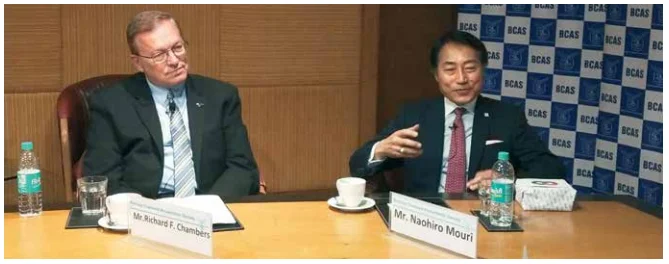
From Published Accounts

COMPILERS’ NOTE

Reporting by Auditors is becoming onerous every year with new clauses being added. Also, to take care of the increasing regulatory expectations, auditors need to be careful on every word they include in their report. Given below is an illustrative Auditors’ Report for FY 2022-23 issued for one of the early reporting companies.

INDEPENDENT AUDITOR’S REPORT TO THE MEMBERS OF INFOSYS LTD

Report on the Audit of the Standalone Financial Statements

Opinion

We have audited the accompanying standalone financial statements of Infosys Ltd (the “Company”), which comprise the Balance Sheet as on 31st March, 2023, the Statement of Profit and Loss (including Other Comprehensive Income), the Statement of Changes in Equity and the Statement of Cash Flows for the year ended on that date and a summary of significant accounting policies and other explanatory information (hereinafter referred to as the “standalone financial statements”).

In our opinion and to the best of our information and according to the explanations given to us, the aforesaid standalone financial statements give the information required by the Companies Act, 2013 (the “Act”) in the manner so required and give a true and fair view in conformity with the Indian Accounting Standards prescribed under section 133 of the Act read with the Companies (Indian Accounting Standards) Rules, 2015, as amended, (“Ind AS”) and other accounting principles generally accepted in India, of the state of affairs of the Company as at 31st March, 2023 and its profit, total comprehensive income, changes in equity and its cash flows for the year ended on that date.

Basis for Opinion

We conducted our audit of the standalone financial statements in accordance with the Standards on Auditing (“SA”s) specified under section 143(10) of the Act. Our responsibilities under those Standards are further described in the Auditor’s Responsibilities for the Audit of the Standalone Financial Statements section of our report. We are independent of the Company in accordance with the Code of Ethics issued by the Institute of Chartered Accountants of India (“ICAI”) together with the ethical requirements that are relevant to our audit of the standalone financial statements under the provisions of the Act and the Rules made thereunder, and we have fulfilled our other ethical responsibilities in accordance with these requirements and the ICAI’s Code of Ethics. We believe that the audit evidence obtained by us is sufficient and appropriate to provide a basis for our audit opinion on the standalone financial statements.

Key Audit Matters

Key audit matters are those matters that, in our professional judgment, were of most significance in our audit of the standalone financial statements of the current period. These matters were addressed in the context of our audit of the standalone financial statements as a whole, and in forming our opinion thereon, and we do not provide a separate opinion on these matters. We have determined the matters described below to be the key audit matters to be communicated in our report.

Not reproduced

INFORMATION OTHER THAN THE FINANCIAL STATEMENTS AND AUDITOR’S REPORT THEREON

The Company’s Board of Directors is responsible for the other information. The other information comprises the information included in the Management Discussion and Analysis, Board’s Report including Annexures to Board’s Report, Business Responsibility and Sustainability Report, Corporate Governance and Shareholder’s Information, but does not include the consolidated financial statements, standalone financial statements and our auditor’s report thereon.Our opinion on the standalone financial statements does not cover the other information and we do not express any form of assurance conclusion thereon.

In connection with our audit of the standalone financial statements, our responsibility is to read the other information and, in doing so, consider whether the other information is materially inconsistent with the standalone financial statements or our knowledge obtained during the course of our audit or otherwise appears to be materially misstated.

If, based on the work we have performed, we conclude that there is a material misstatement of this other information, we are required to report that fact. We have nothing to report in this regard.

RESPONSIBILITIES OF MANAGEMENT AND THOSE CHARGED WITH GOVERNANCE FOR THE STANDALONE FINANCIAL STATEMENTS

The Company’s Board of Directors is responsible for the matters stated in section 134(5) of the Act with respect to the preparation of these standalone financial statements that give a true and fair view of the financial position, financial performance, including other comprehensive income, changes in equity and cash flows of the Company in accordance with the Ind AS and other accounting principles generally accepted in India. This responsibility also includes maintenance of adequate accounting records in accordance with the provisions of the Act for safeguarding the assets of the Company and for preventing and detecting frauds and other irregularities; selection and application of appropriate accounting policies; making judgments and estimates that are reasonable and prudent; and design, implementation and maintenance of adequate internal financial controls, that were operating effectively for ensuring the accuracy and completeness of the accounting records, relevant to the preparation and presentation of the standalone financial statements that give a true and fair view and are free from material misstatement, whether due to fraud or error.In preparing the standalone financial statements, management is responsible for assessing the Company’s ability to continue as a going concern, disclosing, as applicable, matters related to going concern and using the going concern basis of accounting unless the Board of Directors either intends to liquidate the Company or to cease operations, or has no realistic alternative but to do so.

The Board of Directors is also responsible for overseeing the Company’s financial reporting process.

AUDITOR’S RESPONSIBILITIES FOR THE AUDIT OF THE STANDALONE FINANCIAL STATEMENTS

Our objectives are to obtain reasonable assurance about whether the standalone financial statements as a whole are free from material misstatement, whether due to fraud or error, and to issue an auditor’s report that includes our opinion. Reasonable assurance is a high level of assurance, but is not a guarantee that an audit conducted in accordance with SAs will always detect a material misstatement when it exists. Misstatements can arise from fraud or error and are considered material if, individually or in the aggregate, they could reasonably be expected to influence the economic decisions of users taken on the basis of these standalone financial statements.

As part of an audit in accordance with SAs, we exercise professional judgment and maintain professional scepticism throughout the audit. We also:

  • Identify and assess the risks of material misstatement of the standalone financial statements, whether due to fraud or error, design and perform audit procedures responsive to those risks, and obtain audit evidence that is sufficient and appropriate to provide a basis for our opinion. The risk of not detecting a material misstatement resulting from fraud is higher than for one resulting from error, as fraud may involve collusion, forgery, intentional omissions, misrepresentations, or the override of internal control.
  • Obtain an understanding of internal financial control relevant to the audit in order to design audit procedures that are appropriate in the circumstances. Under section 143(3)(i) of the Act, we are also responsible for expressing our opinion on whether the Company has adequate internal financial controls with reference to standalone financial statements in place and the operating effectiveness of such controls.
  • Evaluate the appropriateness of accounting policies used and the reasonableness of accounting estimates and related disclosures made by the management.
  • Conclude on the appropriateness of management’s use of the going concern basis of accounting and, based on the audit evidence obtained, whether a material uncertainty exists related to events or conditions that may cast significant doubt on the Company’s ability to continue as a going concern. If we conclude that a material uncertainty exists, we are required to draw attention in our auditor’s report to the related disclosures in the standalone financial statements or, if such disclosures are inadequate, to modify our opinion. Our conclusions are based on the audit evidence obtained up to the date of our auditor’s report. However, future events or conditions may cause the Company to cease to continue as a going concern.
  • Evaluate the overall presentation, structure and content of the standalone financial statements, including the disclosures, and whether the standalone financial statements represent the underlying transactions and events in a manner that achieves fair presentation.

Materiality is the magnitude of misstatements in the standalone financial statements that, individually or in aggregate, makes it probable that the economic decisions of a reasonably knowledgeable user of the standalone financial statements may be influenced. We consider quantitative materiality and qualitative factors in (i) planning the scope of our audit work and in evaluating the results of our work; and (ii) to evaluate the effect of any identified misstatements in the standalone financial statements.

We communicate with those charged with governance regarding, among other matters, the planned scope and timing of the audit and significant audit findings, including any significant deficiencies in internal control that we identify during our audit.

We also provide those charged with governance with a statement that we have complied with relevant ethical requirements regarding independence, and to communicate with them all relationships and other matters that may reasonably be thought to bear on our independence, and where applicable, related safeguards.

From the matters communicated with those charged with governance, we determine those matters that were of most significance in the audit of the standalone financial statements of the current period and are therefore the key audit matters. We describe these matters in our auditor’s report unless law or regulation precludes public disclosure about the matter or when, in extremely rare circumstances, we determine that a matter should not be communicated in our report because the adverse consequences of doing so would reasonably be expected to outweigh the public interest benefits of such communication.

REPORT ON OTHER LEGAL AND REGULATORY REQUIREMENTS

1.    As required by Section 143(3) of the Act, based on our audit we report that:

a.    We have sought and obtained all the information and explanations which to the best of our knowledge and belief were necessary for the purposes of our audit.

b.    In our opinion, proper books of account as required by law have been kept by the Company so far as it appears from our examination of those books.

c.    The Balance Sheet, the Statement of Profit and Loss including Other Comprehensive Income, Statement of Changes in Equity and the Statement of Cash Flows dealt with by this Report are in agreement with the books of account.

d.    In our opinion, the aforesaid standalone financial statements comply with the Ind AS specified under section 133 of the Act.

e.    On the basis of the written representations received from the directors as on 31st March, 2023 taken on record by the Board of Directors, none of the directors is disqualified as on 31st March, 2023 from being appointed as a director in terms of Section 164(2) of the Act

f.    With respect to the adequacy of the internal financial controls with reference to standalone financial statements of the Company and the operating effectiveness of such controls, refer to our separate Report in “Annexure A”. Our report expresses an unmodified opinion on the adequacy and operating effectiveness of the Company’s internal financial controls with reference to standalone financial statements.

g.    With respect to the other matters to be included in the Auditor’s Report in accordance with the requirements of section 197(16) of the Act, as amended:

In our opinion and to the best of our information and according to the explanations given to us, the remuneration paid by the Company to its directors during the year is in accordance with the provisions of section 197 of the Act.

h.    With respect to the other matters to be included in the Auditor’s Report in accordance with Rule 11 of the Companies (Audit and Auditors) Rules, 2014, as amended, in our opinion and to the best of our information and according to the explanations given to us:

i,    The Company has disclosed the impact of pending litigations on its financial position in its standalone financial statements. Refer Note 2.23 to the standalone financial statements.

ii.    The Company has made provision as required under applicable law or accounting standards for material foreseeable losses. Refer Note 2.16 to the standalone financial statements. The Company did not have any long-term derivative contracts.

iii.    There has been no delay in transferring amounts, required to be transferred, to the Investor Education and Protection Fund by the Company.

iv.    a. The Management has represented that, to the best of its knowledge and belief, other than as disclosed in the note 2.24 to the Standalone Financial Statements, no funds (which are material either individually or in the aggregate) have been advanced or loaned or invested (either from borrowed funds or share premium or any other sources or kind of funds) by the Company to or in any other person or entity, including foreign entity (“Intermediaries”), with the understanding, whether recorded in writing or otherwise, that the Intermediary shall, whether, directly or indirectly lend or invest in other persons or entities identified in any manner whatsoever by or on behalf of the Company (“Ultimate Beneficiaries”) or provide any guarantee, security or the like on behalf of the Ultimate Beneficiaries;

b.    The Management has represented, that, to the best of its knowledge and belief, no funds (which are material either individually or in the aggregate) have been received by the Company from any person or entity, including foreign entity (“Funding Parties”), with the understanding, whether recorded in writing or otherwise, that the Company shall, whether, directly or indirectly, lend or invest in other persons or entities identified in any manner whatsoever by or on behalf of the Funding Party (“Ultimate Beneficiaries”) or provide any guarantee, security or the like on behalf of the Ultimate Beneficiaries;

c.    Based on the audit procedures that have been considered reasonable and appropriate in the circumstances, nothing has come to our notice that has caused us to believe that the representations under sub-clause (i) and (ii) of Rule 11(e), as provided under (a) and (b) above, contain any material misstatement.

v.    As stated in Note 2.12.3 to the standalone financial statements

a.    The final dividend proposed in the previous year, declared and paid by the Company during the year is in accordance with Section 123 of the Act, as applicable.

b.    The interim dividend declared and paid by the Company during the year and until the date of this report is in compliance with Section 123 of the Act.

c.    The Board of Directors of the Company have proposed final dividend for the year which is subject to the approval of the members at the ensuing Annual General Meeting. The amount of dividend proposed is in accordance with section 123 of the Act, as applicable.

vi.    Proviso to Rule 3(1) of the Companies (Accounts) Rules, 2014 for maintaining books of account using accounting software which has a feature of recording audit trail (edit log) facility is applicable to the Company with effect from 1st April, 2023, and accordingly, reporting under Rule 11(g) of Companies (Audit and Auditors) Rules, 2014 is not applicable for the financial year ended 31st March, 2023.

2.    As required by the Companies (Auditor’s Report) Order, 2020 (the “Order”) issued by the Central Government in terms of Section 143(11) of the Act, we give in “Annexure B” a statement on the matters specified in paragraphs 3 and 4 of the Order.

Allied Laws

5. Jagadeesan and others vs. A. Logesh
AIR 2023 MADRAS 94
Date of order: 11th November, 2022

Registration – Unregistered agreement to sell – Non-registration is not a bar from specific performance [Registration Act, 1908, Section 17(1)(g), 49; Specific Relief Act, 1963, S. 20]

FACTS

The Plaintiff/Respondent filed a suit for the specific performance of a contract based on an unregistered agreement of sale before the District Court.

The Defendants/Petitioners challenged the maintainability of the said suit since the same was based on an unregistered sale agreement.

Hence the present petition.

HELD

In view of the express provision contained in section 49 of the Registration Act, the suit cannot be rejected on the grounds that the agreement is unregistered as per section 17 (1)(g) of the Registration Act and section 2(g) of the Contract Act. The Court referred to the decision in the case of D. Devarajan vs. Alphonse Marry & another reported in 2019 (2) CTC 290 in which it was held that the consequence of non-registration does not operate as a total bar to look into the contract. The Proviso to Section 49 of the Registration Act itself carves out two exceptions: (i) it can be used for any collateral purposes, and (ii) it can be used as an evidence in a suit for specific performance”.

In view of the above the petition was dismissed.

6. Parish Priest, Kanyakumari vs. State of Tamil Nadu
AIR 2023 MADRAS 70
Date of order: 3rd January, 2023

Gift deed – Absolute gift – failure to fulfil the purpose – In absence of revocation clause – Gift cannot return to the donor. [Transfer of Property Act, 1882, Section 126]

FACTS

The Petitioner-Church established a cooperative society in 1981 for the economic and social development of poor and gifted a piece of land to the Society. The State Government put up a shed on the said land with their own funds. The land continued to be in the possession of the church. However, with technical advancement in the field of textiles, society became redundant and was wound up in 2006.

After several requests to the State Government to reconvey the land, the Church filed a Writ in 2014. The Court directed the Respondents to consider the representation and pass orders. The Respondent rejected the application of the Church.

Hence the present Petition.

HELD

The Gift deed of 1981 was an absolute gift deed i.e., without any conditions. Therefore, the gift cannot be revoked on the objects becoming redundant. Further, the donor will not have any right to make a claim for the return of the gifted land on the failure of the purpose for which it was gifted.

The Petition was dismissed.

7. Union of India vs. Maheswari Builders, Rajasthan
AIR 2023 MADRAS 73
Date of order: 3rd  January, 2022

Arbitration – Setting aside arbitral award – Award passed after considering all the facts – No interference required.  [Arbitration and Conciliation Act, 1996, Section 34; Contract Act, 1872, 63]

FACTS

The Respondent was engaged by the Petitioner to carry out civil construction work. The Respondent requested an extension of time for completing certain phases of the project as per their contract and the same would be granted. An issue arose between them with respect to the claims made by the Respondent and the Respondent invoked the arbitration clause.

Before the Arbitration Tribunal, after making its claims, the Respondent vide an affidavit withdrew from the arbitration and submitted before the Arbitration Tribunal that the affidavit was submitted under the pressure of the Petitioner on a promise for an extension of time. The Tribunal on considering all the facts passed an order allowing some of the claims of the Respondent.

The award was challenged.

HELD

The award was challenged on the grounds that the Arbitration proceedings should not have proceeded when both the parties had withdrawn from the Arbitration. It was held that the Arbitrator was economical with reasons in support of the order. As the affidavit was not given under free consent, the same cannot be considered as it amounts to coercion. The award was passed after considering all the facts of the case.

The Application is dismissed.

8. Shri Ram Shridhar Chimurkar vs. Union of India and another
AIR 2023 SUPREME COURT 618
Date of order: 17th January, 2023

Succession – Pension – Government employee – Adoption after death by the spouse – Not a family member [Central Civil Services (Pension) Rules, 1972, R. 54, Constitution of India]

FACTS

In the instant case after the death of a retired government employee, his widow adopted a son. The adopted son claimed that they were entitled to family pension payable to the family of the deceased government employee. On the rejection of his plea, the appellant filed an application before the Central Appellate Tribunal. The Tribunal allowed the application and directed the Respondents to consider the Appellant’s claim for family pension by treating him as the adopted son of the deceased government employee directing the Respondents to consider the plea of the appellant.

On a Writ Petition, the Hon’ble High Court reversed the order of the Tribunal. Hence the present appeal.

HELD

The Supreme Court considered provisions of the Hindu Adoptions and Maintenance Act, 1956 (HAMA Act). It highlighted that the provisions of the HAMA Act determine the rights of a son adopted by a Hindu widow only vis-à-vis his adoptive family. Rights and entitlements of an adopted son of a Hindu widow, as available in Hindu Law, as against his adoptive family, cannot axiomatically be held to be available to such adopted son, as against the government, in a case specifically governed by extant pension rules. It held that Rule 54 (15)(b) of the Central Civil Services (Pension) Rules, 1972 states that a legally adopted son or daughter by a government servant would be entitled to a family pension. The phrase “in relation to” would be vis-à-vis the Government servant and not his widow.

The appeal is dismissed.

9 GM Heights LLP vs. Municipal Corporation of Greater Mumbai and Ors
WP No. 5303 of 2022 (Bom)(HC) (UR)
Date of order: 29th March, 2023

Tenancy – Tenants – limited rights – Cannot dictate the terms of redevelopment. [Mumbai Municipal Corporation Act, 1888, Section 354, Development Control and Promotion Regulations for Greater Mumbai, R. 33(19), 33(7)(A) ]
 
FACTS

The Petitioner is an LLP and the owner of the land. There was a building standing on the land, which had 21 tenants. The building had some commercial tenements and some  residential tenements. The building had become dilapidated. A notice was issued by the respondent-Municipal Corporation of Greater Mumbai to the owners/occupants under Section 354 of the Mumbai Municipal Corporation Act, 1888. The building ultimately was demolished in August 2021.

The petitioner, in these circumstances, proposed to undertake redevelopment so as to construct a commercial building, which according to the petitioner was permissible as per the rules.

Out of 21 tenants, one tenant (respondent no. 3) objected to the permanent alternate accommodation. The petitioner approached the Court primarily on the grounds that respondent no.3 who is only one tenant out of the majority of the 21 tenants, cannot obstruct the redevelopment in such condition as inserted in the Intimation of Disapproval  (IOD) by the Municipal Corporation.

HELD

Respondent no.3 is not entering into an agreement for an alternate accommodation with the petitioner and thereby is stalling the entire redevelopment. The approach of respondent no.3 in the present case is most unreasonable and adamant. Respondent no.3, in fact, by his obstinate conduct is stalling the entire redevelopment, which he certainly cannot do. Respondent no.3 in his capacity as a tenant has limited rights. Respondent No.3 within the ambit of such rights cannot dictate to the petitioner-owner, as to the nature of redevelopment. Recognising such rights would, in fact, take away and/or obliterate the legal rights of the owners of property to undertake redevelopment in a manner as may be permissible in law, including under the Development Control and Promotion Regulations. Thus, tenants cannot take a position to foist, dominate and/or dictate to the owner the nature and the course of redevelopment the owner desires to have. The rights of the owners of the property to undertake redevelopment of the manner and type they intend, cannot be taken away by the tenants, minority or majority. Tenancy rights cannot be stretched to such an extent that the course of redevelopment can be taken over by the tenants, so as to take away the basic corporeal rights of the owner of the property, to undertake redevelopment of the owner’s choice. The only rights the tenants have would be to be provided with an alternate accommodation of an equivalent area occupied by them before the building was demolished.

The Petition was allowed.

Goods and Services Tax

I. SUPREME COURT

9. State of Karnataka vs. Ecom Gill Coffee Trading Pvt Ltd (2023) 4 Centax 223 (SC)
Date of order:  13th March, 2023

A burden to prove goods were actually received for the genuineness of ITC claimed was on the purchaser and not on Department   

FACTS

The respondent was a dealer in coffee beans. The Adjudicating Authority issued a show cause notice after noticing some irregularities in the availment of ITC claimed by the respondent. The authority denied ITC on the grounds of doubt in the genuineness of purchases made since registrations of sellers were cancelled/they had filed nil returns. The Appellate Authority also rejected the Respondent’s claim. However, the Tribunal ruled in favor of the Respondent and allowed ITC considering that payments were made through bank transactions against proper invoices. The high court affirmed the Tribunal order. Being aggrieved by such an order, the Department filed an appeal before Hon’ble Supreme Court.

HELD

The Hon’ble Supreme Court held that the burden of proving the genuineness of claiming ITC remains on the respondent. Merely producing invoices or substantiating payment through a bank was not sufficient to prove the actual receipt of goods. Furnishing cogent material like the name and address of the selling dealer, details of the vehicle which has delivered the goods, payment of freight charges, acknowledgment of taking delivery of goods, tax invoices, payment particulars and the actual physical movement of the goods was on Respondent. Thus, the impugned order passed by Tribunal and High Court was set aside.

II. HIGH COURT

10. Wipro Ltd vs. ACIT, Bengaluru
2023 4 Centax 179 (Kar.)
Date of order: 6th January, 2023

The benefit of Circular No. 183/15/2022-GST dated 27th December, 2022 which provides relief for errors pertaining to 2017-18 and 2018-19 would also be extended for 2019-20 where identical errors were committed.

FACTS

Petitioner had filed a GSTR-1 return for the F.Ys. 2017-18, 2018-19, and 2019-20 and had inadvertently mentioned the wrong GSTIN of the recipient. Further, the recipient availed input tax credit which created a mismatch between Form GSTR2A and GSTR3B filed by the recipient. The petitioner filed an affidavit stating that all the conditions in paragraph 4.1.1 of Circular No. 183/15/2022-GST dated 27th December, 2022 have been complied with by enclosing details of invoices. Thereafter, a petition was filed before Hon’ High Court requesting to access the GST portal to rectify Form GSTR-1 for F.Y. 2017-18 to F.Y. 2019-20 on the ground that identical error was committed in all the years due to bonafide reasons as prescribed by the circular.

HELD

By adopting a justice-oriented approach, the High Court held that though the circular refers only to years 2017-18 and 2018-19, the petitioner would also be entitled to the benefits of the abovementioned Circular for ITC pertaining to F.Y. 2019-20, since identical errors had occurred during that period. Thus, the petition was allowed in favor of the petitioner.

11. Yash Kothari Public Charitable Trust vs. State of U.P.
(2023) 4 Centax 159 (All.)
Date of order: 16th January, 2023

Appeal filed in offline mode cannot be denied by respondent where order against which was not available on GST portal owing to some technical issue.

FACTS

The petitioner was a registered public charitable trust. He claimed certain exemptions which were not granted by the assessment order passed on 12th January, 2022. The petitioner reversed certain ITC through Form GSTR-3B, filed on 8th February, 2022. He tried to file an online appeal for the balance, but an error was displayed on the web portal. A complaint was raised by submitting a letter to the authority. Further, an appeal was filed offline. The Appellate Authority dismissed the appeal on the grounds that acknowledgment of the appeal should be filed online or as notified by the commissioner as per Rule 108 of the CGST Act. Being aggrieved by such a dismissal, a writ petition was filed before Hon’ble High Court.

HELD

The High Court relied upon its earlier decision in the matter of Ali Cotton Mill vs. Appellate Joint Commissioner (ST),2022 (56) GSTL 270 (AP) [Para 20] and held that filing an appeal offline was tenable although Commissioner has not specified any other mode of filing. Accordingly, taxing authorities cannot stop the petitioner from claiming his statutory right on grounds of technicality and directed the Appellate Authority to consider the appeal filed offline. Therefore, the appeal was partly allowed in favor of the petitioner.

12 Premier Sales Promotion Pvt Ltd vs. Union Of India  
2023 (70) GSTL 345(Kar)
Date of order: 16th January, 2023

GST is not applicable on vouchers as those are neither goods nor services since they merely represent value of future redeemable goods and services.

FACTS

The petitioner was acting as an intermediary in procuring pre-paid vouchers for companies who issue them to their employees as incentives that can be redeemed against goods or services as specified. He submitted an application before Karnataka Authority for Advance Ruling for clarification on whether vouchers are taxable and when and at what rate. The order passed through advance ruling stated that the supply of vouchers will be taxable as goods/services at the time of supply at the rate of 18 per cent. The petitioner challenged the order on the grounds that vouchers are not goods/services, but mere instruments and tax should be levied at the time of redemption of voucher. The Appellate Authority affirmed the order passed by the Advance Ruling Authority. Aggrieved, the assessee filed the writ petition.

HELD

It was held that the issuance of vouchers is similar to pre-deposit and not a supply of goods or services. Hence, vouchers are neither goods nor services and therefore cannot be taxed. Accordingly, the order passed by the Advance Ruling Authority was quashed. The petition was allowed in favor of the petitioner.

13 Mehndihasan Rahemtulla Hariyani vs. Deputy Commissioner of Revenue 2023 (70) GSTL 272 (Cal.)
 Bureau of Investigation (North Bengal), Alipurduar
Date of order: 3rd November, 2022

Any person aggrieved by any decision or order passed under CGST Act may file an appeal even though the proceedings were not initiated against him.

FACTS

The petitioner was the consignee of the goods transported through a vehicle. The respondent intercepted and confiscated goods as well as a conveyance under section 129 of the West Bengal GST Act (WBGST). Further proceedings were initiated against the driver/person in charge of the vehicle and tax and penalty were imposed. Aggrieved by the same, the petitioner filed an appeal under section 107 of the WBGST Act against the order passed. The Appellate Authority rejected the appeal stating that the order was passed against the driver of the relevant vehicle and the petitioner had no right to challenge the said order. Being aggrieved by such rejection, the petitioner filed a writ petition.

HELD

Hon’ble High Court held that section 107 of the WBGST Act states that any person aggrieved by the order may appeal to the Appellate Authority within the time limit prescribed. The petitioner’s goods were confiscated along with conveyance and thus had justified reasons for being aggrieved by such order. The appeal filed by the petitioner should be heard by the Appellate Authority in accordance with the law. Thus, the appeal was disposed off in favor of the assessee.

14 Ayann Traders vs. State of U.P [2023] 148
taxmann.com 357 (Allahabad)
Date of order: 27th February, 2023

In the facts and circumstances of the case, and evidence leading to the conclusion that the dealer has evaded the tax, the Court upheld the action of revenue authorities stating that if the movement had not been commenced on the same day when the e-way bill was generated, the said e-way bill should be cancelled electronically as per Rule 138(9) failing which the concerned authorities can seize the goods.

FACTS

Petitioner sold 300 bags of Pan Masala to a dealer in Meghalaya. According to the petitioner, goods were handed over to the transporter for transporting by truck, and an E-Way bill was generated on 08th April, 2018 i.e. the same day. However, the truck was made available to the petitioner for transportation on 17th April, 2018, as it was not available from 07th April, 2018. The petitioners did not cancel the E-way bill. The goods were intercepted on 18th April, 2018 and the seizure order was passed on 1st May, 2018.

Before the Hon’ble High Court, the revenue raised apprehensions about the number of transactions that possibly could have been made during this period on the strength of the same tax invoice, bilty, and E-Way Bill generated on 08th April, 2018 through the same vehicle. To illustrate the same, they pointed out that E-Way Bill, which was generated on 08th April, 2018, and a transporter bill, both specifically mentioned the same vehicle number which means that the transit of goods had taken place on 08th April, 2018. They also pointed out that another E-Way bill was generated on 08th April, 2018 for the same vehicle for the transportation of fruits and vegetables to West Bengal. Further, one more E-way bill was generated on 12th April, 2018 being bility no.305 for transporting rice to Darbhanga (Bihar) and, on inquiry, it was found that no such goods were transported to the dealer at Darbhanga and the firm had closed down two months back. It was further brought to the notice of the Court that the said vehicle has been found to have passed from 08th April, 2018 to 18th April, 2018 through three toll plazas viz., Anantram Toll Plaza, Badori Toll Plaza, Fatehpur, and Kokhraj Toll Plaza, Allahabad. It was further stated that the purchasing dealer did not come forward nor any explanation was furnished after the notice was issued when the goods were intercepted and the vehicle was detained.

HELD

Looking at the facts and evidence brought before it, the Hon’ble Court concluded that through the tax invoice and E-Way Bill generated on 08th April, 2018, the dealer has made several transactions and evaded tax. Referring to Chapter XVI of the CGST Rules, it held that once, Part-B of Form GST EWB-01 is filled, a presumption is raised that the goods are in movement. However, if the movement of goods has not commenced, the legislature has provided for a way out through Rule 138(9) whereby E-Way which has been generated on the common portal, may be canceled electronically. The dealer in the present case had waited for 10 long days and did not cancel the E-Way Bill generated by him on the common portal, though, the vehicle was not provided by the transporter. In these circumstances, the Hon’ble Court held that there has been a complete misuse of statutory provision of the Act and Rules by the dealer, and the inference drawn by the taxing authorities after an interception of goods needs no interference by the Court.
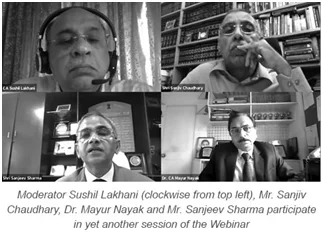
15. Sri Sai Balaji Associates vs. State of Andhra Pradesh  [2023] 149 taxmann.com 66 (Andhra Pradesh)
Date of order: 7th March, 2023
 
Section 70(1)  does not empower the GST officer to issue a summon to the customers of the assessee instructing them for stopping payment to the assessee.

FACTS

The Petitioner’s customer was issued a notice under section 70(1) of the CGST Act directing to stop payments to the petitioner. Aggrieved by the same the petitioner filed a writ petition before the High  Court.
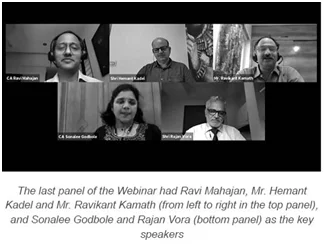
HELD

The Hon’ble Court observed that the impugned notice was issued under section 70(1) of the GST Act but not under section 83 of the GST Act. Section 70(1) of the GST Act only says that the proper officer shall have the power to summon any person whose attendance is considered necessary either to give evidence or to produce a document or any other thing in the inquiry and nothing more. The Court, therefore, held that under section 70(1) of the GST Act, the proper officer cannot exercise powers to direct the summoning party to stop payment to the assessee which is beyond the scope of section 70(1) of the GST Act.

16 . New Hanumat Marbles vs. State of Punjab [2023]
149 taxmann.com 82 (Punjab & Haryana)
Date of order: 30th January, 2023

The Hon’ble Court sets aside adjudication/assessment orders passed without uploading the summary of the Show Cause Notice on the web portal in Form DRC-01 under Rule 142(1) (a) of the CGST Rules.

FACTS

Summons/notices were issued to the assessee before initiating proceedings of passing an assessment order under section 74(5) of the Central GST Act/Punjab GST Act, 2017. As the petitioner did not appear, the matter was decided ex-parte, and the order was passed. The petitioner challenged the said order on the ground that before passing the final order on assessment, Rule 142(1) of the CGST Act is mandatory to be followed and GST DRC-01 has to be uploaded electronically on the website.

HELD

The Court observed that the department did not upload the notice on the website of the revenue as per Rule 142(1) of the CGST Act, 2017 before passing final orders. On this ground, the said orders were set aside and the matter was remanded back to the officer for passing fresh orders and after issuing notice as contemplated under Rule 142(1) of the CGST Act and affording the opportunity of hearing to the petitioner(s) in accordance with the law.

17. Shree Shyam Granites and Marbles vs.Assistant Commissioner (ST) (FAC), Hosur (South) III Circle [2023] 148 taxmann.com 463 (Madras)
Date of order: 13th February, 2023

Principles of natural justice are violated when no reasons were given by the Revenue for rejecting the assessee’s objections raised in replies and a personal hearing was afforded to the assessee before replies were received by the Revenue

FACTS

The petitioner challenged the orders on the grounds of violation of the principles of natural justice.

HELD

The Court observed that the petitioner has already submitted replies to the show cause notice clarifying the defects pointed out by the department stating that there is no mismatch for which they have also substantiated through documents. However, the said replies have not been considered in the impugned assessment orders.  Further, a personal hearing was afforded to the petitioner prior to the receipt of the replies of the petitioner by the respondent. The Court held that only after a reply is sent by the assessee, the Authority can apply its mind, and if they contemplate an adverse decision for which they must provide an opportunity of a hearing. Hence, issuing a personal hearing notice prior to the receipt of the explanation from the petitioner cannot be said to be in compliance of Section 75 (4) of the TNGST Act, 2017. The impugned assessment orders were thus quashed.

18. Mohan Agencies vs. State of U.P. [2023]
148 taxmann.com 323 (Allahabad)  
Date of order: 13th February, 2023

The opportunity of a personal hearing is mandatory before passing an adverse order even if the taxpayer had selected “NA” against personal hearing in the online mode.

FACTS

The petitioner challenged the order passed by the Assistant Commissioner on the basis that a show cause notice seeking a reply was issued but at that stage itself authority chose not to give any personal hearing by mentioning ‘NA’ against the column of “date of personal hearing”.

HELD

The Hon’ble Court reiterated the principle of law laid down in the case of  Bharat Mint & Allied Chemicals v. Commissioner Commerical Tax & 2 Ors., [2022] 48 VLJ 325 that the assessee is not required to request for an opportunity of personal hearing and it is mandatory for the authority to afford such opportunity before passing an adverse order. The fact that the petitioner may have signified ‘No’ in the column meant to mark the assessee’s choice to avail personal hearing, would bear no legal consequence.
19 Swasti Rubber Agency vs. State of Tripura [2023]
149 taxmann.com 4 (TRIPURA)
Date of order: 7th December, 2022

When the department issued a show cause notice for cancellation of registration and suspended the GST registration simultaneously with the issue of such notice and also kept the registration suspended even after furnishing of the replies by the assessee, the Hon’ble Court directed the GST officer to consider the explanation submitted by the assessee expeditiously and revoke the suspension if the orders are not passed within 2 weeks.

FACTS

The order of cancellation of GST Registration was passed. Also, allegations of claiming excess input tax credit (ITC) were raised. While issuing a show-cause notice for the cancellation of the GST registration, simultaneously order of suspension of registration was also passed without affording any opportunity of hearing to the petitioner and/or without assigning any reason thereof. Also, the explanation submitted by the petitioner was not considered by the respondent authority. The Petitioner challenged the show-cause notice on the ground that though the Petitioner-dealer had replied to the impugned show-cause notice on 11th November, 2022and 23rd November, 2022, the respondent authority did not communicate any decision and kept suspending the registration.

HELD

The Hon’ble Court directed the department to consider the explanation submitted to show-cause notice within two weeks and held that in any event, if the explanation is not considered and final orders are not passed, the suspension order shall stand revoked.

20 Ernst & Young Ltd. vs. Additional Commissioner, Central Goods, and Services Tax Appeals-IT [2023] 148 taxmann.com 461 (Delhi) dated 23-03-2023

Professional services provided to overseas entities do not amount to intermediary services merely because such services are provided as outsourced services or on behalf of the third party for its customers if such services are directly provided and do not amount to facilitating or arranging of services between the overseas entity and third party.

FACTS

The assessee entered into service agreements for providing professional consultancy services to various entities of E&Y group located abroad. In terms of those agreements, the petitioner had provided various professional services to overseas EY Entities, and invoices raised described the nature of services for the invoiced amount as “Professional Fees for Services”. A refund was duly filed by the petitioner but the Refund of input tax credit (ITC) was rejected on the grounds that such services qualify as intermediary services as it was provided on behalf of group companies in India to such group companies overseas clients. The Appellant Authority confirmed the order of Adjudicating Authority. The petitioner thus challenged the said order before the High Court.

HELD

The Hon’ble High Court held that the reasoning adopted by the authorities that because the party provides services on behalf of E&Y Ltd, UK in India to overseas clients of E&Y Ltd, UK, it is rendering intermediary services is fundamentally flawed.  Referring to the definition of ‘intermediary’ under section 2(13) of the IGST Act, the Court held that the last line of the definition (i.e. “but does not include a person who supplies such goods or services or both or securities on his own account”) merely clarifies that the definition is not to be read in an expansive manner and would not include a person who supplies goods, services or securities on his own account. The Court further held that there may be services entailing outsourcing some constituent part to a third party, but that would not be construed as intermediary services if the service provider provides services to the recipient on his own account; as opposed to merely putting the third party directly in touch with the service recipient and arranging for the supply of goods or services. Thus, even if it is accepted that the petitioner has rendered services on behalf of a third party, the same would not result in the petitioner falling within the definition of ‘intermediary’ under section 2(13) of the IGST Act as it is the actual supplier of the professional services and has not arranged or facilitated the supply from any third party. Referring to the letter issued by RBI the Court held that merely because one of the activities that could be carried on by the petitioner is to act as buying/selling agent in India does not mean that the petitioner had carried on such activities and the invoices raised were for services as a buying/selling agent.

Glimpses of Supreme Court Rulings

33 State Bank of India vs. ACIT
(2022) 449 ITR 192

Exemption – Leave Travel Concession – LTC is for travel within India, from one place in India to another place in India . It should be by the shortest possible route between the two destinations – The moment employees undertake travel with a foreign leg, it is not a travel within India and hence not covered under the provisions of Section 10(5) of the Act.

The Assessee, a Public Sector Bank, namely, the State Bank of India (SBI), was held to be an “Assessee in default”, for not deducting the tax at source of its employees.

These proceedings started with a Spot Verification under section 133A when it was discerned by the Revenue that some of the employees of the assessee- employer had claimed LTC even for their travel to places outside India. These employees, even though, raised a claim of their travel expenses between two points within India but had also travelled to a foreign country between these two points , thus taking a circuitous route for their destination which involved a foreign place. The matter was hence examined by the AO who was of the opinion that the amount of money received by an employee as LTC is exempted under section 10(5) of the Act, however, this exemption could not be claimed by an employee for travel outside India which had been done in this case. Therefore the assessee-employer defaulted in not deducting tax at source from this amount claimed by its employees as LTC. There were two violations of the LTC Rules, pointed out by the AO:

A. The employee did not travel only to a domestic destination but to a foreign country as well; and

B. The employees had admittedly not taken the shortest possible route between the two destinations thus the Appellant was held to be an Assessee in default by the AO.

The travel undertaken by the employees as LTC was hence in violation of Section 10(5) of the Act read with Rule 2B of the Income Tax Rules, 1962.

The order of the AO was challenged before CIT (A), which was dismissed and so was their appeal before the ITAT .

The Delhi High Court vide its order dated 13th January, 2020 dismissed the appeal filed by the Appellant and upheld the order passed by the ITAT dated 09th July, 2019, holding the Assessee-employer as an Assessee in default for the A.Y. 2013-14, for not deducting TDS of its employees. It was held that the amount received by the employees of the Assessee-employer towards their LTC claims was not eligible for the exemption as these employees had visited foreign countries, which was not permissible under the law. It was held that there was no substantial question of law in the Appeal.

The question therefore which fell for consideration of the Supreme Court was whether the Assessee was in default for not deducting tax at source while releasing payments to its employees as Leave Travel Concession (LTC) in the facts given above.

The Supreme Court after noting the provisions of law observed that they prescribe that the airfare between the two points within India will be given, and the LTC which will be given will be of the shortest route between these two places, which have to be within India. According to the Supreme Court, a conjoint reading of the provisions with the facts of this case could not sustain the argument of the Appellant that the travel of its employees was within India and no payments were made for any foreign leg involved.

The Supreme Court noted from the records that many of the employees of the Assessee had undertaken travel to Port Blair via Malaysia, Singapore or Port Blair via Bangkok, Malaysia or Rameswaram via Mauritius or Madurai via Dubai, Thailand and Port Blair via Europe, etc.

According to the Supreme Court, the contention of the Appellant that there is no specific bar under section 10(5) for a foreign travel and therefore a foreign journey could be availed as long as the starting and destination points remain within India was also without merits. According to the Supreme Court there was no ambiguity that LTC is for travel within India, from one place in India to another place in India.

According to the Supreme Court, the moment employees undertake travel with a foreign leg, it is not a travel within India and hence not covered under the provisions of Section 10(5) of the Act.

The Supreme Court rejected the second argument urged by the Appellant that payments made to these employees was of the shortest route of their actual travel.

The Supreme Court noted that a foreign travel also frustrates the basic purpose of LTC. The basic objective of the LTC scheme was to familiarise a civil servant or a Government employee to gain some perspective of the Indian culture by traveling in this vast country. It is for this reason that the Sixth Pay Commission rejected the demand of paying cash compensation in lieu of LTC and also rejected the demand of foreign travel.

The contention of Assessee that there may be a bona fide mistake by it in calculating the ‘estimated income’ was also rejected by the Supreme Court since all the relevant documents and material were before the Assessee-employer at the relevant time and the Assessee employer therefore ought to have applied his mind and deducted tax at source as it was his statutory duty, under section 192(1) of the Act.

According to the Supreme Court, there was no reason to interfere with the order passed by the Delhi High Court. The appeal was therefore dismissed.

34 Singapore Airlines Ltd. vs. CIT. Delhi and other connected appeals
(2022) 449 ITR 203 (SC)

Deduction of tax at source – Commission – The travel agents are “acting on behalf of” the airlines during the process of selling flight tickets – On the tickets sold, a 7% commission designated by the IATA is paid to the travel agent for its services as “Standard Commission” based on the price bar set by the IATA – In addition, they retain the difference between the Net Fare and the IATA Base Fare and the entire differential is characterized as a Supplementary Commission – The airlines are liable to deduct TDS under section 194H on both the amounts.

Spurred by the reintroduction of Section 194H in the IT Act by the Finance Act, 2001, the Revenue sent out notices for A.Y. 2001-02 to the air carriers operating in the country to adhere to the requirements for deduction of TDS. Upon suspecting deficiencies on the part of certain airlines in their compliance with statutory requirements under the IT Act, the Revenue carried out surveys under section 133A of the IT Act. Following the investigation, the Assessee airlines were allegedly found to have paid their respective travel agents certain amounts as Supplementary Commission on which the purported TDS that the carriers had failed to deduct was as follows:

Assessee Supplementary
Commission
Short
fall in deduction of TDS
Singapore Airlines Rs. 29,34,97,709 Rs. 2,93,49,770 (not including surcharge)
KLM Royal Dutch Airlines Rs. 179,00,49,410 Rs. 18,25,85,040 (not including surcharge)
British Airways Rs. 46,24,28,310 Rs. 4,71,67,688 (including surcharge)

Subsequently, successive Assessment Orders were passed holding that the airlines were Assessees in default under section 201 of the IT Act for their failure to deduct TDS from the Supplementary Commission, and the demands raised by the Revenue in respect of each of them were confirmed.

Following addition of surcharge, and interest under section 201(1A), the aggregate amount calculated as being owed to the Revenue was:

Assessee
(Liability)
Surcharge
+ Interest
Aggregate
amount
Singapore Airlines

( Rs.
2,93,49,770)

Rs. 58,700 + Rs. 21,13,224 Rs. 3,19,21,694
KLM Royal Dutch Airlines

( Rs.
18,25,85,040)

Rs. 2,24,26,580

(interest only)

Rs. 20,50,11,620
British Airways

( Rs.
4,71,67,688)

Rs. 60,08,391

(interest only)

Rs. 5,31,76,079

Penalty proceedings were directed to be initiated against all the Assessees under section 271C of the IT Act.

The Assessees filed their respective appeals before the CIT(A) against the Assessment Orders. The CIT (A) passed a common order, rejecting the appeals on merits but directing that any transactions dated prior to 01st June, 2001, the date on which Section 194H came into effect, would be excluded from the demand for TDS.

The Assessees subsequently approached ITAT. In CA No. 6964-6965 of 2015 concerning Singapore Airlines, the ITAT accepted the contentions of the Assessee and set aside the order passed against it, while holding that:

(i) The amount realized by the travel agent over and above the Net Fare owed to the air carrier is income in its own hands and is payable by the customer purchasing the ticket rather than the airline;

(ii) The “Supplementary Commission”, therefore, was income earned via proceeds from the sale of the tickets, and not a commission received from the Assessee airline;

(iii) The airline itself would have no way of knowing the price at which the travel agent eventually sold the flight tickets;

(iv) Section 194H referred to “service rendered” as the guiding principle for determining whether a payment fell within the ambit of a “Commission”. In this case, the amounts earned by the agent in addition to the Net Fare are not connected to any service rendered to the Assessee;

(v) The Revenue had erroneously and baselessly assumed that the travel agent had, in each of his dealings, realised the entire difference between the Net Fare and the Base Fare set by International Air Transport Association (“IATA”) and characterised the entire differential as a Supplementary Commission. Section 194H could not be pressed into operation on the basis of such surmises and without actual figures being proved.

The ITAT followed the same reasoning and allowed the appeals by the Assessees in the remaining Civil Appeals.

Aggrieved by the quashing of the orders, the Revenue brought separate appeals before the Delhi High Court.

A Division Bench of the High Court clubbed together various Income Tax Appeals all of which concerned tax liability for the airline industry. In the context of the applicability of Section 194H of the IT Act, the Division Bench reversed the findings of the ITAT and restored the Assessment Orders. The relevant part of the High Court judgment may be summarised as follows:

(i) The principles to be kept in mind when interpreting the application of Section 194H of the IT Act are:

a. The existence of a principal-agent relationship between the Assessee airlines and the travel agents;

b. Payments made to the travel agents in the nature of a commission;

c. The payments must be in the course of services provided for sale or purchase of goods;

d. The income received by the travel agent from the Assessees may be direct or indirect, given expansive wording of Section 194H;

e. The stage at which TDS is to be deducted is when the amounts are rendered to the accounts of the travel agents;

(ii) All the Assessees had accepted that a principal-agent relationship subsisted between them and the travel agents. The terms of the Passenger Sales Agency Agreements (“PSA”) also indicated that the actions of the agents in procuring customers were done on behalf of the airlines and not independently;

(iii) Hence, the additional income garnered by the agents was inextricably linked with the overall principal-agent relationship and the responsibilities that they were entrusted with by the Assessees;

(iv) There was no transfer in terms of title in the tickets and they remained the property of the airline companies throughout the transaction;

(v) The Assessees were only required to make the deductions under section 194H of the IT Act when the total amounts were accumulated by the BSP (Billing and Settlement Plan)

The High Court re-imposed the tag of “Assessee in default” under section 201 and the levy of interest on short fall of TDS under section 201(1A) on the Assessees.

The aggrieved Assessees therefore approached the Supreme Court.

The Supreme Court noted that within the aviation industry during the relevant period, the base fare for air tickets was set by the IATA with discretion provided to airlines to sell their tickets for a net fare lower than the Base Fare, but not higher. In essence, the IATA set the ceiling price for how much airlines may charge their customers. This formed part of the IATA’s overall responsibility of overseeing the functioning of the industry.

The air carriers were also required to provide a fare list to the Director General of Civil Aviation (“DGCA”) for approval. The prices that were rubber stamped by the DGCA may be equivalent to or lower than the Base Fare set by the IATA. Alongside setting the standard pecuniary amount for tickets, the IATA would provide blank tickets to the travel agents acting on behalf of the airlines to market and sell the travel documents. The arrangement between the airlines and the travel agents would be governed by PSAs. The draft templates for these contracts are drawn up by the IATA and entered into by various travel agents operating in the sector, with the IATA which signs on behalf of the air carriers. The PSAs set the conditions under which the travel agents carry out the aforementioned sale of flight tickets, along with other ancillary services, and the remuneration they are entitled to for these activities.

Once these tickets were sold, a 7% commission designated by the IATA would, be paid to the travel agent for its services as “Standard Commission” based on the price bar set by the IATA. This would be independent of the Net Fare quoted by the air carriers themselves. The 7 per cent commission on the Base Fare consequently triggered a requirement on the part of the airline to deduct TDS under section 194H at 10 per cent plus surcharge. The details of the amounts at which the tickets were sold would be transmitted by the travel agents to an organisation known as the Billing and Settlement Plan (“BSP”). The BSP functions under the aegis of the IATA and manages inter alia logistics vis-à-vis payments and acts as a forum for the agents and airlines to examine details pertaining to the sale of flight tickets.

The BSP stores a plethora of financial information including the net amount payable to the aviation companies, discounts, and commission payable to the agents. The system consolidated the amounts owed by each agent to various airlines following the sale of the tickets by the former. The aggregate amount accumulated in the BSP would then be transmitted to each air carrier by the IATA in a single financial transaction to smoothen the process and prevent the need to make multiple payments over time.

Within this framework, the airlines would have no control over the Actual Fare at which the travel agents would sell the tickets. While the ceiling price could not be breached, as mentioned earlier, the agents would be at liberty to set a price lower than the Base Fare pegged by the IATA, but still higher than the Net Fare demanded by the airline itself. Hence, the additional amount that the travel agents charged over and above the Net Fare that was quoted by the airline would be retained by the agent as its own income.

An illustration of how such a transaction would be carried out and the monetary gains made by the respective parties is shown below:

Base fare for
Singapore – Delhi (set by IATA)
Net fare (set by the
Airline)
Actual fare (set by
the travel agent)
Standard commission
(7 per cent of the base fare)
Supplementary
Commission (actual fare – net fare)
Rs. 1 lakh Rs. 60,000 Rs. 80,000 7 per cent of  Rs. 1 lakh = Rs. 7,000 Rs. 80,000  –

Rs. 60,000  =

Rs. 20,000

Ceiling price Income of the assesee Rs. 20,000 left after
payment of net fare to the assessee
Income of the travel
agent
Additional income of
the travel agent

This auxiliary amount charged on top of the Net Fare was portrayed on the BSP as a “Supplementary Commission” in the hands of the travel agent.

Thus, according to the Supreme Court, the heart of the dispute between the Assessee airlines and the Revenue in this case was the characterisation of the income earned by the agent besides the Standard Commission of 7 per cent and whether this additional portion would be subject to TDS requirements under section 194H.

According to the Supreme Court, Explanation (i) of Section 194H highlights the nature of the legal relationship that exists between two entities for payments between them to qualify as a “commission”. Consequently, it must be to determined whether the travel agents were “acting on behalf of” the airlines during the process of selling flight tickets. The Supreme Court noted that the Assessees were not disputing that a principal-agent relationship existed during the payment of the Standard Commission. The point on which the air carriers differ from the Revenue was the purported second part of the transaction i.e. when the tickets were sold to the customer and for which the travel agents earned certain amounts over and above the Net Fare set by the Assessees.

The Supreme Court noted the definition of a “principal” and an “agent” under section 182 of the Contract Act. As per the definition – an “agent” is a person employed to do any act for another, or to represent another in dealings with third persons. The person for whom such act is done, or who is so represented, is called the “principal”.

The Supreme Court after referring to the catena of cases elaborating on the characteristics of a contract of agency, was of the opinion that the following indicators could be used to determine whether there is some merit in the Assessees’ contentions on the bifurcation of the transaction into two parts: Firstly, whether title in the tickets, at any point, passed from the Assessees to the travel agents; Secondly, whether the sale of the flight documents by the latter was done under the pretext of being the property of the agents themselves, or of the airlines; Thirdly, whether the airline or the travel agent was liable for any breaches of the terms and conditions in the tickets, and for failure to fulfil the contractual rights that accrued to the consumer who purchased them.

The Supreme Court after perusing the PSA was of the view that several elements of a contract of agency were satisfied by numerous clauses, and the recitals. Every action taken by the travel agents was on behalf of the air carriers and the services they provide were with express prior authorisation. The airline also indemnified the travel agent for any shortcoming in the actual services of transportation, and any connected ancillary services, as it is the former that actually retains title over the travel documents and is responsible for the actual services provided to the final customer. Furthermore, the airline has the responsibility to provide full and final compensation to the travel agent for the acts it carries out under the PSA.

According to the Supreme Court, this led to an irresistible conclusion that the contract was one of agency that does not distinguish in terms of stages of the transaction involved in selling flight tickets. While Assessees had readily accepted the existence of the principal-agent relationship, their consternation had been directed at the so-called second limb of the deal that was exclusively between the agent and the customer. However, the submissions advanced in this regard were clearly not supported by the bare wording of the PSA itself. The High Court in the impugned judgment was correct in its holding that the arrangement between the agent and the purchaser was not a separate and distinct arrangement but is merely part of the package of activities undertaken pursuant to the PSA.

The Supreme Court, thereafter dealt with the submissions of the airlines that the principal-agent relationship does not cover the Supplementary Commission on the basis of arguments that are independent of the PSA. Primarily, it was contended that Supplementary Commission goes from the hands of the consumer and into the pockets of the travel agents without any intervention from the Assessees. Hence, the prerequisite of a payment on which TDS could be deducted in the first place was not fulfilled.

According to the Supreme Court, Section 194H of the IT Act, does not distinguish between direct and indirect payments. Both fall under Explanation (i) to the provision in classifying what may be called a “Commission”. The exact source of the payment was of no consequence to the requirement of deducting TDS. Even on an indirect payment stemming from the consumer, the Assessees would remain liable under the IT Act. Consequently, the contention of the airlines regarding the point of origination for the amounts did not impair the applicability of Section 194H of the IT Act.

The next point raised was regarding the practicality and feasibility of making the deductions, regardless of whether Section 194H may, in principle, cover the indirect payment to the travel agent. The Assessees had pointed out that the travel agent acts on its own volition in setting the Actual Fare for which the flight tickets are sold, and as a symptom of this, the airline itself has no knowledge whatsoever regarding how much Supplementary Commission it has drawn for itself. According to the Supreme Court, this contention was rebutted by the Revenue by highlighting the manner of operation of the BSP where financial data regarding the sale of tickets is stored. According to him, the BSP agglomerates the data from multiple transactions and transmits it twice a month, or bimonthly.

Keeping in mind the principal-agent relationship between the parties, the Supreme Court found significant merit in the arguments by the Revenue. According to the Supreme Court, the mechanics of how the airlines may utilise the BSP to discern the amounts earned as Supplementary Commission and deduct TDS accordingly was an internal mechanism that facilitates the implementation of Section 194H of the IT Act. Further, the lack of control that the airlines have over the Actual Fare charged by the travel agents over and above the Net Fare, cannot form the legal basis for the Assessees to avoid their liability.

The Supreme Court observed that notwithstanding the lack of control over the Actual Fare, the contract definitively states that “all monies” received by the agent are held as the property of the air carrier until they have been recorded on the BSP and properly gauged. Admittedly, the BSP demarcates “Supplementary Commission” under a separate heading. Hence, once the IATA makes the payment of the accumulated amounts shown on the BSP, it would be feasible for the Assessees to deduct TDS on this additional income earned by the agent.

Having held in favour of the Revenue in connection with the applicability of Section 194H of the IT Act, the remaining issue for the Supreme Court was to determine as to whether the matter has been rendered revenue neutral.

The travel agents who received the Supplementary Commission for A.Y. 2001-02, had already shown these amounts as their income. Subsequently, they had paid income tax on these sums. Therefore, it was contended that there had been no loss to the Revenue on this count.

The Supreme Court noting the precedents opined that if the recipient of income on which TDS has not been deducted, even though it was liable to such deduction under the IT Act, has already included that amount in its income and paid taxes on the same, the Assessee can no longer be proceeded against for recovery of the short fall in TDS. However, it would be open to the Revenue to seek payment of interest under section 201(1A) for the period between the date of default in deduction of TDS and the date on which the recipient actually paid income tax on the amount for which there had been a shortfall in such deduction.

In this context, as the Assessees had not provided the specifics of when the travel agents had paid their taxes on the Supplementary Commission, it was necessary to fill in these missing details and determine the amount of interest that the Assessees were liable to pay before this matter could be closed. The Supreme Court therefore remanded the matter back to the AO to flesh out these points in terms of the interest payments due for the period from the date of default to the date of payment of taxes by the agents.

The Supreme Court thereafter examined issue of the levy of penalties under section 271C of the IT Act. The Supreme Court noted that the AO had initially directed that penalty proceedings be commenced against the Assessees for the default in subtraction of TDS but this process was put in cold storage while the airlines and the revenue were contesting the primary issue of the applicability of Section 194H before various appellate forums.

The Supreme Court noted that Section 271C provides for imposition of penalties for failure to adhere to any of the provisions in Chapter XVII-B, which includes Section 194H. This provision must be r.w.s. 273B which excuses an otherwise defaulting Assessee from levy of penalties under certain circumstances.

The Supreme Court held that the liability of an airline to deduct TDS on Supplementary Commission had admittedly not been adjudicated upon by this Court when the controversy first arose in A.Y. 2001-02.

There were contradictory pronouncements by different High Courts in the ensuing years which clearly highlights the genuine and bona fide legal conundrum that was raised by the prospect of Section 194H being applied to the Supplementary Commission. Hence, there was nothing on record to show that the Assessees have not fulfilled the criteria under Section 273B of the IT Act. Though the contentions of the assessee were not accepted by the Supreme Court, there was clearly an arguable and “nascent” legal issue that required resolution by it and, hence, there was “reasonable cause” for the air carriers to have not deducted TDS at the relevant period. The logical deduction from this reasoning was that penalty proceedings against the airlines under section 271C of the IT Act had to be quashed.

From The President

Dear BCAS Family,

In my previous month’s communication, I had promised that I will delve deeper into the subject of ‘Capitalism’ this month. The trigger of this thought was the recent failure of a few prominent banks in the USA. Any financial collapse results in a loss to the common man the most. Also, in most cases, it is true that such collapses have their root in the unbridled greed of the few privileged people who take the wrong advantage of the eco-system provided by capitalism. If we look at the history of major failures of the enterprises or financial system we will find that somewhere human greed has subverted the purported benefits of capitalism.

The reason of examining here whether capitalism is good or bad for the society is not academic. The reason is that India today is on the cusp of a major turnaround. Socialism practised for many decades in India started to give way in the early nineties and after many years of calibrated policies and a slow change of mindset, we now sing praise for the spirit of the free enterprise promised by capitalism. Is it going to be a game changer to alleviate poverty? Is it going to reduce inequality and make India an economic superpower as is the intent? Or will it put too many at the total mercy of too few to be their potential victims? Expose the large population to the risk of economic collapse?

Let us examine the concept and explore how we could leverage the maximum benefit of capitalism and reduce the risk of exploitation of common people.

Capitalism is essentially an economic system in which the operations are privately owned; and governed by the demand of a free market. It has been the stepping stone of the industrial, technological and green revolution. It has redefined the world order and rendered the role of the state perfunctory in relation to governance. Most significantly, capitalism has enabled millions to escape the clutches of poverty, increased the standard of living and paved the way for innumerable innovations, over the past two centuries by being one of the constituents in the system of capitalism as ‘owner’ or labour or investor. One cannot but agree that capitalism has played a pivotal role in making the world a better place, though not completely!

On the flip side, capitalism has many shortcomings that have severely impacted the world. Capitalism has resulted in enormous and irreversible devastation of delicate ecological systems and the environment. It has three dysfunctions that have severely negated much of the good it has done. It has ushered in unstable and unreliable growth. Driven solely by profit, capital follows where there is an opportunity and flees when there’s a shake-up. The abrupt stifling of capital leads to a recession which results in multiple ripples of misery.

Another volcano of dissent that capitalism earns is its market-driven growth that is blinkered in its compulsive pursuit of profitability. Look at the financial sector and the numerous scandals, scams and frauds will all find their roots there. There is no consideration for the slew of side effects that are detrimental to the holistic and wholesome growth of society. Humans are reduced to a commodity to be used for the benefit of a few. Technology is introduced that eliminates jobs and increases profitability. The environment is contaminated on many fronts with toxic discharges. Look at the history of industries like pharma, automobile, and chemical just to name a few and we realize how a business enterprise started with a noble intent to provide solutions for the common good shifted its gear in blind pursuit of money.

The third prong of capitalism that punctures any possibility of a well-balanced society is the audacious inequity of the distribution of capitalist wealth. There is a very pronounced disparity in income among the many layers of the population. Those at the lower end receive almost a pittance, compared to the oversized compensations paid to the upper levels. Even the concentration of assets is skewed heavily in favour of a very small proportion of people who wield enormous control.

So… is the growing enthusiasm to shift the gear to total capitalism in India will reap dividends without the possible evils discussed above? Certainly not. Regulated economy for many years since post- independence did stifle the innovation, ideation and spirit to excel. Tightened hold of control- freak bureaucracy prevented the enterprise to be competitive and efficient. From that point of view, gradually unshackling the economy was a great move forward. But we will have to learn our lessons from the experience the world’s major economies have gone through. India will have to create a support system to sound the advance warning bell for potential collapse and also create a broad regulatory framework to minimize the impact. It is definitely laudatory that some of the regulatory agencies like SEBI, Competition Commission of India, and RBI are constantly keeping vigil and taking corrective steps. The introduction of IBC is a welcome step too.

“History shows that where ethics and economics come in conflict, victory is always with economics. Vested interests have never been known to have willingly divested themselves unless there was sufficient force to compel them.” These words of Dr. Bhimrao Ambedkar explain why capitalism has flourished unencumbered for so long. It is a different matter that this holds equally true even in the state-controlled economies where a privileged few control all the resources holding millions at ransom. Looking at the history of socialism and communism that failed heavily on their promise to bring equality there is not much of an option but to encourage free enterprise. It is only the free enterprise that can give the human being the will to excel. As Nani Palkhiwala said “Distributive justice can never get off to a start when there is nothing to distribute. Socialism is like prohibition. It is a good idea but does not work. While it is possible to have economic growth in India without a social justice, it is impossible to have social justice without economic growth”. India will need to create an eco-system where it is not a shame to fail in the business, but it is shameful to be dishonest. It is a tightrope but the day it is able to inculcate this ethos it will have great future to look at with the calibrated risks emanating from capitalism.

Developments:

It has been observed that of late many Taxpayers have been receiving notices for outstanding demands relating to various years which are as old as 15-20 years.
The said demands are shown as outstandingly on the portal which have been uploaded by the Assessing Officers.

In most cases, AO would have reduced the demand or issued refunds after carrying out rectification, appeal effect etc. physically. In such cases, though, physically demand may have been deleted but no corresponding effect is given in the case of uploaded demands.

In many cases rectifications, appeal effect etc. are pending for many years in spite of correspondence which remain unattended unless there is follow-up by the taxpayer.

This results in fruitless work and a waste of time in follow-up to save taxpayers from action to adjust the wrong demand against the legitimate refunds due for subsequent year(s). We will have to renew our efforts more vigorously to have this issue resolved.

Events at BCAS:

The International Taxation Committee of the BCAS concluded the 27th International Tax & Finance Conference at the Leela, Gandhinagar, on April 09, 2023. More than 240 professionals across India attended the conference. The keynote address delivered by Mr Injeti Srinivas, Chairperson of the International Financial Services Centres Authority (IFSCA) was indeed very enlightening and gave ideas about the opportunities for professional growth through the facilities in the GIFT city.

A hybrid study circle meeting on Graphology-Handwriting Analysis” (Know yourself through your handwriting was organised on April 11, 2023, where Shri Bhupesh Singh Dhundele (Graphologist) explained the analysis of handwriting to more than 150 participants. The meeting was received well by all the participants.

On April 18, 2023, BCAS through its Human Resource & Development Committee jointly with the BCAS Foundation organised a lecture meeting on “Bringing hope when there is None left” addressed by Mrs. Mittal Maulik Patel. She highlighted the work being done by her organization for the nomads who have been abandoned by civil society and appealed to the members to help them by contributing in any way they can. The program was well received by the participants.

There are interesting events lined up for the month of May and June. Please keep a tab on the announcements. The 17th Residential Course ON GST is going to be held in June and the response to this is overwhelming. I request you to grab your seat before the registration closes.

May is a holiday time with family. I wish you all happy holidays.

Goodbye till we meet again next month!

Thank You!

Society News

LEARNING EVENTS AT BCAS


  1. MEETING ON COMPANY LAW: SCHEDULE III AND CARO

On 7th April, 2023, the Students Forum under the auspices of the HRD Committee organised a virtual’ Students’ Study Circle meeting on the topic “Company Law: Schedule III and CARO”.

In her presentation, CA Nidhi Patade, explained the Schedule III and applicability. The main focus of the session was on the disclosure aspects under the schedule and challenges thereon.

Under the guidance of the mentor CA Vijay Gajaria, important disclosures requirement such as Benami Properties disclosure, promoters’ shareholding, property plant and equipment, trade payable, etc. were discussed in detail along with format and examples.

Applicability of CARO 2020, its applicability and clauses were also discussed with a CARO report for better understanding of students.

The interactive session also addressed the questions raised by the participants.

The Students’ Study Circle program is designed in a way to train students under the guidance of the Mentor.

Youtube Link: https://www.youtube.com/watch?v=zlFlrOxniWk

QR Code:


  1. Suburban Study Circle Meeting on “Analysis of Section 45(4) and 9B of Income Tax Act, 1961”

Suburban Study Circle Meetings on “Analysis of Section 45(4) and 9B of Income Tax Act, 1961”, held in two parts, were addressed by CA Upamanyu Manjrekar as a Group Leader and chaired by CA Amit Sawant.

  1. Manjrekar made an insightful presentation with inputs from Sawant and shared his views on the following:
  • Applicability of Section 45(4) and 9B
  • Comparative analysis of erstwhile Section 45(4), new Section 9B and Section 45(4)
  • Case studies illustrating operation of provisions
  • Interpretational issues such as determination of nature of capital gains
  • Insightful discussion on Supreme Court case of ‘The Commissioner of Income Tax vs. M/s. Mansukh Dyeing and Printing Mills’
  • Process to be followed in case of double taxability
  • Supreme Court judgment on applicability of Section 45(4) of the Income Tax Act in cases of subsisting partners of a partnership, transferring the assets in favor of a retiring partner.

The session was knowledgeable, practical and all the points were very well covered with numerous case studies to make it simpler for the group.

Both sessions had wonderful interactive participation from the group. Large number of queries from the participants were satisfactorily addressed by CA. Manjrekar. The participants also benefited from the elaborate presentation shared by the group leader.


  1. XIITH RESIDENTIAL STUDY COURSE ON IND AS

The Accounting and Auditing Committee of the BCAS organised the XIIth Residential Study Course (RSC) on Ind AS (in physical mode) at The Dukes Retreat, Khandala which was attended by 66 participants from across India.

Welcoming the participants, CA Mihir Sheth, President, BCAS mentioned that the topics selected for the RSC were of great importance to the accounting and auditing fraternity and requested the participants to derive the maximum benefits. He concluded by giving his best wishes for the success of the RSC.

In his opening remarks, CA Manish Sampat, Chairman, Accounting and Auditing Committee traced the history of the previous RRCs and gave a broad overview of the structure and topics selected for the current RSC and thought process behind the same.

The RSC comprised three engaging papers for Group discussion along with two interesting presentation papers and an excellent Panel discussion.

The paper for group discussions comprised following topics:

  • Case studies on the Intricate issues of Ind As Standards across Industries
  • Case Studies on Consolidated Financial Statements (Ind AS 110) and Business Combinations (Ind AS 103)
  • Case Studies on Intricacies in Financial Instruments (Ind AS 32 and Ind AS 109)

Presentation Papers comprised following topics:

  • Recent Development in Global Reporting Framework
  • ESG- Concepts and Reporting

A Panel discussion was organized on:

Preparing for Regulatory Challenges and Managing Stakeholders’ expectations in Auditing. The Panel discussion gave the perspective from the viewpoint of Auditors, Audit Committee Representative and the Industry. It was very well moderated to generate interesting discussion.

The Auditor perspective was shared by CA Ashutosh Pednekar. The Audit Committee perspective was represented by CA Sanjay Khemani while the industry perspective was shared by CA Raj Mullick. The session was moderated by CA Raman Jokhakar.

Other speakers at the event included CA Dr. Anand Banka, CA Parag Kulkarni, CA Sarvesh Warty, CA Himanshu Kishnadwala and CA Raj Mullick.

The RSC concluded with closing remarks by the Chairman. He thanked all those who contributed to making the RSC a grand success. He also invited some of the participants to share their experience of the RSC and feedback.

  1. WORKSHOP ON APPROACH TO LITIGATION UNDER GST

The Indirect Tax Committee organised a full day workshop on “Approach to Litigation under GST” covering the entire gamut of litigation under GST. The workshop received 190 registrations (109 members and 81 non-members). 70 participants attended physically while 113 attended virtually.

The tone of the session was set by the key-note address delivered by Vipin Jain, Advocate by sharing important anecdotes from the experience he encountered during his legal carrier.

In the first technical session, Mr Deepak Mata, Dy. Commissioner explained how Department using AI/ML through different softwares obtains various data to identify instances of tax evasion and takes necessary actions. The inputs from Mr Mata gave an insight to the participants as to how the Department receives information from various sources, such as the income tax department, MCA, fast-tag, etc., to unearth tax-evasion and helped them understand the need to be careful while advising clients keeping various aspects in mind.

In the second technical session, Rinkey Jassuja, Advocate explained the provisions relating to notices under section 73 & 74, taking the audience through the necessary provisions, and explaining the ingredients which are necessary for a valid SCN and points to be captured while responding to the SCN.

The third session was addressed by CA. S S Gupta who gave the participants an insight into the appeal provisions, including pre-deposit and instances when a taxpayer should opt for writ route to get relief from High Court. He also dealt with the provisions related to condonation of delay and the importance of timely filing of appeal.

In the last session, Vinay Jain, Advocate, took up live case studies on various issues faced by businesses, such as GSTR-3B vs. GSTR-2A mismatch, circular trading, taxability of leasehold rights, cross-charge, etc.

  1. INDIRECT TAX LAWS STUDY CIRCLE MEETING ON ISSUES IN REPORTING

The group leader of the Indirect Tax Study Circle, CA Deepali Mehta conducted a meeting to discuss seven case studies addressing the practical issues in reporting vis-à-vis turnover for applicability of turnover for e-Invoice, and other practical issues in e-Way Bills and e-Invoices. The presentation and discussion broadly covered the intricacies on the following topics:

  1. Determination of turnover for e-Invoice while considering the specific transactions of WDV as per the Income Tax Act.
  1. Procedural lapse in the generation of e-Invoice and subsequent issues of credit eligibility, applicability of penalties thereon, if any
  1. Turnover issues for considering e-Invoicing when part of the services are exempted from generating e-Invoices
  1. Expiry of e-Way bill due to technical issue of conveyance like flat tyre, engine break down, etc. Penalty was paid under DRC-03 but whether same can be appealed later on to recover the same to prove the bonafide or any other remedy available to the registered person.

Determination of Jurisdiction against confiscation orders of goods in transit, whether in source state, destination state or transit state.

Issue of multiple e-Way bill in a single transaction of transshipment, whether updations will suffice or if PO is cancelled by recipient during the transit, then the issues emanating out of the same.

80 participants from all over India took an active part in the threadbare discussion on the seven detailed case studies and issues discussed with reference to various clarificatory circulars, jurisprudence including recent judgment in relation to Karanatak VAT for similar factors of tax invoice and collective discussion.

  1. HRD STUDY CIRCLE MEETING ON LIFE AND BREATH

The HRD Committee of the Study Circle organised a hybrid meeting on the topic ‘Life and Breath’ on 14th March, 2023, by Shri Pravin Mankar.

The discussion at the meeting revolved around the thought: ‘Life itself is the most wonderful fairy tale. Do we really live? Are we aware of our Breath? Are we conscious of our breathing and breathing habits?’

Listed Below a few points/glimpses from the teaching imparted at the meeting:

  1. Pneuma, Breath of Life, is the natural life of the body.
  1. CA’s got interested in this subject because health is very important to be able to function physically.
  1. A fundamental law: debit the receiver and credit the giver.
  1. Life is about how to balance in order to be successful.
  1. Following important terms were discussed at the meeting:
  1. a) We are not aware of how much we receive.
  1. b) Who is receiving, who is giving, we are receiving, Universe is giving. If I receive more and give less or if I give more and receive less, there will be an imbalance.
  1. c) Give and Take is the law of life. We cannot keep receiving, we have to learn to give also. You can’t even take a breath without giving out breath. Try to continuously inhale.
  1. d) Law is the existence of a condition irrespective of circumstances.
  1. e) Life – Dharma. Be clear of what you collect, you can give away what you collect. If you collect goodies you can give them out, if you collect rubbish, that’s what you’ll be able to give out to the society.
  1. f) Karma follows the law of Cause and Effect or reap as you sow.
  1. g) Dharma is the purpose for which you were born. Most of us don’t know why we were born.
  1. h) Disease is being ill at ease, physically or mentally.

Explore these points and correlate to life and breath.

Youtube Link: https://www.youtube.com/watch?v=ofgTAk0UXxo

QR Code:

  1. WORKSHOP ON PRACTICAL ASPECTS OF AUDIT FOR SME PRACTITIONERS

A two-day hybrid workshop was held from 10th and 11th March, 2023 at the BCAS auditorium to comprehensively deal with various important and practical aspects of auditing for SME entities. The aim of workshop was to help SME practitioners improve the overall quality of audit, avoid pitfalls and make them aware of certain important aspects in audit. The workshop was attended by 35 participants in person and other 18 participants through virtual mode.

The workshop started with the topic: ‘Standards on Auditing – Practical aspects and important considerations SQC-1, AQMM. CA Rajesh Mody covered overall Audit Strategy and touched upon important SAs based on his more than 25 years of experience in identifying and assessing the Risk of Material Misstatements (ROMMS) by being aware to sniff the red flags and respond to the same to obtain Sufficient and Appropriate Audit Evidences (SAAE) in order to arrive at the conclusion for opining on the true and fairness of Financial Statement. He also covered briefly the SQC-1 and AQMM besides answering the queries raised by the participants.

The next session was on ‘Practical Challenges – CARO Reporting’ by CA Tejas Parikh. The speaker touched upon important 8- 10 items in CARO reporting and dealt with peculiar aspects of those items and how the auditors have dealt with and reported the same in the 2022 audited accounts based on the Published Results of listed entities.

After lunch, the third session on FRRB/QRB Observations on Financial Statements, Learnings from NFRA Orders on Audit Reviews, Procedures, and Documentation commenced. Moderated by CA Amit Purohit, the session aimed to  create awareness amongst the participants to realize the importance of complying with the SA and avoid the pitfalls as observed by NFRA, FRRB and QRB.

The last session was on practical aspects on SA-320 Materiality determination, SA-315, SA-330 – Risk Assessment and Auditors response, SA-450 – Evaluation of misstatements identified during Audit by CA Nikhil Patel. The standards covered were the most fundamental and the backbone of all quality audits.

The day two of the workshop began with the SAs covering all reporting aspects of audit including SA-700 series on Audit Conclusions and Reporting and SA-265 – Communicating deficiencies on Internal Control evaluation by CA Ajit Vishwanath. He dealt with all the reporting standards very lucidly and explained important considerations with practical examples. His session was well received by the participants.

The next session SA-530 – Audit sampling, SA- 300 Planning an Audit, SA-230 Audit Documentation and peer review readiness was moderated by CA Harshvardhan Dossa. He explained provisions with real life case studies besides demonstrating how the samples are derived, the Audit Program, how the things are documented and the real folder management.. The participants appreciated the session.

Post lunch the session was on SA 520 – Analytical Procedures and use of Technology in Conducting Audit by CA Gautam Shah. The speaker demonstrated how simple tools like excel can be used to carry out various kinds of analysis to identify the red flags and outliers and then carry out audit procedures to obtain SAAE to derive quality results. He also demonstrated many real life case studies wherein he had used the analysis and arrived at quality samples for minimizing the risk of material misstatement (ROMM). He also named few specialised software for the benefit of the participants. The last session of two days’ workshop was on use of Tally features for conducting an effective Audit by CA Anand Paurana. The speaker demonstrated on live tally data and explained the features available in Tally ERP which can help auditor execute certain important audit procedures and derive meaningful samples for conducting quality audit thereby minimizing the ROMM. He also answered the issue raised by the participants.

The two-day workshop concluded with vote of thanks.

  1. WORKSHOP ON PENALTIES UNDER INCOME TAX ACT 1961

The Taxation Committee organised a Workshop on Penalties under Income Tax Act 1961. The Workshop was divided into two parts. The first part of the workshop was held on 19th January 2023 and the second on 27th January, 2023.

The speaker of the Workshop, CA Jagdish Punjabi educated the participants about the recent
amendments made in the penalty provisions. He gave an overview of the provisions of sections 271AAC, 271AAD, 271D, 271DA, 271E, 271J and sections 270A, 270AA, 273B.

  1. Jagdish Punjabi highlighted the distinctive features between the erstwhile penal provisions and the amended penal provisions. He pointed out various technical issues in the erstwhile penal provisions which have been plugged in the new provisions.

The speaker further enlightened the participants about various points which one needs to keep in mind while replying to notices issued for levying penalty under various provisions.

The workshop got an overwhelming response.

E-Commerce/Start-ups

An e-commerce set-up is integral to every sector – FMCG, Electronics, Logistics, Banking and Financial services, etc. Integration of e-commerce operations with the respective industry can throw up intriguing issues. Conventional business practices are squandered by fluid business models (without appropriate legal documentation) being adopted by new-gen start-ups, hence posing difficulty in the ascertainment of the true nature of the transaction (sometimes even identifying its true supplier). In an earlier article, we discussed some of the challenges faced in the implementation of GST for the said sector. Certain further conceptual issues have been discussed in the ensuing paragraphs.

STATE WISE REGISTRATION

E-commerce marketplaces operate on a time-sensitive delivery model to end consumers. For this purpose, local hubs are being set up nearest to the customers’ locations in every part of the country. The said marketplaces operate the hub for logistical and last mile delivery of goods by suppliers spread across various locations. Goods from multiple parts are picked up and stocked at their locations. Marketplaces claim that they merely provide e-commerce and logistical support services to the vendors enlisted on their portal. Yet, the question of the requirement of registration of the hubs by (a) Marketplace and/or (b) Listed vendor falls into consideration. The said analysis requires the application of the definition of ‘place of business’ with registration provisions under section 22-25.

A. Normal registration of Enlisted Vendor @ Hub location

Listed vendors fall into two broad baskets (a) those availing end-to-end fulfillment and logistic services and store goods at the Hubs across the country (Category 1 Vendors); (b) those performing direct dispatch from origin to customer location through logistical support in which case goods arrive at the Hubs only for sorting, transshipment and consolidation without any intent for storage (Category 2 Vendors).‘Place of Business’ has been defined to include any premises where the “taxable person” stores “his goods” or “makes/ receives supplies therefrom”. A taxable person is liable for registration under section 22 ‘from’ where he makes the taxable supply of goods or services. A vendor would be required to obtain registration at the Hubs in cases where he himself stores goods and makes supplies therefrom. Mere storage by marketplaces as a part of their overall logistical support activity (say for consolidation, transshipment or any other temporary purposes) would not constitute storage by the taxable person.
While this is a very theoretical statement, the differentiating factor between Category 1 and 2 vendors could be the surrounding factual circumstances. Category 1 vendors who dispatch goods based on expected demand for storage at hub locations, without any pre-determined order from customers, with the objective of providing last mile time-sensitive delivery, may have to ‘stock and then sell’ the goods. They have to perform ‘branch billing’ for stock transfers and ‘local billing’ for end-customer delivery. Such models are generally adopted for standard and fast-moving products (such as electronics, packed consumer edible products, etc.) with state-level registrations at the hubs.
Category 2 vendors dispatch goods from their base location with overall logistical services being provided by the marketplace. The storage of the goods at the intermediary location is a part of the logistic activity by the marketplace and not the vendor. Moreover, the vendor has already identified the customer and raised the invoice to the end customer, appointing the marketplace to execute the delivery. In such cases, category 2 vendors may not be required to obtain state-level registrations at the hub locations.

However, this situation spurs two primary challenges. Firstly, section 24(ix) mandates compulsory registration for every person who makes supplies through an e-commerce operator. It suggests that the listed vendors should register in every state in which the e-commerce operator has presence/takes registration. This may not be a reasonable conclusion as it would make IGST supplies irrelevant for e-commerce operators. It would also become burdensome for a supplier to avail/comply with as many registrations as taken by the e-commerce operator. . A more practical interpretation should be adopted to such machinery provisions. Section 24 should be interpreted as mandating registration only for states ‘from’ where the e-commerce operators’ dispatch goods on behalf of the supplier. Despite e-commerce operator’s presence is spanning in multiple states, the location ‘from’ where the goods are being originally on-boarded by the e-commerce operator should form the basis of registration. Intermediate halts/ breaks in logistics should not alter the origin of goods. Hence, one could view section 24(ix) as a mandatory condition only for states of origin/ dispatch and not states of delivery.

The second challenge is with respect to the validity of e-way bill in cases where stoppage time for goods crosses the time limit; due to delays in transshipment/ consolidation at the Hub locations. The validity of e-way bills is designed assuming average speeds for continuous movement of consignments. Logistics partners (especially in low frequency routes) could consume time in identification of appropriate conveyance and consolidation of small consignments for operational efficiency. Many a times overload in the supply chain also results in delay in shipments. At the last mile, delivery at customer location could fail due to lack of response at the door and goods have to return to the warehouse for re-attempted delivery on a subsequent date. Such logistical challenges pose a practical risk of expiry of validity of e-way bills. With multiplicity in shipments by marketplaces and lack of specific knowledge about the delivery timelines at each warehouse, suppliers are also unable to track the validity of the e-way bills making them susceptible to expiry. NASSCOM has represented about both these practical challenges to the GST council. However, the Council is yet to take action on this aspect.

B. Normal registration of Market Place @ Hub location

Here again, market-places operate under distinct modes (a) those who perform the logistic support through own/ leased premises (Fulfillment Services) and (b) those who outsource the entire activity to a separate logistics arm (Listing Services). While performing fulfillment services, the marketplace procures the consignments, ships to hub locations, packs/repacks, stocks and performs last mile delivery. This is performed at warehouse locations of the market place. In such cases, both the vendor as well as the marketplace obtain registration in every state of warehouse presence. Where marketplace services are limited only to listing services with logistics being provided by a delivery partner (say BlueDart, Delhivery, etc.) and the marketplace does not by itself perform any logistics, then in such cases the marketplace generally avails a single state registration (regular) i.e. state from where they monitor/operate the entire e-commerce operations. In these cases, the logistics backend partner avails pan-India registrations for all the warehouse/transshipment centres set-up across the country for the services rendered by him. These models are feasible only for smaller e-commerce operations, not involved in time-sensitive delivery and for vendors making IGST supplies from their home state. In any case, TCS compliance for the e-commerce operator warrants TCS registration for such e-commerce operator in every state where the vendors are located i.e. states where the supply originates (refer discussion below).

C. E-commerce registration of Market Place for State-level operation

Questions arise in respect of marketplaces (a.k.a. e-commerce operators) whether they are liable to discharge the TCS on the collections from the supplies effected through their portal. There has been confusion on whether e-commerce registration is required for the marketplace in every state to which the supplies are made. Government FAQon this aspect proposes the following:

“8. Whether e-Commerce operator is required to obtain registration in every State/UT in which suppliers listed on their e-commerce platform are located to undertake the necessary compliance as mandated under the law?

As per the extant law, registration for TCS would be required in each State/UT as the obligation for collecting TCS would be there for every intra-State or inter-State supply. In order to facilitate the obtaining of registration in each State/UT, the e-commerce operator may declare the Head Office as its place of business for obtaining registration in that State/UT where it does not have physical presence. It may be noted that each State/UT has indicated one administrative jurisdiction where all e-commerce operators having business (but not having physical presence) in that State/UT shall register. The proper officer for the purpose of registration of ECOs has also been notified by each State/UT.”

The above FAQ does not provide much guidance on the legal position of requirement of TCS registration in every state. Compulsory registration provisions (under section 24(4)) under central and state enactment mandate such operators to take registrations at the respective state irrespective of whether they make any taxable supplies from a particular state. A strict reading of section 24, which overrides section 22, mandates the supplier to collect TCS under section 52 to obtain registration for every state irrespective of having any physical presence in that state. Section 52 places the responsibility of TCS on the e-commerce operator for cases where the supplies are effected through it and their collection is made by the e-commerce operator. Section 52 is merely a collection provision rather than levy on the e-commerce operator – the section should stand triggered only if there is an underlying levy of supply and corresponding TCS is payable by the e-commerce operator. Therefore, one could interpret the registration provision to piggyback the applicability of TCS in such state which in turn is dependent on the supply location. This could be elaborated through the said table:

Location of Supplier MH MH MH with Branch in KA
Type of Supply –
Inter-state / Intra-state
Inter-state with POS TN Intra-state POS MH Intra-state POS KA
Location of e-commerce
operator
KA KA KA
Relevant GST law
applicability
IGST – POS TN C/MHGST C/KAGST
Underlying levy IGST-POS TN C/MHGST C/KAGST
TCS collection Yes on IGST Yes on C/MHGST Yes on C/KAGST
Registration of
E-commerce operator
MH registration
necessary for TCS on IGST originating from MH
MH registration
necessary for TCS on C/MHGST originating from MH
Separate KA TCS
registration necessary for TCS on C/KAGST originating from TN

Therefore, from the above table it can be observed that the state in which the dispatch to customer location is performed, would form the basis of ascertaining the state from which TCS would have to be discharged and consequently the applicability of TCS registration may be ascertained. E-commerce operators would take TCS registrations only if they dispatch from a particular state and the underlying supply originates from
that state.

ONLINE INFORMATION AND DATABASE RETRIEVAL SERVICES (OIDAR)

The scope of OIDAR was outlined in the previous article (February 2023 issue). Essentially, OIDAR services have been carved out and granted distinct tax status. B2B OIDAR services have been placed under the RCM mechanism, while B2C OIDAR services have been placed under the forward charge provisions, placing the liability on the overseas service provider to take registration and discharge the tax liability. The definition was significantly wide and the Finance Act, 2023 has further obscured an already delusionary definition. The definition prior to and post amendment has been tabulated below:

Pre-amendment Post-amendment
(17) “online information and database access or
retrieval services” means services whose delivery is mediated by
information technology over the internet or an electronic network and the
nature of which renders their supply essentially automated and involving
minimal human intervention and impossible to ensure in the absence of
information technology and includes electronic services
(17) “online information and database access or
retrieval services” means services whose delivery is mediated by
information technology over the internet or an electronic network and the
nature of which renders their supply essentially automated and involving minimal
human intervention and impossible to ensure in the absence of information
technology and includes electronic services such as,-

It can be observed that the shelter of services being ‘essentially automated’ and involving ‘minimal human intervention’ for a service to be excluded from OIDAR has been removed. The revised definition now states that any service rendered through information technology would amount to an OIDAR service as long as it is necessarily performed through information technology. Thus, the pre-requisite of a human intervention being at the minimal possible level has been removed, implying that the level of human intervention does not have any bearing on classifying a service as OIDAR.On the basis of this phrase, taxpayers hitherto claimed that online video content (like Youtube) would be OIDAR but live video content (such as coaching or live streaming on Youtube) was not OIDAR since human intervention in the latter was significant, albeit, it was routed through the use of information technology. The legislature on the other hand believed that the defense of minimal human intervention was artificial and subjective and hence it was necessary to broadbase the definition of OIDAR to all information technology-driven services. Though the said definition was originally adopted from EU laws, it was believed that service providers increased human intervention for claiming exclusion from the taxation net (particularly in B2C supplies) even though the services were ultimately consumed in India.

Interestingly, the removal of the phrase “supply being essentially automated and involving minimal human intervention” brings into its ambit many more activities beyond the scope of pure information technology-driven services. Take for example two services conducted on the same platform (a) online subscription services to Zoom platform (b) service of online video meetings through Zoom from outside India to business recipients in India.

The former (i.e. Zoom subscription services) was always includible as OIDAR since the services on Zoom platform were essentially automated through information technology involving minimal human intervention. The individual logs onto the Zoom platform and schedules the meetings which are auto-configured to provide the meeting address and credentials to the user’s email accounts. Zoom Inc. (the service provider) does not individually schedule or fix the meetings and this takes place through an automated process at the backend. No specific individual is assigned for the issuance of the digital address or operating the Zoom meeting. Hence, one could easily conclude that these are OIDAR services.

On the other hand, advisory services performed through these online video meetings were excludible on the claim that an individual across the other screen is actively involved in rendition of the service though information technology. The individual interacts (through digital network) with the recipient of services with back-and-forth conversations at both ends, increasing the human intervention. Information technology was a medium of delivery but the services were predominantly driven by human intervention, and hence akin to rendering the services physically to the recipient. This very same service now falls prey to the wide scope thrown open by the amendment.

The EU directives as well as CBEC’s own circular1 (during the service tax regime) provided fair guidance on demarcating the territory of automated services v/s person-driven services. EU directive had juxtaposed automated troubleshooting of computer and classical troubleshooting by an individual through remote connections to explain the comparative degree of human intervention in both activities. The latter displayed a higher degree of human intervention and possibly outside the scope of OIDAR services. But all this guidance material would now be made redundant leaving the field wide open for host of unwanted litigation on this front. The essence of OIDAR being oriented only for automated services has now been given a “go by” and certainly intervention of the Board is critically essential to stop the surge of litigation on this front.


1. Circular No. 202/12/2016-S.T., dated 9th November, 2016

With the amendment now in place, the only pre-requisite left available for a service to be excluded from the definition is the ‘impossibility of ensuring such service’ in the absence of information technology. The impossibility of performance of a service without the use of information technology is a highly subjective term. Taxpayers may claim that personalised services can alternatively be rendered even over physical means. The use of technology saves time and cost. Hence, they cannot be said to be impossible to perform without information technology. Revenue may on the other hand contend that technology has made such services possible, since without such technology an individual across the border cannot render services to anyone. This means that the services are impossible to deliver except through information technology.

Take another example of medical report examination by overseas offices. An individual at the backend examines medical reports and uploads its conclusion through information technology. Though the human intervention was substantial, the revenue could now easily claim that the services are OIDAR since such remote examination of medical reports would be impossible to ensure without information technology. In times where information technology has granted accessibility across borders, it would be very soon difficult for anyone to even fathom an activity which is not driven by information technology.

At the end, one can conclude that this amendment would largely impact B2C transactions where the overseas suppliers are required to obtain OIDAR registration in India and pay tax under forward charge mechanisms. B2B transactions were anyway liable to tax under reverse charge provisions and would have to pay the tax irrespective of if being classified as an OIDAR service.

LOYALTY PROGRAMS

E-commerce entities offer loyalty points/coins to customers on transactions made through their portals. The loyalty points / coins accumulated by these users are convertible into monetary discounts or redeemable vouchers for purchases made through its web-portal. The transactions that need examination here include (a) issuance/accumulation of loyalty points/ coins; (b) monetary discounts on redemptions of such loyalty points / coins against future purchase and (c) expiry of loyalty points / coins.

Nature of these Loyalty points/ coins:– Loyalty coins are a digital representation of future discounts which a customer can avail on the purchase through specified e-commerce portals (say 25 paise / coin). These coins are accumulated by the customer on every purchase through the application through a pre-determined formula and are redeemable after crossing specified thresholds by conversion into a monetary discount. These coins do not have direct money value, are not convertible into cash or any other mode of cash but can be used against transactions over the same web platform or even multiple platforms. CRED is a classic example of an application where every credit card payment through their application generates loyalty points. Flipkart also runs similar programs

Accumulation of Loyalty Points/ Coins: – Coins/ Points at the time of its issuance represent a contingent benefit that may arise in the future to its beneficiary. In a traditional sense, it is a legal entitlement for larger discounts on increasing volume of purchases – it is like saying “Come back to me next time and I will give you a larger discount on your next purchase”. But the digital set-up gives it an obscure appearance resulting in contradictory conclusions. Generally, the T&C of such programs entitle abrupt termination of these schemes and make such points worthless. Therefore, a mere accumulation represents a contingent promise on fulfillment of the purchase criteria at a future point of time. It may be difficult to even term these coins as ‘property’ more-so ‘transferable property’. But it is also difficult to counter-claim this as ‘sums of money’ because they are not equivalent to money itself. Mere accumulation of points should not result in any tax liability as there is no supply of any ‘property’ or ‘service’ being rendered by issuer to the end user. Importantly, there is no flow of any consideration against issuance of such coins. The trigger for issuance of coins is a purchase transaction which has been fully subjected to tax. Consideration being sine qua non of supply is absent at the time of issuance of coins and hence, such issuance could stand excluded from the tax net.Issuers also take an additional defense that this represents an ‘actionable claim’ since a future debt arises in favor of the end-user where the Issuer is expected to honor the monetary value/ discount against redemption of coins. But critically, this debt is not in monetary terms (as the T&C of the scheme do not fix a permanent ratio for conversion and have rights to withdraw the scheme at any point of time). However, such arguments were summarily rejected by the Appellate Authority of Advance Ruling in Loyalty Solutions and Research Pvt. Ltd2.


2. 2019 (22) G.S.T.L. 297 (App. A.A.R. – GST)

Expiry of Loyalty Points/ Coins

Loyalty coins come with a particular shelf-life. Unless the user utilises the coins within the shelf life, they would be termed as worthless. Expiry of such loyalty coins is recorded as a reduction from the coins pool on a FIFO basis. This act of expiry/cancellation of coins is a unilateral act by the issuer without any specific approval for the same. Clearly such a unilateral act arose on account of non-usage by the beneficiary of such coins. Since the said coins did not result in any flow of consideration, the said expiry of coins may be viewed as an inconsequential event from a GST perspective. In summary, loyalty schemes are not taxable as either ‘goods or services’ but the finer aspects of the agreement may be worth examining to reach such a conclusion.

DISCOUNT/ PREPAID VOUCHER SCHEMES

Issuance of Vouchers – Varied business practices are adopted under the voucher scheme. Four participants are involved in this scheme (A) Scheme operator who brands/ displays the scheme; (B) Issuer which issues and manages the scheme (C) Merchant Outlet who accepts these vouchers (D) Beneficiary who benefits from the discounts specified therein. In most cases, the vouchers are issued by “Third Party Issuers” against payments made to them by the scheme operator (say a Raymond voucher is issued by Third-party Issuer on redeeming points loaded on the HDFC card – HDFC Bank makes a specified payment to the Issuer at the time of issuance).

The GST law has granted legal recognition to Vouchers as payment instruments issued for settlement of considerations against supply of goods or services. Though the potential supplies settled against such vouchers may be enlisted by the issuing authority, the exact identity of the future supply need not be known at the time of its issuance. In the digital world, challenges are faced in ascertaining whether these digital vouchers (as are being claimed) are truly vouchers as envisaged under the definition under the GST law. Of course, this would require examination of the T&C and the backend understanding between the Issuer and the scheme operator.

RBI has classified such vouchers under the Payments & Settlements Act 2007 – (i) closed-ended (acceptable only at own outlets), (ii) semi-closed ended (acceptable at third party outlets on-boarded under the scheme); (iii) open-ended (prepaid vouchers representing money equivalent and acceptable at any outlet). Each scheme category would have to be examined distinctly from a tax perspective.

Open-ended vouchers (prepaid debit cards) recognised by RBI are equivalent to money and do not have any GST implications. ‘Semi-closed payment instruments’, in terms of the Payments & Settlement Act have been treated as forms of settlement of consideration. These vouchers are issued for redemption with affiliated merchants against specified discounts. In the backend, the issuer is funding these discounts (partly by itself and rest by an affiliated merchant) as part of their marketing activity.

Taxability of such payment vouchers as prepaid payment instruments has been dealt in detail in certain decisions of the AAR3 and the Karnataka High Court in Premier Sales Corporation4. These decisions were heavily guided by the Supreme Court’s decision in Sodexco’s case issued in the context of applicability of redeemable food coupons. The driving principle has been that there is no sale/ supply of vouchers by the issuer to the users/ customers. They are payment instruments for the settlement of payment obligations and cannot be treated as either goods or services. With this legal clarity provided under the law and judicial decisions in the said context, such semi-closed vouchers may not be taxable as an independent supply. The tax due on such transactions would be collectible through the underlying supply against which they are redeemed.


3. 2022-TIOL-111-AAR-GST in Myntra Designs Pvt Ltd & 2019-TIOL-499-AAR-GST in Kalyan Jewellers Pvt Ltd
4. 2023-TIOL-158-HC-KAR-GST

Redemption of Voucher on Merchant portals: – Users redeem the voucher against supplies at third party outlets/ web-portals. In the frontend, the consumer receives the specified value/ discount on utilisation of the vouchers against supply by the merchant. In the back-end, the issuer and the third-party affiliates may collaborate with each other and share the discounted / redemption value at a pre-determined ratio. The objective is to jointly promote each other’s offerings to the end consumer.At the merchant’s end, the sale of goods/ services would take place at the gross value with the payments being settled partly in the form of actual payment and partly by redemption. The Gross sale value (i.e. including the amount settled through vouchers) would be considered as the taxable value of the transaction with consideration being received from two sources (a) customer for the actual payment and (b) from the Issuer for honoring the voucher and giving the discount. As an example, a product being sold for Rs. 100 with a 10 per cent redemption voucher being used, GST would be discharged on the entire Rs. 100 with consideration being received partly from the customer and balance from the issuer to the extent of the discount value against which the voucher is redeemed. Alternative practices may be prevalent in the trade depending on the schemes which operate in the back-end between the Issuer, Operator and the Merchant.

Expiry of Redemption Vouchers: Vouchers also have a shelf-life (say 1 year, etc.). Issuers expect, from their statistical analysis, that certain vouchers would stand expired before redemption and become redundant with collected sums (if any) being credited as income of the Issuer. Two theories could exist on the taxability of GST on such incomes. Vouchers considered as payment instruments (or actionable claims) at the time of issuance would now be treated as cancelled and treated on par with forfeiture of any debt. The AAAR in Loyalty Solutions and Research (supra) has unfortunately held that the expired voucher gets converted from an actionable claim to a service and is liable to tax as GST. But the true position should be that the vouchers continue to be an actionable claim even on expiry and fall outside the tax ambit completely and hence not liable to GST. This seems to be sustainable legal position on following additional grounds:

– Underlying supply is a sine-qua-non for taxability of GST;
– Income and Supply have separate legal connotations and cannot always be equated;
– Schedule II can be invoked only on identification of supply under section 7(1). Forfeiture does not amount to a Schedule II supply as being toleration of any act – this stand remotely clarified vide Circular 178/10/2022-GST, dated 3th August, 2022
– HSN/ SAC schedule do not enlist any such activity as being a service or goods and hence rate does not seem to be prescribed.

Of course this position could come under challenge by the revenue on the simple contention that ‘supply’ is all encompassing, and the residuary entries of the rate schedule are sufficient to capture such transactions in the tax net. Therefore, the last word on this issue is far from being said.

PRODUCT RETURN CHALLENGES

E-commerce operations have advanced to providing customers with a national returns policy where customers can purchase anywhere and return the products anywhere. The inter-play with a fragmented state level GST operation poses certain challenges. Take the example of a case where an MH supplier sells goods on IGST basis to a GJ customer with the same being returnable in GJ. IGST with POS GJ would be leviable on such transactions at the time of original supply. On return, the goods are taken back at the e-commerce’s GJ facility and continue to remain in GJ either for re-sale or return to the state of origin.

In case of re-sale from Branch – GST provisions have not possibly envisaged such situations. Section 34 which permits raising of credit notes on such returns does not strictly mandate ‘receipt of goods’. The only condition of reducing turnovers through CNs is to ensure that the recipient does not avail input tax credit. In B2C sales, such input tax credit is anyway not available and hence CNs can be easily accounted on the GST portal. In B2B sales, the MH supplier could establish compliance through reporting CNs in GSTR-1 and reduce the input tax credit reflecting in the buyer’s end. Prior to re-sale, MH branch should internally raise an invoice on GJ branch for retention of goods (in terms of section 31) and comply with the distinct person concept prescribed under section 25 read with Schedule I of GST law. Section 31 permits invoices to be raised where goods are made available to the recipient even without movement involved. Therefore, MH Branch can claim that the goods on return have been directed to be re-delivered back to its GJ Branch, hence making the same available to the GJ Branch for further supplies. On re-sale, the goods having been held by the GJ branch, GJ Branch could perform the supply in normal course.

In case of re-transfer from Branch – In many cases the goods are in open condition and not resalable immediately. They would have been sold directly by the MH Branch to the end customer without the involvement of the GJ Branch of the supplier. The GJ Branch is now in possession of the returned goods without originally having made the supply to the end customer. It would be holding stock of goods which never belonged to it. The GJ Branch would have to now raise a delivery challan for return of such goods back to the origin against the cover of the Credit note raised by MH to the end consumer. The Credit Note would have to place the pick-up location of goods from the customer end and dispatch being made by the GJ branch back to the MH Branch. An e-way bill would have to be raised by GJ Branch on MH Branch without any inward source of such goods at the GJ Branch. The delivery challan and e-way bill would have to capture the transaction chain from the customer location for delivery to the MH Branch. This would pose certainly logistical challenges even-though there is no legal impediment in such movement.

ONLINE GAMING

The booming online gaming industry is already facing the wrath of taxation under the GST law. Under Online Gaming model, the gaming company charges two fees – one Platform Fee and the other which is Pot Money or Prize Money. The platform fee is retained by the company while the Pot money is collected from each player/participant and pooled into an Escrow Account which ultimately gets distributed amongst the players/participants as ‘Prize Money or Pot Money’ immediately upon conclusion of the game.On the platform fee, there is largely a consensus that the same is payable since this is retained by the company as a service. The core issue is about the rate of GST which further depends on the nature of online games, whether it is a game of chance or a game of skill. The game of chance attracts 28 per cent in comparison to the game of skill which is at 18 per cent. The defining line which has been stated in Courts5 is the level of skill in the activity rather than the preponderance of chance which is beyond the control of the user.


5. 2022-TIOL-111-AAR-GST in Myntra Designs Pvt Ltd & 2019-TIOL-499-AAR-GST in Kalyan Jewellers Pvt Ltd Ravindra Singh Chaudhary vs. UOI and Ors 2019; Avinash Mehrotra vs. State of Rajasthan & Ors 2021; Junglee Games India Pvt Ltd vs. State of Tamil Nadu 2021; Head Digital Works & Ors vs. State of Kerala (2021); AIGF & Ors vs. State of Karnataka (2022)

On the Pooled Money / Prize Money kept in Escrow Account, there is uncertainty over which is a higher amount since revenue authorities contend that this forms a part of consideration of the overall gaming activity under section 15. The claim is that the entire sum is the price being paid for online gaming activity and the prize money received is a separate appropriation from the collections made by the Gaming Company to the winners. The test of pure agency also fails in such transactions because gaming companies do retain some components of the pot money leaving behind profit on such collections. Moreover, section 15(2) prescribes inclusion of incidental costs as well for the purpose of valuation. In the context of lottery, betting, gambling, Rule 31A prescribes that the value of the entire ticket for the basis of computation of GST. However, this stand of the revenue seems to have been overturned in the context of horse races in the case of Bangalore Turf Club6 vs. State of Karnataka where the Court quashed Rule 31A as being ultra-vires by delving on the concept of receipts in fiduciary capacity and receipts towards consideration for services. It was emphasised that even with the introduction of GST, tax is imposable only on the consideration for services and not on the entire amount collected against the game. However, in a contradictory decision of the Delhi High Court in Skill Lotto Solutions Pvt Ltd (2020-TIOL-176-SC-GST-LB), the challenge to valuation rule was rejected on the premise that valuation is a specification of the statute. If the statute specifies a particular valuation, it cannot be a subject matter of challenge. Rule 31A r.w.s 15 clearly specifies that the tax is to be imposed on the ‘face value’ of the ticket (i.e. including the prize money). If such is the case, one cannot claim an exclusion against such specific provision. Hence, it was concluded that while determining the taxable value of supply the prize money is not to be excluded for the purpose of levy of GST.


6. 2021-TIOL-1271-HC-KAR-GST

The GST Council in its 47th Council meeting subtly recognised the gross irregularity in including the ‘prize money’ for the purpose of taxation. It has directed that Group of Ministers on Casino, Race-Course and Online Gaming re-examine the issues in its terms of reference based on further inputs from States and submit its report. News of a distinction in ‘games of chance’ and ‘games of skill’ is being made at the policy level. The likelihood is that games of chance would be taxed at the highest bracket at par with lottery, betting, gambling, etc. (as a Sin Tax) but exclusion may be granted to the prize money component involved therein. Games of skill would be treated as a service being rendered by the operator to the user rather than stake money contests and hence be subjected to the base line rate of 18 per cent on the entire valuation. However, the debate on this subject is highly complex and a balance of legal principles and revenue augmentation is going to be attempted.

PARITY IN TAXATION

In an interesting judicial update, the Delhi High Court in Uber Systems India Pvt Ltd7 had the opportunity to examine the argument of discrimination in taxation on auto-rides/hotel bookings, etc. when performed through physical mode versus those performed through the e-commerce operator (‘ECOs’). Aggregators were aggrieved with the imposition of taxes on auto-rides when booked through the e-commerce application even-though the very same auto-ride hailed directly with the auto driver continued to be exempt. Notification 12/2017-CT(R) excluded services notified under section 9(5) from the scope of exemptions when the same where provided through the ECO. In our previous article, we had delved upon the Tax-shift mechanism prescribed under section 9(5) and the significance of the phrase ‘services through e-commerce operator’.


7. 2023-TIOL-426-HC-DEL-GST

Broadly, the arguments of the aggregators were that section 9(5) is merely a tax-shift mechanism where the tax liability rests upon the aggregator merely for the role of assisting the booking on the application. The underlying service is still being performed by auto driver himself i.e. all the legal facets of a service transaction: supplier, recipient and the underlying service/HSN are the same. The ‘mode of booking’ i.e. direct hail of auto-rickshaw and booking through Uber app, has resulted in imposition of taxes on e-commerce operator.The court however negated the arguments of tax discrimination on the following grounds:

– Consumers obtain additional benefits (such as convenience, ride tracking, payment options, supervisory role) through the application. Though the user fee charges of Uber are taxable separately, the said services are distinct from a traditional ride-hailing service. They fall under a separate category and hence can be treated as a different class of tax-payers. Moreover, the consumers who book the auto-rickshaw through the application fall in a different category from those booking the same directly;

– Section 9(5) has placed the responsibility of taxation on the e-commerce operators. Through statutory fiction, they step into the shoes of the service provider, and it is this fiction that has resulted in the imposition of tax on the ECOs. Traditional auto-rickshaw and e-commerce operators are a different class of suppliers;

– The position that ECOs are merely a platform that facilitate a mode of booking, is incorrect as the ECOs assume responsibility for the discharge of services assured by the ECOs to the consumer, which are rendered by the ECO. The ECOs provide a bundle of services and partake a charge/commission from both the consumers and the individual supplier. Therefore, for all purposes, the ECOs are independent suppliers of service to the consumer. And, the service provided by the individual supplier is only one facet of the bundle of services assured by the ECOs to the consumer booking through it. Hence, a supply activity through the application is distinct from the supply performed directly with the supplier.

– Exemptions are not a vested right and the exemptions granted can be withdrawn at any point of time; because taxation is the rule and exemptions are only an exception which is to be kept at the minimum.

In the end, the court also took a socialistic stand by stating that if similar treatment is granted to both activities, it would result in gross inequality to the auto-riders who are not enrolled on the application. This decision hails a very important juncture in e-commerce taxation. It indicates that Courts distinguish between activities performed physically from those performed with the assistance of technology, even though the end delivery may be virtually the same. With the onset of this principle in GST law, we would see a larger list of services being shifted to the tax net if the same were rendered through the e-commerce application.

CASH BURN

During early stages, e-commerce operators offer their goods/ services at penetrative discounts involving investment of substantial capital into their business. On account of these penetrative discounts, some of them face consistent operating losses and accumulation of input tax credit. In economic sense, the private equity capital is being used to subsdise the offerings of the start-up and build a market presence. Government is issuing notices to such start-ups on the ground of “HIGH ITC” utilisation (i.e. greater than 95 per cent) and lack of any cash payment, hence subjecting them to intense scrutiny. Section 15 provides for transaction value (i.e. price payable on the supplies) to be the basis for ascertaining the taxable supply. Transaction value could be adopted only if price is the ‘sole consideration’ for the supply and there is no flowback of any benefit back to the supplier. This reminds us of the legacy Fiat decision of the Supreme Court8 where it was stated that the transaction value cannot be adopted under a market penetrative pricing model since ‘price is not the sole consideration’ for a supply. Hence, the Court directed imputation of the price to the market prevailing prices. Subsequently, the CBIC stepped in to clarify that merely because sale is below cost, such cost/ imputed value cannot be adopted as the basis of assessment. The said ambiguity appeared to arise on account of absence of a legal definition of ‘sole consideration’. Excise law was designed to ascertain the duty on manufacturing activity rather than sale value. Moreover, even free supplies were amenable to excise duty at the time of their removal. In this backdrop, the Supreme Court believed that the true value of goods should be ascertained for imposition of the excise duty on manufacture.

The GST law is quite distinct and has been framed on the sales tax/VAT platform. Emphasis under this law is on the contracted price i.e. transaction value rather than the inherent value of goods. Since this was a multi-point levy (unlike a single point excise levy), free market perpetrators believe that any undervaluation would be compensated along the value chain and hence, value distortion in the chain may be avoided. This is in contrast with the Excise levy where goods are outside the tax net after its removal from the factory. Moreover, under the extant law, the term ‘consideration’ has been well defined to refer to any monetary value in response to or inducement of a supply. With a well-defined term present in the statute, the erstwhile decisions rendered under the excise regime can be certainly distinguished. In fact, the Supreme Court in a sales tax decision9, rejected any notional attribution to the transaction value and emphasised the adoption of actual sale price for purpose of taxation. This conceptual difference between excise and the GST law should be differentiating factor while applying the Fiat principle.


8. 2012 (283) E.L.T. 161 (S.C.)
9. Moriroku UT India (P) Ltd. Vvs. State of UP 2008 (224) E.L.T. 365 (S.C.)

The other risk would be for the revenue to allege that prices are subsidised by investment capital and hence, the said subsidy is includible as a part of the consideration in terms of section 15(2)(e). However, this remote issue can be addressed by establishing that investment capital is not directly relating to price, rather as part of the fixed capital of the start-up. Technology is omnipresent and one certainly cannot escape the use of technology in trade. Traditional business practices are being challenged and forced to extinction. GSTN has itself been built on a technology platform. The GST law is certainly catching up on the technological advancements and attempting to tax every possible aspect of transaction. While the services are intangible, tracing the flow of funds seems to be the key to identifying the transaction trail and the Income tax law is playing the Big Brother’s role in assisting GST to tax such transactions. Certainly, legal challenges would erupt and the judiciary would be entrusted with the daunting task of fixing the legal implication of e-commerce transactions. Though the earlier moral was to stick to the fundamentals of the transactions and avoid being influenced with the participation of technology, it now must undergo re-thinking and rejuvenation. The e-commerce generation surely views them differently, then why not the Government!!!!

12 Mantras of Effortless Leadership

Author: CA PAWAN KR AGARWAL

Reviewer: CA ZUBIN F. BILLIMORIA

CA Pawan Agarwal, a first-time author besides being a Chartered Accountant, also completed his LLB and LLM at the age of 57 and 60. He is also a member of Lions International, the world’s largest NGO. The initial reaction of any reader could well be – one more book on leadership! However, once you start a deep dive into the book, a realisation dawns on you that this book is different from several other books on the topic.

The author makes it clear that the book is a simple amalgamation of his understanding gained from reading more than a hundred books comprising autobiographies and biographies of Indian heroes and leaders. The book is divided into three parts – part one being the introduction in which he describes the woes of a first-time author in all humility; the second part is the heart of the book in which he encapsulates 12 mantras of successful leadership that stand out for their simplicity and common sense, without getting into complicated theoretical research which several management thinkers and gurus are prone to do, and the third part is the bonus mantras from Dr. Habil Khorakiwala; reproduced from his book Odyssey of Courage: The Story of an Indian Multinational.

In the first part, the author candidly admits that the book is a reflection of his learnings from hundreds of accomplished people, experts, books, and leaders. This finds reference at several places throughout the book, as also his habit of taking notes whilst reading; having more than 1,000 pages of handwritten notes jotted down over the last decade! His habit struck an immediate chord with me, being similar to my habit, but may not go down well with the current millennials who are glued to the electronic and digital media, as well as with the environmentalists who want to conserve natural resources like paper! The spiritual side of the author is articulated when he states that leadership is a mindset that is the source of one’s motivation. He indicates that The Shrimad Bhagavad Gita (SMB) is his favorite scripture, the quotes from which find a place in several of his leadership mantras in part two. In order to strike a chord with the common reader, the following extract from the book is pertinent to note. “Leadership does not mean that you are a manager, CEO, politician, or the president of a social organisation. You can lead everywhere and wherever you are at present. You lead in your personal life, job, business, and peer group. Even a child is a leader if he is passionate and eager to learn and grow. A housewife is a leader who manages a family and the household, nurtures kids, and is aware of social surroundings.”

The author begins the second and main part of the book discussing the 12 mantras (a term which he specifically emphasizes instead of chapters) of effortless leadership by setting the tone as under:

“Mantras, to be effective, must be understood properly.”

“Read the chapter three times and then make the mantras your daily ritual. Let them penetrate the depths of your unconscious mind. It does not matter whether you chant aloud, mentally, or just listen to them.”

“Soon you will begin to see your leadership skills in each area of your life reach a new level.”

Each of the mantras mentioned subsequently begins with a quotation in the context of the mantra by renowned spiritual and political leaders and motivational thinkers like Guru Mahatriaji, Mahatma Gandhi, Lal Bahadur Shastri, Sardar Patel, Dr. Abdul Kalam, Dale Carnegie, etc. The summary or takeaways at the end of each chapter is a unique way to help readers digest the content of that mantra, which the readers are encouraged to follow to gain the maximum.

Mantra 1 – “I Have a Mindset of Positive Thinking” is at the core of the rest of the mantras since according to the author without the adoption of this mantra the rest of the mantras would be of no use. It talks of the power of positive thinking in the form of a positive response which makes one proactive as opposed to negative thinking which is a reaction to a situation, the choice of either being with each of us.

Mantra 2 – “I Lead by Example by Leading Myself First” refers to several leaders in different fields who lead by example and mandate a detailed and concrete plan and policy, and practice walk the talk to implement the same. It emphasizes the authenticity of a leader whereby actions should speak louder than words. Reference to the famous incident of Dr. Kalam wherein he went to the house of a scientist and took his son for an exhibition since the scientist father was engrossed in his work, bears testimony to this mantra.

Mantra 3- “I Am a Motivating Force Behind My Team” emphasises the need for human connections and interactions together with undertaking a SWOT analysis to increase the effectiveness of the entire team and treating it like his family. It concludes by prescribing one golden rule; delegate but do not micro-manage.

Mantra 4- “I Have a Questioning Mind- I Question Every Answer” puts into focus asking the right type of open-ended empowering questions which elicit positive replies coupled with the art of active listening without which questions are powerless.

Mantra 5- “I Use My Sentiments to My benefit; I am Emotionally Intelligent” would help a leader to deal with people from different cultures and ignite hope and optimism despite challenges, by touching upon the concepts of self-awareness, self-management, social awareness, and relationship management as propounded by psychologist Daniel Goleman and emphasizes that one should never ignore emotional discomfort and suffocation amongst team members.

Mantra 6- “I Give More Than I Receive; I Am Servant Leader” is a mantra that particularly interested me as it is based on the author’s nearly three-decades-long association with Lions International. It touches upon temptations to receive awards, gifts, honours, etc. as being detrimental to effective leadership and talks of service to humanity and always giving more than what you receive. The concluding takeaway of “to be a master, first, you have to be a servant” has a very profound message.

Mantra 7- “Personal Initiative Is My Dictum; I Take Massive Action” starts with the importance of self-education particularly in the context of our education system and touches on the importance of a positive mindset and having a goal to know your why as well as a burning desire to alleviate one’s self from the ordinary to the sublime. He introduces the concept of the wheel of life or the life balance wheel to understand which parts of our life need more energy.

Mantra 8- “I Have Absolute Faith in My Beliefs; I Know My Purpose!” touches on the path of spirituality, humility, and prayers as a positive force and knowing your why which acts as a guiding light to keep track of our leadership journey. He concludes that Enthusiasm is the Electricity of Life which provides us the springboard to develop confidence and excel as a leader.

Mantra 9- “I Believe in the Culture of the Community- I Am connected!” is relevant in the current digital age whereby according to the author “we are more connected digitally than ever before but we seem to feel isolated and disconnected more personally than ever. We need community.” The author draws inspiration from the Buddhist Sangha which means a group of friends, community, or an affinity group that in the context of our diverse culture, will lead to a proper alignment of values, beliefs, mission, and goals.

Mantra 10- “The Only Thing constant in Life is Change; I Evolve Daily!” makes it imperative for us to reinvent, re-create and change consistently and adopt out-of-box thinking. The author exhorts us to use the left brain and the right brain simultaneously; representing the creative side and the imaginative side, respectively resulting in a golden brain ultimately helping us to consistently innovate and adapt to changes.

Mantra 11- “I Am Quick to Give Credit and Take Responsibility!” is very difficult to adopt in practice since a majority of us use blame as a handy defence mechanism. Applying this mantra in practice requires us to forego our ego.

Mantra 12- “I Enjoy Financial Freedom. I always Live in Abundance!” is a unique mantra that brings out the CA in the author and deals with financial empowerment. He discusses this mantra by giving his own 12 sub-mantras such as having a rich mindset; tax planning, investing wisely, tracking and creating wealth, and having multiple sources of income, amongst others. Two takeaways stand out; firstly, financial planning is each person’s individual responsibility even if you hire the best of brains and secondly, never fall into a debt trap and use credit cards only in emergencies which may not be music to the ears of financial consultants and the millennials!

To conclude the 12 mantras are age-old pearls of wisdom that are very much a simple reflection of our regular life and would help to bring out a perfect leader in each of us, without having to dwell into complex theories by management thinkers and gurus! Reading this book would bring back one to the basics in the midst of the complications and stress that one is forced to deal with.

Productivity Apps for Professionals

In this issue, we look at some productivity apps which can be useful in our day-to-day professional activities. So here goes…..

AIS FOR INCOME TAX

The Income Tax Department has launched a mobile app for taxpayers to view their individual Annual Information Statement (AIS). As you may be aware, the AIS presents to you the information on TDS/TCS, SFT, Payment of Taxes, Demand and Refund and other information. All this at the tip of your fingers.

The AIS has been available, for a while, from the normal Income Tax Website (incometax.gov.in) accessible after several clicks. The AIS app gets you all this information on your mobile, instantaneously. After you install the app, you need to verify your email and mobile no. (as per your profile registered with the Department) with OTP and you can set a 4 digit PIN. You can then track your taxes paid, refunds due, TDS, and more, on the app. All this information is available for your current Financial Year and also for the previous couple of years.

It is extremely simple to use and very fast for easy access to your information. Just use it once to see the power of the system – Download AIS Now.

Android: https://bit.ly/3TS0Lff

QR Code:


PRINTFRIENDLY.COM

Many times we visit a webpage that we would like to print and preserve for future reference. When we try to print any webpage, you will notice that we get a lot of junk, advertisements, and distortions. To avoid getting a jumbled page in print, just head to printfriendly.com

Once you are on that website, you can just paste the URL of the webpage that you wish to print, and it will present a Print Preview for you. You can make some more edits / deletions to the webpage as per your requirements and then print. It is that simple.

If you are using Chrome, they also have a Chrome Extension, which does the same thing for the page you are on. This makes the whole process faster, better, and easier – there is no need to copy and paste.

The best part of this is that there is no registration, no login, and no storage of your web pages on their servers. There is a paid, pro version, but most of the stuff that you need is already there in the free version.

Go ahead, and make your web pages Print Friendly, with PrintFriendly.com


IRIS PERIDOT – GSTIN SEARCH

In all business transactions, you get an invoice from your supplier (or even restaurant) which includes its GST Identification No. (GSTIN). If you need to verify the accuracy of the GSTIN, whether supplier is genuinely a GST-registered enterprise, whether GST dues have been paid, and whether GST returns are filed up to date, use this Peridot app.

You can just point to the GSTIN on the invoice or on supplier’s name board (or even enter the GSTIN manually), and the app will give you all the details of the supplier – You not only get the taxpayer details but also other information such as the filing status of the returns and places of businesses registered with the GST system.

A snapshot view also highlights the eligibility of taxpayer to collect taxes and an option to report any non-compliance by taxpayer to the Government.

A very simple but effective app to ensure that you will get credit for your GST when you pay it.

Android: http://bit.ly/2WTIhg5
iOS: https://apple.co/2X3U8YI

QR Code: Android:

IOS:

CALCULATOR.NET


This is a great website for calculators of all kinds – financial, health, fitness, math and others.

Financial Calculators are pretty exhaustive dealing with multiple aspects such as Mortgage Calculator, Loan Calculator, Auto Loan Calculator, Interest Calculator, Payment Calculator, Retirement Calculator, Amortization Calculator, Investment Calculator, Inflation Calculator, Finance Calculator, Compound Interest Calculator, Salary Calculator, etc.

Fitness & Health Calculators include BMI, Calorie, Body Fat and Ideal Weight Calculators. Other calculators include Age Calculator, Date Calculator, Time Calculator, Conversions and much more.

Overall an excellent website for all your life calculations!

Major Changes in the Functioning of Listed Companies Imminent

BACKGROUND

SEBI has recently, on 21st February, 2023, circulated a consultation paper (“the Paper”) proposing amendments relating to topics that fall under what is commonly understood as corporate governance. These have also been approved by SEBI at its Board meeting on 29th March, 2023. The actual amendments have not yet been notified, and hence the text of the new provisions is awaited.

The amendments are proposed to the SEBI (Listing Obligations and Disclosure Requirements) Regulations, 2015 (“the LODR Regulations”). These can be categorised into four broad areas:

a.    Agreements binding the listed entity, directly or indirectly.

b.    Special rights to certain shareholders.

c.    Sale, disposal or lease of assets outside the “scheme of arrangement route.”

d.    Certain directors having a tenure which does not require them to put themselves up for reappointment from time to time, which the Paper calls Board Permanency.

Other than (c), the remaining three effectively give some shareholders special rights, thus creating a category of shareholders that has more rights than others. This is against the principles of shareholder’s democracy where all the shareholders are equal in the sense of one share-one vote. The proposed amendments seek to correct this to some extent. The category in (c) is meant to place some checks on the transfer or lease of assets otherwise through the approval of NCLT under a scheme of arrangement.

It needs to be recollected and emphasised that these requirements will be over and above those contained in the Companies Act, 2013, for listed entities. Hence, the stricter of the two would apply in case of overlapping requirements.

As is generally the case, when SEBI decides to make amendments, it circulates a consultation paper for public comments, takes feedback, and then finalizes the amendment which SEBI has done this time too.

Some of the amendments proposed are far-reaching and have retrospective effect in the sense that they apply even to existing arrangements. These arrangements may end up being reversed if certain requirements are not complied with. Much also depends on the exact final wording of the new requirements in the law. In some cases, the wording proposed or otherwise used to describe changes, are capable of multiple interpretations. This could lead to confusion and possibly litigation.

Let us discuss each of the proposed amendments in detail as to their implications, if given effect to.

AGREEMENTS BINDING THE LISTED ENTITY, DIRECTLY OR INDIRECTLY

Agreements that bind the company and are not in the ordinary course of business, if they have material implications, are something shareholders and the general investor public would want to know about. Under certain circumstances, where required in law, these may even require approval of the shareholders. The LODR Regulations do contain certain disclosure requirements relating to shareholder agreements and similar or other agreements.

However, SEBI has realized that there may be many more categories of such agreements where the company is not even a party but yet there may be material implications on the company. The promoters, management, etc., for example, may enter into such agreements. SEBI has now desired that certain agreements where, even if the company is not a party but if there are certain specified implications on it, there should be disclosure, approvals, etc. This is required where such an agreement, for example, “impacts management or control, whether or not entered into in the normal course of business” or if they “intend to restrict or create any liability” on the listed entity.

SEBI is of the view that such agreements require screening as to whether they are in the interests of the company. For this purpose, three requirements are now being proposed to be made.

Firstly, it is required that there should be disclosure to the company and the stock exchanges of such agreements.

Secondly, the Board of the company should examine such agreements and give its opinion “along with detailed rationale’ whether the agreement is “in the economic interest of the company.”

Thirdly, the agreement would be subject to the approval of the shareholders, by a “majority of the minority”, and that too by a special resolution. It is not specifically made clear what is ‘minority’ here but, taking a cue from other SEBI Regulations, it may mean shareholders other than the promoters.

Importantly, these requirements will also have an effect on existing agreements. Thus, even agreements that continue to be in force will have to undergo such disclosure and screening requirements.

The proposed new provisions would obviously have far-reaching effects. The fact that they apply to subsisting agreements made in the past can create difficulties for the company, for the parties, particularly for the counterparties. The company may have benefitted from such agreements which in many cases would have brought in issue proceeds to the company. This may enable the company/promoters/management to back out of commitments after having enjoyed the gains. But this could lead to litigation since the affected parties may seek recourse in law.

The terms used in the Paper such as “intend to create”, “economic interest”, “impact management or control”, etc. are not defined and in any case, are not precise. The term “control” has already been the subject of past controversy and grey areas still remain. These uncertainties may further compound the difficulties.

It remains to be seen whether the actual text of the amendments resolve these issues, or adds to them!

SPECIAL RIGHTS TO CERTAIN SHAREHOLDERS

Very often, agreements are entered into with investors whereby certain rights are given to them. This may include a right to nominate one or more directors on the Board, consent/veto rights on important matters, etc. To give fuller binding effect to such clauses, they are usually incorporated in the Articles of Association of the company.

SEBI has pointed out, and to this extent rightly so, that such rights put certain shareholders on a pedestal. Though all the shareholders of the same class are meant to be equal, particularly in the sense of one share-one vote, these shareholders are more equal than the others and get special treatment. They get a right, for example, to nominate a director on the Board which otherwise only shareholders having a majority of the voting shareholders would have. They can block certain decisions proposed by the company that ordinary shareholders, even those holding relatively substantial holdings, may not have.

SEBI has now proposed that such special rights shall be subject to review by way of approval of shareholders once every five years. This proposal applies even to existing agreements, and companies would be bound to take such approval within five years of the notification of the amendments.

This requirement too is well intended. But it suffers from the same issues as the preceding proposal. It enables the company to take benefits from an investor but the rights may lapse after five years if the shareholders do not approve at the time of such renewal. Considering that the proposals apply even to existing arrangements, the impact is wider and again, like the preceding proposal, may create difficulties for the investors as also the company, promoters, etc.

SALE, DISPOSAL OR LEASE OF ASSETS OUTSIDE THE “SCHEME OF ARRANGEMENT” ROUTE

Disposal of substantial assets can be carried out either through the scheme of arrangement route through approval by the National Company Law Tribunal or by the shareholders, depending on the nature of the transaction. Certain disposal of assets may not attract either approval though, but in the present case, we are concerned with those that require such approval.

Where approval of the NCLT is required, SEBI has no further suggestions. However, in case of “slump sale” outside this NCLT route, SEBI has recommended that there should be a disclosure of “the objects and commercial rationale” for such transactions.

Moreover, it is required that there should be approval of the shareholders in the form of the majority of the minority. This is in addition to the requirement of special resolution under the Companies Act, 2013. SEBI believes that this would give a say to the minority shareholders and thus they would be able to reject a proposal that would affect their interests adversely.

END TO ‘PERMANENCY’ OF CERTAIN DIRECTORS

SEBI has noted that certain directors are not required by law, contractual arrangements, etc. to retire and hence, for all practical purposes, are ‘permanent’. What is effectively meant is that shareholders do not have an opportunity to consider from time to time whether they are giving worthwhile services on the Board and whether they should be continued. Other directors ‘retire by rotation’ and hence shareholders have a chance to deny them reappointment. The law itself permits part of the Board to be non-retiring. The articles may even provide that some directors are for ‘lifetime’. SEBI considers this position as not a desirable one. Hence, it has proposed that all directors should be required to present themselves for reappointment at least once in five years. This applies even to existing directors and those directors who would have completed tenure of five years as on 31st March, 2024 without having been subject to reappointment by shareholders, may be required to present themselves for reappointment at the first general meeting of the company after 1st April, 2024. However, since the amendments, as this article is being written, are still not notified, it is possible that this date may be extended.

Technically speaking and in law, no director is really ‘permanent’ and ordinarily any director can be removed by a simple/special majority. Hence, in this sense, the position may appear the same that if a majority of shareholders are required to approve the reappointment, the same majority can remove him or her.

However, this does not always solve the problem. Firstly, removal of the directors is not always easy since an attempt by shareholders to remove a director may be met with resistance and litigation and thus, at the very least, delays. Secondly, the articles may provide for a complex procedure including a supermajority to remove a particular director or directors. Whether such a provision is valid in law and also in due compliance with requirements, may become another point of litigation and hence yet another hurdle in the removal of a director. The new requirements of SEBI, if implemented, may effectively overcome such difficulties and thus every director may end up having to regularly present himself before shareholders for reappointment.

CONCLUSION

The recommendations are noteworthy, to say the least and could create difficulties for many listed companies, and may even be partly counterproductive. One also hopes that SEBI has received extensive feedback on this and that in the actual final amendments, there will be some relief.

The Competition that can Beat You!

AI will not replace you. A person using AI will.
– @Svpino

Why an article about AI?

You are reading this article because it is overdue! BCAJ has carried articles on voice commands. We also have a feature called Tech Mantra, which carries short tech quarks. In February 2023, there was a webcast on Chat GPT, which you can view on the BCAS YouTube channel.

However, this article is different. It is from a non-expert stoked by what he is seeing. My sole reason to write is: AI is reaching us faster, and intermingling and integrating with what we do – in its pace and reach. AI has come out from ‘data and code rooms’ to ‘living rooms’ that even accountants are writing about AI. The entire experience for me, which involved looking at the AI landscape and trying different Apps and portals, was like sitting in a magic show. It was so fascinating, that I could not stop myself from writing an article leading to a call for action for fellow BCAJ readers.

Today, our best estimates suggest that at least 2.5 quintillion bytes of data are produced every day (that’s 2.5 followed by 18 zeros!).1  A more reliable report by Statista, said that data created, captured, and replicated on the internet was approximately 64.2 zettabytes2 in 2020. (one zettabyte = one trillion gigabytes).


1. Google Search, cloudtweaks.com
2. equal to 2 to the 70th power or 1 billion terabyte or 1 trillion gigabytes

AI has the potential to transform the way we use such data (obviously parts of it). With that potential, AI can enable us to make better decisions, better analysis, improve performance, make models, automate, make predictions, and help provide better services to customers. Of course, the list is longer, but due to my own limitation and for the sake of focus, I am restricting it to one feature that is emerging today.

AI

AI stands for Artificial Intelligence. A system that acts like humans (Alan Turing). It refers to the development of computer systems that can perform tasks that typically require human intelligence, such as visual perception, speech recognition, decision-making, and natural language understanding.

In its simplest form, artificial intelligence is a field, which combines computer science and robust datasets, to enable problem-solving. It also encompasses sub-fields of machine learning and deep learning, which are frequently mentioned in conjunction with artificial intelligence.

If, all this sounds too unfamiliar – then you are doing too much technical work. You need to catch up!

What can AI do for us?

Why spend time on AI? What can it do for me? Well, today the question is what can it not do for you? You have known Siri, or Speech to Text on WhatsApp. You have seen customer bots / virtual agents on websites, which answer basic questions say on a bank site.

Countless applications today can ease our life. Let us look at one area: content generation. Would you like assistance with drafting a visa application letter? Or use an AI portal that creates instant content in a PPT format. Perhaps write a poem for someone’s birthday!

There is an open AI platform that does all of this plus more. When I used it, it seemed like a Gin (I meant the Ginie in Alladin story) you can summon and get stuff done. All you need to do is give clear instructions as to what you want and how you want it. There are instructions called ‘PROMPTS’ and they trigger suggestions and answers. One needs to learn how to write Prompts. Let’s take an example of you having written an article. Now you want to make it humourous! AI will do that for you. Want to sound like an EXPERT, tell AI to change the tone of the article to make it sound more like an expert. Make that article a bit shorter from 4000 to 2400 words, sure get a draft in seconds. Put an extension on your browser, and it will create a draft response after reading an incoming email. Want to summarise a long decision you are tired of reading, AI will summarise it. Let’s go to the famous and easy-to-reach, AI tool then!

CHAT GPT

While we were busy meeting some timeline, and we read a bit about it in the news in the passing, most people I talked to never used it firsthand. So, do go to chat.openai.com and create a login. Start by asking anything – your next travel plan in Himachal, make it, give it as day-wise literary, tell it how many days you have and what local sightseeing can be done. Well, all the basic stuff you like to test out. See how it gets back with answers and suggestions.

But when you come to content – say a post on a topic or a 1200 words summary from a decision, it starts to roll out magic. It helps with content in many ways: suggestive answers, restyle writing (make it entertaining or educational or sound simpler or like an expert etc.). Want it to translate the entire article – ask for it.

Caveat: This platform accepts inputs only in text format when I checked last. It is also updated till September 2021, but a new version 4 is out in March 2023. You also have to fine-tune and update its first cut content, which in most cases is pretty good for all basic purposes.

The skills you need: you must know how to ASK to get the right output. These are called PROMPTS as I said earlier. Bad questions, trash answers. Prompts are clear instructions about what you want and how you want it. If you need columns then write that you want columns. Look online at effective PROMPTS and learn about them separately. Perhaps the next short article can be on Prompts.

Well, here is some cool stuff it can do for you as a CA (just in case the above para didn’t enthuse you enough). I am giving the first few examples along with PROMPTS.

1. Make a Checklist

PROMPT: make a checklist for the interview of an experienced CA for the tax department

PROMPT: make a checklist of things to carry and things to be prepared for travelling to Madhya Pradesh for seven days in December with a family consisting 2 children between ages 7-9

2. Make a Scorecard

PROMPT: Make a scorecard comparing in a table format years wise comparison of growth of PBT of Reliance Industries Limited versus SENSEX PBT growth from 2000 to 2022.

PROMPT: Can you provide details of the last 5 IPL winners and runners-up? I want the following to include the month, runners-up name, winner name, the score made by the winning team, and stadium name.

3. Rewrite

PROMPT: Rewrite the following paragraph in a more inspiring manner…

4. Creating Replies

PROMPT: Respond to the <<<URL of a post>>>

Those are a few examples of PROMPTS. You can make use of Chat GPT for these actions too followed by PROMPTS in some cases:

a) Summarise – “Summarize this article into a bulleted list of the most important information [paste article]”

b) Brainstorm – “Brainstorm 20 trending ideas for a Twitter thread on recent breaking AI news”

c) Rewrite for a Beginner -”Rewrite the response as if I was a beginner”

d) Create an Outline, and expand outline points thereafter – “Create an outline for an article on Ergonomics at Office and then expand each point with a 100 words’ description”

e) Convert YouTube script into tweets

f) Copy the script, and ask Chat GPT to summarise it for you into tweets.

g) Suggest titles – “Suggest a title for the Article [paste the article]”

h) Ask for Blog Ideas on a topic

i) Create a short training session for example on Ind AS 115

j) Adopt a writing tone (Formal, Sarcastic, Persuasive, Descriptive)

k) Make a Table– Create a table with the 15 biggest Indian temple towns. In the first column put the name of the town, in the second the area of the city, and in the third the state in which it is located.

Caveat: Chat GPT is already outdated although still in use. The next version of sorts, called AUTO GPT is the new IN THING!!! Also, know that there are tools, where your AI generated content can be detected. This means that there is a risk of plagiarism, so check that. Some tools that detect AI generated content are: Contentatscale.ai ; Writer.com; Copyleaks.com ; Smodin.io ; Originality.ai etc..

AI: Present Prospects and Future estimates

Goldman Sachs has estimated that 30 Cr full times jobs may be affected by AI.3 On the other hand, there is some good news: A report said 45000 job openings4 in AI as of February 2023 for data scientists and machine learning engineers. Currently, 400,000 people are employed in AI. Bangalore has the second largest AI talent pool in the world. $136B is the global market. $115B revenue AI can contribute to the global economy. $12.3B in revenue was generated in India in 2022. Salaries are Rs. 10-14 Lac for freshers5.


3. March 30, 2023, NDTV Web Portal
4. Times News Network, 23rd March 2023
5. Teamlease Report, Business Standard 21st March, 2023

Call for action

The above content and thoughts are like peeking into the door. One will need to open the door and step inside. Each one of us will have to make a special effort to see how we can integrate AI into our practice and life. If you are making your firm’s budget, keep a new line item for investments/expenses on AI. Consider adding metrics such as AI-related expenses as a percentage of revenue/total expenses or AI investments as a percentage of total investments/assets. It is important to include these new line items in your budget and track their actual financial impact on your company’s performance and position. There are numerous courses online and the one I did was a lot of fun too! Although you might not get structured CPE for this, but the value you will derive will be extraordinary.

Finally, let me end with the disclosure that what you have read is NOT written by an AI and I have no interest in any website/apps stated earlier nor do I recommend them.

Cross-Border Succession: Indian Assets Of A Foreign Resident

INTRODUCTION

We live in a global village and cross-border acquisition of assets has become an extremely common phenomenon. Cases of both, Indians acquiring assets abroad and foreign residents acquiring Indian assets, are increasing. With this come issues of cross-border succession and Wills. What happens when a person living abroad dies leaving behind Indian assets and when an Indian resident dies, leaving behind foreign assets? Which law should apply and which Wills would prevail? These are some of the myriad complex questions which one grapples with in such scenarios. Let us, in this month’s Feature, examine some such posers in the context of a foreign resident leaving behind Indian assets.

APPLICABLE LAW OF SUCCESSION

The first question to be addressed is which law of succession applies to such a foreign resident? The Indian Succession Act, 1925 (“the Act”) provides that succession to the immovable property in India, of a person deceased shall be regulated by the law of India, wherever such a person may have had his domicile at the time of his death. However, succession to his moveable property is regulated by the law of the country in which such person had his domicile at the time of his death. For example, A, having his domicile in England, dies in UK, leaving property, both moveable and immovable, in India. The succession to the immovable property would be regulated by the law of India but the succession to the moveable property is regulated by the English rules which govern the succession to the moveable property of an Englishman. The Act further provides that a person can have only one domicile for the purpose of the succession to his moveable property. If a person dies leaving the moveable property in India, then, in the absence of proof of any domicile elsewhere, succession to the property is regulated by the law of India.

The Act provides that the domicile of origin of every person of legitimate birth is in the country in which at the time of his birth his father was domiciled; or, if he was born after his father’s death, then in the country in which his father was domiciled at the time of the father’s death. However, the domicile of origin of an illegitimate child is in the country in which, at the time of his birth, his mother was domiciled. The domicile of a minor follows the domicile of the parent from whom he derived his domicile of origin. Except as provided by the Act, a person cannot, during minority, acquire a new domicile.

By marriage a woman acquires the domicile of her husband, if she had not the same domicile before. A wife’s domicile during her marriage follows the domicile of her husband.

The domicile of origin prevails until a new domicile has been acquired which can be done by taking up his fixed habitation in a country which is not that of his domicile of origin. The law further provides that a man is not to be deemed to have taken up his fixed habitation in India merely by reason of his residing in India or by carrying or the civil, military, naval or air force service of Government, or in the exercise of any profession or calling. Thus, a person who comes to India for business does not ipso facto acquire an Indian domicile. There must be intent to remain in India forever and for an uncertain period of time. The Act gives an example of A, whose domicile of origin is in England, comes to India, where he settles as a barrister or a merchant, intending to reside there during the remainder of his life. His domicile would now be in India.

However, if A, whose domicile is in England, goes to reside in India to wind up the affairs of a partnership which has been dissolved, and with the intention of returning to England as soon as that purpose is accomplished, then he does not by such residence acquire a domicile in India, however long the residence may last. But if in the same example, A, having gone to reside in India, afterwards alters his intention, and takes up his fixed habitation in India, then he has acquired a domicile in India.

The Act provides that any person may acquire a domicile in India by making and depositing before the State Government, a declaration of his desire to acquire such domicile; provided that he has been resident in India for one year immediately preceding the time of his making such declaration. A new domicile continues until the former has been resumed or another has been acquired.

The Act also provides that the above provisions pertaining to domicile would not apply to a Hindu / Buddhist / Sikh / Jain or to a Muslim since they are governed by their personal law of succession. Hence, the above provisions would apply mainly to Christians, Parsees, Jews, etc. However, even though the Act does not apply to these five communities, the Rules of Private International Law (on which the provisions of the Act are based) would apply to them.

ONE WILL OR SEPARATE INDIAN WILL?

Is it advisable to make one consolidated Will for all assets, wherever they may be located or should a person make a separate Will for each country where assets are situated? The International Institute for the Unification of Private Law or UNIDROIT has a Convention providing a Uniform Law on the Form of an International Will. Member signatories to this Convention would recognise an International Will if made as per this Format. Thus, a person can make one consolidated Will under this Convention which would be recognised in all its signatories. This would preclude the need for making separate Wills for different countries.

However, only a handful of countries such as, Australia, Canada, Italy, France, Belgium, Cyrpus, Russia, etc., have accepted this Convention. India is not a signatory to this Convention.

Considering the limited applicability of the UNIDROIT Convention, it is a better idea to have a ‘horses for courses’ approach, i.e., a distinct Will for each jurisdiction where assets are located. Thus, a foreign resident should make a separate Indian Will for his Indian assets.

PROBATE OF A FOREIGN WILL IN INDIA

International Wills

Consider a situation of a person who is domiciled in the UK but also has several immovable properties and assets in India. This individual dies in the UK and has prepared a Will for his UK estate. This also includes a bequest for his Indian properties. How would this Will be executed in India?

According to the Indian Succession Act, 1925, no right as an executor or a legatee of a Will can be established in any Court unless a Court has granted a probate of the Will under which the right is claimed.

A probate means the copy of the Will certified by the seal of a Court along with the list of assets. Probate of a Will establishes its authenticity and finality, and validates all the acts of the executors. It conclusively proves the validity of the Will and after a probate has been granted no claim can be raised about its genuineness.. This probate provision applies to all Christians and to those Hindus, Sikhs, Jains and Buddhists who are / whose immovable properties are situated within the territory of West Bengal or the Presidency Towns of Madras and Bombay (i.e., West Bengal or Tamil Nadu or Maharashtra). Thus, for Hindus, Sikhs, Jains and Buddhists who are / whose immovable properties are situated outside the territories of West Bengal or Tamil Nadu or Maharashtra, a probate is not required.

Section 228 of the Indian Succession Act deals with a case where the Will has been executed by a non-resident. It provides that where a Will has been proved in a foreign court and a properly authenticated copy of such Will is produced before a Court in India, then letters of administration may be granted by the Indian Court with a copy of such Will annexed to the same. A letters of administration is at par with a probate of a Will and it entitles the holder of the letters of administration to all rights belonging to the deceased as if the administration had been granted at the moment after his death. Basically, while a probate is granted for a testate succession (i.e., one where there is a will), a letters of administration is granted for an intestate succession (i.e., one where there is no will). However, in case of a foreign Will, instead of a probate, a letters of administration is granted.

FEMA AND INDIAN ASSETS OF A FOREIGN RESIDENT

Section6 (5) of the Foreign Exchange Management Act, 1999 provides that a person resident outside India may hold, own, transfer or invest in Indian currency, security or any immovable property situated in India if such currency, security or property was acquired, held or owned by such person when he was resident in India or inherited from a person who was resident in India. Thus, a non-resident (whether of Indian origin or not) has been given express permission to inherit such Indian assets from a resident Indian.

Further, Rule 24 of the Foreign Exchange Management (Non-debt Instruments) Rules, 2019 provides that an NRI or an OCI may acquire any immovable property in India by way of inheritance from a person resident outside India who had acquired such property:

(i) in accordance with the provisions of the foreign exchange law in force at the time of acquisition by him; or

(ii) from a person resident in India.

When contrasted with Section 6(5), it would be evident that the general permission under Rule 24 is only for NRIs and Overseas Citizens of India, whereas Section 6(5) is for all persons resident outside India. Thus, a foreign citizen of Indian origin, who does is not an OCI, i.e., he is only a Person of Indian Origin, would not be eligible for automatic permission to inherit the property mentioned under Rule 24.

RBI’s Master Direction on Remittance of Assets provides that a Citizen of a foreign state may have inherited assets in India from a person resident outside India who acquired the assets (being immovable property, securities, cash, etc.) when he was an Indian resident or is a spouse of a deceased Indian national and has inherited assets from such Indian spouse. Such a Foreign Citizen can remit an amount not exceeding US$ 1 million per year if he produces documentary proof in support of the legacy, e.g., a Will. “Assets” for this purpose include, funds representing a deposit with a bank or a firm or a company, provident fund balance or superannuation benefits, amount of claim or maturity proceeds of insurance policies, sale proceeds of shares, securities, immovable properties or any other asset held in accordance with the FEMA Regulations.

Further, a Non-Resident Indian or a Person of Indian Origin, who has received a legacy under a Will, can remit from his Non-Resident Ordinary (NRO) Account an amount not exceeding US$ 1 million per year if he produces documentary proof in support of the legacy, e.g., a Will. The meaning of the term “Assets” is the same as that above. In addition, a similar amount is also allowed to be repatriated in respect of assets acquired by the NRI / PIO under a deed of settlement made by either of his/ her parents or a relative as defined in Companies Act, 2013. The settlement should take effect on the death of the settler. Relative for this purpose means, spouse, siblings, children, daughter-in-law and son-in-law. Further, step-parents, step-children and step-siblings are also included within the definition. There is no express mention about adoptive parents. However, various Supreme Court decisions have held that once all formalities of adoption are validly completed, the adopted child becomes as good as the biological child of the adoptive parents. The term settlement is not defined under the FEMA Regulations and hence, one may refer to definitions under other laws. The Indian Stamp Act, 1899 defines a settlement to mean any non-testamentary disposition (i.e., not by Will), in writing, of moveable or immovable property made–

(a) in consideration of marriage,

(b) for the purpose of distributing property of the settler among his family or those for whom he desires to provide, or for the purpose of providing for some person dependent on him, or

(c) for any religious or charitable purpose;

and includes an agreement in writing to make such a disposition.

The Specific Relief Act, 1963 defines a settlement to mean an instrument (other than a Will or codicil as defined by the Indian Succession Act, 1925), whereby the destination or devolution of successive interests in movable or immovable property is disposed of or is agreed to be disposed of.

A declaration of Trust has also been held to be a settlement in the case of Sita Ram vs. Board of Revenue, AIR 1979 All 301. In the case of Chief Controlling Revenue Authority vs P.A. Muthukumar, AIR 1979 Mad 5, the Full Bench examined the question of whether a deed was a settlement or a trust? The Court held that the quintessence of the definition of the word ‘settlement’ in Section 2(24)(b) of the Indian Stamp Act was that the property should be distributed among the members of the family of the author of the trust or should be ordained to be given to those near and dear to him. In the absence of any such clause express or implied to be culled out by necessary implication from out of the instrument to conclude about distribution of property, either movable or immovable among the settlor’s heirs or relatives, it would be difficult to hold that an instrument should be treated as a settlement.

In case of a remittance exceeding the above limits, an application for prior permission can be made to the Reserve Bank of India.

TAX PROVISIONS

Inheritance Tax / Estate Duty is applicable in several nations, such as, the USA, UK, Germany, France, etc. These provisions apply to the global assets of a resident of these countries.

The USA has the most complex and comprehensive Estate Duty Law. A US Resident leaving behind Indian assets would be subject to US Estate Duty on the Indian Assets. Currently, the US has a Federal Estate Duty exemption of US$12.92 million which can be utilized by the estate of a person even for foreign assets. In addition, there is no estate duty on marital transfers, i.e., between US spouses. Hence, if a US person leaves his global assets to his Wife (who should also be a US person), then there is no estate duty. However, if the spouse is a non-US person, then the estate duty exemption is only US$175,000. US Federal Estate duty rates are as high as 40 per cent above the exemption limit.

Further, several US States, such as, NY, Illinois, Washington, etc., levy a State Estate Duty for its residents who die leaving behind estate. Key states which do not levy Estate Duty, include, Texas, Florida, etc.

In addition, six  states (Iowa, Kentucky,  Maryland, Nebraska, New Jersey and Pennsylvania) levy a State Inheritance Tax, i.e., a tax paid by the recipient on the assets received from a deceased. Thus, for recipients staying in these six states, the estate of the deceased would be subject to a Federal Estate Tax, may have to pay a State Estate Duty and then the recipients would also pay State Inheritance Tax.

There is no Estate Duty / Inheritance tax in India on any inheritance/succession/transmission. Section 56 (2) (x) of the Income-tax Act, 1961 also exempts any receipt of an asset / money by Will / intestate succession. This exemption would also be available to receipt by non-residents in cases covered by Section 9 (1) of the Income-tax Act, 1961, i.e., receipt of sum of money by a non-resident from a resident.

CONCLUSION

Estate planning, per se, is a complex exercise. In a cross-border element, one is faced with a very dynamic, multi-faceted scenario which requires due consideration of both Indian and foreign tax and regulatory provisions.

Select Practical Issues in Certification of Taxability of Foreign Remittances in Form 15CB – Part 1

BACKGROUND

The certification of taxability of foreign remittances in Form 15CB remains one of the most practiced areas in international taxation for a Chartered Accountant (‘CA’) in India. While the entire gamut of tax treaties and interplay with domestic tax provisions would apply while analysing the taxability of foreign remittances, there are various practical issues a CA faces while issuing Form 15CB. While it is impossible to cover all such practical issues, the authors, through this article, divided into multiple parts, seek to cover some issues that one comes across, and possible practical solutions for such issues. At the outset, it may be highlighted that as in the case of legal issues, multiple views and solutions may be possible on a particular issue.

With the increase in the rate of tax for royalty and FTS, the claim for treaty benefit becomes a far more crucial issue. In the first part of the article, the authors seek to cover some of the issues related to the tax residency certificate and the issue of Form 10F.

ISSUES RELATING TO TAX RESIDENCY CERTIFICATE (‘TRC’)

Issue 1: Whether TRC is mandatory?

Section 90(4) of the Income Tax Act, 1961 provides that the benefit of a Double Taxation Avoidance Agreement (‘DTAA’) shall be available to a non-resident only in case such non-resident obtains a TRC from the tax authorities of the relevant country in which such person is a resident.

While the provision seeks to deny benefits of a DTAA to a non-resident who does not provide a valid TRC, the Ahmedabad Tribunal, in the case of Skaps Industries India (P) Ltd vs. ITO [2018] 94 taxmann.com 448, held as follows,

“9. Whatever may have been the intention of the lawmakers and whatever the words employed in Section 90(4) may prima facie suggest, the ground reality is that as the things stand now, this provision cannot be construed as a limitation to the superiority of treaty over the domestic law. It can only be pressed into service as a provision beneficial to the assessee. The manner in which it can be construed as a beneficial provision to the assessee is that once this provision is complied with in the sense that the assessee furnishes the tax residency certificate in the prescribed format, the Assessing Officer is denuded of the powers to requisition further details in support of the claim of the assessee for the related treaty benefits. …..

10….. Our research did not indicate any judicial precedent which has approved the interpretation in the manner sought to be canvassed before us i.e. Section 90(4) being treated as a limitation to the treaty superiority contemplated under section 90(2), and that issue is an open issue as of now. In the light of this position, and in the light of our foregoing analysis which leads us to the conclusion that Section 90(4), in the absence of a non-obstante clause, cannot be read as a limitation to the treaty superiority under Section 90(2), we are of the considered view that an eligible assesse cannot be declined the treaty protection under section 90(2) on the ground that the said assessee has not been able to furnish a Tax Residency Certificate in the prescribed form.”

Therefore, the ITAT held that section 90(4) of the ITA does not override the DTAA. In a recent decision, the Hyderabad Tribunal in the case of Sreenivasa Reddy Cheemalamarri vs. ITO [2020] TS-158-ITAT-2020 has also followed the ruling of the Ahmedabad Tribunal of Skaps (supra). Similar view has also been taken by the Hyderabad ITAT in the cases of Vamsee Krishna Kundurthi vs. ITO (2021) 190 ITD 68 and Ranjit Kumar Vuppu vs. ITO (2021) 190 ITD 455.

However, it is also important to highlight that in the absence of a TRC, the onus is on the recipient taxpayer to substantiate that the said taxpayer is a resident of a particular country. Therefore, if the taxpayer can substantiate, through any other document, the eligibility to claim the benefit under the DTAA, the said benefit should be granted. An example of the document to be provided would be the certificate of incorporation wherein the domestic law of the particular country treats companies incorporated in that jurisdiction to be tax residents of that jurisdiction such as Germany, UK, etc. Similarly, in the case of individuals, one may consider the number of days one has stayed in a particular jurisdiction if the test of residence of that jurisdiction is the number of days stay in that jurisdiction.

However, the deductor, who is required to evaluate the eligibility of the recipient for treaty benefit, would need to exercise caution while considering a document other than the TRC as proof of tax residency as the ITA places an onerous responsibility, of withholding the tax due from the non-resident recipient, on the payer.

Further, it is also important to highlight that in Form 15CB, one is required to clearly state as to whether TRC is available. Given the fact that a CA is certifying the taxability of the foreign remittance and in the absence of any provision in the form to provide an explanation, in the view of the authors, the CA would clearly need to state whether TRC is available or not and in the absence of a TRC, one will need to select ‘No’ in the said form.

Issue 2: Is the TRC sufficient to claim the benefits of the DTAA?

Having analysed whether TRC is mandatory to avail the benefits of the DTAA, the next issue which needs to be addressed is whether TRC is sufficient to avail the benefits of the DTAA. In other words, can the beneficial provisions of the DTAA be availed only on the basis of the DTAA. In the context of the India – Mauritius DTAA, there are various judicial precedents which have followed the CBDT Circular No. 789 of 2000 which provides that a TRC issued by the Mauritius tax authorities will constitute sufficient evidence for accepting the status of residence as well as beneficial ownership or to avail the exemption of tax on capital gains.

However, in today’s post-BEPS world, it is extremely important to satisfy the economic substance in claiming the benefits of a DTAA. Further, there is also a school of thought that such requirement to satisfy substance over form through conditions such as the Principal Purpose test (‘PPT’) could also apply even where such DTAA is not modified by the Multilateral Instrument (‘MLI’). This school of thought has been followed in a number of judicial precedents wherein the courts have sought to apply the substance over form approach even prior to the implementation of the MLI or the General Anti-Avoidance Rules (‘GAAR’).

Therefore, in such a scenario, in the view of the authors, while TRC, which merely provides that the said taxpayer is a tax resident of the said country, is mandatory, it may not be sufficient on its own to justify claim of beneficial provisions of a DTAA. In other words, one would need to satisfy the other tests such as beneficial ownership test, PPT, GAAR, Limitation of Benefit test, as may be applicable, to justify the claim of the benefit of the DTAA. However, it is also important to note that as a payer or as a CA issuing Form 15CB, one may not have sufficient information to evaluate the application of the above anti-avoidance measures. Therefore, one should consider obtaining an appropriate declaration from the recipient after having reasonable care and undertaken analysis on the basis of the facts available. One may also refer to an article by the authors in the February 2021 edition of this Journal wherein the issue of application of subjective measures such as PPT test to section 195 of the ITA have been discussed in detail.

Issue 3: Period covered under TRC

Generally, the TRC provides a specific period for which it is applicable. While the TRC of some jurisdictions provide the period for which the taxpayer may be considered as a resident of that jurisdiction, some provide the residential status as on a particular date. While India follows April to March as the financial year, most countries follow the calendar year as the tax year and therefore, the question arises is which period should the TRC cover.

Section 90(2) of the ITA enables the taxpayer to choose between the provisions of the DTAA and the ITA, whichever is more beneficial. Further, section 90(4) of the ITA provides that a non-resident is not entitled to claim the benefit of the DTAA unless TRC has been obtained.

Similarly, section 195 of the ITA provides that tax has to be deducted at source at the rates in force at the time of payment or credit, whichever is earlier. Therefore, on a combined reading of the above sections, one can reasonably conclude that the TRC should cover the period when one is applying the  beneficial provisions of a DTAA i.e. at the time when tax has to be deducted at source on the particular transaction.

This is important as the requirement for furnishing the certificate in Form 15CB under section 195(6) of the ITA is only at the time of payment.

Let us take an example of payment of consultancy fees to a French company for consultancy services rendered in the month of September 2022 where the invoice is provided in the month of October 2022, expense is booked in the same month and the payment for such fees is made in the month of February 2023. As France follows the calendar year for tax purposes, the TRC required would be of 2022, even though the Form 15CB would be issued in February 2023 at the time of payment.

Now, the next question which arises is how one should deal with a situation where the TRC is of an earlier period and the TRC of the relevant period is not available with the vendor or the vendor has applied for the TRC and is awaiting the same. This could typically be in situations where the tax deduction is made in the beginning of the calendar year where most taxpayers would be in the process of applying for the TRC for that year with their tax authorities and hence, the latest TRC may not be available.

In such a situation, so long as one is able to justify the tax residency by way of any other document, the payer can consider providing the benefit of the DTAA to the recipient following the decisions of the Ahmedabad and Hyderabad ITAT mentioned above.

However, similar to the above situation, as a CA who is certifying the taxability in Form 15CB, it is important that the correct TRC is obtained before the issue of the certificate as one is required to state whether TRC has been obtained and in the context of the form, the TRC would need to be the one which is corresponding to the date of deduction of TDS. If the applicable TRC is not available, it may be advisable for the CA to certify that ‘No’ TRC is available and deny treaty benefits or alternatively it may be advisable to obtain a lower withholding certificate from the tax authorities under section 197 or section 195 of the ITA.

ISSUES RELATING TO FORM 10F

Issue 4: Interplay of requirement of TRC and Form 10F

Section 90(5) of the ITA read with Rule 21AB of the Income Tax Rules, 1962 (‘Rules’) provide that the taxpayer who wishes to apply the beneficial provisions of the DTAA shall also submit a self-declaration in Form 10F in case the TRC obtained from the tax authorities of the country of residence does not contain all the necessary information required. Namely, the legal status of the taxpayer, the nationality or country of incorporation / registration, the unique tax identification number in the country of residence, the period for which the TRC is applicable and the address of the taxpayer.

Generally, the TRC issued by most countries contains most of the information such as unique tax identification number, period for which the TRC is applicable and the address of the taxpayer. Further, the TRC issued by a few countries such as the Netherlands, Germany, Mauritius, etc. contain all the information as required in Rule 21AB. Therefore, the need for obtaining a Form 10F in the case of taxpayers who are residents of such countries does not arise.

It is important to highlight that Form 10F is to be used to supplement the TRC by providing information in addition to that provided in the TRC, and it is not to be used as a replacement for the TRC itself. In other words, Form 10F without the TRC has no value. On the other hand, beneficial provisions of a DTAA can be applied even in the absence of a Form 10F if the TRC contains all the necessary information (such as the case with the countries mentioned above).

Further, in the view of the authors, even if the TRC does not contain all the required information, benefits of the DTAA may still be availed even in the absence of Form 10F if one can substantiate on the basis of any other documents, the said information. However, such a situation may be more from a theoretical perspective than a practical one, as Form 10F is a self-declaration from the taxpayer.

Issue 5: Requirement of furnishing Form 10F online

Prior to July 2022, Form 10F, being a self-declaration, was to be issued physically. However, CBDT vide Notification No. 3/2022 dated 16th July, 2022 mandated online furnishing of the said form. This issue has been dealt with in detail in the September 2022 edition of this Journal and therefore, not being discussed here.

Subsequently, in December 2022, the CBDT exempted the mandatory online furnishing of Form 10F to 31st March, 2023. Now, the said exemption has been extended till 30th September 2023 vide Notification No. F. No. DGIT(S)-ADG(S)-3/e-Filing Notification/ Forms/2023/13420 dated 28th March, 2023.

However, it is important to note that this relaxation only applies to those taxpayers who do not have a PAN and are not required to obtain PAN. Section 139A of the ITA mandates every person having income in excess of maximum amount not chargeable to tax, to obtain a PAN in India. Therefore, the Notification above only exempts those non-residents from mandatory furnishing Form 10F online, who do not have income in excess of maximum amount not chargeable to tax.

In order to understand the impact of the above Notification and the situations wherein the exemption applies, one can consider the following scenarios:

a.    Scenario A – Income taxable under the Act and taxable under the DTAA at the same rate of tax i.e. no benefit available in the DTAA – such as capital gains on sale of shares in the case of India – US DTAA .In this situation, as there is no treaty benefit availed, the question of furnishing Form 10F itself does not arise.

b.    Scenario B – Income not taxable under the ITA itself. In this situation as well, in the absence of any treaty benefit availed, Form 10F need not be furnished.

c.    Scenario C – Income taxable under the ITA but exempt under the DTAA – such as fees for technical services rendered by a resident of the US and which do not make available technical know-how, skill, experience, etc. In this situation, due to the exemption under the DTAA, the income of the taxpayer does not exceed the maximum amount not chargeable to tax and therefore, the taxpayer is not required to obtain PAN. Here, one would be able to apply the exemption as provided in the Notification and need not furnish Form 10F online till 30th September, 2023. However, one may also need to consider the recent amendment vide Finance Act 2020, wherein a non-resident earning certain income such as dividend, interest, royalty or FTS, is exempt from filing the return of income only if tax has been deducted at the rates prescribed in section 115A of the ITA.

d.    Scenario D – Income taxable under the ITA as well as the DTAA with a lower rate of tax under the DTAA – such as dividends in most DTAAs have a rate of tax lower than the 20% under section 115A of the ITA. In this situation, while the DTAA benefit is claimed, the taxpayer is still liable to tax (albeit at a lower rate of tax) in India and therefore, if the income exceeds the maximum amount not chargeable to tax, the exemption in the said Notification may not apply and one may need to furnish Form 10F online only.

Issue 6: Whether Form 10F is required in case of no PAN

As discussed above, Form 10F supplements the TRC by providing additional information. However, TRC is used not only for availing benefits under the DTAA but is also one of the prescribed documents/ information required to be furnished by a non-resident who is taxable in India; and does not have a PAN under section 206AA of the ITA read with Rule 37BC of the Rules. With the increase in the tax rate for royalty and FTS, there could be limited situations wherein the provisions of section 206AA would apply in the case of payments to non-residents or foreign companies.

Nevertheless, the question arises is whether Form 10F is required to be obtained for satisfying the conditions as provided in Rule 37BC, in case the TRC obtained does not contain all the necessary information. In this regard, as highlighted earlier, the genesis for furnishing Form 10F arises from section 90(5) of the ITA and therefore, its application should only be limited to claim the benefits of the DTAA and not to the provisions of section 206AA of the ITA. In other words, if the TRC does not contain all the necessary information, one may still provide the balance information as required in Rule 37BC and in such a situation, the higher tax rate under section 206AA should not apply even if Form 10F is not furnished, while Form 10F may be required to obtain the treaty benefits, if any.

CONCLUSION

Section 161 r.w.s 163 of the ITA places an onerous responsibility on the payer for recovery of the taxes due from a non-resident recipient. It means, taxes can be recovered from a payer if the payee fails to discharge his obligation. This is in addition to the disallowance of expenses for non-deduction of tax at source. Further, section 271J of the ITA also provides for a penalty on a CA in respect of any incorrect information provided in any certificate including in Form 15CB. On the one hand, the complexities in the international tax world are increasing. On the other hand, one sees a significant increase in litigation in India on international tax issues. Therefore, it is extremely important for a CA to remain updated and to independently analyse the taxability of the foreign remittances before issuing Form 15CB. In the subsequent part of the article, the authors shall cover various practical issues which arise while issuing Form 15CB such as multiple dates of deduction of tax at source, the role and responsibility of CA in issuing Form 15CB, precautions to be taken, etc.

Accounting of a Demerger Scheme that is Not a Common Control Transaction

In this article, we deal with the date and other aspects of accounting for a demerger scheme that is not a common control transaction in the books of the transferor and the transferee, and its interaction with the MCA General Circular 9/2019 dated 21st August, 2019 on clarification on “appointed date” referred to in section 232(6) of the Companies Act, 2013.

FACT PATTERN

a)    Oz Co (“transferor”) transfers one of the business divisions to a shell company, New Co (“transferee”).

b)    Oz Co is a widely held company and there are no controlling shareholders.

c)    New Co issues shares to the shareholders of Oz Co on a proportionate basis as a consideration for the demerger.

d)    The demerger is undertaken through a court scheme that will need to be approved by the NCLT.

e)    The appointed date in the scheme is dated 1st April, 20X2, though the scheme is filed later.

f)    Oz Co and New Co follow the financial year.

g)    NCLT approves the scheme on 1st May, 20X3, i.e., F.Y. 20X3-X4. The financial statements for year ended 31st March, 20X3, were approved and circulated to shareholders prior to 1st May, 20X3.

How will the scheme be accounted for in the books of the transferor and transferee companies? At what date the transferor will account for the profit or loss from the transfer?

RESPONSE

Technical Literature

MCA General Circular 9/2019 dated 21st August, 2019: Paragraph 6

a)    The provision of section 232(6) of the Act enables the companies in question to choose and state in the scheme an ‘appointed date’. This date may be a specific calendar date or may be tied to the occurrence of an event such as grant of license by a competent authority or fulfilment of any preconditions agreed upon by the parties, or meeting any other requirement as agreed upon between the parties, etc., which are relevant to the scheme.

b)    The ‘appointed date’ identified under the scheme shall also be deemed to be the ‘acquisition date’ and date of transfer of control for the purpose of conforming to accounting standards (including Ind-AS 103 Business Combinations).

c)    Where the ‘appointed date’ is chosen as a specific calendar date, it may precede the date of filing of the application for scheme of merger/amalgamation in NCLT. However, if the ‘appointed date’ is significantly ante-dated beyond a year from the date of filing, the justification for the same would have to be specifically brought out in the scheme and it should not be against public interest.

d)    The scheme may identify the ‘appointed date’ based on the occurrence of a trigger event which is key to the proposed scheme and agreed upon by the parties to the scheme. This event would have to be indicated in the scheme itself upon occurrence of which the scheme would become effective. However, in case of such event being based on a date subsequent to the date of filing the order with the Registrar under section 232(5), the company shall file an intimation of the same with the Registrar within 30 days of such scheme coming into force.

Ind AS 10 Events after the Reporting Period – Appendix A Distribution of Non-cash Assets to Owners

5. This Appendix does not apply to a distribution of a non-cash asset that is ultimately controlled by the same party or parties before and after the distribution. This exclusion applies to the separate, individual and consolidated financial statements of an entity that makes the distribution.

10. The liability to pay a dividend shall be recognised when the dividend is appropriately authorised and is no longer at the discretion of the entity, which is the date:

(a) when declaration of the dividend, e.g., by management or the board of directors, is approved by the relevant authority, e.g., the shareholders, if the jurisdiction requires such approval, or

(b) when the dividend is declared, e.g., by management or the board of directors, if the jurisdiction does not require further approval.

11. An entity shall measure a liability to distribute non-cash assets as a dividend to its owners at the fair value of the assets to be distributed.

13. At the end of each reporting period and at the date of settlement, the entity shall review and adjust the carrying amount of the dividend payable, with any changes in the carrying amount of the dividend payable recognised in equity as adjustments to the amount of the distribution.

14. When an entity settles the dividend payable, it shall recognise the difference, if any, between the carrying amount of the assets distributed and the carrying amount of the dividend payable in profit or loss.

ANALYSIS AND CONCLUSION

Accounting in the books of the Transferor, Oz

  • The transaction is not a common control transaction because it is not controlled by the same party before and after the transaction. Therefore, in accordance with paragraph 5 of Appendix A to Ind AS 10, Oz is scoped into the said Appendix and need to comply with its requirements.
  • As per paragraph 11, the liability for dividend payable is recognised at fair value, which in this case, is the fair value of the business division that is demerged.
  • As per paragraph 10, the liability to pay a dividend shall be recognised when the dividend is appropriately authorised and is no longer at the discretion of the entity. The question is whether such a liability is recognised at the appointed date; i.e., 1st April, 20X2 or when the NCLT approves the scheme, i.e. 1st May, 20X3
  • As per paragraph 14, when an entity settles the dividend payable, it shall recognise the difference, if any, between the carrying amount of the assets distributed and the carrying amount of the dividend payable in profit or loss. The question is should this date be the appointed date or date when NCLT approves the scheme; i.e., 1st May, 20X3?
  • As per paragraph 13, at the end of each reporting period and at the date of settlement, the entity shall review and adjust the carrying amount of the dividend payable, with any changes in the carrying amount of the dividend payable recognised in equity as adjustments to the amount of the distribution. For this purpose, should the settlement of dividend be considered to have occurred at 1st April, 20X2 or 1st May, 20X3. If the settlement date is considered as 1st May, 20X3, then is any adjustment required in accordance with paragraph 13, at 31st March, 20X3?

Paragraph 6(b) of the MCA circular makes it clear that the schemes for which circular is issued are not only for business combination schemes under Ind AS 103. The MCA circular applies to other schemes as well such as a demerger scheme undertaken in accordance with the Company Law. The author believes that the MCA circular clearly lays down the path, for the recording of such transactions at the appointed date. Consequently, the dividend payable should be recorded at the appointed date; i.e., 1 April, 20X2.

The other related question is when should  the dividend settlement be recorded along with the corresponding adjustment to the statement of profit and loss. Again, the author believes that it is the appointed date from which the settlement takes place, and therefore the dividend settlement too should be recorded at the appointed date, though the NCLT approval is received on 1st May, 20X3.

The recognition of profit (assuming fair value of business division is greater than book value) on the dividend distribution is a tricky issue. Should it be recognised on the appointed date, and therefore recorded in retained earnings at 1 April, 20X2 or F.Y. 20X2-X3, i.e., the year in which the appointed date falls or financial year in which the NCLT approval is received, i.e., 20X3-X4.

The author believes that the profit should not be recognised at the appointed date in retained earnings, because that would be a clear violation of Appendix A of Ind AS 10, paragraph 14. Rather the profit shall be recognised in F. Y. 20X2-X3, which is the financial year in which the appointed date falls. Since the settlement of the dividend is recognised in the F. Y. 20X2-X3, the requirement of paragraph 13 to adjust the dividend payable amount at 31st March, 20X3 does not arise.

ACCOUNTING IN THE BOOKS OF THE TRANSFEREE, NEW CO

Though this is not a common control business combination, which requires pooling of interest method to be applied, the transferee may record the business transferred using the pooling of interest method. Essentially, the transfer of the division entails division of the company, but with the same set of shareholders. From the transferee’s perspective, the transfer of the business division is merely a change in geography of the assets, lacking meaningful substance, and therefore should be accounted for using the pooling of interest method.

However, some may argue, that the accounting in the books of the transferor and the transferee should be reciprocal. Therefore, since the transferor records the dividend payable at fair value, there is no reason why the transferee should not record the transaction at fair value. The other argument that supports accounting at fair value is that the demerger transaction should not be seen as a division simpliciter, but a transaction that unlocks value, such that the results achieved are greater than sum of the parts.

The author believes that the book value method (may also be referred to as pooling of interest or continuation method) is the most appropriate representation in the books of the transferee. An analogy can be drawn from the book value accounting applicable to common control business combination.

[Arising out of order dated 9th February, 2022 passed by the ITAT “C” Bench Kolkata in ITA Nos. 87/Kol/2019 A.Y. 2015-2016] Section 50C: Compulsory acquisition of a capital asset being land or building or both – No room to suspect the correct valuation – the provisions of Section 50C will not be applicable:

5 PCIT, Asansol vs. M/s The Durgapur Projects Ltd
[ITAT No. 282 Of 2022, (G. A. No. 02 OF 2022)
 Dated: 24th February, 2023]

[Arising out of order dated 9th February, 2022 passed by the ITAT “C” Bench Kolkata in ITA Nos. 87/Kol/2019 A.Y. 2015-2016]

Section 50C: Compulsory acquisition of a capital asset being land or building or both – No room to suspect the correct valuation – the provisions of Section 50C will not be applicable:

The Assessee filed its original return of income on 28th September, 2015declaring a loss of Rs.591,64,96,295. Subsequently revised return was filed on 16th January, 2017 declaring a loss of Rs.581,04,07,134. The case was selected for scrutiny and notices under section 143(2) and 142(1) of the Act were issued and the AO completed the assessment under section 143(3) of the Act by order dated 30th December, 2017. The AO inter alia amongst other additions added a sum of Rs. 5,48,43,584 to the total income being capital gain on transfer of land to the National Highways Authority of India (NHAI) and also initiated penalty proceedings under section 271(1)(c) of the Act;

The assessee preferred appeal before the CIT (Appeals), Durgapur. The CIT(A) held that the AO was not justified in invoking Section 50C of the Act on the land which was compulsorily acquired for NHAI and directed to re-compute the capital gains without applying Section 50C of the said Act. The revenue challenged the said order by filing the appeal before the Tribunal. The appeal was dismissed by the Tribunal.

Before the Honorable High Court the Appellant Revenue contended that the Tribunal affirmed the decision of the CIT(A) to hold that the AO was not justified in invoking Section 50C of the Act by relying upon an order passed by the Hyderabad Tribunal in ITA No. 1680, 1681/Hyd/2018 dated 27th July, 2020, without noting that the said decision cannot be applied to the facts of the case, as in the said case the assessee had not transferred therein own property consisting of land and building but had only transferred their right to receive the amount of compensation. Reliance was placed on the judgment of the Hon’ble Division Bench of the High Court of Madras in Ambattur Clothing Company Ltd vs. ACIT, 1 for the proposition that the AO was justified in treating value adopted by the stamp valuation authority as deemed sale consideration received as a result of the acquisition.

The Respondent assessee referred to Section 96 of the Right to Fair Compensation and Re-Settlement Act, 2013 and submitted that the said provision states that no income tax or stamp duty shall be levied on any award or agreement made under the said Act except under section 46 and no person claiming under any such award or agreement shall be liable to pay any fee for the copy of the same. Therefore, it is submitted that the department is not justified in levying the tax as was done by the AO. The Respondent assessee referred to Circular No. 36 of 2016 issued by the Central Board of Direct Taxes (CBDT) dated 25th October, 2016 which dealt with the taxability of compensation received by the land owners for the land acquired under the 2013 Act. It is submitted that the circular clearly states that such compensation received by the land owners on account of compulsory acquisition of land under the said provision is not taxable. Further attention was drawn to the various proceedings initiated by NHAI as also the cheques given in favour of the assessee towards payment of compensation.

The Respondent assessee placed reliance on the decision of the High Court of Rajasthan in Gopa Ram vs. Union of India and Others in Civil Writ Petition No. 12746 of 2017 dated 22th January, 2018 for the proposition that Section 24 of the Acquisition Act, 2013 has no application in the acquisition proceedings under National Highways Act, 1956.

The Honourable High Court observed that admittedly, the land in question was compulsorily acquired for the NHAI. The assessee received compensation of Rs. 4,47,17,396 from NHAI and valuation of the stamp valuation authority was Rs. 9,95,60,980.The AO adopted the full value of sale consideration under section 50C and calculated the capital gains in the hands of the assessee at Rs. 548,43,584.

The Honourable High Court observed that in the instant case the transfer of the land was not on account of the agreement between the parties, but it was the case of the compulsory acquisition under the provisions of the 2013 Act. Therefore, the transaction cannot be treated to be a transaction between two private parties where there may be room to suspect the correct valuation and the apparent sale consideration which was reflected in the sale documents. It is common knowledge that when compensation is determined by the authorities under the said Act, it is invariably lesser than the market value of the property as the determination is done in a particular manner by taking note of several factors.

This is precisely the reason that the Act provides for an appellate remedy and further remedies in case the erstwhile land owner is of the view that the compensation paid/offered was inadequate.

The Honourable High Court observed that this provision has been designed to control the transactions where the correct market value is not mentioned and there is suppression of the correct value by the parties to the transactions. As in the instant case, it is an acquisition of land by the Government by way of compulsory acquisition, the appellant department cannot be heard to say that there was suppression of the value and consequently the question of invoking Section 50C of the Act does not arise.

The case of Ambattur Clothing Company Ltd relied on by revenue has no application to the facts of the case of hand. The facts of the case are entirely different and it was not a case of any compulsory acquisition of land as in the case on the hand.

Thus, in a case of compulsory acquisition of land by the Government there is no room for suppressing the actual consideration received on such acquisition.

In cases of transactions between the private parties, quite often the actual sale consideration paid for acquiring the immovable property is more than the .sale consideration disclosed in the sale deed. With a view to curb such transactions, Section 50C of the Act was introduced so as to adopt the market value determined by the stamp duty authorities as the sale consideration for the purpose of computing capital gains under the provisions of the Income Tax Act.

The said provision therefore provides for referring the matter to the valuation officer of the revenue to determine the actual market value of the property sold and all other relevant factors which may be considered by the State Valuation Authority.

The Honourable High Court further held that the principle culled out by the Hyderabad Tribunal is a correct interpretation of the provisions of Section 50C in the case of the compulsory acquisition of land. Thus, the findings rendered by the CIT(A) as affirmed by the Tribunal on this issue do not call for any interference.

The Honourable High Court observed that for the taxability of the compensation received by the assessee for the lands compulsory acquired under the 2013 Act, it is relevant to take note of the circular issued by the CBDT dated 25th October, 2016 in Circular No. 36/2016. It was pointed out that under the existing provisions of the Income Tax Act an agricultural land which is not situated in a specified urban area is not regarded as a capital asset, and hence capital gain arising from the transfer (including compulsory acquisition) of such agricultural land is not taxable. It is further stated that Finance (No. 02) Act, 2004 inserted Section 10(37) in the Act from 1st April, 2005 to provide specific exemption to capital gains arising to an individual or a HUF from compulsory acquisition of an agricultural land situated in specified urban limited subject to fulfilment of certain conditions.

Thus, it was ordered that the compensation received from the compulsory acquisition of an agricultural land is not taxable under the Income Tax Act subject to the fulfilment of certain conditions for specified urban land.

 It was further stated that the 2013 Acquisition Act came into effect from 1st January, 2014 and Section 96 inter alia provides that income tax shall not be levied on any award or agreement made except those made under section 46 of the said Act. Therefore, it was directed that compensation for compulsory acquisition of land under the 2013 Acquisition Act except those made under section 46 of the said act is exempted from the levy of income tax. Further, it was ordered that as no distinction has been made between compensation received for compulsory acquisition of agricultural land and non-agricultural land in the matter of providing exemption from income tax under 2013 Acquisition Act, the exemption provided under section 96 of the 2013 Acquisition Act is wider in scope than the tax exemption provided under the existing provisions of the Income Tax Act, 1961. It was pointed out that this aspect has created uncertainty in the matter of taxability of compensation received on compulsory acquisition of land especially those relating to acquisition of non-agricultural land.

This matter was examined by the CBDT and it was clarified that compensation received in respect of award or agreement which has been exempted from the levy of income tax under section 96 of the 2013 Acquisition Act, shall also not be taxable under provisions of the Income Tax Act, 1961 even if there is no specific provision of exemption for such compensation in the Income Tax Act, 1961. The said Circular No. 36 of 2016 would come to the aid and assistance of the assessee and the compensation received by the assessee on account of the compulsory acquisition of land under the 2013 Acquisition Act is exempt from the tax.

The Honourable Court also observed that the object and purpose behind insertion of the said provision in the Act was to curb the menace of the use of unaccounted cash in transfers of capital assets. Upon a plain and literal interpretation of the words used in Section 50C, it is amply clear that the legislature intended to take the valuation adopted by the stamp valuation authorities as the benchmark for the purpose of payment of stamp duty in respect of transfer of the capital asset as the deemed full value of consideration.

Keeping in mind the canons of interpretation and the object behind inserting the said provision, it appears that the legislature used the words and expressions in Section 50C of the Act consciously to give the same a restricted meaning. In view thereof, the term “transfer” used in Section 50C has to be given a restricted meaning and the same does not have a wider connotation so as to include all kinds of transfer as contemplated under Section 2(47) of the Act. The Court accordingly held that the provisions of Section 50C shall be applicable in cases where transfer of the capital asset has to be effected only upon payment of stamp duty.

In case of a transfer by way of compulsory acquisition, the capital asset being land or building or both vests upon the government by operation of the provisions of the relevant statute governing such acquisition proceeding and subject to the terms and conditions laid down in the said statute being followed.

In case of compulsory acquisition the transfer of property takes place by operation of law and the provisions of the Transfer of Property Act or the Indian Registration Act do not have any manner of application to such transfers. The question of payment of stamp duty also does not arise in such cases.

The Court held that in case of compulsory acquisition of a capital asset being land or building or both, the provisions of Section 50C cannot be applied as the question of payment of stamp duty for affecting such transfer does not arise.

In the instant case, the property was acquired under the provisions of the National Highways Act, 1956. The property vests by operation of the said statute and there is no requirement for payment of stamp duty in such vesting of property. As such there was no necessity for an assessment of the valuation of the property by the stamp valuation authority in the case on hand. For the reasons as aforesaid, it is held that the provisions under section 50C of the Income Tax Act cannot be applied to the case on hand.

Consequently the appeal filed by the revenue was dismissed and the substantial questions of law were answered against the revenue.