Chapter IV-E of the Income-tax Act 2025 introduces several subtle drafting changes regarding capital gains, creating significant interpretive nuances. First, Section 67(7)(c) recasts period-of-holding rules, potentially permitting assessees to select FIFO or LIFO for unlisted DEMAT shares. Second, Section 70(1) replaces “as stock-in-trade” with “not being stock-in-trade”, narrowing exemption exceptions in parent-subsidiary transfers. Third, Section 85 modifies long-term capital gains terminology, effectively displacing the V.S. Dempo precedent for depreciable assets. Lastly, Section 73 omits direct references to the 1961 Act, creating cost-of-acquisition ambiguities during statutory transition. These provisions highlight gaps requiring judicial or legislative clarification for smooth statutory operation.
INTRODUCTION
The Income-tax Act, 2025 (2025 Act) has come into force with effect from 1 April 2026. It has been consistently stated that the 2025 Act has been enacted to simplify the law relating to income-tax as contained in the Income-tax Act, 1961 (1961 Act), thereby indicating that the exercise was intended to restate and simplify the law in a more accessible form, rather than to introduce substantive policy changes.1 However, a granular reading of the provisions of the 2025 Act, when juxtaposed with the 1961 Act, suggests that even minor changes in language may alter the understanding that prevailed under the 1961 Act. This article examines certain such changes in Chapter IV-E of the 2025 Act, which deals with capital gains. The discussion is confined to few changes that may have interpretive significance.
1 See generally, Central Board of Direct Taxes, FAQs on Interplay and Transition, Topic 1, available at
https://www.incometaxindia.gov.in/documents/20117/43138/press-release-executive-summary-on-the-comprehensive-simplification-of-the-income-tax-act-1961-new.pdf
/e02d10b6-938d-f275-3e74-a167bb838f3f?t=1753871051030 (last accessed 13 July 2026); and CBDT,
Press Release: Executive Summary on the Comprehensive Simplification of the Income-tax Act, 1961 (13 February 2025),
stating that the simplification exercise was guided, inter alia, by the core principle of not carrying out major tax policy changes,
available at https://www.incometaxindia.gov.in/documents/20117/43138/press-release-executive-summary-on-the-comprehensive-simplification-of-the-income-tax-act
-1961-new.pdf/e02d10b6-938d-f275-3e74-a167bb838f3f?t=1753871051030 (last accessed 29 August 2026). Also see, Bharat’s Commentary on Income Tax, 2026 Edition,
Volume 1, pp. 2, 5 under the chapter “History of the Act”.
Basis for determining period of holding and cost of acquisition for securities held in DEMAT form which are not listed on any recognised stock exchange
Section 67(7)(c) provides that the period of holding and the cost of acquisition of securities held in DEMAT form are to be determined on a first-in, first-out (FIFO) basis.2 At first glance, this appears to be a restatement of the position under the 1961 Act. However, a comparison of the earlier language with the present formulation suggests a potentially significant shift. Under the 1961 Act, the reference was to the “proviso to clause (42A) of section 2”, whereas the 2025 Act now refers to “section 2(101)(b)”. Although both provisions broadly relate to the period-of-holding requirement for classifying inter alia listed securities as short-term or long-term capital assets, the change in drafting may affect the scope of the FIFO rule. Under the 1961 Act, it could plausibly be argued that the reference in section 45(2A) to the proviso to section 2(42A) was merely a reference to the concept of period of holding embedded in section 2(42A), particularly since a proviso is ordinarily construed as qualifying the main provision rather than as an independent substantive provision.3 In contrast, under the 2025 Act, the earlier proviso has been recast as a distinct sub-clause with independent statutory standing. Applying a literal rule of interpretation, section 67(7)(c), which mandates determination of period of holding and cost of acquisition on a FIFO basis, may therefore be confined to the class of assets specifically covered by section 2(101)(b). If so, in the case of shares of unlisted companies held in DEMAT form, it may be arguable that an assessee could follow either FIFO or LIFO, provided the chosen method is applied consistently.4
2  Section 45(2A) of the 1961 Act.

3  GP Singh, Principles of Statutory Interpretation, 15th ed., p. 153

4 See Circular No. 704 dated April 28, 1995, which was issued prior to the introduction of section 45(2A)
and provided for the application of the FIFO method. The preference for FIFO also accords with general accounting practice,
as reflected in AS-14. Ultimately, the position may turn on the principle of consistency,
and LIFO could arguably be adopted where that method is consistently followed.
Transfer of a capital asset as stock-in-trade by a parent to its wholly owned subsidiary or vice versa may not be taxable under the 2025 Act
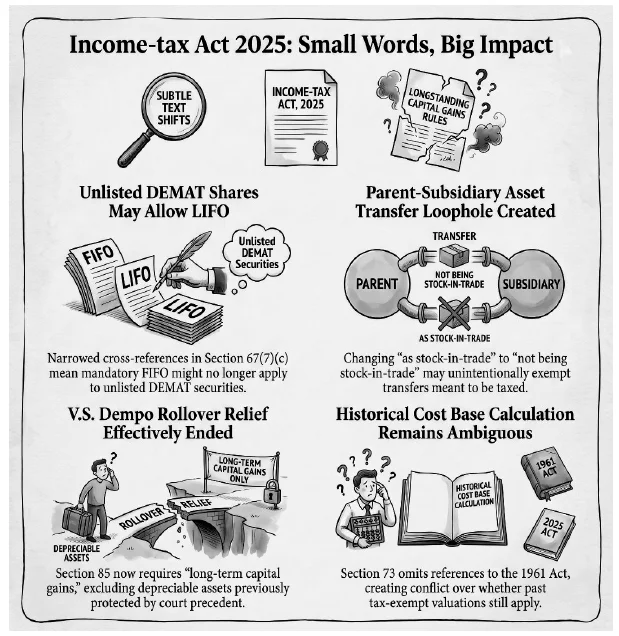
Under the 1961 Act, transfers of a capital asset by a holding company to its wholly owned Indian subsidiary, and vice versa, were not regarded as transfers, subject to a specific proviso that withdrew the exemption where the capital asset was transferred “as stock-in-trade” after 29 February 1988. By contrast, the 2025 Act incorporates the words “not being stock-in-trade” in the main clauses themselves and omits the earlier proviso. The question is whether this reformulation truly carries forward the earlier position, or whether it inadvertently narrows the exception that was earlier intended to apply where the asset, though a capital asset in the hands of the transferor, was taken over as stock-in-trade by the transferee.
The legislative object underlying the proviso to section 47(v) of the 1961 Act was explained in Circular No. 528.5 The intent, therefore, was not merely to exclude assets that were already stock-in-trade in the hands of the transferor,6 but to deny non-recognition treatment where the transferred capital asset was received by the transferee in the character of stock-in-trade. The effect of the proviso was succinctly explained by Chaturvedi & Pithisaria’s Income Tax Law as under:7
“… which provides that the above exemption provisions shall not apply in case of transfer of a capital asset as a stock-in-trade if made after 29-2-1988. Thus, this provision shall apply only if the capital asset, on its transfer, constitutes stock-in-trade in the hands of the transferee. If it constitutes stock-in-trade in the hands of transferor, but not in the hands of transferee, then this provision shall not apply.”
Under the 1961 Act, the relevant proviso denied exemption where the capital asset was transferred “as stock-in-trade”.
The word “as” is used as a preposition to refer to the function or character of someone or something.8 In ordinary legal usage, the word “as” denotes the character, capacity, or manner in which something is dealt with.9 In the context of section 47(iv)/(v), “as” was the correct preposition to convey the meaning of the proviso.
By contrast, section 70(1)(c)/(d) of the 2025 Act uses the expression “not being stock-in-trade”, which is more naturally read as describing the inherent nature of the asset itself. “Being” in general parlance is understood as the nature or essence of something.10 The word being, as used in a sense similar to that of the ablative absolute, has sometimes been translated as, “having been”; but it properly denotes a state or condition existent at the time when the conclusion of law or fact has to be ascertained.11
5 dated 16 December 1988 [1989] 176 ITR (St.) 165 wherein it was explained that
“In order to circumvent the operation of Section 47A of the IT Act, transferee holding/subsidiary companies are resorting
to a device of converting the capital asset as stock-in-trade at the time of transfer itself. With a view to plug this loophole,
 a proviso after clause (v) has been inserted in section 47 of the IT Act after 29th February 1988,
 to its wholly-owned subsidiary company or vice versa will be subject to tax under the head “capital gains” in case where the capital asset is
 taken over as stock-in-trade by the transferee company at the time of transfer itself”

6 If the proviso were to be read in this manner, the proviso would have been rendered a
surplusage for the fact that Section 2(14) of 1961 Act would have not regarded as such asset as a capital asset in the first instance.

7 Chaturvedi & Pithisaria’s Income Tax Law, Eighth Edition, Volume 5, p. 8097.

8 Concise Oxford English Dictionary, 12th edition, p. 75.

9 Advanced Law Lexicon, Seventh Edition, Volume 1, p. 479.

10 Concise Oxford English Dictionary, 12th edition, p. 123.

11 Advanced Law Lexicon, Seventh Edition, Volume 1, p. 668.
Given the above discussion, usage of the word “not being” does not seem to be apt for the thought sought to be expressed.
The shift in language may therefore be significant: while the earlier proviso could apply where a capital asset was taken over by the transferee in the character of stock-in-trade, the present clause may be read as excluding only an asset that is itself stock-in-trade ab initio.
If that reading is accepted, the words “not being stock-in-trade” may do little more than state what is already implicit in the expression “capital asset”, since stock-in-trade is ordinarily outside that concept. On that construction, the present drafting may fail to capture the mischief at which the 1988 proviso was directed, namely, cases where a capital asset is transferred between a parent and its wholly owned subsidiary but is taken over by the transferee as stock-in-trade. In such a case, there is a tenable argument that the transfer would still satisfy section 70(1)(c) or section 70(1)(d), because the subject-matter transferred remains a capital asset in the hands of the transferor, even though the transferee proposes to hold it as stock-in-trade. Section 71(1) of the 2025 Act cannot apply because it contemplates a conversion of the capital asset into stock-in-trade by the transferee company. The transferee company would not satisfy this requirement where the asset is already held by it as stock-in-trade; there is, in such a case, no subsequent conversion to which section 71(1) could apply.
This result would sit uneasily with the legislative object underlying the earlier proviso, which was introduced to prevent avoidance through conversion of the transferred capital asset into stock-in-trade at the point of transfer. For this reason, it may have been preferable for section 70(1)(c)/(d) to retain the earlier formulation using the word “as”, which more clearly addresses the character in which the asset is taken by the transferee. Unless this ambiguity is clarified, the present text may leave room for the argument that a transaction intended to be taxable under the 1961 Act is no longer brought to tax under the 2025 Act.
Supreme Court’s judgment in V.S. Dempo: Effectively Overruled?
The Supreme Court in V.S. Dempo12 drew a distinction between the deeming fiction contained in Section 50 of the 1961 Act and the substantive pre-condition for claiming rollover relief under provisions such as Sections 54E and 54EC. Section 50 was merely a special computational provision: it deemed the gains arising from the transfer of depreciable assets to be gains arising from the transfer of short-term capital assets, but did not deem the underlying asset itself to be a short-term capital asset. Consequently, where the asset was in fact held for the requisite long-term period, the exemption provisions could still apply, since the relevant enquiry under those provisions was whether the asset transferred was a long-term capital asset, and not whether the gain was computed as short-term by virtue of Section 50.
12 CIT v. V.S. Dempo Company Ltd. [2016] 387 ITR 354 (SC).
Insofar as this principle is concerned, Section 74 of the 2025 Act is pari materia with Section 50 of the 1961 Act.
Section 74(1), inter alia, provides that, “irrespective of” anything contained in Section 2(101)13, the provisions of Sections 72 and 73 shall be subject to Sections 74(2) and 74(3). Sections 74(2) and 74(3) further provide that, where the consideration received on the transfer of assets forming part of a depreciable block exceeds the prescribed base, or where the entire block ceases to exist, the resulting amount “shall be deemed to be capital gains arising from the transfer of short-term capital assets.”
13 Corresponds to Section 2(42A) of the 1961 Act.
Significantly, therefore, the deeming fiction under Section 74 remains the same as that contained in Section 50 of the 1961 Act, which was interpreted by the Supreme Court in V.S. Dempo. On this basis, the principle laid down in V.S. Dempo would, at first instance, appear to continue to hold good under the 2025 Act.
The difficulty, however, arises from the change in the language of Section 85.14 Section 85 substitutes the expression “long-term capital gains arising from the transfer of land or building or both” for the expression “capital gains arising from the transfer of a long-term capital asset, being land, building or both” appearing in Section 54EC of the 1961 Act. It was the latter formulation which, in substance, provided the basis for permitting depreciable assets held for the requisite long-term period to qualify for exemption under Section 54EC, notwithstanding the operation of Section 50.
14 Corresponds to Section 54EC of the 1961 Act.
At first blush, this change in language may appear merely cosmetic. Section 2(68) of the 2025 Act defines “long-term capital gains” to mean capital gains arising from the transfer of a long-term capital asset, while Section 2(67) defines a “long-term capital asset” negatively, as a capital asset which is not a short-term capital asset. Moreover, although Section 74 expressly operates “irrespective of” Section 2(101), which defines “short-term capital asset”, its deeming fiction does not expressly provide that the depreciable asset itself shall be treated as a short-term capital asset. Rather, it provides that the gains arising therefrom shall be deemed to be capital gains arising from the transfer of short-term capital assets.
If this reasoning is accepted, the ratio decidendi of V.S. Dempo would continue to apply: Section 74 would deem the character of the gain, without altering the character of the asset, and the statutory requirement under Section 85 would consequently remain capable of being satisfied by an asset that is, in fact, a long-term capital asset. Thereby, the gain therefrom would still remain long term capital gain under Section 2(68) for all other purposes.
A closer reading of the 2025 Act, however, suggests that the matter may not be so straightforward.
The change in language has been made specifically in Section 85, whereas Section 8615 continues to employ language referring to the nature of the asset as being long-term. This deliberate difference in drafting raises the question whether the expression “long-term capital gains” in Section 85 is intended to operate according to the general definition in Section 2(68), or whether the context of Section 85 requires that expression to bear a different meaning.
15 Corresponds to Section 54F of the 1961 Act.
This question assumes significance because the opening provision to the definitions in Section 2 makes those definitions applicable throughout the Act “unless the context otherwise requires”. The issue, therefore, is how the requisite context is to be ascertained for determining whether a definition in Section 2 should yield to a context-specific construction.
Justice G.P. Singh, while discussing the principles of statutory interpretation, observes, quoting a judgment of the High Court of Australia, that the modern approach to statutory interpretation “insists that the context be considered in the first instance” and that context must be understood in its widest sense, including “the existing state of the law and the mischief” which the legislation was intended to remedy.16
The same principle finds expression in Heydon’s Case, where Lord Coke identified four matters to be considered in interpreting a statute: (i) what the law was before the enactment; (ii) what mischief or defect the law did not address; (iii) what remedy Parliament had resolved to provide; and (iv) the true reason for that remedy.17
Applying these principles to Section 85, the legislative context surrounding the change in terminology becomes particularly significant. The apparent mischief sought to be addressed was the availability of exemption in respect of gains arising from the transfer of depreciable assets which, by virtue of the deeming fiction in Section 74, are treated as capital gains arising from the transfer of short-term capital assets.
The Ministry of Finance, in its response before the Parliamentary Select Committee, expressly addressed the concern that the proposed change in language from “long-term capital asset” to “long-term capital gain” could affect the availability of exemption in respect of depreciable assets. Its response was:
“The current clause, as drafted in the Bill is clearer and unambiguous in meaning. The deduction under section 54EC is intended only for long term capital gains and not for assets that are long term. The current provisions may be retained. The suggestion has no merits.”18
The relevance of such legislative material is supported by the Supreme Court’s judgment in Kalpana Mehta.19 Chief Justice Dipak Misra recognised that Parliamentary Committee reports and speeches may be consulted to ascertain the circumstances leading to the enactment of legislation and, where the meaning of a provision is unclear or ambiguous, to ascertain legislative intent. The Court observed that such reports may assist in appreciating the historical background of a statutory provision and may be referred to where there is ambiguity or incongruity in the enactment.20
16 G.P. Singh, Principles of Statutory Interpretation, 15th ed., p. 27.

17 [1584] 76 ER 637. See also G.P. Singh, Principles of Statutory Interpretation, 15th ed., p. 73,
 where “context” is described as including the statute as a whole, the previous state of law, other statutes in pari materia,
the general scope of the statute and the mischief it was intended to remedy.

18 Report of the Select Committee Report on Income-tax Bill, 2025 on pp. 892-893, available at
https://prsindia.org/files/bills_acts/bills_parliament/2025/Select Committee_Report_the_Income-Tax_Bill,2025.pdf
(last accessed on 29 August 2026).

19 Kalpana Mehta v. Union of India [2018] 7 SCC 1 (SC), para 117 of the CJI’s judgment.

20 For a detailed discussion, see K.N. Chaturvedi, Interpretation of Taxing Statutes, 2nd ed., pp. 55–62.
The Select Committee’s response is therefore relevant not merely as an extraneous statement of legislative intention, but as evidence of the particular mischief that change in Section 85 was intended to address.
In the author’s view, therefore, the amendment to Section 85 ought to be understood against this legislative background. Although Section 74 retains substantially the same deeming fiction as Section 50, the expression “long-term capital gains” in Section 85 should, in its specific statutory context, be understood as excluding gains which are deemed to be short-term capital gains by virtue of Section 74. In that sense, V.S. Dempo has not been overruled in principle, but its application to the new Section 85 has effectively been legislatively displaced.
One may, of course, contend that if Parliament intended to achieve this result, it ought to have amended Section 74 itself by expressly deeming the depreciable asset to be a short-term capital asset, in addition to deeming the resulting gains to be gains arising from the transfer of short-term capital assets. Such drafting would have placed the matter beyond doubt. Nevertheless, that argument may not ultimately prevail if the Court is persuaded that the altered language of Section 85, read in its context, was deliberately intended to address precisely the situation contemplated in V.S. Dempo.
This is ultimately an application of the mischief rule: where two constructions are possible, the Court would prefer the construction that suppresses the mischief and advances the remedy which Parliament intended to provide.21
21 G.P. Singh, Principles of Statutory Interpretation, 15th ed., p. 96.
That said, it may still be arguable that V.S. Dempo (supra) remains relevant in the context of the applicable rate of tax under Section 197 of the 2025 Act, which continues to prescribe the rate by reference to the nature of the asset transferred, i.e., “any income arising from the transfer of a long-term capital asset”. On that basis, the ratio of the Mumbai Income-tax Appellate Tribunal in SKF India22 may continue to hold good under the 2025 Act.
22 SKF India v. DCIT [2025] 121 ITR(T) 307 (Mum.)(SB),
where the majority held in favour of the applicability of Section 112 of the 1961 Act to depreciable assets, with one member dissenting.
Section 73 of the 2025 Act dealing with cost of acquisition in certain scenarios
Section 73 of the 2025 Act23 titled “cost with reference to certain modes of acquisition” prescribes the cost of acquisition of a capital asset in various scenarios, including assets acquired pursuant to gift or inheritance, amalgamations, demergers, shares acquired pursuant to exercise of ESOPs, assets which have been subjected to tax under section 92(2)(m)24 and so on. The provisions are pari materia with the erstwhile provisions, except for the tabular form of arrangement. While a few transactions listed therein have no specific reference to any section, such as the items in clauses (a) to (d) of Sl. No. 1 of the Table, the other entries refer only to provisions of the 2025 Act and do not refer to the corresponding provisions of the 1961 Act.
23 Corresponds to Section 49 of the 1961 Act.

24 Corresponds to section 56(2)(x) of the 1961 Act.
To illustrate, consider Sl. No. 17 of the Table under section 73(1), which deals with a capital asset being property where the capital gain arises from the transfer of such property, the value of which has been subject to income-tax under section 92(2)(m). The cost of acquisition of such property is the value taken into account under section 92(2)(m). Assume that Mr. A received shares of A Ltd. as a gift from his friend, Mr. B, on 28 September 2025, when the transaction was governed by the 1961 Act and the value of such shares would have been subjected to tax under section 56(2)(x). What would be the cost of acquisition of the shares when they are subsequently transferred? Would Sl. No. 1 or Sl. No. 17 of the Table apply?
If the provision is read literally, the cost of acquisition may not be the fair value of the property on which tax was paid under section 56(2)(x), but may instead be restricted to the cost to the previous owner under Sl. No. 1 of the Table. This issue also has an interplay with the provisions of the General Clauses Act, 1897 (GCA), to which I shall return shortly.
If read in this manner, section 73 may produce varying results—sometimes in favour of the assessee and sometimes to the assessee’s detriment, as in the gift example above. An example where the assessee may be entitled to claim a higher cost base is Sl. No. 2, which deals with the cost of acquisition of shares of an amalgamated company received pursuant to a tax-neutral amalgamation. Where the amalgamation is exempt from the operation of section 67 by virtue of section 70(1)(f), the cost of acquisition is taken to be the cost of the shares of the amalgamating company.
Assume that the amalgamation had taken place and been effected when the 1961 Act was in force and exemption had been claimed under section 47(vii). What would be the cost of acquisition of the shares of the amalgamated company when they are subsequently transferred? On first principles, the cost of acquisition should arguably be the FMV of the shares of the amalgamating company given up,25 plausibly as on the appointed date, since the scheme is deemed to take effect from that date for all purposes.26 Here, the absence of an express reference to the corresponding provisions of the 1961 Act may operate in favour of the assessee, who may contend that the FMV constitutes the cost of acquisition.
25 See generally, Sarjit Ghanshyam Desai v ITO [2026] 186 taxmann.com 732 (Mumbai - Trib.),
Kamlesh Pukhraj Talera v DCIT [TS-1262-ITAT-2026(Bang)](para 27).

26 See Marshall Sons & Co. (India) Ltd. v ITO [1997] 223 ITR 809 (SC).
Given the constraints of space, it is not proposed to examine the possible implications of each of the entries in section 73. The foregoing examples, however, illustrate the interpretational difficulty arising from the manner in which the provision has been drafted.
At this point, it is relevant to consider section 536 of the 2025 Act, titled “Repeals and savings”. Section 536(1) deals with repeal of the 1961 Act, while section 536(2) sets out various savings in relation to matters arising under the repealed legislation. Section 536(4) further provides that, without prejudice to section 536(2), section 6 of the GCA shall apply with regard to the effect of the repeal.
Section 536(2)(b) provides that the repeal of the 1961 Act shall not affect any right, privilege, obligation or liability acquired, accrued or incurred under the 1961 Act or any order made under that Act. A question therefore arises whether claiming an exemption under section 47 of the 1961 Act in respect of a non-taxable transfer would result in the assessee assuming an obligation or liability to determine the cost of acquisition in accordance with section 49 of that Act. Similarly, where an assessee was subjected to tax on an ESOP perquisite under section 17(2)(vi) of the 1961 Act, did a corresponding right accrue in his favour to claim the FMV of the shares as on the date of exercise as the cost of acquisition under section 49(2AA)?
The subsequent clauses of section 536(2), however, make the position less straightforward. For instance, clause (q) specifically deals with profits or gains arising from the transfer of a capital asset which were not charged under the head “Capital gains” by virtue of section 47(iv), (v), (xiii), (xiiib) or (xiv) of the 1961 Act. It provides that such profits or gains shall be deemed to be income chargeable under the head “Capital gains” under the 2025 Act for the tax year in which the specified conditions are subsequently breached.27
27. Except for Section 47A(1), which reverts taxation back to the year of original transfer
The corresponding provisions continue to operate under the 2025 Act and are now contained in section 71. However, section 71 refers to exemptions under the corresponding provisions of the 2025 Act and does not expressly refer to the provisions of the 1961 Act. Does this suggest that, wherever Parliament intended the provisions of the repealed legislation to continue to operate, an express reference was considered necessary? If so, could the absence of such a reference in section 73 indicate that section 536(2) does not provide a complete answer to the issue under consideration?
This could potentially leave room for more than one view regarding the cost of acquisition in situations covered by section 73 where the relevant exemption was claimed, or tax was imposed, under the 1961 Act. Depending on the provision involved, the resulting cost could arguably be the FMV, the cost to the previous owner, or even an indeterminable or nil amount.
One may further contend that section 536 should not, by itself, prevent an assessee from claiming a cost different from that specified in section 73, particularly in light of the drafting of other provisions of the 2025 Act. For instance, section 39, which deals with actual cost, expressly refers in Sl. No. 9 of the Table under section 39(4) to a situation where an asset used in a business ceases to be used for scientific research relating to that business and a deduction was allowable under section 33(3). In such a case, the actual cost is required to be reduced by the deduction allowed for the capital asset under section 45(1)(a)(i) or “under section 35(1)(iv) of the 1961 Act”. Similarly, section 41 dealing with determination of WDV, section 74 dealing with capital gains on depreciable assets and section 81 dealing with advance money forfeited also contain express references to the 1961 Act.
Strictly speaking, section 536(4) may also not come to the rescue. Section 6 of the GCA deals with the effect of repeal, but section 536(2) itself contains detailed and specific savings provisions dealing with the consequences of repeal. It may therefore be difficult to invoke section 536(4) to supplement section 536(2) in a manner that overrides or expands the specific scheme enacted therein.
At this juncture, it is pertinent to refer to section 24 of the GCA28. It reads as follows:
“Continuation of orders, etc. issued under enactments repealed and re-enacted
24. Where any [Central Act] or Regulation, is, after the commencement of this Act, repealed and re-enacted with or without modification, then, unless it is otherwise expressly provided, any [appointment, notification,] order, scheme, rule, form or bye-law, [made or] issued under the repealed Act or Regulation, shall, so far as it is not inconsistent with the provisions re-enacted, continue in force, and be deemed to have been [made or] issued under the provisions so re-enacted …” (Emphasis supplied)
Section 24 of the GCA, insofar as relevant to the issue under discussion, provides that an order made under the repealed Act shall, so far as it is not inconsistent with the provisions re-enacted, be deemed to have been made under the provisions so re-enacted. This is, however, subject to the re-enacted legislation providing otherwise expressly.
In the present context, application of section 24 could result in orders—including assessment orders—made under the 1961 Act being treated as orders made under the corresponding provisions of the 2025 Act. Consequently, even where an order under the 1961 Act had allowed an exemption or subjected a particular item to tax under a provision of that Act, such exemption or tax treatment could, arguably, be regarded as having been made under the corresponding provisions of the 2025 Act.
In this regard, the judgment of the Supreme Court in Poonjabhai29 is instructive. In Poonjabhai, the assessee had claimed a deduction for bad debts under section 10(2)(xi) of the (Indian) Income-tax Act, 1922 (1922 Act). The debts were subsequently recovered after the 1922 Act had been repealed and the 1961 Act had come into force. At the time of recovery, the business carried on by the assessee had ceased to exist. Section 41(4) of the 1961 Act dealt with the taxability of recovered bad debts; however, the provision, referred only to bad debts in respect of which a deduction had been allowed under section 36(1)(vii) of the 1961 Act. It did not expressly refer to deductions allowed under the corresponding provision of the 1922 Act.
The assessee therefore contended that the recoveries could not be brought to tax under section 41, since the deduction had been allowed under the 1922 Act and not under section 36(1)(vii) of the 1961 Act.30 The Supreme Court rejected this contention. It held that the order of the Income-tax Officer under section 10(2)(xi) of the 1922 Act allowing the deduction was, by virtue of section 24 of the GCA, to be treated as an order made under section 36(1)(vii) of the 1961 Act. Consequently, the subsequent recovery of the bad debt was held to be taxable under section 41(4) of the 1961 Act.
28 Section 536(2)(j) of the 2025 Act is akin to this section.

29 Poonjabhai Varmalidas v CIT [1990] 186 ITR 572 (SC).

30 Here it may be noted that such recovery of bad debts does not represent income in its natural sense,

for these are mere windfalls lacking a definite source to be regarded as income.

However, section 2(24)(v) explicitly includes these items within the ambit of income, to the extent covered under Section 41
The significance of Poonjabhai lies in the fact that the Supreme Court applied section 24 of the GCA notwithstanding the absence of an express reference to the corresponding provision of the repealed legislation in the re-enacted provision. In other words, the fact that the original deduction had been allowed under the repealed 1922 Act did not prevent the subsequent provision of the 1961 Act from operating; section 24 treated the earlier order as having been made under the corresponding provision of the re-enacted legislation. By analogy, an order under the 1961 Act allowing an exemption or subjecting an item to tax could, subject to the provisions of section 24, be regarded as having been made under the corresponding provisions of the 2025 Act. If so, the absence of an express reference to the 1961 Act in section 73 may not, by itself, create the difficulty considered above.
One aspect that merits emphasis is that the1961 Act did not contain equally elaborate repeal and savings provisions. Section 297 primarily dealt with matters relating to assessments for years governed by the 1922 Act. While section 297(2)(k) contained a provision similar to section 24 of the GCA, and a corresponding provision has been carried forward in section 536(2)(j) of the 2025 Act, the 1961 Act did not expressly address, in detail, the treatment of deductions allowed under the 1922 Act and the subsequent consequences arising therefrom, such as the recovery of bad debts. The 2025 Act, in contrast, expressly addresses such matters in section 536(2)(h).
This difference in legislative drafting raises a question as to whether the express treatment of such matters in section 536(2) indicates an intention to deal comprehensively with the consequences of repeal, thereby limiting the scope for invoking section 24 of the GCA. Put differently, could the express savings provisions in section 536 be regarded as provisions which, in the circumstances contemplated by section 24 of the GCA, are “otherwise” provided for, or render the application of section 24 inconsistent with the provisions re-enacted? This assumes significance because section 24 itself operates only “so far as it is not inconsistent with the provisions re-enacted”.31 The qualification embedded in section 24 has itself been recognised as a source of uncertainty in its practical application.32
Against this backdrop, the question in the present context is whether section 536 should be viewed as an exhaustive code governing the transition from the 1961 Act to the 2025 Act, or whether section 24 of the GCA can continue to operate in areas not expressly or inconsistently dealt with by section 536.
The author would, therefore, leave this issue open for deliberation as to whether, in the context of the 2025 Act, the continuity contemplated under section 24 of the GCA and/or the specific saving provision in section 536(2)(j) should govern. The question is not merely one of reconciling two saving provisions, but also of determining the scope of the expression “order” used therein. The issue assumes significance because “order” appears alongside expressions such as “agreement”, “circular”, “direction”, “instruction”, “notification”, “approval”, “recognition”, “scheme”, “rule”, “form” and “bye-law”. Could such a grouping invite the application of the principle of noscitur a sociis, thereby requiring the expression “order” to be understood in the context of the words with which it is associated, and consequently in a manner narrower than the meaning attributed to it by the Supreme Court in Poonjabhai?33 Equally, would such an approach be justified when the Supreme Court has already recognised the operation of section 24 in the context of an assessment order made under the repealed enactment? These questions remain open, and their resolution may ultimately require the imprimatur of the courts. In the context of repeal and re-enactment, however, courts may be inclined to prefer an interpretation that preserves continuity of legal operation over one that produces a legislative hiatus, practical deadlock, or disruption in the working of the statute.
31 One interesting aspect may be noted. The proviso to Section 10(2)(xi) of the 1922 Act was akin to Section 41(4),
subject to one distinction: the former did not cover recoveries of bad debts after cessation of the business carried on by the assessee,
as held by the Supreme Court in CIT v. Express Newspapers Ltd.
[1964] 53 ITR 250 (SC) in context of similar provision under section 10(2)(vii) of the 1922 Act. Section 41(4), in a sense,
expanded the scope of the provision by expressly including the words
“whether the business or profession in respect of which the deduction has been allowed is in existence in that year or not.”
 Notwithstanding this background, the Supreme Court held that there was no inconsistency between Section 10(2)(xi) and Section 41(4).
The point to be noted is that the Supreme Court examined inconsistency with reference to the relevant provisions themselves,
and not with reference to the 1961 Act and the 1922 Act as a whole (see para 7 in 186 ITR 572).

32 It has been suggested that provisions such as section 24 may create uncertainty because of the need to determine whether an existing order,
 rule or other instrument is “inconsistent” with the re-enacted legislation. One suggested legislative solution is to repeal
 such general saving provisions and instead identify and incorporate in the re-enacted legislation the rules, orders and other instruments
intended to continue in force, with such modifications as may be necessary—a course which may be more practicable in the present age of electronic
databases [Robert A. Duperron (Chief Legislative Editor, Department of Justice, Canada), “Interpretation Acts—Impediments to legal certainty and
Access to the Law”, 26 (2005) Statute Law Review 64, p.67].

33 See the entries under “order” in Advanced Law Lexicon, Seventh Edition,
Volume 3, pp. 4477–4481. In ordinary parlance, “order” is understood to mean an authoritative command or direction
 (Concise Oxford English Dictionary, 12th Edition, p. 1007). An assessment order, being an authoritative determination by the assessing authority,
 may therefore very well fall within the ordinary meaning of the expression.