Generational Shifts
Recently, I was with a senior partner of a mid-sized firm who had a simple, but telling story. A junior colleague had texted him at 9 p.m. with the message: “Tomorrow, I’ll be on leave.” No explanation. No apology. Just a fact. When he asked why it was shared so abruptly, the response came: “No need to overcomplicate it.” To the senior, this felt like a breach of etiquette, a lack of respect, unprofessional. To the junior? It was just communication.
Such interactions pointing to generational shifts are increasingly common, not only in accounting firms, but across industries—from accounting and law to tech to consulting—you’ll find these micro-conflicts: senior leaders baffled by juniors who decline to work late without guilt, or young professionals puzzled by the “culture of presence” that glorifies late-sitting.
The clash isn’t about right or wrong, but a signal of a deeper shift in how different generations understand work, authority, and obligation. The discomfort is real—and it exists on both sides. Every generation believes it worked harder than the next. History suggests this belief is universal—and consistently misplaced. The way forward therefore is not to defend old norms reflexively, nor to adopt new ones uncritically, but to translate enduring values into contemporary forms by understanding these generational shifts with empathy.
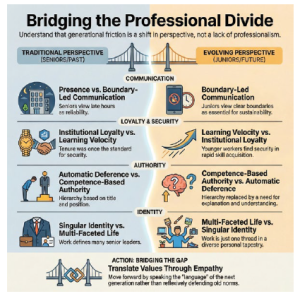
For many senior professionals, professionalism was forged in an environment of scarcity and uncertainty. Long hours were not a choice but a necessity. Staying back late, deferring personal plans, and placing work above all else were ways of demonstrating seriousness and reliability. These habits were not arbitrary; they were survival mechanisms in a competitive and less forgiving professional landscape. Over time, they also became cultural norms—transmitted quietly from one generation to the next.
There is, undeniably, value in this legacy. Endurance builds resilience. Availability builds trust. Unstructured time spent observing seniors at work often imparted lessons no formal training could. Many of today’s leaders owe their professional depth to precisely this immersion. When seniors worry that something essential is being lost, the concern is neither nostalgic nor unfounded.
At the same time, younger professionals are entering a very different world – the world of abundance and technology. Work is more codified, timelines are compressed, and technology has reduced the need for physical presence. They have grown up in an environment that openly discusses mental health, personal boundaries, and sustainability. For them, clarity and planning are not luxuries but expectations. When leave is communicated as a matter of fact, it reflects not entitlement, but a belief that personal time and professional responsibility can coexist without apology.
This difference in approach often gets misinterpreted. Seniors may see a lack of commitment; juniors may experience unspoken expectations as arbitrary or inefficient. In reality, both are reacting rationally to the conditions that shaped them.
A similar tension is visible in ideas of loyalty. Earlier generations invested decades in one firm, trusting that patience and perseverance would be rewarded in time. Younger professionals, however, operate in a world of rapid change. They value learning velocity, relevance, and optionality. Shorter tenures are not necessarily signs of disloyalty, but reflections of a marketplace where skills, not institutions, offer security. Yet, from a firm’s perspective, this increased attrition and frequent job-hopping creates real challenges—continuity, succession planning, and cultural transmission all suffer when attrition is high.
Authority presents another point of divergence. Seniority once commanded automatic deference. Today, authority is often filtered through competence and explanation. Juniors are more willing to question—not to undermine, but to understand. This can feel destabilising to those accustomed to hierarchy, just as unexplained instructions can feel unsatisfactory to those trained to evaluate systems critically.
Technology further complicates the picture. Manual processes that once built discipline now appear inefficient to a generation raised on automation. Seniors may see impatience; juniors see avoidable waste. Here again, both perspectives contain truth.
And finally, there’s identity. For many seniors, the profession is the identity. “I’m a senior partner. That defines me,” said 60-year-old Ravi. But for younger professionals, work is just one thread in a tapestry of interests, hobbies, and family roles. “I’m a chartered accountant, part-time DJ, and owner of an e-commerce startup in customised birthday cakes” said 28-year-old Nia.
So, for seniors, where do we go from here? The answer isn’t choosing between “the way we did it” and “the way you want to do it.” It’s about building bridges. This isn’t a war of generations. It’s a translation. The wisdom of the past isn’t outdated, but it needs to be spoken in a language the next generation can speak. Are we ready to adapt and speak that language?