Increased Life Expectancy: When Life Outruns Professional Career
According to the Government of India’s Sample Registration System, average life expectancy at birth has climbed from 49.7 years in 1970–75 to 69.0 years in 2013–17, and estimates put it above 70 years for 2019–23. International projections suggest it may now be around 72.0–72.5 years, continuing a long-term upward trajectory. This statistic is merely a revalidation of a fact which we witness in our day to day lives. Thanks to the medical advancements and various other reasons, we are living longer. It is now more and more common to find people cross the age of 90 years or even approach the 100- year mark.
The above statistic brings with it reasons to cheer, but at the same time, issues to ponder upon – physical and mental health challenges, quality and dignity of life, financial independence, social relevance, etc. are issues which plague this space. This editorial does not touch upon these larger issues, but discusses the impact from the perspective of a professional’s career.
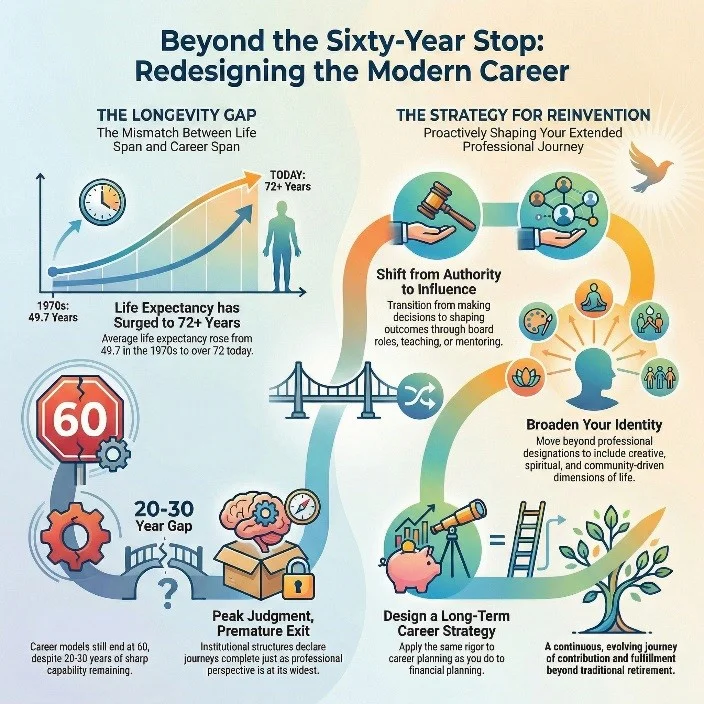
Admittedly, our career structures were built for a time when life expectancy was shorter and retirement signalled decline in capability. Today, life extends well beyond the traditional retirement age of sixty but the model has not evolved with it. Most professionals have another twenty or even thirty years of active, intellectually sharp life pending at that point of time.
Therefore, for professionals in employment, retirement at 60 or 65 often arrives as a hard stop. One day, you lead teams, sign decisions, shape outcomes. The next, you step aside. Financial planning may be sound. Psychological planning rarely is. At the very stage when judgment is deepest and perspective widest, institutional structures declare the journey complete. The question then emerges: what fills the next 25 years? Consulting, board positions, teaching, advisory roles—each offers possibility. But each requires a shift from authority to influence, from control to contribution. That transition is not merely professional; it is personal and emotional.
For self-employed practitioners and partners, the dilemma is subtler. In many firms, there is no mandatory retirement. Stepping back and succession is emotionally complex as firm is rarely just an enterprise; it is a person’s lifetime creation. One may be tempted to continue practice indefinitely, but is it appropriate? Unfortunately, ageing of the brain has not slowed down with increases in longevity. Dementia and loss of memory have become common at an advanced age. If one carries on practice as before even in an advanced age, there is increased risk of mistakes due to decline in memory.
Despite longevity and active lifestyle, energy changes, but the complexity of the professional landscape does not, again increasing the risk of professional negligence. From the firm’s perspective, prolonged continuity at the firm also hinders growth of the team and next in line. Experience has its’ value, but also brings in rigidity and doesn’t allow for fresh ideas to emerge. The team may therefore feel stifled resulting in higher attrition or at times, internal conflicts.
In such cases, should one not consider retiring gracefully while the going is good? It may be better to be remembered for the good that one has done in one’s prime, than be remembered for mistakes made beyond one’s prime. But for many of us, the designation is not just a qualification; it is who we are. The decision of retirement therefore brings in uncomfortable questions: Who am I now, and what next?
The answers may lie in broadening identity rather than clinging to it. When the profession becomes a part of life rather than its entirety, transitions feel less like loss and more like evolution. Teaching, writing, mentoring, community engagement, vacation and travel, spiritual and other creative interests —these are not post-retirement hobbies; they can become parallel dimensions of relevance.
At the same time, the larger truth is unavoidable. If life expectancy has expanded, career design must expand with it. Retirement should not mean irrelevance. Nor should continued practice mean exhaustion or stagnation. We often design long-term financial strategies for our clients. Perhaps it is time we design long-term career strategies for ourselves. Life now extends beyond the old career model. The question is whether we are prepared to extend our thinking along with it.