



Subscribe to the Bombay Chartered Accountant Journal Subscribe Now!

Interview – Dr Nishith Desai

IF YOUR PRINCIPLES OF MATHEMATICS ARE CLEAR, YOU WILL GET THE RIGHT ANSWER: 1 + 1 = 2. IF YOUR PHILOSOPHICAL BASE IS CLEAR, THEN YOUR DECISIONS WILL ALWAYS BE RIGHT — YOU WILL KNOW WHAT IS THE RIGHT THING TO DO, AND WHAT ISN’T.

BCAS and the CA profession have completed 75 years. In order to commemorate this special occasion, the BCAJ brings a series of interviews with people of eminence from different walks of life, the distinct ones whom we can look up to, as professionals. Readers will have an opportunity to learn from their expertise and experience, as well as get inspired by their personal stories.

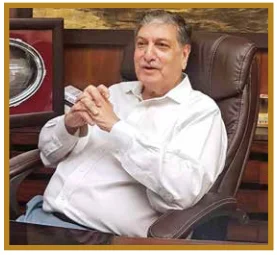
Here is the text (with reasonable edits to put it into a text format) of an interview with Dr Nishith Desai, international tax and corporate lawyer, researcher, author, innovator, thought leader and lecturer.

Dr Nishith Desai is the founder of Nishith Desai Associates (NDA), a research and strategy-driven international law firm. The firm has been recognised as one of Asia-Pacific’s most innovative Law Firms by the Financial Times, London. NDA is committed to shaping the future of law and fostering the next generation of socially conscious lawyers.

Dr Desai’s interests span a wide spectrum of law, society and ethics. He has argued many famous cases before the Advance Ruling Authority, laying down new age jurisprudence and also appeared before the Indian Supreme Court along with Shri Harish Salve KC in the celebrated Azadi Bachao Andolan.

In the year 2023, for his contribution to the jurisprudence of international tax in India, Amity University awarded him an Honorary Doctorate. In 1983, he suggested that the Indian government develop Andaman Nicobar Island as a free trade zone. In or about 1992, he assisted the Mauritius government in developing the country as a reputed offshore financial centre. He helped conceptualise the idea of Gujarat International Financial and Technology City (GIFT City) in 2007, when he travelled with the then Gujarat State Chief Minister and now Prime Minister Shri Narendra Modi.

The Indian Government has recently appointed him as an expert committee member with a mandate to onshore the India innovation to GIFT IFSC. Further, the National Startup Advisory Council has appointed him as a non-official member of the committee with a focus on nurturing innovation and startups to drive sustainable economic growth.

With a keen interest in technology, Dr Desai actively drives legal and ethical research into emerging areas such as blockchain, autonomous vehicles, flying cars, IoT, AI and robotics, medical devices, and genetic engineering, amongst others. In January 2024, NDA became the first Indian law firm to formally develop and implement an AI-ChatBot for their lawyers.

To nurture imagination, innovation, research and impactful thinking, Dr Desai has set up the research campus, Imaginarium Aligunjan1 in Alibaug, near Mumbai. This space brings together prominent leaders and researchers to collaborate and create a positive change in the world.


1 http://aligunjan.com/

In this interview, Dr Desai talks to The BCAJ Editor Mayur Nayak and past Editor Raman Jokhakar about his career, mentors, tax laws, gaps in lawmaking, bottlenecks in ease of doing business in India, his message to youngsters and much more….

Q. (Mayur Nayak): Good morning, Dr Desai, and thank you very much for accepting our invitation for this interesting interview about your life journey, the legal systems in India and the Indian tax scenario. To start with, tell us something about your personal life journey. How did you end up taking up law as a career?

A. (Nishith Desai): Thank you so much for inviting me. Firstly, I would like to compliment the Bombay Chartered Accountants’ Society on completing 75 years. In the 1980s, I learned a lot by attending its refresher courses.

As far as my life is concerned, I have had a very checkered kind of history. You could say I had a bit of a troubled childhood. I was about 3.5–4 years old when my father passed away. My mother remarried, and I spent a few years with my stepfather before I came down to Mumbai in 1963 with my phuphi (paternal aunt). The next 16 years were tricky for me. I learnt to live with a lot of things that are slightly difficult in life. These challenges though shaped me and made me robust. My phuphi’s family had a family store — a chemist shop, and I started helping out there.

On my maternal side, my nana (maternal grandfather) was a renowned lawyer in Dahod near Vadodara, where I was born. He was well-known, very knowledgeable and yet modest. So, it was an interesting background — on one side, I had a troubled childhood; on the other, I had an excellent life with my nana — he taught me the first principles of practice of law.

Those days, we did a lot of work with VinobaBhave, who is my icon even today. He was by far the saintliest of all the politicians I have ever known. He knew about 40 different languages. I was also involved in the Bhoodan Movement in those days. VinobaBhave led me to think globally. In 1955, in an article which he used to write for Sarvodaya Patrika, he wrote (and I am paraphrasing here), “Forget about the slogan, ‘Jai Hind’, talk about ‘Jai Jagat’ – Jai Hind was good for independence, but now we have to think of growth not just for our country alone, we have to think about the growth of the entire world”. This approach of his helped me broaden my mind as well and think globally.

I was not sure whether I would pass my SSC, which was then the 11th standard. But I did and went on to complete my Bachelor of Arts. Studying liberal arts played a very important role in my life because it made my thinking lateral and liberal.

(Mayur Nayak): Working in a CA firm — I understand you also had a stint of working with a Chartered Accountancy firm. Talk us through that experience.

A (Nishith Desai): My kaka (father’s brother) got me a job with an accountancy firm, Thakkar Butala. When I went to the office the first day, I found my biggest problem was that I did not know Accounts. Someone asked me to look at a Balance Sheet. I asked them what that is (chuckles). The first thing they told me to do was to go to the ICAI office and get a booklet, ‘How to read a Balance Sheet’. It was like going back to school — this booklet helped me a lot.

I also learned that accountants are very disciplined people, unlike lawyers. Often I say creative people are not very disciplined and disciplined people are not very creative. If you combine creativity and discipline, it is a powerhouse. Then over time, I did LL.M with International Law.

Q (Mayur Nayak): Law Degree — When did you decide to pursue a Law Degree? Why the interest in International Taxation?

A (Nishith Desai): My kaka was also a lawyer in Mumbai. As I said, my nana was also a lawyer — so, Law was there somewhere in my DNA, but I began to pursue it more when I joined Law College. I did my LL.B. and then LL.M. in International Law, which is where my interest lay. I also now have something called an Honorary Ph.D. in International Tax (chuckles).

I always give some credit to Vinoba Bhave, who made my mindset global, for my interest in International Tax. When I did my Law, I was interested in Employment Law. When I started my Labour Law practice, as it was called then, there used to be many strikes, lockouts and unions. Today’s kids won’t know what a strike means, or what a lockout is, right?

Then, one of my neighbours got me a job with the Solicitors’ firm, Bhaishanker Kanga and Girdharlal (BKG). I could not afford to do the two-year Solicitors Course as I had financial limitations.

Then a senior partner of BKG, M MThakore, got me an opening with the Tax Lawyer, Sanatbhai Mehta or SP Mehta as he was popularly known. I was a standing counsel with him (chuckles) because his chamber in the Great Eastern Building was so small, and at that time, Vasantbhai Mehta, Vijay Patil, Sudhirbhai Mehta, IndrajeetMunim and others were also there. There was no place for me to sit. So, I was always standing. All the young people were literally standing counsels (chuckles). I learnt from Sanatbhai that one could conduct tax practice honestly.

Further, in the Bombay High Court, I came in contact with various counsels — the then legends. I had the opportunity to work with Palkhivala, Kolah and others.

But first and foremost, I was a counsel, and I would go to court. My first appearance was before Justice S K Desai and Justice M N Chandurkar. S K Desai was one of the smartest judges in those days. I remember my first appearance before him —- I was a little petrified, but he said to me, ‘Mr. Desai, tell us the facts; we know the law.’ These kind words gave me a lot of confidence. Ultimately, you know, juniors, at the minimum, must know the facts. Sometimes, they may not be fully aware of the interpretational aspects; it takes some time — typically five–seven years.

Looking at the whole ecosystem, I realised that nobody focused much on the international aspects of Indian taxation. So, I decided to do my Ph.D. on the subject, but I could not find any guide. I decided to do my own research and comparative tax study of various jurisdictions. That took me two–three years.

Q (Mayur Nayak): Nani Palkhivala — Can you tell us about your association with Nani Palkhivala?

A (Nishith Desai): The office of Thakkar and Butala was next to Bombay House; that’s how I got closer to Palkhivala — it’s a long story. He was very fond of me, and I learnt a lot from him. One of the things l learned, besides the professional work was the art of effective delegation. He explained to me, ‘Nishith, when you delegate something to somebody, spend some time explaining to him the background and what you expect and by when, rather than telling him to just do it’. He was my icon, and I wanted to be like him. I thought to myself, I may not reach his stature, but it will at least get me somewhere.

Q (Mayur Nayak): Young householder — While all this was happening, what was the situation at home? Do share a little about your life as a young householder.

A (Nishith Desai): Well, my work was going on. We had a tiny apartment in Khira Nagar — a one-room kitchen. My kids were born there. We were four people, and in those days, a lot of guests used to come over to stay with us as we were close to the Santacruz airport. Everybody who had to travel abroad would need to come to Mumbai. At one time, I remember we had 14 people staying in the house with their bags. But my wife had a big heart.

My wife created a dining table which could be converted into a study table for me to sit and read at night after I came back from work. After three–four years, I got a grip on international law, treaties, and that kind of thing, but there was not much work.

Q (Raman Jokhakar): First international break — How did you get your first international client / break?

A (Nishith Desai): In 1981, one of the world’s largest privately owned construction companies, Bechtel, was looking to come to India for a project. They wanted somebody who understood international construction contracts and international taxation of international construction contracts — both complicated subjects. They went around the country but couldn’t find anybody. Those days, everybody was into domestic tax, and none of the tax lawyers had any idea about construction law. While doing my LL.M., I had studied both of these, and I had some understanding.

They came across an article of mine which had been published in the US and came to see me. There I was, a lanky young guy with long black hair. They looked me up and down and were not sure if I was the right lawyer. But they asked me many complex questions and told me their requirements. I said I have all the theoretical understanding, but no practical experience. However, they were very happy with my theoretical answers on construction law and international taxation of international construction contracts. So, they engaged me.

I think that gave me a real breakthrough because it was one of the largest construction companies — I had no idea how large it was; it was like an ocean. I was absolutely clueless about their reach because we were then a closed economy. I had not travelled abroad at all. They appreciated my work for them. The relation with Bechtel continued for decades — I worked on Bechtel’s famous advance ruling case –Bechtel S.A.

For their work, they invited me to their offices in the US. They were based in San Francisco but invited me to their legal office in Los Angeles. In those days, I would stay with friends and relatives because I couldn’t afford a hotel stay. Bechtel’s name got me instant credibility. Everywhere I went, when I would tell people that I was a lawyer to Bechtel, they would say, ‘Is it? My cousin/ brother/ friend works there’. In those days, most people who went from India were engineers, and the US was building its infrastructure, so the majority of Indians worked for companies like Bechtel, Google or Amazon did not exist then.

Q (Raman Jokhakar): Global reach — How did you go about increasing your international clientele?

A (Nishith Desai): There was a delegation from Dupont coming to India in 1982–83 as they were interested in India. I was part of the Indo-American Chamber of Commerce. When you are a young professional, you take part in these associations to develop your practice — so I was very active there. I was asked to organise a meeting of management consultants for them. When I met them, I started discussing philosophy as I had no background in management. I told them:

Law is nothing else but a philosophy that is codified, and religion is nothing else but a philosophy that is ritualised. People pay more attention to code, sections and rituals than the philosophy behind it. The leader of the delegation got very interested in Indian philosophy and invited me to visit their headquarters in Delaware on my next trip to the US. When I went there, I thought I would meet a few in-house lawyers; instead, besides two–three in-house lawyers, there were about five–six international business strategists. Everyone there was flashing around their visiting cards. I didn’t know what to say about strategies, so I requested their time (adjournment) for a meeting a week later. After all, lawyers are good at taking adjournments (chuckles).

Once I left there, I called up a Chartered Accountant friend who had done his MBA in the US and requested him to recommend some books on strategy for me to buy. He suggested that instead of buying, I go to Barnes & Noble, a large bookstore in NY and I sit and read there. For one week, I visited the store every single day and sat on a side bench to read all the latest books available on management and strategy — it was like doing a crash course. Thankfully, lawyers are trained to do rapid reading (chuckles). A week later, when I went for the meeting, I was very well prepared — I dropped some authors’ names, quoted from some books in my conversation and looked like an expert (chuckles). I told them:

“Everything starts and goes back to philosophy. From philosophy emerges your mission, vision, goals, etc. and then comes strategy; structure follows strategy, the strategy doesn’t follow structure.”

I asked them, what is your philosophy towards India? Do you treat India as a partner in prosperity or as a market to sell your machines? Have you understood various philosophies pursued by different MNCs towards India and other countries? They got very excited with my questions and asked me whether I would be willing to do a corporate philosophy study for them — unusual for a lawyer to end up in a paid project (chuckles). I got paid US$4,500 for this in 1982 — at that time, it was good money. It was a primary study, so I had to go and meet retired CEOs of different companies which had operated in India, such as Coca Cola, Pepsi, Monsanto Chemicals, Dow Chemicals, IBM, etc. to ask them about their experience in India and their philosophy behind coming here, and also why they had left. These conversations helped me learn a lot about organisational behaviour and corporate strategies. Dupont was very happy with my report, and they developed their India strategy on it.

And since Bechtel was San Francisco-based, I also got clients like Clorox, Levi Strauss. All these made me a strategic lawyer.

Q (Raman Jokhakar): Setting up practice — How did you go about setting up your law firm?

A (Nishith Desai): My solo practice began to grow in the US and in 1985–86, I focused and got more involved with Wall Street, mainly investment banking. If you take the top 5 investment banking companies then, such as Goldman Sachs, Merrill Lynch, Lehman Brothers, etc., — the 5th largest was Bear Sterns. The Managing Director of Bear Sterns, an Indian, Anil Bhandari, became a close friend and suggested I set up a law firm. Counsels were not known to set up law firms in India. The law does not stop them from setting up a law firm. It was a complete antithesis to the environment then. I found there were many counsels who specialised in various matters but could not institutionalise their practice.

My main question to myself was, why should I set up one more law firm on the street? What difference can I make, or what value can I add to the professional world?

So, from 1985–86 to 1989–90, I studied about 100 professional services organisations — that included senior partners of law firms, accounting firms and consulting firms. One of the partners at McKinsey NY extended friendly help to me to build a firm, and educated me on the whole ecosystem of global law firms. He suggested there is a Harvard case study on Wachtell Lipton, Rosen & Katz, a law firm, which makes for an interesting read for all professionals.

Being small is not bad. Today, everybody wants to say they are a full-service firm. McKinsey indicated that I could design my firm on the lines of Wachtell Lipton, if I wished to, but I should stay very focused. And interestingly, McKinsey was built by a lawyer — it was an accounting and engineering firm in around 1925. During the 1930s recession, it was struggling to survive — a lawyer named Marvin Bower was brought in from the law firm called Jones, Day, Reavis& Pogue. He changed the whole philosophy and instituted law firm practices into McKinsey. So, even today, McKinsey is structured more like a law firm. I thought I could combine features of Wachtell Lipton and McKinsey, and build a new law firm model by adding futuristic features to it. That’s how NDA was designed.

Q (Raman Jokhakar): Idea of success — Has your idea of success — from when you started off as a young professional to now — changed?

A (Nishith Desai): I was always on the lookout for those who inspire. It was a process of evolution rather than systematic visioning. The legendary Nani Palkhivala was so inspiring and yet so humble. Similarly, Sanatbhai Mehta was another inspirational figure in my life. R J Kolah was a firebrand counsel. So, my vision was to become a good counsel. I have evolved over the years. I remain very open-minded. One must be disciplined; remember, reputation is the most important asset one can have. Similarly, respect is very important.

It was Jonathan Swift who said, “Vision is the art of seeing what is invisible to others.” In my opinion, there are two types of vision: physical vision and intangible vision. Physical vision is all about tangibles — how many millions you have made, how many buildings you own, etc. The second is the intangible vision — the culture of the firm, what do I want to contribute to society, etc. You have to combine both the physical  and the intangible parts. Today, everyone focuses only on the physical — we want to be a 1,000-crore company, etc.

I often give this example: there are two ways to be powerful. One, become bigger and bigger like the elephant who dominates, or two, become smaller and smaller like an atom which is so powerful. Size doesn’t matter; position matters. Don’t worry too much about being big. Doing the right thing is what is important.

With the help of Suril, my son, we are now building a purpose-driven firm. We are not a uni-dimensional commercial law firm, we are a three-dimensional firm. The first dimension is to do innovative, complex cross-border transactions and litigations – this is the commercial part; the second dimension is to foster the next generation of socially conscious lawyers, and the third dimension is to shape the future of law. I believe we shape the world we want. So, we look to 10/15/20 years ahead, foresee the technologies of the future, the new business models, the imminent socio-political development and then visualise today — the future strategic and ethical issues.

We have to be able to understand the future. The role of law and lawyers will shift from compliances and actions to strategic management, crisis management and ethics.

Compliance is heavily automated now — both for the lawyer and the Chartered Accountant. Similarly, in the next 5–7 years, deal negotiation will also be automated through Blockchain and AI. You don’t have to negotiate; 90 per cent will be done by technology, so the role of a professional will be reduced to that extent. Smart contracts, self-enforcing contracts will be in place, with only 10–20 per cent of the terms being left for lawyers to negotiate. The other role is crisis management, which will, to a certain extent, continue, and then there will be ethical issues. The advent of new technologies will bring its own set of ethical issues The same issues will also come up for accountants.

Q (Raman Jokhakar): Style of management — Please shed some light on your style of management.

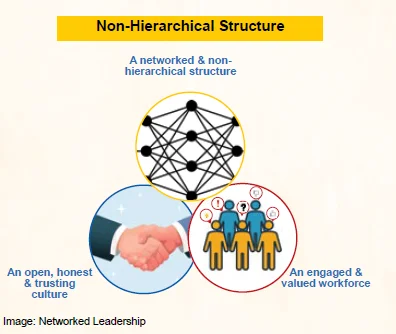
A (Nishith Desai): I am not a command-and-control type of person. In this new world, the command-and-control system always crashes and invariably leads to politics. I believe in freedom with responsibility and accountability — that is the new model we are working on. It is very difficult to monitor individuals; if they are not responsible, they fall into the trap. Being responsible or discharging responsibility alone is not enough; you have to be accountable.

In our firm, we have a measurement system called Balance Score Card. It is not a strategy but a measuring system. Many law firms work till 2:00–3:00 am; people take pride in saying they work till 1:00–2:00 am; once in a while, that’s okay, but not always. Remember, life is never straightforward; there are always ups and downs.

Balancing life or harmonising work and life is very important to us. In our firm, 80–90 per cent of our people leave at 5:30–6:00 pm. A typical day starts at 9:00 am, with one hour of Continuing Education Program. Everyone attends this, no exceptions — I attend too. From 10:00 am, for the next six–seven hours, we do billable work; the remaining hours are devoted to research.

Our career growth path is based on visible expertise. We have no titles — fresher, junior associate, senior associate, director, principal, etc. Once you introduce titles, it creates entitlement. We have broadly two levels: members up to five years, and then leaders. We define a leader as someone who is competent and inspirational. Leaders should behave in a way that others want to follow.

Under visible expert theory, the first level of growth or visible expertise is to be known as an expert within the firm. The second level is to be known within professional circles. The third level is to be known within the industry. The fourth level is to be known nationally. The fifth level is to be known globally.
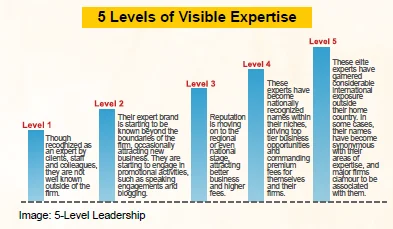
One article which I always give people when they join is ‘Level 5 Leadership: The Triumph of Humility & Fierce Resolve’ by Jim Collins. Once you develop the expertise or leadership, the most important thing you have to develop is to be humble. Humility and empathy must drive leaders’ behaviour.

We are now trying to develop a model called Driverless Organisation, something along the lines of a driverless car. How does a driverless car work? Every piece or part — be it hardware, software, sensor or dashboard — does its job. We give our people a dashboard week-on-week, and we review their Balance Score Card. In a profession or business, there are four dimensions: 1) your clients — you take care of them; 2) your people — clients are served by people, so you take care of people; 3) your processes — you have good clients and good people, but if you do not have good processes, things will fail; 4) your finances — unless you harmonise clients, people and processes, finance will not be right. That is the philosophy behind the Balance Score Card. What you want to balance in your business (or profession) is your prerogative alone.

For us, purpose is very important. Billable hours have to translate into value creation. Value creation also includes article writing, research, thought leadership, podcasts, etc. — these can be objectively measured – this is Part A of Balance Score Card. Part B is subjective — month-on month, the mentor–mentee sit together and discuss.

Conversations (while evaluating) should be more about potential rather than only criticism. It gives a different dimension to the conversation. Rather than setting targets, we indicate their potential (to the team). We have a trust-based environment — trust people as much as you can but blind trust is also not good. There are certain policies we follow, like anyone in the firm can travel anywhere in the world without approval; there is no leave policy. We trust our people that they will judiciously travel and be accountable for expenses.
 

Q (Mayur Nayak) How did you get an idea of the research campus “Ali Gunjan”? Tell us something about Ali Gunjan.

A (Nishith Desai): In the US, I saw law firms housed in these fancy buildings, and I thought — why can’t we have something like this in India; why not make it purpose-driven and not just business-driven? The idea of a research centre (Ali Gunjan) germinated from there.

My wife bought a piece of land in Alibaug without telling me (chuckles). I thought, let us put this to use for the greater good. I was very clear that the property had to be socially useful. Right from an early age, I have always been interested in learning new things. Even today, I have a childlike attitude when it comes to looking at something new. When you spend time thinking, you can do wonders. But I don’t get some quiet time to think.

So, we decided to create an ecosystem for ideation and thinking, where one can sit, ruminate, ideate, deliberate (first within a smaller group and then, as the idea starts taking shape, discuss it within a larger group) and debate. Basically, provide an environment which nurtures the individual thinker —helps him to think big and harness the advantages of collective thinking; or a place where someone can incubate the idea you come up with.

Ali Gunjan is probably the only ‘Blue Sky Thinking and Research Campus’ in the world which is offered to professionals by invitation, without any charge or fee. Ali Gunjan is private property meant for the public good.

Q (Mayur Nayak): How did you come in contact with the BCAS?

A (Nishith Desai): It was during my stint with the CA firm that I had the opportunity to read the BCA Journals, which are most educative. I attended your Residential Refresher Courses in Mahabaleshwar, Matheran and Mount Abu in those days and made friends with accountants. I became a super Chartered Accountant without doing a CA course (chuckles). It was a great learning.

Indian Laws and Judiciary System:

Q (Raman Jokhakar): India Tax System — What is plaguing the Indian tax system?

A (Nishith Desai): At a macro level, things are good in India. But at a micro level, the system is difficult to deal with; everything still operates on the basis of suspicion and unclear regulations. Language creates the biggest problem. The drafting (of the laws) needs to substantially improve.

Q (Raman Jokhakar): Tax as Enabler — Do you feel tax aspects can be enablers instead of being a cost or impediment?

A (Nishith Desai): I believe we focus more on tax collection; less time is spent on discussing how to spend the tax money. Today, if I am not mistaken, we spend roughly US$65–70 billion on defence, US$15 billion on education, and US$20 billion on healthcare. If you ask me, defence is a bottomless pit — we need to revisit how to spend the tax money.

On the revenue side, what is important is to make laws written in a manner that (they) are understood by the common man. How can a person decide their behaviour without reading the letter of the law? The intent of the law must be expressed in clear language. Else, it becomes very difficult to bring in foreign investments. It requires a lot of effort to convince a foreign investor but more time is spent on the implementation of a project.

Another problem is now civil laws are getting converted into criminal laws. Penalties and prosecutions are disproportionate to the crime committed. GIFT City is my favourite project, as I have been associated with it from conception, but I also believe that domestic regulators and the GIFT City regulators are at a disconnect. In the last few years, many changes have happened and excitement is in the air. Sure, it will fast forward.

Q (Raman Jokhakar): Ease of Doing Business — If India were in a race of “Ease of Doing Business’, what should be done URGENTLY to elevate India to the top 10 league in terms of ease of doing business?

A (Nishith Desai): Abolish exchange controls — TODAY!

Q (Raman Jokhakar) What is one change you would like to see in the global tax system?

A (Nishith Desai): I have been championing the case for ease of doing business at a global level. For the longest time now, ‘One World, One Tax’ has been my dream. More than a decade ago, in March 2014, I made a presentation on ‘One World, One Tax’ at the Global Tax Policy Conference held in Amsterdam.

Today, a global company (aka a multinational corporation) has to comply and deal with hundreds of different countries. Why can’t we have one single global tax system with one single base and one rate of tax, say 15 per cent? We need to focus on defining a base, i.e., how income should be computed. What we did with GST, or (what) the EU did with VAT, should be done for the world.

While it is understandable that everyone should pay tax, on the other hand, governments should adhere to and guarantee that nobody is taxed twice.

Q (MayurNayak): New Laws — What are your views on the New Laws, namely, The Bhartiya Nyaya Sanhita, 2023 [replacing Indian Penal Code, 1860] and The BharatiyaNagarik Suraksha Sanhita, 2023 [replacing Code of Criminal Procedure, 1973 (CrPC)]?

A (Nishith Desai): Each legislation is framed with a certain purpose. Some of our laws are more than 100 years old. Over time, there have been changes — systemic, technological, etc. Laws need to change with time, taking in the changed scenarios. At the end of the day, what remains to be seen is whether these new laws have served the purpose for which they were framed. Some reforms are necessary but the new sanhitas are substantially the same version of the old sanhitas. I also maintain that we should not change just for the sake of change.

For me, it is about the judicious use of technology, which will create a larger and faster impact. The use of technology at every level will help to contain crime and immediate justice can be done. The use of technology in the judicial system will help deliver speedy justice. Today, e-hearings have happened — these have eased the process. Whether virtual hearings are effective will be known as time goes by, but by and large, they are (effective).

My vision for the future of justice is: Justice at the speed of thought, without any injustice. Actually, I have written a paper on that.

Q (Mayur Nayak): Appointment of Judges — What are your views on the Collegium System to appoint judges in India?

A (Nishith Desai): Appointment of judges involves a lot of subjectivity. Subjectivity in the hands of people who are competent is important. One generally assumes that Supreme Court judges are competent. There is a degree of trust. For example, perception of honesty, creativity and innovation in meting out justice when the law is ambiguous, and quality of judgement writing — are some of the things needed to be factored into.

At the same time, everything cannot be so subjective that it leads to injustice. Objectivity is also required, but bear in mind that it could be manipulated. So, it has to be a combination of both — it is like any other evaluation. Some objectivity is needed, at the same time, some subjectivity is also necessary. In general, the collegium system has worked reasonably well. I believe that the collegium system, along with some degree of objectivity, would be a good model. Remember, justice must not only be done but seem to be done also.

Q (Mayur Nayak): Arbitration in Tax Treaties — Do you think India should adopt arbitration in its tax treaties?

A (Nishith Desai): Arbitration is a necessity. Arbitration exists in investment treaties. It exists in the World Trade Organization. I agree that this requires us to surrender our sovereignty to a certain extent. However, it is not uncommon, otherwise, international systems will not work. All treaties have that. There are complicated cases or other kinds of situations where you need to appoint an arbitrator and come to an understanding.

Q (MayurNayak): Challenges by AI — Do you think the present laws are equipped to deal with new-age challenges posed by AI and other technologies? If not, what should be done?

A (Nishith Desai): Apart from legal issues, there will be ethical issues. Today, AI has already exceeded human intelligence. It is doing business at a speed faster than your thought.

AI and Robotics will soon get integrated. Once AI gets integrated with Robotics, robots will make their own decisions and act on their own. I may own a robot, but it will be independent. AI will control it.

As regards the legal aspect, I believe that there will soon be a separate ministry of AI. We will have to provide a limited liability kind of a structured company for robots. Robots may be considered a person. There will be a system for registration. Robots will be required to pay tax. They will become part of life. Tomorrow, our competitors will also include robots.

Q (Raman Jokhakar): Education and Training — What does our education and professional training lack?

A (Nishith Desai): As I said earlier, doing a Bachelor of Arts made my thinking lateral and liberal. What typically happens today is that subjects like Logic, Philosophy, etc., are not taught to other students. Everybody wants to become a Chartered Accountant (which is very good) or MBA, but subjects of Philosophy and Ethics are not taught. Consciously understanding their principles helps one make an informed decision. Philosophy is the greatest decision-making tool. It is like Mathematics. Philosophy and Mathematics at an esoteric level are similar if not identical. If your principles of Mathematics are clear, you will get the right answer, 1 + 1 = 2. If your philosophical base is clear, then your decisions will always be right — you will know what is the right thing to do, and what isn’t.

The first paragraph of a company’s annual report is the Chairman’s Statement which captures the corporate philosophy. About 60 per cent of global CEOs have a Liberal Arts background, especially in the US.

Rapid Fire Round

1. One person you admire as a role model outside the family?

Nani Palkhivala

2. Music: Hindustani or Western Classical?

A mix of both — Fusion

3. Books you have read more than once?

Discipline of Market Leaders

4. Favourite sport?

Walking, cricket

5. Your hobby, outside books, music and work?

Thinking

6. Vision for India in a few words?

Move up from Democracy to Netocracy — a Digital nation with responsible and ethical people accountable to each other with minimum hierarchy and disintermediation of agents of the people such as MPs and MLAs. They should serve as  Servant Leaders. The job of technology is to disintermediate.

7. Your favourite movie?

Padosan

8. Three qualities a professional must demonstrate to himself and his clients?

Technical competency, inspirational, willing to allow other professionals to succeed

9. Skills you could have more of in hindsight?

How to make PowerPoint presentations

10. Law firm you admire?

Wachtell Lipton, Rosen & Katz

11. Favourite travel spot?

Switzerland

12. Has the profession become a business, or was it always one?

It has become more of a business now; we need to revisit that approach. In business, money comes first, and service comes next. In a profession, service comes first, and then the money comes.

13. Indispensable quality you want in new hires at your firm?

Professionalism

14. One piece of advice to young professionals?

Be of service to the society at large.

15. Secret sauce of your success?

The excitement of learning new things.

16. Purpose of wealth?

To be happy. Wealth without happiness is poverty.

17. One boon that you would ask from God?

Sarvodaya — growth of everyone in one-world family.

Interview – CA Rajeev Thakkar

“WHEN YOU ARE BUYING EQUITIES, HAVE THE BUSINESS OWNER’S MINDSET, RATHER THAN TRYING TO FLIP IT EVERY NOW AND THEN”

BCAS and the CA profession have completed their 75 years of existence. In order to commemorate this special occasion, the BCAJ brings a series of interviews with people of eminence from different walks of life, the distinct ones whom we can look up to, as professionals. Readers will have an opportunity to learn from their expertise and experience, as well as get inspired by their personal stories.

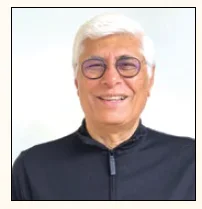
Here is the text (with reasonable edits to put it into a text format) of an interview with Rajeev Thakkar.

Rajeev Thakkar is the Chief Investment Officer & Director, PPFAS Asset Management Private Limited, the asset manager of PPFAS Mutual Fund. As of March 2024, the Company has an asset under management of over ₹64,000 crores.

Rajeev Thakkar possesses over 30 years of experience in various segments of the Capital Markets such as investment banking, corporate finance, securities broking and managing clients’ investments in equities. Rajeev strongly believes in the school of “value-investing” and is heavily influenced by Warren Buffett and Charlie Munger’s approach. His keen eye for ferreting out undervalued companies by employing a diligent and disciplined approach has been instrumental in the scheme’s stellar performance ever since he assumed the mantle.

He resists the temptation of entering speculative stocks during extremely bullish times as he believes that it is not appropriate to wager on clients’ funds and faith by chasing companies that one does not have any conviction in. He strongly believes that only stocks purchased at the right valuations will provide long-term returns and is unperturbed by short-term underperformance. He is a Chartered Accountant, Cost Accountant, CFA Charter holder, and a CFP Certificant.

In this interview, Rajeev Thakkar talks to BCAJ Editor MayurNayak, past editor Raman Jokhakar and Journal Committee member Preeti Cherian about his winning equation, investor behaviour, his advice to investors, company management, auditors, directors, gold as an asset class, de-dollarisation, speculation, the regulatory framework in India, great investor habits and routines and much more…

Q. (Mayur Nayak): Welcome, CA Rajeev Thakkar. On behalf of the Bombay Chartered Accountants’ Society and the Journal Committee of BCAS, I, together with CA Raman Jokhakar and CA Preeti Cherian, thank you for this opportunity to interact with you.

A. (Rajeev Thakkar): Thank you. I have not been part of the profession formally since 1994 when I moved to the financial markets, but my formative years were spent doing my CA articleship and my interactions with Chartered Accountants started since then.

Q. (Raman Jokhakar): Thank you, Rajeev. Morgan Housel has famously said that average returns for an above-average period equals extreme outperformance; he believes this is the most obvious secret in investing. What is your winning equation when you measure performance as a fund manager who is stepping into the shoes of the investors?

A. (Rajeev Thakkar): We studied this one formula in high school, which, unfortunately, a lot of people do not remember in their grown-up years; that formula is the compound interest formula, A = P (1 + R/N)nt; where “A” is the final amount, “P” is the principal amount, “R” is the annual interest rate (decimal), “n” is the number of times interest is compounded per year (12 for monthly) and “t” is the time in years.

If we look at the formula, there is only one term which is exponential in the formula, and that is, the number of years. Addition, multiplication move slowly, but the exponential term moves very rapidly after a certain period. So, if you invest long enough, the number of years “t” is a bigger factor driving the returns. Something which will give you 25–35 per cent for six months will not be that meaningful of a return driver as compared to something which will, let’s say, give you 15–16 per cent over 30–40 years. That is what he means — invest for an above-average period.
In our case, we do what is commonly referred to as ‘active investing’, where instead of putting all the client’s money into stocks which are part of the indices, we identify those companies (that) we believe will outperform the index, and we invest in them. Sometimes, we succeed in this, sometimes we don’t. Our journey has been satisfactory. On average, we have managed to do better; but again, more than the return, the longevity matters. I completely agree that one should look at long-term compounding; but, if in the process, you can do better than the index, you will be even more successful.

Q. (Mayur Nayak): When you talk about the long-term, what is the horizon you look at? Is it 5, 10 or 15 years?

A. (Rajeev Thakkar): Look at the behaviour of our family or our friends or even our behaviour. Typically, in an Indian household, jewellery is passed from one generation to another. We add to the existing jewellery stock; very rarely do people sell jewellery which has been inherited. People buy a home and stay in the same home for 20–30 years. Even if they change the home, they sell that and buy something even more expensive by, typically, putting in some more money. An employee joining the workforce at the age of, let’s say, 25, will regularly put money in the Employees Provident Fund for 35 years till retirement. We buy LIC policies for 20–30–40 years. Yet when it comes to equity investing, the moment we buy the stock, we put it in Google Finance, Yahoo Finance, Money Control, some app or the other, and the TV channels will show you tick-by-tick price data. There is this urge to do something — sell something, buy something else. And we do not have a long-term outlook for it.

At PPFAS, we look at equity as, ‘effectively owning a part of the business’ when we buy shares of the company. When you buy TCS shares, you are partnering with the House of Tata in providing IT services. When you buy Bharti Airtel shares, you are partnering with the company in providing telecom services. Now businesses go through their ups and downs in terms of demand cycles, competition, environment-related matters, etc. Sometimes, the market sentiment will cause share prices to go up and down. We have had long periods of time where equity did nothing; we have also had periods where equities gave supernormal returns — these returns have come only to those who have had the patience to hold through the long up-and-down cycles. The mistake that people make while driving their investment vehicle is that they only look in the rear-view mirror. If the past five years have been good, they will come and invest heavily. If the past five years were bad, they will withdraw or not add money, which is precisely the wrong way to look at it.

To answer the question, “How long is long-term?” you should look at it like you look at your Employees’ Provident Fund or your insurance policies. Equity is the longest asset class; so, when you buy equity, there is no maturity date. As all Chartered Accountants know, it is the permanent capital of the company. Now, on the other hand, a bond will have a maturity date. So, when you are buying equities, have the business owner’s mindset, rather than trying to flip it every now and then.

Q. (Raman Jokhakar): Managing risk is a key part of investing. Some say that even more important than return is the management of risk. What strategies do you employ to mitigate the risk of losses or the risk of permanent loss of capital during market crashes or economic downturns or, you know, black swan events like COVID, etc?

A. (Rajeev Thakkar): So, one thing which is not very widely appreciated about losses and risk is that people generally tend to equate the upside and downside in their minds. If you make 10 per cent and then, you lose 10 per cent, people think they are more or less quits. Well, let me give you some vivid examples.

If you lose 50 per cent, to come back to where you started, you do not need a plus 50 per cent, you need to double your money — you need plus 100 per cent returns. Say, from 100 you go down to 50. Now, from 50 to go back to 100, you require a 100 per cent return. Then again, if you fall from 100 to 25, that is minus 75 per cent; you need to take your money up by 4X to go from 25 to reach 100.

If your return in year 1 is 25, year 2 is 15 and year 3 is 20, you cannot add the three numbers and divide by three to get the average return — you need to multiply the returns. So, in a scenario, where returns are multiplicative, if any one number is 0–100% (investment goes to 0), you get checked out. And similarly, if any one number is a big negative, coming back to par becomes very, very difficult.

Permanent loss of capital needs to be distinguished from what Warren Buffett calls ‘quotationalloss’. After you buy your share, the price could either go up or down. It is almost a 50–50 per cent probability in the near term. Market prices keep bouncing around all the time, so the permanent loss of capital comes only when the mistake is so bad that chances of recovery are either zero or the time taken to recover will be so long that effectively all capital will be gone. This can happen in a situation where the company you buy shares in goes bankrupt. That is one very clear example of permanent loss of capital. This can also happen on account of fraud, excessive leverage or very, very severe business downturns.

If you invest in debt-free businesses or minimal debt or cash-rich companies where the management has a good track record over decades, the chances of fraud are less. That is one thing to look out for while managing risk; buy into businesses which are not that prone to disruption hits. If the business environment changes every six months, then what is a very successful business model today may not work in a year. So, buying into stable businesses helps.

The second reason for permanent loss of capital could be if you have severely overpaid — where the drawdowns are 80–90 per cent. This happened in the late 1990s with what was called New Age or New Tech businesses: technology, media, telecom or internet, communication, and entertainment — the ‘new economy stocks’ as they were called. Those fell significantly after the crash, and people took almost a decade to come back to par and, in some cases, the money was completely lost. Similarly, we saw a cycle in 2007 where people were valuing companies on potential land banks and how they could get monetised. If we avoid these mistakes, the other smaller mistakes get evened out. In a portfolio where let’s say, there are 20 stocks, 10 could do reasonably well, 5 could do exceptionally well, and the other 5 may not do well at all; so, on average, you tend to do reasonably ok.

So, one, guard against fraud, excessive leverage, or disruption, and two, avoid paying very, very excessive valuations to avoid permanent loss of capital.

Q. (Mayur Nayak): Very well answered. Just to take a cue from that, say in a case like Satyam, where there is a sudden or permanent loss, in that situation, how would you react because there is total uncertainty as to whether the company will revive? So, should one stop loss?

A. (Rajeev Thakkar): Let’s say you have invested in 20 businesses, and you have, on average, 5 per cent in each business. Any one stock going to 0 will affect your portfolio value by 5 per cent. 100 will go to 95 if a particular stock goes to 0. Now if the stock market, on average, is giving you a 12–15 per cent return, then you would have to wait for the remaining stocks to give that return to make up for the loss (that) you have suffered. What to do in a specific scenario requires (1) knowledge, (2) skill set, (3) temperament and (4) a certain amount of luck.

There have been people who have invested in downturns where they saw that whatever has happened is not fatal for the company, and they could make huge returns from buying into such a scenario. Then again, there have been scenarios where one should have sold off in that environment. Warren Buffett famously put 40 per cent of his partnership assets into American Express after a scandal broke out, and that worked out very well for him. In India, we have had banks which have gone completely bankrupt, like the Global Trust Bank, or something like Jet Airways. If something is going bankrupt, you will lose all your money. So, after a crisis hits, should you exit that stock or should one buy more? The answer depends on your understanding of the balance sheet, your understanding of the business and how you see the future playing out.

Q. (Mayur Nayak): I think you gave a very important answer, that one should diversify their portfolio as much as possible. To quote Morgan Housel again, “Things that never happened before happen all the time.” Can you share your experience of navigating previous market crises such as the 2008 financial crisis and COVID?

A. (Rajeev Thakkar): Both were very, very interesting in terms of that they happened during my career as a professional investment manager. An individual can choose to do what he or she wants. But a professional investment manager is answerable to a whole set of people. Luckily, we were able to navigate reasonably well during both these crises. COVID was different from the global financial crisis; the proximate causes were different. However, one common theme across both crises was that stock prices came off significantly. So, in COVID, at the lows, you saw something like a 40 per cent drop from peak levels; during the global financial crisis, it was a 60 per cent drop — this is at the index level. Individual stocks would have fallen even more.

The common theme across both these crises is that initially, a few years were / will be difficult for the business environment, economic growth could be slow and there could be losses due to hitherto unseen situations. So, in the case of the virus outbreak in China, the hospitality sector was badly affected, airlines could not operate and hotels could not operate. Or for example, the subprime crisis in the US affected the inter-bank liquidity in India. One does not know what impacts will be there, and what 2nd / 3rd / 4th order effects will be there in a crisis kind of a situation.

My advice is to firstly, go through your existing list of companies where you have invested. The key criteria to look at is, will this company survive over the next three to four years on its own without government support, without anything else? If the answer is yes, you can hold. If the company has too much leverage, if interest payments and principal payments are due, if they are going to be facing issues servicing their loans, then their assets will most likely get sold off, and as a shareholder, you will end up with nothing.

Secondly, let’s say, the next three years’ earnings are 0, but if the stock price is down 50 per cent, in most cases, it results in a ‘buy’ kind of scenario, as long as the business is going to survive because, in the life of a business, three years is a relatively short period. The inherent assets do not go away; the inherent business value does not go away. From the intrinsic value perspective, it does not have that big of an impact, maybe a 10–15–20 per cent value reduction; if the discount you are getting is much larger, it mostly results in a ‘buy’ kind of scenario.

Q. (Raman Jokhakar): In the coming years, the crisis may be different, or may be of a mixed nature. For example, we had this pandemic, a financial crisis. With impending war and the volatile geopolitical situations in some areas, all these could get enmeshed and create a new form of crisis. How do you see such kind of crisis affecting us as investors?

A. (Rajeev Thakkar): Sure. So, several things could go wrong: you could have a meteor strike the earth, you could have a nuclear war break out, you could have cyber-attacks and/or ransomware attacks, you could have political instability or you could have a civil war kind of situation. Various things can happen in the realm of possibilities. If you are investing in equities, there must be a certain amount of optimism that the world will continue to do well. Otherwise, one gets into too much of a defensive nature. We jokingly tell people that if something strikes the earth and all the life as we know it is wiped out, will it then matter whether you invested in gold or bonds or equities? No one will be around to see the asset values decimate.

Coming to asset allocation, how much emergency money / liquid money to keep, how much to put in gold, how much to put in asset classes like REITS (Real Estate Investment Trusts) for regular cash flow, how much to put in growth assets like equity all depends on personal circumstances — personal risk tolerances, age, financial goals, all these things. But once you decide on asset allocation, it helps to tune out worrying about all the things that could go wrong. Occasionally, things will go wrong. But on average, things even out. If people were equity investors in pre-Nazi Germany, most likely, their portfolios would have been wiped out. Or if someone was an equity investor in China or Russia before communism, their holdings would be zero, but so would be everything else, including their large homes, which would be taken over by the state. There are some things you cannot do anything about, except for maybe global diversification; at the end of the day, you should not worry too much about those things.

Q. (Raman Jokhakar): How do you manage customer / investor expectations and show it through your performance, because people do expect some kind of outcome from their investment?

A. (Rajeev Thakkar): We see a very strange kind of investor behaviour. At one end, investors will be very, very comfortable buying insurance plus mixed investment products, where they will get maybe 5–6 per cent return over the long-term, or they will be happy with their bank fixed deposit rates; but when it comes to equity, immediately the expectations go to 20–25–30–35 per cent, the higher, the better. Our job is to communicate to the investors that equity in the short run is a risky asset class. There are periods where returns can be negative. There can be long periods where returns are subdued, and only if you hold it through a longer term, can you expect moderately good returns — ‘moderately good’ meaning something better than fixed income securities and better than inflation. We portray the different kinds of rolling returns that have been achieved over the index level in the past, so that gives some grounding to our communication. We try and explain both these factors: (1) the requirement for long-term investing and (2) we tone down the return expectations whenever we can.

Q. (Mayur Nayak): That takes me to the next important aspect from the investors’ perspective — re-balancing and re-checking the portfolio. What should an investor consider as triggers to undertake this? And the period to review the portfolio — whether it is under a mutual fund or a mix of equity, debt and mutual fund and other asset classes?

A. (Rajeev Thakkar): People have different approaches to this aspect. Some people typically think of re-balancing as a tactical move, and many times, they mix it with upcoming events or their outlook on what is going to happen. I think this is where people go significantly wrong. To give you an example, people try to bet on political outcomes, and they invest accordingly, and invariably get it wrong. They end up losing not only in India but globally as well. People read the Brexit Referendum wrong, they read the Trump and Clinton elections wrong and they read the 2004 Indian elections wrong. This year, on the exit poll day, the markets were significantly up; on result day, markets were down. Again, we are up to all-time highs. People tend to swing between greed and fear and end up losing a lot of money — that is not the reason to re-balance.

The other reason for re-balancing could be because of their asset allocation. Let us say, someone’s asset allocation is 60 per cent equity, 40 per cent bonds. Now if equity does very well, the temptation would be to sell equity and buy more bonds. One could do that if that is the appetite. People should follow a disciplined approach and maybe review it once a year. Re-balancing once a year is reasonably ok. In my opinion, typically, people fall into two categories: either people are saving for retirement or people are consuming in retirement. If you are a saver, my recommendation is rather than selling one asset class and buying the other asset class, you can divert your incremental savings to the asset class which is underweighted. For example, say, the allocation is 70:30 between equity and bonds, and you put the year’s savings only in bonds so  that the weightage of bonds starts going up. Each time you switch between asset classes, that is tax-inefficient; you end up paying tax without benefiting from that cash flow.

Similarly, if you are in retirement and you want to re-balance, withdraw from the asset class which is heavier than your target weight rather than trying to sell one and buying the other frequently. Buying–selling creates unnecessary transactions. If it is too lopsided, then sure, one can sell one (asset) and buy the other (asset).

Q. (Raman Jokhakar): Today we are in a slightly tricky situation – we are facing high interest rates and markets also keep going up, not only in India but also, say, in the US. What do you read into this? What are the causes and consequences? How should investors look at this? How do you look at it?

A. (Rajeev Thakkar): All Chartered Accountants know that the technically correct formula to value any financial asset is the discounted cash flow of any asset, be it a bond, aircraft lease, equity shares, real estate, etc. This formula helps you decide whether the asset is worth buying or not. One of the factors which affect this discounted cash flow is the discount rate you use. Logically, at higher interest rates, the discounting rate would be higher and at lower rates, the discounting rate is lower. So, when rates go down, the intrinsic value goes up.

The linkage between the federal funds rate, RBI repo rate to bonds has been very clearly established. In the case of government bonds, the cash flow is very certain — you know the exact amount you will get and the exact date on which you will get it. In equity shares, neither is the amount nor is the date certain. So, while interest rates do factor in terms of equity valuations, the linkage is not that very strong. The movement of stock prices is better determined by the growth prospects that people see in cash flows and the business environment. This partly explains the fact you mentioned — when interest rates were going up, we saw stock prices also go up. However, when interest rates come down, stock prices may or may not go up — as the linkage is not that very strong, rather it is a weak linkage.

Today, in terms of the environment, we have factored in a lot of positives that are there in India and globally — so, valuations are looking stretched. In one-off companies and sectors, you find opportunities. But if one looks at the overall market levels, I believe it is time to be cautious in equities.

Q. (Raman Jokhakar): Picking information at the right time and analysing it rightly is critical to investing. But like we CAs use the word ‘professional judgment’, how do you stay informed of what action to take? There is way too much information from various sources, such as regulatory changes, market developments, geopolitical risks, etc. How do you sift through all this information to arrive at your investment decision?

A. (Rajeev Thakkar): Firstly, when you are looking at a company, it helps to look at the market cap and  total profits, rather than other parameters. Let’s assume you have enough money in your bank account to write a cheque and buy the entire company at the current market price. Once you buy it, you are the business owner and now the stock ceases to be listed on the exchange. Would you be happy being a business owner at the current offered price? That kind of thinking really clarifies matters a lot.

I believe most of your readers / listeners are Chartered Accountants. Let’s say you are in practice and some other Chartered Accountant is retiring and offers their professional practice to you for a fee. Would you buy that professional practice at the price offered, basis the same factors you would consider to evaluate a listed business? Chartered Accountants in practice would know what a professional practice is. Similarly, you should be aware of what the business of the listed company is. If you are analysing a telecom company, but you do not know anything about telecom, it is difficult to arrive at a business value. Each analyst and each manager is familiar with a certain number of sectors such that they can arrive at a reasonable judgement; do not stray beyond that, that is my first recommendation; if you do stray, then the chances of making a mistake go up.

You mentioned regulatory changes and other changes too. Typically, the chances of making a mistake in such businesses (where regulations change very frequently) are very high. Jeff Bezos once famously said that he frequently gets asked, “What’s going to change in the next 10 years?” And that he rarely gets asked the question, “What’s not going to change in the next 10 years?” The second question is the more important of the two because one can build a business strategy around the things that are stable in time. In the retail business, customers will always want lower prices, faster delivery and bigger selection. It is impossible to imagine a future 10 years from now when a customer will come up and ask for higher prices, slower deliveries or lesser selection. When one has something that one knows is true, even over the long term, one can afford to put a lot of energy into it.

Similarly, as investors, we need to focus on businesses which will look largely similar 5, 10 or 15 years from now. The basic needs of humans — buying consumer goods, soaps, shampoos, biscuits, basic banking, basic insurance — all these have not changed too much. Whereas if you are in some niche technology space or some biotech space where some regulatory approval could either come or not come, then your entire valuation hinges on that one event happening or not happening; that’s when things become very difficult. Stick to things that you understand and things that are relatively slow-moving. Of course, changes are there everywhere. Even in consumer goods, for example, Gillette which offers shaving products faced competition from a direct-to-consumer brand in the US-based Dollar Shave Club. Be on top of the change; focus on things that are slow moving and then take your time. Opportunities will come your way.

Again, in the late 1990s, all tech companies were overvalued. So, if you bought Infosys or Wipro in the late 1990s, you would have lost money or you would have not broken even for seven to eight years. Ironically, after seven years, if in 2007 you bought these tech companies, you would have done well despite the global financial crisis. So, at what valuation you buy matters, apart from all your business analysis, quality checks and all that and much more. Many times, things are obvious. It’s just that you need patience to wait for the right opportunity to come your way and when it does, you should have the courage to act.

Q. (Mayur Nayak): So, Rajeev, you made a very profound statement that one should focus on things that are not going to change. And one of the things which people expect to continue is the governance structure of the investing company. Broadly speaking, what is your broad governance evaluation mechanism?

A. (Rajeev Thakkar): I think more than the technical aspects, past behaviour matters. Sometimes people try to use too much of a checklist kind of approach: How many board meetings did this director attend / not attend? How many other boards is this director present on? I agree there is some importance in that, but are these the people running the company? Are they fair to the minority shareholders or not? Do they have a personal interest in the well-being of the company? Let’s say the promoter group has just a 3 per cent to 4 per cent stake in the company. Then they are not going to be so bothered about minority shareholders. They may be interested in building their empire or paying themselves excessive remuneration. So, essentially, are they being fair to the minority shareholders? Do they have the competence to run the business? Are they energetic? All these things matter.

Seen in the photo from left to right: CA Raman Jokhakar, CA Rajeev Thakkar, Dr CA Mayur Nayak and CA Preeti Cherian

Warren Buffett listed three things. Firstly, you want integrity. Without integrity, nothing will work, no matter how good the business is. Secondly, you want competence. Someone may have integrity but does not know how to run the business; then it will not work out. Thirdly, you want energy. You want commitment in terms of time and effort. If someone has integrity and competence but spends all the time on the golf course, then again, it won’t work. So, you need a combination of these three; but largely, you need integrity and competence.

Q. (Mayur Nayak): Excellent answer! Moving on, how do you see the role of auditors as one of the lines of defence? There are many auditors who have been involved in fraud across the world. How do you see the role of auditors in this governance structure?

A. (Rajeev Thakkar): As investors, we have access to the annual accounts where the auditor puts theirs and the firm’s names behind the assurance that is being given. And that matters a lot. While studying auditing, we were told that we are watchdogs and not bloodhounds. So, if the fraud is too convoluted, there is a limitation on what the auditor can do and cannot do.

The one interesting change in recent times has been in the format of the audit reports. Earlier, you just stated whether these statements were true and fair. Now you have to make additional qualitative disclosures. So, when you read key audit matters and things like that, as an investor, you can decide that this business is too complicated. Then no matter what the published statements say, if there are these significant uncertainties, maybe it’s better to stay away from the company.

Let’s say, one company has a simple standalone balance sheet in India — big promoter stake, long track record, understandable business, not too many issues in terms of inventory valuation, depreciation estimate, impairment, etc., — you can go with the financial statements and invest in it. Now, let’s say, there is another company with 200 subsidiaries in multiple geographies, 20 acquisitions, a huge amount of goodwill lying on the balance sheet and huge paragraphs upon paragraphs of key audit matters. Now in such a case, the reported financials are just these numbers, meaning you can’t nail them down with any precision. Again, if the nature of business is such that it involves a lot of estimates, what is the chance of completing these projects? In the famous case of Enron, the whole structure was so complicated that people could not understand what was going on inside. It’s better to avoid such companies, I think.

When you look at the audit report, irrespective of who the auditor is, the description generally gives you enough information as to what to stay away from. And interestingly, there is a lot of data disclosure these days, apart from whatever is there in the auditor report. There are a lot of data points which are put out by the government and regulatory authorities; there are subscriptions that investors can take and look at. For example, you can do a case search on all the litigations where the company is a party either as a plaintiff or as a respondent, you can look at whether they are filing GST returns on time or not, whether they are paying PF dues on time or not, how many employees do they have, so on so forth; various checks can be done in that manner.

Q. (Mayur Nayak): Today, auditors are regarded as conscience-keepers for the stakeholders. Do you believe that auditors have discharged their duties ably or have they failed in some areas? What more can be done by various regulatory authorities like NFRA and ICAI to make the system more robust?

A. (Rajeev Thakkar): While I am not part of the audit profession as such, I regard myself as a little bit of both an insider and an outsider. As someone with a Chartered Accountancy qualification but one who is a consumer of the accounts rather than someone who writes an audit opinion, I think we are expecting far too much from auditors. Even the way the financials are reported these days — I am slightly old school in terms of preference — things such as historical cost accounting, the adjustments would be done by the end investor or the users of the financial reports. Nowadays, with this fair value concept, making comparisons across time has become difficult because earlier statements would be under one accounting regime and the later statements are under a different accounting regime. So, in our mind, we must redo the numbers and try and compare again. It is not so much of a challenge in the kind of businesses that we invest in because they are simpler businesses, and we don’t place too much importance on a particular quarter’s result or a particular year’s result — when you look at it over 5 years, 10 years, these things even out. So, it is not so much of a hassle.

Q. (Mayur Nayak): Do you use any risk management tools or instruments to hedge against potential losses? Anything from the AI space?

A. (Rajeev Thakkar): Ask the saying goes, artificial intelligence has not prevented natural stupidity. The market cycles are still what they are. If you look at the US markets, for example, you have these meme stocks where the companies are almost bankrupt but because some people are pumping them up on social media, the stock price keeps going up. And then when it goes up very, very dramatically, the company says, oh, this is a golden opportunity, let’s issue more shares and raise actual cash, and then the stock price collapses, and the capital gets misallocated because the business is inherently bad.

Most of the work we do is old school. AI helps in terms of doing certain activities to speed up things. For example, if you want AI to go through all the conference call transcripts and go to a particular term which was used, let’s say, ‘cloud computing’, then you could do that. You could use AI to scan social media posts for a new car brand that has been launched and do sentiment analysis of the reviews — positive or negative. Those kinds of things could be done. You could use AI to summarise stuff but do not outsource the decision-making to AI. We do use things like derivatives for hedging and so on, but these are firstly not for speculation at all. My advice to the investor, especially the retail investor, is to stay completely away. We are the counterparty to them — whenever the retail investor does something foolish, we benefit from their actions.

A matchbox can be used both to light a fire in the kitchen and to burn down the building. Let me give you a simple example. A biscuit company will want to buy wheat, and a farmer will want to sell it. Now, the farmer may not want to take the price risk since the crop is standing; he may want to lock into a fixed price. On the other hand, the biscuit manufacturer may want to lock in the purchase price. So, they may partly enter a wheat futures contract and de-risk both their operations — this is a case of hedging. Now, there could be a commodity speculator who wants to speculate on the price of wheat. He will pay ₹10 as margin and take a position of 100 or 200 and when the price moves, he either makes a lot of money or loses the entire capital. So, it depends on what a person is using those instruments for.

Q. (Raman Jokhakar): Can you walk us through your decision-making process? This is surely the most important work that people count on you for. How do you decide when to buy, and of course, to sell?

A. (Rajeev Thakkar): Before deciding to buy a particular company or not a few things need to be checked out. First is the promoter quality that we spoke about, the integrity, competence and energy of the promoter, and the manager group. Second are good industry characteristics. Now the same business house may be very successful in running an IT services company and yet may fail very miserably in running an airline company because the businesses are different.

Today, anyone can walk into a bank and make a fixed deposit at 7.5 per cent p.a. If the business is going to generate a return on capital employed of 6 per cent p.a., why would you even invest in such a business? There are certain industries and businesses we rule out; if they do not have a track record of a decent return on capital employed, we simply do not invest in them. Third, we discussed leverage or borrowings. Borrowings increase the riskiness of our business. There are certain exceptions — utilities and banks typically are in the business of borrowing money but otherwise we stay away from leveraged businesses. The business should be understandable — if it’s a biotech company dependent on one approval coming for a particular medicine, I’m not competent to judge that company. It should be a business that we can understand. After all these criteria are met, I want a valuation that is reasonable. This is the decision-making process for a company per se.

We have a team of analysts covering different sectors. They track all the companies under their coverage on a regular basis. Periodically, an opportunity comes, and they pitch it to the fund management team, the investment team. How much to buy depends on the upper limits at the regulation level. We cannot own more than 10 per cent of a company across schemes. So, if the company has an outstanding paid-up capital of 100 shares, we cannot own more than 10 shares in the company across all our schemes. This is the first restriction. Also, as a per cent of our assets, we cannot own more than 10 per cent in a company. The company may be very large, let’s say, TCS, I cannot put 20 per cent of my clients’ money in TCS; I am restricted to 10 per cent. So, this is the second restriction. We also do not want to overextend in a particular sector; so, there are sectoral limits in place.

The weightage also depends on the relative attractiveness of different things. If I have five equally good opportunities, then it would be spread over all five. Of these five, if there are three better opportunities, then the weightage would be slightly higher in those three. Of some of the stocks that we currently own, if we get fresh client money, we would buy more of those companies if they are still attractively valued. If there is redemption, obviously we will sell to pay money to the unit holders.

Another reason to sell is when either the promoter and / or management integrity comes into question. Then the exit is relatively quick. If the business worsens significantly and that too on a permanent basis, then the exit is also very quick. Further, if the valuation keeps going up, we generally trim the position over a period. Then it is not a one-shot exit because there is no precise answer as to when something is overvalued; we would end up reducing the weight over a period.

Q. (Raman Jokhakar): These days, when money sort of keeps getting pumped in, with everyone investing in the market through mutual funds, what happens when there is so much inflow?

A. (Rajeev Thakkar): We are clear that we will not buy something which is overvalued just because money is coming in. The money will go to money market instruments which, in the current environment, give around 7.5 per cent p.a. Just because inflows are coming, we will not buy just anything.

Q. (Mayur Nayak): Investing in US securities – PPFAS MF’s well-acclaimed Flexi Cap Fund has exposure to US equity as well. What has been the experience of your fund to US exposure?

A. (Rajeev Thakkar): I’ll split the question into two parts. One is only currency and the second is investing abroad, especially in US markets.

One interesting thing about US markets is the opportunity to invest in larger companies — when you are buying into those larger companies, you are participating in the world economy. These companies don’t just operate in the US, they have global operations. Look at Microsoft, Amazon, Google and Meta (earlier called Facebook), these operate globally. In India, when people buy a new cell phone, among the first apps that they download are WhatsApp, YouTube, Google, Amazon, and things like that. So, when you are buying into US companies, you are buying their Asia business, you are buying their European business, their North American business, their South American business — everything comes to you together.

We do not have any view on the US$ as such. We are saying these are businesses on the right side of the business trends that are there — the business trends being the shift from traditional advertising to digital advertising, the shift from on-premises computing to cloud computing, from linear TV to streaming services like Amazon Prime Video or YouTube or Netflix, shift towards AI where again these companies are at the forefront – so these businesses are growing in terms of revenue now.

The US$ could weaken against other currencies, sometimes it could strengthen, which is ok. We are partnering in that business which is global. When we buy into a global business, what this does is that the India-specific ups and downs get muted on the portfolio level. Let’s say, there is a surprise demonetisation in India, there’s uncertainty around GST introduction or there’s border tension with China. All these things get muted in the portfolio — both positive and negative. Like, we had a surprise tax cut, Indian stocks went up, and global stocks obviously did not follow — so, the journey for the investors is smoother to that extent. Also, some opportunities are not available in India. We have a good corporate sector across various industry segments, but some segments are missing. For example, we do not have big EV players. So, if you want a very strong EV player, you must either buy something like a Tesla or BYD globally. If you want device manufacturers, you want to buy Apple or Samsung globally. Look at software and operating systems, we do not have the equivalent of Microsoft kind of companies in India, Google kind of companies in India or innovator pharma companies. Most of our companies are generic companies. A Johnson & Johnson kind of company is not there in India. So, you must look at overseas investing.

I do not have a view on currency; whatever the currency, if the business is valuable, people will pay for that business and the companies will earn a profit. About the central bank’s de-dollarising — clearly, I think the West has overplayed its hand in the Russia–Ukraine war. If a country has balances with you and you say, because I don’t politically agree with you, I’ll freeze or seize your assets, then people will move away. Even people who are not directly involved will say who knows if 5 years, 10 years from now I could be in a similar situation, I don’t want to be taking that risk now. Recently, we have had India bringing back gold to our shores; why keep our gold in foreign countries? Central banks have been buying gold as opposed to US treasury securities. I think that trend could continue. People could create strategic reserves of oil, industrial metals and rare earths, rather than just keep assets in the reserves, in paper money. Then it does not matter what currency you use as a medium of exchange. You could continue to use US$ because it is a temporary thing. If the balance is not too much, you could use $, €, ¥ or whatever.

Q. (Mayur Nayak): How do you see gold as an asset class? Because today we find both equity and gold going up seamlessly, silver is also going up. How do you look at them as an asset class?

A. (Rajeev Thakkar): Historically, gold has been able to protect purchasing power reasonably well, especially in India, against rupee depreciation or inflation and things like that. But it’s not my favourite asset class. Let’s say, you buy 10 grams of gold. Those 10 grams of gold after 10 years will remain 10 grams of gold. Instead of that, if you buy a business making cars, tractors or manufacturing mobile phones, they could set up new factories, increase turnover and increase profits. It’s productive — putting money in equities or lending money to businesses to generate employment. So as a country, it would be better if we put money in productive assets rather than buying metal, which will go into lockers.

Q. (Raman Jokhakar): There are alternative or competitive investment philosophies which state that the word “long-term” is like a cushion because, in the long term, everything anyways goes up. Instead, they propose to see the long-term view but also try and make money with a higher turnover of their holdings by calling it as being more dynamic.

A. (Rajeev Thakkar): Firstly, let us distinguish between two things — and I am not passing any moral judgment here — let us distinguish between investing and speculation. Let us say all of us sitting in this room took out a pack of cards and said let’s gamble, right? Can all of us be profitable at the end of the session? No. So if you win, I would have lost money to you. When we add up all the winnings and losses, the total will be zero, right? This is what is called a zero-sum game. In the market, speculation is a zero-sum game minus taxes minus brokerage. It’s a negative sum game; it doesn’t mean everyone will lose money. In fact, some people are very, very successful at this — case in point, Jim Simons, founder of the quant fund, Renaissance Technologies in the West. The fund has earned annual returns of around 60 per cent before fees and has one of the best track records. Overall, it adds nothing to the marketplace — there would be counter parties who would have lost money to that extent.

In investing, if all of us put money and, let’s say, start a restaurant and if that restaurant does well, can all of us make a profit? The answer is yes, because we are partners, and the business is doing well — that is investing — we are in the investing camp. Does it mean that you should sell businesses which are not doing well and buy more of things which are doing well? Periodically, you should eliminate companies that are deteriorating and put money to better use. But this continuous need to try and find the next big theme that will work well goes into the realm of speculation. Some people are successful at that. That is not our style. We are in the investing space where the management quality, the balance sheet quality and understanding the business and values are all that matters. Renaissance Technologies that I spoke about? They did not even know what the companies were doing or what the tickers were doing for them. It was a symbol and price. They would analyse price, volume, data and some other indicators and they would keep buying and selling all the time. They did not care about related party transactions, whether it was a qualified annual report or a clean audit report.

Q. (Raman Jokhakar): SEBI has been regulating the mutual fund industry now for almost 30 years. What do you have to tell mutual fund investors about the regulatory protection they have today compared to earlier?

A. (Rajeev Thakkar): I think with each passing day, investor protection gets stronger, and today, if you ask people working in the field, they sometimes feel, oh, is this necessary? We are already so well-regulated. So, of course, anyone in the industry will keep complaining all the time. But, net-net, everything that is required has been done. We are having this conversation after market hours because, during market hours, there are restrictions on what we can speak about, as while trades are going on, the information should not go out. Everything is audio recorded; there are video cameras in the dealing room recording people’s actions. All the securities are held with the custodian bank, so the fund house does not handle the pay-in / pay-out of the securities. There’s a panel of brokers. There are mutual fund custodians. There are registrar and transfer agent companies who provide services to investors on behalf of mutual fund houses. Portfolio disclosures are very detailed. The expenses that the managers can charge the investors are very tightly regulated and are brought down all the time. It is a phenomenal activity where the interest of the unit holder is kept paramount; the entire activity is overseen by a trustee company where two-thirds of the directors are independent — these are people not associated with the company.

So, a lot of measures have been taken, which is seen in the results. Anyone can just look at the number of investors flocking into mutual funds and the size of the assets. People, in this day of social media, immediately turn against you if the experience has not been good. The experience of the people who have been investing with us for a while has been good, and that strong word-of-mouth is helping — we have now reached roughly 4.60 crore unique investors in mutual funds. Till very recently, it used to be less than 2 crores; so, the numbers are growing and more people are coming in.

The one thing that SEBI cannot do anything about to protect investors is the tendency of the investors to invest by looking at returns from the recent past. One thing I think as an industry we could do better is this practice of launching thematic funds. In the late 1990s, mutual funds launched tech funds. In 2007, they launched real estate and infra funds. These are not great instruments for retail investors. Diversified equity funds are a good product. Diversified equity funds, index funds, fixed-income security funds — these are hybrid funds. These are good categories. In very niche industry-specific funds, typically, the end investor sometimes ends up getting a bad experience, so I think that is something that we could collectively do better by not launching thematic and sectoral funds, but otherwise, it is a very well-regulated product, and people are getting a good experience.

Q. (Raman Jokhakar): Compared to markets outside India, in your experience, do you feel there is something that could fall through the cracks as it is not being done and is not yet happening?

A. (Rajeev Thakkar): I think we are far ahead of other markets. Some of the things we have are not prevalent in other markets; for example, on boarding customers — typically, it is completely digitalised and centralised; once you have done a KYC, you can invest in any of the funds. Partly, the pain point right now is the frequent changes in the way KYC is done. Hopefully, we will resolve this very soon. I do not think too much is left now to be done, but otherwise what happens is someone who has done KYC six or twelve months back gets these SMS notifications saying to do this one more thing, else they will not be able to do XYZ, so that has caused some anxiety, but I think that will get resolved soon.

So, again, just to put things in perspective, globally, it’s not as easy, because here we have Aadhaar, mobile linkage, DigiLocker – all these things are seamless here. So, although there are some pain points, we are still better off than the rest of the world.

Q. (Mayur Nayak): We would like to now ask a few quick questions: if you had to list out three worst investor behaviours, what would they be?

A. (Rajeev Thakkar): Falling prey to greed and fear, panicking when markets are crashing and just rushing in when your neighbour is making a lot of money — that is one big mistake. The second big mistake is that people invest in fixed-income products and do not allocate enough to equities. Indians, in general, love physical assets like gold or bank fixed deposits and small savings instruments, but not equity. Another is looking at the rear-view mirror or as it is called, a sunk cost fallacy. Say, you have bought something at 100 and it’s fallen to 50, you know it is going to 0, but still, you do not get the courage to exit at 50 because you think it should go up to 200 for you to exit.

Q. (Raman Jokhakar): What are the great habits and routines of investors, meaning what should they cultivate?

A. (Rajeev Thakkar): I think curiosity is right up there — one must be a constant learning machine. Read all the time, talk to industry people as to what are the drivers of their business, what are the developments happening. Today, the challenge is not access to information; today, the challenge is filtering information. So, how to filter out the noise? How to filter out the useless stuff? Do focused work on what is important.

Q. (Mayur Nayak): Which are your all-time top five books or courses on investing that you would recommend to investors? Also, any blogs that you follow particularly?

A. (Rajeev Thakkar): My vote goes to some accessible writing where one doesn’t need (to have) too much of a background. I believe Peter Lynch’s books are accessible in that sense — One Up on Wall Street and Beating the Street. Peter Lynch is the famous mutual fund manager of Fidelity Investments in the US, where he has a reasonably long track record.

Warren Buffett’s open letters to Berkshire Hathaway shareholders and the videos which are on CNBC’s website are easily accessible to all — these are very, very interesting. Unfortunately, he hasn’t written a book himself. But there are books written on him, on his investing style, so you could pick up one of those, apart from the letters – Buffett:The Making of an American Capitalist is one such book.

For understanding the qualitative aspects, you could read Common Stocks and Uncommon Profits by Philip Fisher where he looks at buying quality companies for a very long period. Then there are a lot of books on behavioural finance. Our company’s founder, Parag Parikh, has authored two books; look up those. One is Value Investing and Behavioural Finance and the other is Stocks to Riches. You mentioned Morgan Housel. His blog and his books are also interesting.

Q. (Mayur Nayak): One more personal question. How do you relax and unwind?

A. (Rajeev Thakkar): So, the organisation has been good in the sense that culturally, we have never subscribed to working long hours or working weekends and things like that. Typically, once we leave the office, we leave work behind in the office. Spending time with the family, listening to music, watching some content on streaming services or reading a book — that is what I like to do.

Q. (Mayur Nayak): Any favourite non-investing or non-fiction books you would want to recommend?

A. (Rajeev Thakkar):Deep Work: Rules for Focused Success in a Distracted World is something I would highly recommend. The 7 Habits of Highly Effective People is again a must-read.

Q. (Mayur Nayak): If you were to write a book, what would be the title?

A. (Rajeev Thakkar): I am not someone who will give something very, very original. In that sense, it would be more on the lived experience part of my journey in the investment process, but it would be something like experiential investing. Charlie Munger was a big fan of vicarious learning. So, instead of making the mistakes yourself, learn from someone else’s mistakes or learn from other people’s experiences.

Q. (Mayur Nayak): Is there any last advice you would like to give to our readers or investors?

A. (Rajeev Thakkar): I think people spend far too much time picking individual stocks and individual mutual fund schemes, tracking it all the time, and spend very little time in terms of the basic asset allocation. Whether you bought company A or company B will have less of an impact on your personal finances than how much money you put in equity versus bonds. People will put maybe 5 per cent of their net worth in equities and then expect that 5 per cent to make them billionaires; it doesn’t work that way. Having a meaningful allocation to a diversified portfolio and holding it for the long term is what will create wealth.

Q. (Preeti Cherian): Mr Thakkar, when I look at you, there’s a Zen-like quality around you. So, my question to you is, does anything ruffle you?

A. (Rajeev Thakkar): Do things upset me? Of course, they do. Things upset any human being. It is not that there is a global financial crisis, but no impact; there is COVID, but no impact. Obviously, there are concerns and there is anxiety. It is not just about markets going up or down. During COVID, it was personal health, being locked up at a place, not even being able to go out for a walk in the initial days — those things ruffled people, I think. One should have a meditation practice, to help oneself calm down. I’ve done vipassana for 10 days and occasionally practise it.

Q. (Preeti Cherian): In your role as CIO, do you exercise a casting vote when it comes to you and your team taking critical decisions?

A. (Rajeev Thakkar): Our investment team has four individuals, so three individuals and myself. Four of us make the fund management team and, more or less, the decisions we arrive at are on a consensus basis. Typically, if there are concerns which we are not able to address, we do not go ahead with that investment. If there is a clear buy-in from the team, then we go ahead with the investment. I am first among equals in that sense, and there would be a casting vote if there ever arose a need to vote, but we do not work like that.

Q. (Preeti Cherian): Before investing in a company, do you and your team analyse who the independent directors are, on which other boards they sit? Does that carry any weight? Similarly, with auditors — do you look at them — which firm and / or which partner? Does that influence your decision-making?

A. (Rajeev Thakkar): One of our team members has created something like a social graph of independent directors and auditors, just like you have a social graph on LinkedIn or Facebook. These directors are associated with this kind of companies, this auditor is associated with these companies. If there is a particular auditor who has also been associated with two or three bad companies, that would be a red flag; similarly for directors. It’s not a very big percentage of how we go about deciding, but it is definitely something we look at, apart from other things.

Q. (Preeti Cherian): Do you get an opportunity to interact with the investee companies?

A. (Rajeev Thakkar): Yeah. So various kinds of interactions happen. Every quarter, there is an analyst call. This is typically on the phone rather than in person. Various brokers have these broker conferences where a lot of companies come over — those are face-to-face meetings. Once in a while, we seek out meetings, go across to the company and meet them. Sometimes, the company management comes to our office, and we meet them. They inaugurate a new plant or R&D facility where they take a group of analysts and investment managers to visit the plant — there are interactions there. When interacting with the company management, we want to make sure that we do not cross the line, we do not ask nor do we get anything which is not in the public domain; but anything that enhances our understanding of the business or increases the knowledge-base of how this sector operates is more than welcome and we seek that out. Typically, this happens after the results are declared, so there is not much to disclose in terms of what is not already known.

Apart from the companies, what our team does is they also interact with other people in the field. So, let’s say we are invested in company A or tracking company A. Company B may be an unlisted company operating in the same space but they would have insights into the strategies of various companies. Sometimes, we  may interact with the channel — where we interact  with the stockists and dealers or we interact with customers. Sometimes, we may interact with suppliers. We could be looking at trade publications or industry exhibitions.

 (Mayur Nayak): This has been an extremely engaging interaction with you, Mr Rajeev Thakkar. I am sure our readers will benefit greatly from your experience. On behalf of the Bombay Chartered Accountants’ Society and my colleagues, I thank you for taking time out of your schedule to talk to us.

(Rajeev Thakkar): Many thanks.