Subscribe to the Bombay Chartered Accountant Journal Subscribe Now!

Representations

BCAS has submitted its comments on ICAI’s Exposure Draft for regulating overseas networks. While supporting the intent, BCAS recommends simplifying the guidelines to avoid unintended impact on Indian CA firms and to encourage India-led global networks.

Readers can read the full representation by scanning the QR code or visit our website www.bcasonline.org

Representations

BCAS as an organisation has always been pro-active in voicing the opinion of its members and community at large and has been one of the important stakeholders of the policy makers. The Society made two representations before the Finance Ministry and CBDT Chairman in the last month.

Pre-Budget Memorandum for Finance Act, 2024:

A Pre- Budget Memorandum- 2024-25 offering various suggestions was presented before the Finance Ministry. Some of the salient suggestions included were:

  •  Reducing the maximum tax rate of 30 per cent for individuals;
  •  Reinstating medical reimbursements up to ₹50,000/- for salaried employees;
  •  Increasing the threshold limit for payment of advance tax from ₹10,000/- to ₹1,00,000/-;
  •  Bringing back weighted deduction of 150 per cent for in-house Research and Development expenditure to promote innovation;
  •  Raising the exemption limit u/s. 54EC from ₹50 lakhs to ₹2 crore.

The recommendations offered in the memorandum were to simply tax compliance, reduce the financial burden on individuals and promote overall growth.

Readers can read the entire representation by scanning the QR Code or by clicking this link
https://bcasonline.org/wp-content/uploads/2024/06/BCAS-Pre-Budget-Memorandum-2024-25-.pdf

Representation for rectification of errors in the E-filing utility:

A lot of members were facing issue with incorrect application of rebate u/s. 87A for various special rate incomes by the Income Tax E- filing utility which was contrary to legislative provision. A representation is filed on 18th July, 24 for rectifying the faulty ITR e-filing utility urgently before the due date of filing of returns of income i.e. 31st July, 2024. It was recommended in the representation that immediate action be taken for rectify these utility errors so as to align the same with the legal provisions and issue a clear clarification regarding applicability of section 87A to avoid such uncertainties in future.

Readers can read the entire representation by scanning the QR Code or by clicking this link
https://bcasonline.org/wp-content/uploads/2024/07/Representation-to-FM-and-CBDT-18.07.2024.pdf


Representation

fiogf49gjkf0d
July 22 ,2013

To,

Mr. P. Chidambaram
The Hon’ble Finance Minister

Government of IndiaNorth Block,
Secretariat, New Delhi – 110 001.

Hon’ble Sir,

Subject: Applicability of Transfer pricing provisions to Specified Domestic Transactions covered u/s. 40A(2)

The Finance Act, 2012 has extended the applicability of transfer pricing provisions to Specified Domestic Transactions including payments made to related party covered u/s. 40A(2). Since payments covered within the purview of Section 40A(2) are tax neutral having no tax arbitrage and in view of difficulty in availability of comparables in public domain with regard to various expenses such as managerial remuneration, ESOP/ESOS cost etc., it is suggested that provisions relating to Specified Domestic transactions should not apply to payments covered u/s. 40A(2). We request your Honour to kindly peruse the attached representation which highlights the reasoning and difficulties likely to be faced in complying with the provisions which are not likely to result in any significant tax revenue.

Thanking you,

We remain,

Yours truly,

For Bombay Chartered Accountants’ Society

Naushad Panjwani                               Kishor Karia                            Deepak Shah
President                                             Chairman                                  Co-Chariman
                                                                   International Taxation Committe

Representation on applicability of Transfer pricing provisions to Specified Domestic Transactions covered u/s. 40A(2)

Legislative Intent behind introduction of Domestic Transfer Pricing provisions for certain Specified Domestic Transactions:

The introduction of the provisions for domestic transfer pricing was an outcome of the suggestions given by Honourable Supreme Court in CIT vs. Glaxo Smithkline Asia (P) Limited 236 CTR 113.

The Hon’ble Supreme Court while deciding on the issue of section 40A(2) made some of the important observations as under:

• The present Transfer pricing provisions does not apply to domestic transactions

• In domestic transactions, under invoicing and over invoicing will be revenue neutral, except in two circumstances:

i. Where one of the related entities is loss making or

ii. Where one of the related entities is liable to pay tax at a lower rate and the profits are shifted to such entity.

The Explanatory Memorandum to Finance Bill 2012 clarifies that the genesis of these provisions lies in suggestion made by the Supreme Court (SC) in the case of CIT vs. Glaxo Smitkline Asia (P) Ltd. (supra). The relevant points from the explanatory memorandum explaining the intent for introduction of domestic transfer pricing provisions are as follows:

• Presently there is no method prescribed to determine reasonableness of expenditure to re-compute the income in related party transactions

• There is a need to provide objectivity in determination of income and determination of reasonableness of expenditure in domestic related party transactions

• There is a need to create legally enforceable obligation on assessee to maintain proper documentation

Thus based on the observations of the Hon’ble Supreme Court, the Finance Act 2012 has extended the applicability of the transfer pricing provisions for specified domestic related party transactions with an intent:

• To discourage tax abuse where the companies resort to tax arbitrage by shifting of profits by undertakings having huge accumulated losses/ enjoying tax holidays/ differential tax rates.
• To shift from Fair Market Value (FMV)/ ordinary profit to Arms Length Price (ALP).

These SDT are contained in section 92BA of the Income Tax Act, 1961 (‘Act’) which is reproduced hereunder:

Section 92BA – Specified Domestic transaction

“Specified Domestic Transactions” in case of an assessee means any of the following transactions, not being an international transaction, namely –

i. any expenditure in respect of which payment has been made or is to be made to a person referred to in clause (b) of s/s. (2) of section 40A;

ii. any transaction referred to in section 80A;

iii. any transfer of goods or services referred to in s/s. (8) of section 80-IA;

iv. any business transacted between the assessee and other person as referred to in s/s. (10) of section 80-IA;

v. any transaction, referred to in any other section under Chapter VI-A or section 10AA, to which provisions of s/s. (8) or s/s. (10) of section 80-IA are applicable; or

vi. any other transaction as may be prescribed, and where the aggregate of such transactions entered in to by the assessee in the previous year exceeds a sum of Rs. 5 crore.

The major implication in a case where a transaction is classified or covered under SDT, then FMV as contemplated by any of the specified provisions will need to be determined in accordance with ALP as defined in the section.

If section 92BA is applicable,

• ALP as determined by adopting most appropriate method as per section 92C(1) will be considered as measure of FMV for transactions specified u/s. 92BA. This makes it mandatory for the taxpayer to compute ALP as per methods specified u/s. 92C (including sixth method recently notified on 23rd May 2012).

• The taxpayer is also obliged to maintain contemporaneous documents u/s. 92D as also obliged to obtain & furnish auditor’s report u/s. 92E of the Act.

While the objective for introduction of the domestic transfer pricing provisions to discourage tax abuse and curb tax evasion on account of tax arbitrage resorted by the tax payers seems laudable and the application of the said provisions with respect to transactions relating to sections 80A, 80IA, 10AA is reasonable but application of said provisions for transactions covered u/s. 40A(2) does not seem to have any logic and sound reasoning, as it is impossible to get comparable cases from public domain. Business is not conducted, either with third party or with related one, in the real life based on Public database or theory of methodology as prescribed u/s 92C of the Income Tax Act, 1961.

The host of transactions that could be covered under the ambit of domestic transfer pricing regulations u/s. 40A(2) are as follows:

• service, maintenance and administration charges

• construction cost and purchase of material

• corporate guarantee charges

• Interest payments on loans advanced amongst group companies

• payment of royalty

• shared services cost/management cross charges

• payments to directors and/or their relatives

•    ESOP and/or ESOS cost borne for directors or their relatives

•    ESOP and/or ESOS cost reimbursed

The provisions of section 40A(2) are analysed in detail below to rationalise the assertion that domestic transfer pricing provisions should not be applicable in case of section 40A(2).

Analyzing the provisions with respect to section 40A(2) to evaluate whether the intended objective is achieved:

Attention is invited to departmental Circular No. 6 – P dated 06-07-1968 and Circular No. 4 – P [LXXVI-65] dated 07-06-1968. Relevant extract of the said circular is reproduced below:

“It may be noted that the new provision is applicable to all categories of expenditure incurred in businesses and professions, including expenditure on purchase of raw materials, stores or goods, salaries to employees and also other expenditure on professional services, or by way of brokerage, commission, interest, etc. Where payment for any expenditure is found to have been made to a relative or associate concern falling within the specified categories, it will be necessary for the Income-tax Officer to scrutinise the reasonableness of the expenditure with reference to the criteria mentioned in the section. The Income-tax Officer is expected to exercise his judgment in a reasonable and fair manner. It should be borne in mind that the provision is meant to check evasion of tax through excessive or unreasonable payments to relatives and associate concerns and should not be applied in a manner which will cause hardship in bonafide cases.” (Emphasis provided)

Thus the provisions of section 40A(2) were introduced in order to check whether the Taxpayers carrying on business transactions with related parties made excessive and unreasonable payments/expenditure, provisions of section 40A(2) were introduced in the Act in the year 1968, which empowered the tax authority to disallow payments to ‘related parties’ which are excessive or unreasonable.

Following are the existing provisions under the Act, that provide for transactions between related parties should be valued at market value:

Section 40A(2) – Expenses or payments not deductible in certain circumstances. The existing provisions of clause (a) of s/s. (2) of the aforesaid section 40A provide that:

•    where the assessee incurs any expenditure in respect of which payment has been or is to be made to any person referred to in clause (b) of the said section, and

•    the Assessing Officer is of the opinion that such expenditure is excessive or unreasonable having regard to fair market value of the goods, services or facilities

•    for which the payment is made or the legitimate needs of the business or profession of the assessee or the benefit derived by or accruing to him there from, so much of expenditure as is so considered by him to be excessive or unreasonable shall not be allowed as deduction.

A fair market value is required to be assigned to the transactions between related parties in terms of section 40A(2). However, there was no specific valuation machinery/methodology prescribed in the Act to find out whether the same is at fair market value or not. Thus, though the provisions have existed under the law since 1968, these were rendered subjective in absence of specific method being prescribed to ascertain and demonstrate the FMV. Thus, there has been an ongoing litigation on this subject and the desired objective of working out reasonable expenditure applying FMV has not been achieved in reality.

Having regard to judicial precedent on the subject, and particularly having regard to Circular 6-P of 1968, section 40A(2) can be regarded as anti abuse provision where the onus of proving fulfillment of all the conditions which result in disallowance lie on the AO.

It is respectfully stated that the intent of legislature for extending transfer pricing regulations to domestic transactions and bringing within the ambit of SDT the payments covered u/s. 40A(2) would become superfluous/ redundant where the parties amongst whom the transaction has been undertaken are subject to same rate of tax and there is no tax arbitrage.

It can be observed that the provisions of section 40A(2) were introduced way back in 1968 and were meant to cover cases of tax evasion. These regulations were issued / enforced at a point of time when there were soaring rates of tax and there existed host of incentive provisions under the Act. However, over a period of time the provisions have been rationalised and liberalised whereby most of the incentives have faded out. Currently the scenario is such that all entities are subject to almost the same rate of taxation and in cases not less than Minimum Alternate Taxes (MAT).

Though we agree and strongly believe that specified domestic transactions should be applicable in cases where there is possibility of resorting to tax arbitrage i.e. in case of transaction between a loss making entity and a profit making entity. However even in this case, it can be appreciated that the tax arbitrage available would be only in form of deferring the tax liability to later date since by shifting of income from a profit making company to a loss making company, the group could reduce its tax liability for the current year, though the impact will be reversed in future years given carry forward of losses. Also considering the position of book losses there could arise a situation where the loss making entity would be liable to pay the Minimum Alternate Tax. Accordingly in our view where the parties involved in the transaction are subject to almost same rate of tax there is little scope of resorting to tax arbitrage.

Further the provisions as prescribed currently have aroused various issues such as:

•    Whether indirect shareholding is covered?

•    Whether shareholding of individual directors can be aggregated for determining substantial interest?

•    Benchmarking issues?

Accordingly in our view, bringing the transactions covered u/s. 40A(2) under purview of domestic transfer pricing provisions necessitating the taxpayer to benchmark the transactions to arrive at arm’s length price of such transaction is burdensome, will lead to increase in compliance burden and causes lot of inconvenience for the assessees which may not be desirable.

Relevant issues arising with respect to benchmarking payments covered by section 40A(2):

ALP Concept

•    Concept of ALP applicable for determining taxable income arising from international transactions which was introduced in 2001 is now extended to SDT.

•    ALP defined to mean a price which is applied or proposed to be applied in a transaction between persons other than Associated Enterprises (AEs), in uncontrolled conditions.

•    Comparability and Functions, Assets and Risks (FAR) fundamental to the concept of ALP

•    Comparison of conditions in a controlled transaction with conditions in transactions between uncontrolled enterprises

•    Compensation usually reflects functions performed (taking into account assets used and risks assumed) (FAR)

ALP concept usually relevant for transactions between “separate enterprises”; may need to be applied by analogy to SDT involving inter-unit transfer of goods/services.

Methods prescribed for computing ALP

ALP is required to be computed using any of the following methods being the most appropriate method

•    Comparable uncontrolled price method (CUP)

•    Resale price method (RPM)

•    Cost plus method (CPM)

•    Profit split method (PSM)

•    Transactional net margin method (TNMM)

•    Such other method as may be prescribed by the Board – method prescribed in May 2012 by inserting Rule 10AB. The rule is reproduced herewith:

“10AB. For the purposes of clause (f) of s/s. (1) of section 92C, the other method for determination of the arm’s length price in relation to an international transaction shall be any method which takes into account the price which has been charged or paid, or would have been charged or paid, for the same or similar uncontrolled transaction, with or between non-associated enterprises, under similar circumstances, considering all the relevant facts.”

Rules provide guidance on application of the methods and factors to be considered in selecting the most appropriate method.

Deficiency in prescribed methods and absence of introduction of practicable and thoughtful method/ approach

It is important to note that even though the provisions of SDT provide for determining the ALP of the domestic transactions by applying the methods that are prescribed for international transactions, however, it would be difficult to apply the prescribed methods to determine the ALP of domestic transactions. This would lead to enormous litigation for tax authorities and taxpayers.

It would be appreciated that no method has been formulated for the purpose of benchmarking the specified domestic transaction but the methods prescribed by OECD (Organization for Economic Co-operation Development) which is applicable for international transactions has been made applicable even for benchmarking specified domestic transactions. It is big challenge for the taxpayers to collate data of comparable transactions/ comparable companies from the public databases available for benchmarking the specified domestic transactions. In several instances it is impracticable to benchmark the specified domestic transactions.

For instance – Payment of managerial remuneration

It is impractical to benchmark payment of remuneration to the directors/ other payments to directors. Salary of directors is determined by the management based on several factors viz qualifications, experience which are individual traits and varies from company to company. Certain judicial precedents have accepted the view that if the managerial remuneration is within the limits prescribed in the Companies Act, 1956, the same is a reasonable expenditure u/s. 40A(2)(b).

The table below explains the concepts of FMV and ALP. There are lot of contentious issues on this subject as to whether FMV is different from ALP? Is ALP synonymous with Market value?

There is a significant difference between the concepts of FMV and ALP whereas the concept of FMV deals with arriving at a value at which a particular transaction may be executed, the concept of ALP deals with profitability arrived on execution of the transaction under most of the methods prescribed except under the Comparable Uncontrolled price method which deals with price i.e. value of the transaction.

Applicability of regulations resulting in Economic double taxation

Further, application of the domestic transfer pricing provisions to payments covered by section 40A(2) may result in to economic double taxation. Here , one may appreciate that even the Hon’ble Supreme court in its observations have specified that under invoicing or over invoicing would be revenue neutral except under the two circumstances as specified. Thus, where the payment covered under section 40A is made amongst two entities both of which are subject to same rate of tax it is in effect a tax neutral situation. Specified Domestic Transactions are not meant to cover revenue neutral transactions lest it would result in economic double taxation. The transfer pricing adjustments for Specified Domestic Transactions would result in double taxation in revenue neutral cases and hence corresponding adjustments are warranted. The provisions of subsection 4 of section 92C ‘Computation of arm’s length price’ is reproduced below for ready reference:

(4)    Where an arm’s length price is determined by the Assessing Officer u.s/s. (3), the Assessing Officer may compute the total income of the assessee having regard to the arm’s length price so determined :

Provided that no deduction u/s. 10A 93[or section 10AA] or section 10B or under Chapter VI-A shall be allowed in respect of the amount of income by which the total income of the assessee is enhanced after computation of income under this sub-section :

Provided further that where the total income of an associated enterprise is computed under this sub-section on determination of the arm’s length price paid to another associated enterprise from which tax has been deducted 94[or was deductible] under the provisions of Chapter XVIIB, the income of the other associated enterprise shall not be recomputed by reason of such determination of arm’s length price in the case of the first mentioned enterprise.

It can be observed from the above provisions that the regulations do not contemplate any correlative adjustments and do not permit recomputation of income of the recipient enterprise if excessive or unreasonable expenses are disallowed in the hands of tax payer at time of the assessment then corresponding adjustment to the income of the recipient will not be allowed in the hands of recipient of income. Hence, it would lead to double taxation in India.

Applicability    of    regulations    resulting    in Unreasonable  burden  of  compliance  cost  on industry and business
    
It  would  further  be  appreciated  that  the enforceability of the aforesaid provisions would result in unreasonable burden of compliance cost on industry and business. Firstly, it is a big challenge for the taxpayers to collate data of comparable transactions/comparable  companies  from  public databases  for  benchmarking  their  transaction, further maintaining documentation and observing the  compliance  requirements  would  lead  to unreasonable burden and cost for the taxpayers.

To conclude it is respectfully submitted that the introduction  of  Specified  domestic  transactions may be useful except in cases of Section 40A(2). In circumstances where there is no base erosion and in instances as described above which result in to tax neutrality, the provisions of domestic transfer pricing  should  not  be  extended  to  payments covered u/s. 40A (2) which cause undue hardship and compliance burden to the taxpayers withoutany significant benefits to the revenue. Accordingly, Section 40A(2) should be excluded from the net of Specified domestic transactions.

Representation

fiogf49gjkf0d
22nd March 2013

To,

Mr. P. Chidambaram
Honorable Finance Minister
Government of India,
North Block, Vijay Chowk,
New Delhi – 110001

Respected Sir,

Subject: Union Budget 2013-2014: Post Budget Recommendations on Indirect Taxes.

We have seen with interest the budget presented by your honor, on behalf of United Progressive Alliance (UPA) Government, in the Parliament on 28th February 2013 and appreciate your concern for challenges faced by the country and your efforts to accelerate economic growth.Our suggestion on various topics for rationalization of law, rectification of certain anomalies and correction of drafting, etc., are given in the enclosed representation relating to indirect taxes. We hope that our Representation will receive due consideration.

Thanking You,

For Bombay Chartered Accountants’ Society
Deepak R. Shah                                                     Govind G. Goyal
President                                                                Chairman, Indirect Taxes and Allied Laws Committee

Post budget memorandum 2013-14


Suggestions on Legislative amendments proposed in Indirect Taxes:

Service Tax

1. Section 78A Introduction of personal penalty – to be dispensed with

1.1 The Bill has proposed to introduce a new section 78A for imposing a financial penalty up to Rs. 1,00,000/- on directors, managers, secretary or other officers incharge of the company for specified contraventions committed by a company.

1.2 In this regard, it may be noted that for similar contraventions, such persons are already liable to prosecution under Section 89 of the Act r.w. s. 9AA of the Central Excise Act. Thus, in view of the liability for prosecution there is no need to provide for penalty also. Such a corresponding penalty is absent in Customs, Excise and Income-Tax. Further, in any case separate penalties are already provided for the company which has defaulted.

1.3 Further, in absence of a corresponding amendment in s. 80 of the Finance Act, 1994 the defense of ‘reasonable cause’ u/s. 80 would not be available to the imposition of penalty under the above proposed section.

1.4 In view of the above, the new provision Section 78A is very harsh. It is hereby suggested that it should be deleted.

2. Section 90 & 91 – Proposal to define certain offenses as cognizable and provide power to arrest – to be deleted.

2.1. The Bill has proposed to introduce Section 90 to provide that notwithstanding anything contained in the Code of Criminal Procedure, 1973, all offences under sub-clause (ii) of the sub-section 89 of the Act (i.e. person collects service tax and fails to pay within 6 months to the credit of Central Government) shall be cognizable and non bailable. Further, it is proposed to introduce section 91 to assign powers to Commissioner to authorize Central Excise officer (not below the rank of superintendent) to arrest the assessee who commits the specified offences under the law.

2.2. Historically, the Service Tax law has always recognized that a large number of service tax assesses are from the unorganized sector. Further, the process of provision of service is quite different from manufacture. Manufacturing takes place with a defined set of activities and within a defined boundary having its own sets of rules and regulations eg. Factories Act, 1948; Standards of Weights and Measures Act, 1976 etc. A service by contrast, has no defined set of activities or defined place. It may be rendered even from the home of a self-employed person. Thus, the wherewithal for the service provider is much less. Lastly, the evidence available for non-compliance in case of manufacturing units would be more easily decipherable as against the service sector. Hence, such provisions of the excise law should not verbatim be made applicable to service tax.

2.3. Secondly, in any case, prosecution is already provided for in Section 89 which could be invoked, if required, in the normal course.

2.4. Thirdly, providing the service tax department the power to arrest would inculcate a fear psychosis in the service tax paying fraternity which will be counter productive from the Government’s prospective. There could also be cases where interpretation and opinion may vary and hence providing impromptu power to arrest without going through the prosecution proceedings u/s. 89 would be unjustified.

2.5. In view of the above, it is hereby suggested that Section 90 and 91 proposed by the Bill should be deleted as Section 89 would meet the ends of justice.


3. Voluntary Compliance Encouragement Scheme (VCES)

3.1 The VCES has been introduced to grant waiver of interest and penalties in cases where tax has been unpaid as on 01.03.2013. The Scheme is not applicable in many cases where the assessee has either disclosed the taxes in return, but was unable to pay due to genuine financial hardships. Similarly, the Scheme is not applicable in cases where SCN has been served on the assessee. This results in a situation that the Scheme favours dishonest and non compliant assesses as compared to compliant assesses who have been victims of interpretation of dynamically changing law.

3.2 It is therefore suggested that the Scheme be extended to the following cases:

a. Where letter of enquiry or SCN has already been issued.

b. Cases where the tax has been paid but interest and penalties are not paid, even if the tax has been disclosed in the returns, demanded through a SCN or an Order or the matter is pending in litigation

c. Cases where the tax has not been paid but is disputed either at the adjudication level or appellate level, if the assessee agrees to pay the tax and withdraw the appeal, the interest and penalties should be waived.

3.3 It may be noted that by doing so, there is very little loss of Revenue to the Government since even in the past when such disclosure schemes have been declared, the Tribunals have been liberal in waiving penalties to similarly placed assesses who were not eligible for the Scheme.

3.4 In fact, extending the Scheme to such cases of litigation will result in a substantial increase in the revenue collection and would bring an end to many matters pending in litigation, leaving the adjudication and the appellate machineries to deal with genuine matters of dispute and ensure an expeditious disposal. This will also further the objective of the Government of setting a 365 day time frame for final disposal of the Appeal at the Tribunal level.

3.5 As regards the scheme, time limit should be prescribed for the following :
(a) rejection of declaration by designated authority under section 96 (2); and

(b) Giving a declaration of discharge under section 97(7).

4. Appeals to Tribunal Certain drafting improvements

Section 86(5) is proposed to be amended to enable the Tribunal to condone a delay in filing the appeal by an assessee. Similarly, s. 86(4) also needs to be amended to enable the Tribunal to deal with the cross-objections filed by an assessee.

Hence it is hereby suggested that in section 86(4), before the words, figures and brackets “subsection (3)” the words “sub-section (1) or” maybe inserted.
5.    Service Tax on air-conditioned restaurants – certain exclusions to be provided.

5.1    With the amendment of entry 19 in the mega exemption w.e.f from 1.4.13 all air-conditioned restaurants will be liable for Service Tax. This would bring a huge number of restaurants although the tax net pushing up the prices of eating out. The Excise Law has well appreciated that Excise Duty should not be applicable on food and food stuffs (Chap 1- Chap 22). Having alcoholic beverages may be a luxury but eating out for a substantial part of public may be a necessity. Secondly a host of small eating houses providing lunch at reasonable prices would be affected including cafeterias in hospitals, factory, offices etc.. Thirdly the threshold limit of 10 lakhs is too minimal for a restaurant.

5.2    In view of the above the following are suggested:

(i)    Eating Houses/Cafeteria in factory, offices, hospitals should be exempted;

(ii)    All restaurants, eating houses and messes having turnover up to Rs. 4 crore in a year (in line with excise) should be exempted.

Customs

6.    Section 47 of the Customs Act

6.1    The section is proposed to be amended to reduce the interest-free period for payment of customs duty from 5 days to 2 days. It is difficult to get bills of entry assessed in 2 days, and in most cases, the reason for delay in clearance is not attributable to the assessee. It is therefore suggested that the interest-free period be retained at 5 days.

Representation

fiogf49gjkf0d
The Charity Commissioner of Greater Mumbai Region,
Mumbai

Dear Sir,

Subject: For your kind attention
           — A representation on certain Administrative matters concerning Charity Trusts

This is with reference to certain administrative aspects concerning filing of documents, inspections and permissions, etc., in various statutory matters concerning charitable trusts, in Maharashtra (particularly in Greater Mumbai Region), we would like to bring to your kind notice a few issues, which need your kind attention.

To introduce ourselves first, we would like to state here that Bombay Chartered Accountants’ Society (BCAS) is a voluntary organisation of chartered accountants. It was established in 1949 and, at present, has around 8500 members spread all over India. Its main object is to spread education among its members and the people in general. It conducts several educational programmes and organises public meetings on various topics of public interest. In addition, it publishes various books, from time to time, spreading knowledge and awareness among the people. Its monthly journal ‘BCAJ’ is being read with interest by more than 10000 subscribers. It also conducts free of charge ‘Charitable Trust Clinic’, RTI Clinic and such other guidance cell, at Mumbai, to guide members, trustees and the people in general.

Sir, the trustees of charitable trusts, their representatives, chartered accountants and lawyers are visiting your office in connection with various matters concerning administration of charitable trusts (within your jurisdiction). These matters may be concerning statutory compliances, accounts, audit, inspection and permissions, etc. There are certain limitations within the Bombay Public Trust Act, 1950, and, there are certain processes followed in your good office, both may need a little modification, so as to keep pace with time, avoid unnecessary hurdles, and to provide a hassle-free process to comply with statutory requirements.

Sir, before presenting these views (contained in the enclosed memorandum), we have discussed each issue in detail and thereafter placing before you the best possible solution within the existing framework.
We hope it will find your favour. For further discussions, you may kindly call us on any day and time as may be convenient to you.

Thanking you.

Yours faithfully,

For BOMBAY CHARTERED ACCOUNTANTS’ SOCIETY
Pradip Thanawala                                                         Govind G. Goyal
President                                                                                 Chairman
BCAS                                                           Indirect Taxes & Allied Laws Committee
                                                                                                        

Bombay Chartered Accountants’ Society
Memorandum of Representation to the Charity Commissioner of Greater Mumbai

levitra

Representation

fiogf49gjkf0d

13th August 2013
To,
The Hon’ble Chairperson
Central Board of Direct Taxes
North Block, Parliament Street,
New Delhi – 110001.

Madam,

subject : Representation in respect of hardships likely to be faced by assessees in respect of returns of income for AY 2013-14

We wish to draw your attention to the hardships likely to be caused while filing Return of Income for Assessment year 2013-14 and give our suggestions for your kind consideration:

1. Hardships in respect of Electronic furnishing of the report of audit under section 44AB, 92E or 115JB of the Act

1.1 Proviso to Rule 12(2) of the Income-tax Rules, 1961 [the Rules], inserted by IT (Third Amdt.) Rules, 2013 notified on 1-5-2013 w.r.e.f. 1-4-2013, provided as under:

“Provided that where an assessee is required to furnish a report of audit under section 44AB, 92E or 115JB of the Act, he shall furnish the same electronically.”

1.2 After the notification, the forms and the utility files were hosted on the efiling website in the month of July 2013 and have undergone several changes. After each change, an assessee, who has partly filled in a report but has not uploaded it, is required to re-feed the entire data, verify and then upload in the latest version for the report to be furnished on the website.

1.3 Considering the time involved in re-entering the voluminous data in the specified format for uploading the reports in Form 3CD, considerable time will be required by each assessee / tax practitioner / Chartered Accountant to upload a tax audit report.

1.4 In addition, there are many issues / difficulties in filling in the various clauses / columns of electronic Form 3CD, which requires immediate attention and clarification. For example:

i) Attachment of the Financial Statements – It is not clear as to whether the Financial Statements to be attached MUST BE A SCANNED COPY of manually signed statements or a PDF file digitally signed will be treated as sufficient compliance.

ii) Clause 14 – Depreciation – There is no column to give details of additional depreciation. Whether date wise details of all the minor items of additions to fixed assets are to be given? This data could run into a few thousands for many businesses, and would take substantial time to reenter. Is there any limitation on the number of items one can enter?

iii) Clause 15 – Under sub clauses a) & b) is it necessary to select each section & put ‘0’ in the amounts column if there is nothing to report under this clause? Or can we simply skip filling any information in this clause?

iv) Clause 17 & 17A – Under sub clauses a) & b), h)B) of Clause 17 & Clause 17A, it is normal practice to give appropriate comments by the assessee / tax auditor. But for e filing form, the space provided is not sufficient. So in that case is it proper for the assessee tax auditor to keep the appropriate comments / remarks / explanation in the hard copy but in the online form we only fill “NIL’ or ‘0’?

v) Clause 19 – Under this clause whether we have to select each section and fill NIL ‘0’ or we can skip filling this clause, if there is no information to be reported?

vi) Clause 21 – Under sub clause (i)(B) (b), normally the Tax Auditor fills the information till the date of signing of the Audit Report. If the payment is made after the date of Audit Report but before the due date of filing ITR u/s 139(1) of the Act the same is allowed u/s 43B of the Act. Now if the Tax Audit Report is signed on 20.6.2013 and the amounts unpaid are shown under the above sub clause and the Form 3CD is being uploaded on 16.8.2013, by which time the said amounts have already been paid, what information should be filled in this sub clause? Further suppose the payment is not yet made, and the Form 3CD is uploaded on 16.8.2013 and the assessee makes the payment after 16.8.2013 but before 30.9.2013, and while uploading the ITR does not disallow the amounts u/s 43B of the Act, will there be a problem of disallowance while processing the ITR by CPC, Bengaluru?

vii) Clause 24 – Under sub clauses a) & b) if the loan is accepted or repaid by way of any journal / transfer entry or electronic funds transfer, the remark to that effect is given in Tax Auditor’s report. However, in the e filing of the Form 3CD, the assessee/ tax auditor has to only state whether the amount was accepted / repaid by otherwise than by account payee cheque or demand draft, and options available are only ‘Yes’ or ‘No’. In this case, selection of option ‘No’ without appropriate remarks may lead to penal proceedings under the Act.

viii) Clause 27 – Under sub clause a), the tax auditor normally gives the appropriate remarks/comments/explanation in this regard. But in the online form 3CD, only ‘Yes’ or ‘No’ options are provided under this sub clause. So in that case is it proper that in tax auditor’s hard copy he keeps the appropriate remarks / comments / explanation, but in the online form he only fills “Yes’ or ‘No’?

ix) Clause 27-Sub clause b)(ii) – Besides the normal short deduction, a Tax Auditor normally reports the cases wherein the tax is deducted under wrong section resulting in short deduction, e.g. if tax is deducted u/s 194C instead of u/s 194J. However, in the online form 3CD, short deduction only in the respective section can be reported. Under these circumstances, how does one report the fact of short deduction due to wrong section?

x) Clause 27 – Sub clause b)(iii) – In addition to the late deduction, the tax auditor normally gives the information about tax deducted but paid late i.e. after the due date of payment. However, there is no such option in the online form 3CD. In that case is it proper that the tax auditor gives this information in the hard copy but no reporting is done in the online form3CD?

xi) Clause 27 (b)(iv) – Normally nowadays there is no such situation wherein tax is deducted but not paid to the Central Govt. as in such a situation the entire expense gets disallowed. However, it is possible that till conclusion of the Tax Audit Report, the TDS may not have been paid. So in a situation wherein the Tax Audit Report is finalized on 20.6.2013, and under this clause a default is reported. Till uploading of the online Form 3CD, say on 16.8.2013, the TDS is not paid. The assessee pays the TDS after 16.8.2013 but before 30.9.2013 and uploads the ITR without disallowing any amount U/S 40(a)(ia). What will be the consequences?

xii) Clause 28 – This clause deals with quantitative details. In case of Trading / Manufacturing Unit normally the data is available. But if the same is not available, the tax auditor simply reports “Information Not Available”. Now the questions are 1) If the data is not available at all till uploading of the report, can a tax auditor skip this clause? 2) If the data is made available after signing of the Tax Audit Report but before uploading the Form 3CD, whether the same should be filled in? In that case, whether the signed Tax Audit Report needs to be revised?

xiii) Clause 28(b)(A) – In case of manufacturing assessees, if yield is more than 100%, the utility does not accept it.

xiv) Clause 32 – In case of service industry or professionals, normally the tax auditors report states that “The activity of the assessee is neither trading nor manufacturing – as such these ratios are not applicable.”

In the online filing there is no space for this comment. In this situation can a tax auditor simply skip this clause? In that case, is it proper that a tax auditor gives this statement in the hard copy but no reporting is done in the online form3CD?

xv)    In addition, many other clauses of Form 3CD need appropriate disclosures by way of Notes etc. No disclosure can be made unless space is provided in required fields, e.g. Disclosure of section 145A, Payments made by cheque or bank draft for section 40A(3), 269SS and 269T, etc.

xvi)    The Annexure II is still part of the Form 3CD. However, from A.Y. 2010-11 the provisions of FBT are made ineffective. The online Form 3CD also does not provide this Annexure II. What is the exact position? Are tax auditors supposed to report NIL under this annexure? Normally, tax auditors report NIL and the fact that provisions of FBT are made ineffective from A.Y. 2010-11 is also reported.

1.5    Certain voluminous data needs to be keyed in into the utility, such as asset wise addition to fixed assets, which would take a considerable amount of time for many assessees. Presently, no software is readily available which will automatically convert existing tax audit reports in word or excel format into xml files.

1.6    Suggestions

a.    In view of the above difficulties/issues, it is suggested that the requirement of furnishing report of audit electronically be made applicable from Assessment Year 2014-15 (i.e. next year) onwards, by which time appropriate software would be available for conversion.

b.    Alternatively, the due date for furnishing the report of audit be extended to 31st December 2013 instead of 30th September 2013 (i.e. extension of three months for furnishing the report), while the return can still be uploaded by the due date of 30th September/30th November, as the case may be.

c.    Clarification should be issued immediately in respect of various issues arising in respect of electronic filing of Form 3CA/3CB/3CD, as pointed out above.

2.    Schedule AL in Form ITR-3 & ITR-4

2.1    From Assessment Year 2013-14, in Return Forms ITR 3 and ITR 4, an additional Schedule AL is inserted. In cases, where the assessee’s total income exceeds Rs. 25 Lakh, he is required to disclose the cost of certain assets, which are not business assets, which includes cost of Land, building, balance in bank, shares and securities, Insurance policies, loans and advances given, cash in hand, jewellery, bullion, drawings, painting, vehicles, yachts, air crafts, etc.

2.2    There are various issues / difficulties in giving the cost of certain assets mentioned above, some of which are as under:

i)    Insurance policies: What is the meaning of ‘cost’ of life insurance policy? Whether bonus to be included? It is not clear whether the premiums paid, or the surrender value or the maturity value is to be mentioned. Premiums may have been paid by either parent or spouse, and may not necessarily have been paid by the assessee. It is not clear as to what the cost should be taken as in such cases. Whether only life insurance or also general insurance?

In cases of partial cash back received, whether cost to be reduced? By amount of cash back or proportionately?

ii)    Land/ building and Jewellery / bullion: These may have been acquired by way of gift or inheritance. The cost would be zero in such cases. In case of self acquired assets, the exact cost may not be known if the property is old and same is not shown in personal Balance Sheet of the assessee. It is also not clear whether it includes property agreed to be purchased – possession & conveyance pending? Whether includes property agreed to be purchased & possession taken – conveyance pending? Cost – whether payment yet to be made to be included? In relation to Cost – whether includes stamp duty, registration fee, transfer fee, brokerage? Whether pre-EMI interest on housing loan forms part of cost? Whether interest on loan for purchase of land forms part of cost? All this need clarification.

iii)    Archaeological Collections, Drawings, Paintings, Sculptures, Works of Art: Many works of art may have been received as gifts, etc. from friends or relatives. The schedule does not draw any distinction between works of art costing a few hundred rupees, and works of art costing a few thousand rupees. Assessees may not have details of the cost of inexpensive works of art. It is also not clear whether the following have to be included:

•  Stamp Collections

•  Coins/Currency Note Collections

•  Valuable Old Edition Books, Maps

•  Photographic Collections etc.

iv)    Deposit in banks: It is not clear whether the Savings bank balances to be mentioned have to be – as per bank passbook/ statements or as per personal accounts of assessee? Fixed Deposits – whether interest accrued to be added? PPF Account/ Senior Citizens Savings Scheme Account with banks – whether to be included? Whether Post Office MIS Deposits or Savings Accounts to be included?

v)    Loans and Advances given: Interest bearing as well as interest free loans to be taken.

Whether to include loans to partnership firm by partner? Advances for purchase of property/other assets – whether to be taken?

vi)    Whether in case of non-residents, foreign assets and liabilities are to be included in this schedule? How to disclose assets received as gift/inheritance?

In addition, there are various other practical difficulties in filling up this schedule.

2.3    Suggestions:

a.    It is therefore strongly suggested that further thought needs to be given to the applicability of this schedule and hence Schedule AL should not be mandatory for Assessment Year 2013-14.

b.    Schedule AL should be made applicable from Assessment Year 2014-15 to all taxpayers with income exceeding Rs. 50 lakh.

c.    Clarifications should be issued in respect of various issues in this regard particularly, what is meant by cost in different situations, with an additional column of remarks in the ITR, so that the assessee can make appropriate disclosure.

3.    Today there is no provision for making disclosure of certain debatable claims while filing the income tax returns. At times, this gives rise to unnecessary litigation regarding levy of penalty u/s.271(1)(c) for concealment. In such cases, though there is no intention to conceal, no disclosure can be made on account of the e return format.

Just as in the case of tax audit report, where scanned copies of signed accounts have to be annexed, provision should also be made in the e return for attaching a pdf statement making disclosures which the assessee desires to make. This will avoid unnecessary litigation
.

In view of above, we therefore request you to grant extension of time for filing Report u/s 44AB & 115JB at the earliest, to defer the applicability of the Schedule AL to AY 2014-15 and to permit filing of disclosures in pdf format as attachments to the e return. Your early action in this regard shall be highly appreciated.

Yours truly,

For Bombay Chartered Accountants’ Society

Naushad Panjwani
President

Gautam Nayak
Chairman
Taxation Committee

Representation

fiogf49gjkf0d
To,
The Commissioner, Service Tax-
I New Central Excise Bldg.,
115, M. K. Road, Churchgate, Mumbai-400020.

Dear Sir,

Re : Bombay Chartered Accountants’ Society
Re : Pre-Budget recommendations

We have received your letter dated 11th October 2011 inviting suggestions for amendments in the Service Tax Law for Budget 2012.

Bombay Chartered Accountants’ Society (BCAS) was established as a voluntary organisation on 6th July 1949 and presently has over 8,500 members from all over the country. It caters to the needs of its members in particular and the tax-paying public in general. It ensures that its members keep pace with the changing times. It also provides courses for selfdevelopment for its members and CA students. We thank you for the opportunity granted to us and we enclose our suggestions in brief in PowerPoint Format as suggested in the letter. Sir, we would be glad to meet you and the Member, CBEC in person and request you to kindly convey us a suitable time for the same.

We hope that our suggestions will merit attention and be considered while framing the amendments in the Service Tax Law.

Thanking you,
Yours faithfully,

For Bombay Chartered Accountants’ Society

Pradip Thanawala
President

Govind G. Goyal
Chairman
Taxation Committee

Pre-Budget Recommendations
Service Specific Suggestions

Preferential Location or Development Services — Section 65(105)(zzzzu)

  • Additional Charges levied by builders/developers for providing preferential location/development are made liable for service tax

  • Abatement should be provided under Notification 1/2006-ST on similar lines as provided for consideration received for sale of ‘ under-construction property’
Construction of Complex Services — Section 65(105)(zzzh)

  • Sale of under-construction property should not be taxed. The Explanation inserted in 2010 should be deleted with retrospective effect
  • Exclusion for ‘personal use’ and ‘complex having 12 or less residential units’ can be removed. Instead, an exemption for individual transactions up to Rs.50 lakhs of value can be provided
Practising Chartered Accountants Services — Section 65(105)(s)

In order to grant parity with the legal profession,

— Advisory Services rendered by individuals should be exempted
— Representational Services rendered to individuals should be exempted

Renting of Immovable Property — Section 65(105)(zzzz)

  • Long-Term Lease should be classified as sale and the lease rental/premiums should not be made liable for payment of service tax

  • In view of the long-pending litigation, it should be provided that if tax is paid before a specific date (say, 30th September 2012), no interest or penalty shall be demanded for this category of service

Supply of Goods Services — Section 65(105)(zzzzj)

An exemption/exclusion should be provided for supply of tangible goods to be used in infrastructure/non commercial projects on the lines of the exclusion for construction services

Works Contracts Services — Section 65(105)(zzzza)

The rate of composition for works contracts should be reduced to 3.3%

Other suggestions

Valuation

Principles for determination of rate of foreign exchange for transactions denominated in foreign currency should be provided
Point of Taxation Rules

  • The period of 14 days for raising the invoice from the completion of service should be increased to 30 days

  • It should be clarified that ‘a proforma invoice’ shall not be considered as an invoice for the purposes of Point of Taxation as well as CENVAT credit

  • In case of new services and change in effective rate of services, the Point of Taxation should not be shifted from the pre-defined point of taxation
Point of Taxation

Rule 7 — The first and second provisos treating the rule as non-existent in certain circumstances should be suitably amended to require the payment of tax at the end of the stipulated period rather than to provide that the rule itself is non-existent

Rule 8
— The said Rule should be applicable to franchisees as well
CENVAT Credit Rules

Rule 2(e) — It should be clarified that the term ‘exempted services’ includes ‘trading in goods’

Rule 2(l) — The phrase ‘input service’ should include ‘activities related to business’

Rule 6 — The Rule should be suitably amended to permit maintenance of one-to-one identification of some input services and claim of proportionate credit on other input services where one-to-one identification with taxable service is not possible

Procedural changes

  • The due date for payment of service tax should be kept at 15th of the next month/ quarter

  • The periodicity of filing returns should be once in a year and not once in half year

  • The assessee should be permitted to revise the return within a period of 180 days

  • Self Adjustment of Excess Service Tax should be allowed without any limit

To,
Mr. Pranab Mukherjee
Finance Minister
Government of India,
North Block, Vijay Chowk, New Delhi-110001.

Dear Sir,

Sub : Pre-Budget Memorandum 2012-13

We take this opportunity to present a Pre-Budget Memorandum on Direct Taxes with a request to consider the same while framing proposals in Finance Bill, 2012 for amendments to the Income-tax Act, 1961.

As mentioned in the letter inviting suggestions for Budget 2012-13, dated 2nd November, 2011, since the Direct Taxes Code, 2011 has been introduced in the Parliament and is proposed to be effective from 1-4- 2012, we are forwarding only those proposals which are urgent in nature.

We request your honour to consider the suggestions favourably. We will be pleased to present ourselves for any explanation and clarification that may be required by your honour.

Thanking you,

We remain,

Yours truly,
For Bombay Chartered Accountants’ Society

Pradip Thanawala
President

Gautam Nayak
Chairman
Taxation Committee

Pre-Budget Suggestions, 2012-13
Direct Tax Laws
SUBSTANTIAL AMENDMENTS

1. Amendments in respect of issues/points covered by the Direct Taxes Code Bill, 2010 (the DTC)

1.1 The DTC has been extensively discussed and debated across the country by various stakeholders and detailed representations have been made to the concerned authorities and before the Standing Committee of the Parliament.

1.2 It has been time and again reiterated by the Finance Minister and other concerned officials that after considering the recommendations of the Standing Committee of Parliament, the revised DTC Bill is likely to be presented to the Parliament either in the winter session or in the budget session and is likely to be made effective from 1st April, 2012.

1.3 Even assuming that due to procedural and other compulsions, the DTC Bill is not presented to the Parliament either in the winter session or in the budget session and the date from which the DTC is likely to be made effective is postponed from 1st April, 2012 to 1st April, 2013 or thereafter, it would be prudent to let the DTC take its final shape and in respect of any of the issues/matters covered by DTC, no amendment should be made in the corresponding or related provisions of the Income-tax Act, 1961 (the Act). Such amendments to the Act would also not be appropriate if the relevant amendments are already under the separate consideration of Parliament in the form of the Direct Taxes Code Bill, 2010.

1.4 It is, therefore, strongly suggested that in the Finance Bill 2012 to be presented in the Parliament in February, 2012, no amendment in respect of any of the issues/matters covered by DTC and under consideration of the Standing Committee of the Parliament/Parliament, should be proposed.

    2. Deemed speculation loss in case of companies — Explanation to section 73

2.1 As per the provisions of section 73 of the Act, any loss, computed in respect of a speculation business carried on by the assessee, cannot be set off except against profits and gains, if any, of another speculation business.

2.2 As per Explanation 2 to section 28 of the Act, where speculative transactions carried on by an assessee are of a nature so as to constitute a business, the business (referred to as ‘speculation business’) shall be deemed to be distinct and separate from any other business.

2.3 As per section 43(5) of the Act, ‘speculative transaction’ means a transaction in which a contract for the purchase or sale of any commodity, including stocks and shares, is periodically or ultimately settled otherwise than by the actual delivery or transfer of the commodity or scrips.

2.4 Accordingly, speculative business is normally understood as business in respect of transactions where settlement takes place without actual delivery.

2.5 However, as per Explanation to section 73 of the Act, where any part of the business of a company (other than a company whose gross total income consists mainly of income which is chargeable under the heads, ‘Interest on securities’, ‘Income from house property’, ‘Capital gains’ and ‘Income from other sources’ or the company the principal business of which is the business of banking or the granting of loans and advances) consists in the purchase and sale of shares of other companies, such company shall be deemed to be carrying on a speculation business to the extent to which the business consists of the purchase and sale of such shares.

2.6 Accordingly, as per the Explanation to section 73, in case of most companies, even delivery- based share transactions are deemed to be speculative. The present provisions deeming even delivery-based purchase and sale of shares as speculative business discriminate between corporate and non-corporate assessees.


2.7 Automation of the trading mechanism, screen-based trading, controls on reporting of capital market transactions by share -brokers, submission of AIRs, dematerialisation and other measures initiated by SEBI over the last few years have brought total transparency in share trading, leaving little scope for manipulation of share trades by transfer of profits/losses from one person to another. In any case, corporates are more regulated compared to non-corporates and hence, disadvantage to companies in terms of the discriminatory tax provision as described above can hardly be justified.

2.8 The need of the hour is to encourage corporatisation which could bring about more transparency and healthy business practices. However, the present provisions act as a disincentive for corporatisation.

2.9 Further, when derivatives which are in the nature of speculative transactions are not considered as speculative transactions, there is no logic in continuing the deeming fiction of treating the transactions in shares entered into by a company as speculative transactions.

2.10 It is, therefore, suggested that the aforesaid Explanation to section 73 of the Act be deleted.

3. Provisions relating to gift: section 2(24)(xv) and section 56(2)(vii)

3.1 As per section 56(2)(vii) and section 2(24) (xv), any receipt in the nature of gift, subject to certain exceptions, is taxed as income if the aggregate receipts during the year exceed Rs. 50,000. Similarly, receipt of certain specified assets without any consideration or for consideration less than fair market value, is also taxed as income if the difference between the fair market value and the consideration is more than Rs.50,000.

3.2 The gift-related provisions were sought to be introduced twice over in the past — but were, for valid reasons, withdrawn after due consideration.

3.3 The  Government  should  not  be  shy  of reconsidering the wisdom and should restore the earlier position. Therefore, the earlier position whereby gifts were not taxed in the hands of the donees unless the said gifts were proved to be bogus should be restored.

3.4 Measures of rationalisation

In case for any reason, the provision has to remain on the statute, it should be rationalised appropriately. The measures of rationalisation suggested are as under:

    A) The following receipts should be exempted from the charge:
    a) Gift to/from Hindu undivided family by/to a member of the family.
    b) Any receipt which is in the nature of damages or accident compensation or which is received on compassionate grounds.
    c) Any receipt which is in the nature of prize or reward for performance at state, national or international level.
    d) Any receipt, which is not in the nature of a gift.
    e) Such other receipts as may be notified by the CBDT.

    B) Further, there is an anomaly in the existing provisions inasmuch as a gift received by a person from his father’s brother is exempted from tax, but if the same person (i.e., the nephew) makes a gift to his father’s brother, then the latter would have to pay tax on the gifted amount if the aggregate gifts received by him exceed Rs.50,000 in a year. This anomaly needs to be removed immediately.

    C) An unintended outcome of the amendment made to section 56 by the Taxation Laws (Amendment) Act, 2006 is that if a person receives gifts aggregating to more than Rs.50,000 in a year from persons other than relatives, then the entire amount of gifts would be taxed as income in his hands instead of only the amount in excess of Rs.50,000. It is suggested in order to avoid ambiguity and resulting disputes and litigation, the section be amended to clearly lay down a basic threshold limit for exemption of Rs.50,000 per year.

    4. Interest, commission, brokerage, rent, royalty, fees for services, payment to contractors, etc. not to be allowed as deduction unless tax deducted at source: Section 40(a)(ia)

4.1 Section 40(a)(ia) as inserted in the Income-tax Act vide the Finance (No. 2) Act, 2004 is prone to interpretation which is wholly unintended and is likely to result in undue and unbearable hardship to the taxpayers. There is, therefore, an urgent need for a suitable amendment and/or for a suitable CBDT Circular which avoids such hardships.

4.2 Section 40(a)(ia) provides that interest, com-mission, brokerage, rent, royalty, fees for profes-sional services, fees for technical services or pay-ments under a contract or sub-contract payable to a resident will not be allowed as deduction unless tax has been deducted at source and paid in accordance with provisions of section 200.

4.3 This provision is unjust. Tax deducted at source is only one mode of recovery of tax. The person paying the amount is, in fact, doing a service to the Government by deducting tax and paying it to the Government without any compensation. To penalise him by refusing deduction of expenditure even for a small default is unfair.

4.4 There are many cases where there can be two opinions on whether tax was deductible at all. If under a bona fide belief that tax was not required to be deducted the assessee does not deduct tax, but if the Department takes a view that tax was deductible, then the assessee would be refused deduction of the whole of the expenditure. Thus, even in a bona fide case, because the assessee has failed to deduct 1% from payment to a contractor or short-deducted few rupees from a payment, he may lose 100% deduction.

4.5 Under the Income-tax Act, if there is a failure to deduct tax or to pay tax deducted, there are provisions to levy interest, penalty and also to recover the tax either from the person who has failed to deduct tax at source or from the person receiving the payment. In extreme cases, the defaulter can even be prosecuted.

4.6 In this background and with such wide powers at the disposal of the Department, this provision disallowing deduction of expenditure to the asses-see is unfair and extremely harsh.

4.7 Deduction of tax from payment to a resident must be distinguished from payment to a non-resident. In case of non-residents, payment is very often to a person whose connections with India are only transient or who may not have any assets in India to discharge the tax liability. This is not the case in respect of the payments to residents. The tax authorities have sufficient powers to recover the tax from resident receivers of income (Refer section 191).

4.8 Hence, there is no justification for such a pro-vision in case of payments to residents and section 40(a)(ia) should be deleted.

Short payment results in total disallowance!!

4.9 Also, a literal interpretation of the provision may bear out that there is likelihood of disallowance should there be short payment of tax. Though the default may be marginal, the entirety of the underlying expenditure may stand disallowed in the assessment of the assessee’s income. This can happen due to administrative lapse or error. Surely, the legislative intent can never be so harsh.

4.10 Therefore, the section should be amended and it should be provided that the disallowance would only be proportionate to the amount of tax/ surcharge/education cess short-deducted and not in respect of the entire expenses.

Need for corrective action

4.11 There are a number of other situations which demand that these provisions touching the length and breadth of the country are implemented pragmatically — if necessary, by a suitable amendment to the law without compromising on the avowed objective of inculcating TDS discipline. As one alter-native, power may be given to the Commissioners to waive defaults in genuine cases. The situations which need consideration are:

    a) One can visualise cases wherein there is small or arithmetical error in compliance resulting in short payment of tax.

    b) There could be valid and bona fide cases in which, based on honest difference of opinion, an assessee finds that he has applied a wrong section or finds that an inadvertent default has been committed.

    c) There would be multiple cases in which, by the time, error is detected by the assessee, the recipient of income would have already paid up his taxes and/or would have been assessed to tax.

    d) Indeed, in real-life situations, there can be numerous other circumstances which are beyond the control of the assessee. For example: bank strike, calamities, personal disabilities in case of proprietary or partnership concerns, Court stay, litigation, etc. We submit that all such cases require sympathetic and due consideration. Surely, it can never be the Government’s intention by introducing this provision to collect duplicated revenue from citizens, nor can it be the intention to inflict undue hardship without paying heed to the reasons which lead to unintended default or delay.

4.12 While the above is the minimum which we believe ought to be rewarded to the citizens, we would once again reiterate our consistent stand that any provision on the lines of section 40(a)(ia) is the antithesis of the theory of real income to which alone the income-tax law should be wedded. We repeat that there are adequate penal provisions in the law to deal with the defaulters and it would be too unrealistic to continue with a provision like section 40(a)(ia) which can distort the level of assessable income to incredible or unbearable proportion.

Alternative suggestion

4.13 Alternatively, if the existing provisions of sec-tion 40(a)(ia) are to continue, an amendment is required for a situation where the payee has already paid the relevant taxes. Often, the deductor may not have deducted tax at source due to oversight, and suffers disallowance of the payment under this section. However, subsequently, the payee files his return of income and makes good the shortfall in tax deduction by making payment of taxes on his own. In such cases, where the payee has paid the relevant taxes, it is not possible for the deductor, nor is it required by law for the deductor, to further deduct tax at source. In such circumstances, the deductor may suffer total disallowance of the expenditure, notwithstanding the fact that the tax in respect of such income has already been paid by the payee. Since the purpose of tax deduction at source is to ensure that taxes on the relevant income are paid, and since the deductor is no longer regarded as a defaulter once the payee has paid the taxes, there is no rationale for not allowing the deductor a deduction of such amount in the year in which the payee has made the payment of the relevant taxes.

4.14 It is, therefore, suggested that the proviso to section 40(a)(ia) be suitably amended retrospectively with effect from A.Y. 2005-06 to provide that the deduction shall also be allowed in the year in which shortfall in tax deduction has been made good by the payee by paying the relevant taxes, or shall not suffer disallowance if the payee has paid the relevant taxes before the due date of filing of the return of income of the deductor.

    5. Tax on distributed profits — Section 115-O — Effect on non-resident shareholder

Tax on distributed profits is the liability of the company. Therefore, non-resident shareholders find it difficult to get credit of such tax in tax assessments in their respective countries especially when there is no direct or indirect provision for such credit either in the domestic law of their countries or in the relevant Double Tax Avoidance Agreement. In view of this, effectively, this method of collecting tax on dividend results in a benefit to the Government of the country of the non-resident rather than the non-resident investor. It is therefore, suggested that appropriate specific provisions should be made in the Act to treat such DDT as tax on dividend receipt of non-resident shareholders.

    6. Increase in threshold limit for TDS — Section 194A

The threshold limits in respect of payments not subject to deduction of tax at source should be reviewed every 3 years, and should be revised up-wards taking into account the impact of inflation. In particular, the limits of Rs.5,000 and Rs. 10,000 u/s.194A for interest have not been revised since June 2007 though limits under other sections were increased in July 2010. It is, therefore, suggested that these limits be revised upwards to Rs.15,000 and Rs.30,000, respectively.

Representation

fiogf49gjkf0d
7th January 2013

To,
Mr. P. Chidambaram Finance Minister Government of India, North Block, Vijay Chowk, New Delhi – 110 001.

Dear Sir,

Sub: Pre-Budget Memorandum 2013-14

We take this opportunity to present a Pre-Budget Memorandum on Direct Taxes with a request to consider the same while framing proposals in Finance Bill, 2013 for amendments to the Income-tax Act 1961.

We request your honour to consider the suggestions favourably. We will be pleased to present ourselves for any explanation and clarification that may be required by your honour.

Thanking you,
We remain,

Yours truly,
For Bombay Chartered Accountants ’ Society
Deepak R. Shah
President
Gautam S. Nayak
Chairman, Taxation Committee

Pre budget suggestions, 2013-14 On direct tax laws

Index

Sr. No.

Particulars

Page
Nos.

1

Amendments required in Section 10(23FB)

2

2

Representation on Section 40A(2)(a)

3

3

Amendments required in Section
47(xiii), (xiiib) and (xiv)

6

4

Deemed speculation loss in case of companies – Explanation to Sec 73

6

5

Provisions Relating to Gift: Section
2(24)(xv) & 56(2)(vii)

7

6

Taxation of Share Premium – Section
56(2)(viib)

8

7

Tax on Long Term Capital Gains-Section 112(1)(c)(iii)-Clarification required

9

8

Tax on Distributed Profits-Sec 115-O – Effect on Non-Resident shareholder

11

9

Increase in threshold limit for TDS – Section 194A

11

10

TDS in respect of Payment to Nonresidents– Section 195(7)

11

11

Clarification required through an
amendment to the provisions of
Section 269SS & Section 269T

12

Substantial Amendments

1. Amendments required in Section 10(23FB)
1.1 SEBI has notified the SEBI (Alternative Investment Funds) Regulations, 2012 (“AIF Regulations”) replacing the extant SEBI (Venture Capital Funds) Regulations, 1996 (“VCF Regulations”) w.e.f May 21, 2012.

1.2 Every fund established in India for the purpose of pooling moneys from investors, Indian or foreign, on a private basis, for investing it further shall fall within the ambit of the AIF Regulations and would have to be registered under these regulations; unless a fund has been specifically excluded in the said regulations.

1.3 With the intention of distinguishing the investment criteria and relevant regulatory concessions that are allowed to AIFs, SEBI has classified AIFs into three categories. The following are the three categories of AIFs: Category I AIF [Venture Capital Fund (VCF), Social Venture Fund, SME Fund, Infrastructure Fund, Other Funds which have a positive spillover effect on the economy]; Category II AIF [Private Equity Fund, Debt Fund, Real Estate Fund] and Category III AIF [Hedge Fund].

1.4 Prior to 2007, VCFs that were registered with SEBI under the VCF Regulations were provided a tax “pass-through” benefit on their entire income. Under Section 10 (23FB) read with Section 115U of the Indian Incometax Act, 1961 (“ITA”), the income of a venture capital fund was exempt from tax in the hands of the fund and was only taxable in the hands of the investors of the fund.

1.5 In 2007, the ITA was amended and this tax “pass-through” benefit was restricted only to income from venture capital undertakings that operated in nine specified sectors. However, in a welcome move, the Finance Act, 2012, has once again reverted to the pre-2007 position by extending this tax “pass-through” benefit to income of a venture capital fund arising from investment in any venture capital undertaking, regardless of the sector in which the venture capital undertaking operates.

1.6 The PE and VC industry lauded this move as a step in the right direction and it was expected that this benefit was to be extended to all AIFs as well. This also appeared to be SEBI’s intent, as gathered from the previous version of the AIF Regulations which specified that SEBI “may represent that similar provision for tax pass through may be provided for AIFs once the VCF Regulations are repealed and the AIF Regulations are notified”. However, at this stage, unfortunately neither the Finance Act, 2012 nor the AIF Regulations extend clarity as to whether the much desired ‘pass-through’ will be available to other categories of AIF other than Category I, for which the AIF Regulation specifically clarify the eligibility under section 10(23FB) of the Income-tax Act, 1961. The assured pass-through is almost a must and right on top of the expectations from the Industry.

A spill-over effect of this restrictive interpretation may also mean that the provisions of section 56(2)(viib) inserted by the Finance Act, 2012, to tax consideration received by a company for issue of shares which exceeds fair market value, will also apply where the payer is a Category II AIF or a Category III AIF. The Finance Act, 2012 has exempted, from such levy, payments made by a “venture capital fund” to a “venture capital undertaking”, an exemption which, given the lack of clarity, may now apply only to Category I AIFs.

1.7 Further, section 10(23FB) of the Income-tax Act has not been amended to refer to AIF Category I Funds, instead of VCFs. Also, the benefit of the pass-through is available only to the income from VCUs. Most Funds also invest their funds in bank deposits, pending investment in companies, and therefore have interest income. This results in a peculiar situation where part of the income by way of bank interest is taxed in the hands of the Fund, while the other income from VCUs is taxed in the hands of the investors.


1.8 It is therefore, strongly suggested that section 10(23FB) should be suitably amended to:

a.    replace the reference to VCFs by AIFs;

b.    extend the provisions to category II & category III AIFs;

c.    extend the pass through status to all income of an AIF.

1.9 Similarly, clause (i) of the proviso to section 56(2)(viib) should be suitably amended to extend the exemption to category II & category III AIFs also.

2.    Representation on Section 40A(2)(a)

2.1  The Finance Act, 1968 had introduced a new section 40A in the Income-tax Act, 1961 (‘ITA’) with effect from 1 April 1968. Section 40A(2) provides  that  an  expenditure  incurred  in business or profession for which payment has been or is to be made to the tax-payer’s relatives or associate concerns is liable to be disallowed in computing the profits of the business or profession to the extent the expenditure is considered to be excessive or unreasonable. The reasonableness of any expenditure is to be judged having regard to the fair market value of the goods, services or facilities for which the payment is made for the legitimate needs of the business or profession or the benefit delivered by, or accruing to, the tax-payer from the expenditure. Such portion of the expenditure which, in the opinion of the Income-tax Officer, is excessive or unreasonable is to be disallowed in computing the profits of the business or profession.

2.2 The Section was inserted with the object to check evasion of tax through excessive or unreasonable payments to relative or any other specified person. The relevant extracts of the Departmental Circular – Circular No. 6-P, Dated 6-7-1968, whereby this Section was introduced, are as under: “Where payment for any expenditure is found to have been made to a relative or associate concern falling within the specified categories, it will be necessary for the Income-tax Officer to scrutinise the reasonableness of the expenditure with reference to the criteria mentioned in the section.

The Income-tax Officer is expected to exercise his judgment in a reasonable and fair manner. It should be borne in mind that the provision is meant to check evasion of tax through excessive or unreasonable payments to relatives and associate concerns and should not be applied in a manner which will cause hardship in bona fide cases.”

2.3 The Assessing officer had all discretion to ensure that payment made or expenditure incurred is based on fair market rates and hence there was no warrant to amend the stated position.

2.4 With the recent insertion of Proviso to sub section (2)(a) of Section 40A by the Finance Act, 2012, w.e.f. 1-4-2013, no disallowance under this clause on account of expenditure being excessive or unreasonable having regard to the fair market value of good, services or facilities shall be made in respect of Specified Domestic Transaction [SDT] referred to in section 92BA, if such transaction is at arm’s length price (‘ALP’) as defined in clause (ii) of section 92F. Hence, with the insertion of this proviso, the section has extended the applicability of the specific concept of arm’s length price instead of a fair market value to determine the value of domestic related party transactions.

2.5 The principles of ALP as propagated by OECD in the context of International Transfer Pricing are purely theoretical and far from reality.

All the methods recommended to achieve results are based on the data base available in public domain, which does not exist and such results are used for Rent-seeking and causes undue harassment to the taxpayers and also increases the compliance costs on the tax payer.

2.6 The limit of payment in excess of Rs. 5 crores is absolutely unrealistic and burdensome as such payment would include even purchase of goods.

2.7 The Administration in India even is not geared up to handle such matters as the law requires reference to T.P.O. which is a specialized wing, which does not exist all over India.

2.8 Finally, domestic Transfer Pricing provisions are introduced in various jurisdictions which are concerned with allocation of Income-tax between Federal and State Governments. India does not have such a system of taxation. In India, Income-tax is recovered only under an all India enactment, administered by Central Government alone and hence there is no allocation of taxing rights granted to various States. It is only after collection of taxes, such collections are distributed amongst the States based on the recommendations of Finance Commission and this has been working well. If at all Domestic Transfer Pricing provisions are required then the principle to be followed should be to ensure that payment made by one tax payer, to another should be subject to full taxation at maximum marginal rate and there should not be any arbitrary apportionment to save taxes. If that is achieved, then the tax officer and tax payer should not be overburdened with compliance of documentation requirement.

2.9 It is therefore strongly recommended that only the transactions of purchase and sale of goods and services should be subject to benchmarking in accordance with the arm’s length methods prescribed under Indian Transfer Pricing regulations. Hence such provisions could be restricted to tax payers availing Chapter VIA deductions or exemptions u/s 10AA but should not be extended to payments covered by Section 40A(2) of the ITA. However, the extension of these provisions to all expenditure incurred by tax-payer on payments to its relatives or associate concerns leads to absurdity. One cannot determine the arm’s length price that should have been paid on various transactions, since the payment may be based on various factors and considerations, like the business market scenario, competition, each individual’s experiences, intellect, etc.

2.10 A few such examples have been listed below, wherein the benchmarking of such transactions may be impossible using arm’s length principle:

a)    Managerial Remuneration

b)    Services provided free of cost by tax holiday units

c)    Applicability of SDT to Companies falling under Presumptive taxation

d)    Allocation of expenses between the group entities, following consistent principles and allocation keys

e)    Joint Development Agreement

f)    Project Management Fees

g)    ESOP

h)    Corporate Guarantees for the group entities

i)    Maintenance and Administrative charged and shares services

Alternatively, it is also suggested:

2.11 The second proviso to Section 92C(4) permits single track adjustment and prohibits consequential adjustment in the hands of the other party. This provision is made applicable to SDT as well. As a result, disallowance of expenditure in the hands of one related party does not mean that there would be co-relative reduction in the hands of recipient. Recipient will be assessed with reference to actual income as earned, even assuming entire expenditure is disallowed in hands of related party. This approach of revenue will lead to unjust enrichment of the State at the cost of the innocent taxpayer.

2.12 It is recommended that even if the above provisions are made applicable and deduction on account of payment to a related party is reduced by application of SDT provisions, the related party’s income should also automatically stand reduced to that extent.

3.    Amendments required in Section 47(xiii), (xiiib) and (xiv)

3.1 Section 47 contains provisions in respect of Transactions not regarded as ‘transfer’ for the purposes of capital gains.

3.2 Section 47(xiii) provides that any transfer of a capital asset or intangible asset by a firm to a company as a result of succession of the firm by a company in the business carried on by the firm, would be an exempt transfer:

provided that the aggregate of the shareholding in the company of the partners of the firm is not less than fifty per cent of the total voting power in the company and their shareholding continues to be as such for a period of five years from the date of the succession;

3.3 A similar condition regarding period of five years is provided in section 47(xiiib) and Section 47(xiv).

3.4 It is submitted that in today’s fast changing business environment, no useful purpose is being served by keeping a long period of five years for continuing shareholding.


3.5 It is, therefore, strongly suggested that the period of continuing shareholding should be reduced to 2 years from 5 years presently prescribed. This would help the reorganisation / restructuring of small and medium enterprises without fear of losing the exemption.

4.    Deemed speculation loss in case of companies – Explanation to Section 73

4.1 As per the provisions of section 73 of the Act, any loss, computed in respect of a speculation business carried on by the assessee, cannot be set off except against profits and gains, if any, of another speculation business.

4.2 As per Explanation 2 to section 28 of the Act, where speculative transactions carried on by an assessee are of a nature so as to constitute a business, the business (referred to as “speculation business”) shall be deemed to be distinct and separate from any other business.

4.3 As per Section 43(5) of the Act, “speculative transaction” means a transaction in which a contract for the purchase or sale of any commodity, including stocks and shares, is periodically or ultimately settled otherwise than by the actual delivery or transfer of the commodity or scrips.

4.4 Accordingly, speculative business is normally understood as business in respect of transactions where settlement takes place without actual delivery.

4.5 However, as per Explanation to section 73 of the Act, where any part of the business of  a  company  (other  than  a  company whose gross total income consists mainly of income which is chargeable under the heads, “Interest on securities”, “Income from house property”, “Capital gains” and “Income from other sources” or the company the principal business of which is the business of banking or the granting of loans and advances) consists in the purchase and sale of shares of other companies, such company shall be deemed to be carrying on a speculation business to the extent to which the business consists of the purchase and sale of such shares.

4.6 Accordingly, as per the Explanation to Section 73, in case of most companies, even delivery based share transactions are deemed to be speculative. The present provisions deeming even delivery based purchase and sale of shares as speculative business discriminate between corporate and non-corporate assessees.

4.7 Automation of the trading mechanism, screen based trading, controls on reporting of capital market transactions by share brokers, submission of AIRs, dematerialization and other measures initiated by SEBI over the last few years have brought total transparency in share trading, leaving little scope for manipulation of share trades by transfer of profits/losses from one person to another. In any case, corporates are more regulated compared to non-corporates and hence, disadvantage to companies in terms of the discriminatory tax provision as described above can hardly be justified.

4.8 The need of the hour is to encourage corporatisation which could bring about more transparency and healthy business practices. However, the present provisions act as a disincentive for corporatisation.

4.9 Further, when derivatives which are in the nature of speculative transactions are not considered as speculative transactions, there is no logic in continuing the deeming fiction of treating the transactions in shares entered into by a company as speculative transactions.

4.10 It is, therefore, suggested that the aforesaid Explanation to section 73 of the Act be deleted.

5.    Provisions Relating to Gift: Section 2(24)(xv) & 56(2)(vii)

5.1    As per Section 56(2)(vii) and Section 2(24) (xv), any receipt in the nature of gift, subject to certain exceptions, is taxed as income if the aggregate receipts during the year exceed Rs. 50,000/-. Similarly, receipt of certain specified assets without any consideration or for consideration less than fair market value, is also taxed as income, if the difference between the fair market value and the consideration is more than Rs. 50,000/-.

5.2 The gift related provisions were sought to be introduced twice over in the past – but were, for valid reasons, withdrawn after due consideration.

5.3 The Government should not be shy of reconsidering the wisdom and should restore the earlier position. Therefore, the earlier position whereby gifts were not taxed in the hands of the donees unless the said gifts were proved to be bogus should be restored.

5.4 Measures of Rationalisation

In case for any reason, the provision has to remain on the statute, it should be rationalised appropriately. The measures of rationalization suggested are as under:

A)    The following receipts should be exempted from the charge:

a)    Any receipt which is in the nature of damages or accident compensation or which is received on compassionate grounds.

b)    Any receipt which is in the nature of prize or reward for performance at state, national or international level.

c)    Any receipt, which is not in the nature of a gift.

d)    Such other receipts as may be notified by the CBDT.

B)    Further, there is an anomaly in the existing provisions in as much as a gift received by a person from his father’s brother is exempted from tax but if the same person (i.e. the nephew) makes a gift to his father’s brother, then the latter would have to pay tax on the gifted amount if the aggregate gifts received by him exceed Rs. 50,000 in a year. This anomaly needs to be removed immediately.

C)    An unintended outcome of the amendment made to Section 56 by the Taxation Laws (Amendment) Act, 2006 is that if a person receives gifts aggregating to more than Rs. 50,000 in a year from persons other than relatives then the entire amount of gifts would be taxed as income in his hands instead of only the amount in excess of Rs. 50,000. It is suggested in order to avoid ambiguity and resulting disputes and litigation, the section be amended to clearly lay down a basic threshold limit for exemption of Rs. 50,000 per year.

6.    Taxation of Share Premium – Section 56(2)(viib)

6.1 A new clause (viib) has been added to section 56(2) by the Finance Act, 2012, under which the share premium received by a closely held company from a resident in excess of the fair market value of the shares is deemed to be the income of the company. The fair market value has to be substantiated based on the value of the assets of the company or as per the prescribed method. Exemption has been provided to amounts received by a venture capital undertaking from a venture capital fund or a venture capital company.

6.2 It appears that this provision is intended to target the practice of obtaining investment in a company at a high premium in exchange for other favours granted by the promoters of such company, through the other positions held by them. It is submitted that such misuse has been by only a few companies, but the remedy provided would adversely affect a significantly large number of promising companies all over the country.

6.3 This provision will seriously impact genuine small start-ups and other small and medium-size  companies  looking  to  grow  rapidly, particularly  in  the  services  sector,  which depend  upon  angel  investors  or  private equity funds for their funding. Such funding normally depends upon future prospects of the company, rather than the current value of the assets of the company. This provision would completely destroy the developing culture of angel investors and private equity funds funding promising entrepreneurs, who have the skills, but very few assets.

6.4 There are already sufficient safeguards under section 68 to tax undisclosed income received by companies in the form of share capital. Further, the GAAR provisions are sufficient to check such misuse. It is therefore suggested that such a harsh provision should be deleted.

6.5 Alternatively, an exemption should be provided for such shares allotted at a premium, where the shares are held by the allottee for not less than 3 years from the date of allotment.

7.    Tax on Long Term Capital Gains – Section 112(1)(c) (iii) – Clarification required

7.1    Clauses (ii) & (iii) of Section 112(1)(c) substituted by Finance Act, 2012 reads as under:

“(ii) the amount of income-tax calculated on long-term capital gains [except where such gain arises from transfer of capital asset referred to in sub-clause (iii)] at the rate of twenty per cent; and

(iii)    the amount of income-tax on long-term capital gains arising from the transfer of a capital asset, being unlisted securities, calculated at the rate of ten per cent on the capital gains in respect of such asset as computed without giving effect to the first and second proviso to section 48;”

7.2 Circular No. 3/2012, dated June 12, 2012 containing Supplementary Memorandum Explaining the Official Amendments moved to the Finance Bill, 2012 as reflected in the Finance Act, 2012, clarifies in this regard as under:

“Concessional rate of taxation on long term capital gain in case of non-resident investors Currently, under the Income-tax Act, a long term capital gain arising from sale of unlisted securities in the case of Foreign Institutional Investors (FIIs) is taxed at the rate of 10% without giving benefit of indexation or of currency fluctuation.

In the case of other non-resident investors, including Private Equity investors, such capital gains are taxable at the rate of 20% with the benefit of currency fluctuation but without indexation. In order to give parity to such non-resident investors, the Finance Act reduces the rate of tax on long term capital gains arising from transfer of unlisted securities from 20% to 10% on the gains computed without giving benefit of currency fluctuations and indexation by amending section 112 of the Income-tax Act.”

7.3 Explanation to Section 112 defines securities, listed securities and unlisted securities as under:

“(a) the expression “securities” shall have the meaning assigned to it in clause (h) of section 2 of the Securities Contracts (Regulation) Act, 1956 (32 of 1956);

(aa)    “listed securities” means the securities which are listed on any recognised stock exchange in India;

(ab) “unlisted securities” means securities other than listed securities;”

7.4 Section 2(h) of the Securities Contracts (Regulation) Act, 1956 [SCRA] defines ‘Securities’ as under:

(h)    “securities” include –

(i)    shares, scrips, stocks, bonds, debentures, debenture stock or other marketable securities of a like nature in or of any incorporated company or other body corporate; …..”

7.5 Thus, the intention of the legislature, as clearly mentioned in the memorandum explaining the aforesaid provisions, is to give parity in the case of other non-resident investors [other than the FIIs], including Private Equity investors, where long term capital gains are taxable at the rate of 20% with the benefit of currency fluctuation but without indexation, by reducing the rate of tax on long term capital gains arising from transfer of unlisted securities from 20% to 10% on the gains computed without giving benefit of currency fluctuations and indexation by amending section 112 of the Income-tax Act.

7.6 Based on the literal interpretation of the definition of securities as per SCRA, only shares which are ‘marketable’ i.e. freely transferable, in the nature are covered under the Act. Thus, since the shares of a private company normally have restrictions on the free transferability of shares, they would fail to meet the ‘marketable’ test and hence may not be covered within the ambit if the definition of unlisted securities and would be liable for the higher rate of tax of 20% instead of 10%, as provided in the newly inserted clause (iii) of section 112(1)(c).

7.7 A large number of non-resident investors including private equity investors [other than FIIs] invest in the shares of private limited companies and the aforesaid provisions of section 112(1)(c)(iii) should be applicable to them. However, in view of the import of the definition of securities from SCRA and appearance of the word ‘marketable’, the benefit of the lower rate of tax @ 10% could be denied in such cases, which is contrary to the purpose and intention of insertion of aforesaid clause (iii).

7.8 It is therefore, strongly suggested that suitable amendments should be made to clearly provide that even in the cases of transfer of shares of private limited companies resulting in long term capital gains, the rate of tax applicable would be 10% and not 20%. This would avoid unnecessary and costly litigation and provided much need clarity to the non-residents.

8.    Tax on Distributed Profits – Section 115-O – Effect on Non-Resident shareholder

Tax on distributed profits is the liability of the company. Therefore, non-resident shareholders find it difficult to get credit of such tax in tax assessments in their respective countries especially when there is no direct or indirect provision for such credit either in the domestic law of their countries or in the relevant Double Tax Avoidance Agreement. In view of this, effectively, this method of collecting tax on dividend results in a benefit to the Government of the country of the non-resident rather than the non-resident investor. It is therefore, suggested that appropriate specific provisions should be made in the Act to treat such DDT as tax on dividend receipt of non-resident shareholders.

9. Increase in threshold limit for TDS – Section 194A

The threshold limits in respect of payments not subject to deduction of tax at source should be reviewed every 3 years, and should be revised upwards taking into account the impact of inflation. In particular, the limits of Rs. 5,000 and Rs. 10,000 under section 194A for interest have not been revised since June 2007 though limits under other sections were increased in July 2010. It is, therefore, suggested that these limits be revised upwards to Rs. 15,000 and Rs. 30,000 respectively.

10.    Tax Deduction at Source in respect of Payment to Non-residents – Section 195(7)

10.1 The new sub-section 195(7) inserted by Fin ance Act, 2012 provides as under:

“(7) Notwithstanding anything contained in sub-section (1) and sub-section (2), the Board may, by notification in the Official Gazette, specify a class of persons or cases, where the person responsible for paying to a non-resident, not being a company, or to a foreign company, any sum, whether or not chargeable under the provisions of this Act, shall make an application to the Assessing Officer to determine, by general or special order, the appropriate proportion of sum chargeable, and upon such determination, tax shall be deducted under sub-section (1) on that proportion of the sum which is so chargeable.”[Emphasis supplied]

10.2 From the language of the aforesaid sub-section, it is evident that the same is self contradictory and would lead to further     litigation in respect of an issue which has been very well settled by the Supreme Court that where the sum payable to a non-resident is not chargeable to income-tax in India, there is no question of deduction of tax source from the same, at the time of making payment to the non-resident.

10.3 It is not quite clear as to how an assessing officer can, by a general or special order, ‘determine the appropriate proportion of sum chargeable’ where the sum is ‘not chargeable under the provisions of this Act’, as provided in the sub-section 7.

10.4 It is strongly suggested that the Board should not be empowered to notify those cases where the sum payable to a non-resident is not chargeable to tax in India under the Act. Otherwise, the same would lead to avoidable harassment, hardships and would also lead to delays in payments and litigation
.

11.    Clarification required through an amendment to the provisions of Section 269SS & Section 269T

11.1 The provisions of Section 269SS were introduced for deterring taxpayers from introducing unaccounted money by way of small loans or deposits in cash in their activities. But the Section provides that if deposits or loans are accept by a mode other than account payee cheque or demand draft the provision shall be attracted resulting in imposition of penalty u/s 271D. The clarification circular that was issued by CBDT following the introduction of section 269SS had clearly stated that the provisions were introduced to deter attempts to explain sources of cash deposits or loans or to offer an explanation for apparently unaccounted cash found during a search.

11.2 Lately however, there is a tendency among Assessing Officers [AOs] to invoke the provisions for payments made or settlements effected by other mode like Real Time Gross Settlement [RTGS] National Electronic Funds Transfer [NEFT] and direct wire transfers and to even transfer by journal entries within the sister concerns for normal and effective business needs. The AOs take a very narrow view that such transfers are not by way of a/c payee cheques or Demand Drafts [DDs] for various reasons overlooking the fundamental fact that the source of the money/fund or finance involved is fully accounted for. The AO is solely guided by the fact that the quantum of transfer is large and he should avoid any career risk and most of the times for rent seeking.

11.3 The quantum being usually big results in a large tax/penalty demand that prompts the AO and supervisory authorities to go for coercive recoveries. The large quantum involved also weighs very heavy in the mind of CIT(A) as well. A number of courts and ITAT have held the issue in favour of the taxpayer. For example, the Delhi ITAT in the case of Ruchika Chemicals 88 TTJ 85 clearly held that Section 269SS does not apply to transfer or journal entries. The Delhi High Court [HC] decision in Noida Toll Bridge 262 ITR 260 in this regard has been accepted by the Department and no SLP had been filed. But this stand of the Dept has not been circulated. Present day complex and competitive business compels business entities to transfer funds, rights or liabilities and lack of clarity compels the AO to penalize the business entity even for a genuine business transaction.

11.4 Taxpayers are facing equally hard times in respect of the provisions of Section 269T, that mandates mode of repayment of loans or deposits, violation of which leads to imposition of penalty u/s 271E. If a business credit is squared off or settled by a journal entry, AOs are interpreting it as a repayment of a loan /deposit not by the prescribed mode and hence imposing penalty.

11.5 So common business or trade practices authorized by Accounting Standards are treated as violations of statutory provisions, leading to imposition of penalties, affecting a business entity very drastically. The confusion apparently has been created by incorrect interpretation of different court decisions. In CIT v/s Noida Toll Bridge Co. Ltd., the Delhi HC held clearly that merely because payment was settled by a book entry and not by the mode prescribed u/s 269SS, penalty u/s 271D cannot be attracted. The HC held that this provision shall be attracted only if payment is made in cash. The said decision is accepted by the Dept and no SLP has been filed. But unfortunately this has not been brought to the notice of the officers of the department.

11.6 Subsequently the Bombay HC decided in the case CIT vs Triumph International Finance Ltd. 345 ITR 273 in respect of Section 269T and Section 271E. The HC gave the opinion that repayment of a loan/deposit through journal entries did violate the provisions of Section 269T. However, if it is done for business requirement, that would be a reasonable cause u/s 273B for not imposing penalty u/s 271E. If the AO fails to give a finding that it was not for a business requirement, penalty cannot be levied. But unfortunately AOs tend to come to such a conclusion without giving any finding on facts. They are overawed by the quantum involved or the number of entrees. So either way the Tax payer is hard pressed for recovery and forced to go through various layers of appeal from the department point of view of the entire process only leads to creation of very high uncollectible demands, till the level of appeals before the HC.

11.7 It is therefore strongly suggested that a clarificatory circular as a sequel to the one issued by the CBDT while introducing Section 269SS may be issued that the provisions shall not apply to transfer or journal entries transferring funds, financial rights or liabilities. A similar clarification in respect of repayment of loan or deposit referred to in Section 269T also needs to be issued. The existing circular even did not consider fund transfers by RTGS/NEFT or transfer from one account to another and mentioned only of cheques and DDs and that perhaps has created the confusion. If however, it is decided by the CBDT that the desired clarification can be brought about only by an amendment of the provision, it is submitted that it should be effected at the earliest available opportunity so that the hardship caused to business entities is set to rest at the earliest.

MINUTES OF THE MEETING OF REPRESENTATIVES OF ASSOCIATIONS OF TAX CONSULTANTS WITH CHIEF COMMISSIONERS OF INCOME TAX

fiogf49gjkf0d
Bombay Chartered Accountants’ Society
7, Jolly Bhavan No. 2, New Marine Lines, Mumbai-400020.
Tel. : 61377600 to 05 / Fax : 61377666
E-mail : bca@bcasonline.org;
Website : www.bcasonline.org WebTV : www.bcasonline.tv
11th November, 2011

To,
Central Board of Direct Taxes,
New Delhi.
Dear Sir,

Re : Representation on Tax Accounting Standards

With reference to the discussion paper on Tax Accounting Standards and the draft Tax Accounting Standards circulated along with the discussion paper, we enclose herewith our representation in respect thereof.

We trust you will take our suggestions into account.

Thanking you,
Yours faithfully,
For Bombay Chartered Accountants’ Society,

(Pradip K. Thanawala)               (Gautam Nayak)
  President                                     Chairman
                                                   Taxation Committee


Representation on Tax Accounting Standards
Bombay Chartered Accountants’ Society

The Central Board of Direct Taxes (‘CBDT’) has released a ‘Discussion Paper on Tax Accounting Standards’. Drafts of Tax Accounting Standards (‘TAS’) on Construction Contracts and Government Grants are annexed to the Discussion Paper (‘DP’). The CBDT has invited comments/suggestions on the DP and the drafts of the TAS.

In respect thereof, we give hereinbelow our comments/suggestions on the above DP and TAS.

1. At the outset, it is submitted that there is absolutely no need for notifying a different set of Accounting Standards (TAS) for the purpose of computing income under the provisions of the Income-tax Act. Though phased introduction of Ind-AS would mean that some taxpayers would be following Ind-AS while others would be following AS notified under the Company Rules, even today the position is that corporates are following Accounting Standards notified under the Company Rules, while non-corporates are following Accounting Standards issued by ICAI. Each set of taxpayers may be permitted to compute their taxable income as per the relevant accounting standards applicable to each of them.

 2. If an accounting standard is not to be followed for the purposes of maintenance of accounts but only for computation of taxable income, then it is not an accounting standard, and it is an enactment of computation provisions. It can be compared to section 145A which requires an adjustment to the reported profits based on the specific statutory provision.

3. The standards notified under section 145 are required to be followed while maintaining books of account and it is not open to prescribe standards u/s.145 which are not to be followed while maintaining books of account. This amounts to incorporating computational provisions in the garb of accounting standards.

4. Amendments cannot be made in the computation provisions in the guise of introducing an accounting standard without making a specific provision in the statute in that behalf and without requiring the said accounting standard to be followed while maintaining the books of account.

5. By notifying TAS, there is an attempt to nullify the effect of well-settled legal positions that have stood the ground since more than half a century, namely, the pre-eminence of the commercial accounting standards, which yield only to statutory provisions, e.g., distinction between capital and revenue, etc. The effect of the decisions of the Supreme Court would be nullified by a notification of TAS, which ignores the commercial accounting principles and sets its own subjective standards of accounting.

6. The tax accounting standards are now meant to be the basis of computation of taxable income by a mere notification. This will open the door to amendments in the law without requiring amendments in the Act, and thereby the executive will be encroaching on the powers of the Legislature. This is not permissible.

7. The basic premise on which the new TAS are proposed, as laid down in para 3.2 of the DP, does not hold water. The accounting standards are for correctly arriving at commercial profits and cannot be in harmony with the provisions of the Act, since otherwise there can be no scope for provisions such as section 43B, which drastically alter the commercial profits in order to arrive at the taxable income. Again, the question of accounting standards providing for specific rules to enable computation of income with certainty and clarity does not arise since the purpose of accounting standards, even those to be notified u/s.145(2), is not that. The alternatives remaining in the accounting standards, which have drastically reduced, have been retained after much deliberation, and a lot of thought process has gone into it keeping in mind its need in the Indian scenario.

8. In order to even make the reconciliation statement, in some cases, elaborate workings will be required to be prepared, kept and maintained to the satisfaction of the Assessing Officer which would amount to re-writing accounting entries passed in the books of account and may be equivalent to maintaining separate books of account. This itself would cast a substantial burden on taxpayers.

9. The corresponding effects in some cases not having been made in the books of account may lead to disastrous consequences. For instance, an assessee who has written off the amount due in respect of a construction contract, would not have written off the retention amount, since he has not accounted for the same as his income. In the reconciliation statement, he would be required to add the retention amount as his income, but will he be allowed deduction for bad debts in respect thereof if he is unable to recover it, without having written it off in the books of account?

In view of the above, the justification to prescribe new TAS in the DP itself does not stand and there is absolutely no need to prescribe new TAS.
Further as regards the draft TAS, we give our comments as follows:
Common
Both the TAS contain elaborate requirements as to ‘disclosure’. Since the said Standards are not to be followed while maintaining books of account, nor in the preparation of financial statements, it is not all clear as to where the disclosure is required to be made.

Tax accounting for construction contracts

1. The TAS states that contract revenue shall include retentions; in other words, retentions would become part of the income, even though conditions specified in the contract have not been satisfied. This is clearly against the principle of accrual, where there has to be reasonable certainty of receipt for an income to have accrued.

2.    The TAS does away completely with the provision for recognising expected loss and omits the following words which are present in AS-7 “An expected loss on the construction contract should be recognised as an expense immediately”. This is contrary to the principle of ‘prudence’, which has also been recognised as such in the Accounting Standard I relating to disclosure of accounting policies which has been notified u/s.145(2) at para 4(i) which reads as under:
“Prudence — Provisions should be made for all known liabilities and losses even though the amount cannot be determined with certainty and represents only a best estimate in the light of available information.”

3.    The TAS seeks to place an artificial limit of 25% completion beyond which contract cost and revenue should be recognised, even if the outcome of the contract cannot be estimated reliably. It is submitted that costs and revenue should be recognised on 25% completion, only if the outcome of the contract can be estimated reliably.

Tax accounting for government grants

1.    The TAS does not provide for the capital approach method for grants. This seeks to do away with the well-established distinction between capital receipt and revenue receipt and is wholly unwarranted. The well-established concept of capital grant, which is not in the nature of income, cannot be nullified by mere notification of a Tax Accounting Standard, without a specific amendment to the definition of income in section 2(24).

2.    AS-12 provides that mere receipt of grant is not necessarily conclusive evidence that conditions attached to the grants have been or will be fulfilled. The TAS specifically provides that recognition of a government grant shall not be postponed beyond the date of actual receipt. This is also against the basic principle of accounting that income should not be fully recognised if certain obligations are yet to be performed.

MINUTES OF THE MEETING OF REPRESENTATIVES OF ASSOCIATIONS OF TAX CONSULTANTS WITH CHIEF COMMISSIONERS OF INCOME TAX

fiogf49gjkf0d
The representatives of the Chamber of Tax
Consultants and Bombay Chartered Accountants’ Society met Shri N P
Singh, CCIT(CCA),Mumbai and Shri T K Shah, CCIT-V, Mumbai with a
suggestion to revive the practice of holding meetings with Chief
Commissioners. Proposal was accepted. The representatives thereafter
sent a list of issues and suggestions for resolution thereof for
discussion with the Chief Commissioners in their first meeting.
Consequently, a meeting of the Chief Commissioners and representatives/
office bearers of associations of tax consultants was held on 9th May,
2012 at 4.00 pm in the conference hall of Aayakar Bhavan, Mumbai.

The following Officers attended the meeting:

1. Shri T K Shah – CCIT-V,Mumbai; Chairman
2. Shri S Ravi – CCIT-XI
3. Shri P C Srivastava – CCIT~VII
4. Shri Swatantra Kumar – CCIT-XII
5. Shri A K Mehrish – CCIT-XIII
6. Shri A C Shukla – CIT (TDS)
7. Shri Sandip Pradhan – CIT (CO)

The representatives from the associations of tax consultants present in the meeting were:

1. Shri Deepak R Shah ? Vice President, BCAS
2. Shri Kishor B Karia ? Chairman, Int. Taxation Committee, BCAS
3. Shri Gautam S Nayak ? Chairman, Taxation Committee, BCAS
4. Shri Vipul B Joshi ? Chairman, Law and representation Committee, CTC
5. Shri Mahendra Sanghvi Co-chairman, Law and Representation Committee CTC
6. Shri S M Bandi ? Vice-chairman and Representation committee CTC
7. Shri Apurva R Shah ? Convenor, Law and Representation Committee, CTC
8. Shri Anil Doshi ? Convenor, Taxation Committee, BCAS

The issues proposed by the associations for discussions included the following.
1. Rectifications and Appeal Effects.
2. Stay of demand and coercive action for recovery.
3. Credit for TDS.
4. Interest under section 244A.
 5. Revalidation/re-issue of Refund Cheques.
6. Adjustment of refunds against old demands.

On
preliminary discussions between the participants, a general consensus
emerged that having regard to the accumulated huge volume of work
involved in the list of issues to be resolved, the Department needs to
take up one important aspect of work at a time instead of dabbling with
all matters simultaneously, review the progress in the next meeting and
move ahead for resolution of other issues. It was also felt that the
foremost need is to correct the demand uploaded by the AOs on to the CPC
server which is otherwise resulting in adjustment of refunds against
non-existent/excessive demands.-

In this background, the issues that were discussed in the meeting are as under:

 I   Correction of Demand uploaded on CPC Server

Shri
M B Sanghvi stated that refunds due to the taxpayers are often not
issued as the AOs have uploaded incorrect demands on to the CPC portal.
Shri Swatantra Kumar explained that there were a few system related
problems earlier. These problems have been resolved and the officers are
now in a position to correct the demand. Shri T.K. Shah informed the
participants that the CCIT-I, CCIT-II and CCIT-X have already appointed
their AC/DCsIT(HQ) as Nodal Officers in their Regions to receive
applications regarding objections to the arrears of demand intimated by
the CPC to the assessees. To start with (upto 30th June, 2012)
applications for correction of such demands which are shown outstanding
on account of following reasons alone will be made by the taxpayers.

(i) Multiple demands for the same assessment year such as demand raised under sections 143(1), 143(3), 154 etc.

(ii) Demand reduced/cancelled on account of rectification/appeal effect orders already passed.

(iii) Demand on account of adjustment of refunds or not allowing credit for TDS and taxes paid.
(iv) Demands in respect of which intimation/ order/demand notice not served

The
scope of the matters covered by the applications to be received by the
Nodal Officers, as aforesaid, needs to be clearly understood and
explained. After 30th June, applications in respect of demands intimated
by the CPC other than those specified above at item nos. (i) to (iv)
may also be made to the Nodal Officers. [Action- All Associations of Tax
Consultants]

Consequent to the discussions in the meeting,
other CCs lT have also passed the orders appointing Nodal Officers. List
of Nodal Officers appointed by the CCs lT is enclosed herewith. It was
clarified that Nodal Officers will not be appointed for CIT charges
located in BKC and Vashi as they will/are being served by Aayakar Seva
Kendra (ASK). Shri S Ravi suggested that the Chartered Accountants/
Advocates may make available the list of rectifications (if they are
more in nos.) in excel format along with applications, so that the same
may be uploaded to the CPC by the AO. Modalities for implementation of
this suggestion need to be discussed and finalized. [Action- Shri S Ravi
and representatives of Associations of Tax Consultants] Shri T K Shah
proposed that second fortnight of June will be devoted to corrections in
demands, as aforesaid, which was found acceptable by all the
participants. He further suggested that the clearance period may be
given wide publicity by the Department/Tax Consultants Associations.
[Action- All Associations of Tax Consultants]

The format to be
used by the assessees for making applications for correction of demand
devised by the Associations is enclosed. II TDS Mismatch Shri Kishor B
Karia, stated that in a large number of cases, credit for TDS is not
given as it does not appear in Form 26AS. He raised the issue that if
the assessee makes an application regarding TDS mismatch, whether the
Income Tax Department can take action against the deductor. He further
suggested that

(i) the reasons for non-grant of credit must invariably be given along with the relevant order/intimation and

(ii)
detailed guidelines should be issued for claims in respect of TDS
credits in cases where amount does not appear in Form 26AS. In response
to the same, Shri T K Shah stated that there were various improvements
under consideration and were being looked into. Since under the existing
instructions, in a case where amount of TDS is not reflected in Form
no. 26AS, the AO has to allow credit after “due verification”, reference
will be made to the CBDT to issue guidelines with regard to what
constitutes “due verification” for this purpose. [Action – Shri T K
Shah] Shri A C Shukla stated that for F.Y.2007-08 and 2008-09, large no.
of statements/returns were pending due to mentioning of wrong PAN,
Section, AY. etc. by the tax deductors. The deductor has to file revised
statements to sort out this problem. Regarding 26AS, he further
requested the representatives to sensitize the deductors about proper
deduction and uploading of TDS statements/returns. It was decided that
the common reasons for mismatch of TDS may be compiled by the CIT (TDS)
and annexed with these minutes. The CIT (TDS) has since done that. A
copy of the common reasons compiled by him is enclosed (not printed
here). [Action- All Associations of Tax Consultants]

Another
problem pointed out in this regard was that TDS certificate cannot be
generated from TIN centre in a case where PAN of the deductee is not
available. Shri A C Shukla stated that this problem has been taken up
with the DGIT (Systems), New Delhi. Shri Swatantra Kumar informed the
participants that with issue of TDS certificates from TIN, this problem
will no longer be there.

III. Rectification & Appeal Effects

Shri M B Sanghvi requested that each and every officer should maintain a separate register for such applications (for matters other than those where applications are made to the Nodal Officer in respect of demands intimated by the CPC) which should bear a separate acknowledgement number. This suggestion was found acceptable by the par-ticipants. Instructions to this effect will be issued to the AOs other than those served by ASK.
[Action – All CCs lT]

IV.    Re-issue/Revalidation of Refund Cheques

The Members stated that in many cases, refund cheques are not sent in time and are received by the assesses few days before their expiry dates and at times after the expiry dates. The representatives stated that the new procedure of issuing new refund cheque delays the matter and suggested that the rules should be amended to permit revalidation of cheques. It was clarified that in view of the guidelines of the RBI, reverting back to the process of revalidation is not an option. To eliminate this problem, Shri T K Shah suggested that the Associations should educate/ encourage the assessees to opt for receipt of refunds under ECS and furnish relevant bank ac-count details in the return itself.
[Action – All Associations of Tax Consultants]

Regarding issue of refunds, Shri Sandip Pradhan suggested that if there is change in address, the assessees should be advised by the associations to get PAN data immediately updated otherwise the refunds cheques are returned unserved.
[Action- All Associations of Tax Consultants]

V.    Migration of PAN and Jurisdiction of the Assessee

The representatives of associations stated that during the process of PAN migration, some clerks do not accept the returns in new jurisdiction as per the Notification of jurisdiction on the ground that the PAN is not migrated to their jurisdiction. They suggested that the clerk in new jurisdiction should accept returns in such cases. Shrl Sandip Pradhan clarified that the assessees have option to file return in either of the jurisdiction. Shri P C Srivastava suggested that it will be advisable if the return is filed in new jurisdiction and is accompanied by a copy of the application addressed to the AO in old jurisdiction for migration of PAN to the new jurisdiction.
[Action- All Associations of Tax Consultants]

It was pointed out that the AO does not send intimation to the assessee at the time of migration of PAN. Shri Sandip Pradhan clarified that the assessee can always know the change jurisdiction/AO online.

Regarding PAN migration, the CIT(CO) suggested that the matter pending before the old AO should be resolved first. Only thereafter the system allows migration of PAN to the new AO.
[Action- All Associations of Tax Consultants]

VI.    Stay of Demand & Coercive Action for Recovery

The representatives stated that very large demands have been raised upon completion of the scrutiny assessments and coercive action is taken without giving the assessee adequate opportunity to even approach the concerned authorities for stay of recovery of demand. Shri Vipul B Joshi suggested that the bank accounts should not be freezed, if stay application is pending. In response, Shri T K Shah stated that there cannot be any specific guidelines and as facts of cases vary, a decision requires to be taken by the officer concerned. The department also has its administrative Instructions to follow. Shri P C Srivastava stated that there is a Board Circular No.1914 which is followed in such cases.

On the issue of action during the pendency of stay application, it is also a fact that the assessees go on making applications for stay at various levels when application is rejected at one level. It may not be workable option not to take action for recovery during the course of pendency of stay petition at level higher than that of AO. It was agreed that this issue will be discussed in next meeting.

VII.    Interest u/s. 244A

The representatives brought to the notice of the Department that the AO is issuing interest u/s 244A till the date of intimation/order, but in fact, the assessee is getting the refund cheque only after 3 to 4 months from the date of intimation/order. In response, Shri T K Shah stated that in many a case, the delay is due to absence of details from the assessee and that under the law the AOs are required to grant interest upto the date of issue of refund.

Conclusion

Shri T K Shah thanked all the participants for their presence and participation. It was agreed to hold next meeting in the first week of September, 2012.

The meeting concluded at 5.30 pm.

(T K Shah)
Chairman and
Chief Commissioner of Income-tax- V,
Mumbai

22.05.2012
 

APPLICATION FOR RECTIFICATION IN PURSUANCE OF NOTICE
OF ARREARS OF DEMANDS RECEIVED FROM CENTRAL PROCESSING CENTRE

REPRESENTATIONS

1.  Dated: 6th
March, 2019

     To: Tax Policy and
Statistics Division, Centre for Tax Policy and Administration, Organisation for
Economic Cooperation and Development (OECD)

     Subject: Thanking
OECD for providing an opportunity to study and offer comments in the
consultation document on Addressing the Tax Challenges of the Digitalisation
of the Economy

     Representation by:
International Taxation Committee of the Bombay Chartered Accountants’ Society.


2.  Dated: 18th
March, 2019

     To: Principal Chief General Manager, Non-Resident Foreign Account
Division (NRFAD)-Policy Division, Foreign Exchange Department, Reserve Bank of
India

     Subject: Private
Trusts for Indian assets-clarification required

Representation
by:
International Taxation Committee of the Bombay
Chartered  Accountants’ Society.  

Representations

1.  Dated: 8th August 2018

     To: The Finance Secretary, Govt. of
India

    Subject: CBDT directive for offering
incentives to Commissioners of Income-tax (Appeals) for passing quality orders
based on Enhancement of assessment and imposition of fresh penalty and other
issues

   Representation by: IMC Chamber of
Commerce and Industry; Bombay Chartered Accountants’ Society; Chartered
Accountants Association, Ahmedabad; Chartered Accountants Association, Surat;
Karnataka State Chartered Accountants’ Association; Lucknow Chartered
Accountants’ Society.


2.  Dated: 9th August 2018

    To: The Ministry of Finance, Govt. of
India

   Subject: Comments and Suggestions
with regard to framing of Income-tax rules relating to Significant Economic
Presence as per Explanation 2A to Section 9(1)(i) of the Income-tax Act, 1961
(the Act)

    Representation by: Bombay Chartered
Accountants’ Society.


3.  Dated: 21st August 2018

    To: Chairman, Central Board of
Direct Taxes, Govt. of India

   Subject: Revised Tax Audit Report in
Form 3CD for AY 2018-19 –recommendations soliciting immediate intervention

  Representation by: IMC Chamber of
Commerce and Industry; Bombay Chartered Accountants’ Society; Chartered
Accountants Association, Ahmedabad; Chartered Accountants Association, Surat;
Karnataka State Chartered Accountants’ Association; Lucknow Chartered
Accountants’ Society.


4.  Dated: 27th August 2018

    To: Securities and Exchange Board of
India (SEBI)

    Subject: Consultative paper on
proposed SEBI (Feduciaries in the securities market) (Amendment) Regulations
Representation by: Corporate and Allied Laws Committee of the Bombay Chartered
Accountants’ Society.


5.  Dated: 28th August 2018

     To: Chairman, Central Board of
Direct Taxes, Govt. of India

     Subject: Representation on Gratuity
Exemption Limits

     Representation by: IMC Chamber of
Commerce and Industry; Bombay Chartered Accountants’ Society. 


Note: For full Text of the above Representations,
visit our website www.bcasonline.org 

Representation

5th
June, 2018


To


Mr.
Sushil Chandra

The
Chairman,

Central
Board of Direct Taxes,

Ministry
of Finance,

Government
of India,

North
Block,

New Delhi
110 001.


Dear Sir,


Sub: Notification No. 23/2018 dated 24th
May, 2018 amending Rule 11UA of the Income-tax Rules, 1962

We are voluntary bodies of Chartered
Accountants with membership from across India with a combined membership of
more than 14,000 CAs. We would like to place before you a representation on
behalf of our members in connection with the recent notification issued by the
CBDT amending Rule 11UA of the Income-tax Rules, 1962.


As per the said amendment, the term
“Accountant” has been omitted from clause (c) of sub rule (2) of Rule 11UA.
Thereby, effectively, valuation of unlisted shares and securities can now be
done only by registered merchant bankers.


This amendment is not in the interest of the
tax payers of the country. It is a known fact that the number of registered
merchant bankers (for the purpose of Rule 11UA) is very small. Tax payers have
generally been approaching Chartered Accountants for this purpose. The
Institute of Chartered Accountants of India (ICAI) has taken several
initiatives in the recent past to encourage its members to learn and attain
expertise in the field of valuation. Valuation Standards have been prescribed
by the ICAI to help Chartered Accountants in discharging their duty as valuers.


Apart from this, even under the Companies
Act, 2013, Chartered Accountants have been recognised as being eligible for
registration as valuers as laid down in section 247 of the said Act.


Further, in the various regulations issued
under the Foreign Exchange Management Act, 1999 also, valuation (including
valuation as per DCF method) by Chartered Accountants has been recognised for
long.


The Wealth-tax Rules too recognise Chartered
Accountants as being eligible for providing valuation reports.


In light of the above, it is indeed shocking
for us to note the sudden amendment in Rule 11UA derecognising Chartered
Accountants as valuers. No reasons are forthcoming for this amendment.


Therefore, on behalf of the tax paying
community of India, and on behalf of the tax professionals who assist the tax
payers in honestly complying with the tax laws of the country, we strongly urge
you to withdraw the amendment to Rule 11UA of the Income-tax Rules, 1962 and to
reinstate the position as it existed prior to the amendment.


Assuring you and the Government of India our
fullest support in the massive nation building exercise that is in progress,


We remain,


Yours sincerely


Sd/- 

Narayan Pasari                                                           Chintan
Doshi

President                                                                        President

Bombay
Chartered Accountants’ Society             Ahmedabad Chartered
Accountants’ Association


Sd/-                                                                            
                                       Sd/-

Raghavendra
T.N.                                                        Gyanesh Verma

President                                                                    
                                       President

Karnataka
State Chartered Accountants’                     Lucknow
Chartered Accountants’

Association                                                              
Society


REPRESENTATIONS

1.  Dated: 2nd
December, 2019

     To: The
International Co-operation and Tax Administration Division Centre for Tax
policy and Administration OECD

     Subject: Comments
and Suggestions for Pillar 2-Global Anti-Base Erosion (‘GloBE’) Proposal

     Representation by:
International Taxation Committee of Bombay Chartered Accountants Society


2.  Dated: 19th
December, 2019

     To: Shri Pramod
Chandra Mody, Chairman, Central Board of Direct Taxes, New Delhi

     Subject:
Representation on Processing Returns for A.Y. 2019-20; Ref: Section 143(1)(a)
and section 139(9)

     Representation by:
International Taxation Committee of Bombay Chartered Accountants Society


Note: For full Text of the above
Representation, visit our website www.bcasonline.org

Representations

Date:  12th
July 2018


To


Mr. Upender Gupta,

Commissioner GST,

Department of Revenue, Government of India,

GST Policy Wing, North Block,

New Delhi.


Respected Sir,


Sub:
Recommended Draft Reconciliation Form 9-C for Audit under section 35(5) of CGST
Act.


With reference to the above subject, we take this
opportunity to present to you our recommendations on simplified format of GST
Audit Report. The preliminary draft format of audit report was discussed with
the Commissioner Goods and Service Tax, (Maharashtra State) and some of the
State Department Officers. After incorporating their inputs, on 4th
July 2018, a detailed discussion was held on the said draft report with your
goodselves, Mr. Siddharth Jain and your two other team members for your inputs.

Based on the above interactions and inputs, we are
enclosing herewith the revised draft after incorporating your suggestions. Our
attempt is to devise a simple yet a complete report which serves the purpose of
all the stakeholders. As discussed, though the main report has been kept
simple, various fields in the said report may be explained to the tax payers
and tax professionals to facilitate the effective and complete reporting
through a detailed instruction/guidance sheet to facilitate the filling of main
form. We are in the process of preparing the same and it will be submitted to
your office based on your feedback on the contents of the form. We reiterate
the philosophy and principles underlying our recommendations as below

We refer to the following provisions of the Goods and
Services Act, 2017

1. Section 35(5) of the CGST Act, 2017 (The Act)
prescribes certain obligations for every registered person whose turnover
during a financial year exceeds the prescribed limit  of Rs. 2,00,00,000 (specified registered
persons/auditee). The obligations are to get his accounts audited by a
chartered accountant or a cost accountant (auditor) and to submit a copy of the
audited annual accounts along with the reconciliation statement under section
44(2) of the Act and such other documents in such form and manner as may be
prescribed. Rule 80(3) requires the reconciliation statement to be duly
certified.  The said section 44(2)
further provides that the annual return along with a copy of the audited annual
accounts and a reconciliation statement reconciling the value of supplies declared
in the return be furnished for the financial year with the audited annual
financial statement and such other particulars as may be prescribed.

2. On a conjoint reading of the above provisions, it
appears that specified registered persons are required to undertake two
distinct obligations:

a. Get his accounts audited by a chartered accountant
or a cost accountant (auditor) and submit a copy of the audited annual accounts

b. Submit a reconciliation statement reconciling the
value of supplies declared in the return furnished for the financial year with
the audited annual financial statement, and such other particulars as may be
prescribed.

3. In connection with the above, we would like to
highlight that in most of the cases, the accounts of the auditee would be
audited under some other Statute, the most common being Companies Act, 2013 and
Income Tax Act, 1961. It is therefore recommended that the audit under the
relevant statute and the submission of the said audited annual accounts should
be considered as sufficient compliance with the first obligation mentioned
above. Currently also, this is an accepted practice under all the VAT
Legislations and also under the Income Tax Act, 1961. Considering the fact that
the only benchmark for the obligation to get the accounts audited is turnover
above Rs. 2 crores, it appears that in most of the cases, there will be audited
annual accounts under relevant statute available for submission to the GST
Authorities.  If the said audited annual
accounts are accepted by the GST Authorities, the additional obligation on the
auditee would be to submit a reconciliation statement in Form 9C duly
certified by the auditor
. Till date, the contents of Form 9C are not
prescribed and no draft format is placed in public domain for their comments.

4. In this connection, Bombay Chartered Accountants’
Society being the largest voluntary body of chartered accountants (with a
membership of around 9000 members) in India, we wish to recommend a format of
the reconciliation statement, for your kind perusal. The same is enclosed as Annexure
“A” to this communication. The broad parameters underlying the said format are
explained hereunder.

(i) On a reading of Section 44(2) it is evident that
the primary emphasis of the certification of the reconciliation statement
appears to be the reconciliation between the value of supplies declared in the
return furnished for the financial year with the audited annual financial
statement. We have therefore suggested a detailed reconciliation between the
turnover as reflected in the return with the turnover as reflected in audited
financial statements. The said reconciliation statement will be handy to the
Department authorities in clearly explaining the reasons for any variation in
the turnover and will assist them in identifying consequent leakages if any in
output taxes.

(ii) We believe that the elaborate transaction level
uploads and matching requirements on the GSTN Portal has provided the
Department with more than sufficient details on many of the other parameters
for a correct assessment. Such parameters were not available under the earlier
regimes where the data upload was not at a transaction level. Our
recommendation as regards additional particulars to be provided in Form 9C
therefore considers this aspect and avoids duplication of efforts and any
ambiguity. Simultaneously a conscious attempt is made to keep the format simple
for the auditee to compile and the auditor to certify at the threshold of the
new legislation.  Nevertheless,
information necessary for the GST Authorities to identify cases of non-payment
of taxes and wrong claim of credits is included in the additional particulars
in Form 9C.

5.In the backdrop of
the above objectives, the recommended format of reconciliation statement under
Form 9C includes the following:

a. Statement of Reconciliation
between return turnover and turnover in audited financial statements for entity
as a whole

b. Statement of
Calculation of Outward Tax Liability and the manner of discharge of the
said  tax liability & Statement of
Liability under Reverse Charge Mechanism for Inward Supplies specified under
Section 9(3) & 9(4) – to be prepared for each GSTIN

c. Reconciliation of Input Tax Credit as per Books and
as per GST Returns along with detailed breakup of blocked and apportioned
credits under Section 17 and reversals and reclaims of credits – to be prepared
for each GSTIN

6. We believe that the above format is simple,
utilitarian and sure to serve the purpose of the revenue to check leakages. In
our view, any reconciliation format which extends beyond 4 to 5 pages can be
surely cumbersome and onerous for the auditee to compile given the challenges
of the implementation of the GST law.  It
may also increase the costs of small and medium sized auditees and may result in
undue hardship and avoidable duplication. We therefore strongly recommend that
redundant additional information requiring elaborate certification and
verification of documents (especially on the side of inward supplies) should be
avoided especially in view of the nascent stage of the law, various other
difficulties faced in basic implementation of the law and also the fact that
GST was introduced in the middle of the year and many transition provisions
were not suitably aligned. The above along with a plethora of notifications,
periodic clarifications and systems related issues in the initial months of
implementation may compound the challenges of the auditee. Therefore, the
format recommended by us may be considered with or without modifications as
felt appropriate at this initial stage.

7. We would also like to highlight that it is very
common for any law to start with baby steps and then bring in additional
obligations after the law stabilises and the industry matures and also based on
experiences of the initial years. The mention of a few precedents may not be
out of place:

a. The initial format of the tax audit report under the
Income Tax Act consisted of only a few pages (4-5) and it was only after 10 to
12 years that the format was made more elaborate. Even today, the tax audit
report under the Income Tax Act, 1961 does not require a certification of
computation of income nor a certification/compilation of payment of taxes.

b. Many States have simple VAT Audit Reports running
into 3 to 4 pages.

We therefore believe that it would be more appropriate
for the Government to notify a simple but functional reconciliation certificate
and then gradually build upon the same in subsequent years rather than start
with an ambitious document running into dozens of pages.

We are sure the
above recommendation having practical applicability would be considered while
drafting and notifying Form 9C. We would be more than happy to meet you in
person to explain and discuss the detailed format.


Thanking You


Yours truly,


CA. Sunil Gabhawalla                                                       CA.
Deepak Shah

President,                                                               
              Chairman,

Bombay Chartered
Accountants’ Society                   Indirect Taxation Committee


Note:
For full representation, visit our website www.bcasonline.org


 Representation

                                                                                                                                  
             Date: 15th
July 2018


To


Mr.
Upender Gupta,

Commissioner
GST,

Department
of Revenue, Government of India,

GST
Policy Wing, North Block,

New
Delhi.


Respected
Sir,


Sub: Recommendations on the
Proposed Draft Amendments in the GST Act.


We have read with detail the draft of the 46
amendments proposed to be carried out in the GST Act and are happy to note that
many of the said amendments are in the right direction. However, we believe
that a few amendments (notably, those proposed at Sr. 29 & 30 dealing with
the manner of cross-utilisation of credits and at Sr.37 dealing with denial of
transition credit for accumulated balances of cess) could be avoided since they
conflict with the basic philosophy of free flow of credits. We also would like
to highlight that in certain amendments, there are certain further
recommendations from our side, which we have tried to incorporate in a tabular
format.


In addition to the proposed amendments, we
believe that there are certain pressing issues facing the industry which also
require immediate attention and legislative amendment. We shall send you a
separate comprehensive representation on all such issues in due course.


In the meantime, we request you to kindly
consider our representations made above favourably and oblige. If need be, we
would be more than happy to meet you in person to discuss the above
recommendations


Thanking You


Yours truly,


CA. Sunil Gabhawalla                                                   CA.
Deepak Shah

President,                                                                   
Chairman,

Bombay Chartered Accountants’
Society                      Indirect Taxation Committee


Note:
For full representation, visit our website www.bcasonline.org


Representation


                                                                                                                                           Date: 16th July, 2018


The Chief General Manager-in-charge,

Reserve Bank of India,

Foreign Exchange Department,

Foreign Investment Division,

Mumbai – 400 001


Subject:
Issues relating to filing of Entity Master File


We appreciate Reserve Bank
of India’s (RBI’s) effort to simplify reporting under Foreign Exchange and
Management Act, 1999 (FEMA). However, in the process of simplifying the
compliance procedures, technical impediments and procedural hitches have
cropped up in filing the Entity Master Form (EMF). The most pressing issues
which need to be addressed immediately by the RBI are as follows:


Key technical impediments:

1. A company is required to
report inflow from the inception of the company. Moreover, the RBI has also
mentioned that if there is no Foreign Direct Investment (FDI) currently, then
FDI has to be reported as NIL. However, the RBI needs to provide clarity on two
aspects:


“Whether foreign investments received under
Foreign Exchange Regulation Act, 1973 (FERA) regime are required to be
reported?”

“If a company has NIL FDI today, whether
previous foreign investments received needs to be reported?”

It is pertinent to note that obtaining such
historic data may be arduous. Also it is not possible to collate data for an
indefinite past.

2. Provide guidance on companies in the
process of liquidation:

Whether an entity with FDI is required to
file EMF even if it is under liquidation?”

It
is important to recognize that it is difficult to obtain such data as an
official Liquidator.

3.
Provide clarity in the cases of companies undergoing a scheme of amalgamation /
de-merger :

“Whether separate reporting is required for
the merged or demerged entity or the resulting company should prepare a
consolidated report?”

 4.
Provide guidance on reporting venture capital from foreign investors:

“How to report investment by Foreign Venture
Capital Investor (FVCI) and whether investment by FVCI needs to be reported
even for those cases where Form FC-GPR has not been filed earlier?”

Key procedural hindrances:

1. The website1 for filing EMF is
functioning slowly. The website keeps crashing and it takes at-least 30 minutes
before the website starts responding again. The signing up procedure which
requires validation of an entity user by the RBI consumes valuable time. The
sign up procedure can be streamlined by allowing the Directors of the company
to be the entity user for filing of EMF.

2. The EMF website does not provide for “Save
as Draft” option i.e. all the information is required to be submitted at one
go. The only solution is a “Reset” button which is available to reset the wrong
inputs. Additionally, there is no “timer” for letting the entity user know when
the session expires. The EMF was available only a week before and therefore it
is a herculean task for any client to collate the data immediately and submit
all the data in one go. It is recommended that a “Save as Draft” option be
immediately implemented to ensure unencumbered reporting.

In view of the above mentioned hardships, we
request your good selves to extend the deadline to submit the EMF to 31st
August, 2018
.

We
would be glad to meet in person to explain the above points and some other
relevant issues which will help RBI to implement the new requirement seamlessly.
We request for an appointment at any convenient time to your good selves.


Thanking You,


CA Hinesh
Doshi
                                                                 CA
Sunil Gabhawalla

President                                                                               President

For The Chamber of Tax
Consultants
                                              For
Bombay Chartered Accountants’ Society


________________________________________________________________________________________________

1   https://firms.rbi.org.in/firms/faces/pages/login.xhtml                                                                                                      


Representation

Date: 21st July, 2018


The Chairman

Central Board of Direct Taxes,

Ministry of Finance,
Government of India,

North Block,

New Delhi-110001.


Respected Sir,


Subject:
Representation and request for relaxation in levy of fee under section 234F of
the Income-tax Act


Vide the Finance Act, 2017, a new section 234F has been
made applicable whereby a fee is mandatorily levied for failure to furnish the
income tax return u/s. 139(1) in respect of income tax returns required to be
filed for A.Y. 2018-19 and onwards.

The above provision for levying of fees is a genuine
hardship and cause of worry and great concern for the non-corporate assessees.
In this respect we have to represent as under:

1. Section 234F has been introduced with a view to
ensure that returns are filed within the due dates specified in section 139(1).
However, fees proposed under section 234F will be leviable on all assessees who
have furnished return beyond the due date specified under section 139(1)
irrespective of the reason for such delay and whether all the taxes have been
paid through TDS or advance tax. The earlier provisions of section 271F
provided for discretionary levy of penalty of Rs. 5,000/- by the Assessing
Officer but the fee u/s. 234F is a compulsory fees to be paid without
considering any reasonable cause of the assessees.

Also, the assessee can not justiy his cause of delay
under any appeal.

2. The time period for filing of ITR has also been
reduced from 2 years to 1 year and the interest u/s. 234-A, 234-B and 234-C
continue to be levied. When the interest for late filing of ITR u/s. 234-A is
already being levied, the fee u/s. 234F is a double whammy and is an injustice
to the assessee.

3. Unfortunately, this new section 234F does not give
you any opportunity to justify the reason for late filing of returns. Whatever
may be the practical difficulties, calamities, medical emergencies, if one is
late in filing the income tax returns, one has to bear the brunt of it.

4. As per the present TDS provisions under the Act ,
the TDS payable as on 31/03/2018 is to be paid by 30/04/2018, the relevant
quarterly e-TDS statement for Q4 is required to be filed by 31/05/2018 and the
TDS certificates are to be issued by 15/06/2018. Once the assessee receives the
TDS certificates by 15/06/2018 he is practically left with only one and a half
months to file his income tax return that becomes due by 31/07/2018. Besides it
is often seen that a TDS deductor either does not file his quarterly e-TDS
statements, or files it late or files a wrong statement, consequently making
the innocent deductee suffer for his TDS credit. This in turn causes forcible
delay in filing his personal returns.

5. For A.Y. 2018-19, The Schema for the online return
filing for ITR 2 and ITR 3 have been updated and changed as late as on 7th
July, 2018 and for ITR 5 the same have been updated and changed as late as on
13th July, 2018 making it difficult for the assessees and tax
professionals to file the ITRs within the due date.

6. Further, the due date of filing of ITR u/s. 139(1),
in the present case by 31/07/2018, gives the time for filing of ITR for 4
months i.e. from 1st April, 2018 to 31st July, 2018.
However, the new online tax filing utility was not available as on 1st April,
2018 and also considering the various other contradictory provisions such as
the TDS certificate receipt due date of 15th June, 2018 and the
amendment and updation of Schema till as late as 13th July, 2018,
for all practical purposes, the ITR filing available time is limited to less
than a month.

7. The small and SME businessmen are also presently
coping up with the GST filing difficulties and hence, may not be able to cope
up with the ITR filings by 31st July, 2018.

8. Of late there has been heavy rainfall since the
first week of July in most parts of the country and hence it is also becoming
administratively difficult for the assessees to comply with the various
statutory deadlines including the ITR filing deadline by 31st July,
2018.

Though we respect and acknowledge the Income Tax Laws
and the levying of the fees u/s. 234F, considering all the above difficulties
faced by small assessees, we humbly request to not levy the fees u/s. 234F for
returns filed for A.Y. 2018-19 and give necessary instructions/issue circular
in this regards. If our humble request is accepted, then necessary amendments
should also be made in the CPC’s return processing software so that at the time
of processing of the returns u/s. 143(1) wherever there is a delay in filing
the return, the fee u/s. 234F is not automatically levied.

We humbly request you to kindly take into consideration
all the facts and circumstances mentioned above and accede to our request in
the larger interest of thousands of tax payers of the country.


Thanking you,


Yours sincerely


Sunil Gabhawalla                            Chintan Doshi                                       Raghavendra
T.N.                       Gyanesh Verma

President, Bombay Chartered                                                                       President,
Ahmedabad Chartered            President,
Karnataka State                                      President,

Accountants’ Society                    Accountants’Association                   Chartered Accountants’            LucknowChartered Accountants’

                                                                                       Association                                                                               Society

Representation

Date:  24th July 2018


To


The
Chairman

Central
Board of Direct Taxes

Task
Force on New Direct Tax Law

Department
of Revenue

Ministry
of Finance, Govt. of India

North
Block,

New Delhi
– 110001


Sir,


Sub: Representation on Important
issues/provisions in the Proposed New Direct Tax Law


We are pleased to submit herewith our
considered suggestions on important issues that may be addressed in the
proposed new Direct Tax Law.


We have made suggestions on following lines:


1) Path breaking suggestions for making the
law more taxpayer friendly by rewarding and encouraging compliances;

2) Suggestions for reducing litigations by
providing clarity;

3) Suggestions for “Ease of Doing Business
in India”.


We hope that these suggestions will find
your favour.


We would be glad to meet you in person and
explain/discuss various points arising from this representation or otherwise,
therefore we request you to grant an opportunity for the same.


Thanking you,


Yours truly,


For Bombay Chartered Accountants’ Society


CA Sunil
Gabhawalla                                 CA
Mayur Nayak                                              CA
Ameet Patel,

President                                                  Chairman
                                                        Chairman

                                                                International
Taxation Committee                       Taxation
Committee


Note: For the full representation, visit
our website www.bcasonline.org


Representation


                                                                                                                                                         Date: 24th
July, 2018

To


Mr. Rajiv Jalota

Commissioner SGST,

Government of Maharashtra

Mumbai


Respected Sir,


Sub:
Recommendations for Simplification of GST for Small and Medium Enterprises
(SME).


We have read with detail the recommendations of the 28th GST
Council Meeting and we are happy to note the efforts taken by the Council to
simplify business processes especially for the Small and Medium Enterprises
(SMEs). In particular, we appreciate the following steps, which we believe are
steps in the right direction:


1.   Recommendation of a new
process requiring the filing of a single return.

2.   Increase in the Eligibility
Limit for Composition Scheme upto Rs. 1.5 crores and permission to opt for
composition even in cases where there are insignificant value of services
rendered.

3.   Eligibility to issue single
debit/credit note against multiple invoices.

4.   Reopening of the GST Migration
Window in certain cases.


While the above steps clearly suggest the intent of the Government to
resolve possible issues and usher in a tax-payer friendly regime, there are
certain issues which continue to bother the tax payers, more particularly the
small and medium enterprises (SME).


Accordingly, we
would like to make recommendations, which, if carried out, will significantly
ease the compliance burden at the SME level, bring in certainty and clarity of
provisions and reduce the cost of doing business.


In addition to the recommendations, we
believe that there are certain pressing issues facing the SME Sector in terms
of challenges on the GSTN Portal which also require immediate attention and
process amendment. We shall send you a separate comprehensive representation on
all such issues in due course.


In the meantime, we request you to kindly
consider our representations made above favourably and oblige. If need be, we
would be more than happy to meet you in person to discuss the above recommendations.


Thanking You

Yours truly,


CA. Sunil Gabhawalla                                                       CA.
Deepak Shah

President,                                                                 
            Chairman,

Bombay Chartered
Accountants’ Society
                  Indirect
Taxation Committee


Note: For full
representation, visit our website www.bcasonline.org


REPRESENTATION

1.  Dated: 12th
November, 2019

     To:The Tax policy
and Statistics Division Centre for Tax Policy and Administration OECD

     Subject: Comments
and Suggestions for the Unified Approach under Pillar One – Secretariat
proposal

     Representation by:
International Taxation Committee of Bombay Chartered Accountants Society


Note: For full Text of the above
Representation, visit our website www.bcasonline.org

REPRESENTATIONS


1.  Dated: 28th March, 2019

     To: Prime Minister and Finance
Minister of India.

     Subject: In the interest of
taxpayers of the country.

     Representation by: Bombay Chartered
Accountant Society; Chartered Accountants Association, Ahmedabad;  Chartered Accountants Association, Surat;
Karnataka State Chartered Accountants’ Association; Lucknow Chartered
Accountants’ Society.


2.  Dated: 30th April, 2019

     To: Revenue Secretary, Ministry of
Finance, Govt. of India; Commissioner GST, Govt. of Maharashtra; Commissioner
GST, New Delhi.

     Subject: Representation on certain
issues in GST.

     Representation by: Indirect Taxation
Committee of the Bombay Chartered Accountants’ Society.


3.  Dated: 17th May, 2019

     To: Secretary (FT&TR)-I (1),
Central Board of Direct Taxes, Ministry of Finance

     Subject: Comments and Suggestions
with regard to Amendment of Income-tax rules relating to Profit Attribution to
Permanent Establishment as per Rule 10 of the Income-tax Rules, 1962.

     Representation by: International
Taxation Committee of the Bombay Chartered Accountants’ Society.


4.  Dated: 24th May, 2019

     To: Joint Secretary TPL, Central Board
of Direct Taxes, Ministry of Finance

     Subject: Suggestions for amendments
in the Income Tax Act.

     Representation by: Taxation
Committee of the Bombay Chartered Accountants’ Society.


Note: For full Text of the
above Representations, visit our website www.bcasonline.org

REPRESENTATIONS

1.  Dated: 10th
December, 2018

     To: Director General of
Goods & Service Tax, Western Zonal Unit, Mumbai

     Subject:
Representation for non-review of refund orders

   Representation by:
Indirect Taxation Committee of the Bombay Chartered Accountants’ Society.


2.  Dated: 8th
January, 2019

      To: The Task Force for
Revamping Maharashtra Public Trust Act, 1950

     Subject: Setting Up
Task Force for Revamping the Charity Commissioner Office and its Functioning in
Maharashtra as Per Directives of The Honourable Chief Minister, Maharashtra

    Representation by:
Corporate and Allied Laws Committee of the Bombay Chartered Accountants’
Society.


3.  Dated: 11th
January, 2019

     To: Secretary
(Revenue), Ministry of Finance, Govt. of India

     Subject:
Representation on mechanical issue of prosecution notices by the Income-tax
department

     Representation by:
IMC Chamber of Commerce and Industry, Bombay Chartered Accountants’ Society;
Chartered Accountants’ Association, Ahmedabad; Chartered Accountants’
Association, Surat; Karnataka State Chartered Accountants’ Association; Lucknow
Chartered Accountants’ Association. 


Note: For full Text of the above
Representations, visit our website www.bcasonline.org
  

REPRESENTATION

1.  Dated: 16th March, 2020

     To:Honourable Finance Minister
Ministry of Finance, Government of India, 128-A North Block, New Delhi

     Subject: Representation for
extension of time-line of 31st March 2020 for Vivad Se Vishwas
Scheme, 2020 (‘VSVS’)

     Representation by: IMC Chamber of
Commerce and Industry; Bombay Chartered Accountants Society; Chartered
Accountants Association, Ahmedabad; Chartered Accountants Association, Surat,
Karnataka State Chartered Accountants Association; Lucknow Chartered
Accountants Society


Note: For full Text of the above Representation, visit
our website www.bcasonline.org

REPRESENTATION

1.  Dated: 30th  March, 2020

To: Honourable Finance Minister
Ministry of Finance, Government of India, 128-A North Block, New Delhi

Subject: Tax Payer Relief: Certain
issues

Representation by: IMC Chamber of
Commerce and Industry; Bombay Chartered Accountants Society; Chartered
Accountants Association, Ahmedabad; Chartered Accountants Association, Surat;
Karnataka State Chartered Accountants Association; Lucknow Chartered
Accountants Society


Note: For
full Text of the above Representation, visit our website www.bcasonline.org


2.  Dated: 27th April, 2020

To: Honourable Finance Minister
Ministry of Finance, Government of India, 128-A North Block, New Delhi

Subject: Representation for
deferment for applicability of provision of expanded scope of Equalisation Levy
(‘EL’) on ‘E-commerce Supply or Services’ (‘ESS’) made applicable to
Non-residents.

Representation by: IMC Chamber of
Commerce and Industry; Bombay Chartered Accountants Society; Chartered
Accountants Association, Ahmedabad; Chartered Accountants Association, Surat;
Karnataka State Chartered Accountants Association; Lucknow Chartered
Accountants Society


Note: For
full Text of the above Representation, visit our website www.bcasonline.org

REPRESENTATION

Dated: 02nd
December, 2020

Subject:
Pre-budget Memorandum for the Finance Act, 2021, covering the Direct Tax Law
provisions

To: Smt. Nirmala Sitharaman, Hon. Union Minister of Finance, Ministry of
Finance, Government of India, North Block,New Delhi 110 001

Representation by: Bombay Chartered Accountants’ Society

Note: For full Text of the above
Representation, visit our website www.bcasonline.org


REPRESENTATION

 1.  Dated: 30th September, 2020

     Subject: BCAS Comments on exposure Drafts
of Forensic Accounting and Investigation Standards

     To: Chairman and Vice-Chairman, Digital
Accounting and Assurance Board, The Institute of Chartered Accountants of
India, 7th Floor, Hostel Block, A-29, Sector- 62, Noida- 201309

     Representation by: Bombay Chartered
Accountants’ Society
Note: For full Text of the above
Representation, visit our website www.bcasonline.org


2.  Dated: 17th October 2020

     Subject: Representation for extension of
time-limit for audit and submission of audited accounts and related documents
in the Office of Charity Commissioner.

     To: Shri R.N.Joshi The Charity Commissioner,
Office of the Charity Commissioner, 3rd Floor, 83, Dr. Annie Besant Road,
Worli, Mumbai – 400 018, Maharashtra

     Representation by: Bombay Chartered
Accountants Society
Note: For full Text of the above
Representation, visit our website www.bcasonline.org


3.  Dated: 21st October 2020

     Subject: Press Release:  Issued in the interest of lakhs of tax payers
and tax professionals of the country.

     To: The Hon’ble Prime Minister of India Shri
Narendra Modi.

     Representation by: Bombay Chartered
Accountants’ Society, Lucknow Chartered Accountants’ Society, Karnataka State
Chartered Accountants’ Association, Chartered Accountants Association,
Ahmedabad, Chartered Accountants’ Association, Surat.

     Note: For full Text of the above
Representation, visit our website www.bcasonline.org.


Once you make a decision to move
on, don’t look back. Your destiny will never be
found in the rear view mirror

  
Mandy Hale


May we think of freedom, not as the right to do as we
please,
but as the opportunity to do what is right

  
Peter Marshall


Ideas won’t keep; something must be done about them.

  
Alfred North Whitehead

REPRESENTATION


                                                                                                                                            26.08.2020


Smt.
Nirmala Sitharaman,

Hon’ble
Minister of Finance & Minister of Corporate Affairs,

New Delhi – 110001


Madam,


Subject: Request for extension of due date for holding Annual General Meeting (AGM) under the Companies Act, 2013
for companies whose
financial year has
ended on 31.03.2020


1. We draw your kind attention to General
Circular (GC) No. 28/2020 dated 17th August, 2020 whereby the
Ministry of Corporate Affairs has, after considering the representations for
extension of AGM for the financial year ended 31.03.2020, have asked the
Companies to seek extension of time in holding AGM with the concerned Registrar
of Companies on or before 29.09.2020. The aforesaid GC also mentions procedural
relaxations granted vide GC 20/2020 dated 21.04.2020 to conduct the AGM through
video conferencing (VC) or other audio-visual means (OAVM).


2. Whereas the procedural relaxations
granted vide aforesaid GC 20/2020 dated 21.04.2020 would go a long way in
mitigating hardships for conducting AGM, however, at present, the companies are
struggling even to finalize their financial statements for the financial year
ending 31.03.2020. These financial statements would then be required to be
audited by the statutory auditors of the company for laying before the AGM.


3. Your goodself is aware that due to
nation-wide lockdown in the months of March, April and May, 2020 and the
staggered process of unlocking from June, 2020 on account of Covid-19, the
offices of the companies as well as of their Chartered Accountant auditors have
largely remained closed. Since the Covid-19 infections are still increasing
exponentially, the level of activity in the offices of the Companies is limited
to achieving day-to-day functioning for running the business. Consequently,
finalization of financial statements for the financial year 2019-20 has taken a
backseat and priority is being given to run the business.


4. It would be relevant to mention here that
though large companies and their auditors with their elaborate ERP systems have
been able to finalize their audited financial statements through Work from Home
infrastructures, the mid-segment and small segment companies due to severe
infrastructural handicaps have been struggling to finalize their financial
statements for the financial year ended 31.03.2020. Needless to mention that
most of these companies are audited by small and medium sized Chartered
Accountant auditors by making physical visits to the company’s offices which is
not possible due to the pandemic. In a nutshell, the difficulties faced by
small and medium sized companies whether for running the business or for making
necessary compliances under various laws cannot be overemphasized.


5. The aforesaid GC 28/2020 dated 17.08.2020
has caused a lot of consternation in the management of such small and medium
sized companies as it would now require them to seek extension of time for
holding AGM by making necessary compliances in these already trying times.


6. In view of genuine hardships arisen
due to Covid-19 pandemic, we request you to kindly consider our request for
blanket extension of due date for holding AGM under section 96 of the Companies
Act, 2013 of those companies whose financial year has ended on 31.03.2020
(other than first financial year) by at least three months from 30th
September, 2020 to 31st December, 2020 instead of requiring the
companies to seek extensions separately.


Respectfully Submitted,


Thanking you

Yours sincerely,


Cc to:
The Secretary, Ministry of Corporate Affairs,
Government of India, Shastri Bhawan,  Dr.
Rajendra Prasad Road,
New Delhi – 110001


You will be the same person in five years as you are
today,
except for the people you meet and the books you read.

                                  — 
John Wooden


REPRESENTATION MADE

BCAS has personally submitted, “Representation on the Direct & Indirect Tax Laws Provisions of the Finance Bill, 2022” to the Chairman of CBDT at New Delhi.

To read the Representation – Scan here
 

Representation Made

1. BCAS has submitted, “Representation to the Charity Commissioner”, regarding extension of time-limit for audit submission of audited accounts and related documents in the Office of Charity Commissioner for FY 2022-23

To read the Representation – Scan here

2. BCAS has submitted, “Representation to the Finance Minister of India”, regarding Notification No. 7/2023 dated February 21, 2023, in respect of filing Form 10B & 10BB, deferring the applicability by one year.

To read the Representation – Scan here

REPRESENTATION MADE

BCAS has made a Representation to the Ministry of Corporate Affairs and the Central Board of Direct Taxes to include approval u/s. 10(23C)(vi) & (via) of the Income Tax Rules in Rule 4(1) of the Companies (CSR Policy) Amendment Rules, 2021.
 

Please scan to read full texts –


REPRESENTATION

On 9th November, 2021, the Bombay Chartered Accountants’ Society (BCAS) jointly with other six voluntary professional associations submitted a Representation to the National Financial Regulatory Authority on Consultation Paper – September, 2021 on Statutory Audit and Auditing Standards for Micro, Small and Medium Companies (MSMCs).


There had been requests received from many of the members to make an effective representation.


To read the Representation – Scan here

REPRESENTATIONS

1.  Dated: 8th
September, 2020

     Subject: Request for making necessary legislative and procedural amendments
in the Income-tax Act, 1961 to ensure transparency in claim of Tax Deducted at
Source (TDS) and to reduce hardships to the taxpayers.

     To: The Chairman,
Central Board of Direct Taxes, New Delhi

     Representation by:
Lucknow Chartered Accountants’ Society, Bombay Chartered Accountants’ Society,
Chartered Accountants Association, Ahmedabad, Chartered Accountants
Association, Surat, Karnataka State Chartered Accountants Association.


Note: For full Text of the above
Representation, visit our website www.bcasonline.org


2.  Dated: 23rd
September, 2020

     Subject: Request for taking up certain measures under Income-tax Act, 1961
in the backdrop of Covid-19 outbreak.

     To: Smt. Nirmala
Sitharaman, Hon’ble Minister of Finance, Government of India, New Delhi

     Representation by:
Lucknow Chartered Accountants’ Society, Bombay Chartered Accountants’ Society,
Chartered Accountants Association, Ahmedabad, Chartered Accountants
Association, Surat, Karnataka State Chartered Accountants Association.


Note: For full Text of the above
Representation, visit our website www.bcasonline.org


3.  Dated: 23rd
September, 2020

     Subject: Request for granting relief from provisions of Tax Collection at
Source (TCS) under section 206C(1H) of the Income-tax Act, 1961.

     To: Smt. Nirmala
Sitharaman, Hon’ble Minister of Finance, Government of India, New Delhi

     Representation by:
Lucknow Chartered Accountants’ Society, Bombay Chartered Accountants’ Society,
Chartered Accountants Association, Ahmedabad, Chartered Accountants
Association, Surat, Karnataka State Chartered Accountants Association.


Note: For full Text of the above
Representation, visit our website www.bcasonline.org


4.  Dated: 24th
September, 2020

     Subject: Extension of dates for various provisions under Goods &
Services Tax Act, 2017.

     To: The Hon’ble
Finance Minister & Chairperson, GST Council North Block, New Delhi

     Representation by:
Bombay Chartered Accountants’ Society.


Note: For full Text of the above Representation,
visit our website www.bcasonline.org


The structure of the atom has
been found by the mind. Therefore the mind is subtler than the atom. That which
is behind the mind, namely the individual soul, is subtler than the mind

  Ramanna Maharshi

Representation In Respect Of Direct Tax Dispute Resolution Scheme 2016

fiogf49gjkf0d
1.Eligibility

1.1 Partial disputed amounts
Issue

Where part of the demand determined for a year is undisputed and remains unpaid, it is not clear as to whether the declarant is entitled to waiver of interest/ penalty on the total outstanding amount or can the penalty be levied on the undisputed amount?

In this regard useful inference can be made to Instruction u/s 96 of the Finance (No. 2) Act, 1998. The Question 8 of Clarification 1 of the Circular: Samadhan 2/98 dated 3-9-1998 under Kar Vivad Samadhan Scheme, 1998 [KVSS] is reproduced:
   
    “Q 8. Where only certain items of addition are in dispute can the assessee take advantage of the Scheme for the entire demand of the year?
   
    Ans. Yes. The Scheme is applicable to the entire demand of an assessment year.”
   
Suggestion
It is suggested that necessary clarification in this regard should be issued keeping in view the intention and the objectives to be achieved in this scheme.

1.2 Relevant cutoff date
Doubt have arisen as to whether a declaration can be filed in a case where assessment order was passed on 15th February 2016 and appeal filed on 1st March 2016 within the due date?

In respect of an appeal filed after 29th February 2016 but within the time limit specified u/s 249 of the Act, the non-eligibility of making declaration under the Scheme may lead to discrimination.

Suggestion

It is suggested that necessary clarifications in this regard be issued.

2.Refund of Interest and Penalty
Issues

2.1If the demand raised on assessment has been paid / adjusted and interest u/s 220 of the Act has also been charged/paid, whether the declarant will be entitled to refund of the interest u/s 220 since u/s 202(I)(a) of FA, interest is payable only upto the date of assessment?
Section 206 of the Scheme states that any amount paid in pursuance of a declaration made u/s 202 of the FA shall not be refundable under any circumstances. However, in the cases referred in 2.1 above, the interest / penalty etc paid is not in pursuance of a declaration u/s 202, and hence refund should be granted in such cases.

Suggestion
It is suggested that necessary clarification and instructions in this regard should be issued, considering the objects and intent of the Scheme. 

3. Penalty appeal pending before CIT (A) and quantum appeal pending before ITAT

3.1 Where the appeal against levy of penalty is pending before the CIT(A) and the quantum appeal is pending before the ITAT or higher forum, whether the ITAT appeal has to be given up in order to avail of the benefit under the Scheme for the penalty?

There are no provisions in the scheme to suggest that.

Section 203(2) provides that when declaration is in respect of tax arrear, consequent to such declaration the appeal filed before CIT (A) would be deemed to be withdrawn. The said deeming fiction does not refer to appeal before any other level / any other appeal other than the appeal for which declaration is made under the Scheme.

3.2 Further, in the above referred cases whether the declarant is required to pay only taxes or interest u/s 220 of the Act? The relevant Clause 3 (b) and (c) of Form 1-Part A relating to penalty order prescribed under Rule 3(1) of the Direct Tax Dispute Resolution Scheme Rules, 2016 [the Rules] seems to lack clarity in this regard.

3.3 In case of penalty which is not relatable to income such as penalties under sections 271A, 271B, 271BA, 271BB, 271D, 271E etc, whether the quantum appeal pending has any relevance?  Clause 3 of the Declaration Form 1-Part A regarding penalty appeal, requires details of tax and interest determined on total income and outstanding demand as on the date of declaration, to be given. As per clause 3(g), the amount payable u/s 202(1)(b) would include outstanding demand plus 25% of minimum penalty.

Suggestion
It is suggested that necessary clarifications in this regard should be issued.

4. Determination of outstanding demand in cases where rectifications are pending
For the purpose of determining the “tax arrear”, what would be the manner of determining the ‘demand outstanding’ where rectification application is pending for non-grant of credit for TDS / tax payments or other mistakes apparent from record?

Suggestion
The demand outstanding should be determined after granting credit for legitimate TDS/ tax payments and rectifying other mistakes apparent from record.

It is suggested that necessary clarification in this regard should be issued.

5. Specified Tax
Specified Tax is defined u/s 201(1)(g) as tax determined in consequence of retrospective amendment and relating to a period prior to the date of assent of President for amendment which is under dispute in respect of which such tax is pending as on 29th February 2016.

5.1 If the dispute is pending before the ITAT or higher forums and part of the demand is not on account of retrospective amendment but in the nature of “tax arrear”, not eligible for declaration since it is not pending before CIT(A)). Can a declaration under the Scheme be made only in respect of specified tax by withdrawing the relevant grounds in appeal and continue the litigation for the balance demand relating to other issues?
Or can the assessee, if he so wishes, take benefit of the Scheme in respect Specified Tax as well as tax determined in respect of other issues in the appeal? In this regard useful inference can be made to Instruction u/s 96 of the Finance (No. 2) Act, 1998, Question 8 of Clarification 1 of the Circular: Samadhan 2/98 dated 3-9-1998 under KVSS, which is reproduced in point 1.2 above.

Suggestion
It is suggested that necessary clarification in this regard should be issued.

5.2 The undertaking u/s 203 of FA, in Form 2 refers to waiver of rights in respect of Specified Tax. Is there any procedure to be followed for waiving rights and timelines for the same?

Suggestion
It is suggested that necessary procedures and time lines in respect of the same should be laid down.

5.3 If the declaration under the Scheme is not accepted can the dispute be reinstated?

Suggestion
Section 203(5) of the FA lays down criteria where the declaration shall be presumed to be withdrawn and the pending proceedings against the declarant shall be deemed to be revived.

It is suggested that necessary clarification in this regard should be issued.

5.4 The Form of declaration u/s 203 of FA, Form 1-Part B-Clauses 4 to 7 – apparently refers to `amount payable as per assessment order’ i.e. to entire demand and not relating to specified tax only.

Suggestion
It is suggested that necessary clarification in this regard be issued.

6. Dilution of Assessee’s claim
Whether filing of the declaration under the Scheme, would result in diluting the claim of the assessee on similar issues in subsequent years assessment proceedings?
In this regard useful inference can be drawn from the following:

i. Instruction under section 96 of the Finance (No. 2) Act, 1998, Question 21 of Clarification 2 of the Circular Samadhan 3/98 dated 7-10-1998 under KVSS which is reproduced as under:

“Question 21: By filing declaration under Samadhan Scheme for one assessment year, does the taxpayer forego his right of appeal on the same issue in other assessment years?

Ans.:No. The order under the Samadhan Scheme does not decide any judicial issue. It only determines the sum payable under the Scheme with reference to tax arrears.”

ii. Clarification 5 vide Letter: Do [No. 3372 – CH (DT)/98, dated 22-12-1998] under KVSS which is reproduced as under:
“Your understanding that, if an assessee comes under the Kar Vivad Samadhan Scheme for some years this fact will not amount to a decision of the Issue involved and therefore no prejudice will be caused to the declarant in respect of that issue for any other assessment year in any other proceeding which might be pending under the Income-tax Act, is correct. The Board has already clarified this point in a reference which had been received earlier.”

iii. Clarification 6 vide Letter: Dated 22-12-1998 under KVSS which is reproduced as under:

It has already been clarified in Question No. 21 and answer thereto issued by the Government with reference to Kar Vivad Samadhan Scheme, 1998 that the order passed by designated authority under the Scheme does not decide any judicial issue. It only determines the sum payable under the Scheme with reference to tax arrears. If the assessee goes for Samadhan Scheme for some years, the decision in other years not covered under Samadhan will not get prejudiced either against the assessee or against the revenue, even though the issues remain the same.

Suggestion
It is suggested that necessary clarification in this regard be issued.

7. Waiver of interest and penalty in Form 3 – Certificate of Intimation

Section 204(1) of the Scheme provides that the designated authority shall, within a period of 60 days from the date of the declaration, determine the amount payable by the declarant in accordance with the provisions of this Scheme and grant a certificate in such form as may be prescribed, to the declarant setting forth therein the particulars of the tax arrear or the specified tax, as the case may be, and the sum payable after such determination.

Rule 4 of the Rules provide that the designated authority shall issue a certificate referred to in sub-section (1) of section 204 in Form 3.
On an analysis of Form 3, it is observed that the Certificate does not include a waiver of interest and penalty.

Suggestion
It is suggested that the Certificate should specifically include a waiver of interest and penalty.

8. To cover appeals pending at any Forum
The object of the Scheme is to reduce huge backlog of appeals and to enable the Government to recover its dues expeditiously. Further, a lot of time, cost and energy of the Revenue are being blocked as also wasted in pursuing a large number of pending appeals before various appellate forums.

The present Scheme covers only the appeals pending before the first Appellate Authority in case of tax arrears and only limited issues with respect to specified tax pending before any Appellate Forum. As can be seen, restricting the scope of the Scheme to the above referred pending appeals runs contrary to the objects and intent of formulating the Scheme.

Suggestion
In order to reduce pending litigation to a great extent as also to unlock the revenue blocked due to such pending appeals, the Scheme may be made applicable to tax arrears in all the appeals pending before any Appellate Forum.

9. Appeals set aside by higher appellate authority with a direction to CIT(A) to decide the appeal denovo
The present Scheme requires the pendency of appeal before the first appellate authority as on February 29, 2016. However, the Scheme does not cover a case where appeals are set aside by a higher appellate authority to CIT(A), in case of the following instances:

a. Where a higher Appellate Authority like Income Tax Appellate Tribunal (“ITAT”), High Court, Supreme Court has set aside the order of the first Appellate Authority with directions to hear the entire appeal denovo;

b.Where the higher Appellate Authority has set aside some of the grounds of appeal to the file of the first Appellate Authority to decide the same denovo;

c.Where the first Appellate Authority decided the appeal based on the grounds of appeal filed originally without admitting additional grounds of appeal raised by the assessee in the course of the appellate proceedings and the ITAT has set aside the appeal to the file of the first Appellate Authority to hear the additional grounds of appeal and decide the same on merits;

d.Where the higher Appellate Authority has passed the order on or before February 29, 2016 whereby it has set aside the appeal to the file of the first Appellate Authority to decide the same denovo but the order with respect to same has not been received by the declarant assessee or the first appellate authority on or before February 29, 2016;

e.Where the higher Appellate Authority’s order has been received on or before February 29, 2016 by the assessee whereby the appeal is set aside to the file of first Appellate Authority to decide the same denovo, but, the first Appellate Authority was not intimated about such order by the assessee; and

f.As an extension to (e) above, the first Appellate Authority was intimated about the order of higher Authority for setting aside the same to his file to decide the appeal denovo, but the first Appellate Authority has not initiated any action. 

Suggestion
If all such appeals are pending before the first Appellate Authority on or before February 29, 2016 then, the same may be considered as fit appeals for the purposes of taking benefit of the Scheme.

10. Determination of tax and interest
The Scheme covers tax, interest and penalty as per assessment order and penalty order respectively. However, it does not cover following:

Where the First Appellate Authority has decided the appeal with respect to grounds of appeal filed by the assessee originally without admitting the additional ground of appeal raised by the assessee in the course of appellate proceedings and subsequent to such order, the assessing officer passes an order giving effect to the order of first Appellate Authority which results in reduction of tax, interest, vis-a-vis penalty. Now, on further appeal by the assessee, the ITAT directed the first Appellate authority to hear the additional grounds of appeal on merits. In this case, the reduced tax and interest based on order giving effect to the order of the first Appellate Authority needs to be considered instead of figures as per assessment order. Similarly, the penalty to that extent will get reduced, hence, penalty as per penalty order should not be considered in this kind of cases.

Suggestion:
The above situation requires attention and needs to be clarified.

11. When a person is barred from making declaration under the Scheme:
Clause (c) of section 208 of the Finance Act, 2016 provides that prosecution under a specified enactment must be instituted on or before filling of declaration by the declarant to bar such person from making declaration under the Scheme. However, clause (b) of section 208 does not stipulate as to when order of detention should be made i.e. such order should be before declaration under the Scheme or any time thereafter.

Suggestion
Clause (b) of section 208 should specify as to when the detention order should be made. It is suggested that it should be made before filling declaration under the Scheme.

Direct Tax Dispute Resolution Scheme, 2016

fiogf49gjkf0d

13th
September, 2016


Ms Rani Singh Nair

Chairperson

Central Board of Direct Taxes,

Ministry
of Finance

New
Delhi.


Dear
Madam

Sub:
Direct Tax Dispute Resolution Scheme,
2016

We
write to you on behalf of members of our respective organisations and also on
behalf of the citizens of India at large.

We
wholeheartedly support the initiative of the Government of India for reducing
the huge backlog of litigation by providing a window to the litigants to settle
the matter by paying some amount of tax/penalty/interest and withdraw the
pending appeal(s).

In
principle, the Direct Tax Dispute Resolution Scheme, 2016 is a step in the
right direction for achieving the stated objective. In order to make the Scheme
more successful and thereby reduce the backlog of pending appeals as well as
unblock the massive amounts of disputed tax demands in the country, in the
interest of the tax paying community and in the larger interest of the nation,
we would like to drawn your kind attention to certain issues that arise from
the Scheme. These issues have not been addressed in the clarifications issued
on 12th September.

We
earnestly request you to kindly issue clarifications on these issues at the
earliest. Upon receipt of the same, we shall give it extensive publicity
amongst our members as well as amongst the tax paying community.

Assuring
you and the Government of India our fullest support in the massive nation
building exercise that is in progress,

We
remain,

Yours
sincerely,


Chetan
M. Shah                                                            Raju
C Shah  

President,
                                                                     President,

Bombay
Chartered Accountants’ Society
             Chartered Accountants’ Association – Ahmedabad


Hitesh
Shah                                                                  Raghavendra
Puranik

President                                                                       President

Chamber
of Tax Consultants                                  Karnataka
State Chartered Accountants’ Association

Dhruv Seth

President,

Lucknow
Chartered Accountants’ Society

Representation in respect of the Model Goods and Services Tax Law.

fiogf49gjkf0d

18th August, 2016

To,
Mr. Ravneet Khurana,
Deputy Commissioner (GST),
CBEC, Ministry of Finance,
Directorate General of Goods & Service Tax
NACEN, Centre of Excellence, 3rd Floor,
Tower 3 & 4, NBCC Plaza, Pushp Vihar,
Sector -5, Saket, New Delhii- 110017.

Dear Sir,

Subject:- Representation in respect of the Model Goods and Services Tax Law.


We enclose herewith our representation and suggestions in respect of the Model Goods & Service Tax Law, for your consideration.

We sincerely hope that our representation would receive favourable consideration.

Thanking you,
We remain,
Yours truly,

For Bombay Chartered Account ants ‘ Society

Chetan Shah
President

Govind G. Goyal
Chairman – Indirect Taxation Committee

GOODS AND SERVICE TAX SUMMARY OF IMPORTANT REPRESENTATIONS

1. Structure Of GST

1.1. Currently, the role of the GST Council under Article 279A is merely “recommendatory” in nature. This could result in some States deviating from the model GST law or the substantive provisions therein. Since GST is an indirect tax ecosystem, with each constituent dependent on another for smooth implementation of the law, it is suggested that though the role of GST Council under Article 279A is merely “recommendatory” in nature, the Centre as well as the States respect all the recommendations made by the GST Council and do not deviate from the same.

1.2. One important reason for the implementation of GST is to bring about uniformity of taxation across the country. It is therefore strongly recommended that the exemptions, rate of tax, classification and all other rules should be uniform for all the States. It may be noted that any deviation by a particular State can result in tax arbitrage, distortion of business processes and increased business compliances. Further it would also complicate the operations of the GST Network and could derail the entire GST Mechanism in the country.

1.3. The Constitution as well as the model GST Laws provide for the notification of the effective date from which GST will be implemented. It is recommended that this effective date should be common for all the States and that GST should be implemented from the first date of any financial year. Further, it is recommended that sufficient time should be provided to the industry and the Department Officers to prepare for GST and therefore, all relevant information should be made available in public domain at earliest opportune time.

2. SUPPLY

2.1. Section 3(1) and Schedule I of the model GST Law provides for taxation of supplies whether they are made for a consideration or otherwise. This can result in many difficulties and unforeseen situations of tax liabilities. Essentially, free supplies of not only goods but also services will become taxable. For example, retail chains providing products under free scheme would be required to discharge GST. Similarly, a common citizen downloading free software from the internet and using websites like Google, Facebook, etc. will be exposed to GST. Volunteers and NGOs will also be required to discharge GST on activities carried out by them without any charge.

2.2. It is therefore recommended that supplies should be taxed only if there is a consideration. Supplies made without consideration, especially in the case of services, should not be taxed.

2.3. Further, if the intent is to tax branch transfers, only such branch transfer of goods should be deemed to be supply and the term should be clearly defined to include only goods transferred from a branch in one State to another branch in another State for the purposes of further manufacture or resale.

2.4. The proviso inserted in Schedule I excludes supplies to the job worker following procedure under Section 43A. As per Section 43A, there is requirement to obtain permission from the Commissioner for such exempt movement of goods on account of job work. Such requirement for permission would not only increase the process time but would also conflict with the core attribute of GST being system driven.

3. NATURE OF SUPPLY

3.1. Under the model GST Law, on a reading of the definition of goods u/s 2(48) and services u/s 2(88), it appears that only supply of money and employment services are excluded from the scope of supply. This results in certain cases where the transaction is essentially of investment and not of consumption (like immoveable properties and securities) becoming liable for GST.

3.2. It is therefore recommended that supplies of immoveable properties and securities should be excluded from GST

4. TIME OF SUPPLY

4.1. Sections 12 and 13 of the model GST Law provides for complicated provisions requiring discharge of GST at the earliest of 4-5 trigger points. This should be done away with, since the provisions relating to time of supply do not create a tax liability but only state the time of paying the liability

4.2. It is therefore recommended that the time of supply should be the date of invoice. As an anti-avoidance measure, if required, the law may prescribe a maximum time (currently 30 days under the service tax law) from the date of removal of goods/ completion of service for the raising of the invoice

5. VALUE OF SUPPLY

5.1. The model GST Law provides for inclusion of various amounts in the value of the taxable supply. Since each of the specific inclusions in the value under Section 15(2) is an independent supply liable for GST, such inclusions are uncalled for and would result in double taxation. It is therefore recommended that the provisions for such notional inclusions should be done away with and only the consideration should be included in the value of supplies

6. PLACE OF SUPPLY

6.1. High Seas Sale should be excluded from the purview of IGST since the subsequent transaction is a subject matter of Customs Duty

6.2. The benefit of ‘zero rating’ provided under Section 2(109) to exports should be extended to deemed exports and supplies to SEZ, EOU and STP

6.3. It should be clarified that the location of supplier under Section 2(65) would be determined based on the person/establishment entitled to receive the consideration, this would bring parity with the definition of location of recipient of service.

6.4. Section 6(4) provides for the source rule in case of services connected with immoveable property. The said rule should cover only services “directly in relation to immovable property…” and should not cover services connected with vessels since they are moveable in nature

6.5. In case of re-classification issues between IGST vs. CGST/SGST, the respective Governments should internally transfer the funds and not require the assessee to once again pay the tax. Similar relaxation should be provided in case of issues of interpretation of place of supply in case of IGST transactions. Section 30 of the IGST Act may be suitably amended.

7. INPUT TAX CREDIT
7.1. Since GST has comprehensive coverage, all credits should be allowed. In fact the FA Q issued by the Government clearly acknowledges that it is a tax on value addition at each stage and there would be no cascading effect. In the light of this core aspect of GST, the restrictions provided under Section 16(9) should be done away with.

7.2. Genuine Credit should not be denied merely due to non reflection in the GST Network. The provisions for reversal of credit on account of mis-match under Section 29 should be done away with.

7.3. Non payment of tax by the vendor should not result in denial of credit to the taxpayer. The condition under Section 16(11)(c) should be deleted.

7.4. Input Service Distributor should be permitted to freely transfer the credits to any of its’ branches. Provisions of Section 17 should be suitably amended.

7.5. The current CENVAT Credit Rules defer the entitlement of credit in certain cases to a future date. While transition provision has been enacted for the claim of credit of second instalment of capital goods, many other transition provisions are not incorporated. It should therefore be provided that in all cases where the credit would have been allowable under the erstwhile CENVAT Credit Rules, the same should be permitted under the GST Law as well. Some examples are listed below

• Re-credit of service tax under proviso to Rule 4(7) in case of delayed payment to the vendor.
• Re-credit of amount revered under Rule 6(3) on finalisation of ratio of exempted turnover to total turnover
• Delayed receipt of invoices from the vendors
• Staggered Credit in respect of Spectrum Payments

8. RATES AND EXEMPTIONS
8.1. Threshold of Aggregate Turnover of Rs. 10 lakhs is across all States, includes exempted and exported supplies and therefore is fairly low when compared to the excise threshold of Rs. 150 lakhs. This will result in substantial hardship to small entrepreneurs. Further, this will also result in substantial increase in the number of assesses to be administered by the Centre (a rough estimate suggests at least 40 times the current bench strength), resulting in a huge pressure on the officials as well as on the network. It is therefore suggested that the aggregate turnover for exemption should be Rs. 50 lakhs with an optional compounding scheme upto Rs. 150 lakhs.

8.2. Exemption provided for agriculturist under Section 9 needs to be extended to cover agricultural produce throughout the supply chain. Further the definition of agriculture under Section 2(7) needs to be widely provided and activities like poultry, diary, etc. should be considered as part of agriculture.

8.3. At present, various tax exemptions are provided to units set up in specific areas. The said exemptions should also continue under the GST law since the units were set up in those areas due to the tax benefit provided. The government should provide clarity on the same.

8.4. In view of the comprehensive coverage and the self policing nature of GST, the base for taxation would increase fundamentally. Therefore, the revenue neutral rate suggested by the Arvind Subramaniam Committee is fair and adequate to meet the revenue requirements of the Centre and the States. It is therefore recommended that the standard rate of GST should not be higher than 18%.

8.5. The rates of GST need to be realigned considering the current rate structures. Many products which are currently exempted or liable for a very low rate of tax should not be directly moved to the RNR but either the exemption should be continued or such products should be kept under the merit rate.

9. REFUND
9.1. Section 38
allows refund only in two situations i.e. Export and Inverted Duty Structure. However, refund should also be allowed in cases where the credit which is accumulated due to other reasons.

10. PROCEDURAL ASPECTS

10.1. The model GST Law provides for strict timeline for various compliances as under
• Filing of Details of Outward Supplies by 10th
• Filing of Details of Inward Supplies by 15th
• Filing of Return by 20th

10.2. S ince transaction level details are to be uploaded onto the GST Network, the above timelines are too short. Considering the diversity of the country, with frequent power cuts and unavailability of internet network in many parts of the country, these timelines cannot be complied with. Further, the volume of data to be uploaded on the GST Network is unprecedented and we do not have any prior benchmark of the same. Therefore, it is suggested that for the first two years, the time lines provided above should be relaxed and based on the stability of the new system, the timelines can be revisited

10.3. There is no justification to subject the taxpayer to two assessments for the same base and similar law. It is suggested that some suitable allocation of the taxpayers be decided such that some taxpayers are assessed by the State Authorities and some taxpayers are assessed by the Centre.

10.4. There are very wide powers to make rules, prosecution, confiscation, etc. which should be avoided. All such provisions merely result in harassment of the asssesees and reduce the ‘ease of doing business’ without any corresponding benefit to the exchequer.


Representation on Model GST Law

fiogf49gjkf0d

29th August, 2016

To,
Shri Arun Jaitley
The Finance Minister
Government of India
134/North Block
New Delhi – 110 001

Respected Sir,

Subject:- Representation on Model GST Law

This is with reference to draft Model GST Law released by the Empowered Committee and hosted on the website of DOR inviting comments from stake holders and public at large. We would like to take this opportunity to present before you some of the views and suggestions of our members.

May we request your good selves to kindly consider the same appropriately while preparing the final Model GST Law and related business processes on proposed Goods and Services Tax (GST).

Yours sincerely,

For Bombay Chartered Accountants ‘ Society

Chetan Shah
President

Govind G. Goyal
Chairman – Indirect Taxation Committee

Indirect Taxation Committee Observations and Suggestions on DRAFT MODEL GST LAW


Major Areas of Concern, which need to be addressed appropriately

1. The Draft Model GST Law, coupled with Reports on Business Processes under GST, has conveyed a very negative feeling among the trade and industries. The same needs to be addressed immediately (may be through a 2nd revised draft or so).

2. There is wide spread confusion about the uniformity of taxation across the country particularly regarding classification, valuation, exemptions and rates of tax.

3. There is an urgent need to dispel the fear of artificial disallowance of Input Tax Credit (ITC), through monthly matching concepts, etc., and, excessive compliance burden in the proposed GST regime.

4. Sanctity of ‘Tax Invoice’, issued by a registered dealer, and seamless Input Tax Credit are basic tenet of any successful VAT law. The same should be maintained.

5. It is also necessary to clarify how dual control by Central and States will be exercised over the same assessee in respect of same transaction liable to tax for CGST and SGST, or for IGST.

6. Small manufacturers, vendors and job workers, in small scale industries (SSI) and Cottage Industries, etc., are clueless about their future in the proposed GST regime. It may be noted that such units constitute a significantly large number of business population of India. Their genuine concerns need to be addressed satisfactorily before deciding about introduction of GST in the proposed format.

7. The proposed threshold of Rs. 10 lakh for compulsory registration is too low a limit. It may back fire. Considering various aspects of smooth transition it would be necessary to seriously reconsider the same. (An appropriate limit, in present conditions, may be Rs. 50 lakh of taxable supplies)

8. It would be necessary to design simple and convenient Composition Schemes for various categories of dealers and for certain specific types of businesses (may be on the lines of composition schemes designed in some of the State VAT laws and various other countries who have successfully implemented VAT /GST).

9. Being entirely new system of taxation across the country, it may not be possible for anyone to determine correct RNR at present. There are several factors, particularly in the present scenario of diverse system of indirect taxation by the Centre and States, and, organized as well as unorganized sectors of manufacture, trade and services, etc. It would be necessary, therefore, that the rates of tax are decided in accordance with the acceptability of such rate/s by the ultimate consumers (who are the real tax payers).

10. The best policy in deciding rates of tax is that the Government should get adequate revenue, trade & industry should not have any burden and the consumers feel happy. To achieve this, it may be necessary to decide in advance (a) the list of exempted goods and services, (b) list of goods and services which deserve a merit rate, (c) list of goods and services which needs to be taxed at very low rate in the beginning (special merit rate) and (d) list of goods and services which can be taxed at fairly high rate. However, it should be ensured that all States apply the same rate on such commonly agreed lists of goods and services.

11. Taking clue from various sources, the general rate of GST @ 15% may be the most appropriate rate, with merit rate (5% to 8%), special merit rate @ 2% and higher rates (25% to 35%).

12. Various definitions, contained in section 2 of draft Model GST Act, need appropriate review and necessary modifications.

13. The terms like ‘supply’ in section 3 and Schedule-1, ‘nature of supply’ in section 2, ‘time of supply’ in section 12 &13, ‘value of supply’ in section 15 and ‘place of supply’ in various sections, need a thorough review.

14. The provisions like RCM, TDS and TCS have made the draft law much more cumbersome. Only those provisions need to be kept, which are necessary. The Reverse Charge Mechanism (RCM) should apply in respect of international transactions only.

15. One needs to look into whether such elaborate provisions of valuation are required in the proposed GST regime where tax is being levied till final stage of consumption. Ultimately tax cannot be levied at a price (value) more than what the consumer has paid to the supplier.

16. Procedural aspects have to be designed in such a manner that all assessees, all over India, are able to comply with the requirements well within time and without facing undue burden of time and money.

17. Appropriate transition provisions need to be spelled out clearly so there is no undue burden on the existing tax payers. Similarly taxation of continuing contracts may need to be clarified appropriately.

18. Interest of those units, presently enjoying exemption under various promotional schemes, needs to be protected.

19. Applicability of IGST on various types of transactions of supply of goods as well as services needs much more clarity.

20. Although, the Government has shown its intention to implement GST with effect from 1st April 2017, there is no harm if it is implemented from a later date. For smooth implementation of such a major reform, it is necessary that the final law is designed after considering all aspects. And sufficient time is given to trade, industry and the Government Departments to gear up for the new regime.

Our observations and suggestions on some of the important provisions are enclosed herewith for your kind consideration.

Complete Representation on Model GST Law can be viewed and downloaded from BCAS home page www.bcasonline.org

Representation Made by 4 Organisations on IDS 2016

fiogf49gjkf0d

11th July, 2016
Mr Hasmukh Adhia
Hon. Revenue Secretary
Ministry of Finance
New Delhi

Dear Sir

Subject:- Controversy regarding effective tax rate under IDS 2016

We write to you on behalf of members of our respective organisations and also on behalf of the citizens of India at large.

There is a raging controversy surrounding the effective rate of tax payable under the Income Declaration Scheme, 2016 [IDS]. This has arisen on account of different interpretations of the reply given to FAQ No. 5 in Circular No. 25/2016 dated 30th June, 2016. The same is reproduced below:

“Question No. 5: Where a valid declaration is made after making valuation as per the provisions of the Scheme, read with IDS Rules and tax, surcharge & penalty as specified in the Scheme have been paid, whether the department will make any enquiry in respect of sources of income, payment of tax, surcharge and penalty?

Answer: No.”

As a result of this FAQ and the reply provided, at various forums, an interpretation has been discussed that the effective rate of tax in such cases could work out to 31% instead of 45%. An illustration will explain this:

Even the senior officers of the Income-tax department are not clear and are giving differing replies. The problem that is caused on account of this confusion is that different people are providing differing advice to potential declarants.

Considering the fact this is an extremely important issue and goes to the very heart of the IDS, there is an urgent need to clarify whether the view that is being advocated by some as illustrated above is correct. The reply to FAQ No. 5 in Circular No. 25 mentioned above needs to be either modified or further clarified with the help of an example.

In the interest of the tax paying community and in the larger interest of the nation, we earnestly request you to kindly issue a clarification on this issue at the earliest. Upon receipt of the same, we shall give it extensive publicity amongst our members as well as amongst the tax paying community.

Assuring you and the Government of India our fullest support in the massive nation building exercise that is in progress,
We remain

Yours sincerely

sd/-
Chetan M. Shah
President
Bombay Chartered Accountants’ Society

sd/-
Hitesh Shah
President
Chamber of Tax Consultants

sd/-
Raju C Shah
President,
Ahmedabad Chartered Accountants’ Association

sd/-
Raghavendra Puranik
President,
Karnataka State Chartered Accountants’ Association

Furnishing of Form GSTR-3B

August 9, 2017

To,

The Revenue Secretary

Shri Hasmukh Adhia

The Government of India

Ministry of Finance,

(Department of Revenue)

(Central Board of Excise
& Customs)

New Delhi.

Dear Sir,

Ref: Notification No.
21/2017 – Central Tax dated 08.08.2017 [F. No.349 /74 /2017-GST(Pt.)]

Sub.: Furnishing of
Form GSTR-3B

This has a reference to the
above referred Notification issued by your office regarding the dates by which
the summary return in Form GSTR-3B has to be filed.

As per the said notification,
the Form GSTR-3B for the month of July 2017 has to be filed before 20th
August 2017. Accordingly, the effective last date for filing the same is 19th
August 2017.

While filling the Form GSTR-3B,
we are able to fill in all the details but when we try to upload the Form by
clicking on the “submit” tab, the uploading does not take place. We are
unable to move further.

Further, between the date of the
notification and the last date of filing the Form GSTR-3B though there are
eleven days but out that, five are holidays as listed hereunder:

Sr.
No.

Date

Nature
of Holiday

1.

12th August
2017

Second Saturday of the
month

2.

13th August
2017

Sunday

3.

14th August
2017

Janmashtami

4.

15th August
2017

Independence Day

5.

17th August
2017

Parsi New Year

As such, the effective working
days are just 6 days which are too short to ensure timely filing of the Form.

In view of the above, we request
your goodself to kindly consider the difficulties faced by the tax payers and
the professionals and extend the said date to 1st September 2017.

Thanking you


For
Bombay Chartered Accountants’ Society,


Narayan
Pasari                                                           Deepak
R. Shah              

President                                                                                            Chairman
– Indirect Tax Committee

GST – implementation – Practical difficulties – need for appropriate Guidance

September 1st 2017

To,

Shri Hasmukh Adhia, Revenue Secretary,

The Government of India,

Ministry of Finance,

(Department of Revenue, Central Board of
Excise & Customs)

New Delhi


Dear Sir,


GST Implementation –
Practical Difficulties – Need for appropriate Guidance

A.  Registration:

1. Section 22 of CGST Act
states “(1)Every supplier shall be liable to be registered under this Act in
the State or Union territory, other than special category States, from where he
makes a taxable supply of goods or services or both, if his aggregate turnover
in a financial year exceeds……”

     There is wide spread
confusion about the phrase “from where he makes a taxable supply of goods or
services”. Different interpretations are being given by Central authorities and
State authorities. It is requested that either the terminology may kindly be
defined in the Act itself or appropriate guidance may kindly be provided in
this regard so that the Taxable Persons can comply with the requirements
accordingly.

2.     Many dealers, who were already registered under the earlier laws,
have not been able to migrate due to various difficulties: one of them is
difference in PAN in the records of authorities and real PAN. They should be
permitted to migrate the registration with effect from 1st July 2017
by bringing in suitable amendments in the portal. The time limit for making
application for migration by such persons may be provided to be 30 days from
the introduction of this functionality on the portal.

3.  There are certain
sectors, which have come into the GST net for the first time (they were not
liable for VAT or Service Tax earlier). Many of them have already applied for
registration, but their applications are still pending for approval, all such
applications may kindly be cleared at the earliest. And those who have not yet
been able to apply due to any kind of confusion or due to non working or slow
working of website or for any other reason, may kindly be permitted to apply
for registration w.e.f. 1st July 2017. The time limit for making
application by such persons may be stipulated to be 30th September
2017.

4.     It may be noted that unless registration is granted to such
persons, they may not be able to issue Tax Invoice. Thus, will not be able to
pay tax and submit returns etc.

5.   Further, in many cases
where application has been made before 30th July for new
registration, certificates have been issued granting registration w.e.f. the
date of granting registration, instead of date of liability. The online filing utility
for GSTR-3B does not allow such dealers to submit return for the month of July.
It may be necessary to issue general instruction for all such cases that their
registration should be made effective from 1st July 2017 and that
the portal should accept invoices of the earlier date.

B. Submission of Returns and
Payment of Taxes:

     Present provisions under
the GST laws provide filing monthly returns by all tax payers whether small or
big. (Except those who have opted for composition scheme). And such returns
have to be filed in three parts on three different dates. Several restrictions
have been prescribed whereby if a person wishes to submit required information
earlier than the due date, he cannot do so. This is creating greatest unrest
among the small and medium enterprises. It may be imperative for the Government
to mitigate the hardship likely to be caused to all such taxable persons.

    It looks like that
suggestions made by various trade associations in this regard have been
ignored. If your good selves have a look at the provisions in GST laws
worldwide, you will appreciate that all such countries who have successfully
implemented GST have ensured much easier compliance by the tax payers. However,
our country has chosen such a rigid time frame and in such a manner, which is
practically impossible to comply with on regular basis. Kindly consider the
time and energy which will be required for such kind of compliance by SMEs
every month throughout the year.

     It is requested
therefore, Chapter IX of the CGST Act regarding submission of returns etc. may
kindly be revisited. (Suggestion made by various associations may kindly be
considered and/or the provisions may kindly be made on the lines of similar
provisions under the laws of various other countries who have successfully
implemented VAT such as EU VAT, Australian VAT or Singapore VAT, etc.)

     It is also observed that
many functionalities on the portal are still not operational. The trade and
industry will need at least 30 days to understand the nuances of the portal
since it is the first time of operation. Therefore, it is suggested that the
due dates of filing of various returns be decided at least 30 days after the
respective functionalities are opened on the portal.

   Further, the
offline/online utility should be provided in such a manner that GSTR-3 is
simultaneously generated from information contained in GSTR-1 and GSTR-2.

     Form GSTR-3B requires a
taxable person to report “supplies made to composition dealer”. As the
compliance of such a requirement looks almost impossible, the Form may kindly
be amended accordingly.

     The due date for payment
of tax may remain same i.e. within 20 days from the end of month.

C. Reverse Charge Mechanism:

   Another major area of
concern to all the tax payers (whether big or small) is provisions contained in
section 9(4) of the CGST Act (supplies received from un-registered persons),
coupled with section 31(3)(f) and the condition that the liability under
reverse charge has to be first paid in cash and the credit thereof (if
eligible) can be claimed thereafter.

     Section 9 “(4) The
central tax in respect of the supply of taxable goods or services or both, by a
supplier who is not registered, to a registered person shall be paid by such
person on reverse charge basis as the recipient and all the provisions of this
Act shall apply to such recipient as if he is the person liable for paying the
tax in relation to the supply of such goods or services or both.”

    Section 31(3) “(f)a
registered person who is liable to pay tax under sub-section(3) or sub-section
(4) of section 9 shall issue an invoice in respect of goods or services or both
received by him from the supplier who is not registered on the date of receipt
of goods or services or both;”

    Respected Sirs, there is
an urgent need to kindly have a look into the provision once again. How much
revenue does the Government expect from such a provision? It will be the most
cumbersome job for the tax payers calculating liability on account of all such
supplies received from ‘un-registered persons’, issuing an invoice for all such
supplies, calculation of tax for each item at respective rate, payment thereof
and thereafter again claiming credit of the same amount as ITC. It may the most
time-consuming exercise for all taxable persons throughout the country,
resulting into almost no additional revenue to the Government and undue burden
of cash outflow on the Tax Payer. It may also result into a tool of harassment
at assessment and audit proceedings. It is requested that such provisions must
be avoided.

    Till necessary amendment
is done in the Act, the applicability of section 9(4) may kindly be kept in
abeyance, or, permission may kindly be granted to discharge the liability
through the Electronic Credit Ledger to the extent credit is available in
respect of such supplies received from un-registered suppliers in the same tax
period.

D. Time of Supply:

     Section 12(2) of CGST
Act may need appropriate amendment to provide ease of compliance.

E. Place of Supply:

     Considering
the complexities involved in the provisions, it is requested that a Guidance
Note may kindly be issued for appropriate compliance by Taxable Persons. It may
be noted that there are different views expressed by the concerned authorities
and leading consultants in respect of various kinds of transactions of supply
of goods as well as in respect of supply of services.

F. Composition Schemes:

     World over composition
schemes are being encouraged for easier compliance by all those who are
generally supplying goods/services to consumers, but, the Composition Schemes
as provided under our laws contain too many conditions and restrictions whereby
all those who really want to opt for composition cannot do so. It is suggested
that:

1. The turnover limit of
Composition scheme for manufacturers and retailers may kindly be raised to
Rupees 150 lakhs (from present limit of Rs. 75/50 lakhs).

2. The Composition Scheme
for hotels (restaurants, eating houses and caterers) should be permitted to all
such establishments without any limit of turnover. It will provide a great
relief to all those people who are dependent on such eating houses for their
daily meals. As the rate of composition under this scheme is kept at 5%, which
is much higher than other composition schemes, the suggestion may kindly be
considered in the interest of people in general.

G.         HSN Codes and
Rates of Tax:

1.   Although the Government
has not made it clear to the people that why it is necessary to mention HSN
code in respect of each and every supply of goods and why HSN code-wise summary
of intra state and interstate supplies is required to be reported in GSTR-1 and
GSTR-2, in this connection, kindly have a look at the rates of tax prescribed
through various rate schedules, items falling under same HSN code (2 digits and
4 digits) may be liable to tax under 2 or 3 different rate schedules. The
registered tax payers are maintaining rate wise bifurcation of each outward
supply as well as inward supply. Further bifurcation thereof into HSN codes and
service accounting codes may result into a much complicated accounting and the
same may lead to various kinds of errors in reporting. It is requested that HSN
code-wise reporting may kindly be kept in abeyance for the time being (at least
during first two years of implementation).

 2. The Rate Schedules may have to be thoroughly reviewed. In the
present set up it is likely to raise a large number of classification disputes,
which must be avoided for having it to be a just and fair law.

H. FAQs and Replies through
Twitter:

    It should be made clear
to all those concerned that whether replies given through Twitter can be
considered as official reply of the Department and if someone has followed the
same whether he will be protected from levy of additional tax, fine and
penalties.   

Thanking you

Yours sincerely,


For
Bombay Chartered Accountants’ Society,


Narayan
Pasari                                                           Deepak
R. Shah              

President                                                                    Chairman
– Indirect Tax Committee

Intimation Issued Under Section 143(1) of the Income-Tax Act, 1961…

24th August 2017

To,

Mr. Sushil Chandra, Chairman

Central Board of Direct Taxes,

North Block,

New Delhi

 Dear Mr. Chandra


Sub: 1)
Intimation issued under section 143(1) of the Income-tax Act, 1961 (‘the Act’)
displays mismatch of income without detailed analysis or reconciliation of income tax
returns filed by assessees.


            2) Challenges and potential consequences in
relation to returns processed by CPC


On behalf of our members
and on behalf of thousands of affected tax payers of the country, we would like
to bring to your kind attention some serious issues which have been brought to
our notice by some of our members on the captioned subject.


1.  Issuance of intimation under section 143(1) of the Act without
detailed analysis

It is noted that while
issuing Intimations issued u/s. 143(1) for A.Y. 2016-17, in a large number of
cases, notices have been sent to tax payers pointing out alleged discrepancies
in the income shown in the return of income. These notices are based on a
reconciliation done by the CPC between Form 26AS, Form 16 (in case of salaried
tax payers) and the figures reflected in the ITR forms. In most cases, the
notices state that the difference between the figure as per the ITR and the
figure as per Form 16 / 26AS represents under reported income or over reported
deductions and therefore adjustments will be made in the Intimation to be
issued u/s. 143(1).

Some of the sample
adjustments that have been proposed to be made in several cases are given
below:


a.  Denial of Allowances, Deductions and extra additions made at the
issuance in Income Tax Return


a.1 Allowances
which are exempt under section 10(14)(ii) of the Act read with Rule 2BB of the
Income-tax Rules,1962 (‘the Rules’),claimed in the
Income-tax return has been disallowed since the same has not been considered in Form 16 issued to the
assesses say Transport Allowance


a.2 Chapter
VI- A deductions- mainly u/s. 80C, 80D and 80TTA have been denied on the ground
that the same are not reflected in the Form 16.

It is respectfully
submitted that these types of comparisons are completely unfair and unwarranted
u/s. 143(1). First of all, Form 16 cannot be made the basis for computing the
total income of an assessee. At best, the salary income can be verified with
the Form 16. An assessee has every right to claim deductions and/or exemptions
if he/she is entitled to do so under the Income-tax Act even if the same are
not reflected in the Form 16. It may be appreciated that issuance of Form 16 is
not in the control of a salaried person. It is done by the employer. If an
employer makes a mistake or if an employer provides incomplete information in
the Form 16, that cannot be taken as the basis for making upward adjustments in
an employee’s total income. In any case, deduction u/s. 80TTA can never form
part of Form 16 since it is a deduction in respect of interest on savings bank
account. This deduction will never appear in the Form 16 unless the employee
has provided details of his income from savings bank account to his employer.

Further, it is common
knowledge that many times, employees prefer to pay advance tax on their non
salary income instead of disclosing the said income to the employer and getting
a TDS done from that income by the employer. This stand is taken across the
country by thousands of employees. There could be various reasons for this. One
very strong reason for taking such a stand is to protect the privacy of one’s
other income from the employer. In such cases, the income as well as deductions
claimed under Chapter VI-A against such income will not appear in the Form 16.

It is respectfully
submitted that proposing adjustments to the income based on such a comparison
will only add to the problems faced by taxpayers. This is in stark contrast to
the Finance Minister’s repeated statements that the government would like to
make tax laws simple and easy to comply with, for taxpayers.

As regards the exemptions
like transport allowance, there are multiple situations where the Form 16
generated by an employer is not accurate in all respects. Often, employers show
only net taxable salary income in the e-TDS statements and Form 16 instead of
showing the gross separately and the exemptions separately. On the other hand,
an employee, while filing his own return, would show the correct amounts (i.e.
gross and exemptions). In such cases, the employee cannot be penalised because
of the lapse of the employer. At the end of it, the employer has every right to
disclose his true and correct income in the return.


b.  Amounts on which Tax is Collected at Source is being considered as
Other Income

In certain cases, the
seller of certain goods has to collect tax at source and pay it to the
government. This TCS appears in the Form 26AS of the tax collector. In several
cases, it has been brought to our notice that the gross amount (on which the
seller has collected the tax at source) is being added to the total income of
such person based on Part B of Form 26AS which displays the details of tax
collected at source (TCS) by the seller.


c.  Notice u/s. 139(9) of the Act

In a large number of cases,
tax payers have received notices u/s. 139(9) stating that the return filed is
defective. In such cases, the reason given for such a stand is that certain
amounts as shown in the ITR in the fields of income do not match with the
amounts shown in the ITR in the Balance Sheet / Profit & Loss Account
fields.

In this regard, certain
examples brought to our notice by some of our members are given below:

Case
one:  

When a taxpayer has Capital
Gains which is credited to the Profit & Loss Account, the same is reduced
from the figure of Net Profit in the computation and then offered for tax under
the head “Capital Gains”. The amount that is reduced from the Net Profit as per
Profit & Loss Account would be the book profit. On the other hand, the
amount of capital gains offered for tax in the return would be as computed
under the provisions of the Income-tax Act. Therefore, in case of long term
capital gains, the gain offered to tax would be indexed gain which would
naturally be different from the figure of book profit.

In such genuine cases also,
the income tax return has been treated as defective return under section 139(9)
of the Act to the extent of mismatch between the schedules of Business Profit
with reference to CG schedule.

Case two:

The Income tax return has
been rejected on the basis of difference between schedules of Business Profit
and Income from Other Source as illustrated hereunder:

Actual facts of the case –
income earned by Mr. A


Sr.
No.

Particulars

Amount (Rs.)

Amount (Rs.)

1.

Net
Profit as per Profit & Loss Account (includes Interest income of parent)


35,000


2.

Other
Sources


Interest
Income


Parent

10,000


Minor’s
income (which would obviously not be credited to P&L Account of the
parent)

15,000


25,000


  Thus, in the above example,
the gross income of the assessee would be as under:


Business
Income (35,000 less 10,000) =

Rs. 25,000

Income
from Other Sources (own + minor’s income)

Rs. 25,000

Total

Rs. 50,000


In the return of income
filed by Mr. A, the above data would be shown as under. As against this, the
last column shows the stand that the CPC is taking while processing the
returns:


Particulars

As
per Return

Stand
taken by CPC

Business
Profits

35,000


Less:
Interest Income – Parent

            
10,000

Mismatch
of Interest income offered under other sources as reduced from Business
Income.

Net
Business Income

            
25,000


Other
Sources


Interest
Income


Parent

10,000


Minor’s
income

15,000


Total
Income from Other Sources

         
25,000

Interest
income offered for tax is not matching with interest income reduced from
Schedule Business Profits

Gross
Income

50,000


Thus, in such cases, while
processing the return, non-existent defects are pointed out by the CPC and the
return is treated as defective. 

Case
three:

In Form ITR 1 – Income from
salary (net) has to be mentioned in Part B. On the other hand, the employer is
required to show gross salary, various exemptions (like HRA, LTA) and the net
taxable salary in the TDS return filed in Form 24. As a result, Form 26AS shows
gross salary based on the TDS return filed by the employer. 


In such cases, the income
tax return has been treated as defective return under section 139(9) of the Act
due to the mismatch of salary income shown in ITR 1 and Form 26AS. It may be appreciated
that in such cases, the tax payer cannot, even if he wants to, show the gross
salary and the deductions/exemptions separately in ITR 1.

In ITR 2, in salary
schedule, gross salary, exempt allowances and net salary can be shown and hence
139(9) notices are not received if ITR 2 is filed.


2. Challenges and potential
consequences in relation to returns processed by CPC

Quoting from the maiden
budget speech of the Hon’ble Finance Minister in 2014 “……I would like to convey
to this August House and also the investors community at large that we are
committed to provide a stable and predictable taxation regime that would be
investor friendly and spur growth….”.

However, receipt of notices
of defective returns as mentioned in preceding paragraphs not only negate the
stated objective of the government but also create huge challenges and hardship
on the affected assessees. In this process, the good work done by the
income-tax department of expeditious disbursement of refunds in several cases
goes unnoticed and the negativity created by such wrongful and inappropriate
adjustments / proposed adjustments to the income overshadows the minds of tax
payers.

We humbly request your goodself
to resolve the issues and issue necessary directions to the CPC so that before
issuing any notices to the assessees, proper care is taken and unnecessary
hardship is not caused to tax payers.

Thanking you,

Yours sincerely,


For
Bombay Chartered Accountants’ Society,


Narayan R.
Pasari                                                       Ameet
N. Patel                

President                                                                      Chairman,
Taxation Committee

Representation in Respect of Draft Rules 10DA & 10DB

16th
October, 2017

 Mr.
Sushil Chandra, Chairman

Central
Board of Direct Taxes,

North
Block,

New Delhi


 Representation
in respect of Draft Rules 10DA & 10DB


1. Deferment of the implementation of the Proposed Rules by 1 year


     There
are many tax jurisdictions (e.g. USA) which are yet to notify regulatory
provisions to compile the documents i.e. Master file, Country by Country Report
[CbCR] etc., as suggested in the BEPS Action Plan 13.


Suggestion:

In view of
this, it would be difficult to obtain required information and documents for
the Constituent Entity [CE] resident in India. Therefore, the implementation of
the rules 10DA and 10DB should be deferred by at least one year.

Alternatively, CEs resident
in India whose parent entity is situated in a jurisdiction where CbCR is
presently not applicable, be exempted from the onerous responsibility of
compiling and submitting global data pertaining to international group. In such
cases, the submission of the report may be restricted to only Indian
operations.


2. Applicability of the Rule 10DA and Form 3CEBA (Master File) only to
CE Resident in India


     Section
286(1) refers to ‘every constituent entity resident in India’, whereas draft
rule 10DA (1) refers to ‘every person being constituent entity of an
international group’. In the draft rule there is no reference to CE resident in
India. This is likely to create unwarranted and avoidable confusion and issues.


Suggestion:

It is
therefore suggested that it should be clearly provided in Rule 10DA that the
provisions relating to Master file are applicable only to resident CE in the
scheme of the notification.


3. Exclusion of the Capital Account Transactions


    For
the purposes applicability of the Master file, rule 10DA(1)(ii) provides that
‘the aggregate value of international transaction’ during the reporting year,
as per the books of accounts, exceeds fifty crore rupees, or in respect of
purchase, sale, transfer, lease or use of intangible property during the
reporting year, as per the books of accounts, exceeds ten crore rupees.


     For
the purpose of calculating the threshold of “aggregate value of international
transaction”, the notification does not exclude capital account transactions
(such as issue of shares, advances, trade receivables, etc.).


     It
is important to note that Rule 10DA(1)(i) as well as rule 10DB(6), both for the
purposes of calculation of threshold limits, consider consolidated group
revenue whereas the definition of the ‘international transaction’ in section
92B includes capital account transaction such as issue of shares, loans, trade
receivable etc. The intention of the BEPS Action Plan 13 seems to set the
threshold limit based on the gross revenue i.e. current account transactions
only
(i.e. transactions which have impact on statement of profit and loss).


Suggestion:

It is
therefore suggested that the Capital Account Transactions should be excluded
while calculating the threshold of “aggregate value of international
transaction” for the purposes of applicability of master file provisions.


4. Threshold limit on the applicability of the master file provisions


Rule 10DA(1)(i) for the
purposes of master file provisions provides a limit of Rs. 500 crores of the
consolidated revenue of the international group. For the purposes of country by
country reporting, rule 10DB(6) provides threshold of total consolidated group
revenue of the international group of Rs. 5,500 crore.

Suggestion:

Considering
the onerous requirement for maintaining master file and other documents, the
threshold limit for the first five years should be kept at a higher level i.e.
say 50% of the threshold of CbC Reporting amounting to Rs. 2,750 crore. The
limit can further be reviewed and reduced, if necessary, based on the
experience gained.


Consequently,
the threshold prescribed in Rule 10DA(1)(ii) pertaining to the aggregate value
of international transactions (other than intangible properties) should be
increased to Rs. 500 crore from the proposed limit of Rs. 50 crore. The
threshold for transactions pertaining to intangible property should be
increased to 100 crore from the proposed limit of Rs. 10 crore.


5. Due date for furnishing CbC Report

The Form 3CEBC requires to
compile data from multiple tax jurisdictions in which the CEs of the MNEs are
operating. This would require considerable amount of time and efforts.


Suggestion:

Therefore,
it is suggested that the due date for furnishing CbC Report (Form 3CEBC) should
be extended from 30th November 2017 to 31st March 2018,
in line with due date for furnishing Master file.


6. Definition of MNE group


In the Indian Income-tax
Act, there is no definition of ‘MNE group’ as stated in Form 3CEBC and thus,
the same needs to be changed in line with the Act i.e. the definition of
‘international group’ provided in section 286(9).


7. Amendment in the headings of Forms 3CEBB and 3CEBE


The heading in both Forms
3CEBB and 3CEBE states the term “non-resident international group” which words
are absent in the Act, and thus, heading in both Forms requires to be amended.


8. Methodology to be adopted for preserving the sanctity and
confidentiality of the information


Both the Master File and
CbC Report and the relevant Forms mandates submission of many confidential data, information and documents which, if leaked, can create havoc with the
business operations of the relevant international group.

The notification is
completely silent on the methodology to be adopted for preserving the sanctity
and confidentiality of the information shared by the international group.

Suggestion:

Therefore, it is suggested
that in line with best international practices, proper systems and procedures
should be adopted by the CBDT and the responsibility for such practices should
be properly assigned (including strictest access control with higher
authorities with accountability) and penalty be prescribed for non-adherence to
the strict protocol of confidentiality.


9. Additional requirements for Master File


Action 13 report of the
OECD provides the requirements for Master File. While the Indian Government has
largely adopted the format provided by OECD, the draft Indian Rules contain
certain additional requirements as mentioned below:


  List of all the operating entities of the
international group along with their addresses
– This information does not
form part of Action 13 report.


   The functions, assets and risks
analysis of the constituent entities of the international group that contribute
at least ten per cent of the revenues, assets and profits of the group
; –
The Action 13 report requires a brief functional analysis describing the
principal contributions to value creation by individual entities within a
group.


  List of all the entities of the
international group engaged in development of intangibles and in management of
intangibles along with their addresses
. The Action 13 report requires a
general description of the location of principal research and development
facilities and location of management.


  Detailed description of the financing
arrangements of the international group, including the names and addresses of
the top ten unrelated lenders
. Action 13 report requires a general
description of the group financing activities.


In a number of instances, the draft
rules require a “detailed description” instead of a “general description” as
mentioned in Action 13 report.


Suggestion:

Most countries have adopted
the format as provided by the OECD. It is requested that the format of Master
File be in sync with the format as provided by OECD. The additional
requirements will create certain inconsistencies for the MNC group since the
group will have to prepare different versions of the Master File for different
countries.

For Bombay Chartered Accountants’ Society,


Narayan R. Pasari                                                             Mayur Nayak                 

President                                                     Chairman,
International Taxation Committee

Representation on FEMA provisions

Shri B. P. Kanungo,

Deputy Governor,

Reserve Bank of India,

Mumbai.

Dear Sir,

Sub: Representation on
FEMA provisions

We submit herewith a representation for some provisions under
FEMA which are causing difficulties and injustice for bonafide transactions.

We request for a personal meeting to explain  the matter.

Thanking you,

Yours faithfully,


Bombay
Chartered Accountants’ Society,             The
Chamber of Tax Consultants

Chetan
Shah                                                                              Hitesh
Shah                    

President                                                                                       President


Cc:
  Smt. Malvika Sinha, Executive  Director

        Shri Shekhar Bhatnagar, Chief
General  Manager-in-charge

        Shri
Jyoti Kumar  Pandey, Chief General  Manager

Representation under FEMA

Background for representation:

1.     FEMA objective and reintroducing
prosecution
– FEMA and the regulations were enacted in the year 2000. The
objective was to liberalise the law. The rules are provided and one has to
interpret and follow the same. Prosecution provisions were removed. In 2005,
Compounding rules were enacted “to provide comfort
to the citizens and corporate community by minimizing transaction costs
,
while taking severe view of wilful, malafide and fraudulent transactions.”

          However in 2015, prosecution has been
brought back in FEMA. Under sections 13(1A) and 37A, if an Indian resident is
found to have foreign assets in contravention of law, then based on mere
suspicion, equivalent Indian assets can be seized. Further there is
prosecution. Thus a civil law has become semi-criminal law. Under these provisions, even procedural violations
come within the semi-criminal scope.

2.       Change
in interpretation by RBI without change in law
– Another issue that we as
practitioners face is interpretation changes that occur when officials change.
This is often on account of the legal language used in the country. Over the
years however this is causing hardship to the people who have undertaken
bonafide transactions. And hardship is compounded when a view is changed all of
a sudden without a clear statutory document. One possible solution to this
problem is creating a library where interpretations of provisions are offered
at any level within the RBI.

          We appreciate that changing
circumstances can change policies and regulations. It is RBI’s
prerogative to change policies. However the
change
has to be prospective. We find that
today’s interpretations are being applied to past transactions.
This is
causing grave injustice to people.

          Further the change has to be spelt out
clearly in the law- especially if it restricts any facility. It cannot be just
a small phrase inserted somewhere in a regulation. The change in the policy has
to be made abundantly clear. We have given more details and illustrations
later.

3.       In our submission, if there is any
ambiguity in the law, the interpretation has to be in favour of the investor.
If at all RBI considers that compounding is required, then a token penalty
should be levied.

          Due to amendments in FEMA in 2015
wherein prosecution has been brought back, it is all the more necessary that a
liberal interpretation is taken by RBI.

4.     Another issue is absence of definition for
certain terms and different interpretations adopted. By way of illustration,
meaning of some of the common terms like “portfolio investment”,
“acquiring” etc, as interpreted by RBI are different from the
meanings ascribed as per Company Law. The accepted market convention is that if
a meaning is not specified, then normally the meaning under the law closest to
the term (e.g. Company Law) will apply.

5.       Our humble suggestion is that change in
interpretation of law without declaring the change in law – should be
minimised. This is of course a massive work. In
the meantime, past innocent transactions should not be considered as
violations.

          If at all these are procedural lapses,
only a token Compounding fee should be levied. Ideally a general amnesty should
be declared for procedural breaches not involving black money.

          For future transactions, abundant clarity
should be provided.

6.       We clarify that our representation is for
bonafide transactions. In a society there will always be some people who will
deliberately violate the law. We are not representing their matters. Let the
law take its course.

         However we submit that if some people
have violated the law, it cannot be a reason to have a blanket ban on everyone.

 Executive summary of the representations 

A.    Liberalised
Remittance Scheme (LRS):

1.       Investment in unlisted companies made
prior to 5th August 2013 should not be considered as a violation. The investor
should not be asked to unwind the investment and bring back the proceeds. At
the most, a token penalty may be levied.

2.       Holding funds in foreign bank accounts
which are remitted under LRS, should not be considered as a violation.

3.     Remittance made for any foreign asset like
Gold and loan should not be considered as a violation.

4.      There should be no restriction under
Current Account transactions as stated in clause (ix) of Schedule III.

5.      If a person has acquired any assets
outside India under LRS / ODI, he should be permitted to gift the same to
anyone.

B.    Principal(?)
issues:

6.     To route all applications and compliances
through the Authorised Dealer is not working out well. We suggest that one
should be able to file all applications or reports online. The AD should
provide his comments within a specified time limit. If AD does not respond, RBI
should consider the case on merits. Or if the matter is just compliance, it
should be accepted.

7.      In case of violations, RBI should not
insist on unwinding a transaction without considering other laws. Only if the
transaction is fundamentally not permitted (e.g. foreign investment in
agricultural activities), then unwinding may be directed.

8.       RBI prefers to meet the investor but not
the representatives. As a regulator, RBI should meet the bonafide
representatives based on authorisation if so desired.

C.    Real Estate
leasing:

9. A
clarification may be issued that investment in Real estate leasing business is
permitted. The meaning of real estate business can be same for Foreign
investment and overseas investment

Interaction of CTC Members with Tax Professionals at Mumbai

REPRESENTATION

15th March, 2017

Central Technical Committee
ITO (HQ)
Aayakar Bhavan
Mumbai.

Respected Sirs

Sub: Interaction of CTC Members with Tax Professionals at Mumbai

We write to you in continuation of our discussion on the 20th February 2017 at Mumbai. We take this opportunity to present a few suggestions with a request to consider the same. These suggestions, if accepted, will go a long way in reducing contentioustax issues.

We request you to consider these suggestions favourably. We will be happy to present ourselves for any explanation and clarification that may be required by you.  

Thanking you,

We remain,

Yours truly,
For Bombay Chartered Accountants’ Society,

Chetan Shah                                                       Ameet Patel    
President                                                             Chairman,
                                                                            Taxation Committee

1.     Applicability of Section 50C to transactions covered by Section 45(3):

    In a case where assesse transfers capital asset being land or building or both and the full value of consideration for such a transfer is lower than the stamp duty value of the asset so transferred, section 50C deems stamp duty value of the asset transferred to be the full value of consideration. Thus, for applicability of section 50C the consideration for transfer of land or building or both has to be compared with the stamp duty value thereof which necessarily presupposes existence of consideration. In the absence of consideration, section 50C will not be applicable.

    In a situation where an assessee introduces his capital asset into a firm or an association of persons where he is a partner or a member, Supreme Court has held that there is no consideration. It is said that in such cases consideration lies in the womb of the future – Sunil Siddharthbhai v.CIT [(1985) 156 ITR 509 (SC)]. It was to overcome the ratio of this decision that section 45(3) was introduced in the Act w.e.f. 1.4.1988. Section 45(3) deems the amount credited to the account of the partner / member to be the full value of consideration. Therefore, by a fiction created by section 45(3) the amount credited to the account of the partner / member who has introduced the asset is regarded as full value of consideration.

    A question arises as to whether in a case where an assessee introduces capital asset being land or building or both in a firm in which he is a partner and the amount credited to his capital account in the books of the firm is lower than the stamp duty value of the asset so introduced by him, are the provisions of section 50C applicable. It is submitted that for the following reasons, provisions of section 50C are not applicable to such a case –

i)     consideration for introducing the asset into the firm in which assesse is a partner lies in womb of the future and therefore the value credited to the account of the partner / member is not consideration for transfer but it is deemed to be full value of consideration for charging capital gains;

ii)     section 50C creates a fiction. Section 45(3) also creates a fiction. It is settled position in law that there cannot be a fiction on a fiction.

Suggestion:
 Appropriate clarification be issued by the CBDT clarifying that the provisions of section 50C are not applicable to cases covered by section 45(3).

2.     Section 115JB:

Tax on book profits was introduced because it was felt that many companies are making profits, declaring dividends but because of incentives under the provisions of the Act they are not paying any taxes. The intention of the provision is never to tax the same amount twice once under the normal provisions of the Act and once under the provisions of section 115JB. There are several instances where because of the timing difference between point when the profits are offered for taxation under the provisions of the Act and the time when they are recorded in the books of accounts, the charge of tax under the normal provisions of the Act arises in a year which is different from the year in which the transaction is recorded in the books of accounts. To illustrate, in view of the inclusive definition of ‘transfer’ as defined in section 2(47) of the Act, the charge to capital gain arises in the year in which possession is granted whereas the profit on sale is recorded in the books in the year in which conveyance is executed. There could be a gap of one or two years between the two events. This results in the assessee paying tax under the normal provisions in the year of handing over possession and in subsequent year the same profits form part of “book profits”. Another example could be of a person who is engaged in development and construction of housing projects and is following project completion method in his books of accounts but for taxation purposes, to avoid any controversy, is following percentage completion method. In such a case, also, the profits get taxed under the provisions of the Act first and then in a subsequent year, on completion of the project, the very same profits form part of “book profits”. Itis relevant to mention that the Andhra Pradesh High Court has in the case of CIT v. Nagarjuna Fertilisers & Chemicals Ltd. [52 taxmann.com 397 (AP)] held that MAT is restricted to income “incomes of relevant tax year” and incomes undisputedly pertaining to earlier tax year/s cannot be roped in for MAT; and that it is a cardinal principle of taxation that same income cannot be subjected to tax more than once in different years in absence of specific provisions and MAT provisions are no exception to this principle.

Suggestion:
Section 115JB should be suitably amended to provide for adjustment in cases where the profit included in “book profit” is to be charged to tax under the normal provisions in a different year i.e. a year other than theyear in which the profit is recorded in the books of account. The Act should incorporate what has been laid down by the Hon’ble Andhra Pradesh High Court in the case of CIT v. Nagarjuna Fertilisers & Chemicals Ltd. (supra).

3.     Non-Levy of Late Filing Fee u/s. 234E prior to 01-06-2015

The legislature has introduced section 234E vide Finance Act, 2012 to provide for fees for late filing of TDS return. The Hon’ble Bombay High Court in the case of Rashmikant Kundalia and Ors v. UOI & Ors. (2015) 54 Taxmann.com 200 (Bom) has upheld the constitutional validity of the section. As a matter of fact, the Hon’ble Apex court has admitted SLP against the decision of the Hon’ble Bombay High court.

Vide amendment made by the Finance Act, 2015, the Legislature amended the section 200A w.e.f. 01-06-2015 to enable the revenue to levy late filing fee u/s. 234E vide order passed u/s. 200A. By virtue of this amendment, a question arises as to whether the late filing fees prescribed u/s. 234E were legitimately levied for the period prior to 01.06.2015 or not. Various courts and tribunals have deliberated on this and have given consistent view that the levy of late filing fees u/s. 234E prior to 01.06.2015 vide intimation u/s. 200A was not permissible under the law. Attention in this regard is drawn to various decisions as under:-

Recently the Hon’ble Kerala High Court in the case of Fateraj Singhvi v. UOI73 taxmann.com 252 (Kar) has held that section 200A is not retrospective and has only prospective application from 01-06-2015. The Hon’ble High Court observed that the mechanism provided for computation of fee and failure for payment of fee under section 200A which has been brought about with effect from 1-6-2015 cannot be said as only by way of a regulatory mode or a regulatory mechanism but it can rather be termed as conferring substantive power upon the authority. Thus, amendment made under section 200A has prospective effect, hence, no computation of fee for demand or intimation for fee under section 234E could be made for TDS deducted for respective assessment year prior to 1-6-2015.

The Hon’ble Amritsar Bench of ITAT in the case of Sibia Healthcare Pvt Ltd. v. DCIT (TDS)63 taxmann.com 333 has held that the revenue was not competent to levy fee u/s. 234E prior to 01-06-2015 by passing an order u/s.200A.

The Hon’ble Mumbai ITAT in the case of Kash Realtors Pvt Ltd v. ITO [2016-TIOL-1842-ITAT-MUM] and the Chennai ITAT in the case of G. Indhirani v. DCIT (60 taxmann.com 312) have also affirmed that prior to 01.06.15, fees u/s 234E of the Act could be levied in intimation u/s 200A of the Act in respect of defaults in furnishing TDS statements.

Now, the situation that has arisen by the act of levying such late filing fees in the intimation issued u/s. 200A for the respective years prior to 01.06.2015 needs rectification u/s. 154 as the same is a mistake apparent from record for the very fact that during that period, there was no enabling provision to levy such late filing fees. Attention in this regard is also invited to the judgment in the case of Gajanan Constructions and others v. DCIT, CPC (TDS) – Pune ITAT -(1292 & 1293/PN/2015).

Accordingly, the late fee levied needs to be deleted suo-moto by rectifying the intimation/ order passed u/s. 200A of the Act. The above position though seems to be simple and clear has various complex practical issues and what seems to be a fairly straight path is full of bumpers, speed breakers and hurdles. The first among them being the recent shift in rectification mechanism. Practically, the concerned Income Tax Officer (TDS) have informed that they do not have any power of rectification and the powers of rectification have been conferred with the CPC (TDS).

The rectification enabled by CPC (TDS) has limited options of rectification available to the deductor. The mechanism does not allow the deductor to apply for rectification in this peculiar circumstance.

Practically, neither the Income Tax Officer (TDS) is empowered nor the systems at CPC (TDS) are enabled to allow processing of rectification application of such kind.

Accordingly, this leads to uncertainty in the mind of the deductor and has no other option but to drag his case into unnecessary litigation adding to his cost and grievance.

Suggestion:
The CBDT should enable the Income Tax Officer and/or system at CPC (TDS) to resolve this issue and delete all the demands raised u/s. 234E for the years prior to 01-06-2015 at its own motion.

4.     Disallowance u/s. Section 40A(3) in case of unaccounted transactions:-

Where the assessee incurs any expenditure in respect of which a payment or aggregate of payments made to a person in a day, otherwise than by an account payee cheque / bank draft exceeds Rs. 20,000/-, no deduction of such expenditure is allowed u/s. 40A(3) of the Act. (Now proposed to be in excess of Rs. 10,000/-).

The said section is quite unambiguous and simple in terms of language but what acquires significance is its implementation in a peculiar circumstance where books of accounts are not prepared and incriminating loose papers in the form of noting, etc. about unaccounted sale / purchase transactions are found in the course of search and seizure action.

For example, in a situation where certain loose sheets / documents containing a noting of unaccounted sale transactions are found and seized in the course of search, the Assessing Officer has the detail of unaccounted sales and under the provisions of Act, he is required to make a proper and just estimate of income earned by the assessee on such unaccounted sales by bringing on record material in the form of comparables in support of his estimate of profit earned by the assessee. In other words, in such a situation, the Act, under the provisions of section 2(24) r.w.s. 5, mandates the Assessing Officer to correctly assess the income earned by the assessee.

However, currently, divergent and extravagant views have been taken by few of the Assessing Officers. It has been seen in such situations that the Assessing Officers have taxed the entire unaccounted sales by disallowing the unaccounted purchases under the guise of section 40A(3). This results in taxing the entire unaccounted sales which is not “income” as defined u/s. 2(24) of the Act. An Assessing Officer is allowed to tax only the element of income and not the total turnover by applying the provision of section 40(A)(3) of the Act which actually results in absurdity and is unlawful. The Hon’ble Apex Court in CIT v. Shoorji Vallabhdas & Co. [1962] 46 ITR 144 (SC) has held that income tax is a tax only on income. The real income theory has not only been accepted but in fact propounded by the Hon’ble Apex courts as well as various High Courts time and again. The Assessing Officer to protect itself from these embarrassments tries to disallow purchases u/s. 40A(3) of the Act. It is significant to note that though the purchase is stated to be disallowed u/s. 40A(3), the resultant addition amounts to taxation of the entire sale proceeds thereby grossly disregarding the settled law laid down by the Hon’ble Apex Court. Therefore, such an action of the Assessing Officer is completely against the spirit of the law laid down by the Apex Court.

Further, the following ingredients to invoke provision of section 40A(3) of the Act needs to be met cumulatively:-
– Payment of expenditure is made in cash
– Payment exceeds Rs. 20,000/- (Now proposed Rs. 10,000/-)
– Payment is made to a person in a day

Thus, the burden of proof to prove the existence of cumulative ingredients as per section 40A(3) lies heavily on the Assessing Officer and if the same is not evident from the loose sheets, there does not arise any question of making disallowance under the said section unless the onus is appropriately discharged by the Assessing Officer.

It is true that section 40A(3) does not make any distinction between the transactions recorded in the books of accounts or not recorded in the books of accounts. However, it is also true that if no books of accounts are maintained as per the provisions of section 145 of the Act, the Assessing Officer is duty bound to make the best judgment assessment u/s. 144 of the Act which requires him to take into account all relevant material which he has gathered to determine the amount of income earned. Hence, in a given situation, a significant question arises as to whether any expense can be disallowed when the books of accounts have not been maintained and income is to be estimated on the basis of incriminating material found in the course of search. In fact, when the income is to be estimated, then there cannot be any locus standi of a specific claim of expenditure made. The question is simple and clearly answered in unanimity by various Hon’ble High Courts that no disallowance u/s 40A(3) is warranted when income is estimated – [Indwell Constructions v. CIT (1998) 232 ITR 776 (AP); CIT v. Purshottamlal Tamrakar (270 ITR 3140) (MP); CIT v. Banwarilal Banshidhar (1998) 148 CTR 533 (All.)]. Accordingly, once the Assessing Officer estimates income, he is debarred from making disallowance under the normal provisions of the Act. The Kerala High Court in the case of CIT v. PD Abrahm (2012) 252 CTR 407 has held that unaccounted expenditure can be set off against unaccounted income which again supports the real income theory.

There also prevails a decision of the Hon’ble Gujarat High Court in the case of Hynoup Food and Oil Industries reported at 290 ITR 702 which has taken acontrary view against the assessee. However, considering the various divergent views of the courts, the Hon’ble Pune ITAT in the case of Shri Narendra Mithailal Agrawal (ITA no. 811 & 808/ PN/2010) has followed the decision of the Hon’ble Supreme Court in the case of CIT v. Vegetable Products Ltd (1973) 88 ITR 192 (SC) and has rendered the verdict in favour of the assessee.

In entirety, the above position though appears amply clear as to no disallowance of expenses can be made on estimation of income, it does not seem to be digestible to the departmental officers and therefore the assessee is made to pass through the long-drawn process of litigation.

Suggestion:
It is advisable that the CBDT makes necessary amendment in Rule 6DD to include the situations of unaccounted transactions as exceptional circumstance so that no disallowance u/s. 40A(3) of the Act is made when in such situations, the Assessing Officer is required to estimate income on his best judgment after taking into account the relevant material gathered in his possession and thereby avoid gross injustice of bringing to tax the entire sale proceeds.

5.     Difficulty in availing credit of Tax deducted at source for assesses following cash system of accounting

Assesse following cash system of accounting record income on receipt basis i.e as and when the amount is received by him. The payer however deducts tax as and when provision is made in the books for amount payable. TDS therefore appears in Form 26AS of the year in which the payer makes the provision. The assessee claims credit for tax in the year in which he actually receives the amount. Since the TDS credit does not appear in Form 26AS of the year in which the assesse has offered the income to tax based on cash system of accounting, credit is not granted to him, though the income from which tax is deducted is duly offered for tax in the relevant year. TDS credit is not granted to the assesse in the year in which it appears in 26AS because the income from which the said tax is deducted is not offered for tax in that year.

Due to the mismatch in the year in which TDS credit appears and 26AS and the year in which income is offered for tax, the assesse does not get credit for TDS in either of the years and often has loose the claim forever.

The issue is very relevant for professional like lawyers, chartered accountants, architects, who record income on cash basis.
In such cases, the concerned tax payers have no recourse but to make repeated requests to the CPC for rectification. Thereafter, the case gets transferred to the field officers. The assessee has to then make fresh application to the field officer and it requires herculean efforts to finally get an order of rectification passed.

Suggestion:
There has to be proper mechanism for granting credit of TDS where income has been offered for tax on cash basis of accounting.

6. Payment made to non-residents, who do not have PAN

Section 206AA requires deduction of tax at source @ 20% if the payee does not have a PAN. Notification dated June 24, 2016 was issued to state that on submission of specific documents by a non-resident provisions of section 206AA would not apply and tax can be deducted as per the rate applicable under the Act or as per the applicable DTAA. Form 27EQ available on NSDL website does not have any provision/field to enter details of such alternative documents received due to which, tax is deducted at lower rate and not at 20%. In the absence of such mechanism, demand is raised for short deduction of tax while processing the TDS statement filed.

Suggestion:
Form 27EQ needs to be amended to capture the simplification as stated in the notification.

7.    Applicability of Sec.43B to both employee and employer contributions. No disallowance u/s 36(1)(va) if paid before due date of filing return of income.

Sections 36(1)(va) of the Act provides that deduction in respect of any sum received by the taxpayers as contribution from his employees towards any welfare fund of such employees is allowed only if such sum is credited by the taxpayer to the employee’s account in the relevant fund on or before the due date under the relevant Statute. The issue arises as to whether due date for payment of employees contribution to staff welfare fund viz. ESIC / PF under section 36(1)(va) is same as contemplated under section 43B.

The following court rulings have been passed in favour of taxpayer wherein it is held that Sec.43B is applicable to both employee and employer contributions – see CIT v. Kichha Sugar Co. Ltd. [2013] 216 Taxman 90 (Uttarakhand), CIT v. Hemla Embroidery Mills (P.) Ltd. [2013] 217 Taxman 207 (Punj. &Har.), Spectrum Consultants India Pvt Ltd v. CIT [2013] 215 Taxman 597 (Kar.), CIT v. AIMIL Ltd. [2010] 188 Taxman 265 (Delhi) , CIT v. State Bank of Bikaner & Jaipur [2014] 225 Taxman 6 (Raj.) , CIT v. Jaipur Vidyut Vitran Nigam Ltd. [2015] 228 Taxman 214 (Raj.) CIT v. Magus Customers Dialog (P.) Ltd. [2015] 231 Taxman 379 (Kar.), Sagun Foundry (P.) Ltd v. CIT [2017] 78 Taxmann 47 (Allahabad).

However, the Assessing Officer are making disallowance u/s 36(1)(va) read with Sec.2(24)(x) even if the contribution received from the employees is deposited before the due date for filing the Income Tax Return.

Suggestion:
The CBDT should come out with circular to clarify the settled position that “due date” for payment of employees contribution to staff welfare fund viz. ESIC / PF under section 36(1)(va) is same as contemplated under section 43B i.e due date for filing the return of income.

Deactivation of Duplicate PAN Cards

REPRESENTATION

14th March, 2017

The Chairman,
Central Board of Direct Taxes
Government of India
North Block
New Delhi – 110 001.

Dear Sir,

Sub: Deactivation of Duplicate PAN Cards

Recently, the CBDT has begun the initiative of deactivation of duplicate PAN issued to tax payers. We wholeheartedly welcome this move to clean up the system and avoid misuse by certain unscrupulous persons. At the same time, we would like to bring to your kind attention genuine problems faced by several tax payers because of this initiative.

It has been noted that often a tax payer is not even aware that he/she has been allotted two different PANs. In many such cases, the tax payer has, for the past several years, been using only one of the two PANs allotted to him. However, because of the fact that such a person has more than one PAN allotted to him/her, the income-tax department, following its new initiative, suo motu cancels one of the PANs. In this regard, no prior intimation is given to the concerned tax payer.

Some of our members have brought to our notice that in some cases, it has so happened that the PAN that was regularly being used by the tax payer for many years has been deactivated.

As a result of deactivation of the regularly used PAN which would be linked to the bank accounts and other agencies, such tax payers are interalia not able to pay advance tax, access Income Tax e-filing portals or file Income tax returns.

Such persons whose active PAN is deactivated have to follow up continuously with the income-tax department for reactivation of the PAN. This is causing a lot of unnecessary inconvenience to the tax payers. It appears that in some cases, more than a month has passed since the tax payer has made an application for reactivation of the PAN but no action has been taken.

On behalf of the tax paying community, we appeal to you to look into the past history about usage of the PAN before deactivating the PAN and also to give the concerned tax payer an intimation about two PANs being allotted to him and a prior notice before deactivating one of the PAN allotted to him. Also, after a PAN is deactivated, the concerned person must be intimated by the income-tax department about the deactivation. Also, if the PAN has been in regular use, then the tax payer must be given an opportunity of being heard in the matter before any action is taken.

Since the current financial year is drawing to an end very soon, we humbly request your good self to take immediate action in the matter so that genuine tax payers do not suffer.

Thanking you,
Yours sincerely,

For Bombay Chartered Accountants’ Society,

Chetan Shah                                                           Ameet N. Patel    
President                                                                 Chairman, Taxation Committee

POST-BUDGET MEMORANDUM ON DIRECT TAX LAWS 2017-18

THE FINANCE BILL – 2017


1.    Clause 6 – Sec 10(38) – genuine cases should be protected

We welcome the government’s resolve to prevent the misuse of the exemptions provided in section 10. The misuse of section 10(38) by unscrupulous investors and market operators who work hand in glove to bypass the law and evade taxes has got to be stopped. The proposed amendment in section 10(38) is therefore, in principle, required.

However, as rightly pointed out in the Explanatory Memorandum, there is a need to protect the genuine investors who could have acquired shares without paying STT. In particular, the following types of acquisitions will not involve payment of STT:

1.    Shares issued to employees under ESOP schemes.
2.    Transfer amongst current and former employees of shares vested from a former ESOP scheme.
3.    Investments made/shares acquired by regulated entities such as SEBI registered Alternate Investment Funds, Domestic Venture Capital Funds, and Foreign Venture Capital Investors; And also investments (of fresh issuances) of Mutual Funds, FPI Category I, II, III, or transactions in regulated entities, such as insurance companies,
banks, etc.
4.    Issue of fresh shares to promoters, post 1st October, 2004 / issue of equity shares in a preferential issue under the Securities and Exchange Board of India (Issue of Capital and Disclosure Requirements) Regulations, 2009.
5.    Inter-se transfer of equity shares within the promoter group.
6.    Transactions which are specifically excluded from the definition of transfer by section 47 of the Income-tax Act, which include inheritance, conversions, etc.
7.    Corporate restructuring approved by a Court/NCLT – e.g. mergers, demergers etc.
8.    Issue of equity shares under the Qualified Institutions Placement (‘QIP’) route under the Securities and Exchange Board of India (Issue of Capital and Disclosure Requirements) Regulations, 2009.
9.    Equity shares received pursuant to split or consolidation of shares of a listed company.
10.    Equity shares of a listed company issued pursuant to slump sale of business to such listed company.
11.    Equity shares of a listed company acquired off-market pursuant to an approval obtained from the Indian regulatory authorities.
12.    Equity shares acquired pursuant to a group restructuring scheme.
13.    Equity shares acquired by a subsidiary company from its parent and vice versa.
14.    Equity shares issued by private limited company which is subsequently listed on stock exchange.

Further, even if STT has actually been paid at the time of acquisition of shares, practically, it would be very difficult for a shareholder to prove this. When shares are sold several years after the date of acquisition, the shareholder would have difficulty in tracing the documents evidencing the acquisition.

Suggestions:

Care must be taken to ensure that the various types of acquisitions listed above are notified for being excluded from the rigours of the amendment proposed in section 10(38).

Where the holding period of the shares exceeds 36 months, the proposed amendment should not be made applicable. In such cases, the requirement of proving that STT was paid at the time of acquisition of the shares should be removed.

2.    Clause 9(ii): Section 12A(1)(ab) –

The time limit of 30 days provided in the new clause proposed to be inserted is too short. Many NGOs are run by volunteers. It is unfair to cast such an onerous responsibility on them. For example, where the amendment to the trust deed is sanctioned by a Court etc., it may take time to get copies of the court order. 30 days’ period is impractical and merely onerous.

Suggestion:

Instead of 30 days, the time limit should be 6 months.
 
3.    Clause 9(ii): Section 12A(1)(ba) –

The condition of filing the return of income within the time specified in section 139(4A) is too harsh and unfair. There could be several genuine reasons for a charitable trust not being able to file its return in time.

Suggestion:

We therefore urge that this clause be withdrawn.
In the alternative, we suggest that there should be an enabling provision to condone the delay in case a reasonable cause is provided by the concerned trust.

4.    Clause 15 – Section 40A(3)

Not only in this clause, but in various other clauses (Clauses 11, 13, 16, 21, 83), there is reference to payment by “account payee cheque, account payee bank draft or use of electronic clearing system through a bank account”.

Today’s fast changing technology provides several other modes of transferring money or making payments such as digital wallets, credit cards etc.

Since the government’s intention is to curb the use of cash and promote modes of payment which can be traced, it is imperative that any mode other than cash should be encouraged. It has been noticed that post the demonetisation drive, large number of people have started using digital wallets and credit cards for making payments. It is therefore necessary to bring these modes also within the list of acceptable modes of transacting.

Suggestion:
At all places where the words “account payee cheque or an account payee bank draft or use of electronic clearing system through a bank account” have been used, the following words may be added at the end – “or use of such electronic mode of payment as may be notified from time to time”. This will enable the government to notify new modes of electronic transfers that may be conceptualized at a future date.

5.    Clause 22 – Section 45(5A)

In principle, we welcome the amendment as it will bring clarity to the contentious issue of taxation of gains arising in case of Joint Development Agreements and will reduce litigation. However, there are certain anomalies in the proposals which, if removed, will make the amendment more meaningful and will cover more tax payers.

Suggestions:
a)    Presently, JDAs between societies and Developers are not covered as the new section refers only to ‘Individual or HUF.

    We therefore suggest that the words “, being an individual or a Hindu undivided family,” in the Line No. 19 of Clause 22 be deleted.
b)    Presently, in the Explanation to the proposed sub section (5A), the definition of “specified agreement” refers to a registered agreement in which a person owning land or building or both. This is likely to cause unintended litigation and disputes.

We therefore suggest that the word “owning” in the Line No. 35 of Clause 22 be replaced with “holding”.

c)    Presently, Section 45(2) lays down the taxation of gains arising on conversion of a capital asset into stock in trade of a business carried on by the assessee. This provision has stood the test of time and has been well accepted by the tax payers as well as the tax department.

    We therefore suggest that the proposed sub section (5A) be worded on similar lines as sub section (2) of section 45 so that there is consistency and clarity about the taxation of such transactions.

6.    Clause 26 – Section 50CA

The proposed section will result in double taxation of the same amount in the in the hands of the payer and the receiver. Also, it is likely to create unending litigation on account of the vague and complicated definition contained in the Explanation.

Suggestion:
We therefore urge that this clause be withdrawn.

In the alternative, it is also submitted that the term ‘quoted share’ used in proposed section 50CA is defined as follows:

‘Quoted share’ means the share quoted on any recognised stock exchange with regularity from time to time, where the quotation of such share is based on current transaction made in the ordinary course of business.’

This definition is likely to create ambiguity and result in unintended litigation. The term “regularity” is highly subjective and could be with reference to the volume of transactions on the stock exchange or it could be with reference to a particular time period.    

Similarly, the term “shares” is not defined. Therefore, disputes could arise as to whether preference shares are also covered by this provision.

The definition of “quoted share” may be amended as under

‘Quoted share’ means the equity share quoted on any recognised stock exchange and traded on not less than such number of days during the period of 12 months preceding the date of transfer as may be notified, where the quotation of such share is based on current transaction made in the ordinary course of business.’

It is also suggested that this section should be made applicable to shares of a company in which the public is not substantially interested.
 
7.    Clause 29 – Section 56(2)(x)

    The existing sections 56(2)(vii) and 56(2)(vii a) are being replaced  by section 56(2)(x).  The proposed section 56(2)(x) will have far reaching consequences. In brief, the proposal is to tax any “Person” who receives any gift in cash or kind from any other person or persons. Existing Section 56(2)(vii) only refers to gifts received by an Individual or HUF. Further, section 56(2)(viia) referred to shares received by a firm or company. By use of the word “Person” it will mean that the new section will apply to gifts received by all assessees (i.e. company, firm, LLP, Individual, HUF, AOP, BOI etc.)
    The effect of this new provision will be that any amount received by following persons without consideration or for inadequate consideration will be taxable as income from other sources.

(i)    Any amount settled in a private trust or any gift received by such a trust.

(ii)    Any subsidy received from the Government by any company (including a public sector company) or other person.

(iii)    Any bonus shares received by a shareholder from a company.

(iv)    Any right shares issued to a shareholder by a company at a price below its fair market value.

(v)    In the case of Buy Back of shares by a company if the shares are purchased at a price below the fair market value.

(vi)    If a company, including a listed company or a firm, receives shares of a listed company without consideration or at a consideration below fair market value.  (This was not taxable under section 56(2)(vii a) so far).    

This suggested amendment will extinguish the entire concept of formation of private trusts in our country. At present, there is no clarity whether the status of a trust is to be determined with reference to the status of the beneficiaries or with reference to the status of the trustees. There are contradictory judicial pronouncements. In some cases the status of the trust is determined with reference to the status of beneficiaries. In other cases the trust is treated as an AOP or BOI. By use of the word “Person” in the proposed section 56(2)(x), the gift to a  private trust will be treated as  gift to a “person”. It is, therefore, suggested that this amendment be dropped.  In the alternative, it may be provided in the Section 56(2)(x) that this section shall not apply to a trust which receives any property with a specific direction that it forms part of the corpus of the trust.

Suggestion:
We therefore suggest that the existing provisions be continued and the proposed amendment be dropped.

8.    Clause 31 – Section 71(3A) – Restriction of set off of loss from House Property

This proposal to restrict the set off of loss under the head “Income from House Property” to Rs. 2,00,000 per year will affect thousands of tax payers who have availed of loans in the past based on the law as it stood then. This will also adversely impact the real estate sector which is already reeling under a lot of pressure because of lack of liquidity and reduced offtake of new properties lying unsold.

Suggestions:
We therefore urge that this clause be withdrawn.
In the alternative, the amendment should apply to loss arising on account of interest on loans taken after 31st March, 2017.

9.    Clause 32 – Section 79(b) r.w.Section 80(IAC):

a)    The definition of eligible start up in 80(IAC) (4) Explanation (ii) requires that the total turnover of the business should not exceed Rs. 25 crore from 1-4-16 to 31-3-21. Clarification is required regarding turnover exceeding Rs. 25 crore in any of the previous years as any increase in a later year should not disentitle the assessee for the deduction in any earlier year.

The section as it is presently worded results in ambiguity in situations when, at a later date, the turnover of the eligible start up increases and crosses Rs. 25 crore. At that stage, the company would become ineligible for the deduction under section 80IAC. However, there are doubts about the deduction already claimed in the earlier years. Because of the ambiguity, there are chances that assessments of past years may be reopened to disallow the deduction
already claimed.

Suggestion:
It cannot be the intention of the government to penalize a start up as against a company which is not a start up. As per the language of the proposed new section 79(2), a start up will never be able to carry forward any losses incurred after the period of 7 years from the date of incorporation, irrespective of whether any change of shareholding has taken place or not.  Further, as a company should not be discouraged from expanding its business and increasing its turnover, the section should clearly spell out that in the event that the turnover crosses Rs. 25 crore, the start up would cease to be a start up and thus cease to be eligible for the exemption from loss of set off of losses only from subsequent years, but for the earlier years, the set off already claimed as per law would not be affected.

10.    Clause 42 – Section 92CE – Secondary Adjustments

The proposed section is not in accordance with international best practice. Hardly any other country has such a practice. Further, the Companies Act, 2013 also does not have explicit provisions relating to ‘adjustments’ in the
books of accounts of the assessee. In any case, Non-discrimination Article in the DTAAs could be invoked by the non-resident entities.

On another front, reciprocal secondary adjustments by the other countries may not be beneficial for India and would hurt the Government’s initiative of enhancing ease of doing business in India.
 
Suggestions:
We therefore urge that this amendment be withdrawn.
In the alternative, we suggest that the Secondary Adjustment should not apply to resident companies covered under Domestic Transfer Pricing regulations and it should be restricted to only international transactions.

11.    Clause 43 – Section 94B – Thin Capitalisation:

We strongly believe that this amendment is not conducive for better investment environment and is counter productive to the excellent initiatives of the government in the form of “Make in India”, “Start up India” etc.

Suggestions:
We therefore urge that this amendment be withdrawn.

In the alternative, we suggest as under:
a)    The provision should not apply to loss making companies;
b)    Instead of simply restricting deduction on account of interest to 30% of EBIDTA, appropriate debt equity ratio should be prescribed as per international practices;
c)    The terms ‘Implicit or’ in 1st proviso to section 94B(1) should be deleted to avoid litigation.

12.    Clause 50 – Sections 132(1) & 132(9B)

A.    132(1) Explanation after 4th proviso and 132(1A) new Explanation – non-disclosure of reason to believe / reason to suspect

    This amendment is not in line with the government’s thrust on providing transparency in governance in the country. Non-disclosure of reasons is not a good practice and will give rise to unfettered powers in the hands of the tax officers. It will once again lead to a regime of tax terrorism which the present government has studiously tried to curb. Non-disclosure of reason to believe / reason to suspect, to any person or authority or the appellate tribunal would only compel assessees to seek relief or remedy from the High Courts which in turn would lead to an increase in backlogs in the Courts. Lastly, these two amendments are proposed on a retrospective basis with effect from 1st April, 1962 and 1st October, 1975 respectively. It has been a stated intention of the government to not bring in any retrospective amendments and therefore the proposed amendment is contrary to the said intention and once gain gives rise to uncertainty in tax laws.

Suggestion:
We therefore urge that this clause be withdrawn

B.    132 (9B) – Provisional Attachment

This provision is likely to be misused and would cause harassment to tax payers. It would also lead to protracted litigation.

Suggestion:
We therefore urge that this clause be withdrawn

13.    Clause 58(i): Section 153(1):

Suggestion:
This amendment may be supplemented by simultaneously reducing the time limit for issuing notice for selection of cases for scrutiny as provided in the Proviso to section 143(2).

14.    Clause 63 – Section 194(IB)

We welcome this move to curb tax evasion and misuse of certain exemption sections by unscrupulous persons. However, the section as it is presently worded will cover thousands of people who may not even be paying any income-tax because their total income is below the threshold limit. Similarly, there will be thousands of tax payers in the income slab of Rs. 2,50,000 to Rs. 5,00,000 who may be impacted by this section. Practically, it would be very difficult for such persons to comply with the TDS provisions.

Suggestion:
The section should not be made applicable to those persons whose total income does not exceed Rs. 5,00,000 in the preceding financial year.

15.    Clause 75 – Section 234F

U/s 239(2)(c), a return claiming refund can be filed within one year of the end of the assessment year. As per the proposed section 234F, even such cases would be covered and would be liable to the proposed fee. This would unnecessarily cause such persons to pay a fee even though the Revenue is not adversely affected by the late filing of the return.

Suggestion:
No fee should be charged from a person who files the return of income beyond the normal time limit and in whose case, a refund is due as per the return filed.

16.    Clause 83 – Section 269ST

269ST(a) begins with ‘ No person shall receive an amount ….’
The word amount will include not only sum of money but any transfer for any value’. This is unintended and should be amended to clearly apply only to cash transactions. In fact, Memorandum brings out the intention.
Suggestion:
The word “amount” in line no. 39 in Clause 83 should be replaced with “sum of money”.
 
17.    Clause 86 – Section 271J:

It is widely felt that this provision could be subjected to widespread misuse and would result in harassment of honest and genuine professionals. Also, in any case, there is no provision for preferring an appeal to the ITAT in respect of orders passed by the CIT.

Suggestions:
We therefore urge that this section be withdrawn.

In the alternative, we suggest that the right of appeal to the ITAT be given to the affected person by way of a suitable amendment in section 253. Also, in order to provide a prospective impact of the section, an amendment should be made in the section to the effect that the section would apply to the certificates / reports issued on or after 1st April, 2017.

18.    Schedule 1 – Part III: The lower rate of tax has been made applicable in case of smaller domestic companies whose turnover for F.Y. 2015-16 did not exceed Rs. 50 crore. This is a welcome amendment.

However, inadvertently, companies which are incorporated after 31st March, 2016 will not be entitled to the benefit of this concessional tax rate. Since the requirement of the turnover being less than Rs. 50 crore for F.Y. 2015-16 does not prohibit such an eligible company from continuing to pay tax in a later year even if its turnover crosses Rs. 50 crore, it is obvious that ultimately, the government intends to cover all companies at a later date for the reduced corporate tax rate of 25%. This was also the stated intention as per the speech made by the Honorable Finance Minister in July 2014 immediately after the present government was voted to power. That being the case, the companies incorporated after 31st March, 2016 should not be excluded from the scope of this amendment.

Suggestion:
The reduced rate of 25% should be made applicable to all companies incorporated on or after 1st April, 2016.

REPRESENTATION – THE FINANCE BILL – 2017

REPRESENTATION

8th March, 2017

Mr. Arun Jaitley
Hon. Minister of Finance
Government of India
North Block
New Delhi – 110 001.

Respected Sir,

THE FINANCE BILL – 2017

We compliment you for the focused and non populist Budget that was presented on 1st February. The idea of combining the Rail Budget and the Finance Budget is also a welcome one.

We also wholeheartedly support the various initiatives taken by the government in expanding the formal economy and reducing the use of cash in the daily transactions that the people of India enter into.

The Housing-for-all is truly a one of its kind social project in the world. Nobody has attempted a project of this scale in such a short time. And the budget proposals for Affordable Housing are in the right direction towards this project. We appreciate the deep thought but simple provisions to incentivize the private sector to put their might behind this project. We feel the proposals, be it the Industry status, tax holidays or interest subvention, are adequate and will attract a lot of serious players in the Affordable Housing sector.

Many of the provisions like three moving up the indexation base year, reducing the holding period for long term capital gains, deferring the incidence of tax in JDA etc will additionally achieve the task of bringing more land supply for development.

We take this opportunity to make certain suggestions for rationalization of law, rectification of certain anomalies in the proposed amendments as also clarifying certain ambiguities so that the amendments meet the intended objectives of the government.

We would be happy to personally explain the suggestions if we are presented with an opportunity to do so.

For Bombay Chartered Accountants’ Society,

Chetan Shah                                                              Ameet N. Patel    
President                                                                   Chairman, Taxation Committee
CC:
–    Shri Santosh Kumar Gangwar, Minister of State for Finance
–   Shri Arjun Ram Meghwal, Minister of State for Finance
–   The Finance Secretary
–   Dr. Hasmukh Adhia, The Revenue Secretary, Ministry of Finance
–   The Chairman, Central Board of Direct Taxes
–   Joint Secretary, TPL-I
–   Director, TPL-I
–   Director, TPL-II

Incorrect levy of interest resulting in non granting of refunds to taxpayers

fiogf49gjkf0d

18th April, 2016

To
Mr. Hasmukh Adhia
Revenue Secretary
Ministry of Finance
New Delhi

Respected Mr. Adhia,

Sub : Incorrect levy of interest resulting in non granting of refunds to taxpayers

For the past 2 years, many of our members have brought to our notice a trend set by the various assessing officers in the country – particularly in Mumbai – of wrongfully charging incorrect amounts of interest u/s. 234B in the tax computation sheet that accompanies the assessment order passed u/s. 143(3). In several cases, the tax payable on the assessed income is lower than the taxes paid by the tax payer. Accordingly, in such cases, in the normal course, a refund would be due to the assessee alongwith interest u/s. 244A. However, much to the shock of such tax payers, instead of a refund being received by them (or at least determined to be payable to them by the government), the notice of demand received by them u/s. 156 of the Act says that the amount payable to/by them is “NIL”. This Nil amount has been arrived at after charging interest u/s. 234B which is exactly equal to the amount of refund due to the tax payer. In some cases, instead of a refund being determined as due to the assessee, a demand has been determined as payable by overcharging interest u/s. 234B.

It would be appreciated that in cases where the tax paid is more than the tax payable, the question of levy of interest u/s. 234B does not arise. In fact, in many cases, there is no advance tax payable and yet interest has been levied for default in payment of advance tax!

It appears that this is a deliberate action being done manually in the system with the sole objective to deprive the taxpayers of the rightful refund and interest due to them.

There are a number of such cases that have come to light. A few examples from the city of Mumbai are given in the Annexure. It will be appreciated that even though this is a serious grievance, many taxpayers only apply for rectification and refrain from raising a grievance on account of the apprehension that such an action may not be perceived in the right spirit by the concerned tax officers

On behalf of the thousands of our members and their tax paying clients, we appeal to your good self to take up this issue with the seriousness that it deserves and to direct the CBDT to issue instructions to all field officers to desist from resorting to such tactics and to immediately issue the refunds to the tax payers without the tax payers having to apply for rectifications. It will be appreciated that in most such cases, the officers are aware that the interest has been wrongly charged and have verbally “advised” the tax payers / their representatives to apply for rectification in April 2016.

The point that we wish to highlight here is the blatant and deliberate error committed by the field officers and unfairness of this situation.

We would be more than willing to meet you or anybody else to take up this matter on a priority basis so that tax payers get their rightful refunds at the earliest.

Thanking in you in anticipation

For Bombay Chartered Accountants ‘ Society

Sanjeev R. Pandit, Chairman
A meet Patel, Co-Chairman Taxation Committee

Incorrect levy of interest resulting in non granting of refunds to taxpayers.

fiogf49gjkf0d

Dear Members,

Subject:- Incorrect levy of interest resulting in non granting of refunds to taxpayers.

Several members had brought to our notice the issue of wrongful charging of incorrect amounts of interest u/s. 234B in the tax computation sheet that accompanies the income-tax assessment orders passed u/s. 143(3) by Assessing Officers, thereby depriving the taxpayers of the rightful refund and interest due to them. This is a serious issue and needs to be highlighted to the higher authorities. In this connection, based on the data received from a few members, we have made a representation to the Revenue Secretary, Ministry of Finance. A copy of the said representation will be published in the BCA Journal for May 2016.

Please click on link below to read the full representation:

Incorrect levy of interest resulting in non granting of refunds to taxpayers.

Please note that the annexure to the representation is not made public since it contains information about a few tax payers.

We also thank the members who have shared with us the information about their clients who have suffered on account of this action on the part of certain assessing officers. We hope that in future when such matters arise, more members will come forward and share with us information which can, in turn, be made the basis for representations to the higher authorities.

For Bombay Chartered Accountants ‘ Society

Sanjeev R. Pandit,Chairman
Ameet Patel, Co-Chairman Taxation Committee

Observations and Suggestions on GST Business Process

fiogf49gjkf0d

22nd February 2016

To
Shri Arun Jaitley
The Finance Minister
Government of India
New Delhi

Respected Sirs,

Sub: Observations and Suggestions on GST Business Process

This is with reference to various Reports on draft business process of GST, hosted on the Website of DOR inviting comments from stake holders and public at large, we could like to take this opportunity to present before you some of the views of our members.
May we request your good selves to kindly consider the same appropriately while finalizing the actual business process on proposed Goods and Services Tax (GST).

Yours Sincerely
For Bombay Chartered Accountant’s Society

Raman Jokhakar
President
Bombay Chartered Accountants’ Society

Govind G. Goyal
Chairman
Indirect Taxes Committee

Comments and Suggestions on Draft Guiding Principles for Determination of Place of Effective Management (POEM) of a Company

fiogf49gjkf0d
30th December 2015

To
The Director
Tax Policy & Legislation – I,
Central Board of Direct Taxes,
Room No 147-D, North Block,
New Delhi 110001.

Dear Sir,

Comments and Suggestions on Draft Guiding Principles for Determination of
Place of Effective Management (POEM) of a Company

On 23rd December 2015, the Central Board of Direct Taxes has released the draft Guiding Principles for Determination of Place of Effective Management of a Company for public comments and suggestions.

We give below our representation on, and suggestions in respect of the draft.

General

1. In principle, we welcome the issuance of guidelines, to bring further clarity on what constitutes a POEM in India, and which will help to reduce the subjectivity. This will help to reduce possible litigation in this regard.

2. While the purpose of the guidelines is to reduce the subjectivity as to what constitutes POEM in India, and to have greater certainty as to the existence or non-existence of a POEM in India, we believe that the draft guidelines are too subjective in nature, and leave too much room for interpretation by the assessing authorities. The guidelines, if issued in the present draft form, will therefore not serve the purpose behind the issue of such guidelines. We set out below some of the reasons as to why we believe the guidelines are too subjective. We suggest that, at least in the initial stages, the guidelines should be more objective, to prevent misuse of discretion by assessing officers.

Definition of “Passive Income”

3. The definition of “passive income” includes income by way of royalty, dividends, capital gains, interest or rental income. There are often instances where such incomes could be active incomes. For example, royalty for a research and development company or for a company providing value added services to a telecommunications company, interest for a bank or financial services company, rental income for a mall, etc., are incomes arising out of active business activity, and cannot be regarded as passive incomes. Such incomes of such types of companies need to be classified as active incomes.

Companies Carrying on Active Business
4. In case of companies carrying on active business outside India, in paragraph 7, it has rightly been laid down that the POEM shall be presumed to be outside India if the majority meetings of the board of directors of the company are held outside India. This is an objective test. However, paragraph 7.1 completely negates such objective test laid down under paragraph 7, by stating that if, on the basis of facts and circumstances, it is established that the board of directors are standing aside and not exercising their powers, which powers are being exercised by either the holding company or any other person resident in India, the POEM should be regarded as being in India.

This paragraph fails to appreciate the commercial reality that every company exists for the benefit of its shareholders. Therefore, it is inevitable that every holding company always exercises some amount of control over its subsidiaries, and that certain crucial decisions are always taken in principle by the holding company, particularly in case of wholly owned subsidiaries. The board of directors, which takes the final detailed decisions, is very often guided by the views expressed by and the needs of the holding company, though they may also have their independent views in relation to the relevant matter, and do consider the impact of their decisions on the subsidiary.

Further, though directors may be resident in India, it is not necessary that by virtue of their residence, decisions are being taken in India, since very often the directors would be visiting the country where the subsidiary is carrying on operations, and taking decisions during the course of such visits, in consultation with the local management of the subsidiary.

Paragraph 7.1, which is supposed to be an exception, rather than the norm, is likely to be taken as the norm by assessing officers, rather than the exception, rendering the provisions of paragraph 7 redundant. A view will likely be taken by most assessing officers, where even a couple of or a few decisions are taken by the holding company, which are confirmed by the board of the subsidiary outside India, or where a majority of the directors are resident in India, that the POEM is in India. This will lead to unwarranted litigation.

We therefore strongly recommend that paragraph 7.1 be deleted altogether.

Companies Carrying on Passive Business
5. The guiding principles laid down in paragraph 8.2 are many, and it is not clear as to in which order of precedence they are to be considered. It is possible that some guiding principles may indicate existence of POEM, while others may indicate non-existence of POEM. In such cases, invariably the assessing officer may take the view in favour of existence of POEM, while the assessee is of the view that there is no POEM, given the subjectivity of the guiding principles, leading to avoidable litigation.  It is therefore suggested that the guiding principles should be given in order of precedence, step by step, similar to the tie-breaker test contained in Double Taxation Avoidance Agreements for determination of residence. This will bring clarity and objectivity to the tests. This is important, at least in the initial years of the introduction of the concept of POEM.

Approval of CIT
6. Paragraph 11 provides that in case the assessing officer proposes to hold a company, on the basis of its POEM, as being resident in India, then he needs to seek the prior approval of the Principal Commissioner or Commissioner.

In order to prevent unnecessary harassment of foreign companies, it is suggested that even in cases where an assessing officer wishes to investigate the existence of POEM in India of a foreign company, he should seek such prior approval, giving his reasons for such investigation. Besides, instead of approval by the Commissioner/ Principal Commissioner, the approval required both for investigation, as well as for holding a foreign company as resident in India on the basis of existence of its POEM in India, should be that of the Chief Commissioner/Principal Chief Commissioner.

Other Suggestions
7. It is suggested that it should be clarified that in case a foreign company is regarded as being resident in India, based on its POEM being in India, it should yet to be entitled to all treaty benefits under the treaty of India with the country in which the foreign company is located.

8. Since the guidelines would be issued only in January 2016, it is suggested that the concept of POEM should be introduced only with effect from assessment year 2017-18. An amendment should be made to the Income Tax Act, 1961 through the Finance Act 2016, making the amendment in section 6(3) applicable with effect from assessment year 2017-18, instead of with effect from assessment year 2016-17.

For Bombay Chartered Accountants’ Society
Raman Jokhakar
President Chairman,

Gautam Nayak
International Taxation Committee

REPRESENTATI ON TO CBDT ON E-FILI NG OF WEALTH -TAX RETU RNS FOR A.Y. 2015-16

fiogf49gjkf0d

20th August 2015

To

The Chairperson,
Central Board of Direct Taxes,
Government of India,
North Block, Vijay Chowk,
New Delhi 110 001.

Respected Madam,

Re: REPRESENTATI ON TO CBDT ON E-FILI NG OF WEALTH -TAX RETU RNS FOR A.Y. 2015-16

Your kind attention is invited to Notification 32/2014 dated 23rd June, 2014 (F.No.143/1/2014-TPL) wherein it was notified that wealth-tax returns are to be filed electronically for all categories of wealth-tax assessees. In the said Notification, certain amendments had been made to the Wealth-tax Rules, 1957. In particular, Rule 3 was substituted by a new Rule. The amended sub Rules (2) and (3) of the said Rule 3 are reproduced below for ready reference:

(2) Subject to the provisions of sub-rule (3), for the assessment year 2014-15 and any other subsequent assessment year, the return of net wealth referred to in sub-rule (1) shall be furnished electronically under digital signature.

(3) In case of individual or Hindu undivided family to whom the provisions of section 44AB of the Income-tax Act, 1961(43 of 1961) are not applicable, the return of net wealth referred to in sub-rule (1) may be furnished for assessment year 2014-15 in a paper form.

It may be noted from the above that in case of individuals and HUFs where tax audit was not applicable, the wealthtax returns could be filed electronically without the Digital Signature (DSC) for A.Y. 2014-15. However, now, for filing the wealth-tax returns for A.Y. 2015-16, even for such wealth tax assessees, it would be necessary to obtain and use the DSC for filing the wealth-tax return.

Assessment Year 2015-16 is the last year for which the Wealth-tax Act, 1957 is applicable. Thereafter, the question of filing wealth–tax returns will not arise.

It will therefore be appreciated that several tax payers will be put to great hardship as they will need to obtain a DSC only for the purpose of uploading the wealth-tax return for one last year i.e. A.Y. 2015-16.

On behalf of the taxpaying community, it is therefore humbly requested that the Rule 3(3) of the Wealth-tax Rules, 1957 be amended suitably to provide that the wealth-tax returns of individuals and HUFs who are not subject to tax audits can be filed electronically without using the DSC.

An early action in the matter would be greatly appreciated as the last date for filing the returns i.e. 31st August is fast approaching.

Thanking you.
Yours truly,
For Bombay Chartered Accountants’ Society

Raman H. Jokhakar
President

Ameet N.Patel
Co-Chairman, Taxation Committee

levitra

27th June 2015 To Shri Eknath Kadse Minister for Revenue Government of Maharashtra, Mantralaya Mumbai-400032 Respected Sir,

fiogf49gjkf0d

27th June 2015

To

Shri Eknath Kadse
Minister for Revenue
Government of Maharashtra,
Mantralaya
Mumbai-400032

Respected Sir,

Subject: Representation for Stamp Duty

This representation is with reference to the increase in stamp duty by the Maharashtra Stamp Act, by virtue of which a Power of Attorney for representation before the Tax authorities needs to be executed on Rs.500 stamp paper.

This increase would cause undue hardship to professionals and the clients as there could be several proceedings pending before the authorities each of which warrant a separate POA execution. Attached is a copy of our representation listing the issues and some suggestions for your kind attention.

We hope that our representation will receive due consideration.

Thanking you.

Bombay Chartered Accountants’ Society

levitra

Furnishing of Information for Payments to Non-Residents & Rule 37BB

fiogf49gjkf0d

28th May 2015

To

The Chairperson,
Central Board of Direct Taxes,
Ministry of Finance,
North Block,
New Delhi 110001.

Furnishing of Information for Payments to Non-Residents & Rule 37BB

Prior to the amendments made vide Finance Act, 2015, Section 195(6) required that a person responsible for paying any sum chargeable to tax under the Income Tax Act, 1961, to a non-resident should furnish the information relating to such payment vide form 15CA and 15CB to the Central Board of Direct Taxes.

After the amendment made vide the Finance Act, 2015, with effect from 1st June, 2015, “a person responsible for paying to a non-resident, any sum, whether or not chargeable under the provisions of this Act, shall furnish the information ….”.

Thus, with effect from 1st June, 2015, every payment to a non-resident, including items such as a simple import of a commodity, will be required to be supported by Form 15CA and 15CB.

Further, simultaneously with the amendment to Section 195(6), a new Section 271-I has been inserted, providing for penalty of Rs. 1 lakh for failure to furnish such information or furnishing inaccurate information.

These amendments will considerably increase the number of certificates that would be required to be issued across the country many fold. A large number of such certificates would not result in any additional tax / revenue generation.

Professionals and accountants across the country would get engaged in unproductive work of repetitive nature, and resources of companies in terms of time and money would get deployed in such unproductive work, thereby draining valuable resources of the nation. This would certainly act as a deterrent to the “Make in India” concept, as well as to the ease of doing business.

The penalty prescribed causes further hardship and compulsion on the assessee.

On behalf of the thousands of affected persons across the country, and on behalf of our members who represent and advise such affected persons, we request that the following remittances be excluded from the purview of the amended requirements. For this purpose, a suitable amendment may be made to Rule 37BB, by adding the following items to the list of exclusions contained in explanation 2 to rule 37BB:

  • Payments for import of goods or machinery
  • Payments under Liberalised Remittance Scheme (LRS)
  • Payments by residents for maintenance of relatives abroad
  • Remittance of balances in NRE & FCNR(B) Accounts
  • Payments by residents for education expenses of their relatives
  • Payments for participating in exhibitions, fairs & events overseas [since such income is in any case exempt under domestic tax law under explanation 2 to section 9(1)(i)]
  • Repayment of principal of loans from overseas
  • Payments by credit card by individuals for personal purposes
  • Remittances to self outside India
Since the amended provisions come into effect from 1st June, 2015, considering the urgency of the matter, we request you to bring about the abovementioned amendments immediately so that genuine personal and business transactions which do not give rise to income chargeable to tax in India, are not adversely impacted.

Thanking you.
For Bombay Chartered Accountants’ Society

levitra

Representation seeking deferment of new Tax Audit Report or extension of time for filing the Return of Income for Assessment Year 2014-15 to 30th November 2014

fiogf49gjkf0d

25th August 2014

The Chairman
Central Board of Excise & Customs
Government of India,
North Block, Vijay Chowk,
New Delhi 110 001.

Hon’ble Sir,

Re: Representation seeking deferment of new Tax Audit Report or extension of time
for filing the Return of Income for Assessment Year 2014-15 to 30th November 2014

The Central Board of Direct Taxes (“CBDT”) vide Order dated 20th August under section 119 of the Act, has extended the due date for obtaining and furnishing of the report of audit under section 44AB of the Act for Assessment Year 2014-15 in case of assessees who are not required to furnish report under section 92E of the Act from 30th September, 2014 to 30th November, 2014. However the Order is silent on the extension of due date for filing the Return of Income.

The CBDT vide Notification No.33 dated July 25, 2014 has notified new Form No. 3CA, Form No. 3CB and Form No. 3CD for furnishing Audit Report u/s 44AB of the Income Tax Act, 1961 [Tax Audit Report]. Various new clauses have been added while many others have been amended. The new clauses and the amended clauses require auditor to certify the correctness of figures having a direct impact on the total income of the assesse.

The Tax Audit report is the basis of computation of income. Various deductions and disallowances are quantified in the Tax Audit Report to be included in the return of income.

It is respectfully submitted that the relief sought to be provided by the CBDT by granting extension of time for filing the Tax Audit Report without a corresponding extension of due date for filing the Return of Income would not serve the desired purpose. It will actually necessitate filing of the Return of Income without audited figures in respect of various deductions and disallowances being available.

Considering the substantial changes made in the new Form 3CD, in principle and to be fair and just, the new requirement should not have been made retrospectively applicable to the Financial Year 2013-2014 [Asst. Year 2014-2015] as that causes severe hardship to the assessees as well as the auditors. Instead of deferring this to Financial Year 2014-2015 [Asst.Year 2015-2016], only the date of obtaining and furnishing Tax Audit Report has been extended and that too, without making consequential extension in the due date of furnishing the Return of Income for the Asst.Year 2014-2015 [Financial Year 2013-2014] and hence, this extension is effectively meaningless.

As such, the extension granted for obtaining and furnishing of the report of audit under section 44AB would not provide relief to the assessees and the hardships faced would continue. In fact, many returns may not have correct figures and the return of income filed without audited figures being available may need to be revised after obtaining the Tax Audit Report, particularly in case of non-corporate assessees. This would lead to avoidable duplication of work as well as additional time and costs to be incurred by assesses as well as the Department (having to process a large number of revised returns).

Hence to provide the desired relief to assessees, it is earnestly requested that either the applicability of new form of Tax Audit Report should be deferred to the next year [Financial Year 2014-2015] to avoid it’s retrospective applicability [which is the just and fair thing to do] or atleast, the due date for filing the return of income for the Assessment Year 2014-15 for all assessees (other than assessees who are required to furnish report under section 92E of the Act) liable to Tax Audit should be extended to 30th November 2014 i.e. the date upto which extension has been granted to obtain and furnish the Tax Audit Report.

We trust you would find merit in our above genuine request and accede to the same.Your early action in the matter will be highly appreciated.

Thanking you.

Yours Sincerely

Bombay Chartered Accountant Society

Nitin Shingala President,

Kishor B. Karia Chairman Taxation Committee

Sanjeev R. Pandit Co-Chairman

levitra

Extension of due date of deposit of Service Tax and TDS in October 2014 due to Public Holidays

fiogf49gjkf0d

6th August 2014

The Chairman
Central Board of Excise & Customs
North Block,
Rashtrapati Bhavan,
Defence Headquarters.
New Delhi 110 001

The Chairman
Central Board of Direct Taxes
Government of India
North Block
Parliamentary Street
New Delhi 110 001

Respected Sirs,

Sub: Extension of due date of deposit of Service Tax and TDS in October 2014
due to Public Holidays

This is to bring to your notice that there will be a series of public holidays in the first week of October 2014 as mentioned below:

In view thereof, it will be very difficult for the taxpayers to make payment of Service Tax/Excise Duty and TDS by their due dates being the 6th and the 7th of the month respectively. You are therefore requested to consider extension of the due dates for payments of Service Tax/Excise Duty and the TDS from 6th October 2014 and 7th October 2014 respectively to 10th October 2014.

Your early action in this regard will help in easing undue hardships to the taxpayers and will be highly appreciated.

Thanking you.

Yours faithfully

Bombay Chartered Accountant Society

Nitin Shingala President,

Kishor B. Karia Chairman Taxation Committee

Sanjeev R. Pandit Co-Chairman

Govind G. Goyal   Chairman Indirect Taxes & Allied Laws Committee

levitra

Border Check Posts

fiogf49gjkf0d

17th July, 2014
To
Mr. Ajit Pawar
The Finance Minister
Government of Maharashtra,
Mantralaya
Madam Cama Road, Churchgate,
Mumbai 400020

and

Mr. Nitin Karir
The Commissioner of Sales Tax,
8th floor Sales Tax Office,
Mazgaon,
Mumbai 400010

Respected Sirs,

Sub: Border Check Posts

This
is with reference to Government Notification dated 23rd June 2014
regarding erection of barriers and establishment of check posts, we
would like to invite your kind attention as follows:

• The provisions of this notification are intended to be effective just after a week from now i.e. from 25th July 2014.
• This notification, although dated 23rd June 2014, but has come to the knowledge of people in the last week only.
• Most of the dealers and their consultants still have to understand the exact procedure to be followed.

It seems that the forms, rules and procedures, etc. have not yet been
discussed by the Department with the trade and industry.
• The
requirements of this notification need wide spread publicity so as to
create an awareness among all those who are concerned with movement of
goods from the State of Maharashtra to other states and also from other
states to the State of Maharashtra.
• There are several aspects,
which need to be clarified so as to have smooth implementation of Law
and hassle free movement of goods.
• The regular business of trade and industry should not hamper because of hasty implementation of new provisions.

As transporters play a big role in the entire process the provisions
and the resultant procedure need to be thoroughly discussed with them.

In the initial stage, it may be necessary to setup help desks and
internet kiosks at convenient locations throughout the State so as to
help the small dealers, truck drivers and others to upload required
information.
• The movement of essential goods and tax free goods needs clarification.

There are several questions, which need to be answered satisfactorily
such as if a purchaser, outside the State, is neither a registered
dealer, nor having PAN/TAN , etc., whether in such cases goods cannot be
sold to them by a supplier from Maharashtra?, what about e-commerce
transactions?, whether same procedure will apply for internal movement
of goods in case of import and exports?, whether a driver is permitted
to register with his driving license number, etc.?

There are
several such other issues, which we feel the Government may thoroughly
discuss with trade, industry and transporters. And till then, may we
request your good selves to kindly consider postponing the
implementation of these provisions by a few months.

Hoping for your kind consideration.

Thanking you.
Yours faithfully

Nitin Shingala                                                     Govind G. Goyal
President, BCAS                                            Chairman Indirect Taxes Committee, BCAS

levitra

Returns Procesed by CPC – clarifications from CPC to representation by BCAS

fiogf49gjkf0d
Dear Members,

Considering the problems pointed out by you in relation to intimations received from the Centralised Processing Centre (CPC), Bangalore, the Taxation Committee of the Society had taken up the various issues for discussion with them, and some of the members had visited Bangalore to discuss the various issues with the CPC at their invitation. We are happy to inform you that the Commissioner of Income Tax, CPC, Bangalore not only gave a patient hearing to the representatives of the Society, but also shared various other aspects of functioning of the CPC and difficulties being faced by the CPC due to its limited mandate. Some of the points that he made would facilitate improved e filing of tax returns by members.

We enclose a copy of the representation made to CPC, their responses to the issues raised, minutes of the meeting with the CIT, CPC, and a copy of instructions given to Assessing Officers by the CPC with regard to uploading of outstanding demands.

We hope you will find these useful while e filing the returns of income, and while making online applications for rectification.

We intend to take up some of these issues further with the appropriate authorities, in view of the clarifications received.

Note : We publish herewith the responses of the CPC. The other documents are available on the web site of BCAS

Returns Procesed by CPC – clarifications from CPC to representation by BCAS Pradip Thanawala President Gautam Nayak Chairman Taxation C0mmittee

Representation of Bombay Chartered Accountants Society To CPC on problem faced by the taxpayers and responses of CPC

1. TDS and Advance tax/ Self-assessment tax credit:

Issue by Bombay Chartered Accountants (BCA)

In many cases, the assessees have been granted short/ no credit for TDS, advance Tax or/and self assessment tax as compared to what has been claimed in the Return of Income filed by them.

Response by CPC Centralised Processing Centre (CPC)

The credit for OLTAS payments are considered to extent claimed in the return and available in 26AS as on the date of processing is allowed subject the details of payments in the return being correct. We have noticed tax payment (Advance Tax, SAT) mismatch due to following mistakes:

1. Date of credit is entered in MM/DD/YYYY or YYYY/ MM/DD format where it is required in DD/MM/ YYYY format in the return.

2. The amount paid is rounded off to nearest 10, where the amount should be exact. Many people pay-7,899 to Bank and claim 7,900 or 7,890 which is not allowed. Amount should correct.

3. BSR codes are quoted incorrectly.

4. Date of deposit of cheque is mentioned while date of credit is required.

BCA: Also, in certain cases, the credit for taxes paid as per Form 26AS have also not been granted. Thus, there is no clarity amongst tax payers as to on what basis credit is granted by the CPC for tax payments

CPC: The difference when there is payments shown in 26AS but not considered in processing is mainly due to incorrect entry of points mentioned in 1(i) above. Many times it is noticed that payments claimed are made in respect of incorrect PANs, for different assessment year, for different purpose (people make payment under minor code 400 (tax on regular assessment) even before an intimation or assessment is made. Actually they are paying SAT(Minor code -300). Considering the magnitude of mismatch pertaining to Minor Code 300 and 400, changes are being made to take into consideration credits available in either minor codes. Rectifications may be filed and credit would be given to SAT wrongly paid as Regular tax (minor head 400)

BCA: Further, in certain cases, credit has been given as per Form 26AS. However, the TDS credit claimed by the assessee based on the original certificates available with him/her is greater than that seen in Form 26AS, which might be due to the errors/ non-filing of the TDS return on part of the deductor. In such cases, the only way that remains for claiming the TDS credit is to produce the original TDS certificates for the said amount to the relevant Authority. However, there is lack of clarity regarding the location (regional jurisdiction or CPC – Bangalore) where the said certificates need to be produced.

CPC:
AO can pass further rectification based on the verification of TDS certificates. CPC has processed cases only where TDS credit is covered by TDS guidelines.

BCA: There could be a difference in the year of deduction of TDS, and the year in which credit for TDS is to be granted. This could arise in the case of advances received, where TDS is deducted at the time of receipt, but credit is available in the year in which the income is offered to tax. This could also arise in a situation where the Deductor is following the mercantile system of accounting and the recipient is following the cash method of accounting, or vice versa. In such cases, the tax credit for the said period as per Form 26AS becomes irrelevant. Thus, in such a case, it becomes necessary for the department to understand the manner in which the income is offered to tax and the TDS credit to be given. However, once again, the problem persists as to where the rectification/explanation needs to be given – to the jurisdictional Assessing Officer or to the CPC.

CPC: AO can pass further rectification based on the verification of TDS certificates. CPC has processed cases only where TDS credit is covered by TDS guidelines.

BCA: Consequent to the above, there is incorrect calculation of interest u/s 234A/ 234B/ 234C/ 244A.

CPC: Consequential but once rectification is completed the computations are set right.

2. Adjustment of incorrect demands of earlier years:

In certain cases, certain erroneous demands for the previous years have been incorrectly adjusted against the refund for the year for which intimation is issued. Following are the issues relating to the same:

Arrear demand adjustment will continue to happen as per update uploaded by AO. Assessee will be able to get his refund from the AO who had uploaded the arrear. Eg. For a record of A.Y. 2009-10 where refund arose, if there is a arrear for A.Y. 2003-04, the amount of arrear has been paid by the refund of A.Y. 2009-10, so the assessee can get his refund for A.Y. 2003-04 once the demand if any is nullified by rectification which has to be done by the AO since A.Y. 2003-04 records are available with AO.

BCA: The main reason for such incorrect adjustment seems to be that the demands have been uploaded by Assessing Officers as per their records without proper verification as to the correctness of the outstanding demand. It is essential that all such demands uploaded in the system be reversed, and demands be uploaded only after verification by the Assessing Officer and certification of correctness of demand by the Additional Commissioner. In case of demands raised in the future, they should be uploaded after certification by the Commissioner that there are no pending rectification applications/appellate effects to be given in respect of such demands.

CPC: All arrear demands are adjusted based on data uploaded by respective Assessing Officers. Sufficient training has been given to them to make sure only correct data is uploaded. We are continuously training them appropriately.

BCA:
No advance intimation is given to the assessee before making the adjustment as required by section 245. Such adjustment is therefore not in accordance with law. It is therefore suggested that an e-mail be sent to the assessee before such adjustment, giving him an opportunity as required by the section. In case the assessee points out that there is a pending rectification application/appellate effect to be given with proof in support thereof or that he has not received the relevant notice of demand so far, then no adjustment should be made, and the matter should be taken up by the CPC with the concerned CIT.

CPC: The AO has been given clear instructions to completely verify and authenticate the arrear demand before upload. As a part of this process the AO is expected to contact the taxpayer and confirm the arrear position. Only subsequent to this the arrear demand is uploaded by AO to CPC. Therefore, CPC (having concurrent jurisdiction over the taxpayer along with AO) intimates the taxpayer about the arrear demand adjustment. AOs will be instructed to clarify to the taxpayer that arrear demand (communicated by AO to taxpayer shall be treated as intimation u/s. 245 and CPC (having concurrent jurisdiction) shall adjust this demand against any refund due.


BCA:
In some cases, the assessee has not received any intimation/notice of demand raising the above-mentioned demand. As a result of this, the manner in which the amount of demand is computed is not known to the assessee. Also, the assessee does not have access to the database of the income – tax showing the said demand. Thereby the assessee has to go through hardships of establishing the reasons/ records for the aforesaid erroneous demand.

CPC:
The intimation in all the cases is sent by email, in case of failure due to bouncing of email, the intimation is sent by speed post. In all cases of demand the intimation along with demand notice is sent by email and paper intimation through speed post. It is important that all assessee fill up the email correctly, so that these intimations are received.

BCA: In certain cases, intimation/order for the year in which the demand is raised has been received by the assessee. In most cases, the demands have arisen on account of non granting of credit for TDS, Advance Tax and/or Self Assessment Tax. In most cases, the assessee would have already filed a rectification application against the said incorrect demand. It appears that the various Assessing Officers have, without considering these pending rectification applications, uploaded these erroneous demands onto the Income Tax Database.

CPC: Answered as above.

BCA: In some cases, intimation for the year in which the demand is raised has been received by the assessee. Subsequent to this, the case is taken up for scrutiny and an order under section 143(3) has been passed which shows a ‘Nil’ demand. However, the department has not made the required changes in the data base and accordingly an incorrect demand appears which is wrongly adjusted.

CPC: Same as above. It is the AO’s responsibility to upload only ‘correct’ arrears. In fact AO’s have been clearly instructed not to upload any demand that is stayed or covered by instalments.

BCA: Further, the delay in attending to rectifications of up to 6 months results in incorrect demands being adjusted.

CPC: Online rectification is much faster to process than request received through mail. Rectifications are being expedited

3.    Wrong adjustments while computing income:

BCA: In cases where the assessee has business income and income from other sources, income from other sources is deducted from the Profit and Loss a/c and taken separately under the head ‘Income from Other Sources’ by the assessee. However, as per the intima-tion u/s 143(1), the said income is taxed twice as it is included in the Profit & Loss A/c as well as Income from Other Sources. Similar is the position as regards capital gains, which forms part of profits as per Profit & Loss Account, but which is treated as exempt income or is taxed under the head “Capital Gains”. Such capital gains is also taxed as profits and gains of business.

CPC: The assessee is expected to offer income from Part A P&L Profit before tax in schedule BP and in schedule BP he has to reduce the income offered for taxation under heads of income as provided Sl. 3. When this is not done, there will be taxation twice for all other heads of income which form part of Part A P&L. If depreciation schedules (DEP/DPM/ DOA) are not filled then depreciation is not allowed, depreciation claimed in P&L but not in schedule is not allowable, Depreciation claimed in P&L is supposed to be added back in Schedule BP and depreciation as per IT RULES must be taken into account. This is not done in many cases leading to addition of depreciation from P&L. In schedule BP profit before tax (PBT) should be taken but assessee took Profit after tax so income tax is added back to reach on PBT.

4    No column in ITR forms for set off of unabsorbed Depreciation of earlier years

It has been provided in schedule CFL, which is the place where Carried forward losses in the column: Unabsorbed Non Speculative are to be mentioned for adjustment in Schedule BFLA.

BCA: There is no distinction made between unabsorbed losses and unabsorbed depreciation in the CFL schedule in the ITR. Thus, the assessee faces a problem when he wants to claim only unabsorbed depreciation, which is not time bound.

CPC: Under e-filing, total of unabsorbed depreciation (beyond eight years) has been advised to be entered in the earliest year permissible in CFL schedule. This will allow system to compute adjustment correctly.

5    Wrong computation of interest u/s 234A/ 234B/ 234C/ 244A:

BCA: In some cases, there is incorrect computation of the interest u/s 234A/ 234B/ 234C/ 244A.

CPC: Needs to be looked at case by case.

6    Correspondence with the staff:

BCA: Since the CPC appears to be manned by a call centre, there is no option available to a tax payer in terms of corresponding with anyone in particular at the CPC office. The executive attending queries changes every time the assessee calls and thus a follow up for anything becomes impossible and tiresome as one has to explain the same case all over again. It is therefore suggested that a ticket number should be allotted for each complaint, and record of that complaint and follow up thereon be maintained by the call centre in its system, which will facilitate follow up by the assessee in subsequent calls.

CPC: Ticketing system is already in place and is used by the call center. A call center agent has access to data on all past interactions with the assessee.

BCA: Also, the call centre staff are not fully conversant with the intricacies of the tax returns, and therefore are able to answer only very basic queries. It is suggested that in case a taxpayer is unable to get his queries resolved by the call centre staff, he should be given the option of escalating the issue to a tax officer, who is aware of the intricacies of e-filed returns.

CPC: We have three levels of ticketing praticed by the Call Center.

  •     Level 1 – Consists of queries which are handled directly by the agents.

  •    Level 2 – Consists of queries which are handled by the respective process owners.

  •     Level 3 – Gets escalated to the income tax officer.

7    Special rates of tax:

BCA: In certain cases, where there is Long Term Capital Gain which is set-off against Long Term Capital Losses of earlier years and the Net Long Term Capital Gain becomes NIL, the software used by the CPC for processing the returns has still levied special rate tax on it, without considering the set-off.

CPC: This is due to incorrect entry of section codes in schedule SI. Use of wrong section codes is one of the main reason for income being increased.

8    Rectifications:

BCA: Online Rectifications are not carried out promptly, with time taken from three to sixmonths.

CPC: Initially there were problems in processing them quicker than three months. Now the process has stabilised and the processing is much faster. The delay is largely due to non receipt of Response sheet which has to be filed by taxpayer to complete rectification process in case of any change in bank account particulars. Many people are filing rectification in case of refund failure or due to change in bank details.

BCA: Very often, the rectified order is received without any corrections, except for additional interest being charged.

CPC: In case rectification is due to tax payments mis-match, then the taxpayer is required to file rectification after confirming the credit position and also should re verify the details provided in the return as there could be an issue with both. No additional interest is being charged.

BCA: Once a rectified intimation is received, there is no provision for further rectification of this intimation, as the system does not permit such further rectification applications. The system should be modified to permit such further rectification within the specified time limit permitted by law.

CPC: The multiple rectification facility will be available shortly.

Bombay Chartered Accountant’s Society

fiogf49gjkf0d
13th February, 2013
The Chief Commissioner of Income-Tax,
Aayakar Bhavan,
Maharshi Karve Road,
Mumbai – 400 020

Dear Sir,

We refer to your above letter and thank you for providing us with an opportunity to give our suggestions on various issues relating to Foreign Tax Credits. Annexed to this letter are the issues commonly faced while trying to obtain credit for taxes paid/ deducted abroad along with suggestions for mitigating the hardships that taxpayers may face while claiming credit for the same. We hope you will find the suggestions useful. If you need any further information/clarification in respect of the above we shall be glad to provide the same.

Yours truly,
For Bombay Chartered Accountants’ Society

Deepak R.Shah                           Kishor B.   Karia                          Rajesh S. Kothari
President                                    Chairman                                       Co-Chairman

International Taxation Committee

Bombay Chartered Accountant’s Society

Representation on “Foreign Tax Credit Rules”

1. Proof of Payment

Many times it is noticed that difficulties arise as to the acceptability of proof of payment of taxes in the source country due to various reasons.

Suggestion

FTC Rules can provide various documents that can be accepted as proof for granting credits for taxes paid / deducted overseas. Some such proofs may be: –

(i) Confirmation from the Revenue Authorities;

(ii) Certificate from the Employer in case of TDS on salaries;

(iii) Acknowledgement of Payment in case of online payment or payment across the Bank counter; and

(iv) Where appropriate proof is not available based on the domestic law of the source country than the Officer processing the return must be empowered to grant credit on being satisfied that the taxes are paid / deducted in the source country.

2. Timing Difference

More often than not the tax assessment year in India is different than it is in the foreign tax jurisdiction. For example: An assessee in India has to follow tax year from April-March whereas in US it is based on the calendar year which results in timing difference and overlapping period.

Suggestion

The FTC Rules should provide for granting proportionate tax credit based on the quantum of income falling within the previous year in line with section 199 i.e. credit for foreign taxes must be granted in the assessment year in which the income is taxed in India.

3. Unilateral Credits even where DTAA exists if payment is as per domestic tax law of the Source Country

Section 90(2) grants an option to a non-resident earning income from sources in India to either opt to be governed by the provisions of the DTAA (in case there is a DTAA between India and the country of residence of the non-resident) or opt to be governed by the provisions of the Domestic Tax Law of India, whichever is more beneficial. However, a similar choice is not available to a resident who receives income from sources outside India. He has to be governed by the provisions of the DTAA (in case there is a DTAA between India and the country from which income is sourced) and where there is no DTAA to be governed by the provisions of section 91 relating to unilateral tax credit. Many times a situation may arise when a person would not like to opt for DTAA provisions (inspite of there being a DTAA) and chooses to be governed by the provisions of domestic tax laws of the source country if they are more beneficial to him.

Suggestion

FTC Rules may provide an option to claim credit based on the rate at which taxes have been actually withheld / paid in the source country i.e. either as per DTAA or Domestic Tax Code of the source country.

4. Exchange Rate for conversion of Foreign Taxes

Since Foreign Taxes are paid in the local currency of the concerned State, an issue arises as to which of the following rate to be applied for conversion to arrive at their rupee equivalent.

 (i) Exchange rate on the date on which the taxes are paid / deducted;

(ii) Exchange rate on the date on which the income is recognised in the Indian books;

(iii) Exchange rate on the date on which income accrues in India;

(iv) Exchange rate on the date of remittance of income to India;

Suggestion

Where income is recognized by the recipient in India on accrual basis on a particular date, FTC Rules should provide that the RBI Reference Rate as prevalent on that date should be considered as the rate of exchange. When income is booked on receipt basis at the time of its remittance to India during the previous year the actual rate of exchange should be taken as the rate of conversion for FTC.

5. Corresponding Adjustments on completion of Assessment

Taxes paid in foreign jurisdiction may be increased or reduced depending upon the tax liability after regular tax assessment. An issue may arise whether India should consider such changes in tax demand or refund while giving tax credit?

Suggestion

It would be fair to provide a mechanism for Corresponding Adjustments on increase or decrease of tax liability upon completion of assessment in the source country.

6. Underlying Tax Credit (UTC)

 Taxation of dividends invariably results in economic double taxation. In order to encourage declaration of dividends by foreign subsidiaries of Indian companies, Section 115BBD provides for concessional rate of tax. This is indeed a welcome step. However, underlying tax credit is the only solution to mitigate economic double taxation. Unfortunately very few Indian Treaties provide for UTC.

Suggestion

FTC Rules should provide for unilateral UTC. This will further encourage Indian MNCs to bring back precious foreign exchange to the country by declaring dividends. UTC will be imperative if the Govt. is thinking of introducing Controlled Foreign Companies Regulations (CFC). However, as a safeguard against possible misuse a minimum direct shareholding % may be prescribed for availing UTC.

 7. FTC in case of a Tax Sparing situation

Many Indian Tax Treaties provide for tax sparing clauses where by India will give deemed credit for taxes on exempt income in the source country. Issue may arise as to determination of the credit amount in absence of proof of payment.

Suggestion

FTC Rules may provide for acceptance of certificate issued by the Auditor’s or tax authorities to determine the tax relief for giving FTC in cases of tax sparing.

8. FTC in case India becomes country of residence under a tie-breaking test

Worldwide major issue of debate or challenge is determination of the place of “Source” of income and place of residence of a tax payer. In a Jurisdictional tax system, taxes are levied on “Residence” link as well as on a “Source” link. Under this system the tax payer is taxed on his worldwide income in the State of residence and the credit is given for the taxes paid / deducted in the source State.

A problem arises when a tax payer is held to be resident of two contracting states based on different criteria / due to timing difference. (For example a US Citizen present in India for more than 182 days would be regarded as resident of both States). Although DTAA provide for series of tie-breaking tests to determine the State of residence and State of source difficulties will arise in claiming FTC.

Suggestion

FTC Rules must provide clear guidance for claiming tax credit in cases of dual residency of individuals.

Representation to CBDT on Tas

fiogf49gjkf0d
Comments on Final Report of Accounting Standards Committee

The Committee constituted for formulating accounting standards for notification under section 145(2) of the Income Tax Act, 1961 has submitted its final report. We give below our comments and suggestions on the recommendations of the committee. General

1. It is submitted that there is absolutely no need for notifying a different set of Tax Accounting Standards (TAS) for the purpose of computing income under the provisions of the Income-tax Act.

Though phased introduction of Ind-AS would mean that some taxpayers would be following Ind-AS while others would be following AS notified under the Company Rules, even today the position is that corporates are following Accounting Standards notified under the Company Rules, while non-corporates are following Accounting Standards issued by ICAI. Each set of taxpayers may be permitted to compute their taxable income as per the relevant accounting standards applicable to each of them.

2. One of the stated purposes of TAS is to harmonise the accounting standards issued by ICAI with the direct tax laws in India. It is submitted that the accounting standards are already in harmony with the provisions of the direct tax laws in India, since the commencement of computation of business profits, is from the profit as per the profit and loss account. The deviations from the accounting standards are in relation to specific allowances and disallowances provided for under the Income Tax Act. If the desire is really to harmonise the two, then it is the Income Tax Act which really needs to be amended to remove such artificial allowances and disallowances from the profits declared in the accounts prepared in accordance with accounting standards, and not have TAS which increases the number of differences between the profits as per accounts and the taxable income.

3. TAS are now meant to be the basis of computation of taxable income by a mere notification. This will open the door to amendments in the law without requiring amendments in the Act, and thereby the executive will be encroaching on the powers of the legislature. This would also amount to excessive delegation of authority.

4. It needs to be kept in mind that accounting standards have to follow commercial reality. Having accounting standards which are completely at variance with the commercial reality, such as TAS, will cause untold hardship to businesses.

 5. From the recommendations of the Committee, it appears that the provisions of TAS are being utilised to overcome the ratio of various judgments, which were in favour of taxpayers, without having to take recourse to make amendments in the law, rather than for any harmonisation or to handle the transition to Ind-AS. The recommendations of the Committee are therefore not in accordance with its terms of reference. It is suggested that rather than having TAS which indirectly effect such amendments in the law, the law itself should be amended to overcome the ratio of those judgments, wherever it is thought that the law needs to be otherwise.

6. TAS will give rise to an enormous amount of litigation, as issues are likely to arise as to the meaning of various provisions of TAS. It is therefore suggested that there is no need for separate TAS, and amendments to the law would serve the purpose far better.

7. If at all TAS is to be introduced, all the TAS should not be introduced simultaneously. TAS should be introduced in a phased manner, over a few years, making it applicable first only to large companies, which have the wherewithal to implement TAS. Thereafter, applicability to other taxpayers may be considered, after taking into account the experience of implementation of TAS by large companies.

8. There are various disclosure requirements in various TAS. If accounts are not required to be drawn up in accordance with TAS, the question of any disclosure should not arise, particularly as there is currently no scope for any disclosures in the return of income. The disclosure requirements should therefore be deleted from TAS.

9. The notification No 9949 dated 25th January 1996 notifying the earlier two accounting standards under section 145(2) had clarified that those accounting standards applied only to taxpayers following the mercantile system of accounting. The interim draft of TAS also had such clarification. Such clarification is missing in the present draft, and needs to be rectified by clarifying that TAS do not apply to taxpayers following the cash method of accounting.

10. It is accepted internationally that small and medium enterprises should not have to follow the same complex accounting standards as those required for large companies, and there are therefore different and simpler accounting standards for such entities, besides exemption from certain standards. It is suggested that small and medium enterprises should be exempted from TAS as well, as they do not have the infrastructure or expertise to handle complex adjustments required by TAS.

11. It needs to be clarified that not following of TAS should not result in rejection of books of account under section 145(3), but result only in adjustment to the total income. Section 145(3) needs to be amended accordingly.

Chapter 3
– App roach Provision (1)(i) To avoid the requirement of maintaining two sets of books of account by the taxpayer, the Committee recommends that the accounting standards notified under the Act should be made applicable only to the computation of taxable income and a taxpayer should not be required to maintain books of account on the basis of accounting standards to be notified under the Act. Comments While such recommendation of not having to maintain separate books of account under TAS is laudable in theory, it is practically unworkable. The proposed Tax Accounting Standards (TAS) would result in wide variance between the figures as per the books of accounts and the figures for taxation purposes. Many of the recommended TAS would require maintenance of separate books of accounts in order to ensure that the computation is correct and proper.

For example, TAS (AP) removes the concept of materiality. Therefore, the expenditure debited in the books of accounts would be different from the expenditure claimed for tax purposes. In order to ensure that the valuation of stock under TAS (VI) takes into account all such expenditure claimed under TAS only, and not expenditure debited in the books of accounts, it would be necessary to maintain separate books of accounts under TAS. Similarly, in the case of TAS (CC), the requirement of expenses being capable of measured reliably is not a condition as it is under AS 7. There are various other deviations in the case of TAS (CC) from AS 7, which cannot effectively be computed properly without maintaining books of accounts in accordance with TAS. This would place an enormous compliance burden on all businesses, which are already suffering from excessive compliance requirements necessitating substantial expenditure and whose profitability is already under severe pressure on account of the global slowdown. This additional compliance burden will further reduce the competitiveness of Indian business.

Provision

(5)    For ensuring compliance with the provisions of TAS by the taxpayer, the Committee recommends appropriate modification in the return of income. For tax audit cases, the Form 3CD should also be modified so that a tax auditor is required to certify that the computation of taxable income is made in accordance with the provisions of TAS.

Comments

The requirement of having a tax auditor certify that the computation of income is in accordance with TAS would add significantly to the costs of tax audit for taxpayers.

Further, currently the basis of the tax audit report is the books of account and the final accounts prepared from such books, which final accounts are certified or identified by the tax auditor. Since computation of income is not part of the books of account, it would not be possible for a tax auditor to certify that such computation is in accordance with TAS.

It would also be too onerous and an impossible obligation for an auditor to certify compliance with all TAS. Currently, an auditor expresses a true and fair view on the accounts, which are based on accounting standards, because it is impossible to express a true and correct view in respect of accounts. Given the fact that TAS does not recognize the concept of materiality, the auditor would have to certify compliance with each and every clause of TAS, which is an impossibility.

Chapter 4 – Harmonisation of Accounting Standards

AS 14 – Accounting for Amalgamations

Provision
4.4.2.3    The Committee also recommends that suitable amendments be made to the Act to provide certainty on the issue of allowability of depreciation on goodwill arising on amalgamation.

Comments

The Supreme Court, in the case of CIT v Smifs Securities Ltd 348 ITR 302, has already provided certainty on the issue, by holding that depreciation is allowable on such goodwill. There is therefore no need for any further certainty on the issue.

Annexure-D – Tax Accounting Standards [TAS]

Specific Standards

TAS (AP) – Accounting Policies

Provision

2(c)    “Accrual’ refers to the assumption that revenues and costs are accrued, that is, recognised as they are earned or incurred (and not as money is received or paid) and recorded in the previous year to which they relate.

Comments

If TAS is not to be followed in maintenance of books of accounts, the question of recording such revenues and costs does not arise.

Provision

5.2.1.ii    [of Chapter 5] AS- 1 recognises the concept of materiality for selection of accounting policies. Since the Act does not recognise the concept of materiality for the purpose of computation of taxable income, the same has not been incorporated in the TAS (AP).

Comments

Removal of the concept of materiality would result in substantial, impossible and non-productive work of determining adjustment of minor and trivial amounts, the compliance cost of which would far exceed the likely revenue from such adjustments. Besides, any such adjustments would be nullified in the subsequent year, and would ultimately be revenue neutral.

Provision

5(i)    The treatment and presentation of transactions and events shall be governed by their substance and not merely by the legal form.

Comments

When TAS is not to be followed in maintenance of books of account, the question of presentation of a transaction or event should not arise. Also, it would be impossible to look at the substance of each and every transaction. The meaning of substance could also be subjective. Tax laws need to be specifically amended to provide for cases where substance is to be seen, rather than the form. For instance, would redeemable preference shares be regarded as borrowing for tax purposes, and dividend thereon be allowed as a deduction in computing taxable income? Would a holding company and its wholly owned subsidiary have to file consolidated tax returns?

Provision

5(ii)    Marked to market loss or an expected loss shall not be recognised unless the recognition of such loss is in accordance with  the  provisions  of  any  other  Tax Accounting Standard.

Comments

The purpose seems to be to incorporate Instruction No. 3 of 2010 dated 23.3.2010 in respect of forex derivatives in the TAS. However, it is so widely worded that its scope is not restricted only to marked to market loss from foreign exchange derivative transactions. The words ‘marked to market loss’ or ‘expected loss’ are also not defined expressly in the TAS.

There could be various other situations, which may be interpreted as ‘marked to market loss’ or ‘expected loss’, such as valuation of investments, loss incurred due to fire or fraud, etc.

The provision for ‘marked to market loss’ or ‘expected loss’ should apply only in respect of derivatives transactions and not to any other transactions.

TAS (VI) – Valuation of Inventories

Provision
2(1)(a)    Inventories are assets:

……

(iii)    in the form of materials or supplies to be consumed in the production process or in the rendering of services.

Comments

The TAS proposes to include service providers also within its ambit, unlike AS-2 which did not cover service providers. Most professional service providers follow cash method of accounting. Accounting for inventory would be contrary to the cash method of accounting followed by them. It needs to be clarified that this provision would not apply to professional service providers, or service providers following cash method of accounting.

Provision

None

Comments

It needs to be kept in mind that valuation of inventory is a commercial concept, which is carried out as an interim measure to break up the income into different accounting periods. Any changes in inventory valuation have an opposite and equal effect in the next accounting period. There is therefore no need to have a separate tax treatment for valuation of inventory, which is different from that followed for accounting purposes. Given the fact that such valuation is tax neutral, the amount of effort required for computing inventory on a separate basis would add to administration costs without any corresponding benefit.

It is therefore suggested that there should be no separate TAS for valuation of inventory.

Provision

None

Comments

The TAS has eliminated Standard Cost as a method of valuation of inventory with a view to reduce litigation and alternatives. However, there has been hardly any litigation on account of an entity following Standard Cost method of valuation of inventory.

Standard cost method is being widely used by most large taxpayers. It is a well recognised method. Many large entities also use ERP like SAP. In such cases it will be next to impossible without incurring unreasonable cost to value inventory on Standard Cost basis for books of account and value the same again on either FIFO basis or Weighted Average basis for TAS.

Standard Cost method should be a permitted alternative under TAS.

TAS(PP) – Prior Period Expense

Provision

3 (2)    Prior period expense shall not be considered as allowable deduction in the previous year in which it is recorded unless the person proves that such expense accrued during the said previous year.

Comments

The condition for allowability contained in subparagraph (2) can never be satisfied since, by definition in para 3(1), prior period expense is an error or omission, and therefore cannot have accrued in the previous year.

The portion beginning with “unless” and ending with “the said previous year” is accordingly meaningless, and should be deleted.

TAS(CC) – Construction Contracts Provision

2(1)(d) “Retentions” are amounts of progress billings which are not paid until the satisfaction of conditions specified in the contract for the payment of such amounts or until defects have been rectified.

9.    Contract revenue shall comprise of:

(a)    the initial amount of revenue agreed in the contract, including retentions;

Comments

Retentions can never be income, because the right to receive such amounts comes into existence only after fulfilment of the specified conditions. It is therefore suggested that retentions should not be treated as part of contract revenue. Further, if retentions are not released but are adjusted, due to the fact that the specified conditions are not met and if retention is regarded as contract revenue under TAS, subsequent non-realisation cannot be claimed as a deduction, since such retentions would not appear in the books of account and cannot be written off in the books of account.

Provision

13.    Contract costs include the costs attributable to a contract for the period from the date of securing the contract to the final completion of the contract. Costs that are incurred in securing the contract are also included as part of the contract costs, provided

(a)    they can be separately identified; and

(b)    it is probable that the contract shall be obtained.

Comments

There could be litigation as to whether costs can be separately identified or not, and whether there is a probability or not that the contract shall be obtained. It is suggested that costs incurred in obtaining the contract should therefore be allowed as a deduction in the period in which they are incurred.

Provision

15.    Contract revenue and contract costs associated with the construction contract should be recognised as revenue and expenses respectively by reference to the stage of completion of the contract activity at the reporting date.

16.    The recognition of revenue and expenses by reference to the stage of completion of a contract is referred to as the percentage of completion method. Under this method, contract revenue is matched with the contract costs incurred in reaching the stage of completion, resulting in the reporting of revenue, expenses and profit which can be attributed to the proportion of work completed.

17.    The stage of completion of a contract shall be determined with reference to:

(a)    the proportion that contract costs incurred for work performed up to the reporting date bear to the estimated total contract costs; or…..

Comments

Under the percentage of completion method, revenue is recognized depending upon stage of completion which in turn is determined with reference to costs incurred. Therefore, the question of recognising costs incurred by reference to stage of completion of the contract activity at the reporting date, as is mentioned in para 15, does not arise and should be deleted.

Provision

17.    The stage of completion of a contract shall be determined with reference to:

(a)    the proportion that contract costs incurred for work performed up to the reporting date bear to the estimated total contract costs; or

(b)    surveys of work performed; or

(c)    completion of a physical proportion of the contract work.

Comments

Para 17 of TAS provides for 3 methods of determining stage of completion. Controversies are likely to arise in case the assessee determines the stage of completion by one method and the AO wants to determine the same by another method. The different methods followed may lead to different stages of completion resulting in different amounts to be recognized as contract revenues. The TAS should expressly provide that it shall be the choice of the assessee to follow any one of the above methods.

TAS(RR) – Revenue Recognition Provision
4.    Where the ability to assess the ultimate collection with reasonable certainty is lacking at the time of raising any claim for escalation of price and export incentives, revenue recognition in respect of such claim shall be postponed to the extent of uncertainty involved.

Comments

The TAS does not allow postponement of recognition of revenue (other than claims for price escalation and export incentives) in a case where the ability to assess the ultimate collection with reasonable certainty is lacking. This is clearly against the principle of accrual, where there has to be reasonable certainty of receipt for an income to have accrued; and also against the principle of prudence. This is also against the commercial reality of business, whereby an amount which is unlikely to be realized, is not treated as income.

Furthermore, in such cases, the assessee may not be able to make a claim for bad debts, since bad debts are now allowable only in the year in which they are written off in the accounts of the assessee and in the instant case, no write off would be effected in the books of account of the assessee.

It is therefore suggested that the requirement of reasonable certainty of ultimate collection should be the basis for revenue recognition for all types of income.

Provision

5.    Revenue from service transactions shall be recognised by the percentage completion method.

Comments

The TAS states that revenue from service transaction sshall be recognised by the percentage completion method, as against AS 9 whereby the revenue from service transactions is recognised either by the proportionate completion method or by the completed service contract method. It is suggested that, in view of complications that may be involved in computing revenue as per the percentage completion method, especially in the case of persons having large number of small independent service contracts, an option may be kept open to the assesses to recognise the revenue from service transactions by the completed service contract method. This is at best a timing issue and as it is for bigger contracts covered by the TAS on Construction contracts, the percentage completion method is mandatory. If at all the percentage completion method is to be mandated, the same should be so mandated only where the total income of the assessee, or the contract value, exceeds a certain threshold, or for long duration contracts, in order to avoid computational hardships.

Professionals and other service providers following cash method of accounting should be excluded from the requirement of following the percentage of completion method.

TAS(FA) – Tangible Fixed Assets

 Provision

19.    The record of tangible fixed assets shall be maintained in the tangible fixed asset register containing    the following details:
……………..

Comments

Currently, there is no statutory requirement of maintaining a fixed assets register by non-corporate entities. Many non-corporate entities may not be able to prepare such a register in the absence of details of Fixed Assets acquired in the past. Further, this does not serve any purpose, since the Income Tax Act does not recognise the individual identity of assets, but treats them as a block of assets. This requirement should be dispensed with, as it would unnecessarily add to compliance costs of small businesses.

Further, as clarified, TAS is not required to be followed in maintenance of books of account. That being the position, how is it possible to maintain fixed assets register under TAS, since fixed assets register is also a book of account?

TAS(FE) – Effects of Changes in Foreign Exchange Rates

Provision

9.    The financial statements of an integral foreign operation shall be translated using the principles and procedures in paragraphs 4 to 7 as if the transactions of the foreign operation had been those of the person himself.

10.(1) In translating the financial statements of a non-integral foreign operation for a previous year, the person shall apply the following:
(a)    the assets and liabilities, both monetary and non-monetary, of the non-integral foreign operation shall be translated at the closing rate;
(b)    income and expense items of the non-integral foreign operation shall be translated at exchange rates at the dates of the transactions; and
(c)    all resulting exchange differences shall be recognised as income or as expenses in that previous year.


Comments

In most cases, it would be impossible to convert each and every income and expenditure transaction of an integral or non-integral foreign operation into rupees by applying the daily rates. It needs to be kept in mind that the accounts are maintained by the branch, and not by the Head Office, and this will involve an enormous amount of work of conversion, which may take weeks, if not months, in many cases, adding tremendously to compliance costs. It is suggested that where there are no significant fluctuations in exchange rates, adoption of periodical rates, such as a weekly rate or a monthly rate should be permitted, as permitted under AS 11.


Provision

12(5) Premium, discount or exchange difference on contracts that are intended for trading or speculation purposes, or that are entered into to hedge the foreign currency risk of a firm commitment or a highly probable forecast transaction shall be recognised at the time of settlement.

Comments

Provision that `marked to market’ gains or losses will be recognised only on settlement should be eliminated. This only increases divergences between books of account kept on recognised accounting principles.

If at all, such provision should be restricted to contracts intended for trading or speculative purposes, and not to contracts to hedge the foreign currency risk of a firm commitment or a highly probable forecast transaction.

TAS(GG) – Government Grants Provision
6.    Where the Government grant relates to a non-depreciable asset or assets of a person requiring fulfillment of certain obligations, the grant shall be recognised as income over the same period over which the cost of meeting such obligations is charged to income.

Comments

Such a grant is of a capital nature, and cannot therefore be recognised as income at all. The character of a receipt cannot be changed from capital to revenue, through a mere provision of a TAS.

Provision

4(2)    Recognition of Government grant shall not be postponed beyond the date of actual receipt.

6.    Where the Government grant relates to a non-depreciable asset or assets of a person requiring fulfillment of certain obligations, the grant shall be recognised as income over the same period over which the cost of meeting such obligations is charged to income.

Comments

The above two provisions are contradictory to each other, in that, one requires accounting for the grant on receipt, while the other permits spreading over of the grant over the period of fulfillment of obligations.

TAS(BC) – Borrowing Costs

Provision

2(1)(b) “qualifying asset” means:
(i)    land, building, machinery, plant or furniture, being tangible assets;

(ii)    know-how, patents, copyrights, trademarks, licences, franchises or any other business or commercial rights of similar nature, being intangible assets;

(iii)    inventories that require a period of twelve months or more to bring them to a saleable condition.

Comments

Under AS -16, Qualifying Asset is defined to mean an asset that necessarily takes a substantial period of time to get ready for intended use or sale. Substantial period of time is taken to be generally twelve months. Under TAS (BC), all tangible fixed assets and intangible assets are Qualifying Assets. The condition of twelve months to bring the asset to saleable condition is restricted only to items of inventory.

As a result, borrowing costs will have to be capitalised even when there is a short interval between time when funds are borrowed and the asset is put to use. Where the entity has borrowed generally, borrowing costs will have to be capitalised in nearly all cases. This will only complicate the workings and also lead to litigation on account of quantum to be capitalised. This is also contrary to the proviso to s.36(1)(iii), where interest paid for acquisition of an asset only for extension of existing business or profession is not treated as a revenue expenditure.


Provision

3.    Borrowing costs that are directly attributable to the acquisition, construction or production of a qualifying asset shall be capitalised as part of the cost of that asset.

Comments

TAS (BC) contemplates capitalisation of borrowing cost to land as well. This will lead to substantial litigation on difference in view regarding the point of time when land is put to use. Will capitalisation cease once construction work commences on the land acquired for setting up a project or will it continue till the construction is complete? If some portion of the land is vacant for future expansion, will capitalisation of borrowing costs continue till expansion project is taken up?

It is suggested that borrowing costs relating to purchase of land should not be capitalised to the cost of the land.

Provision

6.    “To the extent the funds borrowed generally and utilised for the purposes of acquisition of a qualifying asset, the amount of borrowing costs to be capitalised shall be computed in accordance with the following formula namely :-”


Comments

Paragraph 5.2.11(iv) of the Final Report states that AS-16 provides that judgement should be used for determining whether general borrowings have been utilised to fund Qualifying Assets. For this reason, the Final Report provides for a specific formula.

The formula comes into play only in cases where there are generally borrowed funds and these have been utilised for the purposes of acquisition of a qualifying asset. Accordingly, even under TAS, judgement will have to be used for determining whether borrowed funds have been utilised for acquisition of assets.

The formula prescribed by paragraph 6 of TAS for computing the amount to be capitalised in respect of generally borrowed funds is irrational. It does not take into account the period between the time when funds are borrowed and the asset is put to use (point of time of cessation of capitalisation), and would therefore often give absurd results.

It is therefore suggested that the requirement of capitalisation of general purpose borrowings should not be introduced. It is also contrary to the provisions of section 36(1)(iii).

Provision

None

Comments

Paragraph 5.2.11(v) of the Final Report states that to align with judicial precedents, provision regarding income on temporary investments of funds borrowed has been removed from TAS. During construction period, borrowed funds are utilised for making deposit as margin money, advance to contractors. Such interest earned goes to reduce the amount of interest paid. It is only the net interest paid which should be capitalised. This aspect should be incorporated in TAS.

TAS(IA) – Intangible Assets

Provision

10.    When an intangible asset is acquired in exchange for shares or other securities the asset shall be recorded at its fair value or the fair value of the securities issued, whichever is lower.

13.  When    an intangible asset is acquired in exchange for another asset, its actual cost shall be recorded at its fair value or the fair value of the asset given up, whichever is lower.

[Refer Chapter 7, para 7.1.1]

Comments
It is true that throughout all the TAS, wherever there is an exchange of asset for another asset or securities, lower of the fair market value of the asset acquired and securities or asset given up is adopted. However, in case of an intangible asset, it is difficult to ascertain the fair market value where there is exchange.

Consequentially, it would be difficult to arrive at value which is lower. This would only increase litigation.

TAS(PC) – Provisions, Contingent Liabilities & Contingent Assets

Provision

11.    Contingent assets are assessed continually and when it becomes reasonably certain that inflow of economic benefit will arise, the asset and related income are recognised in the previous year in which the change occurs.

Comments

By recognising contingent assets on reasonable certainty in tax computation, but not in books of account, on subsequent non-realisability of such asset, the taxpayer will never get a deduction for write off of such amount, since no entry for such asset is passed in the books of account on account of the fact that there was no virtual certainty when it was recognised for tax purposes.

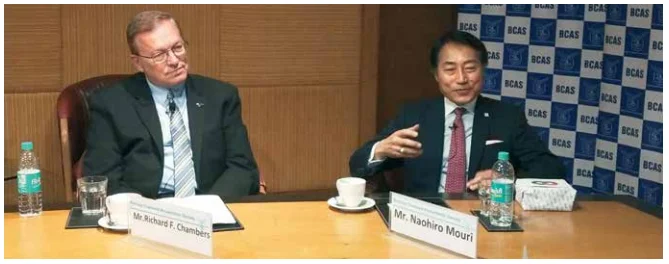
Difficulties being Faced by Charitable Organisations on account of the first proviso of s.2(15)

fiogf49gjkf0d
29th March 2013
To
The Chairperson,
Central Board of Direct Taxes,
New Delhi.
Madam,
representation
Re: Difficulties being Faced by Charitable Organisations on account of the first proviso of s.2(15)

We wish to draw your attention to the harassment and difficulties being caused to genuine charitable organisations in Mumbai on account of the farfetched interpretation being adopted by assessing officers on the provisions of the first proviso to section 2(15).

Various charitable organisations running educational institutions and carrying on various other forms of charity, including relief of poverty, have been denied the exemption under section 11 by assessing officers, on the ground that the first proviso to section 2(15) applies to them. This is notwithstanding the fact that the CBDT has clarified vide its circular number 11 of 2008 dated 19.12.2008, that the first proviso to section 2(15) does not apply to the first 3 limbs of the definition of “charitable purpose” under section 2(15), and only applies to the last limb, advancement of any other object of general public utility.

We would like to draw your attention to the fact that this is likely to lead to substantial litigation, locking up of money intended for charitable purposes in payment of taxes pending disposal of appeals, resulting in the ultimate beneficiaries of such charities losing out on the benefits that they would otherwise have got from such charitable organisations. A significant impact is already being felt on the charitable activities being carried out, with many trusts having decided to scale down their activities, due to their funds being locked up in tax litigation.

In fact, earlier also, the definition of “charitable purpose” included the words “not involving the carrying on of any activity for profit” from 1961 till 1983.  At that time as well, there had been substantial litigation on this aspect, including various decisions of the Supreme Court and many high courts. It was with the purpose of putting an end to this litigation that these words were omitted by the Finance Act, 1983 with effect from 1st April 1984. Reintroducing such provisions in the form of the first proviso to section 2(15) has again revived this litigation, which surely cannot be the intention behind this amendment.

It is submitted that the business carried on by a charitable trust could be of 3 kinds –
(a) where the business itself is the main object of the trust,
(b) where the business is incidental to the attainment of the objects of the trust, and
(c) where the business is in no way connected to the objects of the trust, but is a property held upon trust.

In businesses of type (a) above, if carrying on of the business itself is the main object, the trust would not be regarded as charitable, as held by the Supreme Court in the case of Sole Trustee, Loka Shikshana Trust 101 ITR 234, as the charitable purpose itself would be merely a sham. This was the position even prior to the insertion of the first proviso to section 2(15).

In businesses of type (b) above, the provisions of section 11(4A) would apply, and the trust was entitled to exemption of such income if separate books of accounts were maintained, prior to the insertion of the first proviso to section 2(15). This position continues for trusts engaged in activities other than that of the advancement of any other object of general public utility, and it is only trusts engaged in this residuary object of advancement of any other object of general public utility, which should lose the benefit of exemption after the insertion of the first proviso to section 2(15).

In businesses of type (c) above, the provisions of section 11(4) read with section 11(4A) applied prior to the insertion of the first proviso to section 2(15). Even after the amendment, such businesses continue to enjoy the benefit of exemption where the objects of the trust are not those of advancement of any other object of general public utility.

The purpose of the amendment was to ensure that trusts do not carry on business in the garb of charity. However, the amendment made by insertion of the first proviso to section 2(15) is unfortunately being interpreted by assessing officers as a blanket prohibition on carrying on of businesses by all charitable trusts. Again, assessing officers are treating all types of activities as business, including activities of mere letting of premises, conduct of educational courses, etc. This results in denial of exemption to a large number of genuine charitable organisations, which certainly does not seem to have been the intention behind the amendment.

It is therefore strongly suggested that the following amendments be carried out:

1. Both the provisos to section 2(15) be deleted;

2. Section 11(4) be amended to provide that “property held under trust” shall not include a business undertaking so held; and

3. Section 11(4A) be amended by inserting a proviso to that subsection to the effect that a business shall not be regarded as incidental to the attainment of the objectives of the trust merely on account of the fact that the income from such business feeds the charitable purposes.

These amendments will ensure that in all cases where business carried on by a trust is unrelated to its objects, the business income would be subjected to tax, and the trust would not lose exemption in respect of its other income which is actually utilised for its charitable purposes. As mentioned earlier, where the main object itself is the carrying on of a business, in any case, the trust would not be entitled to exemption, as the object would not be regarded as charitable, in light of the Supreme Court decision in Loka Shikshana Trust.

This amendment will also ensure that genuine charitable trusts do not suffer the harassment of efforts to treat charitable activity carried on by such trusts as business activity, and will not be denied exemptions on that ground.

We trust you will make efforts to implement our suggestions at the earliest, so as to enable charitable trusts to focus on their charitable activities, rather than on tax litigation.

Thanking you,

Yours faithfully

levitra