





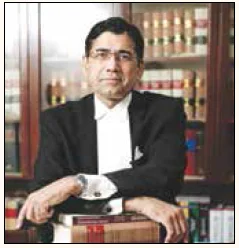
BCAS and the CA profession are entering into the 75th year of their existence. To commemorate this special occasion, the BCAJ brings a series of interviews with people of eminence from different walks of life, the distinct ones whom we can look up to, as professionals. Readers will have an opportunity to learn from their expertise and experience as well as get inspired by their personal stories.
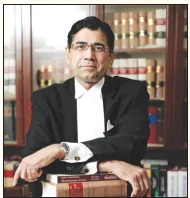
Here is the text (with reasonable edits to put it into a text format) of an interview with Senior Advocate Shri Arvind Datar.
He is most well-known amongst the CAs by being a revising Editor of acclaimed legal commentaries: “Kanga and Palkhivala — The Law and Practice of Income Tax”, and “Ramaiya Guide to the Companies Act”. He has also authored other books such as “Guide to Central Excise — Law and Practice”, “Guide to Central Exercise Procedures” and “Datar on Constitution of India”.
His practice these days is focused mainly on constitutional and tax cases before the Supreme Court of India. He has appeared before the SC on several high-profile cases. He also appears as Amicus Curiae appointed by the Supreme Court and various High Courts, to assist the Court in matters on questions of constitutional and taxation laws.
He started his legal career before the Madras High Court and the Chambers of Mr N Natarajan, Senior Advocate, and Mrs Ramani Natarajan during 1980–81. He later joined the office of M/s Subbaraya Aiyer, Padmanabhan and Ramamani, where he mainly practised income tax before the ITAT, Chennai, from 1981 to 1984. In 1984, he set up his independent practice in income tax and central excise, customs, and company law matters. He was designated as a Senior Advocate by the Madras High Court in 2000.
In this interview, Shri Datar talks to BCAJ Editor Mayur Nayak and the past editors Gautam Nayak and Raman Jokhakar about his career, mentors, tax laws, litigation, gaps in lawmaking, bottlenecks in ease of doing business in India, best court-room moments, his message to youngsters and much more….
Q. (Mayur Nayak): Good evening, Mr Datar, and thank you very much for accepting our invitation for this interesting interview about your life journey, the legal systems in India, the Indian tax scenario and Indian tax litigations. To understand your journey, tell us something about the initial years of your life. How did you end up taking up law as a career?
A. (Arvind Datar): Before I start, I must thank the Bombay Chartered Accountants Society for this interview. I’ve been regularly reading the BCA journal ever since I was a junior. Mr Ramamani, a leading tax practitioner in South India, used to always tell us that this was one of the best and most informative journals. So, it’s a privilege to be giving this interview. On my journey as a lawyer, like in so many cases, I am a lawyer by accident. Law was the last thing on my mind in school or college. My father was a Captain in the merchant navy, and I, too, decided to follow his steps and I had planned to start my own shipping company by the name “Datar International Shipping Company”, abbreviated as ‘DISCO’! I have always dreamt big. Fortunately, I did well in school and had to write the entrance exam to do training with T.S. Rajendran Bombay, which was then necessary to join the merchant navy. But I had just undergone surgery, which was a disqualification as per the prospectus of T.S. Rajendra. This shattered my plans of a career in the sea. Then I tried engineering but had a medical problem the following year. So, I joined the B.Sc. Course at Ruia College, with Physics and Mathematics as my main subjects.
I was a very active debater in school. In college, too, I participated in many debates, which encouraged me to become a lawyer. In college, I used to attend the budget lectures of Mr Nani Palkhivala around 1973. This raised my interest in Economics and Finance. In 1975, I decided to become a tax lawyer and also learn accounting. However, I couldn’t do the CA course, as they clashed with my lectures at the Madras Law College. So, I decided to do ICWA in the evening college. This was the beginning of my journey as a lawyer.
I believe that everything happens for the better. I enjoy every single day, and I think I would not have been so happy as an engineer. I don’t know what difference founding my own shipping company would have made. Maybe, I would have been in the IBC or with a Committee of Creditors! But as a lawyer, I must say, I think I made the right decision in that respect.
After I became a lawyer, I immediately started teaching in the Southern India Regional Council of the Institute of Chartered Accountants of India (SIRC of ICAI), which had many eminent CAs like Mr Bhupathi, the then President, and several others. I used to teach Gift Tax, Wealth Tax, Estate Duty and also Capital Gains at the Institute. One important thing was to get money through lectures, as I had no brief at all. I used to get Rs. 25 for two hours of lectures at the SIRC of ICAI. The SIRC of ICSI and SIRC of ICWA used to pay Rs. 50 for a two-hour lecture. Can you imagine the value of this money at that time? A bus ticket was 15 paise, so Rs. 25–50 was a big amount. I had a very close association with Chartered Accountants from the beginning. I have always believed that lawyers should emulate Chartered Accountants, especially in relation to your continuing education programme.
Q. (Raman Jokhakar): As a first-generation lawyer, any mentors that you would like to mention, who directly or indirectly helped you to rise to where you stand today?
A. I have been extremely blessed to have had wonderful seniors — the biggest blessing an advocate or a Chartered Accountant can have. In college, I started reading biographies of great lawyers, and fortunately, the Connemara Public Library in Madras had a complete shelf of legal biographies. So, I read the autobiographies of Motilal Setalvad, Justice Hidayatullah and other great English lawyers and judges. I was also a great believer in self-help books. These were very inspirational to me. For example, I read the biography of Lord Reading. I read that he used to get up every day at 4:00 am and work till 8.00 am. He used to work four hours every day on his briefs and then go to court and parliament. So, the habits and lifestyles of big lawyers were all great learning experiences for me. After I joined law, I decided to learn the basics of civil law before starting as a tax lawyer. So, I practised civil law for four years, before switching to tax. After that, I joined Mr Ramamani’s office. Mr Ramamani would appear in most of the leading tax cases. Several leading companies in Tamil Nadu were his clients. As a raw junior, I would often go and appear before the CIT(A) or before the ACIT(A). My mentors advised me that instead of assisting seniors, I should start arguing my own cases. Unless you jump into the water, you will not learn to swim, they said. I followed this advice, and this was immensely beneficial.
A. What young Chartered Accountants can do is to analyse how these people became successful, and what steps they took. Can you take the same steps? Make them your role models. You don’t have to reinvent the wheel. You can follow the paths taken by these people, and you will be a success.
A. I had a very harsh struggle. I joined the bar and did civil law in 1980–81. I practised tax law from 1981 to 1984. Exactly, four years after I enrolled, I quit. I didn’t have any clients except one, which my late senior was kind enough to give me. This helped me because I had just got married, and the fees from that case kept me going for some time. Fortunately, I lived with my parents. So, the expenses for food, etc., were taken care of. Nonetheless, it was a terrible struggle. Secondly, I faced a big struggle because I was told that you never go to the client’s office as a lawyer; the client comes to you. I stuck to this, which resulted in me not getting any work at all for several years. I had set up a small office in my house and day after day, I would just sit there doing nothing. This worked in the long run. I bought my first typewriter six years after I joined the bar. I bought a car after 11 years. For 10 years, I travelled by bus. These were my struggles. But I had decided that there was no point compromising. So, I remained firm on my decision of not going to the client’s office. At this time, I wrote several articles, spoke at seminars and work started trickling in.
Q. (Raman Jokhakar): As a citizen of India, what is your analysis, after all these years and fighting all these cases at various levels and reading about our present tax legislation, as well as the litigation system that sits under it?
A. Having completed four decades and more of tax practice, I have realised that nothing has really changed. The laws are as complex as they were in 1981, and the attitude of the Department is also the same. Every time, there is talk of simplifying tax laws and making them citizen-friendly, but nothing has really changed. In my view, the fundamental flaw is our focus on revenue maximisation. By chasing absurd revenue targets, the whole income tax department works in its own silo. It has to recover as much tax as it targets, irrespective of the collateral damage done to the economy. I am told that 97 paise in the rupee comes from advance tax and TDS. For the balance 3 paise, we have all this litigation under the Income-tax Act, which now has 400 sections. How much of torture and time for the balance 3 per cent of revenue?Fortunately, retrospective taxation has been reduced. However, unfortunately, you keep on trying to collect more and more taxes at any cost instead of focusing on growth. It’s better to collect 20 per cent tax from a 6 trillion economy than try to keep on collecting 40 per cent at 2.5 trillion. When I speak to clients, both Indian and foreign, the biggest difficulty they face is with the tax system at the central level and with the regulatory system in the states. The number of permissions and licenses they need to start a factory is still horrendous. We have a long way to go and need to change our mindsets by looking at tax as a byproduct of growth and not as an end in itself.
A. I read that in the last five to six years, some 23,000 HNIs have left the country. This year alone, 6,000 have left. The essential part of a system of rule of law is fairness and justice. I say, where is the fairness, if you are going to start reopening thousands of assessments every year? Once an assessment is opened and a notice is issued, in how many cases has the officer dropped the proceedings? Once the reopening starts, then it goes on and on. Either you file a writ petition, or you go to the appeal route up to the Supreme Court. For appeals, you now have to pay 20 per cent of the amount due, which includes tax, interest and penalty. What kind of a system is this? Look at what have they done to charitable trusts. You are making life so miserable, and there is not even an exit option. I don’t want to be an exempt charitable trust; leave me alone. Every time you give some benefit, then you start taking it back on some ground or the other.
It is like the case of Vatika Township; you keep fighting up to the Supreme Court on whether a 1,000 square feet house will include a balcony or not. The whole system is to give you some benefit, and then start denying it on some pretext or the other. And what is very unfortunate is that when you reopen assessments, you don’t bother about the settled positions of law. How many cases have you reassessed on mere change of opinion? For the last 50 years, the Supreme Court has said that you can’t reopen the assessment as a change of opinion, but case after case, it’s a mere change of opinion. I have to meet the revenue target, so I will simply disallow something. In other cases, I will allege that you have not deducted TDS. Then, you disallow this expense under section 40, levy a penalty under section 201, and it just goes on. And the same thing is true with Central Excise. The five-year period is only for fraud and suppression. But, every case is opened for five years, even if there is no fraud. I think everyone is very mesmerised by Foxconn starting in India. Some PLI schemes are working and there is investment in startups. But then, what is happening to the manufacturing sector? Today, I bought a suitcase that is made in China, and balloons for my granddaughter’s birthday that are made in China. Should we not be ashamed of that? The government doesn’t want any unfavourable data. Everything has to be very nice and smooth, but that’s not the case. There are serious problems, one of them being that investors are scared of the uncertainty of our tax system. Even before the AAR, every application was opposed, as a tax avoidance scheme!
Q. (Gautam Nayak): So, one angle is the procedure, the way the officers go about it. But the other angle is also the law itself. When you succeed all the way to Supreme Court, then you find the law being amended. In fact, every year, there are over 100 amendments to the Indian Income-tax Act. Mr Palkhivala had talked about the Indian Income-tax Act being a national disgrace. What is your view on this?
A. That is exactly my point. Just because a few charitable trusts did something illegal, you hit at all the trusts. Now if some Chartered Accountant has not done their duty under the Act, you cannot hit the entire CA profession. Why should the CA profession come under PMLA? You look at the latest Supreme Court judgment in Deloitte and the other case. If there is a firm of 100 partners and even if two partners do something wrong, the entire firm can be disqualified. What are we doing? And as you rightly put it, as far as the Income-tax Act is concerned, I always used to say that if I go up to the Supreme Court and I win the case, then there would be a retrospective amendment. In one budget lecture, I said that we can have an amendment saying that if any case goes in favour of the assessee, it will be deemed to have been overruled with retrospective effect.
Q. (Gautam Nayak): In fact, why are the Budget amendments not put for public debate beforehand? In Excise, secrecy may be justified as clearance of goods may be affected due to changes in rates, but in the Income-tax, is there any logic in not having a public discussion before the amendments are brought about?
A. Actually, here I can’t blame the government because, in the last three sessions, every budget session has been a washout because of the opposition disrupting the session. There has been no meaningful debate and it was ultimately just pushed through on the last day. What is more worrying is adding something significant on the last day, in two budgets. For example, the Equalisation Levy was added on the last day; we did not even know about it. This year also, many provisions were added on the last day. The entire GST provisions on tribunals were added on the last day. Nobody knew about them. They were not even tabled before Parliament. They were added and simply passed. I just wrote an article after the new Parliament building was inaugurated. The number of working days in Parliament has gone down and it is not even 60 days in a year, because of boycotts. I personally believe this secrecy of budget provisions should be done away with, and there should be debate and discussions beforehand. For example, you’re bringing 115 BAB to give relief to manufacturing companies. Why don’t you place the law in front? We can give suggestions. If you want to give some benefit to manufacturers, put the proposal to the CA Institute. You have so many eminent chartered accountants who can give suggestions and highlight all the practical difficulties that may arise.
A. I started my income tax career working with my senior, who mainly used to go to the Income-tax Appellate Tribunal. I can tell you some of my happiest days were in the ITAT. We had very excellent tribunal members, we had George Cherian, TNC Rangarajan, and so many other very, very good tribunal members. I have no time to mention all their names and as a junior, I learnt a lot from them. Justice Easwar was also my senior at that time, and we had a wonderful time. Not many people know that when the Income-tax Tribunal was started in 1941, the British Government placed the Income-tax Tribunal under the Law Ministry to keep it independent. A 7-judge bench in Chandra Kumar’s case said that all tribunals should be under an independent nodal Ministry, preferably the Ministry of Law, so they are not part of the parent department. From 1997 to 2023, after 26 years, this has not been done. I’ve been fighting this tribunal battle since 1991 and I am against multiple tribunals being created. We succeeded in striking down the National Tax Tribunal. So, I used to keep saying that, look, the tribunal has to be independent. It should be like a Court. What’s the purpose of a tribunal? Up to CIT(A), he is a department official. He has got his own compulsions. Once it comes to a tribunal, you want an independent body to decide the case. Now look at your Board for Advance Ruling. What is the meaning of having a Board with three Commissioners? What’s its independence? What respect will it command? Justice Ranganathan once headed the AAR, and where are we now? So, the tribunal system has gone down a very, very unfortunate path. The government has treated tribunals as part of the executive and like a Department. I heard recently a senior Secretary saying that tribunals must “protect government interests”; tribunals are not to protect government interest, they are supposed to decide a dispute independently and function like a specialised court.
So, the entire tribunal system is an extremely unhappy state because it is not an independent system at all. The worst part is this term of four years for members. If a person joins the tribunal at 45 and retires at 62, he gets the domain expertise, whether it is PMLA, FEMA, or Income-tax. He will have a 15-year career, and then after retirement, he can do whatever he wants. Now, if a person is in office for only four years, what does he learn if he doesn’t have an income tax background? Therefore, this is a serious issue. We have specialised tribunals with people who have no specialised knowledge. And the shocking thing is that the GST tribunal stipulates that advocates are not eligible to become judicial members.
Q. (Mayur Nayak): Another point from the taxpayers’ points of view is the contradictory judgments by various tribunals on almost identical or similar facts. As a result, assessees don’t know which tribunal to follow. Many times, officers do not accept orders of the jurisdictional tribunal, and pick up some unfavourable order from another tribunal and pass the assessment order. Is there any solution to this?
A. Once you have tribunals, the difference of opinion is bound to be there. Even in Supreme Court, two benches can deliver contradictory judgments. This is part of the judicial process. That, in one way, is a healthy process because I may take X view, you may take Y view, and then the case goes to a special bench which decides the correct view. I would say that not even 5 per cent of cases ultimately go to a special bench. So, I am not very worried about people taking different views. Unfortunately, if the view is in favour of the Department, then a person from the Income-tax Department in Mumbai, will rely on something from a Guwahati Bench. But if it is in favour of the assessee, they will not follow it in Mumbai. I experienced this while dealing with a matter under section 2(15) in the case of the Ahmedabad Urban Development Authority before the Supreme Court. There was a Bombay ITAT judgment in our favour, but the officer followed a Jammu and Kashmir ITAT decision and confirmed the demand of thousands of crores. And he’s not accountable. An officer refuses to follow a direct Supreme Court judgment, he just ignores it, and he is not accountable.
A. See, I’ve been repeatedly saying that it is very unfortunate that the revenue tries to portray that Rs. 5000 crore is involved in this case. So, as it is, you put mental pressure on the judge that if he decides against the Department, the government is going to lose ?5000 crore. But they don’t realise that what if the law has been settled for the last 15 years, and if you’re now going to overrule it, are you going to demand interest for the last 15 years? In fact, when I was a junior before Justice Ruma Pal, I was sitting for another case, and the government lawyer had told the court that Rs. 180 crores was involved in the case. She said that the Supreme Court is not bothered about the amount but the legal principle. Highlighting the amount shakes the confidence of the litigant, who thinks that if a large amount is involved, his chance of success is very, very low. That’s a very unfortunate part. Just see Vodafone; they didn’t bother about the amount when they held in favour of the assessee. In so many earlier old cases like Poona Electric Supply or Godhra Electricity, courts decided in favour of the assessee without bothering about the revenue implications. In fact, they can decide against an assessee also when they are deciding a principle of law. What I am saying is that, if the government doesn’t like it, make a retrospective amendment if something goes horribly wrong.
……To be continued