





BCAS and the CA profession are entering into 75th year of their existence. In order to commemorate this special occasion, the BCAJ brings a series of interviews with people of eminence from different walks of life, the distinct ones whom we can look up to, as professionals. Readers will have an opportunity to learn from their expertise and experience as well as get inspired by their personal stories.
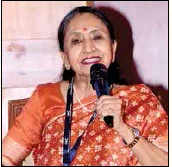
The first interview is with Dr Brinda Jagirdar. She is an independent consulting economist with a specialisation in areas relating to Banking and Economics, including Agriculture Economics. She is an independent director on the boards of many companies and a scheduled bank. She retired as General Manager and Head of Economic Research at the State Bank of India, based at its Corporate Office in Mumbai. As part of the Bank’s Top Management team, her work at SBI involved leading the Department of Economic Research to track developments in the Indian and global economy and analyse policy implications for business. She has a brilliant academic record, with a PhD in Economics from the Department of Economics, University of Mumbai, M.S. in Economics from the University of California at Davis, USA, M.A. in Economics from Gokhale Institute of Politics and Economics, Pune and B.A. in Economics from Fergusson College, Pune. She has attended an Executive Programme at the Kennedy School of Government, Harvard University, USA and a leadership programme at IIM Lucknow.
In this interview, Dr Jagirdar talks to BCAJ Editor Mayur Nayak and the past editors Gautam Nayak and Raman Jokhakar about her career at SBI as Chief Economist, the Indian economy, her perspectives on the key factors which changed the Indian banking sector and drove economic growth in India, her advice to youths of India and much more…
Q: (Mayur Nayak): Can you tell us a bit about your childhood? What were your formative years like?
A: (Brinda Jagirdar): My father was in the army, so I am an army daughter. I was born in Punjab, though we belong to Tamil Nadu, and I spent most of my childhood in North India, Jammu & Kashmir, UP, Himachal, and then Delhi. The first language that I learned was Hindi. Initially, my schooling was at different places; however, later on, it was at Kendriya Vidyalaya. I joined Lady Sriram College, Delhi, for the Honours course in Economics, but then we moved to Pune, and I got a degree in Economics from Fergusson College and then did my MA from Gokhale Institute, Pune. After that, I joined the State Bank of India (SBI) in Mumbai.
Then I saw an ad in the newspaper from the Rotary Foundation for a one-year fellowship to study in the US. I applied and got selected. It took me to the University of California at Davis. As I was also a cultural ambassador, I got invited to speak at many Rotary Clubs and was happy to show them that there’s more to India than the Taj Mahal.
My entire career was with SBI. I was at their Nariman Point office, and I retired from there as Chief Economist. Post-retirement, I serve on a few Boards. I also like to talk to students mainly because I feel that they must know what’s happening in the real world, especially today when India is changing so much, and there are so many opportunities for them.
Q: (Mayur Nayak): You also did a Ph.D. in Economics, from Mumbai University.
A: Yes, that was mid-career. I had put in about 17 years of service in the Bank, and then there was always this restlessness – what next? Sometime in the mid-90s, the Bank came out with a scheme that allowed mid-career employees to take a 3-year sabbatical to do their PhD. I registered at Mumbai University under Dr Dilip Nachane. My topic was “Reforms in the Banking Sector”.
Q: (Raman Jokhakar): When you look at the first 10-12 years and the last 10-12 years in SBI, how do you see the landscape evolved during your career?
A: It has been a remarkably interesting journey, and I could see the way the banking sector in the country has changed and evolved. We started off with nationalisation. Then we went through a phase, where nationalisation did not seem to deliver the desired results, and there was a clamour for privatisation. Now we have a healthy mix of both, along with new institutions, new players and new regulations. There is a greater emphasis on efficiency, competition and performance. Initially, there were very few women officers in banking; now, there are so many.
Q: (Gautam Nayak): During your career with SBI, what exactly was your role and the things that you used to look out for from an Economist’s perspective for the banking sector? Any specific experiences from your banking experience of 35 years?
A: As an Economist, my role was to track changes in the financial landscape, including policies, budgets and regulations, prepare forecasts and highlight the implications for the Bank. We had to keep track of what is happening in the global economy, in the domestic economy, and in the banking sector. That is what economists are expected to do. Being in SBI, the Government and RBI would consult the Bank, and in this context, I had to interact with different departments, get their suggestions, and put them all together. That helped me learn about what is happening in other areas, including credit, treasury, forex, and agriculture. I was very fortunate to be guided by the best banking brains in the country and got to learn a lot from my seniors and colleagues. Interestingly, even after interest rates were deregulated, there was a lot of debate about deregulating savings bank interest rates. I think this was to prepare banks for the new competitive environment that was unfolding. The banking landscape was changing very rapidly – global norms for capital adequacy, asset classification, provisioning, and accounting were introduced. Bank mergers were happening, and banks were being allowed to move into new areas like capital markets, mutual funds, and insurance.
Q: (Raman Jokhakar): In the US these days, we are seeing well-ranked banks fail overnight. Why, in your view, are these banks failing? Anything that you see sitting here and looking at, say, the US, especially because you were in the US as well?
A: In my view, this shows that there is a weakness in their regulation and oversight. Also, the revolving door policy in the US has a conflict of interest – today, you are in the Treasury, and tomorrow you are in Wall Street. This doesn’t happen in India. US banks also put great pressure on making profits here and now, even at the cost of the banking system’s stability and safety. For example, in the 2008 financial crisis, they knew that something was happening. There was a lot of bubble and froth in the system, but nobody paid attention. Thanks to Dr Y. V. Reddy’s foresight, the RBI quickly ring-fenced the banking system. It was being said that there is so much opportunity in the booming capital market and real estate sector, and banks should be allowed to get into this space in a big way. But RBI saw the risks and laid down strict norms for bank exposure to capital markets and real estate. So, from a risk management perspective, we did an excellent job, which the US failed to do. Because we were prudent, the Indian banking system was not affected. I think it is wrongly called the global financial crisis because we didn’t have a financial crisis in India.
Our regulators have always been extremely prudent and cautious. And at the same time, they let the banks have their freedom but with risk management and all systems in place. Thanks to technology, now banks can also monitor their businesses in real-time and immediately know what is happening. The regulators, too, are in constant touch with all players, so supervision has become very ongoing. Now it’s not just an annual inspection, but there’s a lot of dialogue which happens between the banks and RBI all the time, which is the reason our system is so much more stable as compared to what we see abroad. Undoubtedly, it is RBI’s regulation and supervision, along with prudent policies, that has made the commercial banks so resilient and strong.
Q: (Raman Jokhakar): Despite all the knowledge, experience, and ways of the West, the Indian regulator hasn’t gotten swayed by the wave from the West. Do you think the regulator is still holding on to its prudent ways that are appropriate to our situation?
A: You are absolutely right – We must be thankful the regulator has remained focused and not gotten swayed by the West. They want India to open up our markets and open up our banking system rapidly. This pressure is there. But we need to build on our strengths and acquire the skills and size to compete globally. We move slowly, but I think there is some sense in moving at this pace, rather than rushing into anything. Also, doing what India needs should be our priority. That is how today we have the highest level of digital banking. We know where to go, and we take everyone along.
Q: (Raman Jokhakar): Did you ever imagine, 20 or 30 years ago, such a UPI, QR code, kind of revolution, will result in massive inclusion and formalisation? Did you imagine that a Shing/Chanawala, who would earlier collect cash, put it in his pocket, and go home in the evening, will directly get his day’s earnings in the banking system?
A: This is something truly phenomenal, and there were many like me, who did not imagine that a disruption like this would be so rapid, so widespread and universally accepted. Today, everyone has embraced digital payments, including small businesses and street vendors. They realise that banks are secure, and their money is safe in the bank. And for this assurance, I think we must give credit to the Prime Minister, his vision and the economic policies.
Q: (Mayur Nayak): Internationalisation of the Indian rupee: Rupee is accepted in other countries today. Do you see the Indian rupee becoming a global currency soon with the diminishing importance of the US dollar as the reserve currency?
A: De-dollarisation is what everybody is talking about, and I think that is already beginning to happen for sure. While the US Dollar will remain a very important currency, because it is traded and accepted in such a large number of countries, its importance is slowly diminishing. One reason is geopolitics and the rise of economies outside the Western sphere. When you are growing, you want your share of the pie, and also, you want your place at the high table. So, the Indian Rupee is certainly finding more acceptance, because a lot of countries are trading with India in rupee terms. That bilateral trade is already happening, and India’s role is growing. A lot of countries are looking to India because there is a trust factor, and they know that India will share the technology with them and help them. Already, many countries have reached out to India for UPI, and India has said we are ready to share the technology. So, the time has come for this hegemony of one power or one currency to be challenged.
Q: (Gautam Nayak): Being a director on a Bank Board, how do you see the role of auditors in the whole system? Do you feel that the audit system needs to change? Do auditors need to be more vigilant? Should the role of auditors change? Should it be more towards fraud detection? Should you have separate audits for separate purposes the way it is today – you have separate forensic audit, separate security audit, etc? So, what do you see happening in banks?
A: The regulators, RBI, SEBI, look at independent directors as the first line of defence. In turn, the independent directors look at the auditors as their first line of defence. So, the role of auditors, including internal audit, statutory audit, and secretarial audit is very, very important. Besides these, there are specialised audits like forensic audit and cybersecurity audit. Auditors are completely independent and report directly to the Chairman of the Audit Committee, who is always an independent director. Auditors have to ensure that the processes which are laid down and the policies adopted by the company are followed and confirm that these are followed. I think they have a very important role to play, and that role is only going to increase and expand into more and more areas, as we see the economy growing and the banks growing. I believe it is very important for auditors to be independent, and unbiased. Ethics and corporate governance in auditors are crucial.
Q: (Raman Jokhakar): The role of the PSBs over the years: At some point, they were all taken over and converted to the public sector, and now we are coming back to a lot more private sector participation. That whole private flavour that you get when you step into a private bank versus a public bank– going forward, how do you see the role of the public sector banks in the whole landscape of banking? Would that role shrink, or would it stay up to a point where we can overcome, say, poverty issues or certain other issues are overcome, and then maybe that role would probably shrink? Or would the character of the public sector bank itself change?
A: I would agree with bits of what you’re saying, but when you talk about flavour, just step into SBI or Bank of Baroda or, for that matter, any public sector bank, and you will find that the ambience, service, and products are no different from private banks. The public sector banks are also becoming more and more customer friendly and more inviting. Look at their branches – the way they are set up and look at the signage. In services, too, I think the difference is shrinking a lot, and that is mainly because of technology. So today, you are a customer of a bank rather than of a particular branch due to core banking – you can be anywhere, and you can do your banking transactions. Thus, the difference is shrinking between the public sector and the private sector.
Having said that, I think the public sector still has a lot of trust of the public, and they still have a big role in inclusive development. It was public sector banks that opened Jan Dhan Accounts and took them to the last mile with the help of business correspondents. They are also involved in each and every segment of the economy, however small or however far away. I think that role will still continue to be with the public sector banks, which is a good thing, because that’s what will help the economy to grow. We need that big push and support, and I believe only public sector banks can take on that role.
I agree that today we’ve come almost 180 degrees from nationalisation to now having banks in both the public and private sectors. In public sector banks, mergers have also helped to conserve capital and expand size. Today there are about 11 or 12 public sector banks from about 25-27 a few years ago. First, the subsidiaries of the State Bank got merged, and then some other bank mergers happened. So now we have a strong banking sector, and that’s what the Narasimhan Committee also recommended – we must have some strong large Indian banks, because if the economy is going to grow, then it must be supported by a strong and sound banking system. Indian banks must be able to support the movement of Indian businesses abroad and facilitate their growth.
Q: (Raman Jokhakar): If we were to become the third largest economy, which seems like the next or the closest goal, what are the changes that you feel should be brought about where 5-10 Indian banks will enter the top 100?
A: Banks need capital to grow. The FT’s Banker magazine brings out every year a list of the top 100 banks in the world based on capital size. This list is currently dominated by Chinese banks in the top 10 places, and only one Indian bank, SBI, figures somewhere in the middle. The Economic Survey for 2019-20 pointed out that being the fifth largest economy, India should have at least six banks in the top 100 global list, and at least eight would be required for a country having a $ 5 trillion economy. As we know, capital is brought in by the owner, and in public sector banks, the owner is the government. This is why the government is willing to reduce its shareholding. Because banks need capital to grow, they must have that intrinsic strength, and be able to raise money from domestic markets as well as international markets.
After the capital, it is risk management. Banks should have very strong risk management systems and very, very sound ethics, and that’s where there is role of auditors. It is very important to make sure that all the laid down policies of the bank are followed, laid down procedures and systems, which the board has mandated are followed – that will give confidence to investors, domestic and abroad, and they will bring in their capital and investment into the bank. Then the bank will also be able to attract that high-quality talent in terms of manpower.
The IBC and the changes that have happened have helped banks to recover their loans and improve their asset quality. NPAs have come down now because of the support from the legal system. But we need strong contract enforcement. The enforcement of contracts today in India is not so quick. We need judicial reforms. Some cases are taken overseas to adjudicate in those courts. That confidence should be there, that our courts will not take 10 or 20 years to decide on a case. And therefore, we need more legal reforms.
Q: (Mayur Nayak): When you talk about IBC, banks are getting some money back, but by and large, we see that banks are the major loser, in terms of higher haircuts. Are there any loopholes in IBC? How can it be plugged and how can banks’ interests be protected?
A: I would agree with you, but this was not the intention when it was started. They said it should be completed within 240 days or 240 + 90 days. So, cases must be settled speedily. This continued delay means something is wrong somewhere. There are some loopholes. Every time the borrower runs to the courts and that should be avoided completely. I don’t know whether we need more courts or whether we need more tribunals, but whatever it is, the enforcement of contracts is very important. If the lender has not been able to recover his money, then the system should support him to get it back from the borrower. However, there is no denying that because of IBC, NPAs have come down, and bank balance sheets are clean. In fact, the borrowers are saying take the principal, take the interest, but leave us. That fear is there; that’s very good for the system. But unfortunately, banks have been able to recover only a very small amount, but that was not the intention. The loopholes need to be plugged in quickly.
Q: (Raman Jokhakar): If you look at some best practices overseas, because top banks outside India have grown to such a massive scale, what would be some of those practices, which facilitate this recovery process – make it faster and more effective?
A: What comes to my mind is the speed of resolution. You go there, you declare bankruptcy, and it’s all very set and happens quickly. It doesn’t drag on, and it’s not an appeal after appeal. It doesn’t go that way. It’s finished very fast. I think that is what we need to do as well.
Q: (Mayur Nayak): Being in SBI you were a witness to 40 crores plus bank accounts being opened in record time. Everything you saw and felt happening in front of your eyes, because we, as lay readers, just read it in newspapers as statistics. You were probably right inside the truck that was driving it.
A: The biggest change was the small man felt that he could walk into the bank branch. Earlier, he would be somewhat diffident about how he will be treated. But now he can just walk in, show his Aadhar card, open an account, get his money, and walk out with his head held high. If he can’t go to the bank, there’s a business correspondent, who would come to him with the handheld machine, and he can do his transaction. You will be surprised to see how readily the common man has embraced technology and is comfortable doing his banking transactions on his mobile. I think that is the biggest change in the banking sector – the common man and also women feel empowered. And I think this is the perfect example of inclusive growth. This kind of revolution, I don’t think, has happened anywhere in the world. Jandhan-Aadhar-Mobile, the JAM trinity, has enabled the Direct Benefit Scheme. People have confidence in the banking system, especially now when they are able to get all their money, whether it’s a pension, whether it’s a fertiliser subsidy or a scholarship, they get it directly into their account, and it comes on time. It comes without any cut, and they are able to access their account and do their transactions anytime, anywhere. The Jan Dhan zero balance accounts have mobilised Rs. 1,97,082 crores as on 31st May 2023 in 49.12 crore bank accounts. People are keeping money in the bank, which was lying outside the formal banking system.
Q: (Gautam Nayak): When we talk about the future of the Indian economy, we talk about a $5 trillion economy. Going forward, what largest trends do you see, and how fast can India develop?
A: Today, India is the fastest growing economy among the G20 countries, it is the only country with zero prospect of recession and India’s growth is being seen as not only healthy for India but also positive in a world where growth slowdown is a major problem. So, let’s see what kind of economy we have today. In terms of PPP, we are the third largest economy, and in GDP terms, we are the 5th largest. Germany may go into recession, and soon we could become the 4th largest economy. It took us 60 years after independence to become a $1 trillion economy in 2008. Growth gained traction and doubling was much faster. In the next 6 years, we became $2 trillion, and it would have doubled in the next six years and become $4 trillion, but for the disruption caused by COVID. Today we are at about $3.8 trillion, so $5 trillion is not so far away. In fact, today, nobody is focusing on $5 trillion. We’re talking about $10 trillion, and we have the scope to become that. Why? Internally, we have all the resources. In terms of food, we are completely self-sufficient. We have the capability in space technology; we are the 4th nation with ASAT technology, we are the fifth country to launch its own GPS (NAVIC), soon we will be the fifth country to manufacture jet engines, we have our own indigenously designed and manufactured modern high-speed trains, we have the 3rd largest tech start-up base, India is 3rd largest in automobile production, and is an exporter in the defence sector. India has also demonstrated its capability in the manufacturing of pharmaceutical products with the production and export of indigenous COVID vaccines.
Do you remember PL 480? There was a time in 1965 when India didn’t have sufficient wheat and was at the mercy of big powers. There was a famine-like situation after the war. This is when India decided to be self-sufficient in food grains and we had the green revolution. After that, there’s been no looking back. We are the second-largest producer of rice and wheat, the largest producer of sugar, and the largest producer of milk, fruits and vegetables. Look at the variety we have. We are also making significant progress in terms of literacy, skilled manpower, and space research. We are taking commercial satellites to space. When India joined the space club, with satellites and rockets totally made in India and on such a small budget, there was a cartoon in the New York Times – the fellow peeping into that window with the cow. The fat people sitting there, no place inside. So, that is the kind of mindset which we broke through.
We are exporting defence products, but we can become big players when we make, say, missiles, and aircraft fully. In electronics, for instance, smartphones are now being made in India. iPhone already has one plant and is going to set up another plant. Tatas and Cisco, I think, are starting to manufacture iPhone 15. We are now an exporter of electronics and mobiles. We were a strong manufacturing country. But slowly, we allowed China to take over. Many companies closed down because it became cheaper to import. Somewhere we lost sight of what was needed for the country, and we allowed China to take that space. Now with the PLI scheme, logistics and infrastructure development, inflow of foreign investment and technology, ease of doing business and other initiatives, we are moving seamlessly into the global supply chain.
Q: (Gautam Nayak): As an economist, if you look back at the last 75 years, what do you think has been the decision which has impacted the economy the most positively and the decision which has impacted the economy most negatively?
A: Positively, I would say the 1991 deregulation and liberalisation have had the biggest impact on the economy. Earlier, when you were manufacturing two-wheelers, you could do only two-wheelers. There was a capacity you could manufacture and sell at a certain price. All that has gone now! I think the freedom, and openness that has been given to the industrialists, along with incentives and government support, have helped the manufacturing sector. That has created more opportunities not just in manufacturing – each manufacturing job will create about five or six other secondary jobs not only in manufacturing but also in audit and accounts, design, planning, transportation, etc. I think, deregulation certainly helped the economy to grow.
The hindrance, I would say, is that you want the small to remain small. Why not let them grow? There will always be a role for MSMEs, but incentivising them to remain small will stunt their growth. In China, for example, the average textile unit would employ 500 people. In India, it would be 50. When industries are allowed to expand, they can take advantage of the economies of scale and economies of scope, create more jobs and overall is good for the industry and good for the economy.
Q: (Mayur Nayak): What would you advise to youngsters?
A: I would tell them, first of all, have confidence in yourself. Have confidence in the country and its policies. Don’t get swayed by hearsay. What you see in front of you is the full truth. So first, have confidence; second, skill yourself. And even if you’re a chartered accountant, learn about other areas. Learn about economics. Learn about technology. Make yourself a little broad-minded and broaden your vision. See what’s happening in other countries, and what new developments are taking place in India and abroad. Stay abreast, read a lot, and read outside your work. Prepare yourself. And then, of course, have a balanced life. Work-life balance should be there. Don’t spend too much time on WhatsApp, Facebook, or gaming. Don’t waste your time on all that. See how you can use technology to increase your productivity. The future of work is going to change, and there will be a lot of disruption caused by AI.