Subscribe to the Bombay Chartered Accountant Journal Subscribe Now!

Eligibility of LLCs to Claim Benefit under A Tax Treaty

In the Indian context, Tax authorities often challenge the benefits under a Double Taxation Avoidance Agreement (“DTAA” or “tax treaty”) to fiscally transparent entities (“FTEs”) such as foreign partnership firms, trusts, foundations, limited liability company (“LLC”) etc. on the premise that such entities do not qualify as a tax ‘resident’ of that country and are not ‘liable to tax’ in their home country. Whether an FTE can access the tax treaty has been a contentious issue. In this Article, we are analysing some recent judicial developments in this context.

INTRODUCTION

In order to mitigate double taxation in case of cross-border transaction(s), countries have entered into DTAA or tax treaty, which allocates the taxing rights among the Treaty Countries. One of the main conditions that need to be satisfied to access a tax treaty is that the taxpayer should be a tax ‘resident’ (i.e. taxable unit) of either or both the Treaty Countries and is ‘liable to tax’ therein. An exception to this in certain cases is where it appears that the condition of ‘liable to tax’ is subsumed in determining if the taxpayer is resident and once he is resident, whether liable or not does not matter. For example under the India – UAE DTAA, a person is ‘resident’ of UAE if he stays for 183 days in the calendar year concerned and no relevance is provided to being ‘liable to tax’. For illustrative purposes, in this Article, we have considered the provisions of the India-US DTAA.

Article 1 – Personal Scope (in case of India-US DTAA ‘General Scope’) of a Tax Treaty typically provides that ‘This convention shall apply to persons who are residents of one or both of the Contracting States.’ 

Article 3(1)(e) defines the term ‘person’ as follows – “the term “person” includes an individual, an estate, a trust, a partnership, a company, any other body of persons, or other taxable entity.’

Article 4 – Resident (in case of India-US DTAA ‘Residence’) typically provides that for the purposes of a convention, the definition of the term “resident of a Contracting State”.

Article 4(1) of the India-US DTAA reads as follows:

“For the purposes of this convention, the term “resident of a Contracting State” means any person, who under the laws of that State, is liable to tax therein by reason of his domicile, residence, citizenship, place of management, place of incorporation, or any other criterion of a similar nature, provided, however, that:

(a) This term does not include any person who is liable to tax in that State in respect only of income from the sources in that State; and 

(b) In the case of income derived or paid by a partnership, estate, or trust, this term applies only to the extent that the income derived by such partnership, estate, or trust is subject to tax in that State as income of a resident, either in its hands or in the hands of its partners or beneficiaries.”

FTEs such as partnerships, LLCs and trusts are popular across the world considering the legal requirements for certain professions (such as law firms) as well as the ease of doing business without having to undertake significant compliances (as is required to be undertaken in a corporate structure). For tax purposes, these FTEs allow income to ‘pass through’ them i.e. income is taxed at the level of their partners / members / beneficiaries and there is no taxation at the entity level. Given the pass-through status for tax purposes, this has raised the contentious issue as to whether such entities can claim benefits under tax treaties. Tax authorities contend that such entities do not fall under the definition of ‘person’ under tax treaties and that they are not a ‘resident’ in its state of incorporation / location as they are not ‘liable to tax’ in that country and that it is the partners / members / beneficiaries who are taxed in that country.

In the context of Partnerships, certain countries (like Singapore, China, Netherlands etc.) consider partnerships as FTE whereas some countries (like India, Mexico, Hungary etc.) consider partnership as a taxable unit.

Over the years, jurisprudence has developed on whether FTEs can claim benefits under Indian tax treaties. The SC in Azadi Bachao Andolan case ((2003) 263 ITR 706 SC) laid down the principle that liability to taxation is a legal situation and payment of tax is a fiscal fact. Essentially, the SC held that actual payment of tax is not necessarily needed in order to be ‘liable to tax’. In context of partnerships, the ITAT in case of Linklaters LLP ((2010) 40 SOT 51 Mum) held that considering that one of the fundamental objectives of tax treaties is to provide relief to economic double taxation, even when a partnership firm is taxable in respect of its profits, not in its own hands but in the hands of the partners, as long as the entire income of the partnership firm is taxed in the residence country, treaty benefits cannot be denied.

In context of trusts, the Authority for Advance Ruling (AAR), in case of General Electric Pension Trust ([2005] 280 ITR 425), denied tax treaty benefit to the foreign trust considering that the trust was not subject to tax on account of an exemption under the US tax law.

Thus, while judicial precedents exist on the eligibility of tax transparent partnerships being eligible to avail DTAA, similar guidance on the applicability of similar principle to an LLC, was hitherto not available.

Eligibility of a LLC incorporated in USA to claim benefit under India-US DTAA

The Delhi ITAT’s decision in the case of General Motors Company USA vs. ACIT, IT [2024] 166 taxmann.com 170 (Delhi-Trib.), is the first case where the ITAT has upheld the ability of an LLC to claim treaty benefit under the India-US DTAA.

In this case, the taxpayer, an LLC incorporated in Delaware, US, was classified as a disregarded entity; that is, not regarded to be separate from its owner for US tax purposes. For AY 2014-15 and 2015-16, the taxpayer earned income in the nature of ‘Fees for Included Services’. The taxpayer offered this income to tax in India at the rate of 15% under Article 12 of the India-US DTAA instead of 25% (i.e. the tax rate under section 115A of the Income-tax Act, 1961 (“the Act”) during the relevant assessment years). A tax residency certificate (“TRC”) issued by the US tax authorities was furnished by the taxpayer along with the Form 10F to meet the requirements for availing the benefits under India-US DTAA. The Assessing Officer (“AO”) passed an order denying the India-US DTAA benefits to the taxpayer on the ground that it was an FTE and not subject to tax in the US. Accordingly, the AO levied a tax rate of 25% under section 115A of the Act.

The Dispute Resolution Panel upheld the AO’s order, after which the matter went to Delhi bench of the ITAT.

TAX DEPARTMENT’S VIEW

The Revenue contended that based on the taxpayer’s own claim, the taxpayer is an FTE under US tax laws and accordingly, its income is not subject to tax in its own hands in the US.

The Revenue denied the India-US DTAA benefits to the taxpayer for two reasons. The First reason the Revenue contended is that such LLCs do not qualify as ‘Resident’ for the purpose of Article 4 of the India-US DTAA. Only persons who are ‘liable to tax’ in their country according to the laws of that country can be considered to be a ‘resident’ for the purpose of the India-US DTAA. In the instant case, since the income earned by the taxpayer is not liable to tax in the US in their own hands, as per the arguments put forth by the Revenue, it does not qualify as a person ‘resident’ in the US according to the Article 4 of the India-US DTAA.

Secondly, LLCs are not covered under the ambit of the special clause in Article 4(1)(b) of the India-US DTAA, which provides guidance on tax residency related to tax transparent entities such as partnerships, estates and trusts.

The Revenue also relied on paragraph 8.4 of Article 4 of the Organisation for Economic Cooperation and Development (OECD) commentary on Model Convention, which states that where a country disregards a partnership for tax purposes and treats it to be fiscally transparent, and taxes the partners on their share of the partnership income, the partnership itself is not ‘liable to tax’. Therefore, it may not be considered to be a resident of that country.

Accordingly, it was argued that the income earned by the taxpayer should be subjected to tax at 25% under the Act.

ASSESSEE’S CONTENTION

a) The taxpayer contended that under the US domestic tax law, an LLC has an option to either be taxed as a corporation or be considered as a disregarded entity wherein the LLC’s income is clubbed in the hands of its owner who discharges the tax that is assessable in the hands of the LLC in the US. Hence, while the LLC itself is not paying tax, its tax liability is discharged by its owners in the US.

b) The taxpayer contended that the term ‘liable to tax’ has not been defined under the India-US DTAA, and thus, referred to –

i. OECD Commentary 2017 on Article 4, which states that a person is considered to be liable to comprehensive taxation even if the country does not impose a tax.

ii. The commentary of Professor Philip Baker, which states that a person does not have to be actually paying the tax to be liable to tax.

It contended that being ‘liable to tax’ connotes that a person is subject to tax in a country, and whether the person actually pays the tax or not is immaterial.

c) Reliance was also placed on various judicial authorities:

i. UoI vs. Azadi Bachao Andolan [2003] 253 ITR 706 (SC) wherein it noted that for the purposes of the application of Article 4 of a DTAA, the legal situation is relevant—i.e. the liability to taxation—and not the fiscal fact of payment of tax.

ii.Linklaters LLP vs. ITO (ITAT-Mum) [2010] 40 SOT 51 wherein it concluded that while the modalities of taxation may vary from jurisdiction to jurisdiction, what really matters is that income is taxed in the residence jurisdiction. With reference to a fiscally transparent UK partnership firm, it was held that as long as its entire income is taxed in the residence country, the DTAA benefits cannot be denied.

iii. TD Securities (USA) LLC vs. Her Majesty the Queen 12 ITLR 783 of the Tax Court of Canada, Toronto, wherein it was held that an LLC incorporated in Delaware, US, and classified a disregarded entity to be considered as resident of US for the DTAA purpose.

d) Regarding the second aspect raised by the Revenue that Article 4(1)(b) of the India-US DTAA provides specific guidance on the residency of tax transparent entities which covers partnerships, estates and trusts, but does not cover LLCs, the taxpayer made following arguments:

i. the India-US DTAA (executed in 1989) is based on the 1981 US model convention when
the US laws did not recognise single member LLCs as a disregarded entity for the purpose of tax. The concept of disregarded  LLCs was introduced into the US tax laws only in 1996. Hence, disregarded LLCs were not envisaged at the time of entering into the India-US DTAA.

ii. The technical explanation to the US Model Convention issued by US Internal Revenue Services (IRS) has explained that this provision prevents fiscally transparent entities from claiming the DTAA benefits where the owner of such an entity is not subject to tax on the income in its state of residence.

This suggests that, ordinarily, a fiscally transparent entity will be eligible to be treated as a resident who is eligible to claim the benefit under India-US DTAA.

iii. Based on the above guidance from the IRS, it was contended that an ambulatory approach must be adopted while interpreting the India-US DTAA; that is, the meaning of the term prevailing under the US tax laws at the time of applying the India-US DTAA should be adopted and not that at the time when the India-US DTAA was signed. Hence, a disregarded US LLC should be held to be eligible to claim the benefit under India-US DTAA.

e) Basis the above, as the taxpayer is a US tax resident, it should be eligible to claim the benefits under the India-US DTAA.

ITAT DELHI RULING

The ITAT Delhi while deciding the appeal in favour of the taxpayer i.e. permitting the US LLC to access the India-US DTAA and thereby granting the beneficial DTAA rate, inter alia, relied on IRS Publications and Instructions and made below mentioned observations.

US IRS PUBLICATION AND INSTRUCTIONS: 

Publication 3402 on Taxation of LLCs, of the US IRS explains that an LLC is a business entity organized in the United States under state law and may be classified for US federal income tax purposes as a partnership, corporation, or an entity disregarded as separate from its owner by applying the rules in Regulations section 301.7701-3.

Default classification: An LLC with at least two members is classified as a partnership for federal income tax purposes and an LLC with only one member is treated as an entity that is disregarded as separate from its owner for income-tax purposes.

An LLC can elect to be classified as an association taxable as corporation or as an S corporation.

If an LLC has only one member and is classified as an entity disregarded as separate from its owner, its income, deductions, gains, losses, and credits are reported on the owner’s income tax return.

Instruction for Form 8802 (Application for US Residency Certification in Form 6166) issued by US IRS provides that in general, under an income tax treaty, an individual or entity is a resident of the US if the individual or entity is subject to US tax by reason of residence, citizenship, place of incorporation, or other similar criteria. US residents are subject to tax in the US on their worldwide income. It further provides that in general, an FTE organized in the US (that is, a domestic partnership, domestic grantor trust, or domestic LLC disregarded as an entity separate from its owner) and which does not have any US partners, beneficiaries, or owners then such an entity is not eligible for US residency certification in Form 6166.

The Instruction for Form 8802 also provides that the Form 6166 having residency certification is in the form of a letter of US residence certification only certify that, for the certification year (the period for which certification is requested), the applicant were resident of US for purposes of US taxation or, in the case of a FTE, that the entity, when required, filed an information return and its partners/ members/owners/beneficiaries filed income tax returns as resident of United States.

VALIDITY OF TRC 

The ITAT held that the TRC as received from the US IRS in accordance with the requirement of the law as applicable to the assessee, being an LLC, which is organised as body corporate as it fulfills all the requirements of a body corporate in the form of legal recognition of a separate existence of the entity from its Member and a perpetual existence distinct from its Members. Thus, the assessee being a resident under Article 4 of the India-US Tax Treaty by virtue of incorporation and its recognition as a separate existence from its Members qualifies as a ‘person’.

LIABLE TO TAX

The ITAT held that the taxpayer is liable to tax in the resident State by virtue of US Income-tax Law as an LLC is given an option to either be taxed as a corporation or be taxed as a disregarded entity or partnership (depending on number of members) wherein the income of the LLC is clubbed in the hands of its owner who merely discharges the tax that is assessable in the case of the LLC.

The ability of the LLC to elect its classification as well as where the LLC is disregarded as separate from its tax owner and the payment of tax is by the owner(s) of the LLC, supports the legal situation of an LLC being ‘liable to tax’.

The ITAT further held that the phrase ‘liable to tax’ has to be interpreted in the way that the assessee is liable to tax under the authority of the US Income-tax law. The intent of the Indo-US Treaty has to be given precedence wherein the concept of a FTE is recognized for recognizing the phrase ‘liable to tax’.

Accepting the reliance on the decision of the ITAT Mumbai in case of Linklaters LLP vs. ITO [2010] 40 SOT 51, wherein in case of a UK-based limited liability partnership firm which was treated as a FTE in the UK, it was held that while the modalities or mechanism of taxation may vary from jurisdiction to jurisdiction, what really matters is whether the income, in respect of which treaty protection is being sought, is taxed in the treaty partner country or not and thus held that even when a partnership firm is taxable in respect of its profits not in its own right but in the hands of the partners, as long as the entire income of the partnership firm is taxed in the residence country, treaty benefits cannot be declined.

The ITAT also held that Article 4(1)(b) imposes a limitation on eligibility of a partnership to avail the benefits of India-US tax treaty as prescribed, i.e., it seeks to exclude from the eligibility of provisions of India-US tax treaty such income of the partnership which is not ‘subject to tax’ in the US (either in the hands of partnership or partners). Relying on the AAR ruling in case of General Electric Pension Trust (supra) it observed that in this consideration of the matter, it can be concluded that an exclusion provision can only exclude something if it was included at the outset. Hence, a fiscally transparent partnership was already regarded as ‘liable to tax’ for the purposes of India-US tax treaty and this provision determines the scope of eligibility of such fiscally transparent partnership by excluding income which is not ultimately ‘subject to tax’ in the US.

THE OTHER VIEW

In this connection, it is very pertinent to note the recent decision of the Irish Court of Appeal – Civil, dated 27th May, 2025 in the case of Susquehanna International Securities Ltd. & Others vs. The Revenue Commissioners [2025] 175 taxmann.com 1054 (CA – UK) (“the Susquehanna case”). In this case, with respect to Ireland-US DTAA, in the context of entitlement to group relief under section 411 of the Irish Taxes Consolidation Act, 1997 (“TCA”), on the specific and somewhat unusual / peculiar facts of the taxpayer’s group structure, the court concluded that the Taxpayers’ parent company Susquehanna International Holdings LLC (“SIH LLC”), by reason of its fiscal transparency, was not ‘liable to tax’ in the US and accordingly was not resident in the US within the meaning of Article 4 of the Double Taxation Treaty and that the Taxpayers were not entitled to group relief under section 411 of the TCA.

The Court of Appeal ultimately held that SIH LLC was not itself ‘liable to tax’ in the US and consequently, did not meet the definition of “resident of a contracting state” under Article 4.1. In this regard Justice Allen noted that “If – as it is – the purpose of the treaty is to avoid double taxation, it seems to me that it stands to reason that it should only apply to persons who otherwise would be exposed to a liability to pay tax. SIH LLC had no such exposure.”

On the basis that SIH LLC did not satisfy the definition of “resident of a contracting state”, the Court of Appeal held that SIH LLC was not entitled to rely on the anti-discrimination provisions contained in Article 25 of the DTAA.

TD Securities Case: While arriving its conclusion, the court considered the decision of the Tax court of Canada in the case of TD Securities (USA) LLC (supra) in the context of Canada US DTAA and distinguished the same on the basis that the LLC in TD Securities was ultimately held by a corporation which was subject to US tax (as opposed to SIH LLC which was held by other disregarded entities and ultimately US individuals). The Court of Appeal was of the view that TD Securities was based on US and Canadian interpretation of the US-Canada double tax treaty and consequently, its findings were not persuasive in an Irish court.

In para 87 of the decision, the Irish Court of Appeal also referred to the ITAT Delhi’s decision in the case of General Motors Company, USA vs. ACIT (supra) but the Judge did not dwell on it.

The Susquehanna Case is the first Irish case to consider the tax residence of a US LLC. The case confirmed that a disregarded US LLC ultimately owned by individuals who are liable to tax in the US on the income of the LLC should not be regarded as a resident of the US for the purposes of the DTAA. It appears the Susquehanna Case ultimately turned on the specific and somewhat unusual facts of the taxpayer’s group structure.

It remains to be seen whether an Irish court would reach a different conclusion if a US disregarded LLC was held by a corporation who is subject to US tax.

Applicability to other pass-through entities from other jurisdictions

While the General Motors (supra) ruling has focused on the US treatment of LLCs, the question arises is whether one can apply the principle set in the said decision along with other decisions such as Linklaters (supra), etc could apply to other pass-through entities based out of jurisdictions wherein the treaty with India is silent about treatment of partnerships or other pass-through entities. The key difference is that DTAAs such as India – US or India – UK specifically provide treatment for partnerships in Article 3 (dealing with definition of person) and Article 4 (dealing with residence). In the past, the courts have upheld the entitlement to treaty benefits to pass-through entities from other jurisdictions such as Germany as well. Further, it is important to once again point out that the Delhi ITAT in the case of General Motors (supra) held that the reference to partnership in the India – US DTAA is not to provide benefit to partnerships but is to limit the allowability of benefit to partnerships in cases where all the partners are not residents of that jurisdiction. Further, this ruling also follows the general principle of interpretation of treaty that one should not misuse the benefit of a treaty but at the same time if one is paying tax in that jurisdiction either directly or through partners, members or other entities, then one should be able to claim the benefit of the treaties entered into by that jurisdiction. Therefore, in the view of the authors, one may be able to argue that treaty benefits are available to the extent that the partners / members are tax residents of that jurisdiction.

CONCLUSION

Whether an FTE can access a tax treaty has been a contentious issue and in the Indian context the General Motor Company’s ruling strengthen / support the contention that the tax treaty benefit  should not be denied to an FTE especially when its owners / partners / shareholders are from the same country.

While this ruling lays down a precedent on this issue, the same has been challenged before the high court and the final position would depend upon the outcome at the higher appellate level. However, it is also important to obtain appropriate documentation in addition to the TRC to substantiate the share of profit of the partners/members who are residents of the same jurisdiction as the FTE.

From the above discussion, a view can it be taken that the treaty benefit should be given to the “pass through entity”, where all partners / members are residents of the treaty partner country or if some of the partners / members are residents of the treaty partner country, to the extent of partners/members who are resident of the treaty partner country.

International Taxation

In an earlier article, the authors had analysed some of the issues in respect of exchange rates used while computing capital gains in respect of the transfer of shares in a cross-border transaction. While the said article focused on the domestic tax law provisions, there are some interesting issues that arise even in application of tax treaties, especially some specific treaties, due to the language of the said treaties. In this article, the authors seek to analyse an issue in the taxability of capital gains on transfer of shares under India’s DTAAs with Mauritius and Singapore, which relates to the grandfathering provisions.

BACKGROUND

Before the amendment to the tax treaties in 2017, transfer of shares of an Indian company by a resident of Mauritius and Singapore was exempt from tax in India under the respective tax treaties. Both DTAAs have since been amended, which allow the source country (in the above case, being India) the right to tax the income, with investments made before 1 April 2017 being grandfathered. The exemption provided in the Mauritius DTAA (before the amendment) has been subject to significant litigation before the Tribunals and the Courts, with the matter even being examined by the Hon’ble Supreme Court. The Singapore DTAA (before the amendment), while providing the exemption, also had the Limitation of Benefit (‘LOB’) clause, which provided subjective as well as objective criteria for an entity to avail the capital gains benefit in the DTAA. Further, the India–Singapore DTAA also has a unique Limitation of Relief article (‘LOR’) which does not allow treaty benefits in certain situations unless the amount is actually remitted to Singapore.

While the authors seek to analyse the LOB, LOR and other anti-avoidance provisions in these DTAAs in a subsequent article, this article seeks to analyse the issue that arises on account of the grandfathering provisions provided for the capital gains in these 2 DTAAs, which have been examined by the Tribunal in the recent past. In fact, the India – Cyprus DTAA also had a similar exemption as under the India – Mauritius and India – Singapore DTAA. Unlike the Mauritius and Singapore DTAAs, which were amended, India entered into a new DTAA with Cyprus in 2016, which now taxes the capital gains on shares of a company in the country of source. However, the Protocol to the India – Cyprus DTAA also provides the grandfathering clause in a similar manner and therefore, these issues could equally apply to the India – Cyprus DTAA as well.

GRANDFATHERING CLAUSE

Article 13(4A) and (4B) of the India – Singapore DTAA provide as follows,

“(4A) Gains from the alienation of shares acquired before 1 April 2017 in a company which is a resident of a Contracting State shall be taxable only in the Contracting State in which the alienator is a resident.

(4B) Gains from the alienation of shares acquired on or after 1 April 2017 in a company which is a resident of Contracting State may be taxed in that State.”

It may be noted that the language used in the India–Mauritius DTAA in this regard is similar, and therefore, the principles would equally apply therein. Therefore, the distinction between the taxability in the country of source lies in when the shares were ‘acquired’. If the shares were acquired before 1 April 2017, the country of residence of the transferor (or alienator as used in the DTAA) has the exclusive right of taxation, whereas if the shares were acquired on or after 1 April 2017, the country of source has a right to tax the gains (whether such right is an exclusive right is an issue which the authors have examined in the past – one may refer to the April 2025 edition of the Journal on ‘may be taxed’).

SHARES ACQUIRED

The issue that arises in respect of the grandfathering provisions is what does one mean by the term ‘shares acquired’ and whether this term only applies to an actual purchase or acquisition of shares prior to 1 April 2017, or could the term also cover situations wherein the taxpayer receives the shares in a mode which is otherwise exempt from tax.
The first situation is of convertible preference shares. Let us take an example of a Singapore taxpayer who has acquired convertible preference shares (whether compulsorily or otherwise) of an Indian company before 1 April 2017, and the conversion of such shares is undertaken after 1 April 2017, and the Singapore taxpayer is transferring the converted equity shares of the Indian company. In such a case, the conversion is exempt under section 47(xb) of the Income-tax Act, 1961 (‘ITA’). Further, Explanation 1(i) to section 2(42A) of the ITA, which defines the term ‘short-term capital asset’, provides as follows:

“(i) In determining the period for which any capital asset is held by the assessee –

(a)…

(hf) in the case of a capital asset, being equity shares in a company, which becomes the property of the assessee in consideration of a transfer referred to in clause (xb) of section 47, there shall be included the period for which the preference shares were held by the assessee;..”

Similarly, section 49(2AE) of the ITA also provides as follows,

“(2AE) Where the capital asset, being equity share of a company, became the property of the assessee in consideration of a transfer referred to in clause (xb) of section 47, the cost of acquisition of the asset shall be deemed to be that part of the cost of the preference share in relation to which such asset is acquired by the assessee.”

Accordingly, in the case of conversion of a preference share into an equity share, the ITA considers the period of holding as well as the cost of acquisition of the preference share while determining the period of holding and cost of acquisition of the equity share, respectively.

Would such a deeming fiction also apply in the case of a DTAA? The Delhi ITAT in the case of Sarva Capital LLC vs. ACIT (2023) 153 taxmann.com 618 has held that gains on sale of equity shares of an Indian company by a resident of Mauritius would be eligible for grandfathering and exempt from tax even though the equity shares were issued after 1 April 2017 as such shares were issued to the taxpayer on conversion of Compulsorily Convertible Preference Shares which were acquired by the taxpayer before 1 April 2017. The Delhi ITAT arrived at its conclusion on the basis of the following:

“Undoubtedly, the assessee has acquired CCPS prior to 1-4-2017, which stood converted into equity shares as per terms of its issue without there being any substantial change in the rights of the assessee. As rightly contended by learned counsel for the assessee, conversion of CCPS into equity shares results only in qualitative change in the nature of rights of the shares. The conversion of CCPS into equity shares did not, in fact, alter any of the voting or other rights with the assessee at the end of Veritas Finance Pvt. Ltd. The difference between the CCPS and equity shares is that a preference share goes with preferential rights when it comes to receiving dividend or repaying capital. Whereas, dividend on equity shares is not fixed but depends on the profits earned by the company. Except these differences, there are no material differences between the CCPS and equity shares. Moreover, a reading of Article 13(3A) of the tax treaty reveals that the expression used therein is ‘gains from alienation of SHARES’. In our view, the word ‘SHARES’ bas been used in a broader sense and will take within its ambit all shares, including preference shares. Thus, since, the assessee had acquired the CCPS prior to 1-4-2017, in our view, the capital gain derived from sale of such shares would not be covered under Article 13(3A) or 13(3B) of the Treaty. On the contrary, it will fall under Article 13(4)of India-Mauritius DTAA, hence, would be exempt from taxation, as the capital earned is taxable only in the country of residence of the assessee.”

Accordingly, the Delhi ITAT allowed the benefit of the grandfathering on the premise that the DTAA refers to ‘shares’ and that there was no substantial change in the voting rights of the taxpayer after the conversion.

APPLICATION TO OTHER SCENARIOS

Now, the question arises whether one can apply this decision to convertible debentures. Under the ITA, sections 47(x), 49(2A) and Rule 8AA of the Income-tax Rules, 1962 r.w.s 2(42A) of the ITA accord the same treatment of the period of holding and cost of acquisition to conversion of debentures into equity shares as provided to conversion of preference shares into equity shares.
However, given that the Delhi ITAT has held on the basis that the taxpayer held shares (albeit preference shares) before the conversion, arguably, one may not be able to apply the above decision in the context of debentures. On the other hand, if one considers this view, it may result in a peculiar situation wherein if the taxpayer had transferred the debentures prior to conversion, the said debentures would be exempt as they are not shares and would be covered under Article 13(5) of the India – Singapore DTAA but as one is transferring the shares after conversion, the said transaction is taxable in India.

While one may not be able to apply the Delhi ITAT decision to debentures and other situations, the question to be addressed is whether one can consider the shares acquired before 1 April 2017 in situations wherein the ITA, on application of sections 2(42A) and 49, has allowed the pass-through period of holding and cost of acquisition. Some examples, in addition to convertible debentures and preference shares, could be as follows:

a. Shares received as a gift wherein the donor had acquired the shares before 1 April 2017, but the gift is received after 1 April 2017;

b. Shares received on inheritance after 1 April 2017, wherein the testator had acquired the shares before 1 April 2017;

c. Shares of another company received on amalgamation / demerger undertaken after 1 April 2017, wherein the shareholder held the shares of the amalgamating company / demerged company before 1 April 2017;

d. Bonus shares were issued after 1 April 2017 to a taxpayer who had held the original shares prior to 1 April 2017. In such a case, sections 2(42A) and 49 do not apply, and therefore, the period of holding would begin from the date on which the bonus shares are issued, and the cost of acquisition of the shares shall be Nil.

While analysing the grandfathering provisions under the DTAA, it may be worthwhile to also consider the grandfathering provided in the GAAR provisions in the ITA. Rule 10U of the Income-tax Rules provides as follows,

“The provisions of Chapter X-A shall not apply to –

(a)…

(d) any income accruing or arising to, or deemed to accrue or arise to, or received or deemed to be received by, any person from transfer of investments made before the 1st day of April, 2017, by such person”

Further, CBDT Circular No. 7 of 2017 dated 27 January 2017 in respect of certain clarifications on implementation of GAAR provides as follows,

“Question No. 5: Will GAAR provisions apply to (i) any securities issued by way of bonus issuances so long as the original securities are acquired prior to 1 April 2017 (ii) shares issued post 31st March, 2017, on conversion of Compulsorily Convertible Debentures, Compulsorily Convertible Preference Shares (CCPS), Foreign Currency Convertible Bonds (FCCBs), Global Depository Receipts (GDRs), acquired prior to 1 April 2017; (iii) shares which are issued consequent to split up or consolidation of such grandfathered shareholding?

Answer: Grandfathering under Rule 10U(1)(d) will be available to investments made before 1st April 2017 in respect of instruments compulsorily convertible from one form to another, at terms finalised at the time of issue of such instruments. Shares brought into existence by way of split or consolidation of holdings, or by bonus issuances in respect of shares acquired prior to 1st April 2017 in the hands of the same investor would also be eligible for grandfathering under Rule 10U(1)(d) of the Income Tax Rules.”

The question arises whether one can apply the same principle as provided under the GAAR provisions and rules to the DTAA grandfathering provisions. One may wait for the legal jurisprudence in this matter.

However, in the view of the authors, one needs to interpret the language in the DTAA in the context of the relief that the grandfathering provisions seek to provide. It is a well-settled principle as upheld even by the Hon’ble Supreme Court in the case of Union of India vs. Azadi Bachao Andolan (2003) 263 ITR 706 that treaties are not to be interpreted in the same manner as statutory legislation as the treaties are entered into at a political level.1


1 One may also refer to the article by Shri Pramod Kumar on Bonus Shares & Tax Treaty Grandfathering: 
Investor Conundrum Dissected! dated 24 September 2024 published on 
www.taxsutra.com which has discussed this issue in detail in the context of 
applicability of grandfathering provisions to bonus shares

Arguably, the DTAAs have provided for a grandfathering provision to ensure that a person who had invested before the DTAAs were amended should not be adversely affected due to the change that has occurred after such investment has been made.

In other words, one may need to read the term ‘shares acquired’ in the same manner as ‘investments made’ and therefore, so long as the taxpayer had invested in a particular manner prior to 1 April 2017, the change in the mode of investment ought to be grandfathered. While an argument could be made that one should not read the GAAR provisions, which are in domestic law, into the DTAA, in the authors’ view, this is not the case here, as one is merely providing an objective and contextual interpretation of the term ‘acquired’ and not necessarily under the domestic tax law.

This is evident from the Press Release of the Finance Ministry dated 29 August 2016, while notifying the Protocol of the India – Mauritius DTAA, which states as under,

“The Protocol provides for source-based taxation of capital gains arising from alienation of shares acquired on or after 1st April, 2017, in a company resident in India with effect from financial year 2017-18. Simultaneously, investments made before 1st April, 2017 have been grandfathered and will not be subject to capital gains taxation in India.”

From the above, it is clear that the intention of the Government while amending the DTAA was to exempt ‘investments made’. However, the Press Release dated 23 March 2017 in respect of the Protocol to the India – Singapore DTAA states as follows,

“In order to provide certainty to investors, investments in shares made before 1st April, 2017 have been grandfathered, subject to fulfilment of conditions in the Limitation of Benefits clause as per 2005 Protocol.”

While the Press Release in respect of the India – Singapore DTAA amendment does not cover ‘investments’ but covers ‘shares acquired’, given the objective of a grandfathering clause, as explained above, in the view of the authors, one may still be able to apply the same principle as in the India – Mauritius DTAA as the language in the DTAAs is similar.

Therefore, in respect of bonus shares or conversion of preference shares/ debentures into equity shares should be grandfathered under the DTAA if the original shares/ preference shares/ debentures were acquired prior to 1 April 2017.
A similar view may also apply in cases of amalgamation/ demerger as one had already invested in the amalgamating company/ demerged company prior to 1 April 2017.

However, in respect of shares received as a gift after 1 April 2017, wherein the donor had acquired the shares before such date, in the view of the authors, such an exemption may not apply as the investment was not made by the taxpayer (donee) prior to 1 April 2017. Even under GAAR provisions, Rule 10U(1)(d) refers to investment made by such person, and therefore, grandfathering should be permitted only if the investment was made by that specific person. On the other hand, shares ‘acquired’, in the view of the authors, would also mean shares acquired by way of gift. Therefore, if one had received the gift prior to 1 April 2017, even though such receipt may not be a transfer under the ITA, the shares received should be eligible for grandfathering.

In respect of inheritance under a Will, there could be an additional argument that the shares were acquired by the taxpayer by way of application of the law as a transmission and not a transfer itself.

However, one cannot rule out litigation on this issue, and one may need to wait for some jurisprudence before it can settle down.

CONCLUSION

While the Delhi ITAT has not examined the issue in detail, keeping in mind the overall objective of providing grandfathering under the DTAAs with Singapore, Mauritius and Cyprus, in the view of the authors, there is a good case to argue that the original investment made prior to 1 April 2017 should be grandfathered even if the nature or form of the investment changes after 1 April 2017, provided that the taxpayer is the same before such date. Therefore, in respect of conversion of preference shares or debentures into equity shares, issue of bonus shares or issue of shares on amalgamation or demerger, in the view of the authors, the benefit of grandfathering may be available. However, in the authors’ view, gift received on or after 1 April 2017 may not be eligible for the grandfathering benefit. In any case, one may need to consider the facts and circumstances of each case, and the issue is not free from litigation. Further, there are various other considerations one may need to keep in mind while analysing the grandfathering provisions, such as the treaty entitlement and anti-abuse provisions, etc.

Non-Repatriable Investment by NRIs/OCIs under FEMA: An Analysis – Part 2

NON-REPATRIABLE INVESTMENTS: EASY ENTRY, TRICKY EXIT!

In Part I, we explored how NRIs and OCIs can invest in India under Schedule IV, enjoying the perks of domestic investment while sidestepping FDI restrictions. We saw how this route offers flexibility in entry—with no foreign investment caps, no strict pricing rules, and freedom to invest in LLPs, AIFs, and even real estate (as long as it’s not a farmhouse!). But, much like a long-term relationship, once you commit, FEMA expects you to stay for the long haul.

Now, in Part II, we address the big question: Can you transfer, sell, or gift these investments? Will FEMA allow you a graceful exit? We’ll dive into the rules governing transfers, repatriation limits, downstream investments, and more—so buckle up, because while the non-repatriable entry was smooth, the exit is where the real thrill begins!

TRANSFER OF SHARES/INVESTMENTS HELD ON NON-REPATRIATION BASIS

Just as important as the entry is the ability to transfer or exit the investment. FEMA provides certain pathways for transferring shares or other securities that were held on a non-repatriation basis:

  •  Transfer to a Resident: An NRI/OCI can sell or gift the securities to an Indian resident freely. Since the resident will hold them as domestic holdings, this is straightforward. No RBI permission, pricing guideline, or reporting form is required. For instance, if an NRI uncle wants to gift his shares (held on a non-repat basis) in an Indian company to his resident Indian nephew, it’s permitted and no specific FEMA filing is triggered (aside from perhaps a local gift deed for records). Similarly, suppose an NRI non-repat investor wants to sell his stake to an Indian co-promoter. In that case, he can transact at any price mutually agreed upon (pricing restrictions don’t apply as this is essentially a resident-to-resident transfer in FEMA’s eyes), and no FC-TRS form is required.
  • Transfer to another NRI / OCI on Non-Repat basis: NRIs / OCIs can also transfer such investments amongst themselves, provided the investment remains on non-repatriation. For example, one OCI can gift shares held under Schedule IV to another OCI or NRI (maybe a relative) who will also hold them under Schedule IV. This is allowed without RBI approval, and again, no pricing or reporting requirements apply. The only caveat is that the transferee must be eligible to hold on a non-repat basis (which generally means they are NRI / OCI or their entity). Gifting among NRIs / OCIs on the non-repat route is quite common within families. Note: If it’s a gift, one should ensure it meets any conditions under the Companies Act or other laws (for instance, if the donor and donee are “relatives” under Section 2(77) Companies Act, as required by FEMA for certain cross-border gifts – more on that below).
  •  Transfer to an NRI / OCI on a repatriation basis (i.e., converting it to FDI): This scenario is effectively an exit from the non-repatriable pool into the repatriable pool. For instance, an NRI with non-repat shares might find a foreign investor or another NRI who wants those shares but with repatriation rights. FEMA permits the sale, but since the buyer will hold on a repatriation basis (Schedule I or III), it must conform to FDI rules. That means sectoral caps and entry routes must be respected, and pricing guidelines apply to the transaction. If it’s a gift (without consideration) from an NRI (non-repat holder) to an NRI / OCI (who will hold as repatriable), prior RBI approval is required and certain conditions must be met. These conditions (laid out in NDI Rules and earlier in TISPRO) include: (a) the donee must be eligible to hold the investment under the relevant repatriable schedule (meaning the sector is open for FDI for that person); (b) the gift amount is within 5% of the company’s paid-up capital (or each series of debentures / MF scheme) cumulatively; (c) sectoral cap is not breached by the donee’s holdings; (d) donor and donee are relatives as defined in Companies Act, 2013; and (e) the value of securities gifted by the donor in a year does not exceed USD 50,000. These are designed to prevent the abuse of gifting as a loophole to transfer large foreign investments without consideration. If all conditions are met, RBI may approve the gift. If it’s a sale (for consideration) by NRI non-repat to NRI/OCI repatriable, no prior approval is needed (sale is under automatic route) but pricing must be at or higher than fair value (since NR to NR transfer with one side repatriable is treated like an FDI entry for the buyer). Form FC-TRS must be filed to report this transfer, and in such a case, since the seller was holding non-repat, the onus is on the seller (who is the one changing their holding status) to file the FC-TRS within 60 days. Our earlier table from the draft summarizes: Seller NRI-non-repat -> Buyer NRI-repat: pricing applicable, FC-TRS by seller, auto route subject to caps.
  •  Transfer from a foreign investor (repatriable) to an NRI/OCI (non-repatriable): This is the reverse scenario – a person who holds shares as foreign investment sells or gifts to an NRI / OCI who will hold as domestic. For example, a foreign venture fund wants to exit and an OCI investor is willing to buy but keep the investment in India. FEMA allows this as well. Since the new holder is non-repatriable, the sectoral caps don’t matter post-transfer (the investment leaves the FDI ambit). However, up to the point of transfer, compliance should be there. In a sale by a foreign investor to an NRI on a non-repat basis, pricing guidelines again apply (the NRI shouldn’t pay more than fair value, because a foreigner is exiting and taking money out – RBI ensures they don’t take out more than fair value). FC-TRS reporting is required, and typically, the buyer (NRI / OCI) would report it because the buyer is the one now holding the securities (the authorized dealer often guides who should file; it has to be a person resident in India and as non-repat investment is treated as domestic investment, it has to be filed by NRI / OCI acquiring it on non-repat basis). If it’s a gift from a foreign investor to an NRI / OCI relative, RBI approval would similarly be needed with analogous conditions (the NDI Rules conditions on gift apply to any resident outside to resident outside transfer, repatriable to non-repat likely treated similarly requiring approval unless specified otherwise). The draft table indicated: Buyer NRI-non-repat from Seller foreign (repat) – gift allowed with approval, pricing applicable, FC-TRS by buyer, and subject to FDI sectoral limits at the time of transfer.

In all the above cases of change of mode (repatriable vs non-repatriable), one can see FEMA tries to ensure that whenever money is leaving India (repatriable side), fair value is respected and RBI is informed. But when the money remains in India (purely domestic or non-repat transfers), the regulations are hands-off.

Downstream Investment Impact: A critical implication of holding investments on non-repatriation basis is how the investing company is classified. FEMA and India’s FDI policy have the concept of indirect foreign investment – if Company A is foreign-owned or controlled, and it invests in Company B, then Company B is considered to have foreign investment to that extent. However, Schedule IV investments are excluded from this calculation. The rules (as clarified in DPIIT’s policy) state that if an Indian company is owned and controlled by NRIs / OCIs on a non-repatriation basis, any downstream investment by that company will not be considered foreign investment. In other words, an Indian company that has only NRI / OCI non-repat capital is treated as an Indian-owned company. So if it later invests in another Indian company, that target company doesn’t need to worry about foreign equity caps because the investment is coming from an Indian source (deemed). This is a major benefit – it effectively ring-fences NRI domestic investment from contaminating downstream entities with foreign status. This clarification was issued to remove ambiguity, especially in cases where OCIs set up investment vehicles. Now, an NRI / OCI-owned investment fund (registered as an Indian company or LLP) can invest freely in downstream companies without subjecting them to FDI compliance, provided the fund’s own capital is non-repatriable.

From a practical standpoint, when structuring private equity deals, if one of the investors is an NRI / OCI willing to designate their contribution as non-repatriable, the company can be treated as fully Indian-owned, allowing it to invest into subsidiaries or other companies in restricted sectors without ceilings. This has to be balanced with the investor’s interest (since that NRI loses repatriation right). Often, OCIs with a long-term commitment to India might be agreeable to this to enable, say, a group structure that avoids FDI limits.

Summary of Transfer Scenarios: For quick reference:

  •  NRI / OCI (Non-repat)-> Resident: Allowed, gift allowed, no pricing rule, no reporting.
  •  Resident -> NRI / OCI (Non-repat): Allowed, gift allowed, no pricing rule, no reporting (essentially the mirror of above, turning domestic holding into NRI non-repat).
  •  NRI / OCI (Non-repat) -> NRI / OCI (Non-repat): Allowed, gift allowed, no pricing, no reporting.
  •  NRI / OCI (Non-repat) -> Foreigner / NRI (Repat): Allowed, the gift needs RBI approval (with conditions), if sale then pricing applies; report FC-TRS.
  •  Foreigner / NRI (Repat) -> NRI / OCI (Non-repat): Allowed, gift possibly with approval; sale at pricing; report FC-TRS.

The key is whether the status of the investment (domestic vs foreign) changes as a result of transfer, and ensuring the appropriate regulatory steps in those cases.

Comparative Interplay Between Schedules I, III, IV, and VI

To fully understand Schedule IV in context, one must compare it with other relevant schedules under FEMA NDI Rules:

Schedule I (FDI route) vs Schedule IV (NRI non-repat route)

  •  Nature of Investment: Schedule I covers FDI by any person resident outside India (including NRIs) on a repatriation basis. Schedule IV covers investments by NRIs / OCIs (and their entities) on a non-repatriation basis. Schedule I investments count as foreign investment; Schedule IV do not.
  •  Sectoral Caps and Conditions: Schedule I investments are subject to sectoral caps (% limits in various sectors) and sector-specific conditions (like minimum capitalization, lock-ins, etc., in sectors like retail, construction, etc.). By contrast, Schedule IV investments are generally not subject to those caps/conditions because they are treated as domestic. For example, multi-brand retail trading has a 51% cap under FDI with many conditions – an OCI could invest 100% in a retail company under Schedule IV with none of those conditions, as long as it’s on a non-repatriation basis. Similarly, real estate development has minimum area and lock-in requirements under FDI, but an NRI could invest non-repat without those (provided it’s not pure trading of real estate).
  •  Prohibited Sectors: Schedule I explicitly prohibits foreign investment in sectors like lottery, gambling, chit funds, Nidhi, real estate business, and also limits in print media, etc. Schedule IV has its own (smaller) prohibited list (Nidhi, agriculture, plantation, real estate business, farmhouses, TDR) but notably does not mention lottery, gambling, etc. Thus, some sectors closed in Schedule I are open in Schedule IV, and vice versa (as discussed earlier).
  •  Valuation / Optionality: Under Schedule I, any equity instruments issued to foreign investors can have an optionality clause only with a minimum lock-in of 1 year and no assured return; effectively, foreign investors cannot be guaranteed an exit price. Under Schedule IV, these restrictions do not apply – one can issue shares or other instruments to NRIs/OCIs with an assured buyback or fixed return arrangement since it’s like a domestic deal. Likewise, provisions like deferred consideration (permitted for FDI up to 25% for 18 months) need not be adhered to strictly for non-repat investments – an NRI investor and company can agree on different terms as it’s a private domestic contract in FEMA’s eyes.
  •  Reporting: FDI (Sch. I) transactions must be reported (FC-GPR, FC-TRS, etc.), whereas Sch. IV initial investments are not reported to RBI as noted.
  •  Exit / Repatriation: Schedule I investors can repatriate everything freely (that’s the point of FDI), whereas Schedule IV investors are bound by the NRO / $1M rule for exits.

Bottom line: Schedule IV is far more liberal on entry (no caps, any price) but restrictive on exit, whereas Schedule I is vice versa. A legal advisor will often weigh these options for an NRI client: if the priority is to eventually take money abroad or bring in a foreign partner, Schedule I might be preferable; if the priority is flexibility in investing and less regulatory hassle, Schedule IV is attractive.

Schedule III (NRI Portfolio Investment) vs Schedule IV (NRI Non-Repatriation)

Schedule III deals with the Portfolio Investment Scheme (PIS) for NRIs / OCIs on a repatriation basis, primarily buying/selling shares of listed companies through stock exchanges.

  •  Listed Shares via Stock Exchange: Under Schedule III (PIS), an NRI / OCI can purchase shares of listed Indian companies only through a recognized stock broker on the stock exchange and is subject to the rule that no individual NRI / OCI can hold more than 5% of the paid-up capital of the company. All NRIs / OCIs taken together cannot exceed 10% of the capital unless the company passes a resolution to increase this aggregate limit to 24%. These limits are to ensure NRI portfolio investments remain “portfolio” in nature and do not take over the company. In contrast, under Schedule IV, NRIs / OCIs can acquire shares of listed companies without regard to the 5% or 10% limits because those limits apply only to repatriable holdings. An NRI could, for instance, accumulate a larger stake by buying shares off-market or via private placements under Schedule IV.
  •  Other Securities: Schedule III also allows NRIs to purchase on a repatriation basis certain government securities, treasury bills, PSU bonds, etc., up to specified limits, and units of equity mutual funds (no limit). On this front, both Schedule III and Schedule IV allow NRIs to invest in domestic mutual fund units freely if the fund is equity-oriented. So whether repatriable or not, an NRI can buy any number of units of, say, an index fund or equity ETF.
  •  Nature of Investor: Schedule III is meant for NRIs investing as portfolio investors (often through NRE PIS bank accounts), whereas Schedule IV is not limited to portfolio activity – it can be FDI-like strategic investments too.
  •  Trading vs Investment: Under PIS (Sch. III), NRIs are typically not allowed to make the stock trading their full-time business (they cannot do intraday trading or short-selling under PIS; it’s for investment, not speculation). Schedule IV has no such restriction explicitly; however, if an NRI were actively trading frequently under non-repatriation, it might raise questions – usually, serious traders stick to the PIS route for liquidity.

In summary, Schedule III is a subset route for market investments with tight limits, whereas Schedule IV offers NRIs a way to invest in listed companies beyond those limits (albeit off-market and non-repatriable). As a strategy, an NRI who sees a long-term value in a listed company and wants significant ownership may choose to buy some under PIS (repatriable) but anything beyond the threshold under the non-repat route, combining both to achieve a
larger stake.

SCHEDULE VI (FDI IN LLPs) Vs SCHEDULE IV (NRI INVESTMENT IN LLPs)

Schedule VI allows foreign investment in Limited Liability Partnerships (LLPs) on a repatriation basis. It stipulates that FDI in LLP is allowed only in sectors where 100% FDI is permitted under automatic route and there are no FDI-linked performance conditions (like minimum capital, etc.). This effectively bars FDI in LLPs in sectors like real estate, retail trading, etc., because those sectors either have caps or conditions. For example, multi-brand retail is 51% with conditions – so a foreign investor cannot invest in an LLP doing retail. Real estate business is prohibited entirely for FDI – so no LLP can be structured. Even an LLP in construction development is problematic under FDI if conditions (like a lock-in) are considered performance conditions.

However, Schedule IV imposes no such sectoral conditionality for LLPs (apart from the same prohibited list). Therefore, NRIs / OCIs can invest in the capital of an LLP on a non-repatriation basis even if that LLP is engaged in a sector where FDI in LLP is not allowed. For instance, an LLP engaged in the business of building residential housing (construction development) — FDI in such an LLP would not be allowed repatriably because construction development, while 100% automatic, had certain conditions under the FDI policy. Under Schedule IV, an NRI could contribute capital to this LLP freely as domestic investment. Another concrete example: LLP engaged in single-brand or multi-brand retail – FDI in LLP is not permitted because retail has conditions, but NRI non-repat funds could still be infused into an LLP doing retail trade. The only caveat is if the LLP’s activity falls under the explicit prohibitions of Schedule IV (agriculture, plantation, real estate trading, farmhouses, etc., which we already know). As long as the LLP’s business is not in that small prohibited list, NRI / OCI money can be invested on non-repatriable basis.

Thus, Schedule IV significantly expands NRIs’ ability to invest in LLPs vis-à-vis Schedule VI. It allows the Indian-origin diaspora to use LLP structures (which are popular for smaller businesses and real estate projects), which are otherwise off-limits to foreign investors. The outcome is that an LLP which cannot get FDI can still get funds from NRI partners, treated as local funds, potentially giving it a competitive edge or needed capital infusion. As noted earlier, an LLP receiving NRI non-repat investment remains an “Indian” entity for downstream investment purposes as well, so it could even invest in other companies without being tagged as foreign-owned.

SCHEDULE IV Vs SCHEDULE IV (FIRM/PROPRIETARY CONCERNS)

There is also a provision (in Part B of Schedule IV) for investment in partnership firms or sole proprietorship concerns on a non-repatriation basis. There is no equivalent provision under repatriation routes – meaning NRIs cannot invest in a partnership or proprietorship on a repatriable basis at all under NDI rules. Under Schedule IV, an NRI/OCI can contribute capital to any proprietorship or partnership firm in India provided the firm is not engaged in agriculture, plantation, real estate business, or print media. These mirror the older provisions from prior regulations. The exclusion of print media here is interesting, as discussed: an NRI cannot invest in a newspaper partnership but could invest in a newspaper company. This is likely a policy decision to keep sensitive sectors like news media more closely regulated (partnerships are unregulated entities compared to companies which have shareholding disclosures, etc.).

For completeness, Schedule V under NDI Rules is for investment by other specific non-resident entities like Sovereign Wealth Funds in certain circumstances, and Schedule VII, VIII, IX cover foreign venture capital, investment vehicles, and depository receipts respectively.

PRACTICAL CHALLENGES AND LEGAL IMPLICATIONS

While the non-repatriation route offers flexibility, it also presents some practical challenges and considerations for legal practitioners advising clients:

  1.  Exit Strategy and Liquidity: Perhaps the biggest issue is planning how the NRI/OCI will exit or monetize the investment if needed. Since direct repatriation of capital is capped at USD 1 million per year, clients who invest large sums must understand that they can’t easily pull out their entire investment quickly. Case in point: if an OCI invests $5 million in a startup via Schedule IV and after a few years the startup is sold for $20 million, the OCI cannot take $20 million out in one go. They would either have to flip the investment to a repatriable mode before exit (e.g. sell their stake to a foreign investor prior to the main sale, thereby converting to FDI at fair value and then repatriating through that foreign investor’s sale) or accept a long repatriation timeline using the $1M per year route, or approach RBI (which historically is reluctant to approve a big one-shot remittance). This illiquidity needs to be clearly explained to clients
  2.  Mixing Repatriable and Non-Repatriable Funds: Often, companies have a mix of foreign investment – say, a venture capital fund (FDI) and an NRI relative (non-repat). In such cases, accounting properly for the two classes is key. From a corporate law perspective, both hold equity, but from an exchange control perspective, one part of equity is foreign, and one part is domestic. The company’s compliance team must carefully track these when reporting foreign investment percentages to any authority or while calculating downstream foreign investment. Misclassification can lead to errors – e.g., a company might erroneously count the NRI’s holding as part of FDI and think it breached a cap, or conversely ignore a foreign holding, thinking it was NRI domestic. It’s advisable in company records and even on share certificates to mark non-repatriable holdings distinctly. Some companies create separate folios in their register for clarity..
  3.  Corporate Governance and Control: Because Schedule IV allows NRIs to invest beyond usual foreign limits, we see scenarios of foreign control via NRI routes. For example, foreign parents could nominate OCI individuals to hold a majority in an Indian company so that it is “Indian owned” but effectively under foreign control through OCI proxies. Regulators are aware of this risk. The law currently hinges on “owned and controlled by NRIs / OCIs” as the test for deeming it domestic. If an OCI is truly acting at the behest of a non-OCI foreigner, that could be viewed as a circumvention. In diligence, one should ensure OCI investors are bona fide and making decisions independently, or at least within what law permits. If an Indian company with large NRI non-repat investment is making downstream investments in a sensitive sector, one must document that control remains with OCI and not via any agreement handing powers to someone else, lest the structure be challenged as a sham.
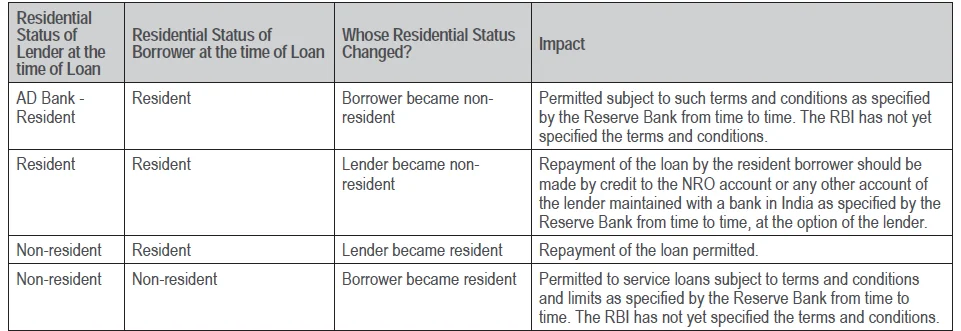
  4.  Changing Residential Status: An interesting practical point – if an NRI who made a non-repat investment later moves back to India and becomes a resident, their holding simply becomes a resident holding (no issue there). But if they then move abroad again and become NRI once more, by default, that holding would become an NRI holding on a non-repat basis (since it was never designated repatriable). That person might now wish it were repatriable. There isn’t a straightforward mechanism to “retroactively designate” an investment as repatriable; typically, the person would have to do a transfer (e.g., transfer to self through a structure, which is not really possible) or approach RBI. It’s a corner case, but it shows that once an investment is made under a particular schedule, toggling its status is not simple unless a third-party transfer is involved.
  5.  Evidence of Investment Route: Down the line, when an NRI / OCI wants to remit out the sale proceeds under the $1M facility, banks often ask for proof that the investment was made on a non-repatriation basis (because if it was repatriable, the sale proceeds would be in an NRE account and could go out without using the $1M quota). Thus, maintaining paperwork – such as the board resolution or offer letter mentioning the shares are under Schedule IV, or a copy of the share certificate with a “non-repatriable” stamp, or the letter to AD bank at the time of issue – becomes useful to avoid confusion. If records are lost or unclear, the bank might fear to allow remittance or might treat it as some foreign investment needing RBI permission. So, documentation is a practical must.
  6.  Taxation Aspect: Though not directly a FEMA issue, note that dividends repatriated to NRIs will be after TDS, and any gift of shares etc. might have tax implications (gift to a relative is not taxable in India, but to a non-relative, it could trigger tax for the recipient if over ₹50,000). Also, the favourable FEMA treatment doesn’t automatically confer any tax residency benefit – e.g., just because OCI investment is deemed domestic doesn’t make the OCI an Indian resident for tax

BEFORE WE ALL NEED A REPATRIATION ROUTE, LET’S WRAP THIS UP!

Before we exhaust ourselves—or our dear readers start considering their own non-repatriable exit strategies—let’s conclude. The non-repatriation route under FEMA is like a VIP pass for NRIs and OCIs to invest in India while enjoying the perks of domestic investors. It’s a fine balancing act by policymakers: welcoming diaspora investments with open arms but keeping foreign exchange reserves snugly in place.

For legal practitioners, Schedule IV is both a playground and a puzzle—offering creative structuring opportunities while demanding meticulous planning for exits and compliance. Done right, it’s a win-win for investors and Indian businesses alike, seamlessly blending “foreign” and “domestic” investment. So, whether you’re an NRI looking for investment options or a lawyer navigating these rules—remember, patience, planning, and a strong cup of chai go a long way!

Issues Relating To ‘May Be Taxed’ In Tax Treaties

The term ‘may be taxed’ has been commonly used in tax treaties since before the OECD  Model Tax Convention was first published in 1963. In India, there has been significant litigation on whether the term indicates an exclusive right of taxation. While the CBDT vide Notification in  2008 has clarified the issue, certain ambiguities still exist.

In this article, the authors seek to analyse the said issue on whether the term ‘may be taxed’ in tax treaties refers to an exclusive right of taxation to any Contracting State.

BACKGROUND

The allocation of taxing rights in respect of various streams of income in DTAAs can generally be bifurcated into 3 categories:

a. Category I – May also be taxed:

Some articles provide that the particular income may be taxed in a particular jurisdiction (typically the country of residence) and also states that the income ‘may also be taxed’ in the other Contracting State, typically with some restrictions in terms of tax rates, etc. The articles on dividend, interest, royalty / fees for technical services, generally provide for such type of allocation of taxing right.

For example, Article 10(1) of the India – Singapore DTAA, dealing with dividends provides as follows,

“1. Dividends paid by a company which is a resident of a Contracting State to a resident of the other Contracting State may be taxed in that other State.

2. However, such dividends may also be taxed in the Contracting State of which the company paying the dividends is a resident and according to the laws of that State, but if….” (emphasis supplied);

b. Category II – Shall be taxable only:

Some articles provide that the particular income ‘shall be taxable only’ in a particular Contracting State indicating an exclusive right of taxation to the particular Contracting State (typically the country of residence). Generally, this type of allocation of taxing right is found in the article of business profits (where there is no permanent establishment) or capital gains (in respect of assets other than those specified).

For example, Article 13(5) of the India – Singapore DTAA provides as under,

“Gains from the alienation of any property other than that referred to in paragraphs 1, 2, 3, 4A and 4B of this Article shall be taxable only in the Contracting State of which the alienator is a resident.” (emphasis supplied);

c. Category III – May be taxed:

Some articles simply state that the particular income ‘may be taxed’ in a particular Contracting State (in most cases, the source State) without referring to the taxation right of the other Contracting State.

An example of such taxing right is in Article 6 of the India – Singapore DTAA which provides as under,

“Income derived by a resident of a Contracting State from immovable property situated in the other Contracting State may be taxed in that other State.(emphasis supplied)

In the above Article, the right of the source State is provided but no reference is made whether the State of residence can tax the said income or not.

While the allocation of taxing right in the first two categories is fairly clear, there is ambiguity in the third category i.e. whether in such a scenario, the country of residence has a right to tax in case the DTAA is silent in this regard.

Given the language in the DTAA, the question which arises is whether the income from rental of an immovable property situated in Singapore by an Indian resident can be taxed in India or would such income be taxed exclusively in Singapore under the India – Singapore DTAA.

DECISIONS OF THE COURTS

While some courts held that the term ‘may be taxed’ in a Contracting State, not followed by the term ‘may also be taxed’ in the other Contracting State meant that exclusive right of taxation was granted to the first-mentioned Contracting State, some courts held that ‘may be taxed’ is to be interpreted differently from ‘shall be taxed only’ and therefore, does not infer exclusive right of taxation. One of the most notable decision which provided the former view i.e. ‘may be taxed’ is equated to ‘shall be taxed only’, is the Karnataka High Court in the case of CIT vs. RM Muthaiah (1993) (202 ITR 508).

The issue before the Hon’ble Karnataka High Court in the above case was whether income earned from an immovable property situated in Malaysia was taxable in India in the hands of an Indian resident under the India – Malaysia DTAA. Article 6(1) of the earlier India – Malaysia DTAA provided,

“Income from immovable property may be taxed in the Contracting State in which such property is situated.”

In the said case, the Revenue argued that the DTAA did not provide for an exclusive right of taxation to Malaysia and India had a right to tax the income. The High Court, while not analysing the specific language of the DTAA, held as under,

“The effect of an ‘agreement’ entered into by virtue of section 90 would be: (i) if no tax liability is imposed under this Act, the question of resorting to the agreement would not arise. No provision of the agreement can possibly fasten a tax liability where the liability is not imposed by this Act; (ii) if a tax liability is imposed by this Act, the agreement may be resorted to for negativing or reducing it; (iii) in case of difference between the provisions of the Act and of the agreement, the provisions of the agreement prevail over the provisions of this Act and can be enforced by the appellate authorities and the Court.”

The High Court, therefore, held that as the DTAA did not specifically provide for India, being the country of residence, to tax the said income, it would be taxable only in Malaysia.

The Mumbai Bench of the Tribunal in the case of Ms. Pooja Bhatt vs. DCIT (2009) (123 TTJ 404) held that,

“Wherever the parties intended that income is to be taxed in both the countries, they have specifically provided in clear terms. Consequently, it cannot be said that the expression “may be taxed” used by the contracting parties gave option to the other Contracting States to tax such income. In our view, the contextual meaning has to be given to such expression. If the contention of the Revenue is to be accepted then the specific provisions permitting both the Contracting States to levy the tax would become meaningless. The conjoint reading of all the provisions of articles in Chapter III of Indo-Canada treaty, in our humble view, leads to only one conclusion that by using the expression “may be taxed in the other State”, the contracting parties permitted only the other State, i.e., State of income source and by implication, the State of residence was precluded from taxing such income. Wherever the contracting parties intended that income may be taxed in both the countries, they have specifically so provided. Hence, the contention of the Revenue that the expression “may be taxed in other State” gives the option to the other State and the State of residence is not precluded from taxing such income cannot be accepted.”

Similarly, the Madras High Court in the case of CIT vs. SRM Firm & Others (1994) (208 ITR 400) also held on similar lines. The above Madras High Court decision was affirmed by the Apex Court in the case of CIT vs. PVAL KulandaganChettiar (2004)(267 ITR 654), albeit without analyzing the controversy of ‘may be taxed’ vs ‘shall be taxed only’. The Supreme Court held that,

“13. We need not to enter into an exercise in semantics as to whether the expression “may be” will mean allocation of power to tax or is only one of the options and it only grants power to tax in that State and unless tax is imposed and paid no relief can be sought. Reading the Treaty in question as a whole when it is intended that even though it is possible for a resident in India to be taxed in terms of sections 4 and 5, if he is deemed to be a resident of a Contracting State where his personal and economic relations are closer, then his residence in India will become irrelevant. The Treaty will have to be interpreted as such and prevails over sections 4 and 5 of the Act. Therefore, we are of the view that the High Court is justified in reaching its conclusion, though for different reasons from those stated by the High Court.”

This view was further upheld by the Supreme Court in the cases of DCIT vs. Torqouise Investment & Finance Ltd. (2008) (300 ITR 1) and DCIT vs. Tripti Trading & Investment Ltd (2017) (247 Taxman 108). In both the above cases, it was held that dividend received by an Indian assessee from Malaysia was exempt from
tax in India by virtue of the India – Malaysia DTAA following the earlier decision of Kulandagan Chettiar (supra).

NOTIFICATION OF 2008 AND SUBSEQUENT DECISIONS

Section 90(3) of the ITA, inserted by the Finance Act 2003 with effect from Assessment Year 2004-05, provides that any term not defined in the DTAA can be defined through a notification published in the Gazette. Subsequently, the CBDT Notification No. 91 of 2008 dated 28th August, 2008 under section 90(3) was issued, which states as under,

“In exercise of the powers conferred by sub-section (3) of section 90 of the Income-tax Act, 1961 (43 of 1961), the Central Government hereby notifies that where an agreement entered into by the Central Government with the Government of any country outside India for granting relief of tax or as the case may be, avoidance of double taxation, provides that any income of a resident of India “may be taxed” in the other country, such income shall be included in his total income chargeable to tax in India in accordance with the provisions of the Income-tax Act, 1961 (43 of 1961), and relief shall be granted in accordance with the method for elimination or avoidance of double taxation provided in such agreement.”

Therefore, the CBDT, vide its above notification, provided that the term ‘may be taxed’ is not required to be equated to ‘shall be taxable only’ and India would still have the right of taxation, unless the tax treaty specifically provides that the income ‘shall be taxed only’ in the other State.

There are two possible views regarding implications of the aforesaid Notification issued by the CBDT.

View 1: The Notification clarifies the right of taxation in respect of ‘may be taxed’

The view is that the Notification now changes the position of taxability and that income of a resident of India shall be taxable in India unless the income is taxable only in the country of source as per the respective DTAA, has been upheld by the Mumbai ITAT in the cases of Essar Oil Ltd. vs. ACIT (2014) 42 taxmann.com 21 and Shah Rukh Khan vs. ACIT (2017) 79 taxmann.com 227, the Delhi ITAT in the case of Daler Singh Mehndi vs. DCIT (2018) 91 taxmann.com 178 and the Jaipur ITAT in the case of Smt. IrvindGujral vs. ITO (2023) 157 taxmann.com 639.

View 2: The Notification does not clarify all situations involving ‘may be taxed’

The alternative view is that Notification No. 91 of 2008 will have application only in a case where the primary right to tax has been given to the state of residence and such state has allowed the source State also to charge such income to tax at a concessional rate.

The relevant provisions in a DTAA could be divided into three broad categories:

i) where the right to tax is given to the State of source (e.g. Article 6 dealing with income derived from immovable property);

ii) where such right to tax is given to the State of residence (e.g. Article 8 dealing with income derived from International Shipping and Air Transport); and

iii) where the primary right to tax is with the State of residence. However, such State has ceded and allowed the State of source also to charge such income to tax, but, at a concessional rate (e.g. Article 7 dealing with business profits, Article 10 dealing with dividends, Article 11 dealing with interest and Article 12 dealing with royalties and fees for technical services).

Under this view, one may argue that the said notification has been issued to clarify the position of the Government of India only with respect to the category (iii) of income as it does not refer to a situation where the right of State of Residence to tax the said income, is silent. The said clarifications should not apply to incomes referred to in category (i) and category (ii) above. This is because, with respect to category (iii) income as explained above, the primary right to tax is with the state of Residence which has partially ceded such right in favour of the State of source by enabling such State to tax the income at a concessional rate of tax. If one reads the said notification in the above context, one may conclude that the Notification only covers income covered in category (iii) above.

Another aspect one may consider is that section 90(3) of the Act, itself provides that the meaning to be assigned to a term in the notification issued by the Central Government shall apply unless the context otherwise requires and such meaning is consistent with the provisions of the Act or the DTAA.

Further, interestingly, readers may refer to the January 2021 edition of this Journal1 wherein the authors of the said article have analysed that while section 90(3) of the ITA empowers the Government to define an undefined term, the above Notification goes beyond the scope of the section as it does not define any term but only clarifies the stand of the Government on the said issue without actually defining the term.

The authors of the said article have also questioned whether ‘may be taxed’ is a term or a phrase.

In this regard, one may also refer to the Mumbai ITAT in the case of Essar Oil (supra), wherein the issue of whether it is a term or a phrase was analysed and concluded as under,

“The phrases “may be taxed”, “shall be taxed only” and “may also be taxed” have a definite purpose and a definite meaning which is conveyed. Whether it is a term, phrase or expression does not make any significant difference because the contracting parties have given a definite meaning to such a phrase and once the Government of India have clarified such an expression, then it cannot be held that it does not fall within the realm of the word “term” as given in section 90(3). Thus, we do not feel persuaded by the argument taken by the learned Sr. Counsel.”

UNILATERAL AMENDMENTS

The India – Malaysia DTAA which was the subject matter of litigation in the matter before the High Courts and Supreme Courts for the meaning of the term, was amended in 2012. Interestingly, the new DTAA now specifically provides the following in the Protocol,

“It is understood that the term “may be taxed in the other State” wherever appearing in the Agreement should not be construed as preventing the country of residence from taxing the income.”

Therefore, in respect of the India – Malaysia DTAA now, there is no ambiguity about the interpretation of the phrase. However, the question does arise as to whether, the fact that this similar language is not provided in any other DTAA (in the main text or in the Protocol), another meaning has to be ascribed to the term in the other DTAAs.

Though the Notification is part and parcel of the Act, a DTAA is a thoughtfully negotiated economic bargain between two sovereign States and any unilateral amendment cannot be read into the DTAA such that the economic bargain is annulled, until and unless the DTAA itself is amended.

As mentioned above, the authorities being aware of the aforesaid fact, amended the India-Malaysia DTAA on 09-05-2012 to incorporate the unilateral amendment put forth by the aforesaid Notification into the DTAA by way of inserting paragraph 3 to the Protocol of the India-Malaysia DTAA. Similarly, paragraph 2 to the Protocol dated 30-01-2014 of the India-Fiji DTAA states that the term “may be taxed in the other State” wherever appearing in the Agreement should not be construed as preventing the country of residence from taxing the income. Paragraph 1 of India-South Africa DTAA provides that ‘With reference to any provision of the Agreement in terms of which income derived by a resident of a Contracting State may be taxed in the other Contracting State, it is understood that such income may, subject to the provisions of Article 22, also be taxed in the first-mentioned Contracting State.

In the earlier India-Malaysia DTAA (Notification No. GSR 667(E), dated 12th October, 2004), Clause 4 of the Protocol was agreed on between the two contracting States with reference to paragraph 1 of Article 6 to the effect that the said paragraph should not be construed as preventing the Country of Residence to also tax the income under the said Article.

It would be relevant to note that Article 6 of the India-Malaysia DTAA and that of other DTAAs on taxation of income from immovable property are worded alike. However, the aforesaid Protocol agreed between India and Malaysia in the India-Malaysia DTAA is not found for example, in the India-UK or India-France DTAA. It becomes all the more conspicuous when protocols under other DTAAs have been signed after the Notification No. 91/2008 issued under Section 90(3). An example can be considered of the India – UK DTAA wherein the Protocol is signed on 30th October, 2012 but there is no agreement with regard to interpretation of the expression “may be taxed”, which is used inter alia in Articles 6, 7, 11, 12 and 13. Thus, one may argue that the expression “may be taxed” required an understanding under the India-Malaysia DTAA that varied with the earlier judicial understanding of the said expression in other DTAAs.

In certain DTAAs where expression ‘may be taxed’ has been used in Article 6 or Article 13, it has been clarified through Protocols that income and capital gains relating to immovable properties may be taxed in both the contracting states. Some of these DTAAs with India are: Hungary, Serbia, Montenegro and Slovenia.

However, in certain other DTAAs where expression ‘may be taxed’ has been used in Article 6 or Article 13, it has been clarified through Protocols that income and / or capital gains relating to immovable properties may be taxed in the Contracting State where the immovable property is situated. For example, India’s DTAAs with Estonia and Lithuania.

A DTAA is a product of bilateral negotiation of the terms between two sovereign States which are expected to fulfill their obligations under a DTAA in good faith. This includes the obligation for not defeating the purpose and object of the DTAA. Therefore, while the amendment to the India-Malaysia DTAA was consciously made on the lines of the Notification, it is apparent that the same was deliberately not extended to other DTAAs in probable consideration of larger macro issues which could have had a bearing upon the bilateral trade relations.

It is to be noted that in the case of Essar Oil Limited (supra), the ITAT was interpreting Article 7 of the India-Oman DTAA and India-Qatar DTAA dealing with business profits. Article 7(1) clearly provides that the profits of an enterprise of a contracting State shall be taxable only in that State. The exception carved out is only to enable the “PE country” to tax the profits attributable to the PE. Profits attributable to a PE may be larger than the profits sourced within the PE State, which is not the case for Article 6 dealing with income from immovable properties, where the source is undisputedly within the State in which the immovable property is located. Contextually, the expression “may be taxed” lends itself to different meanings under Article 7 and Article 6. This distinction has not been brought to the attention of the Hon’ble Tribunal. Clarifications, if any, would serve the intended purpose only when incorporated in the respective DTAA. The same was done through a Protocol entered under the India-Malaysia DTAA in the context of the expression “may be taxed”.

Therefore, one may be able to argue that Notification No. 91/2008 should have no application in respect of cases covered under category I i.e. similar to Article 6.

INTERPLAY WITH ARTICLE ON TAX CREDIT

Another aspect which also needs to be considered is the language of Article 25 of the India – Singapore DTAA, dealing with Elimination of Double Taxation (foreign tax credit or relief). It provides as under,

“2. Where a resident of India derives income which, in accordance with the provisions of this Agreement, may be taxed in Singapore, India shall allow as a deduction from the tax on the income of that resident an amount equal to the Singapore tax paid, whether directly or by deduction.”

In the present case, if one argues that income from immovable property situated in Singapore shall be taxable only in Singapore as the Article states that such income ‘may be taxed’ in Singapore, the question of tax credit does not arise. However, Article 25(2), as discussed above, specifically provides that when the DTAA states that income may be taxed in Singapore, India should grant foreign tax credit to eliminate double taxation. The said credit can be provided only after India has taxed the income in the first place.

It may, however, be highlighted that the Mumbai ITAT in the case of Pooja Bhatt vs. DCIT (2009) 123 TTJ 404 did not accept this argument and held as under,

“8. The reliance of the Revenue on Article 23 is also misplaced. It has been contented that Article 23 gives credit of tax paid in the other State to avoid double taxation in cases like the present one. In our opinion, such provisions have been made in the treaty to cover the cases falling under the third category mentioned in the preceding para i.e., the cases where the income may be taxed in both the countries. Hence, the cases falling under the first or second categories would be outside the scope of Article 23 since income is to be taxed only in one State.”

ROLE OF OECD MODEL COMMENTARY

The OECD Model Commentary has explained the various types of allocation of taxing rights used in a DTAA. The OECD Model Commentary 2017 on Article 23A dealing with Elimination of Double Taxation provides as under,

“6. For some items of income or capital, an exclusive right to tax is given to one of the Contracting States, and the relevant Article states that the income or capital in question “shall be taxable only” in a Contracting State. The words “shall be taxable only” in a Contracting State preclude the other Contracting State from taxing, thus double taxation is avoided. The State to which the exclusive right to tax is given is normally the State of which the taxpayer is a resident within the meaning of Article 4, that is State R, but in Article 19 the exclusive right may be given to the other Contracting State (S) of which the taxpayer is not a resident within the meaning of Article 4.

7. For other items of income or capital, the attribution of the right to tax is not exclusive, and the relevant Article then states that the income or capital in question “may be taxed” in the Contracting State (S or E) of which the taxpayer is not a resident within the meaning of Article 4. In such case the State of residence (R) must give relief so as to avoid the double taxation. Paragraphs 1 and 2 of Article 23 A and paragraph 1 of Article 23 B are designed to give the necessary relief.”

The above Commentary makes it clear that where the Model wanted to provide an exclusive right of taxation to a particular country, it has provided that with the words “shall be taxable only”. In other scenarios both the countries shall have the right to tax the income.

It may be noted that the Hon’ble Supreme Court in the case Kulandagan Chettiar (supra) did not consider the validity of the OECD Model Commentary on the basis of which the DTAAs are entered into. In the said case, the Supreme Court held as under,

“16. Taxation policy is within the power of the Government and section 90 of the Income-tax Act enables the Government to formulate its policy through treaties entered into by it and even such treaty treats the fiscal domicile in one State or the other and thus prevails over the other provisions of the Income-tax Act, it would be unnecessary to refer to the terms addressed in OECD or in any of the decisions of foreign jurisdiction or in any other agreements.”

However, subsequent decisions of the Supreme Court including that of Engineering Analysis Centre of Excellence (P) Ltd vs. CIT (2021) 432 ITR 471 have held that the OECD Model Commentary shall have persuasive value as the DTAAs are based on the OECD Model.

Impact of Multilateral Convention to Implement Tax Treaty related measures to prevent Base Erosion and Profit Shifting [MLI]

India is a signatory to MLI. The DTAAs have to be read along with the MLI. Article 11 of the MLI deals with Application of Tax Agreements to Restrict a Party’s Right to Tax its Own Residents. Article 11(1)(j) provides that a Covered Tax Agreement (CTA) shall not affect the taxation by a Contracting Jurisdiction of its residents, except with respect to the benefits granted under provisions of the CTA which otherwise expressly limit a Contracting Jurisdiction’s right to tax its own residents or provide expressly that the Contracting Jurisdiction in which an item of income arises has the exclusive right to tax that item of income.

India has not reserved Article 11 of the MLI. The following countries have chosen Article 11(1) with India: Australia, Belgium, Colombia, Denmark, Croatia, Fiji, Indonesia, Kenia, Mexico, Mongolia, Namibia, New Zealand, Norway, Poland, Portugal, Russia, Slovak Republic, South Africa and UK. In respect of these countries, in absence of an express provision, the right of the resident country to tax its residents cannot be taken away under the DTAA. However, the same cannot be applied to countries which have not chosen Article 11(1) or which have not signed the MLI.

CONCLUSION

Even after the 2008 Notification under section 90(3), two strong views still exist as to whether the term ‘may be taxed’ grants exclusive right of taxation to the source State particularly in the case of the Article 6 where, unless otherwise expressly stated in the DTAA, it is clearly intended to allocate right of taxation exclusively to the source state where the immovable property is situated. This view would depend on the role of the tax treaties read with MLI in taxation – that is whether one considers that the country of residence always has the right to tax all income unless specifically restricted by the tax treaty or does the right of taxation of the country of residence need to be specifically provided in the tax treaty.

Non-Repatriable Investment by NRIs and OCIs under FEMA: An Analysis – Part – 1

This is the 11th Article in the ongoing NRI series dealing with “Non-repatriable Investment by NRIs and OCIs under FEMA — An Analysis.”

Summary

“What cannot be done directly, cannot be done indirectly – Or can it be?”

FEMA’s golden rule has always been that what you cannot do directly, you cannot do indirectly—but then comes Schedule IV, sneaking in like that one friend who always finds a way out. It’s the ultimate legislative exception, allowing NRIs and OCIs to invest in India as if they never left, minus the luxury of an easy exit. Curious? Dive into the fascinating world of non-repatriable investments — you won’t be disappointed (unless, of course, you were hoping to take the money back out quickly!)

INTRODUCTION AND REGULATORY FRAMEWORK

Non-resident investors — including Non-Resident Indians (NRIs), Overseas Citizens of India (OCIs), and even foreign entities — can invest in India under the Foreign Exchange Management Act, 1999 (FEMA). FEMA provides a broad statutory framework, which is supplemented by detailed rules and regulations issued by the government and the Reserve Bank of India (RBI). In particular, the Foreign Exchange Management (Non-Debt Instruments) Rules, 2019 (NDI Rules) (issued by the Central Government) and the Foreign Exchange Management (Mode of Payment and Reporting of Non-Debt Instruments) Regulations, 2019 (Reporting Regulations) (issued by RBI) lay down the regime for foreign investments in “non-debt instruments.” These are further elaborated in the RBI Master Direction on Foreign Investment in India, which consolidates the rules and is frequently consulted by practitioners.

Under this framework, foreign investment routes are categorised by schedules to the NDI Rules. Of particular interest are Schedule I (Foreign Direct Investment on a repatriation basis), Schedule III (NRI investments under the Portfolio Investment Scheme on a repatriation basis), Schedule IV (NRI / OCI investments on non-repatriation basis), and Schedule VI (Investment in Limited Liability Partnerships). This article focuses on the nuances of non-repatriable investments by NRIs / OCIs under Schedule IV, contrasting them with repatriable investments and other routes. We will examine the legal definitions, eligible instruments, sectoral restrictions, compliance obligations, and the practical implications of choosing the non-repatriation route, with a structured analysis suitable for legal professionals.

DEFINITION OF NRI AND OCI UNDER FEMA; ELIGIBILITY TO INVEST

Non-Resident Indian (NRI) – An NRI is defined in FEMA and the NDI Rules as an individual who is a person resident outside India and is a citizen of India. In essence, Indian citizens who reside abroad (for work, education, or otherwise) become NRIs under FEMA once they cease to be “person resident in India” as per Section 2(w) of FEMA. Notably, this definition excludes foreign citizens, even if they were formerly Indian citizens – such persons are not NRIs for FEMA purposes once they have given up Indian citizenship.

Overseas Citizen of India (OCI) – An OCI for FEMA purposes means an individual resident outside India who is registered as an OCI cardholder under Section 7A of the Citizenship Act, 1955. In practical terms, these are foreign citizens of Indian origin (or their spouses) who have obtained the OCI card. OCIs are a separate category of foreign investors recognized by FEMA, often extending the same investment facilities as NRIs. In summary, NRIs (Indian citizens abroad) and OCIs (foreign citizens of Indian origin) are both eligible to invest in India, subject to the FEMA rules.

Eligible Investors under the Non-Repatriation Route – Schedule IV specifically permits the following persons to invest on a non-repatriation basis):

  •  NRIs (individuals resident outside India who are Indian citizens);
  •  OCIs (individuals resident outside India holding OCI cards);
  •  Any overseas entity (company, trust, partnership firm) incorporated outside India which is owned and controlled by NRIs or OCIs.

This extension to entities owned / controlled by NRIs / OCIs means that even a foreign-incorporated company or trust, if predominantly NRI / OCI-owned, can use the NRI non-repatriation route. However, as discussed later, such entities do not enjoy certain repatriation facilities (like the USD 1 million asset remittance) that individual NRIs do. Moreover, it is important to note that while these NRI / OCI-owned foreign entities are eligible for Schedule IV investments, they cannot invest in an Indian partnership firm or sole proprietorship under this route — only individual NRIs / OCIs can do so in that case.

NRIs and OCIs have broadly two modes to invest in India: (a) on a repatriation basis (where eventual returns can be taken abroad freely), or (b) on a non-repatriation basis (where the investment is treated as a domestic investment and cannot be freely taken out of India). Both modes are legal, but they carry different conditions and implications, as explained below.

WHAT ARE NON-DEBT INSTRUMENTS? – PERMISSIBLE INVESTMENT INSTRUMENTS

Under FEMA, all permissible foreign investments are classified as either debt instruments or non-debt instruments. Our focus is on non-debt instruments, which essentially cover equity and equity-like investments. The NDI Rules define “non-debt instruments” expansively to include:

Equity instruments of Indian companies – e.g. equity shares, fully and mandatorily convertible debentures, fully and mandatorily convertible preference shares, and share warrants. (These are often referred to simply as “FDI” instruments.)

Capital participation in LLPs (contributions to the capital of Limited Liability Partnerships).

All instruments of investment recognized in the FDI policy, as notified by the Government from time to time (a catch-all for any other equity-like instruments).

Units of Alternative Investment Funds (AIFs), Real Estate Investment Trusts (REITs), and Infrastructure Investment Trusts (InvITs).

Units of mutual funds or Exchange-Traded Funds (ETFs) that invest more than 50 per cent in equity (i.e. equity-oriented funds).

• The junior-most (equity) tranche of a securitization structure.

• Immovable property in India (acquisition, sale, dealing directly in land and real estate, subject to other regulations).

Contributions to trusts (depending on the nature of the trust, e.g. venture capital trusts, etc.).

Depository receipts issued against Indian equity instruments (like ADRs / GDRs).

All the above are considered non-debt instruments. Thus, when an NRI or OCI invests on a non-repatriation basis, it can be in any of these forms. In practice, the most common instruments for NRI / OCI non-repatriable investment are equity shares of companies, capital contributions in LLPs, units of equity-oriented mutual funds, and investment vehicles like AIFs / REITs.

It is important to note that debt instruments (such as NCDs, bonds, and government securities) are governed by a separate set of rules (the Foreign Exchange Management (Debt Instruments) Regulations) and generally fall outside the scope of Schedule IV. NRIs / OCIs can also invest in some debt instruments (for example, NRI investments in certain government securities on a non-repatriation basis are permitted up to a limit, but those are subject to different rules and are not the focus of this article.

REPATRIABLE VS. NON-REPATRIABLE INVESTMENTS: MEANING AND LEGAL DISTINCTION

Repatriable Investment means an investment in India made by a person resident outside India which is eligible to be repatriated out of India, i.e. the investor can bring back the sale proceeds or returns to their home country freely (net of applicable taxes) in foreign currency. In other words, both the dividends/interest (current income) and the capital gains or sale proceeds (capital account) are transferable abroad in a repatriable investment without any ceiling (subject to taxes). Most foreign direct investments (FDI) in India are on a repatriation basis, which is why repatriable NRI investments are treated as foreign investments and counted towards foreign investment caps. For instance, if an NRI invests in an Indian company under Schedule I (FDI route) or Schedule III (portfolio route) on a repatriable basis, it is counted as foreign investment (FDI / FPI), with all attendant rules.

Non-Repatriable Investment means the investment is made by a non-resident, but the sale or maturity proceeds cannot be taken out of India (except to the limited extent allowed). The NDI Rules define it implicitly by saying, “investment on a non-repatriation basis has to be construed accordingly” from the repatriation definition. In simple terms, this means the principal amount invested and any capital gains or sale proceeds must remain in India. The investor cannot freely convert those rupee proceeds into foreign currency and remit abroad. Such investments are essentially treated as domestic investments –— the NDI Rules explicitly deem any investment by an NRI / OCI on a non-repatriation basis to be domestic investment, on par with investments made by residents. This distinction has crucial legal effects: NRI/OCI non-repatriable investments are not counted as foreign investments for regulatory purposes. They do not come under FDI caps or sectoral limits (since they are treated like resident equity). This was confirmed by India’s DPIIT (Department for Promotion of Industry and Internal Trade) in a clarification that downstream investments by a company owned and controlled by NRIs on a non-repatriation basis will not be considered indirect FDI. Effectively, non-repatriable NRI / OCI investments enjoy the flexibility of domestic capital but with the sacrifice of free repatriation rights.

Advantages of Non-Repatriation Route: The non-repatriable route (Schedule IV) offers NRIs and OCIs significant advantages in terms of flexibility and compliance:

  •  No Foreign Investment Caps: Since it is treated as domestic investment, an NRI/OCI can invest without the usual foreign ownership limits. For example, under the portfolio investment route, NRIs cannot exceed 5 per cent in a listed company (10 per cent collectively), but under non-repatriation, there is no such limit — an NRI could potentially acquire a much larger stake in a listed company under Schedule IV (outside the exchange) without breaching FEMA limits. Similarly, total NRI / OCI investment can go beyond 10/24 per cent aggregate because Schedule IV holdings are not counted as foreign at all.
  •  Simplified Compliance: Many of the onerous requirements applicable to FDI – e.g. adherence to pricing guidelines, filing of RBI reports, sectoral conditionalities, mandatory approvals — are relaxed or not applicable for non-repatriable investments (since regulators treat it like a resident’s investment). We detail these compliance relaxations below.
  •  Current income can be freely repatriable: Current income arising from such investments like interest, rent, dividend, etc., is freely repatriable without any limits and is not counted in the $1mn threshold.
  •  Deemed Domestic for Downstream: As noted, if an NRI/OCI-owned Indian entity invests further in India, those downstream investments are not treated as FDI. This can allow greater expansion without triggering indirect foreign investment rules.

Drawbacks of the Non-Repatriation Route: The obvious trade-off is illiquidity from an exchange control perspective. The investor’s capital is locked in India. Specifically:

  •  Inability to Repatriate Capital Freely: The principal amount and any capital gains cannot be freely
    converted and sent abroad. The investor must either reinvest or keep the funds in India (in an NRO account) after exit, subject to a limited annual remittance (discussed later).
  •  Perpetual Rupee Exposure: Since eventual proceeds remain in INR, the investor bears currency risk on the investment indefinitely, which foreign investors might be unwilling to take for large amounts.
  •  Exit Requires Domestic Buyer or Special Approval: To actually get money out, the NRI / OCI may need to convert the investment to repatriable by selling it to an eligible foreign investor or seek RBI permission beyond the allowed limit. This adds a layer of uncertainty for the exit strategy.
  •  Not Suitable for Short-Term Investors: This route is generally suitable for long-term investments (often family investments in family-run businesses, real estate purchases, etc.) where the NRI is not looking to repatriate in the near term. It is less suitable for foreign venture capital or private equity, which typically demand an assured exit path.

INVESTMENT UNDER SCHEDULE IV: PERMITTED INSTRUMENTS AND SECTORAL CONDITIONS

What Schedule IV Allows: Schedule IV of the NDI Rules (titled “Investment by NRI or OCI on the non-repatriation basis”) lays out the scope of investments NRIs / OCIs can make on a non-repatriable basis. In summary, NRIs/OCIs (including their overseas entities) can, without any limit, invest in or purchase the following on a non-repatriation basis:

  •  Equity instruments of Indian companies – listed or unlisted shares, convertible debentures, convertible preference shares, share warrants – without any limit, whether on a stock exchange or off-market.
  •  Units of investment vehicles – units of AIFs, REITs, InvITs or other investment funds — without limit, listed or unlisted.
  •  Contributions to the capital of LLPs – again, without limit, in any LLP (subject to sectoral restrictions discussed below).
  •  Convertible notes of startups – NRIs / OCIs can also subscribe to convertible notes issued by Indian startups, as allowed under the rules, on a non-repatriation basis.

Additionally, Schedule IV explicitly provides that any investment made under this route is deemed to be a domestic investment (i.e. treated at par with resident investments). This means the general FDI conditions of Schedule I do not apply to Schedule IV investments unless specifically mentioned.

Sectoral Restrictions – Prohibited Sectors: Despite the broad freedom, Schedule IV carves out certain prohibited sectors where even NRI / OCI non-repatriable investments are NOT permitted. According to Para 3 of Schedule, an NRI or OCI (including their companies or trusts) shall not invest under non-repatriation in:

  •  Nidhi Company (a type of NBFC doing mutual benefit funds among members);
  •  Companies engaged in agricultural or plantation activities (this covers farming, plantations of tea, coffee, etc., and related agricultural operations);
  •  Real estate business or construction of farmhouses;
  •  Dealing in Transfer of Development Rights (TDRs).

These mirror some of the standard FDI prohibitions, with a key addition: agricultural / plantation is completely off-limits under Schedule IV (whereas under FDI policy, certain agricultural and plantation activities are permitted up to 100 per cent with conditions). The term “real estate business” is defined (by reference to Schedule I) to mean dealing in land and immovable property with a view to earning profit from them (buying and selling land/buildings). Notably, the development of townships, construction of residential or commercial premises, roads or infrastructure, etc., is specifically excluded from the definition of “real estate business”, as is earning rent from property without transfer. So, an NRI / OCI can invest in a construction or development project or purchase property for earning rent on a non-repatriation basis (since that is not considered a “real estate business” for FEMA purposes) but cannot invest in a pure real estate trading company.

Implication – Some Sectors Allowed on Non-Repatriation that are Prohibited for FDI, and vice versa: Because Schedule IV’s prohibited list is somewhat different from Schedule I (FDI) prohibited list, there are interesting differences:

  •  Additional Sectors Open under Schedule IV: Certain sectors like lottery, gambling, casinos, tobacco manufacturing, etc., which are prohibited for any FDI under Schedule I, are not mentioned in Schedule IV’s prohibition list. This may imply that an NRI / OCI could invest in such businesses on a non-repatriation basis. For example, a casino business in India cannot receive any FDI (foreign investor money on a repatriable basis), but it could receive NRI/OCI investment as a domestic investment under Schedule IV. However, such investments may be subject to provisions or prohibitions in various other laws and Statewise restrictions in India, and therefore, one must be careful in making such investments.
  •  From a policy perspective, this leverages the idea that an Indian citizen abroad is still treated akin to a resident for these purposes. Thus, apart from the specific exclusions in Schedule IV, all other sectors (even those barred to foreign investors) are permissible for NRIs / OCIs on non-repatriation. This provides NRIs/OCIs a unique opportunity to invest in sensitive sectors of the economy, which foreigners cannot, theoretically increasing the investment funnel for those sectors via the Indian diaspora.
  •  Conversely, Some Investments Allowed via FDI Are Barred in Non-Repatriation: There are cases where FDI rules are more liberal than the NRI non-repatriable route. A prime example is plantation and agriculture. Under FDI (Schedule I), certain plantation sectors (like tea, coffee, rubber, cardamom, etc.) are allowed 100 per cent foreign investment under the automatic route (with conditions such as mandatory divestment of a certain percentage within time for tea). However, Schedule IV flatly prohibits NRIs from investing in agriculture or plantation without exception. Thus, a foreign company could invest in a tea plantation company on a repatriable basis (counting as FDI), but an NRI cannot invest in the same on a non-repatriable basis, ironically. Another example: Print media — FDI in print media (newspapers / periodicals) is restricted to 26 per cent with Government approval under FDI policy. If an Indian company is in the print media business, an NRI / OCI could still invest on a non-repatriable basis (since Schedule IV’s company restrictions don’t list print media) — meaning potentially up to 100% as domestic investment. However, if the print media business is structured as a partnership firm or proprietorship, Schedule IV (Part B) prohibits NRI investment in it. We see a regulatory quirk: an NRI can invest in a print media company on non-repatriation (domestic equity, no specific cap) but not in a print media partnership firm. These inconsistencies require careful attention when structuring investments.

In summary, NRIs / OCIs have a broader canvas in some respects under Schedule IV, but must be mindful of the specifically forbidden areas. As a rule of thumb, apart from Nidhi, plantation / agriculture, real estate trading, and farmhouses / TDRs, most other activities are allowed. NRIs have leveraged this to invest in real estate development projects, infrastructure, and even sectors like multi-brand retail by ensuring their investments are non-repatriable (thus not triggering the foreign investment prohibitions or caps). On the other hand, they cannot use this route for farming or plantation businesses even if foreign investors could via FDI.

Special Case – Investment by NRIs / OCIs in Border-Sharing Countries: In April 2020, India introduced a rule (now embodied in NDI Rules) that any investment from an entity or citizen of a country that shares a land border with India (e.g. China, Pakistan, Bangladesh, etc.) requires prior Government approval, regardless of sector. This was to curb opportunistic takeovers. This rule applies to NRIs / OCIs as well if they are residents of those countries. However, notably, that restriction is relevant only for investments on a repatriation basis. If an NRI / OCI residing in, say, China or Bangladesh wants to invest under the non-repatriation route, Schedule IV does not impose the same approval requirement. In effect, an NRI/OCI in a neighbouring country can still invest in India as a de facto domestic investor under Schedule IV without going through government approval, whereas the same person investing under a repatriable route would face a clearance hurdle. This exception again underscores the policy view of NRI non-repatriable funds as akin to Indian funds. Whilst permissible, in view of authors, considering the geo-political climate, care and caution need to be exercised. Loophole or policy openness may not be the final answer, as national interest always comes first.

PRICING GUIDELINES AND VALUATION — ARE THEY APPLICABLE?

One significant compliance relief for non-repatriable investments is in pricing regulations. Under FEMA, when foreign investors invest in or exit from Indian companies on a repatriation basis, there are strict pricing guidelines to ensure shares are not issued at an unduly low price or purchased at an unduly high price (to prevent outflow/inflow of value unfairly). For instance, the issue of shares to a foreign investor must typically be at or above fair market value (as per internationally accepted pricing methodology), and transfer from resident to foreign investor cannot be at less than fair value, etc. These pricing restrictions do not apply to investments under Schedule IV. Since Schedule IV investments are treated as domestic, the law does not mandate adherence to the pricing formulae of Schedule I.

Practical effect: Indian companies can issue shares to NRIs / OCIs on a non-repatriation basis at face value or book value or any concessional price they choose, even if that is below the fair market value, without contravening FEMA. Similarly, NRIs/OCIs could potentially buy shares from resident holders at a negotiated price without being bound by the ceiling that would apply if the NRI were a foreign investor on a repatriation basis. This flexibility is often useful in family arrangements or preferential allotments where prices may be deliberately kept low for the NRI (which would otherwise trigger questions under FDI norms). For example, an Indian family-owned company can allot shares to an NRI family member at par value under Schedule IV, even if the fair value is much higher — a practice not allowed if the NRI were taking them on a repatriable basis. The only caution is that the Income Tax Act’s fair value rules (for deemed income on undervalued transactions) might still apply, but from a FEMA standpoint, it’s permissible.

To illustrate, the RBI Master Directions explicitly note that pricing guidelines are not applicable for investments by persons resident outside India on a non-repatriation basis, as those are treated as domestic investments. Thus, NRIs / OCIs have an advantage in valuation flexibility under Schedule IV.

REPORTING AND COMPLIANCE REQUIREMENTS

Another area of divergence is in regulatory reporting. Normally, any foreign investment coming into an Indian company must be reported to RBI (through its authorised bank) via forms on the FIRMS portal (previously Form FC-GPR for new issues, Form FC-TRS for transfers, etc.). However, investments by NRIs / OCIs on a non-repatriation basis do not require filing the typical foreign investment reports like FC-GPR. The rationale is that since these are not counted as foreign investments, the RBI does not need to capture them in its foreign investment data.

Indeed, no RBI reporting is prescribed for a fresh issue / allotment of shares under Schedule IV. An NRI/OCI investing on a non-repatriable basis can be allotted shares without the company filing any form to RBI (By contrast, if the same shares were issued under FDI, a Form SMF/FC-GPR would be required within 30 days.) That said, it is a best practice for the investee company or the NRI to intimate the AD bank in a letter about the receipt of funds and the fact that the shares are issued on a non-repatriation basis. This helps create a record, so that if in future any question arises, the bank/RBI is aware those shares were categorized as non-repatriable from the start.

One exception to the no-reporting rule is when there is a transfer of such shares to a person on a repatriation basis. If an NRI/OCI holding shares on a non-repatriable basis sells or gifts them to a foreign investor or NRI on a repatriable basis, that transaction does trigger reporting (Form FC-TRS) because now those shares are becoming foreign investments. The responsibility for filing the FC-TRS lies on the resident transferor or transferee, as applicable. We will discuss transfers shortly, but in summary: no reporting when NRIs invest non-repatriable initially, but reporting is required when the character of investment changes to repatriable via a transfer.

It’s important to maintain proper records in the company’s books classifying NRI / OCI holdings as non-repatriable. Practitioners note that if a company mistakenly records an NRI’s holding as repatriable FDI and files forms or treats it as a foreign holding in compliance reports, it could lead to regulatory confusion or even penalties. For instance, it might appear the company exceeded an FDI cap when, in reality, the NRI portion should have been excluded. Therefore, both the investor and investee company should internally document the nature of the investment (e.g. through a board resolution noting the shares are issued under Schedule IV, non-repatriation).

In summary, compliance for Schedule IV investments is lighter: no entry-level RBI approvals (it’s an automatic route in all cases), no pricing certification, and no routine filing for allotments. Contrast that with Schedule I investments, where one must comply with valuation norms and file forms within the prescribed time. This ease of doing business is a key attraction of the non-repatriable route for many NRIs.

Mode of Payment and Repatriation of Proceeds

Funding the Investment: An NRI/OCI investing on a non-repatriation basis can fund the investment through any of the standard channels for NRI investments. Permissible modes include:

  •  Inward remittance from abroad through normal banking channels (i.e. sending foreign currency, which is converted to INR for investment).
  •  Payment out of an NRE or FCNR account maintained in India (these are rupee or foreign currency accounts which are repatriable).
  •  Payment out of an NRO account in India (Non-Resident Ordinary account, which holds the NRI’s funds from local sources in INR).

Use of an NRO account is notable — since NRO balances are non-repatriable (beyond the USD 1 million a year), routing payment from NRO naturally aligns with the non-repatriable nature of the investment. But even if funds came from an NRE/FCNR (which are repatriable accounts), once invested under Schedule IV, the money loses its repatriable character for the principal and becomes subject to Schedule IV restrictions.

Credit of Sale / Disinvestment Proceeds: When an NRI / OCI eventually sells the investment or the Indian company liquidates, the sale proceeds must be credited only to the NRO account of the investor. This rule is crucial — it ensures the money remains in the non-resident’s ordinary rupee account (NRO), which is not freely repatriable. Even if the original investment was paid from an NRE account, the exit money cannot go back to NRE; it has to go to an NRO (or a fresh NRO if the investor doesn’t have one). Once in NRO, those funds are under Indian jurisdiction with limited outflow rights.

Repatriation of Proceeds — The USD 1 Million Facility: FEMA does provide a limited facility for NRIs / OCIs to remit out funds from their NRO accounts/sale proceeds under the Remittance of Assets Regulations, 2016. A Non-Resident Indian or PIO is allowed to remit up to USD 1,000,000 (One Million USD) per financial year abroad from an NRO account or from the sale proceeds of assets in India, including capital gain. This is a general limit for all assets combined per person per year. This means an NRI who sold shares that were on a non-repatriable basis can utilise this route to gradually repatriate the money, up to $ 1M (USD One Million) annually. Notably, this facility is only available to individuals (NRIs / PIOs) and not to companies or other entities. So, if an NRI made a large investment and eventually exited, they could take out $1M each year (approximately ₹8.75 crore at current rates) from India. Any amount beyond that in a year would require special RBI approval.

In practice, RBI approval for exceeding the USD 1M cap is rarely granted except in exceptional hardship cases. RBI typically expects the NRI to stagger the remittances within the allowed limit across years. Therefore, investors should plan accordingly if the sums are large – it could take multiple years to fully repatriate the corpus unless they find some other mechanism (like transferring the shares to a repatriable route investor before sale, etc.). It has been observed that RBI is generally not inclined to allow one-time large remittances beyond the automatic limit, emphasizing that the non-repatriable route is meant for money that essentially stays in India with only a slow trickle out.

No $1M facility for foreign entities: As mentioned, if the investor was not an individual but an overseas company or trust owned by NRIs / OCIs, that entity does not qualify as an NRI or PIO under the Remittance of Assets rules. Thus, it cannot directly avail of the $1M automatic repatriation. Such entities would have to apply to RBI for any repatriation, which is uncertain. This is why advisors often recommend that if repatriation might eventually be desired, the investment should be structured in the individual NRI’s name (or at least eventually transferred to the individual NRI before exit). By keeping the investor as a natural person, the exit flexibility using the $1M per year route remains available.

Repatriation of Current Income: Importantly, current income (yield) from the investment is freely repatriable even if the investment itself is non-repatriable. FEMA distinguishes between repatriation of capital versus repatriation of current income such as dividends, interest, or rent. As a general rule, any dividend or interest earned in India by an NRI can be remitted abroad after paying due taxes, irrespective of whether the underlying investment was on a non-repatriation basis. RBI Master Circular confirms that authorised dealers may allow remittance of current income (like dividends, pension, interest, rent) from NRO accounts, subject to CA certification of taxes paid. This means an NRI who invested in shares under Schedule IV can still have the company declare dividends, and the NRI can get those dividends out of India without dipping into the $1M capital remittance limit. Likewise, interest on any NRO deposits of the sale proceeds is repatriable as current income. This provision is a relief because it allows NRIs/OCIs to enjoy returns on their investment globally, even though the principal stays locked.

To summarize, the inflow of funds for non-repatriable investments is flexible (NRE/FCNR/NRO all allowed), but the outflow of funds is tightly controlled. NRIs should channel the exit money into NRO and then plan systematic remittances of up to $1M a year unless they intend to reuse the funds in India. Many simply reinvest in India, treating it as part of their India portfolio.

“And That’s a Wrap… for Now!”

Congratulations! If you’ve made it this far, you’re officially a FEMA warrior—armed with the wisdom of Schedule IV and the art of non-repatriable investments. We’ve explored how NRIs and OCIs can invest in India like residents and enjoy the flexibility that even FDI can’t offer. But wait—what happens when it’s time to exit? Can you sell, transfer, or gift these investments? Will FEMA let you walk away freely, or will it make you fill out just one more RBI form?

All this (and more!) is in Part 2, where we unlock the secrets of transfers, repatriation limits, downstream investments, and compliance puzzles. Stay tuned—because just like FEMA regulations, this story isn’t over yet!

Investment by Non-Resident Individuals in Indian Non-Debt Securities – Permissibility under FEMA, Taxation and Repatriation Issues

EDITOR’S NOTE ON NRI SERIES:

This is the 10th article in the ongoing NRI Series dealing with “Investment in Non-Debt Securities – Permissibility under FEMA. Taxation and Repatriation Issues”. This article attempts to cover an overview of investments in non-debt securities that can be made by an NRI / OCI under repatriation and non-repatriation route, the nuances thereof, and issues relating to repatriation. It also covers the tax implications related to income arising out of investment in Indian non-debt securities and the issues relating to repatriation of insurance proceeds, profits from Limited Liability Partnership (“LLP”), and formation of trust by Indian residents for the benefit of NRIs / OCIs.

Readers may refer to earlier issues of BCAJ covering various aspects of this Series: (1) NRI – Interplay of Tax and FEMA Issues – Residence of Individuals under the Income-tax Act – December 2023; (2) Residential Status of Individuals – Interplay with Tax Treaty – January 2024; (3) Decoding Residential Status under FEMA – March 2023; (4) Immovable Property Transactions: Direct Tax and FEMA issues for NRIs – April 2024; (5) Emigrating Residents and Returning NRIs Part I – June 2024; (6) Emigrating Residents and Returning NRIs Part II – August 2024; (7) Bank Accounts and Repatriation Facilities for Non-Residents – October 2024; (8) Gifts and Loans – By and To Non Resident Indians Part I – November 2024; and (9) Gifts and Loans – By and To Non Resident Part -II – December 2024.

1. INTRODUCTION

A person resident outside India may hold investment in shares or securities of an Indian entity either as Foreign Direct Investment (“FDI”) or as a Foreign Portfolio Investor (“FPI”). While NRIs can make portfolio investments in permitted listed securities in India through a custodian, one of the important routes by which a Non-resident individual can invest is through the FDI Route. Individuals can invest directly or through an overseas entity under this route.

Since 1991, India has been increasingly open to FDI, bringing about time-to-time relaxations in several key economic sectors. FDI has been a major non-debt financial resource for India’s economic development. India has been an attractive destination for foreign investors because of its vast market and burgeoning economy. However, investing in shares and securities in India requires a clear understanding of the regulatory framework, particularly the Foreign Exchange Management Act, 1999 (“FEMA”) regulations. This article highlights the income tax implications and regulatory framework governing FDI in shares and securities in India and repatriation issues.


#Acknowledging contribution of CA Mohan Chandwani and CA Vimal Bhayal for supporting in the research.
#Investment in debt securities and sector specific conditionality are covered under separate articles of the series.

2. REGULATORY ASPECTS OF NON-RESIDENTS INVESTING IN INDIA

FDI is the investment by persons resident outside India in an Indian company (i.e., in an unlisted company or in 10 per cent or more of the post-issue paid-up equity capital on a fully diluted basis of a listed Indian company) or in an Indian LLP. Investments in Indian companies by non-resident entities and individuals are governed by the terms of the Foreign Exchange Management (Non-Debt Instruments) Rules, 2019 (“NDI Rules”). With the introduction of NDI Rules, the power to regulate equity investments in India has now been transferred to the Ministry of Finance from the central bank, i.e., the Reserve Bank of India (“RBI”). However, the power to regulate the modes of payment and monitor the reporting for these transactions continues to be with RBI. Investments in Indian non-debt securities can be made either under repatriation mode or non-repatriation mode. It is discussed in detail in the ensuing paragraph. Securities which are required to be held in s dematerialised form are held in the NRE demat account if they are invested/acquired under repatriable mode and are held in the NRO demat account if they are invested/acquired in a non-repatriable mode.

3.INVESTMENT IN NON-DEBT SECURITIES, REPATRIATION AVENUES AND ISSUES

3.1. Indian investments through repatriation route

Schedule 1 of NDI Rules permits any non-resident investor, including an NRI / OCI, to invest in the capital instruments of Indian companies on a repatriation basis, subject to the sectoral cap and certain terms and conditions as prescribed under Schedule 1. Such capital instruments include equity shares, fully convertible and mandatorily convertible debentures, fully convertible and mandatorily convertible preference shares of an Indian company, etc. Further, there will be reporting compliances as prescribed by the RBI by Indian investee entities, by resident buyers/sellers in case of transfer of shares and securities, and by non-residents in some cases, such as the sale of shares on the stock market. A non-resident investor who has made investments in India on a repatriable basis can remit full sale proceeds abroad without any limit. The current income, like dividends, remains freely repatriable under this route.

Essential to note that if a non-resident investor who has invested on a repatriation basis returns to India and becomes a resident, the resultant situation is that a “person resident in India” is holding an Indian investment. Consequently, the repatriable character of such investment is lost. As such, all investments held by a non-resident on a repatriable basis become non-repatriable from the day such non-resident qualifies as a “person resident in India”; and the regulations applicable to residents with respect to remittance of such funds abroad shall apply. When a non-resident holding an investment in an Indian entity on a repatriable basis qualifies as a “person resident in India”, he should intimate it to the Indian investee entity, and the entity should record the shareholding of such person as domestic investment and not foreign investment. Subsequently, the Indian investee entity needs to get the Entity Master File (EMF) updated for changes in the residential status of its investors through the AD bank.

If the investment by a non-resident in Indian shares or securities is made on a repatriable basis, albeit not directly but through a foreign entity, any subsequent change in the residential status of such person should not have any impact or reporting requirement on the resultant structure. In this case, an Indian resident now owns a foreign entity which has invested in India on a repatriable basis. Consequently, such investment shall continue to be held on a repatriable basis and dividend and sale proceeds thereon can be freely repatriated outside India by such foreign entity without any limit. Had the NRI or OCI directly held Indian shares and subsequently become resident, the repatriable character would have been lost, as highlighted above.

3.2. Indian investments through non-repatriation route

NRIs / OCIs are permitted to invest in India on a non-repatriable basis as per Schedule IV of NDI Rules (subject to prohibitions and conditions under Schedule IV). Such investment is treated on par with domestic investments, and as such, no reporting requirements are applicable. Essential to note that Schedule IV restricts its applicability specifically only to NRIs and OCI cardholders (referred to as OCIs hereon). Also, the definition of NRI and OCI, as provided under NDI Rules, does not include a ‘person of Indian origin’ (“PIO”) unless such person holds an OCI Card. As such, it may be considered that a PIO should not be eligible to invest in Indian shares or securities on a non-repatriable basis as per Schedule IV unless such a person is an OCI Cardholder. Permissible investment for NRIs / OCIs under Schedule IV includes investments in equity instruments, units of an investment vehicle, capital of LLP, convertible notes issued by a startup, and capital contribution in a firm or proprietary concern.

In case such NRIs / OCIs relocate to India and qualify as “person resident in India,” there is no change in the character of holding their investment. This is because such investment was always treated at par with domestic investment without any reporting requirement. Additionally, there is no requirement even for an Indian investee entity regarding the change in the residential status of such shareholders if the investment is on a non-repatriation basis. However, under the Companies Act 2013, the Indian company has to disclose various categories of investors in its annual return in Form MGT, including NRIs. It does not matter whether holding is repatriable or non-repatriable. Hence, for this purpose, the Indian company should change its record appropriately.

Typically, the Indian investee entity should collate the details of the residential status of the person along with a declaration from such investor that the investment is made on a non-repatriable basis. It is mandatory that a formal record is kept even by the Indian investee entity where an NRI / OCI, holding shares on a non-repatriable basis, transfers it by way of gift to another NRI / OCI, who shall hold it on a non-repatriable basis. In such cases, a simple declaration by the transferee to the Indian investee entity may suffice, providing that the shares have been gifted to another NRI / OCI, and such transferee shall hold investment on a non-repatriable basis.

Investment under the non-repatriation route at times is less cumbersome, not only for an NRI / OCI investor, but also for the Indian investee entity as well, considering it saves a great amount of time and effort as there is no reporting compliances, no need for valuation, etc. This route has also benefited the Indian economy, as the NRIs / OCIs have been using the monies in their Indian bank accounts to invest in Indian assets (equity instruments, debt instruments, real estate, mutual funds, etc.) instead of repatriating them out of India. Such investments on a non-repatriable basis are typically made via NRO accounts by NRIs and OCIs. RBI has introduced the USD Million scheme under which proceeds of such non-repatriable investments can be remitted outside India per financial year. The prescribed limit of USD 1 Million per financial year per NRI / OCI is not allowed to be exceeded. In case a higher amount is required to be remitted, approval shall be required from RBI. Basis practical experience, such approvals are given in very few / rare cases by RBI based on facts. However, any remittance of dividend and interest income from shares and securities credited to the NRO account will be freely allowed to be repatriated, being regarded as current income, and shall not be subject to the aforesaid USD 1 Million limit.

The repatriation by NRI / OCI from the NRO account to their NRE / foreign bank account does not contain any income element and, accordingly, should not be chargeable to tax in India. Thus, there should not be any requirement for filing both Form 15CA and Form 15CB. However, certain Authorised Dealer banks insist on furnishing Form 15CA along with Form 15CB along with a certificate from a Chartered Accountant in relation to the source of funds from which remittance is sought to be made. In such case, time and effort would be incurred for reporting in both Form 15CA and Form 15CB, along with attestation from a Chartered Accountant who would analyse the source of funds for issuing the requisite certificate.

It is essential to note that any gift of shares or securities of an Indian company by an NRI / OCI, who invested under schedule IV on a non-repatriation basis, to a person resident outside India, who shall hold such securities on a repatriation basis, shall require prior RBI approval. On the other hand, if the transferee non-resident continues to hold such securities on a non-repatriation basis (instead of holding it on a repatriation basis), no such approval shall be required.

Schedule IV also permits any foreign entity owned and controlled by NRI / OCI to invest in Indian shares/securities on a non-repatriation basis. In such a case, sale proceeds from the sale of securities of the investee Indian company shall be credited to the NRO account of such foreign entity in India. However, any further repatriation from the NRO account by such foreign entity shall require prior RBI approval since the USD 1 Million scheme is restricted to only non-resident individuals (NRIs / OCIs / PIOs) and not their entities.

3.3. Repatriation of Insurance Proceeds

While the compliances/permissibility to avail various types of insurance policies in and outside India by resident/non-resident individuals is the subject matter of guidelines as per Foreign Exchange Management (Insurance) Regulations, 2015, we have summarised below brief aspects of repatriation of insurance maturity proceeds by a non-resident individual.

The basic rule for settlement of claims on rupee life insurance policies in favour of claimants who is a person resident outside India is that payments in foreign currency will be permitted only in proportion to which the amount of premium has been paid in foreign currency in relation to the total premium payable.
Claims/maturity proceeds/ surrender value in respect of rupee life insurance policies issued to Indian residents outside India for which premiums have been collected on a non-repatriable basis through the NRO account to be paid only by credit to the NRO account. This would also apply in cases of death claims being settled in favour of residents outside India assignees/ nominees.

“Remittance of asset” as per Foreign Exchange Management (Remittance of Assets) Regulations, 2016, inter-alia includes an amount of claim or maturity proceeds of an insurance policy. As per the said regulation, an NRI, OCI, or PIO may remit such proceeds from the NRO account under USD 1 Million scheme. As such, proceeds of such insurance will have to be primarily credited to the NRO account.

Residents outside India who are beneficiaries of insurance claims / maturity / surrender value settled in foreign currency may be permitted to credit the same to the NRE/FCNR account, if they so desire.

Claims/maturity proceeds/ surrender value in respect of rupee policies issued to foreign nationals not permanently resident in India may be paid in rupees or may be allowed to be remitted abroad, if the claimant so desires.

3.4.Repatriation from LLP by non-resident partners

Non-residents are permitted to contribute from their NRE or foreign bank accounts to the capital of an Indian LLP, operating in sectors or activities where foreign investment up to 100 per cent is permitted under the automatic route, and there are no FDI-linked performance conditions.

The share of profits from LLP is tax-free in the hands of its partners in India. Further, such repatriation should typically constitute current income (and hence current account receipts) under FEMA and regulations thereunder. Recently, some Authorised Dealer (AD) banks in India have raised apprehension and have insisted on assessing the nature of underlying profits of Indian LLP to evaluate whether the same comprises current income (interest, dividend, etc.), business income, or capital account transactions (sale proceeds of shares, securities, immovable property, etc).

In relation to the evaluation of the nature of LLP profits, AD banks have been insisting i furnishing a CA certificate outlining the break-up of such LLP profits, which has to be repatriated to non-resident partners. Where the entire LLP profits comprise current income, it has been permitted to be fully repatriated to foreign bank accounts of non-resident partners. In case such LLP profits comprise of capital account transactions such as profits on the sale of shares, immovable property, etc., some AD banks have practically considered a position to allow such profits to be credited only to the NRO account of non-resident partners. The subsequent repatriation of such profits from the NRO account is permissible up to USD 1 million per financial year, as discussed above. Certain AD banks emphasise that any such share of profit received by a non-resident as a partner of Indian LLPs should be classified as a capital account transaction only and subject to a USD 1 million repatriation limit.

It is essential to note that since dividends are in the nature of current income, there are no restrictions per se for its repatriation from an Indian company to non-resident shareholders, irrespective of whether such dividend income comprises capital transactions such as the sale of shares, immovable property, etc. In such a case, where an Indian company has been converted to LLP, any potential repatriation of profit share from such LLPs will have different treatment from AD banks vis-à-vis company structure. Consequently, though both dividends from the Indian company and the distribution of the share of profits from LLP are essentially the distribution of profits, with respect to repatriation permissibility, they are treated differently. This may lead to discouraging LLPs as preferable holding cum operating vehicles for non-residents.

It may be possible that the aforesaid position was taken by some AD banks to check abuse by NRIs, as has been reported recently in news articles. Thus, the interpretation of repatriation of profit share of LLPs varies from one AD bank to another, thereby indicating that there may not be any fundamental thought process in the absence of regulation for such repatriation or some internal objection / communication from RBI with respect to share of profits from LLP as a holding structure. However, NRI / OCI investors should note the cardinal principle of “What cannot be done directly, cannot be done indirectly.” Thus, capital account transactions should not be abused by converting them into current account transactions, such as profits whereby they can be freely repatriated without any limit.

3.5. Repatriation from Indian Trusts to Non-resident Beneficiaries

Traditionally, trusts were created for the benefit of family members residing solely in India. However, with globalisation, several family members now relocate overseas, pursuant to which compliance with NDI rules between trusts and such non-resident family members as beneficiaries can become a complex web.

Setting up of family trust with non-resident beneficiaries has been the subject matter of debate, specifically in relation to the appointment of non-resident beneficiaries, settlement of money and assets in trust, subsequent distribution, and repatriation from trusts to non-resident beneficiaries. There are no express provisions under FEMA permitting or restricting transactions related to private family trusts involving non-resident family members. For most of the transactions where non-residents have to be made beneficiaries, it amounts to a capital account transaction. The non-resident acquires a beneficial interest in the Indian Trust. Without an express permissibility for the same under FEMA, this should not be permitted without RBI approval. Further, generally, RBI takes the view that what is not permissible directly under the extant regulations should not be undertaken indirectly through a private trust structure. FEMA imposes various restrictions vis-a-vis transfer or gift of funds or assets to non-residents, as well as repatriation of cash or proceeds on sale of such assets by the non-residents. As such, AD banks and RBI have been apprehensive when such transactions / repatriations are undertaken via trust structures.

If a person resident in India wants to give a gift of securities of an Indian company to his / her non-resident relative (donor and donee to be “relatives” as per section 2(77) of the Companies Act, 2013), approval is required to be taken from RBI as per NDI rules. From the plain reading of the said Regulation, a view may be considered that the said RBI approval is also required in a case where the gift of shares or securities of an Indian company is to his NRI / OCI relative who shall hold it on non-repatriation basis even though such investments are considered at par with domestic investment. The reason for the said view is NRIs / OCIs holding shares or securities of Indian companies on non-repatriation can gift to NRIs / OCIs who shall continue to hold on non-repatriation without RBI approval. Consequently, since the gift of shares by a person resident in India to a person resident outside India who shall hold it on non-repatriation is not specially covered, it is advisable to seek RBI approval in such cases. Further, up to 5% of the total paid-up capital of shares or securities can be given as gifts per year and limited to a value of $50,000. This restriction per se affects the settlement of shares and securities by a resident as a Settlor in trust with non-resident beneficiaries (The effect of the transaction is that a non-resident is entitled to ownership of Indian shares or securities via trust structure). However, certain AD banks have considered a practical position that settlement of Indian shares and securities is a transaction per se between Indian settlor and trust and ought not to have any implications under NDI rules as long as trustee/s, being the legal owner of trust assets, are person resident in India. Considering that RBI has apprehensions with cross-border trust structures, it is always advisable to apply to RBI with complete facts before execution of such trust deeds and obtain their prior comprehensive approval for both settling/contribution of assets in the trust as well as subsequent distribution of such assets to non-resident beneficiaries.

The aforesaid uncertainty for settlement of assets in the Indian trust may also occur in another scenario where the trust was initially set up when all beneficiaries were persons resident in India and subsequently became non-resident on account of relocation outside India. In such cases, a practical position may be taken that no RBI approval or threshold limit as specified above shall apply since the trust was settled with resident beneficiaries. Essential to evaluate whether any reporting or intimation is required at the time when such beneficiaries become non-residents. In this regard, a reference may be considered to section 6(5) of FEMA, which permits a person resident in India to continue to hold Indian currency, security, or immovable property situated in India once such person becomes a non-resident. This provision does not seem to specifically cover a beneficial interest in the trust. However, a practical view may be considered that as long as the assets owned by the trust are in nature of assets permissible to be held under section 6(5), there ought not be a violation of any FEMA provisions. Still, on a conservative note, one may consider intimating the AD Bank by way of a letter about the existence of the trust and subsequent changes in the residential status of the respective beneficiaries. Also, subsequent distribution to non-resident beneficiaries by such trust shall be credited to the NRO account of non-resident beneficiaries (refer to below para for detailed discussion on repatriation issues).

Repatriation of funds generated by such trust from sale of Indian assets viz shares and securities has been another subject matter of debate and there is no uniform stand by AD banks on this issue. Under the LRS, the gift of funds by Indian residents to non-residents abroad or NRO accounts of such NRI relatives is subject to the LRS limit of USD 2,50,000. Consequently, any repatriation of funds from trusts to foreign bank accounts / NRO accounts of non-resident beneficiaries is being permitted by some AD banks only up to the aforesaid LRS limit. Alternatively, a position has been taken that repatriation of funds, which predominantly consist of current income generated by trusts, should be freely permissible to be remitted without any limit, and the remaining shall be subject to LRS. In other cases, the remittance of funds from the trust to the NRO accounts of non-resident beneficiaries is considered permissible to be transferred without any limit (since subsequent repatriation from the NRO account is already subject to USD 1 Million limit per year).

3.6. Tabular summary of our above analysis on the gift of Non-debt Securities and settlement and Repatriation issues through a Trust structure

a. Settlement and repatriation issues through trust structure

Sr. No. Scenarios View 1 View 2 View 3
1. Setting up trust with non-resident beneficiaries
i. Settlement of shares and securities in trust by resident settlor Subject to prior RBI approval and threshold limits Permissible during settlement –  subsequent distribution of shares subject to  approval and threshold limit (in case RBI approval is not granted or rejected, there is a possibility that set up of trust may also be questioned) No third view to our knowledge
ii. Repatriation of funds generated by a trust from the sale of shares Subject to LRS limit irrespective of nature of trust income Only income from capital transactions is subject to the LRS limit.


No limit on remittance to an NRO account, irrespective of the nature of the income
to a foreign bank account / NRO account of beneficiaries Current income is freely repatriable to the foreign bank account
2. Setting up trust with resident beneficiaries – subsequently, beneficiaries become non-resident.
i. Settlement of shares and securities Settlement permissible and even distribution to be arguably permissible in light of section 6(5) No second view to our knowledge

b. RBI approval under various scenarios of gift of Non-debt Instruments

Sr. No. Gift of securities Regulation RBI approval
1. By a person resident outside India to a person resident outside India 9(1) Not required
2. By a person resident outside India to a person resident in India 9(2) Not required
3. By a person resident in India to a person resident outside India 9(4) Required
4. By an NRI or OCI holding on a repatriation basis to a person resident outside India 13(1) Not required
5. By NRI or OCI holding on a non-repatriation basis to a person resident outside India 13(3) Required
6. By NRI or OCI holdings on non-repatriation basis to NRI or OCI on non-repatriation basis 13(4) Not required

4. TAX IMPLICATIONS FOR NON-RESIDENTS ON INVESTMENT IN INDIA SECURITIES

The taxability of an individual in India in a particular financial year depends upon his residential status as per the Income-tax Act, 1961 (“the Act”). This section of the article covers taxability in Indian in the hands of NRI in relation to their investment in shares and securities of the Indian company. It should be noted that all incomes earned by an NRI / OCI are allowed to be repatriated only if full and appropriate taxes are paid before such remittance.

We have summarised below the key tax implications in the hands of NRIs under the Act on various shares or securities. For the purpose of this clause, the capital gain rates quoted are for the transfers which have taken place on or after 23rd July, 2024.

5. TAX RATES FOR VARIOUS TYPES OF SECURITIES FOR NON-RESIDENTS

In India, the taxation of shares and securities in the hands of non-residents depends on several factors, including the type of security, the nature of income generated, and the relevant Double Taxation Avoidance Agreement (“DTAA”) entered with India.

5.1 Capital Gains on the ransfer of Capital Assets being Equity Shares, Units of an Equity Oriented Fund, or Units of Business Trust through the stock exchange (“Capital Assets”):

Short-term capital gain (STCG): If a capital asset is sold within 12 months from the date of purchase, the gains are treated as short-term. As per section 111A of the Act, the tax rate on STCG for non-residents is 20 per cent (plus applicable surcharge and cess) on the gains.

Long-term capital gains (LTCG): If the capital asset is sold after holding it for more than 12 months, the gains are treated as long-term. LTCG on equity shares is exempt from tax up to ₹1.25 lakh per financial year. However, gains above ₹1.25 lakh are subject to 12.5 per cent tax (plus applicable surcharge and cess) without indexation benefit.

5.2 Capital Gains on Transfer of Capital Assets being Unlisted Equity Shares, Unlisted Preference Shares, Unlisted Units of Business Trust: Short-term capital gains:

If a capital asset is sold within 24 months from the date of purchase, the gains are treated as short-term. As per the provisions of the Act, STCG shall be subject to tax as per the applicable slab rates (plus applicable surcharge and cess).

Long-term capital gains:

If the capital asset is sold after holding it for more than 24 months, the gains are treated as long-term. LTCG on capital assets is subject to 12.5 per cent tax (plus applicable surcharge and cess) without indexation benefit.

5.3 Capital Gains on Transfer of Capital Asset being Debt Mutual Funds, Market Linked Debentures, Unlisted Bonds, and Unlisted Debentures:

As per the provisions of section 50AA of the Act, gains from the transfer of capital assets shall be deemed to be STCG irrespective of the period of holding of capital assets, and the gains shall be subject to tax as per the applicable slab rates (plus applicable surcharge and cess).

5.4 Capital Gains on Transfer of Capital Assets being Listed Bonds and Debentures:

Short-term capital gains: If a capital asset is sold within 12 months from the date of purchase, the gains are treated as short-term. As per the provisions of the Act, STCG shall be subject to tax as per the applicable slab rates (plus applicable surcharge and cess).

Long-term capital gains: If the capital asset is sold after holding it for more than 12 months, the gains are treated as long-term. LTCG on capital assets is subject to 12.5 per cent tax (plus applicable surcharge and cess) without indexation benefit.

5.5 Capital Gains on Transfer of Capital Assets being Treasury Bills (T-Bills):

T-Bills are typically held for short durations (less than 1 year), so any sale of T-Bills before maturity will result in short-term capital gains. The capital gain from the sale of T-Bills will be subject to tax at the applicable slab rates (plus applicable surcharge and cess).

5.6 Capital Gain on Transfer of Capital Assets being Convertible Notes:

If the convertible note is sold within 24 months, the gain is treated as short-term and taxed at the applicable slab rates (plus applicable surcharge and cess).

If the convertible note is held for more than 24 months, the gain is considered long-term. LTCG on convertible notes is taxed at 12.5 per cent (plus applicable surcharge and cess) without the indexation benefit.

5.7 Capital Gains on Transfer of Capital Assets being GDRs or Bonds Purchased in Foreign Currency:

If capital assets are sold within 24 months, thegain is treated as short-term and shall be taxed at the applicable slab rates (plus applicable surcharge and cess).

If a capital asset is sold after holding for more than 24 months, the gain is treated as long-term. As per the provisions of section 115AC of the Act, LTCG shall be subject to tax at the rate of 12.5 per cent (plus applicable surcharge and cess) in the hands of non-residents without indexation benefit.

5.8 Rule 115A: Rate of Exchange for Conversion of INR to Foreign Currency and vice versa:

The proviso to Section 48 of the Act specifically applies to non-resident Indians. It prescribes the methodology of computation of capital gains arising from the transfer of capital assets, such as shares or debentures of an Indian company. The proviso states that capital gain shall be computed in foreign currency by converting the cost of acquisition, expenditure incurred wholly and exclusively in connection with such transfer, and the full value of the consideration as a result of the transfer into the same foreign currency that was initially used to purchase the said capital asset. The next step is to convert the foreign currency capital gain into Indian currency.

In this connection, the government has prescribed rule 115A of the Income-tax Rules, 1962 (“the Rules”), which deals with the rate of exchange for converting Indian currency into foreign currency and reconverting foreign currency into Indian currency for the
purpose of computing capital gains under the first proviso of section 48. The rate of exchange shall be as follows:

  •  For converting the cost of acquisition of the capital asset: the average of the Telegraphic Transfer Buying Rate (TTBR) and Telegraphic Transfer Selling Rate (TTSR) of the foreign currency initially utilised in the purchase of the said asset, as on the date of its acquisition.
  • For converting expenditure incurred wholly and exclusively in connection with the transfer of the capital asset: the average of the TTBR and TTSR of the foreign currency initially utilised in the purchase of the said asset, as on the date of transfer of the capital asset.
  •  For converting the consideration as a result of the transfer: the average of the TTBR and TTSR of the foreign currency initially utilised in the purchase of the said asset, as on the date of transfer of the capital asset.
  •  For reconverting capital gains computed in the foreign currency into Indian currency: the TTBR of such currency, as on the date of transfer of the capital asset.

TTBR, in relation to a foreign currency, means the rates of exchange adopted by the State Bank of India for buying such currency, where such currency is made available to that bank through a telegraphic transfer.

TTSR, in relation to a foreign currency, means the rate of exchange adopted by the State Bank of India for selling such currency where such currency is made available by that bank through telegraphic transfer.

5.9 Benefit under relevant DTAA:

It is pertinent to note that the way the article on capital gain is worded under certain DTAA, it can be interpreted that the capital gain on transfer / alienation of property (other than shares and immovable property) should be taxable only in the Country in which the alienator is a resident.

For example, Gains arising to the resident of UAE (as per India UAE DTAA) on the sale of units of mutual funds could be considered as non-taxable as per Article 13(5) of the India UAE DTAA subject to such individual holding Tax Residency Certificate and upon submission of Form 10F.

6. TAXABILITY OF DIVIDENDS

As per section 115A of the Act, dividends paid by Indian companies to non-residents are subject to tax at a rate of 20 per cent (plus applicable surcharge and cess) unless a lower rate is provided under the relevant DTAA. Thus, the dividend income shall be taxable in India as per provisions of the Act or as per the relevant DTAA, whichever is more beneficial. It is important to note that the beneficial rate under the treaty is subject to the satisfaction of the additional requirement of MLI wherever treaties are impacted because of the signing of MLI by India.

In most of the DTAAs, the relevant Article on dividends has prescribed the beneficial tax rate of dividend (in the country of source – i.e., the country in which the company paying the dividends is a resident) for the beneficial owner (who is a resident of a country other than the country of source).

It is pertinent to note that as per Article 10 on Dividend in India Singapore DTAA, the tax rate on gross dividend paid / payable from an Indian Company derived by a Singapore resident has been prescribed at 10 per cent where the shareholding in a company is at least 25 per cent and 15 per cent in all other cases However, Article 24 –Limitation of Relief of the India Singapore DTAA, limits / restricts the benefit of reduced/ beneficial rate in the source country to the extent of dividend remitted to or received in the country in which such individual is resident. The relevant extract of Article 24 of India-Singapore DTAA on Limitation of Relief has been reproduced below:

“Where this Agreement provides (with or without other conditions) that income from sources in a Contracting State shall be exempt from tax, or taxed at a reduced rate in that Contracting State and under the laws in force in the other Contracting State the said income is subject to tax by reference to the amount thereof which is remitted to or received in that other Contracting State and not by reference to the full amount thereof, then the exemption or reduction of tax to be allowed under this Agreement in the first-mentioned Contracting State shall apply to so much of the income as is remitted to or received in that other Contracting State.”

Therefore, one will have to be mindful and have to look into each case / situation carefully before availing of benefits under DTAA. In order to claim the beneficial tax rate of relevant DTAA with India (which is of utmost importance), non-resident individuals will have to mandatorily furnish the following details / documents:

  •  Tax Residency Certificate from the relevant authorities of the resident country and
  •  Form 10F (which is self-declaration — to be now furnished on the Income-tax e-filing portal).

In case dividend income is chargeable to tax in the source country (after applying DTAA provisions) as well as in the country of residence, resulting in tax in both countries, then an individual (in the country where he is resident) is eligible to claim the credit of taxes paid by him in the country of source.

Practical issue:

One should be careful in filling the ITR Form for NRIs with respect to dividends received so that the correct tax rate of 20 per cent is applied and not the slab rates. Further, the surcharge on the dividend income is restricted to 15 per cent as per Part I of The First Schedule. Practically, the Department utility is capturing a higher surcharge rate (i.e., 25 per cent) if the dividend exceeds ₹2 crores.

Taxability on Buyback of shares

Prior to 1st October, 2024, the buyback of shares of an Indian company is presently subject to tax in the hands of the company at 20 per cent under Section 115QA and exempt in the hands of the shareholders under Section 10(34A).

As per the new provision introduced by the Finance Act, 2024, the sum paid by a domestic company for the purchase of its shares shall be treated as a dividend in the hands of shareholders.

The cost of acquisition of such shares bought back by the Company should be considered as capital loss and shall be allowed to be set off against capital gains of the shareholder for the same year or subsequent years as per the provisions of the Act.

Because of these new provisions introduced by the Finance Act, two heads of income, viz. capital gains and income from other sources, are involved. It becomes important to understand, especially in the case of non-residents, to decide which article of DTAA to be referred, i.e. Capital gains or dividends.

A view could be taken that the article on dividends should be referred and the benefit under relevant DTAA, wherever applicable, shall be given to the non-residents.

7. INSURANCE PROCEEDS

a. Life Insurance Proceeds: As per section 10(10D) of the Act, any sum received under a life insurance policy, including bonus, is exempt from tax except the following:

i. Any amount received under a Keyman insurance policy.

ii. Any sum received under a life insurance policy issued on or after 1st April, 2003 but on or before 31st March, 2012 if the premium payable for any year during the term of the policy exceeds 20 per cent of the actual sum assured.

iii. Any sum received under a life insurance policy issued on or after 1st April, 2012 if the premium payable for any year during the term of the policy exceeds 10 per cent of the actual sum assured.

iv. Any sum received under a life insurance policy other than a Unit Linked Insurance Policy (ULIP) issued on or after 1st April, 2023 if the premium payable for any year during the term of the policy exceeds five lakh rupees.

v. ULIP issued on or after 1st February, 2021 if the amount of premium payable for any of the previous years during the term of such policy exceeds two lakh and fifty thousand rupees.

However, the sum received as per clause ii to v in the event of the death of a person shall not be liable for tax.

Summary of Taxability of Life Insurance Proceeds:

Issuance of Policy Premium in terms of percentage of sum assured Taxability of sum received during Lifetime Taxability of sum received on Death
Before 31st March, 2003 No restriction Exempt Exempt
From 1st April 2003 to 31st March, 2012 20% or less Exempt Exempt
More than 20% Taxable Exempt
On or After 1st April, 2012 10% or less Exempt Exempt
More than 10% Taxable Exempt
On or after 1st April, 2023, having a premium of more than ₹5 lakh NA Taxable Exempt
ULIP issued on or after 1st February, 2021, having a premium of more than ₹2.5 lakh NA Taxable Exempt

b. Proceeds from Insurance other than Life Insurance:

Where any person receives during the year any money or other asset under insurance from an insurer on account of the destruction of any asset as a result of a flood, typhoon, hurricane, cyclone, earthquake, other convulsions of nature, riot or civil disturbance, accidental fire or explosion, action by an enemy or action taken in combating an enemy, the same is covered by the provisions of section 45(1A) of the Act.

Any profits or gains arising from receipt of such money or other assets shall be chargeable to income-tax under the head “Capital gains” as per section 45(1A).

For the purpose of computing the profit or gain, the value of any money or fair market value of other assets on the date of receipt shall be deemed to be consideration. Further, the assessee shall be allowed the deduction of the cost of acquisition of the original asset (other than depreciable assets) from the money or value of the asset received from the insurer.

The above consideration shall be deemed to be income of the year in which such money or other asset was received.

The profit or gain shall be treated as LTCG if the period of holding the original asset is more than 24 months, or else the same shall be treated as STCG.

LTCG shall be subject to tax at the rate of 12.5 per cent, whereas STCG shall be subject to tax at the applicable slab rates (including applicable surcharge and cess).

8. CHAPTER XII-A: SPECIAL PROVISIONS RELATING TO CERTAIN INCOMES OF NON-RESIDENTS

This chapter deals with special provisions relating to the taxation of certain income of NRIs. These provisions aim to simplify the tax obligations of NRIs and provide certain benefits and exemptions to encourage investments in India.

Applying the provisions of this chapter is optional. An NRI can choose not to be governed by the provisions of this chapter by filing his ITR as per section 139 of the Act, declaring that the provisions of this chapter shall not apply to him for that assessment year.

For the purpose of understanding the tax implications under this chapter, it is important to understand certain definitions:

  •  Foreign exchange assets: means the assets which the NRI has acquired in convertible foreign exchange (as declared by RBI), namely:

Ο Shares in an Indian Company;

Ο Debentures issued by or deposits with an Indian Company which is not a private company;

Ο Any security of the Central Government being promissory notes, bearer bonds, treasury bills, etc., as defined in section 2 of the Public Debt Act, 1944.

  •  Investment income: means any income derived from foreign exchange assets.
  •  Non-resident Indian: means an individual being a citizen of India or a person of Indian origin who is not a resident.
  •  “specified asset” means any of the following assets, namely:—

(i) shares in an Indian company;

(ii) debentures issued by an Indian company which is not a private company as defined in the Companies Act, 1956 (1 of 1956);

(iii) deposits with an Indian company which is not a private company as defined in the Companies Act, 1956 (1 of 1956);

(iv) any security of the Central Government as defined in clause (2) of section 2 of the Public Debt Act, 1944 (18 of 1944);

(v) such other assets as the Central Government may specify in this behalf by notification in the Official Gazette.

a. Section 115D – Special provision for computation of total income under this chapter:

In computing the investment income of a NRI, no deduction of expenditure or allowance is allowed.

If the gross total income of the NRI consists of only investment income or long-term capital gain income from foreign exchange assets or both, no deduction will be allowed under Chapter VI-A. Further, the benefits of indexation shall not be available.

b. Section 115E – Tax on Investment income and long term capital gain:

  •  Investment income – taxed at the rate of 20 per cent
  •  Long-term capital gain on foreign exchange asset: taxed at the rate of 12.5 per cent.
  •  Any other income: as per the normal provisions of the Act.

c. Section 115F – Exemption of long-term capital gain on foreign exchange assets:

  •  Where the NRI has, during the previous year, transferred foreign exchange assets resulting into LTCG, the gain shall be exempt from tax if the amount of gain is invested in any specified asset or national savings certificates within 6 months after the date of such transfer. Further, if the NRI has invested only part of the gain in the specified asset, then only the proportionate gain will be exempt from tax. In any case, the exemption shall not exceed the amount of gain that arises from the transfer of foreign exchange assets.

If the NRI opts for this Chapter, then he is not required to file an income tax return if his total income consists of only investment income or long-term capital gain or both, and the withholding tax has been deducted on such income.

Further, NRIs can continue to be assessed as per the provisions of this Chapter ever after becoming resident by furnishing a declaration in writing with his ITR, in respect of investment income (except investment income from shares of Indian company) from that year and for every subsequent year until the transfer or conversion into money of such asset.

CONCLUSION

As discussed in this article, the foreign exchange regulations with respect to the permissibility of non-residents investing in Indian non-debt securities and the tax laws covering the taxation of income of non-residents arising from investment in Indian securities are complex and need to be carefully understood before a non-resident makes investments in India securities. Further, implications on changes in residential status also need to be looked into carefully to appropriately comply with them.

Issues Relating To Grandfathering Provisions In The Mauritius And Singapore DTAA

The global economic environment in the context of India has resulted in various cross-border investments with many foreign investors investing in Indian companies as well as Indian investors investing overseas. These investments have also benefitted from largely liberal exchange control regulations, which allow cross-border investments in most sectors without requiring prior approval from the Government. Further, in the past, some DTAAs, such as those with Mauritius and Singapore, allowed an investor to invest in shares of an Indian company without any tax arising on the capital gains at the time of transfer, resulting in an increase in investment activity.

Even though the said DTAAs have now been amended to allow India to tax the capital gains arising on the sale of shares of an Indian company, various issues arise in applying the DTAA provisions to the cross-border transfer of shares. The amended DTAAs provide a grandfathering for certain investments. This grandfathering clause, as well as the interplay with the existing Limitation of Benefits (‘LOB’) clauses in the DTAAs, has resulted in some interesting issues. In this article, the authors have sought to analyse some of the issues to evaluate when does one apply the grandfathering clause as well as the respective LOB clause in these two DTAAs.

BACKGROUND

India’s DTAAs with Mauritius and Singapore, entered into in 1982 and 1994, respectively, provided for an exemption from capital gains on the sale of shares in the source country and gave an exclusive right of taxation to the country of residence. Interestingly, the Singapore DTAA initially did not have such an exemption and the gains arising on the sale of shares were taxable in the country of source. However, the Protocol in 2005 amended the DTAA, exempting the gains. Further, the 2005 Protocol also provided that the exemption was available so long as the Mauritius DTAA gave such exemption and also introduced a LOB clause in the Singapore DTAA for claiming exemption of capital gains under the DTAA.

The LOB clause in the India – Singapore DTAA, which applied only in the case of exemption claimed on capital gains under the DTAA, provided that such exemption was not available if the affairs were arranged with the primary purpose of taking advantage of the DTAA and that a shell / conduit company shall not be entitled to benefits of the capital gains exemption. The LOB clause also provides that a company shall be deemed to be a shell / conduit company if its annual expenditure on operations in the Contracting State is less than ₹50,00,000 (if the company is situated in India) or SGD 200,000 (if the company is situated in Singapore) and such company is not listed on a recognised stock exchange in that country.

While various interpretational issues arise in the LOB clause, the said issues have not been analysed in this article, which focuses mainly on when the LOB clause should be applied and which investments are grandfathered under the DTAA.

The India – Mauritius DTAA, prior to its amendment in 2016, did not provide for any LOB clause or any other restriction while exempting the capital gains arising on the sale of shares in the country of source, giving exclusive right of taxation to the country of residence.

The exemptions provided under the India – Mauritius as well as the India – Singapore DTAA have been subject to numerous litigations in the past. In 2016, both the DTAAs were amended, and the capital gains exemption was withdrawn.

AMENDED ARTICLES ON CAPITAL GAINS AND LOB CLAUSE

Article 13 of the India – Mauritius DTAA, as amended by the 2016 Protocol, now provides as under:

“3A. Gains from the alienation of shares acquired on or after 1st April 2017 in a company which is a resident of a Contracting State may be taxed in that State.

3B. However, the tax rate on gains referred to in paragraph 3A of this Article and arising during the period beginning on 1st April 2017 and ending on 31st March 2019 shall not exceed 50% of the tax rate applicable on such gains in the State of residence of the company whose shares are being alienated.

4. Gains from the alienation of any property other than that referred to in paragraphs 1,2,3, and 3A shall be taxable only in the Contracting State of which the alienator is a resident.”

Similarly, Article 13 of the India – Singapore DTAA has also been amended as follows:

“4A. Gains from the alienation of shares acquired before 1 April 2017 in a company which is a resident of a Contracting State shall be taxable only in the Contracting State in which the alienator is a resident.

4B. Gains from the alienation of shares acquired on or after 1st April 2017 in a company which is a resident of a Contracting State may be taxed in that State.

4C. However, the gains referred to in paragraph 4B of this Article which arise during the period beginning on 1st April 2017 and ending on 31st March 2019 may be taxed in the State of which the company whose shares are being alienated is a resident at a tax rate that shall not exceed 50% of the tax rate applicable on such gains in that State.

5. Gains from the alienation of any property other than that referred to in paragraphs 1, 2, 3, 4A and 4B of this Article shall be taxable only in the Contracting State of which the alienator is a resident.”

As can be seen above, the language used in both the DTAAs is similar and provides the following:

a. Capital gains on sale of shares acquired before 1st April, 2017 shall continue to be exempt in the country of source [under Articles 13(5) and 13(4A) of the India – Mauritius DTAA and India – Singapore DTAA, respectively].
b. Capital gains on shares acquired after 1st April, 2017 shall be taxable in the country of source as well as the country of residence.

c. Capital gains on shares acquired after 1st April, 2017 and sold before 31st March, 2019 shall be taxable at 50 per cent of the tax rate applicable.

APPLICATION OF LOB CLAUSE

The 2016 Protocol to both the DTAAs has also introduced a LOB clause wherein benefits of the exemption are denied if the primary purpose of the arrangement is to obtain the benefits of the exemption or if the company is a shell / conduit company. However, the major difference between the LOB clauses in the DTAAs with Mauritius and Singapore is that the LOB clause in the Singapore DTAA applies to all capital gains exemption, i.e., those undertaken before 1st April, 2017 as well as after (if it is exempt) whereas the LOB clause in the Mauritius DTAA applies only in respect of Article 13(3B), i.e., only in situations where the shares are acquired after 1st April, 2017 and sold before 31st March, 2019.

In other words, the LOB clause in the Mauritius DTAA does not apply to any capital gains exemption claimed in respect of investments made before 1st April, 2017, nor any other gains being exempt in respect of shares acquired after 1st April, 2017 (if such gains are exempt).

For example, gains derived by a resident of Singapore on the sale of preference or equity shares of an Indian company which were acquired before 1st April, 2017 shall be exempt as well as be subject to the LOB clause. On the other hand, gains derived by a resident of Mauritius on the sale of preference or equity shares of an Indian company which were acquired before 1st April, 2017 shall be exempt in India but shall not be subject to the LOB clause.

APPLICATION OF PRINCIPAL PURPOSE TEST (‘PPT’)

Another aspect one may need to also keep in mind is that while India – Singapore DTAA is a Covered Tax Agreement under the OECD Multilateral Instrument (‘MLI’) and, therefore, the PPT test of the MLI may apply, India – Mauritius DTAA currently is not a Covered Tax Agreement and hence, not subject to the PPT test. While the MLI does not modify the Mauritius DTAA, a similar PPT test provision may be introduced in the amended DTAA (while the draft was circulated, the same is not notified and final).

GRANDFATHERING CLAUSE

Both the amended DTAAs provide for grandfathering for shares acquired before 1st April, 2017. An interesting question arises whether the said grandfathering would apply in scenarios where one is not holding shares of the Indian company as on 1st April, 2017 but has been acquired or received on account of an interest held in some form before 1st April, 2017.

Let us take a scenario of compulsorily convertible preference shares, which were acquired by the Mauritius or Singapore resident before 1st April, 2017 but were converted into equity shares of the Indian company after 1st April, 2017 and are now being sold. The conversion of the CCPS (it need not necessarily be compulsorily convertible but even optionally convertible) into equity shares is not considered a taxable transfer by virtue of section 47(xb) of the Income-tax Act, 1961 (‘the Act’). Further, the period of holding of the preference shares shall also be considered to determine whether the asset is a long-term or short-term capital asset under clause (hf) of Explanation 1 to section 2(42A).

The question which arises is when the equity shares are sold, would the exemption under the Mauritius or Singapore DTAA apply as the asset being sold came into existence only after 1st April, 2017, although such asset was received in exchange for an asset acquired before 1st April, 2017.

This issue was examined by the Delhi ITAT in the case of Sarva Capital LLC vs.. ACIT (2023) 153 taxmann.com 618, where the facts were similar to the example explained above and in the context of the India – Mauritius DTAA. In the said case, the Delhi ITAT allowed the claim of exemption on the sale of the converted equity shares of the Indian company under Article 13(4) of the DTAA and not under Article 13(3A) or 13(3B).

The Delhi ITAT held as follows:

“Undoubtedly, the assessee has acquired CCPS prior to 1-4-2017, which stood converted into equity shares as per terms of its issue without there being any substantial change in the rights of the assessee. As rightly contended by learned counsel for the assessee, conversion of CCPS into equity shares results only in qualitative change in the nature of rights of the shares. The conversion of CCPS into equity shares did not, in fact, alter any of the voting or other rights with the assessee at the end of Veritas Finance Pvt. Ltd. The difference between the CCPS and equity shares is that a preference share goes with preferential rights when it comes to receiving dividend or repaying capital. Whereas, dividend on equity shares is not fixed but depends on the profits earned by the company. Except these differences, there are no material differences between the CCPS and equity shares. Moreover, a reading of Article 13(3A) of the tax treaty reveals that the expression used therein is ‘gains from alienation of SHARES’. In our view, the word ‘SHARES’ bas been used in a broader sense and will take within its ambit all shares, including preference shares. Thus, since, the assessee had acquired the CCPS prior to 1-4-2017, in our view, the capital gain derived from sale of such shares would not be covered under Article 13(3A) or 13(3B) of the Treaty. On the contrary, it will fall under Article 13(4) of India-Mauritius DTAA, hence, would be exempt from taxation, as the capital earned is taxable only in the country of residence of the assessee.”

In the said decision, the Delhi ITAT allowed the claim of exemption under Article 13(4) on the following grounds:

a. There is no material difference between CCPS and equity shares except with respect to dividends and repayment of capital; and

b. The assessee had acquired CCPS, which are also shares under Article 13, prior to 1st April, 2017

While one may deliberate on the arguments of the ITAT in reaching the conclusion, there is an additional argument to consider — that of purposive interpretation.One may be able to argue that the intention of the grandfathering provision is to protect a taxpayer who had undertaken a transaction prior to the change in law to not be affected by the change in law. In the case of conversion of preference share into equity share, there is no additional investment undertaken and the investment was undertaken prior to April 2017, and therefore, this investment is to be protected in substance, even if the form of the investment undergoes a change. Further, this argument is also the reason the General Anti-Avoidance Rules under the Act have grandfather investments made before
1st April, 2017. This question has arisen in the context of GAAR as well.

In that case, the CBDT vide Circular No. 7 of 2017 dated 27th January, 2017 has provided as under:

“Q. 5. Will GAAR provisions apply to (i) any securities issued by way of bonus issuances so long as the original securities are acquired prior to 1st April 2017 (ii) shares issued post 31st March 2017, on conversion of Compulsorily Convertible Debentures, Compulsorily Convertible Preference Shares, …. Acquired prior to 1st April 2017; (iii) shares which are issued consequent to split up or consolidation of such grandfathered shareholding?

Answer: Grandfathering under Rule 10U(1)(d) will be available to investments made before 1st April 2017 in respect of instruments compulsorily convertible from one form to another, at terms finalised at the time of issue of such instruments. Share brought into existence by way of split or consolidation of holdings, or by bonus issuances in respect of shares acquired prior to 1st April 2017 in the hands of the same investor would also be eligible for grandfathering under Rule 10U(1)(d) of the Income Tax Rules.”

While the language in the DTAA is ‘shares acquired’ as against ‘investments made’ under Rule 10U(1)(d) of the Income Tax Rules for GAAR purposes, and hence the language used in the GAAR rules is broader than the DTAA can one apply the principle of the CBDT Circular above to the DTAA.

CONCLUSION

One may be able to take a view that the principle emanating from the CBDT Circular above can also be applied to the DTAA, especially given the intention of the grandfathering provisions of protecting the taxpayers from the change in the law in respect of an investment made before the law came into force. Therefore, the taxpayer may be able to take a view that in situations where one already has an interest in an entity prior to 1st April, 2017 and that interest in the entity in substance continues albeit in a different form after 1st April, 2017, one should be able to apply the grandfathering principles. However, readers are advised to consider the facts of each case before applying the principles discussed above.

Framework Convention of the United Nations

Editor’s Note:

Bombay Chartered Accountants Society (BCAS) has obtained a special accreditation to participate in the “Ad Hoc Intergovernmental Committee on Tax” at the United Nations as an Academia. CA RadhakishanRawal is representing BCAS at this forum and has been actively participating in discussions. In this write-up, he shares his experiences and updates on discussions at the UN on various tax issues.

OECD’S DOMINANCE AND RELATED ISSUES

For more than two decades, with first the project of attribution of profits to the permanent establishment and then with the BEPS project, the OECD has played a key lead role and dominated international tax agenda. However, not all countries or even the majority of the countries, seem to be happy with the outcome of these projects. OECD is perceived to be a club of rich developed countries, which largely favours residence country taxation as against giving taxing rights to the source country. This approach is generally visible in the output of the OECD’s work, and as a result, the developing countries feel aggrieved. The general perception is that the solutions developed by OECD protect the interests of only the developed countries and offer unfair treatment to the developing countries.

While the OECD’s output (BEPS, P1, P2) is under the Inclusive Framework, the ‘inclusiveness’ and ‘effectiveness’ of such output are questioned. Inclusive and effective international tax cooperation requires that all countries can effectively participate in developing the agenda and the rules that affect them, by right and without pre-conditions. Thus, ideally, procedures must take into account the different needs, priorities and capacities of all countries to meaningfully contribute to the norm-setting processes without undue restrictions and support them in doing so. Interestingly, for the BEPS project, a few countries first set up the agenda and standards and then invited other countries to join the Inclusive Framework (IF). The countries joining IF had the obligation to follow the standards.

While the Inclusive Framework works on a ‘consensus’ basis, such consensus may be illusionary. This is because several developing countries may not have the ability to effectively participate in the IF’s work due to the complexity of the documents produced and the speed at which the work happens / responses are required. As per the procedure followed, unless a country objects to a particular document within the prescribed time, the country is deemed to have agreed, and hence, resultant consensus may not be real consensus.

The countries implementing OECD recommendations are mainly developed countries and not the developing countries. Hence, the developing countries may not find adequate returns / revenues from these. For example, doubts are expressed regarding how much additional tax revenue Pillar One could generate for developing countries as compared to the revenues arising from domestic digital services taxes is not clear.

Common Reporting Standard on Automatic Exchange of Information (CRS) is a mechanism to help countries identify tax evasion and aggressive tax planning. The Global Forum on Transparency and Exchange of Information for Tax Purposes currently has 168 member jurisdictions. However, developing countries do not benefit from this. This is because many developing countries find it difficult to comply with the reciprocity requirements or meet the high confidentiality standards necessary for them to participate in exchanges under the CRS. Resultantly, a developing country may share information but may not be able to receive information due to its inability to maintain systems for confidentiality. The CRS was developed to allow seamless use of exchanged information in countries’ electronic matching systems; many developing countries are still in the process of developing such matching systems. Some countries may not find commensurate returns from the exchange of data, and hence, upgrading / adopting systems may not be their priority.

UN AS AN ALTERNATIVE FORUM

Such problems in the OECD-led system resulted in the developing countries attempting to find an alternative system led by the United Nations (UN). In the year 2022, Nigeria proposed a resolution in the UN General Assembly for the Promotion of Inclusive and Effective International Tax Cooperation at the UN. Consequently, the General Assembly, in its resolution 77/244, took, by consensus, a potentially path-breaking decision: to begin intergovernmental discussions at the UN on ways to strengthen the inclusiveness and effectiveness of international tax cooperation. This resulted in a report dated 26th July, 2023, which the Secretary-General submitted. Some findings of the report are summarised in the succeeding paragraphs.

Subsequently, the Ad Hoc Committee1, at its second session2 prepared draft Terms of Reference (ToR). The marathon session consisted of several technical and political debates. The developed / OECD countries attempted to dilute the scope of UN work on various grounds and insisted that the UN work should not contradict the work of the OECD / Inclusive Framework. The developing countries, on the contrary, did not want the scope of UN work to be so restricted. Finalisation of the draft ToR involved the ‘silence procedure’. The silence was broken by some member states and voting by the member states was required to finalise the draft ToR. Preparation of a basic five-pager draft ToR took 15 days, and this suggests the political resistance to the development of a Framework Convention.


1   Ad Hoc Committee to Draft Terms of Reference for a United Nations Framework Convention on International Tax Cooperation

2   New York, 29th July – 16th August, 2024

After considering the debates and inputs of the member state and other stakeholders, the Chair of the session prepared a final draft and initiated the ‘silence procedure’. It is understood that if the silence were not broken (i.e., if any member did not object to the draft), then the draft would have been finalised unanimously or by consensus. The voting gave interesting results whereby 110 member states voted in favour of the draft, 8 member states voted against it, and 44 member states abstained. The OECD countries largely abstained, and this may be interpreted to mean that if OECD’s Pillar One fails, these countries would want a solution from the UN. The approach of the US is not to sign up for OECD / IF’s Pillar One and, at the same time, oppose the UN’s work. This is interesting but understandable. If the status quo is maintained, only the US continues to levy tax on US MNCs earning income from digital businesses, and DSTs are threatened with USTR proceedings.

Once the General Assembly approves this draft, the next committee will work on the UN Multilateral Instrument based on the ToR so approved.

UN TAX COMMITTEE

The UN Tax Committee3 is a subsidiary body of The Economic and Social Council (ECOSOC) and continues its work on various international tax issues (e.g., addition of new Articles to the UN Model, amendment of its Commentary, etc.). The members of the UN Tax Committee (25 in number), although appointed by the government of the respective countries, operate in their personal capacity and do not represent the respective countries. Resultantly, the work done by the UN Tax Committee does not follow intergovernmental procedures.


3  The Committee of Experts on International Cooperation in International Taxation.

UN FRAMEWORK CONVENTION

Key elements of the draft ToR are summarised in the subsequent paragraphs.

The draft ToR essentially contains a broad outline of the UN Framework Convention. The Preamble of the Framework Convention should make reference to the previous related resolutions4 of the General Assembly.


4  78/230 of 22nd December, 2023, 77/244 of 30th December, 2022, 70/1 of 25th September and 69/313 of 27th July, 2015.

The Framework Convention should include a clear statement of its objectives, and it should establish:

a) fully inclusive and effective international tax cooperation in terms of substance and process;

b) a system of governance for international tax cooperation capable of responding to existing and future tax and tax-related challenges on an ongoing basis;

c) an inclusive, fair, transparent, efficient, equitable and effective international tax system for sustainable development, with a view to enhancing the legitimacy, certainty, resilience, and fairness of international tax rules while addressing challenges to strengthening domestic resource mobilisation.

The Framework Convention should include a clear statement of the principles that guide the achievement of its objectives. The efforts to achieve the objectives of the Framework Convention, therefore, should:

a. be universal in approach and scope, and should fully consider the different needs, priorities and capacities of all countries, including developing countries, in particular countries in special situations;

b. recognise that every Member State has the sovereign right to decide its tax policies and practices while also respecting the sovereignty of other Member States in such matters;

c. in the pursuit of international tax cooperation be aligned with States’ obligations under international human rights law;

d. take a holistic, sustainable development perspective that covers in a balanced and integrated manner economic, social and environmental policy aspects;

e. be sufficiently flexible, resilient and agile to ensure equitable and effective results as societies, technology and business models, and the international tax cooperation landscapes evolve;

f. contribute to achieving sustainable development by ensuring fairness in the allocation of taxing rights under the international tax system;

g. provide for rules that are as simple and easy to administer as the subject matter allows;

h. ensure certainty for taxpayers and governments; and

i. require transparency and accountability of all taxpayers.

The Framework Convention should include commitments to achieve its objectives. Commitments on the following subjects, inter alia, should be:

a. fair allocation of taxing rights, including equitable taxation of multinational enterprises;

b. addressing tax evasion and avoidance by high-net-worth individuals and ensuring their effective taxation in relevant Member States;

c. international tax cooperation approaches that will contribute to the achievement of sustainable development in its three dimensions, economic, social and environmental, in a balanced and integrated manner;

d. effective mutual administrative assistance in tax matters, including with respect to transparency and exchange of information for tax purposes;

e. addressing tax-related illicit financial flows, tax avoidance, tax evasion and harmful tax practices; and

f. effective prevention and resolution of tax disputes.

While the Framework Convention is like an umbrella agreement, each specific substantive tax issue may be addressed through a separate Protocol. Protocols are separate legally binding instruments under the Framework Convention. Each party to the Framework Convention should have the option of whether or not to become party to a Protocol on any substantive tax issues, either at the time they become party to the Framework Convention or later.

Negotiation and preparation of Protocols could take some time, whereas certain unresolved international tax issues need to be addressed at the earliest. Accordingly, it is thought appropriate to negotiate a couple of Protocols simultaneously along with the Framework Convention itself. As per the earlier resolution, the Ad Hoc Committee was also required to consider the development of simultaneous Early Protocols, and for this purpose, issues such as measures against tax-related illicit financial flows and the taxation of income derived from the provision of cross-border services in an increasingly digitalised and globalised economy were treated as priority issues.

The draft ToR specifically identifies taxation of income derived from the provision of cross-border services in an increasingly digitalised and globalised economy as one of the priority issues. The subject of the second Early Protocol should be decided at the organisational session of the intergovernmental negotiating committee and should be drawn from the following specific priority areas:

a. taxation of the digitalised economy;

b. measures against tax-related illicit financial flows;

c. prevention and resolution of tax disputes; and

d. addressing tax evasion and avoidance by high-net-worth individuals and ensuring their effective taxation in relevant Member States.

The ToR also identifies the following additional topics which could be considered for the purpose of Protocols:

a. tax co-operation on environmental challenges;

b. exchange of information for tax purposes;

c. mutual administrative assistance on tax matters; and

d. harmful tax practices.

PARTICIPATION BY ACCREDITED OBSERVERS

The UN is an open and inclusive organisation. It encourages participation by various stakeholders, such as Civil Society, Academia, Corporates / Industry Associations, etc., in their tax-related work as Observers. The participants in these sessions can be broadly divided into two categories: Government Representatives and Observers. The Observers are allowed to participate in most5 of the meetings. The Observers get a fair opportunity to make interventions and give their inputs in the discussions. As a protocol, the Observers get a chance to speak only after the member states (i.e., Government Representatives). Ordinarily, an intervention could be three minutes and a person may be allowed to make more than one intervention in the discussion. Only the Government Representatives can vote and not the Observers. The proceedings of the session are simultaneously translated into the official UN languages6, and hence, a person can speak in any of these languages depending on his comfort. Further, the proceedings of these meetings are recorded, and it is possible to view them at a subsequent stage.


5   About 5–7 per cent of the sessions could be closed sessions only for government officials when the discussions are sensitive.

6   Arabic, Chinese, English, French, Russian, Spanish

From the Indian side, the CBDT officials participate, and the officials of the Indian Mission to the UN in New York also support. The Observers are able to interact with the Government Officials of various countries and exchange views. The inputs given by the Observers are generally appreciated and acknowledged. The government or the UN officials are not required to immediately address the issues raised by the Observers, but in several cases, they react.

The interventions made by the Observers would typically depend on their background. For example, certain civil society members stress a lot on human rights and environmental issues. The substantive inputs7 given by the BCAS representative included the following:


7 This is not a verbatim reproduction. Appropriate changes / paraphrasing is done to enable the readers of the article to understand the issue.
  •  The most important aspect of giving certainty to business houses (MNCs) is getting lost while the tax authorities of countries continue to battle for their taxing rights in different forums. Even more than a decade after the initiation of the BEPS project, there is no solution for the taxation of the digital economy. Business houses generate employment opportunities, economic activities and generate wealth for the shareholders and stakeholders. These business houses need to plan well in advance, but they have no clarity on whether they will pay tax on Amount A, Digital Service Taxes (without corresponding credit in the country of residence) or increased tariffs resulting from trade wars.
  •  Considering the large group involved and the time taken, the Early Protocols should focus predominantly on issues which result in the reallocation of taxing rights.
  •  While Resolution 78/230 requires the Ad Hoc Committee to ‘take into consideration’ the work of other relevant forums, it does not mean one has to necessarily follow or adopt it. The Ad Hoc Committee can certainly improvise on it or ensure that the deficiencies contained in it are not adopted. The work of the intergovernmental negotiating committee should, however, not be constrained by the work of other relevant forums.
  •  Human rights are certainly important, but a tax committee may have a very limited role in the protection of human rights. It should be ensured that the discussion on human rights does not derail the main discussion on the distribution of taxing rights to developing countries. Further, issues such as (i) whether corporates would be treated as ‘humans’ for this purpose and (ii) whether taxing rights can be denied to a country, if there are allegations of human rights violation, etc., should be addressed.
  •  The ability to levy tax on the income generated in the source country should be treated as ‘tax sovereignty’. This sovereignty should be reflected in the allocation of taxing rights under the tax treaties.
  •  It is not advisable to remove the words “fairness in the allocation of taxing rights” from the principles. ‘Fairness’ is a subjective concept, and some objective parameters can be developed. For example, Where the per capita GDP of a country is below a certain threshold, such a country should be given exclusive taxing rights or at least source country taxing rights. This will improve the quality of human life in these countries.
  •  Experience of participating in the work of the UN Tax Committee suggests that a lot of time is spent in ensuring that such provisions are not adopted. These are political discussions. Subsequently, a decision is taken to accept the provision, but the time spent on technical work on the article is too less. If more time is spent on the technical aspects of the provisions, the qualitative outcome can be achieved.
  •  OECD has a large pool of technical resources. These resources could be used to develop technical documents and solutions which could be further adopted as per the UN intergovernmental processes to achieve the desired objective of fair allocation of taxing rights.
  •  The Committee can adopt an ‘if and then’ approach for its future work, especially on Early Protocols. Thus, the Early Protocols could depend on whether OECD’s Pillar One becomes operational.
  •  Before deciding on issues for Early Protocols, a brainstorming session could be conducted. When topics such as taxation of HNIs are suggested, if the solution is seen as a levy of capital gains under domestic law, that cannot be a priority for the Ad Hoc Tax Committee.

The background of some of these comments is that several OECD countries do not want the UN to work on areas on which the OECD is working or has worked. Hence, the approach of introducing topics and spending more time on such topics, which do not result in the allocation of taxing rights to developing countries, becomes obvious.

TIMELINES

The Framework Convention would be negotiated by an intergovernmental member-state-led committee. This committee is expected to work during the years 2025, 2026 and 2027 and submit the final Framework Convention and two Early Protocols to the General Assembly for its consideration in the first quarter of its 82nd session. Thus, it will take more than 36 months before the final Framework Convention and two Early Protocols are available. Further, it should be noted that the availability of these documents does not necessarily resolve any issue. The issue would get resolved only if a substantial number of relevant countries sign and ratify these documents. However, it is fair to assume that if the OECD Inclusive Framework’s Pillar One fails, the resistance from the developed countries (other than the USA) to the Framework Convention and at least to the protocol addressing digital economy taxation would cease to exist, and the outcome could be much faster.

29TH SESSION OF THE UN TAX COMMITTEE

This session was conducted in Geneva in October 2024 and several important workstreams have significantly progressed. Some of these workstreams are briefly summarised in the subsequent paragraphs.

New Article dealing with taxation of “Fees for Services”

Most Indian tax treaties contain a specific article dealing with “fees for technical services”. Such an article does not exist in the OECD Model and historically did not exist in the UN Model as well. The 2017 update of the UN Model included Article 12A, which deals with “fees for technical services”. The 2021 update of the UN Model included Article 12B, dealing with fees for automated digital services. Further, Article 14 of the UN Model deals with independent personal services, and Article 5(3)(b) of the UN Model is a Service PE provision.

The UN Tax Committee has recently finalised new Article XX (yet to be numbered), which deals with “fees for services”. The structure of this new provision is broadly comparable to Article 11 and gives taxing rights to the source country, which could be exercised on a gross basis. The existing Article 12A and Article 14 would be withdrawn.

New Article dealing with Insurance Premium

The UN Tax Committee has finalised new Article 12C, which gives taxing rights on the insurance and reinsurance premiums to the source country, which could be exercised on a gross basis. The structure of this new provision is broadly comparable to Article 11, etc.

New Article dealing with Natural Resources

The UN Tax Committee has finalised new Article 5C which gives taxing rights to the source country on Income from the Exploration for, or Exploitation of, Natural Resources.

As per this provision, a resident of a Contracting State which carries on activities in the other Contracting State which consist of, or are connected with, the exploration for, or exploitation of, natural resources that are present in that other State due to natural conditions (the ‘relevant activities’) shall be deemed in relation to those activities to be carrying on business or performing independent personal services in that other State through a permanent establishment or a fixed base situated therein, unless such activities are carried on in that other State for a period or periods not exceeding in the aggregate 30 days in any 12 months commencing or ending in the fiscal year concerned.

The term “natural resources” is defined to mean natural assets that can be used for economic production or consumption, whether non-renewable or renewable, including fish, hydrocarbons, minerals and pearls, as well as solar power, wind power, hydropower, geothermal power and similar sources of renewable energy. While it was orally clarified that telecom spectrum would not be treated as a ‘natural resource’, no clarification was given on humans and livestock. One will have to wait for the final version of the Commentary for this purpose.

Other major changes to the provisions of the UN Model

The UN Tax Committee is also making significant changes to the provisions of Articles 6, 8 and 15.

Fast Track Instrument

Adoption of these new provisions in the existing tax treaties would require a BEPS MLI-type instrument. For this purpose, the UNTC has already prepared a Fast Track Instrument, which will be sent to ECOSOC.

Other workstreams

Other workstreams of the UNTC include environment taxes, wealth and solidarity taxes, crypto assets, transfer pricing, tax and trade agreements, indirect taxes, extractive industries, etc.

WAY AHEAD

The Intergovernmental Member-State Committee will continue its work on the Framework Convention. It is expected that the Committee will prepare the final Framework Convention and two Early Protocols over the next three years and will submit them to the General Assembly for its consideration. If, for any reason, the OECD-led, Inclusive Framework Nations fail to implement the solutions of Pillar One, then the work on the Framework Convention may be expedited. We shall keep a close watch on these developments and will bring you updates from time to time. In the meantime, readers are welcome to share their ideas and inputs for the consideration of BCAS representatives at the UN.

Gifts and Loans — By and To Non-Resident Indians – II

Editor’s Note:

This is the second part of the Article on Gifts And Loans — By and to Non-Resident Indians. The first part of this Article dealt with Gifts by and to NRIs, and this part deals with Loans by and to NRIs. Along with the FEMA aspects of “Loans by and to NRIs”, the authors have also discussed Income-tax implications including Transfer Pricing Provisions. The article deals with loans in Indian Rupees as well as Foreign Currency, thereby making for interesting reading.

B. LOANS BY AND TO NRIs

FEMA Aspects of Loans by and to NRIs

Currently, the regulatory framework governing borrowing and lending transactions between a Person Resident in India (‘PRI’) and a Person Resident Outside India (‘PROI’) is legislated through the Foreign Exchange Management (Borrowing and Lending) Regulations, 2018 (‘ECB Regulations’) as notified under FEMA 3(R)/2018-RB on 17th December, 2018.

PRIs are generally prohibited from engaging in borrowing or lending in foreign exchange with other PROIs unless specifically permitted by RBI. Similarly, borrowing or lending in Indian rupees to PROIs is also prohibited unless specifically permitted. Notwithstanding the above, the Reserve Bank of India has permitted PRIs to borrow or lend in foreign exchange from or to PROIs, as well as permitted PRIs to borrow or lend in Indian rupees to PROIs.

With this background, let us delve into the key provisions regarding borrowing / lending in foreign exchange / Indian rupees:

B.1 Borrowing in Foreign Exchange by PRI from NRIs

∗ Borrowing by Indian Companies from NRIs

  •  According to paragraph 4(B)(i) of the ECB Regulation, eligible resident entities in India can raise External Commercial Borrowings (ECB) from foreign sources. This borrowing must comply with the provisions in Schedule I of the regulations and is required to be in accordance with the FED Master Direction No. 5/2018–19 — Master Direction-External Commercial Borrowings, Trade Credits, and Structured Obligations (‘ECB Directions’).
  •  Schedule I details various ECB parameters, including eligible borrowers, recognised lenders, minimum average maturity, end-use restrictions, and all-in-cost ceilings.
  •  The key end-use restrictions in this regard are real estate activities, investment in capital markets, equity investment, etc.
  •  Real estate activities have been defined to mean any real estate activity involving owned or leased property for buying, selling, and renting of commercial and residential properties or land and also includes activities either on a fee or contract basis assigning real estate agents for intermediating in buying, selling, letting or managing real estate. However, this would not include (i) construction/development of industrial parks/integrated townships/SEZ, (ii) purchase / long-term leasing of industrial land as part of new project / modernisation of expansion of existing units and (iii) any activity under ‘infrastructure sector’ definition.
  •  It is important to note that, according to the above definition, the construction and development of residential premises (unless included under the integrated township category) will be classified as real estate activities. Therefore, ECB cannot be availed for this purpose.
  •  To assess whether NRIs can lend to Indian companies, we must consider the ECB parameters related to recognised lenders. Recognised lenders are defined as residents of countries compliant with FATF or IOSCO. The regulations specify that individuals can qualify as lenders only if they are foreign equity holders. The ECB Directions in paragraph 1.11 define a foreign equity holder as a recognized lender meeting certain criteria: (i) a direct foreign equity holder with at least 25 per cent direct equity ownership in the borrowing entity, (ii) an indirect equity holder with at least 51 per cent indirect equity ownership, or (iii) a group company with a common overseas parent.
  •  In summary, lenders who meet these criteria qualify to become recognized lenders. Consequently, NRIs who are foreign equity holders can lend to Indian corporates in foreign exchange, provided they comply with other specified ECB parameters.

∗ Borrowing by Resident Individual from NRIs

  •  An individual resident in India is permitted to borrow from his / her relatives outside India a sum not exceeding USD 2,50,000 or its equivalent, subject to terms and conditions as may be specified by RBI in consultation with the Government of India (‘GOI’).
  •  For these regulations, the term ‘relative’ is defined in accordance with Section 2(77) of the Companies Act, 2013. This definition ensures clarity regarding who qualifies as a relative, which typically includes family members such as parents, siblings, spouses, and children, among others. This clarification is crucial for determining eligibility for borrowing from relatives abroad.
  •  Additionally, Individual residents in India studying abroad are also permitted to raise loans outside India for payment of education fees abroad and maintenance, not exceeding USD 250,000 or its equivalent, subject to terms and conditions as may be specified by RBI in consultation with GOI.
  •  It is also noteworthy that although the External Commercial Borrowings (ECB) regulations were officially introduced in 2018, no specific terms and conditions necessary for implementing these borrowing provisions have been prescribed by the RBI. The absence of detailed guidelines indicates that, although a framework is in place for individuals to borrow from relatives or obtain loans for educational purposes, potential borrowers may experience uncertainty about the specific requirements they need to adhere to.

B.2 Borrowing in Indian Rupees by PRI from NRIs

∗ Borrowing by Indian Companies from NRIs

  •  Similar to borrowings in foreign exchange, Indian companies are also permitted to borrow in Indian rupees (INR-denominated ECB) from NRIs who are foreign equity holders subject to the satisfaction of other ECB parameters.
  •  Unlike the FDI regulations, RBI has not specified any mode of payment regulations for the ECB. The definition of ECB, as provided in ECB regulations, states that ECB means borrowing by an eligible resident entity from outside India in accordance with the framework decided by the Reserve Bank in consultation with the Government of India. Further, even Schedule I of the ECB Regulation states that eligible entities may raise ECB from outside India in accordance with the provisions contained in this Schedule. Hence, based on these provisions, it is to be noted that the source of funds for the INR-denominated ECB should be outside of India.
  •  Hence, the source of funds should be outside of India, irrespective of whether it is a  foreign currency-denominated ECB or INR-denominated ECB.

∗ Borrowing by Resident Individuals from NRIs

  •  PRI (other than Indian company) are permitted to borrow in Indian Rupees from NRI / OCI relatives subject to terms and conditions as may be specified by RBI in consultation with GOI. For these regulations, the term ‘relative’ is defined in accordance with Section 2(77) of the Companies Act, 2013. It is also noteworthy that although the External Commercial Borrowings (ECB) regulations were officially introduced in 2018, the specific terms and conditions necessary for implementing these borrowing provisions have yet to be prescribed by the RBI.
  •  Additionally, it is to be noted that the borrowers are not permitted to and utilise the borrowed funds for restricted end-uses.
  •  According to regulation 2(xiv) of the ECB Regulations, “Restricted End Uses” shall mean end uses where borrowed funds cannot be deployed and shall include the following:
  1.  In the business of chit fund or Nidhi Company;
  2.  Investment in the capital market, including margin trading and derivatives;
  3.  Agricultural or plantation activities;
  4.  Real estate activity or construction of farm-houses; and
  5.  Trading in Transferrable Development Rights (TDR), where TDR shall have the meaning as assigned to it in the Foreign Exchange Management (Permissible Capital Account Transactions) Regulations, 2015.

B.3 Lending in Foreign Exchange by PRI to NRIs

∗ Branches outside India of AD banks are permitted to extend foreign exchange loans against the security of funds held in NRE / FCNR deposit accounts or any other account as specified by RBI from time to time and maintained in accordance with the Foreign Exchange Management (Deposit) Regulations, 2016, notified vide Notification No. FEMA 5(R)/2016-RB dated 1st April, 2016, as amended from time to time.

∗ Additionally, Indian companies are permitted to grant loans in foreign exchange to the employees of their branches outside India for personal purposes provided that the loan shall be granted for
personal purposes in accordance with the lender’s Staff Welfare Scheme / Loan Rules and other terms and conditions as applicable to its staff resident in India and abroad.

∗ Apart from the above, the current External Commercial Borrowing (ECB) regulations do not include specific provisions that allow Non-Resident Indians (NRIs) to obtain foreign exchange loans for non-trade purposes, either from individuals or entities residing in India. For example, lending in foreign exchange by PRI to their close relatives living abroad is not permitted under FEMA.

B.4 Lending in Indian Rupees by PRI to NRIs

∗ Lending by Authorised Dealers (AD)

  •  AD in India is permitted to grant a loan to an NRI/ OCI Cardholder for meeting the borrower’s personal requirements / own business purposes / acquisition of a residential accommodation in India / acquisition of a motor vehicle in India/ or for any purpose as per the loan policy laid down by the Board of Directors of the AD and in compliance with prudential guidelines of Reserve Bank of India.
  •  However, it is to be noted that the borrowers are not permitted to utilise the borrowed funds for restricted end-uses. The list of restricted end-use has already been provided in paragraph B.4 of this article.

∗ Other Lending Transactions

  •  A registered non-banking financial company in India,a registered housing finance institution in India, or any other financial institution, as may be specified by the RBI permitted to provide housing loans or vehicle loans, as the case may be, to an NRI / OCI Cardholder subject to such terms and conditions as prescribed by the Reserve Bank from time to time. The borrower should ensure that the borrowed funds are not used for restricted end uses. The list of restricted end-use has already been provided in paragraph B.4 of this article.
  •  Further, an Indian entity may grant a loan in Indian Rupees to its employee who is an NRI / OCI Cardholder in accordance with the Staff Welfare Scheme subject to such terms and conditions as prescribed by the Reserve Bank from time to time. The borrower should ensure that the borrowed funds are not used for restricted end uses.
  •  Additionally, a resident individual is permitted to grant a rupee loan to an NRI / OCI Cardholder relative within the overall limit under the Liberalised Remittance Scheme subject to such terms and conditions as prescribed by the Reserve Bank from time to time. The borrower should ensure that the borrowed funds are not used for restricted end uses.
  •  Furthermore, it’s important to note that even the revised Master Direction on the Liberalized Remittance Scheme (LRS) still outlines the terms and conditions for NRIs to obtain rupee loans from PRI. The decision to retain these terms and conditions in the LRS Master Direction may indicate a deliberate stance by the RBI, especially since the RBI has not yet specified the terms and conditions mentioned in various parts of the ECB regulations.
  •  Specifically, Master Direction LRS states that a resident individual is permitted to lend in rupees to an NRI/Person of Indian Origin (PIO) relative [‘relative’ as defined in Section 2(77) of the Companies Act, 2013] by way of crossed cheque / electronic transfer subject to the following conditions:

i. The loan is free of interest, and the minimum maturity of the loan is one year;

ii. The loan amount should be within the overall limit under the Liberalised Remittance Scheme of USD 2,50,000 per financial year available for a resident individual. It would be the responsibility of the resident individual to ensure that the amount of loan granted by him is within the LRS limit and that all the remittances made by the resident individual during a given financial year, including the loan together, have not exceeded the limit prescribed under LRS;

iii. the loan shall be utilised for meeting the borrower’s personal requirements or for his own business purposes in India;

iv. the loan shall not be utilised, either singly or in association with other people, for any of the activities in which investment by persons resident outside India is prohibited, namely:

a. The business of chit fund, or

b. Nidhi Company, or

c. Agricultural or plantation activities or in the real estate business, or construction of farm-houses, or

d. Trading in Transferable Development Rights (TDRs).

Explanation: For item (c) above, real estate business shall not include the development of townships, construction of residential/ commercial premises, roads, or bridges;

v. the loan amount should be credited to the NRO a/c of the NRI / PIO. The credit of such loan amount may be treated as an eligible credit to NRO a/c;

vi. the loan amount shall not be remitted outside India; and

vii. repayment of loan shall be made by way of inward remittances through normal banking channels or by debit to the Non-resident Ordinary (NRO) / Non-resident External (NRE) / Foreign Currency Non-resident (FCNR) account of the borrower or out of the sale proceeds of the shares or securities or immovable property against which such loan was granted.

B.5 Borrowing and Lending Transactions  between NRIs

∗ ECB Regulations do not cover any situation of borrowing and lending in India between two NRIs.

∗ However, in line with our view discussed in paragraph A.3.f, NRI may grant a sum of money as a loan to another NRI from their NRO bank account to the NRO bank account of another NRI, as transfers between NRO accounts are considered permissible debits and credits. The expression transfer, as defined under section 2(ze) of FEMA, includes in its purview even a loan transaction. Similarly, granting a sum of money as a loan from an NRE account to another NRE account belonging to another NRI is also allowed without restrictions.

∗ However, a loan from an NRO account to the NRE account of another NRI, or vice versa, may not be allowed in our view, as the regulations concerning permissible debits and credits for NRE and NRO accounts do not specifically address such loan transactions.

B.6 Effect of Change of Residential Status on Repayment of Loan

∗ As per Schedule I of ECB Regulations, repayment of loans is permitted as long as the borrower complies with ECB parameters of maintaining the minimum average maturity period. Additionally, borrowers can convert their ECB loans into equity under specific circumstances, provided they adhere to both ECB guidelines and regulations governing such conversions, such as compliance with NDI Rules, pricing guidelines, and reporting compliances under ECB regulations as well as NDI Rules.

∗ Additionally, there may be situations where, after a loan has been granted, the residential status of either the lender or the borrower changes. Such situations are envisaged in the Regulation 8 of ECB Regulations. The following table outlines how the loan can be serviced in those situations of changes in residential status:

∗ Furthermore, it is to be noted here that not all cases of residential status have been envisaged under ECB Regulations such as those given below and, therefore, may require prior RBI permission in the absence of clarity.

INCOME TAX ASPECT OF LOAN

B.7 Applicability of Transfer Pricing Provisions under the Income Tax Act, 1961

Section 92B(1), which deals with the meaning of international transactions includes lending or borrowing of money. Further, explanation (i)(c) of Section 92B states as follows: capital financing, including any type of long-term or short-term borrowing, lending or guarantee, purchase or sale of marketable securities or any type of advance, payments or deferred payment or receivable or any other debt arising during the course of business.

As per Section 92A of the Income Tax Act, NRI can become associated enterprises in cases such as (i) NRI holds, directly or indirectly, shares carrying not less than 26 per cent of the voting power in the other enterprise; (ii) more than half of the board of directors or members of the governing board, or one or more executive directors or executive members of the governing board of one enterprise, are appointed by NRI; (iii) a loan advanced by NRI to the other enterprise constitutes not less than fifty-one per cent of the book value of the total assets of the other enterprise, etc.

Hence, the borrowing or lending transaction between associated enterprises is construed as an international transaction and is required to comply with the transfer pricing provisions. Section 92(1) states that any income arising from an international transaction shall be computed having regard to the arm’s length principle. Consequently, financing transactions will be subjected to the arm’s length principle and are required to be benchmarked based on certain factors such as the nature and purpose of the loan, contractual terms, credit rating, geographical location, default risk, payment terms, availability of finance, currency, tenure of loan, need benefit test of loan, etc.

For benchmarking Income-tax Act does not prescribe any particular method to determine the arm’s length price with respect to borrowing/ lending transactions. However, the Comparable Uncontrolled Price (‘CUP’) method is often applied to test the arm’s length nature of borrowing/ lending transactions. The CUP method compares the price charged or paid in related party transactions to the price charged or paid in unrelated party transactions. Further, it has been held by various judicial precedents1 that the rate of interest prevailing in the jurisdiction of the borrower has to be adopted and currency would be that in which transaction has taken place. In this case, it would be the international benchmark rate.

To simplify certain aspects, Safe Harbour Rules (‘SHR’) are also in place, which now cover the advancement of loans denominated in INR as well as foreign currency. The SHR specifies certain profit margins and transfer pricing methodologies that taxpayers can adopt for various types of transactions. The SHR is updated and periodically extended for application to the international transactions of advancing of loans.


1   Tata Autocomp Systems Limited [2015] 56 taxmann.com 206 (Bombay); 
Aurionpro Solutions Limited [2018] 95 taxmann.com 657 (Bombay)

B.8 Applicability of Section 94B of the Income Tax Act, 1961

Further, to address the aspect of base erosion, India has also introduced section 94B to limit the interest expense deduction based on EBITDA. Section 94B applies to Indian companies and permanent establishments of foreign companies that have raised debt from a foreign-associated enterprise. The section imposes a limit on the deduction of interest expenses. The deduction is restricted to 30 per cent of the earnings before interest, tax, depreciation, and amortization (EBITDA). This provision may apply when NRI, being an AE, advances a loan to an Indian entity over and above the application of transfer pricing.

B.9 Applicability of Section 40A(2) of the Income Tax Act, 1961

Section 40A(2) of the Income Tax Act deals with the disallowance of certain expenses that are deemed excessive or unreasonable when incurred in transactions with related parties. When transfer pricing regulations are applicable for transactions with associated enterprises, the provisions of Section 40A(2) are not applicable.

As a result, in scenarios where transfer pricing provisions apply (for instance, when shareholding exceeds 26 per cent), both transfer pricing regulations and Section 94B will come into effect. In such cases, Section 40A(2) will not apply. Conversely, in situations where transfer pricing provisions do not apply (for example, when shareholding is 25 per cent, which is the minimum percentage required under ECB Regulations to be considered a foreign equity holder eligible for granting a loan), Section 40A(2) will be applicable, and the provisions of transfer pricing and Section 94B will not become applicable.

B.10 Applicability of Section 68 of the Income Tax Act, 1961

Same as discussed in the gift portion in paragraph A.8 of this article. Additionally, the resident borrower also needs to explain the source of source for loan availed by NRIs.

B.11 Applicability of Section 2(22)(e) of the Income Tax Act, 1961

In a case where the loan is granted by the Indian company in foreign exchange to the employees of their branches outside India (who are also the shareholders of the company) for personal purposes as permitted under ECB Regulations, implications of Section 2(22)(e) need to be examined.

C. Deposits from NRIs — FEMA Aspects

Acceptance of deposits from NRIs has been dealt with in Notification No. FEMA 5(R)/2016-RB – Foreign Exchange Management (Deposit) Regulations, 2016, as amended from time to time.

According to this, a company registered under the Companies Act, 2013 or a body corporate, proprietary concern, or a firm in India may accept deposits from a non-resident Indian or a person of Indian origin on a non-repatriation basis, subject to the terms and conditions as tabled below:

It may be noted that the firm may not include LLP for the above purpose.

CONCLUSION

FEMA, being a dynamic subject, one needs to verify the regulations at the time of entering into various transactions. An attempt has been made to cover various issues concerning gifts and loan transactions between NRIs and Residents as well as amongst NRIs. However, they may not be comprehensive, and every situation cannot be envisaged and covered in an article. Moreover, there are some issues where provisions are not clear and/or are open to more than one interpretation, and hence, one may take appropriate advice from experts/authorized dealers or write to RBI. It is always better to take a conservative view and fall on the right side of the law in case of doubt.

Gifts and Loans – By and To Non-Resident Indians: Part I

Editor’s Note on NRI Series:

This is the 8th article in the ongoing NRI Series dealing with Income-tax and FEMA issues related to NRIs. This article is divided in two parts. The first part published here deals with important aspects of Gifts by and to NRIs. The second part will deal with important aspects of Loans by and to NRIs. Readers may refer to earlier issues of BCAJ covering various aspects of this Series: (1) NRI — Interplay of Tax and FEMA Issues — Residence of Individuals under the Income-tax Act — December 2023; (2) Residential Status of Individuals — Interplay with Tax Treaty – January 2024; (3) Decoding Residential Status under FEMA — March 2023; (4) Immovable Property Transactions: Direct Tax and FEMA issues for NRIs — April 2024; (5) Emigrating Residents and Returning NRIs Part I — June 2024; (6) Emigrating Residents and Returning NRIs Part II — August 2024; (7) Bank Accounts and Repatriation Facilities for Non-Residents — October 2024.

INTRODUCTION

The Foreign Exchange Management Act (FEMA) of 1999 is a significant piece of legislation in India that governs foreign exchange transactions aimed at facilitating external trade and payments while ensuring the orderly development of the foreign exchange market.

Enacted on 1st June, 2000, FEMA replaced the earlier, more restrictive Foreign Exchange Regulation Act (FERA) of 1973, reflecting a shift toward a more liberalized economic framework. The Act establishes a regulatory structure for managing foreign exchange and balancing payments, providing clear guidelines for individuals and businesses engaged in such transactions.

It designates banks as authorized dealers, allowing them to facilitate foreign exchange operations. FEMA distinguishes between current account transactions and capital account transactions. Current account transactions, which include trade in goods and services, remittances, and other day-to-day financial operations, are generally permitted without prior approval, reflecting a more open approach to international commerce. In contrast, capital account transactions, which encompass foreign investments and loans, are subject to specific regulations. Furthermore, the Act includes provisions for enforcement through the Directorate of Enforcement, establishing penalties for violations.

This article will delve into the provisions governing gifting and loans involving Non-Resident Indians (NRIs), including the relevant implications under the Income Tax Act, 1961 (ITA) as applicable. Understanding these provisions is crucial for NRIs, as they navigate financial transactions across borders while remaining compliant with Indian tax laws. Further, within the gifting and loan sections, respectively, we will first deal with the FEMA provisions and, after that, Income Tax provisions dealing with gifting or loans as the case may be.

To start, it’s essential to understand the definition of NRIs. The term NRI has been defined in several notifications issued under the Foreign Exchange Management Act (FEMA), as outlined in the table below:
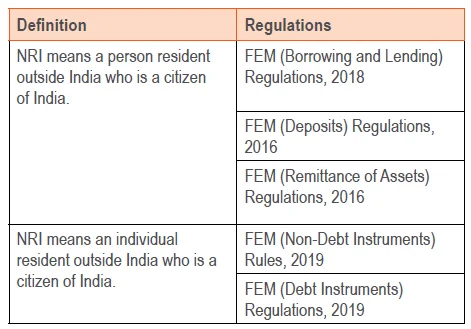
In essence, the term NRI is defined in several notifications issued under the Foreign Exchange Management Act (FEMA) to refer specifically to an individual who holds Indian citizenship but resides outside of India. This definition captures a broad range of individuals who may live abroad for various reasons, including employment, business pursuits, education, or family commitments.

Further, kindly note that we are not dealing with the provisions concerning the overseas citizen of India cardholder (‘OCIs’) in this article. Overseas Citizen of India means an individual resident outside India who is registered as an overseas citizen of India cardholder under section 7(A) of the Citizenship Act, 1955.

FEMA ASPECT OF GIFTING

A. Gifting to and from NRIs

Let us briefly delve into whether the gifting transaction is a capital or a current account transaction. A capital account transaction means a transaction that alters the assets or liabilities, including contingent liabilities, outside India of persons resident in India or assets or liabilities in India of persons resident outside India and includes transactions referred to in sub-section (3) of section 61. A current account transaction means a transaction other than a capital account transaction and includes certain specified transactions. In our view, gifting transactions can be classified as either capital or current account transactions, depending on the specific circumstances. For instance, when an Indian resident receives a gift as bank inward remittance from a non-resident, this transaction does not change the resident’s assets or liabilities in any foreign jurisdiction nor alters the assets or liabilities of a non-resident in India. As a result, it can be viewed as a current account transaction, primarily affecting the resident’s income without altering any existing financial obligations abroad. On the other hand, if an Indian resident gifts the sum of money in the NRO account in India of a non-resident, this situation will be categorized as a capital account transaction since this impacts the non-resident’s assets in India.


  1. Though the definition refers to section 6(3) of FEMA, section 6(3) of FEMA is omitted asof the date of this article. Instead, Section 6(2) and Section 6(2A) are amended to covertheerstwhile provisions of Section 6(3) of FEMA.

Now that we have clarified the meaning of the term NRI, we can proceed to explore the provisions under FEMA related to gifting various assets by individuals residing in India to NRIs, whether those assets are located in India or abroad. Understanding these provisions is essential for both residents and NRIs, as they outline the legal framework governing the transfer of gifts across borders. Under FEMA, certain guidelines specify how and what types of assets can be gifted, along with the necessary compliance requirements to ensure that these transactions adhere to regulatory standards.

A.1 FEMA Provisions — Gifting from PRI to NRI

a. Gifting of Equity Instruments of an Indian company

i. The expression equity instruments have been defined in Rule 2(k) of FEM (Non-debt Instruments) Rules, 2019 (‘NDI Rules’) as equity shares, compulsorily convertible preference shares, compulsorily convertible debentures, and share warrants issued by an Indian company.

ii. NDI Rules categorically include the provision concerning the transfer of equity instruments of an Indian company by or to a person resident outside India (‘PROI’)/ NRIs.

iii. Specifically, Rule 9(4) of NDI Rules provides that a person resident in India holding equity instruments of an Indian company is permitted to transfer the same by way of gift to PROI after seeking prior approval of RBI subject to the following conditions:

  •  The donee is eligible to hold such a security under the Schedules of these Rules;
  •  The gift does not exceed 5 per cent of the paid-up capital of the Indian company or each series of debentures or each mutual fund scheme [Paid-up capital is to be calculated basis the face value of shares of an Indian company.]
  • The applicable sectoral cap in the Indian company is not breached;
  • The donor and the donee shall be “relatives” within the meaning in clause (77) of section 2 of the Companies Act, 2013;
  •  The value of security to be transferred by the donor, together with any security transferred to any person residing outside India as a gift during the financial year, does not exceed the rupee equivalent of fifty thousand US Dollars [For the value of security, the fair value of an Indian company is required to be taken into consideration;]
  • Such other conditions as considered necessary in the public interest by the Central Government.

iv. Consequently, it is clear that when a Person Resident in India (PRI) intends to gift equity instruments to a Non-Resident Indian (NRI), this action is permitted only after obtaining prior approval from the Reserve Bank of India (RBI) and subject to satisfaction of terms and conditions as mentioned in Rule 9(4) of NDI Rules.

v. This leads us to a critical question under FEMA: does gifting equity instruments on a non-repatriable basis also necessitate prior approval from the RBI, considering the fact that non-repatriable is akin to domestic investment?

  •  Rule 9(4) of the Non-Debt Instruments (NDI) Rules does not clearly specify whether prior approval from the Reserve Bank of India (RBI) is required for either repatriable or non-repatriable transfers of equity instruments. Hence, the first perspective is that since Rule 9(4) of NDI Rules does not distinguish between repatriable and non-repatriable investments, even gifting of shares on a non-repatriable basis should be subjected to the terms and conditions specified in Rule 9(4) of NDI Rules.
  •  The second perspective is that non-repatriable investments are viewed as analogous to domestic investments, suggesting that they operate similarly to transactions conducted between two resident Indians. In this light, the gifting of equity instruments of an Indian company should be permitted under the automatic route, thereby eliminating the need for prior RBI approval. This interpretation aligns with the notion that since the funds remain within India’s borders and are not intended for repatriation, the transaction should not pose risks to the foreign exchange regulations.

vi. Additionally, it is to be noted that LRS provisions do not apply in the case of gifting of equity instruments of Indian companies by PRI to NRI.

b. Gifting of other securities such as units of mutual fund, ETFs, etc

i. Schedule III of the NDI Rules addresses the sale of units of domestic mutual funds, whereas the FEMA (Debt Instruments) Regulations, 2019, focuses specifically on the purchase, sale, and redemption of specified securities. Neither of these regulations explicitly mentions the gifting of such units or securities. Further, the term ‘transfer’ is also not used under these provisions to permit the gifting of such assets. As a result, a question arises regarding whether these securities can be gifted to Non-Resident Indians (NRIs) under the automatic route.

ii. Given that the rules and regulations do not explicitly outline the provisions for gifting, it is prudent to seek prior approval from the Reserve Bank of India (RBI) before proceeding with such transactions. This approach helps mitigate the risk of violating FEMA provisions, ensuring compliance and legal clarity in the transaction process.

c. Gifting of immovable property in India

i. Acquisition and transfer of immovable property in India by an NRI is governed by the provisions of the NDI Rules.

ii. Rule 24(b) of NDI Rules permits NRI to acquire any immovable property in India (other than agricultural land or farmhouse in India) by way of a gift from a person resident in India who is a relative as defined in section 2(77) of Companies Act, 2013. Thus, NRI cannot receive agricultural land or farm house by way of a gift from PRI even if it is from a relative.

iii. The relative definition of the Companies Act, 2013 covers the following persons:
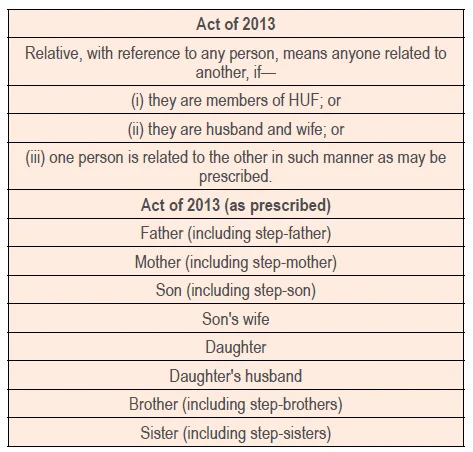
iv. As a consequence, gifting by only relatives as covered above is permitted in the case of immovable property in India. Thus, if the resident grandfather wishes to gift immovable property to his NRI grandson, such gifting will not be permitted under the contours of FEMA.

v. This limitation on gifting can have significant implications for families, particularly when it comes to wealth transfer and estate planning. For instance, if the resident grandfather wants to ensure that his grandson benefits from the property, he will not be able to gift property to his grandson.

vi. Additionally, it is to be noted that LRS provisions do not apply in the case of gifting of immovable properties by PRI to NRI.

d. Gifting of immovable property outside India

i. The acquisition and transfer of immovable property outside India are governed by the provisions set forth in the Foreign Exchange Management (Overseas Investments) Rules, 2022 (‘OI Rules’).

ii. This brings up an important question: are resident individuals permitted to transfer immovable property outside India to Non-Resident Indians (NRIs)?

iii. Rule 21 of the OI Rules specifically addresses the provisions related to the acquisition or transfer of immovable property located outside India. Within this rule, Rule 21(2)(iv) explicitly states that a person resident in India can transfer immovable property outside the country as a gift only to someone who is also a resident of India. This means that the recipient of the gift must reside in India to qualify for such a transfer. Consequently, gifting immovable property outside India by a resident individual to an NRI is not permitted within the framework of FEMA regulations.

e. Gifting of foreign equity capital

i. To determine whether gifting of foreign equity capital from a PRI to an NRI is allowed, it is essential to consider the provisions outlined in the OI Rules and the Foreign Exchange Management (Overseas Investment) Regulations, 2022 (‘OI Regulations’). Additionally, RBI has also issued Master Direction on Foreign Exchange Management (Overseas Investment) Directions, 2022, specifying/detailing certain provisions concerning overseas investments.

ii. Rule 2(e) of the OI Rules defines equity capital as equity shares, perpetual capital, or instruments that are irredeemable, as well as contributions to the non-debt capital of a foreign entity, specifically in the form of fully and compulsorily convertible instruments. Therefore, it primarily includes equity shares, compulsorily convertible preference shares, and compulsorily convertible debentures.

iii. Schedule III of the OI Rules addresses the provisions related to the acquisition of assets through gifts or inheritance. However, it does not explicitly mention the scenario where a Person Resident in India (PRI) gifts foreign securities to a Non-Resident Indian (NRI). This implied that PRI is not permitted to gift foreign equity capital to NRI under the automatic route. This interpretation is also supported by the Master Direction, which clearly states that resident individuals are prohibited from transferring any overseas investments as gifts to individuals residing outside India. The definition of the term ‘overseas investment’ includes financial commitment made in foreign equity capital.

f. Gifting through bank / cash transfers

i. Master Direction on Liberalised Remittance Scheme (‘LRS Master Direction’) outlines the provisions concerning gifting by PRIs to NRIs through bank transfers.

ii. As per the LRS Master Direction, a resident individual is permitted to remit up to USD 250,000 per FY as a gift to NRIs. Whereas, for rupee gifts, a resident individual is permitted to make a rupee gift to an NRI who is a relative (as defined in section 2(77) of the Companies Act) by way of a crossed cheque/ electronic transfer. However, it is to be noted that the gift amount should only be credited to the NRO account of the non-resident.

iii. A significant question arises regarding whether a resident individual who has opened an overseas bank account under LRS is permitted to gift funds from that account to a person residing outside India. This question involves two differing interpretations of the regulations. One perspective posits that when a resident individual gifts money from an overseas LRS bank account, it alters their overseas assets. This change is seen as a capital account transaction, which is subject to stricter regulations under FEMA. Since gifting is not explicitly allowed under FEMA for capital account transactions, this view concludes that such gifts cannot be made. Additionally, the LRS Master Direction states that funds in the LRS bank account should remain available for the resident individual’s use, suggesting that any transfer of those funds, including gifting, would not be permissible. Conversely, another view is that LRS intends to allow the utilization of funds for both permitted capital account transactions and current account transactions. Thus, gifting being a permitted transaction under LRS, it should be permitted from overseas bank accounts too. For example, since residents are allowed to use their overseas LRS bank accounts to cover travel expenses, it stands to reason that gifting funds from these accounts should also be acceptable.

iv. Furthermore, concerning the gifting of cash to any person resident outside India by the PRI, it is crucial to that emphasize PRI is not permitted to give cash gifts to individuals residing outside India while the PROI is present in India or abroad. This prohibition stems from Section 3(a) of FEMA, which specifically forbids any person who is not an authorized person from engaging in transactions involving foreign exchange. The term ‘transfer’ under FEMA encompasses a wide range of transactions, including gifting. This means that any act of gifting cash or other forms of foreign exchange to a non-resident is treated as a transfer and is, therefore, subject to the same restrictions.

v. Thus, in a nutshell, while gifts in foreign currency can be sent to any person resident outside India, irrespective of their relationship with the donor, rupee gifts are strictly limited to those individuals defined as relatives. Also, cash gifting is prohibited.

g. Gifting of movable assets such as jewelry, paintings, cars, etc

i. Given that the FEMA regulations do not clearly outline provisions for gifting such movable assets located either in India or outside India, it is prudent to seek prior approval from the Reserve Bank of India (RBI) before proceeding with such transactions. This approach helps mitigate the risk of violating FEMA provisions while ensuring compliance at the same time.

A.2 FEMA Provisions — Gifting from NRI to PRI

a. Gifting of Equity Instruments of an Indian Company

i. Rule 13 of NDI Rules, which specifically covers the provisions concerning the transfer of equity instruments by NRIs, does not contain any specific provision wherein NRIs are permitted to transfer by way of gift equity instruments of Indian companies to a person resident in India. However, Rule 9 of NDI Rules, which covers the transfer of equity instruments of an Indian company by or to a person resident outside India, covers the provision concerning the transfer of equity instruments of an Indian company by way of a gift from a person resident outside India to a person resident in India. Since NRIs are categorized as a person residing outside India, Rule 9 can also be said to apply to the aforesaid situation.
ii. Specifically, Rule 9(2) of NDI Rules provides that a person resident outside India holding equity instruments of an Indian company is permitted to transfer the same by way of sale or gift to PRI under automatic route subject to fulfillment of certain conditions such as pricing guidelines, compliance if repatriable investment, SEBI norms as applicable, etc.

iii. As a consequence, NRI is freely permitted to
transfer equity instruments of an Indian company by way of a gift to PRI in accordance with FEMA rules and regulations.

b. Gifting of other securities such as units of mutual fund, ETFs, etc

i. As discussed in paragraph A.1.b, Schedule III of NDI Rules, as well as FEMA (Debt Instruments) Regulations, 2019, do not clearly outline provisions for gifting of these instruments. Hence, it is advisable to seek prior approval from the Reserve Bank of India (RBI) before proceeding with such transactions.

c. Gifting of immovable property in India

i. The acquisition and transfer of immovable property in India by non-resident Indians (NRIs) are regulated by the NDI Rules.

ii. According to Rule 24(d) of these rules, NRIs can transfer any immovable property in India to a resident person or transfer non-agricultural land, farmhouses, or plantation properties to another NRI.

iii. However, an important point of consideration is that Rule 24(d) does not explicitly mention whether transfers can occur through sale or gift. This ambiguity necessitates a closer examination of the term ‘transfer’ to determine if it encompasses gifts.

iv. Although the term ‘transfer’ is not defined in Rule 2 of the NDI Rules, Rule 2(2) states that terms not defined in the rules will carry the meanings assigned to them in relevant Acts, rules, and regulations. Thus, we need to check if ‘transfer’ is defined in the Foreign Exchange Management Act (FEMA). Section 2(ze) of FEMA defines ‘transfer’ to encompass various forms, including sale, purchase, exchange, mortgage, pledge, gift, loan, and any other method of transferring rights, title, possession, or lien. Therefore, gifts are included within the definition of ‘transfer’ under FEMA.
v. As a result, NRIs are allowed to transfer immovable property in India to any resident person in accordance with Rule 24(d) of the NDI Rules, along with Rule 2(2) and Section 2(ze) of FEMA.

d. Gifting of immovable property outside India

i. The acquisition and transfer of immovable property outside India are governed by the Foreign Exchange Management (Overseas Investments) Rules, 2022 (referred to as the OI Rules).

ii. Rule 21 of the OI Rules specifically addresses the acquisition and transfer of immovable property outside India. Notably, Rule 21(2)(ii) permits PRIs to acquire immovable property outside India from persons resident outside India (PROIs). However, this rule does not explicitly allow for acquisition through gifting from NRIs; it only permits acquisition through inheritance, purchase using RFC funds, or under the Liberalized Remittance Scheme (LRS), among other methods. Rule 21(2)(i) allows PRIs to acquire immovable property by gift, but only from other PRIs.

iii. Thus, it emerges that PRIs are not permitted to receive immovable property as a gift from NRIs.

e. Gifting of foreign equity capital

i. To determine whether gifting foreign equity capital from a person resident in India (PRI) to a Non-Resident Indian (NRI) is allowed, it is essential to consider the provisions outlined in the OI Rules and the Foreign Exchange Management (Overseas Investment) Regulations, 2022 (‘OI Regulations’).

ii. Rule 2(e) of the OI Rules defines equity capital as equity shares, perpetual capital, or instruments that are irredeemable, as well as contributions to the non-debt capital of a foreign entity, specifically in the form of fully and compulsorily convertible instruments.

iii. Schedule III of the OI Rules outlines the provisions regarding how resident individuals can make overseas investments. It specifically allows resident individuals to acquire foreign securities as a gift from any person residing outside India. However, this acquisition is subject to the regulations established under the Foreign Contribution (Regulation) Act, 2010 (42 of 2010) and the associated rules and regulations.

iv. As a result, PRIs are permitted to receive foreign securities as a gift from NRIs.

f. Gifting through bank/ cash transfers

i. Under FEMA, there are no restrictions on receiving gifts via bank transfer by PRI from NRI. However, it is to be noted that PRI is not permitted to accept gifts from a person resident outside India/ NRI in their overseas bank account opened under the Liberalised Remittance Scheme since the LRS account can only be used for putting through all the transactions connected with or arising from remittances eligible under the LRS.

ii. Similar to what has been discussed in paragraph A.1.f.iv, gifting cash by NRI to PRI is not permitted.

g. Gifting of movable assets such as jewelry, paintings, cars, etc

i. Given that the FEMA regulations do not clearly outline provisions for gifting such movable  assets located either in India or outside India, it is advisable to seek prior approval from the  Reserve Bank of India (RBI) before proceeding with such transactions.

A.3 FEMA Provisions — Gifting between NRIs

a. Gifting of Equity Instruments of an Indian Company

i. Rule 13 of NDI Rules, which specifically covers the provisions concerning the transfer of equity instruments by NRIs, contains the provisions for gifting equity instruments to another NRI.

ii. Rule 13(3) of NDI Rules specifically permits NRI to transfer the equity instruments of an Indian Company to a person resident outside India (on a repatriable basis) by way of gift with prior RBI approval and subject to the following terms and conditions:

  • The donee is eligible to hold such a security under the Schedules of these Rules;
  • The gift does not exceed 5 per cent of the paid-up capital of the Indian company or each series of debentures or each mutual fund scheme [Paid-up capital is to be calculated basis the face value of shares of an Indian company.]
  • The applicable sectoral cap in the Indian company is not breached;
    • The donor and the donee shall be “relatives” within the meaning in clause (77) of section 2 of the Companies Act, 2013;
  • The value of security to be transferred by the donor, together with any security transferred to any person residing outside India as a gift during the financial year, does not exceed the rupee equivalent of fifty thousand US Dollars [For the value of security, the fair value of an Indian company is required to be taken into consideration;]
  •  Such other conditions as considered necessary in the public interest by the Central Government.

iii. Further, as per Rule 13(4) of NDI Rules, NRI is permitted to transfer equity instruments of an Indian company to another NRI under the automatic route provided such NRI would hold shares on a non-repatriation basis.

iv. Hence, in a nutshell, for repatriable transfer of shares by way of gift, prior RBI approval is required whereas, in the case of non-repatriable transfers, RBI approval is not required.

b. Gifting of other securities such as units of mutual fund, ETFs, etc

i. As discussed in paragraph A.1.b, Schedule III of NDI Rules, as well as FEMA (Debt Instruments) Regulations, 2019, do not clearly outline provisions for gifting of these instruments. Hence, it is advisable to seek prior approval from the Reserve Bank of India (RBI) before proceeding with such transactions.

c. Gifting of immovable property in India

i. According to Rule 24(e) of NDI Rules, NRI is permitted to transfer any immovable property other than agricultural land or a farmhouse or plantation property to another NRI. However, an important point of consideration is that Rule 24(e) does not
explicitly mention whether transfers can occur through sale or gift.

ii. As discussed in paragraph A.1.c, section 2(ze) of FEMA defines ‘transfer’ to encompass various forms, including sale, purchase, exchange, mortgage, pledge, gift, loan, and any other method of transferring rights, title, possession, or lien. Therefore, gifts are included within the definition of ‘transfer’ under FEMA.
iii. As a result, NRIs are allowed to transfer immovable property in India to another NRI in accordance with Rule 24(e) of the NDI Rules read with Rule 2(2) of NDI Rules and Section 2(ze) of FEMA. It is to be noted that the transfer of agricultural land or a farmhouse or plantation property by way of gift to another NRI is prohibited.

d. Gifting of immovable property outside India

i. This transaction falls outside the regulatory framework of FEMA, meaning it is not subject to its restrictions or requirements. As a result, it is permitted and can be carried out without any regulatory concerns or limitations imposed by FEMA.

e. Gifting of foreign equity capital

i. This transaction falls outside the regulatory framework of FEMA, meaning it is not subject to its restrictions or requirements. As a result, it is permitted and can be carried out without any regulatory concerns or limitations imposed by FEMA.

f. Gifting through bank/ cash transfers

i. Under FEMA, NRI can freely gift money from their NRO bank account to the NRO bank account of another NRI, as transfers between NRO accounts are considered permissible debits and credits. Similarly, gifting money from one NRE account to another NRE account belonging to another NRI is also allowed without restrictions.

ii. However, the question comes up regarding whether it is allowed to gift money from an NRO account to the NRE account of another NRI or from an NRE account to the NRO account of another NRI. In our view, this may not be permissible, as the regulations regarding permissible debits and credits for NRE and NRO accounts do not explicitly cover this type of gifting transaction and restrict it to the same category of accounts.

iii. Furthermore, concerning the gifting of cash to any person resident outside India, as discussed in paragraph A.1.f.iv, gifting cash by NRI to NRI is not permitted.

g. Gifting of movable assets such as jewelry, paintings, cars, etc

i. Given that the FEMA regulations do not clearly outline provisions for gifting such movable assets situated in India, it is advisable to seek prior approval from the Reserve Bank of India (RBI) before proceeding with such transactions.

A.4 Applicability of the Foreign Contribution (Regulation) Act, 2010

The Foreign Contribution (Regulation) Act, 2010 (‘FCRA’) governs the acceptance and utilization of foreign contributions by individuals and organizations in India. As per the Foreign Contribution (Regulation) Act, 2010, foreign contribution means the donation, delivery, or transfer made by any foreign source of any article, currency (whether Indian or foreign), or any security as defined in Securities Contracts (Regulations) Act, 1956 as well as foreign security as defined in FEMA. Thus, receipt of the above assets by PRI from foreign sources will trigger the applicability of FCRA. Hence, it is pertinent to analyze the definition of the term ‘foreign source’ as specified in FCRA.

It is important to highlight here that NRIs are not classified as a ‘foreign source’ under the provisions of FCRA. This distinction is crucial because it implies that gifts received from NRIs are not subjected to the stringent regulations that govern foreign contributions. Consequently, PRIs can freely acquire such gifts without falling under the scrutiny of FCRA.

INCOME TAX ASPECTS OF GIFTING

A.5 Applicability of Section 56 of the Income Tax Act, 1961

The framework of Section 56:

Section 56 of the Income-tax Act, of 1961, is primarily concerned with income that does not fall under other heads of income, such as salaries, house property, or business income. This section covers “Income from Other Sources” and serves as a residual category for various types of income that cannot be specifically classified under other heads.

This section deals, inter alia, with the taxability of gifts and the transfer of property under specific “conditions.This section was introduced to prevent tax avoidance by transferring assets or property without proper consideration (gifting) as a method to evade taxes.

Applicability:

As per this section, any person who receives income from any individual or individuals on or after 1st April, 2017, will have that income chargeable to tax. The ‘income’ types are outlined in the table below:
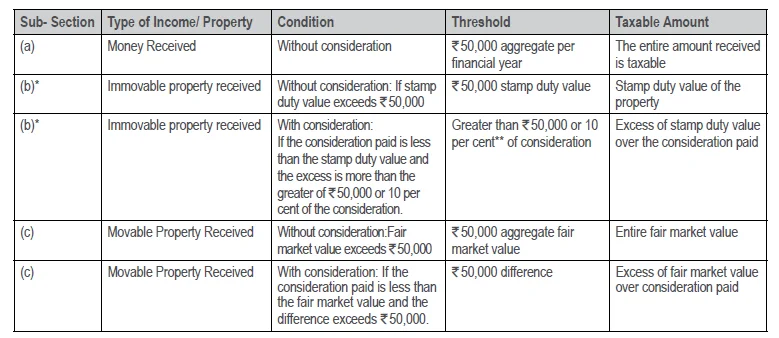
*Proviso to section 56(2)(x)(b)
** The Finance Act 2018 introduced a safe harbor limit set at 5 per cent of the actual consideration. However, the Finance Act 2020 increased this limit to 10 per cent of the actual consideration.
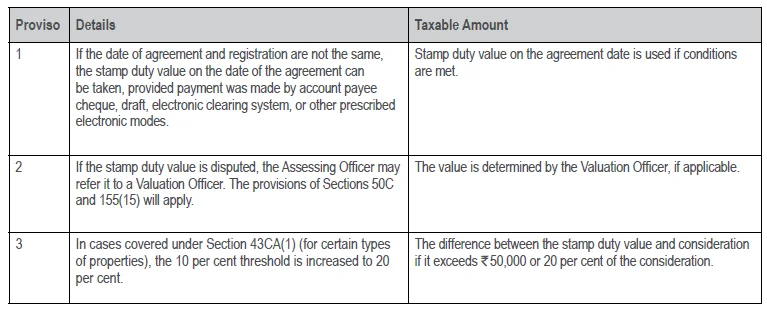
Exemption:

Though the list of exemptions is exhaustive, we have included key exemptions that are specifically pertinent concerning the gifting aspects only.

1. Any sum of money or any property received from any relative

The term “relative” shall be construed in the same manner as defined in the explanation to clause (vii) of Section 56(2), which delineates the definition of “relative” as follows:

Relative means:

i. In the case of an individual—

(A) spouse of the individual;

(B) brother or sister of the individual;

(C) brother or sister of the spouse of the individual;

(D) brother or sister of either of the parents of the individual;

(E) any lineal ascendant or descendant of the individual;

(F) any lineal ascendant or descendant of the spouse of the individual;

(G) spouse of the person referred to in items (B) to (F); and

ii. in the case of a Hindu undivided family, any member thereof,

2. Any sum of money or any property received on the occasion of the marriage of the individual

a. Scope of Exemption: Money or property received by the individual on their marriage is exempt under Section 56(2)(x), excluding gifts to parents. Further, the gifting of money or property, etc. will eventually be subjected to FEMA applicability as well in cross-border transaction cases.

b. No Monetary Limit: No limits on the value of gifts.

c. Sources of Gifts: Gifts can come from anyone, not just relatives.

d. Timing of Gifts: Gifts received before or after the wedding are exempt if related to the marriage.

A.6 Applicability of Clubbing Provisions under the Income Tax Act, 1961

Section 64 of the Income Tax Act, 1961, (ITA) addresses the taxation of income that arises from the transfer of assets to certain relatives, specifically focusing on preventing tax avoidance strategies that involve shifting income-generating assets. It aims to ensure that income from such assets is ultimately taxed in the hands of the original owner, thereby maintaining fairness in the taxation system.

The provisions of Section 64 concerning the clubbing of income is summarised in the table below:

Particulars Provisions
Income of Spouse Transfer of Assets:

If a non-resident individual (let’s say Mr. A) transfers an asset such as an immovable property located outside India or equity shares of Apple Inc. to his Indian resident spouse (Mrs. A) without adequate compensation, any income generated from that asset — such as rental income from the house or dividends from shares — will be treated as Mr. A’s income.


Whether capital gains pre-exemption or post-exemption to be clubbed:

The High Court of Kerala, in the case of Vasavan2, while interpreting Section 64 of ITA, held that the assessing authority was bound to treat the ‘capital gains’ which, but for Section 64 should have been assessed in the hands of the wife, as the capital gains of the assessee was liable to be assessed in his hands in the same way in which the same would have been assessed in the hands of the wife”.

Therefore, based on the above judicial pronouncements, one may claim that the capital gain income first needs to be computed in the hands of the spouse, and thereafter, capital gain income remaining net of allowable exemptions under Section 54/ Section 54F needs to be clubbed in the hands of husband for computing his total income in India.

Income of Minor Child Clubbing of Income:

Any income earned by a minor child, including income from gifts received, will be clubbed with the income of the parent whose total income is higher. This applies to all minor children of the individual.

Exemption:

There is a specific exemption of up to ₹1,500 per child for income derived from the assets of the minor. If the income exceeds this limit, the excess amount is clubbed with the income of the parent.

Income of Disabled Child Separate Assessment:

If a minor child is physically or mentally disabled, their income is not subject to clubbing provisions, allowing the child’s income to be assessed separately. This recognition acknowledges the unique circumstances and financial burdens that may arise from disability.

Income from Assets Transferred to Daughter-in-Law If an individual transfers assets to his daughter-in-law, any income generated from those assets will also be clubbed with the income of the transferor.
Transfer of Assets and Adequate Consideration The clubbing provisions apply specifically to transfers made without adequate consideration. If the transferor receives fair value in exchange for the asset (like selling an asset), the income generated from that asset will not be subject to clubbing.


2   [1992] 197 ITR 163 (Kerala)

A.7 Applicability of Section 9(i)(viii) of the Income Tax Act, 1961

1. Introduction:

Till AY 20–21, no provision in the Act covered income of the type mentioned in section 56(2)(x) if it did not accrue or arise in India (e.g. gifts given to a non-resident outside India). Such gifts, therefore, escaped tax in India. To plug this gap, the Finance (No. 2) Act, 2019 inserted section 9(1)(viii) with effect from the assessment year 2020–21 to provide that income of the nature referred to in section 2(24)(xviia) arising outside India from any sum of money paid, on or after 5th July, 2019, by a person resident in India to a non-resident or foreign company shall be deemed to accrue or arise in India.

2. Key Provisions:

a. Conditions for Deeming Income:

i. There is a sum of money.

ii. The sum of money is paid on or after 5th July, 2019.

iii. The money is paid by a person resident in India.

iv. The money is paid to a non-resident3, not a company or to a foreign company.


3. We have not mentioned applicability to resident and not ordinarily resident since we are 
dealing with provisions concerning NRIs in this article.

b. Exclusions from Coverage:

i. Gifts of property situated in India are expressly excluded from the purview of this section: Section 56(2) refers to the sum of money as well as property. However, section 9(1)(viii) reads as ‘income … being any sum of money referred to in sub-clause (xviia) of clause (24) of section 2’. Thus, it refers only to the sum of money. Hence, a gift of property is not covered by section 9(1)(viii).

ii. The provision does not apply to gifts received by relatives or those made on the occasion of marriage, as specified in the proviso to section 56(2)(x) of the Income Tax Act.

iii. Gift of the sum of money by NRI to another NRI.

c. Threshold Limit:

i. Any monetary gift not exceeding ₹50,000 in a financial year remains exempt from classification as income under section 9(1)(viii).

A.8 Applicability of Section 68 of the Income Tax Act, 1961

Section 68 of the Income Tax Act imposes a tax on any credit appearing in an assessee’s books when the assessee fails to satisfactorily explain the nature and source of that credit. This provision operates as a deeming fiction, treating unexplained credits as income if the explanation provided is inadequate.

Under Section 68, the initial burden is on the assessee to demonstrate the nature and source of the credit. Judicial precedents have established that to satisfactorily explain a credited amount, the assessee must prove three key elements:

  •  Identity of the payer: The assessee must provide clear identification of the person or entity that made the payment. This includes details such as the payer’s name, address, and any relevant identification numbers.
  •  Payer’s capacity to advance the money: The assessee must show that the payer had the financial capacity to provide the funds. This could involve demonstrating that the payer had sufficient income, savings, or assets that would allow them to make such a payment.
  •  Genuineness of the transaction: Finally, the assessee needs to prove that the transaction was genuine and not a façade to disguise income. This could include providing documentation such as bank statements, agreements, or other relevant evidence supporting the legitimacy of the transaction.

It is also critical to understand that just because a transaction is taxable under Section 56(2)(x), it does not exempt it from consideration under Section 68. For example, consider Mr. A, who receives a gift of Rs. 1 crore from his non-resident son. This amount will not be taxable under Section 56(2)(x) because it falls within the definition of a relative, exempting it from tax. However, Mr. A will still have an obligation to prove the identity, capacity, and genuineness of this gifting transaction under Section 68 to ensure compliance with tax regulations.

When it comes to taxation, there are significant differences between these sections. If an addition is made under Section 56(2)(x), the income will be taxed at the individual’s applicable slab rate, allowing the taxpayer to claim deductions for any losses incurred as well as set-off of losses. In contrast, if the addition is made under Section 68, Section 115BBE applies, imposing a much higher tax rate of 60 per cent on the added income, with no allowance for any deductions or set-offs for losses.

A.9 Applicability of TCS Provision under the Income Tax Act, 1961

In order to widen and deepen the tax net, the Finance Act 2020 amended Section 206C and inserted Section 206(1G) to provide that an authorized dealer who is receiving an amount for remittance out of India from the buyer of foreign exchange, who is a person remitting such amount under LRS is required to collect tax at source (‘TCS’) as per the rates and threshold prescribed therein. Gifting to a person resident outside India either in foreign exchange or in Indian rupees is very well covered within the purview of LRS remittances.

As per the TCS provision as applicable currently, at the time of gift by PRI to NRI either in foreign exchange or in Indian rupees, the authorized dealer bank of PRI will collect the tax at source @ 20 per cent in case the gift amount is in excess of ₹7 lakh. The second part of this Article will deal with important aspects of “Loans by and to NRIs”.


Bank Accounts and Repatriation Facilities for Non-Residents

In this article, we have discussed the rules and regulations related to NRO, NRE, FCNR and other accounts pertaining to Non-residents under Foreign Exchange Management Act, 1999 (FEMA).

BANK ACCOUNTS

Opening, holding and maintaining accounts in India by a person resident outside India is regulated in terms of 6 section 6(3) of the FEMA, 1999 read with Foreign Exchange Management (Deposit) Regulations, 2016 (‘Deposit Regulations’) issued vide Notification No. FEMA 5(R)/2016-RB dated 1st April, 2016, Master Direction – Deposits and Accounts FED Master Direction No. 14/2015-16 dated 1st January, 2016 and FAQs on Accounts in India by Non-residents, updated from time to time, provides further guidance on the same.

An Authorised Dealer (AD) bank is permitted to open in India the following types of accounts for persons resident outside India:

i) Non-Resident (External) Account Scheme (NRE account) for a non-resident Indian (NRI) – Schedule 1 of the Deposit Regulations;

ii) Foreign Currency (Non-Resident) Account Banks Scheme, (FCNR(B) account) for a non-resident Indian – Schedule 2 of the Deposit Regulations;

iii) Non-Resident (Ordinary) Account Scheme (NRO account) for any person resident outside India – Schedule 3 of the Deposit Regulations;

iv) Special Non-Resident Rupee Account (SNRR account) for any person resident outside India having a business interest in India – Schedule 4 of the Deposit Regulations;

v) Escrow Account for resident or non-resident acquirers – Schedule 5 of the Deposit Regulations.

Currently, a company or a body corporate, a proprietary concern or a firm in India may accept deposits from an NRI or PIO on a non-repatriation basis only1 – Other conditions that apply to such deposits include:

  • Deposit should be for a maximum maturity period of three years.
  • Deposit can be received from NRO account only.
  • Rate of interest should not exceed the ceiling rate prescribed under the Companies (Acceptance of Deposit) Rules, 2014 / NBFC guidelines / directions issued by RBI.
  • Deposit shall not be utilised for relending (other than NBFC) or for undertaking agricultural/plantation activities or real estate business.
  • The amount of deposits accepted shall not be allowed to be repatriated outside India.

Under the current regulations, a company or a body corporate is not permitted to accept any fresh deposits on repatriation basis from an NRI or PIO. However, it is only permitted to renew the deposits which had already been accepted under the erstwhile Notification.


1 Refer Schedule 7 of the Deposit Regulations

KEY FEATURES OF NRE, FCNR (B) AND NRO ACCOUNTS

NRIs usually have majority of their earnings in foreign currency and thus their financial and investment objectives differ from residents. NRIs and PIOs are permitted to open and maintain accounts with authorised dealers and banks (including co-operative banks) authorised by the Reserve Bank to maintain such accounts. The major types of accounts that can be opened by an NRI2 or PIO3 in India include NRE, NRO and FCNR accounts. The key features of these accounts are as under:

NRE ACCOUNT

  • This account is denominated in Indian rupees, wherein proceeds of remittances to India can be deposited in any permitted currency;
  • The monies held in this account can be freely repatriated outside India;
  • Current income in India like rent, dividend, pension, interest, etc. can be deposited subject to payment of income taxes;
  • This account is subject to exchange rate fluctuations since the foreign currency earnings deposited into this account are converted into INR using the current exchange rate of the receiving bank;
  • Interest income earned from the NRE account is tax-free.

NRO ACCOUNT

  • A resident account needs to be redesignated as a NRO account when a person becomes non-resident. For this, the person becoming non-resident needs to submit the documentary evidences to prove his intentions to leave India for the purpose of employment, business or vocation or an uncertain period. Additionally, NRO account can be opened by a non-resident for any bonafide transactions. For further details, refer to the table below.
  • This account allows you to receive remittances in any permitted currency from outside India through banking channels or permitted currency tendered by the account holder during his temporary visit to India or transfers from rupee accounts of non-resident banks;
  • Repatriation from the NRO account can be done to the extent of USD 1 million for every financial year;
  • Income earned in India in the form of interest, dividend, rent, etc. can be deposited into this account;
  • This account is also subject to exchange rate fluctuations since the foreign currency deposited into this account are converted into INR using the current exchange rate of the receiving bank;
  • Interest income earned from the NRO account is not tax-free.

2 A ‘Non-resident Indian’ (NRI) is a person resident outside India who is a citizen of India.
3 ‘Person of Indian Origin (PIO)’ is a person resident outside India who is a citizen of any country other than Bangladesh or Pakistan, or such other country as may be specified by the Central Government, satisfying the following conditions: [PIO will include an OCI cardholder]
a) Who was a citizen of India by virtue of the Constitution of India or the Citizenship Act, 1955 (57 of 1955); or
b) Who belonged to a territory that became part of India after the 15th day of August, 1947; or
c) Who is a child or a grandchild or a great grandchild of a citizen of India or of a person referred to in clause (a) or (b); or
d) Who is a spouse of foreign origin of a citizen of India or spouse of foreign origin of a person referred to in clause (a) or (b) or (c)

ACCOUNT OPENED BY FOREIGN TOURISTS VISITING INDIA

In case of a current / savings account opened by a foreign tourist visiting India with funds remitted from outside India in a specified manner or by sale of foreign exchange brought by him into India, the balance in the NRO account may be paid to the account holder at the time of his departure from India provided the account has been maintained for a period not exceeding six months and the account has not been credited with any local funds, other than interest accrued thereon.

FCNR ACCOUNT

  • This is a term deposit account and not a savings account;
  • Monies can be deposited in any currency permitted by RBI i.e., a foreign currency which is freely convertible;
  • The deposits can range from a period of one to five years;
  • The principal amount and interest earned from the deposits are fully repatriable;
  • This account is not subject to exchange rate fluctuations since deposits and withdrawals are in foreign currency.
  • Income earned from FCNR account is tax-free.

A tabulated comparison of the three accounts is provided below for your reference:

Particulars NRE Account FCNR (B) Account NRO Account
NRIs and PIOs (Individuals / entities of Pakistan and Bangladesh require prior RBI approval) Any person resident outside India for putting through bonafide transactions in rupees.

Individuals / entities of Pakistan nationality / origin and entities of Bangladesh origin require prior RBI approval.

A Citizen of Bangladesh / Pakistan belonging to minority communities in those countries i.e., Hindus, Sikhs, Buddhists, Jains, Parsis, and Christians residing in India and who has been granted LTV* or whose application for LTV is under consideration, can open only one NRO account with an AD bank.

* Long Term Visa

Type of Account Savings, Current, Recurring, Fixed Deposit Term Deposit only Savings, Current, Recurring, Fixed Deposit
  From one to three years. However, banks are allowed to accept NRE deposits for a longer period i.e., above three years from their Asset-Liability point of view. For terms not less than 1 year and not more than 5 years. As applicable to resident accounts.
Permissible Credits i. Inward remittance from outside India.

ii. Proceeds of foreign currency/ bank notes tendered by account holder during his temporary visit to India.

iii. Interest accruing on the account

iv. Transfer from other NRE / FCNR(B) accounts.

v. Maturity or sale proceeds of investments (if such investments were made from this account or through inward remittance).

vi. Current income in India like rent, dividend, pension, interest, etc. is permissible subject to payment of taxes in India.

i. Inward remittances from outside India.

ii. Legitimate dues in India.

iii. Transfers from other NRO accounts.

iv. Rupee gift / loan made by a resident to an NRI / PIO relative within the limits prescribed under LRS may be credited to the latter’s NRO account.

As a benchmark, credits to NRE / FCNR(B) account should be repatriable in nature.
Permissible Debits


i. Local disbursements.

ii. Remittance outside India.

iii. Transfer to NRE / FCNR (B) accounts of the account holder or any other person eligible to maintain such account.

iv. Permissible investments in India in shares / securities / commercial paper of an Indian company or for purchase of immovable property.

i. Local payments in rupees.

ii. Transfers to other NRO accounts.

iii. Remittance of current income abroad.

iv. Settlement of charges on International Credit Cards.

v. Repatriation under USD 1 million scheme is available only to NRIs and PIOs.

vi. Funds can be transferred to NRE account within this USD 1 million facility.

Permitted Joint Holding May be held jointly in the names of two or more NRIs / PIOs.

NRIs / PIOs can hold jointly with a resident relative on ‘former or survivor’ basis. The resident relative can operate the account as a PoA holder during the lifetime of the NRI / PIO account holder.

May be held jointly in the names of two or more NRIs / PIOs.

May be held jointly with residents on ‘former or survivor’ basis.

Loans in India AD can sanction loans in India to the account holder / third parties without any limit, subject to the usual margin requirements.

The loan amount cannot be used for re-lending, carrying on agricultural / plantation activities or investment in real estate.

In case of loan to account holder the loan can be used for personal purposes or for carrying on business activities or for making direct investments in India on non-repatriation or for acquiring a flat / house in India for his own residential use.

In case of loan to third parties, loans can be given to resident individuals / firms / companies in India against the collateral

of fixed deposits held in NRE account.

The loan should be utilised for personal purposes or for carrying out business activities. Also, there should be no direct or indirect foreign exchange consideration for the non-resident depositor agreeing to pledge his deposits to enable the resident individual / firm / company to obtain such facilities.

These loans cannot be repatriated outside India and can be used in India only for the purposes specified in the regulations.

The facility for premature withdrawal of deposits will not be available where loans against such deposits are availed of.

Loans against the deposits can be granted in India to the account holder or third party subject to usual norms and margin requirement.

The loan amount cannot be used for relending, carrying on agricultural / plantation activities or investment in real estate.

The term “loan” shall include all types of fund based / non-fund-based facilities.

  Loans outsid AD may allow their branches / correspondents outside India to grant loans to or in favour of non-resident depositor or to third parties at the request of depositor for bona fide purpose against the security of funds held in the NRE / FCNR (B) accounts in India.

The term “loan” shall include all types of fund-based/ non-fund-based facilities.


Not permitted


Rate of Interest There is no restriction on the rate of interest. It varies across banks and is generally based on the repo rate of RBI.
Operations by Power of Attorney in favour of a resident Operations in the account in terms of PoA is restricted to withdrawals for permissible local payments or remittances to the account holder himself through normal banking channels.

The PoA holder cannot repatriate outside India funds held in the account under any circumstances other than to the account holder himself, nor to make payment by way of gift to a resident on behalf of the account holder nor to transfer funds from the account to another NRE or FCNR(B) account.

Operations in the account in terms of PoA is restricted to withdrawals for permissible local payments in rupees, remittance of current income to the account holder outside India or remittance to the account holder himself through normal banking channels. While making remittances, the limits and conditions of repatriability will apply.

The PoA holder cannot repatriate outside India funds held in the account under any circumstances other than to the account holder himself, nor to make payment by way of gift to a resident on behalf of the account holder nor to transfer funds from the account to another NRO account.

IMPACT OF CHANGE IN RESIDENTIAL STATUS

  • All non-resident accounts i.e., NRE / NRO (wherein, you are the primary account holder) need to be converted / re-designated as resident accounts immediately upon the return of the account holder to India for taking up employment or return of the account holder to India for any purpose indicating his intention to stay in India for an uncertain period or upon change in the residential status. The account holder should provide appropriate documentation to the bank for conversion of NRE / NRO account into resident account.
  • FCNR (B) deposits may be allowed to continue till maturity at the contracted rate of interest, if so desired by the account holder. Authorised Dealers should convert the FCNR(B) deposits on maturity into resident rupee deposit accounts or RFC accounts (if the depositor is eligible to open RFC account), at the option of the account holder.

With respect to the above, it would be relevant to refer to the compounding order C.A. No. 4578 /2017 dated 30th January, 2018 in the matter of Mr. Gaurav Bamania for compounding of contravention of the provisions of the Foreign Exchange Management Act, 1999 (the FEMA) and the Regulations issued thereunder. The compounding was on account of violation on two grounds viz; payment of consideration towards investment in an Indian company by an NRI through a resident account and the applicant had not re-designated his existing account as a NRO account on becoming NRI. As per the RBI, there was a contravention of the provisions of Para 8(a) of Schedule 3 of FEMA 5 and Para 3 of Schedule 4 of FEMA 20, and applicant was required to apply for regularis ation of the contraventions subject to compounding. The RBI has quoted Para 8(a) of Schedule 3 of FEMA 5 in the compounding order which states as under:

“When a person resident in India leaves India for a country (other than Nepal or Bhutan) for taking up employment, or for carrying on business or vocation outside India or for any other purpose indicating his intention to stay outside India for an uncertain period, his existing account should be designated as a Non-Resident (Ordinary) account.”

The matter was compounded in terms of the Foreign Exchange (Compounding Proceedings) Rules, 2000 and a sum of ₹26,530/- was levied as compounding fees by RBI as the amount of contravention involved was ₹56,850/-.

Further, it would also be useful to note the compounding order C.A. No. 85 /2019 dated 18th March, 2019 in the matter of Mr. Thakorbhai Dahyabhai Patel wherein the contravention sought to be compounded related to transfer of funds from NRE account to ordinary savings account thereby resulting in contravention of the provisions under Regulation 4(C) of Schedule 1 to Notification No. FEMA.5/2000-RB dated May 3, 2000, as amended from time to time. While the contravention was with respect to transfer of funds from NRE account to ordinary savings account, the same could have been mitigated if the applicant had converted / re-designated his ordinary savings account into NRE / NRO account after becoming a non-resident since the applicant, being a non-resident, is not eligible to open or maintain an ordinary savings account as per extant FEMA guidelines.

It would also be pertinent to note that the decision of the Hon’ble High Court of Delhi in the case of Basant Kumar Sharma vs. Government of India [2013] 33 taxmann.com 282 (Delhi), which has been rendered in the context of Section 2(p)(ii)(c) of the Foreign Exchange Regulations Act, 1973 (‘FERA’). In this case, the petitioner was an NRI who had returned to India for exploratory purposes and the petitioner had approached State Bank of India (‘SBI’) to convert his subsisting NRE account into NRO account and also to obtain necessary approval from RBI for sale of his investments. The SBI informed him that after becoming a resident, he was not allowed to keep a NRE account and his NRE account would have to be re-designated as a ‘Resident Account’ under Section 2(p)(ii)(c) read with Regulation A.15 of the Foreign Exchange Manual. The Petitioner did not agree with the stand adopted by SBI that he was a ‘Resident’ since he had come to India for exploring possibilities of resettlement but had also kept the doors open for overseas relocation in case, he would find a job outside India. The Petitioner wrote to various authorities, which included RBI, and requested their intercession in this matter and after a series of communications with various authorities, the Petitioner filed a writ petition with the Hon’ble Delhi High Court. The Hon’ble Delhi High Court affirmed the view adopted by SBI that the Petitioner had attained the status of a Resident in India within the meaning of Section 2(p)(ii)(c) of the FERA since his stay in India was for an uncertain period and thus his NRE account was required to be re-designated as a Resident Account due to change in residential status.

The provisions of residential status under FEMA and key differences vis a vis the Income-tax Act, 1961 (ITA) is covered in detail in earlier issue of this series titled Residential Status of Individuals — Interplay With Tax Treaty published in January 2024.

A person can be Resident or Non-Resident under both ITA and FEMA or a person can be Resident under one Act and Non-Resident under the other Act. In such a scenario, it would be pertinent to analyse the impact of taxability of an individual under the ITA where his / her residential status is different under ITA and FEMA.

The interplay of residential status under ITA and FEMA comes into light at the time of claiming income tax exemption under Section 10(4)(ii) of the ITA for a person earning interest from his NRE account in India. As per Section 10(4)(ii) of the ITA, interest received on NRE account is exempt from tax in India, if the account holder is a Person Resident Outside India as defined under Section 2(w) of the FEMA or is a person who has been permitted by the Reserve Bank of India to maintain such account. Thus, the residential status under the ITA is not required to be looked into for claiming such exemption.

Say, an individual having NRE account in India when he was a Person Resident Outside India as per FEMA and a Non-Resident as per the ITA comes to India for good during December 2023. It would be important to dwell into the change in residential status under each Act to determine eligibility for exemption u/s 10(4)(ii) of the ITA with respect to interest received from NRE account. The individual becomes a person resident in India as per FEMA from December 2023 onwards, however, he would be regarded as a Non-Resident under the ITA during Financial Year 2023-24 (assuming his stay in India was below the threshold as required under ITA). In order to claim exemption from tax u/s 10(4)(ii) of the ITA, a person has to be resident outside India under FEMA. Thus, even though the individual is a Non-Resident under the ITA, he would be entitled to claim exemption under Section 10(4)(ii) of the ITA only up to December 2023 (i.e till he was a Person Resident Outside India as per FEMA), as he would become resident of India under FEMA from the date of his return for good. Further, such individual shall be required to redesignate his NRE account to resident account on account of change in his residential status under FEMA.

On the contrary, interest earned on FCNR account by a Non-Resident or Resident but Not Ordinarily Resident (‘RNOR’) under the ITA is exempt from tax under Section 10(15)(iv)(fa) of the ITA. Thus, the exemption from tax in this case is determined by a person’s residential status under the ITA and not under FEMA. If a Non-Resident holding FCNR account in India returns to India on a permanent basis in a particular financial year, he would become a Person Resident in India under FEMA immediately upon his return, but may continue to be a Non-Resident or RNOR under ITA for that particular year. Accordingly, such person can continue to claim exemption of tax for interest earned from FCNR account since the residential status under FEMA shall not impact his eligibility to claim exemption. The exemption can continue to be claimed till the residential status is RNOR and the deposit has not matured.

With respect to the above, we would like to draw your attention to the decision of the Hon’ble Chennai Tribunal in case of Baba Shankar Rajesh vs. ACIT 180 ITD 160 (Chennai ITAT) [2019] wherein Assessee was denied exemption under Section 10(4)(ii) of the ITA by the Hon’ble Tribunal on the ground that the Assessee was a ‘Person Resident in India’ under Section 2(v) of the FEMA as he was a Non-Resident who had come to India for taking up employment in India.

Another important decision was rendered by the Hon’ble Supreme Court of India in the case of K. Ramullan vs. CIT 245 ITR 417 (SC) [2000] in the context of Section 2(p) & (q) of the Foreign Exchange Regulation Act, 1973 (‘FERA’) which was in favour of the Assessee. The Assessee was earlier denied exemption under Section 10(4A) of the ITA by the High Court with respect to interest earned from NRE account and the Supreme Court set aside the order of the Hon’ble High Court holding that under erstwhile clause (c) casual stay with spouse should not be included and hence unless the stay was for uncertain period or with some permanence the Assessee was a ‘Person Resident Outside India’ under Section 2(q) of the FERA and was thus entitled to claim exemption under Section 10(4A) [erstwhile section] of the ITA.

Of course, determination of residential status under FEMA depends upon facts and circumstances of each case.

Furthermore, the following two types of accounts are also permitted to be opened by persons resident outside India for specific purposes as explained:

i) Special Non-Resident Rupee Account (SNRR Account)

Any PROI having a business interest in India may open, hold and maintain with an Authorised Dealer (AD Banks) in India, a SNRR account for the purpose of putting through bona fide transactions in rupees. SNRR accounts shall not earn any interest.

For the purpose of SNRR account, business interest, apart from generic business interest, shall include INR transactions relating to investments permitted under FEM (NDI Rules), 2019 and FEM (DI Regulations) 2019, import and export of goods and services, trade credit and ECB and business-related transactions outside International Financial Service Centre (IFSC) by IFSC units.

AD bank may maintain a separate SNRR account for each category of transactions or a single SNRR Account as per their discretion.

The tenure of the SNRR account should be concurrent to the tenure of the contract / period of operation / the business of the account holder and in no case should exceed seven years in case of generic business transactions.

SNRR account is often used by foreign entities to obtain income tax refunds on account of earning passive income from India or foreign entities undertaking turnkey projects in India. Earlier foreign entities were required to establish project offices (as regulated by RBI) in India to execute turnkey projects awarded to joint ventures between Indian entity and foreign entity also known as unincorporated joint venture. Now, with the introduction of the SNRR account, foreign companies can execute projects without establishing a project office in India.

ii) Escrow Account

Resident or non-resident acquirers may open, hold and maintain Escrow Account with ADs in India as permitted under Notification No. FEMA 5(R)/2016-RB. The account can be opened for acquisition/transfer of capital instruments / convertible notes in accordance with Foreign Exchange Management (Non-Debt Instrument) Rules, 2019.

The accounts shall be non-interest bearing. No fund / non-fund-based facility would be permitted against the balances in the account.

PPF AND SSY ACCOUNT FOR NRIS

The Ministry of Finance has issued updated guidelines for Public Provident Fund (PPF), Sukanya Samriddhi Yojana (SSY), and other small savings schemes, effective from 1st October, 2024. One of the key changes under the new guidelines in relation to PPF accounts of NRIs are as under:

  • For NRIs, PPF accounts which were opened under the Public Provident Fund Account Scheme, 1968 where Form H did not require the residency details of the account holder and the account holder became an NRI during the account’s tenure, the Post Office Savings Account (‘POSA’) interest rate shall be granted to the account holder until 30th September, 2024. However, after this date, the interest on these accounts will drop to 0 per cent.

Further, it is pertinent to note that an NRI cannot open a new PPF account. If an account was opened by an individual while he / she was a resident who subsequently became an NRI, the account can continue until maturity. This rule has been there from quite some time, however, there have been cases where NRIs have even continued holding PPF accounts for another 5 years after completion of 15 years. In such cases, banks have denied interest in such accounts.

PPF interest is tax-free in India under Section 10(11) of the ITA for both residents and non-residents. However, the said PPF interest might be taxed in the residence country of the NRIs if it taxes its citizens / residents on their worldwide income.

Further, NRIs are not eligible to open and operate a Sukanya Samriddhi Yojana Account under the erstwhile Guidelines. There has been no change in this respect under the updated guidelines as well.

REMITTANCE FACILITIES UNDER FEMA

We have further discussed below the options available for persons resident outside in India to remit funds outside India under the Foreign Exchange Management (Remittance of Assets) Regulations, 2016 [Notification No. FEMA 13(R)/2016-RB dated 1st April, 2016]. As explained, current income in NRE and FCNR(B) account is freely repatriable outside India. For other balances and accounts pertaining to capital account transactions which are not repatriable in nature, the RBI has provided the following options:

i) Remittances by NRIs / PIOs:

Popularly known as USD 1 Million scheme / facility which covers only capital account transactions. ADs may allow NRIs / PIOs to remit up to USD one million per financial year:

  • out of balances in their NRO accounts / sale proceeds of assets / assets acquired in India by way of inheritance / legacy;
  • in respect of assets acquired under a deed of settlement made by either of his / her parents or a relative as defined in the Companies Act, 2013. The settlement should take effect on the death of the settler;
  • in case settlement is done without retaining any life interest in the property i.e., during the lifetime of the owner / parent, it would be as remittance of balance in the NRO account;

The NRI or PIO should make such remittances out of balances held in the account arising from his / her legitimate receivables in India and not by borrowing from any other person or a transfer from any other NRO account.

Further, gift by a resident individual to an NRI / PIO after turning non-resident in a particular year may not be permitted under the Liberalised Remittance Scheme (‘LRS’) since such remittances under LRS are only permissible for resident individuals. However, such remittance can be made under the 1 million Dollar scheme by the residential individual after turning non-resident.

The prescribed limit of USD 1 million is not allowed to be exceeded. In case a higher amount is required to be remitted, approval shall be required from RBI. In our experience such approvals are given in very few / rare cases based on facts.

ii) Remittances by individuals not being NRIs/ PIOs:

ADs may allow remittance of assets by a foreign national where:

  • the person has retired from employment in India (upto USD 1 million per financial year);
  • the person has inherited from a person referred to in section 6(5) of the Act4 (up to USD 1 million per financial year);
  • the person is a non-resident widow / widower and has inherited assets from her / his deceased spouse, who was an Indian national resident in India (up to USD 1 million per financial year);
  • the remittance is in respect of balances held in a bank account by a foreign student who has completed his / her studies (balance represents proceeds of remittances received from abroad through normal banking channels or out of stipend / scholarship received from the Government or any organisation in India).
  • Salary income earned in India by individuals who do not permanently reside in India5.

However, these facilities are not available for citizens of Nepal or Bhutan or a PIO.

iii) Repatriation of sale proceeds of immovable property:

A PIO/ NRI / OCI, in the event of sale of immovable property other than agricultural land / farmhouse / plantation property in India, may be allowed repatriation of the sale proceeds outside India provided:

  • the immovable property was acquired by the seller in accordance with the provisions of the foreign exchange law in force at the time of acquisition;
  • the amount for acquisition of the immovable property was paid in foreign exchange received through banking channels or out of funds held in FCNR(B) account or NRE account.

4 “person resident in India” means 
(i) a person residing in India for more than one hundred and eighty-two days during the course of the preceding financial year but does not include— 
(A) a person who has gone out of India or who stays outside India, in either case— 
   (a) for or on taking up employment outside India, or 
   (b) for carrying on outside India a business or vocation outside India, or (c) for any other purpose, in such circumstances as would indicate his intention to stay outside India for an uncertain period; 
(B) a person who has come to or stays in India, in either case, otherwise than— 
   (a) for or on taking up employment in India, or 
   (b) for carrying on in India a business or vocation in India, or (c) for any other purpose, in such circumstances as would indicate his intention to stay in India for an uncertain period; 
(ii) any person or body corporate registered or incorporated in India, 
(iii) an office, branch or agency in India owned or controlled by a person resident outside India, 
(iv) an office, branch or agency outside India owned or controlled by a person resident in India;
5 “ As per Explanation to Regulation 5 of the Remittance of Asset Regulations, 2016, ‘not permanently resident’ means a person resident in India for employment of a specified duration (irrespective of length thereof) or for a specific job or assignment, the duration of which does not exceed three years.

In the case of residential property, the repatriation of sale proceeds is restricted to a maximum of two such properties in the lifetime of the NRI / PIO. The non-resident seller shall be liable to TDS @ 20 per cent under Section 195 of the ITA on the sale consideration of the property. In such cases, non-resident sellers may apply for a Lower Deduction or Nil Deduction Certificate from the tax authorities under Section 197 of the ITA in order to minimise their tax liability and retain a higher portion of the sale proceeds. If the non-resident seller does not obtain a lower / nil deduction certificate, he / she can claim a refund by filing a return of income, in case the actual tax liability works out to be lower than the tax withheld by the buyer.

Further, the seller repatriating sale proceeds outside India may be required to obtain Form 15CB from the Chartered Account for repatriation of sale proceeds outside India.

Foreign Remittance by NRIs / OCIs — Compliances under ITA

The relevant provisions governing taxability of foreign remittances and the compliance requirements with respect to the same are provided under Section 195 of the ITA and Rule 37BB of the Income-tax Rules, 1962.

Section 195 of the ITA states that any person responsible for paying to a resident, not being a company or foreign company, any interest (excluding certain kinds of specified interest) or any other sum chargeable under the provisions of the ITA (not being the income under salaries) shall at the time of credit of such income to the payee in any specified mode, deduct income-tax thereon at the rates in force. The provisions of Section 195 of the ITA are applicable only if the payment to non-residents is chargeable to tax in India.

Further, Section 195(6) of the ITA requires reporting of any payment to a non-resident in Form 15CA / 15CB irrespective of whether such payments are chargeable to tax in India. Rule 37BB defines the manner to furnish information in Form 15CB and making declaration in Form 15CA. In terms of Rule 37BB, the information for payment to a non-resident is required to be provided in Form 15CA in four parts as under:

  • Part A – For payment or aggregate of payments during the FY not exceeding ₹5,00,000.
  • Part B – When a certificate from Assessing Officer is obtained u/s 197, or an order from an Assessing Officer is obtained u/s 195(2) or 195(3) of the ITA.
  • Part C – For other payments chargeable under the provisions of the ITA – To be filed after obtaining a certificate in Form 15CB from a practicing Chartered Accountant.
  • Part D – For payment of any sum which is not chargeable under the provisions of the ITA.

Form 15CA is a declaration by the remitter that contains all the information in respect of payments made to non-residents and Form 15CB is a Tax Determination Certificate in which the Chartered Accountant (‘CA’) examines a remittance with regard to chargeability provisions. These forms can be submitted both online and offline (bulk mode) through the e-filing portal. A CA who is registered on the e-filing portal and one who has been assigned Form 15CA, Part-C by the person responsible for making the payment is entitled to certify details in Form 15CB. The CA should also possess a Digital Signature Certificate (DSC) registered with the e-filing portal for e-verification of the submitted form.

Form 15CB has six sections to be filled before submitting the form which are as under:

  1. Certificate
  2. Remittee (Recipient) Details
  3. Remittance (Fund Transfer) Details
  4. Taxability under the Income-tax Act (without DTAA)
  5. Taxability under the Income-tax act (with DTAA relief)
  6. Accountant Details (CA’s details)

The foreign remittances by NRI / OCI would generally comprise of payments to NRIs / foreign companies / OCIs / PIOs towards royalty, consultancy fees, business payments, etc., where the payment contains an income element or transfer from one’s NRO bank account to NRE / foreign bank account i.e., transfer to own account. Sub-rule (3) of Rule 37BB of the Income-tax Rules, 1962 provides a specific exclusion for certain remittances under Current Account Transaction Rules, 2000 or remittances falling under the Specified List provided thereunder6.


6. https://incometaxindia.gov.in/pages/rules/income-tax-rules-1962.aspx

The transfer from NRO to NRE / foreign bank account may fall within one of the purposes under the category of remittances which may not contain an income element and thus would not be chargeable to tax in India. Thus, there should not be any requirement of obtaining Form 15CB and reporting would only be required in Part D of Form 15CA. However, certain Authorised Dealer banks insist on furnishing Form 15CA along with Form 15CB for source of funds from which remittance is sought to be made in order to process the remittance. In such case, reporting would be required in Part C of Form 15 CA and the CA would be required to report the taxability of such remittance under Section 4 (which deals with taxability under ITA without DTAA) or Part D, Point No. 11 under Section 5 (which deals with taxability under the ITA with DTAA relief).

It may be noted that furnishing of inaccurate information or non-furnishing of Form 15CA can trigger penalty of sum of Rupees 1 lakh under section 271-I of the ITA. Thus, in order to avoid any future litigation and to be compliant from an income-tax perspective, it would be advisable to comply with the reporting obligation under Part C of Form 15CA and obtain Form 15CB from a CA at the time of making remittance from NRO account to NRE / foreign bank account.

When dealing with certification on taxability of funds from which remittance is sourced, a CA may need to bifurcate into separate certificates and also travel back several years. A CA must analyse the following aspects before issuing certificate for remittances from one’s own NRO bank account to NRE account:

  • Find out the source of funds lying in the NRO account by tracing them back to the incomes comprised therein which may trace back to several years;
  • Income-tax returns filed by the NRI in India for the period concerned;
  • Relevant year’s Form 26AS and TDS certificates;
  • Documents and issues pertaining to each type of income.

Third parties transferring money to NRE / NRO accounts of NRIs (for e.g., payment of rent or a sale consideration of an immovable property), may ask for certain documents from NRI before making transfers, such as a certificate under section 197 of the ITA from the Assessing Office (AO) of NRI, undertaking/ bond from NRI, certificate from the CA in case of certain controversial issues. Further, such third-party payers shall be required to obtain Form 15CA / Form 15CB at the time of remittance to the NRI. NRIs should pre-empt such documentation requirements of tax authorities at the time of receiving remittances from third parties in their NRI / NRO account and thus obtain such documents in advance and keep them on their records, in case required to be furnished before tax authorities at the time of remittances / transfers by NRI’s between their own accounts i.e., NRO to NRE.

Such documentation may also be helpful to CA issuing Form 15CA / CB to the NRI in future for remittance between own accounts.

It is not possible nor intended to cover all aspects of the important topic of Bank Accounts in India by non residents and Repatriation of Funds. In view of the dynamic nature of FEMA and other laws, readers are well advised to get an updated information at the time of advising their clients and / or undertaking transactions relating to bank accounts or repatriation of funds outside India.

Digital Tax War and Equalisation Levy

RECENT DEVELOPMENT

The Finance (No. 2) Act 2024 has dropped the provision of Equalisation Levy (EQL) of the year 2020 on e-commerce supply of services and goods. (Finance Act 2016, Chapter VIII has been suitably modified.) What we call equalisation levy is a part of Digital Taxation. Digital Taxation has been the subject of deep discussions, since 1997, and a global tax war, since 2013. In this tax war, the US Government has been on one side, China has been neutral, and the rest of the world has been on the other side. The USA has been insisting that there should be no digital taxation on non-residents of a country; in other words, digital commerce income should be taxed only by the Country of Residence (COR). India resisted this demand from the USA, but finally, with the Finance (No. 2) Act, 2024 India has succumbed to US pressures. Even before the Indian withdrawal, U.K., France, etc. have deleted their unilateral digital tax laws.

With the withdrawal of EQL 2020, in the Global Digital Tax War, USA has emerged as ‘The Winner’…. for the time being. Let us see how the situation develops. 

The Global Digital Tax War and earlier, Digital Tax discussions have engaged many tax commissioners as well as professionals and a huge amount of intellectual work has been done. Since 2013, there was a huge discussion on BEPS Action 1 and, since the year 2017, on Pillar 1. The USA wants to bury all this. In this brief article I am just giving a timeline of what has happened, with some insights.

REASON FOR THE DIGITAL TAX WAR

Most of the prominent Digital Corporations (DCs) are from USA and China. They are the providers of digital services and sellers of goods and services through digital platforms. Hence one can say that broadly, USA and China are the Countries of Residence (COR) for digital commerce. The rest of the world constitutes Countries of Market (COM). The USA, as the COR, is taxing its digital corporations and collecting vast amounts of tax. It does not want COM to tax these corporations. Because, if COMs tax DCs (digital corporations) then under the Double Tax Avoidance Treaty (DTA), the USA would have to give set off / credit for COM taxes. This would be a significant loss of revenue for the USA. Hence, the USA is determined that no COM should have any digital tax law. It may be noted that the USA is able to tax DCs resident in USA without any change in existing tax law.

Under existing OECD and UN model treaties (which are outdated and need major modifications), COMs cannot tax non-resident DCs doing digital business without a PE in the COM. Hence, COMs want to change the model treaty. The USA does not allow change in the model treaty. This is the reason for the Digital Tax War. This is a COR vs. COM Digital Tax War.

A TIMELINE OF DIGITAL TAX DEVELOPMENTS

History

In the year 1997, OECD at its Ottawa Conference (Canada) published a report that E-commerce is going to be very important, and OECD should work on drafting special provisions for E-Commerce taxation in OECD model of DTA.

In the year 2000, the CBDT, Government of India appointed an E-commerce Committee consisting of Commissioners and Professionals to study the subject and report.

The Committee reported that E-commerce is really an important business, and it will grow fast. Existing tax laws and Treaty Models cannot be applied to it because the definition of Permanent Establishment (PE) was outdated. The Committee recommended that the concept of PE should be reviewed.

In the year 2005, OECD published a report and said that E-Commerce is not significant. There is no need for any further discussion on it. This was an “about turn” by OECD from its 1997 report.

Background

The US Government already knew that if E-Commerce tax law came in, then USA would be the loser. Hence, it convinced OECD not to proceed further. Normally, the G7 nations — USA, UK, France, Germany, Canada, Italy, and Japan hold similar views on such international matters.

Amazon, Google, Facebook, and other Digital Corporations (DCs) were earning hundreds of millions of Pounds / Euros from the COM — U.K., France, Germany, etc. And they were not paying any significant tax to the COM Governments. In the year 2013 Ms. Margaret Hodge, Chair of the British Public Accounts Committee clearly expressed her anger at the Corporate Tax Avoidance. The committee was clear in its view that the revenue that was rightfully due to them as COM was not coming to them. They had no solution and were frustrated, because the OECD model DTA did not permit them to tax non-resident DCs. These nations pushed and finally, G20 asked OECD to redraft the OECD model of DTA so that even DCs pay taxes to the COM.

In the year 1997, the use of computers and internet was limited. Mobile phones were not in use. In any case, nobody had thought of using mobile phones to conduct commerce. In those times, this business was called Electronic Commerce or E-commerce. Within about 15 years, the whole world started doing business on the internet. Mobile phones became so common that smallest transactions to large transactions started happening on mobile phones. In essence, commercial communication happens through a device — computer-mobile phones; internet and intermediary servers. By the year 2013, however, OECD and other experts found it difficult to call mobile phone commerce as E-commerce. Hence, they developed a new name- Digital Commerce. In essence, it is a business carried out by the seller of goods or services without having a permanent establishment in COM.

In 2013, OECD again took an about turn when UK, France and other nations could not tolerate loss of tax revenue on digital commerce and G20 pushed OECD. They declared that E-commerce was a very big business. The existing OECD model was inadequate to deal with Digital Commerce. COM nations were losing their due tax revenue and hence OECD model needed a review.

The project to draft new DTA provisions was called: “Base Erosion & Profit Shifting” or BEPS. In simple words, a project to curb international “Tax Evasion” and “Tax Planning”.

USA again played its game. It declared that there are several forms of tax evasion and OECD should work on trying to control all tax evasions & avoidances. Hence the BEPS work was divided into fourteen different subjects. Focus was expanded from a single subject of Digital Taxation to fourteen different subjects. For each subject, a separate report would be prepared. Separate committees were constituted for different subjects. (Instead of “Committee” they used the word “Task Force”). There would be a fifteenth report which would give a draft Multi-Lateral Instrument (MLI). All the parties to BEPS agreement would sign MLI. Since the exercise started with E-commerce, the very first report was titled BEPS Action One report on E-Commerce. It was given maximum importance, and the expectation was that the report would be published in the year 2014. In other words, OECD model DTA was expected to be modified to take care of E-Commerce taxation.

BEPS committees had expert senior Income-tax officials as well as tax professionals. They put in a huge amount of work. Eventually, BEPS Action reports from No. 2 to 15 were published. However, BEPS Action One report on E-commerce could not come up with draft rules for taxation of Digital Income. The main reason for this failure was that the US Government kept on stone walling the project. The USA insisted that:

(i) the basic right to tax business income should always be with COR;

(ii) the concept of PE cannot be modified;

(iii) the committee and all countries must work within the Framework of OECD;

(iv) whatever amendments may be made in the tax treaty model, must be applicable to all the businesses. One cannot make separate rules for E-commerce and other rules for “Brick & Mortar” businesses. In other words, “Ring Fencing” was not acceptable. (It may be noted that in Pillar One, US proposal for Digital Tax involves “Ring Fencing”.)

In 2015, the BEPS Action One Committee came up with an interim report. There was a reference in the interim report that some tax system like EQL may be imposed by the governments. Government of India (GOI) took this opportunity and immediately appointed a new E-commerce committee – 2015. The Committee gave a report and made suggestions. In the Finance Act 2016, GOI brought EQL 2016. USA was unhappy with it but could not object because the law brought in by GOI was in line with the interim report. This was a tax essentially on advertisement charges paid by Indian residents to non-residents who published their advertisements on the internet. The rate was 6 per cent, to be deducted at source by the payer. This provision came as chapter VIII of the Finance Act 2016 – Sections 163 to 165. EQL 2016 was not a part of the Income-tax Act. If it were a part of the Income-tax Act, DTA would override EQL. There is no provision in DTA for EQL, which could frustrate GOI’s efforts to tax DCs.

Government of India wanted to tell the world that it was serious about bringing in the E-Commerce tax. The revenue that GOI would get from Equalisation Levy may be insignificant, but the world must realise that it cannot go on negotiating forever.

BEPS ON E-COMMERCE FRUSTRATED

The BEPS Action One was started for E-commerce taxation, it could not bring in the necessary draft for amending the OECD model. U.K., France and other countries in OECD that pushed for BEPS Action One could not levy any tax on DCs. Their efforts were completely wasted. This was one more success for the USA.

DTA TRADITIONS CHANGED

So far, the history of DTAs has been as under:

Double tax Avoidance Agreement is an agreement between two countries. OECD and United Nations (UN) have given their model treaties to be used as templates. The two negotiating countries would make such modifications as they like. Thus, OECD and UN models had absolutely zero binding power. They were just suggestions. Countries were free to either adopt UN model or OECD model or develop their own model.

The USA insisted for huge change in the system. In the BEPS group of discussions even non-OECD & Non-G20 countries were invited. It was called “Inclusive Framework”. Total OECD members were 36 in the year 2013. Total number of countries that participated in BEPS negotiations went up to 136. The USA further insisted that once a person signs MLI, that country should not adopt UN model, or any other model and it should largely follow the BEPS model – MLI. In addition, the MLI would also expect signatories to modify their domestic laws in line with the MLI.

Initially, several countries were happy that they could participate in tax treaty drafting negotiations even though they were not OECD members. Later they realised that signing the BEPS agreement amounted to restriction on their freedom.

By now, 102 nations have signed MLI. The USA was the main architect of important clauses of the Agreement. But USA has not signed MLI; and will not sign MLI. This is US Unilateralism.

UNILATERAL DIGITAL TAX LAW

While the BEPS negotiations were going on, some COMs were frustrated. Every year, huge revenue was going out of their countries without payment of any taxes. Hence, some countries started their own unilateral digital tax law. Britain, France and India are some of the prominent countries who passed unilateral tax laws. This was clearly contrary to the US demand that any digital tax provision must be within the OECD framework.

The US Government started action under Super 301 (section 301 of United States Trade Act of 1974) and alleged that all the countries that had passed unilateral digital tax law had caused damage to US digital commerce. Hence, these countries were summoned as “guilty of violating the BEPS principles”. They were asked to drop the unilateral tax laws or face a trade war with USA. None of the countries could afford trade war with USA. Hence, all these countries agreed to drop their unilateral laws. The provision in Finance Act 2024 is a result of India succumbing to US pressures and thus dropping a unilateral digital tax law — EQL-2020.

After the demise of BEPS One, USA came out with another proposal around the year 2020. Pillar 1 was to provide a draft for digital taxation. Pillar 2 was to provide for curbing tax avoidance through tax havens and other matters. These reports drafted are so complex, arbitrary and unjust that again years were spent on discussions without any conclusion. As on the date of writing this article, Pillar 1 has seen no conclusion. Until Pillar 1 is concluded; OECD model does not get modified; and COMs cannot tax DCs’ digital incomes. COMs have been forced to abolish their Unilateral digital tax laws. Hence US DCs do not face digital taxes outside the USA.

There have been no agreements on BEPS-Action One and on Pillar 1. Hence, technically, one can say that India is free to choose OECD model or UN model on Digital Taxation. However, this would be a “technical” statement and not “practical”. The US may never modify India-USA DTA. And hence UN provisions cannot come into effect.

U.N. has its own model DTA. The UN Expert Committee has drafted its own digital tax provision as Article 12B. It is a fairly simple provision to understand, to administer (department) and to comply with (taxpayer). Countries are free to adopt it. However, everyone is scared of the US Govt., and there is not much progress on Article 12B.

There is a Union of African Nations named Economic Commission for Africa. This association has criticised OECD tax reform process.

India wanted to tell the world and mainly the USA that “India is serious about imposing Digital tax”. This declaration has been made by three legal provisions – EQL 2016, EQL 2020 and Significant Economic Presence – SEP. The last provision is part of the Income-tax Act (ITA) – Section 9(1)(i) Explanation 2A. Since this provision is part of the ITA, it will not work unless the relevant DTA includes a provision for digital tax. Hence, at present this provision has no practical effect.

EQL 2016 CONTINUES

It may be noted that while the Finance Act 2024 has dropped EQL 2020, the earlier provision of EQL 2016 still continues. The reason may be that practically EQL 2016 is suffered by the Indian advertiser making the TDS from payments for advertising charges.

EUROPEAN HELPLESSNESS

Remember the North Stream Gas Pipeline which starts from Russia, passes through the Baltic Sea and lands in Germany? It was meant to supply cheap Russian gas to Germany and Europe. This gas was very important for German and European economies.

In September, 2022, both North Stream 1 and North Stream 2 were blown up. It is rumoured that this was done by the USA. Russian gas supply was damaged. Germany went into recession and suffered heavily. Still, German politicians could not criticise the U.S. Government. This is the extent to which Europe has lost its independence to USA.

When important issues like energy supply and economy are surrendered to US pressures; what do we expect for a smaller issue like Digital Tax?

This article gives a glimpse of important Digital Tax War. In essence, US stonewalling has succeeded, and at present, the world has no way to tax digital incomes of non-residents.

Emigrating Residents and Returning NRIs – Part-II

This article is part of the ongoing series of articles dealing with Income-tax and FEMA issues related to NRIs. This is the second part of the two-part article on the interplay of Income-tax and FEMA issues for Emigrating Residents and Returning NRIs. Part-I of this article was published in the June 2024 edition of the BCAS Journal. It dealt with concepts and controversies related to migrating residents and change of citizenship. One can refer to Paragraphs 1 to 4 at the start of Part-I for introductory points in relation to movement from one country to another. Part-II — this part — is in continuation to Part-I and covers issues related to Returning NRIs. At the end of this article certain considerations which are common to both sets of people — migrating residents and returning NRIs — are also dealt with in Para C.

B. Returning NRIs

A recent survey highlights that at least 60 per cent of NRIs in the US, UK, Canada, Australia, and Singapore are considering returning to India after retirement1 . Apart from retirement, there are several other reasons due to which NRIs return to settle back in India — to stay with family members in India; due to their or their family members’ health reasons; citizenship issues in the foreign country; political instability in the foreign country; etc. In our experience, some of them are also returning for new and better business opportunities which are available in India now.

Under FEMA, there are different and overlapping classifications for non-residents like Non-resident Indian (NRI), Persons of Indian Origin (PIO), and Overseas Citizen of India (OCI) cardholders. This article covers all such people and collectively refers to all non-residents of India who come to India and become Indian residents as “Returning NRIs.” Such persons, if they are foreign citizens, should also refer to Para 11 to 16 in Part-I of this Article2 , which covers issues pertaining to change of citizenship.


1. https://retirement.outlookindia.com/plan/news/60-of-nris-consider-returning-to-india-after-retirement-sbnri-survey
2. Refer June 2024 issue of the BCAJ – 56 (2024) 251 BCAJ

The Income-tax and FEMA issues pertaining to Returning NRIs are explained in detail below:

B.1 Income-tax issues of Returning NRIs

17.13 Residential status

If a Returning NRI is determined to be Resident & Ordinarily Resident (ROR), their global incomes are taxable in India. Further, such a person needs to disclose all their foreign assets (including those which were acquired when the person was non-resident) and foreign incomes in their tax return. Any non-compliance exposes the person not only to interest and penalties under the Income-tax Act, but also the penal provisions under the Black Money Act4 for non-disclosure of foreign incomes and assets. Therefore, the first and foremost step under the Income-tax Act is to ascertain the residential status of the individual. Section 6, sub-sections (1), (1A) and (6), are relevant to determine the residential status of individuals.


3. The paragraph references continue from Part-I of this article
4. Black Money (Undisclosed Foreign Income and Assets) and Imposition of Tax Act, 2015

17.2 In the case of Returning NRIs, the individual is coming back for good. He is not coming on a visit to India. Hence, the relief pertaining to “being outside India and coming on a visit to India” provided under Explanation 2 to Section 6(1)(c) of the Income-tax Act (ITA) is not available. Consequently, the relief of staying up to 181 days in India is not available to them. In other words, the basic “60 + 365 days test”5 applies to Returning NRIs, and if it is met, the individual becomes a resident u/s. 6(1) of the ITA. A couple of nuances pertaining to this were dealt with in detail in the December edition of the BCAS Journal. For completeness’s sake, they are briefly touched upon below:

a. Benefit of visit not allowed:

A person returned to India after resigning from her employment in China. The Authority for Advance Rulings (AAR) held6 that relief under Expl. 2 to S. 6(1)(c) of the ITA will not be available to her since the facts and circumstances show that the reason for coming to India is not just a visit. Hence, the “60 + 365 days test” test will apply.

b. Is hair-splitting between visit and permanent stay allowed during the same year?

Karnataka High Court has held7 that when the individual – being outside India, was on a visit to India – such stay should be tested against the 182-day test and not considered for the “60 + 365 days test.” Later, during the year, if the person returns to India, only the stay after such return needs to be considered for the “60 + 365 days test.” However, in the decision by AAR referred to herein above in sub-para (a), the hair-splitting between a visit and a permanent stay in India was not allowed. Hence, hair-splitting of a person’s stay between ‘visit’ and ‘permanent stay’ during the same year is litigious.


5. “60 + 365 days test” means that the individual has stayed in India for 60 days or more during the relevant previous year and for 365 days or 
more during the four preceding years
6. Mrs. Smita Anand, China [2014] 42 taxmann.com 366 (AAR - New Delhi)
7. Director of Income-Tax, International Tax, Bangalore vs. Manoj Kumar Reddy Nare [2011] 12 taxmann.com 326 (Karnataka)

17.3 If the person was a non-resident of India in 9 out of the preceding 10 previous years; or if his or her stay in India in the preceding 7 years was less than 729 days, such an individual would be Resident but Not Ordinarily Resident (“RNOR”). These provisions of Section 6(6)(a) of the ITA have been explained in detail in the December 2023 edition of the BCAJ. In general, before the amendments by the Finance Act 2020, a returning Indian could claim RNOR status for 2 or even 3 years if one of the above tests of Section 6(6)(a) is met. The amendments by the Finance Act 2020 have diluted the RNOR status for Returning NRIs. This is explained in detail below.

17.4 If an individual does not become a resident, u/s. 6(1), one should also consider the provisions of Section 6(1A) wherein an Indian Citizen is considered a resident under specific circumstances8, where he is not liable to tax in any other country by reason of residence, domicile, or any other criteria of similar nature. If an individual becomes a resident by virtue of Section 6(1A), he is always considered as RNOR as per Section 6(6)(d).


8. Where his or her income from sources within India exceeds ₹15 lakhs in that year(s).

Individuals who are covered u/s. 6(1A) become deemed RNORs. Even if they do not visit India for a single day, they are residents but not ordinarily residents under the ITA. This has an impact when they return to India for good. Let us say, an Indian citizen, Mr Kumar has been employed and staying in Oman since 2010. Mr Kumar came on visits to India totalling a period of 65 days every year with clarity that he would remain a non-resident of India due to relief available of a visit to India as per clause (b) to Explanation 1 to Section 6(1)(c). On 1st April, 2024, he retired and came back to India for good. In the absence of Section 6(1A), he would have been a non-resident since 2010. Hence, after returning to India, he would have been RNOR for at least the first two years.

However, Oman does not tax individuals. Post Finance Act 2020, as per Section 6(1A), such an Indian citizen would be RNOR and not NR for the PYs 2020-21, 2022-23, 2023-24. This means he does not meet the first test u/s. 6(6)(a) of being NR for at least 9 years out of the last 10 years. The relief u/s. 6(6)(a) has thus been diluted due to Section 6(1A). In simple words, he will be ROR from PY 2024-25 and will be liable to Indian tax on his global income. Similar would be the situation for an Indian citizen or person of Indian origin9 who visits India for 120 days or more during each year, and his stay in the preceding 4 years is 365 days or more. Such a person gets covered by the amended portion of clause (b) of Explanation 1 to Section 6(1)(c) and consequently would be RNOR as per Section 6(6)(c)10.


9. A person shall be deemed to be of Indian origin if he, or either of his parents or any of his grand-parents, was born in undivided India – Explanation to clause (e) of Section 115C of ITA.
10. Where his or her income from sources within India exceeds ₹15 lakhs in that year(s).

17.5 Normally, a Returning NRI would be considered as RNOR if he had not spent more than 728 days during the preceding 7 years. This should be the case generally for 2 or even 3 years after a person returns to India. But for persons like Mr Kumar, who visits India every year and then settles in India, they may not meet the test of stay in India of less than 729 days during the preceding 7 years after the first year of returning to India. Hence, those individuals who stay abroad and are planning to settle in India need to be aware of the dilution of their RNOR status due to the provisions of Section 6 as amended vide Finance Act 2020.

18 Disclosure and source of foreign assets

Since AY 2012-13, Indian residents (ROR) are required to disclose their assets located outside India in their Income-tax return form. This is required even if such a resident is otherwise not required to file a tax return. Returning NRIs would, in most cases, have savings, assets, and investments abroad when they come back. On becoming ROR, all such foreign assets need to be disclosed in the tax return. The person would have acquired these assets when he was staying abroad and was a non-resident. The source of funds for acquiring these assets is not required to be explained or disclosed in the tax return. However, practically, things are quite different.

There is 360-degree profiling by the regulators these days. The CBDT has formed Foreign Asset Investigation Units (FAIUs) in all the 14 investigation directorates across India. Their job is to analyse the plethora of information received by India from foreign jurisdictions under Automatic Exchange of Information (AEoI) agreements, CRS, DTAAs, etc. If they come across any red flags, they issue a notice asking for detailed information pertaining to each and every foreign asset held by the person since its acquisition. The red flags could be a variance between the data received by them vis-à-vis the foreign assets disclosed in the tax return by the assessee; or foreign assets disproportionate to the transactions or profile of the assessee, etc. They even ask for decades-old data and documents supporting such data. Hence, maintaining documents becomes particularly important.

In such cases, until and unless it is proven through documentary evidence that a foreign asset was acquired from bonafide sources, the matter is not closed. This becomes a big hassle. There are cases where the assessees did not retain their old bank statements and other documents. In fact, foreign banks and brokers do not provide old statements easily and they also charge heftily for obtaining old statements. Further, foreign banks and financial institutions do not retain records beyond a certain number of years, in which case, it becomes almost impossible to provide the documents to the officer. Hence, Indians who are staying abroad, whether they plan to return to India someday or not, should keep proper and complete data of all their assets. If and when they return to India, such a record would become important. Further, they need to maintain documents to justify their increase in net worth by their sources of incomes during the years when they were non-resident. If there is any violation in the disclosure of foreign assets; or if the officer is not satisfied with the explanation or documents, proceedings can be initiated under Section 10 of the Black Money Act11 (BMA) and the harsh penal provisions of the BMA are also invoked in certain cases. This has happened in even bona fide cases where innocent errors are made in disclosing foreign assets.


11. Black Money (Undisclosed Foreign Income and Assets) and Imposition of Tax Act, 2015

19 Other Disclosures in ITR Form

Apart from foreign assets and incomes, other disclosures are also required to be made in the Income-tax return form, which are tabulated below:

Particulars ROR NOR NR
Unlisted equity shares To be disclosed of all companies. To be disclosed only of Indian companies.
Directorships To be disclosed in all companies across the globe. To be disclosed in all Indian companies & only in such foreign companies which have income accruing or deemed to be accruing in India.
Schedule AL Global assets. Only Indian assets.
Schedule FSI Foreign-sourced incomes are included in the Total Income (largely relevant only for RORs.)
Schedule EI Incomes exempt under the Income-tax Act or DTAA.

20 Treaty relief

Similar to migrating Indians, even for Returning NRIs, there can be an overlapping period wherein the person is a resident of India as well as of the country he is returning from. This leads to dual residency, for which tie-breaker tests are prescribed under Article 4(2) of the Double Tax Avoidance Agreement (DTAA). There could also be a possibility of the concept of split residency being applicable. Accordingly, the provisions of the DTAA can be applied. These provisions have been explained in detail in the second article of this series (January 2024 edition of the BCAJ). In essence, there could be benefits vide the DTAA in the foreign jurisdiction as well as in India. The credit of tax paid in a foreign jurisdiction as per the DTAA can be availed against the tax payable in India. Necessary forms will be required to be filed along with supporting documents to claim credit.

21 Continuing foreign employment or business

Many people continue their employment or business abroad after returning to India. This has become easier in today’s globalised technology-driven era. In fact, the Covid lockdown saw many Indians stuck in India
or coming back to India and continuing their foreign business or employment from India. However, it is pertinent to note that the economic activity is being done from India. It should be checked whether any income directly accrues in India on account of such activity due to specific provisions which can get triggered in such a case, of which the most common ones are explained below:

21.1 Salary: Section 9(1)(ii) deems the salary proportionate to the period when the employment was exercised from India to be accruing in India. Hence, even if a person is NR or NOR, the amount of salary proportionate to the days he exercises employment from India is deemed to accrue in India. This provision applies not only to Returning NRIs, but to everyone. Prima facie, the proportionate salary is taxable under ITA, and one should go under the applicable DTAA to claim relief, if any.

21.2 Place of Effective Management: A foreign company is considered as resident of India if its Place of Effective Management is, in substance, in India, during that year12. The CBDT has prescribed detailed guidelines through Circulars 6, 8 and 25 of 2017. It should be noted that this provision applies only to companies having a turnover of more than INR 50 crores during the financial year.

21.3 Business Connection and Permanent Establishment: When an individual works in India for a foreign entity, he may constitute a “Business Connection” of the foreign entity in India. In that case, the income pertaining to the activities carried out through such Business Connection is deemed to accrue in India13 . Further, if there is a DTAA between India and the country where the entity is resident, generally, the business profits of the foreign entity would be taxable in India only if the foreign entity has a Permanent Establishment (PE) in India. Every DTAA has different criteria for determining whether there is a PE. Hence, it needs to be checked whether the individual constitutes a Business Connection of such entity in India, and if yes, whether he constitutes a PE of such entity in India as per the applicable DTAA. This can be possible in cases where the foreign company is run almost exclusively by the Returning NRI.


12. Section 6(2) of ITA
13. Section 9(1)(i) of ITA

B.2 FEMA issues regarding Returning NRIs

22 Residential status

The provisions pertaining to residential status under FEMA were dealt with in detail in the March 2024 edition of BCAJ. In essence, as per Section 2(1)(v) of FEMA, when a person comes to India for or on taking up employment in India; or for carrying on business or vocation in India; or under circumstances which indicate his intention to stay in India for an uncertain period — he becomes an Indian resident under FEMA. Hence, when a person comes to settle down in India for good, he or she becomes a resident under FEMA from the date of their return to India. This is because the person is coming to India in such circumstances, which indicates his intention to stay in India for an uncertain period. Hence, from the day a person returns to settle in India or for the purposes mentioned above, all provisions under FEMA meant for residents become applicable to such person.

23 Scope of FEMA as applicable to Returning NRIs

Apart from the assets and transactions covered u/s. 6(4) of FEMA and the balances in RFC accounts (explained in detail below), all other transactions outside India (whether in foreign currency or INR); all Indian transactions in foreign currency and all transactions with non-residents (whether in or outside India) come under the purview of FEMA. This can impact Indian transactions of the Returning NRI with other non-resident family members. As non-residents, they would have had the liberty to transfer funds between their NRO accounts. However, there will be several restrictions on transactions between a Returning NRI (who is now a resident individual) and a non-resident. Thus, gifts, loans and even payments made to or on behalf of non-residents can have implications under FEMA. Thus, a change of residence requires a change in mindset, as otherwise, Returning NRIs may end up committing violations under FEMA.

24 Holding foreign assets abroad

24.1 Background of FERA: Under FERA, as it was enacted, when a person became an Indian resident, he was required to liquidate all his foreign assets and bring the foreign exchange into India unless approval was obtained from RBI. This was liberalised in July 1992 when the Government of India issued six notifications granting exemptions from several different provisions of FERA to the returning Indians. These notifications were covered with a press note and a circular issued by RBI in Sept. 1992 — ADMA Circular No. 51 dated 22nd September, 1992. It explained the notifications. A summary of all the provisions is that on return to India, the Returning NRI retain all his assets abroad — provided that the assets were not acquired in violation of FERA and that the person was a non-resident for at least one year before becoming resident. There was no need to make any declaration under FERA. He could change his assets in the sense that he could sell one asset and buy another. He could retain dividends / interest / rent and other incomes earned on the assets. He could reinvest these incomes or spend the same. He was at liberty to bring the assets to India or to retain them abroad. He could gift these assets to anyone. On death, his foreign assets would pass to his heirs without any restrictions. If the Returning NRI held shares in any company, the shares would be considered as his investments. The company could continue business abroad. One could say that FERA did not apply to such wealth of the person and the incomes generated on such wealth. The person was free to do anything with the same.

24.2 Provisions under FEMA: Under FEMA, unfortunately, such liberalisation has been provided in a very brief manner through Section 6(4), which is reproduced below:

“(4) A person resident in India may hold, own, transfer or invest in foreign currency, foreign security or any immovable property situated outside India if such currency, security or property was acquired, held or owned by such person when he was resident outside India or inherited from a person who was resident outside India.”

It is provided that any foreign currency, foreign security, and immovable property situated outside India which were acquired when the person was a non-resident, can be continued to be held or owned after becoming a resident.

24.3 Section 6(4) of FEMA does not clearly specify the transactions which are allowed as was quite apparent as per the circulars issued under FERA. On making a representation, RBI issued A.P. Dir Circular No. 90 dated 9th January, 2014, which prescribes the transactions covered u/s. 6(4). Those are as follows:

a. Foreign currency accounts opened and maintained by the Returning NRI when he or she was resident outside India.

b. Income earned through employment or business or vocation outside India taken up or commenced while such person was resident outside India, or from investments made while such person was resident outside India, or from gift or inheritance received while such a person was resident outside India.

c. Foreign exchange, including any income arising therefrom, and conversion or replacement or accrual to the same, held outside India by a person resident in India acquired by way of inheritance from a person resident outside India.

d. Returning NRIs may freely utilise all their eligible assets abroad as well as income on such assets or sale proceeds thereof received after their return to India for making any payments or to make any fresh investments abroad without approval of the Reserve Bank, provided the cost of such investments and / or any subsequent payments received therefor are met exclusively out of funds forming part of eligible assets held by them and the transaction is
not in contravention to extant FEMA provisions.

Thus, such assets can be sold, and proceeds may even be reinvested abroad. There is no requirement to repatriate the income earned on these assets or sale proceeds thereof into India.

24.4 One can consider that broadly, the restrictions under FEMA do not apply to assets covered u/s. 6(4) of FEMA. One of the important clarifications in this regard pertains to overseas investments by resident individuals, which are allowed under the Overseas Investment Rules14 (OI Rules) of FEMA only if specific conditions are met. However, when it comes to foreign assets covered u/s. 6(4), Rule 4(b)(iii) of the OI Rules clearly provides that the OI Rules do not apply to any overseas investment covered u/s. 6(4). It would thus also cover any asset or investment which a resident may otherwise either not be permitted to invest in; or permitted only within a certain limit; or only after fulfilling attendant conditions — under the OI Rules. For instance, resident individuals are not allowed to make Overseas Direct Investment in a foreign entity which is engaged in financial services activity. However, if a non-resident had invested in such a company abroad and later on, he or she becomes an Indian resident, such person can continue holding shares of the foreign company. The income thereon and the sale proceeds thereof can be retained abroad. If the individual wants to make any further investment in the foreign entity engaged in financial services activities out of funds lying in his Resident bank account in India, he or she will not be generally permitted to do so15.


14. Foreign Exchange Management (Overseas Investment) Rules, 2022 – Notification No. G.S.R. 646(E) issued on 22nd August 2022.
15. Refer Rule 13 of the OI Rules read with paragraph 1 of Schedule III to OI Rules.

24.5 Other assets not specified u/s. 6(4) of FEMA: Section 6(4) specifies only three assets. Further, the circular also does not provide complete clarity. A person may own several other assets. For instance — the person can have an interest in a partnership firm or LLC or can own gold, jewellery, paintings, etc. As a practice, the RBI has taken a view since 1992 that a person is eligible to continue owning / holding all the foreign assets after turning resident, which he had acquired as a non-resident. This also includes such assets or investments which he could not have otherwise owned or made as a resident.

24.6 Insurance abroad: Returning NRIs may have different types of insurance policies issued by insurers in India as well as outside India. As explained above, funds covered under Section 6(4) of FEMA and lying abroad can be utilised for any purpose, including premium payment for insurance policies. FEMA provisions pertaining to s the utilisation of Indian funds for foreign insurance policies16 by Returning NRIs are as follows:

a. Health insurance policy can be continued to be held by a Returning NRI provided the aggregate remittance including the amount of premium does not exceed the LRS limit.

b. Life insurance policy can be continued to be held by a Returning NRI if it was issued when he was a non-resident. Further, if the premium due on such policy is paid by remittance from India, the maturity proceeds or amount of any claim due on the policy should be repatriated to India within 7 days of receipt.

24.7 Loans abroad: If a person has taken a loan abroad as a non-resident and becomes a resident later, he can service such loans subject to such terms, conditions and limits as specified by RBI. In general, RBI has not objected to a Returning NRI using his or her foreign funds covered under Section 6(4) of FEMA to service such loan repayments.

24.8 Foreign currency: Returning NRIs may need to bring in foreign currency notes and coins into India. Notification No. FEMA 6(R)17 provides that such person can bring into India without limit foreign exchange (other than unissued notes) from any place outside India. However, a declaration needs to be made to the Customs authorities.


16. Para 2 of Master Direction on Insurance - FED Master Direction No. 9/ 2015-16 - last updated on 7th December 2021.
17. Reg. 6(b) of Foreign Exchange Management (Export and import of currency) Regulations, 2015.

24.9 Inheritance of assets covered under Section 6(4) of FEMA: The first limb of Section 6(4) allows residents to hold assets abroad which they had acquired as a non-resident. The second limb further allows a resident heir of such Returning NRI to inherit these foreign assets from him or her. This is in line with the reliefs provided through the circulars issued earlier under FERA. However, it should be noted that this provision covers only one level of inheritance, i.e., from the Returning NRI to his or her heir. Later, if a resident heir of such heir wants to inherit these foreign assets, it is not covered by Section 6(4). The relevant notifications, rules, etc. under FEMA corresponding to the concerned assets need to be checked for the same. A summary of the holding and inheritance of foreign assets under Section 6(4) of FEMA can be summarised as follows:

Exceptions to this rule are for overseas immovable properties18 and foreign securities19, inheritance for which is allowed up to any generation if the investment and holding of such foreign property were as per extant FEMA regulations.


18. Rule 21(2)(i) of OI Rules.
19. Para 9(b) of Schedule III to FEMA Notification 5(R)/2016-RB – FEM (Deposit) Regulations,2016.

It should be noted that there are several controversies surrounding Section 6(4) of FEMA, including the interpretation of its second limb. We have not discussed all the controversies here, considering this is an article on a broader topic.

25 Impact on Indian assets

25.1 Bank and demat accounts: Returning NRIs need to designate their NRO bank and demat accounts as normal Resident accounts once they become residents20.
There are some special types of accounts in which non-residents can hold funds like NRE, FCNR, etc. On becoming a resident, NRE accounts need to be closed; however, FCNR deposits are permitted to be continued till maturity. Funds in both these accounts can be either transferred to the Resident account (becomes non-repatriable) or to the RFC account (repatriability continues, and such funds remain out of FEMA purview). Returning NRIs are permitted to hold foreign exchange in India in RFC accounts. The funds lying in an RFC account can be remitted abroad without any restrictions and can be used or invested for any purpose. The provisions of FEMA do not apply to the same. The provisions for such accounts will be discussed in detail in the upcoming articles in this series of articles.


20. Para 9(b) of Schedule III to FEMA Notification 5(R)/2016-RB – FEM (Deposit) Regulations, 2016.

25.2 Loan from NRI / OCI to a resident: If an NRI / OCI has given a loan to a resident (as per the FEMA guidelines) and he becomes a resident later, the repayment may be made to the designated account of the lender maintained with a bank in India as per the RBI guidelines, at the option of the lender.

25.3 Privately held investments in India: There could be investments in Indian companies, LLP, partnership firms, etc., made by Returning NRIs when they were non-residents. The implications of such investments due to a change of residence are explained below:

25.3.1 Indian assets held on a non-repatriable basis: NRIs and OCIs are permitted to invest in India on a non-repatriable basis, which has minimal restrictions and no reporting requirements. In such cases, if the person becomes a resident of India, there is no change in the character of the holding. The investment was anyway treated at par with domestic investment and no reporting, etc., is required. Normally, there is no formal record to be kept by the investee entity regarding the residential status of the person if the investment is on a non-repatriation basis. However, if there is any such record maintained, the residential status should be updated therein.

25.3.2 Indian assets held on a repatriable basis: Let us say the person has made investments in India on a repatriable basis. As a non-resident, he can remit full sale proceeds abroad without any limit. Now, if such a person returns to India and becomes a resident, the resultant structure is that an Indian resident is holding an Indian asset. The repatriable character of the investment is lost! This is a particularly important provision. All investments held by a non-resident on a repatriable basis become non-repatriable from the day he becomes a resident. In fact, there is nothing like repatriable or non-repatriable investment for a resident. Every Indian asset of a resident is considered as a domestic investment. It is only assets covered under Section 6(4) and the funds transferred to the RFC account, which are free from FEMA. This becomes a critical point, which every Returning Indian should consider in advance. When a non-resident holding an investment in an Indian entity on a repatriable basis becomes a resident, he should intimate it to the entity, and the entity should record the shareholding of the person as domestic investment and not foreign investment.

25.3.3 Indian assets held through a foreign entity: Let us say, a non-resident invests in Indian assets on a repatriable basis. However, instead of investing in his personal name (as explained in the above para), the investment is made by his foreign entity. Thereafter, the person becomes an Indian resident. The resultant structure is that an Indian resident owns a foreign entity which has invested in India on a repatriable basis. This enables the following:

a. Holding in Foreign entity: The ownership in the foreign entity by the Returning NRI is covered under Section 6(4). He can thus continue to hold such investments.

b. Repatriability of Indian assets: The Indian assets continue to be held on a repatriable basis by the foreign entity. All incomes and sale proceeds therefrom can be remitted abroad by the foreign entity without any limit. Had the individual directly held Indian assets and became resident, the repatriable character would have been lost — as highlighted above in Para 25.3.2. However, one should consider the tax implications of such a structure, especially with regard to POEM, Transfer Pricing and Permanent Establishment provisions under the ITA, as explained in para 21 above.

26 Remittance facilities for resident individuals

Liberalised Remittance Scheme: LRS is the remittance facility available for resident individuals. The LRS limit of USD 250,000 per financial year is the ceiling for all current and capital account transactions covered under the Current Account Transaction Rules. Barring exceptions like exports and imports and certain relaxations21 which are available in limited situations, the remittance facilities for a person resident in India under FEMA are constrained to the LRS limit. Returning NRIs should hence note that their remittances from India will be restricted to a considerable extent compared to what they were allowed as non-residents22. Even the liberty of remitting current incomes without any limit is not available for resident individuals.


21 Like use of International Credit Card while being on a visit outside India; higher amount of remittance allowed for educational or medical expenses; or for acquisition of ESOPs, sweat equity, etc.
22 Please refer to Para 7.6 in Part-I of this article for USD 1 Million Scheme which is available to NRIs.

27 Fresh incomes earned abroad

Let us say the individual earns fresh income abroad after becoming a resident – like salary, royalty or even receiving a gift of funds from a non-resident. A resident individual cannot retain such foreign exchange abroad. He is required to take all reasonable steps to realise the foreign exchange due or accrued to him and repatriate the same within 180 days of the date of receipt23.


23. Section 8 of FEMA r.w. Regulation 7 of FEMA Notification 9(R)/2015-RB.

C. OTHER RELEVANT ISSUES COMMON TO CHANGE OF RESIDENTIAL STATUS

28 Change of Citizenship

Change of citizenship has several ramifications beyond change of residence, especially under FEMA. The issues to be kept in mind when a person has obtained foreign citizenship are elaborated in Para 11 to 16 in Part-I of this Article covered in the June 2024 issue of the BCAJ. Returning foreign citizens should consider the implications of the country of their citizenship on their move to India — especially where such countries are taxing them based on their citizenship, exit taxes and estate duty or inheritance tax — all of which are explained briefly below.

29 Change of residence for a short period

One can see that the scope of FEMA and the Income-tax Act changes drastically with the change of residential status. This article attempts to cover aspects where there is a change of residence for good. If the residential status of a person changes for a short period of time, caution should be exercised before taking the benefits of a change of residence. Consider a situation where a resident goes abroad; claims to be a non-resident under FEMA or the Income-tax Act; takes benefit of such change (for example, by remitting USD 1 million from India or taking a treaty benefit as a non-resident of India); and again, becomes an Indian resident — all within a short period of time. In such cases, the regulator or tax officer may question the whole arrangement and consider that the change in residence is not genuine. Action can be taken based on anti-tax avoidance provisions under the Act and relevant treaty (please refer to para 35 below). Hence, there should be clarity on residential status; bonafides of transactions and genuineness of arrangements. In fact, sometimes it is ideal and safe if benefits are availed of only after the person is certain about his or her change in residential status and it is maintained over a period of time.

30 Succession Planning

There are several laws which need to be considered for succession planning like the applicable succession laws, Sharia law in the case of Muslims, Trust laws in case of Trusts, FEMA for cross-border transactions & assets, corporate laws in case of securities, stamp duty laws, Income-tax laws, Inheritance / Estate Tax etc. Hence, succession planning from a holistic approach is especially important wherever the family members or the assets are spread over more than one country. In fact, FEMA itself contains several complexities regarding inheritance. There are only a few provisions specifically dealing with inheritance and gifts under FEMA. These provisions are spread over many notifications. For several assets and situations, provisions are completely missing. To top it all off, everything changes when a person shifts residence from one country to another. The whole succession planning exercise needs to be re-considered in such cases — especially due to FEMA provisions.

31 Inheritance Tax or Estate Duty

31.1 Migrating persons, as well as Returning NRIs, should consider the inheritance tax or Estate Duty laws of the foreign jurisdiction. Different countries levy such taxes based on different criteria like citizenship, visa (green card in USA), domicile (UK), etc. In the USA, there is the Federal Estate Tax as well as the State Estate Tax. Residents of countries where such taxes or duties are applicable should have proper Estate Duty planning done. There have been cases where Estate Duty or Inheritance Tax is payable in the foreign country where a large amount of wealth was in the immovable properties which cannot be sold since the person is staying in the same. Further, if substantial wealth is situated in India, the limits on remittances abroad can also create a hindrance for paying such taxes. The following basic questions can be considered:

a. Applicability of such tax and the taxable events.

b. Connecting factors including domicile, citizenship, residence, etc.

c. Assets covered.

d. Thresholds applicable, if any, and tax rates.

e. Implications of gifts between family members.

f. Whether it applies to the inheritance of Indian assets received by the person on the death of his parents who are staying in India.

g. Treaties in relation to Double Taxation Relief for Estate Duties.

31.2 One common question asked is whether the Indian Government will bring in Estate Duties or Inheritance taxes. There is an unsupported fear in people’s minds of such duties impacting their wealth leading them to create Trust structures for protecting their wealth from such duties. The Government has earlier been on record to state that no such Estate Duties are planned. Further, even if such duties are introduced, they would have enough anti-avoidance provisions to counteract against any planning undertaken by taxpayers.

32 Exit Tax: Some countries have a concept of Exit Tax to prevent loss of revenue, if any, upon change of residential status / citizenship. It is levied when a person revokes citizenship or visa (like revocation of citizenship or green card in the USA) or if a person shifts his residence to another country (like Departure Tax in Canada). One may carefully plan the timing of their change of residence to minimise the impact of such taxes wherever possible.

33 Transfer Pricing

In simple words, Transfer Pricing triggers in case of a transaction which can give rise to income (or imputed income) between associated enterprises, of which at least one party is a non-resident. On change of residence, the migrating resident’s or Returning NRI’s continuing transactions with associated enterprises may come under the purview of Transfer Pricing provisions. All such transactions must be on an arm’s length basis. The implications under Transfer Pricing on the shift of a person from or to India should hence be considered.

34 Section 93 of ITA

Section 93 is a complex anti-avoidance provision which targets certain transfers of assets in a manner which leads to the income being earned by a non-resident, but the transferor still has the power to enjoy such incomes. The provision targets such transfers whereby incomes would have been chargeable to tax in the hands of the transferor if the transferor had earned such incomes directly. For example, a Returning NRI who transfers assets to another person before returning to India, but with a condition that income earned by such other person would be in control of the NRI, would be caught by this provision. There are several conditions and nuances in the provision, and one must note that any tax planning done before a change of residence can be impacted due to this provision.

35 Anti-tax avoidance provisions

While there are several Specific Anti Avoidance Rules (SAARs) prescribed under the Income-tax Act – POEM, Business Connection, Transfer Pricing, etc. – one should also consider General Anti Avoidance Rules (GAAR), which have been notified under Sections 95 to 102. GAAR would apply to an arrangement if it is regarded as an Impermissible Avoidance Arrangement (IAA). There are detailed provisions on the same. The ramifications of GAAR are massive. Once an arrangement is determined as IAA, the officer can treat the place of residence of such person at a place other than their claimed place of residence; ignore one or more transactions; deny benefits of a DTAA; recompute the income and tax of the assessee; and so on. While the Department has invoked GAAR in very few cases till now, it looks evident that GAAR will be invoked more frequently in the times to come. Recently courts have decided on the matter of applicability of GAAR in certain situations. Further, after the advent of the Multi-Lateral Instrument, several treaties that India has entered with other countries and jurisdictions have brought in anti-tax avoidance provisions where the change of residence is only for the purposes of claiming treaty benefit. These include the broader Principal Purpose Test and amendment in the preamble to the treaty, as well as the specific anti-tax avoidance measures that are today part of many double-tax avoidance treaties that India has signed.

36 Documentation and record-keeping

Change of residence typically leads to several queries from the tax department or regulator — especially for Returning NRIs in relation to their foreign assets. They would like to know that the foreign assets of such a person were acquired in a bona fide manner as a non-resident. One can refer to para 18 above explaining the same. Therefore, full documentation should be maintained. A few key areas where documentation should be maintained are:

a. Calculation of number of days of stay in India in each year and determination of residential status.

b. Passport copies to substantiate travel details and number of days stayed in India.

c. Relevant documents for every foreign asset and transaction, especially the opening statements, along with an explanation of the source of funds (irrespective of residential status).

d. Tax returns and other documents filed in the foreign jurisdiction.

e. Disclosure of foreign assets including in case of joint ownership, nomination, authorised signatory, etc.

f. Employment contract, salary slips, visa, etc.

g. Details and documents substantiating the purpose of immigration or emigration.

37 Impact of other laws

37.1 Transferring physical or movable assets from or into India: While FEMA permits holding assets in or outside India migrating or returning individuals may plan to move valuable assets with them from or into India – like gold, jewellery, art, etc. One should consider the permissibility and limits under Baggage Rules, 2016 of the Customs Act, along with the disclosures required thereunder. Further, certain movable items like art and antiques, as well as those dealing with wildlife, etc., need to be imported or exported only as permitted under the relevant laws24. Similarly, a migrating resident needs to check the parallel provisions of the country to which they are migrating.


24. The Antiquities and Art Treasures Act, 1972 and The Wild Life (Protection) Act, 1972, etc.

37.2 Indirect taxes: Indirect taxes have a significant impact, especially in a situation where the individual works in a personal capacity instead of employment. For instance, if Returning NRI continues working for a foreign entity as a consultant or in a similar manner, the applicability of GST and other indirect taxes needs to be checked.

37.3 Stamp duty laws: Certain individuals end up entering into gift deeds, powers of attorney, etc., on change of residence. Any document executed or brought within India can attract stamp duty. The stamp duty laws need to be checked before executing any such document. Similarly, the stamp duty law of the foreign country should also be considered.

37.4 Other laws: There are several other laws which could apply while executing a transaction or on account of a change of residence. It could be visa and citizenship rules; laws pertaining to family and marriage; labour, and social security regulations/norms. These laws should be considered for India as well as the host country.

38 Geopolitical, Economical, and Cultural Considerations / Challenges

Moving base has its own set of challenges. Certain personal factors can be dealt with by the individual concerned to a large extent. However, such individuals should also appreciate that there are several factors which are beyond their control. These relate to the economic situation of the country they are moving to the cultural change they or their family members must deal with. Further, the global geopolitical environment has seen dramatic upheavals in the last decade. Apart from the economic and legal considerations, one should also keep the geopolitical developments in mind, especially in relation to India and the host country where they are migrating to or from.

Conclusion

One can see that a change of residence leads to a substantial change in the tax liability, compliances, and regulatory provisions applicable to the person. Further, the Income-tax and FEMA laws themselves have grey areas, with differing views between various stakeholders causing prolonged litigation. When we bring in laws of another country and their interplay with Indian laws to the same transaction or income, it leads to increasing complexities, contradictions, and uncertainties. When a person shifts residence from abroad to India or from India to abroad, the whole legal position surrounding the person takes a 180-degree turn. It is like turning the table halfway through in a game of chess! In such cases, it is ideal to consider all the legal implications in advance, so that informed decisions can be taken. Otherwise, it could happen that the person is “physically” moving to a particular location with several plans in mind, but “legally” spearing into uncharted territory with far-reaching consequences.

Exchange Rate to Be Used For Computation of Capital Gains In The Case Of Cross-Border Transactions Involving Transfer of Shares

With the removal of exemption for capital gains arising on transfer of shares under the Indian tax treaties (DTAA) with Mauritius, Singapore and Cyprus, gains arising on such transfer, in most cases, would now be taxed in the country of source. Further, there have been certain significant judgments which raise pertinent issues in respect of computation of capital gains arising on the transfer of shares in a cross-border scenario. Some of these judgments are in respect of domestic provisions in the Income Tax Act, 1961 (ITA) related to the computation of capital gains in a cross-border scenario whereas some are related to computation or eligibility of claim under the DTAA.

In this article, the authors have sought to analyse the issues related to the exchange rate to be used for computation of capital gains in the case of a cross-border scenario. These issues are dealing with the domestic provisions under the ITA and the Income Tax Rules, 1962 (Rules).

EXCHANGE RATE FOR COMPUTATION OF CAPITAL GAINS

An important issue in recent times has been related to the exchange rate to be used for the purpose of computing capital gains. There have been a couple of recent judgments, both by the Mumbai bench of the ITAT, which have discussed these issues at length. The issue of exchange rate to be used in the case of capital gains arises in both type of transactions — when a resident sells the shares of a foreign company as well as when a non-resident sells the shares of an Indian company. However, while the broad principle would apply in both the transactions, as the provisions of the ITA differ slightly in each of the above transactions, each transaction has been analysed separately.

a. Inbound

In this type of transaction, a non-resident is selling shares of an Indian company. The main issue in this type of transaction is the interplay of sections 48 and 112 of the ITA and Rule 115/115A of the Rules.

Let us take an example to understand this issue further. US Co, a US company, had acquired shares of I Co, an Indian unlisted private company, in 2014 when the exchange rate was 1 USD = INR 60. During FY 2024–25, these shares are sold to a UK-based company, when the exchange rate is 1 USD = INR 85. The computation of capital gains would be as follows:

Particulars Amount in USD Exchange Rate Amount in INR
Sales consideration 80,000 85 68,00,000
(-) Cost of acquisition 100,000 60 60,00,000
Capital Gains (20,000) 8,00,000

As can be seen from the computation above:

a. If one computes the capital gains in USD terms there is a loss; whereas

b. If one computes the capital gains by converting the cost of acquisition and the sales consideration at the exchange rate prevalent at the time of acquiring or transfer of the shares, respectively, it results in a gain.

Therefore, one can say that the gain is primarily on account of the difference in the exchange rates on both the dates.

The first proviso to section 48 of the ITA, which provides the mode of computation of capital gains, states as follows:

“Provided that in the case of an assessee, who is a non-resident, capital gains arising from the transfer of a capital asset being shares in, or debentures of, an Indian company shall be computed by converting the cost of acquisition, expenditure incurred wholly and exclusively in connection with such transfer and the full value of the consideration received or accruing as a result of the transfer of the capital asset into the same foreign currency as was initially utilised in the purchase of the shares or debentures, and the capital gains so computed in such foreign currency shall be reconverted into Indian currency, so, however, that the aforesaid manner of computation of capital gains shall be applicable in respect of capital gains accruing or arising from every reinvestment thereafter in, and sale of, shares in, or debentures of, an Indian company:..”

Therefore, the proviso requires one to convert the cost of acquisition as well as the sales consideration into foreign currency, compute the capital gains in foreign currency and then recompute the gains arrived in this manner, into INR.

Rule 115A of the Rules provides further guidance in case of sale of shares by a non-resident Indian. Rule 115A requires one to compute the capital gains in this manner:

(i) Convert the cost of acquisition into foreign currency at the rate as on the date of acquisition (USD 100,000 in the said example).

(ii) Convert the expenditure incurred in connection with the transfer as well as the full value of consideration into foreign currency at the rate as on the date of transfer of the capital asset (USD 80,000 in the said example).

(iii) Reconvert the capital gains into INR at the rate as on the date of transfer (loss of USD 20,000 converted to loss of INR 17,00,000).

While Rule 115A applies only to non-resident Indians and not all non-residents or foreign companies, in the view of the authors, one may be able to apply the same principle in the case of all non-residents.

Section 112(1)(c) of the ITA, which provides the rate of tax on long-term capital gains in the hands of a non-resident (other than a company) or a foreign company, states as follows:

“(1) Where the total income of an assessee includes any income, arising from the transfer of a long-term capital asset, which is chargeable under the head ‘Capital gains’, the tax payable by the assessee on the total income shall be the aggregate of, –

(a)..

(c) in the case of a non-resident (not being a company) or a foreign company, –

(i) …

(ii) …

(iii) the amount of income-tax on long-term gains arising from the transfer of a capital asset, being unlisted securities or shares of a company not being a company in which the public are substantially interested, calculated at the rate of ten per cent on the capital gains in respect of such asset as computed without giving effect to the first and second proviso to section 48; (emphasis added)

Therefore, in the case of transfer of unlisted shares of an Indian company by a non-resident or a foreign company, section 112 provides that the tax is to be computed on an income without giving effect to the first and second proviso to section 48 of the ITA. If one computes the gains without giving effect to the first proviso to section 48 of the ITA in the above example, it will result in taxable long-term capital gains of INR 8,00,000.

The question which arises is which section should one apply while computing the capital gains in the case of a non-resident or a foreign company, which is transferring unlisted shares of an Indian company — section 48 or 112(1)(c) of the ITA?

This issue has been evaluated by the Mumbai ITAT in the case of Legatum Ventures Ltd vs. ACIT (2023) 149 taxmann.com 436, wherein, on similar facts as our example above, the ITAT held that in such a situation, section 112 would apply and not section 48. The relevant extracts of the reasoning provided by the ITAT is as follows:

“17. From the perusal of section 112 of the Act, forming part of Chapter XII – Determination of Tax in Certain Special Cases, we find that though the said section deals with the determination of tax payable by the assessee on the total income which includes any income arising from the transfer of a long-term capital asset chargeable under the head ‘capital gains’. However, in the case of a non-resident (not being a company) or a foreign company, sub-clause (iii) of clause (c) to sub-section (1) also provides the mode of computation of capital gains. As per section 112(1)(c)(iii) of the Act, in case of a non-resident, capital gains arising from the transfer of a long-term capital asset, being unlisted securities or shares of a company in which public are not substantially interested, shall be computed without giving effect to 1st and 2nd proviso to section 48 of the Act. The aforesaid section further provides a tax rate of 10% on the capital gains so computed. Therefore, we are of the considered opinion that section 112(1)(c)(iii) is a special provision for the computation of capital gains, in case of a non-resident, arising from the transfer of unlisted shares and securities. While, on the other hand, section 48 of the Act is a general provision, which deals with the mode of computation of capital gains in all the cases of transfer of capital assets. Further, section 112(1)(c)(iii) of the Act does not provide for ‘re-computation’ of capital gains for levying tax rate of 10%. Since section 112(1)(c)(iii) is the specific provision, therefore, in case the ingredients of the said section, i.e. (i) in case of non-resident or foreign company; (ii) long-term capital gains arise; (iii) from the transfer of unlisted shares or securities of a company not being a company in which public are substantially interested, are fulfilled, capital gains is required to be computed as per the manner provided under the said section. It is a well-settled rule of interpretation that if a special provision is made respecting a certain matter, that matter is excluded from the general provision under the rule which is expressed by the maxim ‘Generallia specialibus non derogant’. Further, it is also a well-settled rule of construction that when, in an enactment, two provisions exist, which cannot be reconciled with each other, they should be so interpreted that, if possible, the effect should be given to both. Therefore, if the submission of the assessee that in the present case the income chargeable under the head ‘capital gains’ is to be computed only as per section 48 of the Act is accepted, then the same would render the computation mechanism provided in section 112(1)(c)(iii) of the Act completely otiose and redundant.

18. In view of the above, we also find no merits in the assessee’s submission that if the case of the assessee is governed under two provisions of the Act, then it has the right to choose to be taxed under the provision which leaves him with a lesser tax burden. In the present case, the capital gains has to be computed only by reference to provisions of section 112(1)(c)(iii) of the Act. Further, it cannot be disputed that if as per section 112(1)(c)(iii), the 1st and 2nd proviso to section 48 of the Act are not given effect, the assessee will have a long-term capital gains of Rs. 17,13,59,838 from the sale of unlisted shares of the Indian company. Therefore, we find no infirmity in the orders passed by the lower authorities taxing the long-term capital gains of Rs. 17,13,59,838 as per section 112(1)(c)(iii) of the Act.”

Therefore, the ITAT held that section 112 is a special provision and would override section 48, which is a general provision under the ITA.

With utmost respect to the Hon’ble ITAT, in the view of the authors, the above decision did not consider a few aspects, discussed in detail in the ensuing paragraphs, which could have an impact on the issue at hand.

i. At the outset, section 48 lays down the computation mechanism whereas section 112 prescribes the rate of tax. As both sections operate on different aspects and one needs to give impact to both the sections when one is finally computing the tax payable. Therefore, if one takes a harmonious reading of the law, one cannot state that either section should override the other.

ii. Section 112 of the ITA begins with the language “Where the total income of an assessee includes any income, arising from the transfer of a long-term capital asset, which is chargeable under the head ‘Capital gains’”. Therefore, for section 112 of the ITA to apply, there needs to be income which is chargeable under the head “Capital gains”. For the purpose of computing the capital gains, one would need to consider section 48 of the ITA, including the first proviso. If after computing the capital gains in accordance with the ITA, there is a loss, the question of applying section 112 of the ITA does not apply as the total income of the assessee does not include any income chargeable under the head “Capital gains”.

One may refer to the CBDT Circular 721 dated 13th September, 1995, wherein the application of section 112 in the set-off of losses under the other heads of income was discussed in detail. The relevant extracts of the said Circular are reproduced below:

“The above phraseology contains two significant expressions, ‘total income’ and ‘includes any income’. The total income is to be computed in the manner prescribed in the Income-tax Act. Set-off of loss as per the provisions of sections 70 to 80 is a stage which is part of this procedure. When this procedure is adopted for computing gross total income or total income, only the amount of income after set-off remains under a head as part of gross total income or total income. Only that amount of long-term capital gains which is included in the total income would be subject to tax at a prescribed flat rate. Thus, if there was a loss of Rs. 10,000 from business and there is long-term capital gains of Rs. 30,000, then after setting off of loss of Rs. 10,000 with long-term capital gains, only Rs. 20,000 would remain under the head ‘Capital gains’ to be included in the gross total income or total income. The flat rate of tax will be applicable in respect of Rs. 20,000 and not Rs. 30,000, since the amount of long-term capital gains included in that total income is Rs. 20,000. (Here it is assumed that the total income ignoring, long-term capital gains, is above the exemption limit).”

In the view of the authors, while the above circular is in the context of application of section 112 after set-off of the losses, it clearly lays down the manner of interpreting section 112 (the relevant portion of which has not been amended after this Circular), i.e., section 112 applies after the computation provisions have been given effect to. Therefore, the principles emanating from the Circular should also apply in the case interplay of section 112 and section 48 and allows one to give a harmonious reading of both the sections.

iii. Further, the ITAT applied the principle of “Generallia specialibus non derogant”, i.e., special provisions shall override the general provisions. While using this interpretation, it held that section 112(1)(c) specifically applies to non-residents whereas section 48 applies to all transfers. However, what should be considered is that the first proviso to section 48 is also a specific provision and applies only in the case of a non-resident transferring shares or debentures of an Indian company. In other words, both the sections [the first proviso to section 48 and section 112(1)(c)] are special provisions and not general provisions under the ITA.

iv. Another aspect to be considered while evaluating the above decision of the ITAT above is to compare it with the treatment provided to transfer of shares listed on a recognised stock exchange under section 112A of the ITA. In case of such gains also, the first and second proviso to section 48 of the ITA do not apply. However, the manner in which such exclusion has been implemented is by adding a separate proviso to section 48 itself and not in the taxing section 112A. The third proviso to section 48 of the ITA states as below:

“Provided also that nothing contained in the first and second provisos shall apply to the capital gains arising from the transfer of a long-term capital asset being an equity share in a company or a unit of an equity oriented fund or a unit of a business trust referred to in section 112A:”

If a similar carve-out in section 48 was also provided for unlisted shares, taxable under section 112(1)(c), the ITAT decision could have been better appreciated. However, the fact that the legislature, in its wisdom, decided to carve-out the benefit of the first and second proviso in the section dealing with tax rate instead of that dealing with the computation would mean that its intention was different and has to be interpreted in a manner different than one would for section 112A.

v. If one follows the view of the ITAT, it could result in an absurdity wherein a situation of loss in foreign currency but gains in INR would be dealt with differently than loss in foreign currency as well as INR. In case of a loss in foreign currency as well as in INR, the provisions of section 112 of the ITA do not apply and for the purpose of the carry forward of the loss under section 74 of the ITA, one would consider the first proviso of section 48 for carrying forward such loss. Therefore, in the case of a profit due to exchange fluctuation, one would not apply the first proviso to section 48 whereas in the case of a loss, one would apply the first proviso to section 48, resulting in two different outcomes in two similar situations (loss in foreign currency).

vi. Lastly, if one views purely from a non-resident’s perspective, i.e., from the perspective of the US Co in this case, there is clearly a loss. In the above example, US Co had invested in I Co at USD 100,000 and received USD 80,000 in return. Therefore, while the value of the investment may have grown on account of the exchange rate fluctuation, it does not result in an actual profit or gain from US Co’s point of view.

Therefore, in the view of the authors, the only way one would be able to harmoniously apply both the sections without making either obsolete would be to first compute capital gains in accordance with section 48 (including the first proviso) and if the income in accordance with the said section is positive, apply the provisions of section 112 by recomputing the gains without giving effect to the first proviso to section 48. If the income, after computing in accordance with section 48, is a loss, then one need not apply section 112 of the ITA.

b. Outbound

Having analysed the case of a non-resident transferring the shares of an Indian company, one should also evaluate the issues arising in the transfer of shares of a foreign company by a resident. The main issue in this type of transaction is the interpretation of Rule 115 of the Rules.

Let us take a similar example as that above to understand this issue further. In this example, I Co, an Indian company, had acquired shares of US Co, a company incorporated in the US, in 2014 when the exchange rate was 1 USD = INR 60. During FY 2024–25, these shares are sold to a UK-based company, when the exchange rate is 1 USD = INR 85. The computation of the capital gains would be similar to above and as follows:

Particulars Amount in USD Exchange Rate Amount in INR
Sales consideration 80,000 85 68,00,000
(-) Cost of acquisition 100,000 60 60,00,000
Capital Gains (20,000) 8,00,000

Similar to the earlier example, I Co has made a loss in USD terms but a profit if one considers the exchange rate fluctuation.

In this situation, the first proviso to section 48 of ITA does not apply as it applies only in the case of a non-resident transferring the shares of an Indian company and not in the case of a resident transferring the shares of a foreign company. Similarly, section 112(1)(c) of the ITA also does not apply to this transaction.

Rule 115 of the Rules, which deals with the exchange rate to be used for conversion into INR of income expressed in foreign currency, provides as under:

“(1) The rate of exchange for the calculation of the value in rupees of any income accruing or arising or deemed to accrue or arise to the assessee in foreign currency or received or deemed to be received by him or on his behalf in foreign currency shall be the telegraphic transfer buying rate of such currency as on the specified date.

Explanation.—For the purposes of this rule,—

(1) ‘telegraphic transfer buying rate’ shall have the same meaning as in the Explanation to rule 26;

(2) ‘specified date’ means—

(a) …
(b)…

(c) in respect of income chargeable under the heads ‘Income from house property’, ‘Profits and gains of business or profession’ not being income referred to in clause (d) and ‘Income from other sources’ (not being income by way of dividends and ‘Interest on securities’), the last day of the previous year of the assessee

(f) in respect of income chargeable under the head ‘Capital gains’, the last day of the month immediately preceding the month in which the capital asset is transferred:

Provided that the specified date, in respect of income referred to in sub-clauses (a) to (f) payable in foreign currency and from which tax has been deducted at source under rule 26, shall be the date on which the tax was required to be deducted under the provisions of the Chapter XVII-B.

(2) Nothing contained in sub-rule (1) shall apply in respect of income referred to in clause (c) of the Explanation to sub-rule (1) where such income is received in, or brought into India by the assessee or on his behalf before the specified date in accordance with the provisions of the Foreign Exchange Regulation Act, 1973 (46 of 1973).”

The issue which arises is whether Rule 115 shall apply in a situation where the income accruing as a result of a transfer has been received in India — whether the exchange rate for the currency in which the transfer was effectuated and therefore, income accruing, is to be considered or does Rule 115 not apply as the income is received in India.

One of the key decisions on Rule 115 is that of the Supreme Court in the case of CIT vs. Chowgule & Co. Ltd (1996) 218 ITR 384, wherein the Apex Court held as follows:

“Rule 115 merely lays down that ‘for the calculation of the value in rupees of any income accruing or arising or deemed to accrue or arise to the assessee in foreign currency or received or deemed to be received by him or on his behalf in foreign currency’, the rate of exchange shall be the telegraphic transfer buying rate of such currency as on the specified date. Explanation (2) has clarified that the ‘specified date’ will mean in respect of income chargeable under the heading of ‘Profits and gains of business or profession’, the last day of the previous year of the assessee. This only means that if an assessee is assessable in respect of any income accruing or arising or deemed to have accrued or arisen in foreign currency or has received or deemed to have received income in foreign currency, then such foreign currency shall be converted into rupees notionally at the telegraphic transfer buying rate of such currency as on the last day of the previous year of the assessee. If on the last day of the previous year, the assessee does not have any foreign currency in his hand or the assessee is not entitled to receive any foreign currency, then there is no question of conversion of such foreign currency into rupees. It is only the foreign currency which will have to be converted into rupees. But, if the foreign currency received by an assessee has been converted into rupees before the specified date, question of application of rule 115 does not arise. Rule 115 does not lay down that all foreign currencies received by an assessee will be converted into rupees only on the last day of the accounting period. Rule 115 only fixes the rate of conversion of foreign currency. If there is no foreign currency to convert on the last day of accounting period, then no question of invoking rule 115 will arise. The assessee in this case is agreeable to have the outstanding amount of foreign currency payable to him at the rate of exchange prevalent on the last day of the previous year of the assessee. But this rule cannot apply to the amounts received by the assessee in course of the accounting period in rupees. Clause (2), which was introduced on 1-4-1990, is really clarificatory and does not bring about any change in rule 115.”

Therefore, the SC held that Rule 115 would have no implication if the income has been brought into India as on the last day of the previous year. The SC further held that Rule 115(2) of the Rules is merely clarificatory and does not bring about any change in Rule 115. This would, therefore, mean that in the case of capital gains, if the sales consideration (of which the income is a part) is brought into India before the last date of the previous year, the rate at which the income was brought into India would be considered for computing the capital gains.

In the view of the authors, the above SC decision is to be read in the context of the facts which were before the Apex Court. The facts of that case were in respect of business income, wherein the Rule itself provides for the exchange rate on the last date of the previous year to be applied. Therefore, one may be able to distinguish that the principle laid down by the SC in the above decision would not apply to other streams of income where a different date for considering the exchange rate is to be considered — for example, in the case of capital gains, on the last date of the month preceding the month of transfer.

Another point which needs to be considered is the language of Rule 115 which deals with exchange rate for “income accruing or arising or deemed to accrue or arise to the assessee in foreign currency or received or deemed to be received by him or on his behalf in foreign currency”. Therefore, when the Rule itself distinguishes between income accrued and income received, considering the rate at which the income was brought into India and not at which the income was accrued, may not be in line with the Rule. Similarly, if one takes a view that the observation of the SC, that Rule 115(2) is clarificatory, should apply to all streams of income and not just business income, it may be considered as against the intention of the Rule which provides for the rate at which income was brought into India only for business income, income from house property, income from other sources (other than dividend) and interest on securities.

Therefore, in the view of the authors, the above SC decision may not apply to the case of capital gains. Secondly, even if one needs to consider the above SC decision and take the exchange rate as on the date on which it was brought into India, the said exchange rate would apply on the ‘income’ component, which is capital gains and therefore, one need not convert the cost of acquisition and sales consideration separately.

In the context of capital gains, one may refer to the recent decision of the Mumbai ITAT in the case of ICICI Bank Ltd vs. DCIT (2024) 159 taxmann.com 747. In the said case, the assessee had invested in foreign subsidiaries and some of the subsidiaries had been sold while some of the investments were redeemed during the year. As per the limited facts provided in the judgement, the sales consideration was accruing in foreign currency and received in India. The Pr. CIT, while passing an order under section 263, held that indexation of cost is available only when capital assets are acquired in Indian currency. The Pr. CIT further computed the income by converting the cost of acquisition and sales consideration at the exchange rate on the date of acquisition and date of sale, respectively, and held that the investment was made in INR and, therefore, indexation was computed on the gains computed in INR as stated above. The ITAT upheld the order under section 263 and held as follows:

“…. The assessee has sold the shares of the subsidiary company to another entity for a consideration of Russian rubles Rs. 122,49,51,818. This was purchased by the assessee for Russian ruble Rs. 183,12,16,035…..Undisputedly, all these acquisitions have been made by the assessee in Indian currency and sold and ultimately consideration was received in India in Rupees. The acquisition cost in INR was converted in to FC and sale in foreign currency was received in INR. The learned PCIT has given a reason that the order of the learned assessing officer is not in accordance with the concept of cost inflation index. In fact, assessee has not invested in foreign currency but in INR. Even the second proviso to section 48 is only with respect to Non-resident Assessee. By computing long term capital gain by incorrect method assessee has got the benefit of Foreign Exchange Fluctuation as well as cost inflation index both, which is not in accordance with Income-tax Act.”

While no detailed reasoning is provided, it seems that the ITAT has held that as ultimately the acquisition was made by converting INR into foreign currency and as the sales consideration, though in foreign currency, was received in India, the capital gains is to be computed by converting the cost of acquisition and sales consideration at the exchange rate prevailing on the date of purchase and sale, respectively.

Therefore, the ITAT effectively read Rule 115(2) even for capital gains and did not distinguish between “income accruing” and “income received”. As has been analysed above, in the view of the authors, such a position, with utmost respect of the ITAT, may need to be reconsidered on the basis of the arguments provided above. If the same is not reconsidered, in the view of the authors, the provisions of Rule 115 may become obsolete as income, would at some point of time, in the case of a resident, always be repatriated to India, in accordance with the rules under Foreign Exchange Management Act, 1999.

Therefore, in the view of the authors, if the income accruing as a result of transfer, is expressed in foreign currency, such income, being capital gains, would need to be converted in accordance with Rule 115, i.e., there would be a loss of USD 20,000 in the above example.

However, care needs to be taken that the income should be accruing in foreign currency and not in INR. The Bombay High Court in the case of CIT vs. E.R.Squibb & Sons Inc (1999) 235 ITR 1 held, while in an inbound scenario, where the sale price of the shares of an Indian company by a non-resident, as well as the RBI approval for the sale, was in INR, the income would not be said to be accruing in foreign currency and hence, Rule 115 would not apply. Therefore, for Rule 115 to apply in the case of capital gains, it is essential that the agreement in form as well as in substance, refer to the consideration to be received in foreign currency and not INR.

CONCLUSION

While the arguments provided above could help in distinguishing the decisions of the ITAT in the case of inbound investments as well as outbound investments, one may need to consider the possibility of litigation on this aspect as there is no favourable judicial precedent on the subject directly, taking the above arguments. Further, the Mumbai ITAT in the case of ICICI Bank (supra) has held, by upholding the order of the Pr. CIT under section 263, that indexation should apply only to investments in INR and not in case of income expressed in foreign currency. Such a view, not coming clearly from language of the second proviso to section 48 (which seems to apply to all transactions other than capital gains in the hands of a non-resident on sale of shares or debentures of an Indian company), would need a detailed evaluation.

End of the Non-Dom Era in the UK

For many years, the concept of domicile has been a cornerstone of the UK tax system. In order to attract wealthy individuals to the UK, the UK Government was happy to grant preferential tax treatment to non-UK domiciled individuals, effectively protecting their overseas assets from UK taxation for an extended period.

However, this privileged status has attracted much debate in recent years, so it was no surprise when the Chancellor announced the abolition of the non-dom regime in the 2024 Spring Budget. We were told that the existing rules would be replaced with a residence-based tax system for income and capital gains tax from April 2025, with new benefits for long-term non-residents lasting for only four years following a move to the UK.

The Government also announced the inheritance tax regime would move to a residence-based test following a period of consultation, leaving many UK resident non-doms having to rethink their plans, whilst new arrivers to the UK will be wondering how they can benefit from the new rules.

UK TAX PRINCIPLES

Domicile

Domicile is a concept in UK general law that is distinct from nationality and residency. It is the country where a person ‘belongs’ and is found by considering the individual’s habitual residence and where they intend to remain indefinitely.

Under UK law, each person has a domicile, and whilst it is possible to be a resident in more than one country, a person can only have one domicile at any given time. There are three different types of domicile:

  • A domicile of origin, typically being where the individual’s father was domiciled at the time of their birth;
  • A domicile of dependence, where their parent acquired a different domicile before the individual turned 16 years old; and
  • A domicile of choice, which occurs if the individual moves away from their home country and resides in a different country with the intention of making the latter their home permanently or indefinitely.

For tax purposes only, the UK also has the concept of ‘deemed domicile’, where an individual who is non-UK domiciled under general law is considered to be UK domiciled for tax purposes where certain conditions are met. Since 2017, this would apply if an individual has been a UK tax resident for 15 of the last 20 tax years or, where someone with a domicile of origin in the UK who had obtained a domicile of choice elsewhere subsequently becomes a tax resident in the UK again.

When an individual is deemed domiciled in the UK, this status is relevant for income, capital gains and inheritance tax purposes, although relief might be available under some double tax treaties in limited circumstances.

Background

The UK first introduced income tax in 1799 in order to fund the Napoleonic Wars. Even then, the rules incorporated an early form of the remittance basis of taxation by limiting a taxpayer’s liability on foreign income to that remitted to the UK. It was not until 1914 that the concept of domicile was linked to the UK’s tax system and the benefits that a UK-domiciled individual could obtain from this ‘remittance basis’ started to be restricted.

This divergence between the taxation of UK and non-UK domiciled individuals increased in the 1940s and 1950s through further restrictions on the reliefs available to those with a UK domicile, and when capital gains tax was introduced in 1965, it was only ‘non-doms’ who were able to use the remittance basis to shelter unremitted overseas gains. The final strands of the remittance basis available to UK domiciled individuals were effectively abolished in 1974, and this disparity continues to this day.

As it stands, the two primary benefits of the non-dom regime are the ability to avoid paying inheritance tax on non-UK situs assets and the option to elect to be taxed on the remittance basis, which avoids the taxation of overseas income and gains.

From a conceptual perspective, aligning tax benefits to an individual’s domicile status could help achieve the long-standing UK objective of encouraging foreign individuals to relocate to the UK to do business and invest in the economy. However, the existing regime has some apparent drawbacks, including the loss of tax revenue on foreign income and gains, a tax charge that can effectively encourage non-doms to keep their wealth outside of the UK, and the discontent of the UK public at the inequity of tax regimes.

The remittance basis remains a popular election for non-doms with the UK’s tax authority, HM Revenue & Customs (HMRC), reporting that in 2022 the combined total of non-domiciled and deemed domiciled taxpayers in the UK stood at a minimum of 78,700. Together this cohort contributed £12.4 billion to the UK in the form of income tax, capital gains tax, and National Insurance Contributions — the highest amount on record.

However, despite these revenue contributions, the regime and its users have remained under significant scrutiny and criticism from both the public and politicians. Anecdotally, the public considers the regime to be a benefit for the rich — at odds with the principle of those with the broadest shoulders contributing most to the economy. Politicians, on the other hand, question whether a regime which motivates taxpayers to keep their wealth out of the UK is counterproductive to what was originally intended. This contrasts with supporters of the existing rules who point to the regime as being one of the reasons individuals and businesses have for decades continued to come to the UK to do business, create wealth and spend money.

From a professional adviser’s perspective, the concept of domicile is very subjective, so it can be difficult to form a definitive opinion on the matter, which has led to many tax disputes. At the time the concept was introduced, it would not have been possible, or at least highly unlikely, to have a permanent home in two different countries but this is now relatively commonplace with modern-day transportation and ever-increasing global mobility. Similarly, moving away from traditional family relationships can cause issues when applying the rules and many people are uncertain where they will remain permanently until very late in life.
Accordingly, since at least 2015, most UK opposition parties, including Labour and Liberal Democrats, have pledged to either abolish the regime altogether or drastically restrict it. In 2017, we saw significant changes to the non-dom regime, including an increase to the annual charge applicable when claiming the remittance basis after 7 years of UK residence, the point at which one is deemed UK domiciled reducing from 17 to 15 of 20 years of UK residence, and income and gains being brought into the deemed domicile rules.

Despite these changes, the remittance basis remained a popular election, and non-doms looked set to continue to utilise the regime prior to the Budget announcements.

THE CURRENT REGIME

As noted, non-UK domiciled individuals are currently able to benefit from a UK inheritance tax exemption on their non-UK situs assets and an exemption from income and capital gains tax on overseas income and gains by electing to be taxed on the remittance basis of taxation. Both of these benefits offer significant benefits and planning opportunities that are not available to UK domiciled individuals.

UK Inheritance Tax (IHT)

IHT can apply when an individual makes certain transfers during their lifetime, but it is primarily a charge on the value of a person’s estate on death. However, the extent to which an individual’s estate is subject to IHT depends on their domicile status.

UK-domiciled and deemed domiciled individuals are subject to IHT on their worldwide assets. To the extent an individual’s estate does not consist of ‘Excluded Property’ or qualifies for any reliefs or exemptions, it will be taxed at the inheritance tax death rate, currently 40 per cent, on any amounts in excess of the nil rate band of £325,000.

This threshold of £325,000 has not been increased since 2009 and is set to remain at this level until 2028. As a result, there has been a significant increase in the number of people who find themselves subject to inheritance tax as the nil rate band has not kept up with inflation or, in particular, the rise in UK property values over the same period.

In contrast, for a non-UK domiciled individual, non-UK situs assets will be Excluded Property with the exception of any assets that derive their value from UK residential property or related loans – for example, foreign companies that own UK residential property. Accordingly, non-doms coming to the UK currently have limited exposure to IHT, provided they do not stay long enough to become deemed domiciled.

Furthermore, as Trusts inherit the IHT status of the settlor, under the current regime non-doms have the ability to settle non-UK situs assets into trust without these assets falling into the Relevant Property Trust regime, which would otherwise subject the trust fund to principal and periodic charges. These trust structures can, therefore, offer long-term IHT protection provided the assets are kept out of the UK.

The Remittance Basis

From an income and capital gains tax perspective, the default position for a UK resident is that they are subject to income tax and capital gains tax on their worldwide income and gains on an arising basis. This means that UK tax is payable on these receipts regardless of where they arise and whether or not they are brought to the UK.

However, non-doms have the ability to limit their UK tax exposure by electing to be taxed on the remittance basis in a given year. The effect of this election is that they will continue to be taxed on their UK source income and gains on an arising basis, but their non-UK income and gains will only be taxable in the UK to the extent that they are brought into, or otherwise enjoyed in the UK.

Non-UK income and gains that have not been taxed in the UK as a consequence of a claim to be taxed on the remittance basis will be subject to UK taxation if they are remitted to the UK at any point in the future. When this occurs, the income loses its character and is taxed as non-savings income at rates of 20 per cent, 40 per cent and 45 per cent (or up to 48 per cent if the individual is a Scottish taxpayer). Capital gains will be taxed at the prevailing capital gains tax rate at the time of the remittance. If the income or gains have suffered tax in another jurisdiction, any Double Tax Treaty between the UK and the source country will need to be considered to determine how much, if any, foreign tax credit relief is available against the UK liability.

The concept of ‘remittance’ is very broad. In summary, non-UK income and gains are treated as remitted to the UK if they are brought into, received in or used in the UK. This includes income and gains being used to pay for services in the UK, being used in relation to UK debts, or being used to acquire assets that are subsequently brought into the UK.

Additionally, anti-avoidance provisions exist to prevent non-domiciled individuals from making remittances in tax years when they are temporarily non-UK residents — i.e., where they are outside the UK for less than five years. In these circumstances, any remittances in the period of temporary non-residence will be taxed in the year they re-establish residence in the UK.

Where an individual’s unremitted foreign income and gains in a year are less than £2,000, the remittance basis applies automatically without the need to make a claim. Otherwise, the remittance basis must be claimed annually on an individual’s UK tax return. Accordingly, individuals can decide whether to be taxed on the remittance basis on a year-by-year basis by taking into account the potential UK tax due on the overseas income and gains and the amount that has been remitted to the UK in order to determine whether it is beneficial for a given tax year.

Drawbacks of the Remittance Basis

Whilst there can be significant benefits to claiming the remittance basis, there are costs associated with doing so and also potential pitfalls.

Firstly, under the current rules, any foreign income and gains received in a year when a remittance basis election is made will always become taxable in the UK when remitted. This could be the following year or in 10 years — it still becomes taxable when it is brought into the UK. Accordingly, it is necessary to maintain detailed records to demonstrate the source of funds remitted to the UK, which can be very onerous over an extended period of time.

It may also be necessary to maintain multiple offshore accounts in order to avoid different sources of income and gains becoming mixed. A non-dom could have overseas receipts from different sources — investments, property income, asset sales, etc. — which can be difficult or impossible to unpick later down the line. Where money is remitted to the UK from a mixed fund, statutory ordering provisions apply, which deem the remittance to be made up of income or gains from the current tax year in priority to earlier years and, in essence, from income in priority to capital gains. This allows HMRC to tax remittances from mixed funds at the highest rates possible, as income tax rates significantly exceed those for capital gains. Whilst these rules can result in a significant compliance burden, they also provide an opportunity for well-advised individuals to structure their affairs so they are able to remit funds in a tax efficient manner.

Another pitfall is the wide-ranging definition of what constitutes a remittance. Non-doms will typically identify that a direct bank transfer to a UK account is a remittance, but it is not so obvious for indirect transfers — for instance, if they use a UK credit card which is ultimately repaid using overseas income. The acquisition of UK stocks and shares using offshore funds also constitutes a remittance, which is often not identified until after a purchase has been made — the sale of these assets does not remove the remittance, so consideration is required on what to do with these assets or proceeds given the remittance has already been made. At the very least, clear instructions should be given to any investment manager in place, and the taxpayer should monitor their portfolio on an ongoing basis through this lens. Care is also required around gifts to and from close family members and family investment vehicles to avoid unintended tax consequences.

Where a remittance of overseas funds has been made but not immediately identified, non-doms will want to ensure they disclose this to HMRC as soon as possible. As a remittance relates to offshore income or gains, a harsher penalty regime applies — up to 200 per cent of the unpaid tax — but this can usually be significantly mitigated by making a voluntary disclosure, cooperating with HMRC in resolving the matter, and making a full and prompt settlement of the underpaid tax. If the taxpayer fails to secure ‘unprompted disclosure’ status — for instance, if HMRC gets wind of undeclared income or gains and issues a ‘nudge letter’ — the ability to mitigate these penalties is considerably reduced.

As noted, whilst there can be tax benefits to claiming the remittance basis, there is also a ‘cost’ associated with doing so. Whenever a non-dom elects to be taxed on the remittance basis, the individual loses their entitlement to the income tax-free Personal Allowance (currently £12,570) and the capital gains tax Annual Exemption (£3,000 for the 2024/25 tax year).

In addition, a Remittance Basis Charge (‘RBC’) applies to remittance basis users after they have been UK residents for more than seven of the previous nine years. This charge starts at £30,000 and increases to £60,000, where the individual has been resident for more than 12 of the last 14 tax years.
Eventually, after being resident in the UK for 15 of the last 20 years, individuals will become deemed domiciled in the UK and therefore considered to be UK domiciled for all tax purposes. This means that they can no longer benefit from the remittance basis of taxation and that their worldwide estate will be chargeable to IHT on their death, subject only to very limited exceptions found in a handful of old Double Tax Agreements.

THE PROPOSED NEW REGIME

Before considering the proposed changes, it’s worth noting the current state of play in British politics, which will undoubtedly have an impact on what is ultimately enacted by legislation. The current Government has a Conservative majority but opinion polls suggest this is unlikely to be the case come the end of the year. So, whilst we know what a regime introduced by the Conservatives might look like, they may not be in a position to have much of a say on matters after the General Election now set for 4th July.

Based on current polling, the Labour Party is in pole position to take power so it is necessary to consider their take on matters. We know that they are in favour of abolishing the existing non-dom regime, so we can be relatively certain that the old rules will go in April 2025. There also seems to be an acceptance that the concept of domicile has had its’ day, so it is likely the new rules will be based on residence. Beyond that, those affected will need to pay close attention to the party proposals in the run-up to, and decisions made following the General Election.

If we do consider the Conservative Party proposals for the time being, the most significant change is the removal of the remittance basis of taxation from April 2025 and the introduction of a new Foreign Income and Gains Regime (the “FIG regime”). Under the FIG regime, new arrivers — said to be those who have been non-UK residents for the previous ten years — will not suffer income or capital gains tax on their offshore income or gains for the first four years of UK residence, after which point they will be subject to UK taxation on their worldwide income and gains. Similar to claiming the remittance basis, electing into the FIG regime will result in the loss of their Personal Allowance and capital gains tax Annual Exemption. However, unlike the remittance basis, foreign income or gains will not be taxed irrespective of whether they are remitted to the UK.

Transitional Rules

As is often the case with significant changes in tax policy, the proposals included some transitional provisions for those affected:

  • For the 2025/26 and 2026/27 tax years, taxpayers who have previously claimed the remittance basis will have access to a Temporary Repatriation Facility, whereby they will be able to remit foreign income and capital gains and suffer tax at a reduced tax rate of 12 per cent (compared to up to 45 per cent under the current rules);
  • For the 2025/26 tax year only, those who were claiming the remittance basis but are unable to benefit from the FIG regime will be able to exempt 50 per cent of their foreign income (not gains) from UK taxation; and
  • Individuals who have previously been taxed on the remittance basis and are neither UK domiciled nor deemed domiciled on 5th April, 2025 will be able to claim a capital gains tax rebasing uplift to the April 2019 value for assets sold after April 2025.

In addition, the Conservatives have announced that any Excluded Property Trusts — i.e. those established by non-domiciled individuals and are therefore not subject to UK IHT unless they hold UK situs assets — would retain their IHT benefits so long as they were settled before
6th April, 2025.

Some implications of the proposals.

In the first instance, individuals planning to come to the UK might consider the timing of their move. The new regime will be very attractive to new arrivers so they may wish to consider aligning their arrival date to that of the introduction of the new rules so they are able to take full advantage of the FIG regime. Whilst several countries already have a tax regime aimed at attracting wealthy individuals, these often come with a requirement to make a substantial investment in the country or pay a hefty annual charge to benefit from the local regime. As currently proposed, the FIG regime will have no such requirement, so it is very generous for the first four years of UK residence.

Because of this, we may see a rise in individuals using the UK as a temporary place of residence. In particular, the FIG regime will be attractive for business owners looking to realise a gain on or extract dividends from their non-UK business, which they will be able to do without incurring any UK tax. They will, of course, need to carefully consider the interaction of the new rules with tax legislation in the source jurisdiction.

There will also be certain professions where the changes could have a disproportionately large impact — for instance, foreign football players will typically keep their wealth out of the UK as they are generally able to meet their UK spending needs on just their club salary. This will no longer be effective planning after four years of UK residence, so we might see players only willing to sign up to a four-year contract, after which the player moves on to another league.

Consideration will also need to be given to how the new rules work with existing Double Tax Agreements. In many cases, relief from taxation in one jurisdiction is only available where the income or gains are taxed in the other jurisdiction — as the new FIG rules will not bring the income or gains into UK taxation, the taxing rights may fall back to the country where the income or gains are derived from.

For non-doms who are already UK residents and have not previously claimed the remittance basis, they may wish to consider doing so in order to ensure they can benefit from some of the transitional provisions. As noted above, there is likely to be a ‘cost’ to making the claim, so once there is certainty over the incoming rules, they will need to weigh this up against the benefits of doing so.

All that said, at the time of writing, these are still just proposals with no legal authority, and the Labour Party have given some strong suggestions that they would not introduce everything announced in the Spring 2024 Budget. In particular, they have suggested there would be no 50 per cent income exemption for those unable to benefit from the FIG regime and also that Excluded Property Trusts would lose their preferential IHT status. This leaves those affected in a rather unhelpful position with no firm basis on which to make plans.

Inheritance Tax (IHT) (again)

Finally, the Conservatives also announced their intention to move the application of IHT to a residence-based system from April 2025 but have not yet expanded further on this area. It would be extremely harsh to bring an individual’s entire estate into the charge to UK taxation after only four years of residence, so a 10-year period has been suggested as a starting point for discussion. We are advised that the Government will issue a formal Consultation on this matter in the summer, after which we can expect more information on the direction of travel.

WHAT NEXT…

The Government has given advanced notice of a fundamental change to UK taxation. This is helpful insofar as those affected are now aware that a change is coming — the issue is over what the landscape will look like after April 2025 and what actions they should be taking based on their personal circumstances.

The upcoming General Election and the contrasting views of the two main political parties add an element of uncertainty, but there are a few areas that seem to be relatively safe assumptions. Both parties seem to agree that the concept of domicile should be replaced with a residence-based test, indicating the existing non-dom regime is going. There also seems to be agreement that a mechanism which enables remittance basis users to bring funds into the UK is necessary, so we can expect some incarnation of Temporary Repatriation Facility —although it will be interesting to see how this looks when eventually legislated. Beyond that, it would seem that everything is up for debate and we expect this to be a key battleground as the parties draw up their tax policies for the General Election.

So much like Christopher Columbus, we know the direction of travel but not how we will get there or what the landscape will look like on arrival. For those wishing to avoid the new rules, the obvious option is to get off the ship — i.e., leave the UK before April 2025, but this would result in some pretty significant lifestyle changes that may not be attractive to everyone. For those who intend to stay in the UK, they should keep a close eye on developments over the next 6–8 months and, when we eventually have certainty on the incoming rules, be prepared to act swiftly. Accordingly, those with complex affairs will want to review their assets and structures to assess the implications of the changes and give consideration to their long-term objectives. Once the new regime is finalised, there will then be a relatively short window to implement any changes or suffer the consequences of this brave new world.

Corporate Guarantee and Letter of Comfort: Untangling the Transfer Pricing Quandary

Transfer Pricing (TP) regulations examine related party transactions as to whether they are undertaken between parties on an arm’s length basis or otherwise from the viewpoint of avoidance of tax leakage, i.e., whether said transactions are priced in a manner as transactions between two independent parties would have been priced. This not only mitigates tax leakage from one country to another but also ensures appropriate corporate governance (especially in listed companies dealing with public money).

In the complex landscape of TP, the issuance of corporate guarantees and letters of comfort (including the potential compensation to be charged thereon) has been a matter of significant controversy in income tax proceedings as well as in audit committee discussions.

BACKGROUND

Essentially, a corporate guarantee / letter of comfort is issued by a holding company to the bankers on behalf of its subsidiary, basis which the bank lends funds to the subsidiary. The borrowings in several cases entail a significant quantum of funds and consequentially, the above controversy has now reached corporate boardrooms and top management.

While the OECD Transfer Pricing Guidelines for Multinational Enterprises and Tax Administrations 2022 (OECD Guidelines) covers financial guarantees and does not specifically mention corporate guarantees, conceptual reference can be drawn from various paragraphs therein.

Para no. 10.154 of the OECD Guidelines acknowledges the intricacies involved in guarantee-related transactions, stating that “To consider any transfer pricing consequences of a financial guarantee, it is first necessary to understand the nature and extent of the obligations guaranteed and the consequences for all parties, accurately delineating the actual transaction in accordance with Section D.1 of Chapter I.”

Para no. 10.155 of the OECD Guidelines states that “There are various terms in use for different types of credit support from one member of an MNE group to another. At one end of the spectrum is the formal written guarantee and at the other is the implied support attributable solely to membership in the MNE group.”

Para no. 10.158 of the OECD Guidelines states that “From the perspective of a lender, the consequence of one or more explicit guarantees is that the guarantor(s) are legally committed; the lender’s risk would be expected to be reduced by having access to the assets of the guarantor(s) in the event of the borrower’s default. Effectively, this may mean that the guarantee allows the borrower to borrow on the terms that would be applicable if it had the credit rating of the guarantor rather than the terms it could obtain based on its own, non-guaranteed, rating.”

Para No. 10.163 of the OECD Guidelines deals with explicit / implicit support and states that “By providing an explicit guarantee the guarantor is exposed to additional risk as it is legally committed to pay if the borrower defaults. Anything less than a legally binding commitment, such as “letter of comfort” or other lesser form of credit support, involves no explicit assumption of risk. Each case will be dependent on its own facts and circumstances but generally, in the absence of an explicit guarantee, any expectation by any of the parties that other members of the MNE group will provide support to an associated enterprise in respect of its borrowings will be derived from the borrower’s status as a member of the MNE group. For this purpose, whether a commitment from one MNE group member to another MNE group member to provide funding to meet its obligations, constitutes a letter of comfort or a guarantee depends on all the facts and circumstances … The benefit of any such support attributable to the borrower’s MNE group member status would arise from passive association and not from the provision of a service for which a fee would be payable.”

Thus, the factual parameters of each individual guarantee transaction need to be carefully considered and the internationally accepted principle indicates that an “explicit” guarantee with a financial obligation on the guarantor would be regarded as a “transaction” requiring arm’s length compensation. However, an “implicit” support like a “Letter of Comfort” ought not to require any compensation.

Corporate guarantees are typically explicit, i.e., there is a financial obligation on the guarantor in case of the borrower’s default. A “Letter of Comfort” on the other hand is merely a support letter by the Group’s flagship company to the lender confirming the status of the borrower entity as a Group constituent. No financial obligation is cast on the issuer of such a letter.

This is also evidenced by the terminology generally included in corporate guarantee agreements, which revolves around an obligation on the guarantor in the event of default by the borrower. Corporate guarantee agreements usually contain explicit / specific references to:

  • “Unconditional / irrevocable / absolute financial obligation which the guarantor agrees to bear”;
  • “Obligations binding on the guarantor to pay any defaulted amounts to the lender on behalf of the borrower”;
  • “Continuing security for all amounts advanced by the bank”;
  • “In the event of any default on the part of Borrower in payment/repayment of any of the money referred to above, or in the event of any default on the part of the Borrower to comply with or perform any of the terms, conditions and covenants contained in the loan agreements / documents, the Guarantor shall, upon demand, forthwith pay to the Bank without demur all of the amounts payable by the borrower under the loan agreements / documents”;
  • “The Guarantor shall also indemnify and keep the Bank indemnified against all losses, damages, costs, claims, and expenses whatsoever which the Bank may suffer, pay, or incur of or in connection with any such default on the part of the Borrower including legal proceedings taken against the Borrower.”

In contrast, the nomenclature used in a letter of comfort is far more generic / informative in nature, typically involving:

  • “Declarations from the issuer of the letter that they are aware of the credit facility being extended to its subsidiary”;
  • “Assurance to the lender that the issuer shall continue to hold majority ownership / control of the business operations of the borrower”;
  • “The issuer shall not take any steps whereby the borrower might enter into liquidation or any arrangement due to which rights of the lender could get compromised vis-a-vis other creditors.”

Therefore, corporate guarantees and letters of comfort serve their respective purpose and the rationale behind providing a corporate guarantee or issuing a comfort letter are not directly comparable.

REGULATORY AND JUDICIAL HISTORY OF THE ISSUE IN INDIA

One of the first rulings from the Indian judiciary on the issue of applicability of transfer pricing provisions on providing of corporate guarantee by a parent to its subsidiary company was in the case of Four Soft Ltd vs. DCIT, wherein the Hyderabad Income-tax Appellate Tribunal (ITAT) (62 DTR 308) adjudicated that the definition of international transaction did not specifically cover transaction for providing corporate guarantee and hence, in absence of any charging provision enabling application of TP regulations to the said transaction, the same would be outside the purview of TP.

However, in the case of Nimbus Communications Ltd vs. ACIT [2018] 95 Taxmann.com 507 (MUM-TRIB.), Mumbai ITAT held that the provision of corporate guarantee is an international transaction.

To provide more clarity from a regulatory standpoint, Finance Act 2012 retrospectively amended the Income-tax Act, 1961 (the Act) by appending clause “(c)” to Explanation (i) in Section 92B of the Act, specifically including corporate guarantee as an international transaction. Before the said amendment, the matter of contention was the inclusion of corporate guarantee as an international transaction. Post amendment, the issue of eligibility of corporate guarantee as an international transaction continued to evolve, with the addition of newfound arguments centered around the validity of retrospective amendment and interpretation of Explanation (i) to Section 92B of the Act in conjunction with the Section itself. It is pertinent to note that Letter of Comfort has not been specifically included in the purview of Section 92B of the Act vide aforesaid amendment, thereby continuing to remain a bone of contention from the perspective of classification or otherwise as an international transaction under transfer pricing regulations.

Divergent views have been taken in subsequent judicial pronouncements. In the case of Bharti Airtel Limited vs. ACIT [2014] 63 SOT 113 (Del), it was held by the ITAT, Delhi that “there can be a number of situations in which an item may fall within the description set out in clause (c) of Explanation to Section 92B, and yet it may not constitute an International transaction, as the condition precedent with regard to the ‘bearing on profit, income, losses or assets’ set out in Section 92B(1) may not be fulfilled.” Thus, a view can be taken that a corporate guarantee is in the nature of parental obligation or shareholder’s activity for the best interest of the overall group, and if it can be established that providing a corporate guarantee does not involve any cost to the guarantor, then such corporate guarantee is outside the ambit of the “international transaction”.

However, in the case of Redington (India) Ltd [TS-656-HC-2020(MAD)-TP], the Hon’ble Madras High Court held that corporate guarantee is an international transaction and upheld the guarantee commission rate of 0.85 per cent to be at arm’s length. The Hon’ble High Court observed that in case of default, the guarantor has to fulfil the liability and therefore there is always an inherent risk to the guarantor in providing such guarantees. Hence, the Hon’ble High Court adjudicated that there is a service provided to the AE in increasing its credit worthiness for obtaining debt from the market. It was further observed that there may not be an immediate impact on the profit and loss account, but an inherent risk to the guarantor cannot be ruled out in providing such guarantees.

Over time, a multitude of assertions by the tax authorities as well as rulings by judicial authorities providing a variety of views as to whether or not such arrangements qualify as “covered transactions” from a TP perspective have added fuel to the above controversy.

Post the barrage of judicial pronouncements, the general consensus among taxpayers was that in case of an explicit guarantee, taxpayers typically reported it as an international transaction and conducted the arm’s length analysis accordingly.

Another controversy was on the issue of “Letters of Comfort” where the support is more implicit. In case of default, there is no financial obligation on the issuer of such a letter. The tax authorities have always alleged that even if there is no direct financial obligation, the mere fact that such letters of comfort benefit the group entity borrowing funds, compensation would be warranted.

The taxpayers have, however, maintained the position that implicit support could never warrant a fee.

RECENT DEVELOPMENTS

Very recently, the Mumbai ITAT issued two specific rulings on whether or not the issuance of a comfort letter can be considered in the same light as a corporate guarantee, thereby constituting an international transaction. While the rulings were fact-specific, they have shed further light on the debate.

In the case of Asian Paints Limited vs. ACIT [2024] 160 Taxmann.com 214 (MUMBAI-TRIB.) & ACIT vs. Asian Paints Limited (I.T.A. No. 5934/Mum/2017), the ITAT adjudicated that a comfort letter meets the criteria of international transaction even though they cannot be squarely compared to a corporate guarantee. Here, the ITAT focused on the fact that the taxpayer had made a specific disclosure in its financial statements showing it as a “contingent liability” in the same manner as corporate guarantee was disclosed in the financial statements. The ITAT held that since the taxpayer itself has classified it as a contingent liability, the letter of comfort has a bearing on the assets. Accordingly, it meets the specific criteria prescribed under Section 92B of the Act whereby, inter alia, a transaction having a bearing on the profits, income, losses, or assets is an international transaction and hence, compensation is warranted.

However, in the case of Lupin Limited vs. DCIT [2024] 160 Taxmann.com 691 (MUMBAI-TRIB.), the ITAT observed that in order to ascertain whether or not the issuance of a comfort letter constitutes an international transaction, it is important to examine whether any additional financial obligation is cast on the taxpayer. The ITAT held that issuance of a comfort letter is not an international transaction as “Rule 10TA of Safe Harbour Rules for International Transactions defines “corporate guarantee” as explicit corporate guarantee extended by a company to its wholly owned subsidiary being a non-resident in respect of any short-term or long-term borrowing and does not include a letter of comfort, implicit corporate guarantee, performance guarantee or any other guarantee of similar nature.”

Further, in relation to the characterization or otherwise of a letter of comfort as an international transaction, in a recent judgement of Shapoorji Pallonji and Company Private Limited [TS-147-ITAT-2024(Mum)-TP], the Mumbai ITAT held that a letter of comfort does not come under the definition of ‘international transaction’ and there is no necessity for determining the ALP of the said transaction.

A controversy has also recently come to light in the case of Goods and Services Tax (GST) law in India as to whether such guarantee transactions need to be valued and are eligible for GST liability.

Vide Circular No. 204/16/2023-GST dated 27th October, 2023, the Central Board of Indirect Taxes and Customs (CBIC) clarified that where the corporate guarantee is provided by a company to a bank / financial institutions for providing credit facilities to its related party the activity is to be treated as a supply of service between related parties. Further, in case where no consideration is charged for the said activity, it still falls within the ambit of ‘supply’ in line with Schedule I to the CGST Act.

For valuation of the aforesaid ‘supply’, a new sub-rule was inserted to Rule 28 of the CGST Rules, 2017 vide Notification No. 52/2023-Central Tax dated 26th October, 2023, whereby the value of supply of such services was prescribed as 1 per cent of the amount of such guarantee offered, or the actual consideration, whichever is higher.

A petition against the above-mentioned amendment has been filed before the Hon’ble High Court of Delhi, wherein the levy of GST on corporate guarantees has been challenged basis of the alleged fact that guarantees are contingent contracts which are not enforceable until the guarantee is invoked and a financial obligation on the guarantor is triggered, thereby giving rise to the issue of a “taxable service”. The matter is presently sub judice, with the hearing scheduled for July 2024.

KEY TAKEAWAYS FROM THE ABOVE

In a nutshell, the critical differentiator when ascertaining whether or not a consideration needs to be charged would be whether the support in question is explicit or implicit based on the facts of the case. If the support casts a financial liability on the guarantor, compensation may be required. A mere implicit support ought not to warrant compensation from a TP perspective.

PRICING FROM A TP AND GST STANDPOINT

Once it is established that compensation is required, determining the quantum of such compensation becomes critical from a business / operational viewpoint.

From a TP perspective, it is a matter of benchmarking by adopting various methods for conducting such analysis. Globally, the Interest Savings Method (ISM) and Loss Given Default (LGD) approach are widely accepted.

The ISM applies the principle of interest rates being determined based on credit ratings. Since the credit rating of the guarantor gets super imposed on the borrower, the borrower can obtain the funds at a reduced interest rate. Such reduction is the “interest saving” which needs to be compensated. In such cases, it becomes vital to understand the benefit obtained by the borrower through the support / credit rating provided by the guarantor and to quantify the value of said benefit in terms of savings in interest payout.

Broadly, LGD is the estimated amount of money a guarantor is expected to pay without recovery when a borrower defaults on a loan. The LGD method firstly takes into account the probability of default by the borrower triggering payout for the guarantor and subsequently, the likelihood of non-recovery of the said payout by the guarantor from the borrower. The compensation is computed based on the percentage of such default probability on the guaranteed amount.

Apart from the above, in case the guarantor / borrower has entered into a similar transaction with an unrelated party on identical terms, the guarantee commission percentage in such transaction could also be adopted. This is referred to as the Comparable Uncontrolled Price (CUP) method. The CUP method mandates strict comparability, and for application of the same, the terms & conditions of the arrangement in question must be almost perfectly identical to the terms & conditions of the comparable arrangement being considered.

In case an actual transaction is not entered into, even quotations for identical transactions can be utilized. Judicial precedents are also considered as references in this regard for providing a reference rate of guarantee commission to be charged, should the transaction be characterized as an international transaction requiring TP benchmarking.

Another reference point in the regulations is the Safe Harbour Rules, which prescribe a range of 1.75 per cent – 2.00 per cent for pricing of corporate guarantee transactions vide Rule 10TD of Income-tax Rules, 1962. The exact pricing is to be determined subject to specific conditions as mentioned in the aforesaid Rule.

Even from a GST perspective, the pricing of the transaction is imperative. The stand taken by the authorities has been that the provision of a guarantee is a service liable for taxation as it is undertaken by the parent company to maximize its returns on investment in the subsidiary.

As mentioned above, as per the aforementioned Circular issued by the GST authorities, a corporate guarantee should be valued at 1 per cent or the actual pricing, whichever is higher.

One key question which is presently under discussion is whether the transaction pricing for accounting, corporate governance, and income tax purposes should be based on actual benchmarking or whether the 1 per cent valuation prescribed by the GST authorities will prevail. In this regard, a better view seems to be that the 1 per cent valuation is merely for the purposes of payment of GST. However, the actual transaction should be undertaken based on the appropriate benchmarking methods. Having said this, the TP rules themselves recognize that Government orders in force need to be taken into account while determining the related party pricing. Hence, one may argue that 1 per cent itself is an appropriate transaction pricing. The issue has not reached finality and is still being debated.

CONCLUSION

Given the significant numbers involved in several cases, compensation or otherwise for corporate guarantees / letters of comfort has now become a boardroom topic. Given the recent rulings, Circulars and assertions by tax authorities, the controversy is far from settled. It is crucial to consider the facts and circumstances involved in each individual case, especially the actual conduct and intent of the parties to establish whether or not compensation is warranted. The nomenclature of the instrument or terminology used in the financial statements can be looked into, but should not be the sole factor for concluding on the nature of support. Having said that, wording the instrument accurately could reduce the questions raised.

Further, whether the 1 per cent guidance provided by the GST Circular should be the transaction pricing or whether a specific TP benchmarking should be the basis of the price determination is also a subject matter of debate. Given that the same is sub judice before the Hon’ble Delhi High Court, guidance in this regard is to provide clarity. Having said that, a better view seems to be that scientifically benchmarked pricing should be adopted, duly considering all the facts and particulars of each case in hand. However, tax professionals are still not ruling out the possibility of determining the guarantee transaction pricing at 1 per cent.

All facts and circumstances, including the Government and judicial views, need to be taken into account in adopting the appropriate positions on the issue. A holistic approach would be recommended.

Emigrating Residents and Returning NRIs

1. This article is a part of the series of articles on income-tax and FEMA issues faced by NRIs and deals with issues faced by individuals when they change their residential status. A resident who leaves India and turns non-resident is termed as a “Migrating Resident”; while a non-resident of India, who comes to India and becomes a resident of India is termed as a “Returning NRI” in this article.

2. Both Migrating Residents and Returning NRIs have to consider implications under income-tax and FEMA before taking any decision for change of residence. We have come across several instances where such a person has not taken due care before change of residence leading to unnecessary and avoidable legal issues. After the advent of the Black Money Act1, there are instances where corrective action is quite difficult under law. Further, resolution of violations under FEMA can be difficult or costly to undertake.


1. Black Money (Undisclosed Foreign Income and Assets) and Imposition of Tax Act, 2015

3. Key to the above concern is the fact that residential status definitions under the Income-tax Act (ITA) and FEMA are separate and different. While under ITA, the definition is largely based on number of days stay of the individual in India; under FEMA, it is based on the purpose for which the person has come to, or left India, as the case may be. An important objective in advising persons who are migrating from India or returning to India, thus, is to determine the date on which the change in residence has been effected and purpose thereof. Any discrepancy in this can lead to assumption of incorrect residential status which can have adverse implications, some of which are as under:

a. Concealment of foreign income which should have been submitted to tax as well as non-disclosure of foreign incomes and assets, which can have severe implications under the Black Money Act;

b. Incorrect claim of benefits under the Double Tax Avoidance Agreements (DTAAs);

c. Holding assets or executing transactions which are in violation of FEMA.

4. The provisions of residential status under the ITA, the DTAA and under FEMA are dealt in detail in th preceding articles of this series — in the December 2023 and January and March 2024 editions, respectively, of The Bombay Chartered Accountant Journal (the Journal) — and hence, not repeated here. Readers will benefit by referring to those articles for issues covered therein. This article deals with income-tax and FEMA issues specifically for Migrating Residents and Returning NRIs2 and is divided into three parts as follows:

Sr. No. Topic
Part-I
A. Migrating Residents
A.1 Income-tax issues of Migrating Residents
A.2 FEMA issues of Migrating Residents
A.3 Change in Citizenship
Part-II
B. Returning NRIs
B.1 Income-tax issues of Returning NRIs
B.2 FEMA issues of Returning NRIs
C. Other relevant issues common to change of residential status

2. There is an overlap of several sections under different topics. To prevent repetition and focus on the relevant issues, the sections are not repeated completely. Only the applicable provisions or part thereof, which are relevant to the topic, are referred here.

Issues related to Returning NRIs and other relevant issues common to change of residential status will be covered in Part II of this Article in the upcoming issue of the Journal.

A. Migrating Residents

India has the world’s largest overseas diaspora. In fact, every year, 25 lakh Indians migrate abroad.3 While Indians shift and settle down abroad, it seldom happens that they eliminate their financial ties with India completely. The common reason being that either they continue to own assets or continue their businesses in India, or their relatives stay in India with whom they enter into transactions. Hence, Migrating Residents generally have a continuing link with India even after they have left India. This can create issues under income-tax and FEMA, which are analysed in detail below.


3. https://www.moneycontrol.com/news/immigration/immigration-where-are-indians-moving-why-are-hnis-leaving-india-12011811.html

A.1 Income-tax issues relevant for Migrating Residents:

1. Continuing Residential status under ITA: An issue that Migrating Residents need to keep in mind in particular is their residential status in the year of migration. Clause (a) of Explanation 1 to Section 6(1)(c) of the ITA provides a relief from the basic “60 + 365 days test”4. The relief is available only under two specific circumstances, i.e., a citizen who is leaving India during the relevant previous year for the purposes of employment abroad or as a crew member on an Indian ship. If a person does not fall under either of these circumstances, the “60 + 365 days test” test applies.


4 “60 + 365 days test” means that the individual has stayed in India for 60 days or more during the relevant previous year and for 365 days or more during the four preceding years.

Hence, in such cases, if a person who was normally residing in India, stays in India for 60 days or more during the year of his or her departure, he or she will meet the “60 + 365 days test” and consequently, be a resident for the whole previous year under ITA and will be classified as ROR. In such cases, following implications should be noted:

1.1 As a resident, scope of total income under Section 5 of the ITA includes all incomes accruing or arising within or outside India. Hence, foreign incomes would be prima facie taxable, subject to relief under the relevant DTAA. However, in the year of migration, even treaty benefits may not be available as the Migrating Resident may not be considered as a resident of the other country. Further, the exposure is not just regarding tax, interest and penalty under the Income-tax Act on concealment of income, but also the penal provisions under the Black Money Act for non-disclosure of foreign incomes and assets.

1.2 The issue gets compounded for a Migrating Resident who would otherwise not need to file a tax return but is now required to file a tax return as they would generally have a foreign bank account abroad. A common example is of students who are leaving India. Fourth proviso to Section 139(1) provides that those persons who are resident and ordinarily resident of India and hold or are beneficiary of any foreign asset are required to file their tax return in India even if they are not required to file a tax return otherwise. The same issue can come up for senior citizens or spouses who generally are not filing tax returns, but now need to do so in the year they are moving abroad. It should be noted that this requirement has no relief even if such person is termed as a non-resident for the purposes of the treaty under the relevant DTAA. Such an error can lead to harsh penalties under the Black Money Act for non-disclosure of foreign incomes and assets.

Hence, persons migrating abroad should be careful about their residential status in the year of migration.

1.3 Deemed Resident: Another instance where a Migrating Resident may still be considered as a resident under the ITA is due to the application of Section 6 (1A) of the ITA. This sub-section provides for an individual to be deemed as a resident of India if such individual, being a citizen of India, has total income other than income from foreign sources exceeding ₹15 lakhs during the previous year and is not liable to tax in any other country or territory by reason of domicile or residence or any other criteria of similar nature. While such deemed residents are considered as Resident but Not Ordinarily Resident as per Section 6(6)(d) of the ITA, their foreign incomes derived from a profession setup in India, or a business controlled from India are covered within the scope of income liable to tax in India. Readers can refer to the December 2023 edition of the Journal for an exposition on this provision.

1.4 Recording the change in status: On a person turning non-resident, his or her status should be correctly selected in the tax returns filed starting from the relevant assessment year of change in residence. It should be noted that the change in status recorded in the tax return does not automatically update the person’s status on the income-tax portal. Hence, such status should be changed on the income-tax portal also. Further, as of now, there seems to be no linking between the status updated in the tax return filed or on the income-tax portal with that recorded as per the local ward in the income-tax department. Hence, one should always ensure that such change is recorded in the local ward and the PAN is shifted to a ward which deals with non-residents. This will ensure that the status has been recorded in all manners with the tax department. This can be quite useful when the department issues notices to such persons.

2. Impact on change of residential status under ITA:

On change of residence, following are the important changes to keep in mind as far as ITA is concerned:

Particulars ROR NOR NR
Scope of Total Income5 Global incomes taxable Indian-sourced incomes are taxable. Foreign-sourced income are taxable only if derived from a business controlled in India or profession set up in India.

Incomes being received for the first time in India are also taxable.

Only Indian-sourced incomes taxable.

Foreign-sourced incomes are not taxable at all.

Incomes being received for the first time in India are also taxable.

Set-off of capital gains, dividend, etc., against unexhausted basic exemption limit Allowed6 Not allowed
Dividend Taxed at the applicable slab rate. Taxed @ 20%7 plus applicable surcharge & cess. (No set-off against unexhausted basic exemption, as stated above. No benefit of lower slab rate since special rate is mentioned.)
LTCG on unlisted securities and shares of 20% with indexation8 10% without the benefit of indexation and forex fluctuation9
a company, not being a company in which public are substantially interested
Withholding tax under ITA where the person is recipient of income Generally, at lower rates Generally, at a higher rate unless treaty relief availed
Access to Indian DTAAs Available as Resident of India under the DTAA Available if he is a resident of such host country as per the DTAA
FCNR Interest10 Taxable Not taxable
NRE Interest11 Exempt if the person is non-resident under FEMA
Benefits provided to senior citizens — higher  basic exemption limit, non-applicability of advance tax in certain situations, higher deduction for medical premium u/s. 80D, deduction u/s. 80TTB, etc. Available Not available

5. Section 5 of ITA. 
6. Proviso to Section 112(1)(a) and 
Proviso to Section 112A (2) of ITA. 
7. Section 115A(1)(A)
8. Section 112(1)(a)(ii)
9. Section 112(1)(c)(iii)
10. Section 10(15)(iv)(fa)
11. Section 10(4)(ii)

3. Transfer Pricing: Transfer Pricing triggers in case of a transaction which can give rise to income (or imputed income) between associated enterprises (parties related to each other as per Section 92 of the Income-tax Act), of which at least one party is a non-resident. All such transactions must be on an arm’s length basis. The implications under Transfer Pricing on the shift of a person from India can lead to unnecessary complications. However, in some cases, such an implication may be unavoidable. Thus, the incomes earned by a Migrating Resident from his related enterprises in India and other International transactions with such enterprises would be subject to Transfer Pricing. There is no threshold on application of Transfer Pricing provisions.

Having considered the issues under the ITA, a Migrating Resident would need to study the impact of the DTAA, too, especially with regard to reliefs available. A detailed study of residential status as per the DTAA has been dealt with in the January 2024 issue of the Journal. Here, we focus on the issues a Migrating Resident needs to be concerned about:

4. Treaty relief:

4.1 A person can access DTAA if he is a resident of at least one of the Contracting States. To consider a person as resident of a Contracting State, DTAAs generally refer to the residential status of the person under domestic tax laws of the respective country. While there are different permutations possible, one important point to note is that while migrating abroad, there can be an overlapping period wherein the person is a resident of India as well as the foreign country during the same period. This leads to dual residency, for which tie-breaker tests are prescribed under Article 4(2) of the DTAA. There could also be a possibility of the concept of split residency under DTAA being applicable. Accordingly, the provisions of the DTAA can be applied. These provisions have been explained in detail in the second article of this series contained in the Journal’s January edition.

4.2 A dual resident status under the treaty can lead to the person being able to claim the status of a non-resident of India as per the relevant treaty even though they are a resident as far as the ITA is concerned. While this would provide them benefits under the treaty as applicable to a non-resident of India, it would not change their status under the ITA. Such persons would still need to file their tax return as a resident of India, and they would be treated as a non-resident only as far as application of the benefits of treaty provisions is concerned.

4.3 It should be noted that the benefit of treaty provisions as a non-resident is not automatic and is subject to conditions on whether such person qualifies as a tax resident of the country of his new residence as per the definition of the respective DTAA. Further, as per Section 90(4), a tax residency certificate should be obtained from the foreign jurisdiction. At the same time, as per Section 90(5), Form 10F needs be submitted online.

4.4 Individuals who claim treaty benefits without proper substance in the country of residence risk exposure to denial of such benefits under the anti-avoidance rules of the treaty like Principal Purpose Test or those of the Act in the form of General Anti-Avoidance Rules (GAAR) where the main purpose of such change of residence was tax avoidance.

A.2 FEMA issues of Migrating Residents:

5. Residential status: The concept of residential status under FEMA has been dealt with in the March 2024 edition of the Journal. FEMA uses the terms “person resident in India”12 and “person resident outside India”13. For simplicity, these terms are referred to as “resident” and “non-resident” in this article.


12 As defined in Section 2(v) of FEMA
13 As defined in Section 2(w) of FEMA

It is pertinent to note from the said article that only a claim that the person has left India — for or on employment, or for carrying on business or vocation, or under circumstances indicating his intention to stay outside India for an uncertain period — is not sufficient to be considered as a non-resident under FEMA. The facts and circumstances surrounding the claim are more important and should be backed up by documentation as well. For instance, leaving India for the purpose of business should be based on a type of visa which allows business activities and to support the purpose. Similarly, a person claiming to be leaving India for employment abroad should be backed up not only by an employment visa but also a valid employment contract; actual monthly salary payments (instead of just accounting entries); salary commensurate to the knowledge and experience of the person; compliance with labour and other applicable employment laws; etc. In essence, the intent and purpose should be backed by facts substantiated by documents which prove the bona fides of such intent.

6. Scope of FEMA: Once a person becomes non-resident under FEMA, such person’s foreign assets and foreign transactions are outside FEMA purview except in a few circumstances. However, such person’s assets and transactions in India would now come under the purview of FEMA. This can create issues in certain cases.

A common example of this is loans and advances between a Migrating Resident and his family members, companies, etc. On turning non-resident, the person generally does not realise that such fresh transactions can now be undertaken only as allowed under FEMA. A simple loan transaction can be a cause of unintended violations under FEMA — resolution for which is
generally not easy.

7. Existing Indian assets of migrating persons:

7.1 For a Migrating Resident, transacting with his or her own Indian assets after turning non-resident results in capital account transactions and, thus, can be undertaken only as permitted under FEMA. Section 6(5) of FEMA comes to the rescue in such a case. It allows a non-resident to continue holding Indian currency, Indian security or any immovable property situated in India if such currency, security or property was acquired, held or owned by such person when he or she was a
resident of India. In essence, Section 6(5) of FEMA allows non-residents to continue holding their Indian
assets which they acquired or owned when they were residents.

7.2 This also includes such assets or investments which cannot be otherwise owned or made by a non-resident. For instance, non-residents are not allowed to invest in an Indian company which is engaged in real estate trading. However, if a resident individual has invested in such a company and he later becomes a non-resident, he can continue holding such shares even after turning non-resident.

7.3 However, it should be noted that Section 6(5) permits only holding the existing assets. Any additional investment or transaction should conform with the FEMA provisions applicable to such non-residents.

Hence, if such an individual wants to make any further investment in the real estate trading company after turning a non-resident, he can do so only in compliance with FEMA. As investment by an NRI in an entity which undertakes real estate trading in India is not permitted under the NDI Rules14, such further investment would not be allowed even if the migrating person owned stake in such an entity before they turned non-resident.


14. Non-debt Instrument Rules, 2019

7.4 Further, incomes earned, or sale proceeds obtained, from such assets can be utilised only for purposes permissible to a non-resident. Thus, incomes earned by a non-resident from assets he held as a resident cannot be utilised, for instance, to invest in a real estate trading company in India. This is in contrast to Section 6(4) of FEMA which applies to Returning NRIs who are permitted to invest and utilise their incomes earned on their foreign assets covered under Section 6(4) or sale proceeds thereof without any approval from RBI even after they turn resident. This concept of Section 6(4) will be explained in detail in the second part of this article dealing with Returning NRIs.

7.5 Other assets: Section 6(5) of FEMA specifies only three assets: Indian currency, Indian security or any immovable property situated in India. A person would generally own several other assets. For instance, the person may have an interest in a partnership firm, LLP, AOPs or may own gold, jewellery, paintings, etc. There is no clarity provided in FEMA or its notifications and rules on continued holding of such other assets. However, as a practice, a person is eligible to continue holding all the Indian assets after turning non-resident which he owned or held as a resident. In fact, even the business of all entities can continue.

7.6 Repatriation of sale proceeds and incomes: On the migrating person turning non-resident, assets in India are considered to be held on a non-repatriable basis. That is, the sale proceeds obtained on transfer of such assets are not freely repatriable outside India. This is because transfer of an asset held in India by a non-resident is a capital account transaction and full remittance of sale proceeds of such assets covered under Section 6(5) is not specifically allowed.

However, separately, on turning non-resident, NRIs (including PIOs and OCI card holders) are allowed to remit up to USD 1 million per financial year from their funds lying in India15. It should be noted that such remittances can be only from one’s own funds. Remittances in excess of this limit would be only under approval route and there are low chances of the RBI providing any relief in such cases. Thus, in essence, a Migrating Resident would have limited repatriability as far as sale proceeds of their assets in India covered under Section 6(5) are concerned.


15. Regulation 4(2) of Foreign Exchange Management (Remittance of Assets) Regulations, 2016

Incomes generated from such investments, say dividend, interest, etc., can be freely repatriated from India without any limit as these are considered as they are current account transactions for which there are no limits on repatriation under FEMA for a non-resident.

7.7 Applicability of Section 6(5) of FEMA:

Section 6(5) of FEMA reads as under:

(5) A person resident outside India may hold, own, transfer or invest in Indian currency, security or any immovable property situated in India if such currency, security or property was acquired, held or owned by such person when he was resident in India or inherited from a person who was resident in India.

The first limb of Section 6(5) of FEMA allows non-residents to hold specified Indian assets which they owned or held as a resident. The second limb of Section 6(5) further allows the non-resident heir of such a migrating person also to inherit and hold such assets in India.

Thus, Section 6(5) allows both the Migrating Resident and his or her non-resident heirs to continue holding the Indian assets. It should be noted this provision covers only one level of inheritance, i.e., from the migrating person who has become non-resident to his non-resident heir. Later, if say the heir of such non-resident heir acquires such assets by way of inheritance, it is not covered under Section 6(5). The relevant notifications, rules, etc., under FEMA corresponding to the concerned assets need to be checked for the same. The permissibility for holding and inheritance under Section 6(5) can be summarised as follows:

An area of interpretation arises on a plain reading of the second limb of Section 6(5) which suggests that it covers inheritance by a non-resident heir only from a resident as the phrase reads as “a person who was resident in India”. However, the intention is to cover inheritance by a non-resident heir from another non-resident who had acquired the Indian assets when he was resident and later turned non-resident. Hence, if a non-resident acquires any asset in India by way of inheritance from a resident, the relevant notifications, rules, etc., under FEMA corresponding to the concerned assets need to be checked if they are permitted. For instance, if a non-resident is going to acquire an immovable property situated in India from a resident, it needs to be checked whether such inheritance is permitted under the NDI Rules16. Under Rule 24(c) of NDI Rules, an individual, who is non-resident, is permitted to acquire an immovable property situated in India by way of inheritance only if such person is an NRI or OCI cardholder. Hence, in this case, if the non-resident is an NRI or OCI cardholder, only then he is permitted to inherit an immovable property situated in India from a resident. This case will not be covered under Section 6(5).


16. Non-debt Instrument Rules, 2019

Apart from the general relief under Section 6(5) of FEMA, there are certain specific assets and transactions which are dealt with separately under the notifications as explained below.

7.8 Bank and Demat Accounts: Bank and demat accounts normally held by persons staying in India are Resident accounts. When a resident individual turns non-resident, he is required17 to designate all his bank and demat accounts to Non-Resident (Ordinary) account – NRO account. One must note that there is no specific procedure under FEMA for a person to claim or to even intimate to the authorities that they have turned non-resident on migrating abroad. Unlike OCI card, there is no NRI card. Further, there is no concept of a certificate under FEMA like a Tax Residency Certificate under ITA. The simplest manner this claim can be put forward is by designating their bank account as a Non-Resident (Ordinary) account (NRO) account. Thus, it is important that a Migrating Resident does not delay in designating their bank account as an NRO account. This becomes the primary account of the person for Indian transactions and investments. It should be noted that banks will ask for related documents which substantiate the change in residential status of the individual for designating the account as NRO. In fact, the redesignation of account as NRO is the most widely accepted recognition of a person as an NRI under FEMA, and therefore, it is important for the Migrating Resident to intimate his banker about the change of residential status.


17. Para 9(a) of Schedule III to FEMA Notification No. 5(R)/2016-RB. FEM (Deposit) Regulations, 2016.

Once the Migrating Resident becomes a non-resident as per FEMA, they are permitted to open different type of accounts like NRE account, FCNR account, etc., which provide permission to hold foreign currency in India, flexibility of making inward and outward remittances without limit or compliances, etc. Once a person becomes non-resident, he can take benefit of opening such accounts. (The provisions pertaining to the same will be dealt with in detail in the upcoming parts of this series of articles.)

7.9 Loans:

i. Loan taken by a Migrating Resident from bank: If a loan is taken by a resident from a bank and he later turns non-resident, the loan can be continued. This is subject to terms and conditions as specified by RBI, which have not been notified. However, in practice, banks are allowing non-residents to continue the loans taken by them when they were residents.

ii. Loan between resident individuals: Where a loan is given by one resident individual to another, FEMA would not apply. If the lender becomes a non-resident later, repayment of the same can be done by the resident borrower to the NRO account of the lender. There is no rule or provision in FEMA for a situation where the borrower becomes a non-resident. However, in such case, the borrower can repay the loan from his Indian or foreign funds. It should not be an issue.

7.10 Immovable properties: NRIs and OCIs are permitted to acquire immovable property in India, except agricultural land, farmhouse or plantation property18. However, what if a person owned such property as a resident and later turned non-resident. Section 6(5) covers any type of immovable property which was acquired or held as a resident. Hence, one can continue holding any immovable property after turning non-resident including agricultural land.


18. Rule 24(a) of FEM (Non-debt Instruments) Rules, 2019

7.11 Insurance: Almost every Migrating Resident would have existing insurance contracts covering both life and medical risks. While there is no specific clarification on continuance of such policies, a Migrating Resident can take recourse to the Master Direction on Insurance19 which provides that for life insurance policies denominated in rupees issued to non-residents, funds held in NRO accounts can also be accepted towards payment of premiums apart from their other accounts. Settlement of claims on such life insurance policies will happen in foreign currency in proportion to the amount of premiums paid in foreign currency in relation to the total amount of premiums paid. Balance would only be in rupees by credit to the NRO account of the beneficiary. This would also apply in cases of death claims being settled in favour of residents outside India who are assignees or nominees on such policies.


19. FED Master Direction No. 9/ 2015-16 - last updated on 7th December, 2021

7.12 PPF account: Non-residents are not permitted to open PPF accounts. However, residents who hold PPF account and turn NRIs (and not OCIs) are permitted to deposit funds in the same and continue the account till its maturity on a non-repatriation basis.20 While extension is not permitted, as a practice, the account is permitted to be held after maturity but additional contributions are not allowed.


20. Notification GSR 585(E) issued by Ministry of Finance dated 25th July 2003.

7.13 Privately held investments: Migrating person who holds investments in entities like unlisted companies, LLPs, partnership firms, etc. should intimate such entities about change in residential status.

8. Remittance facilities for non-residents: The remittance facilities for non-residents are generally higher and more flexible than for residents. These will be dealt with in detail in the upcoming editions of the Journal. However, an important point pertaining to the year of migration is highlighted below.

The bank, broker, etc., should be intimated about the change in residential status. Once the resident accounts are designated as NRO, the remittance facilities available for non-residents can be utilised.

One must note that, conservatively, the remittance facilities are to be considered for a full financial year and hence cannot be utilised as applicable for residents as well as non-residents in the same financial year. For instance, let’s say, a resident individual has utilised the maximum LRS limit of USD 250,000 available to him. In the same year, he migrates abroad and wishes to remit USD 1 million as a non-resident under FEMA. However, since the person had already remitted USD 250,000 during the year, albeit as a resident, he cannot remit another USD 1 million after turning non-resident. He can remit only up to USD 750,000 during that year. From the next financial year, the person can remit up to USD 1 million per year.

9. Foreign assets directly held by Migrating Residents:

9.1 More and more residents today own assets abroad. Generally, a resident individual could be holding overseas investment by way of Overseas Direct Investment (ODI), Overseas Portfolio Investment (OPI) or an Immovable Property (IP) abroad as per the Overseas Investment Rules, 2022. Let us consider that such an individual migrates abroad. Does FEMA apply to these foreign assets after such person becomes a non-resident? There is no express provision in the law or any clarification from RBI regarding applicability of FEMA in such cases.

9.2 The general rule is that FEMA does not apply to the foreign assets and foreign transactions of a non-resident. Hence, prima facie, where an individual turns non-resident, his foreign assets are out of FEMA purview. Thus, foreign investments and foreign immovable property obtained under the LRS route would go out of the purview of FEMA once a person turns non-resident.

9.3 However, there is a grey area for investments made under the ODI route by resident individuals. This is because investments under the LRS-ODI route stand on a footing different from other foreign assets of resident individuals. Many Resident Individuals set up companies abroad under the LRS-ODI route21, establish their overseas business and then migrate abroad. What gets missed out is to determine whether FEMA continues to apply even after they have turned non-resident.


21 Route adopted for overseas direct investment by Resident Individuals as per Rule 13 of Overseas Investment Rules, 2022 or as per erstwhile Reg. 20A of FEM (Transfer or Issue Of Any Foreign Security) Regulations, 2004.

Under LRS-ODI route, the investment and disinvestment need to be done as per pricing guidelines; all incomes earned on the investment and the sale proceeds thereof need to be repatriated to India within 90 days; reporting of every investment or disinvestment is required, etc. It is not clear whether these disinvestment norms and reporting requirements continue to apply after the person turns non-resident.

It is understood that when an intimation is provided that all the residents owning the foreign entity under the LRS-ODI route have turned non-resident, the RBI suspends the associated UIN22 but does not cancel it. This is done so that there is no trigger from the system for filing of Annual Performance Report (APR). In case the Migrating Residents decide to return to India in future and turn resident again, the suspension on the UIN would be removed and compliance requirements would restart.


22. Unique Identification Number provided for each ODI investment.

Apart from the compliance requirements, there are other rules that apply to investments under the LRS-ODI Route like pricing guidelines, repatriation of incomes and disinvestment proceeds, reporting of modifications in the investment, etc. There is no clarity on whether these rules continue to apply to such overseas investments once the Migrating Resident turns non-resident. One view is that in such a case the Resident should follow the applicable ODI rules. This is because the facility provided for making investments abroad under ODI route is with the underlying purpose that incomes and gains earned on such foreign investments would be repatriated back to India as and when due. Another reason seems to be that when the investment is made under LRS-ODI, the individual has used foreign exchange reserves of India and therefore, he or she is required to give the account of use of such funds till the investment is divested and compliances are completed. The alternate view is that FEMA does not apply to a foreign asset held by a non-resident individual. Hence, no compliance with rules under FEMA is required. Both views can be considered valid. However, without any clarification under the law, one should seek clarification from the RBI and then proceed in the alternate case.

10. Overseas Direct Investment (ODI) made by Indian entities of Migrating Residents: One more common structure is where the Indian entities owned by resident individuals make ODI in foreign entities. Later, the individuals migrate abroad. Since they have turned non-residents, FEMA does not apply to such individuals. However, sometimes these non-residents also consider that their overseas entities are also free from FEMA provisions.

Hence, they enter into several transactions like borrowing funds from such foreign entity, directing such entity to undertake portfolio investments, utilise the funds lying in such entity for personal purposes of the shareholders or directors, etc. All such transactions are not permitted under the ODI guidelines. It should be noted that once an investment is made in a foreign entity under ODI route by an Indian entity, the ODI guidelines need to be followed by the foreign entity irrespective of the residential status of its ultimate beneficial owners. Such a foreign entity can only do the specified business for which it has been set up abroad. Thus, if such an entity enters into any transaction outside its business requirements, it would be considered as a violation under FEMA.

A.3. Change of citizenship — FEMA & Income-tax issues: Apart from change of residence, a few Migrating Residents also end up changing their citizenship. Such people obtain citizenship of foreign countries for varied reasons: to avail better opportunities in such countries; to avoid regular visa issues, for ease of entry in other countries, etc. Since India does not allow dual citizenship, such people need to revoke their Indian citizenship. Between 2018 to June 2023, close to 8,40,000 people renounced their Indian citizenship.23 Further, India has allowed such individuals access to a special class of benefits as an Overseas Citizen of India. Several benefits have been conferred to OCI cardholders under FEMA and are treated almost at par with NRIs (who are Indian citizens but non-resident of India). The concepts of PIO and OCI have been explained in detail in the March edition of the Journal. Further, Indian residents and those coming on a visit to India, who have obtained foreign citizenship, also need to keep certain issues in mind. These issues are highlighted below.


23. Answer by Ministry of External Affairs in Rajya Sabha to Question No. 2466 dated 10th August, 2023

11. OCI vs PIO card: It should be noted that the PIO scheme has been replaced with OCI scheme. Under the Foreign Exchange Management (Non-Debt Instruments) Rules, 2019, Foreign Exchange Management (Debt Instruments) Regulations, 2019 and Foreign Exchange Management (Borrowing & Lending) Regulations, 2018, only OCIs are recognised and not PIOs. Hence, this creates issues for borrowing and lending, investments in India, etc., if the individual, though of Indian origin, has not obtained an OCI card. An important point that may not miss the attention of PIOs is that inheritance of immovable properties and Indian securities is also permitted under these notifications only to OCI Cardholders and not PIOs. Most PIOs should be eligible for OCI status and hence, they should obtain OCI cards if they have, or will have, financial links with India.

12. Applicability of Section 6(1A) of the ITA: Section 6(1A) of the Income-tax Act which deems persons as Not Ordinarily Residents under certain circumstances applies only to Indian citizens. Hence, it does not apply to those who are not Indian citizens.

13. Leaving for the purpose of employment abroad: The benefit of leaving for employment outside India provided under Expl. 1(a) of Section 6(1)(c) is available only to Indian citizens. Hence, a person who is not an Indian citizen, cannot take this benefit.

14. Donations: Indian charitable trusts are not allowed to accept donations from foreign citizens unless they have obtained approval under the Foreign Contribution Regulation Act (FCRA). This prohibition is irrespective of whether the person is a PIO or an OCI. While it is a violation for the trust to accept the donation, even the donor should keep this in mind to not be a party to any contravention. At the same time, the FCRA prohibition does not apply to a non-resident who is a citizen of India. Hence, NRIs can continue to donate to Indian charitable trusts.

15. Citizenship-based taxation: In certain countries like the USA, the domestic tax laws have citizenship-based taxation whereby its citizens are taxed on their global incomes, irrespective of where they stay during the year. Even green card holders are taxed in a similar manner in the USA. Such persons when they return to India become dual residents on account of their physical stay in India and their foreign citizenship. Hence, such persons will be liable to tax on their global incomes both in India and the foreign country. Several issues of Double Tax and foreign tax credit arise in such cases and hence, proper planning is required.

16. Relief of disclosure of foreign assets: There is a limited and conditional relief from reporting of foreign assets under Schedule FA of the income-tax return forms for foreign citizens who have become tax residents while they are in India on a business, employment or student visa.

The above analysis intends to highlight the various issues that a Migrating Resident should be aware of. They should not be considered as a comprehensive list of issues that apply to a Migrating Resident. Issues relevant to “Returning NRIs” and other relevant but common issues of concern related to change of residence including inheritance tax, anti-avoidance rules under ITA, succession planning, documentation and record-keeping, etc., will be dealt with in the forthcoming issue of the Journal as Part II of this article.

Capital Gains Tax Implications in Singapore on Capital Reduction or Liquidation

A. BACKGROUND

A.1. A Singapore company (“SGCo”) is owned by two UK-resident individual shareholders (“UKS”).

A.2. SGCo owns shares in 3 Indian entities (“the Shares”):

a) An associate purchased in March 2017 (“ACo”)

b) A subsidiary purchased in November 2014 (“S1Co”)

c) A subsidiary purchased in November 2014 (“S2Co”)

A.3. The Shares were originally contributed into SGCo by UKS via the issuance of ordinary share capital.

A.4. UKS wishes to transfer the Shares to themselves and close the Singapore entity.

B. QUERIES

What are the Singapore options and related consequences?

C. WHAT ARE THE OPTIONS?

C.1. On the basis that SGCo wishes to transfer the Shares to UKS, there are two main options:

a) Capital reduction

b) Liquidation of SGCo

I Capital Reduction

D. HOW DOES IT WORK?

D.1. A capital reduction is a basic process where SGCo would return assets to its shareholders (UKS) in exchange for the cancellation of an equivalent amount of capital in the balance sheet.

D.2. Hence, please note that if SGCo wished to instead return surplus assets (i.e. more assets that the capital being returned), a capital reduction would not be an appropriate solution. In such a situation, a share buy-back would be more suitable. Please note that a share buy-back has associated restrictions and tax consequences.

D.3. Further, it is usually carried through a non-court process which has the following key requirements:

a) Shareholder approval

b) Solvency declaration

c) Creditor approval (if any)

d) Publication of the said capital reduction

E. WHAT ARE THE TAX CONSEQUENCES OF CAPITAL REDUCTION IN SINGAPORE?

E.1. Excluding the possible application of Section 10L (which will be analysed below), Singapore does not impose any stamp duty / transfer tax on the cancellation of shares through a capital reduction.

E.2. Singapore also does not impose any tax on the shareholders through withholding tax.

E.3. Hence, it is fairly efficient to return capital to shareholders at an equivalent value.

F. WOULD SECTION 10L APPLY? — GENERAL RULE

F.1. We would request readers to review my previous article in the February 2024 edition of “The Bombay Chartered Accountant Journal” for the full details of Section 10L to provide context to the analysis below.

F.2. From 1st January, 2024, based on the new Section 10L of the SITA, gains from the sale or disposal by an entity of a relevant group (“Relevant Entity”) of any movable or immovable property situated outside Singapore at the time of such sale or disposal or any rights or interest thereof (“Foreign Assets”) that are received in Singapore from outside Singapore, are treated as income chargeable to tax under Section 10(1)(g) if:

a) The gains are not chargeable to tax under Section 10(1); or

b) The gains are exempt from tax

F.3. Foreign-sourced disposal gains are taxable if all of the following conditions apply:

a) Condition 1: The taxpayer is a “Relevant Entity”;

b) Condition 2: The Relevant Entity is not under a Specified Circumstance; and

c) Condition 3: The disposal gains are “Received in Singapore”

F.4. To summarise, for the disposal gains to be taxable under Section 10L, the answer to all of the following questions must be “Yes”:


G. SINGAPORE’S TAXATION OF CAPITAL GAINS – ANALYSIS

G.1 There is a risk under Section 10L as SGCo would be disposing of the Shares and instead of receiving consideration, it is cancelling its own shares with UKS.

G.2. In the above situation, it is likely that SGCo will be considered as a Relevant Entity as it is part of a Group. However, it is unlikely to be considered as a Specified Entity as it is just a holding company. Hence, if any disposal gains are received in Singapore, SGCo will need to ensure that it is an Excluded Entity in order to not be taxed under Section 10L.

G.3. Based on Section 10L(9), foreign-sourced disposal gains are regarded as received in Singapore and chargeable to tax if they are:

a) Remitted to, or transmitted or brought into, Singapore;

b) Applied in or towards satisfaction of any debt incurred in respect of a trade or business carried on in Singapore; or

c) applied to the purchase of any movable property which is brought into Singapore

G.4. The cancellation of shares should not cause any of the limbs of Section 10L(9) to apply, especially since SGCo would not have carried on a trade or business in Singapore as it is a pure equity holding company.

G.5. Assuming that the gains would be considered as “received in Singapore”, SGCo would need to be considered as an Excluded Entity. To be considered as such, it would need to meet the economic substance requirements as a pure equity-holding entity (“PEHE”).

G.6. The following conditions are to be satisfied in the basis period in which the sale or disposal occurs:

a) the entity submits to a public authority any return, statement or account required under the written law under which it is incorporated or registered, being a return, statement or account which it is required by that law to submit to that authority on a regular basis;

b) the operations of the entity are managed and performed in Singapore (whether by its employees or outsourced to third parties or group entities); and

c) the entity has adequate human resources and premises in Singapore to carry out the operations of the entity.

H. SUBSEQUENT CLOSURE OF SGCO

H.1. Post the completion of the capital reduction, SGCo will likely have no remaining assets. If so, UKS would wish to close down SGCo. The most efficient way to close down SGCo would be through a strike-off process. A liquidation is a more complicated and expensive process.

I. STRIKE OFF PROCESS

I.1. A director of SGCo may apply to the Singapore company registrar (“ACRA”) to strike off the company’s name from the register.

I.2. ACRA may approve the application if it has reasonable cause to believe that the company is not carrying on business and the company is able to satisfy the following criteria for striking off:

a) The company has not commenced business since incorporation or has ceased trading.

b) The company has no outstanding debts owed to Inland Revenue Authority of Singapore (IRAS), Central Provident Fund (CPF) Board and any other government agency.

c) There are no outstanding charges in the charge register.

d) The company is not involved in any legal proceedings (within or outside Singapore).

e) The company is not subject to any ongoing or pending regulatory action or disciplinary proceeding.

f) The company has no existing assets and liabilities as at the date of application and no contingent asset and liabilities that may arise in the future.

g) All / majority of the director(s) authorise you, as the applicant, to submit the online application for striking off on behalf of the company.

II Liquidation of Singapore Entity

J. HOW DOES IT WORK?

J.1 Members voluntary liquidation (“MVL”) occurs when the shareholders of a company decide to terminate a business. In a MVL, the directors make a statement of solvency and make a declaration that the company will be able to pay all its debts within 12 months following commencement of the winding-up. A shareholder meeting (an EGM) will need to be convened to pass a special resolution to wind up the company and approve the appointment of a liquidator.

J.2. MVLs can be undertaken by both qualified andnon-qualified individuals. During an MVL, the liquidator takes over the company’s assets and helps liquidate them. The cash proceeds are used to initially pay offthe company’s outstanding debt and then the remaining cash / assets are distributed to the shareholders on a pro-rata basis.

J.3. The formal process includes the following key steps:

a) Filing of Notification of Appointment of Liquidator and address of office of Liquidator with ACRA

b) Placing of advertisements in a local newspaper and Government Gazette of the Appointment of and address of the Liquidator and Notice to Creditors to file their claims with the Liquidator

c) Realising any remaining assets of the Company and paying off all remaining liabilities.

d) Preparing and submitting the receipts and payments for the period from the date the Company was placed into MVL up to the current date to IRAS

e) Finalising the Company’s income tax position with IRAS and obtaining tax clearance to finalise the liquidation

f) Paying the Liquidator’s fee and expenses, paying the remaining balance in the Company’s bank account to the members (shareholders) and closing the bank account

g) Arranging for the holding of the Final Meeting of the members and placing advertisements in a local newspaper and Government Gazette of the date of the Final Meeting

h) Preparing the Liquidator’s Report, setting out the Liquidation process and concluding that as all matters had been dealt with, the Final meeting can be held and the Liquidation can be concluded

i) Holding the Final Meeting, at which the Liquidator’s Report is tabled for approval by the member

j) Filing of Notice of Holding of Final Meeting and Liquidators’ Report with ACRA

k) Dissolution of the Company by ACRA within 3 months after the filing of Notice of Holding of Final Meeting

K. TAX ANALYSIS

K.1. There are no specific tax consequences in Singapore on the liquidation of a Singapore company.

L. CONCLUSION

L.1. On balance, from a Singapore perspective only, since both options could be planned as tax neutral, a capital reduction will usually be chosen as it is cheaper, does not involve the appointment of a third party and therefore could make the eventual closure of SGCo easier.

Note: Readers may note that the above article restricts discussion of taxation from the point of view of Singapore only and not from Indian perspective.

Immovable Property Transactions: Direct Tax and FEMA Issues for NRIs

INTRODUCTION

This article is the fourth part of a series on “Income Tax and Foreign Exchange Management Act (FEMA) issues related to NRIs”. The first article focused on the provisions of the Income Tax Act, whereas the second one was on the applicability of the treaty on the definition of Residential Status. The third one was focused on the Residential Status under FEMA Regulations and this one deals with the “Immovable property Transactions – Direct Tax and FEMA issues for NRIs.
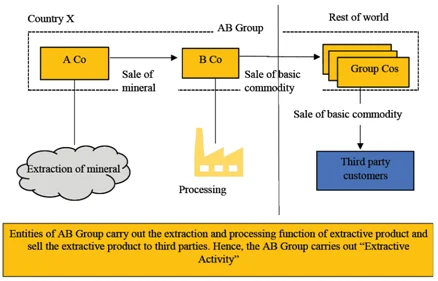
BACKGROUND

Immovable property refers to any asset, which is attached to the earth and is immobile, and includes land. Typically, the term “immovable property” is used to mean land and/or buildings attached to the land. Owning an immovable property, especially a residential house, in India has often been considered an aspirational goal. The lure of owning a property in India also attracts Non-resident Indians (“NRIs”), who have moved out of India but have an investible surplus available with them. Additionally, many NRIs also inherit ancestral or family properties and continue to hold them and enjoy the passive income therefrom. As these NRIs identify better or alternative opportunities outside India, the properties are sold,and sale proceeds are sought to be repatriated outside India.

This article seeks to touch upon the tax and FEMA aspects of the various transactions surrounding investment in Immovable Property by NRIs ranging from investment and passive income to sale and repatriation of the proceeds.

TAXABILITY OF INCOME FROM IMMOVABLE PROPERTIES

As a thumb rule, rent income or passive income arising from an immovable property is taxable in India. Rent income received by the owner of a property from the letting out of any building or land appurtenant thereto is generally taxable under the head “Income from House Property”, irrespective of whether the property in question is a residential property or a commercial one. In fact, section 22 of the Income-tax Act seeks to tax the Annual Value of such property as “Income from House Property”, which is determined on the basis of the higher of the actual rent received or receivable for a property or the sum for which the property might reasonably be expected to be let. Thus, a property is taxed on the basis of its capacity to earn rent even though it is not actually let out or generating rent income.

Section 23, however, provides for considering the Annual Value as Nil in case of up to two properties, which are occupied by the owner for his own residence or which cannot be so occupied by the owner on account of his employment, business or profession is carried on at any other place and he has to reside at that other place in a building which is not owned by him. Where the NRI owns more than two properties which have not been let out, then, he can opt for the Annual Value of two of the properties to be considered as Nil and the Annual Value of the remaining properties will be computed as if they have been let out. Further, if the property is used or occupied by the owner for the purposes of any business or profession carried out by the owner and the profits of such business or profession are chargeable to income-tax, then, its Annual Value is not taxable.

If, however, that leasing or renting of the property is only one of the elements of a composite contract, under which various services are provided, then, the entire income from such composite services is taxable as business income1. For instance, leasing of shops by a mall or renting of rooms by a hotel. When the rent income is taxable as Income from House Property, only specific deductions are allowable from the Annual Value in respect of municipal taxes paid, standard deduction of 30 per cent and interest on borrowings. As against this, in case of income taxable as business income, the taxpayer can claim any expense incurred for the purposes of the business, including depreciation on capital expenditure. The tax rate on income from the property for NRI in either case would be the applicable slab rate.


1   Krome Planet Interiors (P.) Ltd. 265 Taxman 308 (Bom HC); Plaza Hotels (P) Ltd. 265 Taxman 90 (Bom HC); City Centre Mall Nashik Pvt. Ltd. 424 ITR 85 (Bom HC)


In the case of jointly owned properties, the income from the property would be taxable in the hands of all the owners in the ratio of their ownership. If the deed does not mention the ratio of ownership of the property between the joint owners, it would be assumed to be an equal share of each joint owner2. If, however, the name of any joint owner is added merely for convenience and such joint owner has neither paid for any of the purchase consideration nor has any source of income to do so, then, it would be appropriate to consider the entire income as taxable in the hands of the remaining owners3, following the principle laid down by the Apex Court that in the context of section 22, owner is a person who is entitled to receive income from the property in his own right4.


2   Saiyad Abdulla v. Ahmad AIR 1929 All 817
3   Ajit Kumar Roy 252 ITR 468 (Cal. HC)
4   Podar Cement (P.) Ltd. 226 ITR 625 (SC)


If the immovable property in question is simply plot of land, without any building thereon, then the charge under section 22 would not be triggered and the income from the land would instead be taxable as “Income from Other Sources” under section 56. Any expenses incurred to earn the said income can be claimed as a deduction under section 57 from the said income. The income from the land would, however, be exempt under section 10(1) if it is an agricultural income in terms of section 2(1A), which refers to rent or revenue derived from land in India used for agricultural purposes; income derived from the land by agriculture, or by the performance of any process by the cultivator or receiver of rent-in-kind to render the produce fit to be taken to the market, or sale of the produce by the cultivator or receiver of rent-in-kind; as also income derived from a building on or in the immediate vicinity of the land, subject to certain conditions.

TAXABILITY OF CAPITAL GAINS

The gains arising from the sale or transfer of immovable property, i.e., land or building or both, are taxable under section 45 as Capital Gains, classified as short-term or long-term depending on the period for which the property was held. Where the property is held by the owner for a period of more than twenty-four months immediately preceding the date of its sale or transfer, it is considered a long-term asset and the gains are taxable as Long-Term Capital Gains (“LTCG”). Where the period of holding does not exceed twenty-four months, the property is treated as a short-term asset, with the gains taxable as Short-Term Capital Gains (“STCG”). In the case of non-residents, STCG is included in the total income for the period and taxable as per the applicable slab rate, whereas LTCG is taxable under section 112 at a rate of 20 per cent, excluding applicable surcharge and cess.

The term “transfer” includes the transfer of immovable property on account of compulsory acquisition, redevelopment of old property, or even receipt of the insurance claim on account of damage to or destruction of the property, but does not include the transfer of property under a gift, will, irrevocable trust or distribution upon the partition of a Hindu Undivided Family (“HUF”). In the case of a property transferred by way of a gift, will, irrevocable trust or distribution upon the partition of an HUF and similar other situations as enumerated in section 47, the Capital Gains is taxable only in the event of a final sale or transfer and at the point of taxability, the amount of gain is computed with reference to the purchase price for the previous owner.

Further, the period of holding of the previous owner is also included while determining whether the gain on the property is Long Term or Short Term.

Section 48 lays down the computation of the amount of Capital Gain as under —

Sale Consideration
Less: Expenses incurred wholly and exclusively in connection with the transfer
Less: Cost of Acquisition
Less: Cost of Improvement
Taxable Capital Gain


As per the second proviso to section 48, in case the property is a long-term asset, the cost of acquisition and cost of improvement are indexed for the period of holding as per the cost inflation index notified by the Central Government in relation to each year. Thus, LTCG is computed with reference to a stepped-up cost, allowing for rising costs.

The various elements relevant to the computation of gains are discussed hereunder —

Sale Consideration: The transaction price at which the property is sold shall be considered to be the sale consideration, including the value of any consideration in kind. In a situation where a property is sold at a consideration, which is lower than the value adopted or assessed for the purposes of payment of stamp duty, section 50C would come into play, requiring that such value adopted or assessed for stamp duty payment should be assumed to be the full value of sale consideration and the capital gains should accordingly be calculated with reference to such higher value.

Expenses incurred wholly and exclusively in connection with the transfer: In claiming deduction of the expenses from sale consideration, attention should be paid to the requirement that such expenses are “incurred wholly and exclusively in connection with the transfer.” Expenses such as transfer fees paid to society, brokerage expenses, and legal expenses connected to the transfer such as fees for drafting of the agreement, would be allowable expenses. Further, in the case of non-residents, expenses incurred on travel to India as well as stay if incurred specifically for the purposes of executing and registering the sale agreements can also be considered as incurred wholly and exclusively in connection with the transfer.

Cost of Acquisition: As a general rule, the actual purchase price paid for acquiring a property would constitute the cost of acquisition of the property. It would include the expenses incurred at the time of purchase of the property towards stamp duty, registration fee, and brokerage. However, any payment made at the time of purchase towards recurring expenses, which form part of the purchase price, such as advance maintenance for a certain period or outstanding property taxes or electricity charges, etc. would not form part of the cost of acquisition.

The cost inflation index used for indexation of the cost follows FY 2001–02 as the base year with the index for the base year set at 100. Thus, if any property was purchased prior to 1st April, 2001, its cost cannot be indexed beyond FY 2001–02. To address this issue, in case of properties purchased by the taxpayer or the previous owner (in case of property acquired through gift, will, etc.) prior to 1st April, 2001, Section 55(2)(b) allows the taxpayer the option to adopt its original purchase price or its fair market value as on 1st April, 2001 as the Cost of Acquisition. This fair market value as of 1st April, 2001, however, cannot exceed the value of the property adopted or assessed for the purpose of payment of stamp duty as of 1st April, 2001. Where the property was purchased prior to 1st April, 2001, the original purchase cost would usually be lower than the fair market value as of 1st April, 2001. The option provided in Section 55(2)(b) would, therefore, let the taxpayer adopt the higher value as the cost of acquisition (subject to the cap of stamp duty value as on 1st April, 2001) and index it from FY 2001–02 till the year of sale. Thus, when computing capital gains in respect of an immovable property purchased by the taxpayer or the previous owner prior to 1st April, 2001, a valuation report determining the fair market value of the property as on 1st April, 2001 as well as its value for the purposes of stamp duty on the same date shall be required to be obtained.

Often, in case of ancestral properties acquired by way of inheritance, will or such other modes, the details of original purchase cost of the property are not available, making it difficult to compute the capital gains. Section 55(3) provides that in cases where purchase cost of the previous owner cannot be ascertained, the fair market value of the property as on the date on which the previous owner became the owner of the property shall be considered as the Cost of Acquisition of the previous owner.

Cost of Improvement: Any cost that has been incurred by the taxpayer or the previous owner towards making additions or alteration to the property, which is capital in nature is considered as cost of improvement and is allowable as a deduction while computing the amount of capital gains. Examples of cost of improvement include cost incurred towards adding a room or a floor to an existing property, fencing a plot of land to secure its perimeter, installation of lift, incurring expenses to make the property habitable, incurring expenses to clear the legal title of a property, which is under dispute, etc. However, expenses such as routine repairs and renovation expenses, modifications to furniture, aesthetic expenses, etc. would not be considered as Cost of Improvement. Any cost of improvement incurred prior to 1st April, 2001 is not to be considered in the computation. This restriction is in line with the fact that the taxpayer has an option to adopt the fair market value as on 1st April, 2001 as the Cost of Acquisition, which would take into account any improvements done to the property prior to 1st April, 2001 and thus, separate deductions need not be claimed for such cost of improvements. Further, any expenditure that can be claimed as a deduction in computation of income under any other head of income, cannot be claimed as a Cost of Improvement.

In case of the purchase of property, while it was under construction, the determination of the period of holding and the year from which indexation should be allowed can be debatable. The date of allotment of the future property to the taxpayer by the builder, phase-wise payment towards the purchase cost, the date of registration of the sale agreement and the date of possession would fall in different years in such cases, leading to significant differences in the computation of the amount of taxable capital gain depending on when the property is said to be acquired by the taxpayer. Several judicial pronouncements5 have held that where the taxpayer has been allotted a specific identified property and such allotment is final, subject only to the payment of the consideration, then, the date of allotment is to be considered as the date of acquisition of the property and the period of holding should be calculated from the date of allotment. Similarly, in the case of allotment of property along with shares in the co-operative society prior to the completion of construction or physical possession of the property, it has been held that the date of allotment should be considered as the date of acquisition of the property6. In fact, in the context of whether acquisition of a flat under the self-financing scheme of the Delhi Development Authority shall be considered as construction for the purposes of sections 54 and 54F, the CBDT Circular No. 471 dated 15th October, 1986 states that “The allottee gets title to the property on the issuance of the allotment letter and the payment of instalments is only a follow-up action and taking the delivery of possession is only a formality.”

Further, payments for an under-construction property are made by taxpayers over several years starting from the date of allotment in a phase-wise manner. It has been held by the Courts that the benefit of indexation in such cases should be allowed on the basis of payment7, i.e., payment made in each year should be indexed from that year till the date of sale of the property. In fact, in the case of Charanbir Singh Jolly v. 8th ITO 5 SOT 89 and thereafter, in Smt. Lata G. Rohra v. DCIT 21 SOT 541 the Mumbai Tribunal has held that indexation for the entire purchase cost of the property should be allowed from the year in which the first instalment was paid by the assessee. While the ratio of aforesaid judgements has not been further appealed against and is, thus, valid, indexation of the entire cost from the year of first payment irrespective of date of actual payments may be considered to be an aggressive tax position and open to litigation.


5   Praveen Gupta v. ACIT 137 TTJ 307 (Delhi – Trib.); CIT v. S.R.Jeyashankar 228 Taxman 289 (Mad.); Vinod Kumar Jain v. CIT 195 Taxman 174 (Punjab & Haryana)
6   CIT v. AnilabenUpendra Shah 262 ITR 657 (Guj.); CIT v. JindasPanchand Gandhi 279 ITR 552 (Guj.)
7   Praveen Gupta (supra); ACIT v. Michelle N. Sanghvi 98 taxmann.com 495 (Mumbai-Trib.); Ms. RenuKhurana v. ACIT 149 taxmann.com 160 (Delhi-Trib.)

However, this view is supported by the form of return of income. The form of return of income does not provide mechanism to index cost of acquisition with reference to payments made in various years. Therefore, if an assessee chooses to index cost of acquisition with reference to years in which instalments of purchase price are paid then such instalments will need to be reported in the form of return of income as cost of improvement which is technically not correct.

Where the property in question is an agricultural land, one would need to examine whether the same is a “rural” agricultural land or an “urban” agricultural land, as is referred to in common parlance. The former is excluded from the definition of a capital asset under section 2(14) and thus, gains arising from its sale would not give rise to taxable Capital Gains. An “urban” agricultural land, however, does not enjoy such an exclusion and would be subject to capital gains taxation like any other property. The distinction between “rural” or “urban” agricultural land is drawn on the basis of the location of the land with reference to local limits of municipalities and the population of such municipalities as per the latest census. Accordingly, agricultural land which is situated within any of the following areas shall be considered to be an “urban” agricultural land and thus, included within the definition of capital asset —

i) Within the jurisdiction of a municipality or any such governing body, having a population exceeding 10,000, or

ii) Within 2 km of the local limits of a municipality or any such governing body, having a population exceeding 10,000 but not exceeding 1,00,000, or

iii) Within 6 km of the local limits of a municipality or any such governing body, having a population exceeding 1,00,000 but not exceeding 10,00,000, or

iv) Within 8 km of the local limits of a municipality or any such governing body, having a population exceeding 10,00,000.

EXEMPTIONS FROM CAPITAL GAINS

The Income-tax Act contains certain beneficial provisions to provide relief from tax on the capital gains upon reinvestment into certain specified assets if the conditions laid down in those provisions are satisfied. A summary of the relevant exemption provisions applicable for capital gain arising on the sale of immovable property is given in the table below —

Section Nature of Gain Type of New Asset Amount to be reinvested for full exemption Time period for reinvestment Lock-in period for New Asset Capital Gain Deposit Account Scheme Other provisions
54 LTCG on transfer of residential property One residential property in India Amount of Capital Gains Purchase of new property within 1 year before, or 2 years after date of transfer; or Completion of construction of new property within 3 years after date of transfer 3 years from purchase or construction, failing which cost of the new asset shall be reduced by the amount of exemption already claimed To be deposited before the date of filing / due date of filing the return of income •   Taxability in case of unutilised balance in CG Deposit Account

•   One time option to small taxpayers having LTCG less than R2 crores

•   Exemption capped at
R10 crores

54D Gain on compulsory acquisition of land or building or rights therein, forming part of industrial undertaking Any other land or building or rights therein Amount of Capital Gains Purchase or construction within 3 years from date of transfer 3 years from purchase or construction, failing which cost of the new asset shall be reduced by the amount of exemption already claimed To be deposited before the date of filing / due date of filing the return of income •   Use of asset for 2 years immediately prior to the date of transfer for business of the industrial undertaking

•   Taxability in case of unutilised balance in CG Deposit Account

54EC LTCG on transfer of land or building or both Specified Bonds issued by NHAI, RECL or as maybe notified Amount of Capital Gains, subject to a maximum of
R50 lakhs
Within 6 months after the date of transfer 5 years. Transfer of New Asset or monetisation other than by way of transfer within the lock-in period will result in revocation of exemption in the year of such transfer or monetisation Not Applicable •   Interest received on Bonds is taxable.

•   No deduction can be claimed under section 80C in respect of the investment in bonds

54F LTCG on transfer of any asset other than a residential property One residential property in India Full amount of net sale consideration. Proportionate exemption is allowed in case of lower reinvestment Purchase of new property within 1 year before, or 2 years after date of transfer; or Completion of construction of new property within 3 years after date of transfer 3 years from purchase or construction, failing which the amount of exemption already claimed shall be deemed to be LTCG in the year of transfer of new asset To be deposited before the date of filing / due date of filing the return of income •   Taxability in case of unutilised balance in CG Deposit Account

•   Added condition relating to ownership of residential house on the date of transfer of original asset or purchase or construction of one more residential house within 1 year / 3 years after the date of transfer – withdrawal of exemption in case of violation of condition.

•   Exemption capped atR10 crores


INCOME UNDER SECTION 56(2)(X)

Section 56(2)(x) seeks to bring into the tax net, any transactions of receipt of money or movable or immovable property without consideration or for inadequate consideration. Where any person receives an immovable property having a stamp duty value exceeding ₹50 thousand without consideration, the stamp duty value of such property is deemed to be an income of the recipient. Similarly, where a person purchases an immovable property at a consideration lower than its stamp duty value, where the difference is more than the higher of ₹50 thousand or 10 per cent of actual consideration, then, such difference between the actual consideration and stamp duty value of the property is deemed to be the income of the recipient. In other words, if any person, including a non-resident, is purchasing an immovable property in India for a value lower than its stamp duty value, then, the difference is assumed to be a benefit to the purchaser and sought to be taxed in the hands of the purchaser.

This provision intends to target property transactions that are intentionally undervalued so as to reduce the burden of stamp duty and involve cash payments. However, practically, the price of any transaction varies depending on various factors which may not reflect in the stamp duty value of the property, and it is likely that the actual transaction may genuinely take place at a value lower than the stamp duty value. To address such situations, the provisions allow a safe harbour of higher ₹50 thousand or 10 per cent of the actual consideration. If the difference in the consideration and the stamp duty value is within this safe harbour, then, it will not have any implication for the purchaser. However, if the difference exceeds the safe harbour limit, then, the entire difference will be treated as income of the purchaser.

In practice, parties may agree upon the consideration for property sale when the initial token or advance is given and enter into an agreement or MOU to document the same, but the actual registration of the sale agreement may take place subsequently after a gap, by which time the stamp duty value of the property may have increased. In such a case, the first proviso to section 56(2)(x) allows for stamp duty value as on the date of the initial agreement or MOU to be adopted provided the advance or token is paid on or before that date by account payee cheque or bank draft or electronically. Thus, if for any reason the registration of the final sale deed is delayed, the purchaser will not have to suffer taxation merely due to an increase in the stamp duty value of the property during the period of delay.

TAXABILITY UNDER A TAX TREATY

Article 6 of the OECD Model Convention deals with Income from Immovable Property, while Paragraph 1 of Article 13 deals with Gains from alienation of Immovable Property. Both these articles give the right to tax the income and capital gains relating to immovable property to the Source State where such property is situated. This is considering the fact that there is always a close economic connection between the source of income relating to immovable property and the State of source8. Further, the definition of the concept of immovable property as also the manner of taxation and computation is left to the Source State to decide. This helps to remove any ambiguity regarding the classification of an asset as immovable property.


8   Paragraph 1 of Commentary on Article 6

Thus, in the case of NRIs having income or capital gains from immovable property in India, the manner of taxation and computation would be determined as per the domestic tax laws, which have been briefly discussed above. The NRIs can then offer to tax or report these incomes in their Residence State and claim credit for the taxes paid in India as per the provisions of the applicable tax treaty and domestic tax laws of the state of residence.

TAX DEDUCTION AT SOURCE

Section 195 requires any person making payment to a non-resident or a foreign company of any sum chargeable to tax under the Act, to deduct tax at source on such payment and deposit the same with the Government. Unlike the TDS provisions applicable in case of rent payments or property purchases amongst residents, Section 195 does not provide a fixed rate of TDS. Thus, the person making payment in respect of income from property or sale consideration to the non-resident would be required to deduct tax at source as per the applicable rate of tax on the respective transactions. In order to do so, the payer would have to obtain a Tax Deduction Account Number (“TAN”), which is often not required in case of property transactions between residents. Additionally, the payer would also have to file quarterly TDS statements in Form 27Q so as to enable the NRI to get credit of tax deducted.

As discussed earlier, the income from property, computed after claiming deductions, would be taxable for the NRI at the applicable slab rates. However, the tax would be required to be deducted at source by the payer on the entire rental income at the rate of 30 per cent as per the residuary entries for “other income” under Serial No. (1)(b) of Part II of the Finance Act. Further, STCG on transfer of property would also be taxable at the applicable slab rates, while LTCG would be taxable at a rate of 20 per cent plus applicable surcharge and cess. The person making the payment to the NRI in respect of the sale of the property would not be in a position to conclusively determine either the slab rate applicable to the NRI or the computation of taxable capital gains. Consequently, the payer would not be in a position to determine the appropriate rate at which the TDS obligation should be discharged.

In the above scenarios, the payer or the NRI payee can make an application to the Assessing Officer under section 195(2) or section 197 to determine the sum chargeable to tax or the rate at which tax should be deducted at source, respectively. Based on the application made, the Assessing Officer would issue a certificate determining the sum chargeable to tax or the rate at which tax deduction should be done and the payer can deduct tax under section 195 accordingly.

While no time limit has been prescribed in the provisions for the Assessing Officer to deal with such an application and issue the certificates, a 30-day timeline was provided for this process in the Citizen’s Charter 2014, which was further endorsed by the CBDT in its office memorandum of 26th July 2018. Thus, the overall process of making an application for lower or nil deduction of tax, responding to queries, if any, of the tax offices and obtaining the certificate can take from 5-8 weeks. In a time-sensitive transaction and considering the logistics of transacting with an NRI, the payer or the NRI payee may not be in a position to follow the process of obtaining a lower or nil deduction certificate. In such a scenario, the payer may deduct tax at source at the rate applicable to the transaction (20 per cent plus applicable surcharge and cess in case of LTCG on sale of property and 30 per cent plus applicable surcharge and cess in other cases) on the entire amount payable to the NRI, who would be required to claim a refund of the excess tax deducted by filing a return of income.

REPORTING OF HIGH-VALUE TRANSACTIONS

Section 285BA requires various reporting persons to file a statement of financial transactions (“SFT”) to report certain transactions above the specified thresholds, referred to as high-value transactions, to the Income-tax authorities, which enables the latter to evaluate if the incomes reported by the persons transacting are in line with such high-value transactions and whether there could have been any tax evasion. One of the transactions required to be reported by the Registrar or Sub-Registrar is the purchase or sale of immovable property for an amount of ₹30 lakh or more or valued at ₹30 lakh or more by the stamp valuation authority. It is a common scenario where non-residents may not have filed a return of income in India for several years as they have negligible income less than the maximum amount not chargeable to tax, and consequently, no tax liability. However, if they have entered into a transaction of purchase or sale of immovable property, the same would be reported in the SFT and would reflect against the PAN of both the buyer and the seller. This would lead to the issuance of notice by the assessing officer to investigate the reason for non-filing of return of income even though a high-value transaction was entered into during the year. It is, thus, advisable for a person entering into any of the specified high-value transactions, including the purchase or sale of immovable property, to file a return of income for the year in which such transaction is undertaken, so as to avoid unnecessary proceedings merely on the premise of such a transaction.

INVESTMENT IN IMMOVABLE PROPERTY UNDER FEMA

Acquisition or transfer of immovable property byNon-residents in India is regulated by sub-sections 2(a), (4) and (5) of section 6 of the Foreign Exchange Management Act, 1999 (“FEMA”) read with Foreign Exchange Management (Non-debt Instruments) Rules, 2019 and is subject to applicable tax laws and other duties and levies in India.

NRIs and Overseas Citizens of India (“OCIs”) have general permission to invest in immovable property in India subject to certain conditions and restrictions. They can purchase residential or commercial property, other than agricultural land, plantation property, or farmhouse. NRIs and OCIs can also receive an immovable property other than agricultural land, plantation property, or farmhouse as a gift from a relative as defined in section 2(77) of the Companies Act, 2013. A NRI or OCI can also receive any immovable property as inheritance from a resident or from any person, who had acquired the property in accordance with the laws in force.

Payment for the purchase of immovable property can be made in India through normal banking channels by way of inward remittance. It can also be made out of funds held by the NRI or OCI in their NRE, FCNR(B) or NRO accounts. However, the payment cannot be made through travellers’cheques and foreign currency notes or any other mode.

A non-resident spouse of any NRI or OCI, who is not themselves an NRI or OCI, is permitted to acquire one immovable property in India, other than agricultural land, plantation property, or farmhouse jointly with their spouse, provided the marriage has been registered and has subsisted for a continuous period of at least 2 years immediately prior to acquiring the property. In such a case, the payment for the purchase can be made by the non-resident spouse, who is not a NRI or OCI either by way of inward remittance through normal banking channels or by debit to their non-resident account maintained as per the FEMA Act or rules thereunder.

SALE AND REPATRIATION OF FUNDS

The NRI or OCI can transfer the immovable property, other than agricultural land, plantation property, or farmhouse to a resident or another NRI or OCI. Transfer by way of gift can only be made to a relative as defined in section 2(77) of the Companies Act, 2013. Further, transfer of agricultural land, plantation property, or farmhouse can only be made to a person resident in India.

As a general rule, any person, who had acquired an immovable property when they were a resident in India or inherited from a person resident in India or their successor, requires RBI approval to remit the sales proceeds of the property. However, under the Foreign Exchange Management (Remittance of Assets) Regulations, 2016, NRIs and PIOs are permitted to remit up to USD 1 million per financial year, out of the sale proceeds of such assets in India. The limit of USD 1 million shall apply qua a financial year, irrespective of how many such assets may have been sold during the year.

In all other cases, the NRIs, OCIs and PIOs (in case of property acquired under the erstwhile Foreign Exchange Management (Acquisition and transfer of Immovable Property in India) Regulations, 2000, can repatriate the sale proceeds of immovable property outside India provided the following conditions are satisfied —

i) The property was acquired by the NRI / OCI / PIO as per the laws in force at the time of acquisition;

ii) The payment for the purchase of property was made by way of inward remittance through normal banking channels or out of balances in NRE / FCNR(B) account; and

iii) The repatriation of sale proceeds for residential property is restricted to not more than two properties.

In the case of point ii) above, if the NRI / OCI / PIO had acquired the property through housing loans availed in accordance with the applicable FEMA regulations, then the repayment ought to have been made by way of inward remittance through normal banking channels or out of balances in NRE / FCNR(B) account.

PROPERTIES IN INDIA BY CITIZENS OF NEIGHBOURING COUNTRIES

Citizens (including natural persons and legal entities) of certain countries — Pakistan, Bangladesh, Sri Lanka, Afghanistan, China, Iran, Nepal, Bhutan, Macau, Hong Kong, and the Democratic People’s Republic of Korea — cannot acquire or transfer immovable property in India, without the prior permission of RBI. They can,however, acquire the property on lease, which does not exceed 5 years. These restrictions do not apply in case of an OCI.

However, the regulations prescribe some relaxations in case of citizens of neighbouring countries Afghanistan, Bangladesh, or Pakistan, who belong to the minority communities in those countries, i.e., Hindus, Sikhs, Jains, Buddhists, Parsis and Christians. If such a person is residing in India and has been granted a Long-Term Visa (“LTV”) by the Central Government, he can purchase only one residential immovable property in India for his own residence and only one immovable property for self-employment, subject to the following conditions —

i) The property should not be located in, and around restricted / protected areas notified by the Central Government and cantonment areas.

ii) A declaration should be submitted to the district Revenue Authority specifying the source of funds and that the person is residing in India on an LTV.

iii) The registration documents of the property should mention the nationality and the fact that such a person is on an LTV.

iv) The property of such a person may be attached/ confiscated in the event of his/ her indulgence in anti-India activities.

v) A copy of the documents of the property shall be submitted to the Deputy Commissioner of Police / Foreigners Registration Office / Foreigners Regional Registration Office concerned and to the Ministry of Home Affairs (Foreigners Division).

vi) Sale of such property is permissible only after the person has acquired Indian citizenship. However, if the property is to be transferred before acquiring Indian citizenship, then, it would require the prior approval of the Deputy Commissioner of Police (DCP) / Foreigners Registration Office (FRO) / Foreigners Regional Registration Office (FRRO) concerned.

CONCLUSION

The acquisition and sale of immovable property in India by non-residents has several nuances under both the tax laws and FEMA. Several aspects discussed in the above article may have different implications depending on the facts of each case. For instance, in order to decide which payments can be included in the Cost of Acquisition or Cost of Improvement would require one to understand the nature of payments as well as their context. Similarly, as discussed in this article, the determination of the period of holding and indexation of cost can have its own complexities in cases of purchase of under-construction property with phase-wise payment and the conclusion can vary on the basis of the facts of the case. The aim of this article is to highlight the various aspects to be considered by individuals involved in property transactions, especially non-residents, and to bring about awareness regarding the applicable provisions and regulations so that the detailed facts of each case can be examined in light of these.

Residential Status – Whether Employment Includes Self Employment

In the context of determination of the residential status of an individual, a question or dispute arises as to whether for the purposes of Explanation 1(a) section 6(1) of the Income-tax Act, 1961 (“the Act”), the term ‘employment’ in the phrase ‘for the purposes of employment outside India’ includes ‘self-employment’ or not.

In this article, we are discussing certain nuances relating to the above dispute.

A. BACKGROUND

Section 6(1) of the Act deals with the residential status of an individual and provides for alternative physical presence tests for residents in India.

Clause (a) of section 6(1) provides that an individual is said to be resident in India in any previous year if he is in India in that year for a period or periods amounting in all to 182 days or more.

Alternatively, clause (c) of section 6(1) provides that an individual is said to be resident in India in any previous year if he has, within 4 years preceding the relevant year, been in India for a period of 365 days or more and, is in India for a period or periods amounting in all to 60 days or more in the relevant year.

Explanation 1(a) to Section 6(1) extends the period of 60 days to 182 days in case of a citizen of India who has left India in any previous year as a member of the crew of an Indian ship or for the purposes of ‘employment’ outside India.

It is pertinent to note that the original Explanation was inserted by the Finance Act, 1978, w.e.f. 1st April, 1979. At that time, the Explanation only covered a situation wherein a citizen of India was visiting India on a leave or vacation in the previous year and did not cover a situation where an Indian citizen left India for the purpose of employment outside India. The extension of the number of days from 60 to 182 for an Indian citizen leaving India for the purposes of ‘employment’ outside India was first introduced by substituting the Explanation vide the Finance Act, 1982 w.e.f. 1st April, 1982, wherein it now stated as follows:

(a) “Explanation.-In the case of an individual, being a citizen of India,-

Who leaves India in any previous year for the purposes of employment outside India, the provisions of sub-clause (c) shall apply in relation to that year as if for the words “sixty days”, occurring therein, the words “one hundred and eighty-two days” had been substituted;

(b) …”

The scope and effect of the above amendments were explained by the Memorandum to the Finance Bill, 1982, which provided as follows:

“33. Relaxation of tests of “residence” in India….

34….

35. With a view to avoiding hardship in the case of Indian citizens who are employed or engaged in avocations outside India, the Bill seeks to make the following modifications in the tests of “residence” in India: –

(i) ….

(ii)…

(iii) It is proposed to provide that where an individual who is a citizen of India leaves India in any year for the purposes of employment outside India, he will not be treated as a resident in India in that year unless he has been in India in that year for 182 days or more. The effect of this amendment will be that the “test” of residence in (c) above will stand modified to this extent in such cases.” (emphasis added)

Para 7.3 of the CBDT in Circular No. 346 dated 30th June, 1982 has also provided similar reasoning and is reproduced as under: “7.3 With a view to avoiding hardship in the case of Indian citizens, who are employed or engaged in other avocations outside India, the Finance Act has made the following modifications in the tests of residence in India:

1. The provision relating to the maintenance of a dwelling place coupled with a stay in India of 30 days or more referred to in (b) above has been omitted.

2. In the case of Indian citizens who come on a visit to India, the period of 60 days or more referred to in (c) above will be raised to 90 days or more.

3. Where an individual who is a citizen of India leaves India in any year for the purposes of employment outside India, he will not be treated as a resident in India in that year unless he has been in India in that year for 182 days or more. The effect of this amendment will be that the test of residence in (c) above will stand modified to that extent in such cases.”

The Direct Tax Laws (Second Amendment) Act, 1989 substituted the Explanation to section 6(1) w.e.f.
1st April, 1990. However, the language in the amended Explanation is the same as was introduced in 1982 and this limb of the Explanation relates to the substitution of 182 days in case of a citizen of India who has left India in any previous year for the purposes of ‘employment’ outside India, remained the same.

B. WHETHER THE TERM ‘EMPLOYMENT’ INCLUDES THE ‘SELF-EMPLOYMENT’

The moot point is what is meaning of the term ‘employment outside India’ is covered by Explanation 1(a) to Section 6(1).

One view that the Assessing Officers (“AOs”) have been taking is that ‘employment outside India’ covered by the Explanation 1(a) does not include undertaking business by oneself and an assessee will be entitled to the benefit of the Explanation only if such assessee went outside India in the previous year to take up ‘employment’ and not for undertaking business. Under this view, a restrictive meaning is given to the term ‘employment’ to only cover a situation where an employer-employee relationship exists with terms of employment and not a broader meaning.

The other view which assessees have been contending is that the term ‘employment’ in the context of Explanation 1(a) includes self-employment and taking up and continuing business is also ‘employment’ for the purposes of Explanation 1(a) to Section 6(1).

C. JUDICIAL PRECEDENTS

1. CIT vs O. Abdul Razak [2011] 198 Taxman 1 (Kerala)

In this case, the Kerala High Court relying upon the above Circular No. 346 dated 30th June, 1982, has interpreted the term ‘employment’ in wide terms. The relevant findings of the Kerala High Court are as under:

“Similarly the Central Board of Direct Taxes issued Circular No. 346, dated 30-6-1982, which reads as follows:

“7.3 With a view to avoiding hardship in the case of Indian citizens, who are employed or engaged in other avocations outside India, the Finance Act has made the following modifications in the tests of residence in India:

(i) & (ii) ******

(iii) Where an individual who is a citizen of India leaves India in any year for the purposes of employment outside India, he will not be treated as a resident in India in that year unless he has been in India in that year for 182 days or more. The effect of this amendment will be that the test of residence in (c) above will stand modified to that extent in such cases.”

7. What is clear from the above is that no technical meaning is intended for the word “employment” used in the Explanation. In our view, going abroad for the purpose of employment only means that the visit and stay abroad should not be for other purposes such as a tourist, or for medical treatment or for studies or the like. Going abroad for the purpose of employment therefore means going abroad to take up employment or any avocation as referred to in the Circular, which takes in self-employment like business or profession.

So much so, in our view, taking up their own business by the assessee abroad satisfies the condition of going abroad for the purpose of employment covered by Explanation (a) to section 6(1)(c) of the Act. Therefore, we hold that the Tribunal has rightly held that for the purpose of the Explanation, employment includes self-employment like business or profession taken up by the assessee abroad.”

Therefore, the Kerala High Court has held that:

a) No technical meaning is intended for the word “employment” used in Explanation 1(a);

b) Going abroad for the purpose of employment only means that the visit and stay abroad should not be for other purposes such as a tourist, for medical treatment, for studies or the like; and

c) Going abroad for the purpose of employment therefore means going abroad to take up employment or any avocation as referred to in the Circular, which takes in self-employment like business or profession.

2. K. Sambasiva Rao vs. ITO [2014] 42 taxmann.com 115 (Hyd — Trib.)

In this case, the ITAT Hyderabad referred to the decision of the Supreme Court in the case of CBDT vs. Aditya V. Birla [1988] 170 ITR 137 (SC) where in the context of section 80RRA, the SC considered that employment does not mean salaried employment but also includes self-employed/professional work. Further referring to the view expressed by the decision of the Kerala High Court in the case of CIT vs. O. Abdul Razak (supra) and also Circular No.346 of the CBDT, the ITAT held that the assessee’s earnings for consultancy fees from foreign enterprise and visit abroad for rendering consultancy can be considered for the purpose of examining whether the assessee is a resident or not.

3. ACIT vs. Jyotinder Singh Randhawa [2014] 46 taxmann.com 10 (Delhi — Trib.)

The ITAT Delhi, in this case, relating to a professional golfer, while deciding the issue in favour of the assessee held as under:

“7. We thus find that going abroad for the purpose of employment also means going abroad to take up employment or any avocation which takes in self-employment like business or profession. The facts of the present case suggest that the assessee was in self-employment being a professional golfer. We thus do not find reason to deviate from the finding of the Ld. CIT(A) which is based on the decision of the Hon’ble Kerala High Court in the case of O. Abdul Razak (supra) and others that the assessee being a professional golfer is a self-employed professional who carries his talent as a sportsperson by participating in golf tournaments conducted in various countries abroad. For such an Indian citizen in employment outside India the requirement for being treated as resident of India is his stay of 182 days in India in the previous year, as per Explanation (a) to section 6(1)(c) of the I.T. Act 1961.”

Thus, the ITAT Delhi also relying on the decision of the Kerala High Court has held that for the purposes of Explanation 1(a) of Section 6(1), employment would cover self-employed professionals.

4. ACIT vs. Col. Joginder Singh [2014] 45 taxmann.com 567 (Delhi — Trib.)

In this case of an assessee, a retired Government servant, providing consultancy services outside India, while deciding the issue in favour of the assessee, the ITAT Delhi held as follows:

“11. In view of the above, we are of the considered view that the Assessing Officer misinterpreted the provisions of section 6(1)(c) and Explanation (a) attached thereto. On the other hand, the Commissioner of Income Tax(A) rightly held that the assessee has to be treated as non-resident as per Explanation (a) attached to section 6(1)(c) of the Act. The Commissioner of Income Tax (A) also rightly held that in the case of the individual, a citizen of India who left India during the previous year for the purpose of employment outside India and in a peculiar circumstance, when his stay in India during the relevant period was only 68 days which is much less than the period of 182 days as per statutory provisions of the Act, then the assessee cannot be treated as resident of India and his status would be of non-resident Indian for the purpose of levying of tax as per provisions of the Act.”

Thus, in this case, going out of India for the purposes of providing consultancy services, has been considered to be eligible for the extended period of 182 days under Explanation 1(a) to section 6(1).

5. ACIT vs. Nishant Kanodia [2024] 158 taxmann.com 262 (Mumbai — Trib.)

In a recent decision of the ITAT-Mumbai the important facts were as follows:

a) The assessee stayed in India for 176 days and went to Mauritius during the year.

b) From the work permit issued by the Government of Mauritius, it was observed that the assessee went to Mauritius on an occupation permit to stay and work in Mauritius as an investor and not as an employee.

c) It was submitted by the assessee that he went to Mauritius for the purpose of employment, on the post of Strategist – Global Investment of the company (in which he held 100% of the shares) for a period of three years. Therefore, it was claimed that the assessee was a non-resident as per the provisions of section 6(1)(c) read with Explanation 1(a) to section 6(1).

d) The AO held that the assessee left India in the relevant financial year as an ‘Investor’ on a business visa which was usually taken by an investor and not by an employee who leaves India for employment and accordingly, the assessee was not entitled to take benefit of Explanation -1(a) to section 6(1). Therefore, the AO held the residential status of the assessee for the year under consideration to be ‘resident’ as per the provisions of clause (c) of section 6(1) and income received by the assessee from offshore jurisdiction was added to the total income of the assessee.

e) While admitting that the assessee had submitted an employment letter, the AO alleged that as the assessee held 100% of the shares of the employer company, it had considerable control over the affairs of the company and the appointment letter and salary slips submitted were self-serving documents, especially in view of the fact that the permit obtained in Mauritius was not for employment but for business/investor.

f) The Commissioner (Appeals) agreed with the submissions of the assessee and held that the assessee was away from India for the purpose of employment outside India and was accordingly entitled to take the benefit of Explanation -1(a) to section 6(1)(c).

g) On revenue’s appeal, the ITAT, relying on the decision of the Kerala High Court in case of CIT vs. O. Abdul Razak (supra), other ITAT decisions mentioned above and Circular 346 dated 30-6-1982, dismissed the appeal of the Revenue and held as follows:

“14. Therefore, even if the taxpayer has left India for the purpose of business or profession, in the aforesaid decisions, the same has been considered to be for the purpose of employment outside India under Explanation-1(a) to section 6(1) of the Act. Accordingly, even if it is accepted that the assessee went to Mauritius as an Investor in Firstland Holdings Ltd., Mauritius, in which he holds 100% shareholding, we are of the considered view that by applying the ratio of aforesaid decisions the assessee is entitled to claim the benefit of the extended period of 182 days, as provided in Explanation-1(a) to section 6(1) of the Act, for the determination of residential status. Since it is undisputed that the assessee has stayed in India only for a period of 176 days during the year, which is less than 182 days as provided in Explanation 1(a) to section 6(1) of the Act, the assessee has rightly claimed to be a “Non-Resident” during the year for the purpose of the Act. Accordingly, we find no infirmity in the findings of the learned CIT(A) on this issue. As a result, the grounds raised by the Revenue are dismissed.”

D. IMPORTANT CONSIDERATIONS

From the above-mentioned judicial precedents, while taking into consideration ‘employment outside India’ and while considering the benefit of an extended period of 182 days as per Explanation 1(a) to section 6(1) of the Act, the following important points should be kept in mind:

a) The visit and stay abroad should not be for other purposes such as a tourist, or for medical treatment or for studies or the like.

b) ‘Employment’ would include self-employment i.e. acting as Consultant, leaving India for the purpose of business or profession including professional activities of a sportsman, carrying on activities of an investor etc.

c) The status in the Occupation Permit of being an ‘investor’ or not having a permit for employment in a country outside India or having a business visa instead of employment visa, may not be relevant considerations for this purpose. However, depending on the facts of the case, the type of visa obtained may also have persuasive value in the intention of the assessee to stay for a longer duration outside India.

E. OTHER VIEW

There is another point of view, according to which the difference between ‘Employment’ and ‘Business or Profession’ is well known and therefore ‘employment’ should not include ‘self-employment’ i.e. business or professions.

The CBDT Circular cannot travel beyond the scope of section 6 which mentions ‘employment’ and includes in its ambit ‘avocations’, which in turn has been relied upon by the Kerala High Court and ITAT benches.

Interestingly, while the section refers only to ‘employment’, the Memorandum to the Finance Bill as well as the CBDT Circular clearly states that the amendment is seeking to avoid hardship to Indian citizens employed or engaged in other avocations outside India. In our view, given the intention of the legislature to provide the benefit to a person who leaves India permanently or for a long duration, which is clear in the Memorandum to the Finance Bill and the CBDT Circular, this other view of giving a restricted meaning to the term “employment” may not find favour with the courts.

F. CONCLUSION

In view of the Memorandum, CBDT Circular and judicial opinion, it appears to be a settled position that for the purposes of Explanation 1(a) to Section 6(1) of the Act, the term ‘employment’ includes self-employment i.e. carrying on business and profession. However, it is important that the assessee maintains appropriate documentation to substantiate the facts of the case.

Underlying tax credit Concept and its significance


1. Overview :


The taxation of dividends has its origin in the classical
system of taxation, which in fact taxes corporate profit twice: once at the
company level and again at the shareholder level where the company’s profits
after tax are distributed by way of dividend to its shareholders. This is known
as economic double taxation as distinct from juridical double taxation. In
simple words, economic double taxation means double taxation of the same items
of economic income in the hands of different taxpayers.


From a tax policy perspective, economic double taxation
distorts investment decision making, and therefore the optimally efficient
allocation of resources, by inducing tax payers to invest by means of channel
that provides the best after-tax return, rather than by means of the most
appropriate commercial route to achieve the best pre-tax return.


2. Meaning of underlying Tax Credit :


Underlying tax credit relieves the economic double taxation
on foreign dividend income. The underlying tax credit is given for the pro-rata
share of the corporate tax paid by the foreign dividend distributing company. It
is computed as percentage of the corporate tax paid by the company that the
gross dividend distribution bears to the after-tax profits. The net dividend
received plus the withholding tax, if any, is taken as percentage of the related
after-tax profits of the paying company and multiplied by the corporate tax
paid. Dividend is grossed up by the underlying tax credit to compute the foreign
income subject to tax in home country. The ordinary credit limitation is applied
on the grossed-up dividend.


The underlying tax (or indirect) credit system on foreign
dividends is found in several countries under their domestic laws or tax
treaties. These countries include Argentina, Australia, Austria, Canada,
Denmark, Estonia, Finland, Germany, Greece, Ireland, Japan, Korea, Malta,
Mauritius, Mexico, Namibia, Nigeria, Singapore, Spain, Poland, the UK and the
US. It typically only applies if :


  • The shareholder has a significant shareholding in the dividend distributing
    company (e.g. in the UK, 10% is needed), and


  • The shareholder is a company.


Upon receipt of a dividend by the shareholder, the pre-tax
income of the distributing company is included as a taxable income. The
shareholder jurisdiction’s normal rate of company tax is then applied, but the
resulting tax (mainstream tax) is reduced by the company tax paid by the
dividend distributing company (i.e., reduced by the underlying tax). If
the underlying tax exceeds the amount of mainstream tax then there will be no
further tax to pay by the shareholder, who will, thus, receive tax-free
dividends.


The result is that the group will always pay the higher of
the two taxes — the dividend distributing company tax or the shareholder country
tax.


It is referred to as underlying tax credit because credit is
given for the tax paid in the underlying entity. It is also referred to as the
‘Indirect tax credit’ method because shareholder receives credit for tax which
it has only paid indirectly. In the U.S. Internal Revenue Code the same is
referred to a ‘Deemed paid credit’. The concept of ‘Imputation Credit’ is almost
similar to underlying tax credit.


In addition, most jurisdictions provide for a tax credit to
the parent company for the foreign tax paid by the subsidiary when its
undistributed income is attributed under the Controlled Foreign Corporation
Rules. In this article the focus is on underlying tax credit in respect of
dividend income.


3. Example of the underlying tax credit :


Company X is a resident of the UK and owns 60% share capital
of Company Y, a resident in India. Tax rate in India is assumed to be 34% and
tax rate in the UK is assumed to be 28%. Company X has no other taxable income
in the UK.

Since the dividends may be paid out of both current and past profits, domestic law or practice generally provides the ‘ordering rules’. These rules relate the dividends to the relevant post-tax profit out of which the distribution has been made and the creditable tax is determined by the effective tax rate imposed on those profits. In the US, the dividends are deemed to be distributed from a pool of retained profits and the underlying foreign tax is the average effective tax rate.

The computation is also affected by the exchange rate used to translate the creditable foreign tax. It could be either the rate prevailing at the time of payment of the foreign tax (historical rate), or the rate when the dividend was distributed (current rate). The US law requires that the foreign tax be translated at the historical rate, while the United Kingdom generally applies the current rate.

4. Underlying tax credit in respect of taxes paid by the lower tier companies:

In the context of International business structuring, it is quite common for the Multinational Enterprises (MNEs) to structure their business operations in various countries by way of creating various subsidiaries  of the same parent  company and to have further downward subsidiary companies of its subsidiary companies, to achieve their business objective in most efficient and profitable manner. The subsidiaries and the subsidiaries of the subsidiary companies are commonly referred to as ‘lower tier companies’.

Many countries allow the underlying tax credit computation to include taxes paid by lower tier companies. For example, Australia, Ireland, Mauritius, South Africa, and the UK allow the credit for taxes suffered by all lower tier companies, provided prescribed minimum equity or voting rights are maintained at each tier. Similarly Argentina, Japan and Norway permit the underlying tax credit upto two tiers of subsidiaries, Spain gives the underlying tax credit for taxes paid upto three tiers and the United States grants them upto 6 tiers, of qualifying foreign subsidiaries.

Thus, for example, a UK parent company investing in a Mauritian subsidiary, which in turn invests in its Indian subsidiary, subject to fulfillment of the shareholding percentage and other relevant conditions and compliance with regulations, would be eligible to take credit of underlying corporate taxes paid by the Indian subsidiary, to the extent of dividends paid by Indian Company, which are forming part of the dividends paid by the Mauritian Company, against the tax payable in respect of dividends received by the UK Company in UK.

5. Significance of underlying tax credit :

Foreign tax credit planning plays a major role in structuring investments in a foreign tax jurisdiction, in case of various multi-nationals based in jurisdictions such as the UK, the US and Ireland etc., where the credit system predominates and where the underlying tax credit is given. India’s Double Taxation Avoidance Agreements (DTAAs) with ten countries contains the provisions regarding underlying tax credit in respect of dividends paid by a company resident of India. Similarly India’s DTAAs with Mauritius and Singapore contain the provisions regarding underlying tax credit in respect of dividends paid by a Mauritian or Singaporean company.

In respect of planning  for all inbound  investment into India, from the countries  where the respective DTAAs with India/ domestic law contain the underlying tax credit provisions,  it is very important  to keep  in mind  the  exact  operation   of respective -1 underlying  tax credit  provisions  in the DTAAs/ domestic  law, to arrive  at the net tax cost of the MNE/Group  in respect  of dividend  income.  This will facilitate a proper decision-making in respect of investments into India. However, it is important to note that a detailed knowledge of the domestic law provisions of the underlying tax credit in the respective jurisdictions is of utmost importance. Therefore, wherever required, the services of the local consultants/tax experts may be utilised to know the law and practice in respect of exact operations of the underlying tax credit provisions.

In respect of outbound investments also, a proper consideration of the underlying tax credit would be of great help in properly arriving at the actual net tax cost of the enterprise/ group in respect of dividends and thus making the right investment decisions.

6. Underlying tax credit under Indian Scenario:

India does not have any domestic regulations in respect of underlying tax credit. However, as mentioned above, India’s DTAAs with ten countries contain the provisions relating to underlying tax credit. The relevant provisions relating to underlying tax credit contained in various articles are given below for ready reference:

In most of the above mentioned DTAAs, the definition of the term ‘Indian tax payable’ include provisions relating to tax sparing for the ordinary tax credit. However, in respect of DTAA with Ireland, the provisions relating to tax sparing are includible only in respect of clause relating to underlying tax credit.

It is interesting to note that in case of India’s DTAAs with 9 counties (except Singapore), the relevant provisions of the Articles mention about the under-lying tax credit where a dividend paid by a company which is a resident of India to a company which is a resident of the other state. However, in case of Singapore in Article 25(4) of the India-Singapore DTAA, it is mentioned that a dividend paid by a company which is a resident of India to a resident of Singapore. Thus apparently, in case of Singapore underlying tax credit would be available even if the shares in Indian company are not held by any Singaporean Company but are held by any other resident of Singapore.

7. Domestic regulations in respect of underlying tax credit in some of the important jurisdictions:

(a) Mauritius:

Provisions relating to underlying foreign tax credit are contained in Regulation 7 of the Income-tax (Foreign Tax Credit) Regulations, 1996. These regulations have been made by the Ministry u/s.77 and u/s.161 of the Income-tax Act, 1995.

(b)  Credit  for underlying taxes

As regards dividends received from subsidiary, the state in which the parent company is a resident gives credit as provided for in paragraph 2 of Article 23A or in paragraph 1 of Article 23B, as appropriate, not only for the tax on dividends as such, but also for the tax paid by the subsidiary on the profits distributed (such a provision will frequently be favoured by States applying as a general rule the credit method specified in Article 23B).”

(c) United States:

The provisions relating to underlying tax credit referred to in the Internal Revenue Code of 1986, as ‘Deemed Paid Credit’ are contained in section 78 and 902 of the Code.

8. OECD Commentary:
Paras 49 to 54 and para 69 of the commentary on Articles 23A & 23B summarise the OECD approach towards tax credit in respect of dividends from substantial holdings by a company. It recognises that recurrent corporate taxation on the profits distributed to parent company: first at the level of subsidiary and again at the level of the parent company, creates very important obstacle to the development of international investments. Many states have recognised this and have inserted in the domestic laws provisions designed to avoid these obstacles. Moreover, provisions to this end are frequently inserted in double taxation conventions. In view of the diverse opinions of the states and the variety of the possible solutions, it preferred to leave the states free to choose their own solution to the problem. For states preferring to solve the problem in their conventions, the solutions would most frequently follow one of the principles i.e. credit for underlying taxes.

Paragraph 52 of OECD Commentary on Article 23A & 23B mentions as under:

“(b) Credit for underlying taxes
As regards dividends received from subsidiary, the state in which the parent company is a resident gives credit as provided for in paragraph 2 of Article 23A or in paragraph 1 of Article 23B, as appropriate, not only for the tax on dividends as such, but also for the tax paid by the subsidiary on the profits distributed (such a provision will frequently be favoured by States applying as a general rule the credit method specified in Article 23B).”

9. Dividend Distribution Tax:

It is important to note that the Dividend Distribution Tax (DDT) paid by the Indian company u/s.115-0 of the Indian Income-tax Act, 1961 may not be the same as “the Indian tax payable by the company in respect of the profits out of which such dividend is paid” as used in relevant articles of the various DTAAs mentioned above containing underlying tax credit provisions. Whether the DDT will be available as ordinary tax credit, is an issue not free from doubt and litigation. We have been given to understand that U.S. allows credit for DDT in USA under the provisions of S. 904 of the Internal Revenue Code. Similarly, we understand that Mauritian authorities have issued a circular clarifying that DDT credit would be available in Mauritius.

10. Conclusion:
From the above, it is evident that the concept of underlying tax credit is very important in mitigating the economic double taxation of dividends paid to companies. This is equally important in planning both inbound and outbound investments. However, in view of the complexities, one will have to carefully understand the provisions of the domestic laws of the applicable foreign tax jurisdictions and treaties before applying the same.

Bibliography:
1. Basic International Taxation, Second edition, Volume-l : Principles, by Roy Rohatgi, Chapter 4, Para 8.4.3 page 281.

2. International Tax Policy and Double Tax Treaties – An introduction to Principles and Application by Kevin Holmes. Chapter 2, page 37 to 38.

3. Interpretation and Application of Tax Treaties, by Ned Shelton. Chapter 2, Para 2.52, page 101.


Underlying tax credit — Concept and its significance

International Taxation

1. Overview :


The taxation of dividends has its origin in the classical
system of taxation, which in fact taxes corporate profit twice: once at the
company level and again at the shareholder level where the company’s profits
after tax are distributed by way of dividend to its shareholders. This is known
as economic double taxation as distinct from juridical double taxation. In
simple words, economic double taxation means double taxation of the same items
of economic income in the hands of different taxpayers.

From a tax policy perspective, economic double taxation
distorts investment decision making, and therefore the optimally efficient
allocation of resources, by inducing tax payers to invest by means of channel
that provides the best after-tax return, rather than by means of the most
appropriate commercial route to achieve the best pre-tax return.

2. Meaning of underlying Tax Credit :


Underlying tax credit relieves the economic double taxation
on foreign dividend income. The underlying tax credit is given for the pro-rata
share of the corporate tax paid by the foreign dividend distributing company. It
is computed as percentage of the corporate tax paid by the company that the
gross dividend distribution bears to the after-tax profits. The net dividend
received plus the withholding tax, if any, is taken as percentage of the related
after-tax profits of the paying company and multiplied by the corporate tax
paid. Dividend is grossed up by the underlying tax credit to compute the foreign
income subject to tax in home country. The ordinary credit limitation is applied
on the grossed-up dividend.

The underlying tax (or indirect) credit system on foreign
dividends is found in several countries under their domestic laws or tax
treaties. These countries include Argentina, Australia, Austria, Canada,
Denmark, Estonia, Finland, Germany, Greece, Ireland, Japan, Korea, Malta,
Mauritius, Mexico, Namibia, Nigeria, Singapore, Spain, Poland, the UK and the
US. It typically only applies if :

  • The shareholder has a significant shareholding in the dividend distributing
    company (e.g. in the UK, 10% is needed), and


  • The shareholder is a company.


Upon receipt of a dividend by the shareholder, the pre-tax
income of the distributing company is included as a taxable income. The
shareholder jurisdiction’s normal rate of company tax is then applied, but the
resulting tax (mainstream tax) is reduced by the company tax paid by the
dividend distributing company (i.e., reduced by the underlying tax). If
the underlying tax exceeds the amount of mainstream tax then there will be no
further tax to pay by the shareholder, who will, thus, receive tax-free
dividends.

The result is that the group will always pay the higher of
the two taxes — the dividend distributing company tax or the shareholder country
tax.

It is referred to as underlying tax credit because credit is
given for the tax paid in the underlying entity. It is also referred to as the
‘Indirect tax credit’ method because shareholder receives credit for tax which
it has only paid indirectly. In the U.S. Internal Revenue Code the same is
referred to a ‘Deemed paid credit’. The concept of ‘Imputation Credit’ is almost
similar to underlying tax credit.

In addition, most jurisdictions provide for a tax credit to
the parent company for the foreign tax paid by the subsidiary when its
undistributed income is attributed under the Controlled Foreign Corporation
Rules. In this article the focus is on underlying tax credit in respect of
dividend income.

3. Example of the underlying tax credit :


Company X is a resident of the UK and owns 60% share capital
of Company Y, a resident in India. Tax rate in India is assumed to be 34% and
tax rate in the UK is assumed to be 28%. Company X has no other taxable income
in the UK.

Since the dividends may be paid out of both current and past profits, domestic law or practice generally provides the ‘ordering rules’. These rules relate the dividends to the relevant post-tax profit out of which the distribution has been made and the creditable tax is determined by the effective tax rate imposed on those profits. In the US, the dividends are deemed to be distributed from a pool of retained profits and the underlying foreign tax is the average effective tax rate.

The computation is also affected by the exchange rate used to translate the creditable foreign tax. It could be either the rate prevailing at the time of payment of the foreign tax (historical rate), or the rate when the dividend was distributed (current rate). The US law requires that the foreign tax be translated at the historical rate, while the United Kingdom generally applies the current rate.

4. Underlying tax credit in respect of taxes paid by the lower tier companies:

In the context of International business structuring, it is quite common for the Multinational Enterprises (MNEs) to structure their business operations in various countries by way of creating various subsidiaries  of the same parent  company and to have further downward subsidiary companies of its subsidiary companies, to achieve their business objective in most efficient and profitable manner. The subsidiaries and the subsidiaries of the subsidiary companies are commonly referred to as ‘lower tier companies’.

Many countries allow the underlying tax credit computation to include taxes paid by lower tier companies. For example, Australia, Ireland, Mauritius, South Africa, and the UK allow the credit for taxes suffered by all lower tier companies, provided prescribed minimum equity or voting rights are maintained at each tier. Similarly Argentina, Japan and Norway permit the underlying tax credit upto two tiers of subsidiaries, Spain gives the underlying tax credit for taxes paid upto three tiers and the United States grants them upto 6 tiers, of qualifying foreign subsidiaries.

Thus, for example, a UK parent company investing in a Mauritian subsidiary, which in turn invests in its Indian subsidiary, subject to fulfillment of the shareholding percentage and other relevant conditions and compliance with regulations, would be eligible to take credit of underlying corporate taxes paid by the Indian subsidiary, to the extent of dividends paid by Indian Company, which are forming part of the dividends paid by the Mauritian Company, against the tax payable in respect of dividends received by the UK Company in UK.

5. Significance of underlying tax credit :

Foreign tax credit planning plays a major role in structuring investments in a foreign tax jurisdiction, in case of various multi-nationals based in jurisdictions such as the UK, the US and Ireland etc., where the credit system predominates and where the underlying tax credit is given. India’s Double Taxation Avoidance Agreements (DTAAs) with ten countries contains the provisions regarding underlying tax credit in respect of dividends paid by a company resident of India. Similarly India’s DTAAs with Mauritius and Singapore contain the provisions regarding underlying tax credit in respect of dividends paid by a Mauritian or Singaporean company.

In respect of planning  for all inbound  investment into India, from the countries  where the respective DTAAs with India/ domestic law contain the underlying tax credit provisions,  it is very important  to keep  in mind  the  exact  operation   of respective -1 underlying  tax credit  provisions  in the DTAAs/ domestic  law, to arrive  at the net tax cost of the MNE/Group  in respect  of dividend  income.  This will facilitate a proper decision-making in respect of investments into India. However, it is important to note that a detailed knowledge of the domestic law provisions of the underlying tax credit in the respective jurisdictions is of utmost importance. Therefore, wherever required, the services of the local consultants/tax experts may be utilised to know the law and practice in respect of exact operations of the underlying tax credit provisions.

In respect of outbound investments also, a proper consideration of the underlying tax credit would be of great help in properly arriving at the actual net tax cost of the enterprise/ group in respect of dividends and thus making the right investment decisions.

6. Underlying tax credit under Indian Scenario:

India does not have any domestic regulations in respect of underlying tax credit. However, as mentioned above, India’s DTAAs with ten countries contain the provisions relating to underlying tax credit. The relevant provisions relating to underlying tax credit contained in various articles are given below for ready reference:

In most of the above mentioned DTAAs, the definition of the term ‘Indian tax payable’ include provisions relating to tax sparing for the ordinary tax credit. However, in respect of DTAA with Ireland, the provisions relating to tax sparing are includible only in respect of clause relating to underlying tax credit.

It is interesting to note that in case of India’s DTAAs with 9 counties (except Singapore), the relevant provisions of the Articles mention about the under-lying tax credit where a dividend paid by a company which is a resident of India to a company which is a resident of the other state. However, in case of Singapore in Article 25(4) of the India-Singapore DTAA, it is mentioned that a dividend paid by a company which is a resident of India to a resident of Singapore. Thus apparently, in case of Singapore underlying tax credit would be available even if the shares in Indian company are not held by any Singaporean Company but are held by any other resident of Singapore.

7. Domestic regulations in respect of underlying tax credit in some of the important jurisdictions:

(a) Mauritius:

Provisions relating to underlying foreign tax credit are contained in Regulation 7 of the Income-tax (Foreign Tax Credit) Regulations, 1996. These regulations have been made by the Ministry u/s.77 and u/s.161 of the Income-tax Act, 1995.
 

(b)  Credit  for underlying taxes

As regards dividends received from subsidiary, the state in which the parent company is a resident gives credit as provided for in paragraph 2 of Article 23A or in paragraph 1 of Article 23B, as appropriate, not only for the tax on dividends as such, but also for the tax paid by the subsidiary on the profits distributed (such a provision will frequently be favoured by States applying as a general rule the credit method specified in Article 23B).”

(c) United States:

The provisions relating to underlying tax credit referred to in the Internal Revenue Code of 1986, as ‘Deemed Paid Credit’ are contained in section 78 and 902 of the Code.

8. OECD Commentary:
Paras 49 to 54 and para 69 of the commentary on Articles 23A & 23B summarise the OECD approach towards tax credit in respect of dividends from substantial holdings by a company. It recognises that recurrent corporate taxation on the profits distributed to parent company: first at the level of subsidiary and again at the level of the parent company, creates very important obstacle to the development of international investments. Many states have recognised this and have inserted in the domestic laws provisions designed to avoid these obstacles. Moreover, provisions to this end are frequently inserted in double taxation conventions. In view of the diverse opinions of the states and the variety of the possible solutions, it preferred to leave the states free to choose their own solution to the problem. For states preferring to solve the problem in their conventions, the solutions would most frequently follow one of the principles i.e. credit for underlying taxes.

Paragraph 52 of OECD Commentary on Article 23A & 23B mentions as under:

“(b) Credit for underlying taxes
As regards dividends received from subsidiary, the state in which the parent company is a resident gives credit as provided for in paragraph 2 of Article 23A or in paragraph 1 of Article 23B, as appropriate, not only for the tax on dividends as such, but also for the tax paid by the subsidiary on the profits distributed (such a provision will frequently be favoured by States applying as a general rule the credit method specified in Article 23B).”

9. Dividend Distribution Tax:

It is important to note that the Dividend Distribution Tax (DDT) paid by the Indian company u/s.115-0 of the Indian Income-tax Act, 1961 may not be the same as “the Indian tax payable by the company in respect of the profits out of which such dividend is paid” as used in relevant articles of the various DTAAs mentioned above containing underlying tax credit provisions. Whether the DDT will be available as ordinary tax credit, is an issue not free from doubt and litigation. We have been given to understand that U.S. allows credit for DDT in USA under the provisions of S. 904 of the Internal Revenue Code. Similarly, we understand that Mauritian authorities have issued a circular clarifying that DDT credit would be available in Mauritius.

10. Conclusion:
From the above, it is evident that the concept of underlying tax credit is very important in mitigating the economic double taxation of dividends paid to companies. This is equally important in planning both inbound and outbound investments. However, in view of the complexities, one will have to carefully understand the provisions of the domestic laws of the applicable foreign tax jurisdictions and treaties before applying the same.

Bibliography:
1. Basic International Taxation, Second edition, Volume-l : Principles, by Roy Rohatgi, Chapter 4, Para 8.4.3 page 281.

2. International Tax Policy and Double Tax Treaties – An introduction to Principles and Application by Kevin Holmes. Chapter 2, page 37 to 38.

3. Interpretation and Application of Tax Treaties, by Ned Shelton. Chapter 2, Para 2.52, page 101.

Taxation of ‘Fees for Technical Services’ : Application of the concept of ‘Make Available’

In this article the concept of ‘Make Available’ used in the Article in the Tax Treaties relating to ‘Fees for Technical Services (FTS)’ or ‘Fees for Included Services’ has been discussed and analysed. In the second part of the Article to be published next month we shall deal with the Indian Judicial decisions dealing with the subject.

A. Concept of ‘Make Available’ and historical background :The expression ‘make available’ used in the Article in the Tax Treaties relating to ‘Fees for Technical Services (FTS)’ has far reaching significance since it limits the scope of technical and consultancy services in the context of FTS.

India has negotiated and entered into tax treaties with various countries where the concept of ‘make available’ under the FTS clause is used. India’s tax treaties with Australia, Canada, Cyprus, Finland, Malta, Netherlands, Portuguese Republic, Singapore, UK and USA contain the concept of ‘make available’ under the FTS clause. Further, the concept is also applicable indirectly due to existence of Most Favored Nation (MFN) clause in the protocol to the tax treaties with Belgium, France, Israel, Hungary, Kazakstan, Spain, Switzerland and Sweden.

It is interesting to note that India-Australia tax treaty does not have separate FTS clause but the definition of Royalty which includes FTS, has provided for make available concept. An analysis of the countries having the concept of make available directly or indirectly in their tax treaties with India reveals that almost all of these countries are developed nations and they have successfully negotiated with India the restricted scope of the definition of FTS as almost all of them are technology exporting countries.

In view of the above, while deciding about taxability of any payment for FTS, the reader would be well advised to examine the relevant article and the protocol of the tax treaty to examine whether the concept of make available is applicable to payment of FTS in question and accordingly whether such a payment would be not liable to tax in the source country. He would also be well advised to closely examine the relevant judicial decision to determine the applicability of the concept of ‘make available’ to payment of FTS in question.

B. Explanation of the concept in the MOU to the India-US Tax Treaty :

Article 12(iv)(b) of the India US tax treaty reads as follows :

“4. For purposes of this Article, ‘fees for included services’ means payments of any kind to any person in consideration for the rendering of any technical or consultancy services (including through the provision of services of technical or other personnel) if such services :

(a) . . . .

(b) make available technical knowledge, experience, skill, know-how, or processes, or consist of the development and transfer of a technical plan or technical design.”

As per Article 12(4)(b) of the India US tax treaty, payment of any kind in consideration for rendering of services results in FTS if :

(a) Such services are technical or consultancy services;

(b) They ‘make available’ knowledge, experience, skill, know how, or processes or alternatively, consist of development and transfer of a plan or design; and

© Such knowledge, experience, plan, design etc. is technical.

The three conditions above are cumulative and not alternative. In order to fall under the Article 12(4)(b) of the India US tax treaty, it is essential that services should make available knowledge, experience, skill, know-how, or processes.

The Memorandum of Understanding (MoU) to the India-US Tax Treaty, Technical Explanation to India-US Tax Treaty, Technical Explanation to India-Australia Tax Treaty, and various Indian Judicial Pronouncements, have laid down different tests for considering whether or not services ‘make available’ knowledge, experience, skill, know-how, or processes.

The concept of ‘make available’ is interpreted and explained with concrete illustrations in the ‘Memorandum of Understanding concerning Fees for Included Services in Article 12’ appended to the said India-US DTAA. The concept is explained as under in the Memorandum of Understanding :

“Paragraph 4(b) of Article 12 refers to technical or consultancy services that make available to the person acquiring the service technical knowledge, experience, skill, know-how, or processes, or consist of the development and transfer of a technical plan or technical design to such person. (For this purpose, the person acquiring the service shall be deemed to include an agent, nominee, or transferee of such person.) This category is narrower than the category described in paragraph 4(a) because it excludes any service that does not make technology available to the person acquiring the service. Generally speaking, technology will be considered “made available” when the person acquiring the service is enabled to apply the technology. The fact that the provision of the service may require technical input by the person providing the service does not per se mean that technical knowledge, skills, etc., are made available to the person purchasing the service, within the meaning of paragraph 4(b). Similarly, the use of a product which embodies technology shall not per se be considered to make the technology available.” (Emphasis supplied)

“Typical categories of services that generally involve either the development and transfer of technical plans or technical designs, or making technology available as described in paragraph 4(b), include :

1 Engineering services (including the sub-categories of bio-engineering and aeronautical, agricultural, ceramics, chemical, civil, electrical, mechanical, metallurgical, and industrial engineering);

2 Architectural services; and

3 Computer software development.

Under paragraph 4(b), technical and consultancy services could make technology available in a variety of settings, activities and industries. Such services may, for example, relate to any of the following areas :

1 Bio-technological services;

2 Food-processing;

3 Environmental and ecological services;

4. Communication  through  satellite or otherwise;

5. Energy  conservation;

6. Exploration or exploitation of mineral oil or natural gas;

7. Geological  surveys;

8. Scientific services;  and

9. Technical  training.”

This concept is further explained by Examples 3 to 7 in the MoU which are as follows:

Example (3) :

Facts:

A U.S. manufacturer has experience in the use of a process for manufacturing wallboard for interior walls of houses which is more durable than standard products of its type. An Indian builder wishes to produce this product for his own use. He rents a plant and contracts with the U.S. company to send experts to India to show engineers in the Indian company how to produce the extra-strong wall-board. The U.S. contractors work with the technicians in the Indian firm for a few months. Are the payments to the U.S. firm considered to be payments for ‘included services’ ?

Analysis:

The payments would be fees for included services. The services are of a technical or consultancy nature; in the example, they have elements of both types of services. The services make available to the Indian company technical knowledge, skill, and processes.

Example  (4) :

Facts:

A U.S. manufacturer operates a wallboard fabrication plant outside India. An Indian builder hires the US. company to produce wallboard at that plant for a fee. The Indian company provides the raw materials and the US. manufacturer fabricates the wall-board in its plant, using advanced technology. Are the fees in this example payments for included services?

Analysis:

The fees would not be for included services. Al-though the U.S. company is clearly performing a technical service, no technical knowledge, skill, etc., are made available to the Indian company, nor is there any development and transfer of a technical plan or design. The U.S. company is merely performing a contract manufacturing service.

Example  (5) :

Facts:

An Indian firm owns inventory control software for use in its chain of retail outlets throughout India. It expands its sales operation by employing a team of travelling salesmen to travel around the countryside selling the company’s wares. The company wants to modify its software to permit the salesmen to access the company’s central computers for information on products available in inventory and when they can be delivered. The Indian firm hires a U.S. computer programming firm to modify its software for this purpose. Are the fees which the Indian firm pays to be treated as fees for included services?

Analysis:

The fees are for included services. The U.S. company clearly, performs a technical service for the Indian company, and transfers to the Indian company the technical plan (i.e., the computer program) which it has developed.

Example  (6) :

Facts:

An Indian vegetable oil manufacturing company wants to produce a cholesterol-free oil from a plant which produces oil normally containing cholesterol. An American company has developed a process for refining the cholesterol out of the oil. The Indian company contracts with the US. company to modify the formulae which it uses so as to eliminate the cholesterol, and to train the employees of the Indian company in applying the new formulae. Are the fees paid by the Indian company for included services?

Analysis:

The fees are for included services. The services are technical, and the technical knowledge is made available to the Indian company.

Example  (7) :

Facts:

The Indian vegetable oil manufacturing firm has mastered the science of producing cholesterol-free oil and wishes to market the product worldwide. It hires an American marketing consulting firm to do a computer simulation of the world market for such oil and to advise it on marketing strategies. Are the fees paid to the U.S. company for included services?

Analysis:

The fees would not be for included services. The American company is providing a consultancy service which involves the use of substantial technical skill and expertise. It is not, however, making available to the Indian company any technical experience, knowledge or skill, etc., nor is it transferring a technical plan or design. What is transferred to the Indian company through the service contract is commercial information. The fact that technical skills were required by the performer of the service in order to perform the commercial information service does not make the service a technical service within the meaning of paragraph 4(b).

It is important to note that in the protocol to the said DTAA the Government of India has also accepted the interpretation of Article 12 (Fees for included services) in the following words:

“This memorandum of understanding represents the current views of the United States Government with respect to these aspects of Article 12, and it is my Government’s understanding that it also represents the current views of the Indian Government.” (emphasis supplied)

C.  Application of concept of ‘make available’ – Relevant  and  irrelevant  tests:

In ‘The Law and Practice of Tax Treaties: An Indian Perspective’ (2008 edition), the learned authors Shri Rajesh Kadakia and Shri Nilesh Modi, have culled out the relevant and irrelevant tests (on pages 569-571) as under  :

Relevant  tests:

1. The expression ‘make available’ is used in the sense of one person supplying or transferring technical knowledge or technology to another.

2. Technology is considered to be ‘made available’ when the service recipient is enabled to apply the technology contained therein. [Bharat Petroleum Corporation v. DfT, (200) 14 SOT 307(Mum.)]

3. If the services do not have any technical knowledge, the fees paid for them do not fall within the meaning of FTS as per Article 12(4).

4. The service recipient is able to make use of the technical knowledge, skill etc. by himself in his business or for his own benefit and without recourse to the performer of the services, is able to make use of the technical knowledge, etc. by himself in his business or for his own benefit and without recourse to the performer of the services in future. The technical knowledge, experience, skill, etc. must remain with the person utilising the services even after the rendering of the services has come to an end. A transmission of the technical knowledge, experience, skill, etc. from the person rendering the services to the person utilising the same is contemplated by the article. Some sort of durability or permanency of the result of the ‘rendering of services’ is envisaged which will remain at the disposal of the person utilising the services. The fruits of the services should remain available to the person utilising the services in some concrete shape such as technical knowledge, experience, skill, etc.

5. The service recipient is at liberty to use the technical knowledge, skill, know-how and processes in his own right.

6. The technical knowledge, experience, skill, know-how, etc. must remain with the service recipient even after the rendering of the service has come to an end.

ii) Irrelevant  tests:

1. Provision of service may require technical input by the service provider;

2. Use of a product  which  embodies  technology;

3. The service recipient gets a product and not the technology itself;

4. Merely allowing somebody to make use of services, whether actually made use of or not;

5. Service recipient acquires some familiarity or in-sights into the manner of provision of services.

D. Concept of ‘make available’ as explained in various judicial pronouncements:

The concept of make available has been examined, explained and applied by various judicial authorities in India in the following cases (which shall be summarised in the next part of the Article) :

E. Application of explanation and examples given in MoU to the India-US Treaty to other Treaties:Although the abovementioned interpretation is given in the context of the DTAA between India and the USA, considering that identical terminology is used in other DTAAs between India and other countries, the Government can be considered to have contemplated the same meaning to be assigned to the .same term in the other DTAAs. This proposition, has found judicial recognition.

E.1 The above interpretation of the concept of ‘make available’ has now gained acceptance even with the Indian judicial authorities in the context of a variety of DTAAs India has entered into with different countries. In Raymond Ltd. v. Deputy CIT, [2003] 86 ITD 791 (Mum.), the assessee made an issue of Global Depository Receipts (GDRs) to in-vestors outside India, and it paid, inter alia, com-mission to the managers to the GDR issue, who were residents outside India, for rendering a vari-ety of services outside India for the successful completion of the GDR issue. The question before the Tribunal, among others, was whether the com-mission paid for such services rendered outside India could be taxed in India as ‘fees for technical services’ in the light of the provisions of S. 9(1)(vii) of the Act read with Article 13(4) of the DTAA with the UK. It is noteworthy that the terminology used in Article 13(4)(c) of the DTAA with the UK is the same as that used in Article 12(4)(b) of the DTAA with the USA. Although in this case the Tribunal was concerned with the interpretation of Article 13(4)(c)of the DTAA between India and the UK, the Tribunal made a reference to the identically worded Article 12(4)(b) of the DTAA between India and the USA, took into consideration the interpretation and the illustrations given in the Memorandum of Understanding appended to the said DTAA, and observed that the same can be used as an aid to the construction of the DTAA with the UK because they deal with the same subject (namely, fees for technical services). The Tribunal also observed that merely because these treaties are with different countries does not mean that different meanings are to be assigned to the same words, especially when both have been entered into by the same country on one side, namely, India. It it is difficult to postulate that the same country (India) would have intended to give different types of treatment to identically defined services rendered by entrepreneurs from different countries. On the facts of the case, the Tribunal held that the commission paid by the assessee for the various services rendered by the non-resident manager to the GDR issue did not fall within the definition of ‘fees for technical services’ given in Article 13(4) of the DTAA between India and the UK because no technical knowledge, experience, skill, know-how or process, etc. was ‘made available’ to the assessee by the managers to the GDR issue. After referring to the grammatical purpose of the word ‘which’ used in Article 13(4)(c) of the DTAA with the UK, the Tribunal gave its inter-pretation of the expression ‘make available’ in the following clear-cut words (paragraphs 92 and 93) :

“92. We hold that the word ‘which’ occurring in the article after the word ‘services’ and before the words ‘make available’ not only describes or defines more clearly the antecedent noun (‘services’) but also gives additional information about the same in the sense that it requires that the services should result in making available to the user technical knowledge, experience, skill, etc. Thus, the normal, plain and grammatical meaning of the language employed, in our understanding, is that a mere rendering of services is not roped in unless the person utilising the services is able to make use of the technical knowledge, etc. by himself in his business or for his own benefit and without recourse to the performer of the services in future. The technical knowledge, experience, skill, etc. must remain with the person utilising the services even after the rendering of the services has come to an end. A transmission of the technical knowledge, experience, skill, etc. from the person rendering the services to the person utilising the same is contemplated by the article. Some sort of durability or permanency of the result of the ‘rendering of services’ is envisaged which will remain at the disposal of the person utilising the services. The fruits of the service should remain available to the person utilising the services in some concrete shape such as technical knowledge, experience, skill, etc.

93.  In the present case, … after the services of the managers . . . came to an end, the assessee-company is left with no technical knowledge, experience, skill, etc. and still continues to manufacture cement, suitings, etc. as in the past.” (emphasis supplied)

The Tribunal also noted the language employed in the definition of ‘fees for technical services’ in Article 12(4)(b) of the DTAA between India and Singapore to the effect “if such services … make available technical knowledge, experience, skill, know-how or processes, which enables the person acquiring the services to apply the technology contained therein”, and opined that these words, though not found in the DTAAs with the UK and the USA, merely make explicit what is embedded in the words ‘make available’ appearing in the DTAAs with the UK and the USA.

E.2 In the decision    in CESC  Ltd. v. Deputy CIT [2005] 275 ITR (AT) 15 (Kol) (TM) this interpretation of the concept of ‘make available’ used in Article 13(4)(c) of the DTAA between India and the UK got the stamp of judicial approval. In this case, a UK company acted as a technical adviser to cer-tain financial institutions in India and the assessee, CESC, paid some fees to the UK company for the services rendered in respect of the technical appraisal of the assessee’s power project. One of the questions before the Tribunal was whether the fees paid to the UK company fell within the sweep of the expression’ fees for technical services’ as understood in Article 13(4)(c) of the DTAA between India and the UK. As noted earlier also, the terminology used for defining the expression’ fees for technical services’ in the DTAA between India and the UK is the same as that used in, among many others, the DTAA between India and the USA. The Tribunal held that the fees paid by the assessee to the UK company did not fall within the expression ‘fees for technical services’ as it did not result in making available to the assessee any technical knowledge, skill, etc. The Tribunal made a reference to Article 12 of the DTAA between India and the USA and to the Memorandum of Understanding appended thereto, discussed above, as also to the Protocol attached thereto wherein it is stated, inter alia, that the Memorandum of Understanding with regard to the interpretation of Article 12 (Royalties and fees for included services) also represents the views of the Government of India, and observed that under Article 12(4)(b) of the DTAA between India and the USA, which is pari materia with Article 13(4)(c) of the DTAA with the UK, technology would be considered made available when the person acquiring the services is enabled to apply the technology; that the mere fact that the provision of services may require technical input to the person providing the services does not per se mean that technical knowledge, skill, etc. are made available to the person purchasing the services. Since in this case the role of the engineers providing the services was of mere reviewing and opining rather than designing and directing the project, the Tribunal held that no technical knowledge, etc. was made available to the assessee and therefore the fees paid to the UK company did not fall within the scope of ‘fees for technical services’ under Article 13(4)(c) of the DTAA with the UK. It is pertinent to note that the Tribunal made certain observations at page 25, which, in effect, mean that the interpretation adopted by the Tribunal of the term ‘fees for technical services’ with reference to the DTAA between

India and the UK, particularly of the concept of ‘make available’, relying upon the definition and interpretation of the term ‘fees for included services’ used in the DTAA with the USA, should apply to several subsequent DTAAs India has entered into using the same phraseology, including specifically the DTAA between India and the UK.

E.3 In NQA Quality Systems Registrar Ltd. v. Deputy CIT, (2005) 92 TTJ (Del.) 946, wherein the above-referred decision in Raymond Ltd. v. Deputy CIT (supra) is followed and similar views are expressed in the context of the DTAA with the UK. In this case, the assessee, an Indian company, made payments to certain non-resident companies in the UK for certain services rendered by those UK companies. The assessee was in the business of ISO audit and certification. The nature of services provided by the UK companies to the assessee included providing the assessee with assessors to assess the quality assurance systems existing with the assessee’s customers, visits to the assessee’s customers, providing of training, etc. The question was whether while remitting the fees to the UK companies the assessee was required to deduct tax at source there from. The Tribunal analysed the definition of the term ‘fees for technical services’ given in Article 13 of the DTAA with the UK, noted the similar provisions of Article 12 of the DTAA with the USA, the Memorandum of Understanding appended thereto, and concluded that the nature of services provided by the UK companies to the assessee did not make available any technical knowledge, experience, skill, etc. to the assessee and therefore the fees paid by the assessee to the UK companies do not fall within the definition of the term ‘fees for technical services’ and that, therefore, the assessee was under no ob-ligation to deduct tax therefrom u/s.195 of the Act.

E.4 In National Organic Chemical Industries Ltd. v. Deputy CIT, (2005) 96 TT] (Mum.) 765, this interpretation of the concept of ‘make available’ is reiterated by the Tribunal in the context of Article 12(4) of the old DTAA between India and Switzerland. It is in effect observed by the Tribunal that when there is mere rendering of services without the transfer of technology it cannot be said that technology, etc. are ‘made available’ within the meaning of Article 12(4) of the DTAA between India and Switzerland and therefore payment for such services is not liable to tax in India.

E.5 In Dy. CIT v. Boston Consulting Group Pte. Ltd., [2005] 94 ITD 31 (Mum.) reiterates similar views. In this case, the non-resident company, a resident of Singapore, was in the business of ‘strategy consulting’. One of the issues before the Tribunal was whether the fees paid for such services fell within the term ‘fees for technical services’ under Article 12(4)(b) of the DTAA between India and Singapore where more or less the same language is employed as in the DTAA with the USA, the UK, etc. Noting the above-referred decision in Raymond Ltd. v. Deputy CfT (supra), the language of Article 12 of the DTAA with the USA, the Memorandum of Understanding appended to the said DTAA and the illustrations given therein, the concept of ‘make available’, etc., discussed above, the Tribunal concluded that the fees paid for such strategy consulting do not fall within the scope of ‘fees for technical services’ used in Article 12(4)(b) of the DTAA with Singapore. However, interestingly, it seems that the Tribunal has given an altogether different dimension to this issue by making a very broad observation at page 57 that so far as the DTAA with the USA is concerned, consultancy services which are not technical in nature cannot be treated as fees for included services. Though not clear, perhaps this view is influenced by a more general or profound statement made in the Memorandum of Understanding appended to the DTAA between India and the USA, under the paragraph titled ‘Paragraph 4 (in general)’, regarding the interpretation of the term ‘fees for included services’ given in Article 12(4)(b) of the said DTAA, which statement runs as follows:

“Thus, under paragraph 4(b), consultancy services which are not of a technical nature cannot be included services.”

F. Indian Treaties where the concept of ‘make available’ is used and differences in the wordings used in the relevant Articles:

Detail of DT AA with different countries having ‘make available’ phrase in FTS clause or indirectly made applicable through Protocol

Underlying tax credit — Concept and its significance

International Taxation

1. Overview :


The taxation of dividends has its origin in the classical
system of taxation, which in fact taxes corporate profit twice: once at the
company level and again at the shareholder level where the company’s profits
after tax are distributed by way of dividend to its shareholders. This is known
as economic double taxation as distinct from juridical double taxation. In
simple words, economic double taxation means double taxation of the same items
of economic income in the hands of different taxpayers.

From a tax policy perspective, economic double taxation
distorts investment decision making, and therefore the optimally efficient
allocation of resources, by inducing tax payers to invest by means of channel
that provides the best after-tax return, rather than by means of the most
appropriate commercial route to achieve the best pre-tax return.

2. Meaning of underlying Tax Credit :


Underlying tax credit relieves the economic double taxation
on foreign dividend income. The underlying tax credit is given for the pro-rata
share of the corporate tax paid by the foreign dividend distributing company. It
is computed as percentage of the corporate tax paid by the company that the
gross dividend distribution bears to the after-tax profits. The net dividend
received plus the withholding tax, if any, is taken as percentage of the related
after-tax profits of the paying company and multiplied by the corporate tax
paid. Dividend is grossed up by the underlying tax credit to compute the foreign
income subject to tax in home country. The ordinary credit limitation is applied
on the grossed-up dividend.

The underlying tax (or indirect) credit system on foreign
dividends is found in several countries under their domestic laws or tax
treaties. These countries include Argentina, Australia, Austria, Canada,
Denmark, Estonia, Finland, Germany, Greece, Ireland, Japan, Korea, Malta,
Mauritius, Mexico, Namibia, Nigeria, Singapore, Spain, Poland, the UK and the
US. It typically only applies if :

  • The shareholder has a significant shareholding in the dividend distributing
    company (e.g. in the UK, 10% is needed), and


  • The shareholder is a company.


Upon receipt of a dividend by the shareholder, the pre-tax
income of the distributing company is included as a taxable income. The
shareholder jurisdiction’s normal rate of company tax is then applied, but the
resulting tax (mainstream tax) is reduced by the company tax paid by the
dividend distributing company (i.e., reduced by the underlying tax). If
the underlying tax exceeds the amount of mainstream tax then there will be no
further tax to pay by the shareholder, who will, thus, receive tax-free
dividends.

The result is that the group will always pay the higher of
the two taxes — the dividend distributing company tax or the shareholder country
tax.

It is referred to as underlying tax credit because credit is
given for the tax paid in the underlying entity. It is also referred to as the
‘Indirect tax credit’ method because shareholder receives credit for tax which
it has only paid indirectly. In the U.S. Internal Revenue Code the same is
referred to a ‘Deemed paid credit’. The concept of ‘Imputation Credit’ is almost
similar to underlying tax credit.

In addition, most jurisdictions provide for a tax credit to
the parent company for the foreign tax paid by the subsidiary when its
undistributed income is attributed under the Controlled Foreign Corporation
Rules. In this article the focus is on underlying tax credit in respect of
dividend income.

3. Example of the underlying tax credit :


Company X is a resident of the UK and owns 60% share capital
of Company Y, a resident in India. Tax rate in India is assumed to be 34% and
tax rate in the UK is assumed to be 28%. Company X has no other taxable income
in the UK.