




Subscribe to the Bombay Chartered Accountant Journal Subscribe Now!

JOSH OF CAN ACHIEVE : A KALEIDOSCOPIC VIEW

Stories inspire generations, have built civilizations and adorn cultures. Stories of valour, imagination, determination, and all that the human spirit is about! As we celebrate 50 years, BCAJ thought of bringing to you such stories – stories of people from diverse backgrounds and circumstances woven together into a colourful Kaleidoscope.

The stories below are of Chartered Accountants. Some did CA and went off running in another direction, chasing their chosen dream. Some belonged to a strong family tradition and yet went ahead to do CA. Some, in spite of ‘the impossible’ staring at them, went for their dream called CA. Some climbed mountains of difficulties every day and jumped off into an orbit of a new life they aspired to lead.

A true celebration is about the Human Spirit. No wall, no resistance, not even time can stop what is bound to happen. We had to write about them in this last issue of the 50th Volume. In these stories we celebrate colours and hues, dimensions and diversity, turbulence and triumph, barriers and dreams. And that is akin to the BCAJ journey. It is said: Man never made any material as resilient as the human spirit (Bernard Williams).

Each story is a unique jewel tied to a common thread of being a proud CA. CA stands for Chartered Accountant, but these stories give it a new meaning of Can Achieve! We hope you enjoy the stories of a vegetable vendor’s son, a third-generation violinist, a rickshaw driver’s daughter topping the exam, a bomb blast victim, five generations of CAs, an illiterate farmer’s son staying in slums to chase his dream and more! That is the JOSH! Hope you enjoy these GOLDEN NUGGETS as we close the Golden Year!

DIFFICULTIES ARE MEANT TO ROUSE, NOT DISCOURAGE

She changed his life for ever

In the late 1990s, there was a man who carried vegetables in a basket on his head and went from building to building in Dadar/Matunga, hawking his wares. He came from an illiterate family and had migrated from Mhow in Uttar Pradesh. He somehow made ends meet and sent his children to the Hindi-medium municipal school near by.

When his eldest son Moti completed his Seventh standard, he had to leave – because there was no further class in that school. The boy got admitted to the Eighth class at Shri Dayanand Balak Vidyalaya, run by the Arya Samaj in Matunga. Still studying in Hindi medium, something snapped in Moti’s mind. He realised that if he wanted to rise above poverty and to live a better life, he would have to get a proper education. Rather than grumbling about the dark, he started hunting for the lamp of knowledge. He searched for the company of the more studious boys who concentrated on their books.

Where could they find the place to study at late hours after school? Believe it or not, in the “gaps between buildings”! In those days, not all buildings had compound walls and there used to be a distance of eight to ten feet (or even more) between buildings. It was in these gaps that the boys sat to study. If there was insufficient light there, they would go across to the nearby garden and sit under the streetlights. His efforts bore fruit and he passed his SSC with 85% marks.

Once this milestone had been crossed, a “Guru Maa” entered his life in the shape of Ms Sulabha Joshi, a teacher. She used to interact with the boy and his family while buying vegetables from them. When Moti told her that he had passed his SSC and wanted to pursue further studies, she took him under her wings. She lived in a bungalow in Dadar and used to give tuitions. She asked him to join her other students. She would not charge him – and, wonder of wonders, she would also teach him English and Maths.

He took admission at the nearby Ruparel College so that he would be close to home and help in the family’s vegetable business. While at college he also did a software course (it was the rage at that time). Things moved very quickly after that. He soon realised that although software was “popular”, it would not be as paying in the long run. Ms Joshi helped him make a decision. As he was good at accounts, he considered doing his CA. He joined S.S. Ganpule & Co. for his articleship and started studying very hard. He passed his Inter at the first attempt; later, due to ill health he lost a year and a half, but he cleared the CA final in 2005.

It has been rather smooth sailing after that. He has worked with several leading companies, including Sharda Worldwide Exports, Bharti Airtel and Tata Power (for eight years) and joined Ion-Exchange (India) Ltd. as Senior Manager (Taxation) in July, 2018.

As the BCAJ spoke to him, Mr. Motichand Gupta said that he is a happily married man today with two daughters and a son; he has moved into a bigger house in Sanpada and lives there with his parents.

How could a person who was facing tough challenges overcome them and emerge successful? When he was finishing school, Mr. Motichand recalled, he realised that if he wanted to improve his station in life, if he wanted himself and also his family to lead a better life, then he had to choose the right path and work hard in that direction.

He could see that the software course that he was doing at that time, even though it was the most popular and sought-after, would not prove beneficial in the long run. He felt it could turn out to be just a fad (as it happened). So right then he chose something that would be longer-lasting and would help lift him and his family and help them lead a better life.

“I could overcome my challenges because I identified my goal and pursued it despite my circumstances, despite ill health and the loss of a year and a half. Finally, I was able to succeed.” Clearly, a firm resolve, accompanied by hard work, helped him overcome all challenges and to succeed.

A THIRD GENERATION VIOLINIST CAN BE A FIRST GENERATION CA

CA is like armour for her

Imagine a little girl growing up in a house where there were only two kinds of sound, birdsong and the notes emanating from the strings of violins. Any other child (especially one of today’s generation) would have covered her ears and stomped out of the house. But this one didn’t. She went with the flow, picking up a violin when she was just three years old and, after a lot of practice and riyaaz, debuted on stage at 8 and gave her first solo performance at just 13. Nandini Shankar, a young, vivacious and outspoken violinist – is also a Chartered Accountant!

Granddaughter of the legendary Dr. N. Rajam, Padma Bhushan and India’s best-known living violinist, she is the daughter of Chemical Engineer Shankar Devraj and ace violinist Dr. Sangeeta Shankar. It goes without saying that her sister Ragini Shankar is also a violinist.

After completing high school, Nandini had to make a decision, should she pursue engineering, medicine, law or something else? At that time, sane counsel (her own, she insists!) prevailed and she decided to go for commerce. It would not take up too much of her time, she would be able to continue her riyaaz and also tour the country (and the world) with her family and other troupes.

In retrospect, it was a very good decision, she says. While studying for and passing her CA in 2016 (she passed all her CA exams at the first attempt), she was also doing her M.A. in Music at SNDT University and passed that in 2017.
But even during those days and nights of books, notes, tests, studies and exams, she seldom missed her riyaaz and was always game for performances both in India and abroad. (Ms Nandini practises Hindustani classical music associated with the Gwalior gharana.)

Soon, Nandini landed a very good job with Kotak Wealth and life seemed settled. But there was something that was gnawing at her. She was in the midst of an existential dilemma. Coincidentally, something else happened at that time – she was offered an appointment to the faculty for music production at Whistling Woods International established by film-maker Subhash Ghai (the Tata Institute of Social Sciences is associated with Whistling Woods which offers a graduate degree in music).

So, three ‘M’s came to describe her life – music, more music and money! Something had to give. Anyone else would have given up music, but Nandini chose to give up money (her profession as a CA) and devote herself to music full time, both teaching and performing.

Nandini told the BCAJ that the best important part of doing CA was that it has given her an “armour”: Now, she says, no one can ever trick her or forage off her so far as money matters are concerned. She knows her money inside out! And it is a great help to a professional like her. Too many of her ilk have been victims of conmen and tricksters. She is immersed in her music today, but what will happen some years down the line? That’s a question to which she has no answer right now.

She says: “CA is academically tougher. It is intellectually stimulating and practising it makes you wiser. Had I not been involved with music and only been a CA, I would probably have done very well because I think I have a knack of interacting with people… Just follow your passion. Find the middle path. It would help CAs if they take a break from their work and turn to the arts, go for painting, dancing, music, theatre or anything to keep their creativity alive. These are natural expressions. CAs can also enjoy the beauty of the arts.”

Since she is associated with a film-making company, would she like a “body double” that would help her to be at two places at the same time – one on the stage giving a recital; and another sitting with balance sheets, P&L statements and the like?

“No, I would love to have a ‘mind double’ so that I can pursue both my careers simultaneously!” Nandini exclaims.

THE HUMAN SPIRIT IS STRONGER THEN ANYTHING THAT CAN HAPPEN TO IT

Tearing their books into two

Almost everybody in the world of Chartered Accountancy knows that Ms Prema Jayakumar, the daughter of an autorickshaw driver in Malad, Mumbai, topped the all-India CA exams conducted by the ICAI in January, 2013. Along with her, Dhanraj, her younger brother aged just 22 then, also cleared the exam. Those with good memories will also recall that she had stood second in Bombay University’s B.Com. exam, scoring 90% marks; that she did her articleship with Kishore Seth and Company in Borivli; and that she also gave tuitions to several B.Com. students all over the city (she usually left home at 6.30 am and returned by 10.30 or 11 at night).

BCAJ spoke to her to find out some interesting details about her which not everybody knows. Soon after the brother-sister duo started studying for the CA entrance exams, they struck up a novel idea to control the cost of their education. Since the books were quite expensive, they tore them into two halves – then, while the sister studied the first half, the brother took up the second half; and then they exchanged their halves. Thus the two managed not to tax their indigent parents too much.

Prema recalls that she and the family faced a lot of hardships while they were studying but they had never complained. Their parents supported them to the best of their abilities, making several sacrifices to ensure that the children were never disheartened. (Their father, Jayakumar, now 60 years old, had come to Bombay from Tamil Nadu in the 1960s and after working in a mill for some time, started driving an autorickshaw to earn a living. Their mother also worked for some time, then started paying full attention to the CAs-to-be.)

After the announcement of the results, several companies were virtually falling over each other to offer her a job. She was keen on working at a bank (preferably at the RBI), and when Indian Bank offered her an appointment letter on the spot, with a choice to work in Mumbai or in Chennai, she gladly accepted it.
Now happily married, Prema lives with her husband in Chennai and recently gave birth to a baby boy. Her parents are back in their village in Tamil Nadu, living a happier life, far from the maddening crowd of Mumbai.

Despite agreeing to a brief chat for this piece earlier, her brother CA Dhanraj suddenly clammed up when it was time to speak. Perhaps it was stage-fright, perhaps it was nerves, or panic, but the young 28-year-old apologised.

One can see that the two siblings overcame massive adversity. And Chartered Accountancy was the result of their efforts and cause of their new life.

THERE ARE TWO WAYS OF MEETING DIFFICULTIES: YOU ALTER DIFFICULTIES, OR YOU ALTER YOURSELF TO MEET THEM

From soil to slum to Sr. GM

Most city dwellers rarely encounter a “son of the soil”. If you are one of them, Mr. Kisan Daule is the man to meet. He is a real “son of the soil” – and a chartered accountant to boot. Here is the story he told BCAJ about his journey. The eldest son of unlettered farmers from Rajuri village in Junnar taluka of Pune district, Kisan could see his parents struggle with the elements, especially the weather gods, to eke out a living and put food on the table; of course, there was no table in their mud hut. But there was a fire in his father’s belly which made him goad his eldest son to somehow get an education (“at least become a graduate,” he said).

Fate decided to lend a hand; but Kisan had to go through the toughest of times before the gods finally smiled on him. He studied at the local Marathi school but after he passed his SSC, he was totally blank. What now? Stumped, he came to Bombay where a brother (working at the CTO on a very low salary) lived with his family in a Wadala slum.

It was July when he came to Bombay and junior college admissions had closed. He was simply turned away. Then he learned about Vikas Night High School in Kannamwar Nagar, Vikhroli. The Principal saw his zeal and gave him admission, even though the first-term exams were already over. Kisan studied like a maniac. Since he was good in accounts, he did very well and passed the XIth, and then the HSC exam with 68% marks.

Kisan recalls that even though he faced enormous hardships, living in a slum, in unclean and contagious surroundings, with no facilities for studies, no peace of mind, no money, no ambition and no encouragement, there were a few people who did help him along. His brother gave him a roof, his brother-in-law gave him some financial help and even the villagers of Rajuri pooled in their resources and sent him some money.

The Principal of Vikas Night School was clearly the “hero” of his story, because he saw Kisan’s resolve and determination and showed him a direction – “go for B.Com.”, he said. The youngster did just that and joined the N.G. Acharya and D.K. Marathe College in Chembur. Although he had already passed away when the youngster passed his HSC, his father’s wish was soon fulfilled and his eldest son became a graduate.

It was then that Kisan met another benefactor, Prof. Ramesh Iyer, Accountancy Professor at the college. Prof. Iyer was impressed by his accountancy skills and suggested that he should become a chartered accountant. Kisan knew absolutely nothing about chartered accountancy. Prof. Iyer explained its salient points and told him to join articleship. So he joined A.R. Krishnan & Co. in 1990.

Kisan recalls his first day at office. He had been told to attend the telephone. Mr. Krishnan himself called from another line, whereupon the new articled clerk picked up the phone and mechanically said, “Mr. Krishnan has gone out.” Mr. Krishnan laughed out loud! After completing his CA, Kisan continued with Mr. Iyer. “My entire growth happened in those seven years (with
Mr. Iyer).”

Destiny beckoned him once again. He joined Transworld Shipping as a junior executive in February, 1998. When he left 20 years later, he did so as Senior General Manager. That, in short, is the story of the man behind K.Y. Daule & Co., Chartered Accountants.

On January 26, 1998, Kisan Daule was felicitated by his old school and the entire Rajuri village for being the first CA from among the real “sons of the soil”. Had his father been alive on that day, he says wistfully, “he would have been the happiest man alive.”

SURMOUNTING DIFFICULTIES WITH A SMILE MAKES HEROES

A continuing miracle

Few people in the community of chartered accountants in Bombay city know that over 80% of the Income-Tax Offices are differently-abled-friendly. They have ramps for wheelchairs, proper ingress and egress for them and, to top it all, they even have a separate parking area for those who drive up in special vehicles. It’s not that they have never bothered to find out, but the truth is that they always took it for granted that there were bound to be arrangements for those not as able as the rest.

As it turns out, it was a pleasant surprise even for Mr. Chirag Chauhan whose mobility is assisted by a wheelchair and who drives a vehicle specially adapted for him when he visits the IT offices whether at Bandra or at Churchgate.

It was a soothing realisation for him. But that is leapfrogging his story by more than a decade. For, it was on July 11, 2006 that he became a victim of the series of bomb blasts in the city’s local trains. Rendered a paraplegic and paralysed below the waist at the age of 21, it was a miracle that he survived. And how! Today, his life is a continuing miracle: He has his own practice in suburban Kandivli; with friends he set up the website which offers innumerable services, such as finding the nearest CA, CS, lawyer, finance or any other professional; answering queries related to taxation, company formation and other needs. This site guides visitors to more than 4,000 CAs and has over 26,000 visitors. Mr. Chirag’s website hosts scores of articles, several of them written by him and neatly and systematically archived.

Interestingly, he recalls that one of his first articles, “How to save tax”, had received more than 35 lakh hits (that’s 3.5 million!) and, in a way, opened his eyes to the immense potential of the internet.

After the blast that has come to redefine his life, he had to struggle hard with his own body which would not heed his commands. But thanks to a loving mother, a devoted sister, a persevering physiotherapist and doctors and friends who would not let him wallow in self-pity (“Why me?” he often asked himself), Mr. Chirag completed his CA. He was with A.J. Shah & Co. at the time of the blast and fondly remembers Ms Nandita Parikh, the first women CA rank-holder in India, who encouraged him to resume his studies.

But that was easier said than done. It took two long years of painful rehabilitation (physical as well as psychological) for him to finally get back to his books. He had already cleared the first two exams (PE1 and PE2). Goaded on by those close to him, he decided to go for self-study and then appeared for the PE3 exam. He passed in the first attempt and became a CA in 2009. And then his life changed once again.

He worked with a CA firm for six months but the daily journey by autorickshaw from Kandivli to Chembur was a dampener, especially during the monsoons. A job switch saw him joining internal audit at Kotak Mahindra Bank. He soon adjusted to his discomforts and, before long, bought a car; he drove all the way to Lonavala, reassessed his abilities and came back convinced that he could live a life quite close to that of anyone else. But… there was a certain restlessness. So he quit his job and started his own practice. He remembers first client – the local newspaper vendor. That man is still his client and he helped spread the word around. His practice started to flourish and today, he says, “I am normal… my work-life balance is perfect.” Touché!

Chirag is active on all social media platforms. He has met the Prime Minister of the country and has over 8,000 followers. But one of the best things about him is that he has an infectious (and sometimes mischievous!) smile.

CAN CA BE PART OF DNA?

Five Generations and Eleven CAs!

Mr. Brij Mohan Chaturvedi, a leading CA practising in Bombay, belongs to a family that boasts of not two or three but full five generations in the same profession. This sounds too good to be true, so he pulls out a chart, complete with names and photographs, and explains the relationship between the generations.

The eldest, the late Bishambar Nath Chaturvedi, was the man who started the trend. He hailed from a family of Sanskrit scholars and was one of the first men from Mathura to do his graduation in English. He became a registered accountant in 1925 after working as an apprentice under one Irani & Co., an audit firm in Delhi. His two sons, the late Amar Nath and Dina Nath, also became CAs. In the third generation, the late Amar Nath’s three sons, Brij Mohan, the late Madan Mohan and Subodh, followed suit. Another of Bishambar Nath’s grandsons (his daughter’s son), Srikant, also became a CA.

In the fourth generation, the late Madan Mohan’s sons, Apurva and Rishabh, did not let down the team and passed their CA. One more CA in the fourth generation came in the shape of Tina Pankaj Chaturvedi (she is the daughter of the late Amar Nath’s daughter).

Finally, the latest. Mohini Gagan Chaturvedi, Mr. Brij Mohan Chaturvedi’s daughter’s daughter, passed her CA final in November, 2017, thus becoming the fifth generation of the Chaturvedi family to take up the profession. Thus, a total of 11 members from the Chaturvedi family are CAs.

No one forced the Chaturvedi boys and girls to do their CA. It just so happened that since the patriarch of the family and his sons were all CAs, the women of the household could see the benefits that the profession brought and came to believe that anyone who did their CA would be assured of a comfortable and respectable life.

As simple as that. Few women of the first and the second generation were well-read, most of them having studied only up to middle school, but they were suffused with great native wisdom. They didn’t want the youngsters to go astray. They would mockingly gnash their teeth and tell the children, “Study! Learn something! Then you will be able to occupy the chair of your father, otherwise you won’t even become office boys!”

Sitting in his plush office at Nariman Point in Bombay today, Mr. Brij Mohan Chaturvedi is proud that his family owns the world record of having five generations in the same profession. This is a record that he claims for himself as a right; it has not been officially conferred by any organisation. He has approached the people handling the Guinness Book of World Records but is yet to receive any certificate from them. Nor has he received any official recognition from the American Institute of CPAs, or the Institute of Chartered Accountants of England or Wales; nor, for the matter of that, from the Institute of Chartered Accountants of India. Almost all of them appear to be prevaricating, claiming that they don’t keep records of their members by way of family trees.

However, that doesn’t deter Mr. Chaturvedi in any way. The cheerful and ebullient gentleman appears incredulous about the fact that he belongs to such an illustrious family and is happy that the Indian media has been kind to him. The claim to fame of his family has been splashed in several newspapers and he is thankful for the coverage as he awaits the official world recognition that he believes is due to his family.

Post Script: Mr. Brij Mohan Chaturvedi claims that although his grandfather, the late Bishambar Nath Chaturvedi, has eleven direct descendants in the profession, at least nine of the children of his brothers and sisters (grandsons, great granddaughters and great grandsons) have also qualified as chartered accountants. That makes a total of 20 chartered accountants in one family.

NOT HAPPY WITH BEING A CA, HE WENT ON TO WIN A NATIONAL AWARD FOR PLAYING THE MAHATMA

Roller-coaster ride for this CA

Life has been a roller-coaster ride for Mr. Darshan Jariwala who has donned many hats during an illustrious career in theatre, films and television. Aged 60 today, he recalls that he bowed before the typical middle-class family’s “goal” to get a good education that would stand him in good stead.

Ironically, he got the CA degree but it seems to have got him neither bread nor butter. Instead, it was his acting prowess that saw him going places and earning some money for jam! He won the 2007 National Award for Best Supporting Actor for playing the Mahatma in the film Gandhi, My Father (2007). Apart from the Mahatma, he also played the eponymous role in Narsinh Mehta, a hugely successful Gujarati television serial. That made him one of the most successful Gujarati actors. Roles in films, on television and the stage chased him and he could pick and choose. He also acted in English films, TV serials and plays.

Born in 1958 into a family with artistic leanings (his mother also did theatre and worked for All India Radio; her brother was the celebrated film star, the late Sanjeev Kumar), he worked in theatre till 1976.

He became a CA in 1983-84 and then branched into financial services and even started practising; simultaneously, he was studying for the company secretary (CS) exam, but never appeared for the final. Along the way, he had a brush with the National Stock Exchange, too.

“But then I realised that I was not cut out for these things. My dalliance with acting was still going on, but it was only as late as in 1998 that I took the decision to concentrate on acting and not to do anything else.” What the world of chartered accountancy lost, the acting world gained.

Actually, he admits, he had burnt his fingers with the other pursuits that he had followed till 1998. The challenge was to resume earning and restore his financial well-being. God was kind to him. Thankfully, work had always been abundant because of his constant association with theatre. And those who valued quality came to him and offered him roles. “It was left to me to make the choice. It has been a good journey since the last twenty years or so.”

Darshanbhai believes that being a CA he is able to approach problems in a more analytical manner and is able to identify the right perspective to tackle them. “I do believe that certain of my faculties have been sharpened because of my doing chartered accountancy… Unfortunately, I never failed. If I had been an academic dud, maybe I would have been happier and a more credible actor than I am right now!” After he gave up all other work to concentrate on acting, he became financially comfortable and had no occasion to regret the shift.

Returning to the world of chartered accountancy, he makes a perspicacious statement when he says that, earlier, CAs were supposed to be watchdogs and not bloodhounds. But now the responsibilities of CAs so far as compliance was concerned had increased manifold. “I have always struggled with that particular credo, ‘certifying the true and fair view’. I think when you talk of fair sense, your personal set of ethics does come into the picture… You have to make the choice, are you going to stick to your charter of probity and maybe starve, or…?”

As Vice-President of the Cine Artistes’ Association (the actor’s union), he points out that many of its members receive their payments only 90 to 115 days after shooting. But in the meanwhile they are supposed to pay (professional) service tax as well as GST soon after raising their bills. They have to make these payments out of their pockets, pending receipt from the respective producers.

“We have started a movement to contact each production house and make them realise that payment has to be made within the GST deadline period. We don’t want to go out of pocket… We are asking producers to pay at least 25% of the invoice value in the first 30 days and the rest in the usual course. They (producers) have also to think about the fate of the technicians. We are willing to listen to their problems, because their broadcasters have to pay them… Perhaps we can do it in a tripartite manner.

“I am actively promoting information about personal tax returns, the Income-Tax Act and so on for our members; information on how to save tax, plan tax… obtain insurance. We have to take care of everything. We are doing workshops on these subjects.”

Darshanbhai says he will wholeheartedly welcome the assistance of the Bombay Chartered Accountants’ Society in organising such workshops.

FROM A BAREFOOT UNDERGRADUATE, TO M.COM., TO CA, TO PH.D., TO TRIATHLON – AND IT’S STILL NOT OVER YET!

We are told Dr. Ravindra Khairnar brought bad luck to the family the day he was born. His father suffered a grievous injury in both hands and virtually lost their use. His father’s brother continued with the family’s small tailoring shop. They lived in a dilapidated house in a poor neighbourhood. Between them, the two brothers had eight children: six daughters and two sons. Feeding all those mouths was not easy.

With his father unable to work, his mother joined Khandesh Mills as a labourer. To make things worse, Ravi’s father often went AWOL. He would disappear for weeks; when he did return, he was of no help in running the household. Ravi had to drop out of school after completing his Fourth standard.

Next to the family’s tailoring shop was a typing class whose owner often asked the little boy to run errands for him. Sometimes, he was asked to mind the shop. The boy fiddled with the typewriters to pass the time. A few years later, someone advised him to appear for the SSC examination externally. He went for it. And after a lot of effort he managed to pass. At the same time, he worked in the tailoring shop for 12 to 14 hours to supplement the family’s income.

And then the first miracle in his life occurred. When Ravi joined high school for the 12th Standard, he wore chappals for the first time in his life. He had been barefoot all his life. He still had little time for his studies. Working the pedal of the sewing machine resulted in his legs getting swollen. But he continued working and studying and finally completed his graduation.

That little typing class next door had both English and Marathi typewriters. Ravi learnt typing on his own and also a bit of stenography. In 1986, immediately after graduation, he got a temporary job as a steno-typist for two years in United Western Bank. But the tailoring continued. Simultaneously, he started preparing for his M.Com. (externally).

That was when the second miracle occurred. He secured the 2nd rank in the M.Com. exam of Pune University in 1988. He was still working at the tailoring shop, enduring the pain in his legs.

By now he was a steno-typist and joined the office of M.V. Joshi, a chartered accountant who shared his office with Mr Desai who was an eminent lawyer in Jalgaon. The lawyer had a great flair for drafting in English and Ravi was always ready with his pencil and notebook. It is another matter that Mr Desai was short-tempered. But that turned into a blessing because although he was scolded even for a minor spelling mistake, it polished Ravi’s English.

Then he learned about a cousin who lived in a slum area in Mulund, Bombay, with his sister. The brother-sister duo had lost their parents in early childhood. The brother had done his CA but one day he suddenly passed away. A relative (who also lived in Mulund) met Ravi at a family function in Jalgaon and suggested that he should try and do his CA.

The young Ravi was sceptical at first. But he saw reason and joined M.V. Joshi, CA, as an articled clerk on a stipend of Rs. 400 (more than the mandatory Rs. 150 per month). He gave up the bank job but did not stop working at the tailoring shop. Mr Joshi encouraged him to appear before the Income Tax authorities for scrutiny and other proceedings. This exposure gave him a lot of confidence.

Ravi could never afford reference books for his studies. He relied only on the study material at the Institute. Many articled trainees in Jalgaon used to attend coaching classes in Pune. But this young man could not do so. His evenings were spent in the tailoring shop.

And then the third miracle occurred, albeit in a round-about way, thanks to his tailoring skill. The family shop was the only one in Jalgaon that stitched coats. Several rich, well-to-do people were among its clients. One of them was a certain Mr Barve who was well connected in influential circles. He observed Ravindra’s struggles and saw how difficult it was for him to study in his dilapidated house.

To aggravate matters, Ravindra was married before his final CA exam and even had a baby girl. Mr Barve invited him to stay in his house at Pune for a month before the exams. Soon, this became a regular feature; he would go to Pune and stay there for a month before the group exam. Incidentally, he had never had even a cup of tea in a hotel before passing his CA! There was just no question of eating outside. He would carry provisions and cook for himself. But he cleared all the groups of intermediate and final CA without failing even once.

What after CA? His principal and benefactor, Mr Joshi, offered him assignments of charitable trusts, schools, etc., which were far from remunerative (such assignments are not remunerative even today!). But Ravindra was thrilled and started his “office” below the staircase of an old chawl in Jalgaon.

Today, miracle number four, Ravindra has a two-storeyed office of his own.

Despite the odds, he has got all his sisters and brother married. The greatest pleasure in his life is that he could build a good house and own a small piece of agricultural land where his parents spend their old age happily. Ravindra also likes farming and his parents are completely contented looking at the achievements of their son Ravindra.

All good stories should end at this point. But that’s not the case with Ravindra Khairnar.

In 2016, he earned a doctorate in taxation from North Maharashtra University, Jalgaon. His Ph.D. thesis is titled, “A study of Public Trusts in Jalgaon District with special reference to Finance and Operations”.

If that was miracle number five, here is the next one.
A well-know social and political leader, Mrs. Pratibha Patil, and her husband were popular figures in Jalgaon. She was a Member of Parliament and he a businessman. Whenever any dignitaries came visiting, they would call Ravindra to lend a helping hand. They had a lot of affection for him.

This was when the sixth miracle occurred. The Patils’ CA was becoming too old to handle work. On learning that Ravindra had already started practising as a CA, they handed over all their work to him.

When Mrs. Pratibha Patil became the President of India, Ravindra took the Western India Regional Council members to meet her. A photograph taken on the occasion appeared on the cover page of the CA journal that month.

But the story continues. And so do the miracles.

Ravindra had developed varicose veins because of his constant work on the sewing machine. As soon as he could, he underwent surgery to alleviate the pain. And then he turned to athletics!

Recently, he completed 9 marathons and the triathlon. In this, participants have to run 21 kilometres, cycle 90 kilometres and swim 2 kilometres in quick succession. Ravindra completed the feat in Hyderabad recently. He is now eyeing the Olympics in the veterans’ category (50 to 60 years). But that is some time away. At present, he has set his sights on representing India in the annual Ironman World Championship organised by the World Triathlon Corporation at Hawaii.

When he completes that championship, that will be miracle number seven. And, Ravindra says, he will then be on seventh heaven.

He is married with a son and two daughters. The elder one, who is doing her CA, is married to a CA
from Thane. But despite all the miracles he has wrought, Ravindra Khairnar still remains a humble, unassuming and low-profile man, always willing to help others.

Kaleidoscopic inputs provided by Ramesh Iyer, Raman Jokhakar, Sanjeev Pandit, Anmol Purohit, Mihir Sheth and C.N. Vaze.

AUDITOR RESIGNATION – PRESCRIPTIONS AND RESPONSIBILITIES

INTRODUCTION


Auditing is the core area of competence of a
Chartered Accountant. Audit of financial statements of public interest entities
such as listed companies, government companies, banks and insurance companies
is an exclusive domain area entrusted to our profession. The underlying trust
in assigning this responsibility to the members and firms (referred to as
“auditor” henceforth in this article) registered with the Institute of
Chartered Accountants of India (ICAI) needs to be preserved by diligent
discharge of our duties associated with such a responsibility. Audit of a
public interest entity should be accepted not merely as a professional opportunity
but with a sense of pride in safeguarding the stakeholder’s interest by
authenticating the financial statements audited. Viewed from this perspective,
it is a matter of concern that during the year 2018 numerous mid-term
resignations by statutory auditors of listed companies (hereinafter referred to
as “auditor”) were reported. No doubt, an auditor is legally entitled to resign
as per law under certain circumstances. However, the large number of
resignations occurring in recent times has become a cause of concern among the
stakeholders. In this article, all aspects relating to an auditor’s resignation
are dealt with for assimilation of the readers of the journal of the BCAS.


CHALLENGING ENVIRONMENT


With the passage of time, business practices
are getting complicated and the environment is quite challenging. New laws
envisaging stringent compliance mechanisms are demanding more time, attention
and cost for enforcing compliance. The business methodologies and practices are
becoming vulnerable to manipulation and the individual value system is
degenerating due to greed, on account of which many frauds and scams are
occurring. Cases of mismanagement and flouting of governance norms are getting
reported in the corporate world, where it is least expected. This also leads to
widening the gap between expectations of the stakeholders as against
performance by an auditor. Beginning with the Satyam case and followed by many
other scams including Nirav Modi’s case associated with Punjab National Bank
and till the current on-going investigation in the IL&FS group cases, the
accountability of the auditor who has attested the financial statements in
those cases has been the subject matter of scrutiny. In the Satyam case, the
auditor was banned by SEBI from auditing listed entities for two years. The
Companies Act, 2013 and the Chartered Accountants Act, 1949 provide for
stringent consequences if an auditor is found guilty in discharging his onerous
task. The Companies Act, 2013 has vested the right of class action suits in favour
of the shareholders posing a threat not only to management but to the auditor
as well. Hitherto, only a signing partner was liable for any consequence for
misdeed, but now, even the firm can suffer the consequences for lapses in the
discharge of the audit function—Section147(5).


LEGISLATIVE AND REGULATORY PRESCRIPTIONS


The provisions of section 139 of the
Companies Act, 2013 deal with the appointment of auditors. Rotation of every
individual auditor after a 5-year term and audit firms after two consecutive
terms of 5 years each is stipulated. The law lays down a procedure not only for
removal but also for resignation of an Auditor. But, either of this can be done
only by adhering to the procedure laid down in The Companies Act, 2013 read
with the Companies (Audit and Auditors) Rules, 2014. According to sub-section
(2) of section 140 of the Companies Act, 2013 the auditor who has resigned from
a company shall file within a period of 30 days from the date of resignation a
statement in Form ADT-3 with the company and the Registrar of Companies. In the
case of a government company or any other company owned or controlled by any of
the governments, the auditor shall also file such a statement with the
Comptroller and Auditor-General of India. The said form, apart from seeking the
basic details about the company and the auditors, requires reasons for
resignation and any other facts relevant to the resignation. Failure to submit
such a statement attracts a levy of penalty of Rs. 50,000 or an amount equal to
the remuneration of the auditor, whichever is less, and in case of continuing
failure, with a further penalty of Rs. 500 per each day after the first during
which the failure continues, subject to a maximum of Rs. 5 lakh.


Based on the
recommendations of the Kotak Committee on Corporate Governance many changes
have been made to the Listing Obligations and Disclosure Requirements (LODR)
and these have been made effective in a phased manner from 2018 onwards. The
changes encompass matters that relate to disclosure of auditor credentials,
audit fee, reasons for resignation of auditors as indicated below:


“The notice being sent to shareholders for
an annual general meeting, where the statutory auditor(s) is/are proposed to be
appointed/re-appointed shall include the following disclosures as a part of the
explanatory statement to the notice:


(a)   Proposed fees payable to the statutory
auditor(s) along with terms of appointment and in case of a new auditor, any
material changes in the fee payable to such auditor from that paid to the
outgoing auditor along with the rationale for such change

(b)   Basis of recommendation for appointment
including the details in relation to and credentials of the statutory
auditor(s) proposed to be appointed.


In case of resignation of the auditor of the
listed entity, detailed reasons for resignation of auditor, as given by the
said auditor, shall be disclosed by the listed entities to the stock exchanges
as soon as possible but not later than twenty-four hours of receipt of such reasons
from the auditor.”


CIRCUMSTANCES WHEN A RESIGNATION IS WARRANTED

Before accepting an engagement as auditor to
an entity, the auditor is expected to evaluate diligently about the entity, the
scope of the mandate, the resources (time, manpower and competence) available
to execute the audit and then take a conscious call to accept or not to accept
the engagement. After accepting an audit engagement, it is generally perceived
that the auditor would carry out the mandate adhering to the Standards and Ethical
framework governing the profession and issue an audit report with or without
modification. Resigning or withdrawing from an engagement to perform audit of
financial statements without issuing an audit report is an exceptional
situation and therefore needs to be backed by justifiable reasons and should
not be based on flimsy grounds.


An auditor entrusted with the engagement to
perform audit is required to comply with the requirements of SQC 1 in
performing audits, reviews of historical financial information and for other
assurance and related services engagements. As part of this responsibility, an
auditor should establish policies and procedures designed to provide reasonable
assurance that independence can be maintained. The auditor needs to evaluate
circumstances and relationships that pose threats to independence and to take
appropriate action to eliminate those threats or, reduce them to an acceptable
level by applying safeguards or if considered appropriate, to withdraw from the
engagement (Paras 18 & 22). Where the auditor obtains information that
would have caused to decline an engagement if that information would have been
available earlier: In such a situation, the auditor may examine if withdrawal
from the engagement or both from the engagement and the client relationship is
appropriate (Paras 34 & 35).


The overall objectives of the independent
auditor and the conduct of an audit in accordance with Standards on Auditing
are dealt with in SA 200. In case reasonable assurance cannot be obtained and a
qualified opinion in the auditor’s report is insufficient in the circumstances
for the purposes of reporting to the intended users of the financial
statements, the SAs require to disclaim an opinion or withdraw from the
engagement, where withdrawal is legally permitted (Para 12). If an objective in
a relevant SA cannot be achieved, the auditor shall evaluate whether it
prevents him from achieving the overall objective of the audit and then decide
either to modify the auditor’s opinion or to withdraw from the engagement (Para
24).


According to SA 210, agreeing to the Terms
of Audit Engagements, if the auditor is unable to agree to a change in the
terms of the audit engagement and is not permitted by the management to
continue the original audit engagement, the auditor shall withdraw from the
audit engagement where permissible as per law or regulation (Para 17). SA 220
on Quality Control for an Audit of Financial Statements provides that if the
engagement partner is unable to resolve the threat to independence with
reference to the policies and procedures that apply to the audit engagement, if
considered appropriate, the auditor can withdraw from the audit engagement
(Para 11 and A6). Where the applicable law or regulation does not permit
withdrawal of the auditor from the engagement, disclosure shall be made through
a public report of circumstances that have arisen that would have otherwise led
to the auditor to withdraw (Para A7).


If, as a result of a misstatement resulting
from fraud or suspected fraud, the auditor encounters exceptional circumstances
that bring into question the auditor’s ability to the perform the audit, the
Standard suggests the withdrawal from the engagement as one of the options,
subject to following certain procedures and measures — SA 240, the Auditor’s
Responsibilities relating to Fraud in an Audit of Financial Statements (Paras
38, A53, to A56). Again, when management or those charged with governance do
not take the remedial action that the auditor considers appropriate in the
circumstances, even when the non-compliance is not material to the financial
statements, the auditor can consider withdrawal from the engagement if
necessary. If such withdrawal is prohibited, the auditor may consider
alternative actions, including describing the non-compliance in the “Other
Matters” paragraph in the auditor’s report — SA 250, Consideration of Laws and
Regulations in an Audit of Financial Statements (Para A18). In a situation
where the two-way communication between the auditor and those charged with
governance is not adequate and the situation cannot be resolved, one of the
options available to the auditor is to withdraw from the engagement, if not
prohibited under the applicable law or regulation — SA 260 (Revised),
Communication with those charged with Governance (Para A53).


SA 705, dealing with “Modifications to the
Opinion in the Independent Auditor’s Report”, establishes requirements and
provides guidance in determining whether there is a need for the auditor to
consider a qualification or disclaimer of opinion or, as may be required in
some cases, to withdraw from the engagement where it is legally permissible –
SA 315, Identifying and Assessing the Risks of Material Misstatements Through
Understanding the Entity and its Environment (Para A108). Concerns about the
competence, integrity, ethical values or diligence of management, or about its
commitment to or enforcement of these, may cause the auditor to conclude that
the risk of management misrepresentation in the financial statements is such
that an audit cannot be conducted. In such a case, the auditor may consider,
where possible, withdrawing from the engagement, unless those charged with
governance put in place appropriate corrective measures — SA 580, Written
Representations (Para A24).If the auditor is unable to obtain sufficient
appropriate audit evidence, then the auditor is expected to determine the
implications thereof to decide whether to qualify the opinion or to resign. If
the auditor concludes that the possible effects on the financial statements of
undetected misstatements, if any, could be both material and pervasive and a
qualification of the opinion would be inadequate to communicate the gravity of
the situation, the auditor shall resign if not prohibited by law or regulation.
In the event of resignation not being practicable or possible, the auditor
shall disclaim an opinion on the financial statements —SA 705, Modifications to
the Opinion in the Independent Auditor’s Report (Paras 13, 14, A13 to A15).


In a rare circumstance where the auditor is
unable to withdraw from an engagement even though the possible effect of an
inability to obtain sufficient audit evidence due to limitation on the scope of
the audit is pervasive, the auditor may consider it necessary to include in
“other matter paragraph” in the auditor’s report a statement  to explain why it is not possible for the
auditor to withdraw from the engagement — SA 706, Emphasis of Matter Paragraphs
and Other Matter Paragraphs in the Independent Auditor’s Report (Para A10).
Similarly, if the auditor concludes that a material misstatement exists in
other information obtained prior to the date of the auditor’s report and the
other information is not corrected after communicating with those charged with
governance, the auditor shall take appropriate action. One option in such a
situation is withdrawing from the engagement, especially when the circumstances
surrounding the refusal to correct the material misstatement of the other
information casts such doubt on the integrity of the management and those
charged with governance as to call into question the reliability of
representations obtained from them during the audit. In case of certain
entities, such as Central or State governments and related government entities,
withdrawal from the engagement may not be possible. In such cases, the auditor
may issue a report to the legislature providing details of the matter or may
take other appropriate actions.


The Code of Ethics requires an auditor to
consider resigning/withdrawing from an engagement when the auditor is able to
conclude that the expectation or requirement envisaged by the Code of Ethics
cannot be fulfilled and there is no other option but to resign. It is also
possible that an auditor expresses inability to continue as statutory auditor
due to overdue past audit fees and disagreement on fees for future services. In
case the auditor cannot legally continue as auditor, then withdrawal becomes
inevitable. There could also be an unavoidable circumstance beyond the control
of the auditor due to which continuing the engagement is ruled out. 


TIMING OF RESIGNATION


As the resignation of an auditor from an
audit engagement is not a matter of routine and since it is not a recurring
act, it is difficult to suggest as to when is the appropriate time for
resignation. But considering the immense faith that the various stakeholders
including the regulators and shareholders have reposed on the profession, an
auditor must be abundantly cautious not to exercise this right in a casual
manner and that, too, when the audit is almost complete. Unless the situation
is grave and the circumstances adequately justify it, the resignation option
should be avoided. Instead, a disclaimer of opinion and adequate disclosures on
the circumstances that have resulted in such a disclaimer can be reported.


The ICAI has issued “Implementation Guide on
Resignation/Withdrawal” wherein the following guidance is given in this regard:


“16. The auditor is therefore advised,
particularly in case of listed entities, to comply as below:


(a) In case an
auditor has signed all the quarters (either limited review or audit) of a
financial year, except the last quarter, then the auditor has to finalise the
audit report for the said financial year before resignation.

(b) In other cases, the auditor should resign after
issuing limited review/audit report for the previous quarter with respect to
the date of resignation.

(c) To the extent information is
not provided to the auditor or the management imposes a scope limitation, the
auditor should provide an appropriate disclaimer in the audit report.”


DISCIPLINARY/ REGULATORY PROCEEDINGS AGAINST AN AUDITOR


Even when called in for questioning in a
later proceeding, the auditor should be able to defend with the proper documentation
done and with the audit evidence gathered and maintained prior to issuing the
audit report. It is possible that an auditor is called in the disciplinary
proceedings of the ICAI or in an appropriate proceeding by a regulator such as
SEBI or RBI. The auditor is required to respond and submit in a systematic
manner all the working papers that would explain the execution of the audit
engagement stage by stage, strictly adhering to the SQC 1, SAs and Code of
Ethics. An auditor must demonstrate that in a given situation how a
professional judgement was made based on proper reasoning and prudence and that
any other auditor in the same set of facts and circumstances could not have
reached a different conclusion. In my experience as Chairman of the Disciplinary
Committee of ICAI and subsequently as a member of the Appellate authority, I
have come across cases with simple charges wherein the auditor was held guilty
for want of proper working papers and documentation. On the other hand, there
have been complex cases with serious charges levelled but finally the auditor
was acquitted on the strength of the working papers, audit evidence and proper
documentation which demonstrated that the standard auditing procedure was
meticulously followed and professional scepticism and judgement were duly
exercised.


Even those who sit in judgment on the
professional conduct of an auditor must not judge the conduct based on
subsequent developments pertaining to the entity that have taken place post
signing of the audit report. They must evaluate the case based on the circumstances,
facts and records as were available to the auditor at the time of signing the
audit report and by verifying whether the applicable SAs and Ethical framework
were followed and due professional judgement was exercised. It is easy to hold
anyone guilty in hindsight but that would defeat the very purpose of fairness
and justice while reaching a conclusion on the performance of a professional.
It must also be appreciated that audit is not an investigation and an audit
cannot unearth all kinds of frauds that have been perpetrated upon an entity.
At the same time, an auditor cannot claim protection on this general premise in
all cases of fraud because, if proper audit process is planned and executed
with professional scepticism it is possible to find out certain types of
misstatements arising out of frauds. If a fraud, which could have been
unearthed by following standard audit procedures and exercise of professional
scepticism, was not detected on account of gross negligence or dereliction of
duty, then an auditor cannot defend on the generic ground that audit is not an
investigation. On the other hand, if there are instances of fraud which could
not have been detected even after proper conduct of audit procedure and best
practices then the auditor cannot be held guilty in such a case and needs to be
exonerated.


COMMUNICATION AND DOCUMENTATION


When
circumstances compel an auditor to contemplate resignation from an audit
engagement, he must communicate with the appropriate level of management and,
where appropriate, with those charged with the governance, and, where
considered necessary, inform the circumstances, evaluation on the implications
thereof and the conclusions drawn. The auditor may even seek time from the
Audit Committee Chairman and explain to him the circumstances and seek his
intervention either directly or through the Audit Committee. Once a
communication is so given by the auditor, the management and, where
appropriate, those charged with the governance should respond to the said
communication within a reasonable period of time. Management and those charged
with the governance that are put on notice should also take necessary steps to
remedy the situation and communicate the same to the auditor. The auditor
should evaluate the response received and then review his earlier conclusions
impacting the decision of resignation. Thereafter, either he may drop the
decision to resign and continue with the engagement in accordance with the
Standards and Ethical Code or he may persist with his earlier decision to
resign, in which case he must comply with the procedure prescribed by filing
the relevant Form ADT 3 as indicated above.


The Implementation Guide issued by ICAI
further delineates the effective mode of communication of the resignation and
the relevant portion is given herein below:


“19 Further, the auditor is also advised to
include the following in the letter of resignation, as applicable:


(a) If the withdrawal or resignation results from
an inability to obtain sufficient appropriate audit evidence, the reasons for
that inability;

(b)        The possible effects on the financial
statements of undetected misstatements, if any, could be both material and
pervasive;

(c) If the matter is related to a material
misstatement of the financial statements that relates to specific amounts in
the financial statements (including quantitative disclosures), the auditor
should include a description and qualification of the financial effects of the
misstatement, unless impracticable

(d)        If the withdrawal or resignation results
from the inability of the auditor/the firm to complete the engagement due to bona
fide
reasons;

(e) The fact that the circumstances leading to
withdrawal or resignation from the engagement were communicated to an
appropriate level of management and, where appropriate, to those charged with
governance;

(f) The response from the management or those
charged with governance on the written communication made by the auditor. If
response is not received, state the fact

(g)        Prior to resignation, the last
audit/limited review report issued by the auditor.”


According to the Code of Ethics, any auditor
newly appointed by an entity, prior to accepting the position as auditor, is
required to communicate with the previous auditor (clause 8 of Part I of the First
Schedule to the Chartered Accountants, Act, 1949).The objective behind such a
pre-requisite is that the incoming auditor will have an opportunity to know
from his predecessor the circumstances that resulted in the change so that he
can take necessary steps to protect his independence and professional dignity,
besides adopting caution in safeguarding the interest of the stakeholders. In
view of this, the auditor who has resigned should respond to the communication
received from the new auditor promptly, furnishing the reasons that caused his
resignation. The auditor should share a copy of the resignation letter stating
the reasons as submitted to the Registrar of Companies.


The
auditor who has resigned should maintain the relevant documentation in order to
demonstrate compliance with the requirements of the Implementation Guide issued
by ICAI, SAs, SQC 1 and the Code of Ethics for a period of 7 years from the
date of resignation.


Conclusion


No doubt, the present business environment
is transforming into a VUCA world, implying that there is Volatility,
Uncertainty, Complexity and Ambiguity (VUCA)! In such an environment, it is
truly a challenge for an auditor to discharge the duties associated with
assurance and to  function by upholding
standards and values as the risk matrix is escalating. Nevertheless, we must
believe that challenges are given only to those who have the ability to handle
them. We must also remember that if one auditor resigns without signing a
financial statement, such financial statement will be ultimately signed by
another auditor, of course, after taking necessary measures and steps to
complete the audit engagement in accordance with the Standards and Ethical
Framework. Therefore, before exercising the right to resign, an auditor should
explore the possibility of due discussion/communication with the management and
those charged with governance so as to secure their support and co-operation
for the smooth conduct of the audit without compromising on independence. An
auditor should also examine the possibility of giving a modified report with a
qualified opinion or adverse opinion or disclaimer of opinion instead of
resigning.


As discussed above the right to resign by following proper
procedures, is vested with the auditor under the law. At the same time, an
auditor’s resignation should not give an impression to the society that there
is an abdication of the duties attached to an audit responsibility. Needless to
say, audit should not be perceived as just an opportunity but it should be
viewed as a challenging responsibility and handled with due care and
caution.  A profession like ours owes it
to society to possess the courage of conviction to perform our role as an
auditor in the best interest of the stakeholders in order to establish an
unblemished track record for posterity to inherit.


INTERVIEW – CHAIRMAN AND CEO OF THE INSTITUTE OF INTERNAL AUDITORS

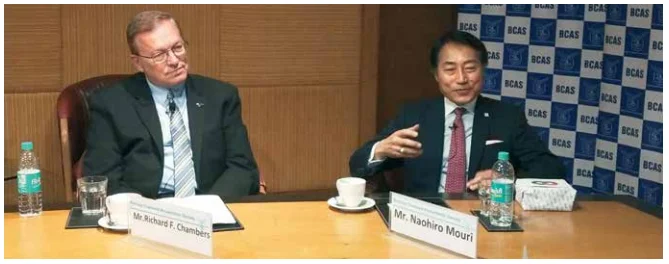
BCAJ interviewed Mr. Naohiro Mouri [NM], Chairman and Mr. Richard Chambers [RC], Gobal President & CEO of the Institute of Internal Auditors, USA (IIA). In the following pages we present excerpts from the full interview. The aim of the interview was to understand individual stories and experiences of these two professionals and also to get a perspective on the emerging global internal audit canvas.

In this interview Mouri San and Richard speak to BCAJ Editor Raman Jokhakar and Nandita Parekh about their life experiences, their understanding of the Internal Audit profession around the world, corporate failures and role of internal audit, rebranding internal audit, future competencies, millennial generation and the profession of internal audit.

If you can recall and share your early professional journey and share with us 2 or 3 career milestones/experiences that shaped you? What is it that made you commit to a career in Internal Auditing and what other options did you consider?

(NM): I did not originally want to become an internal auditor. I started as an external auditor. I studied accounting in school and my career path was to become a CPA and then getting into one of the external audit firms. I passed CPA, and I became an auditor with Arthur Andersen. I thought it was the greatest profession in the world. But, as the second year passed, I became senior. Come third year, I was feeling a little complacent.

I started looking outside and took an offer to become a controller of a French bank operating in Tokyo, to replace someone who was to retire. I had no prior banking experience. So I went in and the bank was gracious enough to put me through two months’ training across different parts of the bank such as trading, settlement, credit, finance and compliance, legal etc. After two months, my boss called me up and said, “Mouri, your training is about to finish. But, the gentleman who is supposed to retire, decided not to retire. You have two choices. You either have to leave the bank or you start the internal audit department”.

I was very happy doing what I was doing, I did not want to leave the bank. So, I decided to just become the internal auditor and that was actually the beginning of my internal audit career. It turned out that it was the best opportunity for me because internal audit is different in each and every engagement. I’ve changed organisations – from French Bank to German Bank to American Bank and now I’m in insurance. But I have always been in internal audit and it always just excites me every day coming into the office.

(RC): You asked for two or three kinds of milestones that then ended up shaping the course of my career. And so, what I’ll probably do is sort of fast forward.

I came out of college and went into internal audit 43 years ago. So I have been in this profession for a long time. I worked in the US government – I was an auditor for over 20 years for the army – civilian auditor of the US Army. Then I spent some time in the US Postal Service where I was a Deputy Inspector General and then the Inspector General of the state-owned company The Tennessee Valley Authority, which is the largest producer of electricity in the United States. And then I had the opportunity to retire rather young. I was 47 years, and I took a retirement, had an opportunity to do that because of some wrinkles in the law governing civil service employment in the United States. So that was a really important milestone because at that point, I had to decide what was I going to do with the rest of my life because while I retired, I knew it was really more of a career change.

The President of the IIA at that time was a gentleman named Bill Bishop, who was quite an icon in the history of the IIA and he convinced me that I come to Florida and work at the IIA sort of the equivalent of the Chief Operations Officer. First, I was a little reluctant because I thought, okay, I have been in government. I am not sure, I want to go into a not-for-profit Association. But he was very persuasive. So the next thing I knew, we packed up and moved to Florida and I joined the IIA. That was in the year 2001. Three years later, he passed away very suddenly. It was a sad time for IIA. But it was time for me to think about doing something different and so, I took a reverse career path. Most people come out of college with an accounting degree like Mouri and they go into the public accounting field and then maybe later, they do internal audit. I spent my life doing internal audit and then, when I was 50 years old, I joined PwC. I spent five years with PwC in the United States and became the national practice leader for internal audit advisory services which was part of the internal audit practice that PwC had. So, that was the second milestone.

And then the third one was, at the end of my time at PwC, the IIA Board asked me to come back as the CEO; that was 10 years ago. So, I was back in the role of being a leader in this profession along with our Chairman. I served as a spokesman for IIA and a champion for internal audit in the world. So those are three milestones that just sort of jumped out at me, that sort of say – how did I get from there to here.

Richard, this questions is for you. You have been a prolific writer, speaker, two books, blogs for eight – nine years now, videos. How did you develop this art of communicating and being, sort of, the cheerleader for the profession of internal audit? And, being so disciplined to be able to publish week after week.

(RC): Actually, next month will be the 10th year that we put in the blog. So it’s been quite a journey. The last time I looked, we were already over 400 blogs since we started. When I wrote that first blog in February of 2009, I remember it was about the crisis, the impact of the financial crisis on internal audit. And I don’t think, I said then to myself, I am doing something that I will be doing for the next decade. But what I found was that members of our profession around the world starve for very contemporary, informal, short, digestible perspectives on things that are going on… Last year, I think, the blog was read more than 250,000 times. So it is an important way to communicate in the 21st century and then if you take the blog and leverage on social media, it has a wide reach and readership.

The books, I don’t know that I really ever expected I will write a book.

But way back in 2013, the Internal Audit Foundation, our publishing arm, came to me and said, you know, your blogs have been very popular, why don’t you share some perspectives via a book. I thought, I don’t know what I have to really share? But then, I started thinking that I have the privilege of being in this profession for 40 years. I started thinking what really I have to do, is a sort of package of these major lessons I have learnt in the course of 40 years into a book. We called it Lessons Learned on the Audit Trail. We published it and that is a very popular book. Then a couple of years later, the Internal Audit Foundation sensing that the first book had gone really well, came back and said “Would you write another book” and that is how this one – the second book, the Trusted Advisors book came about. I really sort of picked up where the first book left off (because I concluded “Lessons Learned on the Audit Trail” by talking about what does it take to be a Trusted Advisor in the 21st century).

After the book “Lessons Learned on the Audit Trail” was published, I really started reflecting and I thought that I had over-simplified the message about what does it take to be a Trusted Advisor. So we went back, we did some research, we gathered perspectives from Chief Audit Executives around the world and then we put this second book together “Trusted Advisors”, which was even more popular than the first.

We are now in the process of refreshing the first book “The Lessons Learned on the Audit Trail” because the last five years have taught us a lot about the speed of risk and how risk dynamics can change everything that an internal auditor needs to focus on. So the title of the refreshed edition is the Speed of Risk: Lessons on the Audit Trail. So we go back and we talk about some of those lessons that we explored in the first book and we overlay on it the impact that a dynamic risk environment has. We talk about auditing culture, we talk about the importance of innovation and how do you audit. It has been in process. That book will be out in March 2019.

The image of an internal auditor is often perceived to be uninspiring. How do you feel this image that people perceive should undergo a makeover? Is there anything that’s happening in this direction?

(RC): Oh! I think it starts with those of us in the profession. You know, like every profession, there probably are stereotypes about internal audit. But again, you can go to a lot of companies and they don’t see those stereotypes at all because their internal audit is alive, it’s vibrant, it’s dynamic, gets involved, engaged in all the key risks of the organisation. So I think, it’s up to each one of us in this profession worldwide, to make this profession not only meaningful for us but to be able to convey what the potential and the opportunity is, so that our boards and management and even the people in the organisation who are audited, begin to appreciate what internal audit really is. It has evolved, it’s gone beyond the bean counting. I say in the 21st century, we have to know how to do more than count the beans. We have to know how they’re marketed, how they’re grown, how they’re harvested, how they’re marketed, to know everything about the life cycle of beans. We have to know how they’re marketed, how they’re grown, how they’re harvested, to know everything about the life cycle of beans. And we have to be able to convey that in a way that gets people excited.

So, related to this, is a question – Does the name “internal auditor” do any disservice to the profession because there is a connotation of an auditor primarily being an accountant? The impression is that internal auditors are an extension of the accounting profession. There have been attempts to rename the profession as risk advisors or risk professionals or GRC professionals. Any views that you have – what is there in a name or how does it matter?

(NM): I have my personal view on this originally. To me, the name convention doesn’t really matter. What matters is what we do. Even if you are called internal auditor, if you are actually being very innovative, if you are providing value to your board or the committee in the senior management, doesn’t really matter to them. I have seen different name conventions like management reviews, the audit and risk reviews and different connotations. But you know, at the end of the day, if you are actually doing what is considered as bean counting, as opposed to helping the business, protecting the organisation, being strategic, being innovative, trying to do more with less, they will actually see it through, no matter how it’s called. So that’s just my opinion about the name convention.

(RC): I agree100%. I mean, you could change the name of an airline pilot to aircraft navigation engineer but it’s still an airline pilot, right? I think, what we really need to be doing is – we need to be focusing on what does it mean to be an internal auditor. You simply say, we are going to rebrand what we do, not rebrand who we are. But we are going to elevate the level of service that we provide. So I would like to think where we are going to be the Apple of the future.

Coming to internal audit, unlike in statutory audit or an external audit, there is no legal mandate to have an internal audit. Do you think this is an impediment to the work of an internal auditor? Should there be legal force given to the position of an internal auditor?

(RC): IIA has taken the position and I happen to personally agree strongly with that, that licensing of internal auditors, somehow creating a licensed profession, is not really in the best interest of the organisations. We very rarely find any statutes or regulations that license the person who’s the CFO in the organisation or license the other professionals, Chief Risk Officer and others. Organisations, particularly publicly traded organisations or corporations, I think should be free to decide how to manage their affairs, without the long arm of government reaching in and saying – No, here’s what you have to do – here are the credentials or the skills or the qualifications. Now, we were very big proponent of listing agencies, stock exchanges, and others saying – if you’re going to be traded on an exchange, you need to have an internal audit function. I don’t think we have a problem, even seeing government regulations saying that organisations and companies should have an internal audit function. But it’s getting into it, it’s sort of mandating, who can do it and who can’t and what qualifications and credentials, because I have seen how that gets stuck in the past. If we had something like that 20 years ago, it would be mandating that in order to be internal auditors, you have to be accountants and yet today, only a fraction of what internal audit does, has any relationship to accounting. So I think, the profession needs to be live and to evolve and companies should be free to decide how they’re going to resource it.

(NM): Internal audit is a management tool to self-regulate itself, self-correct itself, find the problem by your own and correct it so that companies’ sustainability is maintained. It is a wonderful training ground for anyone who actually wants to learn about organisations – how they make money, how they lose money, what is the control that needs to actually exist. So, a number of companies use internal audit to actually put people in for training for few years and put them back to the business, to take more senior level roles. Such free flow of people is important for internal audit and for the organisation.

You know, as the world around us is changing, the competencies and skill sets that internal auditors need to own has changed tremendously. So, what are the few things that the future internal auditor must add to his bucket of competencies, to remain relevant. I am talking of survival, I am not even talking of success.

(NM): So, future is now already and this is one of the Richard’s comments. I took it from his slide. But not just the internet, now everything is on smart phone. No one goes to the bank branch anymore. Banking transactions to travel booking to buying insurance, everything is done by phone and laptop! How do we actually deal with this situation as an internal auditor?

First, you have to be extraordinary and able to work across the organisation. Earlier, there were IT auditors (called EDP auditors) and Business Auditors and Financial Auditors within internal Audit. Now the lines have been blurred because there is no process existing without technology. Thus, today’s internal auditor needs to operate across all areas, technology being an important skill to have.

Facilitation skills, because audit is all about Listening, Thinking, and Communicating. So, you have to really facilitate the conversation that goes on. And in many organisations, once you start to incorporate self-assessment process as part of the audit process, you have to facilitate the discussion. When you talk about the agile process, the scrum meeting – you have to actually chair the scrum meeting and bring the information now from your auditee or risk management or compliance, legal, finance. All this actually helps to make the internal audit better, right? So that is the second characteristic or the skills you need to have – facilitation skills.

And finally, analytical ability of course, to think in-depth about what is the root cause of the problem? Why is it happening? Because if you don’t actually get the root cause right and if you just remediate superficially, the problem will come back. We don’t want that to happen because we actually embrace remediation. We need to kill that root cause and then move on. So those three things that I would actually think, that’s really the skill sets necessary,

(RC): I speak a lot these days about the importance of internal auditors being able to provide foresight. The profession, the origins of internal audit was totally behind – in the past. What happened last year? Were the records maintained correctly? Were controls adequate? But it was in the past.

Then as the profession evolved, we became more adept at talking about the present. Okay. Here are things that we see now, that need to be corrected. But as I look to the future, we are really going to have to be able to look to the future because the things that happened yesterday are yesterday, they’re not the things that we seek. I spoke earlier this week and I said, you know, you seek out experts for the future, not for the past. So I think, internal auditors as a profession and as individuals are going to have to become much more adept looking forward. We speak a lot about what are the threats that artificial intelligence presents to our profession. I often say, if you’re only providing hindsight, that’s something artificial intelligence can easily do. If you are only providing hindsight and insight, you are still likely threatened by artificial intelligence and some of the other technology that’s coming. The things that will make it more difficult for you to be disintermediated, are your ability to leverage your professional knowledge, your professional judgment and to give the organisation perspectives about what the future holds.

This question is about recent corporate failures and the role of internal audit. Couple of lessons that both of you may want to share for the internal auditors, seeing what has happened in the UK, in Europe, and of course, America, and closer home to IL&FS in India – Anything that internal auditors need to wake up to and learn from?

(RC): I shared my message this week and I talk about it a lot. The five scariest words in the English language are “where were the internal auditors?” And it almost always comes when there’s a major scandal or collapse or calamity. It may have nothing to do with the internal auditors. But somebody will ask a question and say, well, where were the internal persons?

First of all, I would say internal auditors can audit anything, but they cannot audit everything. Okay? So we always need to keep that in mind that it is perfectly plausible that a big collapse or scandal or fraud can occur. That internal audit was focusing on all the right things and just didn’t see it. I mean, we cannot audit everything unless you’re willing to give us thousands of people. Study after study has been done looking at what contributes what, which risks are the most lethal when it comes to shareholder value. It’s not financial risk. People think, Oh! well – financial reporting fraud is what kills companies. It’s not compliance risks. Those risks together account for fewer than 20% of decline in shareholder value. It is strategic risks, it is business risks, sometimes even operational risks. it is companies that don’t see what’s coming ahead. And that is where I think, get back to internal audit, being there to help the management identify what are the things that could cause the failures and the calamities to occur. Now, some of the examples you find in Europe and others elsewhere. Some of those were compliance failures, some of those were frauds that occurred. But you know what, if you look deep enough, you’re going to find that it was culture, it was culture in the organisation. It was culture in the organisation that caused the compliance failures or the fraud or all the other things that took the company down. The compliance failure or the financial reporting fraud was symptomatic of a bigger issue. And that’s where internal audit always has to have insight.

There is a lot of talk about engaging with the millennials, the younger minds. As a profession, how would we attract the most creative, the most difficult to engage with talent within the profession?

(NM): Please watch my video, it is for you millennials. Because we were trying to make it very simple, trying to relate to building the career by using the analogy of constructing the building. So, it was actually, essentially targeting for millennials, to really understand the concept of, how important the standards are, how important that certification programme is, in what sort of thing that internal auditors do? So, please watch my video.

(RC): In the interest of time, let me just say, we over-analyse sometimes what differentiates generations. I think, millennials are a lot more like baby boomers of my generation than they are different. I think, we have a lot of the same kinds of the interests. I can tell you, we were very ambitious too. When I was a young adult, people of my generation felt like we should own the world. I think, that’s a natural kind of phenomenon. One of my daughters falls into that millennial category. These are people that are motivated by a purpose. They don’t just want a job for money, they want a purpose. There’s no greater opportunity to serve a purpose than to be an internal auditor and to exercise your craft to make things better. So I think, millennials will be attracted and are being attracted to internal audit. And I think that’s something we will continue to work on.

(You can see the unedited interview on the BCAS You Tube channel.)

THE LIGHT ELEMENTS

Always India

Saffron, white and green,

What does it, to you, mean?

You must be proud,

Shout out aloud,

Ye Indians arise,

Let’s reach for the skies

All you gals
and guys! 

There will always be an India,

While there are village lanes,

Wherever there are grazing deer

Or noisy,
jam-packed trains!

There will always be an India,

While there’s a crowded street;

Wherever there’s a saint and seer

Or dirt and dust
and heat!

We shall, ere long, have an India,

Where all can read and write;

Let’s vow to lead them, now and here,

From darkness
into light!

Let’s look forward to an India,

Where drunkenness is past;

Gulp down your fruit-juice, not your beer

To break your
morning fast!

Very soon, we’ll have an India,

Where the people are well fed;

Bidding goodbye to yesteryear:

With none hungry
to bed!

There will, one day, be an India,

Where disease is abolished, and,

right from the womb to the bier,

its nationals
well nourished!

One day, we shall have an India,

Which is aglow with health,

Where no one has any idea

Of an untimely
death!

There will always be an India,

Her people well clad and shod;

In all their doings, most sincere

Protect them all,
dear God!

There will always be an India,

Where oppression is dead;

Where the people laugh, from ear to ear,

With a roof above their head!

Before long, we’ll have an India,

Where unemployment’s gone;

With factories working in top gear,

And fields
bursting with corn!


We’ll, very soon have an India,

Where discipline pervades;

There’s something in the atmosphere,

So that
lawlessness fades!


There will, one day, be an India,

Where lawbreaking’s outlawed;

No doubt, it does sound very queer,

So, help us all,
oh Lord!


There will always be an India,

Democratic to the core;

Of tolerance the pioneer

 And for all, an open door!


At all times, we’ll have an India,

Secular in each pore,

Outshouting the communal jeer

With an almighty
roar!


There will always be an India,

And India shall succeed;

With people, hailing from front and rear,

Of every caste
and creed!


There will always be an India,

United we’ll remain;

All communities will cohere

To seek their
common gain!


There will always be an India,

And harmony subsist;

No one can, at all, engineer

A conflict in its
midst!


There will always be an India,

Where amity shall reign;

Whether you are a mountaineer

Or living in the
plain!


There will always be, in India,

A pluralist structure,

From Kanyakumari to Kashmir

A well-blended culture!

There will always be, in India,

Different ethnic groups composed,

Ever ready to Volunteer

To Share Each other’s woes!


There will always be an India,

Cosmopolitan in mould;

But, all throughout, you’ll overhear:

“We’re one in the national goal!”


There will always be an India,

Non-violent we shall stay;

A quality we will revere

Along life’s crowded way!


May there, one day, be an India,

With poverty banished,

Where life has ceased, to be severe,

And destitution vanished!


There will always be an India,

And India shall progress,

If we resolve, this very year,

To ban all strife and stress!


There will always be an India,

And India shall flourish;

With peace and plenty, far and near,

As much as you can wish!


We shall shortly have an India,

Sweet-smelling as a rose;

That scene will, very often, appear,

Where milk and honey flows!


There will, one day, be an India,

Where hard work is the norm;

We’ll show the whole world that we are

A people that can perform!


There will always be an India,

Where good faith counts a lot;

In work, you can’t be insincere

But give it all you’ve got!


There shall, ere long, be an India,

With waste down to zero;

Where he, who leads the life austere,

Is the nation’s real hero!


There will one day, be an India,

Where dues are paid on time;

No sum remaining in arrear

Right to the smallest dime!


Ere long, we shall have an India,

Where corruption’s absent,

Where payments made are not 2-tier

And everything upfront!

There will always be an India,

Where charters we have signed

That, to principles, we shall adhere

To benefit
mankind!


There will always be an India,

Where truth shall hold its sway,

A land where you’ll constantly hear:

“Satyam eve
jayate”!


There will always be an India,

With honesty at heart,

And nothing causing it to veer

From the straight
and narrow path!


There will always be an India,

Its integrity unstained;

Our honour we shall ne’er besmear,

But keep it well
sustained!


There will always be an India,

Its people, so simple and kind;

No sophisticated veneer

 And with no axe to grind!


There will always be an India,

Hospitably inclined;

E’en the poorest keen to feed ya

Though they
themselves haven’t dined!


There will always be, in India,

People generous to a fault,

Who , like Santa Claus’s reindeer,

Give gifts at
every halt!


There will always be an India,

With goodwill everywhere;

No mud, another’s face to smear

Just genuine,
heartfelt care!


There will always be an India,

Where joyousness you’ll find;

Where misery is just a mere

Invention of the
mind!


There will always be an India,

Where merriment abounds;

Where the people couldn’t be happier

And smiles
outnumber frowns!


There will always be an India,

Where human rights rank high,

Where none may treat them with a sneer:

All must, with
them, comply!


Reproduced from BCAJ, 2001   


DEBT OF GRATITUDE

We are profoundly grateful to the members of the Editorial Board for their long and consistent years of guidance and single-minded dedication. Editorial Board was first formed in 1990. It consists of past editors and committed contributors. The Board deals with policy matters and serves as a brainstorming platform and a sounding board for the Editor. The Board also gives valuable critique to ensure that the Journal runs on basic principles and yet evolves with time.

Kishor B. Karia

Member since
November, 1990
till date

Ashok K. Dhere

Member since
November, 1990
till date

Kahan Chand Narang

Member since
August, 2000
till date

Gautam S. Nayak Member since
August, 2003 till date

Sanjeev R. Pandit

Member since
August, 2004 to
July, 2006 &
August, 2007 till date

Anil J. Sathe

Member since
August, 2004 to
July, 2009 &
August, 2011 till date

Anup P. Shah

Member since
August, 2008

Raman H. Jokhakar

Editor
Member since
August, 2016

Pooja Punjabi

Convenor of Journal Committee

Namrata Dedhia

Convenor of Journal Committee

Akshata Kapadia

Convenor of Journal Committee

Sunil B. Gabhawalla

Ex Officio

Manish Sampat

Ex Officio

BCAJ FEATURES

Features are the bedrock of the BCAJ. Some features report
and digest. Some others explain and analyse. Some provide inspiration or probe
unfairness in laws. The following list gives the statistics of continuing
features that are more than five years old:


Feature

Started in the Year

Number of years

1

Tribunal
News

1969-70

50

2

In
the High Courts

1971–72

48

3

From
Published Accounts

1980-81

39

4

Controversies

1981-82

38

5

Closements

1982-83

37

6

Miscellanea

1984-85

35

7

Is
It Fair

1996-97

23

8

Allied
Laws

1996-97

23

9

International
Taxation

1997-98

22

10

Corporate
Law Corner

1988-89 to 2006 &

2015-16 till date

18

4

11

Glimpses
of Supreme Court Rulings

2001-02

18

12

Ind
AS / IGAAP – Interpretation & Practical Application

2001-02

18

13

Light
Elements

1995-96 to 2004

2006-07 to 2012

2014-15

2017 till date

9

6

1

2

14

Laws
& Business

2002-03

17

15

Namaskaar

2002-03

17

16

Right
to Information

2004-05

15

17

Securities
Laws

2006-07

13

18

VAT
(Sales Tax Corner)

1995-96

24

19

Indirect
Taxes – Recent Decisions

2009-10

10

20

Ethics
& You

2012-13

7


LANRUOJ TNATNUOCCA DERETRAHC YABMOB EHT (JACB)

SPECIAL EDITORIAL

We bring you a special edition of the JACB journal.
The January, 2019 editorial carried these words of wisdom:

“Friends, the word of the year declared by two prominent dictionaries recently gives it away: Toxic and Misinformation. Both words articulate the stark realities of our times ….”.

This feature is based on the above theme.

If you have any comments/views on this feature please feel free to draft a mail to us, and keep it in your draft folder. Even if you send it, it makes no difference. To quote George Bernard Shaw, “The single biggest problem in communication is the illusion that it has taken place”.

Happy Golden Jubilee reading!
*ditor

*E Edited

GOLDEN CONTENTS AND ITS ECONOMIC IMPACT – EXTRACTS FROM WHITE PAPER

JACB brought to its esteemed readers Golden Contents over the course of the last twelve months to commemorate its golden jubilee. We have been overwhelmed with the responses received thereby encouraging us to come out with a white paper. We provide below extracts from the white paper that will shortly be published in full in resplendent colors. You may place orders for the same at
your own risk.

Abstract of White Paper – “Golden Contents and Its Economic Impact”

Introduction

Economic development is understood in many different ways but it is clear that there has always been a close correlation and vital linkage between human endeavor and civilisation’s economic relationships.

Golden Contents and Its Direct and Indirect Impacts

  • Cost Effective

No making charges on golden content

  • Economic Impact

Since the golden content cannot be used as a collateral to raise high-cost loans, subscribers have benefited significantly by not paying huge interest costs on such non-availed loans. There is significant social benefit too since these non-availed funds can now be utilised by banks to provide loans to critical sectors of the economy.
This in turn leads to economy, efficiency and transparency in functioning of our financial institutions and markets and reinforces investor confidence, thereby reducing the cost of capital and boosting private consumption expenditure and private investment positively impacting economic growth rates.This is expected to add 50 basis points to the economy’s GDP growth rate on a secular basis over the next 5 years. Tax revenues are also expected to increase marginally, in line with the contributory increase to GDP.

Conclusion

The velocity of an economy is limited by the speed at which innovation can take place. The Golden Contents, a path-breaking innovation, is expected to propel the economy towards its potential growth trajectory.

QUOTE OF THE MONTH

FROM THE DESK OF THE PRESIDENT

Subscribers to our JACB journal receive mailers “From the Desk of the President” much before they get to see the printed version of it in the journal. Readers have all along been eager to know what exactly is in that desk.
What we got from the desk of the President:

  • Old calculator (not functioning).
  • A blue ballpoint pen (functioning).
  • Income tax ready reckoner (AY 1987-88).
  • JACB journal (April, 2001 without front cover).
  • Old spectacle case of a former president.
    (sd/- Forensic auditors)

KNOW YOUR JOURNAL

The BCA Journal is also available in two formats, offering twin benefits.

GOLDEN CONTENT INTERVIEW: EMINENT PERSONALITY, YOUNGEST CA

JACB: Tell us a bit about yourself.

MM: I am CA Mutandis…..Mutatis Mutandis. Youngest CA. 83 years old.

JACB: How do you see the profession developing?

MM: Nemo debet esse judex in propria qusa. (No one can be a judge in his own cause)

JACB: Huh! Could you please share your views on ethics in profession?

MM: Ubi jus, ibi officium (Where there is a right, there is also a duty)

JACB: What are your views on usage of fair values in financial reporting?

MM: Nemo tenetur ad impossible. (No one is required to do what is impossible)

JACB: Sir, your responses using legal maxims makes it very difficult for me to understand. Since when did you get into this habit?

MM: Ab initio.

JACB: I do not understand what you are saying sir.

MM: Ignorantia legis jurisneminem excusat.

JACB: ***&%…..How long do you think we can go on like this?

MM: Ceteres paribus, in praesenti.

JACB: I better close this, Sir. Thank you very much for sparing your valuable time. In closing could you explain in plain English how you claim to be the youngest CA when you are claiming super senior citizen tax benefits.

MM: I cleared yesterday…. CA Results were announced yesterday you see.

TAX PLANNING – HOW TO SAVE TAXES (INDIVIDUAL ASSESSEES)

  • Resign from high-paying job and one saves taxes on income under the head salaries. The tax savings will be on monthly fixed salary, bonuses, perquisites, as well as on stock options.
  • If one has a second house, demolish it (if it is say an apartment on the 14th floor, we do understand you have a challenge) that is self-occupied so that you do not pay tax on notional income. Note: Our sympathies are with those who took our advice and demolished their second home considering the interim budget proposals. But take heart, it is just an interim budget.
  • We have refrained from providing any inputs for Business income since we understand all have expertise in saving taxes under the income head of business and professional income.
  • Attend AGMs of companies where you hold shares and vociferously protest dividend payments and exercise your right to disapprove board-recommended dividends. You save dividend taxes at 10% if your dividend income was expected to be above threshold.

GLIMPSES FROM SUPREME COURT

In Camera – In this issue we bring you photographs shot from various angles from different perspectives and using drones that provide good glimpses from the Supreme Court.

*ditorial note: Glimpse photos not published since the matter is sub-judice.

NAMASKAAR

FROM UNPUBLISHED ACCOUNTS

Compilation From Notes
Basis of Preparation of Financial Statements

  • These financial statements are prepared in accordance with the whims and fancies of our management under the historical cost convention on accrual basis except for most transactions and events that are reported on a convenience accounting basis.

Use of Judgments and Assumptions

  • The preparation of financial statements in conformity with the applicable accounting framework requires management to make estimates, judgments and assumptions. Management has made an assumption that users of financial statements can easily be tricked into believing the contents of the financial statements.
  •  Management estimates used in the preparation of financial statements are aimed at underestimating expenses and liabilities and overestimating income and assets.

Disclosures

  • Included in land is a large parcel of land amounting to Rs. 14,000 crore measured using the revaluation model that actually belongs to our neighbouring company.
  • The fair valuation of our assets is based on stooping to levels that are lower than Level 3.
  • We have not disclosed many liabilities as well as contingent liabilities considering the material impact that it could have on our investors’ well-being and on the health of their investment portfolio.

NEW FEATURES THAT WE EXPECT TO INRODUCE SHORTLY IN YOUR JOURNAL

  • Birth Taxation
  • Inheritance Taxation
  • Inter-planetary Taxation
  • Internal audit of statutory audit
  • Independence movement of Independent Directors
  • And more!!!

JACB GOLDEN JUBILEE SPECIAL ANNOUNCEMENT

INDIAN BANKING: HOW BAD ASSETS WERE CREATED AND WHAT THE FUTURE HOLDS

The CEOs of
India’s debt-laden state-owned banks probably celebrated Christmas ahead of its
arrival in December – after an extremely stressful year, relentlessly chasing
rogue corporate borrowers for recovery of the monies lent. Finance Minister
Arun Jaitley played Santa Claus for them by seeking Parliament’s approval for Rs.
410 billion capital infusion in these banks.


The government
had budgeted for Rs. 650 billion fund infusion during the current year, of
which Rs. 420 billion is still to be allotted. This means, Rs. 830 billion will
flow into the public sector banks (PSBs), taking the total sum to Rs. 1.06
trillion by March, 2019.


In October,
2017, the government had announced a staggering Rs. 2.11 trillion capital
infusion in phases into PSBs that have little less than 70% share of the assets
of the Indian banking industry. The new package, for which Parliament’s nod has
been sought, is part of that.


Incidentally,
between 1985-86 and 2016-17, in little over a decade, the government had
injected Rs. 1.5 trillion into these banks; the bulk of this flowed in since
the global financial crisis of 2008, triggered by the collapse of the iconic US
investment bank Lehman Brothers Holding Inc.


To ward off the
impact of the crisis, the Reserve Bank of India (RBI) flooded the banking
system with money and brought down the policy rate to a historic low, less than
the savings bank rate which was regulated then. With too much money, coupled
with pressure from various quarters to lift consumption, banks lent recklessly
and that led to the creation of bad assets.


IS THE SCENE GETTING BETTER?


In September,
2018, after the annual ritual of a review meeting with the chiefs of PSBs,
Jaitley said that non-performing assets (NPAs) with these banks were on the
decline and Rs.1.8 trillion worth of recovery of bad loans could happen during
fiscal year 2019.


According to
him, in the first quarter of the year (April-June, 2018), the lenders recovered
Rs. 365.5 billion. This is 49% higher than the corresponding quarter of the previous
year. During the entire 2018 fiscal year, banks recovered Rs. 745.6 billion.
“It’s still early days of the IBC (Insolvency and Bankruptcy Code), but already
the impact is clearly visible,” Jaitley said.


He also said
that the NPAs with the PSBs were declining.
“The last quarter saw PSU banks with a net profit. On the basis of the
last quarter and what their expectations are looking ahead, the good news is
that NPAs are on the decline because recoveries have picked up.”


Indeed, the
recovery of bad loans at PSBs gained momentum in the June, 2018 quarter; their
operating profits rose and the overall asset quality improved. Besides, the
provision coverage ratio of these banks has gone up to 63.8%, he pointed out.


The listed
banks’ kitty of gross NPAs dropped marginally—a little more than 2% from
Rs.10.25 trillion in March to Rs. 10.03 trillion in June. For PSBs, the drop is
2.5%, from Rs. 8.97 trillion to Rs. 8.74 trillion. In September, it dropped
further – Rs. 8.69 trillion.


Clearly, the
pace of fresh slippage has slowed. Aided by provision and aggressive
write-offs, the net NPAs of all listed banks have dropped a little over 6%,
from Rs. 5.18 trillion to Rs. 4.85 trillion in June and Rs. 4.83 trillion in
September.


Incidentally,
the PSBs’ share in bad loans is far higher than their share in banking assets.


All these data
say that things are getting better, but a closer look at some of the banks’ bad
loan pile-ups clearly signal that the party time has not arrived as yet.


Let us take a
look at some individual banks. Twelve of the 21 PSBs were in losses in
September, 2018. Among them, IDBI Bank posted loss in 10 of the past 12
quarters, since December, 2015 (when the NPAs of the banking system started
rising following the RBI intervention), to the tune of Rs. 236 billion. The
trio of Indian Overseas Bank, Central Bank of India and Uco Bank have made losses in all 12
quarters (collectively, Rs. 375 billion). Dena Bank and Bank of Maharashtra
seem better off – they have recorded losses in 11 quarters (Rs. 94 billion).


Overall, during
this period, the PSBs recorded Rs. 1.84 trillion losses, around 1.2% of India’s
GDP. This also exceeds the total capital infusion in 31 years between 1986 and
2017, one-third of which — Rs. 500 billion — flowed in 2016 and 2017. By the
December quarter, the losses will probably exceed the big bang recap of Rs. 2.1
trillion.


Four PSBs’
advance portfolios declined in the September quarter compared with June and, if
we compare them with a year-ago period, as many as 11 of them have shrunk their
loan books. For two of them, the drop is as much as 10% or more. Similarly for
PSBs, the deposit kitties shrank in the September quarter compared with June;
if we compare them with the year-ago period, then seven banks have shrunk their
deposit portfolios. The RBI restrictions do not impact deposit mobilisation.


Finally, six
banks’ gross NPAs surged in September from the June level. Ditto about five
banks’ net NPAs. In September, at least one bank (IDBI Bank) had more than 30%
gross NPAs and another five (Uco
Bank, Indian Overseas Bank, Dena Bank, United Bank, Central Bank) more than 20%
but less than 25%, even as six banks had more than 15% gross NPAs. When it
comes to net NPAs, nine of them had more than 10% and up to 17.3%; for a few of
them the asset quality deteriorated further in September.


THE NPA SAGA


The NPA saga
started in 2014 but gained momentum in 2016 after the Reserve Bank of India
(RBI), under former Governor Raghuram Rajan, instituted an asset quality review
(AQR) whereby the inspectors of the Central bank audited the banks’ loan books
and identified bad assets. The exercise was completed in October, 2015 and the
banks were directed to come clean in six quarters between December, 2015 and
March, 2017.


In a detailed presentation
to a Parliamentary Committee, Rajan has explained what went wrong in the Indian
banking system.


According to
him, a larger number of bad loans originated in 2006-2008 when the Indian
economy grew at over 9% for three years in a row. “This is the historic
phenomenon of irrational exuberance, common across countries at such a phase in
the cycle.”


In the
aftermath of the collapse of Lehman Brothers, the world witnessed an
unprecedented liquidity crisis and India too could not escape the fallout. The
strong demand projections for various projects started looking increasingly
unrealistic as domestic demand slowed down.


Around the same
time, a variety of governance problems, such as the suspect allocation of coal
mines coupled with the fear of investigation, slowed down the government
decision-making. As a result of this, cost overruns escalated for stalled
projects and they became increasingly unable to service debt.


And, once the
projects got delayed to the extent that the promoters had little equity left in
the project, they lost interest. “Ideally, projects should be restructured at
such times, with banks writing down bad debt that is uncollectable, and
promoters bringing in more equity, under the threat that they would otherwise
lose their project. Unfortunately, until the Bankruptcy Code was enacted,
bankers had little ability to threaten promoters, even incompetent or
unscrupulous ones,” Rajan has said.


He has also
mentioned that unscrupulous promoters who had inflated the cost of capital equipment
through over-invoicing were rarely checked and the PSBs continued financing
promoters even as the private sector banks were getting out. Finally, too many
loans were made to well-connected promoters who had a history of defaulting on
their loans.


What Rajan has
not mentioned is that most Indian banks do not have the expertise for project
financing. Till the late 1990s when RBI pulled down the walls between
commercial banks and development financial institutions (DFIs) and the DFIs
were allowed to die while the commercial banks turned themselves into universal
banks, these banks were primarily into financing the working capital needs of
corporations. They got into term lending after the demise of DFIs but never
acquired the expertise to do so.


Do all these
banks know how to lend? Had they known, they would not be in such a mess.
Typically, the PSB bosses blame the state of the economy for the rise in bad
loans but this is not convincing as the private banks too
operate in the same milieu and many of them have far better asset quality.


BANK RECAPITALISATION


Officially, the
government does not want to treat this as a dole. Both the government and the
RBI seem to be keen that banking reforms and recapitalisation must go
hand-in-hand. In other words, the taxpayers’ money will not be continuously
pumped in just to keep PSBs alive.


To put the
story of bank recapitalisation in context, capital is core to banks for
expanding credit, earning interest and growing their balance sheets so that
they can drive economic activities. The government is the majority owner of
PSBs in India. The statutory requirement in the Banking Companies (Acquisition
and Transfer of Undertakings) Act, 1970/1980, and the State Bank of India Act,
1955, ensure that the Indian government shall, at all times, hold not less than
51% of the paid-up capital in such banks.


In 2010, the
Cabinet Committee on Economic Affairs (CCEA), after taking into account the
trends of the economy, had decided to raise government holding in all PSBs to
58%. The objective was to create a headroom and enable PSBs to raise capital
from the market when they need it, without compromising their public sector
character.


Subsequently,
in December, 2014, the CCEA decided to allow PSBs to raise capital from the public
markets through instruments such as follow-on public offer or qualified
institutional placement by diluting the government holding up to 52%, in a
phased manner.


The regulatory
requirements of capital adequacy and credit growth are the two main drivers for
bank capitalisation. The regulatory architecture is globally framed by the
Basel Committee on Banking Supervision — a committee of bank supervisors
consisting of members from representative countries. Its mandate is to
strengthen the regulation, supervision and practices of banks and enhance
financial stability.


So far, three
sets of Basel norms have been issued. The Basel I norms were issued in 1988 to
provide, for the first time, a global standard on the regulatory capital
requirements for banks. The Basel II norms, introduced in 2004, further
strengthened the guidelines for risk management and disclosure requirements.


This called for
a minimum capital adequacy ratio (CAR) — or, capital to risk-weighted assets
ratio (CRAR) as it is the ratio of regulatory capital funds to risk-weighted
assets — which all banks with an international presence are to maintain. These
norms were revisited again in 2010 — known as Basel III norms — in the wake of
the sub-prime crisis and large-scale bank failures in the US and Europe. Basel
III emphasised on capital adequacy to protect shareholders’ and customers’
risks and set norms for Tier I and Tier II capital.


The capital can
come either from their dominant shareholder (the government of India) or the
capital market. The PSBs’ underperformance and the pile of bad loans leading to
low book value come in the way of accessing the capital market. There is a
significant gap between the book value and market value of PSB shares, with
most PSBs having a lower market value, compared with their book values. Hence,
the government as the majority stakeholder needs to step in to rescue PSBs.


THE FUTURE TRAJECTORY


How long will
it take for the Indian banks to bring down their NPAs? The December, 2017
Financial Stability Report of the RBI, a bi-annual reality check of the Indian
financial system, had suggested that the gross NPAs in the Indian banking
system may rise from 10.2% in September, 2017 to 10.8% in March, 2018, and an
even higher 11.1% by September, 2018. The actual bad loan figure of March, 2018
was higher than the estimate.


And the June,
2018 Financial Stability Report said the gross NPAs may rise from 11.6 % in
March, 2018 to 12.2% by March, 2019. Besides, the system-level
capital-to-risk-weighted assets ratio (CRAR) may come down from 13.5% to 12.8%
during the period; 11 public sector banks under prompt corrective action
framework may experience a worsening of their gross NPA ratio from 21% in March
2018 to 22.3% with six PSBs likely experiencing capital shortfall relative to
the required minimum CRAR of 9%.


The AQR is just
the beginning of the RBI actions to unearth the mound of NPAs. At the next
stage, the Central bank took a series of steps to force the banks to chase the
defaulters for recovery as well as punish the banks for not doing enough to
clean up their balance sheets.


MORE DISCLOSURES


In April, 2017, an RBI notification
said, “There have been instances of material divergences in banks’ asset
classification and provisioning from the RBI norms, thereby leading to the
published financial statements not depicting a true and fair view of the
financial position of the bank.” The regulator advised the banks to make
adequate disclosures of such divergences in the notes to accounts in their
annual financial statements.


RBI inspectors
found these when they took a close look at the loan books of all banks while
carrying out the asset quality review in 2015.


Under the
regulatory norms, when a borrower is not able to service a loan for three
months, it becomes an NPA and the lender needs to set aside money or provide
for it. However, there could be divergence as under certain circumstances, one
can take a “view” on whether a particular loan is good or bad. For instance,
when the principal or interest payment for a particular loan is overdue between
61 and 90 days (and not exceeding 90 days), this becomes a special mention
account-2 ( SMA-2). If a loan exposure continues to be in this category for
months, a prudent banker would prefer to classify it as an NPA even though
technically it can continue to be treated as a standard asset.


Then, there are complexities for some of the
restructured infrastructure loans. There have been cases where banks have given
the borrowers more time, depending on the date of commencement of commercial
operations. Many such loans have been restructured twice and continue to be
tagged as standard assets in banks’ books. Often, the date of commencement of
commercial operations is subject to interpretation and the RBI may not be
comfortable with such cases.


While
conducting the AQR, RBI inspectors had found many instances of the same loan
exposure being classified as bad by one bank but good by another.


The annual
reports of quite a few banks in the past two years showed “divergence” or a
difference – which in some cases was quite huge – between the lender’s
assessment of bad loans and that of the RBI. As a result of this divergence,
the difference in provisioning is also stark and banks have shown lesser NPAs
than what the RBI assessment had suggested. In other words, had there been no
divergence, these banks would have shown lesser profit and higher NPAs.


Subsequently,
in May, 2017, the RBI was empowered through an Ordinance to issue directions to
banks to initiate insolvency proceedings against borrowers for resolution of
stressed assets. The Banking Regulation (Amendment) Ordinance, 2017 was
promulgated on 4th May, 2017. This Ordinance empowered the RBI to
direct banking companies to initiate insolvency proceedings in respect of a
default under the provisions of the Insolvency and Bankruptcy Code, 2016 (IBC).
It also enabled the RBI to constitute committee/s to advise banking companies
on resolution of stressed assets.


Armed with the
Ordinance, the Central bank in June, 2017 asked banks to initiate insolvency
proceedings against 12 large bank defaulters with a total debt of over Rs. 2
trillion, around 25% of the banking system’s bad assets at that time.


It followed
this up in August, 2017 by sending a second list of 28 defaulters to the
lenders to initiate debt resolution before December 13, failing which these
cases would have to be sent to the National Company Law Tribunal (NCLT) before
December, 2017. Between them, these 40 loan accounts have roughly 40% share of
the Rs. 10 trillion bad assets in the Indian banking system.


THE FEBRUARY 2018 CIRCULAR


Finally, in February,
2018, the RBI tightened its rules on bank loan defaults, sought to push more
large defaulters towards bankruptcy courts and abolished all existing
loan-restructuring platforms. The objective was to speed up the process of
resolution of the bad loans.


The recovery
drive for the banking industry started with the Debts Recovery Tribunals
(DRTs), set up under the Recovery of Debts Due to Banks and Financial
Institutions (RDDBFI) Act, 1993. Almost a decade later, the Securitisation and
Reconstruction of Financial Assets and Enforcement of Security Interests
(SARFAESI) Act, 2002 came into force to help banks and financial institutions
enforce their security interests and recover dues. Still, the recovery did not
get momentum. For instance, in 2013-14 recovery under DRTs was Rs. 305.9
billion while the outstanding value of debt sought to be recovered was close to
Rs. 2.37 trillion.


The platforms
such as corporate debt restructuring (CDR), strategic debt restructuring (SDR)
and the scheme for sustainable structuring of stressed assets (S4A) which were
used to clean up the bank balance sheets were all abolished late night on 12th
February, 2018.


SDR, introduced
in June, 2015, gave banks the power to convert a part of their debt in stressed
companies into majority equity, but it didn’t work because promoters delayed
the restructuring, dangling the promise of bringing in new investors. Before
that, in February, 2014, RBI had allowed a change in management of stressed
companies. The principle of the restructuring exercise was that the
shareholders must bear the first loss and not the lenders; and the promoters
must have more skin in the game.


This was done
after the regulator realised that the CDR mechanism, put in place in August,
2001, could not do much to alleviate the pain of the lenders. Any loan exposure
of Rs. 10 crore and more (including non-fund limits) and involving at least two
lenders could have been tackled on this platform.


The S4A scheme
allowed the banks to convert up to half the loans of stressed companies into
equity or equity-like securities. Meant for restructuring companies with an
overall exposure of at least Rs. 500 crore, this scheme could come into play
only when the bankers were convinced that the cash flows of the stressed
companies were enough to service at least half of the funded liabilities or
“sustainable debt”. Not much, however, could get resolved under this scheme
either.


After ushering
in a new bankruptcy regime in 2016, the RBI got more powers in 2017 to force
the lenders to deal with 40 biggest corporate loan defaulters. The February,
2018 norms took the story forward.

The rules,
released on 12th February, stipulate that starting 1st
March, lenders must implement a resolution plan within 180 days for defaulted
loan accounts above Rs. 2,000 crore. Failing to do so, the account must be
referred to insolvency courts. They also mandate banks to report defaults
weekly to RBI, even if loan payments are delayed by a day. These norms replaced
earlier schemes such as strategic debt restructuring, 5/25 refinancing, the
Corporate Debt Restructuring Scheme, and the Scheme for Sustainable Structuring
of Stressed Assets, among others, with immediate effect. “All accounts,
including such accounts where any of the schemes have been invoked but not yet
implemented, shall be governed by the revised framework,” the RBI said.


It warned that
any failure on the part of banks to meet the prescribed timelines, or any
actions they take to conceal the actual status of accounts or evergreen
stressed accounts, will expose banks to stringent actions, including monetary
penalties.


The rules
around resolution plans were also tightened and restructuring of large accounts
with loans of Rs.100 crore or more would need independent credit evaluation by
credit rating agencies authorised by the Central bank. Loans of Rs. 500 crore
or more would need two such independent evaluators.


NO LONGER IN A DENIAL MODE


As a result of
the series of steps taken by the regulator, Indian banks are no longer in
denial mode. Indeed, in the past, they were slow in recognising bad assets as
such recognition hits their profitability since they need to provide for or set
aside money for NPAs. Which is why, traditionally, bankers try hard not to
allow any loan to slip into NPAs through various ways. But the relentless
pressure of the banking regulator has changed the scene. The bankers are not
taking any chances for any loan account any more. Once it’s gone bad, they are
swift in classifying it as an NPA and providing for it.


Once shy in
recognition and resolution of NPAs for fear of being hit on profitability and a
backlash from investors, bankers are now bold and walking the extra mile to
settle with loan defaulters. They don’t care much about the depth of the
haircut and impact on their balance sheets.


However, this
detoxification exercise has its own challenges through early recognition of
stressed assets and increased provisioning. To add to the banker’s woes,
frequent involvement by investigative agencies, arrests of a few bankers and
stripping the powers of a few others have created a fear psychosis. Bankers are
tending to opt for a relatively safer and optically transparent path, even at
the cost of recovery maximisation.

Today, the
impact of major economic reforms such as Demonetisation, GST, RERA has
stabilised and recognition of the bad loans has largely been done. We are
probably at the final stage of detoxification.


Though this
period has been mired by quite a few litigations, which were expected, IBC
being a new legislation, the message has been conveyed aptly to the corporate
world. The IBC has not only provided a legal framework to systematically
address the NPAs of the banking system with a strong armoury to lenders, but
also put borrowers who were looking for an easy escape route from the situation
on the back foot.


Japan, which
introduced the bankruptcy law in 2004, takes six months to settle a case and
the recovery rate is close to 93%. For UK, which introduced it in 2002, the
recovery rate is 88.6% and settlement within a year, while US, where insolvency
law is 40 years old, it takes 18 months to settle a case at a recovery rate of
80.4%. It’s still early days in India but the IBC has made a new beginning for
the banking system. With the recovery picking up, albeit slowly, the banks are
being encouraged to lend and support economic growth. The first signs of this
are already visible – the credit growth in India is at a four-year high.


The Story of Two Investors


Grace Groner was orphaned at age 12. She
never married. She never drove a car. She lived most of her life alone in a
one-bedroom house and worked her whole career as a secretary. She lived a
humble and quiet life. This made the $7 million she left to charity after her
death in 2010 at age 100, all the more confusing. People who knew her asked:
Where did Grace get all that money?

Grace took humble savings from a meager
salary and enjoyed eighty years of hands-off compounding in the stock market.
That was it.

Weeks
after Grace died, an unrelated investing story hit the news.


Richard Fuscone, former vice chairman of
Merrill Lynch declared personal bankruptcy, fighting off foreclosure on two
homes, one of which was nearly 20,000 square feet and had a $66,000 a month
mortgage. Fuscone was the opposite of Grace Groner; educated at Harvard and
University of Chicago, he became so successful in the investment industry that
he retired in his 40s to “pursue personal and charitable interests.” But heavy
borrowing and illiquid investments did him in. The same year Grace Groner left
a veritable fortune to charity, Richard filed for bankruptcy.

It
is the study of how people behave with money. And behaviour is hard to teach.


The Promise Of The New Economy

Computation power, networks and storage will affect investment area in a big way. The author discusses new platforms that will emerge in a decentralised model that will give birth to powerful new organisations. Siddharth, an IIM graduate, worked heading a equity derivates and algorithmic trading desk, but his life completely changed when he stayed at the Sabarmati Ashram for four years to find answers to some burning questions.

Blockchains and distributed ledger technology have had their share of hype. Bitcoin, Ethereum and cryptocurrencies have enjoyed the limelight, but what is their potential? While there are enough technical articles on how blockchains function, the true challenge lies in articulating their potential.

Simply put, these technologies allow us to maintain a distributed consensus for the ledger. As opposed to a centralised authority maintaining information, we can now do so in a distributed manner. What are the far reaching consequences of this for us? To answer this question, we need to grasp the context of the larger shift that is underway in technology. Blockchain technology, or distributed ledger technology is revolutionary in itself, but part of a much greater puzzle that is falling into place.

Think of the pieces of this puzzle as the holy trinity of technology. Computational power, networks and immutable storage.

Until the advent of the personal computer in the 1980’s, computing was restricted to large institutions due to sheer expense and access to resources. The average person barely caught a glimpse of a computer, let alone engaged with one. However, the computing revolution over the last three decades have allowed us all access to remarkable computational power with the swipe of a finger.

Networks were heavily centralised too, until the advent of the internet. In a world where a simple data connection allows us to broadcast to millions via smart phones, we have reduced our dependence on centralised broadcasting technologies like the printing press, television and radio stations.

There is no doubt that we have all benefited from revolutions like personal computing and the internet. However, we are yet to see their full power manifest. It could be argued that we are on the verge of the last piece of the holy trinity falling into place i.e. immutable storage.

By immutable storage, we mean the ability to store data of any kind without risk of it being lost, deleted or tampered with, unless mandated by a set of rules. In the past we have had to rely on large institutions to store this data for us. For example, governments for holding our land/ birth records, banks holding our financial information, or even large institutions like Facebook or other cloud hosting services holding our intimate information for social networks and apps.

However, several moments in the past few years have exacerbated the need to move to newer models of storing our information. The 2008 crisis called to light our over-dependence on Wall Street banks, while the Cambridge Analytica fiasco at Facebook showed us how misuse of our data can have disastrous impact. Back in India, the problem of fake news is posing new kinds of threats to us – from attacking mobs motivated by false information, to voters making decisions based on facts that are not entirely based on truth.

These problems have asked us all to collectively stop and ask deep question of ourselves. Wasn’t technology supposed to help address these issues? Perhaps, and that is why one could argue that the solution lies in building more resilient, humane platforms that are worthy of us in the twenty first century.

How does Distributed Ledger Technology help in this regard? Well, thanks to innovations in blockchains and distributed ledger technology, we are now seeing massive decentralisation in the ability to offer immutable storage. Instead of reliance on large institutions to store data for us, any individual, collective or organisation can now provide immutable storage to its community/users/customers for significantly cheaper costs.

The power to provide immutable storage can create fascinating new possibilities – you could have micro-entrepreneurs providing services for land records, currencies, smart contracts. In fact, much of 2017 was about establishing new business models with this technology.

But what more could we be building with this? When you look at the holy trinity of technology – computation, networks and storage falling into place, one realises that the sum of the three is way larger than the three individual parts by themselves.

Decentralisation in computation, storage and networks are allowing us to build a whole new future – that of distributed economies. If the catch-phrase of the twentieth century was ‘Opening-up of Economies’ the mantra of the twenty-first is Open sourced economies.

When we use the word ‘Economy’ we typically think of large nations like the United States of America, or Great Britain, or India.

The word economy however, has roots in Greek: oikos, nomos: i.e. rules of the house. This essentially means setting in place rules which allows a community or group of people to interact with each other and function. An economy essentially consists of three layers: governance, reputation and a material currency to keep track of transactions among people.

With the holy trinity mentioned above falling into place, we are now seeing possibilities where anyone leveraging decentralised storage, computation and networking can create and operate their own economy.

In a way, we are moving to a world where local economies or communities of people can self-organise and create, validate and amplify value that is important to them. Why would we want to do this? Because different groups of people can honour different kinds of value. So far, we have been limited to one economic design, or one economic language for all value creation. However, open-sourced economies allow each network or group of people to shape their own contracts and code that they would abide by. Think of these as networks which frame a set of laws for reputation within their community and their own currencies.

What is the motivation for moving towards such a system? It can be summarised best in the words of Gandhi. Through my time spent at the Sabarmati Ashram, I had the opportunity to engage with and interact with stalwarts of Gandhian movements over the last 60-70 years. It was here that I had the opportunity to dive into Gandhian/distributed economics. Think of this as a stream of economics that was dedicated to the beauty of distributed and local economies.

In the 1930s, 40s and 50s, this philosophy took shape in the form of movements like Gram Swaraj, where communities came together to build self-reliant economies. Such economies have been proven over the centuries to be much more resilient and inclusive. But such movements lacked sustainability due to the inherent frictions associated with them. Local economies suffered from issues of weak governance and patriarchy. More over, wealth created within a local economy could not be ported out of the community easily. Such issues caused us to move towards highly centralised, efficient models of money.

The technological revolution spoken of above, helps reverse some of the changes over the past 50 years. Distributed ledgers allow us to enforce rules in a simple, transparent manner. It allows us to build governance in democratic ways as opposed to relying on small groups of people to shape rules.

More importantly, it allows us to port wealth across networks and communities at ease, in spite of diverse designs. How? Well, to understand this better, it is important to tap into an entire stream of distributed economics (the foundational work for this stream was initially articulated by JC Kumarappa, a renowned Gandhian economist, and later developed in the west by economists such as EF Schumacher). It is a vastly different, yet fascinating new world. While the traditional economy i.e. capitalist system is designed to build material capital, distributed economies amplify networks and communities. While the former is built on principles of a zero sum game, the latter uses principles of sufficiency. While the former relies on efficiency, the latter builds resilience i.e. the ability to confine failures to restricted zones. While the former requires centralised regulators, the latter uses ‘reputation systems’ for tracking the behaviour of each individual. Reputation systems are critical for peer to peer networks, which is why the distributed economy is sometimes synonymous with the reputation economy.

To understand this better, here are four fundamental tenets of the reputation economy1

12. It is linked to identity: Within a social network, or community of people, if I have a reputation as a ‘good dentist’ or a ‘film-enthusiast’ it is a reputation that is firmly fixed with me. It cannot be transferred to another entity like we do with money.

  1. It is NOT fungible: What does this mean? The fact that I’m a good dentist cannot be ‘bought’ by someone else. Sure, my reputation as a good dentist can be monetised as a practicing doctor, but I cannot sell it in return for money. That would be absurd.

  1. Multi-dimensional and Diverse: When we qualify people, or describe them to others, we do so using multiple labels. We do not rate our friends using one uniform scale i.e. from 0 to 100. In fact, when we engage with people we are newly introduced to, it is always better to have multiple data points. I might be a food lover, a good speaker, a cyber security expert— they are all records of my reputation. We cannot ‘add’ up all these individual reputations to present one meta score for Siddharth like a 65 out of 100. In fact, you might say he is a 4 star cyber security expert, a 65/100 food lover, a ‘fantastic’ speaker and more. In fact, the more diversity you have in categories and scales, the better it is.

More importantly, each reputation is designed differently. Earning a reputation as a good dentist might take me decades of blemish free practice and deep knowledge. A reputation as a food-blogger could be attained in weeks. They each have different scales and representations – some can be numbers, others scales, other binary classifications. The bottom line, diversity is celebrated in this world as opposed to uniformity.

It is vastly different from the traditional economic system, where everyone’s net-worth can be summed up in one scale i.e 5mn USD, or 150mn USD and so forth.

  1. Reputation can be staked and ported: Does this mean we can ‘invest’ reputation and create a portfolio? Well, no, but it is like ‘lending your name’ or credibility to different intentions. If I ask you for movie recommendations, you are lending your name to the 5 films that you love. If it turns out that they are not great, your reputation in my lens drops, and vice versa. In this way, staking reputation on other initiatives can bring us a corresponding increase or decrease in reputation.

What is interesting here is that my reputation isn’t a ‘zero sum game’. If I had a 100 dollars to invest across 10 new organisations, I am limited by this number. I cannot make commitments for 500 dollars. But with reputation I could lend my name to innumerable initiatives, it is just that I have to be prepared for the consequences of my actions!

So how will all of this be enabled? Over the last couple of months, we have seen some heavy-weights move in this direction to build the nuts and bolts for this economy. Hub, initiated by the co-founder of LinkedIn, Colony.io and Holochain are just some examples of protocols that will allow us to design and play with reputation in this way.

It’s critical to understand the importance of these initiatives. They are allowing network effects to play into reputation, which was not considered immutable in the past. This immutability is important, because it allows reputation to attain money-like qualities, something it did not possess in the past. These rapid innovations are allowing entrepreneurs to start plugging into networks and provide all kinds of benefits and utilities to reputation – something that will allow us as users to feel secure in its ability to provide for our needs.

While we will have protocols in place to allow reputation to be captured and ported, some of the fundamental issues with this kind of an economy is that the diversity can sometimes be confusing. We are soon foreseeing a world with thousands or millions of distributed economies – each with its own scale and design and benefits. In the past, we moved away from the inconvenience of barter and distributed economies towards the convenience of one single design for money. These technologies however, help simplify this problem. With that in mind, Sacred Capital is helping address issues in this space in two ways:

  1. Taxonomy i.e building relationships between the varied kinds of reputation. Is my reputation established in ‘women empowerment’ related to social-justice? Or is it related to my love for food?

  1. Inter-portability i.e. how does my ‘women empowerment’ score translate to sustainability. Is a 4 star rating equivalent to 75 in sustainability?

This is where Sacred Capital comes in. Through conversations on our platform, and by establishing precedents of who stakes what for which initiative we are going to be able to derive intelligence for both taxonomy and inter-portability of reputation. It is like crowd-sourced research, but for the reputational economy. Think of us as the inter-change, or an exchange, but for reputation.

In the past we have only been able to influence value at scale with money, but we now have countless levers at our disposal. That means individuals and entrepreneurs such as you will be able to initiate distinct conversations, shape movements, and explore new dimensions of value creation. All of this because you can port, scale, leverage and stake reputation to give birth to new kinds of networks!

In summary, we should say that this is not a radical new concept that will see adoption in Silicon Valley before other regions. In fact, you could argue that these designs for wealth resonate intuitively with people in India, Latin America and S. E. Asia because they are fundamentally diverse and heterogeneous in their way of life. Instead of relying on centralised institutions, they have relied on social fabric for their well-being over centuries. Even today, communities in India pride themselves in their ability to look out for each other, circulate capital for commerce and entrepreneurial ventures through these social networks.

Some argue that this is a new form of literacy. Over the last 500 years, huge benefits have accrued to mankind due to a vast rise in literacy across the globe. 500 years ago, only 1% of the world’s population was literate, however, we now have more than 87% of the world benefiting from literacy. It is not just access to jobs, but the ability to organise, innovate and the ability to create value where there was none. Think about how that might translate to the open-sourcing of economic language i.e. allowing people to articulate and validate value that is important to them, as opposed to restricting themselves to one centralised way of sustaining themselves. The possibilities are endless.

Real Estate – A Viable Investment?

The author is also a law graduate, with
more than twenty-five years of experience in real estate business including
founding and leading a property consulting firm in India. Prior to real estate,
Mr Vakil worked in senior roles at several listed entities and a fortune 500
company.


Over the years, Real Estate has evolved
into a full fledged investment class. In this free flowing article, the author
discusses the realities and myths about investing in real estate.


For individuals, is investment in real
estate still a viable investment option? Or should individuals invest through
REITs? How should an individual evaluate whether to invest in real estate? What
should be the investment strategy? These are some of the issues addressed in
this article. What follows are some important issues, beliefs and myths that
are prevalent in real estate.


1.  Returns on Real Estate:

Out of the 10 richest persons in the world,
7 have become rich due to Real Estate. Need I say more!! If you had an option,
to invest in Real Estate say in 1992, when the industry was liberalised by Dr.
Manmohan Singh, the comparison would be somewhat like this:


   Real Estate in south Mumbai
up by at least 100 times


   Investment in BSE Sensex
stocks up approximately 70 times


   Gold, with all its fluctuations,
would have given you 7 fold increase and Silver about the same.


   If you were permitted to
invest in USD, it would have been twice.


The conclusion is
obvious, that in the long run, Real Estate, if chosen wisely and at a good
location, would probably out beat any other asset class.


2.  Issue of Sizing and Pricing:

Lesser the size of Real Estate, bigger is
the universe of buyers. Bigger the size of Real Estate and value, the universe
of buyers shrinks and, at time, shrinks disproportionately. For a developer to
be successful and for a buyer to succeed, the mix of size and price has to be
optimum. This is because “the rate per sq.ft.”, will have no meaning beyond the
affordability level. Having said this, the quality of construction plays a very
important role. There is a developer in Bangalore, who provides quality at
competitive price, that is unmatched by any other. He goes to the extent of
rounding off all edges of walls to ensure that children don’t get hurt! The
plug points are at the right place and even in high rise buildings the windows
withstand the onslaught of rain and extreme breeze.


3.   Location:

The mantra for Real Estate is: LOCATION,
LOCATION, LOCATION.


It has a double whammy. Exit or
disinvestment is easy and quick and appreciation is almost guaranteed. There is
no other factor that scores over a good location. Do you know that Altamount
Road in Mumbai is the 10th most expensive location in the world?


4.   Tax Breaks and Incentives:

Over the years, the Government has done a
lot to encourage investment in Real Estate, both for the investor and a little
bit for the developer. Chartered Accountants will remember section 80-IB
(though not many developers have succeeded in taking advantage) and now section
80-IBA. Affordable housing is a new mantra and the good thing is that it has
reference only to the size (30 sq. Mtrs. for the four metro cities and 60 sq.
Mtrs. for the rest of India). The result is that over 80 percent of the
development would qualify to be included as “affordable housing”, on which the
developer gets full tax break. The end result is that a compact 2 bedroom flat
outside the four metro cities would still qualify as “affordable housing”. I have
seen a number of developments in Chennai recently, which fall into this
category and selling despite recessionary market conditions.


5.   Government Levies and Taxes:

Stamp Duty is a State subject and continues
to be high at 5 per cent and more in the metros.


Property taxes in certain metros have
created avoidable litigation and a lot of confusion. The change of basis from
annual lettable value to capital values have yet to fully stabilise. There is a
need to bunch up similar issues and get a ruling, which can apply to most
pending cases,  concerning property
taxes.


The major problem for Real Estate is the
Ready Reckoner values or jantri, as known in some States. Over 30 percent of
flats in south Mumbai, are not getting sold because the market value is up to
30 per cent below the Ready Reckoner value. As CAs you know the implication of
this mismatch. It not only results in higher stamp duty, which is levied with
reference to Ready Reckoner value, but there is a deeming provision both for
the seller and the buyer. The difference between the Ready Reckoner value and
the sale value has to be offered for taxes, both by the buyer and seller.


For the developer, there are issues on how
profit is computed on “under construction” projects and for CAs the new Accounting
Standards (Standard 115) offers a major challenge.


GST will take some time to stabilise and
there is no guarantee that the benefit accruing to the developer, will be fully
passed on to the buyers. For under construction property the GST is a huge
additional cost, which in most cases, the developer, under the present
recessionary market, is required to absorb fully or partly.


6.  Investible Quantum:

Real Estate as an investible class is for
people with deep pockets. The minimum surplus required is at least Rs.2 crores
for cities like Mumbai and at least Rs.50 lakhs for other locations.


The investor should remember that exit can
be time consuming and expensive. Also Real Estate is incapable of being broken
down or split. In most cases, either you keep the property or sell it, but
selling “in parts”,
is not possible.


7.  Titles:

Please do not save on legal fees, at least
when you buy a property. Titles can be really complicated and a legal scrutiny
is a must. The acid test is “can you sell the property at will, without any
possible issues?” One has to be careful about the mortgages, the lock in
periods, combined or joined flats (known as Jodi flats), terraces that have
been sold to prospective buyers, etc. etc.


There is a recent development, which is
really going to help small investors – “a title insurance”.  It’s expected that insurance companies will
now also offer “title insurance” in line with what is happening in developed
countries.  This is path breaking and
will definitely benefit a buyer/investor.


8.  Investment basket:

I would recommend that not more than 30
percent of your investible wealth should be invested in Real Estate, not
counting the house in which you live. It would not be wise to put substantial
amounts of your liquid assets in Real Estate as not only it would be volatile
but exiting would be difficult.


9.  REITS:

REITS will not only change the way
investment in Real Estate is done, but make it possible for smaller investors
to invest in Real Estate. Broadly REITs would operate like a Mutual Fund, where
the investments are in commercial Real Estate, earning rental yields. REITs
will make investment decisions broad based and spread over wider geographies.
With the spread of risk, the returns would also marginally come down. The good
thing is it gives an opportunity to a smaller investor to invest into real
estate.


There are certain issues like stamp duty,
capital gains, etc. that are hindering the success. It is expected that
over a period of time, this will be resolved and REITs will become successful.


The day when REITs begin to invest in
residential Real Estate like in the US, we will begin to see real
professionalism and a reach, that we have never seen before.


Investment into commercial properties today
gives a yield of up to 7 percent, whereas residential properties
barely provide yield of 2 percent. However, if the  appreciation for the period of investment is
taken into account probably, the residential REITS will fetch more than
commercial REITs.


10. Investment in Real
Estate abroad:

Investors who
have substantial surpluses and who desire to diversify their investment into
Real Estate abroad, will now have an option. Reserve Bank permits remittance of
upto USD 250,000 per person, per year, for investments. If we take 2 or 3
family members together then the investment could exceed USD 1 million, which
is a decent investible amount. Currently, UK, Dubai, Singapore and certain
parts of US are attractive for such investments.  Also there are possibilities of investing in
a newer class of investments like students housing, old age or retirement
homes, etc.


For a long period of time, Rupee has
depreciated vis-a-vis the US Dollar. Any investment made abroad will provide
insulation to the investor from such currency depreciation.


11.   Conclusion:

Over a 10 to 20 year period, investment in
Real Estate, if done wisely with good titles and at a good location would give
a return that can exceed any other asset class. I have seen this happen in my
career and I am confident of the future. The key word is “patience”. Don’t be
desperate if prices stagnate, don’t be greedy if prices escalate beyond
targeted appreciation. I recommend investing in Real Estate, without borrowing
money, excepting for the primary home you stay in.


The real thing about Real Estate is that it
is tangible, it is real and more certain than other asset classes.


Good luck to you! Jai Ho! 


Equities – Simple, But Not Easy

In this
simple and easy article, the author shares his perspective on equity and funds.
The article walks you through many data points and tables to make a point about
equity markets. The author is the chief investment officer and fund manager of
a leading fund house. An IIT and IIM graduate and a CFA, Prashant talks about
taking a long view of equity markets. Prashant has been in the markets for more
than 25 years and manages several thousand crores of assets under various funds
under him.


Nature
of Equities

Equities are
remarkably simple. An equity share is simply volatile in the short run, but in
the long run, its returns are close to the growth of the underlying business.
This implies that for a diversified portfolio, the long term returns will be
close to the nominal GDP growth of the country (real growth + inflation). This
is so because all businesses together make the economy and thus the average
growth of different businesses will be similar to the economy’s growth rate.


The chart
below depicts real decadal GDP growth
n and inflation n
for India since 1980


Exhibit 1


Source: World Bank
data


It is
interesting to note that the decadal average growth in India’s nominal GDP has
been fairly constant. This is despite the changing headlines over the decades –
different governments, several global and local crises like Gulf crisis, ASEAN
crisis, 9/11, global financial crisis post Lehman, European debt issues etc.,
periods of high and low interest rates, periods of high and low oil prices etc.
etc. 

The persistent
real growth in India is explained by:


   Excellent demographics – rising population,
even faster growth in number of families

   Falling dependency ratio and a healthy
savings rate

   Ample availability of  natural resources

   Large availability of skilled, young, English
speaking and competitive manpower

   Low penetration of consumer goods and
improving affordability


It is
interesting to note that these drivers of real growth are not affected by
change in governments, global developments etc., and this is what explains the
remarkably steady growth in India. Further, in periods of high inflation i.e.
1991-00, as interest rates move higher, EMI’s increase thus reducing
affordability and hence real growth; and vice versa. This is why the nominal
growth rates (real growth plus inflation) has remained more or less constant.


The
When, Where and How Much of equities?

Someone with
an interest in equities typically asks the following three questions:


When should I
invest?


Where (which
funds / stocks) should I invest?


How much
should I invest?


When
should I invest?

The table
below depicts Sensex rolling returns for 1, 5, 10 and 15 years since its
inception in 1979 :


Exhibit 2


Sensex % Return CAGR

YEAR END

SENSEX

Rolling 1 year

Rolling 5 years

Rolling 10 years

Rolling 15 years

(1)

(2)

(3)

(4)

(5)

(6)

Mar-79

100


Mar-80

129

29


Mar-81

173

35


Mar-82

218

26


Mar-83

212

-3


Mar-84

245

16

20


Mar-85

354

44

22


Mar-86

574

62

27


Mar-87

510

-11

19


Mar-88

398

-22

13


Mar-89

714

79

24

22


Mar-90

781

9

17

20


Mar-91

1168

50

15

21


Mar-92

4285

267

53

35


Mar-93

2281

-47

42

27


Mar-94

3779

66

40

31

27

Mar-95

3261

-14

33

25

24

Mar-96

3367

3

24

19

22

Mar-97

3361

-0.2

-5

21

20

Mar-98

3893

16

11

26

21

Mar-99

3740

-4

0

18

20

Mar-00

5001

34

9

20

19

Mar-01

3604

-28

1

12

13

Mar-02

3469

-4

1

-2

14

Mar-03

3049

-12

-5

3

15

Mar-04

5591

83

8

4

15

Mar-05

6493

16

5

7

15

Mar-06

11280

74

26

13

16

Mar-07

13072

16

30

15

8

Mar-08

15644

20

39

15

14

Mar-09

9709

-38

12

10

6

Mar-10

17528

81

22

13

12

Mar-11

19445

11

12

18

12

Mar-12

17404

-10

6

18

12

Mar-13

18836

8

4

20

11

Mar-14

22386

19

18

15

13

Mar-15

27957

25

10

16

12

Mar-16

25342

-9

5

8

14

Mar-17

29621

17

11

9

15

Mar-18

32969

11

12

8

17

Probability of loss

13/39

3/35

1/30

0/25


Source: Bloomberg


Sensex
returns are computed for 1,5,10 &15 years from the date of investment.
Returns for 1 year are absolute and above 1 year CAGR.


CAGR: The
rate at which an investment grows annually over a specified period of time.


Column 2:
shows the value of BSE index at the end of month of the respective year.
Probability of gains is the number of times the investor would have made
positive returns.


Column 3 to
6: Represents the return earned on the investment for the referred period. For
e.g. If you invested in Mar-79 when SENSEX Index was 100, then 1 year returns
(in Mar-80) would have been 29%, 5 years returns (in Mar-84) would have been
20%, 10 year returns (in Mar-89) would have been 22% and 15 year returns (in
Mar-94) would have been 27%.


As the column
of 1 year return shows, returns in short run are simply volatile. Since there
is no pattern of one year returns, it is evident that it is futile to time
the markets in the short run. This is also why equities are considered risky in
the short run and are only recommended for long time horizons
. Interestingly,
long term returns are less volatile and as holding period increases, returns
converge close to nominal GDP growth rate of 14-15% (S&P BSE SENSEX has
returned close to 16% since its inception in 1979 till June 2018). Further,
chances of losses reduce as holding period increases, thus reducing risk in
equities.


Interestingly,
not only is it difficult to time the markets in the short run, timing hardly
matters over the long term. For example, whether someone invested at a Sensex
of 510 in Mar 87 or at 398 in Mar 88 hardly made a difference ten years later
when the index was 4000 in 1998!


The key to
successful investing is actually not in timing but in something that is
becoming increasingly rare in times of whatsapp and e-commerce – and that is
patience.
As India is a growing economy, the size and value of businesses
also keeps on growing. This implies that the longer one remains invested – the
more the wealth is likely to be created. Invariably, successful investors are
also the most patient investors. Afterall, if someone had simply remained
invested in the Sensex for last 39 years – through good and bad times, through
bullish and bearish times would have made his wealth 350 times –  which is hard to match by the traders and
timers !


Finally, while
short term timing is very difficult, it is possible to take a medium to long
term view of the market based on the past returns of the markets vs. nominal
GDP growth. As explained earlier, over the long term, stock market indices in
India are growing around the same rate as the nominal GDP (GDP Growth +
Inflation) of India. This implies that when in any extended period of, say
10 years, indices grow significantly less than nominal GDP (i.e. 1992-2002),
they tend to make up in the future by delivering higher returns and vice versa.


Where
should I invest?

Each business
has specific risks. These risks are increasing by the day due to rapid changes
in technology and due to several disruptive business models that are emerging.
To reduce business specific risks, it is strongly recommended to maintain
effective diversification when investing in equities, irrespective of whether
one is investing directly or through mutual funds. To discuss more than this
about security selection here is neither desirable nor feasible. Suffice to say
that security selection deals with the future, with uncertainty and even
professionals make several mistakes. It is best to leave this to experts
therefore unless one really understands equities i.e., prefer mutual funds over
direct investments. In my experience, the majority of direct investors have not
done well – the most popular stocks in 1992 were in cement; in 1999 it was the
turn of IT stocks; in 2007 it was the turn of the infrastructure related
stocks, similarly pharma companies were in favour around 2015. On each
occasion, these popular investments did not perform as expected. These
observations give us an insight to a common mistake that investors tend to make
in equity investments. It has been experienced that many investors simply
invest based on past trends i.e. when a sector or a group of stocks does well
for few years these become increasingly popular and attract higher
participation and vice versa. In reality, high returns of the past (especially
when they are disproportionate to business growth) could indicate over
valuation and vice versa. In view of the above, such investors who do not have
proper understanding of equities are probably better off with mutual funds.


Choosing
a right Fund

John C.
Bogle
, founder of the
Vanguard group has suggested in his book “Common Sense on Mutual Funds
that three to five mutual fund schemes that have done well across market cycles
are all that an investor needs for one’s equity portfolio.


With a
tailwind of ~15% p.a. economic and Sensex growth highlighted earlier, it is no
surprise therefore that around 74% of equity and hybrid equity funds with more
than 15 year history have delivered more than 15% CAGR and around 88% of equity
and hybrid equity funds have delivered more than 12% CAGR over last 15 years.
The better ones have delivered returns close to 20% CAGR over this period. (Source:
NAV India)


Interestingly,
while funds proudly display long term returns of 15 – 20%, only a small
minority of investors have experienced similar wealth creation. This is so
because, the vast majority of investors moved in and out of equity funds
several times in this period, from equity funds to liquid and back, from lower
rated funds to higher rated only to witness role reversal of funds in some
time, from large cap to mid cap or vice versa etc. etc. In other words, the
majority frequently churned their funds and refused to stay put. Only a small
minority that simply remained invested in a few carefully chosen funds for
these entire period reaped immense benefits.


To take an
analogy from the game of cricket, the good batsman is not the one who scored
the highest in the last game but is the one who has the best batting average in
say, last 10 or 20 matches.


Just as one
match cannot be used to judge a good batsman, similarly one year’s performance
is too short a time to judge equity funds. Instead, there is merit in assessing
equity funds’ over 3-5 year or longer periods


Funds that
have a good track record across market cycles are likely to be investor’s best
bets and 3-5 such funds is all that an investor needs in my opinion.


How much
should I invest in equities?  The
Importance of Asset Allocation in Equities


Equities are a
great compounding machine (as mentioned earlier, Sensex itself is up 350 times
since 1979) and India has good growth prospects. However, while equities hold
promise over long term, in the short to medium term, equities almost invariably
carry significant risks as the past has repeatedly reminded us.


This suggests
that an investor should assess and allocate one’s risk capital only (that
portion of capital which can be kept aside for few years and on which
volatility can be tolerated) to equities. This simply put, is asset allocation.

Asset
Allocation is critical to successful investing. Unfortunately, it is often
neglected, as more attention is given to timing, security selection, moving
across funds etc.


After
optimal asset allocation, all that an investor needs is patience and discipline:
Patience to remain invested for long
periods in equities / equity mutual funds to allow compounding to work and the
discipline of not panicking and on the contrary increasing allocation to
equities when the returns over the past few years have been disappointing or in
simple words when the P/Es are low.


The
illustration below highlights the significant impact asset allocation has on
wealth creation over longer time periods:


Exhibit 3

Initial investment of Rs 100

Value at Year 10

10 year CAGR (%)

Equity %

Debt %

100

0

404

15.0

80

20

367

13.9

60

40

328

12.6

40

60

291

11.3

20

80

253

9.7

0

100

216

8.0


For
illustration purposes only.  For
calculation purpose CAGR returns has been taken as 15% CAGR for equities and 8%
CAGR for debt. Returns are not assured / guaranteed.


Economic
Prospects of India

As explained
earlier, India is a secular growth economy. Interestingly, other macro
parameters also like fiscal deficit, current account deficit, FDI, inflation
etc. have witnessed significant improvement over last 5 years as can be seen
from the table below.


Slowdown in
GDP growth in FY17 and FY18 is due to adverse short term impact of
demonetisation and GST. Going forward as this effect neutralises, GDP growth
should accelerate. The table below summarises the key macro-economic indicators
and forecasts for India: 

Exhibit 4

Improving macros

FY13

FY14

FY15

FY16

FY17

FY18

FY19E

GDP at market price (% YoY)

5.5

6.4

7.5

8

7.1

6.7

7.2

Centre’s fiscal deficit (% GDP)

4.8

4.4

4.1

3.9

3.7

3.5

3.3

Current Account Deficit (CAD) (% GDP)

4.7

1.7

1.3

1.1

0.7

1.9

2.5

Net FDI (% of GDP)

1.1

1.2

1.5

1.7

1.6

1.2

1.2

Consumer Price Inflation (CPI) (Average)

9.9

9.4

6

4.9

4.5

3.6

4.6

India 10 year Gsec Yield % (at year end)

7.9

8.8

7.8

7.6

6.8

7.6

Na


Source: CEIC, Macquarie Macro Strategy;
Economic Survey, E-Estimates


Some of the
macro parameters are likely to witness some deterioration in FY19 primarily as
a result of higher oil prices. These are nevertheless expected to remain at
healthy / reasonable levels. GDP growth should however accelerate with improvement
in capex in housing, urban infrastructure and industrial capex led by oil &
gas, metals, fertilizers etc.  Capex in
roads, railways, power T&D has already seen material improvement. RBI has
estimated GDP growth of 7.4% and 7.7% in FY19 and FY20 respectively vs. 6.7% in
FY18.


Equity
Markets Outlook

Equity markets
in India have lagged nominal GDP growth for several years now. As a result,
Market cap to GDP ratio at 70% is below long term average. Market cap to GDP
ratio for CY20 at 62% which will become relevant one year from now looks
particularly attractive. Market cap to GDP ratio is a better tool to analyse
markets instead of P/E in current environment as corporate profitability is
below long term averages.


Exhibit 5

India market cap to
GDP ratio, calendar year-ends 2005-18 (%)


Source: Kotak Institutional Equities, updated till 30th
June, 2018


Note:

a) From
2005-17, S&P BSE SENSEX PE is based on 12 month forward estimated EPS.

b) For 2018 and
2019, Kotak has calculated S&P BSE SENSEX PE based on estimates as of Mar
19 and Mar 20 end and used market cap as of June 30, 2018.


In the last
seven years, corporate profits as % to GDP have fallen from 5.6% in FY10 to
3.0% in FY17 (chart below).  As a result,
despite improving macro as seen in Exhibit 4 earlier, NIFTY profit growth has
been weak at 7.7% CAGR between FY10 and FY18. This phase of weak earnings
growth now appears to be ending. Driven by improving fundamentals of key
sectors like corporate banks, capital goods, metals etc., the profit growth
should improve in future.


Exhibit 6


Source: Morgan Stanley Research, year is
Fiscal Year


A recent
development in equity markets has been the underperformance of small caps and
midcaps. This underperformance has to be viewed in the backdrop of sharp
outperformance in last 3 and 5 years as seen in the table below:


Exhibit 7


Absolute Returns %

as on June 30, 2018

1 year

3 years

5 years

Nifty 50 (A)

12.5%

28.0%

83.4%

Nifty Midcap (B)

2.5%

39.8%

147.6%

Outperformance vs NIFTY 50 (B – A)

-10.0%

11.7%

64.2%

Nifty Smallcap (C)

-1.8%

34.8%

146.9%

Outperformance vs NIFTY 50 (C – A)

-14.4%

6.8%

63.5%


 Source: Bloomberg

At this
juncture, given the large outperformance of midcaps / smallcaps in last 3, 5
years and expected revival of NIFTY profit growth as can be seen from the table
below, risk-reward ratio appears to be more in favor of largecaps.


Exhibit 8

Fiscal year

2018

FY19E

FY20E

CAGR FY18 to FY20E

EPS

449

546

664


NIFTY Earnings growth (%)

2.3

21.6

21.6

21.6


Source: Kotak Institutional Equities


Markets are
trading near 18x CY18 (e) and 15x CY19 (e) (Source: Bloomberg Consensus as
on June 30, 2018)
. These are reasonable multiples especially in view of
improving profit growth outlook. Markets thus hold promise over the medium to
long term in our opinion. Adverse global events, sharp moderation in equity
oriented mutual funds flows and delays in NPA resolution under NCLT are key
risks in the near term. 


Conclusion:

In conclusion,
equities are a simple asset class. However, getting the best from equities is
not easy. That needs clear understanding of equities, lots of patience and
faith in difficult times. The prospects of equities are closely tied to the
long term prospects of the economy which are promising for India. To benefit
from equities investors should estimate their risk capital and invest the same
in a few carefully selected funds and then hold these for long periods.
Remember that the successful equity investors also tend to be the ones who
think and hold equities / funds for the longest.


Note: The views expressed are of Prashant
Jain, Executive Director and Chief Investment Officer, HDFC Asset Management
Company Limited as on 23rd July, 2018 and not necessarily those of
HDFC Asset Management Company Limited (HDFC AMC). Neither HDFC Asset Management
Company Limited and HDFC Mutual Fund (the Fund) nor any person connected with
them, accepts any liability arising from the use of this document. Past
performance may or may not be sustained in the future. Readers before acting on
any information herein should make their own investigation and seek appropriate
professional advice and shall alone be fully responsible / liable for any
decision taken on the basis of information contained herein.


Mutual Fund
investments are subject to market risks, read all scheme related documents
carefully.

Emerging Canvas Of Investment – Opportunities And Risks

This article walks us through the opportunities and risks
of investing in India.  People are all
ears to the India story, the author takes us through the risks and
opportunities. Dr Uma Shashikant is a founder and chairperson of CIEL and holds
a doctorate in finance. She is well known as a writer, speaker, researcher,
consultant and trainer.


India as an investment opportunity is a theme that has
persisted for a long time, since we opened up to global capital inflows in
1993. The novelty about India as an emerging market was very high in the
initial period, and then the story was tempered by several ups and downs in the
last 25 years. There was a time when the primary attraction of India was its
insulation from global markets, evidenced by a low correlation with most
markets. During periods of crisis and collapse elsewhere, Indian stock markets
seemed unscathed. All that changed soon. By 2007 it was clear that India was
not decoupled from the world, but quite amenable to being impacted by global
head winds. Investing in India still remains an attractive proposition, both
for global and local investors due to the sheer opportunity for growth.


The attractiveness of emerging markets like India, and the
returns such markets offer to investors arising from the potential that a
growing economy offers. Benefits of market expansion, development of new
technologies and innovations, growth in infrastructure, services and
manufacturing sectors, higher rate of GDP growth compared to the rest of the
world, stability from elected governments, free press and democratic
traditions, and modernisation arising from increased exposure to the world, are
all enduring factors that make India an attractive investment story. Domestic
investors who in the thick of all the action taking place, are better poised to
make the most of these opportunities. Several institutional investors, domestic
and global, view India as a very profitable long term investment play and
returns on investments corroborate that assessment.


Quality concerns

Where do the risks lie? The primary risk to an investor in
India is the quality of businesses they choose. Private equity investors are
quite used to an intense search for investment opportunities, but they would
also testify to the difficulties in finding good businesses to invest in India.
There is an underlying culture of exploitative capitalism in play, made worse
by favouritism, corruption and lack of enforcement of the rule of law, that
make Indian markets very risky to the investor. There are innumerable examples
of business success that came about not because of innovative entrepreneurship,
but mere crony capitalism at play. It takes a while to understand how nefarious
players could spoil otherwise thriving and growing opportunities in coal,
power, mining, roadways, banking, real estate, jewellery, and airways to name a
well-known few, to short cut the process for private profits. Many businesses
have emerged to be a kind of mafia in their own right, encumbering upon public
goods for private gains, making many investors wary.


There are world class businesses that India has built; there
are innovations that the country and its entrepreneurs can be proud of; there
are foreign collaborations that have worked excellently to bring quality
products to India and benefit from the growing markets here. However, to the
discerning investor, the problem of not knowing whether a business succeeds
from strong strategy or the existence of crony capitalism hiding from plain
sight is a tough one. Selecting the right businesses to back remains a
challenge for the investor in Indian markets.


The second big challenge to investors is the burden of
historical baggage. Nowhere is this evident more starkly than in the banking
sector in India. The policy misstep of nationalising banks many years ago and
stripping the banker of accountability in lending decisions has created
tremendous damage to the banking sector. Despite the opening up of the sector
to competition and the implementation of various recommendations to strengthen
the system, the problem of poor quality assets has only grown with time, and is
now large enough to threaten the existence of erstwhile strong banks. From a
time when we believed that the public sector would lead the economy and build
institutions of benevolence in a socialistic model, we have taken a turn to
embrace capitalism and the market economy. However, we still have several
businesses owned by the government in a range of sectors from airlines, mining,
transportation, metals, beverages, hotels, telecom, and insurance. While
accepting that the government has no business to be in business, we have
neither privatised these, nor dismantled the bureaucracy that supervises them.


To the investor, the existence of these pockets of
inefficiency that simultaneously enjoy government patronage, is a risk. How
would one evaluate the banking sector, for instance? Would one see it as a
growth business that can exploit the low penetration of banking services, the
huge potential to expand credit, and the opportunity to formalise several
informal sectors? Or would one see it as a risky business with a systemic risk
of a possible bank failure from NPAs? Or is it a sector with the lack of clear
policy guideline with respect to the treatment of a bad asset, its recovery and
rework of the balance sheet? To an investor the presence of historical baggage
is an unresolved risk that makes an investment decision needlessly complicated.


There are always fears of the immediate events and factors
that may matter in the foreseeable future. That 2019 is an election year is a
factor that weighs on the minds of several investors. They would worry about
policy decisions that pander to the electorate and interest groups of the
ruling party, and about reckless decisions with an eye on the ballot. Or they
would worry about possible destabilisation from a result that may not bring a
majority government. One of the primary reasons for our inability to forge
ahead the path of reforms we set upon in 1991 has been the various ragtag
coalitions that have ruled the country and investors continue to be wary of
that risk. However, the resilience of Indian businesses to the political risks
and changes in the parties that ruled has also been established in the last 25
plus years. Therefore the long term investment story for India is more about
the opportunities offered to businesses by the unique factors that enable growth, than about the risks from the political
environment.


Enough has been written about the demographic advantages of
India, the high GDP number, the opportunity for the economy to double in record
time, and the growth from growing global exposure. Let’s consider two
overarching themes that will matter to the long term investor, who would like
to stay invested and make the most out of the opportunities offered by an
emerging economy like India.


The first theme is the consumption story that will primarily
drive India’s growth and offer the highest potential for investment returns.
The second theme is the one that will temper these returns and remain outside
the realm of control of the investor – the changing global trends. An
investment strategy that considers both these factors is likely to benefit the
investor the most, in terms of balancing risks and return.


Consumption

The Indian consumption story has been told with various
modifications and nuances ever since the economy opened up in 1991 and the
theory that consumers will propel growth gained ground. The liberalised Indian
market place of the last 27 years has been undoubtedly driven by consumers.
Most sectors that saw significant growth and gains in those years, from telecom
to automobile and tourism to fashion have benefitted from the ability and
willingness of the Indian middle class to spend more. Boston Consulting Group estimates
that India’s household spending will triple to $4 trillion by 2025. The middle
class is estimated at 600 million, a number that is about twice the population
of the US, about 60 million short. It is tough to ignore the impact of the
wallet of the middle class Indian.


The consuming Indian had not been easy to stereotype. Many
global brands have watched in dismay when fake versions of their produce flood
the market with cheap lookalikes. They reported that the Indian consumer was
willing to compromise quality for price. Even before they began to generalise
that Indians may be unwilling to pay top dollars, the expansion of the markets
for luxury goods left most observers stumped. From luxury homes to cars,
jewellery to destination weddings, Indians seemed quite willing to splurge.
Early observers looked at urbanisation as the trigger for consumption. Soon
enough, the demand for goods and services from rural markets began to outpace
urban markets, and many producers modified their strategy to capture the imagination
of Bharat, rather than India alone. Before we theorise that the new demand will
be driven by the millennials, there are studies that show the emerging spending
power of the newly retiring Indian who is ready to buy more toys, travel the
world and pay for a new experience. Tracking the trends in the Indian
consumption story has thus remained a challenge. The risk in this sector also
stems from these changing assumptions about consumer spending.


We can divide consumption into two categories – essential and
discretionary. The rate of growth in discretionary spending is estimated to be
much higher than the rate of growth in essential spending. There are two
primary reasons: First, the rate of inflation that applies to essentials has
been lower, while prices of discretionary items have been increasing more
rapidly. Second, the availability of bank loans and the increased use of formal
credit by households has enabled a higher discretionary spend. The amount a
household spends on transport and travel is no longer dictated by cost of
public transport, when it is easier to obtain a bank loan and get to work in a
personal vehicle.


The investment opportunities triggered by the consumption
story are quite vast, wide spread and subject to a steady and sustainable
growth over a long period of time. A long term investment strategy will ride
the consumption story and the growth prospects it holds. Food and beverages,
alcohol and entertainment, clothing, fashion and accessories, automobiles,
telecom, housing and communications are all sectors that directly benefit from
the Indian consumption story.


Investors in the consumption driven sectors have a diverse
range of opportunities: Several PE firms and boutique investment firms
routinely chase consumption stories for their growth opportunity. Portfolio
managers offer thematic plays that focus on consumption to provide a
concentrated bet; mutual funds offer both diversified portfolios and thematic
funds to capture this opportunity; and the simple low cost index funds offer a
diversified bet that also has significant weightage to consumption stories.
Growth investing in India would not ignore consumption driven sectors.


Global Trends

The changing world order is always a challenge to investors.
Much as one would like to invest within the local context and primarily in
domestic businesses, the performance of those businesses as well as the stock
markets where these businesses are valued, are significantly impacted by global
trends and policies of various governments. Returns and risk of various asset
classes is impacted by these global trends. The emerging risks to oil from the
growing tension in the Middle East, and the broad projection that we are headed
towards $100 per barrel for crude, alters so much for the Indian markets. As a
net importer of crude, and as a country with high dependence on oil and a lower
level of export engagement with the world, rising oil prices will impact our
balance of payments, lead to a depreciation in our currency, and also impact
our fiscal balances.


There is then the question of FII flows, which are impacted
by both strategic and tactical allocations based on the global trends. If there
is a negative global outlook arising from rising oil prices, tense global trade
and policy relations, and uncertainty about the direction the developed world
would take, overall strategic allocations to emerging markets would fall, as
money remains risk averse and in home markets of global investors. In that
context, the tactical allocations between various emerging markets and the
relative share of India in global capital flows would not matter much. It is an
overall positive scenario for global flows that the relative attractiveness of
India in terms of its GDP growth, market performance, domestic consumption and
investment, and quality of government and policy will matter more.


The risk of a no holds barred trade war will have its own
ramifications for the global economy, and most leaders are keen to avoid an
escalation of the retaliatory stance on tariffs and protection. Years of work
done by the WTO to dismantle destructive tariffs are now under the risk of
being undone, and the carving out of nations by their protective measures will
impact many economies. Given India’s limited engagement with the world, this
may not seem like a big impact on our economy, as compared to other
export-dependent regimes. However, global trade wars combined with restrictions
on immigrants in Western economies can seriously impact technology and services businesses.


The interest rate cycle is another matter of concern. While
India has begun to increase its rates, it does seem to have done so
reluctantly, and the expectation that US would not increase rates too much too
soon underlies the monetary policy assumptions of many economies including
India. However, it has become quite complicated to venture into the business of
projecting how the developed economies, especially the United States would
perform in the next few years. While there is optimism about resilience and revival
of the economy and the possibility of a sustained 4% GDP, there is worry about
the trade and tariff policies unraveling to the detriment of the US. Many
Western nations as well as exporters like Japan and China, and many nations in
Asia and the Middle East are known to be grouping up to work together in the
light of what is seen widely as disruptive trade policies of the US. Greater
the unknowns, greater the risks to the investor.


Plan of action

How does an investor develop a strategic outlook for investing
in the Indian markets given these opportunities and risks?


First, every market offers the opportunity for beta returns
that come from investing in the broad market and the alpha returns that come
from outperformance. Investors should target a combination of the two. It is
quite common for investors to focus too much on alpha. Many would think that
investing in equity is not worthwhile if extraordinary returns are not earned.
It is important to see that stable long term story that India represents is
best captured by the index or a diversified portfolio of stocks that broadly
invests across sectors. Such a portfolio may not include the spectacular stars,
but it holds the merit of being a default choice to invest, an easy decision to
make during all times, a theme that is worth investing in for the long term,
and being diversified a low-risk choice for most investors. A diversified
portfolio that offers market returns should be the base, over which all else
can be built.


Second, the dilemma of
large cap versus mid cap is a tough one to resolve in the Indian markets. While
large cap stocks offer stability, the returns from the mid cap opportunity is
too high to ignore. In an emerging market like India, it is the business that
begins small, shows agility to grow rapidly, and become a blue chip in a short
span of time, that holds investor interest. There are several examples of
business that became big thus. However, the risks of failure are high in the
mid and small cap space as not all businesses succeed in what they set out to
do. An investment strategy that has a core and a satellite component, with
large cap as core and mid and small caps as satellite would help balancing the
portfolio. The relative weights can be modified to overweight large caps during
times of uncertainty and overweight mid and small caps during times of optimism.


Third, investors love the
idea of being value driven and like to see themselves as chasing good
investment opportunities at a reasonable price. However, a market like India
offers more opportunities for growth and momentum, than value. A beaten down
business may not represent a cheap buy, but an incorrigible loss. Most money in
Indian markets has been made from growth and momentum than from value. Momentum
is risky but holds the lure of a quick gain, making short term day traders out
of once innocent bystanders. It is astonishing how many try to make money
staring at blinking screens and staking too much money on what they see as
going up. Investors have to make their choices – to invest is to choose
carefully and focus on the return; to trade is to have an algorithm or action
plan and focus on the capital. The two are completely different tactics and
need different kinds of skills and attitudes.


There is money to be made in the long term on a diversified
portfolio across sectors, built carefully, monitored regularly, and pruned
sensibly. It just boils down to implementation, which most investors admit is
tougher than assumed.


View and Counterview : Market Returns: Is Direct Investing the Best Approach?

For
decades, investors put their money directly into the market. A traditional
investor swears by buying shares directly for their returns! Many have made
humongous returns from investing directly in shares that turned out to be
‘multi baggers’ while some lost all they had.


For the
new investors, the busy lot or even the risk averse, there are several options
of investing indirectly through mutual fund and other schemes. This option
offers a reasonable risk- return profile. Indirect investing has allowed a
large number of citizens to participate in corporate growth stories and make a
decent return over the long term.


This fifth
VIEW and COUNTERVIEW aims to tell the story from both perspectives. Both
writers, connected to their respective areas for years, give two perspectives
for you to consider. Deven R. Choksey, an entrepreneur in the business of
shares and securities and a leading voice for the markets in media, shares his
views from his more than thirty years of experience. Aniruddha Sarkar, a principal
fund manager with an AMC, shares his perspective on indirect investing.


VIEW: direct
investing is the best form of investing


Deven r. choksey  


Direct Investing is like
driving your own car versus Indirect Investing is equivalent to commuting in
public transport. Destination being the common goal while travelling, both
comfort and time are key differentiators in public versus private mode of commutation.
Similarly, Investing is done with an objective. It can be fulfilled via direct
investments or indirect mode of investments, like Mutual funds etc.
Investment products have buyers across multiple investor segments i.e.,
Institutional, Family offices, High Net worth Individuals- HNI’s, Ultra HNI’s,
Retail investors. Therefore, there remains advantage and disadvantage between
investing through either Direct or Indirect route, depending upon the category
or segment of investor
one belongs to.


Primary objective across
various customers segment is generation of Returns, managing Risk and having
adequate Liquidity. Both the routes, whether direct and indirect, have their
pros and cons under each of the above aspects. As we all know, returns and risk go hand in hand, in case
of direct investments substantial knowledge on subject matter to support
decision making & considerable research is required before venturing in. I
would not call this as a hindrance for direct investment route, as nowadays we
have professional advisors to assist us into the decision making process. Let
me bring out one interesting fact to your attention, direct individual
investments in equities commands nearly 16.5% of the market capitalisation
versus around 5.4% of the Indian market capitalisation that is held through
Equity funds. Clearly, individual preferences remain with direct investments
versus indirect route of investments. In US markets also there has been clear
shift from direct investments versus investments through mutual funds; there
has been decent rise in Independent Advisors therein who cater to individuals
for investments.


Let us see how the
following primary objectives are managed under respective routes of
investments:


a.   Returns b. Risk c. Liquidity d. Cost


a.
Returns: For the last 5 years, investments into Direct Equity, say for
eg., Current top 5 companies by market capitalisation have fetched 30.8% CAGR
vs. Top 5 Equity – Large Cap Mutual fund CAGR returns of 20.1%. One needs to
bear in mind while choosing the indirect route the demerits of change in fund
manager at Asset management companies, change in purpose of schemes, non
customisation of portfolios. Compulsions of common pool investments as required
to be followed in MF acts as deterrent whereas direct investment has its own
character in managing the returns objective.


b. Risk: Investors
risk profile tends to change with segment and category they fall into. The
preferences to attain final objective for aggressive investor will be different
from those who are believers to passive style of investments. In case of Direct
Investments the customisation stands as an advantage based on individual risk
profile needs versus Indirect Investments which is more standardised instead of
being customised.


c. Liquidity:
Benefits of direct investing is generation of adequate liquidity
within 2-3 working days. In case of indirect investing, one may witness
additional burden in form of exit loads to find speedy liquidation.


d. Costs:
In case of indirect investments management charges are levied under individual
schemes, which are not in case of direct investments.


While we
have seen the pros and cons under individual’s primary objectives of Returns,
Risk, Liquidity and Cost, let us also find out how secondary objectives are
dealt under direct and indirect investments.


1. Build
knowledge capital & Earn [Earn-Edge vs ROI]
: It
is always beneficial to know the company that one invests versus knowing your
fund manager. Which means it is better to be dependent on company management in
which funds are deployed rather than on fund manager who will be deploying your
money. Think about it, isn’t it assuring to have financial gains with knowledge
capital versus only financial gains. My take is, direct investing is all about
individual’s passion for growth in investments vs passive growth approach.


2.
Investment Advisor:
To put it simply, one good
book is knowledge, one good friend is equal to 100 books,
an ocean of
knowledge, and a friend as an investment advisor is a navigator in the
journey of wealth creation.
Professional investment advisors are a great
help and preferred support for active management of investment goals. One can
gain expertise and develop analytical skill with guidance of investment
advisors. According to me, there is no match to information sourced from tips,
social media or likes of Google or any other media sources that always limits
itself to information and does not compliment to the conviction extended by
investment advisor. Regular review and monitoring mechanism can help achieve
the objective with higher conviction on end results.


3. Easy
to maintain as any other Asset Class:
In case
of direct investments, at times it is found that maintaining of records is
tedious and disadvantageous. I believe, maintaining own investments is as easy
as maintaining investments in any other assets including MF, insurance etc. We
need to follow discipline to invest in sets. SIP in MF, Annual Premium in
Insurance are in-built investment systems. Direct Investments help us to invest
with conviction whereas indirect investment is often swayed with sentiments.


4.
Diversification not a suitable solution:
  An investment in indirect route generally
comes with diversification and involves  
investing    into    companies in excess of 30-50 at times in
individual schemes. Wealth creation is matter of investing in value and growth
companies and not supportive of diversification which tends to dilute the
successful ones with unsuccessful stories.


Direct investments have an
inbuilt character of allotting higher weight to growth and it is a science. All
it needs is an attention. Simply the ability to add dynamic weight produces
extraordinary results.


As long as trading instinct
is brought under control and CAGR is allowed to be employed, direct equity
produces better ROI. Classic example of wealth creation is depicted in table 1:


TABLE:
1

Performance of Direct
Investments for last 10 Years

Indian
Cos

Market
cap Rs Bn – 2008-2018

10
yr CAGR

MRF

14.4

316

36.2%

Infosys

99.2

2800

39.7%

TCS

840.4

7000

23.6%

International Cos

Market cap $ Bn – 2008-2018

10 yr CAGR

Google

165.3

779.5

16.8%

Facebook

66.48

562.48

42.7%

Amazon

30.6

824.7

39.0%

Apple

147.61

909.84

19.9%


5.
Customisation to objectives:
While
the broader goals and objectives can be met both under direct and indirect
route of investments, when it comes to meeting of objective within stipulated
parameters, investing through direct route, is always beneficial. In case of
indirect investment customisation beyond a point is not possible because of
productised approach. Let me explain with an example, say for an individual
investor has an expertise and understanding in manufacturing industry based on
his background. It will be inappropriate for him to invest in a product that
offers Pharma companies or any other business, since his knowledge would be
insufficient to assess the risk he is engaging himself into.


Finally, we have seen that investing route
direct or indirect is subject to type of individual you are and preferences to
primary objectives, as spelt earlier with respect to travel; we are well versed
with different level of comfort in 3 modes of travel i.e. Self Driven Vehicle,
Driving with a Driver and Travelling as a Passenger. Investing in direct
equities is no different from the satisfaction received through individual’s
own decision to investments versus decision taken by fund manager. One may also
bear in mind the modes of investment also depends on ticket size of investment.
In case of small investor, the preferred route of indirect investments will be
beneficial and vice-versa for large investors.


In case one has urge to
gain exponential returns with substantial risk taking ability, then direct
investment is a better avenue as compared to indirect investing.


counterVIEW: INDIRECT
INVESTMENTs WORK BETTER FOR MOST PEOPLE


Aniruddha Sarkar 


Though the culture of
equity investing has been prevalent in India for many decades now, yet equity
investing in India is still at its nascent stage. The penetration of equity
exposure among the households is merely 3-4% which includes all the organised modes
of investments (Mutual Funds, PMS, AIF) as well as direct equity exposure. This
figure is small by all global standards and has a great scope for increasing
penetration going ahead. In this regard a key question which comes to an
investor’s mind is which is the better suited path to take when it comes to
equity investing. Earlier investors had only two options to choose from; namely
direct equity and mutual funds. Then came Portfolio Management Services (PMS).
Now, since the last few years AIF has taken the industry by a storm. So, the
dilemma has increased even more for investors as to what is a better way ahead
for equity investing.


We believe, unless an
individual can devote a substantial amount of time in studying and
understanding the market and at the same time keeping track of events and news
flow that pertains to the equity market and his portfolio stocks, one should
always give his money to be managed by professional money managers like Mutual
Funds, PMS and AIF. Equity investing is one of the most dynamic activities and
cannot be done in a silo. Would like to break-up the benefits of having an
indirect exposure into equity markets through professionally managed route into
the following broad heads:


   Managing
Risk and Return; making more informed decisions:
Equity
returns is all about managing risk and return and getting the balance right
makes all the difference. Investors most often expose their direct equity
portfolios to very high risk and not take risk which is commensurate with the
returns expected. Risk has many facets of it and can be in various forms. Lack
of adequate information before investing in a company and not keeping track of
developments in the portfolio companies is a major information risk which
direct equity investing is faced with. Also, concentration risk is there when
too much capital is allocated to a few stocks and if something goes wrong in
any of the high concentrated stocks, then it impacts the whole portfolio
returns. Unlike in a Mutual Fund or in a PMS, the investment manager and his
team is always on top of all developments that keep happening in the markets
and their portfolio companies. This helps in making quicker and more informed
decisions regarding portfolio changes. Also, portfolio managers balance risk
and return aspect in a more scientific manner by not exposing the clients’
money to high risk, as there are several internal checks within the asset
management companies to monitor this aspect.


  Access
to companies for making decisions
: When
investors approach equity investment directly, their access to company
information gets limited to accessing annual reports and earnings transcript
and reading online public information. However, for professional money
managers, access to company management, plant visits, institutional access and
analysts meetings is something which helps them to make more informed decisions
when it comes to equity investing.

   AIF
platform offers diverse financial products
:
With the
AIF platform being launched by SEBI in 2012, the ability of the investment
managers to offer diverse products on the platform has taken a huge leap in
financial innovation. Within the three categories (CAT I, CAT II and CAT III)
of AIF, we now have diverse product offerings spread across listed equity,
unlisted equity, debt instruments, Real estate and Commodities. Having a
diverse basket of these products along with Mutual Funds and PMS, helps in
having the right Asset Allocation for the investors which is of prime
importance in the journey of making long term wealth. There are some financial
products wherein investors are also given access to investing into overseas
equities, which is otherwise very cumbersome if one has to go directly. 


  Freedom
to choose investment managers and switch between them
:

During different periods different investment managers outperform others. As an
investor, you have a choice to switch between the managers and at the same time
have a basket of investment portfolios which is managed by different investment
managers. This helps in generating a more balanced return for the portfolio at
a consolidated level.


   Less
hassle and professional approach at competitive fees
:

We have come a long way in Indian Equity markets from the days of Open cry in
the ring at BSE. Equity investments are now managed by professional fund
managers and SEBI which governs and controls all operations of the Mutual Fund,
PMS and AIF industry. This has helped in bringing the best global practices of
the financial service industry to Indian investors. Access to single statement
which shows all holdings of investors across investment managers, ease of tax
statements and lower fees due to increased competition in the financial
services industry is something which makes life a lot easier for investors
coming through the indirect route for equity investing.


Thus, we see that where there is paucity of time and where investors do
not have the bandwidth to spend a lot of time on understanding companies, on
reading annual reports and in understanding financial statements, it is best
not to enter the equity markets directly and better to invest via the mutual
funds, PMS or AIF route. What we have seen in the past is that when the bull
markets happen, more and more investors get lured into the equity markets and
start buying stocks directly based on hearsay and ‘tips’. These are recipes for
disaster and investors should be careful about not burning their hands in this
manner. At the same time, if there is any investor who thinks he has the
bandwidth and time to devote to the equity markets, he should gradually start
taking baby steps in the market through direct equity and invest only after
doing detailed analysis of the portfolio companies. This would also help in
building more discipline in the investing style and in building great amount of
knowledge about companies and markets. The benefits of professional investment
managers cannot be ruled out even for a client who likes to do direct investing
because of the access to a plethora of different financial products which are
otherwise not available when doing directly.


Interview: Rakesh Jhunjhunwala

What is stopping us is the peoples’ feeling of right of entitlement and India’s bureaucracy

In celebration of its 50th Volume – the BCAJ brings a series of interviews with people of eminence, the distinct ones we can look up to, as professionals. Those people who have reached to the top of their chosen sphere, people who have established a benchmark for others to emulate.


This third interview is with Mr. Rakesh Jhunjhunwala. He is well known in the fraternity of investors in the stock market and a Chartered Accountant by training.Mr. Jhunjhunwala, has a fairy tale story of entering the market with Rs. 5000 when the index was 150 and making it bigger than what most people can dream of. He has served on several Boards, produced a mainstream movie and is best known as India’s most successful investor.


In this interview, Mr. Jhunjhunwala talks to BCAJ Editor Raman Jokhakar and BCAJ Past Editor Gautam Nayak about his formative years, how the Chartered Accountancy training helped him, role of auditors in present times, and modestly sharing his investment mantras …..

(Raman Jokhakar): You have spent a long time in the market and made the most out of it. As you look back, do you find some roots of your dream like success in your childhood?

Sir, when you make a vegetable. Now you don’t know – there are various ingredients. Now it is some amount of ingredients, which makes that vegetable. If I have to say as to which particular ingredient was important – every ingredient was important, I can say every ingredient was important. I think, in my childhood love for stocks, background of a speculative nature by ancestry, polishing of the financial skills by Chartered Accountancy.

Then you know the fact that when I came here, India came on a growth path, Sensex was 100, today Sensex is 35000. I think all factors have contributed for me in India and finally it is luck, where all we are is because of the grace of God.

(Gautam Nayak): Can you tell us a bit about your childhood – what were your formative years like?

See, the most important part of my formative life was my curiosity and my father’s encouragement of curiosity. I was a very curious child. My father always inculcated that curiosity and I think that helped me build a lot of knowledge. Also my father let me think independently, always encouraged me to think independently and he always told me that – you do whatever you want to do in life, but be responsible. And you know I had sickness when I was young. I had meningitis. So I think, these are the main important factors. Otherwise, I had a very normal childhood.

(R): You were always in Mumbai?

Yes. I was born in Hyderabad but I came here when I was 2 years old and last 56 years I am here.

(G): Your father was an Income Tax Officer in the Income Tax Department.

Also in my formative years, I met (because my father was in the Income Tax Dept.) a lot of important people. I developed an attitude where I did not have any fear of authority. I was not in awe -‘This fellow is this, this fellow is this’.

(G): About Chartered Accountancy – why did you choose Chartered Accountancy course – a trait or attribute you that you learnt then – that made a difference in what you do now?

See, every Income Tax Officer wanted his son to be in practice and my brother was already a Chartered Accountant. My father always wanted me to do what I enjoyed. But he said that you must have a kind of financial security and chartered accountancy is a good education. My father’s guidance and then my interest in financial matters was why I did my chartered accountancy.

(R): Any kind of attributes, something that you learnt then, do you feel helped you in this kind of…….

Lots of things. Lots of things. I think, even if you ask me today, chartered accountancy is the best education, far better than an MBA from America. If you want to work and remain in India, chartered accountancy gives you an expertise of accountancy, finance, company law. It gives you a basic thought process. It matures you because when you do the articleship, you have to behave. So I think, it is very wonderful education and it has contributed a lot to my success.

(R): What attracted you to the stock markets? You didn’t have that background from your father’s side and Chartered Accountancy does not mean stock market. What prompted you to enter the investment business?

You know my father used to invest in the market and he and his friends would discuss the market in the evening. I would be 10-12-13 years old, and I would notice the fluctuations in prices. As usual, I would quiz my father and my father would say “See, look, there is an information about Gwalior Rayon.” Next day, the price would move up. So this price information, then relating it to the news and then trying to understand it, really fascinated me. That’s what I thought and, you know, we are basically Aggarwals from Rajasthan, we are basically business community and we are very good at speculation. My grandfather and my uncle were speculators. So, you know, I have that in my blood.

(G): Who were your role models or mentors, and how did they influence you and your investing style?

See, my real mentor was Radheshyam Damani. He is not a mentor, he is a friend. Mr. Radheshyam Damani, who owns Dmart. He is my best friend. He is a person from whom I learnt a lot by observation. Mentor is one who sort of guides you. He was not a guide to me, but I learnt a lot of things from him. My role model in life really are the House of Tatas. We must do economic activity and use that economic activity for social work. In that way, my role models are Tatas. As far as skills of investing in trading is concerned, we should read, observe but try and make independent decisions. We should not subjugate our mind to an individual. You should not think, this individual is too great, so whatever he has said is the gospel truth. But these are markets. They are dynamic. There is no gospel truth.

(R): Difference you see from those days – before SEBI – and now after SEBI – as an investor?

I think, SEBI has contributed greatly for Indian investors and traders. We have gone from the Wild West to the absolute well regulated markets…….See, there have been excesses by SEBI, but that is the function of evolution. I am thankful to SEBI for the way they have conducted the markets. Some excesses have been done somewhere.

(R): Role of auditors: we saw some resignations – some last minute resignations. As an investor, were you satisfied with the action of the auditors, reaction of markets and regulatory response? 

I think Society is underestimating the importance of auditors. I think, auditors are also taking their roles lightly.

You see, faith is the basis of capitalism. Basically, that faith in terms of accounting is certified by auditors. So that’s why I say that society is underestimating the role of auditors. If you got auditors like Arthur Anderson for Enron in all companies, then what would happen? Capitalism itself would get shaken. The auditors don’t understand the importance of what they are certifying. So, personally I feel, first, the monopoly of the Big 4 is not good, and I think the role of auditors has to change. They have to be more responsible and it will evolve with time.

(R): Why you say more responsible, in what sense? Meaning would you like auditors to report something else beyond what they are doing presently?

These are substantive matters. Auditors want to look at procedural matters and I don’t know what are the reasons? I feel, I am also guilty that I am not contributing to the setting of accounting standards, which I can as a member of the Institute. The issue is that a lot of the accounting standards are also not practicable. And, second thing is, I feel, that after all, accounting also carries a lot of opinions. This fact that under the Companies Act, that a qualification by an auditor means a black mark on the Board is not right, because I can differ from the auditor and I as a member of the Board of Directors have the right to counter the auditor’s observations without any black marks right? The auditors themselves differ on certain things. I think, the role of auditors has to be better understood and discharged with greater responsibility, greater understanding and greater practicality.

(R): And presently do you feel that auditors have enough incentive e.g. the board appoints the auditor effectively. Effectively, you have the general meeting, which is composed of promoters largely. They are appointing the auditors. What is the incentive to auditors to speak up and to speak up against those same people? 

That is why you are professionals, you know. That is why you are supposed to uphold your professional standards. Do you want to compromise your professional standards? So, that will depend upon the general morality of our profession. It is you who set the standards of the profession. If we chartered accountants, all together, start giving independent opinions, regardless of whether we are appointed or not, then what will the directors do? What will the promoters do? So, it is for us to improve the standards and have more transparency, and not clamour only for more work.

(G): Do you see the role of auditors should undergo a change in the years to come – considering the scams from Satyam to Carillion in UK? Is assurance expected these days to be more of insurance?

They should undergo a change. But see, it cannot, and will not happen in a jiffy. It will not happen by me or you desiring it. It will happen with evolution.

(R): In other words, what would be the next stage of that evolution that you as an investor and a director look forward to?

That is difficult for me to point out specifically– right? I mean, say, suppose somebody is resigning from Manpasand Beverages. I want, to tell that auditor: what has changed from the year before? Right? I know for one, all the members, my fellow members don’t like it. I am very happy that the power to take disciplinary action has been taken away from the Council. I think, that is why. Partly because SEBI is getting more vigilant – see what has happened to Pricewaterhouse case in Satyam- right? Therefore, this will evolve with time.

(G): Coming to the stock markets – What are the fundamental stumbling blocks that the Indian Economy generally and Stock market specifically face, which need to be changed immediately for a sustainable long-term growth?

Stock Market and Economy, what are you asking, Stock Market or Economy?

Both – mainly the economy, because once the economy grows, the stock market will automatically grow.

My personal observation, that in India, we Indians are more disciplined. Why? Because we think, we can grow far better and we can have better civic and Government than what we have. But see, in the backdrop of the kind of diversity we have, the kind of economic inequality we have, our growth, we are evolving. And this change, we are an elephant, you cannot make it jump faster beyond a point. But it is evolving. Everything is bottom up. So, I think, with evolution, growth will go up. I think, what is stopping us most, is the peoples’ feeling of right of entitlement and India’s bureaucracy. I suddenly feel entitled to everything, I have to do nothing. And bureaucracy feels they can obstruct everything. So that is what is really stopping us – but nothing can stop India.

(R): Today there is a lot of study, knowledge and analysis involved in investing. Yet there is an element of ‘future’ and therefore ‘uncertainty’ that one feels being in the market. If you have to rank skill, courage, risk taking and good luck or God’s grace – what weightage would you give each or how would you rank them?

You may have ninety nine things right in a way. If you don’t have salt it will make food tasteless. So, you need everything in proper measure.

(G): From an economic perspective – what are the areas you can see in future will be the real growth areas, specific sectors you feel would outperform in the next decade?

Everything. India is going to grow! What is it that is not going to grow?

(G): Any specific sectors, any sector you feel has greater potential?

I think, financial sector is very underdeveloped in India. There are lot of sectors. Pharma. Everything in India – is like a buffet! There are so many dishes – eat what you want, do not overeat. (Laughter)

(R): Your advice to Chartered Accountants – especially the younger lot – what should they do more, do less and stop doing completely?

Hard work.

(R): Current generation

And we have to understand that growth and success is a process. Nothing comes in a hurry. And see, you have to be practical in this world but we have got to keep our integrity and keep professional ethics above results.

(G): Corporates are a small portion of the economy – government, agriculture and even unorganised sector is quite significant. Do you see this ratio change? These are some of the factors that are holding back the society.

It is a normal process of Society that as you develop more and more, more and more sectors will get organised, consolidated. So, it is a process, and I think, government’s role in business will diminish. Diminish not by selling government stakes, but by allowing private sector to grow. So, they take out market share.

(R): If you were to interview Warren Buffet – what questions would you like to ask him?

What is the secret of his health? He eats most unhealthy in the world. He is so active at 87. I will ask him the secret of his health. (Laughter)

(R): Anything else you would want to ask if you had to ask a second question?

No. He is an open book.

(G): A long-term investor looks at several factors before investing in a company. One factor is the quality of the management and promoters. Today, when so many promoters who were once upon a time considered as top quality, are now discovered to be frauds, how do you make a decision about the quality of the management and promoters before taking stakes in companies?

How do you gauge if your wife will be good? So, it is intuitive. One test I keep is, you try and find out if the management is playing in the market.

And then if you meet them, you understand the attitude, purpose.

(G): Do you feel that the changes in management being brought about on account of the Insolvency Code would make promoters more accountable, cautious and transparent, and therefore is in the interest of investors or it has its flip side?

Absolutely. It will change the credit culture in India and it will raise the rate of return on capital.

(G): Today, I think, promoters are worried about being replaced.

Worried means, they are being replaced. There is no chance. So, the question is, the insolvency code – firstly is evolving, it will change credit culture and credit behaviour in India. If you raise return on capital, you will use assets more efficiently and they will not inflate capital cost. I think, it is a game changer.

(R): How do you protect yourself against the significant unpredictable legal and regulatory risk faced by companies in India, e.g., Supreme Court ban on mining in Goa, cancellation of coal mine allocations and telecom licences, ban on copper smelting in Tamil Nadu, change in gold import norms, etc. – the sudden slaps.

One is – we don’t know. We can try to protect ourselves from the known, but we can’t protect ourselves from the unknown. We try to not invest in controversial areas – sectors and companies.

(R): Many CAs miss the woods for the trees. How does one master the art and the craft of investing? This is the secret mantra we want from you (Laughter)

Well (laughter) I am trying for the last 38 years since 1980. I still have not mastered it, because the process to learn is a journey, not a destination. One thing that is most important – have an open mind, experience, read, analyse, understand, have an independent opinion. These are some of the factors.

(G): The change today is not only constant – but is faster than ever before. How do you keep up with all this and remain informed to keep up with the pace of change?


I am not so technologically savvy, but there are a lot of things which don’t change. Change can bring – the structural change can bring opportunity. It does bring opportunity. By reading.

(G): What do you read regularly?

I read The Economist and India Today. India Today tells me what is happening in India. The Economist makes me form an opinion about what is happening in the world.

(G): And how long have you been doing this now?


For the last 15-20 years or even more. Now actually, my reading quotient has come down.

(R): As someone linked to the markets in the superfast digital age – How do you prevent burnout and keep good health and well-being?

Well-being of the mind comes from 3 things: Happiness, Contentment and Tolerance. And acceptance of defeat with a smile. See, life is not about regrets, it is about learning. Once you accept that, you are always mentally healthy.

(R): Ideas of Success and Achievement drive people. What does Success mean to you? Has that idea changed over the years for you?

See I have always done what I enjoyed. I enjoy what I do. I came to the markets in 1985. By the 1990s, I had enough to provide me for a life time. No wealth is enough, no success is enough. But I have never been motivated by the quantum of wealth. I do what I enjoy, enjoy what I do. I have far less than what people think but far more than what I need. So for me, the job what I am doing is far more enjoyable, the hunt is more enjoyable than the game. Success is by-product of what I am doing and I will be lying to say that I don’t like to be wealthy and successful. But I am in no rat race.

God has given me wealth at least far beyond my own imagination. Sometimes, I wonder what will I do with that? What do I need it for?

SUCCESSION PLANNING VIA PRIVATE TRUSTS – AN OVERVIEW

Family-run
businesses continue to be the norm rather than the exception in India; with
most progressing fast on the path to globalisation, succession planning has
never been as important as it is today. Succession planning is not only a means
to safeguard from potential inheritance tax, but also a method to ensure that
legacies remain alive and keep up with changing times with minimum conflict or
impact on business.


Succession
planning can be a complex exercise in India. Families are often large with
multiple factions involved in the business, making deliberations around
succession planning prolonged and difficult. The slew of regulations around tax
and other regulatory matters, in addition to personal laws, do not ease
matters.


Despite these
factors, it is imperative to plan for succession. A look back at the history of
corporate India reveals the immense disruption due to improper or absent
succession planning. Familial ties have been irreparably damaged, wealth
accumulated over generations has been squandered, protracted and endless
litigation between family members has taken up significant time and effort,
draining valuable resources that could have been put to better use, and most
importantly, once-leading business houses have taken a huge hit to their
finances, glory and reputations.


Use and limitation of wills

While a Will
remains the most oft-used mechanism for passing down wealth through generations,
it has its limitations. The chances of a Will being challenged, tying up the
family in litigation for years to come, are high. In addition, it is not
possible to keep ownership or control of assets in a common pool in a Will,
leading to fragmentation of family wealth. Since assets under a Will are
transferred only on the demise of the owner, they were subject to estate duty
under the Estate Duty Act, 1953 (ED Act), which was abolished in 1985. Although
estate duty is currently not on the statute, there have been apprehensions of
its reintroduction. While one cannot predict the provisions thereof, a
reasonable assumption is that passing of property on the death of the owner
would be subject to any such tax.


Such
limitations and other concerns, such as ring-fencing assets from legal issues
and setting family protocols, has led India Inc. to once again seriously
consider succession planning through a private Trust set up for the benefit of
family members.


Private trusts

As the name
suggests, a Trust means faith/confidence reposed in someone who acts in a
fiduciary capacity for someone else. Essentially, a Trust is a legal
arrangement in which a person’s property or funds are entrusted to a third
party to handle that property or funds on behalf of a beneficiary.


While oral
Trusts that were self-regulated have been part of Indian society since time
immemorial, the law relating to private Trusts was codified in 1882, as the
Indian Trust Act, 1882 (the Trust Act). The Trust Act is applicable to the
whole of India, except the State of Jammu and Kashmir and the Andaman and
Nicobar Islands. The provisions of the Trust Act should not affect the rules of
Mohammedan law with regard to waqf, or the mutual relations of the
members of an undivided family as determined by any customary or personal law.
The provisions of the Trust Act are also not applicable to public or private
religious or charitable endowments.


A private
Trust is effective for succession planning as the settlor can see its
implementation during his lifetime, enabling corrective action to be taken in a
timely manner. A Trust demonstrates family cohesiveness to the world and
provides effective joint control of family wealth through the Trust deed. Thus,
a Trust provides united control and effective participation of all members in
the decision-making process, leading to mitigation of disputes and legal
battles. It can also ease the path for separation within the family, making it
a smooth and defined process.

A Trust, as a
means of succession planning, is easy to operate and not heavily regulated. The
statutory formalities to be complied with are minimal. The Trust Act is an
enabling Act and does not contain regulatory provisions. Thus, a Trust provides
all types of flexibility. It allows the necessary distribution, accumulates
balance and allows ultimate succession, even separation, as planned. As against
being regulated by laws, a Trust is governed and regulated by the Trust deed.


Information
on private Trusts is not publicly available, unless such Trusts have been
registered, providing much- sought-after privacy.


Therefore, for several generations, private Trusts
have been a popular means of succession planning, and the spectre of
inheritance tax has only given a boost to its use.


A. Basic structure

The basic
structure of a private Trust is as follows:


Apart from
the settlor, Trustees and beneficiaries, who are the key players in any Trust,
there may also be a protector and an advisory board. The protector is
essentially a person appointed under the Trust deed, who guides the Trustees in
the proper exercise of their administrative and dispositive powers, while
ensuring that the wishes of the settlor are fulfilled and the Trust continues
to serve the purpose for which it was intended. An advisory board is a body
constituted under a Trust deed to provide non-binding advice to the Trustees,
often used more as a sounding board.


B. Trust deed

A private
Trust is usually governed by a Trust deed. A Trust deed, as an instrument, is
similar to an agreement and contains clauses similar to an agreement between
two parties, in this case, the settlor and Trustee, however, which would have
implications for the beneficiaries. Therefore, like any other agreement, a
Trust deed usually provides for rules in relation to each of the three parties
and is a complete code by itself for operating the relationship within them.


A Trust deed
would—apart from information regarding the relevant parties and Trust
property—also cover aspects such as:

u    Rights, powers (and restrictions
thereon), duties, liabilities and disabilities of Trustees, including the
procedure for their appointment, removal, resignation or replacement and
minimum/maximum number of Trustees

u    Rights, obligations and
disabilities of beneficiaries, including the powers and procedure for addition
and/or removal of beneficiaries, including the person who would be entitled to
exercise such powers

u    Terms of extinguishment of
the Trust

u    Alternative dispute
resolution, etc.


It is
preferable that a Trust deed is in simple language and contains clear
instructions, including the process and provisions for amendment thereof.


C. Type of private
trust

Usually, when
property is settled into a private Trust for the purpose of succession
planning, it is done through an irrevocable transfer, i.e., the settlor does
not retain or reserve the power to reassume the Trust property/income or to
transfer it back to himself. Thus, once the assets are settled in an
irrevocable Trust, the property no longer belongs to the settlor or the
transferor, i.e., it belongs to the Trust. Since the settlor has no right left
in the Trust property, this typically provides adequate protection to the
assets against claims by creditors, or in case of a divorce, etc. Under the
erstwhile ED Act, if the settlor reserved any right for himself, including
becoming a beneficiary in the Trust, such property may be considered to be
passing only on the death of settlor, resulting in a levy of estate duty. This
is another reason why irrevocable Trusts are typically used for succession
planning, unless some special extenuating circumstances exist.


Based on the
distribution pattern adopted by a private Trust, it may be classified as either
a specific (also called determinate) or a discretionary Trust. If the Trust
deed provides a list of beneficiaries specifying their beneficial interest, it
would be a specific Trust. On the other hand, if the Trust deed does not
specify any beneficiary’s share, but empowers someone (usually the Trustees) to
determine such share, it is considered as a discretionary/ indeterminate Trust.
Such discretion may be absolute or qualified.


Under the ED
Act, in case of a specific Trust, since the interest of each beneficiary was
identified, the same was considered as passing to others on the death of such
beneficiary, and therefore, subject to estate duty.


However, as
no interest was identified in case of a discretionary Trust (based on the
decision of the Trustees, each beneficiary’s share could be anywhere from 0% to
100%), no estate duty was levied upon the death of any beneficiary, as no
property was considered to be passed, making it a commonly used mechanism.


Often—and
depending on the requirements—a combination of specific and determinate Trusts
(in either case irrevocable) may be used for succession planning and planning
around the potential levy of estate duty.


D. Key aspects of
taxation of a private trust

In general,
moving to a Trust structure is neutral from the point of view of taxation,
i.e., neither a tax advantage nor an additional tax burden is imposed by the
Income-tax Act, 1961 (IT Act).


1.  Settlement of a
Trust

Taxation of the settlor

Section
47(iii) contains a specific exemption for any capital gains that may be
considered to arise to the settlor on transfer of capital to an irrevocable
Trust. Therefore, the settlor should not be liable to any tax on settlement of
the irrevocable Trust.


Taxation of beneficiaries

Section
56(2)(x), which was introduced by the Finance Act, 2017, provides for taxation
of the value of the property in the hands of the recipient of such property, if
received for nil or inadequate consideration. Certain exceptions, including for
receipt of property by a Trust created for the benefit of relatives of the
transferor of the property have been carved out from the purview of these
provisions.


Thus, when assets are settled into a Trust, assuming the beneficiaries are
considered as “relatives” of the settlor within the definition prescribed for
this purpose under the IT Act, no tax implications would arise u/s. 56(2)(x) of
the IT Act. It is important to note the following aspects:

u    Fundamentally, for
determining taxability u/s. 56(2)(x), the definition of relative is to be
tested in relation to the recipient of the property. However, the exception for
Trusts requires the relationship to be tested with reference to the
giver/settlor. This could give different results, such as in the context of
uncle and nephew/niece, and therefore, should be examined closely.

u    The argument may be that
the provisions of section 56(2)(x) ought not to apply in context of Trusts set
up for beneficiaries who do not fall within such definition of “relatives,”
including corporate beneficiaries, notwithstanding that there is no specific
exception carved out; however, its applicability cannot be ruled out. Hence,
adequate care is necessary in such cases, e.g., separate Trusts may be set up
for relatives and non-relatives.


Taxation of Trustees

The
provisions of the aforesaid section 56(2)(x) ought not to apply to the Trustees,
as a Trustee receives the property with an obligation to hold it for the
benefit of the beneficiaries. This obligation taken over should be good and
sufficient consideration for receipt of properties by the Trustees, and
therefore, the receipt of property cannot be said to be without/for inadequate
consideration.


2.  Income earned by
a Trust

Broadly, a
specific Trust’s tax is determined as an aggregate of the tax liability of each
of its beneficiaries on their respective shares (unless the Trust earns
business income). A discretionary Trust, on the other hand, is generally taxed
at the maximum marginal rate applicable to the type of income earned by the
Trust.The additional tax on dividends earned from domestic companies (as
provided u/s. 115BBDA[1])
would also apply.


Once taxed,
the income should not be taxed once again when distributed to the
beneficiaries.


3.  Distribution
of assets/termination of a Trust

There are no
specific provisions under the ITA dealing with dissolution of Trust/taxability
on distribution of assets of the Trust.


Since a Trust
holds property for the benefit of the beneficiaries, when the properties are
distributed/handed over to the beneficiaries, it should not result in any
income taxable under the ITA for them.


Since the Trust does not receive any consideration
at the time of distribution, no capital gain implications ought to arise.


In the past,
tax authorities have attempted to treat a Trust as an AOP, and apply the
provisions of section 45(4)[2]
of the IT Act on dissolution of a Trust. However, the Hon’ble Bombay High Court[3]
has held that Trustees cannot be taxable as an AOP, and therefore, the
provisions of section 45(4) are not applicable.


Hence, the
distribution to the beneficiaries at the time of termination of the Trust or
otherwise ought not to result in any tax liability.


E. Implications
under other regulations

Depending on the kind of property settled into a
Trust, implications under various other provisions may also arise:


1.  Shares of a
listed company

It is
increasingly popular to settle business assets, in the form of shares of listed
companies into a Trust. A family may decide to put part or all of their holding
into a single Trust or multiple Trusts, depending on their specific needs.The
key consideration is whether this triggers any implications under the
regulations framed by the Securities and Exchange Board of India (‘SEBI’),
notably the SEBI (Substantial Acquisition of Shares and Takeover) Regulations,
2011 (Takeover Code).


Under the
Takeover Code, if there is a substantial change in shareholding/voting rights
(direct or indirect) or change in control of a listed company, the public
shareholders are supposed to get an equal opportunity to exit from the company
on the best terms possible through an open offer. Certain exceptions have been
carved out, whereby, upon compliance with certain conditions, the open offer
obligations would not be applicable[4].

There are arguments
that may be taken as to why the Takeover Code ought not to have an implication,
especially since there is no change in control. However, in the absence of
specific exemptions, especially in the context of transfer to a newly set-up
Trust or a Trust, which does not already own shares in the listed company for
at least three years, as a matter of precaution, several families approached
SEBI for seeking a specific exemption. SEBI has, subject to certain conditions
or circumstances being met, generally approved such transfers to a Trust,
albeit with safeguards built in.


In December
2017, SEBI released a circular highlighting the guidelines that would need to
be adhered to while seeking exemption for settling shares of a listed company
into a Trust, which broadly mirrors the principles applied by SEBI in its
earlier orders.


2.  Immoveable
property

Immoveable
properties in which family members are residing or those acquired for
investment purposes may also be transferred to a Trust. However, typically, stamp
duty would be levied on any such settlement of immoveable property, which
becomes a major deterrent. Often, residential property is gifted to individual
members, since in states such as Maharashtra, the stamp duty on gifts to
specified relatives is minimal; such exception is not available for transfer to
a Trust even if the beneficiaries are such specified relatives.


As there is no stamp duty on assets transferred
through a Will, it becomes a more commonly used means of migrating large
immovable properties held by individuals. However, this could lead to a
potential estate duty liability, as it would only pass on on the demise of the
owner. Thus, apart from the concerns around the ownership of the property or
any friction between family members, the trade-off between immediate stamp duty
outflow and potential future estate duty outflow would need to be considered.


In case
properties are not held directly by individuals but through entities, the
ownership of the entity itself may be transferred to the Trust. In such case,
stamp duty implications, if any, are likely to be significantly lower than that
which would have arisen on transfer of the immovable property itself.


Family wealth may include intangible rights in the
properties, such as development or tenancy rights, which are not transferable
without the approval of landlord/owner of the property. Depending on how such
rights are held and whether such approval is forthcoming, a decision may need
to be taken if they ought to be settled into the Trust.


3.  Assets located
overseas

Increasingly,
many families hold assets overseas, be it in the form of shares (strategic or
portfolio investments) or immoveable property. For any such assets to be
transferred to a Trust, or if any of the family members are non-residents, not
only would the provisions of the Foreign Exchange Management Act, 1999 need to
be considered, but also the laws of the country where the assets are located.


4.  Business assets

In the
current environment, considering the size of business and other factors, it is
usually not possible or advisable to carry on business from a Trust. Therefore,
it is inevitable that the business is continued or transferred to a company or
other entity.


If the
business is carried on through a company, whether wholly owned by the family or
not, the securities in such company will be transferred to a Trust. In case the
business is housed in non-company entities (such as a partnership firm or
Limited Liability Partnership firm), it may be necessary to make the Trust
(through its Trustees) a partner in such an entity. However, it would be
advisable that in case a partnership firm is conducting the business, a
separate Trust is set up to ring-fence and protect other properties, since
partnership firms have unlimited liability for its partners.


F. Examples of trust
structures

Depending on
the requirements, a Trust structure may be set up in multiple ways. No
one-size-fits-all approach would work.


If it is a
nuclear family, setting up a single Trust may suffice. On the other hand,
multiple factions within the family would require multiple Trusts to be set up.
For example, a family of two brothers owned their business in a company. Their
father created the business, and with his wife (the mother), owned 100% shares
in the company. The parents settled their entire holding in the company to a
master Trust, wherein they were the Trustees, thereby retaining control with
them. The beneficiaries were two separate Trusts (often referred to as baby or
sub-Trusts) set up for each of their sons and their respective families. This
is depicted here as a base structure:

Another
variation could be with multiple master Trusts. In this example, a family of
father and two sons owned two businesses. They decided to have:

u    Two master Trusts for
holding the two businesses through existing companies

u    One master Trust for owning
other assets

u    Three baby Trusts for each
segment of the family


Clearly, the
facts of each case, combined with the requirements of all stakeholders will
need to be considered while establishing any Trust structure.


G. Migration

Any
succession plan would fail unless it is implemented properly, through
appropriate migration of assets to the structure. Not all assets would be
directly owned by the settlor, which can easily be settled into the Trust. In
some cases, they may be owned by companies, partnership firms, LLP, even Hindu
Undivided Families. In such case, the existing structure would first need to be
unwound before the properties are introduced into the Trust.


To do so,
especially to unwind a structure, various methods may be used, e.g.:

u    Settlement into a Trust

u    Gift of assets

u    Sale of
assets/business/shares

u    Family
arrangement/settlement

u    Primary infusion

u    Mergers/demergers


Any migration
strategy would typically be a combination of the above. Each of the above modes
of transfers could have implications under various statutes, which would need
to be examined closely, e.g.:

u    Income tax

u    Stamp duty

u    SEBI

u    FEMA

u    Laws of foreign
jurisdictions


Further, one
would also need to consider the potential levy of inheritance tax/estate duty,
and plan appropriately, considering that there is no law in place currently,
not even in draft form; one can only draw an analogy from the erstwhile ED Act
or even from laws of foreign countries.


To conclude

Succession
planning through the use of Trusts has been in use in India since several
generations and is not a new concept. However, with the various complications
of business, the multitude of laws that today surround any kind of action, the
glare that any business house comes under, and the uncertainty surrounding the
reintroduction of inheritance tax, makes it an exciting subject. The intent is
to capture a flavour of Trust structures; however, various nuances would need
to be considered before embarking on such a journey.


[1] Section 115BBDA
provides that if an assessee earns dividend income from a domestic company
[which is otherwise exempt u/s. 10(34)] in excess of INR 10 lakhs during a
financial year, the assessee shall be subject to an additional tax at the rate
of 10% on the dividend income earned in excess of Rs. 10 lakhs. The same is
applicable to all assessees other than the three specifically
exempted
categories, none of which are a private trust.

[2] U/s. 45(4), the
distribution of assets by, inter alia, an AOP would be charged to tax as
capital gains, by taking the fair market value of the assets as the full value
of the consideration.

[3]L.R. Patel Family Trust vs. Income Tax Officer [2003] 129 Taxman 720
(Bombay).

[4] For example, if the trust is named as a promoter in the last three
years’ shareholding pattern of a listed entity, exemption may be claimed for
transferring shares by another promoter to such trust.

TAXATION ASPECTS OF SUCCESSION

In the process of making a ‘living’, we
often forget to ‘live’. We start realising this fact, only when the time is
near for ‘leaving’. We then start the exercise of ‘leaving’ all that we have
gathered, for the benefit of our kith and kin such that there is least tax
leakage and they inherit maximum possible of what we ‘leave’ at the time of
‘leaving’ which we ourselves did not enjoy while we were ‘living’.


This takes us into the area of tax planning
for succession. This was more prevalent in the days India had estate duty law,
which got abolished in 1986 on the ground that the yield from the estate duty
was much lower than the cost of administering that law. This was despite the
fact that the maximum marginal rate of estate duty was as high as 85%! There
is, however, a fear that the draconian law may get resurrected on some pretext
or the other in the near future. While it is bad news for each one of us, it is
also good news for some of us who are engaged in tax practice!!


But before moving into that unknown terrain,
let us have a look at the basic aspects of taxation of the income and the
estate of a deceased.


Section 159

When a person dies, the assessment of his
income pertaining to the period prior to his death would be pending. Courts
held in the past that an assessment cannot be made on a dead person and, if so
made, would be a nullity in the eyes of law[1].
At the same time, however, it would be unjustifiable to say that upon death of
a person, the tax department cannot collect taxes on the income that he had
earned prior to death and in respect of which assessments are pending, or even
filing of the return may be pending for the last one or two assessment year(s).
In order to overcome this conundrum, section 159 was inserted in the Income-tax
Act, 1961 (“the Act”) to enable assessment of income of a person who was alive
during the relevant financial year but had died before filing the return of
income or before the income was assessed.


This section provides that when a person
dies, his legal representatives shall be liable to pay any tax or other sum
which the deceased would have been liable to pay if he had not died “in the
like manner and to the same extent” as the deceased. Thus, there would be
separate assessments of income in the hands of the legal representative which
he has earned in his personal capacity and that which the deceased had earned
prior to his death. The two cannot be assessed as part of the same return of
income of the legal representative. Consequently, therefore, arrears of tax of
deceased cannot be adjusted against refund due to the legal representative in his
individual capacity[2].
A legal representative is deemed to be an assessee for the purposes of the Act
by virtue of section 159(3). The liability of the representative assessee,
however, is limited to the extent to which the estate is capable of meeting the
liability and it does not extend to the personal assets of the legal
representative[3].
If, however, the legal representative has disposed of any assets of the estate
or creates charge thereon, then he may become personally liable. In such cases
also, the liability will be limited to the extent of the value of the assets
disposed of or charged[4].
A legal representative gets assessed in the PAN of the deceased, but in a
representative capacity.


Section 168

While the above provision deals with
taxation of income of the deceased in respect of the period prior to the date
of death, questions arise as regards taxing of the income that the estate of
the deceased earns after the date of death but prior to the date of
distribution of the assets of the deceased amongst the legatees. Section 168
deals with this income. This section essentially provides that the income of
the estate of a deceased person shall be chargeable to tax in the hands of the
executor to the estate of the deceased. The executor shall be assessed in
respect of the income of the estate separately from his personal income. Thus,
there would be a separate PAN required for filing the return of the executor.
Executor shall be so chargeable to tax u/s. 168 upto the date of completion of
distribution of the estate in accordance with the will of the deceased. If the
estate is partially distributed in a given year, then, the income from the
assets so distributed gets excluded from the income of the estate and gets
included in the income of the legatee. Legatee is chargeable to tax on income
after the date of distribution[5].
Even if the executor is the sole beneficiary, it does not necessarily follow
that he receives the income in latter capacity. The executor retains his dual
capacity and hence, he must be assessed as an Executor till the administration
of the estate is not completed except to the extent of the estate applied to
his personal benefit in the course of administration of the estate[6].


This section applies only in case of
testamentary succession, i.e. when the deceased has left behind a Will. In
cases of intestate succession, the income from the assets earned after the date
of death becomes assessable in the hands of the legal heirs as
“tenants-in-common” till the assets of the deceased are distributed by metes
and bounds[7].


The section provides that the executor is
assessable in the status of “individual”. If, however, there are more executors
than one, then, the assessment will be as if the executors were an AOP.
However, the Madhya Pradesh High Court has held, in the case of CIT vs.
G. B. J. Seth and Anr (1982) 133 ITR 192 (MP)
, that though the
assessment is on the executor or executors, for all practical purposes it is
the assessment of the deceased. The Court has held that the status of AOP is for
statistical purposes and that notwithstanding the status of the assesse being
an AOP, the executors were entitled to claim set-off on account of the balance
of brought forward losses incurred by the deceased prior to his death.


Inheritance – extent of
tax exposure

A transfer of a
capital asset under a gift or a will is not regarded as “transfer” for the
purposes of capital gains. Referring to this clause, the learned author, Arvind
P. Datar, in his treatise, “Kanga and Palkhivala’s The Law and Practice of
Income-tax”, Tenth Edn., on page 1206
, has said that “However, these
clauses expressly grant exemption where none is needed
”. Indeed, wealth
transmitted under a Will is not a ‘transfer’ but a ‘transmission’. Also, there
is no consideration for the same.


Hence, the question of capital gains tax can
never arise. The section does not deal with transfer under intestate succession,
it refers only to a transfer under a will. Yet, for the reasons aforesaid,
there can be no capital gains on such transmission.


For the recipient, amounts or property
received by way of inheritance is a capital receipt and not “income”.
Ordinarily, therefore, such receipt is not chargeable to tax. Section 56(2)(x),
however, charges to tax money or value of certain properties received by a
person without consideration or for inadequate consideration. Proviso thereto
exempts, inter alia, money or property received “under a will or by way
of inheritance”. There is thus no tax in the hands of the recipient under this
section.


In an interesting decision of the Mumbai
Bench of the Income Tax Appellate Tribunal, in the case of Purvez A.
Poonawalla [ITA No. 6476/Mum/2009 for AY 2006-07],
it was held that sum
received by the taxpayer from the legal heir of a deceased in consideration of
the taxpayer giving up his right to contest the Will of the deceased is not
chargeable to tax under the then prevailing section 56(2)(vii), which
corresponds to present section 56(2)(x) in principle.


Section 49 provides that when a capital
asset becomes the property of an assessee, inter alia, under a Will
[section. 49(1)(ii)] or inheritance [section 49(1)(iii)(a)], the cost of
acquisition of the asset shall be the cost to the previous owner.
Correspondingly, section 2(42A) provides (in clause (i)(b) of Explanation 1)
that in computing the period of holding the asset by an assessee who had
acquired the property under a will or inheritance, the period of holding by the
previous owner shall be counted. The asset will qualify as a long-term capital
asset or a short term capital asset accordingly. 


Expenses incurred in connection with
obtaining probate are held to be not allowable expenses in an early decision of
the Privy Council in the case of P.C. Mullick vs. CIT (6 ITR 206)(PC).


Leaving a ‘Will’ – pros
and cons

‘Will’ is a document by which a person
directs his or her estate to be distributed upon his death. It is also termed
as “testament”. Organising succession through a ‘Will’ is certainly a preferred
option as compared to leaving no such written document from the point of view
of certainty. A Will becomes operative upon the death of the testator and
hence, unlike a gift given during the life time, the person is in full
ownership and control of his wealth till the time of his death. Wealth
inherited under a will is not subject to stamp duty. A Will can be amended at
any time during the lifetime of the testator.


While these are the pros of writing a
‘Will’, in today’s day and age, one encounters some challenges in
implementation of wills in the form of some claimants emerging from the blue
and throwing spanner in the works to scuttle smooth and easy succession of the
estate. Besides, under a Will simpliciter, it is not possible to segregate the
economic interest of the legatee from controlling interest in a particular
asset. Say, for example, the testator desires to give the benefit of the income
from the shares held by him in a company that he controls to his son, but is
not desirous of handing over control of such shares to him as such control
gives him voting power qua the company. In such a case, simply writing a Will
in favour of the son for bequeathing the shares will not solve the problem.
Finally, the fear of estate duty that we talked about earlier looms large and
if property worth significant value is transmitted under a Will, and if on the
date of death, estate duty law is resurrected, then there would be a sure liability
to estate duty.


Planning succession
through trusts

The above cons of a ‘Will’ bring to table
the option of planning succession by creation of trusts. A trust is a structure
involving three persons, namely, a Settlor (or author); a Trustee; and a Beneficiary.
The settlor is the creator of a trust who settles his asset into the trust and
hands it over to the trustee (who becomes the legal owner) to be held for the
benefit of the beneficiary. Thus, the segregation of controlling interest and
beneficial interest happens whereby the control remains with the trustee while
the economic interest travels to the beneficiary.


A trust structure may get created during the
lifetime of the testator or may be incorporated in the will so as to create a
trust under the Will. However, creating the trust under a Will may not address
the issue of the Will being challenged by some claimant. It also does not
address the issue of attracting estate duty on death, if such duty is
re-introduced. So, a trust created during the lifetime of the deceased would be
a preferred option from that point of view.


When a person creates a trust, he divests
himself of the property which, upon creation of the trust, vests in the
trustee. Hence, at the time of his death, he is no more the owner of that
property and consequently is not liable to estate duty, if such duty becomes
applicable. He can appoint a third party as a trustee or he may himself be a
trustee during his lifetime. He may plan a successor to the trustee as part of
the trust deed itself. If he continues to be sole or one of the trustees, he
retains control over the assets settled in the trust, but in a different
capacity, namely, as a trustee of the named beneficiary. The trustee carries an
obligation to hold the property for and on behalf of the beneficiary and hence
he does not own economic interest in the property so held by him and thereby
such property so held by him as trustee has no economic value. In absence of
any value, there can be no estate duty exposure even if he is himself the
trustee.


Care, however, will have to be taken while
choosing the beneficiaries in as much as section 56 of the Indian Trusts Act,
1882 empowers a beneficiary who is competent to contract to require the trustee
to transfer the property to him at any time if he is the sole beneficiary
without waiting for the period mentioned in the trust deed. If there are more
than one beneficiaries, they can so compel the trustee if all of them are of
the same mind. It may therefore be better to have in the list of beneficiaries
a minor and he gets absolute interest in the trust only on his attaining
majority. It may also be better to plant a person as one of the beneficiaries
who enjoys complete confidence of the settlor so that the wishes of the settlor
are not vitiated by the ‘not so matured’ beneficiaries coming together. It
would also be advisable that the trust be a discretionary trust rather than a
specific trust so that none of the beneficiaries have any identified interest
in the trust property.


Specific Trust vs.
Discretionary Trust

A Specific Trust is a trust where the
beneficiaries are all known and their shares in the income and assets of the
trust are defined by the settlor in the trust deed. On the other hand, if
either the beneficiaries are not identified or their shares are not defined by
the settlor, the trust would be a discretionary trust. The distribution of
assets and income is left to the discretion of the trustee. A beneficiary of a
discretionary trust does not have any identified interest in the income. He
only has a hope of receiving something if the trustee so decides.  


Taxation of income of a specific trust is
governed by section 161 of the Income-tax Act, 1961, (“the Act”) while the
rules for taxation of a discretionary trusts are contained in section 164 of
the Act. For tax purposes, a trustee or the trustees is a “representative
assessee”. Trustee of a specific trust is taxed “in the like manner and to the
same extent” as the beneficiaries. In other words, theoretically, there can be
as many assessments on the trustees as the number of beneficiaries. However,
there is only one assessment, but the income is computed as if the shares of
the beneficiaries are taxed. Section 166 provides an option to the assessing
officer to either tax the trustee or the beneficiaries separately on their
shares of income from a specific trust. In practice, we often find it simpler
that the beneficiaries of specific trusts offer their respective share of
income from a specific trust in their respective returns of income and get
assessed.


On the other
hand, trustees of a discretionary trust are taxed at the trust level in view of
the provisions of section 164. This section provides that the income of a
discretionary trust is taxable at maximum marginal rate. Only in cases where
all the beneficiaries are persons having income below taxable limits, then the
trust may be taxed at the slab rates applicable to an AOP. Also, a testamentary
trust, i.e. trust created through a will, enjoys this exception provided it is
the only trust so created under the will. If a discretionary trust has business
income, then such trust (barring a testamentary trust) is taxed at maximum
marginal rates. In cases where the income of a discretionary trust is
distributed by the trustees to the beneficiaries during the year in which is
earned, then, as held by the Supreme Court in the case of CIT vs.
Kamalini Khatau (1994) (209 ITR 101) (SC)
,
the beneficiaries can be
taxed directly on such income instead of the trustees being taxed.


Status in which a trust is generally assessable
is as an “individual” and not as an AOP. It is only in cases where the
beneficiaries have come together voluntarily to form a trust, then, they may be
assessed as an AOP[8].
Such would never be the case where a settlor settles a trust for the beneficiaries
as part of his succession planning.


Revocable vs.
Irrevocable Trusts

Trust may be revocable or irrevocable. It is
revocable when the settlor retains with himself the right to revoke the trust
after having created it. In substance, therefore, he remains to be the
effective owner of the property settled. It is irrevocable if he retains no
right to revoke it once it is created by him.


Sections 61 and 63 of the Act deal with
taxation of revocable trusts. Section 63, by a fiction of law, deems certain
instances where the trust shall be deemed to be revocable. These cases are
where the trust contains any provisions for re-transfer directly or indirectly
of the part or the whole of the income or assets of the trust to the transferor
or it gives right to the transferor to re-assume power directly or indirectly
over part or whole of the income or assets of the trust. Tax implication of
such revocable or deemed revocable trusts is that the income that arises to the
trust by virtue of such revocable or deemed revocable transfer is taxable in
the hands of the transferor and not in the hands of the trust or the
beneficiaries. Thus, in cases where the settlor is himself a beneficiary, such
trusts are deemed to be revocable trusts even though the trust deed may say
that the trust is irrevocable. In such cases, the income of the trust that
arise by virtue of the assets transferred to the trust by the settlor who is
also the beneficiary (or one of the beneficiaries), becomes taxable in the
hands of the settlor and not in the hands of the trustee or the other
beneficiaries, if any.


Creation of a trust –
application of section 56(2)(x)

As noted earlier, section 56(2)(x) charges
to tax money or value of certain properties received by a person without
consideration or for inadequate consideration. Having regard to the legal
position that when a trustee of a trust receives any property from a settlor,
he receives it with an obligation to hold it for the benefit of the beneficiary
and not for his absolute enjoyment. The obligation so cast on the trustee can
be viewed as the consideration and an adequate consideration for his receiving
legal ownership of the property. In this view of the matter, receipt by a
trustee of a trust of an asset settled by the settlor in trust for another
beneficiary cannot give rise to a taxable event in the hands of the trustee.
But that does not seem to be the way the law makers seem to view this. In the
proviso to section 56(2)(x), the law provides a clause granting exemption from
this taxing provision in respect of any sum of money or any property received
“from an individual by a trust created or established solely for the benefit of
relative of the individual”. Now, is this exemption inserted out of abundant
caution or is it an exemption to relieve the trusts created for relatives from
the rigours of this section is a vexed question. If I am right in the view
expressed earlier, receipt by a trustee can never be subjected to this tax
since his obligation is an adequate consideration. However, another view of the
matter is that but for this exemption, even trusts created for relatives would
be subjected to the rigours of this taxing provision.


Be that as it may. While one is planning his
affairs, one may have to go by the conservative interpretation that but for the
exemption, every trust would be chargeable to tax under this provision.
Consequently, this provision may have to be kept in view while making the
succession plans. It may be stated here that the amounts received under a Will
or by way of inheritance are exempt from the purview of section 56(2)(x) and
hence, if there is a testamentary trust (i.e. a trust created through a Will),
then, this section will not be applicable in any case, whether all the
beneficiaries of the trust are relatives of the testator or not. If one ignores
a possibility of resurrection of estate duty law, then, this seems to be an
efficient mode of planning succession so as to achieve the objective of
segregating the control of the assets from the economic benefits thereof and
pass on only the economic benefits to the legatees and not the control over the
asset which can be retained with the desired trustee or trustees.


The way forward

If you have crossed fifty, and if you are not enjoying
life, i.e. Not lavishly spending the wealth you have created, prepare a ‘will’,
whether you have a ‘will’ to give away everything or not, because it is his
‘will’ that will ultimately prevail and if the affairs are not well planned,
the ‘will’ of the devil will ruin the empire created by you in future. If you
are just worried about the tax on your estate, then, forget everything, start
spending your every rupee, enjoy life. Remember that punch line from the film “Anand”
– “jab tak zinda hoon, tab tak mara nahin. Aur jab mar gaya, to saala mei hi
nahin
”.


[1] Ellis C Reid vs.
CIT (1930) 5 ITC 100 (Bom), CIT vs. Amarchand N Shroff (1963) 48 ITR 59 (SC).

[2] Hasmukhlal vs. ITO
251 ITR 511 (MP)

[3] See section 159(6).
Also see: Union of India vs. Sarojini Rajah (Mrs) 97 ITR 37 (Mad.)

[4] See section 159(4))

[5] CIT vs. Ghosh
(Mrs.) 159 ITR 124 (Cal)

[6] CIT vs. Bakshi
Sampuran Singh (1982) 133 ITR 650 (P&H).

[7] CIT vs. P.
Dhanlakshmi and Ors (1995) 215 ITR 662 (Mad).

[8] See CIT vs. Shri
Krishna Bhandar Trust (1993) 201 ITR 989 (Cal); CWT vs.Trustees of HEH Nizam’s
Family Trust (1977) 108 ITR 555 (SC); CIT vs. Marsons Beneficiary Trust (1991)
188 ITR 224 (Bom); CIT vs. SAE Head Office Monthly Paid Employees Welfare Trust
(2004) 271 ITR 159 (Del).

SUCCESSION FOR MOHAMMEDANS, PARSIS AND CHRISTIANS

A.  SUCCESSION: MEANING, KINDS AND THE APPLICABLE
LAWS IN INDIA

The law of succession is the law governing the
transmission of property vested in a person at the time of his/her1
death to some other person or persons. Generally, succession can broadly be
divided into “intestate” and “Testate/Testamentary” succession.


Intestate succession is when a person leaves behind no Will (or to the extent
of that part of the estate of the deceased not covered under the Will of the
deceased) and the estate of the deceased is distributed among the heirs of the
deceased as per the laws applicable to the succession of the estate of the
deceased (which in India would usually depend upon the religion professed by
the deceased at the time of his death). Testamentary succession is when the
deceased leaves behind a Will and his estate is distributed as per his wishes
as expressed in his Will.


In matters
relating to succession of property (both testate and intestate) in the case of
Christians and Parsis in India, the provisions of the Indian Succession Act
1925 (“Succession Act”) would apply. However, in the case of Mohammedans,
Mohammedan personal law would apply to both testate as well as intestate
succession, except under certain circumstances which are dealt with below.


B. SUCCESSION FOR
MOHAMMEDANS

Mohammedans are broadly divided into two sects,
namely, the Sunnis and Shias. The Sunnis are divided into four sub-sects,
namely, the Hanafis, the Malikis, the Shafeis and the Hanbalis. Shias are
divided into 3 sects namely, Athna-Asharias, Ismailyas and Zaidyas. The
principles of intestate succession differ for Hanafis (Sunnis) and Shias. As
most Sunnis are Hanafis, the presumption is that a Sunni is governed by Hanafi
law. However, Khojas who are a sect of Ismailyas are, in certain matters
relating to testate succession, governed by Hindu law (by virtue of custom).

_________________________________________

1.  In
this Article, a reference to the masculine gender shall include the feminine
gender, except as otherwise stated.


In India, as
per section 2 of the Shariat Act, 1937 (“Shariat Act”), matters relating to
succession and inheritance of a Mohammedan, are governed by Mohammedan Personal
Law (as applicable to the sect of Mohammedans to which the deceased belongs),
except;


I)     in respect of certain sects of Mohammedans
viz. Khoja Muslims, in the case of testate succession where such
sect followed a different custom from Mohammedan personal law then in such
cases customary law would apply, (except where the concerned Mohammedan makes a
declaration before the prescribed authority that he/she would like to be
governed by Mohammedan personal law in such matters as contemplated u/s. 3 of
the Shariat Act); and

II)    where a Mohammedan is married under the
provisions of the Special Marriage Act, 1954, in which case the Indian
Succession Act, 1925 becomes applicable to such person and his issues in all
matters of succession (that is both testate and intestate succession).


The
principles of Mohammedan law remain mostly uncodified and thus there exists no
statute or legislation that governs succession for Mohammedans. Courts in India
apply the principles of Mohammedan law [(which are derived from 4 sources, viz,
the Koran, the Sunna (tradition), Ijmaa (consensus of opinion) and Qiyas
(analogical deduction)] to deal with matters of succession with respect to the
Mohammedans in India.


1. Testamentary
Succession: –

The following
basic rules and principles should be borne in mind in respect of testamentary
succession of Mohammedans, based on Mohammedan personal law read with customary
law (as applicable to Khoja Muslims) and relevant Sections of the Succession
Act.

(i) Subject
to the below, every Mohammedan of sound mind and not a minor may dispose of his
property by Will.

(ii) A
Mohammedan cannot dispose of by Will more than one-third of what remains of his
property after his funeral expenses and debts are paid unless his heirs consent
to the bequest in excess of one-third of his property.

(iii) A Khoja
Mohammedan may dispose of the whole of his property by Will. The making and
revocation of Khoja Wills and validity of trusts and waqfs created
thereby are governed by Mohammedan law, but apart from trusts and waqfs,
the construction of a Khoja Will is governed by Hindu Law.

(iv) In the
case of Sunni Muslims, while a bequest to a stranger (i.e. a person who is not
an heir) to the extent of one-third of his property is permissible, any bequest
to an heir is not valid unless the other heirs of the Testator consent to such
bequest, even if the bequest is within this permissible limit of one-third. The
consent of the other heirs to such bequest must be given after the death of the
Testator.

(v) In the
case of Shia Muslims however, a bequest may be made to a stranger and/or to an
heir (even without the consent of the other heirs) so long as it does not
exceed one-third of the estate of the Testator. However, if it exceeds one-third
of the Testator’s property, it is not valid unless the other heirs consent to
this, which consent may be given either before or after the death of the
Testator.

(vi) A
bequest to a person not yet in existence at the Testator’s death is void, but a
bequest may be made to a child in the womb, provided he is born within six
months from the date of the Will.

(vii)
Succession to the property of a Mohammedan whose marriage is solemnised under
the Special Marriage Act and also of the issue of such marriage, shall be
regulated by the provisions of the Succession Act and accordingly, there would
be no restriction on him bequeathing more than 1/3rd of his property
to any person and the consent of his heirs would not be required, even to
bequeath more than one-third of the property.

(viii) No
writing is required to make a valid Will and no particular form is necessary.
Even a verbal declaration is a Will. The intention of the Testator to make a
Will must be clear and explicit and form is immaterial.

(ix) A
Mohammedan Will may, after due proof, be admitted in evidence even though no
probate has been obtained.


2. Intestate
Succession: –

Distributions on intestacy as per Hanafi Law:

As per Hanafi Law there are three classes
of heirs, namely:

(i)
“Sharers”- being those who are entitled to a prescribed share of the
inheritance as per Mohammedan law

(ii)
“Residuaries” being those who take no prescribed share, but succeed to the
residue after the claims of the Sharers are satisfied

(iii)
“Distant Kindred” are all those relations by blood who are neither Sharers nor
Residuaries


The first
step in the distribution of the estate of a deceased Mohammedan (governed by
Hanafi law), after payment of his funeral expenses, debts, and legacies, is to
allot the respective shares to such of the relations as belong to the class of
Sharers who are entitled to a share.


The next step
is to divide the residue (if any) among such of the Residuaries as are entitled
to the residue. If there are no Sharers, the Residuaries will succeed to the whole
inheritance.


If there are
neither Sharers nor Residuaries, the inheritance will be divided among such of
the distant kindred as are entitled to succeed thereto. The distant kindred are
not entitled to succeed so long as there is any heir belonging to the class of
Sharers or Residuaries. But there is one exception to the above rule where the
distant kindred will inherit with a Sharer, and that is where the wife or
husband of the deceased is the sole Sharer and there are no other
Sharers or Residuaries.


The question
as to which of the relations belonging to the class of Sharers, Residuaries, or
distant kindred, are entitled to inherit the estate of the deceased and the
share which such relation will receive will depend upon the relationship of the
Sharer or Residuary with the deceased and the other surviving relations2.


Distributions
on intestacy as per Shia Law:

As per Shia
law, heirs are divided into two groups, namely (1) heirs by consanguinity, that
is, blood relation, and (2) heirs by marriage, that is, husband and wife.


Heirs by
consanguinity are divided into three classes, and each class is subdivided into
two sections. These classes are respectively composed as follows: –


(i)    (a) Parents (b) children and other lineal
descendants h.l.s3.

(ii)   (a) Grandparents h.h.s4 (true5
as well as false6), (b) brothers and sisters and their descendants
h.l.s.

________________________________________________________

2. See Mullas Principles
of Mohammedan Law (page [66(A and 74A)] Edn 20 for more details on the exact
share of each relation)

3. How low soever

4.  How high soever

5.  Male ancestor between
whom and the deceased no female intervenes

6.  Male ancestor between
whom and the deceased a female intervenes


(iii)   (a) Paternal, and (b) maternal, uncles and
aunts, of the deceased and of his parents and grandparents h.h.s and their
descendants h.l.s.


Amongst these
three classes of heirs, the heirs of the first (if living) exclude the heirs of
the second and third from inheritance, and similarly the second excludes the
third. But the heirs of the two sections of each class succeed together, the
nearer degree in each section excluding the more remote in that section.


Husband or
wife is never excluded from succession, but inherits together with the nearest
heirs by consanguinity, the husband taking 1/4 (when there is a lineal
descendant) or 1/2 (when there is no such descendant) and the wife taking 1/8
(when there is a lineal descendant) or 1/4 (when there is no such descendant).7


C. SUCCESSION IN THE
CASE OF INDIAN CHRISTIANS AND PARSIS

The
Succession Act defines an “Indian Christian” to mean a native of India who is,
or in good faith claims to be, of unmixed Asiatic descent and who professes any
form of the Christian religion8. However, the term “Parsi” is not
defined under the Succession Act. The Bombay High Court has, however, held that
the word “Parsi” as used in the Succession Act includes not only the
Parsi Zoroastrians of India but also the Zoroastrians of Iran.


The
Succession Act applies to Parsis and Indian Christians for both testate and
intestate succession. In the case of testate succession, the same rules apply
to both Parsis and Indian Christians. However, the rules differ in the case of
intestate succession.


1. Intestate
Succession for Indian Christians: –

Devolution
of property of Christians in the case of intestacy: –

In the case of Christians, the property of an
intestate devolves upon his/her heirs, in the order and according to rules laid
down under Chapter II, part V of the Succession Act. Some of the salient
principles of devolution are set out below-

________________________________

7.  See Mullas Principles of
Mohammedan Law (page [112] Edn 20 for more details on the exact share of each
relation)

8.  Section 2(d) of the
Act.


(i)    If the deceased has left lineal descendants
i.e. one or more children, or remote issue, the widow’s share is 1/3rd
and the remaining 2/3rd devolves upon the lineal descendants. In
case the deceased has left no lineal descendants but only a father, mother,
other kindred etc., the widow gets one half and the other half goes to the
kindred. But if there is no kindred, the widow gets the whole estate. [Note:
the rights of a widow in respect of her husband’s property are similar to those
of the surviving husband in respect of the property of his wife.
]

(ii)   Where the intestate has left no widow, his
property shall go entirely to his lineal descendants and in the absence of
lineal descendants, to those who are kindred to him (not being lineal
descendants) in proportions laid down in sections 41 to 48 of the Succession
Act.

(iii)   Though the Indian law does not otherwise
expressly recognise adoption by Christians, the courts have held that an
adopted child is deemed to have all the rights of succession that are available
to a natural-born child9.(iv)            A
posthumous child has the same rights as if he was actually born at the time of
the death of the intestate.


1.1. The rules for
distribution of Intestate’s property with some examples: –

Distribution
where there are lineal descendants:

Sections 37
to 40 of the Succession Act lay down the rules of distribution of the property
of an intestate (after deducting the share of a widow, if the intestate has
left a widow), where the intestate had died leaving lineal descendants and the
rules of distribution are as under:

_____________________________________

9. Joyce Pushapalath
Karkada Alias vs. Shameela Nina Ravindra Shiri (Regular First Appeal No. 849 of
2010)


1.

If only a child or
children and no more lineal
descendants

Property belongs to
the surviving child or equally divided amongst the surviving children

(s.37)

2.

If there are no
children, but only a grandchild or grandchildren

Property belongs to
the surviving grandchild or equally divided amongst the surviving
grandchildren

(s.38)

3

If there are only
great-grandchildren or other remote lineal descendants all in the same degree
only

Property belongs to
the surviving great-grandchildren or other
remote lineal descendants,
equally, for both males and females.

(s.39)

4.

If the intestate
leaves lineal descendants not all in same degree of kindred to him, and those
through whom the more remote are descended are dead

Property is divided
in such a number of equal shares as may correspond with the number of the
lineal descendants of the intestate who either stood in the nearest degree of
kindred or of the like degree of kindred to him, died before him, leaving
lineal descendants who survived him. For example; A had three children, J, M
and H; J died, leaving four children, and M died leaving one, and H alone
survived the father. On the death of A, intestate, one-third is allotted to
H, one-third to John’s four children, and the remaining third to M’s one
child.

(s.40)


Distribution where there are no lineal
descendants:

Sections 42 to 48 of the Succession Act lay
down the rules of distribution of the property of an intestate, where the
intestate had died without leaving children or remoter lineal descendants and
the rules of distribution are as under in order of priority:


1.

Widow (1/2)

Father (1/2) (even
if there are other kindred)

(s.42)

2

Widow (1/2)

Mother, Brothers and
Sisters (1/2) equally

(s.43)

3.

Widow (1/2)

Mother, Brothers,
Sisters and Children of any deceased Brother or Sister (1/2) equally per
stirpes.

(s.44)

4.

Widow (1/2)

Mother and Children
of Brothers and Sisters (1/2) equally per stirpes

(s.45)

5.

Widow (1/2)

Mother (1/2)

(s.46)

6.

Widow (1/2)

Brothers and Sisters
and Children of predeceased Brothers and Sisters 1/2 equally per stirpes

(s.47)

7.

Widow (1/2)

Remote kindred 1/2
(in the nearest degree)

(s.48)


2. Succession for
Parsis: –


2.1 Intestate
Succession: –

Parsis
are governed by the rules for Parsi intestates which are laid down under Part V
Chapter III of the Act. A Parsi intestate’s property is distributed among his
heirs in accordance with sections 51-56 of the Act. General principles
relating to intestate succession:


2.2 No share for a
lineal descendant of an Intestate who dies before the Intestate

If a child or
remoter issue of a Parsi intestate has predeceased him, the share of such child
shall not be taken into consideration, provided such predeceased child has left
neither;


(i) a widow
or widower; nor


(ii) a child
or children or remoter issue; nor


(iii) a widow
of any lineal descendant of such predeceased child. If a predeceased child of a
Parsi intestate leaves behind surviving any of the above mentioned relatives,
then such a child’s share shall be counted in making the division as provided
in section 53. If a predeceased child or remoter lineal descendant of a Parsi
intestate leaves a widow or widower and a child or children, then if such
predeceased child is a son, his widow and children will take the share of such
predeceased son. If such predeceased son leaves a widow or a widow of a lineal
descendant, but no lineal descendant, then the share of such predeceased son
shall be distributed as provided u/s. 53(a) proviso.


Further, if
such predeceased child is a daughter, her widower shall not be entitled to
anything u/s. 53(b), but such daughter’s share shall be distributed amongst her
children equally and if she has died without leaving lineal descendant, her
share is not counted at all.


No share is
given to a widow or widower of any relative of an intestate who has married
again in the lifetime of the intestate. However, the exception to this rule
would be the mother and paternal grandmother of the intestate and they would
get a share even if they have remarried in the lifetime of the intestate.


2.3
Rules for division of the Intestate’s property:

Sections 51 to 56 lay down the rules of division of the property of
an intestate Parsi and the rules of distribution are as under:

1

Son

Widow

Daughter

Equal shares

(s.51)


No widow

Son

Daughter

Equal shares

.

Father/Mother or
both and widow

Son

Daughter

Widow, son and
daughter get equal and each parent gets half the share of each child.

2

If intestate dies
leaving a deceased son


Widow and children
take shares as if he had died immediately after the intestate’s death

(s.53)


If intestate dies
leaving a deceased daughter

The share of the daughter
is divided equally among her children


If any child of such
deceased child has also died

Then his/her share
shall also be divided in like manner in accordance with the rules applicable
to the predeceased son or daughter


Remoter lineal descendant
has died

Provisions set out
in the box immediately above shall apply mutatis mutandis to the
division of any share to which he or she would be entitled to

3

intestate dies
without lineal descendants and leaving a widow or widower but no widow or
widower of any lineal descendants

Widow or widower
(1/2)

And residue as
below*

(s.54)


intestate dies
leaving a widow or widower and also widow or widower of lineal descendants

Widow or widower
(1/3)

Widow or widower of
lineal descendant (1/3)

Residue as below*


intestate dies
without leaving a widow or widower but leaves one widow or widower of a
lineal descendant

The widow or widower
of the lineal descendant (1/3)

Residue as below*


intestate dies
without leaving a widow or widower but leaves more than one widow or widower
of lineal descendants

The widows or
widowers of the lineal descendants together (2/3) in equal shares

Residue as below *


*Residue after
division as above

Residue amongst
relatives in Schedule II

Part I


If no relatives entitled
to residue

Whole shall be
distributed in proportion to the shares specified among the persons entitled
to receive shares under this section.

4

Neither lineal
descendants nor a widow or widower, nor a widow or widower of any lineal
descendant

The next-of-kin, in
order set forth in Part II of Schedule II (where the next-of-kin standing
first are given priority to those standing second) shall be entitled to
succeed to the whole of the property of the intestate.

(s.55)

5

No relative entitled
to succeed under the other provisions of Chapter 3 of Part V, of which a
Parsi has died intestate

Property shall be
equally divided among those of the intestate’s relatives who are in the
nearest degree of kindred to him.

(s.56)


D. SUCCESSION
PRINCIPLES COMMON FOR CHRISTIANS AND PARSIS


1. Rights of an
illegitimate child

Christian and
Parsi law do not recognise children born out of wedlock and deal only with
legitimate marriages (Raj Kumar Sharma vs. Rajinder Nath Diwan AIR 1987 Del
323
). Thus, the relationship under various sections under the Succession
Act relating to the Christian and Parsi succession, is the relationship flowing
from a lawful wedlock.


1.1 Difference between
Christian and Parsi succession laws and succession laws of other religions:

The law for
Christians and Parsis does not make any distinction between relations through
the father or the mother. In cases where the paternal and maternal sides are
equally related to the intestate, all such relations shall be entitled to
succeed and will take equal share among themselves10.


Further there is no difference when it comes to full-blood/half-blood/uterine
relations; and a posthumous child is treated as a child who was present when
the intestate died, so long as the child has been born alive and was in the
womb when the intestate died11.


2. Testamentary
Succession (applicable to both Christians and Parsis)


2.1 Wills and Codicils


2.1.1
Persons capable of making Wills: Every person of sound mind not being a
minor may dispose of his property by Will12. Thus, a married woman,
or other persons who are deaf, dumb or blind are not thereby incapacitated from
making a Will if they are able to know what they do by it. Thus, the only
people who cannot make Wills are people who are in an improper state of mind
due to intoxication, illness, etc.


2.1.2 Testamentary
Guardian:

A father has been given the right to appoint by Will, a guardian or guardians
for his child during minority.

___________________________________

10.            Section 27
of the Act

11.            Section 27
of the Act

12.            Section 59
of the Act


2.1.3 Revocation
of Will by Testator’s marriage:
All kinds of wills stand revoked by marriage which takes place
after the making of the Will13.

________________________________

13.            Section 69


2.1.4 Privileged and Unprivileged Wills: Wills that fulfil the essential
conditions laid down u/s. 63 of the Succession Act are called Unprivileged
Wills and Wills executed u/s. 66 of the Succession Act are called Privileged
Wills.


As per section 63 of
the Succession Act inter alia states that every Will must be signed by
the person making the Will (“Testator”) or his mark must be affixed thereto or
signed by a person as directed by the Testator and in the presence of the
Testator. The Will must also be signed by at least two witnesses, each of whom
has seen Testator sign the Will or affix his mark or seen some other person
sign the Will in the presence of the Testator.


A Privileged Will
made u/s. 66 of the Succession Act is one which is made by a soldier employed
in an expedition or engaged in actual warfare, or by an airman so employed or
engaged, or by mariner being at sea and such Wills can be either in writing or
oral. A Privileged Will need not be signed by the Testator, nor attested in any
way. In case of unprivileged wills, the mode of making, and rules for executing
privileged Wills shall be in accordance with Section 66 of the Act and many
requirements such as attestation or signature of the Testator are not required
in such special Wills.


2.1.5  Bequests to religious and
charitable causes:
Section 118 of the Succession Act (which applies to Christians but
not Parsis) which provides that no man having a nephew or niece or any nearer
relative shall have power to bequeath any property to religious or charitable
uses, except by a Will executed not less than twelve months before his death,
and deposited within six months from its execution in some place provided by
law for the safe custody of the Wills of living persons, was struck down as
being unconstitutional by the Supreme Court, and therefore Christians and
Parsis can leave their property to charity without being bound by the above
condition.14


2.2 Probate: –


2.2.1 Parsis: In case of
a Parsi dying after the commencement of the Act, a probate is necessary if the
will in question is made or the property bequeathed under the will is situated
within the “ordinary original civil jurisdiction” of Calcutta, Madras and
Bombay and where such wills are made outside those limits in so far as they
relate to immovable property situated within those limits15.


2.2.2 Christians: It is not
mandatory for a Christian to obtain probate of his Will16.


To
conclude,
it may be noted that the laws of
succession differ drastically depending upon the personal law by which the
deceased person is governed at the time of his death. The religion which a
person purports to profess at the time of his/her death (or is known to have
last followed) would determine the personal law applicable to the succession of
the deceased person’s property. Therefore, it is essential to know and
understand the personal laws applicable to the person making a Will or planning
the succession of his estate. Further, in some cases, the law has evolved
through judicial precedents and therefore apart from the letter of the law
spelt out in the statute, it would be advisable to acquaint oneself with
judicial precedents, to ascertain the present position.

_______________________________

14.            Section 213
(2)

15.            Section 213
(2)

16. Section 213 (2)


TESTAMENTARY SUCCESSION

Background

Prior to the codification of Hindu Law which
was started in 1955, Hindu Law was based on customs, traditions and
inscriptions in ancient texts and also on judicial decisions interpreting the
same. There were two schools of law, viz., Mitakshara and Dayabhaga.
While Dayabhaga school prevailed in Bengal, Mitakshara school
prevailed in the other parts of India. The Bengal school differed from Mitakshara
school in two main particulars, viz., the law of inheritance and joint family
system.


The rules relating to succession under the
uncodified customary and traditional Hindu Law were quite confusing and led to
different interpretations by courts. Moreover, enactments by several states and
by some princely states added to the problems. The rules regarding succession
were codified for the first time by the Hindu Succession Act, 1956 (“the Act”)
which came into effect from 17th June 1956. Under the Act, the word
“Hindu” has been used in a very wide context and includes a Buddhist, a Jain or
a Sikh by religion. The Act gives clarity and effects of basic and fundamental
change on the law of succession. The main scheme of the Act is to clearly lay
down rules of intestate succession to males and females and establish complete
equality between male and female with regard to property rights. Moreover, the
old notion of what was known as ‘limited estate’ or ‘limited ownership’ of
women was abolished and the right of a female over property owned by her was
declared absolute.


With a view to give clarity, the Act has
been given an overriding effect over any text, rule or interpretation of Hindu
law or any custom or usage as part of that law in force immediately before
commencement of the Act as also over any other law in force immediately before
commencement of the Act so far as inconsistent with any of the provisions of
the Act. After passing of the Act, the rules regarding succession are governed
by the provisions of the Act replacing the provisions which were applicable
under the uncodified Hindu law.


There are two modes of succession, one is
intestate succession (when the testator dies without leaving a Will) and the
other is testate succession (when the testator leaves a Will). The Act only
applies when a Hindu male or female dies without a Will. But testate or
testamentary succession will be governed by the testamentary document/s, left
by
the testator.


Wills or rules relating to testamentary succession

This article being mainly for the chartered
accountants readers it is proposed to limit its scope to only give basic understanding
of testamentary documents without going into various complexities.


The basic testamentary document for
testamentary succession is a Will. Jarman in his treatise on Wills defines a
Will as ‘an instrument by which a person makes disposition of his property to
take effect after his demise and which is in its own nature ambulatory and
revocable during his life’. A declaration by a testator that his Will is
irrevocable is inoperative. A covenant not to revoke a Will cannot be
specifically enforced.


While the Act does not cover testamentary
disposition, the same is governed under the provisions of the Indian Succession
Act, 1925 and u/s. 57 thereof many of its provisions apply to Wills made by any
Hindu, Buddhist, Sikh or Jain. The term ‘Will’ has been defined in section 2(h)
of the Indian Succession Act to mean ‘the legal declaration of the intention of
a testator with respect to his property which he desires to be carried into
effect after his death’. It is not necessary that any technical words or particular
form is used in a Will, but only that the wording be such that the intentions
of the testator can be known therefrom.


(Section 73 of the Indian Succession Act) A ‘codicil’ is a supplement by which a testator alters or adds to
his Will. Section 2(b) of the Indian Succession Act defines the term ‘codicil’
to mean ‘an instrument made in relation to a Will and explaining, altering or
adding to its dispositions and shall be deemed to form part of the Will’.
Therefore, a Will is the aggregate of a person’s testamentary intentions so far
as they are manifested in writing duly executed according to law and includes a
codicil.


There is no specific form or legal
requirement about a Will nor is it required to be on stamp paper. The only
legal requirement is that it should be properly witnessed by not less than two
witnesses as explained in detail hereafter.


Every person of sound mind not being a minor
may dispose of his property by a Will. A married woman may dispose by Will any
property which she could alienate by her own act during her life. Persons who
are deaf or dumb or blind can make their Wills if they are able to know what
they do by it. It may be interesting to note that even a person who is
ordinarily insane may make a Will during interval in which he is of sound mind.
A father may by Will appoint a guardian for his child during minority. A Will
or any part of it obtained by fraud, coercion or importunity is void. If a
bequest is made in favour of someone based on deception or fraud, only that bequest
becomes void and not the whole Will.


When a person wants to execute his/her Will,
one of the normal questions which is raised is whether it is necessary to
register the Will. A Will need not be compulsorily registered. There is no rule
of law or of evidence which requires a doctor to be kept present when a Will is
executed (See Madhukar vs. Tarabai (2002) 2SCC 85).


However, if a Will is to be registered, the
Registrar as a matter of procedure requires production of a doctor’s
certificate to the effect that the testator is in a sound state of mind and
physically fit to make his/her Will. It has been held by the Supreme Court that
there was nothing in law which requires the registration of a Will and as Wills
are in a majority of cases not registered, to draw any inference against the
genuineness of the Will on the ground of non-registration would be wholly
unwarranted (See Ishwardeo vs. Kamta Devi AIR(1954) SC 280). In case of Purnima
Devi vs. Khagendra Narayan Deb AIR(1962) SC 567
, the Supreme Court has
observed that if a Will has been registered, that is a circumstance which may,
having regard to the circumstances, prove its genuineness. But the mere fact
that a Will is registered will not by itself be sufficient to dispel all
suspicion regarding it where suspicion exists, without submitting the evidence
of registration to a close examination. If the evidence as to registration on a
close examination reveals that the registration was made in such a manner that
it was brought home to the testator that the document of which he was admitting
execution was a Will disposing of his property and thereafter he admitted its
execution and signed it in token thereof, the registration will dispel the
doubt as to the genuineness of the Will.


The Supreme Court in Venkatachala Iyengar
vs. Trimmajamma AIR (1959) SC 443
held that as in the case of proof of
other documents so in the case of proof of Wills it would be idle to expect
proof with mathematical certainty. The test to be applied would be the usual
test of the satisfaction of the prudent mind in such matters. Though in the
same case, the Supreme Court further held that being the non-availability of
the person who signed it there is one important factor which distinguishes a
Will from other documents and observed that in case of a Will other factors
like surrounding circumstances including existence of suspicious circumstances,
if any, should be clearly explained and dispelled by the propounder.


Section 63 of the Indian Succession Act
requires that a Will shall be attested by two or more witnesses, each of whom
has seen the testator sign or affix his mark to the Will or receive from the
testator a personal acknowledgement of his signature or mark. Each witness is
required to sign the Will in presence of the testator. Under law it is not
necessary that the attesting witnesses should know the contents of the Will.


A person can change or revoke his Will as
often as he likes. Ultimately it is the last Will which prevails over earlier
Wills. Even a registered Will can be revoked by a subsequent unregistered Will.
Moreover, it may be noted that u/s. 69 of the Indian Succession Act, a Will
stands revoked by the marriage of the maker and in such a case it will be
necessary for the testator to make a fresh Will.


It is open for a testator to give or
bequeath any property to an executor and such bequest is valid. If a legacy is
bequeathed to a person who is named as an executor of the Will, he shall not
take the legacy unless he proves the Will or otherwise manifests an intention
to act. However, care should be taken to ensure that no bequest is made to a
person who is an attesting witness or spouse of such person as in such a case
while validity of the Will is not affected, such bequest shall be void.


The ancient rule of a share in HUF going by
survivorship does not now apply. A coparcener in a HUF can bequeath his
undivided share in HUF by way of Will.

It may be noted that any bequest in favour
of a person not in existence at Testator’s death subject to a prior bequest
contained in the Will or a bequest in breach of rule against perpetuity is
void. A bequest will be in breach of rule against perpetuity if it provides for
vesting of a thing bequeathed to be delayed beyond the lifetime of one or more
persons living at the Testator’s death and minority of a person who shall be in
existence at the expiration of that period and to whom the thing is bequested
on attaining majority.


These days it
is normal to use the facility of nomination for ownership flats in co-operative
housing societies, depository/demat accounts, mutual funds, shares, bank
accounts, etc. Once a person dies, the nominee gets a right on the asset.
However, it has been held by courts and the legal position is that although the
nominee has easy access to the asset and can get it transferred to his/her name,
the nominee holds it only as a trustee and ultimately the asset would go to the
legal heirs of the deceased under the testamentary succession or as per
applicable rules of the intestate succession, as the case may be.


Although the Indian Succession Act also
applies to testamentary succession of Parsis and Christians, Mohammedans are
governed by their own law and there are several restrictions in their making a
Will.


Tips for drafting

It is known that some chartered accountants
have been drafting legal documents and that such practice is not restricted to
just simple documents like deeds of partnership or deeds of retirement but now
extends to drafting ownership of flat, sale/purchase transactions and even
Wills and Trusts. For the benefit of such chartered accountant friends who
venture to draft Wills, the following tips may be helpful:-


(1)   As mentioned above, there is no specific form
or legal requirement about the Will. However, it is advisable to use clear and
unambiguous language and where names of beneficiaries are to be given, it would
be advisable to give full names, preferably with relationship with the
Testator. Again where any asset is subject matter of the Will, the item should
be clearly indentifiable and proper details of the asset should be given.


(2)   Any obliteration, interlineation or
alteration should be avoided and in case of any such alteration, the same
should be executed by the Testator and the witnesses in like manner as required
for the execution of the Will.


(3)   Care should be taken to ensure that the
attesting witness is one who or whose spouse is not getting any benefit or
bequest under the Will as otherwise the bequest will be void.


(4)   Wills containing bequest of any property to
religious or charitable uses have certain restrictions and need to be avoided.


(5)   Apart from specific bequests and legacies, a
Will should also provide for what happens to the rest and residue of the estate
of the Testator as otherwise whatever is not specifically included would
devolve as per rules of intestate succession i.e. as if there is no Will.


(6)   It is normal to appoint some family elders as
executors possibly out of respect. However, it is suggested that the executors
selected by the testator ought to be persons who are easily available and accessible
and who are able to coordinate and co-operate with each other. Preferably, the
executors should be people who have interest in the estate as beneficiary/ies.


(7)   In case of a Testator who has acquired
citizenship of any other country, the draftsman should keep the applicable laws
of that country in mind before preparing any Will. For instance, Sharia Law
applies to persons who have acquired citizenship in any Middle East country,
and some special provisions will have to be added depending on the local
lawyer’s advice to take care of the legal requirement of each country to make a
valid and effective Will based on the personal law (e.g. Hindu Law) applicable
to the individual. In the same way, foreign domicile of the Testator who holds
Indian citizenship may also need advice from local lawyers.


(8)   While drafting a Will for a person who is
resident in Goa it should be noted that Goa residents are still governed by
Portuguese Law. Therefore, a Will is likely to be challenged if it is not in
conformity with the provisions of the local law.


(9) So far as the Will is in simple form,
any educated person can draft the same. However, if it is proposed to provide
for any complicated provisions for succession planning or any kind of tax
planning by way of Trusts, it will be advisable to leave the drafting to a
competent lawyer. The reason for this piece of advice is to ensure that the
Will does not contain any provision which would in law be void.

SUCCESSION OF PROPERTY OF HINDUS

1.  INTRODUCTION

The Hindu
Succession Act, 1956, was enacted on 17.06.1956 to amend and codify the law
relating to intestate succession among Hindus. It extends to the whole of India
except the State of Jammu & Kashmir. It brought about changes in the law of
succession among Hindus and gave rights which were till then unknown in
relation to women’s property. However, it did not interfere with the special
rights of those who are members of Hindu Mitakshara coparcenary except
to provide rules for devolution of the interest of a deceased male in certain
cases. The Act lays down a uniform and comprehensive system of inheritance and
applies, inter alia, to persons governed by the Mitakshara and Dayabhaga
schools. The Act applies to Hindus, Buddhists, Jains or Sikhs. In the case of a
testamentary disposition, this Act does not apply and the succession of the
deceased is governed by the Indian Succession Act, 1925.  Section 6 of the Act deals with the
devolution of interest of a male Hindu in coparcenary property and recognises
the rule of devolution by survivorship among the members of the coparcenary. To
remove the gender discrimination, the amending act of 2005 has given equal
rights to the daughter as that of the son in the Hindu Mitakshara
Coparcenary property. The daughter has been made a coparcener, with right to
partition. Sections 8 – 13 contains general rules of succession in the case of
males and section 14 made property of a female Hindu to be her absolute
property. Sections 15 – 16 enact general rules of succession in the case of
females. Section 17 – 30 deal with general provisions with testamentary
succession. It is a self-contained code and has overriding effect and makes
fundamental and radical changes.


2. COPARCENARY / HINDU UNDIVIDED FAMILY
PROPERTY AND DEVOLUTION OF INTEREST

Mitakshara, which is prevelant in large number of states except West Bengal,
recognises two modes of devolution of property, namely, survivorship and
succession. The rule of survivorship applied to joint family (coparcenary)
property; the rules of succession apply to property held in absolute severalty.
Dayabhaga recognises only one mode of devolution, namely, succession. It
does not recognise the rule of survivorship even in the case of joint family
property. The reason is that while every member of a Mitakshara
coparcenary has only an undivided interest in the joint property, a member of a
Dayabhaga joint family holds his share in quasi-severalty, so that it
passes on his death to his heirs, as if he was absolutely seized thereof, and
not to the surviving coparceners as under the Mitakshara law. The
essence of a coparcenary under the Mitakshara law is unity of ownership.
The ownership of the coparcenary property is in the whole body of coparceners.
According to the true notion of an undivided family governed by the Mitakshara
law, no individual member of that family, whilst it remains undivided, can
predicate of the joint and undivided property, that he, that particular member,
has a definite share, that is, one-third or one-fourth. His interest is a
fluctuating interest, capable of being enlarged by deaths in the family, and
liable to be diminished by births in the family. It is only on a partition that
he becomes entitled to a definite share. No female could be a coparcener under Mitakshara
law. Share of wife is not as her husband’s coparcener, but is entitled to equal
share where there is a partition between her husband and her children.


2.1. Where a Hindu dies after 09.09.2005, his
interest in the property shall devolve by testamentary or intestate succession
and the coparcenary property shall be deemed to have been divided as if a
partition had taken place. A notional partition and division has been
introduced. Upon such notional partition, the property would be notionally
divided amongst the heirs of the deceased coparcener, the daughter taking equal
share with son, the share of the pre-deceased son or a pre-deceased daughter
being allotted to the surviving child of such heirs. To put a stop to escape
the consequences, it has been specified that partition before 20.12.2004 made
by registered partition deed or affected by a decree of court, alone would be
treated as valid.


2.2. The Supreme Court in Gurupad Magdum vs. H.
K. Magdum – AIR 1978 SC 1239 : (1981) 129-ITR-440 (S.C.)
. observed : “What
is therefore required to be assumed is that a partition had in fact taken place
between the deceased and his coparceners immediately before his death. That
assumption, once made, is irrevocable. In other words, the assumption having
been made once for the purpose of ascertaining the shares of the deceased in
the coparcenary property, one cannot go back on that assumption and ascertain
the share of the heirs without reference to it. The assumption which the
statute requires to be made that a partition had in fact taken place must
permeate the entire process of ascertainment of the ultimate share of the
heirs, through all its stages…. All the consequences which flow from a real
partition have to be logically worked out, which means that the share of the
heirs must be ascertained on the basis that they had separated from one another
and had received a share in the partition which had taken place during the
lifetime of the deceased”.
On reading the said judgment the Supreme Court
does not say that the fiction and notional partition must bring about total
disruption of the joint family, or that the coparcenary ceases to exist even if
the deceased was survived by two coparceners. It is submitted that the notional
partition need not result in total disruption of the joint family. Nor would it
result in the cessation of coparcenary. In Shyama Devi (Smt.) and Ors. vs.
Manju Shukla (Mrs.) and Anr. (1994) 6 SCC 342
followed the judgment in Magdums
case (supra). The Hon’ble Court went on to state that Explanation 1
contains a formula for determining the share of the deceased on the date of his
death by the law effecting a partition immediately before a male Hindu’s death
took place.


2.3. In State of Maharashtra vs. Narayan Rao Sham
Rao, AIR 1985 SC 716 : (1987) 163-ITR-31 (SC)
, the Supreme Court carefully
considered the above decision in Gurupad’s case and pointed out that Gurupad’s
case has to be treated as authority (only) for the position that when a female
member who inherits an interest in joint family property u/s. 6 of the Act,
files a suit for partition expressing her willingness to go out of the family,
she would be entitled to both the interest she has inherited and the share
which would have been notionally allotted to her as stated in Explanation 1 to
section 6 of the Act. It was also pointed out that a legal fiction should no
doubt ordinarily be carried to its logical end to carry out the purposes for
which it is enacted, but it cannot be carried beyond that. There is no doubt
that the right of a female heir to the interest inherited by her in the family
property, gets fixed on the date of the death of a male member u/s. 6 of the
Act, but she cannot be treated as having ceased to be a member of the family
without her  volition as otherwise it
will lead to strange results which could not have been in the contemplation of
Parliament when it enacted that provision. It was also pointed out in this
later decision of the Supreme Court that the decision in Gurupad’s case has to
be treated as an authority (only) for Explanation 1 to section 6 of the Act.
The decision of the Supreme Court in Raj Rani vs. Chief Settlement
Commissioner, Delhi – AIR 1984 SC 1234
say the explanation speaks of share
in the property that would have been allotted to him if a partition of the
property had taken place. Considering these words used in the explanation, it
is clear that such property must be available for computation of share and
interest.  In my view, not in automatic
partition under the Income-tax law.


2.4. In a recent judgment the Apex
Court in Uttam vs. Saubhag Singh – AIR 2016 S.C. 1169, considered both
the above cases and held (i) Interest of the deceased will devolve by
survivorship upon the surviving members subject to an exception that such
interest can be disposed of by him u/s. 30 by Will or other testamentary
succession; (ii) A partition is effected by operation of law immediately before
his death, wherein all the coparceners and the male Hindu’s widow get a share
in the joint family property; (iii) On the application of section 8 such
property would devolve only by intestacy and not survivorship; (iv) On a
conjoint reading of sections 4, 8 and 19 of the Act, after joint family
property has been distributed in accordance with section 8 on principles of
intestacy, the joint family property ceases to be joint family property in the
hands of the various persons who have succeeded to it as they hold the property
as tenants in common and not as joint tenants. While coming to the above
proposition the Hon’ble Court observed in para 13 “In State  of Maharashtra vs. Narayan Rao Sham Rao
Deshmukh and Ors., (1985) 3 S.C.R. 358 : (AIR 1985 SC 716), this Court
distinguished the judgment in Magdum’s (AIR 1978 SC 1239) case in answering a
completely different question that was raised before it. The question raised
before the Court in that case was as to whether a female Hindu, who inherits a
share of the joint family property on the death of her husband, ceases to be a
member of the family thereafter. This Court held that as there was a partition
by operation of law on application of explanation 1 of Section 6, and as such
partition was not a voluntary act by the female Hindu, the female Hindu does
not cease to be a member of the joint family upon such partition being
effected.

2.4.1.    In my humble opinion the
last proposition as to “the joint family property ceases to be joint family
property in the hands of the various persons who have succeeded to it” needs
clarification, reconsideration and review. If so, the joint family property
would become extinct in all cases where section 6 applies and the sons of the
last recipient would not get any share and the recipient’s property would have
character of individual property. To illustrate ‘A’ has coparcenary property;
the family consists of ‘A’ father, ‘ H‘ wife, ‘B’, ‘C’ sons and ‘D’ daughter.
‘B’ & ‘C’ are married and have sons ‘G’ & ‘H’ and wives, ‘N’ & ‘M’
respectively. They are living together and carrying on family business – on
death of ‘A’ his interest would devolve and there would be notional partition
of the family. The share received by ‘B’ and ‘C’ respectively would become
their individual property governed by section 8 and not section 6, resulting in
extinguishment of share and interest of ‘G’, ‘H’, ‘N’ and ‘M’ and debarring
them to inherit ancestral property.


2.4.2.    Though the members live
and want to continue to live jointly and do not want to exercise the volition
of living separate, separation would be thrusted upon them, with extinction of
family property. Section 171 of the Income-tax Act, 1961 which requires
division by meets and bounds and an application u/s. 171(2) on there being
total or partial partition, would become iotise and non-existent. ‘G’ &
‘H’, who have share and interest in coparcenary/ancestral property would lose and
‘B’ & ‘C’ would gain. Considering from all angles, the share received on
notional partition by ‘B’ and ‘C’ would have the character of H.U.F. property
and the share received by each would be for and on behalf of himself, his wife
and son.


2.4.3.    Many old judgments of the Apex Court like Gowli
Buddana vs. C.I.T. (1966) 60-ITR- (SC) 293; N. V. Narendra Nath vs. C.W.T.
(1969) 74-ITR-190 (S.C.)
holding that : “When a coparcener having a wife
and two minor daughters and no son receives his share of joint family
properties on partition, such property, in the hands of the coparcener, belongs
to the Hindu undivided family of himself, his wife and minor daughters and
cannot be assessed as his individual property for the purposes of wealth-tax”
  C. Krishna Prasad vs. C.I.T. (1974)
97-ITR-493 (S.C.). Surjit Lal Chhabra vs. C.I.T. (1975) 101-ITR-776 (S.C.);
Controller of Estate Duty vs. Alladi Kupuswamy (1977) 108-ITR-439 (S.C.) and
Pushpa Devi vs. C.I.T. (1977) 109-ITR-730 (S.C.)
needs be considered,
discussed and deliberated. The Hon’ble Supreme Court escaped (sic) the above
cases, which are of material substance and direct on the point at issue.

2.5. An unfounded controversy has been created by
the two-judge judgment in Uttam’s case (supra) after distinguishing the
three-judge judgment in Narayan Rao Sham Rao (supra). In my analysis
better view is in Narayan Rao Sham Rao case and later judgment in Kaloomal
Tapeshwari Prasad (H.U.F.) (1982) 133-ITR-690 (S.C.)
where it has been held
that mere severance of status under Hindu Law would not be sufficient to
establish partition and there must be division of property by meets and bounds
coupled with application after voluntary separation. Case of Uttam (supra) is
on its own facts and completely distinguishable on facts and under the
Income-tax Act. Otherwise also judgement in Narayan Rao Sham Rao (supra)
is by three judges, whereas in case of Uttam (supra) by two judges. For
purposes of income-tax assessment judicial precedent would be the case of Kaloomal
Tapeshwari Prasad (supra)
. At best such observations in Uttam’s case
(supra)
would be obiter dicta and inapplicable as a judicial
precedent.


2.6. Recently on 02.07.2018 the Supreme Court in Shyam
Narayan Prasad vs. Krishna Prasad – AIR 2018 S.C. 3152
observed in para 12
: “It is settled that the property inherited by a male Hindu from his
father, father’s father or father’s father’s father is an ancestral property.
The essential feature of ancestral property, according to Mitakshara Law, is
that the sons, grandsons, and great grand-sons of the person who inherits it,
acquire an interest and the rights attached to such property at the moment of
their birth. The share which a coparcener obtains on partition of ancestral
property is ancestral property as regards his male issue. After partition, the
property in the hands of the son will continue to be the ancestral property and
the natural or adopted son of that son will take interest in it and is entitled
to it by survivorship”.
It referred to C. Krishna Prasad Case (supra); M.
Yogendra and Ors. vs. Leelamma N. and Ors, 2009 (15) SCC 184; Rohit Chauhan vs.
Surinder Singh and Ors. AIR 2013 S.C. 3525
etc. Thus it can be said that
Uttam’s case would be completely distinguishable and inapplicable.


2.7. Eliminating gender discrimination, putting a
daughter on same pedestal as that of a son, making her as a coparcener as that
of son and with equal rights and obligations is a right step after 50 long
years towards women empowerment and equality. Son and daughter are born out of
the same womb, why should there be preferential treatment to son dehorse
the daughter? Now a daughter would get her interest in coparcenary property of
her father as also share on partition of family of her husband, being a wife.
Double share is laudable. Now she can be sole coparcener. A doubt is raised as
to whether a daughter i.e. a female can be Karta/Manager of her father’s
family? In my humble submission, she being a coparcener, if is possessed of the
property and manages it, she can be a Manager and perform her duties. It is a
misnomer that, only the eldest son can be a Karta / Manager. In the family of
His Late Highness Maharana Bhagwat Singh of Mewar, the honourable Rajasthan
High Court accepted younger son Shreeji Shri Arvind Singh of Mewar as a Manager
instead of Shri Mahendra Singh of Mewar. However, she cannot be a Karta/Manager
of her husband’s family. It shows a daughter remains as daughter married or
unmarried, until her last and also Karta of her father’s family in appropriate
eventuality. It is noticed that some persons persuade the sisters and
pressurise them to release their interest in their favour, which is unethical
and needs to be eschewed and criticised. Women’s rightful gain must go in their
kitty.


3.     SUCCESSION OF PROPERTY OF MALE HINDU

The property of a
male Hindu dying intestate i.e. without a Will, shall devolve upon his heirs as
specified in class I of the Schedule; if none, then upon the heirs specified in
Class II of the Schedule and in the absence of the said heirs, then upon the
agnates of the deceased and lastly if there is no agnate, then upon the
cognates. Heirs specified in Class I of the Schedule shall take simultaneously
and equally. The property is distributed as per rules in section 10. All widows
together would take one share; sons and daughters and mother each shall take
one share and the heirs of each predeceased son or each predeceased daughter
shall take between them one share. Heirs specified in any one entry as in Class
II of the Schedule would have equal share. Agnates and Cognates shall receive
as per section 12 with computation of degress as specified in section 13.
Property possessed or acquired by a female Hindu would be held by her as a full
owner, with all powers to transfer, gift, encumber or bequeath.


3.1. The Supreme Court after considering preamble
and its over-riding effect on Hindu Law observed in C.W.T. vs. Chander Sen
and Others – AIR 1986 S.C. 1753 : (1986) 161-ITR-370 (S.C.)
, it is not
possible when Schedule indicates heirs in Class I and only includes son and
does not include son’s son but does include son of a predeceased son, to say
that when son inherits the property in the situation contemplated by section 8
he takes it as karta of his own undivided family. It also stated it would be
difficult to hold today the property which devolved on a Hindu u/s. 8 of the
Hindu Succession Act would be HUF in his hand vis-à-vis his own son. This view
has been followed in C.I.T. vs. P. L. Karuppan Chettair (1992) 197-ITR-646
(S.C.)
.


4.     WOMEN’S PROPERTY

Under the ancient
Hindu Law in operation prior to the coming into force of this Act, a woman’s
ownership of property was hedged in by certain delimitations on her right of
disposal by acts inter vivos and also on her testamentary power in
respect of that property. Absolute power of alienation was not regarded, in
case of a female owner, as a necessary concomitant of the right to hold and
enjoy property and it was only in case of property acquired by her from
particular sources that she had full dominion over it. Section 14 provides that
any property whether movable or immovable or agricultural acquired by
inheritance or devise or at a partition or in lieu of maintenance or by gift
from any person, at or before or after marriage or by her own skill or
exertion, or by purchase or stridhan or in any other manner whatsoever
possessed by a female Hindu, whether acquired before or after the commencement
of this Act, shall be held by her as full owner thereof and not a limited
owner. The said section is not violative of article 14 or 15(i) of the
Constitution and is capable of implementation as held in Pratap Singh vs.
Union of India – AIR 1985 S.C. 1694
.


4.1. If a male dies leaving only a widow, she would
be sole owner, but if two widows, each would share equally. Once a widow
succeeds to the property of her husband and acquires absolute right over the
same under this section, she would not be divested of that absolute right on
her remarriage. Property received, acquired or possessed by a female Hindu
would be her individual property. Share received from her father’s coparcenary
u/s. 6 of the Act on partition between her husband and son, would be of the
character of an individual property. She has right to give away by testamentary
succession. In case of her intestacy, succession would be in accordance with
section 15 of the Act. It is a right step towards women’s empowernment and
eliminates gender vice. Now there is no distinction between a man and a woman.


5.     SUCCESSION OF PROPERTY OF A FEMALE HINDU

The property of a female Hindu dying intestate shall devolve as mandated
in section 15 and in accordance with the rules set out in section 16. Firstly,
upon the sons, daughters, children of pre-deceased son or daughter and the
husband. Secondly, on the heirs of the husband; thirdly, upon the mother and
father of the female; fourthly, upon the heirs of the father, and lastly, upon
the heirs of the mother. However, any property inherited by a female from her
father or mother shall devolve upon the heirs of her father, if in the absence
of any son or daughter or children of any pre-deceased son or daughter or their
children only.


Secondly any property inherited by a female from her husband or from her
father-in-law shall devolve, in the absence of any son or daughter or children
of any pre-deceased son or daughter, upon the heirs of the husband. These
exceptions are on property inherited from father, mother, husband or
father-in-law and not from others or her self-acquired property. Object is to
revert back to the heirs of the same from whom acquired. The order of
succession and manner of distribution amongst heirs of a female Hindu are:
Firstly among the heirs specified hereinbefore in one entry simultaneously in
preference to any succeeding entry; Secondly in case of pre-deceased son or
daughter to his/her deceased son or daughter living at the relevant time. Other
rules would apply.


6.     GENERAL PROVISIONS

Heirs related to
full blood shall be preferred as against half blood. When two or more heirs
succeed together, they would receive per capita and not per stirpes and as
tenants-in-common and not as joint tenants. A child in womb at the time of
death of deceased, shall have same right to inherit as a born child.


In case of
simultaneous deaths, it shall be presumed, until the contrary is proved, that
the younger survived the elder. Preferential right to acquire property by the
heirs specified in Class I of the Schedule, shall vest in other heirs, if a
heir proposes to transfer his share at the consideration mutually settled or
decided by the Court. If a person commits murder or abates in the crime he
would dis-inherit the property of person murdered. It is based upon principles
of justice, equity and good conscience. Converts to any other religion and his/her
descendants are disqualified and would not inherit. He/she shall be deemed as
died before the deceased. Any disease, defect or deformity would not disqualify
from succession. If there is none to succeed, the property of the deceased
shall devolve on the Government along with obligations and liabilities.


7.     TESTAMENTARY SUCCESSION

‘Will’ as defined
u/s. 2(h) of the Indian Succession Act means “the legal declaration of the
intention of a Testator with respect of his property which he desires to be carried
into effect after his death”. A Will comes into effect after the death of the
Testator and is revocable during the life-time of the testator. Every person of
sound mind not being a minor can dispose of his property by Will. The testator
is at liberty to bequeath the disposable property to any person, he likes.
There is no restriction that a Will has to be made in favour of legal heirs,
relatives, close friends, etc. A Will or codicil need not be stamped or
registered though it deals with vast immovable properties. A Will can be on a
sheet of paper. It need not be on a stamp or Government paper. However, to
generate confidence, it is advisable to execute on a stamp of any denomination.
It is advisable to get each sheet of the Will signed in the aforesaid manner
from the testator and to put photo of the testator.  Attestation should be as per section 63 of
the Indian Succession Act.  However, it
is desirable to get it Notarised or registered under the Indian Registration
Act.


A Hindu male or
female can bequeath individual property as well as share in the coparcenary
property by way of a Will. Manifold benefits are inherent by making a Will.
However, it has been noticed that very negligible few tax payers are taking
advantage of the medium of Will. It can be a tool for further reducing the
nominal rate of tax and expanding units of assessments with manifold advantages
to regulate the members of family and relatives. Its importance need not be
emphasised but is well known. It is highly desirable that every person makes a
Will to avoid and avert litigation amongst legal heirs and representatives and
in order to reduce the rate of tax in the hands of relatives and would-be
children, grand-children, daughters and sons-in-law and to create Hindu
undivided family, to add more units. Such persons could be surely reminded :
“Have you executed your Will, if so, please see that it is in a safe place and
do inform your spouse about it. If not, please fix up the earliest appointment
with the ever-friendly lawyer next door! All the ladies should ask their
husbands that there is a proper Will duly executed by them and insist on seeing
it and also to ensure that the (wife) is the sole beneficiary under that Will.
One should advice to act expeditiously. Liability of tax after death of an
individual can be better managed through a Will. It is high time to explore the
multi-fold benefits of a WILL.


8.     CONCLUSION

Old Hindu Law and
outdated customs stand deleted, codified in succession and inheritance with
overriding effect given to the enacted provisions. A child in the womb has been
conferred birthright in property. Gender discrimination between son and
daughter eliminated, bestowing share and interest in coparcenary property to
make females self-sufficient and financially strong. Right of testamentary
succession granted in share in coparcenary property, Will has become a strong
tool to choose beneficiaries, avoid stamp duty and family disputes. One can
better manage tax with sound planning. A female can throw her individual
property in common hotch-potch or impress with the character of H.U.F. property
being a coparcener. She can be even Karta of father’s family, but not of
husband’s family. Male predominance stands curtailed. Rule of primogeniture
stands abolished. View expressed in Uttam’s case would be distinguishable on
facts and under income-tax Act. Correct view is in Narayan Rao Sham Rao
(supra)
and Shyam Narayan Prasad (supra).


BCAJ SURVEY ON CHALLENGES FACED BY PRACTITIONERS – AUGUST 2018

The BCAJ carried out a dipstick survey of professional
services firms to identify challenges faced by them. Respondents were asked to
rank the challenges faced by them.


Attributes of the respondents:

A>   Location and
Presence

        76%
respondents had presence in Metros and about 22% in both Metros and Non Metros.

B>   Size of
Firms

        18%
respondents were proprietors, 34% came from firms having 2-4 partners, 16% from
5-9 partner firms and 32% belonged to firms having more than 10 partners.

C>   Years in
Practice

        Only 5% respondents were in practice for
less than 10 years and another 4% were in practice for more than 10 years but
less than 20 years. Nearly 11% respondents were in practice between 20 to 30
years. Maximum respondents – 80% belonged to practices older than 30 years.


Challenges

Out of twelve challenges posed
before the respondents, the biggest challenges were as under:

Ranking

Nature of Challenge

Percentage of Respondents giving this ranking

1

Finding and
Retaining Staff

65%

2

Identifying
and Developing New Service Lines

60%

3

Motivating
Staff

54%

4

Business
Development and Getting New Work

54%

5

New
Regulations and Standards

53%

6

Training and
Enhancing Productivity

46%

7

Fees Pressure
and Pricing of Services

43%

8

Strategic
Focus

43%

9

Coping with
Automation

39%

10

Delivering
High Quality Services

36%

11

Losing clients
to competition

33%

12

Networking
with likeminded professionals

24%


Additional comments and challenges stated by respondents:

i.    Increasing level of compliance;

ii.   Frequent changes in regulations;

iii.   Skills of new Chartered Accountants are low;

iv.  Cost and Quality mismatch of staff;

v.   Unreasonable expectations of regulators;

vi.  Mid-sized firms becoming training schools for
larger firms;

vii.  Perception, that practice is difficult;

viii. Clients not able to keep up with applicable
changes

View and Counterview

Professional Practice: Is it all about size?


Is size the pre dominant criteria
for professional services firms (PSF)? There are niche firms and then there are
those mammoth full service firms. Some focus on the markets that require size,
scale and spread, while many others focus on select clients and hyper focused
personalised services. What are the pros and cons? Is one better than the
other? Is size, distribution and scale greater than niche, personalised and
boutique? 


This sixth VIEW and COUNTERVIEW
tells the story from both perspectives. Both writers have been on both the
sides and in practice for decades. They share their perspectives from two
vantage points, so that the reader can get the whole picture.


VIEW: It is not all about size!


Ketan Dalal
Chartered
Accountant


Life is becoming increasingly
complex and it is very difficult to have one view without having a counterview
to any dimension of life, and the subject of this article is no exception.
Whether it is from the perspective of an experienced professional(s) or clients,
it is a very tricky choice! The purpose of this view is to bring out the
critical dimensions of size vs. niche and to discuss the case for niche
practice in certain circumstances.


What is Size?

To get a perspective, the global
network revenue of the smallest of the Big 4 entity would be in excess of USD
26.5 bn and the largest would be close to USD 39 bn (i.e. anywhere between Rs.
1,85,000 cr to Rs. 2,70,000 cr). As a global network, all of them employ in
excess of 1,80,000 people going up to 2,65,000 people. That’s size and scale!
As far as India is concerned, all of them in some form or the other would
employ between 8,000 – 15,000 people (excluding employees of global network
deployed in Indian operations, usually a back office); India contributes
anywhere between 1% to 2% percent of the global network revenue. Being a part
of such a global network enables professionals to access global knowledge,
global resources and global practices and also provides potentially significant
opportunities for global growth.


The big issue!

A key issue faced by the majority
of small-sized firms is the spectrum of services that it seeks to provide with
relatively limited skills and relatively limited strength. For example,
consider a 30-40 people firm seeking to do audit, tax and consulting work. It
would be very difficult for such a firm to make any meaningful impact in each
service line, since the size of the firm and levels of complexities involved
are unaligned. In fact, even if one looks at tax as a subject, it is an ocean
in itself; the complexity of international tax vis-à-vis domestic tax, the
depth of knowledge required for GST, the developments in the field of transfer
pricing such as CbCR, APA etc., means that each sub-domain itself can
constitute a practice and therefore, even the word ‘tax’ is fairly broad for a
small firm to meaningfully handle. While professional organisations of all
sizes are grappling to tackle the issue of complexity vis-à-vis specialised
skill sets in some form or the other, however, as Indian companies grow in size
and sophistication, the quality of the services and depth of knowledge required
to service them will still demand significant upgradation.


If one takes the example of audit,
there is not only statutory audit and internal audit, but there is Information
Technology audit, forensic audit, due diligence and others, and each of these
segments requires very distinct skill sets.


Another example beyond the usual
professional practice is consulting- another ocean in itself; there is strategy
consulting, which is very different from operations consulting, whereas
technology consulting and human resource consulting are two different worlds!
Within each are again various dimensions, and clients are now seeking experts
who understand their specific needs, rather than talking to generalists.


Significance of sector knowledge

Additionally, and very crucially,
an important aspect is sectoral knowledge. Most sizeable firms have sector
specialist teams. A few important examples where sectoral knowledge is
particularly important are financial services (within which banking, insurance
and private equity are sectors in themselves), infrastructure (where roads,
ports, power and airports are again sectors in themselves), shipping and
logistics (shipping being again different from logistics and logistics, in turn
has different sub-sectors such as CFS, warehousing, third party logistics
etc.), real estate, FMCG and several others. Clients in each such sector often
require professionals to have detailed sectoral knowledge to service them. A
comparison that always comes to my mind when I look at these sectors is
cuisine- a few years back, one used to think of going to a restaurant, but
today one first wants to first think about specific cuisine – is it Oriental,
Continental, etc., and amongst Oriental, is it Chinese or Japanese and so on…


The bottom line is that
specialisation, in terms of both domain and sector, is extremely important and,
to some extent inevitable, in client servicing. To put it in perspective,
knowledge needs to be deeper as opposed to being broader, although this
approach itself has its own challenges – for the professional, for the client
and also the organisation.


Need for Niche!

Necessity is the mother of
invention! This statement cannot ring more truer for a niche/boutique firm
where the need for a niche is an outcome of the need to tackle the challenges
mentioned above, particularly the need for deeper skill sets and more
integrated thinking, as well as more senior level attention. Incidentally,
there is no clear definition of a niche/ boutique firm, nor there are specific
attributes to define a boutique firm, but they are obviously small in size and
typically operate in specific domains or sectors and offer specialised
services; for example, management consultancy, litigation support, transaction
support or valuation. Incidentally, the fact that, very often, a boutique firm
is established by a professional with a proven track record is a very
comforting factor for the client as well as potential employees.


One key issue in the context of a
niche/ boutique firm is that there may be a niche in the market, but is there a
market in the niche? To elaborate, there may be a niche for a practice, dealing
with say, co-operative societies, but from a revenue perspective, it may be
difficult to say that there is a market in the niche!


The philosophy of a boutique firm
is a critical aspect. Elements like the area of service, kind of work, types of
clients, people etc., are important facets of firm philosophy. For example,
whether to service comparatively smaller assignments or to service a few large
assignments is a matter of firms’ philosophy.


Let me elaborate some situations
where a boutique firm could be a more compelling proposition. 


  •    In the M&A structuring
    space, the complexity of tax issues and their interconnect with regulations
    (such as Companies Act, SEBI regulations, RBI regulations, stamp duty
    regulations etc.) very often makes a boutique M&A firm a very good choice
    from a client stand point. 


  •    Another example is that of
    litigation where going to a boutique firm or a counsel (as opposed to a large
    firm) will usually be far more advisable, especially due to focus and the
    relevant vast experience of different matters, their ability to present matters
    in a manner that makes arguments more compelling and their sheer familiarity
    with the eco system; in this situation, of course, the dearth of such boutique
    firms and counsels is a major
    limiting factor.


  •    Valuation, such as
    required for mergers and acquisition, where a boutique firm with valuation
    expertise could be a good choice; larger firms often tend to take much longer,
    the cost is usually higher and the caveats in the valuation report can
    sometimes create confusion and be difficult to explain to stakeholders who may
    perceive these caveats to be virtually disclaimers.


  •    Forensic audit, especially
    if needed by a smaller organisation, where a boutique firm could give more
    personalise attention and perhaps do the work at much lower cost.


  •    Internal audit: a boutique
    firm with internal audit expertise, especially where there is direct partner
    involvement at a much intense level can often be very valuable.


In some of the examples mentioned
above, such as that of M&A restructuring, tax litigation or valuation, the
boutique firm can possibly be even a 10-20 people firm or even smaller, but in
situations like, say, internal audit where client size is not very large (say
up to 300 cr to 400 cr), a small-sized internal audit boutique firm could often
do a good job. Obviously, this assessment has to be done by the client, but as
a general proposition, in most examples given above, a boutique firm can serve
the purpose better from a client standpoint.


Niche practice – the client dimension

Usually, big organisations with a
global network are better placed to service MNCs. In fact, with most large MNCs
already in India and a large number of smaller MNCs having entered into India,
often a need for boutique firms is faced by smaller companies, which may not be
MNCs in the true sense. In a sense, smaller MNCs or smaller foreign companies,
may find that, in the Indian context, a boutique Indian firm is easier to deal
with, provided it has the relevant expertise. A good example is that of regular
tax work where smaller foreign companies find that boutique firms can give them
more attention and very often, would be less expensive; another advantage is
quicker turnaround time and more customised advice.


A similar situation from a client
standpoint is that of a domestic client which can be again divided between the
very large ones (say top line of Rs. 10,000 cr and above), the large ones (say
Rs. 5,000 cr to Rs. 10,000 cr) and those below Rs. 5,000 cr. In the last
category, there could also be sub-segments and without going into needless
details, the point is that in the 3rd category (and very often, even
in the 2nd category), there is a significant need felt by Indian
clients for attention from senior advisors and that is where boutique firms can
play an important part; this is especially so where relatively small teams are
required to work on client matters, as opposed to the need of a large team
(examples have already been given above in terms of M&A structure,
valuations, forensic audits etc).  One
additional dimension is that Indian companies are often promoter driven and
they feel more comfortable dealing with a boutique firm where they are directly
talking to, and being serviced by, the founder(s) of that firm and where there
may be existing relations or easier to build relationships.


An important concern for any client
is confidentiality. For example, in assignments involving family arrangement or
succession planning, even with non-disclosure agreements (NDAs) in place, the
potential exposure levels in a big organisation can be high, as such data/
information can be (and often is) accessed by multiple people for a variety of
internal reasons. This is again a reason why clients may choose to explore
retaining a boutique firm.


As such, as would be seen above,
there are several aspects of a professional service practice which necessitate
deeper expertise, more integrated thinking and personal attention; the ‘silo’
ecosystem of large firms often creates a challenge, in terms of integrated
advice, coordination and turnaround time.


Niche practice – the people dimension

From the perspective of
professionals who are evaluating between a boutique firm vis-à-vis a big
organisation, there are several aspects to be considered. A boutique firm often
offers an opportunity to work directly with a ‘grey-haired professional’, a
rare possibility while working in a big organisation. A niche/ boutique firm
provides a professional an integrated learning experience, more client facing
exposure, and importantly, understanding the approach and thought process of a
senior professional. As such, it offers young professionals a platform to defy
the “boxed thinking” approach and innovate. Yet another important dimension is
the fact that large organisations have stringent processes for client acceptances
and formalising assignments, and rightly so from their perspective; however, it
does reduce the time available for actual client work and therefore, learning
opportunity (alternatively, it lengthens the hours of work significantly!).
Needless to say, a key consideration would be the financial and non-financial
benefits which needs to be weighed while making the choice. Thus, depending
upon the above aspects of career trajectory that a professional is looking for,
the choice should be evaluated!


Concluding Thoughts

There are often two (if not more)
perspectives to everything possible and the above discussion, as I mentioned
earlier, is clearly not an exception! Having said that, a particular view
cannot be viewed in isolation; there needs to be a relative comparison between
the two viewpoints to come to any conclusion. What one should really evaluate
is how much of one outweighs the other in a ‘relative’ sense.


Clearly (as this view has
presumably brought out), there are several services needed by the business
community where niche/ boutique firms not only have an important role to play,
but indeed could be preferred over a big organisation.


counterVIEW: Full Service firms can deliver holistic solutions


Milind Kothari 

Chartered
Accountant


When the Accounting profession was
formalised by the ICAI Act, 1949, the expectations from Chartered Accountants
were largely centered around providing Audit or Accounting service. Also, with
the Income Tax Act nearing completion of 100 years, providing tax service also
has been a mainstay for our professional community. Back then, these services
were largely availed by individuals and small businesses.


In the past 25 years, India’s
economy has taken a definitive shape, more than any other time in its history;
the influx of MNCs post-liberalisation in 1990’s to win a slice of large
domestic market, becoming the services hub of the world, thanks to the
domination of Indian IT companies, shared service centers (‘SSC’) being set up
by large global corporations and so on. This has catapulted Indian economy to
bring it in the reckoning to become the 5th largest economy in the
world.


The global economy itself has
transformed rapidly with the epicenter shifting to internet-driven business
models and new businesses being created with supply-chain modeled on creating a
borderless world. While there has been a recent push-back to globalisation in
many countries reeling under staggering challenge of refugee-crisis, the
businesses seem unmindful of this rethink and it appears that globally
delivered business models are here to stay. There has been no better time in
the history to set up a global business in the shortest possible time than
today. 


Most business groups are globally
focused, technology dependent and most likely, confronting overdose of
introduction of new tax laws and regulations. The list of new regulations being
introduced at a rapid pace is quite extraordinary as the Government and
Regulators are also trying to cope with the change unleashed by technology. The
process of disruption has been quite severe on economies and companies that
were unwilling or could not embrace change. On the other hand, people loose
jobs as companies that provided jobs shut down or they are unable to reskill
themselves. The word ‘disruption’ has suddenly acquired a cult-status.


So why is the history and the
present state of economy relevant to Chartered Accountants? Needless to mention
but Chartered Accountants are required to follow the trend of the business to
remain relevant.


In the present scenario, the
expectations from our professionals have increased multi-fold. We need to
provide answers to all the questions that would arise from parallel play of
multiple tax laws, regulations and changes in the accounting standards, while
mindful of the business challenges of clients. We also need to understand the
new laws and regulations that emerge around ‘data’ (considered as the new
‘oil’). However, in reality, an average professional finds it hard to cope with
significant change sweeping our profession; new Indian accounting standards,
introduction to GST, insolvency and bankruptcy reforms, industry regulations
such as RERA, data privacy laws and the list goes on. Then again demand of our
clients for forensic services, cyber security solutions and tech-driven
services such as data analytics, big data, predictive analysis, data mining, is
unending. We need to realise that there is no finishing line for technological
progress.


In this rapidly changing world, how
are Chartered Accountants going to keep pace with change and remain relevant?
Will the conventional service model of Audit and Tax see us through for the
next several decades? Let’s deep-dive and assess the situation on the ground as
well as peek into the future that would unfold for us. Also, before we
recommend a professional to join a large professional services firm or pursue a
niche as two clear career options within the profession-fold, it would be good
to understand the DNA of both these options.


Like in business, the past few
decades have seen flourishing of large accounting firms globally. The large
professional services organisation working as a team, provide all answers to a
client through deep expertise and support the client across the globe. A
one-stop shop for all the needs! To get this right, they invest in top talent
(relatively easy to get as they pay well), use technology extensively, build
world-class infrastructure and are connected globally through their partner
firms in nearly every country. They are well-placed to cope with change as
their ability to adopt to new demands of services by clients is extraordinary
and therefore, also less at risk for becoming redundant. These firms are
thriving and getting bigger as their clients are getting richer and more
complex and need myriad of services.


On the other hand, professionals
with niche expertise deliver well for a small part of a large puzzle but are
unable to provide a holistic solution across varied demands of clients. Again,
like in business, the small and boutique firms are getting squeezed out of the
profession as they are unable to sustain the momentous challenges that they
face on nearly every front. Inability to attract top corporates as clients,
retaining existing client-base (audit rotation has played havoc with mid-sized
Indian accounting firms), coping with technology, fight a losing battle to
retain talent, inability to invest to remain relevant and most importantly,
coping with the constantly evolving landscape of professional opportunity with
ever-changing legal and regulatory framework; the list of woes is unending and
growing.


In the recent past, one has
witnessed several top-class professionals who were independent for most part of
their career and achieved excellence, only succumbing to join the large
accounting firms. While the demand from clients for service is becoming
complex, such professionals realise that it is impossible to provide a
well-rounded service across several laws and regulations more so, when they are
unable to retain talent. For traditional tax practice, competition is coming
from different directions; in-house tax teams, management consultancies,
software developers, the business information providers are all increasingly
interested in conducting tax work. The biggest challenge is coming from
technology service providers who are first of the block as Government introduce
digitisation like in the case of GST.


Over time, a niche service
provider, at best, becomes a trusted advisor to the promoter but not to the
company he has promoted. Individuals with niche are much more at risk as
changes in law hit them hardest for them to reinvent their expertise. The
recent phase-out of all indirect law with GST is the classic example. Their
ability to reskill themselves remains limited and their years of building expertise
on a subject suddenly becomes redundant because of change in law or technology
taking over.


In a very subject relevant
publication, ‘The Future of the Professions’ the authors, Richard and Daniel
Susskind examine how technology will transform the work of human experts. The
authors observe that for centuries, much professional work was handled in the
manner of a craft, individual experts and specialists – people who know more
than others and offered essentially bespoke services. Their research strongly suggests
that bespoke professional work in this vein looks set to fade from prominence.
They observe that for a long time, professionals found it important to have all
sorts of information at their fingertips; in books, technical papers and case
files. But they say that a different need is arising and this is for the
professionals to have mastery over massive bodies of data that bear on their
disciplines with the help of many technology tools. As the boundaries of the
professions blur and service becomes more focused on meeting client’s overall
needs, it is probable that multi-disciplinary practices will be formed and
re-establish themselves as commercially viable. In the book, the authors have
given considerable insight into the current and future state of audit and the
tax profession.


Lastly, the key question remains,
is it about me or about us? Niche practices have always been about ‘me’ and
therefore die with the professional at the helm, whereas the large accounting
firms is about ‘us’; they survive the founder and become an institution. It
consistently fulfills demands for jobs for well-qualified and smart
professionals. They also fulfill a social responsibility for a nation that is
so starved of jobs for the millennials.


The
rules of the games are changing. It is not about the sheer brilliance of an
individual like in a game of chess (remember Gary Kasparov losing to the Big
Blue in the late 90’s), but how we perform as a team like in football. The new
superstars that world recognises are footballers!

HR MANTRA FOR MID-SIZED FIRMS: ATTRACT – ENGAGE – GROW

There is no other resource like human resource. As clichéd as it might sound, it is true. It is the people of the business that make it work. Be it a multi-national, a SME or just a mom & pop shop at the corner of the street; it is an accepted fact that, the better the people running the business are, the higher the chances of it being more successful.

Here’s another fact: finding good talent is hard but retaining it is even harder.

This conundrum is faced by many businesses. While singling out one specific industry is unfair, this is majorly witnessed by businesses engaged in the service sector, and that is where all professional services belong; not just chartered accountancy firms. Rather, the need, concern and effectiveness of a talented pool of human resources for a chartered accounting firm becomes even more critical considering the responsibility, statutory obligations and the positioning that this profession carries.

In the current era, significant changes are observed in the manner and behaviour of chartered accounting firms while dealing with their employees. The sole objective is not just to retain them, but ensuring that the firm stays attractive enough to bring new talent on board. This issue to some extent may be diluted for firms with a brand name or muscle power, though let me assure you that these are the firms that not only have the highest spends but also the maximum attention by bringing in best global practices. But the question is, can we say the same for a mid-sized chartered accounting firm? Probably not. All the firms want to put together the most effective and efficient team possible, to support their clients. Thus, the issue of talent retention remains universal.

MOVING WITH THE TIMES

I read somewhere that “Agile isn’t just for tech anymore.” And how true is that! There was a time when students used to go from firm to firm applying for articleship, with a hope that they would get selected. However, the paradigm that applies to the service sector also applies to chartered accounting firms. These days, it is the firm that needs to be ‘interesting’ enough for the students to even apply for an articleship. The onus to showcase how good a firm is, lies with the HR of that firm, who goes with a marketing pitch to these students who are years away from being Chartered Accountants. And, it is the students who make a choice. This is a perfect example of changing times.

With the changing landscape of chartered accounting firms and an ever-raising bar of clients’ expectations; mid-sized chartered accounting firms have no option but to let go of the inertia related to people processes, which has been the practice so far. So, the agility of the firm and ability to bring this change is crucial. But isn’t it true that anything crucial is never easy? As the saying goes, “It’s easier said than done”. Now, let’s see how mid-sized firms can do it, rather achieve it.

In this article, I have attempted to cover the following three core aspects of HR that mid-sized chartered accounting firms should focus on. I have also elaborated how with limited means this can best be achieved.

1. Talent Management – which includes talent attraction as well as retention.

2. Team Efficiency – also means growth and sustainability of the team, which includes:

  • Performance Management Systems
  • Reward Mechanism
  • Mid-Career Crises

3. Aspects that help to build Firm Culture:

  • Work environment where performance is recognised
  • Standardisation through HR processes
  • Fun element to make the work place exciting

But before we go to the core, here are a few thoughts: does the firm have a vision which is translated into common objectives? Is the team aligned with these objectives? And what is the approach?

DRAWING A GAME PLAN

If you don’t know where you’re going, then you’ll never get there… and if you don’t set the bar high enough, you’ll never live up to your potential.

It is essential for every firm to have a goal, which is well understood by every stakeholder in the firm. Some organisations call it ‘target’, some call it ‘objectives’, whereas some call it ‘areas of focus’. It is absolutely necessary to have this direction. Very often, firms get so engrossed in the execution mode that they are unable to take a pause and decide what they want to achieve collectively as a firm, throughout the year. The existence of a goal helps to channelise the firm’s energies in the right direction. Merely having a goal is not enough, continuous focus towards achieving it can only enable in channelising the firm’s energy. When firms know what they want to achieve, it becomes easier to align people and processes.

Having identified the firm’s goal, an important area is organisational structure – a backbone of any firm, irrespective of size, but it is often neglected in mid-sized firms. Creation of an organisational structure brings in significant clarity in many ways: the hierarchy, reporting lines, a span of control at each level, career path, etc. Unless there is an organisational structure, it is difficult to map the firm-wide talent need. Talent need encompasses the number of people, their experience level, required skill set, areas of expertise. Due to a lack of focus on HR functions, organisational structure is either absent or completely skewed. Though my experience tells me that, in some cases an informal organisational structure gets created. While it may achieve the results to some extent, it fails to optimise the full potential of the firm and its employees.

The existence of an organisational structure will help in identifying and eliminating excess bench strength and thereby optimising payroll cost and rationalising the operational cost.

Organisational structure will vary firm to firm, depending on the business model, expertise and skill level, delegation of responsibilities and of course, focused practice areas.

Setting up a goal supported by organisational structure helps in outlining clear roles and responsibilities at a firm level. And, it is needed. Even the junior most team member likes to know what is expected out of him/her, how the contribution will be measured, and what is the growth path. Role clarity further helps to bring accountability within the team.

ATTRACTING TALENT

Once you have the basics clear, you know what you are looking for. However, does it mean that the person on the opposite side of the table is also looking for the same thing? Chances are, that both of you might not be on the same page.

When you ask any aspirant, where he/she wants to work, the answer invariably is; at a good firm. For most, that ‘good firm’ is always at the top of the hierarchy. While this is always a matter of opinion, there is something ‘special’ about every firm and more so about a mid-sized CA firm. Let me add, if you believe that there is nothing ‘special’, it is essential that you work towards creating that element which makes your firm ‘special’. This ‘special’ element will enable your firm to attract talent.

How do you send this message across?

Creating a brand value is a crucial aspect while looking to hire for your firm. If your prospective candidate does not know what your firm does, how will you convince him/her to join you?

Talk about your brand value; you need to position your firm well while you are in the process of hiring new talent for your firm. How do you do that? Always remember that your brand needs are to be projected a cut above the rest. There are a few aspects that you have, which many other firms may not. While talking to your prospective candidates, why not highlight those aspects that would make them want to consider your firm? Illustrative constitution of the firm, niche created by the firm, nature of clientele, geographic spread, work policies, technical knowledge and expertise, etc.

While you may not be able to use the conventional ways of talking about your firm, you can certainly use the new age methods. Social media presence is one of the best ways to create your firm’s brand value that can help you find your spot in the mix of things.

Addition of a special column reflecting the work culture or work concept in regular newsletters or publications issued by the firm has also proved to be an effective medium to attract candidates.

Participating in knowledge sessions, lecture series or conducting seminars at various forums has traditionally been and still continues to be a tool to demonstrate to the candidate, a perspective of your firm. Recent times demand continued networking by the firm with these institutions. This in turn gives the candidate a better chance to know your firm and its culture. At the same time, expanding the options of prospective candidates of the firm.

Beyond the above, one may optimise all other channels while hiring including; internal referrals, campus recruitment, job portals/posts, internal transfers instead of losing talent, etc. Last but not the least, headhunting is always an option available and should be effectively used to fill senior level or unique positions.

PERFORMANCE, GROWTH AND SUSTAINABILITY

In this ultra-competitive job market, it is tough to find the right talent that fits the bill. Therefore, when you find one, retain. Just as you have managed to get the attention of the person you are looking for, you also need to make sure that the person stays with the firm and grows.

The new generation employees demand clarity in many ways including; process, career path, performance measures and rewards. This is where the annual goal setting, organisational structure and clearly defined roles and responsibilities play a crucial role. Employees usually feel more engaged when they believe that the firm is concerned about their growth and provides avenues to reach individual career goals while fulfilling the firm’s objectives.

One of the most effective ways of achieving this is to have a robust Performance Management Process aligned with the firm’s goals and values. In recent times, the purpose of this process has expanded to not just determining annual increment, but acting as a source of mentoring and guidance for professional enhancement. No mentoring process can be a one-time affair, so the practice of annual performance review is fading away. E.g. when an employee works on multiple assignments throughout the year, performance feedback given once a year loses significance because most often such feedback tends to be based on recent experiences. On the other hand, a regular performance dialogue vis-à-vis performance measures is an apt, more constructive and meaningful process for the professional development of the employee. Such performance dialogues can be held on completion of each assignment or on a periodic basis. Whatever may be the periodicity, it is vital that such discussions are formally recorded for future reference and comparative analysis.

The traditional process of partner and manager giving feedback to an individual, helps the individual grow professionally. Similarly, for the firm to understand team expectations and to realign to the changing trends, upward feedback can be a great tool. This is generally best achieved when tried anonymously.

The next most important aspect is the reward mechanism, both extrinsic and intrinsic. The extrinsic rewards are; salary and career progression and intrinsic rewards are; satisfaction and pride. A reward mechanism is a beautiful way of recognising performers in the system. In addition to fixed salary, a firm can always adopt a structure where a part of the pay-out is linked with the firm achieving its objectives, as well as individual performance.

While designing performance measures:

The performance linked pay-out will drive the team to achieve the firm’s goals and objectives, and at the same time, will motivate performers.

The planning, organisational structure, role and responsibilities and regular performance feedbacks will collectively support in having a fair reward system in place and will help in deciding the firm’s compensation philosophy. The overarching requirement while determining the reward mechanism is to stay in tune with market dynamics. Know what your competitors are offering; there are enough data points and ways to engage in compensation benchmarking.

DEALING WITH MID-CAREER CRISIS

Have you observed the enthusiasm and excitement with which a new employee enters the office on his/her first day? Have you also observed whether the same level of enthusiasm and excitement continues? As days went by, has this enthusiasm and excitement withered away? Do not take it personally. It is not that the firm has stopped offering the same environment as before. But because the firm has failed to enhance the environment, or let’s say that the employee’s expectations have increased or changed. This is a common phenomenon.

Most employees always want something new in their line of work. While they execute the same kind of roles and responsibilities, day after day, there comes a point when they become listless, and well, somewhat tired. This is not entirely the fault of the firm. Lets just call it “Mid-Career Crisis”.

One of the challenges mid-sized firms face is developing a career path for the employees who have progressed in the profession, but have reached a glass ceiling where they start feeling stagnated. Firms can help employees to explore new skills, new geographies, new roles, and can also offer job rotation.

Have you thought of mentoring mid-level employees to become future mentors – it helps in two ways; keeping long-term employees engaged with the firm, and instilling the work culture of the firm in newer employees.

HAVING A RETENTION PLAN

In the absence of a proper retention plan, keeping the talent within the firm is a difficult task. Planning, growth, performance management, and the compensation policy; are all a part of retention strategies, but is that all? There is more to it. If this has got you thinking about the people in your firm who are already looking like they are ready to jump the ship, there are a few things you can do:

  • Recognition: Everyone wants to be recognised for a job well done. All that it takes is a few internal announcements. Recognising your employees’ efforts go a long way into keeping them happy and motivated. This gives them a sense of belonging, knowing that someone is there to appreciate their work. It makes them feel more accountable towards their job, and they make extra effort.
  • Reward: Not all rewards need to be monetary. There are other ways to reward your hard-working employees with unusual and exciting things, e.g. movie tickets for the employee and family. Sometimes, small things make a huge difference for them. Your people appreciate when they know that they are cared.
  • Standardisation and policies: Adopting a standard yardstick when dealing with people related situations, creates an unbiased environment and will earn respect from the employees. It is always a good practice to have an Employee HR Manual which states the firm’s guidelines, which simply put, are accepted behavioural norms within the firm.
  • First impression: First few days can be crucial for any new employee. A new employee begins to form an impression of the firm, and sometimes it influences the decision to stay with the firm in the long term. Create an impeccable onboarding experience. Have a well-designed induction and orientation program which not only talks about the firm pedigree and processes, but also sets clear expectations for a new joinee. Everyone wants to be part of a professional firm, and this is where it all starts.
  • Fun quotient at work: All work and no play make Jack a dull boy. Fun quotient can be built in by having a structured calendar of team bonding activities and informal events throughout the year. Not necessarily an elaborate one. But believe it or not, the team that laughs together and has fun together is more likely to stick together. Because of the high emotional quotient, they treat the firm as family and the sense of belonging is high.

Clients being a source of revenue are important, and firms always ensure to make them feel that they are taken care of. The same applies to employees as well, since the absence of good employees will fail the effort to make clients feel important. Thus, a little bit of effort goes a long way and this can be seen not only in the work ethics but also the attitude of the employees.

EXIT DOES NOT MEAN THE END

If there is a beginning to every story, there is bound to be an end. For some, the end is retirement. In the current era, it is a complete rarity. These days, end arises through resignations. Not all resignations need to be sad or bad. In fact, the manner in which a firm handles these ends, goes a long way in enhancing the respect and repute thereof.

Each individual has his/her own aspirations and a quest to move ahead in life. For some, they find that in the same organisation, whereas, for some it may mean that the “grass is greener on the other side”, so they move to a new organisation. This situation is bound to arise no matter what the size of a chartered accounting firm is. Sometimes, even though there is no push factor, there is always a strong pull factor and individuals are lured to explore.

While you would be losing on a good resource, it does not mean that it is the end of a good relationship.

The exit process plays a very crucial role for mid-sized chartered accounting firms. There has to be a robust system in place so that the exit of an employee is a smooth transition. Have a feedback mechanism since an employee on the verge of exiting is more likely to give honest and open feedback, which will help in making improvements, for the betterment of the firm.

If the individual is leaving for growth, this is your chance to help the person bloom, so that he/she becomes a brand ambassador for the firm. It is a small world. Chances are that you will run into this employee somewhere at some point in time. Always keep your door open so that he/she feels comfortable enough to approach you in time of need. Don’t let emotions overpower you and do it more gracefully.

In this dynamic world, for businesses and especially those engaged in the service sector, the new mantra is to shift the focus from client management to resource management, because only the availability of resources as and when required, will enable you to cater to those clients. Adding to this, let me quote Sir Richard Branson who said “Clients do not come first. Employees come first. If you take care of your employees, they will take care of the clients.”

STRATEGY AND ROLE OF PARTNERS IN PROFESSIONAL SERVICE FIRMS

Strategy for a professional service firm is all about making
informed choices. It is fundamentally also about saying “No” to projects or
engagements or decisions that are not in alignment with the firm, as much as it
is about asking deep questions about the practice and the way we run it.

Every professional service firm needs to think about
strategy. This would mean having clarity about where is the firm headed, what
is the “business plan” of the firm, how will the firm think about its clients
and service areas, how will the firm embrace technology, respond to changing
economic and business environment, and keep itself relevant in today’s times.

This article is an attempt to provide a road map to develop a
strategic thought process in that direction.


Critical questions that the firm’s
partners need to address are:

1.  Have partners and leaders of professional
service firms built the growth blocks (“blocks”) that are necessary to ensure
sustained growth? Some of these vital blocks are:

  •    Firm’s vision and mission
  •    Strategy to grow and sustain
  •    Team to lead and execute
  •     Knowledge and expertise
  •     Client centricity
  •     Challenges to address
  •     Risks to mitigate
  •     Markets, technology and other functions

And are these blocks being reviewed on a consistent basis?
Are they aligned for growth? Are they aligned to the partners’ vision? Are the
partners aligned to these blocks?

2.  To
grow as a firm and to keep it in continuous alignment, strategic choices made
by the partners on various aspects of practice need to be given the highest
priority.

Partners and professional services firms have the fundamental
responsibility of producing and managing. The long-standing dichotomy of the
“Producer Manager” needs to be settled in a manner that is relative to the
firm’s size, stature and evolution in its growth cycle. A small- sized firm
can aspire to become a mid-sized firm and a mid-sized firm can aspire to become
a large firm only if there is a high level of focus on allowing producing
partners to produce and leaving the managing part to those best equipped to
manage.
A producing partner over time cannot be expected to be managing the
firm on
all aspects, as both the functions need dedicated time and focus.

3. Specific partners will invariably
have to focus on the managerial functions: client relationships, people
management, marketing, and functional roles such as accounting, compliances, administration,
compliance and alike.This in other words presupposes that partners will have to
take out time to perform management function. But this seldom happens. As a
result, output suffers and so does growth curve of the firm. For decades now,
firms have been suffering from this dichotomy, popularly knownas the “Producer
Manager Dilemma
”. For a mid-sized firm to grow, it is very important that
partners decide on their respective functional and technical roles such that
there is no overlapping of the functions and also there is high degree of
harmony, synergy and efficiency in the roles performed.

4.  There
could be instances where there is duality in certain roles requiring more than
one partner to partake in decision making.

Example: The firm’s management may recommend two or
three partners to constitute a Compensation Committee, which is entrusted with
the task of deciding on remuneration/bonus to partners, firm wide cost cutting
initiatives, cost of inflation factored determination of increments, HR
performance evaluation and the likes.

5.  Then
there are times when people decisions need to be taken such as which campuses
to be selected for potential young talent recruits, pre-qualifications, minimum
standard for all new recruitments, written and verbal tests during hiring
process, background checks and proliferation of ideas and thoughts. As one can
decipher from the above, there is a high degree of correlation between strategy
and partners’ contribution to the firm’s managerial functions.

6.  Having
a strategic mindset is not an option. It is critical for partners of
professional service firms to think about the firm and practice areas
constantly, to develop a sense of expertise and a visible perspective
difference in the market place. People retain professionals for the value they
seem to generate from time to time. It is this edge that makes professionals
stand out from amongst their peers. This is seldom looked at as a strategic
asset as it is never widely understood.

7. The Differentiated Firm:

A differentiated firm thinks about strategy in the following
segments:

a)  Growth
strategy

b)  Markets
strategy

c)  People
strategy

d)  Operations
strategy

e)  Finance
strategy

f)   Functional
strategy

Let’s discuss each of these and what its implications are on
the growth and evolution of a firm:

a.  Growth

Partners have a fundamental obligation to think about how
should their practice lines individually grow. What is the business plan for
their service line? How should they think about newer ways of improving the
execution, improving efficiencies, and providing a more qualitative product and
output each time. Being process driven is no longer an option; it’s a basic
requirement. Growth comes to practice areas which are led by partners who make
time to think about strategies to compete, strategies to develop a
differentiated product, strategies to develop a sound understanding of what the
client expects in terms of value, and finally a strategy to deliver that
value.The end goal is that the firm should collectively grow, if that practice
area grows.

Strategies to develop a differentiated product include
thinking about and developing a completely new solution to “problem solve” an
existing set of challenges.

Example: Data analytics tool: Can the auditor provide
a data analytics service to a client by using technology? If you can tell an
eCommerce company promoter that he is losing repeat customers because of, say,
quality of finishing of product, sub-optimal service experience or delivery
issues, the company will consider this as a priceless piece of input. And they
will be willing to pay for it. That’s where the audit world may need to focus
some of its energies on, going forward.

So what are the ways to think about strategy? One of the best
ways to do so is to ask specific questions related to the service line and then
the firm needs to develop its responses by way of partners coming together,
providing their inputs and working for a common purpose.

Some of these questions are:

  •     What is the market for the service line in
    terms of total revenues?
  •     What is our current market share?
  •     What can we reasonably aim at achieving, if
    the firm were to provide all the underlying infrastructure, people, tools and
    technology?
  •     To achieve the budgeted revenues, do we have
    an adequate team?
  •     Do we provide adequate resources and
    infrastructure to our teams to perform?
  •     Are our teams armed with the tools they need
    to perform their professional obligations – example: do they have access to
    online research libraries, databases, books, periodicals, journals, knowledge networks,
    knowledge sharing societies/groups/clubs? Do we measure them on such access and
    their proficiency?
  •     What is the firm’s policy with respect to
    using the existing clientele base for cross-selling the firm’s other service
    offerings? How is the value proposition made known to clients? Are these
    included in KPIs of the firm’s partners and senior managers?
  •     How is respective service line growth
    evaluated? For instance, it may not be appropriate to conclude that a 40% YoY
    growth in advisory services is a greater success than a 25% YoY growth in audit
    services.What are the contours of this growth – recurring vs. non-recurring,
    quality of the deliverable, the relationship being developed etc.
  •     Has the firm developed a framework for
    evaluating which service lines (either existing or completely new) will
    shape the firm’s growth trajectory? Does this framework consider the firm’s
    existing capabilities as well as the capabilities capable of being developed
    inorganically? What is the periodicity of such an evaluation?
  •     How does the firm identify trigger-events
    which can have long-term implications on a firm’s growth trajectory?
  •     How often is ‘growth’ discussed in partner
    meetings?

Responses to the above questions
will lead to a strategy to grow the practice. The form and shape of such a
strategy is not as relevant as its substance and the process used to arrive at
the conclusions. Thereafter, what is left is periodic monitoring and course
correction.


b.  Markets

The questions below have to be thought through within the
contours of code of ethics of the regulating body of the profession, the ICAI.
The idea here was to merely bring out that marketing of professional services
is more about projecting the capabilities to the right audiences, while
following the code of ethics and code of conduct prescribed by ICAI in form and
spirit. With this context, here are some questions to think through:

  •     Does the firm have a ‘curated profile’ which
    summarises its offerings?
  •     What is the firm best at? Why should a
    client work with you?
  •     What is the firm’s unique differentiator? Be
    it in product, quality, service, reliability, timeliness/responsiveness or
    similar.
  •     Does the firm have a focused ‘meeting/events
    calendar’which portrays the networking events the partners can participate in?
    How are the partners nominated to attend such events, in a way that costs are
    within budget and the best possible impact is envisaged?
  •     How are the follow-ups conducted post networking
    sessions? Are the leads profiled? Are meetings sought and held?
  •     Does the firm publish thought-leadership
    articles? Do the partners participate as speakers in relevant events? How is
    the firm’s expertise depicted outside the four walls of the firm?
  •     How does the firm sustain, manage and
    improve client relationships? Is there a documented process which is adhered to
    in this regard?
  •     Has the firm evaluated the need for a CRM
    software to better cater to its needs?
  •     How are the efforts and the outcome
    measured?
  •     Does the firm have an internal process in
    place which ensures that the firm does not violate the applicable regulations,
    ethical guidelines or the relevant pronouncements of the regulatory bodies, in
    its marketing endeavours?


Marketing professional services is not an easy thing to do.
It needs conviction, confidence and a strategy. The questions above should get
you started. Firms should keep refining their marketing strategy based on the
outcome and the measurement of the efforts.


c.  People

To attract the best people and thereafter to retain them to
ensure that they grow is yet another fundamental responsibility of the
partners. And strategy to provide a career roadmap is again a critical aspect
that partners need to align themselves to, such that the key performers are
retained.

  •     How involved are the partners in the
    recruitment drives?
  •     Do the partners give sufficient freedom to
    the managers to interview and hire candidates? Remember, the managers have to deal
    with the new recruits more than the partner group, and by extension, the
    managers deserve a say in the decision of whom to recruit and whom not to.
  •     How are the interview technical tests
    determined? Are these tests closely in sync with the job-description?
  •     How does the firm ensure cross-team
    interaction?
  •     Does the firm have an in-house
    bulletin/intranet which ensures that the communication flow within the firm
    isn’t hindered? Such initiatives ensure that the employees are closely knit.
  •     Is the process of compensation – especially,
    bonus and incentives, transparent and not arbitrary? Does an employee know
    beforehand how his bonus would be determined?
  •     How are the team-bonding exercises
    undertaken? What is the frequency of these exercises?
  •     Is there an anonymous grievance portal
    operating within the firm?
  •     Is the career roadmap customised for every
    employee?
  •     Do the partners follow an ‘open cabin’
    policy?
  •     Do the partners have ‘no-agenda’ meetings
    with the employees?
  •     Are the employees encouraged to maintain a
    knowledge repository? Is a service line over dependent on a single employee?
    Does the firm conduct a scenario analysis to assess the aftermath if that
    particular employee resigns?
  •     Is there a mechanism which ensures that even
    the most junior employee has a medium to express his/her ideas or suggestions
    directly to the partners, bypassing the reporting hierarchy?
  •     Are exit interviews documented, archived and
    acted upon?
  •     Does the firm have a recognised alumni
    association of the past employees?


d.  Operations

  •     What are the key operational metrics of the
    firm that are relevant?
  •     What is the per partner billing?
  •     What is the per FTE billing (FTE – full time
    equivalent)?
  •     What is the yield per billable hour (Total
    billing of a person divided by his billable hours) – Example: INR 1 Crore of
    revenues / 1,000 billable hours = billable rate of INR 10,000 per hour. If a
    large firm’s partner bills INR 5 Crores for the same 1,000 billable hours, his
    billable rate is INR 50,000 per hour. Can that be aspired for? How does one get
    there? How does one create the visible expertise that’s necessary to command
    higher rates? Does the firm provide the necessary tools and the environment
    that allows such expertise to be built and billed?
  •     What is the profitability per partner? What
    is the profitability per FTE?
  •     How many clients are serviced by each
    partner? What is the average billing per client? Does this provide good data
    about the type of practice/segmentation of each partner and their teams?


e.  Finance

  •     What is meaningful MIS to the partners? What
    reports are relevant? Do we have the in-house talent group to achieve this?
  •     Has the firm developed a balanced scorecard
    framework?
  •     Is there a practice of maintaining, updating
    and circulating finance trackers and dashboards internally? Does the firm use
    practice management tools and softwares to automate the information flow to
    ensure that rich data is generated for the partner group to take decisions?
  •     Is there a mechanism to identify which
    areas/teams/personnel can any delay be attributed to? This can help in devising
    better preventive and corrective strategies.
  •     Does the firm have a designated function of
    a CFO/Controller?
  •     Is a cash flow budget made periodically?How
    are the partners’ drawing limits determined? Are the drawings consistent?
  •     How are receivables monitored? Have all the
    partners concurred on a common line of thinking with respect to actions to be
    taken if the previous receivables aren’t settled? A zero-tolerance policy for
    bad debts isn’t necessarily a negative attribute to have, barring exceptions.

The finance function in professional
services firms has to be responsible for ensuring that meaningful data is provided
for the leadership group to take the right decisions.


f.   Functional

A lot of professional service firms do not necessarily spend
sufficient time on functions such as Admin, Technology, HR, Finance and
Marketing. Some aspects to think about are:

  •     What are the various functional areas that
    the firm’s resources needed to be expensed upon, and what are the results?
  •     Is every function led or overlooked by a
    designated partner? What say do the other partners have for a function not
    personally managed by them?
  •     How is functional efficiency adjudged? Which
    evaluation steps are in place to ensure zero redundancy of functional areas?
  •     How is cross-functional integration,
    interlink and inter-dependence evaluated?
  •     What are the fall-back options in case a
    function fails or is temporarily unavailable?
  •     Do each of the functions maintain a process
    and knowledge repository?


Call to Action

The call to action here is:

1.  To
achieve a working strategy document for your firm. And, for this purpose, it is
for the partners to make time to think through the above questions, and develop
a discussion paper.

2.  Next
step will be to discuss the finer aspects of the plan and fine tune it.

3.  Thereafter,
roll out the plan to the larger partner group and key people in the firm (who
are the identified future leaders).

4.  Once
the plan is rolled out, partners have to focus on execution and be the best
they can be and inspire and lead their teams with energy and enthusiasm.

5.  Every
quarter, the strategy needs to be then reviewed for efficacy.

6.  Finally,
the managing partner or the leadership group within the partners should take
care of periodic course corrections to keep the strategy in alignment.

Partners will do well to do this in right earnest. That’s the
way to develop your firm’s credentials, attract and retain talent, generate and
service clients and build a sustainable growing firm.


THE AUDITOR’S TRAGEDY

On
hearing Ram’s cries of help, Sita insisted that Lakshman go to his rescue.
Lakshman hesitated. If he went out to help Ram, who would protect Sita? He came
up with a solution: he drew a line around their grass hut. ‘Stay within!’ he
told his sister-in-law, ‘Within is culture, where you are safe. Without is the
forest, where no one is safe.’


This
story of Lakshman Rekha, the line drawn by Lakshman around Sita’s hut, comes to
us from regional Ramayanas like the Bengali Krittivasa Ramayana and the Telugu
Ranganatha Ramayana, written about seven hundred years ago. It is not found in
the old Sanskrit Ramayana of Valmiki, written two thousand years ago, or even
the oldest regional Ramayana, written in Tamil by Kamban, a thousand years ago.


How
do we view the Lakshman Rekha? A symbol of love, created by a young man to
protect his sister-in-law? Or as a symbol of oppression, created by a man to
control the movements of a woman. In the 21st century, much of
feminist literature has conditioned us to see it as the latter. Lakshman, at
best, comes across as patronising patriarch. So it is in business.


Rules
are created to protect organisations. Some rules create efficiency while others
de-risk the company. Together they contribute to the prosperity and security of
the company. Together they ensure the organisation becomes controllable,
predictable, and manageable. Various technologies are created to ensure people
follow the rules. There are technologies to communicate the rules: the various
protocols, guidelines, regulations, procedures, and policies. There are
technologies to measure if the rules are being followed or violated. There are
technologies to flag repeat violations and escalate issues. Essentially, rules
help us domesticate and organise ourselves.


Then
come the auditors: the internal and external, who check if we have complied.
They go through our documents and our spending patterns and check if investor
wealth is safe, and if implementation aligns with agreed upon strategies and
tactics, and if the organisation fulfills its obligations of society by paying
taxes on time, and explaining all its costs and expenses that erode into
profit. The auditor is the Lakshman of the organisation, protecting the
institution for the Board of Directors and Investors.


The
analogy can upset many people for it equates Sita to the institution, and makes
her the property of Ram. It endorses patriarchy. Yet the relationship between
the Board of Directors and the institution is the same as Ram and Sita. Without
the institution (Sita), the Board of Directors (Ram) have no value or purpose,
or even meaning. Their entire existence depends on nourishing and protecting
the institution, and the institution in exchange makes them valuable, and
glamorous, worthy of respect, even worship.


It
is the auditor (Lakshman) who ensures that institution is safe. He ensures
rules are followed and even creates rules to ensure other rules are followed.
To the people in the organisation, he can seem like an oppressor. For his
actions limit movement. His demands take away freedom and agility. The larger
the company, the larger the investments, the more the rules, the more important
the auditor, the less nimble is the organisation. It takes away quick
decisions, and puts obstacles on the entrepreneurial spirit.


It is the auditor who is hauled up
when it turns out that the promoter has been misusing investor wealth to
increase personal wealth at the cost of the institution. In other words, when
the one who is supposed to be Ram turns into Ravana and gets the institution to
break rules for his own benefit. It is the auditor who has to prove his
honesty, and diligence, when there is a takeover. We often mock the auditor, or
the company secretary, as the oppressor who forces us to comply with rules we
don’t want to, who retards us, makes us inflexible and not very nimble,
especially when we are a large organisation. But he is Ram’s younger brother,
loyal and determined to protect all that his brother stands for. 


(Source:
Devdutt.com, reproduced with permission)


INTERNATIONAL TAXATION AND FEMA KAL – AAJ – AUR – KAL

When I qualified as a Chartered Accountant way back in 1961, the words
‘International Taxation’ were not known to Chartered Accountants. The reason is
not difficult to find.


Our country had an acute shortage of foreign exchange. Hence the British
Government, who ruled our country before 1947, imposed exchange control
regulations as a temporary measure at the time of the Second World War through
the Defence of India Rules in 1939. Though it was meant to be a temporary
measure to fight the War, its continued need was felt and hence it was made
permanent by legislating the Foreign Exchange Regulation Act, 1947. It was a
very loose piece of legislation, not precise, leaving a lot to interpretations.


After the experience gained over 26 years, the 1947 Act was replaced by
the Foreign Exchange Regulation Act, 1973 (FERA) which came into force from 1st
January, 1974.


Because of acute foreign exchange resources of the country, there were
very few inward foreign investments and hardly any outbound foreign investments
and that too, confined to a few high and mighty, the rich and the famous.


When I passed my final CA examination of November, 1960, the subject of
foreign exchange and/or international taxation was not on the CA curriculum.
Hence, there were hardly any tax professionals, aware of and practising
international taxation and foreign exchange regulations.


FERA, 1973 was a draconian, criminal law in which mens rea,
meaning guilty mind, was presumed. One was presumed to be guilty until one
proved oneself to be innocent – completely contrary to the established
principles of jurisprudence. For every need of foreign exchange, including for
legitimate foreign travel, one had to approach the Reserve Bank of India (RBI)
for release of foreign exchange. If one asked for release of foreign exchange
for five days, RBI would give sanction for three days. There were instances
when during a week of foreign travel, there was Saturday and Sunday in between;
in such cases RBI would rather want one to come back on Saturday morning and go
back on Monday morning and sanction foreign exchange accordingly! Coupled with
shortage of foreign exchange, there was what was known as requirement of ‘P’
form; meaning to get approval for booking your passage or ticket for going
abroad; and chances of getting that were better if one preferred to fly Air
India. Later, the foreign exchange quota was relaxed by allowing first a lump
sum of USD 100, later increased to USD 500 for a foreign trip, irrespective of
its duration. People used to book an excursion ticket by Air India, which was
valid for four months, avail of the sumptuous allowance of USD 500 and go
abroad. This was nothing but official invitation to contravene FERA as such
people used to make other arrangements for their requirement of foreign
exchange. The law was so impractical that the then Prime Minister had gone on
public record saying  that offering a cup
of tea to a Non-Resident by a Resident would amount to contravention  of FERA. Since then, we have come a long way.
Now, not only a cup of tea but complete hospitality to a non-resident is
permitted.


The real breakthrough came in July of 1991 when our foreign exchange
reserves were as low as approximately USD 1.1 million, hardly enough for
fifteen days’ imports. The country would have literally gone bankrupt but for
the timely action by the then Finance Minister, Dr. Manmohan Singh, who pledged
the country’s gold with IMF, announced sweeping reforms and saved the country
from international shame.


As a result of such reforms, foreign exchange reserves gradually
increased and both inbound and outbound foreign investments increased
gradually. This started the awareness about foreign exchange regulations,
double taxation avoidance agreements and international taxation amongst the tax
professionals. One saw a gradual increase in seminars and conferences with FERA
and International Taxation as subjects for discussions.


As per the experience gained over another 26 years, the Foreign Exchange
Regulations Act, 1973 (FERA) was completely replaced by the Foreign Exchange
Management Act, 1999 (FEMA) which came into force on 1st June, 2000.
FEMA has been a civil law, which is more precise and comparatively easy to
understand and implement. Under FERA, all transactions in foreign exchange and
dealings with Non-Residents were prohibited unless permitted by RBI. Under
FEMA, all Current Account transactions are freely permitted under the automatic
route except for a very few requiring RBI permission but all Capital Account
transactions are prohibited unless permitted by RBI.


This opened up the floodgates of professional opportunities for tax
professionals and Foreign Direct Investments into India and India’s investments
overseas have considerably

increased, resulting in the present foreign exchange reserves of the
country in excess of USD 390 billion. Now the tax professionals have understood
the importance of  International Taxation
and its potential for professional practice. The need is further strengthened
with the introduction of Transfer Pricing Regulations in our tax laws from
2001.


Since June, 2000, the law in force is Foreign Exchange Management Act,
1999 (FEMA). Hence the emphasis is more on management of foreign exchange
rather than regulation of foreign exchange. Hence, RBI has, since February,
2004, introduced the Liberalised Remittance Scheme (LRS) permitting residents
to access a certain amount of foreign exchange for their personal needs like
foreign travel, education, medical expenses, etc. The LRS scheme started with a
small quota of USD 25,000 to each resident to invest abroad, open a bank
account overseas etc. which gradually increased to USD 50,000, USD 100,000, USD
1,25,000 reduced to USD 75,000 for a short period and  increased to USD 2,50,000 at which it has now
stabilised. Of course, the LRS scheme has brought in its wake new problems but
it is more or less successful.


Now the tax professionals have come to know the role of OECD in the realm
of International  Taxation  and 
now  we  find 
many  such  professionals 
practising International Taxation and FEMA and also sharing their
knowledge at conferences and seminars. Study of international taxation, FEMA
and DTAA have opened up certain limited opportunities for international tax
planning but one has to do so very cautiously due to concepts and regulations
like GAAR, POEM, BEPS, MLI, TP, Permanent Establishment, etc. The matter has
become more complicated with the coming into play of FATCA and CRS which have
set into action, automatic exchange of information globally.


Over and above the Article for Exchange of Information contained in the
Double Taxation Avoidance Agreements (DTAA) that our country has entered into
with several countries, since many so-called tax haven countries were excluded
or were not inclined to enter into such agreements, now our Government has
proactively entered into Tax Information Exchange  Agreements (TIEA) and also Multilateral
Convention on Mutual Administrative 
Assistance in the matter of Taxation with many other countries.           


These have resulted in our country being able to obtain tax information
from all these countries. Moreover, because of the Foreign Account Tax
Compliance Act (FATCA) of USA and the Common Reporting Standard (CRS) adopted
by many other countries resulting in automatic exchange of information, a lot
of information relating to beneficial owners of overseas assets and income has
started flowing in, resulting in Tax Department and Enforcement Directorate
initiating investigation against persons concerned. As a result of all these
steps, more and more persons have been adversely affected by the crackdown on
offshore tax havens.


All these, coupled with Black Money (Undisclosed Foreign Income and
Assets) And Imposition of Tax Act, 2015 (BMA), have opened up immense professional
opportunities    and challenges for tax professionals provided
they have sharpened their skills in the fields 
of international taxation and exchange control regulations. This may
also have implications of taxation in multiple countries requiring filing of
tax returns in other countries and paying taxes there. This will necessitate
the need to claim foreign tax credit in the country of residence in respect of
taxes paid in the source country. Many tax professionals must have already
experienced the impact of automatic exchange of information in respect of their
clients.


One important facility in International Taxation is the permission to
Chartered Accountants by CBDT and RBI to issue withholding tax certificate in
Form 15CB for making overseas remittances. This is very much appreciated by all
concerned as  it, being prompt and
professional, saves time in making remittances.


However, one negative in the matter of International Taxation is the
attitude of Authorised Dealer Banks. RBI has delegated many powers to banks and
everything has to be routed through banks only. But their lack of knowledge hampers
and delays the process. Today, a professional who is able to advise clients in
the matter of International Taxation is much more respected than one who
confines to auditing and domestic taxation because of the opportunities thrown
open to corporates and entrepreneurs. Now it is no more confined to the high
and mighty, the rich and famous. The tax professionals are experiencing many
inquiries from common businessmen for advice on overseas structures and
regulations concerning the same.


The term, Base Erosion and Profit Shifting (BEPS) has now become an
important topic for discussions and consideration amongst tax professionals
globally and has made inroads into India also. The general tendency amongst
businessmen and industrialists is to look for low tax or no tax countries to
shift their activities. Hence, the existence of tax havens became very relevant
in the last few decades. The profits are artificially shifted to such low-tax
or no-tax jurisdictions. This brings out the issue of form over substance as
such activities do not have much substance. This, in short, is known as BEPS.


In recent times the world has become
more transparent in terms of commercial and economic activities. The tax havens
which had no Double Taxation Avoidance Agreement with any country have now
given up because of the fear of extinction and have signed tax information
treaties with all major countries. Frankly, tax haven has now become a dirty
word, as it immediately smells of tax evasion. Treaty abuse had become rampant
and to control the same, OECD formulated Multilateral Instruments (MLI) with a
view to modify bilateral tax treaties and arrest
treaty abuse.


Another avenue of international tax planning which had become very
popular was cross-border offshore Trusts for tax saving and estate planning. It
is always a fact that businessmen and entrepreneurs are very quick in
understanding and implementing such measures while the laws and tax authorities
are very slow in understanding such loopholes and catching up with legislation
to counter them. This leads to changes in domestic laws to make such
tax-planning measures very expensive and even useless. There was a time when
offshore Discretionary Trusts settled by Non-Resident relatives for the benefit
of their Resident relatives in India were very popular because any capital
distribution by such Trusts was exempt in the hands of such beneficiaries.
Moreover, the banking secrecy laws of jurisdictions like Switzerland, the
Channel Islands etc., helped proliferation of such Trusts. But now, with global
awareness about their abuse for tax planning, coupled with the KYC requirement
regarding the ultimate beneficial owner (UBO), has led to amendments in
domestic laws making such Trusts almost redundant.


Now that we Indians are allowed to own assets worldwide, the importance
of International Taxation has gained considerable importance. The issue of
Cross-Border Wills or Wills for overseas assets also opens up avenues for
international tax practice. One lesser known area is the GST impact on
cross-border transactions. Its impact on import and export of goods and
services, stock transfers, international trading, projects outside India etc.,
needs careful consideration as a part of International Taxation.


One important issue that seems to have escaped attention of the tax
professionals and the authorities concerned needs to be resolved.  It is about the fact that when the
Enforcement Directorate (ED) concludes an investigation, even after
adjudicating process, no order is issued when it is in favour of the person
concerned but invariably an order is issued when the same is against the person
and a penalty is levied. It is well-known that under FEMA, there is no
limitation period prescribed but even then, there should be a regulation to
provide for a discipline of time limit within which an order, whether adverse
or favourable, must be issued by ED after completion of the hearing.  We find this very common under all other laws
that an order is invariably issued, whether in favour or against, within a
reasonable time after the hearing is over. Even taking an example under FEMA,
the law provides that the hearing of a compounding application must be
completed within 180 days and thereafter an order is invariably issued within a
maximum of one month. Why shouldn’t the same be made applicable to the ED?


All these developments in the arena of International Taxation and FEMA
would mean that specialisation is the only way for tax professionals to
survive, succeed and prosper.  The days
of Jack of All and Master of None are now over. 
Now we have not only to look to the present but to think of the future
and equip ourselves to understand events happening globally in the fields of
economic activities, reforms and international taxation. However, the future
lies in complete removal of exchange control regulations. We have the examples
of England and Singapore and how they have progressed and flourished as
financial centres after abolishing exchange control regulations.


DEVELOPMENT OF TAX LAWS AND ADMINISTRATION IN INDIA – PAST, PRESENT AND FUTURE

In a brilliant introduction to his book, The
Law Book – 250 Milestones in the History of Law
, Michael H. Roffer begins
with the statement: “The Law surrounds us. It affects the food we eat, the
water we drink, and the air we breathe. It travels with us. It defines our
relationships with the people with whom we live, work, and share space. It
affects our homes and schools, our offices and stores. The law touches every
aspect of our lives and even our deaths.”
I am inclined to think, in a
lighter vein, that the author had the tax law in his mind more than any other
law, for the tax law (direct & indirect) touches every aspect of life which
he has listed! That is perhaps why Oliver Wendell Holmes Jr., made the famous
statement that “Taxes are the price we pay for civilization. I like to pay
my taxes
”. But the question as to how the taxes are imposed and collected,
and upon whom they are levied, and in what manner and how  they are quantified – these questions seem to
have always troubled the tax administrator, the tax payer, the tax lawyer and
ultimately the government.


Taxes have been looked upon, traditionally, as the government’s share in
the prosperity of the breadwinner. That is one of the main reasons why
income-tax paid is not allowed as a deductible expense; it has been held to be
the “Crown’s share in the profits”, there being other reasons, too. It would appear
that before the development of “money” as representing the purchasing power of
a person, the taxes were collected in kind, through commodities, even hard
work. Customs duty and taxes on owning of lands are said to be two of the
earliest taxes netting huge revenues for the countries. Only in the year 1798,
William Pitt the Younger, who was the Prime Minister of Great Britain those
days, first proposed a legislation to tax the citizens “upon all the leading
branches of income”
. This law is generally believed to be the first formal
income-tax in history. This tax is believed to have been imposed to replenish
the treasury of that country which had been drained because of its war with
Napoleon Bonaparte. The tax was known as “The Triple Assessment” because
its measure was three times the expenditure which a person had incurred in the
preceding year. There is good reason to believe that the levy succeeded,
because it was followed up by a proposal that a general income-tax be charged
on all leading branches of income. This resulted in a tax legislated for the
first time in history in January, 1799, and it called for a progressive rate of
tax on annual income above 60 pounds; the rate began with 1% and went up to 10%
on incomes above 200 pounds. But it was a disaster, and the public protested
strongly and resisted payment. It was criticised as a “monstrous law” and “an
indiscriminate rapine”; experts claimed that the public received it with
nothing but “disdain and distrust”. Eventually the tax was repealed in 1802,
after a short life of just three years, but the trend had set in, and the law
had caught the eye of governments all over. In the very next year, England
enacted a new income-tax law and this law became the basis for all subsequent
enactments in that country and became the bedrock of that country’s fiscal
policy. Soon, Germany and America adapted the law, resulting in the passing of
several enactments for the levy and collection of income-tax.


In America, several short-lived attempts had been made in this behalf
and in the law passed in 1894, a tax of 2% was imposed on annual income over
4,000 dollars the object stated being “to address economic inequalities”. But
what happened was that in a decision of the Supreme Court of America, Pollock
vs. Farmers’ Loan & Trust Co.
, this levy was struck down as
unconstitutional; it was held that the taxes on real and personal property were
direct taxes and in the absence of apportionment among the states they were
unconstitutional. Chastened by this judgment, Howard Taft, the President of
America, wanted to levy income-tax in 1908 after an amendment to the
Constitution to expressly permit the levy. It was the sixteenth amendment and
after being passed by the Senate and the House of Representatives and the
required number of states, it became law in 1913. It was called the Revenue
Act, 1913 and it imposed tax on net income at rates ranging from 1% to 6%.


Beginning with William Pitt’s levy in 1798, taxes have been imposed to
recover monies lost on account of warfare, impliedly as a fee for protecting
the citizens against external aggression. In India, the Sepoy Mutiny in 1857
saw the British rulers imposing a tax in 1860 as a temporary measure for 5
years. In 1867, a licence tax on all trades and professions was imposed. In
1868, it became a ‘certificate tax’ and in both licence tax and certificate
tax, agricultural income was excluded. From 1869 to 1873, for a period of 4
years, there was an income-tax including agricultural income. The tax got
revived due to famine and other reasons in 1877, but it was the Act of 1886
which saw the first landmark of income-tax law of India. It remained in force
till 1918, in which year a comprehensive recasting of the income-tax law was
attempted with a measure of success. Inequalities and inconsistencies in the
earlier law were sought to be redressed. The heads of income such as property,
salaries, business earnings and professional income, other sources of income
were introduced in this law. It applied to income under these heads which arose
in British India.


The recommendations of the All India Tax Committee formed the basis of
the Indian Income-Tax Act, 1922 which tax lawyers of repute commend as a
well-drafted, precise legislation with about 60 sections. In this law, the tax
rates were not prescribed in a schedule as was done previously, and the rates
were left to be prescribed by the annual Finance Acts. This has endured till
now. Notable features of the Act were the adjustment of past losses and
inter-head and intra-head losses, liability of the successor to the business to
pay taxes of the predecessor, etc. The Act received wholesale amendments by the
1939 Amendment Act. Notable features of this amending Act were: introduction of
a category of “resident, but not ordinarily resident”, taxation of income
accruing outside British India even if it is not brought into British India,
introduction of provisions to prevent avoidance of tax by creating trusts,
transferring property to relatives (spouse, minor children),
dividend-stripping, bond-washing, introduction of closely-held companies to
avoid dividend income, etc.


The working of the 1922 Act led to certain situations which were thought
by the government to be not in the interests of the growth and development of
income-tax law in India, and a series of recommendations were sought with a
view to bringing about a legislation with more teeth and which was more
comprehensive. Substantial changes were made in the 1947 Taxation of Income
(Investigation Commission) Act,  in 1952,
1953 and 1955 (Dr. John Mathai Committee). More importantly, the Act was
referred to the Law Commission in 1956 in order to make it “on logical lines
and to make it intelligible and simple, without at the same time affecting the
basic structure”. The recommendations of the Law Commission and the committee
headed by Mahavir Tyagi set up in the meantime formed the basis of the present
1961 Act.


The Income Tax Act, 1961 today is a maze no doubt, but to call it “a
national disgrace
” (Nani Palkhivala, preface to the 8th edition
of his treatise on income-tax law) would be unfair, in my humble opinion.
Government has the right to set right distortions practised by the tax payers
to “evade” (not avoid or mitigate or plan) income-tax, and it is also well
established that this can be done even retrospectively. This is particularly so
in modern days when multi-national enterprises indulge in multi-layering and
multi-structuring of the corporate entity, and locate them in different places
around the world and in different tax jurisdictions. The government of the day
must be conceded the right to combat such moves if it feels due taxes are not
being paid and the right to plug the loopholes, if necessary, by making the
amendments retrospective. It cannot be lost sight of that it is always a
running battle between the government and the tax payers, particularly the
multi-national juggernauts, and each side tries its best to outdo the other!
But to be fair to the tax payers, it must also be said that some of the
amendments in the recent past, say in about 10-12 years, have been startling,
upsetting the traditional and well-accepted notions of what is “income”. A
different concept of “taxation of benefits” has come to stay, where the
notional difference between the market value of an asset, movable or immovable,
and the price paid is roped in as income.


It is hard to believe that a provision in the Act which was read down to
make it workable, equitable and fair to both the citizen and the government, by
the Supreme Court in K.P. Varghese (131 ITR 597) (SC) has been
introduced through “the back door”, giving a go-by to the acclaimed principles
of taxation vis-à-vis the power under the Constitution of India explained
lucidly and forcefully, if I may say so with respect, in the judgment. There
are also recent instances of what is not income or even a receipt, being taxed
under some pretext or the other. We have all so far understood the pay-out of
dividend by a company as its expense (though not tax-deductible in the
company’s hands, being appropriation of profits), but we are now told that it
will be taxed as the income of the company, a proposition which is baffling.
The constitutional validity of this tax has undoubtedly been upheld by the
Supreme Court in the recent Tata Tea case and therefore the levy has come to
stay. But one shudders to think of the consequences that may follow in the
coming days. A citizen can be mulcted with taxes both on his income and his
expense, to put it crudely, taking umbrage under the ever-elastic Entry 82 of List
I (Union List) which permits the central government to levy “taxes on income
other than agricultural income”.


The power to tax income, and the general power to levy taxes, is
traceable to Article 246 of the Constitution of India which says that Parliament
has exclusive power to make laws with respect to any of the matters specified
in List I of the 7th Schedule to the Constitution. It is also
necessary to note Article 248 which reiterates that Parliament has exclusive
power to make any law with respect to any matter not enumerated in the State
List or the Concurrent List and such power shall include the power to legislate
for the levy of tax not mentioned in either of these Lists. It is in this
background that we need to now look at Article 265, which occurs in the Chapter
titled “Finance, Property, Contracts and Suits”. It is a single-liner, and one
of the most powerful one-liners; one cannot also help noticing that the
marginal head of the article consists of 10 words, and the article itself
contains 12 words, only 2 more than the marginal head!


“ARTICLE 265. Taxes not to be imposed save by authority of law.—No tax
shall be levied or collected except by authority of law”.


The government therefore requires the authority of law not only to
“levy” taxes but also to “collect” them. The consequence is that a collection
machinery which is tyrannical or arbitrary or out of proportion with the
gravity of the situation or circumstances can also be held to be
unconstitutional, being in violation of the article. Since an entry includes
all subsidiary and ancillary matters, the power to tax would include the power
to enact law for the effective implementation and collection/recovery of the
tax levied. It can determine the procedure to collect the tax and provide for a
machinery and also make provision for evasion of taxation: Orient Paper
Mills Ltd. vs. State of Orissa (AIR 1961 SC 1438)
. It was, however, held
that the power to seize and confiscate the goods moving from one state to
another, which were not meant for sale, and also levy penalty was not
incidental to the power to levy tax under Article 265 (C.P. Officer vs. K.P.
Abdulla, (1970) 3 SCC 355
).


In a federal set-up like ours, the inter-relationship between the
government at the centre and the state governments is very critical. According
to M.P. Jain, the author, inter-governmental financial relationship “touches
the very heart of modern federalism, as the way in which this relationship
functions affects the whole content and working of a federal polity
”. Since
taxation is part – a very substantial and significant part – of the finances,
the allocation of the taxing powers is considered important in Constitutions.
The scheme of allocation of taxing powers is broadly based on the principle
that the taxes which are of a local nature are legislated upon by the states
and taxes which have a tax-base extending over more than one state, or which
should be taxed uniformly throughout India, or which can be more conveniently
collected by the centre, are allocated to the centre.
The drawing up of a
Union List, State List and Concurrent List has by and large said to have
prevented the problem arising out of overlapping taxes being levied causing
hardship to citizens, though the Concurrent List has now and then caused some
problem or the other. There are some other federations in the world where this
problem (of overlapping taxes) has manifested itself more acutely.


I had earlier referred to the entries in the three Lists in the 7th
Schedule to the Constitution being “elastic” and being the subject of a wide
interpretation. Here, there is a clear distinction between a tax entry and a
non-tax entry. A tax entry, it has been held in several judgments of the
Supreme Court, has to be construed or interpreted broadly and liberally. In Tata
Iron & Steel Co. vs. St. of Bihar (AIR 1958 SC 452)
, this principle of
broad and liberal interpretation of the tax-entries was extended to include the
power to tax retrospectively. An important principle in this context is the
doctrine of “pith and substance” which means this: the true character of the
legislation in question has to be ascertained by having regard to it as a
whole, to its objects and to the scope and effect of its provisions, and if
according to its “true nature and character” the law substantially relates to a
topic assigned to the legislature, which enacted it, then it is not invalid
merely because it incidentally trenches or encroaches on matters assigned to
another legislature. The fact of incidental encroachment does not affect the vires
of the law even as regards the area of encroachment; incidental encroachments
are not forbidden. The law in question has to be read as an organic whole and
not as a mere collection of sections; it should not be disintegrated into
pieces and each piece examined whether it fits into the Constitutional scheme
or division of legislative powers. The classic observations of the Supreme
Court in State of Bombay vs. Balsara (AIR 1951 SC 318) are these:


“It is well-settled that the validity of an Act is not affected if it
incidentally trenches on matters outside the authorised field and, therefore,
it is necessary to enquire in each case what is the pith and substance of the
Act impugned. If the Act, when so viewed, substantially falls within the powers
expressly conferred upon the legislature which enacted it, then it cannot be
held to be invalid merely because it incidentally encroaches on matters which
have been assigned to another legislature”.


Another aspect of Article 265 is that it is open to the legislature to
pass a validating Act to remove the infirmity in the law pointed out by the
judgment, and make the law effective from the date of its enactment and retain
the collections of the taxes under the law invalidated by the court. The
important condition, however, is that the government must have the power to
levy the tax, for in the absence of the power the tax must ever remain invalid:
M.P. Cement Manufacturers Association vs. State of M.P. (2004) 2 SCC 249.
The validation by a validating Act can however be done only by removing the
grounds of illegality (Rai Ramkrishna vs. State of Bihar) (AIR 1963
SC 1967
), or by removing the basis of the decision and not merely by
disregarding or disobeying or “reversing” the judgment: Ahmedabad
Municipality vs. New Shorrock Spg. & Wvg. Co: (1970) 2 SCC 280
.


Legislative competence (in addition to Constitutional validity) is the
deciding factor in examining the validity of a tax. In judging the legislative
competence – which has to be adjudicated at the threshold before any other
challenge is examined – the nature and character of the tax constitute a
significant element. The following aspects are irrelevant: (a) motive in imposing
the tax; (b) wrong reasons given in the statement of objects and reasons; (c)
the form and manner in which the power is exercised; (d) nomenclature of the
tax. In Jullundur Rubber Goods Manufacturers Association vs. UoI (1969) 2
SCC 280
, it was held that so long as the doctrine of “pith and substance”
is satisfied and the “real nature and character of the levy” test is answered
in the affirmative, with reference to the taxable event and the incidence of
the levy, the law imposing tax cannot be invalidated. It cannot also be argued
that the tax under a particular entry shall be levied in a particular manner;
it is open to the legislature to adopt such method of levy as it chooses so
long as the character of the levy falls within the four corners of the particular
entry: Twyford Tea Co. vs. State of Kerala (1970) 1 SCC 189. The pithy
observations of the Supreme Court in Rai Ramkrishna (supra) are
noteworthy:


“The objects to be taxed, so long as they happen to be within the
legislative competence of the legislature can be taxed by the legislature
according to the exigencies of its needs. ……..the quantum of the tax levied by
the taxing statute, the condition subject to which it is levied, the manner in
which it is sought to be recovered are all matters within the competence of the
legislature”.


In Jain Bros. vs. UoI (1969) 3 SCC 311 and Avinder Singh vs.
State of Punjab (1979) 1 SCC 137
, it was held that Art. 265 does not
prohibit double taxation of the same person twice over if the legislature
evinces a clear intention to do so and that the vice of double-taxation cannot
be spun out of the said article. But without an express provision in the law to
impose tax twice over on the same subject, there can be no double-taxation by
implication.


The question of sharing the revenues between the centre and the states
is crucial, not the least due to political reasons. In the USA, there is no
provision in their Constitution for sharing revenues between the centre and the
states, but in actual practice a system of conditional grants has come to be
under which the centre financially supports the states. Moreover, in that
country the power of the states to impose taxes is vast. The situation in
Australia and Canada is more or less the same, and there is a system of
tax-sharing. The Constitution of India also contains provisions to ensure
financial equilibrium in the distribution of collection by way of taxes. It may
be noted that most of the lucrative tax levies, such as corporation tax,
income-tax, goods and services tax, customs duty are within the domain of the
centre. On the other hand, the states require plenty of money for their welfare
and development schemes and they are mostly left with taxes by way of octroi,
entry tax, land revenues, etc. There are, however, political compulsions in
imposing land revenues, as well as considerations such as hardships to the
agriculturists to be taken note of. The makers of the Constitution did
recognise that the revenues of the states were thus inadequate to fulfill their
needs. In the Report of the Expert Committee on Financial Provisions, this was
highlighted. The Constitution therefore provided for sharing of the finances
between the centre and the states. 


There are two major methods by which the finances are shared:
Tax-sharing and Grants-in-aid.There are detailed provisions in our Constitution
in Article 268 onwards and it is beyond the scope of this article to dive deep
into them. The most important aspect of tax-sharing is the establishment of a
Finance Commission which can devise its own formula for the splitting of the
revenues between the centre and the states in a flexible manner and without
being rigid. The Commission is a non-political body and consists of a president
and four members appointed by the President of India. Article 280 makes
elaborate provisions for the powers and functions of the Commission. The
functions include (a) the distribution between the Union and the States of the
taxes can be divided; (b) to lay down the principles to govern the
grants-in-aid of the revenues of the States out of the Consolidated Fund of
India; (c) to lay down the measures to augment the Consolidated Fund of the
States in order to supplement the resources of the panchayats on the basis of
the recommendations of the State Finance Commission; and (d) to lay down
measures to augment the State Consolidated Fund to supplement the resources of
the municipalities on the basis of the recommendations of the State Finance
Commission.


A burning question which has exercised the minds of tax experts,
economists, jurists, tax lawyers and persons of eminence is whether there
should be justice in taxation
. N.T. Wright, an author who wrote several
books on religion, remarked: “A sense of justice comes with the kit of being
human. We know about it, as we say, in our bones
”. John Rawls, in his book A
Theory of Justice
says that the ultimate purpose of a State is justice.
James Madison, the celebrated President of the USA, said “Justice is the end
of government. It is the end of civil society. It ever has been and ever will
be pursued until it be obtained
”. It is believed that taxation and economic
or fiscal policy, which are subsidiary features of a government, do aim to do
justice first and foremost. Thomas Piketty, in his book The Economics of
Inequality
says that a primary factor for the persistence of economic
injustice in this world is tax and fiscal policy, though there may be other
reasons, too. Injustice in taxation has many facets, the main facet being
complexity due to lack of systematic theories which provide general guidance as
to how taxation does function in society, and the difficulty in reasoning it
out; according to David F. Bradford who wrote Untangling the Income Tax,
taxation “can be understood (if at all) by only a tiny priesthood of lawyers
and accountants
”! Judge Learned Hand scathingly described tax law as a
“meaningless procession of cross-reference to cross-reference, exception upon
exception – couched in abstract terms that offer no handle to seize hold of….”.
Moreover, taxation or tax law takes note of and incorporates other disciplines
in it, such as economics, philosophy, at times even politics. In India, if one
has to understand the Income-Tax Act, one has to have more than a working
knowledge of other branches of law – Civil and Criminal Law, Partnership Law,
Hindu Law or Mohammedan Law, Company Law, Intellectual Property Law and so on.
This certainly makes the tax law more interesting, but also complex. In
contemporary tax jurisprudence, we often hear of horizontal and vertical
equity. Horizontal equity requires two persons similarly situated to be treated
similarly. Vertical equity requires two persons differently situated to be
treated differentially to a degree. These are probably different names given to
what is basically understood as fairness. Fairness in tax law, as presently
advised, seems to be a distant goal. Adam Smith must be turning in his grave!


Is there morality in taxation? This question has troubled many tax
jurists and lawyers over the years. We have a fascinating jurisprudence in
India on the subject. The debate will go on forever and jurists will keep on
saying that the two are poles apart, and that everything is fair in war, love
and taxation. The morality aspect is relevant not only in the means which the tax
payer adopts in “arranging his affairs in such a manner that he pays the least
amount of tax”, but it also applies to governments, particularly in the matter
of retrospective taxation. How moral is it to tax the results of a transaction
which, when it was put through, did not attract taxation but which has been
made subject to tax at a future point of time with back-effect? People may have
arranged their monetary affairs on the basis of the earlier law, and if they
are told after ten years that the earlier law is being withdrawn
retrospectively, it does cause enormous financial strain, mental agony and
leads to distrust or mistrust on the government of the day. Today’s world of
globalisation of business and inter-country commerce and investment suffers most
because of retrospective taxation, as we have seen recently in our country. The
debate will go on, and ways and means will be found to tide over such difficult
situations.


A stable tax policy may be a dream, but that should not prevent
governments from adopting a rational and informed view of taxation principles
to be adopted to serve the needs of the country. For a long time we did not
have a “tax policy unit” in the administration of the Income-Tax Act, and if
tax pundits are to be believed, this has resulted in several skewed situations
which benefit neither the government nor the tax payer. Fortunately, we now
have a Tax Policy Unit which carries out a lot of research, both of local and
overseas conditions, and keeps advising the government which can input the
advice to shape its fiscal policy.


The Indian government came out with proposals in 2016 to make use of
e-assessment procedures with the objective of transparency and speed, in
consonance with the “digital India” initiative. Measures are being taken to
showcase the Indian tax administration as an intelligent, sensitive and
non-combative system which will deal with overseas investors in India fairly
and honestly. The recent amendment to introduce a pilot-scheme where
assessments will be made without any interface between the tax officer and the
assessee is a step taken with the right intention and its success will drive
future amendments with a similar purpose. At the same time, the concern of the
tax payers about the unnecessarily aggressive and at times vengeful attitude of
the tax authorities cannot be said to be without basis and must be addressed.
It is very easy to make a deliberately excessive and high-pitched assessment,
create a demand and harass the assessees who will be forced to run from pillar
to post, spend huge amounts as legal expenses, suffer mental agony, run the
risk of assets and bank accounts being attached with consequent stoppage of
business, and so on and so forth. Tax compliance cannot be expected without
showing tax-sensitivity; to tax and to please is impossible, hence the need
today for a friendly and polite and at the same time objective approach, with
only the requirements of the law in mind. Collection of targeted amounts of tax
cannot be the sole objective and setting of targets must also be realistic;
assessments must be rooted to the law and should be in conformity with the
judicial precedents and not merely target-oriented. A target-oriented approach
tends to result in aggression and a flouting of the rule of law. Judicial
review of the assessments and decisions of the tax authorities should be viewed
as a corrective and not as  criticism.
What is required from the tax administration is a broad-minded, professional
and impersonal approach. Computerisation has its place in the procedural
aspects of administering the law, but computers cannot be allowed to make
assessments!


Protracted and interminable tax disputes serve no purpose. The Act
provides for an excellent system of appellate and revisional remedies but of
late murmurs are being heard whether the appellate tiers, both the first and
the second, are discharging their duties impartially and without being
influenced by “oblique” considerations. There was a time when the Appellate
Assistant Commissioners used to write orders which were, quality and learning
wise, no less than those of judgments of High Courts or even the Supreme Court.
It is unfortunate that one does not get to see such orders these days. The tax
tribunal has always done an excellent job but of late one wonders if it can be
said to be immune to the “winds of change” sweeping the country and the mindset
of its people. Innovation and improvisation in the decision-making process is
welcome, but it should be within the framework of the judicial norms and discipline.
The decisions should be informed by objectivity and absence of bias – against
the Department of Income-Tax, against the tax payer and also against the
counsel! – and care should be taken to ensure that judicial adventurism does
not masquerade as judicial innovation or judicial creativity. I will say no
more.


A word about the emerging trends and issues in international taxation,
which has turned out to be a fascinating branch of the income-tax law. These
are mostly issues arising out of interpretation of tax treaties and
transfer-pricing issues. In both, the stakes are mind-boggling. The
jurisprudence is marvellous and provides excellent fodder for intellectual
acrobatics. The IRS has mastered these two branches of tax law; the tax
lawyers, with some unmatched original thinking, have made a huge contribution
to the growth of this branch of the tax law, supplemented by the learning
exhibited by the Tribunal in dealing with those issues. It is a matter of pride
for the profession that the highest number of decisions in this branch has
emerged from our country and it is believed that they are treated with great
respect in judicial forums across the world. This is a very good augury for the
tax administration of the country. It is further believed that this branch of
tax jurisprudence will govern the future tax litigation in our country.


To conclude, I can do no better than quote the learned author,
Padamchand Khincha, from his preface to the book Emerging issues in
International taxation
: “Rightful tax is the price of social order. Tax
is that portion of a citizen’s property which he/she yields to the Government
in return for the benefits enjoyed from the society. Citizens feel that taxes
are (un)wantonly levied, that the pervasiveness of taxes is stifling.
Governments feel that the tax payers are short in discharging their
obligations……………..In this interaction of granting the benefits and demanding
the exaction, the equation is hardly ever balanced.”
Well, very pithily
put. The goal of every tax administration is to find that ever-elusive balance!


JAI HIND!!!


Corporate Social Responsibility

1.     Introduction

1.1    I
initiate the subject of Corporate Social Responsibility (CSR) with a sutra
written by Chanakya

Dharma – religion (ethics or commitment
to duty as a human being) is the nucleus of happiness. The core of dharma is
wealth or Artha. The stability of the state is the precondition for Artha
(wealth) in the state. The primary duty of the rulers/government is to be in
command over senses and emotions (perennially until they are ruling)


Corporate Social Responsibility (CSR)
is an evolving concept and represents the collective culmination of fundamental
desire of every human being to be happy and to direct the efforts of all to
make it happen.


1.2    General Aspects

Corporate Social Responsibility (CSR)
can be explained as the initiative of a company to assess and take
responsibility for the company’s effects on the environment and impact on
social welfare. The term, generally, applies to company’s efforts that go
beyond what may be required by regulators. Corporate social responsibility is a
form of corporate self-regulation integrated into a business model. CSR
functions as a built-in, self-regulating mechanism whereby a business monitors
and ensures its active compliance with the spirit of the law and its response
to societal needs.


1.3    The term
“corporate social responsibility” came into common use in the late
1960s and early 1970s after certain corporations formed the term stakeholder,
meaning those on whom an organisation’s activities have an impact. It was used
to describe corporate owners beyond shareholders.


1.4    A single
globally accepted definition of CSR does not exist. However, various
organisations have developed formal definitions of CSR, some of them are:


1.4.1   Corporate
Social Responsibility is the continuing commitment by business to behave
ethically and contribute to economic development while improving the quality of
life of the workforce and their families as well as of the local community and
society at large. – World Business Council for Sustainable Development.


1.4.2   Corporate
Social Responsibility is essentially a concept whereby companies decide
voluntarily to contribute to a better society and a cleaner environment. – European
Commission; Employment & Social Affairs.


1.5    Corporate
social responsibility offers manifold benefits both internally and externally
to the companies. Externally, it creates a positive image amongst the people
for its company and earns a special respect amongst its peers. Internally, it
cultivates a sense of loyalty and trust amongst the employees in the
organisational ethics. It can improve operational efficiency of the company and
can be accompanied by increase in quality and productivity.


1.6    The
essence of CSR comprises philanthropic, corporate, ethical, environmental and
legal as well as economic responsibility. In India, the evolution of CSR refers
to changes over time in cultural norms of corporations’ engagement and the way
businesses managed to develop positive impacts on communities, cultures,
societies, and environment in which those corporations operated.


1.7    In the
last decade, CSR has rapidly evolved in India with some companies focusing on
strategic CSR initiatives to contribute toward nation building. Gradually, the
companies in India started focusing on need-based initiatives aligned with the
national priorities such as public health, education, livelihoods, water
conservation and natural resource management.


2.     CSR
in India – Legal Position

2.1    The
government introduced mandatory CSR requirements in Companies Act 2013. The
2013 Act mandates companies to spend on social and environmental welfare,
making India perhaps one of the very few countries in the world to have such a
requirement embedded in a corporate law. The CSR provision became effective
from 1st April 2014. Significant amendments have been made to CSR
provisions through issuance of various notifications, clarifications (including
Frequently Asked Questions (FAQs)), Guidance Note on accounting for expenditure
on CSR (GN on CSR) by The Institute of Chartered Accountants of India.


2.2    As per
rule 2(c) of Companies (Corporate Social Responsibility Policy) Rules 2014 CSR
means and includes but it is not limited to –


i. Projects or programs relating to
activities specified in Schedule VII to the Act; or


ii. Projects or programs relating to
activities undertaken by the board of directors of a company in pursuance of recommendations
of the CSR committee of the Board as per declared CSR Policy of the Company
subject to the condition that such policy will cover subjects enumerated in
Schedule VII of the Act.


2.3  Applicable to certain companies

Section 135 (1) provides that every
Company having –


i. Net worth of rupees five hundred
crore or more; or


ii. Turnover of rupees one thousand
crore or more; or


iii. Net profit of rupees five crore or
moreduring the immediately1 preceding financial year shall
constitute a Corporate Responsibility Committee of the Board.


As per rule 3 (1) of Companies
(Corporate Social Responsibility Policy) Rules 2014 every company including its
holding or subsidiary and a foreign company defined under clause (42) of
section 2 of the Act, having its branch office or project office in India which
fulfils the criteria specified in section 135(1) shall comply with the
provisions of section 135 of the Act and The Rules.


2.3.1   Net
Worth
” means the aggregate value of the paid-up share capital and all reserves
created out of the profits and securities premium account, after deducting the
aggregate value of the accumulated losses, deferred expenditure and
miscellaneous expenditure not written off, as per the audited balance sheet,
but does not include reserves created out of revaluation of assets, write-back
of depreciation and amalgamation.


2.3.2   Turnover
means the aggregate value of the realisation of amount made from the sale,
supply or distribution of goods or on account of services rendered, or both, by
the company during a financial year.


2.3.3Net Profit” means the net profit of a
company as per its financial statement calculated as per section 198 of the
Companies Act 2013, but shall not include the following: i. any profit arising
from any overseas branch or branches of the company whether operated as a
separate company or otherwise; and


ii. any dividend received from other
companies in India, which are covered under and complying with the provisions
of section 135 of the Act.


2.3.4   average
net profits
” shall be calculated in accordance with the provisions of
section 198 of the Companies Act 2013.


2.3.5   The net
worth, turnover or net profit of a foreign company shall be computed in
accordance with the balance sheet and profit and loss account of such company
prepared in accordance with the provisions of clause (a) of sub-section (I) of
section 381 and section 198 of the Act.


2.3.6      It has been provided that the net profits in
respect of a financial year for which the relevant financial statements were
prepared in accordance with he provisions of the Companies Act 1956, shall not
be required to recalculate the same in accordance with the provisions of
Companies Act 2013.


2.4  Constitution of the CSR Committee

2.4.1   Section
135 (1) provides that every Company covered by section 135(I) shall constitute
Corporate Social Responsibility committee with 3 or more directors, out of
which at least one director shall be independent director. In case where
company is not required to appoint an independent director under sub-section
(4) of section 149, it shall have in its CSR committee two or more directors.

A private company having only two
directors on its Board shall constitute its CSR Committee with two such
directors.

A foreign company shall constitute CSR
Committee comprising of atleast two persons of which one person should be
resident in India authorised to accept on behalf of the company service of
process any notices or other documents served on the company and another person
shall be nominated by the foreign company.

The composition of the Corporate Social
Responsibility Committee is required to be disclosed in the Board’s report
prepared under the Act.


2.4.2   The
2013 Act mandates that every company (including its holding or subsidiary, as
well as foreign companies having project office/branch in India) to undertake
CSR activities if they meet certain thresholds. One question which arises is
whether a holding or a subsidiary of a company (which fulfils the criteria for
CSR applicability under the 2013 Act) also has to comply with CSR provisions,
even if such holding or subsidiary itself does not fulfil those criteria. The
FAQs issued by the MCA clarify that a holding or a subsidiary of a company is
not required to comply with CSR provisions unless the holding or subsidiary
itself fulfils the CSR criteria.

2.4.3    
It has also been clarified in the rules that every company which ceases
to satisfy the criteria mentioned above for three consecutive financial years
shall not be required to- a. constitute a CSR Committee; and

b. comply with the provisions contained
in section 135, till such time it meets the criteria specified in sub section
(1) of section 135.


2.5    Functions of CSR Committee


Section 135 (3) provides that the CSR
committee shall –

a.  formulate and recommend to
the Board, a CSR Policy which shall indicate the activities to be undertaken by

the company as specified in Schedule VII; of Companies  Act 2013

b.  recommend
the amount of expenditure to be incurred on the CSR activities. 

c.   monitor
the Corporate Social Responsibility Policy of the company from time to time.


The Board shall take into account the
recommendations made by the CSR Committee and approve the CSR Policy of the
company.


2.6    CSR Policy and Report

Section 135 (4) provides that the Board
after taking into account the recommendations of CSR Committee, approve the CSR
policy for the Company and disclose the content of such policy on the Company’s
website.


The Board’s report to shareholders
pertaining to a financial year shall include an annual report of CSR containing
particulars specified in the Annexure to Companies (CSR Policy) Rules 2014.


2.7    Contribution under CSR


2.7.1   Section
135 (5) provides that every company referred in s/s. (1) shall ensure that the
company spends in every financial year at least 2% of the average net profits
of the Company made during the three immediately preceding financial years, in
pursuance of its Corporate Social Responsibility Policy.

If the Company fails to spend such
amount the Board shall in its report made under clause (o) of sub-section (3)
of section 134, specify the reasons for not spending the amount.

2.7.2   Contribution
of any amount directly or indirectly to any political party u/s.182 of the Act
shall not be considered as CSR activity.


3.     CSR
ACTIVITIES

3.1    As per
rule 4 of Companies (Corporate Social Responsibility Policy) Rules 2014 CSR
activities includes activities undertaken by the Company as per its policy as
projects or programs either new or ongoing excluding activities undertaken in
pursuance of its normal course of business.


3.2   Activities which are included in CSR – As
per Schedule VII of Companies Act 2013


Activities relating to –


i. 
eradicating hunger, poverty and malnutrition, promoting health care
including preventive health care and sanitation (including contribution to the
Swachh Bharat Kosh set up by the Central Government for the promotion of
sanitation) and making available safe drinking water;


ii. 
promoting education, including special education and employment
enhancing vocation skills especially among children, women, elderly, and the
differently abled and livelihood enhancement projects;


iii.  
promoting gender equality, empowering women, setting up homes and
hostels for women and orphans; setting up old age homes, day care centres and
such other facilities for senior citizens and measures for reducing
inequalities faced by socially and economically backward groups;


iv. ensuring environmental
sustainability, ecological balance, protection of flora and fauna, animal
welfare, agro forestry, conservation of natural resources and maintaining
quality of soil, air and water; (including contribution to the clean Ganga Fund
set up by the Central Government for rejuvenation of river Ganga)


v.   
protection of national heritage, art and culture including restoration
of buildings and sites of historical importance and works of art; setting up
public libraries; promotion and development of traditional arts and
handicrafts;


vi.  
measures for the benefit of armed forces veterans, war widows and their
dependents;


vii.  
training to promote rural sports, nationally recognised sports, para
Olympic sports and Olympic sports;


viii. 
contribution to the Prime Minister’s National Relief Fund or any other
fund set up by the Central Government for socio-economic development and relief
and welfare of the Scheduled Caste, the Scheduled Tribes, other backward
classes, minorities and women;


ix. contributions or funds provided to
technology incubators located within academic institutions which are approved
by the Central Government;


x.  
rural development projects;


xi. 
slum area development.

3.3    The CSR
projects or programmes or activities undertaken in India only shall amount to
CSR Expenditure. Companies should give preference to the local area and areas
around it where it operates, for spending the amount earmarked for CSR
activities. The MCA has also clarified that CSR activities enumerated in the
Schedule VII of the 2013 Act are broad-based and are intended to cover a wide
range of activities. Thus, these prescribed activities should be interpreted
liberally to capture
their essence.


3.4    Rule 4 of
the Companies (Corporate Social Responsibility Policy) Rules, 2014, requires
that the CSR activities that shall be undertaken by the companies for the
purpose of section 135 of the Act shall exclude activities undertaken in
pursuance of its ‘normal course of business’. The Rules also specify that CSR
projects or programmes or activities that benefit only the employees of the
company and their families shall not be considered as CSR activities in
accordance with the requirements of the Act. Such programmes or projects or
activities, that are carried out as a pre-condition for setting up a business,
or as part of a contractual obligation undertaken by the company or in
accordance with any other Act, or as a part of the requirement in this regard
by the relevant authorities cannot be considered as a CSR activity within the
meaning of the Act.


3.5    Similarly,
the requirements under relevant regulations or otherwise prescribed by the
concerned regulators as a necessary part of running of the business, would be
considered to be the activities undertaken in the ‘normal course of business’
of the company and, therefore, would not be considered CSR activities.


4.     Implementing
CSR activities


4.1   A Company
can undertake CSR activities in one or more of the following ways:

i)     The Company itself can do these activities
ii)    A company established u/s. 8 of the
Act or a registered trust or a registered society, established by:-

a)    the
company, or

b)    the
company alongwith any other company, or

c)    the
Central Government or State Government or any entity established under an act
of Parliament or a State legislature, or

d)    Any
other person or persons, where such company or trust or society have an
established track record of three years in undertaking similar programs or
projects and the company has specified the projects or programs to be
undertaken, the modalities of utilisation of funds of such projects and
programs and the monitoring and reporting mechanism.


iii)    A
company can collaborate with other companies for undertaking projects or programs
or CSR activities in such a manner that the CSR Committees of respective
companies are in a position to report separately on such projects or programs
in accordance with these rules.


4.2    Companies
may build CSR capacities of their own personnel as well as those of their
implementation agencies through Institutions with established track records of
atleast three financial years but such expenditure including expenditure on
administrative overheads shall not exceed five per cent of total CSR
expenditure of the company in one financial year.


5.     CSR
– Accounting and related disclosures

5.1    The
Institute of Chartered Accountant of India has issued Guidance Note on
Accounting for expenditure on CSR activities which provides accounting
guideline for CSR expenditure.


5.2    The amount
of contribution made towards CSR would generally, be treated as an expense and
charged to the statement of profit and loss, unless it gives rise to an asset.
According to the Guidance Note on Accounting for CSR, an asset would be recognised
on the basis of an evaluation of control over the asset and accrual of future
economic benefits to the company.

5.3    Section
135 (5) of the Companies Act, 2013, requires that the Board of every eligible
company, “shall ensure that the company spends, in every financial year, at
least 2% of the average net profits of the company made during the three
immediately preceding financial years, in pursuance of its Corporate Social
Responsibility Policy”. A proviso to this Section states that “if the company
fails to spend such amount, the Board shall, in its report specify the reasons
for not spending the amount”.

Further, Rule 8(1) of the Companies
(Corporate Social Responsibility Policy) Rules, 2014, prescribes that the Board
Report of a company under these Rules shall include an Annual Report on CSR,
containing particulars specified in the Annexure to the said Rules, which
provide a format in this regard. The above provisions of the Act clearly lay
down that the expenditure on CSR activities is to be disclosed only in the
Board’s Report in accordance with the Rules made thereunder.

In view of above, no provision for the
amount which is not spent, i.e., any shortfall in the amount that was expected
to be spent as per the provisions of the Act on CSR activities as compared to
the amount actually spent at the end of a reporting period, may be made in the
financial statements.

The proviso to section 135 (5) of the
Act, makes it clear that if the specified amount is not spent by the company
during the year, the Directors’ Report should disclose the reasons for not
spending the amount.

However, if a company has already
undertaken certain CSR activity for which a liability has been incurred by
entering into a contractual obligation, then in accordance with the generally
accepted principles of accounting, a provision for the amount representing the
extent to which the CSR activity was completed during the year, needs to be
recognised in the financial statements.

Where a company spends more than that
required under law, a question arises as to whether the excess amount ‘spent’
can be carried forward to be adjusted against amounts to be spent on CSR
activities in future period. Since ‘2% of average net profits of immediately
preceding three years’ is the minimum amount which is required to be spent u/s.
135 (5) of the Act, the excess amount cannot be carried forward for set off
against the CSR expenditure required to be spent in future.

Further, the Board of Directors of the
Company are free to decide whether any unspent amount from the minimum required
CSR expenditure is to be carried forward to the next year. However, the carried
forward amount should be over and above the next year’s CSR allocation
equivalent to atleast 2% of the average net profit of the Company of the
immediately preceding three years.

Additionally, a company should also
disclose related party transactions e.g. contribution to a trust controlled by
the company in relation to CSR expenditure.

5.4 In some cases, a company may supply goods
manufactured by it or render services as CSR activities. In such cases, the
expenditure incurred should be recognised when the control on the goods
manufactured by it is transferred or the allowable services are rendered by the
employees. The goods manufactured by the company should be valued in accordance
with the principles prescribed in Accounting Standard (AS) 2, Valuation of
Inventories. The services rendered should be measured at cost. Indirect taxes
(like excise duty, service tax, VAT or other applicable taxes) on the goods and
services so contributed will also form part of the CSR expenditure.

Where a company receives a grant from
others for carrying out CSR activities, the CSR expenditure should be measured
net of the grant.

5.5       Item 5 (A)(k) of the General Instructions for
Preparation of Statement of Profit and Loss under Schedule III to the Companies
Act, 2013, requires that in case of companies covered u/s. 135, the amount of
expenditure incurred on ‘Corporate Social Responsibility Activities’ shall be
disclosed by way of a note to the statement of profit and loss. From the
perspective of better financial reporting and still be in line with the
requirements of Schedule III in this regard, it is generally recommended that
all expenditure on CSR activities, that qualify to be recognised as expense
should be recognised as a separate line item as ‘CSR expenditure’ in the
statement of profit and loss. Further, the relevant note should disclose the
break-up of various heads of expenses included in the line item ‘CSR
expenditure’.

5.6    In case a
contribution is made to a fund specified in Schedule VII to the Act, the same
would be treated as an expense for the year and charged to the statement of
profit and loss. In case the amount is spent through a registered trust or a
registered society or a company established u/s. 8 of the Act the same will be
treated as expense for the year by charging off to the statement of profit and
loss.

5.7    In cases,
where an expenditure of revenue nature is incurred on any of the activities
mentioned in Schedule VII to the Act by the company on its own, the same should
be charged as an expense to the statement of profit and loss. In case the
expenditure incurred by the company is of such nature which may give rise to an
‘asset’, a question may arise as to whether such an ‘asset’ should be
recognised by the company in its balance sheet. In this context, it would be
relevant to note the definition of the term ‘asset’ as per the Framework for
Preparation and Presentation of Financial Statements issued by the Institute of
Chartered Accountants of India. As per the Framework, an ‘asset’ is a “resource
controlled by an enterprise as a result of past events from which future
economic benefits are expected to flow to the enterprise”. Hence, in cases
where the control of the ‘asset’ is transferred by the company, e.g., a school
building is transferred to a Gram Panchayat for running and maintaining the
school, it should not be recognised as ‘asset’ in its books and such
expenditure would need to be charged to the statement of profit and loss as and
when incurred. In other cases, where the company retains the control of the
‘asset’ then it would need to be examined whether any future economic benefits
accrue to the company. Invariably future economic benefits from a ‘CSR asset’
would not flow to the company as any surplus from CSR cannot be included by the
company in business profits in view of Rule 6(2) of the Companies (Corporate
Social Responsibility Policy) Rules, 2014.

Where a company receives a grant from
others for carrying out CSR activities, the CSR expenditure should be measured
net of the grant.

5.8    Recognition of income earned from CSR
projects/programmes or during the course of conduct of CSR activities

Rule 6 (2) of the Companies (Corporate
Social Responsibility Policy) Rules, 2014, requires that “the surplus arising
out of the CSR projects or programs or activities shall not form part of the
business profit of a company”. Thus, in respect of a CSR project or programme
or activity, it needs to be determined whether any surplus is arising
therefrom. A question would arise as to whether such surplus should be
recognised in the statement of profit and loss of the company. It may be noted
that paragraph 5 of Accounting Standard (AS) 5, Net Profit or Loss for the
Period, Prior Period Items and Changes in Accounting Policies, inter alia,
requires that all items of income which are recognised in a period should be
included in the determination of net profit or loss for the period unless an
Accounting Standard requires or permits otherwise. As to whether the surplus
from CSR activities can be considered as ‘income’, the Framework for
Preparation and Presentation of Financial Statements issued by the Institute of
Chartered Accountants of India, defines ‘income’ as “increase in economic
benefits during the accounting period in the form of inflows or enhancements of
assets or decreases of liabilities that result in increases in equity, other
than those relating to contributions from equity participants”. Since the
surplus arising from CSR activities is not arising from a transaction with the
owners, it would be considered as ‘income’ for accounting purposes. In view of
the aforesaid requirement any surplus arising out of CSR project or programme
or activities shall be recognised in the statement of profit and loss and since
this surplus cannot be a part of business profits of the company, the same
should immediately be recognised as liability for CSR expenditure in the balance
sheet and recognised as a charge to the statement of profit and loss.
Accordingly, such surplus would not form part of the minimum 2% of the average
net profits of the company made during the three immediately preceding
financial years in pursuance of its Corporate Social Responsibility Policy.

5.9    Presentation and disclosure  in financial statements

The General Instructions for
Preparation of Statement of Profit and Loss under Schedule III to the Companies
Act, 2013, requires that in case of companies covered u/s. 135, the amount of
expenditure incurred on ‘Corporate Social Responsibility Activities’ shall be
disclosed by way of a note to the statement of profit and loss.

The notes to accounts relating to CSR
expenditure should also contain the following:

a. Gross amount required to be spent by
the Company during the year;

b. Amount Spent during the year;

c. Details of related party
transactions eg; contribution to a trust controlled by the Company in relation
to CSR expenditure as per AS -18 – Related Party Disclosures;

d. Where provision is made in case of
CSR activity for which a liability has been incurred by entering into a
contractual obligation the same should be presented as per requirements of
Schedule III to the Companies Act, 2013. Further movements in the provisions
during the year should be shown separately.

6.     CSR
– Tax implications

6.1    Before
Companies Act, 2013 and Finance Act, 2014, the expenditure on CSR was not
mandatory and there was no direct provision under Income Tax Act dealing with
CSR expenditure. Therefore, all the voluntary expenditures incurred on CSR were
claimed either u/s. 35(2AA) or 35AC or u/s. 80G of the Income Tax Act and in
most of the cases the CSR expenditures were claimed to be allowed u/s. 37(1) of
the Income Tax Act, 1961. However, after Companies Act 2013, CSR expenditure
became mandatory and the tax treatment of CSR spends became contingent upon the
Income Tax Act, 1961 and amendments thereof.

The Finance Act, 2014 had brought a
very radical and far reaching amendment, as far as CSR expenditures are
concerned. The Finance Act had proposed that CSR expenditure shall not be
allowed as expenditure u/s. 37 of Income Tax Act, 1961. However, any CSR
expenditure which is allowed as deduction under other sections such as section
30, 32, 35, 35AC, 80G etc., should be possible.

6.2    Historically
it is well established by various judicial pronouncement that the CSR
expenditures were allowed u/s. 37 (1) of the Income Tax Act, 1961, only on the
background that these expenditures were considered to be for the purpose of
business or for advancement of the business of the assessee. However, now Rule
4 of CSR Rule specifically provides that CSR activities will not include any
activities undertaken in pursuance of normal course of business and therefore,
to constitute a valid CSR expenditure, the expenditure cannot be in relation to
or for advancement of business of the company. Under this background, the
amendment in the Finance Act, 2014 seems to be clarificatory in nature as
expenditure can be allowed to be deducted u/s. 37(1) only when it is incurred
for the purpose of business.

6.2.1   If the
company directly undertakes CSR expenditures there will be no tax deduction and
therefore, the company cannot claim the tax benefits when it spends the amount
directly.

6.2.2   If the
company undertakes CSR expenditures through 80G registered NGOs (including its
own foundation) then the company can claim some tax benefit as such
contribution provide 50% tax benefit.

 6.2.3  Further,
if a corporate undertakes CSR activities through Institutions registered u/s.
35CCA, 35AC, 35CCC, 35CCD of the Income Tax Act, 1961 or through funds like
Prime Minister Relief Fund, National Defence Fund having 100% tax benefit u/s.
80G then it will get 100% tax advantage.

6.2.4   Further, if
a corporate undertakes CSR activities through Institutions registered u/s. 35
for scientific research or social research then it may get 125% to 175% tax
advantage and will be most advantages for CSR, but the choice of activities will
be reduced and the money will go towards research and not towards direct field
level programmes.

6.2.5      Thus,
the present tax provisions of differential tax statement of CSR expenditure may
shift focus of the company to have a CSR policy on the basis of tax efficiency
also.

6.3    The present laws dealing with CSR, i.e.
Companies Act 2013 and Income Tax 1961, thus are going in 2 different
directors. The Companies Act requires a company to spend certain amount towards
C.S.R. and lays down elaborate mechanism in respect of the same. The Income Tax
Act very clearly states that the C.S.R. expenditure would not be allowed as
business expenditure. However, in case the company spends the amount of CSR
through a section 8 Company, Trust or Society, it can legitimately claim this
as a deduction under relevent provisions of the Income Tax Act. Thus, it
appears that there is a need to have a co-ordinated approach in these two laws,
in respect of CSR activities.

7.     CSR
– Implementation issues

7.1    Certain
issues have been surfaced during the implementation of the CSR rules and they
can be addressed by setting up appropriate mechanisms. First, if a company has
to spend relatively large sums on CSR year after year, because its profits are
huge, it will face the challenge of identifying appropriate projects on a
sustained basis. It is important to realise that companies need to pump in 2
per cent of their net profits every year. This can put a strain on the
company’s management to search, select, implement and monitor new projects
every year. The task is likely to cumulatively build up both in terms of scale
and scope over time. For large companies the issue of identifying appropriate
projects on a sustained basis is even more challenging. Spending of such large
amounts may require large companies to have dedicated centres that identify,
implement, and monitor large scale projects or a large number of smaller
projects. This entails additional costs for a company that need to be factored
in. The Rules foresee this to some extent and allows companies to carry out
their CSR activities through registered trusts set up by the companies or
outside trusts with good track records; but the activities of these trusts
would in turn become challenging and will possibly need monitoring.

7.2    Another
issue relates to the treatment of CSR kind of expenditure that companies may
already be incurring. Would reclassifying them as CSR expenses meet the
requirements of law? For example, can companies that are operating educational
institutions or running major hospital facilities for their employees beyond
what the law requires, claim the excess facilities as CSR expenditure u/s. 135?

Will this be allowed if such facilities
are also open to nonemployees as well? Some questions have already been raised
as to whether certain types of expenditure which companies have been incurring
will qualify as items towards meeting the specified CSR target. In response to
this, the Ministry of Corporate Affairs issued a circular dated June 18th,
2014 (MCA, 2014b) specifying that “the activities undertaken in pursuance of
the CSR policy must be relatable to Schedule VII of the Act and the activities
mentioned in the Schedule VII must be interpreted liberally capturing the
essence of the subjects enumerated therein.” As stated earlier, the circular
also lists certain specific types of expenditures that will count as CSR
expenditure for meeting the provisions of section 135 and those that will not.
More such explanations and clarifications are likely to be made over time.

7.3    Another
problem relates to coordination among companies in choosing their respective
CSR activities. This is a concern, particularly because the Rules recommend
that the companies give preference to local areas in their CSR spending. To
prevent duplication in particular types of CSR projects by companies within a
particular region, formal partnerships or consortiums can be set up to achieve
better coordination of CSR activities among companies within that region. In
instances where large investments are necessary, such as in hospitals and
schools, smaller companies may be better off by pooling their CSR resources
through such consortiums.

7.4    Many
companies give donation to Trust or Societies for the purpose of CSR and claim
it as CSR expenditure. In such cases, it is necessary for the company to obtain
a certificate from the Trust or Society that the requisite amount has been
actually spent for the purpose for which it was received by the Trust. The
Trust/ Society should produce some documentary evidence for the company to show
that the actual work is done and the amount is spent on such work.

7.5    The Trust
or Societies which receive money form companies towards CSR need to follow a
proper method of accounting whereby they should be able to show to the
companies that the money received is actually spent for the specified purpose.
The company may even ask for a certificate from the auditor of such
Trust/Society for this purpose and even ask for a copy of the financial
statement of the Trust/Society for its records.

7.6 Companies need support from Non-Profit
Organisations (NPO) in various area of CSR activities such as identification
implementation and perseverance in undertaking such activities. People need a
different mindset when they do social work. This is an area where people
working in social sector through NPO need to guide and support the people form
the corporate sector in respect of various skills required for doing such work.
The combination of perseverance of persons doing social work coupled with the
effective and efficient way of handling the matter can give better results from
CSR activities.

7.7    The
N.P.Os need to prepare proper project reports and present their ideas in an
organised manner before the corporates so that the Companies get the required
confidence before they commit their money and time for such projects. This is
one area which needs substantial improvement since a large number of N.P.Os do
not have the necessary expertise and skills to make proper presentation even
when they are actually doing good work at ground level.

7.8    There is a
need to carry out social audit of many of the CSR projects so as to identify
and measure the impact of such work on the various sections of the Society.
There is a need for more agencies who can do such work. Mere spending of money
is not sufficient for achieving the desired social results and this aspect
needs to be brought to the notice of the corporates in proper manner.

7.9    Registrar
of Companies has issued Notices to many companies to explain as to why the
companies have not spent the necessary amount towards CSR. There is no penalty
provided in the Companies Act 2013 for non-payment or less payment towards CSR.
However, the collection of such data and explanations form companies by
Registrar of Companies indicate that the Govt. might soon come out with some
more stringent provisions in this matter.

8.     Way
Forward

8.1    CSR is a
social movement wherein the companies are contributing their money and time in
fulfilling certain social objectives which help the members of the society. It
would be more useful if the top management of the companies put their heart and
soul into it and spend some more time for these activities. This would achieve
better effective and efficient use of economic resources for the betterment of
the Society. This would be also a good step in the right direction to ensure
sustainability of the business of the company.

8.2    Corporate
Social Responsibility should now move on to Individual Social Responsibility
whereby each individual feels the necessity of doing something for the society
Of course doing your own job with full integrity and honesty itself is a
positive contribution to the Society. However, if every individual decides to
spend atleast 5% of his/her time for some social work, it will make great
difference to the society. Everyone can choose the area of work as per his
choice, but such commitment of time will make all the difference to the area of
work selected. This will support many good initiatives taken by N.P.Os since
the social work actually needs involvement of many people in addition to the
monetary contribution. Such social work will also enhance the work experience
and reputation of people doing it and make them more happy.

The purpose of this article would be
achieved if more readers decide to do something for others and move on to
fulfil Individual Social Responsibility.


INSOLVENCY RESOLUTION PROFESSIONAL – JOURNEY AND ACCOUNTING AND TAX ASPECTS

1.     INTRODUCTION


1.1.  The introduction of the Insolvency and
Bankruptcy Code, 2016 (“Code”) ushered in a new era in the distressed asset landscape
and was undoubtedly a significant reform. Prior to introduction of the Code,
multiple regulations, at times not in congruence, were leading to disputes and
defaults thus invariably delaying the entire process. The laws addressing the
revival and financial reconstruction were provided for under different Acts.
These different laws were implemented in different judicial forums, namely (i)
Provincial Insolvency Act, 1920 (ii) Presidential Towns Insolvency Act, 1909
(iii) Winding up provisions of the Companies Act, 1956 (iv) Sick Industrial
Companies (Special Provisions) Act, 1985 (v) Recovery of Debts Due to Banks and
Financial Institutions Act, 1993 and the (vi) Securitisation &
Reconstruction of Financial Assets, Enforcement of Security Interests Act, 2002
which often led to delay in achieving the end objective of
resolution/reconstruction.


1.2.  The defining aspect of the Code is the strict
adherence to timelines, an aspect which was relatively absent in previous
legislations. The Code explicitly provides for a 180-day period of resolution
of the corporate debtor with an extension of 90 days. The lapse of 180/270 days
leads to the compulsory liquidation of the corporate debtor. The Code has
ushered in a change from the existing situation of “debtor in possession” to
“creditor in control”. This overhaul has empowered the creditors to take
decisions for the benefit of the corporate debtor and the creditors with
relatively less opposition from the promoters or the erstwhile directors of the
corporate debtor whose powers have been suspended during the period of
moratorium, which lasts during the period of the Corporate Insolvency
Resolution Process.


1.3.  The Code has given significant headroom to
indebted companies reeling under pressure to meet their obligations and has
facilitated the lenders to expedite recovery and resolution of stressed assets.
The Code stipulates a strict 180-day window (extendable to 270 days) for
running and completing the Corporate Insolvency Resolution Process (CIRP). The
time-bound nature of the process is a unique feature that provides confidence
to the creditors and the appointment of an Independent Resolution Professional
to manage the process makes the entire ecosystem of resolution more sacrosanct.


2.     IMPORTANCE OF INFORMATION 


2.1.  As an Interim Resolution
Professional/Resolution Professional (IRP/RP), one assumes the management
responsibilities of the company since the board of directors of the corporate
debtor stands suspended u/s. 17 of the Code.


2.2.  While the IRP/RP is entrusted with the duty of
managing the company as a going concern during the CIRP and steer it towards a
successful resolution, he is required to comply with the provisions of various
regulations which govern the company undergoing CIRP.


2.3.  As a process, the IRP/RP assumes the control
of the company once the CIRP is initiated and takes charge of the books of
accounts, financial information and records, assets and operations of the
company.


2.4.  Various provisions of the Code require the
IRP/RP to take on record the financial information relating to the company for
present and past time period. For example, section 18 of the Code requires that
the IRP on assuming charge of the company has to collect all information
relating to the assets, finances and operations of the corporate debtor for
determining the financial position of the corporate debtor, including
information relating to, inter alia, financial and operational payments
for the previous two years and list of assets and liabilities as on the initiation
date.


2.5.  In order to ensure a time-bound and speedy
mechanism, due care with appropriate safeguards needs to be incorporated so as
to ensure that the scales are balanced with regard to the speed, accuracy and
authenticity of the information, accompanied by its legality. In view thereof,
the Code has envisaged four pillars of institutional infrastructure. These
pillars include a new competitive industry of Information Utilities (IUs),
which has probably no parallel in India or abroad. These have been envisioned
with a view that they would store authentic and verified financial information
such as debt and default, assets and liabilities of corporates, partnerships
and individuals. Further, they shall hold a collection of information about all
corporate and individual entities at all times. Thus, when the Insolvency
Resolution Process would commence under the Code, within less than a day,
undisputed and complete information would become available to all stakeholders
involved in the process and thus address the source of delay in dissemination
of information.[1]
However, till date the IU pillar of the IBC has not been optimally developed
and is still in its nascent stage


2.6.  Further, Regulation 36 of the Code requires
the Resolution Professional to prepare and submit an information memorandum
including, inter alia, the latest financial statements, the audited
financial statements of the corporate debtor for the last two financial years
and provisional financial statements for the current financial year made up to
a date not earlier than 14 days from the date of the application to CIRP.


2.7.  Apart from this, the RP while undertaking his
duties under the Code requires that all the information pertaining to the
accounts of the company is kept up-to-date in order to ensure adequate
disclosures with respect to compliances, CIRP costs etc., during the CIRP as
and when required by IBBI.


2.8.  Regular updating of accounting statements and
financial records is also required since the Code provides rights to the
Committee of Creditors of the Company to ask the RP for providing them with any
particular financial information during the process. Apart from this, the
Resolution Professional while dealing with prospective investors is also often
required to provide latest financial information which is required by the
investors for submission of the resolution plan.


2.9.  The IBBI vide Circular dated 3rd January
2018 has directed all Insolvency Professionals to exercise reasonable care and
diligence and take all necessary steps to ensure that corporate persons
undergoing Insolvency Resolution Process, fast-track Insolvency Resolution
Process, liquidation process or voluntary liquidation process under the
Insolvency and Bankruptcy Code, 2016 comply with provisions of the applicable
laws (Acts, Rules and Regulations, Circulars, Guidelines, Orders, Directions,
etc.) during such process. For example, a corporate person undergoing
Insolvency Resolution Process, if listed on a stock exchange, needs to comply
with every provision of the Securities and Exchange Board of India (Listing
Obligations and Disclosure Requirements) Regulations, 2015, unless the provision
is specifically exempted by the competent authority or becomes inapplicable by
operation of law for the corporate person. This implies that it is the RP’s
responsibility to ensure that all the financial statements falling during the
CIRP are duly prepared and published as required under applicable laws and
regulations.


2.10.     This aspect regarding compliance of various
laws during the CIRP process was also touched upon by the Mumbai NCLT Bench in
the case of Roofit Industries, where it noted that companies are governed by
various enactments, they have to run in compliance with the laws of this
country and it can’t be said that companies running under CIRP are free to
flout all other laws.


2.11.     It is also to be noted that requirements
pertaining to their payment of tax or filing of returns during the CIRP would
be primarily the responsibility of the IRP/RP.


3.     THE CHALLENGE


3.1.  More often than not it is observed that the
IRP/RP’s face challenges in terms of availability of financial information,
various legacy non-compliances spilling over into the CIRP period, ongoing tax
appeals/litigations, lack of required data to finalise the books of accounts
and so on.


3.2.  There are instances where it is found that
inadequate accounting procedures are followed by a company under CIRP and the
company may not have contemporaneous records pertaining to previous periods
maintained with it. This usually stems from the fact that there is usually a
brain-drain of key executives of the company undergoing CIRP, a possible case
of mismanagement in the past resulting in loss of records, loss of data during
handover by employees who have left the company, possible IT
infrastructure-related issues like server crashes, as also the various existing
non-compliances resulting in levy of penalties and interest.


3.3.  Thus, the IRP/RP usually finds himself with a
myriad of challenges in meeting the ongoing compliances during the CIRP.
Although the Code u/s. 19 stipulates that the personnel of the corporate debtor
have to extend help to the Interim Resolution Professional in terms of running
the process and provide the necessary information, the primary responsibility
of compliance remains with the IRP/RP.


3.4.  It is possible that the accounts of the
company for the year preceding the year in which the CIRP was initiated have
not been finalised and published as on the date of CIRP and with the board of
directors of the company now suspended, the RP has a task cut for him to ensure
the compliance of finalising the accounts. In such circumstances which are
usually also caused by lack of necessary co-operation from the previous
management of the company and lack of necessary information, the RP finds
himself in a challenging situation where he has to completely re-do the
financial statements to ensure their correctness and completeness.


3.5.  This, in addition to possible non-availability
of past records, absence of adequate man-power within the company undergoing
CIRP and a legacy of past non-compliances poses a real challenge for the IRP/RP
in meeting the ongoing compliance.


3.6.  As the auditor of the company is also required
to comment regarding the going concern status of the company in its audit
report, it becomes very difficult to harmonise the idea of going concern for a
company under CIRP to express an opinion.


3.7.  The Resolution Professional is also required
to carry out a liquidation and fair valuation of the assets of the company
under CIRP. This also gives rise to various difficulties in integrating the
finding of the valuer appointed by the Resolution Professional which carries
out the liquidation and fair valuation within certain assumptions and a
framework, with the requirement to restate the financial statements as per the
applicable accounting standards for the company undergoing CIRP.


3.8.  The matters pertaining to taxation also need
to be dealt with caution as there could be several ongoing cases that may
result into demands and penalties during the CIRP period. This requires the
IRP/RP to understand all the ongoing litigations to ensure that necessary steps
are taken to address the same. It is not quite possible to imagine a situation
where the bank accounts of the company under CIRP are attached u/s. 226 of the
Income Tax Act, 1961 for non-compliances before the CIRP. This leaves the
IRP/RP with a challenging situation where on the  one hand he is duty-bound to maintain the
going concern status of the company, while on the other, the company’s bank
accounts are frozen affecting its ability to conduct day-to-day operations
smoothly.


3.9.  This brings to the fore an important aspect of
overriding of legislations. Although section 238 of the Code is an over-riding
provision, it has been tested on various occasions as to its applicability and
operability given the evolving jurisprudence of the Code.


3.10.     The problem of inadequate past financial
data bears an impact during the ongoing tax assessments as well. The company
usually reeling under financial stress finds itself in a difficult position to
meet the requirement for paying the appeal deposit or representing before the
tax authorities. This, however, does not absolve the RP of any compliances and
requires that he has to ensure that appropriate actions, be it appeal or
otherwise, are taken.


3.11.     Section 80 of the Income Tax Act, 1961
provides that in the event a taxpayer fails to file return in accordance with
the provisions of section 139(3) of the Act, the carry-forward losses computed
in accordance with the sections specified therein would lapse. The RP often faces
some practical predicaments relating to filing of timely income tax returns
with inadequate available data, requirement of filing with respect to digital
signatures, changing of signatories for filing returns without support from the
previous signatories, etc. The direct implication of such non-compliance would
be to lose the benefit of carrying forward losses of the year.


3.12.     Another set of challenges which may have an
implication on compliances is the mandatory applicability of Indian Accounting
Standards applicable to certain class of companies. Ind AS 8 deals with
Accounting Policies, Changes in Accounting Estimates and Errors. The said
standard mandates that any material prior period error is to be set right by
restating the financial statements of that year. A tax complication may arise
as to whether such error impacting the profit/loss of earlier years would be
allowed as an expenditure in the year of resolution or should be claimed for
the year when such error occured. Such claim would be possible only if the
timeline for revised return permits the same. In a nutshell, the claim in
respect of such error may not be available if one were to take the provision of
law and jurisprudence on the subject.


3.13.     One other aspect of taxation is the claims
admission process, wherein the IRP/RP is required to deal with various claims
by the tax authorities including claims arising out of ongoing cases or cases
under appeal. The law is still evolving on the subject of determining the
amount of claim in case of liabilities which are not crystallised on the date
of submission of claim or are contingent on the happening/non-happening of
certain events in future.


3.14.     Like the IBC, another reform that is still
in its sapling stages is GST. It is possible that the company under CIRP often
does not have adequate resources and manpower to ensure various GST compliances
including registration, transition from previous indirect tax regime to GST
regime or necessary infrastructure to implement GST.


3.15.     A few other aspects that remain to be
tested are the possibility of waiver of existing tax demand on approval of a
Resolution Plan, tax liability of the period up to the date of approval of
Resolution Plan but crystallised afterwards, and waiver of tax liability arising
on implementation of the Resolution Plan given that a Resolution Plan may often
involve certain write-backs resulting in notional income for the company. The
order in the matter of J.R. Agro Industries Pvt. Limited vs. Swadisht Oils
Pvt. Limited, (Company Application No. 59 of 2018 in CP No. (IB) 13/ALD/2017)

may be referred to, wherein a company application was filed before the AA
(Allahabad Bench) by the RP u/s. 30(6) of the IBC for approval of the
resolution plan as approved by the Committee of Creditors. The AA observed that
“we cannot allow exemption of any liability arising in respect of income tax”.
The NCLT further noted that any statutory liability of the transferor company
shall be the liability of the transferee company and since the income tax
department was not a party to the proceedings, the resolution plan cannot be
approved without giving the department a hearing at this stage. Accordingly,
the resolution professional was asked to modify its resolution plan with a
direction that the same may be re-submitted after getting the plan approved
from the CoC. In this regard, numerous orders of the AA state that a waiver of
statutory dues, if any, can only be done by the appropriate authority by moving
an appropriate application before the statutory authorities.


3.16.     IP is expected to
maintain robust documentation during the period he had acted in his role. This
would be more relevant because if there are certain challenges post his
completion of role, he would be expected to demonstrate that he acted in good
faith and with due diligence.


3.17.     With the few relaxations and certain
decisions of the Hon’ble Supreme Court, it appears that the battle is only half
won with the complexities outpacing the challenges faced. The IBC has been a
landmark legislation and it will continue to evolve.


3.18.     While some of the areas
listed above may need more thought and consideration, the issue that IBC deals
with is such that there will always be other unforeseen challenges.


4.     ACCOUNTING CONSIDERATIONS


4.1.  To begin with, when a company is under the
Resolution Process, if there is a reporting date and the company has to issue
its financial statements, the company will have to consider the following
issues:


4.1.1.    Going Concern Assessment: Indian Accounting
Standard (“Ind AS”) 1 Presentation of Financial Statements, requires the
management to make an assessment of going concern while preparing the financial
statements. The company being admitted under the Code is an indicator of
accumulated losses and inability to pay its operational and/or its financial
creditors. Hence, the management of the company will have to carry out a going
concern assessment taking into consideration the stage of the Resolution
Process and its future prospects and decide on the accounting treatment
accordingly.


In cases where it
is likely that the company will be sent under liquidation or it has already
been referred for liquidation before the financial statements have been
approved for issue, the financial statements cannot be prepared using the going
concern assumption. Ind AS 1 does not prescribe the accounting treatment to be
followed in case financial statements are to be prepared on a basis other than
going concern basis. The management will have to decide on appropriate accounting
policies for preparing the accounts depending on the facts and circumstances
and provide detailed disclosures for the basis of preparation of the financial
statements and judgements made in selecting the accounting policies. There will
be a similar requirement under Accounting Standard (“AS”) 1 Disclosure of
Accounting Policies
.


4.1.2.    Impairment of Assets: AS 28 / Ind AS 36 Impairment
of Assets
requires the management to test its tangible and intangible
assets for impairment in case any indicators are identified. When the company
is admitted under a Resolution Process under the Code, it is an indicator for
the management to calculate the recoverable amount for its tangible and
intangible assets and if it is below the carrying amount, an impairment loss will
have to be recognised in the profit and loss.


4.1.3.    Additional Disclosures:
There may be several claims made by the creditors on the company which may or
may not match with the liabilities recognised in the financial statements.
Depending on the stage of the Resolution Process, the company will have to
provide detailed disclosures about such claims and also give the expected
financial effect of the same on the financial statement.


4.2.  Once the Resolution Process has been approved,
the company under the Code will have to evaluate the following accounting
considerations:


4.2.1.    Debt restructuring: There are several ways
in which the existing debt of the company may be restructured with the lenders
as part of the resolution. The accounting will be driven by the terms and
conditions of the agreed restructuring. In case of any full or partial waiver
of principal or interest amount by the lender, the gain on the reduction of the
liability for the company will be recognised in profit and loss as per Ind AS
109 Financial Instruments. There are some exceptions to this rule
provided under Appendix D to Ind AS 109 which the company may have to evaluate.


In case of novation
of the loan to the acquirer or a special purpose vehicle (SPV) formed for the
Resolution Process, the company will have to evaluate whether the same will
qualify for extinguishment of liability from original lender under Ind AS 109.


Ind AS 109 requires
that a substantial modification of the terms of an existing financial
liability, or a part of it, should be accounted for as an extinguishment of the
original financial liability and the recognition of a new financial liability.
A change in lender could significantly alter the future economic risk exposure
of the liability and could be regarded as representing a substantial change
which would lead to derecognition of the original liability.


In that case, the
company will derecognise the existing loan and recognise a new obligation to
the acquirer or the SPV at fair value of the loan with the revised term and the
difference between the carrying value of the extinguished liability and the
fair value of the new loan will have to be recognised in profit and loss.


This credit taken
to the profit and loss may have significant implications on the computation of
MAT.


4.2.2.    Other aspects in the Resolution Process:
Depending on the other steps agreed as part of the resolution process, the
company may have to account for any additional equity / debt issued to the
acquirer. If a part of the business is being demerged, the company may have to
evaluate implications under Ind AS 105 non-current assets held for sale and
discontinued operations.


4.3.  Depending on the structure finalised under the
Resolution Process, the acquirer will have to evaluate the following possible
accounting implications:


4.3.1.    The acquirer will have to apply Ind AS 103 Business
Combinations
and give effect to acquisition accounting at fair values of
the net assets acquired depending on the structure agreed – merger, demerger or
reverse merger. For the acquisition accounting, the company will also have to
undertake purchase price allocation of the net assets. This may entail several
accounting complexities as under, depending on the structure of the
transaction:


a.     Are there any contingent liabilities of the
company which need to be fair valued?

b.    While comparing the net assets acquired and
consideration transferred, normally there should not be a goodwill considering
the circumstances in which the transaction has taken place.

c.     If there is a merger of the entities, the
acquirer to evaluate whether the values to be merged will be those appearing in
the standalone financial statements or consolidated financial statements of the
acquiree. There is guidance provided pertaining to this in the Ind AS Transition
Facilitation Group
(ITFG) which the company will have to evaluate.

d.    Due to fair valuation of
assets and liabilities, there will be changes in the book base and the company
will have to evaluate the consequent impacts on deferred tax balances.

In case the company
is following Indian GAAP, the acquirer will have to evaluate the accounting
treatment as per AS 14 Accounting for Amalgamations, whether pooling of
interest or purchase method will be used to account for the transaction.


4.3.2     Another important consideration is the
year in which this acquisition accounting needs to be done. Based on the
process under IBC and application of Ind AS 103, the same will be done in the
year in which the final approvals for the Resolution Plan have been received
from the NCLT. In case such approval is received after the reporting date, but
before the financial statements are approved for issue, appropriate disclosures
as per Ind AS 10 Events after the Reporting Date will have to be given.

Even after the Resolution Plan has been implemented, the acquirer
and the company will have to be mindful of some of the challenges as mentioned
hereunder:


a.     In case the company becomes a subsidiary of
the acquirer, it will have to include the company’s financial statements in its
consolidated financial statements.

b.    The acquirer will have to harmonise the
accounting policies, judgements and estimates of the company with its own
policies.

c.     The acquirer will also have to evaluate the
Internal Controls over Financial Reporting (ICFR) for the company.

d.    Finance function readiness will have to be
evaluated for quarterly and annual reporting, as applicable and compliance with
requirements of Accounting Standards, SEBI requirements and Companies Act.

e.     A detailed investor communication will have
to be issued to manage the investor expectations.


Thus, it becomes
critical for both the acquirer and the company under the IBC to be mindful of
the various accounting implications while deciding the overall structure to
arrive at an effective resolution to revive the struggling company.


5.     TAX CONSIDERATIONS


5.1.  Prior to introduction of IBC,
the Sick Industrial Companies Act (SICA) was enacted to identify sick and
potentially sick companies owning industrial undertakings and for
implementation of suitable measures to revive such companies. Section 32 of the
SICA provided that the scheme made under the SICA would have overriding effect
over other laws in force and basis this provision, it was also possible for a
sick company to obtain customised tax concessions with the consent of the
income tax department through the BIFR scheme approved under SICA. However,
there is no similar provision in the Code. This led to recommendations from the
industry bodies and professional chambers for providing tax concessions under
the Income Tax Act, 1961 (ITA), for companies undergoing Resolution Process.


In deference to the
recommendations and to facilitate the effective implementation of IBC,
amendments were made in the ITA vide Finance Act, 2018 (FA 2018) to facilitate
the rehabilitation of companies undergoing Insolvency Resolution Process.


The following is a
snapshot of the amendments made by FA 2018:


1.     Amendment of MAT provisions to provide for
deduction of aggregate of brought-forward book losses and unabsorbed
depreciation.


Provisions of section 115JB of ITA as they existed prior to amendment
by FA 2018 provided for deduction of an amount which is lower than
brought-forward loss and unabsorbed depreciation as per books in computing the
book profits for MAT purposes. FA 2018 inserted Clause (iih) in Explanation 1
to section 115JB(2) to provide a deduction of aggregate of
brought-forward losses and unabsorbed depreciation in case of a company against
whom an application for insolvency proceedings has been admitted under IBC.


2.     Carry forward of losses of IBC companies
not to be impacted in case of change in shareholding pursuant to implementation
of Resolution Plan.


Section 79 of the ITA provides that carry forward and set-off of losses
in a closely-held company shall be allowed only if there is a continuity in the
beneficial owner of the shares carrying not less than 51% of the voting power,
on the last day of the year or years in which the loss was incurred.
Implementation of Resolution Plan under IBC for the revival of the insolvent
companies may involve restructuring in the form of mergers, acquisitions,
buy-outs, etc., thus resulting in a change in shareholding of the insolvent
company. Noting that application of section 79 in such cases may act as a
hurdle for the revival of the insolvent companies, FA 2018 amended section 79
to provide that the rigours of section 79 will not apply to change in
shareholding resulting from the implementation of the Resolution Plan under IBC[2].

3.     Resolution professional authorised to
verify the return of income during the Resolution Process.


The return of income filed under the ITA is required to be verified
by the managing director/director of the company. Once an application for
insolvency resolution has been accepted under IBC, the powers of the board of
directors are suspended and the management of the affairs of the company is
handed over to the Resolution Professional. Section 140 of ITA was thus amended
to authorise the Resolution Professional to verify the return of income filed
by the company, in respect of whom an application for corporate insolvency
process has been admitted under IBC.


4.     Section 178 – In addition, section 178 of
ITA dealing with responsibilities of a liquidator was amended by IBC (Section
247 of IBC read with the third schedule) to provide that the provisions of
section 178 will apply subject to the other provisions of IBC.


5.2.  While the above amendments are welcome, the
following are certain aspects that need consideration/ suitable amendments to
truly enable the revival of insolvent companies.


1.     The insertion of clause (iih) is intended
to provide relief to companies undergoing Insolvency Resolution Process by
allowing them full set-off of loss and depreciation instead of the lower of the
two. However, the interpretation of clause (iih) in conjunction with existing
clause (iii) raises number of interpretational issues:

u      Which is the first year
in the lifecycle of corporate insolvency process in which clause (iih) will
become applicable?

u      Once clause (iih) becomes
applicable, which is the year in which it shall cease to apply? This issue
becomes more crucial in cases where the Resolution Process extends beyond the
270 – day period prescribed under IBC due to litigations.

u      If the amount of losses
and unabsorbed depreciation quantified under clause (iih) remains unutilised,
how would such losses and depreciation be carried forward and set off u/s.
115JB? Can both clause (iih) and clause (iii) be applied for a single year?

u      A related issue that
arises is whether in case of the merger of an IBC company with another company
pursuant to a Resolution Plan, the amalgamated company can claim benefit of
clause (iih)?


2.     MAT relief in respect of sick companies
covered under SICA was governed by clause (vii) of of Explanation 1 to section
115JB. Clause (vii) provides that any profits of a sick industrial company for
the period beginning from the assessment year in which the company qualifies as
a sick industrial company and ending with the assessment year in which the net
worth of the company becomes equal to or exceeds the accumulated losses, needs
to be reduced from ‘book profit’. In other words, profits of a company for the
period during which it qualifies as a sick industrial company under the SICA is
not to be considered for MAT purposes. Clause (vii) is now redundant with the
repeal of SICA.


It is very common for creditors of companies undergoing IBC to take
a haircut (waiver). Such waiver when credited to the profit and loss account is
likely to have a huge MAT impact for the IBC companies. This acts as a hurdle
for the revival of IBC companies. Clause (iih) providing relief to IBC
companies is not as wide in scope as clause (vii) and may not be able to
relieve the MAT impact of such waiver, especially in case of IBC who have
nominal or nil brought-forward losses. Clause (iih) may thus be of no help in
revival of such IBC companies.


3.     Whether the benefit of
exclusion from section 79 applies only to change in shareholding of the IBC
company or whether it can apply even to the change in shareholding of
subsidiaries of the IBC company?


4.     Whether the Resolution Professional who
verifies the return of income be visited with the consequences of a principal
officer under the Income Tax Act, such as penal consequences for failure in
withholding and payment of tax deducted at source (TDS), filing of TDS return,
etc.?


6.     CONCLUSION


While it is
heartening to see that the government is keen to facilitate the implementation
of IBC, there are still many aspects as discussed above, which may need policy
consideration for the IBC to be effective in its true spirit.


Tax is and
continues to be a major factor that will impact and influence various
stakeholders in the IBC process. Despite IBC being hailed as an important
legislative reform to resolve the burgeoning NPA problem in the Indian economy,
if the tax laws are not amended appropriately, it may hinder the growth of the
Indian economy.


[1] BLRC Report

[2] This is subject to
affording a reasonable opportunity of being heard to the jurisdictional
principal commissioner or commissioner.

THE INSOLVENCY & BANKRUPTCY CODE, 2016

Two years ago,
India was accorded number 130 in the World Bank’s Ease of Doing Business 2017
rankings[1],
with the average time for resolution standing at 4.3 years. Low recovery rates
had led to a dip in the number of high-risk high-return ventures, as investment
returns could not be guaranteed to investors’ satisfaction. However, with the
onset of the Insolvency and Bankruptcy Code, 2016 (“IBC”), there has been a sea
change in the restructuring space, leading to an increasingly diligent business
environment and a quicker turnaround on account of resolution plans being
completed within a year of the commencement of the IBC in several cases. India
displayed rapid progress as per the Ease of Doing Business 2018 rankings,[2]
 as it rose thirty ranks, and has
proceeded to further improve by twenty three ranks and jumped to number 77 in
the recently published Ease of Doing Business 2019 Rankings.[3]


LEGAL CHANGES


Committee of Creditors


The IBC has undergone
a substantial amount of changes from its inception, evolving gradually based on
the needs of all the stakeholders involved. The commercial wisdom of the
committee of creditors (“CoC”) comprising of financial creditors has
been given utmost weightage, which can be deduced in a number of cases. The
voting threshold for major decisions to be undertaken by the CoC has been
reduced from 75 % to 66 %, whilst routine decisions can now be taken with the
approval of 51 % of the CoC, which was 75 % prior to the latest amendment.
Further, withdrawal of an application is now only permitted if 90 % of the CoC
approve the same.


Section 29A of the IBC


Section 29A of the IBC, which pertains to the eligibility criteria of
resolution applicants, has inspired intense debate from its inception. The
section has now been substantially amended in order to widen the scope of
ineligible resolution applicants, so as to protect the interests of the company
as a going concern and ensuring maximisation of the value of the assets. The
most notable case in this regard has been the ongoing resolution process of
Essar Steel Limited, wherein ArcelorMittal and Numetal Limited have been
engaged in a competitive bid process in order to acquire Essar Steel Limited.
This case has been instrumental in setting out the eligibility criteria
applicable to resolution applicants under the IBC.


Subsequent amendments have resulted in increasingly stringent conditions
being applied to defaulting promoters and their connected parties in order to
prevent them from finding loopholes to regain their companies after leading
them to financial distress. The exception to this rule is the MSME industry,
whose promoters are currently exempt from the restrictions applicable u/s. 29A
of the IBC.


Cross-Border Insolvency
Laws


With a number of creditors and assets located across the globe,
regulating the recovery and involvement of foreign assets and creditors has
gained an increasing urgency in order to address the interests of all
stakeholders. This has led to lawmakers initiating the process of aligning
domestic cross-border insolvency laws with existing international laws under
UNCITRAL. While the draft chapter, which is currently undergoing an extensive
review, deals with the laws pertaining to corporate debtors only, eventually
the focus will also include personal cross-border insolvency laws.


Impact of IBC across
all spheres of law


In order to
facilitate the smooth implementation of the IBC, a number of significant
changes have been introduced across several spheres of law, in the form of
amendments to the Income Tax Act, 1961, the Companies Act, 2013, multiple
Securities and Exchange Board of India (“SEBI”) regulations and the Real
Estate Regulations and Developments Act, 2016 (“RERA”). 


a)     Relaxations under Income Tax Act


With regard to
income tax, there have been two relevant changes in the form of amendments to
the Finance Act, 2018. Section 79 of the Finance Act, 2018 has been amended to
provide that business losses shall not lapse in respect of a company, whose
resolution plan has already been approved by the National Company Law Tribunal
(“NCLT”). However, the amendment has a caveat in the form of an
opportunity to appeal to higher authorities.

Moreover, section 115JB has been amended to provide that in the case of
companies whose application is admitted by the NCLT under the IBC, the amount
of total loss brought forward (which is inclusive of unabsorbed depreciation)
would be allowed to be reduced from the book profit for the purpose of levying
minimum alternate tax.


Additionally, a
reference could also be made to the Monnet Ispat & Energy Limited judgment,
which has rendered further clarity on the priority of the ranking provided to
the Income Tax Department under the waterfall mechanism provided u/s. 53 of the
IBC.


b)    Exemptions under Companies Act, 2013


Under the Companies
Act, 2013, if a resolution plan has already been approved by the NCLT, then the
consent of shareholders of the corporate debtor (which is generally required
for significant corporate actions such as reduction of capital, disposal of
material assets and preferential allotment of shares), is not necessary for the
resolution plan to take effect.


c)     SEBI
(Delisting of Equity Shares) Regulations, 2009


Delisting of
securities from stock exchanges generally requires compliance with stringent
pricing norms and appropriate shareholder consent. However, if delisting is
proposed under a resolution plan under the IBC, then exemptions from the
elaborate delisting requirements are available, provided, the resolution plan
under the IBC grants an exit option to the existing public shareholders at a
price not less than their liquidation value and the price provided to promoters
and/or other shareholders. Further, an application for listing of shares
delisted pursuant to a resolution plan under the IBC can now be made without
adhering to the cooling-off period prescribed under the delisting regulations.


d)    Exemptions under SEBI (Listing Obligations
and Disclosure Requirements) Regulations, 2015


Shareholder consent
is no longer required if certain actions are undertaken pursuant to an approved
resolution plan under the IBC. These include undertaking material related party
transactions, divesting control in a material subsidiary and selling more than
20 % of the assets of a material subsidiary. Relaxations have also been
provided for undertaking the actions listed herewith pursuant to an approved
resolution plan under the IBC such as change of promoter, a company procuring
professional management, and a reclassification of promoter(s) or promoter
group as public shareholder.


e)     Exemptions under SEBI (Substantial
Acquisition of Shares and Takeovers) Regulations, 2011


Companies which
have an approved plan under the IBC have also been exempted from the
requirement of making an open offer. Further, successful acquirers under a
resolution plan are now permitted to hold more than
75 % of the shares in a listed company, which would have otherwise breached the
requirement for a minimum public shareholding of 25 %.


f)     Exemptions under SEBI (Issue of Capital and
Disclosure Requirement) Regulations, 2011


Preferential
allotment of shares can be made by companies if the preferential allotment
takes place as the result of a resolution plan under the IBC. Further
exemptions include relaxation from the multiple pricing requirements and
requirement of shareholder consents for allotment of equity shares and
convertible securities.


g)    Real Estate Regulations and Developments
Act, 2016


With the Jaiprakash Associates Limited  – Jaypee Infractech Limited case gaining
an exceptional amount of traction, it became essential to address the concerns
of home buyers as significant financial creditors. With the ordinance on 6th
June, 2018 and subsequently the amendment of 17th August, 2018
coming into effect, allottees under the Real Estate Regulations and
Developments Act, 2016 are now included as financial creditor(s) in keeping
with the amendment to the definition of financial debt.


The amendment and the outcome of the Jaypee Infratech Limited
matter has shown the efforts made by lawmakers to secure and protect the
interests of homebuyers who did not have any representation in the CoC despite
their substantial investment.


STRUCTURAL AND CULTURAL
CHANGES


The architects of
the IBC drafted the law with an endeavour to ensure that the company remains a
going concern. The IBC has provided the economy a medium to ensure commercial
stability. The IBC has now gained traction as a means of ensuring the
maximisation of the value of assets in a time-bound manner and preventing the
obliteration of the value of the assets of the company on account of corporate
distress.


In the course of
the last two years, a system comprising of experienced professionals and
organisations such as Insolvency Professionals (“IP”), Information
Utility (“IU”), Insolvency Professional Entities (“IPE”),
Insolvency and Bankruptcy Board of India (“IBBI”) in collation with the
adjudicatory authorities has managed to create an efficient ecosystem. The
combined efforts and experience of the aforementioned parties in dealing with
stressed assets can be credited for the significant turnaround the market has
undergone.


The IBBI has taken
up the mantle of regulating the aforementioned parties with multiple
regulations, guidelines and circulars, in order to help these parties to
smoothly navigate through these problematic situations. The adjudicatory
authorities have provided further clarity with regard to the laws applicable
and have adopted alternate approaches occasionally to ensure that the interests
of all stakeholders are not compromised.


The culture of
creditors consistently having to pursue debtors to ensure recovery has
gradually evolved into a culture wherein the promoters are viewing debt
repayment as an obligation, and not as an option, leading to speedier
resolution and recovery for the creditors. With promoters being held
accountable under the IBC, promoters have begun to take proactive steps to
ensure that defaults do not occur or are engaged in offering out-of-court
settlements for existing debts to their creditors.


The change has
percolated beyond debtors and creditors, and has led to a significant and
expedited improvement in the overall economic culture prevalent in the market,
with corporates opting to take quicker action with regard to deployment of
resources and smoother functioning in terms of timely payments in order to
reduce any possibilities of being involved in insolvency proceedings.


RBI Circular dated 12th
February, 2018 on Stressed Assets


Reporting
requirements have become increasingly stringent especially on account of the
RBI 12th February, 2018 circular (“Circular”), which in addition to
the multiple amendments to the law, has led to significant improvements in the
prevalent debt culture, with lenders exercising more caution by using
feasibility and viability as the determinants for future projects.


The IBC has
increasingly become more inclusive and creditor-friendly by providing for
mitigation of risk not only for financial creditors but also for operational
creditors. With regard to financial creditors, home buyers are also considered
as a class of financial creditors, a step which has provided substantial relief
to the common population in addition to corporate organisations.


The circular has also led to an improvement in ensuring post-credit
disbursement discipline, in addition to future lenders increasing their
diligence and prudence while determining the viability of a project which they
intend to fund. 


It must be noted,
however, that the ensuing litigation filed by a number of power companies has
led to a halt to the ongoing process of bringing to task a number of defaulting
companies as banks refrain from reporting them as non-performing assets.


Project Sashakt


In addition to the
Circular, Project Sashakt has also been largely responsible for introducing a
structural change in the business environment by increasing transparency and
investor confidence with regard to the financials of a bank. Early resolution
is key to the preservation of organisational capital and to ensuring a quicker
turnaround with regard to the resolution process.


The committee
headed by Mr. Sunil Mehta suggested a five-pronged approach, which would result
in bad loans amounting to up to Rs. 50 crore being managed at the bank level,
within a stipulated deadline of 90 days, whilst bad loans between Rs. 50 crore
to Rs. 500 crore would require banks to enter into an intercreditor agreement,
which would authorise the elected lead bank to implement a resolution plan in
180 days or make reference of the asset to the NCLT. As a part of Project
Sashakt, the government is currently looking into instituting an Asset
Reconstruction Company (“ARC”) and an Asset Management Company (“AMC”)
and is on the lookout for possible investors who would be willing to fund the
AMC.


A collation of the
ideas and implementation respectively for Project Sashakt and the Circular is
expected to bring in substantial improvement with regard to debt recovery in
compliance with expedited timelines.


CASES WHICH HAVE MADE
AN IMPACT


a)     Bhushan Steel Limited


Bhushan Steel Limited (the company has been renamed as Tata Steel BSL
Limited) and Bhushan Power and Steel Limited have been a significant part of
the resolution process under the IBC. Bhushan Steel Limited was one of the
first major companies to achieve resolution and was acquired by Tata Steel
Limited. Bhushan Power and Steel Limited is currently undergoing the resolution
process, with its three bidders – Tata Steel Limited, JSW Steel Limited and
Liberty House. Bhushan Power and Steel Limited has undergone two rounds of
bidding. In the first round of bidding, Liberty House submitted its bid after
the proposed deadline, and filed before NCLT an application seeking consideration
of its bid. The NCLT subsequently directed the CoC to consider Liberty House’s
bid, resulting in Tata Steel Limited appealing before the NCLAT to discount
Liberty House’s bid from being considered on account of non-adherence to the
procedure.


The NCLAT, however,
asked the CoC to reconsider Liberty House’s bid. With a number of appeals filed
by both Liberty House and Tata Steel Limited based on several issues,
eventually the NCLAT asked lenders to consider the three bids submitted by Tata
Steel Limited, Liberty House and JSW Steel Limited in a second round of
bidding. Reports state that currently JSW Steel Limited is the H1 bidder for
Bhushan Power and Steel Limited after Tata Steel Limited refrained from
revising its bid.


b)    Essar Steel Limited


The ongoing
resolution process of Essar Steel Limited has significantly led to the
developments which have taken place in section 29A which sets out the
ineligibility criteria of resolution applicants. ArcelorMittal and Numetal
Limited have been engaged in a competitive bidding process for more than a year
in order to procure one of the largest steel companies in India.


This led to the
eligibility of both the companies to be re-examined in light of the amendment,
with the Resolution Professional declaring both the prospective resolution
applicants as ineligible. A number of applications were filed by both the
companies pertaining to the ineligibility of the other company on account of
their association with non-performing assets. The orders passed by the courts
in this matter have dealt in detail with issues concerning management and
control in addition to lifting of the corporate and several other aspects of
section 29A.  Subsequently, both
companies were asked to clear their non-performing assets (“NPA”) within
two weeks from the order passed by the Supreme Court on 4th
October,2018.


ArcelorMittal has offered to pay Rs. 42,000 crore for Essar Steel
Limited. ArcelorMittal has already made a payment of Rs. 7,469 crore in order
to clear the outstanding liabilities on account of NPAs, Uttam Galva Steels
Limited and KSS Petron Limited in keeping with the order of the Supreme Court.
However, in a last attempt to save their flagship company, the promoters of
Essar have offered to pay back all dues, amounting to Rs. 54,000 crores. Even
though ArcelorMittal has been declared as the H1 bidder, a number of creditors
have challenged the decision before the adjudicatory authorities claiming that
the plan does not address the interest of all stakeholders sufficiently. The
outcome of this case will play a significant role in determining the future of
a number of NPAs.


c)     Jaypee Infratech Limited – Jaiprakash
Associates Limited


The case concerning Jaypee Infratech Limited – Jaiprakash Associates
Limited has been instrumental in helping home buyers to secure their rights as
financial creditors in the CoC, and participate in the resolution process.


The courts have
gone out of their way to ensure that the rights of home-buyers are not
compromised as far as possible and have accorded home-buyers the status of
financial creditors in order to render them a voice with regard to major
decisions to be undertaken by the CoC. 


Jaypee Infratech
Limited provided an upstream guarantee to its parent company, Jaiprakash
Associates Limited. However, subsequently both companies have become NPAs.
During the first attempt for resolution, the CoC for Jaypee Infratech Limited
had decided to liquidate the asset on account of unviable proposals. However,
the liquidation proceedings were stayed by the Supreme Court, whilst NCLT asked
Jaiprakash Associates Limited to return 760 acres of land to Jaypee Infratech
Limited on account of the transaction being deemed undervalued and fraudulent.
Through subsequent court hearings, the Supreme Court asked Jaiprakash
Associates Limited to pay Rs. 1,000 crore, which was subsequently reduced to
Rs. 650 crore.Since liquidation would not
serve the purpose of recovering the dues of the creditors, the Supreme Court
opted to restart the resolution process and included home buyers as a class of
financial creditors in the CoC. The insolvency process for Jaypee Infratech
Limited has commenced, with the home-buyers voicing their opinions with regard
to the selection of the resolution professional already.


CONCLUSION


In a short span of two years, the IBC has managed to stabilise the
economy to a considerable extent. By establishing an efficient ecosystem of
dedicated organisations and individuals with experience in the field of
insolvency and bankruptcy, the market has witnessed a turnaround with regard to
NPAs in multiple sectors. Credit must be given to the lawmakers and
adjudicatory authorities for the efforts they have made to address the best
interests of all stakeholders to the best of their capacities.


It must also be
duly noted that with defaulters being held accountable for their financial
irresponsibility under the IBC, the managements responsible for companies, such
as promoters, are proactively engaged in ensuring that their companies do not
convert into NPAs.


In cases where
companies have defaulted, attempts are being made to convince their creditors
to accept out-of-court settlements. Alternatively, by means of IBC, distressed
asset fund investors are being provided with multiple opportunities for
investment and to ensure the turnaround of NPAs. This is gradually reflecting
positively on the fiscal health of the economy. In the course of another year,
the impact that IBC has made as a path-breaking law will be clearly evident as
a number of approved resolution plans will be implemented to a substantial
extent.


[1] Ease of Doing
Business 2017, World Bank http://www.doingbusiness.org/en/rankings

[2] http://www.worldbank.org/en/news/press-release/2017/10/31/india-jumpsdoing-business-rankings-with-sustained-reform-focus

[3] Ease of Doing
Business 2019, World Bank http://www.doingbusiness.org/en/rankings

Emerging Technologies And Their Impact On Accounting And Assurance


Introduction

Emerging technologies such
as Robotic Process Automation (RPA), Cognitive & Artificial Intelligence,
Analytics and Blockchain present significant opportunities for both improving
our world and creating competitive advantage but they all bring with them new
risks that need to be understood, managed and assured.


The speed, ubiquity,
complexity and invisibility of technological change has driven holes through
and paths around our traditional three lines of defence. Without new approaches
to accounting and assurance, there is the danger of a breakdown in the
willingness of people to engage with technology and to share data — an erosion
of the ‘digital trust’ which is increasingly important to the success of
organisations, economies and societies.


Just as technology is
enabling business to do things they have never done before, so it is for
auditors. The basic premise of audit today remains what it has always been; to
give assurance to the capital markets that a company is correctly reporting its
financial results. Nevertheless, auditors are now using powerful technological
tools to deliver more comprehensive and even higher-quality audits.


These tools also save time
that can be spent focusing on complex areas of the audit and those that require
judgement. And because the tools enable the analysis of a complete data
population, they allow the auditor to add value by commenting on processes and
discussing related business issues with audit committees and company boards.


RPA:
Transforming audit delivery model
 

Robotic process automation
(RPA) – the automation of rule-based processes and routine tasks using software
applications known as “bots” – is one of the digital enablers of the
transformation of the audit. RPA is a fast, accurate and efficient way of
processing structured data from bank accounts and financial systems. It can be
used to perform general ledger analysis – for example, finding journal entries
that do not balance, are duplicated or are of a particularly high value – and
to create audit-ready work papers.


Benefits of RPA in audit
include global consistent quality, analytics driven approach, accelerated audit
start and reduced burden on audit team and client. Some of the audit activities
where RPA is being increasingly adopted by companies globally includes:


1. Data preparation:

    Automated
and streamlined data capture from multiple systems

    Data
mapping

    Reconciliation
of data

   Check
completeness of data


2. Audit procedures

    Analytical
review

    Sample
size calculation and selection

    Automation
of basic audit procedures

    Analysis
of trial balance, journal entries, application of agreed risk criteria and
materiality levels

    Audit
confirmations from vendors, financial institutions etc.


For example, in Australia,
over 50% of leading auditor’s bank audit confirmations for the recent 30 June
year-end were lodged by a robot. The robot submitted confirmation requests,
managed the process (including exceptions) and provided work papers back to the
audit team, along with the formal confirmation. This allowed the audit teams to
focus on judgmental areas rather than administration, accelerated and
identified issues earlier, reduced potential audit surprises, and improved
client service. Further solutions that employ RPA are now being developed.


AI:
Welcome to the machines

Artificial Intelligence
(AI) could be a game-changer for business generally, and professional services
in particular. With the rapid developments in machine learning, data mining and
cognitive computing, the next decade promises to see huge leaps forward.


While the excitement over
the potential applications of AI is understandable, there are some
misconceptions – and indeed fears – developing. Central to that is the fear
that AI will in fact replace humans in the value chain – doing the tasks we
currently do, but faster and more accurately, and thus rendering many of us
redundant.


We are currently at the
beginning of that journey. Following a lull in the pace of development, the
last three years have seen applications of AI becoming more mainstream across
professional services.


Take, for instance, the
issue of lease accounting. This is a hot topic, given the recent accounting
changes that demand that companies scrutinise their position with regard to
leases and recognise related liabilities.


Until now, analysis of
lease accounting has mainly been performed using human review. However, current
pilot programs indicate that AI tools may allow the analysis of a larger number
of lease documents in a much shorter timeframe. These pilots show that AI tools
would make it possible to review about 70%-80% of a simple lease’s contents
electronically, leaving the remainder to be considered by a human. With more
complex leases (in real estate, for instance), that figure would be more like
40%, but as the tools improve, and the machines learn, it is likely that more
complex contracts and data can be read, managed and analysed.


This illustrates some of
what narrow AI can deliver. It cannot, as yet, replace the judgement,
scepticism or experience that humans bring to their work. Making comparisons or
value judgements is not the function of this type of AI


But the real benefit we are
now beginning to see through this type of application is in its predictive
value. We recently used deep learning technologies to “learn” from seven years
of financial statements through six machine learning algorithms. This enabled
us to survey enough data to better evaluate where restatement risks lie. The
technologies make it possible to predict where future risks may occur and
enable audit teams to revisit and refine their approach. They also present intriguing
possibilities for the detection of fraud.

That predictive ability
marks the next step in the evolution of AI, and allows auditors to carry out
work like this more efficiently and with greater accuracy.


AI can do
a lot, but there’s also a lot it cannot do, and we cannot rely on it to deliver
scepticism and judgement.


Predictive
Analytics: Shortcut to tomorrow

Data analytics is being
increasingly applied to almost 100% of transactions at various stages in audit
by companies to bring enhanced insight and value. This includes planning,
interim as well as year-end audit procedures.


Data
analytics provides auditors with an enhanced ability to:

    Focus
on areas of risk

    Ask
better questions

    Detect
unusual items

   Strengthen
professional scepticism

Predictive analytics
combined with data visualisation and reporting is being applied in the
following audit activities using both structured as well as unstructured data:


1. Scoping

   Dashboard
reporting for stakeholders

   Repeatability
and audit trail

   Work-paper
generation


2. Interim
Financial Statement Review

   Flexible
period comparison

   Intelligence
on group operation

  Core
‘not significant’ BS and IS analysis


3. Single and
Multi-dimensional trending analysis of Key Performance Indicators/Key Risk
Indicators:

   Financial

   Non-financial

  Intra-component

   Inter-component


Blockchain:
Building blocks of the future

Blockchain may be best
known as the distributed ledger technology that underpins the digital currency
Bitcoin, but it could also be used for a host of other purposes that involve
transmitting data securely. These include payment processing, online voting,
executing contracts, signing documents digitally, creating verifiable audit
trails and registering digital assets such as stocks, bonds and land titles.
Its potential for application within the transaction-based financial services
industry is particularly vast, but it is relevant to organisations in every
sector.


Going a stage further,
blockchain could even overturn entire business models in certain sectors by
empowering the growth of “virtual organisations,” also known as decentralised
autonomous organisations (DAOs). DAOs operate through computer programs known
as “smart contracts” that carry out the wishes of human shareholders by automatically
executing the terms of a contract – for example, transferring money or assets.


In the future, finance
teams could make use of distributed ledgers – together with artificial
intelligence – to automate a range of processes, from payments through to
foreign exchange trades and the filing of tax returns. For greater efficiency,
finance functions could even outsource parts – if not all – of their routine
work to DAOs.


Finance teams could work
with blockchain in different ways, observes Professor Nigel Smart from the
department of computer science at the University of Bristol in the UK. “They
could have multiple distributed ledgers, each one doing something different. Or
they could have big distributed ledgers, with lots of different things going on
within one ledger. Some data may be visible to everybody, while other data may
be encrypted so that it is only visible to a small group of people.”


Since the data stored in
distributed ledgers is authenticated by multiple parties and continually
updated, it offers finance teams the possibility of both real-time reporting to
management and external auditors, and being able to work more effectively with
their external audit and tax providers.


It’s likely that auditing
will also be revolutionised by blockchain. Key to the technology is its record
of transactions, which enables something akin to real-time auditing by default.
Indeed, blockchain has been dubbed “digital era double-entry bookkeeping”
because of its similarity to old accountancy principles.


Blockchain might also be
able to replace random sampling by auditors, by making it easier and more
effective to check every single transaction using code. This would also make it
easier to investigate fraud, since real-time systems could highlight and investigate
anomalies.


Blockchain’s rise doesn’t
mean the end of the finance or audit team. Real-time auditing and reporting
will release CFOs and their teams from certain routine, time-consuming tasks so
that they can play more strategic, creative roles – and focus on new ways to
deliver future business value, rather than keeping track of past costs. And
human interpretation of data and transaction patterns will still be needed to
generate the new insights that can lead to business growth.


Blockchain’s
rise doesn’t mean the end of the finance or audit team.


Emerging
technology challenges for Assurance

There are four common
characteristics of emerging technology that have made designing appropriate
assurance techniques increasingly challenging:


1.  Speed

The pace
at which new technologies such as Blockchain and AI are evolving drives three
main challenges:


    ‘Pilots’,
‘proof of concepts’, ‘agile’ and other quick ways of implementing emerging
technology means that it has often landed and is in use inside an organisation
before the assurance implications have been considered


    By
the time technical assurance training has been developed and rolled out (with
equally beautiful PowerPoint slides), the technology has often moved on.
Traditional methods for developing and delivering training haven’t kept pace
with the rate at which technology is evolving


    Regulators
and professional bodies have yet to develop frameworks and approaches for
guiding how these should be considered, implemented and assured


2.  Ubiquity

The extent
of the potential, and in some cases actual, adoption of these technologies
creates a further challenge. Simply put both the likelihood and impact of
emerging technology risks are increasing:


    The
likelihood increases as the breadth of adoption increases. For example Gartner
predicts that AI will be in almost every new software product by 20201.

    The
impact increases as the depth of adoption increases. For example, IoT
technologies are increasingly used to control and protect national infrastructure
and AI is being used in healthcare both for diagnosis and recommendation of
treatment


3. Complexity

Emerging technologies
aren’t impacting organisations in nice bite-sized chunks:


Convergence means these technologies interact (for example, there
is no reason you can’t use AI to process Blockchain transactions on IoT). The
ever increasing interactions between autonomous computer systems may lead to
unpredictable and potentially untraceable outcomes and as such technology
specific assurance approaches are of limited value


Extended enterprises mean that these technologies are not
controlled exclusively by the organisation and are often adopted through the
use of third party services or dictated by the supply chain. Increasingly, the data
that is used by emerging technologies is shared between organisations


4.  Invisibility

There is a danger that is
risks and therefore the need for assurance goes unnoticed:


    The
very existence of the emerging technology components may be unclear when it is embedded
into things we use. Software may include things such as machine learning and a
service maybe delivered using automation e.g. chat bots.

[1] https://www.gartner.com/newsroom/id/3763265


Even where
this use is clear, there is often no transparency around the level of assurance
that has been already been performed over it.


  The
need for assurance may be less visible to teams where the risks created by
emerging technology initially impact stakeholders outside of the organisation.
For example profiling based on observed data (collected through online activity
or cctv), derived or inferred data could cause significant unwarranted
reputational damage for an individual.


Key impacts of emerging technology on existing assurance approaches

Whilst
developing approaches to each emerging technology in turn can provide useful
guidelines for teams (where they land in isolation and this can be done quickly
enough) we believe there are three more fundamental shifts in assurance
approaches that need to be considered by assurance leaders:


1. From post to pre-assurance


Assurance after the event
is increasingly irrelevant. Whether its machine learning models that can’t be
retrospectively audited, the risk of almost instantaneously processing millions
of items incorrectly (but consistently) with RPA or the immutability of
Blockchain. The impact of not assuring emerging technologies before the event
will increase in line with the increase of the power and responsibility being
entrusted to them as they are embedded into safety critical, or decision
making, systems. Perhaps the most quoted example of this is a model used to
support criminal sentencing in the US by looking at the likelihood of
reoffending.


This significantly
under-predicted white males reoffending and over predicted black males based on
questions which introduced bias into the algorithm2. Considering the
impact of this example then merely detecting discriminatory decisions after the
event will not be sufficient. Under the accountability provisions of
legislation such as GDPR organisations will need to find ways to build
discrimination detection into emerging technology to prevent such decisions
being made in the first place.


Assurance
after the event is increasingly irrelevant.


2. From timely to time limited assurance


Assurance teams spend a significant
amount of effort in providing comfort over processes, profits and projects
based on how well they are doing at a point in time and provide little comfort
as to how long into the future the assurance will remain valid— what is the
‘assurance decay’? If a continuously evolving model is working as expected now,
what assurance do we have that it won’t start producing erroneous decisions and
predictions going forward? While this may be an implicit gap in how assurance
is reported today, emerging technology will accelerate the need to address
this. To achieve this, the scope of assurance plans and reporting need to
evolve to address questions such as:


   What
are the things that we have assumed remain constant for the assurance to be
valid?


   What
ongoing monitoring controls are there that the assurance and these assumptions
remain valid?


   Are
there any specific triggers which would cause us to revisit or revise this
assurance as it would not be valid?


   What
assurance is there over controls which cover ongoing change management and
evolution of systems?


3. From data analytics to data dialectics


Over
the last decade assurance teams have increasingly attempted to use data
analytics to improve the way they scope, risk assess and deliver their work. Even
basic analytics have driven additional insight and comfort in areas ranging
from fraud (e.g. ghost employees) to commercial benefits (e.g. duplicate
payments). While many aspire to move towards more advanced analytics such as
continuous controls monitoring, emerging technology significantly increases a
challenge that has already slowed progress for teams in this area. Simply put:


   The
‘black boxes’ are getting darker. As we move into areas such as AI it is
becoming harder to understand how systems are processing things; and

[2] Angwin,
Julia. Make Algorithms Accountable. The New York Times, 1 August 2016


   The
‘data exhausts’ are getting bigger. Exponentially more data is being generated
by technologies such as IoT.


While
there will no doubt continue to be a role for traditional analytics moving
forward (including over emerging technologies such as RPA), we believe that
assurance teams should also develop a data dialectics approach — focusing less
on testing what the system has done and more on what it could and should have
done. To bring this to life:


Assurance
teams should also develop a data dialectics approach — focusing less on testing
what the system has done and more on what it could and should have done


   A
simple example of generating an independent expectation in practice has been to
predict store level revenue based on weather, footfall and advertising
campaigns and using this to highlight stores reporting revenue out of line with
central expectations.

  A
simple example of using an appropriate questioning approach is querying a
machine learning model to understand its sensitivity to changes in training
data and for specific outcomes understand which features are most heavily
driving this outcome and what would have to change to change the outcome. Even
where the underlying model is inscrutable a data dialectics approach provides a
step towards better algorithmic assurance.


Skills
auditors need & are CA
s prepared for that?

This technology is already
impacting our organisations and this will only increase — we need to quickly
develop a plan that navigates a path between waiting (and potentially being too
late) or over focusing on this at the cost of other areas that require attention.
The reality is we have neither the luxury of doing nothing nor doing everything
we would want to. We suggest three steps to consider in developing a practical
response to assuring emerging technology risks.


1.  Develop a rough map and
start skirmishes


Starting
work in this area is important both to address existing emerging technology
risks as well as developing capability and confidence to deal with this as it
increases in the future. In our work in this area we have found there are four
key corners to considering developing a rough map:


  Verifiability:
What are the consequences of doing nothing now on our ability to assure but
more importantly control this area in the future — will the horse already have
bolted?


   Visibility:
To what extent is the technology already understood with robust guidelines in
places to how it can be assured and controlled?


   Value
at risk: What is the likely impact in the future of risks not being addressed
in this area including the current direction of regulation (e.g. privacy)?


  Velocity:
What is the speed of likely adoption and impact of this technology in the
organisation in the future?


Having
developed a view of where we should focus our efforts, it is important to start
skirmishes early when we believe there will be an issue rather than when they
believe there will be an issue.


2.  Train the troops


From our own experience in
developing approaches to assuring emerging technology we suggest three areas of
focus to enable our teams to build the right skills to remain relevant to their
organisations:


   Give
them first-hand experience: ‘The map is not the territory’ — teams can’t
prepare to deal with emerging technologies just by reading whitepapers (however
well written and informative they might be…), attending breakfast briefings or
webcasts. Training your entire team in becoming technical experts in data
science isn’t realistic either. To truly understand and be able to assure
emerging technologies the team needs to get hands-on with them — this means seeing
it in action, playing with it and gaining more than a superficial knowledge.


  Develop
effective communication and relationship skills: The shift to pre-assurance may
seem like a sensible step but for it to work involved up front. To do this they
need more than ever to be able to build the relationships that will allow them
to be invited to the table at the right time to stand shoulder-to-shoulder with
the rest of the business — relying on assurance dictates and stage gates alone
won’t be enough to achieve this. Therefore as the deployment of emerging
technologies increases so does the need for effective communication and
relationship building skills in assurance teams.


Relying on
assurance dictates and stage gates alone won’t be enough to achieve this


  Train for higher order
skills — the need to become more ‘human’: Ethics is an area where we have
clearly stated we need to collectively raise our game as an assurance
profession in terms of embedding this into our assurance plans and therefore
also in how we train our teams to understand and deal with this. However, we
believe developing other higher-order skills will enhance the team’s capability
for dealing with emerging technology — whether that’s in creativity (to help
them find new approaches) or perhaps most importantly in how to deal with
complexity. Even with today’s technology, complexity is a key area where
assurance often fails, for example gaps often occur in considering
technologies’ inter-relationship with other risks (e.g. master data, reports,
application controls, and interfaces). This will accelerate in the future and
as ‘simplicity does not precede complexity but follows it’ before our
teams deliver off the shelf work programs we need to encourage them to stand
back and to consider things such as these inter-relationships (between
technologies, suppliers, risks, data to name a few). Therefore training teams
to deal with and manage complexity (for example by training them in techniques
such as problem-structuring methods) in order to design appropriate assurance
will perhaps be the other key skill that makes a difference in the future.


3.  Adapt


As technology and
organisations adapt we believe assurance functions must also move beyond the
‘iteration’ of the continuous improvement driven by measures such as
effectiveness reviews and audit committee demands if they are to appropriately
adapt. An approach we have applied to help assurance functions do this in
practice considers adaptation across an additional two dimensions:


    Iteration:
This is an area most assurance departments already focus on to drive ongoing
continuous improvement in existing processes by making them more efficient and
effective.


   Innovation:
Choosing a limited number of ‘big bets ‘where assurance teams can evolve or add
value by doing something totally different. For example emerging technologies
such as robotics have the potential for some more repetitive controls in
frameworks such as SOX to be automated to allow more focus on other areas which
require more judgement or are more complex.


   Integration:
It is difficult for assurance teams to have the resources to adapt alone and
collaboration is another dimension which can allow them to do this more
effectively. Working across the organisation and beyond (e.g. suppliers, peers)
to keep up to date and where appropriate to collaborate with other initiatives
and innovations can allow additional capabilities to be more quickly and
cheaply developed and delivered.


Conclusion

To conclude, following are
the two key messages which should serve as food for thought for all CA’s and audit professionals:


1.
Technology: The great leveller:
The pace of technological
change is bringing with it unparalleled opportunities for companies to disrupt
themselves and enter new markets. The promise of greater productivity,
efficiencies and the elimination of human error is well documented. Less well
documented are the new risks that emerging technologies are creating for
organisations. The speed of adoption, complexity and ubiquity of these
technologies means that these risks are rapidly increasing in both likelihood
and impact and moreover often going unnoticed.


2. Get
ready:
Current assurance approaches alone are insufficient to address
these risks. Assurance leaders urgently need to engage with their stakeholders
and the rest of the organisation to understand how emerging technologies impact
their organisation now, and in the future. Resulting changes to assurance
scopes and approaches require new skills and capabilities that assurance teams
need to start developing today to remain relevant for the future.


As part of this, ethical
assurance will be key to help ensure that in embracing these new technologies
organisations are confident that the way in which they are doing so is consistent
with their brand and culture allowing them to demonstrate integrity and build
essential digital trust.


Auditing: An Indic Framework

This article proposes
fundamental changes to the auditing framework in India seeking to move away
from the present Western framework, which has been blindly adopted, and lead to
dysfunction in our audit profession. There is more, but only a couple of
framework items, namely, marketing and constitutional status, are selected for
the present article. This ‘Indic Framework’ has the potential to drive changes
globally starting with India.


The Supreme Court has
directed on 23rd February 2018, in a landmark judgement against the
multinational audit firms operating in India, in the Sukumaran Case, that GoI
should come up with a new statutory framework. Identifying the root causes of
the problem sets the stage for a new framework. The auditor needs to be
constitutionally provided with a judges’ standing, in a fundamentally
re-thought new-framework, in so far as it concerns his role as an auditor.


Can the auditing system
work if the framework itself is broken and dysfunctional? Then why wonder as to
how come the auditing world has been raining scams and will continue to rain
scams? All we need to do is stop blindly following a defective framework
unthinkingly, because it comes from the West, or because some global firms,
powerful lobbies and governments support it.


The Auditor and The Judge – Marketing

For those who do not have a
clear picture that an auditor is seriously disrespected by the very framework
of the laws, and his position is compromised. The present western audit
framework is unsuitable for the quasi-judicial function of independent
financial statement auditing, should clearly visualise the following comparable
scenarios, and then introspect, if an auditor can still be independent, ethical
and respect worthy, no matter how honest he may actually be.


1   Imagine a judge pleading before the potential
litigants in his court –O Dear Potential Litigant in my Court, please give me
your case to stand in judgement over? please??! And the judge gets praised as
to what a fabulous marketing angel he is?!


2   Imagine a judge doing his brand marketing
exercise with a potential litigant in his court – I will give you my name on my
Order in your case, and, what a great name will be associated with the Order?
You simply cannot compare my name with any other? O Please, how can you go to a
smaller judge?!!


3   The judge then opens up his marketing
presentation and reveals high quality marketing collaterals, which leave his
litigants in a swoon – they can’t think of going to another “ordinary judge”…
It would be infra dig in my cocktail circuits to do that…hmmm..


4   Imagine a judge entering a remuneration
contract with a potential litigant in his court – these are my fees / salary /
consulting charges for issuing an order after I stand in judgement on your
litigation in my court!


5   Imagine a judge offering a bargain basement
“pricing offer” to a potential litigant in his court – I will undercut all the
other judges, I will give you 25 percent cut in my fees, you must appoint me!!


6   Imagine a judge sending snazzy
update-newsletters to the potential litigants in his own court, containing
scenarios of ‘advance rulings’ on what he would do as a judge in various
latest-situations, and telling the potential litigant. “Look at this, you will
not have problems, if your case gets heard in my court”!!


7   Imagine a judge telling the potential
litigants: this is not about me or who I am – this is not a service of my
personal skill and ability, it is not a conscience matter – it is all about the
vast empire of the Big N business of which I am partner and we have worldwide
strengths. What does it matter what is my capacity – after all it is not me, it
is ABCD, the largest “global judgment network” that is doing your work. How can
a lowly single honest judge be compared to ME?!! I am the most honest of all judges
ever!


8   Imagine a judge telling fellow judges in the
courts, you guys are incompetent and lack the capacity – you don’t employ as
many people as I, you don’t train them as well as I do, you don’t pay them as
well as I do. You are all nothing compared to what I AM. LoL. Litigants are not
fools to select me. ROFL.


9   Our judges network offers just about every
other service, doctoring, laundry, housekeeping, construction, what not? You
name it, we have it! Obviously, that makes us best judges. Don’t waste your
time with others! We come to ement delivered right there – don’t be ridiculous,
you don’t have to come to the Courts anymore. You’re the boss! And, ofcourse we
are truly the best in our global-village world – quality in everything we do,
always one step ahead. Cheers!


Constitutional
Authority

While the Judge enjoys
constitutional authority, the Auditor enjoys none. The case for the need to
make this change is identified here. There is indeed a very strong case for
this.


The
Auditor renders a very skillful job of delivering an opinion on the true and
fair view of the financial statements of the audited entity. There are multiple
points in the conduct of an audit where application of mind, involves very
experienced and deep judgment. On the one hand, there are the ‘facts’ of the
case. On the other hand, there are the laws and standards and ‘regulations’. An
application of the regulations to the facts, gives rise to numerous onerous
interpretations involving complex issues of law, probability, precedence,
intent, all supported by independence and ethics. This gives rise to multiple
set of interpretations and understandings of the same facts and regulations.
This is where judgment comes in. While the auditee’s management may argue along
one line, the independent directors, the promoter directors, the audit
engagement teams – at corporate office, and at other locations – and the
consulted subject matter experts, may all choose different lines. This is often
the case. Based on all this, the auditor (signing the financial statements) has
to make a final judgment call and his ‘order’ is contained in his Auditors
Report. It has been repeatedly said especially recently that an auditor’s
signature is relied upon by the whole nation, meaning to say that the role of
the auditor is crucial. Sadly, in all this, the company treats an auditor, who
plays such a crucial quasi-judicial role, like any other ‘vendor’: commercially
and there ends the matter.


This ostrich-like stance of
the western rules of auditing that is the basis of our present laws, defies the
facts of the situation, that in so far as the audit is concerned, the auditor
performs a quasi-judicial function based on exercise of both personal skill and
judgment, involving a conscience-based duty, delivering grass-root governance
to the entire economy in the form of assurance arising from his integrity, and
therefore the present structure is far from salubrious, just as making a judge
subservient to the litigants, denying him the standing, denying him the
privileges, and the financial independence, will all compromise and throw into
jeopardy the legal system.


The very same outdated
framework of laws, which fails to protect the standing and role of an auditor,
however, expects that the auditor should be independent of the auditee, without
providing any support for it. The auditor can be (and often is in present
times) hauled-up for misconduct for taking a stand in his audit opinion, which
need not match with those on the other side of the disciplinary process.


The disciplinary process is
often vitiated because decision-makers do not have a clue and/or have never
conducted a financial statement audit. Finding competent decision-makers to man
the disciplinary-process is akin to finding a needle in a haystack. An auditor
can be sued for defamation if he resigns for making explicit disclosures; and
really speaking it is not at all the auditor’s deliverable to make public
statements other than those he is formally reporting on. Vested interests in
our business world weaponize these legal provisions against the auditor and the
auditing firm in pursuit of their own goals, complicated by incompetence of
those who are given the powers to indict an auditor. Even a casual glance shows
that the classic systemic-failure of a ‘judge becoming subservient to the
litigants’, referred to above, has become the reality.This has jeopardised the
audit process – creating a dangerous environmentthat is now hanging by a thread
– one in which the big fish escape and nameless small issues gain a place of
importance.


The biggest loser of course
is the investor, and our capital markets. Ask well-experienced auditors, and
they will uniformly agree on these forces at work. As a further consequence of
our present defective foundation, the audit process over the years has turned
into an extreme-documentation-exercise rather than remain as one that is
focused on application of responsible professional judgement. The better
auditor is the better file-maker: one who is best able to fend off or absorb
professional liability. This in turn has created a secondary wave of
risks-and-failures. A cottage industry has emerged of ‘auditor shopping’:
good-documentation by presentation-savvyauditors is exploited by corporates, as
a substitute for good auditing. It is all too obvious that the process when
tested in situations will continue to fail, as it is inherently fraught with
inadequacies. No amount of SOX and governance rules, fresh auditing standards,
tweaks to listing rules, independent director training, higher regulatory
authorities, can fix the problem, and having tried it for a few years, we see
that audit failures still continue to happen. Why? Because the root cause of
the failure, namely the lack of standing and authority of an auditor as a
constitutional authority similar to a judge, has failed to be recognised.


It is essential to empower
the auditor and not keep him as a pawn in a commercial game. By keeping the
auditor as a pawn, all rules have already been compromised by interests whose
objective is that. Have we not said always that auditing is a noble profession?
Should there not be a framework to support it? Any disagreements of
stake-holders on an audit opinion, should vest as in the case of the order of a
judge, against the merits of the order itself, through an appeal to a senior
auditor on its content, rather than viciously crucify the auditor personally
and labeling him as guilty of misconduct, effectively destroying honest
professionals (even a single finding of guilt suffices in today’s evaluation
structure), professional firms, and finally de-railing the profession.


Grass
Roots “Good Governance” in National Interest

On a national scale, the
court system, interfaces with less than one percent of the population. The
legal system kicks in only when there is a complaint on a dispute. On the other
hand, nearly one hundred percent of the population is directly or indirectly,
subjected to an audit. Every business, and every charity, is audited. The
financial statement audit is nearly omnipresent and is a substratum of the
nation’s economy. The objective of our times is to bring in good-niti
ethics, integrity, and good governance. Indeed this objective that is to
be fulfilled is in the motto– satyamevajayate. By re-positioning the
status of an auditor, the reach of integrity and good governance in society
will be almost pushed to one hundred percent.


This shows how vastly
favourable the impact on the population will be by a reform of this nature – in
fact so complete will be the roll out of the process of bringing an undercurrent
to all our affairs, that such a change will completely clean up the country’s
everyday standards of ethics at the grass root level. One can safely say that
this is in our national interest. Kautiliya believed that “greed clouds
the mind” implying that a greedy person could not figure out the consequences
of his/her actions. It is therefore essential that a premium is placed on
probity, and, the audit profession be rescued from the bad framework which
blindly ape the west, and the chartered accountant is given a constitutional
position similar to a judge in so far as his function as an independent auditor
of financial statements goes.
 

Forensic Audit: Adapting to Changing Environment

Expectations from Forensic
Auditors have sky rocketed after the revelation of many large value scandals,
which have rocked corporate India in the last decade. The latest one relating
to the LOU scam has crossed over Rs 11,000 crores! Not only the affected banks,
enforcement agencies, and the regulatory bodies, but even the hitherto
unaffected banks and even blue chip companies have started doing a lot of deep
diving exercises to ascertain whether they have been abused in any way. Thus,
experts in forensic accounting services are being sought out to perform this
massive task which is unprecedented in terms of size and scale.


In this backdrop, the
challenges to forensic auditors are huge. Perpetrators of financial crimes and
fraud have evolved with stronger capabilities and are armed with technology to
launch lethal attacks. This is further compounded by the growing complexities
in business operations. The nature of the business transactionssometimes are so
technical that they are not easy to comprehend for even technically qualified
experts, and to do a thorough forensic audit in such circumstances needs a huge
amount of patience and perseverance apart from the expertise. Therefore, to do
a good forensic audit in the days to come, forensic auditors will need to
adapt. In the theory of evolution, it is believed that the species which
survives the longest is not the one which is the strongest, nor that which is
the most intelligent, but that which is able to
adapt
to the changing environment. Forensic auditors need to do exactly
that. They will have to adapt to the environment which poses such new
challenges.


The process of adapting
will be greatly facilitated if forensic auditors bring in creativity and
imaginative thinking. The following suggestions may facilitate a forensic auditor
to adapt better and perhaps bring in more penetrative results:


– Firstly, remove complete
reliance on standard checklists by customising them to the objectives of the
given situation. This can be better understood with a case study. In an
investigation assignment in a life insurance company, the forensic auditor had
to investigate and report on suspicious death claims based on data and
documents given to him for the last one year. He compiled a checklist, which
included selection of a test sample of transactions and applying routine
processes of vouching and verification of supporting claim documents like the
death certificates, crematorium receipts, doctors cause of death reports,
application form details, etc. The sample selection was done by using one of
the standard sampling methods like statistical sampling. The auditor’s entire
focus was on completing the work as per his checklist on a statistical sample,
and submitting his report. This procedure of applying a statistical sample and
then vouching and verifications of documents is certainly important, possibly
to gain confidence on the controls and procedures, but maynot be sufficient to
detect the possibility of fraud. One suggestion is to then reduce complete
reliance on standard sampling techniques and apply other kinds of focussed and
adapted sampling techniques additionally. The forensic auditor in this case
tried this approach. Since he had the full data dump of all the death claims on
an electronic spreadsheet, he started thinking about different ways of
extracting data samples which could possibly throw up any clues of fraud. That
was the key to his success. When one starts looking beyond the routine and
tries to visualise various possible ways of exposing a crook, amazing solutions
can come from such a thought process. In fact, it is said that a good
investigator is one who can think like a fraudster. The forensic auditor, in
this case, saw that in the data of death claims, there were many data fields
that were not addressed or checked by his audit check list. He realised that
fraudsters also realise what auditors check and what they generally don’t look
at. The forensic auditor spotted two data fields which caught his eye. Date of
birth of the deceased and date of birth of the beneficiary or the claimant.
These were not within the focus of the forensic audit at all. The forensic
auditor then decided to extract a new sample of data by filtering out those
claims paid where the date of birth of the
deceased and the date of birth of the claimant were the same.
The
forensic auditor expected such instances to be nil or very miniscule. Except in
the rare situations where the claimantor beneficiary was a twin sibling of the
deceased, the date of birth of the beneficiary would be unlikely to be exactly
the same as that of the deceased. So out of 13,000 line items, he expected to
find no more than 4-5 such transactions where the date of birth of the deceased
and the beneficiary would be exactly the same. The data was filtered to those transactions
where the dates of birth were matching and to his surprise he found 82
transactions where the date of birth matched exactly for the deceased and the
beneficiary. Now the forensic auditor had a new direction of investigation and
he started examining them in greater detail. He made inquiries as regards which
branch offices had originated and paid these claims, who were the claims’
approving officers, which period during the year were these claims paid and
even how fast they were paid. He then grouped the sample data appropriately
branch wise, officer wise. The results were spectacular. 77 of the 82 claims
with the common dates of birth came from only one specific branch in North
Mumbai. A claims officer Mr. M. Thanvir was the common authorising claims
officer for all these claims. These claims were paid off 50 % faster (in number
of days after lodgement). Now the original checklist for document examination
was again used to vouch and verify in detail the claims of these 77 deaths. As
expected, solid evidence of falsified death certificates and other documents
was found and a major insurance fraud in the North Mumbai branch was exposed!
Thus customising the sampling technique, and applying appropriate additional
checks based on the revelations, did the trick. In other words adapting and
innovating was the key to the forensic auditor’s success.


– Secondly, the forensic
auditor must constantly do research and look for newer solutions and techniques
to address fraud in different situations. If the perpetrators of fraud can take
advantage of technology, so can the forensic auditors. A regular visit to
websites relating to latest fraud tools, techniques and approaches in fraud
investigations can enable a forensic auditor to meet the challenges of business
complexities and possibly gain from experiences of others. In one such
investigation assignment when a forensic auditor was stuck with limited
findings, he had come to a stage where he had to submit a report and close the
matter inconclusively stating there was lack of evidence. He had really worked
hard and found that all the documentary checks that he had applied were not
yielding any significant results, but there were plenty of warning bells and
other indicators which seemed to suggest that fraud existed. But he had no hard
core evidence. Of the many matters which were not resolved, he had one major
doubt in his mind that the credit card number that had been furnished as
evidence for payment was false, but he had no way to verify its correctness. He
did not give up hope and his patience and perseverance paid off. He surfed
through the internet looking for solutions for credit card frauds and with a
little effort he came across an algorithm called the Luhn’s algorithm. This
algorithm was able to ascertain whether a credit card number was a valid credit
card number. However, the algorithm in the form available on the internet was
difficult to use, so painstakingly the auditor prepared an electronic
spreadsheet incorporating the functions of algorithm and he was able to use it
to prove that the credit card number given as evidence of payment for an
expense was an invalid number. This forensic auditor was thus able to achieve
the objective only by doing research and adapting the forensic audit to the
needs of the situation.


While these two suggestions
stated above are possible approaches for solutions, there are other measures
too which not only forensic auditors, but all professionals should take. One,
do not allow ‘a stale procedures syndrome’ to set in. This stale procedures
syndrome is nothing but a term for ‘getting used to’, or ‘taking for granted’.
In our every day work we often get complacent when we do the same or similar
tasks again and again. There was a very interesting fraud investigation case
where an auditor was auditing the financial statements of a college for 2
decades. He was doing a reasonably good audit and generally the audit reports
issued were clean and unqualified. Unfortunately, he died and a new auditor was
appointed. The new auditor brought a fresh new wave of thought processes and he
started examining data with a completely new checklist, which was compiled
after a thorough understanding and evaluation of the activities and operations
of the college. One of the items in the financial statements which caught his
eye was the huge balance ofstudents deposits lying with the college. These were
amounts deposited by the students at the time of admission such as library
deposit, caution money deposit, etc. These deposits could be collected
by the students only when they left the college, which was usually about 4
years after their date of admission. Most students would forget to collect
these deposits for various reasons and consequently over a period of time the
college balance sheet disclosed a huge amount of unpaid students deposits.  The earlier auditor never gave much attention
to this deposit amount since this was not a part of the college’s revenue and
it was merely an unclaimed liability payable only when requested for by the
students. Nevertheless, the new auditor painstakingly studied the deposit
collection and refund procedure and performed some checks on them as a part of
his new audit checklist. While he was examining the refund procedure, something
unusual caught his eye. The ledger account of deposit repayments showed
repayments for each date person wise, amount wise strangely in an
alphabetical order.
To his surprise, he found that almost throughout the
entire year (barring some random exceptions) deposits were repaid to students
in an alphabetical order of their names.


This was not only queer but
also absurd. It was unthinkable that students would come to claim their deposit
refund in an alphabetical order. The new auditor called a few of the students
who had claimed their refund. All of them confirmed his suspicions that they
had not made any request for, nor had they got any refund. It was thus revealed
that the repayments were actually effected on forged refund applications
prepared and collected by the cashier himself. The cashier had adroitly taken
great care to ensure the forged application forms were prepared with all the
necessary supporting details and were attached to the cash payment vouchers,
but he made one fatal mistake. He got the names of students from the attendance
registers of the college, which were always in an alphabetical order.The
previous auditor also would have seen this ledger, but he had been auditing for
over two decades and his mind became ‘used to’ or `stale’ and he did not spot
this absurdity. The central lesson in this for all professionals is to combat
setting in of such a stale procedures syndrome by having more than a different
person to review the work, so as to bring in freshness and a greater alertness
to spot any warning bells of fraud.


Thus, in the foreseeable
future, forensic audits can increase their chances of success if they try to
innovate and adapt. The future holds opportunities for even the middle level
and smaller sized professional firms who want to do this kind of forensic
auditing work. Presently, that may appear to be difficult, but even smaller
firms can and will get a share of the pie. For this purpose, they will have to
adapt too by undergoing training and doing intense research. This will be the
fundamental need. Once the capability has been achieved, these firms can also
get empanelled with Police, Banks, Income Tax, PSUs etc. Very soon the
need will be so intense that all companies and potential clients may not wish
to go only to giant firms but also to small specialist firms where they would
have the benefits of both economical budgets and matching quality.
 

Accountants & Auditors: Ethics And Morality – A Fast Developing Story

Last week I met a few
friends from my accounting fraternity – and the discussions hovered around a
rather difficult recent phenomenon: Whether the audit-clients are becoming more
unethical nowadays? Or is it that the accounting community carrying out audits,
raising themselves from slumber and becoming stricter?


Just think of the scenario:
It is reported that during the five-month period January to May 2018, 32 firms
have resigned as auditors midterm from companies, compared to 36 auditor
resignations in the whole of 2017-18 and 18 in 2016-17. The numbers in earlier
years were all significantly lower. Fearing probable repercussions from
regulatory authorities on corporate governance standards, more auditing firms
are dropping their assignments like hot potatoes.


Deloitte resigned as
auditor of Manpasand Beverages, the producer of MangoSip – one of the largest
mango-drinks in India, after the auditee-company reportedly failed to share key
data. Price Waterhouse (PwC) quit as auditor for construction and infrastructure
company Atlanta Limited. Same happened at Vakrangee Ltd. where PwC quit, citing
concerns to the corporate affairs ministry about the books of accounts, mainly
related to its bullion and jewellery business.


Apart from the
resignations, the audit of many big names have come under stricter ‘audit
opinions’, with auditors flagging off some sticky issues. For instance, at Jet
Airways, L&T Shipbuilding and Reliance Naval and Engineering, auditors have
raised doubts whether these companies can continue as a “going
concern”.


And these are all bad news!


It may be noted that each
auditee, where auditor resignations have taken place, has since then denied any
irregularities, though their clarifications do not exactly answer the doubts
raised by the concerned audit firms.


The key
question is: have the environment changed and made auditors behave more
responsibly?
Prima facie, the exodus of auditors
seem to be motivated by the fear of being pulled up by the market-regulator or
worse the company getting caught with their hands stuck in the hanky-panky
bowl.


Do
Corporates Cheat?

The vexed
question is: do businesses swindle? And if they do, then the auditors have a
lot to ponder, plan and perform.


A corporation is an
artificial legal entity – it can buy, sell, borrow, lend and produce – but can
it deceive and deceit? And if a company does cheat, then who should be held
responsible? Is it not the people within who cheat? If the employees of a
company cheat, can the responsibilities of the corporation be far behind?


Be it by choice or
compulsion, the corporate world has not been immune to cheating. Businesses are
a microcosm of our society and are made up of people like you and me. They have
the same strengths and weaknesses as
the people it consists of. Greed has been a major influencer for human
behaviour since long. No wonder, it has been said that many in the corporate
world have the feet of clay.


Auditors will therefore
have to be aware that cheating can and will take place. Some will try to cut
the corners, but many will not. It is the task of the auditors to sift through
the basket of eggs to find the ones which are either rotten or are in the
course of becoming decomposed.


Who is
responsible?

When a corporation commits
fraud, who should be held responsible – the management, the shareholders, the
finance managers or the auditors?


Time and again companies
have been penalised, taken to task and admonished for wrong doing. But the top
management, who would have masterminded the unlawful activity, generally have
got away rather lightly, if not scot-free. Take the example of Jeffrey
Skilling, the ex-CEO of Enron Corporation, who spearheaded one of the worst
accounting frauds in history and destroyed the company and trampled on the
lifelines of thousands of employees. But Skilling got away with a relatively
light punishment. Initially jailed in 2006 for 24 years, but his imprisonment
term was reduced by 10 years, only to walk away soon, a free man by 2019.


Are shareholders, the
ultimate owners of a joint-stock company, responsible for frauds if any? Let us
take a peep into a corporation, by lifting its corporate-veil. While in
theory the shareholders own a company, but in reality it is the directors and
the top management who run a corporation.
They decide everything – how much
dividend to declare, how much bonus shares to issue and how much stock options
to be allotted to themselves. Shareholders in general, hardly possess the
ability or the wherewithal to influence corporate’s behavior – negatively or
otherwise, unless of course it’s the controlling shareholders.


Now comes the finance team,
the accountants and most importantly the CFO. Are they responsible? The CFO and
her team, have a lot of responsibility on good governance. When it comes to
doctoring the books of accounts, they would generally have the primary
responsibility. However, there could be frauds committed ‘on’ the corporation,
of which the finance team may not be aware. But for that purpose, a robust
internal control process with concomitant internal audit system needs to be put
into place.


According to the Companies
Act 2013, the introduction of Internal Financial Control (IFC) has ordained the
finance team to ensure orderly and efficient conduct of business, including
adherence to company policies, safeguarding of its assets, prevention and
detection of frauds and errors, accuracy and completeness of accounting records
and timely preparation of reliable financial information. These are all onerous
tasks. In addition, listed companies need to submit a certification from both
the CEO and CFO under Regulation 33 of the SEBI Listing Obligations &
Disclosure Requirements (LODR), 2015 has given an onerous task to the two top
guys. They will need to not only confirm that to their best of knowledge the
financial statements do not contain any materially untrue statements, no
transactions are fraudulent and illegal and they have communicated to the
auditors and the Audit Committee of instances of any significant frauds they
have been aware of.  


There is another important
aspect the accounting team needs to consider. Most of the CFO team members
would be employees of an organisation. If the employer desires to carry out
hanky-panky, it is well neigh impossible for most employee-accountants to
negate the ulterior intent of their bosses. And this is the greatest conundrum
which faces most of the accounting community. What do you do when you know
things are not above board? Should you protest? Can you walk out or should you join
the bandwagon to save your skin with the job? Most literature would suggest
that ethics is the king, and being ethical is any accountants’ dharma. But when
the employer pulls the strings of poor governance, little in my view, are the
choices which can be made by the employees.


Now let us shift our
attention to the auditors. What is the level of their responsibility? Can they
take the sanctuary of the accounting reports and statements being ‘true and
fair’, and do not guarantee its complete ‘accuracy’? The primary responsibility
for prevention and detection of fraud lies with the management team. An auditor
do not guarantee that all material misstatements shall be detected. Auditors
opinion on the financial statements is based on the concept of obtaining
reasonable assurance from the documents, records and management team.  In addition, if an auditor finds during the
course of audit that fraud has been committed by the company or its employees,
it must be reported immediately.


Let us look at the role of
the Auditors in some more detail.


Auditors
and Auditees

Auditors are the eyes and
ears of the shareholders and their boards. Their financial statements are
relied on by the outside world to take a view on a company’s state of affairs.
Auditors verify whether accounting information and reports have been prepared
appropriately (in fact, it should be prepared accurately subject to accounting
judgements wherever applicable). Auditors are looked upon as protectors of the
interest of the shareholders, creditors and the governments.


However, the trust reposed
on the auditors are sometimes belied and some of them miss out in doing their
duties fairly. And this the challenge the accounting fraternity is currently
fighting against.


Many a times, the auditors
fail to acknowledge that they have the responsibility of detecting impending
financial disaster in a corporation and highlight on ongoing fraud. Time and
again auditors tend to wash their hands off on the plea that they were led up
the garden path by the management, and they believed in what they were told and
showed. This basic tenet may get challenged sooner than later, not only by
public pressure but also by the accounting oversight boards set up by the
various Governments.


It is a fact that some
auditees would try to get a ‘better than actual’ picture certified. Not all
have this tendency but many have. And this is where the ethical standards of
auditors get tested. What does an auditor do when audit fees are at stake? A very
vexed question indeed, which the auditor and accounting community have been
grappling since time immemorial.


Rap on
the knuckles

Prime Minister Narendra
Modi gave Chartered Accountancy community a big jolt through his speech on
Chartered Accountants’ Day on July 1, 2017. The speech powerfully suggested at
CAs’ involvement in money-laundering and tax evasion. He also highlighted the
ICAI’s apparent poor record of disciplining its members. Used to being lauded
for its efforts in “nation-building”, the CA community was stunned by the Prime
Minister’s candor and the threat of severe action against errant CAs. This was
a clarion call to get the CA community on board with ethical practice.


Then came the unfortunate
Nirav Modi scandal at PNB. The Rs. 14,000-crore bank fraud perpetrated that
surfaced in February 2018 has raised fresh questions about the effectiveness of
auditing in banks. The public outcry gained ground when it came to the fore
that Public sector banks (PSBs) have a variety of audits done by CAs including
statutory, branch, concurrent, and stock audit. This development did not augur
well for the accounting fraternity. Unfortunately, the rising non-performing
assets of banks have also raised questions about the auditors’ failure to
review asset quality carefully and insist on provisions for bad loans.


In a significant move, the
Central Government in March 2018 approved setting up of the independent
regulator National Financial Reporting Authority (NFRA) that will have sweeping
powers to act against erring auditors and auditing firms. The PNB fraud became
the trigger point for this development. The CA community could not convince the
powers that be, especially the Ministry of Corporate Affairs, that the ICAI was
doing a good job in taking to task the recalcitrant auditors. And I tend to
agree with the general belief that ICAI could have done a much better job to
detect and punish the defaulting fellow members. The NFRA now becomes an
overarching watchdog for the auditing profession, with the powers of the ICAI
to act against erring chartered accountants getting now vested with the new
regulator.


Another development which
has made life a bit more difficult for the auditors is the Insolvency and
Bankruptcy Code 2016. Many defaulting borrowers failing to repay their
committed debt amounts, could be subject to forensic audit. Fingers can then
get pointed towards the auditors, if things are not found to be in order.


The appointment of NFRA and
instituting of bankruptcy proceedings, have definitely made things tough and
harsher for the auditors. No wonder that we are seeing more resignations of
auditors in the recent times. If any nation has to develop and flourish, it is
very important that the financial reports certified by the auditors, need to be
reliable. There is nothing wrong in making movement towards attainment of this
goal to make financial reporting more credible and dependable.


It may be also noted that
the Companies Act 2013 have granted legal status to Serious Fraud Investigation
Office (SFIO). This is a significant development exposing the accounting
fraternity to the vagaries of a third-party government controlled
investigations.


Let’s be
careful and team-up

While many businesses
prepare their accounting records to present the true picture of its health,
there are several who play ducks and drakes with numbers. Accounting fraud
usually begins small – by cutting some corners here and enhancing some revenue
there. However, it is like riding a tiger. Very difficult to disembark. Once
the mischief is done – the next quarter’s profits are never sufficient to undo
mistakes or mischiefs committed in the past.


Methodologies adopted by
the tricksters and fraudsters are numerous. And the reality is accounting
manipulations have been happening since the birth of accounting. Instances
exist where auditors have been hand in glove with their clients. There are also
numerous examples where auditors have not been able to detect wrongdoing in
their client companies.


As economy progresses and
information availability enhanced, the pressure on the auditors will only go
up. The CA community who conducts most of the audits and especially the
statutory audits, have to now come up to the expectations. There will continue
to be wayward clients bent upon taking short-cuts to meet their immediate
goals.


The moot point now is: the
auditing community which is mostly consisting of CAs, now needs to hold
themselves together against the unscrupulous in the business community. The
problem will be, if one auditor resigns and stands firm on ethics, others
should not give way. This is yet not happening.
The resigning auditors’
positions are being taken by someone else. But if, we the CA community stand
firm on good governance, only we can be the winners – no doubt the economy and
the country will come out with flying colours under the banner of clean and
good governance.


The last
words

At the gathering when I and
my fellow CA fraternity members were debating what is in store for all of us,
the consensus was clearly that increasing premium will be placed on good
judgement, ability to distinguish the signal from the noise when it comes to
reporting and auditing. The audit profession will evolve significantly in the
next five years or so, changing more than what it has happened in the last
several decades.


Keeping pace with advancing
technology, discouraging immoral practices, sticking to ethics and acting
‘together’ against the black-sheep in the client-community, will become the fulcrum
for the accounting and auditing community’s continued relevance.


Substance Over Form

Background:

The principle of substance
over legal form is central to the faithful representation and reliability of
information contained in the financial statements. The responsibility on the
preparers of financial statements is to actively consider the economic reality
of transactions and events to be reflected in the financial statements. And
more importantly, account for them in a manner that does fairly reflect the
substance of the transaction (and situation). This is because, preparers
understand the commercial reality best and also the reason why the legal form
was considered appropriate to a particular set of transactions.


In the same way, it is
important for accountants and auditors whose responsibility it is to review
financial statements that they obtain the commercial reality and substance of
the transactions from the preparers to serve the overall objective of “faithful
representation” which represents one of the two ‘Fundamental Characteristics’
and components of the Conceptual Framework for financial reporting.


What is critical to both
the preparer and the reviewer is that ‘substance over form’ does not mean that
we ignore ‘Form’ …. in that case, the entire edifice on which Ind AS 115 on
Revenue Recognition where the contract with the customer is fundamental to
revenue recognition, would collapse! What is meant is, we focus on the
commercial substance and reality of the transaction(s) in its entirety.


Accordingly, this article
does not seek to judge the legality of transactions from the narrow prism of a
reviewer. Instead, it focuses on working together as preparers and reviewers to
reflect the substance of transactions in the financial statements. 


1.  Introduction:


1.1   We are all aware that an entity’s financial
statements should report the substance of the transactions that it has entered
into. Normally, transactions are such that the substance and form do not differ
and therefore, do not require any further inquiry. However, some of these would:


a. The
party that gains the principal benefits from the transaction is not the legal
owner of the asset;


b. There
are a set of transactions that we know are all inter-linked in such manner that
the commercial substance can be determined only by putting together all these
transactions, treating them as “interlinked”;


c. An
option is included on terms that make its exercise highly likely;


1.2 Let us
now look at a couple of transactions:


a. A
finance company buys a huge item of plant & machinery that it will not use
and plans to sell it to the previous owner? Is this a sale transaction or a
financing arrangement is what we may need to establish.


b. An auto
manufacturing company appoints dealers through whom it sells cars on the
condition that it will transfer the cars at a fixed price, will bear the cost
of price fluctuations and the risk of obsolescence… in effect, the auto maker
bears all the significant risks and this could be a significant indicator
whether the company needs to derecognise the asset.


2.  Substance of transactions and the standard setters…


2.1   There has been a fair amount of understanding
and consensus among various authorities and accounting standard setters that
except for certain circumstances and reasons, “substance should follow
form
“, although, it is not necessary that transactions should not
follow form.


2.2 Very
recently, Tax Authorities introduced General Anti Avoidance Regulations (GAAR)
to deal with certain set of transactions entered into by entities, with the
sole objective of reducing or shifting the tax base, etc to the detriment of
the Exchequer. The net effect of the GAAR provisions (to put them
simply) is to disregard the legal form of these transactions and look
only at the substance, that is the “Commercial Reality” and tax the entity
accordingly. Obviously, these relate to a specific set of transactions entered
into with the only significant objective of reducing tax liability.


2.3 Financial
markets have been developing products and solutions around financial
reengineering, segregating risks between parties and selling these products.
Lease financing, Securitisation, Derivative instruments, the creation of SPVs,
are part of innovative products that were developed to help finance companies.
Regulators and accounting bodies have been putting together their collective
wisdom and market knowledge to address these complexities.


Sale and Lease back arrangements were an accepted tax planning devise
until GAAR came in and so were financial leases on the basis of which an entire
industry came into being. Financial instruments became more complex with the
issue of complex derivative products, securitisation etc. The introduction of
convertible securities raised issues regarding the nature and classification of
capital and debt.  


3. The response of the IASB


There is no
specific international financial standard that deals with the topic of
substance over form. Unless specifically governed by specific standards, the
terms of transactions will be scrutinised to determine how the transaction
should be recorded.


It was only
around 1985 that the Institute of England and Wales issued the first
authoritative document on Off Balance Sheet Financing with a view to
determining the accounting treatment of transactions and their economic
substance rather than their mere legal form.


The IASB
came up over a period of time with a fairly comprehensive Financial Reporting
Framework that formed the basis and context for standard setters across the
world. Notwithstanding that, substance over matter forms an all-pervading
aspect of financial accounting; its reference was omitted from the Framework
for the Preparation and Presentation of Financial Statements because it was
considered “redundant” to be presented as a separate component of “Faithful
Representation
”. Except for FRS 5 which sets out the principles that
will apply to all transactions where we need to inquire into the basic
principles for identifying and recognising the substance of transactions,
none of the accounting bodies devote a separate standard to deal with the
complexities arising out of “substance over form”.


4.  Let us look at some of the accounting
standards that specifically address the issue of substance over form in greater detail:


a.  Ind AS 115 the new Revenue Recognition
Standard
that replaces Ind AS 11: Construction Contracts and Ind AS 18:
Revenue specifically to deal with the complexities and changes that have been
taking place in the structuring of business transactions of various types and
in several sectors such as Information Technology, Infrastructure and Real
Estate, etc. by focusing on Revenue Recognition from the customer’s
point of view.


b.  Ind AS 17 
Leases
where Operating Leases have also come within the ambit of the
Standard.


c.  Ind AS 110 that deals
with Consolidated and Separate Financial Statements. The standard deals with
various scenario which emphasises on reflecting the substance in determination
of control such as de-facto control, assessment of participating rights
vs. protective rights, analysing the rights and obligation assumed by the
shareholders irrespective of their legal shareholding in the entity.


d.  Ind AS 32 on Financial
Instruments:
Presentation specifically deals with the classification of
debt instruments into debt and equity in certain cases, like for example
Convertible Debentures that are broken based on a fair valuation into equity
and debt. This standard also covers a situation where in a financial instrument
would classify as equity instruments but if the other members of the group
assumed any obligation or provided any guarantee to the holder of the
instrument, then such additional terms and conditions would need to be
considered for the determination such instrument as equity or financial
liability.


5.   Illustrative “Principles” that could
apply to most transactions:


i.  UK GAAP deals with the concept of
“substance over form”
through FRS 5 that lays down the  general principles that could apply to
transactions. It adopts a strictly Balance Sheet strategy namely, settle the
assets and liabilities and let the profit and loss entry emerge.
One simple
governing principle is when determining the nature of transactions, one needs
to decide whether, as a result of the transaction, the reporting entity has
created new assets or liabilities or whether it has changed any of its assets
and liabilities. The Standard emphasises the need to focus on the commercial
logic of the (set of) transactions of the respective parties. And, if this does
not make sense, probably, all aspects of the transaction or all parties to the
transaction(s) have not been identified.


ii.
Complex transactions have certain common features that we need to look out for,
such as:


a.  Where the legal title to an item is separated
from the ability to enjoy the principle benefits and exposure to the principle
risks associated with it; the main issue here is the identification of assets
and liabilities and tests to ascertain whether the asset or liability should be
recognised in the balance sheet


b.  The tying up of all related transactions to
make sense of the commercial reality or substance;


c.   The inclusion in the transaction of option
whose terms make it highly likely that the option will be exercised;


d.
Situations where the relationship between the two entities is that of parent
and subsidiary; the concept of ‘control’ becomes very critical here;


iii. The
identification and recognition of the substance of transaction is to identify
whether it has resulted in complete alienation of the asset or the liability or
whether, it has given rise to new assets or liabilities for the entity or
whether it has increased the existing assets or liabilities of the entity. The
transaction may result in the entity losing control over the future economic
benefits of the asset.


iv.
Transactions may result in the creation of new obligations where the entity is
unable to avoid the outflow of benefits. If that be so, the liability is
recognised!


v.
Complexities arise when there are subsequent transactions that result in
affecting these rights or obligations. Where the transaction does not
significantly alter the entity’s rights to benefits or its exposure to risks,
the entity should continue to maintain “status quo”. When significant
variations occur, it may be necessary to vary the valuation of the asset or the
liability. For example, through a series of transactions, an entity hands over
the economic benefits from a financial asset in part (one specific revenue
stream is parted with), there is no complete alienation, in which case, it may
be necessary to recognise the variation in the books.


In this
context, it may help revisit some of the key definitions to get to the
substance of the transactions and these are: Assets, Liabilities, Common Control, Options, etc.


6.  Looking at Illustrative Case Studies to demystify some of the complexity:


A small
list of illustrations to better understand this principle….


A.  Ind AS 115: Revenue Recognition


Consignment Sales:


 This is a case of Principal vs
Agent. In this case, the Consignor sends goods to the consignee to the
specifications of the ultimate customer and is responsible for any deviations.
The Consignee sells the stock in the normal course and returns the unsold goods
to the Consignor.


Some of
the key or significant risks for consideration that would determine whose asset
or obligation it is would be:


… does
the Principal take primary responsibility for fulfilling the terms of the
contract on acceptability of the product and its specifications (that is,
meeting with customer specifications)


 … who bears the Inventory risk:
this comprises of two components that is, whom bears the risk of slow moving
inventory and second, the risk of inventory after it reaches the customer (that
is, where the customer has the right of return)


… is the stock
transferred at a price fixed by the entity.


Comments:
The crucial tests are:


i. Consignment revenues are
not recognised when the goods are delivered to the consignee because control is
not transferred. Revenue is generally recognised on sale to the customer.

ii. Revenue recognition
upon transfer of ‘control’ is different from the ‘risk and rewards model’ under
Ind AS 18. Per Ind AS 115, ‘control of an asset refers to the ability to direct
the use of an obtaining substantially all of the remaining benefits from the
asset.


Sale & Repurchase:


A is a Developer in the
Real Estate business, he also possesses significant land banks. He enters into
an agreement with ABC Bank to sell some of the land based on:


i) Sale price on date of
sale will be decided by the seller who will appoint his own valuer;


ii) A gets the right to
develop the land during any time commencing within the next three years during
ABC’s ownership. Given A’s credentials in the sector, ABC will not unreasonably
withhold any of the development plans. However, ABC will bear all the outgoings
during this entire period including taxes etc. ABC will also charge an addition
fee of 10% of costs incurred that will cover its administration costs;


iii) The bank will maintain
a “Memorandum” account to which all costs incurred will be debited
and should A re-acquire the land, all these costs will be recovered including
interest calculated at the average of the last three years;


iv. The Bank grants A an
option to buy the land anytime within the next 5 years at the price that is
determined on the date of the repurchase, except that the Bank will deduct all
expenses it incurred during the period of its holding.


v.  The Bank also has an option to sell the land
at the same price as determined in the Memorandum to any third party, except
that A will be given the first right of refusal. In the event of the land being
sold to a third party, all proceeds net of incidental costs including brokerage
etc. will be deducted by the bank and made good to A.

Comments:
The substance of the transaction appears clearly as a secured loan because, A
continues to control possession of the land, control’s its development, bearing
all costs and acknowledging all the obligations relating to ownership and use.
The right to first refusal virtually ensures that the return of the asset is
controlled fairly through the entire transaction.

Real
Estate Transactions: Performance obligation relating to the provision of common
amenities:


One area of significant
judgment is with regard to performance obligations made by the builder. It is
common, builders are able to sell individual apartments whereas common
facilities forming part of the performance obligations, remain incomplete.


1.   Hypothetically, a builder had launched a
project of five buildings, out of which, he has completed three of them in
full. Under RERA, all the five buildings were considered as one project. The
builder has completed all necessary steps with regard to the individual
apartments sold, viz:


– The builder has a present
right for full payment from the respective owners


– Legal title has been
transferred for each of the apartments


– Physical possession has
been completed.


2. Significant risks and
rewards of ownership have been transferred to the individual owners and


– The owner has accepted
the apartment.


3. Common facilities such
as sports complex and social function halls;


4.These were all part of
the performance obligations of the builder.


The builder says that
Occupancy Certificate is pending and therefore, the builder’s contention is
that they do not propose to recognise any revenue on the completed units. The
alternate view is as under:


i. Revenue should be recognised
on the units actually sold; the amenities represent implicit obligations
because they are not ‘distinct’ from the project and real estate has been sold
without completion of these facilities;


ii. The individual units
are ready and the builder has actually been advised that they can apply for an
OC for the completed part because it is completed in every which way, however,
the builder has been postponing
this process.


Comments:
In the case above: This is an area of complexity and responses will differ upon
circumstances of the case:


i.  There is a valid contract (whose attributes
meet with the conditions specified in Ind AS 115) that has been entered into
with the owners;


ii.  Individual performance level obligations have
been met except that obligations that are implied such as sports complex and
function halls are yet valid expectations and therefore, obligations that
remain unfulfilled yet; however, the contract states that these areas are
scheduled to be complete by the time the other two buildings are completed.


iii.  Given the fact that the three residential
buildings are complete in every which manner, the only question that remains
unanswered is whether the builder is in a position to apply for the OC
immediately; that would require him to confirm several matters including
mainly, an affirmation that all aspects of the three buildings have been
completed for survey by the Authorities. If the builder is in a position to do
so, Revenue should be recognised in respect of every apartment sold, which
meets the criteria set out in Ind AS 115 and para I above that is, there should
be a valid contract, individual (apartment) performance level obligations have
been met, legal title has been transferred for each of the apartments, physical
possession has been completed, significant risks and rewards of ownership have
been transferred to the individual owners and the owner has accepted the
apartment.


B. Ind AS 109: Financial
Instruments


Factoring of Debts:


Factoring is a common
practice to raise money’s especially in cases where a company wishes to remove
the factored debts from the balance sheet and preferably, show no liability for
payments made by the Factor.


Factoring: a Case Study:


A company with a poor
history of collections approaches a “Factor” because a stage has
arrived where the bankers have threatened not to increase working capital
limits to the extent of overdue debts. The company holds a portfolio of Rs.300
million. It enters into a “factoring” arrangement with a reputed
factor with the following key conditions:


i. The company will
transfer the portfolio through an assignment to the Factor for Rs. 275 million
of cash. All debts have been subject to a credit appraisal by an independent
agency to  ensure that the portfolio transferred  is, ab ignition,  not a “troubled” debt. The Factor
will pay the cash of Rs. 275 million “upfront” to the company.


ii. The company will open a
separately nominated account into which it shall deposit all the collections it
makes from its debtors. The Factor will charge a collection fee and this will
be added up to the amounts collected by the company upon settlement and end of
agreement;


iii. Any collections
falling short of Rs.275 million will be to the company’s account and so will
any collections in excess of Rs.275 million: the company takes the upside too;


iv. Upon termination of the
agreement, all outstanding are agreed upon and settled in cash.


The substance of the
transaction is as under:


i. Under the agreement, the
maximum exposure that the company has is to the extent of Rs.275 million that
it has received from the Factor, upfront;


ii. It means, the company
has given a guarantee to the Factor to the extent of the entire Rs.275 million,
that is, for all credit losses;


iii. In addition, the
company is entitled to the upside too;


Comments:


i. This means, the company
has retained both the credit and late payment risks associated with the
portfolio; therefore, the entity has retained substantially all the risks and
rewards of ownership of the receivables and continues to recognise the
receivables.


ii. Such type of
transactions can be a very useful way of raising cash quickly and can be tricky
from accounting perspective. It involves analysing terms of arrangement to
establish the substance of the transaction. Key point here is, understanding
the “ownership” of the receivable in establishing the commercial substance of
the transaction.


iii The company will
therefore need to recognise the consideration received from the broker as a secured
borrowing.


C. Ind AS 110: Consolidation


Case Study: Control


The assessment whether an
investor has control over an investee depends whether the entity has all the
three elements of control over the investee, viz; power over the investee, exposure,
or rights to variable returns and the ability to use its power to influence the
investor’s returns.


It is a simple situation
where control of an investee is held through voting rights; however, it is not
clear whether control of the investee is through voting rights, a critical step
in assessing control is identifying the relevant activities of the investee,
and the way decisions about such activities are made. Relevant activities are
activities that significantly impact the investee’s returns. Power over an
investee is fairly established when an investor who does not have majority
voting rights has power to influence decision making with regard to the
relevant activities that significantly affect the investee’s returns.


Generally, decision making
is controlled by majority voting rights that also give rise to variable
returns. But in certain cases, the investor may be holding less than majority
of the voting rights, in which case, it may not be as straight forward. This is
particularly so in the case of a structured entity (SPV) that is used to
control an investee company and the investor does not have any dominant holding
in the structured entity and voting rights are not the dominant factor in
deciding who controls that structured entity. This is where all factors listed
above (power, exposure to variable returns and ability to use power over
investee) may all be need to be taken into consideration to determine the real
substance behind the structuring.


In cases cited above (that
is, where voting rights are not the dominant factor in deciding control over
the investee), an understanding of the purpose and design of the investee would
help to understand the reasons why the investor is involved with the investee,
what risks was the investee designed to be exposed and which are the key
parties exposed to those risks and variable returns. Such mapping of power with
the ability to use that power to influence the variable returns will be helpful
in determining who has the control.


In certain complex situations
where two or more investors control several relevant activities of the
investee, it is important to ascertain which investor controls the activities
with the most significant returns.


One may
conclude that the substance of the control can be determined by examining where
the decision-making powers resides i.e. seat of power.

To establish the decision making with complex legal structure, it is necessary
to look into framework for assessment of control i.e. i) Assessment of purpose
and design of the investee, ii) Its relevant activities, iii) and how decision
about these relevant activities are made. This involves complete
understanding of the lucidity behind the structure and role of each party.


7.  Conclusion:


Given the complexities that
the financial markets are made of and also given the financial structuring
options that businesses have, it is necessary that the Financial Accounting and
Reporting Framework specifically may necessitate  separate guidance that deals with ‘Substance
over Form’. While the specific standards such as Leasing, Revenue Recognition
and Consolidation have dealt with several of the complexities, the need for an
independent standard that builds the logic for accountants and auditors to
apply cannot be overemphasised.


View and Counterview: Fair Value: Should We Fear The Fair Value?

Fair Value
accounting is now strongly entrenched in the accounting cannons after centuries
of following historical cost convention. It is a shift from ENTRY perspective
to EXIT perspective. Historical cost convention was perhaps the premium for
stability and long-term prudence, to cover the business from volatility of
business and market forces. That idea of measure of value – based on original
cost – was replaced by a measure defined as exchange value (of an asset)
between knowledgeable and willing parties in an arm’s length transaction.


Does fair
value (FV) inform the user of financials better? Does it improve upon true and
fair consideration? Are users happy to pay the price of volatility to get the ‘real’
picture? REALITY, what actually happened, has been the central pillar
accounting for centuries. FV, in a lighter vein could be augmented or virtual
reality which only time will test.


This
fourth VIEW and COUNTERVIEW aims to tells the story of how fair the fair value
is and although it has had a bumpy ride in times of turbulence, it is now an
accepted norm of accounting.


VIEW: WHY FAIR
VALUE SHOULD NOT HAVE FEAR VALUE?


Dolphy D’souza  

Chartered
Accountant


Fair value
accounting is an integral aspect of Ind AS and all other global standards, such
as IFRS or US GAAP.  Since Ind AS has
been in use for more than two years now, a discussion on this topic is probably
only academic. Most entities reluctantly or otherwise have accepted this
concept, though the debate when it was first introduced was highly exacerbated.
Of course, in good times, everyone likes fair value accounting, however, in bad
times they will be complaining. 

Some argue
that fair value accounting is procyclical and caused the credit crisis a few
years ago. However, subsequent research done by SEC indicates that financial
institutions collapsed because of credit losses on doubtful mortgages, caused
by sub-prime lending, and not fair value accounting. Fair value accounting was
rather useful in highlighting the inherent problem and weaknesses of entities.


Those
criticising fair value accounting do not seem to provide any credible
alternatives. Do we take a step back to historical cost accounting, wherein,
financial assets are stated at outdated values and hence not relevant or
reliable? Is there any better way of accounting for derivatives, other than
using fair value accounting?
For example, in the case of
long-term foreign exchange forward contracts there may not be an active market.
For such contracts, entities obtain MTM quotes from banks. In practice,
significant differences have been observed between quotes from various banks.
Though fair value in this case is judgemental, is it still not a much better
alternative than not accounting or accounting at historical price?


Some years
ago, an exercise was conducted by a global accounting firm to determine
employee stock option charge. By making changes to the input variables, all
within the allowable parameters of IFRS, option expense as a percentage of
reported income was found to vary as much as 40% to 155%. However, since then
valuation guidance on fair value measurement has been issued by IASB and
International Valuation Standards Council (IVSC), and overtime subjectivity and
valuation spread reduced substantially.


The next
question is what kind of assets and liabilities lend themselves better to fair
value accounting. Whilst many non-financial assets under Ind AS are accounted
at historical cost, biological assets are accounted at fair value. Unfortunately,
many biological assets are simply not subject to reliable estimates of fair
value. Take for instance, a colt, which is kept as a potential breeding stock,
grows into a fine stallion. The stallion starts winning race events and is also
used in Bollywood films. The stallion earns substantial amount for its owner
from breeding and other services. The stallion gets older, his utility
decreases. Eventually, the stallion dies of old age and the carcass used as pet
food. At each stage in the life of the horse, the fair values would change
significantly, but estimating the fair values could be extremely subjective,
difficult and make earnings highly volatile. In many ways, the stallion reminds
one of fixed assets. Changes in fair value of fixed assets are not recognised
in the income statement, then why should the treatment be different in the case
of atleast some biological non-financial assets? Certainly, an invariable
application of fair valuation is not what the author recommends.


In India,
the debate on fair value has got confused because of lack of understanding of
Ind AS. For example, a common misunderstanding is that all assets and
liabilities are stated at fair value.
However,
the truth is that under Ind AS many non-financial assets such as fixed assets
or intangible assets are stated at cost less depreciation (unless an entity
chooses to apply the revaluation model, subject to conditions being fulfilled).
The apprehension of using fair value accounting is driven by tax considerations
or legal legacy. However, one may note that Ind AS financial statements are
driven towards the needs of the investor and not of any regulator. Therefore,
the income-tax and other regulatory authorities should ensure that Ind AS is
tax or statute neutral.


Determining
fair value can be extremely excruciating in certain cases, such as biological
assets, contingent liabilities, unquoted equity shares, etc.
Notwithstanding the difficulty, determining fair value should not be an excuse
for abandoning the idea of fair valuation. Doing so would be throwing the baby
with the bath water. Fair valuation cannot be expected to provide, the same
result if different valuers were valuing it. This is because fair valuation is
not a science but an art and no guidance or methodology can ever make it a
science. IFRS 13 (Ind AS 113) and the IVSC valuation standards were certainly
helpful in bringing about clarity, consistency and in collapsing the valuation
spread between valuers.


In the
examples below, it is hard to imagine, a measurement basis other than fair
value.


S.No.

Particulars

Indian GAAP

Reason for fair value under Ind AS

1

Investment in equity and debt mutual funds

Long-term investments are carried at cost less provision for
other than temporary decline in the value of investment, if any.

Under Ind AS 109, Investments in debt and equity mutual funds
are measured at fair value with changes credited or debited to P&L
(FVTPL). This makes absolute practical sense. 
Both retail and corporate investors evaluate their investment in
equity and debt funds (other than FMPs) on the basis of its fair value and
not historical cost. Even ordinary investors will consider historical cost as
being an outdated measure.

2

Investment in equity shares (quoted and unquoted)

Long-term investments are carried at cost less provision for
other than temporary decline in the value of investment, if any.

The reasons discussed in (1) above equally applies to investment
in equity shares (quoted and unquoted). 
Some companies were against fair value in the case of investments in
unquoted shares.  However, Ind AS
implementation has revealed that in many cases unquoted equity shares were
either impaired or had a very high valuation. Accounting at fair value will
reflect the real value of the shares and the entity that holds such
shares.  Such information is absolutely
critical for any reader of financial statements, for making a sensible
assessment of the true worth of an entity.

3

Investment in debt instruments

Carried at amortised cost by banks and financial institutions.


Other entities carry Long-term investments at cost less
provision for other than temporary decline in the value of investment, if
any. Interest is recognised on accrual basis at contractual rate.

Such investments if they meet certain conditions are accounted
on an amortised cost basis.   However,
the fair value disclosure with respect to such instruments is required.  Factors such as change in interest rate,
credit rating, inflation rate, etc. plays an important role in
determination of fair value disclosure with respect to such instruments is
required.  Factors such as change in
interest rate, credit rating, inflation rate, etc. plays an important
role in determination of fair value.


Consider an example on why fair value disclosure of loans given
by a financial company is critical to understanding the financial position of
the entity.


Example: A finance company gives loan at competitive rates let
say @ 8% and subsequently interest rate goes up; say 10%. Fair value of the
loan is impacted significantly, resulting in a huge hair cut (but not under
Indian GAAP).  Further, an entity may
have liability at floating rate, so there is clear mismatch between assets
and liabilities, which will impact its future profitability and
viability.  This will get reflected
under Ind AS but not under Indian GAAP.

4

Interest free loans between parent and subsidiary

Both parent and subsidiary recognise loan at amount paid/
received. 

On day 1, the parent will recognize loan at fair value and debit
the differential amount to investment in subsidiary. Subsequently, interest
income is recognised in P&L at market rate.  The subsidiary will also recognise loan at
fair value and credit differential amount to capital reserve (investment by
parent). This will result in interest expense recognition at market
rate.  Some may argue that this is
notional accounting.  However, this
accounting will reveal the hidden cost in the group transactions.  Further, it will eliminate transaction
structuring by treating all loans whether interest bearing or non-interest
bearing equally for accounting purposes. It will also bring transparency in
related party transactions.

5

Redeemable and convertible instruments, for example, redeemable
or convertible preference shares

Instrument is accounted for based on their legal form.  Redeemable and convertible preference
shares are presented as equity share capital

Redeemable preference share is treated as a liability.  Convertible preference shares are split
into equity and liability or derivative and liability. Fair value principles
are applied in split accounting in case of convertible instruments and in
determining the fair value of liability and interest expense.  This, will fairly present the amount of
liability and embedded equity/derivative.

6

Share based payment

Gives an option to account for ESOP expenses using either the
fair value or the intrinsic value method over the vesting period.

It requires expenses of share based payment to be measured using
the fair value method only.  The fair
value of an ESOP is estimated using an option pricing model like the Black
Scholes Merton or a Binomial Model. Under Indian GAAP, very often the
intrinsic method did not result in any ESOP cost for an entity.  This is undesirable, since it makes a
distinction between remuneration that is paid in cash vs that which is paid
through an ESOP scheme.  The form in
which remuneration is paid should not determine the expense charge to the
P&L.

7

Foreign Parent issues ESOP to employees of Indian subsidiary
(there is no settlement obligation on subsidiary)

The parent generally recognizes ESOP expense and no expense is
recognised by the subsidiary.

The expense will need to be recognised by subsidiary since its
employees are receiving remuneration by way of ESOP. No expense can be
recognised by the parent. Who provides the ESOP is not relevant to this
assessment; rather, who receives the benefit is relevant. Fair value
principles are applied in determining the ESOP cost.

8

Acquired contingent liabilities in business combination

Contingent liabilities do not form part of acquisition
accounting.

The acquired contingent liabilities are recognised at the
acquisition date at fair value, provided it can be measured reliably. By
putting a value to contingent liabilities, the consequential goodwill amount
is fairly reflected.

9

Sales Tax deferral/loan

Sales tax loan is accounted for at the undiscounted value.

Ind AS requires that on initial recognition, sales tax loan
should be accounted for at fair value, i.e., present value of future cash
flows. Difference between amount deferred and fair value of loan is correctly
treated as government grant under Ind AS 20. 
Sales tax loan is a funding by the government to an entity.  Ind AS accounting truly reflects that
underlying substance.


In many
areas, fair valuation is simply inevitable. Fair value accounting does not
create good or bad news; rather it is an impartial messenger of the news.


counterview:
WHEREFORE FAIR VALUE?


Ashutosh Pednekar

Chartered
Accountant


A common misconception is
that wherefore means where; it is occasionally so used in
retellings of Romeo and Juliet — often for comedic effect. The meaning of “Wherefore
art thou Romeo?”
is not “Where are you, Romeo?” but “Why are
you Romeo?” i.e. “Why did you have to be a Montague” i (the
family name of Romeo).


One may wonder, why in an
article that is meant to be defiant to current trends of accounting I am
quoting Shakespeare. Well, the fact remains that English as she is spoken is
not necessarily understood in the same manner by everyone. That is the bane with
Fair Value (FV) accounting too. My concept of FV could be different from your
concept. Hence, the users of financial statements could possibly, get different
perspective of financial statements. Accounting permits or requires (based on
specific conditions) different bases of measurement. The two main bases are
historical cost and current value, with current value having bases such as FV,
value in use for assets or fulfilment value for liabilities and current cost.
The IASB in March 2018 has issued the revised Conceptual Framework of
Financial Reporting.
Chapter 6 describes various measurement bases and
discusses factors to be considered when selecting those. Our Indian Accounting
Standards (Ind AS) will need to follow this framework.


It is said that double
entry book keeping was first codified in a treatise 1494 in by Luca Pacioli.
Prior to that, there are records of double entry book keeping by Jews and
Koreans. The Bahi-Khata system of accounting in India was prevalent too. These
would have been times when traders of different regions and languages did
business with each other and to settle the trades needed a uniform language of
accounting acceptable to all. Double entry system of book keeping served the
purpose. Trade practices, technology and methods of transacting evolved but the
cardinal rules of accounting remained the same. Ever since Pacioli’s treatise
those rules (debit what comes in, credit what goes out, et al) have remained
consistent for more than 600 years!

_________________________________________________

i     
https://en.wiktionary.org/wiki/wherefore#English


Twentieth century saw
multiplication of world trade; money becoming more fungible, businesses
regulated, stakes increasing, higher gains, deeper losses. This led the users
of financial statements question accounting and financial statements. The
persons who were making decisions of providing resources to an entity relied on
the financial information that was available and they realised that the
financial information was inadequate – if an entity had acquired an asset fifty
years ago and it was carried at historical cost less depreciation, then that
information was not relevant to the user who wanted to take a decision of
providing resources. These decisions were made on an elaborate combination of
what price a similar asset / business fetches in an open market and / or a
calculation of future cash flows, discounted at an appropriate rate reflecting
the risk of the entity i.e. at FV. However, accounting continued on historical
cost measurement basis.


Since 1980s there was a
demand to have the needs of resource providers addressed in the financial
statements. Consequently, the concept of FV gained prominence and eventually
accounting standards included it and the concept of exit price emerged.
Along with that came in the complex arithmetical computations, statistical
assumptions & probabilities requiring use of significant estimations.


India is in the process of
converging to IFRS since April 2016 in a phased manner. The entities that are
applying Ind AS are of different sizes and structures even amongst listed
entities The experience of two years of Ind AS of preparers and auditors has
been educating as well as exasperating. The questions that promoters and many
preparers ask of accountants and auditors are:-


   Why
my entity needs to be evaluated on an “exit price”.


–    Am
I selling my entity as on the balance sheet date?


    What
has happened to the concept of going concern?


   My
balance sheet used to be prepared for me and my shareholders and my bankers and
my business partners and they know how healthy or otherwise I am.


   By
having my financial statements at an exit price am I telling the world that my
business is up for grabs at the values presented in the financial statements?

   I
do not want to and I have no intentions of selling my business, either in parts
or as a whole, then why should I increase my costs of compliance by undertaking
valuation exercises based on various inputs that standards themselves say can
be “unobservable” So, be definition they are abstract and unreal.


    So
am I placing a picture of my state of affairs based on presumptions, statistics
and estimations rather than at the values at which the transactions have taken
place?


Answers anyone?


The standard gives a three
level hierarchy for specific facts and circumstances. The hierarchy ranges from
simple to complex calculations. An entity is required to replicate the above at
each measurement date. If it is presenting financial results on quarterly
basis, then all these steps have to be done each quarter. The cost of
compliance with FV computations, recognition and measurement is indeed
significant. Not to mention the volatility that can enter the financial
statements. If the markets are erratic then it would get reflected in the
financial statements.  Compare this with
the stability provided by historical cost measurement, where one is certain
that the amounts at which assets and liabilities are presented are the values
that are a result of transactions that have already occurred.


One typical example of the
complexity of FV accounting is the interest free or concessional interest loans
given to employees. An entity is required to determine the FV of such loans, by
discounting the cash flows at an appropriate rate of interest and documenting
the rationale of appropriateness and then presenting the difference between the
FV of the loan and the amount of loan as employee benefits and which would be
recycled over the tenor of the loan, making it PL neutral over multiple years.
When one explains this to business owner the reaction is flabbergasting. When
one explains the rationale of this charge, then there is a reluctant nodding of
head followed by, “but when I gave the loan, this was not my intention.
Sometimes the intent was to keep my employees satisfied and that cannot be an
accounting rule / requirement”. 
He
reacts by saying, “for me it is the amount of loan to employee that is
critical – on employee leaving the organization I will recover the absolute
amount and not its fair value.”


If a simple business transaction
of loan to employee causes such difficulties in FV accounting, one can only
imagine what could be the case in complex business transactions.


Some standards require
disclosure of FV of items that are carried at amortised cost! This defies logic
to some preparers as the business model permits those items to be carried at
amortised cost but disclosure requirements requires determining FV, implying
going through the grind of estimations & computations and justifying it to
all users of financial statements.


The user now has to read
the voluminous disclosures to understand the impact of the numbers in the
financial statements. Will they have the expertise of understanding the devil
in such detailed? Isn’t it fine that an entity provides such detailed information
on a need to know basis, sat, to a potential investor to whom “FV at exit
price” is more relevant rather than “historical cost”


The reaction of other
stakeholders & users of financial statements viz. bankers, lenders,
vendors, current & potential investors, tax authorities is awaited to be
seen in public domain. Reactions and responses of users of financial statements
and their impact on businesses will tell us whether FV accounting has achieved
what it had set out to; whether the benefits indeed exceeded the costs. Only
then, perhaps, we will know the answer to wherefore art thou fair value
accounting?


India is part of a global
business community and standards of performance have to be comparable. Hence,
India decided to converge with IFRS. But, is it fair that every Indian entity
that is not comparable with an international entity in terms of size and
structure is required to go through this grind of fair value and its
disclosures? Can one not look at a model of the IFRS for SMEs? For less complex
entities IFRS for SMEs give limited options w.r.t recognition & measurement
principles and disclosures are significantly less too. It would make the
financial statements more relevant and reliable.


It has taken the world six centuries to move
from historical cost measurement bases to FV measurement bases. We all
experience that lifecycle of new technologies is much short lived. Likewise,
can we equate FV as new technology prone for obsolescence a decade or five from now? And thereafter do we move to
a new technology or do we revert to historical cost.

An alternate proposition
would be that only those entities that frequently raise resources from local
and international markets, who have international investors, who have a mass
that matters or are comparable with the Fortune Global 500ii can be
required to have FV accounting. To understand where India stands, we have only
7 companies in this global list with the highest at 168th position. The 500th
company on the global list has revenues of US$ 21,609 Mniii
(INR 1,44,780 Crore). It would be worthwhile to do an analysis around this
figure and determine what would be the right size for an entity to get involved
in determination of FV and recognizing it in its financial statements. For
others (excluding sectors such as banking, insurance & lending),
historical cost could continue. FV will be need-based information, not
necessarily part of financial statements.


One size fits all is a good
dictum. However, if the size of an average Indian business entity that applies
FV accounting is much smaller than the average size of a global entity that
applies FV accounting, aren’t we justified in having something simpler commensurate
with our size and nature of business?


This debate shall certainly
not end with this article but may at the least trigger a thought process, and
for that I would like to end with apologies to William Shakespeare by a bit
rephrasing of Marallus speaking to two rejoicing commoners in Julius Ceaser,
Act 1, Scene 1iv :-


Wherefore
rejoice

What
conquest brings fair value home?

What
levels of hierarchy follows him to the statement of financial position to grace
in probability weighted estimates

You measurement
blocks, you recognition principles, you worse than senseless disclosure
requirements

Oh you
hard hearts, you cruel men of accounting

Knew you
not historical accounting
.  

________________________________________________

ii   https://timesofindia.indiatimes.com/business/india-business/40-of-fortune-500-companies-asian-india-has-7-in-list/articleshow/59707630.cms

iii  http://fortune.com/global500/list/

iv             http://www.shakespeare-monologues.org/monologues/612


Accounting And Auditing In India – The Past, Present And Future

Evolution Of Accounting


1     Introduction


1.1    Financial
accounting and reporting remains the core tool of entities for communication
with its stakeholders. It is the semantics for such communication. Accounting
standards are the grammar of such language used by entities in such
communication. The separation of ownership and management in the growing
businesses and modern day complexities added the importance of timely and
accurate communications. The grammar (i.e. Accounting Standards) blends
uniformity in reporting and facilitation of unambiguous communication with the
variety of stakeholders including but not limited to owners/shareholders,
employees, regulators, trade/business relations, revenue authorities etc.


1.2     The subject of accountancy and its
importance has a long history in India e.g. a treatise on economics and
political science titled ‘Kautilya’s (also known as Chanakya) Arthshasthra’,
has elaborate prescriptions on accounting (and accountability) aspects for a
treasury and government which have features of universal utility. In line with
the evolution and changes in the scale and texture of economies and society,
financial reporting and accounting standards have also evolved and witnessed
path-breaking changes.


1.3     The earliest treatise on accounting is
generally thought to be Pacioli’s Summar of 1494. However, Bahi-khata (a
double-entry system of bookkeeping) predates the ‘Italian’ method by many
centuries. Its existence in India prior to the Greek and Roman empires suggests
that Indian traders took it with them to Italy, and from there the double-entry
system spread through Europe, which then evolved itself to accrual from cash
and gradually to present day modern reporting.


2     Evolution of accountancy in major jurisdictions


2.1     America:


After
the U.S. stock market crash in 1929, many investors and market participants
felt that insufficient and misleading accounting and reporting had inflated
stock prices that eventually crashed the stock market followed by the Great
Depression. Whether that perception was true or not is a separate debate, but
those feelings made accounting world more alert and agile about its role and
the continuing pressures on the accounting profession to establish accounting
standards prompted the American Institute of Accountants (now known as the
AICPA) and the New York Stock Exchange to review financial reporting
requirements.


2.2     A few years later, the Securities Act of
1933 and the Securities Exchange Act of 1934 were passed into law to restore
investor confidence, which set forth the accounting and disclosure requirements
for the initial offering of stocks and bonds and for secondary market offerings
respectively.


2.3     The 1934 Act also created the U.S.
Securities and Exchange Commission (SEC), which was mandated with standard
setting of financial accounting and reporting for publicly-traded companies.
However, the SEC while keeping the power to set standards chose to delegate its
rule-making responsibilities to the private sector. This means that if the SEC
did not conform to a specific standard issued by the private sector, it had the
authority to change that standard. Despite delegating its
rule-making responsibility, the SEC issued its own accounting pronouncements
called Financial Reporting Releases (FRRs).


2.4     The Committee on Accounting Procedure (CAP)
and American Institute of Accountants (now AICPA) were the very first
private-sector standard setting bodies. During 1938 to 1959, the CAP issued 51
Accounting Research Bulletins (ARBs). Since, it had not established a financial
accounting conceptual framework, its rule-making approach of dealing with
accounting and reporting problems and issues was subjected to severe criticism.


2.5     The CAP was then replaced by the Accounting
Principles Board (APB) set up under the recommendation of a special committee
appointed by AICPA which issued 31 Accounting Principles Board Opinions
(APBOs), 4 Statements and several interpretations during its tenure from 1959
to 1973. In contrast to its predecessor, it attempted to establish a conceptual
framework with its APB Statement No. 4 but failed. In addition to its
unsuccessful efforts to create a framework, it was also under fire for its
apparent lack of independence because its board members were supported by the
AICPA and other interest groups or stakeholders were not represented in its
rule-making process.


2.6     Emphasizing the significance of an
independent standard-setting structure, the APB was reorganized in 1973 into a
new body called the Financial Accounting Standards Board (FASB). As compared to
APB’s 18-21 part-time members who mostly represented public accounting firms,
the FASB has 7 full-time members representing the accounting profession,
industry and other various interest groups/stakeholders such as the government
and accounting educators.


2.7     In 1984, FASB formed the Emerging Issues
Task Force (EITF) with members of the FASB, auditing firms and industries with
the role of responding to emerging accounting and financial reporting issues
and publish its pronouncements in the form of EITF Issues – considered to form
part of US GAAP. The function of the EITF is important because it makes the
standard-setting process more efficient and allows the FASB to concentrate on
much broader and long-term problems.

3     UK/ Europe


3.1     Meanwhile, efforts in the UK and Europe to
create an international body to establish international accounting standards
were also gaining widespread support, which led to the creation of the
International Accounting Standards Committee (IASC) in mid-1973. Just like the
FASB’s EITF, the IASC established the Standing Interpretations Committee (SIC)
in 1997 to study accounting issues and problems that required authoritative
guidance.


3.2     In 1977, the International Federation of
Accountants (IFAC) came into existence as a result of an agreement signed by 63
accounting bodies representing 49 countries. The main objective of IFAC is ‘the
development and enhancement of a co-ordinated worldwide accountancy profession
with harmonized standards’.
ICAI is a member of the IFAC since its
inception.


3.3     In 2001, the IASC reorganized itself to act
as an umbrella organisation to a new standard-setting body – the International
Accounting Standards Board (IASB). The accounting standards issued by the IASB
were designated as International Financial Reporting Standards (IFRS). The IASB
continued to adopt the 41 International Accounting Standards (IAS) issued by
the IASC between 1973 and 2002. It also adopted all SIC Interpretations which
were renamed as International Financial Reporting Interpretations Committee
(IFRIC).


3.4
    IASB has no authority to enforce
compliance with IFRS and its adoption is entirely voluntary. In 2001, the
International Organization of Securities Commission (IOSCO) approved the use of
IAS/IFRS for cross-border offerings and listings and IFRS/IAS was also adopted
in 2005 by listed companies in the European Union. This adoption of IFRS/IAS by
EU companies gave a big filip for them to become gradually being adopted and
accepted across other jurisdictions.


3.5     Since October 2002, the IASB and FASB have
been working to remove differences between IFRS/IAS and US GAAP towards a
common set of high quality global accounting standards. Their commitment to the
convergence effort was embodied in a memorandum known as the Norwalk Agreement.


3.6     After 10 years of working together, some
notable convergence projects have been successfully completed. Major joint
projects completed include converged standards on Business Combinations,
Consolidation, Fair Value Measurement, Revenue Recognition and Leases.


3.7     Other projects were discontinued because
the two boards could not agree on some issues such as standards on
de-recognition, financial statement presentation, insurance contracts,
liabilities and equity, and post-employment benefits.


3.8     The major prevalent Accounting Practices in
the world today can be bifurcated to two broad categories:


i.   International Financial Reporting Standards
(IFRS) issued by International Accounting Standards Board (IASB), which are
prevalent in more than 100 countries including European Union, Australia,
Canada etc.;


ii.   US GAAP i.e. Generally Accepted Accounting
Principle followed in United States of America.


4     History & Evolution of Accounting and
Auditing in modern India


4.1     The evolution of India’s present-day
accounting system can be traced back to as early as the sixteenth century with
India’s trade links to Europe and central Asia through the historic silk route.
Earlier Indian accounting practices reflect its diversity as India has many
official languages and scores of dialects spread over numerous states.


1857:
The first ever Companies Act in India legislated.


1866:
Law relating to maintenance of accounts and audit thereof introduced. Formal
qualification as auditor was now required.


1913:
New Companies Act enacted. Books of accounts required to be maintained
specified. Formal qualifications to act as auditor were named and a Certificate
from the local government was required to act as an auditor – An unrestricted
Certificate to act as auditor throughout British India and a restricted
Certificate to act as auditor only within the Province concerned and in the
languages specified in the certificate.


1918:
Government Diploma in Accounting (GDA) was launched in Mumbai. On
completion of articleship of 3 years under an approved accountant and passing
of the Qualifying examination, the candidate would become eligible for the
grant of an Unrestricted Certificate.


1920:
The issue of Restricted Certificates discontinued.


1930:
Register of Accountants to be maintained by the Government of India to exercise
control over the members in practice. Those whose names found entry here were
called Registered Accountants (RA).


The
Governor General in Council replaced the local government as the statutory authority
to grant certificates to persons entitling them to act as auditors. Auditors
were allowed to practice throughout India.


1932:
First Accountancy Board was formed. The Board was to advise the Governor
General in Council on matters relating to accountancy and to assist him in
maintaining standards of qualification and conduct required of auditors.


1933:
First examination held by the Indian Accountancy Board. GDAs were exempted from
taking the test.


1935:
The first Final examination was held. GDAs were exempted from taking the test.


1943:
GDA was abolished.


1948:
Expert Committee formed to examine the scheme of an autonomous
association of accountants in India.


1949:
The Chartered Accountants Act, 1949 passed on 1st May. The term
Chartered Accountant came to be used in place of Indian Registered Accountants.
The Chartered Accountants Act was brought into effect on 1st July and The
Institute of Chartered Accountants of India (ICAI) was born on 1st
July 1949.


4.2
    The ICAI, being the premier
standard-setting body in India, constituted Accounting Standard Board (the
‘ASB’) on April 21, 1977, with the objective to formulate Accounting Standards
to enable the Council of ICAI to establish a sound and robust financial
reporting standards framework in India.


The
ASB takes into consideration the Accounting Standards at the International
Level (IFRS/IAS) and sets National Standards based on those so that National
Standards are broadly aligned to Global Accounting Principles. ASB is
represented not merely by members of ICAI but also representatives from
Government including Revenue Departments, RBI, IRDA, MCA, Chambers of Commerce.


From
1977 to 1988, ICAI notified 11 Accounting Standards (‘AS’), made in
consultative manner by ASB, but these notified AS lacked statutory recognition.


4.3     The statutory recognition and legal force
was provided to Accounting Standards by amendment made in 1999 to the Companies
Act, 1956. New sub-sections (3A), (3B) and (3C) were inserted in section 211,
which required that every balance sheet and profit & loss account of the
Company complied with the accounting standards, prescribed by the Central Government
in consultation with the National Advisory Committee on Accounting Standards
(NACAS).


The
accrual method of accounting in India also gradually evolved with growth and
evolvement of the ‘Company’ form of business organisation and mandatory
requirement prescribed under the law [Section 209(3) of 1956 Act] for the
Companies to follow ‘accrual’ basis and according to double entry system of
accounting.


5     Accounting Standards


5.1     Accounting Standards are “written
documents, policies, procedures issued by expert accounting body or government
or other regulatory body covering the aspects of recognition, measurement,
treatment, presentation and disclosure of accounting transactions in the
financial statement”.


5.2  Objective of Accounting Standards:


   Standardise the diverse accounting policies.


   To eliminate non-comparability of financial
statements to the possible extent.


    Add to the reliability to the financial
statements.


    Help understand Accounting Treatment in
financial statements.


5.3  Advantages of Accounting Standards:


    Reduce or eliminate confusing variations in
the accounting treatments used to prepare the financial statements.


    Disclosures beyond that required by law.


   Facilitating comparison of financial
statements of across different companies.


   Uniformity of accounting treatment of
identical transactions


5.4 Procedure for issuing
Accounting Standards by ICAI:


The
following procedure is adopted for formulating the accounting standards:


    ASB constitutes Study Group to formulate
preliminary draft.


    ASB considers the preliminary draft and
issues Exposure draft (ED) for public comments. ED is also specifically sent
for comments to specified bodies such as industry associations, regulators,
stock exchanges and others.


    ASB considers comments received on ED and
finalises the draft AS for consideration of Council.


  Draft approved by council is recommended to
NACAS.


   NACAS recommends the Standard to the
Government of India (MCA) after its review and modifications, if any, in
consultation with ICAI.


    Government of India (MCA) notifies the AS on
acceptance of recommendations made by NACAS.


6     Important Milestones of Accounting
Standards in India


   1979 – Preface to Statements of AS & AS
1 issued.


   1987 – Mandatory status of AS 4 & AS 5.


   1991 – Mandatory status of AS 1, AS 7, AS 8,
AS 9, AS 10 and AS 11 (Corporate Entities)

    1993 – Mandatory status of AS 1, AS 7, AS 8,
AS 9, AS 10 and AS 11 (Non Corporate Entities)


    1999  
Legal recognition to ASs issued by ICAI under Companies Act, 1956.


   2000-2003 – 12 AS were issued based on
IASs-major step towards convergence with IASs.


   2002 – Insurance Regulatory and Development
Authority (IRDA) required Insurance Companies to comply with the Accounting
Standards issued by the ICAI.


    2003 – Reserve Bank of India (RBI) issued
Guidelines on compliance with Accounting Standards (ASs) advising banks to
ensure strict compliance with the Accounting Standards issued by the ICAI.


    2006 – MCA notified separate AS under Companies
(AS) Rules, 2006 which was based on work done by ASB of ICAI and approved by
NACAS. ASB decided to constitute a task force to develop a concept paper on
convergence with IFRS.


    2007 – ASB and Council accepted
recommendations of Task Force for convergence with IFRS.


    2010-11 Ind AS (IFRS Converged Standards)
prepared by ICAI, approved by NACAS and notified by MCA (Date not notified)


    2015 – MCA issued the roadmap (dates of
implementation) for converged IFRS in phased manner & notified 39 Ind AS
formulated by ICAI and approved by NACAS.


    2016 – MCA notified revised AS 2, AS 4, AS
10, AS 13, AS 14, AS 21, and AS 29 and Ind AS 11.


    2018 – MCA notified Ind AS 115 replacing Ind
AS 11 and Ind AS 18.


7     Applicability
of Accounting Standards to Small and Medium Sized Enterprises (SMEs) and Small
and Medium-sized Companies (SMCs)

7.1     Under the Companies Act, 1956 Small and
Medium-Sized Company as defined in Clause 2(f) of the Companies (Accounting
Standards) Rules, 2006 were exempted from compliance of the Accounting
Standards AS 3 – Cash Flow Statement and AS 17 – Segment Reporting. Also AS 21
– Consolidated Financial Statements, AS 23 – Accounting for Investments in
Associates in Consolidated Financial Statements and AS 27 – Financial Reporting
of Interests in Joint Ventures (to the extent of requirements relating to
Consolidated Financial Statements were not applicable to SMCs since the
relevant Regulations did not require compliance with them. Relaxations in
respect to disclosures under certain Accounting Standards were also granted to
SMCs.


7.2    As per
‘Applicability of Accounting Standards’, issued by the ICAI (published in ‘The
Chartered Accountant’, November 2003), there are three levels of entities.
Level II entities and Level III entities are considered to be the small and
medium enterprises (SMEs). On the other hand, as per the Accounting Standards
notified by the Government, there are two levels, namely, SMCs as defined in
the Rules and companies other than SMCs. Non-SMCs are required to comply with
all the Accounting Standards in their entirety, while certain exemptions/
relaxations have been given to SMCs. Certain differences in the criteria for
classification of the levels were also noted.


Globalisation
of Accounting Standards


8.1     Globalisation of economies and evolution of
a highly interconnected world has had far reaching changes impact on economy
and the ‘accounting’ world also cannot remain unaffected there from. Since the
beginning 21st century, there was renewed demand for global
harmonisation of accounting standards and to converge or adopt single set of
high quality standards that require transparent and comparable information in
the financial statements. There is also a significant transformation in the
fundamental accounting principles and concepts fair value measurements,
prominence to fair and faithful presentation, new components in financial
statements and so on gained acceptance.


8.2     Further, the direction of accounting
standard setting has shifted towards ‘Principles’ based standards rather
than ‘Prescriptive Rule’ based ones. There are two other major
developments also impacting standard-setting viz., the unprecedented global
financial crisis starting in 2007-08 and birth of integrated reporting
framework in 2010 having core objective of more effective communication with
stakeholders. Policy makers and Regulators are following the developments in
standard-setting area with keen interest. Therefore, accounting
standard-setting role has assumed greater responsibility and accountability.


8.3     International Financial Reporting Standards
(IFRS) area set of high quality principle-based standards and has become the
global financial reporting language with more than hundred countries accepting
or requiring IFRS based financial reporting. The U.S. Securities and Exchange
Commission has also allowed Foreign Private Issuers to file financials
statements prepared under IFRS without reconciliation to the US GAAP.


8.4     It is the primary duty of any company
irrespective of Indian company or foreign company to prepare financial
statements at the end of accounting period. While preparing financial
statements some accounting standards needs to be followed that is laid down by
Accounting Standard Board of the respective country. Subsidiary/Joint
Venture/Associate of a company located in another country need to prepare its
financial statements according to accounting standards of the country where it
is located, which leads to variation in profits. This variation in profits is
due to difference in accounting standards, which differs from country to
country. In order to remove these variation/difference in profits,
International Accounting Standard Board introduced International Financial
Reporting Standards called as IFRS.  IFRS
are the common accounting standards followed by member countries of IASB in
preparing their financial statements. IFRS helps in arriving at similar profits
regardless of the location of an entity. Before any new IFRS are issued or
amendments are made in IFRS, IASB issues exposure drafts, discussion papers and
conducts out-reach events.


9      Advantages of convergence to IFRS


    Easy Comparison: Companies always
would like to compare their performance with other companies’ performance. IFRS
make this work easier because most companies are / will follow same accounting
standards in preparing their financial statements.


   One Accounting language company-wide:
Company with subsidiaries in foreign countries can use IFRS as common business
language in preparing its financial statements as most of the countries are
adopting / converging with IFRS.

    IFRS facilitates Cross border movement of
capital and cross border acquisitions, enables partnerships & alliance with
foreign entities.


   Availability of professionals
internationally: IFRS enhances the mobility of professionals internationally.


    IFRS provides more compatibility:
IFRS provide more compatibility among sectors, industry, & companies. This
would improve relationship with investors, suppliers, customers and other
stakeholders across the globe.


   Increased investment opportunities:
Common accounting standards help investors to understand available investment
opportunities better as opposed to financial statements prepared under
different set of national accounting standards.


    Lower cost of capital: Greater
willingness on the part of investors to invest across borders will enable
entities to have access to global capital markets which lowers the cost of
capital.


    Higher economic growth: Increased
investment opportunities lead to attraction of more investments which result in
higher economic growth.


    Better quality of financial reporting:
Convergence will place better quality of financial reporting due to consistent
application of accounting principles and reliability of financial statements.


10      Road to Indian Accounting Standards (Ind-AS  i.e. 
IFRS  Converged  Standards 
in India)


10.1   The Leaders’ Statement at G-20 Summit held in
September 2009 attended by our Prime Minister Dr. Manmohan Singh at Pittsburgh
contained a commitment by the G-20 nations for convergence of accounting
standards globally.


10.2   In 2010-11, the ASB of ICAI after a
tirelessly effort came out with 35 Ind AS which, after NACAS consultation were
notified by Ministry of Corporate Affairs (MCA) in February 2011. However the
date of implementation which was scheduled to be 1st April, 2011 was
not notified by the Government possibly, amongst other reasons, due to
tax-related concerns by corporates.

10.3   The current
government in its very first budget in July 2014 announced its intention of
implementing Ind AS from 2015 onwards. On 2nd January 2015, the
Ministry of Corporate Affairs (MCA) issued a press release which laid down a
roadmap for adoption of Ind AS in India. 16th February 2015 marked
the dawn of new era in accounting standards in India when MCA notified the
final roadmap for adoption of new generation accounting standards, “Indian
Accounting Standards – Ind AS” based on the size of the companies and sectors
like Banking, NBFC & Insurance.


10.4   Between 2011, when MCA deferred the
implementation of Ind ASs and this notification, the International Financial
Reporting Standards (IFRSs) had gone through a significant rejig – the biggest
ones being the new accounting standards on Consolidation (IFRS 10, 11 and 12),
Fair Value Measurement (IFRS 13), Revenue (IFRS 15) and Financial Instruments
(IFRS 9). These developments have been incorporated in the standards notified
by the MCA based on the updation by ICAI with consultation of NACAS.


11      Indian Accounting Standards (Ind AS)


11.1   The key features of Ind-AS which are
principle-based IFRS converged standards include fair value measurement, use of
time value of money and reliance on robust disclosures. These Standards are
applicable for separate as well as consolidated financial statements.


11.2   The implementation of Ind-AS has led to
enhanced qualitative reporting due to additional information requirements and
more transparency. This will help the investors to better understand the risks
and rewards associated with the investment in an entity and, therefore, it
would make investment decisions easier.


11.3   Ind AS also require greater use of judgements
and estimates. Therefore, greater disclosure requirements are prescribed under
these Standards.


    For estimates: focus on the most difficult,
subjective and complex estimates including details of how the estimate was
derived, key assumptions involved, the process for reviewing and a sensitivity
analysis.


    For judgements: provide sufficient
background information on the judgement, explain how the judgement was made and
the conclusion reached.

   There is emphasis on substance over form
under these standards as they require us to look into the economic reality of a
transaction. Therefore, the substance of a financial instrument needs to be
looked into, rather that its legal form to determine its classification in the
balance sheet. For example, a compulsorily redeemable preference share is to be
classified as a financial liability under Ind AS while under Indian GAAP it was
classified as per its form i.e., it was classified as a part of equity.


11.4   Ind-AS thus, leads to more truthful
representation of transactions, e.g.


    Where goods are sold on extended credit
terms, i.e., extending the term beyond the normal credit period; then the
financing element built into the price is segregated and considered as
‘interest’ income. For example, goods that are normally sold at price of Rs.
100 for a credit period of 3 months. If, however, they are sold for Rs. 110 for
15 months credit then Rs. 10 will be considered as ‘interest’ (say @10%) income
under Ind AS. Similarly, fixed assets or inventories purchased on deferred
credit terms having financing element, namely ‘interest’ is also to be
segregated from the ‘purchase price’.


    Derivatives and hedge accounting was earlier
done on settlement-based approach rather than deferral approach. Ind-AS
requires fair value approach in case of these instruments.


    Accounting for time value of money, the true
position of financials closer to reality is depicted. There are many instances
where Ind-AS requires discounting of future amounts to arrive at the present
value. Some of these instances are discounting of long term provisions,
measurement of asset retirement obligations, measurement of liability in
defined benefit plans etc.


11.5   There are several fundamental changes that
the new standards bring in when compared to the earlier Standards. One key
fundamental change is the significant increase in focus on fair value
accounting. Ind AS requires application of fair value principles, which is
resulting in significant differences from financial information being presented
earlier. Complying with fair value principles of Ind AS will also require
assistance from professionals with valuation skills to arrive at reliable fair
value estimates.


The
following four Ind AS will have substantial impact with significant operational
and procedural changes specially for Banks, NBFCs and Insurance Companies:


    Ind AS 109, Financial Instruments which
provides the accounting and reporting norms for Financial Instruments.


Presently,
companies follow a provisioning matrix for impairment losses of financial
assets which is based on ‘incurred loss’ model wherein impairment losses were
recognised on occurrence of a credit risk trigger or event indicating objective
evidence of impairment. This could include a past due or default, significant
financial difficulty and so on.


After
Ind AS comes into place, the ‘expected loss’ model will be followed which is
based on estimating Credit Risk since initial recognition. Ind AS 109 requires
entities to recognise and measure a credit loss allowance or provision based on
an expected credit loss model.


The
new impairment model based on the expected credit losses as compared to
current  percentage-based provisioning
requirements will have a significant impact on the entities’ estimation of the
probabilities of default.


    Ind AS 32, Financial Instruments:
Presentation which will change the presentation by the issuer of a financial
instrument as liability or equity based on principles of classification.


    Ind AS 113, Fair Value Measurement which
defines how fair value will be measured.


   Ind AS 115, Revenue from Contracts with
Customers which is effective from 1st April 2018, replacing Ind AS
11, Construction Contracts and Ind AS 18, Revenue.


11.6   Carve-Outs from IFRS: The Ind AS contain
some carve-outs as compared to IFRS as mentioned below. These carve-outs have
been made either due to conceptual issues or considering Indian economic
conditions and existing accounting practices being followed in the country.


    Events after the Reporting Period – Ind AS
10 vis-à-vis IAS 10As per IFRS, Rectification of any breach of a loan
agreement after the end of Reporting period is a non-adjusting event. Whereas,
as per Ind AS, if the lender, before the approval of Financials Statements for
issue, agrees to waive the breach, it shall be considered as an adjusting
event.


    Leases – Ind AS 17 vis-à-vis IAS 17:
As per IFRS, all leases rentals to be charged to statement of profit and loss
on straight-line basis. Whereas, as per Ind AS, no straight-lining for
escalation of lease rentals is to be done in line with expected general
inflation.


    Employee Benefit – Ind AS 19 vis-à-vis
IAS 19: As per IFRS, corporate bond rates are to be used as discount rate for
determining Actuarial Liabilities. Whereas, as per Ind AS, mandatory use of
government securities yields rate is to be done.


   The Effects of changes in Foreign Exchange
rates – Ind AS 21 vis-à-vis IAS 21: As per IFRS, recognition of exchange
rate fluctuations on long-term foreign currency monetary items is to be done in
the statement of profit and loss. Whereas, as per Ind AS, there is an Option to
defer exchange rate fluctuations on long-term foreign currency monetary items
existing as at the transition date.


    Investment in Associates and Joint Ventures
– Ind AS 28 vis-à-vis IAS 28: As per IFRS, for the purpose of applying
equity method of accounting in the preparation of investor’s financial
statements, uniform accounting policies should be used. In other words, if the
associate’s accounting policies are different from those of the investor, the
investor should change the financial statements of the associate by using same
accounting policies. Whereas, as per Ind AS, the phrase, ‘unless impracticable
to do so’ has been added in the relevant requirements.


    Financial Instruments: Presentation – Ind AS
32 vis-à-vis IAS 32: As per IFRS, equity conversion option in case of
foreign currency denominated convertible bonds is considered a derivative
liability, which is embedded in the bond. Gains or losses arising on account of
change in fair value of the derivative need to be recognised in the statement
of profit and loss as per IAS 32. Whereas, as per Ind AS, an exception has been
included to the definition of financial liability, whereby conversion option in
a convertible bond denominated in foreign currency to acquire a fixed number of
entity’s own equity instruments is classified as an equity instrument if the
exercise price is fixed in any currency.


    First time
Adoption – Ind AS 101 vis-à-vis IFRS 1: As per IFRS, on the date of
transition, either the items of Property, Plant and Equipment shall be
determined by applying IAS 16 ‘Property, Plant and Equipment’ retrospectively
or the same should be recorded at fair value. Whereas, as per Ind AS, an
additional option is given to use carrying values of all items of property,
plant and equipment on the date of transition in accordance with previous GAAP
as an acceptable starting point under Ind AS.


    Business Combinations – Ind AS 103 vis-à-vis
IFRS 3:


As
per IFRS, bargain purchase gain arising on business combination is to be
recognised in Statement of profit or loss as income, whereas, as per Ind AS, it
is to be recognised in Capital Reserve.


It
is proposed to minimise carve-outs in the future in course of time. In order to
minimise the carve-outs which are due to conceptual issues, ICAI is
continuously in dialogue with IASB and raising concerns at appropriate
international forums.


The
objective of carve-outs made due to Indian economic conditions and existing
accounting practices was to smoothen the transition to Ind AS and are proposed
to be removed over a period of time when Ind AS get stabilised in India and an
environment compatible with the requirements under IFRS is developed.


12     The way forward


12.1   Changes in Accountancy, due to change in
Technology:  Globalization of national
economies and their interdependence had been strengthened by the internet,
which brings people living across the globe together in no time. This had an
impact on the working of the different professions and the profession of
accounting has not been left unaffected by this global revolution of
networking. New technologies spawn new applications and possibilities, which in
turn inspire changes to accounting methods and methodologies. The advent of
cloud-enabled computing has brought improvements to mobility and connectivity
for accountants. As a result, one is able to work with clients across the globe
from the comfort of one’s home, remotely access one’s data from a variety of
devices regardless of one’s location or the time, perform advanced computations
on the fly and retrieve real-time analytics. Technological changes to
accounting have automated many of the inputs and calculations that accountants
once had to perform manually. This allows one to play a more analytical and
consultative role in one’s interactions with clients. Of course, these advances
also require one to remain flexible, adaptable and perpetually learning in
order to keep up with the rapid pace. The evolving Block Chain technology and Artificial
Intelligence will also impact the way accounting is done, in times to come.
These are interesting times in the Accounting arena.


12.2   India has come a long way through evolving
the accounting rules towards better governance and globalization of its rapidly
growing economy. The couple of years of experience by several hundred Indian
companies ushering in IFRS converged accounting, to the say the least, is
encouraging. The existing Standards for SME/SMCs are also being upgraded to
make them compatible with Ind AS except for the complexities of Fair Value,
time value of money, etc. and this could be next era of big changes in
Indian context.  


Origin
and Evolution of Auditing


13.    Origin of Audit


13.1
  The word audit comes from the word
“Audire” (means to hear). In general, it is a synonym to control, check,
inspect, and revise. In early days an auditor used to listen to the accounts
read over by an accountant in order to check them. Auditing is as old as
accounting. It was in use in all ancient countries such as Mesopotamia, Greece,
Egypt, Rome, U.K. and India. The Vedas contain reference to accounts and
auditing. Arthasashthra by Kautilya also detailed rules for accounting and
auditing of public finances.


13.2
  In general, it is a synonym to control,
check, inspect, and revise. Auditing existed primarily as a method to maintain
governmental accountancy, and record-keeping was its mainstay. It wasn’t until
the advent of the Industrial Revolution, from 1750 to 1850, that auditing began
its evolution into a field of financial accountability. Checking clerks were
appointed in those days to check the public accounts and to find out whether
the receipts and payments are properly recorded by the person responsible.


13.3
  As trade and commerce grew extensively
globally, the involvement of public money therein also increased manifold. This
in turn created a demand from the investors to have the accounts of the
business ventures examined by a person independent of the owners and management
of the business to ensure that they were correct and reliable. Such a demand
laid down the foundation for the profession of auditing.


13.4
  Over the years, the extent of reliance
placed by the public on the auditors has increased so much with time that it
is, unreasonably, felt by the public that nothing can go wrong with an
organisation which has been audited. Though the fact that an audit has been
carried out is not a guarantee as to the future viability of an enterprise, it
is extremely important that the auditors carry out their assignments with
utmost professional care and sincerity, to uphold the faith posed by the public
in them.


13.5
  Over the years, auditing has undergone
some critical developments. A change in audit approach from “verifying
transaction in the books” to “relying on system” also evolved due to the
increase in the number of transactions which resulted from the continued growth
in size and complexity of companies where it was unlikely for auditors to play
the role of verifying transactions. As a result, auditors started placing much
higher reliance on companies’ internal controls in their audit procedures.
Furthermore, auditors were required to ascertain and document the accounting
system with particular consideration to information flows and identification of
internal controls. When internal control of the company was effective, auditors reduced the level of detailed testing.


13.6
There was also a readjustment in auditors’ approaches where the assessment of
internal control systems was found to be an expensive process and so auditors
began to cut back their systems work and make greater use of analytical
procedures. An extension of this was the development during the mid-1980s of
Risk-Based Auditing (RBA). RBA is an audit approach where an auditor will focus
on those areas which are more likely to contain errors. To adopt the use of
RBA, auditors are required to gain a thorough understanding of their audit
clients in term of the organisation, key personnel, policies, and their
industries. The use of RBA places strong emphasis on examining audit evidence
derived from a wide variety of sources that is both internal and external
information for the audit client.This period also involved Introduction of
Computer Assisted Audit Techniques (CAATs) that facilitated data extraction,
sorting, and analysis procedures.


14.     Advent of computerization and auditing


14.1
Before the advent of the computer, bookkeeping was done by actual bookkeepers.
The bookkeeper would record every financial transaction the company made in a
journal, the then book of primary entry. The transaction didn’t just need to be
entered into the journal but also copied to other ledgers, for example, the
company’s general ledger.


14.2
  Prior to the advent of computers, to
ensure accounts were in balance, a ‘Trial Balance’ was used. If this internal
document revealed that the accounts were not balanced then the bookkeeper had
to undertake the arduous task of going through each transaction, check the
castings, carry-forwards, etc. until the root cause of the disparity was
located and rectified so that the accounts again balanced.


14.3
  The advent of computerisation
dramatically changed the manner in which the business was conducted. It had
significant effect on organization control, flow of document information
processing and so on. Auditing in a Computerised environment however did not
change the fundamental nature of auditing, though it caused substantial change
in the method of evidence collection and evaluation. This also required auditors
to gain knowledge about computer environment (hardware, software, etc.)
and keep pace with rapidly changing technology, even to the extent of using
sophisticated Audit software.


14.4
  Auditors generally followed an “auditing
around the computer
” approach by comparing the machine’s input with its
output (parallel processing), just as he/she had compared the voucher files
with the ledger books in the early 1900s.


14.5
  With the introduction of computers,
conventional accounting systems and methods using papers, pens, etc. underwent
drastic changes, therefore exerting a great impact on internal control and
audit trails in following audit procedures. Auditors could no longer depend on
visible records but only check the existence of adequate internal control
system to ensure accuracy of operations; the number of records which could be
read only when processed by computers increased while intermediary and legible
records which existed in conventional manual accounting processes decreased and
there were many cases in which audit trails were not available. Therefore,
audit procedures had to be revised to cope with
these problems.


14.6
With rapid changes in the business world, auditors only slowly realised they
needed to be technologically proficient and, perhaps, adopt new approaches. The
21st Century forced auditors to rather “work through the computer
in performing their functions as virtually all business transactions were
conducted via the information technology. Computer Assisted Audit Techniques
(CAATs) were developed for using technology to assist in the completion of an
audit. CAATs automated working papers and auditors used software to perform
audits. CAATs  were very useful when
large amounts of data were involved or complex relationships of related data
were needed to be reviewed to gather appropriate audit evidence from the
aggregated data. It also increased the efficiency of the conclusions about data
analysis. Several CAATs were developed like Generalized Audit Software, Data
analysis software; Network security evaluation software/utilities; OS and DBMS
security evaluation software/utilities; Software and code testing tools”,
Interactive Data Extraction and Analysis, and Audit Command Language.


15.    Auditing in future and use of technology
for audit


15.1
  For the past two decades, auditors have
been seeking less and less audit evidence from detailed substantive testing.
Better accounting systems and the greater use of IT by clients has meant that
very few material transaction errors are being discovered by external auditors.
Therefore, audit emphasis is increasingly shifting from the detailed
examination of the routine transactions to the internal controls and the
potential of risk. These developments have to be viewed in terms of a change
from audit efficiency to audit effectiveness. There has been resurgence in the
emphasis on judgement regarding the assessment of risks and controls, judgement
regarding the interpretation of analytical reviews, and judgement in relation
to any testing (albeit on limited basis). The focus, by some firms, on the
high-level risks and controls, together with the justification of very limited
amounts of detailed substantive testing based on their risk analyses and
analytical reviews, has completely altered previous conceptions of the external
audit.


15.2
  The functions of auditors have changed
over the years unlike its antecedent “accounting”. Much later in history, this
duty changed since auditors are not guarantors and there is no way they can
ascertain 100% that the financial statements prepared and presented are free
from fraud, therefore, the auditors were expected to give reasonable skill and
care in giving their opinion on whether the financial statements faithfully
represent the financial situation of the business. The roles of auditors were
seen to be changing due to changes in the world at large. Due to this, the
assertion in an audit report has changed from “True and correct” in the past to
the present concept of “True and Fair”.


15.3   Given the
recent advances in business technologies, the continuing emphasis on the
backward-looking or historical audit is now being seen as an outdated
philosophy. Instead, the thought is that real-time solutions are needed. As
such, it is felt that auditing firms that successfully experimented with the
CAATs should give eventual consideration to more advanced programs which
contain functionalities resembling the audit of the future and provide a higher
level of assurance. Furthermore, these programs may assist in optimizing the
audit function by analyzing all financial transactions as they occur. This has
also resulted in the evolution of different fields of audit viz., Statutory
Audit, Internal Audit, Management Audit, Systems Audit, Forensic Audit and so
on. Clearly, within the overall audit function, the scope and end result or the
reporting is different in the different types of audit.


15.4
  The extent to which data, controls, and
processes are automated must be considered and discussed with the client, for
example a company that is overburdened by manual audit processes will need to
confront this issue at some point if the objective is to yield optimal benefits
from the audit. An enterprise that moves toward greater automation relative to
data, processes, controls, and monitoring tools begins to naturally structure
itself for the coming of the future audit. There are a variety of methodologies
like Embedded Audit Modules (EAM), Monitoring and Control Layer (MCL), Audit
Data Warehouse (ADW), and Audit Applications Approach that will need to
progressively adopted and used to meet the users’ expectations.


15.5   New technological
tools have the potential to enable the auditor to mine and analyze large
volumes of structured and unstructured data related to a company’s financial
information. This capability may allow auditors to test 100% of a company’s
transactions instead of only a sample of the population. Major accounting firms
have asserted that the use of these tools will enhance the audit by automating
time-consuming tasks, which are more manual and rote in nature. For example,
through the use of artificial intelligence, robotic systems could interface
with a client’s systems to transfer and compile data automatically, something
previously done manually by a junior auditor. Other areas where such
technologies may introduce efficiencies include processing of confirmation
responses or using drones for physical inventory observations.


15.6
  As a result, the auditor should have
more time to carefully examine the more complex and higher risk areas that
require increased auditor judgement and contain high levels of estimation
uncertainty. Such tools, will also enable auditors to perform advanced
analytics which will provide them with greater awareness and deeper insights
into the company’s operations. Data analytics may also allow auditors to better
track and analyze their client’s trends and risks against industry or
geographical datasets, allowing them to make more informed decisions and
assessments throughout the audit process.


15.7
  Further, through the power of big data,
auditors will be able to correlate disparate data information to develop
predictive indicators to better identify areas of higher risk, which in turn
could lead to early identification of fraud and operational risks. For example,
firms will have the ability to develop predictive models to forecast financial
distress in order to better assess the future financial viability of a company
or improve fraud detection by helping auditors assess the risk of fraud as part
of their risk assessment.


15.8
  The use of these technological tools and
methods also raise certain challenges. For example, it is important that the
data being used is reliable, complete and accurate. That is true for general
ledger data, other financial and operating data, and data from outside the
company. Data security and quality control over these tools, whether developed
in-house or by vendors, are also factors for firms to consider. And ensuring
consistency of approaches across group audits may become difficult if such
tools are not readily available to, or used by, affiliate offices. Also,
auditors should take care that they are not over relying on data analytics. As
powerful as these tools are, or are expected to become, they nonetheless are
not substitutes for the auditor’s knowledge, judgement, and exercise of
professional scepticism.


16.     Changing role of Auditors


In
the last two decades, rapid and vast development in corporate governance has
consolidated the auditor’s position as a watchdog. The perpetual accounting and
auditing failures like Enron, WorldCom, Paramalt, and more recently Satyam has
exposed serious lacuna in the auditing. India’s largest accounting fraud
“Satyam” has dented auditing profession and surfaced the inherent conflicting
position of auditors in the Indian business scenario. The recent ‘PNB’ scam and
the more recent resignation of auditors in several listed entities just before
the financial statements were to be adopted has also put the auditors; and
their role in the limelight.


16.1
  According to IFAC, objective of an audit
is to enable the auditor to express an opinion on whether the financial
statement is prepared in all material respects, in accordance with an
identified financial reporting framework. The auditor’s opinion helps to
determine the true and fair financial position and operating results of an
enterprise. This is considered as most accepted role of the auditorsand
mandated so by the corporate laws of most countries of the world. In India
also, the auditor is cast with the responsibility of ensuring this aspect.


16.2
  With development of stricter corporate
governance codes and new reporting standards both in accounting and auditing,
the auditor’s role has implicitly enhanced to a great extent as against the
traditional role of merely assessing the true and fair value of a corporation.
With financial reporting standards now focusing on concepts of ‘fair value’,
‘impairment’ and ‘going concern’, which involve a high level of judgement, the
role of auditors is becoming much more relevant than ever.


16.3
  External auditors are the oldest
watchdogs, to protect the interest of the shareholders by verifying the
financial accounts and presenting their opinion on it. In India, in the recent
decade, capital markets have grown tremendously, open access of market has been
given to foreign nationals / investors, numerous corporate frauds (including
Satyam, Ricoh, and PNB) happened, and vast developments in the field of
corporate governance have taken place. All these increase theauditor’s
responsibilities and make them an integral part of corporate governance
framework. They are now professed to play different roles and responsibilities,
other than their statutory responsibilities in this contemporary business
environment. The corporate governancereforms by SEBI in the form of Clause 49
and the more recent LODR has improved the status of auditing and given much
needed significance to the role of auditors.


17.   Standards on Auditing in India


17.1
In simplest possible terms, auditing standards represent a codification of the
best practices of the profession, which already exists. Auditing standards help
the members in proper and optimum discharge of their profession duties.
Auditing standards also promote uniformity in practice as also comparability.
Standards on Auditing help to:


   compensate for the lack of observability of
the audit outcome by focusing on the audit process;


    partially mitigate the information advantage
possessed by the auditor as a professional expert that might motivate the
auditor to under-audit;


    counter balance the diversity of demand
across multiple stakeholders that might drive the audit to the lowest common
denominator and create a market based on adverse selection; and


    provide a benchmark that facilitates the
calibration of an auditor’s legal liability in the event of a substandard
audit.


17.2
     However, the Standards does not:


    discourage the use of judgement by auditors;


   limit the potential demand for alternative
levels of assurance;


   lead to excessive procedural routine or standardisation
in the conduct of the audit; or


   be set based on an enforcement agenda.


17.3
  Since its establishment, the ICAI has
taken numerous steps to ensure that its members discharge their duties with due
professional care, competence and sincerity. One of the steps is the
establishment of the Auditing Practices Committee (APC) in September
1982. Representatives from the Reserve Bank of India, the Securities and
Exchange Board of India (SEBI) and industry were part of APC and had their say
before the ICAI formulated its guidance and statements on `Standard Auditing
Practices’. APC issued Statements on Standard Auditing Practices (SAPs) and
guidance notes without involving the public in the entire process.


17.4   In July 2002,
the central council of ICAI renamed the existing APC as Auditing and Assurance
Standards Board (AASB) to reflect the activities being undertaken by the
committee. To bring about more transparency in the auditing standards setting
process, the council also stipulated that the AASB would have four special
invitees.. Further, all exposure drafts issued by AASB are sent to specific
bodies such as the stock exchanges, Insurance Regulatory & Development
Authority (IRDA) and the Indian Banks’ Association (IBA) for their views and
comments.


17.5   The Standards
on Auditing (SAs) issued by ICAI are based on International Standards on
Auditing (ISAs) issued by IFAC.Since, ICAIis one of the founder members of
IFAC, the Standards issued by the AASB under the authority of the council of the
ICAI are in conformity with the corresponding International Standards issued by
the International Auditing and Assurance Standards Board (IAASB) established by
the IFAC. The only exception to this is SA 600 ‘Using the work of another
auditor’ which, looking to the Indian scenario where auditors can rely on
branch auditors or subsidiary auditors, is not converged with ISA 600.


Currently, the Standards on Auditing issued by the ICAI
are:


Title

SQC-1

Quality control for Firms that perform audits and
reviews of historical financial information and other assurance and related
services engagement

Standards on Auditing (SA)

SA 100-199

Introductory Matters

SA 200-299

General Principles and Responsibilities

SA 300-499

Risk Assessment and Response to  
Assessed Risks

SA 500-599

Audit Evidence

SA 600-699

Using Work of Others

SA 700-799

Audit Conclusions and Reporting

800-899

Specialized Areas

Standards on Review Engagements (SREs)

SRE 2000 -2699


Standards on Assurance Engagements (SAEs)

SAE 3000-3699

Applicable to All Assurance Engagements

SAE3400-3699

Subject Specific Standards

Standards on Related Services (SRSs)

4000-4699

Standards on Related Services


18. Revised Audit Reporting (Effective
for
periods beginning on or after 1st April 2018
)


18.1
The ICAI has issued revised standards on audit reporting. The same are based on
the ISAs issued by IFAC in 2016. The reason stated by IFAC for issue of the
revised ISAs is as under:


    Continued relevance of audit


   Improve audit quality and
professional scepticism


    Enhance preparer focus on key
financial statement risk areas and disclosures


    Enhance communicative value to users


   Stimulate more robust auditor
interactions and user engagement


   Improve users’ understanding of what
an audit is and what the auditor does.


18.2
     Key Audit Matters (KAM):


Mentioning
KAM in an audit report is one of the major changes brought about in audit
reporting from financial year 2018-19 onwards. KAM are defined as those matters
that, in the auditor’s professional judgement, were of most significance in the
audit of the financial statements of the current period. KAM are selected from
matters communicated with TCWG. KAM are required to be communicated for audits
of financial statements of all listed entities – however an auditor may also
voluntarily, or at the request of management communicate KAM. The following
considerations are used in determining matters of most significance:


    Importance
to intended users’ understanding of the FS


   Nature and extent of audit effort needed to
address


   Nature of the underlying accounting policy,
its complexity or subjectivity


    Nature and materiality, quantitatively or
qualitatively, of corrected and accumulated uncorrected misstatements due to
fraud or error (if any)


    Severity of any control deficiencies
identified relevant to the matter (if any)


    Nature and severity of difficulties in
applying audit procedures, evaluating the results of those procedures, and
obtaining relevant and reliable evidence


18.3
  It is felt that the introduction of KAM
in the audit reports will usher in more transparency in disclosures and
improvement in audit quality. 


conclusion

19.
    Over the last decade, the users’
expectations from financial statements and audit report thereon have undergone
a sea-change. From a time where concise financial statements and crispaudit
reports were favoured, the trend now is clearly towards more disclosures and
transparency in financial statements and audit reports with more details. An
attempt has been in this article to discuss the evolution of accounting and
auditing to meet these ever-growing expectations.
 

Interview: Y. H. Malegam

In celebration of its 50th Volume – the BCAJ brings
a series of interviews with people of eminence, the
distinct ones we can look up to, as professionals. Those
people who have reached to the top of their chosen
sphere, people who have established a benchmark for
others to emulate.

This second interview is with Mr. Y. H. Malegam.
Mr.Yezdi Hirji Malegam is well known in the fraternity of
professionals – on both practitioners’ as well business
side. He served as president of the ICAI (1979-80), served
on the Board of the Reserve Bank of India (17 years),
and was awarded Padma Shri (2012). Academically, he
holds a particular distinction of passing both the Indian
Chartered Accountancy examination (stood first and won
a gold medal) and Society of Incorporated Accountants
examinations (stood first and won a gold medal).
Mr. Malegam was appointed on several committees/
commissions of significance. He also led one of India’s
oldest professional services firm for decades. However,
what surpasses his achievements and accolades is the
respect people have for Mr Malegam for his integrity,
clarity and the wealth of experience which is the true
hallmark of a professional.

In this interview, Mr Malegam talks to BCAJ Editor Raman
Jokhakar and BCAJ Past Editor Gautam Nayak about his
formative years, accounting and auditing aspects of the
profession, current issues before the profession, personal
anecdotes from his sixty plus years of career….

(Raman Jokhakar) Tell us a bit about yourself as a
young professional. What was it like growing up as a
fresher then?

After graduating as a B. Com, I started articles with
S. B. Billimoria & Co on 30thJune, 1952. I was 18 years
old. I spent the whole of my first year of articles at
Jamshedpur, where we were auditing Tata Iron & Steel
Co Ltd (Tata Steel) and Tata Engineering and Locomotive
Co Ltd (TELCO). It was a great learning experience.
These two companies had perhaps the best corporate
accounting systems, and they were amongst the few who
had started using the mainframe Punch-Card Hollerith
machines. It gave me the opportunity to audit a variety of
activities, including manufacturing, sales, iron ore mines,
collieries etc. This was the period when there was large
capital expenditure in Telco, and it was an opportunity
to understand how contractors’ bids and escalation
claims should be examined. It was also an opportunity
to appreciate how the use of accounting machines could
change the traditional audit programme. S. B. Billimoria
& Co were the main auditors of the Tata Group and the
Wadia Group as also Volkart Brothers, amongst a number
of business groups, and were auditors of the Reserve
Bank of India, the State Bank of India and almost all
the large Indian banks. Even while I was doing articles
for the Indian Institute, I was simultaneously doing byelaw
service for the Society of Incorporated Accountants,
London (which subsequently merged with the Institute
of Chartered Accountants in England and Wales). After I completed my articles in June 1955, I continued with the
firm for one year, during which time, I took charge of a
number of audits of the firm. I qualified in England in July
1957 and returned to India and rejoined S. B. Billimoria &
Co and became a partner on 1stJanuary, 1958.

I was immediately given some important and interesting
assignments. LIC had been formed with the amalgamation
of over 230 individual companies, and it was a gigantic
task to amalgamate the financial statements of the
companies. LIC had 12 auditors, but S. B. Billimoria & Co
was one of the four central auditors, and this task had to
be mainly done by me.

The Durgapur Steel Works were being constructed by
11 British firms under a contract with the Government of
India, whereby the individual firms sold the equipment
but formed a company (ISCON), which did the erection
on a cost plus basis. Price Waterhouse was appointed
by ISCON and we were appointed by the Government
to jointly certify the bills for construction. I was asked to
go to Calcutta to attend a meeting with ISCON and given
two large volumes of the contract, which I studied for the
first time on the long flight to Calcutta and thereafter, I
was in charge of this work. We had appointed Mr S. V.
Ayyar, a retired Chief Cost Officer of the Government
as our consultant, and he worked with me. I learnt a
lot from him as to how to audit construction invoices,
which stood me in great stead throughout my career.
For example, steel scrap had to be segregated between
structurals which were above a specified length, which
were sold as structurals, and which fetched a much
higher price as compared to those below this length,
which were sold as scrap. Similarly, for all construction
bills, it was necessary to examine the drawings and
ensure that the quantities billed were not in excess of
the quantities as per the drawings. On one occasion,
a sub-contract had a performance incentive, whereby
savings in cost was to be shared with the sub-contractor.
The incentive for which payment was made was a large
percentage of the estimated cost. I challenged this and
argued that obviously the estimates were understated.
This was disputed by the local office of ISCON, and
it was accepted only when, on a visit to UK, I met the
Company’s senior officials in the UK and convinced
them about my stand. Later, when examining the
fabrication bills for the capital expenditure at Telco, I
noticed that the escalation claims had been made and
accepted on the basis of the standard escalation claims
of the industry. I pointed out that the standard claim was
based on a standard percentage of the rate per ton of
fabrication, and it had been overlooked that there were
two rates which were applicable, namely one where steel
was supplied by Telco and second, where the steel was
supplied by the fabricator. The application of a common
percentage on both rates resulted in gross overpayment
where steel was supplied by the fabricator. This resulted
in substantial refunds from the fabricator for work already
done, and even more savings for work still to be done.

(R) What are the important parts of your daily
routine? Has it changed over the years?

From my student days, I always liked to start early in
the day. Even today, I wake up between 6 and 6.30 am,
take a morning walk and then start work by about 7.30
am. The best work, I feel, is done in the early part of the
morning, especially the work that involves thinking.

(R) What was your idea of success when you were
in your 20s? Did it change over the decades?

I am not a very ambitious person. I did not have a
concept of wanting to achieve something. However, I can
say that some incidents played an important role in shaping
my career.

In those days, there was no idea of increasing the business
by taking the work of someone else. We were the auditors
of RBI and of all its subsidiary corporations. I remember
that when the UTI was formed, we were closely involved in
its formation. You might still find some early documentation written in hand by me in formulating the regulations and Dr Pendharkar, the first CEO of UTI has acknowledged
this in his book. Since we were involved in its formation,
we expected that we would also be appointed as its first
auditors. However, after the formation, UTI appointed A
F Fergusson & Co. as auditors. After about two years,
the Chairman of UTI called Mr. Billimoria and said he
wanted to meet him. Mr. Billimoria asked for the reason
of the meeting. The Chairman said that they wanted to
appoint us as the auditors of UTI. Mr. Billimoria enquired
more about the matter, and the Chairman explained
that there were some differences with the auditors. Mr.
Billimoria asked the Chairman to give him the name of the
concerned partner, and told him that he (Mr. Billimoria)
would bring that partner of A F Ferguson & Co with him
to the UTI Chairman so that the matter can be sorted
out. These were the value systems, which have always
guided me.

(R) Who were your role models and mentors? How
did they shape your career?

My parents were my earliest mentors. My mother was
one of the first woman graduates and was a principal of
a school. Due to this, although she wanted me to study,
she insisted that after coming back from school, I should
go out and play and do school work later in the evenings.
This inculcated my interest in sports. I played cricket a lot,
both for my club and also my college, and represented my
Gymkhana in badminton and table tennis.

My father was a self-made man. He couldn’t complete his
studies in medicine due to financial difficulties, because
he lost his father when he was eight years old. He started
and ran a surgical equipments business, which he built
up successfully. He was more like a friend, and did not
impose things on me that I had to accept because he was
the father.

I was lucky to have good professors who took interest in
me in college and then of course there was Mr. Bhikaji
Billimoria. After the loss of my father, our relationship was
like father and son. He was a complete gentleman in all
respects. By his example, I learnt many things, including
how to behave with clients and colleagues, and most
importantly, never to compromise.

(R) What are the top lessons you learnt over
the past 8 decades that you wish to share with the
present generation?

i.To learn to ask questions and not be scared to show
my ignorance of a subject.
ii. Never to be patronising and to treat all persons
equally, irrespective of their social standing.
iii. Never be unwilling to admit mistakes and take
corrective action.

(R) Looking back, is there something you feel that
you could have done differently in your career?

I feel I should have given more time to understanding
information technology, where I am particularly deficient.
Earlier, I also used to practice income-tax and enjoy it.
Unfortunately, I could not devote enough time, as I got
more and more involved in the audit practice.

(Gautam Nayak) As a leader of a firm with stature
and long standing, what were the important pillars it
was built on – that new entrants could emulate?

i. We placed great emphasis on client acceptance and
retention. I had made a policy on acceptance or retention
of a client. Every partner, before taking a new client, had to
discuss it with me to ensure that the new client met those
criteria. Similarly, if a partner was unhappy with a client,
he was encouraged to discuss with me, the question of
whether the client should be retained.

ii. We never wanted to build a firm that was the largest or
the most profitable. The goal was to build a firm that was
most respected.

iii. Competence, fairness and integrity were the most
important aspects of the firm’s practice. Client’s
confidence in us was the most important aspect. Once we
felt that client confidence was not there, we would give up
the client. On one occasion, we had a different view with a
client group that constituted nearly 10% of our revenue. I
was the chairman of the Research Committee of the ICAI,
and a paper was presented at a Seminar in Mumbai which
suggested that customs duty need not be added as an
element of cost in the valuation of inventories. This paper
was sent to the Research Committee for consideration.
We thought that this was not a sound accounting practice,
and issued a guidance on that basis. One of the firm’s
clients, handled by another partner, had followed this
practice, as did many other companies after the Seminar.

Mr. Kuruvilla, CBDT Chairman, asked the CIT, Mumbai
to call me and discuss the whole issue of the accounting
practice. Since I was aware of the practice followed by
our client, I checked with the client if they would mind
me attending that meeting with the CIT to discuss the
matter. The client did agree. When I saw what the tax
department was intending to levy as additional tax on the
client, I told the department that the additional tax was
payable, but that the computation was excessive, which
the tax department accepted. However, the clients felt
that I should have defended their position, as they did
not want to change their stand. I told my partners that we
should not compromise, and that we should give up the
client. The client persuaded us not to do so, but within
a year, other issues arose, as the confidence had been
destroyed, and we gave up the group.

At the same time, it was necessary to demonstrate to the
client that we were willing to assist the client to act in any
way which was legal and permissible.

On one occasion, one of the Tata group entities suggested
an accounting adjustment, with which I did not agree.
However, on enquiry, I ascertained that they wanted to
give a dividend, but did not have enough profits to do so.
They had consistently given dividend, and wished to carry
on that practice. In those times, investment allowance
reserve was created in the accounts, which was meant
to be retained for seven years. Now that the seven years
had already passed, I suggested that this amount could
be brought back to the profit and loss account since it was
taken out from profit and loss account at the inception of the
reserve. The client took some time, and took an external
opinion, and came back saying that this was not possible.
They had taken an opinion of Fali Nariman. I asked the
client that I would like to meet Fali and discuss the matter.
After the meeting at the Oberoi, Fali Nariman agreed with
my view and even asked me to draft an opinion that he
could sign and give the client. This demonstrated to the
group that our approach to the audit was not negative and
encouraged the client to freely discuss with us all issues
with the confidence that we would permit everything which
was legal and acceptable, and at the same time not allow
anything which was not legal.

iv. When invited to speak on or contribute an article,
select a subject you do not know, rather than a subject
you are familiar with. This is the best form of learning, as
you prepare for the talk or article.

v. In building a professional practice, it is important to
attract talented individuals. In our firm, we did this by
identifying exceptional individuals at an early stage in
their career, giving them positions of responsibility and
empowering them and by having a policy of promoting
persons to partnership purely on merit, irrespective of
religion or caste or other considerations. In our firm, we
had partners of all communities, and no partner was
related to any other partner.

(G) Can you share your experience of the move from
heading a leading CA firm to being part of a Big N firm?

We had international affiliations for many years even
before I became a partner. However, this was mainly an
arrangement for mutual assistance. The international firms
referred clients to us and we allowed them to examine
our working papers to give them confidence about the
quality of our work. We also attended their international
conferences and built up personal relationships.

When we joined Deloitte Touche Tohmatsu in 2004, the
Indian firm consisted of S. B. Billimoria Co, C. C. Chokshi
Co and Fraser and Ross. N. V. Iyer and I became Co-
Chairmen of the firm. We shared a wonderful relationship,
as we were, and still remain, good friends. We both retired
in 2004, and A. F. Ferguson & Co. joined thereafter. The
Indian firm is, therefore, a combination of 4 large national firms. It is not controlled by an overseas entity. Only for
the purpose of technology or certain technical matters,
we had people from overseas. The benefits also flowed
the other way – when our Indian clients invested and
expanded overseas, Deloitte was appointed to do their
work in those countries.

One change that did happen. As the number of partners
increased, it became necessary to share profits on a
more results-based system and performance gradation
criteria became important for both partners and staff.
The international affiliation has greatly increased the
competence of the firm, as it had greater access to
technical inputs from overseas, as also the ability to refer
to international offices for guidance on specific issues.

(G) Worldwide, more and more reliance is being
placed on valuations and estimates, which are often
highly subjective, for the purpose of accounting.
Valuers are not as regulated as public accountants are.
Is the increasing role of valuation in accounting, more
specifically in relation to fair value measurements,
making the accounts more subjective and perhaps,
less reliable too?

The one area, other than audit, where I have done much
work, and to which I can claim expertise, is valuations.
When you do valuations, you have to have access to
information, which is otherwise not available in the public
domain. My view has always been that valuation based
approach should be applied to instruments listed in the
markets because the information is available. Valuation
based approach is also justified for associates and
subsidiaries, because the information is also available.
But applying fair value to unlisted entities does not seem
reasonable and practical since the information in the
public domain is often inadequate.

Fair value is largely applied to financial instruments, where
estimates are involved. Therefore, most other entities are
not significantly affected by fair value measurements.

(R) Is auditing becoming more a task of form over
substance? There is documentation and paperwork,
but auditor’s judgement could be missing. These
days, 60% or more time goes into documentation as
compared to actual testing and asking questions.
Is proving that procedures have been followed
becoming more important than the actual application
of mind? Is this desirable? Have the fundamentals of
audit changed?

One thing is that the auditor needs to be more
sceptical. In the olden days, you assumed that everyone
was a gentleman, and you accepted what they said. Now
you have to be sceptical of the people at the highest
level because all of these frauds take place. Not fraud in
terms of taking money out from the company, but fraud
in falsification of accounts for a number of purposes.
This is a grey line, at which things can be done without
your knowledge, so you have to be much more sceptical
during the audit.

I think you also need to realise that documentation is there
for your protection, but documentation alone does not add
to the value of audit. Except, of course, the very process
of creating documentation means that you do not leave
out some essential parts of the audit. To that extent, it is
useful, but it is not an excuse for not doing a good audit.

The other feeling is that when you had a lot of manual
work, which was being done earlier, accuracy of
accounting was one of the objectives. You had to balance
the trial balance, you had to take totals, you had to do
postings; now all that is gone – machines are doing all
that. Therefore, in the olden days, you needed a lot of
junior staff to do this work. Now that need does not arise.
Therefore, an audit cannot be done by junior staff. You
now need to do audits only with higher level of staff. And
therefore, the professional now has to think about this –
that can you afford to do auditing, when you rely upon
the work of juniors, when in effect the skills needed are of
a much higher level? That, I think, is affecting firms from
properly addressing the problem.

If I may take an example, if you are talking of concurrent
audit in banks – the whole purpose of the concurrent
audit was to prevent a malpractice before damage takes
place. And therefore it was nothing else, but equivalent
to internal audit, but internal audit done concurrently.
Therefore, you need much higher skills. And if you do not
do that, if you entrust that work to the articled clerks or the
people who have no maturity or the understanding of this,
you are not serving any purpose. In fact, you are creating
a worse situation, because you rely upon something, you
assume that is done, but there is no such control. That I
think is the big area, which you have to address.

And the other thing is, I think, increasingly now the
purpose of audit is changing. In the past, the purpose of
audit was to give some degree of reliability to the financial
information. Now, reliability by itself is not enough, with
increased computerisation, it is assumed that it will be
reliable. What is now needed is some assurance that
there is no mismanagement, that there is no fraud; some
assurance that you are able to provide to the reader. See
and answer the questions like – What is the future of this
company? Is this run as efficiently as it should be run?
This is where the changes are taking place.

(R) How do you see the audit profession developing
in the future? Would use of technology, such as
artificial intelligence, replace a significant part of the
audit process and audit judgement in the future? Or
would it only help in reducing test checks?

One of the things perhaps I was thinking about, is the
perception that the big firms are doing better audit. I think
one of the reasons perhaps is, that in the big firms there is
now specialisation. The Audit partner does only audit, the
tax partner does only tax. Now, in the smaller firms, the
same person is doing both audit and tax. I feel somehow,
that maybe you are not developing sufficient skills in either
area, in trying to do both. You may be an average auditor
and an average taxman, whereas if you specialise, you
would probably be a very good auditor and a very good tax
practitioner. Now this is the problem which is faced, and
therefore, what can the profession do? We are producing
a large number of members, and there is just not enough
work in the audit profession for them. Therefore, for those
areas which are more individual oriented, where you need
individual skills, there is no harm in having small firms, just
as you can have a lawyer who is appearing in the court as
an individual. He can have few support staff, and he can
have a huge practice. But you can’t have a solicitor’s firm
without having a large number of people specialising in
different areas. Now that is one of the basic issues in the
profession. If you want to go into the audit area, people
must get together and create larger entities; without that,
you cannot function, because you need larger staff, you
need more finances for systems, for machines and for
various other purposes.

The second is – that the skills have to be upgraded and I
don’t know whether we are doing that adequately. If you,
for example, find that people want more assurance than
there is available today, then obviously you will need to
have the skill to do that. What is needed is to understand
what is a good system of internal control, to know how
you detect fraud and what are the forensics skills that you
need. I think we are not doing enough of it in the training.
We keep on doing the same training over and over again.
I used to tell that even in the olden days to my staff – I
said “You are only looking at the paper. If someone gives
you a bill that he travelled by taxi, you will accept that bill.
You don’t know who has signed that receipt or if such a
person exists, but if a man tells you that he travelled by
taxi, you will not believe him. Now, perhaps you can be a
better judge to see whether that is a person, whose word
you can rely on, rather than a piece of paper”. Now that is
the skill which you have to develop, what is the relevant
evidence for checking the transaction, not just a piece of
paper. That is the whole point.

(R) Meaning, the amount of questioning or the type
of questioning and judgement?

Not just questioning. First is, that you are dealing with
people you must have the ability to assess, on whom you
can rely, and on whom you cannot rely. You have to be a
good judge of people, and you can find that out straight
away. There are some people whose honesty you do not
doubt. I am talking about intellectual honesty. Then there
are other people – you feel that maybe he is just trying to
tell you what you want to hear. So you have to understand
that you have to be polite, good but, at the same time,
sceptical. You have to put yourself in the shoes of that
person. If there is a company which is making losses, the
normal practice will be to try and reduce the loss, if it is
making profits, the practice will be to put some cushion
there, that sort of a thing.

(R) Few questions on the professional scene in
India: The Chartered Accountancy profession was
built on certain values and principles. People who
know you, hold you in the highest regard in terms of
abiding in and living those values. As you interact with
professionals – be it Directors, Auditors, Regulators
– do you feel that some of those fundamentals have
undergone a change?

I have personally not come across people for
whom I would say that I have some reservations about
them, but I have at the same time found the general
impression of others to be that standards have declined.
That is unfortunate.

I will give you a specific example. I was talking to some
bank people, the Managing Director of a bank, and I was
trying to work out how we can make better systems,
so I was making some suggestions, and I said, “If you
can get the borrower to submit audited certificates on
these aspects, then it will give you a better control.” And
I was shocked to find the response from that person,
when he said, “No, no, no, after all, all these auditors
certificates are fake certificates. We cannot rely upon any
of these auditors certificates”. And this, unfortunately, is
happening, because either the auditor or the person who
gives the certificate doesn’t understand the importance
of that certificate or he is too much indebted to that client
that he cannot afford not to do this.

Therefore, as far as the profession is concerned; we
have to have a zero tolerance practice. Again, I will
give you an illustration. When I was the president, there
was Mr. D’Souza who was the Commissioner of Income
tax. In the morning one day, I read in the newspaper a
report about some raid, and one Chartered Accountant
who was involved. So I went that morning to Mr. D’Souza
and I said, “Can you make a complaint against this
chartered accountant?” He was shocked, and he said,
as a President, he had expected me to protect the
member, and here I was asking him to make a complaint
against a member. I told him that “Sir, I am protecting
my members. By making a complaint and by punishing
this person, I will give the right message to the rest of
my profession. Whereas without that, it will be assumed
that the whole profession is of that type”. So that’s why I
am saying that we have to have zero tolerance. Anytime
something happens, you have to punish people who are
guilty because ultimately they are the custodians of a
brand. Chartered Accountancy is something which should
carry a lot of respect. The fact that you are a chartered
accountant must be synonymous with the fact that
you are a person of integrity. Now if that brand is
damaged, the whole profession gets damaged.

Unfortunately, our value systems have changed. You
admire a person who is very successful and how do you
measure success? You measure success by the fact that
he has got a large practice, or that is he making a lot of
money or that is he able to buy a large office. In our days,
we never looked at it in that fashion. We looked only at the
respect a person commanded, and the fact whether he
had a large practice or small practice didn’t matter.

(G) Related to this fact – Some people believe that
the distinction between business and professions,
such as the CA profession, has now blurred, and that
every profession has to function like a business to
grow and survive. What is your view?

See, I think there is some force in that. What has
happened is, that you have composite firms. You
have firms that do auditing, they do taxation, they do
management consultancy, they do advisory services etc.
So when that happens, naturally the people you take on
in the firm include non Chartered Accountants. In the old
days, you had one or two or a few of these people, now
a majority of the people are non Chartered Accountants.
They don’t have the same background, discipline etc.,-
they are result oriented. And when they are result
oriented, their whole value systems are different. Not that
they are dishonest, but for them getting work, making
larger profits, these all are more important. What is
happening, therefore, is that in these firms, the Chartered
Accountants are feeling the heat. Their performance
evaluation etc. is now being judged on the same lines
as the others. And therefore, there is a strong temptation
sometimes to cut corners. Even in the olden days, when you had people, in say a commercial organisation, you
had a chartered accountant and you had an MBA, and
the MBA seemed to be more progressive, more dynamic
and then the chartered accountant in order to survive, had
to become more dynamic – that sort of a thing. So there
is that risk, but ultimately this is what I feel – no individual
can use this as an excuse for rationalisation. The final test
for an individual is to be his own judge. If he believes that
what he is doing is ethical, his conduct is correct etc., then
it doesn’t matter whether the whole thing is becoming a
profession or not, or whether it is becoming a business.
Even within a business, you can act like a profession.

(R) About Work and Lifestyle that is changing these
days – Today in spite of technology, most people
around us are more stressed. There is more stress
and burnout amongst CAs. You worked during times
when there were no calculators, and everything had
to be done manually. What has changed?

The burnout is not because of technology, in fact,
technology helps you. This burnout is again because of
how you measure success. What do you want to achieve?
Contentment is a very difficult quality. Peer pressure is
there, and all of these situations lead to it.

[R] Having been a director of many companies,
what are your views on the overall quality of audit in
India and the independence of auditors?

Well, I have not had any occasion whereby I can say
that I have had any reservation about the quality of audit
or about the independence of the auditors. In fact, I would
say that the audit quality over the years is quite good and
it has improved. But I have been connected for auditing
with some big audits and big firms; I can’t really judge this
for smaller companies. But as I said, it’s only in some of
the financial institutions, where this feeling is there that
the reliance on the information which is provided, duly
audited, is not of the quality that one would have expected.

(G) With so many high-profile frauds becoming
public, auditors are being blamed. Is the criticism
justified? What are the real causes for this? You
mentioned about bank directors feeling a certain way.
Do you feel that the role of auditors needs to undergo
a change to match changing public expectations? Or
is a publicity initiative required to educate the public
(besides the Government) as to limitations of an
audit? What, in your opinion, is the long-term remedy
to meet this mismatch?

You see, it is very difficult at this stage to say, but
basically, you can have frauds which are facilitated by
a number of things. You can have a situation of a fraud
where there is collusion between the borrower and
the staff, or there is failure of the staff to perform their
functions. I don’t think external auditors can have a role
in this. You can have a problem, where the borrower and
the staff exploit the gap in the internal control system, and
that perhaps is an area where to some extent the external
auditor may have a responsibility.

And just to illustrate, this question of where you have
a letter of undertaking, which is not recorded in the
accounting system itself. Then, whether the system is
such that it should have been recorded – that system failure
is perhaps where the auditor has some responsibility.
You cannot expect an auditor to look at the failure of the
internal control regulation, or internal control procedures.
That the internal auditor has to do so. I would say thisto
the extent to which there is a fraud in the nature of
the falsification of financial information, I think the auditor
needs to be held responsible.

(R) Self-regulation is seen as a conflict of interest.
Why so? There are so many places where there is
similar apparent conflict of interest – legislators
passing laws to approve their own emoluments, a
tax officer becoming an appellate officer, or a lawyerfriendly
with fellow lawyers becoming a judge before
whom these fellow lawyers now appear. Do you
agree that self-regulation is a conflict of interest, or
that it has failed? Recently we have seen quite a bit
happening – how accountants can self-regulate is
being questioned.

I believe that all professions should have selfregulation,
but I also believe that there is no harm
in having an oversight. But it’s a question of what is
oversight. Oversight is not regulation – that is the big
difference which you have to make. The oversight is to
ensure that the system of self-regulation is functioning,
but the oversight does not take over the functions of the
self-regulator.

Having said that, it is also the responsibility of the selfregulator
to be able to demonstrate that the self-regulation
is effective, that you have sufficient independence, that
there are penalties for failures, and so on. If again, I may
give an example.You look at the Microfinance industry.
The Microfinance industry was in a shambles. Then,
when we made that report, we had made a number of
regulations about what a Microfinance company could
do, could not do, etc. And, at the Reserve Bank, I was
asked, who is going to monitor all this, and I said: “Our
recommendation is that you have a self-regulatory body.
Because the whole idea is that a regulator does not have
the resources to enforce regulation”.

Years ago, when I was asked to chair the committee on
the offer documents by SEBI or it’s predecessor. Before
every prospectus was to be cleared, it was examined by
the department. And it took 2 months to clear that. Then
I said that it was ridiculous, why should you do that? You
appoint an intermediary. The merchant banker is your
intermediary. He has to ensure that all the regulations
are complied with. And then you enforce discipline on
the Merchant Banker. If the Merchant Banker does
not function, you deregister him. Now, the threat of
deregistration is sufficient to ensure that he does his job.
Similarly, SEBI doesn’t regulate, the stock exchange is
the regulator. So, there also, you may have an oversight
body, but there must be a self-regulatory body, like the
Institute, which must ensure that the regulations are
followed.

(R) In this context, do you feel that NFRA, the way
it is constituted now, in its present form justified?
Given the qualifications required of NFRA members,
do you feel that they would be able to understand the
audit process, constraints and judgement calls taken
by an auditor?

I have not studied it in detail, but my general feeling is
that the oversight body has to see the functioning of the
self-regulator, but not take over its work.

(R): Right now they have powers to investigate,
they can enforce AS and SA and they can directly
reach auditors.

I feel, that perhaps is too much. That is not the correct
approach. But then you have to demonstrate that you
are doing your job adequately. Otherwise, the rationale
of doing this is because they feel it’s not being done
adequately.

[R] What is your view on rotation for public
interest entities, particularly given the international
experience showing that rotation leads to audit
concentration?

I have always been against rotation of audits, to be
quite honest. And I think the rationale for rotation, that
I pointed out repeatedly is, that if you imposed rotation,
you will be in fact destroying the second level firms. What
has happened is that a number of the companies grow,
and as they grow, they still want to retain the auditors with
whom they have grown. But when you impose rotation,
you give them an opportunity to change their auditor,
and when they have to change, they will go to a big 4
firm. So, in a sense, a lot of the work which is there with
the second level firms will flow into the big 4 firms. And I
don’t think, quite honestly, that rotation is the answer to
lack of independence. Whereas, the answer to that is the
restriction on exposure.

I mean, if you said, for example, that you cannot have
more than X percent of your work from a single group.
Because they say, at that level what will happen is, as
I said, that if I gave up 10% of my work I could afford to
give it up, but if it was 30% of my work, I would have had
second thoughts of giving up that work. So you must not
allow firms to get into the situation where they are overall
dependent on a particular client or a particular group.

(G) For that do you feel that the concept of joint
audit should be introduced in India, to encourage
the growth of medium-sized firms, and reduce audit
concentration?

I think quite honestly the whole motivation for joint audit
is wrong. You cannot impose regulation on audit to help
yourself. This is what has created a strong dislike of the
profession, especially in the case of banks. Every time,
our Institute has gone to the Reserve Bank of India to
say, give us branch audits, because if we don’t do branch
audits, then what will our members do, it has destroyed
it’s credibility.

Is it the responsibility of the client to provide work or
is it the responsibility of the profession to offer to the
client the service which the client needs? If you tell me that the joint audit is there and it helps because the
client is not dependent on a single auditor, and it helps
independence, I would agree with that view. But then, the
client must be free to appoint anyone as a joint auditor.
But, as soon as you go and tell the client that the law says
that you must appoint a joint auditor because it will help the
smaller auditor to get work, then that’s completely wrong.
And when the profession adopts or the Institute adopts
such an attitude, then you are creating a big damage to
your image.

(R) Sir, how do you view SEBI’s recent order against
Price Waterhouse? SEBI has sought to debar not just
a partner or two or not even just the firm involved, but
it has debarred the whole group. What is your view
on this? Secondly, SEBI also brought out a lower test
of ‘preponderance of probability’ as a sufficient test
in this specific matter instead of applying the test of
‘beyond reasonable doubt’.

I don’t know the details of this ‘preponderance of
probability’ which you are talking about, but I do feel that,
when you take action against a firm, and you take action
against an individual, the action against the individual
should be on the ground that the punishment for an
individual should be to debar him from doing the work
for a period of time or for all time, depending upon the
severity of his offence. The action against the firm should
only be a financial penalty, unless you can show that the
firm itself directed the individual, and the individual was
acting as an agent of the firm for the purpose of doing this.
That is the whole approach.

(R) Recently the ICAI made certain changes,
bringing the firm in, or the amendments in the
Companies Act, 2013 relating to the liability of the firm
– all of this is becoming more serious for auditors.

I feel it is virtually impossible, I mean it’s like saying
that every time the officer of the company commits an
offence, you can stop the company from doing business,
you can’t do this.

[R] Also Sir, what is your view on the Supreme
Court observations and directions on the operation of
Multinational Accounting Firms (MAF) in India? SC has
directed the Institute to take action against MAF who
are acting as surrogates of foreign accounting firms.

What is meant by surrogates?

[R] ICAI in their reports stated that some of firms
operating in India are in violation of foreign investment
norms. Accounting and auditing service is blocked
under GATS.

[G] Some firms have received subsidy from foreign
entities to acquire Indian firms – example was Price
Waterhouse – other example – there is a private
limited company where there is foreign investment,
you have Indian firm – Indian firm is regulated – but
office and staff are same – same visiting card, sharing
the same office, – on paper they are separate, but in
reality, acting as one entity.

No, I personally believe that if you have an Indian firm
and it is a part of the international membership, there is
no harm in a network arrangement, because it is like all
enterprises you work everywhere – work in cooperation,
collaboration, you get synergy out of this. If you do work
here for a foreign company, then you should do it on arm’s
length basis, then you should charge for it. But if a foreign
company or firm does something here indirectly, what it
cannot do directly, then obviously there is an offence.

(G) The Institute has issued letters to all firms who
are members of associations, not even networks.
Firms other than Big 4 – Indian firms who are members
of an association, have also been issued a letter.

I don’t see any difference in them. Having an
arrangement with an international firm, which gives
you access to technology, is no different from having a
company having a technical collaboration agreement with
someone. I do not see any particular reason if you are
paying a royalty to an international firm for using their
name. Then again, you have to see that there is a royalty
agreement which is in place. But if that International firm
has a network here, and you are doing that work on their
behalf, then it is a different situation. So you have to go
on the facts of each case – you cannot generalise the
situation.

(G) Indian Firms expanding overseas: Why has
the Indian accountancy profession not been able to
go global? What do you see as the biggest stumbling
blocks to Indian firms going global?

The question is like this – an Indian firm expanding
overseas would start off with the proposition that you are
an Indian group which is operating outside.
If you have, let’s say, a large number of Indian client
companies / groups having foreign subsidiaries, then
clearly you may need local firms to handle that work.
Suppose, for argument’s sake, you have a company, which
has a subsidiary in Spain. Now, you can either have a local
accountant there in Spain, or if you have a large number of
clients in Spain, you can have a firm there, which has an
affiliation with you, and that firm can do that work for you.

(G) The problem when you talk about collaboration
here is, the Institute does not allow sharing of fees
with non chartered accountants – typically, the ICAI
looks at it this way – a payment of fees to the foreign
firms is regarded as a violation of code of conduct.

I think, there is nothing which prevents you from
subcontracting work to a foreign firm. Sharing of fees
and paying for services are two entirely different things.
Sharing of fees means, the top line you are sharing.
Example, if you get work done from a solicitors firm, if
you get work done from a lawyer – why should you not get
work done from a chartered accountant or an accountant
there. If you are making payment for services rendered,
that is not sharing of fees.

[R] Constraints on Advertisement – Do you feel
that the constraints on advertisement and publicity
on Indian CA firms need to undergo a change, and
to what extent, especially when increasing number
of services can also be rendered by non-CA firms
– like GST or tax work or internal audit – who have
no restriction on advertisement? Do you feel that
such regulations in a competitive environment are
detrimental to the growth of the profession?

I think, perhaps the answer to that is, that you should
have a separate firm doing non-audit services. If you
have a separate firm which is doing non audit services,
then that firm because it is competing with non chartered
accountants should be allowed to advertise, but if you
have the same firm, then the question is that preferably
the names should be different – you cannot have indirectly,
a brand extension.

[R]: But then the ownership…

The ownership can remain the same. Same people
can be partners in both the firms.

[R] The role of ICAI has already been curtailed
significantly – disciplinary action and standard
setting going out. It is today left with education and
registration of members. What is happening and how
do you see its role going forward – will it remain with
these two functions?

See, in fact you have to go back, I don’t know enough
about the present situation. The Institute started as a
regulatory body and an examination body, that is how it
started. Then it developed, it setup a Coaching Board. So,
the core function of the Institute is still there.

Now, the question which arises is the standard setting.
Everywhere in the world, the standard setter is a separate
body. Now, there is no harm in the Institute being an
Accounting Standards Board, but the difficulty, which I
had always pointed out, was we set up an Accounting
Standards Board, and its composition was of the Council
Members plus a few outsiders. The authority of the
Accounting Standards Board was subservient to the
authority of the Council; the standards were issued not
by the Accounting Standards Board, but by the Council.
Now the question is, does the membership of the Council
have the competence to do this? The difficulty is that we
were not willing to shed power and responsibility. If you
had created an Accounting Standards Board, where you
have the right to appoint members for the Accounting
Standards Board, but with a composition which said that
majority of the members would be from outside, that the
chairman of Accounting Standards Board would be an
outside person, that the Board had the authority to issue
standards, and the Council was only concerned with the
procedural part and not the technical part, then you can
have it within; otherwise you can have it outside.That’s
your standard setting function. What happened with the
disciplinary action? The disciplinary action was, and
this again I had been pointing out for a long time; you
had to make a distinction between normal complaints
which were received and information received from the
regulatory bodies.

I will tell you in practice, the stand that we were taking,
in the Reserve Bank. We had a Board of Financial
Supervision, then there was a sub-committee of the
Board, which was called the Audit Committee. Now it’s no longer there. In my time, it was there. The function
of that Audit Committee really was to examine, whether
there was any lapse on the part of the auditor. When an
inspection report brought out that there was something
wrong, and that the NPAs were not properly disclosed,
we would insist on first sending a notice to the auditor, to
see what his explanation was. Then, as an independent
body, we would consider this. And if we were convinced
that there had been a failure, then we would go ahead
and make a complaint to the Institute or inform the
Institute. What does the Institute say- it said No! You
have to make a formal complaint, and if you are to make
a formal complaint, then your people must come and
give evidence, and you must do all that is required of a
complainant. Now, no regulator is willing to do that. After
we made a reference, no action was taken for years. So
what did we do finally? We decided that if we were prima
facie satisfied, we would take action on our own. We
don’t have to wait for the Institute. Now, this was when
the Institute didn’t make a distinction initially between the
matters of public interest, matters of internal obligation,
the independence of the disciplinary committee and its
functioning. These are not some things which happened
today or tomorrow. They happened over a period, and a
bad image was created. As a result of that, you gave an
excuse to the government to take away those functions.
Now you can’t blame the government for doing this.

(R) It is a result of things that have happened over
the years.

Yes.

(R) Do you feel at some point, we should have,
like in some countries, they have multiple Institutes,
meaning there is no one body that will give the
license.

There is only licensing, like that of the Board of Trade
in England, because there are separate Institutes which
exist. I don’t think that would probably come here.

(G): One aspect about image of Chartered
Accountants, which you mentioned. Amongst banks,
the image is quite negative. What do you think needs
to be done now? How does one arrest this problem
going forward? One is, of course zero tolerance
policy you mentioned. What needs to be done now
going forward?

I think it is a long drawn out process, but you have
to build up confidence. The important thing is that
for a profession, what you need, is not the brilliance
of the few, but the competence of the many. You are
holding out that as a member of the profession, your
members have a certain minimum level of competence.
You have to ensure that the competence is there; you
have to ensure that the work is taken by people who have
the ability to discharge that work. But if you are acting
like a politician, where you are trying to please your
voters and get more work for people without ensuring it’s
need or the competence, you are damaging the image of
the profession.

ROLE OF INDEPENDENT DIRECTORS

If there is
one institution that has been seen as a panacea for all ills in corporate
India, it is that of independent directors. The role of the independent
directors has come to mean different things to different people. Like the story
of the blind men and the elephant, it has come to mean different things
to different people. Some believe the independent director to be a strategic
guide; others want her to be a conscience-keeper; while yet others believe she
is a policewoman, who some believe is a watchdog and others believe must be a
bloodhound.


First, a word
on what exactly a director, or for that matter, the Board of Directors is meant
to do. Directors are those who direct the running of the company. The Board of
Directors comprises the individuals who direct the course of operations. The
management conducts the affairs of the company under the overall
superintendence, oversight and control by the Board of Directors. The
management of a company holds office at the pleasure of the Board of Directors.
Directors of a company hold office at the pleasure of the shareholders of the
company.


Once the Board
of Directors is appointed, the shareholders move out of the picture in relation
to the day-to-day oversight of the company. It is for the directors to govern
the company in terms of the Articles of Association. It is the directors who
are meant to provide strategic direction and guidance to the management of a
company. That is their main role. An attendant consequence is the role of being
policemen keeping vigil over the conduct of affairs by the management.  


In this
context, sits the office of independent directors, which is now firmly codified
into the law. Making its debut in the Listing Agreement – a statutory agreement
between listed companies and stock exchanges – the concept has moved firmly
into Parliament-made company law, and indeed in the SEBI (Listing Obligations
and Disclosure Requirements) Regulations, 2015 (“LODR Regulations”)
governing listing obligations that has replaced the listing agreement. With
each move in this regulatory waltz, the expectation, role and scope of what is
expected from an independent director has kept changing. Add to this rulings by
courts that have at the least laid down what cannot be ruled out from the role
of these directors. 


Independence from?

Yet, to begin
with, one has to necessarily understand what the law expects from independent
directors in terms of independence – are they meant to be independent of
ownership or are they meant to be independent from management? As defined, the
independence is expected from both ownership and management. The definition
rules out independence of a director on both counts. An equity ownership
interest of two percent or more would result in a director being regarded as
non-independent. Likewise, senior executives of a company who become directors
would not be considered independent unless three years have passed since their
association with the company. 


However, the
facet that skews the picture in any case is that all independent directors
would in any case rely on the vote of all shareholders to be appointed to the
Board of Directors – just as any other director would have to be voted into
office. In other words, every director, including the independent director,
holds office at the pleasure of the majority vote of the shareholders. 


How
independent can the director therefore be, purely as a matter of political
science, from the shareholder? The answer perhaps does not lie in making the
majority owners, or controlling owners (under Indian law, “promoters”)
ineligible to vote for independent director appointments.  The answer in fact lies in recognising that
independent directors cannot be totally independent of ownership and can indeed
lose their office by being voted out for being unpopular. Therefore,
strengthening the institution of the independent director, granting an
independent director protection of tenure, and providing conceptual clarity on
real role expectations is the way to go.


The very
concept of independent director is one that has developed as a matter of best
practice elsewhere in the world, but has been codified into the law here. Best
practices that evolved with the aim of minimising the risk of litigation
against those involved in governance of companies as a shield against
litigation, have become swords that directors need to defend themselves
against.


Role of
Independent Directors

The question
of whether a director is meant to represent the interests of the shareholders
has been well settled in case law. 
Company law is quite clear that the role of every director on the Board
of Directors, whether independent or not, is to apply her mind to serving the
best interests of the company, and not of the shareholder who nominated her to
be appointed. Indian company law has been codified for long. However, what
standards a director must bring to bear, how she is supposed to conduct herself
in decision-making, and what is a realistic expectation from her was left
substantially to the sphere of judge-made law, laid down when dealing with
controversies and proceedings presented to them for resolution. India is a
common-law jurisdiction – gaps in the statute are filled in by judges,
providing meaning to ambiguities and inconsistencies based on the principles of
justice, equity and good conscience. 


Some of these
principles are now codified into the Companies Act, 2013 (“the Act”), with
section 1661 , which contains motherhood statements in the
expectations from directors in general, leaving the burden of establishing the
tests and standards to be applied when ruling on alleged violation of the
provision, to the courts – but more about that later. Once appointed, a
director has a fiduciary duty to discharge to the company and she is not a
servant of the shareholders who appoint her. The shareholders cannot impinge
upon the exercise of rights by a director in discharge of the fiduciary duties
of the director. Shareholders cannot dictate terms to directors except by
amendment of Articles of Association or by sacking the directors2. 


In the words
of the court, in the first-cited judgement in the footnote to the foregoing
paragraph:-


“The
shareholder….. is entitled to consider his own interests, without regard to
interests of other shareholders. However, Directors are fiduciaries of the
Company and the shareholders. It is their duty to do what they consider best in
the interests of the Company. They cannot abdicate their independent judgment
by entering into pooling agreements.”

_______________________________________________

1   References to Sections
by number are references to provisions of the Companies Act, 2013 while
references to Regulations by number are references to provisions of the SEBI
(Disclosure Obligations and Listing Requirements) Regulations, 2015.

2              All these principles are well
stated by a Division Bench of the Hon’ble Bombay High Court in the case of
Rolta India Ltd. & Another Vs. Venire Industries Ltd. & Others 2000
(100) Comp. Cas. 19 (Bom) and has been well analysed in other decisions
applying the principles found in this judgement, including Mrs. Madhu Ashok
Kapur & 3 Others Vs. Mr. Rana Kapoor & 8 Others – decision by Justice
Gautam Patel of the same court on June 4, 2015  


“In our view,
the curtailment of the powers of Director by enforcement of such a clause would
not be permissible. Clause 8 would result in curtailment of the fiduciary
rights and duties of the Directors. The shareholders cannot infringe upon
the Directors’ fiduciary rights and duties.
Even Directors cannot enter
into an agreement, thereby agreeing not to increase the number of Directors
when there is no such restriction in the Articles of Association. The shareholders
cannot dictate the terms to the Directors, except by amendment of Articles of
Association or by removal of Directors.”

[Emphasis
Supplied
]


In the second
judgement referred to in the footnote to the foregoing paragraph, the court
rejected the attempt to cite the aforesaid judgment to support arguments
relating to the facts of the case before the court, but well reiterated the
same principle thus: –


“Or take a
nominee director
, that is, a director of a company who is nominated by a
large shareholder to represent his interests.
There is nothing wrong
in it. It is done every day. Nothing wrong, that is, so long as the director
is left free to exercise his best judgment in the interests of the company
which he serves.
But if he is put upon terms that he is bound to act in
the affairs of the company in accordance with the directions of his patron, it
is beyond doubt unlawfu
l, or if he agrees to subordinate the interests of
the company to the interests of his patron, it is conduct oppressive to the
other shareholders
for which the patron can be brought to book .”

[Emphasis
Supplied
]


The
codification of directors’ responsibilities in section 166, is a game-changer
in what company law means for directors. 
For independent directors, the Code of Conduct stipulated u/s. 149 read
with Schedule IV, is another game changer. These are now explicit provisions of
the law that require directors to be mindful that their constituents are way
beyond shareholders alone. For all directors, the term used is “stakeholders”
u/s. 166 while for independent directors, there are specific obligations
imposed to be mindful of the interests of minority shareholders. 

Therefore,
many of the past practices and comfort zones reached by corporate Boards of
Directors, are up for disruption. The impunity that has been demonstrated in
the past is no longer a light matter – indeed, companies are now actively
considering becoming private limited companies so that they are not bound by
the statutory obligation of maintaining the institution of independent
directors. A case in point is Tata Sons Ltd., which is a “systemically
important core investment company” and has sought to convert itself into a
private limited company amidst litigation over governance standards applied in
that company4.


What is clear
is that independent directors can now be litigated against as a matter of
codified legal standard, with principles-based law that forms part of statutory
obligations set out in Schedule IV of the Act.


Limitation of
Liability

Now, one facet
of the law that is not fully appreciated among Indian corporate boards yet, is
that while the limitation of liability for shareholders is limited,
increasingly, the limitation of liability for directors seems to not be so. The
Act has codified the obligation to have independent directors4;  the qualifications of an independent director5;
the duties of independent directors6, with a specially stipulated
Code of Conduct for independent directors7. A fully codified robust
statutory framework for governance of companies in India is now formally in
place.


It is settled
law that every director of any company (including directors nominated by
specific shareholders) are meant to address and look after the interests of the
company and not the interests of the shareholders nominating them.


A director
indeed holds office at the pleasure of the shareholders, who can appoint,
remove or replace a director in compliance with other applicable law, by
passing an ordinary resolution. This is in fact the reason for the Takeover
Regulations to provide that a right to appoint a majority of the Board of
Directors constitutes “control” and it is the shareholder holding the majority
of a company who is deemed to be acquiring the voting rights in any listed
company, held by the company being acquired.

A ruling by
the Hon’ble Supreme Court just before the onset of the Act and the LODR
Regulations is instructive in appreciating this growing trend in this area of
jurisprudence.  Upholding monetary
penalty imposed against directors of a company for a finding of market abuse by
a company, in the case of N. Narayanan vs. Adjudicating Officer, SEBI8
the Court actually ruled that the role of directors in listed companies is
meant to be a “particularly onerous” one, stating that “the Board of Directors
makes itself accountable for the performance of the company to shareholders and
also for the production of its accounts and financial statements especially when
the company is a listed company.” 

_________________________________________________________________

3   Disclosure: The author is involved as an advocate
in the litigation and is interested in the intervention against Tata Sons Ltd.

4   Section 149(4)

5   Section 149(6)

6   Section 149(8) read with Schedule IV

7   Schedule IV to the Act

8 Civil
Appeals no. 4112 – 4113 of 2013 – available at:
http://judis.nic.in/supremecourt/imgs1.aspx?filename=40338


In the court’s
own words (paraphrasing would not do justice to the content): –


Responsibility
is cast on the Directors to prepare the annual records and reports and those
accounts should reflect ‘a true and fair view’. The over-riding obligation of
the Directors is to approve the accounts only if they are satisfied that they
give true and fair view of the profits or loss for the relevant period and the
correct financial position of the company. Company though a legal entity cannot
act by itself, it can act only through its Directors. They are expected to
exercise their power on behalf of the company with utmost care, skill and
diligence.
This Court while describing what is the duty of a Director of a
company held in Official Liquidator vs. P.A. Tendolkar (1973) 1 SCC 602
that a Director may be shown to be placed and to have been so closely and so
long associated personally
with the management of the company that he
will be deemed to be not merely cognizant of but liable for fraud in the
conduct of business of the company even though no specific act of dishonesty is
proved against him personally.
He cannot shut his eyes to what must be
obvious to everyone who examines the affairs of the company even superficially.


The facts in
this case clearly reveal that the Directors of the company in question had
failed in their duty to exercise due care and diligence and allowed the company
to fabricate the figures and make false disclosures.
Facts indicate that they have overlooked the numerous red flags in the
revenues, profits, receivables, deposits etc. which should not have escaped the
attention of a prudent person. For instance, profit as on quarter ending June
2007 was three times more than the preceding quarter, it doubled in the quarter
ending December 2007 over the preceding quarter. Further, there was
disproportionate increase in the security deposits i.e. Rs. 36.05 crore in
September 2007 to Rs. 270.38 crore in December 2007 as compared to increase in
the number of theatres during the same period. They have participated in
the board meetings and were privy to those commissions and omissions.

[Emphasis
Supplied
]


All the
judgements and precedents cited above involved the law governing directors and
their role prior to the Act and the LODR Regulations coming into force. Now,
the codified law stipulates the standards to be followed and expectations from
directors.  To take just the role of
independent directors, summarising and paraphrasing just some of their
obligations under Schedule IV, such directors must: –


a)  act objectively, constructively and exercise
responsibilities in the interest of the company;

b) not allow extraneous considerations to vitiate
objective independent judgment in the paramount interest of the company as a
whole;

c)  bring independent judgment to bear on the
Board’s deliberations especially on issues of strategy, performance, risk
management and resources;

d) safeguard the interests of all stakeholders,
particularly the minority shareholders;

e)  balance conflicting interests of the
stakeholders;

f)  moderate and arbitrate in the interest of the
company as a whole;

g) seek appropriate clarification or amplification
of information and, where necessary, take and follow appropriate professional
advice and opinion of outside experts at the expense of the company;

h)  ensure that concerns about any proposed action
are addressed and, to the extent that they are not resolved, insist that their
concerns are recorded;

i)   ensure adequate deliberations before
approving related party transactions and assure themselves that the same are in
the interest of the company; and

j)   hold meetings of just the independent
directors at least once in a year, without the attendance of non-independent
directors and members of management.


Each of these
standards would necessarily entail mixed questions of fact and law in disputes
involving interpretation of Schedule IV. Section 166 is but a synopsis of these
tests and is made applicable to all directors, whether or not independent. The
LODR Regulations, which follow more of a check-the-box framework for
composition of the Board of Directors and of sub-committees of the Board of
Directors or listed companies, too have to be read with Section 166.  It must be remembered that the provisions of
the SEBI Act, in particular, sections 11 and 11B, entitle SEBI to issue
directions “in the interests of the securities market”. Such directions may be
issued by SEBI of its own accord without having to convince any independent
judicial mind about the appropriateness of its intervention.  The only check and balance is a post-facto
statutory appeal to the Securities Appellate Tribunal.


This poses
multiple nuanced threats to directors. Actions may be taken suo motu by
SEBI where it is convinced that a director must be taught a lesson. These may
take the form of restraint not to deal in securities or not to join the board
of directors of other listed companies or capital market intermediaries for
specified periods.  Action by SEBI could
be triggered by a complaint by other regulatory agencies and tax authorities.
There is precedent of regulatory action triggered in such a manner.  It is only a matter of time for the gravity
and creativity in the application of the law to reach the doorstep of
independent directors of companies that SEBI acts against.


Some independent directors are also prone to
getting carried away and get involved in the day-to-day functioning of the
company – at times with direct access to the employees whose line of reporting
is to the CEO.  Whether a director has
been truly in charge of day-to-day operations or only relied on Board processes
for oversight of the company, will always be a mixed question of fact and law,
requiring tedious evidence.


Given the
scope for intervention by the securities regulator and indeed other regulators
who may be regulating the company in question, one must be very clear and have
very specific and formal processes for an independent director’s engagement
with the company.


Whether every director has then acted in the interests
of the company would become the question to ask.  Derivative suits by shareholders in any civil
court present a serious threat to directors having to answer allegations about
their conduct. To summarise, if the general standard for directors of listed
companies as laid down by the Supreme Court in the Narayanan case (supra)
is to be followed under the newly-legislated framework set out in the Act and
the LODR Regulations, being a director, and more so, an independent director at
that, would not be an easy call.

INTERVIEW | ISHAAT HUSSAIN

In celebration of its 50th Volume, the BCAJ brings you a series of interviews with people of eminence, those whom we can look up to as outstanding professionals. These are persons who have reached the top of their chosen spheres, are leading lights of the profession and who have set high standards for others to emulate.

The fourth interview in this series features the indefatigable Mr. Ishaat Hussain. Originally from Patna, Bihar, he went to Delhi to study at St. Stephen’s College and then to England to pass Chartered Accountancy from ICAEW. He went through the rank and file at Tata Steel during one of the most fascinating times in the history of that company. He worked under four Chairmen at the Tata Sons, worked with stalwarts at the Tata Steel and played number of roles from financial management, tax, M&A, operations, banking, and so on. He served on Boards of several iconic and respected companies of India. Most notably, he served as Finance Director of Tata Steel, Board member at Tata Sons, chairman at Voltas and other group companies. 71 years old now, Mr. Hussain is a treasure trove. He tells his story, recalls anecdotes, shares his perspectives on life and work in this interview with BCAJ Editor Raman Jokhakar and Past Editor Gautam Nayak. Read on for his take on Fair Value Estimates, expectations from auditors, idea of success, conflicts of interest and what made him tick at the House of Tatas

Raman Jokhakar: Can you tell us a little about your childhood, your formative years, what made you choose the Chartered Accountancy course and, if I may ask, why from the ICAEW? After that, how did you find your way to the Tata group?

I am from Patna. My father was a doctor and my mother’s family hailed from Lucknow. In those days, it was quite rare for a Bihari to marry in UP. I am 71 years old now; I did my initial schooling in Patna and then went to Doon School. I spent 5 years there, did my senior Cambridge and then went to St. Stephen’s for my BA with Honours in Economics. St. Stephen’s has probably produced 50% of the bureaucrats (and Ambassadors of India). One career option was to attempt to get into the IAS. The other choice was to do Chartered Accountancy. In retrospect I think it was the right decision not to go for the IAS. I have many friends in the IAS. They were all very bright – but they were quite frustrated at the end of their tenures!

I had a friend whose father was the Finance Director of Glaxo. He was going to do Chartered Accountancy. He put the idea of doing Chartered Accountancy in my head. I had lost my father when I was 15, so there was also a heavy emphasis on security. One thing that I have learnt about the Chartered Accountancy profession is that as a CA you will never starve. It is a “safe” profession.However, I knew that the pass rates were very low and it was very difficult to clear the exams. An elder cousin was in business and he was my mentor. When I mentioned Chartered Accountancy to him, he said it was an excellent idea. Besides, I had the aptitude. In school, I was reasonably good in maths. I did higher maths and got good grades. I also studied economics, which in retrospect was a good decision.

For a CA if you have a good knowledge of economics it helps you enormously in understanding finance. My cousin’s auditors were A F Ferguson & Co and I got articleship with them at Allahabad Bank Building in Bombay (Fort) right after my BA results. I was there for a year from July 1967.

GOING TO ENGLAND

However, almost all my college mates had gone to England to do their CA. I was a bit late on the draw. I was pretty comfortable here. But my friends kept saying – come here, come on, come over. So I finally started looking around for articleship in the UK. It meant that I would lose a year – but that was not bad because at Ferguson’s I got excellent training as an articled clerk. Finally, when I went to England, although I had lost a year, I was up to speed in accounting matters. My firm (in the UK) was very happy because of the experience I had (from the previous articleship). I was just 20 years old then, the world was opening up and it was thrilling to experience what was happening. India was a bit moribund at that time, not as advanced as it is today.

In the UK I joined a medium-sized firm. Doing small audits in the UK was a very different experience and a great learning in those days. In small firms you learnt a lot about accounting. Some of the clients could not put their final accounts together and you had to handle ‘incomplete records’. You won’t believe this, but once I had to prepare the accounts of some Pub. The proprietor came with a sack and left it on the table – that sack contained cheques, stubs, vouchers and all that you needed to piece his accounts together! Putting a set of accounts together from incomplete records provided tremendous learning. Even today, unless I am satisfied on the debits and credits I find it difficult to move ahead.

To return to my Chartered Accountancy, I passed my Inter with flying colours. I was in the top 5%. I got to my part 1 and then to part 2 and passed that also at the first attempt. That gave me terrific confidence in myself, plus I gained good experience, too. I used to do the largest audits for the firm.

And then, for personal reasons, I decided to come back to India. Very few amongst my contemporaries came back, Deepak Parekh was one of them, although I didn’t know him there. Keki Dadiseth was also a very dear friend and was also at Ferguson for a year. He, too, came back. I can count on my fingertips the number of people who came back.

BACK IN BOMBAY

On my return to India, I joined the ICI Group and was posted as the Financial Accountant to CAFI (Chemicals and Fibres of India) which used to make Terylene under the brand Terene. I joined them in Vashi where Reliance (ADAG) stands today. It was a great experience for me because I looked after all accounting, banking and insurance matters. As a front line manager, I also got to handle a large body of unionised staff. In those days, unions were very strong. Everything was a negotiation. Industrial relations in Bombay were not good and in CAFI, it was definitely bad. In fact, CAFI were just recovering from a two month old strike prior to my joining. This exposure to managing a large body of unionised staff has held me in very good stead throughout my career. That is why whenever I recruited accountants, I used to tell them while by and large all C.A.s have the requisite technical skills, they need to sharpen their people and inter-personal skills.

I was with CAFI for a year and a half; in ICI they used to transfer people around very quickly. I was transferred to ACCI (Alkali and Chemical Corporation of India) which used to make Dulux and Duco paints which was a very hot commodity in those days. I was with them in Bombay as the Regional Accountant. The Regional Accountant had much more to do than accounting, and the accounting was very simple, involving just branch accounting. But the godowns also reported to the Regional Accountant. All the contracts of the transporters used to be negotiated by me. Thus, I got considerable commercial experience.

LIAISING WITH BANK AND LENDERS

Since ACCI was headquartered in Calcutta and all the Financial Institutions such as IDBI, ICICI, LIC, the banks and RBI had headquarters in Bombay, a part of my job as the Regional Accountant was to liaise with these institutions. This was a unique and great experience and I was really lucky to get this exposure. One of the long-standing benefits of which was that many of those whom I dealt with in the 1970s had risen to the highest levels in these organisations which was of considerable value to me when I returned to Bombay in the ‘90s.

When I had completed five years, I felt I needed to step out and learn more about financing capital evaluation, project evaluation and so on. I mentioned this to my Finance Director and he said “fine, you come and work as my assistant”. I was transferred to Calcutta as Assistant to the Finance Director. There was a Finance Director, there was a Head of Finance and there was the Assistant (me). The three of us were a sort of think tank and I used to do all the legwork. In those days, there were no Excel spreadsheets.

While working on the financial part of the project evaluation, one had to start getting involved with the engineers to understand how the project cost was developed, talk to the commercial people about how they looked at the markets and assess the demand. One might have read all this in textbooks but I was now doing all this in practice. ICI was a very process oriented company. Both at CAFI and ACCI, the systems and procedures were well developed, though computers, thanks to the unions, were few and far between. Charts of authority along with delegation of powers, checks and counter balances and so on were in place and governance was of a high standard. ICI was also very sound in financial analysis and techniques. If you remember, in the early ‘80s, inflation was running at a very high level. In fact, there were proposals to dump “Historic cost Accounting” and to adopt “Inflation Accounting”. In ICI I was involved in “inflation accounting” which had been mandated by the ICAEW – it was a fascinating intellectual exercise.

I strongly believe that after one qualifies, one’s first job must be with a good company where one can get hands-on experience and exposure to good systems, procedures, governance and management.

Gautam Nayak: From heading financial functioning at a flagship entity to Tata Sons, how did that happen? Any memorable stops along the way?

My ex-boss at CAFI left the ICI Group to join Indian Oxygen. The Chairman of Indian Oxygen was Mr. Russi Mody. Mr. Mody told him that he was trying to modernise Tata Steel, particularly the finance and accounts department, which he felt was very archaic in its approach. He wanted to rejuvenate Tata Steel. He asked him whether he knew of any young guys who would consider joining Tata Steel. To cut a long story short, I agreed to meet Mr. Mody. We had an interview. He offered me two jobs – one was the number 2 man in accounts in Jamshedpur and the other was Finance Director in Indian Tube Company, which at that time was among the top 100 companies in India. I chose the latter.

THE SKY IS THE LIMIT

Indian Tube Company was 40 % owned by Tata Steel, 40 % by British Steel (which Tata Steel later acquired) and 20 % was held by the Indian public. It was not a listed company. British Steel was in trouble at that time and wanted to sell their shares and Tata Steel wanted to buy them out. Mr Mody told me that they were looking for a Finance Director, and he added that some day it would merge with Tata Steel and I would be back with him in Tata Steel. If I did well, then the sky was the limit for me. I said I would take my chance. I was only 30 or 31 then. That’s how I came in to Tatas.

In 1983, Indian Tube merged with Tata Steel. The Board continued because the merger was a contested merger and that was another experience that I had – how to deal with contested mergers. One of my jobs was to see the merger through. It went up to the MRTP (there was a hearing at MRTP). I made a presentation before them. I learned about share valuations and got a good understanding of M & A. It was a terrific learning experience. I continued to be on the Board because the company was not dissolved till two and a half years later but I, as an executive, was transferred to Tata Steel and became the Joint Director of Accounts, the no. 2 man – something that Mr. Mody had originally offered me.

Mr. Mody gave me two tasks at Tata Steel – to complete the merger and to go and “smell” Jamshedpur because what he had in mind for me was the position of Finance Director of Tata Steel. But he told me that in order to become the Finance Director it was necessary to go and live in Jamshedpur, to see what steel is about, imbibe the culture of Tata Steel and the Tatas.

OVER TO JAMSHEDPUR

I went to Jamshedpur as no. 2 but very unfortunately, the Director of Accounts (DOA) got a heart attack and took retirement. So I became the Director of Accounts. At that time, Mr. Mody was acquiring companies – Kumardhinbi Fire Clay, Metal Box Bearings Division, Dairy Ashmore. I dealt with all these three acquisitions, in addition to the ITC merger.

As Director of Accounts, I was truly overawed by the enormity of the job. The diversity of Tata Steel’s operations is best captured by the famous by-line “We also make Steel”. Furthermore, the Director of Accounts was not only responsible for accounting for such a diversified company, he was also responsible for despatches of all the steel from Jamshedpur. In other words, all the weighbridges came under the DOA’s charge.

Furthermore, the maintenance of attendance records, the Time Offices, which meant keeping a tab on some 45,000 people also came under the DOA’s jurisdiction. And you have to keep in mind this was in the ‘80s when there was very little computerisation. The departments reporting to me had a strength of 2000 people!

I often reflect on how I came through this “Baptism by fire”. As I said earlier that by and large, C.A.s have a high level of technical skills, but to manage a large body of people, one must have competence in inter-personal skills. I didn’t manage by sitting in my room. I was young then and I had boundless energy. I made it a point to be in touch with the troops, visit them informally and have some tea and pakoras with them. I would slap their backs, joke with them, motivate them – and I actually brought the overtime level down.

I treated my fellow professionals, about 150 of them, as equals and empowered them fully. I concentrated on doing things that I believed I could do better than anyone else and left the experts and specialists alone. However, I did not abdicate my responsibility and told them to come to me if they had a problem.

I was also very lucky with my choice of people. About two years into my tenure as DOA, I began a search for my successor. With the help of Mr. Mody, we selected Mr. R. Sankaran, from SAIL as the Joint Director of Accounts. Mr. Sankaran was an outstanding professional, some 15 years my senior and vastly more experienced than I was. I credit him for much of my success, not only when I was in Jamshedpur but later on when I moved to Bombay as Finance Director.

I truly believe that you must get people who are the best, even better than you, and if you have to work under them, then so be it. The organisation is more important than individuals. However, I have also learnt that what people value most is recognition and respect and who reports to whom is irrelevant. It is the team that matters.

Amongst the more significant impacts that I made as DOA in Jamshedpur was rationalising the manpower and setting the scene for the digital transformation which Tata Steel subsequently undertook.

With Mr. Sankaran in position and after completing four years in Jamshedpur, I told Mr. Mody I was ready for my next assignment.

MOVING TO BOMBAY HOUSE

I moved to Bombay House and became Finance Director. It was very interesting to work with Mr. Yezdi Malegam who was the Tata Steel Auditor and for whom I have the greatest respect. I think he is the finest accountant this country has ever had. I relied very heavily on him and he on me. We shared a very good relationship.

There was also Mr. Soonawala who was the Finance Director of Tata Sons. He was an outstanding man, a mentor in many ways. We all worked together as a team. We had only one objective – the good of the organisation. There were no personal agendas. This is where organisations fail and the culture you have to build is that of trust, a culture of respect. I did not give a damn about whether I was a Finance Director of Tata Sons or not. The respect, the treatment that I received, and gave, is what I value.

At Tata Steel, we did interesting things. We invented the SPN (Secured Premium Note). The financing of the entire modernisation programme of Tata Steel was an interesting challenge. I had Mr Tata and Mr Soonawala to advise and guide me. We worked collectively. Don’t be individualistic to seek credit. These are small things, but very vital in any organisation.

I attended Tata Steel Board meetings from 1984 when I became the Director of Accounts. Mr. JRD Tata was there – I saw him in action for 7 years. Mr. Nani Palkhivala was there, Mr. Keshub Mahindra was there. When I interacted with these people in the same boardroom, I was struck by their sense of decency. Although I was only 37 years old, they would listen to me, show me the courtesies. I developed confidence interacting with people like them.

TATA SKY IS DEAR TO MY HEART

In 1997-98, Mr. Tata was setting up his Group Executive Office. I had a very good relationship with him and had worked very closely with him. He was my Chairman. I used to meet him almost on a daily basis to report to him. So when he formed the Group Executive Office, he asked me to come and work with him. He said you can oversee Tata Steel as you know it so well now, get another man. So we brought in another person and I moved to Tata Sons as Executive Director with a clutch of companies to look after. And when Mr. Soonawala retired, I became Finance Director. I became Chairman of Voltas. I had earlier joined the Board of Titan in 1989 and was on the Board for 25 years! That was a terrific experience, tremendous breadth of businesses to be involved with – from steel to watches to jewellery and airconditioners. And when Tata Sky was formed, Mr. Tata told me to look after it. There was, of course, the telecom war, which was not a good story. I was also on the insurance companies for some time and eventually became chairman of two of them. In the meantime, there was the meltdown of Tata Finance. I became Chairman of Tata Finance, revived it and saved it. Tata Sons provided the money and there were a lot of people involved.

Tata Sky is very dear to my heart because I started it from scratch. I am so happy that it is likely to have an EBIDTA of over Rs.2,000 crores and a turnover of over Rs.6,500 crores. Its market valuation would probably be about $3 billion – it is an unquoted company.

It has been a very rewarding career. If I were to sum up, I would say that you have to do the right thing. Companies fail when they don’t do the right thing. Don’t get obstinate, don’t get arrogant, do the right thing. Do the right thing by people, build teams because it’s the people who deliver. People talk about strategy, I ask, what is strategy? Strategy for me is setting course. Once you have set your goal, go for it. You can strategise and decide what you want to do and how you want to do it. Once you have done that, then just execute.

This is what I have attempted to do in Tata Sky, in Voltas. When I took over Voltas, it was a Rs. 300 crore company (market cap), it used to make a profit of Rs. 40 to Rs.50 crores. By the time I left, it had a market cap of Rs. 20,000 crores. I was Chairman for 17 years and when I left it had cash of about Rs.1,800 crores and a pre-tax profit of Rs. 700 crores. People ask me, how did you do that? I say, I really don’t know. I just did my job. You just go to office and plunge into your job. My job was to set things right, get the teams in place. Just do the right thing, do it honestly, transparently and be execution-focussed.

(R): The big pillars of the Tata Group have stepped in and out; yet the culture continues. What is the secret behind keeping purpose and profit woven together in such a fine blend? Have these values ever taken precedence over business interests?

There is a certain ‘Tataness’. Where does it come from? I don’t know if I have the answer. There is a certain glue which keeps the group together. My feeling is that this comes from what the group stands for and that is what comes from the people must go back to the people. That is what Jamshetji Tata had said. The ownership structure of the Tata Group is such that we actually practice it – because whatever we do, eventually a large part of it goes back to the Trust, which it spends on charity. This, in my humble opinion, is the essence of it. That is how I felt. At the end of the day, kuch bhalaa kaam kiyaa. In the Tata Group, money is not an end; money is purely a means to an end. There is a certain-self actualisation and everybody across the group feels the same. Either they have thought through it, or they feel it. The Tata Trusts own 66 % of us, we are working for the trusts. The company is just a vehicle.

And we are very proud of our heritage. Of Jamshetji, Dorabji, JRD, Ratan Tata. Mr. Ratan Tata is an iconic figure. We have produced the only Bharat Ratna from the business world in this country. So many Padma Vibhushans, Padma Bhushans and Padma Shris have come from the Tata stable. Which organisation has achieved that? We are truly proud of this heritage. We feel proud of what we have given to the country. There is the TIFR (Tata Institute of Fundamental Research). The TISS (Tata Institute of Social Sciences). The Indian Institute of Science, Jamshedpur; Mithapur; Tata Motors in Pune; in Lucknow we have a huge plant. Wherever we have gone, we have served the community. Some human beings are driven just by money (I am not saying it is a bad thing). But many of us, after we reach a level of comfort, we want to give back. And that sense is very strong in the Tata Group.

When I spoke at the TISS the other day, I met a young lady who said she is doing work with the Tata Trusts. She said when she goes to talk to Tata Companies about CSR, she does not have to sell the concept of CSR to them. The connect is straightway. They know what CSR is. When she goes elsewhere, first of all people are really not interested. Secondly, she has to explain things to them. Thirdly, she doesn’t even know where she stands with them. So it all comes down to the Tata culture, our rich heritage with a very noble objective. And that is what I think keeps us together. We have had mishaps, but people forgive us.

(G): You worked with four group Chairmen. Can you share some stories about them, especially about JRD Tata!

In their own ways, they were all very exemplary people, exuding humility. The gap between me and Mr. JRD was very great. He was extremely courteous and correct. To give you an example…This was just after liberalisation in 1991. He was on the Board of Tata Steel but not Chairman (Mr. Mody was Chairman). Mr JRD was Chairman of Tata Sons. I was sitting in my room, my phone rang, it is not very often that he rang me up. He said this is ‘Jeh’ here (he called himself Jeh and we used to call him Mr. JRD). He said, are you busy? I said, not for you, Sir. He asked, are you sure? I said, absolutely sure. He said can you come up and have a cup of tea with me. I was perplexed! I went up to his office, very simple but elegant and classy. In fact, they have reconstructed his office in Pune.

When Mr. JRD used to sit in the chair in Tata Steel, he had 7 % of the vote, and although he was in charge and in control, he behaved as a person who only had a 7 % control. He would go round the table, he would speak very little, he would introduce the agenda, he would listen to everybody, forge a consensus. So that gives you a measure of the man and his transparency.

All the Chairmen I worked with were wonderful human beings, with a genuine heart for the less privileged. I have not seen that in many people – genuineness. They were all Deshbhakts. For them, anything that the group did, the question always asked was – is it good for the country. You look at our vision statements. It is all about the country. So that is what is remarkable about these people I have worked with – The Deshbhakts.

(R): How do the best Boards that you have been on deal with conflict of interest, particularly when promoters/groups control the Board? Any challenge you have come across as a Finance Director such as shared services, cross-charging, questionable transactions that need more probing – how did you deal with it as a Finance Director?

This is very easy to answer. No, I didn’t come across any challenge on this score. The problem of related-party transactions arises when people start having personal agendas.

(R): How does a large group like the Tatas handle the challenge of Related-Party Transactions?

As I said, the issue of related-party transactions and suspicion around them arises when people start having personal agendas. For us in the Tata Group, the culture discourages personal agendas and requires a high-level of integrity. We treat the independent Boards as truly independent Boards and all related-party transactions are entered into transparently, with an emphasis on substance over form.

(G): Conflict of Interest in respect of auditors – several firms have business entities with business relationship with audit clients. What are the best practices that Boards should follow from a legal and especially from an ethical point of view?

This is definitely an issue and a contentious one. While the Institute has laid down guidelines in this regard, I believe the accounting firms, particularly the Big 4, have to make a case for providing other services along with providing audit services. If providing just audit services is not a viable proposition, then it would appear to me that we do have a serious problem. To treat the audit as a loss leader, if that is so, is not an acceptable argument.

(R): From your long career as a Board member, have you seen expectations from auditors change – over the 80s to 90s to now – do Boards expect something different from what they used to?

No – it hasn’t remained static. I think what has really changed is the formation of Audit Committees. The formation of Audit Committees is a great innovation and a great force for good. Auditors now have a forum where they can strongly put their point of view across and they have time. It is up to the auditors now to make use of this forum to be much more forceful.

I think auditors must ask themselves – what does the man on the street expect from an auditor? How does he read an audit report? Is it true and fair, is it an opinion, or is it a certificate? The second point that I want to make is that the man on the street does not buy that the auditor is a watchdog, he wants the auditor to be a bloodhound. We were taught that the auditor is a watchdog and not a bloodhound. But now the ordinary man wants him to be a bloodhound.

(G): But from a practical perspective, considering the time limitations for an auditor, is it possible for him to be a bloodhound?

Given the technology that we have today, I think it is possible to be a bloodhound. Today everything is on the computer. Plug in your software and you can do a hundred percent check in 5 minutes. I think we have the technology to be a bloodhound.

(G): You feel an auditor should adopt technology better and work differently?

Of course. You can use it for fraud prevention. If I was the auditor, I would look at what the internal audit is doing; it should be the internal auditor’s duty to do checks on every transaction in real time. If they were not doing it, I would make an observation in the Auditor’s Report.

The other issue is – what do people really expect their Auditors to be signing off on? They are only giving a true and fair view. They are not giving the company a clean bill of health, right? But it should not be that you sign the accounts today and the company collapses tomorrow.

And this is why I believe Auditors must question the “going concern” assumption very closely before they sign off. The “going concern” assumption is that the business will be viable for the next 12 months. I strongly urge that Auditors should examine de novo the “going concern” assumption every year.

That brings me to my favourite topic – “cash profit” vs. “accounting profit”. As Chairman, I would start all my monthly, quarterly and annual accounts presentations by first looking at the cash flow statement. You start there and look at the key ratio of how much of your operating profit, how much of your PAT, is getting converted into cash. The cash flow should be the principle statement of account. It should not be item no. 3. It should be item no. 1. I don’t know if you studied the Carillion case…

(R): Yes. I have.

While they were reporting accounting profits, if you looked at their cash flows, there was clearly no case for declaring dividends for the last few years. It is the Directors who are charged with recommending payment of dividends, and given the cash situation, I am amazed how they could declare dividends while borrowings were rising alarmingly. Incidentally, the Auditors have come in for heavy criticism including for allowing the payment of dividends. This is clearly being unfair to the Auditors, but just goes to show peoples’ expectations from Auditors.

(R): Any views on Fair Value, Estimates and Judgements that now are a legitimate part of most financial statements – the shift from historical cost and prudence to market-linked approach?

The accounting that I learnt sought primarily to preserve the entity’s capital. From this grew the conventions of historic cost, prudence, accruals and going concern. If in any situation there was a conflict between prudence and the other conventions, then prudence would prevail. The historic cost convention has the advantage of verifiability. It is imperative that all the numbers in the financial statements are verifiable. While the argument for fair market value and mark to market are theoretically compelling, but in practice are very difficult to implement with any degree of certainty and objectivity.

The classic example of this difficulty was when options given by AIG to Goldman Sachs were valued and each party ended up with claims against the other party!

As I mentioned earlier, in ICI under instructions from the holding company we attempted inflation accounting in the ‘80s which tended to modify the historic cost convention. The idea was abandoned after a few trials because of the highly subjective nature of the assumptions that required to be made.

Therefore, to sum up, while I am sympathetic to the idea of fair value accounting, for the reasons explained earlier, I wouldn’t vote for it. However, even though my vote doesn’t count and Accounting Standards have accepted Fair Valuation Accounting, I would still urge that all unrealised gains arising from Fair Value Accounting should only be booked through other comprehensive income.

While “intangibles” are inherently difficult to value, and in many cases constitute a significant part of the balance sheet, one intangible in particular I would like to touch upon is goodwill arising on acquisition. Under extant accounting standards, goodwill is subject only to impairment testing. I have earlier spoken of my reservations about fair value accounting, and in the case of goodwill arising on acquisition, I strongly believe it should be amortised over a period of time. I’d like to draw your attention to a very interesting case I came across recently concerning Adidas in Germany. Adidas was carrying a large value for goodwill arising from an acquisition it made some 12 years ago. In Germany, they have a super regulator for financial reporting who disagreed on the value of goodwill being carried by Adidas, and the regulator forced Adidas to write down the value of goodwill.

(G): We saw some auditor resignations recently and some last-minute resignations. How do you see the role of auditors; any shortcomings you notice as a Board member?

Very good. I am wholly supportive of it. If they are not satisfied, and if the auditors take a stand, managements and boards can do nothing about it. I am not saying that they should become unreasonable. Be professional. Be what you were trained for. Be what you are taught in the classroom. Practice it. Don’t be unreasonable. I tell my friends who always knock auditors: I say to them, the auditor is a bit like the Reserve Bank of India. If the Reserve Bank of India says this bank is in trouble, there will be a run on the bank. If the auditor says that this company is not a going concern, there will be a run on it and it will pack up. This is a huge dilemma and I would advise auditors to make use of the regulators when they face this dilemma.

(G): SEBI has some regulations that if the auditor is qualifying, then the company can be forced to restate the accounts.

I am not aware of the regulation, but I don’t see any harm in it. In any case, the accounting standards do cover such eventualities.

(R): But isn’t it a matter of judgement where there is an element of subjectivity?

There you have to take materiality. If this judgement goes wrong, does this company go bankrupt? It depends on materiality.

(R): Has the idea of success changed over the years and how?

Yes, it has certainly evolved. I was very designation conscious at one point of time and I thought that that would be the measure of success. But that changed completely. Designations became irrelevant. At one point, money was important. But as I got better paid and I built up some assets – money became less important – how could I be helpful and useful? That became a great source of encouragement for me to continue.

(R): Some takeaways for the present generation!

Work hard, continuously widen your horizons, go beyond finance and accounting, go beyond business, have hobbies and you must play the game beyond the prize. Do your best. I can assure you that if you do your best, the results will come. I have not seen anybody who has tried and the result has not come.

You must have noticed I have stressed a lot on leadership and behavioural issues. I have done this for two reasons.
Firstly, while there is a lot of talk around this issue, I haven’t seen people really walking the talk. Secondly, peoples’ expectations of good Corporate behaviour is continuously increasing.Corporate behaviour and a company’s culture are strongly co-related. Hence, leadership and behavioural attitudes assume considerable significance.

INTERVIEW – N. R. NARAYANA MURTHY

In celebration of its 50th Volume, the BCAJ has brought a series of interviews with people of eminence, those whom we can look up to as outstanding professionals.

The fifth interview in this series features Mr N. R. Narayana Murthy, co-founder of Infosys, one of the top ten Indian companies by market capitalisation. Mr Murthy is known for his entrepreneurial journey of setting up a hugely successful IT company in the times of anti-business government controls. He is perhaps better known as a fine human being and someone who brings ideas that India needs the most. He guides several companies as Board member and numerous educational and philanthropic institutions such as INSEAD, Cornell University, etc. He is well known for a committee he headed on Corporate Governance. Integrity, character, simplicity and discipline are some of the values his life exemplifies. He was awarded Padma Vibhushan, the second highest civilian award for ‘exceptional and distinguished service’. He continues to inspire professionals, entrepreneurs and youth. Considering his time constraints, BCAJ sent him five questions to receive written answers from him. We hope you enjoy these pearls from this oyster of a man.

Values in Business: If you can tell us about the factors that helped build a strong value system personally and at Infosys. Were there instances in your formative years that left a strong impression? What steps did you take to ensure that it stayed deep and strong?

A community makes the desired economic progress with equity and dignity for all only when every member of the community follows a certain code of conduct agreed upon after detailed consultation with experts in a society. Such a set of norms for behaviour is what is termed a value system. Such a set of norms enhances the trust and confidence of each member of the community in every other member of the community and in the value system. When there are lacunae in this set of norms, it is the duty of the elite, the rich, the powerful and the influential people to fight and change the norms. This task cannot be taken up by the weak, the poor and the marginal people.

When confidence and trust are high in the set of norms in a community, then such a community faces no bottlenecks to progress like corruption, nepotism, and inefficiency. Therefore, progress is likely to be fast in such a community.

There were several events which taught us, at Infosys, the importance of values. We learned from each instance and bettered ourselves.

The best instrument a leader has to instill a good value system is leadership by example, walking the talk and practising the precept. Employees are watching a leader every minute they are in contact with him or her. They want to imitate him or her since he or she is a powerful role model for them. It is very important for our corporate leaders to demonstrate their compliance with the agreed upon values in every transaction. It is also necessary for the leaders of capitalism in India to practice self-restraint in arrogating for themselves a disproportionate percentage of the fruits of labour in a corporation.

Fairness, transparency and accountability in senior management compensation are a must. They have to lead an austere life shunning vulgar display of wealth and power if they want capitalism to become strong in India.

The leaders have to tell stories from their own company where they ensured that good values indeed succeeded and how they made sacrifices to overcome huge problems they faced using the right methods.

Financial Figures: As a leader of Infosys – you would have to deal with numbers all the time – what was it that you always looked at from what may seem like a maze – your tools and rules?

Being an engineer, I have been a numbers man all my life. I am also comfortable in connecting the 50,000 feet bird’s eye view of the world with the ground level worm’s eye view of the world. In other words, I am comfortable both with strategy formulation and overseeing a detailed execution plan to achieve the strategy. That is why our annual strategy conference has been called (right from the early days) as STRAP (Strategy and Action Plan). Strategy takes a week to formulate but implementing that strategy successfully takes 3 years.

This country has made a science of lack of integrity, nepotism, ignoring meritocracy, poor work ethic, lack of discipline, corruption, putting the interest of an individual ahead of the country, and not caring for the commons. Unless a leader like Mahatma Gandhi emerges to lead cultural transformation, I do not see India can redeem her pledge to the founding fathers.

Therefore, in running a company, it is first important to decide what your strategy is. My strategy has always been to bring innovation in every function of the organisation to differentiate ourselves from our competitors to provide a better value to our customers, charge 20% to 25% higher prices, and obtain industry-leading operating margins (this was true as long as I was the Executive Chairman of the company till 2011; I do not know what it is now). Every business has about 5 to 7 levers that you can tweak to achieve your objectives. I focused my attention only on the US GAAP figures since our revenue was 98% from abroad. Some of the parameters I looked at were: revenue growth (on-site and off-shore), utilisation of professionals (on-site and off-shore), ratios of the number of senior, middle and junior people on-site and off-shore, spend on sub-contractors, gross margins (on-site and off-shore), cost of business enabler functions as a percentage of revenue, per-capita revenue productivity, per-capita after-tax dollars added, number of innovations added, cost per innovation and ratio of after-tax dollars to cost in dollars of such innovation, attrition, brand and compliance.

Corporate Governance: You headed the SEBI committee. In light of all that is going on (IL&FS, ICICI, NPA mess, economic offenders getting away) – How do you see the state of Corporate Governance in India today? More specifically the role of Executive Directors, Independent Directors and Auditors in particular – what are we still missing?

While SEBI has done a good job in attempting to improve corporate governance standards in India, the Indian culture has not allowed their efforts to succeed as much as they would want. The primary requirement for sustainable Indian economic growth to ensure that the poorest child in the remotest part of the country has decent access to education, healthcare, nutrition and opportunity for betterment is the cultural transformation of the country. This country has made a science of lack of integrity, nepotism, ignoring meritocracy, poor work ethic, lack of discipline, corruption, putting the interest of an individual ahead of the country, and not caring for the commons. Unless a leader like Mahatma Gandhi emerges to lead cultural transformation, I do not see India can redeem her pledge to the founding fathers.

The value of independent directors and success of governance depends on a courageous, value-based, tough, intelligent, detail-oriented and hard-working chairman who leads by example. Such people are rare in this country. Unless there is a non-executive chairman who has the attributes that I spoke about earlier and whose stature is high enough that the CEO operates under his or her governance instructions, governance is unlikely to succeed. The companies where the board is subservient to the CEO will sooner or later fail as we have seen what happened in many well-known companies in India.

How do we improve the quality of independent directors? There must be a school established by SEBI to teach the basics of governance and business (various sectors of the economy) to those who want to be independent directors. Only those who obtain 80% marks in an examination conducted by an international professional body should be given licence to practice as independent directors. This certification should be valid for just five years and the independent directors should be recertified once in five years. When there is an issue of misgovernance in a company, the certificates of all the independent directors including the chairman should be withdrawn for ten years and they should be punished very severely. Those directors who are found not guilty should get recertified.

Success: How do you define and see success? Has it changed over the years and how?

Success to me is the ability to bring a smile onto the face of people when you enter a room. They smile not because you are rich, powerful, beautiful but because you are for them. I follow the following words of Ralph Waldo Emerson :

“To laugh often and much; to win the respect of intelligent people and the affection of children; to earn the appreciation of honest critics and endure the betrayal of false friends; to appreciate beauty; to find the best in others; to leave the world a bit better, whether by a healthy child, a garden patch, or a redeemed social condition; to know even one life has breathed easier because you have lived. This is to have succeeded.”

If one were to find you on a nice and easy day – what would you be doing at home, Sir?

I would be reading a book on mathematics or physics or computer science and listening to music – Western classical, Carnatic classical, Hindi and Kannada film songs.

BCA JOURNAL @50 – HISTORY OF THE LAST 10 YEARS

The
Bombay Chartered Accountant Journal (BCAJ) is the only offering of the the
Bombay Chartered Accountants’ Society (BCAS) that reaches members and
subscribers every month. Contributed entirely by volunteers, it has been doing
so for the past fifty years. From the days of cyclostyled bulletins in 1950 to
bi-monthly printed bulletins as a source of Tribunal decisions in 1962 to the
first printed and bound Journal in 1969 of 40 pages at a subscription of Rs.
18/year, the BCAJ has blazed the trail over these fifty years.


History
of the first forty years of the BCAJ was published in the July 2009 (40th
Year of the BCAJ) by the then Editor Gautam Nayak. In the same vein, this piece
seeks to give a snapshot of the last ten years.


THE FIFTH DECADE
(2009-10 TO 2018-19)


This
decade saw four Editors – Gautam Nayak (till July, 2010), Sanjeev R. Pandit
(2010-11 to 2012-13)  Anil J. Sathe (2013-14 to 2016-17) and this writer since July, 2017.


This
decade saw numerous and frequent changes. It saw amendments to company law in
the aftermath of Satyam fraud, settling down of VAT regimes across India and
end of State Sales Tax, XBRL, Citizens Charter by the tax department,
establishing of Income tax Ombudsman, strengthening of RTI, proliferation of
ERPs, Vodafone dispute and retrospective amendments, thrust on Corporate
Governance, FCRA amendments, increasing size of service tax law, Digital
Certification, Cloud Computing, focus on family-managed companies in a
globalising economy, Stock Options, Companies Act revamp and a new 2013 Act,
Transfer Pricing, CAs practising under LLP, Competition Law, FATCA and CRS,
BEPS, NCAS, AAR, GAAR, CSR, Ind AS, IBC, GST, NFRA and such other changes.


New features

New
features that were started in this decade included Risk containing case
studies by Dr. Vishnu Kanhere from May, 2009. It contained practical content,
as risk management was the buzz word. SAP and Fraud was written by
Chetan Dalal from October, 2009, which was an extension of his earlier series
on fraud detection. This was to arm the CAs with tools to use in an ERP
environment. Auditing Standards by Bhavesh Dhupelia and Shabbir
Readymadewala highlighted important points of the revised standards on auditing
and their practical impact. In 2009-10, BCAJ started a feature called Indirect
Taxes – Recent Decisions penned by Bakul Modi and Puloma Dalal. In
2012-13 – Ethics and You penned by C. N. Vaze was started to address the
need to keep the focus on ethics in a light yet effective manner. A new feature
Student Forum with a view to encourage the next generation was started
with contributions from students. With opening up of the economy, more global
reporting and the imminence of IFRS coming to India – Jamil Khatri and Akeel
Master wrote regularly in a feature titled IFRS. A column to cover
building blocks of the evolving GST law was started under the title Decoding
GST
by Sunil B. Gabhawalla, Rishabh Sanghvi and Parth Shah. Statistically
Speaking
was introduced to draw attention to some key indicators with Parth
Shah and Akshata Kapadia as first compilers. In July, 2018, a bi-monthly series
Tech Mantra was started with Yazdi Tantra as its contributor. FEMA
Focus
was started in October, 2018 to bring out brief analysis of changes
in foreign exchange law including compounding orders authored by Bhaumik Goda
and Saumya Sheth. All other features such as Tribunal News, In the High Courts,
From Published Accounts, VAT and others continued as usual.


Articles

The
articles that appeared showcased burning issues of the times. Rotation of
Auditors in the aftermath of Satyam fraud by P. N. Shah; articles on Female
Rights in HUF by M. L. Bhakta; articles on IPR laws by Aditya Thakkar are few
of the examples. A series of six articles on M&A was contributed by Krishna
Chaturvedi and Vijay Iyer as M&A was the flavour of the time. A series on
Transfer Pricing was also carried out considering its increasing importance.
Family-managed companies going the professional way and double-dip recession by
Rajaram Ajgaonkar; Lawyers Duties and Accountability by Senior Advocate S. E.
Dastur brought about matters beyond the regular tax and audit subjects.
Articles by Sriraman Parthasarthy on audit were especially noteworthy, as they
covered contemporary issues with usable content. N. M. Ranka wrote a series
articles titled Rules of Interpretation of Tax Statutes. Building the Firm of
the Future by Dr. Lee Fredericksen was an especially admired article giving
numerous graphical data points.


The
young Shantanu Gawade, age 14 years, spoke at BCAS and his talk on “Ethical
Hacking and Cybercrimes” was published in the form of a report in the December,
2011 issue.


Editorials and Other Content


Editorials
continued to speak objectively, emphatically, and fearlessly. A number of
cartoons were brought out during this decade too – depicting what words couldn’t
have. Every feature writer and President – whether writing their monthly page
or digesting cases or giving commentary on cases or laws – did so with purpose
and passion, some summarising, others detailing or analysing – each one doing
it with exactitude and calibre.


Digital Push: BCAJONLINE.ORG


Reading
a professional journal in print format has remained in vogue. However, a
digital platform has its own benefits. A CD containing Journals from 2000 to
2011 was brought out earlier. A web version was thought imperative. The Journal
got its dedicated website in April, 2014, containing full text of all journals
published since the year 2000. This facilitated search of the Journals for
specific topics or authors or articles. A flip book version was also started in
April, 2017.


Printer

BCAJ
was printed since 1970 by Vijay Mudran run by Madhav Kanitkar, who after 40
years of association with the BCAS was not only a well wisher but also
complemented the editor with his observations. He would make numerous
suggestions and took great care of the BCAJ. In February, 2010 BCAJ switched to
Spenta Multimedia when Vijay Mudran suddenly discontinued their operations.
Along with the change of the printer BCAJ reviewed its font size, cover page,
and structure to ensure that these were contemporary and more reader friendly.


Interviews

The
July, 2010 Annual Special Issue carried an interview of Justice Ajit P. Shah
pertaining to law and the legal system and challenges before the judiciary such
as judicial appointments, tribunalisation, arbitration and mediation, RTI, and
the criminal justice system. The July, 2012 Annual Special Issue covered an
interview of film star Anupam Kher, who shared his professional journey and
lessons learnt along the way. The golden jubilee year 2018-19 saw six
interviews described later.


GST


As the
advent of GST was becoming imminent, numerous articles around model GST law to
GST/VAT in other countries were brought out. Welcome GST articles carried the
theme to bring readers abreast with the grandest tax change India was to see.


July,
2017 marked the arrival of Goods and Services Tax. BCAJ decided to carry its
Annual July Special Issue containing 21 Articles on GST without any of the
regular features. This was perhaps done only once earlier in 1993. More than
19,000 copies (including normal subscription) of this Special Issue were
printed and several subscribers booked additional copies in advance. The issue
was released at the hands of the Hon. Union Cabinet Minister Piyush Goyal, a Chartered
Accountant. This was the highest circulation number of the Journal.


Surveys


A
survey on Practice Management was conducted in October, 2015, on a number of
data points of fee scales, billable hours, gross fees, profit per partner,
etc., comparing these with similar figures in the USA. This was perhaps the
first one of its kind in the Journal. Another survey was conducted on Practice
Management in August, 2018 and the results printed in September, 2018. BCAJ
also carried out a Survey on BCAJ itself, to obtain data points on reader
expectations in January, 2018. 95% of respondents answered YES to the question
on satisfaction with overall coverage of topics. 50.5% respondents spent more
than two hours reading the journal every month. Heartening indeed!


Subscription

The
BCAJ cover price has remained the same in all the 10 years: Rs. 1200 per year
or Rs. 100 per copy. This was nothing short of remarkable. This is possible
solely because of consistent voluntary contributions by several professionals
over the years. Members and readers have always remained the centre point and
focus of the Journal. 


Losses

In
these ten years, BCAJ lost its biggest supporters: past editor Bhupendra V.
Dalal (2014), publisher Narayan K. Varma (2015) and contributor to 50 plus
Namaskaars Pradeep A. Shah (2017).


Books developed from BCAJ
content


The
BCAJ churns out vast amounts of content. Four books took shape out of the BCAJ
articles series – “Laws and Business” (by Anup P. Shah), “Novel and
Conventional Methods of Audit, Investigation and Fraud Detection” (by Chetan
Dalal), Namaskaar ki Bhet (in two parts in 2011 and 2015) and an E book “Rules
of Interpretation of Tax Statutes” (by N. M. Ranka).


Annual special issues, best article & best feature awards

Year

Theme of Annual Special Issue

Best Article and Awardee/s

Best Feature and Awardee/s

2009 

40th
Year of the BCAJ

Kirit  S. Sanghvi for “Simplicity and Complexity”

Jayant
M. Thakur for “Securities Laws”

2010

Profession
the way forward

H.
Padamchand Khincha & B.R. Sudheendra for “Carry forward and set off of
MAT Credit u/s.115JAA- Allowability in the hands of the amalgamated company-
A Case Study”

Jamil
Khatri & Akeel Master for “IFRS”

2011

Family
managed businesses

Atiff
Khan for “ Understanding Islamic Finance”

Pradip
Kapasi & Gautam Nayak for “Controversies”

2012

Professionals

Ajit
Korde CIT for “What does Settlement mean”

Govind
Goyal & C.B. Thakkar for “VAT”

2013

Accountability
of Professions

 Sriraman Parthasarathy for “Auditor Dilemma”

Bakul
Mody and Puloma D. Dalal for
“Service Tax”

2014

Future
of India –perspectives of the youth

Ankit
V. Shah & Tarunkumar Singhal for “Power of the tribunal to stay demand
beyond 365 days”. 

Bhavesh
Dhupelia, Shabbir Readymadewala & Vijay Mathur for “Auditing
standards”. 

2015

Ethics

Yogesh
Thar & Anjali Agarwal for “Domestic Transfer Pricing”

C.N.
Vaze for “Ethics and You”

2016

Expectations

Aditya
Thakkar for “Territorial jurisdiction Infringement of Copyright and/or
trademark” 

Keshav
Bhujle for “In the High Courts” 

2017

GST

Gautam
Nayak & Pradip N. Kapasi for “Demonetisation-Some Tax issues”

Anup
P. Shah for “Laws and Business” 

2018

Audit
& Assurance

Akeel
Master and Rupali Adhikari Sawant for “Artificial Intelligence Embracing
Technology – New Age Audit Approach”

Sunil
Gabhawalla, Rishabh Singhvi & Parth Shah for “Decoding GST” 


Golden year – 2018-19


Unlike
in the past, special content was featured all through the year as GOLDEN
CONTENTS. BCAJ interviewed eminent professionals Y. H. Malegam and Zia Mody;
investor Rakesh Jhunjhunwala; Tata Group Director Ishaat Hussain, tech
entrepreneur N. R. Narayana Murthy and the leadership of Institute of Internal
Auditors, Naohiro Mouri and Richard Chambers. Volume 50 carried 6 interviews,
31 Special Articles, 6 View and Counterview, a survey, Kaleidoscope on CAs,
Spoof, Blast from the Past and this article on history under the Golden
Contents. Articles ranged from Succession, Audit, Investments, Insolvency Law,
GST, CSR, musings, to auditor resignations amongst others. The Survey on
Practice Management ranked key challenges faced by practitioners. View and
Counterviews brought out two sides of current topics such as NFRA, Fair Value
Accounting, etc.


BCAJ
will publish a Digital version of the entire Golden Contents in the free access
section of the website – to commemorate the fabulous fifty years.


Spirit of BCAJ: Volunteering


The
Journal is run on a pro bono basis by professionals committed to the
cause of BCAS by volunteering to share their knowledge with their fraternity.
The Journal Committee is the only committee of the BCAS that meets every month
to review the Journal and to brainstorm and review the content. The Editorial
Board meets quarterly or more to review policies and larger themes. The yearly
Marathon Meeting of all feature writers of the Journal is generally held in
January to review yearly statistics and analysis and to give a critique on the year
gone by. As you will read in the following pages, people have been contributors
for 10-15-20 to over 30 years sharing knowledge and giving time, month on
month, year on year. We salute them all!


ELECTORAL AND POLITICAL REFORMS

Elections are fundamental to democracy. Elections in India are in dire
need for reforms. In this article, the author, a professor at IIM, Bangalore
and Chairman of the Association of Democratic Reforms (ADR) shares his views.
The electoral system has many shortcomings and urgent reforms are the need of
the hour. To commemorate our 70th Republic Day, BCAJ requested him
to write for the Journal so that professionals can be better aware citizens.


ABSTRACT


We discuss as far as
possible the root causes of various problems in elections and democracy. The
different objectives of voters and parties is one such reason. Competitive
politics and the increasing role of money and crime is another. One section of voters
seems to vote on “identity” – caste, religion, language and so on. This makes
campaigns divisive. Some implications of the system beyond elections into the
financial sector are also discussed, and a small link established between
various economic and financial crises and the kind of elections and parties we
have. We propose a solution. The key is not the solution itself, but the
objective: reduce competition among parties, make things transparent, create a
system that unites the country, its citizens and politicians. After all, we all
belong to the same country.


        In true democracy every man and woman is taught to think for himself
or herself.

                                                     –  Mahatma Gandhi


The need for electoral reforms is felt by everyone. This includes
citizens, the Supreme Court, the Election Commission, government, media and
many well-meaning politicians. There is a long list of features that are good
about our democracy and an equally long list of things that need improvement.
Once in a while, it is important to step back and look at some basic issues and
discuss how these can be sorted out. What are the root causes of what we see in
elections and politics? We try to show that these basic issues lead to the
myriad problems we see during elections, the scams, problems in governance and
so on.


At the outset, we
need to recognise that we need elections and political parties. Without them,
democracy cannot function. In the Indian context, there are a few significant
stakeholders. First and foremost are the citizens or voters themselves. Second,
we have the politicians and political parties. To regulate them and conduct
elections, we have the Election Commission. Once in a while, the courts also
step in. They are required to see that the laws of the country are upheld. As a
check and balance, we have the media. Most important, to finance the elections
we have various funders.


We need to accept
and recognise two basic issues. One is that political parties and candidates
are committed to winning elections. That is a legitimate pursuit. The second
fact that we ignore is that elections cost money. We are not talking of the
money spent by the Election Commission. Candidates and political parties need
funds to contest elections. Merely pointing out scams and irregularities is not
enough. We need to ask a basic question: what is the root cause of these
problems?


One fundamental
issue is the basic divergence in the goals and expectations of two stakeholders
– the citizens and the political system. Citizens ultimately want good
governance. They want that the money they pay as taxes is properly utilised and
develops the country and the people. This includes a long list like education,
health, roads, water, garbage disposal, rural development, poverty eradication
and so on. ADR’s periodic national surveys reinforce this. One of the top
priorities of the people of India, for instance, is employment.


Political parties,
on the other hand, have one basic motivation – to win elections and be in
power. This is not the same as wanting to develop the country. There are no
doubt well-meaning politicians who want to do that. But the critical question
is: if development requires long-term work, but the next election is round the
corner, what would they do? Invariably, they choose “winnability” over all other
factors. For instance, creating employment for hundreds of millions is not easy
and would take a long time. It is easier to make promises and give various
subsidies and loan waivers.


Let us also look at
it from the politician’s point of view. An honest politician feels overwhelmed
by the competition. There is a huge amount of spending during elections by
other candidates, and all sorts of promises are made. He feels compelled to
compete with others on the same lines. It is said “spending money does not ensure
victory, but not spending any money ensures defeat”.


Of late the role of
money in elections has risen dramatically. This is similar to other democracies
around the world. There are some rules and regulations regarding this – limit
on the amount being spent is the principal rule under the law. But as everyone
knows, this is not followed. For instance, two former Chief Election
Commissioners have gone on record during their term in office to say that over
Rs.10,000 crores of cash was pumped into one State election alone.


No doubt voters have
become aware and take funds from many candidates and vote for the candidate of
their choice. But we miss the key question: whoever wins, has spent a lot of
money. So will he work for good governance or for recovering the funds spent?
Where will he recover it from?


In summary, the
political system is beholden to big money. We have had a series of corporate
scams recently. Not all are linked to political funding, but some are.


Let us look at the
other side – the voters. They have to choose between parties and candidates
presented to them. What do they do if they don’t like anyone? Recently, one
Trump appointee was embarrassed by a statement he had made attacking the
candidate Trump. He now says he had to choose him because he thought the
alternative was worse. This is often the predicament of the ordinary voters in
India. They have to vote for someone. Election after election shows that voters
vote out one party and in the next election vote out another party. Rarely do
we see the same party getting re-elected either at the State or even the
national level. In many States, they always change the party in power in every
election.


There are other
issues with “mass” voters as well. There are endless discussions on the caste
and religious factor in elections. In short, the identity-based voting and
politics. This has nothing to with India or the developing countries.
Identity-based voting happens all over the world, especially when there are
problems like joblessness, immigration and so on. The recent elections in the
US and the Brexit vote are more or less an outcome of lack of jobs and
immigration. The groups that feel they have lost out are usually based on one
race or language or social class even in the US and the UK. We do not comment
on whether this is right or not. Given the identity-based politics, it is but
natural that political parties will use it during campaigns. In India
particularly, the rhetoric on identity-based politics has steadily increased,
and the level of political debate gone down. The media channels and social
media are having a great time highlighting what one politician said about
another. Rarely do we see a seasoned discussion on the development of a
constituency, State or country. Why does this happen? Politicians feel that to
win they don’t have to do a great job – they simply have to defeat the other
candidates. If voters are moved by identity-based politics, so be it, they seem
to say. Another issue with voters is the accusation that they are also
short-term thinkers like the politicians. Some civil society voter awareness
campaigns say: A buffalo costs Rs. 35,000. Why do you sell your vote for Rs.
5,000? To be fair to voters, they choose between the lesser of many evils (not
to say that politicians are evil). They are also somewhat cynical because they
don’t see the kind of development they expect and feel that no matter who wins,
things will remain more or less the same. So why bother?


On the other hand,
there are a large number of well-to-do educated voters. In India as in other
countries, the voting percentage here is very low. India perhaps still does
better than other so-called advanced countries in terms of voting percentage.
The principal reason is that their own life is hardly affected no matter who
wins the elections. So why bother to vote? Also the feeling that my one vote
hardly makes a difference.


To summarise this
aspect: the fundamental difference in motivation and expectation between voters
and politicians has over time led to an increasing “distance” or cynicism. One
wants power, the other wants good governance. Power needs money and money has
its own logic. Those who fund elections expect returns from the winner, and
politicians who spend money expect to recover the funds they have spent.


A closely related
issue is transparency in funding. Till 2008, Income tax returns of political
parties were not publicly available. It took several years of struggle by ADR
to get these in the public domain. Next, the source of funding is still not
known. The accounting systems of political parties are not up to the standard
of a professionally-run company. Many in fact use the single entry cash-based
system – not a double entry accrual system. The accounts are not properly
audited. Once some degree of transparency was coming in, the doors were shut by
the Electoral Bond system. Now no one can find out who gave how much money to
which candidate or party. In other countries, this is public information. The
flaws of the Electoral Bond system require a separate lengthy discussion. It
has been challenged in the Supreme Court.


Along with money
power, there is the issue of crime in politics. Various Supreme Court judgments
and media coverage is ignored. Parties continue to field people with criminal
records. The Table below for the current Lok Sabha elected in 2014 shows that a
combination of crime and money increases the chances of getting elected. The
columns represent the politicians with a serious criminal record, those with
serious criminal record and assets of between Rs. 1 crore and Rs. 5 crore and
so on.


LS 2014

Total

Serious Crime

Ser Cr + 1cr

Ser Cr + 5cr

Ser Cr + 10cr

Winners

543

112

93

52

32

Candidates

8163

889

397

176

107

%

6.70%

12.60%

23.40%

29.50%

29.90%


As shown, the percentage of candidates who win increases steadily as the
crime and money combination increases. There are three key questions: can we
expect good governance when we have such MPs in Parliament? They belong to all
the various major political parties and their leadership knowingly gives
tickets to them. The second question is why do they give tickets to them? The
third question is why do voters elect them? This requires a lot of research.
Preliminary data show that parties field such candidates because of their
“winnability”. Voters are either unaware of the facts or have to choose between
the lesser of evils. Since political parties continue to indulge in the game of
money and muscle power without transparency, there is a need for political
party reforms. A citizen’s initiative led by a former Chief Justice of India
drafted such a Bill but no party is interested in passing it as of now.


Before we come to
possible solutions, let us look at the system that we have. No doubt it is a
democracy. But there are broadly four types of democracies with many variations
and permutations and combinations. One is the first-past-the-post system like
we have in India with a British Parliamentary way of electing a Chief Minister
or Prime Minister. The party or coalition with a majority elects their leader.
Second, we have the US Presidential system where the President and the Governor
of each State is directly elected by the voters. In India, we vote for the
local candidate, not for the CM or PM. The elected MLAs and MPs, in turn, elect
them. Third, we have the list or proportional representation system. Here each
voter in effect has two votes – one for a candidate and another for a party.
While candidates are directly elected as in other countries, the votes obtained
by a political party nationwide are then converted by a formula into additional
seats. For instance, in India, we increasingly see that the vote difference
between two parties is very small, but the seat difference is huge. In a few
cases, a party with more votes has even lost a State election (in Karnataka it
happened twice). The proportional representation system tries to correct this.
Fourth, we have the French system of run-off elections. They say anyone with
less than 50% of the votes cast is not a people’s representative. So the top
two candidates have a run-off election in the second round.


Each system has its
pros and cons. The Indian-British system is easy to understand for the ordinary
voter. But it has many negatives. The CM in almost every State has to placate
various interests within his or her own party (unless the CM is a mega
politician who single-handedly brings in all the votes). So we see Cabinet
reshuffles and many disgruntled MLAs. It has also contributed to the large
number of political parties that we have. Over 34 parties have at least one MP
in Parliament. While this can be taken positively as celebrating diversity,
winning elections at a local level means getting far less than 50% of the votes
cast. Over 200 MPs have less than 40% of the votes cast and many have won with
less than 30% votes. That is because there are so many parties and candidates
in each constituency. Even at the level of political parties, the winning party
usually gets between 25% and 32% of the national vote in Parliament. The votes
are greatly split, but power is not shared – it is with the ruling party or
coalition. This raises a fundamental question: whom does the Government
represent?


The US system of
direct elections is attractive to many groups. However, many others, including
the Constitutional Review Committee headed by a former Chief Justice of India,
and one former President and another Vice President have cautioned against it.
While it brings stability, it gives unbridled power to one individual with no
doubt some checks, and balances like between the Congress, the Senate and the
President in the US. The problem in India is that we are the most diverse
nation in the world. Dozens of languages, hundreds of dialects, hundreds of
castes, all the major religions in the world and so on. Each group wants some
representation. A via media may be to have this at the State level rather than
at the national level. But a lot more foresight about all the implications is
required before we change our system.


Many other groups
recommend the proportional representation (PR) system. In particular, the
Dalits, Muslims and the urban educated want this. For instance, BSP got nearly
15% votes in the 2014 national election but got 0 seats. With the PR system,
they would get between 30 and 70 seats depending on the formula used.
Similarly, the Muslim representation will go up and so on. Given our
heterogeneous country, each group will form a pan-India political party over
time and claim seats in Parliament and the State Assemblies.


The French system
was endorsed by a minority of commissions and thinkers. Some former CEC’s have
also said that it is easy to implement. The main argument in favour of it is
that no one can buy 50% of the votes and that too twice. The nature of
campaigns and politics has to become more inclusive as a result. The divisive
politics that we see today will come down. The downside according to some is
that it achieves nothing as the winner in the first round usually wins in the
second round as well. That may be true in France, but it remains to be seen how
it works out here.


Before we propose
any solution, one important aspect needs to be re-emphasised. We have nearly
2,000 registered political parties, and most States are governed by a regional
party. The voter is often faced with over a dozen candidates in the polling
booth, many of whom are Independents. The political calculation is then simple.
The candidate knows how many are on his side (committed) and how many are never
going to vote for him. He can concentrate on the swing voters. They can be
bought over, or promises made to win them over with freebies, subsidies,
distribution of mobiles, free rations, loan waivers and so on. He can attack
other candidates in increasingly vulgar terms. He can raise communal and caste
issues openly. But we need to understand that he is not really abusing others,
he is really appealing to his own voter base. Thankfully, the role of muscle
power and booth capturing is no longer there thanks to the Election Commission.
But there are other tricks routinely used. Voter lists are tampered with
wherever possible. In one case, over 10,000 voter IDs were found of a
particular religious group in one flat. You can also buy people’s voter IDs to
ensure they do not vote. In some areas, there is a threat of post-poll violence
and people are told to simply not vote. Since the margins of victory in many
constituencies are very low, these tactics can make the difference between
victory and defeat. We have perhaps the youngest voters in the world. To what
extent they are interested in thinking through various issues before voting is
not known. But we cannot blame the youth – the elders also sometimes vote based
on identity or various other factors.


While voters are
increasingly giving clear mandates, the era of coalition Governments is not
over. This may be good in some ways as it acts as a check to excesses by a
ruling party. But it also leads to instability, and behind-the-scenes
bargaining for the fishes and loaves of office. Many times a minor party gets
into power within a coalition. At other times the minor parties have a lot of
bargaining power.


What is the
collateral damage? To what extent do those in power work for the people and to
what extent do they work for those who fund them? One bare-bones method of
fundraising is something like this. A bold entrepreneur or business house goes
to someone in power and says, give me so much land or other public resources.
He says he will set up a plant and create so many jobs. If he is able to
persuade those in power, he then uses the public resources or land to leverage
large loans, preferably from public sector banks. Naturally, those in power
need some consideration to help them fight elections. Meanwhile, bad loans keep
rising. There are many clever ways of making money and helping those in power.
A book can perhaps be written on that. Politics of the type we have can affect
the financial sector in the long run.


On the social front,
we have State after State with huge deficit financing. This is growing and
sometimes seems irreversible. The politics of buying votes from the public
exchequer by giving freebies has led to this.


So where are we? We
have a highly competitive political system with over 2,000 parties, of which at
least 50 if not more are serious contenders for winning seats either at the
national or State level. We have a very diverse and heterogeneous population
divided on caste, religion, language and so on. We have an increasing role of
money power. (There are all sorts of interesting stories about how this is used
and practically every Indian has one story to tell). There are all sorts of
tricks being used to win elections – from campaign strategies to media management,
social media, fake news, paid news and what not. This is bound to happen given
the structure we operate in. We have a lot of collateral damage to the banking
sector and the State finances.


What can we do? We
propose one possible solution. It may or may not be workable but it addresses
the problems outlined earlier. We need to solve some basic problems – reduce
the role of money power and crime, reduce divisive politics and the politics of
hatred and appeasement. One way is to reduce the competition in politics. The
Japanese have an interesting multi-member constituency. Each is a large domain
and several members can be elected from the same constituency. This was true in
a few constituencies in India also for one or two elections after Independence.


What do we then
propose? We need to balance between what is practical and what is ideal. If at
most two candidates can be elected from each constituency, it would mean for
instance that anyone with say 35% or more votes is elected. We can then have at
most two candidates. How does this help? If a popular candidate knows he or she
is very likely to get past 35% of the votes polled, he need not spend so much
money, he need not abuse the other candidates and political parties. It is also
in line perhaps with the Indian ethos where co-operation and consensus is the
social norm, not competition. The winner takes all democracy that we have seen
is largely in the Western framework of competition and individualism. Our joint
family system, the notion of biradri, is more about living together
without animosity to others. Another thing we need to fix is transparency in
funding. Thirdly, we need ordinary people to fund their favourite candidate and
party with small amounts. Instead of selling their votes people need to support
politics. If they want a good government, they should pay for it, even if it is
a small amount.


There are many other
issues like which of the four systems of government we need. Or whether we need
an intelligent combination of some of those systems. The media needs to be
regulated. The Election Commission has a long list of recommendations that the
government is not acting on. There have been at least half a dozen major
Commissions that have gone into the issues of Electoral Reforms. Again, the government
has not acted – it is a long-term issue and elections are short-term. The hope
is that as more and more people think about these issues and become active
citizens, change will eventually come.


Finally, what about
the coming elections? The idea of active citizens who campaign not for a
candidate or for a party, but for good governance is needed. Social media in
various languages has increased the reach. ADR itself carries out a campaign
saying no votes for crime and for bribes. Voters need to understand that
selling their vote is not only demeaning but also harmful in the long run. The
more such non-partisan groups who carry out such campaigns, especially in
regional languages, the better.


From the Editorial – 1969

Reproduced from The Bombay Chartered Accountant
Journal

Volume 1, January 1969

 We seem to have convinced ourselves that the following
sayings are all outdated: –

“Practice is better than precept”.

 “Substance is
important than the form”.

“Knowledge is vital than the show of it”.

“Begin not with a programme but with a deed”.


We excuse the
deterioration in the Professional Standards on the plea that we are but a part
of Society, and the deteriorations in the Nation are bound to be reflected in
us.

The need of the
hour is that we professionals should withstand these forces. Our duty is to
make the people look to the future.


Our conscience must
be clear ; we should be of a ‘steel frame’; and must dispel the devils.


We must be
convinced that we have a role to play. We should not beat about the bush, but
turn the corner for the better.


The fountainhead of
our strength should be sound knowledge, which increases, when given. We should
avoid a show of knowledge, which is nothing but an exhibition of a weak mind.


We are the
guardians of the Nation’s finances, and with it the Nation’s morale. Our
actions and behavior should inspire the society at large to better themselves.


Let each of us
resolve to be the vanguard, and help and guide others to help themselves.


– Sham G. Argade


INTERVIEW | ZIA MODY

QUALITY IS THE ONLY THING,
IN QUALITY IS EVERYTHING!

In celebration of its 50th
Volume – the BCAJ brings a series of interviews with peopl
e of eminence, the
distinct ones we can look up to, as professionals. Those people who have
reached to the top of their chosen sphere, people who have established a
benchmark for others to emulate. 

This first interview is with
Mrs. Zia Mody. Zia is an advocate and solicitor, founder and managing partner
of AZB and Partners. She is considered an authority on corporate merger and
acquisition law in particular. Zia studied at Cambridge and Harvard both,
worked in the US for five years with Baker McKenzie and then in India. She
started her own firm which today is considered one of the best in India. A
wife, mother, winner of many awards, an active practitioner of the Bahai faith.

In this interview, Zia talks to
BCAJ Editor Raman Jokhakar and BCAJ Past Editors Ashok Dhere & Gautam Nayak
about her formative years, what she learnt from her mentors, the factors she
attributes to her success, the sacrifices that she had to make, her thoughts on
the laws in India, and more…..

(Raman Jokhakar): From being in employment
at a US law firm, to being a counsel, to leading your own law firm – yours has
been a multi-faceted career. Which part of it was the most enjoyable?

Well, the truth is that, in hindsight, the
most enjoyable part if you say of my career would be my time as a counsel in
the High Court. And although, I enjoy my work as M&A lawyer, for sure, I
think that the thrill of winning a matter which I got when I was younger is
probably the biggest thrill in my span as a lawyer.

(Gautam Nayak): In spite of being a first
generation law firm, I think you have overtaken most of the firms which are
much older and established firms in that sense. From being a first generation
firm to being a top rank firm is
an amazing achievement. What do you attribute your success to?

A
combination of being there at the right time. When I came back from America, I
was in court for 10 years and the opportunity to start a firm was not there.
Then after Manmohan Singh’s policy in 1991 to about 1995, in those 4 years, a
lot of foreign friends who wanted their clients to set up shop, clients wanted
to set up shop, India opened up. So I was there at the right time. Because I
had foreign education and foreign training, my acceptability was much easier
for my foreign friends and clients. Again, in comparison we were
technologically savvy. We had star programme, which the older firms who were
giants then could not have. We had a computer for each lawyer; God forbid, the
other firms didn’t have. We spent more money, invested more money in getting
technologically better and also I think, frankly, I spoke the language better
to an American General Counsel, I knew what they were looking for.

(Gautam
Nayak): Maybe the initial impetus yes, came from these factors, but as
your firm grew in size, what factors made it work later? 

 There
again, a combination of being lucky to get such good talent and though not
always successful, trying my best to retain the talent. Sometimes you can and
sometimes you can’t. Then always emphasizing to everybody who walked in and
carried our card, that quality is the only thing, and in quality is everything
– hard work, loyalty to the letterhead, loyalty to the client – all comes out
of quality. So like in any service profession – what do you want to be – you
want to be the best and how do you get to be the best – when you hire the best
and how do you make them the best – by showing them the way.

(Raman Jokhakar): Role of your Mentors: you
worked here in India and in the US all these years. Would you like to share a
trait that has stayed relevant even today or over all these years?


As
a young professional, your prayers get answered if you get a good mentor. It’s not
choosing your job, it’s choosing your boss right? And, I think for me, both my
mentors, in America and in India, were really patient human beings because they
invested time in me and had affection for me. Both of which are key. You know
if you have a good mentor but he does not love you, it does not work as much as
if he loves you. So I think, a personal connect which I had, helped me a great
deal. Therefore, the person was willing to do more than he needed to.
Therefore, my duty as a mentee was to never let that mentor waste his time; to
learn all the time; to let him know that I am learning.


(Raman
Jokhakar): And something that still rings true, even today – something that you
learnt during those times.

Honesty
to the matter. Every matter has to be dealt with honesty. You can nuance your
advice. You can have gradations of what you want to say. But stick to the
skeleton of what is an honest assessment of the matter. That is key.


(Gautam Nayak): Both you
and you
r husband have been and are very successful in your respective careers.
What is the role that you played in each other’s success?

So
I always again thank God, although my husband is a typical Gujju, he has
enormous respect for his wife. And, I think that is really why I have been able
to be successful. My profession has taken a toll in terms of time on my
marriage, not having conventional rule as a wife, not able to spend time with
my children as I would have liked to. My mother in law compensated a lot of my
absenteeism. But I think the luck that I had was that my husband was not
insecure. He is very proud of me. His father was a lawyer. So I never grew up
having to be worried about what my husband would feel. Because he was so
successful in his own mind and later on in life, that there was no feeling- How
she is so important, why is she on this TV show or something? It was– Great
that you are on this TV show! There was no competitiveness at home. This is
important.

(Raman
Jokhakar): Any special sacrifice that you felt you had to particularly make?

Time.
Time with my family.

(Raman
Jokhakar): If you look back at your career, in hindsight, is there anything
you feel you would have done differently?

No.
Except, maybe being less paranoid! (laughter)

(Gautam
Nayak): One of the significant issues which you may have faced when you
started your career, was that you were in a legal profession dominated by males
(Zia: Still is). Being a woman, how has it played out for you as a woman? For
other women professionals, what is your advice?

It
was hard. It is much better now. But it was hard. In early 1980s, as a young
woman going to court, which client is going to give you his matter to argue –
right? They would say (go away – gesture) It is much better now. I don’t
think it is much better still in Court, I think it is the same. But, in the
table space of our profession, it is much better. It is well paid – women get
more attracted to the profession. Frankly, their parents have changed. Today
our generation puts more value on a girl child than they did on our
sisters.  Our fathers are much more
vested in educating us than the previous generations. That is what is making a
change.

(Gautam
Nayak): What is your advice to women professionals that they should follow
in order to succeed?

The same story – Quality, Focus and
Sacrifice. We can keep talking about what we want to, but as women, we have to
make that sacrifice. And sometimes it’s not worth it – it’s just not worth it.
It is different for every woman. I think I overdid it. I don’t think I will
recommend my life to many people. But each one has to strike their own balance.
Because, if all this is going to make you miserable personally, why would you
do it?

(Gautam
Nayak): You are legendary for your long working hours. Even today after
having so much success, you put in long hours. What is it that drives you even
today?

I
just can’t stand not being prepared. If I have a calendar tomorrow, I will
prepare. I want to know if I can add a little more value by having a pre-discussion,
by reading, by pre-reading material: I also want to know what laws have
happened, I look at what my knowledge management team pushes out, changes in
FEMA, changes in Companies Act, I will read the headlines. I think it is the
fear of not being up to date. Then of course, long hours are also because
clients want to meet, after clients finish, partners want to meet for views.

(Ashok Dhere): What are your hobbies?

 I
had hobbies. (laughter) I used to write, I used to play the piano and I
used to do cooking classes with Tarla Dalal. But now, my only hobby today is
travelling with my family for short breaks.

(Raman Jokhakar): A Daily habit that you
have?

Prayers

(Ashok
Dhere): We have complex Laws. What do you suggest about repealing laws and
reducing complexity?

 It
is a big problem. It’s a good one. There is not one law you could repeal in
totality. Look at your Companies Act, there are lot of provisions that don’t
make sense to me but you can’t repeal that law. You have to amend them in bits
and pieces. I don’t think there is one statute that I would say – DHUM!
– kill it! There are so many statutes that need updating, fine-tuning. You take
the latest Insolvency and Bankruptcy Code, it is doing a great job as a
statute, but it still needs refining. So, it is an ongoing process.

(Gautam
Nayak)
: What is your view on
Companies Act 1956 versus the current Companies Act?

 But
the 1956 Act had also outgrown its useful life. It is just that our new Act is
unfortunately a knee jerk reaction to Satyam- that is the problem. Satyam
happened 10 years ago. (Raman: We call it Roy and Raju Act). Perfect.

 (Gautam
Nayak): Some of the old laws we have such as Indian Contract Act from 1872.
As compared to that, some of the recent legislations have a lot more
litigations, a lot more ambiguity in drafting. What is your view on that?

 I
think, the old statutes are better drafted. Our current drafting is the biggest
problem.

(Raman
Jokhakar)
: The way they use English.
Imagine in a country like ours where most people can’t speak English, can’t
read English, and you have these laws which even professionals can’t
understand?

 What
to do. It’s good for Lawyers!           

(Gautam Nayak): Technology is changing,
laws are changing, and the society is changing. In that sense, going forward,
what do you see as the key attributes a professional needs to have? As in your
times, technology was the key factor, what would be the key factors now?

 A
senior professional as he climbs up the value chain, has to morph into a
Trusted Advisor. That is the biggest value you can give to the clients. You are
not a lawyer. You are a trusted advisor. Your client comes to you, to make the
company calls, real crisis calls. At that time you are not reading sections.
You are simply reading, assimilating everything.  And then taking a judgement call, which is
different for each client. One guy is risky, one risk averse, one guy is a
foreigner, one Indian, one guy is a listed company, and one guy is an unlisted
company. So you have to put everything into the mix. That’s the issue.

(Ashok
Dhere): Madam, I am a fan of your book translated (shows the book ….) into
Marathi. I read that book.

Even
Marathi one also. I know Penguin said can we get the book translated into
Marathi and I said yes – as long as it is an honest translation.

(Ashok Dhere): I was fascinated by that
judgement of Aruna Shanbag. (Zia: Right to live). At that time, Supreme Court
was shy of pronouncing it because they passed it on to the Dean. Let the Dean
decide. They were shy. Now they are bold.

They
are bold. Life has changed.

(Ashok Dhere): In Golaknath and
Keshavanand Bharati, there is a constant tussle between judiciary, executive and
parliament. Will it continue forever?

Probably,
because there is misalignment spiritually. The executive feels they need more
control over judiciary, who can otherwise keep hauling them up for contempt and
striking down their laws. Judiciary feels that they are the custodians of the
Constitution which they are spiritually duty bound to protect. There is a
misalignment. But, I am for the judiciary.

(Ashok
Dhere): What about judicial activism which is also being criticised (Zia: I
understand sometimes it is overboard but…) they are giving direction to Reserve
Bank of India…

I Understand. But if you are asking me which
balance I prefer, I prefer this one even if it has these side effects, because
without that, you can’t have a country that can be kept in check. As much as I
love Reserve Bank of India, sometimes even they may go wrong. It’s ok. I don’t
think they were right in the directions they gave. I think even Reserve Bank or
the Government or any Regulator today is concerned about what the Supreme Court
thinks of them.

 (Ashok
Dhere): What about corruption in the Judicial System in the light of recent
Supreme Court (four Judges) matter?

 I
think there is more corruption at junior level simply because pay scales are so
pathetic and there is less corruption at the higher level. I am not a believer
that there is systemic judicial corruption. I don’t think so at all.

 (Gautam Nayak): Professional Firms:
Today, do you feel there is a scope for small professional firms or are large
firms alone the future?

Boutique
firms. Specialised Boutique (firms).Otherwise big firms. Unless you have
domain and you are a boutique. Larger companies would veer towards branded
firms.

(Ashok
Dhere)
:Madam, so far as frauds and
scams happen or other activities that are in the newspapers, Chartered
Accountants are always at the receiving end (Zia: Poor guys) and everything is
always done with drafting with lawyers or law firms etc. (Zia: We protect
ourselves) Tell us a few tips for Chartered Accountants, how to protect themselves?

You
don’t have to sign balance sheets. (Laughter) and if you are smart, stay
away from being Directors.

(Gautam Nayak): Large firms that
we talked about. Do you think that now professions are becoming a business,
some of the large firms you see?

See,
it has always been a business. You can keep calling yourself a noble
profession, which of course it is. That does not mean that you are doing
charity. You are doing work for doing business. Just that you have to do it
ethically. That’s what makes it noble.

 (Ashok
Dhere)
: What do you have to say
about prohibitive cost of litigation? Sometimes, litigation in an income tax
matter is valid, but the client just does not have the capacity to pay.

Answer:
That’s life. What can you do!

(Gautam Nayak): There was a talk of legal fees, capping
that etc. that the Government is considering.

Why should they? It is a free market. How do
we hire the best, pay the best and then not charge the best? That is socialism?

 (Ashok
Dhere)
: Do you make a distinction,
M’am, between banking fraud and political corruption, say in PNB Case?

 Depends.
Depends on reason. Talk about PNB, there is no fraud proved yet at a senior
level. How are you asking to compare senior level fraud before it’s even
proved? That is pre-judging.

(Ashok
Dhere)
: What about political
overtones as in Karti Chidambaram Case? That is also fraud matter.

It
is. But let the investigation happen.

(Raman
Jokhakar)
: For the Chartered
Accountant profession, what is your advice to Chartered Accountants as you look
at them and you interact with them? Is there something that you want to tell
them?

 Be
stricter with your clients. (Raman: And in which way?)  Get proper back up, don’t stop asking
questions, be comfortable with the balance sheet you are signing and the
qualifications, and don’t be scared about losing the account. That’s all.

 The minute you can say “Go Away”,
you are capable. That’s what we do. If we are not comfortable – “We are not
going to give you that opinion.” No problem. That has been our approach right
from the day we started with twelve lawyers.  


AS IT WAS, IS AND MAY BE
(MUSINGS FROM THE PAST, ABOUT THE PRESENT AND THE FUTURE AS FORESEEN)

As one’s professional career inches to what would be the age
of a senior citizen one tends to look more to the past than the future. One
suddenly finds that he/she can remember what happened in 1990 more clearly than
what happened in 2016!

When the Editor of the 50th anniversary
publication of the BCAJ approached me to write an article and suggested that I
recollect real life experiences, I expressed serious reservations as to whether
anybody would really be interested in the same. I do hope the Editor does not
have cause to regret his mistaken choice (of person and subject). In any case,
my vanity ultimately prevailed and I agreed to pick up my pen and let it run
wild.

In 1952, I joined the Sydenham College of Commerce and
Economics named after Lord Sydenham, a former Governor of Bombay. At that time,
it was situated in premises belonging to the J. J. School of Arts (with two
divisions of the first year class being located in the Sukhadwala Building near
Excelsior Cinema). My father was in the first batch of students (of 1913) to
enroll in the College! My brother as well as my wife graduated from Sydenham.
It was, perhaps the only College with a tennis court! In 1955, the College
shifted to its present location on B. Road near Churchgate.

In 1956, I joined the Government Law College for the then
two-year LL.B. degree course for those who had already graduated. Surprising as
it may sound to today’s college student fraternity, at that time at least 90%
of the students attended classes regularly (the Canteen residency was limited).
For the lectures by Prof. Sanat P. Mehta on the Indian Constitution, the class
was always full even though the lectures were scheduled at a most unearthly
hour early in the morning. I understand that today the percentage is reversed
and perhaps more than 90% do not attend lectures but join private coaching
classes. In our days a student who took private tuitions was looked down upon
as being backward! What I find even more surprising, and rather intolerable, is
that I am told that today professors themselves do not attend regularly. The
other leading Counsel in the field of Tax Law at that time were Mr. R. J. Kolah
and Mr. N. A. Palkhivala. Mr. R. J. Kolah was also the foremost lawyer in the
field of labour law – if this branch did not rub off on me it was, I suppose,
because I did not labour enough. Two Solicitors: Mr. N. R. Mulla and Mr.
Tricumdas Dwarkadas also had a large practice in the Tribunal. Mr. Tricumdas
(partner in the firm of M/s. Kanga & Co.) was and has been the only person
allowed to appear before a Bench of the Tribunal, otherwise than in the
regulation coat and tie! I may in passing, mention my eternal admiration of Sir
Dinshaw Mulla (the founder of the firm of M/s. Mulla and Mulla) for the number
of classical treatises he has written on varied legal subjects. I do not think
anyone, the world over, has rivaled his achievement. 

With the confidence (arrogance) of youth I decided to take
the plunge in individual law practice as, according to me, it afforded
independence. The next question was whose Chamber I should join. At the request
of Mr. R. K. Dalal, the founding partner of the Chartered Accounting firm of
Messrs. Dalal & Shah, Mr. N. A. Palkhivala agreed to see me but not to
accept me as a Junior! Thereafter, through the good offices of Mr. Maneck P.
Mistry (popularly known as “Botty” Mistry, though I do not quite know why) I
joined the Chambers of Mr. R. J. Kolah.

The Law Chambers were at that time just newly located on the
first floor of the Annexe building which was connected by a passage to the High
Court Building. Chamber No.1 was of Sir Jamshedji B. Kanga in which Seniors of
great eminence like Mr. K. H. Bhabha, Mr. Murzban Mistree etc., who were
earlier his juniors, functioned. Chamber No. 2 was of Mr. R. J. Kohla and
chamber No.3 of Mr. N. A. Palkhivala. Prior thereto Chambers of Counsel were on
the Ground Floor of the High Court Building to the left as one entered the High
Court building from the gate near the University (and not the one near the Hong
Kong Bank building). Later in 1987, Counsel functioning from the Annexe
building received notices to quit as the High Court wanted the premises for
itself.

The atmosphere on the 1st floor was unique. There
was great fellowship between the 50 odd Counsel who occupied the 12 Chambers
situated there including the Chambers of Mr. Motilal Setalvad (the first
Attorney-General for India), Mr. M.P. Amin (Advocate-General for the State of
Bombay) and Mr. Karl Khandalawalla, a lawyer of eminence at the Criminal Bar, and
many more. Mr. Khandalawalla was a distinguished art critic. He was as devoted
to art as Mr. Kolah was to horse-racing and to dog-racing (which latter sport
he wanted to initiate at the Brabourne Stadium). Very often when Mr. Kolah was
in the Supreme Court on a Friday but his matter had not concluded, he would fly
back to Bombay on Friday night and after attending the races at Mahalaxmi on
Sunday evening proceed by the early morning flight on Monday back to Delhi. He
travelled extensively for professional work and invariably went to the then
Santa Cruz airport by the airport bus run by Indian Airlines. I still remember
a delightful photograph which was displayed in Chamber No. 2 of Mr. R. J. Kolah
in a top hat and tail coat with his devoted and charming wife Lorna, which
photograph was taken when they had attended the Epsom Derby race in
England.  

My practice as a lawyer had a slow (more accurately, a very
slow and halting) start. In the first year of my practice at the Bar I earned a
total of Rs.30 and that too not on account of any merit of mine! A brief for
applying for an adjournment at 2.45 p.m. (which was when the High Court used to
resume work at that time after the lunch break), was marked by Messrs. Little
& Co. (the instructing solicitors) for Mr. K. K. Koticha, Advocate. A fee
of 2 Gold Mohurs (GMs) which is the denomination in which advocates practicing
on the original side of the High Court traditionally marked (and some still
mark) their fees. Interestingly a Gold Mohur, a currency prevailing in ancient
times, was reckoned at Rs.15 in Bombay, Rs.16 in Delhi and Rs.17 in Calcutta!
The bearer of the brief could not locate Mr. 
Koticha in the High Court library as, (most fortunately!) he had gone
out for lunch. He noticed that (having nothing better to do) I was sitting in
the Library and offered the brief to me. This incident increased my belief in a
kind, benevolent and benign God who looked after briefless lawyers!

I may mention that Mr. Palkhivala had once offered me
employment in the legal department of Tatas at what I considered to be a
princely salary. My brother, Jal, a Chartered Accountant of great learning, was
vehemently against my accepting the offer and when I talked about it to Mr.
Kolah he was forthright, as usual, in his view. He remarked “gadhero thai
gayoch ke.”

When I commenced my practice in 1959, the Income-tax
Appellate Tribunal (Tribunal) had 2 Benches each in Bombay, Delhi and Calcutta
and one at Allahabad, Madras, Patna and Hyderabad. If I remember correctly,
there were just 2 or 3 Commissioners of Income-tax in Bombay jurisdiction. I
have lost track of the number of Principal Commissioners of Income-tax and
Commissioners of Income-tax who now hold office. The Tribunal which was formed
in 1941 was initially located in the Industrial Assurance Building near Eros
Cinema. By 1959 it had shifted to its present location. I have not been able to
discover exactly when such shift was effected. Even the Encyclopaedic Dr. K.
Shivaram, has not been able to enlighten me!

The ITAT has evolved into the leading and most satisfactorily
of all functioning Tribunals. I may refer to what I consider to be two
unfortunate administrative aberrations on its part. The Headquarters of the
Tribunal has   always been at Bombay.
Three Presidents shifted the office of the President to Delhi. Thus, during
their tenure, though the Headquarters of the Tribunal was at Bombay, the office
of the Head of the Tribunal was in Delhi! A junior lawyer appropriately
remarked, “the importance of the Headquarters of the Tribunal has now been
reduced to a quarter thereof!” Mr. Rajagopala Rao a very sincere, patient and
fair member had during his tenure as President very correctly restored the
President’s office to Bombay.

The other unfortunate administrative decision is that the
Tribunal now organizes a farewell meeting for a retiring member. The hallowed
tradition followed by the Income-tax Tribunal Bar Association, at Bombay, (in
the same manner as by the High Court Bar Association) was that it was the prerogative
of the Bar to organize a Reference to a retiring member (if the Bar felt he
merited one). The occasional decision of not granting a Reference on the
retirement of a member (considered by the Bar as not being fit to be so honoured)
was not acceptable to the authorities.

There cannot be a truer saying than “Justice delayed is
justice denied.” As major reason for the abysmal mounting arrears both in the
Tribunal and the Courts is on account of the fact that the judicial authorities
have to function much below their sanctioned strength. It is proudly claimed
that the present Government is one which works. However, there does not appear
to be any evidence in support thereof, at least in the law and judicial field.
When a vacancy will occur is known well in advance – the only exception being
the unexpected event of resignation or unfortunate premature demise. Instead of
spending time on making tax life more complicated, cannot the Ministries of Law
and Finance find time to attend to this long-standing yet unresolved problem?

The malaises of mounting arrears of tax appeals and writ
petitions in the High Courts would be alleviated if more judicial members of
the Tribunal, and perhaps even Accountant Members with appropriate judicial
qualifications, were promoted to the High Courts and special benches dealing
the year round with tax matters were set up in the High Courts. It may also be
appropriate if the Supreme Court collegium, which finally recommends persons
for promotion to the High Courts, was a little more circumspect in rejecting
proposals for such promotion made by a High Court. It is for serious
consideration whether, in the event of there being a doubt about the fitness of
a member for promotion to the High Court, it is possible to devise a system
whereunder the Collegium obtains (on the condition of maintenance of complete
secrecy) the views of Advocates of pre-eminent reputation, who have practiced
before the concerned person.

Legal practice can be broadly of 2 types: a) table practice
comprising of advisory work in conference, furnishing of written opinions and
drafting pleadings and b) arguing matters before different fora. Variety is the
spice of life and, as in life generally, it is always good to have a
combination of all possibilities. However, if I had to choose only one of the
two forms of legal practice I would certainly plump for the second alternative
as appearing before a Tribunal or Court requires one to attune one’s arguments
to what is likely to appeal to the particular judge, bearing in mind his
approach to life, his bent of mind and also brings into focus one’s ability to
respond immediately to queries (relevant and irrelevant) His Lordship or Honour
may pose. A ready repartee, a light hearted remark sometimes achieves more than
learned legal submissions based on case laws. One has also to cultivate the
ability to deal on the spot with arguments urged by the opposing Counsel. The
ability to do all this is what distinguishes an Advocate from a lawyer. Law can
be learnt from text books, – advocacy requires an inherent talent and
experience.  

The practice of tax laws is not confined just to the
provisions of the relevant Direct Tax Acts. One has to consider the provisions
of a whole range of what may be termed as “general laws” like the Transfer of
Property Act, personal laws which determine succession to a deceased’s
property, company and partnership law (including the Limited Liability
Partnership Act), stamp duty and registration provisions, and laws relating to
limitation and new financial instruments etc. Even the provisions of the
Evidence Act and of criminal law may have to be applied. A judge once addressed
Counsel arguing a tax appeal before him by saying. “You tax lawyers …” Counsel
replied, “I am not aware of any such animal!”

About 3 or 4 years after I joined the legal profession, Mr.
N. A. Palkhivala gradually shifted the field of his operation from Chamber No.3
to his office in Bombay House and became a Director of several Tata companies.
It was somewhat of a unique decision because Counsel generally prefer to
operate from their own independent chambers without being associated with a
particular business house. In retrospect I felt that it was all to the good
that he had not approved of me as a prospective junior. Unfortunately, in life
when one is faced with a disappointment it is only in retrospect that one
thinks of the disappointment as being all for the good.

Lord Macnaghten in London County Council v. Attorney-General
44 TC 265, 293, observed “Income Tax, if I may be pardoned for saying so, is a
tax on income. It is not meant to be a tax on anything else.” Our Finance
Ministers should take heed of these words of wisdom. Today, section 2(24) of
the Income-tax Act includes twenty-eight items as “income,” quite a few of
which cannot at all be regarded as “income.” The zeal of our Finance Ministers
has resulted in our presently having Volume 402 of the Income-tax Reports. The
publication of the Income-tax Report started in 1933. The proliferation of
litigation is shown by the fact that whereas till 1950 we had only one volume
of the Income-tax Reports per year, now (in 2017) we have 10 Volumes per year
and I do not know how many volumes 2018 will generate! Prior to the publication
of the Income-tax Reports we had “Income-tax Cases” which covered 10 Volumes
relating to the period from 1886 to 1937. The Tax Cases in England published
from 1876 presently are in the 80th volume. Of course, in so far as
the legal profession is concerned, the Indian overdose is all to the good! I
may note in passing something which is rather intriguing. In India we refer to
“Income-tax” but in the United Kingdom it is “Income Tax.”

There is today a strong lobby which doubts the wisdom of
several provisions in the annual Finance Bills (sometimes 2 per year) which
amend the Income-tax Act. The thought process which goes into the enactment of
the proposed amendments is best illustrated by the fact that recently the
Finance Bill, 2018, was apparently passed by the Lok Sabha without debate.

Some people today complain about the rates of tax and
surcharge making unwarranted inroads into one’s income earnings. They overlook
that during our flirtation with socialism some assessees were liable in 1972 to
1973 to pay more than 100% of their income as direct taxes (income-tax plus
wealth tax). The imposition of such draconian rates of taxes led to the
development of a tax planning industry. Some of the schemes were really
fantastic. An assessee is certainly not bound to pay the maximum amount of tax
possible. At the same time excessive and daring tax-planning is not advisable
as, in my view, a good untroubled night’s sleep is more important than the
possible increase in one’s wealth by embarking on such a scheme. I hasten to
add that tax planning is undoubtedly legal and permissible. The Duke of
Westminster’s case (19 TC 490) is a classic example of tax planning, perhaps
even stretching the permitted limits. Nevertheless, the Supreme Court in Union
of India v. Azadi Bachao Andolan 263 ITR 706
observed at page 758 that the
principle in the Honourable Duke’s case “was very much alive and kicking.” Even
ignoring the exceptional 2 years in the 1970s one has ruefully to accept that
in several other years in the past the individual income-earning assessee
(Mr.A.) was a junior partner in profit sharing in the firm of the Central
Government and Mr.A!

There is no reason why we should complain about the present
rates of income-tax even though one may not be able to muster the enthusiasm of
Justice Holmes of the U.S. Supreme Court who observed “Taxes are what we pay
for civilized society. I like to pay taxes, with them I buy civilization.” Mr.
C. K. Daphtary, the first Solicitor-General of India, who was known for his
ready wit and felicity of language, in a speech when he was felicitated by the
Bombay Bar, referred to the observation of Justice Holmes and wryly commented
“If by payment of taxes one buys present-day civilization then I do not want
any part of it!” The key issue was rightly summarized by Justice Sabyasachi
Mukharji in CWT v. Arvind Narottam 173 ITR 479: “Does he with taxes buy
civilization or does he facilitate the waste and ostentation of the few. Unless
waste and ostentation in Government spending are avoided or eschewed no amount
of moral sermons would change people’s attitude to tax avoidance.” Mr. N. A.
Palkivala has pithily observed “a widespread taste for tax promises to be a
thing of slow growth.”

The prodigious and unwieldy growth of tax legislation and
amendments after the present Act came into being is evidenced by the fact that,
to cite but one example, between section 115 and section 116, more than 120
sections have been inserted at one time or the other. The total inadequacy of
the English language to provide for this overdose is shown by the fact that we
have such monstrosities as section 80JJAA and section 115BBDA!

The change in the nature of the litigation then and now is
striking. In 1959 a large part of the appeals before the Tribunal centered
around cash credits, unexplained investments, capital and revenue expenditure
etc. The litigation is now more sophisticated and with an international flavour
like the circumstances in which income earned by a non-resident from an asset
situated outside India is to be deemed to accrue or arise in India (section 9),
transfer pricing and Double Taxation Avoidance Agreements. One of the most
often cited cases today is the decision of the Supreme Court in Union of
India v. Azadi Bachao Andolan 263 ITR 706
where the Supreme Court laid down
the path-breaking interpretation to be placed on the words “may be taxed”
appearing in DTAAs. I daresay in the future, a substantial part of the
litigation will centre around Chapter XA of the Income-tax Act (concerning
General Anti-Avoidance Rule) bearing in mind the very wide, if not wild,
provisions which have been enacted.

People often condemn Treaty Shopping overlooking that
Treaties are negotiated with several political, economic and other
considerations in mind and if in achieving/implementing the same tax concessions
are available so be it. If the Government negotiates a treaty which opens a
shop it cannot complain if people resort thereto!

A matter of great importance to the well-functioning of the
Tribunal is who is appointed as its President. Previously, the Central
Government was empowered to appoint the Senior Vice-President or one of the
Vice-Presidents to be the President. Now sub-section (3) of section 252 of the
Act enables the Central Government to appoint in addition a person who is a
sitting or retired judge of a High Court and who has completed not less than
seven years of service as a judge in a High Court.

Pursuant to the newly acquired power vested in it in 2013 the
Central Government appointed a retired judge of a High Court to be the
President of the Tribunal with effect from 14th March, 2015. In my
view the conferment on the Central Government of the option to appoint a
retired High Court judge as the President is misconceived. The President has to
perform various administrative tasks relating to the functioning of the
Tribunal such as constitution of the Benches, the posting of members etc. which
requires him to be a person who has worked as a member for a long period of
time before he assumes charge as President. The President is also a part of the
Committee to select persons to function as members of the Tribunal. An existing
Vice-President, and more so the Senior Vice-President, would be fully
experienced to discharge these functions. A retired High Court Judge is not
likely to be aware of the plethora of judgements, reports, magazines etc.
dealing with the tax matters. Speaking for myself I do not think the experiment
of appointing a retired High Court judge as the President of the Tribunal was
at all successful.  

For almost two decades moves have now been afoot to redraft
our income-tax law. It was way back in 1997 that “A Working Draft of the
Income-tax Bill, 1997” saw the light of day. This was followed in August 2009
by the Direct Taxes Code. Later, the Direct Taxes Code Bill 2010 was published.
It is undoubtedly necessary to redraft the entire Act and not merely to move
piecemeal amendments. However, one has to bear in mind that several critical
sections have already been interpreted by the High Courts and the Supreme
Court. If in the process of redrafting them, different language is used, even
though the same may appear to be more elegant, it may start the ball of fresh
litigation rolling once again. This would be not only time but money consuming
and cause harassment to the assessee, though of course it may fill the pockets
of tax lawyers and practitioners. The net gain may be that the Government would
be able to collect more taxes from them!

A professional in the field of law is often asked which is
the moment in his legal practice or which is the case or matter which he has
argued or handled which has left him with a sense of enduring satisfaction. For
myself I would say that what is most satisfying is to note with admiration how
those who have passed through my Chambers have overcome that handicap and
achieved enviable eminence in their own legal careers.

Another question a lawyer is often asked is what is most
essential for success in the legal profession. My answer is simple: the ability
to find an all understanding spouse who will (a) put up with ill-temper (which
the lawyer can’t afford to exhibit in the Court room or in his Chamber and,
consequently, reserves it for the residence) (b) tolerate and overlook his
forgetting specific occasions and (c) be immune to his lack of punctuality in
attending to and looking after personal and social commitments.

One gathers from newspaper reports, instructions issued by
the CBDT and comments regarding the provisions in the Finance Bill, 2018, that
it is proposed to vest more and more powers in the Centralised Processing
Centre (CPC) in Bengaluru. Whilst such a move may be theoretically supportable
I feel that the Government should first put in place a satisfactory and
reliable mechanism to resolve grievances and objections raised by assessees.
Let me refer to only one example. Nowadays, if a refund is due to an assessee
it is adjusted against what is shown as arrears due from him in the records of
the all powerful, all knowing, but “in purdah” CPC. Protests lodged with
incontrovertible proof in support, against the proposed adjustments are dealt
with by a standard response: “Your objections ‘if any’ have been considered and
no interference is called for.” Representations and appeals for justice to the
higher authorities have invariably proved futile. The use of the words “if any”
shows a complete lack of application of mind (if any exists). Today an assessee
can contact his Assessing Officer and personally explain to him that the
alleged arrears are not outstanding by producing documents in support of such
assertion and by responding to any doubts entertained by the Officer. This
avenue is no longer open.

High sounding words and phrases are used to declare what the
Government proposes to do. For example, it is stated 1) there would now be
team-based assessments with dynamic jurisdiction 2) there would be
jurisdiction-free assessment i.e., a tax payer in Delhi could be assessed by a
tax officer situated elsewhere in India 3) the role of the tax officials will
be split into functions of assessments, verification, tax demands, recovery
etc.” What these phrases mean is not at all clear to me and perhaps not even to
the tax officers!

The new system is allegedly designed for minimizing the scope
for corruption. However, the cure seems to be worse than the disease at least
from the point of view of the honest tax payer who will now be denied the
opportunity of a direct and fair hearing.

If minimal interaction between the assessee and the tax
officials is the goal for allegedly avoiding corruption it would, perhaps, be
more meaningful to formulate rules limiting interaction between the citizen and
ministers and the citizen and powerful Government Officers as it is these
interactions which are probably most corruption prone.

I had better now conclude these ramblings before my pen runs
completely dry and before the reader, (if any), of this article wants to turn
over the pages to venture to the next article, assuming he has not already
entered slumberland. 

It is said that what distinguishes a good lawyer from the
run-of-the-mill ones is that he can articulate his views precisely and briefly.
I have hopelessly failed so to qualify as I have over-stepped the limit
suggested by the Editor for the length of this article!

I must record that the Editor had very thoughtfully and
helpfully suggested as one of the titles for my proposed article “Happy Hours
at the Bar.” I can only say that whilst young there are undoubtedly happy hours
at the Law Bar, but as one grows older, one appreciates the happier hours one
can spend at a conventional Bar which creates a feeling of solidity,induced by
consuming liquidity!  


THE EDITORIAL TRIO AND ANGEL IN HEAVEN

It is undoubtedly a historical event that BCAJ is completing
50 years of its knowledge dissemination “YADNYA” and it would be
pleasantly nostalgic to remember past Editorial Trio in heaven Sarvashree
Shamrao Argade, Bhupendra Dalal and Ajay Thakkar and our personal friend and a
permanent member of the Journal Committee Shri Jal Dastur.

It was a typical and a loving combination of knowledge, wit,
fun, hobby and a common desire to be of help to the fellow professionals
through the medium of BCA journal.

Each one had a different style, nature, professional
expertise and yet an ability to share was a common factor.

Shri Shamrao Argade was the founder Editor. He used to
write editorials in Marathi English, with an abundant sprinkling of Sanskrit
shlokas, Shri Bhupendra Dalal would write in Gujarati English with enjoyable
spread of a Gujarati poetry whereas Ajay Thakkar would write in his queen’s
English with a wide ranging background of philosophy.

Shamrao was a “DADA” to his friends and juniors. Argade would
be incomplete without a suffix of “DADA”. He had lots of interest, except a
keen interest in professional practice. He would spend a lot of time with his
political colleagues in the erstwhile Bhartiya Jan Sangh, a sizable time for
the activities of our Institute as a four time central council member and
shuttling between Mumbai and Delhi. He always had plenty of time for
establishment and taking care of BCA journal which was his baby child till the
journal reached its adolescent age, and of course time for his numerous friends
like Ambalal Kaka (Thakkar), one of the crazy seven who established BCAS on 6th
July 1949. These seven persons as founders of BCAS wanted to test limits to
their knowledge which in itself is limitless and it was reason enough for them
to establish the BCAS just 5 days after the birth of our Institute.

Besides this, Argade Dada was fond of his Lonavala farmhouse,
where there were plenty of trees, flower beds and what not and he would
genuinely love to show his garden to all his visitors.

Naturally, he had no time for his clients and office. His
clients would believe that their CA is extremely busy. In spite of all this he
called himself a practising C.A !

Shri Bhupendra Dalal was a poet president and poetic
editor. He was extremely passionate about everything that he did. However,
audit was his love bird and income tax law and more than that income tax
practice
was on his hate list. History must have been his pet subject and
even in audit,   he was fond of
historical practices. Travel, trekking and trying to catch Himalayan heights
(in literal sense) was his favourite past time. He would be more than an
enthusiastic child to make a presentation of his slide shows and narrating his
historical travels.

He was a “Laxman” for his elder cousin Shri Arvindbai
Dalal. As a result of Arvindbai’s absence from office on account of numerous
central council meetings and lecture meetings and other related work,
Bhupendrabhai would be fighting like a warrior on office front and at the same
time he had also taken the responsibility of BCAJ editorial work with equal
enthusiasm.

Shri Ajay Thakkar was a different lovable fish. He
never wanted to become a Chartered Accountant or even a commerce graduate. He
was passionate about many unknown things, but was an obedient son as well. He
wanted to keep serpents as pet. Our country lost another Baba Amte staying in a
jungle. He would find mathematical Fibonacci numbers in abundance in nature,
plant, jungle. He wanted to do his Masters in Arts and further do his PhD in
Philosophy. He was, with lot of difficulties, persuaded to be a commerce
graduate and must have created a record of all sorts by using only one 400
pages note book throughout his four years period in the college and managed to
keep that note book without a touch of pen or pencil except for the name
written on the first page.

College lecture bunking was his second nature. Once he saw
his father walking through cross maidan to go to I.T Office and Ajay could not
go back to avoid his father. He immediately sat down near a beggar hiding
himself behind a torn umbrella used by the beggar. In spite of all this, he
became a commerce graduate and then even a Chartered Accountant. His father
once told him that one is required to study to pass the CA examination. He then
hid himself in a room for about 2 months before the examination and passed.

Once a Chartered Accountant, he paid attention to whatever
work was allotted to him by his father Ambalal Kaka. He had a special passion
for income tax law and frequent appearance before Tribunal or CIT(A) became a
routine for him. With memory tips from none other than Nani Palkhiwala, he
would anytime impress the ITAT members with facts and figures on the tip of his
tongue.

As a son of a founder member Ambalal Kaka, he instantly
became a chela of Argade dada and his journey with journal was continuous till
his death. He was a philosophical editor with queen’s English and fluent
writing skills. His prose would also sound like poetry when writing editorials,
when he became editor of the journal and later as a member of editorial board.

The Editorial Trio of these persons now enjoying heavenly
hospitality would be incomplete without mentioning another heavenly personality
Shri Jal Dastur. Although Jalbhai, as he was popularly known and
affectionately called, never became an editor of BCA journal, he was a
permanent member of the Journal Committee. He would be an excellent aid to any
Editor and I can say this with personal experience during my 5 years stint as
an editor. He would always communicate with the editor through his printed
“letters to the editor” and would be a permanent guide to the editor on company
law matters.

It was a treat to see Jalbhai in his second floor office in
Dol-Bin-Shir. It was a fairly large office, but there would be a cluster of books
and files near and in his cabin. Whenever you visit his office for journal work
or even a personal query, he would immediately take out a book, Institutes’
Guidance note and file notes to give you a studied reply. To keep eye contact
with him during the course of his own study for your query, you have to see him
by bending a little and look at him through the valley created between the
books and files. You only face him straight when you are sipping hot boiling
tea offered with love and affection in a large cup. He would otherwise be
seriously immersed in books and notes to solve your problem. Other roughly 2/3rd
portion of his office would be fairly empty and lonely.

These apparently serious looking our loving friends would now
be chitchatting in heaven together. However, even during life time, behind
their serious looking face would be a naughty child with Jalbhai narrating
funny Parsi anecdotes, Bhupendrabhai narrating his gujju tales, Ajay being
master of ceremony, making you laugh with his own straight face and Dada would
pretend to be not listening while displaying a gentle smile of acknowledgement
on his face.

In the 50th year of BCA journal’s journey, I am
sure; many of us truly miss them. I am sure their good wishes would make the
journey smoother, enjoyable and lovable.   

(Shri Ashok Dhere served as the fourth Editor of
the BCA Journal from the year 2000 to 2005)

VIEW AND COUNTERVIEW:NFRA: An Unwarranted Regulator?

There are at least two views, if not more, on almost everything. Call it
perspectives or facets. VIEW and COUNTERVIEW seeks to bring before a reader,
two opposite sides of a current issue and everything in between. Our world is
increasingly becoming linear and bipolar. VIEW and COUNTERVIEW aims to inform
the reader of multi dimensional totality of an issue, to enable him to see a
matter from a broad horizon.


This second ‘VIEW and COUNTERVIEW’ is on National Financial Reporting
Authority (NFRA). NFRA, a creation of the Companies Act, 2013, was not notified
for more than 3 years. The recent PNB scam resulted in sudden activation of
NFRA. NFRA is mandated with formulation of accounting and auditing standards,
to monitor and enforce their compliance on members and firms, and oversee the
quality of services of professions associated with compliance with such
standards. The body will have the same powers as a civil court. With NFRA, the
international practice of an ‘independent’ audit regulator has finally arrived
in India. In the USA, PCAOB has about 1,935 firms registered with it, has a
staff of about 700 people and has a budget of $259 million. Unlike in the US,
ICAI is a body formed by the parliament to regulate the audit profession.  Is it intentionally sidelined by the
government? While NFRA is a reality now, the question remains whether the audit
fraternity requires another regulator without better regulations and regulating
machinery?


VIEW: Without regulations another regulator may not work


Santanu Ghosh   

Chartered Accountant


The Issue:


It is
said that the government should govern the country and not run business.
Regulating business is a difficult business and requires competence, budget,
credibility and rigour. These are generally not what our administrators are
known for. 


Not so
long ago, the government thought it fit to step in to the domain of the
Chartered Accountants of India to pronounce accounting and auditing standards
to be followed by a section of the corporate world. In fact, Section 209 and
211 of the Companies Act, 1956 were amended to make the accounting and auditing
standards mandatory. This created a form of ‘advisory’ function by the
government within the domain of accounting and auditing. However, it was
announced that till NACAS pronounced the standards, the ICAI standards will
remain in force.


After
the Satyam and Global Trust Bank scams, the effectiveness of accounting
standards to avoid fraudulent transactions were put to test again by the
government and Amendments were brought about in Sections 211, which added new
Subsections- 3A, 3B, 3C in 1999 in the 1956 Act. In addition, Section 210A was
also inserted. The government was probably not satisfied with its ‘advisory’
role but thought it fit to assume ‘regulatory’ powers by creation of National
Financial Reporting Authority (NFRA). In the Companies Act, 2013, Section 132
was inserted for implementation of NFRA compliance to be effective from the
date of notification to be published in this respect. Till February 2018, such
notification was not issued but on the news of PNB Scam, very hurriedly the
notification was issued by the government.


NFRA: In the wake of recent
scams, post Satyam and more immediately relating to Winsome Diamonds, Nirav
Modi, Mehul Choksi, has created a belief within the government that one of the
causes could be non application of proper auditing methodology. Presumptions
are rebuttable. NFRA was notified in the wake of recent scams and rules have
been prescribed for its operations.


The key powers and functions of NFRA are:


a.   To investigate either Suo moto
or on the reference made by the Central Government in matters of Professional
Misconduct
committed by any member or a CA firm.


b.  To make recommendations to the
central government on formulation or laying down of accounting standards and
auditing policies by companies or their auditors.


c.   To monitor and implement
compliances relating to accounting standards and auditing policies as
prescribed.


d.  To oversee the quality of
service of professions associated with compliance of accounting standards and
auditing policies as suggested measures for improvement.


e.   To exercise powers as of a
civil court under the Code of Civil Procedure, 1908.


f.   Impose penalties:


i.    Not less than 1 lakh rupees
which may extend up to 5 times of the fees received in case of individuals


ii.   Not less than 10 lakh rupees
which may extend up to 10 times of the fees received in case of firms.


g.  To consider an investigation
based on monitoring and compliance review of auditor upon audit firms upon
recommendations by member – accounting and member – auditing.


h.   To receive a final report from
the committee on enforcement on matters referred to them and issue a notice in
writing to the investigated company or the professional on whom the action is
proposed to be taken.


i.    To conduct quality review for
the following class of companies:

    Listed companies

  Unlisted companies having net worth or paid
up capitals of not less than 500 crores or annual turnover of not less than 100
crores as on 31st March of immediately preceding financial year.

 –   Companies having securities listed outside
India.


j.    To debar any member or firm
from engaging himself or itself from practice as a member of institute of
chartered accountants of India for a minimum period of six months which may
extend up to 10 years on account of proved misconduct.


k.   To accept or overrule
clarifications received or objections raised in writing.


l.    To investigate against the
auditor or audit firms which conducts


i.    200 or more companies in a
year or,

ii.   Audit of 20 or more listed
companies.


ICAI: Section 21A of the
Chartered Accountants (Amendment) Act, 2006 provides for constitution of board
of discipline and prescribes its powers which are as follows:


i.    To consider the prima
facie
opinion of the director (discipline) in respect of all information
and complaints where opinion of the director is that the member is prima
facie
guilty of professional or other misconduct mentioned in the First
Schedule to the Act and all cases where prima facie opinion is that the
member is not guilty of any professional or other misconduct irrespective of
schedules and passing of orders.

ii.   To enquire into, arrive at a
finding and thereafter award punishment in respect of guilty cases of any
professional or other misconduct in First Schedule to the Act.

iii.  To consider letter of
withdrawal from complainants and permit withdrawal if the circumstances so
warrant.


Section 21B of the Chartered Accountants (Amendment) Act, 2006 provides
for the scope of work for the committee


i.    To consider the prima
facie
opinion of the director discipline in respect of all information and
complaints where opinion of the director is that the member is prima facie guilty
of professional or other misconduct mentioned in the Second Schedule or in both
the Schedules to the Act and passing of orders.

ii.   To enquire into the
allegations of professional or other misconduct issuing notices to the
witnesses and their examinations, arrive at a finding and award punishment in
respect of guilty cases of any professional or other misconduct mentioned in
Second Schedule or in both the Schedules to the Act.

iii.  To consider letter of
withdrawal from the complainants and permit withdrawal if the circumstances so
warrant.


The Crisis:

1)   The ICAI is created by an Act
of parliament to control and regulate the profession of Chartered Accountants
in the country since 1949 and its members have creditably served the society as
professionals, as industrialists, as CFOs, as business leaders, as
parliamentarians, as social workers, as ministers in central and state
cabinets.


2) The
disciplinary directorate of the institute have been functioning also reasonably
well in spite of various external factors like injunctions, stay petitions,
interlocutory applications etc., which have mainly slowed down the process of
quasi-judicial process including delayed production of relevant details at
times by the complainants and also delayed response thereto by
the accused.


3) Mr.
Manoj Fadnis, past president of the Institute said in an interview in February
2015 as follows:-


“there
is no delay as in each case is required to be examined based on facts and
merits and due procedures under the rule has to be adhered to. The matter
(Mukesh P. Shah) is receiving due attention and it would be our endeavour for
an expeditious disposal. The matter is under examination for formation of prima
facie
opinion by the director (discipline) under Rule 9 of the Chartered
Accountants (Procedure of Investigations of professional and other misconducts
and conduct of cases) Rules 2007 and it is only thereafter the appropriate
authority-board of discipline, disciplinary committee as the case may be would
be required to consider and pass orders on the opinion.” He also stated that
there is no timeline as such prescribed in the rules notified by the government
of India for taking action against erring members. He also stated that “as on
date there are 116 cases pending before the disciplinary committee and 18 cases
before the board of discipline for enquiry.” Mr. Fadnis mentioned that between
February 12, 2014 and February 11, 2015, 53 cases have been heard and concluded
by the disciplinary committee. Board of discipline in the same time heard and
concluded 9 cases. He stated that “the delay if any, in concluding a particular
case is generally on account of adjournments sought by the concerned parties.
This could also be because of procedure required to be followed by citing and
summoning of witnesses by the parties and witnesses to make their depositions
or submissions before the committee so that interest (principle) of natural
justice is maintained.


4) The
Hon. Prime Minister himself questioned the efficacy of disciplinary mechanism.
It was alleged that in spite of so many wrong things having taken place only 25
Chartered Accountants were punished in 10 years and around 1400 cases were
pending for years. There had not been any denial or acceptance of such
accusations, at least not to my knowledge.


5)
From the foregoing paragraphs it can be seen that the charges sought to be
levelled against ICAI are:


   Inaction or delayed action

 –   Principles of natural justice sought to be
given is more in form than substance

 –  A disciplinary case may go on for a long time
because there is no time frame to conclude the proceedings, not many Chartered
Accountants were penalised

 –   An individual Chartered Accountant can be
prosecuted but not his firm

 –   Self regulation.

 Certain
suggestions are given for pondering.


6) To
my mind, the ICAI has sufficient powers under its legal mandate and
regulations/rules. Therefore, just like any other law, if the intention is to
upgrade the law to its desired level, the law itself requires amendments. The
Amendments that have taken place in the Income Tax Act, The Companies Act, the
Constitution itself are glaring examples of how the existing laws can be
upgraded or modified to the satisfaction of the legislature.


7) I
also believe that instead of amending the existing law, to its desired level,
enactment of another law and allowing the new law to coexist with the existing
law by demarcating its relative powers to judge cannot be a solution to the “so
called” problems.


8) A
regulatory mechanism that seeks to regulate listed companies, large unlisted
companies and companies listed abroad on the one side and leaving unlisted
companies of lesser dimension with the disciplinary directorate of ICAI can
have new set of challenges. Maintaining two parallel quasi-judicial authorities
is definitely not in the best interest of the country as well as the
profession.


9) The
speed at which the notification under NFRA was issued after the PNB scam has
raised the eyebrows.


10) It
is surprising that even before the due process of law could be initiated
charges and accusations have been levelled against the auditors.


11) It
is widely reported in newspapers and sections of the media that:


   There was no concurrent audit of the branch
concerned by Chartered Accountants

 –   Probably there was no inspection by RBI

 –   The branch in-charge (deputy manager) was in
the same office for 11 years and it is also reported that he himself was the
maker, checker and authoriser of the transactions routed through SWIFT without
being routed via the CBS and

 –   He was allowing ever greening of LOUs issued
without having applications for each LOU.


 12) Profession or vocations do have
few black sheep. That does not make or prove the entire profession to be full
of black sheep. Adverse criticisms are bound to demoralize the entire
community.


Suggestions for Solution:


   Amend Chartered Accountants Act /Regulations
/ rules to incorporate timeline for conclusion of proceedings of the
disciplinary mechanism.


 –   Create appellate tribunal for redressal of
grievances with respect to the orders pronounced under the Chartered
Accountants Act


 –   For consideration of points of law which are
in dispute, the aggrieved party pursuant to the order of the tribunal may
prefer to file a second appeal before the Honourable Supreme court of India.


   High Courts shall have no jurisdiction to try
any matter under the Chartered Accountants Acts and regulations.


   All applications, interlocutory applications,
stay petitions, injunctions and/ or directions under the law, be only preferred
before the tribunal


 –   If nexus can be proved, firm can also be
prosecuted together with the concerned partner. However, such action against
the firm should invariably be probed before inducting the firm as a party. The
firms that are highly professionalised may have a system where partners are
independently taking decisions with respect to handling of any client and such procedure
is duly documented. The burden of proof that such independence exists in the
firm and that the firm does not influence the partner shall rest on the firm
itself.


 –   Repeal / Delay NFRA as a regulatory body and
reintroduce NACAS as an advisory body.


The way NFRA is structured, and seemingly undermining the ICAI, will not
bring intended results. Without adequate manpower, high calibre staff,
investigative teeth, and infrastructure, NFRA could create a situation that was
sought to be overcome.


Other questions and apprehensions that need to be addressed:


a.  In terms of setting the
standards, if ICAI were to still prepare the standards and NFRA were to
approve, will it be a mere pass through or a hurdle in between?


b.  Can there be different regulators
for corporate and non corporate? It appears that NFRA will deal with large
corporate only. Will auditors now be subjected to two sets of rules – one of
the ICAI and one of NFRA?


c.  Basis on which complaints will
be accepted? How will it deal with frivolous complains? Will this body put
Chartered Accountant profession into an unwarranted round of litigation? If the
complainant is disproportionately large, how will an auditor represent himself
to get a deal?


d.  How will independence of
members of NFRA be dealt with? Will there be detailed rules framed and some
other body will regulate it?


e.  Conflict of interest with other
regulators: Say SFIO – could be a potential issue when a fraud matter is
involved. The NFRA being quasi judicial will carry out both investigative and
quasi judicial functions. Can an enforcement agency – say SFIO which is part of
MCA – be part of the NFRA?


f.   Location of NFRA needs to be
spread out and certainly not in Delhi and preferably kept where maximum
corporate economic activity takes place, such as Mumbai. 


g.  QRRB has struggled to find
people to carry out reviews. Can we expect qualified people with requisite
experience, skill and judicious predisposition to join the NFRA?


h.  Will the salary and fees be
commensurate with qualification to pay such reviewers?


i.   Will these Rules put Auditors
at a disadvantage – with companies threatening to complain against auditors?
Safeguards for false complaints are not visible.


The members of the CA Profession of their own volition have to rise and
clean up the mess we are in. We ourselves have to regulate the way a profession
should be run, as the ultimate users of our services is society at large. We
have to prove our worth and if we consciously try to keep an image of honest
professionals, then no other authority, such as NFRA would be necessary.


The ICAI has not fared badly when compared to other professional bodies
and legal machinery. Look at the way justice is denied / delayed, with almost 3
crore cases pending in Courts! So friends, revamping of existing machinery of
Regulation could have been a better proposition rather than having another
Regulator.


Counterview: NFRA is a change for better


Nawshir Mirza

Chartered Accountant

The
notification announcing the activation of a National Financial Regulatory
Authority (NFRA) has set the proverbial fox within the Institute of Chartered
Accountants of India. It is likely to see this move as a public humiliation of
the profession; as a withdrawal of the recognition that the profession had had
from Indian society in the past nearly seventy years. Long before the prime
minister of India rebuked the profession at a meeting of a “competing”
profession, the Companies Act had already framed the provision for the
setting-up of the NFRA. The question is, was this justified? Has the profession
lost the trust implicit in self-regulation: that it would always place public
interest over the interests of its own members, were there to be a conflict
between the two? It is also important to understand that trust is based on
both, fact as also perception. Indeed, because few members of the public have
access to facts, it is perception of the profession’s functioning that
determines its utility to society.


Indeed,
the NFRA is only one more amongst many independent regulators of the accounting
profession that have come up in many countries around the world. This has been
the trend in most major jurisdictions and the regulation of the profession and
the preparation of accounting standards had been taken away from professional
bodies in many places. So, to that extent the change may well have been a
result of overseas influence on the government. But, it would be self-deceiving
if we failed to look at how the profession weakened its case to remain
self-regulating, over the past couple of decades.


So
long as the ICAI leadership inspired confidence in the public and in government
officials by their intellectual breadth and dignified conduct, the profession’s
trust was secure. Members were rightly held in high regard and their voice
carried weight in business and government. Whilst there have always been black
sheep, their numbers were smaller, the media was not interested in the topic
and the high standards maintained by most members diluted the dark impact of a
few maligned individuals.


Today,
conversations with business people and other members of society clearly
indicate a collapse in the dignity of the profession. As a body representing a
profession that exists because of the capitalist system ironically it has done
everything in its power to undermine the basic philosophy of that system in its
own membership. It has created divisions in the profession between the larger
firms and their smaller counterparts. Society struggles to see how that has
been to its benefit.


The
intellectual quality of the ICAI’s output has deteriorated even as the quantity
has exploded. There is little originality in its publications and those that
attempt to be so, often suffer from poor standards of expression and
comprehension.


Whilst
the ICAI has postured to be a defender of India’s right to frame its own
accounting and auditing standards, the sad reality is very different. Its
commitments to international bodies expect it to harmonise its standards with
international ones and the exceptions that have been carved out are
comparatively trivial, giving the lie to the original posture. Whilst there
exists a mechanism for some degree of adherence to accounting standards
(independent auditors and audit committee oversight), the self-governing
mechanism that oversees adherence to auditing standards is ineffectual. The
quality reviews by peers appear to be ineffectual. Apart from the bigger audit
firms that must adhere to their respective firms’ global standards and a few of
the larger medium sized firms, the quality of audit is abysmal.


The
profession’s reputation in the field of taxation too is at a low. Whether true
or not, repeated newspaper reports now name chartered accountants complicit in
devious tax evasion schemes. The practice of “managing” public sector bank
loans has been another disgrace. The author struggles to discover any concrete
action by the institute and its office bearers to remedy this.


The
spectacle of the undignified scramble for votes every time council elections
come around, with a candidate’s community being considered the principal reason
for supporting him or her, creates the poorest of impressions. In this
free-for-all, the best suited have no chance of success and the winners do not
always prove to be thought leaders, a necessity for leadership of a learned
profession.


Sadly,
the disciplinary process too has had challenges. For one, proceedings take too
long. There are valid reasons for this, the least of which are that part time
members on the bench can only meet once a while. One can go on. To sum it up –
if members and the council failed to see in the early years of this century the
NFRA looming and to take corrective action, they have only themselves to thank.


The
NFRA has taken away three roles from the ICAI – the right to discipline
chartered accountants, the right to set accounting standards and the right to
set auditing standards.


Let me
first address the disciplinary process. I have been its object (the respondent)
several times in my career. In every case, spread from the mid-1970’s to the
Harshad Mehta scam in the early 1990’s, I was treated with spotless fairness.
Major matters such as the Harshad Mehta scam’s slew of disciplinary cases were
concluded within a relatively short time. But the final case, originating in a
dispute between two partners in a trading business (annual turnover one crore
rupees) took nearly a decade to reach conclusion. It is now slow, even when the
complainants and respondents are not the reason for delay, and it is viewed by
respondents from the large firms as not being scrupulously fair. Fair justice
is a fundamental right. If there is a continuing perception that it is not so
in even a few of those arraigned, a remedy is needed. Sadly, the ICAI did not
heed the signs. Nor did it address the core issue: why are there so many
complaints against members? Why are members with poor ethics proliferating? Why
are members in practice stooping to conduct more suited to a trader than to a
high-minded professional? What has the ICAI done effectively to set this right?


Another
point is that the NFRA may proceed more strongly against members preparing
financial statements (i.e., members in industry) and against their employers,
something the ICAI was constrained from doing because of the nature of the
process.


Moving
to the standard setting role, once again, the institute has provided poor
thought leadership. There was a time when its publications were a pleasure to
read and provided enduring guidance to preparers of financial statements. Take,
for example, the “Guidance note on Expenditure During Construction” or the one
on “The Payment of Bonus Act”. Examples of lucid expression, clarity of
thought, conceptual soundness and comprehensiveness. Something that cannot be
said for much of the material issued in recent years. It is unfair to not
recognise the guidance on Ind AS issued in the past couple of years; that has
been valuable. Transfer of this role from the ICAI to the NFRA is not a major
issue. The ICAI will continue to have the right to issue guidance to its
members. That is where the real value of its thought leadership will lie and it
will retain it. It needs to work out a process by which it does not get into
conflict with the NFRA. I read section 132 of Companies Act, 2013 to mean that
the NFRA will restrict itself to accounting standards and that it will not
issue further guidance. Were it to do so it would be important for the NFRA and
the ICAI to be in harmony.


As for
auditing standards, if all that the NFRA does is adopt the international
standards with minor modifications, they would be doing what the ICAI currently
does. However, if the NFRA seeks to impose on auditors uninformed public
expectations of them, auditors may find their work becoming unduly onerous, to
the point of impossible. That would be a matter for concern to the profession
as also to industry and commerce. Here again, the ICAI would need to build a
harmonious relationship so that auditing standards and expectations are pitched
right and so that the institute has sufficient time to prepare members for new expectations.


It is
very early days. It is not possible to state categorically that the NFRA will
be an improvement on the ICAI in the areas that are now being transferred to
it. Only time will tell as to how it functions, the extent of political and
bureaucratic influence over its functioning, its ability to remain independent
of government and its protection of the public interest. The fact that it is to
be in Delhi is an unhappy augury. Considering that most of its stakeholders
(auditors and preparers of financial statements) reside in or near Mumbai, it
should have been located there. That would have distanced it from the influence
of politicians and the bureaucracy and would have offered convenient access to
the stakeholders it has been created to deal with.


Finally,
all is not lost for the ICAI. It has had for many years an admirable record and
did command high regard from society. It is not impossible to win it back. But
it is not easy either because it would require a total change in the
profession. To do that it needs to reconsider how it has viewed its role. It is
not a trade union for its members seeking to aggrandise. For too long has its
leadership manoeuvred to win more work for its practicing members, often
regardless of industry and society that must bear the cost of that enhanced
role. The institute’s role is to ensure that its members make a positive
contribution to industry and commerce. For that it must ensure that members
undergo practical training that prepares them for making such a contribution.
It should not be licensing members who stoop to unethical practices to succeed.
The institute must be far more rigorous in vetting aspirants for its imprimatur
so that people with a weak ethical grounding do not receive it. It should be
zealous in protecting society from its cowboy members. Its leadership must not
fall into the trap of bombast and high-sounding statements whilst, at the same
time, behaving to the contrary. These leaders should demonstrate integrity in
their thought, speech and behaviour. The process by which its leaders are
selected should ensure that only individuals of such integrity and who possess
a high intellect and are well regarded for their professional knowledge go to
council.


I view
the NFRA not as a lost battle but as a wake-up call to the whole profession.
Chartered accountants have many centuries to go and one companies act does not
mean that we cannot win-back the right to regulate ourselves.


Is the
NFRA a change for the better? As with all such things, only time can answer
that question.


Change before you get replaced!

On the occasion of the
launch of the Golden Jubilee year of the venerable BCAJ, I take the liberty of
doing a bit of crystal ball gazing on behalf of the tax professionals of the country.
The objective of this article is only to take a peek at what the future could
possibly have in store for us. Readers are therefore advised to not get into
technicalities. It is the message that counts and not the form.

Part I

The date is 31st
December, 2018. The time is 7.59 pm

Millions of Indians are
glued to their TV sets as their untiring and zealous Prime Minister Mr.
Narendra Damodardas Modi is about to address the nation. Several viewers are
ominously recounting his speech on the night of 8th November, 2016
when he broke the news about demonetisation. Everyone is wondering what will be
announced today.

At sharp 8.00 pm, the PM’s
face appears on TV channels. There is hushed silence as everyone strains to
catch the first words of the PM.

“Mitron”, he begins.

After the customary
pleasantries, he gets down to business and within a few seconds shocks the
nation by saying that “with effect from midnight of 31st December,
2018, there will be no tax on income. The Income-tax Act, 1961 will stand abolished
almost 57 years after it was enacted.”

For a few seconds, there
is stunned silence in all the living rooms in the country. The disbelief is
writ large on the faces of the millions glued to their television sets. But as
reality sinks in, there is chaos everywhere. As expected, people rush to their
mobile phones trying to send messages on all possible types of media. Whatsapp
crashes in a few seconds as millions of messages flood the system. Facebook
comes alive with all kinds of comments and remarks. Twitter suddenly reports
that #incometaxabolished starts trending at No. 1 spot.

As expected, television
news channels go berserk and excited reporters start shouting at the top of
their voices. There is a rush to interview Mr. Subramaniam Swamy who has been
one of the most vociferous proponents of the “abolish income-tax” suggestion.
Some of the business channels also start interviewing the stunned “tax experts”
and “tax gurus” of the country. Most questions revolved around finding out what
these experts/gurus would do once the Income-tax Act is abolished. How will
they keep themselves occupied going forward?

The new year eve parties
all over the country suddenly see a drop in attendance as thousands of affected
tax practitioners try and comprehend the impact of this huge announcement made
by the Prime Minister. The bolt from the blue which most people never expected
would ever come had actually been delivered. And what a timing!

Income-tax Act, 1961
repealed w.e.f. 1st January, 2019! Before becoming a senior citizen
the Act has been given euthanasia by the government. Chartered Accountants all
over the country suddenly open up their offices and start reviewing their
financials for past few years as well as current year. Everyone begins to
estimate how much he/she is likely to lose out in terms of gross revenues once
the Income-tax practice closes down.

There are thousands of
Chartered Accountants in India who have, over the decades, built up a large tax
practice. They have been heavily dependent on the compliance related tax
practice where thousands of tax returns, lakhs of TDS statements etc are filed
year after year. As we all know, in recent years, a large portion of the
traditional income-tax practice of Chartered Accountants has been reduced to a
compliance driven practice. With the advent of automation and e-governance,
e-filing and e-payments have become the order of the day. These have shifted
the focus of people from knowledge to data entry and computerisation. Many
Chartered Accountants who refused to see the writing on the wall,are woken up
from their self imposed slumber. The prospect of their sweat and toil of
several years being on the verge of disintegrating into nothing is real and
even closer to the present than ever imagined! Very few CAs realise that the
way technology is evolving, they could anyways be redundant. Globally, there is
greater acceptance of this fact and those of us who are not upgrading our skill
sets continually, risk being replaced by machines. The ‘routine’ tax practice
is clearly at risk.

Let us take a look at the
list of various categories of people who will be affected by this dramatic
announcement by the Prime Minister:

a)    Income-tax practitioners which would include
Chartered Accountants

b)   Employees of the Central Government posted in
the Income-tax departments across the country

c)    Middlemen who connive with the corrupt and
“fix cases” at the assessment and appellate stages

d)   Publishing houses who print thousands of
books every year on taxation

e)    Owners of several websites which provide tax
return filing services

f)    Lawyers and counsel who provide litigation
services to tax payers and their tax consultants at the various appellate
stages

g)   Television channels who spend hours discussing
the Budget and other tax matters alongwith “tax experts” and “tax gurus”

h)    Many of us at the Bombay Chartered
Accountants’ Society and other professional bodies who are part of the various
committees that spend so much time on income-tax related programs / articles
etc.

The objective of this
article is merely to prod you, our reader, into sitting up and thinking. Are
you ready for a disruption that threatens to completely change your work
profile? Are you doing anything to hone your skills towards an alternative area
of practice?
You have got a
Mediclaim policy to take care of a medical emergency and an insurance policy to
take care of your loved ones in case of the ultimate emergency. But have you
spent even one rupee on providing for a professional emergency – an emergency
of the type that artificial intelligence can bring upon you? Do you even
know that as blockchain technology becomes more and more prevalent and
pervasive, there may come a day when a taxpayer need not even have to file a
tax return? All the data that goes into the return today would anyways be
already available with the government?
Who will then come to you for filing
tax returns? What then?

Once e-assessments become
the order of the day, imagine how much time will be saved? Imagine a
possibility that the client will tell you that he does not need you to respond
to the notices.
He could sit on his laptop and respond directly to the
notices! You are not required for representing your client before a tax
officer. What then?

Today, almost every piece
of information under the sun is easily traceable on the internet with the help
of Google. For case laws, one does not need to remember citations. One does not
need to subscribe to costly magazines and/or websites. All this is virtually
floating around free of cost on the world wide web! Why would anyone call you
up to ask you about a case law? What then?

Quarterly TDS statements
are basically a compilation of data. Preparing them and filing them does not
require rocket science. All it requires is a reliable data entry operator and a
robust software. Why would a company or a partnership firm come to you for this
service? Can they not outsource this work to a BPO or to a freelance data entry
operator at a fraction of the fees that you would charge? What then?

Such simple examples are
enough to make us think hard about the harsh future ahead. The prospect of the
entire Income-tax Act, 1961 being repealed is definitely something that will
force us to think even harder.

Part II

I took the further liberty
of asking a few people known to me (and to most if not all of you) as to how
they would react to such a situation and how they would deal with this kind of
a change. Every effort has been made to speak to different categories of people
who are likely to be affected by such a change.Their interesting responses will
surely help our readers in understanding how others (who have a lot at stake in
the continuation of the Income-tax Act) would handle disruptive change that may
even do away with the Income-tax Act itself. If their thinking helps our
readers in being in a better state of preparedness for an “Apocalypse Now” type
of situation, this article would have served its purpose. Here’s what some of
the people I spoke to
have to say:

Menaka Doshi, Managing Editor, Bloomberg Quint

Question:The
citizens of India are very familiar with your face as we see you regularly in
the media. Your coverage of financial world is well appreciated by thousands. A
major chunk of the discussions that you spearhead in the media are related to
Income-tax. Surely, a lot of your own time as well as that of your team members
would be spent in researching on tax matters and in talking about it.

We want to
know what it would be like for you if the Income-tax Act, 1961 is suddenly
repealed one day! A big section of the content that you thrive on for your
career and your job would suddenly vanish. How would you adapt to this change?
If you were to start preparing for such a change in advance, what would you do?

Menaka Doshi: I can’t tell if your hypothesis is a dream or a
nightmare. Personally, what a pleasant surprise it would be to “take home” my
full salary. Professionally, yes I’d miss covering all the fiscal
ammunition.
The big retroactive landmines and the dense language of Section
9, the MAT missile and the LTCG bombs. But I wouldn’t worry about my job. After
all, there is still GST.

T. P. Ostwal (a practicing Chartered Accountant)

Question: As
someone who is very active on the international tax front, what would your
reaction be if, one fine day, we hear an announcement that the Income-tax Act,
1961 is abolished? Do you feel that tax professionals of India would be able to
survive by changing their home ground from India to other countries? Are we equipped
to provide truly international tax advice to foreigners engaged in
international trade even in those cases where the trade does not touch India?

T. P. Ostwal: The thought which you have brought about with this
question is very interesting and I wish that it should happen. I feel that it
would be a very bold decision by the Government to abolish the Income-tax Act.
The abolishment of the Income-tax Act has been immensely advocated by Dr.
Subramanian Swamy and I endorse his views. Unfortunately, neither the
Income-tax department nor the Government of India has the courage to do so. I
wish that they would do so for at least a short period on a trial and error
basis. During such period, they should abolish the Income-tax Act for 5 years
and clean up the whole system similar to the clean up being carried out under
the “Swachh Bharat Abhiyan”
. They should allow all the pending assessments
and appeals to be completed in this duration so as to start with a clean slate.
Subsequently they should introduce a simplified Income-tax law with a moderate
rate of tax. In this law, all the receipts should be treated as taxable and all
the expenditure should be allowed as a deduction. As such with the advent of
technology and with Aadhar being linked to everything, taxation of all the
transactions will be streamlined. This will give an opportunity to the people
of India to clean up their records and be straightforward in the future. It
would be pertinent to ensure that the new Income-tax Act is not being
complicated unlike the present system.

And as for your thought
that whether the professionals in India would be able to survive this
abolishment by changing their home ground and shifting to another country, this
thought is virtually an impossible task. Neither are Indian Chartered
Accountants equipped to handle international tax advices where India is the
subject matter of part of the transaction nor can they handle a transaction where
India is not a subject matter at all.
If you shift abroad on the premises
that Income-tax Act is abolished and you are going out of the country to advise
the foreigners, it is not an impossible task but we would definitely need to
gear up. There are professionals who have changed their home ground, gone
abroad and integrated themselves with the technical advancements in terms of
the laws of the world and as well advise on laws of the other countries. It is
not an unachievable task, but by and large 99% of our tax professionals are not
equipped to do that.

The Tax experts in India
can be classified in 3 categories

Domestic Tax Experts

Domestic – International
Tax Experts

International –
International Tax Experts

There are various tax
professionals in India who are well equipped to advise the clients and handle
matters within the domestic tax areas and a huge number of these professionals
are specialists. However, there are very few professionals who are specialists
on the Domestic – International tax front. Over a period of time, from 2001,
our tax professionals have gradually achieved proficiency in this field. Almost
10,000 professionals in India can handle Domestic – International tax
transactions. However, whether these 10,000 can handle International –
International tax transactions is questionable. Hardly 25-30 Chartered
Accountants may be in a position to handle international affairs entirely
outside India however, the rest of them may not be able to, in my personal
opinion.

By and large Indian tax
experts who have achieved the proficiency in advising international tax matters
can advise on the Domestic – International tax transactions as well, i.e.
application of Indian tax treaties with other countries. However, they are
neither efficient nor proficient in advising on the laws of the other
countries. This is because they are generally not expected to know the laws of
countries other than India and also practising on the laws of these other
countries may not be permissible. Consequently, they do not have expertise on
that subject.

Nevertheless,
theoretically it is quite possible to equip yourself with the knowledge of laws
of the other countries. Despite the fact that you know the laws of the other
country, the understanding of jurisprudence in that country is equally
important. Since the laws are interpreted in a particular manner by the judges
which could be different from the theoretical legal provision, this knowledge
is also extremely important. Those who keep abreast of the provisions of law
as well as the judicial interpretation in those countries can definitely embark
upon this idea of creating for themselves, professional opportunities abroad.

There are people from the large firms who have shifted abroad to their foreign
affiliates and thereby acquired that proficiency in foreign laws.
Unfortunately, if someone goes abroad for such opportunities they
settle there.

Therefore, if I am asked
this question today about the Indian experts practising in India and regarding
their ability to understand and work with these foreign laws with their current
skill set, I have my reservations. I doubt whether there are any people in a
position to do that except for the small number of 25-30 professionals I
mentioned earlier. A situation of abolishment of the Income-tax Act would
create challenges for the practitioners unless they take necessary steps. They
will have to look for other work opportunities, which fortunately, are ample in
a country like India. Taking an example of the recent case of Nirav Modi, a
forensic audit is required for such cases. There are specialists who undertake
such assignments and by becoming little more equipped, the tax professionals in
India can undertake such other assignments in India itself especially with the
ongoing Swachh Bharat Abhiyan of the Government of India, particularly Mr.
Narendra Modi.

Mr. Narendra Modi is
undertaking the responsibility of cleaning up everything and consequently the
entire system is being cleaned up as a part of the Swachh Bharat Abhiyan. I
must compliment and congratulate him and the Government for undertaking the
Swachh Bharat Abhiyan in its true sense. Mr. Modi, is neither compromising nor
allowing anybody to compromise with any of the systems of the Government. For
achieving this, actions are necessary and he is undertaking such actions. Hence
the Chartered Accountants can definitely support the Government of India in its
endeavour for creating a Swachh Bharat by undertaking different and innovative
work rather than just getting bogged down to direct taxation related work. The
field of indirect taxation is humongous, wherein we can help the tax payers and
the Government of India. Further, there are multiple opportunities in the area
of company law and other system oriented work, which are substantial in the
country. We are barely around 2,50,000 Chartered Accountants. When a company
like Tata Consultancy Services has 3,00,000 employees, getting work
opportunities for 1,50,000 Chartered Accountants (assuming that they are
presently involved in direct tax work) in different fields is not at all a
difficult job.

Sonalee Godbole (a practicing Chartered Accountant)

Question:You
practice actively in income-tax matters and handle several large litigations
for your clients. You have also been regularly appearing in the ITAT on behalf
of your clients. What would be your reaction if the Income-tax Act, 1961 is
abolished one day? How would you spend your time once there is no litigation
left on tax matters and nothing is to be represented before the income-tax
authorities?If you had sufficient notice of such an event happening in future,
how would you prepare for it?

Sonalee Godbole: Government generates revenues from levy of
various taxes to meet demands of different stakeholders in the economy and also
to meet its economic development agenda like infrastructure development,
healthcare, education etc. Income tax revenues constitute a large portion of
the overall tax collections. Therefore, it is highly unlikely that the income
tax will be abolished. If it was abolished, it shall be considered as one of
the most radical tax reforms.

If we assume that income
tax is abolished, then the consequential shortfall in income tax revenue will
have to be met through other sources like levy of some other taxes.
Introduction of new taxes will give opportunity and open new area of practice.
Knowing the past history – whenever new laws are introduced in India, due to
drafting inconsistencies, it is open field for litigation. All those who have
experience of litigation practice in the field of Income tax, will have edge
over new entrants. The introduction of new law/laws will keep us busy while we
understand, interpret and litigate.

Simultaneously,
Government will introduce several compliances for the citizens, in order to
ensure that relevant data is collected by the Government. The assignment of
doing compliances on behalf of clients will provide opportunities to
professionals.

If announcement for
abolition of income tax is made by the Government, I will start studying
various other laws which are presently applicable in the country, to look for
opportunities and also look at newly introduced laws. In our CA curriculum, we
are taught to tirelessly study and continuously update our knowledge. This will
certainly help while I explore newer areas of practice. Initially, it may cause
some hiccups but everything would fall in place in long term.

The citizen will bless the
Government for abolishing the income tax. But on a lighter note, students of CA
course will be most happy since, one of the most difficult and lengthy subjects
shall be removed from the curriculum of CA students. Such a relief!

Arun Giri, promoter, Taxsutra

Question:You
have co-founded a highly successful tax portal and have been able to create an
excellent network that goes beyond the cyber world and into the physical world.
Your business model revolves around income-tax related news. Although you do
have an indirect tax related section in your portal, the predominant brand that
you have created for your portal is in the world of income-tax. In this
scenario, how would you react to the abolition of the Income-tax Act by the
government in the near future? How would you deal with a sudden void created by
such an announcement?

Arun Giri: The abolition of income tax is an idea (better
described as ‘fantasy’) that has been advocated by some thinkers in the recent
past. It hasn’t taken off and for good reasons. Be that as it may, we enter the
fantasy land to answer this question!

A black swan event like
this gives one an opportunity to imagine and paint a different canvas … with
no scope of daily tax reporting except to the extent of past litigations, there
will be very little that will excite the Indian tax professional.That being
the case, tax professionals will have to look elsewhere… naturally they will
replace their Indian tax practice with a Asian or global tax practice. Several
hundred Indian tax firms may eye the GCC market, parts of Asian continent or
even Africa where tax laws are new/evolving, hence giving them an opportunity to
learn new tax laws and become proficient tax advisors for tax laws of other
jurisdictions.
Taxsutra will be happy to follow the customer and think
‘global.’ We would probably direct our focus towards global tax updates, with
focus on tax jurisdictions which would interest the Indian tax professional.

Associations like the
BCAS, with a glorious history, especially in tax, will also have to conduct
programs to re-skill the Indian tax advisors. Taxsutra shall probably be
partnering BCAS in this endeavour. If such a day were to ever pan out, it will
cause seismic changes in the tax world but what is life without being jolted
out of our comfort zones once in a while!

Kamlesh Varshney, Commissioner of Income Tax (International Taxation)-2
New Delhi

Question:
Sir – you have spent several years in the service of the income-tax department
and have, over the years, risen in rank. Today, you would be heading a team of
several hundred officers and other staff in the income-tax department. Like
you, there would be hundreds of other senior officers with thousands of staff
down the line. Basically, the work that all of you are doing is totally
dependent on what is laid down in the Income-tax Act, 1961. If we suddenly have
a situation where this Act is abolished, how would you and your team react?
Obviously, the government will either have to absorb such a large work force in
other jobs or will be left with no alternative but to seek large scale job
cuts. In either case, what do you think would be the reactions of the affected
people and how would they cope?

Kamlesh Varshney: First of all, I believe that this is a
hypothetical situation, which is unlikely to happen. However, if it happens it
would definitely be a disappointment for the tax administrators since the
wealth of experience they have gained over the years in tax matters and its
implementation would suddenly be lost. So far as job is concerned that would
not be an issue as being in government job, the work force would be absorbed
somewhere else. Having said that, I believe this situation would not arise
since direct tax has a special role to perform. Direct tax is one of the
major instruments for transfer payments (from rich to poor) meeting
socio-economic objective/principles enshrined in our constitution. Consumption
or transaction based tax, though easy to implement, fails to achieve transfer
payments.
They are also more burdensome for poor people as they spend
virtually everything that they earn. Hence, for a country like India which
believes in socio-economic objectives/principles, it is virtually impossible
for any Government to abolish
income tax.

Milin Mehta (a practicing Chartered Accountant)

Question:You
have been in tax practice for more than 30 years and are a partner in a firm
that was established several decades back. You have an established client base
to whom you are providing various tax services. Lately, this has become more
and more a compliance driven practice. There is already a challenge being faced
by such practitioners from the advent of automation – particularly
practitioners based in smaller towns of India. To add to this, if, one day, the
government decides to abolish the Income-tax Act, how would you react? What
steps do you think you need to take right away so that
if such a drastic decision is taken in the near future by the government, you
will be able to continue to practice
as a CA?

Milin Mehta: At the very outset I must state that it is a very
interesting thought. I am reminded of my own words a few years ago where I wanted
the participants of the regional conference of WIRC in Mumbai to imagine a
situation where three things happen: (1) No Tax Audits (2) No audit for Private
Limited Companies and (3) No scrutiny assessment. The purpose was to encourage
members to focus on purely “value added services” from compliance oriented. I
encouraged the members at that time to move to services where importance is
given more to the quality of service than merely stamp of being a CA.

I must admit that your
thought goes beyond what I had envisaged.

Let me analyse the
situation from a different angle. In the budget estimate of FY 2018-19, Income
Tax (personal tax, corporate tax and other taxes like STT, etc.) is estimated
at Rs. 11.39 lac crore out of gross revenue receipts (tax and non-tax and
without deducting the share of the state governments from the consolidated fund
of India) of Rs. 27.81 lac crore i.e. approximately 41% of the total gross
revenue. If you exclude the share of the Central Government (CG), this % goes
up to 57 % plus. Therefore, it is impossible to abolish the income tax, without
either substituting it with some other source of revenue or drastically
bringing down the expenditure of the CG.

I as a Chartered
Accountant very strongly feel that in either of the things, the CAs will have
enough work provided we are agile and flexible to re-train or re-orient
ourselves quickly enough to seize the opportunities. Considering the speed with
which our fraternity adapted to a framework change in the indirect taxes in a short
time shows distinctly that we as community are adept at the changes, though we
resist it a lot and many times unnecessarily.

I feel that one of the
reasons why we, as a firm, remained ahead of the pack is that we have adapted
with changes faster than other firms and have seized most of the opportunities.
As a firm, we have taken the principle (and I have been talking to younger
members and others entering the profession about this) that we must consider
that the changes are inevitable and it is only your ability to make yourself
relevant with the changes which would keep you ticking. Therefore, I feel that
I (and so also my fraternity of CAs) are ready to meet with the challenges that
would be thrown if the income tax is abolished and substituted with any other
source of revenues.

Let me look at this from a
further different angle. A large portion of the tax team of any CA office goes
in the area of compliance. Second in line will be representation and
litigation. Very little time is spent in advisory in true sense. Therefore,
majority of the time goes in completely “non-value added services”. The
services in these areas are like necessary evils and completely avoidable. The
question that I ask myself and my team is that “do we want to continue to do such
work?”. The answer is a clear “NO”. I would rather want to utilise my time more
creatively. I would want to devote my time in generating wealth and well being
and not in defending my position all the time.

The abolition of income
tax will free up time of a large number of very capable people, who I am sure
will devote their time in much more creative manner. It would be a shock at the
beginning but things would settle fast and my office and so will be most of the
agile CAs be more gainfully employed. I am not sure whether the income levels
of people will go up or not, but certainly their happiness quotient or their
quotient for contribution to the society will significantly go up.

I am not even slightly
afraid of this situation. In fact, I would welcome such situation as I do not
wish to be engaged in the work which does not produce anything.

Coming specifically to my
organisation, I feel that we are already ready for such challenges to face. The
culture is already developed to expect changes and many times initiate such
changes and challenge the situation and
be ready.

Before I end, I would
want to mention that success in our profession does not depend on what you know
but it completely depends on what is your capability of learning. I would
recommend my friends to create that capability and you will be able to face the
challenges of any change, no matter how significant it is, better than your
peers.
 

Anil Sathe (former editor of BCAJ & a practicing Chartered
Accountant)

Question:You
have been the editor of the BCAJ for several years and have been a member of
the Journal Committee of the BCAS for more than a decade. You are also a senior
tax practitioner. The BCAJ has a very strong coverage of articles and features
relating to income-tax. If, one day, the government decides to abolish the
Income-tax Act, how would you react? What steps do you think you need to take
right away so that if such a drastic decision is taken in the near future by
the government, you will be able to continue to practice as a CA? Also, if you
were to become the editor of BCAJ again, how would the journal look like
without any article or feature relating to income-tax?

Anil Sathe: If income tax is abolished! When I read this
hypothetical announcement, my first reaction was that of shock, then relief,
gradually giving way to concern. My relationship with tax laws is longer than
that with my wife. My tryst with income tax began in 1978 when I began my
articleship. Gradually the liking for tax law grew into a passion. When I started
practice, though I was involved in every traditional area of practice including
accounts and audit, my first love was tax. I still recall the heated
discussions/ deliberations with friends in our office, in BCA study circles and
RRCs. As I started public speaking and writing, tax was the subject that I
chose. In practice I would spend hours in the corridors of Aayakar Bhavan
attending assessments, later appeals and finally in the courtrooms of the
Tribunal. Of course tax practice did result in a significant amount of
frustration when I realised that knowledge, effort and skill had very little
relation with the result which was what the client desired. When I joined the
Journal Committee of the BCAS, meetings were lively with seniors discussing
various tax issues threadbare. As the editor of the BCAJ, I enjoyed reading the
material that was published in each issue. Even today, income tax constitutes
around 40% of the editorial content of the journal. Without knowing it, tax law
has occupied such a position in professional life that it is difficult to
imagine its absence. So what would I do if income tax was abolished?

Yes those long waits, in
the department and in courtrooms would no longer be there. I would not have to
miss family commitments because an important matter was coming up. There would
be sufficient time to spend for myself. But what would I do for a livelihood?
Of course, if Income tax was abolished, the government would have to
necessarily replace it with some other revenue generating mechanism. One would
then have to study that legislation and, if possible, develop expertise in that
area. But all of us have to realise that traditional tax practice in the form
that we have seen it is already on the decline. For more than a decade, we have
seen the change and those who have not had the foresight to change the practice
structure are already suffering. Pure compliance practice has already declined
or shifted to other service providers and this trend would accelerate in the
days to come. Therefore, though abolition of income tax would be a shock for
thousands, the change in the practice landscape has been visible for a long
time. In fact, as professionals, we need to realise that the value addition to
client is in advising about his economic activity rather than in regard to the
output thereof. To a client, a person who advises him on how to increase the
size of the pie is more important than the one who tries to save the pie that
has already been baked. Professionals will have to get into the area of
consulting. Litigation in tax law would undoubtedly continue but would become
so costly that only a few would be able to afford it. So on the personal front,
while even after abolition of tax law, the remaining litigation might suffice
to take me through upto the end of my professional career, my firm would have
to
reinvent itself and look to continuously develop the area of business
consulting.

As for the journal, its
contents are a reflection of the needs of readers. It’s information content is
already being challenged by the onslaught of technology with information
reaching the doorstep of the reader much before it is available in the journal.
Therefore, the journal itself will have to undergo a change, even if income tax
were to continue to exist. In its absence, new areas of practice will come to
the fore, and these will fill the void in the journal. In the next decade or
so, I expect the electronic media to completely overtake the print media. This
will have to be understood and appreciated and accepted by future editors of
the journal. The form and content of the journal will undergo a change, but if
it adapts itself to the changing scene in the profession it will retain its
place of eminence.

Part III

A new beginning!

Repeal of the Income-tax
Act, 1961 may or may not happen. Even if it does happen someday, it may be in
the very distant future. The point of this article is not about the
Income-tax Act but about the challenges thrown by disruptive technology that is
fast pervading every aspect of our lives. The objective of this article is to
spur our readers into thinking outside the box.

When we are faced with a
life changing situation, the one important question that stares at us is – “did
I do anything in the past to prepare myself to face such a situation”?

In the hypothetical
situation that I have written about in Part I of this article, we talked about
reactions of people who could be affected by such a situation. In this part of
the article I would like to talk about how we could start preparing ourselves
now so that if any part of our existing practice is disrupted suddenly, we are
not caught napping! The challenge that disruption poses must be converted into
an opportunity by us. Old baggage that has been carried on for many years can
be discarded using this opportunity.

We need to understand and
accept the fact that the practice area that sustained us over the decades will
not continue to do so in the decades ahead. We have to look at alternatives. We
need to spot opportunities around us and start working on them immediately.
There are several emerging areas of practice that are clearly making their
presence felt. We need to start taking interest in them and then start focusing
on a few of them. Some such exciting and interesting areas that one could
consider are:

u   Data analytics

u   Forensic audit

u   Blockchain technology

u   Transfer pricing in other countries

u   Financial planning and wealth management

u   Rehabilitation, insolvency, liquidation
services

u   Corporate governance

u   Valuation services

u   Business / Commercial laws services

u   International trade laws

u   Climate change and carbon credit

u   Inheritance and succession planning

All in all, the objective
of this article is to provoke the reader into action. Our profession needs
to be aware of the disruptive force of technology and change that is sweeping
the globe.
We cannot afford to remain in our cocoons any longer. If we are
to survive, we need to accept the change and before that change sweeps us away,
change our course. Just as a boatman regularly adjusts his sails with every
change in the wind, so must we.

I sincerely hope that
readers of BCAJ will contribute to making the golden year of the BCAJ memorable
and momentous by reading every article relating to this theme of “disruption”
and imbibing the spirit behind the articles in their professional and personal
lives and make themselves and their teams ready for change. Unless we change
really fast, we will soon get replaced. The time to act is NOW!


A TAXPAYER’S GST PRAYER

May GST Network never play

with you ‘shy’ ..

And GST Council hear your

desperate ‘ cry’..!

May all your returns go well

in time ….

Your nights are not spent

in ‘ try and sigh’…!

May E-way Bill never block

your way …!

And reverse charge finally

say ‘ Goodbye’…!

May anti profiteering officer

remain at bay …

And you are not accused of

eating the whole ‘pie’ ..!

May TDS , TCS not cause

you headache …

And ‘late fee’ flash never

stare you in the ‘eye’..!

May ‘ Good and Simple Tax’

bless your life ….

And the ‘terror of tax’ remain

a distant cry..!!


– Shailesh Sheth, Advocate –

VAT/GST: A FRIGHTENING BUT FASCINATING FUTUREWORLD….!

“Once a new technology rolls over you, if you’re not
part of the steamroller, you’re part of the road.”
Steward Brand

INTRODUCTION

Taxes are as old as civilization, so the ‘Value Added Tax’
(VAT), hardly 63 years old, may seem to be relatively
young in the history of tax. For India, that embraced this development in taxation over the last half-century. Limited
to fewer than 10 countries in the late 1960s, VAT/GST is a
‘Consumption Tax’ of choice of some 170 countries today.
Presently, all member countries of the Organization of
Economic Cooperation and Development (OECD),
except United States, have VAT systems in place [See
Graph 1]. Significantly, UAE and Saudi Arabia have also fundamental ‘Indirect Tax Reform’ in the form of ‘Goods
and Services Tax’ (GST) only in July, 2017, it may even
resemble a ‘New-born Baby’ that has just arrived in the
world from the mother’s womb!

[The words ‘VAT’ and ‘GST’ are used synonymously
in this article.]

GLOBAL SPREAD OF VAT

The spread of VAT has been the most important implemented VAT from January 1, 2018, whereas, other
Gulf Cooperation Council (GCC) countries – Kuwait,
Qatar, Bahrain and Oman – are expected to levy VAT
from 2019.

In terms of revenue, VAT is now the largest source of
taxes on general consumption in OECD countries on
average. Revenues from VAT as a percentage of GDP
increased from 6.8% in 2012 to 7.0% in 2014 on average; and from 20.05% in 2012 to 20.07% in 2014 as a share of
total taxation. [See Graph 2].

INDIA’S ‘MIDNIGHT TRYST’ WITH GST

Finally, GST was launched from the Central Hall of Parliament
with much gaiety and fanfare in the midnight of June 30, 2017,
marking an opening of a new chapter in the indirect tax history
of the country. What was equally significant was the fact that
with the introduction of GST, a new era of ‘Cooperative
Federalism’ was perceived to have begun!

INDIAN GST – FAULT LINES BECOME VISIBLE

However, the fault lines inherent in the design and structure
of the country’s GST system soon became visible!
Exclusion of several key commodities from GST and
resultant distortion of credit chain, significant restrictions
placed on the entitlement of Input Tax Credit (ITC)
resulting into cascading effect of tax, multiple rates,
long list of exemptions, low threshold and ill-conceived
business processes are but only a few ills that plagued
the Indian GST design from its inception. The biggest
‘let-down’ turned out to be the GSTN Portal! Multiple and
complicated returns, cumbersome Return-filing process,
ill-conceived statutory requirements reflecting revenueoriented,
rigid and ‘i-don’t-trust-you’ attitude coupled with
hopelessly ill-prepared GSTN portal have ensured that
the GST implementation and compliance by ‘more-thanwilling’
taxpayers are anything but smooth! The poorly
drafted, hastily implemented and badly administered GST
laws have only added to the woes of the taxpayers. The
situation has reached such an impasse that the whole system appears to be running on extensions, promises
and assurances!

INDIAN GST DESIGN –WHAT LIES AHEAD?

GST has a potential and the intrinsic characteristics to be ‘a
blessing’ – instead of ‘a curse’ as being perceived by many
today – provided it is designed and structured intelligently
and diligently. The system should be supported by subsystems
such as minimalist number of rates; moderate tax
rate; minimum exemption; high exemption threshold; neatly
defined key expressions; minimal and clear classification;
simple valuation provisions; seamless credit chain; clean
and clutter-free business processes; robust, insightful and
forward-looking ‘dispute redressal machinery’ and many
more. Anything contrary to this would be a humungous
curse for the economy.

TO SUM UP…….

Demonetisation and GST have several common attributes.
The most striking one is the discourse of short-term pain
and long-term gain. However, the latter can be enjoyed
only if one does not succumb to the former. The objective
to plug the informal economy – mainly prevalent in MSME
Sector – into formal set-up may have benefits. But the cost
can outweigh the benefits if done forcefully through radical
reforms. Moreover, the decision to grow competitive should
be a matter of choice and not compulsion. Presently,
lower exemption threshold coupled with cumbersome
compliance can prove to be counter-productive and push
small businesses towards new ways of tax evasion, thereby
breeding corruption.

A mega reform like GST is nothing short of a paradigm
shift. Such reforms often gives rise to two broad categories
of inconveniences, foreseen and unforeseen. Presently,
most of the inconveniences were of ‘foreseen’ category
and could have been avoided. Nevertheless, now is not
the time to cry over ‘what it could have been?’ but, to
concentrate on ‘what it should be’.

It is, indeed, heartening to note that the benevolent and
responsive GST Council has pro-actively undertaken
mid-course corrections. Going by the decisions taken by
the Council in last three meetings, the Council appears
to be determined to ease the woes, particularly that of
compliance load, of the taxpayers and this itself should
‘smoothen the ruffled feathers’ of the taxpayers, at least,
for the time being!

CHANGING GLOBAL TAX HORIZON

Even while the GST Council faces the challenges of
finding ‘elusive design’ that may fit the bill and the right
matrix of the business processes and of building a solid
GST structure, the global tax landscape is going through a
period of fundamental change. The policy-makers and the
tax experts across the world are re-thinking how taxes are
or ought to be levied. Changes have been triggered by the
unimaginable advancement and rapid spread of technology,
digitalisation, new supply chains and an increased scrutiny
of multinational tax practices! These changes will certainly
have destabilising – if not, devastating – impact on the
taxation across the world including India and will inevitably
bring forth its own set of formidable challenges. Obviously,
these changes and challenges can be ignored by one
only at one’s own peril!

In the ensuing paragraphs, these technology-driven
changes and their likely impact on VAT system are briefly
discussed. But before that, it would be advantageous to
understand the meaning of ‘VAT’ and the core principles on
which the foundation of VAT rests.

VAT – MEANING AND ITS CORE PRINCIPLES

International Tax Dialogue, 2005 defines ‘VAT’ as ‘a broad
based tax levied at multiple stages of production (and
distribution) with – crucially – taxes on inputs credited
against taxes on output. That is, while sellers are required
to charge the tax on all their sales, they can also claim
a credit for taxes that they have been charged on their
inputs. The advantage is that revenue is secured by being
collected throughout the process of production (unlike a
retail sales tax) but without distorting production decisions
(as turnover tax does)’.

In November, 2015, OECD published its ‘International
VAT/GST Guidelines’ (Guidelines). The Guidelines are the culmination of nearly two decades of efforts to
provide internationally accepted standard for consumption
taxation of cross-border trade, particularly in services and
intangibles. The Guidelines aim at the uncertainty and risks
of double taxation and unintended non-taxation that result
from the inconsistencies in the application of VAT in crossborder
context.

The overarching purpose of a VAT is to impose a broadbased
tax on consumption, which is understood to
mean final consumption by households. A necessary
consequence of this fundamental proposition is that the
burden of the VAT should not rest on businesses.

The central design feature of a VAT, and the feature from
which it derives its name, is that tax is collected through
a staged process. This central design feature of the VAT,
coupled with the fundamental principle that the burden of the
tax should not rest on businesses, requires a mechanism
for relieving businesses of the burden of the VAT they pay
when they acquire goods, services or intangibles. There
are two principal approaches to implementing the staged
collection process of VAT, one is invoice-credit method
(which is a ‘transaction-based method’) and other is
subtraction method (which is ‘entity based method’).
Almost all VAT jurisdictions (including India) of the world
have adopted the invoice-credit method.

This basic design of the VAT with tax imposed at every
stage of the economic process, but with a credit for taxes on
purchases by all but the final consumer, gives the VAT “it’s
essential character in domestic trade as an economically
neutral tax”. As the introductory chapter to the Guidelines
explains:

“The full right to deduct input tax through the supply chain,
except by the final consumer, ensures the neutrality of the
tax, whatever the nature of the product, the structure of
the distribution chain, and the means used for its delivery
(e.g. retail stores, physical delivery, internet downloads).
As a result of the staged payment system, VAT thereby
“flows through the businesses” to tax supplies made to final
consumers”.

It is, thus, evident that the two core principles on which the
VAT system is based are:

◆ Neutrality principle

This is the core principle of VAT design. The Guidelines set
forth the following three specific precepts with respect to
‘basic neutrality principles’ of VAT:

• The burden of VAT themselves should not lie on taxable businesses except where explicitly provided for in
legislation;

• Businesses in similar situations carrying out similar
transactions should be subject to similar level of taxation;

• VAT rules should be framed in such a way that they are
not the primary influence on business decisions.

◆ Destination principle

This principle seeks to achieve neutrality in cross-border
trade.

The Guidelines provides: “For consumption tax purposes,
internationally traded services and intangibles should
be taxed according to the rules of the jurisdiction of
consumption.”

Keeping the above core principles of VAT system in mind,
let us now advert to certain key challenges facing the tax
system.

I. TAX CHALLENGES OF THE DIGITAL
ECONOMY

On March 16, 2018, OECD released ‘Tax Challenges
arising from Digitalisation – Interim Report 2018’. The
Interim Report is a follow-up to the work delivered by the
OECD in October 2015 under Action 1 of the Base Erosion
and Profit Shifting (BEPS) Project, which was focused on
addressing the tax challenges of the digital economy.

The Report states that ‘Digitalisation is transforming many
aspects of our everyday lives, as well as at the macro-level
in terms of the way our economy and society is organized
and functions. The breadth and speed of change have
been often remarked upon, and this is also true when one
considers the implications of this digital transformation on
tax matters’. The Report acknowledges the far-reaching
implications of digitalisation and its disruptive effects,
beyond the international tax rules, on other elements of
the modern tax system, bringing forth opportunities and
challenges. From the design of the tax system through
to tax administration, relevant developments include
the rise of business models facilitating the growth of the
‘gig’ and ‘sharing’ economies as well as an increase in
other peer-to-peer (P2P) transactions, the development
of technologies such as block chain and growing data
collection and matching capacities.

Chapter 7 of the Report titled “Special feature – Beyond
the International Tax Rules” explores some of these
changes including Online platforms and their impact on
the formal and informal economy. There is no denying
the fact that global e-commerce is becoming increasingly
important. The rapid growth of multi-sided online platforms is attributed to digitilisation. The estimates suggests B2C
sales of US$ 2 trillion annually and is registering an annual
growth of 10 to 15 per cent. Based on an average VAT rate
of 15%, this represents US$ 200 billion in tax revenues!
(It may be noted that US operates a sales tax and has
not embraced VAT as yet). Currently, online shoppers are
tagged at 1.6 billion and are estimated to rise to 2.2 billion
in 2022. E-Commerce admittedly creates challenges for
administrations (VAT and Customs) in terms of collection
since non-taxation creates an unlevel playing field.

The Interim Report notes that the opportunities presented
by multi-sided platforms as regards taxation are two-fold:

i. Facilitate integration into the formal economy;

ii. Drive growth and increase revenues

The Report then identifies the following issues that must
be addressed in order to realise the benefits as well as to
address some of the challenges arising from the operation
of online platforms:

• Understanding the tax implications of the changing
nature of work

• Fostering innovation and ensuring equivalent tax
treatment with similar, existing activity

• Improving the effective taxation of activities facilitated
by online platforms

In sum, the digital economy has become increasingly
entwined with our physical world. The Indian digital
economy is expected to be worth about US$ 35 billion
and it is growing at a pace of 24-25 per cent a year. Given
the high disruption that digital economy has brought
about and its blistering growth rate, a few key questions
arise – how should the digital ecosystem be taxed? How
can governments earn revenue from services that span
borders, as some of the world’s most valuable enterprises
like Google, Facebook and Amazon spread their reach in
emerging markets like India? What share of their revenue
can the Indian Government look at taxing? Is Indian GST
system geared up to address the challenges and seize the
opportunities presented by digitisation?

II. BLOCKCHAIN TECHNOLOGY AND ITS
IMPACT ON THE TAXWORLD

In early 2016, construction workers in London unearthed
hundreds of Roman writing tablets, including some of the
earliest known examples of receipts and IOUs. The find
reminded all that, essentially, the way in which we record
the transactions has barely changed in 2000 years. But will
we say the same five or ten years from now?

‘Blockchain’ – a relatively obscure technology until only a few years ago – is about to make the step from the theoretical to
practical. When it does, it will fundamentally change the way
businesses, people and governments operate.

‘Blockchain’, to put it simply, is a ‘secure distributed
ledger that simultaneously records transactions on a
large number of computers in a network’. In this type
of secure, shared database, participants have their own
copies of the stored data. Strong cryptography ensures
that transactions can be initiated only by certified parties,
that changes are validated by participants collectively and
that the outputs of the system are immediate, accurate and
irrevocable.

BLOCKCHAIN AND INDIRECT TAX

Indirect taxes like VAT are ‘transaction-based taxes’ and
often follow chains of transactions and their tax liabilities.
Obligations are often “triggered” by key events that need
to be documented and recorded securely. These events
include the performance of a service or the delivery of
goods, the conclusion of a contract, the manufacture of
a product and by an act of importing or exporting goods
and services.

However, by and large, the indirect tax systems have
their foundations in physical transactions and trade. The
rise of the sharing economy, digital business and new
business models have caused many people to think about
the current tax systems. Blockchain has emerged at a
time when many in the tax world are speculating about
the efficacy and relevance of the current tax system in
the modern, digital era. While the financial and business
world is naturally excited about Blockchain, ‘Tax’ is one
area where this technology could have a profound impact.
Blockchain’s core attributes, namely, Transparency,
Control, Security, Real-time information and ability to detect
fraud and error mean that it has significant potential for use
in tax regime. Naturally, the tax administrations around the
world – including Indian tax administration – have started
considering the adoption of the Blockchain technology.

Some of the likely near-term uses of Blockchain that could
have an impact on indirect taxes are:

a. Blockchain regimes

VAT and customs administrations could create blockchains
for the transmission of tax data and payments between
taxpayers and government portals. These blockchains
could involve taxpayers in a single jurisdiction or they could
cross multiple jurisdictions.

b. Real-time compliance and reporting

Tax administrations around the globe are already
demanding real-time information from businesses in order
to assess and support their VAT liabilities and deductions.
Blockchain could greatly increase the speed, accuracy and
ease of collecting this data, thereby improving the quality
of VAT compliance while reducing the cost of compliance.

c. Tax Invoices

Tax invoice is the most critical VAT document. In a
Blockchain-based regime, it is likely that for a VAT invoice
to be valid, it will require a digital fingerprint, derived through
the VAT blockchain consensus process.

The fingerprint would immediately confirm that the block
under scrutiny is permanently linked to the previous and
subsequent blocks. The entire history of the commercial
chain (forward and backward from this transaction) could
be followed and scrutinised by a tax official in an office, by
a robot or by a customs officer at a border.

d. Customs documentation

Customs declarations and export controls depend on
various detailed and accurate information, often provided
by third parties. The veracity and reliability of this
information is vital.

Blockchain can enable the customs officer to verify, with
complete accuracy, various information and also the origin
and nature of the goods at every stage of the chain.

As this technology would allow them to verify every aspect
of a shipment with certainty, they could maintain supply
chain security with fewer officers who could target their
inspections more accurately.

e. Supporting refunds, reliefs and rebates and
combatting fraud

The use of immediately verifiable information
could allow taxpayers to support claims for VAT
deductions (or ITC) and customs rebates and reliefs.

Blockchain technology could also be useful in tracking if
and when VAT has been paid and in doing so, reduce VAT
fraud. Blockchain could also help to drive behavioural
change because of the risks and consequences of
non-compliance which may even lead to ‘permanent
exclusion’ from the blockchain network. In these ways, it
is likely that blockchain could help reduce the ‘tax gap’ to
some extent.

f. Smart audits

Using blockchain technology, indirect tax administrations
could carry out independent risk analysis facilitated by
artificial intelligence.

To sum up, Blockchain technology has tremendous
potential, not only to transform business, but also the tax
regimes across the world. Blockchain has the potential to
streamline and accelerate business processes, to improve
cybersecurity and to reduce or eliminate the role of trusted
intermediaries in industry after industry. The technology
has already many real-world applications and many more
applications are likely to be adopted in future.

III. 3D PRINTING AND ITS IMPACT ON
TAXATION

In 3D printing, we once again have a new technology that
could upend supply chains, business models, customer
relationships – entrepreneurship itself. 3D printing takes
mass distribution and innovation to the next level, while
realigning the very geography of work and trade.

Any significant technology that emerges impacts different
industries at different times, places and levels of disruption.
It also raises tax, legal and policy implications that can trip
up corporate leaders and global policymakers alike as they
are in full stride toward the future.

3D printing – a process of making solid objects from the
instructions in a digital file – has the potential to be every
bit as revolutionary as the PC was in the 1980s or even as
the factory production line was in the early 20th century. It
is also creating unprecedented opportunities to customise
products and reduce manufacturing costs.

But 3D printing also presents a minefield of challenges for
tax authorities around the world. This is because almost
all of the taxable value for a business selling product to
be 3D printed is contained within its intellectual property
(IP) – namely, the digital file’s ownership and authorisation
of its use, rather than in its manufacture, transport and
point of sale.

a. Disrupting long-standing business models

3D printing brings particularly complex global tax challenges
because it threatens to bypass long-standing protocols
used to set taxes on the movement of goods and supply
of services. 3D printing will absolutely disrupt the existing
model of taxation of goods and services grounded in the
physical movement of things or the provision of services.

The question ‘where value is created’ lies at the centre of
any discussion about the taxation of goods and services.
While VAT applies at the point of consumption, in some
taxing jurisdictions of the world, taxes are levied on raw
materials or intermediate stages where value is created,
such as in a factory and on shipment or warehousing.

3D printing disrupts these assumptions by transferring
manufacturing from factories to printing devices located
nearer the consumer, potentially even in their homes.

b. Intellectual Property takes centre stage

If consumers have 3D printers at home, much of the
taxable value may migrate there, where the supply chain
ends, greatly reducing the potential for supply chain taxes.

IP, as a matter of fact, sets the stage for any discussion
of 3D printing and taxation. Any 3D printing tax strategy
needs to consider that IP ownership and authorisation
will account for much more of a product’s value. With the
anticipated shrinkage in manufacturing, customer support
and sales personnel that will accompany this process, tax
authorities’ focus on IP is expected to intensify.

c. Transfer pricing and geographical challenges

Another tax challenge is the effect of 3D printing on
transfer pricing within multinational companies. Every time
a company changes its supply chain, it needs to change
how it shares costs related to taxable functions. If a local
distributor begins printing replacement parts, it could be
considered a factory, so the related transfer pricing would
change. Under current tax laws, it is unclear how or by how
much.

As we enter a new world of 3D printing, there are few
comparables in the current world of manufacturing.

d. Beware of double taxation

As production costs fall, 3D printing could also affect the
percentage of a product’s value that resides in any given
manufacturing location. In a 3D printing world, the value of
a product becomes more intangible than tangible.

So when tax authorities in different geographical locations
ask where the base of product’s profit is located and who
gets the right to tax it, they could come up with very different
answers, setting the stage for double taxation.

e. Global jurisdictional challenges

Business will also face location-sensitive tax questions
related to globally distributed manufacturing via 3D printing including permanent establishment (PE), exit taxes and
“substantial contribution” provisos.

f. 3D printed products can confound customs

Companies and governments often find themselves
contesting the value of imports, as products are shipped
across borders and through customs controls. Such crossborder
calculations could become a whole new equation,
as the increasing placement of 3D printers in local markets
changes global trade flows. While the raw materials or
components used in 3D printers may still cross borders the
old-fashioned way, more of a product’s value will be defined
by the digital blue prints that invisibly traverse the globe.

3D printing could also change the cross-border tax equation
for the value of raw materials and components. If the value
of raw material declines in relation to parts or products, it
could in turn affect customs duties.

The governments will then be looking to replace lost tax
revenue, and pressure could mount for a product’s digital
blue print to become the taxable item.

To sum up, 3D printing, yet another ‘disruptive technology’
will surely turn the business world upside down and the tax
profile of a business inside out!

IV. ROBOTS AND TAXATION

What happens if a new technology causes men to lose their
jobs in a short period of time, or what if most companies
simply no longer need many human workers? These
gloomy prospects loom large because of the advancement
and wide-scale spread of ‘robotic technology’.

Last year, Bill Gates, the co-founder of Microsoft proposed a
tax on robots to fund government expenditure on cushioning
the potential dislocation of millions of workers by the
widespread introduction of robots, and to limit inequality.

However, the arguments ‘for’ and ‘against’ the ‘Robot Tax’
continue across the world and it is not intended to dwell
into the same here.

What one needs to clearly acknowledge is the fact that
we appear to be at a technological ‘tipping point’ in the
diffusion of robotic technology across commerce, industry,
professions and households. It could spread like wildfire.
This could unleash what the economist Joseph Schumpeter
apocalyptically described as a ‘gale of creative destruction’
and set into motion a ‘process of industrial mutation that
incessantly revolutionises the economic structure from
within, incessantly destroying the old one, incessantly
creating a new one’.

The pace of automation is accelerating. In 2015, global
expenditure on robotics rose to US$ 46 billion. Sales of
industrial robots are growing by around 13% a year,
meaning that the ‘birth rate’ of robots is practically doubling
every five years.

The widespread introduction of robots could substantially
reduce the government’s revenues, while simultaneously
creating an increased demand for its support for displaced
workers until they find alternative employment. The heated
debate on ‘whether to tax robots or not’ revolves around
this central issue. However, even while the issue is being
debated, it is imperative that as a first step in taxing robots,
the legislation clearly defines ‘what a robot is?’.

There is currently no clear or agreed definition of what
constitutes a ‘robot’. The term generally conjures up mental
images of mechanical men or even humanoids like the
laconic Terminator, as portrayed by Arnold Schwarzenegger
in films. But, in practice, it would be challenging to identify
robots by sight. As David Poole has noted, ‘A robot is not a
unit equal to a human. Most are not physical robots, they’re
software robots. It’s no different, really, to a spreadsheet!’.

Given the range and sophistication of robots likely to come
into development, the definition needs to be ‘form neutral’;
i.e. it should include all autonomous robots, bots and similar
smart AI machines. Any proposed definition should be
tested from not just from legal perspectives, but also from
economic, technological and constitutional approaches.

The government, obviously, has a range of possible tax
policy options which include:

• Taxing robots

• Increasing the corporation tax rate

• Lumpsum taxes

• Taxing forms on the imputed notional income of their
robots

• Robot levy

• Imposing a ‘payroll tax’ on computers

• Disallowing relief on the acquisition of robotic
technology

• Increasing the cost of robots

• Increasing the rate of VAT payable on value added by
robots.

To conclude, the governments will be required to urgently
develop a legislative definition and ethical-legal framework
for robots. They should also take steps to introduce
corporate reporting requirements on their deployment, to
gather information that would facilitate remedial action like
the introduction of new taxes. At present, a palpable lack of
leadership in facing up to the substantial risks posed by the rapid diffusion of robotic technologies is on display across
the governments of the world.

VAT: EMERGING GLOBAL TRENDS

Even while the various ‘disruptive technologies’ looming
large on the horizon gear up to wreak havoc with the tax
regimes across the globe, some clear trends or changes
are clearly visible or emerging in the global developments
of indirect taxation. These emerging trends sweeping the
indirect tax landscape are likely to define and reshape the
traditional design and structure of VAT system.
Given that over 60 years have elapsed since first VAT,
serious deliberations are on amongst the tax experts and
policymakers on the need to “reform this revolutionary ‘tax
reform’”, and the contours of such reforms, keeping a close
watch on the emerging global trends.
The discussion in the ensuing paragraphs briefly outlines
these emerging global trends in the field of VAT. The
discussion is based on two independent papers published
by two of the Big 4 Accounting firms. [For reference, see
‘Acknowledgements’]

EMERGING GLOBAL TRENDS IN INDIRECT
TAX

Recently, the Global Indirect Tax Leader at EY published
an article titled ‘Indirect Tax: Five Global Trends’ in the
Bloomberg BNA Indirect Taxes Journal. The article outlines
five key trends sweeping the global indirect tax landscape
which are :

1. VAT and GST rates are stabilizing, but remain high

Following the banking crisis of 2008, VAT and GST rates
increased globally. The average rate of indirect taxes
peaked at 21.5% in the EU and 19% in the OECD. Of
late, these increases have slowed down and may even be
reversing.

2. Reduced VAT and GST rates and exemptions are
making a come back

Related to the post-2008 trend of increased rates, many
countries have broadened their VAT or GST base by
removing exemptions and restricting reduced rates.
However, this trend also seems to be slowing and may be
reversing.

3. The global reach of VAT and GST expands

Globally, VAT and GST have rapidly replaced previousgeneration
single-stage retail sales taxes. Very few
countries do not have a VAT or GST.

4. Digital Tax Measures proliferate

Tax administrations are grappling with the problem of how
to tax cross-border e-commerce and electronic services,
such as, digital downloads, because untaxed online sales
distort competition and reduce tax receipts. Governments
have responded to the growth of digital commerce by
adapting tax laws and using technology to collect tax and
monitor tax information.

5. Tax administrations embrace technology

As well as finding new ways to tax the digital economy, tax
administrations are applying digital technology to administer
indirect taxes more effectively, imposing requirements such
as the electronic submission of VAT or GST declarations,
mandating the use of e-invoicing, and introducing new
reporting standards and real time collection.

While the above trends are, indeed, clearly visible in the
VAT/GST systems around the world, a detailed paper titled
“VAT: A pathway to 2025” published in International Tax
Review in November 2017 by Indirect Tax Team of KPMG
China, seeks to provide a different perspective and insight
in the emerging trends which are likely to sweep indirect
taxes beyond what one can already clearly see.

Starting with a quick snapshot of the ‘here and now’,
the article claims that there has never been a time when
there has been a greater certainty about the future global
direction of indirect taxes, at least over the next few years.
This claim is sought to be buttressed by three propositions:
First, VAT and GST rates throughout the world are at
an all-time high, and there is very little pressure being
brought to bear to either increase or decrease them.
Therefore, any global shift from ‘a rates perspective’ is
unlikely to be seismic, certainly as compared to what
took place globally in the period from 2008 to 2015.
Second, from 2016 through to 2018, we will have seen
several major economies throughout the world implement
a VAT or GST either for the first time or through the
expansion or rationalisation of their existing indirect tax
systems.

Third, in a global context, the period from 2015
through to 2019 (or thereabouts) will be remembered
for the proliferation of digital tax measures – whether
they are measures to tax the cross-border provision
of services that can occur digitally and without the
creation of a permanent establishment, or through a
new measure to tax the business-to-consumer (B2C)
importation of goods through e-commerce platforms.

However, the article asserts that while the OECD’s
recommendations were clearly designed with a view to
implementation in the EU, when applied to countries in
Asia Pacific region, they would be problematic, given
certain fundamental and structural weaknesses of the tax
systems of the countries of this region.

The article then poses a question – ‘Are there bigger
changes afoot with indirect taxes as we move into the
second quarter of the 21st century?’ With a clear intent
to prompt discussion and debate and add some colour
and controversy, while a pathway to 2025 is lighted, the
article posits three key indirect tax trends which are briefly
discussed below:

1. VAT and GST systems will more closely resemble
retail sales taxes

After adverting to the fundamental principles on which VAT
systems are intended to operate, the article states that
under this system, it is an implicit understanding that in a
typical supply chain when there is a flow of goods from say:
a. the manufacturer to the wholesaler;
b. the wholesaler to the retailer; and
c. then from the retailer to the end-consumer,

the only transaction that truly ‘matters’ from a VAT or
GST perspective in the sense that it raises the revenue to
which the tax is directed is transaction (c). The process of
collecting the tax and allowing input credits in transactions
(a) and (b) is merely an administrative mechanism to
reinforce the integrity of tax administration throughout the
wholesale supply chain.

However, from a tax adviser’s perspective, many of the
challenges which one confronts each day are focused on
the problems when the system breaks down in relation
to transactions (a) and (b) – that is, in ensuring the fiscal
neutrality of those transactions, leading to inefficiency,
non-competitiveness and tax cascading through the
supply chain.

The governments may therefore move from VAT system
into a tax system that more closely resembles a single
stage retail sales tax, mainly for three reasons:

First, technology will enable the settlement of tax obligations
between the supplier and the recipient instantaneously,
without the need for any real payment, crediting or refund.

Second, with a view to overcome the problems caused
by fraud – carousel or ‘missing trader’ fraud being the
most prominent -, the governments have resorted to the
reverse charge mechanism in place of VAT and more
recently, a number of EU countries have implemented,
or propose to implement ‘split payment’ methods for VAT
collection, whereby the recipient diverts the VAT included
in the purchase price directly to a bank account held for the
benefit of the tax authorities.

The fraud or evasion is often perpetrated in B2B transactions,
not B2C transactions. So, if there is a recognition already
that by taxing or crediting B2B transactions, the system is
prone to fraud or evasion, then, why do it?

Third, the concept of the supplier accounting for output tax
and recipient claiming input tax in B2B transactions will be
rendered superfluous. What one is left with is a retail sales
tax, that is, a single stage tax that applies to transactions
with end-consumers only.

The article, however, hastens to add that it is not necessarily
suggested that VAT or GST systems will be replaced as a
matter of form with retail sales taxes – rather, it is suggested
that VAT or GST systems will, as a matter of substance,
operate similarly to retail sales taxes.

2. Indirect Taxes to be managed almost exclusively
through technology

While growing automation of indirect tax determination
and administration process, both in government and
business, is clearly on display in last few years, the
technology developments in the broader economy itself will
mean that indirect taxes will be managed exclusively
through technology.

Indirect taxes are, by their very nature transaction-based
taxes. As more and more transactions occur in the digital
world, the logical outcome is that the indirect taxes
whose liabilities flow from these transactions will also be
managed and administered digitally. [See the discussion
on the ‘impact of technology on taxation’ in the preceding
paragraphs].

It is predicted that the role of the indirect tax adviser
will, therefore, be akin to the conductor of an orchestra
– not playing the instruments, but directing the
musicians and ensuring they keep time. The role of the
indirect tax adviser will be to maintain a watch over
the technology, testing the controls, and addressing
problems when they are detected.

The shift to automation will not simply be because the
technology will improve to help manage tax compliance,
but the tax itself will be adapted to fit the technology. The automation will be a function of two forces coming together
– technological advances to help manage tax compliance,
and developments in tax legislation to help the technology
apply in a more automated way.

3. The tax base for indirect taxes will be expanded in
ways not previously contemplated

It is stated that the principles which have, hitherto, defined
or shaped the indirect tax structure over the years may
not hold in 2025. The following developments which
have recently been enacted in China have been cited by
the article as leading a pathway for the rest of the world
to follow:

a. The pre-condition of being a ‘business’ or
‘entrepreneur’ for VAT/GST registration will no
longer apply

Virtually, all VAT systems (including GST system of India)
around the world have a pre-condition for registration and
VAT obligations that supplier is engaged in a business or
commercial or economic activity or is an entrepreneur.
China’s VAT system, by contrast, has no such precondition.
Instead, China’s VAT system imposes registration
and payment obligations on ‘units’ and then imposes
different obligations depending upon turnover thresholds.
The question that arises is whether a profit making
pursuit, coupled with a de minimis exclusion (where the
compliance costs would exceed the tax collected) is all
that is really needed as a precondition for imposing VAT
or GST liabilities. The private consumer/business divide
would then become redundant, in favour of a system that
more closely resembles what one already sees in China.

b. VAT/GST systems will even tax consumer-toconsumer
(C2C) transactions

Digital market places now facilitate trade between private
individuals. These developments in commerce are
commonly labelled as ‘sharing economy’, ‘crowd funding’,
‘crowd sourcing’, and ‘ride sharing’.

The central question is, why should the profit or gains
derived from these activities fall outside the VAT or GST
net? The bigger issue is that VAT or GST systems need to
be adapted to tax the value added, irrespective of whether
it is by a traditional business or a consumer sitting online.

In China, there is no real distinction drawn between
business and non-business activities.

c. Customs duty will need to find a new tax base

Customs duties are inherently narrow in their tax base in
that they typically apply only to goods, nor services. The
question is whether customs duty is at risk of a terminal
decline in its tax base unless changes are made. Is it
possible that customs duties will be expanded to services,
and if so, how would they be collected and administered?

d. VAT/GST will apply to financial services

The traditional reasons cited for not taxing financial services
under VAT or GST was the inability to apply the tax on a
transaction-by-transaction basis. However, that rationale
was conceived in an era when margins were the dominant
model rather than fee-based services.

Early steps to dismantle this were taken in places like
New Zealand (with GST imposed on insurance, through
a cash-based tax), in South Africa (with VAT on fee-based
services), in Australia (with the introduction of the reduced
ITC regime to remove the bias against outsourcing and
to achieve a broadly similar tax outcome to exemption),
in New Zealand again (with B2B zero rating) and more
recently, in China (with a broad-based VAT on financial
services with few exemptions).

The experiments in applying VAT to financial services are
shown to be largely working.

e. The tax base for VAT/GST will be expanded in other
areas too

Even the traditionally exempted areas such as healthcare
and education could potentially be taxed.

The challenge in this area is in balancing the desire for
good policy (which may support the removal of exemptions)
with the political realities of doing so (where taxing the
necessities of life may be seen as politically unpalatable in
some countries).

f. Taxes like a VAT/GST that are founded in
transactions or flows will continue to grow in
importance

The noticeable trend of a decline in the average global
corporate tax rate and increase in the average VAT/GST
rate may continue. In an era of unprecedented dislocation
and disruption to historical business models, what will
emerge is taxes that are imposed on ‘transactions’, or
on ‘cash flows’, and directed to the place where
‘consumption’ occurs.

While not predicting the demise of corporate taxes, it is
predicted that the corporate taxes will transmogrify until they more closely resemble the features of a VAT or GST.

FINAL THOUGHTS

After more than 60 years, VAT may now be at a turning
point in its life. At this juncture, the rapidly changing
climate poses serious challenges for the policymakers,
lawmakers, economists and the tax experts, including
the GST Council in India. The challenge lies in predicting
the intersection of two key developments – the first being
the profound changes we are witnessing to the economy
itself through technological developments that have been
labelled as the ‘fourth industrial revolution’; and the
second being an increasing reliance on indirect taxes
as they mature into a dominant form of taxation in the
21st century.

For Indian GST system, the frequent changes so far made
post-introduction of GST indicate that the government is
learning by its mistakes. In the words of Deng Xiaoping,
it is ‘crossing the river by feeling the stones’. But let
us not lose sight of the above formidable challenges that
lie over the taxation horizon even while we shape (or reshape)
our own GST design and structure! The GST
Council, led by the Union Finance Minister, seems to be
working only on the immediate challenges confronting the
system. However, the world is changing in the way and at
the speed which we cannot comprehend. What, therefore,
is required for the Council is to establish, even while fixing
the short-term challenges, a mechanism that starts working
on identifying the long-term challenges with the aim of
enabling the country’s tax systems to keep pace with the
seismic-level changes sweeping the taxation landscape.

“We must develop a comprehensive and globally
shared view of how technology is affecting our lives
and reshaping our economic, social, cultural, and
human environments. There has never been a time of
greater promise, or greater peril.”

Klaus Schwab, Founder and Executive Chairman,
World Economic Forum

ACKNOWLEDGEMENTS:

1. ASSOCHAM India and Deloitte (2015) – “Goods and
Services Tax (GST) in India – Taking stock and setting
expectations”

2. Banerjee Sudipto and Sonia Prasad – “Small
Businesses in the GST Regime”

3. Black Stefan – “Robots, technological change and
taxation” – Published on Tax Journal; September 14, 2017

4. Bulk Gijsbert, EY – “Indirect Tax: Five Global Trends”
– Published on International Tax Blog; April 13, 2017

5. Bulk Gijsbert and Barr Ros, EY (2017) – “How
blockchain could transform the world of indirect tax”

6. Charlet Alain and Owens Jaffrey – “An International
Perspective on VAT” – Tax Notes International, September
20, 2010; Vol.59, No.12

7. Charlet Alain and Buydens Stephane- “The OECD
International VAT/GST Guidelines: past and future
developments” – World Journal of VAT/GST Law; (2012)
Vol.1 Issue 2

8. EY (2017) – “In a world of 3D printing, how will you be
taxed?”

9. Flynn Channing, EY (2015) – “3D printing taxation –
Issues and impacts”

10. Hellerstein Walter, Professor Emeritus, University of
Georgia School of Law (October 2015) – “A Hitchhiker’s
Guide to the OECD’s International VAT/GST Guidelines”

11. Nicholson Kevin and Lynn Laetitia, PWC, UK – “How
blockchain technology could improve the tax system”

12. OECD – “Consumption Tax Trends (2016); VAT/GST
and Excise Rates, Trends and Administration Issues”

13. OECD/G20 Base Erosion and Profit Shifting Project –
“Tax Challenges Arising From Digitilisation – Interim Report
2018 (Inclusive Framework on BEPS)”

14. Owens Jeffrey, Piet Battiau, Alain Charlet – “VAT’s
next half century: Towards a single-rate system?”

15. O’Sullivan David, Consumption Taxes Unit, OECD
– “Global Developments in VAT/GST – Overview and
Outlook”

16. Poddar Satya and Ahmad Ehtisham – “GST Reforms
and Intergovernmental Considerations in India”.

17. Rao Govinda M. and Rao Kavita R., NIPFP (2005)
–“Trends and Issues in Tax Policy and Reform in India”

18. Rao Govinda M. – “GST Bill; First step, but with birth
defects” – Published in Financial Express, May 05, 2015

19. Shailendra Kumar, TIOL. “GST Roll-out with hiccups;
white paper on Future DESIGN warranted” – TIOL – COB
(WEB) – 561; July 06, 2017

20. Shailendra Kumar, TIOL- “Revamped GST calls
for change in Basic Design!” – TIOL-COB(WEB)- 583;
December 07, 2017

21. Shailendra Kumar, TIOL- “Rebooting of GST – A TIOL
word of caution for the Council” – TIOL-COB(WEB) -589;
January 18, 2018

22. Shailendra Kumar, TIOL – “Dear FM, Let’s not rush
into, India can ill-afford semi-cooked GST laws” – TIOLCOB(
WEB) -513; August 11, 2016

23. Steveni John and Smith Paul, PWC – “Blockchain –
will it revolutionise tax?” – July 01, 2016

24. Walker Jon – “Robot tax – A Summary of Arguments
“For” and “Against” – Last updated on October 14, 2017

25. Wolfers Lachlan, Shen Shirley, Wang John and
Jiang Aileen, KPMG China – “VAT: A pathway to 2025”
– Published on International Tax Review; November
28, 2017

VIEW AND COUNTERVIEW
GST – SHOULD TECHNOLOGY OVERRIDE THE LAW?

GST runs on technology platform.
Often technology and legal provisions are out of sync. Technology (GSTN)
prohibits actions that are specifically permitted by law. Often technology
seems to impede the letter and spirit of law and the tax payer is stranded.
Problems are many: Inability to claim credits if Place of Supply is different
than registered address, inability to upload an invoice where the customer is
wrongly tagged as SEZ Unit/Developer, issues of an erratic portal, mismatches
in Shipping Bill Numbers resulting in blockage of refunds to exporters, Forced
Utilization and Cross Utilization of Credit Balances before cash payment
settlement, Requirement to identify supplies to composition persons separately
in GSTR-3B…This third VIEW and COUNTERVIEW aims to inform the reader of multi
dimensional totality of an issue, and enable him to see a matter from a broad
horizon.


VIEW: Technology is
playing an Important Role in GST Implementation


Govind G. Goyal   

Chartered Accountant


In today’s
world, technology is playing plausible role in every sphere of our life. With
speedy internet access, technology has made it possible to accomplish many
things almost instantly. Technological developments in last few years have
changed the way we live our lives. Today, whether it is sharing of news, views,
pictures, messages, knowledge based discussion, buying, selling, travel,
entertainment, research, development, banking, investment, management, and administration
– most of our acts and deeds are guided or assisted by technology.


People, world
over, are using technology and so do the Governments. As far as GST is
concerned, such a mega reform in the field of indirect taxation would not have
been possible to implement without the use of well researched network of
Information Technology (IT).


Introduction
of GST, in India, is certainly a paradigm shift in the field of indirect taxes
which will necessarily change the manner in which the taxes were being administered.
Earlier the Centre as well as the States and Union Territories were having
their own laws and procedures for taxing goods and services whereby there were
multiple taxes, multiple compliances and so the multiple administrations
thereof. But, in GST, all those States, Union Territories as well as the Centre
have come together. Most of the taxes, which were levied separately, were
consolidated under the vision of ‘One Nation One Tax’. Although, legally
speaking there may be separate legislation for Centre and States, the
technological network has made it possible like ‘one registration’, ‘one
challan’, ‘one return’, etc.


India’s dual
GST system also ensures each stake holder (i.e. Centre, States and UTs)
receives their share of revenue in time. At the same time GST, being
destination based tax, it ensures that the tax amount travels simultaneously
with the movement of goods and/or services, as the case may be. The registered
tax payer (recipient of goods/services) has to be ensured every eligible input
tax credit of Central GST (CGST), State GST (SGST) or Integrated GST (IGST).
And there is Cess also on some of the commodities, which has to be accounted
separately. Migration of tax payers (under the earlier laws) to GST was a
tedious job. Nevertheless, all those tax payers (more than 64 lakh in number)
spread over various States and UTs could smoothly migrate to the new system,
thanks to the robust Information technology backbone. In addition, more than 44
lakh new tax payers (spread all over India) have opted for new registration
(July 17 to April 18). Each of these tax payers has been assigned one unique
GSTIN, which is valid for all the taxes i.e. CGST, SGST/UGST and IGST. There is
no separate number needed for Centre and State GST. Presently more than 10
million tax payers are liable to submit data of outward supplies, inward
supplies, tax payable and ITC, etc., through various returns and
formats. There are a large number of commodities and services, out of which
some are nil rated, while others are liable to tax at several different rates.
Some of the transactions are zero rated, while a few are liable for a
concessional rate of taxation. There are about 20 lakh taxpayers, who have
opted for ‘composition schemes’. Such tax payers are discharging their tax
liability differently than other registered tax payers. While dealing with
about 250 to 300 crore B2B invoices per month, one has to keep track of all
such kind of transactions so as to see that correct amount of tax is being paid
by the tax payer/s and instant credit thereof is granted as soon as the payment
is cleared through respective bank.       


The law
provides that GSTN (GST Network, which is presently managing IT network)
maintains three types of ledgers (or registers), for each tax payer, (1)
Liability Register – wherein tax payable on supplies made by the tax payer is
recorded (as per periodic data related to supplies uploaded by the tax payer)
(2) Credit Ledger – In which credit of ITC and utilisation thereof is recorded
and (3) Cash Register – wherein all payments made by the tax payer (through
bank challan) and utilisation thereof is recorded. All these ledgers/registers
are instantly updated and available for viewing by the tax payer. To avoid most
of the common mistakes, in preparation of challan for payment of taxes, a
system has been developed whereby a payment challan has to be created through
IT network of GST portal. The system has provided great relief to the tax
payers, bankers as well as the Government Departments.


GST IT Strategy:

The GSTN has
been assigned the role of facing taxpayers and these among other things include
filing of registration application, filing of return, creation of challan for
tax payment, settlement of IGST payment (like a clearing house), generation of
business intelligence and analytics. All statutory functions to be performed by
tax officials under GST like approval of registration, assessment, audit,
appeal, enforcement etc. remains with the respective tax departments.


Thus, GSTN has
the main responsibility of providing a robust IT infrastructure and related
services to the Central and State Governments, taxpayers and other
stakeholders, by integrating the common GST portal and connecting it to the
existing tax administration IT systems. The common GST Portal developed by GSTN
is functioning as the front-end of the overall GST IT eco-system. The back end
operations are being looked after by the IT systems of CBEC (Central Board of
Excise and Customs) and State Tax Departments.


Under GST, the
registration of taxpayers is common under Central and State GST and hence, one
place of filing application for the same i.e. the Common GST portal. The
application so received is being checked for its completeness by the GST
portal, which will also carry out validation of data like PAN from CBDT,
CIN/DIN from MCA and Aadhaar of promoters, if provided, from UIDAI. After
completion of validation, the registration application thereafter is shared
with respective central and state tax authorities. Query of tax authorities, if
any, and their final decision is communicated to GST portal which in turn
communicates the same to the taxpayer.


The Common GST
Portal, as explained in brief above, is the single interface for all taxpayers
from any part of the country. Only in case where a taxpayer is picked up for
scrutiny or audit, and such cases are expected to be small in number, he will
interface with the respective tax authority issuing the notice under the Act.
For all other cases, which is expected to be around 95%, the Common GST Portal
will be the only taxpayer interface.


As far as
filing of returns is concerned, under GST there is one common return for CGST,
SGST and IGST, eliminating the need to file separate tax returns with Central
and state GST authorities. Checking of claim of Input Tax Credit (ITC) is one
of the fundamental pillars of GST, for which data of Business to Business (B2B)
invoices have to be uploaded and matched. The Common GST Portal created and
managed by GSTN will do this matching on the basis of invoice level data filed
as part of return by all taxpayers. Similar exercise will be done for
inter-state supplies where goods or services will move from the state of origin
to the state of consumption and so will the taxes. The claim of IGST and its
utilisation will be settled based on returns filed at the Common GST portal.


Although,
there may have been initial hiccups due to various reasons, but learning from
past, adopting appropriate strategies, and constant improvement thereof is the
key to success. The fact remains that the IT network of GSTN, CBEC and that of
respective State Governments, together, are rendering plausible services to all
stake holders in the implementation of GST in our country.   


(Thanks to Shri Gajanan Khanande,
Deputy Commissioner of Goods and Services Tax, Maharashtra, for necessary
inputs.)


counterview:
Technology cannot override the provisions of Law


Sushil Solanki, IRS and
Drashti Sejpal

Chartered Accountants


One of the
important features of GST structure, adopted by the policy makers, is the IT
network which is the backbone for almost all the processes like registration,
return filing, tax payment, etc. On the face of it, it promises minimal
human intervention, giving the hope of a robust transparent system which should
have been welcomed by all the stakeholders.

After passing
of more than 10 months, the said hope has belied the expectations and there
have been a lot of hue and cry across the country about helplessness of the
taxpayers in handling the situation arising out of glitches or non-functioning
of the IT network.


Under the
authority of section 146 of the CGST Act, the Central Government has notified
vide Notification no. 4/2017- Central Tax, www.gst.gov.in, as the website
managed by Goods and Service Tax Network (GSTN).


While
operating the GSTN, the taxpayers have faced many situations whereunder, they
could not upload the information in the returns or even file the returns or
applications. Some of the illustrations are the following:


1) In many
cases TRAN-1 return was not uploaded even after it was ‘submitted’. It has
resulted in either not carrying forward the ITC balance available with the
taxpayer to the GST regime or mismatch between GSTR-3B and electronic credit
ledger. It also led to inability to file returns for subsequent months.
Exporters could not get refunds because of non-filing of returns.


2) In the case
of sale of imported bonded goods, the CBIC has clarified vide Circular No.
46/2017- Customs treating the said transaction liable to payment of IGST
irrespective of location of buyer (place of supply). Whenever sale was made to
customer within the same State, the said transactions were not accepted by GSTN
for payment of IGST as the system was classifying those transactions as
intra-state transaction liable to payment of CGST & SGST. The system was
behaving against the provisions of law. In future, GST Officer may allege
payment of wrong taxes and even wrong availment of credit by the buyers.


3) On
introduction of GST, all the existing taxpayers were migrated to GST. A large
number of them had stopped the business or decided to close the business, but
the GST portal did not have facility for cancellation of registration till
November 2017. This has led to imposition of penalties for non-filing of
returns. In one of the States, the GST officers have   issued  
the  best   judgement  
assessment  orders u/s. 62
treating the cases of non-filers and huge demands have been raised against them
because the system was not accepting their cancellation application and there
is no provision in the law to file manual applications.


4) Section 170
of the CGST Act requires rounding off the tax payable amount. On the other
hand, online GSTR-1 facility which calculates the tax payable amount
automatically does not round off the tax payment. It led to mismatch between
GSTR-3B and GSTR-1 return resulting in non-payment of refund to exporters.


There are many
such instances where GSTN portal was not supporting what the GST law has
provided for. The question, therefore, is whether GSTN portal can override the
provisions of law, thus taxpayers be made liable to suffer financial hardship
and penal consequences. The answer is definitely a big NO. Let us analyse this
with legal reasoning.


Section 146
and the Notification issued there under provides that, an electronic portal
would be notified by the Government for “facilitating” the processes like
registration, payment of tax, return filing and for carrying out functions and
purposes under the GST law. The existence of GSTN is only for facilitating the
functions and purposes of the GST law. Therefore, GSTN or the technology, which
is subservient to the law, can never override the provisions of law.


Even though,
to our knowledge, there is no judicial precedent available on the issue as to
whether technology would prevail over law or vice versa, but the courts
have consistently held that in the absence of any machinery provision to
implement a provision of law, the substantive law itself fails because of being
incapable of implementation.


The Supreme
Court has in the case of B. C. Srinavasa Shetty [1981 AIR 972], while
examining whether there arises capital gains liability on goodwill of a new
business, held that there cannot be a levy of tax without existence of a
machinery computation provision. A similar view has also been taken by the High
Court of Orissa in the case of Larsen and Toubro Limited [2008 12 VST 31
(Orissa)]
, which was later affirmed by the Supreme Court, wherein while
examining whether without a specific provision allowing reduction of the value
of land from the value of service, levy of tax on sale of under construction
flats by a builder is valid, the Court has held that charging provisions as
well as the machinery for its computation has to be provided in the Statute or
the rules framed under the Statute. The Act is unworkable in the absence of
necessary rules.


The Supreme
Court in the case of Govind Saran Ganga Saran (1985) 155 ITR 144, while
examining the validity of CST levy on cotton yarn where the law omitted to
prescribe the single point at which the levy could be imposed, observed that:


“The
components which enter into the concept of a tax are well known. The first
is the character of the imposition known by its nature which prescribes the
taxable event attracting the levy, the second is a clear indication of
the person on whom the levy is imposed and who is obliged to pay the tax, the third
is the rate at which the tax is imposed, and the fourth is the measure
or value to which the rate will be applied for computing the tax liability. If
those components are not clearly and definitely ascertainable, it is difficult
to say that the levy exists in point of law. Any uncertainty or vagueness in
the legislative scheme defining any of those components of the levy will be
fatal to its validity.”(emphasis supplied)


If we adopt
the reasoning given by the courts, it is crystal clear that if the law provides
for certain responsibility to be fulfilled by a taxpayer through a mechanism to
be put in place by Government or any other authority, the failure to provide
such mechanism will absolve the taxpayer from his responsibility and the
consequence thereof. The reason for such views taken by the courts is that in
the absence of any mechanism or facility which was to be provided by law, the
taxpayer cannot be made to suffer. In the case of GST, the non-availability of
certain facilities in the GST portal or inability of GSTN to permit entering of
certain details or filing of return cannot make the taxpayer to suffer its
consequences. The judicial pronouncements discussed above would definitely
support this view.


Because of
various glitches in the GSTN portal, a number of taxpayers have approached High
Courts. The courts, including Allahabad High Court (Continental Pvt. Ltd. and
others) and Bombay High Court (Abicore and Binjel Techno Weld Pvt. Ltd. and
others), have provided relief by allowing them to file manual TRAN-1 return or
to extend the deadline for filing of return/s.

The fact that
technology cannot override the provisions of law has also been admitted by the
Government vide CBIC (Central Board of Indirect Taxes and Customs) Circular
No. 39/13/2018-GST
, wherein an IT-Grievance Redressal Mechanism has been
put in place to redress the grievances raised by taxpayers with regards to the
failure to filing a return or form within the time limit prescribed in the law
due to IT related glitches. Para 5.2 of the said Circular clearly states that
the application for redressal has to be made for those glitches due to which
the due process as envisaged in the law could not be completed on the Common
Portal. The circular has also empowered the said committee to provide relief
for past cases.


It is,
therefore, quite clear that GSTN is merely an infrastructural tool which would
assist and facilitate the compliances to be done by a taxpayer and it cannot
override the provisions of the law.


I do realise
that there are possibilities of IT related glitches when a tax reform of this
magnitude for a vast country like India is introduced. It has happened in the
past while implementation of VAT in many States who also adopted technology
based systems.


But, what is
disheartening is that Government has taken considerable period of time to come
out with redressal mechanism. Moreover, the mechanism is very restrictive and
many of genuine grievances presented before the committee may be rejected on
the grounds that a problem relates to individual taxpayer and not large section
of taxpayer or it does not pertain to non-filing of return.


The Government
should have allowed all types of cases to be presented before the said
committee with an assurance that a time-bound solution would be provided. Alternatively,
taxpayer may be allowed to file manual returns or documents in order to help
him in claiming refund or allowing the credit to the buyer.


In fact,
making an omnibus provision in the GST law that no penal action including
interest liability would arise against any taxpayer or his customer due to
non-filing or wrong filing of returns etc. on account of IT glitches,
Government should keep in mind that handholding of taxpayers at the initial
stage of GST reform is one of their prime responsibilities.