







Subscribe to the Bombay Chartered Accountant Journal Subscribe Now!

Financial Reporting Dossier

A. KEY GLOBAL UPDATES

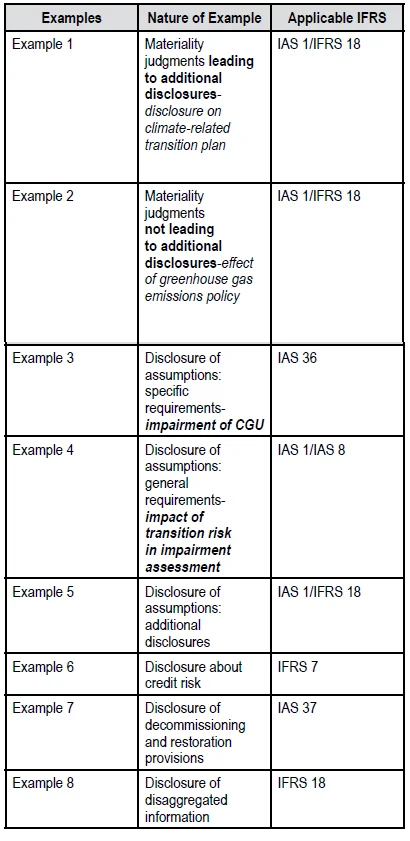
1. IASB: ILLUSTRATIVE EXAMPLES ON REPORTING UNCERTAINTIES IN FINANCIAL STATEMENTS

On November 28, 2025, the International Accounting Standards Board, in response to stakeholders’ concerns about the equity of information in financial statements relating to climate-specific and other uncertainties, issued illustrative examples on reporting such uncertainties in the financial statements.

Reporting uncertainties in the financial statements involves the exercise of judgement in determining what needs to be disclosed. This highlights the need for guidance to ensure consistency and sufficiency of disclosures relating to such uncertainties.

The examples highlight the following:

  •  Application of materiality for specific disclosures required by IFRS (Para 31 – IAS 1)
  • Estimates used to measure recoverable amounts of cash-generating units containing goodwill or intangible assets with indefinite useful lives (Para 134 – IAS 36)
  • Sources of estimation uncertainty (Para 125 – IAS 1)
  • Credit Risk (Para 35A – IFRS 7)
  • Indication of the uncertainties about the amount or timing of those outflows among other disclosures (Para 85 – IAS 37)
  • Aggregation and disaggregation (Para 41 – IFRS 18)

The above examples reiterate the disclosure requirements prescribed in the above-mentioned standards and do not discuss any new matters.

2. FASB: NEW STANDARD TO IMPROVE INTERIM REPORTING

On December 08, 2025, the Financial Accounting Standards Board, to improve the guidance on interim reporting by improving the navigability of the required interim disclosures and clarifying when the guidance is applicable, issued a Narrow-Scope Improvements through Accounting Standards Update (ASU) – Interim Reporting (Topic 270).

The improvements are issued following feedback from the stakeholders about the challenges and complexity of Topic 270. As per the Financial Accounting Standards Board these challenges is a result of development of the source literature, the initial codification of the historical content, and subsequent amendments to the Topic as new accounting guidance was issued over time necessitating the improvements in Accounting Standards Update (ASU) – Interim Reporting (Topic 270).

The objective of the amendments is to provide clarity about the current requirements, rather than evaluate whether to expand or reduce interim disclosure requirements. These include:

  •  Applicability of Topic 270
  • Types of interim reporting
  • Form and content of interim financial statements
  • Disclosure principle that requires entities to disclose events since the end of the last annual reporting period that have a material impact on the entity

These amendments in the Accounting Standards Update (ASU) – Interim Reporting (Topic 270) are effective for interim reporting periods within annual reporting periods beginning after December 15, 2027, for public business entities and for interim reporting periods within annual reporting periods beginning after December 15, 2028, for entities other than
public business entities. Early adoption is permitted for all entities.

3. FASB: NEW STANDARD TO IMPROVE HEDGE ACCOUNTING GUIDANCE

On November 25, 2025, the Financial Accounting Standards Board, to clarify certain aspects of the guidance on hedge accounting and to address several incremental hedge accounting issues arising from the global reference rate reform initiative, issued a Hedge Accounting Improvements through the Accounting Standards Update (ASU) – Derivatives and Hedging (Topic 815).

The improvements are a follow up to the amendments in the 2019 proposed update, which as per the stakeholders was inadequate in resolving the issues encountered by the stakeholders. Further, a need for update in several areas of the hedge accounting guidance to address the effects of reference rate reform on hedge accounting were identified in 2021 by the stakeholders.

The objective of the updates is to more closely align hedge accounting with the economics of an entity’s risk management activities. The following issues are discussed in the updates

  • Similar Risk Assessment for Cash Flow Hedges: A group of individual forecasted transactions to have similar risk exposure rather than a shared risk exposure
  • Hedging Forecasted Interest Payments on Choose-Your-Rate Debt Instruments: A module with simplified assumptions to assess the probability of occurrence of forecasted transactions and hedge effectiveness.
  • Cash Flow Hedges of Nonfinancial Forecasted Transactions: Allows hedge accounting for eligible components of forecasted spot-market transactions, forward-market transactions, and subcomponents of explicitly referenced components in an agreement’s pricing formula.
  • Net Written Options as Hedging Instruments: Accommodates differences in the loan and swap markets that resulted from the cessation of the LIBOR reference rate and eliminates the requirement for the net written option test in certain instances.
  • Foreign-Currency-Denominated Debt Instrument as Hedging Instrument and Hedged Item (Dual Hedge): Eliminate the recognition and presentation mismatch related to a dual hedge strategy (that is, a hedge for which a foreign currency-denominated debt instrument is both designated as the hedging instrument in a net investment hedge and designated as the hedged item in a fair value hedge of interest rate risk).

These amendments in the Accounting Standards Update (ASU) – Derivatives and Hedging (Topic 815) are effective from annual reporting periods beginning after December 15, 2026, and interim periods within those annual reporting periods. For entities other than public business entities, the amendments are effective for annual reporting periods beginning after December 15, 2027, and interim periods within those annual reporting periods. Early adoption is permitted for all entities.

4. FASB: NEW STANDARD TO ADD GUIDANCE ON ACCOUNTING FOR GOVERNMENT GRANTS BY BUSINESSES

On December 04, 2025, the Financial Accounting Standards Board, to improve generally accepted accounting principles (GAAP) by establishing authoritative guidance on the accounting for government grants received by business entities, issued updates relating to accounting for Government Grants received by Business Entities through the Accounting Standards Update (ASU) – Government Grants (Topic 832).

These updates bring in specific authoritative guidance about the recognition, measurement, and presentation of a grant received by a business entity from a government which the GAAP did not provide. The absence of this guidance in the GAAP led the business entities to refer similar but not specific guidance on IAS 20 – Accounting for Government Grants and Disclosure of Government Assistance, Topic 450 – Contingencies (US GAAP) and Subtopic 958-605 – Not-for-Profit Entities—Revenue Recognition. Hence, to reduce diversity in practice and increase consistency among business entities these updates have been issued.

The following amendments are affected to the updates:

  • Recognition criteria of a government grant received by a business entity if it meets the recognition guidance for a grant related to an asset or a grant related to income and depending upon probability of compliance with the conditions attached to the grant and the receivability of the grant.
  • A grant related to an asset to be recognized on the balance sheet as a business entity incurs the related costs for which the grant is intended to compensate, either as a Deferred income (the deferred income approach) or as an adjustment to the cost basis in determining the carrying amount of the asset (the cost accumulation approach).
  • In case of deferred income approach:
    Measurement: a systematic and rational basis for income recognition over the periods in which a business entity recognizes as expenses the costs for which the grant is intended to compensate.
    Presentation: a general heading such as other income or deducted from the related expense.
  • In case of cost accumulation approach:
    Measurement: no separate subsequent recognition of the government grant proceeds in earnings. Depreciation or subsequent accounting depending upon the carrying amount of the asset.

These amendments in the Accounting Standards Update (ASU) – Government Grants (Topic 832) are effective for annual reporting periods beginning after December 15, 2028, and interim reporting periods within those annual reporting periods. For entities other than public business entities, the amendments are effective for annual reporting periods beginning after December 15, 2029, and interim reporting periods within those annual reporting periods Early adoption is permitted for all entities.

5. IAASB: NARROW-SCOPE AMENDMENTS RELATED TO IESBA’S USING THE WORK OF EXPERTS

On January 05, 2026, the International Auditing and Assurance Standards Board issued a narrow-scope amendments to its standards arising from the International Ethics Standards Board for Accountants’ (IESBA) Using the Work of an External Expert project.

The following standards stands amended:

  1. ISA 620 – Using the work of an auditor’s expert
  2. ISRE 2400 (Revised) – Engagements to Review Historical Financial Statements
  3. ISAE 3000 (Revised) – Assurance Engagements Other than Audits or Reviews of Historical Financial Information
  4. ISRS 4400 (Revised) – Agreed-upon procedures engagements

The amends relates to ethical requirements include provisions related to using the work of an expert, evaluation of competence, capabilities and objectivity of the expert, Prohibition on using the work of an expert if necessary competence or capabilities is not possessed or if no such evaluation is possible.

6. FRC: THEMATIC REVIEW: REPORTING BY THE UK’S SMALLER LISTED COMPANIES

The Financial Reporting Council, to support a high quality of reporting by the UK’s smaller listed companies and by doing so enhance investor confidence in the said companies, issued operational insights in its “Thematic Review: Reporting by the UK’s smaller listed companies”. The review is based on 20 companies with year-ends between September 2024 and April 2025 operating in a range of market sectors listed outside of the FTSE 350.

The publication highlight improvement in the following areas:

  1.  Revenue: An accounting policy on revenue recognition for all material revenue streams should be aptly disclosed and should be consistent with the company’s business model. Explanations relating to the timing of satisfaction of performance obligations, determination of the transaction price, agent versus principal considerations, and the associated judgements should also be aptly disclosed as a part of the accounting policy.
  2. Cash flow statements: A clear explanation of specific transactions and the rationale for the classification of such items as operating, investing and financing activities should be provided. Consistency between the amount in the cashflow and other information must be ensured.
  3. Impairment of non-financial assets: Disclosure relating to the impairment reviews of non-financial assets, significant judgements and estimates, key assumptions and sensitivity analysis.
  4. Financial instruments: Company specific accounting policies for more complex financial instruments including initial classification and subsequent measurement should be disclosed.

B. GLOBAL REGULATORS – ENFORCEMENT ACTIONS AND INSPECTION REPORTS

1. THE FINANCIAL REPORTING COUNCIL, UK

a) Sanctions against KPMG LLP and Anthony Sykes

The Financial Reporting Council (FRC) in relation to serious breaches of the International Standards on Auditing (ISAs) in the statutory audit of the financial statements of N Brown Group plc (N Brown) for the financial year ended 26 February 2022 (FY22) by KPMG LLP (KPMG), imposed sanctions against KPMG and the concern Audit Engagement Partner in the Final Settlement Decision Notice (FSDN) under the Audit Enforcement Procedure.

KPMG and the concern Audit Engagement Partner have admitted to these breaches of the International Standards on Auditing (ISAs) in the audit work performed on impairment of non-current assets.

As per the International Accounting Standard 36 (IAS 36) a non-current asset should be tested for impairment if there are indications that the carrying value is more than the highest amount to be recovered through its use or sale by the company. The Auditors are required to determine if these impairment testing are performed in accordance with the standards. Impairment testing helps reflect accurate picture of the company’s financial position, ensuring that the company’s assets are not overstated.

N Brown is one of the UK’s largest online clothing and footwear retailers and at the relevant time was listed on the Alternative Investment Market of the London Stock Exchange. In FY 2022, there was indication of impairment, as the group’s market capitalisation was substantially lower than its net assets. The audit team identified impairment of non-current assets as a significant risk and key audit area for the audit.

The breaches in the audit performed with respect to IAS 36 is as under:

  • Carrying value of the cash generating unit (CGU).
  • Impairment model methodology.
  • Cash flow forecasts.
  • Discount rate.
  • Sensitivity analysis.
  • Reconciliation to market capitalisation
  • The audit’s team’s overall conclusions.

Even after the breaches mentioned above, the FSDN has not questioned the truth or fairness of the FY 2022 financial statements. Although the inadequate audit work on impairment led to an overstatement of headroom (being the difference between the recoverable amount and carrying value), it has not been alleged that N Brown should have recognised an impairment in FY 2022.

B) FRC IMPOSES SANCTIONS AGAINST BDO LLP AND TWO AUDIT ENGAGEMENT PARTNERS

The FRC, in relation to misconduct by BDO LLP (BDO) and two former audit engagement partners, has imposed sanctions under the Accountancy Scheme against the BDO and its former partners.

The sanctions were imposed following a formal complaint against the respondents in April 2025, which led to an investigation into their conduct under the given circumstances.

In the investigation it was found that a Senior Manager was able to pursue, undetected, a dishonest course of conduct on numerous audits between 2015 and 2019, which included: creating false audit evidence, causing auditor’s reports to be issued without approval from the relevant audit engagement partner, and inserting electronic copies of the audit engagement partners’ signatures in auditor’s reports without their approval.

The outcome of the investigation into the Senior Manager, which provides further details of their Misconduct and the sanctions imposed, was published in November 2024.

The misconduct found in the investigation in the present case is as under:

  • BDO’s inadequate response to internal reports which raised or should have raised concerns as to the Senior Manager’s honesty and integrity.
  • Deficiencies in BDO’s systems and controls for ensuring adequate audit supervision by engagement partners, and audit quality in the period 2012-2019.
  • The failure of the one of the former partners (in the period 2014 – 2019) and the other former partners (in the period 2015 – 2019) to adequately supervise, monitor and oversee 21 and 13 audits respectively, on which the Senior Manager worked, which resulted in each case in an Auditor’s Report being issued without their authority and, in some cases, where inadequate, or no, audit evidence had been obtained.
  • One of the partner’s issuance of 10 Auditor’s Reports (for financial years ending between 2015-2018) in relation to audits on which the Senior Manager worked, when insufficient audit evidence had been obtained and where it is inferred that he had carried out no, or very limited, review of such evidence (if any) as had been obtained.
  • BDO’s liability for the Misconduct of the Senior Manager and the former partners.

2. THE PUBLIC COMPANY ACCOUNTING OVERSIGHT BOARD (PCAOB)

a) PCAOB Sanctions Audit Firm, an Owner of That Firm, and a Former Audit Manager for Multiple Violations of PCAOB Rules and Standards

On January 13, 2026, The PCAOB, in the case involving violations of PCAOB rules and auditing standards in connection with the integrated audit of a public company – Genie Energy Ltd. (“Genie”) – for the year ended December 31, 2022, announced an order sanctioning to Zwick CPA, PLLC(“Firm”), Jack Zwick (“Zwick”) and (2) Jeffrey Hoskow (“Hoskow”).

Violations Found By the PCAOB

  • Failure to properly plan, identify, and assess the risks of material misstatement.
  • Failure to obtain sufficient appropriate audit evidence to support the Firm’s opinion on internal control over financial reporting.
  • Failure to obtain sufficient appropriate audit evidence as to Genie’s reported revenue and unbilled revenue.
  • Failure to properly supervise the work of the Firm’s engagement team members.
  • Failure to prepare audit documentation pursuant to PCAOB standards.

b) PCAOB Sanctions U.S. Audit Firm for Violations Related to Communications Between Predecessor and Successor Auditors

On September 23, 2025, The PCAOB, in the case involving violations of PCAOB rules and auditing standards in connection with its transfer of draft workpapers to the Successor Auditors, announced an order sanctioning to Marcum Asia CPAs, LLP, a New York-headquartered firm formerly known as Marcum Bernstein & Pinchuk LLP (“Marcum BP”).

Violations Found By the PCAOB

  • Failure to adhere to the PCAOB rules and auditing standards relating to transfer of draft workpapers to the Successor Auditor.
  • Failure to reach an understanding with the successor auditor as to the use of the draft workpapers, in violation of under AS 2610, “Initial Audits -Communications Between Predecessor and Successor Auditors.”

Due to above violations, the successor auditor improperly used the draft workpapers in its audits and issued an unqualified audit report on the Company’s financial statements for the fiscal year 2015 till 2017. This conduct was the subject of a November 2023 PCAOB enforcement settlement.

c) PCAOB Sanctions Former Audit Partner for Multiple Violations of PCAOB Rules and Standards

On October 25, 2025, The PCAOB, in case of multiple violations of its rules and standards, announced an order imposing sanctions on a former partner in the Lima, Peru, office of Tanaka, Valdivia, Arribas & Asociados Sociedad Civil de Responsabilidad Limitada (“EY Peru”).

The former partner was the partner responsible for EY Peru’s full scope component audit (for the year ended December 31, 2020) of Gilat Networks Peru S.A. (“GNP”), a Latin American subsidiary of an Israel-based provider of satellite-based broadband communications.

Violations Found By the PCAOB

The PCAOB found that during the GNP audit work, the former partner:

  • Violated its rules and standards in evaluating GNP’s revenue recognition, an identified fraud risk;
  • Failure to appropriately supervise the GNP engagement team; and
  • Failure to prepare audit documentation pursuant to PCAOB standards.

d) Deficiencies in Firm Inspection Reports:

K G Somani & Co. LLP

The Public Company Accounting Oversight Board (PCAOB) has issued a report detailing significant deficiencies in the audits conducted by K G Somani & Co. LLP. These deficiencies, which span various aspects of the firm’s audit practices, have raised serious concerns regarding the quality of their audits, compliance with PCAOB rules, and audit independence. Below is an overview of the key findings from the PCAOB inspection report, categorized into several critical areas:

1) Audits with Unsupported Opinions

One of the most concerning findings in the PCAOB inspection report is the firm’s failure to obtain sufficient appropriate audit evidence to support its audit opinions, particularly regarding the financial statements and Internal Control Over Financial Reporting (ICFR). Specific deficiencies identified in this area include:

Issuer A (Information Technology):

  • Revenue, Accounts Receivable, Cash, Goodwill, and Intangible Assets: The firm did not perform adequate testing of these key areas, including revenue recognition and the valuation of goodwill and intangible assets.
  • Inadequate Testing of Revenue Transactions: The firm failed to adequately test revenue transactions to ensure they were correctly recorded in accordance with accounting standards.
  • Failure to Evaluate Key Controls: The audit did not adequately assess controls over critical areas such as journal entries or accounts receivable, which could have flagged material misstatements.
  • Insufficient Fraud Risk Assessment: The firm did not perform sufficient procedures related to journal entries, which could indicate potential fraud. This failure led to an incomplete evaluation of the fraud risks inherent in the audit.

The deficiencies in obtaining sufficient evidence for these areas have resulted in unsupported audit opinions on the financial statements and ICFR of Issuer A. This raises concerns about the accuracy of the firm’s audit conclusions and whether the financial statements provided to stakeholders were truly reliable.

2) Other Instances of Non-Compliance

The inspection also identified several other areas where the firm did not comply with PCAOB standards, further compromising the reliability of their audits. These non-compliance issues include:

  • Journal Entries: The firm did not perform sufficient procedures to ensure that the population of journal entries was complete when testing for possible material misstatements due to fraud, as outlined in AS 1105. This lack of thorough testing increases the risk of overlooking fraudulent activity in the audit.
  • Audit Independence: The firm failed to properly assess the compliance of audit participants with independence requirements, as mandated by AS 2101. This represents a violation of critical PCAOB standards and raises concerns about the objectivity and integrity of the audit process.
  • Risk Identification: The firm did not adequately inquire with the audit committee and the internal audit function about material misstatement risks, including fraud risks, as required under AS 2110. This failure in communication could have led to an incomplete or inaccurate risk assessment for the audit.
  • Internal Control Reports: The firm’s internal control report was deficient, as it failed to reference the financial statements for all years included in the Form 10-K, violating AS 2201. This omission raises concerns about the completeness and accuracy of the firm’s reporting on the effectiveness of internal controls over financial reporting.

3) Independence Issues

The inspection report also identified concerns regarding the firm’s audit independence, an area of particular importance for maintaining the integrity of the audit process. Specifically, the firm may have violated SEC and PCAOB rules regarding audit independence. An indemnification agreement between the audit client and the firm impaired the auditor’s independence, violating Rule 2-01(b) of Regulation S-X.

4) Quality Control

While no major criticisms were found regarding the firm’s quality control system, the PCAOB inspection raised concerns about the effectiveness of monitoring activities within the firm. These concerns suggest that there may be gaps in ensuring that audit procedures consistently align with PCAOB standards across all audits, which could increase the risk of non-compliance in future audits.

The deficiencies identified in the PCAOB inspection report reflect significant gaps in K G Somani & Co. LLP’s audit processes, especially in their testing procedures, risk assessments, and compliance with independence rules. The firm’s inability to test key areas adequately, such as revenue recognition, journal entries, and internal controls, may have led to inaccurate or unsupported opinions on the financial statements and ICFR of its clients. These findings underscore the critical need for corrective action to bring the firm’s audit practices into compliance with PCAOB standards.

Additionally, the potential breach of independence requirements due to the indemnification agreement with the audit client needs to be urgently addressed. The firm must also take steps to improve its internal quality control processes to prevent future instances of non-compliance.

The PCAOB has set a 12-month period for the firm to address these deficiencies. Failure to do so will result in public disclosure of any unresolved issues. The firm’s response to the PCAOB draft inspection report will be evaluated to ensure that the necessary corrective actions are taken to comply with PCAOB standards and maintain the integrity of its audits.

3. THE SECURITIES EXCHANGE COMMISSION (SEC)

a) SEC Charges ADM and Three Former Executives with Accounting and Disclosure Fraud

On January 27, 2026, The SEC in the matter of materially inflating the performance of one of the key segments i.e. Nutrition segment of Archer-Daniels-Midland Company (ADM) filed the following:

  •  Charges against ADM and two former executives.
  • Litigated action against one of its former executives.

As per SEC, the said segment was one that ADM highlighted to its investors as an important driver of the company’s overall growth.

The SEC further highlighted the role of the former executives in directing the ‘adjustments’ to Nutrition segment with other segments of ADM to offset the falling targets in the Nutrition segment in fiscal year 2021 and 2022. These adjustments included retrospective rebates and price change between the Nutrition and Other segment which were not available to other customers thereby passing on the operating profit to Nutrition segment. These transactions thus helped ADM and the executives to show that the Nutrition segment has achieved the desired operating profit of 15% to 20% as promised by the executives to the investors.

The order finds that the above adjustments in annual and quarterly reports of ADM led to false and were misleading as these transactions were inconsistent with the representations by the ADM that intersegment transactions were recorded at amounts “approximating market”.

The former executives of ADM were charged with violating the antifraud provisions of the federal securities laws, reporting, books and records, and internal accounting control provisions of the federal securities laws in case of all the concern executives and aiding and abetting ADM’s violations of the antifraud and failing to reimburse ADM for certain executive compensation as required in case of one of the executive.

The following penal charges are levied:

  • ADM – civil penalty of $40,000,000
  • Executive 1 – Disgorgement and prejudgment interest – $404,343, Civil penalty of $125,000, three-year officer and director bar.
  • Executive 2 – Disgorgement and prejudgment interest – $575,610 and Civil penalty of $75,000
  • Executive 3 – Permanent injunctions, an officer and director bar, disgorgement of ill-gotten gains with prejudgment interest, civil penalties, and reimbursement of certain executive compensation to ADM pursuant to the Sarbanes-Oxley Act.

Financial Reporting Dossier

A. KEY GLOBAL UPDATES

1. FRC: PUBLISHES GUIDANCE PROVIDING CLARITY TO AUDIT PROFESSION ON THE USES OF AI

On 26th June 2025, the Financial Reporting Council (FRC) has published its first guidance on the use of artificial intelligence (AI) in audit, alongside a thematic review of the six largest firms’ processes to certify new technology used in audits.

FRC observed that most firms had well-established processes in place to certify Automated Tools and Techniques (ATT)prior to deployment for use in audits. However, in some cases, these processes were less mature and not supported by documented policies. They identified various examples of good practice across the certification process. This included innovative ways to identify opportunities for using ATTs in audits, guiding audit teams through the ATTs available to them depending on their requirements and targeting required training to relevant users. They also observed good practice across some firms to proactively review ATTs over time to confirm they remain appropriate for use in audits.

As AI tools continue to be utilised in audit, this new guidance outlines a coherent approach to implementing a hypothetical AI-enabled tool, and offers insights into FRC documentation requirements, all designed to support innovation across the audit profession. This guidance should support auditors and central teams at audit firms as they develop and use AI tools in their work, while also providing third-party technology providers with the regulatory expectations for their customer base.

The key features of the guidance, which are fundamental to the delivery of audit quality are as below:

» Two-part structure: Illustrative example of one potential way AI can be leveraged in an audit, as well as principles that are intended to support proportionate and robust documentation of tools that use AI

» Broad and forward-looking AI definition: Encompasses both traditional machine learning and deep learning models, including generative AI

» Balanced documentation expectations: Proportionate approach to prevent over documentation

» Sophisticated view on appropriate explainability: Acknowledges that appropriate levels of explainability vary based on context and usage

» Versatile principles: Illustrates topics, judgements and considerations that have broad applicability to other instances of AI use in audit

» Alignment with Government AI principles: Documentation guidance reflects the UK government’s five AI principles

» Relevant across market: The guidance contains material that clarifies how expectations translate into contexts where a tool is obtained from a third party

While comprehensive in scope, the guidance is not prescriptive and does not introduce new regulatory requirements, instead focusing on supporting innovation while maintaining appropriate standards.

2. FASB: UPDATE TO IMPROVE GUIDANCE ON SHARE-BASED CONSIDERATION PAYABLE TO A CUSTOMER

On 15th April 2025, the Financial Accounting Standards Board (FASB) published an Accounting Standards Update (ASU) to provide accounting guidance for share-based consideration payable to a customer in conjunction with selling goods or services.

The changes improve financial reporting results by addressing the intersection of the requirements of FASB Accounting Standards Codification Topic 606, Revenue from Contracts with Customers, and Topic 718, Compensation—Stock Compensation.

The amendments affect the timing of revenue recognition for entities that offer to pay share-based consideration (for example, equity instruments) to a customer (or to other parties that purchase the entity’s goods or services from the customer) to incentivize the customer (or its customers) to purchase its goods and services. Specifically, the amendments clarify the requirements for share-based consideration payable to a customer that vests upon the customer purchasing a specified volume or monetary amount of goods and services from the entity.

3. FASB: CLARIFICATION ON GUIDANCE FOR IDENTIFYING THE ACCOUNTING ACQUIRER IN A BUSINESS COMBINATION

On 12th May 2025, FASB published an ASU that improves the requirements for identifying the accounting acquirer in FASB Accounting Standards Codification Topic 805, Business Combinations.

In a business combination, the determination of the accounting acquirer can significantly affect the carrying amounts of the combined entity’s assets and liabilities.

The ASU will revise current guidance for determining the accounting acquirer for a transaction effected primarily by exchanging equity interests in which the legal acquiree is a variable interest entity that meets the definition of a business. The amendments require an entity to consider the same factors that are currently required for determining which entity is the accounting acquirer in other acquisition transactions.

4. IAASB: REVISES FRAUD STANDARD TO ENHANCE PUBLIC TRUST

On 8th July 2025, The International Auditing and Assurance Standards Board (IAASB) has revised International Standard on Auditing (ISA) 240, The Auditor’s Responsibilities Relating to Fraud in an Audit of Financial Statements. The updated standard responds to global scrutiny and stakeholder concern regarding the auditor’s role in detecting fraud. The revised standard clarifies the auditor’s responsibilities, emphasises a fraud lens in the auditor’s risk identification and assessment and the appropriate responses to assessed risks, and provides greater transparency in the auditor’s reports of publicly traded entities. ISA 240 (Revised) becomes effective for audits of financial statements for periods beginning on or after December 15, 2026, representing a practical and meaningful shift in how auditors assess and respond to fraud risks.

ISA 240 (Revised) incorporates the following key elements:

» Clearer Auditor Responsibilities – Strengthens and clarifies what auditors are expected to do when addressing risks relating to fraud.

» Reinforced Professional Skepticism – Introduces new requirements to elevate the consistency and effective practice of professional skepticism across all stages of the audit.

» Sharper Fraud Risk Assessment – Requires a focused “fraud lens” when identifying and addressing risks, with stronger links to related standards.

» More Effective Fraud Responses – Establishes a new section with clearer, enhanced requirements to guide how auditors respond to identified or suspected fraud.

» Improved Transparency and Communication – Emphasizes timely communication with management and those charged with governance, with clearer disclosures in the auditor’s report.

The revisions also align with ISA 570 (Revised 2024), Going Concern, recognizing that fraud and financial distress are often interrelated risks that must be addressed together to bolster corporate transparency and resilience.

5. IESBA: LAUNCHES PUBLIC CONSULTATION ON AUDITOR INDEPENDENCE FOR AUDITS OF COLLECTIVE INVESTMENT VEHICLES AND PENSION FUNDS

On 31st March 2025, The International Ethics Standards Board for Accountants (IESBA) issued a Consultation Paper seeking feedback on whether revisions to the International Code of Ethics for Professional Accountants (including International Independence Standards) (the “Code”) are necessary to address the independence of auditors when they carry out audits of Collective Investment Vehicles (CIVs) and Pension Funds (collectively referred to as “Investment Schemes” or “Schemes”).

Investment Schemes enable investors to pool their funds and often rely on external parties (“Connected Parties”) for functions typically managed internally in conventional corporate structures. This structure introduces specific relationships that are highlighted in the Consultation Paper and need to be carefully considered to ensure that any threats to auditor independence are identified and appropriately addressed.

Key areas of focus include:

» The definition of “related entity” in the Code and its applicability to audits of Investment Schemes.

» The Connected Parties that should be considered in relation to the assessment of auditor independence with respect to the audit of an Investment Scheme.

» The application of the Code’s conceptual framework when assessing threats to independence resulting from interests, relationships, or circumstances between the auditor of an Investment Scheme and Connected Parties.

B. GLOBAL REGULATORS- ENFORCEMENT ACTIONS AND INSPECTION REPORTS

I. THE FINANCIAL REPORTING COUNCIL, UK

a) Sanctions against Sean Robert Clark in relation to the operations and investment activities of Thurrock Council

The Executive Counsel of the Financial Reporting Council (FRC) has agreed terms of settlement with Sean Robert Clark, Chief Financial Officer (CFO) of Thurrock Council, following his admission of Misconduct, in relation to his role in the operations and investment activities of Council’s affairs for the financial years ended 31 March 2018 to 31 March 2022.

The following sanctions were imposed on Mr Clark as part of the settlement:

  •  Exclusion as a Member of the Association of Chartered Certified Accountants (ACCA) for a recommended period of 5 years; and
  •  A Severe Reprimand.
    In October 2017 Thurrock Council formally approved an Investment and Treasury Management Strategy document which set out an approach for borrowing on a short-term basis, primarily from other local authorities, and using the funds to make longer-term commercial investments (a “debt for yield approach”). Under this approach, short-term borrowing and investments eventually exceeded £1 billion, more than six times the Council’s annual budget.

A number of the investments ran into difficulties from 2020, and the Council reported the investment portfolio lost more than a quarter of its value. In September 2022 the Secretary of State appointed Commissioners to run the Council because of concerns around the “debt for yield” approach and associated governance issues.

In December 2022 the Council gave notice that its expenditure was likely to exceed its resources in that financial year, and extraordinary financial support was received from Central Government. In addition to agreed support in excess of £343 million, the Council has needed to make significant increases to Council Tax bills as well as cutting services, and has reported ongoing uncertainty as to the long-term financial position.

The sanctions reflect the seriousness of the Misconduct and its consequences, but also Mr Clark’s personal circumstances and the fact that he has co-operated with Executive Counsel’s investigation.

b) Sanctions against KPMG LLP and Nick Plumb.

The Executive Counsel to the Financial Reporting Council (FRC) has issued a Final Settlement Decision Notice (FSDN) under the Audit Enforcement Procedure against KPMG LLP (KPMG) and Nick Plumb (audit engagement partner) and imposed Sanctions as a result of the investigation into the Statutory Audit of the financial statements of Carr’s Group plc (Carr’s) for the financial year ended 28 August 2021 (FY21). Carr’s is the parent company of a corporate group operating in the agriculture and engineering sectors. In FY21 it was listed on the main market of the London Stock Exchange and was a Public Interest Entity (PIE).

Mr Plumb and KPMG breached the FRC’s 2019 Ethical Standard (the Ethical Standard) and International Standards on Auditing (ISAs) by failing to ensure compliance with applicable independence requirements. The independence issue arose because the Statutory Audit of Carr’s relied on the work of another firm (a component auditor outside the KPMG network, Firm X) who undertook the Statutory Audit of an associate of Carr’s, in circumstances where the audit engagement partner at Firm X had held the role for longer than five years, and Firm X had provided certain non-audit services to the associate entity.

In this case, whilst the quality of the audit work performed by the two firms is not brought into question, the breaches were serious. KPMG and Mr Plumb missed a number of opportunities in FY21 to establish the facts underpinning the breaches. The breaches in the current case involve the failure to identify bright-line prohibitions designed to secure the independence of the Statutory Auditor. The Respondents’ failings in this regard were of a basic and fundamental nature.

II. THE PUBLIC COMPANY ACCOUNTING OVERSIGHT BOARD (PCAOB)

a) PCAOB Sanctions Two Firms for Violations Related to Required Audit Records and Disclosure of Key Information for Investors

On 11th July 2025, the Public Company Accounting Oversight Board (PCAOB) announced settled disciplinary orders sanctioning two audit firms: one for violating PCAOB rules and auditing standards related to the timely assembly of a complete and accurate record of the work the firm performed and the other for failing to report key information on the PCAOB’s Form 3 within the required timeframe.

Proper audit documentation is essential to the audit process and investor protection, given that documentation serves as the written record that provides support for the representations in the auditor’s report. Form 3 reporting also provides key information for investors and others, including the initiation and conclusion of certain criminal, regulatory, administrative, or disciplinary proceedings against a firm or its personnel.

As detailed in the orders released:

» Goldman & Company, CPA’s, P.C. failed to timely assemble a complete and final set of audit documentation in connection with the audit of a broker-dealer, in violation of AS 1215, Audit Documentation. The order imposes on the firm a censure, $25,000 civil money penalty, and undertakings to review and certify its audit documentation policies and procedures and ensure annual training concerning audit documentation requirements.

» Raymond Chabot Grant Thornton LLP failed to timely report the initiation and conclusion of three proceedings brought against it by a local regulator, in violation of PCAOB Rule 2203, Special Reports. The order imposes on the firm a censure and $30,000 civil money penalty. The order also requires it to comply with its previously revised policies and procedures concerning PCAOB reporting requirements.

Without admitting or denying the findings, the firms settled with the PCAOB and consented to the PCAOB’s orders and disciplinary actions.

b) PCAOB Sanctions Audit Partner for Multiple Audit Failures in Consecutive Audits and Violation of Partner Rotation Requirements

On 12th March 2025, The Public Company Accounting Oversight Board (PCAOB) announced a settled disciplinary order against Jaslyn Sellers, CPA, in connection with significant audit failures in her role as engagement partner in consecutive audits of issuer NetSol Technologies, Inc. for the fiscal years ended June 30, 2021, and June 30, 2022 (“NTI Audits”). The PCAOB also found that Sellers violated auditor independence requirements by serving as the NTI engagement partner for a sixth consecutive year, beyond applicable partner rotation limits.

Sellers failed during the NTI Audits to obtain sufficient appropriate audit evidence in multiple areas that she had identified as significant risks, including revenue recognition and accounting estimates. In addition, Sellers authorized the issuance of audit reports for each of the NTI Audits, which identified critical audit matters (CAMs). Those CAMs included descriptions of audit procedures intended to address each CAM, but certain of those procedures were not actually performed.

Sellers also failed to appropriately supervise the NTI Audits and violated U.S. Securities and Exchange Commission and PCAOB independence requirements by serving as the NTI engagement partner for a sixth consecutive year.

c) Deficiencies in Firm Inspection Reports:

1) M. S. Madhava Rao:

Deficiency: In an inspection conducted by PCAOB it has identified deficiencies in the financial statement audit related to Litigation, Claims, and Assessments, Revenue, Convertible Debt and Derivative Liabilities.

The firm’s internal inspection program had inspected this audit and reviewed these areas but did not identify the deficiencies below:

» With respect to Litigation, Claims, and Assessments: The firm’s procedures for identifying litigation, claims, and assessments and determining whether the financial accounting and reporting of such matters was complete and accurate consisted solely of obtaining letters of audit inquiry from the client’s lawyers, without evaluating such responses and performing other necessary procedures.

» With respect to Revenue:

i. The firm did not perform procedures to evaluate whether the issuer’s recognition of this revenue was in conformity with FASB ASC Topic 606, Revenue from Contracts with Customers.

ii. The sample size the firm used in its substantive procedures to test this revenue was too small to provide sufficient appropriate audit evidence.

iii. The firm did not identify and evaluate a GAAP departure related to the issuer’s omission of disclosures related to significant payment terms for its customer contracts as required by FASB ASC Topic 606.

» With respect to Convertible Debt, for which the firm identified a significant risk:

i. The issuer reported convertible notes payable with conversion features that were recorded as derivative liabilities.

ii. The firm did not perform any procedures to test certain convertible notes payable.

iii. The firm sent a positive confirmation request to the issuer’s lender for a convertible note payable. The confirmation was returned with an exception, and the firm did not consider the nature of the exception and whether additional evidence was needed.

iv. The firm did not perform any procedures to test the unamortized debt discount related to the convertible notes payable.

» With respect to Derivative Liabilities, for which the firm identified a significant risk:

i. The firm did not perform any procedures to evaluate the accounting treatment of the embedded conversion features as derivative liabilities.

ii. The firm did not perform substantive procedures to test the fair value of the derivative liabilities, beyond obtaining and reading a company-provided memo.

2) Brown Armstrong Accountancy Corporation.

Deficiency: In review, it had identified deficiencies in the financial statement audit related to Revenue and Significant estimates.

» With respect to Revenue, for which the firm identified a fraud risk. The firm’s selected a sample of transactions to test certain revenue. The firm did not perform any procedures to test whether certain of these transactions were appropriately recognized as revenue. Further, for certain other transactions, the firm did not perform sufficient procedures to test the related revenue because it limited its procedures to vouching to cash receipts

» With respect to a Significant Estimate, for which the firm identified a significant risk: The firm’s approach for substantively testing a significant estimate was to test the issuer’s process. The firm did not perform any procedures to evaluate the reasonableness of a significant assumption used by the issuer to develop this estimate, beyond testing the mathematical accuracy of the calculation.

III. THE SECURITIES EXCHANGE COMMISSION (SEC)

a) Charges Georgia-based First Liberty Building & Loan and its Owner for Operating a $140 Million Ponzi Scheme (10th July 2025)

The Securities and Exchange Commission announced that it filed charges seeking an asset freeze and other emergency relief against Newnan, Georgia-based First Liberty Building & Loan, LLC and its founder and owner Edwin Brant Frost IV in connection with a Ponzi scheme that defrauded approximately 300 investors of at least $140 million.

According to the SEC’s complaint, from approximately 2014 through June 2025, First Liberty and Frost offered and sold to retail investors promissory notes and loan participation agreements that offered returns of up to 18% by representing that investor funds would be used to make short-term bridge loans to businesses at relatively high interest rates. The defendants allegedly told investors that very few of these loans had defaulted and that they would be repaid by borrowers via Small Business Administration or other commercial loans. The complaint also alleges that, while some investor funds were used to make bridge loans, those loans did not perform as represented, and most loans ultimately defaulted and ceased making interest payments. Since at least 2021, First Liberty operated as a Ponzi scheme by using new investor funds to make principal and interest payments to existing investors, according to the complaint. The complaint further alleges that Frost misappropriated investor funds for personal use, including by using investor funds to make over $2.4 million in credit card payments, paying more than $335,000 to a rare coin dealer, and spending $230,000 on family vacations.

The SEC seeks emergency relief, including an order freezing assets, appointing a receiver over the entities, and granting an accounting and expedited discovery. The SEC also seeks permanent injunctions and civil penalties against the defendants, a conduct-based injunction against Frost, and disgorgement of ill-gotten gains with prejudgment interest against the defendants and relief defendants.

b) Charges Three Arizona Individuals with Defrauding Investors in $284 Million Municipal Bond Offering that Financed Sports Complex (1st April 2025)

The Securities and Exchange Commission charged Randall “Randy” Miller, Chad Miller, and Jeffrey De Laveaga with creating false documents that were provided to investors in two municipal bond offerings that raised $284 million to build one of the largest sports venues of its kind in the United States.

As alleged in the SEC’s complaint, in August 2020 and June 2021, Randy Miller’s nonprofit company, Legacy Cares, issued approximately $284 million in municipal bonds through an Arizona state entity to finance the construction of a multi-sports park and family entertainment center in Mesa, Arizona. Investors were to be paid from revenue from the sports complex, and investors were given financial projections for revenue that were multiple times the amount needed to cover payments to investors, according to the complaint. However, the complaint alleges that the defendants fabricated or altered documents forming the basis for those revenue projections, including letters of intent and contracts with sports clubs, leagues, and other entities to use the sports complex. The sports complex opened in January 2022 with far fewer events and much lower attendance and generated tens of millions less in revenue than expected under the false projections, and the bonds defaulted in October 2022, according to the complaint.

The complaint alleges that these defendants used fake documents to deceive municipal bond investors into believing a sports complex would generate more than enough revenue to make payments to bondholders. The SEC will hold accountable individuals who defraud municipal bond investors.

Financial Reporting Dossier

A. KEY GLOBAL UPDATES

1. IASB: UPDATE TO GOING CONCERN EDUCATIONAL MATERIAL

On 13th May 2025, IFRS Foundation published an updated version of its educational material to support the consistent application of IFRS Accounting Standards related to going concern assessments. This educational material was first published in January 2021 to respond to questions raised by stakeholders during the covid-19 pandemic.

The revision is mainly related to following:

(1) include updated references to the going concern requirements in IFRS Accounting Standards. When the IASB issued IFRS 18 Presentation and Disclosure in Financial Statements, the requirements about an entity’s assessment of its ability to continue as a going concern were moved unchanged from IAS 1 Presentation of Financial Statements to IAS 8 (which was retitled as Basis of Preparation of Financial Statements after the issuance of IFRS 18). IFRS 18 is effective for annual reporting periods beginning on or after 1 January 2027.

(2) to remove outdated references to the International Auditing and Assurance Standards Board (IAASB) and its project on Going Concern. In December 2024, the IAASB approved International Standard on Auditing (ISA) 570 (Revised 2024), Going Concern. The ISA is effective for audits of financial statements for periods beginning on or after 15 December 2026.

(3) to remove references to the covid-19 pandemic and the stressed economic environment associated with it.

The companies preparing financial statements using IFRS Accounting Standards are required to assess their ability to continue as a going concern. This educational material brings together the relevant requirements and explains how they might apply to a range of company situations. It is designed to support understanding and consistent application of the Standards but does not change or add to existing requirements.

2. IASB: UPDATE TO THE IFRS FOR SMES ACCOUNTING STANDARD

On 27th February 2025, the International Accounting Standards Board (IASB) issued a major update to the IFRS for SMEs Accounting Standard, which is currently required or permitted in 85 jurisdictions.

The IFRS for SMEs Accounting Standard was issued in 2009 to address the global demand for a simplified Accounting Standard for SMEs.

This Standard aims to balance the information needs of lenders and other users of SMEs’ financial statements with the resources available to SMEs. The Standard defines SMEs as entities without public accountability that prepare general purpose financial statements.

The update of this Standard is the outcome of a periodic comprehensive review of the Standard. Highlights include:

a) a revised model for revenue recognition.

b) bringing together the requirements for fair value measurement in a single location; and

c) updating the requirements for business combinations, consolidations and financial instruments.

This update is effective for annual periods beginning on or after 1 January 2027, with early application permitted.

3. FASB: PROPOSAL TO IMPROVE ACCOUNTING FOR DEBT EXCHANGES

On 30th April 2025, the Financial Accounting Standards Board (FASB) a proposed Accounting Standards Update (ASU) that would provide accounting guidance for debt exchange transactions involving multiple creditors.

Under current generally accepted accounting principles (GAAP), when an entity modifies an existing debt instrument or exchanges debt instruments, it is required to determine whether the transaction should be accounted for as:

(1) a modification of the existing debt obligation or

(2) the issuance of a new debt obligation and an extinguishment of the existing debt obligation (with certain exceptions).

The proposed ASU would specify that an exchange of debt instruments that meets certain requirements should be accounted for by the debtor as the issuance of a new debt obligation and an extinguishment of the existing debt obligation. The Board expects this would improve the decision usefulness of financial reporting information provided to investors by requiring that economically similar exchanges of debt instruments be accounted for similarly. It also would reduce diversity in practice in accounting for such debt instrument exchanges.

4. FASB: CLARIFICATION ON GUIDANCE ON THE PRESENTATION AND DISCLOSURE OF RETAINAGE FOR CONSTRUCTION CONTRACTORS

On 01st April 2025, The Financial Accounting Standards Board (FASB) released an FASB Staff Educational Paper that addresses questions about how to apply revenue recognition guidance about presentation and disclosures to construction contracts that contain retainage (or retention) provisions.

The companies that operate in the construction industry often are subject to contracts that contain retainage provisions. Those provisions generally provide a form of security to the customer by allowing the customer to withhold a portion of the consideration billed by the company until certain project milestones are met or the project is completed.

The educational paper (a) explains the presentation and disclosure requirements in GAAP about retainage for construction contractors and (b) provides example voluntary disclosures of retainage that would provide more detailed information about contract asset and contract liability balances.

5. FASB: PROPOSAL TO IMPROVE FINANCIAL ACCOUNTING FOR AND DISCLOSURE OF ENVIRONMENTAL CREDITS AND ENVIRONMENTAL CREDIT OBLIGATIONS.

On 17th December 2024, The Financial Accounting Standards Board (FASB) published a proposed Accounting Standards Update (ASU) intended to improve the financial accounting for and disclosure of financial activities related to environmental credits and environmental credit obligations.

The changes are expected to provide investors with additional decision-useful information by improving the:

a) understandability of financial accounting and reporting information about environmental credits and environmental credit obligations and

b) comparability of that information by reducing diversity in practice.

During the FASB’s 2021 agenda consultation project and other outreach, stakeholders noted that entities are increasingly subject to additional government mandates and regulatory compliance programs related to emissions, which often result in obligations that are settled with environmental credits. Additionally, some entities voluntarily purchase environmental credits from third parties. Stakeholders also emphasised that generally accepted accounting principles (GAAP) does not provide specific authoritative guidance on how to recognise and measure this financial activity, resulting in diversity in practice.

The proposed ASU provides recognition, measurement, presentation, and disclosure requirements for all entities that purchase or hold environmental credits or have a regulatory compliance obligation that may be settled with environmental credits.

6. IAASB: STRENGTHENING OF AUDITOR RESPONSIBILITIES FOR GOING CONCERN THROUGH REVISED STANDARD

On 9th April, 2025, The International Auditing and Assurance Standards Board (IAASB) released its revised International Standard on Auditing 570 (Revised 2024) – Going Concern.

The revised standard responds to corporate failures that raised questions regarding auditors’ responsibilities by significantly enhancing the auditor’s work in evaluating management’s assessment of an entity’s ability to continue as a going concern.

The standard will also increase consistency in auditing practices and strengthen transparency through communications and auditor reporting on matters related to going concern in a consistent manner.

The key changes in ISA 570 (Revised 2024) are as follows:

⇒Robust risk assessment- Auditors must conduct, in a more timely manner, thorough risk assessments to determine whether events or conditions are identified that may cast significant doubt on the entity’s ability to continue as a going concern.

⇒Evaluating Management’s Assessment- Auditors must evaluate management’s assessment of going concern irrespective of whether events or conditions are identified. In doing so, auditors must consider the potential for management bias and evaluate the underlying method, significant assumptions, and data used when management formed its assessment. Additionally, auditors must evaluate whether management’s judgements and decisions indicate potential bias.

⇒Extended date of evaluation period- The auditor’s evaluation period for going concern now extends at least twelve months from the date of approval of the financial statements, contributing to an assessment of more relevant, decision-useful information.

⇒Enhanced transparency- The standard requires clearer communication in the auditor’s report about the auditor’s responsibilities and work related to going concern and strengthened communications with those charged with governance and external parties.

The revised standard is effective for audits of financial statements for periods beginning on or after 15th December, 2026.

7. FRC: INSPECTION FINDINGS FOR THE TIER 2 AND 3 AUDIT FIRMS

On 16th December, 2024, the Financial Reporting Council (FRC) has today published its annual inspection findings for Tier 2 and Tier 3 audit firms, which emphasises the importance of delivering consistent levels of audit quality.

The report highlights areas where firms have made progress but also identifies challenges that exist across this part of the market in achieving consistent audit quality, particularly in the Public Interest Entity (PIE) sector.

As noted in the report, while some inspection results demonstrated audits assessed as good or limited improvements required, there remains a disparity across some of the firms. This reflects the ongoing need for firms to embed effective systems of quality management and strengthen their commitment to continuous audit quality improvement.

Summary of findings are as follows:

Sr.No. Audit Area Examples of key findings
1. ECL provisions Weaknesses in the audit procedures performed to test the methodology, assumptions and data inputs used in ECL calculations, including procedures over significant increases in credit risk criteria, macro-economic scenarios and post model adjustments.

In several cases, findings were compounded by shortcomings in audit teams’ oversight of the work of third-party specialists / experts.

2. Impairment Weaknesses in the audit procedures performed to

corroborate and challenge cash flow forecasts used in management’s impairment assessments of property, plant and equipment, goodwill and other intangible assets.

3. Journal entry testing No testing performed over journal entries or any evidence of the audit team’s response to the risk of management override of controls.

Inadequate or no corroboration performed to substantiate journals identified as meeting fraud risk criteria.

4. Revenue Insufficient procedures to test the effective interest rate calculations on banking audits, including assessment of management’s accounting policy and key inputs and assumptions.

For a revenue stream relating to activity performed jointly with third parties, insufficient evidence of the audit team’s understanding of contractual arrangements and the completeness and accuracy of revenue allocations.

Weaknesses in the testing of revenue completeness and cut-off, where these areas had been identified as significant risks by audit teams.

5. Going concern The audit teams had not sufficiently corroborated and

challenged the cash flow forecasts used in management’s forecast assumptions or adequately assessed the impact of related sensitivities on the going concern model.

6. Partner and staff appraisals A lack of a clear linkage between audit quality and reward for partners and / or staff, and weaknesses in the consideration of audit quality in individual appraisals.
7. Partner portfolio management: Insufficient monitoring of partner and / or staff portfolios to ensure that partners have manageable workloads, engagements are appropriately resourced and that portfolios are aligned to skills and experience and contain an appropriate balance of risk.

B. GLOBAL REGULATORS- ENFORCEMENT ACTIONS AND INSPECTION REPORTS

I. THE FINANCIAL REPORTING COUNCIL, UK

a) Sanctions against Ernst & Young LLP and Richard Wilson (10th April, 2025)

The Executive Counsel of the Financial Reporting Council (FRC) has issued a Final Settlement Decision Notice under the Audit Enforcement Procedure and imposed sanctions on Ernst & Young LLP (EY) and Richard Wilson (Mr Wilson), audit engagement partner, in relation to the audits of Thomas Cook Group plc (the Company/Thomas Cook) for the financial years ended 30 September 2017 and 30 September 2018.

The sanctions imposed take account of a number of factors, including the seriousness of the breaches and the financial strength of the auditor, as indicated by the turnover of the firm. It is not suggested that the breaches were intentional, dishonest, deliberate or reckless. Further, both EY and Mr Wilson cooperated with Executive Counsel’s investigation.

Thomas Cook’s Goodwill balance was significant as it comprised £2.6 billion across the whole group (approximately 40% of total assets). In both audit years, EY and Mr Wilson failed to approach this audit area with sufficient professional scepticism in order to properly corroborate management’s assumptions and estimates supporting the Goodwill impairment model. The failings for the audit of Goodwill in 2018 were particularly serious given Thomas Cook’s deteriorating trading performance, which heightened the risk that the Goodwill balance could be impaired.

In relation to Going Concern, where there are breaches in the 2018 audit only, EY and Mr Wilson failed to adequately challenge management with regards to sensitivity testing, liquidity and financial covenant headroom, and as such were not in a position to properly conclude on whether a material uncertainty existed that might cast significant doubt upon Thomas Cook’s ability to continue as a Going Concern. This was a key responsibility that EY and Mr Wilson did not fulfil adequately under the relevant auditing standards and was an important matter to users of the financial statements.

The breaches of auditing standards accepted by EY and Mr Wilson relating to the Goodwill impairment and Going Concern work included areas such as risk assessment, the performance of procedures to obtain and evaluate audit evidence, communication with those charged with governance as well as disclosures in the accounts. The breaches include auditing standards dealing with the exercise of professional scepticism, partner supervision and audit documentation which are central to the performance of an audit.

b) Sanctions against Price Waterhouse Coopers LLP and Jonathan Hinchliffe (25th March, 2025)

The Executive Counsel of the Financial Reporting Council (“FRC”) has issued a Final Settlement Decision Notice under the Audit Enforcement Procedure and imposed sanctions against Price water house Coopers (“PwC”) and Jonathan Hinchliffe (“Mr Hinchliffe”) in relation to the statutory audit of the financial statements of Wyelands Bank plc (“the Bank”) for the financial year ended 30 April 2019 (“the FY2019 Audit”).

PwC and Mr Hinchliffe admitted breaches of Relevant Requirements in relation to six areas of the FY2019 Audit: risk assessment, auditing of the Bank’s compliance with laws and regulations, auditing of the Bank’s related party transactions, auditing of the Bank’s assessment of going concern, auditing of the Bank’s loans and advances, and auditing of the bank’s provision for expected credit loss.

The breaches primarily stemmed from a single common cause: the failure of the audit team to properly understand the Bank’s lending and adequately consider the risks posed by its actual and potential exposure to related parties in the GFG Alliance. The audit team also failed to properly examine concerns raised by the Bank’s regulator, the Prudential Regulation Authority (“PRA”) in that regard. In addition, they failed to exercise appropriate professional scepticism in relation to a number of aspects of the audit.

The FY19 audit opinion was signed in July 2019. Subsequent to the Audit, in September 2019 the PRA required the Bank to limit its exposures to related parties due to concerns that the Bank had an unacceptable concentration of risk. By March 2020 the Bank had stopped entering into new credit transactions and commenced a wind down of its business. In March 2021 the PRA required the Bank to repay its depositors, which it has done.

II. THE PUBLIC COMPANY ACCOUNTING OVERSIGHT BOARD (PCAOB)

a) PCAOB Sanctions Former Deloitte Colombia Partner for Issuing Audit Report Before Completing All Necessary Audit Procedures

On 12th February, 2025, the Public Company Accounting Oversight Board (PCAOB) announced a settled disciplinary order sanctioning Gabriel Jaime López Díez (“López”), a former partner of Colombia-based Deloitte & Touche S.A.S. (the “Firm”), for violations of PCAOB rules and auditing standards in connection with the Firm’s 2016 integrated audit of Bancolombia S.A. (“Bancolombia”). The PCAOB found that López failed to perform necessary audit procedures and failed to obtain sufficient appropriate audit evidence before authorising the issuance of the Firm’s unqualified audit opinions on Bancolombia’s financial statements and internal control over financial reporting.

As described in the order, López and the engagement team improperly altered audit documentation, and, in several instances, obtained supporting audit evidence and performed audit procedures after issuance of the audit opinions, in violation of PCAOB standards. These procedures related to revenue, interest expenses, internal controls, and the fair value of Bancolombia’s loan portfolio and its derivatives.

López also violated PCAOB standards by failing to include in the audit documentation or causing the engagement team not to include information sufficient to comply with audit documentation standards.

Without admitting or denying the Board’s findings, López consented to the PCAOB’s order, which censured him and imposed a $75,000 civil money penalty.

b) PCAOB Sanctions James Pai CPA PLLC and Partner for Audit Failures

On 25th March, 2025, the Public Company Accounting Oversight Board (PCAOB) announced a settled disciplinary order sanctioning:

  •  James Pai CPA PLLC (the “Firm”) and Yu-Ching James Pai, CPA (“Pai”), the sole owner and partner of the Firm, for violations of multiple PCAOB rules and standards in connection with two audits of one issuer client.
  •  the Firm for violations of PCAOB quality control standards, and
  •  Pai for directly and substantially contributing to the Firm’s violations.

The PCAOB found that, in the audits, the Firm and Pai failed to perform appropriate risk assessments and obtain sufficient appropriate audit evidence in multiple areas, including revenue and related party transactions.

The PCAOB also found that, in the audits, the Firm failed to:

  1.  Have engagement quality reviews performed;
  2.  Obtain written representations from management;
  3.  Comply with requirements concerning critical audit matters, audit committee communications, and audit documentation; and
  4.  Establish and implement a system of quality control to provide it with reasonable assurance that the work performed by engagement personnel met applicable professional standards and regulatory requirements.

In settlement with PCAOB, the Firm and partner commit to $40,000 fine, revocation of the Firm’s registration, and partner bar following failure to perform appropriate risk assessments and obtain sufficient appropriate audit evidence in multiple areas.

a) Deficiencies in Firm Inspection Reports:

  •  Bansal & Co LLP. (27th February, 2025)

Deficiency: In an inspection conducted by PCAOB it has identified deficiencies in the financial statement audit related to Revenue, Goodwill and Intangible Assets, Journal Entries and Equity-Related Transactions.

The firm’s internal inspection program had inspected this audit and reviewed these areas but did not identify the deficiencies below:

» With respect to Revenue for which the firm identified a fraud risk: The firm did not perform any substantive procedures to evaluate whether the issuer met the revenue recognition criteria prior to recognising revenue.

» With respect to Goodwill and Intangible Assets: The firm did not evaluate whether the issuer’s accounting for and disclosures related to goodwill and certain intangible assets were in conformity with GAAP.

» With respect to Journal Entries, for which the firm identified a fraud risk: The firm did not perform any procedures to identify and select journal entries and other adjustments for testing to address the potential for material misstatement due to fraud.

» With respect to Equity-Related Transactions: The firm did not perform procedures to evaluate whether the issuer had a reasonable basis for the significant assumptions used to estimate the fair value of the issuer’s common stock issued in various share-based transactions, beyond obtaining and reading certain issuer-prepared documents

  •  Brown Armstrong Accountancy Corporation. (27th February, 2025)

Deficiency: In our review, we identified deficiencies in the financial statement audit related to Revenue and Related Accounts, Income Taxes, and Journal Entries.

» With respect to Revenue and Related Accounts, for which the firm identified a significant risk: The firm designed a substantive procedure for testing four types of revenue as a dual-purpose test. The firm performed its substantive procedure using the sample size it determined for its control testing. This sample size was too small to provide sufficient appropriate audit evidence for the substantive procedure because the firm did not use the larger of the sample sizes that would otherwise have been designed for the two separate purposes. In addition, for the selected revenue transactions, the firm did not perform procedures to test whether the issuer satisfied its performance obligations prior to the recognition of revenue, beyond obtaining certain issuer-produced reports and testing the timing of cash receipts. The firm did not perform substantive procedures to test the deferred revenue at year end.

» With respect to Income Taxes, for which the firm identified a significant risk: The firm did not perform procedures to test certain permanent and temporary differences used in calculating the income tax provision, beyond vouching these amounts to issuer-prepared schedules.

» With respect to Journal Entries, for which the firm identified a fraud risk: The firm identified fraud criteria for purposes of identifying and selecting journal entries for testing. The firm did not perform procedures to determine whether any journal entries met one of its fraud criteria. In addition, the firm obtained a listing of journal entries that met certain of the criteria. The firm did not perform sufficient procedures to test the journal entries in this listing, because it limited its procedures to certain entries, without having an appropriate rationale for limiting its testing to those journal entries.

III. THE SECURITIES EXCHANGE COMMISSION (SEC)

a) Charges Three Texans with Defrauding Investors in $91 Million Ponzi Scheme (29th April 2025)

The Securities and Exchange Commission announced charges against Dallas-Fort Worth residents Kenneth W. Alexander II, Robert D. Welsh, and Caedrynn E. Conner for operating a Ponzi scheme that raised at least $91 million from more than 200 investors.

According to the SEC’s complaint, between approximately May 2021 and February 2024, Alexander and Welsh operated the scheme through a trust controlled by Alexander called Vanguard Holdings Group Irrevocable Trust (VHG). They falsely represented that investors would receive 12 guaranteed monthly payments of between 3% and 6% per month, with the principal investment to be returned after 14 months. The SEC alleges that Alexander and Welsh held VHG out as a highly profitable international bond trading business with billions in assets, and told investors that the monthly returns were generated from international bond trading and related activities.

As alleged, Conner funnelled more than $46 million in investor money to VHG through a related investment program that he operated using Benchmark Capital Holdings Irrevocable Trust (Benchmark), which he controlled. According to the complaint, Alexander, Welsh, and Conner also offered investors the option to protect their investments from risk of loss through the purchase of a purported financial instrument they called a “pay order.”

In reality, VHG had no material source of revenue, the purported monthly returns were actually Ponzi payments, and the protection offered by the “pay orders” was illusory. Alexander and Conner misappropriated millions in investor funds for personal use, such as Conner’s purchase of a $5 million home, according to the complaint.

b) Charges Investment Adviser and Two Officers for Misuse of Fund and Portfolio Company Assets (7th March, 2025)

The Securities and Exchange Commission filed settled charges against registered investment adviser Momentum Advisors LLC, its former managing partner Allan J. Boomer, and its former chief operating officer and partner Tiffany L. Hawkins, for breaches by Boomer and Hawkins of their fiduciary duties when they misused fund and portfolio company assets.

According to the SEC’s orders, from at least August 2021 through February 2024, Hawkins misappropriated approximately $223,000 from portfolio companies of a private fund she managed with Boomer and that was advised by Momentum Advisors. Specifically, Hawkins misused portfolio company debit cards in more than 100 transactions to pay for vacations, clothing, and other personal expenses, and caused herself to be paid compensation in excess of her authorized salary.

As set forth in the orders, Hawkins concealed her misconduct from Momentum Advisors, from the portfolio companies’ bookkeeper, and from SEC staff, and Boomer failed to reasonably supervise Hawkins despite red flags of her misappropriation. The order against Boomer also finds that he caused the fund to pay a business debt that should have been paid by an entity he and Hawkins controlled, resulting in an unearned benefit to the entity of $346,904, and that Momentum Advisors failed to adopt and implement adequate policies and procedures and to have the fund audited as required.

The orders find that Hawkins and Boomer violated the antifraud provisions of the Investment Advisers Act of 1940, and that Momentum Advisors violated the compliance and custody rule provisions of the Advisers Act. Without admitting or denying the SEC’s findings, Hawkins, Boomer, and Momentum Advisors consented to the entry of cease-and-desist orders. Additionally, Hawkins agreed to pay a $200,000 civil penalty and to be subject to an associational bar; Boomer agreed to pay an $80,000 civil penalty and to be subject to a 12-month supervisory suspension; and Momentum Advisors agreed to a censure and to pay a $235,000 civil penalty.

Financial Reporting Dossier

A. KEY GLOBAL UPDATES

1. IASB: Improvements to Requirements for Provisions

On 12th November, 2024, the International Accounting Standards Board (IASB) has published consultation for improving the requirements for recognising and measuring provisions on company balance sheets.

The proposed amendments to IAS 37 Provisions, Contingent Liabilities and Contingent Assets would clarify how companies assess when to record provisions and how to measure them. The proposals would most likely be relevant for companies that have large long-term asset decommissioning obligations or are subject to levies and similar government-imposed charges.

The proposed amendment is to improve the following areas:

Areas of IAS 37 Proposed amendment
(a)  one of the criteria for recognising a provision— the requirement for the entity to have a present obligation as a result of a past event (the present obligation recognition criterion);


(a)  change the timing of recognition of some provisions. The amendments would affect provisions for costs, often levies, that are payable only if an entity takes two separate actions or if a measure of its activity in a specific period exceeds a specific threshold. Provisions for some of these costs would be accrued earlier and progressively instead of at a later point in time, to provide more useful information to users of financial statement.

(b) Entities that are subject to levies and similar government-imposed charges are among those that are likely to be most significantly affected by the proposed amendments.

(b)  the costs an entity includes in estimating the future expenditure required to settle its present obligation; and


(a)  proposes to specify that this expenditure comprises the costs that relate directly to the obligation, which include both the incremental costs of settling that obligation and an allocation of other costs that relate directly to settling obligations of that type.
(c)  the rate an entity uses to discount that future expenditure to its present value.


(a)  some entities use risk-free rates whereas others use rates that include ‘non-performance risk’ — the risk that the entity will not settle the liability. Rates that include non-performance risk are higher than risk-free rates and result in smaller provisions.

(b)  proposes to specify that an entity discounts a provision using a risk-free rate — that is, a rate that excludes non-performance risk

(c) The entities most affected are likely to be those with large long-term asset decommissioning or environmental rehabilitation provisions — typically entities operating in the energy generation, oil and gas, mining and telecommunications sectors

The IASB is inviting feedback on these amendments. The comment period is open until 12th March, 2025.

2. IASB: Proposal for Improvements for the Equity Method of Accounting

On 19th September, 2024, in the Exposure Draft of Equity Method of Accounting, the International Accounting Standards Board (IASB) proposed to amend IAS 28 Investments in Associates and Joint Ventures.

The Exposure Draft sets out proposed amendments to IAS 28 to answer application questions about how an investor applies the equity method to:

a) changes in its ownership interest on obtaining significant influence;

b) changes in its ownership interest while retaining significant influence, including:

i. when purchasing an additional ownership interest in the associate;

ii. when disposing of an ownership interest in the associate; and

iii. when other changes in an associate’s net assets change the investor’s ownership interest—for example, when the associate issues new shares;

c) recognition of its share of losses, including:

i. whether an investor that has reduced its investment in an associate to nil is required to ‘catch up’ losses not recognised if it purchases an additional interest in the associate; and

ii. whether an investor that has reduced its interest in an associate to nil recognises its share of the associate’s profit or loss and its share of the associate’s other comprehensive income separately;

d) transactions with associates — for example, recognition of gains or losses that arise from the sale of a subsidiary to its associate, in accordance with the requirements in IFRS 10 Consolidated Financial Statements and IAS 28;

e) deferred tax effects on initial recognition related to measuring at fair value the investor’s share of the associate’s identifiable assets and liabilities of the associate;

f) contingent consideration; and

g) the assessment of whether a decline in the fair value of an investment in an associate is objective evidence that the net investment might be impaired.

The Exposure Draft also sets out proposals to improve the disclosure requirements in IFRS 12 Disclosure of Interests in Other Entities and IAS 27 Separate Financial Statements to complement the proposed amendments to IAS 28, along with a reduced version of those proposed disclosure requirements for entities applying IFRS 19 Subsidiaries without Public Accountability: Disclosures.

3. FASB: Proposed Clarifications to Share-Based Consideration Payable to a Customer.

On 30th September 2024, The Financial Accounting Standards Board (FASB) today published a proposed Accounting Standards Update (ASU) to improve the accounting guidance for share-based consideration payable to a customer in conjunction with selling goods or services.

The proposed changes are expected to improve financial reporting results by requiring revenue estimates to more closely reflect an entity’s expectations. In addition, the proposed changes would enhance comparability and better align the requirements for share-based consideration payable to a customer with the principles in Topic 606, Revenue from Contracts with Customers.

The proposal would affect:

a) the timing of revenue recognition for entities that offer to pay share-based consideration (for example, equity instruments) to a customer (or to other parties that purchase the entity’s goods or services from the customer) to incentivise the customer (or its customers) to purchase its goods and services.

b) revenue recognition would not be delayed when an entity grants awards that are not expected to vest. Specifically, the proposed amendments would clarify the requirements for share-based consideration payable to a customer that vest upon the customer purchasing a specified volume or monetary amount of goods and services from the entity.

4. FASB: Issue of Standard that Improves Disclosures About Income Statement Expenses

On 4th November, 2024, The Financial Accounting Standards Board (FASB) published an Accounting Standards Update (ASU) that improves financial reporting and responds to investor input by requiring public companies to disclose, in interim and annual reporting periods, additional information about certain expenses in the notes to financial statements.

The investors observed that expense information is critically important in understanding a company’s performance, assessing its prospects for future cash flows, and comparing its performance over time and with that of other companies. They indicated that more granular expense information would assist them in better understanding an entity’s cost structure and forecasting future cash flows.

The current proposal requires the companies in the notes to financial statements, specified information about certain costs and expenses at each interim and annual reporting period. Specifically, they will be required to:

  • Disclose the amounts of (a) purchases of inventory; (b) employee compensation; (c) depreciation; (d) intangible asset amortisation; and (e) depreciation, depletion, and amortisation recognised as part of oil- and gas-producing activities (or other amounts of depletion expense) included in each relevant expense caption.
  • Include certain amounts that are already required to be disclosed under current generally accepted accounting principles (GAAP) in the same disclosure as the other disaggregation requirements.
  • Disclose a qualitative description of the amounts remaining in relevant expense captions that are not separately disaggregated quantitatively.
  • Disclose the total amount of selling expenses and, in annual reporting periods, an entity’s definition of selling expenses.

The amendments in the ASU are effective for annual reporting periods beginning after 15th December, 2026, and interim reporting periods beginning after 15th December, 2027. Early adoption is permitted.

5. FASB: Targeted Improvements to Internal-Use Software Guidance

On 29th October, 2024, the Financial Accounting Standards Board (FASB) today published a proposed Accounting Standards Update (ASU) to update the guidance on accounting for software.

The proposed ASU would remove all references to a prescriptive and sequential software development method (referred to as “project stages”) throughout Subtopic 350-40, Intangibles — Goodwill and Other — Internal-Use Software.

The proposed amendments would specify that a company would be required to start capitalising software costs when both of the following occur:

a) Management has authorised and committed to funding the software project.

b) It is probable that the project will be completed, and the software will be used to perform the function intended (referred to as the “probable-to-complete recognition threshold”).

In evaluating the probable-to-complete recognition threshold, a company may have to consider whether there is significant uncertainty associated with the development activities of the software.

The proposed amendments also would require a company to separately present cash paid for capitalised internal-use software costs as investing cash outflows in the statement of cash flows.

6. FRC: Thematic Review On IFRS 17 ‘Insurance Contracts’ Disclosures in the First Year of Application (5th September, 2024)

The Corporate Reporting Review (CRR) team of the Financial Reporting Council (FRC) carried out a review of disclosures in companies’ first annual reports and accounts following their adoption of IFRS 17 ‘Insurance Contracts’

They reviewed the annual reports and accounts of a sample of ten entities, three of which had also been included in our interim thematic. The companies selected covered both life and general insurers, including larger listed companies, as well as smaller and private insurers.

Overall, the quality of IFRS 17 disclosures provided by the companies in their sample of annual reports and accounts was good. While some further areas for improvement were identified in the annual reports and accounts in our sample, many of the issues identified related to areas that are commonly raise with
companies as part of their routine reviews, such as judgements and estimates, and alternative performance measures (APMs).

The companies are expected to consider the examples provided in the thematic review of good disclosure and opportunities for improvement and to incorporate them in their future reporting, where relevant and material. The companies should:

a) Continue to provide high quality disclosures, which meet the disclosure objective of IFRS 17 and enable users to understand how insurance contracts are measured and presented in the financial statements, while avoiding boilerplate language.

b) Ensure that accounting policies are sufficiently granular and provide clear, consistent explanations of accounting policy choices, key judgements and methodologies, particularly where IFRS 17 is not prescriptive.

c) Where sources of estimation uncertainty exist, provide information about the underlying methodology and assumptions made to determine the specific amount at risk of material adjustment and provide meaningful sensitivities and / or ranges of reasonably possible outcomes.

d) Provide quantitative and qualitative disclosures of the CSM, including how coverage units are determined, the movement in CSM during the period, and quantification of the expected recognition of CSM in appropriate time bands.

e) Provide appropriately disaggregated qualitative and quantitative information to allow users to understand the financial effects of material portfolios of insurance (and reinsurance) contracts.

f) Meet the expectations set out in our previous thematic reviews on the use of APMs, including commonly used measures such as premium metrics, and claims and expense ratios.

7. FRC: Thematic Review on Offsetting in the Financial Statements (5th September, 2024)

Offsetting (also known as ‘netting’) classifies dissimilar items as a single net amount.

Inappropriate application of the offsetting requirements can mask the full extent of the risks relating to a company’s income and expense, assets and liabilities, or cash flows.

IFRS Accounting Standards (IFRSs) require or permit offsetting only in specific situations. Determining when to offset can be challenging, because the requirements are complex and not all located in one place in IFRS.

Certain IFRSs contain explicit guidance on offsetting while others rely on the offsetting principles in IAS 1, ‘Presentation of Financial Statements’. Applying these requirements may require management to make significant judgements, especially when accounting for complex arrangements.
Although the requirements for offsetting are reasonably well established, the Corporate Reporting Review (CRR) team of the Financial Reporting Council (FRC) regularly identifies material errors in this area through its routine monitoring work, even in fairly straightforward scenarios.

The key findings include:

  • Cash flows should be presented gross, unless otherwise required or permitted.
  • Bank overdrafts and positive bank balances that form part of a cash pooling arrangement are offset in the statement of financial position only when there is an intention to exercise a legally enforceable right to set off period-end bank balances.
  • High quality disclosures are important where financial instruments have been offset or are subject to a master netting arrangement or similar agreement.
  • A reimbursement asset is required to be separately presented from the associated provision. Any reimbursement rights that satisfy the contingent asset requirements of IAS 37 should also be appropriately disclosed.

Companies are expected to consider the areas of good practice and opportunities for improvement and to incorporate them in their future reporting, where relevant and material. The companies should:

  • Disclose material accounting policy information relating to offsetting, ensuring all relevant aspects of any offsetting conditions are included.
  • Disclose significant judgements made in relation to offsetting income and expenses, assets and liabilities or cash inflows and outflows.
  • Present cash inflows and outflows within investing and financing activities on a gross basis in the cash flow statement, except in limited cases where netting is either required or permitted.
  • Consider whether to exclude overdrafts from cash and cash equivalents in the cash flow statement when the overdrafts remain overdrawn over several reporting periods.
  • Consider the terms and conditions of cash pooling arrangements when determining whether to offset positive bank balances and overdrafts that form part of such an arrangement in the statement of financial position. For example, whether they provide a legal right of set off that is currently enforceable, are notional or zero balancing arrangements and how the timing of any cash sweeps relates to the reporting date.
  • Demonstrate an intention at the reporting date to physically transfer the period-end balances of positive bank balances and overdrafts that form part of a cash pooling arrangement to one account to satisfy the intention criterion of the Offsetting Criteria in IAS 32.
  • Provide high quality offsetting disclosures where financial instruments: a) have been offset, or b) form part of a master netting arrangement or similar agreement.
  • Present a reimbursement asset separately from the associated provision. Any reimbursement rights that satisfy the contingent asset requirements of IAS 37 should be appropriately disclosed.

B. GLOBAL REGULATORS— ENFORCEMENT ACTIONS AND INSPECTION REPORTS

I. The Financial Reporting Council, UK

a) Sanctions against Ernst & Young LLP

The Financial Reporting Council (FRC) has issued a Final Settlement Decision Notice to Ernst & Young LLP (EY UK) under the Audit Enforcement Procedure and imposed sanctions in respect of a breach of the FRC’s Revised Ethical Standard 2019, namely exceeding the 70 per cent fee-cap on non-audit services. The breach relates to the Statutory Audit of the Financial Statements of Evraz plc for the year ended 31st December, 2021.

Evraz is a multi-national mining group, headquartered in Moscow but incorporated in London and listed as a FTSE 100 company. Its shares have been suspended from trading on the London Stock Exchange since March 2022. EY UK audited Evraz since it was listed in the UK in 2011 until its resignation as auditor in November 2022 following the imposing of new UK Government sanctions against the Russian Federation in response to the invasion of Ukraine.

The Revised Ethical Standard 2019, which reflects the requirements of UK law, imposes restrictions on the amount of non-audit services that an audit firm may provide to a Public Interest Entity. The cap on non-audit work is 70 per cent of the average of the fees paid to the audit firm over the previous three consecutive years. The cap applies at both Network level (i.e., members of the global EY network) and at Firm level (EY UK). EY UK tested the fee ratio at Network level but not at Firm level, and so accepted and carried out non-audit work in breach of the 70% fee cap. This breach was not intentional or dishonest.

Sanctions were imposed against all.

II. The Public Company Accounting Oversight Board (PCAOB)

a) PCAOB Sanctions De Visser Gray LLP for Violations of Rules and Standards Related to Quality Control

In 2019, PCAOB inspection staff conducted an inspection of the Firm. In connection with the inspection, PCAOB inspection staff informed the Firm of its findings regarding significant deficiencies in the Firm’s system of quality control. In particular, PCAOB inspection staff noted that the Firm had obtained its audit methodology and audit practice materials from external service providers. It informed the Firm that the guidance used was only in accordance with Canadian Auditing Standards (“CAS”), rather than PCAOB auditing standards.

In 2022, PCAOB inspection staff conducted another inspection of the Firm. In connection with the inspection, PCAOB inspection staff informed the Firm of its findings regarding significant deficiencies in its system of quality control related once again to its use of an external service provider and its audit practice materials. Specifically, PCAOB inspection staff informed the Firm that certain of this guidance, including Professional Engagement Guide (“PEG”) audit programs, was only in accordance with CAS, rather than PCAOB auditing standards and rules.

In addition, it noted that the Firm had not established policies and procedures to ensure that when engagement teams use the PEG audit programs on issuer audit work, they will address the requirements in PCAOB standards that were not addressed in the PEG audit programs. As a result, for certain audits, the Firm used audit methodology that failed to consider the requirements of PCAOB standards.

Despite being on notice of these deficiencies, the Firm continued to use the audit methodology and audit practice materials that were not compliant with PCAOB auditing standards and other regulatory requirements.

De Visser Gray therefore failed to establish policies and procedures sufficient to provide it with reasonable assurance that the work performed by the Firm and its engagement personnel complied with applicable professional standards and regulatory requirements, in violation of QC Section 20.

PCAOB fines the firm $60,000 and requires the firm to undertake remedial measures.

b) Deficiencies in Firm Inspection Reports:

  • BDO USA, P.C.

Deficiency: In an inspection conducted by PCAOB it has identified deficiencies in the financial statement audit related to Revenue and Warrants.

The firm’s internal inspection program had inspected this audit and reviewed these areas but did not identify the deficiencies below:

  • With respect to Revenue: The issuer recorded revenue at the time its services were provided to its customers. The firm did not perform any substantive procedures to test whether the performance obligation had been fully satisfied before revenue was recognised. The firm used information produced by the issuer in its testing of transaction prices, but did not perform any procedures to test, or test any controls over, the accuracy and / or completeness of certain of this information.
  • With respect to Warrants: During the year, the issuer issued warrants that were recorded as liabilities. The firm did not identify and evaluate misstatements in the fair value measurement of these warrants.

In connection with the inspection, the issuer re-evaluated its accounting for these warrants and concluded that misstatements existed that had not been previously identified. The issuer subsequently corrected these misstatements in a restatement of its financial statements, and the firm revised and reissued its report on the financial statements.

  • Grant Thornton LLP

Deficiency: In an inspection conducted by PCAOB it has identified deficiencies in the financial statement and ICFR audits related to Revenue, for which the firm identified a fraud risk, and Inventory.

  • With respect to revenue and inventory: In determining the extent to which audit procedures should be performed, the firm did not evaluate:-

i. the materiality of these business units in the current year and;

ii. whether the risks of material misstatement, including the fraud risk related to this revenue, that the firm identified for the business units subject to more extensive audit procedures also applied to these business units.

iii. The firm did not perform any substantive procedures to test revenue and inventory for these business units.

  • IT Controls: The firm selected for testing a control that included the issuer’s annual physical count of the inventory. The following deficiencies were identified:

i. The firm did not test the aspects of this control that addressed whether an accurate and complete count had occurred.

ii. The firm did not evaluate whether the issuer had appropriately investigated and resolved differences between the physical counts and the quantities recorded in the issuer’s inventory system.

iii. The firm did not evaluate whether the IT-dependent aspects of this control would be effective given the significant deficiency related to this IT system discussed above.

iv. The firm did not perform sufficient substantive procedures to test the existence of this inventory because the firm did not assess the effectiveness of the methods the issuer used to conduct its inventory counts.

III. The Securities Exchange Commission (SEC)

a) Charges for Negligence in FTX Audits and for Violating Auditor Independence Requirements (17th September, 2024)

The SEC alleges that Prager misrepresented its compliance with auditing standards regarding FTX. According to the SEC’s complaint, from February 2021 to April 2022, Prager issued two audit reports for FTX that falsely misrepresented that the audits complied with Generally Accepted Auditing Standards (GAAS). The SEC alleges that Prager failed to follow GAAS and its own policies and procedures by, among other deficiencies, not adequately assessing whether it had the competency and resources to undertake the audit of FTX. According to the complaint, this quality control failure led to Prager failing to comply with GAAS in multiple aspects of the audit — most significantly by failing to understand the increased risk stemming from the relationship between FTX and Alameda Research LLC, a crypto hedge fund controlled by FTX’s CEO. Because Prager’s audits of FTX were conducted without due care, for example, FTX investors lacked crucial protections when making their investment decisions. Ultimately, they were defrauded out of billions of dollars by FTX and bore the consequences when FTX collapsed.

The SEC’s complaint charges Prager with negligence-based fraud. Without admitting or denying the SEC’s findings, Prager agreed to permanent injunctions, to pay a $745,000 civil penalty, and to undertake remedial actions, including retaining an independent consultant to review and evaluate its audit, review, and quality control policies and procedures and abiding by certain restrictions on accepting new audit clients. The settlement is subject to court approval.

The SEC’s complaint alleged that, between approximately December 2017 and October 2020, the Prager Entities improperly included indemnification provisions in engagement letters for more than 200 audits, reviews, and exams and, as a result, were not independent from their clients, as required under the federal securities laws.

b) Fraud: Now-defunct digital pharmacy Medly Health Inc. raised over $170 million based on fake prescriptions and fraudulently inflated revenue. (12th September, 2024)

The Securities and Exchange Commission charged now-defunct digital pharmacy startup, Medly Health Inc’s. co-founder and former CEO, Marg Patel, former CFO, Robert Horowitz, and former Head of Rx Operations, Chintankumar Bhatt, with defrauding investors in connection with capital raising efforts that netted the company over $170 million.

According to the SEC’s complaint, from at least February 2021 through August 2022, Patel and Horowitz provided financial information to existing and prospective investors that fraudulently overstated Medly’s revenue due in part to millions of dollars’ worth of fake prescriptions entered into the company’s systems by Bhatt. The SEC’s complaint alleges, among other things, that Patel and Horowitz knew of, but failed to correct, significant accounting irregularities and were aware of several reports and complaints by employees that the revenue reported in Medly’s financial statements to investors was inaccurate.

The alleged facts of this case demonstrate significant corporate malfeasance. Startups that seek to raise capital from investors through deceitful conduct remain a continued focus for the Commission.

The SEC’s complaint, filed in the U.S. District Court for the Eastern District of New York, charges Patel, Horowitz, and Bhatt with violating the antifraud provisions of the securities laws and charges Bhatt with aiding and abetting Patel’s and Horowitz’s primary securities law violations. The complaint seeks permanent injunctions, civil money penalties, disgorgement, prejudgment interest, and officer-and-director bars against all three defendants.

Financial Reporting Dossier

A. KEY GLOBAL UPDATES

1. IASB: ILLUSTRATIVE EXAMPLES TO IMPROVE REPORTING OF CLIMATE-RELATED AND OTHER UNCERTAINTIES IN FINANCIAL STATEMENTS

  • On 31st July, 2024, the International Accounting Standards Board (IASB) published a consultation document, proposing eight examples to illustrate how companies apply IFRS Accounting Standards when reporting the effects of climate-related and other uncertainties in their financial statements.
  • These examples are developed based on feedback received from the investors wherein the investors had expressed concerns that information about climate-related uncertainties in financial statements was sometimes insufficient or appeared to be inconsistent with information provided outside the financial statements.
  • The eight illustrative examples focus on areas such as materiality judgments, disclosures about assumptions and estimation uncertainties, and disaggregation of information. These illustrative examples do not add to or change the requirements of IFRS Accounting Standards.
  • Key highlights of these eight examples are as follows:

  • The IASB will consider stakeholders’ feedback and decide whether to proceed with the proposed illustrative examples to accompany IFRS Accounting Standards.

2. IASB: PROPOSE AMENDMENTS FOR TRANSLATING FINANCIAL INFORMATION INTO HYPERINFLATIONARY CURRENCIES

  • On 25th July, 2024, the International Accounting Standards Board (IASB) published proposals in an Exposure Draft to address accounting issues that affect companies that translate financial information from a non-hyperinflationary currency to a hyperinflationary currency
  • In the situations considered, the reporting entity or the reporting entity’s foreign operation has a functional currency that is the currency of a non-hyperinflationary economy. And in both situations, the reporting entity’s presentation currency is the currency of a hyperinflationary economy. Applying the requirements in IAS 21, the entity translates income, expenses and comparative amounts at historical exchange rates. The IASB observed that in a hyperinflationary economy, money loses purchasing power at such a rapid rate that information is generally useful only if amounts are expressed in terms of a measuring unit current at the end of the most recent reporting period.
  • The IASB is seeking feedback on the proposed amendments from interested or affected stakeholders.

3. IASB: ISSUES ANNUAL IMPROVEMENTS TO IFRS ACCOUNTING STANDARDS

  • On 18th July, 2024, the International Accounting Standards Board (IASB) issued narrow amendments to IFRS Accounting Standards and accompanying guidance as part of its regular maintenance of the Standards.
  • These amendments, published in a single document Annual Improvements to IFRS Accounting Standards—Volume 11, include clarifications, simplifications, corrections and changes aimed at improving the consistency of several IFRS Accounting Standards.
  • The amended Standards are:

– IFRS 1 First-time Adoption of International Financial Reporting Standards;

– IFRS 7 Financial Instruments: Disclosures and its accompanying Guidance on implementing IFRS 7;

– IFRS 9 Financial Instruments;

– IFRS 10 Consolidated Financial Statements; and

– IAS 7 Statement of Cash Flows.

  • The amendments are effective for annual periods beginning on or after 1st January, 2026, with earlier application permitted.

4. IASB: REVIEW OF IMPAIRMENT REQUIREMENTS RELATING TO FINANCIAL INSTRUMENTS

  • On 4th July, 2024, the International Accounting Standards Board (IASB) concluded and published its Post-implementation Review (PIR) of the impairment requirements in IFRS 9 Financial Instruments—Impairment.
  • The overall feedback shows that the impairment requirements in IFRS 9 are working as intended and provide useful information to users of financial instruments. In particular, the IASB concluded that:

♦ there are no fundamental questions (fatal flaws) about the clarity or suitability of the core objectives or principles in the requirements.

♦ in general, the requirements can be applied consistently. However, further clarification and application guidance is needed in some areas to support greater consistency in application.

♦the benefits to users of financial statements from the information arising from applying the impairment requirements in IFRS 9 are not significantly lower than expected. However, targeted improvements to the disclosure requirements about credit risk are needed to enhance the usefulness of information for users.

♦the costs of applying the impairment requirements and auditing and enforcing their application are not significantly greater than expected.

  • Based on the above feedback, the IASB decided the following:
Matters to be added to the research pipeline Improvement to Credit risk disclosures:


  • Post-model adjustments or management overlays,


  • sensitivity analysis,


  • significant increases in credit risk forward-looking information; and


  • the reconciliation of the expected credit loss allowance and changes in gross carrying amounts
Matters to be considered at the next agenda consultation Financial guarantee contracts:


  • mainly on the inclusion of financial guarantee contracts under the ECL model
Matters on which no further action is required
  • Requirements for recognising expected credit losses on loan commitments
  • Intersection between the impairment requirements in IFRS 9 and other IFRS Accounting Standards

5. IASB: AMENDMENTS TO CLASSIFICATION & MEASUREMENT REQUIREMENTS FOR FINANCIAL INSTRUMENTS

  • On 30th May, 2024, the International Accounting Standards Board (IASB) issued amendments to the classification and measurement requirements of IFRS 9 Financial Instruments and IFRS 7 Financial Instruments: Disclosures. The amendments will address diversity in accounting practice by making the requirements more understandable and consistent.
  • These amendments are done to address the following concerns raised earlier:
Clarifying the classification of financial assets with environmental, social, and corporate governance (ESG) and similar features
  • ESG-linked features in loans could affect whether the loans are measured at amortized cost or fair value. The concern was how such loans should be measured based on the characteristics of the contractual cash flows. To resolve any potential diversity in practice, the amendments clarify how the contractual cash flows on such loans should be assessed.
Settlement of liabilities through electronic payment systems
  • The challenge was on the derecognition of a financial asset or financial liability in IFRS 9 on settlement via electronic cash transfers. The amendments clarify the date on which a financial asset or financial liability is derecognised. The IASB also decided to develop an accounting policy option to allow a company to derecognise a financial liability before it delivers cash on the settlement date if specified criteria are met.
  • With these amendments, the IASB has also introduced additional disclosure requirements to enhance transparency for investors regarding investments in equity instruments designated at fair value through other comprehensive income and financial instruments with contingent features, for example, features tied to ESG-inked targets.
  • The amendments are effective for annual reporting periods beginning on or after 1st January, 2026.

6. PCAOB: STRENGTHENING ACCOUNTABILITY FOR CONTRIBUTING TO FIRM VIOLATIONS

  • On 12th June, 2024, the PCAOB approved the adoption of an amendment to PCAOB Rule 3502, previously titled Responsibility Not to knowingly or Recklessly Contribute to Violations. The rule, originally enacted in 2005, governs the liability of an associated person of a registered public accounting firm who contributes to that firm’s violations of the laws, rules, and standards that the PCAOB enforces.
  •  An associated person is “any individual proprietor, partner, shareholder, principal, accountant, or professional employee of a public accounting firm, or any independent contractor or entity that, in connection with the preparation or issuance of any audit report (1) shares in the profits of, or receives compensation in any other form from, that firm; or (2) participates as agent or otherwise on behalf of such accounting firm in any activity of that firm.
  • For decades under PCAOB and predecessor auditing standards, auditors have been required to exercise reasonable care any time they perform an audit, and the failure to do so constitutes “negligence”.
  • Previously, however, Rule 3502 allowed the PCAOB to hold associated persons liable for contributing to a registered firm’s violation only when they did so “recklessly” — which represents a greater departure from the standard of care than negligence. This means even when a firm commits a violation negligently, an associated person of that firm who directly and substantially contributed to the firm’s violation could be sanctioned by the PCAOB only if the PCAOB were to show that the associated person acted recklessly.
  • As adopted, the updated rule changes Rule 3502’s liability standard from recklessness to negligence, aligning it with the same standard of reasonable care auditors are already required to exercise anytime they are executing their professional duties. Similarly, the U.S. Securities and Exchange Commission already has the ability to bring enforcement actions against associated persons when they negligently cause firm violations.
  • The amendment to Rule 3502 is subject to approval by the U.S. Securities and Exchange Commission (SEC). If approved by the SEC, the amended rule will become effective 60 days after such approval.

7. PCAOB: PROPOSAL ON SUBSTANTIVE ANALYTICAL PROCEDURE

  • On 12th June, 2024, the PCAOB issued a proposal to replace its existing auditing standard related to an auditor’s use of substantive analytical procedures with a new standard: AS 2305, Designing and Performing Substantive Analytical Procedures. If adopted, the new standard would strengthen and clarify the auditor’s responsibilities when designing and performing substantive analytical procedures, increasing the likelihood that the auditor will obtain relevant and reliable audit evidence — ultimately improving overall audit quality and leaving investors better protected.
  • A substantive analytical procedure involves comparing a recorded amount (by the company) or an amount derived from the recorded amount (the “company’s amount”) to an expectation of that amount developed by the auditor to determine whether there is a misstatement.
  • The proposed standard would do the following:

♦ Strengthen and clarify the requirements for determining whether the relationship(s) to be used in the substantive analytical procedure is sufficiently plausible and predictable;

♦ Specify that the auditor develops their own expectation and not use the company’s amount or information that is based on the company’s amount (so-called circular auditing);

♦ Strengthen and clarify existing requirements for determining when the difference between the auditor’s expectation and the company’s amount requires further evaluation;

♦ Strengthen and clarify existing requirements for evaluating the difference between the auditor’s expectation and the company’s amount. This includes determining if a misstatement exists as well as specifying requirements for certain situations the auditor may encounter when evaluating a difference;

♦ Clarify the factors that affect the persuasiveness of audit evidence obtained from a substantive analytical procedure;

♦ Clarify the elements of a substantive analytical procedure, including the distinction between substantive analytical procedures and other types of analytical procedures; and

♦ Modernise the standard by reorganising the requirements and more explicitly integrating the standard with other Board-issued standards — ultimately making it easier for auditors to follow.

  •  Along with proposed AS 2305, the proposal also includes amendments to AS 1105, Audit Evidence, and AS 2301, The Auditor’s Responses to the Risks of Material Misstatement.

8. PCAOB: AUDITOR’S RESPONSIBILITIES WHEN USING TECHNOLOGY-ASSISTED ANALYSIS

  •  On 12th June, 2024, the PCAOB adopted amendments to two PCAOB auditing standards, AS 1105, Audit Evidence, and AS 2301, The Auditor’s Responses to the Risks of Material Misstatement, addressing aspects of audit procedures that involve technology-assisted analysis of information in electronic form.
  • These changes, which grew out of the Board’s ongoing research project on the use of data and technology, are designed to provide additional detail and clarity around the responsibilities auditors have when performing procedures using technology-assisted analysis. The detail and clarity provided by these amendments should serve to reduce the risk that auditors who use technology-assisted analysis in the audit may issue an opinion without obtaining sufficient appropriate audit evidence. The additional clarity also should address some auditors’ reluctance, which the PCAOB has observed, to use technology-assisted analysis at all under existing standards.
  • The changes adopted today bring greater clarity to auditor responsibilities in the following areas:

Using reliable information in audit procedures: Technology-assisted analysis often involves analysing vast amounts of information in electronic form. The adopting release emphasises auditors’ responsibilities when evaluating the reliability of such information used as audit evidence.

Using audit evidence for multiple purposes: Technology-assisted analysis can be used to provide audit evidence for various purposes in an audit.

Performing tests of details: When performing tests of details, auditors may use technology-assisted analysis to identify transactions and balances that meet certain criteria and warrant further investigation.

9. PCAOB: QUALITY CONTROL STANDARD

  • On 13th May, 2024, the PCAOB adopted a new standard designed to lead registered public accounting firms to significantly improve their quality control (QC) systems. The new standard would require all PCAOB-registered firms to identify their specific risks and design a QC system that includes policies and procedures to guard against those risks.
  • The new standard strikes a balance between a risk-based approach to QC (which should drive firms to proactively identify and manage the specific risks associated with their practice) and a set of mandates (which should assure that the QC system is designed, implemented and operated with an appropriate level of rigour).
  • All PCAOB-registered firms would be required to design a QC system that complies with the new standard. Firms that perform audits of public companies or SEC-registered brokers and dealers would be required to implement and operate the QC system they design, monitor the system, and take remedial actions where policies and procedures are not operating effectively, creating a continuous feedback loop for improvement.
  • Those firms would be required to annually evaluate their QC system and report the results of their evaluation to the PCAOB on new Form QC, which would be certified by key firm personnel to reinforce individual accountability.
  • Firms that audit more than 100 issuers annually would be required to establish an external oversight function for the QC system, referred to as an External QC Function (EQCF), composed of one or more persons who can exercise independent judgment related to the firm’s QC system. In response to comments, the new standard clarifies that the EQCF’s responsibilities should include, at a minimum, evaluating the significant judgments made and the related conclusions reached by the firm when evaluating and reporting on the effectiveness of its QC system.
  • The new standard and related amendments will take effect on 15th December, 2025.

10. FASB: PROPOSED DERIVATIVES SCOPE REFINEMENTS

  •  On 23rd July, 2024, the Financial Accounting Standards Board (FASB) today published a proposed Accounting Standards Update (ASU) to address stakeholder feedback related to:

the application of derivative accounting to contracts with features based on the operations or activities of one of the parties to the contract; and

the diversity in accounting for a share-based payment from a customer that is considered for the transfer of goods or services.

  • For Derivative accounting, the amendments in this proposed Update would expand the scope exception for certain contracts not traded on an exchange to include contracts for which settlement is based on operations or activities specific to one of the parties to the contract. This improvement is expected to result in more contracts and embedded features being excluded from the scope of Topic 815 Derivatives and Hedging.
  • For Share-Based Payment, the amendments in this proposed Update would clarify that an entity should apply the guidance in Topic 606, including the guidance on noncash consideration in paragraphs 606-10-32-21 through 32-24, to a contract with a share-based payment (for example, shares, share options, or other equity instruments) from a customer that is consideration for the transfer of goods or services. Accordingly, under Topic 606, the share-based payment should be recognised as an asset measured at the estimated fair value at contract inception under Topic 606 when the entity’s right to receive or retain the share-based payment from a customer is no longer contingent on the satisfaction of a performance obligation.

B. GLOBAL REGULATORS- ENFORCEMENT ACTIONS AND INSPECTION REPORTS

I. THE FINANCIAL REPORTING COUNCIL, UK

a) Sanctions against MacIntyre Hudson LLP, Deborah Weston, and Geeta Morgan (9th July, 2024)

  • The Company was incorporated on 3rd May, 2018 in order to issue bonds to raise finance for its parent company, a business focused on natural resources with interests in agribusiness, logistics and technology.
  • MHA and Ms Weston (in relation to the FP2018 Audit) and MHA and Ms Morgan (in relation to the FY2019 Audit) have admitted that there were numerous breaches of Relevant Requirements in the audit work completed.
  • The primary breach in each audit year was the failure during the audit acceptance and continuance processes to ultimately identify (and so conduct the audits on the basis) that the Company was a Public Interest Entity because although it had not listed its shares, it had listed the bonds on the London Stock Exchange debt market. The failure to gain an adequate understanding of the Company, and the regulatory framework applicable to it, led directly to further breaches of Relevant Requirements, including, in both years, the provision of prohibited non-audit services and a failure to ensure that an Engagement Quality Control Review was performed before the Audit Report was signed.
  • The FRC’s investigation also identified additional breaches of Relevant Requirements concerning the application of the correct accounting standards and documentation, audit work on confirmation of bank balances, a loan to the parent company, and the going concern assumption.
  • The sanctions were imposed against all.

II. THE PUBLIC COMPANY ACCOUNTING OVERSIGHT BOARD (PCAOB)

a) Sanctions against three auditors for failures relating to audit evidence, skepticism and other violations (7th May, 2024)

  • The PCAOB announced three settled disciplinary orders sanctioning two former Liggett & Webb, P.A. (“Liggett & Webb”) partners, Jessica Etania, CPA and Arpita Joshi, CPA, and engagement quality reviewer Robert Garick, CPA (collectively, “Respondents”).
  • The PCAOB found the following:

♦ Etania and Joshi, the engagement partners on the Innovative Food audits, (1) failed to obtain sufficient appropriate audit evidence to support the issuance of Liggett & Webb’s Innovative Food opinions, and (2) failed to evaluate whether Innovative Food’s revenue was properly valued and presented fairly in Innovative Food’s financial statements.

♦ Etania, the engagement partner on the Luvu audits, failed to evaluate whether Luvu’s revenue was presented fairly in Luvu’s financial statements.

♦ Joshi and Garick – while serving as engagement quality reviewers on the 2020 Luvu audit and 2020 Innovative Food audit, respectively — failed to exercise due professional care and professional skepticism, and therefore, lacked an appropriate basis to provide their concurring approvals of issuance of Liggett & Webb’s audit reports.

  • PCAOB bars engagement partners, impose practice limitations on engagement quality review partners, and imposes $130,000 in total fines

b) Deficiencies in Firm Inspection Reports:

  • Deloitte Touche Tohmatsu CPA LLP (23rd May, 2024)

 Deficiency: In an inspection carried out by PCAOB, it has identified deficiencies in the financial statements and ICFR audits related to Revenue and Related Accounts, Variable Interest Entities, and Short-Term Investments.

♦ Revenue and Related Accounts: The firm did not identify and test any controls over the satisfaction of a performance obligation, accuracy and completeness of system-generated data, etc.

♦ Variable Interest Entities: The firm did not identify and test any controls over the issuer’s review of the legal opinion prepared by the company’s specialist, which described uncertainties regarding the interpretation and application of current laws and regulations related to the structure of the VIE, and evaluation of the effect of such uncertainties on its ability to consolidate the VIE.

♦ Short-Term Investment: The firm selected for testing a control over short-term investments that consisted of the issuer’s review of the fair value calculation of the investments, including the expected rate of return. The firm did not evaluate the review procedures that the controlling owner performed, including the procedures to identify items for follow-up and the procedures to determine whether those items were appropriately resolved.

  •  Ernst & Young Hua Ming LLP (23rd May, 2024)

Deficiency: In an inspection carried out by PCAOB, it has identified deficiencies in the financial statements and ICFR audits related to Goodwill and Variable Interest Entities.

  • Goodwill: The firm selected for testing a control that consisted of the issuer’s review of the determination of the reporting units. The firm did not test an aspect of this control that addressed the considerations for the aggregation of the two components into one reporting unit, including the similarity of the economic characteristics of the components and various qualitative factors, as required by FASB ASC Topic 350, Intangibles – Goodwill and Other, etc.
  • Variable Interest Entities: The firm did not sufficiently evaluate the relevance and reliability of the work performed by the company’s specialist and whether the specialist’s findings support or contradict the issuer’s rights and obligations related to the consolidation of the VIEs.

III. THE SECURITIES EXCHANGE COMMISSION (SEC)

a) Charges for misleading investors about the Compliance Program (1st July, 2024)

  •  The Securities and Exchange Commission charged Silvergate Capital Corporation, its former CEO Alan Lane, and former Chief Risk Officer (CRO) Kathleen Fraher with misleading investors about the strength of the Bank Secrecy Act / Anti-Money Laundering (BSA/AML) compliance program and the monitoring of crypto customers, including FTX, by Silvergate’s wholly owned subsidiary, Silvergate Bank. The SEC also charged Silvergate and its former Chief Financial Officer, Antonio Martino, with misleading investors about the company’s losses from expected securities sales following FTX’s collapse.
  • According to the SEC’s complaint, from November 2022 to January 2023, Silvergate, Lane, and Fraher misled investors by stating that Silvergate had an effective BSA/AML compliance program and conducted ongoing monitoring of its high-risk crypto customers, including FTX, in part to rebut public speculation that FTX had used its accounts at Silvergate to facilitate FTX’s misconduct. In reality, Silvergate’s automated transaction monitoring system failed to monitor more than $1 trillion of transactions by its customers on the bank’s payments platform, the Silvergate Exchange Network.
  • Without admitting or denying the allegations, Silvergate agreed to a final judgment, ordering it to pay a $50 million civil penalty and imposing a permanent injunction to settle the charges

b) Cybersecurity Related Control Violations (18th June, 2024)

  • The Securities and Exchange Commission announced that R.R. Donnelley & Sons Company (RRD), a global provider of business communication and marketing services, agreed to pay over $2.1 million to settle disclosure and internal control failure charges relating to cybersecurity incidents and alerts in late 2021.
  • Data integrity and confidentiality were critically important to RRD’s business. Because client data was stored on RRD’s network, its information security personnel and the third-party service provider RRD hired were responsible for monitoring the network’s security. However, according to the order, RRD failed to design effective disclosure controls and procedures to report relevant cybersecurity information to management with the responsibility for making disclosure decisions and failed to carefully assess and respond to alerts of unusual activity in a timely manner. The order further finds that RRD failed to devise and maintain a system of cybersecurity-related internal accounting controls sufficient to provide reasonable assurances that access to RRD’s assets — its information technology systems and networks — was permitted only with management’s authorisation.
  • RRD agreed to cease and desist from committing violations of these provisions and to pay a $2,125,000 civil penalty.

c) Fraud: Charges against raising more than $184 million through Pre-IPO Fraud Schemes

  • The Securities and Exchange Commission charged three individuals with fraud for selling unregistered membership interests in LLCs that purported to invest in shares of pre-IPO companies, first on behalf of StraightPath Venture Partners LLC, the subject of the Commission’s emergency action in May 2022, and, later, on behalf of Legend Venture Partners LLC, the subject of the Commission’s emergency action in June 2023.
  • In this new action, the SEC alleges that New York residents Mario Gogliormella, Steven Lacaj, and Karim Ibrahim directed an unregistered sales force of more than 50 callers in boiler rooms to pressure investors into making investments without telling them that the shares had been substantially marked up — between approximately 19 and 105 per cent on average above the prices that StraightPath or Legend had paid for the underlying shares. As a result of these tactics, the defendants and their sales force allegedly pocketed more than $45 million in fees from unsuspecting investors from 2019 to 2022. Charges were imposed.

Financial Reporting Dossier

A. KEY GLOBAL UPDATES

1. IASB: COMPREHENSIVE REVIEW OF ACCOUNTING FOR INTANGIBLES

  • On 23rd April 2024, the International Accounting Standards Board (IASB) announced that it will comprehensively review the accounting requirements for intangibles.
  • This review is mainly based on concerns raised relating to all aspects of IAS 38 Intangible Assets, including its scope, its recognition and measurement requirements (including the difference in the accounting for acquired and internally generated intangible assets), and the adequacy of the information companies are required to disclose about intangible assets.
  • The project will assess whether the requirements of IAS 38 remain relevant and continue to fairly reflect current business models or whether the IASB should improve the requirements.

2. IASB: AMENDMENTS FOR RENEWABLE ELECTRICITY CONTRACTS

  • On 8th May 2024, the International Accounting Standards Board published an Exposure Draft proposing narrow-scope amendments to ensure that financial statements more faithfully reflect the effects that renewable electricity contracts have on a company. The proposals amend IFRS 9 Financial Instruments and IFRS 7 Financial Instruments: Disclosures. The IASB’s swift action responds to the rapidly growing global market for these contracts.
  • Renewable electricity contracts aim to secure the stability of and access to renewable electricity sources. However, renewable electricity markets have unique characteristics. Renewable electricity sources depend on nature and its supply cannot be guaranteed. The contracts often require buyers to take and pay for whatever amount of electricity is produced, even if that amount does not match the buyer’s needs at the time of production. These distinct market characteristics have created accounting challenges in applying the current accounting requirements, especially for long-term contracts.
  • To address these challenges, the IASB is proposing some targeted changes to the accounting for contracts with specified characteristics. The proposals would:
  • address how the ‘own-use’ requirements would apply;
  • permit hedge accounting if these contracts are used as hedging instruments; and
  • add disclosure requirements to enable investors to understand the effects of these contracts on a company’s financial performance and future cash flows.

3. IASB: IFRS 18- AID INVESTOR ANALYSIS OF COMPANIES’ FINANCIAL PERFORMANCE:

  • On 9th April 2024, the International Accounting Standards Board completed its work to improve the usefulness of information presented and disclosed in financial statements. IFRS 18 introduces three sets of new requirements to improve companies’ reporting of financial performance and give investors a better basis for analysing and comparing companies:
  • Improved comparability in the statement of profit or loss (income statement): Currently there is no specified structure for the income statement. IFRS 18 introduces three defined categories for income and expenses—operating, investing and financing to improve the structure of the income statement, and requires all companies to provide new defined subtotals, including operating profit. The improved structure and new subtotals will give investors a consistent starting point for analysing companies’ performance and make it easier to compare companies.
  • Enhanced transparency of management-defined performance measures: Many companies provide company-specific measures, often referred to as alternative performance measures. However, most companies don’t currently provide enough information to enable investors to understand how these measures are calculated and how they relate to the required measures in the income statement.

IFRS 18 therefore requires companies to disclose explanations of those company-specific measures that are related to the income statement, referred to as management-defined performance measures. The new requirements will improve the discipline and transparency of management-defined performance measures and make them subject to audit.

  • More useful grouping of information in the financial statements: Investor analysis of companies’ performance is hampered if the information provided by companies is too summarised or too detailed. IFRS 18 sets out enhanced guidance on how to organise information and whether to provide it in the primary financial statements or in the notes. The changes are expected to provide more detailed and useful information. IFRS 18 also requires companies to provide more transparency about operating expenses, helping investors to find and understand the information they need.

4. FASB: ACCOUNTING GUIDANCE RELATED TO PROFIT INTEREST AWARDS

  • On 21st March 2024, the Financial Accounting Standards Board (FASB) published an Accounting standard update that improves generally accepted accounting principles (GAAP) by adding illustrative guidance to help entities determine whether profits interest and similar awards should be accounted for as share-based payment arrangements within the scope of ASC 718, Compensation–Stock Compensation.
  • Certain entities, typically private companies, provide employees and other non-employees with profits interest and similar awards to align compensation with the company’s operating performance and provide those holders with the opportunity to participate in future profits and/or equity appreciation of the company. The Private Company Council and other stakeholders noted the diversity in practice in accounting for these awards as share-based payment arrangements.
  • The amendment will apply to all share-based payment transactions in which a grantor acquires goods or services to be used or consumed in the grantor’s own operations or provides consideration payable to a customer by either of the following:

a. Issuing (or offering to issue) its shares, share options, or other equity instruments to an employee or a non-employee.

b. Incurring liabilities to an employee or a non-employee that meet either of the following conditions:

1. The amounts are based, at least in part, on the price of the entity’s shares or other equity instruments. (The phrase at least in part is used because an award of share-based compensation may be indexed to both the price of an entity’s shares and something else that is neither the price of the entity’s shares nor a market, performance, or service condition.)

2. The awards require or may require settlement by issuing the entity’s equity shares or other equity instruments.

5. FRC: REVISIONS TO UK & IRELAND ACCOUNTING STANDARDS

  • On 27th March 2024, the Financial Reporting Council issued comprehensive improvements to financial reporting standards applicable in the UK and the Republic of Ireland.
  • The amendments are designed to enhance the quality of UK financial reporting and help support the access to capital and growth of the businesses applying them. The most significant changes apply to leases and revenue recognition to align with recent changes to international financial reporting standards. The changes will provide better information to users of financial statements including current and potential investors and lenders. In response to stakeholder feedback, the FRC has made improvements to the proposals for lease accounting and revised the recognition exemption for leases of low-value assets to clarify that the focus is to ensure that the most significant leases are recognised in the balance sheet.
  • Whilst there will be some implementation costs, the FRC has been mindful of the need for changes to be proportionate and to remove any unnecessary reporting burdens. During the extensive stakeholder engagement period many stakeholders, including those representing preparers, generally supported the updates to the accounting model for revenue recognition.

6. PCAOB: STANDARDIZING DISCLOSURE OF FIRM AND ENGAGEMENT METRICS

  • On 9th April 2024, the PCAOB issued a proposal regarding public reporting of standardized firm and engagement metrics and a separate proposal regarding the PCAOB framework for collecting information from audit firms.
  • It would require PCAOB-registered public accounting firms that audit one or more issuers that qualify as an accelerated filer or large accelerated filer to publicly report specified metrics relating to such audits and their audit practice.
  • The proposal sets out standardized firm- and engagement-level metrics that PCAOB believes would create a useful dataset available to investors and other stakeholders for analysis and comparison. The proposed metrics cover (1) partner and manager involvement, (2) workload, (3) audit resources (4) experience of audit personnel, (5) industry experience of audit personnel, (6) retention and tenure, (7) audit hours and risk areas (engagement-level only), (8) allocation of audit hours, (9) quality performance ratings and compensation (firm-level only), (10) audit firms’ internal monitoring, and (11) restatement history (firm-level only).

7. IESBA: FIRST GLOBAL ETHICS STANDARDS ON TAX PLANNING

  • On 15th April 2024, the International Ethics Standards Board for Accountants (IESBA) launched the first comprehensive suite of global standards on ethical considerations in tax planning and related services, incorporated in the IESBA Code of Ethics.
  • The standards establish a clear framework of expected behaviours and ethics provisions for use by all professional accountants and respond to public interest concerns about tax avoidance and the role played by consultants in light of revelations in recent years such as the Paradise and Pandora Papers.
  • These standards are especially relevant in the context of rising public scrutiny of tax avoidance schemes which can harm companies’ credibility and corporate reputation, as well as risking litigation and harming the public interest. Responding to increased public interest concerns, the fundamental goal of these standards is to ensure an ethical, credible basis for advising on tax planning arrangements, thereby restoring public and institutional trust on a topic that is core to the social contract between corporations and the market which supports them.

B. GLOBAL REGULATORS— ENFORCEMENT ACTIONS AND INSPECTION REPORTS

I. THE FINANCIAL REPORTING COUNCIL, UK

a) Sanctions against Grant Thornton UK LLP (8th April 2024)

  • The FRC’s Enforcement Committee (Committee) has found that Grant Thornton UK LLP failed to comply with the Regulatory Framework for Auditing in its audit of a local authority’s pension fund for the year ended 31st March 2021.
  • The Committee found failures in the reviewed audit, which it considered represented a significant departure from the standards expected of a Registered Auditor and had the potential to affect the public, employees, pensioners or creditors. These included two uncorrected material errors which appeared in the version of the pension fund’s audited financial statements that were included in the local authority’s annual report (these errors did not appear in the pension fund’s own financial statements) and insufficient audit evidence obtained that the value of investments was materially accurate.
  • The Committee considered that it is necessary to impose a Sanction to ensure that Grant Thornton UK LLP’s Local Audit Functions are undertaken, supervised and managed effectively.
  • The Committee issued a Notice of Proposed Sanction proposing a Regulatory Penalty of £50,000, adjusted by a discount of 20 per cent for co-operation and other mitigating factors to £40,000. The Sanction has been accepted by Grant Thornton UK LLP.

II. THE PUBLIC COMPANY ACCOUNTING OVERSIGHT BOARD (PCAOB)

a) Sanctions against Deloitte Indonesia, Deloitte Philippines & KPMG Netherlands (10th April 2024)

  • The Public Company Accounting Oversight Board (PCAOB) announced five settled disciplinary orders sanctioning Imelda & Raken (“Deloitte Indonesia”), Navarro Amper & Co. (“Deloitte Philippines”), the latter’s former National Professional Practice Director, Wilfredo Baltazar (“Baltazar”), KPMG Accountants N.V. (“KPMG Netherlands) and its former head of Assurance, Marc Hogeboom for violations of PCAOB rules and quality control standards relating to the firms’ internal training programs and monitoring of their systems of quality control.
  • At all the firms, quality control deficiencies resulted in widespread answer sharing on internal training tests.
  • The audit partners and other personnel were engaged in widespread answer sharing — either by providing answers or using answers – or received answers without reporting such sharing in connection with tests for mandatory firm training courses.
  • On at least six occasions, the third-party vendor, in his capacity as the partner responsible for e-learning compliance, shared answers to training assessments with other audit partners at the firm.
  • The sanctions are as follows:
  • Deloitte Philippines: $1 Million civil penalty
  • Deloitte Indonesia: $1 Million civil penalty
  • Wilfredo Baltazar: $10,000 civil money penalty
  • KPMG Netherlands: $25 Million civil penalty
  • Marc Hogeboom: $1,50,000 civil money penalty and a permanent bar

b) Sanctions against Singapore firm for Quality Control Violations (9th April 2024)

  • The Public Company Accounting Oversight Board (PCAOB) announced a settled disciplinary order sanctioning Singapore-based audit firm Pan-China Singapore PAC (“the firm”) for violations of PCAOB rules and quality control standards.
  • The PCAOB found that the system of quality control at the firm failed to provide reasonable assurance that it:

1. Used an audit methodology, guidance materials, and practice aids designed to comply with PCAOB auditing standards and other regulatory requirements;

2. Ensured that staff participated in relevant training;

3. Met requirements with respect to audit documentation;

4. Made all required communications to issuer audit committees; and

5. Timely and accurately filed Form APs.

  • The sanction: $75,000 civil money penalty on the firm and requiring the firm to conduct training for all audit staff.

c) Sanctions against three partners of KPMG China for violations of Audit Standards (20th March 2024)

  • The Public Company Accounting Oversight Board (PCAOB) today announced a settled disciplinary order sanctioning CHOI Chung Chuen (“Choi”), MA Hong Chao (“Ma”), and DONG Chang Ling (“Dong”) (collectively, “Respondents”), partners of mainland China-based KPMG Huazhen LLP (the “Firm”), for violations of PCAOB standards.
  • The PCAOB found that each of the Respondents violated PCAOB standards in connection with the Firm’s audit of the 2017 financial statements of Tarena International, Inc., a mainland China-based education service provider listed in the United States. In 2019, Tarena restated its 2017 financial statements for, among other things, intentional revenue inflation and improper charges against accounts receivable.
  • Specifically, the PCAOB found that Choi and Ma, the engagement partner and a second partner on the 2017 audit, respectively, failed to obtain sufficient appropriate audit evidence to support Tarena’s reported revenue. In evaluating Tarena’s revenue, Choi and Ma planned to rely on the company’s internal controls, including information technology-related controls (“IT Controls”). However, after learning of numerous unremediated deficiencies in Tarena’s IT Controls, Choi and Ma improperly continued to rely on those controls to support their audit conclusions as if those controls were effective.


  • Sanctions are as follows:

a. Imposes civil money penalties in the amounts of $75,000 on Choi, $50,000 on Ma, and $25,000 on Dong;

b. Bars Choi and Ma from being associated persons of a registered public accounting firm with a right to petition the Board for consent to associate with a registered public accounting firm after one year;

c. Limits Dong from acting in certain roles on issuer audits for a one-year period;

d. Requires that Choi and Ma each complete continuing professional education before filing any petition for Board consent to associate with a registered public accounting firm; and

e. Requires that Dong complete additional continuing professional education over the next year.

d) Deficiencies in Firm Inspection Reports:

  • Centurion ZD CPA & Co. (29th March 2024)

Deficiency: In an inspection carried out by PCAOB it has identified deficiencies in the financial statement and ICFR audits related to Revenue, Related Party Transactions, a Significant Account, the Financial Reporting Process and Journal Entries, and Information Technology General Controls (ITGCs).

a. Revenue: The firm did not identify and test any controls that address whether the relevant revenue recognition criteria were met prior to recognizing revenue.

b. Related Party Transactions: The firm did not identify and test any controls over the issuer’s (1) identification of related parties and relationships and (2) accounting for, and disclosure of, related party transactions.

c. Significant Account: The issuer engaged an external specialist to develop an estimate related to this significant account. The firm did not identify and test any controls over the assumptions used by the company’s specialist. The firm’s approach for substantively testing this estimate was to test the issuer’s process, and the firm engaged another external specialist to perform a review of the company’s specialist’s report.

d. Financial Reporting Process and Journal Entries: The firm did not identify and test any controls over journal entries and other adjustments made in the period-end financial reporting process. In addition, the firm did not perform any substantive procedures to examine material adjustments made while preparing the financial statements.

• Salles Sainz- Grant Thornton, S.C.

(29th March 2024)

Deficiency: In an inspection carried out by PCAOB it has identified deficiencies in financial statement audit related to Intangible Assets, Long-Lived Assets, and Right of Use Assets.

a. Intangible Assets: The issuer determined that it had a single cash-generating unit (“CGU”) for purposes of evaluating intangible and long-lived assets for possible impairment and used a discounted cash flow method to determine the recoverable amount of this CGU in its annual impairment analysis. The firm’s approach for substantively testing the impairment of an intangible asset was to review and test the issuer’s process.

They did not sufficiently evaluate whether the method the issuer used to determine the recoverable amount of the CGU was in conformity with the applicable financial reporting framework and standards. Also, they did not perform any procedures to evaluate the reasonableness of certain significant assumptions used by the issuer to determine the recoverable amount of the CGU.

b. Long-Lived Assets and Right of Use Assets: The firm did not perform procedures to evaluate whether there were indicators of potential impairment for certain long-lived assets and right-of-use assets beyond reading the issuer’s impairment policy.

III. THE SECURITIES EXCHANGE COMMISSION (SEC)

  • Sanctions Audit firm BF Borgers and its owner with massive fraud affecting more than 1,500 SEC filings (3rd May 2024)

The Securities and Exchange Commission today charged audit firm BF Borgers CPA PC and its owner, Benjamin F. Borgers (together, “Respondents”), with deliberate and systemic failures to comply with Public Company Accounting Oversight Board (PCAOB) standards in its audits and reviews incorporated in more than 1,500 SEC filings from January 2021 through June 2023. The SEC also charged the Respondents with falsely representing to their clients that the firm’s work would comply with PCAOB standards; fabricating audit documentation to make it appear that the firm’s work did comply with PCAOB standards; and falsely stating in audit reports included in more than 500 public company SEC filings that the firm’s audits complied with PCAOB standards.

They failed to adequately supervise and review the work of the team performing the audits and reviews; did not properly prepare and maintain audit documentation, known as “work papers;” and failed to obtain engagement quality reviews, without which an audit firm may not issue an audit report.

The SEC’s order further finds that, at Benjamin Borgers’s direction, BF Borger’s staff copied work papers from previous engagements for their clients, changing only the relevant dates, and then passed them off as work papers for the current audit period. As a result, the order finds, BF Borgers’s work papers falsely documented work that had not been performed. Among other things, the work papers regularly documented purported planning meetings — required to discuss a client’s business and consider any potential risk areas — that never occurred and falsely represented that both Benjamin Borgers, as the
partner in charge of the engagement, and an engagement quality reviewer had reviewed and approved the work.

  • Charges against record keeping and other failures (3rd April 2024)

The Securities and Exchange Commission today announced charges against registered investment adviser Senvest Management LLC for widespread and longstanding failures to maintain and preserve certain electronic communications. The SEC also charged Senvest with failing to enforce its code of ethics.

Senvest employees at various levels of authority communicated about company business internally and externally using personal texting platforms and other non-Senvest messaging applications in violation of the firm’s policies and procedures. Senvest also failed to maintain or preserve the off-channel communications as required under the federal securities laws and the firm’s policies and procedures. In one instance, three senior employees engaged in off-channel communications on personal devices that were set to automatically delete messages after 30 days. Additionally, the order finds that certain Senvest employees failed to adhere to provisions of the firm’s code of ethics requiring them to obtain pre-clearance for all securities transactions in their personal accounts.

  • False and misleading statements about their use of Artificial Intelligence (18th March 2024)

The Securities and Exchange Commission announced settled charges against two investment advisers, Delphia (USA) Inc. and Global Predictions Inc., for making false and misleading statements about their purported use of artificial intelligence (AI). The firms agreed to settle the SEC’s charges and pay $400,000 in total civil penalties.

According to the SEC’s order against Delphia, from 2019 to 2023, the Toronto-based firm made false and misleading statements in its SEC filings, in a press release, and on its website regarding its purported use of AI and machine learning that incorporated client data in its investment process. For example, according to the order, Delphia claimed that it “put[s] collective data to work to make our artificial intelligence smarter so it can predict which companies and trends are about to make it big and invest in them before everyone else.” The order finds that these statements were false and misleading because Delphia did not in fact have the AI and machine learning capabilities that it claimed. The firm was also charged with violating the Marketing Rule, which, among other things, prohibits a registered investment adviser from disseminating any advertisement that includes any untrue statement of material fact.

The SEC’s Office of Investor Education and Advocacy has issued an Investor Alert about artificial intelligence and investment fraud.

Financial Reporting Dossier

A. KEY GLOBAL UPDATES

1. IASB: PROPOSAL TO IMPROVE REPORTING OF ACQUISITIONS

On 14th March 2024, the international accounting Standards Board published Exposure Draft Business Combinations — Disclosures, Goodwill and Impairment aimed at enhancing the information companies provide to investors about acquisitions.

The exposure draft published responds to stakeholder feedback that reporting on acquisitions poses difficulties for both investors and companies:

  •  Investors lack sufficient and timely information about acquisitions and post-acquisition performance.
  •  Companies seek to provide useful information to investors but see risks and costs in providing some information, particularly commercially sensitive information that could be used by competitors.

The stakeholders have also expressed concern about the effectiveness and complexity of the impairment test for operations which have been allocated goodwill.

The Exposure Draft proposes amendments to:

  •  IFRS 3 Business Combinations — in particular, to improve the information companies disclose about the performance of business combinations; and
  •  IAS 36 Impairment of Assets — in particular, amendments to the impairment test of cash-generating units containing goodwill.

The proposed amendments would require companies to report the objectives and related performance targets of their most important acquisitions, including whether these are met in subsequent years. Companies would also be required to provide information about the expected synergies for all material acquisitions. However, companies would not be required to disclose information that could compromise their acquisition objectives. The comment period for the Exposure Draft Business Combinations — Disclosures, Goodwill and Impairment is open until 15th July, 2024.

2. IASB: IFRS 18- Presentation & Disclosure in Financial Statements

On 5th February, 2024, the International Accounting Standards Board (IASB), provided an overview on IFRS 18 Presentation & Disclosures in Financial Statements, the forthcoming IFRS Accounting Standard, that will set out the overall requirements for presentation and disclosures in the financial statements. This new Standard responds to investors’ demand for better information about companies’ financial performance. It will affect all companies and all investors.

IFRS 18 arises from the IASB’s work on the Primary Financial Statements project. This will introduce three sets of new requirements:

  • •The first set of requirements create structure in the statement of profit or loss by requiring companies to present two new defined subtotals. This will provide a consistent and comprehensive starting point for investors’ analysis and help investors compare performance between companies. In particular, using the subtotal for operating profit, which will now be defined and therefore more comparable.
  •  The second set of requirements is that companies will be required to disclose information about some non-GAAP measures in a single note to the financial statements. These are called management-defined performance measures. This will help companies to complement information provided using the new structure for the statement of profit or loss, with company specific information about performance and provide investors with greater transparency about those measures. Since the same will be disclosed in the financial statements they will be subject to audit.
  • The third set of requirements enhances guidance on grouping of information, also known as aggregation and disaggregation, in the financial statements. This will help ensure that investors receive material information, making financial statements more understandable and more useful. IFRS 18 will also provide guidance for a company to determine whether information should be presented in the primary financial statements or disclosed in the notes.

IFRS 18 is expected to be issued in April 2024. The effective date for IFRS 18 will be 1st January, 2027. IFRS 18 will replace IAS 1 Presentation of Financial Statements.

3. FASB: CONCEPTUAL FRAMEWORK OF MEASUREMENT

On 21st December, 2023, the Financial Accounting Standards Board (FASB) proposed a new chapter of its Conceptual Framework related to the measurement of items recognised in financial statements. The proposed chapter provides concepts for the Board to consider when choosing a measurement system for an asset or liability recognised in general purpose financial statements. It describes (a) Two relevant and representationally faithful measurement systems: the entry price systems and the exit price systems and (b) considerations when selecting a measurement system.

4. IAASB: AUDITOR’S RESPONSIBILITIES RELATED TO FRAUD

On 6th February, 2024, the International Auditing & Assurance Standards Board proposed significant strengthening of its standard on auditor’s responsibilities relating to fraud.

The proposed revisions to International Standards on Auditing 240 (Revised)- The Auditor’s Responsibilities Relating to Fraud in an Audit of Financial Statements, include:

  •  Clarified auditor responsibilities relating to fraud in an audit.
  •  Emphasised professional skepticism to ensure auditors remain alert to possible fraud and exercise professional skepticism throughout an audit.
  •  Strengthened identification and assessment of risks of material misstatement due to fraud.
  •  Clarified response to fraud or suspected fraud identified during the audit.
  •  Increased ongoing communication with management and those charged with governance about fraud.
  •  Increased transparency about auditors’ responsibilities and fraud-related procedures in the auditor’s report.
  •  Enhanced audit documentation requirements about fraud-related procedures.

The exposure draft is open for comments till 5th June, 2024.

5. IAASB: AMENDMENT TO ISQMS, ISAS AND ISRE 2400

On 8th January, 2024, the International Auditing and Assurance Standards Board launched a consultation process on proposed narrow scope amendments to achieve greater convergence with International Ethic’s Standards Board for Accountants’ (IESBA) International Code of Ethics for Professional Accountants (including independence Standards).

These proposed revisions have two key objectives (a) aligning definitions and requirements in IAASB Standards with new definitions for publicly traded and public interest entities in the IESBA Code, (b) amendments would extend the applicability of existing differential requirements for listed entities to meet heightened stakeholder expectations regarding audits of public interest entities (PIE).

Key proposed revisions include extending thescope of the entities included under the International Standards on Quality Management and theInternational Standards on Auditing such that they will be subject to:

  •  Engagement quality reviews;
  •  Providing transparency in the auditor’s report on specific aspects of the audit, including auditor independence, communicating key audit matters, and the engagement partner’s name; and
  •  Communicating with those charged with governance to help them fulfill their responsibility overseeing the financial reporting process, (e.g., communicating about quality management and auditor independence).

6. FRC: UPDATE ON ETHICAL STANDARD FOR AUDITORS

On 15th January, 2024, the FRC updated the Ethical Standard for Auditors. The update does three main things:

  •  First, the FRC has simplified the existing ethical standard and provided additional clarity in a limited number of areas to respond to helpful feedback from auditors.
  •  Second, the new standard considers recent revisions made to the international IESBA Code of Ethics. This aligns the UK with international standards and helps to ensure high standards of independence and ethical behaviour are applied consistently by UK audit firms and their networks.
  •  Third, the FRC has added a new targeted restriction on fees from entities related by a single controlling party. This is in response to issues identified through FRC audit inspection and enforcement cases.

The high-quality ethical standards for auditors enhance trust in the quality of financial information that drives investment in the UK. This is balanced with ensuring that any requirements are targeted and proportionate.

7. FRC: REVISION OF UK CORPORATE GOVERNANCE CODE

On 22nd January, 2024, the FRC announced important revisions to the UK Corporate Governance Code (the Code) that enhance transparency and accountability of UK plc and help support the growth and competitiveness of the UK and its attractiveness as a place to invest.

In a significant move aimed at promoting smarter regulation, the FRC has kept changes to the Code to the minimum that are necessary. The FRC is conscious that the expectations for effective governance must be targeted and proportionate.

Given stakeholder support for the importance of good corporate governance, the FRC has prioritised revisions to the Code in one significant area- Internal Controls. As signalled on 7th November, the FRC has dropped its earlier proposals for revisions to the Code related to the role of audit committees on environmental, social and governance issues; expanding diversity and inclusion expectations; over-boarding provisions, and expectations on Committee Chairs’ engagement with shareholders.

In relation to Internal Controls, the existing expectations in the Code will remain. Namely that the Board should monitor the company’s risk management and internal control framework and, at least annually, carry out a review of its effectiveness. The existing Code also includes the provision that monitoring and review should cover all material controls, including financial, operational, reporting and compliance controls. The main substantive changes the FRC is now making is asking Boards to explain through a declaration in their Annual Reports how they have done this and their conclusions.

A small number of other more minor changes have been made to the Code that aim to better streamline the expectations or clarify the language. This relates to the Code provisions on malus and clawback and audit committee minimum standards.

8. FRC: THEMATIC REVIEW OF REPORTING BY THE UK’S LARGEST PRIVATE COMPANIES

On 31st January, 2024, the FRC published the review of reporting by the UK’s largest private companies. This review looked at the annual report and accounts of 20 UK companies.

The key findings that company and their auditors should consider for future annual reports are:

  •  The best strategic report disclosures focused on the matters that are key for an understanding of the company. These were explained in a clear, concise and understandable way that was consistent with the disclosures in the financial statements. Good quality reporting does not necessarily require greater volume.
  •  Better examples of judgement and estimates disclosures included detail of the specific judgement involved and clearly explained the rationale for the conclusion. The significance of estimation uncertainty was much more apparent when sensitivities were quantified.
  •  Accounting policies for complex transactions and balances were often untailored, providing boilerplate wording. Entity-specific policies are particularly critical for revenue, where the better examples explain the nature of each significant revenue stream, the timing of recognition and how the value of revenue was determined.

9. FRC: ANNUAL REVIEW OF COMPETITION IN THE AUDIT MARKET

On 14th December, 2023, the FRC published an updated overview of competition in the UK’s audit market for public interest entities (PIE).

While the report shows a small increase in market share for challenger audit firms, the audit market remains highly concentrated. The Big Four accounting firms continue to dominate, earning 98 per cent of FTSE 350 audit fees in 2022, resulting in limited choices for businesses and ongoing concerns about resilience. The audit fees paid by FTSE 100 increased by 15 per cent in 2022 and FTSE 350 by 13 per cent.

Over the past year, and with a focus on addressing concerns in the quality of PIE audits among smaller firms, the FRC has pursued a range of initiatives targeting different aspects of market competition. These include publishing a standard for audit committees in relation to their role on the external audit, launching the FRC’s Scalebox to assist smaller firms’ entry in the PIE audit market, and exploring barriers to growth for smaller audit firms.

10. IESBA: NEW ETHICAL BENCHMARK FOR SUSTAINABILITY REPORTING AND ASSURANCE

On 29th January, 2024, the International Ethics Standards Board for Accountants (IESBA) announced the launch of two Exposure Drafts (EDs):

  • International Ethics Standard for Sustainability Assurance (including International Independence Standards) (IESSA) and ethics standards for sustainability reporting proposes a clear framework of expected behaviors and ethics provisions for use by all sustainability assurance practitioners regardless of their professional backgrounds, as well as professional accountants involved in sustainability reporting. The goal of these standards is to mitigate greenwashing and elevate the quality of sustainability information, thereby fostering greater public and institutional trust in sustainability reporting and assurance.
  •  The Exposure Draft on Using the Work of an External Expert proposes an ethical framework to guide professional accountants or sustainability assurance practitioners, as applicable, in evaluating whether an external expert has the necessary competence, capabilities and objectivity in order to use that expert’s work for the intended purposes. The proposals also include provisions to aid in applying the Code’s conceptual framework when using the work of an external expert.

These proposed ethics (including independence) standards are especially relevant in a context where sustainability information is increasingly important for capital markets, consumers, corporations and their employees, governments and society at large, and when new providers outside of the accounting profession play a prominent role in sustainability assurance.

B. GLOBAL REGULATORS- ENFORCEMENT ACTIONS AND INSPECTION REPORTS

I. THE FINANCIAL REPORTING COUNCIL, UK

a) SANCTIONS AGAINST KPMG LLP AND AUDIT PARTNER (4th March, 2024)

On 4th March, 2024, the FRC imposed sanctions against KPMG & Adrian Wilcox (the audit engagement partner) in respect of their statutory audit of M&C Saatchi plc for the financial year ended 31st December, 2018.

The FRC investigation was launched following M&C Saatchi’s discovery of accounting errors, announced in 2019, which ultimately led to a restatement of the FY 2018 profit in the FY 2019 annual accounts. The investigation looked at a number of elements of the audit, including revenue recognition, journal entries, and the year-end consolidation process.

KPMG and Mr. Wilcox have admitted breaches of relevant requirements in the following areas:

  •  A failure to audit with sufficient professional skepticisms the release of WIP credits (a type of client payment on account), which increased revenue by £1,200,000. These releases, processed as UK sub-consolidation adjustments, were subsequently reversed in the FY2019 annual accounts.
  •  Failures to properly audit journal entries across a number of subsidiary companies, including a lack of any journals-testing at all for two subsidiaries, and a failure to identify potentially high-risk journals for testing across a number of entities.
  •  A failure to document the auditors’ reasoning, or complete their inquiries with management, in relation to the retention of rebates under a contract which, on its face, appeared to require such rebates to be passed back to a client. The level of professional skepticism was insufficient.

The sanctions were a financial sanction of £2,250,000 on KPMG and financial sanction of £75,000 on Mr. Wilcox.

II. THE PUBLIC COMPANY ACCOUNTING OVERSIGHT BOARD (PCAOB)

a) Imposing $2 million in fines for pervasive Quality Control Violations Involving SPAC Audits

On 21st February, 2024, PCAOB announced a settled disciplinary order sanctioning WithumSmith+Brown, PC (“the firm”) for violations of PCAOB rules and quality control standards.

From January 2020 through December 2021, WithumSmith+Brown, PC accepted a substantial number of special purpose acquisition company (SPAC) audit clients, resulting in a dramatic increase in its issuer audit practice and putting a significant strain on its quality control system.

In 2021, for example, the firm’s issuer audit practice increased almost 500 per cent, from approximately 80 audit reports to almost 450. Yet the number of partners assigned to these audits increased by only 50 per cent (from 15 to 23). The firm’s quality control system failed to provide reasonable assurance that its personnel complied with applicable professional standards and regulatory requirements, including those related to appropriately staffing issuer audits.

The PCAOB found that the firm’s system of quality control failed to provide reasonable assurance that the firm would:

  •  Undertake only those issuer engagements that the firm could reasonably expect to be completed with professional competence and appropriately consider the risks associated with providing professional services in the particular circumstances;
  •  Ensure that partner workloads were manageable to allow sufficient time for engagement partners to discharge their responsibilities with professional competence and due care;
  •  Ensure that personnel were consulting with individuals within or outside the firm, when appropriate, when dealing with complex issues;
  •  Perform sufficient procedures to test estimates, including sufficiently evaluating the reasonableness of certain significant assumptions underlying the estimate;
  •  Make all required communications to issuer audit committees;
  •  Perform sufficient procedures to determine whether certain matters were critical audit matters;
  •  Perform sufficient procedures to test journal entries.

The firm settled with the PCAOB, without admitting or denying the findings, and consented to a disciplinary order imposing a $2 million civil money penalty on the firm.

On this, PCAOB Chair Erica Y. Williams said “Growth must not come at the expense of quality. The PCAOB will hold firms accountable for upholding quality control systems that protect investors.”

b) Sanctions audit firms for violating PCAOB rules and standards related to audit committee communications

On 20th February, 2024, PCAOB announced settled disciplinary orders sanctioning four audit firms for violating PCAOB rules and standards related to communications that firms are required to make to audit committees.

These firms failed to make certain required communications with audit committees, as required by Auditing Standards (AS) 301, Communications with Audit Committees. These firms includes (a) Baker Tilly US, LLP – $80,000; (b) Grant Thornton Bharat LLP (India) – $40,000; (c) Mazars USA LLP – $60,000; and (d) SW Audit (Australia) – $60,000.

Three of these firms also violated additional PCAOB rules and standards:

  •  Baker Tilly US, LLP failed to document pre-approval of statutory audit services, in violation of AS 1215, Audit Documentation.
  •  Grant Thornton Bharat LLP failed to ensure that an issuer client’s audit committee received a copy of management’s representation letter, in violation of AS 1301 and AS 2805, Management Representations.
  •  SW Audit failed to satisfy independence requirements in violation of PCAOB Rule 3520, Auditor Independence, and PCAOB Rule 3524, Audit Committee Pre-Approval of Certain Tax Services, by failing to obtain audit committee pre-approval of tax compliance and other services and by engaging an issuer audit client pursuant to an indemnification agreement. SW Audit also violated PCAOB quality control standards in failing to maintain effective policies and procedures with respect to independence and audit documentation.

c) Sanctions Audit firm & Partner for Violating PCAOB Audit & Quality Control Standards

On 24th January, 2024, the PCAOB announced a settled disciplinary order sanctioning Jack Shama (the “firm”) and Jack Shama, CPA (“Shama”), the sole proprietor of the firm, for numerous and repeated violations of various PCAOB rules and standards in connection with nine audits.

The PCAOB found that, among other violations, Shama and his firm

  •  failed to exercise due professional care and professional skepticism during the nine audits,
  •  failed to obtain sufficient appropriate audit evidence to support the firm’s opinions and failed to properly assemble and retain audit documentation.
  •  Violated PCAOB standards by failing to have an engagement quality review performed for any of the nine audits.

The PCAOB also found that the firm violated PCAOB quality control standards because it failed to design and implement adequate policies and procedures to provide reasonable assurance that (1) the work performed by engagement personnel would meet applicable professional standards and regulatory requirements, (2) the work was assigned to personnel with the required technical training and proficiency, and (3) the firm would only undertake engagements that it could reasonably expect to complete with professional competence.

The PCAOB permanently revoked the firm registration and permanently barred Shama from being an associated person of a registered public accounting firm.

d) Sanctions Haynie & Company and Four of Its Current and Former Partners for Audit and Quality Control Violations

PCAOB announced three settled disciplinary orders sanctioning Haynie & Company (“Haynie”); Haynie partner Tyson Holman, CPA (“Holman”) and former Haynie partner Anna Hrabova, CPA (“Hrabova”); and Haynie partner Steven Avis, CPA (“Avis”) and former Haynie partner Richard Fleischman, CPA (“Fleischman”) (collectively, “Respondents”).

PCAOB’s findings include the following:

  •  Holman and Avis — the engagement partners on the George Risk and Investview audits, respectively — failed to exercise due professional care and professional skepticism, failed to obtain sufficient appropriate audit evidence to support Haynie’s opinions, and failed to evaluate whether the financial statements were presented in conformity with the applicable financial reporting framework. With respect to George Risk’s investments, Holman was aware of deficiencies in his testing approach identified during the PCAOB’s inspection of Haynie’s audit of George Risk’s 2017 financial statements. Despite this awareness, he followed a similar deficient testing approach during the 2019 George Risk audit.
  •  Hrabova and Fleischman, while serving as engagement quality review partners on the 2019 George Risk and Investview audits, respectively, failed to exercise due professional care and professional skepticism. Therefore, they lacked an appropriate basis to provide their concurring approvals of issuance of Haynie’s audit reports.

The PCAOB further determined that Haynie violated PCAOB QC standards because it failed to (1) effectively implement policies and procedures to provide reasonable assurance that the work performed by engagement personnel met applicable professional standards and regulatory requirements; and (2) establish policies and procedures to provide reasonable assurance that Haynie’s quality control policies and procedures were suitably designed and were being effectively applied, and that its system of quality control was effective.

e) Deficiencies identified in Inspection Reports:

1) Grant Thornton (Dublin, Ireland) (11th December, 2023)

Deficiency: In an inspection carried out by PCAOB it has identified (a) deficiency in financial statements audit related to revenue. The firm did not performed procedures to test, or test any controls over, the accuracy of certain data used in its substantive testing of the issuer’s revenue disclosures, (b) the firm did not include all relevant work papers in the final set of audit documentation it was required to assemble, Non-compliant with AS 1215 Audit Documentation, (c) the firm did not make certain required communications to the issuer’s audit committee related to name, location and planned responsibilities of other accounting firms that performed audit procedures in the audit, uncorrected misstatements, other material written communications with management, non-compliant with AS 1301 communications with Audit Committees, (d) did not provide the copy of Management representation letter to the issuer’s audit committee.

2) Grassi & Co., CPAs, P.C. (21st December, 2023)

Deficiency: In an inspection report carried out by PCAOB it has identified (a) deficiency in the financial statement audit related to Revenue & Related Accounts and a Business Combination, (b) the firm when testing journal entries for evidence of possible material misstatement due to fraud, did not perform procedures to determine whether journal entry population from which it made its selections was complete, non-compliant with AS 1105 Audit evidence, (c) the firm did not assess the risks of Material Misstatement related to certain significant accounts and disclosures, non-compliant with AS 2110 Identifying and Assessing Risks of Material Misstatements.

3) KCCW Accountancy Corp., California (11th December, 2023)

Deficiency: In an inspection report carried out by PCAOB it has identified (a) deficiency in the financial statement audit related to Revenue, Financial Statement Presentation and Disclosures, and Related Party Transactions, (b) the firm did not communicate to the issuer’s audit committee certain critical accounting estimates, significant risks identified through its risk assessment procedures, certain critical accounting policies and practices, (c) did not include certain matters that were communicated or required to be communicated, to the issuer’s audit committee while performing procedures to determine whether or not matters were critical audit matters.

III. THE SECURITIES EXCHANGE COMMISSION (SEC)

a) Violation of Foreign Corrupt Practices Act (FCPA) (10th January, 2024)

The SEC announced charges against global software company SAP SE for violations of the Foreign Corrupt Practices Act (FCPA) arising out of bribery schemes in South Africa, Malawi, Kenya, Tanzania, Ghana, Indonesia, and Azerbaijan.

SAP violated the FCPA by employing third-party intermediaries and consultants from at least December 2014 through January 2022 to pay bribes to government officials to obtain business with public sector customers in the seven countries mentioned above. According to the SEC’s order, SAP inaccurately recorded the bribes as legitimate business expenses in its books and records, despite the fact that certain of the third-party intermediaries could not show that they provided the services for which they had been contracted. The SEC’s order finds that SAP failed to implement sufficient internal accounting controls over the third parties and lacked sufficient entity-level controls over its wholly owned subsidiaries.

The company agreed to monetary sanctions of nearly $100 million in disgorgement and prejudgment interest to settle the SEC’s charges.

b) Fraud in Block Trading Business (12th January, 2024)

The SEC charged investment banking giant Morgan Stanley & Co. LLC and the former head of its equity syndicate desk, Pawan Passi, with a multi-year fraud involving the disclosure of confidential information about the sale of large quantities of stock known as “block trades.” The SEC also charged Morgan Stanley with failing to enforce its policies concerning the misuse of material non-public information related to block trades.

A block trade generally involves the sale of a large quantity of shares of an issuer’s stock, privately arranged and executed outside of the public markets. According to the SEC’s orders, from at least June 2018 through August 2021, Passi and a subordinate on Morgan Stanley’s equity syndicate desk disclosed non-public, potentially market-moving information concerning impending block trades to select buy-side investors despite the sellers’ confidentiality requests and Morgan Stanley’s own policies regarding the treatment of confidential information. The SEC’s orders find that Morgan Stanley and Passi disclosed the block trade information with the understanding that those buy-side investors would use the information to “pre-position” by taking a significant short position in the stock that was the subject of the upcoming block trade. According to the SEC orders, if Morgan Stanley eventually purchased the block trade, the buy-side investors would then request and receive allocations from the block trade from Morgan Stanley to cover their short positions. This pre-positioning reduced Morgan Stanley’s risk in purchasing block trades.

SEC censures the firm, and orders it to pay approximately $138 million in disgorgement, approximately $28 million in prejudgment interest, and an $83 million civil penalty. The SEC’s order concerning Passi finds that he willfully violated Section 10(b) of the Exchange Act and Rule 10b-5 thereunder, orders him to pay a $250,000 civil penalty, and imposes associational, penny stock, and supervisory bars.

c) Violation of Whistleblower Protection Rule (16th January, 2024)

The SEC announced settled charges against J.P. Morgan Securities LLC (JPMS) for impeding hundreds of advisory clients and brokerage customers from reporting potential securities law violations to the SEC. JPMS agreed to pay an $18 million civil penalty to settle the charges.

According to the SEC’s order, from March 2020 through July 2023, JPMS regularly asked retail clients to sign confidential release agreements if they had been issued a credit or settlement from the firm of more than $1,000. The agreements required the clients to keep confidential the settlement, all underlying facts relating to the settlement, and all information relating to the account at issue. In addition, even though the agreements permitted clients to respond to SEC inquiries, they did not permit clients to voluntarily contact the SEC.

The SEC’s order finds that JPMS violated Rule 21F-17(a) under the Securities Exchange Act of 1934, a whistleblower protection rule that prohibits taking any action to impede an individual from communicating directly with the SEC staff about possible securities law violations.

d) Fraud: ‘HyperFund’, Crypto Asset Pyramid Scheme (29th January, 2024)

The SEC charged Xue Lee (aka Sam Lee) and Brenda Chunga (aka Bitcoin Beautee) for their involvement in a fraudulent crypto asset pyramid scheme known as HyperFund that raised more than $1.7 billion from investors worldwide.

According to the SEC’s complaint, from June 2020 through early 2022, Lee and Chunga promoted HyperFund “membership” packages, which they claimed guaranteed investors high returns, including from HyperFund’s supposed crypto asset mining operations and associations with a Fortune 500 company. As the complaint alleges, however, Lee and Chunga knew or were reckless in not knowing that HyperFund was a pyramid scheme and had no real source of revenue other than funds received from investors. In 2022, the HyperFund scheme collapsed and investors were no longer able to make withdrawals.

The SEC’s Office of Investor Education and Advocacy directs investors to resources on detecting and avoiding pyramid schemes.

e) Fraud: Misappropriation with Revenue (6th February, 2024)

The SEC announced settled accounting fraud charges against Cloopen Group Holding Limited, a China-based provider of cloud communications products and services whose American depositary shares formerly traded on the New York Stock Exchange.

Two senior managers who led Cloopen’s strategic customer contracts and key accounts department orchestrated a fraudulent scheme from May 2021 through February 2022 to prematurely recognise revenue on service contracts. The order finds that, facing pressure to meet strict quarterly sales targets, the two senior managers directed their employees to improperly recognise revenue on numerous contracts for which Cloopen had either not completed work or, in some instances, not even started work. As a result of this misconduct and other accounting errors, Cloopen overstated its unaudited financial results for the second and third quarters of 2021 and its announced revenue guidance for the fourth quarter of 2021.

Within a few days of starting an internalinvestigation, Cloopen self-reported the accounting violations to the SEC.

f) Failure to Disclose Influencer’s Role in connection with ETF Launch (16th February, 2024)

The SEC announced that registered investment adviser Van Eck Associates Corporation has agreed to pay a $1.75 million civil penalty to settle charges that it failed to disclose a social media influencer’s role in the launch of its new exchange-traded fund (ETF).

According to the SEC’s order, in March 2021, Van Eck Associates launched the VanEck Social Sentiment ETF to track an index based on “positive insights” from social media and other data. The provider of that index informed Van Eck Associates that it planned to retain a well-known and controversial social media influencer to promote the index in connection with the launch of the ETF. To incentivise the influencer’s marketing and promotion efforts, the proposed licensing fee structure included a sliding scale linked to the size of the fund so, as the fund grew, the index provider would receive a greater percentage of the management fee the fund paid to Van Eck Associates. However, as the SEC’s order finds, Van Eck Associates failed to disclose the influencer’s planned involvement and the sliding scale fee structure to the ETF’s board in connection with its approval of the fund launch and of the management fee.

Financial Reporting Dossier

This article provides: (a) key recent updates in the financial reporting space globally; (b) Global Regulators’ Actions – FRC and PCAOB; (c) SEC reports on audit, accounting and fraud matters.

A. KEY GLOBAL UPDATES:

1. IASB — ACCOUNTING FOR COMPOUND FINANCIAL INSTRUMENTS

On 29th November, 2023, the International Accounting Standards Board (IASB), based on feedback received from the Investors, proposed amendments to address the challenges in companies’ financial reporting on instruments that have both debt and equity features. The proposed amendment would amend the IAS 32, IFRS 7 Financial Instruments: Disclosures, and IAS 1 Presentation of Financial Statements.

IAS 32 Financial Instruments: Presentation sets out how a company that issues financial instruments should distinguish debt instruments from equity instruments. The distinction is important because the classification of the instruments affects the description of a company’s financial position and performance. The proposed amendment mainly to (i) clarify the underlying classification principles of IAS 32 to help companies distinguish between debt and equity; (ii) to require companies to disclose information to further explain the complexities of instruments that have both debt and equity features; and (iii) to issue new presentation requirements for amounts—including profit and total comprehensive income. The comments are to be received by 29th March, 2024.

2. IASB — REPORTING OF CLIMATE RELATED AND OTHER UNCERTAINTIES IN FINANCIAL STATEMENTS

On 20th September, 2023, the International Accounting Standards Board (IASB) decided to explore targeted actions to improve the reporting of climate-related and other uncertainties in the financial statements. Currently, IFRS Accounting Standards do not refer explicitly to climate-related matters. In July 2023, the IASB republished Education Material on Effects of climate-related matters on financial statements which provides examples illustrating when IFRS Accounting Standards may require companies to consider the effects of climate-related matters in applying the principles in several Standards.

For e.g. IAS-2- Inventories- Climate-related matters may cause a company’s inventories to become obsolete, their selling prices to decline or their costs of completion to increase. If, as a result, the cost of inventories is not recoverable, IAS 2 requires the company to write down those inventories to their net realisable value.

The possible actions include development of educational materials, illustrative examples and targeted amendments to IFRS Accounting Standards to improve application of existing requirements.

3. IASB — ACCOUNTING REQUIREMENTS IN CASE CURRENCY NOT EXCHANGEABLE

On 15th August, 2023, the International Accounting Standards Board (IASB) issued an amendment to IAS 21 The Effects of Changes in Foreign Exchange Rates that will require companies to provide more useful information in their financial statements when currency cannot be exchanged into another currency.

These amendments will require companies to apply a consistent approach in assessing whether a currency can be exchanged for another currency and, when it cannot, in determining the exchange rate to be used and the disclosures to be provided.

The amendments will become effective for annual reporting periods beginning on or after 1st January, 2025. Early application is permitted.

4. FASB — ACCOUNTING FOR AND DISCLOSURE OF CERTAIN CRYPTO ASSETS

On 13th December, 2023, the Financial Accounting Standards Board (FASB) published an Accounting Standards Update (ASU) intended to improve the accounting for, and disclosure of certain Crypto Assets. The amendments in the ASU improve the accounting for certain crypto assets by requiring an entity to measure those crypto assets at fair value each reporting period with changes in fair value recognized in net income. The amendments also improve the information provided to investors about an entity’s crypto asset holdings by requiring disclosures about significant holdings, contractual sale restrictions, and changes during the reporting period.

It will provide investors and other capital allocators with more relevant information that better reflects the underlying economics of certain crypto assets and an entity’s financial position while reducing cost and complexity associated with applying current accounting.

The amendments in the ASU apply to all assets that meet all the criteria:- (a) Meet the definition of intangible asset as defined in the FASB ASC (b) Do not provide the asset holder with enforceable rights to or claims on underlying goods, services, or other assets (c) are created or reside on a distributed ledger based on block chain or similar technology (d) are secured through cryptography (e) are fungible and (f) are not created or issued by the reporting entity or its related parties.

The amendments in the ASU are effective for all entities for fiscal years beginning after 15th December, 2024, including interim periods within those fiscal years. Early adoption is permitted.

5. FASB — NEW SEGMENT REPORTING GUIDANCE

On 27th November, 2023, the Financial Accounting Standards Board (FASB) issued a final Accounting Standards Update (ASU) on Segment Reporting. It is based on the FASB’s extensive outreach with stakeholders, including investors, who indicated that enhanced disclosures about a public company’s segment expenses would enable them to develop more decision-useful financial analyses. The key amendments are:

  • Require that a public entity disclose, on an annual and interim basis, significant segment expenses that are regularly provided to the chief operating decision maker (CODM) and included within each reported measure of segment profit or loss.
  • Require that a public entity disclose, on an annual and interim basis, an amount for other segment items by reportable segment and a description of its composition. The other segment items category is the difference between segment revenue less the significant expenses disclosed and each reported measure of segment profit or loss.
  • Require that a public entity provide all annual disclosures about a reportable segment’s profit or loss and assets currently required by FASB Accounting Standards Codification® Topic 280, Segment Reporting, in interim periods.
  • Clarify that if the CODM uses more than one measure of a segment’s profit or loss in assessing segment performance and deciding how to allocate resources, a public entity may report one or more of those additional measures of segment profit. However, at least one of the reported segment profit or loss measures (or the single reported measure, if only one is disclosed) should be the measure that is most consistent with the measurement principles used in measuring the corresponding amounts in the public entity’s consolidated financial statements.
  • Require that a public entity disclose the title and position of the CODM and an explanation of how the CODM uses the reported measure(s) of segment profit or loss in assessing segment performance and deciding how to allocate resources.
  • Require that a public entity that has a single reportable segment provide all the disclosures required by the amendments in the ASU and all existing segment disclosures in Topic 280.

The ASU applies to all public entities that are required to report segment information in accordance with Topic 280. All public entities will be required to report segment information in accordance with the new guidance starting in annual periods beginning after 15th December, 2023.

6. FASB — INDUCED CONVERSIONS OF CONVERTIBLE DEBT INSTRUMENTS

On 14th September, 2023, the Emerging Issues Task Force (EITF) reached a consensus-for-exposure to amend the induced conversions guidance to improve its relevance. The Task force reached a consensus-for-exposure to (a) Pursue the preexisting contract approach for induced conversion assessment. Under this approach, only conversions that include the issuance of all the consideration (in form and amount) pursuant to conversion privileges included in the terms of the debt at issuance would be accounted for as induced conversions. (b) Include clarifications that, under the preexisting contract approach, when evaluating whether the amount of cash (or combination of cash and shares) issuable under the original conversion privileges is preserved by the inducement offer, (1) an entity should determine the amount of cash and number of shares that would be issued based on the fair value of the entity’s shares as of the offer acceptance date (2) if within a year leading up to the offer acceptance date the debt has been exchanged or modified without being deemed to be substantially different, then the debt terms that existed a year ago should be used in place of the terms of the debt at issuance. (c) Apply induced conversion accounting to all convertible debt instruments, including instruments that are not currently convertible, so long as those instruments contained a substantive conversion feature as of the time of issuance and are within the scope of the guidance in Subtopic 470-20, Debt—Debt with Conversion and Other Options.

7. FASB — ACCOUNTING FOR AND DISCLOSURE OF SOFTWARE COSTS

On 6th June, 2023, the Financial Accounting Standards Board (FASB) provided input about potential financial reporting improvements for software costs, including the development of a single model to account for costs to internally develop, modify, or acquire software. The project objectives are to (a) modernize the accounting for software costs and (b) enhance transparency about an entity’s software costs, noting the prevalence and continuous evolution of software. The FASB supported additional disclosures to provide transparency about software costs, given the judgement involved in the accounting and the nature of software costs incurred. Some investors and other allocators of capital expressed the importance of having information that enables them to understand a company’s technology spend and the expected return on that investment.

There were mixed views on the Recognition & Measurement of Software costs requiring capitalization at the time when it is probable that a software project will be completed, whereas some suggested refinements to the indicators to help apply the threshold, some questioned whether probability is a workable threshold and the rest advised that the current GAAP is sufficient.

Also, it was advised to have distinction between maintenance & enhancement costs since costs incurred for Maintenance activities should be expensed as incurred.

For Presentation & Disclosures, information about total software costs would be useful, information that differentiates between types of software such as revenue-generating & non-revenue generating, etc., information for potential additional disclosures would be feasible. Some practitioner council members stated that some of the potential disclosures could be challenging to audit due to the high level of management judgement involved in preparing them.

8. FASB — JOINT VENTURE FORMATIONS

On 23rd August, 2023, the Financial Accounting Standards Board (FASB) has issued an Accounting Standards Update (ASU) intended to (1) provide investors and other allocators of capital with more decision-useful information in a joint venture’s separate financial statements and (2) reduce diversity in practice in this area of financial reporting. Currently, there has been no specific guidance in the Codification that applies to the formation accounting by a joint venture in its separate financial statements, specifically the joint venture’s recognition and initial measurement of net assets, including businesses contributed to it. The proposed update provides decision-useful information to a joint venture’s investors and reduces diversity in practice by requiring that a joint venture apply a new basis of accounting upon formation. As a result, a newly formed joint venture, upon formation, would initially measure its assets and liabilities at fair value (with exceptions to fair value measurements that are consistent with the business combinations guidance). The said amendments in this ASU are effective prospectively for all joint ventures with a formation date on or after 1st January, 2025, and early adoption is permitted.

9. IAASB — NEW STANDARD FOR AUDIT OF LESS COMPLEX ENTITIES

On 6th December, 2023, the International Auditing & Assurance Standards Board (IAASB) published the International Standard on Auditing for Audits of Financial Statements of Less Complex Entities, known as the ISA for LCE. The ISA for LCE is a standalone global auditing standard designed specifically for smaller and less complex businesses and organizations. Built on the foundation of the International Standards on Auditing (ISAs), audits performed using this standard provide the same level of assurance for eligible audits: reasonable assurance. The standard is effective for audits beginning on or after 15th December, 2025 for jurisdictions that adopt or permit its use. The ISA for LCE underscores the IAASB’s commitment to ensuring the credibility and reliability of financial reporting for entities of all sizes.

10. IAASB — AUDITOR’S REPORT TRANSPARENCY ON INDEPENDENCE

On 12th October, 2023, the International Auditing and Assurance Standards Board (IAASB) has released amendments aimed at bolstering transparency and providing auditors with a clear mechanism to action changes to the International Ethics Standards Board for Accountants’ (IESBA) Code of Ethics for Professional Accountants (including International Independence Standards). The IAASB amended International Standard on Auditing 700 (Revised), Forming an Opinion and Reporting on Financial Statements and ISA 260 (Revised), Communication with Those Charged with Governance. The IESBA Code now requires firms to publicly disclose when a firm has applied the independence requirements for public interest entities in an audit of the financial statements of an entity. The IAASB’s amendments provide a clear and practical framework for implementing this new requirement through appropriate communication in the auditor’s report and with those charged with governance.

11. FRC — REVISED ISA (UK) 505 EXTERNAL CONFIRMATIONS

On 3rd October, 2023, the FRC published revised ISA (UK) 505 External Confirmations. The revisions to the standard reflect recent enforcement findings as well as ensuring that modern approaches to obtaining external confirmations are considered, with additional material in respect of digital means of confirmation, enhanced requirements in relation to investigating exceptions and a prohibition on the use of negative confirmations.

There are following revisions:

Definitions

  • External Confirmation: Audit evidence obtained as a direct written response to the auditor, or by the auditor directly, from a third party (the confirming party), in paper form, or by electronic or other medium. Electronic or other mediums could include auditors directly accessing information held by third parties through web portals, software interfaces or other digital means.
  • Negative Confirmation Request: A request that the confirming party respond directly to the auditor only if the confirming party disagrees with the information provided in the request. The use of negative confirmations is prohibited in an audit conducted in accordance with ISAs (UK). Accordingly, the requirements and related application material in this ISA (UK) relating to negative confirmations are not applicable.

Requirements

  • External Confirmation Procedure: Designing the confirmation requests, including determining that requests are appropriately designed to provide evidence relevant to the assertions identified in accordance with ISA (UK) 330, are properly addressed and contain return information for responses to be sent directly to the auditor.

12. FRC — THEMATIC REVIEW OF AUDIT SAMPLING

On 24th November, 2023, the FRC published its thematic review of Audit Sampling. Audit sampling is a fundamental tool for auditors, allowing the auditor to draw conclusions about a population based on the sample selected. The FRC reviewed the sampling methodologies of the largest audit firms to identify areas of good practice and to highlight any concerns.

The review found all audit firms should:

  • Ensure that they provide engagement teams with sufficient guidance and training to support their use of professional judgement in audit sampling; and
  • Update their methodologies and guidance to drive better documentation of key professional judgements in this area.
  • Audit Committees should understand how auditors obtain audit evidence to support their choice of auditor when tendering and to aid understanding of how their auditor takes the audit.

13. PCAOB — NEW STANDARD: MODERNIZING REQUIREMENTS FOR AUDITOR’S USE OF CONFIRMATION

On 28th September, 2023, the Public Company Accounting Oversight Board (PCAOB) adopted a new standard to strengthen and modernize the requirements for the auditor’s use of confirmation- the process that involves verifying information about one or more financial statement assertions with a third party.

Among its key provisions, the new standard:

  • Includes a new requirement regarding confirming cash and cash equivalents held by third parties or otherwise obtaining relevant and reliable audit evidence by directly accessing information maintained by a knowledgeable external source;
  • Carries forward the existing requirement regarding confirming accounts receivable, while addressing situations where it is not feasible for the auditor to perform confirmation procedures or otherwise obtain relevant and reliable audit evidence for accounts receivable by directly accessing information maintained by a knowledgeable external source;
  • States that the use of negative confirmation requests alone does not provide sufficient appropriate audit evidence;
  • Emphasizes the auditor’s responsibility to maintain control over the confirmation process and provides that the auditor is responsible for selecting the items to be confirmed, sending confirmation requests, and receiving confirmation responses; and
  • Identifies situations in which alternative procedures should be performed by the auditor.

Subject to approval by the Securities and Exchange Commission, the new standard will take effect for audits of financial statements for fiscal years ending on or after 15th June, 2025.

B. GLOBAL REGULATORS’ ENFORCEMENT ACTIONS AND INSPECTION REPORTS

I. THE FINANCIAL REPORTING COUNCIL, UK

a) Sanctions against audit firm, audit plc and two former partners

On 12th October, 2023, the FRC has issued two Final Settlement Decision Notices under the Audit Enforcement Procedure and imposed sanctions against KPMG LLP, KPMG Audit Plc, and two former audit partners following the conclusion of her investigations into the audits of Carillion plc (“Carillion”).

Decision 1:

Prior to going into liquidation in January 2018, Carillion was a leading UK based multinational construction and facilities management services company. KPMG audited the financial statements of Carillion and its group companies for the financial years 2014, 2015, and 2016. In each of these years, KPMG provided an unqualified audit opinion that the financial statements gave a true and fair view of Carillion’s affairs. The audit opinion for the financial year 2016 was dated 1st March, 2017. In July and September 2017, Carillion announced expected provisions totalling £1.045 billion, primarily arising from expected losses on a number of its contracts, and a goodwill impairment charge of £134 million.

The outcome of the investigation was that this very large public company, which had multiple large contracts with public authorities, was not subject to rigorous, comprehensive, and reliable audits in the three years leading up to its demise. In particular, in 2016, KPMG and Mr Meehan’s work in respect of going concern and Carillion’s financial position generally was seriously deficient. KPMG and Mr Meehan failed to respond to numerous indicators that Carillion’s core operations were lossmaking and that it was reliant on short term and unsustainable measures to support its cash flows.

KPMG failed to gather sufficient appropriate audit evidence to enable it to conclude that the financial statements were true and fair and also failed to conduct its audit work with an adequate degree of professional skepticism. Instead of consistently challenging and scrutinising such audit evidence as it gathered, KPMG failed to subject Carillion’s management’s judgements and estimates to effective scrutiny, even where those judgements and estimates appeared unreasonable and/or appeared to be inconsistent with accounting standards and might suggest potential management bias.

Additionally, audit procedures in a range of areas were not completed until more than six weeks after the date of the audit report was signed and records of the preparation and review of working papers were unreliable and, in some cases, misleading.

Decision 2:

The investigation related to transactions entered into by Carillion in 2013, that involved changing its provider of outsourced IT and business process services. At the same time as entering into a contract for those services with the new provider, Carillion concluded other agreements, with the same counterparty, involving the assignment of certain IP rights for a significant sum, as well as receiving a further sum as a contribution to ‘exit fees’ payable to the former outsourcing provider. Each of these transactions was treated in Carillion’s financial statements as being independent of each other and this treatment resulted in a significant increase in Carillion’s reported profit for 2013.

b) FRC – Inspection findings for tier 2 & 3 audit firms

On 13th December, 2023, the FRC published its annual inspection findings for Tier 2 and Tier 3 audit firms, alongside the actions these firms must prioritise to deliver high quality audits and contribute to a more resilient audit market.

As part of the FRC’s 2022-2023, the inspection programme of Tier 2 and Tier 3 firms, which audit Public Interest Entities (PIEs), the FRC inspected 13 audits at 11 of these firms. Only 38 per cent of audits reviewed required no more than limited improvements, 24 per cent required more than limited improvements and a further 38 per cent required significant improvements. Tier 2 and Tier 3 firms must prioritise audit quality improvements and respond swiftly.

Some of the key observations in the report are as follows:

  • audit teams not demonstrating sufficient professional skepticism in the areas involving significant levels of management judgement and the potential for bias;
  • weaknesses in the audit procedures to evaluate the underlying going concern assessments and supporting evidence provided by management.
  • weaknesses in the planned audit approach and the linkage of this to the audit team’s fraud risk assessment.
  • shortcomings in processes for the archiving of audit files in line with the requirements of the auditing standards.
  • lack of a policy and formal process, driven by a risk-based assessment, for accepting new clients and re-accepting existing clients.

II. THE PUBLIC COMPANY ACCOUNTING OVERSIGHT BOARD (PCAOB)

a) Light on rising audit deficiencies related to engagement quality reviews

On 12th October, 2023, PCAOB published a report which revealed that 42 per cent of firms the PCAOB inspected in 2022 had a quality control criticism related to engagement quality reviews (EQRs), up from 37 per cent in 2020. The report focuses on the PCAOB-mandated EQR process, in which a reviewer who is not part of the engagement team evaluates significant judgements made by the audit engagement team. The EQR reviewer should (1) hold discussions with the engagement partner and other members of the engagement team and (2) review the engagement team’s audit documentation.

Common deficiencies related to EQR’s are:

  • Failing to identify certain Engagement Level Performance Deficiencies in the Audit.
  • Failing to provide competent, knowledgeable EQR reviewer.
  • Failing to properly document EQR.
  • Failing to provide Concurring Approval.
  • Failing to provide an EQR.

b) Sanctions on audit firms for violating PCAOB rules and standards related to audit committee communications

On 16th November, 2023, PCAOB announced settled disciplinary orders sanctioning six audit firms for violating PCAOB rules and standards related to communications with audit committees. The firms were sanctioned as part of a sweep, which enabled the PCAOB to collect information on potential violations from a number of firms at the same time.

Specifically, all six firms failed to make certain required communications with audit committees related to the planned participation of other firms and individuals in the audit, as required by AS 1301.10, Communications with Audit Committees.

In addition, UHY LLP failed to obtain audit committee pre-approval in connection with providing non-audit services to an issuer audit client, in violation of PCAOB Rule 3520, Auditor Independence, and PCAOB Rule 3524, Audit Committee Pre-Approval of Certain Tax Services.

RH CPA also failed to file an accurate Form AP in violation of PCAOB Rule 3211, Auditor Reporting of Certain Audit Participants.

c) Historic sanctions on China-based audit firms

On 30th November, 2023, PCAOB announced the first major enforcement settlements with mainland Chinese and Hong Kong firms since securing historic access to inspect and investigate firms headquartered in China and Hong Kong in 2022 in accordance with the Holding Foreign Companies Accountable Act (HFCAA).

The settled disciplinary orders sanction three China-based firms and four individuals a total of $7.9 million and include the highest civil money penalties the PCAOB has imposed against a China-based firm and some of the highest penalties it has imposed against any firm around the globe.

The firms are:

  • PwC China
  • PwC Hong Kong
  • Shandong Haoxin & four of its auditors

PwC China and PwC Hong Kong violated the integrity and personnel management elements of the PCAOB quality control standards by failing to detect or prevent extensive, improper answer sharing on tests for mandatory internal training courses.

Shandong Haoxin and four of its auditors falsified an audit report, failed to maintain independence from their issuer client, and improperly adopted the work of another accounting firm as their own.

d) Deficiencies identified in inspection reports

1. ASA & Associates LLP (16th November, 2023)

Deficiency: In an inspection carried out by PCAOB, (a) when at the time of issuing audit report(s) the firm had not obtained sufficient appropriate audit evidence to support its opinion(s) on the issuer’s financial statements and/ or ICFR, (b) Instances of non-compliance with PCAOB standards or rules, (c) Instances of potential non-compliance with SEC rules or with PCAOB rules related to maintaining independence.

2. Baker Newman & Noyes, P.A. Limited Liability Company (16th November, 2023)

Deficiency: In an inspection carried out by PCAOB, (a) the firm used confirmations to test the existence of loans. The sample size did not provide sufficient appropriate audit evidence because it was based on a level of reliance on other substantive procedures that was not supported given the nature and scope of those other substantive procedures (b) the firm used negative confirmations to substantively test the existence of certain types of loans. The firm’s use of negative confirmations did not reduce audit risk to an acceptable level because the population of such loans did not comprise a large number of small balances.

3. T R CHADHA & CO LLP (28th September, 2023)

Deficiency: In an inspection carried out by PCAOB, (a) the firm did not perform any substantive procedures to evaluate the reasonableness of certain significant assumptions developed by the company’s specialist (b) did not perform any substantive procedures to test the fair value of certain other accounts (c) The firm did not perform any procedures to identify and select journal entries and other adjustments for testing.

III. THE SECURITIES EXCHANGE COMMISSION (SEC)

a) Violations of the anti-bribery, books and records, and internal accounting controls (10th January, 2024)

SEC announced charges against global software company SAP SE for violations of the Foreign Corrupt Practices Act (FCPA) arising out of bribery schemes in South Africa, Malawi, Kenya, Tanzania, Ghana, Indonesia, and Azerbaijan. SAP employed third-party intermediaries and consultants from at least December 2014 through January 2022 to pay bribes to government officials to obtain business with public sector customers in the seven countries mentioned above. SAP inaccurately recorded the bribes as legitimate business expenses in its books and records, despite the fact that certain third-party intermediaries could not show that they provided the services for which they have been contracted. SAP failed to implement sufficient internal accounting controls over the third parties and lacked sufficient entity-level controls over its wholly owned subsidiaries.

b) Medical Device Startup Fraud (19th December, 2023)

The SEC charged Laura Tyler Perryman, the former CEO and co-founder of Florida-based medical device startup Stimwave Technologies Inc., with defrauding investors out of approximately $41 million by making false and misleading statements about one of the company’s key medical device products. The medical device comprised several components, one of which was a fake, non-functional component that was implanted into patients’ bodies.

During capital fundraising events from 2018 through 2019, Perryman made material misrepresentations about Stimwave’s peripheral nerve stimulation device, or PNS Device, which purported to treat chronic nerve pain by delivering electrical signals to targeted nerves. The device consisted of three key components: (1) a transmitter; (2) a receiver; and (3) an electrode array. The transmitter was worn by patients in a pouch outside the body and sent a wireless signal into the body. A receiver and electrode array were implanted inside patients’ bodies and were together supposed to receive the signal and convert it into electrical currents that stimulated target nerves. As alleged, Stimwave included two receivers of different sizes with the PNS Device, the smaller of which was designed to be used when the larger receiver was too big to implant.

The SEC’s complaint alleges that Perryman knew, or was reckless in not knowing, that the smaller receiver was, in reality, fake and nothing more than a piece of plastic. According to the complaint, Perryman misrepresented to investors that the PNS Device was approved by the U.S. Food and Drug Administration and was the only effective device of its kind on the market. The complaint also alleges that Perryman made false and misleading statements to investors about Stimwave’s historical revenues, revenue projections, and business model.

After Perryman’s fraud unraveled in the fall of 2019, Stimwave voluntarily recalled the PNS Devices and eventually filed for bankruptcy.

c) Fraud: Inflation of Financial Performance (19th December, 2023)

The SEC found that Mmobuosi Odogwu Banye a/k/a Dozy Mmobuosi spearheaded a scheme to fabricate financial statements and other documents of the three entities of which he is the CEO- Tingo Group Inc., Agri-Fintech Holdings Inc., and Tingo International Holdings Inc. and their Nigerian operating subsidiaries, Tingo Mobile Limited and Tingo Foods PLC to defraud investors worldwide. The SEC has obtained emergency relief including a temporary restraining order: (1) freezing Mmobuosi’s assets; (2) prohibiting TIH, OTC-traded Agri-Fintech and Nasdaq-listed Tingo Group from transferring money or property or issuing shares to Mmobuosi; (3) enjoining Defendants from selling or otherwise disposing of their respective holding in Agri-Fintech and/or Tingo Group stock; (4) prohibiting Defendants and their agents from destroying, altering, or concealing records and documents; and (5) ordering Defendants to show cause why a preliminary injunction continuing the relief set forth in any temporary restraining order as well as ordering repatriation of proceeds and a sworn accounting should not be entered.

d) Fraud: Misappropriation with Invoice (22nd December, 2023)

The SEC announced fraud charges against Brooge Energy Limited, a publicly-traded energy company located in the United Arab Emirates, the company’s former CEO, Nicolaas Lammert Paardenkooper, and its former Chief Strategy Officer and Interim CEO, Lina Saheb.

Before and after going public through a special purpose acquisition transaction, Brooge, whose securities trade on NASDAQ, misstated between 30 and 80 percent of its revenues from 2018 through early 2021 in SEC filings related to the offer and sale of up to $500 million of securities. The order finds that Brooge created false invoices to support inflating revenues from its oil facilities in Fujairah, UAE by over $70 million over three years, and that Paardenkooper and Saheb knew, or were reckless in not knowing, of the fraud. The SEC order also finds that Brooge provided these false invoices to its auditors to conceal the inflated revenue.

Brooge agreed to settle the SEC’s charges that found the company violated the antifraud, proxy statement, reporting, and books and records provisions of the federal securities laws and to pay a $5 million penalty. Paardenkooper and Saheb also agreed to settle the charges, to each pay $100,000 civil penalties, and to permanent officer and director bars.

According to the order, Brooge agreed during the SEC’s investigation not to issue the $500 million in securities. In April 2023, the company announced a restatement of its audited financial statements from 2018 through 2020.

e) Violation of Internal Accounting Controls (2nd November, 2023)

The SEC’s order finds that, from 2008 through 2020, Royal Bank of Canada’s accounting controls failed to ensure that the firm accurately accounted for its internally developed software project costs. The order finds that, for a portion of its internally developed software projects, Royal Bank of Canada applied a single rate to determine how much of those projects’ costs to capitalize, but it lacked a reliable method for determining the appropriate rate to apply, in part because it could not adequately differentiate between capitalizable and non capitalizable costs. This resulted in, among other things, the bank using the same capitalization rate each year without a sufficient basis and capitalizing certain costs that were ineligible under the appropriate accounting methodology.

Royal Bank of Canada has agreed to cease and desist from committing or causing any violations or any future violations of these provisions. Royal Bank of Canada also agreed to pay a $6 million civil penalty, offset by amounts paid to Canadian regulatory authorities as a result of the same conduct. The SEC considered Royal Bank of Canada’s remedial acts in determining to accept the settlement.

f) Representation of Material Misstatements (28th November, 2023)

SEC issued a suspension order against Daniel Rothbaum, CPA who as a controller for a subsidiary of UniTek Global Services Inc., was among others responsible for UniTek materially overstating its earnings in public filings with the Commission. The misstatements arose from the premature recognition of revenue using the percentage of completion accounting model based on goods and services purportedly purchased from subcontractors. Rothbaum did not fully understand the relevant accounting principles with respect to this issue and, along with UniTek’s Chief Accounting Officer and Corporate Controller, provided incorrect accounting advice to others and improperly relied on receipt of subcontractor invoices rather than receipt of the related goods and services to conclude when recognition of revenue was appropriate.

g) Misleading Investors about Sales Performance (29th September, 2023)

The SEC charged Newell Brands Inc., a Georgia-based consumer products company and its former CEO, Michael Polk, with misleading investors about Newell’s core sales growth, a non-GAAP (Generally Accepted Accounting Principles) financial measure the company used to explain its underlying sales trends. From Q3 2016 through Q2 2017 (the “Relevant Period”), Newell announced core sales growth rates that were misleading because Newell did not also disclose that its publicly disclosed core sales growth rate was higher as the result of actions taken by Newell that were unrelated to its actual underlying sales trends. Internal communications during this period recognized that Newell’s sales were disappointing and had fallen short of management’s goals. In response, Newell’s then-CEO, Polk, approved plans to pull forward sales from future quarters, asked employees to examine accruals established for customer promotions in order to determine if they could be reduced, and agreed with decisions to reclassify consideration payable to customers that resulted in the value of that consideration not being deducted as required by generally accepted accounting principles (GAAP).

FINANCIAL REPORTING DOSSIER

1.  Key Recent Updates

IAASB:
Auditing ECL Accounting Estimates

On 31st
August, 2020, the International Auditing and Assurance Standards Board (IAASB)
published New Illustrative Examples for ISA 540 (Revised) Implementation:
Expected Credit Losses (ECL).
The examples were developed to assist
auditors in understanding how ISA 540 (R) may be applied to IFRS 9 Expected
Credit
Losses, viz. a) credit card, b) significant
increase in credit risk, and c) macroeconomic inputs and data.


IAASB:
Using Automated Tools and Techniques in Audit Procedures

A month
later, on 28th September, 2020, IAASB released a non-authoritative
FAQ publication regarding the Use of Automated Tools and Techniques in
Performing Audit Procedures
to assist auditors in understanding whether
a procedure involving automated tools and techniques may be both a risk
assessment procedure and a further audit procedure. It provides specific
considerations when using automated tools and techniques in performing
substantive analytical procedures in accordance with ISA 520, Analytical
Procedures.


AICPA:
Considerations Regarding the Use of Specialists in the Covid-19 Environment

On 6th
October, 2020, the American Institute of Certified Public Accountants (AICPA),
the International Ethics Standards Board for Accountants (IESBA) and IAASB
jointly released a publication,Using Specialists in the Covid-19
Environment: Including Considerations for Involving Specialists in Audits of
Financial Statements
. The publication provides guidance to assist
preparers and auditors of financial statements to determine when there might be
a need to use the services of a specialist to assist in performing specific
tasks and other professional activities in the Covid-19 environment.


FRC: The
Future of Corporate Reporting

Two days
later, on 8th October, 2020, the UK Financial Reporting Council
(FRC) released a Discussion Paper: A Matter of Principles – The Future of
Corporate Reporting
outlining a blueprint for a more agile approach to
corporate reporting. The proposals in the discussion paper include: a)
unbundling the existing purpose, content and intended audiences of the current
annual report by moving to a network of interconnected reports; b) a new common
set of principles that applies to all types of corporate reporting; c)
objective-driven reports that accommodate the interests of a wider group of
stakeholders, rather than the perceived needs of a single set of users; d)
embracing the opportunities available through technology to improve the
accessibility of corporate reporting; and e) a model that enables reporting
that is flexible and responsive to changing demands and circumstances.


SEC:
Auditor Independence Rules

On 16th
October, 2020, the US Securities and Exchange Commission (SEC) updated the Auditor
Independence Rules.
The amendments to Rule 2-01 of Regulation S-X
modernises the rules and more effectively focuses the analysis on relationships
and services that may pose threats to an auditor’s objectivity and
impartiality. The amendments reflect updates based on recurring fact patterns
that the SEC staff observed over years of consultations in which certain
relationships and services triggered technical independence rule violations
without necessarily impairing an auditor’s objectivity and impartiality.


FASB:
Borrower’s Accounting for Debt Modifications

On 28th
October, 2020, the Financial Accounting Standards Board (FASB) issued a Staff
Educational Paper – Topic 470 (Debt): Borrower’s Accounting for Debt
Modifications.
According to the FASB, because of the effects of
Covid-19 there may be increased modifications or exchanges of outstanding debt
arrangements. The educational material provides an overview of the accounting
guidance for common modifications to, and exchange of, debt arrangements and
illustrative examples of common debt modifications and exchanges.


PCAOB:
Impact of CAM Requirements

And on 29th
October, 2020, the Public Company Accounting Oversight Board (PCAOB) released
an Interim Analysis Report – Evidence on the Initial Impact of Critical
Audit Matter (CAM) Requirements
providing insights and perspectives of
the Board on the initial impact of CAM requirements on key stakeholders in the
audit process. Key findings include: a) Audit firms made significant
investments to support initial implementation of CAM requirements, b) Investor
awareness of CAMs communicated in the Auditor’s Report is still developing, but
some investors find the information beneficial, and c) the most frequently
communicated CAMs were revenue recognition, goodwill, other intangible assets
and business combinations.


2. Research: Capitalisation of Borrowing Costs Setting
the context

Borrowing
costs, in general, are period costs expensed to the income statement unless an entity
incurs the same for acquiring a qualifying asset, in which case the same is
capitalised as part of the cost of that qualifying asset.


Under the
IFRS framework, the core principle of IAS 23, Borrowing Costs is
‘Borrowing costs that are directly attributable to the acquisition,
construction or production of a qualifying asset form part of the cost of that
asset. Other borrowing costs are recognised as an expense.’ [IAS 23.1]


In this
context, a Qualifying Asset is an asset that necessarily takes a
substantial period of time to get ready for its intended use or sale, and Borrowing
Costs
are interest and other costs incurred in connection with
borrowing of funds. Borrowing costs include interest expense, interest on lease
liabilities and exchange differences arising from foreign currency borrowings
to the extent they are regarded as an adjustment to interest costs.


US GAAP
has similar principles although certain terminologies and the computation
process slightly differ from IFRS.


In the
following sections, an attempt is made to address the following questions: How
did capitalisation of borrowing costs as an accounting topic originate? What
have been the related historical developments and the approaches adopted by
global standard-setters? What are the principles that underpin them? What is
the current position under prominent GAAPs?


The
Position under Prominent GAAPs

USGAAP

Capitalisation
of borrowing costs has its genesis in USGAAP. SFAS No. 34, Capitalisation of
Interest Cost
was issued by the Financial Accounting Standards Board (FASB)
in 1979 (Extant US GAAP ASC 835).


Tracing
its origins, the American Institute of Accountants set up a Committee in 1917
on ‘Interest in Relation to Cost’. The Committee concluded that interest
on investments should not be included in production cost. However, the
accounting issue of capitalising interest cost was never resolved under US
accounting literature until the issuance of SFAS No. 34.


Capitalisation
of interest cost was practised by US Public Utilities: The rate of return on
investment was used to set regulatory prices in the industry. Accordingly, as a
practice, interest cost incurred in connection with capacity expansion was
capitalised as expensing the same would have meant that current users of
utility services would have to pay for future capacity creation. There was no
codified accounting standard on interest capitalisation and the same was also
not explicitly prohibited.


It was in
1974 that the US capital market regulator, the SEC, becoming concerned with the
increase in non-utility registrants adopting a policy of capitalising interest
costs, proposed a moratorium on adoption or extension of a policy of
capitalising interest costs by non-public utility registrants that had not publicly
disclosed such a policy until then. The moratorium applied till such time as
the FASB developed a related accounting standard. Accordingly, five years later
the FASB issued SFAS No.34.


The FASB
considered three basic methods of accounting for interest costs as part of the
standard-setting process, viz:


i)     Account for interest on debt as an expense
of the period in which it is incurred,

ii)    Capitalise interest on debt as part of the
cost of an asset when prescribed conditions are met, and

iii)   Capitalise interest on debt and imputed
interest on stockholder’s equity as part of the cost of an asset when
prescribed conditions are met.


The
standard-setter opined that the historical cost of acquiring an asset includes
the costs necessarily incurred to bring it to the condition and location
necessary for its intended use. If an asset requires a period of time in which
to carry out the activities necessary to bring it to the condition and location,
the interest cost incurred during that period as a result of expenditures for
the asset is a part of the historical cost of acquiring the asset. The
objectives of capitalising interest were: (a) to obtain a measure of
acquisition cost that more closely reflects the enterprise’s total investment
in the asset, and (b) to charge a cost that relates to the acquisition of a
resource that will benefit future periods against the revenues of the periods
benefited.


On the
premise that the historical cost of acquiring an asset should include all costs
necessarily incurred to bring it to the condition and location necessary for
its intended use, the FASB concluded that, in principle, the cost incurred in
financing expenditures for an asset during a required construction or
development period is itself a part of the asset’s historical acquisition cost.


IFRS

The
accounting topic of Capitalisation of Borrowing Costs made its
entry into International Accounting Standards (now IFRS) in 1984 with the
inclusion of IAS 23, Capitalisation of Borrowing Costs in the accounting
framework. This standard underwent a revision in 1993 as part of the
standard-setters’ ‘Comparability of Financial Statements’ project.


It may be
noted that the 1993 version of IAS 23 permitted two treatments for accounting
for borrowing costs that are directly attributable to the acquisition,
construction or production of a qualifying asset. They could be capitalised or,
alternatively, recognised immediately as an expense. The IASB concluded that during
the period when an asset is under development, the expenditure for the
resources must be financed, and financing has a cost. The cost of the asset
should, therefore, include all costs necessarily incurred to get the asset
ready for its intended use / sale, including the cost incurred in financing the
expenditures as a part of the asset’s acquisition cost. The Board reasoned that
a) immediate expensing of borrowing costs relating to qualifying assets does
not give a faithful representation of the cost of the asset, and b) the
purchase price of a completed asset purchased from a third party would include
financing costs incurred by the third party during the development phase.


Accordingly,
extant IAS 23 Borrowing Costs was issued in 2007 by way of revision to
the 1993 version and was made effective from 1st January, 2009.


Indian
Accounting Standards (Ind AS 23, Borrowing Costs) is aligned with its
IFRS counterpart IAS 23.

AS

AS 16, Borrowing Costs requires borrowing costs that are directly
attributable to the acquisition, construction or production of a qualifying
asset to be capitalised as part of the cost of that asset. Other borrowing
costs should be recognised as an expense in the period in which they are
incurred. Borrowing costs include: a) interest and commitment charges, b)
amortisation of discounts or premiums, c) amortisation of ancillary costs, d)
finance lease charges, and e) exchange differences arising from foreign
currency borrowings to the extent that they are regarded as an adjustment to
interest costs.


IFRS for
SMEs

Section
25, Borrowing Costs of the IFRS for SMEs Framework requires all
borrowing costs to be recognised as an expense compulsorily in the period in
which they are incurred.


AICPA’s
Financial Reporting Framework for Small-and Medium-Sized Entities (FRF for
SMEs)

The US FRF
(a special purpose framework for SMEs, not based on USGAAP) does not contain a
separate chapter on Borrowing Costs. However, capitalisation of interest
costs is permitted as detailed herein below.


14, Property, Plant
and Equipment
states that the cost of an item of PPE that is acquired,
constructed or developed over time includes carrying costs directly
attributable to the acquisition, construction or development activity, such as
interest costs when the entity’s accounting policy is to capitalise interest
costs. The Chapter on Intangible Assets contains similar provisions with
respect to Internally-Generated Intangible Assets.


Chapter 12, Inventories states that
the cost of inventories that require a substantial period of time to get them
ready for their intended use or sale includes interest costs, when the entity’s
accounting policy is to capitalise interest costs.


Accordingly,
under the FRF for SMEs framework, capitalisation of interest costs is permitted
if an entity elects to do so as an accounting policy choice. It is not a
mandatory requirement.


Snapshot
of position under Prominent GAAPs

A snapshot
of the position under prominent GAAPs is provided in Table A.

Table
A:

Accounting framework

Capitalisation of borrowing costs

Standard

USGAAP

If an asset requires a period of time in which to carry out the
activities necessary to bring it to the condition and location of intended
use, interest cost incurred during that period is part of the historical cost
of acquiring the asset

ASC 835-20, Capitalisation of
Interest

IFRS

Borrowing costs directly attributable to the acquisition,
construction or production of a qualifying asset are capitalised as part of
the cost of the asset

IAS 23,
Borrowing Costs

Ind AS

Same as IFRS

Ind AS 23,
Borrowing Costs

AS

Similar in principle to Ind AS except that the definition of
borrowing costs differs

AS 16,
Borrowing Costs

IFRS for SMEs

All borrowing costs are required to be expensed

Section 25,
Borrowing Costs

US FRF for SMEs

Interest costs incurred for PPE, internally generated
intangibles acquired / developed / constructed over time can be capitalised
if an entity elects to do so

No separate chapter


In
Conclusion

Capitalisation of interest costs started as an industry practice in the
US public utilities industry and non-utilities, too, started embracing this
accounting treatment. The capital market regulator had to step in to curb this
practice by way of a moratorium on fresh adoption, thereby forcing the
accounting standard-setter to issue an accounting standard for the first time
in 1979.


The
International Accounting Standards permitted an accounting policy choice of
capitalising interest costs on qualifying assets or expensing them. This being
at variance with USGAAP, the IASB, as part of a short-term convergence project
with USGAAP, removed this option in 2009.


USGAAP and
IFRS are aligned in principle in this accounting area albeit
capitalisation of exchange differences is not permissible under USGAAP.


The IASB,
in the process of revising IAS 23 in 2007, acknowledged that capitalising
borrowing costs does not achieve comparability between assets that are financed
with borrowings and those financed with equity. However, it does achieve
comparability among all non-equity financed assets, which it perceived as an
accounting improvement.

References:

– SFAS No.
34, as originally issued

– IAS 23
Basis for Conclusion

-http://archives.cpajournal.com/printversions/cpaj/2005/205/p18.htm


3. Global Annual Report Extracts: ‘Statement –
Fair, Balanced and Understandable’

Background

The UK
Corporate Governance Code (applicable to all companies with a premium listing)
published by the FRC requires a company’s board to explicitly state in the
annual report that they consider the annual report and accounts as fair,
balanced and understandable. This requirement was first made applicable in
2013. This reporting obligation cast on the Board is contained in section 4,
Principle N, Provision 27 of the 2018 Code (extracted below).


Section 4
– Audit, Risk and Internal Control

Principle
N – The Board should present a fair, balanced and understandable assessment of
the company’s position and prospects.

Provision 27 – The directors should explain in the annual report their
responsibility for preparing the annual report and accounts, and state that
they consider the annual report and accounts, taken as a whole, is fair,
balanced and understandable and provides the information necessary for
shareholders to assess the company’s position, performance, business model and
strategy.


Extracts
from an Annual Report

Company: Ascential plc (FTSE 250 Listed
Company, 2019 Revenues – GBP 416 million)

Extracts
from Director’s Report:

We
consider the Annual Report and Accounts, taken as a whole, is fair, balanced
and understandable and provides the information necessary for shareholders to
assess the Group’s position and performance, business model and strategy.


Extracts
from the Report of the Audit Committee:

Section –
Fair, balanced and understandable

The Board
asked the committee to consider whether the 2019 Annual Report is fair,
balanced and provides the necessary information for shareholders to assess the
Company’s position and prospects, business model and strategy. In performing
this review, the Committee considered the following questions:

Is the
Annual Report open and honest with the whole story being presented?

Have any
sensitive material areas been omitted?

Is there consistency between different sections of the Annual Report,
including between the narrative and the financial statements, and does the
reader get the same message from reading the two sections independently?

Is there a clear explanation of key performance indicators and their
linkage to strategy?

Is there a
clear and cohesive framework for the Annual Report with key messages drawn out
and written in accessible language?


Following
this review, and the incorporation of the Committee’s comments, we were pleased
to advise the Board that, in our view, the Annual Report is fair, balanced and
understandable in accordance with the requirements of the UK Corporate
Governance Code.

4. COMPLIANCE: CHANGES IN LIABILITIES ARISING FROM
FINANCING ACTIVITIES

Background

Ind AS
requires entities to provide disclosures that enable users of financial
statements to evaluate changes in its ‘Liabilities from Financing Activities’.
Ind AS 7, Statement of Cash Flows mandates disclosure of movement
between the amounts in the opening and closing balance sheets for liabilities
for which cash flows were, or future cash flows will be, classified as
financing activities in the Cash Flow Statement.


An entity
needs to take into consideration relevant requirements of Ind AS 7 (Paragraphs
44A to 44E), IAS 7 – Basis for Conclusions, and Ind AS 1, Presentation
of Financial Statements
in complying with this requirement. The same is
summarised in Table B herein below.

5. INTEGRATED REPORTING

Key Recent
Update

On 11th
September, 2020, the five Global Sustainability, ESG and IR Framework and
standard-setting organisations (GRI, CDP, CDSB, IIRC and SASB) co-published a
shared vision of the elements necessary for more comprehensive corporate
reporting and a joint statement of intent to drive towards this goal. A report
titled Statement of Intent to Work Together Towards Comprehensive
Corporate Reporting
was released that inter alia discusses: a)
the importance of recognising various users and objectives of sustainability
disclosures and the resulting distinctive materiality concepts; b) addresses
the unique role of frameworks and standards in the sustainability information
eco-system; and c) outlines an approach to standard-setting that results in a
globally agreed set of sustainability topics and related disclosure
requirements.


Materiality
in Sustainability Reporting

Background

Global Reporting Initiative Standard GRI 101: Foundation applies
to organisations that want to use the GRI Standards to report about their
economic, environmental, and / or social impacts in their sustainability
reporting. In sustainability reporting, materiality is the principle that
determines which relevant topics are sufficiently important that it is
essential to report on them. A material topic is a topic that reflects a
reporting organisation’s significant economic, environmental and social
impacts; or that substantively influences the assessments and decisions of
stakeholders.


Extracts
from Annual Integrated Report of Netcare Limited, a leading healthcare
service provider in SA

Materiality

Matters
that have the potential to substantively affect our ability to create value for
all stakeholders in the short (one to two years), medium (three to five years)
and long term, and which are likely to influence their decisions in assessing
this ability, are considered material.


The
material matters, mapped to the Group’s strategic priorities, informed the
preparation of and are discussed throughout the Integrated Report.


Materiality
Themes

Deliver
outstanding person-centred health and care,

Adapt
proactively to developments in the local and global healthcare sectors,

Demonstrate
our commitment to transforming healthcare in SA,

Defend and
grow sustainable profitability,

Continue
to develop visionary and effective leadership.


6. FROM THE PAST – ‘Lack Of Transparency Directly
Feeds Into Lack Of Stability’

Extracts
from a speech by Mr. Hans Hoogervorst (then Chairman, IFRS Foundation Monitoring
Board) at a conference in Brussels organised by the European Commission in
February, 2011 related to objectives of financial reporting are reproduced
below:


Stability
should be a consequence of greater transparency, rather than a primary goal of
accounting standard-setters.


What
accounting standard-setters can also not do is to pretend that things are
stable which are not. And, quite frankly, this is where their relationship with
prudential regulators sometimes becomes testy. Accounting standard-setters are
sometimes suspicious that they are being asked to put a veneer of stability on
instruments which are inherently volatile in value.


The truth is that investors around the world have had little faith that
the financial industry has been facing up to its problems in the past years. In
such circumstances, markets often become suspicious and they tend to overreact.
Thus, lack of transparency directly feeds into lack of stability.


There is
one final reason why I think that both the accounting and prudential community
should be fully committed to transparency. That reason is that preventing a
crisis through full risk transparency is much less costly than letting things
go and cleaning up afterwards’.


FINANCIAL REPORTING DOSSIER

This article provides: (a)
key recent updates in the financial reporting space globally; (b)
insights into an accounting topic, viz., the functional currency approach;
(c) compliance aspects related to Impairment of Trade Receivables under
Ind AS; (d) a peek at an international reporting practice – Viability
Reporting
, and (e) an extract from a regulator’s speech from the past.


1. KEY RECENT UPDATES


PCAOB: Audits involving
crypto assets


On 26th May,
2020, the Public Company Accounting Oversight Board (PCAOB) issued a document, Audits
Involving Crypto Assets – Information for Auditors and Audit Committees
,
based on its observation that crypto assets have recently begun to be recorded
and disclosed in issuers’ financial statements and were material in certain
instances. The document highlights considerations (at the firm level and at the
engagement level) for addressing certain responsibilities under PCAOB standards
for auditors of issuers transacting in, or holding, crypto assets. It also
suggests related questions that Audit Committees may consider asking their
auditors.


IAASB: Auditing Simple and Complex Accounting Estimates


On 29th May,
2020, the International Auditing and Assurance Standards Board (IAASB) released
ISA 540 (R) Implementation: Illustrative Examples for Auditing Simple and
Complex Accounting Estimates,
a non-authoritative pronouncement that
provides examples of (i) provision on inventory impairment, and (ii) provision
on PPE impairment designed to illustrate how an auditor could address certain
requirements of the ISA for auditing simple and complex accounting estimates.


FRC: Covid-19 – Going
Concern, Risk and Viability


On 12th June,
2020, the UK Financial Reporting Council (FRC) released a report titled Covid-19
– Going Concern, Risk and Viability
acknowledging that many parts of
the annual report may be impacted by the pandemic. The report highlights the
impact on three key areas of disclosure, viz., (i) going concern, (ii) risk reporting,
and (iii) the viability statement. It considers each of these areas and
highlights some of the key considerations for reporting entities and also
provides examples of current disclosure practices.


IASB: Business Combinations under Common Control


On
29th June, 2020, the International Accounting Standards Board (IASB)
issued an update – Combinations of Businesses Under Common Control – One
Size Does Not Fit All
, that is part of its research project to fill a
gap in IFRS by improving the reporting on combinations of businesses under
common control
(companies / businesses that are ultimately
controlled by the same party before and after the combination). The update
discusses the preliminary views reached by the Board that include: the
acquisition method of accounting should be used for some combinations of
businesses under common control and a book-value method should be used for all
other such combinations.
A discussion paper is expected later this year.


IAASB: Covid-19 and Interim Financial Information Review
Engagements


And on 2ndJuly,
2020, the IAASB released a Staff Audit Practice Alert – Review
Engagements on Interim Financial Information in the Current Evolving
Environment Due to Covid-19.
It highlights key areas of focus in the
current environment when undertaking a review of interim financial information
in accordance with ISRE 2410, Review of Interim Financial Information
Performed by the Independent Auditor of the Entity.


2. RESEARCH: FUNCTIONAL CURRENCY APPROACH


Setting the Context


The functional currency
approach to accounting for foreign currency transactions and preparation of
consolidated financial statements is relatively new in the Indian context.
Functional currency is ‘the currency of the primary economic environment in
which an entity operates’
which is normally the one in which it primarily
generates and expends cash.


An entity (under Ind AS)
is required to determine its functional currency and for each of its foreign
operations. Such assessment, a process involving judgement, is required at
first-time adoption and on the occurrence of certain events / transactions
(e.g. acquisition of a subsidiary). Changes to the underlying operating
environment could trigger the process of evaluating if there is any change to
the functional currency.


The accounting approach
requires foreign currency transactions to be measured in an entity’s functional
currency. The financial statements of foreign operations are required to be
translated into the functional currency of the parent as a precursor to
on-boarding them to the consolidated financial statements.


In the following sections,
an attempt is made to address the following questions: Is the functional
currency approach new in the global financial reporting arena? What have been
the related historical developments and the approaches adopted by global
standard setters? What are the principles that underpin them? What is the
current position under prominent GAAPs?


The Position under
Prominent GAAPs

USGAAP


The Financial Accounting
Standards Board (FASB) issued SFAS 52, Foreign Currency Translation, in
1981. This standard replaced SFAS 81 and introduced the concept of
‘functional currency’ providing guidance for its determination with certain
underlying principles that included:


(a) when an entity’s operations
are relatively self-contained and integrated within a particular country, the
functional currency generally would be the currency of that country
, and

(b) the entity-specific
functional currency is a matter of fact
although in certain instances the
identification may not be clear and management judgement is required to
determine the functional currency based on an assessment of economic facts and
circumstances.


SFAS 52 was designed to
provide information generally compatible with the expected economic effects
of exchange rate changes
on an entity’s cash flows and equity, and to
reflect in consolidated financial statements the financial results and
relationships
of the individual consolidated entities as measured in their
functional currencies. The FASB opined that the process of translating the
functional currency to the reporting currency, if the two are different, for
the purposes of preparing consolidated financial statements should retain
the financial results and relationships
that were created in the
economic environment
of the foreign operations.


__________________________________________________________________________________________________________________________________________________

1    SFAS
8, Accounting for the Translation of Foreign Currency Transactions and Foreign
Currency Financial Statements (issued 1975) introduced the concept of a
reporting currency. Prior USGAAP pronouncements had dealt only with the
accounting topic of ‘translation of foreign currency statements’ and not with
‘foreign currency’


The existing USGAAP ASC
830, Foreign Currency Matters (SFAS 52 codified) requires the following
economic factors to be considered individually and collectively in determining
the functional currency: cash flow indicators, sales price indicators, sales market
indicators, expense indicators, financing indicators and intra-entity
transactions and arrangements
indicators.


IFRS


IAS 21, The Effects of
Changes in
Foreign Exchange Rates, issued in 1993 was based on a
‘reporting currency’ concept (the currency used in presenting financial
statements). A related interpretation, SIC-192 elaborated two
related notions, viz., the ‘measurement currency’ (the currency in which items in
financial statements are measured), and the ‘presentation currency’ (the
currency in which financial statements are presented).


The SIC-19 guidance was
perceived to lay emphasis on the currency in which transactions were
denominated rather than on the underlying economy determining the pricing of
transactions. Some stakeholders were of the view that it permitted entities to
choose one of several currencies or an inappropriate currency as its functional
currency.


IAS 21 was revised in 2003
(effective 1st January, 2005) and replaced the notion of ‘reporting
currency’ with ‘functional currency’ and ‘presentation currency’. It defined
‘functional currency’ as the currency of the primary economic environment in
which an entity operates
, and the ‘presentation currency’ as the
currency in which financial statements are presented.


In the determination of
the functional currency, the primary indicators to be considered are: (a) the
currency that mainly influences its sales pricing, (b) the currency of the
country whose competitive forces and regulations mainly determine its selling prices,
and (c) the currency that mainly influences its cost structure. Secondary
indicators (not linked to the primary economic environment but that provide
additional supporting evidence) to consider are: (i) the currency in which
funds from financing activities are generated, and (ii) the currency in which
operating receipts are usually retained.


__________________________________________________________________________________________________________________________________________________

2    SIC-19,
Reporting Currency – Measurement and Presentation of Financial Statements
under IAS 21 and IAS 29
(issued in 2000)


When the above indicators
provide mixed results with no functional currency being obvious, then the
management is required to apply its judgement. The guiding principle in
such determination is that such judgement should faithfully represent the
economic effects
of the underlying transactions, events and conditions.


AS

AS 11, The Effects
of Changes in Foreign Exchange Rates
defines the reporting currency and does
not adopt the functional currency approach. The standard does not specify the
currency in which an entity presents its financial statements although it
states that an entity normally uses the currency of its country of domicile. It
may be noted that the reporting currency is rule-based under the Companies Act.


The translation of
financial statements of foreign operations is principles-based under AS 11 and
is extracted below.


(a) Integral foreign
operations
(Business carried on as if it were an
extension of the reporting entity’s operations).

A change in the exchange
rate between the reporting currency and the currency in the country of foreign
operation has an almost immediate effect on the reporting enterprise’s cash
flow from operations. Therefore, the change in the exchange rate affects the
individual monetary items held by the foreign operation rather than the
reporting enterprise’s net investment in that operation
(AS 11.18).


(b) Non-integral foreign
operations
(Business carried on with sufficient degree
of autonomy).

When there is a change in
the exchange rate between the reporting currency and the local currency, there
is little or no direct effect on the present and future cash flows from
operations of either the non-integral foreign operation or the reporting
enterprise. The change in the exchange rate affects the reporting enterprise’s net
investment in the non-integral foreign operation rather than the individual
monetary and non-monetary items held by the non-integral foreign operation
(AS 11.19).


Snapshot of Position under
Prominent GAAPs


A snapshot of the position
under prominent GAAPs is provided in Table A.


                                     Table A

Accounting framework

Foreign currency approach

Standard

USGAAP

Functional Currency

ASC 830, Foreign Currency Matters

IFRS

Functional Currency

IAS 21, The Effects of Changes in Foreign Exchange
Rates

Ind AS

Functional Currency

Ind AS 21, The Effects of Changes in Foreign
Exchange Rates

AS

Reporting Currency

AS 11, The Effects of Changes in Foreign Exchange
Rates

IFRS for SMEs

Functional Currency

Section 30 – Foreign Currency Translation

US FRF for SMEs3

Reporting Currency

Chapter 31, Foreign Currency Translation


Case Study


In 2010, the US SEC noted
that the subsidiaries of Deswell Industries (US listed entity) changed their
functional currency and accordingly required it to provide a comprehensive
analysis regarding the appropriateness of the change. Extracts from the
Company’s response4 (correspondence available in the public domain)
is provided below:


Through our subsidiaries,
we conduct business in two principal operating segments: plastic injection
moulding and electronic products assembling and metallic parts manufacturing.
Two Macao subsidiaries function as our sales arms, marketing products to,
contracting with, and ultimately selling to, our end customers located
throughout the world, principally original equipment manufacturers, or OEMs,
and contract manufacturers to which OEMs outsource manufacturing. Our Macao
sales subsidiaries subcontract all manufacturing activities to our subsidiaries
in the PRC.


__________________________________________________________________________________________________________________________________________________

3    AICPA’s
– Financial Reporting Framework (FRF) for SMEs, a special purpose framework
that is a self-contained financial reporting framework not based on USGAAP

4    https://www.sec.gov/Archives/edgar/data/946936/000095012310006168/filename1.htm


Catalyst for change in functional currency to US$: In the fourth quarter of fiscal 2009, we experienced a
significant increase in the proportion of sales orders from customers in US$.
Such increase, which we considered a material change from our historical
experience, was the stimulus that caused us to assess whether our then use of
HK$ and RMB as our functional currencies remained appropriate.


Criteria used in assessment: In making our assessment, we reviewed the salient economic factors set
forth in SFAS 52.


Conclusion to change our functional currency: Having reviewed the above economic factors individually
and collectively, and giving what our management believes is the appropriate
weight to, among other things, the increases in, and predominance of, US$
denominated sales, our reliance on US$ sales generated by our Macao sales
subsidiaries to fund the PRC operations and the transfers of excess funds as
dividend payments to the ultimate parent; and
albeit of less influence, the lower percentage of total costs and
expenses in RMB for the PRC operations, our management concluded that the
currency of the primary economic environment in which we operate is the US$ and
that the US$ is the most appropriate to use as our functional currency.


In Conclusion


The functional currency
approach originated in USGAAP (effective 1982), IAS followed suit in 2005
coinciding with the EU’s adoption of IFRS, and made its entry in India under
the Ind AS framework from April, 2015.


The functional currency
approach lays emphasis on the underlying economic environment and not on the
home currency. Management judgement is involved in the process of determination.
Since there is no free choice, the leeway with management to decide the
measurement currency in order to influence the accounting exchange gains /
losses in P&L is removed.


The underlying principles
are the same under both USGAAP and IFRS, albeit the determining
indicators differ. Ind AS is aligned with IFRS in this accounting area. The
IFRS for SMEs framework follows the functional currency approach.


The reporting currency
concept prevails under the AS framework (previous version of IAS 21) and the
USFRF framework. These are simplified accounting approaches not based on
underlying economics. It may be noted that the AS framework is mandatory for
applicable companies in India while the USFRF for SMEs is non-mandatory.


At present, global
standard setters do not have any stated plans to modify / improve the
functional currency approach. While the underlying principle is robust, more
guidance on applying management judgement cannot be ruled out in the future
considering the complexity, diversity, digitisation of cross-border operations
and structuring strategies of global corporates.


3. GLOBAL ANNUAL REPORT EXTRACTS: ‘VIABILITY STATEMENT’


Background


The UK Corporate
Governance Code
(applicable to companies with a premium listing) published
by the FRC requires the inclusion of a Viability Statement in the Annual
Report
and was first made applicable in 2015. This reporting obligation
cast on the Board is in addition to the Statements on Going Concern
and is contained in Provision 31 of the 2018 Code (extracted below):


31. Taking account of the
company’s current position and principal risks, the board should explain in the
annual report how it has assessed the prospects of the company, over what period
it has done so and why it considers that period to be appropriate. The board
should state whether it has a reasonable expectation that the company will be
able to continue in operation and meet its liabilities as they fall due over
the period of their assessment, drawing attention to any qualifications or
assumptions as necessary.


Extracts from an Annual Report:

Company: Experian PLC
(Member of FTSE 100 Index, YE 31st March, 2020 Revenues – US$ 5.2
Billion)


Extracts from Board’s Strategic Report:

In conducting our
viability assessment, we have focused on a three-year timeline because we
believe our three-year financial planning process provides the most robust
basis of reviewing the outlook for our business beyond the current financial
year.


Although all principal
risks have the potential to affect future performance, only certain scenarios
are considered likely to have the potential to threaten our overall viability
as a business. We have quantified the financial impact of these ‘severe but
plausible’ scenarios and considered them alongside our projected maximum cash
capacity over a three-year cash period.


The most likely scenarios
tested included:

  •  The loss or
    inappropriate use of data or systems, leading to serious reputational and brand
    damage, legal penalties and class action litigation.
  •  Adverse and
    unpredictable financial markets or fiscal developments in one or more of our
    major countries of operation, resulting in significant economic deterioration,
    currency weakness or restriction. For this we assessed the possible range of
    outcomes, beyond our base case, due to the Covid-19 pandemic.
  • New legislation or
    changes in regulatory enforcement, changing how we operate our business.


Our viability scenario
assumptions incorporate a significant shock to GDP in FY21, with no immediate
rebound and a slow recovery over a two-to-three-year period in order to
adequately assess viability.


Viability
Statement

Based on their assessment
of prospects and viability, the directors confirm that they have a
reasonable expectation
that the Group will be able to continue in
operation
and meet its liabilities as they fall due over the
three-year period
ending 31st March, 2023. Looking further
forward, the directors have considered whether they are aware of any
specific relevant factors beyond the three-year horizon that would threaten the
long-term financial stability of the Group over a ten-year period and
have confirmed that, other than the ongoing uncertainty surrounding Covid-19,
the near-term effects of which have been considered in the analysis, they are
not aware of any.


4. COMPLIANCE: IMPAIRMENT OF TRADE RECEIVABLES


Background


The
provisioning for, and disclosure requirements for impairment losses on trade
receivables is governed (under the Ind AS framework) by Ind AS 109, Financial
Instruments
and Ind AS 107, Financial Instruments: Disclosures.


Ind AS advocates an
expected credit loss (ECL) approach and an entity applies section 5.5, Impairment
of Ind AS 109. A simplified approach applies to ECL on trade receivables that
do not contain a significant financing component. With respect to trade
receivables that contain a significant financing component, an entity can
elect, as an accounting policy choice, to account for impairment losses using
the simplified approach. The accounting and disclosure requirements w.r.t. ECL
on trade receivables are summarised in Table B.


Table B: Accounting and disclosure requirements (ECL on
trade receivables)

Ind AS Reference

Accounting requirements

Ind AS 9.5.5.15

• An entity is always required to measure ECL at
lifetime ECL for trade receivables that do not contain a significant
financing component
(or when practical expedient applied as per Ind AS
115.63)

Practical expedients available:

• An entity can use practical expedients in measuring
ECL as long as they are consistent with principles laid down by Ind AS
9.5.5.17.

• An example of a practical expedient is the ‘ECL
Provision Matrix’
that uses historical loss experience as the base
starting point. The matrix might specify fixed provision rates depending on
the age buckets of trade receivables that are past due

• Appropriate groupings need to be used if
historical loss experience is different for different customer segments
(e.g., geographical region, product type, customer rating, type of customer,
etc.)

(9.B5.5.35)

9.5.5.17

• The
measurement of ECL requires the following to be reflected, viz. (a) unbiased
and probability-weighted amounts, (b) time value of money, and (c) reasonable
and supportable information about past events, present conditions and
forecasts of future economic conditions

Disclosure requirements

Ind AS 7.35F

Disclosures
of credit risk management practices:


Explanation of credit risk management practices and how they relate to
recognition and measurement of ECL


Entity’s definitions of default, including reasons for selecting those
definitions

• How
the assets were grouped if ECL is measured on a collective basis


Entity’s write-off policy

7.35G

• Explanation of basis of inputs, assumptions and
estimation techniques
used to measure ECL

• Explanation of how forward-looking information has
been incorporated in determining ECL

• Changes, if any, in estimation techniques or
significant assumptions during the period and the reasons for change

7.35H

• Statement reconciling from
the opening balance to closing balance of the loss allowance, in a tabular
format

7. 35L

• Disclosure of contractual amount outstanding that has
been written off during the reporting period and is still subject to
enforcement activity

7.35M & 7.35N

• Credit risk exposure data to enable users to assess
the entity’s credit risk exposure and understand its significant credit
risk concentration
. This information may be based on a provision matrix

7.29

• Disclosure of fair value not required when carrying amount approximates fair value
(e.g. short-term trade receivables)


5. FROM THE PAST – ‘THE PROFESSION WILL GET THE STANDARDS
IT DESERVES’


Extracts from a speech by Sir
David Tweedie
(former Chairman, IASB) to the Empire Club of Canada,
Toronto in April, 2008 related to developing financial reporting
standards
are reproduced below:


‘It
is harder to defeat a well-crafted principle than a specific rule which
financial engineers can by-pass. A principle followed by an example can
defeat the “tell me where it says I can’t do this mentality”.
If the
example is a rule then the financial engineers can soon structure a way round
it. For example, if the rule is that, if A, B and C happens, the answer is X,
the experts would restructure the transaction so that it involved events B, C
and D and would then claim that the transaction was not covered by the
standard.


A principle-based standard
relies on judgements. Disclosure of the choices made and the rationale for these
choices would be essential. If in doubt about how to deal with a particular
issue, preparers and auditors should relate back to the core principles.


Of course, the viability of a principles-based system
depends largely on its implementation
by preparers and auditors.
Ultimately, the profession will get the standards it deserves.’


FINANCIAL REPORTING DOSSIER

1. Key Recent Updates
SEC: Amendments to Modernise and Enhance MD&A Disclosures

On 19th November, 2020, the US Securities and Exchange Commission (SEC) adopted amendments to certain financial disclosure requirements in Regulation S-K (Items 301, 302 and 303). The amendments, inter alia, (a) replace the current requirement for quarterly tabular disclosure with a principles-based requirement for material retrospective changes; (b) add a new item, Objective, to state the principal objectives of MD&A; (c) enhance disclosure requirements for liquidity and capital resources and results of operations; and (d) replace current item Off-balance sheet arrangements, with an instruction to discuss such obligations in the broader context of MD&A.


FRC: Research Supports Introduction of Standards for Audit Committees

On 2nd December, 2020, the UK Financial Reporting Council (FRC) reported that its newly-commissioned research has shown that the developments of standards for audit committees would support a more consistent approach to promoting audit quality. The research also reveals that the key attributes audit committee chairs value in auditors are a good understanding of the business and its sector, the ability to identify key risk areas, good communication skills, along with a focus on timeliness in raising issues and completing work.


IAASB: Quality Management Standards

On 17th December, 2020, the International Auditing and Assurance Standards Board (IAASB) released three Quality Management Standards: (a) International Standard on Quality Management (ISQM) 1, Quality Management for Firms that Perform Audits or Reviews of Financial Statements, or Other Assurance or Related Services Engagements; (b) ISQM 2, Engagement Quality Reviews; and (c) ISA 220 (Revised), Quality Management for an Audit of Financial Statements. The standards become effective on 15th December, 2022 and are aimed at promoting a robust, proactive, scalable and effective approach to quality management.


IFAC: New International Standard Support Resources

On 21st December, 2020, the International Federation of Accountants (IFAC) released updates to two international standard support resources: (a) Agreed-Upon Procedures (AUP) Engagements: A Growth and Value Opportunity that describes AUP engagements, when they are appropriate and identifies key client benefits; it provides six short case studies with example procedures that might be applied; and (b) Choosing the Right Service: Comparing Audit, Review, Compilation and Agreed-Upon Procedures Services that explains and differentiates the range of audit, review, compilation and agreed-upon procedures services which practitioners can provide in accordance with relevant international standards.


IFRS Foundation: Educational Material on Going Concern Application

On 13th January, 2021, the IFRS Foundation published an educational material Going Concern – A Focus on Disclosure aimed at supporting consistent application of IFRS standards. The educational material brings together the requirements in IFRS standards relevant for going concern assessments as deciding whether financial statements should be prepared on a going concern basis involves a greater degree of judgement than usual in the current stressed economic environment arising from the Covid-19 pandemic.


FRC and IESBA: Government-backed Covid-19 Business Support Schemes

And on 26th January, 2021, the UK FRC and the International Ethics Standards Board for Accountants (IESBA) jointly released a Staff Guidance publication, Ethical and Auditing Implications Arising from Government-Backed Covid-19 Business Support Schemes that inter alia includes guidance for those who prepare related financial information and disclosures, as well as for those who independently audit or provide assurance services regarding such information.


2. Research – Revaluation Model for PPE

Setting the Context

Items of property, plant and equipment (PPE) upon initial recognition (Day 1) are measured at cost. The subsequent measurement requirement (Day 2), in general across prominent GAAPs, is to allocate the capitalised cost to the periods (and manner) in which the benefits embodied in the asset will be consumed by way of a depreciation charge. Additionally, the assets will also be subject to impairment testing. Accordingly, PPE are carried in the balance sheet at their historical cost.


The IFRS framework permits the use of an alternate accounting model for Day 2 measurement of PPE, viz., the Revaluation Model. USGAAP, on the other hand, prohibits the use of the revaluation model for PPE.


In the following sections, an overview of the revaluation model under IFRS is provided and an attempt is made to address the following questions: What have been the historical developments and rationale adopted by global standard-setters, and what is the current position under prominent GAAPs?


The Position under Prominent GAAPs

USGAAP

The Accounting Principles Board’s Opinion No. 6 (APB Opinion No. 6) issued in October, 1965 (that amended Accounting Research Bulletin No. 43) specifically prohibited the use of current values in subsequent measurement of items of PPE except under specified situations. The relevant extract is provided herein below:


Chapter 9B – Depreciation on Appreciation: The Board is of the opinion that property, plant and equipment should not be written up by an entity to reflect appraisal, market or current values which are above cost to the entity. This statement is not intended to change accounting practices followed in connection with quasi-organisations or reorganisations.


Extant USGAAP does not permit the use of the revaluation model for subsequent measurement of PPE. ASC 360, Property, Plant and Equipment requires items of PPE to be measured subsequent to initial measurement by accounting for depreciation (on cost) and for any impairment losses. [ASC 360-10-35]


IFRS

Current Position

Under IFRS, in measuring PPE subsequent to initial recognition, an entity can choose either the cost model or the revaluation model as its accounting policy. The measurement basis is therefore a function of the policy choice.


The IFRS Conceptual Framework defines a measurement basis as an identified feature of an item being measured in the financial statements. With respect to assets, a historical cost measure provides monetary information using information derived, at least in part, from the price of the transaction or other event that gave rise to them. In contrast with current value measures, historical cost does not reflect changes in values, except to the extent that those changes relate to impairment. On the other hand, current value measures (e.g., fair value) provide monetary information about assets using information updated to reflect conditions at the measurement date.


Information provided by measuring assets at fair value is perceived to have predictive value since it reflects the market participants’ current expectations about the amount, timing and uncertainty of future cash flows.


The conditions specified by IAS 16 that need to be complied with by an entity that opts to use the revaluation model are:

* If an entity elects to use the revaluation model, it needs to apply the same for an entire class (grouping of assets with similar nature and use) of PPE,

* The model can be used only for items for which fair value can be measured reliably,

* Revaluations should be made with sufficient regularity to keep the values of PPE current in the balance sheet, and

* If an item of PPE is re-valued, the entire class of PPE to which the asset belongs should be re-valued.


Revaluation gains being unrealised in nature are recognised in other comprehensive income and are never recycled to the income statement. The IFRS Conceptual Framework states: The accounting process of revaluation of PPE gives rise to increases or decreases that in effect meet the definition of income and expenses. However, they are not included in the Statement of Profit and Loss under certain concepts of capital maintenance and instead, are included in equity as capital maintenance adjustments (revaluation reserves). [IFRS Conceptual Framework 8.10]


The revaluation surplus included in equity is permitted to be transferred directly to retained earnings when the asset is derecognised. This may involve transferring the whole of the surplus when the asset is retired or disposed of and some of the surplus may be transferred as the asset is used (the amount of the surplus transferred would be the difference between depreciation based on the re-valued carrying amount and depreciation based on the asset’s original cost).


Historical Developments

Under the International Accounting Standards framework (now IFRS), IAS 16 Accounting for Property, Plant and Equipment was issued in 1982. The standard permitted the use of re-valued amounts as a substitute for historical cost. However, these amounts were not necessarily based on fair value, a measurement base that had yet to gain traction in the accounting arena. The re-valued amounts could be on any valuation basis subject to the cap that they could not breach the recoverable amount.


The standard underwent a re-haul in 1993 (with an effective date of 1st January, 1995) where fair valuation was introduced in connection with revaluation accounting. Fair value as defined then was based on arm’s length pricing in an exchange transaction. It may be noted that the fair value concept under IFRS has since developed and now has a new definition courtesy IFRS 13 that is based on the notion of an exit price. Recoupment of additional depreciation (on account of revaluation) through the profit and loss account was not permitted.


In 2003, IAS 16 was amended whereby a condition was attached: an entity could opt for the revaluation model only for items of PPE whose fair value could be measured reliably. Under the previous version of the standard, the use of re-valued amounts did not depend on whether fair values could be reliably measured.


Ind AS

Indian Accounting Standards (Ind AS 16, Property, Plant and Equipment) is aligned with its IFRS counterpart IAS 16 in the area of revaluation accounting.


AS

AS 10 – Accounting for Fixed Assets issued in 1985 permitted the usage of revaluation amounts that were in substitute of historical cost. Relevant extracts from that standard are provided herein below:


* A commonly accepted and preferred method of restating fixed assets is by appraisal, normally undertaken by competent valuers. Other methods sometimes used are indexation and reference to current prices which when applied are cross-checked periodically by appraisal method.

* It is not appropriate for the revaluation of a class of assets to result in the net book value of that class being greater than the recoverable amount of the assets of that class.

* An increase in net book value arising on revaluation of fixed assets is normally credited directly to owner’s interests under the heading of revaluation reserves and is regarded as not available for distribution. A decrease in net book value arising on revaluation of fixed assets is charged to profit and loss statement.


The standard was revised in 2016 and AS 10, Property, Plant and Equipment was notified on 30th March, 2016 and is similar to Ind AS in many aspects but with some conceptual differences, viz.,

1)  Fair value under the AS Framework is the amount for which an asset could be exchanged between knowledgeable, willing parties in an arm’s length transaction unlike Ind AS where it is based on the notion of an exit price (Ind AS 113, Fair Value Measurement), and

2)  In the absence of the concept of OCI, revaluation surpluses are directly credited to shareholder’s funds without routing them through total comprehensive income.


IFRS for SMEs

Section 17, Property, Plant and Equipment of extant IFRS for SMEs states that ‘An entity shall choose either the cost model or the revaluation model as its accounting policy’. [Section 17.15]


The IFRS for SMEs Framework issued by the IASB required the cost model to be used for subsequent measurement of PPE until 2017. The IASB, in 2015, made amendments that introduced the accounting policy option to use the revaluation model in acknowledgement of the fact that not allowing the revaluation model was the single biggest impediment to adoption of the accounting framework in some jurisdictions. This amendment was made effective from 1st January, 2017.


US FRF for SMEs

The Financial Reporting Framework for Small- and Medium-Sized Entities (FRF for SMEs), a self-contained financial reporting framework not based on USGAAP issued by the AICPA, does not permit the use of the revaluation model for Day 2 measurement of PPE.

Chapter 14, Property, Plant and Equipment of the Framework states that it does not deal with special circumstances in which it may be appropriate to undertake a comprehensive revaluation of assets and liabilities of an entity [i.e., New Basis (Push-Down) Accounting].


In Conclusion


The attribution of current values to items of fixed assets (PPE) continues to be a contentious issue in the accounting world. There is a lack of consensus among prominent GAAPs. While some accounting frameworks have permitted revaluation as an option focusing more on the relevance characteristic of items in the financial statements, other frameworks that do not permit such revaluations continue with their unwavering focus on the reliability aspect.


Compared to USGAAP, there is greater flexibility to incorporate current values for PPE under IFRS.


3. Global Annual Report Extracts: ‘Reporting on External Audit Process Effectiveness’


Background

The UK Corporate Governance Code issued by the FRC requires Audit Committees to report on the effectiveness of the external audit process in the Annual Report. This reporting obligation is contained in Section 4, Principle N, Provision 26 of the Code (extracted below):


Section 4 – Audit, Risk and Internal Control

Principle N – The board should establish formal and transparent policies and procedures to ensure the independence and effectiveness of internal and external audit functions and satisfy itself on the integrity of financial and narrative statements.

Provision 26 – The annual report should describe the work of the audit committee, including:

* an explanation of how it has assessed the independence and effectiveness of the external audit process…


Extracts from an Annual Report

Company: BODYCOTE plc. (FTSE 250 Constituent, 2019 Revenues – GBP 720 million)

Extracts from the Report of the Audit Committee


External Audit – Assessment of Effectiveness

The Committee has adopted a formal framework for the review of the effectiveness of the external audit process and audit quality which includes the following aspects:


* assessment of the engagement partner, other partners and the audit team,

* audit approach and scope, including identification of risk areas,

* execution of the audit,

* interaction with management,

* communication with and support to the Audit Committee,

*insights, management letter points, added value and reports, and

* independence, objectivity and scepticism.


An assessment questionnaire is completed by each member of the Committee, the Group Chief Executive and Group Chief Financial Officer and other senior finance executives. The feedback from the process is considered by the Audit Committee and provided to the external auditor and management. The full formal questionnaire is completed every three years with key areas being completed every year.


The Committee considered the FRC Audit Quality Review report on PWC dated July, 2019. If the audit is selected for quality review, the Committee understands that any resulting reports will be sent to the Committee by the FRC. After considering the above matters, the Committee felt that the external audit had been effective.


4. COMPLIANCE: Presentation of Other Comprehensive Income


Background

Under the Ind AS framework, other comprehensive income (OCI) comprises items of income and expense that are not recognised in the Statement of P&L as required or permitted by other Ind AS’s. Examples of OCI include PPE revaluation surplus, re-measurement of employee-defined benefit plans and gains / losses arising from translating the financial statements of a foreign operation.


An entity needs to take into consideration relevant requirements of Ind AS1, Presentation of Financial Statements in complying with the related disclosure and presentation requirements.


The same is summarised in Table A (on the following page):

Table A: Presentation and Disclosure Requirements (OCI)

Disclosure
Requirements

Statement
of P&L

OCI
Section of Statement of P&L

OCI
Related Taxes

   Present Total Other     Comprehensive Income and Comprehensive
Income
(aggregate of P&L and OCI) for the period. [Ind AS1.81A]

  
Present OCI line items grouped

    into those that:

o  Will not be reclassified subsequently
to P&L, and

o  Will be reclassified subsequently to
P&L [Ind AS1.82A (a)]

   Disclose income tax relating to each item
of OCI (including reclassification adjustments) either in the
statement of P&L or in the notes [Ind AS1.90]

   Items of OCI may be presented either:

o  Net of related tax, or

o  Before related tax with one line item for
the aggregate tax amount (allocate separately for the two groupings of the
OCI section) [Ind AS1.91]

   Present allocation of Comprehensive
Income
for the period attributable to a) non-controlling interests and b)
owners of the parent. [Ind AS 1.81B (b)]

   Present share of OCI of associates and
joint ventures
(accounted using the equity method) grouped into above 2
categories. [Ind AS 1.82A (b)]

Reclassification
adjustments1

o  Disclose reclassification adjustments
relating to components of OCI. [Ind AS 1.92]

o  Reclassification adjustments may be
presented either in the Statement of P&L or in the notes. [Ind AS 1.94]

Statement
of Changes in Equity

o  Reconciliation to be provided between
carrying amount of OCI at the beginning and end of the period (disclosing
changes resulting from OCI). [Ind AS 1.106 (d) (ii)]

o  Present either in the statement of changes
in equity or in the notes, an analysis of OCI by item for each component of
equity. [Ind AS 1.106A]

1 Amounts
previously recognised in other comprehensive income that are reclassified to
P&L in the current reporting period


5.  INTEGRATED REPORTING

a) Key Recent Updates

IIRC: Revisions to the International <IR> Framework

On 19th January, 2021, the International Integrated Reporting Council (IIRC) published revisions to the International <IR> Framework that: (a) focuses on simplification of the required statement of responsibility for the Integrated Report; (b) provides improved insight into the quality and integrity of the underlying reporting process; (c) makes a clearer distinction between outputs and outcomes; and (d) lays greater emphasis on the balanced reporting of outcomes and value preservation and erosion scenarios.


GRI: Three New and Updated Standards Effective 2021

Companies disclosing their impacts through sustainability reporting standards are required to adhere to three new and updated GRI standards for reports they publish effective 1st January, 2021, viz., (1) GRI 207: Tax 2019 – A new standard that enables organisations to better communicate information about their tax practices with a focus on transparency on the tax contribution they make to the economies in which they operate; (2) GRI 403: Occupational Health and Safety 2018 – An updated standard that represents global best practice on reporting about occupational health and safety management systems, prevention of harm and promotion of health at work; and (3) GRI 303: Water and Effluents 2018 – An updated standard that provides a holistic perspective on the impact organisations have on water resources and considers how water is managed, inclusive of impact on local communities, and provides a full picture of water usage, from withdrawal to consumption and discharge.


b) Reporting Organisational Strategy and Drivers of Value Creation

Background

The primary purpose of an Integrated Report is to explain to providers of financial capital how an organisation creates value over time. One of the Guiding Principles of the International <IR> Framework is Strategic Focus and Future Orientation: An integrated report should provide insight into the organisation’s strategy and how it relates to the organisation’s ability to create value in the short, medium and long term and to its use of and effects on the capitals. [Para 3.3, Part II]


Extracts from Integrated Report of CAPGEMINI SE [Listed: Euronext Paris]

Our Group is built on five strategic pillars:

1.  Be the Preferred Partner for our client’s transformation and growth challenges.

2.  Invest in our employees, who are our most valuable assets.

3.  Roll out a balanced portfolio of innovative offerings.

4.  Innovate by mobilising an ecosystem of strategic partners.

5.  Strengthen our impact as a responsible company.


Our Value Creation: Using our operational excellence, innovative assets and added-value partnerships, we link technology, business and society to deliver sustainable value to all stakeholders.


Our Drivers of Value Creation:

Passionate and committed talents:

* Seven core values.

* A continuous entrepreneurial spirit.

* Ethical conduct at all times.

* CSR stakes at the heart of our decisions.


Motivating development paths:

* The recruitment of the best talents.

* Recognised knowhow in particular in the design and management of complex technological programmes addressing business challenges.

* The development of tomorrow’s skills.

* Regular training courses adapted to each employee.


A global ecosystem of research and innovation:

* A global technology and innovation network, including 15 Applied Innovation Exchanges (AIE) to co-innovate with our clients.

* Euro 160m cash invested in digital and innovation acquisitions.


An agile organisation:

* Global delivery model.

* Proven expertise in the allocation of talents and skillsets.

* Global Quality Management System.

* A hub of more than 110,000 employees in India.


6. FROM THE PAST – ‘The Theory of Why Strong Mandatory Disclosures Drive Capital Formation is Straightforward’

Extracts from a speech by Luis A. Aguilar (then Commissioner, US SEC) at the Annual Conference of the Consumer Federation of America in December, 2013 is reproduced below.


‘It is investors who are the real “job creators” in our economy. As such, it is in the country’s best interest that we ensure that there is an investment environment that works for investors, particularly the retail investors that live and work on Main Street.


Facilitating true capital formation means making sure that investors have the information needed to make informed decisions. The goal is for issuers to provide potential investors with appropriate and sufficient information so that investors can assess the risks and potential rewards of investing their capital. True capital formation is about ensuring that the companies with the best ideas, even if those ideas are risky, can get the financing they need to make those ideas a reality.


For that goal to be reached, the research makes it clear that we need strong and effective securities regulation that fosters appropriate disclosures.


The theory of why strong mandatory disclosures drive capital formation is straightforward. Disclosures improve the accuracy of share prices and help to determine which business ventures should receive society’s limited capital.’

FINANCIAL REPORTING DOSSIER

1. Key Recent Updates
IASB: Improvements to Accounting Policy Disclosures under IFRS

On 12th February, 2021, the International Accounting Standards Board (IASB) issued narrow-scope amendments to IAS 1, Presentation of Financial Statements; IFRS Practice Statement 2, Making Materiality Judgments; and IAS 8, Accounting Policies, Changes in Accounting Estimates and Errors (effective 1st January, 2023). The IAS 1 amendments require companies to disclose their material accounting policy information rather than significant accounting policies. The amended Practice Statement provides guidance on how to apply the materiality concept to accounting policy disclosures, while the IAS 8 amendments clarify how to distinguish changes in accounting policies from changes in accounting estimates. [https://www.ifrs.org/news-and-events/news/2021/02/iasb-amends-ifrs-standards-accounting-policy-disclosures-accounting-policies-accounting-estimates/]


FRC: Virtual and Augmented Reality (VR & AR) in Corporate Reporting

On 17th February, 2021, the UK Financial Reporting Council (FRC) released a report, Virtual and Augmented Reality in Corporate Reporting – Digital Future of Corporate Reporting, that considers how VR & AR are and might be used to expand the scope and audience for corporate reporting; it includes examples of current practice and some possible future uses, and stresses on the related ability to bridge between the physical and the digital thereby giving it a useful role in supporting and building understanding about a company, its business model and its operations at a distance and scale. [https://www.frc.org.uk/getattachment/e1e6befb-d635-4284-a022-2354a04d5873/VR-and-AR-in-corporate-reporting-1702.pdf]


FRC: Updated Principles for Operational Separation of the Audit Practices of the Big 4

On 23rd February, 2021, the FRC published updated principles for the Operational Separation of the Audit Practices of the ‘Big 4’, stating its desired outcomes that include: the total amount of profits distributed to the partners in the audit practice should not persistently exceed the contribution to profits of the audit practice; individual audit partner remuneration is determined above all by contribution to audit quality; and, auditors are not (nor viewed as or considered to be) consultants. [https://www.frc.org.uk/getattachment/281a7d7e-74fe-43f7-854a-e52158bc6ae2/Operational-separation-principles-published-February-2021-(005).pdf]

IAASB: Support Material to Help Auditors Address Risk of Overreliance on Technology

On 18th March, 2021, the International Auditing and Assurance Standards Board (IAASB) released a non-authoritative support material, viz. FAQ Addressing the Risk of Overreliance on Technology – Use of ATT and Use of Information Produced by the Entity’s Systems that considers how the auditor can address automation bias and the risk of overreliance on technology when using ATT and when using the information produced by an entity’s systems. [https://www.ifac.org/system/files/publications/files/IAASB-Automated-Tools-Techniques-FAQ.pdf]


IASB: Proposed New Approach to Developing Disclosure Requirements in IFRS

On 25th March, 2021, the IASB issued an Exposure Draft, Disclosure Requirements in IFRS Standards – A Pilot Approach, setting out a new approach to developing disclosure requirements in IFRS Standards that are intended to better enable companies and auditors to make more effective materiality judgements and provide more useful disclosures to investors. This new approach has been tested for two IFRS, viz. IFRS 13, Fair Value Measurement, and IAS 19, Employee Benefits, where disclosure amendments are proposed. [https://www.ifrs.org/news-and-events/news/2021/03/iasb-proposes-a-new-approach/]

 
IESBA: New Measures to Safeguard Auditor Independence in relation to Non-Assurance Services and Fees Paid by Audit Clients

On 28th April, 2021, the International Ethics Standards Board for Accountants (IESBA) released revisions to the Non-Assurance Services (NAS) and Fee-related provisions of the International Code of Ethics for Professional Accountants (including International Independence Standards). The package of new measures (effective 15th December, 2022) includes: a far-reaching prohibition on audit firms from providing an NAS that might create a self-review threat to an audit client that is a public interest entity; strengthened provisions to address undue fee dependency on audit clients; and comprehensive guidance to steer auditor’s threat assessments and actions in relation to NAS and fees. [https://www.ethicsboard.org/news-events/2021-04/global-ethics-board-takes-major-step-forward-strengthening-auditor-independence]


2. Research – Prior Period Errors

Setting the Context

Prior period errors are omissions from, and misstatements in, the entity’s financial statements for one or more prior periods arising from a failure to use, or misuse of, reliable information that a) was available when financial statements for those periods were authorised for issue; and b) could reasonably be expected to have been obtained and taken into account in the preparation and presentation of those financial statements. Such errors include the effects of mathematical mistakes, mistakes in applying accounting policies, oversights or misinterpretations of facts, and fraud. [IAS 8.5]


The approaches adopted by global accounting standard-setters to correct prior period errors include a ‘current’ / ‘cumulative catch-up’ and a ‘retroactive’ / ‘retrospective restatement’ method. Both approaches do not entail ‘reissuance’ / ‘amendment’ of previously issued financial statements.


Standard-setters have, by and large, refrained from prescribing ‘reissuance’ (also termed ‘republication’ / ‘revision’ / ‘amendment’) of previously issued financial statements and have left it to be addressed by local company law / capital market regulations1 and auditing standards.


1 For instance, when previously issued financial statements contain errors, effects of which are so large that they are considered to be no longer reliable, the Indian Company Law contains provisions with respect to revising such previously issued financial statements (section 131). In the US, the capital market regulator (SEC) requires material misstatements in previously issued financial statements to be dealt with via a restatement wherein financial statements previously issued are declared as unreliable and are required to be republished. In this context, it may be noted that IFRS (and Ind AS) mandate the presentation of a third balance sheet at the beginning of the comparative period in case of correction of material prior period errors, which to an extent could be perceived as a form of modified reissuance


In the following sections, an attempt is made to address the following questions: What have been the historical developments and approaches adopted by global standard-setters, and what is the current position under prominent GAAPs?


The position under prominent GAAPs

USGAAP

Current Position

Extant USGAAP defines ‘Error in Previously Issued Financial Statements’ as an error in recognition, measurement, presentation, or disclosure in financial statements resulting from mathematical mistakes, mistakes in the application of generally accepted accounting principles, or oversight or misuse of facts that existed at the time that the financial statements were prepared. [ASC 250-10-20]


Errors in the financial statements of a prior period discovered after the financial statements are issued need to be reported as an error correction by restating the prior-period financial statements. In the context of restatement, ASC 250-10-45-23 requires all of the following:

i) The cumulative effect of the error on periods prior to those presented shall be reflected in the carrying amounts of assets and liabilities as of the beginning of the first period presented.

ii) An offsetting adjustment, if any, shall be made to the opening balance of retained earnings (or other appropriate components of equity or net assets in the statement of financial position) for that period.

iii) Financial statements for each individual prior period presented shall be adjusted to reflect correction of the period-specific effects of the error.


An entity is also required to disclose the following: a) that its previously issued financial statements have been restated; b) the effect of the correction on each financial statement line item and EPS for each prior period; and c) the cumulative effect of the change on retained earnings as of the beginning of the earliest period presented. [ASC 250-10-50-7]


While the above is the position under USGAAP as issued by the Financial Accounting Standards Board (FASB), it may be noted that US-listed entities (‘SEC registrants’) need to additionally comply with SEC regulations including the provisions of Staff Accounting Bulletin (SAB) 108, Considering the Effects of Prior Year Misstatements when Quantifying Misstatements in Current Year Financial Statements. As per this SAB, in general, the manner in which prior period errors are corrected is a function of its materiality. In case prior period financial statements are materially misstated, they need to be corrected via a restatement (also referred to as a ‘Big R’ Restatement), while prior period errors that do not result in material misstatements are corrected via a revision (that is also referred to as a ‘little r’ revision).


A Big R restatement involves a declaration to be made by the entity (for which SEC prescribes a Form) that its previously filed financial statements (annual / quarterly reports in Form 10-K/10-Q) are unreliable and the previously misstated annual / quarterly reports are required to be restated by amending (i.e., reissuing) them. Further, in the current period financial statements the corrected prior year figures are labelled as being ‘restated’.


On the other hand, the correction of non-material errors (i.e., a little r revision) does not entail amendment of previously filed annual / quarterly reports. In the current period, the nature and impact of the error needs to be disclosed in the notes and it may be noted that the comparative figures are not labelled as restated on account of them being non-material in prior periods.


Historical developments

The Accounting Principles Board (APB) Opinion No. 20, Accounting Changes (issued 1971) dealt with this accounting topic and the Board opined that the correction of an error in the financial statements of a prior period discovered subsequent to their issuance should be reported as a prior period adjustment [Para 36]. In this context, one had to refer the related guidance provided in APB Opinion No. 9, Reporting the Results of Operations which prescribed that when comparative statements are presented, corresponding adjustments should be made of amounts of net income and retained earnings balances for all of the periods presented therein, to reflect the retroactive application of the prior period adjustment [Para 18]. Disclosures were required about the nature of error and the effect of its correction on income before extraordinary items, net income and related EPS amounts in the period in which the error was discovered and corrected. [APB Opinion No. 20.37]


In 2005, the FASB replaced APB Opinion No. 20 by issuing SFAS No. 154, Accounting Changes and Error Corrections (which is the current codified USGAAP standard) that redefined restatement as the process of revising previously issued financial statements to reflect the correction of an error in those financial statements. It also carried forward, without change, the related guidance contained in APB Opinion No. 20.


IFRS

Current Position

The position under IFRS (IAS 8, Accounting Policies, Changes in Accounting Estimates and Errors) is as follows: ‘an entity shall correct material prior period errors retrospectively in the first set of financial statements authorised for issue after their discovery by:


a) restating the comparative amounts for the prior period(s) presented in which the error occurred; or

b) if the error occurred before the earliest prior period presented, restating the opening balances of assets, liabilities and equity for the earliest prior period presented. [IAS 8.42]


In the above context, retrospective restatement is correcting the recognition, measurement and disclosure of amounts of elements of financial statements as if a prior period error had never occurred. [IAS 8.5]


Further, IAS 1, Presentation of Financial Statements mandates presentation of a third Statement of Financial Position (SOFP) [‘3rd Balance Sheet’] as at the beginning of the preceding period if an entity makes a retrospective restatement of items in its financial statements that has a material effect on information in the SOFP at the beginning of the preceding period. [IAS 1.40A]


Historical developments

Under International Accounting Standards (now IFRS) IAS 8, Net Profit or Loss for the Period, Fundamental Errors and Changes in Accounting Policies was issued in 1993 (replacing an earlier 1978 version). The standard categorised prior period errors as: (i) Fundamental errors, and (ii) Other material prior period errors.


Fundamental errors was defined as errors discovered in the current period that are of such significance that the financial statements of one or more prior periods could no longer be considered to have been reliable at the date of their issue. The 1993 version of IAS 8 permitted an accounting choice with respect to correction of fundamental errors, viz., a ‘benchmark’ treatment and an ‘allowed alternative’. Under the ‘benchmark treatment’, financial statements including comparative information for prior periods were retroactively corrected by presenting them as if the fundamental error had been corrected in those period(s) itself. Corrections related to periods prior to it was required to be adjusted against opening balance of retained earnings in the earliest period presented. While, under the ‘allowed alternative’, the amount of correction of errors was included in the determination of net profit or loss for the current period with comparative information presented as reported in financial statements of prior periods. In addition, an entity was mandated to present additional pro-forma information per the ‘benchmark treatment’.


The correction of other material prior period errors was required to be included in the determination of profit and loss for the current period.


In 2003, the IASB revised IAS 8 (rechristened as Accounting Policies, Changes in Accounting Estimates and Errors) with a view to improve the standard via removal of the accounting choice, thereby addressing criticism by regulators and other stakeholders.


The 2003 revisions to IAS 8 (extant IFRS) involved: requirement of retrospective restatement to correct prior period errors; removal of the ‘allowed alternative’ treatment; and elimination of the distinction between fundamental errors and other material errors. As a result of the removal of the allowed alternative and requirement of retrospective restatement, comparative information for prior periods is presented as if the prior period errors had never occurred.


Ind AS

Indian Accounting Standards (Ind AS 8, Accounting Policies, Changes in Accounting Estimates and Errors) is aligned with its IFRS counterpart IAS 8 on error corrections.


AS

AS 5, Net Profit or Loss for the Period, Prior Period Items and Changes in Accounting Policies defines prior period items as income or expenses which arise in the current period as a result of errors or omissions in the preparation of the financial statements of one or more prior periods [Para 4.3]. Such errors are corrected adopting a cumulative catch-up approach without disturbing the comparative period figures / opening retained earnings.


Per AS 5, prior period items are normally included in the determination of net profit or loss for the current period. An alternate approach is to show such items in the statement of profit and loss after determination of current net profit or loss. In either case, the objective is to indicate the effect of such items on the current profit or loss. [AS 5.19]


The Little GAAPs

US FRF for SMEs

The US Financial Reporting Framework for Small- and Medium-Sized Entities (FRF for SMEs) issued by the AICPA requires material prior period errors to be corrected retrospectively by restating the comparative amounts for the prior period(s) presented when the error occurred or, if the error occurred before the earliest prior period presented, by restating the opening balances of assets, liabilities and equity for the earliest prior period presented. [Chapter 9, Accounting Changes, Changes in Accounting Estimates, and Correction of Errors. Para 22.]


IFRS for SMEs

The accounting treatment for material prior period errors under the IFRS for SMEs framework (Section 10, Accounting Policies, Estimates and Errors. Para 21) is similar to that under the US FRF for SMEs framework.


3. Global Annual Report Extracts:

‘Reporting on Auditor’s Independence and Objectivity when Non-Audit services Provided’


Background

The UK Corporate Governance Code [July, 2018] issued by the FRC requires Audit Committees to explain how auditor independence and objectivity are safeguarded, if the external auditor provides non-audit services. This reporting obligation is contained in Section 4, Principle M, Provision 26 of the Code (extracted below):


Section 4 – Audit, Risk and Internal Control; Principle M – The board should establish formal and transparent policies and procedures to ensure the independence and effectiveness of internal and external audit functions and satisfy itself on the integrity of financial and narrative statements; Provision 26 – The annual report should describe the work of the audit committee, including: an explanation of how auditor independence and objectivity are safeguarded, if the external auditor provides non-audit services.


Extracts from an Annual Report

Company: DS Smith PLC (YE 4/2020 Revenues – GBP 6.04 bn)

Extracts from Audit Committee Report


Independence and Objectivity

In order to ensure the independence and objectivity of the external auditor, the Audit Committee maintains and regularly reviews the Auditor Independence Policy which covers non-audit services which may be provided by the external auditor, and permitted fees.


The Group has a policy on the supply of non-audit services by the external auditor. The policy prohibits certain categories of work in accordance with the guidance such as the FRC Ethical Standard. The external auditor is permitted to undertake some non-audit services under the Group’s policy, providing it has the skill, competence, integrity and appropriate independence safeguards in place to carry out the work in the best interests of the Group. All proposed permitted non-audit services are subject to the prior approval of the Audit Committee.


During 2019/20, total non-audit fees paid to the external auditor of GBP 0.3 million were 8% of the annual Group audit fee (2018/19: GBP 1.6 million: 46%). In addition GBP 9.6 million was paid to other accounting firms for non-audit work, including GBP 0.8 million for work relating to internal audit. The EU Audit Regulation and the FRC’s Revised Ethical Standard of June, 2016 mean that, with effect from the Group’s 2020/21 year, a cap on the ratio of non-audit fees to audit fees paid to the Auditor of 70% applies, which will further restrict the non-audit services permitted.


Annually, the Audit Committee receives written confirmation from the external auditor of the following:

  •  Whether they have identified any relationships that might have a bearing on their independence,

  •  Whether they consider themselves independent within the meaning of the UK regulatory and professional requirements,

  •  The continued suitability of their quality control processes and ethical standards.


The external auditor also confirmed that no non-audit services prohibited by the FRC’s Revised Ethical Standard were provided to the Group. On the basis of the Committee’s own review, approval requirements in the non-audit services policy, and the external auditor’s confirmations, the Audit Committee is satisfied with the external auditor’s independence and effectiveness.


4. AUDITS – Enforcement Actions by Global Regulators


The Public Company Accounting Oversight Board (PCAOB)


A. Enforcement Actions

The US PCAOB imposes appropriate sanctions in settled and litigated disciplinary proceedings against audit firms and auditors. Herein below are provided summaries of certain recent orders:


1) Disciplinary proceedings against an Audit Manager for modification of audit work papers in violation of PCAOB audit documentation standards


The Case: Following the documentation completion date for a client and its subsidiary, the respondent (Audit Manager) learned that the subsidiary audit had been selected for review as part of an upcoming PCAOB inspection of the respondent’s audit firm. The respondent thereafter oversaw the modification of four work papers to add descriptions of audit procedures. Those modified work papers were then included in hard copy binders provided to PCAOB inspectors without any indication that modifications had been made, nor any information about when, why, or by whom they had been modified.


PCAOB Rules / Standards Requirement: ‘Prior to the report release date, the auditor must have completed all necessary auditing procedures and obtained sufficient evidence to support the representations in the auditor’s report. A complete and final set of audit documentation should be assembled for retention as of a date not more than 45 days after the report release date (documentation completion date)’.


The Order: The PCAOB barred the respondent manager of the audit firm from being an associated person of a registered public accounting firm. The sanction was imposed on the basis of findings that the respondent failed to co-operate with its inspection and violated audit documentation standards. [PCAOB Release No. 105-2021-001 dated 29th March, 2021]


2) Respondent audit firm violated standards for using an unregistered component auditor’s work


The Case: The respondent audit firm (‘principal auditor’), during three consecutive audits of a client, used the work of a Mexican public accounting firm (‘component auditor’) not registered with the PCAOB in opining on an issuer’s consolidated financial statements. The component auditor audited over 90% of consolidated assets and performed services that the principal auditor used or relied on in issuing its audit reports, despite knowing from inquiries that it was not PCAOB-registered. Further, the audit reports did not make reference to another auditor. The Mexican firm’s personnel were not trained in PCAOB standards and performed procedures in accordance with Mexican Auditing Standards.


PCAOB Rules / Standards requirement: An auditor may express an unqualified opinion on an issuer’s financial statements only when the auditor has formed such an opinion on the basis of an audit performed in accordance with PCAOB standards.


The Order: The PCAOB imposed sanctions on the respondent firm by censuring it and imposing a monetary penalty of $25,000 for violating PCAOB rules and standards. It held that the principal auditor failed to determine whether the component auditor’s work was compliant with PCAOB standards. [PCAOB Release No. 105-2021-002 dated 30th March, 2021]


B. Deficiencies identified in audits


The PCAOB annually inspects registered audit firms that issue more than 100 audit reports (and all other firms, at least once every three years) aimed at assessing compliance with certain laws, rules and professional standards in connection with a firm’s audit work. Herein below are extracted audit deficiencies identified in the work of audit firms from its recently released inspection reports:


1) Buchbinder Tunick & Company LLP, New York

Audit area: Equity – The audit client (in ‘Healthcare’ sector) engaged an external party to perform testing of controls over equity and used it as evidence of the effectiveness of related controls.


Audit deficiency identified: Since the audit firm identified a significant risk associated with an equity transaction that the client entered into during the year, the audit firm’s use of the work of the external party, without performing its own work, did not provide sufficient appropriate audit evidence that such controls were designed and operating effectively. Further, the audit firm did not perform any procedures to evaluate the quality and effectiveness of the external party’s work. [Release No. 104-2021-066 dated 24th February, 2021]


2) Pricewaterhouse Coopers AS, Norway


Audit area: Revenue – A component of the audit client (in ‘Energy’ sector) entered into long-term contractual arrangements with customers for products and services, and the management represented that contracts generally contained one performance obligation.


Audit deficiency identified: The audit firm (that played a role but was not the principal auditor of the audit component) did not evaluate whether contracts contained multiple performance obligations and, if they did, whether revenue was appropriately allocated to each distinct performance obligation and recognised only when the related performance obligations were satisfied. [Release No. 104-2021-075 dated 24th February, 2021]


The Securities Exchange Commission (SEC)

The US SEC, in the public interest institutes public administrative proceedings against audit firms and securities issuers pursuant to the Securities Exchange Act of 1934. Herein below is provided a summary of a recent order:


1. Audit partner and audit manager suspended for improper professional conduct during an audit of a not-for-profit college


The Case: The audited financial statements of a not-for-profit college, submitted to the Municipal Securities Rulemaking Board (pursuant to its obligation to provide continuing disclosure to investors) had an unmodified audit opinion (F.Y. 2015), despite the existence of numerous outstanding open items, unanswered questions and not having completed critical audit steps. The college, in order to bridge an increasing gap between its revenues and expenses, began using funds (from 2013) in its endowment to pay for operating expenses. Such consumption of funds resulted in a precipitous decline in its net assets. In order to conceal it, the controller engaged in a fraudulent scheme including intentionally withholding payroll tax remittances and, instead of reporting the liabilities, it recorded a series of improper and unsupported journal entries to conceal them. The controller also hid numerous past due vendor invoices in his office, preventing them from being recorded and allowed receivables to be reported at inflated values. As a result of such practices, the college’s net assets were overstated by $33.8 million, an overstatement that impacted virtually every amount reported on the balance sheet.


The Violations: The auditors failed to comply with auditing standards stemming from failures to: obtain sufficient appropriate audit evidence; properly prepare audit documentation; properly examine journal entries for evidence of fraud due to management override; adequately assess the risk of material misstatement; communicate significant audit challenges to those charged with governance; properly supervise the audit; and exercise due professional care and professional scepticism. These pervasive audit failures significantly reduced the audit team’s ability to detect the fraud.


The Order: The SEC ordered the suspension of the audit partner and audit manager from appearing or practicing before the SEC as an accountant with the right to apply for reinstatement after three years and one year, respectively. [Press Release 2021-32 dated 23rd February, 2021]


The Financial Reporting Council (FRC)

The FRC (the competent authority for statutory audit in the UK) operates the Audit Enforcement Procedure that sets out the rules and procedures for investigation, prosecution and sanctioning of breaches of relevant requirements. Herein below are summarised key adverse findings from a recent Final Decision Notice following an investigation:


1) Adverse finding – Key Audit Matters: The respondent’s (audit firm’s) audit work in the area of revenue recognition and recoverability of debtors did not comply with requirements of ISA 701, Communicating Key Audit Matters in the Independent Auditor’s Report. That area was identified, both in the audit file and the auditor’s report, as a KAM. However, the reasoning behind that identification was lacking; the audit team’s assessment of the risks in relation to revenue recognition had, in fact, led them to a contrary conclusion; and the identification of this matter as a KAM was an error.


2) Adverse finding – Going Concern: It was noted that there was a material uncertainty in relation to going concern in the directors’ report, the notes to the financial statements and the audit report. The respondents, in the audit report, drew attention to the directors’ consideration of going concern and the measures which could be taken by the directors to mitigate the material uncertainty as to going concern. The respondents’ opinion in this regard depended upon their appropriate challenge to management in areas including the feasibility of raising funds and the adequacy of the disclosures related to going concern. Although the respondents recorded, in the relevant work-paper on the audit file, that they had performed the necessary audit work in this area, including the required challenge to management, the evidence of the work is not otherwise sufficiently documented on the audit file. This deficiency was a breach of the requirements of ISA 230, Audit Documentation. [https://www.frc.org.uk/news/may-2021/sanctions-against-haysmacintyre-and-a-partner]


5. COMPLIANCE: Investment Property Disclosures Under Ind AS


Background

Under Ind AS, Investment Property is property (land or a building, or part of a building or both) held to earn rentals, or for capital appreciation, or both. An investment property generates cash flows largely independently of the other assets held by an entity. This is a key distinguishing factor between owner-occupied property (accounted under Ind AS 16, Property, Plant and Equipment) and investment property (accounted under Ind AS 40, Investment Property).


An entity needs to take into consideration relevant requirements of Ind AS 40 in complying with the related disclosure requirements. The same is summarised in Table A below:


Table A: Disclosure requirements
(investment property)


Disclosure
requirements

Accounting
policy related

Amounts
recognised in P&L

Balance
Sheet

   Accounting policy for
measurement of investment property. [Ind AS 40.75 (a)]

   Criteria used to
distinguish investment property from owner-occupied

   Rental income from
investment property

   Direct operating
expenses arising from investment property that generated rental income during
the period

   Direct operating

   Gross carrying amount
and accumulated depreciation (aggregated with accumulated impairment losses)
at the beginning and end of the period

    [Continued]

property / property held for sale in ordinary course of business, where
classification is difficult [Ind AS 40.75 (c )]


    expenses arising from
investment property that did not generate rental income during the period

    [Ind AS 40.75 (f)]


   Depreciation related:


   Depreciation methods
used

   Useful lives or the
depreciation rates used

     [Ind AS 40.79
(a)and (b)]

   Reconciliation of
carrying amount of investment property at the beginning and end of period
showing additions, depreciation, impairment losses, net exchange differences
on translation, transfers to and from inventories and owner-occupied property,
and other
changes

    [Ind AS 40.79 (c)and
(d)]


Contractual
obligations and restrictions

Fair
value disclosure

   Existence and amounts
of restrictions on the realisability of investment property or remittance of
income and proceeds of disposal

   Contractual obligations
to purchase, construct or develop investment property

    [Ind AS 40.75 (g)and
(h)]

   All entities are
required to measure the fair value of investment property for the purpose of
disclosure [Ind AS 40.32]

   Disclose
the extent to which the fair value of investment property is based on
valuation by an independent valuer holding a recognised and relevant
professional qualification and has recent experience in the location and
category of investment property being valued. If there has been no such
valuation, that fact shall be disclosed [Ind AS 40.75 (e)]

   In exceptional cases
when an entity cannot measure fair value reliably, it shall disclose:

o  Description of the
investment property,

o  Explanation of why fair
value cannot be measured reliably, and

o  If possible, the range
of estimates within which fair value is highly likely to lie [Ind AS 40.79
(e)]


6. INTEGRATED REPORTING


a) Key Recent Updates

IOSCO: Encouraging Globally Consistent Standards for Sustainability Reporting Identified as a Priority Area

On 24th February, 2021, the International Organization of Securities Commissions (IOSCO), issued a statement which underscores the urgent need to progress towards a globally consistent application of a common set of international standards for sustainability-related disclosure across jurisdictions. Other priority areas identified by the Board include promoting greater emphasis on industry-specific, quantitative metrics in companies’ sustainability-related disclosures and standardisation of narrative information.


IFRS Foundation Announcement: Global Sustainability Reporting Standards

And on 22nd March, 2021, the IFRS Foundation Trustees announced the formation of a working group to accelerate convergence in global sustainability reporting standards (focused on enterprise value) and to undertake technical preparation for a potential International Sustainability Reporting Standards Board under the governance of the IFRS Foundation. [https://www.ifrs.org/news-and-events/news/2021/03/trustees-announce-working-group/]


b) Reporting on factors affecting an organisation’s ability to create value over time


Background

The International Integrated Reporting Council’s (IIRC) long-term vision is a world in which integrated thinking is embedded within mainstream business practice in public and private sectors, facilitated by Integrated Reporting as the corporate reporting norm. According to the IIRC, the cycle of Integrated Reporting and thinking, resulting in efficient and productive capital allocation, will act as a force for financial stability and sustainable development.


One of the Guiding Principles of Integrated Reporting is that ‘an Integrated Report should show a holistic picture of the combination, interrelatedness and dependencies between the factors that affect the organisation’s ability to create value over time. [Para 3.6, Part 2]


Extracts from Integrated Report of The Crown Estate (an independent organisation created by UK Statute) [2019/20 revenue – GBP 516.2 million]

Creating Value

We seek to deliver our purpose through our strategy, enabled by our business model. Our competitive advantage comes from bringing our capabilities to bear on a diverse and world-class portfolio of assets, using scale and our expertise to generate outperformance and create value for our customers, stakeholders, environment and society.


What
we do

What
we rely on

The
value we create

Investment

We buy assets through the market cycle where we
have the scale and expertise to generate outperformance. We sell assets to
recycle capital into the business, funding future acquisitions, our
development pipeline and investment into our offshore wind and seabed
activities


Development

Our development activity focuses on opportunities
within our principal sectors. We unlock the value of the UK’s seabed and
build destinations that are relevant and valuable to our customers, visitors
and communities


Management

We aim to deliver exceptional service and create
great experiences. Working alongside our customers, we look to refine and
improve our offer in response to their needs and business objectives

We have identified six
different resources and relationships which we draw on to create value; these
are our capitals

Beyond meeting our
income and total return targets we also consider the wider value we deliver
against each capital. An example for 2019/20 for each capital can be seen
below

Financial Resources

The financial resources that are available to us
to grow our business

GBP 345 m

   0.4% year-on-year
increase in net revenue profit

Physical Resources

The land and property that we own and utilise

GBP 464.5 m

   Purchases and
capital expenditure

Natural Resources

The natural resources that we nurture, manage,
use and impact to sustain our business

100%

   Directly managed
Sites of Special Scientific Interest in favourable condition

Our People

The individual skills, competencies and
experience of our people which create value

73%

   Of people who agree
they have the opportunity for personal development and growth at The Crown
Estate

Our know-how

Our collective expertise and processes which
provide us with competitive advantage

16 hours

   Average training per
staff member per annum

Our networks
The relationships we have
with stakeholders, including customers, communities and partners that are
central to our business

34.3

   Net Promoter Score
which tracks the loyalty that exists between provider and customer. This is
comparable to the Institute of Customer Service UK benchmark of 20.5 as at July,
2019


c) INTEGRATED REPORTING MATERIAL

1. IIRC: International <IR> Framework – 2013/2021 Comparison Document. [11th March, 2021]

2. GRI and SASB: A Practical Guide to Sustainability Reporting Using GRI and SASB Standards. [8th April, 2021]

3. SASB: Climate Risk Technical Bulletin – 2021 Edition. [13th April, 2021]


7. FROM THE PAST – ‘Dispelling Myths about IFRS’


Extracts from a speech by Hans Hoogervorst (Chairman of the IASB) in November, 2012 while inaugurating the first office of the IASB outside London in the Asia-Oceania region is reproduced below:


‘One persistent myth about the IASB is that we (perhaps secretly) would only be interested in fair value. The truth is that we have always been proponents of a mixed measurement model. We understand fully well that while fair value measurement is very relevant for actively traded financial instruments, for a manufacturing company it does normally not make a lot of sense to fair value its Property, Plant and Equipment.


The second myth that I would like to touch upon is that the IASB is only interested in the balance sheet, and that we aim to replace net income with comprehensive income. Again, I see no evidence of such bias. We do not designate one type of information, about balance sheet or about profit and loss, as the primary focus of financial reporting. Both are indeed complementary. We also view net income as an important performance indicator.


The two preceding misconceptions have led to a third persistent myth, namely, that IFRSs are only of use to the financial whizz-kids in London and Wall Street. This myth holds that our standards are incompatible with the culture of countries with a strong manufacturing tradition. Again, this is not true. Around the world, the vast majority of companies using IFRS are normal businesses involved in normal business activities such as manufacturing, retail and the services sector. Since the global financial crisis first broke out in 2007, media coverage of IFRS has been dominated by what it means for financial institutions. Media coverage is one thing, but the reality is that IFRSs are used day in, day out by businesses in the “real economy”.

FINANCIAL REPORTING DOSSIER

1. Key Recent Updates

SEC: Enhanced Access to Financial Disclosure Data
On 19th August, 2021, the US Securities and Exchange Commission (SEC) announced open data enhancements that provide public access to financial statements and other disclosures made by publicly-traded companies on its Electronic Data Gathering Analysis and Retrieval (EDGAR) System. The SEC is releasing for the first time Application Programming Interfaces (APIs) that aggregate financial statement data, making corporate disclosures quicker and easier for developers and third-party services to use. APIs will allow developers to create web or mobile apps that directly serve retail investors. The free APIs provide access to the EDGAR submission history by the filer as well as XBRL data from financial statements, including annual and quarterly reports. [https://www.sec.gov/news/ press-release/2021-159]

UK FRC: Guidance on Addressing Exceptions in the Use of Audit Data Analytics
On 27th August, 2021, the UK Financial Reporting Council (FRC) issued a Guidance, Addressing Exceptions in the Use of Audit Data Analytics (ADA) for auditors to address potential exceptions when using data analytics in an audit. The Guidance lays down general principles for dealing with outliers when using ADA to respond to identified audit risks and includes an illustrative example based on a real-world scenario. Also included in the Guidance are best practices and potential pitfalls to avoid when refining expectations developed for ADA. [https://www.frc.org.uk/getattachment/01327ab3-1d5f-4068-ab9b-ece0efc3c3af/Addressing-Exceptions-In-The-Use-of-Data-Analytics-20210824.pdf]

IAASB: Supplemental Guidance on Auditor Reporting and Mapping Documents – Audits of LCE
On 3rd September, 2021, the International Auditing and Assurance Standards Board (IAASB) published two documents, namely: (1) Proposed Supplemental Guidance on Auditor Reporting, and (2) Mapping Documents related to its open consultation on the Audits of Less Complex Entities (LCE). The supplement provides further guidance on modifications and other changes to the auditor’s report when using the proposed ISA for LCE, while the Mapping Document is aimed at assisting users in navigating between existing, equivalent ISA and the requirements in the newly-proposed ISA for LCE. [https://www.iaasb.org/news-events/2021-09/audits-less-complex-entities-consultation-supplemental-guidance-auditor-reporting-mapping-documents]

FASB: Fair Value Measurement of Equity Securities Subject to Contractual Sale Restrictions
On 15th September, 2021, the Financial Accounting Standards Board (FASB) issued an Exposure Draft of Proposed Accounting Standards Update – Fair Value Measurement of Equity Securities Subject to Contractual Sale Restrictions proposing amendments to Topic 820, Fair Value Measurement of USGAAP. The proposed amendments clarify that a contractual restriction on the sale of equity security is not considered part of the unit of account of the equity security and, therefore, is not considered in measuring fair value. [https://www.fasb.org/jsp/FASB/Document_C/DocumentPage?cid=1176177297732&acceptedDisclaimer=true]

FASB: Changes to Interim Disclosure Requirements
And on 1st November, 2021, the FASB issued a proposed Accounting Standards Update Disclosure Framework – Changes to Interim Disclosure Requirements (Topic 270). The Exposure Draft clarifies that interim reporting can take the following three forms: (a) Financial statements prepared with the same level of detail as the previous annual statements subject to all the presentation and disclosure requirements in GAAP; (b) Financial statements prepared with the same level of detail as the previous annual statements subject to all the presentation requirements in GAAP and limited notes subject to the disclosure requirements in Topic 270; and (c) Condensed financial statements and limited notes subject to the disclosure requirements in Topic 270. [https://www.fasb.org/cs/Satellite?c=Document_C &cid=1176178812005&pagename=FASB%2FDocument_C%2FDocumentPage]

International Financial Reporting Material

1. CPA Canada, ICAS and IFAC: Ethical Leadership in an Era of Complexity and Digital Change, Paper 1 – Complexity and the Professional Accountant: Practical Guidance for Ethical Decision Making. [19th August, 2021.]
2. UK FRC: Thematic Review – Viability and Going Concern. [22nd September, 2021.]
3. IAASB: First-time Implementation Guide for ISQM1 (Revised). [28th September, 2021.]
4. PCAOB: Staff Guidance – Insights for Auditors: Evaluating Relevance and Reliability of Audit Evidence Obtained from External Sources. [7th October, 2021.]
5. UK FRC: Structured Reporting: An Early Implementation Study – Applying Disclosure Guidance and Transparency (DTR) Rules 4.1.14 and the European Single Electronic Format (ESEF). [12th October, 2021.]
6. UK FRC: Thematic Review: IAS 37, Provisions, Contingent Liabilities and Contingent Assets. [14th October, 2021.]
7. UK FRC: Report – What Makes a Good Audit? [16th November, 2021.]

2. Enforcement Actions and Inspection Reports by Global Regulators

The Public Company Accounting Oversight Board (PCAOB)

A. Enforcement actions
Alison G. Yablonowitz, CPA and Shawn C. Rogers, CPA (Partners of Ernst and Young LLP, New Jersey)
The Case: The audit client Synchronoss sold a 70% ownership interest in the BPO segment of one of its businesses for $146 million and accounted for it as part of net income from discontinued operations in the Consolidated Income Statement. The sale was to Counterparty E. Six days after the BPO Sale, Synchronoss entered into a license agreement with Counterparty E, which allowed Counterparty E to use one of Synchronoss’s software in connection with operating the BPO business. Counterparty E paid Synchronoss a $10 million fee in connection with the license agreement. Synchronoss accounted for the license agreement separately from the BPO sale and recorded $9.2 million of the $10 million license fee as revenue in Q4 2016 ($9.2 million was the company’s fair value estimate of the license agreement). It treated the remaining $0.8 million as additional consideration paid by Counterparty E to purchase the BPO business and recorded it as an element of the gain on the sale of the discontinued operations.

PCAOB Rules / Standards Requirement: Auditors who have identified significant unusual transactions are required to comply with specific provisions in the PCAOB’s auditing standard governing the auditor’s consideration of fraud – performing adequate procedures and obtaining sufficient evidence concerning certain significant unusual transactions.

The Order: The PCAOB suspended Alison G. Yablonowitz, CPA, from being associated with a registered public accounting firm for one year, imposed a $25,000 civil money penalty and required her to complete 20 additional hours of CPE within one year. The PCAOB censured Shawn C. Rogers, CPA, imposed a $10,000 civil money penalty and required him to complete 20 additional hours of CPE within one year. [Release No. 105-2021-010 dated 22nd September, 2021.]

B. Deficiencies identified in audits

1. KPMG LLP, Canada
Audit Area: Long-Lived Assets – The audit client had multiple cash-generating units. For one CGU, the issuer concluded that there were no indicators of potential impairment. For another CGU, the issuer identified indicators of potential impairment, performed an impairment analysis and recorded an impairment charge. For testing controls, the audit firm selected the client’s evaluation of long-lived assets for possible impairment. It included the client’s reviews of potential indicators of impairment and assumptions underlying the forecasts used in the impairment analysis such as forecasted operating costs, capital expenditures and discount rates.

Audit deficiency identified: The audit firm did not evaluate specific review procedures that the control owners performed concerning potential indicators of impairment related to the first CGU and to assess the reasonableness of the forecasted operating costs, capital expenditures and discount rates used in the impairment analysis for the second CGU. [Release No. 104-2021-137 dated 6th July, 2021.]

2. Haynie & Company, Salt Lake City, Utah
Audit Area: Revenue and Related Accounts – The Audit Firm was selected for testing in the revenue process for certain IT general controls, automated controls and IT-dependent manual controls.

Audit deficiency identified: The audit firm did not test the accuracy and completeness of the information used in testing controls over access rights and removals. For testing, it selected an automated control designed to calculate and record revenue. It did not obtain an understanding of or test the configuration of the control. The firm did not identify and test: controls over the accuracy and completeness of the information used in the performance of control to verify standard terms in customer agreements; super-user access to revenue systems in which various automated IT-dependent manual controls resided; the accuracy and completeness of specific inputs used to recognise revenue; and the determination of the units of accounting and allocation of total contract consideration to each performance obligation for contracts with multiple performance obligations. [Release No. 104-2021-134 dated 6th July, 2021.]

3. Yichien Yeh, CPA, New York
Audit Area: Related Party Transaction – The audit client entered into an agreement with a related party in which it was to receive quarterly fees. Since the agreement’s inception, the client recorded the fee as receivables and deferred revenue. The client disclosed that its sole officer and director was also the beneficial owner of and controlled the related party.

Audit deficiency identified: The audit firm did not obtain an understanding of the business purpose of the transaction and failed to take the transaction into account in its identification of significant unusual transactions. It did not evaluate the financial capability of the related party concerning the outstanding receivable balance and assess whether the client’s accounting for and disclosure of the transaction was appropriate. During the audit, the audit firm was aware of information concerning possible illegal acts committed by the client and an officer. Despite this, it did not obtain an understanding of the nature of the acts, the circumstances in which they occurred and sufficient other information to evaluate the effect on the financial statements. [Release No. 104-2021-148 dated 28th July, 2021.]

4. BF Borgers, CPA, Colorado
Audit Area: Accounts Receivable – The audit firm received electronic responses to its accounts receivable confirmation requests.

Audit deficiency identified: The audit firm did not consider performing procedures to address the risks associated with electronic responses, such as verifying the source and contents of the confirmation responses. [Release No. 104-2021-155 dated 16th August, 2021.]

The Securities Exchange Commission (SEC)
1. Kraft Heinz Company
The Case:
Kraft Heinz Company, according to the SEC order, from the last quarter of 2015 to the end of 2018, engaged in various types of accounting misconduct, including recognising unearned discounts from suppliers and maintaining false and misleading supplier contracts, which improperly reduced its cost of goods sold and allegedly achieved ‘cost savings’. Kraft, in turn, touted these purported savings to the market, which financial analysts widely covered. The accounting improprieties resulted in Kraft reporting inflated adjusted EBITDA, a key earnings performance metric for investors. In June, 2019, after the SEC investigation commenced, Kraft restated its financials, correcting a total of $208 million in improperly recognised cost savings arising out of nearly 300 transactions.

The Violations: The expense management misconduct inter alia included the following types of transactions: (a) Prebate Transactions – The company’s procurement division employees agreed to future-year commitments, like contract extensions and future-year volume purchases, in exchange for savings discounts and credits by suppliers (prebates), but mischaracterised the savings in contract documentation which stated that they were for past or same-year purchases (rebates); (b) Clawback Transactions – The procurement division employees agreed to take upfront payments subject to repayment through future price increases or volume commitments, but documented the transactions in ways which obscured the repayment obligation; and (c) Price Phasing Transactions – Suppliers agreed to reduce their prices during a specific period in exchange for an offsetting price increase in a future period, but the entire nature of the arrangement was not communicated by the procurement division employees to controller group employees.

Throughout the relevant period, the company did not design or maintain effective controls for the procurement division, including those implemented by the finance and controller groups, in connection with the accounting for supplier contracts and related arrangements.

The Penalty: Kraft consented to cease and desist from future violations without admitting or denying the SEC’s findings and paying a civil penalty of $62 million. The company’s former COO consented to cease and desist from future violations, pay disgorgement of $14,000 and a civil penalty of $300,000. [Press Release No. 2021-174 dated 3rd September, 2021.]

3. Integrated Reporting

(a) Key Recent Updates

CDSB: Application Guidance for Water-related Disclosures
On 23rd August, 2021, the Climate Disclosure Standards Board (CDSB) released an Application Guidance for Water-related Disclosures. The Guidance helps businesses apply the recommendations of the Task Force on Climate-related Financial Disclosures (TFCD) beyond climate to water. The Water Guidance is designed around the first six reporting requirements of the CDSB Framework: Governance; Management’s environmental policies, strategies, and targets; Risks and opportunities; Sources of environmental impact; Performance and comparative analysis; and Outlook. [https://www.cdsb.net/sites/default/files/ cdsb_waterguidance_double170819.pdf.]

IFAC: Practical Framework for Deploying Global Standards at Local Level
On 9th September, 2021, the International Federation of Accountants (IFAC) published a Framework for implementing global sustainability standards at the local level, focusing on the Building Blocks approach (published in May, 2021). The Framework examines how existing mechanisms already in place for adopting IFRS standards used in financial reporting may be appropriate or adapted for sustainability-related reporting. Alternatively, it states a new mechanism may be required. [https://www.ifac.org/knowledge-gateway/contributing-global-economy/publications/how-global-standards-become-local.]

CDSB: Biodiversity Application Guidance
On 15th September, 2021, the CDSB released for consultation a Biodiversity Application Guidance aimed at assisting companies in the disclosure of material biodiversity-related information in the mainstream report. The Guidance is designed around the first six reporting requirements of the CDSB Framework (Supra). For each reporting requirement, the Biodiversity Guidance provides a checklist including suggestions for effective biodiversity-related disclosures, detailed reporting suggestions and a selection of external resources to assist companies in developing their mainstream biodiversity reporting. [https://www.cdsb. net/sites/default/files/biodiversity_application_guidance_draft_for_consultation_v2_1.pdf.]

GRI: First Sector Standard for Oil and Gas
On 5th October, 2021, the Global Reporting Initiative (GRI) released its first sector-specific sustainability reporting standard for Oil and Gas, namely, GRI 11: Oil and Gas Sector 2021. The standard applies to any organisation involved in oil and gas exploration, development, extraction, storage, transportation or refinement. It guides reporting across 22 most likely material topics, including climate adaptation, resilience and transition, site closure and rehabilitation, biodiversity, the rights of indigenous peoples, anti-corruption, water and waste. The standard comes into effect for reporting from 1st January, 2023. [https://www.global reporting.org/about-gri/news-center/oil-and-gas-transparency-standard-for-the-low-carbon-transition/.]

GRI: Revised Universal Standards
On 5th October, 2021, the GRI launched Revised Universal Standards. The revised standards, effective for reporting from 1st January, 2023, represent the most significant update since GRI transitioned from guiding to setting standards in 2016. The revised standards reflect due diligence expectations for organisations to manage their sustainability impacts outlined in the UN and OECD intergovernmental instruments. The Universal Standards comprise three standards: (a) GRI 1: Foundation (replaces GRI 101); (b) GRI 2: General Disclosures (replaces GRI 102); and (c) GRI 3: Material Topics (replaces GRI 103). [https://www.global reporting.org/about-gri/news-center/gri-raises-the-global-bar-for-due-diligence-and-human-rights-reporting/.]

IFRS Foundation: Developments related to Disclosures on Climate and Sustainability Issues
And on 3rd November, 2021, the IFRS Foundation announced: (a) the formation of a new International Sustainability Standards Board (ISSB); (b) Consolidation of Climate Disclosure Standards Board (CDSB) and the Value Reporting Foundation (VRF) by June, 2022; and (c) the publication of prototype climate and general disclosure requirements developed by its Technical Readiness Working Group (TRWG). [https://www.ifrs.org/news-and-events/news/2021/11/ifrs-foundation-announces-issb-consolidation-with-cdsb-vrf-publication-of-prototypes/.]

(b) Extracts from Published Reports – Task Force on Climate-related Financial Disclosures
Background
In 2017, the Task Force on Climate-related Financial Disclosures (TCFD) released climate-related financial disclosure recommendations to help companies provide better information to support informed capital allocation. The disclosure recommendations are structured around four thematic areas representing core elements of how organisations operate: governance, strategy, risk management, and metrics and targets.

Extracts from Annual Report of Entain PLC (listed on LSE) [2020 revenue: GBP 3.6 billion]
Reporting on climate-related risks and opportunities aligned with the TCFD
Entain supports the recommendations of the Task Force for Climate-related Financial Disclosures (TCFD). The recommendations fit well with our new Sustainability Charter to help us achieve long-term success. We took our first step towards implementing the TCFD recommendations in 2020 by reporting our first CDP climate change submission in 2020. We will take a step-wise approach to implementing the recommendations, with the following page being our first TCFD Statement.

Task Force for Climate-related Financial Disclosures (‘TCFD’) Statement

Governance

• The effective understanding, acceptance and
management of risk is fundamental to the Group achieving its strategic
priorities. Climate-related risks and opportunities are included within our
risk governance framework;

• Responsibility for overseeing this framework is
with the Risk Committee, which is overseen by the Audit Committee;

Strategy

• In addition, our
board-level ESG Committee is responsible for steering our approach to environmental
issues, including climate change, and which has recently approved our updated
environmental policy;

• To double-down our
focus on the environment and climate change, we formed an Environmental
Steering Committee. Reporting to the ESG Committee, its purpose is to advise
on the environmental strategy and its implementation globally;

• We will continue to
encourage and enhance connected, strategic thinking about the risks that
climate change poses to the business, across divisions and functions;

Risk Management

• Our overall risk management framework is
overseen by the Audit Committee, with the Risk Committee responsible for
managing it;


 (continued)


• The risk management policy and framework
outline an iterative approach between the top-down view of commercial risk
and the bottom-up assessment of operational risks;

• Physical and transition climate-related risks
have been identified on our operational risk registers;

• In the coming year, we will take steps towards
systematically reviewing the risks and opportunities that climate change
poses to Entain over the medium and long term under different climate change
scenarios. We will provide further details of our progress in 2021;

Metrics
and targets

• In 2018, we set a
target to reduce our GHG emissions per colleague by 15% by 2021. We are
pleased to announce that Entain has achieved this target one year earlier,
with a reduction since 2018 levels of 15%. Whilst the Covid-19 pandemic saw a
significant reduction in business travel, office-based working, store opening
hours, our trend over time suggested we were on track to achieve our
emissions reductions despite Covid-19;

• In 2021, we will
continue to drive emissions reductions and commit to setting a science-based
target ready for our next;

• Our environmental
KPIs can be found below1.

1 The table is not reproduced for the purposes of this feature. The relevant environmental KPIs reported by Entain PLC include: total energy consumption; total GHG emissions – direct and indirect; total GHG emissions intensity per employee; water withdrawal and waste generated

(c) Integrated Reporting Material
1. IFAC Statement: Corporate Reporting – Climate Change Information and the 2021 Reporting Cycle. [7th September, 2021.]
2. UK FRC: Thematic Review – Streamlined Energy and Carbon Reporting. [8th September, 2021.]
3. Value Reporting Foundation: Transition to Integrated Reporting: A Guide to Getting Started. [20th September, 2021.]
4. UK FRC: Frequently Asked Questions – International Sustainability Standard Setting. [23rd September, 2021.]
5. UK FRC: Thematic Review – Alternative Performance Measures (APMs). [7th October, 2021.]
6. UK FRC: FRS 102 Factsheet 8 – Climate Related Matters. [12th November, 2021.]

FINANCIAL REPORTING DOSSIER

1. Key Recent Updates

PCAOB: Inspection / Investigation of Registered Public Accounting Firms Located in a Foreign Jurisdiction
On 13th May, 2021, the Public Company Accounting Oversight Board (PCAOB) proposed a new rule, PCAOB Rule 6100, Board Determinations Under the Holding Foreign Companies Accountable Act (‘HFCAA’). The proposed rule provides a framework for the PCAOB’s determinations under the HFCAA Act (where the Board cannot inspect / investigate registered public accounting firms located in a foreign jurisdiction because of a position taken by one or more authorities in that jurisdiction). [https://pcaob-assets.azureedge.net/pcaob-dev/docs/default-source/rulemaking/docket048/2021-001-hfcaa-proposing-release.pdf?sfvrsn=dad8edcf_6]

IASB: Proposed New Framework for Management Commentary
On 27th May, 2021, the International Accounting Standards Board (IASB) published for public comments a proposed comprehensive framework for companies preparing ‘Management Commentaries’ (or Management Discussion and Analysis). The proposed framework represents a significant overhaul of IFRS Practice Statement 1, Management Commentary. It builds on innovations in narrative reporting, thereby enabling companies to bring together in one place information to assess a company’s long-term prospects. [https://www.ifrs.org/content/dam/ifrs/project/management-commentary/ed-2021-6-management-commentary.pdf]

IAASB: New Quality Management Guides
On 14th June, 2021, the International Auditing and Assurance Standards Board (IAASB) released two Guides: a) First-time Implementation Guide for International Standard on Quality Management (ISQM) 1, Quality Management for Firms that Perform Audits or Reviews of Financial Statements, or Other Assurance or Related Services Engagements, and b) First-time Implementation Guide for ISQM 2, Engagement Quality Reviews aimed at helping stakeholders understand the standards and properly implement requirements in the manner intended. [https://www.iaasb.org/news-events/2021-06/new-quality-management-implementation-guides-now-available]

FASB: Leases Standard – Proposed Improvements to Discount Rate Guidance for Lessees that are not Public Business Entities
On 16th June, 2021, the Financial Accounting Standards Board (FASB) issued an Exposure Draft, Discount Rate for Lessees That Are Not Public Business Entities, proposing amendments to Topic 842. The existing USGAAP provides lessees that are not public business entities with a practical expedient that allows them to elect, as an accounting policy, to use a risk-free rate as the discount rate for all leases. The proposed amendments would enable those lessees to make the risk-free rate election by underlying asset class rather than entity-wide. Further, the proposed amendments also require that when the rate implicit in the lease is readily determinable (for any individual lease), the lessee will use that rate (rather than a risk-free rate or an incremental borrowing rate), regardless of whether it has made the risk-free rate election. [https://www.fasb.org/jsp/FASB/Document_C/DocumentPage?cid=1176176792230&acceptedDisclaimer=true]

IASB: Proposed New IFRS Standard – Reduced Disclosure Requirements for Subsidiaries
On 26th July, 2021, the IASB proposed a new IFRS standard and issued an Exposure Draft, Subsidiaries Without Public Accountability: Disclosures, that would permit eligible subsidiaries (subsidiaries without public accountability) to apply IFRS standards with a reduced set of disclosure requirements. [https://www.ifrs.org/content/dam/ifrs/project/subsidiaries-smes/ed2021-7-swpa-d.pdf]

IESBA: Proposed Quality Management-Related Conforming Amendments to the International Code of Ethics
And on 5th August, 2021, the International Ethics Standards Board for Accountants (IESBA) released for public comments an Exposure Draft, Proposed Quality Management-Related Conforming Amendments to the Code, aimed at aligning the International Code of Ethics with the IAASB’s suite of quality management standards, particularly ISQM 1 and ISQM 2. [https://www.ethicsboard.org/publications/proposed-quality-management-related-conforming-amendments-code]

International Financial Reporting Material
1. FRC: Thematic Review: Interim Reporting. [18th May, 2021]
2. FRC: Thematic Briefing: The Audit of Cash Flow Statements. [19th May, 2021]
3. FRC: Workforce Engagement and the UK Corporate Governance Code: A Review of Company Reporting and Practice. [24th May, 2021]
4. IFAC: Point of View: Greater Transparency and Accountability in the Public Sector. [19th July, 2021]
5. FRC: Research Report: Board Diversity and Effectiveness in FTSE 350 Companies. [20th July, 2021]

2. Evolution and Analysis of Accounting Concepts – Non-controlling Interests

Setting the Context
Non-controlling Interest (NCI) is the equity in a subsidiary not attributable, directly or indirectly, to a parent entity (an entity that controls one or more entities). NCI arises in the preparation and presentation of Consolidated Financial Statements when a parent has control over less than one hundred per cent of the investee subsidiary.

In general, an NCI originates in a transaction that qualifies as a ‘Business Combination’ for accounting purposes. On Day 1, upon acquisition of controlling interest in a subsidiary, the measurement and recognition of NCI are based on applying the ‘Acquisition Method’ of accounting (under IFRS, Ind AS, and USGAAP). Day 2 accounting requires using the ‘line-by-line consolidation’ method wherein, typically, the NCI picks up its share of change in net assets of the subsidiary post-acquisition.

One can see diversity across GAAPs in the Day 1 measurement of NCI, which could either be at ‘fair value’ or as a ‘proportion of the net assets of the acquiree’ resulting in recognition of either ‘full goodwill’ or ‘partial goodwill’ with attendant implications on subsequent impairment testing and accounting. The presentation of NCI on the balance sheet also varies across GAAPs – some consider it as equity. At the same time, some GAAPs treat them as a mezzanine item presenting it in between equity and liabilities.

There are various related facets to NCI accounting (e.g., situations that result in step acquisitions, changes in the proportion held by non-controlling interest, etc.). This section below delves only into, a) the Day 1 measurement of NCI, and b) the presentation of NCI in a consolidated balance sheet. It attempts to trace its historical developments, the current position under prominent GAAPs and the alternates that global accounting standards setters have considered since the accounting and presentation of NCI in group balance sheets have evolved under International GAAP.

The Position under Prominent GAAPs
US GAAP
Historical Developments

The Accounting Research Bulletin (ARB) No. 51, issued in 1959 by AICPA’s Committee on Accounting Procedure (CAP), dealt with Consolidated Financial Statements. The Bulletin, inter alia, laid down general consolidation procedures. It, however, did not delve into specifics of Day 1 accounting of NCI and presentation of the related line item in the group balance sheet. This limited guidance resulted in diversity in reporting practice. The reporting of NCI (then termed ‘minority interests’)
in consolidated balance sheets was either under liabilities or the mezzanine section (between liabilities and equity).

To eliminate the diversity in practice, in 2007 the FASB issued a Statement of Financial Accounting Standards (SFAS) No. 160, Non-controlling Interests in Consolidated Financial Statements, that amended ARB 51 establishing accounting and reporting standards for NCI. The existing USGAAP is a codification of SFAS No. 160. The new standard amended specific provisions of ARB No. 51 to make them consistent with the requirements of another related standard, SFAS No. 141 (Revised 2007), Business Combinations (a joint effort by FASB and IASB aimed at promoting international convergence of GAAPs).

Previously, the FASB had deliberated the related NCI accounting issues in two of its earlier projects, a) Consolidations Project (January, 1982): How should the NCI be displayed in the consolidated statement of financial position and the income statement? and b) Financial Instruments Project (May, 1986): to eliminate the classification of mezzanine items between the liabilities section and the equity section. The Board stated that there was no debate about whether NCI has an ownership interest in a subsidiary. The issue that required address was how to report that interest in consolidated financial statements. It considered three alternatives for presenting NCI: i) as a liability, ii) as equity, or iii) in the mezzanine between liabilities and equity.

The FASB concluded that an NCI represents the residual interest in the net assets (of a subsidiary) within the consolidated group held by owners other than the parent and therefore meets the definition of equity (as per Concept Statement CON 6). Paragraph 254 of Concepts Statement 6, Elements of Financial Statements (issued in December, 1985) stated, ‘Minority interests in net assets of consolidated subsidiaries do not represent present obligations of the enterprise to pay cash or distribute other assets to minority stockholders. Rather, those stockholders have ownership or residual interests in components of a consolidated enterprise. The definitions in this Statement do not, of course, preclude showing minority interests separately from majority interests or preclude emphasising the interests of majority stockholders for whom consolidated statements are primarily provided.’

The Board also decided that the NCI should be presented separately from the parent’s equity so that users could readily determine the equity attributable to the parent from the equity attributable to the NCI.

SFAS No. 160 aligned the reporting of NCI under USGAAP with the requirements in IAS 27 (then ‘Consolidated and Separate Financial Statements’). Previously, entities applying IFRSs (then IASs) reported NCI as equity, while entities applying USGAAP reported those interests as liabilities or in the mezzanine section between liabilities and equity.

Current Position
Non-controlling interest
Topic 810 of USGAAP that deals with Consolidation defines NCI as the ownership interests in the subsidiary that are held by owners other than the parent. [ASC 810-10-45-15]

Day 1 measurement
Topic 805 (Business Combinations) lays down the Day 1 accounting requirements for NCI: ‘The acquirer shall measure the identifiable assets acquired, the liabilities assumed and any non-controlling interest in the acquiree at their acquisition-date fair values’. [ASC 805-20-30-1]

Balance sheet reporting
The NCI in a subsidiary is part of the equity of the consolidated group.

‘The non-controlling interest shall be reported in the consolidated statement of financial position within equity (net assets), separately from the parent’s equity (or net assets). That amount shall be clearly identified and labelled, for example, as non-controlling interest in subsidiaries.’ [ASC 810-10-45-16]

IFRS
Historical Developments
Day 1 measurement of NCI

Under International Accounting Standards (now IFRS) IAS 22, Business Combinations (issued in 1983 and revised in 1998) permitted the pooling of interests method or the purchase method of accounting for business combinations. Where the acquirer was not identifiable, the technique used was the pooling of interests method. In other circumstances, business combinations were presumed acquisitions necessitating the need to apply the purchase method of accounting. Under the purchase method of accounting, the benchmark approach required minority interests’ Day 1 measurement at the pre-acquisition carrying amounts with an allowed alternate to measure at the minority’s proportion of the net fair value of the assets acquired and liabilities assumed.

IFRS 3, Business Combinations (issued 2004) replaced IAS 22. All business combinations required accounting applying the acquisition method of accounting. The allowed alternate approach (Supra) in IAS 22 was the only basis to measure NCI at the acquisition date.

A revised version of IFRS 3 issued in 2008 introduced a choice (on a transaction-by-transaction basis) to measure Day 1 NCI: at fair value or its proportionate share of the acquiree’s net identifiable assets. Providing a choice was not a preference of the IASB but a compulsion.

The IASB’s considerations in arriving at the approach to the 2008 amendments were:
a) Whether the NCI’s share of goodwill is required to be recognised or not?
b) An acquirer can directly measure the fair value of NCI (based on market prices or with the application of a valuation technique). In contrast, the other plug variable, goodwill, cannot be measured directly but only as a residual.
c) The decision-usefulness of NCI information would be improved if the revised standard specified a measurement attribute rather than merely stating the mechanics for determining that amount. The IASB concluded that, in principle, that measurement attribute should be fair value.
d) The information about acquisition date fair value of NCI helps in estimating the value of the shares of the parent company (both at the acquisition date and at future dates).

It may be noted that ‘Introducing a choice of measurement basis for non-controlling interests was not the IASB’s first preference. [IFRS 3. BC 210] The IASB reluctantly concluded that the only way the revised IFRS 3 would receive sufficient votes to be issued was if it permitted an acquirer to measure a non-controlling interest either at fair value or at its proportionate share of the acquiree’s identifiable net assets, on a transaction-by-transaction basis. [IFRS 3. BC 216]’

Presentation of NCI
The revision to IAS 27 in 2003 by the IASB required minority interests to be presented within equity, separately from the equity of shareholders of the parent. The IASB concluded that minority interest is not a group liability because it does not meet the definition of a liability in the Conceptual Framework.

Current Position
Non-controlling interest

IFRS 10, Consolidated Financial Statements, defines NCI as the equity in a subsidiary not attributable, directly or indirectly, to a parent. [IFRS 10. Appendix A]

Day 1 measurement
The Day 1 accounting requirements for NCI are laid down in IFRS 3, Business Combinations. As per the standard, ‘For each business combination, the acquirer shall measure at the acquisition date components of non-controlling interests in the acquiree that are present ownership interests and entitle their holders to a proportionate share of the entity’s net assets in the event of liquidation at either: a) fair value; or b) the present ownership instruments’ proportionate share in the recognised amounts of the acquiree’s identifiable net assets.’ [IFRS 3.19]

Balance sheet reporting
A parent shall present non-controlling interests in the consolidated statement of financial position within equity, separately from the equity of the owners of the parent. [IFRS 10.22]

Ind AS
Indian Accounting Standards (Ind AS 103, Business Combinations | Ind AS 110, Consolidated Financial Statements) and IFRS (Supra) are aligned concerning Day 1 measurement of NCI and reporting of NCI in consolidated balance sheets.

AS
Current Position
Non-controlling interest

The definition of minority interest contained in AS 21, Consolidated Financial Statements, is as follows: ‘Minority interest is that part of the net results of operations and of the net assets of a subsidiary attributable to interests which are not owned, directly or indirectly through subsidiary(ies), by the parent.’ [AS 21.5.7]

Day 1 measurement
Minority interests, in general, are measured at their proportion of the book values (carrying amounts) of identifiable net assets of subsidiaries. As per AS 14, Accounting for Amalgamations, under the purchase method of accounting the transferee company accounts for an amalgamation either by incorporating the assets and liabilities at their existing carrying amounts, or by allocating the consideration to individual identifiable assets and liabilities of the transferor company based on their fair values.

Balance sheet reporting
‘Minority
interests in the net assets of consolidated subsidiaries should be identified and presented in the consolidated balance sheet separately from liabilities and the equity of the parent’s shareholders.’ [AS 21.13(e) | AS 21.25]

The Little GAAPs
US FRF for SMEs

As per AICPA’s US Financial Reporting Framework for Small and Medium-Sized Entities (FRF for SMEs), a self-contained framework not based on USGAAP, an entity is required to present separately the NCI component of equity in the body of the financial statements or in the notes. [Chapter 18, Equity. Para 18.8]

‘If an entity consolidates its subsidiaries, non-controlling interests should be presented in the consolidated statement of financial position within equity, separately from the equity of the owners of the parent.’ [Chapter 23, Consolidated Financial Statements and Non-controlling Interests. Para 23.33]
‘For each business combination, the acquirer should measure any non-controlling interest in the acquiree at the non-controlling interest’s proportionate share of the acquiree’s identifiable net assets.’ [Chapter 28, Business Combinations. Para 28.16]

IFRS for SMEs
Section 9, Consolidated and Separate Financial Statements of IFRS for SMEs, requires an entity to present NCI in the consolidated Statement of Financial Position within equity, separately from the equity of the owners of the parent. [9.20]

Section 19, Business Combinations and Goodwill, states that ‘At the acquisition date, any non-controlling interest in the acquiree is required to be measured at the non-controlling interest’s proportionate share of the recognised amounts of the acquiree’s identifiable net assets.’ [19.14]

In January, 2020, the IASB released a Request for Information – Comprehensive Review of the IFRS for SMEs Standard (with a comment deadline of 27th October, 2020). The Objective of the RFI was to seek views on whether, and how, aligning
IFRS for SMEs Standard with the full IFRS Standards could better serve users. The IASB sought views to align Section 19, Business Combinations and Goodwill, with certain parts of IFRS 3. However, it categorically stated that it was not seeking views on aligning IFRS for SMEs with improvements in IFRS 3 (2008) that introduced the option to measure NCI at fair value.

3. Global Annual Report Extracts: ‘Part of Director’s Remuneration Report That is Subject to Audit’

Background
The UK Large and Medium-sized Companies and Groups (Accounts and Reports) Regulations, 2008 mandate certain sections of the Director’s Remuneration Report to be audited and reported by the statutory auditors. Paragraph 411 of Part 5 of Schedule 8 (The Quoted Companies [and Traded Companies]: Director’s Remuneration Report) states that ‘The information contained in the Director’s Remuneration Report which is subject to audit is the information required by paragraphs 4 to 17 of Part 3 of this schedule.’
_______________________________________________
1 https://www.legislation.gov.uk/uksi/2008/410/schedule/8

The information in the Director’s Remuneration Report that is subject to audit includes: a total figure of remuneration for each director setting out separately salaries, taxable benefits, remuneration based on achievement of performance measures and targets, pension benefits, total fixed remuneration and total variable remuneration; total pension entitlements; scheme interests awarded during the financial year; payments to past directors; payments for loss of office; and a statement of director’s shareholdings and share interests.

Extracts from an Annual Report
Company: Anglo American PLC [FTSE 100 Constituent] (Y.E. 12/2020 Revenues – US $30.9 billion)
Extracts from Director’s Remuneration Report:

Annual Report on Director’s Remuneration
Audited Information

Under schedule 8 of the Large and Medium-sized Companies and Groups (Accounts and Reports) Regulations, 2008, elements of this section of the report have been audited. The areas of the report subject to audit are indicated in the headings2.

• Executive director remuneration in 2020 (audited)
• Benefits in kind for 2020 (audited)
• Annual bonus outcomes for 2020 (audited)
• Annual bonus performance assessment for 2020 (audited)
• 2018 LTIP award vesting (audited)
• Pension (audited)
• Payments for past directors (audited)
• Payments for loss of office (audited)
• Other director remuneration in 2020 (audited)
• Scheme interests granted during 2020 (audited)
• Total interests in shares (audited)

Extracts from Independent Auditor’s Report:
Section: Other required reporting
Companies Act, 2006 exception reporting

Under the Companies Act, 2006 we are required to report to you if, in our opinion:


certain disclosures of directors’ remuneration specified by law are not made; or

We have no exceptions to report arising from this responsibility.

__________________________________________________________
2 Full contents of sections not reproduced for the purpose of this
feature. Readers may refer to:
https://www.angloamerican.com/~/media/Files/A/Anglo-American
4. Audits – Enforcement Actions by Global Regulators

The Public Company Accounting Oversight Board (PCAOB)

A. Enforcement actions
The US PCAOB imposes appropriate sanctions in settled and litigated disciplinary proceedings against audit firms and auditors. Provided herein below is a summary of a select recent order.

1. RBSM, LLP
The Case: From 2014 through 2019, the PCAOB inspection staff notified the audit firm of repeated significant audit deficiencies that raised concerns about its engagement performance. The initial instances of these deficiencies provided the firm with notice of engagement performance issues. Subsequent findings of deficiencies provided continuing notice and indicated the firm’s system of quality control had failed to adequately address the deficiencies noted in previous inspections.

PCAOB Rules / Standards Requirement: PCAOB rules require a registered public accounting firm to comply with PCAOB quality control standards. These standards require that a registered firm have a system of quality control for its accounting and auditing practice – ‘A firm’s system of quality control encompasses the firm’s organisational structure and the policies adopted and procedures established to provide the firm with reasonable assurance of complying with professional standards.’

The Order: The PCAOB censured the audit firm, imposed a monetary penalty of $50,000 and required it to engage an independent consultant for a period of three years to review and make recommendations concerning the firm’s quality control policies and procedures. [Release No. 105-2021-004 dated 9th August, 2021]

B. Deficiencies identified in audits
The PCAOB annually inspects registered audit firms that issue more than 100 audit reports (and all other firms, at least once every three years). Such inspection assesses compliance with applicable laws, rules and professional standards applicable to a firm’s audit work. Reported herein below are some audit deficiencies identified by the PCAOB from its recently released inspection reports:

1. Sassetti LLC, Illinois
Audit area: Revenue
– The firm’s approach for testing revenue included selecting a sample of transactions from certain months during the year.

Audit deficiency identified: In determining the sample size, the firm did not consider the relevant factors, including the firm’s established tolerable misstatement for the population, the allowable risk of incorrect acceptance, and the characteristics of the population of sales transactions. As a result, the sample size the firm used in its test of details was too small to achieve the planned audit objective. Further, the firm’s selection of transactions for testing was confined to transactions from certain months of the year, not the entire population of net sales. Therefore, the results of these audit procedures could not be projected to the entire population. [Release No. 104-2021-102 dated 12th May, 2021]

2. Sadler, Gibb & Associates, LLC, Utah
Audit area: ICFR related to certain assets
– The client held certain assets at multiple locations. The audit firm selected for testing a control related to certain assets that was being performed quarterly at all locations.

Audit deficiency identified: The audit firm did not test whether 1) the control operated consistently at all locations; 2) all such assets at each location were subject to the control; 3) variances that exceeded threshold were appropriately investigated and resolved; and 4) adjustments made by the client as a result of the control were appropriately approved and recorded. [Release No. 104-2021-101 dated 12th May, 2021]

The Securities Exchange Commission (SEC)
The US SEC institutes public administrative proceedings against audit firms and securities issuers under the Securities Exchange Act of 1934. Here is a summary of a select recent order.

1. Retail company and its former CFO | CEO charged for accounting, reporting and control failures
The Case: Tandy Leather Factory Inc. (a specialty retailer) had accounting, reporting and control failures: a) its inventory tracking system failed to properly maintain the historical cost basis for individual inventory items that resulted in every new price input of a purchased inventory item changing the historical cost for all earlier purchases, and the system could therefore not support the company’s FIFO inventory accounting methodology disclosed in public reports; b) despite knowledge of the system’s limitations, the management failed to design and maintain a system of internal accounting controls; c) the company failed to properly design, maintain and evaluate its Disclosure Control Procedures (DCP) and Internal Control over Financial Reporting (ICFR). These deficiencies resulted in a multi-year restatement in Tandy’s financial statements concerning, among other things, inventory, net income and gross profit.

The Violations: As per the SEC order, Tandy violated, and Shannon Greene (its former CFO and CEO) caused Tandy’s violations of, the reporting, record-keeping and internal controls provisions of the Securities Exchange Act of 1934 and the Rules made thereunder. The SEC found Greene to have violated the certification provisions of the Exchange Act Rules.

The Penalty: Without admitting or denying the findings, Tandy and Greene each consented to cease and desist from further committing or causing these violations and pay civil money penalties of $200,000 and $25,000, respectively. [Press Release No. 2021-133 dated 21st July, 2021]

The Financial Reporting Council (FRC)
The FRC (the competent authority for statutory audit in the UK) operates the Audit Enforcement Procedure that sets out the rules and procedures for investigation, prosecution and sanctioning of breaches of relevant requirements.

Summarised below are key adverse findings from a recent Final Decision Notice following an investigation:

1. UHY Hacker Young LLP and Julie Zhuge Wilson (Audit engagement partner)

Key adverse findings:
• Acceptance, planning and resourcing of the audit

The structure of the client’s operations meant that the audit would be potentially complex and logistically challenging. Such a structure necessitated audit planning completion in advance of the year-end. Had this been followed, it would have allowed sufficient time for the audit firm to: meet with management; understand changes to the business; assess risks; adequately resource the Audit Team; brief the Engagement Quality Control Review (EQCR); evaluate the competence of the Component Auditors; instruct the Component Auditors and participate in the risk assessment of the Component Auditors. Inadequacy in achieving all this resulted in multiple significant shortcomings in the execution of the audit work.

• EQCR
The EQCR had commenced its substantive review of the audit file only four days before the signing
deadline. There was also no evidence of related discussion on any significant matters arising on the audit; consequently, the review was largely ineffective and therefore inadequate.

• Signing of audit report
The Annual Report was approved by those charged with governance just after midnight on 29th April, 2017. The audit report was signed following that approval, with the result that the audit report was incorrectly dated 28th April, 2017.

The Sanctions:
• Severe reprimand and imposition of non-financial sanctions (requiring remedial actions to prevent recurrence of breaches) against the audit firm,
• Declaration that the F.Y. 2016 audit report did not satisfy the relevant requirements, and
• Prohibiting the audit engagement partner from acting as a statutory auditor of a PIE (Public Interest Entity) for two years.

[Final Decision Notice dated 13th May, 2021 – https://www.frc.org.uk/getattachment/6e80eb04-2193-4f34-930b-b0112d4e5b75/UHY-Hacker-Young-LLP-Decision-Notice.pdf]

FRC’s Annual Inspection and Supervision Results
On 23rd July, 2021 the FRC published its Annual Audit Quality Inspection and Supervision Results3 for 2020/21 that covered the seven largest audit firms (involving the review of 103 audits). Summarised herein below are select audit review findings and audit good practices.

______________________________________________________________
3 https://www.frc.org.uk/news/july-2021/frc-annual-audit-quality-inspection-results- 2020-2

Findings from Review of Individual Audits

BDO LLP
In an audit, the FRC observed that insufficient substantive audit procedures were performed over the valuation of pension scheme assets, in particular over unquoted assets, including equities and bonds, property and assets held in Pooled Investment Vehicles.

Deloitte LLP
In two audits, the FRC noted that the audit teams did not sufficiently evidence their consideration and challenge of the period used in goodwill impairment assessment. One of these related to where a short-term forecast period of ten years had been used (which was above the commonly-adopted five-year period). Another one related to the assumption that an extension to the useful life of a material asset to support the carrying value was appropriate.

Ernst & Young LLP
In one audit reviewed by the FRC, there was inadequate consultation and evidence of a) consideration over the use of certain assets, which were not yet under the control of the group, and b) Deferred Tax Asset (DTA) recoverability assessment. It also noted that the auditor’s analysis did not adequately evidence the connection between DTA recoverability and management’s calculations and forecasts.

Grant Thornton UK LLP
The FRC found in an audit insufficient assessment of a lender’s ability to provide funding as and when required. The working capital forecasts assumed this funding would be available to support the going concern conclusion.

KPMG LLP
In three audits reviewed by FRC, it reported non-performance of sufficient audit procedures related to the audit of expected credit losses that included the following: a) procedures relating to the assessment of significant increases in credit risk and related testing, b) individually assessed exposure credit file review procedures, and c) the testing of models and related data elements.

Mazars LLP
In one audit, the FRC found weaknesses relating to Expected Credit Losses (ECL) testing. In particular, it had concerns about the nature and extent of audit procedures performed and the sufficiency of audit evidence. These were primarily related to the Significant Increase in Credit Risk (SICR) and the appropriateness and adequacy of the audit approach over all the SICR criteria (including management judgement) and specific stage allocation. As per the FRC, the audit team performed inadequate procedures and did not retain sufficient evidence to support its testing of multiple economic scenarios.

PricewaterhouseCoopers LLP
Risk of Management Override – The FRC reported that in five audits with journal testing based on determined risk criteria, there was insufficient evidence of the audit team’s evaluation of the residual aggregated risk in the remaining untested population. These included two cases with inadequate evidence of assessment of the residual higher risk journal population after targeted testing.

b. Good Practice Observations by the FRC

BDO LLP: Assessment of going concern and viability – The audit teams clearly evidenced: challenge of going concern disclosures, assessment of management’s historical budgeting accuracy, and the use of computer-aided audit techniques to check the integrity of management’s going concern cash flow model.

Deloitte LLP: Use of bespoke data analytic procedures – The FRC saw a good example of the use of bespoke data analytic procedures to obtain audit evidence and provide assurance over unbilled revenue. This is an effective way of auditing the related estimates generated from a diverse set of data.

Ernst & Young LLP: First-year audits – Thorough first-year procedures were observed, including one audit where the audit team identified several prior year adjustments. As part of the consultation about each prior year adjustment, the audit team evidenced a thorough challenge of the root cause of each matter to understand the potential for the underlying causes to have a pervasive impact.

Grant Thornton UK: LLP Consultation on certain audit matters – In two audits, there was detailed consultation on accounting policy adoption and disclosure where alternative treatments were possible.

KPMG LLP: Challenge of management – In addition to going concern, the identified best practices included examples on three audits where there had been a robust challenge of the judgements made by management for impairment, PPE residual values and deferred revenue.

Mazars LLP: Delayed sign-off – The engagement partner delayed signing the auditor’s report to ensure that sufficient audit evidence was obtained. Furthermore, the reporting to the Audit Committee in relation to the difficulties encountered during the audit was robust.

PricewaterhouseCoopers LLP: Robust assessment of management’s going concern assumption – The FRC observed examples of good practice in two audits where there was a heightened going concern risk as a result of Covid-19. On one audit, there was detailed evidence of audit review and challenge by the firm’s technical panel in the case of a material uncertainty relating to going concern. On another audit, the audit team demonstrated enhanced professional scepticism by developing a ‘traffic light system’ to assist with the assessment of key assumptions used in management’s going concern assessment.

5. COMPLIANCE: Presentation of a Third Balance Sheet under Ind AS

Background
Under Ind AS, an entity is required to present a third balance sheet (i.e., at the beginning of the preceding period) under certain circumstances taking into consideration relevant requirements of Ind AS 1, Presentation of Financial Statements, and Ind AS 8, Accounting Policies, Changes in Accounting Estimates and Errors. The same is summarised in Table A below.

Table A: Presentation requirements
(Third balance sheet)

A complete set of financial statements, inter alia,
comprises a balance sheet at the beginning of the preceding period
when an entity:

a) applies an accounting policy retrospectively, or

b) makes a retrospective restatement of items in its
financial statements, or

c) when it reclassifies items in its financial statements
as per Ind AS 1,

and such retrospective application, restatement or
reclassification has a material effect. [Ind AS 1.10 & 1.40A]

Retrospective application is applying a new accounting
policy to transactions, other events and conditions as if that policy had
always been applied.

Retrospective restatement is correcting the
recognition, measurement and disclosure of amounts of elements of financial
statements as if a prior period error had never occurred. [Ind AS 8.5]

An entity need not present related notes to the
opening balance sheet as at the beginning of the preceding period. [Ind AS
1.40C]

Interim Financial Reporting:

The IASB decided not to reflect in Paragraph 8 of IAS
34
, Interim Financial Reporting (i.e., the minimum components of
an interim financial report) its decision to require the inclusion of a
statement of financial position as at the beginning of the earliest
comparative period in a complete set of financial statements. [IAS 1
(IFRS) Basis for Conclusions BC 33]

6. Integrated Reporting

a. Key Recent Updates

GRI: Double Materiality Crucial for Reporting Organisational Impacts
On 31st May, 2021, the Global Reporting Initiative (GRI) released a white paper, The Double Materiality Concept – Application and Issues, that investigates the application of materiality in sustainability reporting. Key findings include, a) identification of financial materiality issues is incomplete if companies do not first assess their impact on sustainable development; and b) reporting material sustainable development issues can enhance financial performance, improve stakeholder engagement and enable more robust disclosure. [https://www.globalreporting.org/media/jrbntbyv/griwhitepaper-publications.pdf]

IIRC and SASB Merger: Value Reporting Foundation
On 9th June, 2021, the International Integrated Reporting Council (IIRC) and the Sustainability Accounting Standards Board (SASB) announced their merger to form the Value Reporting Foundation (VRF). The VRF supports business and investor decision-making with three key resources: Integrated Thinking Principles, Integrated Reporting Framework and SASB Standards.

FRC: Statement of Intent on ESG Challenges
And on 7th July, 2021, the FRC published the FRC Statement of Intent on Environmental, Social and Governance Challenges. The paper sets out areas in which there are issues with ESG information if companies report in a manner that meets the demands of stakeholders; how to address such issues; and the FRC’s planned activities in this area. [https://www.frc.org.uk/getattachment/691f28fa-4af4-49d7-a4f5-49ad7a2db532/FRC-LAB-ESG-Paper_2021.pdf]

b. Reporting Sustainability Roadmap
Background:

The 2030 Agenda for Sustainable Development issued by the United Nations in 2015 is a plan of action for people, the planet and prosperity. The 17 Sustainable Development Goals (SDGs), adopted by all UN member states, provides the blueprint for a more sustainable future by tackling big-ticket and urgent global challenges that include poverty, inequality, climate change and environmental degradation. Goal 13 pertains to climate action, namely, ‘Take urgent action to combat climate change and its impacts’.

The International Federation of Accountants (IFAC) has promoted ‘Sustainable Development Goal Disclosure (SDGD) Recommendations’ that provide an opportunity for organisations to establish best practices for corporate reporting on SDGs, thereby enabling more effective reporting and transparency on social impacts. One of the recommendations on the related governance aspect includes ‘Disclose the time period over which the organisation intends to implement the SDGD Recommendations and where any SDGD Recommendation is not, or will not, be disclosed, explain why not.’ [G3 SGSD Recommendations]

Extracts from Annual Report of The Weir Group PLC (a premium mining technology group) [Y.E. 12/2020 revenue: GBP 1,965 million]
Sustainable Development Goals (SDGs)
We support the UN Sustainable Development Goals and our sustainability priority areas can meaningfully support the achievement of eight of the seventeen SDGs.

Sustainability Roadmap – Key Climate Milestones

2019

• Multi-stakeholder materiality assessment

Roadmap design and key goals
commitment

• Weir’s first Chief Strategy &
Sustainability Officer’s
role on the Group Executive

Energy efficiency pilots across key
operations

2020

Roadmap
launch

• Global energy use in
mining study

• Group-wide energy
efficiency and renewable supply studies

• Sustainable
solutions technology developments

• First Task Force
for Climate-related Financial Disclosures evaluation

2021

• Progress and disclosure against roadmap KPIs

• Continued focus on sustainable solutions
R&D and technology partnerships to address mining industry’s biggest
challenges

• Scope 3 study and first evaluation of
Science-Based Targets and Net Zero pathways

Digitalisation of strategic
sustainability disclosures

2021+

• Deliver against Reducing
our Footprint
goals through a combination of strategic energy efficiency
and renewable supply actions

• Deliver against Creating
Sustainable Solutions
goal through both sustainable design embedded in
core products and new transformational solutions innovation

Evaluate viable
2050 Net Zero Pathways

2024

• 30% reduction in Scope 1 & 2 CO2e

2030

• 50% reduction in
Scope 1 & 2 CO2e

2050

• Net zero

c. Integrated Reporting Material
• IFAC: Enabling Purpose Driven Organizations PAIBs (Professional Accountants in Business) Leading Sustainability and Digital Transformation. [19th May, 2021]
• IIRC: Integrated Thinking in Action: A Spotlight on Munich Airport. [25th May, 2021]
• ACCA: Invisible Threads: Communicating Integrated Thinking. [26th May, 2021]
• GRI and SASB: Five Tips for GRI and SASB Reporters. [29th June, 2021]
• IIRC: Purpose Drives Profit: How Global Executives Understand Value Creation Today. [28th July, 2021]

7. From the Past – ‘Without professional accountants, growth in almost any country would be stymied’

Extracts from a speech by Graham Ward (the then IFAC President) at the World Congress of Accountants, 2006 held in Turkey:

‘There are not, of course, any specific statistics that demonstrate our profession’s effectiveness in generating economic growth, so I will present it to you in another light: Without professional accountants, without reliable and credible financial information that is independently reviewed and verified, growth in almost any country would be stymied. Where our profession flourishes, so, too, does the potential for real and meaningful economic growth.

Having a strong accountancy profession is a key aspect of having a strong financial infrastructure in a country and relates to the ability of that country as a whole, and also to the individual companies within that country, to raise capital at a favourable cost.

For developing nations, having a strong financial infrastructure, or, as I like to call it, an investment climate of trust, means that not only can you attract private sector capital more easily and at a better price, but you can also attract assistance from development partners. Therefore, having a strong accountancy profession is a real help in the fight against poverty, in that it can help to finance programmes for education, health, energy, clean water and food, as well as financing business and growth, thereby enabling standards of living to improve.’

Financial Reporting Dossier

A. KEY RECENT UPDATES

1. IASB – AMENDMENT TO IFRS 16 (SALE AND LEASEBACK TRANSACTIONS)

On 22nd September, 2022, the International Accounting Standards Board (IASB) issued Lease Liability in a Sale and Leaseback, amending IFRS 16, Leases. Extant IFRS 16 includes requirements on how to account for a sale and leaseback transaction at the date of the transaction but does not delve into specific subsequent measurement requirements. Consequently, when payments include variable lease payments in such a transaction, there is a risk that a modification or change in the leaseback term could result in the seller-lessee recognising a gain on the ROU retained even though no transaction or event would have occurred to give rise to that gain. The latest amendment explains how to account for a sale and leaseback after the transaction date. [https://www.ifrs.org/news-and-events/news/2022/09/iasb-issues-narrow-scope-amendments-to-requirements-for-sale-and-leaseback-transactions/]

2. UKEB – A HYBRID MODEL FOR SUBSEQUENT MEASUREMENT OF GOODWILL

On 29th September, 2022, the UK Endorsement Board (UKEB), which endorses new/amended IFRS standards for use by UK Companies, published a research report, Subsequent Measurement of  Goodwill: A Hybrid Model, as a part of its contribution to the ongoing international debate on Day 2 goodwill measurement. The report explores the practical implications of a potential transition to a hybrid model for subsequent measurement of goodwill. Under a hybrid model, an annual amortisation charge would be combined with indicator-based impairment testing and disclosures to increase management accountability for acquisitions. [https://assets-eu-01.kc-usercontent.com/99102f2b-dbd8-0186-f681-303b06237bb2/da8976ce-bdf2-4173-839f-29d89c66a1ea/Subsequent%20Measurement%20of%20Goodwill%20-%20A%20Hybrid%20Model.pdf]

3. IESBA – UKRAINE CONFLICT: KEY ETHICS AND INDEPENDENCE CONSIDERATIONS

On 3rd October, 2022, the International Ethics Standards Board for Accountants (IESBA) released a Staff Alert, The Ukraine Conflict: Key Ethics and Independence Considerations, drawing the attention of professional accountants in business (PAIBs) and professional accountants in public practice (PAPPs), to important provisions in the International Code of Ethics for Professional Accountants. The publication highlights the ethical implications arising from the wide-ranging economic sanctions many jurisdictions have imposed on Russia and certain Russian entities/ individuals and the related ethical responsibilities of PAIBs and PAPPs. It also highlights key ethics considerations for PAPPs on client/ engagement acceptance, audits of financial statements, key independence considerations relating to overdue fees and the Code’s prohibition against assuming management responsibility. [https://www.ifac.org/system/files/publications/files/FINAL-IESBA-Staff-Alert-Ukraine.pdf]

4. FASB – IMPROVEMENTS TO SEGMENT DISCLOSURES

On 6th October, 2022, the Financial Accounting Standards Board (FASB) issued an Exposure Draft (ED) of Proposed Accounting Standards Update – Segment Reporting (Topic 280), Improvements to Reportable Segment Disclosures. The ED, inter alia, requires a public entity to disclose a) significant segment expenses that are regularly provided to the CODM and included within each reported measure of segment profit or loss (collectively referred to as the “significant expense principle”) and b) an amount for ‘other segment items’ by reportable segment. The ‘other segment items’ category is the difference between segment revenue less the significant expenses disclosed under the significant expense principle and each reported measure of segment profit or loss. [https://www.fasb.org/document/blob?fileName=Prop%20ASU—Segment%20Reporting%20(Topic%20280)—Improvements%20to%20Reportable%20Segment%20Disclosures.pdf]

5. IASB – PROPOSED NARROW SCOPE AMENDMENTS TO IFRS 9

On 24th October, 2022, the IASB proposed narrow-scope amendments to IFRS 9, Financial Instruments, covering: a) clarifications to assess whether a financial asset’s contractual cash flows are solely payments of principal and interest (SPPI) and new disclosure requirements for financial instruments not measured at FVTPL; b) derecognition requirements to permit an accounting policy choice to allow an entity to derecognise a financial liability before it delivers cash on the settlement date, subject to meeting specified criteria; and c) adding disclosure requirements in IFRS 7 on the aggregated fair value of equity investments for which the OCI presentation option is applied and changes in fair value recognised in OCI. [https://www.ifrs.org/news-and-events/news/2022/10/iasb-adds-narrow-scope-project-to-work-plan-on-possible-amendments-to-financial-instruments-accounting-standard/]

6. IAASB – PROPOSED ISA 500 (R), AUDIT EVIDENCE

On 24th October, 2022, the International Auditing and Assurance Standards Board (IAASB) issued an Exposure Draft of Proposed International Standard on Auditing 500 (Revised), Audit Evidence. The proposed changes include: clarifying ISA 500’s purpose and scope; providing a principles-based approach to considering and making judgements about information intended to be used as audit evidence and evaluating whether sufficient appropriate audit evidence has been obtained; modernising the standard to be adaptable to current business and audit environment; and providing a ‘reference framework’ for auditors when making judgements about audit evidence throughout the audit. [https://www.ifac.org/system/files/publications/files/IAASB-Exposure-Draft-ISA-500-Audit-Evidence.pdf]


7. FASB – PROPOSED IMPROVEMENTS TO ACCOUNTING FOR JV FORMATIONS

On 27th October, 2022, the FASB issued an Exposure Draft of Proposed Accounting Standards Update: Business Combinations – Joint Venture Formations (Subtopic 905-60), Recognition and Initial Measurement, to address accounting for contributions made to a joint venture (JV) upon formation in a JVs separate financial statements. Extant USGAAP does not provide related specific authoritative guidance resulting in diversity in practice – some JVs initially measure their net assets at fair value at the formation date, other JVs account for their net assets at the venturers’ carrying amounts. The ED proposes that a JV apply a new basis of accounting upon formation whereby it recognises and initially measures its assets and liabilities at fair value. [https://www.fasb.org/document/blob?fileName=Prop%20ASU—Business%20Combinations—Joint%20Venture%20Formations%20(Subtopic%20805-60)—Recognition%20and%20Initial%20Measurement.pdf]

8. IASB – AMENDMENT TO IAS 1 (LONG-TERM DEBT WITH COVENANTS)

On 31st October, 2022, the IASB amended IAS 1, Presentation of Financial Statements, to improve information about long-term debt with covenants. IAS 1 requires a company to classify debt as non-current only if the company can avoid settling the debt in the 12 months after the reporting date. However, a company’s ability to do so is often subject to complying with covenants. The amendments to IAS 1 specify that covenants to be complied with after the reporting date do not affect the classification of debt as current or non-current at the reporting date. The amendments require a company to disclose information about these covenants in the notes to the financial statements. The amendments are effective for annual reporting periods beginning on or after 1st January, 2024. [https://www.ifrs.org/news-and-events/news/2022/10/iasb-amends-accounting-standard-to-improve-information-about-long-term-debt-with-covenants/]

INTERNATIONAL FINANCIAL REPORTING MATERIAL1

1.    UK FRC – Thematic Review: Deferred Tax Assets. [21st September, 2022.]

2.    THE TASKFORCE ON DISCLOSURES ABOUT EXPECTED CREDIT LOSSES UPDATED GUIDANCE –
Recommendations on a Comprehensive Set of IFRS 9 Expected Credit Loss Disclosures. [23rd September, 2022]

3.    UK FRC – Lab Report on Structured Digital Reporting, Improving Quality and Usability. [23rd September, 2022.]

4.    IESBA – Ethical Leadership in A Digital Era: Applying the IESBA Code to Selected Technology-Related Scenarios.
[26th September, 2022.]

5.    UK FRC – Thematic Review: Business Combinations. [29th September, 2022.]

6.    UK FRC –
Annual Review of Corporate Reporting – 2021-22 Report. [27th October, 2022.]

7.    IFAC – Quality Management Series: Small Firm Implementation – Instalment One: It is Time to Get Ready for the new Quality Management Standards. [31st October, 2022.]

8.    IFRS INTERPRETATIONS COMMITTEE – Compilation of Agenda Decisions – Volume 7. [2nd November, 2022.]


1. All publications are available online as free downloadable material at the respective organisation’s websites.

B. GLOBAL REGULATORS – ENFORCEMENT ACTIONS AND INSPECTION REPORTS

I. THE PUBLIC COMPANY ACCOUNTING OVERSIGHT BOARD (PCAOB)

ENFORCEMENT ACTIONS

1. DEFICIENCIES IN AUDIT FIRM’S QUALITY CONTROL SYSTEM

The case – The matter concerns a Korean Audit Firm’s failure to take the required steps after learning that certain audit procedures may not have been performed and sufficient audit evidence may not have been obtained in connection with an audit. Specifically, after the Component Audit had been completed and the Audit Firm was preparing for a PCAOB inspection, the Firm’s senior personnel learned that the engagement team for the Component Audit may have failed to perform certain planned procedures for accounts receivable and may have failed to obtain sufficient appropriate audit evidence – that significant portions of the engagement team’s documentation related to accounts receivable for the Component Audit consisted primarily of prior-year work papers. The Audit Firm failed to take reasonable steps at the time to determine and demonstrate that sufficient procedures were performed, sufficient evidence was obtained, and appropriate conclusions were reached with respect to relevant assertions for accounts receivable. The Audit Firm thereby violated PCAOB auditing standards. The matter also concerned the Audit Firm’s failure to establish and implement appropriate policies and procedures to provide reasonable assurance that: a) personnel would assemble for retention (‘archive’) a complete and final set of audit documentation in connection with each issuer audit; and (b) archived audit documentation would be protected against improper alteration. In particular, the Audit Firm failed to establish appropriate policies and procedures to address the risk that hard-copy work papers might be improperly added to previously archived audit documentation.

The order – The PCAOB censured the Audit Firm, imposed a civil money penalty of $350,000 and required it to undertake and certify the completion of certain improvements to its quality control system. [Release No. 105-2022-012 dated 16th August, 2022.]

2. AUDIT OF A CRYPTO COMPANY – AUDIT FIRM UNDERTOOK ENGAGEMENT THAT IT COULD NOT REASONABLY EXPECT TO COMPLETE WITH PROFESSIONAL COMPETENCE

The case – The client company (CC) reported in its post-merger financial statements that it held more than eleven different cryptocurrencies, which were significant to its assets and revenue, and that its mission was to provide investors with a diversified exposure to cryptocurrency markets. These cryptocurrencies were purchased or traded using various types of software and hardware-based wallets on various unregulated cryptocurrency trading platforms (cryptocurrency ‘exchanges’). The engagement team’s planning documentation and related communications to the audit committee for the 2017 audit concluded no specialized skills or knowledge were needed, despite being aware that CC’s investment activities in cryptocurrencies, which relied on new technology, required specialized skills. In addition, notwithstanding the engagement team’s identification of significant risks of material misstatement related to the digital nature of cryptocurrency, and its lack of experience in auditing cryptocurrencies, the engagement team unreasonably concluded no specialized IT skills were needed to address those risks. The engagement team also failed to gain a sufficient understanding of CC’s internal control over financial reporting to appropriately plan its audit, including CC’s use of service organizations for cryptocurrency investments.

Specifically, the Firm’s system of quality control did not provide reasonable assurance that: (1) the Firm undertook only those engagements that the Firm could reasonably expect to complete with professional competence, and appropriately considered the risks associated with providing professional services in the particular circumstances; (2) work was assigned to personnel having the degree of technical training and proficiency required in the circumstances; and (3) the work performed by engagement personnel met applicable professional standards, regulatory requirements, and the Firm’s quality standards.

The order – The PCAOB censured the Audit Firm; imposed civil money penalties of $30,000 and $25,000 on the audit firm and the Engagement Quality Review Partner, respectively; and required the audit firm to undertake certain remedial measures, including establishing quality control policies and procedures. [Release No. 105-2022-029 dated 3rd November, 2022.]

II. DEFICIENCIES IDENTIFIED IN AUDITS

1. A DALLAS (US) BASED AUDIT FIRM

Audit area – Critical Audit Matters (CAMs)

Audit deficiency – In an audit reviewed by PCAOB, other than a matter that was communicated in the auditor’s report as a CAM, the firm did not perform procedures to determine whether other matters that were communicated to the audit committee, and that relate to accounts or disclosures that are material to the financial statements, were CAMs. In this instance, the firm was non-compliant with AS 3101, The Auditor’s Report on an Audit of Financial Statements When the Auditor Expresses an Unqualified Opinion. This instance of non-compliance does not necessarily mean that other CAMs should have been communicated in the auditor’s report. [Release No. 104-2022-113 dated 8th April, 2022.]

2. A FLORIDA (US) BASED AUDIT FIRM    

Audit area – Internal Control over Financial Reporting (ICFR)

Audit deficiency – In one audit, the Audit Firm did not include in its ICFR report a disclosure regarding the exclusion of an acquired business from the scope of both management’s assessment and the firm’s audit of ICFR. In this instance, the firm was non-compliant with AS 2201, An Audit of Internal Control Over Financial Reporting That Is Integrated with An Audit of Financial Statements. [Release No. 104-2022-108 dated 8th April, 2022.]

3. A COLORADO (US) BASED AUDIT FIRM

Audit areas – Non-compliance with PCAOB Standards

Audit deficiency- In an audit reviewed by PCAOB, the Audit Firm did not provide a copy of the management representation letter to the audit committee. In this instance, the firm was non – compliant with AS 1301, Communications with Audit Committees, and AS 2805, Management Representations. In another audit reviewed, the Audit Firm did not place the Basis for Opinion section as the second section of its audit report resulting in non-compliance with AS 3101, The Auditor’s Report on an Audit of Financial Statements When the Auditor Expresses an Unqualified Opinion. [Release No. 104-2022-106 dated 8th April, 2022.]

4. A KOLKATA (INDIA) BASED AUDIT FIRM

Audit areas – Inventory & Audit Documentation

Audit deficiency – The Audit Firm selected for testing various controls that consisted of management’s review of inventory costs (including capitalized overhead), inventory valuation and related account reconciliations. It did not evaluate the review procedures that the control owners performed, including the procedures to identify items for follow up and the procedures to determine whether those items were appropriately resolved.

Also, the Audit Firm did not assemble a complete and final set of audit documentation for retention within 45 days following the report release date. In this instance, the firm was non-compliant with AS 1215, Audit Documentation. [Release No. 104-2022-129 dated 21st April, 2022.]

5. A VICTORIA ISLAND (NIGERIA) BASED AUDIT FIRM

Audit area – Non-compliance with PCAOB Standards and Rules

Audit deficiencies – The individual who performed the engagement quality review was an employee of the firm who was not a partner or an individual in an equivalent position. In this instance, the firm was non-compliant with AS 1220, Engagement Quality Review

The Audit Firm did not include in the audit report the city and country from which the audit report was  issued. In this instance, the firm was non-compliant with AS 3101, The Auditor’s Report on an Audit of Financial Statements When the Auditor Expresses an Unqualified Opinion.

The Audit Firm included in its audit report an explanatory paragraph describing substantial doubt about the client’s ability to continue as a going concern but did not place it immediately following the opinion paragraph. In this instance, the firm was non-compliant with AS 2415, Consideration of an Entity’s Ability to Continue as a Going Concern. [Release No. 104-2022-126 dated 21st April, 2022.]

6. A TORONTO (CANADA) BASED AUDIT FIRM

Audit area – Intangible Assets

Audit deficiency – During the year, the client extended the useful lives of its intangible assets from their original lives. The management used a discounted cash flow analysis over the extended lives to evaluate its intangible assets for possible impairment. The firm did not perform sufficient procedures to evaluate the reasonableness of the sales projections as it did not perform procedures, beyond inquiry, to test the reasonableness of extending the useful lives. (AS 2502.26 and .28) In addition, the firm did not sufficiently evaluate the management’s ability to achieve its forecasted sales projections considering the substantial doubt about the client’s ability to continue as a going concern because it limited its procedures to inquiry and comparing the forecasted sales projections to the current year results. [Release No. 104-2022-125 dated 21st April, 2022.]

7. A VANCOUVER (CANADA) BASED AUDIT FIRM

Audit area – Related Parties

Audit deficiency –The Audit Firm did not perform sufficient procedures to evaluate whether the client had properly identified, accounted for, and disclosed its related party relationships and transactions. Specifically, the firm did not evaluate whether certain transactions (communicated by it to the audit committee as significant unusual transactions) with a company for which (i) a shareholder of the client was a director, and (ii) an immediate family member of the client’s majority shareholders was the CEO were related party transactions that the client should have identified and disclosed and whether such transactions were accounted for appropriately In addition, the Audit Firm did not perform procedures to obtain an understanding of the business purpose (or the lack thereof) of the transactions. [Release No. 104-2022-119 dated 21st April, 2022.]

8. A MEXICO BASED AUDIT FIRM

Audit area – Financial Reporting and Close

Audit deficiency-
The Audit Firm identified a risk related to the manual consolidation process. It did not identify and test any controls over the client’s financial statement consolidation process, including controls over journal entries and other adjustments. In addition, it did not perform any procedures to identify and select journal entries and other adjustments for testing. Further, the Audit Firm used the work of the issuer’s internal audit for certain testing of controls over the financial reporting and close process at certain components. It did not assess the competence and objectivity of internal audit to support the extent to which the Audit Firm used its work. [Release No. 104-2022-134 dated 13th May, 2022.]

9. A TORONTO (CANDA) BASED AUDIT FIRM

Audit area – Financial liability

Audit deficiency – The client entered into a licensing arrangement in which the licensee purchased the client’s common shares and warrants. The arrangement also included an option (‘put option’) that required the issuer to repurchase certain of the common shares under specific conditions for cash. The client did not record the put option. The Audit Firm did not identify and appropriately address a departure from IFRS related to the client not recording the put option as a financial liability at the present value of the redemption amount, in conformity with IAS 32, Financial Instruments: Presentation. [Release No. 104-2022-142 dated 26th May, 2022.]

II. THE SECURITIES AND EXCHANGE COMMISSION (SEC)

1. SEC charges a bank holding company and its former CEO with Failure to Disclose Related Party Loans

The SEC charged a Maryland based Bank holding Company, and its former CEO and Chairman of the Board with negligently making false and misleading statements about related party loans extended by the bank to his family trusts.

The SEC’s order reports that the company and its former executive stated in press releases, news articles, and meetings with investors that the trust loans were not related party loans and that the company was in compliance with all related party loan requirements. The SEC’s order finds that even though the company’s independent auditor and primary regulator concluded that the trusts were related parties under GAAP and banking regulations, respectively, it again failed to disclose the trust loans as related party loans in its 2017 annual report.

USGAAP (ASC 850) requires companies to disclose in their financial statements material related party transactions. Related parties include management, directors, and their immediate family members, and “other parties that can significantly influence the management or operating policies of the transacting parties or that have an ownership interest in one of the transacting parties and can significantly influence the other to an extent that one or more of the transacting parties might be prevented from fully pursuing its own separate interests.” Also, SEC Rule 9-03 of Regulation S-X requires bank holding companies to disclose the aggregate dollar amount of loans exceeding $60,000 made to directors, executive officers or shareholders or to any associates of such persons, as long as the aggregate amount of such loans exceeds 5% of shareholders’ equity. “Associate” includes immediate family members, entities in which such person has at least 10% ownership, and trusts “for which such person serves as trustee or in a similar capacity.”

Without admitting or denying the SEC’s findings, the Company agreed to cease and desist from future violations and to pay disgorgement of $2.6 million, prejudgment interest of $750,493, and a civil penalty of $10 million. [Release No. 2022-146 dated 16th August, 2022 – https://www.sec.gov/litigation/admin/2022/33-11092.pdf]

2. SEC charges a technology-based company with misleading investors by obscuring financial performance

The SEC charged a California-based technology company for misleading investors about its order backlog management practices. The Company’s backlog at the end of each reporting period consisted of unfulfilled orders for software, maintenance, and related professional services. Under USGAAP, revenue is recognised upon transfer of control. The Company recognised revenue upon delivery to customers of license keys to access on-premises or cloud-based software. During F.Y.2019 and 2020, the company controlled the timing of its revenue recognition by placing discretionary holds on selected sales orders, which delayed the delivery of license keys. The company employed discretionary holds when business objectives – including those for “bookings” and revenue – had been achieved, in order not to exceed the company’s revenue guidance. Using discretionary holds, orders were entered into the company’s system, but order booking – and the coincident, automated email delivery of license keys – was suspended until just after quarter-end, at which point the hold was released, the order booked, and revenue subsequently recognised.

The SEC’s order found the company violated antifraud provisions of the Securities Act of 1933 as well as certain reporting provisions of the federal securities laws. Without admitting or denying the findings in the SEC’s order, the Company consented to a cease-and-desist order and to pay $8 million penalty. [Release No. 2022-160 dated 12th September, 2022 – https://www.sec.gov/litigation/admin/2022/33-11099.pdf]

III. THE FINANCIAL REPORTING COUNCIL (FRC), UK

1. Sanctions against a UK-based Audit Firm for failings in audit of related party disclosures

The Case – The FRC imposed sanctions against a UK based Audit Firm and one of its former partners (Respondents) in relation to their statutory audits of the financial statements of a LSE listed high street retailer for F.Ys. 2016 and 2018. The FRC, inter alia, noted serious failings by the Respondents in the conduct of the audit concerning their assessment as to whether the client’s financial statements contained the necessary disclosures to draw attention to the possibility that its financial position may have been affected by its relationship with Delivery Company A.

Key adverse findings include: the Respondents identified related parties as an area of significant risk, but failed to treat with professional scepticism the management’s assertion that Delivery Company A was not a related party of the client; the Respondents should have obtained audit evidence commensurate with the level of risk, but the evidence obtained was insufficient for the Respondents to reach a reasonable conclusion as to the appropriateness of the related parties disclosure; the Respondents failed to evaluate whether the overall presentation of the relationship between the client and Delivery Company A in the financial statements met reporting requirements and in so far as the Respondents did consider these issues, they failed to document their consideration, conclusions, and audit evidence; and even though related parties had been identified as a significant risk, the Respondents also failed adequately to communicate this to those charged with governance before the 2016 financial statements were finalised.

The Sanctions – The FRC imposed financial sanctions of £1,700,000 and £350,000 on the Audit Firm in respect of the 2016 and 2018 audits, respectively and non-financial sanctions that included a declaration that that the Statutory Audit Report for 2016 and 2018 did not satisfy the Relevant Requirements. A financial sanction of £120,000 was imposed on the former partner of the Audit Firm. [https://www.frc.org.uk/news/july-2022/sanctions-against-grant-thornton-uk-llp-and-philip | 18th July, 2022.]

C. INTEGRATED REPORTING

I. KEY RECENT UPDATES

1. IFRS FOUNDATION COMPLETES CONSOLIDATION WITH VALUE REPORTING FOUNDATION

On 1st August, 2022, the IFRS Foundation announced the completion of the consolidation of the Value Reporting Foundation (VRF) into the IFRS Foundation. This follows the commitment made at COP26 to support the International Sustainability Standards Board’s (ISSB) work to develop a comprehensive global baseline of sustainability disclosures.

The VRF’s SASB (Sustainability Accounting Standards Board) Standards serve as a key starting point for developing the IFRS Sustainability Disclosure Standards, while its Integrated Reporting Framework provides connectivity between financial statements and sustainability-related financial disclosures. The ISSB has articulated its encouragement to companies and investors to continue providing full support for and using the SASB Standards. The IFRS Foundation’s IASB and the ISSB now assume joint responsibility for the Integrated Reporting Framework and are working together to agree on how to build on and integrate the Integrated Reporting Framework into their standard-setting projects and requirements. The ISSB and IASB actively encourage the continued adoption of the Integrated Reporting Framework to drive high-quality corporate reporting.


2. IESBA – ETHICS CONSIDERATIONS IN SUSTAINABILITY REPORTING

On 21st October, 2022, the International Ethics Standards Board for Accountants (IESBA) released a Staff Q&A publication, Ethics Considerations in Sustainability Reporting, Including Guidance to Address Concerns about Greenwashing, that highlights the relevance and applicability of the International Code of Ethics for Professional Accountants to ethics-related challenges in the context of sustainability reporting and assurance, especially circumstances involving misleading or false sustainability information (i.e., “greenwashing”). The publication is intended to assist professional accountants, especially those in business, but might also be of interest to other professionals involved in preparing sustainability reports or disclosures.

3. ISSB – REQUIREMENT TO USE CLIMATE-RELATED SCENARIO ANALYSIS

On 1st November, 2022, the ISSB unanimously confirmed that companies will be required to use climate-related scenario analysis to inform resilience analysis. It also agreed to provide application support to preparers including making use of materials developed by the Task Force for Climate-Related Financial Disclosures (TCFD) to provide guidance to preparers on how to undertake scenario analysis. This decision responds to questions from stakeholders about what is meant by the term ‘climate-related scenario analysis’.

4. CDP TO INCORPORATE ISSB CLIMATE-RELATED DISCLOSURES STANDARD INTO GLOBAL ENVIRONMENTAL DISCLOSURE PLATFORM

On 8th November, 2022, CDP, the not-for-profit which runs the global environmental disclosure platform for corporations, and the IFRS Foundation announced that CDP will incorporate the International Sustainability Standard Board’s (ISSB) IFRS S2, Climate-related Disclosures Standard into its global environmental disclosure platform, in a major step towards delivering a comprehensive global baseline for capital markets through the adoption of ISSB standards. The Standard, currently being finalised, will be incorporated into CDP’s existing questionnaires, which are issued to companies annually on behalf of 680 financial institutions with over $130 trillion in assets.

5. IFAC – REPORT HIGHLIGHTS LACK OF COMPARABILITY IN CORPORATE CLIMATE REPORTING

On 9th November, 2022, the International Federation of Accountants (IFAC) released a report Getting to Net Zero: A Global Review of Corporate Disclosures, that focuses on corporate emissions reduction reporting. The report’s findings strongly support the movement in global policy towards rapidly enhancing the usefulness of disclosures on climate-related targets and transition plans. The report analyses disclosure trends in emissions reduction targets and transition plans of the 40 largest exchange-listed companies in 15 jurisdictions, for a total of 600 companies.

  • INTEGRATED REPORTING MATERIAL


1.    The Institute of Internal Auditors –
Prioritizing ESG: Exploring Internal Audit’s Role as a Critical Collaborator.

2.    UK FRC – Lab Report: FRC Statement of Intent on Environmental, Social and Governance Challenges. [30th August, 2022.]

3.    UK FRC – Lab Report: Net Zero Disclosures. [11th October 2022.]


II. EXTRACTS FROM PUBLISHED REPORTS – MEASURING AND MONITORING IMPACT OF GHG EMISSIONS

Hereinbelow are provided extracts from the 2021 ESG Report of an FTSE 100 company relating to measuring and monitoring the impact of greenhouse gas emissions.

Company: Harbour Energy plc [Y.E. 31st December, 2021 Revenues – $ 3.48 billion]

Energy and GHG emissions – Measuring and monitoring our impact


Direct emissions

  • The primary sources of GHG emissions across our operations are associated with the combustion of fuels.
  • Total Scope 1 and 2 GHG emissions from our operated facilities and drilling operations amounted to 1.6 million tonnes CO2eq. Our operations in the UK were responsible for 1 million tonnes of CO2eq, with the remaining coming from our International operations.


  • In terms of GHG per activity, production accounted for 92 per cent of all emissions, with drilling and decommissioning accounting for the remaining 8 per cent. Only 3 per cent of our emissions were as a result of safety, routine and non-routine flaring (accounted for within our production and drilling activities).

  • Using IPCC global warming potentials to calculate CO2 equivalency, CO2 made up 94 per cent of our total emissions in 2021. Methane (CH4) made up 4 per cent with Nitrous Oxide (N2O) making up the remaining 2 per cent of our total GHG emissions for the year.
  • 2021 Scope 1 GHG emissions were lower than our target as a result of improvements in plant efficiency and lower production, including as a result of the delayed start-up of the Tolmount project in the UK.
  • Our equity share of GHG emissions from both our operated and non-operated assets was 1.39 million tonnes of CO2eq in 2021.

Indirect emissions

  • Our indirect GHG emissions (Scope 2) account for only a small percentage of our total carbon footprint. In 2021, our indirect emissions (from consumption of purchased electricity, heat or steam) across our own operations was 3.9k tonnes CO2eq, less than 0.3 per cent of our combined Scope 1 and 2 emissions output.
  • Our Scope 3 emissions related to employee travel and commuting amounted to 448 tonnes of CO2eq in 2021.

Discharges to air

  • In 2021 total flaring amounted to 50k tonnes. This was made up of routine, non-routine flaring (comprising flaring during upset conditions), and safety flaring.

  • In 2021 Harbour publicly endorsed the World Bank’s “Zero Routine Flaring by 2030” initiative.

Energy consumption

  • In 2021, our operated assets used 22.4 million GJ of energy, with 18.1 million GJ in the form of fuel gas, and 4.3 million GJ in the form of diesel.
  • Our energy intensity was 2.1 GJ per tonne of production.
  • The share of renewables in our offshore energy consumption was zero during 2021.

Fuel use

  • We used 546k tonnes of fuel in 2021. 82 per cent of this comprised fuel gas produced from our offshore facilities. The remainder was made up by diesel use on the drill rigs, vessels, helicopters and fixed wing planes that support our operations.

Emissions reduction

  • As part of our journey towards Net Zero, we continually strive to reduce our environmental footprint by improving our operations including through energy efficiency.
  • In 2021, we continued these efforts through our Environmental Hopper process. We use this tool to identify, capture and screen improvement opportunities based on feasibility, emissions and costs.
  • Throughout the year we implemented projects that are expected to result in annual emissions-reduction savings of 56k tonnes CO2eq. These were primarily as a result of reducing fuel demand on the Judy and Britannia facilities by utilising single train export compression where production rates allow.

Looking ahead, our focus areas include:

  • Successfully implementing our sanctioned emissions reduction projects
  • Building asset-specific emissions-reduction plans, with a strong focus on flaring and venting
  • Continuing baseline methane emissions surveys

Financial Reporting Dossier

A. KEY RECENT UPDATES

1. PCAOB COMPLETES 20 YEARS

On 30th July, 2022, the Public Company Accounting Oversight Board (PCAOB) completed 20 years of existence. The Sarbanes-Oxley Act (SOX) of 2002 established the PCAOB, a non-profit corporation, to oversee the audits of US public companies, protect investors, and further the public interest in the preparation of informative, accurate, and independent audit reports. The PCAOB also oversees the audits of brokers and dealers, including compliance reports filed under federal securities laws. Since its creation, the PCAOB has:

•    Registered over 3,800 audit firms,

•    Completed more than 4,300 firm inspections in 55 countriesreviewing more than 15,000 audits of public companies and over 1,000 broker-dealer engagements,

•    Issued more than 330 settled orders, and

•    Sanctioned more than 230 firms and 270 individuals.

2. FASB – PROPOSED IMPROVEMENTS TO ACCOUNTING FOR INVESTMENTS IN TAX CREDIT STRUCTURES

On 22nd August, 2022, the Financial Accounting Standards Board (FASB) issued an Exposure Draft (ED) of Accounting Standards Update, Accounting for Investments in Tax Credit Structures Using the Proportional Amortization Method. The ED proposes amendments to US GAAP Topic 323, Investments – Equity Method and Joint Ventures. The proposed amendments would permit reporting entities to elect to account tax equity investments, regardless of the program from which the income tax credits are received, using the proportional amortization method if specified conditions are met.

In 2014, the FASB issued ASU No. 2014-01 that introduced an option allowing entities to elect to apply the proportional amortization method to account for investments made primarily to receive income tax credits and other income tax benefits. The guidance limited the proportional amortization method to investments in low-income housing tax credit (LIHTC) structures. Under the proportional amortization method, an entity amortizes the initial cost of the investment in proportion to the income tax credits, and other income tax benefits received and recognizes the net amortization and income tax credits and other income tax benefits in the income statement as a component of income tax expense/(benefit). Investments in other tax credit structures are typically accounted for using the equity or cost method, resulting in investment gains and losses and tax credits being presented gross on the income statement in their respective line items. [https://www.fasb.org/page/getarticle?uid=fasb_Media_Advisory_08-22-22]

3. SEC – PAY VERSUS PERFORMANCE RULES

On 25th August, 2022, the US Securities and Exchange Commission (SEC) adopted amendments to its rules requiring registrant companies to disclose information reflecting the relationship between executive compensation paid and the registrant’s financial performance (Pay vs Performance Rules). The rules implement a requirement mandated by the Dodd-Frank Act and require registrant companies to provide a table disclosing specified executive compensation and financial performance measures of the five recent fiscal years. A company must report its total shareholder return (TSR), the TSR of companies in its peer group, its net income and a chosen financial performance measure. Using the information presented in the table, registrants will be required, inter alia, to describe the relationships between the executive compensation paid and each of the performance measures, as well as the relationship between the registrant’s TSR and the TSR of its selected peer group. [https://www.sec.gov/rules/final/2022/34-95607.pdf]

4. PCAOB – AGREEMENT SIGNED WITH CHINESE AUTHORITIES, TAKING FIRST STEP TOWARD COMPLETE ACCESS FOR PCAOB TO SELECT, INSPECT AND INVESTIGATE IN CHINA

On 26th August, 2022, the PCAOB signed a Statement of Protocol with the China Securities Regulatory Commission and the Ministry of Finance of the People’s Republic of China (PRC). This was the first step taken towards opening the access for the PCAOB to inspect and investigate registered public accounting firms headquartered in mainland China and Hong Kong, consistent with the US law.  In 2020, the US Congress passed the Holding Foreign Companies Accountable Act (HFCAA). Under this Act, beginning with 2021, after three consecutive years of PCAOB determinations that positions taken by authorities in PRC obstructed the board’s ability to inspect and investigate registered public accounting firms in mainland China and Hong Kong completely, the companies audited by those firms would be subject to a trading prohibition on US markets. In 2021, the PCAOB made determinations that the positions taken by PRC authorities prevented the PCAOB from inspecting and investigating in mainland China and Hong Kong completely. The PCAOB is now required to reassess its determinations by the end of 2022. [https://pcaobus.org/news-events/news-releases/news-release-detail/fact-sheet-china-agreement]

5. IASB – PROPOSALS TO UPDATE IFRS FOR SMEs ACCOUNTING STANDARD

On 8th September, 2022, the International Accounting Standards Board (IASB) published proposals to update the IFRS for SMEs Accounting Standard. The Exposure Draft, Third Edition of the IFRS for SMEs Accounting Standard, aims to update the IFRS for SMEs literature to align it with: The Conceptual Framework for Financial Reporting; the simplified requirements based on IFRS 13, Fair Value Measurement and IFRS 15, Revenue from Contracts with Customers; and updating new requirements in IFRS 3, Business Combinations, IFRS 9, Financial Instruments, IFRS 10, Consolidated Financial Statements and IFRS 11, Joint Arrangements. The proposed updates include other improvements made to full IFRS Accounting Standards since the publishing of the previous (second) edition of IFRS for SMEs Accounting Standard in 2015. [https://www.ifrs.org/content/dam/ifrs/project/2019-comprehensive-review-of-the-ifrs-for-smes-standard/exposure-draft-2022/snapshot-ed-ifrsforsmes-sept2022.pdf]


INTERNATIONAL FINANCIAL REPORTING MATERIAL

UK FRC – Thematic Review, Judgements and Estimates: Update. [26th July, 2022.]

IAASB – First-Time Implementation Guide for ISA 315 (Revised 2019),
Identifying and Assessing the Risks of Material Misstatement. [27th July, 2022.]

IAASB – New FAQs for Reporting Going Concern Matters in the Auditor’s Report. [1st August, 2022.]

FASB – 2022 FASB Investor Outreach Report. [4th August, 2022.]

UK FRC –
Snapshots of Current Practice in Auditor Reporting. [16th August, 2022.]

UK FRC – Thematic Review, Earnings per Share (IAS 33). [8th September, 2022.]


B. EVOLUTION AND ANALYSIS OF ACCOUNTING CONCEPTS – INDEFINITE-LIFE INTANGIBLE ASSETS

SETTING THE CONTEXT

An intangible asset is an identifiable non-monetary asset without physical substance. The Day 2 (subsequent) measurement of indefinite-life intangible assets under prominent GAAPs has seen interesting developments over the years, which are discussed herein.

THE POSITION UNDER PROMINENT GAAPS

US GAAP
Historical Developments

The Accounting Principles Board (APB) of the American Institute of Certified Public Accountants (AICPA) issued Accounting Research Bulletin (ARB) No. 43 in 1959. Chapter 5, Intangible Assets of ARB No. 43, classified intangible assets as ‘Type a’ and ‘Type b’.

‘Type a’ intangible assets included those whose term of existence was limited by law, regulation, or agreement, or by their nature – for example, patents, copyrights, leases, licenses, franchises for a fixed term, etc.

‘Type b’ intangible assets included those with no such limited term of existence and as to which there was, at the time of acquisition, no indication of limited life – for example, trade names, secret processes, subscription lists, perpetual franchises, etc.

‘Type a’ intangible assets were required to be amortized to the income statement over the period benefitted. As regards ‘Type b’ intangible assets, the guidance stated that when it becomes reasonably evident that the term of existence of a ‘Type b’ intangible assets has become limited and that it has, therefore, become a ‘Type a’ intangible asset, then its cost should be amortized by systematic charges in the income statement over the estimated remaining period of usefulness.

This accounting practice was criticised since alternative methods of accounting for costs were acceptable. Some companies amortized intangible assets over a short arbitrary period to reduce the amount of the asset as rapidly as practicable, while others retained it until evidence showed a loss of value, and then recorded a material reduction in a single accounting period.

Such criticisms led the APB to issue APB Opinion No. 17, Intangible Assets, in 1970. APB Opinion No. 17 required goodwill and other intangible assets to be amortized by systematic charges over the period expected to be benefitted by those assets, not to exceed 40 years. The Board opined (in para 22) that accounting for the cost of a long-lived asset after acquisition normally depends on its estimated life. The cost of assets with perpetual existence, such as land, is carried forward as an asset without amortization, and the cost of assets with finite lives is amortized by systematic charges to the income statement. Goodwill and similar intangible assets do not clearly fit either classification; their lives are neither infinite nor specifically limited but are indeterminate. Thus, although the principles underlying the then practice conformed to accounting principles for similar types of assets, their applications had led to alternative treatments. Amortizing the cost of goodwill and similar intangible assets on arbitrary bases in the absence of evidence of limited lives or decreased values resulted in recognising expenses and decreases of assets prematurely, but delayed amortization of the cost until a loss was evident and thereby recognised the decreases after the fact. The Board felt that a practical solution would be to set a minimum and maximum amortization period. Allocating the cost of goodwill or other intangible assets with an indeterminate life over time is necessary because the value almost inevitably becomes zero at some future date. Since the date at which the value becomes zero is indeterminate, the end of the useful life must necessarily be set arbitrarily at some point or within some range of time for accounting purposes.

APB Opinion No. 17 presumed that goodwill and all other intangible assets were wasting assets (i.e., finite lived assets), and thus the amounts assigned to them should be amortized in determining net income. It also mandated an arbitrary ceiling of 40 years for that amortization. The FASB noted that having the same maximum amortization periods for intangible assets as for goodwill might discourage entities from recognizing more intangible assets apart from goodwill in mergers and acquisitions. Not independently recognizing those intangible assets when they exist and can be reliably measured adversely affects the relevance and representational faithfulness of the financial statements.

In 2001, the Financial Accounting Standards Board (FASB) issued the Statement of Financial Accounting Standards No. 142, Goodwill and Other Intangible Assets, which superseded APB Opinion No. 17. SFAS No. 142 did not presume such goodwill and intangible assets to be wasting assets. Instead, it mandated that the goodwill and intangible assets with indefinite useful lives should not be amortized but should be tested annually for impairment. Intangible assets that have finite useful lives would continue to be amortized over their useful lives but without the constraint of an arbitrary ceiling.

Current Position

Extant US GAAP ASC 350, Intangibles – Goodwill and Others carries forward the guidance of SFAS No. 142. The relevant extracts from the standard are: “The accounting for a recognized intangible asset is based on its useful life to the reporting entity. An intangible asset with a finite useful life shall be amortized; an intangible asset with an indefinite useful life shall not be amortized.” [ASC 350-30-35-1.]

IFRS
Historical Developments

IAS 38, Intangible Assets, issued in 1998, assumed that the useful lives of intangible assets were always finite. The standard also prescribed a presumptive maximum useful life of 20 years. The presumption was rebuttable, though.

The IASB amended IAS 38 in 2004, whereby the rebuttable presumption of useful life of 20 years was withdrawn, and the concept of indefinite life intangible assets (not subject to amortisation but annual impairment testing) introduced.

In developing the revised standard, the IASB observed that the useful life of an intangible asset is related to its expected cash inflows. For example, some intangible assets are based on legal rights conveyed in perpetuity rather than for finite terms. As such, these assets may have cash flows associated with them that may be expected to continue for many years or indefinitely. The Board concluded that if the cash flows are expected to continue for a finite period, the useful life of the asset is limited to that finite period. However, if the cash flows are expected to continue indefinitely, the useful life is indefinite.

To be representationally faithful, the amortisation period for an intangible asset generally should reflect that useful life and, by extension, the cash flow streams associated with the asset. The Board concluded that it is possible for management to have the intention and the ability to maintain an intangible asset in such a way that there is no foreseeable limit on the period over which that particular asset is expected to generate net cash inflows for the entity [38.BC 61.]. Accordingly, IAS 38 (Revised) required an intangible asset to be regarded as having an indefinite useful life when, based on an analysis of all the relevant factors, there is no foreseeable limit to the period over which the asset is expected to generate net cash inflows for the reporting entity.

Current Position

Under extant IFRS (IAS 38, Intangible Assets), the subsequent measurement of an intangible asset is based on its useful life. An entity must assess whether an intangible asset’s useful life is finite or indefinite.

The depreciable amount of an intangible asset with a finite useful life shall be allocated on a systematic basis over its useful life. [38.97.]

An intangible asset with an indefinite useful life shall not be amortised. [38.107.] It may be noted that an intangible asset is regarded as having an indefinite useful life when there is no foreseeable limit to the period over which the asset is expected to generate net cash inflows for the entity. ‘Indefinite’ does not mean ‘infinite’. An entity must test an indefinite useful life intangible asset for impairment annually. [38.108.]

An entity should also disclose for an intangible asset assessed as having an indefinite useful life, the carrying amount of that asset and the reasons supporting the assessment of indefinite useful life. While giving these reasons, the entity should describe the factors that played a significant role in determining that the asset has an indefinite useful life.

Ind AS
Current Position

Ind AS 38, Intangible Assets is in line with IFRS (IAS 38, Intangible Assets) in the accounting topic of Day 2 (subsequent) measurement of indefinite life intangible assets.

AS
Current Position

Paragraph 62 of AS 26, Intangible Assets (IGAAP), which deals with measurement after initial recognition, requires intangible assets to be carried at cost less accumulated amortisation and accumulated impairment losses. The depreciable amount of an intangible asset should be allocated on a systematic basis over the management’s best estimate of its useful life. However, there is a rebuttable presumption that the useful life of an intangible asset will not exceed 10 years. However, if there is persuasive evidence that the useful life will be a specific period longer than 10 years, the presumption stands rebutted, and the reporting entity is required to amortise the intangible asset over the best estimate of its useful life and subject it to impairment testing annually. In such circumstances, the entity must also disclose why the presumption is rebutted and the factors that played a significant role in determining such useful life.

THE LITTLE GAAPS
US FRF for SMEs

Chapter 13, Intangible Assets of the AICPA’s US Financial Reporting Framework for Small and Medium-Sized Entities (FRF for SMEs), a self-contained framework not based on US GAAP, considers all intangible assets to have a finite useful life. The standard states that when the precise length of an intangible asset’s useful life is not known, the intangible asset is amortized over the best estimate of its useful life [13.55.].

IFRS for SMEs

Prior to the 2015 ‘Comprehensive Review’ of IFRS for SMEs by the IASB (effective 1st January, 2017), if an entity could not reliably estimate the useful life of an intangible asset, it was presumed to have a default 10-year life.  

Extant International Financial Reporting Standard for Small and Medium-sized Entities (IFRS for SMEs), Section 18, Intangible Assets Other than Goodwill considers all intangible assets to have a finite useful life. The requirement also states that if the management cannot reliably establish the useful life of an intangible asset, then it shall determine the life based on the best estimate, which should not exceed ten years.

C. GLOBAL ANNUAL REPORT EXTRACTS – REMUNERATION POLICY FOR EXECUTIVE DIRECTORS

BACKGROUND

The UK Large and Medium-sized Companies and Groups (Accounts and Reports) (Amendment) Regulations 2013, mandates disclosures of ‘Directors Remuneration Report’ by quoted companies.

Relevant extracts from Schedule 8 of the Regulation (Quoted Companies: Directors Remuneration Report) are provided below.

PART 4
DIRECTORS’ REMUNERATION POLICY

24.—(1) The information required to be included in the directors’ remuneration report by the provisions of this Part must be set out in a separate part of the report and constitutes the directors’ remuneration policy of the company.

25.—(1) The directors’ remuneration report must contain in tabular form a description of each of the components of the remuneration package for the directors of the company which are comprised in the directors’ remuneration policy of the company.

26. In respect of each of the components described in the table there must be set out the following information—

(a)    how that component supports the short and long-term strategic objectives of the company (or, where the company is a parent company, the group);

(b)    an explanation of how that component of the remuneration package operates;

(c)    the maximum that may be paid in respect of that component (which may be expressed in monetary terms, or otherwise);

(d)     where applicable, a description of the framework used to assess performance including—

(i)    a description of any performance measures which apply and, where more than one performance measure applies, an indication of the weighting of the performance measure or group of performance measures;

(ii)    details of any performance period; and

(iii)    the amount (which may be expressed in monetary terms or otherwise) that may be paid in respect of —

(aa)    the minimum level of performance that results in any payment under the policy, and

(bb)    any further levels of performance set in accordance with the policy;

(e)    an explanation as to whether there are any provisions for the recovery of sums paid or the withholding of the payment of any sum.


EXTRACTS FROM ANNUAL REPORTS

Flutter Entertainment Plc, (Listed on LSE, FTSE 100 index constituent); Y.E. 31st December, 2021 Revenue – £ 6.04 billion.

Directors Remuneration Report – Remuneration Policy

Remuneration Policy table

The table below sets out our Remuneration Policy for Executive Directors. It has been represented in full and unchanged from 2020:

Element

Purpose and link to strategy

Operation and performance measures

Maximum opportunity

Salary

To attract and retain high-calibre
talent in the labour market in which the Executive Director is employed.

Generally reviewed annually but may
be reviewed at other times of the year in exceptional circumstances.


Salaries (inclusive of any Director
fees) are set with reference to individual skills, experience,
responsibilities, Company performance and performance in role.


Independent benchmarking is
conducted on a periodic basis against companies of a similar size and
complexity, and those operating in the same or similar sectors, although this
information is used only as part of a broader review.

Increases (as a percentage of
salary) will generally be in line with salary inflation and consistent with
those offered to the wider workforce.


Higher increases may be appropriate
in certain circumstances including, but not limited to:


· where an individual changes role;


· where there is a material change
in the responsibilities or scope of the role;


· where an individual is appointed
on a below market salary with the expectation that this salary will increase
with experience and performance;


· where there is a need for
retention;


· where salaries, in the opinion of
the Committee, have fallen materially below the relevant market rates; and


· where the size of the Group
increases in a material way.


The Committee will review salaries
if the proposed combination with The Stars Group completes. This may lead to
increases awarded at rates higher than the wider workforce level, given that
it would represent a significant change in the scale and complexity of the
business and therefore the roles of the Executive Directors.

Benefits

To provide market competitive, cost
effective benefits.

Employment-related benefits may
include (but are not limited to) private medical insurance, life assurance,
income protection, relocation, travel and accommodation assistance related to
fulfilment of duties, tax equalisation and/or other related expenses as
required. Where expenses are necessary for the ordinary conduct of business,
the Company may meet the cost of tax on benefits.

The value of benefits may vary from
year-to-year in line with variances in third-party supplier costs which are
outside of the Company’s control, business requirements and other changes
made to wider workforce benefits.

Pension

To provide retirement benefits that
are appropriately competitive within the relevant labour market.

Paid as a defined contribution
and/or cash supplement.

Contribution of up to 15% of salary

(or an equivalent cash payment in
lieu) for current Executive Directors. These will reduce to the UK and
Ireland wider workforce level from the start of 2023. For any new Executive
Directors appointed during the term of this Policy, contributions will be set
in line with the wider workforce level upon recruitment.

Annual bonus and DSIP

To incentivise and reward the
successful delivery of annual performance targets. The DSIP also provides a
link to long-term value creation.

The Committee reviews the annual
bonus prior to the start of each financial year to ensure that the
opportunity, performance measures, targets and weightings are appropriate and
in line with the business strategy at the time.

Threshold performance will result in
an annual bonus pay-out of 25% of the maximum opportunity.


For target performance, the annual
bonus earned is two-thirds of the maximum opportunity.

Annual bonus and DSIP


Performance is determined by the
Committee on an annual basis by reference to Group financial or strategic
measures, or personal objectives, although the financial element will always
account for at least 50% of the bonus in any year. The DSIP will be subject
to a financial underpin; for 2020 this will be a revenue underpin but a
different measure may be used in future years.


Half of any annual bonus is paid in
cash, with the remaining half deferred into shares under the DSIP. Any
deferred element is released 50% after three years and 50% after four years
from the date of grant.


Malus and
clawback provisions apply to the annual bonus and DSIP both prior to vesting
and for a period of two years post-vesting. Dividends (or equivalent) accrue
and are paid on DSIP awards that vest.

Maximum annual opportunity of 285%
of total salary for the CEO and 265% of salary for other Executive Directors.

LTIP

To attract, retain and incentivise
Executive Directors to deliver the Group’s long-term strategy while providing
strong alignment with shareholder interests.

Annual grant of shares or nil-cost
options, vesting after a minimum of three years, subject to the achievement
of performance conditions.


The Committee reviews the
performance measures, targets and weightings prior to the start of each cycle
to ensure that they are appropriate. The measures and respective weightings
may vary year-on-year to reflect strategic priorities, but at least 75% will
always be based on financial measures (which can include TSR).


Following vesting, awards are
subject to a holding period of up to two years, such that the overall
timeframe of the LTIP will be no less than five years. Directors may sell
sufficient shares to satisfy the tax liability on exercise but must retain
the net number of shares until the end of this two-year period.


Malus and clawback provisions apply
to the LTIP, which allow the Company to reduce or claw back awards during the
holding period. Dividends (or equivalent) accrue and are paid on LTIP awards
that vest.

The normal maximum opportunity is
180% of salary for the CEO and 150% of salary for other Executive Directors.
Threshold performance will result in no more than 25% vesting.

SAYE

To facilitate share ownership and
provide further alignment with shareholders.

The Company operates Save As You
Earn share plans for all employees (in the UK this is an HMRC-approved and in
Ireland this is an Irish Revenue-approved plan); the Executive Directors may
participate in the plan on the same basis as other employees.


Participants are invited to save up
to the monthly limit over a three-year period and use these savings to buy
shares in the Company at up to the maximum discount allowable in the relevant
jurisdiction.

Maximum opportunity is in line with
HMRC and Irish Revenue limits (currently £500 and €500 per month for UK and
Irish employees respectively).


Maximum opportunity for employees in
other countries is the equivalent of €500 per month.

Shareholding guidelines

To create alignment between the
interests of Executive Directors and shareholders.

Executive Directors must build up
and maintain a holding of shares in the Company equivalent to a minimum of
300% of salary for the CEO and 200% of salary for other Executive Directors.
Executive Directors must retain half of post-tax vested awards until the
guidelines are met. Shareholding guidelines may be met through both
beneficially owned shares and vested but unexercised options on a notional
net of tax basis. Executives are required to hold the lower of their respective
shareholding guideline and the actual shareholding immediately prior to
departure for two years post-departure.

n/a

D. FROM THE PAST – “ACCOUNTING IN THE PAST HAS NOT TOLD THE WHOLE TRUTH”

Extracts from a speech by Russell G. Golden (then FASB Chairman) at the United Nations Conference on Trade and Development, Geneva held in 2015:

“Accounting standards must be established in an arena free of bias and free of even the hint of political or business interference. If investors and other stakeholders ever sensed that standards were being set behind the scenes, or to benefit a particular industry or group, they would lose faith in financial reporting and, by extension, the capital markets.

While our process is designed to circumvent politics, outside forces sometimes come into play. One example centered on stock options.

In 1993, FASB issued a proposal that would have required companies to expense the value of their stock options. This did not go over well with some companies, especially with tech industry startup companies that used stock options to compensate employees. In a nutshell, expensing stock options would make profits appear smaller.

Also opposing it were all eight of the major accounting firms. Four of the five commissioners at the SEC spoke out publicly against us. SEC Chairman Arthur Levitt also said he could not support the proposal. In fact, one of the only people who spoke out in our favour was Warren Buffett.

Congress got involved. In the end, we tempered the rule so that companies could either report the cost of options in a footnote, with no effect on earnings, or book them as an expense.

Fast forward to 2001. A series of accounting scandals—including Enron—forced Congress to get serious about reforming corporate practices. The stock options proposal finally made it into GAAP—shortly after Congress enacted the Sarbanes–Oxley Act of 2002. By the way, Sarbanes-Oxley is formally known as “Public Company Accounting Reform and Investor Protection Act.”

Years later, Arthur Levitt publicly admitted that his failure to support the FASB on stock options was the single worst decision that he made during his tenure as chair of the SEC.

Standards that provide an objective view of a company’s financial position enable investors and other users to make the best-informed decisions possible about the allocation of their capital, and second, allows our capital markets to operate as efficiently as they can.

We currently are working to solve some accounting problems where accounting in the past has not told the whole truth.”

FINANCIAL REPORTING DOSSIER

A. KEY RECENT UPDATES

1. FASB – ACCOUNTING FOR GOVERNMENT GRANTS

On 13th June, 2022, the Financial Accounting Standards Board (FASB) issued an Invitation to Comment (ITC) document titled Accounting for Government Grants by Business Entities – Potential Incorporation of IAS 20, Accounting for Government Grants and Disclosure of Government Assistance, into Generally Accepted Accounting Principles. Extant USGAAP does not have specific topical authoritative guidance related to the accounting for government grants by business entities. The FASB in the ITC has requested stakeholder comments on whether the FASB should consider incorporating into USGAAP the related guidance in IFRS (IAS 20), and if yes, what aspects of IAS 20 related to recognition, measurement and/or presentation should be incorporated.

[https://www.fasb.org/Page/ShowPdf?path=ITC—Government+Grants+by+Business+Entities.pdf&title=Invitation+to+Comment—Accounting+for+Government+Grants+by+Business+Entities%3A+Potential+Incorporation+of+IAS+20%2C+Accounting+for+Government+Grants+and+Disclosure+of+Government+Assistance%2C+into+Generally+Accepted+Accounting+Principles&acceptedDisclaimer=true&Submit=]


2. PCAOB – NEW REQUIREMENTS FOR LEAD AUDITORS

On 21st June, 2022, the Public Company Accounting Oversight Board (PCAOB) adopted amendments to its auditing standards. The amendments specify certain procedures for the lead auditor to perform when planning and supervising an audit involving other auditors and applying a risk-based supervisory approach to the lead auditor’s oversight of other auditors for whose work the lead auditor assumes responsibility. The amendments apply to all audits conducted under PCAOB standards and will take effect for audits of financial statements for fiscal years ending on or after 15th December, 2024. [https://pcaob-assets.azureedge.net/pcaob-dev/docs/default-source/rulemaking/docket042/pcaob-other-auditors-adopting-release-6-21-2022.pdf?sfvrsn=c3712668_2]

3. UK FRC – PROFESSIONAL JUDGEMENT GUIDANCE

On 23rd June, 2022, the UK Financial Reporting Council (FRC) issued Professional Judgement Guidance (non-prescriptive) comprising a framework for making professional judgements. It also contains a series of illustrative examples showing the exercise of professional judgement in practice. The guidance has been issued since professional judgement is required in all areas of an audit (design, implementation, and operation of a quality management system at the firm level). The newly issued guidance is expected to improve audit quality by enhancing the consistency and quality of professional judgement exercised by auditors. [https://www.frc.org.uk/getattachment/fff79ba1-3b5a-4c04-8f1e-eb8df3aacd40/FRC-Professional-Judgement-Guidance_June-2022.pdf]

  • INTERNATIONAL FINANCIAL REPORTING MATERIAL

1. UK FRC – Thematic Review: Discount Rates. [16th May, 2022.]

2. UK FRC ReportKey Findings Reported in 2020/21 Inspection Cycle. [27th May, 2022.]

3. UK FRC ReportGood Practices Reported in 2020/21 Inspection Cycle. [27th May, 2022.]

4. IASB – Project Report and Feedback Statement – Post-implementation Review of IFRS 10, Consolidated Financial Statements, IFRS 11, Joint Arrangements and IFRS 12, Disclosure of Interests in Other Entities. [20th June, 2022.]

B. GLOBAL REGULATORS – ENFORCEMENT ACTIONS AND INSPECTION REPORTS

I. THE PUBLIC COMPANY ACCOUNTING OVERSIGHT BOARD (PCAOB)

ENFORCEMENT ACTIONS

1. JLKZ CPA LLP AND JIMMY P. LEE, CPA

The case – The respondents allowed audit reports to be issued by JLKZ after an unregistered public accounting firm had conducted the underlying audits. JLKZ entered into an arrangement with Stone Forest contemplating that Stone Forest personnel would act as the engagement partner and engagement quality review partner for certain issuer audits and that Stone Forest would receive the majority of the audit fees for such audits. The 2019 audits of Issuer A and Issuer B were conducted under that arrangement. JLKZ’s involvement in these audits was limited to a review of certain work papers, primarily to check that they used JLKZ templates, and a draft of the financial statements by Lee near the end of the audit. Lee nonetheless agreed to the issuance of audit reports for Issuer A and Issuer B by JLKZ.

JLKZ violated AS 3101, The Auditor’s Report on an Audit of Financial Statements When the Auditor Expresses an Unqualified Opinion by issuing audit reports where it had not conducted the underlying audits. By taking or omitting to take actions knowing, or recklessly not knowing, that his acts and omissions would directly and substantially contribute to the Firm’s AS 3101 violations, Lee violated PCAOB Rule 3502, Responsibility Not to Knowingly or Recklessly Contribute to Violations.

The Order – The PCAOB censured the respondents and limited JLKZ’s activities for two years, prohibited JLKZ from accepting engagements to prepare or issue audit reports for new clients and imposed a civil money penalty of $50,000 jointly and severally on Respondents. [Release No. 105-2022-005 dated 19th April, 2022.]

DEFICIENCIES IDENTIFIED IN AUDITS

1. DE VISSER GRAY LLP, CANADA

Audit area – PCAOB rules and regulations

Audit deficiency identified – 1) In one of two audits reviewed by the PCAOB, the Audit Firm did not assemble a complete and final set of audit documentation for retention within 45 days following the report release date. In this instance, the firm was non-compliant with AS 1215, Audit Documentation. 2) In one of two audits reviewed, the Audit Firm’s report on Form AP (Audit Participants) contained inaccurate information, such as the engagement partner’s name and Partner ID. In this instance, the firm was non-compliant with PCAOB Rule 3211, Auditor Reporting of Certain Audit Participants. [Release No. 104-2022-014 dated 20th January, 2022.]

2.  KPMG INC, JOHANNESBURG

Audit area – Cash and cash equivalents

Audit deficiency identified – The Audit Client closed its books and records before its calendar year-end and did not record certain transactions that occurred between the closing date and year-end. The Audit Firm did not identify and appropriately address that the client’s accounting treatment for these transactions was not in conformity with the International Accounting Standards Board’s Conceptual Framework for Financial Reporting. [Release No. 104-2022-053 dated 27th January, 2022.]

3. DELOITTE & TOUCHE, COLOMBIA

Audit area – Other receivables

Audit deficiency identified – To test other receivables, the Audit Firm sent positive confirmation requests to a selection of the client’s customers. The firm did not receive a response to any of the confirmation requests sent and did not perform alternative procedures to test whether the recorded amounts of the other receivables were accurate and existed as of the confirmation date. [Release No. 104-2022-047 dated 27th January, 2022.]

4. ACCELL AUDIT & COMPLIANCE, P.A, FLORIDA

Audit area – Inventory

Audit deficiency identified – An outside custodian held certain inventory of an audit client. The Audit Firm did not perform sufficient procedures to test the existence of this inventory because it limited its procedures to testing certain purchases of inventory during the year. [Release No. 104-2022-070 dated 28th February, 2022.]

5. KPMG, PANAMA

Audit area – Revenue

Audit deficiency identified –
The audit client reported revenue from multiple sources. The Audit Firm did not evaluate whether persuasive evidence of an arrangement existed and delivery of services had occurred as of the date in which certain revenue transactions selected for testing had been recognized. Further, the Audit Firm did not perform any substantive procedures to test certain other revenue transactions. In addition, for one source of revenue, it did not test, or in the alternative test any controls over, the accuracy and completeness of data used by the client to calculate the revenue. [Release No. 104-2022-089 dated 10th March, 2022.]

6. KIRTANE & PANDIT LLP, INDIA

Audit area – Significant accounts and disclosure

Audit deficiency identified – The Audit Firm did not plan and perform an audit that provided a reasonable basis for its audit opinion on the issuer’s financial statements because its procedures were limited to inquiring of management and obtaining a bank statement, one sale invoice, and one purchase invoice. [Release No. 104-2022-099 dated 24th March, 2022.]

7. ASA & ASSOCIATES LLP, INDIA

Audit area – Allowance for doubtful accounts

Audit deficiency identified – The Audit Firm selected for testing certain controls that consisted of the client’s review of the allowance for doubtful accounts. It did not evaluate whether the controls were designed and operating effectively to ensure the methodology and assumptions used by management to develop the allowance for doubtful accounts conformed with accounting standards. The audit firm failed to evaluate whether the allowance for doubtful accounts was developed in conformity with IFRS. [Release No. 104-2022-095 dated 24th March, 2022.]

II. THE SECURITIES EXCHANGE COMMISSION (SEC)

1. Three Tech Company employees from Billing Platform Group of Twilio charged in $ 1 million insider trading scheme

In 2020, Twilio, a listed entity, generated revenue from its cloud computing platform by charging usage-based fees to clients that increased their usage/extended their use of its product or adopted a new product. An internal group called the Billing Platform Group was responsible for generating invoices. The group created internal systems that aggregated customer usage. Since these metrics (including the number and value of invoices generated and the aggregated customer usage) directly affected quarterly revenue numbers, the group was also involved in month-end and quarter-end processes. The group worked with the revenue accounting team to provide data that was then used in the company’s financial-close reporting, including preparing financial statements provided to its shareholders and reported to the SEC.

In March 2020, the respondents (three employees) learned through the databases that Twilio’s customers had increased their usage of the company’s products and services in response to health measures taken considering the pandemic and concluded in a joint chat that Twilio’s stock price would “rise for sure”.

The SEC’s complaint alleges that despite a company policy that prohibited them from insider trading, the respondents knowingly tipped off, or used the brokerage accounts of, their family and close friends to trade Twilio options and stock in advance of its May 2020 earnings announcement while in possession of the confidential information concerning customer usage. According to the complaint, the scheme generated more than $1 million in illegal trading profits. [Release No. 2022-55 dated 28th March, 2022 – https://www.sec.gov/litigation/complaints/2022/comp-pr2022-55.pdf]

2. EPS management – Rollins Inc to pay $ 8 million to settle accounting violations

The SEC announced that Rollins Inc., a listed pest control company, agreed to pay $ 8 million to settle charges that it engaged in improper accounting practices to boost its publicly reported quarterly earnings per share (EPS) to meet research analysts’ consensus estimates.

According to the order, in Q1 2016 and Q2 2017, Rollins made unsupported reductions to their accounting reserves in amounts sufficient to allow the company to round up reported EPS to the next penny. The company’s then CFO directed the improper accounting adjustments without analysing the appropriate accounting criteria under GAAP. The order also finds that Rollins made other accounting entries not supported by adequate documentation in multiple additional quarters from 2016 through 2018. The SEC’s order found violations related to the financial reporting, books and records, and internal controls provisions of the Securities Exchange Act of 1934.

Without admitting or denying the SEC’s findings, Rollins and it’s then CFO agreed to cease and desist from future violations of the charged provisions and pay civil penalties of $8 million and $100,000, respectively. [Release No. 2022-64 dated 18th April, 2022 – https://www.sec.gov/litigation/admin/2022/33-11052.pdf]

3. NVIDIA Corporation charged with inadequate disclosures about impact of crypto mining

The SEC announced settled charges against NVIDIA Corporation, a listed technology company, for inadequate disclosures concerning the impact of crypto mining (a process of obtaining crypto rewards in exchange for verifying crypto transactions on distributed ledgers) on its gaming business.

According to the order, during consecutive quarters in fiscal 2018, NVIDIA failed to disclose that crypto mining was a significant element of its material revenue growth from the sale of its graphics processing units (GPUs) designed and marketed for gaming. As demand for and interest in crypto rose in 2017, NVIDIA customers increasingly used its gaming GPUs for crypto mining.

The SEC’s order finds that NVIDIA violated Section 17(a)(2) and (3) of the Securities Act of 1933 and the disclosure provisions of the Securities Exchange Act of 1934. The order also finds that NVIDIA failed to maintain adequate disclosure controls and procedures.

Without admitting or denying the SEC’s findings, NVIDIA agreed to a cease-and-desist order and to pay a $5.5 million penalty. [Release No. 2022-79 dated 6th May, 2022 – https://www.sec.gov/litigation/admin/2022/33-11060.pdf]

4. Accounting-related misconduct – Synchronoss Technologies to Pay $12.5 million

The SEC charged Synchronoss Technologies, Inc., a listed technology company and its seven senior employees, including the former CFO, in connection with their roles related to long-running accounting improprieties from 2013 to 2017.

In a July 2018 SEC filing, Synchronoss announced a restatement of its audited financial statements for the fiscal years 2015 and 2016 and restated selected financial data for the fiscal years ended 2013 and 2014, totalling approximately $190 million in revenues. The company acknowledged that during this period, it had accounted for numerous transactions improperly and thus filed with the SEC materially misleading financial statements and had material weaknesses in its internal controls over financial reporting.

Synchronoss’s improper accounting concerned the following three categories of transactions: (1) transactions for which there was not persuasive evidence of an arrangement; (2) acquisitions/divestitures in which it recognized revenue on license agreements rather than netting those purported amounts against the purchase prices; and (3) license/hosting transactions, in which it improperly recognized revenue upfront, instead of rateably over the term of the multi-year arrangement. In addition, the SEC alleged that certain Synchronoss employees entered into “side letter” arrangements, concealing facts indicating that the revenue that Synchronoss recognized upfront was in fact contingent on future events. The impact of the improper accounting was material and, in many instances, allowed the company to meet earnings targets.

Without admitting or denying the findings, Synchronoss agreed to cease and desist from violating Section 10(b) of the Securities Exchange Act and other provisions of the securities laws, and to pay a civil penalty of $12.5 million. [Release No. 2022- 101 dated 7th June, 2022. https://www.sec.gov/news/press-release/2022-101]

5. EY Employees cheating on CPA ethics exams and misleading investigation – $100 million penalty

The SEC charged Ernst & Young LLP (EY) for cheating by its audit professionals on exams required to obtain and maintain Certified Public Accountant (CPA) licenses and for withholding evidence of such misconduct from the SEC’s Enforcement Division during the Division’s investigation.

According to the order, over multiple years, a significant number of EY audit professionals cheated on the ethics component of CPA exams and various continuing professional education courses required to maintain CPA licenses, including those designed to ensure that accountants can properly evaluate whether clients’ financial statements comply with GAAP. Accordingly, it violated a Public Company Accounting Oversight Board (PCAOB) rule requiring the firm to maintain integrity in the performance of professional service, committed acts discreditable to the accounting profession, and failed to maintain an appropriate system of quality control.

EY admitted the facts underlying the SEC’s charges and agreed to pay a $100 million penalty and undertake extensive remedial measures to fix the firm’s ethical issues. [Release No. 2022-114 dated 28th June, 2022. https://www.sec.gov/litigation/admin/2022/34-95167.pdf]

III. THE FINANCIAL REPORTING COUNCIL (FRC), UK

1. Recoverability of goodwill – Sanctions against Deloitte LLP and its AEP

The Case – The FY2016 financial statements of Mitie Group plc attributed £465.5m to the value of goodwill (37.5% of the total assets). Of this, £107.2m (23% of total goodwill) was attributed to its Healthcare Division, whose recoverability was identified by Deloitte as a significant audit risk and was also identified in the audit report as an assessed risk of material misstatement. According to the FRCs Adverse Findings Report, this area required robust and rigorous audit work. Despite being aware of the significant risk, the Respondents failed to obtain sufficient audit evidence to gain appropriate comfort regarding the future cashflows and the discount rate used in the impairment model; failed to give sufficient consideration to the impact of working capital; failed to exercise sufficient professional scepticism; failed adequately to document their audit work in relation to the discount rate; and allowed inadequate disclosures and incomplete statements to be included in the auditor’s report.

One adverse finding in the report states “The inclusion of new business lines in the cashflows used to build the impairment model for impairment testing purposes, including an Apprenticeships business, which was accepted by the auditor, even though it had concluded that this new business should not be included in these cashflows.”

The FRC held that if the Respondents had complied with the Relevant Requirements, goodwill in the Company’s Healthcare business might well have been treated as impaired.

The Sanctions – The FRC, in addition to a severe reprimand, imposed a financial sanction of £2 million on Deloitte and directed a declaration that the audit report did not satisfy the Relevant Requirements. It also imposed a financial sanction of £65,000 on the Audit Engagement Partner (AEP). [https://www.frc.org.uk/getattachment/23d23fd8-1cae-4de8-a49a-f17b1f64b604/Sanctions-against-Deloitte-for-its-audit-of-Mitie-Final-Decision-Notice.pdf | 21st April, 2022.]

2. Risk of Non-Compliance with laws and regulations – Sanctions against KPMG Audit plc and its AEP
   
The Case –
The case relates to failures to address matters identified in the audit, which indicated the risk of non-compliance with laws and regulations related to the statutory audit of Rolls-Royce Group plc for F.Y. 2010. The matters concerned two sets of payments made by the Company to agents in India. These payments gave rise to allegations of bribery and corruption, which later formed two (out of twelve) counts in a Deferred Prosecution Agreement with the Serious Fraud Office in 2017, under which Rolls-Royce plc paid large fines. Allegations of bribery and malpractice using intermediaries and ‘advisers’ in the defence field were prominent at the time of the audit, including that in March 2010 [Defence Company A] paid large fines to settle US and UK criminal investigations resulting from the use of intermediaries. According to the Adverse Findings Report, KPMG were aware of these matters, having also been auditors of [Defence Company A].

The FRC’s adverse findings amounted to serious failures to exercise professional scepticism, obtain sufficient, appropriate audit evidence and document this on the audit file, and achieve sufficient Engagement Quality Control.

The Sanctions –
The FRC imposed a financial sanction of £4.5 million on KPMG and required it to commission a review by an appropriate external independent expert of the effectiveness of the firm’s policies, guidance and procedures for audit work in the area of an audited entity’s compliance with laws and regulations. It also imposed a financial sanction of £150,000 on the AEP.

[https://www.frc.org.uk/getattachment/f86b80ff-1959-404e-ab42-ae350ec39459/KPMG-Anthony-Sykes-Final-Decision-Notice.pdf | 24th May, 2022.]

C. INTEGRATED REPORTING

• KEY RECENT UPDATES

1. IFRS FOUNDATION AND GRI – CO-OPERATION AGREEMENT

On 24th March, 2022, the IFRS Foundation and Global Reporting Initiative (GRI) entered into a collaboration agreement under which the International Sustainability Standards Board (ISSB) and the Global Sustainability Standards Board (GSSB) will coordinate their standard-setting activities. The MOU represents the latest developments in efforts to align multiple international initiatives covering sustainability reporting into a more cohesive approach. [https://www.ifrs.org/news-and-events/news/2022/03/ifrs-foundation-signs-agreement-with-gri/ ]

2. ISSB – EXPOSURE DRAFTS OF TWO IFRS SUSTAINABILITY DISCLOSURE STANDARDS

On 31st March, 2022, the ISSB issued two exposure drafts (ED), namely IFRS S1, General Requirements for Disclosure of Sustainability-related Financial Information and IFRS S2, Climate-related Disclosures, as part of its endeavour to develop a comprehensive baseline of sustainability disclosures for capital markets. The EDs build upon the recommendations of the Task Force on Climate-Related Financial Disclosures (TCFD) and incorporate industry-based disclosure requirements derived from SASB standards. [https://www.ifrs.org/news-and-events/news/2022/03/issb-delivers-proposals-that-create-comprehensive-global-baseline-of-sustainability-disclosures/]

3. IFRS FOUNDATION – FUTURE PATH OF INTEGRATED REPORTING

On 25th May, 2022, the IFRS Foundation communicated its plans for the future of Value Reporting Foundation’s Integrated Reporting Framework and Integrated Thinking Principles that inter-alia include: The Integrated Reporting Framework will become part of the materials of the IFRS Foundation; on consolidation of the VRF, the IASB and the ISSB will assume responsibility for the Integrated Reporting Framework; and the IASB and ISSB will utilise principles and concepts from the Integrated Reporting Framework in their standard-setting work. [https://www.ifrs.org/news-and-events/news/2022/05/integrated-reporting-articulating-a-future-path/]

4. SEC – PROPOSED ENHANCED DISCLOSURES BY INVESTMENT COMPANIES ABOUT ESG INVESTMENT PRACTICES

On 25th May, 2022, the US SEC proposed amendments to rules and reporting forms to promote consistent, comparable, and reliable information for investors concerning funds’ and advisers’ incorporation of ESG factors. The proposed changes would apply to certain registered investment advisers, advisers exempt from registration, registered investment companies, and business development companies. It seeks to categorize certain types of ESG strategies broadly and require funds and advisers to provide more specific disclosures in fund prospectuses, annual reports, and adviser brochures based on the ESG strategies they pursue.  For instance, funds focused on the consideration of environmental factors generally would be required to disclose the greenhouse gas emissions associated with their portfolio investments. [https://www.sec.gov/rules/proposed/2022/ia-6034.pdf]

  • INTEGRATED REPORTING MATERIAL

1. IFAC & IIA Publication – Executing the Board’s Governance Responsibility for Integrated Reporting. [25th May, 2022.]

EXTRACTS FROM PUBLISHED REPORTS – CLIMATE CHANGE-RELATED OPPORTUNITIES

BACKGROUND
The TCFD (Task Force on Climate-related Financial Disclosure) recommendations on climate-related financial disclosures, includes strategy as one of the four thematic areas. The recommended disclosures are: a) describe the climate-related risks and opportunities the organization has identified over the short, medium and long-term; b) describe the impact of climate-related risks and opportunities on the organization’s business, strategy and financial planning; and c) describe the resilience of the organization’s strategy, taking into consideration different climate-related scenarios.

EXTRACTS FROM AN ANNUAL REPORT

Herein below are provided extracts from the 2021 Integrated Report and Financial Statements of an FTSE 100 company relating to climate change-related opportunities (strategy theme).

Company: Mondi plc Group [Y.E. 31st December, 2021 Revenues –€ 7.72 billion]

Climate-change related opportunities

Opportunity

Opportunity
description

How we
realise this opportunity

Estimated
financial impact
(€ m)

1. Sale
of by-products

Timeframe:

Short-term

By-products of the kraft pulping process
include turpentine and tall oil. These renewable by-products are highly
valued as a substitute for fossil fuel-based materials. They can be used
internally for energy generation or extracted, purified and sold as higher
value secondary raw materials.


We are investigating additional
opportunities to use other by-products (e.g. lignin from black liquor and
Eucalyptol extraction) to create additional revenue streams in the future.

The extraction and sale of renewable
by-products from the kraft pulping process is part of our circular economy
approach. We have invested in our mills to realise this opportunity including
upgrading our tall oil extraction plant in Syktyvkar (Russia).


Depending on the existing infrastructure at
our other mills, further investments may be required in order to realise the
opportunity.


10-20

2.
Reduced operating costs through energy efficiency

Timeframe:

Medium-term

The production of pulp, paper and packaging
is energy-intensive and energy generation is the major source of our GHG
emissions. By improving the efficiency of our energy plants and manufacturing
operations, we have the opportunity to realise cost savings.

Investing in optimising energy and process
efficiencies in our operations has been a long-standing focus.


Since 2015, we have invested around €650
million in energy efficiency measures and in increasing biomass-based energy
in our mills.


Further investment projects are planned to
meet our science-based GHG reduction targets over the coming years which will
also reduce our specific energy costs.

20-25

3.
Changing customer behaviour

Timeframe:

Short
to long-term

The growing demand for sustainable
packaging is driving investment, collaboration and innovation to meet
evolving customer needs. Paper-based packaging is renewable and generally
recyclable making it an ideal alternative to less sustainable solutions.
Where certain barriers are required, flexible plastic packaging can be an
ideal solution when manufactured, used and disposed of appropriately.
Leveraging our unique platform of paper where possible, plastic when useful,
we see an opportunity to meet the demand for more sustainable products, using
our leading corrugated packaging and flexible packaging (both paper- and
plastic-based) footprint and increasing the focus on recyclability and the
amount of recycled content used within our solutions.


While we continue to further our
understanding around this opportunity, our estimated quantification is based
on revenue growth of 1-2% per annum based on current margins for our
packaging businesses in the long term.

As a leading packaging producer, Mondi is
uniquely positioned to leverage the Group’s innovation capabilities, leading
market positions and strong customer base to deliver sustainable packaging
solutions to our customers.


We actively collaborate with customers
using our EcoSolutions customer-centric approach to develop innovative
solutions that are sustainable by design.


We are also investing in our asset base to
increase our cost-advantaged packaging capacity to meet growing demand.


We are leveraging strong partnerships to
bring about positive change and drive the transition to a circular economy.

120-240

Total estimated
financial impact of climate change-related opportunities                                                                                         
150-285

FINANCIAL REPORTING DOSSIER

A. KEY RECENT UPDATES

1. SEC – ENHANCED DISCLOSURES FOR SPACs AND SHELL COMPANIES

On 30th March 2022, the US Securities and Exchange Commission (SEC) proposed new rules to enhance disclosure and investor protection in IPOs by special purpose acquisition companies (SPACs) and in business combination transactions involving shell companies (such as SPACs and private operating companies). The proposals, inter-alia, include additional disclosures about SPAC sponsors, conflicts of interest and sources of dilution. Additional disclosures are required regarding business combination transactions between SPACs and private operating companies, including disclosures relating to the fairness of the transactions. [https://www.sec.gov/rules/proposed/2022/33-11048.pdf]

2. PCAOB – KEY CONSIDERATIONS FOR AUDITORS RELATED TO THE RUSSIAN INVASION OF UKRAINE

On 31st March, 2022, the Public Company Accounting Oversight Board (PCAOB) released a staff Spotlight document, Auditing Considerations Related to the Invasion of Ukraine, that highlights important considerations for auditors of issuers and broker-dealers in conducting audits in the current evolving geo-political environment.  It covers a range of audit-related matters, including identifying and assessing risks, planning, and performing audit procedures, possible illegal acts, reviews of interim financial information, and acceptance and continuance of clients and engagements. The Spotlight also reminds auditors to remain aware of developments that may affect the issuer company. [https://pcaob-assets.azureedge.net/pcaob-dev/docs/default-source/documents/auditing-considerations-related-invasion-ukraine-spotlight.pdf?sfvrsn=19dc6043_3]

3. IAASB – STANDARD FOR GROUP AUDITS MODERNIZED IN SUPPORT OF AUDIT QUALITY

On 7th April, 2022, the International Auditing and Assurance Standards Board (IAASB) released International Standard on Auditing (ISA) 600 (Revised), Special Considerations – Audits of Group Financial Statements (Including the Work of Component Auditors). The revised ISA includes a robust risk-based approach to planning and performing a group audit. The approach focuses the group auditor’s attention and work effort on identifying and assessing the risks of material misstatement of the group financial statements and designing and performing further audit procedures to respond to those assessed risks. It also recognizes that component auditors can be, and often are, involved in all phases of the group audit. The revised standard promotes a clear, proactive, and scalable approach for group audits that can be applied to current evolving group audit structures. The revised standard is effective for audits of group financial statements for periods beginning on or after 15th December, 2023. [https://www.iaasb.org/publications/international-standard-auditing-600-revised-special-considerations-audits-group-financial-statements]

4. IESBA – UNIVERSE OF ENTITIES THAT ARE PUBLIC INTEREST ENTITIES (PIEs) EXPANDED

On 11th April, 2022, the International Ethics Standards Board for Accountants (IESBA) released a revised definition of a PIE and other revised provisions in the International Code of Ethics for Professional Accountants (including International Independence Standards). The revised provisions specify a broader list of categories of entities as PIEs whose audits should be subject to additional independence requirements to meet stakeholders’ heightened expectations concerning auditor independence when an entity is a PIE. The revisions: articulate an overarching objective for additional independence requirements for audits of financial statements of PIEs; provide guidance on factors to consider when determining the level of public interest in an entity and replaces the term ‘listed entity’ with a new term ‘publicly traded entity’. The revised PIE definition and related provisions are effective for audits of financial statements for periods beginning on or after 15th December, 2024. [https://www.ethicsboard.org/publications/final-pronouncement-revisions-definitions-listed-entity-and-public-interest-entity-code]

5. IAASB – ‘ENGAGEMENT TEAM’ – QUALITY MANAGEMENT STANDARDS

And on 2nd May, 2022, the IAASB released a Fact Sheet, ISA 220 (Revised), Definition of Engagement Team, to facilitate users of auditing standards to adapt to the clarified and updated definition of ‘Engagement Team’. The fact sheet addresses the clarified definition and its possible impacts, including the recognition that engagement teams may be organized in various ways, including across different locations or by the activity they are performing. The fact sheet also includes a diagram that walks users through who specifically is included and excluded. It may be noted that the new definition of ‘engagement team’ applies to ISAs and ISQMs. [https://www.iaasb.org/publications/isa-220-revised-definition-engagement-team-fact-sheet]

• INTERNATIONAL FINANCIAL REPORTING MATERIAL

1. IFAC – Exploring the IESBA Code, A Focus on Technology – Artificial Intelligence. [11th March, 2022.]

2. IFAC – Auditing Accounting Estimates: ISA 540 (Revised) Implementation Tool. [5th April, 2022.]

3. IFAC – Audit Fees Survey 2022: Understanding Audit and Non-Audit Service Fees, 2013-2020. [25th April, 2022.]

4. IFAC – Mindset and Enabling Skills of Professional Accountants – A Competence Paradigm Shift – Thought Leadership Series. [27th April, 2022.]

5. UK FRC – Supply Chain Disclosure – Lab Insight. [29th April, 2022.]

6. IAASB – The Fraud Lens – Interactions Between ISA 240 and Other ISAs – A Non-authoritative Guidance on Fraud in an Audit of Financial Statements. [5th May, 2022.]

B. EVOLUTION AND ANALYSIS OF ACCOUNTING CONCEPTS – LIFO

SETTING THE CONTEXT
The objective of inventory valuation for financial reporting purposes is to facilitate periodic income determination. Accounting frameworks guide the determination of inventory costs and the related cost formulas. The cost formula to be used is a function of whether the inventories held by a reporting entity are ‘ordinarily interchangeable’ or ‘not ordinarily interchangeable’. For instance, generally across prominent GAAPs dealt in this feature, the ‘specific identification method’ must be used for inventories that are not ordinarily interchangeable or segregated for specific projects. However, in the case of other inventories, barring US standards, inventory cost can be assigned using either the ‘first-in, first-out’ (FIFO) or ‘weighted average’ cost formula. USGAAP permits the use of the ‘last-in, first-out’ (LIFO) cost formula too.

In the US, LIFOs entry into the accounting literature and the vehement resistance to its repeal is courtesy of US tax laws. Using LIFO for tax purposes while using FIFO for financial reporting purposes provided the advantage of reporting higher accounting earnings to shareholders. For this reason, the ‘LIFO conformity rules’ were instituted in the US tax laws– whereby a company that opts to use LIFO for tax purposes must compulsorily use LIFO for financial reporting purposes. Historically, companies that desired to save taxes pressurised regulators to embed it in USGAAP. It may also be noted that a significant showstopper for a complete USGAAP convergence with IFRS has been LIFO.

Under IFRS (IAS 2), LIFO was an accepted cost formula until its prohibition effective 2005. The IASB believed that tax considerations do not provide an adequate conceptual basis for selecting an appropriate accounting treatment and that it is not acceptable to allow an inferior accounting treatment purely because of tax regulations and advantages in particular jurisdictions. [IAS 2. BC 20.]  (emphasis supplied)

THE POSITION UNDER PROMINENT GAAPS

US GAAP

HISTORICAL DEVELOPMENTS
The genesis of the LIFO concept (as a basis for accounting inventories) can be traced to the base stock method. Base stock is a minimum inventory quantity identified as essential in certain operations to maintain continuity, with the cost of minimum inventories being analogous to investment in fixed assets. The base tock method assigns an arbitrary/ nominal cost basis to such fixed minimum quantity (the base quantity being carried forward from year to year at its original cost or an arbitrary nominal cost). In the United States, this method was disallowed for income tax purposes in the 1920s, with LIFO adopted as a substitute. The American Petroleum Institute recommended the adoption of LIFO for the oil industry in 1934 which was approved by a special committee of the American Institute of Accountants (in 1936). In 1938, Congress amended the tax law to recognize LIFO as an acceptable method for specified sectors. The tax law was further amended in 1939, permitting LIFO to all industries, with the condition that taxpayers using LIFO must compulsorily use it for general financial reporting purposes, too (LIFO Conformity Requirement Rules).

According to Accounting Research Study (ARS) No. 13, Accounting Basis of Inventories, a non-official pronouncement of the AICPA issued in 1973: ‘LIFO is a compromise method of achieving a matching of costs and revenue recommended under base stock theory, without a theory of its own. It is not a method of determining cost of products as such. It is, instead, a method of matching costs and revenue under an artificial assumption that dissociates the flow of cost incurrence from the physical flow of product’.

The first general pronouncement on inventories issued by the American Institute of Certified Public Accountants’ (AICPA) Committee on Accounting Procedure (CAP) was Accounting Research Bulletin (ARB) No. 29, Inventory Pricing. The bulletin issued in July, 1947, contained the following statement and discussion in the context of the fact that one of several cost flow assumptions may be made to arrive at the financial accounting basis of inventories:

Statement 4 ‘Cost for inventory purposes may be determined under any one of several assumptions as to the flow of cost factors (such as “first-in first out,” “average,” and “last-in first-out”); the major objective in selecting a method should be to choose the one which, under the circumstances, most clearly reflects periodic income.’

Extracts of accompanying discussion to Statement 4 – The cost to be matched against revenue from a sale may not be the identified cost of the specific item which is sold, especially in cases in which similar goods are purchased at different times and at different prices. Ordinarily, under those circumstances, the identity of goods is lost between the time of acquisition and the time of sale. In any event, if the materials purchased in various lots are identical and interchangeable, the use of identified cost of the various lots may not produce the most useful financial statements. This fact has resulted in the development and general acceptance of several assumptions with respect to the flow of cost factors to provide practical bases for the measurement of periodic income. These methods recognize the variations which exist in the relationships of costs to sales prices under different economic conditions. These methods recognize the variations which exist in the relationships of costs to sales prices under different economic conditions. Thus, where sales prices are promptly influenced by changes in reproductive costs, an assumption of the “last-in first- out” flow of cost factors may be the more appropriate. Where no such cost-price relationship exists, the “first-in first-out” or an “average” method may be more properly utilized.’

In 1953, ARB No. 43 – Restatement and Revision of Accounting Research Bulletins were issued by the Accounting Principles Board (APB), which superseded the CAP, consolidating all the previously published 42 bulletins. Chapter No. 4, Inventory Pricing of ARB No. 43, carried forward the guidance in ARB No. 29 (except for the description of the circumstances under which various cost flows might be appropriate).

CURRENT POSITION
It may be noted that the Statement No.4 of ARB No. 29 (Issued 1947) discussed above is also the current codified USGAAP Topic 330, Inventory.

Accounting Standards Codification, Topic 330 – Inventory issued by the IASB states as follows:

‘Cost for inventory purposes may be determined under any one of several assumptions as to the flow of cost factors, such as first-in first-out (FIFO), average, and last-in first-out (LIFO). The major objective in selecting a method should be to choose the one which, under the circumstances, most clearly reflects periodic income’. [USGAAP 330-10-30-9.]   

IFRS

HISTORICAL DEVELOPMENTS

IAS 2, Inventories (issued in 1993 and that replaced IAS 2, Valuation and Presentation of Inventories in the Context of the Historical Cost System issued in 1975) and an interpretation (SIC – 1, Consistency – Different Cost Formulas for Inventories) provided an accounting alternate in the form of a ‘benchmark treatment’, and an ‘allowed alternative treatment’. For inventories, the benchmark treatment required either the FIFO or weighted average cost formulas. The allowed alternative was the LIFO cost formula.

The IASB made limited revisions to IASs in 2003 as part of its Improvements Project undertaken in the light of criticisms raised by securities regulators and other stakeholders. The project’s objectives were to reduce or eliminate alternatives, redundancies and conflicts within the standards, deal with some convergence issues, and make other improvements. For IAS 2, the Board’s main objective was a limited revision to reduce alternatives for the measurement of inventories.

The Board decided to eliminate the LIFO method because of its lack of representational faithfulness of inventory flows. This decision does not rule out specific cost methods that reflect inventory flows similar to LIFO. [IAS 2 BC.18.] Accordingly, LIFO was prohibited under IFRS effective 1st January, 2005.

CURRENT POSITION
The relevant extracts from extant IFRS (IAS 2, Inventories) are provided below.

The cost of inventories of items that are not ordinarily interchangeable and goods or services produced and segregated for specific projects shall be assigned by using specific identification of their individual costs.’ [IAS 2.23.]

‘The cost of inventories, other than those dealt with in paragraph 23, shall be assigned by using the first-in, first-out (FIFO) or weighted average cost formula. An entity shall use the same cost formula for all inventories having a similar nature and use to the entity. For inventories with a different nature or use, different cost formulas may be justified.’ [IAS 2.25.]

AS

CURRENT POSITION
AS 2, Valuation of Inventories
permits only the FIFO and weighted average cost formula. As per the standard, ‘the cost of inventories of items that are not ordinarily interchangeable and goods or services produced and segregated for specific projects should be assigned by specific identification of their individual costs.’ [AS 2.14.] And para 16 of AS 2 states – ‘The cost of inventories, other than those dealt with in paragraph 14, should be assigned by using the first-in, first-out (FIFO), or weighted average cost formula. The formula used should reflect the fairest possible approximation to the cost incurred in bringing the items of inventory to their present location and condition.’

THE LITTLE GAAPS
 
US FRF FOR SMEs

Chapter 12, Inventories of the AICPA’s US Financial Reporting Framework for Small and Medium-Sized Entities (FRF for SMEs), a self-contained framework not based on USGAAP provides related guidance as follows:

The cost of inventories of items that are not ordinarily inter-changeable, and goods or services produced and segregated for specific projects, should be assigned by using specific identification of their individual costs. [12.16.]

The cost of inventories, other than those dealt with in paragraph 12.16, should be assigned by using the first in, first out (FIFO), last in, first out (LIFO), or weighted average cost formulas. [12.18.]

IFRS FOR SMEs
International Financial Reporting Standard for Small and Medium-sized Entities (IFRS for SMEs), Section 13, Inventories prohibits the use of the LIFO method. Relevant extracts are provided below.

An entity shall measure the cost of inventories of items that are not ordinarily interchangeable and goods or services produced and segregated for specific projects by using specific identification of their individual costs. [13.17.]

An entity shall measure the cost of inventories, other than those dealt with in paragraph 13.17, by using the first-in, first-out (FIFO) or weighted average cost formula. An entity shall use the same cost formula for all inventories having a similar nature and use to the entity. For inventories with a different nature or use, different cost formulas may be justified. The last-in, first-out method (LIFO) is not permitted by this Standard. [13.18.]

C. GLOBAL ANNUAL REPORT EXTRACTS – DISCLOSURE: COMPETITIVE TENDER PROCESS FOR STATUTORY AUDITOR APPOINTMENT

BACKGROUND
The Statutory Audit Services for Large Companies Market Investigation (Mandatory Use of Competitive Tender Processes and Audit Committee Responsibilities) Order 2014 applies to providing statutory audit services in the UK to large companies. The provisions of the Order (effective 1st January, 2015) apply to a Company from the date on which it enters the FTSE 100 or FTSE 250 index until the date on which it ceases to be an FTSE 350 Company.

The relevant extracts from the Order are provided below.

‘3.1 An Auditor and a FTSE 350 Company must not enter into or give effect to a Statutory Audit Services Agreement unless:

(a)  subject to Article 6, the FTSE 350 Company has made an Auditor Appointment pursuant to a Competitive Tender Process in relation to one or more of the preceding nine consecutive Financial Years or has conducted a Competitive Tender Process for an Auditor Appointment in relation to the Financial Year immediately following these preceding nine consecutive Financial Years; and

(b)  the terms of the Statutory Audit Services Agreement, including, to the extent permissible by law and regulations, the Statutory Audit fee and the scope of the Statutory Audit, have been negotiated and agreed only between:

(i)  the Audit Committee, either acting collectively or through its chairman, for and on behalf of the board of directors; and

(ii)  the Auditor; and

(c)  the provisions of Article 4 have been complied with.’

In this context, ‘competitive tender process’ means a process by which a Company invites and evaluates bids for the provision of statutory audit services from two or more Auditors.

The Order mandates in-scope companies to include a statement of compliance with the provisions of the Order in the Audit Committee Report for each Financial Year. [Part 7.1.]

EXTRACTS FROM ANNUAL REPORTS

1. Taylor Wimpey Plc, (FTSE 100 index constituent); 2021 Revenue – £4.3 billion

Audit Committee Report [2021 Annual Report]

Statement of Compliance
The company has complied throughout the reporting year with the provisions of The Statutory Audit Services for Large Companies Market Investigation (Mandatory Use of Competitive Tender Processes and Audit Committee Responsibilities) Order 2014.

2. Vodafone Group Plc, (FTSE 100 index constituent); 2021 Revenue – €43 billion

Audit Committee Report [2021 Annual Report]

External Audit
The Committee will continue to review the auditor appointment and anticipates that the audit will be put out to tender at least every 10 years. The Company has complied with the Statutory Audit Services Order 2014 for the financial year under review. The last external audit tender took place in 2019 which resulted in the appointment of EY.

3. InterContinental Hotels Group Plc, (FTSE 100 index constituent); 2019 Revenue – $ 4.6 billion

Audit Committee Report [2019 Annual Report]

Audit tender
In accordance with regulations mandating a tender for the 2021 financial year, the Group conducted an audit contract tender in 2019. A sub-committee, including members of the Audit Committee, was established to manage and govern the audit tender process and was accountable to the Audit Committee, which maintained overall ownership of the tender process and ensured that it was run in a fair and balanced manner. The sub-committee was supported by a project team, led by the Group Financial Controller. A summary of the timeline and key activities carried out during the tender process is set out below:

• The request for proposal was issued to firms in May 2019. A data room was established to provide the firms with sufficient information to be able to establish an audit plan. A Q&A process was also set up through a centralised mailbox, allowing the firms to ask questions on the content of the data room or request further information.

• The audit firms participated in a series of meetings with management, which provided a forum for the firms to ask questions arising from their review of the data room, as well as enabling management to interact directly with each proposed audit team.

• Each firm met with the Chair of the Audit Committee.

• Due diligence activities conducted as part of the tender process included:

–  Consideration of the Competition and Market Authority’s review of the effectiveness of competition in the audit market and Sir John Kingman’s independent review of the FRC;

– A review of audit quality reports on the firms issued by the FRC and the Public Company Accounting Oversight Board;

– Each firm completed an independence return, which were reviewed to assess consistency with the Company’s own assessment; and

• Reference checks with comparable companies were completed.

• Written proposals were received in June 2019 and the participating firms presented their proposals to the sub- committee in July 2019.

The principal evaluation criteria used to assess the firms were:

• Audit Quality, including the firm’s internal and external audit inspection results, the ongoing work in respect of quality being undertaken by the firm, how the firm will execute group oversight in areas of significant risk, and how the firm will challenge management; and

• Experience and Capability of each firm to address IHG’s structure and its areas of uniqueness.

Following a detailed review of the performance of each firm and an evaluation against all of the criteria, the sub-committee recommended Pricewaterhouse Coopers LLP (PwC) as its preferred candidate. The factors contributing to the selection of PwC as the preferred candidate included its understanding of the complexities specific to IHG including IHG Rewards Club and the impact of a shared service centre structure on the audit; external quality ratings across the past six years, and the firm’s response to quality findings; internal quality ratings for the proposed team; clear insight into IHG’s control environment; and a robust approach to the audit of IT.

In accordance with statutory requirements, a report on the tender selection procedure and conclusions was prepared and validated by the Audit Committee. The Audit Committee and subsequently the Board approved the recommendation to appoint PwC. In August 2019, the Company announced the Board’s intention to propose to shareholders at the 2021 AGM that PwC be appointed as the Company’s statutory auditor for the financial year ending 31 December 2021.

EY will remain the Group’s auditor for the financial year ending 31 December 2020. Over the intervening period PwC and IHG will run the transition process. The principal activities completed so far include reviewing non-audit services provided to the Group and taking appropriate steps to achieve audit independence during the first half of 2020.

The Group confirms that it has complied with the requirements of The Competition and Markets Authority Statutory Audit Services for Large Companies Market Investigation (Mandatory Use of Competitive Tender Processes and Audit Committee Responsibilities) Order 2014, which relates to the frequency and governance of tenders for the appointment of the external auditor and the setting of a policy on the provision of non-audit services.

D. FROM THE PAST – ‘RESTORING PUBLIC CONFIDENCE IS SOMETHING THAT THE PROFESSION ITSELF MUST DO’

Extracts from a speech by Daniel L. Goelzer (PCAOB Board Member) at the Investment Company Institute Tax Conference held in 2003:

“It has become commonplace for observers of the accounting profession to open speeches by asserting that the profession is in the midst of the greatest crisis in public confidence in its history. That may well be true. However, it is useful to keep in mind that the profession’s evolution over the last century has been marked by a series of crises, followed by tougher standards and renewed commitment to the public interest. In fact, an argument can be made that the accounting scandal with the most far-reaching impact on the way auditors do their work occurred, not in the 1990s at Enron’s offices in Houston or at WordCom’s headquarters in Mississippi, but during the 1930s in Bridgeport, Connecticut.

Sixty-five years ago, McKesson & Robbins, a pharmaceutical company listed on the New York Stock Exchange and the predecessor of today’s McKesson Corporation, was the focus of the most infamous audit failure in U.S. history.

The corporate collapses, audit failures, and litany of restatements — and the resulting losses suffered by average investors — that marked the last several years have bred deep cynicism and public anger. A good share of that anger and cynicism is directed at the accounting profession. In my view, it is critical to the long-term health of our capital markets that that phenomenon be reversed, and that the public once again view auditors as watchdogs of corporate integrity, rather than as lapdogs of their corporate clients.

I believe that the Board’s aggressive implementation of the blueprint Congress laid out in the Sarbanes-Oxley Act will go a long way toward accomplishing that goal. Ultimately, however, restoring public confidence is something that the profession itself must do.”


FINANCIAL REPORTING DOSSIER

1. KEY RECENT UPDATES

SEC: Accounting Guidance on ‘Spring-Loaded’ Compensation Awards to Executives
On 29th November, 2021, the US Securities and Exchange Commission (SEC) released guidance (Staff Accounting Bulletin No. 120) for companies to properly recognize and disclose compensation costs for ‘spring-loaded awards’ made to executives. Spring-loaded awards are share-based compensation arrangements where a company grants stock options or other awards shortly before it announces market-moving information (such as an earnings release with better-than-expected results or the disclosure of a significant transaction). The Bulletin provides additional guidance to companies estimating the fair value of share-based payment transactions regarding the determination of the current price of the underlying share and the estimation of the expected volatility of the price of the underlying share for the expected term when the company is in possession of material non-public information. [https://www.sec.gov/news/press-release/2021-246]

PCAOB: Updated Guidance on Disclosures Related to Audit Participant Reporting in Form AP
On 17th December, 2021, the Public Company Accounting Oversight Board (PCAOB) released updates to its Staff Guidance: Form AP, Auditor Reporting of Certain Audit Participants, and Related Voluntary Audit Report Disclosure Under AS 3101, The Auditor’s Report on an Audit of Financial Statements When the Auditor Expresses an Unqualified Opinion. Extant PCAOB Rules require each registered public accounting firm to provide information about engagement partners and accounting firms that participate in audits of issuers by filing a Form AP for each audit report issued by the firm for an issuer. The current updates to the guidance include a revised description of secondment arrangements to address both in-person and remote work and a revised illustrative example of disclosure in the audit report. [https://pcaob-assets.azureedge.net/pcaob-dev/docs/default-source/standards/documents/2021-12-17-form-ap-staff-guidance.pdf?sfvrsn=52d4323d_4]

FASB: Exposure Draft Proposing Enhanced Transparency around Supplier Finance Programs
And on 20th December, 2021, the Financial Accounting Standards Board (FASB) issued an Exposure Draft (ED): Liabilities – Supplier Finance Programs (Subtopic 405-50), Disclosure of Supplier Finance Program Obligations. The proposed Accounting Standards Update affects buyers that use supplier finance programs (commonly known as reverse factoring, payables finance, or structured payables arrangements) to purchase goods and services. The ED requires buyers in a supplier finance program to disclose sufficient information to allow an investor to understand the program’s nature, activity during the period, changes from period to period, and potential magnitude. [https://www.fasb.org/cs/Satellite?c=Document_C&cid=1176179161221&pagename=FASB%2FDocument_C%2FDocumentPage]

International Financial Reporting Material
1. UK FRC: Developments in Audit 2021. [18th November, 2021.]
2. IAASB: Non-Authoritative Support Material Related to Technology: Frequently Asked Questions (FAQ) on Audit Planning. [7th December, 2021.]
3. IASB: Issue 25 of Investor Update. [16th December, 2021.]

2. EVOLUTION AND ANALYSIS OF ACCOUNTING CONCEPTS – EXTRAORDINARY ITEMS

Setting the Context
Financial statement analysis and exercises in valuation involve inter-alia, a process of normalizing GAAP reported figures for the effects of items of income/expense that are non-recurring, not related to the core business operations and the like. The isolation of such items could involve labelling them separately on the face of the income statement or providing a narrative in the accompanying management commentary. In this context, broadly, accounting has had two presentation categories: namely 1) extraordinary items and 2) exceptional items (also labelled in practice globally as ‘special items’, ‘one-time items’, ‘unusual items’, ‘infrequent items’, etc.).

Items of income or expense were considered Extraordinary in accounting when they arose from events or transactions that were distinct from the ordinary activities of the enterprise and, therefore, not expected to recur frequently or regularly.

The concept of ‘extraordinary items’ prevails under the AS accounting framework in India. US GAAP, IFRS and little GAAPs like IFRS for SMEs have eliminated the same. According to global standard setters, eliminating extraordinary items dispensed the need for arbitrary segregation of the effects of related external events – some recurring and others not – on the profit or loss of an entity for a period. For example, arbitrary allocations would have been necessary to estimate the financial effect of an earthquake on an entity’s profit or loss if it occurs during a significant cyclical downturn in economic activity. Companies could continue to communicate the impact of such events/transactions using the guidance available for ‘exceptional’/ ‘unusual or non-recurring items.’

The Position under prominent GAAPs

US GAAP

Historical Developments
The Committee on Accounting Procedure (CAP) issued Accounting Research Bulletin (ARB) No. 321 in December 1947, the first Bulletin that covered the concept of extraordinary items. It contained the viewpoint that only ‘extraordinary items’ may be excluded from determining net income (when their inclusion would impair the significance of net income leading to misleading inferences). This accounting literature contained a general presumption that all items of profit and loss recognized during a period should be used in determining net income, with the only possible exception being material items that are not identifiable with or do not result from usual or typical business operations.

The Bulletin discussed two conflicting viewpoints: ‘current operating performance’; and ‘all-inclusive’. The principal emphasis in the ‘current operating performance’ concept is upon an entity’s ordinary, normal, recurring operations during the period under report. If extraordinary transactions have occurred, their inclusion could impair the significance of net income leading to misleading inferences by users of financial statements. Under the ‘all inclusive’ viewpoint, it is a presumption that net income includes all transactions affecting the net increase/decrease in Equity, excluding dividend distributions and capital transactions.

In 1966, the Accounting Principles Board (APB) of AICPA issued APB Opinion No. 9, Reporting the Results of Operations, which concluded that net income should reflect all profit and loss items recognized during the period (with the sole exception of prior period adjustments). However, it stated that ‘extraordinary items’ should be segregated from the results of ordinary operations and shown separately in the income statement, with disclosure of the nature and amounts thereof, thereby providing meaningful information to users. In the document, the Board acknowledged that this approach could involve difficulty in segregating extraordinary items.

In later years, the financial reporting practices indicated that interpreting the criteria in APB Opinion No. 9 had been difficult for stakeholders and significant differences of opinion existed concerning certain of its provisions.

Accordingly, APB Opinion No. 30, Reporting the Results of Operations (issued in 1973), superseded APB Opinion No.9. It provided more definitive criteria for extraordinary items as follows:

‘Extraordinary items are events and transactions that are distinguished by their unusual nature and by the infrequency of their occurrence. Thus, both of the following criteria should be met to classify an event or transaction as an extraordinary item:

1. Unusual nature—the underlying event or transaction should possess a high degree of abnormality and be of a type clearly unrelated to, or only incidentally related to, the ordinary and typical activities of the entity, taking into account the environment in which the entity operates.

2. Infrequency of occurrence—the underlying event or transaction should be of a type that would not reasonably be expected to recur in the foreseeable future, taking into account the environment in which the entity operates.

The Board concluded that an event or transaction should be presumed to be an ordinary and usual activity of the reporting entity, the effects of which should be included in income from operations unless the evidence supports its classification as an extraordinary item. This Opinion formed Codified US GAAP. [Sub Topic 225-20.]

In this context, it is pertinent to note the Emerging Issues Task Force (EITF) had, post the September 11 US Terror Attack decided against extraordinary treatment for terrorist attack costs (EITF 01-10.) It stated that while the events of 9/11 were indeed extraordinary, the financial reporting treatment that uses that label would not be an effective way to communicate the financial effects of those events. The EITF observed that the economic effects of the events were so pervasive that it would be impossible to capture them in any one financial statement line item. Any approach to extraordinary item accounting would include only a part—and perhaps a relatively small part—of the actual effect of those tragic events. Readers of financial reports will be intensely interested in understanding the complete impact of the events on each company. The EITF concluded that showing part of the effect as an extraordinary item would hinder, rather than help, effective communication.

In 2015, the Financial Accounting Standards Board (FASB) issued Accounting Standards Update (ASU) No. 2015-01, Income Statement: Extraordinary and Unusual Items – Simplifying Income Statement Presentation by Eliminating the Concept of Extraordinary Items. The ASU eliminated the Concept of Extraordinary Items in response to stakeholders’ feedback that the concept causes uncertainty since it was unclear when an item should be considered both unusual and infrequent. The FASB noted that it was extremely rare in practice for a transaction or event to meet the requirements to be presented as an extraordinary item.

The Board issued the Accounting Standards Update as part of its initiative to reduce complexity in accounting standards. (Effective for fiscal years commencing after 15th December, 2015.)

In reaching its conclusion, the FASB concluded that the elimination of the concept would not result in a loss of information since the presentation and disclosure guidance for items that are unusual in nature or occur infrequently will be retained and would be expanded to include items that are both unusual in nature and infrequently occurring.

Current Position
Extant US GAAP, ASC Subtopic 225-20 does not contain the concept of extraordinary items.

IFRS

Historical Developments

IAS 8, Net Profit or Loss for the Period, Fundamental Errors and Changes in Accounting Policies (issued in 1993), required extraordinary items to be disclosed in the income statement separately from the profit or loss from ordinary activities. ‘Extraordinary items’ was defined as ‘income or expenses that arise from events or transactions that are clearly distinct from the ordinary activities of the enterprise and therefore are not expected to recur frequently or regularly’.

In 2002, the Board decided to eliminate the concept of extraordinary items from IAS 8. Accordingly, as per IAS 1, Presentation of Financial Statements no items of income and expense are to be presented as arising from outside the entity’s ordinary activities. The Board decided that items treated as extraordinary result from the normal business risks faced by an entity and do not warrant presentation in a separate component of the income statement. The nature or function of a transaction or other event, rather than its frequency, should determine its presentation within the income statement. Items currently classified as ‘extraordinary’ are only a subset of the items of income and expense that may warrant disclosure to assist users in predicting an entity’s future performance. [IAS 1. BC 63.]

Current Position
Paragraph 87 of IAS 1 states, ‘An entity shall not present any items of income or expense as extraordinary items, in the statement(s) presenting profit or loss and other comprehensive income or in the notes.’

AS

Current Position
AS 5, Net Profit or Loss for the Period, Prior Period Items and Changes in Accounting Policies
(Revised 1997), defines extraordinary items as income or expenses that arise from events or transactions that are clearly distinct from the ordinary activities of the enterprise and, therefore, are not expected to recur frequently or regularly.

AS 5 states that whether an event or transaction is clearly distinct from the ordinary activities of the enterprise is determined by the nature of the event or transaction in relation to the business ordinarily carried on by the enterprise rather than by the frequency with which such events are expected to occur. [AS 5. 10.]

Extraordinary items require disclosure in the P&L Statement as a part of net profit or loss for the period.

The Little GAAPs

US FRF for SMEs
AICPA’s US Financial Reporting Framework for Small and Medium-Sized Entities (FRF for SMEs), a self-contained framework not based on US GAAP in Chapter 7, Statement of Operations, contains no reference to extraordinary items.

IFRS for SMEs
International Financial Reporting Standard for Small and Medium-sized Entities (IFRS for SMEs), Section 5, Statement of Comprehensive Income and Income Statement prohibits the presentation or description of any items of income and expense as ‘extraordinary items’. [Section 5.10.]

Conclusion
The prevailing pandemic situation might not have qualified as extraordinary under accounting. Regulators/accounting bodies worldwide had stepped in to provide advisories/guidance to preparers of financial statements of publicly accountable companies to provide disclosures related to the effects of the pandemic.

3. GLOBAL ANNUAL REPORT EXTRACTS: “SHAREHOLDER ENGAGEMENT”
Background
The UK Companies (Miscellaneous Reporting) Regulations 2018 require Directors to explain how they considered the interests of key stakeholders and the broader matters set out in Section 172(1) (A) to (F) of the Companies Act 2006 when performing their duty to promote the success of the Company. This includes considering the interest of other stakeholders which will have an impact on the long-term success of the Company. Herein below is provided an extract from an Annual Report with respect to reporting on Shareholder Engagement.

Extracts from an Annual Report

Company: 4imprint Group PLC, listed on London Stock Exchange (YE 2nd January, 2021 Revenue – $ 560 million).

Stakeholder Engagement – Shareholders

Why we engage

We aim to attract
Shareholders whose requirements are aligned with our strategic objectives, and
who are interested in a long-term holding in our Company. This involves a
good understanding of our strategic objectives, our business model and our
culture.

How we engage

Our key Shareholder engagement activities are:

Annual Report & Accounts.

Investor Relations website.

Annual General Meeting (“AGM”).

Results announcements.

Investor roadshows.

Periodic trading/performance updates.

Meetings and calls throughout the year with existing and
potential investors, including Environmental, Social and Governance
(“ESG”)/Compliance departments.

Meetings with Chair, NEDs and Company Secretary as required.

Key topics


Effect of COVID-19 on the business.


Growth strategy and evolution of marketing portfolio.


Market dynamics and opportunity for a return to organic revenue growth.


Capital allocation priorities.


ESG.


Remuneration Policy.

Culture, ethics and sustainability in the business.

Outcomes & actions


Frequent communication and active governance at Board level throughout the
pandemic.

Effective and timely communications to the market of the
effects of COVID-19 on the business, including mitigating actions taken
addressing order intake, operational adjustments and the Group’s liquidity
position.

Shareholder register and investor relations activity regularly
reviewed by the Board.

Involvement of Company Secretary and Chairman in ESG
discussions with Shareholders and compliance agencies.

Extensive review of Remuneration Policy and Shareholder
consultations in preparation for requesting Shareholder approval at the AGM
in May 2021.

4. FROM THE PAST – “OUR STARTING POINT IN DEVELOPING A STANDARD IS UNDERSTANDING AND EVALUATING THE INVESTOR’s PERSPECTIVE”

Extracts from a speech by Leslie F. Seidman (then Chairman of FASB) at the 12th Annual Baruch College Financial Reporting Conference held in 2013:

“Our starting point in developing a standard is understanding and evaluating the investor’s perspective – how can we make financial reports more decision-useful for them?

But financial information comes at a cost – the cost of preparing and using that information. When the FASB says it won’t issue a standard unless the benefits justify the costs, we mean the following: We issue standards if the expected improvements in the quality of reporting, from the perspective of investors and other users, are expected to justify the costs of preparing and using the information. Until investors have experience using that new information, our understanding of benefits is based on what they tell us they need and how they will use the information. Likewise, until a company has actually adopted a new standard, our understanding of costs is based on imprecise estimates, even in a well-constructed and broad-based field test.

The process I have described is designed to identify the most faithful way to present the information; we do not try to control how others will interpret or act on the information.

It is observable that when market participants perceive an improvement in the quality and credibility of the information they are receiving, the efficiency of the market improves, and investors are better able to price stocks and other capital investments.”

Financial Reporting Dossier

A. KEY RECENT UPDATES

1. IAASB – ISA 220, First-time Implementation Guide

On 17th February, 2022, the International Auditing and Assurance Standards Board (IAASB) released a First-time Implementation Guide for ISA 220, Quality Management for an Audit of Financial Statements. The publication is non-authoritative guidance to assist stakeholders in understanding the requirements of ISA 220 and implementing the standard in the manner intended. ISA 220 (R) focuses on quality management at the audit engagement level and requires the audit engagement partner to actively manage and take responsibility for the achievement of quality. It may be noted that practitioners must have quality management systems designed and implemented according to ISA 220 by 15th December, 2022. [https://www.ifac.org/system/files/publications/files/IAASB-ISA-220-first-time-implementation-guide.pdf]

2. IESBA – Proposed Revisions to Code Relating to Definition of Engagement Team and Group Audits

On 28th February, 2022, the International Ethics Standards Board for Accountants (IESBA) issued an Exposure Draft (ED) proposing revisions to the International Code of Ethics for Professional Accountants (including International Independence Standards). The ED establishes provisions that comprehensively address independence considerations for firms and individuals involved in an engagement to perform an audit of group financial statements. The proposals also address the independence implications of the change in the definition of an engagement team?a concept central to an audit of financial statements in ISA 220. The ED, inter alia, clarifies and enhances the independence provision at a component auditor firm and establishes new defined terms. [https://www.ethicsboard.org/publications/proposed-revisions-code-relating-definition-engagement-team-and-group-audits]

3. IFAC – Pathways to Accrual Tool for Public Sector Transition from Cash to Accrual Accounting

On 28th February, 2022, the International Federation of Accountants (IFAC) launched a new digital platform, Pathways to Accrual. The tool provides a central access point to resources helpful for governments and other public sector entities planning and undertaking a transition from cash to accrual accounting, including adopting and implementing International Public Sector Accounting Standards (IPSAS).  The tool, among other things, includes an overview of the wider context in which the transition to the accrual basis of accounting may occur, and a discussion of various transition pathways that entities choosing an incremental implementation process may adopt. [https://pathways.ifac.org/standards/pathways/2021]

  •  International Financial Reporting Material

1. UK FRC – Audit Committee Chair’s Views on, and Approach to, Audit Quality – A Research Report. [26th January, 2022.]

2. IESBA – Revised Fee-related Provisions of the Code, Guidance for Professional Accountants in Public Practice. [31st January, 2022.]

B. ENFORCEMENT ACTIONS AND INSPECTION REPORTS BY GLOBAL REGULATORS

I. The Public Company Accounting Oversight Board (PCAOB)

Enforcement Action:

Dale Matheson Carr-Hilton LaBonte LLP

The Case – Client A engaged the Audit Firm to audit its financial statements for F.Y. 2016. The Audit Firm was aware before it consented to the inclusion of its audit report (in the regulatory filing) that A was in the process of becoming a US public company. Its work papers contained a summary of press releases indicating that A was in the process of becoming a US public company. Despite this awareness, in planning and performing the audit, the Audit Firm failed to evaluate whether A’s plan to become a US public company was important to its financial statements and how it would affect the Firm’s audit procedures. It was required to plan and perform the audit following PCAOB standards and include in the audit report a statement that the audit was conducted following PCAOB standards. As a result of this failure, the Firm’s audit documentation and its audit report reflect that the Firm planned and performed the audit following CGAAS (Canadian Generally Accepted Auditing Standards) rather than under PCAOB standards.

In a comment letter dated 5th May, 2017, the SEC’s Division of Corporation Finance staff informed A that it should obtain a revised independent auditor’s report indicating the audit had been performed in accordance with PCAOB standards. Company A informed the Audit Firm of the comment letter. The Audit Firm, in response, issued an amended audit report bearing the same date as the original audit report but adding a statement that the audit was conducted in accordance with PCAOB standards (‘Amended Issuer A Report’). However, the Audit Firm failed to perform any additional audit procedures connected to the amended report. Instead, it inappropriately relied upon the work it had performed under CGAAS, which did not sufficiently address PCAOB standards.

PCAOB Rules/Standards Requirement – An auditor’s standard report stating that the financial statements present fairly, in all material respects, an entity’s financial position, results of operations, and cash flows in conformity with GAAP may be expressed only when the auditor has formed such an opinion based on an audit performed in accordance with PCAOB standards.

The Order – The PCAOB censured the Audit Firm and imposed a civil penalty of US$ 50,000 and required it to undertake specified remedial measures. [Release No. 105-2021-021 dated 14th December, 2021.]

Deficiencies identified in Audits:

a. MAYER HOFFMAN MCCANN P.C., MISSOURI

Audit Area: Inventories. Audit deficiency identified – The Audit Client recorded a reserve for excess and obsolete inventory. The Audit Firm did not evaluate the reasonableness of the reserve percentages and product lives used in the client’s reserve determination for excess inventory. Further, the Audit Firm did not evaluate the appropriateness of fully reserving for certain items at the end of their assumed product lives when those items continued to be sold during the year. For the portion of the reserve for obsolete inventory, the firm did not evaluate the reasonableness of the issuer’s policy to fully reserve for items with no sales in the past 24 months. Further, the firm did not evaluate the effect of fully reserved items sold during the year on that policy. [Release No. 104-2021-166 dated 9th September, 2021.]

b. K.R. MARGETSON LTD., CANADA

Audit Area: Audit Report. Audit deficiency identified – In three audits, the Audit Firm included in the audit report an explanatory paragraph describing substantial doubt about the client’s ability to continue as a going concern but did not place it immediately following the opinion paragraph and also did not include an appropriate title. In these instances, the firm was non-compliant with AS 2415, Consideration of an Entity’s Ability to Continue as a Going Concern. Further, in one audit reviewed by the PCAOB, the firm did not provide the audit committee equivalent with the required independence communications before accepting the audit. In this instance, the firm was non-compliant with PCAOB Rule 3526, Communication with Audit Committees Concerning Independence. [Release No. 104-2021-171 dated 17th September, 2021.]

c. ZIV HAFT CPA, ISRAEL

Audit Area: Revenue and Trade Receivables. Audit deficiency identified – To reduce the extent of its substantive procedures over revenue and trade receivables, the Audit Firm selected for testing certain controls over: unauthorized access to the sales system; changes in credit limits and commercial conditions of customers; monitoring of customer credit ratings; collectability of outstanding receivables; approval of the allowance for doubtful accounts journal entry; approval of product price changes and discounts; and review and approval of allowances for returned goods and credits. The firm’s sample sizes to test revenue and trade receivables were too small to provide sufficient appropriate audit evidence (since the firm did not identify and test any controls over the occurrence and completeness of revenue and the existence of trade receivables). [Release No. 104-2021-183 dated 21st September, 2021.]

d. SQUAR MILNER LLP, CALIFORNIA

Audit Area: Related Parties. Audit deficiency identified – The Audit Firm did not perform sufficient procedures to evaluate whether the client properly identified its related parties and relationships and transactions with related parties, because the Audit Firm did not consider information gathered during the audit. [Release No. 104-2021-180 dated 21st September, 2021.]

e. SPIEGEL ACCOUNTANCY CORP, CALIFORNIA

Audit Area: Critical Audit Matters (CAMs). Audit deficiency identified – The Engagement Team performed procedures to determine whether matters were critical audit matters but did not include in those procedures one or more material matters that were communicated to the client’s audit committee. The firm, therefore, was non-compliant with AS 3101, The Auditor’s Report on an Audit of Financial Statements When the Auditor Expresses an Unqualified Opinion. This instance of non-compliance does not necessarily mean that the ‘other critical audit matters’ should have been communicated in the auditor’s report. [Release No. 104-2021-179 dated 21st September, 2021.]

f. DYLAN FLOYD ACCOUNTING & CONSULTING, CALIFORNIA

Audit Area: Acquisition. Audit deficiency identified – The Client acquired a business, recording it as a business combination (including goodwill). But it disclosed that the transaction had been accounted as an asset acquisition. The Audit Firm did not identify and evaluate the effect on the issuer’s financial statements of a GAAP departure related to either the client’s accounting treatment or disclosure of the transaction. Specifically, the Audit Firm did not evaluate whether the acquisition met the conditions to be accounted for as a business combination or asset acquisition in conformity with FASB ASC Topic 805, Business Combinations. [Release No. 104-2021-175 dated 21st September, 2021.]

g. MNP LLP, CANADA

Audit Area: Investment Securities. Audit deficiency identified – The Client engaged an external specialist to estimate the fair value of specific investment securities. The securities had a publicly available quoted price on the last business day before year-end. The Audit Firm did not evaluate the difference between the estimated fair value of the securities determined by the external specialist and the publicly quoted price. [Release No. 104-2021-188 dated 30th September, 2021.]

II. The US Securities and Exchange Commission (SEC)

a. BAXTER INTERNATIONAL INC.

The Case – Baxter International Inc.’s FX convention was not following GAAP. Foreign currency transactions were initially measured using exchange rates from a specified date near the middle of the previous month instead of the exchange rate on the date of the transaction. Foreign currency denominated assets/ liabilities were subsequently remeasured at the end of each month using exchange rates from a specified date near the middle of the then current month, called ‘T Day’ and not at the end of the reporting period. Beginning in at least 2009 and continuing through July 2019, Baxter’s treasury department personnel engaged in FX Transactions solely to generate non-operating foreign exchange accounting gains or avoid foreign exchange accounting losses.

The Violations – Each FX Transaction comprised a series of transactions designed to create a foreign exchange gain or avoid a loss at a Baxter subsidiary. For example, when the dollar was strengthening compared to the Euro, Baxter would generate a foreign exchange gain by moving U.S. dollars to a Euro-functional Baxter entity. Specifically, a U.S. dollar Baxter entity would make a capital distribution in U.S. dollars to its Baxter Euro-functional parent (‘Euro Parent’). Euro Parent would then enter into simultaneous transactions with Baxter’s Euro-functional cash pooling entity (‘Euro Cash Pooling Entity’) to (i) trade the dollars for Euros and (ii) loan Euros in the same amount it just traded. The Euro Cash Pooling Entity would record a foreign exchange gain on the U.S. dollars held at month-end. The gain was the difference between exchange rates for the prior month’s T Day and the current month’s T Day. After month-end, the Treasury group would unwind the currency trade and the loan. Because of Baxter’s FX Convention, treasury personnel knew the foreign exchange rates that would apply to month-end transactions before they happened. With this knowledge, certain treasury personnel executed FX transactions to generate specific amounts of accounting gains or avoid specific amounts of accounting losses.

The SEC’s order against Baxter found that the company violated the negligence-based anti-fraud, reporting, books and records, and internal accounting controls provisions of the federal securities laws.

The Penalty – The SEC charged an $18 million penalty against Baxter for engaging in improper intra-company foreign exchange transactions that resulted in the misstatement of the company’s net income. The SEC also announced settled charges against Baxter’s former treasurer and assistant treasurer for their misconduct. The former treasurer consented to pay a $125,000 civil penalty while the assistant treasurer consented to pay a $100,000 civil penalty, disgorgement of $76,404 and prejudgment interest of $12,955. [Press release No. 2022-31 dated 22nd February, 2022; https://www.sec.gov/news/press-release/2022-31]

III. The Financial Reporting Council (FRC), UK

a. MAZARS LLP

The Case – The FRC’s Enforcement Committee determined that Mazars LLP had failed to comply with the Regulatory Framework for Auditing in its audit of a local government authority’s 2019 financial statements. The most significant failure was the PPE valuation. There was an insufficient and undocumented challenge of the accounting treatment for refurbishment costs in the valuation of the authority’s dwellings which could indicate a material overvaluation. Other areas of concern included first-year independence, group oversight and quality control.  

The Penalty – FRC considered that it is necessary to impose a sanction to ensure that Mazar’s Local Audit Functions are undertaken, supervised and managed effectively. The sanction proposed, and accepted by Mazars LLP, was a Regulatory Penalty of £314,000 adjusted by a discount of 20% for co-operation and admissions to £250,000.  In addition, the Committee accepted written undertakings given by Mazars. [https://www.frc.org.uk/news/january-2022-(1)/sanctions-against-mazars; 5th January, 2022]

b. KPMG LLP AND MICHAEL NEIL FRANKISH (AUDIT ENGAGEMENT PARTNER)

The Case – The Audit Firm and the AEP accepted failures in their work on the Audits of a Company (a newly listed leading UK operator of premium bars). The failings relate to three specific areas of the Audits: supplier rebates and listing fees; share-based payments; and deferred taxation. The Company’s financial statements for F.Y. 2015 and F.Y. 2016 contained various misstatements that had to be corrected, some of which arose from the three areas and were material. Consequently, the audits failed to achieve their principal objective of providing reasonable assurance that the financial statements were free from material misstatement. The failings regarding supplier rebates and listing fees were aggravated by the fact that the FRC had made auditors aware, through publications in 2014 and 2015, that such complex supplier arrangements were an area of particular audit risk and would be a focus of its inspection activity.

The FRCs adverse findings in respect of supplier rebates and listing fees include a) failure to agree rebates to underlying agreements as part of the analytical review procedures; b) failure to consider the correct period in which to account for listing fees accrued under agreements straddling the year-end; and c) failure to agree rebates to underlying agreements; and using erroneous figures in the audit testing and retaining this flawed information on the audit file.

The Penalty – The FRC, inter alia, imposed the following sanctions against the audit firm: financial sanction of £1,250,000; a published statement in the form of a severe reprimand; a declaration that the reports signed on behalf of KPMG in respect of the audits did not satisfy the requirement to conduct the audit in accordance with relevant standards; and a requirement for KPMG to analyse the underlying causes of the breaches of relevant standards, to identify and implement any remedial measures necessary to prevent a recurrence, and to report to the FRC at each stage of the
process. Also, a financial sanction of £50,000 was imposed against Frankish. [https://www.frc.org.uk/news/march-2022-(1)/sanctions-against-kpmg-llp-and-mr-michael-neil-fra; 8th March, 2022]

C. INTEGRATED REPORTING

• KEY RECENT UPDATES

1. Launch of an Impact Management Platform

On 17th November, 2021, leading international organisations that provide sustainability standards and guidance (including GRI, CDP, CDSB) launched an Impact Management Platform. Through the Platform, partnering organisations aspire to clarify the meaning and practice of impact management, work towards interoperability, fill gaps as needed, and coordinate dialogue with policymakers. The Impact Management Platform website supports practitioners to manage their sustainability impacts – including the impacts of their investments – by clarifying the actions of impact management and explaining how standards and guidance can be used together to enable a complete impact management practice. [https://www.cdsb.net/news/harmonization/1293/leading-international-organisations-launch-platform-address-calls-clarity]

2. European Commission – Adopts Proposal for Directive on Corporate Sustainability Due Diligence

On 23rd February, 2022, the European Commission adopted a proposal for a Directive on Corporate Sustainability Due Diligence aimed at fostering sustainable and responsible corporate behaviour throughout global value chains. Companies will be required to identify and, where necessary, prevent, end, or mitigate adverse impacts of their activities on human rights and on the environment. The new due diligence rules will apply to the following companies and sectors: a) EU Companies – Group 1: all EU limited liability companies of substantial size and economic power (with 500+ employees and EUR 150 million+ in net turnover worldwide), and Group 2: other limited liability companies operating in defined high impact sectors, which do not meet both Group 1 thresholds, but have more than 250 employees and a net turnover of EUR 40 million worldwide and more. For these companies, rules will start to apply 2 years later than for group 1, and b) non-EU companies active in the EU with turnover threshold aligned with Group 1 and 2, generated in the EU. [https://ec.europa.eu/commission/presscorner/detail/en/ip_22_1145]

3. CDP – New Climate Disclosure Framework for SMEs
On 25th November, 2021, the CDP launched a new Climate Disclosure Framework to empower small and medium-sized enterprises (SMEs) to make strategic and impactful climate commitments, track and report progress against those commitments, and demonstrate climate leadership. The framework provides key climate-related reporting indicators and metrics that SMEs should report and encourages setting targets grounded in science. Its modular design offers flexibility for SMEs to tailor the use of the framework to their disclosure needs. [https://www.cdp.net/en/articles/companies/smes-equipped-to-join-race-to-net-zero-with-dedicated-climate-disclosure-framework]

4. CDSB – New Biodiversity Application Guidance

On 30th November, 2021, the Climate Disclosure Standards Board (CDSB) launched the CDSB Framework – Application Guidance for Biodiversity-related Disclosures. The guidance aims to assist companies in disclosing material information about the risks and opportunities that biodiversity presents to an organisation’s strategy, financial performance,
and condition within the mainstream report (biodiversity-related financial disclosure). It is designed to supplement the CDSB Framework for reporting environmental and climate change information to investors (CDSB Framework). [https://www.cdsb.net/sites/default/files/biodiversity-application-guidance-spread.pdf]

5. VRF – Integrated Thinking Principles and Updated SASB Standards for Three Industries

On 6th December, 2021, the Value Reporting Foundation (VRF) published new Integrated Thinking Principles that provide a structured approach for creating the right environment within an organization w.r.t. Integrated Thinking. Integrated thinking is a management philosophy for strategically assessing the resources and relationships the organization uses or affects and the dependencies and trade-offs between them, especially in organizational decision-making. The Foundation also published updates to the Asset Management and Custody Activities, Metals and Mining and Coal Operations Industry Standards. The updated standards include new metrics in the waste management disclosure topics. [https://www.valuereportingfoundation.org/news/the-value-reporting-foundation-publishes-integrated-thinking-principles-and-updated-sasb-standards-for-three-industries/]

6. SGX – Mandates Climate-related Disclosures

And on 15th December, 2021, the Singapore Stock Exchange (SGX) announced that it would mandate climate-related disclosures based on recommendations of the Task Force on Climate-related Disclosures (TCFD). All issuers must provide climate reporting on a ‘comply or explain’ basis in their sustainability reports from F.Y. commencing 2022. Climate reporting will subsequently be mandatory for issuers in the financial, agriculture, food and forest products, and energy industries from F.Y. 2023. The materials and buildings; and transportation industries must do the same from F.Y. 2024. Other changes effective 1st January, 2022 include: requiring issuers to subject sustainability reporting processes to internal review; all directors to undergo a one-time training on sustainability, and sustainability reports to be issued together with annual reports unless issuers have conducted external assurance. [https://www.sgx.com/media-centre/20211215-sgx-mandates-climate-and-board-diversity-disclosures]

  •  EXTRACTS FROM PUBLISHED REPORTS – COMPANY’S RELATIONSHIP WITH THE COMMUNITY

BACKGROUND

In September 2015, the United Nations decided on new global Sustainable Development Goals (SDGs). ‘Transforming our world: the 2030 Agenda for Sustainable Development’ is a plan of action for people, planet, and prosperity that has 17 SDGs and 169 targets that are integrated and balance the three dimensions of sustainable development: economic, social and environmental.

EXTRACTS FROM AN ANNUAL REPORT

Hereinbelow are provided extracts from the 2020 Annual Report of an FTSE 100 company that articulates the Company’s relationship with the community in which it operates and the activities undertaken to meet four of the UNs SDGs.

Company: Keywords Studios PLC [Y.E. 31st December, 2020 Revenues – Euro 373.5 million]

UN
Sustainable Development Goals

Goal 3
Ensure healthy lives and promote well-being for all at all ages.

Goal 5
Achieve gender equality and empower all women and girls.

Goal 10
Reduce inequality within and among countries.

Goal 13 – Take urgent action to combat climate change and its
impacts.

Responsible Business Report – Community

Here at Keywords, we encourage community involvement and supporting good causes throughout our local studios. In order to do more to support good causes across the communities that we are a part of, under the Keywords Cares initiative we have set aside an annual central fund of €100,000. This can be applied to match funds raised for community outreach and charitable initiatives by our local teams around the world. In this way, we hope to encourage even more support for our local communities.

In 2020, we were delighted again to see so many Keywordians giving their time and energy in support of the numerous initiatives that so many of us feel strongly about, whether it’s local charities, not-for-profit programmes, educational initiatives or community outreach programmes. Some of the many proud examples of our community efforts in 2020 are set out in more detail on pages 33 to 351.

Supporting communities

  •  Keywordians volunteered significant hours in an effort to help our neighbours.
  •  Uniting and inspiring, making communities stronger.
  •  Ensuring player safety and wellbeing, our Player Support Agents and Community Managers have reported hundreds of online threats.
  •  Raised funds for various community needs.

Celebrating cultures

  •  70+ international holidays observed, including National Day, Diwali, International Women’s Day, Chinese New Year, Revolution Day, Independence Day, Day of National Unity and many more.
  •  Honouring the backgrounds of our teams located across 22 countries and four continents.
  •  65+ studios supporting diversity and inclusion.

6

studios supported diversity and inclusion programmes,
to improve the quality of life for marginalised communities

8

studios
supported local schools and education needs

6

studios supported green initiatives in
their studios and communities

7

studios supported emergency relief
measures, related to natural disasters and COVID-19

€46,000

Raised by employees for charity (2019:
€29,000)

1Not published for this Feature.

  •  INTEGRATED REPORTING MATERIAL

1. IFAC- Sustainability Information for Small Businesses: The Opportunity for Practitioners. [18th November, 2021.]
2. IFAC- The Role of Accountants in Mainstreaming Sustainability in Business – Insights from IFAC’s Professional Accountants in Business Advisory Group. [29th November, 2021.]
3. GRI– State of Progress: Business Contributions to the SDGs – A 2020-21 Study in Support of the Sustainable Development Goals. [17th January, 2022.]
4. UK FRC– FRC Staff Guidance, Auditor responsibilities under ISA (UK) 720 in respect of climate related reporting by companies required by the Financial Conduct Authority. [14th February,2022.]