




Subscribe to the Bombay Chartered Accountant Journal Subscribe Now!

A Chartered Accountant’s Guide to Writing: Debit Procrastination, Credit Guilt

For over 15 years, I’ve juggled tax audits, reconciled financial statements, and answered client queries that range from the existential, Why do I pay so much tax? To the downright bizarre one like …Can I claim my dog’s grooming bill as a business expense?

I’ve survived financial year-end chaos, outsmarted the ever-crashing GST portal (at times), and, like every super working mom, somehow managed to keep my 11-year-old daughter from showing up at school in her PE uniform instead of a Navvari saree for Shivaji Jayanti celebrations. Yet, despite all of this, there is one thing I just haven’t managed to do—write an article.

For years, I have put off writing this article, finding new excuses every time. It has been on my to-do list for ages, just like that one client who always submits documents late but still expects everything to be done on time. I often picture myself writing smart and funny articles like Twinkle Khanna, but instead of bestselling books and popular columns, I have a laptop, a cold cup of masala chai, and an Excel sheet filled with numbers.

Recently, I even attended a writer’s workshop at the Bombay Chartered Accountancy, hoping to discover the writer in me. But every time I sit down in front of a Word document, my mind just goes blank. Every time I see the blinking cursor on a blank page, I feel completely stuck, not knowing where to begin.

As a Chartered Accountant, I live by numbers, spreadsheets, and logic. Writing, on the other hand, demand first and foremost—a topic, emotions, and naturally, some creativity. Numbers follow rules, while words seem to have a mind of their own!

Every time I sit down to write, my brain defaults to financial jargon. Should I start with an opening balance of my thoughts? Or maybe a profit-and-loss statement of my failed attempts? It’s as if my mind cannot function without an Excel sheet.

And just when I manage to gather some thoughts, life intervenes. My daughter needs help finding her debate notes. The doorbell rings because, apparently, Sunday at 3 p.m. is the best time to deliver a courier. A client who hasn’t contacted me in three months suddenly panics over a tax matter and expects an urgent answer, as if tax solutions come with instant gratification.

So, once again, writing takes a backseat…

For years, my writing has been confined to crisp WhatsApp messages, precise emails, engagement letters, and the occasional leave applications each with a clear recipient and a specific purpose. The shift from this structured, transactional writing to something meant for a wider audience, where there’s no fixed reader in mind, feels unsettling. The idea that my words will be out there, open to interpretation, reaction, or even indifference, makes me nervous. Writing in a professional setting is about clarity and brevity while writing for an audience is about connection and impact. Bridging this gap is the challenge and the adventure I now find myself navigating.

Over time, I have realized that writing and filing taxes are more similar than you’d think:

– You know it’s important, but you put it off until the last minute.

– You overthink every detail and are still terrified of making a mistake.

– You compare your work to others and convince yourself you are doing it all wrong.

– You finally submit it, feeling relieved but also paranoid that someone will find an error.

But unlike taxes, where deadlines and penalties force you to get things done, writing has no such enforcement mechanism. Honestly, if the Income Tax Department introduced a fine for incomplete and unwritten articles, I would have clinched the highest taxpayer title!

A Tiny Victory in an Endless Struggle

Here I am, finally putting words on paper. It’s not perfect, but then again, neither are tax laws, and yet they have managed to survive for decades. Maybe writing isn’t about perfection….it’s just about starting!!

So, to my fellow accountants who have been meaning to write but haven’t figured it out yet: If we can navigate the ever-changing world of financial regulations, we can conquer the written word too. After all, both demand:

– Structure

– Analysis

– And the ability to survive last-minute chaos

an expertise that is ingrained in every Chartered Accountant.

Now, if you’ll excuse me, I’m going to celebrate this little victory the best way I know how… by opening an Excel sheet!


1. An inspired writer from the workshop begins her journey in new avatar..

Thank You Letter Summarising the Workshop

To,

BOMBAY CHARTERED ACCOUNTANTS SOCIETY (BCAS)

I am delighted to have attended and learned from the Writers’ Workshop organized by the BCAS on 20th February. The key learning was how to develop or enhance professional writing skills.
Topics Covered:

  1.  Writers and Writing
  2. How to Write for the Profession and the Public
  3. How to Respond to Government Authorities

The session was conducted by experienced and knowledgeable speakers, all of whom are past presidents of BCAS: CA Raman Jokhakar, CA Gautam Nayak, and CA Anil Sathe.

KEY TAKEAWAYS:

  1.  Encouragement for Writing
  2. Importance and Relevance of Writing
  3. Importance of Writing a Book
  4. Techniques of Writing (Structure of Ideas, Express Thoughts Clearly, Create Meaningful Impact)
  5. Essentials of Good Writing
  6. Common Mistakes While Writing

WRITING INSIGHTS:

  1. Writing is a skill. 85 per cent of financial success comes through skills, and 15% through technical knowledge.
  2. Writing is an art.
  3. Writing creates permanent records
  4. Writing brings new and original ideas.
  5. Writing is a reflection of thoughts.
  6. Writing is tool for mental wellness.
  7. Writing is joyful and gives immense satisfaction.
  8. Writing is about crafting words and making an impact; this craft cannot be replaced by technology.
  9. write in simple English.
  10. Make a clear summary.
  11. Write, read, understand, and write what we understood.
  12. Use minimal words, be free from doubts, and unobjectionable.
  13. Say less, but mean more.
  14. State facts, not opinions.
  15. Grammar and punctuation are important.
  16. Use active voice.
  17. If writing is your goal, write for your audience, not for your personal style.
  18. Writing helps us to know history or basics.
  19. The more we read, the better writers we become.
  20. Writing clears our mind and thoughts.
  21. Reading is the other side of writing.
  22. Good reading and good writing go together.

ESSENTIALS OF GOOD WRITING:

  1. Complete Understanding of topic
  2. Command over Language
  3. Target Audience
  4. Research the Subject
  5. Topic should be current and relevant in future
  6. Conclusion: Logical and Rationale

From this workshop, it was evident that traditional skills like writing and reading will always hold importance and be irreplaceable. Rather, the value of these skills will be in high demand. According to one survey, due to over usage of technology, reading and writing skills have been reduced to 40 per cent of their earlier levels.

The workshop was organized in a very planned manner with timely sessions, learning methodology, and practical handouts. It was attended by participants from cities other than Mumbai as well.

A heartfelt thank you to all speakers, coordinators, the Chairman of the Journal Committee, the President, and the support staff. Special thanks for this new initiative by the Journal Committee. We look forward to more such enriching workshops.

Best Regards,

CA Samir Kasvala

Ink & Inspiration: Writers’ Workshop Reflections

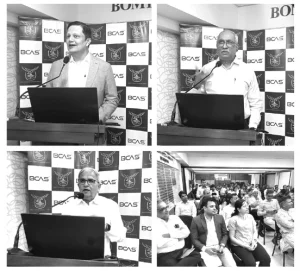
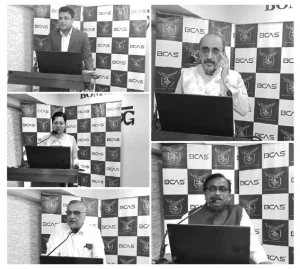
The Journal Committee of the BCAS (Bombay Chartered Accountants’ Society) successfully organised a Writers’ Workshop on 20th February 2025 in physical mode at the BCAS Office. This initiative aimed to nurture and enhance the writing skills of members and budding Chartered Accountancy (CA) professionals. Recognising the importance of encouraging young talent, the committee offered concessional registration fees for CA students, ensuring wider participation and fostering a learning culture.

The workshop received an overwhelming response, attracting participants from various states across the country. Attendees expressed their appreciation for the workshop’s well-structured sessions and rich content, which provided practical insights and actionable takeaways to improve their writing capabilities.

Topics were:

  1.  Writer & Writing – CA Raman Jokhakar
  2.  How to Write for the Profession and the Public? – CA Gautam Nayak
  3.  How to Respond to Government Authorities? – CA Anil Sathe

REMINISCENCE….

AN ODE TO WRITER’S WORKSHOP

The music created in the prosody of writings,

BCAS being the concert hall.

Sounding so purposeful and deep

The participants were confident of taking writing as their faithful leap.

The enthusiasm knew no bounds,

The workshop will be weighed for months in pounds.

90+ participants and 3 authentic speakers,

The enrolment had to be closed for more seekers.

Laughter, deep insights and practical aspect,

The participants went inside their minds and started to introspect.

Write, write till your ink finishes,

Paint the paper till you see you own artist.

CA Divya Jokhakar