





Subscribe to the Bombay Chartered Accountant Journal Subscribe Now!

Part A – Goods and Services Tax

I. HIGH COURT

71 Xilinx India Technology Services Pvt. Ltd vs. Special Commissioner, Zone-VIII
2023 (78) GSTL 24 (Del.)
Date of Order: 1st September, 2023 

Refund of IGST of a Subsidiary EOU incorporated in India providing services to its holding company outside India, cannot be denied by contending that the condition stated under section 2(6)(v) of the IGST Act 2017 are not satisfied.

FACTS

Petitioner, an Export Oriented Unit, had entered into an intercompany service agreement with its holding company located in the USA for export of information technology software services. Petitioner filed an application for refund of IGST amounting to ₹1,83,34,289 which was rejected by the respondent. A SCN was issued contending that condition under section 2(6)(v) of IGST Act which -provides that the petitioner and its holding company are merely establishments of a distinct person. Hence the condition was not satisfied and thus service provided did not constitute as export of services. Reply was filed by petitioner after referring to Circular No. 161/17/2021-GST dated 20th September, 2021 which expressly clarified that supply of services by a subsidiary of a foreign company, incorporated in India by establishment of said foreign company located outside India would not be barred by the condition stipulated under section 2(6)(v) of IGST Act. Petitioner further stated that the services provided were on their own account and were on principal-to-principal basis. Despite the detailed reasoning, the respondent without referring to the circular simply passed an order rejecting the refund.

HELD

The Hon’ble High Court held that services provided by a subsidiary of foreign company to its holding company are not covered under section 2(6)(v) of IGST Act. Impugned order was passed mechanically without application of mind ignoring and disregarding the basic provisions of law and circular. The respondent was directed to process the refund along with interest. Accordingly, petition was allowed in favour of the assessee.

72 Modern Insecticides Ltd. vs.
Commissioner CGST 
2023 (78) GSTL 423 (P & H.)
Date of Order: 19th April, 2023 

Amount deposited during the search operation cannot be treated as voluntary where no proceedings under section 74 of CGST Act, 2017 have been initiated and hence liable to be refunded to petitioner.

FACTS

Petitioner was a manufacturer of pesticides. On  5th March, 2020, respondent conducted a search operation at factory premises of petitioner, during which respondent seized all the documents and prepared a panchnama on the same day. Further, the respondent created an artificial shortage of goods without actual stock count which involved the GST and penalty amounting to ₹34,04,855 and ₹5,10,728, respectively. Petitioner deposited the said amount under pressure. Subsequently, a second search was conducted on 15th January, 2021, wherein director and CA of petitioner were detained. Both were released on a condition of deposit of ₹2.15 cr which was paid by reversing the ITC and surrender of refund application filed. Petitioner requested to refund the total amount of ₹2.54 cr as no proceedings were initiated by issuance of notice and no summons were issued under section 74(1) of the Act from the date of search till the amount deposited. Respondent contended that since petitioner had deposited money voluntarily, no notice was required to be issued. Being aggrieved, petitioner preferred this petition before Hon’ble High Court.

HELD

The Hon’ble High Court, relying upon the decision of Delhi High Court in case of Vallabh Textiles vs. senior intelligence officer and others2023 (70) STL 3 (Del) held that the amount deposited during search operation cannot be considered as voluntary. Department cannot issue Form GST DRC-01A for tax recovery since no proceedings were initiated by the department till date. The deposit of tax amount during search cannot be retained by the department and accordingly, the department was directed to refund the deposited amount along with interest.

73 Shyam Sel and Power Ltd. vs. State of U.P.
2023 (78) G.S.T.L. 283 (All.) 
Date of Order: 5th October, 2023 

Penalty under sections 129(3) and 130 should not be levied where there was a minor breach and no intention to evade tax was observed.

FACTS

Petitioner was engaged in manufacture and sale of industrial grade steel components. Goods sold by the petitioner were in transit from West Bengal to Kanpur were accompanied with all necessary documents such as tax invoice, e-way bill and goods receipts. Subsequently, these goods were intercepted by concerned authorities on the way and on verification it was found that the e-way bill had already been cancelled by the purchaser without informing the petitioner, the reason being disagreement with valuation and quantum of goods. Form MOV 06 was issued and goods were seized. Further, GST MOV 07 was issued seeking response from petitioner wherein no intention to evade tax was observed. Response submitted by petitioner that all e-way bills were filled up and they were unaware that the same were cancelled by purchaser was rejected. Further, order in Form MOV 09 was passed and penalty was imposed under sections 129(3) and 130 of CGST Act. Subsequently, an appeal filed by the petitioner was rejected. Aggrieved, a writ petition was filed before Hon’ble High Court.

HELD

High Court relying upon decision of Apex Court in case of Asstt. Commissioner (ST) vs. Satyam Shivam Papers (P.) Ltd. 2022 (57) GSTL 97 (SC), held that there was no intent to evade tax and goods in question did not reach the destination only due to circumstances beyond the control of petitioner. No such intention was observed for invoking proceedings under section 129(3) and 130 of CGST Act. It was a minor breach and proceedings should have been initiated under section 122 of CGST Act. Impugned order was set aside.

74 M. Sathess Kumar vs. Deputy State Tax Officer-2
2023 (78) GSTL 388 (Mad.) 
Date of Order: 30th August, 2023 

No Assessment Order shall be passed under section 73 of CGST Act, 2017 before considering the reply filed by the petitioner.

FACTS

Petitioner was engaged in providing works contract services to Government departments and local bodies. Subsequent to the increase in the rate of GST from 12 per cent to 18 per cent, notice was issued by respondent stating that petitioner had not paid excess liability. Petitioner submitted a reply on 24th July, 2023 but an order was passed by respondent on 25th July, 2023 without considering the reply submitted on the ground that petitioner failed to appear and submit their reply during 3 personal hearings granted previously. Aggrieved, writ petition was filed before Hon’ble High Court to quash the impugned order.

HELD

It was held that assessment order was passed by violating the principle of natural justice and the respondent is bound to consider the response submitted by the appellant before passing any impugned order. Respondent to grant one or more opportunities for personal hearing before passing a speaking order.

75 Rane Madras Ltd. vs.
Assistant Commercial Tax Officer (Appeals)
2023 (77) GSTL 382 (Mad.)
Date of Order: 2nd August, 2023 

Appeal filed manually due to technical glitches on portal against TRAN-1/2 Order before issuance of Notification No. 29/2023-CT dated 31st July, 2023 cannot be rejected merely on account of delay as specified under Section 107 of CGST Act.

FACTS

Petitioner attempted to file an appeal against the TRAN-1 rejection order dated 28th February, 2023 electronically as per Rule 108 of CGST Rules. Due to technical glitches on the portal, the petitioner was not able to upload the appeal. Another attempt was made to file an appeal online which was unsuccessful. Subsequently petitioner filed a complaint on the portal on 31st May, 2023 to which there was a reply from GST Helpdesk on 13th June, 2023 that TRAN-1/2 orders are not enabled for Appeal on GST Portal and petitioner was asked to wait till further instructions were issued on this matter. Meanwhile, the petitioner filed an appeal manually on 12th June, 2023 which was rejected by respondent by issuing order on the ground that appeal was filed after time specified under section 107 of CGST Act. Aggrieved, writ petition was filed before Hon’ble High Court.

HELD

It was held that appeal should not be rejected on the ground of delay, where due to absence of facility on GST portal, appeal was filed manually. Petitioner had already complied with Notification No. 29/2023-Central Tax dated 31st July, 2023. Any appeal filed before issuance of this notification was considered to be filed on time and hence cannot be rejected on the basis of delay in filing appeal as per section 107 of the CGST Act. Respondent directed to dispose off the order on merits.

76 Vriddhi Infratech India (P.) Ltd vs. Commissioner, Commercial Tax
[2023] 157 taxmann.com 278 (Allahabad) 
Date of Order: 23rd February, 2023 

Whether the authorities have misread Form GSTR-9 by not taking into consideration the entire form, the orders passed confirming the demands are set aside. 

FACTS

Notice under section 61 of the CGST Act was served upon the petitioner, claiming that in the annual return filed in the form GSTR-09, he has shown his turnover as R129.52 lakh which does not tally with his Bank Statement. The demand was confirmed by both the original as well as appellate authorities. The petitioner contended that the very basis of the notice is wrong since in his GSTR-9, the turnover of an amount R129.52 lakh is shown as only with regard to supply made to unregistered persons i.e., under the B2C category. It was thus contended that the authorities did not read the form as a whole.

HELD

The Hon’ble Court held that since the authorities concerned failed to take into consideration the entire form which at its end shows a total turnover of R2037 lakh in GSTR-9 and have committed the said misreading of GSTR-9, both the orders are liable to be set aside.

Note: The SLP filed against the said judgment is dismissed by the Hon’ble Supreme Court Refer (2023) 57 taxmann.com 279 (SC) dated 24th November, 2023. 

77 Sine Automation and Integration (P.) Ltd.
vs. UOI 
[2023] 157 taxmann.com 259 (Bom) Date of Order: 29th November, 2023 

Where the petitioner filed a refund application for the period April 2018 to July 2019 and included therein ITC attributable to F.Y. 2017–18 which was standing to the credit of the petitioner in the form of a running account, the order rejecting the refund on the ground that it was not permissible for the petitioner to club both the periods i.e., period before 1st April, 2018 and subsequent period is set aside. 

FACTS

The petitioner had made an application for a refund of the unutilized ITC under section 54(3) of the CGST Act, 2017 on export of goods under Letter of Undertaking (LOU) for the period April 2018 to July 2019. The said refund application included certain credits claimed even for the financial year 2017–18. The refund was sanctioned after due verification, however, the said order was challenged by the department before the Commissioner (Appeals) and the order directing payback of the refund was passed on the ground that as per Circular dated  18th November, 2019, the refund claim filed could not be spread across different financial years.

HELD

The Hon’ble Court held that as the credit which was available for the period prior to 1st April, 2018 pertained to the financial year 2017–18 the same was certainly available to the petitioner in its electronic ledger in the form of a running account, such refund cannot be denied.

78 Nemi Pharma Chem vs. Additional Commissioner of CGST & CX
[2023] 157 taxmann.com 478 (Bombay) 
Date of Order: 14th December, 2023

Whether the assessee filed a request for adjournment allowing 30 days to make submissions, the Order passed without responding to the said adjournment request and without giving an opportunity of being heard is liable to be set aside.

FACTS

The petitioner was issued a show cause notice on  12th April 2023, however, there was no compliance of the said show cause notice by the petitioner. On  26th June, 2023, the petitioner filed a letter requesting the respondents to provide a copy of the said show cause notice, since the address at which it was issued was no more occupied by the petitioner and also requested for an adjournment of 30 days, so as to enable him to make submissions and for personal hearing. The respondents handed over the hard copy of the show cause notice dated 27th June, 2023. Thereafter, on 21st July, 2023, an Order-in-Original came to be passed.

HELD

The Hon’ble Court observed that the impugned order came to be passed within two weeks from the date of application for adjournment, without the respondents replying to the request for adjournment of the petitioner. The Court further held that the respondents ought to have also complied with the provisions of section 75(4) and provided an opportunity for a hearing where any adverse decision was contemplated against such a person. The Hon’ble Court held that since there has been a violation of principles of natural justice and the mandatory provision of section 75(4) of the CGST Act, the impugned Order was quashed with a direction to decide the matter afresh and for passing a reasoned order after considering the submissions made by the petitioners.

Note: The attention is also invited to the decision in the case of Cart2India Online Retail (P.) Ltd. vs. UOI [2023] 157 taxmann.com 212 (Bombay) wherein the Hon’ble Court held that where the petitioner had sufficiently indicated that he needed a personal hearing, merely because the petitioner did not appear on a scheduled date, in the absence of a valid reason, it should not have been presumed by the State Tax Officer that the petitioner is not interested in hearing.

79 Saloom Trading vs. Superintendent, Central Goods and Services Tax and Central Excise
[2023] 157 taxmann.com 46 (Kerala) 
Date of Order: 22nd November, 2023 

The Hon’ble Court recorded a prima facie view that the benefit of waiver of late fees for delay in filing of GSTR-9 for F.Ys. 2017–18 to 2020–21, granted by Notification No.8/2023 dated 31st March, 2023, should also be extended to persons who have filed the returns before 1st April, 2023. 

FACTS

The issue before the Court was whether the benefit of waiver of late fee for delay in filing of GSTR-9 for the financial years from 2017–18 to 2021–22 filed during the period 1st April, 2023 to 31st August, 2023 as provided in Notification no. 08/2023 dated 31st March, 2023 should be extended to persons who have filed GSTR-9 before 1st April, 2023.

HELD

The Hon’ble Court granted one week’s time to file an affidavit on what basis different treatment is sought to be given to assessee’s filing GSTR-9 prior to  1st April, 2023, and thereafter for the purpose of treating differently for the purpose of benefit under the Amnesty Scheme. However, the Hon’ble Court recorded a prima facie view that any person who has filed GSTR 9/9C in respect of the financial years 2017–18, 2018–19, 2019–20, 2020–21, 2021–22 up to 31st August, 2023 should be eligible for the concessional late fee as mentioned in the said notification.Otherwise,it would amount to a violation of Article 14 of the Constitution of India since no intelligible differentia is coming out from the Scheme to differentiate an assessee/dealer who had filed GSTR-9/9C before 1st April, 2023 and an assessee/dealer who has filed GSTR-9/9C in between 1st April, 2023 to  31st August, 2023.

80 Nexus Motors (P.) Ltd vs. State of Bihar
[2023] 157 taxmann.com 538 (Patna) 
Date of Order: 30th November, 2023 

Although Notification No.53/2023-CT restricts the benefit of Amnesty allowing belated filing of appeals beyond the condonable period for orders passed up to 31st March, 2023, the High Court extended the said benefit even where the impugned order was passed after the said date stating that the order passed in at least three months before the date of the said notification i.e., 2nd November, 2023 should be considered for the beneficial treatment. 

FACTS

The proper officer passed the order in original on  27th April, 2023, which was challenged by the petitioner before the first appellate authority five days after the condonable period of one month for filing of appeal u/s 107(4) of the CGST Act had expired.

HELD

The Court held that there is no power vested either in the Appellate Authority or in a Constitutional Court acting under Article 226 to extend the period of limitation, especially when there is a specific stipulation and period prescribed for the purpose of filing a delayed appeal. The Court however referred to the Amnesty Scheme notified under Notification No.53/2023- CT dated 2nd November, 2023, permitting the belated filing of appeal only in respect of orders passed by the proper officer on or before 31st March, 2023. The Court held that there is no rationale for the date of 31st March, 2023 fixed as a cut-off date and that the Notification itself was brought out on 2nd November, 2023. The Hon’ble Court therefore held that in such circumstances any order passed during at least three months before that date; the time provided for filing an appeal, ought to have been considered for such beneficial treatment. The Court, therefore, allowed the benefit under the notification to the petitioner and the order rejecting the appeal was set aside.

81 Diamond Beverages (P.) Ltd vs. Assistant Commissioner of CGST & CX
[2023] 157 taxmann.com 479 (Calcutta) 
Date of Order: 15th December, 2023 

A show cause notice reproducing the reply of the appellant and containing allegations without dealing with the contentions of the appellant cannot be said to have been issued with proper application of mind. Such a notice issued without considering the reply to the pre-show cause notice and without conducting any inquiry or investigation at the supplier’s end is liable to be set aside. 

FACTS

The appellants were issued certain notices pointing out certain discrepancies and alleging that the appellants had availed/utilised input tax credit during the financial year 2018–19 on suppliers whose registration was cancelled retrospectively, and who had not filed GSTR3B Returns during the financial year 2018–19. The appellants filed a reply to the said notices from time to time. However, without considering the said reply to a pre-show cause notice in Part -A of Form DRC-01A was issued to the appellant computing a demand pertaining to the same allegations. The appellant submitted a very detailed reply to the pre-show cause notice giving all the factual details and also placing reliance on certain decisions of this Court as well as the Hon’ble Supreme Court. The appellant specifically sought an opportunity for a personal hearing. However, the impugned show-cause notice was issued to the appellant without considering the said reply. On challenging the said show cause notice, the learned Single Judge Bench disposed of the writ petition by directing the appellants to submit a reply to the show cause notice and raise all issues of facts as well as on law and also place the decisions on which they placed reliance. Aggrieved by the same, the petitioners filed an appeal before the division bench.

HELD

The Hon’ble Court noted that essentially, in their replies the appellants requested the authority to investigate at the supplier’s end, where there was an allegation of retrospective cancellation of the supplier’s registration and allegations, where the suppliers did not file the returns for the concerned financial year. The court therefore held that the authority was required to examine the reply given in the pre-show cause notice and considering the nature of allegations in the pre-show cause notice, it was supposed to investigate or inquire into the matter by taking note of the relevant details at the supplier’s end. The court further held that if that is not done, the true facts will not emerge and consequently, issuance of any show cause notice will be a fait accompli. The Hon’ble court noted that in the instant case, the authority has not conducted any such investigation and proceeded to issue the impugned show cause notice under section 73(1) of the Act.

The department argued that the replies given by the assessee were considered before issuing the impugned show cause notice. The Hon’ble Court observed that except for extracting the reply given by the appellants, the authority has not dealt with the contentions that were placed by the appellants in the reply to the pre-show cause notice. The court therefore held that the show-cause notice has been issued without due application of mind. Accordingly, the impugned show-cause notice was set aside and the matter is remanded back to the adjudicating authority to the stage of pre-show cause notice.

Recent Developments in GST

A. NOTIFICATION 


Notification No. 54/2023-Central Tax
dated 17th November, 2023


By above notification, the notification 27/2022 dated 26th December, 2022, is amended to notify Biometric Based Aadhaar authentication for GST registration in Andhra Pradesh.


B. ADVISORY / INSTRUCTIONS 


a) The GSTN has issued Advisory dated 14th November, 2023, for Online Compliance pertaining to ITC mismatch-GST-DRC-01C.


b) Further Advisory dated 14th November, 2023, regarding ITC reversal on account of Rule 37(A) is issued.


c) Advisories dated 10th November, 2023, and 28th November, 2023, regarding procedure for provision related to the amnesty for tax payers who missed the appeal filing deadlines for the orders passed on or before 31st March, 2023, are issued.


d) Advisory dated 1st December, 2023, is issued about two-factor authentication for Taxpayers.


e) Further Advisory dated 1st December, 2023, regarding Pilot Project of Biometric-Based Aadhaar Authentication and Document verification, of GST registration applications of Andhra Pradesh, is issued.


f) Instruction No. 4/2023-GST dated  23rd November, 2023, is issued which is regarding serving of the summary of notice in Form GST-DRC-01 and uploading of summary of order in Form GST-DRC-07 electronically on the portal by the proper officer.


C. ADVANCE RULINGS


45. Liability on Canteen recovery — ITC — Inward transportation service 
Kirby Building Systems & Structures India P. Ltd. (Order No. A. R. Com/21/2022
dated 15th November, 2023, (Telangana)) 


The facts are that the applicant M/s. Kirby Building Systems & Structures India Private Limited, Sangareddy, is into the manufacture and supply of pre-engineered buildings and storage racking systems. They provide canteen and transportation facilities to its employees at subsidised rates as per the terms of the employment agreement entered between the applicant and the employees.


In light of the above agreement, the applicant further submitted that by virtue of Section 46 of the Factories Act, 1948, they are obliged to run and maintain a canteen for their employees and for said purpose they are procuring canteen services from a third party who in turn is issuing invoice to the applicant by charging GST at a rate of 5 per cent.


The applicant submitted its say in brief as under:


“i. According to the applicant the canteen facilities provided to its employees do not qualify as supply u/s. 7 of the CGST Act and therefore no GST is leviable on the same.


ii. The applicant further relies on clarification provided by CBIC in Circular No. 172/04/2022 dt: 06.07.2022 and the press release no. 73/2017 dt: 10.07.2017 wherein it was clarified by the CBIC that prerequisites provided by the employer to its employees in terms of contractual agreement will not be subjected to GST.


iii. Further the applicant claims eligibility to ITC on the GST paid on canteen services in terms of provision to Section 17(5)(b) of the CGST Act, 2017 wherein it is provided that the input tax credit in respect of such goods or services or both shall be available, where it is obligatory for an employer to provide the same to its employees under any law for the time being in force.”


In respect of transportation service to employees, the applicant submitted that they are arranging for transportation facilities for the employees and recovering nominal amounts from the employees’ salaries towards the cost incurred for providing such transportation facility, without any commercial objective. It was submitted that:


“i. Such supply of transportation service shall not be treated as supply in terms of Section 7 of the CGST Act, 2017.


ii. That vide Notification No. 12/2017 dt: 28.06.2017, the intra-state supply of transport of passengers in non-air conditioned contract carriage, excluding tourism shall be exempted from the payment of Central tax; and that they are providing a service for transport of passengers in non-air conditioned contract carriage and therefore the service provided by them is exempt from tax.


iii. That the applicant is procuring bus services to facilitate smooth functioning of his business in the course of furtherance of his business and the cost incurred by the applicant pertaining to the transport facility provided to its employees is the expenditure incurred by the applicant in terms of the contract between the employer and employee. Therefore, that the applicant is eligible for input tax credit on the tax paid on hire of such vehicles.”


With the above background, following questions were raised.


“1. Whether GST is liable to be discharged on the recoveries being made by the applicant from its employees towards the canteen and transportation facilities provided to them?


2. Whether the applicant is eligible to avail input tax credit in respect of the GST paid on inward supplies used for providing canteen and transportation facilities?”


The learned members gave their different but concurring orders.


The sum and substance of the said order is that the canteen facility is as per requirement of Factories Act,1948, and the applicant is entitled to recover the cost as per Rule 68 of AP Factories Rules,1950, as adopted under Telangana Factories Rules.


The ld. members, in general, observed that if cost is fully recovered, then no cost will be borne by the applicant and hence no ITC. However, if only nominal amount recovered and rest born as cost, then the applicant will be eligible to ITC, as it is allowable as per section 17(5)(b) read with proviso thereto.


In respect of traveling inward, the ld. members were of the view that it is not under any statutory requirement but in the nature of personal consumption for employees.


Therefore, on inward transportation service, ITC is not eligible in view of section 17(5)(b), observed the ld. AAR.


On the supply outward side in both cases, it is held that if the providing service is as part of perquisite, then no liability to GST, but if it is against consideration as business, then such action will be liable to GST.


The ruling given by ld. AAR is as under:


Questions Ruling
1. Whether GST is liable to be discharged on the recoveries being made by the applicant from its employees towards the canteen facilities provided to them? If it is by way of perquisites not liable. However, if canteen services as a business are liable to GST.
2. Whether the applicant is eligible to avail input tax credit in respect of the GST paid on inward supplies used for providing canteen facilities? ITC will be eligible in view of section 17(5)(b).
3. Whether GST is liable to be discharged on the recoveries being made by the applicant from its employees towards the transportation facilities provided to them? If it is by way of perquisites not liable. However, if such services as business are liable to GST.
4. Whether the applicant is eligible to avail input tax credit in respect of the GST paid on inward supplies used for providing transportation facilities? No ITC as it will be personal consumption.


46 Supply by sub-contractor to Contractor — separate supply than by principal contractor to its contractee 
Immense Construction Co.
(Order No. A.R. Comm/13/2023
dated 13th November, 2022 (Telangana))


The Applicant M/s Immense Construction Company is a Firm registered under the Goods and Services Tax Act, 2017. It undertakes contracts / subcontracts of the entire work for Operation and Maintenance of Water Supply Projects / Sewerage Projects / Facilities.


The Applicant is awarded a contract by M/s. The Indian Hume Pipe Company Ltd. (referred to as “Principal Contractor”).


The Principal Contractor is awarded a contract by the State of Telangana, Mission Bhagiratha.


The subcontract agreement is carved out of the Principal Contract, and it clearly indicates scope of the work to be undertaken and obligations of such subcontractor. The conditions of subcontract also provide that the subcontract agreement is liable to termination if the work is not executed and maintained as per Guidelines of Mission Bhagiratha, State Government of Telangana.


It is also mentioned by applicant that value of goods is not more than 25 per cent of the subcontracted value (as can be verified from the Contract so awarded) and therefore exempted from payment of GST in terms of entry 3A in Notification No. 12/2017 – Central Tax (Rate) as amended by Notification No. 2/2018 Central Tax (Rate) dated 25th January, 2018; and that the subcontract only for supply of Man Power is Pure Service and hence exempted from payment of GST in terms of Entry 3 in Notification No. 12/2017 – Central Tax (Rate) as amended by Notification No. 2/2018 – Central Tax (Rate) dated 25th January, 2018.


The applicant further presented its Interpretation of Law for each of the above questions as under:


“a) That services provided by the Applicants are Pure Services;


b) That these services are ultimately provided to the State Government of Telangana;


c) That these services are in relation a function entrusted to a Municipality under Article 243W of the Constitution (the present work falls under Serial No. 5 of 12th Schedule being water supply for domestic purpose);


d) That the services are covered by the Entry No. 3 of Notification No. 12/2017 Central Tax (Rate) dated 28th June, 2017;


e) That the Applicant draws support from Circular No. 147/16/2011-Service Tax dated 21st October, 2011 issued under the erstwhile Service Tax regime wherein under similar situations the Department had clarified that the services provided by the subcontractors to the main contractors in relation to those very projects which are classifiable as Infrastructure Projects Works Contract Services, then they too will get the benefit of exemption so long as they are in relation to the very same Infrastructure Projects i.e. WCS;


f) That the Applicant also draws support from the observations of the Hon’ble Apex Court in the case of State of Andhra Pradesh vs. Larsen and Toubro 17 VST 1 (SC) – 2008-VIL-30-SC wherein it was submitted by the Company and upheld by the Court that the transfer of property in goods, as effected by the sub-contract, resulted in direct sale to the Contractee and consequently it did not involve multiple sales either in favour of the main contractor or in favour of the Contractee.”


In respect of ‘Pure Service’ they further submitted that the said transaction is covered by Notification No. 12/2017- Central Tax (Rate), dated 28th November, 2017, as amended by Notification No. 2/2018 dated 25/01/2018 under Entry 3 and it is exempt from Tax.


With above facts, following questions were raised:


“a. Whether the supply of Services by the Applicant to M/S. THE INDIAN HUME COMPANY LTD. is covered by Notification No. 12/2017- Central Tax (Rate), dated 28th November, 2017 as amended by Notification No 2/2018 – Central Tax (Rate) dated 25/01/2018;


b. If the supplies as per Question (a) are covered by Notification No. 12/2017 Central Tax (Rate), dated 28th November, 2017 as amended by Notification No 2/2018 Central Tax (Rate) dated 25/01/2018, then what is the applicable rate of Tax under the Goods and Services Tax Act, 2017 on such Supplies; and


c. In case, if the supplies as per Question (a) are not covered by the Notification supra then what is the applicable rate of tax on such supplies under the Goods and Services Tax Act, 2017.”


Based on above, the ld. AAR observed that the basic enquiry in this proceeding is regarding.


“1. Whether the supply of works contract services by a contractor and his procurement works contract services constitute two independent taxable events under the CGST Act.


2. Whether an exemption extended to a contractor supplying works contract services is applicable to his procurement of works contract.”


The ld. AAR made reference to the Notification No. 12/2017 – Central Tax (Rate), dated 28th June, 2017, which is amended vide Notification 2/2018 – Central Tax (Rate), dated 25th January, 2018, to include entry 3A in same in order to exempt works contract with value of supply of goods less than 25 per cent, when the said supply is made to the Central Government, State Government or Local Authority, etc., and if the activity is related to any function entrusted under Article 243G or 243W of the Constitution of India.


The ld. AAR observed that the exemption is not a general exemption but subject to conditions that the supply has to be made to Central Government, State Government or Local Authority, etc. The ld. AAR found that there is no mention in entry of sub-contractors making supply of such services to a contractor who in turn is making supplies under entry 3A of Notification 12/2017, as amended above.


The ld. AAR, making reference to judgments, held that the exemption entry is to be interpreted strictly. It is also observed that where it is felt necessary, the Government has mentioned the category of sub-contract also for grant of concession like, in Notification no. 1/2018 – Central Tax (Rate) dated 25th January, 2018, r/w. Notification no. 11/2017. The ld. AAR observed that though the CGST Act does not define a subcontractor, however, the Notification 11/2017, as amended, makes a mention of the subcontractor whose services are procured by the main contractor. Accordingly, the ld. AAR observed that the Scheme of the Act clearly identifies the subcontractor as a supplier of works contract services to the main contractor.


With above observations, the ld. AAR passed ruling as under:


“Questions Ruling
a. Whether the supply of Services by the Applicant to M/S. THE INDIAN HUME COMPANY LTD. is covered by Notification No. 12/2017- Central Tax (Rate), dated 28th November, 2017 as amended by Notification No. 2/2018 – Central Tax (Rate) dated

25th January, 2018;

No
b. If the supplies as per Question (a) are covered by Notification No. 12/2017 Central Tax (Rate), dated 28th November, 2017 as amended by Notification No. 2/2018 Central Tax (Rate) dated

25th January, 2018, then what is the applicable rate of Tax under the Goods and Services Tax Act, 2017 on such Supplies; and

Not Applicable
c. In case if the supplies as per Question a are not covered by the Notification supra then what is the applicable rate of tax on such supplies under the Goods and Services Tax Act, 2017. 9 per cent CGST + 9 per cent SGST”


47 Business — Composite Supply in Education / Healthcare Services 
Kasturba Health Society (Order No. MAH/AAAR/DS-RM/13/2022-23
dated 5th December, 2022, (MAH)) 


The facts are that the appellant had earlier filed an AR application, which was rejected. Against the said rejection, appeal was filed before AAAR. The said appeal was also rejected. Therefore, a writ petition was filed in Bombay High Court and Hon. Bombay High Court directed the authorities to decide the question raised in the AR application. Accordingly, the AAR decided issues vide its order in GST-AAR-120/2018-2019/B-90 dated 30th November, 2021. Some questions were decided against the appellant and hence, this appeal was filed before AAAR.


The basic facts are that the Kasturba Health Society was formed as a Charitable Institution by way of Registration under the Societies Registration Act, 1860, and also under The Bombay Public Trust Act, 1950, with the sole objective of attending the health needs of rural India.


The Appellant society was also registered under Section 12AA of the Income Tax Act, 1961, and it has other registrations also.


The appellant is imparting Medical Education, till Post Graduation. The appellant has its setup in the form of a “Medical College” named as “Mahatma Gandhi Institute of Medical Science”, at Village Sewagram. Dist. Wardha, which is attached with a clinical laboratory named as “Kasturba Hospital”.


The appellant was not registered under earlier BST/MVAT Act or Service Tax. However, entertaining doubt, this application for AR was filed under GST.


The questions put forward by appellant in its AR application and its replies by AAR are as under:


i. Whether the applicant, a Charitable Society, having the main object and factually engaged in imparting Medical Education, satisfying all the criteria of “Educational Institution”, can be said to be engaged in the business so as to cast an obligation upon it to comply with the provisions of Central Goods and Service Tax Act, 2017, and Maharashtra Goods and Service Tax Act, 2017 in totality.


Reply: Appellant engaged in business.


ii. Whether the applicant, a Charitable Society, having the main object and factually engaged in imparting Medical Education, satisfying all the criteria of “Educational Institution” is liable for registration under the provisions of section 22 of the Central Goods and Services Tax Act, 2017 and Maharashtra Goods and Services Tax Act, 2017, or it can remain outside the purview of registration in view of the provisions of section 23 of the said act as there is no taxable supply.


Reply: Liable for registration.


iii. In a situation, if above questions are answered against the contention of the appellant institution, then following further questions were raised for the kind consideration by the Honourable Bench.


a. Whether the fees and other charges received from students and recoupment charges received from patients (who is an essential clinical material for education laboratory) would constitute as “outward supply” as defined in section 2(83) of The Central Goods and Service Tax Act, 2017 and Maharashtra Goods and Service Tax Act, 2017, and if yes, then whether it will fall in classification entry at Sr. No. 66 or the portion of nominal amount received from patients (who is an essential clinical material for education laboratory) at Sr. No. 74 in terms of Notification 12/2017 Central Tax(R) – dated 28th June, 2017.


Reply: Charges are exempt from GST.


b. Whether the cost of Medicines and Consumables recovered from OPD patients along with nominal charges collected for Diagnosing by the pathological investigations, other investigation such as CT-Scan, MRI, Colour Doppler, Angiography, Gastroscopy, Sonography during the course of diagnosis and treatment of disease would fall within the meaning of “composite supply” qualifying for exemption under the category of “educational and /or health care services.”


Reply: Charges are exempt from GST.


c. Whether the nominal charges received from patients (who is an essential clinical material for education laboratory) towards an “Unparalleled Health Insurance Scheme” to retain their flow at one end for the purpose of imparting medical education as a result to provide them the benefit of concessional rates for investigations and treatment at other end would fall within the meaning of “supply” eligible for exemption under the category of “Education and/or Health Care Services.”


Reply: The charges are liable to 18 per cent GST. 


d. Whether the nominal amount received for making space available for essential facilities needed by the students and staffs such as Banking, Parking, Refreshment, etc. which are support activities for attainment of main activities and further amount received on account of disposal of wastage would fall within the meaning of “supply”, qualifying for exemption under the category of “educational and / or health care services”.


Reply: The charges are liable to 18 per cent GST.


This appeal was filed against the above ruling of ld. AAR. In appeal, the appellant mainly contended that it is not doing any business and, therefore, GST not applicable to it.


Similarly, the ruling about taxability of charges was contested as erroneous.


In the course of appeal, the department also made its submission and reiterated that the AR is correctly decided.


The ld. AAAR thereafter analysed the argument of both sides.


Regarding the first issue as to whether the impugned activities of Appellant of providing educational services by way of imparting medical education through MGIMS, and providing the health care services through Kasturba Hospital, can be construed as “Business” in terms of the provisions of CGST Act, 2017, the ld. AAAR examined the definition of “Business” provided under section 2(17) of the CGST Act, 2017.


The ld. AAAR also observed that the appellant is doing such job or work which requires the services of highly educated, trained and skilled persons in the form of doctors hired by them for imparting the medical education to the students and hence, the said work done by the appellant is in the nature of “profession”, and accordingly, it is to be construed as “business” in terms of the GST provisions. The provision of health care services by the Appellant through its establishment, Kasturba Hospital, is also “profession” as envisaged under the definition of the term “business” provided under the GST law. The ld. AAAR held that the appellant is in business.


The ld. AAAR also examined whether the said activities of educational services and health care services undertaken by the Appellant will be construed as “supply” in terms of section 7(1)(a) of the CGST Act, 2017 or not. The definition of “supply” also reproduced as under:


“Section 7


(1) For the purposes of this Act, the expression ‘supply’ includes-


(a) ‘all forms of supply of goods or services or both such as sale, transfer, barter, exchange, license, rental, lease or disposal made or agreed to be made for a consideration by a person in the course or furtherance of business.’”


The ld. AAAR observed that following criteria is to be fulfilled for activity to be ‘supply’.


“i. that such supply should be made by a person for a consideration;


ii. that such supply should be made in the course or furtherance of business;”


The ld. AAAR held that the appellant fulfils criteria of being a person, the activity being in the course of business and hence, the activities are ‘supply’ under GST.


Coming to the next issue about exemption, the ld. AAAR held that the activities of imparting medical education
to the students squarely fit under entry at Sl. No. 66 of the exemption Notification No. 12/2017-C.T. (Rate) dated 28th June, 2017, which reads as under:


“Sl.

No.

Chapter, Section, Heading, Group or Service Code (Tariff) Description of Services Rate

(percentage)

Conditions
66 Heading 9902 Services provided – (a) by an educational institution to its students, faculty and staff; NIL NIL”


The ld. AAAR observed that the services of medical education provided by the Appellant-Society is recognised by the Maharashtra University of Health Sciences, Nashik and Nagpur University, hence it falls under the category of “educational institution” as defined under the GST law, and accordingly, the ld. AAAR held that the medical education services provided by the Appellant to the students will attract NIL rate of GST as per the aforesaid entry 66, and allowed it as exempt.


Regarding the second activity of the health care services also, the ld. AAAR held that it will squarely fit under the entry at Sl. No. 74 of the exemption Notification No. 12/2017-C.T.(Rate) dated 28th June, 2017, which reads as under:
“Sl.

No.

Chapter, Section, Heading, Group or Service Code (Tariff) Description of Services Rate

(percentage)

Conditions
74 Heading 9993 (a) Services by way of (a) health care services by a clinical establishment, an authorized medical practitioner or paramedics;

(b) services provided by way of transportation of a patient in an ambulance, other than those specified in (a) above.

NIL NIL”


The ld. AAAR observed that the services of appellant are ‘health care services’ and will be exempt from the payment of GST in terms of the entry at Sl. No. 74 above.


The learned AAAR observed that the above services are ‘outward services’ as appellant receives charges from students and recoupment charges from patients which constitute consideration for outward supply.


Accordingly, the ld. AAAR held that the core services of the Appellant, viz. provision of medical education to the students and provision of health care services to the patients, are exempted supplies.


In respect of cost of medicines and consumables recovered from OPD, patients along with nominal charges collected for diagnosis etc. during the course of diagnosis and treatment of disease, the ld. AAAR held that they are covered by scope of ‘composite supply’ as defined in section 2(30) of GST Act.


The ld. AAAR, therefore, held that they are exempt along with core health care services.


Regarding the recovery under the second activity, namely, “Unparallel Health Insurance Scheme” under which the Appellant collects a nominal specific amount from the public who intends to avail the health care services from the Appellant in future at the concessional rate, the ld. AAAR observed that it is not an insurance service in real terms as it is not under licence from IRDAI. The AAR has classified the said activities as liable to GST at 18 per cent. However, the ld. AAAR concurred with the Appellant’s contention that the said nominal amount being charged by them are in the nature of advances towards the provision of the health services which would be provided to the subscribers of the said scheme. Therefore, the ld. AAAR held that receipts are eligible for exemption under the entry at Sl. No. 74 of the exemption Notification No. 12/2017-C.T. (Rate) dated 28th June, 2017.


Regarding further activity of providing space for the facilities, like Banking, Parking, Refreshment Canteen, etc., the ld. AAAR observed that the said activities are not directly provided to the students or patients, who are the recipients of the main services of the Appellant. The receipts are from third parties for renting of immovable property by way of providing space for the facilities like banking etc., who are running these establishments on their own account.


The ld. AAAR held that they are, therefore, not composite supply as not provided to the same one person but two separate persons.


Accordingly, the ld. AAAR held the said receipts taxable at the applicable rate of 18 per cent.


In respect of receipts on account of disposal of wastes such as medical equipment, apparatus and other instruments, etc., by selling them to the interested vendors, the ld. AAAR held them as independent activity and hence ruled as liable to tax.


Accordingly, the ld. AAAR concurred with replies of AAR mentioned in questions (i), (ii), (iii)(b) and (iii)(d). The ld. AAAR modified the ruling in respect of (iii)(a) and (iii)(c) to hold said activities as exempt.


Classification — ‘Honeycomb paper for wrapping’
V. M. Technocoatings (AR No. UP-ADRG-11/2022 dated 30th August, 2022 (UP)) 


The applicant is undertaking a process to prepare eco-friendly expandable paper wrap (replacement of bubble wrap) from kraft paper and to sell the same in open market.


The process is explained as under:


“First they prepare the core material by using the two or more sheets of honeycomb like structure kraft paper which is glued together in an alternate glue strip pattern to create structure of multiple layers of kraft paper in vertical direction. These corrugated layers open out in the form of continuous honeycomb like grid with center of each corrugated strip attached to another layer of corrugated strip upon expansion. Depending upon the product being packed with this material, multiple paper honeycomb wrap may be glued together to make specific design of packing material.


These paper honeycomb used in the primary packing of goods as a cushioning material, separators or edge protector, to make shipping cartons of goods and as pallets and pallet boxes.


This paper honeycomb wrap consists of 80 to 90% of kraft paper and rest is other adhesive, hence this paper honeycomb wrap classifies under HSN 4808 category. Contrary to this, 4823-chapter heading is more oriented towards ‘other paper, paperboard, cellulose wadding and webs of cellulose fibers’ etc. and not specific to kraft paper products.”


The applicant made reference to the fact that the main raw material to make honeycomb wrapping paper contains 80–90 per cent of kraft paper, and the rest other things are consumable items.


Reliance placed on order of Karnataka AAR in the case of M/s. Lsquare Ecoproducts Pvt. Ltd. (2020 (37) GSTL 394 (AAR-GST-Kar-2020-VIL-123-AAR)) where in it held as below:


“Therefore, on verification of the structure and purpose for which kraft paper honeycomb board or paper honeycomb board used are similar to the corrugated paperboard (listed under 4808 10 00), only difference is that this paper honeycomb board consists of honeycomb like structure core material at the center and on either side of this one or more layer of kraft paper is glued by using adhesive with fluting direction being perpendicular to corrugated boards. Hence this honeycomb paperboard classified under the Heading 4808 90 00 as other instead 4808 10 00.”


In the above case, the same item is held as covered by heading 4808-9000 attracting GST at 12 per cent.


The applicant also referred to the setting of heading 4808 in Custom Tariff.


The ld. AAR also considered the submission of the department, wherein they submitted that the item is classifiable under Chapter Sub-heading No. 48239013.


The ld. AAR observed about meaning of ‘paper’ referring to dictionary as under:


Meaning of the said word is explained in The Shorter Oxford Dictionary [Volume 2 (Third Edition)] as- “a substance composed of fibres interlaced into a compact web, made from linen and cotton rags, straw, wood, certain grasses, etc. which are messed into a pulp, and pressed; it is used for writing, printing, or drawing on, wrapping things in, for covering the interior or walls, etc.”


Encyclopaedia Britannica says – “Paper, the general name for the substance commonly used for writing upon or for wrapping things in.”


In Unabridged Edition of the Random House Dictionary of the English Language the word “paper” has been defined as “a substance made from rags, straw, wood or other fibrous material, usually in thin sheets, used to bear writing or printing on or for wrapping things, decorating walls etc.”


As per Webster’s Dictionary- “Paper, a thin flexible material made in leaves or sheets from the pulp of rags, straw, wood or other fibrous material and used for writing or printing upon or for wrapping and various other purposes.”


Accordingly, the ld. AAR observed that in popular parlance the word “paper” is understood as meaning a substance which is used for writing or printing, or for packing or for drawing on, or for decorating, or covering walls.


The ld. AAR after referring to the process adopted by the applicant also made reference to judgment of Hon’ble Rajasthan High Court in the case of Deepak Agencies vs. Assistant Commercial Tax Officer, (1993) 90 STC 376 (Raj) to ascertain the meaning of ‘paper’.


The ld. AAR held that the intended use of the material in question should be the guiding factor for deciding the classification of the commodity.


The ld. AAR also referred to the scheme of classification under GST with reference to Notification no. 1/2017-Central Tax (Rate) dated 28th June, 2017, and also to General Rules for the Interpretation of Import Tariff which provides for classification of goods in this Schedule.


After examining the schedule of Tariff, the ld. AAR observed as under:


“As per Rule 3(a) of General Rules for the Interpretation of Import Tariff, the heading which provides the most specific description shall be preferred to headings providing general description. The Tariff item 48239013 contains specific description of Packing and wrapping paper. The product ‘eco-friendly expandable paper wrap (honeycomb paper for wrapping)’ is manufactured from the kraft paper and adhesives and the same is used in wrapping/packing as such Rule 3(a) of General Rules for the Interpretation of Import Tariff will apply and the same merits classification under HSN 48239013.”


After considering the above position the ld. AAR gave ruling as under:


25. Ques. Whether HSN applicable to eco-friendly expandable paper wrap (honeycomb paper for wrapping) is 48239013 or 48084090?


Answer- The HSN code of the product namely “eco-friendly expandable paper wrap (honeycomb paper for wrapping) is 48239013.” 

Corporate Guarantee: Quasi Capital or Taxable Service

Business Conglomerates fund their SPVs, subsidiaries, joint ventures, etc., with self-generated capital and / or leveraged capital. The downstream entity may not be capable of attracting debt capital based on its own net-worth and would require an intervention of the parent entity to guarantee such debt. In many cases, they are also issued to notch-up the credibility of the debt entity and reduce the cost of debt capital.

These Guarantees are reported in the financial statements (as contingent liabilities), Transfer pricing reports (as international transactions), Bank sanction letters and have caught the taxman’s eye of a possible revenue leakage, creating significant litigation under the Direct and Indirect Taxes domain. Therefore, it would be apt to unravel the concept of Guarantees, their forms / types, and the tax exposure they carry under the GST law.

COMMERCIAL UNDERSTANDING

Guarantees are contracts which grant the financier of capital the “assurance” over the repayment capacity of the borrower and carry an “obligation” to make good any default by the borrower entity. In many cases, promoters / directors of the Company (being the deployers of the capital) are also roped into the financial arrangement and made personally liable in case of any default. Such guarantees may also be backed with realisable security (such as deposits, capital assets, mortgageable / pledge assets, etc.,) to secure any default of the guarantor itself.

TYPES OF GUARANTEES

1) Bank guarantees / performance bank guarantees — Banks and FIs issue Guarantees to third parties at the insistence of their customer securing the performance of a financial obligation by the said customer. These guarantees are backed with liquid or illiquid securities which secure any possibility of default by the entity whose obligations are being underwritten. These are issued in Government / large contracts where a contractor must project his financial commitment to deliver such contracts. Banks charge a guarantee commission for the issuance of such guarantee which is liable to GST.

2) Corporate / personal guarantees — Banks / FIs insist that debt capital is supported by due corporate guarantees from their parent entities and hence incorporate guarantee conditions. The parent companies may not charge any fee from the funded entity towards such a guarantee. Promoters / Directors, etc., also extend personal guarantees and are barred from recovering any fee from the related entity in terms of the RBI Master Circular No. RBI/2021-22/121 dated 9th November, 2021.

3) Commercial / standby letter of credit (LC) — This is used commonly in international trade1. LC is an undertaking, or a guarantee issued, generally by a Bank, to pay to the beneficiary a certain or determinable amount upon simple demand or on presentation of specified documents. Commercial LCs are distinct from standby LCs to the extent that the former involves an upfront payment obligation to the beneficiary while in the case of the latter, the payment obligation is triggered only on a default by the person whose obligation is being guaranteed. Like the Bank guarantee commission, the LC issuance fee is liable to GST.

4) Contractual Performance Guarantee — Similar to bank performance guarantee, the parent entity also guarantees that its SPV, being the awardee of the contract, would successfully and satisfactorily execute the obligations under the contract. It also includes a guarantee that the contract would be performed with the material and workmanship meeting the required standards.

5) Letter of Comfort — Letters of comfort are issued by the Parent entity, more as a moral commitment rather than a legally binding obligation, to discharge the debts of the funded entity in case of there being any default therein. No explicit cost is charged either by the bank / FI from the parent entity for this facility.

Among the above, guarantees by third parties (such as Banks / FIs) are simple and against valuable consideration, and are clearly chargeable to GST. Other forms of guarantee involving related entities (such as Corporate / personal Guarantees, etc.,) have come to the forefront regarding the applicability of GST, in the absence of any visible consideration in the contract. We could address this by going back to the genesis of guarantees from the Contract Act.


1. Governed by Uniform Customs & Practice for Documentary Credits (UCP-600)

INDIAN CONTRACT ACT, 1872

Chapter VIII of the Indian Contract Act, 1872 titled as “Indemnity and Guarantee” contains special provisions for Contract of Guarantee:

126. A “contract of guarantee” is a contract to perform the promise, or discharge the liability, of a third person in case of his default. The person who gives the guarantee is called the “surety”; the person in respect of whose default the guarantee is given is called the “principal debtor”, and the person to whom the guarantee is given is called the “creditor”. A guarantee may be either oral or written.

127. Anything done, or any promise made, for the benefit of the principal debtor, may be a sufficient consideration to the surety for giving the guarantee.

145. In every contract of guarantee there is an implied promise by the principal debtor to indemnify the surety, and the surety is entitled to recover from the principal debtor whatever sum he has rightfully paid under the guarantee, but, no sums which he has paid wrongfully.”

Contracts are a set of promises and counter-promises wherein each party undertakes an obligation for the benefit of the other. Section 2 of the Contract Act beautifully lays down the sequence in the formation of a contract – a proposal by the promisor, its acceptance by the promisee, leading to an agreement between the promisor and promisee and then finally being sealed as an enforceable contract. Guarantees are one such type of contract of counter-promises which have to evolve through this very same process.

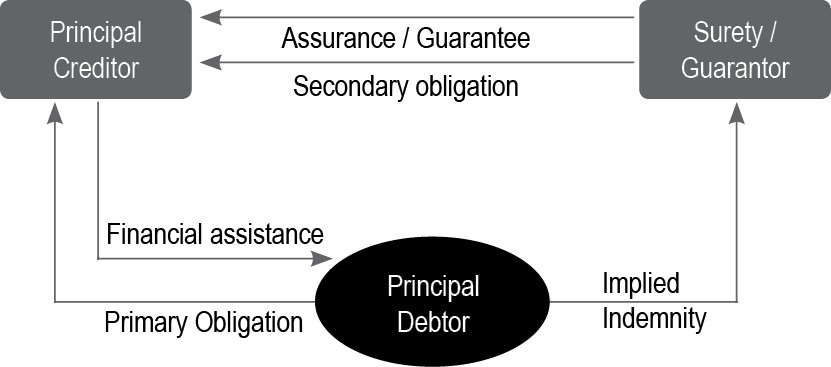
Unlike typical contracts, the definition of guarantee identifies three parties to a contract – “Surety / Guarantor” giving the guarantee, such guarantee being given to the “principal creditor” and the guarantee being rendered in respect of the default of “principal debtor”. The subject-matter of the guarantee (when invoked by the Creditor) could be the “performance of a promise” or “discharge of a liability” of the principal debtor. Each of these terms / phrases are significant and have to be specifically identified in a contract of guarantee. Pictorially it would appear as follows:

Speaking in contract language, the Surety promises / assures the Creditor that the financial assistance proposed to be issued to the Debtor is backed by its guarantee and in the event of the default being committed by the Debtor, the Surety would step into the shoes of such debtor and make good the financial assistance which has been rendered to the Debtor. In the tri-party arrangement, the liability of the debtor and the surety are co-extensive and alteration of the liability simultaneously alters the rights of both parties vis-à-vis the Creditor.

The subject-matter of a contract of guarantee flows from the Surety to the Creditor i.e. the promise of a guarantee, and the recipient of such guarantee is the Principal Creditor. It is against the promise of guarantee that the Principal Creditor extends the financial assistance to the Principal Debtor. Therefore, there are two sets of promises in such a scenario (a) one being the promise of guarantee by the Surety / Guarantor (as a promisor); and (b) the promise of rendering the due financial assistance by the Creditor to the debtor (being the consideration against the promise of guarantee). This would be crucial while applying the concept of supply and consideration under section 7 of the GST law (elaborated later).

After defining the contract of guarantee, section 127 now proceeds to define the consideration of the contract of guarantee. One may note that the Creditor and the Debtor are engaged in an independent debtor-creditor arrangement2. The contract of guarantee acts as a top-up to the underlying arrangement where the surety may not receive any direct benefit from the Creditor for extending its assurance / promise. As can be seen from the diagram above, the assurance / guarantee does not have any reciprocal flow of consideration back to the Surety / Guarantor either from the Creditor of Debtor. Thus, in the absence of any consideration, direct or indirect, flowing to the Surety, it was imperative that such contracts are given statutory enforceability, else may constitute a void contract. Section 127 fills this gap by stating that the ‘financial assistance to the Debtor’ against the ‘promise of Guarantee’ would constitute sufficient consideration to the Surety for a rendition of the promise of Guarantee. Technically speaking, the financial assistance to the debtor would constitute sufficient discharge by the Creditor under the contract of guarantee and the Surety cannot claim any further consideration from the Creditor for rendition of such guarantee. However, there is an option for the Surety, though no contractual obligation, to claim a consideration from the Debtor for agreeing to issue such a guarantee.


2. Mak Impex Chemicals vs. UOI AIR 2003 Bom 88

Section 128–144 of the said Act defines the rights, obligations, liabilities, and discharge of the Surety on account of the guarantee extended to the Creditor. Section 145 is critical as it defines the relationship between the Debtor and Surety—it states that there is an implied responsibility by the Debtor to ‘indemnify’ the Surety against all costs which the surety has rightfully incurred under the Contract of guarantee (including costs of defending suits, etc.,). This section grants legal protection to the Surety to proceed against the Debtor for recovery of all costs under this contract despite there being no express contract between these parties. This is akin to an implied contract of indemnity underlying the contract of guarantee and establishes an indemnifier-indemnity holder relationship.

REVENUE’S CONTENTION UNDER GST

Now turning to the revenue’s understanding of this arrangement. Revenue claims that Banks generally charge a fee from third parties for the issuance of Bank guarantees. Corporates issuing guarantees within group entities ought to charge a similar fee to be considered at arm’s length. The issuance of the guarantee is at the request of the related entity. Hence, there is a service being rendered by Surety in delivering a guarantee to the Bank. Thus, the transaction aptly fits into Entry 2/4 of Schedule I and is liable to tax in the hands of the Surety under the residuary services entry @ 18 per cent. In cases where the Surety is located outside India or personal guarantees are provided by Promoter-Directors, RCM is proposed by the Debtor Company as a “recipient” of Corporate Guarantee services. To further the case of the revenue, the GST council has inserted Rule 28(2) to provide a mechanism to value such services. A Circular has also been issued elaborating on the valuation methodology in corporate / personal guarantees.

APPLICATION OF GST LAW

With this backdrop, the points for examination would be as follows:

a) Is there any service between the Surety and the Debtor (as related persons) under a contract of guarantee?

b) Can the guarantee form part of the ‘shareholder function’ as it is provided by the parent company in respect of its related company whose shares it holds?

c) If at all there is a service being imputed under law, what is the taxable value of such service?

Section 7 of GST law stands upon four important pillars (a) an act of supply of goods / service; (b) supplier-recipient relationship; (c) consideration for such supply; (d) supply being in the course or furtherance of business. In cases where a service is being imported from outside India, it is taxable whether or not, it is in the course of business. In respect of related parties, Entry 2/4 of Schedule I excludes the requirement of ‘consideration’ for an activity to constitute a supply.

GST being levied on a transaction of supply can be termed as a “transaction-based tax” involving two or more persons. The Contract Act lays down the foundation for transactions which emanate from contracts between two or more persons. Thus, it is important to intertwine the contract law and the GST law to understand the deemed GST implications in case of related entities located either in India or outside India. The analysis is to take place in two parts (a) Cases where no commission / fee is charged for such activity from related parties (b) Cases wherein a specific charge is made from the related party for such activity. For analysis, “A” may be considered as the Creditor; “C” as the Debtor and “B” as the Guarantor / Surety for the Debtor, with B and C being related entities.

A) Cases where no fee is charged from the Debtor

Is there an Act / Contract of Supply between B and C?

The primary question is whether at all, there is a service being rendered by B to C by issuing guarantee to A, or is it a self-activity done by B for its own interest?

At the outset “activity of supply” should be viewed as emerging from an “enforceable contract” between the contracting parties. The essential elements of a contract should clearly be reflected in the contract of supply for it to be taxable under section 7 of GST law. Invalid, incomplete, or non-existent contracts cannot be considered as taxable or even imputable into section 7. The Bombay High Court in Bai Mamubai Trust3 placed the requirement of an enforceable contract and contractual reciprocity between parties as quintessential for a taxable supply. The Court very finely distinguishes payment of sums in respect of a disputed price of a taxable supply vs. payment of sums towards restitution or damages for an illegal act. Payment of sums for wrongful unilateral acts or damages were not emerging from reciprocal obligations and hence not considered as passing the “supply doctrine”.

Thus, the ingredients of the contract (as elaborated above) are core to the taxation of supply under GST. The terms supplier (promisor), recipient (promisee), the act of supply (promise) and consideration should be explicit and agreed upon by the contracting parties. If a transaction is to be considered as a supply, the contractual obligations and promises should also align with the act of supply i.e. if a service is said to be taxed between a supplier and a recipient, there has to be a contractual obligation by the supplier to render such a service to the recipient. Without any contractual obligation, a service cannot be said to have been agreed between the contracting parties. Gratuitous acts are not meant to be taxed under the GST law4. Thus, there is no room for intendment or imputation of a ‘contract’ even by way of a statutory fiction under section 7 of GST law.


3. 2019 (31) G.S.T.L. 193 (Bom.)
4. Circular No. 116/35/2019-GST, dated 11th October, 2019 issued on donations and free gifts

Contract of Guarantee is clearly between B and A under which the promise of guarantee flows from B to A. In consideration for the receipt of the guarantee from B, A renders financial assistance to C. Clearly, C is the only beneficiary of reciprocal obligations between A and B. Neither are B and C acting on behalf of each other while contracting with A. Both the parties have their respective obligations to A: C has its primary obligation to repay the financial debt and B has the co-existent secondary obligation to repay in case it is called upon to do so by A. C (though a witness / signatory) does not have contractual privity to the promise of guarantee. C’s obligation to A emerges from the separate loan contract between A and C. C cannot enforce any of the obligations or promises which is agreed upon between A and B and they stand on an independent footing.

Any supplier-recipient identification under GST law should have contractual authenticity. Similarly, the guarantee service sought to be deemed under Schedule I by the revenue should also possess valid contractual obligations between B and C. Yet Revenue through the CBIC Circular (discussed later) claims that there is a flow of guarantee service by B to C. If we attempt to implement the course adopted by the CBIC circular, we may reach a conclusion which is in direct opposition to sections 125 and 126 of the Contract Act:

Party Contractual Status GST imputed status Implication on account of deeming fiction
B Guarantor / Promisor Supplier of Guarantee B issuing the assurance to C that the Debt will be repaid by C
C Beneficiary of funds Recipient of Guarantee C would be receiving the promise of guarantee for the debt availed by itself
A Guaranteed entity / Promisee Neither supplier or recipient A would be considered as an outsider in this supplier-recipient relationship between B and C

The above table depicts the anomaly which results in imputing a contract of guarantee between B and C. The Contract Act does not identify or even deem any flow of a guarantee obligation by B to C. Therefore, any attempt to impute a contract of guarantee between B to C for the purpose of taxation would be fatal to commercial reality itself.

This brings us to the question as to the true nature of the relationship between B and C. The answer is spelled out in section 145 of the Contract Act. It states that Surety B has an implied right of indemnity against the Debtor C to the extent of financial loss incurred because of the contract of guarantee. Clearly, the consequence of any wrong-doing by C in defaulting in the payment obligation to A, would trigger A’s right to recover the sums from B. B after settling the debts due to A can now claim the said sums as damages indemnifiable under this implied contract. Therefore, the true relationship etched by the Contract Act is that of ‘indemnity’ rather than the act of service by B to C.

Then for what benefit does B issue a guarantee to A where no counter-benefit arises either from A or C? Does the act of agreeing to issue the guarantee constitute a legal obligation by B to C? Can C claim that by virtue of being an invested entity, it can enforce B to issue a guarantee for all the loans C avails from A? Certainly Not. B would have its own vested interests in issuing the guarantee in favour of C. Such issuance would be without any contractual consensus with C. Unless there is an agreed contract, C cannot as a matter of right direct B to issue a guarantee on its behalf. Thus, the issuance of the guarantee by B is on its own account and not ‘on behalf’ of C. Probably, B performs this act for protecting / enhancing its ownership interest in C. B may choose (out of its own volition) to refrain from issuing any guarantee, in which case, the only consequence would be that C may not receive the financial assistance and would be remediless without any legal recourse of B.

This therefore brings us to the commercial rationale of the issuance of Corporate / personal guarantees. As one would appreciate, a guarantee is issued by the Company / person on account of the ownership / financial interest over the entity for whom it is being issued. If not for such interest, the guarantee would not have been issued at all. Thus, the key driver for such a guarantee is the protection / enrichment of its own ownership interest in the subject entity and nothing beyond this. It is a ‘self-activity’ and does not warrant any counter-consideration either from the recipient or the debtor.

In transfer-pricing context, this act was termed as a ‘shareholder function’. Whether a corporate guarantee issued in favour of its subsidiary constituted an ‘international transaction between related parties’ warranting a benchmarking of the said activity to the arm’s length price. This issue was raised based on the definition of ‘international transaction’ (prior to 2012) which required a transaction between related parties having a bearing on the profits, incomes, losses or assets of the related entity. Taxpayers claimed that such issuance did not entail any explicit cost and was part of the shareholder obligation to adequately fund the entity for its business operations. Reliance was placed on OECD Transfer Pricing guidelines which is extracted below:

Shareholding Activity – An activity which is performed by a member of an MNE (multinational enterprise group) (usually the parent company or a regional holding company) solely because of its ownership interest in one or more other group members, i.e. in its capacity as shareholder.”

When an Activity is considered / not considered as intra-group service

“7.6………………………..This can be determined by considering whether an independent enterprise in comparable circumstances would have been willing to pay for the activity if performed for it by an independent enterprise or would have performed the activity in-house for itself. If the activity is not one for which the independent enterprise would have been willing to pay or perform for itself, the activity ordinarily should not be considered as an intra-group service under the arm’s length principle.”

“7.9. A more complex analysis is necessary where an associated enterprise undertakes activities that relate to more than one member of the group or to the group as a whole. In a narrow range of such cases, an intra-group activity may be performed relating to group members even though those group members do not need the activity (and would not be willing to pay for it were they independent enterprises). Such an activity would be one that a group member (usually the parent company or a regional holding company) performs solely because of its ownership interest in one or more other group members, i.e. in its capacity as shareholder. This type of activity would not be considered to be an intra-group service, and thus would not justify a charge to other group members. Instead, the costs associated with this type of activity should be borne and allocated at the level of the shareholder. ……”

“7.13. Similarly, an associated enterprise should not be considered to receive an intra-group service when it obtains incidental benefits attributable solely to its being part of a larger concern, and not to any specific activity being performed. For example, no service would be received where an associated enterprise by reason of its affiliation alone has a credit-rating higher than it would if it were unaffiliated, but an intra-group service would usually exist where the higher credit rating were due to a guarantee by another group member, or where the enterprise benefitted from deliberate concerted action involving global marketing and public relations campaigns. In this respect, passive association should be distinguished from active promotion of the MNE group’s attributes that positively enhances the profit making potential of particular members of the group. Each case must be determined according to its own facts and circumstances. See Section D.8 of Chapter I on MNE group synergies.”

The above extract clearly ruled out the possibility of an intra-group service to a related entity in case it incidentally benefited from a guarantee issued by its parent entity. A similar analysis was performed by the Income tax appellate Tribunal in Micro Ink’s case5 wherein it was examined whether corporate guarantees issued by the Parent Company were not in the nature of ‘provision for service’ but a shareholder function to the invested entity. A retrospective amendment in the definition of ‘international transaction’ vide Finance Act 2012 led to a deemed inclusion of Corporate guarantees as an international transaction. Yet, the decision in Micro Ink’s case considered the retrospective insertion and held that since the said guarantee did not meet the primary threshold of the ‘transaction having a bearing on profits, income, assets or losses’, it was still outside the ambit of the definition. However, subsequent to this, there was an overturn of decisions based on the High Court’s / Tribunal’s view6 that such activity was deemed to be an international transaction by virtue of an explicit amendment. While one may believe that this would have limited applicability in view of the distinct fabric of Income tax and GST law, it certainly leaves us with an important conclusion that in the absence of deeming fiction akin to ‘international transactions’ under Income tax, such corporate guarantees may not be considered as a transaction at all, but a self-activity as part of shareholders responsibilities and hence outside the tax net itself.


5. Micro Inks Ltd. vs. Addl. CIT [2015] 63 taxmann.com 353/[2016] 157 ITD 132 (Ahd. – Trib.)
6. PCIT vs. Redington (India) Ltd. reported in 122 taxmann.com 136 (Mad-HC) affirming Prolifics Corporation Ltd. vs. Dy. CIT – Hyderabad ITAT[[TS-497-ITAT-2014(HYD)-TP] ]; Infotech Enterprises Ltd. vs. Addl. CIT - Hyderabad ITAT [TS-159-ITAT-2018(HYD)-TP]; Nimbus Communications Ltd – Mumbai ITAT[TS-43-ITAT-2016(Mum)-TP]

SCOPE OF SCHEDULE I

The role of Schedule I also comes to the forefront when taxpayers claim that there is no service between the related parties and the activity is for ‘own account’. Revenue invokes Schedule I and claims that the relationship has disguised the performance of guarantee service between B and C. B has rendered the guarantee service and has deliberately not charged a consideration. Schedule I addresses such situations and brings to tax the service rendered by B to C.

Truly speaking, Schedule I has been legislated by virtue of section 7(1)(c) to give legal sanctity to acts without consideration in specified cases. If the law was to tax any and every activity (including self-activity), Schedule I need not have to be made so restrictive. Section 7(1)(c) could have simply stated that all acts without consideration are taxable as supply. The purpose of legislating limited entries in Schedule I is to identify commercial cases where consideration may not be charged on certain counts even-though there exists a contractual obligation (oral / written) between the parties concerned. The question to be asked before applying Schedule I is this – “Whether there exists any contractual obligation between the related parties?” If the answer is in the negative (like a gratuitous or self-act), one may not even enter Schedule I for application. To reiterate, Schedule I is designed only to fill the gap of consideration but not to deem / impute a contract itself between related parties.

This conclusion also emerges from the title of Schedule I which uses the phrase “Activities treated as supply even if without consideration” indicating that only activities which fall short of being treated as supply u/s 7(1) on account of a ‘lack of consideration’ would be deemed as supply. As a corollary, it means that a mere existence of a relationship would not constitute a supply of goods / services. There must necessarily be an identifiable supply under section 7(1), albeit absent a consideration, prior to invoking the entries in Schedule I. Guidance is obtained from the entries and adjunct circulars on this aspect.

  • Section 7(1)(c) itself deems an act as ‘Supply’ under Schedule I only if it is “made” or “agreed to be made”. Making of an agreement cannot be with oneself and requires the consensus of another person.
  • Use of the phrase ‘transfer’, ‘supply’, ‘import of service’ in the entries itself emphasise that other requirements of supply (u/s section 7(1)) are mandatory.
  • Supply being a commercial term is used in trade or business involving sale, transfer etc., for consumption. The deeming fiction in Schedule I is an extension of such supply-consumption theory;
  • In the context of goods, circulars have treated mere movement of goods without any transfer as not involving as supply (e.g., warranty replacement, job work movement, inter-state movement of goods rigs / equipment, free supply or gifts to customers, etc.,).
  • In the context of services, circular on liquidated damages, penalties, late payment charges etc., emphasise the requirement of an agreement or contract for the provision of service for the imposition of tax i.e., contractual relationship is an essential element of supply;

Thus Schedule I is to be invoked only when a service (guarantee or any other identifiable service) is provided between the related parties concerned. Any artificial imputation of a contract of guarantee between B and C would result in grave anomaly as tabulated above. It’s a different matter that revenue may claim that the activity is in the nature of a support function to agree to issue the guarantee, but certainly cannot claim it to be a guarantee service.

IS THERE A SERVICE PROVIDER — RECIPIENT RELATIONSHIP?

This now takes us to the question of whether at all there is a service provider-recipient relationship between the parent and related entity. Of course, once it is established that there is no service at all and the entire activity is a shareholder function, there is no requirement to examine this point. Yet to allay any doubts, an examination of the strict definition of service provider (supplier) and service recipient (recipient) can be made. Typically, revenue places the argument that an act of guarantee by the Surety constitutes a service provider-recipient relationship between the B as a service provider and the C as a service recipient. This is on the premise that a service flows from Surety to Debtor.

Supplier — Section 2(105) defines a supplier as the person supplying the service and includes an agent acting on his behalf. Under Section 126 of the Contract Act, the promise of the contract of guarantee (being the rendition of the service) flows from the Surety (say Parent Co / Director) to the Principal Creditor (Banks / FIs). In such contracts, the supplier of a service (if any), in terms of 2(105), is clearly the Surety / Guarantor who is issuing the promise of guarantee and rendering the service. Till this juncture the contract law and GST law are aligned as the Surety is the person who is rendering the guarantee promise and liable to be called a supplier.

Recipient — 2(93) defines a recipient as the person who is “liable to pay” the consideration for the rendition of service and where no consideration is payable, the person “to whom the service is rendered”. It is here where the legal error appears to be committed by the Revenue. Contractually, the service of guarantee is being rendered only to the Banks / FIs. Banks are also the ‘beneficiary of the guarantee obligation’ which is being issued by the Surety. In the eventuality of any default, the promise / assurance to recoup the loss endures to the benefit of the Creditor. The confusion arises because the ‘beneficiary of funds’ is mixed with ‘beneficiary of the guarantee service’. This fine distinction can only be solved by appreciating the contract law implications as elaborated above.

C has undoubtedly been the beneficiary of the loan, but that does not by implication make it the beneficiary of the guaranteed service. The loan may be disbursed as a consequence of the guarantee obligation. The debtor (except where a fee is being specifically charged) in no circumstance can be treated as the contractual recipient of the guarantee. Clearly, there is no service provider-recipient relationship between the B as a Surety and the C as Debtor. Thus, revenue’s contention that the Debtor is a ‘recipient’ of the guarantee service and liable to tax under reverse charge provisions fails on this front.

FLOW OF CONSIDERATION FOR SUPPLY?

One may traverse further into the scope of the term consideration. Section 2(31) defines consideration as any monetary or non-monetary act in response to or in respect of or for inducement of the act of supply. To impose a tax on the guarantee, it is imperative that C should be liable to pay a consideration to B. C would be liable to pay a consideration only if B was obligated to render the Guarantee service. But since B performs the guarantee on its own behest as a shareholder function, it cannot be said that C has induced the performance of the guarantee service. While one may say that the relationship between B and C has induced the act of guarantee, the mere existence of a relationship between B and C cannot be termed as a consideration in terms of 2(31) of the GST law.

The revenue places reliance on the Edelweiss Financial Services decision (refer to later para) to claim that the element of consideration which was absent in the service tax regime has been made good by virtue of Schedule I and hence the transaction is now taxable. However, this argument fails to appreciate that there is certainly a consideration in this contract in terms of section 126. Section 126 of the Contract Act identifies the consideration in the said contract of guarantee as being the financial assistance by A to C i.e. involving the issuance of the debt itself. B has been the recipient of the consideration in terms of the Contract Act in the form of the disbursement to C. In which case it would be incorrect to state that guarantee service has been rendered without consideration. No other consideration has been identified under the Contract law and hence one cannot impute a consideration between B and C merely to invoke Schedule I between the parties. The act of the revenue to invoke Schedule I on the premise that there is no consideration flowing to B is against the contract law provisions itself.

RECENT DEVELOPMENTS

An issue arose before the Supreme Court in the context of the negative list regime of service tax in the case of Edelweiss Financial Services7. The Court while affirming the decision of the Mumbai tribunal held that “consideration” is an inevitable requirement of taxation and the absence of such consideration to compensate for the corporate guarantee activity, rendered the transaction as non-taxable. Amidst this uproar, 51st GST Council took cognizance and recommended legislation of a deemed valuation rule in the form of Rule 28(2) w.e.f. 26th October, 2023:

“(2) Notwithstanding anything contained in sub-rule (1), the value of supply of services by a supplier to a recipient who is a related person, BY WAY of providing corporate guarantee to any banking company or financial institution ON BEHALF of the said recipient, shall be deemed to be one per cent of the amount of such guarantee offered, or the actual consideration, whichever is higher.”

Parallelly, CBIC’s Circular8 clarifies the issue from a valuation perspective:

Issue of corporate guarantees by Corporates to related entities In view of Schedule I and section 15, the activity of providing “guarantee by the parent entity to the Bank / FIs” is treated as a “service by the parent entity to the related entity”. Valuation is to be performed in terms of Rule 28. W.e.f. 26th October, 2023 – rule 28(2) deems the value of such service at 1 per cent of the amount guaranteed
Issue of personal guarantees by Directors to related entities While the issuance of personal guarantees is a deemed service in terms of Schedule I, in view of RBI’s circular9 which bars charging any commission or fee for such activity, it was clarified that there cannot be an open market value for such activity and hence the said activity is not taxable. It is surprising that the circular reaches the conclusion of non-taxability without testing other valuation alternatives and Rule 31 (residual method).

7. [2023] 149 taxmann.com 76 (SC) affirming (2023) 5 Centax 57 (Tri.-Bom)
8. Circular No. 204/16/2023-GST dated 27th October, 2023
9. Para 2.2.9 (C) of RBI's Circular No. RBI/2021-22/121, dated 9th November, 2021

The GST council has curiously introduced Rule 28(2) for the valuation of Corporate / Personal Guarantees, by-passing the examination of taxability itself. The GST council has presumed that there is a guarantee service activity which flows from the Surety (B) to the Debtor (C) in all cases. This is evident from the literal wordings of Rule 28(2) which identifies the supply as being ‘by way of’ providing a corporate guarantee service to a Company / FI ‘on behalf of’ a recipient.

Rule 28(2) and circular seem to be creating a dichotomy by attempting to identify the service as a ‘guarantee service’ and also deeming it to be rendered to the Debtor. This clearly does not align well with the contractual structure prescribed in the Contract Act. Neither the definition of recipient nor section 7(1)(c) r.w. Schedule I, permits the rules to deem the ‘guarantee service’ as flowing from the Surety to the Debtor.

One may only probably view the rule to be applicable where an enforceable contract is agreed between B and C, wherein B takes on an obligation to issue a guarantee to A. The obligation under the contract would merely be an ‘agreement to issue a corporate guarantee to the Bank’ but would not be the act of guarantee itself. One may call it a financial support activity or by any other nomenclature but in substance such obligation cannot be the guarantee obligation as understood in terms of section 125 of the Contract Act.

Taking this perspective forward, Rule 28 would now attempt to value the support activity between related persons. Pre-amendment, in the absence of any consideration being charged, the said rule would rely upon the ‘open market value’ or the ‘value of like services’ or the ‘cost approach’. The first proviso to the said rule also provided flexibility to adopt a nominal fee as low as even “Zero” if the recipient was eligible to avail input tax credit. In view of this subjectivity, the manner of valuation of the open market value varied across various jurisdictions—while some adopted the SBI / Bank rate for guarantee commissions, others adopted ad-hoc rates leaving it to the taxpayer to defend with a better alternative. The amendment has now swept away the flexibility. It pegs the rate at 1 per cent of the amount of guarantee or the actual consideration, whichever being higher10.


10. The practice of fixing such ad-hoc rates through valuation rules is a separate debate.

Assuming the rule is valid, the intriguing question is whether the amended rule in its zeal to value the support activity misdirected itself in going after a non-taxable guarantee activity. Special importance should be placed on the phrase ‘by way of providing corporate guarantee’ and ‘on behalf of the recipient’ in the said Rule. Since the presence of a guarantee is already negated, the ad-hoc valuation rules introduced do not seem to be valuing the support function between B and C. Though support function may ultimately lead into a guarantee provided to the Bank / FI but the mere agreement to do so (between B and C) is not guarantee service per se. Hence one can clearly claim that in such a fact pattern, Rule 28(2) does not have applicability, and one may have to fall back upon the default option as available pre-amendment i.e. open market value, etc., As a consequence, the flexibility of 1st proviso granting the leverage to adopt any value (subject to full input tax credit at the recipient’s end) would now become available. Propagators of this rule may contend that this interpretation would make the rule itself redundant and inapplicable in all cases. Probably the rule would have limited applicability within Banking sectors where Bank / FIs act as co-guarantors in large arrangements. However, redundancy (if any) cannot result in forceful application of the provisions to a non-existent contract.

B) Cases where a consideration is charged or a contract is entered

No doubt the scenario changes completely if B and C enter into a specific contract wherein B is obligated to issue a corporate guarantee in consideration for a commission. This would be an enforceable contract wherein B would be receiving consideration in exchange for the promise of guarantee by B to A. In such case, the guarantee service has been induced by virtue of the contractual obligation and against a consideration flowing from C to B. Section 2(31) r.w. 2(93) clearly spells out that where a specific consideration is charged, the person liable to pay consideration would be termed as a ‘recipient’ of service. In view of the specific provision to treat C as the recipient of service and an identifiable flow of consideration inducing the guarantee, tax may possibly be invoked in such cases.

In summary, the legislation has not permitted imputation of any contract of guarantee de hors the contract law legislation. Thus, any assumption of a guarantee service by Surety to the Debtor is unwarranted. The service, if any, between the related entities may be a support function if the Surety takes it as part of a contractual obligation (such as under a shareholder agreement, etc.,). In case a consideration is charged by the Surety to the Debtor, such consideration is not towards the guarantee service, but rather a support function and is liable to be taxed accordingly. Though the law is settled under the service tax regime, the unfolding of the true picture under the GST setting would certainly be an interesting journey.

From Published Accounts

Compilers’ Note:

Illustration of accounting treatment and disclosures for a proposed scheme of arrangement under implementation and pending regulatory approvals.

Zee Entertainment Enterprises Ltd (31st March, 2023)

From Auditors’ Report

(₹ million)

Key audit matter How our audit addressed the key audit matter
Proposed Merger with Sony Pictures Networks India Private Limited (Refer to note 30, 40 and 58 of Standalone financial statements):


The company has entered into a proposed Scheme of arrangement with Sony Pictures Networks India Private Limited in the current year. The Company has obtained approvals from stock exchanges, the Competition Commission of India (CCI), Shareholders of the Company and the Registrar of Companies (ROC) for the proposed scheme of arrangement and the draft scheme is currently pending for final approval with NCLT as at 31st March, 2023.


As per the above approvals and condition precedents of the Merger Co-Operation Agreement (MCA), the management is in the process of either liquidating or selling the components not forming part of the aforesaid Scheme of the merger. Accordingly, investment and other balances in relation to these components are classified as Non-current Assets held for sale / disposal in accordance with IND AS 105 (Non-current Assets Held for Sale and Discontinued Operations). Considering these assets are held for sale, the assets have been recorded at their realisable value and an impairment loss of R3,313 million has been recorded in the financial statements which has been disclosed as an exceptional item.


Further, to expedite the merger process, the company settled certain objection applications / insolvency proceedings

Our audit included, but was not limited to, the following procedures:


• Obtained an understanding of management’s process to identify key financial reporting elements of the Scheme of arrangement, Merger Cooperation agreement;


• Evaluated the design, implementation and tested the operating effectiveness of key controls that the Company has in relation to the aforesaid process;


• Evaluated the orders received from BSE, NSE, NCLT and CCI;


• Obtained and examined the details of objection filed against the merger in the NCLT, reply filed by the Company and settlement agreement entered into by the Company;


• Assessed the trigger to classify the excluded entities as business held for sale in line with management action and NCLT approval as Non-current assets held for sale in accordance with Ind AS 105 — Non-current Assets Held for Sale and Discontinued Operations;


• Tested on a sample basis the merger cost recorded as exceptional items in the standalone financial statements;


• Evaluated the adequacy of

filed by operational creditors and bankers for a total amount of ₹2,230 million (₹1960 million already provided). Accordingly, an additional charge of ₹270 million has been recorded as an exceptional item.


The Company has also incurred expenses aggregating to R1,762 million pursuant to such scheme of merger which has also been disclosed under exception items.


Considering the uncertainty of the impact on standalone financial statements because of the entire merger process including approvals from various regulatory authorities, the outcome of various litigations and materiality of the amount allocated for expenses in relation to the merger, the above matter has been considered as a Key Audit Matter for the current period audit.

disclosures given in the standalone financial statements with regard to the merger.

From Notes to financial statements

30. EXCEPTIONAL ITEMS

(₹ million)

Mar–23 Mar–22
Provision for trade and other receivables (Refer note 43(d)(ii)A) 1,068 527
Provision for diminution in value of investments classified as held for sale
(Refer note 40)
3,313
Provision for diminution in value of investment * 255
Other exceptional expenses # 2,032 744
Total 6,668 1,271

# During the previous year, the Board of Directors approved payment of a one-time bonus as part of the Talent Retention Plan, payable in two tranches. Accordingly, an amount aggregating ₹671 million was accounted for during the previous year.

Further, during the year, the Company has accounted for ₹1,762 million (₹73 million) for certain employee and legal expenses pertaining to the proposed Scheme of Arrangement. The said amount is disclosed as a part of ‘Exceptional items’ (Refer to note 54).

During the year, the Company has settled the dispute with Indian Performing Rights Society Limited (IPRS) in relation to the consideration to be paid towards royalty for the usage of literary and musical works. On 6th March, 2023, the Company entered into agreement with IPRS to settle its old disputes in light of the impending merger. The agreement entails the settlement of the dues for the period 1st April, 2018 to 31st March, 2023. Accordingly, all the legal cases and proceedings filed by IPRS at various forums stand withdrawn. During the year ended 31st March, 2023, the Company has recorded an additional liability of 270 million pertaining to earlier years as an ‘Exceptional Item’ by virtue of this settlement.

40. NON-CURRENT ASSET CLASSIFIED AS HELD FOR SALE

(₹ million)

Mar–23 Mar–22
Investment in subsidiary and others # 3,850
Less: Provision for diminution in value of investment 3,313
537
Receivables from subsidiary# 372
Freehold land and building $ 573
Total 1,482

# The Management as part of its portfolio rationalisation initiative and conditions of impending merger; is in the process of either liquidating / discontinuing / selling certain entities (primarily Margo Networks Private Limited). Based on the same, the Management has classified the investment in relation to these entities as Non-current Assets held for sale / disposal under IND AS 105 (‘Non-current Assets Held for Sale and Discontinued Operations’). Considering these assets are held for sale, the assets have been recorded at their realisable value. Accordingly, the Company recorded an impairment of ₹3,313 million on such assets which has been disclosed as an exceptional item.

$ The Company has entered into a memorandum of understanding for the disposal of freehold land which it no longer intends to use and the sale transaction is in progress and is expected to be completed in the next 12 months. Accordingly, the same has been classified as a Non-current asset classified as held for sale.

58. The Board of Directors of the Company, at its meeting on 21st December, 2021, has considered and approved the Scheme of Arrangement under Sections 230 to 232 of the Companies Act, 2013 (Scheme), whereby the Company and Bangla Entertainment Private Limited (an affiliate of Culver Max Entertainment Private Limited (formerly known as Sony Pictures Networks India Private Limited)) shall merge in Culver Max Entertainment Private Limited. After receipt of requisite approvals / NOCs from shareholders and certain regulators including SEBI, CCI, ROC etc., the Company has filed a petition with NCLT for approval of the Scheme which shall be effective NCLT approval and balance regulatory approvals / completion formalities.

From Directors’ report

8. COMPOSITE SCHEME OF ARRANGEMENT

The Board of Directors of the Company at its Board Meeting held on 21st December, 2021 had considered and approved (subject to requisite approvals consents) the Scheme of Arrangement under Sections 230 to 232 and other applicable provisions of the Act amongst the Company, Bangla Entertainment Private Limited (BEPL) and Culver Max Entertainment Private Limited (formerly known as Sony Pictures Networks India Private Limited) (CMEPL) and their respective shareholders and creditors (Scheme). The Scheme provides for, inter alia, the merger of the Company and BEPL into CMEPL; the consequent issue of equity shares of CMEPL to the shareholders of the Company and BEPL, in accordance with Sections 230 to 232 of the Act; dissolution without winding up of the Company and BEPL; appointment of Mr. Punit Goenka, Managing Director & Chief Executive Officer of CMEPL on the terms set out in the Scheme; and amendment of the Articles of Association of CMEPL. The Scheme is sanctioned/approved by:

  • The BSE Limited and the National Stock Exchange of India Limited vide their observation letters dated 29th July, 2022;
  • The Competition Commission of India vide its letter dated 4th October, 2022;
  • Shareholders of the Company at the meeting held on 14th October, 2022 convened under the directions of the National Company Law Tribunal, Mumbai Bench (‘NCLT’);
  • The Official Liquidator by way of report dated 3rd January, 2023 on the Scheme, inter alia, stating that the affairs of the Company have been conducted in a proper manner and raising no objections to the Scheme;
  • The Regional Director, Western Region, Ministry of Corporate Affairs, by way of the report dated 10th January, 2023, inter alia, stating that he did not have any objections to the Scheme; and
  • On the basis of the above no-objections and approvals, the NCLT by order dated 10th August, 2023 sanctioned the Scheme.

The Company is in the process of making an application with the Ministry of Information and Broadcasting for the transfer of the licenses relating to the up-linking and down-linking of television channels obtained by the Company to CMEPL, pursuant to the Scheme.

The Scheme shall become effective upon fulfilment of all the conditions and precedents mentioned in the Scheme.

The Scheme is in the interest of the shareholders, creditors, and all other stakeholders of the Company, CMEPL, BEPL and the public at large.

Streaming Arrangements

Mining companies (also referred to as producers) use metal streaming arrangements to raise funds. The Producer enters into a metal streaming arrangement with a streaming company (the “Investor) where the Producer may receive an upfront cash payment plus ongoing predetermined per unit payments for part or all of the metal production and sometimes by-product metals (e.g., silver extracting from zinc ores). This enables the Producer to access funding by monetizing the product or by-product metal. The Investor too is assured of a supply of metals without having to develop or operate the mine. The accounting of such arrangements can be extremely complex and is dealt with below.

QUERY

Hindustan Metal (HM), owns iron ore mines. HM enters into a streaming arrangement with the Investor. HM commits to deliver 60 per cent of the iron ore production of the mine over the life of the mine in exchange for an upfront advance of $100 million and the lesser of, $120 and the market price per tonne of iron ore, for each future tonne or iron ore delivered. The upfront advance funds generally will be used to finance capital expenditures in the development of the mine project for which HM holds the mineral rights. When the market price exceeds $120 / tonne, the notional drawdown of the upfront advance funds is based on the difference between the market price of iron ore at the time of delivery and the actual amount received (i.e., the $120 / tonne.). Even if the advance is reduced to zero, HM is still contractually obligated to deliver iron ore over the remaining term of the arrangement and will receive the lesser of $120 / tonne and the market price. The balance of the upfront advance may be reimbursable (in cash, usually without interest) to the Investor at a specified date or the end of the life of the mine if the amount has not previously been reduced to zero. How is the arrangement recorded in the books of HM?

RESPONSE

Streaming arrangements may be accounted for by the Producer in a number of ways based on an analysis of all of the relevant facts and circumstances. Potential methods of accounting for these streaming arrangements by the Producer include, but are not necessarily limited to be discussed after the accounting standard references below:

ACCOUNTING STANDARD REFERENCES

Ind AS 109 Financial Instruments

Paragraph 2.4

This Standard shall be applied to those contracts to buy or sell a non-financial item that can be settled net in cash or another financial instrument, or by exchanging financial instruments, as if the contracts were financial instruments, with the exception of contracts that were entered into and continue to be held for the purpose of the receipt or delivery of a non-financial item in accordance with the entity’s expected purchase, sale or usage requirements. However, this Standard shall be applied to those contracts that an entity designates as measured at fair value through profit or loss in accordance with paragraph 2.5.

Paragraph 2.6

There are various ways in which a contract to buy or sell a non-financial item can be settled net in cash or another financial instrument or by exchanging financial instruments. These include: 

(a) when the terms of the contract permit either party to settle it net in cash or another financial instrument or by exchanging financial instruments; 

(b) when the ability to settle net in cash or another financial instrument, or by exchanging financial instruments, is not explicit in the terms of the contract, but the entity has a practice of settling similar contracts net in cash or another financial instrument or by exchanging financial instruments (whether with the counterparty, by entering into offsetting contracts or by selling the contract before its exercise or lapse); 

(c) when, for similar contracts, the entity has a practice of taking delivery of the underlying and selling it within a short period after delivery for the purpose of generating a profit from short term fluctuations in price or dealer’s margin; and 

(d) when the non-financial item that is the subject of the contract is readily convertible to cash. 

A contract to which (b) or (c) applies is not entered into for the purpose of the receipt or delivery of the non-financial item in accordance with the entity’s expected purchase, sale or usage requirements and, accordingly, is within the scope of this Standard. Other contracts to which paragraph 2.4 applies are evaluated to determine whether they were entered into and continue to be held for the purpose of the receipt or delivery of the non-financial item in accordance with the entity’s expected purchase, sale or usage requirements and, accordingly, whether they are within the scope of this Standard.

RESPONSE
Following are some of the factors (not an exhaustive list) to be considered when making an assessment of the appropriate accounting for streaming arrangements:

  • The settlement mechanism of the upfront advance (e.g., through delivery of the commodity, cash or other financial assets)? Settlement through the delivery of commodity may suggest that own-use exemption may apply.
  • When settlement happens fully or partly using cash or another financial asset, the following aspects may need to be considered:
  • Contingent settlement provisions, whereby the Producer is required to pay cash only under certain conditions and the genuineness of those conditions;
  • Provisions which allow the Investor the right or option to receive cash instead of commodity;
  • The right of the Investor to cancel the arrangement and require the Producer to make a lump sum cash payment or transfer other financial assets;
  • Reimbursement of the upfront advance at a specified date or the end of the life of the mine if the upfront advance has not been reduced to zero and whether such an amount could be significant.
  • When settled through delivery of the commodity, will it always be obtained from the Producer’s operations or expected to be purchased from the open market or a third party? Own-use exemption may not apply when settlement is the basis of the purchase from an open market or third party, which may be suggestive of a derivative contract. Other related factors to consider may be:
  • The amount of the commodity required to settle the arrangement compared to expected future production from the Producer’s operation and estimated mineral quantity;
  • The timing of expected future production from the operation compared to any specific delivery dates per the arrangement;
  • The past business practice of the producer for similar arrangements;
  • The term of the arrangement in relation to the expected life of the mine;
  • Understanding how the risks are shared between the Producer and the Investor if the output of the mine is not as expected or changes in government policy regulating mines?
  • Which party bears the price risk of the underlying commodity?
  • Which party bears the risk that the cost of developing the mine is higher than anticipated?
  • Whether the Producer or the Investor controls the mines and who has the right to take significant decisions relating to the operation of the mine, such as a go or no-go area?
  • Can the commodity be readily converted to cash? Is the commodity indexed to a quoted price?
  • Provisions relating to defaults, e.g., the right of the Investor to levy a penalty on the Producer for not delivering the commodity as per the agreed schedule. Such a right may be suggestive that the risks relating to the mine are not shared by the Investor, and therefore, the arrangement may not qualify as a part sale of assets. It would mean that such arrangements are commodity arrangements and assessment would be required to determine if an own-use exemption applies.
  • Is there an explicit or implicit and significant financing component (e.g., rate of interest) in the arrangement?

COMMODITY ARRANGEMENT

This arrangement may qualify as a commodity arrangement that is outside of the scope of Ind AS 109 provided the streaming arrangement is determined to be an executory arrangement to deliver an expected amount of the commodity to the Investor from the Producer’s own operation (i.e., it meets the “own-use” exemption as set out in paragraph 2.4 of Ind AS 109). For the “own-use exemption” to apply, the arrangement must always be settled through the delivery of the commodity which has been obtained by the Producer as part of its own operations.

If the own-use exemption applies, then the arrangement is treated as an executory arrangement to be fulfilled on an ongoing basis, and the upfront advance received by the Producer is accounted as an advance payment (unearned revenue) related to the future sale of commodities. Care is needed when analysing all the terms of the arrangement to determine whether they give rise to separable embedded derivatives (such as caps, floors and collars) that need to be separated and accounted for as derivatives.

DERIVATIVE CONTRACT

If the “own-use exemption” does not apply, the streaming arrangement may qualify as a derivative under Ind AS 109. When the commodity is readily convertible to cash, or either party can settle net in cash or has a past practice of doing so, and delivery will not be made with the Producer’s own production, the arrangement would qualify as a derivative. If the streaming arrangement is considered a derivative, it would be measured at fair value through profit and loss (“FVTPL”). In such an assessment, the upfront advance made under the streaming arrangement would make the derivative partially pre-paid.

FINANCIAL LIABILITY

The arrangement may qualify as a financial liability (i.e., debt) in accordance with Ind AS 109 when the streaming arrangement establishes a contractual obligation for the Producer to deliver cash or another financial asset. An example of net settlement in cash is where a commodity producer enters into a contract to supply a specified amount of a commodity and, in addition, pays or receives an amount in cash based on the difference between the market price of the commodity on the date of its supply and the price stated in the contract. Settlement may be part or the entire contract can be paid in cash, instead of through the physical delivery of the commodity.

When the streaming arrangement is classified as a financial liability, the commodity-linked principal (and interest) may be separated from the host debt instrument and accounted for at FVTPL because it is exposed to dissimilar risks and would not be closely related. Alternatively, a company could elect for the entire instrument to be measured at FVTPL. A call, put, or prepayment option embedded in a host debt instrument should be reviewed to determine if separation is required. Caution needs to be exercised when analysing all the terms of the arrangement to determine whether they give rise to other embedded derivatives and/or if they are important in the assessment of the classification of the streaming arrangement.

SALE OF A MINERAL INTEREST AND A CONTRACT TO PROVIDE SERVICES

Such an arrangement may qualify as a sale of a mineral interest and a contract to provide services — such as extraction, refining, etc., in accordance with Ind AS 16 Property, Plant and Equipment and Ind AS 115 Revenue from Contracts with Customers when the streaming arrangement meets the criteria under Ind AS 115 for a sale.

Under the sale of the mineral interest classification, an argument might be made that the upfront advance relates to the sale of a portion of the mineral interest, and the price per unit payments made by the Investor as the commodity is delivered in the future relates to the cost of the services (e.g., extraction, refining, etc.) provided by the Producer to the Investor.

The service portion of the arrangement may include a “cap” or “out-of-the-money floor” on the selling price of a commodity that may need to be accounted for separately as an embedded derivative. Caution needs to be exercised to determine whether such features give rise to embedded derivatives or if they are determinative in the assessment of the classification of the streaming arrangement.

CONCLUSION

Determining the appropriate accounting approach is not an accounting policy choice but rather an assessment of the specific facts and circumstances. Examples of additional terms that can be found in these arrangements include a cap on the price per tonne, interest-bearing upfront advance, a commitment to deliver a minimum quantity within a specified limit, time-bound arrangements, buy-back rights of the producer, etc. Some arrangements may include by-products only, e.g., fines (pieces of iron ore) rather than the iron ore.

The determination of how to account for a streaming arrangement requires significant judgment and careful consideration of the facts and circumstances, as discussed above. Globally, it appears that there is a mixed practice for the accounting of streaming arrangements.

Allied Laws

41 Cox and Kings Ltd vs. SAP India Pvt Ltd

[2023] 157 taxmann.com 142 (SC)

Date of Order: 6th December, 2023

Arbitration — The validity of the ‘group companies’ doctrine — non-signatory parties can be bound by an arbitration agreement [Arbitration and Conciliation Act, 1996, 1 S. 2, S. 7].

FACTS

Five judges of the Hon’ble Supreme Court were called upon to determine the validity of the ‘Group of Companies’ doctrine in the jurisprudence of Indian arbitration. The challenge was to figure out whether there can be reconciliation between the group of companies’ doctrine and well-settled legal principles of corporate law and contract law.

HELD

The definition of “parties” under Section 2(1)(h) read with Section 7 of the Arbitration and Conciliation Act, 1996 (ACA) includes both the signatory as well as non-signatory parties. The conduct of the non-signatory parties could be an indicator of their consent to be bound by the arbitration agreement. The requirement of a written arbitration agreement under Section 7 of the ACA does not exclude the possibility of binding non-signatory parties. Under the Arbitration Act, the concept of a “party” is distinct and different from the concept of “persons claiming through or under” a party to the arbitration agreement.

The underlying basis for the application of the group of companies doctrine rests on maintaining the corporate separateness of the group companies while determining the common intention of the parties to bind the non-signatory party to the arbitration agreement. The group of companies doctrine has an independent existence as a principle of law which stems from a harmonious reading of Section 2(1)(h) along with Section 7 of the ACA. Further, to apply the group of companies doctrine, the courts or tribunals, as the case may be, have to consider all the cumulative factors laid down in Oil and Natural Gas Corporation Ltd vs. Discovery Enterprises (2022) 8 SCC 42. Resultantly, the principle of a single economic unit cannot be the sole basis for invoking the group of companies doctrine.

The group of companies doctrine should be retained in the Indian arbitration jurisprudence considering its utility in determining the intention of the parties in the context of complex transactions involving multiple parties and multiple agreements. At the referral stage, the referral court should leave it for the arbitral tribunal to decide whether the non-signatory is bound by the arbitration agreement; and in the course of this judgment, any authoritative determination given by this Court pertaining to the
group of companies doctrine should not be interpretedto exclude the application of other doctrines and principles for binding non-signatories to the arbitration agreement.

42 Vijay vs. UOI & Ors

CA No. 4910 of 2023 (SC)

Date of Order: 29th November, 2023

Secondary Evidence — Admissibility — Agreement for sale — Executed prior to the amendment — Allowed [Indian Stamp Act, 1899, S. 35].

FACTS

The Original Plaintiff and Defendant entered into an agreement to sell a property on 4th February, 1998, and pursuant to that, Plaintiff was allegedly put in possession of the property by the Defendant. When the Defendant denied the existence of such an agreement, Plaintiff filed a suit for specific performance of the contract. In the said suit, Plaintiff moved an application to file a copy of the agreement to sell, among other documents, as secondary evidence. Initially, the said application was allowed but when the Defendant sought a review of the order, the Court held that secondary evidence of an agreement to sell could not be allowed as it was not executed on a proper stamp, thus barred under section 35 of the Indian Stamp Act, 1899 (Stamp Act). Subsequently, the Plaintiff filed a Writ Petition challenging the review order and the Constitutional validity of Section 35 of the Stamp Act. The High Court upheld the validity of the said section and the order of the Review Court.

On Appeal.

HELD

The Explanation deeming certain ‘agreements to sell’ as conveyance (and thus making them liable to be stamped as conveyance) inserted in Article 23 of Schedule I-A contained in the Stamp Act (vide MP Amendment Act, 1990) creates a new obligation for the party and, therefore, cannot be given retrospective application. Thus, it will not affect the agreement(s) executed before such amendments. Hence, the documents in question were not required to be stamped at the relevant period to attract the bar of Section 35 of the Stamp Act. Thus, a copy of a document can be adduced as secondary evidence if other legal requirements are met.

The Appeal was allowed.

43 Manu Gupta vs. Sujata Sharma & Ors

RFA (OS) 13 of 2016 (Del)(HC)

Date of Order: 4th December, 2023

Hindu Undivided Family — Right of a female coparcener to be Karta — Held Yes. [Hindu Succession Act, 1956, S. 6].

FACTS

The Appeal was preferred by the appellant / Manu Gupta (defendant No.1 in the main Suit), against the Judgement whereby the Suit for Declaration for declaring the plaintiff (respondent No.1 herein) as the Karta of Late Shri D.R. Gupta and Sons, HUF, has been allowed.

On an appeal.

HELD

The explicit language of Section 6 of the 2005 Amendment Act makes it abundantly clear that though the reference in the Preamble may be to inheritance, but conferring “same” rights would include all other rights that a coparcener has, which includes a woman’s right to be a Karta. Thus, if a woman can be a coparcener but not a Karta of HUF, would be giving an interpretation that would not only be anomalous but also against the stated Object of the introduction of the Amendment.

The appeal was dismissed.

44 Anumolu Nageswara Rao vs. AVRL Narasimha Rao

AIR 2023 TELANGANA 178 (FB)

Date of Order: 27th June, 2023

Rights of adoptee — Right of a coparcener — In the family of birth — Ceases on adoption — unless partition before adoption. [Hindu Adoption and Maintenance Act, 1956, S. 12].

FACTS

A full bench was constituted to address the question of whether the rights of a coparcener in the joint possession and enjoyment of the property is a clear vesting of title in the coparcener even before partition, and can he be said to be short of rights of a full owner or whether his rights would get crystallized into definite share only on an actual partition, and whether by virtue of the proviso (b) to Section 12 of the Adoption Act, the undivided interest in the property of a coparcener will not, on his adoption, be divested, but will continue to vest in him even after his adoption.

HELD

On adoption by another family, the adoptee becomes a coparcener of the adoptive family and ceases to have any connection with the family of his birth. He / she ceases to perform funeral ceremonies and loses all rights of inheritance as completely as if he / she had never been born. Court held that the child ceases to be a coparcener of the family of his / her birth and forgoes interest in the ancestral property in the family of his birth. Only if a partition has taken place before the adoption and property is allotted to his share or self-acquired, obtained by will, inherited from his natural father or other ancestor or collateral which is not coparcenary property held along with other coparceners and property held by him as sole surviving coparcener, he carries that property with him to the adoptive family with corresponding obligations.

Claim of Loss in Revised Return of Income

ISSUE FOR CONSIDERATION

The provisions relating to filing of return of income are contained in section 139 of the Income Tax Act, 1961. A return of income filed within the due date is governed by sub-section (1) of section 139 Sub-section (3) deals with a return of loss. A return not filed in time can be furnished within the time prescribed under sub-section(4). The return furnished under sub-section (1) or (4) can be revised as per sub-section (5) of section 139.

Section 139(5) reads as under:

“If any person, having furnished a return under sub-section (1) or sub-section (4), discovers any omission or any wrong statement therein, he may furnish a revised return at any time before three months prior to the end of the relevant assessment year or before the completion of the assessment, whichever is earlier.”

Section 80 provides that no loss shall be carried forward and set off unless such loss has been determined in pursuance of a return filed in accordance with sub-section (3) of section 139. Section 80 reads as under:

“Notwithstanding anything contained in this Chapter, no loss which has not been determined in pursuance of a return filed in accordance with the provisions of sub-section (3) of section 139, shall be carried forward and set off under sub-section (1) of section 72 or sub-section (2) of section 73 or sub-section (2) of section 73A or sub-section (1) or sub-section (3) of section 74 or sub-section (3) of section 74A.”

Sub-section (3) of section 139 reads as under:

“If any person who has sustained a loss in any previous year under the head “Profits and gains of business or profession” or under the head “Capital gains” and claims that the loss or any part thereof should be carried forward under sub-section (1) of section 72, or sub-section (2) of section 73, or sub-section (2) of section 73A or sub-section (1) or sub-section (3) of section 74, or sub-section (3) of section 74A, he may furnish, within the time allowed under sub-section (1), a return of loss in the prescribed form and verified in the prescribed manner and containing such other particulars as may be prescribed, and all the provisions of this Act shall apply as if it were a return under sub-section (1).”

A question had earlier arisen before the courts as to whether a return of income filed under section 139(1) declaring a positive income, could be revised under section 139(5) to declare a loss, which could be carried forward for set-off as per s.80 by treating such a return as the one filed under s. 139(3) of the Act. The Gujarat High Court in the case of Pr CIT vs. Babubhai Ramanbhai Patel 249 Taxman 470, the Madras High Court in the case of CIT vs. Periyar District Co-op. Milk Producers Union Ltd 266 ITR 705, and various benches of the Tribunal, in the cases of Sujani Textiles (P) Ltd 88 ITD 317 (Mad), Sarvajit Bhatia vs. ITO ITA No 6695/Del/2018, and The Dhrangadhra Peoples Co-op. Bank Ltd vs. DCIT 2019 (12) TMI 976 – ITAT Rajkot had all taken a view that it was permissible to file a return of loss for revising the return of income, and such a loss so declared in the revised return could be carried forward for set off. The Kerala High Court in the case of CIT vs. Kerala State Construction Corporation Ltd 267 Taxman 256, however, held to the contrary disallowing the right of set-off in the case where the original return of income was for a positive income,

The position believed to be settled was disturbed by a decision of the Supreme Court. The Supreme Court, in the case of Pr CIT vs. Wipro Ltd 446 ITR 1, in the context of withdrawal of a claim for exemption (of a loss) under section 10B through a revised return under section 139(5) claiming to carry forward of such loss (not claimed in view of s.10B exemption), has observed that the Revenue was right in claiming that the revised return filed by the assessee under section 139(5) can only substitute its original return under section 139(1) and cannot transform it into a return under section 139(3), in order to avail the benefit of carry forward or set off of any loss under section 80. The review petition against this order was dismissed by the Supreme Court vide its order reported at 289 Taxman 621.

Subsequent to this Supreme Court decision, the controversy has arisen before the Tribunal as to whether the Supreme Court’s decision has impacted the allowance of a claim for carry forward or set off of a loss not made in the original return by filing a revised return filed under section 139(5), after the due date of filing of the return under section 139(1). While the Pune Bench of the Tribunal has held that a claim of enhanced loss under a revised return is permissible, the Delhi Bench has taken a view that a claim of loss under a revised return would not enable the assessee to carry forward or set off a loss claimed for the first time in the revised return of income.

BILCARE’S DECISION

The issue first came up for discussion before the Pune bench of the Tribunal in the case of Dy CIT vs. Bilcare Ltd 106 ITR(T) 411, the relevant assessment year being the assessment year 2016-17.

In this case, the assessee had a wholly-owned subsidiary in Singapore, which went into liquidation. While the company was ordered to be liquidated within 30 days in February 2014, the assessee made an application to the High Court of Singapore in October 2015 seeking permission to transfer the shares held by it in the Singapore subsidiary to another foreign subsidiary incorporated in Mauritius for a consideration of SGD 1. The permission was granted by the Singapore High Court in October 2015, and the transfer of shares was completed on 22nd October, 2015.

The assessee had not reflected this sale of shares of the Singapore subsidiary in its audited financial statements. The assessee had filed its original return before the due date on 28th November, 2016, declaring a loss of ₹45.98 crore, not taking into consideration such loss on the sale of shares of the Singapore subsidiary. The return was revised after the due date on 29th March, 2018, increasing the loss to ₹968.31 crore. The increase in loss was on account of the claim for long-term capital loss of ₹922.33 crore arising on transfer of shares of the Singapore subsidiary of the company, which claim was not made in the original return of income.

In the draft assessment order, the assessing officer refused to take cognizance of the revised return of income, in which the claim for such long-term capital loss was made. The assessee filed an application before the Joint Commissioner of Income Tax under section 144A for issuance of a direction on the issue of disallowance of the long-term capital loss arising on the sale of shares of the subsidiary of ₹922.33 crore. The Joint Commissioner directed that the loss on sale of shares claimed in the revised return should not be entertained, but that the claim of capital loss of ₹922.33 crore made during the course of assessment proceedings may be examined on merits.

The assessing officer disallowed the claim of long-term capital loss on the sale of shares of the foreign subsidiary on the following grounds:

(i) the claim for deduction of loss on the sale of shares in the revised return of income was not valid in law as the necessity for filing the revised return of income was not on account of any omission or wrong statement in the original return of income;

(ii) the Singapore High Court simply permitted the assessee to sell the shares of the Singapore subsidiary without mentioning the consideration for the sale of shares, and therefore the transaction of sale of shares was not by operation of law;

(iii) the assessee only sold the shares of the Singapore subsidiary to another wholly-owned subsidiary in Mauritius, and there being complete unity of control between the seller and purchaser, the transaction was not undertaken at arm’s length;

(iv) the assessee failed to furnish the information sought by the AO in order to determine the fair market value of the shares in terms of the provisions of rule 11UA of the Income Tax Rules, 1962.

The assessing officer was of the view that it was a dubious method adopted by the assessee in order to avail the benefit of set-off of the long-term capital loss arising on the sale of the shares of the subsidiary. Invoking the doctrine laid down by the Supreme Court in the case of McDowell and Co Ltd vs. CTO 154 ITR 148, the AO denied the claim for deduction of long-term capital loss of ₹922.33 crore arising on sale of shares of the Singapore subsidiary.

The Commissioner (Appeals) considered the chronology of events and facts of the case and upheld the finding of the AO that the long-term capital loss could not have been claimed through a revised return of income. He however held that since the assessee had suffered a loss, the claim made during the course of assessment proceedings could also be considered, placing reliance on the decision of the Bombay High Court in the case of CIT vs. Pruthvi Brokers & Shareholders 349 ITR 336. He therefore directed the AO to allow the loss as the claim was genuine and bona fide.

Before the tribunal, on behalf of the revenue, it was contended that the revised return of income was not valid in law and that the Commissioner (Appeals) ought not to have applied the ratio of the Bombay High Court decision in the case of Pruthvi Brokers & Shareholder (supra), as the decision related to a claim made for the first time before the Commissioner (Appeals) and that the ratio of the decision of the Supreme Court in the case of Goetze (India) Ltd 284 ITR 323 was squarely applicable to the facts of the case. It was further claimed that the Commissioner (Appeals) had failed to examine the colourful device adopted by the assessee and that the transactions of sale of shares of the Singapore subsidiary to another wholly-owned foreign subsidiary were not at arm’s length price.

On behalf of the revenue, it was further claimed that the revised return of income was not valid in law, as the assessee had chosen not to challenge this finding before the tribunal. It was claimed that the Commissioner (Appeals) had failed to take cognizance of the provisions of section 139(3) read with section 80. Reliance was placed on the decision of the Supreme Court in the case of Wipro Ltd (supra).

On behalf of the assessee, it was submitted that the ratio of the decision of the Supreme Court in the case of Wipro Ltd (supra) had no application to the facts of the case, as the issue before the Supreme Court was regarding the interpretation of the provisions of section 10B(8). It was further submitted that the claim of the assessee in the case before the tribunal was totally different from the facts in the case of Wipro Ltd (supra), and therefore the ratio of the decision of the Supreme Court in the case of Wipro Ltd (supra) could not be applied to the facts of the case before the tribunal. It was submitted that the material on record clearly showed that after meeting the liabilities of creditors of the Singapore subsidiary, nothing remained to be distributed amongst the shareholders. Therefore the intrinsic value of the shares was nil, and that there could not be any dispute with regard to consideration received on the sale of the shares.

It was further pointed out on behalf of the assessee that rule 11UA did not apply to the year under consideration, since it came into effect from 1st April, 2018. It was further submitted that the transaction was not a dubious transaction but was a real transaction, as evidenced by the documents showing the completeness of the transaction of the sale of shares. It was argued that the ratio of the decision in the case of McDowell & Co Ltd (supra) had no application to the facts of the case as it was a real transaction, and citizens were free to arrange affairs in order to minimise the tax liability.

Analysing the provisions of section 139, the tribunal observed that there was no dispute that the original return was filed within the due date for filing of the return of income under section 139(1). Even the revised return of income was filed within the prescribed period as required by section 139(5). The revised return could be filed in a situation where an assessee discovered any omission or any wrong statement made in the original return of income. The circumstances that led the assessee not to claim the long-term capital loss in the original return of income were explained before the AO, and which explanation remained uncontroverted. Therefore, according to the tribunal, it could not be said that it was not a bona fide omission made in the original return of income, or that the assessee had failed to satisfy the conditions prescribed under section 139(5) for filing the revised return of income. The Tribunal therefore held that the AO was not justified in not accepting the revised return of income filed by the assessee.

The tribunal observed that it was a settled position of law that an assessee was entitled to revise the return of income within the time allowed under section 139(5). Once the revised return of income was filed, the natural consequence was that the original return of income was effaced or obliterated for all purposes, and it was not open to the AO to revert to the original return of income. This position of law was approved by the Supreme Court in the case of CIT vs. Mahendra Mills/Arun Textile C/Humphreys Glasgow Consultants 243 ITR 56.

As regards the applicability of the Supreme Court decision in the case of Wipro Ltd (supra), the tribunal observed that, in that case, the Supreme Court was concerned with the interpretation of the provisions of section 10B(8), and had made a passing remark that the revised return of income filed by the assessee under section 139(5) only substituted original return of income under section 139(1), and such a return could not be transformed as return of loss filed under section 139(3) in order to avail the benefit of carry forward and set off of any loss under the provisions of section 80. The issue of interpretation of the provisions of section 139(3) and section 80 was not before the Supreme Court in the case of Wipro Ltd (supra). According to the tribunal, it was a settled legal position that every interpretation made by the Honourable Judges did not constitute the ratio decidendi. The tribunal further observed that the observations made by the Supreme Court had no application to the facts of the case before it, as the assessee had filed the original return of income showing loss within the time prescribed under section 139(1), and therefore the decision of the Supreme Court was distinguishable on facts.

According to the tribunal, it was clear that the assessee had discovered and omitted to claim a genuine loss arising on sale of shares, and therefore filed a revised return of income under section 139(5) within the prescribed time limit claiming the determination and carry forward of loss. It was a valid revised return of income filed under section 139(5). Therefore, the findings of the AO as well as the Commissioner (Appeals) to the extent that the revised return of income was not a valid one, was reversed by the tribunal.

The tribunal further rejected the arguments made on behalf of the revenue, that the finding that the revised return of income was not valid was accepted by the assessee as the issue was neither raised in cross-appeal nor in cross-objection, observing that respondent to an appeal could always support the order of the Commissioner (Appeals) on the ground decided against him under the provisions of rule 27 of the Income Tax (Appellate Tribunal) Rules, 1963. The tribunal observed that it was a settled position of law that in a case where the assessee filed the return of loss within the time prescribed under section 139(1), there was no bar under the provisions of the Income Tax Act to claim a higher loss during the course of assessment proceedings, nor were there any fetters on the AO to allow such higher loss.

Placing reliance on the decisions of the Delhi High Court in the case of CIT vs. Nalwa Investment Ltd 427 ITR 229 and Karnataka High Court in the case of CIT vs. Srinivasa Builders 369 ITR 69, the tribunal observed that when the assessee had claimed a lower amount of loss erroneously, which was sought to be corrected during the course of assessment proceedings, the AO was not justified in not determining and allowing the carry forward and set off of the loss, as the conditions for triggering the provisions of section 80 would not apply.

The Tribunal therefore held that the reasoning of the AO, that the loss not claimed in the original return of income but claimed in the revised return of income could not be allowed, was not sustainable in the eyes of the law.

RRPR HOLDING’S DECISION

The issue again came up before the Delhi bench of the tribunal in the case of RRPR Holding (P) Ltd vs. DyCIT 201 ITD 781.

The assessee was an investment holding company set up to acquire and hold shares of NDTV Ltd and its group companies. It filed its original return of income under section 139(1) on 15th October, 2010, declaring total income at ₹4,17,005. The original return was subjected to scrutiny assessment by the issuance of notice under section 143(2) dated 29th August, 2011. Pending completion of assessment under section 143(3), the assessee filed a revised return under section 139(5) on 2nd February, 2012 within the prescribed time. As per the revised return, the assessee claimed a long-term capital loss of ₹206.25 crore arising on the sale of shares, along with the income from other sources of ₹4,17,005 declared in the original return and claimed to carry forward of such loss.

The AO noted that no such loss arising on the sale of shares was claimed in the original return filed by the assessee. Subsequently, according to the AO, enquiries in respect of certain transactions entered into by the assessee were carried out by the Investigation Wing. Following the same, the assessee revised its return of income after a lapse of 17 months and filed a revised return claiming the long-term capital loss. The AO observed that such a revised return was not a valid return, and therefore non-est in the eyes of law. The AO noted that there was not even an iota of reference to any transaction involving any capital gains or capital loss in the original return. As per the AO, for entitlement of carry forward of losses, as per section 139(3), the loss return had to be necessarily filed within the time allowed for filing return under section 139(1), whereas the capital loss had been claimed for the first time in the revised return filed beyond the time limit stipulated under section 139(1). Thus, the AO refused to admit the claim of long-term capital loss and denied carrying forward and setting off of such loss.

The Commissioner (Appeals) upheld the denial of the long-term capital loss, on the ground that the return had to be necessarily filed within the time limit prescribed under section 139(1), but that the loss had been claimed by filing a revised return under section 139(5) beyond the time limit prescribed under section 139(1).

Before the tribunal, on behalf of the assessee, it was contended that where the original return had been filed on or before the due date under section 139(1), the assessee was entitled in law to revise the return under section 139(5) within the due date prescribed therein. The assessee had filed the original return as well as the revised return within the due dates prescribed under the respective sub-sections (1) and (5) of section 139. Thus the loss arising on the sale of the shares claimed as long-term capital loss was not hit by the embargo placed by section 80. Reliance was placed on the decisions of the High Courts in the case of Babubhai Ramanbhai Patel (supra), Dharampur Sugar Mills Ltd (supra), and the decision of the Mumbai bench of the tribunal in the case of Ramesh R Shah vs. ACIT 143 TTJ 166 (Mum) in support of this proposition. It was submitted that the denial of carry forward of losses claimed in the revised return was opposed to the scheme of the Act as interpreted by the judicial dicta and hence was required to be reversed by admitting the claim made towards long-term capital losses by way of revised return, and allowing carry forward and set off of such losses.

On behalf of the revenue, it was submitted that the loss return under section 139(3) must be necessarily filed within the due date prescribed under section 139(1) to avoid the rigours of section 80. The losses claimed had come into consideration by virtue of a revised return which was filed subsequent to the due date prescribed under section 139 (1), and thus the revised return to make a new claim giving rise to losses, could not be allowed in defiance of the provisions of the Act, regardless of the fact that the revised return had been filed within the due date prescribed under section 139(5). It was further submitted that the claim of capital loss had been made for the first time in the revised return, and it was not a case where the claim of loss made in the original return had been modified in the revised return. It was further pointed out that such a huge loss was claimed for the first time by way of a revised return, and that there was no reference to the loss in the original return or in the profit and loss account. It was contended that such an omission to claim the loss in the original return was prima facie willful to hide the transactions from the knowledge of the Department, and therefore the claim of loss made by filing the revised return should not be granted.

The tribunal observed that the moot question in the case was whether the assessee was entitled in law to make an altogether new claim of capital loss in the revised return which was filed within the due date prescribed under section 139(5) but subsequent to the due date prescribed under section 139(1), and consequently, whether the assessee was entitled to carry forward such capital losses claimed in the revised return. The other integral issue was whether the loss claimed in the revised return met the requirement of section 139(5).

The tribunal analysed the provisions of sections 139(1), 139(3), 139(5) and 80. It noted that section 80 began with a non-obstante clause, unequivocally laying down that to get the benefit of carry forward of loss pertaining to capital gains, the return of loss had to be filed within the time allowed under section 139(1). Section 80 therefore prohibited the claim of carry forward of such losses unless determined under section 139(3). Section 139(3) in turn made the mandate of the law clear that the loss return must be filed within the time limit permitted under section 139(1). The revision of the return under section 139(5) was also circumscribed by the expression “discovers any omission or any wrong statement in the original return”.

Analysing the facts of the case before it, the tribunal noted that the original return filed under section 139(1) did not make reference to the existence of any capital loss at all. The loss had been claimed for the first time in the revised return of income filed beyond the time limit prescribed under section 139(1). According to the tribunal, the provisions of section 80 thus came into play. The tribunal observed that the law codified was plain and clear and did not have any ambiguity. Therefore, the tribunal was of the view that the capital loss claimed under a return filed beyond the time limit under section 139(1) could not be carried forward under section 74.

The tribunal was of the view that the decision of the Allahabad High Court in the case of Dhampur Sugar Mills Ltd (supra) did not apply as the facts of the case before it were quite different. The tribunal refused to follow the decision of the Gujarat High Court in Babubhai Ramanbhai Patel (supra) on the ground that section 80 had not been pressed for the consideration of the High Court at all, and reliance upon such judgment rendered without reference to section 80, which was pivotal to the controversy, was of no relevance, and the observations made therein could not be applied to the facts of the case before it.

The tribunal further observed that no explanation was given as to how the omission to account for such a large loss had resulted, and therefore the propriety of such capital loss itself was under a cloud. It was therefore difficult for the tribunal to affirm that the omission or wrongful statement in the original return was sheer inadvertence and not deliberate or willful. The revised return could be filed only if there was an omission or wrong statement. A reference was made by the tribunal to the decision of the Supreme Court in the case of Kumar Jagdish Chandra Sinha vs. CIT 220 ITR 67, where it was held that a revised return could not be filed to cover up deliberate omission etc. in the original return.

The Tribunal therefore upheld the order of the AO.

OBSERVATIONS

There are various facets to the issue of claim of loss vis-à-vis a revised return;

  • A claim of increased loss where the original return declared loss that was increased in the revised return,
  • A claim of loss vide a revised return of income filed within the due date prescribed under s. 139(1),
  • Where the claim for loss was made during the course of assessment before the AO,
  • Where the claim for loss was made before the appellate authorities.
  • A claim of loss where the original return disclosed positive income,
  • Where the omission or wrong statement was conscious.

In Wipro’s case, the Supreme Court has rejected the claim for set-off and carry forward of the loss on two grounds;

  • the reason for filing the revised return could not be attributed to a mistake or a wrong statement, and
  • the return so filed could not transform itself into a return of loss under s. 139(3).

The Supreme Court in Wipro’s case considered the facts where the assessee filed a return under section 139(1), claiming exemption under section 10B, and therefore did not claim carry forward of the loss otherwise incurred. After the due date, it filed the declaration under section 10B(8) claiming that the provisions of section 10B should not apply, and claimed loss and the right to carry forward of losses under section 72, withdrawing its claim under section 10B. It may be noted that section 10B(8) requires the filing of the declaration to opt out before the due date prescribed under section 139(1). The Supreme Court held that the requirement to file the declaration under section 10B(8) was a mandatory requirement and not a directory one, and therefore filing the revised return under section 139(5) could not help the assessee to withdraw the claim under s. 10B of the Act and in its place stake a claim for the loss.

The Supreme Court also held that the assessee could file a revised return in a case only where there was an omission or a wrong statement. As per the Supreme Court, the revised return of income could not be filed to withdraw the claim of exemption and stake a claim for set-off of loss and to carry forward such loss. The Court held that the filing of a revised return to take a contrary stand regarding the claim of exemption was not permissible. In deciding so, the Supreme Court observed that the revised return filed by the assessee under section 139(5) only substituted the original return under section 139(1) and could not transform the original return into a return under section 139(3) in order to avail the benefit of carry forward or set-off of any loss under section 80. The issue in Wipro’s case was more about the right to withdraw the claim for an exemption by filing a revised return, and less about the right to claim a loss for the first time in a revised return of income.

In a situation where an original return of income is filed claiming a loss, either under the head “Business or Profession” or “Capital Gains” or both, which is filed within the time limit specified in section 139(1), what has undoubtedly been filed is a return of loss as envisaged by section 139(3), which is regarded as a return under section 139(1) by reason of operation of section 139(3). As held by the Supreme Court in Mahendra Mills case (supra), the revised return effaces or obliterates or replaces the original return, which original return cannot be acted upon by the AO. Any mistake or wrong statement made in a return furnished under section 139(1) can be corrected by filing a revised return under section 139(5) within the time specified in that sub-section. Therefore, logically, a return under section 139(3) declaring a loss under any one of the two heads of income can be revised to disclose a further loss under any of those heads (either the head with a positive income or the head with a loss in the original return) not disclosed in the original return. In Bilcare’s case, this was the position. The Delhi High Court supports this proposition in Nalwa Investments (supra) case, where a higher loss than that filed in the original return was claimed during assessment proceedings and allowed by the High Court. The Madras High Court also supports this proposition in the case of Periyar District Co-op. Milk Producers Union Ltd (supra), where it held that in view of the expression “all the provisions of this Act shall apply as if it were a return under sub-section (1)” contained in section 139(3), there was no reason to exclude the applicability of sub-section (5) to a return filed under sub-section (3). A similar view was taken by the Pune Tribunal in the case of Anagha Vijay Deshmukh vs. DyCIT 199 ITD 409, where a revised return was filed to claim a higher capital loss than that claimed in the original return.

In Bilcare’s case, the tribunal was concerned with a case where the original return of loss was revised and the claim of loss was substituted with the higher loss. This made it easier for the tribunal to hold the case in favour of the assessee as the original return was a return under s. 139(3). The facts presented by the assessee substantiated that there was an omission while filing the original return which was circumstantial and not deliberate. On a co-joint reading of the provisions of s. 139(3) and (5) along with sub-section (1), it is correct to hold that a return of loss filed under s. 139(3) can be revised under s.139(5) of the Act. In our considered view, there is no room for doubt about this position in law. The ratio of the decision in the case of Wipro was not applicable in this case, even where its decision in the context was not held to be obiter dicta.

Likewise, a case where the assessee has filed the revised return filed before the expiry of time prescribed under s.139(1), for claiming the loss for the first time should not pose a problem as such a return is nonetheless within the time permissible under s. 139(3) of the Act. The case of the assessee will be better served where there was a mistake in omitting to claim the loss originally.

A claim for deduction or expenditure is permissible to be made during the course of assessment or appellate proceedings, and such a claim resulting in assessed loss should not be disallowed and should be eligible for carry forward as long as the return of income was filed within the due date of s.139(1).

The challenge remains in a case where the original return of income filed u/s 139(1) was for a positive income which was changed to loss while filing the revised return under s. 139(5), outside the time prescribed under s.139(1) of the Act. It is in such a case that the Supreme Court in Wipro’s case held that it was not possible to grant the claim of loss staked under the revised return. The facts in RRPR’s case were similar to the facts in Wipro’s case, and therefore the tribunal in that case had no option but to apply the ratio of the decision of the Supreme Court.

In all cases of the revised return under s.139(5), the assessee has to establish that the revision was on account of the omission or a wrong statement and was not a deliberate and conscious act. Kumar Jagdish Chandra Sinha (supra),

Assuming that a given case does not suffer from the handicap of the deliberate or intentional act on the part of the assessee, one can perhaps analyse the issue in the absence of Wipro’s decision, notwithstanding the fact that even the application for the review of Wipro’s decision is rejected.

  • A situation where the income declared in the original return is a positive income under both heads of income, “Business or Profession” as well as “Capital Gains”, but a loss under either head is sought to be claimed in a revised return, as was the situation in RRPR Holding’s case. These were the facts before the Gujarat High Court in Babubhai Ramanbhai Patel’s case, where a positive return of income that was filed was sought to be revised disclosing such income, but also disclosing a speculation loss. While the Gujarat High Court did not expressly refer to section 80, they did hold that accepting the contention of the revenue would amount to limiting the scope of revision of the return, which did not flow from the language of section 139(5).
  • Similarly, the Karnataka High Court, in the case of Srinivas Builders (supra) allowed the claim for loss made during assessment proceedings, where the return of income originally filed was of a positive income.
  • A contrary view was taken by the Kerala High Court in the case of CIT vs. Kerala State Construction Corporation Ltd 267 Taxman 256, where the High Court held that when a return is originally filed under section 139(1), the enabling provision under section 139(5) to file a revised return only enables the substitution or revision of the original return filed. On a revised return filed, it can only be a return under section 139(1) and not one under section 139(3). The Kerala High Court relied (perhaps unjustifiably) on the decision of the Punjab & Haryana High Court in the case of CIT vs. Haryana Hotels Ltd 276 ITR 521, which was a case where a loss of an earlier year was claimed for set off without a return of income being filed at all and without any assessment having been done for that earlier year.
  • In Ramesh R Shah’s case (supra), a return of positive income was sought to be revised by claiming a long-term capital loss which was to be carried forward, in addition to the income declared in the original return. In that case, the Tribunal observed as under:

“In our humble opinion correct interpretation of section 80, as per the language used by the Legislature, condition for filing revised return of loss under section 139(3) is confined to the cases where there is only a loss in the original return filed by the assessee and no positive income and assessee desires to take benefit of carry forward of said loss. Once, assessee declares positive income in original return filed under section 139(1) but subsequently finds some mistake or wrong statement and files revised return declaring loss then can he be deprived of the benefit of carry forward of such loss? In our humble opinion, if we accept interpretation given by the authorities below, it would frustrate the object of section 80. Section 80 is a cap on the right of the assessee, when the assessee claims that he has no taxable income but only a loss but does not file the return of income declaring the said loss as provided in sub-section (3) of section 139. It is pertinent to note here that Legislature has dealt with two specific situations (i) under section 139(1), if the assessee has a taxable income chargeable to tax then it is a statutory obligation to file the return of income within the time allowed under section 139(1). So far as section 139(3) is concerned, it only provides for filing the return of loss if the assessee desires that the same should be carried forward and set off in future. As per the language used in sub-section (3) to section 139, it is contemplated that when the assessee files the original return, at that time, there should be loss and the assessee desires to claim said loss to be carried forward and set off in future assessment years. Sub-section (1) of section 139 cast statutory obligation on the assessee when there is positive income. In the present case, admittedly, the assessee filed the return of income declaring the positive income and even in the revised return, the assessee has declared the positive income as the loss in respect of the sale of shares, which could not be set off, inter-source or inter-head under section 70 or 71 of the Act.

11. We have to interpret the provisions of any statute to make the same workable to the logical ends. As per the provisions of sub-section (5) to section 139, in both the situations where the assessee has filed the return of positive income as well as return of loss at the first instance as per the time limit prescribed and subsequently, files the revised return then the revised return is treated as valid return. In the present case, as the assessee filed its original return declaring the positive income and hence, in our opinion, subsequent revised return is valid return also and the assessee is entitled to carry forward of ‘long-term capital loss’. Sub-sections (1) and (3) of section 139 provides for the different situations and in our opinion, there is no conflict in applicability of both the provisions as both the provisions are applicable in the different situations. We are, therefore, of the opinion that there is no justification to deny the assessee to carry forward the loss.”

  • Unfortunately, the decision in Ramesh R Shah’s case, though cited before the Tribunal in RRPR Holding’s case, was not considered by it in deciding the matter. It appears that the decision in RRPR Holding’s case was swayed by the assessee’s failure to furnish an explanation of the nature and character of transactions resulting in the capital loss, and therefore the genuineness of the transactions.
  • This view taken in Ramesh R Shah’s case has also been followed by the Tribunal in the case of Mukund N Shah vs. ACIT, ITA No 4311/Mum/2009 dated 17th August, 2011, where a revised return was filed during the course of assessment proceedings, claiming a capital loss which had not been claimed in the original return filed under section 139(1). The Tribunal held that once the return is revised the original return filed gets substituted by a revised return, and therefore, loss determined as per the revised return was to be treated as loss declared under section 139(3), because the original return was filed within the time allowed under section 139(1). Therefore, the loss determined has to be taken as a loss computed in accordance with the provisions of section 139(3) and such loss has to be allowed to be carried forward under the provisions of section 80. The Tribunal also looked at it from a different angle. If the assessee had not revised the return at all and no loss was shown in the original return due to some mistake, the AO in the assessment under section 143(3) was required to compute income or loss correctly. Once the loss had been determined by the AO under section 143(3), it cannot be said that the loss cannot be allowed to be carried forward when the return has been filed within the time allowed under section 139(1).

A harmonious reading of the provisions of sub-sections (1),(3),(5) of s. 139 with s.80 of the Act reveals that the return of income is to be filed under s.139(1) and of loss under s. 139(3) and both the returns are to be filed within the time prescribed under s.139(1). The reading also confirms that both of these returns can be revised under sub-section (5). There is no express or implicit condition in s.139 that stipulates that a return of income cannot be revised to declare loss for the first time.

Importantly s.139(3) clearly states that all the provisions of the Act shall apply to such a return as if the return of loss is the return of income furnished under s.139(1) of the Act. In our respectful opinion, it is clear that no further transformation is called for where the legislature itself had bestowed the return of loss with the status of a return under s.139(1), and no further aid is required from the provisions of sub-section (5) to further transform the return filed thereunder as one under sub-section (3).

The purpose of section 80 is that, while there is no obligation to file a return of income under section 139(1), the assessee should file a return of income and have the loss determined in order to be able to claim carry forward and set off of the loss. This purpose is achieved even in a situation where the original return declaring a positive income is filed in time but is revised on account of a mistake to reflect a loss. Further, if a return of loss can be revised to claim a higher loss or can be assessed at a higher loss on account of a claim made in assessment proceedings, there is no justification in denying a claim of a loss merely because it was made through a revised return and not through the original return. This view also results in a harmonious interpretation of sections 80, 139(3) and 139(5).

There is no doubt that the ratio of the Supreme Court‘s decision in Wipro Ltd.’s case will be applicable to cases with identical facts, till such time the relevant part of the decision is read as obiter dicta by the courts or the same is reconsidered by the Supreme Court itself. Better still is for the legislature to come forward and correct an aberration that is harmful, and the harm is unintended.

Principle Of Mutuality Cannot Be Extended To Interest Earned By Mutual Concern On Fixed Deposits Placed With Member Banks

INTRODUCTION

1.1 Section 4 of the Income-tax Act, 1961 (‘the Act’) provides that income-tax shall be charged for any assessment year in respect of the ‘total income’ of the previous year of every person. It is a well-settled law that no person can earn profits from himself. This is the basis of the principle of mutuality which has been accepted by the Courts in their decisions rendered from time to time.

1.2 One such decision is that of the Supreme Court in the case of CIT vs. Bankipur Club Ltd. [(1997) 226 ITR 97 –SC)] which was analysed in this column in the August 1998 issue of the BCAJ. In this case, a batch of appeals filed by the department came up before the Supreme Court, and the same were divided into 5 groups. One of the assessees – Cawnpore Club Ltd. which was initially a part of this group of matters was subsequently delinked and kept for hearing separately. While delinking the matter, the Supreme Court observed that it did not appear that the issue of income being exempt on the ground of mutuality was decided in favour of the assessee and the only issue in that appeal filed by the tax department was whether certain income could be taxed under the head Income from house property. In the remaining group of cases, the assessees were companies registered under section 25 of the Companies Act, 1956, and were mutual undertakings in the nature of ‘Members’ clubs’. The issue before the Supreme Court was as to whether the surplus receipts of the clubs earned from providing facilities to its members was in the nature of ‘income’ chargeable to tax. The income received by the clubs from providing facilities to non-members was not an issue before the Supreme Court. The Court held that it was not necessary that the individual identity of contributors and participants should be established for an entity to be regarded as a Mutual Concern. Such identity should be established between the class of contributors and the class of participants. The Court after setting out the facts in each of these groups of cases observed that the receipts for the various facilities extended by the assessee clubs to its members as part of the usual privileges, advantages, and conveniences, attached to the membership of the club could not be said to be ‘a trading activity’ and held that the surplus as a result of mutual arrangement could not be said to be ‘income’ of the assessees.

1.3 Thereafter, the case of CIT vs. Cawnpore Club Ltd. [(2004) 140 Taxman 378 -SC], which was delinked in the above group of cases, was separately taken up by the Supreme Court. The Supreme Court in Cawnpore’s case noted that one of the questions which the High Court had decided in other cases relating to the same assessee was that the doctrine of mutuality applied and, therefore, the income earned by the assessee from the rooms let out to its members could not be subjected to tax. The Supreme Court further noted that no appeal had been filed against the said decision of the High Court and the matter stood concluded in favour of the assessee. Having noted so, the Supreme Court observed that there was no point in proceeding with the appeals on the other questions.

1.4 In the case of Bangalore Club vs. CIT [(2013) 350 ITR 509 –SC], the assessee relying on the principle of mutuality took a stand that interest earned on the fixed deposits kept with certain banks which were corporate members of the assessee was not chargeable to tax. The tax was, however, paid by the assessee on the interest earned on fixed deposits kept with non-member banks. The Supreme Court denied the assessee’s claim for exemption on the basis of mutuality principle. The Supreme Court held that (i) the arrangement lacked a complete identity between the contributors and the participants as once the surplus funds were placed in fixed deposits, the closed flow of funds between the assessee and the member banks was broken and the use of these funds by the member banks for advancing loans to third parties and engaging in commercial operations ruptured the privity of mutuality; (ii) the excess funds of a mutual concern must be used in furtherance of its objects which was not so in the present case and (iii) the third condition that the funds must be returned to the contributors as well as expended solely on the contributors was violated in the present case once the deposits placed by the assessee with the banks were given to third parties by the bank for commercial reasons.

1.5 Recently, this issue of taxability of interest earned by a mutual concern from fixed deposits placed with banks came up before the Supreme Court in the case of Secundrabad Club vs. CIT and it is thought fit to consider the said decision in this column.

Secundrabad Club vs. CIT (2023) 457 ITR 263 – SC

2.1 In this case, the Supreme Court heard a batch of appeals filed by the respective assessees from the decision of the Andhra Pradesh High Court in the case of Secunderabad Club [(2012) 340 ITR 121] and from the decisions of the Madras High Court in the cases of Madras Gymkhana Club [(2010) 328 ITR 348], Madras Cricket Club [(2011) 334 ITR 238], etc. The High Courts in all these cases concluded that the deposit of surplus funds by the appellant Clubs by way of bank deposits in various banks was liable to be taxed in the hands of the Clubs and that the principle of mutuality would not apply in such a case.

2.1.1 Before the Supreme Court, one of the primary arguments urged by the assessee in these appeals against the aforesaid High Court judgments was that the Supreme Court’s decision in the case of Bangalore Club (para 1.4 above) called for a reconsideration in view of the Court’s earlier decision in the case of Cawnpore Club (para 1.3 above).

2.2 The assessee submitted that the two-judge bench decision of the Supreme Court in the case of Bangalore Club was not a binding precedent as the same did not notice the order passed in the case of Cawnpore Club and, therefore, the decision of Bangalore Club required reconsideration. The assessee urged that prior to the decision in the case of Bangalore Club, all interest earned from fixed deposits, and post office deposits by the clubs were entitled to exemption from income tax as the same was surplus income of the clubs earned without any profit motive and such interest income earned from the deposits was exclusively used for the benefit of the clubs and its members.

2.2.1 The assessee further submitted that the reasoning of the Supreme Court in the case of Bangalore Club was flawed and, further, such judgment being contrary to the order passed in Cawnpore Club was per incuriam and not a binding precedent. The assessee pointed out that the Bangalore Club failed to note that once there is no profit motive in the activities of a club and despite such fact, a surplus is generated, the activities and income of the club cannot be tainted with commerciality. The assessee also placed reliance on the Supreme Court’s decision in the case of Kunhayammed vs. State of Kerala [(2000) 6 SCC 359] to urge that when a special leave petition (in the case of Cawnpore Club) is converted into a Civil Appeal and a judgment is rendered in the Civil Appeal, the same is a binding precedent to be followed subsequently by all courts which was not done by the Court in Bangalore Club. The assessee also submitted that as two decisions of the Supreme Court in the case of Cawnpore Club and Bangalore Club took two diametrically opposite views, a reference ought to be made to a larger bench to lay down the correct law.

2.2.2 The assessee also contended that once the triple test for the applicability of the principle of mutuality is satisfied, the notion of rupture of mutuality or one-to-one identity could not have been the basis for denying exemption on the interest income generated by the clubs.

2.2.3 The assessee further urged that for social clubs and mutual associations, the character and nature of the receipt are immaterial and the only thing which is of significance is the utilisation of the income earned by a club only for the benefit of its members. The assessee urged that irrespective of whether the banks are corporate members of the club or not, there is complete identity between the source of deposits made by the Club in banks, post offices etc., and the beneficiaries of the interest earned, as the interest earned on the said deposits are being used for the benefit of the members of the Club.

2.2.4 The assessee submitted that the aspect of profit motive could not be attributed to clubs, as the only intention behind depositing surplus funds of the clubs in a bank was a matter of prudence, and the interest earned thereon along with the principal amount deposited would only be used for the benefit of the members of a club.

2.2.5 The assessee also placed reliance on the decision of the Karnataka High Court in the case of Canara Bank Golden Jubilee Staff Welfare Fund vs. DCIT [(2010) 308 ITR 202] where on the facts of that case, the Karnataka High Court had held that the principle of mutuality would apply even to interest earned from fixed deposits, National Savings Certificates etc., invested by the appellant-Clubs in various banks who may or may not be corporate members of these Clubs.

2.3 On the other hand, the Revenue submitted that the impugned judgments of the High Courts did not require any interference. The Revenue also submitted that the decision of the Supreme Court in Bangalore Club squarely covered the issue at hand and did not call for any reconsideration.

2.3.1 The Revenue placed reliance on Bangalore Club’s decision to urge that the principle of mutuality applied to the generation of surplus funds but once the funds were invested in the form of fixed deposits in the banks (whether corporate members of the club or not), in post offices or through national savings certificates etc., the funds suffer a deflection as a result of being exposed to commercial banking operations or operations of the post offices which use the said funds for advancing loans to their customers and thus, generate a higher income by lending it at a higher rate to the third party customers and pay a lower rate of interest on the fixed deposits made by the clubs.

2.3.2 The Revenue further submitted that the Bombay High Court and the Madras High Court had not concurred with the judgment of the Karnataka High Court in Canara Bank, and had observed that the said judgment may be restricted to the facts of that case alone and cannot act as a precedent, particularly in view of the judgment of the Supreme Court in Bangalore Club. The Revenue contended that the judgment in Bangalore Club had impliedly overruled the decision of the Karnataka High Court in Canara Bank’s case.

2.4 Rebutting the Revenue’s arguments, the assessee pointed out that the Supreme Court had dismissed the special leave petition filed by the Revenue against the judgment of the Karnataka High Court in Canara Bank’s case. The assessee submitted that once the Supreme Court had affirmed the Karnataka High Court’s judgment in the case of Canara Bank which was in line with the judgment of the Supreme Court in Cawnpore Club, the subsequent judgment in Bangalore Club taking a totally contrary view required reconsideration.

2.5 After considering the rival contentions, the Supreme Court set out the jurisprudence on the principle of mutuality and then proceeded to decide the issue.

2.5.1 With respect to the binding nature of Cawnpore Club’s judgment, the Supreme Court held that there was no ratio decidendi that arose from Cawnpore Club’s order which could be treated as a binding precedent for subsequent cases. The relevant observations of the Supreme Court, in this regard, are as follows [page 301]:

“ ……..It must be remembered that the appeals in the case of Cawnpore Club were filed by the Revenue and merely because the Revenue did not press its appeal in respect of the other aspects of the case and this Court found that the income earned by the assessee from the rooms let out to its members could not be subjected to tax on the principle of mutuality, it would not mean that the other questions which were not pressed by the Revenue in the said appeal stood answered in favour of the assessee and against the Revenue. On the other hand, in the absence of there being any indication in the order as to what “the other questions” were in respect of which the principle of mutuality applied, in our view, there is no ratio decidendi emanating from the said order which would be a binding precedent for subsequent cases. In view of the disposal of Revenue’s appeals in the case of Cawnpore Club by a brief order sans any reasoning and dehors any ratio, cannot be considered to be a binding precedent which has been ignored by another Coordinate Bench of this Court while deciding Bangalore Club. In our view, the Order passed in Cawnpore Club binds only the parties in those appeals and cannot be understood as a precedent for subsequent cases.”

2.5.2 The Supreme Court held that there was no need to refer the decision in Bangalore Club’s case to a larger bench as there was no binding ratio decidendi which was laid down in Cawnpore Club’s order which could be said to have been ignored in Bangalore Club’s case. The relevant observations of the Supreme Court are as under [pages 305/306]:

“When the appeals were considered thereafter in the case of Cawnpore Club this Court simply applied the principle of mutuality to the income earned by the club from rooms rented out to its members as not being subject to tax. As far as the other questions were concerned, this Court only observed that “no useful purpose would be served in proceeding with the appeals on the other questions when the respondent cannot be taxed because of the principle of mutuality.” This observation in Cawnpore Club must be juxtaposed with the observations expressed above in Bankipur Club. When the aforesaid observations made in Cawnpore Club are considered in light of the larger plea, we find that the same was not answered in Bankipur Club nor in Cawnpore Club. But, the subsequent decision in Bangalore Club ultimately answered the said larger plea through a detailed reasoning. Therefore, it cannot be held that the short order passed in Cawnpore Club is a precedent which was ignored by a Coordinate Bench of two judges in Bangalore Club, so as to make the latter decision per incuriam. On the other hand, we are of the view that the larger plea which was neither considered in Bankipur Club nor in Cawnpore Club was ultimately considered and answered in Bangalore Club by a detailed judgment.

Therefore, we do not find any fault in a subsequent Coordinate Bench of this Court in Bangalore Club in not noticing the Order passed in the case of Cawnpore Club while dealing, in a detailed manner, on the taxability of the income earned from the interest on fixed deposits made by the said Club in banks, whether the banks are members of the clubs or not………”

2.5.3 The Supreme Court noted that Bangalore Club had noted the three principles of mutuality, namely, (i) complete identity between contributors and participators, (ii) action of the participators and contributors which are in furtherance of the mandate of the associations or the Clubs and (iii) no scope for profiteering by the contributors from a fund made by them which could only be expended or returned to themselves. The Supreme Court concurred with the decision in Bangalore Club and held that the aforementioned tests of mutuality were not satisfied when the assessee club made an investment in fixed deposits of a bank. The Supreme Court observed as under [page 311]:

“………These appellant Clubs just like Bangalore Club are social clubs, and it is the surplus funds earned through various activities of the Clubs which are deposited as fixed deposit in the banks so as to earn an interest owing to the business of banking. In the absence of the said fixed deposits being utilized by the banks for their transactions with their customers, no interest can be payable on the fixed deposits. This is so in respect of any customer of a bank who would deposit surplus funds in a bank. It may be that the interest income would be ultimately used for the benefit of the members of the Clubs but that is not a consideration which would have an impact on satisfying the triple test of mutuality. It was observed in Bangalore Club that even if ultimately the interest income and surplus funds in the fixed deposit are utilised for the benefit of the members of the clubs, the fact remains that when the fixed deposits were made by the clubs in the banks, they were exposed to transactions with third parties, i.e., between the banks and its customers and this would snap the principle of mutuality breaching the triple test. When the reasoning of this Court in Bangalore Club is considered in light of the judgments of overseas jurisdictions, it is noted that this proposition would squarely apply even to fixed deposits made in banks which are members of the clubs. In other words, it is only profit generated from the payments made by the members of the clubs, which would not be taxable…….”

2.5.4 With respect to the reliance by the assessee on the decision of the Karnataka High Court in the case of Canara Bank, the Supreme Court observed that the said decision must be restricted to apply to the facts of that case only and cannot be a precedent for subsequent cases as the judgment of the Karnataka High Court in Bangalore Club’s case was not brought to the notice of the judges hearing the Canara Bank’s case.

2.5.5 The Supreme Court concluded that the reasoning given in its earlier decision of Bangalore Club was proper and did not call for reconsideration and held that interest income earned by the clubs on fixed deposits made in the banks or any income earned from persons who are not members of the club would be liable to be taxed.

CONCLUSION

3.1 In view of the above judgment of the Supreme Court, the issue now stands settled, that any interest income earned by a mutual concern or club from interest on fixed deposits placed with member banks of the club would be subjected to tax and the principle of mutuality would have no applicability in such an instance. For a concern to claim exemption on account of mutuality, it will be necessary to demonstrate that the three tests of mutuality laid down by the Court which are extracted in para 2.5.3 above are fulfilled.

3.2 In light of the Supreme Court’s decision, the fact that the interest earned on the fixed deposits is used only towards the objects of the mutual concern or club is also irrelevant once the surplus has been invested in the fixed deposits which are used by banks to give loans to third parties.

3.3 In the past, the issue had also come up as to whether the ‘annual letting value’ [‘deemed house property income’] of vacant immovable property owned by the Members Club [which is otherwise entitled to benefit of Principle of Mutuality] is liable to tax or the same will not be liable to tax applying the Principle of Mutuality. This issue was considered by the Apex Court in the case of Chelmsford Club Ltd [(2000) 243 ITR 89 -SC] wherein the Court has taken a view that even such ‘deemed house property income’ can be governed by the Principle of Mutuality. This judgment was analysed in this column in the August, 2000 issue of BCAJ.

Glimpses of Supreme Court Rulings

53 Kotak Mahindra Bank Limited vs. Commissioner of Income Tax, Bangalore (2023) 458 ITR 113(SC)

Settlement Commission — Immunity from prosecution and penalty as contemplated — Section 245H — Based on such disclosures and on noting that the Appellant co-operated with the Commission in the process of settlement, the Commission proceeded to grant immunity from prosecution and penalty as contemplated under Section 245H of the Act — The High Court ought not to have sat in appeal as to the sufficiency of the material and particulars placed before the Commission, based on which the Commission proceeded to grant immunity from prosecution and penalty as contemplated under Section 245H of the Act.

The facts giving rise to the present appeal, in a nutshell, are that the Appellant-Assessee, Kotak Mahindra Bank Limited (formerly, “M/s. ING Vysya Bank Limited”) is a Public Limited Company carrying on the business of banking and is assessed to tax in Bangalore where its registered office is located. Apart from the business of banking, the Appellant also carries out leasing business on receiving approval from the Reserve Bank of India (hereinafter “RBI” for short) vide Circular dated 19th February, 1994. Thus, the Appellant derives its income, inter alia, from banking activities as well as from leasing transactions.

The Appellant filed its income tax returns for the assessment years 1994–1995 to 1999–2000, and assessment orders were passed up to the assessment year 1997–1998 and the assessment for the subsequent years was pending. During the assessment proceedings for the assessment year 1997–1998, the Assessing Officer (AO) made certain additions and disallowances based on which the assessment already concluded for the assessment years 1994–1995 to 1996–1997 were proposed to be reopened. The AO then passed an Assessment Order dated 30th March, 2000, for the assessment year 1997–1998. The main issue pertained to the income with respect to the activity of leasing. As per the Assessment Order, the Appellant had been accounting for lease rental received, by treating the same as a financial transaction. As a result, the lease rental was bifurcated into a capital repayment portion and an interest component. Only the interest component was offered to tax. In other words, the Appellant treated such leases as loans granted to the “purported” lessees to purchase assets. In such cases, the ownership of the assets is vested with the lessees. However, the Appellant claimed depreciation on those assets under Section 32 of the Income-tax Act, 1961 (“the Act”) though the Appellant was not the owner of the assets for the purpose of the said transactions.

On 9th June, 2000, the AO issued a notice under Section 148 of the Act for the reassessment of income for the aforesaid assessment years. The AO also passed a penalty order dated 14th June, 2000, levying a penalty under Section 271(1)(c) of the Act, after being satisfied that the Appellant had concealed its income as regards lease rental.

While various proceedings, such as an appeal before the CIT(A) for the assessment year 1997–1998, re-assessment proceedings for the assessment years 1994–1995 to 1996–1997 and regular assessment proceedings for the assessment years 1998–1999 and 1999–2000 were pending before various income tax authorities, the Appellant, on 10th July, 2000, approached the Settlement Commission at Chennai to settle its income tax liabilities under Section 245C(1) of the Act. The Appellant sought for determination of its taxable income for the assessment years 1994–1995 to 1999–2000, after considering the issues pertaining to the income assessable in respect of its leasing transaction; eligibility to avail depreciation in respect of leased assets; the quantum of allowable deduction under Section 80M and exemption under Sections 10(15) and 10(23G); and depreciation on the investments portfolio of the bank classified as permanent investments.

When matters stood thus, the concluded assessments for earlier assessment years were reopened by the issuance of notices under Section 148 of the Act. The Appellant filed returns under protest with respect to the said assessment years.

Before the Settlement Commission, the Respondents-Revenue raised a preliminary objection contending that the Appellant did not fulfil the qualifying criteria as contemplated under Section 245C(1) and, hence, the application filed by the Appellant was not maintainable, as, under the said provision, the Appellant was required to make an application in the prescribed manner containing full and true disclosure of its income which had not been disclosed before the AO and also the manner in which such income had been derived. That unless there is a true and full disclosure there would be no valid application and the Settlement Commission will not be able to assume jurisdiction to proceed with the admission of the application. It was thus contended that the purported application made before the Settlement Commission was not an application as contemplated under Section 245C(1) of the Act for the reason that the Appellant had not made a full and true disclosure of its income which had not been disclosed before the AO.

After considering the contentions of both parties, the Settlement Commission passed an Order dated 11th December, 2000, entertaining the application filed by the Appellant under Section 245C and rejecting the preliminary objections raised by the Revenue. The Settlement Commission allowed the application filed by the Appellant by way of a speaking order and permitted the Appellant to pursue its claim under Section 245D. Thus, the application proceeded further under Section 245D(1) of the Act.

The Revenue challenged the Order dated 11th December, 2000, passed by the Settlement Commission before the High Court of Karnataka at Bangalore by way of Writ Petition No. 13111 of 2001. The Revenue questioned the jurisdiction of the Settlement Commission in entertaining the application filed by the Appellant under Section 245C(1) of the Act.

The learned Single Judge of the High Court of Karnataka, after going through the legislative history of the provisions of Chapter-XIXA, accepted the argument advanced by the Appellant that the proviso to Section 245C as it stood earlier, which enabled the Commissioner to raise an objection even at the threshold to entertain an application of this nature had been later shifted to sub-section (l)(A) of Section 245D and from the year 1991, it had been totally omitted, and in the light of such legislative history, it was not open to the Revenue to raise any such preliminary objection regarding maintainability of the application itself. It was further held that the application can be proceeded with by the Settlement Commission for determination of the same on merits and it was not necessary that the Revenue should be permitted to raise a preliminary objection as to the maintainability of the application.

The learned Single Judge disposed of the above Writ Petition by way of an Order dated 18th August, 2005, in favour of the Appellant herein by holding that notwithstanding any preliminary finding, it was still open to the Commissioner to agitate or to apprise the Commission of all the aspects of the matter that he may find fit to be placed before the Commission. The Single Judge was of the view that it was not necessary to examine the legal position that may require an interpretation of provisions of Section 245C at that stage when the matter itself was still at large before the Settlement Commission as the very object of Chapter-XIXA was to settle cases and to reduce the disputes and not to prolong litigation. Thus, the High Court disposed of the Writ Petition, holding that it was open to the parties to raise all their contentions before the Commission at the stage of disposal of the application and the Commission may, independent of the findings which it has given under the Order dated 11th December, 2000, examine all the contentions and proceed to pass orders on merits in accordance with the provisions of the Act.

As a result of the Order dated 18th August, 2005, passed by the High Court of Karnataka, the Settlement Commission heard both parties on merits as well as on the issue of maintainability. The Settlement Commission upheld the maintainability of the application filed by the Appellant and passed an Order dated 4th March, 2008, under Sections 245D(1) and 245D(4), determining the additional income at ₹196,36,06,201. As regards the issue of immunity from penalty and prosecution, the Commission, having regard to the fact that the Appellant had co-operated in the proceedings before the Settlement Commission, and true and full disclosure was made by the Appellant before the Commission, granted immunity under Section 245H(1) from the imposition of penalty and prosecution under the Act and the relevant Sections of the Indian Penal Code. Further, the Settlement Commission annulled the penalty levied by the AO under Section 271(1)(c) for the assessment year 1997–1998 in respect of non-disclosure of lease rental income. The same was annulled considering that the non-disclosure was on account of RBI guidelines and subsequent disclosure on the part of the Appellant, of additional income of the lease income before the Settlement Commission when the Appellant realised the omission to disclose the same as per income tax law.

Being aggrieved by the Order dated 4th March, 2008, passed by the Settlement Commission, the Respondent-Revenue preferred Writ Petition bearing No. 12239 of 2008 (T-IT) before the High Court of Karnataka assailing the said Order. The learned Single Judge of the High Court vide Order dated 20th May, 2010, upheld the Order of the Settlement Commission as regards the jurisdiction to entertain the application and also as regards the correctness of the Order passed by the Settlement Commission in determining the tax liability, but found fault with the Commission in so far as granting immunity to the Appellant from the levy of penalty and initiation of prosecution was concerned. The Single Judge was of the view that the reasoning of the Settlement Commission was vague, unsound and contrary to established principles and that the burden was on the Appellant herein to prove that there was no concealment or wilful neglect on its part and in the absence of such evidence before the Settlement Commission, the Order granting immunity from penalty and prosecution was an illegal order. The learned Single Judge, thus, remanded the matter to the Settlement Commission for the limited purpose of reconsidering the question of immunity from levy of penalty and prosecution and the Order of the AO levying penalty, after providing an opportunity to both parties.

Being aggrieved by the remand order passed by the learned Single Judge, the Appellant preferred Writ Appeal No. 2458 of 2018 before a Division Bench of the High Court.

In the meanwhile, Revenue preferred Special Leave Petition (C) CC No. 19663 of 2010 before the Supreme Court against the Order dated 20th May, 2010, passed by the learned Single Judge in Writ Petition No. 12239 of 2008. On 6th January, 2012, the Supreme Court directed the Special Leave Petition to stand over for eight weeks and directed the Settlement Commission to dispose of the matter remanded to it by the High Court. In pursuance of the Order dated 6th January, 2012, passed by this Court, the Settlement Commission, Chennai, issued a notice in the remanded matter on 30th January, 2012.

On 10th February, 2012, the Appellant moved an application before the Supreme Court seeking modification of its Order dated 6th January, 2012, by issuing a direction to the High Court to dispose of Writ Appeal No. 2458 of 2010. It was contended that the filing of a Special Leave Petition against the order of the learned Single Judge was not proper as a Writ Appeal should have been filed. That admittedly, Writ Appeal No. 2458 of 2010 was pending before the High Court and the Revenue suppressed this vital information while filing the Special Leave Petition. The Supreme Court by way of an Order dated 21st February, 2012, recalled its earlier Order dated 6th January, 2012, passed in SLP (C) CC No. 19663 of 2010 and directed the High Court to dispose of Writ Appeal No. 2458 of 2010 within a period of two months.

Following the same, a Division Bench of the High Court of Karnataka vide Order dated 6th July, 2012, dismissed the Writ Appeal preferred by the Appellant and upheld the Order passed by the learned Single Judge. It was observed that the Order of the learned Single Judge remanding the matter to the Settlement Commission for adjudication did not suffer from any material irregularity or illegality.

Aggrieved by the judgment dated 6th July, 2012, in Writ Appeal No. 2458 of 2010, the Appellant has preferred Civil Appeal before the Supreme Court.

According to the Supreme Court, the following points emerged for its consideration:

“Whether the Division Bench of the High Court was right in affirming the findings of the learned Single Judge, to the effect that the Settlement Commission ought not to have exercised discretion under Section 245H of the Act and granted immunity to the Assessee de hors any material to demonstrate that there was no wilful concealment on the part of the Assessee to evade tax and on that ground, remanding the matter to the Commission for fresh consideration?”

The Supreme Court found that in the present case, the Settlement Commission had rightly considered the relevant facts and material and, accordingly, decided to grant immunity to the Appellant from prosecution and penalty. The Supreme Court arrived at this conclusion having regard to the following aspects of the matter, recorded by the Settlement Commission:

The Commission in its order dated 4th March, 2008, had noted that the Appellant had realised while adhering to the RBI guidelines of accounting of lease income that there was an error in not disclosing the full lease rental receipts as per income tax law. Thus, the Appellant offered additional income under various heads, which were not considered by the AO. Considering the nature and circumstances and the complexities of the investigation involved, the Commission was of the view that the application was to proceed under Section 245D(1) of the Act and that prima facie, a full and true disclosure of income not disclosed before the AO had been made by the Appellant. The findings of the Commission to this effect are usefully extracted as under:

“4.3 We have considered the rival submissions. We are of the opinion that there is no bar for banking companies to approach the Commission. The disclosure of the material facts in the return of income or the documents accompanying return of income is not a bar for the applicant to approach the Commission. In view of this, we hold that the applicant is eligible to approach the Commission.

5.1 Finally we have carefully gone through the settlement application and the confidential annexures and are satisfied that the complexities of investigation as brought out in the application do exist. We have also considered the nature and circumstances of the case as explained by the applicant’s representative. The applicant is an established scheduled bank with several branches. The applicant has realized that when adhering to RBI guidelines of accounting of lease income there was an error in not disclosing the full lease rental receipts as per income tax law. In addition the applicant has offered additional income under various heads not considered by the Assessing Officer. We are satisfied that the nature and circumstances and the complexities of investigation involved do warrant the application to be proceeded with under Section 245D(1) of the Act. We are also reasonably satisfied that, prima facie, a full and true disclosure of income not disclosed before the Assessing Officer has been made by the applicant. Additionally, taking a practical view of the case, we are also concerned by the time taken to dispose of this application, particularly in respect of a scheduled bank. We feel that the matters need to be given a quietus and brought to close as speedy collection of taxes is also an important function of the Settlement Commission. We therefore allow the application to be proceeded with Under Section 245D(1) of the Act.”

According to the Supreme Court, the aforesaid findings of the Settlement Commission demonstrated that it had applied its mind to the aspect of whether there was wilful concealment of income by the Assessee. Having noted that non-disclosure was on account of RBI guidelines, which required a different standard of disclosure, the Commission decided to grant immunity to the Appellant from prosecution and penalty.

In the light of the aforesaid discussion, the Supreme Court was of the view that the learned Single Judge of the High Court was not right in holding that the reasoning of the Settlement Commission was vague, unsound and contrary to established principles. The Division Bench was also not justified in affirming such a view of the learned Single Judge. The Supreme Court was of the view that the Commission had adequately applied its mind to the circumstances of the case, as well as to the relevant law and accordingly exercised its discretion to proceed with the application for settlement and grant immunity to the Assessee from penalty and prosecution. The Order of the Commission dated 4th March, 2008, did not suffer from such infirmity as would warrant interference by the High Court, by passing an order of remand.

The Supreme Court concluded that in the present case, the Appellant placed material and particulars before the Commission as to the manner in which income pertaining to certain activities was derived and has sought to offer such additional income to tax. Based on such disclosures and on noting that the Appellant co-operated with the Commission in the process of settlement, the Commission proceeded to grant immunity from prosecution and penalty as contemplated under Section 245H of the Act. The High Court ought not to have sat in appeal as to the sufficiency of the material and particulars placed before the Commission, based on which the Commission proceeded to grant immunity from prosecution and penalty as contemplated under Section 245H of the Act.

The Supreme Court was of the view that the Order of the Settlement Commission dated 4th March, 2008, was based on a correct appreciation of the law, in light of the facts of the case and the High Court ought not to have interfered with the same. Therefore, the judgment dated 6th July, 2012, passed by the High Court of Karnataka at Bangalore in Writ Appeal No. 2458 of 2010 whereby the judgment of the learned Single Judge dated 20th May, 2010, passed in Writ Petition No. 12239 of 2008, remanding the matter to the Settlement Commission to determine afresh, the question as to immunity from levy of penalty and prosecution was affirmed, was set aside by the Supreme Court. Consequently, the order of the learned Single Judge was also set aside. The Order of the Settlement Commission dated 4th March, 2008, was restored. The appeal was accordingly allowed.

54 Director of Income Tax, New Delhi vs. Travelport Inc. Civil
(2023) 454 ITR 289 (SC)

India-USA DTAA – Article 7 — Under Explanation 1(a) under clause (i) of Sub-section (1) of Section 9 of the Income-tax Act, 1961, what is reasonably attributable to the operations carried out in India alone can be taken to be the income of the business deemed to arise or accrue in India — What portion of the income can be reasonably attributed to the operations carried out in India is obviously a question of fact — Article 7 of DTAA is of no assistance as the entire income was taxable in contracting state.

Before the Supreme Court, the Respondents in the appeals before it were in the business of providing electronic global distribution services to Airlines through what is known as “Computerized Reservation System” (hereinafter referred to as CRS). For the said purpose, the Respondents maintain and operate a Master Computer System, said to consist of several mainframe computers and servers located in other countries, including the USA. This Master Computer System is connected to airlines’ servers, to and from which data is continuously sent and obtained regarding flight schedules, seat availability, etc.

In order to market and distribute the CRS services to travel agents in India, the Respondents had appointed Indian entities and had entered into distribution agreements with them.

The Respondents earned an amount of USD 3 / EURO 3 accordingly, as the case may be, per booking made in India. Out of the said earnings, of USD 3 / EURO 3, the Respondents paid various amounts to the Indian entities, which ranged from USD / EURO 1 to USD / EURO 1.8. In other words, the amount paid by the Respondents to their Indian entities ranged from 33.33 per cent to about 60 per cent of their total earnings.

The respective Assessing Officers in the original proceedings came to the conclusion that the entire income earned out of India by the Respondents was taxable. This was on the basis that the income was earned through the hardware installed by the Respondents in the premises of the travel agents and that, therefore, the total income of USD / EURO 3 was taxable.

The orders of assessment so passed were upheld by the respective Commissioners of Income Tax (Appeals) by independent orders.

Appeals were filed by the Respondents before the Tribunal and the Revenue also filed cross objections on a different aspect. The Tribunal held that the Respondents herein constitute Permanent Establishment (PE) in two forms, namely, fixed place PE and dependent agent PE (DAPE). At the same time, the Tribunal also held that the lion’s share of activity was processed in the host computers in USA / Europe and that the activities in India were only minuscule in nature. Therefore, as regards attribution to the PE constituted in India, the Tribunal assessed it at 15 per cent of the revenue and held, on the basis of the functions performed, assets used and risks undertaken (FAR), that this 15 per cent of the total revenue was the income accruing or arising in India. This 15 per cent worked out to 0.45 cents. However, the payment made to the distribution agents was USD 1 / EURO 1 in many cases and much more in some cases. Therefore, the Tribunal held that no further income was taxable in India.

The Revenue filed miscellaneous applications, but the same were dismissed by the Tribunal, clarifying that after apportioning the revenue, no further income was taxable in India, as the remuneration paid to the agent in India exceeded the apportioned revenue.

Appeals were filed both by the Revenue and Assesses against the orders of the Tribunal before the Delhi High Court. The Delhi High Court dismissed the appeals filed by the Revenue on the grounds that no question of law arose in these matters. The Delhi High Court held that insofar as attribution is concerned, the Tribunal had adopted a reasonable approach.

Aggrieved by the orders passed by the Delhi High Court, the Revenue has come up with the above appeals.

Assailing the judgment of the High Court, it was argued by the learned Additional Solicitor General: (i) that the attribution of only 15 per cent of the revenue as income accruing / arising in India within the meaning of Section 9(1)(i) of the Income-tax Act, 1961 read with Article 7 of the Treaty, was completely wrong; and (ii) that the computers placed in the premises of the travel agents and the nodes / leased lines form a fixed place PE of the Respondent in India.

The Supreme Court was of the view that there was no need to go into the second contention of the learned Additional Solicitor General because the approach of the Tribunal and the High Court on the question of attribution appears to be fair and reasonable.

So far as the first contentions were concerned, the Tribunal had arrived at the quantum of revenue accruing to the Respondent in respect of bookings in India, which could be attributed to activities carried out in India, on the basis of FAR analysis (functions performed, assets used and risks undertaken). The Commission paid to the distribution agents by the Respondents was more than twice the amount of attribution, and this had already been taxed. Therefore, the Tribunal had rightly concluded that the same extinguished the assessment.

Further, the question as to what proportion of profits arose or accrued in India was essentially one of the facts. Therefore, according to the Supreme Court, the concurrent orders of the Tribunal and the High Court did not call for any interference.

The Supreme Court observed that under Explanation 1(a), under clause (i) of Sub-section (1) of Section 9
of the Income-tax Act, 1961, what is reasonably attributable to the operations carried out in India alone can be taken to be the income of the business deemed to arise or accrue in India. What portion of the income can be reasonably attributed to the operations carried out in India is obviously a question of fact. On this question of fact, the Tribunal had taken into account relevant factors.

According to the Supreme Court, Article 7 of the India-USA DTAA also may not really come to the rescue of the Revenue for the reason that in the contracting state, the entire income derived by the Respondents, namely, USD / EURO 3 would be taxable. That is why Section 9(1) confines the taxable income to that proportion which is attributable to the operations carried out in India.

Therefore, the Supreme Court was of the view that the impugned order(s) of the High Court did not call for interference. Insofar as the second issue, namely, the question of permanent establishment was concerned, the Supreme Court did not go into the same, as it had concurred with the High Court on the first issue.

All the appeals filed by the Appellant-Department of Income Tax were, therefore, dismissed.

Section 148: Reassessment — No new facts — merely to investigate and make enquiry — Not justified — Arbitration Award — Consent term — Amount received in full and final settlement of all disputes and claims raised in regards to firm / Will etc. — Income not chargeable to tax

26 Ramona Pinto vs. Dy. Dy. CIT – 23(3), Mumbai

ITXA No. 2610 Of 2018, (Bom.) (HC)

A.Y.: 2010–2011

Date of Order: 8th November, 2023.

Section 148: Reassessment — No new facts — merely to investigate and make enquiry — Not justified — Arbitration Award — Consent term — Amount received in full and final settlement of all disputes and claims raised in regards to firm / Will etc. — Income not chargeable to tax. 

The Assessee — Appellant has preferred an appeal against the impugned order dated 2nd April, 2018, passed by the Tribunal. The following substantial questions of law was admitted:

(i) Whether the Tribunal ought to have held the Respondent No. 1 had assumed jurisdiction under section 147 of the Act without fulfilling the jurisdictional pre-conditions and hence, the reassessment proceedings were without jurisdiction?

(ii) Whether on the facts and in the circumstances of the case and in law, the Tribunal ought to have held that the amount of R28 crores received by the Appellant as per the arbitration Award was not chargeable to tax?

A partnership firm by name M/s. P. N. Writer & Co. (the said Firm) was established in or about the year 1954 between Appellant’s late father Mr. Charles D’Souza and one Mr. P. N. Writer. The said Firm was reconstituted from time to time, and the last partnership deed in this regard, according to Appellant, was executed on 18th January, 1979. As per the partnership deed, Appellant along with her late father and brothers were the partners in the said Firm. Appellant was entitled to a share of 20 per cent in the profits or losses made by the said Firm.

Appellant’s father Mr. Charles D’Souza expired on  24th November, 1997 leaving behind his last Will and Testament dated 16th September, 1990. Appellant was bequeathed a further share of 5 per cent in the profits and losses of the said Firm. Accordingly, the Appellant became entitled to a 25 per cent share in the profits and losses of the said Firm. This fact has been also mentioned in the application for probate filed by Appellant’s brother.

It is Appellant’s case that somewhere in 2005, Appellant realised that the said Firm was reconstituted vide a Deed of Partnership dated 25th November, 1997, entered into between Appellant’s brothers. According to the said Deed, Appellant was treated as having retired from the Firm as and from the close of business on 24th November, 1997. The said Firm had filed its return of income for Assessment Year 1998–1999, enclosing reconstituted Deed of Partnership and financial showing Appellant as an erstwhile partner. Appellant’s case was that she continued to be a partner in the said Firm.

Since disputes arose, Appellant and the continuing partners of the said Firm decided to refer their matter to arbitration. Finally, by an interim order dated  20th July, 2007, the Apex Court directed the said Firm to pay an amount of R50,000 per month to the Appellant. Subsequently, by a final order dated 28th March, 2008, the Apex Court appointed a sole Arbitrator to decide the disputes between Appellant, her siblings and the said Firm.

Claims and counter-claims were filed before the Arbitrator. During the course of arbitration proceedings, the parties arrived at consent terms, which was taken on record by the Arbitrator and an award in terms of the consent terms was passed on 25th September, 2009. As per the consent terms, Appellant relinquished all her rights, claims and demands of any nature whatsoever against the said Firm or its partners. In consideration thereof, Appellant was to receive an amount of ₹28 crores. Appellant was to be paid an amount of ₹7 crores on or before 25th December, 2009 and the balance amount of ₹21 crores was to be paid, in seven equal installments of ₹3 crores, on or before  25th December of each subsequent year.

The Appellant, pursuant to the interim order dated  20th July, 2007, of the Apex Court referred earlier, received an amount of ₹5 lakhs in the previous year relevant to Assessment Year 2008–2009. In the course of assessment proceedings, Respondent no. 1 issued a show cause notice for assessment of the said receipt wherein Appellant contended that the receipt was related to her retirement from the said Firm and was, therefore, not chargeable to tax under the Act. Being satisfied, no addition in respect of the said receipt was made in the assessment order dated 26th November, 2010, passed under Section 143(3) of the Act.

As per the consent terms, during the previous year ending 31st March, 2010, Appellant received an amount of ₹7 crores. Appellant filed return of income for Assessment Year 2010–2011 on 16th July, 2010, offering to tax a total income of ₹18,91,589. In the note annexed to the return of income, Appellant referred to the receipt of ₹7 crores pursuant to the arbitration award. Reference was also made to ₹4,82,258 received during the Financial Year 2009–2010 pursuant to the interim order dated 20th July, 2007 passed by the Apex Court. Appellant claimed that as the amounts were received upon her retirement from the said Firm, the same were not chargeable to tax under the Act. Appellant also relied on various decisions of the Apex Court and of this Court.

The return of income filed by Appellant was processed by the Assessing Officer (AO), on 20th March, 2012, under Section 143(1) of the Act, whereby, the total income as offered by Appellant in her return of income was accepted.

Almost two years later, the Appellant received a notice dated 19th March, 2014, from the AO under Section 148 of the Act alleging escapement of income for Assessment Year 2010–2011. Appellant was directed to file return of income once again which was complied with. Appellant also received a copy of the reasons for reopening. The said reasons referred to the information received in respect of an order dated 21st July, 2007, passed by the Supreme Court as well as the arbitration award dated 25th September, 2009. The reasons also made reference to the fact that the amount of ₹7 crores received by Appellant during the Financial Year 2009–2010, corresponding to Assessment Year 2010–2011, has not been offered for tax in the return of income. Based on this, Respondent no. 1 has formed his belief that income of ₹7 crores chargeable to tax for Assessment Year 2010-2011 has escaped assessment.

The AO passed the assessment order on 30th March, 2015, determining Appellant’s total income at ₹28,18,91,590. Therein, the amount of ₹28 crores was added as business income by invoking Section 28(iv) of the Act. Alternatively, he held that the amount of arbitration award was chargeable to tax as capital gains. It was further alleged that Appellant had not retired from the said Firm because the consent terms did not mention so and further held that the entire amount was not towards her retirement from the said Firm.

Aggrieved by the assessment order, Appellant filed an appeal before the Commissioner of Income Tax (Appeals) [CIT(A)]. During the course of hearing before the CIT(A), Appellant filed valuation reports in respect of various properties owned by the said Firm to justify the amount of ₹28 crores that was received as her share from the said Firm. The CIT(A) dismissed the appeal by an order dated 3rd February, 2017. While dismissing the appeal, the CIT(A), however, accepted Appellant’s contention that the provisions of Section 28(iv) had no application to the present case and that the amount of ₹28 crores could not be assessed as capital gains in the hands of the Appellant. The CIT(A), however, held the amount of the arbitration award as income from other sources under Section 56(1) of the Act because the amount had been received for settlement of a composite bundle of rights. It is Appellant’s case that the CIT(A) failed to appreciate that the dispute between Appellant and her brothers was primarily in respect to her wrongful retirement from the said Firm and as reference was also made to the inheritance from the father which also mainly comprised of further partnership interest of 5 per cent in the said Firm being given to her, even assuming that any part of the said award also related to the inheritance right as per the father’s Will, no part
of such amount would be chargeable to tax under the Act.

The Appellant filed an appeal before the Tribunal. Appellant raised all grounds before the Tribunal which dismissed the appeal by the impugned order dated 2nd April, 2018. The Tribunal upheld the reassessment proceedings to be valid on the ground that prima facie there was material on record which shows that income chargeable to tax had escaped assessment. The Tribunal, however, referred to the amount of arbitration award as special income which has to be considered in a wider sense. Miscellaneous application was filed before the Tribunal which came to be dismissed.

The Hon. Court observed that the jurisdictional pre-conditions have not been fulfilled. Therefore, it can be stated that the assumption of jurisdiction by the AO under Section 148 of the Act to reassess the Appellant’s income is without jurisdiction.

The Hon. Court observed that on a bare perusal of the reasons shows that there was no mention as to whether and how the amount as per the arbitration Award was in the nature of income. Apart from referring to the fact that there was a decision of the Supreme Court as well as an arbitration award pursuant to which Appellant had received the amount of ₹7 crores, nothing else has been mentioned in the reasons. The belief formed by the AO without any statement on whether and how the receipt was of an income nature would render the reasons as vague and incomplete thereby making the reassessment proceedings initiated under Section 148 of the Act bad in law. The AO while disposing the objections raised by Appellant to his assumption of jurisdiction under Section 148 of the Act has stated that the receipt of ₹7 crores was not in respect of Appellant’s retirement from the said Firm. The order, however, states that the information / material available with the AO at the time of formation of his belief consisted of information received by him from the AO of P. N. Writer & Co. as well as the note placed by Appellant in her return of income filed for Assessment Year 2010–2011. The information reveals that the said receipt was towards the Appellant’s retirement from the said Firm. Therefore, justification given by the AO in the order dated 21st August, 2014, for taxability of the said receipt as not relating to Appellant’s retirement from the said Firm was contrary to the information / material available with him.

The law is very settled in as much as the belief formed by the AO has to be based on the information / material available with him at the time of formation of the belief. There was no material whatsoever available with the AO at that point of time to show that the said receipt of R7 crores by Appellant as referred to in the reasons did not relate to her retirement from the said Firm. In the absence of any statement in the reasons recorded for reopening the assessment regarding taxability of the said receipt and in view of non-sustainability of the justification provided by the AO, the reassessment proceedings initiated under Section 148 of the Act is bad in law.

The Court further observed that for Assessment Year 2008–2009 also, Appellant had received similar amounts from the said Firm. After scrutinising the character of such receipt, it was held by the predecessor of the AO that the receipt was not taxable in nature. Therefore, the formation of the belief that the amount received for the current year was taxable, tantamount to a change of opinion which is not permissible in law.

The Court further observed that in the present case, as the AO has initiated reassessment proceedings without forming the requisite belief and only with a view to enquire / investigate into the facts, his assumption of jurisdiction under Section 148 of the Act would be bad in law. Moreover, it also indicates that even at the stage of disposing the objections, the AO was not clear on the basis why Appellant’s income chargeable to tax has escaped assessment.

As regards taxability of the amount is concerned, the court observed that having considered the consent terms with the arbitration award and the statement of claim, it is clear, the amount of ₹28 crores was receivable by Appellant in terms of the arbitration award dated 25th September, 2009. As per the award, Appellant has relinquished all her claims against the partnership firm of P. N. Writer & Co. as well as the partners. Appellant had initiated arbitration proceedings as she was wrongfully shown as retired from the said Firm. This is brought out by the statement of claim made by the Appellant before the Arbitrator. Even the claim based on the father’s Will was mainly related to the additional 5 per cent share of the said Firm. Therefore, the real dispute between the parties related to the termination of Appellant’s partnership interest in the said Firm. The consent terms were arrived at between the parties with a view to settle this dispute. It goes without saying that when Appellant’s rights and claims in the said Firm were settled by the consent terms and the arbitration award, there could not be her continuance as a partner with the said Firm. Therefore, the arbitration award was receivable by Appellant in respect of her retirement from the said Firm. As held by the Apex Court in Mohanbhai Pamabhai ((1987) 165 ITR 166) and this Court in Prashant S. Joshi ((2010) 324 ITR 154 (Bom)), the amount receivable upon retirement from the said Firm could not be of an income nature. Therefore, the Tribunal was not correct in holding that the amount of arbitration award receivable by Appellant was not relatable to her retirement from the said Firm.

The Tribunal has failed to appreciate that there was a dispute between Appellant and her brothers with respect to her wrongful retirement from the said Firm. For invocation of arbitration proceedings, the matter was carried right up to the Hon’ble Supreme Court. The settlement amount was receivable by Appellant for relinquishment of her rights and claims as a partner of the said Firm. In these circumstances, though there may be no mention of her retirement from the said Firm in the consent terms or the arbitration award, the only inference possible would be that she no longer continued as a partner of the said Firm after such settlement. It is also not anybody’s case that the Appellant has not played any role in the said Firm or received any share from the said Firm after the settlement.

Further, the said Firm — P. N. Writer & Co. had also filed the relevant information with respect to change of constitution of the firm with the Registrar of Firms which showed that Appellant had retired from the said Firm with effect from 24th November, 1997. The arbitration award was also given for withdrawal of all claims and rights in respect of the suits filed by Appellant against the said Firm and its partners. This fact also supports Appellant’s claim to show that the rights settled were in respect of her partnership interest in the said Firm. As regards the observation on no positive balance in Appellant’s capital account with the said Firm, the same is an irrelevant factor because for working out of rights upon retirement, one is not required to look at the balance in the capital account. Further, Appellant had produced a valuation report valuing the immovable assets of the partnership firm which discloses that the value of the immovable properties of the said Firm was more than ₹100 crores. The fact that the partners agreed to a payment of  ₹28 crores fits in with this value. Further, the said Firm had also transferred its business on a going concern basis to a private limited company by name P. N. Writer & Co. Pvt. Ltd., in the Financial Year 1992–1993. The Balance Sheet of the said company as on 31st March, 2006, revealed that there were substantial reserves which showed that the business of the said Firm was extremely profitable. Therefore, the Tribunal was not correct in holding that the amount of the arbitration award was not relatable to the Appellant’s retirement from the said Firm.

Moreover, the amount of the arbitration award was also related to the settlement of the inheritance rights which the Appellant was entitled to under her father’s Will. An amount received in satisfaction of the inheritance rights also cannot be regarded as of an income nature chargeable to tax under the Act. The Tribunal failed to appreciate that the relevant details formed part of the arbitration proceedings, and Appellant had raised this as an alternative claim in view of the stand taken by the AO in the assessment order and the CIT(A) in the appellate order.

The court further observed that the dominant component in the settlement was Appellant’s separation from the said Firm. The Tribunal ought to have considered each component of the rights and claims which were relinquished and withdrawn by Appellant and bifurcated the amount of arbitration award between each of such rights and claims. Instead of doing this exercise and considering whether the amount was capital or revenue in nature, the ITAT has simpliciter accepted the conclusion reached by the CIT(A) to the effect that such receipt is of an income nature chargeable to tax as income from other sources. The Tribunal has failed to consider this issue in a proper perspective.

The Tribunal failed to appreciate that a receipt on capital account cannot be assessed as income unless it was specifically brought within the scope of the definition of the term “income” in Section 2(24) of the Act . The Tribunal erred in evolving a concept of “special income” when no such concept exists either in the Act or in the jurisprudence and saying that the same is judicially settled.

The Court further held that even if the portion of the arbitration award relates to the inheritance by Appellant under the Will of her late father or otherwise, in the absence of Estate Duty or a similar tax, no tax is chargeable in respect of the same. In any event, the same would be on the estate and not on a legatee. Even the provisions of Section 56(2)(vii) which seek to tax an amount received without consideration specifically excludes from the ambit of the charge any amount received pursuant to a bequest.

Alternatively, even if the amount received / receivable under the arbitration award is regarded as damages, the nature of the dispute which was settled was with respect to disputes pertaining to the partnership firm or inheritance and, hence, the receipt should be capital in nature (CIT v/s. Saurashtra Cement Ltd.18). Further, it has been held by this Court in CIT v/s. Abbasbhoy A. Dehgamwalla19 that the amount received as damages also cannot be brought to tax as capital gains.

Burden to show that a particular receipt is of an income nature is on the Revenue which has not been discharged in the facts of the present case. The mere rejection of an assessee’s explanation without any positive finding as to the true character of the receipt cannot justify a conclusion being reached by an AO that the amount is of an income nature.

Therefore, the amount of ₹28 crores can be considered as the amount received by a partner upon retirement from the said Firm and is not chargeable to tax.

In the circumstances, the substantial questions of law were answered in favour of the Appellant. It was held that the reassessment proceedings were without jurisdiction. Further, the Tribunal ought to have held that the amount of ₹28 crores received by Appellant as per the arbitration award was not chargeable to tax.

TDS ­­­— Technical services — Contracts — Principle of indivisibility of a contract — Taxing authorities should not overlook the dominant object of the contract — The assessing authority should not break down the indivisibility or composite nature and character of the contract

25 The Commissioner Of Income Tax (TDS) And Another vs. Lalitpur Power Generation Co. Ltd.

ITXA No. 111 of 2018, (All.) (HC)

Date of Order: 16th November, 2023

[Arising from Income Tax Appellate Tribunal, Delhi Bench “C” New Delhi order dated: 20th February, 2018 (Assessment Year 2013–2014)].

TDS ­­­— Technical services — Contracts — Principle of indivisibility of a contract — Taxing authorities should not overlook the dominant object of the contract — The assessing authority should not break down the indivisibility or composite nature and character of the contract.

The assessee was engaged in the business of generation of power. It set up a 3×660 MW (Mega Watt) Super Critical Thermal Power Plant at District-Lalitpur, Uttar Pradesh. For that purpose, the assessee was incorporated as a Special Purpose Vehicle (“SPV”) by the State Government of Uttar Pradesh. Later, its ownership was transferred to a private company.

To set up that thermal power plant, the assessee entered into two sets of contracts. First, with Bharat Heavy Electric Ltd. (“BHEL”) to set up a Boiler Turbine Generator (“BTG”) and the second with Carbery Infrastructure Pvt. Ltd. (“CIPL”) to set up a Balance of Plant (“BOP”).

The contract entered into between the assessee and the BHEL involved services of Transportation, Insurance, Erection, Installation, Testing and Commissioning of BTG, for consideration ₹689 crores. Similarly, the contract with CIPL involved Erection, Installation and Commissioning of BOP for ₹197 crores.

These two contracts included description and execution of other work as well, inasmuch as the contract with BHEL for BTG involved supply of BTG package equipments of value ₹5,311 crores, whereas the contract for BOP with CIPL involved procurement and supply of equipments and civil constructions, structural works, engineering, information, design and drawings and project management of value ₹2,008 crores. The supply component under the two contracts entered into by the assessee with BHEL and CIPL does not form the subject matter of dispute in these appeal proceedings.

On 19th June, 2014, individual orders came to be passed under Section 201 of the Act describing the assessee to be in default of deduction of TDS required to be made by it at the higher rate of 10 per cent (under Section 194J of the Act) against the lower rate of 2 per cent (under Section 194C of the Act) applied by the assessee, to the payments made by the assessee in each year, against the two contracts for the works done under the head of “services of Transportation, Insurance, Erection, Installation, Testing and Commissioning of BTG”, awarded to BHEL and also the work under the head of “Erection, Installation and Commissioning of BOP”, awarded to CIPL.

Thus, under the assessment order dated 15th January, 2015 passed by the Assistant Commissioner of Income Tax (TDS), Noida for the Assessment Years 2012–2013, 2013-2014 and 2014–2015, demand for short deduction of TDS and the corresponding demand of interest were raised. The Orders were confirmed on appeal by common order dated 16th March, 2016, passed by the Commissioner of Income Tax (Appeals)-I, Noida.

Upon further appeal, the Income Tax Appellate Tribunal, vide its common order dated 20th February, 2018, allowed the appeals preferred by the assessee.

The Revenue appeal was admitted on following substantial question of law:

Question No. 1

Whether the Tribunal has erred in annulling the assessment order and reaching to a conclusion that Tax Deduction at Source (for short “TDS”) was required to be made under Section 194C of the Act and not under Section 194J of the Income-tax Act, 1961 without first dealing with the reasons and findings recorded by the assessing authority, as affirmed in first appeal?

Question No. 2

Whether, in absence of proper books maintained to establish the exact expenditure incurred by the assessee in availing technical services, the Tribunal has erroneously granted relief to the assessee?

The revenue contended that the assessing authority had made a detailed consideration of facts. It was found that the assessee had not maintained any account to establish the actual payment made to BHEL for the work of Testing and Commissioning of BTG. Similarly, the assessee had not maintained a separate account to establish the payment made to CIPL for Installation and Commissioning of BOP. Since payments for those works performed by the BHEL and CIPL fell under the head “fees for technical services” as defined under clause (b) of sub-section (1) of Section 194J of the Act, read with Explanation [2] to clause (vii) to sub-section (1) of Section 9 of the Act, the assessee was liable to deduct the Tax at Source / TDS, at the rate of 10 per cent in terms of Explanation (b) to section 194J of the Act. Relying on the reasoning given by the assessing authority, it was submitted that it cannot be denied that BHEL had performed Testing and Commissioning of BTG and similarly, CIPL had performed the work of Installation of Commissioning of BOP.

The revenue further contended that since the payments made to BHEL and CIPL were “fees for the technical services”, rendered to the assessee by BHEL and CIPL, the Assessing Officer had not erred in determining the default in deduction of TDS by the assessee.

The assessee contended that the contracts awarded by the assessee to BHEL and CIPL were exactly identical to that awarded to BHEL, as was considered by the Punjab and Haryana High Court in Pr. Commissioner of Income Tax, TDS-II, Chandigarh vs. The Senior Manager (Finance), Bharat Heavy Electricals Ltd., Jhajjar (2017) 390 ITR (P&H).

The assessee further contended that the contract awarded to BHEL was for BTG and the contract awarded to CIPL was for BOP and the reliance placed by the revenue to non-specification or quantification of value of sub-components or parts of the contracts awarded to the BHEL and CIPL is inconsequential. Those contracts remained indivisible or composite. The revenue authorities being obligated to assess income tax payable by the assessee, they could not have broken down that indivisible contract for wholly artificial reasons-to discover on an assumptive basis, the alleged component of “fees for technical services”. The undisputed fact remains that the work awarded to the BHEL was for commissioning of BTG and that awarded to CIPL was for BOP, the contract clauses should have been read in light of that main object. In absence of any internal tool arising therefrom and in absence of any legal provision allowing the assessing authority to break down the indivisibility or composite nature and character of the contract, the exercise carried out by the assessing authority is described as erroneous and impermissible in law.

Reliance was placed on the decision of the division bench of the Karnataka High Court in the case of Commissioner of Income Tax vs. Bangalore Metro Rail Corporation Ltd. (2022) 449 ITR 431 (Karnataka).

The assessee alternatively submitted that it was only a payer. The payees i.e., BHEL and CIPL were subjected to tax. Upon completion of their assessment, those payers were also issued certificates of full payment of tax due. Therefore, if at all the assessee may only be liable for delay in payment of TDS. Yet, liability of short deduction of TDS could not be imposed.

The Hon Court held that it has not been disputed that the essence of the contract involved in the present case and that involved in the case of Pr. Commissioner of Income Tax, TDS-II, Chandigarh vs. The Senior Manager (Finance), Bharat Heavy Electricals Ltd., Jhajjar (supra) were similar — to set up a thermal power plant. In both cases, the dispute arose upon a survey. That inconsequential similarity apart, it is undisputed that in both cases, the element of testing and commissioning of technical works etc. was part of the main contract — to set up a thermal power plant including therein the work of Transportation, Insurance, Erection, Installation, Testing and Commissioning of BTG and also Commissioning of BOP.

In view of the undisputed similarity between two cases, the court followed the reasoning given by the division bench of Punjab and Haryana High Court in the case of Pr. Commissioner of Income Tax, TDS-II, Chandigarh vs. The Senior Manager (Finance), Bharat Heavy Electricals Ltd., Jhajjar (supra) that the work of testing etc., had to be performed by the contractor not by way of independent work awarded to it but by way of execution of the whole contract that was to set up a thermal power plant.

Thus, Punjab and Haryana High Court has principally reasoned that the primary / dominant object of the contract would govern or subsume the other object /clause therein. In absence of any internal tool shown to exist (in the contract), it was incorrect to reach an inference that the contracting parties, i.e., assessee on one hand and BHEL and CIPL on the other, had intended to treat the work of Testing and Commissioning, separate / independent of the contract to set up BTG and BOP by those contracting parties. Further, in absence of any enabling law, it never became open to the taxing authorities to overlook the dominant object of the contract and reach to a conclusion, because part of the contract involved Testing, Commissioning, etc., necessarily, there would exist component of “fees for technical services”, by necessary implication.

Then, the Karnataka High Court in Commissioner of Income Tax vs. Bangalore Metro Rail Corporation Ltd. (supra) has further reasoned that an indivisible / composite contract may not be bifurcated to cull out any indivisible component of such contract, to make a higher deduction of tax at source. Thus, that Court applied the principle of indivisibility of a composite contract. It may not be bifurcated to subject a part of the contract to higher TDS. Thus, that Court applied the principle of indivisibility of a contract, that may not be artificially dissected at the hands of a taxing authority, to the prejudice of the assessee.

On plain reading, the contracts executed by the assessee with BHEL and CIPL were indivisible contracts for BTG and BOP, respectively. The taxing authorities exist to apply the taxing statute to the proven facts of a case. Such facts are not for the taxing authority to imagine or presume or assume. Therefore, the burden existed on the revenue authorities to establish that they were enabled in law and also that the proven facts of the case permitted them to divide an otherwise indivisible / composite contracts executed by the assessee with the BHEL and CIPL. Unless that exercise had been carried out by the assessing authority, no presumption was available in law.

Accordingly, the first question of law framed was answered in negative, i.e., in favour of the assessee and against the revenue.

The question no. 2 was left unanswered, at this stage. Accordingly, the revenue appeal was dismissed.

Search and seizure — Assessment in search cases — Additions to be confined to incriminating material found during the course of search — Not erroneous

72 Principal CIT vs. Kutch Salt and Allied Industries Ltd.

[2023] 457 ITR 44 (Guj)

A.Y.: 2007–08

Date of Order: 5th May, 2023

Ss. 132(1), 143(3) and 153A of ITA 1961

Search and seizure — Assessment in search cases — Additions to be confined to incriminating material found during the course of search — Not erroneous.

For the A.Y. 2007–08, the Assessing Officer in his order u/s. 143(3) read with section 153A(1)(b) of the Income-tax Act, 1961, made disallowances on account of power and fuel expenses, Registrar of Companies and stamping expenses, sale made to group concern, transportation expenses and interest u/s. 36(1)(iii).

The Commissioner (Appeals) recorded a finding that no incriminating material was found at the premises of the assessee during the search u/s. 132(1) and deleted the additions. The Tribunal upheld his order.

The Gujarat High Court dismissed the appeal filed by the Revenue and held as under:

“The Tribunal had not erred in holding that addition during the assessment u/s. 153A had to be confined to the incriminating material found during the course of search u/s. 132(1). No question of law arose.”

Offences and prosecution — Money laundering — Issue of tax determination certificate in Form 15CB without ascertaining the genuineness of documents — Not an offence

71 Murali Krishna Chakrala vs. Deputy Director, Directorate of Enforcement

[2023] 457 ITR 579 (Mad)

Date of Order: 23rd November, 2022

R. 37BB of Income Tax Rules 1962

Offences and prosecution — Money laundering — Issue of tax determination certificate in Form 15CB without ascertaining the genuineness of documents — Not an offence.

On a complaint given by the Deputy Manager of a Bank, a case was registered against six accused. Since the FIR disclosed the commission of a scheduled offense under the Prevention of Money Laundering Act, 2002, the Enforcement Directorate, took up the investigation of the case. The case was related to moneys remitted abroad on the basis of forged documents. The allegations were to the effect that these persons had opened fictitious bank accounts, submitted forged bills of entry, parked huge amounts in those bank accounts and had them transferred to various parties abroad through the bank in order to make it a legitimate transaction for the alleged purpose of import.

In the course of its investigation, the ED came across 15CB certificates issued by the accused MKC, a Chartered Accountant. In the interrogation, the accused MKC submitted that one of his clients, Mr. KM, approached him for issuance of Form 15CB under Rule 37BB of the Income-tax Rules, 1962, and submitted the documents in support of his request. On perusal of the documents, the accused MKC issued certificates to the effect that it was not necessary to issue Form 15CB for remittances abroad in respect of imports. The certificate numbers were uploaded on the Income-tax portal and copies of certificates were also submitted to the Branch Manager for transferring a sum of R3.45 crores to various entities in Hong Kong.

After completing the investigation, a supplementary complaint was filed by which MKC, inter alia, was declared an accused.

The discharge application was dismissed by the trial court. The Madras High Court allowed the revision petition and held as follows:

i) In issuing form 15CB under rule 37BB of the Income-tax Rules, 1962, a chartered accountant is required only to examine the nature of the remittance and nothing more. The chartered accountant is not required to go into the genuineness or otherwise of the documents submitted by his clients.

ii) The accused MKC had issued five form 15CB in favour of B, which were handed over by him to his client K for which, a sum of ₹1,000 per certificate was given to him as remuneration. The prosecution of MKC in the facts and circumstances of the case at hand, could not be sustained.”

Insurance Business — Computation of profits — Effect of S. 44

70 Sahara India Life Insurance Co. Ltd. vs. ACIT
[2023] 457 ITR 548 (Del.)
A.Y.: 2014–15 
Date of Order: 22nd February, 2023 
S. 44 of ITA 1961


Insurance Business — Computation of profits — Effect of S. 44.


The assessee carries on a life insurance business. In the assessment for the A.Y. 2014–15, the Assessing Officer (AO) made four disallowances, viz. disallowance on account of amortization of investment, disallowance of interest on TDS, disallowance of unpaid bonus and disallowance on account of unpaid leave encashment.


CIT(A) allowed the assessee’s appeal and deleted all the additions. Except on the ground of amortization of investment, the Tribunal reversed the order of the CIT(A) and upheld the disallowances made by the AO.


In an appeal by the assessee, the High Court framed the following question of law:


“(i) Whether the Tribunal misdirected itself in law and on facts in not appreciating that the profits and gains of the appellant-assessee were to be computed in accordance with the provisions of section 44 read with First Schedule to the Income-tax Act, 1961?”


The Delhi High Court allowed the appeal and held as follows:


“i) What emerges upon perusal of section 44 of the Income-tax Act, 1961 is that it contains a non-obstante clause, which excludes the application of all provisions contained in the Act, which relate to computation of income chargeable under the heads referred to therein, by providing that computation of income qua the said heads will be made in accordance with rules contained in the First Schedule. Therefore, in the event of any dissonance, the provisions of the rules contained in the First Schedule will prevail over the provisions of the Act.


ii) Section 44 of the Act provides for a statutory mechanism for computing profits and gains of an insurance business and includes, in this context, the business carried on by a mutual insurance company or even by a co-operative society. In that sense, it moves away from the usual and general method of computing income chargeable to tax by bearing in mind the heads of income referred to in section 14 of the Act. This is plainly evident, since there is a specific reference to section 199, (which broadly deals with granting credit to the person from whose income tax has been deducted at source) and the sections spanning between sections 28 and 43B. The rules contained in the First Schedule appended to the Act will determine the manner in which the profits and gains of the insurance business are to be ascertained.


iii) Thus, according to us, the Tribunal has committed an error in law, which needs to be corrected.


iv) Therefore, for the foregoing reasons, we allow the appeal and set aside the impugned order. Consequently, the question of law, as framed, is answered in favour of the appellant-assessee and against the respondent-Revenue.”

Capital gains — Capital loss — Capital asset — Leasehold rights in land is a capital asset — Lease of land granted by State Government with permission to build thereon or sub-lease it — Compensation on subsequent cancellation of lease — Loss sustained was a capital loss

69 Principal CIT vs. Pawa Infrastructure Pvt. Ltd.

[2023] 457 ITR 392 (Del)

A.Y.: 2013–14

Date of Order: 18th November, 2022

S. 2(14) of ITA 1961

Capital gains — Capital loss — Capital asset — Leasehold rights in land is a capital asset — Lease of land granted by State Government with permission to build thereon or sub-lease it — Compensation on subsequent cancellation of lease — Loss sustained was a capital loss.

The petitioner, a real estate developer, was allotted a plot of land in Goa by the Government in September 2006. The lease deed was executed and registered in favour of the assessee for an initial period of 30 years which could be further extended by 60 years. The assessee had shown the property as a Fixed Asset in its books of account. Due to a change in the policy, the allotment was subsequently cancelled, and the assessee received ₹28,03,68,246. The said amount included compensation of ₹9,86,07,762. After reducing the indexed cost of cancellation of ₹30,49,54,129, the assessee claimed a long-term capital loss of ₹2,45,85,883 in the return of income filed for the A.Y. 2013–14. On scrutiny assessment, the return of income filed by the assessee was accepted by the Assessing Officer (AO) after considering the replies filed by the assessee with respect to the compensation received on cancellation of allotment of plot.

Subsequently, the Principal Commissioner issued notice u/s. 263 of the Income-tax Act, 1961, for revision of order and directed the AO to pass a fresh order keeping in mind that the assessee had wrongly treated the property in question as a capital asset and the assessee’s claim of indexed cost of acquisition could not be allowed.

The Tribunal allowed the assesee’s appeal and held that compensation received for the cancellation of the plot was capital in nature and not revenue receipt.

The Delhi High Court dismissed the appeal filed by the Department and held as under:

“i) The leasehold rights held by the assessee in the plot created an interest in the land in favour of the assessee. The assessee under the terms of the agreement not only had the right to construct on this plot but it had a further right to transfer and alienate the building along with the land to third parties and, therefore, the leased land came within the definition of capital asset u/s. 2(14) of the Act. Further, in this case, the allotment of land was cancelled by the Government of Goa in pursuance of the Act of 2012. The payment received by the assessee towards compensation was in terms of sub-sections (3) and (5) of section 3 of the Act of 2012. The leasehold rights held by the assessee in the plot were a capital asset and the compensation received by the assessee from the Government of Goa on the cancellation of the plot was a capital receipt and not a revenue receipt.

ii) The Assessing Officer’s order was correct and did not suffer from any error, justifying the invocation of powers u/s. 263 of the Act by the Principal Commissioner.”

Capital Gains — Computation of — Deduction u/s. 48 — Determination of actual amount deductible — Tax payable by seller agreed to be reimbursed by the assessee seller — Is an allowable deduction in proportion to assessee’s share

68 Smt. Durga Kumari Bobba vs. DCIT

[2023] 457 ITR 118 (Kar)

A.Y.: 2009–10

Date of Order: 4th July, 2022

S. 48 of ITA 1961

Capital Gains — Computation of — Deduction u/s. 48 — Determination of actual amount deductible — Tax payable by seller agreed to be reimbursed by the assessee seller — Is an allowable deduction in proportion to assessee’s share.

The assessee agreed to sell her shares in a company for a consideration of ₹2,70,32,278. Clause 7 of the agreement dealt with the payment of taxes, and it had been agreed between the parties that the seller would reimburse the tax that may be levied on the company up to the closing date. In substance, what the parties agreed was for consideration towards the sale of shares at ₹2,70,32,278 minus the tax component of ₹90,74,103. The assessee claimed deduction under the head “Capital gains” on the tax component u/s. 48 of the Income-tax Act, 1961. The Assessing Officer did not allow the claim for deduction.

The Commissioner of Income-tax (Appeals) allowed the appeal in part. The Tribunal dismissed the appeal of the assessee.

On further appeal to the High Court, it was contended by the assessee that the assessee realised the full value of consideration after excluding the tax component. On the other hand, the Department contended that the tax component which was being claimed as a deduction by the assessee was neither an expenditure in connection with transfer nor was it the cost of acquisition being the only permissible deductions u/s. 48 of the Act. Further, it was contended that since a company is not allowed to claim the tax paid as deduction, applying the same analogy, the assessee cannot be allowed the deduction of tax from the sale consideration.

The Karnataka High Court held as follows:

“i) In the facts of this case, the total amount realised, or in other words, which the appellant got in her hand, is R1.80 crores. The deduction is claimed based on the agreement between the parties. A careful perusal of the agreement shows that the intention of the parties is clear to the effect that the value of the shares shall be the amount agreed between the parties excluding the tax component.

ii) The contention urged by the Department that tax components should be distributed among both sellers merits consideration. Therefore, the appellant shall be entitled to a deduction of only 50 per cent of the tax component proportionate to her shareholding.”

Assessment u/s. 144C — Limitation — Order passed on remand by the Tribunal — Section 144C does not exclude section 153 — Final assessment order barred by limitation — Return of income filed by the assessee to be accepted

67 Shelf Drilling Ron Tappmeyer Ltd. vs. ACIT(IT)

[2023] 457 ITR 161 (Bom.)

A.Ys.: 2014–15 and 2018–19

Date of Order: 4th August, 2023

Ss. 92CA, 144C and 153 of ITA 1961

Assessment u/s. 144C — Limitation — Order passed on remand by the Tribunal — Section 144C does not exclude section 153 — Final assessment order barred by limitation — Return of income filed by the assessee to be accepted.

For the A.Y. 2014–15, the assessee filed its return of income declaring a loss of R120,18,44,672 after fulfilling the condition u/s. 44BB(3) of the Act by exercising the option available to compute its income under the regular provisions of the Act. The asssessee’s case was selected for scrutiny and a draft assessment order was passed on 26th December, 2016, after rejecting the books of account and invoking section 145 of the Act. Despite the option exercised by the assessee, the assessee’s income was computed u/s. 44BB(1) of the Act on the presumptive basis at 10 per cent of the gross receipts.

Objections were filed before the DRP against the draft assessment order. The DRP rejected the objections and gave its directions vide order dated 28th September, 2017, and based on such DRP directions, the final assessment order was passed on 30th October, 2017, u/s. 143(3) read with section 144C(13) of the Act.

On appeal, vide order dated 4th October, 2019, the Tribunal disposed of the appeal by remanding the matter back to the Assessing Officer (AO) for fresh adjudication.

The assessee, vide letter dated 5th February, 2020, informed the AO about the order passed by the Tribunal and requested for early disposal of the same. The assessee followed up with the oral requests. Over one year later, on 22nd February, 2021, the AO called upon the assessee to produce the details of contracts entered into by it and reasons for loss incurred during the A.Y. 2014–15. Details were called in time and again, which were replied to. Thereafter, the AO passed an assessment order dated 28th September, 2021, which read like the final assessment order. However, vide communication dated 29th September, 2021, the AO clarified that it was only a draft order. In order to safeguard against the objections being treated as delayed, the assessee filed its objections on 27th October, 2021, before the DRP.

Meanwhile, the assessee also filed a writ petition challenging the order dated 28th September, 2021, on various grounds. The main objection being that the limitation to pass the final order expired on 30th September, 2021, u/s. 153(3) of the Act read with the provisions of Taxation and Other Laws (Relaxation and Amendment of Certain Provisions) Act, 2020, and the notifications issued thereunder. Therefore, no final assessment order can be passed in the present case, and the same is time-barred, and therefore, the return filed by the assessee should be accepted.

The Bombay High Court allowed the petition and held as under:

“i) Although in passing a final assessment order, sub-section (13) of section 144C of the Income-tax Act, 1961 specifically excludes the provisions of section 153 stating that the Assessing Officer shall pass a final order of assessment even without hearing the assessee, in conformity with the directions issued by the Dispute Resolution Panel within one month from the end of the month when such directions were received by him, the exclusion of section 153 or section 153B is specific to, and comes in only at the stage of, passing of the final assessment order after directions are received from the Dispute Resolution Panel and not at any other stage of the proceedings u/s. 144C. Hence, the entire proceedings would have to be concluded within the time limits prescribed.

ii) No doubt, section 144C is a self contained code for assessment and time limits are in-built at each stage of the procedure contemplated. Section 144C envisions a special assessment, one which includes the determination of the arm’s length price of international transactions engaged in by the assessee. The Dispute Resolution Panel was constituted bearing in mind the necessity for an expert body to look into intricate matters concerning valuation and transfer pricing and it is for this reason that specific timelines have been drawn within the framework of section 144C to ensure prompt and expeditious finalisation of this special assessment. The purpose is to fast-track a special type of assessment. That cannot be considered to mean that overall time limits prescribed have been given a go-by in the process.

iii) Wherever the Legislature intended extra time to be provided, it expressly provided therefore in section 153. Sub-section (3) of section 153 also applies to a fresh order u/s. 92CA being passed in pursuance of an order of the Tribunal u/s. 254. Sub-section (4) of section 153 specifically provides that notwithstanding anything contained in sub-sections (1), (1A), (2), (3) and (3A) where a reference under sub-section (1) of section 92CA is made during the course of the proceeding for assessment or reassessment, the period available for completion of assessment or reassessment, as the case may be, under these sub-sections shall be extended by twelve months. Explanation 1 below section 153 also provides for the periods which have to be excluded while computing the twelve-month period mentioned in section 153(3). However, there is no mention anywhere of section 144C.

iv) The time limit prescribed u/s. 153 would prevail over and above the assessment time limit prescribed u/s. 144C since the Assessing Officer may follow the procedure prescribed u/s. 144C, if he deems fit and necessary but then the entire procedure has to be commenced and concluded within the twelve-month period provided u/s. 153(3) because, the procedure u/s. 144C(1) also has to be followed by the Assessing Officer if he proposes to make any variation that is prejudicial to the interest of the eligible assessee. If the Assessing Officer did not wish to make any variation that is prejudicial to the interest of the eligible assessee, he need not go through the procedure prescribed u/s. 144C.

v) The exclusion of applicability of section 153, in so far as the non-obstante clause in sub-section (13) of section 144C is concerned, is for the limited purpose to ensure that de hors the larger time available, an order based on the directions of the Dispute Resolution Panel is passed within 30 days from the date of the receipt of such directions. Section and subsection have to be read as a whole with connected provisions to decipher the meaning and intentions. A similar non-obstante clause is also used in section 144C(4) with the same limited purpose, even though there might be a larger time limit u/s. 153, once the matter is remanded to the Assessing Officer by the Tribunal u/s. 254, so that the process to pass the final order u/s. 144C is taken immediately. The object is to conclude the proceedings as expeditiously as possible. There is a limit prescribed under the statute for the Assessing Officer and therefore, it is his duty to pass an order in time.

vi) The date on which the draft assessment order had been passed was 28th September, 2021. Therefore, there was no possibility of passing any final assessment order as the matter had got time-barred on 30th September, 2021. Since the final assessment order had not been passed before this date the proceedings were barred by limitation. Therefore, the return as filed by the assessee should be accepted. Since the order had been passed by the Tribunal on 4th October, 2019, the time would be twelve months from the end of the financial year in which the order u/s. 254 was received. The submission of the Department that when there was a remand the Assessing Officer was unfettered by limitation would run counter to the avowed object of provisions that were considered while framing the provisions of section 144C. The assessment should have been concluded within twelve months as provided in section 153(3) when there had been remand to the Assessing Officer by the Tribunal’s order u/s. 254. Within these twelve months prescribed, the Assessing Officer was to ensure that the entire procedure prescribed u/s. 144C was completed. Since no final assessment order could be passed as it was time-barred, the return of income as filed by the assessee was to be accepted.

vii) This would however, not preclude the Department from taking any other steps in accordance with law.”

Appeal to High Court — Deduction of tax at source — Payment to non-resident — Fees for technical services — Agreement entered into by assessee with USA company for testing and certification of diamonds — Execution of work by laboratory in Hong Kong and payment made in its name as instructed by USA company — Payment to non-resident entity which had no permanent establishment in India — No technical knowledge made available to assessee — Assessee not liable to deduct tax — No question of law arose.

66 CIT(IT & TP) vs. Star Rays

[2023] 457 ITR 1 (Guj)

A.Y.: 2015–16

Date of Order: 31st July, 2023

Ss. 9(1)(vii)(b), 201(1), 201(1A) and 260A of ITA 1961; DTAA between India and USA

Appeal to High Court — Deduction of tax at source — Payment to non-resident — Fees for technical services — Agreement entered into by assessee with USA company for testing and certification of diamonds — Execution of work by laboratory in Hong Kong and payment made in its name as instructed by USA company — Payment to non-resident entity which had no permanent establishment in India — No technical knowledge made available to assessee — Assessee not liable to deduct tax — No question of law arose.

The assessee was in the business of cutting, polishing and export of diamonds. For purposes of testing and certification services, the assessee entered into a customer services agreement with GIA, USA, which set up a laboratory in Hong Kong. The invoices were raised by GIA, USA, instructing the assessee to make payment to the offshore bank accounts of GIA, Hong Kong with which the assessee had no direct relationship or any agreement. The assessee made the payments accordingly but erroneously mentioned the name of the beneficiary in forms 15CA and 15CB as GIA, Hong Kong. The Assessing Officer (AO) was of the view that the remittance made by the assessee for diamond testing certification charges to GIA’s Hong Kong laboratory was in the nature of “fees for technical services” u/s. 9(1)(vii)(b) of the Income-tax Act, 1961, which was applicable in the absence of a Double Taxation Avoidance Agreement between India and China or Hong Kong and treated the assessee as in default u/s. 201(1) for non-deduction of tax at source. He held that the assessee having made payments to GIA’s Hong Kong laboratory could not claim the benefit of the Double Taxation Avoidance Agreement between India and USA, and that the assessee ought to have deducted tax on those payments and accordingly passed an order u/s. 201(1) read with section 201(1A). GIA, Hong Kong did not have a permanent establishment in India.

The Tribunal held that in view of the tax residency certificate and form 10F furnished by GIA, USA from the tax authority of that country for the A.Y. 2015–16, the assessee was entitled to the benefits of the Double Taxation Avoidance Agreement between India and USA, even though such services were not rendered by the USA entity but the service was rendered by a subsidiary situated in Hong Kong, and the payment was merely routed through GIA, USA.

The Gujarat High Court dismissed the appeal filed by the Revenue and held as under:

“i) The concurrent findings of fact by the authorities were that there was a “take in window” where articles were delivered but the service agreement was between the assessee and GIA, USA. The rightful owner of the remittances was also the U.S.A. entity. Based on factual appreciation, especially the condition in the customer service agreement, the bank invoice and the bank remittance advice, a finding of fact had been arrived at that the assessee was protected under the Double Taxation Avoidance Agreement between India and the U.S.A. and that mere rendering of services could not be roped into fees for technical services unless the person utilising the services was able to make use of the technical knowledge. A simple rendering of the services was not sufficient to qualify the payment as fees for technical services.

ii) The orders of the Commissioner (Appeals) and the Tribunal were based on appreciation of facts in the right perspective. No question of law arose.”

Advance tax — Interest u/s. 234B — Advance tax paid in three years proportionately for transaction spread over three years — Transaction ultimately held to be entirely taxable in the first year itself — Assessee is allowed to adjust the advance tax paid in subsequent two assessment years while computing interest liability u/s. 234B.

65 Mrs. Malini Ravindran vs. CIT(A)

[2023] 457 ITR 401 (Mad)

A.Ys.: 2011–12, 2012–13 and 2013–14

Date of Order: 14th November, 2022

Ss. 119 and 234B of ITA 1961

Advance tax — Interest u/s. 234B — Advance tax paid in three years proportionately for transaction spread over three years — Transaction ultimately held to be entirely taxable in the first year itself — Assessee is allowed to adjust the advance tax paid in subsequent two assessment years while computing interest liability u/s. 234B.

The assessee entered into an MOU with a company on 12th December, 2010, for the sale of property for a sale consideration of ₹121,65,21,000. The sale took place over the A.Ys. 2011–12, 2012–13 and 2013–14, and the assessee had computed and paid capital gains for each of the years and also paid advance tax during each of the corresponding financial years. Returns filed by the assessee had become final.

Subsequently, the assessments were re-opened, wherein the Assessing Officer (AO) held that the transfer took place upon the execution of MOU, that is, on 12th December, 2010, and the entire sale consideration was taxable in the A.Y. 2011–12. The AO also made assessments for A.Ys. 2012-13 and 2013-14 on a protective basis.

In the appeal before the first appellate authority, the assessee agreed that the gains were taxable in year one, and the entire demand arose in A.Y. 2011–12. The assessee confirmed that substantive assessment for A.Y. 2011–12 could be confirmed, and the protective assessments for A.Ys. 2012–13 and 2013–14 be cancelled. The CIT(A) confirmed the position vide order dated 31st January, 2019.

While giving effect to the orders passed by the CIT(A), a demand of ₹40,78,17,870 was raised for A.Y. 2011–12 and refunds were due for A.Ys. 2012–13 and 2013–14. The refunds were adjusted against the demand for A.Y. 2011–12 and after adjustment, a sum of ₹8,30,05,290 was determined to be payable by the assessee. The total demand for A.Y. 2011–12 included a sum of ₹19,43,57,718 as interest u/s. 234B of the Act.

The assessee submitted a request for waiver of interest u/s. 234B on the grounds that self-assessment tax / advance tax paid for A.Ys. 2012–13 and 2013–14 be considered as paid towards A.Y. 2011–12. The AO did not accede to her request and held that there was no provision for adjustment of tax paid in one year as against the liability of another year.

Against the said order of rejection of waiver by the AO, as well as the order of the appellate authorities, the petitions were preferred before the High Court. The Madras High Court partly allowing the writ petitions held as under:

“i) The advance taxes relevant to the assessment years 2012–13 and 2013-14 had been paid in time, in the course of financial years 2011–12 and 2012-13, respectively. The reassessments had transpired on 29th December, 2017. The payments were not ad hoc, and had been made specifically towards advance tax for liability towards capital gains in the financial years 2011–12 and 2012–13.

ii) Moreover, the Department had been in possession of the entire amounts from the financial years 2011–12 and 2012–13, since the assessee had satisfied the demands for the corresponding assessment years by way of advance and self-assessment taxes. It was those amounts that had been adjusted against the liability for the assessment year 2011–12 and therefore, substantially revenue neutral.

iii) The phrase ‘or otherwise’ used in section 234B(2) would encompass situations of remittances made in any other context, wherein the amounts paid stood to the credit of the assessee. However, the liability to advance tax had commenced from the financial year relevant to the assessment year in question 2011–12. The assessee sought for credit in respect of the advance tax remitted during the financial years 2011–12 and 2012–13, relevant to the A.Ys. 2012–13 and 2013–14 and there was a delay of one and two years, respectively, since the amounts for which credit was sought for ought to have been remitted in the financial year 2010–11, relevant to the A.Y. 2011–12. To such extent, the assessee was liable to interest u/s. 234B. The order rejecting waiver of interest was set aside to that extent. There was no justification in the challenge to the order of the Commissioner (Appeals) and the consequential order passed by the Assessing Officer.”

The Tribunal held the act of PCIT in treating the assessment order as erroneous and prejudicial to the interest of the revenue only because the capital gain was not deposited in the capital gain account scheme as a hyper-technical approach while dealing with the issue. When the basic conditions of section 54(1) are satisfied, the assessee remains entitled to claim deduction under section 54.

48 Sarita Gupta vs. PCIT

ITA No. 1174/Del/2022

A.Y.: 2012–13

Date of Order: 7th December, 2023

Sections: 54, 263

The Tribunal held the act of PCIT in treating the assessment order as erroneous and prejudicial to the interest of the revenue only because the capital gain was not deposited in the capital gain account scheme as a hyper-technical approach while dealing with the issue.

When the basic conditions of section 54(1) are satisfied, the assessee remains entitled to claim deduction under section 54.

FACTS

The assessee, a resident, filed a return of income declaring total income of ₹6,42,740. The AO upon receiving information that the assessee has sold immovable property for a consideration of ₹62,06,000 issued a notice under section 147. The assessee, in response, filed a return of income declaring the income to be the same as that declared in the original return of income.

In the course of assessment proceedings, the AO asked the assessee to submit details relating to property sold and capital gain arising out of such property. From the documents, the AO observed that the assessee along with one another had purchased the property for ₹20 lakh of which ₹10 lakh was contributed by the assessee. The property was sold for ₹62,06,000, out of which, the share of the assessee was ₹31,03,000. After reducing the indexed cost of acquisition, the long-term capital gain aggregated to ₹14,59,324. The assessee made purchase of a new residential property and consequently claimed that the entire long-term capital gain to be exempt under section 54. The AO completed the assessment accepting the returned income.

Subsequently, PCIT called for an examined assessment record and found that the amount of capital gain was not deposited in the capital gain account scheme during the interim period till its utilisation in purchase / construction of new property. The PCIT was of the view that these facts were not looked into by the AO and therefore the assessment order is erroneous and prejudicial to the interest of the revenue. After issuing a show cause notice and considering the response of the assessee thereto, the PCIT set aside the assessment order with a direction to disallow the deduction claimed under section 54 of the Act as the assessee has failed to deposit the amount of capital gain in the capital gain account scheme.

Aggrieved, the assessee preferred an appeal to the Tribunal.

HELD

The Tribunal observed that in the course of assessment proceedings, the AO had thoroughly examined the issue of the sale of immovable property and the resultant capital gain arising from such sale. The AO had called upon the assessee to furnish details of exemption claimed under section 54 of the Act with supporting evidence. The Tribunal held that the AO has duly examined the issue relating to capital gain from the sale of the property as well as assessee’s claim of deduction under section 54 of the Act.

The Tribunal noted that the PCIT had not doubted the amount of capital gain arising in the hands of the assessee, and also the fact that such capital gain was invested in purchase / construction of residential house within the time limit mentioned in section 54(1) of the Act. It is only because the capital gain was not deposited in the capital gain account scheme, the revisionary authority has treated the assessment order to be erroneous and prejudicial to the interest of the revenue.

The Tribunal held that in its view, the PCIT adopted a hyper technical approach while dealing with the issue. The Tribunal held that when the basic conditions of section 54(1) have been satisfied, the assessee remains entitled to claim deduction under section 54 of the Act. The Tribunal also held that in any case of the matter, there is no prejudice caused to the Revenue as the assessee in terms of section 54(1) of the Act is entitled to deduction. The Tribunal held that exercise of power under section 263 of the Act to revise the assessment order to be invalid. The Tribunal quashed the order passed under section 263 of the Act and restored the assessment order.

The appeal filed by the assessee was allowed.

Levy of penalty under section 271AAB is not mandatory. The AO has discretion after considering all the relevant aspects of the case to satisfy himself that the case of the assessee does not fall within the definition of an `undisclosed income’ as provided in Explanation to section 271AAB of the Act. Initiation of penalty will be invalid where show cause notice for initiation thereof neither specifies the grounds and default on the part of the assessee nor does it specify the undisclosed income on which the penalty is proposed to be levied.

47 JCIT vs. Vijay Kumar Saini

ITA No. 371/Jaipur/2023

A.Y.: 2020–21

Date of Order: 8th November, 2023

Section: 271AAB

Levy of penalty under section 271AAB is not mandatory. The AO has discretion after considering all the relevant aspects of the case to satisfy himself that the case of the assessee does not fall within the definition of an `undisclosed income’ as provided in Explanation to section 271AAB of the Act.

Initiation of penalty will be invalid where show cause notice for initiation thereof neither specifies the grounds and default on the part of the assessee nor does it specify the undisclosed income on which the penalty is proposed to be levied.

FACTS

A search under section 132 of the Act was carried out at the premises of the assessee in connection with search and seizure action on Saini Gupta Malpani — Somani Group of Ajmer on 13th February, 2020. During the year, under consideration, the assessee filed the return of income on 25th February, 2021, declaring a total income of ₹3,34,40,150. During the course of assessment proceedings, the assessee only furnished revised computation of the total income but the revised return of income was not found on the e-filing portal, nor was it furnished by the assessee. Revised computation of total income was not given cognizance and the assessment of total income was completed by making an addition of ₹2,87,50,000 to the returned income on account of an undisclosed business income, and assessing the total income at ₹6,21,90,150 vide order dated 29th September, 2021 passed under section 143(3) of the Act. The AO also initiated proceedings for levy of penalty under section 271AAB(1A) by issuing a show cause notice without specifying the default prescribed under section 271AAB(1A) of the Act.

In response to the show cause notice, the assessee furnished the reply but the same did not find favour with the AO and he held that the assessee is liable for penalty under section 271AAB(1A) @ 60 per cent of the undisclosed income of ₹2,87,50,000 and he levied a penalty of ₹1,72,50,000. In the penalty order, the AO did not point out any specific document and the nature of transactions recorded therein which may substantiate the charge that undisclosed income was detected during the course of search.

Aggrieved, the assessee preferred an appeal to the CIT(A) who upheld the order of CIT(A) by observing the appellant to be guilty of mischief of clause (a) of section 271AAB(1A) instead of clause (b) under which penalty was supposedly levied by the AO. Thus, CIT(A) granted partial relief to the assessee.

Aggrieved, by the order passed by the CIT(A), revenue preferred an appeal to the Tribunal.

HELD

At the outset, the Tribunal observed that this appeal by the revenue is a cross appeal against order passed by CIT(A) against which order, the assessee preferred an appeal being ITA No. 303/Jp/2023 raising common issue as raised by the revenue and the said appeal of the assessee has been disposed off vide Tribunal’s order dated 25th July, 2023. It observed that the appeal of the assessee has been decided on legal issues as well as on merits in favour of the assessee after elaborately discussing the matter at great length, and after considering the identical issues as have been decided by the co-ordinate benches in the case of Ravi Mathur vs. DCIT [ITA No. 969/Jp./2017; Order dated 9th April, 2019, and Rajendra Kumar Gupta vs. DCIT [ITA No. 359/Jp./2017; Order dated 18th January, 2019.

The Tribunal noted the decision in the appeal filed by the assessee wherein the Tribunal interalia observed that the assessee, in the course of search, admitted an undisclosed sales of ₹5 crore and offered the same for taxation, and therefore, penalty cannot be levied under section 271AAB of the Act. The Tribunal held that —

(i) it is pertinent to note that the disclosure of additional income in the statement recorded under section 132(4) itself is not sufficient to levy the penalty under section 271AAB of the Act until and unless the income so disclosed by the assessee falls in the definition of `undisclosed income’ as defined in Explanation to section 271AAB(1A) of the Act;

(ii) the question whether the income disclosed by the assessee is undisclosed income in terms of definition of section 271AAB has to be considered and decided in penalty proceedings;

(iii) since the assessee has offered the said income to buy peace and avoid litigation with the department, the question of taking any decision by the AO in the assessment proceedings about the true nature of surrender made by the assessee does not arise, and only when AO has proposed to levy the penalty then it is a pre-condition for invoking the provisions of section 271AAB that the said income disclosed by the assessee in the statement under section 132(4) is an undisclosed income as per definition in section 271AAB. Therefore, the AO in proceedings under section 271AAB has to examine all the facts of the case as well as the basis of surrender and then arrive at the conclusion that the income disclosed by the assessee falls in the definition of undisclosed income.

(iv) it did not agree with the CIT(A) that levy of penalty under section 271AAB is mandatory simply because AO has to first issue a show cause notice and then has to make a decision for levy of penalty after considering the fact that all the conditions provided for in section 271AAB are satisfied. It relied on the ratio of the decision of the co-ordinate bench of the Tribunal in the case of Ravi Mathur vs. DCIT.

As regards the second issue regarding validity of initiation, the Tribunal while deciding the appeal of the assessee held —

“We further note that in the case in hand, the AO in the show cause notice has neither specified the grounds and default on the part of the assessee nor even specified the undisclosed income on which the penalty was proposed to be levied. Thus it is clear that the show cause notice issued by the AO for initiation of penalty proceedings under section 271AAB(1A) is very vague and silent about the default of the assessee and further the amount of undisclosed income on which the penalty was proposed to be levied. Even the Hon’ble Jurisdictional High Court in case of Shevata Construction Co. Pvt. Ltd in DBIT Appeal No. 534/2008 dated 6th December, 2016 has concurred with the view taken by Hon’ble Karnataka High Court in case of CIT vs. Manjunatha Cotton & Ginning Factory, 359 ITR 565 (Karnataka) which was subsequently upheld by the Hon’ble Supreme Court by dismissing the SLP filed by the revenue in the case of CIT vs. SSA’s Emerald Meadows, 242 taxman 180 (SC). Accordingly, following the decision of the Coordinate Bench as well as Hon’ble Jurisdictional High Court, this issue is decided in favour of the assessee by holding that the initiation of penalty is not valid and consequently the order passed under section 271AAB is not sustainable and liable to be quashed.”

Since Revenue did not place any material to controvert the submissions of the assessee, the Tribunal on the basis of observations made while deciding the appeal filed by the assessee, allowed the appeal of the assessee and dismissed the appeal filed by the Revenue as it had become infructuous.

Once tax has been deducted at source credit, it therefore has to be granted to the deductee even though the deductor has not deposited the tax so deducted with the Government

46 Vishal Pachisia vs. ITO

ITA No.: 764/Kol/2023

A.Y.: 2016–17

Date of Order: 7th November, 2023

Section: 205

Once tax has been deducted at source credit, it therefore has to be granted to the deductee even though the deductor has not deposited the tax so deducted with the Government.

FACTS

The assessee, a salaried employee, received a salary of ₹17,40,264. The employer deducted tax at source of ₹3,96,700. The employer did not deposit the tax deducted in the government treasury. The assessee in its return of income claimed credit of taxes deducted at source which interalia included the tax of ₹3,96,700 deducted at source by the employer. The AO, CPC denied the credit in respect of the tax deducted at source by the employer on the ground that the same was not deposited by the employer in the government treasury.

Aggrieved, the assessee preferred an appeal to CIT(A) who held that since the employer of the assessee has not deposited the tax so deducted into the government treasury, the assessee is not entitled to claim the credit.

Aggrieved, the assessee preferred an appeal to the Tribunal.

HELD

The Tribunal noted that the case of the assessee is covered in its favour by Departmental Circular No. F.No. 275/29//2014–IT(B) and also by decision in Unique Buildcon Private Limited vs. ITO in W.P.(C) 7797/2003 order dated 31st March, 2023, and also decision of co-ordinate bench Pune in the case of Mukesh Padamchand Sogani vs. ACIT in ITA No. 29/Pune/2022 order dated 30th January, 2023.

The Tribunal observed that in all the above cases the issue of non-deposit of TDS by the deductor has been allowed in favour of the assessee by holding that once TDS is deducted then liability resulting from non-deposit of TDS by the deductor cannot be fastened upon the assessee.

The Tribunal having reproduced the operative part of the decision of the Pune bench in the case of Mukesh Padamchand Sognai (supra) followed the said decision and set aside the order of CIT(A) and directed the AO to allow the credit of TDS to the assessee.

The appeal filed by the assessee was allowed.

BCAS President CA Chirag Doshi’s Message for the Month of January 2024

Dear BCAS Family,

At the start of the New Year 2024, BCAS is celebrating its 75th year with a 3-day conference from 4th to 6th January, 2024, with topics on Reimagining the way the World, India, and the Profession will be unfolding in the future.

I, therefore, felt that it would be apt to share my thoughts on the way we can ReImagine to be of relevance going forward as well as be part of the change that we envisage for a better world in the future.

REIMAGINE

Reimagine as a vibrant tapestry of innovation, sustainability, and inclusive growth. Imagine a healthcare system that prioritizes preventive care and embraces technological advancements for universal well-being. Envisage governance that is transparent, accountable, and participatory, fostering a strong democracy. Reimagine the world not just in economic terms but as a beacon of social harmony, cultural richness, and sustainable development, inspiring the overall trajectory of progress.

REIMAGINE INDIA

Envision a nation where diverse cultures and traditions coalesce into a harmonious mosaic, fostering unity amidst diversity. Picture a dynamic economy propelled by cutting-edge technology, entrepreneurship, and green initiatives ensuring a balance between progress and environmental stewardship. See education as the cornerstone, empowering every citizen with knowledge and skills, and bridging urban-rural gaps. Taking a pole position not just in the economic diaspora but also becoming an ambassador of peace and sustainability.

REIMAGINE TAX

Integrate digital taxation models to address the challenges of the modern, globalized economy. Environmental and social impact taxes to incentivize sustainability and fund social initiatives. Simplify tax codes for clarity and reduce administrative complexities.

“One World, One Tax” envisions a unified global tax system, transcending national boundaries for simplicity and fairness. This concept involves a harmonised approach to taxation, minimizing complexities and disparities across countries. It aims to prevent tax evasion, ensure a level-playing field for businesses, and foster international economic cooperation.

“Let us redefine the narrative of taxation, moving from a story of burdens to a tale of empowerment and abundance – where taxes are not only paid but invested in a better future for all.”

REIMAGINE ACCOUNTING AND AUDITING

a. AI for Accounting

Accountants and Chief Information Officers (CIOs) agree that artificial intelligence software is one of the new technologies that will shape the industry’s future.

b. Big Data

Big data has always been preferable for financial experts and accountants whenever it comes to resorting to crucial financial task completion. This technological form is imperative in transforming vital internal data sets into dynamic, secure data analysis.

c. Automated Accounting Process

Automation has drastically changed most industries, and accounting is no exception. The entire management process has become automated with comprehensive solutions. It has helped reduce errors and eliminate confusion.  Since the process relies on computers and servers, businesses tend to fall into money scams and compromised security attacks. This, in turn, raises the demand for in-house auditors to check the financial inputs and data accuracy.

d. Outsourcing the Accounting Functions

Outsourcing is a new way of making advancements in the accounting business. It helps the firms to focus more on their core work rather than worrying over petty issues.  By 2027, the market for outsourcing financial and accounting functions is expected to grow to $56.6 billion.

REIMAGINE AUDIT

“The future of audit is a symphony of innovation, where artificial intelligence and human expertise harmonise to unveil insights that transcend numbers.”
The future of audit is poised for a transformative shift driven by advanced technologies and evolving methodologies. Artificial intelligence and machine learning will play a central role, enhancing risk assessment, automating routine tasks, and providing deep insights into complex data sets. Continuous auditing frameworks will replace periodic assessments, offering real-time monitoring and adaptive risk management. Environmental, social, and governance (ESG) considerations will become integral to audit practices, reflecting a broader commitment to sustainability and responsible corporate practices. The future of audit envisions a dynamic, technology-driven, and collaborative ecosystem that goes beyond financial scrutiny to encompass a holistic evaluation of business performance and ethical standards.

“Audit’s evolution is not just about embracing technology; it’s a commitment to crafting narratives that tell the full story of a company’s impact on the world.”

To stay a step ahead of corporate transformation, auditors must be agile and achieve technological fluency with data and analytics, AI, and robotic process automation.

Way Forward (NFRA)

The establishment of NFRA is a significant step toward improving financial reporting and auditing practices in India. By ensuring transparency, accountability, and adherence to international standards, NFRA contributes to the overall health and trustworthiness of the Indian financial system. However, its success will depend on its ability to navigate challenges, engage stakeholders, and adapt to evolving economic and technological landscapes.

Changing Corporate Landscape – Culture of Innovation and Technology

Cultivating a culture of innovation is essential for organisations aiming to thrive in a rapidly changing environment. It begins by creating an environment that encourages and rewards creativity. When employees feel empowered to think outside the box, share ideas, and experiment without the fear of failure, true innovation can thrive. Collaboration across functional lines and platforms for idea sharing fosters diverse perspectives and sparks innovative solutions.

Technology also plays a vital role in driving innovation and agility in businesses.

“As we look ahead, fintech’s future promises a seismic shift towards democratising finance. Startups are driving this transformation, embodying the spirit of change as expressed by Elon Musk: ‘The first step is to establish that something is possible; then probability will occur.’ Fintech is not just proving the possibility; it’s redefining the probability of financial accessibility for diverse populations globally.”

“As we conclude, we see a narrative of continual evolution, driven by a commitment to innovation, inclusivity, and responsible finance. The words of Steve Jobs resonate: ‘Innovation distinguishes between a leader and a follower.’ Fintech is not just leading; it is pioneering a future where financial technology becomes a force for positive change, shaping a world where finance is a tool for empowerment and inclusion.”

“Also, the Banks of the future are not just witnesses to change; they actively shape a future where banking transcends its traditional boundaries, embracing technological evolution, and fostering financial landscapes that are inclusive, efficient, and resilient.”

Let us celebrate not just our achievements but the spirit of resilience, adaptability, and innovation that defines us as a nation. As we step into this reimagined future, let the journey continue, fuelled by the collective aspirations of a nation that embraces change as a catalyst for progress.

Hope to see you all at the BCAS mega conference – ReImagine, at the Jio World Convention Centre, Mumbai.

Navigating the “CA (E)Volution”: Balancing Responsibility and Compliance in the Fight Against Money Laundering

“The Expanded Role of Chartered Accountants: Implications, Obligations, and Considerations under the New PMLA Rule in India”

The regulatory landscape in India has undergone a significant change with the new rule incorporating Chartered Accountants (CAs), along with Company Secretaries (CSs) and CMAs, as reporting entities under the Prevention of Money Laundering Act (PMLA). CAs, considered the warriors of the national economy, are expected to take the role of reporting entities as a vital role-upgradation for safeguarding the financial system and countering financial crimes. This expansion of reporting requirements places the role of CAs in the spotlight in combating money laundering and terrorism financing. As trusted professionals and gatekeepers of financial information, CAs now have the responsibility of detecting and reporting suspicious transactions linked to illicit activities or money laundering.

This article examines the concerns and considerations faced by CAs, compares approaches in other countries and provides insights on effective ways for CAs to equip themselves in light of the new rule. While there are already sources available for professionals to understand the notification and rules under the PMLA, this article primarily focuses on examining the specific implications and effects on CAs as reporting entities, providing insights and guidance relevant to their role in combating money laundering and terrorist financing.

BACKGROUND

In the context of combating money laundering and terrorist financing, the Financial Action Task Force (FATF), established by the G-7 countries as a global money-laundering watchdog headquartered in Paris under the OECD Secretariat, assumes great significance. This organisation sets global standards to combat money laundering, terrorist financing and other threats to the international financial system. FATF has developed 40 recommendations on legal, financial regulatory, and international cooperation that serve as a framework for countries to collectively address the challenges of money laundering, terrorist financing, and the financing of proliferation. These recommendations are meant to guide countries in effectively implementing measures within their national systems. The accounting profession plays a vital role in supporting the FATF 40 Recommendations in two key methods. Firstly, the “General Framework” recommendations align with the profession’s mission of promoting transparency and facilitating multilateral cooperation. Secondly, the “Financial System” recommendations emphasise the importance of record-keeping, reporting and promoting transparency, which directly aligns with the core competencies of the accounting profession, such as implementing controls and systems and maintaining audit trails.

One such recommendation is Recommendation 29, which requires the establishment of a Financial Intelligence Unit (FIU) in each country. The FIU serves as a central authority responsible for receiving, analysing and disseminating information related to suspicious transactions and financial intelligence. Reporting entities (RE), such as banks, financial institutions and other relevant businesses, are obligated to submit reports to the FIU in accordance with national laws and regulations.

In India, the FIU is known as FIU-IND and operates under the provisions of the PMLA. FIU-IND serves as the national centre for receiving, analysing and disseminating reports on suspicious transactions, money laundering activities, associated predicate offences and terrorist financing. This includes Suspicious Transaction Reports (STRs), Cash Transaction Reports (CTRs) and reports on cross-border wire transfers. The FIU utilises advanced analytics and intelligence tools to analyse the data received from these reports and shares actionable intelligence with law enforcement agencies.

With the recent rule, CAs have also been included as RE under the PMLA, expanding the concept to include them as well. This brings an important understanding of the differentiation between ‘reporting entities (RE)’ and ‘relevant persons.’ Relevant persons, including practising CAs, CSs and Cost and Works Accountants, become RE when they engage in specified financial transactions, thereby requiring them to comply with the necessary regulatory obligations. As relevant persons, CAs are included in the category of professionals who carry out specified financial transactions on behalf of their clients. These financial transactions fall within the ambit of RE, which means that CAs have reporting obligations under the PMLA. Hence, CAs can be referred to as both relevant persons and RE in the context of the PMLA.

As mentioned earlier, the PMLA encompasses a broad range of entities and individuals involved in designated businesses or professions. To specify the scope of RE, the Ministry of Finance, empowered by the PMLA, has outlined certain financial transactions conducted by relevant persons. These transactions pertain to diverse areas such as property dealings, management of client assets and establishment or administration of companies. The Ministry has further clarified that relevant persons encompass practising individuals or firms who hold certificates of practice under the Chartered Accountants Act, 1949, Company Secretaries Act, 1980 or Cost and Works Accountants Act, 1959. This inclusion aligns with the definition of a “person carrying on designated business or profession” and encompasses these professionals undertaking financial transactions on behalf of their clients. Consequently, these professionals assume the role of RE and are obligated to fulfil the requisite compliance obligations stipulated by the PMLA.

Recommendation 22

The above inclusion by PMLA aligns with Recommendation 22 of the FATF on Designated Non-Financial Businesses and Professions (DNFBPs). Recommendation 22 outlines the customer due diligence and record-keeping requirements that apply to DNFBPs in specific situations. These situations include activities carried out by lawyers, notaries, other independent legal professionals and accountants on behalf of their clients.

Recommendation 22(d): “The CDD and record-keeping requirements set out in Recommendations 10, 11, 12, 15, and 17 apply to designated non-financial businesses and professions (DNFBPs) in the following situations: Lawyers, notaries, other independent legal professionals, and accountants – when they prepare for or carry out transactions for their client concerning the following activities:

  • buying and selling of real estate;
  • managing of client money, securities, or other assets;
  • management of bank, savings, or securities accounts;
  • organisation of contributions for the creation, operation, or management of companies;
  • creation, operation or management of legal persons or arrangements, and buying and selling of business entities.”

By including CAs as RE and imposing compliance obligations on them, the PMLA takes reference from and assumes importance with the customer due diligence and record-keeping requirements outlined by the FATF for DNFBPs. While legal professionals like lawyers are excluded from this rule, unlike in other countries, the inclusion of CAs highlights their crucial role as relevant persons engaged in financial transactions, actively contributing to the fight against money laundering and other illicit activities. Consequently, this ensures that valuable information is gathered as part of the reports collected by FIU-IND, enhancing overall efforts to combat financial crimes.

ACCOUNTANTS AS RE IN OTHER COUNTRIES

In several countries, accountants have been included as RE under their respective Anti-Money Laundering (AML) acts or regimes.

The International Federation of Accountants (IFAC) highlights that while national AML regulations may not explicitly assign accountants specific responsibilities, practitioners are still obligated to adhere to the standards and guidelines set by local accounting bodies. Money laundering is generally not as directly impactful on financial statements as other forms of fraud, like misappropriation. Therefore, detecting money laundering through a financial statement audit is unlikely. However, the indirect consequences of money laundering can still affect an entity’s financial statements, which make it an area of concern for external auditors.

This leads us to the important question of the specific obligations imposed on CAs under this new rule.

THE TRANSITION OF OBLIGATIONS

When interpreting the notification, it is crucial to consider the purpose of the PMLA, which is to combat money laundering and terrorist activities. Suppose a transaction involves the client’s use or sourcing of funds and raises suspicions regarding money laundering or terrorism financing. In that case, the professional cannot claim ignorance of the client’s credentials, as due diligence on the client is a requirement. Additionally, if the professional identifies transactions that require reporting to the FIU-IND, they are obligated to report such transactions.

Comprehensively, below are the factors to be considered or that are expected by the CA to be performed.

1. Enhanced Customer Due Diligence (CDD): There is a need to implement robust CDD measures when establishing a business relationship with a client or when conducting occasional transactions above a certain threshold. Further, the professionals need to gather and verify information about the client’s identity, beneficial ownership and the purpose of the transaction.

2. Transaction Monitoring: The professionals ought to enhance their transaction monitoring systems to detect and report any suspicious transactions. They need to develop an understanding of the typical transaction patterns for each client and be alert to any anomalies or red flags.

3. Suspicious Transaction Reporting: If the professional identifies any suspicious transactions during their audit or through their transaction monitoring systems, they have a legal obligation to report these to the FIU-IND in a timely manner. This involves preparing an STR and submitting it as per the prescribed format and timelines.

4. Record Keeping: The professional must maintain detailed records of their clients, transactions and the measures taken to comply with the reporting obligations. These records should be readily accessible for review by regulatory authorities.

5. Compliance Training and Policies: There is a need for practising professionals to provide appropriate training to their staff on AML / CFT compliance, including recognising and reporting suspicious transactions. They should also update their internal policies and procedures to reflect the new reporting requirements and ensure adherence across the organisation.

As a result, CAs, in addition to the traditional roles in financial auditing, now need to be proactive in identifying and reporting suspicious transactions as per the new PMLA rule. This transition requires them to enhance their knowledge, implement new procedures and stay vigilant in their efforts to combat money laundering.

In practical terms, it is beneficial for CAs to consider the following points, drawing inspiration from a money laundering guide for lawyers. These recommendations encompass similar activities and requirements that can be relevant for CA professionals.

FATF Recommendation Key Consideration Relevance Recommended Actions
10 Customer due diligence Identifying clients and their ownership – Identify the client and their beneficial owner.
– Use reliable, independent source documents or information.
– Request a structure map and details of beneficial ownership for corporate clients.
– Understand the business relationship and the purpose of the transaction.
– Conduct ongoing due diligence to align with your knowledge of the client’s profile and source of funds.
– Refrain from establishing or continuing the business relationship if satisfactory due diligence cannot be carried out.

– Consider reporting suspicious transactions.

11 Record-keeping requirements Maintaining records – Keep copies or originals of documents obtained during CDD measures.
– Maintain files and business correspondence for a specified period or as per the recommended period by the PMLA.
– Include electronic and physical communications and documentation.
– Ensure records are sufficient to reconstruct individual transactions as potential evidence in suits.
12 Enhanced CDD for politically exposed persons (PEPs) Dealing with high-risk clients – Obtain senior partner approval for establishing or continuing a business relationship with PEPs, their families or close associates.
– Take reasonable steps to determine the source of wealth and funds.
– Conduct enhanced ongoing monitoring of the business relationship.
15 New technologies Keeping pace with emerging risks – Identify, assess and manage risks associated with new products, business practices and technologies used by lawyers.
17 Reliance on third parties and group-wide compliance Partnering with reliable entities – Ensure third parties have a good reputation and are regulated, supervised and monitored.
– Confirm that third parties have measures in place to comply with CDD and record-keeping requirements.
– Obtain necessary CDD information from third parties and ensure availability of identification data and documentation upon request.
20 Suspicious transaction reporting Identifying and reporting suspicious activity – Familiarise yourself with the requirements for reporting suspicious transactions in the relevant jurisdiction.
– Report suspicions of criminal or terrorist activity to the FIU-IND as per requirements.

These guidelines, based on the specific recommendations, provide suggested actions for CA professionals to follow in order to comply with the new PMLA rules and effectively prevent money laundering activities. Each recommendation highlights the key consideration, its relevance and the suggested actions to be taken by CAs to fulfil their obligations under the new rule.

ETHICAL CONSIDERATIONS AND CONCERNS

As with any new rule, the implementation of the amended PMLA raises several ethical considerations and concerns that the CA professionals need to navigate. One such consideration is the delicate balance between client confidentiality and reporting obligations. Professionals often face the challenge of deciding when and how to disclose information while upholding the privacy and trust of their clients. One may come across a suspicious transaction involving a client but revealing that information could potentially breach the client’s confidentiality. Striking the right balance requires a deep understanding of the legal framework and clear guidelines. Not to mention the significant effort and investment in conducting thorough due diligence on clients, monitoring transactions and maintaining records.

The enhanced requirements and extensive documentation can be time-consuming and resource-intensive, which requires professionals to allocate sufficient resources to meet these obligations while also ensuring the smooth functioning of their practice.

Importantly, the potential for bias and subjective interpretation in identifying suspicious transactions is also a valid concern. Professionals must ensure they approach their work with objectivity and avoid unintended biases. This can be particularly challenging in cases where transactions may appear suspicious based on subjective criteria. For instance, two professionals may have different interpretations of a transaction’s suspicious nature, leading to inconsistent reporting. Clear guidelines, regular training and collaboration with industry peers can help address this concern.

In light of the new obligations, the CA professionals should equip themselves in the following ways and prepare for the coming days:

The inclusion of professionals like CAs under the PMLA is a significant and welcome development in the fight against money laundering. This expansion of their role emphasises the critical responsibility they hold as warriors safeguarding the financial integrity of the nation. Despite the criticisms surrounding the lower contribution of accountants in terms of STRs compared to other contributors in the global scenario, it remains crucial to strike a balance between compliance efforts and conviction rates in India as the regulatory landscape evolves to combat financial crimes. For instance, although all DNFBPs are required to report suspicious activity reports (SARs), there is underreporting from higher-risk sectors such as trust and company service providers, lawyers and accountants in the UK. It is key to achieving the objective of ensuring that heightened compliance measures effectively translate into successful convictions without imposing an excessive burden on professionals.

The upcoming FATF assessment in 2023 will shed light on the effectiveness of the new notification in addressing financial crimes in India. It is imperative for CA professionals to step up their game by staying updated on compliance regulations, embracing technology and fostering a strong ethical framework. This expanded role signifies a crucial step towards curbing money laundering in India, reinforcing the collective effort to preserve the integrity of our financial system and protecting the interests of our nation.

REFERENCES

1. A Lawyer’s Guide to Detecting and Preventing Money Laundering October 2014, A collaborative publication of the International Bar Association, the American Bar Association, and the Council of Bars and Law Societies of Europe.

2. https://www.nortonrosefulbright.com/en-au/knowledge/publications/bae065f5/tranche-2

3. Anti-money laundering, 2nd edition by IFAC.

4. Extending the Reach: CAs, CMAs and CSs brought under the ambit of PMLA reporting entities by Dr (CA) Durgesh Pandey.

5. https://legal.thomsonreuters.com/en/insights/articles/what-is-a-suspicious-activity-report

6. Requiring Lawyers to Submit Suspicious Transaction Reports: Implementation Issues and Current International Trends by George V. Carmona, Chief of Party, ROLE – USAID

7. Guideline: Accountants Complying with the Anti-Money Laundering and Countering Financing of Terrorism Act 2009, March 2018, published by New Zealand Government

8. https://fintrac-canafe.canada.ca/re-ed/accts-eng

9. https://ec.europa.eu/commission/presscorner/detail/en/MEMO_13_64

10. https://alessa.com/blog/compliance-with-bank-secrecy-act-aml-requirements/

11. https://cfatf-gafic.org/index.php/documents/fatf-40r/388-fatf-recommendation-22-dnfbps-customer-due-diligence

12. https://www.cfatf-gafic.org/index.php/documents/fatf-40r/395-fatf-recommendation-29-financial-intelligence-units

13. https://www.rupanjanade.com/post/the-role-of-professionals-under-the-redefined-pmla

वसुधैव कुटुम्बकम् | अहोरूपमहो ध्वनि: |

Friends, in the present article, we will discuss two well-known shlokas. The first one is:

अयं निज: परो वेति गणना लघुचेतसाम् |

उदारचरितानां तु वसुधैव कुटुम्बकम् ||

Literal meaning —

‘This person is mine, while this person is a stranger — this type of thinking is that of narrow-minded people. On the other hand, for people with liberal thinking, the whole earth (world) is one family.

This is a great message from our rich Indian culture. Our philosophy is ‘inclusive’ and not ‘exclusive’. No other
country or community has ever thought of treating all the people in the world as family members. This thought is deeply rooted in Indian hearts. Of late, due to vicious politics, people are promoting or encouraging communalism, separatism, a divide between two sects, two groups, two ideologies, etc. They have vested interests in it. Our ancient sages never thought along these lines.

Indians never invaded any country. Indians won over others through their trade, quality products, education, and above all, honesty and affection. We had no specific religion, no single founder, and no single religious book. We were never possessive about anything. Knowledge was freely available to all. In ancient literature, Dharma referred to one’s duty and not to the ‘religion’ as we understand it today.

There was not even the concept of belonging to the family. That is the joint family system or in modern times, thanks to tax laws, popularly known as ‘HUF’. That is why there was no concept of ‘Will’ in our culture. Nothing belonged to anyone personally.

That is also the reason why and how we Indians accommodated and absorbed even the invaders of the country — despite their cruelty and narrow-minded attitude.

The ‘world family’ is not our hypocrisy or ‘agenda’. All sages and saints not only preached it but practised it. It came naturally to them. Society harassed the saints, they still gave back to society everything with love and affection. This is possible only when we consider all of them as our family members. That should give rise to mutual love, affection, and cordiality.

Swami Vivekanand won the hearts of all present at the Chicago World Religious Congress with just two words — ‘My brothers and sisters of America’. These words can be uttered only by a firm believer in the principle of ‘Vasudhaiva Kutumbakam’. Needless to say that Vasudha (earth) includes the whole of nature — trees, animals, birds, and everything!

We worship nature — trees, rivers, ocean, mountains, animals, and so on. People are realising its importance now — when they shout about ‘environment’.

Sant Dnyaneshwar’s prayer Passayadaan (पसायदान) is full of this feeling of वसुधैव कुटुम्बकम्.

Let us reinforce this great principle and become a real “Vishwa-guru”

अहोरूपमहो ध्वनि: |

Full shloka reads as follows:

उष्ट्राणां च विवाहेषु गीतं गायन्ति गर्दभा: |

परस्परं प्रशंसन्ति अहोरूपम् अहो ध्वनि: ||

Once at a wedding function of Camels (उष्ट्र), Donkeys (गर्दभ) were singing. Both were praising each other.

Donkeys said about Camels – ‘what a handsome appearance’. Camels reciprocated by saying ‘what a melodious voice’.

In today’s world, mediocre things become popular since the high taste of the elite class has deteriorated and diluted. In reality shows on TV channels, praise is showered on each other in ‘superlative’ words. Modern dances, which are in the nature of acrobatics, suppress the real classical dances. The loud orchestras have suppressed classical music. The same is the position in other arts and literature. So also, in politics, mediocre leaders put up big banners for self-promotion. The honest and dedicated leaders who have a genuine desire to do something good for society and who put in genuine efforts are often side-lined.

Such mediocre and inefficient people have no identity of their own, no talent, no recognition. They stay in mobs and they form a ‘Mutual Admiration Club’.

That is nothing but ‘अहोरूपमहो ध्वनि: |

Taxpayers’ Charter – Implement It in Letter and Spirit (Respect Begets Respect)

One would like to visit a place often where one gets respect. More than what we are treated with, “how” we are treated is important. And therefore, one would shudder to go to a Police Station. However, some people have a similar feeling while visiting the Income tax office. The trust deficit between the Income-tax department and the taxpayer is so high that both suspect and disrespect each other. Respect for the fellow human being is the cardinal principle of a civilized society. However, it is not to be found while dealing with some government agencies.

In this connection, the first two declarations of the Taxpayers’ Charter by the Income-tax Department1, which was issued on 13th August, 2020, deserve our attention.


  1. https://incometaxindia.gov.in/Documents/taxpayer-charter.pdf

They are as follows:

“The Income Tax Department is committed to:

1. Provide fair, courteous, and reasonable treatment

The Department shall provide prompt, courteous, and professional assistance in all dealings with the taxpayer.

2. Treat taxpayer as honest

The Department shall treat every taxpayer as honest unless there is a reason to believe otherwise.”

In all, there are 14 declarations in the Taxpayers’ Charter. However, even if the first two declarations cited above are implemented in letter and spirit, they can help to reduce the trust deficit to a great extent.

When one looks at the language of the notices or summons issued by the Income-tax department, one feels that much needs to be done to implement these two declarations in the Charter. Of late, summons are sent by the Investigation Wing of the Income-tax department even to non-residents who have been living abroad for ages, seeking details of their worldwide affairs without jurisdiction. Moreover, the notices threaten to levy a penalty for non-attendance and contain a direction not to leave the officer’s chamber until permitted to do so. Such an attitude creates fear and causes reluctance in nonresidents in even venturing into obtaining a PAN in India. Notices from the Income-tax department use unfriendly language and end with a threat to levy a penalty for noncompliance. The tone of the communication from the Income-tax department is that taxpayers are suspected tax evaders. These attitudes need to be changed with soft skills training for officers on the approach to taxpayers.

It is worth noting the remarks made by the Prime Minister while launching the Taxpayers’ Charter – “it is a significant step where the taxpayer is now assured of fair, courteous and rational behaviour.” He said the charter takes care of maintaining the dignity and sensitivity of the taxpayer and that is based on a trust factor and that the assessee cannot be merely doubted without a basis. Many steps have been taken by the Government to improve taxpayers’ services, such as the use of technology, faceless assessments, faceless appeals, etc.; however, much more remains to be done.

The experience of the taxpayer is quite dismal when it comes to fair and reasonable treatment by the Incometax department. High-pitched assessments, withholding of refunds, denial of exemptions/deductions, reopening of assessments without making base papers available to taxpayers, adjustment of refunds against unverified past demands, past incorrect demands reappearing time and again, and the absence of accountability on the part of tax officials remain painful experiences of taxpayers, even today. The levy of a high penalty (Rs. Ten Lakh) under the Black Money Act for mere failure to disclose (in respect of a legitimate transaction) a foreign asset or signatory of a foreign bank account, etc., by an Indian resident cannot be justified as fair and reasonable on any count. Some overzealous Assessing Officers want to tax anything and everything, as there is no accountability if they are found to have gone overboard.

The powers given by the recent insertions in section 245 of the Income-tax Act are prone to misuse and harmful to taxpayers. The amended provisions allow tax authorities to withhold refunds on the basis that they are anticipating some demand to arise in future upon the conclusion of pending assessment proceedings. In any case, refunds of higher amounts are invariably delayed or withheld without any valid reason; the amended provision will legitimatise the right of tax officials to delay refunds.

Backdoor assumption of powers by the CBDT?

Many sections, e.g., section 115BAB, sections 206C(1G/H), 194-O, 194Q, 194R, 194S, etc., are amended to assume powers by the CBDT to issue binding guidelines on the taxpayers and tax officials. So far, guidelines issued by the Income-tax department were biding only on the officers. However, under the new provisions, guidelines issued by the CBDT shall be binding on both taxpayers and IT officials. Even though these guidelines need to be approved by the Parliament, it hardly makes a difference. There is a fear that officials will assume powers to amend the law in the name of clarifications, etc. The glaring example is FAQ 4 of Circular 12/2022 issued in the context of S.194R, which states that the cost of a free medicine sample given by a pharma company to a doctor with the narration ‘Not for Sale’ can be considered as a ‘benefit’/‘perquisite’ provided to the doctor and hence the pharma company providing free samples needs to deduct TDS under section 194R. This interpretation of the tax department may not stand the test of judicial scrutiny. However, till such time, the taxpayer will be bound by it, as it is a part of the binding guideline. Such provisions are clearly against the spirit of the Taxpayers’ Charter, which aims to be people-centric and public-friendly.

Unfortunately, one can still see the grip of bureaucracy over law-making. The laws are framed for outliers/exceptions. In the name of plugging loopholes, court rulings in favour of taxpayers are nullified by legislative amendments, citing legislative intent, which may not be true. This calls for a complete change of mindset in policymaking and advising.

Two other important declarations in the Taxpayers’ Charter are (i) Providing a Just and Fair Tax System and (ii) Reducing the Cost of Compliance. When one looks at both of these declarations, one cannot help but feel that the ground-level reality is far from the promises in the Charters.

Let us hope that the Income-tax officials will implement the Taxpayers’ Charter in the spirit of “Transparent Taxation — Honouring the Honest”, the underlying theme announced by the PM while launching the structural reforms platform of Faceless Assessment, Faceless Appeal and Taxpayers’ Charter. Needless to add, every rule, law, and policy has to be people-centric and publicfriendly, rather than process and power-centric.

New Criminal Laws in the New Year

One major development on the judicial front is the enactment of three new criminal laws, to replace the colonial-era criminal laws. The focus of the earlier laws was to levy penalties, whereas the focus of the new laws is to give justice to the victim. The three New Laws are: (1) The Bharatiya Nyaya Sanhita, 2023 (replacing the “Indian Penal Code, 1860”) (2) The Bharatiya Nagarik Suraksha Sanhita, 2023 [ replacing The Code of Criminal Procedure, (CrPC) 1973] and (3) The Bharatiya Sakshya Adhiniyam, 2023 (replacing the “Indian Evidence Act, 1872”).

The laws are not only named in Bharatiya style but claimed to be Bharatiya in spirit to keep pace with the current times and get rid of the colonial mindset. The new laws provide penalties for crimes such as terrorism, mob lynching, and offences jeopardising national security. The new laws will have a far-reaching impact on internal security and law and order situation in India. However, to make these laws more effective, judicial reforms need to be undertaken at the earliest.

Let us hope that Bharat ushers in the New Year with a progressive, positive, and pragmatic mindset, leaving behind a colonial legacy!

Wish you a happy and prosperous 2024!

Key Amendments to SEBI (Listing Obligations and Disclosure Requirements) Regulations, 2015

SEBI had issued Consultation Papers in November 2022 and February 2023 for amending the SEBI (Listing Obligations and Disclosure Requirements) Regulations, 2015. SEBI had invited comments on these consultation papers and finally issued the amendments by way of Notification No. SEBI/LAD-NRO/GN/2023/131 dated 14th June, 2023. These amendments majorly relate to enhancing disclosure and governance requirements of listed entities.

EFFECTIVE DATE OF THE AMENDMENTS

The amendments are effective on the 30th day of publication in the official gazette i.e., 14th July, 2023, except for some of the requirements which were effective from 14th June, 2023, e.g., approval requirements in case of sale, lease or disposal of an undertaking outside scheme of arrangement.

The objective of this article is to provide an overview of the key amendments and provide the brief analysis of the amendments. Reference should be made to SEBI notification dated 14th June, 2023, and amended SEBI LODR Regulations, 2015 for a detailed understanding of the entire set of amendments.

TIMELINE FOR SUBMISSION OF FINANCIAL RESULTS SUBSEQUENT TO THE FIRST-TIME LISTING

Clause (j) has been added to the Regulation 33(3) of Chapter IV, Obligations of a listed entity which has listed its specified securities and non-convertible debt securities, to provide clarity on the submission of financial results for the entity listed for the first time. The entity subsequent to the listing, is required to submit its financial results for the quarter or the financial year immediately succeeding the period for which the financial statements have been disclosed in the offer document for the initial public offer, as per the below timeline:

  • period specified in Regulation 33(3)(a) i.e., within 45 days from the end of each quarter other than the last quarter; or
  • period specified in Regulation 33(3)(d) i.e., within 60 days from the end of the Financial Year (in case of the March quarter);
  • within 21 days from the date of listing;

Whichever is later.

This amendment is applicable to the issuers whose public issues open on or after these regulations come into effect.

DISCLOSURE OF MATERIAL EVENTS/INFORMATION UNDER REGULATIONS 30 – INTRODUCTION OF QUANTITATIVE CRITERIA FOR DETERMINING MATERIALITY

The qualitative criteria governing disclosure of material events/information as per Regulation 30(4) is where the omission in discourse of such event/information is likely to result in:

  • discontinuing or altering an event or information already available publicly; or
  • significant market reaction if the said omission came to light at a later date.

Sub-regulation (4) of Regulation 30 has been amended and new quantitative criteria by way of threshold has been included for determining the materiality of events/ information as below:

The omission of an event or information, whose value or the expected impact in terms of value, exceeds the lower of the following:

  • 2 per cent of the turnover as per the last audited consolidated financial statements of the listed entity;
  • 2 per cent of the net worth as per the last audited consolidated financial statements of the listed entity except in case the arithmetic value of the net worth is negative;
  • 5 per cent of the average of absolute value of profit or loss after tax, as per the last 3 audited consolidated financial statements of the listed entity.

The thresholds are based on the last audited consolidated financial statements of the listed entity. Considering that the present financial year is the first year of applicability, the thresholds will need to be determined based on the consolidated financial statements as on 31st March, 2023. In case of profit related parameters, average needs to be computed for the last three financial years i.e., 2022-23, 2021-22, 2020-21.

Turnover has been defined under Companies Act, 2013 as the gross amount of revenue recognised in the profit and loss account from the sale, supply, or distribution of goods or on account of services rendered, or both, by a company during a financial year.

‘Absolute value of profit or loss after tax’ means to take absolute figures of profit / loss i.e., without netting off in case the company has losses in any of the financial year. The threshold for profit/loss is to be computed by taking the absolute values of profit or loss after tax, for the immediately preceding three financial years.

The amended regulations require the materiality policy to be framed in a manner so as to assist the relevant employees in identifying potential material events or information. The listed entity will have to ensure that the policy formulated by the listed entity for determining the materiality cannot dilute any requirement specified under the provisions of these regulations, and is required to assist the relevant employees in identifying any potential material event or information and reporting the same to authorised KMP for determining the materiality of such events or information and for making necessary disclosures to the stock exchange.

The new quantitative threshold would require listed entities to make timely disclosures of material information without exercising their judgement on whether they are required to be disclosed.

TIME PERIOD FOR DISCLOSURE OF MATERIAL EVENTS/ INFORMATION:

The disclosure of the material event or information to the stock exchange is required to be not later than the following:

  • 30 minutes from the closure of Board Meeting where the decision regarding the event/ information is taken.
  • 12 hours from the occurrence of event or information if such event or information emanates from within the listed entity.
  • 24 hours from the occurrence of event or information if such event or information emanates NOT within the listed entity.

In case of delay in such disclosure, explanation for the same need to be disclosed. In case the timelines for the disclosure of events are specified in Part A of Schedule III of the regulations, such timelines need to be followed.

AMENDMENT IN PART A OF SCHEDULE III OF THE REGULATIONS IN RELATION TO EVENTS WHICH NEEDS TO BE DISCLOSED BASIS THE GUIDELINES FOR MATERIALITY

The following events have been added which need disclosure basis the guidelines for materiality:

  • Arrangements for strategic, technical, manufacturing, or marketing tie-up.
  • Adoption of new line(s) of business.
  • Closure of operation of any unit, division or subsidiary (in entirety or in piecemeal).
  • Pendency of any litigation(s) or dispute(s) or the outcome thereof which may have an impact on the listed entity.
  • Frauds or defaults by employees of the listed entity which has or may have an impact on the listed entity.
  • Delay or default in the payment of fines, penalties, dues, etc. to any regulatory, statutory, enforcement or judicial authority.

DISCLOSURE OF EVENTS/INFORMATION IRRESPECTIVE OF MATERIALITY

Para A of Part A of Schedule III has been amended to include certain events which need to be disclosed to the Stock Exchange(s) without any application of guidelines for materiality as specified in Regulation 30(4) as follows:

A. Events relating to fraud/ default in repayment / arrest of certain persons

The following events need to be disclosed:

  • Fraud or defaults by a listed entity, its promoter, director, key managerial personnel, senior management or subsidiary; or
  • Arrest of key managerial personnel, senior management, promoter or director of the listed entity, whether occurred within India or abroad.

‘Fraud’ is defined under Regulation 2(1)(c) of Securities and Exchange Board of India (Prohibition of Fraudulent and Unfair Trade Practices relating to Securities Market) Regulations, 2003. ‘Default’ means non-payment of the interest or principal amount in full on the date when the debt has become due and payable.

In the case of revolving facilities like cash credit, an entity would be considered to be in ‘default’ if the outstanding balance remains continuously in excess of the sanctioned limit or drawing power, whichever is lower, for more than thirty days.

Default by a promoter, director, key managerial personnel, senior management, subsidiary means the default which has or may have an impact on the listed entity.

B. Event relating to restructuring / amalgamation (Amendments have been highlighted in bold)

The following events need to be disclosed:

Details relating to acquisition(s) (including agreement to acquire), Scheme of Arrangement (amalgamation, merger, demerger or restructuring), sale or disposal of any unit(s), division(s), whole or substantially the whole of the undertaking(s) or subsidiary of the listed entity, sale of stake in associate company of the listed entity or any other restructuring.

C. Events relating to resignation of certain persons

The following needs to be disclosed to the Stock Exchange(s) within 7 days from the date resignation comes into effect:

  • resignation of key managerial personnel, senior management, Compliance Officer or director other than an independent director,
  • the letter of resignation along with detailed reasons for the resignation.

D. Events relating to non-availability of certain persons

The following needs to be disclosed to the Stock Exchange(s):

  • The event where MD or CEO was indisposed or unavailable to fulfil the requirements of the role in a regular manner for more than 45 days in any rolling period of 90 days.
  • Reason for such indisposition or unavailability.

E. Event relating to voluntary revision of financial statements or Directors’ report

Voluntary revision of financial statements or the report of the board of directors of the listed entity under section 131 of the Companies Act, 2013.

Communication/ order from regulatory, statutory, enforcement or judicial authority – Disclosure under Regulation 30 (13).

Action(s) initiated, or orders passed by all regulatory, statutory, enforcement authority or judicial bodies against the listed entity or its directors, KMPs, senior management, promoter or subsidiary, in relation to the listed entity requires disclosure. The following events require disclosure:

  • search or seizure; or
  • reopening of accounts under section 130 of the Companies Act, 2013; or
  • investigation under the provisions of Chapter XIV of the Companies Act, 2013;

In case of an action/order, the following details pertaining to the actions initiated, taken or orders passed will be required to be disclosed within 24 hours:

(i) name of the authority; (ii) nature and details of the action(s) taken, initiated or order(s) passed; (iii) date of receipt of direction or order, including any ad-interim or interim orders, or any other communication from the authority; (iv) details of the violation(s)/contravention(s) committed or alleged to be committed; (v) impact on financial, operation or other activities of the listed entity, quantifiable in monetary terms to the extent possible.

Action(s) taken, or orders passed by any of the above mentioned authority against the listed entity or its directors, KMPs, senior management, promoter or subsidiary, in relation to the listed entity, is also required to be disclosed; following details are required:

(i) suspension; (ii) imposition of fine or penalty; (iii) settlement of proceedings; (iv) debarment; (v) disqualification; (vi) closure of operations; (vii) sanctions imposed; (viii) warning or caution; or any other similar action(s) by whatever name called.

Disclosure of Agreements impacting listed entities – New regulation

A new Regulation 30A has been inserted in Chapter IV, Obligations of a listed entity which has listed its specified securities & non-convertible debt securities which requires disclosures of agreements specified in the newly inserted clause 5A of para A of part A of schedule III. There are numerous agreements that are entered into by shareholders e.g., SHAs, SPAs, performance related agreements etc. These may be entered into between investors, joint venture partners, family members etc. These agreements may or may not be having the listed entity as a party or even a confirming party. However, these agreements pertain to management or control of the listed entity and therefore, may require disclosure in terms of Clause 5A.

Who is required to make the above disclosures?

If the shareholders, promoters, promoter group entities, related parties, directors, key managerial personnel and employees of a listed entity or of its holding, subsidiary and associate company are parties to the above-mentioned agreement and the listed entity is not a party to such agreement.

The above mentioned person needs to inform the listed entity about the agreement within 2 working days of entering into such agreements or signing an agreement to enter into such agreements. In case the above agreements subsist on the date of notification of clause 5A to para A of part A of schedule III, then the above mentioned person needs to make disclosure to the listed entity on that date only. The listed entity in turn is required to disclose the information to the stock exchange and on its website within the timelines specified by the Board.

Information/ agreements specified in clause 5A of part A of Schedule III

Agreements entered into by the shareholders, promoters, promoter group entities, related parties, directors, key managerial personnel, employees of the listed entity or of its holding, subsidiary or associate company, among themselves or with the listed entity or with a third party, solely or jointly, which, either directly or indirectly or potentially or whose purpose and effect is to, impact the management or control of the listed entity or impose any restriction or create any liability upon the listed entity, need to be disclosed to the Stock Exchanges, including disclosure of any rescission, amendment or alteration of such agreements thereto, whether or not the listed entity is a party to such agreements:

Disclosure of such information in Annual Report for FY 2022-23 and FY 2023-24

Number of agreements that subsist as on the date of notification of clause 5A to para A of part A of schedule III, their salient features, including the link to the webpage where the complete details of such agreements are available.

Information disclosed under clause 5A of paragraph A of Part A of Schedule III needs to be disclosed in the Annual Report.

This amendment seeks to address information disparity and increases transparency and will also enable the listed entity to be made aware of the obligations that have been imposed upon it by the parties to such agreements.

Circumstances in which disclosure of such information to stock exchange is not required

If such agreements entered into by a listed entity in the normal course of business unless:

  • they, either directly or indirectly or potentially or whose purpose and effect is to impact the management or control of the listed entity; or
  • they are required to be disclosed in terms of any other provisions of the LODR Regulations.

The term “directly or indirectly” includes agreements creating obligations on the parties to such agreements to ensure that listed entities shall or shall not act in a particular manner.

BUSINESS RESPONSIBILITY AND SUSTAINABILITY REPORT (BRSR) – MANDATORY REASONABLE ASSURANCE

Vide Circular No. SEBI/HO/CFD/CFD-SEC-2/P/CIR/2023/122 dated 12th July, 2023, SEBI has mandated reporting of ESG disclosures by top 1000 listed companies (by market capitalisation) from FY 2023-24 onwards in the revised BRSR format. The revised format has added some additional questions in Section C, Principle Wise Performance Disclosures besides making some Leadership indicators as Essential Indicators. To enhance the reliability of disclosures in BRSR, SEBI has mandated the reasonable assurance of BRSR Core to top 150 listed entities (by market capitalisation) from FY 2023-24 onwards which will be extended to top 1000 listed entities (by market capitalisation) by FY 2026-27 in a phased manner vide amendment in Regulation 34(2)(f) of SEBI (Listing Obligations and Disclosure Requirement) Regulations, 2015 (LODR Regulations). BRSR core is a subset of BRSR.

In addition, KPIs for value chain needs to be disclosed by the top 250 listed entities (by market capitalisation) from FY 2024-25 on a comply-or-explain basis. Limited assurance on the same is required to be obtained with effect from FY 2025-26. For this purpose, the value chain encompasses the top upstream and downstream partners of a listed entity, cumulatively comprising 75 per cent of its purchases / sales (by value) respectively. SEBI also released a set of FAQs wherein it provided an indicative list of activities which the assurance provider cannot undertake besides clarifying that assurance of BRSR Core is profession agnostic.

Regulators and Investors are increasingly focussing on the ESG disclosures and their accuracy. Companies need to gear up for providing adequate information in their sustainability report. As reporting and assurance of sustainability related disclosures evolves audit committees have a critical role to play in expanding their existing oversight responsibilities for financial reporting and compliance to sustainability-related disclosures.

REPORTED INFORMATION IN THE MAINSTREAM MEDIA – NEW REQUIREMENT

Regulation 30 (11) of SEBI (LODR) Regulation, 2015 had been amended requiring top 100 and 250 listed companies to confirm, clarify or deny any reported event or information in the mainstream media which is not general in nature and which indicates that rumours of an impending specific material event or information, in terms of the provisions of LODR regulation, are circulating amongst the investing public, as soon as reasonably possible and not later than twenty four hours from the reporting of the event or information. If the listed entity confirms the reported event or information, it shall also provide the current stage of such event or information. SEBI has also defined what constituted mainstream media in that Notification vide amendment in Regulation 2 (1)(ra).

Recently, SEBI vide Notification dated 9th October, 2023, has omitted the timelines and deferred the applicability of the above-mentioned provisions indefinitely. The three industry associations, viz. ASSOCHAM, CII and FICCI, have come together to form Industry Standards Forum (ISF) under the aegis of the Stock Exchanges on a pilot basis. ISF has taken up verification of market rumours as one of the pilot projects for formulating standards. The effective date for the aforesaid requirement would be specified by the SEBI, after reviewing the standards submitted by ISF1.


1 . Source: SEBI Board Meeting - Extension of timeline for verification of market rumours by listed entities – Amendment to the SEBI (Listing Obligations and Disclosure Requirements) Regulations, 2015.

WAY FORWARD

The Amendment Regulations have attempted to strengthen corporate governance standards and disclosure requirements of listed companies. These changes reflect SEBI’s commitment to create a more robust regulatory framework and promote investor confidence. The changes introduced can be considered as a step in the right direction as it has the effect of empowering the shareholders of listed companies by way of enhanced transparency and additional disclosures.

Residential Status of Individuals – Interplay With Tax Treaty

INTRODUCTION

This article is the second part of a series of articles on Income-tax and FEMA issues related to NRIs. The first article in the series focused on various issues related to the residence of individuals under the Income-tax Act, 1961 (‘the Act’). In this article, the author seeks to analyse some of the key issues related to the determination of the residential status of an individual under a tax treaty (‘DTAA’). Some of the issues covered in this article would be an interplay of tax residency under the tax treaty with the Act, the applicability of the treaty conditions to not ordinarily residents, tie breaker rule under tax treaty in case of dual residency, the role of tax residency certificate and split residency.

BACKGROUND

Article 1 of a DTAA typically provides the scope to whom it applies. For example, Article 1 of the India — Singapore DTAA provides as follows,

“This Agreement shall apply to persons who are residents of one or both of the Contracting States.”

Therefore, in order to apply the provisions of the DTAA, one needs to be a resident of at least one of the Contracting States which are party to the relevant DTAA. If one does not satisfy Article 1, i.e., if one is not a resident of either of the Contracting States to DTAA, the provisions of the DTAA do not apply1. Therefore, the Article on Residential status is considered to be a gateway to a DTAA. Usually, Article 4 of the DTAA deals with residential status. While the broad structure and language of Article 4 in most DTAAs is similar, there are a few nuances in some DTAAs and therefore, it is advisable to check the language of the respective DTAA for determining the residential status. For example, the definition of ‘resident’ for the purposes of the DTAA in the India — Greece DTAA and India — Libya DTAA is not provided as a separate article but is a part of Article 2 dealing with the definition of various terms.


1. There are certain exceptions to this rule — application of the article on Mutual Agreement Procedure, application of the nationality Non-Discrimination article and application of non-territorial taxation of dividends.

DTAAs are agreements between Contracting States or jurisdictions, distributing the taxing rights amongst themselves. The distributive articles in the DTAA provide the rules for distributing the income between the country where the income is earned or paid (considered as source country) and the country of residence. Therefore, it is important to analyse, which country is the country of source and which country is the country of residence before one analyses the other articles of the DTAA.

In the subsequent paragraphs, the various issues of the article dealing with treaty residence have been discussed.

Generally, Article 4 of the DTAA, dealing with residence, contains 3 paragraphs — the first para deals with the specific definition of the term ‘resident’ for the purposes of the DTAA, the second para deals with the tie-breaker rule in case an individual is considered as resident of both the Contracting States in a particular DTAA and the third para deals with the tie-breaker rule in case a person, other than an individual is considered as resident of both the Contracting States in a particular DTAA.

ARTICLE 4(1) — INTERPLAY WITH DOMESTIC TAX LAW

Article 4(1) of the DTAA generally provides the rule for determining the residential status of a person. Article 4(1) of the OECD Model Convention 2017 provides as follows,

“For the purposes of this Convention, the term “resident of a Contracting State” means any person who, under the laws of that State, is liable to tax therein by reason of his domicile, residence, place of management or any other criterion of a similar nature, and also includes that State and any political subdivision or local authority thereof as well as a recognised pension fund of that State. This term, however, does not include any person who is liable to tax in that State in respect only of income from sources in that State or capital situated therein.”

The UN Model Convention 2021 has similar language, except that it includes a person who is liable to tax in a Contracting State by virtue of its place of incorporation as well. Similarly, the US Model Convention 2016 also includes a person who is liable to tax in a Contracting State on account of citizenship.

Language of Article 4(1) of India’s DTAAs

In respect of the major DTAAs entered into by India, most of the DTAAs follow the OECD Model Convention2, whereas some of the DTAAs3 entered into by India only refer to the person being a resident under the respective domestic law without giving reference to the reason for such residence such as domicile, etc.


2 India’s DTAAs with Mauritius, the Netherlands, France, Germany, UK, UAE (in respect of Indian resident), Spain, South Africa, Japan, Portugal, Brazil and Canada.
3 India’s DTAAs with Singapore and Australia.

With the exception of the DTAAs with the UAE and Kuwait, Article 4(1) of all the major DTAAs entered into by India refers to the definition of residence under the domestic tax law to determine the residential status under the relevant DTAA. In other words, if one is considered a resident of a particular jurisdiction under the domestic tax law of that jurisdiction, such a person would also be considered as a resident of that jurisdiction for the purposes of the tax treaty.

As the UAE and Kuwait did not impose tax on individuals, the DTAAs entered into by India with these jurisdictions provided for a number of days stay in the respective jurisdiction for an individual to be considered as a resident of that jurisdiction for the purposes of the DTAA. For example, Article 4(1) of the India — UAE DTAA provides,

“For the purposes of this Agreement, the term ‘resident of a Contracting State’ means:

(a) In the case of India: any person who, under the laws of India, is liable to tax therein by reason of his domicile, residence, place of management or any other criterion of a similar nature. This term, however, does not include any person who is liable to tax in India in respect only of income from sources in India.

(b) In the case of the United Arab Emirates: an individual who is present in the UAE for a period or periods totalling in the aggregate at least 183 days in the calendar year concerned, and a company which is incorporated in the UAE and which is managed and controlled wholly in UAE.”

Recently, the UAE introduced criteria for individuals to be considered as tax residents of the UAE. As per Cabinet Decision No. 85 of 2022 with Ministerial Decision No. 27 of 2023, individuals would be considered as tax residents of the UAE if they meet any one of the following conditions:

(a) The principal place of residence as well as the centre of financial and personal interests is situated in the UAE; or

(b) The individual was physically present in the UAE for a period of 183 days or more during a consecutive 12-month period; or

(c) The individual was physically present in the UAE for a period of 90 days or more in a consecutive 12-month period and the individual is a UAE national, UAE resident, or citizen of a GCC country and has a permanent place of residence in the UAE or business in the UAE.

While the UAE does not have a personal income tax, the compliance of above conditions is necessary for obtaining a tax residency certificate. As the India — UAE DTAA does not give reference to the domestic tax law of the UAE for determining treaty residence in the case of individuals and provides an objective number of days stay in the UAE criteria, there could be a scenario wherein a person is resident of the UAE under the domestic law but does not satisfy the test under the DTAA.

For example, Mr. A, a UAE national with a permanent home in the UAE, is in the UAE for 100 days during a particular year. As he satisfies the 90-day period specified in the Cabinet Decision, he would be considered a tax resident of the UAE under UAE laws. However, such a person may not be considered as a resident of the UAE for the purposes of the tax treaty as he is in the UAE for less than 183 days, leading to a peculiar mismatch.

Therefore, it is extremely important for one to read the exact language of the article while determining the tax residence of that DTAA.

Liable to tax

Article 4(1) of the DTAA treats a person as a treaty resident if he is ‘liable to tax’ as a resident under the respective domestic tax law. In this regard, there has been a significant controversy in respect of the interpretation of the term ‘liable to tax’. There have been a plethora of decisions on this issue, especially in the context of the India — UAE DTAA. The question before the courts was whether a person who is a resident of the UAE, which did not have a tax law, was liable to tax in the UAE as a resident and, therefore, eligible for the benefits of the India — UAE DTAA.

The AAR in the case of Cyril Eugene Periera vs. CIT (1999) 154 CTR 281, held that as the taxpayer has no liability to pay tax in the UAE, he cannot be considered to be liable to tax in the UAE and, therefore, not eligible for the benefits of the India — UAE DTAA. However, the AAR in the cases of Mohsinally Alimohammed Rafik, In re (1995) 213 ITR 317 and Abdul Razak A. Meman, In re (2005) 276 ITR 306, has distinguished between ‘subject to tax’ and ‘liable to tax’ and has held that so long as there exists, sufficient nexus between the taxpayer and the jurisdiction, and so long as the jurisdiction has the right to tax such taxpayer (even though it may not choose to do so), such taxpayer would be considered as a resident of that jurisdiction. This view has also been upheld by the Supreme Court in the case of Union of India vs. Azadi Bachao Andolan (2003) 263 ITR 706 and interpreted specifically by the Mumbai ITAT in the case of ADIT vs. Green Emirate Shipping & Travels (2006) 286 ITR 60. It may be noted that the distinction between liable to tax and subject to tax is also provided by the OECD in its Model Commentary to the Convention.

While this issue was somewhat settled, the controversy has once again reignited by the introduction of the meaning of ‘liable to tax’ given by the Finance Act 2020. Section 2(29A) of the Act, as introduced by the Finance Act 2020, provides as follows,

““liable to tax”, in relation to a person and with reference to a country, means that there is an income-tax liability on such person under the law of that country for the time being in force and shall include a person who has subsequently been exempted from such liability under the law of that country;”

Therefore, the Act now provides that a person is liable to tax if there is tax liability on such a person even though such person may not necessarily be subject to tax, on account of an exemption in that jurisdiction. One may argue that the definition under the Act should have no consequence to a term under the DTAA. However, Article 3(2) of the OECD Model (as is present in most Indian DTAAs) provides that unless the context otherwise requires, a term not defined in the DTAA can be interpreted under the domestic tax law of the jurisdiction. Further, Explanation 4 to section 90 of the Act provides as follows:

“Explanation 4.—For the removal of doubts, it is hereby declared that where any term used in an agreement entered into under sub-section (1) is defined under the said agreement, the said term shall have the same meaning as assigned to it in the agreement; and where the term is not defined in the said agreement, but defined in the Act, it shall have the same meaning as assigned to it in the Act and explanation, if any, given to it by the Central Government.”

In other words, unless the context otherwise requires, the meaning of a term under the Act may be used to interpret the meaning of the same term under the DTAA as well if such term is not already defined in the DTAA. Now, the question of whether, in a particular case, what would be the context and whether the context in the DTAA requires another meaning than as provided in the Act is a topic in itself and would need to be examined by the courts.

The main issue to be addressed is whether an individual resident of the UAE would now be considered as a resident of UAE under the India — UAE DTAA. In this regard, it is important to note that the decisions mentioned above are in respect of the DTAA before it was amended in 2007. Prior to its modification, Article 4(1) of the DTAA defined the term ‘resident’ as one who was liable to tax under domestic law by reason of residence, domicile, etc. However, the present DTAA, as discussed above, refers to objective criteria of number of days stay in the UAE and therefore, this controversy may not be relevant to the India — UAE DTAA.

This controversy, however, may be relevant for the interpretation of the DTAAs wherein there is no tax on individuals, and the residence article in the DTAA gives reference to the domestic tax law.

TAX RESIDENCY CERTIFICATE (‘TRC’)

The question arises is whether a TRC would be sufficient for an individual to claim the benefit of the tax treaty. There are certain judicial precedents, especially in the context of the India — Mauritius DTAA, by virtue of the CBDT Circular No. 789 dated 13th April, 2000, that TRC is sufficient to claim the benefit of the DTAA. In the view of the author, while a TRC issued by the tax authorities of a particular jurisdiction would be sufficient to claim that the person is a resident, the taxpayer may still need to satisfy other tests, including anti-avoidance rules in the Act and DTAA to claim the benefit of the DTAA along with the TRC. Section 90(4) of the Act, which requires TRC to be obtained to provide the benefit of the DTAA, simply states that a person is not entitled to treaty benefit in the absence of a TRC, and it does not state that TRC is the only condition for obtaining treaty benefit.

Further, one may also need to evaluate the TRC as well as the specific language of Article 4(1) in the relevant DTAA before concluding that TRC is sufficient to claim treaty residence. For example, if the UAE authorities provide a TRC stating that the person is a taxpayer under the domestic provisions of the UAE, such TRC may not even satisfy the treaty residence conditions, depending on the facts and circumstances.

The Cabinet Decision, as discussed above, recognises this particular issue and states that if the relevant DTAA between UAE and a particular jurisdiction specifies criteria for the determination of treaty residency, the TRC would need to be issued to the individual considering such criteria and not the general criteria provided in the UAE domestic law.

Now, another question that arises is whether the benefit of the DTAA (assuming that other measures for obtaining the benefit are satisfied) can be granted even in the absence of a TRC. In this case, one may refer to the Ahmedabad Tribunal in the case of Skaps Industries India (P.) Ltd. vs. ITO [2018] 94 taxmann.com 448, wherein it was held as follows,

9. Whatever may have been the intention of the lawmakers and whatever the words employed in Section 90(4) may prima facie suggest, the ground reality is that as the things stand now, this provision cannot be construed as a limitation to the superiority of treaty over the domestic law. It can only be pressed into service as a provision beneficial to the assessee. The manner in which it can be construed as a beneficial provision to the assessee is that once this provision is complied with in the sense that the assessee furnishes the tax residency certificate in the prescribed format, the Assessing Officer is denuded of the powers to requisition further details in support of the claim of the assessee for the related treaty benefits. …..

10….. Our research did not indicate any judicial precedent which has approved the interpretation in the manner sought to be canvassed before us i.e. Section 90(4) being treated as a limitation to the treaty superiority contemplated under section 90(2), and that issue is an open issue as on now. In the light of this position, and in the light of our foregoing analysis which leads us to the conclusion that Section 90(4), in the absence of a non-obstante clause, cannot be read as a limitation to the treaty superiority under Section 90(2), we are of the considered view that an eligible assessee cannot be declined the treaty protection under section 90(2) on the ground that the said assessee has not been able to furnish a Tax Residency Certificate in the prescribed form.”

Therefore, the ITAT held that section 90(4) of the Act does not override the DTAA. In a recent decision, the Hyderabad Tribunal in the case of Sreenivasa Reddy Cheemalamarri vs. ITO [2020] TS-158-ITAT-2020 has also followed the ruling of the Ahmedabad Tribunal of Skaps (supra). A similar view has also been taken by the Hyderabad ITAT in the cases of Vamsee Krishna Kundurthi vs. ITO (2021) 190 ITD 68 and Ranjit Kumar Vuppu vs. ITO (2021) 190 ITD 455.

In the case of individuals, the treaty residence for most of the major DTAAs is linked to residential status under domestic tax law and the number of days stay is a condition for determining the residential status under most domestic tax laws. Therefore, one may be able to substantiate on the basis of documents such as a passport which provide the number of days stay in a particular jurisdiction. However, a Chartered Accountant issuing a certificate under Form 15CB may not be able to take such a position as the form specifically asks one to state whether TRC has been obtained.

SECOND SENTENCE OF ARTICLE 4(1)

The second sentence of Article 4(1) of the OECD/ UN Model Convention excludes a person, as being a resident of a particular jurisdiction under the DTAA, who is liable to tax only in respect of income from sources in that jurisdiction. This sentence is found in only a few major DTAAs entered into by India4.


4. India’s DTAAs with Germany, UK, USA, UAE, Australia, Spain, South Africa and Portugal.

The objective of this sentence is to exclude those taxpayers as being treaty residents of a particular jurisdiction, wherein they are not subject to comprehensive taxation. The first question which arises is whether the second sentence would apply in the case of a person who is a resident of a country, which follows a territorial basis of taxation, i.e. income is taxed in that country only when received in or remitted to that country. For example, Mr. A is a tax resident of State A, which follows a territorial basis of taxation, like Singapore [although India — Singapore DTAA does not contain the second sentence of Article 4(1)]. If India — State A DTAA contains the second sentence in Article 4(1), the question that arises is whether Mr. A would be considered as a resident of State A for the purposes of the DTAA. In this regard, in the view of the author, the objective of the second sentence is to exclude individuals who are not subject to comprehensive tax liability and not to exclude countries where the tax system is territorial. In other words, so long as Mr. A is subject to comprehensive taxation in State A, the second sentence should not apply and Mr. A should be considered as a treaty resident of State A for the DTAA. The OECD Commentary also states the same view5.


5. Refer Para 8.3 of the OECD Model Commentary on Article 4, 2017.

An interesting decision on this would be the recent Hyderabad ITAT decision in the case of Jenendra Kumar Jain vs. ITO (2023) 147 taxmmann.com 320. In the said case, the taxpayer, who was transferred from India to the USA during the year, opted to be taxed as a ‘resident alien’ under USA domestic tax law, i.e. only income from sources in the USA would be taxable in the USA. In this regard, the ITAT held that as the taxpayer was taxed in the USA, not on the basis of residence but on the basis of source, such taxpayer would not be considered as a resident of the USA for the purposes of the India — USA DTAA.

The next question which arises is whether the second sentence would apply in the case of an individual who is considered as a not ordinarily resident (‘RNOR’) under section 6(6) of the Act. For example, whether a person would be considered as a resident of India under the DTAA and thus can access the Indian DTAAs when such a person is considered as a deemed resident but RNOR of India under section 6(1A) of the Act. In the view of the author, the second sentence does not apply in the case of an RNOR as the RNOR is not liable to tax only in respect of sources in India. Such a person may be taxable on worldwide income, if such income is, say, earned through a profession which is set up in India.

Another interesting issue arises is whether the second sentence applies in the case of third-country DTAAs after the application of a tie-breaker rule (explained in detail in the subsequent paras). Let us take the example of Mr. A, who is a resident of India and the UK under the respective domestic tax laws and is considered as a resident of the UK under the tie-breaker rule in Article 4(2) of the India — UK DTAA. In case Mr. A earns income from a third country, say Australia, the question arises is whether the India — Australia DTAA can be applied. In this regard, para 8.2 of the OECD Model Commentary on Article 4, 2017, provides as follows,

“…It also excludes companies and other persons who are not subject to comprehensive liability to tax in a Contracting State because these persons, whilst being residents of that State under that State’s tax law, are considered to be residents of another State pursuant to a treaty between these two States….”

Therefore, the OECD suggests that in the above example, as India would not be able to tax the entire income (being the loser State in the tie-breaker test under the India —UK DTAA), Mr. A would not be subject to comprehensive taxation in India and therefore, one cannot apply the India — Australia DTAA or any other Indian DTAAs which contain the second sentence in Article 4(1).

However, this view of the OECD has been discarded by various experts. In the view of the author as well, the above view may not be the correct view as the residential status in the DTAA is only ‘for the purposes of the Convention’ and therefore, cannot be applied for any other purpose. As also explained in the first part of this series, the tie-breaker test has no relevance to residential status under the Act, and a person resident under the Act will continue being a resident under the Act even if such person is considered as a resident of another jurisdiction under a DTAA. In the above example, Mr. A continues to be a resident of India under the Act6 as well and, therefore, should be eligible to access Indian DTAAs.


6. In contrast with the domestic tax law of Canada and UK wherein domestic residency is amended if under the tie-breaker rule in a DTAA, the taxpayer is considered as resident of another jurisdiction.

ARTICLE 4(2) – TIE-BREAKER TEST

If an individual is a resident of both the Contracting States to a DTAA under the respective domestic tax laws (and therefore, under Article 4(1) of the DTAA), one would need to determine treaty residency by applying the tie-breaker rule. Article 4(2) provides in the case of a dual resident; the treaty residency would be determined as follows:

A. The jurisdiction in which the taxpayer has a permanent home available to him (‘permanent home test’),

B. If he has a permanent home in both jurisdictions, the jurisdiction with which his personal and economic relations are closer (centre of vital interests) (‘centre of vital interests test’),

C. If his centre of vital interest cannot be determined, or if he does not have a permanent home in either jurisdiction, the jurisdiction in which he has a habitual abode (‘habitual abode test’),

D. If he has a habitual abode in both or neither jurisdiction, the jurisdiction of which he is a national (‘nationality test’),

E. If he is a national of both or neither jurisdiction, the jurisdiction as mutually agreed by the competent authorities of both jurisdictions.

The language of Article 4(2) is clear regarding the order to be followed while determining the treaty residency in the case of dual residents. It is important to note that some of the conditions are subjective in nature and are used to determine which jurisdiction has a closer tie to the taxpayer. Therefore, one needs to consider all the facts holistically and carefully while applying the various tie-breaker tests to determine treaty residence in such situations.

PERMANENT HOME TEST

Generally, a permanent home test is satisfied if the taxpayer has a place of residence available to him in a particular jurisdiction. The availability of the home cannot be for a short period but needs to be for a long time to be considered as permanent. However, the OECD Commentary as well as a plethora of judgements have held that it is not necessary that the home should be owned by the taxpayer. Even a home taken on rent would be considered as a permanent home of the taxpayer if he has a right to use such a property at his convenience. Similarly, the parents’ property would also be considered as a permanent home as the taxpayer would have a right to stay at the said property. Another example could be that of a hotel. While generally, a hotel may not be considered a permanent home, if the facts suggest that accommodation would always be available to the taxpayer as a matter of right, it may be considered a permanent home. On the other hand, even if a person owns a particular residential property in a particular jurisdiction, it may not be considered a permanent home if the taxpayer has given the said property on rent and the taxpayer does not have the right to use the property at any given time7.


7. Refer para 13 of OECD Model Commentary on Article 4, 2017.

CENTRE OF VITAL INTERESTS TEST

The centre of Vital Interests generally refers to the social and economic connections of the taxpayer to a particular jurisdiction. Examples of social interests would be where the family of the taxpayer is located, where the children of the taxpayer attend school, and where his friends are. Similarly, examples of economic interests would be a place of employment, a place where major assets are kept, etc. This is a difficult test to substantiate as there is a significant amount of subjectivity involved. Moreover, there could be situations wherein the personal interests may be located in a particular jurisdiction, whereas the economic interests may be located in the other jurisdiction. In such a situation, one may not be able to conclude the tie-breaker test on the basis of the centre of vital interests test as no specific weightage is given to either of the nature of interests.

HABITUAL ABODE TEST

The habitual abode test is another subjective test that seeks to determine where the taxpayer seeks to reside for a longer period. This could be on the basis of the number of days stay (if the difference in the number of days stay is significantly at variation between the jurisdictions) or on the intention of the taxpayer to spend a longer period of time. An example given in the OECD Model Commentary is that of a vacation home in a particular jurisdiction and the main property of residence in another jurisdiction. In such a situation, the jurisdiction where the vacation home is situated may not be considered to be the habitual abode of the taxpayer as the stay in such a property would always be for a limited period of time.

NATIONALITY TEST

Given the subjectivity involved in the other tie-breaker tests, in most situations, practically, the tiebreaker is determined by the jurisdiction where the taxpayer is a national. As India does not accept dual citizenship, the question of a taxpayer being a national of both jurisdictions and therefore, having the residential status be determined mutually by the competent authorities does not arise.

Timing of application of the tie-breaker tests

Having understood some of the nuances of the various tie-breaker tests, it is important to analyse the timing of the application of the tie-breaker tests, i.e. at what point in time does the tie-breaker test have to be applied? Unlike the basic residence test based on the number of days, which applies in respect of a particular year, as the tie-breaker tests are driven by facts which are subjective and can change, this question of timing of application gains significant relevance.

Let us take the example of Mr. A who moved from India to Singapore in October 2023 as he got a job in Singapore. Let us assume that for the period October to March, Mr. A, who has not sold his house in India, is staying in various hotels in Singapore and he takes an apartment on rent in the month of March 2024 after selling his property in India. Now, if Mr. A is a tax resident of India and Singapore and one is applying the tie-breaker rule, one may arrive at a different conclusion on treaty residence depending on when the tie-breaker rule is applied. For example, if one applies in October 2023, he has a permanent home only in India, whereas if one applies in March 2024, he has a permanent home only in Singapore. In the author’s view, one would need to apply the tie-breaker rule when one is seeking to tax the income, i.e. when the income is earned or received, as the case may be. This would be in line with the application of the DTAA as a whole, which would need to be applied when one is taxing the said income, as DTAAs allocate the taxing rights between the jurisdictions.

Split Residency

The above example is a classic case of split residency wherein a person can be considered as a resident of different jurisdictions within the same fiscal year. This issue is also common where the tax year differs in the jurisdictions involved. For example, India follows April to March as the tax year, whereas Singapore follows January to December. Let us take the example of Mr. A, who moved to Singapore for the purpose of employment along with his family in January 2023. He has not come back to India after moving to Singapore. He qualifies as a tax resident of Singapore for the calendar year 2023 under the domestic tax law. He has a permanent home only in Singapore. In such a situation, Mr. A qualifies as a tax resident of India for the period April 2022 to March 2023 and as a tax resident of Singapore for the period January 2023 to December 2023. In such a situation, in respect of income earned till December 2022, Mr. A is a resident of India and not of Singapore, and therefore, in such a scenario, Mr. A is a treaty resident of India under the India — Singapore DTAA for the period April 2022 to December 2022. In respect of the income earned from January 2023 to March 2023, Mr. A will be considered as a resident of India as well as Singapore under the domestic tax law. However, as he has a permanent home available only in Singapore, he would be considered as a treaty resident of Singapore during such a period. Therefore, for income earned from April 2022 till December 2022, Mr. A is a treaty resident of India, whereas from January 2023 till March 2023, he is a treaty resident of Singapore.

This principle of split residency finds support in the OECD Model Commentary8 as well as various judicial precedents9.


8. Refer Para 10 of the OECD Model Commentary on Article 4, 2017.
9. Refer the decisions of the Delhi ITAT in the case of Sameer Malhotra (2023) 146 taxmann.com 158 and of the Bangalore ITAT in the case of Shri Kumar Sanjeev Ranjan (2019) 104 taxmann.com 183.

CONCLUSION

The above discussions only strengthen the case that one cannot determine the residential status under the Act as well as the DTAA together, as while the definitions may be linked to each other, there are certain nuances wherein there is divergence in applying the principles. For example, the concept of split residency does not apply to residential status under the Act. Similarly, under the Act, the residential status of a person does not change depending on the income, whereas in the case of a treaty, the treaty residence may be different for each stream of income (in many cases for the same stream of income as well) depending on the timing of application of the treaty residence. Further, each DTAA has its own unique nuances and language used and therefore, it is important that one analyses the specific language of the treaty while interpreting the same.

Tech Mantra

This time we present a few nifty productivity tips for
Accountants – from the must-haves to the exotic. Each tool
has its advantages and some are those which you simply
cannot do without!


SENDTHISFILE.COM

Very often, we need to send
large files to colleagues, friends or family. They may be
image files or video files or just pdf files. Sometimes, it may
be large medical reports which need to be sent to a doctor
abroad for a second opinion. Most of the email clients
cannot handle file sizes of more than 20-25 MB at a time –
gmail has a limit of 25MB for attachments.
www.sendthisfile.com comes to the rescue. This is a very
simple but powerful utility which helps us send large files. You
just need to logon, create an account – yes it is free – and send
your file. As simple as that! What it does, is that it uploads the
files to a secure server, and sends the link of the uploaded
file to the email recipient. The email recipient just has to click
on the link, and she can download the file directly. So neither
your email account nor the recipient’s email account is used,
except for a brief line communicating the link.
It works pretty efficiently. The speed of the uploads and
downloads depends on the total no. of files that you have
transferred. The first time, it goes at full speed and then,
as your traffic increases, the speed slows down. However,
the counter is re-set every month for your account. So the
first file which you send in any month is super-fast and the
speed keeps deteriorating as you send more and more
files. Also, you can send only one file at a time. The other
limitation is that the recipient can download the file that you
have sent, only 3 times. And the file is held on their servers
only for 3 days. But in spite of all these limitations, it works
extremely well for most users without any problems.
If you go for a paid account, these limitations are eliminated.
Besides, it offers encryption of the data also, just in case
there are peeping toms around! Check it out the next time
you are stuck with a LARGE file to send or receive. http://
www.sendthisfile.com is a great transporter of large files!


NEEDTOMEET.COM

When you wish to organise a meeting of 3 or more people,
it is a challenge to check with each one about their available
timings and trying to synchronise a meet. Needtomeet.
com is a simple tool that helps you effortlessly find a
time to meet. The design principle used in creating this
service is simplicity. Meetings can be created in just three
simple steps. There is no need to register for an account
or provide any information not pertinent to the task. The
unique calendar interface allows you to select meeting
times in an intuitive and user-friendly manner and to see at
a glance which times work best for your group.
You can setup a meeting in just 3 simple steps:
1 Define a meeting and select available times. The
site gives you a link which you then send across to the
prospective attendees.
2 Attendees indicate their availability by clicking on the
link.
3 Find the best time to meet when the majority are
available!
So go ahead – schedule that meeting, organise that
event, book that trip, or set up that conference – all with
the convenience of a few clicks and an easy to use and
uncluttered interface.


IRFANVIEW

One of the best and lightest image viewers
that I have come across is Irfanview –
available free at irfanview.com
IrfanView is very fast, small, compact and innovative and
hence, very popular too. It is very simple for beginners and
powerful for professionals. It creates new and/or interesting
features in its own way. You need no knowledge of any
graphic programs when you use Irfanview. Just download
it, install it and run it – as simple as that. The variety of
graphic files it can handle, is to be seen to be believed. And
coupled with the Plugins / Addons available, it can manage
multimedia audio and video files too.

Although primarily it is a viewer, it gives some basic but
powerful image editing options too – you can adjust the
brightness, contrast and color of your image at the touch
of a button with a visual preview online. Rotation and
giving special effects to your images like a professional,
is a breeze. Format conversion, is as simple as clicking on
Save As, and re-sizing your large camera images before
uploading online, is child’s play. The batch-processing
mode helps you run several repetitive tasks, like re-sizing
of hundreds of photos, in a single click.
An added bonus is that you can play slide-shows of your
favorite pictures and also play movies in a large range of
formats – which used to be a daunting task for the lay user.
Capturing snapshots of your screen, running the multiimage
viewer, flipping images – one can go on and on. All
this, and much more, is available in a very light, easy to
use, intuitively designed interface.
Now, go ahead, be a PRO at image viewing and editing
with Irfanview.


MOVING EXCEL SHEETS – VERY EASY !!

Moving Right Next Door!
As I’m sure we all know, you can rearrange worksheets in
an MS Excel file with a simple click-hold-and-drag of the
sheet tab.

But, did you know that you can also move
worksheets from one workbook to another
using the same method? No? Well, the
good news is, you can, and it’s really as
easy as it sounds.
First, open both workbooks. (The one with the worksheet
and the one to which the worksheet needs to be relocated).
Next, arrange your workbooks side by side.
Next, you need to click and hold the sheet tab to be moved.
Now, still holding down the left mouse button, drag the
sheet tab into the other file.
You’ll see the small triangle that appears when a sheet is
moved, so you can tell where it will be located.
When it’s where you need it to be, simply release the
mouse button.
Voila!
The sheet is moved from one workbook to another. No
fuss, no muss!

RECENT DECISIONS PART B: VAT

The Addi. Commissioner of Sales Tax vs.
Benchmark Engineering Pvt Ltd.(Bom H.C) –
Judgment dated 28th November, 2018
Whether VAT can be levied on Service Tax,
Separately collected, even when the VAT is paid
under Composition Scheme?

FACTS

The appeal related to the period 2005-2006. The substantial
question of law referred to the Hon’ble High Court was
whether the Tribunal was justified in holding that for
determining the Composition amount in lieu of amount of
tax payable in respect of Works Contract Sales, the amount
of Service Tax charged separately in the invoice will not be
included in total contract value?

HELD

The Hon’ble Court upheld the judgment of the Tribunal
which had observed that the amount of Service Tax charged
separately in the invoice will not be included in total contract
value for the purpose of levy of VAT. The Hon’ble Court
referred to Trade Circular No.6T dated 14.05.2015 issued
by the Commissioner of Sales Tax, Maharashtra State which
had informed the trade that the Government had accepted
the judgment of the Tribunal in the case of Sujata Painters
wherein it was held that the Service Tax could not formed
part of Sale Price u/s.2(25) of the MVAT Act, in a transaction
wherein the sale price is determined subject to Rule 58 of
the MVAT Rules and is not liable to VAT. The Court said,
once the State had accepted the decision of the Tribunal in
the case of Sujata Painters by issuing Trade Circular and
pointing out that so far as the period prior to 01.04.2015 was
concerned, the Department had accepted the order of the
Tribunal that Service Tax would not form part of the Sale price
and informed the trade, the same would bar the Revenue
from taking a contrary view. The Court further said that the
State has to apply law uniformly to all the assesses. The
AGP had drawn the attention of the Court to the appeal on
similar issue, involved in the case of Technocrat Engineers,
and submitted that the same had already been admitted by
the Hon’ble Court. However, the Court refused to accept his
submissions stating that aforesaid Circular No.16 of 2015
was not pointed out to the Court at the time of admission of
that appeal.

Deepak Fertilisers And Petrochemicals
Corporation Ltd. vs. State of Maharashtra and
Others (Bom H.C.) – Judgment dated
26th June, 2018
Whether the Trade Circulars issued by the
Commissioner of Sales Tax, Maharashtra State can
controll the substantive notifications?

FACTS

The Petitioner was engaged in the manufacture and sale of
fertilisers and for the purpose of manufacture of fertilisers,
purchased natural gas from GAIL. The natural gas was
either utilised as fuel or as an input in the manufacture
and processing of fertilisers and chemicals. The rate of tax
applicable to the natural gas prior to 30th June 2017 was
13.5% under the MVAT Act,2002. However, Input Tax Credit
was available under that Act above 3%. Thus, the effective
rate on natural gas under that Act, was 3%. The Goods and
Service Tax was introduced on 1st July 2017. The natural
gas along with some other few goods was left outside the
coverage of the GST Act and VAT and CST continued to be
levied on the same. With effect from 1st July 2017, when any
person purchased natural gas domestically, the seller would
collect full tax from him @ 13.5% and since the person was
no longer a dealer under the 2002 Act due to the section
16(6A), he could not claim setoff or refund of the input tax
collected from him. Furthermore, he would be liable to pay
goods and service tax on his outputs at the full rate since the
GST Act only provided for ITC of goods and Service Tax paid
and not of value added tax paid. Hence, the effective rate
after 1st July 2017 got increased to 13.5%. The Government
of Maharashtra in exercise of its powers conferred u/s. 9(1)
of the MVAT Act issued a Notification dated 24th August
2017 adding Entry 16 in Schedule “B” to the MVAT Act, by
which the sale of natural gas to a registered dealer, subject
to the condition mentioned in the notification, was eligible
for a lower rate of VAT @ 3%. To avail the benefit of the
reduced rate of 3%, the purchasing dealer was required to
be certified by the Joint Commissioner. Queries were raised
to the Commissioner of Sales Tax whether the benefits
given under the Notification dated 24th August, 2017 were
available to the tax payers registered under the GST Act.
The Commissioner issued trade Circular No.39T dated 8th
September 2017 clarifying that the benefits of notifications dated 24th August 2017 would also be available to taxable
persons registered under the GST Act. Subsequently, by
Notification dated October 13, 2017, an explanation to
entry 16 of Schedule “B” of the MVAT Act was amended
with effect from 14th October 2017 to the effect that the
benefit of the Entry 16 in Schedule “B” shall be available to
a registered taxable person under the GST Act. However,
by Trade Circular No.3T of 2018 dated 16th January 2018 it
was clarified that manufacturers – buyers who did not hold
registration certificate under the MVAT Act on or after 1st
July 2017 either due to cancellation of registration certificate
or due to the deeming provision relating to cancellation of
registration certificate u/s. 16(6A) of the MVAT Act, shall
not be entitled for the benefits of the reduced rate of 3% in
respect of use of natural gas in manufacturing, for the period
24th August 2017 to 13th October 2017. Writ Petitions were
filed contending that Notification dated 13th October 2017
should be given effect to and operated from 24th August 2017
because Trade Circular No.3T of 2018 dated 16th October
2018 and the addenda dated 13th January 2018 enabled
recovery of VAT in excess of 3%.

HELD
Writ Petitions were dismissed holding that the language of
the Notifications issued was clear. The circulars were for
internal guidance or clarification of queries of the trade and
officials, but their language could not control the substantive
notifications.


Vishat Diagnostic Pvt Ltd. vs. State of
Maharashtra and Others (VAT Appeal Nos. 425
and 567 of 2017 (MSTT) – Judgment dated
30th November, 2018
Whether the words ‘on the body’ appearing in the
Entry for “Drug’ in the MVAT Act, 2002 exclude the

diagnostic kits used in the laboratory for testing of
blood etc., from the coverage of that entry and sent
the same to the residuary entry?

FACTS
The appellant was dealing in diagnostic reagents which were
used in laboratories in the diagnosis of the diseases like
diabetes, cancer etc.. The Advance Ruling Authority (ARA)
had relied upon the words ‘on the body’ appearing in Entry
No. C-29 (a) which was for drugs and held that the same
were falling under the residuary entry liable to tax @12.5%. It
was the contention of ARA that the words ‘on the body’ were
inserted in the said entry consequent to the judgment of the
Hon’ble Bombay High Court in the case of Merind Ltd. The
introduction of the said words in the Entry under the MVAT
Act was conscious. The legislature intended to exclude such
products which are used outside the human body i.e. in the
laboratory.

HELD
Hon’ble Maharashtra Sales Tax Tribunal relied on the
several judgments of the Apex Court, more particularly,
on the judgment in the case of Rajendra Prasad Yadav
and Others vs. State of M.P. and others (1997) 6 SCC
678 dated 09/07/1997 were in it was held that it is settled
principal of interpretation that all the provisions should be
harmoniously interpreted to give effect to all the provisions
and no part thereof rendered surplusage or otiose. Thus,
the words ‘diagnosis’ and ‘on the body’ were harmoniously
construed by the Hon’ble Tribunal. The Tribunal also relied
on the certificates issued by the competent authorities which
averred that there is no such product which can be used for
the purpose of diagnosis on the body of a person as held by
the ARA. The Hon’ble Tribunal gave liberal meaning to the
words ‘on the body’ and held that the diagnostic kits sold by
the appellant were covered by the entry for Drugs attracting
tax @5% and not 12.5%.

BCAJ January 1969

BCAJ January 1970

BCAJ January 1971

BCAJ January 1972

BCAJ January 1973

BCAJ January 1974

BCAJ January 1975

BCAJ January 1976

BCAJ January 1977

BCAJ January 1978

BCAJ January 1979

BCAJ January 1980

BCAJ January 1981

BCAJ January 1984

BCAJ January 1985

BCAJ January 1986

BCAJ January 1987

BCAJ January 1988

BCAJ January 1989

FEMA FOCUS

(A) Standard Operating Procedure for processing FDI Proposals notified by Department of Industrial Policy and Promotion dated 9th November, 2020.

(I)  Application

The government has notified the Standard Operating Procedure (SOP) to be followed for obtaining approvals for foreign investment in sectors / activities requiring government approval. All applications for approval would need to be filed online through the Foreign Investment Facilitation Portal (FIFP) on www.fifp.gov.in in the specified format and containing documents mentioned in Annexure 1 to the SOP.

Further, once an application is received, the Department of Promotion of Industrial and Internal Trade (DPIIT) will identify the Administrative Ministry / Department (Competent Authority) concerned which will process the case. Detailed guidelines have been provided in respect of timelines to be followed for processing the applications with an outer limit of ten weeks or 12 weeks (for companies requiring security clearance from the Ministry of Home Affairs) from the date of filing of the application. Once the application is approved, an Approval letter as per Annexure 2 to the SOP will be issued to the applicant.

(II) Name of Competent Authority for approving the application

As per the SOP, the Competent Authority (CA) for approving / rejecting foreign investment for different sectors has been specified below:

S. No. Activity / sector Administrative Ministry / Department
(i) Mining Ministry of Mines
(ii) Defence
a) Items requiring Industrial Licence under the Industries (Development & Regulation) Act, 1951 and / or Arms Act, 1959 for which the powers have been delegated by the Ministry of Home Affairs to the DPIIT Department of Defence Production, Ministry of Defence
b) Manufacturing of small arms and ammunition covered under the Arms Act, 1959 Ministry of Home Affairs
(iii) Broadcasting Ministry of Information & Broadcasting
(iv) Print Media and Digital Media
(v) Civil Aviation Ministry of Civil Aviation
(vi) Satellites Department of Space
(vii) Telecommunication Department of Telecommunications
(viii) Private Security Agencies Ministry of Home Affairs
(ix) (a) Applications arising out of Press Note 3 of 2020 dated 17th April, 2020 read with Foreign Exchange Management (Non-Debt Instruments) Amendment Rules, 2020 dated 22nd April, 2020 as under:

(A) investments from an entity of a country which shares land border with India or where the beneficial owner of an investment into India is situated in or is a citizen of any such country; and / or

(B) transfer of ownership of any existing or future FDI in an entity in India, directly or indirectly, resulting in the beneficial ownership falling within the restriction / purview of Para 3.1.1(a) of the FDI Policy (i.e., investment from country with which India shares land border)

The Administrative Ministry / Department concerned as identified by the DPIIT
(ix)(b) Cases pertaining to Government approval route sectors / activities, requiring security clearance as per extant FEMA Regulations, FDI Policy and security guidelines, as amended from time to time Nodal Administrative Ministries / Departments
(x) Trading (single, multi-brand and food product retail trading) Department for Promotion of Industry and Internal Trade
(xi) FDI proposals by Non-Resident Indians (NRIs) / Export-Oriented Units (EOUs) requiring approval of the Government Administrative Ministry / Department concerned as identified by the DPIIT
(xii) Application relating to issue of equity shares under the FDI Policy under the Government route for import of capital goods / machinery / equipment (excluding second-hand machinery)
(xiii) Applications relating to issue of equity shares for pre-operative / pre-incorporation expenses (including payments of rent, etc.)
(xiv) Financial services which are not regulated by any Financial Sector Regulator or where only part of the financial services activity is or where there is doubt regarding the regulatory oversight Department of Economic Affairs
(xv) Applications for foreign investment into a core investment company or an Indian company engaged only in the activity of investing in the capital of other Indian company/ies
(xvi) Banking (public and private) Department of Financial services
(xvii) Pharmaceuticals Department of Pharmaceuticals

Further, it has been clarified that the administrative Ministry / Department concerned as identified above by the DPIIT would continue to be the Competent Authority for post facto approval for foreign investment.

(III) Detailed flowchart for processing the application

The detailed process laid down in the SOP for processing the application is explained by way of the flow chart as under:

  •  Following proposals will require security clearance from the MHA:
  1. i) Investments in Broadcasting, Telecommunication, Satellites – establishment and operation, Private Security Agencies, Defence, Civil Aviation and Mining & Mineral, separation of titanium-bearing minerals and ores, its value addition and integrated activities;

  1. ii) Applications arising out of Press Note 3 of 2020 dated 17thApril, 2020 read with Foreign Exchange Management (Non-Debt Instruments) Amendment Rules, 2020 dated 22ndApril, 2020 as under:
  1. a) investments from an entity of a country which shares land border with India or where the beneficial owner of an investment in India is situated in or is a citizen of any such country. Further, a citizen of Pakistan or an entity incorporated in Pakistan can invest, only under the Government route, in sectors / activities other than defence, space, atomic energy and sectors / activities prohibited for foreign investment; and / or
  2. b) transfer of ownership of any existing or future FDI in an entity in India, directly or indirectly, resulting in the beneficial ownership falling within the restriction / purview of paragraph 3.1.1(a) of the FDI Policy.

** In case application is not digitally signed, then applicant to submit physical copy to CA within seven days of receipt of email from DPIIT. If not submitted, then additional timeline of seven days can be given, failing which application will be treated as closed.

^ If no clarifications are received from the applicant, additional time of seven days should be given. Thereafter, if no additional details are provided, final reminder for submitting application in seven days to be given to the applicant, failing which application should be treated as closed.

(IV) Specific clarifications

Further, the SOP has also clarified the following points:

(a) Where FDI applications are incomplete – CA is not required to obtain concurrence from DPIIT for closure of the application. However, where applicant has submitted all details and CA proposes to reject the application, concurrence from DPIIT is required. The CA for closure of FDI application due to incomplete information / document would be the Secretary of the respective Ministry / Department;

(b) Where the FDI application seeks an amendment to an earlier approval granted by Government / FIPB and concurrence of DPIIT is sought for rejecting such an amendment and ask to file a fresh application – The applicant should not be asked to file a fresh application;

(c) NCLT has not yet approved the scheme of merger / demerger and concurrence of DPIIT is sought for rejecting the application – Approval of NCLT / competent authority as applicable under the Companies Act, 2013 is required before grant of FDI approval. Hence, where such approval is not received, the applicant should be advised to resubmit it upon receipt of requisite approval; and

(d) CA seeks DPIIT’s concurrence for conditions requiring compounding under FEMA / compliance of other laws / orders of courts – No concurrence from DPIIT required in such cases.

(V) Approving authority in DPIIT – The Secretary, DPIIT, is the competent authority for a decision on cases referred by other Ministry / CA seeking concurrence of the DPIIT.

(VI) Database – DPIIT and each CA to maintain a database on proposals received with details like name of investor, investee, date of receipt, company details, amount of foreign investment, date of grant of approval / rejection letter.

(VII) Surrender of approval – CA may accept withdrawal of approval letter from the applicant after receiving declaration clearly explaining reasons for withdrawal / surrender.

(VIII) Compounding of contraventions – Any contravention of FEMA would be subject to compounding as per Foreign Exchange (Compounding Proceedings) Rules, 2000 as amended from time to time.

Thus, the laying down of the detailed SOP in relation to obtaining approval under the Government route along with timelines for respective Ministries / Departments would definitely help in streamlining the process of approvals.

(B) Amendments to FDI Regulations governed by Foreign Exchange Management (Non-Debt Instruments) Rules, 2019 by issuance of Notification dated 8th December, 2020.

The Government had amended the above regulations in April, 2020 by placing restrictions on investments from countries with which India shares land border and taking such investments under the prior approval route. The Amendment has now clarified that investment made by a multilateral bank or fund of which India is a member shall not be treated as an entity of particular country and, hence, the beneficial ownership condition is not required to be examined in relation to investments from such multilateral bank or fund.

Further, FDI limit in the defence sector has been increased to 74% under the automatic route from the existing limit of 49%. Any FDI above 74% will be under the Government route. Additionally, certain additional conditions have also been specified for FDI in the defence sector both for existing as well as new companies.

(C) Amendments to Foreign Exchange Management (Mode of Payment and Reporting of Non-Debt Instruments) Regulations, 2019 by issuance of Notification dated 15th June, 2020.

(I) Schedule II – Investment by Foreign Portfolio Investors (FPI) & Schedule VIII – Investment by person resident outside India in an Investment Vehicle

Schedule II of FEMA (Mode of Payment and Reporting of Non-Debt Instruments) Regulations, 2019 provided for the mode of payment and remittance of sale proceeds in case of investments by FPIs. There was a specific prohibition in Schedule II under which balances held in Special Non-Resident Rupee (SNRR) Accounts could not be utilised for investment in units of Investment Vehicles other than units of domestic mutual funds. The said prohibition has now been deleted by issuance of Notification dated 15th June, 2020.

Accordingly, with effect from 15th June, 2020, investment in REITS, InVits apart from domestic mutual funds can be made by FPIs from balances held in SNRR Accounts.

Similarly, amendments have been made in Schedule VIII which provides for the mode of payment in case of investment by a non-resident in an Indian Investment Vehicle. The Amendment now permits FPIs and FVCIs to invest out of their balance held in their SNRR Accounts for trading in units of an Indian Investment Vehicle listed or to be listed (primary issuance) on Indian stock exchanges.

(D) Amendment in Foreign Exchange Management (Export and Import of Currency) Regulations, 2015 – FEMA 6(R) / 2015.

The above Regulation has now been amended to provide that on a specific application, RBI may allow a person to export or import Indian currency notes subject to such terms and conditions as specified by RBI.

(E) Prohibition for opening any Branch office / Liaison office / Project office or any other business place by foreign law firms.

RBI had earlier issued AP DIR Circular No. 23 dated 29th October, 2015 wherein it was instructed that no fresh permissions / renewal of permissions shall be granted by RBI / AD Bank to any foreign bank for opening their liaison office in India as the matter was pending for disposal with the Supreme Court.

RBI has now issued AP DIR Circular No. 7 dated 23rd November, 2020 wherein it has directed that foreign lawyers / foreign law firms / companies or any other person resident outside India will not be permitted to establish any branch office / project office / liaison office / any other place of business in India for the purpose of practising legal profession.

(F) Delegation of compounding powers to Regional offices / sub-offices of RBI.

RBI has issued AP DIR Circular No. 06 dated 17th November, 2020 clarifying that post the Notification of Foreign Exchange Management (Non-Debt Instruments) Rules, 2019 and Foreign Exchange Management (Mode of Payment and Reporting of Non-Debt Instruments) Regulations, 2019 in October, 2019 which superseded the earlier FDI Notification FEMA 20(R) / 2017-RB, compounding powers in relation to the following contraventions have been delegated to the Regional offices of the RBI.

FEM (Non–Debt Instruments) Rules, 2019 dated 17th October, 2019
Relevant paragraph Nature of contravention
Rule 2(k) read with Rule 5 Investment made by person resident outside India shall be subject to entry routes, sectoral caps or the investment limits
Rule 21 Price of equity instrument of an Indian company issued to person resident outside India or transferred from person resident in India to person resident outside India or vice versa shall be subject to pricing guidelines
Paragraph 3 (b) of Schedule I (Issue of shares without approval of RBI or Government, wherever required) The total foreign investment shall not exceed the sectoral or statutory cap
Rule 4 (Receiving investment in India from non-resident or taking on record transfer of shares by investee company) An Indian entity or an investment vehicle or a venture capital fund or a firm or an association of persons or a proprietary concern may receive investment in India from a person resident outside India or record such investment in its books subject to approval of RBI
Rule 9(4) and Rule 13(3) Person resident in India may, by way of gift, transfer equity instrument or units of an Indian company to person resident outside India with the prior approval of RBI and subject to certain conditions;


NRI or an OCI or an eligible investor under Schedule IV of these rules may, by way of gift, transfer equity instrument or units of an Indian company on a non-repatriation basis with the prior approval of RBI and subject to certain conditions

FEM (Mode of Payment and Reporting of Non-Debt Instruments) Regulations dated 17th October, 2019
Relevant Paragraph Nature of contravention
Regulation 3.1(I)(A) Issuance of equity instrument to person resident outside India within 60 days from the date of receipt of the consideration
Regulation 4(1) Filling of Form FC-GPR within 30 days from the date of issue of equity instrument
Regulation 4(2) Filling of Form FLA on or before 15th July of each year
Regulation 4(3) Filling of Form FC-TRS within 60 days of transfer of equity instrument or receipt / remittance of funds, whichever is earlier
Regulation 4(6) Filling of Form LLP(I) within 30 days from the date of receipt of the amount of consideration
Regulation 4(7) Filling of Form LLP(II) within 60 days from the date of receipt of funds
Regulation 4(11) Filling of Form DI within 30 days from the date of allotment of equity instrument

BCAJ January 1992

BCAJ January 1993

BCAJ January 1994

BCAJ January 1995

BCAJ January 1996

BCAJ January 1997

BCAJ January 1998

BCAJ January 2000

BCAJ January 2001

BCAJ January 2002

BCAJ January 2003

BCAJ January 2004

BCAJ January 2005

BCAJ January 2006

BCAJ January 2007

BCAJ January 2008

Lecture Meetings

Subject : Taxation of Real Estate — Some Important Aspects including PCM, Development & Redevelopment, S. 50C and S. 80IB(10)

Speaker : Pradip Kapasi, Chartered Accountant

Date    : 20-10-2010

After a brief introduction of the topic for the evening, the learned speaker took up the Completed Contract Method (CCM) as the first issue to be discussed. The Supreme Court in the case of Bilahari Investment (299 ITR 1) held that the CCM which was acceptable in accountancy was also acceptable in the case of income tax. The propositions laid down by the Supreme Court in this decision were that the CCM was an accepted method of accounting, it was an objective method and it was a revenue-neutral method. Based on the observations of the Supreme Court, the speaker opined that the CCM would be acceptable provided that there was no accounting standard in force prohibiting use of the CCM.

The speaker then proceeded to discuss certain recent developments in accountancy which have a bearing on the topic. It was noted that AS-7 was revised to provide that the revenue for all contracts entered into on or after 1-4-2003 would have to be recognised for on a Percentage Completion Method (PCM) only?: the option to use CCM has been withdrawn. Further, the revised AS-7 is not applicable to builders and developers but only to contractors. The speaker referred to the opinion of the Expert Advisory Committee of ICAI which has opined that the revenue recognition of builders and developers would be in accordance with AS-9 read with AS-2. Reference was made to the Exposure Draft of ASI which had clarified that the revenue was required to be recognised in cases of builders and developers only at the time of parting with the possession of the premises and not at the time of mere execution of the agreement for sale. However, the Draft was not finalised and instead, the Guidance Note 23 was issued, which states that it would be reasonable to assume that the property in goods passes on the execution of agreement and therefore, revenue recognition should occur at that stage provided work had commenced. Attention was drawn to the GN which provided that in cases where substantial work is yet to be performed at the time of execution of the agreement, one would have to recognise the revenue in stages by reverting to AS-7 for following the PCM. Thereafter, the speaker discussed some important aspects of relevant IFRS on this topic, viz., IAS 11, IAS 18, IAS 40 and IFRIC 15.

Thereafter, the learned speaker addressed the issue of how the taxation of real estate industry would be affected by the various accounting changes that have or will take place. The speaker opined that given all the accounting changes, in view of S. 145 and S. 145A and the tribunal decisions in the case of Greater Ashoka LDC. (P) Ltd. (89 TTJ 281) and Growth Techno Projects Ltd. (29 SOT 59), following the CCM would not be difficult.

The speaker then highlighted that the cost of acquisition of land is to be ignored in considering the value of the work completed and also in determining the stage of completion of work. He explained that the base unit for computing the work completion can be w.r.t. — area, cost, time or sales value. He expressed that the time of passing the effective control and management by the builder-developer was crucial in deciding the time for recognition of revenue. The speaker opined that the revenue may be recognised once the stage of completion of work reached 25% of the total work to be done. He also referred to some pertinent issues arising in valuation of stock/land/WIP.

The next point of discussion was whether the borrowing cost incurred (being in the nature of period cost) was allowable as deduction in computing the income for tax purposes?? It was explained that the Bombay High Court in the case of Lokhandwala Constructions (260 ITR 579) held that the interest should be allowed as a deduction as it was in the nature of business expense u/s. 36(1)(iii). On the topic of ‘Borrowing Cost’, the speaker also discussed the cases of Wallstreet Constructions [101 ITD 156 (Mum.) (SB)], K. Raheja [102 ITD 414 (Mum.)], Thakkar Developers [115 TTJ 841 (Pune)].

The next question was whether sharing of land or real estate of any kind, in any manner, would by default lead to formation of a joint venture?? If yes, another question would be whether this JV would then be an AOP and taxable as a separate entity?? He highlighted the acute controversy prevailing on account of the conflicting decisions of the AAR in the cases of Van Ord 248 ITR 399, and Geo Consult GmbH (304 ITR 283). In the opinion of the speaker, the arrangement of land sharing without sharing the profit does not amount to joint venture.

In the area of indirect taxation and allied laws, the speaker discussed the developments in the following areas?:

  •   Service tax on sale of flats — Harekrishna Developers AIT, 2008 128 (AAR), Magus Constructions P. Ltd., 2008 TIOL 321 (Gau.).
  •     Consumer Protection Act — Fakirchand Gulati v. Uppal, (SC), ITAT Online.
  •     VAT on sale of flats — Review of K. Raheja’s decision by larger Bench of SC in L&T’s case, Amendment of 2006 w.e.f. 20-6-2006, Trade Cir-cular dated 7-2-2007 and Amendment of 2010.
  •     Stamp Duty — Development agreements and tenancy transfers.

Thereafter, the speaker discussed whether a development agreement results into a transfer in the hands of the landlord and if yes, at what point of time does the liability to pay tax arise?? The decision of Bombay High Court in the case of Chaturbhuj Dwarkadas Kapadia (260 ITR 491) was discussed and debated and the serious consequences following this decision were highlighted.

Next, in the cases redevelopment of tenanted properties, the speaker said that in case the land-lord himself develops the property, there would be no transfer in his hands. However, in case the landlord does not develop the property himself, in such cases, the above decision of the Bombay High Court would be applicable.

Other situations and alternatives arising from the decision of Chaturbhuj Dwarkadas Kapadia such as development pending the approval, willingness to perform, deferred possessions, piecemeal transfers, partial retention, need for written agreement, etc. were discussed.

Next point was redevelopment. In case of redevelopment of tenanted property, there could be three situations in respect of the tenant on redevelopment?:

  •   The tenant of old property becomes tenant of new property after the redevelopment — Would this result in capital gains in the hands of the tenant?? There is a transfer, however, capital gains would arise only if there is a full value of consideration.
  •     Tenant remains a tenant immediately after the redevelopment, but after a while, he becomes the owner — There are two views on transfer when tenancy is converted to ownership. One view, to which the speaker subscribed, is that there is a new right in place of the old right and thus, there is transfer. The other view is that tenancy provides an occupancy right and upon conversion to ownership, there is a merger of an inferior interest to superior interest but no transfer.
  •     Tenancy is converted to ownership immediately on redevelopment — Whether when such ownership property is transferred shortly after conversion to ownership, would it be long-term or short-term?? Courts have held that this is short-term capital asset as what was transferred was the ownership right which was acquired only in the short term.

In case of redevelopment of society property, issue is whether there is any liability to tax when the society and owners transfer the development rights to developers. If yes, the issue would be that since the transferable development rights (TDR) have no cost of acquisition, there would be no capital gains tax. In this regard, the decision in the case of Shakti Insulated Wires Ltd. (87 ITD 56), should be noted which stated that the cost of acquisition was to be determined by pro-rating the cost of acquisition of the land. However, later there were decisions in the cases of Jethalal D. Mehta (2 SOT 422) and Om Shanti CHS Ltd. (41-B BCAJ 265) which held that since TDR and additional FSI have no cost of acquisition, there was no capital gains tax. However, in case of transfer of unutilised FSI, there would be capital gains tax.

Another issue in this case would be whether taxability would be in the hands of the society or members. In case of Auroville CHS Ltd., the Mumbai Tribunal has taken a view that the taxability should be in the hands of the members. However, at present, this issue has not been examined in detail by any court of law.

The meeting ended with the vote of thanks.

Subject : Important Practical and Legal Issues arising out of first and second appeal and relevant amendments related to appeals in DTC

Speaker : Dr. K. Shivram, Advocate

Date    : 24-11-2010

Dr. K. Shivram, Advocate, addressed the members on the subject of “Important Practical and Legal Issues arising out of first and second appeal and relevant amendments related to appeals in DTC” on November 24, 2010 at IMC. The speaker in his exhaustive style covered various issues with regard to procedures and legal concepts in relation to appeals. He discussed not only the main legal and procedural issues in relation to appeals, but also the practical issues in representation and documentation which can cause damage unless not observed diligently.

The speaker started with appeals at the first appellate stage. He covered in detail the fundamental procedural requirements of grounds of appeal and the statement of facts required for every appeal. He stressed on the importance of each document and the ramifications if irregularities crop up in the same. He also dealt with reassessment proceedings and instances where an assessee can ask for squashing of the proceedings.

The speaker ably covered significant issues including that of making a claim in the course of assessment proceedings, inclusion of additional grounds for the first time before the appellate authority, raising of the jurisdictional issue at a later point of time, production of additional evidence, etc.

In the same vein, he brought out the finer points in germane topics like who can file or sign an appeal by alerting the participants to the risk of an assessment by consent, the consultant’s limited role, etc. He briefly covered the powers of the CIT(Appeals) as also the rights available with the appellant including those with respect to stay of recovery proceedings.

For the benefit of participants, he listed out various instances in which defects in an appeal can be cured under the maxim of judicial propriety. He also gave a list of judicial precedents to support each instance.

  •     In the later part of his speech, Dr. K. Shivram elaborated on the various issues regarding appeals to the Income-tax Appellate Tribunal.

He highlighted specific points in relation to filing of appeal, service of order, etc. He detailed various rules in relation to rights of respondent, rectification of mistake, presentation of paper book, filing fees, etc.

  •     For each major issue, he provided anecdotes from his vast personal experience to drive home the point. Further, his speech was bolstered by a gamut of legal precedents which found immense favour with all participants. He also gave an insight on important aspects of the Direct Tax Code wherever relvant.
  •     At the end, he provided a detailed referencer on various guidelines and regulations. It is said that for every legal argument, the presentation of the argument is as important as the content. To that end, Dr. K. Shivram capped his exhaustive presentation by providing resources for the participants on the art of representation.
  •     The participants also got a chance to get their queries answered from the learned speaker. His enthusiasm coupled with his deep knowledge of the subject was well appreciated by all the participants.

Subject : Recent Developments in IFRS – Globally and in India

Speaker : Mr. N. P. Sarda, Chartered Accountant

Date    : 08-12-2010

Mr. N.P. Sarda, started his lecture by briefing about the journey of the formation of Accounting Standards. In 1977, India had to decide whether to adopt the International Accounting Standards in totality or to formulate its own Accounting Standards. The Accounting Standards Committee decided to formulate its own standards; accordingly Indian Accounting Standards came into existence. The Indian Accounting Standards are being followed since last three decades.

In 2007, again a debate arose whether to follow the International Financial Reporting Standards (IFRS) and adopt the same in totality or to bridge the gap between Indian Accounting Standards and IFRS by converging the standards. The decision was taken to adopt the convergence process.

The journey of IFRS was explained. Initially, there were 41 International Accounting Standards (IAS) as they were termed prior to being termed as IFRS. Out of these 41 IAS, 12 standards were withdrawn or superseded by new standards, leaving 29 IAS. Presently, there are nine IFRS and 16 interpretations on IFRS known as IFRICs. Finally there are 11 interpretations on IAS also. To sum up, at present IFRS has total of 65 documents to be referred.

To be at the level where all the accounting standards are accepted by the world at large, a country has to pass through three stages, namely:

  •     Harmonisation;
  •     Convergence; and
  •    Adoption

India, has successfully harmonised its Accounting Standards to suit the local needs of stakeholders. It has decided not to directly adopt the IFRS, but will be passing through the second stage of convergence of Indian Accounting Standards with the IFRS. In convergence, there is right to ‘carve out’ i.e. right to differ from IFRS.

Section 211 of the Companies Act, 1956 will have to deal with two categories of Financial Statements.

  •     Financial Statements prepared as per IFRS Converged Accounting Standards for the entities where the adoption of IFRS Converged Accounting Standards is mandatory; and
  •     Financial Statements prepared by other entities, where they will continue to prepare them as per the Indian Accounting Standards.

The two main challenges for convergence are:

  •     Fair Value; and
  •     Tax Implications.

The above two challenges are of a very great concern and they are considered to be major barriers to the smooth implementation of IFRS.

The ideal decision is to have the applicability of IFRS only for the Consolidated Financial Statements (CFS) and allowing individual subsidiaries and also holding company to continue to follow Indian Accounting Standards. This will mitigate the issues relating to tax, Schedule VI, Schedule XIV and other corporate compliances. In fact, listed companies of 27 countries of Europe have only CFS prepared as per IFRS.

There will have to be legislative changes to the provisions of Sections 78, 100, 205, etc, taking into consideration the treatment given under IFRS. For example:

  •     Redeemable Preference Capital which is part of Equity as per Indian AS, will have to be treated as debt as per IFRS;
  •    Fully Convertible Debentures, which till the time of conversion is treated as debt, will have to be segregated and the element of Equity will have to be shown under Equity.

There will have to be a separate Schedule VI for Financial Statements under IFRS. Even Schedule XIV will also have to be amended for IFRS compliant Financial Statements, in view of the fact that as per IFRS, depreciation on assets has to be pro-vided as per the actual useful life of the asset. The existing Schedule XIV prescribes standard rates of depreciation for various categories of fixed assets, irrespective of its useful life.

There have to be rules of the game for convergence, which are covered in IFRS 1 – First Time Adoption of IFRS.

There are five items where the effect of the changes due to adoption of IFRS is to be ignored for the past years and the effect has to be considered from the year of adoption only. It means there will not be retrospective changes required to be made to the Financial Statements in such cases.

There are 17 items, wherein an option is given to the entity to apply treatment prescribed under IFRS with effect from a particular date in past on adoption of IFRS.

Regarding the change in Accounting Policy, as per the Indian AS, the difference due to the change is taken to the current year’s profit and loss account and the impact on the profit/loss of the current year due to such change is quantified.

As per the IFRS, instead of working on the current year for the impact, the change has to be carried out in the previous year figures, which are part of the comparative figures with the current year.

Further, there is an additional statement in IFRS known as Other Comprehensive Income (OCI) Statement, which deals with the unrealised gains/ losses on fair valuing the assets and liabilities. As IFRS follows a Balance Sheet approach to the Financial Statements, it requires that all the assets and liabilities are reflected at their fair values. In view of the same, wherever there are adjustments to the assets and liabilities, which are only on account of fair valuing the same, such adjustments are taken to OCI.

A conceptual difference between IFRS and Indian GAAPs is that the IFRS follows Fair Value Accounting which is relevant in today’s context, whereas Indian GAAPs follows Historical Cost concept which is a reliable concept but may not be relevant in today’s context.

Another Conceptual difference between IFRS and Indian GAAPs is that of Substance over Form.

  •     Indian GAAP gives more importance to the legal aspect of the transaction than the beneficial aspect;
  •     IFRS believes in beneficial aspect than the legal aspect and hence judgment plays a vital role in the preparation of accounts under IFRS.

Mr. Sarda concluded by stating that the User should know from the Financial Statements what the Pre-parer of Financial Statements knows.

The learned speaker thereafter replied questions raised by audience.

The meeting terminated with a vote of thanks to the speaker.

Society News

Seminar on Direct Tax Code

The Taxation Committee of BCAS had conducted a Seminar on Direct Tax Code on 26th & 27th November, 2010 at Y. B. Chavan Pratishthan, Nariman Point. The seminar received very good response. The total enrolment was more than 450 participants which included members from the industry and from different parts of the country. The Seminar was addressed by prominent speakers namely; Mr. Pinakin Desai, Mr. Kishor Karia, Mr. Gautam Doshi, Mr. Rajan Vora, Mr. Gautam Nayak, Mr. Hitesh Gajaria. The speakers highlighted important aspects of the Direct Tax Code and gave suggestions for making proper representations to the Government on certain contentious and far reaching consequences that the DTC may have.

Accounting and Auditing Committee Careers in Internal Audit – An Exploratory Programme

The regulatory framework on one hand and the accelerated pace of the economy on the other hand has made it imperative for progressive enterprises to set up effective Internal Audit systems to aid the management and to enable the enterprise to achieve its objectives. Chartered accountants now have the opportunity to either become a part of the in-house Internal Audit team of large companies, banks, financial institutions, etc. or to join the Internal Audit practice of a professional firm.

To create awareness about the potential careers that await chartered accountants in the area of internal audit, the Accounting and Auditing Committee held a half day exploratory programme entitled “Careers in Internal Audit” on December 11, 2010 at BCAS premises.

Mr. Pradip Thanawala, Vice president, welcomed the participants and shared his thoughts on the changing role of internal audit in present times.

The panel of speakers comprised of – Ms. Neesha Samant, Mr. Nischal Shah and Mr. Shailin Desai, Chartered Accountants. Mr. Nischal Shah was part of the Corporate Internal Audit team of a large IT company prior to pursuing his MBA and thereafter joined a well-known credit rating agency. He elaborated on the advantages of starting one’s professional career with a stint in Internal Audit. Through sharing of his personal experiences, he explained that internal audit provides exposure to the key functional areas of the entity audited and thereby creates ample opportunities of cross-functional interactions.

Ms. Neesha Samant shared her experience as a senior member of the Internal Audit Department of a large group of entities engaged in Banking and Financial Services sector. She drew comparisons between working in industry as in house internal auditor vis-à-vis working in CA firm as an outsourced internal auditor. She convinced the participants that switching between CA firm and the industry is not at all difficult for those pursuing career in internal audit. She also briefed participants on the skill sets and competencies needed to pursue a career in Internal Audit and provided the list of Professional Certification courses that may be taken up by candidates interested in pursuing a career in Internal Audit.

Mr. Shailin Desai, who specialises in Internal Audit and Risk Advisory Services for the Telecom Industry, in a large accounting/consulting firm, gave altogether new insights for pursuing a career in Business & Risk Advisory services with large accounting/consulting firms. Through lucid example of a large corporate house where the Internal Audit Head was asked to take over as the acting-CEO during the absence of the latter, he drove home the organisation-wide role of the Internal Auditor. He also shared his experience of developing industry specialisation within internal audit and the edge that such specialisation creates in present times. His passionate rendering of “the Art of Internal Audit” stirred a lot of interest amongst the young participants.

The programme concluded with a question/answer session that gave the participants a chance to clarify their doubts and address their concerns. The panel of speakers was joined by Ms. Nandita Parekh & Mr. Atul Shah, Course Coordinators in the concluding session. The participants were encouraged to attend the six day Foundation Course on Internal Audit that is scheduled to be conducted by BCAS in the month of February, 2010 as well as to take up membership of BCAS Students’ Forum & Internal Audit Study Circle for ongoing learning in the area of Internal Audit.

The program received an overwhelming response with an enrolment of 78 participants – and for many young participants, it was their first introduction to the BCAS.

Miscellaneous

4. Revenue recognition for income from wind mills

    Madras Cements Ltd. — (31-3-2009)

    Significant Accounting Policies :

    1. Under wheeling and banking arrangement :

    Units generated from windmills are adjusted against the consumption of power at our factories. The monetary value of the units so adjusted, calculated at the prevailing EB rates net of wheeling charges has been included in power and fuel. The value of unadjusted units as on the Balance Sheet date has been included in Advances recoverable in cash or in kind under the schedule loans and advances.

    2. Under power purchase agreement :

    Units generated from windmills are sold to State Electricity Board at agreed rates and the income is included in value of power generated from wind mills.

   5. CFS not prepared since subsidiary held for taking over for a specific purpose

    Kirloskar Oil Engines Ltd. — (31-3-2009)

From Notes to Accounts :

    The Company has promoted and incorporated a wholly-owned subsidiary in the name of Kirloskar Engines India Limited on 12 January 2009. The said Company will be used for the purpose of taking over the Engine and Auto Component business of demerged company on a going-concern basis pursuant to the proposed Scheme of Arrangement.

    As such investment in subsidiary is held exclusively for such a purpose, in view of para 11(a) of Accounting Standard (AS-21) ‘Consolidated Financial Statement’ prescribed by the Companies (Accounting Standards) Amendment Rules, 2009, the consolidated accounts have not been prepared.

    Moreover, first financial year of the subsidiary company is from 12 January 2009 to 31 March 2010. In view of the extended financial year of the subsidiary, its accounts are not attached in this Annual Report as required under Section 212 of the Companies Act, 1956.

  6.  Scheme for Demerger of Passive Infrastructure at Nil value to a subsidiary, and loss arising therefrom adjusted against ‘Reserve for Business Restructuring’

    IDEA Cellular Ltd. — (31-3-2009)

    From Notes to Accounts :

    A Scheme of Arrangement was filed with the High Court of Gujarat at Ahmedabad to de-merge Passive Infrastructure (PI) assets in the telecom service areas of Andhra Pradesh, Delhi, Gujarat, Uttar Pradesh (both East & West including Uttaranchal), Harayana, Kerala, Rajasthan and Mumbai at nil consideration with an appointed date of 1st January 2009 to Idea Cellular Towers Infrastructure Limited (ICTIL), a 100% subsidiary of Aditya Birla Telecom Limited (ABTL). ABTL is a 100% subsidiary of the company. The High Court of Delhi at New Delhi and the High Court of Gujarat at Ahmedabad approved the scheme on 3rd August 2009 and 31st August 2009, respectively. The scheme became effective on 29th September 2009. As per the scheme :

    (i) PI assets having book value of Rs.16,227.76 Mn. as on 31st December 2008 has been debited to the Profit & Loss Account.

    (ii) Investment in ABTL has been increased by the book value of PI assets vested with ICTIL as part of this scheme, by creating ‘Reserve for Business Restructuring’.

    (iii) An amount equal to net book values of PI assets as per point (i) above, has been withdrawn from ‘Reserve for Business Restructuring’ recognised as per point (ii) above.

    Had the scheme not mandated the above accounting treatment, the value of investment in ABTL would not have included the book values of Rs.16,227.76 Mn. of the PI assets de-merged to ICTIL but would have remained at Rs.100.00 Mn. Consequently, there would have been no creation of ‘Reserve for Business Restructuring’ of Rs.16,227.76 Mn. and withdrawal of the same to the credit of P&L.


  7. Disclosures regarding changes due to Migration to ERP system

    BEML Ltd. — (31-3-2009)

    From Notes to Accounts :

    ERP System :

    (i) Change in costing methodology consequent to introduction of ERP

    With the introduction of ERP system, stage level production orders are opened vis-à-vis batch work orders under the Legacy system. The valuation of such stage level production orders is done on standard cost basis. There is a provision to review the cost and revise the same to bring it as close as possible to actual cost. Thus the closing stock of work-in-progress and finished goods though valued at standard cost are adjusted to nearly the actual cost and the difference, if any, is not material. Variances arising on account of difference between standard cost and the actual cost, on account of change in the nature of inputs from bought-out to internally manufactured or vice versa, timing difference between standard cost and actual occurrence during the financial period and fluctuations in the material prices and the exchange rate, is adjusted in the Cost of Production in order not to carry forward period variances to subsequent financial period. Cost redistributions between work orders have been made to reduce the impact of material variances between standard cost and actual cost.

    (ii) Provision towards Obsolescence is made as per provisioning norms consistently followed and is based on ageing of inventory as per ERP.

iii) Physically verified and reconciled inventory balances have been uploaded in ERP at the time of migration to ERP. Physical verification has been done on a perpetual basis while reconciliation of the physical balance with ERP balance could not be online. No significant discrepancies have been noticed on subsequent reconciliation of physical balances as per stock verification with ERP balances to the extent identified.

iv) Balances with Government Departments are subject to reconciliation and consequential adjustment, if any.

v) Consequent to migration from Legacy to ERP system covering all Regional offices, District offices and Marketing divisions at KGF and Mysore during Financial year 2008-09, the date of entry of transactions including sale of spares in certain cases is after 31-3-2009 though the transactions have occurred on or before 31-3-2009.

From The President

From the President

Dear Esteemed Readers,

Every year, 3rd December is celebrated as International Day
of Persons with Disabilities, as resolved by the UN General Assembly in 1982.
The objective is to create awareness about various disabilities, the basic
rights of people with disabilities, and the need for rehabilitation of such
individuals so that they remain an integral and contributive part of the
society. In today’s world, disabled persons are either ignored, mocked at, or
sympathized with but are rarely treated normally. Disability is a curse and more
so, if that person happens to be in India, as we do not have necessary
facilities and infrastructure for movement of the physically and mentally
challenged; e.g. we do have seats reserved for the physically handicapped in
buses or trains but getting in and out of these modes of transportation is
difficult. In fact, reaching their access points is a nightmare for those with a
limp or for a person on crutches.

We, as an enlightened and resourceful class in the society,
must shoulder responsibility for the well being and welfare of the disabled.
Given an opportunity, the disabled stand out in many respects. There are many
who have overcome their disabilities with sheer determination, perseverance and
hard work and have become role models for many others. Chirag Chauhan, a young
boy who got paralyzed from the waist below in a gruesome local train blast in
Mumbai on 11th July 2006 completed his studies and has become a successful
Chartered Accountant. A friend of mine, Ameet Thakkar, who is a spastic from
birth with more than 50 % disability, is a successful LIC agent with the
distinction of being a club member.

A blind couple, namely, Muktaben and Pankajbhai Dagli from
Pragna Chakshu, Surendranagar, Gujarat, are taking care of almost 200 blind
women and children. Gopi, an eight year old girl, deaf, dumb and blind like
Helen Keller, is being raised by Muktaben. In the worst earthquake to hit
Gujarat in 2001, BCAS and CTC helped them in small measure to rebuild demolished
houses. Our recent visit revealed that in a ten-year span, they have completed
three buildings with a capacity for 300 inmates, a primary and a secondary
school for the blind and also centres for imparting training in computers, music
and beauty care. Indeed, they have become a source of inspiration for many of
us. If they can do so much with a vital faculty missing, think of all that we
can achieve, having all our faculties intact! My plea is that let us recognize
our Individual Social Responsibility (ISR) and give more than what we take. I am
aware that many of our members are doing good social work. My salutation to
them—one and all. We, at BCAS, are compiling a database of all such
contributors. Please do send in your details in the prescribed format, which can
be downloaded from our website
www.bcasonline.org
.

In order to provoke thinking amongst members on some of the
burning issues concerning climate, profession, health, family, nation and the
world at large, a one-pager thought-mailer would be released (only by e-mail) on
the first of every calendar month. The first such thought-mailer for December
2010,authored by Mr. Nawshir Mirza on “What Should a Chartered Accountant do
About Climate Change?” elicited good response. We plan to put across this mailer
on our website with a discussion/bulletin board facility or on Facebook where
members can communicate/share their thoughts and/or observations.

The first-ever joint conference by the BCAS with the
Chartered Accountants’ Association (CAA), Ahmedabad, on 18th and 19th December,
2010, held at Ahmedabad on the Direct Taxes Code elicited an overwhelming
response.

Lately, India has been in the limelight not only for its
booming economy but also for its huge market. Indeed, it is the second largest
and fastest growing economy after China. The size of the Indian economy is about
$ 1.3 trillion and is poised to grow at around 9 per cent annually. India has
thus emerged stronger post the global financial crisis, economic meltdown and
the resources crunch. No wonder, India is emerging as a hot destination for all
UN Security Council Permanent Members looking out for large economic deals.
British Prime Minister David Cameron, US President Barack Obama, French
President Nicolas Sarkozy, Chinese Premier Wen Jiabao and the Russian President
Dmitry Medevedev were amongst those world leaders who visited India in the past
six months. They all put together, secured over $80 billion in deals ranging
from defence, nuclear energy to telecoms and the like.

I am of the view that now is the time for India to play its
cards right so as to emerge as one of the economic leaders of the world. India
must therefore negotiate with the nations of the world from its inherent and
potential strengths to achieve its goals.

Curbing inflation and keeping up the momentum of economic
growth is a tall order for any government. Even with a reputed economist at the
helm, as our Prime Minister, India today is witnessing one of the worst ever
inflations especially in food items. Increase in the prices of petrol and diesel
have a cascading effect on such price rise. Well, measures are under way to
contain the unbridled price rise which is not healthy for proper economic
growth.

We are on the threshold of the new decade 2011-2020. In the
first decade (2001-2010), we were witness to a lot of changes occurring in India
and the world. It is high time for us to take stock of the present situation,
consolidate the same and march ahead with renewed zeal and zest to forge ahead.
It is all right if we cannot place an Indian on the MOON, but it is imperative
to reach every poor Indian and provide him with the basic necessities of life.
It is tragic that day after day, our farmers are committing suicide. Let us
resolve to provide opportunities to the downtrodden, not by reservation, but by
education; not by giving fish to eat but teaching them fishing such that they
can lead a life of dignity. Equality deserves to be achieved not by converting
“haves” into “have nots” but by raising the bar of the “have nots” to “haves”.

To this end, let us frame our new year’s resolution in order
to contribute our might, for the betterment of the poorer sections of our
society. Service to humanity is service to God, is it not!

I wish you all a happy and a prosperous New Year!

Mayur Nayak

levitra

From The President

Dear BCAJ Lovers,


    Christmas is round the corner as I begin writing this month’s President’s Page and New Year would have begun by the time you read this page. My colleagues at the BCAS join me in wishing all of you a very Happy New Year. Hopefully, 2010 will be more cheerful, less stressful and will bring with it good health and peace to everyone.

    Once again, readers have continued to respond to my messages and I have received several mails from members of BCAS echoing the sentiments that I convey through these pages. I am glad that members are spending time in sharing their thoughts. Receiving feedback is very important for us.

    The ICAI elections are finally over and the results are also informally known to us. The unfortunate incident of booth capturing is indicative of the state of affairs. Can things get worse than this? One hopes that the newly elected Council members will readily and expediently work towards improving the image of the Institute as well as our profession. Members of the ICAI are eagerly looking forward to the new team making perceptible changes in the manner in which the organisation is run both with respect to members as also students and in the cleansing operation as far as the image of the organisation is concerned. Let us not forget that the media too is now watching closely the developments at the ICAI.

    At the BCAS, the IFRS Residential Study Course held recently was very well received by the members and other participants. The structure of the programme, the efforts of the paper writers and the excellent group leading by the various group leaders contributed immensely to the value addition that BCAS offered to the participants. One of the participants also voluntarily guided interested participants in doing Yoga in the early morning at the scenic and serene venue. The Indian Merchants’ Chamber had joined with us for this programme and so, we also had a few members of IMC participating in the event. We have also received requests from members from other cities to organise similar courses in their cities. The Accounting and Auditing Committee will take a decision in the matter shortly. We now eagerly look forward to the annual RRC scheduled to begin on 10th January at Gandhinagar in Gujarat. Apart from this, there are a large number of important and interesting programmes planned in the coming months.

    On the economic front, the alarming increase in prices of vegetables, grains and other food materials is very worrying. When even the economically well-to-do citizens are feeling the pinch, one shudders to think about the plight of the less fortunate poor people. One wonders how they would be making both ends meet. Let us hope the Government wakes up to this problem soon and takes corrective action. Similarly, water shortages that are already visible in several parts of the country are going to become worse as days go by. It’s high time we all seriously started conserving water and curbing excess usage. The same applies to electricity and petroleum products also. Global warming alarms are sounding on a daily basis. Is anyone listening?

    The Govt. finally notified the amended Rule 3 of the Income-tax Rules, 1962 with a view to guiding employers in computing the value of taxable perquisites in the hands of employees. The new Rule was long overdue. Having waited so long for this, employers were expecting substantial changes particularly in view of the fact that under the FBT regime, there were a number of items of expenses which were considered as fringe benefits. The new Rule, however, is almost a copy of the old Rule as it stood before the introduction of FBT. This may be interpreted to say that the Govt. clearly erred in taxing several expenses under FBT despite the fact that employees never got any benefit from such expenses. I wonder whether someone can take the Govt. to a court of law for wrongfully taxing employers on such expenses for the past few years. In any case, it’s a matter of great relief that FBT is gone and employees would have to pay tax only on those perquisites on which they were originally paying tax before FBT was introduced.

    Recently, I had the occasion to visit Bangalore for a CPE Conference organised by the Bangalore Branch of SIRC. I met many members of BCAS and was happy to hear good words about the BCAS from them. The goodwill that our founders and past presidents have built over the years is so strong that members from across the country eagerly await our programmes and our publications. The BCAJ, of course, continues to be one of the best professional magazines in the country.

    By the time you would be reading this page, the incumbent team at BCAS would have completed about 6 months in office. We took charge on 10th July, 2009. The six months that have passed have simply flown by. Various initiatives have been taken during this period to improve the administration of the Society. Conscious efforts are being made to make our response time shorter and our staff members are being gradually trained in the various aspects of serving members. Technology is being harnessed aggressively to improve our services. Efforts are also being made to bring about innovation in terms of the subjects and speakers at our programmes. New talent is being proactively discovered and groomed. This also applies with equal force to the future leadership at the BCAS. I invite you to let us know whether you have found any difference in our functioning.

    Finally, I read an interesting news item recently on an international website. It spoke of how the manager of the Hip Hop group “Black-Eyed Peas” seems to have missed a minor detail… for the last ten years or so, he has neglected to file income tax returns on the group’s income of $10 million ! Looks like tax evasion is not restricted to one country alone!

    All the best for a great year ahead.

    Sincerely yours,

    Ameet Patel

From The President

From The President

Dear Professional Colleagues,

As the December issue was going to the press, we witnessed a
ghastly terror attack on Mumbai. My first thoughts came to you by way of post
script printed after my communication. Thereafter our Vice-President Ameet Patel
expressed our anguish through Rabindranath Tagore’s poem. Much has been written
and spoken about the attack. The post mortem of the event will continue. The
reality is that we have lived with and will have to continue to live with
different forms of terror. We can minimise risks, control damage, but cannot
eliminate terrorism.

It is not the first time that our country has faced a terror
attack, nor is it the first time that so many innocent citizens have lost their
lives. But the reaction of the public has however been significantly different.
Whenever an attack took place in the past, our neighbour was blamed, the
security personnel lambasted and thereafter many of us went about their business
as if nothing had happened. This time persons in the power were held responsible
and there is an effort to ensure a continuous accountability of those in public
service. Though it may sound harsh, the difference in the reactions is probably
on account of the fact that terror has now reached the doorstep of the elite.
They were forced to descend from their ivory towers because those towers are no
longer safe. The feeling of being insulated from such mishaps has vanished.

There is a feeling of anger and anguish within all sections
of the society. It is justified, but very little will be achieved if it is
directed only towards bureaucrats, politicians and their ilk. We should be
angry with ourselves too
. Since independence, we are a nation of citizens
who clamour for rights, but are not as conscientious when it comes to performing
our duty. There will of course be honourable exceptions, but otherwise it is
true of most of us. We all want to make government officials and the politicians
accountable, but we must pause and ponder as to how many of us are in a position
to render an honest account of ourselves to society. We must appreciate that
persons whom we hold responsible are not aliens from another planet, but are one
of our own breed.

The show of solidarity, the lighting of candles and meetings
to express sympathy were all necessary because these help to soothe the emotions
that had been aroused due to the tragedy. But if true lessons are to be learnt,
much more needs to be done. As an immediate measure, the needs of the victims
must be ascertained and catered to. Some of them will need emotional support
which only family members and friends can give, but others will need financial
support both in the short term and for longer duration as well.

In the medium term the need is to create awareness about
security and vigilance. The railway police at the CST were criticised because
their weapons did not fire as they had not been used in years. It is easy to
point a finger, but we must ask ourselves some questions and there will be
unpleasant answers. Many of us live in high-rise buildings, but the disaster
management systems (if any have been installed) have not been used in years. We
may not have war, but will face a number of warlike situations. Are we prepared
for that ? I think that a year of compulsory military or paramilitary training
will go a long way in creating mental toughness, discipline and patriotism
amongst the youth. The aspect of security needs to be brought into focus on a
continuous basis so that, being vigilant becomes the second nature.

The root cause of why ten individuals could wreak the havoc
they did is that those in public service are not accountable. A large majority
of the public is busy in earning their daily bread while the elite get their
work done through resources. Creating a permanent platform where citizens remain
vigilant and make the powers that be accountable, will be a real challenge. For
that, a proper infrastructure needs to be put in place. This activity will
require substantial funding as well as the commitment of a large number of
individuals. After witnessing the tragic events of 26th November, every person
has the urge to contribute but is at a loss to decipher the course of action
that he can take.

What role we professionals in general and Chartered
Accountants in particular have to play ? I would divide our role into two parts;
one is our role as ordinary citizens. As citizens, we should contribute to a
number of organisations who have come forward, to aid the victims. This
contribution could be financial as well as of our time. Our role however does
not end there. We are professionals who have through training, acquired specific
skills. In order to ensure that citizens continue to care, a robust
infrastructure is required. Our enthusiastic past President Mr. Narayan Varma is
associated with a group of citizens which is contemplating a platform that will
be supported by various Non-Government Charitable Organisations. This effort
needs not only funds but committed support. We the members of the Society
through modalities that will be worked out will support this new platform. We
may communicate with you to understand what commitment the members of our
Society can make.

So much for the events of the recent past. The year 2008 has
been a mixed bag. While the economy was surging ahead in the first two quarters,
the last two have seen a sharp downturn. People are slowly coming to terms and
realising that this slowdown is here to stay for a while. For us, professionals,
the year ahead promises to be exciting as well as challenging.

Even though we have witnessed a national tragedy, I am
confident of a resurgent India. So let us hold our heads high and salute all
those who laid down their lives in the year gone by and welcome 2009. I hope it
brings cheer to all.

With warm regards,
Anil Sathe

levitra

ICAI And Its Members

ICAI and its Members

1.
Companies Bill, 2009 — New avenues for
Chartered Accountants :


As reported in the last
issue, the above Bill is pending before the Parliament. The Standing Committee
for Finance has submitted its report on 9-9-2009. Several suggestions have been
made by this Committee and the Bill is likely to be modified on this basis and
discussed in the Parliament during the months of February to May, 2011. Some
important changes relating to accounts and audit were discussed in the last
issue of BCA Journal. Some of the other amendments affecting Chartered
Accountants suggested in the Bill are as under.

(i) Clause 422(1) of the
Bill provides that no association or partnership consisting of more than such
number, not exceeding 100, as may be prescribed by Rules, shall be formed for
the purpose of carrying on any business unless it is registered as a company. It
may be noted that under clause 422(2)(b) it is provided that the above
restriction shall not apply to a partnership formed by professionals. Therefore,
Chartered Accountants and other professionals will be able to form a partnership
firm with unlimited number of partners.

(ii) Clauses 368 to 395 of
the Bill provide for the constitution of ‘National Company Law Tribunal’ and
‘National Company Law Appellate Tribunal’ and the functions and procedure to be
followed by these two bodies. Under the scheme of the Bill, existing powers of
the High Courts under the Companies Act will now vest in the Tribunal. Each
Bench of the Tribunal or Appellate Tribunal will consist of two categories of
members. One will be a judicial member and the other a technical member.
President of the Tribunal shall be a sitting or retired Judge of a High Court.
The chairperson of the Appellate Tribunal shall be a sitting or retired Judge of
the Supreme Court or Chief Justice of a High Court. In the list of persons who
can be a technical members of the Tribunal or the Appellate Tribunal it is
provided that a Chartered Accountant in practice for 15 years or more can be
appointed as a technical member of the Tribunal or the Appellate Tribunal.

(iii) Clause 393 of the Bill
also provides that a Chartered Accountant in practice can appear before the
Tribunal or the Appellate Tribunal and argue the case of his client.

(iv) Clause 250 of the Bill
provides that the Central Government shall maintain a panel consisting of names
of Chartered Accountants, Advocates, Company Secretaries, etc. for appointment
as Company Liquidators or Provisional Liquidators. For the purpose of winding up
of a company by the Tribunal, a Company Liquidator who is on the above panel
will have to be appointed. This provision will enable Chartered Accountants in
practice to work as Company Liquidators.

From the above provisions it
will be noted that if the Companies Bill, 2009 is enacted with the above
clauses, our members will be able to render their professional services in the
above new fields.

2.
Accounting treatment of overlift/underlift
quantity of crude oil :


Facts :

A public limited company
(Company) which is a wholly-owned subsidiary of a listed government company, is
in the business of exploration and production of oil and gas and other
hydrocarbon-related activities outside India. Usually, the legal regimes
applicable in most of the counties provide that the ownership of mineral
resources (hydrocarbons) is with respective governments. Accordingly, the host
governments grant the rights to explore, develop and produce hydrocarbons in
certain specified geographical areas within their territories (Rights) to the
companies on some equitable consideration under various regimes. The activities
of the Company, thus, include securing such Rights and then to explore, develop
and produce hydrocarbons. Such Rights are secured either on a 100% basis,
wherein the Company or its affiliates themselves take the entire risks and
rewards of such Rights or in consortium with other participants where the joint
venture participants share the risks and rewards in certain agreed proportions.

The Company is a participant
in a production sharing agreement along with other companies (Consortium) and
the government of a foreign country (State) in respect of certain geographical
area.

The Company is accounting
for the overlift/underlift quantity of its basic entitlement as per its declared
accounting policy. Following the accounting policy, the Company reduced the
sales arrived at by multiplying overlift quantity by the sale price of crude oil
realised by the Company for its last sold cargo during March 2009 and created
liability for the same. In case of underlift as on the balance sheet date, the
Company would have treated the underlift quantity as inventory of the Company
and would have valued it in accordance with the requirements of Accounting
Standard (AS) 2, ‘Valuation of Inventories’ at cost or net realisable value,
whichever is lower.

However, C&AG auditors while
carrying out their review for the financial year 2008-09 objected to the
accounting for overlift quantity as liability and contended that the Company
should treat overlift quantity as its own share of production and should have
booked sales for the overlift quantity simultaneously recognising expenditure on
the basis of its recent cost figures.

Query :

Hence, the Company sought
the opinion of the Expert Advisor Committee of ICAI on the appropriate
accounting treatment of overlift/underlift quantity of crude oil by the Company,
i.e., whether the accounting policy of the Company in recognising
overlift quantity as liability and underlift quantity as inventory is
appropriate and whether the accounting treatment carried out by the Company in
respect of overlift quantity of crude oil by recognising the same as liability
at recent sales price of the crude oil realised by the Company is appropriate ?

Opinion :

After considering the term ‘revenue’ as provided by Accounting Standard (AS) 9, ‘Revenue Recogni-tion’, the Committee expressed the view that the total amount of consideration arising from the sale of crude oil should be recognised as revenue.

Further, after considering paragraph 10 of Accounting Standard (AS) 29, ‘Provisions, Contingent Liabilities and Contingent Assets’, the Committee has taken the view that the overlift of crude oil gives rise to an obligation on the Company to transfer future economic benefits. Accordingly, a liability should be provided for by the Company by way of charge to the profit and loss account for overlift quantity.

Furthermore, the amount of provision for the liability in respect of overlift quantity should be determined on the basis of the best estimate of the expenditure required to settle the present obligation at the balance sheet date as per the requirements of paragraph 35 of AS-29.

As regards underlift situation, the Committee has taken the view that to the extent it is the settlement of an overlift situation of the earlier periods, it should be recognised by debiting the liability provided for under the overlift situation and crediting/reducing the Company’s proportion-ate share in the production cost. In respect of other underlift situations, the Committee has noted that the Framework for the Preparation and Pre-sentation of Financial Statements, issued by ICAI provides that “an asset is a resource controlled by the enterprise as a result of past events from which future economic benefits are expected to flow to an enterprise”. Accordingly, the Committee expressed the view that an underlift represents a right to future economic benefit through entitlement to receive equivalent production in the future and is therefore, an asset.

Since in the present case, the Company is charged for the proportionate share of production cost as per its basic entitlement, but the quantity of crude oil lifted is less than its basis entitlement, the amount paid in excess is ‘prepaid expense’. The Committee has taken the view that under the underlift situation, the Company should recognise a pre-paid expense by crediting its proportionate share of production cost as per the joint operating agreement/production sharing agreement.

On the basis of the above, the Committee expressed the opinion that the accounting policy of the Company in recognising overlift quantity as liability is appropriate, however, recognition of liability by reversing the sales/revenue of the Company at the recent sales price of the crude oil is not appropriate. The accounting policy of recognising the underlift quantity as inventory is
also not appropriate.

  3.  300th Meeting of Council of ICAI held on 24-11-2010:

Some of the important decisions taken by the Council at the above meeting are as under:
  (i)  Formulation of guidelines for revival of derecognised Study Circles: A Study Circle which was earlier derecognised by the Council can be revived by the Continuing Professional Education Committee, subject to the compliance with certain norms to be specified in this regard.

  (ii)  Recognition of fair value changes in investment property: The ASB has decided that instead of recognising the changes in fair value in investment property in profit or loss, where an entity adopts the option of measuring investment property at fair value as per the draft AS-37 dealing with ‘Investment Property’, the same should be recognised in other comprehensive income.

 (iii)  To ensure professional competence of our members: The Council decided that where there has been a gap of 5 or more years between the removal of name and application of restoration of the name, if the member applies for Certificate of Practice, he should undergo a specified refresher course of a duration of 30 hours in the modules to be developed by Board of Studies, either in physical form during weekends or in the online format. Alternatively, such members could attend CPE programmes and earn 30 CPE hours before the Certificate of Practice is restored/granted.

 (iv)  Persons who have not enrolled as members: For the persons who have passed the final examination and become eligible for enrolment as a member, but have not applied for membership within 5 years from the date of their becoming eligible, should undergo the aforesaid refresher course for getting enrolled as a member.

  (v)  Modalities to be recommended for holding the office of Office Bearers: For the year 2011-12 and 2012-13 for those branches where the majority of members of Managing Committee have held that office of Chairman in earlier years, the Council observed that holding of post of Chairman of a branch again is not acceptable either from good governance point of view or from ethical point of view. Therefore, the Council has decided that the Chairman of a branch after demitting office should not seek re-election for or hold the post of the Chairman of the said branch in the year 2010-11 and 2012-13.

 (vi)  Common Proficiency Test: It is decided that candidate shall have to obtain at one sitting, a minimum of 30% marks (out of maximum marks specified by the Council for each Section) and a minimum of 50% marks in the aggregate of all the Sections, subject to the principle of negative marking, in a manner as may be specified by the Council from time to time.

  (vii)  Revised Final Study Material available by January 2011: The Board of Studies had released the revised final study material which has been updated and modified. Entire study material along with Practice Manuals would be available at all branches of ICAI by January 2011.
(Refer pages 836-837 of CA Journal for December, 2010)

(viii)  In case of reconstitution of a firm, wherever Form 18 duly signed by the remaining partners and the resignation letter of outgoing partner(s) is received, the office will take such reconstitution on record as per the current practice.

 (ix)  Wherever the firm is ‘at will’ as per the deed of partnership and the retirement of a partner(s) is informed and Form 18, accompanied by a certified copy of partnership deed, can be submitted duly signed by the remaining/surviving partners of the firm. In such a case, the fact of such retirement will be informed to the outgoing partner(s) concerned giving a notice by recorded delivery mode of 14 days to inform the factual position. In case no response is received, the reconstitution of the firm will be taken on record. If an objection is received, the reconstitution of the firm will not be taken on record and the firm as well as the outgoing partner(s) will be informed about the option of availing the forum of Dispute Resolution Mechanism of the Institute.

  (x)  Wherever the firm is ‘at will’ as per the deed of partnership and the partnership deed has vested in the Managing Partner of the firm to perform certain specified acts which includes reconstitution of firm on his own he can, in pursuance of such authority, inform the Institute and submit Form 18 accompanied by a certified copy of partnership deed, duly signed by the re-maining/surviving partners of the firm. The fact of such Form 18 specifying the act will be informed to the outgoing partner(s) concerned giving a notice by recorded delivery mode of 14 days to inform the factual position. In case no response or confirmation is received, the reconstitution of the firm will be taken on record. If objection is received, the reconstitution of the firm will still be taken on record and the aggrieved members can move the Dispute Resolution Mechanism.

(Refer page 842 of CA Journal for December, 2010)

4.    Dispute Resolution Mechanism:
The Council of ICAI has announced the development of Alternate Dispute Resolution Mechanism (Arbitrator) for dealing with disputes of (i) Member v. Member and (ii) Member v. Student.

5.    ICAI News:

(Note?: Page Nos. given below are from the CA Journal for December, 2010)

(i)    Discrepancies noticed by Peer Reviewers during Review Process:
Peer Review is directed towards maintenance and enhancement of quality attestation services and to provide guidance to improve their performance and adhere to various statutory and the other regulatory requirements. Some of the discrepancies noticed during the course of Peer Review of records of some of the members have been reported on page 968.

(ii)    New Publication of ICAI:
(a)    Background Material for Audit Training Work-shops and Seminars (A manual of Presentations on Standards on Auditing and other Engagement Standards) has been published by the Institute.
(page 972)

(b)    Revised Guidelines and FAQs for Training of Articled Assistants outside India. (page 973)

(iii)    Empanelment with C & AG:
Applications for empanelment with C & AG by firms of Chartered Accountants for 2011-12 can be made after 1-1-2011. Details published on page 972.

(iv)    Multipurpose Empanelment Forms:
Details about Multipurpose Empanelment Forms (Including Bank Branch Auditor’s Empanelment) have been published on pages 975-977.

ICAI And Its Members

1. Disciplinary case :

    In the case of ICAI v. Shri M. K. Sachdeva, the member was concurrent auditor of one of the branches of Punjab National Bank. The Bank filed a complaint against the member alleging that while conducting concurrent audit of branch he got opened a current account with that branch in the name of a finance company in which he was a director. The account was introduced by him in his capacity as partner of his audit firm. The Bank purchased 3 cheques of Rs.1.97 lacs, 1.92 lacs and 1.97 lacs on different dates from the finance company which were returned unpaid. At the behest of the member these cheques were not debited to the account of the finance company. The finance company later on deposited two cheques of Rs.1.97 lacs and 2.00 lacs in its account which were also returned unpaid. It was alleged that the above-mentioned transactions of purchase of cheques were entered into by the branch under the influence of the member who was a director of the finance company and was also a concurrent auditor of the branch of the Bank.

    The Disciplinary Committee found that the member was guilty of ‘Other Misconduct’. This finding of the committee was accepted by the Council and it recommended to the Delhi High Court that the member be awarded punishment by removal of his name for 3 months from the Register of Members.

    The High Court while accepting the above recommendation of the Council observed that the allegations made against the member are quite serious in nature and his acts show that he is guilty of misconduct and had acted in a manner unbecoming of a chartered accountant. The High Court also observed that there has to be some degree of integrity and probity which is expected of a chartered accountant who is regularly concerned with financial transactions and it is not part of his duty to misappropriate the money belonging to his client. The Court also noted that a criminal case had also been registered against the member and he was absconding. Under the circumstances, the Court was of the view that the punishment awarded to the respondent was not at all harsh.

    (Refer page 910 of C.A. Journal, December, 2009)

2. Some ethical issues :

    The Ethical Standards Committee of ICAI has clarified whether a Chartered Accountant can advertise his professional attainments or services as under.

    As per Clause (7) of Part-I of the First Schedule of the CA Act read with S. 11, a member shall be deemed to be guilty of professional misconduct, if he advertises his professional attainments or services. Now the Act has been amended and a proviso has been inserted in the Clause (7). The proviso says that a member in practice may advertise through a write-up setting out the services provided by him or his firm and particulars of his firm, subject to such guidelines as may be issued by the Council. Thus, due to addition of this proviso now a Chartered Accountant in practice is allowed to advertise. But it has to be as per the Guidelines of the Council. Here attention is drawn to Clause (6) of Part-I of the First Schedule which says that if a Chartered Accountant solicits clients or professional work either directly or indirectly by circular, advertisement, personal communication or interview or by any other means, it would be treated as professional misconduct. So, if proviso to Clause (7) and wordings of Clause (6) are compared, it appears that an impossible situation is created since Clause (6) prohibits advertisement and Clause (7) allows advertisement. However, there is no contradiction as in Clause (6) only the advertisement for soliciting of clients or professional work is prohibited. Thus other advertisements which do not solicit clients or professional work are not covered under this Clause. Whereas Clause (7) prohibits a Chartered Accountant from advertising his professional attainments or services, but the proviso permits to advertise through a write-up setting out the services provided by him or his firm and particulars of his firm, subject to such guidelines as may be issued by the Council. Thus, advertisement, in a limited way through a write-up, as per the Council guidelines and not soliciting of clients or professional work is permitted. Details are clarified in Advertisement Guidelines issued by ICAI on 14-5-2008 as reproduced at pages 890-891 of C.A. Journal for December, 2009.

3. Determination of current liabilities — EAC opinion :

    A company has interest in energy segment both in India and overseas, like liquid fuel, thermal, hydro, stake in coal mines, etc. The company is also having various business plans/strategies to diversify further into segments like transmission, etc. The company made bids for various transmission bids announced by the Government of India through its various bodies corporates.

    In order to qualify as a successful bidder for any transmission/power project, etc., all bidders have to fulfil various financial and technical criteria as per the requirements of the respective bid documents. Among others, some common financial criteria are to meet the minimum requirement of Internal Resources Generation (IRG) and net worth of the bidder either solely or in combination of consortium members as per the conditions of the bid documents.

    The company shows, as per Schedule VI of the Companies Act, 1956, all working capital facilities, bill discounting facilities and short-term loans under the head ‘secured loans’/’unsecured loans’ even though they are in the nature of current liabilities as per the Guidance Note on Terms used in Financial Statements issued by ICAI.

    Recently, the company sought an opinion of the Expert Advisory Committee of ICAI on the question whether the working capital facilities, bill discounting facilities and short-term loans shown under the heads ‘secured’ and ‘unsecured’ loans are to be considered as ‘current liabilities’ while working out net current assets of the company.

    After considering the definition of the term ‘current liability’ as contained in para 3-35 of the above Guidance Note, the committee has given its opinion that all liabilities including loans, whether secured or unsecured, payable within a time period of twelve months should be considered for calculating ‘current liabilities’, irrespective of the fact that the same are not shown under the head ‘current liabilities’ in the balance sheet as per the requirements of Schedule VI of the Companies Act, 1956.

    (Refer pages 911 to 912 of C.A. Journal, December, 2009)

4. Some instances of non-compliance with reporting obligations :

The Financial Reporting Review Board (FRRB) has, during their review of some published accounts have come across the following instances of common non-compliances of Reporting Obligations of our Members. These are published on P. 979-980 of CA journal of December, 2009.

    i) AS 2 — Valuation of inventories :

It was observed that according to the policy of the company, inventories of raw materials, work-in-progress, stores and spares parts, goods-in-progress and by products were valued at cost. The policy indicates that apparently the enterprise is not considering the net realisable value (NRV) in the valuation of raw materials and work-in-progress. This is not as per AS 2. Paragraph 5 of AS 2 requires all inventories, including raw materials, work-in-progress to be valued at the lower of cost and net realisable value.

    ii) AS 6 — Depreciation accounting :

It was observed that some of the enterprises adopt depreciation rates, for certain assets, that are different from the rates as specified in Schedule XIV to the Companies Act, 1956. Further, the enterprises also do not disclose the useful lives or the depreciation rates that have been adopted for such assets. It is in non compliance of the Companies Act, 1956 as well as AS 6.


    iii) AS 9 — Revenue recognition :

Some enterprises include two amounts of excise duty, relating to both opening stock as well as closing stock, in the statement of profit and loss but fail to give any explanatory note in the note to accounts to explain their nature. It may be mentioned that as per paragraph 3 of ASI 14 of Accounting Standard 9, Revenue Recognition, requires that “The excise duty related to the difference between the closing stock and opening stocks should be recognised separately in the statement of profit and loss, with an explanatory note in the notes to accounts to explain the nature of two amounts of excise duty”.

    iv) AS 10 — Accounting for fixed assets :

Some enterprises include in the Schedule of Inventory those items of fixed assets which have been retired from active use and are held for disposal as an inventory item. It is not in line with para 14.2 of Accounting Standard (AS) 10, Accounting for Fixed Assets and para 3 of Accounting Standard (AS) 2, Inventory Valuation.

    v) AS 13 — Accounting for investments :

Accounting Standard (AS) 13, Accounting for Investments, require provision to be created to recognise a decline, other than temporary, in the value of long-term investments. Some enterprises use the term ‘permanent diminution’ instead of ‘other than temporary’, which is contrary to the requirement of AS- 13. It may be noted that there is a difference between ‘permanent diminution in the value of investments’ and ‘other than temporary diminution in vale of investments’ and normally, no diminution in value of investments may be termed as ‘permanent’.

5. ICAI News :

Note : Page Nos. given below are from CA Journal for December, 2009

i. Late Shri Rahul Roy :

Shri Raul Roy who was the youngest President of ICAI in 1998- 99 died at Kolkata on 19-11-2009 at a very young age of 46 years. We pay our sincere homage to the departed soul and pray that his soul may rest in peace. (page 878)

ii. Exposure drafts :

The following exposure drafts are published for comments by Members :

    a) Accounting Standard 25 — Interim Financial Reporting (page 999)

    b) Standard on Review Engagements (SRE) 2410 dealing with Review of Interim Financial Information performed by the Independent Auditor of the Entity. (page 1010)

iii. Empanelment with C & A.G. :

Applications are invited online from firms of Chartered Accountants who intend to empanel with C & A.G. for 2010-11 for appointment of Auditors of Government companies/corporations. The last date is 10-3-2010. The application forms will be available on ICAI website from 1-1-2010 to 15-2-2010. (page 988)

iv. Regular classroom teaching for students :

Regulations and policies are changing on a regular basis and with the new direct taxes code, the imminent induction of the GST and other laws, the pressure on members and the C.A. profession is increasing day by day. Students too are bearing the brunt of this changing world and the need of the hour is to help them see through these difficult times with ease. To help students get a clear understanding of concepts which will help them clear all their written exams, ICAI has decided to step forward and launch regular classroom teaching classes. These classes will cover the entire CA curriculum from A to Z. Students will reap the benefits of attending these classes which have been specially structured to provide personalised attention and help them prepare for all exams from CPT to Final with peace of mind. On an experimental basis the first series of classes are launched at the Western Regional Office on November 30, 2009. (page 874)

v. Know your clients :

With increasing incidence of economic offences in the Country and threat of terrorism and money laundering looming large over the society, it has become of utmost importance to know the credentials of our clients. As a watchdog of financial sector, it is our national duty and social responsibility to report about our ambiguous clients and their unscrupulous activities to the authorities concerned. To facilitate this, ICAI proposes to formulate and put in place ‘Know Your Client’ norms, having through checklist and guidelines, for CA profession on the lines of ‘Know Your Customer’ norms in place in banking industry. (page 875)

6. ICAI Elections :

The elections for Central Council and Regional Councils were held on 4-5 December, 2009. It is reported that following members are elected to Central Council from Western Region for 3 year term from 2010-2012. Results of election to WIRC is awaited.

Sarvashri (i) R. S. Adukia, (ii) Atul Bheda, (iii) Jayant Gokhale, (iv) Pankaj Jain, (v) Sanjeev Maheshwari, Mahesh Sarda, (vii) Dhinal Shah, (viii) Jaydeep Shah, (ix) Nitesh Vikamsey, (x) S. B. Jaware and (xi) Bhavna Doshi.

7. CPE hours :

ICAI has, by notification dated 15-12-2009, announced that the time limit for compliance with the requirement of CPE hours for structured learning for members holding Certificate of Practice for 2009 has been extended from 31-12-2009 to 31-1-2010. Members may note this change.

ICAI And Its Members

ICAI and Its Members

1. Disciplinary case :


In the case of ICAI v. Vijay R. Ashar, reported on P.
1006 of C.A. Journal for December, 2008, it was reported to the Institute that
the member had audited the accounts of a company in which the wife of the member
had substantial interest (holding more than 20% equity shares). It was also
reported that the member did not disclose the nature of his wife’s interest in
his audit reports given to the company for all the six years for which this
complaint was filed with ICAI. It was alleged that by not disclosing his
interest, the member had violated the guidelines issued by ICAI.

The Disciplinary Committee, after hearing the parties and
examining the evidence, held that the member had violated Clause (4) of Part I
of Second Schedule to the C.A. Act and, therefore, he was guilty under that
clause. The Council of ICAI accepted this finding and referred the matter to the
Bombay High Court with a recommendation that the member be reprimanded.

The High Court has held as under :

That Code of Conduct for the chartered accountants framed
by the Institute of Chartered Accountants of India provides that where the
partner or relative of the member as a director in the company holds
substantial interest, the member may desist from undertaking audit of the
financial statements and/or expression of opinion and if the member feels that
his independence is not affected and undertakes the audit of such company, he
should disclose such interest in his report while expressing his opinion on
the financial statement of such company. The explanation of the member before
the Disciplinary Committee was that he was ignorant of the said guidelines.
The Court was of the view that the explanation put forth by the member was
hardly acceptable. It could not be believed that as a professional chartered
accountant in practice, he was not aware of the guidelines and the Code of
Conduct framed by the ICAI.

The High Court, accordingly, concurred with the finding
recorded by the Disciplinary Committee and accepted by the Council, that the
member had violated Clause (4) of Part I of the Second Schedule of the Act.
Accordingly, the Court held that the recommendation of the Council that the
member be reprimanded is reasonable and rather lenient.


It may be noted that in Clause (4) of Part I of the Second
Schedule as amended by the Chartered Accountants (Amendment) Act, 2006, w.e.f.
17-11-2006, it is provided that a member cannot express his opinion on financial
statements of any business or enterprise in which he, his firm, or a partner in
his firm has a substantial interest. In other words, a member or his firm cannot
accept audit assignment of a company in which he or his partner or his relative
has substantial interest.

2. MOU between ICAI and ICAEW :


ICAI has signed an MOU with the Institute of Chartered
Accountants in England and Wales (ICAEW) on 20-11-2008 at Jaipur. In brief, the
MOU provides as under.

(i) Existing members of ICAI, in good standing and with two
years post-qualification experience (availing credit of prior learning) will be
eligible for ICAEW membership on passing of only one paper of ICAEW on Case
Study. The ICAI members with less than two years’ experience ( not availing
credit for prior learning) will be required to appear for additional papers in
Business Reporting (T1) and Business Change (T2) along with Case Study. They
will also be required to pursue the structure training in ethics. There is no
additional requirement of undergoing any additional training experience
requirements or take any other examinations.

(ii) Existing members of ICAEW who are trained in public
practice will be become eligible for ICAI membership, subject to passing ICAI’s
examination papers for the special modules of Auditing & Assurance; Law, Ethics
& Communication; Information Technology & Strategic Management; and Taxation.

(For further details refer P. 955-956 of C.A. Journal for
December, 2008
)

3. CPE Credit requirements for 3 years’ rolling period 2008-2010 :


Members may note the CPE Credit Requirements for three years’
rolling period 2008-2010, which are as under :

(i) For members holding certificate of practice (excluding
members residing abroad), unless exempted,

— 60 CPE credit hours (Minimum 20 credit hours each year)
of structured learning during 2008- 2010.

— 30 CPE credit hours of structured/unstructured learning
during 2008-2010.

— For members above 60 years of age, the CPE credit hours
of structured/unstructured learning required is of 70 credit hours (Minimum 10
credit hours in 2008 and 20 credit hours in each year thereafter) during
2008-2010.


(ii) For members not holding certificate of practice and all
members residing abroad, 45 CPE credit hours (Minimum of 10 credit hours each
year) of structured or unstructured learning during 2008-2010. For members above
60 years of age, this period is 35 credit hours during 2008-2010 (Minimum 5 in
2008 and 10 in each year thereafter).

(Refer Page 1057 of C.A. Journal, December 2008)


Note : It is reported that during the period
1-1-2008—10-11-2008 ICAI, its Regional Councils, Branches, Study Circles, etc.
have generated about 7,65,000 CPE credit hours. Out of about 70000 members
(excluding senior members and members residing abroad) holding C.P., about 14000
members have completed the minimum requirement for CPE credit hours. Details
about CPE credit hours of each member can be obtained through CPE Portal,
www.cpeicai.org .

4. Accounting and Auditing Standards :


(Note : Page Nos. given below are from C.A. Journal
for December, 2008)


(i) The following Accounting Standards are published :

(a) Accounting Standard for Local Bodies (ASLB)

– ASLB-3 ‘Revenue From Exchange Transactions’

This Standard deals with revenue recognition on sale of goods, rendering of services yielding revenue and use by others of entity assets yielding interest, royalties and dividends (Pages 1072- 1079).

– ASLB-4 ‘Borrowing  Costs’

This Standard deals with Borrowing Costs i.e., interest and other costs incurred by an entity in connection with the borrowing of funds (Pages 1080-1084).

    ii) The following Revised Auditing Standards are published:

    a) Revised Standard on Auditing (SA) 250 ‘Consideration of Laws and Regulations in an Audit of Financial Statements’ (Pages 1085-1090).

    b) Revised Standard on Auditing (SA) 260 ‘Communication with Those Charged with Governance’ (Pages 1091-1100).

    c) Revised Standard on Auditing (SA) 570 ‘Going Concern’ (Pages 1101-1107).

    iii) Standard on Internal Audit (SIA) 8 on ‘Terms of Internal Audit Engagement’ has been published on Pages 1108-1109.

    iv) The following Exposure Drafts are published for comments by members by 12-1-2009:

    a) Standard on Internal Audit (SIA) – ‘Enterprise Risk Management’ (Pages 1110-1111).

    b) Standard on Internal Audit (SIA) – ‘Internal Control Evaluation’ (Pages 1112-1116).

5) Engagement by students in business or other occupation:

An articled/ audit assistant (student) cannot engage himself or herself in any business or other occupation without the previous approval of the Council of ICAI. He/she has to apply in Form No. 112 duly recommended by the principal with whom articled/ audit service is registered. This permission is normally granted by the Council in the following cases if the conditions stated on pages 1058-1059 of CA. Journal for December, 2008 are satisfied.

(i) Teaching:

This engagement should be before or after the office hours. Further, it should be in the same city or town. The number of hours for the teaching assignment should not exceed the prescribed hours.

(ii)  For Directorship:

The directorship should  be in a company  in which the family of the student has majority interest. The company  should be in existence before the articled/audit  service  started. The principal or the firm in which  the student is working as articled/  audit  assistant should not be the auditor of the company. The student should not be actively engaged in the business of the company and should not receive any remuneration other than director’s meeting fees.

(iii) Sleeping Partner:

The student can be a sleeping partner in the family concern. Strict conditions are laid down for granting this permission.

(iv) Additional vacancies  for Articled Assistants:

This is granted by the Council under Regulation 57 for the reasons stated on page 1059 and on compliance of certain conditions stated therein.

6. Campus    Placement    Programme:

ICAI organised this programme during August – September, 2008 at 16 cities for those candidates who qualified in May, 2008, examination. In all, 3817 candidates had the opportunity to avail this service. The interviews were conducted by 149 Interview Boards representing 77 organisations. The following figures will indicate the importance of this exercise which is undertaken by ICAI twice in a year (Refer Page 1040 of CA. Journal for December, 2008).

i) Range of annual salary packages offered and number of candidates selected:

7. ICAI News

(Note: Page Nos. given below are from CA. Journal for December, 2008)

i) Enhancing Audit  Quality:

Some observations made by the Financial Reporting Review Board are listed in order to enable members to improve the quality of audit of corporate bodies. These observations relate to major non-compliances relating to

    a) AS-2   ‘Valuation  of Inventories’,

    b) AS-3   ‘Cash  Flow Statements’,

     c) AS-5 ‘Net Profit or Loss for the Period, Prior Period Items and Changes in Accounting Policies’,

    d) AS-9   ‘Revenue  Recognition’  and

    e) AS-13 ‘Accounting for Investments’ (Page 1033).

ii) Revised Resolution under Regulation 190A of CA. Regulations:

ICAI Council has passed a Resolution under Regulation 190A specifying the activities in which a practising CA. can engage either with the specific permission or without the permission of the Council. This Resolution is published as Appendix No. (9) of CA. Regulations. The following modifications are made in the Resolution w.e.f. 9-8-2008 (Refer Page 1054):

(i) No specific permission is now required for holding “Interest in agricultural land and allied activities carried on with the help, if required, of hired labour”.

(ii) General permission is now granted for the following activity.

“Owning agricultural land and carrying on agricultural activity.”

(iii) Empanelment of CA. Firms with C&AG for 2009-10 :

Applications can be made online by CA. Firms to C&AG for Empanelment for appointment as auditors of Government Companies/Corporations for the year 2009-10. The format of application along with detailed instructions will be available on the web site ‘www.cag.gov.in’ from 1-1-2009 to 16-2-2009. The last date for receipt of specified documents by C&AG is 27-2-2009. (Refer Page 1057)

iv) Forensic Accounting:

A certificate course for CAs on ‘Forensic Accounting and Fraud Detection’ is being started by ICAI. (Page 949)

v) lFAC Board:

Shri Ved Jain, our President, has been appointed as member on the Board of International Federation of Accountants (IFAC) for a term of 3 years w.e.f. 13-11-2008.Our best wishes to him for a successful term of office. (Page 952)

(vi) New Publications by lCAl (Page 1055) :
(a) Principles and Practice of Life Insurance
(b) Principles and Practice of General Insurance
(c) Risk Management and Reinsurance
(d) Business Strategic Planning and Information Technology for Insurance Sector
(e) Code of Ethics

Some Recent Judgments

I. Supreme Court :

    1. The date of 18-4-2006 for applicability of reverse charge achieves finality :

    UOI & Ors. v. Indian National Ship Owners, 2009 TIOL 129 SC – ST

    Special Leave Petition filed by the Government against the Mumbai High Court’s decision in the case of Indian National Ship Owners’ Association v. UOI, 2009 (18) STT 212 (Bom.) to the effect that prior to the date on which S. 66A was introduced in the Finance Act, 1994 viz. 18-4-2006, services provided outside India would not attract service tax is dismissed by the High Court. As such, the pending cases at various levels for dispute as to the applicable date for levying service tax on services provided outside India would stand settled.


II. High Court :

2. Pre-deposit of Rs.70 crores directed by Tribunal upheld :

    Microsoft Corporation (India) Pvt. Ltd. v. CST, 2009 (16) STR 545 (Del.)

(i) Background :

    The Delhi CESTAT passed a stay order in the case of Microsoft Corporation (India) Pvt. Ltd. v. CST, New Delhi, 2009 (15) STR 680 (Tri. Del.) directing pre-deposit of Rs.70 crores on the grounds that the marketing services covered under business auxiliary service which is a recipient-based service as classified under Rule 3(1)(iii) of the Export of Services Rules 2005) (the export Rules) provided by Microsoft India to its Singapore or US-based entities did not qualify as exports. The denial was on the ground that since services were provided in India and consumed by the customers of the Singapore/US entities in India, the benefits of the services were to the customers in India. The CESTAT interpreted the terms ‘delivered outside India’ and ‘used outside India’ used in the conditions in the Export Rules for treating the services as exports to mean physical performance to take place outside India. The Tribunal heavily relied on the judgment of the Supreme Court in All India Federation of Tax Practitioners & Ors. v. UOI & Ors., 2007 (7) STR 625 wherein it was held that services fall in two categories viz. property-based services and performance-based services and as per prima facie view of the Tribunal, the place of performance of a service is decisive for determining the event of taxability and incidence of tax.

    (ii) The petitioner cited before the Tribunal Circular No. 111/05/2009-ST, dated 24-2-2009 and various decisions wherein it was decided on similar facts that services were exported. This inter alia included decisions in the cases of Blue Star v. CCE, Bangalore 2008 (11) STR 23 and ABS India Ltd. v. CST, Bangalore 2009 (13) STR 65. Further, the petitioner pointed out that in cases viz. M/s. Gap International Sourcing India Pvt. Ltd. v. CST, Delhi 2009 (15) STR 270 (T) and Hitachi Home & Life Solution (I) Ltd. v. CST, Ahmedabad 2009 (16) STR 341 (Tri. Ahd.), unconditional stay was provided on similar facts considering prima facie case in favour of the appellants.

    (iii) As against the above, the Revenue’s case was that the Tribunals or Courts were not bound by the clarificatory Circulars of the Government since the Tribunal had found the Circular No. 111 (supra) to be contrary to the decision in the case of All India Federation of Tax Practitioners’ case (supra). The Revenue further contended that the Court should not be influenced by the stay orders granted by the Co-ordinate Benches of the Tribunal as the issue involved was plain import of goods, whereas the instant case was radically different as it involved peculiar term of agreement between Microsoft India with its foreign counterparts.

    (iv) The Court, although found contentions of the appellant to be convincing, concluded that only prima facie view has to be considered at the stage of stay and the Tribunal having fully considered all the relevant parameters required to be gone into including the principle that based on prima facie case interim order of protection should not be passed. Therefore, it was not province of the Court to finally pronounce on the aspects of whether or not the services were extinct in India or abroad. The Court took a view that both the sides had arguable case and the final determination was first to be done by the Tribunal. Further the order being equitable was found not fit for interference, the petition was dismissed granting 4 weeks’ time to the petitioner to make compliance with the pre-deposit.

III. Tribunal :

    3. CENVAT Credit :

(a) Repairs & maintenance service — whether an input service ?

    CCE, Vadodara v. Danke Products, 2009 (16) STR 576 (Tri. Ahd.)

    The issue involved related to whether or not service tax paid on the bill of repairing and maintenance raised on the respondent by an outsourced service provider company called DEL was a correctly availed CENVAT credit. Considering that repairs of transformer during warranty period provided by the respondent through outsourced services of DEL could be said to be an activity relating to the business, it stood concluded that the Commissioner (Appeals) had rightly treated the service as input service and held it entitled for CENVAT credit by relying on the Larger Bench’s decision in the case of ABB Ltd. v. Commissioner, 2009 (15) STR 23 (Tri.-LB) wherein it was held that the expression ‘activity relating to business’ was of large import and would take into its ambit all types of activities.

(b) Security in off-factory residential colony — Whether input service ?

    CCE, Nagpur v. UltraTech Cement Ltd., 2009 (16) STR 611 (Tri. Mum.)

The short question for consideration was whether the lower authority rightly allowed CENVAT credit of service tax paid on security service received at the off-factory residential colony of the assessee. Considering the service to be ‘input service’ for Rule 2(1) of the CENVAT Credit Rules, 2004. The respondent’s contention of allowability was based on the fact that the definition of input service included security service in its inclusive part. The Revenue, on the other hand contended relying on the decision in the case of Ponds India Ltd. v. Commissioner, 2008 (227) ELT 497 (SC) that the words ‘means and includes’ used in the definition would afford an exhaustive explanation to the meaning which must invariably be attached to the word or expression. Therefore The Tribunal accordingly observed that services mentioned in the inclusive part of the definition of input service have also to satisfy the parameters laid down in the main part of the definition as the two parts were not independent of each other and as such, the security service used for residential activity was neither a service received prior to the commencement of manufacture, but the value of which got absorbed in the value of goods, nor was it the case of a service received after the clearance of goods where the service is received up to the stage of clearance of goods. It was also not the case of a service like advertising which was not directly related to manufacture but is related to sale of manufactured goods and as such, the credit was ineligible. However, at the end of interpretation in favour of the Revenue, the assessee would not be penalised and penalties would be set aside.

c) Service tax on mobile phones and maintenance of vehicles entitled to the extent of allocated unit :

Force Motors Ltd. v. CCE, Pune-1, 2009 (16) STR 616 (Tri.-Mum)

The appellant in this case had not been able to produce evidence of use of vehicles and mobile phones for business purposes only and there was no check on use for the personal work of employees. Based on the decision in the case of Conzerve Systems (P) Ltd. 2009 (16) STR 195 (Tri.-Mum.) wherein it was held that mobile phones standing in the name of the company and used by the employees in relation to work only and incidentally used for personal work by itself was no ground for denial of credit, the Tribunal allowed the appeal by way of remand to the adjudicating authority to ascertain the quantum of taxable service beyond the allotted limit of use of mobile phones and vehicles and allowed credit availed to the extent of allotted limits and directed to follow the principle of natural justice to pass appropriate order.

d) Garden maintenance service not eligible for CENVAT credit and penalty also sustained. Outdoor catering service to factory workers considered eligible input service :
 

GKN Sinter Metals Ltd. v. CCE, Aurangabad, 2009 (16) STR 615 (Tri. Mum.)

On the issue of allowability of CENVAT credit of service tax paid to outdoor catering service used for the supply of food to factory workers, the Tribunal relying on the Larger Bench’s decision in the case of CCE, Mumbai v. GTC Industries Ltd., 2008 (12) STR (Tri.-LB) held that such credit could not be denied to a manufacturer where the cost of such supply of food was reflected on the cost of production of the final product. However, in the case of CENVAT credit of service tax taken by the assessee on garden maintenance service, relying on the decision in the case of Kirloskar Oil Engines Ltd. v. CCE, 2009 (241) ELT 474, it was held that garden maintenance service had no nexus even remotely to the manufacture or clearance of excisable goods. It further held that the matter being very clear, the assessee could not take undue benefit of pending clarificatory decisions and therefore, penalty maintained was also sustainable.

Right To Information

fiogf49gjkf0d

Right to Information

Privacy &/v. Disclosure

One American writer has said:


“One man’s freedom of information is another man’s invasion
of privacy.”

The personal information of an individual need not be made
public in every case, as he has a right to be left alone, which now has been
recognised as a fundamental right the world over.


Article 21 of the Constitution of India:


21. Protection of life and personal liberty:

No person shall be deprived of his life or personal
liberty except according to procedure established by law.


The Supreme Court has ruled, modelled on the decisions of the
US Supreme Court, with regard to privacy. The Court observed in R. Rajagopal
alias R. R. Gopal v. State of Tamil Nadu
(1994) 6 SCC 632:

The right to privacy is implicit in the right of life and
liberty guaranteed to the citizens of this country by Article 21. It is a
‘right to be left alone’. A citizen has a right to safeguard the privacy of
his own, his family, marriage, procreation, motherhood and education among
other matters. None can publish anything concerning the above matters without
his consent. If he does so, he would be violating the right to privacy of the
person concerned and would be liable in action for damages.

Article 19 of the Constitution of India reads:

“All citizens shall have the right to freedom of speech and
expression.”

That right, as per the Supreme Court of India, includes the
right to information. S. 8(1)(j) of the RTI Act:


8(1) Notwithstanding anything contained in this Act,
there shall be no obligation to give any citizen

(j) information which relates to:


§ personal information


§ the disclosure of which has no relationship to any public activity or
interest, or


§ which would cause unwarranted invasion of the privacy of the individual


§ unless the Central Public Information Officer or the State Public
Information Officer or the Appellate Authority, as the case may be, is
satisfied that the larger public interest justifies the disclosure of such
information:


Provided that the information which cannot be denied to the
Parliament or a State Legislature shall not be denied to any person.

Landmark judgment of Delhi High Court (F.B.) pronounced on
12-1-2010:

In Secretary General, Supreme Court of India v. Subhash
Chandra Agarwa
l: The Full Bench of the Delhi High Court concurred with the
view of the learned single Judge that the contents of asset declarations,
pursuant to the 1997 Resolution, are entitled to be treated as personal
information, and may be accessed in accordance with the procedure prescribed
u/s.8(1)(j); and that they are not otherwise subject to disclosure. Therefore,
as regards the contents of the declarations, whenever applicants approach the
authorities under the Act, they would have to satisfy themselves u/s.8(1)(j)
that such disclosure is warranted in ‘larger public interest’.

Privacy issues & RTI:


  •  
    S. 8(1)(j) talks of personal information:


Dictionary defines:


§
‘person’ as human being, an individual


§
‘personal’ as relating to or affecting an individual


Hence, S. 8(1)(j) only covers natural persons, i.e.,
individuals, it covers privacy of the individuals only.

Hence, other entities like companies, HUF, trusts, etc. are
not covered under this clause and any information on them cannot be affected by
the exemption u/s.8(1)(j).

Similarly, no such entities can take protection under the
Right of Privacy, a fundamental right guaranteed under the Article 21 of the
Constitution.

Re. Individual’s personal information gets exemption under
this clause on the following three criteria:


1. ‘It must be
personal information’:


Personal information here has reference to the third party’s
information and not one’s own.

Extract from a Full Bench decision (five members of the
Central Information Commission) dated 23-4-2007, explaining the scope and ambit
of this clause: (Para 32)

In this case there were six applicants/complainants and 5
public authorities. Out of 5 Information Commissioners, three are presently in
chair, two have retired.

This Section has to be read as a whole. If that were done, it would be apparent that personal information does not mean information relating to the information seeker, but about third party. That is why, in the Section, it is stated “unwarranted invasion of the privacy of the individual”. If one were to seek information about oneself or one’s own case, the question of invasion of privacy of one’s own self does not arise. If one were to ask information about a third party and if it were to invade the privacy of the individual, the information seeker can be denied the information on the ground that disclosure would invade the privacy of a third party. Therefore, when a citizen seeks information about his own case and as long as the information sought is not exempt in terms of other provisions of S. 8 of RTI Act, this clause cannot be applied to deny the information. Thus, denial for inspection/verification of his own answer sheets by a citizen applying the provisions of S. 8(1)(j) is not sustainable.

2.    It must not have been disclosed to the public authority as a part of public activity:

When a citizen provides information in discharge of a statutory obligation, it is a disclosure as a part of public activity. The same cannot be exempted under this clause. For example:

Income-tax return — Not exempt.

The Assessment Order — Exempt.

Names of persons who applied for arms licenses — Not exempt.

See:

Mr. Jagvesh Kumar Sharma, New Delhi v. PIO, Govt. of NCT of Delhi Decision No. CIC/WB/A/2008/00993 dated 16-3-2009

One para thereof:

Various public authorities in performing their functions routinely ask for ‘personal’ information from citizens, and this is clearly a public activity. When a person applies for a job, or gives information about himself to a public authority as an employee, or asks for permission, licence or authorisation, all these are public activities. Applying for an arms licence certainly falls in this category. As a matter of fact S. 4(1)(b)(xii) requires a suo moto publishing of ‘particulars of recipients of concessions, permits or authorisations granted by it’.

3.    The disclosure of the information would cause unwarranted invasion of the privacy of the individual
What is unwarranted invasion of privacy of a person cannot be enlisted exhaustively. However cases have arisen before numerous adjudicative bodies on the issue of invasion of privacy arising out of the requests to furnish information under the RTI Act. To cite an example is the case before the Central Information Commission in Mr. Harish Lamba v. Indian Council of Medical Research, CIC/AD/A/20009/0010371 dated 2nd September, 2009. The Commission denied to provide information about expenses on educa-tion of the children of members of the Committee u/s.8(1)(j) as it was held to be personal information disclosure of which will cause unwarranted invasion of privacy of individuals constituting the Project Review Committee.

The right of privacy is an evolving right and the extent of its strength and reach is different in different countries.

Privacy is the ability of an individual or group to seclude themselves or information about themselves and thereby reveal themselves selectively. The boundaries and content of what is considered private differ among cultures and individuals, but share basic common themes. Privacy is sometimes related to anonymity, the wish to remain unnoticed or unidentified in the public realm. When something is private to a person , it usually means there is something within them that is considered inherently special or personally sensitive. The degree to which private information is exposed therefore depends on how the public will receive this information, which differs between places and over time.

Assuming that this clause is applicable after undergoing above three criteria, still it is overridden if larger public interest justifies the disclosure of such information.

Such matters could be of many types — e.g.,:

  •     criminal activity of any individual

  •     tax evasion matter

  •     medical related information on the Prime Minister and the President of India.

Para from the decision in
Mr. Mahesh Kumar Sharma
v. PIO, Govt. of NCT of Delhi

Decision No. CIC/AT/A/2008/01262/SG/2109 dated 27-2-2009

The test of public interest is to be applied to give information only if any of the exemptions of S. 8 apply. Even if the exemptions apply, the Act enjoins that if there is a larger public interest, the information would still have to be given. There is no requirement in the Act of establishing any pub-lic interest for information to be obtained by the sovereign citizen; nor is there any requirement to establish larger public interest, unless an exemption is held to be valid.

Para from the Decision No. CIC/OK/A/2008/00860/ SG/0809, dated 31-12-2008.

The concept of public interest cannot be invoked for denial of information. The Section empowers the Public Information Officer to provide the exempted information if it is in the larger public interest; meaning thereby that access to the exempted information can be allowed if public interest is served in providing the information.

The term ‘privacy’ means things in different contexts. Different people, cultures, and nations have a wide variety of expectations about how much privacy a person is entitled to or what constitutes an invasion of privacy.

Almost all countries have laws which in some way limit privacy; an example of this would be law concerning taxation, which normally require the sharing of information about personal income or earnings.

Similarly, if one is in job with the Government or is politician contesting for seat in Parliament, etc. he is obliged to disclose certain information publicly. Transparency is inseparable from good governance and privacy has then to be sacrificed for such occupation/situation and disclosure of many personal information has to be accepted as essential for democracy to be meaningful.

There are many types of privacy e.g.,

  •     Physical: In the USA, the right of the people to be secured in their houses, against unreasonable security and seizures is guaranteed. In India, our Income-tax Act provides for power to search and survey and over-rides privacy right, but reasonable restrictions also are built into the provisions like S. 133A(2) which provide that an income-tax authority may enter any place of business or profession referred to in Ss.(1) only during the hours at which such place is open for the conduct of business or profession and, in the case of any other place, only after sunrise and before sunset.

  •     Informational: Various types of personal information come in public domain, specially financial e.g., many transactions reported through Annual Information Returns (AIR) being furnished by many bodies like MFs, property registration authorities (see ITR-2, instruction 9) are to be disclosed. However, one is allowed to keep :in privacy outlets of one’s wealth/income other than required to be disclosed under AIR.

  •     Medical privacy allows a person to keep their medical records from being revealed to others. This may be because people have concern that it might affect their employment. Or it may be because they would not wish others to know about medical or psychological conditions or treatment which would be embarrassing. Revealing medical data could also reveal other details about one’s personal life (such as about one’s sexual activity for example).

  •     The secret ballot is the simplest and most widespread measure to ensure that political views are not known to any one other than the original voter. It is nearly universal in modern democracy, and considered a basic right of citizenship. In fact even where other rights of privacy do not exist, this type of privacy very often does.

  •     There is also concept of privacy in relation to spiritual and intellectual attributes of an individual, also many other types of privacy concepts prevail.

The concept of privacy is most often associated with western culture. Universal Declaration of Human Rights, Article 12 states:
No one shall be subjected to arbitrary interference with his privacy, family, home or correspondence, nor to attacks upon his honour and reputation. Everyone has the right to the protection of the law against such interference or attacks.

In India, this right is not very deep. It would de-pend on each case to determine whether privacy is invaded in an unwarranted manner or not.

In fact, as regards the UID project, privacy right is extensively invaded and many civil society individuals are disturbed about it. Various representations have been made to the Authority through civil society meetings and discussions. In response, the Government has set up a group of officers under the Secretary, DOPT to develop frameworks for data protection, security and privacy.

It is difficult to balance between privacy and disclosure. An individual would say that he has the ‘right to be let alone’ yet he wants to live in the society and not alone, he wants to be part of the society. He has then to be open for disclosure. Hence, there is a right to privacy and the need for disclosure.

  •     Dr. Alan Westin (He is a professor of Public Law & Government Emeritus, Columbia University, Department of Political Science and has conducted 30 privacy surveys and created privacy indexes) once wrote:

Each individual is continually engaged in a personal adjustment process in which he balances the de-sire for privacy with the desire for disclosure and communication of himself to others, in light of the environmental conditions and social norms set by the society in which he lives.

In India the subject of ‘privacy’ has hardly been in public debates. However as noted above, the UID project has opened up this subject, more now with ‘2G Scam tapes’. The Income-tax authorities have tapped the phones of Niira Radia, a powerful lobbyist. The same have been leaked and partly now are in public domain. Issue is raised by Mr. Ratan Tata whether his right to privacy is violated. Let me quote some opinions on the same?: one pro-disclosure, one against and the third balanced.

Advocate Prashant Bhushan:

I think it (tapes made public) is absolutely in public interest. The Income-tax Department taped all these conversations legally. If whoever leaked it did it in public interest, it could be argued that he or she is a whistle-blower. But there is no precise definition of public interest. If somebody asked for the tapes through the Right To Information Act, they could be denied only on the premise that it would compromise the investigation, or that it contains personal information that has no relevance to public interest at all. Whatever has come out in public domain is not personal information. It’s all purely official communication, which is of interest to the public. Tata was talking to Radia, only because she happened to be employed by the Tata group as its lobbyist.

Mr. Deepak Parekh on NDTV’S ‘Walk the talk program’ said: “the tapes and the leaked conversations were an invasion of privacy.”

Mr. Arun Jaitley writes on this issue of privacy related to these tapes:
“The intercepted materials are ordinarily not likely to be secrets of the State. Their disclosures are neither prohibited, nor can at present be penalised. It is expected that the same would be available with the relevant departments of the Government and a legitimate disclosure of the same could be made either through the RTI Act or through an investigative process if the same are utilised for that purpose. If the material intercepted deals with matters concerning the affairs of the State, unauthorised intervention in the functioning of a government or commission of an offence, it could be handed over to the competent authority dealing with the matter. However, if the conversations so taped are private in nature and have no bearing whatsoever on the functioning of the State, it would ordinarily be expected from the competent authority to direct that such conversations or intercepts be maintained in absolute secrecy and its disclosure and use is prohibited.

However, those who seek to interfere in the matters of the State and influence decisions concerning the State of play in the political arena are hardly expected to contend that a cloak of secrecy be maintained around their roles. They may have a right to privacy in relation to their private lives, but not in relation to activities which are wholly political or related to the public affairs of the State.”

On macro level on this issue of privacy &/v. information, let me quote Barack Obama:
Open government is, within limits, an ideal that we all share. US president Barack Obama endorsed it when he took office in January 2009. ‘Starting today,’ he told his cabinet secretaries and staff “every agency and department should know that this administration stands on the side not of those who seek to withhold information, but those who seek to make it known.” He then noted that there would have to be exceptions to this policy to protect privacy and national security.

An iconic industrialist, Mr. Ratan Tata feels violated, is outraged over the public disclosure of his private conversation with lobbyist, Niira Radia. Mr. Tata has filed a petition in the Supreme Court invoking Article 21 of the Constitution, arguing that what has happened is an invasion of his privacy.

I have always wondered whether the right of privacy is opposite to the right to information or these two fundamental rights make balance for human dignity and human values. I believe that there cannot be any general conclusion as to which right universally overrides the other; each case has to be decided on the issue involved.

Let us hope that the Supreme Court decision enlightens the citizens on this vital issue of human rights and restrictions therein. It shall be a land-mark decision. Citizens await the same, hopefully in February 2011.

(I was invited by the Institute of Secretarial Training and Management, Department of Personnel & Training, Ministry of Personnel, Public Governances & Pensions, GOI to make a presentation on the subject ‘Privacy Issues & RTI.’ This article is based on the said presentation and further developed by other information available on this subject on Wikipedia and other websites and the recent news items related to tapes of telephone conversion between Niira Radia and others in newspapers and magazines).

Right to Information

Part A : Decisions of CIC

 S. 2(h) of the RTI Act :

    Many bodies operate primarily as service to the citizens of India, though some of them may be even commercial or business bodies. When RTI application is received by them, they take a view that RTI Act does not apply to them. They contend that they are not ‘Public Authority’ (PA) as defined u/s.2(h) the Act.

    Basically, such bodies need to be transparent and accountable not only to those they deal with, but to the citizens at large. Such bodies include co-operative societies, NGOs, various educational and medical institutions and so on.

    One may appreciate if the RTI application is mischievous in nature or is for harassment, and the body takes the view that it is not a PA, but not when citizen requests for information which leads the body to become more transparent and accountable.

    Matter came before Central Information Commission in respect of (1) LIC Housing Finance Ltd. (LICHF) (2) LIC Mutual Fund Asset Management Co. Ltd. (LICMF) and (3) G.I. Housing Finance Ltd. (GIHF). Applications and complaints are filed by 10 individuals and the decision is given by 3-member bench of Chief IC and two other ICS.

    All above 3 bodies took the view that they are not PA and refused to provide the information sought.

    Facts of the above three bodies are as under :

    LICHF : It is a Public Ltd. Company. 45.918% of shares are owned by LIC (40.497 %) and three other PSUs.

    LICMF :
It is a Public Ltd. Company. LICMF made detailed submissions and based on 16 submissions made, stated that it is not PA. The same included : It is purely a business/commercial entity, it is not a Government Company as defined u/s.617 of the Cos. Act and the shares held by LIC in it are not even 50%.

    GIHF :
Government-owned companies hold 47.7% of total shares, directorship on its Board is linked to the tenure of the respective Director with a Government-owned or controlled organisation.

    Decision :

    CIC held that the above facts are sufficient enough to bring these three bodies within the definition of the term ‘substantially financed’ as in S. 2(h)(d)(ii).

    CIC also noted that ‘Substantially financed’ does not mean more than fifty percent financed or majority shareholding by the Appropriate Government.

    It also held that :

  •      It can be inferred that the control of LIC over LICHFL is explicit and effective.

  •      LICMF is administratively controlled by the LIC of India.

  •      GICMF is controlled by six Public Authorities.

    Hence, it held : “In view of the above observations and findings, we decide that all the three respondents, LIC Housing Finance Limited, LIC Mutual Fund Asset Management Co. Limited & GIC Housing Finance Limited are ‘Public Authorities’ under the RTI Act. All of them are, therefore, obliged to take all necessary steps to carry out their duties and responsibilities assigned by the Act. Insofar as these appeals/complaints are concerned, the Commission directs the respondents to provide the requested information to the concerned applicants within a period of three weeks from the date of receipt of this decision.

    [10 Appellants & Complainants v. LIC Housing Finance Ltd., LIC Mutual Fund Asset Management Co. Ltd. and G.I. Housing Finance Ltd. decided on 28-10-2009]

Travel and medical expenses of the President of India : S. 7(9) of the RTI Act :

    The appellant, Shri Chetan Kothari of Mumbai, in four different appeals sought information regarding travel and medical expenses of (a) the President of India (b) Vice-President of India, and (c) The Prime Minister of India.

    Hereunder are covered two appeals re. (a) above. He had sought the above information not just for the incumbent but also for the earlier Presidents with break-up of each covering 11 Presidents starting with Dr. Rajendra Prasad and ending with Smt. Pratibha Patil. Also break-up for the period when they were not serving as President of India.

    CPIO responded as under :

    “The information asked for would have to be compiled and would disproportionately divert the resources of public authority and will be detrimental to the normal functioning of the office.”

    CIC while deciding the matter read out the contents of S. 7(9) to CPIO of the President’s Secretariat and asked him to identify under what clause of the Act he was authorised to actually refuse information sought, since this clause deals only with the option of providing information in a form other than that asked for. CPIO Shri F. A. Kidwai submitted that according to his understanding this clause entitled the CPIO to refuse the information if it would disproportionately divert the resources of the public authority or would be detrimental to the safety or preservation of the record in question.

    Decision Notice :

    Ss.(9) of S. 7 does not authorise a CPIO to refuse information under the RTI Act, but only allows him to provide the information sought in a form other than that sought. The best way of doing this is to interact with the appellant and provide him the information in alternative form. The decision of the CPIO in both applications to the President’s Secretariat is, therefore, invalid and inasmuch as it is supported in the order of the Appellate Authority, both orders of the Appellate Authority Ms. Chaube are set aside.

    In the normal course, the orders of the President’s Secretariat would have been set aside and it would have been directed to consider the appellant’s two RTI applications of 9-2-2008 and 29-5-2008 afresh. However, since the Ministries holding information sought are different to the President’s Secretariat as elaborated by Ms. Rasika Chaube in her order of 14-7-2008, the applications are now transferred to the CPIOs of Ministry of Health, Ministry of External Affairs and Ministry of Defence who will process these applications in response to the RTI applications made to them directly by Shri Chetan Kothari. Appeals concerning the President’s Secretariat are, therefore, allowed, but without cost.

    (Note : The above reporting covers decision on two out of four appeals. Other two for the expenses on the VP of India and on the PM of India are not covered in this issue.)

Part B : The RTI Act

Continuing from October to December BCAJ, the summary of two reports :

One study by PricewaterhouseCoopers (PWC) as appointed by the Department of Personnel and Training (DOPT), titled ‘Understanding the key issues and constraints in implementing the RTI Act’. Its final report as Executive Summary is published in June 2009.

Second study by National Campaign for People’s Right to Information (NCPRI) and RTI Assessment & Analysis Group (RaaG) in collaboration with number of other social bodies including TISS, Mumbai under the title ‘Safeguarding the Right to Information’. Its interim findings are published in October 2008.

DOPT-PWC Report :

Improving efficiencies at Information Commission :

The appeal process is a key component of the RTI Act. It is one of the controls established to ensure that the information is provided to common citizens.

Key issues observed :

Any person who does not receive a decision within the time specified in Ss.(1) or clause (a) of Ss.(3) of S. 7, or is aggrieved by a decision of the Public Information Officer may, within thirty days from the receipt of decision, appeal to an officer who is senior in rank in each Public Authority — commonly referred as the First Appellate Authority [S. 19(1)]. A second appeal against the decision shall lie within ninety days from the date on which the decision should have been made or was actually received, by the Central/State Information Commission [S. 19(3)]. However, there are significant challenges observed at the Information Commission. The findings of the study were as follows :

  •  Large pendency of cases with a wait time of 4-12 months existed in most of the States. This discouraged people from filing appeals.

  • Information seeker survey pointed out that 47% of the citizens did not receive replies to their RTI application with 30 days.

  • Appellants had to incur expenses to attend the hearing of second appeals at Information Commission. As per S. 19(8)(b), the Information Commission may require the Public Authority to compensate the complainant for any loss or other detriment suffered. However whether this clause can be invoked for compensating the travel expenses of the appellants is an area of contention and was not observed during the study.

The adjudicatory role of the Appellate Authority is critical in making this Act a success. As per the estimates, projected numbers of the secondary appeals would grow to 2.5-3.0 lakhs by the year 2011. This would require developing innovative ways to dispose of cases, without diluting the rights of either party.

Recommendations :

Improving the disposal rate of complaints/appeals by the Information Commission through the following recommendations :

  • Hearings through video conferencing : Since the Information Commissions are situated in State capitals (with exceptions like Maharashtra), it is inconvenient for applicants to be present during the scheduled hearing. This problem assumes significance in cases of matters pertaining to the Central Government, where the appellant has to travel to New Delhi. It is proposed that the Information Commissions use video conferencing (VC) as a mode of communication for such hearings. VC facility is available at each district headquarter which may be used for this purpose.

  •  The CIC, as per S. 12(7) and SIC, as per S. 15(7), with the approval of the appropriate Government should open offices at other locations, so as to reach out to the masses.

  •  Passing order on merit of the case without hearing. This would address issues of rescheduling the hearing, in case of absence of the appellant or the PIO.

  •  Usage of software application for managing the processes at the Information Commission. This application  should  assist  in  improving productivity/efficiency in disposal of cases, drafting of orders, day-to-day office administration etc.

Further the recommendations on other important issues are as follows :

  •  Composition of Information Commissions : As per the S. 12(5) and S. 15(5), the composition should be such that it should have people with wide knowledge and experience in law, science and technology, social service, management, journalism, mass media or administration and governance. To implement these sections in spirit, it is recommended that the people who have worked in Government should be restricted to 50% (if not less) as recommended in the ARC report.

  •  To facilitate the induction of the new Commissioner, where he/she does not have a back-ground of law/quasi-judicial role, he/she should go through an induction period before assuming full charge.

  •  Usage of RTI-compliant standard templates should ensure quick and reasoned orders to the appellant. It may be noted that the templates have a strong linkage to the Act and leave little room for errors.

Raag & NCPRI Report :

Current status and preliminary findings :

4) RTI case studies :

RAAG has now collected some 5,000 case studies from across the country in a further effort to understand who is using the Act, to what end, and what the outcomes have been. While thus far, case studies have been culled primarily from the national Hindi and English press, and by looking at relevant websites, mailing lists and blogs, attention is now turning to collecting more stories from the vernacular press as well.

These case studies show myriads of citizens using the Act in previously unknown ways, disproving the misperception that only RTI activists use the Act. Since the Act was born from people’s needs, it has been branching out continually as more and more people use it. For example, while it may strengthen some people’s Right to Life by helping them answer ration-related questions; it also helps others close down a polluting factory. In some cases, applicants faced threats, not all of which were ‘paper tigers’. In others, a larger group came forward to support an individual’s application. There are even interesting cases of Internet users forming their own online RTI support groups to help each other fill applications.

Similarly, there are extremely encouraging stories of RTI success by individuals or groups that are generally stonewalled by the Government, such as women, SCs and STs, people coping with physical challenges. Examples include economically-weaker sections using it to get school admissions for their children, a visually-challenged person using it to question his village panchayat, a ninety-year-old woman to get her passport, and supposed beneficiaries of the Indira Awas Yojna to avail of this scheme.

Other stories are emanating directly from field groups throughout the country. Many people’s movements, citizens’ groups, and non-governmental organisations now rest their work heavily on the Right to Information Act, using it for broader societal purposes.

In other words, RTI activism does not stand in isolation, but is being used as a potent instrument to improve governance and transparency across a variety of issues, including the Public Distribution System, municipalities, elections, trade unions, genetically-modified foods, dams, and the National Rural Employment Guarantee Act.

Cases of particular interest are being culled out and sent for rewriting, to make them more readable from the human interest angle. These will then be compiled into a compendium to be released in January. The RAAG team is also hoping to commission an author to write a novel featuring the Right to Information Act. These case studies will also become the basis for a play on the Right to Information Act, to be performed in January.

5) Website survey of S. 4 compliance :

As mentioned earlier, the departmental websites of the 240 state and district-level Public Authorities covered in the urban survey are also being evaluated for S. 4 compliance. This is to ascertain whether Public Authorities have begun to ‘pro-actively’ report the detailed operational, financial, and service-related information the Act requires of them.

The website survey of all 240 state and district-level sample Public Authorities is now half-way done.
 
One of the major findings of this ‘work in progress’ is that most S. 4-related information is not found on the website of the Public Authority itself as would be most logical, but on the State or Central RTI portal. Many websites also have frequent connectivity problems, making it difficult for citizens to use them to find the information they are seeking. There are also significant differences in the quality and depth of websites across States, with some providing extremely detailed and insightful information to citizens, while others provide almost nothing. However, a general pattern is that State Government websites tend to contain more information than District Government websites.

6) Survey of RTI coverage by the media :

As mentioned earlier, the People’s RTI Assessment is analysing the role that the print media has played as a disseminator and user of the Act. Leading newspapers and magazines in over ten states (Bihar, Goa, Gujarat, Karnataka, Kerala, Madhya Pradesh, Maharashtra, Orissa, Rajasthan, Uttarakhand, Tamil Nadu), as also leading national English and Hindi publications are being analysed. Each state analysis is being undertaken by a partner organisation or individual.

This national analysis of the media is intended to answer the following questions :

  •  How much coverage have different publications given to RTI-related issues and cases ?

  • What role have different publications played in raising public awareness about the RTI Act and its use ?

  •  What tone and approach have different publications assumed vis-à-vis the RTI Act ?

  • Have newspapers, magazines and other publications used the RTI as a tool for investigative journalism, and have they found it useful ?

  •  What does the Indian media establishment (i.e., owners, editors and journalists) think of the RTI Act ?

  •  Has the Indian media establishment begun to internalise the RTI in letter and/or spirit by enhancing the transparency of their own functioning ?

Additionally, State partners are collecting clippings of all RTI coverage in their States, and RAAG intends to upload this entire collection onto a national People’s RTI Assessment portal.

Status — This analysis is now half-way done, and State partners are beginning to send in the first draft for their analysis reports. From a cursory review of these, it appears that RTI coverage of the media is not as intense as might be assumed, and that many journalists are still learning how to use the RTI for investigative purposes.

State media survey consultants will now begin the process of interviewing editors, journalists, and media house owners to determine their perceptions about the RTI and its potential impact in India. The final analysis report should be complete by late December 2008.


Part C : Other News

Important pronouncements by the Commission :

When Shailesh Gandhi, CIC was in BCAS office addressing RTI activists and journalists, he distributed compilation of 8 important profound pro-nouncements by the Central Information Commission.

In this part, the first is being covered, others to be followed in subsequent issues :

1. No imagined exemptions :

This Commission is conscious of the fact that it has been established under the Act and being an adjudication body under the Act, it cannot take upon itself the role of the Legislature and import new exemptions hitherto not provided. The Commission cannot of its own impose exemptions and substitute their own views for those of the Parliament. The Act leaves no such liberty with the adjudicating authorities to read law beyond what is stated explicitly. There is absolutely no ambiguity in the Act and tinkering with it in the name of larger public interest is beyond the scope of the adjudicating authorities. Creating new exemptions by the adjudicating authorities will go against the spirit of the Act.

Under this Act, providing information is the rule and denial an exception. Any attempt to constrict or deny information to the Sovereign Citizen of India without the explicit sanction of the law will be going against rule of law.

Right to Information as part of the fundamental right of freedom of speech and expression is well established in our constitutional jurisprudence. Any restriction on the Fundamental Rights of the Citizens in a democratic polity is always looked upon with suspicion and is invariably preceded by a great deal of thought and reasoning. Even the Parliament, while constricting any fundamental rights of the citizens, is very wary. Therefore, the Commission is of the view that the Commission — an adjudicating body which is a creation of the Act — has no authority to import new exemptions and in the process curtail the Fundamental Right of Information of citizens.

Undiplomatic disclosures :

Soli Sorabjee under ‘Soli LOQUIES’ writes in Sun-day Express of 25-10-2009 (extracts) :

Thanks to the freedom of Information Act in the UK, there have been startling revelations in the release of letters written by British ambassadors about foreign governments and the people of the country where they had been stationed.

The most devastating assessment was in a 1967 memo by Roger Pinsent, Britain’s ambassador to Nicaragua, stating that “the average Nicaraguan is one of the most dishonest, unreliable, violent and alcoholic of Latin Americans”. The letters are brutally frank but certainly not diplomatic. A successful application under our RTI Act for disclosure of assessments made by our diplomats about countries where they were posted would be very illuminating. The problem is that any disparaging criticism, even if true, would be withheld by timorous babus because of likely potential damage to foreign relations with other countries. Unfortunately, satyameva jayate has no place in these matters.

Unauthorised alterations in the flat :

One, Ms. Kanika Golder, was put in the dock by her housing society after she made unauthorised alterations in her flat purchased on the 20th floor of the storeyed Shivalaya Residency Co-operative Housing Society in Thakur Complex, Kandivli (E). She took the RTI route to find out that almost every neighbour of hers had also made such unauthorised constructions. But after follow-ups with the BMC failed to yield any result, she approached the Bombay High Court.

A report submitted by the BMC to the Court admit-ted that almost every flat holder had illegally encroached upon the corridor up to the lift door. There was an amalgamation of flats and major alteration inside the flats. The refuge area has also been encroached upon. Even though the BMC tried to argue that the illegalities cropped up at the time of construction, a Division Bench of Justices Ranjana Desai and Mridula Bhatkar ruled, “We are not concerned with the question as to whose instance the encroachment is done. If there is any encroachment, it should be removed immediately, because if the area outside the lift is encroached upon, in case of fire or other such calamity, it may prove hazardous. If the refuge area is occupied, it is also dangerous to the housing society,” the order said.

When the Court came down heavily on the civic body, the BMC begun action by demolishing certain portions in the tower.

RTI helps retired Government employees to get their dues :

RTI activist, Milind Mulay, was prompted to file the RTI query as his mother, Vijaya S. Mulay, who re-tired as a nurse from Marol Maternity Home, did not get her dues for over one and a half years. “I was made to run from pillar to post, but they found a new excuse every day,” Mulay said.

RTI replies had revealed that the leave encashment dues of many employees had remained unpaid.

In a Circular dated November 10, the State Finance Department ordered that full payment should be made to the retired government employees. The Circular also said that excuses like not having full details (like the revised pay) should not be used to delay payments.

The payment should be made in full and at one stroke. If there is any difference in the amount because of revised dues, even that should be given in the lump sum instead of in part payments, the Circular said.

In the Fire Brigade alone, 41 firemen had not been paid leave encashment dues for three years.

The RTI replies revealed that around Rs.6.81 crore have been pending in dues to the 787 employees. Fourteen municipal wards alone are sitting on the files of 308 employees.

A senior fire officer who won the President’s Gallantry Award for meritorious service said that “for around one and a half year he was curtly asked to call up later. Many Fire Officers and firemen like me did not take leave for months together, working seven days a week. But this is the way the department has rewarded us”.

RTI and emails at BMC :

BMC is trying to make it easier for citizens to file online complaints to officers. RTI reply showed that only 40% of BMC personnel used their official email IDs.

The Chief Minister has now in the Circular dated November 9, instructed personnel in all government departments, including the civic corporation, to use their official email IDs for departmental communication, especially in instances where files get stuck for months together.

The BMC now plans to make all official IDs according to the officer’s post (or office) and not his or her name. These way complaints from the public will reach the new officer even if the old one is transferred. BMC officials admitted that the civic corporation has done little to promote the use of online facilities among employees or citizens. There are now plans to bring out pamphlets with the details of all official email IDs. “We will also provide the email IDs in the civic guide,” an official said.

RTI replies on BMC employees Internet usage pat-terns had revealed that in a 20-day period only around 40% of personnel actually used their official e-mail IDs. Data provided by the BMC’s IT cell showed that while 2,897 official IDs were created by the department, an average of only 1,172 emails were sent daily. Further,

  • An average of 312 e-mails bounced back and 47 were rejected from official IDs every day;

  • A senior BMC official has said that only 1% of civic Public Information Officers have official e-mail IDs.


Rs.5, 000 demanded for reply in about 45 pages to RTI application :

The Delhi University (DU) seems to be taking sides when it comes to answering queries through the Right to Information Act. Months after Amitabh Amit, a civil servant and ex-DU student, alleged that two DU professors — including PM Manmohan Singh’s daughter Upinder — victimised him for objecting to an ‘anti-culture’ essay in the course, the varsity has sent him a bill of Rs.5, 000 to cover costs incurred to answer the question.

In reply to a fresh RTI application filed by Amit, District Information and Public Information Officer, DU said they spent the sum on typing and photo-copying information to answer his earlier query about Professor Singh, and only after receiving the amount due for the previous query, will it be pos-sible to entertain further questions.

DU’s late realisation has surprised Amit. “I am being victimised because I dared to question the PM’s daughter. Even if you consider all the answers sent to me, they will not be more than eight to nine replies of four to five pages each. I don’t know how they charged me Rs.5,000,” he said.

According to RTI activist, the usual charge for an RTI reply is Rs.2 per page. Therefore, Amit should not have been charged more than Rs.90.

Details on Judges’ appointment :

The Supreme Court on December 4 stayed an order of the Central Information Commission (CIC) to the Apex Court to make public details of discussions in the collegium relating to appointment of Judges and the correspondence between the Chief Justice of India and another Judge relating to alleged interference of a Union Minister in a pending case.

Accepting Attorney General G. E. Vahanvati’s suggestion that the matter was of grave importance and required threadbare scrutiny, a Bench issued notice to RTI applicant S. C. Agrawal and posted the matter for hearing after five weeks.

This marks the beginning of the SC’s maiden judicial journey to examine the impact of the RTI on the happenings in the inner sanctum of the highest echelon of judiciary relating to administration of justice, which had been traditionally kept away from public knowledge.

An important clarification came from the Bench before it embarked on the journey — “there is no backtracking on right to information”. Probably, it was hinting at the recent decision of Judges of the Apex Court to put their assets and liabilities on the official SC website.

Appearing for the RTI applicant, Counsel Prashant Bhushan said it was the SC which had got the ac-colades for pushing the right of a citizen to access information. But, a perception is gaining ground that when it came to enforcing the right to information on judiciary, the SC was backtracking.

A firm assurance came from the Bench that the judiciary was not against the citizen’s right to information. It said : “You can take it from us that there is no backtracking on the right to information. We will examine the issue threadbare”.

Assailing the direction to make public information which was available only with the CJI, the SC, in its two petitions, said the CJI held the information pertaining to the appointment of Judges in a fiduciary capacity. So it should be exempted from the public under the RTI Act.

Endorsement of food products of Pepsi :

A RTI battle by a doctor against his colleagues for endorsing two Pepsi products had made the Central Information Commission (CIC) sit up and direct the Medical Council of India (MCI), a statutory body to regulate standards of medical practice in the country, to take up the issue with their Ethics Committee.

The Indian Medical Association (IMA) had, under a cloud of controversy, gone ahead and given its seal of approval to Pepsi’s Tropicana fruit juices and Quaker cereals. Dr. K. V. Babu, a native of Kannur district in Kerala and a life member with the IMA, chose to stand back from his fellowmen to question how ethical is it for doctors to support Pepsi’s commercial products. He took his queries right up to the CIC after the MCI and later the Ministry of Health and Family Welfare passed the buck from one to the other. “IMA is endorsing food products of Pepsi and that such endorsement is unethical,” Information Commissioner Annapruna Dixit voiced Babu’s questions in a recent hearing, later recorded in her order.

“He requests clarification since he is an IMA member. He wants to know whether endorsement of a commercial product by a medical organisation is unethical or not,” the Commissioner explained.

She directed the Medical Council “to place the issue before the Ethics Committee at its next meeting and to inform Dr. Babu the decision taken by the committee” by December end 2009. The Commission ordered the Public Information Officer, IMA, to furnish necessary information to the doctor by December 15.

Right To Information

fiogf49gjkf0d

r2i

Part A : Decisions of CIC and SIC


S. 8(1)(g) of the RTI Act :


S. 8(1) of the RTI Act provides exemption from disclosure of
information, clause (g) thereof says : “Information the disclosure of which
would endanger the life or physical safety of any person or identify the source
of information or assistance given in confidence for law enforcement or security
purposes.”

The issue in the case of Brij Lal v. Deputy Commissioner
of Police
was whether a copy of the enquiry report which was conducted by
vigilance branch of the police can be supplied. PIO held the view that the same
cannot be provided due to exemption u/s.8(1)(g). The first AA ordered that
copies shall be provided after deleting the name and identity of the witnesses.
In the appeal before CIC, Mr. Brij Lal asked : “It is appealed that a full and
clean copy of the Inquiry Report indicating clearly the names of the persons
concerned be provided.”

The restriction mentioned in S. 8(1)(g) would seem to clearly
apply to this case as the witness gives assistance in confidence for law
enforcement. Therefore, the names and identity of witnesses are generally not
disclosed, as it may endanger their life or physical safety.

On examination of the report however CIC found that it also
deletes the names of complainant, accused and enquiry officer. The definition
above equally and clearly does not cover names of complainant, accused or
enquiry officer. This will be particularly so when the RTI applicant himself is
either the complainant or the accused. To this extent, therefore, CIC directed
that a fresh copy of the enquiry report be provided to the appellant restoring
the names of the complainant, the accused and the enquiry officer wherever
deleted.

[Brij Lal v. DCP, North West, Appeal No. CIC/WB/A/2007/00516,
decided on 15-5-2007]


 S. 6(3) of the RTI Act :


In the last month, one decision of SIC of Maharashtra was
reported. Herewith is one other decision of Dr. S. V. Joshi (CSIC, Maharashtra)

Shri S. K. Nangia had sought from Jt. Chief Registrar,
Directorate of Industries, Government of Maharashtra, information regarding
Notification/ order issued by the Government designating co-operative industrial
estates in Mumbai as public authority.

PIO replied that this information be obtained from the
Government. Citing the provisions of S. 6(3) (which requires PIO to transfer the
RTI application to the appropriate public authority if the information sought is
held by that another public authority, etc.) Shri Nangia insisted that PIO so
do. There was no response. He then filed another RTI application. Again, this
application and the first appeal also remained unattended to. Hence, he filed
the complaint before SCIC. Dr. Joshi made the following order :

In his submission before the Commission, PIO admitted that
as per his knowledge there is no system of publishing the names of the
institution to whom RTI Act is applicable in the Gazette. In fact, this fact
ought to have been made clear by the PIO to the applicant instead of asking
applicant to go to the Government.

PIO has however given instance of his commitment to RTI.
According to him, taking advantage of difference of opinion about
applicability or RTI to co-operative institutions, when Kandivali Co-operative
Industrial Estate was avoiding appointment of PIO, he doggedly pursued the
matter and saw to it that they appoint PIO.

His lapses were basically because of lack of knowledge.

“This Commission feels that all the replies to the
application should have been given by the PIO without him making reference to
the Government or asking applicant to go the Government which he should do
within 5 days of receipt of this order.” Taking into consideration the fact
that he has tried to reply within the time limit and also his commitment to
RTI, Commission decided to give him a chance to work better and discharge his
responsibility under RTI properly by merely reprimanding and not by imposing
any fine.

[Shri S. K. Nangia v. PIO and Joint Chief Registrar,
Directorate of Industries, Mumbai,
Complaint No. 2008/621/02, decided on
10-11-2008]


Part B : The High Court decision


The petitioner is PIO, Dr. Celsa Pinto. She has challenged
the order dated 27-7-2007 passed by the Goa Information Commission, holding her
responsible for furnishing incorrect, incomplete or misleading information.

The complainant had sought information on various letters
from GPSC for filling up certain posts, seniority list, etc. She also had asked
the following information :

(i) Copy of the seniority list of the common cadre of the
Librarian post from the Directorate of Education, Technical Education and
Higher Education.

(ii) Why the post of curator was not filled up by promotion
after retirement of V. B. Hubli, and the post filled by direct recruitment
through GPSC ?

(iii) Why the Librarian from the Engineering College was
not considered for promotion for the post of Curator in the Central Library
when it was fallen vacant due to retirement of Shri V. B. Hubli ?


Initially, Dr. Pinto replied to all items of information sought including two questions above as ‘Not available’.

The matter came up before the Goa Information Commission in appeal.

The Goa Information Commission has held the petitioner guilty of furnishing incomplete, misleading and false information and has imposed a penalty of Rs.5,000 which is liable to be deducted from the petitioner’s salary.

Before the High Court, it was submitted that SIC has wrongly held that the petitioner provided incomplete and misleading information, etc.
 

The High Court  passed the following  order:

The Commission has with reference to question No. 1 held that the petitioner has provided incomplete and misleading information. As regards point No. 1, it has also come to the conclusion that the petitioner has provided false information in stating that the seniority list is not available. It is not possible to comprehend how the Commission has come to this conclusion. This could have been a valid conclusion if some party would have produced a copy of the seniority list and proved that it was in the file to which the petitioner, Information Officer, had access and yet she said ‘Not Available’. In such circumstances it would have been possible to uphold the observation of the Commission that the petitioner provided false information in stating initially that the seniority list is not available.

As regards the requisition Nos. 2 and 3 by which the petitioner was called upon to give information as to why the post of Curator was not filled up by promotion and why the Librarian from the Engineering College was not considered for promotion, the petitioner had initially answered by stating that the information was “N.A.” (Not Available). Thereafter, she had clarified by stating that it means “I don’t know”. The Commission has initially observed in para No. 13 that it does not see anything wrong in the petitioner’s reply that she does not know the information because “P.LO. cannot manufacture the information.”

It can be recalled that the petitioner corrected the information by explaining that “Not Available” meant “she does not know.” It is not possible to accept the reasoning of the Commission. There is no substance in the observation that merely because the petitioner initially said “Not Available” and later on corrected her statement and said she does not know, the petitioner provided incomplete and incorrect information. In the first place, the Commission ought to have noticed that the Act confers on the citizen the right to information. Information has been defined by S. 2(f) as follows:

“S. 2(f) – Information means any material in any form, including records, documents, memos e-mails, opinions, advices, press release, circulars, orders, logbook, contracts, reports, papers, samples, models, data materials held in any electronic form and information relating to any private body which can be accessed by a public authority under any other law for the time being in force.”

The definition cannot include within its fold answers to the question ‘why’, which would be the same thing as asking the reason for a justification for a particular thing. The Public Information Authorities cannot expect to communicate to the citizen the reason why a certain thing was done or not done in the sense of a justification, because the citizen makes a requisition about information. Justifications are matter within the domain of adjudicating authorities and cannot properly be classified as information.

In this view of the matter, the order of the Commission appears to suffer from a serious error of law apparent on record and results in the miscarriage of justice. In the result, the impugned order is hereby set aside.

[Dr. Celsa Pinto v. Goa SIC & Anr., W.P. No. 419 of 2007, decided on 3-4-2008]

 Part C : Other News

•  RTI information provided with condition:

In an ingenious attempt to have its cake and eat it too, AIIMS has made a disclosure under the RTI with the condition that it was meant only for the applicant’s ‘personal consumption’ and he should not share it with the media without the ‘written permission’ of its director.

Such conditional disclosure is contrary to the scheme of RTI as it allows the applicant to use the law for any purpose. This is evident from S. 6(2), which exempts the applicant from giving “any reason for requesting the information”.

•  SIC, Maharashtra needs police  protection:

Chief Information Commissioner Suresh [oshi was among those stuck in office till late in the night on 26/11 though he was nowhere near CST, Hotel Taj, Hotel Oberoi-Trident or Nariman House where terrorists struck. He had been besieged by a group of six RTI activists who allegedly made him sit back well past midnight demanding that he pass an order on an RTI appeal that very day.

Joshi has now written to Police Chief Hasan Gafoor seeking police protection, pointing out that many of the people who visit his office are accused in bomb blasts or named in criminal cases.

Speaking to Mumbai Mirror, Joshi said: “The RTI activists are good people, but they were adamant and were unwilling to leave. Their desire was that I pass an order the same day, but I was firm (on not doing their bidding). They cannot dictate to us. Earlier, we did not feel the need for protection, but now we can’t predict the nature of people visiting our office.”

•  RTI and  Stamp  Duty  refunds:

If you are still waiting to get your refund from the stamp duty office even after months of filing your application for the same, the Right to Information (RTI) Act can come to your rescue.

The information law can not only help you get the refund, but also penalise the errant bureaucrat who hasn’t responded to your queries.

Tarun Ghia, a chartered accountant, had sought information on the number of applications that had come for stamp duty refund and the total amount of refund that had been disbursed in the last two years. Mr. Ghia also said that the unreasonable delay may instigate corruption and will be the cause for misery for the common man.

A person is eligible for refund when he has paid the stamp duty, but the document remains unexecuted. Such cases are common, especially in real estate transactions, and the stamp duty office is flooded with applications for refund.

The State Information Commission (SIC) has imposed a penalty of Rs.25,OOOon the Deputy Super-intendent of Stamps, Mumbai, for not providing information to an applicant on stamp duty refunds.

Limited Liability Partnerships

We continue our examination of various laws and the issues arising therein in respect to an LLP.

1. Infrastructure projects :

    1.1 Can an LLP be an SEZ Developer under the Special Economic Zone Act, 2005 ? S. 2(g) of this Act defines the term developer to mean a person who has been granted a letter of approval. S. 2(v) of the Act defines a person to include a company, a firm, an association of persons or body of individuals, whether incorporated or not. An LLP is none of the above but it is a ‘body corporate’. Again an amendment to the SEZ Act would be highly desirable to accommodate LLPs.

    1.2 Can an LLP be the entity for developing, operating, maintaining an infrastructure facility such as a road, port, rail, airport, industrial park, etc. ? S. 80-IA(4) of the Income-tax Act which provides for the income-tax deduction specifies that the infrastructure facility must be owned by a company or a corporation or a body established under a Central or State Act. An LLP is none of these. However, if one looks at the Industrial Park Scheme, 2008 and Form IPS-1, then there is no restriction in the Scheme that the entity must be only a company.

2. Consolidation of accounts :

    2.1 The LLP Act allows a company to become a partner in an LLP. What if the company owns more than 50% of the voting power of the LLP or controls the composition of the governing body of the LLP ? The issue is : Whether Consolidation of Accounts will be required ?

    2.2 Accounting Standard 21 on Consolidated Financial Statements prescribed under the Companies (Accounting Standard) Rules, 2006, speaks about control by a company over an enterprise which may or may not be a company. Hence, the accounts of any entity over which the company exercises control should be consolidated with that of the parent.

    2.3 The Expert Advisory Committee of the Institute of Chartered Accountants of India has given an opinion as regards investment by a company in a partnership firm. It opined that if a company is required to prepare consolidated financial statements (CFS) under any statute or it does so voluntarily, then the consolidation should be done in accordance with AS-21 by consolidating the financial statements of the firm with that of the company. The same EAC Opinion should hold good for an LLP.

3. Takeover regulations :

    3.1 Reg. 3(1)(k) of the SEBI Takeover Regulations, 1997, exempts an Acquirer from making a Public Announcement in the case of acquisitions of voting power in an unlisted company. However, if the unlisted company is in control of a listed company and by virtue of the acquisition of the unlisted company, the acquirer acquires shares/voting power/control over a listed company, then the acquirer is required to make an offer for the listed company’s shares.

    3.2 Now, if a person acquires ‘control’ over an LLP (by virtue of change of partnership in an LLP or otherwise) and the LLP owns shares/voting power/control over a listed company, whether any change in the Partners of the LLP would trigger the provisions of the Takeover Code ? As LLP is not expressly covered by the R.3(1)(k), as it talks about only a company, hence, it is a moot point whether any change in the control of an LLP leading to change in control of a listed company would require a Public Announcement.

4. SARFAESI Act :

    4.1 One of the aspects of SARFAESI Act is Enforcement of security interest by banks/financial institution for recovery of a secured debt from a borrower in case of default in repayment.

    4.2 An LLP can also be a borrower and if it fails to discharge its liability, the secured creditor may recover his debt in the manner prescribed by the Act, without intervention of the Court or Tribunal.

5. CCI for Mergers of LLP :

    5.1 The Competition Act also provides for the regulation of Mergers and Acquisitions to prevent an adverse effect on competition. The Competition Commission of India (CCI) is authorised to approve and regulate the M&A exceeding the prescribed networth and turnover limits. The Act applies to all enterprises including firm, AOP, etc. engaged in any activity relating to production, storage, supply, distribution, acquisition or control of articles or goods, or the provision of services and so on. Therefore, amalgamation of LLPs will also be covered under Competition Law and thereby would be regulated by CCI.

6. Related party transactions :

    6.1 S. 295 and S. 297 of the Companies Act, 1956 require the previous approval of the Central Government in case a company makes any loan/guarantee/security to, or enters into certain contracts with certain prescribed persons, being related to the directors of the lending company. The provisions of S. 370 of the said Act will also have to be complied with.

    6.2 The list of prescribed persons u/s.295 includes a body corporate in which not less than 25% of the voting power is exercised by one or more directors of the lending company as well as a body corporate which is accustomed to act on the instructions of the Board of Directors or one or more directors of the lending company. An LLP is a body corporate. Therefore, any loan/guarantee/security given by a public company to an LLP which acts as aforesaid would require previous approval of the Central Government.

    6.3 However, the approval u/s. 297 will not be required in case a company enters into the prescribed transactions with an LLP.

    6.4 Further, S. 299 on Disclosure of Interest by directors would require a director to give a general notice to the Board of Directors if he is a partner in an LLP. Also, if a director is directly or indirectly interested in any contract or arrangement entered into by the company with an LLP, the director should disclose the nature of his interest in the relevant Board Meeting.

7. Clause 49 requirements :

    7.1 Clause 49 of the Listing Agreement lays down certain compliances to be made in case of a material unlisted subsidiary of a listed company. These include appointing an independent director of the listed company on the board of such a subsidiary.

7.2 The term ‘material non-listed Indian subsidiary’ has been defined to mean an unlisted subsidiary, incorporated in India, whose turnover or net worth (i.e. paid up capital and free reserves) exceeds 20% of the consolidated turnover or net worth respectively, of the listed holding company and its subsidiaries in the immediately preceding accounting year. Since the term subsidiary has not been defined under the Listing Agreement, one should refer to s.4 of the Companies Act. According to this section, only a company is covered within the definition of a subsidiary. Hence, an LLP cannot be a subsidiary of another company and accordingly it would not be covered within the ambit of Clause 49 of the Listing Agreement.

8. Security Interest on Conversion of a Company into LLP :

8.1 According to Para 2 of the Third Schedule to the LLP Act, a company can be converted into an LLP only if it does not have any security interest subsisting in its assets at the time of application.

8.2 It may be noted that this restriction is not laid down in case of conversion of a firm into an LLP.

8.3 The practical problem that arises in this regard is firstly that “Security Interest” has not been defined in the LLP Act. Secondly, if we take “Security Interest” to mean as understood in common parlance, hardly any company would be able to convert itself into an LLP. This cannot and should not be the intention of the legislature.

8.4 Let us analyse the meaning of the term ‘Security Interest’.

8.4.1 Definition under SARFAESI Act :

According to S. 2(zd) of the Securitisation and Re-construction of Financial Assets and Enforcement of Security Interest Act, 2002 (SARFAESI) —

“security interest means right, title and interest of any kind whatsoever upon property, created in favour of any secured creditor and includes any mortgage, charge, hypothecation, assignment other than those specified in S. 31.”

S. 31 of this Act lays down the following cases wherein the provisions of SARFAESI Act shall not apply :

    a) a lien on any goods, money or security given by or under the Indian Contract Act, 1872;

    b) a pledge of movables within the meaning of S. 172 of the Indian Contract Act, 1872;

    c) creation of any security in any aircraft as defined in clause (1) of S. 2 of the Aircraft Act, 1934;

    d) creation of security interest in any vessel as defined in clause (55) of S. 3 of the Merchant Shipping Act, 1958;

    e) any conditional sale, hire-purchase or lease or any other contract in which no security interest has been created;

    f) any rights of unpaid seller under S. 47 of the Sale of Goods Act, 1930

    g) any properties not liable to attachment (excluding the properties specifically charged with the debt recoverable under this Act) or sale under the first proviso to Ss.(1) of S. 60 of the Code of Civil Procedure, 1908;

    h) any security interest for securing repayment of any financial asset not exceeding Rs. one lakh;

    i) any security interest created in agricultural land;

    j) any case in which the amount due is less than 20% of the principal amount and interest thereon.

8.4.2 Definition under Black’s Law Dictionary

Security Interest is a form of interest in property which provides that the property may be sold on default in order to satisfy the obligation for which security interest is given.

In other words, the term ‘security interest’ means any interest in property acquired by contract for the purpose of securing payment or performance of an obligation or indemnifying against loss or liability.

8.5 Thus, from the above definitions, it is seen that the definition of ‘Security Interest’ is very wide. At the same time, one cannot conclude that the charge which is created on the assets of a company in order to avail loans especially loans from banks and financial institutions can be treated as security interest subsisting in the assets of the company for the purposes of LLP Act.

In this regard, it is important to note that under the LLP Act, all the liabilities of the private limited company become the liabilities of the LLP. Further, both the entities have limited liability. So there is no difference in the nature of liability of the private limited company and its shareholders on one hand and the LLP and its partners on the other hand. Moreover, Schedule II which provides for conversion from a firm (where its partners have unlimited liability) into an LLP, does not put any such restriction. Therefore, it is difficult to understand the real intention of legislature in putting this restrictive clause in case of conversion of company into an LLP. It would be advisable if the MCA issues a clarification in this respect since this is holding up the conversion by several companies into LLPs.

(Concluded)

To be precise

fiogf49gjkf0d

New Page 4

35 To be precise


l
“The growing importance of India, to the world and to Dow Jones and News
Corporation, is obvious to all of us. What the world needs is a trusted means
of measuring this country’s development, an index that can be used by
investors around the world to track the progress of Indian companies and the
Indian economy.”

— Rupert Murdoch, Chairman, NewsCorp, to CNBC


l
“For a long time after Independence, we were trying to solve the employment
problem. Now we’re trying to solve the employability problem.”


— Vijay Thadani, Head,
Confederation of Indian Industry’s Committee on Education, in Newsweek


l
“The earth’s crust has enough material to supply all the oil needed, but the
earth’s atmosphere may not be in a position to absorb all the emissions.”

— Christof Ruhl, Group Chief Economist and Vice-President,
British Petroleum, in The Economic Times


l
“To think more clearly about what should be done, we have to ask what should
keep us awake at night.”

— Amartya Sen, Nobel Prize-winning economist, in Business
Standard.


l
“The India story remains a good one. Experience suggests that a time of
maximum bearishness represents a good buying opportunity.”

— Tarun Kataria, Chairman, HSBC Securities & Capital
Markets, in BusinessWeek Online.


l
“When we started Infosys in 1981, we decided to become the most respected
company rather than merely focus on becoming a profitable company. If you want
your people to sacrifice, then you need to sacrifice first.”


— N. R.
Narayana Murthy, Non-executive Chairman & Chief Mentor of Infosys
Technologies, to Agencies.


l
“The fellow on the other end, usually the CEO, says : ‘The market looks at us
as a toad. Berkshire Hathaway is looked at as a princess. And if you would
just kiss us, we would turn into a handsome prince.’ And I say : ‘No, we would
turn into a toad’.”

— Warren Buffett, Chairman and CEO, Berkshire Hathaway, in Fortune.


l
“The world has never seen this kind of advance before. These are people who
have known deprivation. These are people who are intent on developing their
skills, improving their lives and showing the world what they can do.”

— Rupert Murdoch, Chairman, News Corp., talking about India
and China, to Agencies.


l
“IT companies in India are investing for the long term and they have a pretty
incredible reputation. They are always considered whenever a global project
comes up.”

— Bill Gates, Chairman, Microsoft, in The Economic Times

(Source : Business Today, dated 2-11-2008 and 30-11-2008)

levitra

New tax haven blacklist likely

fiogf49gjkf0d

New Page 4

32 New tax haven blacklist likely


Seventeen countries led by France and Germany decided to draw
up a new blacklist of tax havens, which could include Switzerland, in a first
step toward rewriting the rules of global finance.

The world’s 40-odd tax havens, such as the Cayman Islands and
Jersey, are known hideaways for undeclared revenue and host many of the
non-regulated hedge funds that came under fire following the recent financial
meltdown.

French Budget Minister Eric Woerth said the 17 governments at
the Paris meeting agreed to task the OECD with drafting a new expanded blacklist
of countries that fail to cooperate on tax evasion and transparency.

German Finance Minister Peer Steinbrueck singled out
Switzerland for criticism, saying it had failed to fully cooperate on taxation
issues and deserved to be on the new list.

“Switzerland should be on the blacklist and not the green
list” of countries that do cooperate, he said.

“Banking secrecy has its limits,” Woerth added. “Switzerland
has made progress . . . but we must take matters farther.”

Switzerland, often criticised for its opaque bank secrecy
laws, decided to boycott the meeting along with Luxembourg, while the US and
Austria declined to send representatives.

(Source : The Economic Times, dated 23-10-2008)

levitra

Voices

fiogf49gjkf0d

New Page 4

27 Voices


  • “We have not received the kind of support that we were requesting from our
    friends. So in a situation like that, one has to look for new friends.”


— Iceland’s Prime Minister Geir Haarde, rebuking European
allies for failing to help ease his country’s financial crisis. Iceland has
since turned to Russia for a

 4
billion loan.


  •  “In a bout, compromises and concessions are permissible, but only in one
    case : if it is for victory.”


— Russian
Prime Minister and martial-arts black belt Vladimir Putin, in a new video
“Let’s Learn Judo With Vladimir Putin”


  •  “I have found a flaw. I don’t know how significant or permanent it is. But I
    have been very distressed by that fact.”


— Former
Federal Reserve chairman and legendary proponent of deregulation Alan
Greenspan, referring to his free-market ideology during a hearing with U.S.
congressional leaders last week.


  •  “How do you prove a guy’s a pirate before he actually attacks a ship?”


— Adm. Mark
Fitzgerald, commander of NATO’s antipiracy control, on why it’s difficult to
defend ships including U.N. aid vessels from pillage by the growing ranks of
pirates off Somalia’s coast.


  • “I call it the Hotel Honda.”


— Unemployed
IT consultant Bruce Richall, who’s been sleeping in the back of his car after
getting laid off from his job with a multinational bank in the tiny U.S.
suburb of Westport, Connecticut.


  •  “The threat of a new, major terrorist attack on the United States is still
    very real.”

— The conclusion of a new independent study, noting that
America remains excessively vulnerable to chemical, biological and nuclear
attacks seven years after the destruction of the World Trade Center.


  • “This isn’t some disaster movie about a virus from Mars. It’s a recession, a
    downturn . . . it doesn’t mean we have to line our rooms with newspaper, get
    in the fetal position and live on tins.”

— London Mayor Boris Johnson, railing against Britain’s
funereal credit-crunch atmosphere and encouraging wealthy consumers to resume
spending in order to jump-start the economy.


  • “It’s a mess.”

— Eric M. Thorson, inspector general of the United States
Treasury Department, on the lack of coordinated oversight of Congress’s $700
billion bailout package

(Source : Newsweek dated October, November, 2008.)


  •  “Touch their money and Swiss get mad.”

— Bernhard Weisberg, editor of Black newspaper, on the
national outpouring of anger over the subprime mess at UBS, the country’s
biggest bank. Locals have recently renamed the site of UBS headquarters from
“Pared Square” to “Pirate Square.”


  • “There are other ways to get exercise and a peace of mind . . . . Eat less
    fatty food.”

— Abdul Shukor Husin, Chairman of Malaysia’s Islamic
Council, which recently issued a fatwa against yoga because of its Hindu roots
and its ‘blasphemous’ meditative chants.


  • “Our main concern is to get to first flight home and never come back.”


— Australian
newlywed Robert Grieve, who has been stranded along with scores of other
tourists at Bangkok’s international airport after thousands of protesters
swarmed the complex, in the latest escalation of a campaign to topple the
country’s prime minister.


(Source : Newsweek dated 8-12-2008)


  •  “We are removing 10 zeros from our monetary value. Ten billion dollars today
    will be reduced to $1.”

— Central Bank Governor Gideon Gono, on his efforts to
restore stability to the Zimbabwe dollar, which is so battered by inflation
that even the new $100 billion notes were not enough to buy a loaf of bread.


  •  “I am proud to be the Prime Minister of a country that investigates its Prime
    Ministers.”

– Israel’s Prime Minister Ehud Olmert, announcing his plan to resign in September due to an ongoing corruption investigation against him.

  • “If energy costs are as high as rents, people will consider whether they’re not able to live reasonably well at room temperatures … with a warm sweater on.”


– German Finance Minister Thilo Sarrazin, whose call for conservation led to calls for his resignation from newspaper readers accusing him of insensitivity to the human toll of rising oil costs.
(Source: Newsweek, dated 11-8-2008)


Part B — Some recent landmark judgments

fiogf49gjkf0d
New Page 2

I. High Court :

1. Services provided abroad : Used by Indian persons : From when did
service tax apply ? A landmark decision :

Indian National Ship Owners Association v. UOI, 2008
TIOL 633 HC MUM-ST, Writ Petition No. 1449 of 2006 — Judgment dated 11-12-2008.


(i) By way of a writ petition, the petitioner association had
challenged constitutional validity of S. 66A of the Finance Act, 1994 (The Act),
explanation to S. 65(105) of the Act (in force from 16-6-2005 till 17-4-2006)
and Rule 2(1)(d)(iv) of the Service Tax Rules, 1994 (the Rules). However, no
relief was pressed under the said S. 66A. The challenge therefore
was restricted to the demand of service tax made by the Department for the
period from 16-8-2002 to 17-4-2006 (i.e., prior to the enactment of S.
66A) in respect of services by persons from outside India and rendered outside
India to the persons resident in India but who received services outside India.


(ii) The Hon. High Court took note of and examined the
following :


  • Board’s Circular No. 36/04/2001, dated 8-10-2001


  • Scope of S. 64 of the Act


  • Notification No. 1/2002-ST, dated 1-3-2004


  • Notification No. 36/2004-ST, dated 31-12-2004 (effective from 1-1-2005)


  • Rule 2(1)(d)(iv) of the Rules along with the amendments from time to time.


  • S. 68(2) of the Act.


  • Explanation below S. 65(105) of the Act (In force from 16-6-2005 till
    17-4-2006)


  • S. 66 of the Act — the charging Section


  • Overall scope of S. 65 including that of S. 65(105).


(iii) The
Court relied on the following decision :

Laghu Udyog
Bharati v. Union of India
, 1999 (112) ELT 365 (SC).

(iv) After
considering submissions made by both the sides, the findings of the Court are
briefly summarised here in below :


  •  Referring to Article 265 of the Constitution, the Court stated that no tax
    shall be levied or collected except under authority of law and therefore,
    examination was necessary as to whether or not there was a valid law between
    1-3-2002 and 12-4-2006 which authorised to levy service tax on services
    rendered outside India.


  •  As regards Notification No. 1/2002-ST, the Court stated that the said
    Notification extended territorial limits of India to the designated areas in
    the continental shelf and Exclusive Economic Zone of India and therefore, this
    Notification did not have effect of levying service tax on the recipients of
    services.


  •  In the context of Rule 2(1)(d)(iv) of the Rules, it was observed that S. 64
    empowered the Central Government to make rules for carrying out provisions of
    Chapter V where a service provider was considered an assessee and services
    provided were taxed. The rules could not be framed to be in conflict with
    provisions of the chapter. If the Act made the person providing the service
    liable, the Rule could not make the recipient liable and thus the provisions
    of Rule 2(1)(d)(iv) were invalid.


  • While examining Notification No. 36/2004-ST (supra) on which reliance
    was placed by the authorities, the Court observed that S. 68(2) authorised the
    Government to notify any taxable service for which rules could be framed. Vide
    Notification No. 36/2004 (supra), any taxable service provided by a
    non-resident or a person from outside India was notified and if rule 2(1)(d)(iv)
    was taken to be the rule pursuant to this provision, then a person receiving
    taxable service in India from a non-resident or from a person outside India
    would become taxable and not services rendered outside India by a non-resident
    or a person from outside India.


  • Vis-a-vis explanation below S. 65(105) from 16-6-2005, the Court found that the explanation did not authorise the Government to levy service tax in relation to services rendered to vessels and ships of the members of association outside India. In this frame of reference, the Court observed and relied on the case of Laghu Udyog Bharati (supra), wherein the Supreme Court by its judgment clearly laid down a law that by making a provision in the Rules, the levy of service tax could not be shifted to recipients of the services. It further noted that this law squarely applied to Rule 2(1)(d)(iv) also. According to the Court, in spite of the explanation, which made services provided outside India taxable, the charge of the tax continued to be on the provider of service as per scheme of the Act.

  • At the end, the Court  ruled that  on amending the Act and inserting S. 66A that the Government got legal authority to levy service tax on recipients of taxable services and before the enactment of S. 66A, no authority was vested by law and therefore, only from 18-4-2006 the recipients could be deemed to be service providers and thus would be liable for service tax in respect of services received from abroad and accordingly, restrained the Government to levy service tax on the members of the petitioner association for the period from 16-8-2002 till 12-7-2006.

(v) Comments:

In the judgment in the case of Hindustan Zinc Ltd. v. CCE, [aipur, 2008 (11) STR 338 (Tri.-LB) (narrated under this feature at length in September 2008 issue of BCAn, no distinction was made between services provided in India by a person from outside India and services performed outside India. As such, the issue of taxability on services provided outside India remained open for the period from 1-1-2005 to 17-4-2006. Decision in the case of Foster Wheeler Energy Ltd. v. CCE Vadodara Il, 2007 (7) STR 443 (Tri.-Ahd), on the other side provided that prior to insertion of S. 66A i.e., 18-4-2006, the recipient could not be made liable for service tax in respect of offshore services provided by person from outside India. However, the validity or otherwise of Rule 2(1)(d)(iv) was not examined, nor was examined the distinction be-tween scope of provision of Notification No. 36/ 2004-ST and that of S. 66A. Only in the case of Sterlite Industries (India) Ltd. v. CCE, 2008 (11) STR 325 (Tri.-Chennai), the issue as a whOle and distinction between coverage of Notification No. 36/2004 and scope of S. 66A was presented by the appellant. However, it being only a stay application, no finality was reached. Hon. Bombay High Court has dealt with all issues concerning services provided by persons from outside India and the liability of Indian receivers vis-a-vis such services, except examining constitutional validity of the extra-territorial jurisdiction of the levy.

2. Handling of export cargo whether liable to service tax?

CCE, Mangalore v. M/s. Konkan Marine Agencies, [2008 TIOL 601 HC Kar. ST]

The assessee paid service tax under the category of ‘port service’ for the period March 2004 to September 2004 and filed a refund claim of service tax and interest paid, stating that they were handling only export cargo which was outside the purview of service tax under ‘cargo handling service’ and that they had erroneously paid service tax under port services. The claim was rejected considering the services as port services. The Commissioner (appeals) remanded the matter to the adjudicating authority to determine the nature of the service. On examination, it was decided to be ‘cargo handling service’, however the refund was directed to be paid to the Consumer Welfare Fund.

The Commissioner took suo motu revision against the order of the adjudicating authority u/ s.84 and held that the services were port services, therefore, refund stood rejected. The assessee filed an appeal before the CESTAT.After relevant findings, CESTAT held that the assessee was not rendering services on behalf of port, but on its own behalf to customers for loading of export cargo. Accordingly, the Revenue’s appeal was dismissed in limine.

3. Whether reimbursement of expenses part of service rendered ?

Intercontinental Conslt. & Tech. Pvt. Ltd. v. Union of India, 2008 (12) STR 689 (Del)

The petitioner challenged constitutional validity of Rule 5 of the Valuation Rules, 2006 as it is ultra vires provisions of S. 66, S. 67 and Chapter V of the Finance Act, 1994 for inclusion of reimbursement of expenses as part of value of services.

The petitioner paid service tax only on services rendered to clients (NHAI) and not on reimbursement of expenses.

The authorities treating reimbursement of expenses as forming part of gross value of taxable services as per S. 67 and Rule 5, issued show-cause notice. The appellant contended that such expenses did not form part of value of services rendered and therefore was not liable u/ s.67 and further that reimbursable expenses were shown separately in the bill issued to clients.

It was held that no coercive steps be taken till an adjudication order was passed, but proceedings for SCN could continue.

II. Tribunal:’
4. Banking and other Financial Services:
CCE, [aipur v. Bank of Rajasthan Ltd., (2008 TIOL 1866 CESTAT Del.)

The Revenue had appealed against the order of the Commissioner (Appeals) whereby’ Anywhere Banking Business (ABB) transactions’ were held not liable to service tax. The respondent contended that ABB came under the net of service tax w.e.f. 10-9-2004, therefore, prior to 10-9-2004 this service was not chargeable to service tax. As this service was only for operation of bank account, the Revenue’s appeal was dismissed. No infirmity in the order.

5. Business Auxiliary Service:

APL Logistics India (Pvt.) Ltd. v. Commissioner of Service Tax, Chennai, 2008 (12) STR588 (Tri.-Chennai)

The appellant was in the business of collecting export goods from different Indian suppliers for a foreign party under an agreement with the latter. Such goods were consolidated into one cargo and exported for a consideration in Indian rupees. Thus, the appellant was undertaking the activity of handling of export cargo that is excluded from the ambit of cargo handling service. The Revenue contended to tax this activity as ‘Business Auxiliary Service’ as services were provided on behalf of client. The decision of Dr. Lal Path Lab Pvt. Ltd. v. CCE; Ludhiana, 2006 (4) STR 527 (Tribunal) was relied upon and contention was made that handling export could not be brought within the scope of ‘provision of service on behalf of the client’ as well as ‘cargo handling service’. Since the matter involved detailed examination for Revenue’s claim, waiver of pre-deposit was granted.

6. CENVAT Credit :
(i) Whether TR-6 challan a valid document?

M/s. Gaurav Krishna Ispat (I) Pvt. Ltd. v. CCE, Raipur (2008 TIOL 1979 CESTAT Del.)

The assessee was denied Cenvat credit for the period prior to 16-6-2005 as TR-6 challan was considered as an invalid document for availing the same.

It was held by the Commissioner (Appeals) that it was an inadvertent omission of not including TR-6 challan as a valid document, which was rectified by Notification. The Tribunal’s decision of National Organic Chemicals India Ltd., 2004 (178) ELT 331 (Tribunal) was also relied upon. It was held that CENVAT credit could not be denied and penalty could not be sustained.

(ii) Can CENVAT credit be denied on procedural ground?

M/s. Bharat Sanchar Nigam Ltd. v. CCE, Salem, (2008 TIOL 1989 CESTAT-Mad.)

BSNL divided the country into what they called Secondary Switching Areas (SSAs) and had a Central Stores Dept. (CSD) at Madurai, which catered the SSAs by purchasing and supplying capital goods required for rendering telephone services. The lower authorities denied the credit taken by SSA, Salem on capital goods supplied by CSD covered by copies of manufacturer’s invoice, on the ground that the credit was taken without issuing invoices as registered first stage dealer in accordance with Rule 9.

However, the appellant’s contention that credit could not be denied on technical grounds as the two substantive conditions (a) that the capital goods must be duty paid, and (b) that they should be used in rendering of output service were satisfied.

On finding that CSD was registered at a later date as a first stage dealer, the credit was allowed.

iii) CENVAT credit: Consignment agent’s place – whether place of removal?

CCE, Rajkot v. Rajhans Metals Pvt. Ltd., (2008 TIOL 1871 CESTAT-Ahm.)

The assessee availed Cenvat credit of service tax paid on transportation service availed for movement from factory to consignment agent’s premises. The property of the goods did not transfer to the agent. The Revenue claimed that only depots could claim credit as per Board’s Circular, therefore Commissioner (Appeals)’ s extension of benefit was incorrect. It was contended that the Circular discussed the place of removal, wherein consignment agent’s premises has been defined as place of removal. It was held that the fact that expenses are borne by manufacturer, property of goods does not get transferred and the consignment agent’s premises are defined as the place of removal makes them eligible for Cenvat credit.

iv) CENVAT credit on capital goods when goods received at one place and invoice issued in the name of other:

M/s. BSNL v. CCE, Bhopal (2008 TIOL 1938 CESTAT-Del.)

The Revenue denied the credit on the ground that the credit was availed on the strength of improper document. It stated that the invoices were in the name of Headquarter Bhopal, whereas credit was taken at Jabalpur on the strength of debit notes. However the appellant contented that invoices for capital goods received at Jabalpur were issued in the name of circle Headquarter i.e., Bhopal, and Jabalpur comes under the Bhopal circle. Further, there was no dispute as to payment of duty on those capital goods and they were used for providing output service. Finding merit in the contention, waiver of pre-deposit and penalties was granted.

7. Commercial Training and Coaching Services:

M/s. Administrative Staff College of India, Hyderabad v. The CCE, Hyderabad (2008 TIOL 2007 CESTAT-Bang.)

The appellant is a college for practising managers that pioneered post-experience management education in India. The Revenue proceeded on the grounds that they did not pay service tax on services rendered as ‘Commercial Training or Coaching Centre’ and ‘Scientific or Technical Consultancy’. The Revenue contended that any institute satisfying this definition would be liable for service tax, irrespective of whether it was a commercial institute or not and that the college was recognised as a research institute by the Ministry of Science & Technology and as such, they were covered as Scientific and Technical Consultant.

However, it was held that the word ‘commercial’ qualified the commercial coaching or training. It did not qualify coaching or training, but qualified the centre. As long as the institute was registered under the Societies Registration Act and also exempted from income-tax, it cannot be considered as commercial and so no service tax was leviable under Commercial Coaching or Training Service. As regards Scientific and Technical Research, it was held that the appellants carried out research broadly in the field of social sciences, which was not considered ‘Scientific and Technical Consultancy’, and hence no service tax was leviable and the appeal was allowed on both the counts.

8. Import    of services:

Nestle India Ltd. v. Commissioner of Service Tax, New Delhi, [(2008 (12) STR 570 (Tri.-Del.)]

Service tax was demanded under consulting engineer services for import of services. The appellant received service of consulting engineer from their holding company and the period under dispute was 6-8-2002 to 9-9-2004. The Larger Bench of the Tribunal’s decision in the case of Hindustan Zinc Ltd. v. CCE, 2008 (11) STR 337 (Tri.-LB) was followed, finding the facts of the case similar and relief was provided for the period prior to 1-1-2005.

9. Revisionary authority – Whether can revise the decision taken u/s.80 ?
M/s.  Solomon Foundry  v. CCE, Tiruchirapalli, (2008 TIOL 1826 CESTAT-Mad.)

The assessee entered into a contract when the service of maintenance and repair was not under the tax net, therefore the contract did not contain any provision to recover the service tax from its clients and hence the tax liability was absorbed and lenient decision was prayed for. The original authority considered that default in payment of service tax was because of bona fide belief as to non-taxability. The amount due was mostly paid before the issue of show-cause notice and the remaining before the decision of adjudicating authority.

The Tribunal allowed the appeal and held that the revisional authority does not have powers to revise a decision of competent authority, which had refrained from imposing penalty on the assessee ul s.80 of the Act.

10. Stevedoring a port service? Homa Engineering decision disregarded with issue referred to Larger Bench:

Western Agencies Pvt. Ltd. v. Commissioner of Service Tax, Chennai, 2008 (12) STR 739 (Tri.-Chennai)

In this case, the issue relates to whether or not services other than stevedoring activity could be considered as port services. The Tribunal has dif-fered from the decisions taken in the following cases:

  • Homa Engineering Works v. Commissioner, 2007 (7) STR 546 (Tribunal)
  • Kin-Ship Services (India) Pvt. Ltd. v. Commissioner, 2008 (10) STR 331 (Tribunal)
  • Konkan Marine Agencies v. Commissioner, 2007 (8) STR 472 (Tribunal)
  • Velji P. and Sons (Agencies) Pvt. Ltd. v. Commis-sioner, 2007 (8) STR 236 (Tribunal)
  • Western (I) Shipyard Ltd. v. Commissioner, 2006 (3) STR 639 (Tribunal)
  • Western India Shipyard Ltd. v. Commissioner, 2008 (15) STT 371 (Mum-CESTAT)

Briefly stated, the Revenue contended that the Apex Court dismissed the Department’s appeal against Tribunal decision in Velji’s case (supra) not on merits but for the reason that no appeal against the Tribunal’s order in Homa Engineering (supra) was filed. However, the appeal in Homa Engineering’s case (supra) has been subsequently filed in the Bombay High Court. Therefore, the Tribunal’s de-cision could not be deemed to have been affirmed on merits in case of Velji’s by the Apex Court. It was also observed by the Tribunal that port services of minor ports were governed by the Indian Ports Act, 1908 and major ports by the Major Port Trust Act, 1963 whereas in Velji’s case, services in question were minor port services and decision was rendered with reference to many provisions of the Major Port Trust Act which did not apply. Further, the Tribunal observed that the view taken to the effect that licence issued by the port was unrecognised as authorisation also seemed incorrect. In the case of Konkan Marine Agencies (supra) it was concluded that stevedoring licence issued by the Mangalore Port Trust permitted them to perform within port premises.

According to the Tribunal, cargo handling services i.e., loading and unloading of cargo when performed within territorial limits of minor and major ports qualify to be ‘port services’. Port service can be performed from premises only if authorised by major port or minor port authorities and therefore stevedoring operations performed from port premises were port services. However, considering the importance of the issue and disagreement made with the decision in the above mentioned cases, the matter was referred to the Larger Bench.

11. Turnkey contracts – Daelim’s decision to be examined by Larger Bench:

CCE, Raipur v. Mls. BSBK Pvt. Ltd., (2008 TIOL 1880 CESTAT-Del.]

The respondent was engaged in the business of execution of turnkey contracts for engineering works at the site of their clients. The authorities ordered the respondents to pay service tax and penalty on these contracts to which the respondents appealed before the Commissioner (A) who set aside this order.

Relying on various decisions which inter alia included the decisions on the cases of Daelim Industrial Co. v. CCE, Vadodara, 2003 and Turbotech Precision Engg. P. Ltd. v. CCE, Bangaiore-III, the respondents claim that a turnkey works contract, could be vivisected as sale contract and service contract, and thus a part of a works contract cannot be subjected to tax.

However, the Revenue stated that the decision in Daelim (supra) was not in accordance with the decision of the Supreme Court in BSNLv. VOl and was challenged in the Supreme Court. Considering the decision in Daelim’s case (supra) was not in accordance with the law, the case was referred to the Larger Bench to consider the correctness of the decision.

12. Valuation and S. 67:

Shakti Motors v. Commissioner of Service Tax, Ahmedabad, 2008 (12) STR 710 (Tri.-Ahmd.)

The assessee, an authorised dealer selling motor bikes and scooters, also provides business auxiliary services to various financial institutions. Servicetax was paid by the appellant before issue of show-cause notice and penalty was levied u/ s.76 and u/ s.77of Finance Act 1994.The appellant contended that the amount received was a cum – tax value, therefore actual demand should be reduced and requested waiver of penalty u/ s.80. It was held that amount received could not be treated as cum- service tax price as no evidence supported it. The benefits of S. 80 were granted considering confusions in budget of 2005.The liabilityof interest could not be set aside.

PART C: Information on & Around

fiogf49gjkf0d
  • RTI and Consumer Protection Act:
The Pune District Consumer Disputes Redressal Forum (Consumer Court) has ordered an educational institution to pay compensation to an RTI applicant, a former employee of the institute, for delay in providing him information he had sought to buttress a case he had filed in the Bombay High Court.

The consumer forum ordered the Information Officer and the principal of Deccan Education Society’s Technical Institute to pay Rs.15,000 to Haribhau Kakade for not providing the information despite a state information commission order to do so. The institute argued that Kakade was not a ‘consumer’ as per the definition in the Consumer Protection Act. The Court panel of president of the forum Anjali Deshmukh and member S. K. Kapse disagreed and relied on a National Consumer Rights Commission order that stated, “In our view, therefore the State Commission was wrong while holding that once the complainant had availed the remedy against which appeal was provided, he could not maintain a complaint under the Consumer Protection Act.” The Consumer Court stated that although it cannot direct the institute to make the documents available to Kakade, it can order the institute to pay a compensation for mental and physical agony faced by him. The Court ordered the institute to pay Rs. 15,000 as compensation and Rs.1,000 as litigation cost. (As reported on 9-12-2011 in Indian Express)

  • MMRDA for furnishing certain information
Information comes at a price, but Thane resident Omprakash Sharma learnt that the cost could be prohibitive when the information concerns public issues and is to be given by a public body like the Mumbai Metropolitan Region Development Authority (MMRDA).

The state-run agency has told Sharma to pay Rs. 50,000 for copies of a study report on transportation strategies in Thane and Raigad districts.

The Right to Information (RTI) Act activist had on November 14 filed an application with the MMRDA, inquiring if the agency had conducted any surveys on the monorail or metro in the Mumbai Metropolitan Region (MMR) area. Sharma offered to pay for the study report.

MMRDA promptly replied to the query on November 26, stating that a comprehensive transportation study for the region was carried out by the agency along with M/s. Lea Associates, and the study report was ready by 2008. Another report, on the proposed master plan for a monorail in Thane and Raigad, was also prepared and is with the MMRDA.

However, Sharma was asked to pay up Rs.50,000 for securing these reports as they are said to be ‘priced reports’. “It shows how innovative they could be in keeping away citizens and activists who seek information using the RTI Act”, Sharma said.

He added that the report is now MMRDA property and ideally it should follow the RTI Rules, which state that the information seeker be charged Rs.2 for every copy which is photocopied.

“Alternatively, the agency could charge me Rs.50 for transmitting the report on a floppy or disc” Sharma said.

  • Statement on RTI in Rajya Sabha:

Minister of personnel, public grievances and pensions, V. Narayanasamy replied in the affirmative on a query in the Rajya Sabha regarding concerns raised by Ministers on the RTI Act affecting the Government’s functioning.

When asked about bureaucrats expressing apprehension about putting their view on controversial issues because of the Act, the Minister said:

“Some concerns have been expressed that the improper use of RTI Act and indiscriminate and impracticable demands for disclosure of sundry information unrelated to transparency and accountability in the functioning of public authorities may adversely affect the efficiency of administration.”

On a separate question, he said the Central Information Commission has a pendency of 20,232 cases as on 1st September.

  • Non-refund of deposits by the college:

In the elation of securing admission to a college of their choice, students often forget to check that the miscellaneous fees and deposits paid to the institution are actually refundable. These deposits are taken by the institute as cover in the event of any breakages or damage to the facility caused by the student. And these deposits are refundable after completion of the course, however a majority of students are unware that they are entitled to the refund. A former student of Ramniranjan Jhunjunwala (RJ) College in Ghatkoper approached the management to claim the refundable deposit. Surprisingly, his request to the college administrators was met with uncooperativeness. Fed up with the tactics of management, the ex-student who was made to run from pillar to post to recover his security deposit exposed the college through an RTI query.

In August this year, Singh sought information through an RTI, querying why the management is not refunding the student’s money. But the management refrained from giving him a reply. On 1st, October, Singh then appealed to a higher authority in the college. A week later, the college replied that the management had refunded money to all those students, who have asked for a refund. The authorities also presented a list of 14,000 students who had paid deposits to the college. However, more than 30% of the students did not receive their dues, which means that the college had pocketed approximately Rs.45 lakh in the last 10 years.

“It’s shocking and shameful for our educational system that the college is not interested in refunding the money. The college should be investigated and action should be taken against those guilty of misappropriation,” said Singh.

Following the RTI revelation, on 23rd November, Singh wrote (copy with MID DAY) to the Education Minister, State Education Minister, Governor and the Vice-Chancellor of Mumbai University to look into the matter.

levitra

PART B: RTI act , 2005

fiogf49gjkf0d
Confidentially can’t hide Information: SC strengthening the arms of the Right to Information Act in a manner that thwarts the Government’s procedural antics to stall information regarding corruption and human rights violations by investigation agencies under the garb of confidentiality, the Supreme Court has ruled that a Notification issued by a State for that purpose in mind can’t be made effective from retrospective date.

In a significant judgment on Monday, the Apex Court held that the Notifications under the RTI Act cannot apply retrospectively. It means, information in response to an RTI query can’t be denied merely because a Notification has been issued after the date of application.

The right of an aggrieved applicant must be decided on the basis of the law as it stood on the date when the request is made. “Such a right cannot be defeated on the basis of a Notification if issued subsequently at a time when the controversy about the RTI is pending before the Court,” a Bench of Justices Asok Kumar Ganguly and Gyan Sudha Misra ruled while disposing of an appeal filed by a resident of Manipur, Wahangbam Joykumar, who had moved the State in February, 2007 under RTI seeking information regarding the magisterial enquiries initiated by the State from 1980 to 2006.

The Government denied this information on the basis of Notification issued in 2007.

Allowing Joykumar’s appeal, the Bench asked him to seek the requisite information now as it directed the State to provide him the information.

Stressing the importance of the RTI Act, the Apex Court said its preamble would show that it “is based on the concept of an open society. Way back in 1975, the Apex Court had underscored the need of an ‘open government’ and observed that “the people of this country have a right to know every public act, everything, that is done in a public way, by their public functionaries”.

It had also said that people are entitled to know the particulars of every public transaction in all its bearing. The right to know is “derived from the concept of freedom of speech though not absolute, is a factor which should make one wary, when secrecy is claimed for transaction which can rate, have no repercussion on public security”.

It also warned saying that “to cover with veil of secrecy, the common routine business, is not in the interest of public. Such secrecy can seldom be legitimately desired”.

levitra

Lecture Meeting

fiogf49gjkf0d
Financial Instruments (Including derivative transaction) – Accounting aspects on 21st November 2012 at Indian Merchants’ Chambers

Mr. Raghuraman K. Iyer, Chartered Accountant, explained the accounting aspects related to recognition, measurements and disclosure of financial instruments including issues arising therefrom at this lecture meeting. The learned speaker dealt with in great detail about financial assets and liabilities and derivative accounting. The meeting was attended by over 350 participants. The webcast of the meeting is available on BCAS Web TV to subscribers.

ICAI Election and Governance–Members expectations and duties on 28th November 2012 at Indian Merchants’ Chamber

In view of the triennial elections to the Central and the Regional Councils of the ICAI, the Society organised a panel discussion moderated by Mr. Shariq Contractor. The learned panelists Mr. Arvind H. Dalal, Mr. Y. M. Kale and Mr. Jayant P. Gokhale, Chartered Accountants, highlighted various challenges being faced by the profession and discussed the role of the members, including voting for the right candidates in the upcoming election. The panelists answered questions from the audience. The webcast of the meeting is made available on BCAS Web TV to all the members.

Mr. Dilip V. Lakhani, Chartered Accountant, explained the legal provisions in respect of a Limited Liability Partnership (LLP) at this lecture meeting. The speaker discussed various issues arising relating to formation and taxation, conversion of a Partnership Firm/Company into LLP, tax issues relating to conversion, conversion of LLP into a Company, formation of LLP by Chartered Accountants in Practice, compromise and arrangements, merger & demerger, dissolution of LLP, winding up of LLP, implications under the FEMA and stamp duty implications. The meeting was attended by over 450 participants. The webcast of the meeting is made available on BCAS Web TV to the subscribers.

Other programmes

Professional Accountant Course – Batch XV, Inauguration on 20th November 2012 at HR College


The 15th batch of the Professional Accountant Course, jointly organised by the Human Resource Committee of the Society and HR College of Commerce & Economics, was jointly inaugurated by President Mr. Deepak Shah, Chartered Accountant and Mrs. Indu Shahani, Principal of HR College. The dignitaries congratulated about 60 students enrolled for this course for continuing their learning and motivated them to pursue excellence. Mr. Parag Thakkar, Vice Principal of HR College, and Mr. Manish Reshamwala, Chartered Accountant and course coordinator, also addressed the participants ,giving them guidance about the course and how to gain maximum benefit therefrom.

The Infotech & 4i Committee had organised this 2 Day Workshop which received very good response from 65 participants comprising of members as well as non-members and was addressed by the following learned faculties:

The participants gained immensely from the wealth of knowledge and experience shared by the learned faculties.

The Thirteenth Intensive Study Course on Double Tax Avoidance Agreements conducted by the International Taxation Committee of the Society received full house response from 67 participants, in line with earlier editions. The course commenced with a welcome address by President Mr. Deepak Shah and inaugural address by Mr. Kishore Karia, Chairman the International Taxation Committee, who explained the structure of this course to the participants. The inaugural programme was followed by the first session where the learned faculty Mr. T.P. Ostwal, Chartered Accountant, introduced the participants to the concept of Double Tax Avoidance Agreements.

4th Residential Study Course on IFRS/Ind AS from 13th to 15th December 2012 at Hotel Dukes Retreat, Khandala

The 4th Residential Study Course was organised from 13th to 15th December 2012 by the Accounting & Auditing Committee of the Society at the scenic location of Khandala amidst the Sahyadri range. The following Papers with case studies by learned faculties were discussed: The group discussions were led by a team of able group leaders comprising of Ms. Anagha Thatte, Mr. Ashutosh Pednekar, Mr. Atul Shah, Mr. Jayendran Iyer, Mr. Jayesh Gandhi, Mr. Paresh Clerk and Mr. Prashant Mehta.

Over 65 participants, comprising of members as well as non-members, returned home well rejuvenated and enriched by wealth of knowledge and experienced gained through the deliberations. The CD containing course reference material, case studies with solutions and presentations given by respective paper writers will be released soon.

Analysis & Discussion on the Implications of the Supreme Court decision of 13th September 2012 in the matter of Namit Sharma with regard to Right To Information Act on Thursday, 29th November 2012 at Society Office.

This lecture meeting was organised by the Society jointly with the Public Concern for Governance Trust, Dharma Bharathi Mission, Forum of Free Enterprise and M. R. Pai Foundation. The learned speakers Hon. Justice (Retired) Hosbet Suresh and Shri Shailesh Gandhi, Former Central Information Commissioner, discussed and analysed the Supreme Court’s judgment, its impact on rights of the citizen under the RTI Act and representations being made to the Government by various organisations. The meeting evoked very good response and was attended by over 100 persons.

Workshop on MVAT & Service Tax from 6th December 2012 to 30th March 2013 at STPAM Library, Mumbai

The Workshop on MVAT & Service Tax, organised by the Society jointly with the Chamber of Tax Consultants (CTC), the Sales Tax Practitioners’ Association of Maharashtra (STPAM), All India Federation of Tax Practitioners (AIFTP) and Malad Chamber of Tax Consultants (MCTC) was inaugurated on 6th December 2012 at the STPAM Library. The Presidents of the respective organisations, i.e. Mr. Deepak Shah, Chartered Accountant, BCAS, Mr. Manoj Shah, Chartered Accountant, CTC, Mr. Pankaj Parekh, Chartered Accountant, STPAM and Mr. Sachin Gandhi, Chartered Accountant, MCTC welcomed the participants.

The Course Coordinator Mr. Pranav Kapadia, Chartered Accountant, introduced the workshop structure and various sessions. The workshop evoked strong response from over 200 participants, highlighting the importance of indirect taxes amongst practicing professionals.

levitra

ICAI and its Members

1.    Code of Ethics:

The Ethical Standards Board of ICAI has given answers to some of the Ethical Issues on pages 888-889 of the CA Journal of December, 2012. Some of these issues are as under:-

(i)    Issue:
Can a Chartered Accountant in Service accept or agree to accept any part of fees, profits or gains from a lawyer, a Chartered Accountant or broker engaged by such company, firm or person or agent or customer of such company, firm or person by way of commission or gratification?

Comment:
Clause (2) of Part II of First Schedule to the CA Act prohibits a member in service from accepting or agreeing to accept any part of fees, profits or gains from a lawyer, a Chartered Accountant or broker engaged by such company, firm or person or agent or customer of such company, firm or person by way of commission or gratification.

(ii)    Issue: Whether a member of the Institute shall be deemed to be guilty of professional misconduct, if he includes in any statement, return or form to be submitted to the Council any particulars knowing to be false?

Comment: As per Clause (3) of Part III of the First Schedule to the CA Act, a member of the Institute, whether in practice or not, shall be deemed to be guilty of professional misconduct if he includes in any statement, return or form to be submitted to the Council, any particulars knowing them to be false.

(iii)    Issue : Whether a member of the Institute shall be deemed to be guilty of professional misconduct, if he does not supply the information called for, or does not comply with the requirements asked for, by the Institute?

Comment: A member of the Institute shall be deemed to be guilty of professional misconduct if he does not supply the information called for, or does not comply with the requirements asked for by the Institute. (As per clause 2 of part-III of the First Schedule to the CA Act)

(iv)    Issue: Whether a joint auditor will be responsible for the work done by other joint auditor?

Comment : Council direction under Clause (2) of Part 1 of the Second Schedule to the CA Act prescribes that in respect of audit work divided among the joint auditors, each joint auditor is responsible only for the work allocated to him, whether or not he has prepared a separate report on the work performed by him. On the other hand, all the joint auditors are jointly and severally responsible:-

(a)    in respect of the audit work which is not divided among the joint auditors and is carried out by all of them;

(b)    in respect of decisions taken by all the joint auditors concerning the nature, timing or extent of the audit procedures to be performed by any of the joint auditors. It may, however, be clarified that all the joint auditors are responsible only in respect of the appropriateness of the decisions concerning the nature, timing or extent of the audit procedures agreed upon among them; proper execution of these audit procedures is the separate and specific responsibility of the joint auditor concerned;

(c)    in respect of matters which are bought to the notice of the joint auditors by any one of them and on which there is an agreement among the joint auditors;

(d)    for examining that the financial statements of the entity comply with the disclosure requirements of the relevant statute; and

(e)    for ensuring that the audit report complies with the requirements of the relevant statute.

(v)    Issue : Whether the member in practice can permit his name or the name of his firm to be used in connection with an estimate of earnings contingent upon future transactions, in a manner which may lead to the belief that he vouches for the accuracy of the forecast?

Comment : Under Clause 3 of Part-I of the Second Schedule of the CA Act, a member in practice cannot permit his name or the name of his firm to be used in connection with an estimate of earnings contingent upon future transactions, in a manner which may lead to the belief that he vouches for the accuracy of the forecast. However, the Council has decided that a Chartered Accountant can participate in the preparation of profit or financial forecasts and can review them, provided he indicates clearly in his report the sources of information, the basis of forecasts and also the major assumptions made in arriving at the forecasts and so long as he does not vouch for the accuracy of the forecasts.

2.    Employee Benefits- (AS-15) – FRRB Comments on Non-compliances

Financial Reporting Review Board (FRRB) of ICAI has reviewed published accounts of certain companies. It has noticed non-compliances by some companies with regard to disclosure requirements under AS-15. These comments are at Page 999 of CA Journal for December, 2012. Some of these comments are as under.

(i)    Enterprises often state in their accounting policies that “Provision for gratuity is made in the accounts, considering the balance sheet date as the notional date of retirement”. It was noted that as per AS 15, the provision for gratuity should be determined through actuarial valuation which should be based on assumptions that are not excessively conservative and should reflect the economic relationship considering the factors such as inflation, salary increase, the return on plan and discount rates. It was viewed that the stated policy indicates that provision for gratuity is determined by the company based on the assumption that all its employees retire on the balance sheet date, which is an excessively conservative assumption. Since it does not consider actuarial risk, it was viewed that actuarial valuation is not followed by the company while valuing its liability towards gratuity, which is against AS 15.

(ii)    Accounting policy on termination benefits of a company states that payments under Voluntary Retirement Scheme are recognised in the profit and loss account of the year in which such payments are effected. It was viewed that considering the provision given under paragraph 134 of AS 15, an enterprise is required to provide for termination benefits on accrual basis. Accordingly, the stated accounting policy is observed to be against the requirements of AS 15 as well as Section 209(3) (b) of Companies Act, 1956.

(iii)    Certain companies have adopted an accounting policy on employee benefits under which any payment to defined contribution scheme is charged as expense, as they fall due. It was viewed that as per paragraph 45 of AS 15, the expense of defined contribution plan should be recognised for each period of service rendered by the employees. However, the accounting policy states that such expense has been recognised by the enterprise when it falls due. It was viewed that such policy does not clearly indicate as to whether the contribution so made, is the appropriate accrual of liability or not. It is essential because the contribution in excess of what is due is to be recognised as an asset and contribution falling short is to be recognised as liability.

3.    Empanelment of CA Firms for 2013-14

The following Notification issued by C and AG office is published on P. 1005 of CA Journal of December, 2012.

Applications are invited online from the firms of Chartered Accountants who intend to be empanelled with C & G office for appointment as auditors of Government Companies/Corporations for the year 2013-2014. The format of application will be available on C & G website: www.cag.gov. in from 1st January, 2013 to 15th February, 2013. Chartered Accountant firms can apply/update the data showing the status of their firm as on 1st January, 2013 and generate online acknowledgement letter for the year. They are also required to submit related documents (to be notified in this office website) to this office by 31st March, 2013. Only the Chartered Accountant firms who have generated online acknowledgement letter for the year 2013 -2014 and submitted the documents before the due date will be considered for empanelment.

4.    Tax Accounting Standards

The committee appointed by CBDT to formulate Accounting Standards for the purposes of Notification u/s. 145(2) of the Income tax Act has submitted its report on 26-10-2012. This committee has recommended Accounting Standards on the following 14 issues. These Accounting Standards will be called “Tax Accounting Standards” (TAS). The committee has recommended that TAS, as notified u/s. 145(2), will apply only to the computation of Taxable Income and the assessee will not be required to maintain books of accounts in accordance with the requirements of TAS. This will mean that the assessee will have to follow Accounting Standards issued by ICAI for preparing the financial statements and TAS for computing Taxable Income under the Income tax Act. If there is a conflict between ICAI issued AS and TAS, it is stated that TAS will apply for computing the Taxable Income. The committee has also recommended that for ensuring compliance with the provisions of TAS, Tax Audit Report u/s. 44AB will be modified and it will be the duty of the Tax Auditor to certify that the computation of taxable income has been made by the assessee in accordance with the provisions of TAS. In other words, the Tax Auditor will have to certify the correctness of taxable income. This will place additional responsibility on practicing Chartered Accountants when these TAS are notified u/s. 145(2).

List of Recommended TAS

TAS

Corresponding
AS

Topic

1


1

Disclosure Accounting Policies

2


2

Valuation of Inventories

3


4

Events Occurring after the


Previous Year

4


5

Prior Period Items

5


7

Construction contracts

6


9

Revenue Recognition

7


10

Accounting for Tangible Fixed


Assets

8


11

The Effects of Changes in


Foreign Exchange Rates

9


12

Government Grants

10

13

Securities

11


16

Borrowing Costs

12

19

Leases

13

26

Intangible Assets

14

29

Provisions, Contingent Liabilities


And Contingent Assets


Ethics and u

fiogf49gjkf0d
Shrikrishna (S) – Arjunji, you are smiling. Khush Dikh Rahe ho!

Arjun (A) – Yes. Scrutinies are under control. MVAT audit is on 15th January. So December is a little relaxed.

S – I Know. You will start VAT audits only after 10th January – at 11th hour, and then expect further extension.

A – Can’t help it. Articles now go on leave from December itself for May exam!

S – Such a long leave? But what about Council’s rule about maximum leave?

A – That is only on paper. Articles always dictate their terms.

S – Anyway. But there must be something else behind your happy mood. Any plans for festival season?
A – Yes. Good news is that one of my client’s bank loan of Rs. 5 crores has been sanctioned !

S – So what?

A – He has agreed to pay me fees of 3% of the loan. I had also insisted on it, so there will be good collection.

 S – Hey! Talk softly. Somebody will hear.

A – I am taking my family on a long holiday. Wait. I will just call my office to raise an invoice. Sanction letter is in my hand. I should get fees as soon as the loan is disbursed.

S – If bill is not raised, please hold it. For God’s sake, don’t mention this to anyone and never ever mention it in the bill.

A – Why? What is wrong about it? I have slogged for the sanction. I spent so much time on preparing the project report; visited the bank so many times; had so many meetings. 3% is absolutely reasonable.

S – O dear. Please don’t do such foolish acts. A – I don’t understand. You only preached Karmayog in Geeta. I have performed Karma. I must get the fruit. It is my rightful reward.

S – Do you always charge like this? Based on the result of your work?

A – Of course! Now see, for client’s refunds, you know how many times we need to visit tax offices? It is common to charge 10% of refunds.

S – Before talking of 10%, please spend two minutes to read clause (10) of Part I of the First Schedule. Very simple.

A – What do you mean? Should we not charge?

S – You should always charge. But not linked with loan amount or refund amount. Are you a broker?

 A – Then how should we charge?

S – It should be based on your inputs in terms of time, paper work done, expense incurred, representation skills, seniority, experience and such factors.

A – But why? Client is benefited after all. What is wrong if he pays based on the benefit?

S – That is precisely what I preached in Geeta. Karmayog is – Just do your duty sincerely. You have no right in the reward in this manner.

A – You are confusing me. You mean, we should do social work in the profession?

S – No dear. I only mean you should not be attached to the fruit. If your percentage theory is accepted, will you not charge any fees if loan is not sanctioned? Or refund is not received?

A – This, I had never thought about. But clients don’t pay unless the client gets a beneficial result.

S – See, a doctor will charge you even if you are not cured; even if surgery is not successful. Why? Because rendering service is in his hands and not the result. His fees are quoted before the operation and he does not increase it when operation is successful; nor reduces it even if treatment fails.

A – But I am told lawyers charge on the result of the case especially in Western countries. S – Don’t quote these examples. It is not a standard of ethical behaviour. A – But what is the logic?

S – If your reward is dependent on results, you are likely to make many compromises; resort to unscrupulous means. You may try to give result by hook or by crook. Not necessarily by professional approach.

A – You said it is acting like a mere broker. I see a point in what you are saying.

S – It may impair your independence. Your dignity and grace will be lost. In fact, you will lose respect in the eyes of clients.

A – It will be like a gamble. Either a big fee or a big zero! And the result is never in our hands. Anything may happen between the cup and the lip. All efforts then go waste. That’s what you to mean to say.

S – Same is the case with assignments of investigation. You cannot say that fees will be a percentage of quantum of discrepancy or fraud detected; or on any other findings as such.

A – Yes. I agree. If nothing is found, that does not mean we should not get any fees. After all, we have worked diligently. Result is always uncertain. But tell me, is it always a misconduct? There could be situations where we need to charge based on some result.

S – Yes. Council has thought of this. See clause 192 of your Regulations.

A – What is that?

S – Basically, it is in respect of assignments where the Government decides the structure of fees. For example, a Liquidator’s fees may be based on realisation of assets or disbursement of assets; or audit of a cooperative society where fee is decided on the basis of capital or net profits; or that of a valuer under direct taxes.

A – I have seen some of my colleagues even entering into a regular written agreement for fees on a percentage basis. I must caution them.

S – Yes dear. Remember, yours is a profession; not a business. And certainly not a broking business or commission agency.

A – Thanks for opening my eyes in time. Your advice is always ‘invaluable’; and you also should not charge me a percentage of it! Indeed, You Are Bhagwan! Om Shanti This is based on Clause 10 of Part I of First Schedule and Regulation 192 Clause (10) – charges or offers to charge, accepts or offers to accept in respect of any professional employment, fees which are based on a percentage of profits or which are contingent upon the findings, or results of such employment, except as permitted under any regulation made under this Act; Regulation 192 – Restriction on fees No Chartered Accountant in practice shall charge or offer to charge, accept or offer to accept, in respect of any professional work, fees which are based on a percentage of profits, or which are contingent upon the findings, or results of such work:

Provided that:

(a) in the case of a receiver or a liquidator, the fees may be based on a percentage of the realisation or disbursement of the assets;

(b) in the case of an auditor of a co-operative society, the fees may be based on a percentage of the paid up capital or the working capital or the gross or net income or profits; and

(c) in the case of a valuer for the purposes of direct taxes and duties, the fees may be based on a percentage of the value of the property valued.

levitra

From Published Accounts

fiogf49gjkf0d
Section B:

• No provision diminution in value of investment in subsidiary

• Subsidiary has recognised impairment in value of its assets and effect of such provision for impairment given in CFS

Tata Power Ltd (31-3-2012)

From Notes to Accounts (Standalone financial statements)

The Company has a long term investment of Rs. 4,112.08 crore (including advance towards equity) (31st March, 2011 – Rs. 3,172.50 crore) and has extended loans amounting to Rs. 248.88 crore (including interest accrued) (31st March, 2011 Rs. 221.06 crore) to Coastal Gujarat Power Limited (CGPL) a wholly owned subsidiary of the Company which is implementing the 4000 MW Ultra Mega Power Project at Mundra (“Mundra UMPP”).

CGPL has agreed to not charge escalation on 55% of the cost of coal in terms of the 25 year power purchase agreement relating to the Mundra UMPP. As a result of the changes in the fuel prices, CGPL’s management has assessed the recoverability of the carrying amount of the assets under construction at Mundra as of 31st March, 2012 of Rs. 16,366.50 crore and concluded that the cash flows expected to be generated (on completion of construction and commencement of commercial operations) over the useful life of the asset of 40 years, would not be sufficient to recover the carrying amount of such assets and has therefore recorded in CGPL’s books as at 31st March, 2012, a provision for an impairment loss of Rs. 1,800.00 crore.

In estimating the future cash flows, management has, based on externally available information, made certain assumptions relating to the future fuel prices, future revenues, operating parameters and the asset’s useful life which management believes reasonably reflects the future expectation of these items. In view of the estimation uncertainties, the assumptions will be monitored Himanshu V. Kishnadwala Chartered Accountant From published accounts on a periodic basis and adjustments will be made if external conditions relating to the assumptions indicate that such adjustments are appropriate.

The company’s investments in Indonesian coal companies through its wholly owned subsidiaries, Bhira Investments Limited and Khopoli Investments Limited, were made to secure long term coal supply. The management believes that cash inflows (in the nature of profit distribution) from these investments from an economic perspective, provide protection from the risk of price volatility on coal to be used in power generation in CGPL, to the extent not covered by price escalations. In order to provide protection to CGPL and to support its cash flows, the Management has committed to a future restructuring under which the Company will transfer at least 75% of its equity interests in the Indonesian coal companies to CGPL, subject to receipt of regulatory and other necessary approval, which are being pursued and will also evaluate other alternative options.

Having regard to the overall returns expected from the Company’s investments in CGPL, including the proposed future restructuring no provision for diminution in value of long term investment in CGPL is considered necessary as at 31st March, 2012.

From Auditor’s Report

Without qualifying our opinion, we draw attention to the following matters referred to in the Notes forming part of the financial statements:

(i) xxxx

(ii) provision for investment in a subsidiary referred to in Note 32(j), which describes the key source of estimation uncertainty as at 31st March, 2012 relating to the Company’s assessment of the recoverability of carrying amounts of assets including assets under construction that could result in material adjustment to the carrying amount of the long-term investment in the subsidiary.

From Notes to Accounts (Consolidated Financial Statements) Coastal Gujarat Power Limited (CGPL) is implementing the 4000 MW Ultra Mega Power Project at Mundra (“Mundra UMPP”). During the year, CGPL has declared commercial operations for its first Unit of 800 MW and continues the construction activities for the balance 4 unit of 800 MW each at its project site at Mundra

 In terms of the 25 year Power Purchase Agreement (PPA), CGPL has agreed to charge no escalation on 55% of the cost of coal. As at 31st March, 2012, CGPL has in pursuance of Accounting Standard 28 (AS 28) –

“Impairment of Assets”, assessed impairment of its Mundra UMPP, having regard to the upward revision in the fuel prices. Based on such assessment, CGPL has accounted an impairment loss of Rs. 1,800 crore in respect of its Mundra UMPP, which has been recognised as an exceptional item-impairment loss in the Statement of Profit and Loss. The recoverable amount of the relevant assets has been determined on the basis of their value in use. The discount rate used in the current period and the previous year in measuring value in use is 10.57% per annum.

In estimating the future cash flows, CGPL’s management has based on externally available information, made certain assumptions relating to the future fuel prices, future revenues, operating parameters and the assets’ useful life, which CGPL’s management believes reasonably reflects the future expectation of these items. However, if these assumptions change consequent to change in future conditions, there could be future adverse/favourable effect on the recoverable amount of the asset. The assumptions will be monitored on periodic basis by CGPL’s management and adjustments will be made, if external conditions relating to the assumptions indicate that such adjustments are appropriate.

Consequent to the impairment loss in respect of Mundra UMPP, certain financial covenants in the loan agreements in respect of loans borrowed for construction of the project have not been met as at 31st March, 2012. No notice has been served by the lenders, declaring the loans taken as immediately due and payable. Meanwhile, CGPL has approached the lenders to seek waiver from the compliance with the financial covenants to the extent that such breach is due to the changes in foreign exchange rates and increases in coal prices and CGPL’s Management expects to receive such waivers. Accordingly, loans aggregating to Rs. 11,162.12 crore are considered to be long-term borrowings (including current maturities of long term borrowings of Rs. 566.57 crore).

levitra

FROM THE PRESIDENT

fiogf49gjkf0d
The wait for Sachin’s elusive hundred continues, the one for the Lokpal Law is hopefully over. After a delay of more than four decades the Lokpal Bill has been passed by the Lok Sabha. For close to the past one year this subject was the matter of debate and discussion among all sections of the public. The bill in the form that it has been passed may not satisfy all but I believe that it is a good beginning. Law making is a process and one cannot wait for the “perfect” law for which hardly exists. This sentiment was echoed by the Finance Minister as he wound up the debate on the Bill before the vote thereon. The bill has still to pass through the Rajya Sabha but one hopes that it will do so. What was heartening to note was that the government accepted some of the suggestions made.

What one needs is a proper implementation and enforcement of this Lokpal legislation. The challenge before the leaders of the movement against corruption, is to keep up the pressure to ensure that the administrative mechanism for the Lokpal is set up early. Let us hope that the government acts proactively on this issue.

The last two months of 2011, saw the government awakening from the slumber that it was in. The FDI in retail had to be kept in abeyance due to lack of support from the allies in the UPA, but I think the policy will be introduced in the near future. For some other policy initiatives one may have to wait for the forthcoming assembly elections to end.

Apart from the Lokpal bill, two other important pieces of legislation are pending approval of Parliament. These are the Companies Bill 2011 and the Direct Tax Code. Out of them the Companies Bill was introduced and has been referred to the select committee. As far as the Direct Tax Code is concerned the report of the committee has yet to be received after which it is hoped that the suggested amendments will be made in the bill and the same will may be discussed in the budget session.

The year 2012 will probably see the enactment of these two laws both of which are of great importance to our profession. The Direct Tax Code has already been sufficiently debated and deliberated upon. One now awaits its passage through parliament. The Companies Bill have a significant number of changes as compared to the Companies Act 1956. Many of these have already been debated and discussed and the deliberations will continue for a long time to come.

The bill provides for a number of changes like rotation of auditors in regard to a certain class of companies, the prohibition for a statutory auditor to render other services to the auditee etc. There could be a number of views on these proposals. However, I wish to draw attention to the two most significant changes for auditors. The first is the change the role of the National Advisory Committee on accounting standards (NACAS) to National Financial Reporting Authority (NFRA). This authority will now have the power to investigate cases of professional misconduct. This virtually takes away the disciplinary mechanism from the Institute of Chartered Accountants of India (ICAI). One wonders whether such a change is advisable. There is no denying the fact that there is a perception among the public that the profession is soft on its members. There could be two views in that regard as well, but to set up another forum is hardly the solution. The second most important proposal is the duty cast on the auditor to report fraud to the Central Government. Undoubtedly the proposal uses the words “in the course of performance of his duties as an auditor” in the context of such reporting, but once the proposal becomes law it may mark a shift in the classical role of an auditor. I am sure that the ICAI will make the necessary representation but other stakeholders must also make their views known. Let us hope that the representations of all stakeholders concerned will be duly considered by the Parliament when the Companies Bill and the Direct Tax Code bill ultimately become law.

As I conclude this communication, I am reminded of the stories that were doing the rounds a few days ago that the world will come to an end in 2012. One needs to ignore all such “prophecies”. All prophets have also said that India is on its way to become a super power. But merely believing in prophecies will take us nowhere. If all of us have self belief, and work hard towards our goals, the coming year will be joyful and prosperous for us and our country. Let us hold hands, recite our century old national anthem and be proud to be Indians!

Leaders are more powerful role models; When they learn than when they teach..

levitra

Penalty provisions under MVAT Act, 2002

fiogf49gjkf0d

VAT

Penal provisions : (Part-2)


(Part-1 published in the November issue of BCAJ)

Express penal provisions :

The express penal provisions are those which are specifically
so stated in the VAT Act. A brief summary of these provisions is as under :

Penalties — S. 29 :

S. 29 of the VAT Act provides for different types of
penalties. There are several sub-sections providing for levy of penalty. However
there are certain common provisions applicable to the above sub-sections. It
will be better if these common provisions are discussed first and then the
individual sub-sections can be discussed separately.

S. 29(11) :

This sub-section reads as under :


“(11) No order levying penalty under the foregoing
provisions of this Section shall be passed in respect of any period after
five years from the end of the year containing the said period :”


This sub-section lays down time limit, viz., 5 years
from the end of year, containing the period for which penalty is to be levied.
Thus, if penalty is to be levied for return period of February 2006, the time
limit will be March 2011.

A question will arise in cases where new actions are
initiated, like review, within their respective time limits. In such orders
penalty can be levied. It appears that even if such new action may be within the
time, the penalty can be levied in such proceedings only if it is within the
time limit of above 5 years.

S. 29(12) :

The Section reads as under :


“(12) No order imposing a penalty under any of the
foregoing sub-sections shall be made, —

(a) by a Sales Tax Officer or an Assistant Commissioner
where the penalty exceeds rupees five lakh except with the prior approval of
the Deputy Commissioner;

(b) by a Deputy Commissioner or a Senior Deputy
Commissioner, where the penalty exceeds rupees ten lakh except with the
prior approval of the Joint Commissioner :

Provided that nothing in this sub-section shall apply to
any penalty which may be imposed by an appellate authority.”


The Section is self-explanatory. The procedure for obtaining
approval is not given and whether the dealer will get hearing before such
approval is also not clear.

However the proviso makes it very clear that the appellate
authorities will not require any such permission.

The intention behind such a system of prior approval seems to
be to have some control over lower authorities. An incidental issue, which may
arise is whether the first appellate authority like the Deputy Commissioner or
Joint Commissioner (Appeals) will be able to give relief in case of appeal
relating to such penalty ? Since the penalty would be levied with approval of an
officer of equal rank, it is possible that such appellate authorities may drag
cold feet and may not tinker with the penalty order.

S. 29(13) :

The Section reads as under :

“(13) For the purposes of this Section, Commissioner
includes any appellate authority appointed or constituted under this Act.”


Thus the Section does away with the controversy
arising under the BST Act, 1959. The dispute lingered long under the BST Act, as
to whether Commissioner includes appellate authority or not. Now due to above
specific provision the confusion is clear and Commissioner will include
appellate authorities.

In other words, appellate authorities including the Tribunal
will get jurisdiction to levy penalty even while passing appeal orders.

One more common feature of penalty provisions u/s.29(3) to
u/s.29(9)(c) is that there is no discretion about the quantum. The penalty
amount/s have already been provided in the Section itself. However, there is
another view, according to which despite of fixed amount provided in the
Section, the authorities can levy lesser amount depending upon facts of the
case. It will be a matter of interpretation. The sales tax authorities may take
a view that the amount is fixed. Accordingly the issue before authorities will
be to decide whether to levy penalty or not. Once decided to levy, a fixed sum
may be levied.

It may be a matter of debate whether the penalties should be
of fixed amount or not ? The argument of the Department is that it will reduce
corruption as fixed amount is to be levied, there is no discretion. But dealers
fear that this will increase corruption at the stage of initiation of penalty.

S. 29(3) :

The levy S. 29(3) reads as under :

“(3) While or after passing any order under this Act, in
respect of any person or dealer, the Commissioner, on noticing or being
brought to his notice, that such person or dealer has concealed the
particulars or has knowingly furnished inaccurate particulars of any
transaction liable to tax or has concealed or has knowingly mis-classified any
transaction liable to tax or has knowingly claimed set-off in excess of what
is due to him, the Commissioner may, after giving the person or dealer a
reasonable opportunity of being heard, by order in writing, impose upon him,
in addition to any tax due from him, a penalty equal to the amount of tax
found due as a result of any of the aforesaid acts of commission or omission.”

The ingredients are clear. The concealment of transaction
liable to tax, knowingly misclassifying the turnover or knowingly claiming
excess set-off will be ground for levy of penalty under this Section. Words like
‘concealment’ and ‘knowingly’, sufficiently provide that the Department should
prove the mens rea before levying penalty.

The order levying this penalty can be made while passing an order or even after passing any order. The action can be taken on suo motu findings or on the findings brought to his notice. Who can bring to notice is not clarified and hence even an outsider can bring to the notice of officer and the penalty action can be initiated.

The Section envisages hearing opportunity and passing of written order  for levying  penalty.

The quantum of penalty will be equal to tax found payable because of the above acts of commission or omission.

S. 29(4):

The Section reads  as under  :

“(4) Where any person or dealer has knowingly issued or produced any document including a false bill, cash memorandum, voucher, declaration or ‘certificate by reason of which any transaction of sale or purchase effected by him or any other person or dealer is not liable to be taxed or is liable to be taxed at a reduced rate or incorrect set-off is liable to be claimed on such transaction, the Commissioner may, after giving the person or dealer a reasonable opportunity of being heard, by order in writing, impose on him in addition to any tax payable by him, a penalty equal to the amount of tax found due as a result of any of the afore-said acts of commission or omission.”

The ‘Section’ envisages levy of penalty equal to tax amount found due as a result of the acts of commission or omission given in the above Section. The acts are about issue or production of false bill, voucher, declarations, etc. by which the tax payable is avoided or resulting in excess set-off. The other ingredients of the Section are same as above i.e., the order should be after hearing opportunity and be in writing. The mens rea clause applies here also as the provision speaks of acts of commission and omission knowingly.

S. 29(5):

This Section is inserted from 20-6-2006 :

“(5) Where a dealer has sold any goods and the sale is exempt, fully or partly, from payment of tax by virtue of any provision contained in Ss.(3), Ss.(3A), Ss.(3B) or Ss.(5) of S. 8, and the purchaser fails to comply with the conditions or restrictions subject to which the exemption is granted, then the Commissioner may, after giving the said purchaser a reasonable opportunity of being heard, impose penalty on him equal to one and a half times the tax which would have become payable on the sale if the said exemption was not avail-able on the said sale.”

The Government is empowered to provide concessional rate of tax for particular class of dealers by issue of Notification ul s.8(3), u/’ s.8(3A), u/ s. 8(3B) and ul s.8(5). The class of dealers so specified can effect purchases at 4% even though otherwise the goods are liable @ 12.5%. The Government has issued such Notifications under above Sections and allowed concessional rate to organisations like electric power generating company, etc. Now this penalty is provided if the dealer purchases the goods by utilising concession provided ul s.8(5) and fails to comply with the conditions of such concessional rate. The quantum of penalty is one and half time of the concession availed. There is no levy of purchase tax, which used to be there under the BST Act in case of contravention. Under the MVAT Act the Government intends to compensate for loss of revenue due to unauthorised use of concession by levy of penalty at the above quantum. Of course, it being a penalty, the normal defence available to the dealer viz., absence of mens rea, etc. will remain applicable here also.

29(6) :

The Section reads  as under:

“(6) Where, any person or dealer contravenes the provision of S. 86, so as to have the quantum of tax payable by him to be under-assessed, the Commissioner may, after giving the person or dealer a reasonable opportunity of being heard, by order in writing, impose on him, in addition to any tax payable by him a penalty equal to half the amount of tax which would have been under-assessed or one hundred rupees, whichever is more.”

The provisions of S. 29(6) apply when there is contravention of provisions of S. 86. S. 86 is about tax invoice and other bills, cash memorandum, etc. The quantum of penalty is linked with under-assessment because of non-compliance of invoice provisions and the same will be 50% of the said under-assessment. It is necessary to note that the words ‘knowingly’, etc. are missing here and hence it appears that the principles of mens rea will not apply here. However ultimately it being a penalty provision the mens rea indirectly creeps in as observed by the Supreme Court in case of Hindustan Steel Ltd. (25 STC 211).

29(7):

The Section reads  as under    :

“(7) Where, any person or dealer has failed without reasonable cause to comply with any notice in respect of any proceedings, the Commissioner may, after giving the person or dealer a reasonable opportunity of being heard, by order in writing, impose on him, in addition to any tax payable by him, a penalty equal to Rs.1000.”

It provides for levy of penalty for non-compliance of any notice, etc. without reasonable cause. The amount is Rs.1000. The penalty, in my opinion, applies, qua each proceedings and not multiple number of notices within one proceedings.

S. 29(8):

The Section reads  as under  :

“(8) Where, any person or dealer has failed without reasonable cause to file within the prescribed time, a return for any period as provided u/s.20, (…. ) the Commissioner may, after giving the person or dealer a reasonable opportunity of being heard, by order in writing, impose on him, in addition to any tax payable by him, a sum of rupees ten thousand by way of penalty. Such penalty shall be without prejudice to any other penalty, which may be imposed under this Act:

Provided that, if the return is filed before the initiation of the proceeding for levy of penalty, the penalty shall be levied at rupees five thousand and in any other case, the penalty shall be levied at rupees ten thousand.”

The Section is resembling to S. 36(4A), etc. under the BST Act, 1959. It speaks about levy of penalty if return is not filed within stipulated period. The penalty will be Rs.10000. However if return is not filed within permissible period, but it is filed before any action is initiated under the above S. 29(8), the penalty will be at Rs.5000.

Since a fixed sum of Rs.10000 and 5000 is prescribed, it appears that the penalty is contemplated for each act of default. However, depending upon the situation of filing, the penalty amount will vary i.e., it may be Rs.10000 or Rs.5000. Only if the dealer proves reasonable cause for default, the penalty may not be levied, else it will become a routine in each case.

S. 29(9)(c) :

The Section reads  as under:

“(9)(c) Where a dealer has filed a return and such return is found to be not complete and self-consistent, then the Commissioner may, after giving the dealer a reasonable opportunity of being heard, impose on him, by order in writing, a penalty of rupees one thousand. The levy of penalty shall be without prejudice to any other penalty which may be imposed under this Act.”

The penalty under this Section gets attracted where the dealer fails to file complete and self-consistent return. The complete and self-consistent return is to be seen in light of S. 20(1)(b)and Rule 20 of the VAT Rules.

The above provisions provide for correcting return within one month of serving of defect memo and if one fails to carry out the said corrections, penalty u/s.29(9)(c) at Rs.1000will be attracted.

S. 29(10):

The Section reads as under:

“(10) Where a person or dealer has collected any sum by way of tax in contravention of the provisions of S. 60, –

a) he shall be liable to pay a penalty not exceeding two thousand rupees, and

b) in addition, any sum collected by the person or dealer in contravention of S. 60shall be for-feited to the State Government.

If the Commissioner, in the course of any proceeding under this Act or otherwise, has reasons to believe that any person has become liable to a penalty or forfeiture or both penalty and forfeiture of any sum under this sub-section, he may serve on such person a notice in the prescribed form requiring him on a date and at a place specified in the notice to attend and show cause why a penalty or forfeiture or both penalty and forfeiture of any sum as provided in this sub-section should not be imposed on him. The Commissioner shall thereupon hold an inquiry and shall make such order as he thinks fit. When any order of forfeiture is made, the Commissioner shall publish or cause to be published a notice thereof for the information of the persons concerned giving such details and in such manner as may be prescribed.”

The above penalty is about forfeiture of excess collection of tax. The Section provides for forfeiture as well as penalty for the same. This is the only Section where the penalty is provided as not exceeding Rs.2000, i.e., the authorities can levy penalty as per their discretion from Re.1 to Rs.2000.The other procedure of forfeiture is the same as it was under the BSTAct, 1959.The officer has to issue a notice for the purpose of forfeiture of tax. S. 60 provides the mode of determining the excess collection,hence reference is required to be made to the said Section for correctly knowing the scope of forfeiture. If for-feiture is made, the details of the same should be published in the format given in Rule 39.

From the President

fiogf49gjkf0d
Dear Members,
Human rights are today a buzzword.
The basic rights to which all humans are entitled, include the right to life, liberty, freedom of thought and expression, and equality before the law. These rights exist in theory at the national and international levels. The rights of its citizens are to be protected by governments. This requires compliance with laws by the people and the enforcement thereof by the authorities.

It is interesting to note that in the ancient world, the concept of universal human rights was not prevalent. Ancient societies had “elaborate systems of duties, concepts of justice, political legitimacy, that sought to treat human dignity, as being entirely independent of human rights”.

But today, what is meant by a “right”, is itself controversial, and the subject of continued philosophical debate. The strong claims made that human rights are universal, or that they exist independently of legal enactments, has provoked skepticism and criticism.

I thought of this topic on Human Rights for obvious reason of recent rape incidents in the capital. The incident received international coverage and was condemned by one and all. It was a horrendous act.

I fail to understand that when all human beings are born free and equal, why do persons show such scant regard for the dignity of others? Why does a person at the slightest provocation turn into a beast?

The abuse of women is probably a universal phenomenon. It exists virtually everywhere, breaking barriers of caste, creed, religion and geographical barriers of nations. The extent and degree may differ but its existence cannot be denied.

I believe that the story of women’s struggle for equality belongs to no single feminist nor to any one organisation, but to the collective efforts of all those who care about human rights.

The Judicial committee set up by the Central Government on 22.12.12, headed by J.S Verma, a former Chief Justice of India, to suggest amendments to criminal law to sternly deal with sexual assault cases, has urged the public in general and particularly eminent jurists, legal professionals, NGOs, women’s groups and civil society to share “their views, knowledge and experience, suggesting possible amendments in the criminal and other relevant laws to provide for quicker investigation, prosecution and trial, as also enhanced punishment for criminals accused of committing sexual assault of an extreme nature against women”.

It’s time to understand that it is our responsibility to nurture the younger generation and imbibe in them a mindset that treats the other gender with dignity and respect. Let us act in bringing about a change.

The real solution lies in making women aware of their rights and getting them into the habit of exercising them regularly. In fact, in our country, it is not only women’s rights, but so many others are trampled over with impunity. The result is not a revolt but meek, passive acceptance. For example, I would like all our members to ponder whether we as CAs exercise our Rights?

There are various occasions/situations when we get frustrated over many issues that we face day in day out during our practice, may be in the Tax department or dealing with clients.

Let me try to lista few of the areas where we don’t exercise our rights:

• We CAs most of the time are shy to raise our bills in advance or send reminders for our fees.

• We in the Tax Departments read the Citizen’s Charter displayed on the walls, but we don’t raise any voices to get it implemented.
• We often wait for hours and hours in the Tax Department, and still don’t convey our anguish on time being wasted.
• We don’t resist where timings of duty are not adhered to, or internal meetings of tax officials are called at their convenience in spite of noticing a big queue outside, and still we patiently sit on benches.
• We fight and visit for months and years for our client’s refunds with a smiling face, for their legitimate dues, but still cannot enforce those rights.
• We CAs sacrifice our Rights and don’t raise our voices in a fear of harassment to our clients.

I am not sure whether you will agree that, we ourselves are to be blamed. I strongly feel that young CAs have perceived such plight, and that is why they prefer industry or jobs rather than traditional practice. So what is the solution? Is there any, or it is our fate to see the same thing happen again and again? This can change only after we all start practicing what we preach and exercise as our rights.

So this New Year let’s talk about what we want or how do we live our professional Life. I believe it’s time to change. You can’t expect to do things the same way for the rest of your life. Sometimes, we forget that in order to change something, we ourselves need to change. For example you cannot get a new job by not looking or not developing your skills, and you cannot lose weight if you continue doing no exercise or by not having a nutritious diet.

I will end by quoting Max Dupree – “We can’t become what we need by remaining what we are”.
Wish you all a Happy, fearless and rightful New Year.

With Warm Regards,
Yours truly,
Deepak R. Shah

levitra

Society News

fiogf49gjkf0d
Lecture meetings:

Service Tax Amendments — Point of Taxation and CENVAT Credit

At this lecture meeting held on 16th November, 2011 the speaker Sunil Gabhawalla, Chartered Accountant, explained the recent amendments relating to Point of Taxation and CENVAT credit, discussed important decisions on the subject and answered queries raised by the participants. The webcast of this meeting is available on BCAS Web TV.

Recent Developments in AS/IFRS/Ind AS — Global and India At this lecture meeting held on 6th December, 2011 the speaker P. R. Ramesh, Chartered Accountant, made a detailed presentation on recent updates on the subject and various issues arising therefrom with special focus on IFRS 1, IFRS 3, IFRS 7, IFRS 9, IAS 12, IAS 19 and IAS 1. The learned speaker also covered new pronouncements which are in the pipeline and other changes to the framework for the Preparation and Presentation of Financial Statements. The webcast of this meeting is available on BCAS Web TV.


L to R: Deepak Shah, Vice President, Anil Sathe, Ameet Patel, P.R. Ramesh, Speaker, Pradip Thanawala, President and Mukesh Trivedi Web TV.

Other programmes

Two-day comprehensive workshop on Valuation

The Infotech and 4i Committee had organised a two-day comprehensive workshop on Valuation on December 9 & 10, 2011 at the Walchand Hirachand Hall, IMC, Churchgate, with the objective of introducing members to valuation as an emerging area of practice. The workshop was attended by over 100 participants, including several participants from outside Mumbai (including two from Dubai) and from industry.

Pranay Vakil, Chartered Accountant and CEO, Knight Frank, delivered the keynote address and presented a curtain raiser on the Art and Science of Valuation Practice. He said that value of any asset is driven by scarcity, utility and transferability thereof. The participants also benefitted from experiences in real estate industry shared with them by Mr. Vakil.

T. M. Rustomjee, Senior Director, Deloitte, gave an overview of Business Valuation and shared his experiences and stressed on need to go beyond numbers to understand true value of a business.

Sujal Shah, Chartered Accountant, introduced to the participants various methods of valuations and emphasised on importance of common sense and logic while applying the methods. In another session, the learned faculty also discussed various case studies including famous 1:2:2 model used in merger of TOMCO with HLL.

Satish Deshpande, Head PE Practice, NV Capital Services LLP, presented “Users’ Perspective” and discussed how PE investors and fund managers look at valuation models.

Pinkesh Billimoria, Chartered Accountant, discussed in detail important and topically relevant DCF Method of Valuation and elaborated on various issues such as cost of capital and terminal value.

Jayesh Gandhi, Chartered Accountant, enlightened the participants on importance of analysis of historical results and issues in future projections.

Sharad Abhyankar, Advocate, discussed several important case laws on Valuations.

Shariq Contractor, Chartered Accountant, elaborated on art of report writing including disclaimers.

The participants gained immensely from the wealth of knowledge and experience shared by the learned faculty. The workshop was co-ordinated by Manish Sampat and Nandita Parekh with valuable inputs from Sujal Shah.

L to R: Nandita Parekh, Pranay Vakil, Speaker, Ameet Patel, Pradip Thanawala, President, T.M. Rustomjee, Speaker and Kinjal Shah

In life and business, there are two cardinal sins.. The first is to act precipitously without thought and the second is to not act at all.

—Carl Icahn

levitra

Letters

fiogf49gjkf0d
Editor,

At the outset, I congratulate you and the author of the article “Are Options an Option?” published in the December issue. The article not only evaluates various aspects of FDI policy but also gives voice to the practical difficulty faced by the local/ domestic business houses that raise the funds thru FDI route.

We earnestly request you to use your good offices to take up this issue to the concerned body at the RBI and other appropriate forum and I am sure that they will issue suitable circular clarifying the position once for all. I am sure that many of our fellow members in the industry will be immensely benefited and boost the FDI in India.

— Ketan Mehta

Editor,

We refer to the article of Mr. Anup P. Shah published in the December edition of BCAJ on the issue of “Are Options an Option?”. The article vividly brings out as to how options are different and how and why the treatment suggested by SEBI is incorrect and erroneous.

To make the issue properly known to the Regulator and various executive director/s of SEBI, we sincerely request you to send the same to the Chairman and Executive Directors of SEBI. By representing and putting across the issue threadbare, the BCAS will have rendered valuable service to large number of financial intermediaries in correct interpretation of the law and convince SEBI to withdraw or amend erroneous notification / interpretations.

Since BCAS is a leading professional organisation, it can share various thoughts transparently, fearlessly and in larger interests of the economy. It can also take up the matter at appropriate forums to save the industry from prolonged and costly litigation and saving in time and energy of professionals.

— Mukesh Shah
Chartered Accountant

levitra

Representation

fiogf49gjkf0d
To,
The Commissioner, Service Tax-
I New Central Excise Bldg.,
115, M. K. Road, Churchgate, Mumbai-400020.

Dear Sir,

Re : Bombay Chartered Accountants’ Society
Re : Pre-Budget recommendations

We have received your letter dated 11th October 2011 inviting suggestions for amendments in the Service Tax Law for Budget 2012.

Bombay Chartered Accountants’ Society (BCAS) was established as a voluntary organisation on 6th July 1949 and presently has over 8,500 members from all over the country. It caters to the needs of its members in particular and the tax-paying public in general. It ensures that its members keep pace with the changing times. It also provides courses for selfdevelopment for its members and CA students. We thank you for the opportunity granted to us and we enclose our suggestions in brief in PowerPoint Format as suggested in the letter. Sir, we would be glad to meet you and the Member, CBEC in person and request you to kindly convey us a suitable time for the same.

We hope that our suggestions will merit attention and be considered while framing the amendments in the Service Tax Law.

Thanking you,
Yours faithfully,

For Bombay Chartered Accountants’ Society

Pradip Thanawala
President

Govind G. Goyal
Chairman
Taxation Committee

Pre-Budget Recommendations
Service Specific Suggestions

Preferential Location or Development Services — Section 65(105)(zzzzu)

  • Additional Charges levied by builders/developers for providing preferential location/development are made liable for service tax

  • Abatement should be provided under Notification 1/2006-ST on similar lines as provided for consideration received for sale of ‘ under-construction property’
Construction of Complex Services — Section 65(105)(zzzh)

  • Sale of under-construction property should not be taxed. The Explanation inserted in 2010 should be deleted with retrospective effect
  • Exclusion for ‘personal use’ and ‘complex having 12 or less residential units’ can be removed. Instead, an exemption for individual transactions up to Rs.50 lakhs of value can be provided
Practising Chartered Accountants Services — Section 65(105)(s)

In order to grant parity with the legal profession,

— Advisory Services rendered by individuals should be exempted
— Representational Services rendered to individuals should be exempted

Renting of Immovable Property — Section 65(105)(zzzz)

  • Long-Term Lease should be classified as sale and the lease rental/premiums should not be made liable for payment of service tax

  • In view of the long-pending litigation, it should be provided that if tax is paid before a specific date (say, 30th September 2012), no interest or penalty shall be demanded for this category of service

Supply of Goods Services — Section 65(105)(zzzzj)

An exemption/exclusion should be provided for supply of tangible goods to be used in infrastructure/non commercial projects on the lines of the exclusion for construction services

Works Contracts Services — Section 65(105)(zzzza)

The rate of composition for works contracts should be reduced to 3.3%

Other suggestions

Valuation

Principles for determination of rate of foreign exchange for transactions denominated in foreign currency should be provided
Point of Taxation Rules

  • The period of 14 days for raising the invoice from the completion of service should be increased to 30 days

  • It should be clarified that ‘a proforma invoice’ shall not be considered as an invoice for the purposes of Point of Taxation as well as CENVAT credit

  • In case of new services and change in effective rate of services, the Point of Taxation should not be shifted from the pre-defined point of taxation
Point of Taxation

Rule 7 — The first and second provisos treating the rule as non-existent in certain circumstances should be suitably amended to require the payment of tax at the end of the stipulated period rather than to provide that the rule itself is non-existent

Rule 8
— The said Rule should be applicable to franchisees as well
CENVAT Credit Rules

Rule 2(e) — It should be clarified that the term ‘exempted services’ includes ‘trading in goods’

Rule 2(l) — The phrase ‘input service’ should include ‘activities related to business’

Rule 6 — The Rule should be suitably amended to permit maintenance of one-to-one identification of some input services and claim of proportionate credit on other input services where one-to-one identification with taxable service is not possible

Procedural changes

  • The due date for payment of service tax should be kept at 15th of the next month/ quarter

  • The periodicity of filing returns should be once in a year and not once in half year

  • The assessee should be permitted to revise the return within a period of 180 days

  • Self Adjustment of Excess Service Tax should be allowed without any limit

To,
Mr. Pranab Mukherjee
Finance Minister
Government of India,
North Block, Vijay Chowk, New Delhi-110001.

Dear Sir,

Sub : Pre-Budget Memorandum 2012-13

We take this opportunity to present a Pre-Budget Memorandum on Direct Taxes with a request to consider the same while framing proposals in Finance Bill, 2012 for amendments to the Income-tax Act, 1961.

As mentioned in the letter inviting suggestions for Budget 2012-13, dated 2nd November, 2011, since the Direct Taxes Code, 2011 has been introduced in the Parliament and is proposed to be effective from 1-4- 2012, we are forwarding only those proposals which are urgent in nature.

We request your honour to consider the suggestions favourably. We will be pleased to present ourselves for any explanation and clarification that may be required by your honour.

Thanking you,

We remain,

Yours truly,
For Bombay Chartered Accountants’ Society

Pradip Thanawala
President

Gautam Nayak
Chairman
Taxation Committee

Pre-Budget Suggestions, 2012-13
Direct Tax Laws
SUBSTANTIAL AMENDMENTS

1. Amendments in respect of issues/points covered by the Direct Taxes Code Bill, 2010 (the DTC)

1.1 The DTC has been extensively discussed and debated across the country by various stakeholders and detailed representations have been made to the concerned authorities and before the Standing Committee of the Parliament.

1.2 It has been time and again reiterated by the Finance Minister and other concerned officials that after considering the recommendations of the Standing Committee of Parliament, the revised DTC Bill is likely to be presented to the Parliament either in the winter session or in the budget session and is likely to be made effective from 1st April, 2012.

1.3 Even assuming that due to procedural and other compulsions, the DTC Bill is not presented to the Parliament either in the winter session or in the budget session and the date from which the DTC is likely to be made effective is postponed from 1st April, 2012 to 1st April, 2013 or thereafter, it would be prudent to let the DTC take its final shape and in respect of any of the issues/matters covered by DTC, no amendment should be made in the corresponding or related provisions of the Income-tax Act, 1961 (the Act). Such amendments to the Act would also not be appropriate if the relevant amendments are already under the separate consideration of Parliament in the form of the Direct Taxes Code Bill, 2010.

1.4 It is, therefore, strongly suggested that in the Finance Bill 2012 to be presented in the Parliament in February, 2012, no amendment in respect of any of the issues/matters covered by DTC and under consideration of the Standing Committee of the Parliament/Parliament, should be proposed.

    2. Deemed speculation loss in case of companies — Explanation to section 73

2.1 As per the provisions of section 73 of the Act, any loss, computed in respect of a speculation business carried on by the assessee, cannot be set off except against profits and gains, if any, of another speculation business.

2.2 As per Explanation 2 to section 28 of the Act, where speculative transactions carried on by an assessee are of a nature so as to constitute a business, the business (referred to as ‘speculation business’) shall be deemed to be distinct and separate from any other business.

2.3 As per section 43(5) of the Act, ‘speculative transaction’ means a transaction in which a contract for the purchase or sale of any commodity, including stocks and shares, is periodically or ultimately settled otherwise than by the actual delivery or transfer of the commodity or scrips.

2.4 Accordingly, speculative business is normally understood as business in respect of transactions where settlement takes place without actual delivery.

2.5 However, as per Explanation to section 73 of the Act, where any part of the business of a company (other than a company whose gross total income consists mainly of income which is chargeable under the heads, ‘Interest on securities’, ‘Income from house property’, ‘Capital gains’ and ‘Income from other sources’ or the company the principal business of which is the business of banking or the granting of loans and advances) consists in the purchase and sale of shares of other companies, such company shall be deemed to be carrying on a speculation business to the extent to which the business consists of the purchase and sale of such shares.

2.6 Accordingly, as per the Explanation to section 73, in case of most companies, even delivery- based share transactions are deemed to be speculative. The present provisions deeming even delivery-based purchase and sale of shares as speculative business discriminate between corporate and non-corporate assessees.


2.7 Automation of the trading mechanism, screen-based trading, controls on reporting of capital market transactions by share -brokers, submission of AIRs, dematerialisation and other measures initiated by SEBI over the last few years have brought total transparency in share trading, leaving little scope for manipulation of share trades by transfer of profits/losses from one person to another. In any case, corporates are more regulated compared to non-corporates and hence, disadvantage to companies in terms of the discriminatory tax provision as described above can hardly be justified.

2.8 The need of the hour is to encourage corporatisation which could bring about more transparency and healthy business practices. However, the present provisions act as a disincentive for corporatisation.

2.9 Further, when derivatives which are in the nature of speculative transactions are not considered as speculative transactions, there is no logic in continuing the deeming fiction of treating the transactions in shares entered into by a company as speculative transactions.

2.10 It is, therefore, suggested that the aforesaid Explanation to section 73 of the Act be deleted.

3. Provisions relating to gift: section 2(24)(xv) and section 56(2)(vii)

3.1 As per section 56(2)(vii) and section 2(24) (xv), any receipt in the nature of gift, subject to certain exceptions, is taxed as income if the aggregate receipts during the year exceed Rs. 50,000. Similarly, receipt of certain specified assets without any consideration or for consideration less than fair market value, is also taxed as income if the difference between the fair market value and the consideration is more than Rs.50,000.

3.2 The gift-related provisions were sought to be introduced twice over in the past — but were, for valid reasons, withdrawn after due consideration.

3.3 The  Government  should  not  be  shy  of reconsidering the wisdom and should restore the earlier position. Therefore, the earlier position whereby gifts were not taxed in the hands of the donees unless the said gifts were proved to be bogus should be restored.

3.4 Measures of rationalisation

In case for any reason, the provision has to remain on the statute, it should be rationalised appropriately. The measures of rationalisation suggested are as under:

    A) The following receipts should be exempted from the charge:
    a) Gift to/from Hindu undivided family by/to a member of the family.
    b) Any receipt which is in the nature of damages or accident compensation or which is received on compassionate grounds.
    c) Any receipt which is in the nature of prize or reward for performance at state, national or international level.
    d) Any receipt, which is not in the nature of a gift.
    e) Such other receipts as may be notified by the CBDT.

    B) Further, there is an anomaly in the existing provisions inasmuch as a gift received by a person from his father’s brother is exempted from tax, but if the same person (i.e., the nephew) makes a gift to his father’s brother, then the latter would have to pay tax on the gifted amount if the aggregate gifts received by him exceed Rs.50,000 in a year. This anomaly needs to be removed immediately.

    C) An unintended outcome of the amendment made to section 56 by the Taxation Laws (Amendment) Act, 2006 is that if a person receives gifts aggregating to more than Rs.50,000 in a year from persons other than relatives, then the entire amount of gifts would be taxed as income in his hands instead of only the amount in excess of Rs.50,000. It is suggested in order to avoid ambiguity and resulting disputes and litigation, the section be amended to clearly lay down a basic threshold limit for exemption of Rs.50,000 per year.

    4. Interest, commission, brokerage, rent, royalty, fees for services, payment to contractors, etc. not to be allowed as deduction unless tax deducted at source: Section 40(a)(ia)

4.1 Section 40(a)(ia) as inserted in the Income-tax Act vide the Finance (No. 2) Act, 2004 is prone to interpretation which is wholly unintended and is likely to result in undue and unbearable hardship to the taxpayers. There is, therefore, an urgent need for a suitable amendment and/or for a suitable CBDT Circular which avoids such hardships.

4.2 Section 40(a)(ia) provides that interest, com-mission, brokerage, rent, royalty, fees for profes-sional services, fees for technical services or pay-ments under a contract or sub-contract payable to a resident will not be allowed as deduction unless tax has been deducted at source and paid in accordance with provisions of section 200.

4.3 This provision is unjust. Tax deducted at source is only one mode of recovery of tax. The person paying the amount is, in fact, doing a service to the Government by deducting tax and paying it to the Government without any compensation. To penalise him by refusing deduction of expenditure even for a small default is unfair.

4.4 There are many cases where there can be two opinions on whether tax was deductible at all. If under a bona fide belief that tax was not required to be deducted the assessee does not deduct tax, but if the Department takes a view that tax was deductible, then the assessee would be refused deduction of the whole of the expenditure. Thus, even in a bona fide case, because the assessee has failed to deduct 1% from payment to a contractor or short-deducted few rupees from a payment, he may lose 100% deduction.

4.5 Under the Income-tax Act, if there is a failure to deduct tax or to pay tax deducted, there are provisions to levy interest, penalty and also to recover the tax either from the person who has failed to deduct tax at source or from the person receiving the payment. In extreme cases, the defaulter can even be prosecuted.

4.6 In this background and with such wide powers at the disposal of the Department, this provision disallowing deduction of expenditure to the asses-see is unfair and extremely harsh.

4.7 Deduction of tax from payment to a resident must be distinguished from payment to a non-resident. In case of non-residents, payment is very often to a person whose connections with India are only transient or who may not have any assets in India to discharge the tax liability. This is not the case in respect of the payments to residents. The tax authorities have sufficient powers to recover the tax from resident receivers of income (Refer section 191).

4.8 Hence, there is no justification for such a pro-vision in case of payments to residents and section 40(a)(ia) should be deleted.

Short payment results in total disallowance!!

4.9 Also, a literal interpretation of the provision may bear out that there is likelihood of disallowance should there be short payment of tax. Though the default may be marginal, the entirety of the underlying expenditure may stand disallowed in the assessment of the assessee’s income. This can happen due to administrative lapse or error. Surely, the legislative intent can never be so harsh.

4.10 Therefore, the section should be amended and it should be provided that the disallowance would only be proportionate to the amount of tax/ surcharge/education cess short-deducted and not in respect of the entire expenses.

Need for corrective action

4.11 There are a number of other situations which demand that these provisions touching the length and breadth of the country are implemented pragmatically — if necessary, by a suitable amendment to the law without compromising on the avowed objective of inculcating TDS discipline. As one alter-native, power may be given to the Commissioners to waive defaults in genuine cases. The situations which need consideration are:

    a) One can visualise cases wherein there is small or arithmetical error in compliance resulting in short payment of tax.

    b) There could be valid and bona fide cases in which, based on honest difference of opinion, an assessee finds that he has applied a wrong section or finds that an inadvertent default has been committed.

    c) There would be multiple cases in which, by the time, error is detected by the assessee, the recipient of income would have already paid up his taxes and/or would have been assessed to tax.

    d) Indeed, in real-life situations, there can be numerous other circumstances which are beyond the control of the assessee. For example: bank strike, calamities, personal disabilities in case of proprietary or partnership concerns, Court stay, litigation, etc. We submit that all such cases require sympathetic and due consideration. Surely, it can never be the Government’s intention by introducing this provision to collect duplicated revenue from citizens, nor can it be the intention to inflict undue hardship without paying heed to the reasons which lead to unintended default or delay.

4.12 While the above is the minimum which we believe ought to be rewarded to the citizens, we would once again reiterate our consistent stand that any provision on the lines of section 40(a)(ia) is the antithesis of the theory of real income to which alone the income-tax law should be wedded. We repeat that there are adequate penal provisions in the law to deal with the defaulters and it would be too unrealistic to continue with a provision like section 40(a)(ia) which can distort the level of assessable income to incredible or unbearable proportion.

Alternative suggestion

4.13 Alternatively, if the existing provisions of sec-tion 40(a)(ia) are to continue, an amendment is required for a situation where the payee has already paid the relevant taxes. Often, the deductor may not have deducted tax at source due to oversight, and suffers disallowance of the payment under this section. However, subsequently, the payee files his return of income and makes good the shortfall in tax deduction by making payment of taxes on his own. In such cases, where the payee has paid the relevant taxes, it is not possible for the deductor, nor is it required by law for the deductor, to further deduct tax at source. In such circumstances, the deductor may suffer total disallowance of the expenditure, notwithstanding the fact that the tax in respect of such income has already been paid by the payee. Since the purpose of tax deduction at source is to ensure that taxes on the relevant income are paid, and since the deductor is no longer regarded as a defaulter once the payee has paid the taxes, there is no rationale for not allowing the deductor a deduction of such amount in the year in which the payee has made the payment of the relevant taxes.

4.14 It is, therefore, suggested that the proviso to section 40(a)(ia) be suitably amended retrospectively with effect from A.Y. 2005-06 to provide that the deduction shall also be allowed in the year in which shortfall in tax deduction has been made good by the payee by paying the relevant taxes, or shall not suffer disallowance if the payee has paid the relevant taxes before the due date of filing of the return of income of the deductor.

    5. Tax on distributed profits — Section 115-O — Effect on non-resident shareholder

Tax on distributed profits is the liability of the company. Therefore, non-resident shareholders find it difficult to get credit of such tax in tax assessments in their respective countries especially when there is no direct or indirect provision for such credit either in the domestic law of their countries or in the relevant Double Tax Avoidance Agreement. In view of this, effectively, this method of collecting tax on dividend results in a benefit to the Government of the country of the non-resident rather than the non-resident investor. It is therefore, suggested that appropriate specific provisions should be made in the Act to treat such DDT as tax on dividend receipt of non-resident shareholders.

    6. Increase in threshold limit for TDS — Section 194A

The threshold limits in respect of payments not subject to deduction of tax at source should be reviewed every 3 years, and should be revised up-wards taking into account the impact of inflation. In particular, the limits of Rs.5,000 and Rs. 10,000 u/s.194A for interest have not been revised since June 2007 though limits under other sections were increased in July 2010. It is, therefore, suggested that these limits be revised upwards to Rs.15,000 and Rs.30,000, respectively.

ICAI and its members

fiogf49gjkf0d
1. Code of ethics

The Ethical Standards Board of ICAI has considered some of the ethical issues which have been published in C.A. Journal of December, 2011 at pages 842-844 and are as under.

(i) Issue : What is the status of a Chartered Accountant who is a salaried employee of a Chartered Accountant in practice or a firm of such Chartered Accountants?

An associate or a fellow of the Institute who is a salaried employee of a Chartered Accountant in practice or a firm of such Chartered Accountants shall, notwithstanding such employment, be deemed to be in practice for the limited purpose of the training of articled assistants. He may hold Certificate of Practice, but he is not entitled to perform attest functions.

(ii) Issue: Can a member in practice be promoter/ Promotor director of a company?

There is no bar to a member in practice becoming a promotor/signatory to the Memorandum and Articles of Association of any company. For becoming such promotor/signatory, members are not required to obtain specific permission of the Council. There is also no bar for such a promotor/signatory becoming Director simplicitor of that Company, irrespective of whether the objects of the company include areas which fall within the scope of the profession of Chartered Accountants. In this case also, specific permission of the Council is not required.

(iii) Issue: Can a member in practice be a sleeping partner in family business concern?

A member in practice can be a sleeping partner in a family business concern, provided he takes specific permission from the Council in terms of Regulation 190A of the CA Regulations.

(iv) Issue: Can a member share profits with the widow of his deceased partner?

When there are two or more partners and one of them dies, the widow of the deceased partner cannot receive a share of the profit of the firm. However, such widow of a deceased partner, would be entitled to share the profits only where the partnership agreement contains a provision that on the death of the partner, his widow or legal representative would be entitled to such payment by way of sharing of fees or otherwise for the specified period.

(v) Issue: Can there be any sharing of fees between the widow or the legal representative of the proprietor of a single-member firm and the purchaser of the goodwill of the firm on the death of the sole proprietor of the firm?

There could not be any sharing of fees between the widow or the legal representative of the proprietor of a single-member firm and the purchaser of the goodwill of the firm on the death of the sole proprietor of the firm. Payment of goodwill to the widow is permissible in such cases only for the goodwill of the firm and to enable such payments to be made in instalments, provided the agreement of the sale of goodwill contains such a provision. These payments, even if they are spread over the specified period, should not be linked up with participation in the earnings of the firm.

2. Conversion of a CA firm into Limited Liability Partnership (LLP)

ICAI has issued detailed guidelines for conversion of CA firms into LLPs on 4-11-2011. These guidelines are published on pages 939-941 of CA Journal for December, 2011. Some of the salient features of these guidelines are as under.

(i) All existing CA firms who want to convert themselves into LLPs are required to follow the provisions of Chapter-X of the Limited Liability Partnership Act, 2008 read with Second Schedule to the said Act containing provisions of conversion from existing firms into LLP.

(ii) In terms of Rule 18(2)(xvi) of the LLP Rules, 2009, if the proposed name of LLP includes the words ‘Chartered Accountant’ or ‘Chartered Accountants’, as part of the proposed name, the same shall be referred to ICAI by the Registrar of LLP and it shall be allowed by the Registrar only if the Secretary, ICAI approves it.

(iii) If the proposed name of LLP of CA firm resembles with any other non-CA entity as per the naming Guidelines under the LLP Act and its Rules, the proposed name of LLP of CA firm may include the word ‘Chartered Accountant’ or ‘Chartered Accountants’, in the name of the LLP itself and the Registrar, LLP may allow the same name, subject to compliance to Rule 18(2)(xvi) of the LLP Rules as referred above.

(iv) For the purpose of registration of LLP with ICAI under Regulation 190 of the Chartered Accountants Regulations, 1988, the partners of the firm shall apply in ICAI Form No. 117 and the ICAI Form No. 18 along with copy of name registration received from the Registrar of LLP and submit the same with the concerned regional office of the ICAI. These Forms shall contain all details of the offices and other particulars as called for together with the signatures of all partners or authorised partner of the proposed LLP.

(v) The names of the CA firms registered with the ICAI shall remain reserved for the partners as one of the options for LLP names, subject to the provisions of the LLP Act, Rules and Regulations framed thereunder.

(vi) There are provisions relating to seniority of firms.

(vii) These guidelines will apply to conversion of proprietary firm into LLP.

(viii) There are similar provisions for formation of new LLP by Chartered Accountants in practice.

(ix) It may be noted that the following issues have not been clarified in these guidelines.

(a) Whether a CA firm converted into LLP can continue as statutory auditors of a limited company under the Companies Act and other similar Acts.

(b) Whether the proprietary concern or firm of Chartered Accountants converted into LLP will get exemption from Capital Gains Tax on transfer of capital assets, including goodwill, of the firm to the LLP. No specific exemption is provided in section 47 of the Income-tax Act on such conversion.  

3. EAC Opinion

Depreciation on freehold land having mineral reserves and the internal roads constructed in the premises of the company.

Facts
A State Government company is engaged in mining and marketing of four major minerals, namely, rock phosphate, gypsum, lignite and limestone. The company was granted a mining lease for excavation of lignite for a period of 20 years and accordingly, the company has purchased/acquired a 1063.35 hectare of freehold land having estimated mineable lignite reserves to the tune of 172.90 lakh MT for sum of Rs.18,98,59,223. As per the approved mining plan, the reserves of lignite is to be mined in 20 years. The ownership of the land would, however, remain with the company after excavation of the entire lignite reserves. After complete excavation of the mining of lignite, land would not be useful for any other purposes.

According to the company, as the mining lease was for a period of 20 years, the company has adopted the accounting policy to write off the freehold land on the basis of future benefit likely to be accrued and started writing off the value of land equally @ 1/20th per annum in view of the fact that the lease is only for 20 years. This policy has been reflected in the books of account by way of note reproduced below:

“Cost of freehold mining land is amortised on the basis of future benefit likely to be accrued.”

Due to some natural hazards beyond the control of the company, the company could not excavate the requisite of lignite as per approved mine plan.

The auditors while conducting the audit have commented that the method of writing off freehold land was not commensurate with the declared accounting policy and the matching principle. According to the auditors, as per matching principle, cost and revenue should match in the period in which they occur and such as, the company should have amortised the freehold land on the proportion of lignite mined during the year and total recoverable reserves available at the beginning of the year.

The company is also having internal roads in the mine area and the same are depreciated as per Schedule XIV to the Companies Act, 1956, i.e., @ 5% p.a. on the written down value (WDV). The auditor was of the view that internal roads in the mine area should have been depreciated on the line of amortisation of land.

The company sought the opinion of EAC as to whether accounting treatments given by the company for amortisation of the land is in order or not. If not, whether the company should charge depreciation as suggested by the auditors.

Opinion
The EAC is of the view that, in this case, since the sole purpose of acquisition of the land is to exploit it for extraction of mineral recourse and extraction of such minerals is the only economic use of the land for the company, the useful life of the freehold land would be more appropriately governed by the extractable minerals available on the land extraction thereof. In other words, it would be more appropriate to depreciate the freehold land on the basis of units of minerals extracted, viz., Units of Production method. Accordingly, the Committee is of the view that the cost of acquisition of freehold land, in the case of the company, should be depreciated on the basis of the actual quantity of lignite extracted during a period as against the estimated quantity of extractable mineral reserves.

Further, EAC is of the view that the change in the method of depreciation from straight-line method to Unit of Production would result into more appropriate presentation of financial statements of the company. The impact of the change in the method of depreciation should be calculated retrospectively from the date of the concerned asset coming into use.

The EAC is also of the view that in the case of the company, the internal roads may include two types of roads — roads that might exist when the freehold land is acquired and those developed thereafter by the company to gain access to mineral reserves. The application of unit of production method for depreciation of roads does not appear to be appropriate and the same should be depreciated separately based on their useful life.

(Pages 867 to 871 of CA Journal, December 2011).

4. ICAI News

(Note : Page Nos. given below are from CA Journal for December, 2011)

i) ICAI Publications

    a) Handbook on Professional Opportunities in Internal Audit (Page 946)
    b) Handbook on Special Economic Zone (Revised Edition)

ii) Guidance Note on certification of XBRL Financial statements has been published on page 968-978.
 

iii) CPE hours requirements for various categories of members of the Institute for the block period of 3 years (1-1-2011 to 31-12-2013)

Direct Taxes

fiogf49gjkf0d
Central Government notifies the National Commodity and Derivatives Exchange Limited, Mumbai as a recognised association for the purposes of clause (e) of the proviso to section 43(5) of the Act with effect from the date of publication of this notification in the Official Gazette – Notification No. 90 dated November 27, 2013.

Last date of payment of the December Quarter Instalment of Advance Tax for the Financial year 2013-14, extended from 15th December 2013 to 17th December 2013 for all the assesses – Order F.No 385 – 8 – 2013-IT(B) dated 13th December 2013.

Central Government has introduced Rajiv Gandhi Equity Savings Scheme, 2013 encourage investment of savings of small investors in the domestic capital market. Investment made in this scheme on or after April 1, 2013, shall be eligible for deduction under section 80CCG of the Act – Notification No. 94 dated 18th December 2013385-8-2013-IT

levitra

From the President

fiogf49gjkf0d
Dear members of BCAS family,

It is nearing the year end as I write this communique. Christmas and New Year are round the corner. Festivities are in the air. Many colleagues and friends are going for their vacations. Some coincide with the vacations of their children and some availing leaves before they lapse. Whatever the reason, there’s a lot of family time. A lot of happiness. A time to take stock of the year gone by. Time to make New Year resolutions and plans. Today the GM of BCAS sent me a list of proposed BCAS holidays for my approval. Likewise my office HR is finalising the holidays for our various offices.

A list which has numerous festivals. Many birthdays of Gods and Godly figures. Some occasions to commemorate victories of good over evil and freedom from slavery. All reasons to celebrate and spread happiness. Barring a couple of days of mourning the death of founders of religions, all reasons to cheer and make merry. These are formal occasions to be happy. Add to these the birthdays, anniversaries, births, promotions and many other events in our personal lives. The society that we are a part of presents us with ‘ocassions’ to be happy. Being happy is mandated. So what happens on the remaining days? Are we happy without a societal diktat? A lot of what one has read, heard, discussed and believed comes to mind.

Mind has thoughts. The heavy traffic of thoughts, some nice and some not so nice, sucks on the energy and creates a state of restlessness. Man needs a structure, a guidance if you may, to reduce the pace of thoughts, channelise them and organise the pace to be able to maintain sanity. Most of us throng to religions to satisfy this need. Many scriptures talk of this. Many modern thinkers have studied and tried to rationalise this. Some have even prescribed ways to bring peace of mind and happiness. Triumph of good over evil is the universal strand running through most religions. The most motivating and optimist belief that all will be well in the end is a very important and powerful thought that keeps us going. Then there are variants. Meditation is another way to control the mind through reaching a state of nothingness.

No thoughts. Sufism follows a similar belief, that of entering into a trance where one feels one with the God. Chanting too probably has the same impact. Various ways to achieve the same objective – control over thoughts. Hence by inference, thoughts are disturbing. May be not all, may be the pace of thoughts, the quality of thoughts and the conscious hierarchy of thoughts. I don’t know much about the chakras and kundalis but there’s a science in the segregation of various thoughts and their hierarchy. I recently had a conversation with a friend which gave me some insights into Buddhism. Buddhism believes that one is responsible for one’s own happiness or unhappiness. There are four needs that need to be fulfilled to attain happiness. The degree and hierarchy is not defined.

1. Health – it is our dharma to maintain a healthy body which houses our mind.

2. Wealth – money is important but how much and how is your choice. A simple arithmetic formula is: Resources ÷ Needs. The lesser your needs the lesser the resources needed. If the needs exceed the resources then there’s mental disturbance.

3. Relationships – there must be peace and contentment with the relations around you.
(1) Have fewer but deeper relationships and
(2) Reduce the expectations to a level where there is never any disappointment. Forgiveness plays an important part here.

4. Peace with self – this probably is the most important aspect. Morals, ethics, acceptance, detachment all are ends to reach this state. Such a simple approach. In modern times, one can see a similar analysis done by the Psychologist Abraham Maslow through his famed Need-Hierarchy theory. He ranked needs into 5 categories and concluded that as each need is satisfied, one moves from the lower needs to higher needs.
Starting from bottom and going up, these are:
1. Physiological needs – air, water, food, clothing
2. Safety needs – safe housing, job security, safety of family, property etc.
3. Belonging needs – Need for acceptance in society, family, friends, community
4. Esteem needs – respect, appreciation, recognition, rewards, etc.
5. Self-actualisation need – Peace with self.

As can be seen, it is universally recognised that left to itself, the mind can cause a havoc. Mind needs to be tamed. Thoughts need to be organised. Needs to be recognised, defined, prioritized and satisfied. Moving from one level to another. It is true that we are responsible for our own happiness. The solutions are not external. Happiness does not come from outside. What is common between meditation, music, sports, chanting, etc?

All are aimed at controlling the mind and it’s thoughts and sharpening the focus to think clearly. This makes it easy to believe that happiness is a state of mind. (No, I am not inspired by the politician who recently said something similar in the context of poverty). The other observation is that some of us are besieged with problems, much more than the others. These problems deny us the opportunity to be happy. If we were to categorise our problems into those that are God-given and those that are self-created, we would realise that the former are far fewer than the latter. Terminal illness, natural calamities, accidents caused due to negligence of others could all be in the former category.

Fights, rashness, badmouthing others, carelessness, disregard to safety, crimes, revenge, jealousy and many such are self-created problems. Apart from bringing grief along with them, they also suck your energies into resolving them and thus denying you the opportunity to do something more satisfying or self-actuating. So another mantra to be happy is to create as little problems for oneself as possible and save your strength and energy for battling challenges thrown by nature or the Almighty. Many of our griefs are due to our attachments. In many cases one has seen that on the loss of a person or possession, people lose the will to live and start living in a perpetual state of misery.

Hence if you notice, all scriptures and thinkers concur on the state of detachment being the ultimate level of a happy mind. Not very easy. Very few would have reached this elevated state of mind. Is this the state of mind they call Moksha? If proof is needed that the mind wanders, then this write up of mine is an apt example. How a list of festivals led my mind to wander into so many directions. Need to put into practice all that I have read, heard, discussed, pondered or propagated.

levitra

FROM THE PRESIDENT

fiogf49gjkf0d
Dear members,

By the time you read this page, we would have welcomed the New Year with lots of hopes as well as resolutions. My colleagues at the BCAS join me in wishing all of you a very Happy New Year. Let us hope that 2015 will bring a lot more cheer, good health and peace to everyone, and all of us indeed succeed in our resolutions.

The year end is also the season for the experts in various fields to analyse the past trends and come up with forecasts for the new year eventhough an increasingly uncertain world makes this virtually impossible. Recent developments such as falling oil prices, tumbling currencies in emerging markets,the financial crisis in Russia and the looming possibilities of black swan events underscore this challenge.

Climate change is an important field where the world needs to analyse the trend and ensure that the forecast is not bleak. The UN Framework Convention on Climate Change proclaims that the climate change is disrupting national economies, costing us dearly today and even more tomorrow. The record for the warmest monthly global sea surface temperature has been broken three times this year. The five warmest months of sea surface temperature ever recorded have all taken place in 2014. Author Naomi Klein says, “A destabilised climate is the cost of deregulated, global capitalism: it’s unintended, yet unavoidable consequence.” Led by the UN, the world strives to stymie the impact of the climate change. The recently concluded 20th Annual Climate Conference proclaimed “Lima Call for Climate Action”, that is a step forward in the right direction even though it is perceived somewhat as a compromise.

Can accountants solve global problems like climate change and save the planet? Author Jane Glesson-White raises this very interesting question in her recent book “Six Capital”. She advocates that the seemingly endless growth that capital offers us is, in fact, limited by the earth’s resources and comes at a huge price to the planet and our wellbeing. Jane emphasises the need for the second revolution in accounting to transform corporate accounting and natural capital accounting for nations and the global economy since double-entry bookkeeping emerged in medieval Italy.

Jane insists that the familiar categories of industrial and financial capital bequeathed by the mercantile and industrial ages be broadened to include four new categories of wealth: intellectual, human, social and natural. She further argues that incorporating these new categories of capital into our financial statements and GDP figures would be the only way to address many crises that we face today. Indeed, this is a very interesting perspective that the accounting profession will need to appreciate sooner than later.

Recently, the Ministry of Finance (MoF) released the 2014-15 mid-year economic analysis report. It expresses grave concerns about India being afflicted by the “balance sheet syndrome with Indian characteristics”. Overexuberant investment in the last few years, especially in the infrastructure and in the form of Public-Private Partnerships (PPPs), has triggered this challenge. The report pegs the total of the stalled projects at Rs. 18 lakh crore hampering corporate profitability and leading to over-indebtedness in the corporate sector. As a result, the banking sector is displaying risk aversion and is increasingly unable and unwilling to lend to the corporate sector.

This MoF report also acknowledges that the above problem is further compoundedby relatively weak institutions. It states that the work on effective legal processes (the Corporate Debt Restructuring Systemand the SARFAE SI Act) that can allocate the pain of past decisions between investors, creditors, consumers, and taxpayers are in progress.

The suggested remedy of pursuing a series of reforms to de-bottleneck existing projects, reviving public investment, FDI in insurance, ushering the GST and direct transfers in place of subsidies appear to be ambitious. Let us hope that the Indian Government will be able to put behind the election fever of 2014 to bring in required reforms and move forward on the much-needed governance front.

On 19th December 2014, the Comptroller & Auditor General (CAG) tabled its report no. 32 of 2014 in the Parliament. In its audit findings, the CAG has listed 367 cases of non-adherence to various provisions of the Income-tax Act by Chartered Accountants in tax audit reports and other certificates during the financial years 2010-11 to 2012-13. The CAG has alleged this nonadherence has led to deny dues of Rs. 2,813.11 crore to the Government and has recommended putting in place a mechanism to initiate actions against erring Chartered Accountants under relevant provisions of the law.

The report lists cases such as furnishing incorrect information in respect of depreciation and amortisation, brought forward loss/depreciation, personal/capital expenditure and excess allowance of exemptions among others. The report also listed cases with names of the Chartered Accountants where the number of tax audit assignments exceeds the limit of 45 prescribed by the Institute of Chartered Accountants of India (ICAI) and has stressed on the need to strengthen the monitoring mechanism and enforce this limit.

Prima facie, the audit findings seem to be largely based on differences arising from a comparison between information in the tax audit reports and the assessment orders. Given the track record of aggressive practices adopted by the assessing officers, a detailed examination is required to evaluate the validity of the above differences and whether the Assessees have preferred any appeal. Similarly, there appears to be some incongruity in the data on the number of tax audit assignments. The numbers provided seem to include not just tax audit assignments but other certifications as well.

There cannot be two opinions about the need to take action in cases where there are lapses. However, pending detailed examination of the matter, the disclosure of confidential information containing the names of the assessees and the Chartered Accountants appears to be premature. I am sure the ICAI will take up this matter with the CAG and the MoF at the earliest, to address these issues and take corrective action.

Is there a difference between Success and Excellence? On 17th December 2014, the Society organised a talk by Shri Swami Swatmananda on “Pursuing Excellence in Profession – a Holistic Approach”. In this talk organised under the auspices of Shri Dilip Dalal Oration Fund, revered Swamiji shared the secrets of how to practice excellence in our daily life and achieve success, happiness and fulfilment. Don’t miss to go through the video recording of this lecture meeting at www.bcasonline.tv and benefit from the same, in case you could not attend the lecture meeting.

The present team of the Office Bearers at the BCAS completes six months in office on 6th January 2015. Various initiatives have been taken during this period to continue improvements in the administration of the Society. Conscious efforts are being made to make our response time shorter through the on-going staff coaching and training. Technology initiatives are being pursued to improve our reach and services. Efforts are also being made to bring about innovation in terms of the subjects and speakers at our programmes. Younger members are being proactively encouraged and groomed. I invite your feedback, comments, suggestions and contributions to ensure that we continue to take our Society to greater heights.

levitra