
Service tax
8 Exemption limit for small service providers
increased from 8 lacs to 10 lacs with effect from 1 April, 2008 : Notification
No. 8/2008-Service Tax, dated 1-3-2008.


Stay abreast with the latest developments in the professional domain along with in-depth analysis through the monthly BCA Journal. Get access to an engaging library of researched publications from the BCAS stable.
Learn MoreExplore past issues of BCA Journal & indulge in a treasure trove of high-quality professional content across format of print, videos & learning events from the BCAS stable.
Learn More





Service tax
7 Works Contract (Composition Scheme for
Payment of Service Tax Amendment) Rules, 2008 : Notification No. 7/2008-Service
Tax, dated 1-3-2008.
The rate prescribed for optional scheme for payment of
Service Tax for works contract service has been enhanced from the present rate
of 2% of the total value of the contract to 4% of the total value of the
contract.
Service tax
6 Taxation of Services (Provided from outside
India and received in India) Rules, 2006 : Notification No. 6/2008-Service Tax,
dated 1-3-2008.
Under the reverse charge method, provision of notified
services through Internet, etc. in relation to any goods or materials or any
immovable property, as the case may be, situated in India at the time of
provision of service, whether or not partly performed outside India, shall be
treated as performed in India and leviable to Service Tax.
Service tax
5 Export of Services (Amendment) Rules, 2008
: Notification No. 5/2008-Service Tax, dated 1-3-2008.
Export of service rules have been amended to consider
services including management, maintenance or repair, technical testing and
analysis and technical inspection and certification services which are provided
remotely through Internet or an electronic network including a computer network
or any other means, in relation to any goods or materials or any immovable
property, situated outside India at the time of provision of service, whether or
not partly performed in India, shall be treated as performed outside India and
treated as export of service.
Service tax
4 Service Tax (Amendment) Rules, 2008 :
Notification No. 4/2008-Service Tax dated 1-3-2008.
The following major amendments have been carried out by this
notification :
à
The Board has allowed payment of advance Service Tax, provided intimation is
submitted with the jurisdictional office and in the next return of Service
Tax, the said advance tax is duly disclosed.
à
Self-adjustment of excess service tax paid is enhanced from Rs.50000 up to
Rs.1 lakh for a relevant month or quarter, as the case may be.
à
Period for filing of revised return has been increased from sixty days to
ninety days.
à
Penalty for late filing of return may be reduced or waived by the concerned
officer on being satisfied that there was reasonable cause for delay.
3 Clarification issued by the Finance
Ministry on retrospective amendment to S. 271(1)(c) : Press Release BSC/SS/GN-67/08
dated 14-3-2008.
It has been clarified that the amendment has been made only
to settle the contrary views expressed by different Courts. However,
retrospective amendment will not prejudice taxpayers’ right to agitate the levy
of penalty on merits. Further, while no separate satisfaction is required to be
recorded before initiating penalty proceedings, it is still incumbent upon the
Assessing Officer to record his satisfaction before levying the penalty.
Accordingly, there is neither violation of the principle of natural justice, nor
any prejudice caused to the taxpayer as a result of the retrospective amendment.
2 Clarification regarding transactions under
Securities Lending and Borrowing Scheme issued by SEBI : Circular No. 2/2008,
dated 22-2-2008.
It has been clarified that the exemption under Section 47(xv)
of the Act would apply to transfers/ transactions under the new scheme notified
by SEBI vide Circular No. MRD/DoP/SE/DEP/Cir. 14/2007, dated 20-12-2007.
Consequently there would be no capital gains liability on these transfers/
transactions. Also securities transaction tax would not be levied on these
transactions.
(Full texts
of the following Tribunal decisions are available at the Society’s office on
written request. For members desiring that the Society mails a copy to them,
Rs.30 per decision will be charged for photocopying and postage.)
3. Pik Pen Private Ltd. v. ITO
ITAT ‘C’ Bench, Mumbai
Before P. M. Jagtap (AM) and
R. S. Padvekar (JM)
ITA No. 6847/Mum./2008
A.Y. : 2005-06. Decided on : 28-1-2010
Counsel for assessee/revenue : K. Shivaram/ Chandra
Ramakrishnan
S. 36(1)(va), S. 43B, S. 37(1) — Delayed payment of employees
contribution to PF/ESIC beyond the grace period but before due date of filing
return of income is allowable. Unrecoverable advances made for purchase of
capital asset are allowable as revenue expenditure u/s.37(1).
Per R. S. Padvekar :
Facts I :
The assessee made payment of employees contribution to PF/ESIC
for the month of February, beyond the grace period but before due date of filing
return of income. The Assessing Officer (AO) disallowed the payment of Rs.43,721
u/s.36(1)(va) as he was of the opinion that the employees’ contribution to PF/ESIC
even if made before filing of the return of income is not covered u/s.43B of the
Act.
Aggrieved, the assessee preferred an appeal to the CIT(A) who
confirmed the action of the AO.
Facts II :
The assessee had debited a sum of Rs.2,96,135 which
represented advances made for purchase of machinery, but since the machinery was
not supplied the unrecovered amount of advances was written off and treated as
revenue expenditure allowable u/s. 37(1) of the Act. The Assessing Officer (AO)
was of the view that since the advances were made for purchase of capital asset,
un-recovered amount of advances represented a capital loss and was not
allowable. He disallowed the sum of Rs.2,96,135.
Aggrieved, the assessee preferred an appeal to the CIT(A) who
confirmed the action of the AO.
Aggrieved, the assessee preferred an appeal to the Tribunal.
Held I :
In the case of Alom Extrusion Ltd. 319 ITR 306 (SC) it has
been held that the omission of the second proviso to S. 43B of the Act by the
Finance Act, 2003 operated retrospectively w.e.f. 1-4-1988. In the said case
also, the issue was concerning the contribution payable by the employer to the
PF/Superannuation Fund or any other fund for the welfare of the employees. The
Court held that the contribution paid before due date of filing return of income
is allowable. Consequently, the Tribunal held that the issue is covered in
favour of the assessee and the deduction is allowable.
Held II :
The Tribunal following the principles laid down by the
Rajasthan High Court in the case of CIT v. Anjanikumar Co. Ltd., (259 ITR 114)
decided the issue in favour of the assessee and deleted the addition by treating
the write-off as revenue expenditure u/s.37(1) of the Act, as admittedly, no
capital asset came into existence. This ground was decided in favour of the
assessee.
(Full texts
of the following Tribunal decisions are available at the Society’s office on
written request. For members desiring that the Society mails a copy to them,
Rs.30 per decision will be charged for photocopying and postage.)
2. Shabro International v. Addl. CIT
ITAT ‘E’ Bench, Mumbai
Before R. S. Sayal (AM) and
V. Durga Rao (JM)
ITA No. 6629/Mum./2008
A.Y. : 2005-06. Decided on : 20-3-2010
Counsel for assessee/revenue : Pradip Kapasi/ A. K. Kadam
S. 40(b) — Remuneration to working partner as per the
partnership deed — Partnership deed gave power to modify the terms of
remuneration — Whether the existence of such term would render remuneration not
qualified for deduction — Held, No.
Per R. S. Sayal :
Facts :
The assessee, a firm, executed a supplementary partnership
deed on 20-6-2004 to provide for the payment of interest and remuneration to the
working partners. As per the deed, the remuneration was to be calculated as a
percentage of the profit as per S. 40(b) of the Act. One of the clauses in the
deed further provided that the partners may decide to pay remuneration at a
lower amount or not to pay remuneration or to pay remuneration on any other
criteria or ratio. According to the AO, as explained in Circular No. 739, dated
25-3-1996, since the partnership deed did not contain a specific provision for
calculating the amount of remuneration, no remuneration was allowable. He
further held that in any case, the remuneration for the period till 20-6-2004,
since it pertained to the period prior to the date of the execution of the deed,
cannot be allowed. The CIT(A) on appeal upheld the order of the AO.
Held :
According to the Tribunal, the Board Circular referred to by
the Tribunal required that either the remuneration payable to each of the
working partners is laid down in the deed or the deed must lay down the manner
of ascertaining such remuneration. Referring to the supplementary deed, the
Tribunal noted that the deed did provide the manner of quantifying the
remuneration to the partners. According to the Tribunal, the presence of clause
3(d) which empowered the partners to lower the remuneration or to not pay the
remuneration, did not erase the other clauses which clearly laid down the amount
of remuneration payable. It further observed that even in the absence of the
said clause 3(d), the partners had the power to alter the remuneration payable.
Accordingly, the orders of the lower authorities were modified to the said
extent.
(Full texts
of the following Tribunal decisions are available at the Society’s office on
written request. For members desiring that the Society mails a copy to them,
Rs.30 per decision will be charged for photocopying and postage.)
1. Nash Machines & Electronics Pvt. Ltd. v.
Jt. CIT
ITAT ’A’ Bench, Pune
Before Mukul Shrawat (JM) and
D. Karunakara Rao (AM)
ITA Nos. 163/PN/2008
A.Y. : 2004-05. Decided on : 30-11-2009
Counsel for assessee/revenue : C. N. Vaze/
Amrinder Kumar
S. 41(1) — Remission or cessation of liability — Receipt of
advance money against order remaining unclaimed — Creditor under liquidation —
Whether AO justified in treating the unclaimed sum as income — Held, No.
Per Mukul Shrawat :
Facts :
The assessee had received the sum of Rs.36.33 lacs in the F.Y.
1996-97 from a party called PMA Ltd. as advance against sales. Before the
assessee could supply the material, PMA went into liquidation. The last
correspondence with the party was in February 1999 when a liquidator informed
the assessee about the fact of liquidation.
Applying the ratio of the decision of the Supreme Court in
the case of T. V. Sundaram Iyenger & Sons Ltd., of the Chennai High Court in the
case of Aries Advertising Pvt. Ltd. and of the Delhi High Court in the case of
State Corporation of India Ltd., the AO treated the said unclaimed amount as the
income of the assessee. On appeal the CIT(A) agreed with the order of the AO and
noted that since the amount remained unpaid for a long period, it assumed the
character of trade receipt taxable u/s.41(1) of the Act. He also relied on the
decision of the Karnataka High Court in the case of Mysore Thermo Electric Pvt.
Ltd.
Held :
According to the Tribunal, the provisions of S. 41 would
apply where an allowance or deduction had been made of loss or expenditure in
the assessment of earlier year and in any subsequent years the assessee availed
the benefit by way of remission or cessation of such trading liability. In the
case of the assessee, the impugned amount was not of the character of ‘trading
liability’ for which the assessee had ever obtained any benefit or deduction or
allowance in any of the past years. Further, there was no evidence or any
specific communication to indicate the remission or waiver of debt by the
creditor. Hence, according to the Tribunal, the provisions of S. 41(1) were not
applicable. For the purpose it also relied on the decisions of the Calcutta High
Court in the case of S. K. Bhagat & Co. and of the Rajasthan High Court in the
case of Shree Pipes Ltd. According to it, all the decisions relied on by the
lower authorities were distinguishable on facts and hence, not applicable to the
case of the assessee.
Cases referred to :
1. S. K. Bhagat & Co. v. CIT, 275 ITR 464 (Cal.);
2. CIT v. Shree Pipes Ltd., 301 ITR 240 (Raj.);
3. U. B. Engineering Ltd., ITA No. 1368/PN/06 dated
31-8-2009;4. T. V. Sundaram Iyenger & Sons Ltd., 222 ITR 344 (SC);
5. CIT v. Aries Advertising Pvt. Ltd., 255 ITR 510 (Mad.);
6. CIT v. State Corporation of India Ltd., 247 ITR 114
(Del.);
7. Mysore Thermo Electric Pvt. Ltd. v. CIT, 221 ITR
504 (Kar.)
6 ITO v. Medicorp Technologies India Ltd.
ITAT ‘A’ Bench, Chennai
Before H. S. Sidhu (JM) and Ahmad Fareed (AM) ITA No. 2328/Mds./2007
Income-tax Act, 1961 — S. 32(1)(ii) — Depreciation on Intangible Assets — Payment for Non-compete fees — Whether by payment of non-compete fees the assessee can be said to have acquired a commercial or business right similar to the intangible assets enumerated in S. 32(1)(ii)of the Act — Held, Yes. Whether claim of depreciation is admissible on non-compete fees paid by the assessee — Held, Yes.
Facts :
The assessee-company was in the business of manufacture and distribution of bulk drugs and intermediaries, and exporting these products to the USA, Canada, Europe and Australia. Another company, Medispan Limited (MS) was engaged in the business of development and production of medical and pharmaceutical formulations and had been exporting it to various South American, African and South-East Asian countries. The assessee with an intention to expand its market reach to South American and African countries, for its own products as well as for other formulations, drugs and medicines, entered into an agreement dated 12-7-2000, whereby MS agreed to transfer the business and activities of its export division to assessee for a consideration of Rs.5.33 crores. Clause III of the agreement inter alia provided for break-up of various components of the consideration of Rs.5.33 crores. It was provided that the consideration of Rs.5.33 crores comprises Rs.2 crores towards compensation for MS accepting noncompete obligation in respect of export of bulk drugs, pharmaceutical products and formulations. In the computation of total income filed along with the return of income, the assessee had claimed the payment of Rs.2 crores towards non-compete obligation as revenue expenditure. The AO rejected the claim. The assessee made an alternative claim before the AO that depreciation be allowed u/s.32(1) of the Act on the non-compete fee. The AO rejected this claim also. The CIT(A) held that depreciation on this sum of Rs.2 crores be granted u/s.32(1) of the Act. Aggrieved the Revenue preferred an appeal to the Tribunal.
Held :
The Tribunal considered the legislative history and scope of the provisions dealing with the benefit of ‘depreciation’ under the Act. It noted that the scope of S. 32(1) was widened by the Finance Act, 1999 by allowing depreciation in respect of ‘intangible assets’ w.e.f. 1-4-1999. This has been achieved by introducing clause (ii) in S. 32(1) of the Act. Prior to this, depreciation was allowable only in respect of ‘tangible assets’ viz. buildings, machinery, plant or furniture. It stated that the words ‘being intangible assets’ appear in clause (ii) by way of a nomenclature, to contradistinguish the items appearing in clause (ii) from those appearing in clause (i). It noted that the provisions of S. 32(1)(ii) w.e.f. 1-4-1999 not only extended the benefit of S. 32 to the ‘intangible assets’ but also gave therein an ‘inclusive’ definition of the ‘intangible assets’, for this purpose. It stated that one can say that clause (ii) contains an ‘inclusive’ definition of ‘intangible assets’, for the purpose of S. 32.
The Tribunal found that it was an admitted fact that the payment of Rs.2 crores was made by the asses-see-company to ward off competition in the export business which was acquired by it from MS. Therefore, it concluded that what was acquired by the assessee by paying this amount of Rs.2 crores was a business/commercial right. It observed that it is clear from the language of clause (ii) of S. 32(1) that each of the terms, know-how, patents, copyright, trade mark, licences, or franchises represents a ‘business or a commercial right’. It then proceeded to examine the ‘nature’ of these business/commercial rights and compared their ‘nature’ with the ‘nature’ of the impugned business/commercial right which was acquired by the assessee and concluded that in the case of copyright, trade mark, licence, and franchises also the owners have exclusive business/ commercial rights, and if there is a breach they can sue. It held that similar was the nature of the impugned right acquired by the assessee. It further stated that if the business/commercial right of a patent, copyright, trademark, licence and franchise fulfils the conditions of being intangible asset, then surely the impugned business/commercial right acquired by the assessee also fulfils that condition by way of a logical corollary. The decision of Madras Tribunal in the case of A. B. Mauria India Pvt. Ltd. was held to be not applicable in the facts of the present case. The Tribunal held that the payment of Rs.2 crores made by the assessee under agreement dated 12-7-2000 to ward off competition was a business/commercial right which was similar in nature to copyright, trade mark, licence and franchises and therefore qualified for depreciation u/s.32(1)(ii) of the Act. The Tribunal observed that the decision of ITAT, Chennai, in the case of A. B. Mauria India Pvt. Ltd., on which reliance was placed on behalf of the Revenue, does not support the case of the Department on the facts of the case in the present appeal.
Case referred to :
1. A. B. Mauria India Pvt. Ltd. (ITA No. 1293/ Mds./2006, dated 23-11-2007)
5 Dy. CIT v. Premsons
ITAT ‘B’ Bench, Mumbai
Before R. S. Syal (AM) and Asha Vijayaraghavan (JM) ITA No. 4698/Mum./2006
A.Y. : 2003-04. Decided on : 15-1-2009 Counsel for revenue/assessee : Pitambar Das/ Reepal Tralshawala
S. 133A of the Income-tax Act, 1961 — Whether an addition can be sustained merely on the basis of statement made at the time of Survey — Held, No.
Per R. S. Syal :
Facts :
A survey action u/s.133A of the Act was conducted on the office premises of the assessee along with its two sister concerns on 15-1-2003. During the course of survey, physical stock in the case of the assessee was found to be excessive by Rs.21,14,146. Statement of Mr. Bharat Gala, partner of the assessee firm, was recorded. The assessee admitted to surrender a sum of Rs.50 lakhs as additional income over and above the income recorded in the books of accounts with the following bifurcation :
Towards excess stock Rs.21 lakhs
Towards any other discrepancy Rs.29 lakhs
After the close of survey but before the close of the year the assessee retracted from the surrender made during survey, vide its letter dated 24-3-2003. The assessee mentioned in its letter that the surrender was obtained forcefully by the survey team.
The assessee filed its return of income declaring total income of Rs.25,20,483 which included the surrender of Rs.21.14 lakhs towards difference in closing stock. The remaining portion of Rs.28.85 lakhs agreed by the assessee at the time of survey was not offered for taxation.
While assessing the total income of the assessee, the AO held that retraction was an after thought and further since the assessee had not maintained quantitative stock register, it was not possible to check the sales and purchases of different items dealt in by it. He also held that accounting of sales was such that it was open to manipulation. He, therefore, made an addition of Rs.28.85 lakhs.
The CIT(A) held that the books of accounts ought not to have been rejected and also the addition of Rs.28.85 lakhs was deleted by him. Aggrieved, the Revenue preferred an appeal to the Tribunal on these two grounds.
As regards the addition of Rs.28.85 lakhs, the Tribunal noted that the real question before it was whether addition can be sustained simply on the basis of statement recorded at the time of survey. The Tribunal noted that the Kerala High Court has in the case of Paul Mathew & Sons held that addition cannot be sustained simply on the basis of statement recorded at the time of survey. The Madras High Court has in the case of S. Khader Khan Son, held that S. 133A does not empower any Income-tax authority to examine any person on oath and hence such a statement has no evidentiary value. The Tribunal also observed that the Circular dated 10-3-2003 issued by the CBDT which makes it clear that no attempt should be made to obtain undue confession from the assessee during search or survey proceedings is indicative of the fact that the Department is also not oblivious of the practice by which the Revenue Authorities obtain undue confession from the assessee during search or survey. The Tribunal held that in view of the verdict of the two High Courts and the position reaffirmed by the CBDT through its Circular, it is abundantly clear that no addition can be made or sustained simply on the basis of statement recorded at the time of survey/search. It further held that in order to make an addition on the basis of surrender during search or survey, it is sine qua non that there should be some other material to correlate the undisclosed income with such statement. The Tribunal noted that the surrender to the extent of Rs.28.85 lakhs was specifically ‘towards other discrepancy’. The assessment order had no mention of any such discrepancy found as a result of survey throwing light on undisclosed income. There was nothing on record which could correlate such income offered by the assessee during the course of survey with any other discrepancy. The Tribunal was of the view that there is no basis for sustaining the addition in question.
Cases referred to :
4 Kisanlal Sarda v. ACIT
ITAT Pune Bench ‘A’ Pune
Before Pramod Kumar (AM) and Mukul Shrawat (JM) ITA No. 241/PN/2006
A.Y. : 1994-95. Decided on : 29-8-2008 Counsel for assessee/revenue : B. V. Jhaveri/
S. Bains
S. 271(1)(c) of the Income-tax Act, 1961 — Penalty for concealment — Claim made under bona fide belief rejected and penalty imposed — Whether penalty can be levied — Held, No.
Per Mukul Shrawat :
Facts :
The case before the Tribunal was about a penalty being levied on account of the claim of inadmissible higher rate of depreciation. The facts of the case were, the assessee in the earlier two years had claimed depreciation @ 40% in respect of two vehicles which were given on hire and the same was allowed. The assessee’s claim for the same in the year under appeal was negatived by the AO on the ground that during the year, the main activity of the assessee was not that of running the vehicles on hire, hence he was entitled to depreciation @ 25% only. On appeal the CIT(A) confirmed the AO’s order. For claiming depreciation at the higher rate, the AO levied penalty of Rs.4.68 lacs, which was confirmed by the CIT(A).
Before the Tribunal the Revenue relied on the decision of the Bombay High Court in the case of Ramesh Chandra & Co. and contended that once the addition was accepted by not filing appeal against the same, the assessee has no right to challenge the levy of penalty.
Held :
The Tribunal noted that the claim by the assessee of depreciation at the higher rate was based on the advice given by his chartered accountant. Secondly, it was not the case of the Revenue that there was a deliberate attempt to conceal the vital facts of the case pertaining to the claim of depreciation, and all the necessary information on the basis of which the correct claim of depreciation had to be allowed was on record and furnished by the assessee. Accordingly, relying on the ratio in the decisions listed at S. Nos. 2 to 6 below, it held in favour of the assessee. Further, it also referred to the recent Supreme Court decision in the case of Dilip N. Shroff, where in the context of the penalty u/s.271(1)(c), the Court had observed that the AO was required to arrive at a finding that the explanation offered by the assessee was false. Based on the same, the Tribunal reversed the orders of the authorities below and allowed the appeal.
Cases referred to :
3 Inderlok Hotels Pvt. Ltd. v. ITO, Circle 5(2)(1)
ITAT ‘I’ Bench, Mumbai
Before A. L. Gehlot (AM) and R. S. Padvekar (JM)
ITA No. 4376/Mum./2008
A.Y. : 2005-06. Decided on : 5-2-2009 Counsel for assessee/revenue : A. H. Dalal / S. K. Singh
Income-tax Act, 1961 — S. 50C — Whether provisions of S. 50C are applicable only in respect of computation of income under the head ‘Income from Capital Gains’ and that the said Section cannot be invoked where the income is assessed as business income under the head ‘profits and gains of business or profession’ — Held, Yes.
Per R. S. Padvekar : Facts :
The assessee had constructed a building on land held by it as stock-in-trade. During the previous year relevant to the assessment year under consideration two flats in the building constructed by the asses-see were sold for a consideration of Rs.60 lakhs and Rs.40 lakhs, respectively. The Stamp Authorities had for the purposes of levy of stamp duty valued the flats at Rs.78,41,500 and Rs.72,81,456, respectively. The assessee accepted the valuation done by the Stamp Authorities. The assessee declared profit @ 8% of the sale price. The profit declared by the assessee was offered for taxation under the head ‘Income from Business’. The AO assessed profit arising on sale of these two flats under the head ‘Income from Business’, but made an addition of Rs.51,22,956. This amount represented the difference between valuation adopted for the purpose of the stamp duty and actual sale consideration shown by the assessee. The CIT(A) confirmed the action of the AO. Aggrieved, the assessee preferred an appeal to the Tribunal.
Held :
The Tribunal noted S. 50C deals with transfer of a ‘capital asset’ being land or building or both and it provides for replacing the value adopted or assessed for the purpose of stamp duty more particularly u/s.48 of the Act in place of value or sale consideration shown by the assessee if it is lower than the value adopted or assessed for the purpose of levy of stamp duty. It observed that the expression ‘capital asset’ has specific relevance with S. 45 which provides for taxing gain on transfer of ‘capital asset’ as capital gain. The Tribunal upon consideration of the language of the provisions of S. 50C of the Act and also the intention of insertion of the provisions of S. 50C as mentioned in the Explanatory Circular No. 8, dated 27-8-2002 issued by the CBDT, held that there should not be any cloud of doubt that S. 50C has application only to the extent of determining sale consideration for computation of capital gain and it cannot be applied for determining the income under other heads.
2 ACIT v. Podar Associates
ITAT ‘B’ Bench, Jaipur
Before I. C. Sudhir (JM) and B. P. Jain (AM) ITA No. 579/JP/2008
A.Y. : 2003-04. Decided on : 13-8-2008 Counsel for revenue/assessee : Jai Singh/ Mahendra Gargieya
S. 80IB of the Income-tax Act, 1961 — Whether income from DEPB and drawback eligible for deduction — Held, Yes.
Per B. P. Jain :
Facts :
One of the issues before the Tribunal was about the allowability of deduction u/s.80IB with respect to income earned by way of DEPB and drawback. The CIT(A) had held in favour of the assessee.
Held :
The Tribunal agreed with the assessee that the income from DEPB and drawback went to reduce the cost of purchase and therefore, income to that extent was derived from the eligible undertaking. According to it, a similar view was expressed by the Gujarat High Court in the case of India Gelatine and Chemical Ltd. where the Court had also distinguished the decision in the case of Cambay Electric Supply Co. Ltd.. Further, it also referred to the provisions of S. 28(iiid), whereunder such receipt is treated as business profit. Accordingly, relying on the decisions of the Jaipur Bench of the Tribunal in the case of Vijay Industries and in the case of Garment Craft India Ltd. and also on the Delhi High Court decision in the case of Eltek SGS Pvt. Ltd., it upheld the order of the CIT(A).
Cases referred to :
CIT v. India Gelatine and Chemical Ltd., 275 ITR 284 (Guj.);
Vijay Industries (ITA No. 247/JP/05 dated 29-6-2007);
Garment Craft India Ltd. (ITA No. 105/JP/06 dated 28-9-2007);
CIT v. Eltek SGS Pvt. Ltd., 300 ITR 06 (Del.);
Cambay Electric Supply Co. Ltd., 113 ITR 84 (SC)
1 ACIT v. Indexport Ltd.
ITAT ‘D’ Bench, Mumbai
Before Sushma Chowla (JM) and Abraham P. George (AM) ITA Nos. 1941 and 2200/Mum./2004
A.Y. : 2000-01. Decided on : 29-1-2009 Counsel for revenue/assessee : Sanjay Agarwal/ Nishant Thakkar
Rule 8D read with S. 14A of the Income-tax Act, 1961 — Expenditure disallowable with reference to exempt income — Disallowed expenditure is the subject matter of appeal before the Tribunal — Whether Revenue justified in its contention to apply the ratio of the Special Bench decision rendered in the matter — Held, Yes but the disallowance cannot exceed the amount originally disallowed by the AO.
Per Sushma Chowla :
Facts :
One of the issues before the Tribunal was regarding the disallowance of expenditure u/s.14A. The AO had disallowed the aggregate sum of Rs.15.2 lacs consisting of interest of Rs.8.46 lacs and other expenses of Rs.6.74 lacs under the said provisions of S. 14A. The interest amount was computed by applying the ratio of investment attributable to tax-free income earned by the assessee to total investments, including the current assets, to the sum of interest paid by the assessee. The other expenses were estimated at 10% of the total of other expenses incurred by the assessee. On appeal, the CIT(A) gave partial relief by restricting the disallowance of other expenses at 5% of the total of such expense. Being aggrieved with the order of the CIT(A) qua the other expenses, the assessee as well as the Revenue, both appealed before the Tribunal.
Before the Tribunal, the Revenue challenged the order of the CIT(A) in giving partial relief to the assessee and also sought to apply the ratio of the decision of the Special Bench in the case of Daga Capital Management Pvt. Ltd. in support of its contention for the enhanced sum of disallowance.
Held :
The Tribunal noted that the Special Bench in the case of Daga Capital Management Pvt. Ltd. has held that the provisions of Rule 8D are explanatory in nature and are applicable to all the pending cases. Therefore, even though the Tribunals in the case of the assessee in respect of the earlier years had fully allowed the expenses incurred, including the interest paid, following the Special Bench decision, it remitted back the matter to the AO with a direction to recalculate the disallowance. However, the order passed was with a condition that the amount of disallowance should not exceed the amount originally disallowed by the AO.
Case referred to :
ITO v. Daga Capital Management Pvt. Ltd., 26 SOT 603 (Mum.) (SB)
1) Hitesh D. Gajaria v. ACIT
ITAT ‘K’ Bench, Mumbai
Before J. Sudhakar Reddy (AM) and
P. Madhavi Devi (JM)
ITA No. 992/Mum./2007
A.Y. : 2003-04. Decided on : 22-2-2008
Counsel for assessee/revenue : Deepak Shah/
Manvendra Goyal
S. 271B r.w. S. 44AB of the Income-tax Act, 1961 — Penalty
for failure to get accounts audited — Assessee, a chartered accountant by
profession, being proprietor and also a partner in a firm — Gross receipts
excluding his share of income from the firm was less than Rs.10 lacs — Penalty
imposed for failure to get the accounts audited — Whether AO justified — Held,
No.
Per P. Madhavi Devi :
Facts :
The assessee was a chartered accountant by profession. He had
a proprietory concern besides being a partner in Bharat S. Raut & Co. During the
year, he received share of profit and remuneration from the said firm, each of
which was more than Rs.10 lacs. However, the gross receipts earned by his
proprietary concern were less than Rs.10 lacs. According to the AO, the
provisions of S. 44AB were applicable. However, the assessee relying on the
opinion of the senior counsel contended that partner’s allocated amounts were
not gross receipts as contemplated in S. 44AB and accordingly, he was not
required to get the accounts audited. However, the AO did not agree and levied a
penalty u/s.271B r.w. S. 274 of the Act. On appeal, the CIT(A) confirmed the
AO’s order.
Held :
The Tribunal noted that assessee’s major income was not from
profession, but from the share of his profit from the professional firm.
According to it, share of profit cannot be equated with income from profession.
Further, it noted that the assessee had relied on the opinion of the senior
counsel, where-in it was opined that it was not necessary to get the accounts
audited. Therefore, relying on the Jodhpur Bench decision in the case of Dr.
Sunderlal Surana, the Tribunal held that the assessee had reasonable cause for
the failure to get his accounts audited as required u/s.44AB of the Act.
Accordingly, the penalty imposed by the lower authorities was deleted.
Case referred to :
Dr. Sunderlal Surana v. ITO, (2006) 105 TTJ (Jd) 907
2) ITO
v.
Lalitaben B. Kapadia
ITAT ‘K’ Bench, Mumbai
Before J. Sudhakar Reddy (AM) and
P. Madhavi Devi (JM)
ITA No. 8763/Mum./2004
A.Y. : 2001-02. Decided on : 20-9-2007
Counsel for assessee/revenue : N. R. Agarwal/
Milind Bhusari
S. 55A of the Income-tax Act, 1961 — Reference to
Valuation Officer — Value returned by the assessee was more than the fair market
value arrived at by the Valuation Officer and accepted by the AO — Whether
action of the AO in making reference to the Valuer justifiable — Held, No.
Per P. Madhavi Devi :
Facts :
The assessee had returned income under the head long-term
capital gain from the sale of immovable property. For the purpose, the assessee
had shown fair market value (FMV) as on 1-4-1981 as Rs.10 lacs. U/s.55A, the AO
made reference to the Valuation Officer who valued the property at Rs.6.6 lacs
as on the said date. On appeal, the CIT(A) took the FMV at Rs.9.36 lacs. Being
aggrieved, the Revenue appealed before the Tribunal.
Held :
According to the Tribunal, reference u/s.55A could be made
only if the AO was of the opinion that the value returned by the assessee was
less than its FMV. The act of the AO in accepting the valuation made u/s.55A,
which was undoubtedly less than the FMV claimed by the assessee, proved that the
AO was of the opinion that the assessee’s claim was more than its FMV. Thus,
according to the Tribunal, the AO was not justified in making reference to the
Valuation Officer. Therefore, relying on the decision of the Mumbai Tribunal in
the case of Rubab M. Kazerani, the Tribunal dismissed the appeal filed by the
Revenue.
Case referred to :
Rubab M. Kazerani v. JCIT, 97 TTJ (TM) 698 (Mum.)
Per J. Sudhakar Reddy:
Facts:
In their return of income filed, both the assessees had returned besides other income, income from agriculture. According to the AO, the assessees had not proved with evidence that they were engaged in agricultural activities. Therefore, the income so declared was treated by the AO as income from other sources.
According to the CIT, the reasons for additions given by the AO were grossly inappropriate and inadequate for sustaining the additions. In order to strengthen the case of the Revenue, he held both the orders passed by the AO as erroneous and prejudicial to the interest of the Revenue. Accordingly, he directed the AO to make fresh assessment. The assessees challenged the orders passed by the CIT before the TribunaL
Held:
According to the Tribunal, the crr wanted to indicate the same thing what the AO had indicated, but for different reasons. It further observed that an order u/ s.263 cannot be passed for giving additional reasons or substituting reasons by a higher authority to support the same cause. According to it, when the AO had in fact rejected the claim of the assessee, it cannot be said that any prejudice was caused to the Revenue. Merely because the CIT was not happy with the reasons given by the AO, the same did not give jurisdiction to invoke the powers conferred on him u/ s.263. The Tribunal further observed that once an addition was made, the issue if appealed against, travelled to the First Appellate Authority whose powers were co-terminus with that of the Assessing Officer. The first appellate authority, according to the Tribunal, can always, if he feels that the reasoning given by the Assessing Officer was not sufficient, strengthen the order by giving his own reasons, if the situation so permitted. If the assessees did not carry the matter in appeal, the assessment orders attain finality. Thus, it was noted that, in either case, the scheme of the Act does not permit the supervisory Commissioner to give additional reasons for supporting the same additions that had been made by the AO.
For the reasons stated as above, the Tribunal quashed both the orders passed by the CIT u/ s.263 and allowed the appeals filed by the assessee.
4. Boon Industries v. ITO ITAT ‘K’ Bench, Mumbai Before O. K. Narayanan (AM) and Sushma Chowla OM) ITA No. 6736 and 6737/Mum./2006 A.Ys. : 1998-99 & 1999-2000. Decided on: 27-11-2007
Counsel for assessee Zrevenue :
Prakash Jhunjhunwala/Malathi Sridharan
S. 271(1)(b) read with S. 142(1) and S. 143(2) of the Income-tax Act, 1961 – Penalty for non-compliance with notices issued – On the facts held that penalty cannot be imposed.
Per O. K. Narayanan:
Held:
The penalty of Rs.0.2 lac each imposed for the years under appeal for non-compliance of statutory no-tices issued u/s.142(1) and S. 143(2) were deleted by the TribunaL According to it, it cannot be said that the assessee was indifferent in the matter and did not co-operate with the assessing authorities, when it complied with the requirements twelve times out of the sixteen times. It further held that the non-compliance cannot be said to be willful when the time given to the assessee to attend be-fore the AO was only four to six days. According to it, the failure of the assessee to sought adjournment or inform the AO was not that much material in the light of the conduct of the assessee by appearing before the AO for not less than twelve times.
5. Jayram Rajgopal Poduval v. ACIT ITAT ‘H’ Bench, Mumbai Before R. S. Syal (AM) and Sushma Chowla OM) ITA No. 7072/M/2004 AY. : 2001-02. Decided on: 18-1-2008 Counsel for assessee/revenue: Rajan Vora/ B. K. Singh
S. 6(6) of the Income tax Act, 1961 – Resident but not ordinarily resident – Whether the two conditions specified in the provisions are cumulative – Held, No.
Per R. S. Syal :
Facts:
The assessee’s stay in India in the preceding 10 years was as under:

Since the assessee’s stay in India was for more than 730 days in the 7 preceding years, he, relying on the decision of the Gujarat High Court in the case of Pradeep J. Mehta, dismissed the appeal filed by the assessee.
Held:
The Tribunal noted that the provisions of S. 6(6)(a) uses the term ‘or’ and not ‘and’ between the two conditions given therein. Accordingly, the person would be considered as RNOR if he complies with either of the two conditions given therein. It dis-agreed with the CIT(A) that in order to qualify as RNOR, the assessee should fulfil both the condi-tions. In the case of the assessee, since he was not resident in India in nine out of ten previous years, his status would be that of RNOR. In support it also relied on the decision of the Apex Court in the case 4 of Morgenstern Werner.
Cases referred to :
1. Cl’T and Another v. Morgenstern Werner, (2003) 259 ITR 486 (SC)
2. PradeepJ. Mehta v. CIT, (2202) 256 ITR 647 (Guj.)
Note: The provisions of S. 6(6) have been substituted by the Finance Act, 2003 w.e.f. 1-4-2004. As per the substituted provisions, in order to qualify as RNOR, the person should be non-resident in nine out of ten previous years. The other alternative condition remains unchanged.
6. Innerwheel Club of Bombay v. ADIT ITAT ‘e’ Bench, Mumbai Before O. K. Narayanan (AM) and P. Madhavi Devi OM) ITA No. 4855/Mum.l2003
AY. : 1999-2000. Decided on: 12-10-2007 Counsel for assessee/revenue: Jayesh Dadia/ J. K. Garg
S. 272A(2)(e) r.w. S. 139(4A) of the Income-tax Act, 1961 – Penalty for failure to file return of income – Net income before claiming deduction u/s.11 be-low the taxable limit – Whether AO justified in levying penalty for delay in filing of return – Held, No.
Per P. Madhavi Devi :
Facts:
The assessee was a public charitable trust eligible for deduction u/s.ll. During the year under appeal, its gross total income was Rs.0.71 lac and after deducting establishment expenses of Rs.0.7Iac, the surplus remained was only Rs.353. It filed its return of income on 15-5-2000. For delay in filing return of income, the AO imposed a penalty of Rs.13,500 which was confirmed by the CIT(A).
Held:
The Tribunal noted that the AO had not rejected the audited accounts of the assessee. And as per the accounts, the net income of the assessee was below taxable limit even before claiming deduction u/s.11.
Therefore, relying on the decision of the Mumbai Tribunal in the case of Durgadevimata and of the Delhi Tribunal in the case of Purakh Chand Askaran Pugella Charitable Trust, the Tribunal held that the AO was not justified in levying penalty.
Cases referred to:
1. Durgadevimata v. lTG, (ITA No. 36/M/2000)
2. Purakh Chand Askaran Pugella Charitable Trust, 124 Taxman (Mag) 74 (Del.)
5) Jayram Rajgopal Poduval
v. ACIT
ITAT ‘H’ Bench, Mumbai
Before R. S. Syal (AM) and
Sushma Chowla (JM)
ITA No. 7072/M/2004
A.Y. : 2001-02. Decided on : 18-1-2008
Counsel for assessee/revenue : Rajan Vora/
B. K. Singh
S. 6(6) of the Income tax Act, 1961 — Resident but not
ordinarily resident — Whether the two conditions specified in the provisions are
cumulative — Held, No.
Per R. S. Syal :
Facts :
The assessee’s stay in India in the preceding 10 years was as
under :
|
No. |
|
No. of |
|
1. |
1991-92 |
29 |
|
2. |
1992-93 |
15 |
|
3. |
1993-94 |
23 |
|
|
(A) |
67 |
|
4. |
1994-95 |
24 |
|
5. |
1995-96 |
92 |
|
6. |
1996-97 |
366 |
|
7. |
1997-98 |
365 |
|
8. |
1998-99 |
359 |
|
9. |
|
365 |
|
10. |
2000-01 |
366 |
|
|
(B) |
|
|
|
(A) |
2004 |
According to the AO, the assessee was not ‘non-resident’ in 9
out of 10 years and had also resided in India for more than 730 days in the
preceding 7 years. Hence, he held that the status of the assessee was ‘Resident
and ordinarily resident’ (ROR). According to the CIT(A), in order that a person
could be considered as Resident but not ordinarily resident (RNOR), he must
fulfil the following two conditions given in S. 6(6)(a) viz. :
Since the assessee’s stay in India was for more than 730 days in the 7 preceding years, he, relying on the decision of the Gujarat High Court in the case of Pradeep J. Mehta, dismissed the appeal filed by the assessee.
Held:
The Tribunal noted that the provisions of S. 6(6)(a) uses the term ‘or’ and not ‘and’ between the two conditions given therein. Accordingly, the person would be considered as RNOR if he complies with either of the two conditions given therein. It disagreed with the CIT(A) that in order to qualify as RNOR, the assessee should fulfil both the conditions. In the case of the assessee, since he was not resident in India in nine out of ten previous years, his status would be that of RNOR. In support it also relied on the decision of the Apex Court in the case 4 of Morgenstern Werner.
Cases referred to :
1. CIT and Another v. Morgenstern Werner, (2003) 259 ITR 486 (SC)
2. PradeepJ. Mehta v. CIT, (2202) 256 ITR 647 (Guj.)
Note: The provisions of S. 6(6) have been substituted by the Finance Act, 2003 w.e.f. 1-4-2004. As per the substituted provisions, in order to qualify as RNOR, the person should be non-resident in nine out of ten previous years. The other alternative condition remains unchanged.
4) Boon Industries v. ITO
ITAT ‘K’ Bench, Mumbai
Before O. K. Narayanan (AM) and
Sushma Chowla (JM)
ITA No. 6736 and 6737/Mum./2006
A.Ys. : 1998-99 & 1999-2000. Decided on : 27-11-2007
Counsel for assessee/revenue :
Prakash Jhunjhunwala/Malathi Sridharan
S. 271(1)(b) read with S. 142(1) and S. 143(2) of the
Income-tax Act, 1961 — Penalty for non-compliance with notices issued — On the
facts held that penalty cannot be imposed.
Per O. K. Narayanan :
Held :
The penalty of Rs.0.2 lac each imposed for the years under
appeal for non-compliance of statutory notices issued u/s.142(1) and S. 143(2)
were deleted by the Tribunal. According to it, it cannot be said that the
assessee was indifferent in the matter and did not co-operate with the assessing
authorities, when it complied with the requirements twelve times out of the
sixteen times. It further held that the non-compliance cannot be said to be
willful when the time given to the assessee to attend before the AO was only
four to six days. According to it, the failure of the assessee to sought
adjournment or inform the AO was not that much material in the light of the
conduct of the assessee by appearing before the AO for not less than twelve
times.
3) Manisha R. Chheda
v.
ITO
Mukesh P. Chheda
v. ITO
ITAT ‘B’ Bench, Mumbai
Before J. Sudhakar Reddy (AM) and
P. Madhavi Devi (JM)
ITA No. 5961 and 5962/Mum./2004
A.Y. : 2001-02. Decided on : 17-8-2007
Counsel for assessee/revenue : Pradeep Kapasi/
Chet Ram
S. 263 of the Income-tax Act, 1961 — Power to revise AO’s
order — AO making certain additions to the income returned — Whether the
Commissioner has power to revise AO’s order in order to sustain the addition but
on different reasons — Held, No.
Per J. Sudhakar Reddy :
Facts :
In their return of income filed, both the assessees had
returned besides other income, income from agriculture. According to the AO, the
assessees had not proved with evidence that they were engaged in agricultural
activities. Therefore, the income so declared was treated by the AO as income
from other sources.
According to the CIT, the reasons for additions given by the
AO were grossly inappropriate and inadequate for sustaining the additions. In
order to strengthen the case of the Revenue, he held both the orders passed by
the AO as erroneous and prejudicial to the interest of the Revenue. Accordingly,
he directed the AO to make fresh assessment. The assessees challenged the orders
passed by the CIT before the Tribunal.
Held :
According to the Tribunal, the CIT wanted to indicate the
same thing what the AO had indicated, but for different reasons. It further
observed that an order u/s.263 cannot be passed for giving additional reasons or
substituting reasons by a higher authority to support the same cause. According
to it, when the AO had in fact rejected the claim of the assessee, it cannot be
said that any prejudice was caused to the Revenue. Merely because the CIT was
not happy with the reasons given by the AO, the same did not give jurisdiction
to invoke the powers conferred on him u/s.263. The Tribunal further observed
that once an addition was made, the issue if appealed against, travelled to the
First Appellate Authority whose powers were co-terminus with that of the
Assessing Officer. The first appellate authority, according to the Tribunal, can
always, if he feels that the reasoning given by the Assessing Officer was not
sufficient, strengthen the order by giving his own reasons, if the situation so
permitted. If the assessees did not carry the matter in appeal, the assessment
orders attain finality. Thus, it was noted that, in either case, the scheme of
the Act does not permit the supervisory Commissioner to give additional reasons
for supporting the same additions that had been made by the AO.
For the reasons stated as above, the Tribunal quashed both
the orders passed by the CIT u/s.263 and allowed the appeals filed by the
assessee.
2) ITO
v.
Lalitaben B. Kapadia
ITAT ‘K’ Bench, Mumbai
Before J. Sudhakar Reddy (AM) and
P. Madhavi Devi (JM)
ITA No. 8763/Mum./2004
A.Y. : 2001-02. Decided on : 20-9-2007
Counsel for assessee/revenue : N. R. Agarwal/
Milind Bhusari
S. 55A of the Income-tax Act, 1961 — Reference to
Valuation Officer — Value returned by the assessee was more than the fair market
value arrived at by the Valuation Officer and accepted by the AO — Whether
action of the AO in making reference to the Valuer justifiable — Held, No.
Per P. Madhavi Devi :
Facts :
The assessee had returned income under the head long-term
capital gain from the sale of immovable property. For the purpose, the assessee
had shown fair market value (FMV) as on 1-4-1981 as Rs.10 lacs. U/s.55A, the AO
made reference to the Valuation Officer who valued the property at Rs.6.6 lacs
as on the said date. On appeal, the CIT(A) took the FMV at Rs.9.36 lacs. Being
aggrieved, the Revenue appealed before the Tribunal.
Held :
According to the Tribunal, reference u/s.55A could be made
only if the AO was of the opinion that the value returned by the assessee was
less than its FMV. The act of the AO in accepting the valuation made u/s.55A,
which was undoubtedly less than the FMV claimed by the assessee, proved that the
AO was of the opinion that the assessee’s claim was more than its FMV. Thus,
according to the Tribunal, the AO was not justified in making reference to the
Valuation Officer. Therefore, relying on the decision of the Mumbai Tribunal in
the case of Rubab M. Kazerani, the Tribunal dismissed the appeal filed by the
Revenue.
Case referred to :
Rubab M. Kazerani v. JCIT, 97 TTJ (TM) 698 (Mum.)
Part D : Company Law updates
15 Revision
of Form 32 pertaining to change in directors, manager, secretaries (vide
Notification GSR 68(E), dated 10-2-2010), with effect from 14-3-2010.
Under the Notification :
1. Form 32 can be filed
for those directors who do not have a DIN and who have ceased to be
associated with the company on or before 31-10-2006.
2. Signatory to the form
has to verify that the director has given declaration to the company in
writing that he is not restrained/disqualified/removed of, for being
appointed as a director under the provisions of the Act including S. 203, S.
274 and S. 388E.
Part D : Company Law updates
18 Criteria
for identification of a vanishing company — Clarification on MCA website
A company would be deemed to
be a vanishing
company, if it is found to have :
(a) Failed to file
returns with Registrar of Companies (ROC) for a period of two years;
(b) Failed to file
returns with Stock Exchange (SE) for a period of two years (if it continues
to be a listed company);
(c) It is not
maintaining its registered office of the company at the address notified
with the Registrar of Companies/Stock Exchange; and
(d) None of its
directors are traceable.
Notes :
(i) All the conditions
mentioned above would have to be satisfied before a listed company is
declared as a vanishing company; and
(ii) The conditions
mentioned at (a), (c) and (d) would suffice to declare a company as
vanishing if such company has been de-listed from the Stock Exchange.
erala, Lakshadweep, Madhya
Pradesh, Maharashtra, Manipur, Meghalaya, Orissa, Punjab, Rajasthan, Tamil Nadu,
Uttar Pradesh, Uttarakhand and West Bengal with effect from 1st April 2010.
Part D : Company Law updates
16 New Form
68 (vide Notification GSR 177(E), dated 5-3-2010) pertaining to application for
rectification of mistakes apparent on record in e-Form 1A, e-Form 1 and Form 44
with effect from 14-3-2010.
Under the Notification
u/s.20G(1), an application for rectification of mistakes made while filing Form
No. 1, Form No. 1A and Form No. 44 electroncially on the Ministry’s website,
shall be made to the Registrar of Companies in Form No. 68 and such application
shall be accompanied by fee of Rs.1000 for rectification of mistakes in Form No.
1 and Form No. 1A, and Rs.10,000 for rectification of mistakes in Form No. 44,
respectively. An application in Form 68 complete in all respects shall be made
to the Registrar within 365 days from the date of approval of Form No. 1, Form
No. 1A and Form No. 44, respectively by the Registrar.
This rectification of
mistakes is also applicable to Form 1, Form 1A and Form 44 approved by the
Ministry prior to 14th March, 2010 and the mistakes shall be examined, approved
and intimated to the applicant within 60 days of filing the Form. It is also
provided that the rectification of mistakes shall be allowed only once in
respect of one company.
Part D : Company Law updates
19
E-payment of Stamp Duty.
Vide Notifications Number
GSR 642(E) and SO 2276(E), dated 7-9-2009 and SO 3314(E), dated 31-12-2009,
Payment of Stamp Duty for Form No. 1, Memorandum of Association, Articles of
Association, Form No. 5 and Form No. 44 is mandatory to be paid electronically,
through MCA portal (www.mca.gov.in) in respect of the States and Union
Territories of Andaman and Nicobar Islands, Andhra Pradesh, Arunachal Pradesh,
Assam, Bihar, Chhattisgarh, Delhi, Gujarat, Haryana, Jharkhand, Karnataka,
Kerala, Lakshadweep, Madhya Pradesh, Maharashtra, Manipur, Meghalaya, Orissa,
Punjab, Rajasthan, Tamil Nadu, Uttar Pradesh, Uttarakhand and West Bengal with
effect from 1st April 2010.
Part C : RBI / FEMA
Given below are the
highlights of certain RBI Circulars.
14 A.P.
(DIR Series) Circular No. 40, dated 2-3-2010 — External Commercial Borrowings (ECB)
Policy — Structured Obligations.
This Circular permits Indian
companies who have raised debt through issue of capital market instruments such
as bonds and debentures, as well as Infrastructure Development Companies (IFCs)
to obtain credit enhancement facility from eligible non-resident entities. This
is subject to the following terms and conditions :
(i) Credit enhancement
will be permitted to be provided by multilateral/regional financial
institutions and Government-owned development financial institutions;
(ii) The underlying debt
instrument should have a minimum average maturity of seven years;
(iii) Prepayment and
call/put options would not be permissible for such capital market
instruments up to an average maturity period of 7 years;
(iv) Guarantee fee and
other costs in connection with credit enhancement will be restricted to a
maximum 2% of the principal amount involved;
(v) On invocation of the
credit enhancement, if the guarantor meets the liability and if the same is
permissible to be repaid in foreign currency to the eligible non-resident
entity, the all-in-cost ceilings, as applicable to the relevant maturity
period of the Trade Credit/ECBs, would apply to the novated loan. Presently,
the all-in-cost ceilings, depending on the average maturity period, are
applicable as follows :
|
Average |
All-in-cost |
|
Up to three |
200 basis |
|
Three years and up to five years |
300 basis |
|
More than five years |
500 basis |
(vi) In case of default
and if the loan is serviced in Indian Rupees, the applicable rate of
interest would be the coupon of the bonds or 250 bps over the prevailing
secondary market yield of 5 years Government of India security, as on the
date of novation, whichever is higher;
(vii) IFCs proposing to
avail of the credit enhancement facility should comply with the eligibility
criteria and prudential norms laid down in the Circular DNBS.PD.CC No.
168/03.02.089/ 2009-10, dated February 12, 2010 and in case the novated loan
is designated in foreign currency, the IFC should hedge the entire foreign
currency exposure; and
(viii) The reporting
arrangements as applicable to the ECBs would be applicable to the novated
loans.
Part C : RBI / FEMA
Given below are the
highlights of certain RBI Circulars.
13 A.P.
(DIR Series) Circular No. 39, dated 2-3-2010 — External Commercial Borrowings (ECB)
Policy.
Presently, Non-Banking
Finance Companies (NBFC) which are exclusively engaged in financing of
infrastructure sector are permitted to avail of ECB from recognised lenders,
including international banks, under the approval route, for on-lending to the
infrastructure sector.
This Circular states that
with the coming into existence of separate category of NBFC viz. Infrastructure
Finance Companies (IFC) vide guidelines contained in Circular DNBS.PD.CC No.
168/03.02.089/2009-10, dated February 12, 2010, NBFC are no longer permitted to
avail ECB for on-lending to the infrastructure sector.
IFC can avail of ECB for
on-lending to the infrastructure sector after obtaining RBI permission under the
‘approval route’, subject to the following conditions :
(i) Compliance with the
norms prescribed in the aforesaid DNBS Circular, dated February 12, 2010;
(ii) Hedging of the
currency risk in full; and
(iii) The total
outstanding ECBs including the proposed ECB not exceeding 50% of the Owned
Funds.
Part C : RBI / FEMA
Given below are the
highlights of certain RBI Circulars.
12 A.P.
(DIR Series) Circular No. 38, dated 2-3-2010 — External Commercial Borrowings (ECB)
Policy.
Presently, infrastructure
sector is defined as (i)
power, (ii) telecommunication, (iii) railways, (iv) road including bridges, (v)
sea port and airport, (vi) industrial parks, (vii) urban infrastructure (water
supply, sanitation and sewage projects), and (viii) mining, exploration and
refining.
This Circular had enlarged
the definition of infrastructure sector to include “cold storage or cold-room
facility, including for farm-level pre-cooling, for preservation or storage of
agricultural and allied produce, marine products and meat”. As a result,
infrastructure sector will now include :
(i) power, (ii)
telecommunication,
(iii) railways,
(iv) road including
bridges,
(v) sea port and
airport,
(vi) industrial parks,
(vii) urban
infrastructure (water supply, sanitation and sewage projects),
(viii) mining,
exploration and refining, and
(ix) cold storage or
coldroom facility, including for farm-level pre-cooling, for preservation or
storage of agricultural and allied produce, marine products and meat.
Part C : RBI / FEMA
Given below are the
highlights of certain RBI Circulars.
11 A.P.
(DIR Series) Circular No. 36, dated 24-2-2010 — Overseas Investment Application
— Online Reporting of Overseas Direct Investment in Form ODI.
This Circular states that
online reporting system in respect of Overseas Direct Investment — Form ODI has
been operationalised in a phased manner from March 2, 2010. The online
application form is available on the Secured Internet Website of RBI at —
https://secweb.rbi.org.in.
Physical copy of the said
online application bearing the Unique Identification Number (UIN) will also have
to be filed with the bank.
MVAT Circulars
9 Tax
treatment of goods sent to other States — Trade Circular No. 12T of 2010, dated
22-3-2010.
It is clarified that
requirement of F-Forms in transactions in respect of job work and goods return
would be applicable prospectively from the date of Trade Circular 2T of 2010
i.e., 11th January 2010.
MVAT Circulars
For CST in Form-IIIE challan
portion is now deleted and a separate challan MTR-6 is now provided for
E-payments as well as manual payments under the CST Act.
8 Increase
in rate of tax Schedule-C — Clarification — Trade Circular No. 11T of 2010,
dated 17-3-2010.
It is clarified that fabrics
and sugars which were tax-free prior to issue of the Notification No.
VAT-1510/CR 47/Taxation-1, dated 10-3-2010 continue to remain as tax-free.
MVAT Circulars
7 Optional
scheme for electronic payment of VAT and CST : Trade Circular No. 10T of 2010,
dated 15-3-2010.
A dealer who desires to make
payment of VAT, interest or penalty under the MVAT Act, 2002 electronically can
use Challan MTR-6. For manual payments Form-210 continues. Facility for
E-payment is not available for payments under the erstwhile BST Act. Procedural
modalities of E-refunds under the MVAT Act, 2002 will be notified in due course.
For CST in Form-IIIE challan
portion is now deleted and a separate challan MTR-6 is now provided for
E-payments as well as manual payments under the CST Act.
MVAT Circulars
6 Extension
of date for applying for CST declarations for the periods prior to 1-4-2008 :
Trade Circular No. 9T of 2010, dated 12-3-2010.
Application for obtaining
CST declarations for all the periods prior to 1-4-2008 can be made on or before
30-4-2010. Such applications should be made manually (on CD) and not online.
Such applications shall not be accepted after 30-4-2010.
5 Compulsory
e-payment of service tax and filing of Notification No. 01/2010 — Dated
19-2-2010.
By this Notification,
service tax rules have been amended w.e.f. 1-4-2010 to provide that a service
tax assessee who has in the preceding financial year, paid total service tax,
including amount paid by utilisation of CENVAT credit, of Rs.10 lakhs or more,
shall deposit service tax electronically through Internet banking and shall also
file the return electronically.
4 CBDT
Instruction No. 3/2010, dated 23-3-2010 — Allowing losses on account of forex
derivatives under the Income-tax Act, 1961 — reg — F. No. 225/143/2009-ITA.II.
Foreign exchange derivative
transactions entered into by the corporate sector in India have witnessed a
substantial growth in recent years. This combined with extreme volatility in the
foreign exchange market in the last financial year is reported to have resulted
in substantial losses to an assessee on account of trading in forex derivatives.
A large number of assessees are said to be reporting such losses on ‘marked to
market’ basis either suo motu or in compliance of the Accounting Standard or
advisory Circular issued by the Institute of Chartered Accountants. The issue
whether such losses on account of forex derivatives can be allowed against the
taxable income of an assessee has been considered by the Board. In this
connection, I am directed to say that the Assessing Officers may follow the
guidelines given below :
‘Marked to Market Losses’ :
2. ‘Marked to Market’ is in
substance a methodology of assigning value to a position held in a financial
instrument based on its market price on the closing day of the accounting or
reporting record. Essentially, ‘Marked to Market’ is a concept under which
financial instruments are valued at market rate so as to report their actual
value on the reporting date. This is required from the point of view of
transparent accounting practices for the benefit of the shareholders of the
company and its other stakeholders. Where companies make such an adjustment
through their Trading or Profit/Loss Account, they book a corresponding loss
(i.e., the difference between the purchase price and the value as on the
valuation date) in their accounts. This loss is a notional loss as no
sale/conclusion/settlement of contract has taken place and the asset continues
to be owned by the company.
A ‘Marked to Market’ loss
may be given different accounting treatment by different assessees. Some may
reflect such loss as a balance sheet item without making any corresponding
adjustment in the Profit and Loss Account. Other may book the loss in the Profit
and Loss Account which may result in the reduction of book profit. In cases
where no sale or settlement has actually taken place and the loss on Marked to
Market basis has resulted in reduction of book profits, such a notional loss
would be contingent in nature and cannot be allowed to be set off against the
taxable income. The same should therefore be added back for the purpose of
computing the taxable income of an assessee.
3.
Treatment of loss from actual transactions in forex derivatives :
In a case where a loss on a
forex derivative transaction arises on actual settlement/conclusion of contract
and is not a notional or Marked to Market book entry, a further question will
arise as to whether such a loss is on account of a speculative transaction as
contemplated in S. 43(5) of the Income-tax Act. For determining whether loss
from a transaction in respect of a forex derivative is a speculatidn loss or
not, the Assessing Officers may refer to proviso (d) below Ss.(5) of S. 43
inserted by the Finance Act, 2005, with effect from 1-4-2006. It lays down that
any ‘eligible transaction’ in respect of trading in derivatives referred to in
clause (ac) of S. 2 of the Securities Contracts (Regulation) Act, 1956, that has
been carried out in a recognised stock exchange shall not be treated as a
speculative transaction. Further, an ‘eligible transaction’ for this purpose
would be one that fulfils the conditions laid down in Explanation to S.
43(5)(d). Any loss in a speculative transaction can be set off only against
profit from speculative transactions.
As the revenue implications
of such transaction are large, the Assessing Officers need to examine the
statements of accounts and the notes to accounts with a view to find out any
reference to any loss on account of forex derivatives. In some cases, these
losses may be camouflaged under the ‘financial charges’, ‘foreign exchange loss’
or some similar head which may make it difficult to detect them. In such cases,
the Assessing Officers should make a specific query asking the assessee to give
a break-up of any ‘Marked to Market’ loss on forex derivatives included in the
Profit and Loss Account and examine whether such transactions are ‘eligible
transaction’ in terms of S. 43(5)(d). An adjustment to the taxable income may
therefore be made, if necessary, keeping in view the provisions of law referred
to above.
3 CBDT
Instruction No. 1/2010, dated 25-2-2010 — Processing of returns of A.Y. 2008-09
— Steps to clear the backlog.
The issue of processing of
I.T. returns for the A.Y. 2008-09 and giving credit for TDS has recently been
considered by the Board and the following decisions have been taken in order to
clear the backlog of returns pending for processing :
(i) In all the returns
filed in ITR-1 and ITR-2 for the A.Y. 2008-09, where the aggregate TDS claim
does not exceed Rs.4 lakh and where the refund computed does not exceed
Rs.25,000, the TDS claim of the taxpayer concerned should be accepted at the
time of processing of the return.
(ii) In all the returns
filed in forms other than ITR-1 and ITR-2 for the A.Y. 2008-09, where the
aggregate TDS claim does not exceed Rs.4 lakh and the refund computed does
not exceed Rs.25,000, and there is 70% matching of TDS amount claimed, the
TDS claim of the tax-payer concerned should be accepted at the time of
processing of the return.
(iii) In all remaining
cases, TDS credit shall be given after due verification.
2 Income-tax
(First Amendment) Rules, 2010 — Notification No. 9/2010, dated 18-2-2010.
Rules 30, 31 and 31A
providing time and mode of payment of TDS/TCS and issue of certificates of TDS/TCS,
quarterly returns of TDS/TCS are substituted. The CBDT had made certain
amendments on 25th March 2009 in respect of TDS/TCS payments and related
compliance requirements. The CBDT has now reintroduced the erstwhile Income-tax
Rules which prevailed before enacting the above said amendments, with a few
changes with effect from 1st April 2009.
1 CBDT
Circular No. 03/2010 [F. NO. 275/66/2007-IT(B)], dated 2-3-2010 regarding tax
deduction at source u/s.194A on payment of interest on time deposits by banks.
The CBDT has clarified that
tax should not be deducted at source on interest provided by banks on time
deposits on daily or monthly basis. Tax should be deducted at source on accrual
of interest at the end of the financial year or at periodic intervals as per
practice of the bank or as per depositors’ requirement or on maturity or
encashment of time deposits, whichever is earlier.
E-filing has been made mandatory w.e.f. 1-3-2009. of all the pending returns
in respect of any of the periods starting on or after 1st April, 2005 and
ending on or before 30th September, 2008 including fresh and revised
returns.
(Full texts
of the following Tribunal decisions are available at the Society’s office on
written request. For members desiring that the Society mails a copy to them,
Rs.30 per decision will be charged for photocopying and postage.)
4. Asian PPG Industries Ltd. v. DCIT
ITAT ‘A’ Bench, Mumbai
Before R. K. Gupta (JM) and
A. L. Gehlot (AM)
ITA No. 648/M/2009
A.Y. : 2004-05. Decided on : 9-2-2010
Counsel for assessee/revenue : H. N. Shah/Daya Shankar
S. 2(14), 45 – For charging income under the head ‘capital
gains’ it is not necessary for an assessee to be owner of the asset transferred.
Per A. L. Gehlot :
Facts :
Under an agreement to lease entered into by the assessee with
MIDC on 27-1-1999 the assessee paid consideration of Rs.10 crores and took
possession of land. The agreement provided several conditions upon fulfilment of
which MIDC would execute a lease deed in favour of the assessee for a period of
95 years. The assessee could not comply with the conditions laid down in the
agreement dated 27-1-1999. Vide letter dated 22-1-2003, the assessee surrendered
the original documents, lease agreement and possession receipt dated 27-1-1999
to MIDC and also requested MIDC to sub-divide the plot into two parts. The
assessee received order dated 16-6-2003 from MIDC agreeing to refund a sum of
Rs.9,49,99,995 against a premium of Rs.10,00,00,000 paid towards acquisition of
leasehold land at Chakan. One part of the sub-divided plot was surrendered by
the assessee to MIDC and one part of the sub-divided plot was transferred by the
assessee to Lucas TVS by paying to MIDC transfer charges and balance
consideration payable on execution of supplemental agreement. Tripartite
agreement was entered into between the assessee, MIDC and Lucas Ltd. on
11-3-2004.
In the return of income the assessee claimed long-term
capital loss of Rs.3,69,08,837. The Assessing Officer was of the view that the
assessee had entered into a conditional MOU with MIDC, which entitled the
assessee to lease of land on long-term basis upon fulfilment of the conditions
mentioned in the MOU. Since the assessee did not fulfil the conditions, it never
got lease of land and consequently it never became owner of a capital asset, nor
did any right accrue in favour of the assessee. The AO held that since the
assessee never owned the capital asset which he could transfer there is no
capital gain/loss and the assessee was not entitled to carry forward the
long-term capital loss claimed by it.
Aggrieved the assessee preferred an appeal to the CIT(A) who
dismissed the appeal.
Aggrieved, the assessee preferred an appeal to the Tribunal.
Held :
The Tribunal held that S. 2(14) which defines the term
‘capital asset’ uses the words ‘property of any kind held by an assessee’, these
words do not necessarily mean that the property which the assessee holds must be
his own. Any kindly of property by the assessee would come within the
definition. It is not possible to read the definition of capital asset in a
restrictive manner to mean that the property which the assessee owned by himself
alone would come within the meaning of ‘capital asset’.
The Tribunal noted the agreement was executed, consideration
was paid and possession of the plot was taken by the assessee. The assessee was
having rights in the plot was evident from the fact that after sub-division of
the plot one portion of the plot was given to M/s. Lucas TVS Ltd. vide agreement
dated 11-3-2004 wherein the assessee was one party along with MIDC and consent
of the assessee was taken. The Tribunal held that the surrender of rights of the
assessee amounted to extinguishment of his rights in land/capital asset and
therefore it attracts capital gains/loss.
The Tribunal set aside the orders of the Revenue authorities and allowed the
claim of the assessee.
Pacific Internet (India) Pvt. Ltd.
ITA Nos. 1607 to 1609 (Mum.) of 2006
A.Ys. : 2003-04 to 2005-06. Dated : 23-12-2008
S. 194J of the Act are applicable to payments
made for availing bandwidth services and port charges
— Held, No.
Facts :
The assessee-company was engaged in the business
of providing internet access services to corporate clients and consumers. In
the course of survey action u/s.133A of the Act against the assessee, on
29-10-2004, it was found that the assessee had made huge payments to avail
services of MTNL and VSNL for using bandwidth and network operating. The
Assessing Officer was of the opinion that in respect of payments made to MTNL/VSNL
for availing bandwidth services and port charges, the assessee should have
deducted tax at source as required u/s.194J of the Act. The Assessing Officer,
therefore, treated the assessee as in default within the meaning of S. 201(1)
and passed the order, raising the demand against the assessee for failure to
deduct tax in respect of payments made to MTNL/VSNL and also levied interest
as per the provisions of S.
201(1A) of the Act. Aggrieved, the assessee
preferred an appeal to CIT(A), challenging the order passed by the Assessing
Officer treating the assessee in default within the meaning of S. 201(1), but
did not find favour.
On an appeal by the assessee to the Tribunal,
Held :
The bandwidth services and other infrastructure
availed by the assessee for providing Internet access to its customers are
standard facilities. The Tribunal was of the view that the case of the
assessee is covered by the decision of Delhi High Court in the case of Estel
Communications (P.) Ltd. and accordingly held that payment made by the
assessee company to MTNL/VSNL and other concerns for availing the service of
bandwidth network infrastructure cannot be said to be technical services
within the meaning of S. 194J of the Act read with Explanation 2 to clause
(vii) of S. 9(1) of the Act. The appeal filed by the assessee was allowed and
the orders passed by the Assessing Officer u/s.201(1) and u/s.201(1A) of the
Act were cancelled.
Sheriff Constructions v. ACIT
ITA No. 975/Bang./2008
A.Y. : 2005-2006. Dated : 23-12-2008
Facts :
The assessee-firm was owner of a property by
the name ‘The Summit’ from which rent of Rs.18,39,027 was declared and in
doing so, the assessee deducted association maintenance charges of
Rs.1,77,000. The AO disallowed the claim by holding that this is not an
allowable expenditure u/s.24 of the Act.
The CIT(A) upheld the order of the AO.
In an appeal before the Tribunal, the assessee
contended that since the association maintenance charges have to be paid by
the owner of the property, it depresses the annual letting value of the
property and thus the amount of rent which the property may be reasonably
expected to let from year to year would be an amount against which the
maintenance charges have to be reckoned with. Therefore, the association
maintenance charges were claimed u/s.23(1)(b) of the Act while computing the
annual letting value of the property.
Held :
The issue under consideration is squarely
covered in favour of the assessee in view of the decision of the Delhi Bench
of the Tribunal in the case of Neelam Cable Manufacturing Co. and the
decisions of Mumbai Bench of Tribunal in the case of Sharmila Tagore and
also in the case of Bombay Oil Industries Ltd. The Tribunal observed that no
order or judgment taking a contrary view was brought to its notice by the
Department. Accordingly, the AO was directed to deduct association
maintenance charges paid by the assessee to the Summit Apartment Owners’
Association while computing the annual letting value of the property u/s.23
of the Act.
Cases referred to :
Neelam Cable Manufacturing Co. v. ACIT, (1997) 63 ITD 1 (Del.)
Sharmila Tagore v.
JCIT, (2005) 93 TTJ 483 (Mum.)
Bombay Oil Industries,
ITA No. 550/Mum./ 2000 dated 15-11-2000.
Tube Investments of India Ltd. v. ACIT
ITA No. 12/Mds./2006
A.Y. : 2001-2002. Dated : 5-1-2009
S. 10B of the Income-tax Act, 1961 — Second
proviso to S. 10B(1) and Ss.(4) of S. 10B — When the assessee had domestic
sales of more than 25% of total sales value during A.Y. 2001-02, is the
asses-see still entitled to partial deduction proportionately on export
turnover in view of S. 10B(4) — Held, Yes. Whether excise duty needs to be
included in domestic turnover while computing the value of domestic sales to
find out the domestic sales as a percentage of total turnover — Held, Yes.
Facts :
The assessee had in its return of income claimed
a sum of Rs.2,88,84,327 as exempt u/s.10B of the Act in respect of income of
100% EOU. In the course of assessment proceedings, the AO noted that the
details of sales were as under :
Domestic Sales Rs. 901.40 lakhs
Export Sales Rs. 2,227.34 lakhs
Total Sales Rs. 3,128.74 lakhs
The AO held that since the domestic sales were
28.8%, the assessee was not entitled to deduction u/s.10B of the Act. The
domestic sales as mentioned above were taken to be inclusive of excise duty.
On an appeal by the assessee, the CIT(A)
confirmed the action of the AO.
Aggrieved, the assessee preferred an appeal to
the Tribunal where it contended that the amount of domestic sales to be
considered should be exclusive of excise duty. Also, since during the
assessment year under consideration, second proviso to as well as Ss.(4) were
both on the Statute Book, therefore, it is entitled to claim deduction
u/s.10B, if not at 100%, on proportionate basis in terms of Ss.(4) of S. 10B.
As regards inclusion of excise duty in computing
the value of domestic sales, the Tribunal held that in view of the ratio of
the decision of SC in the case of Chowranghee Sales Bureau P. Ltd., excise
duty and sales tax are part of trading turnover and therefore, excise duty
needs to be included in domestic sales to find out the value of domestic
sales.
The Accountant Member held that since during the
assessment year, both, the second proviso as well as Ss.(4) were on the
statute book, an assessee whose domestic sales were less than 25% would be
covered by the second proviso and would be entitled to 100% deduction and if
the domestic sales exceeded this limit of 25%, then Ss.(4) would apply and the
assessee would be entitled to deduction on a proportionate basis. In the
present case, since the domestic sales exceeded 25% of the total sales, the AO
was directed to allow deduction on a proportionate basis u/s.10B(4).
The Judicial Member disagreed with the Accountant
Member on the issue of grant of proportionate deduction and held that during
the period relevant to the A.Y. 2001-02, if an assessee had domestic sale of
more than 25%, then the assessee would not be entitled to exemption u/s.10B of
the Act.
Upon a difference of opinion amongst the Members,
the TM was asked to consider the question as to whether when the assessee had
domestic sales of more than 25% of the total sale value during the A.Y.
2001-02, he is still entitled to partial deduction on export turnover in view
of provisions of 10B(4) ?
On a reference the Third Member
Held :
The eligibility criteria are laid down in Ss.(1).
The second proviso is an additional incentive which has been granted to the
assessee to provide economic flexibility and to allow it to dispose of the
export-rejects and by-products, etc. The second proviso no way governs the
eligibility criteria. No interdict is laid down in the statute to withdraw the
total benefit of S. 10B in the eventuality of domestic sales being in excess
of 25% limit. There is no ambiguity in the language of the statute. The
interpretation that benefit of S. 10B is not available in the eventuality of
domestic sales exceeding the percentage mentioned in the second proviso would
render the provisions of Ss.(4) otiose. On the panoply of the second proviso
deduction cannot be denied. Accordingly, he held that the assessee was
entitled to claim deduction proportionately on export turnover in view of the
provisions of S.10B(4).
The view of the Accountant Member became the
majority view. The ground raised by the assessee stood allowed.
ITO v. Modi Motors
ITA No. 6900 (Mum.) of 2006
For the relevant assessment year, the assessee’s
claim for deduction of premium paid by it on the Keyman Insurance Policy in
respect of the lives of two working partners u/s.37(1) was disallowed by the
Assessing Officer on the grounds that :
Keyman Insurance Policy
premium was allowable only in case an assessee who was an employer, paid the
amount in respect of the life of an employee.
the partnership firm could
not be termed as ‘Another person’ within the meaning of S. 10(10D), as a
firm is not independent and distinct from its partners.
The CIT(A) held that the Assessing Officer was
not justified in presuming that there was no distinction between the partners
and the firm, and the conditions of S. 37 were also satisfied because that
expenditure had been incurred for the purpose of business and, accordingly, he
deleted the disallowance made by the Assessing Officer.
The Tribunal allowed the claim of the assessee.
The Tribunal noted as under :
In view of
the various judicial opinions and also the legislative change in the Act, it
was to be held that under the Income-tax Act, a partnership firm is an
entity separate from its partners and if there exists any specific provision
in the Income Tax law modifying the partnership law, then such specific
provision shall be applied.
The
wordings of Explanation to S. 10(10D) are also relevant, wherein it has been
mentioned that “Keyman Insurance Policy life insurance taken by the person
on the life of another person who is or was the employee of a
first-mentioned person or is or was connected in any manner whatsoever with
the business of the first-mentioned person”. Hence, the Legislature has also
envisaged various kinds of relationships (in addition to employer-employee
relationship) which may exist between the person paying the premium and the
person on whose life such
Keyman Insurance Policy is taken.
The CBDT
vide its Circular No. 762, dated 182-1998 has explained the provisions of S.
10(10D) wherefrom it is abundantly clear that in order to allow the premium
paid on Keyman Insurance Policy as business expenditure, there can exist
relationships other than that of an employer and employee.
The amount
received on maturity or surrender of Keyman Insurance Policy is taxable
under the head ‘Income from salary’ u/s.17(3)(ii) or ‘Income from profits
and gains of business or profession’ u/s.28(1)(vii) or ‘Income from other
sources u/s.56(2)(iv)’. Hence, if the Legislature would have intended that
such premium was allowable as deduction only in cases where employer and
employee relationship existed, then the amount received on
maturity/surrender would have been made taxable only under the head `Income
from salary’.
In view of
the above, Keyman Insurance Premium paid by the firm on the life of its
partners is allowable as business expenditure.
ITO v. Shambhu Mercantile Ltd. ITA No. 2056/Del./2006
A.Y. : 2004-2005. Dated : 29-2-2008
S. 94(7) and CBDT Circular No. 14 of 2001
Tax avoidance — For application of Ss.(7) of
S. 94, all the three conditions mentioned in clauses (a), (b) and (c) thereof
must be cumulatively satisfied; conditions of three months before and after
record date for purchase and sale respectively of units not having been
satisfied cumulatively in all the transactions, loss incurred in those
transactions could not be disallowed by invoking Ss.(7) of S. 94.
The assessee had purchased units of three mutual
funds on the record date for declaration of dividend. These units were sold
after a period of three months from the said record date at a loss of
Rs.1,88,47,816.
The Assessing Officer held that S. 94(7) can be
invoked even if any one of the conditions is fulfilled. Since the units were
purchased on the record date, he held the case to be one of dividend stripping
and disallowed the loss invoking the provisions of S. 94(7), even though they
were sold after three months from the record date. The CIT(A) accepted the
claim of the assessee that all three conditions of S. 94(7) are to be
cumulatively satisfied. On Revenue’s appeal, the ITAT held that :
The question that arises for consideration is as to whether clauses (a), (b)
and (c) of S. 94(7) need to be satisfied cumulatively or not. One may take a
look at the language used in other portions of the IT Act, 1961, where such
requirement for satisfying one of the many conditions or all conditions
cumulatively is laid down.
The case where only one condition is needed to be satisfied as laid down in
the proviso to S. 139(1) relating to one by six scheme, may be taken for
instance. The language of such provision uses the expression ‘or’ at the end
of each condition.
The Legislature, when it desired that all conditions are to be satisfied
cumulatively, has used the word ‘and’ in the relevant provision. For
example, one may take the language used in provisions of S. 80-O, where the
conditions of receipt of income in convertible foreign exchange and such
income should be for services rendered outside India are cumulatively
required to be satisfied.
A
plain reading of the provision of S. 94(7) shows that it has neither used
the expression ‘or’ nor the expression ‘and’. The Revenue wants to say that
each of the conditions laid down in S. 94(7) is independent and if an
assessee satisfies any one of the conditions, then he should be held to be
covered within the mischief of the law. But the use of words, ‘such person’,
‘such unit’, ‘such date’, ‘such securities or units’ in clauses (b) and (c)
of S. 94(7) also indicates that the three clauses have to be read
together—Such an interpretation also finds support from CBDT Circular No. 14
of 2001.
On these reasonings, the ITAT upheld the claim of
the assessee that all the conditions laid down in clauses (a), (b) and (c) of
Ss.(7) of S. 94 have to be satisfied before the said provisions can be applied
in a given case.
Nirmal Jain (Smt.) v. ITO
ITA No. 273/Pat./2005
A.Y. : 2000-01. Dated : 8-2-2007
S. 44AB, S. 44AD, S. 271B, S. 273B
Assessee engaged in loading and unloading iron
and steel at railway siding using a mobile crane cannot be said to be carrying
on civil construction work within the meaning of S. 44AD and, therefore, she is
not liable to penalty u/s.271B for failure to get accounts audited u/s.44AB,
even though she has shown income below 8% of the gross receipts.
The assessee was engaged in loading and unloading
iron and steel at railway siding using a mobile crane. She declared net profit
at a rate lower than 8% of the gross receipts. The Assessing Officer held that
she should have got her accounts audited as required under clause (c) of S. 44AB
and accordingly imposed penalty u/s.271B. The said order of penalty was upheld
by the CIT(A). On second appeal, the ITAT held that :
1. Use of mobile crane for loading and unloading iron and steel cannot be said to be civil construction work. Once the provisions of S. 44AD are enacted for computing profits and gains of business of civil construction, then any other work which is not in the nature of civil construction cannot be brought within the mischief of this Section.
2. ‘Works contract’ cannot be construed to mean any contract relating to work. Therefore, the assessee was under a bona fide belief that her case does not fall u/s.44AD and that she was not required to get her accounts audited, even though she has shown income below 8% of the gross receipts.
3. Her gross receipts being less than Rs. 40 lacs, there was no compulsion to get the accounts audited u/s.44AB.
4. The principle of ejusdem generis has to be invoked when particular words pertaining to a class or category or genre are followed by general words, and the general words are construed as limited to words of the same kind as those specified. This principle would apply when : (i) the statute contains an enumeration of specified words; (ii) the subject of enumeration constitutes a class or category; (iii) that class or category is not entrusted by enumeration; (iv) each term follows enumeration; and (v) there is no indication of a different legislative intent.
5. There is no legislative intent to infer that works contract can mean any works contract other than civil construction. The heading of S. 44AD clearly says “Special provision for computing profits and gains of business of civil construction, etc.” Ss.(1) of S. 44AD provides that a sum equal to 8% of the gross receipts paid or payable to the assessee can be assessed as income from civil construction or supply of labour for civil construction. Therefore, intention of the Legislature is clear that S. 44AD has been enacted for the purpose of computing profits and gains of business of civil construction and nothing else.
Cases referred to :
CIT v. Shree Warna Sahakari Sakhar Karkhana, (2002) 253 ITR 226 (Bom.), and
CIT v. Mohd. Ishaque Gulam, (1998) 232 ITR 869 (MP)
3) (2007) 109 ITD 141 (Delhi) (SB)
RBF Rig Corpn. LIC (RBFRC) v. ACIT
A.Y. 2004-05. Dated : 30-11-2007
Payment of tax by employer on behalf of employee is a
non-monetary perquisite and hence tax on such tax is not liable to be again
included in the total income of the employee by virtue of clause 10CC of S. 10.
For A.Y. 2004-05, the returns of income of non-resident
foreign national employees employed in India were filed by the employer as their
statutory agents. These employees were paid salary ‘net of taxes’ and the taxes
were borne by the employer company. Accordingly, the taxes borne by the employer
were added to the income of the employees and tax was calculated on the
grossed-up salary. However, the Assessing Officer held that the tax borne by the
employer was also a monetary perquisite and hence further tax on such tax should
also be added to the salary by multiple-stage grossing up process. The assessee
appealed to CIT(A), but without success.
In the following two cases, the Delhi Bench of the Tribunal
held that tax on tax borne by the employer was a monetary perquisite and hence
not exempt u/s.10(10CC) :
(1) B.J. Services Co. Middle East Ltd. v. ACIT, (IT
Appeal No. 4033 to 4053 of 2005)
(2) Western Geo International Ltd. v. ACIT, (2007)
16 SOT 459
In the circumstances, a Special Bench was constituted at the
request of the assessee and recommended by the Regular Bench to consider the
operation of S. 10(10CC) and to review the above decisions.
The Special Bench observed that :
(1) The Finance Act 2002 has inserted Clause 10CC in S. 10
to exempt tax on non-monetary perquisites paid by the employer on behalf of
the employees.
(2) The above clause overrides S. 200 of the Companies Act,
1956, which prohibits payment of tax-free salary by a Company.
(3) Combined reading of S. 10(10CC) along with other
consequential amendments by the Finance Act, 2002 like insertion of S.
192(1A), S. 40(a)(v), amendment of S. 195A, etc. suggests that the employer
has an option to pay the taxes on behalf of the employee. Once this option is
exercised by the employer, it is nothing but discharge of an obligation by the
employer, which but for such payment by the employer would have been payable
by the employee. Thus it is a perquisite fully covered by sub-clause (iv) of
clause (2) of S. 17.
(4) A payment by the employer to a third party on behalf of
the employee cannot be considered as a monetary payment to the employee. It
may be a monetary gain or monetary benefit or monetary allowance for the
employee, but it is definitely not a monetary payment to the employee.
(5) S. 10(10CC) excludes from its operation tax on direct
monetary payments to the employees. Tax paid to the Government is a payment to
a third party and hence cannot be excluded from the operation of S. 10(10CC).
Thus, taxes paid by employer on behalf of employees is a
non-monetary perquisite within the meaning of S. 17(2)(iv) and hence tax on such
tax is exempt u/s.10(10CC). Such taxes can be added in the salary of the
employees for the purpose of grossing up, but the tax on such tax can not be
again added for multiple-stage grossing up.
Case relied upon :
CIT v. Mafatlal Gangabhai & Co. (P) Ltd., (1966) 219 ITR 644 (SC)
2) (2007) 110 TTJ 183 (Chd.) (SB)
Dy. CIT v.
Glaxo Smithkline Consumer Healthcare Ltd.
ITA No. 343 (Chd.) 2005
A.Y.2001-02. Dated : 20-7-2007
S. 43B of the Income-tax Act, 1961 –
(a) Deduction for tax, duty, etc. is allowable u/s.
43B on payment basis before incurring the liability to pay such amounts;
excess amount of excise duty reflected in the account-current is, therefore,
nothing but actual payment of excise duty, even though mentioned as advance
payments. Hence, it is allowable deduction u/s.43B.
(b) Modvat credit available to assessee, as on the
last day of the previous year does not amount to payment of excise duty and,
hence, not allowable u/s.43B.
Allowability u/s.43B on payment :
The assessee’s claim before the Assessing Officer was that
the balance of Central Excise Duty lying in the PLA and RG-23 registers should
be allowed as a deduction u/s.43B. The CIT(A) allowed the claim, relying on the
decisions in the following cases :
(a) Raj & Sandeep Ltd. v. Asst. CIT, (ITA No.
1853/Chd./1992 dated 18-2-1993)
(b) Modipon Ltd. v. IAC, (1995) 52 TTJ (Del.) 477
(c) Honda Siel Power Products Ltd. v. Dy. CIT,
(2000) 69 TTJ 97 (Del.)/(2001) 77 ITD 123 (Del.)
The Regular Division Bench at Chandigarh found that divergent
views have been expressed by the co-ordinate Benches of the Tribunal on this
issue and there is no judgment of any superior Court so as to settle the
divergent views. The Special Bench was constituted to decide the following
issue :
“Whether deduction for tax, duty, etc. is allowed on
payment basis without incurring of prior liability to pay such amount u/s.43B
of the Act ?”
The Special Bench held that deduction for tax, duty, etc. is
allowable u/s.43B on payment basis before incurring the liability to pay such
amounts; excess amount of excise duty reflected in the account-current is,
therefore, nothing but actual payment of excise duty even though mentioned as
advance payments. Hence, it is allowable as deduction u/s.43B. The Special Bench
relied on the decisions in the following cases :
(a) Indian Communication Network (P) Ltd. v. IAC,
(1994) 48 TTJ (Del.) (SB) 604; (1994) 49 ITD 56 (Del.) (SB)
(b) Lakhanpal National Ltd. v. ITO, (1986) 54 CTR
(Guj.) 241; (1986) 162 ITR 240 (Guj.)
(c) Berger Paints India Ltd. v. CIT, (2004) 187 CTR
(SC) 193; (2004) 266 ITR 99 (SC)
The Special Bench noted as under :
(a) S. 43B provides for the deduction of sums payable
mentioned in clauses (a) to (f), only if actually paid, but it shall be
allowed irrespective of the previous year in which the liability to pay such
sum was incurred by the assessee. The intention of the legislature is apparent
in the language used in S. 43B that the deduction in respect of tax or duty,
which was actually paid by the assessee has to be allowed as deduction without
looking into the year of incurring the liability. The expression ‘irrespective
of the previous year’ dispenses with the concept of previous year in the
matter of the sums covered by S. 43B.
(b) Any reference to the time of incurring or accruing of
the liability is dispensed with by the statute, while concentration is made on
the point of actual payment of the sum to the treasury of the Government.
(c) The payments made to the credit of the accounts-current
are nothing but substantial/actual payments of central excise duty. The
assessee has no option to pay or not to pay such deposits in that running
account to meet the liability of central excise duty arising from time to
time. The payments of advance deposits in the account-current are necessitated
by the mandate of law and not by the option of the assessee. The advance
payments of central excise duty, therefore, satisfy the character of exaction
made by the sovereign under authority of law.
(d) S. 43B has brought in a change in the normal rule of
deduction of expense based on the accounting method followed by an assessee.
The normal principles and practices are done away. Accordingly, there is no
force in the argument of the Revenue that the deduction can be granted only if
the liability is incurred during the previous year even when the payment was
made by the assessee.
(e) The nature of the account-current brings home the point
that the advance payments of excise duties are actual payments of duties.
Therefore, when the payments are understood as actual payments, those
payments, even if mentioned as advance payments, need to be allowed as
deduction u/s.43B.
Modvat credit not allowable u/s.43B :
The other issue considered by the Special Bench was whether
Modvat credit available to the assessee as on the last day of the previous year
amounts to payment of central excise duty u/s.43B.
The Special Bench held that Modvat credit available to the
assessee on the last day of the year does not amount to payment of excise duty
and, hence, it is not allowable u/s.43B.
The Special Bench noted as under :
(a) There is a distinction between unexpired Modvat credit
available in the hands of the assessee as well as the set-off of the credit
balance against actual liability. The time lag between the two points cannot
be ignored. On actual set-off of the unexpired Modvat credit against the
liability towards the payment of duty may be as good as tax paid, but the
unexpired Modvat credit before the point of such set-off cannot be treated as
tax paid.
b) In the case of unexpired Modvat credit, there is no question of set-off on the last day of the previous year and, therefore, there is no occasion to treat the unexpired credit as equivalent to tax paid. In fact, the unexpired Modvat credit available to an assessee is in the nature of a future entitlement which cannot be considered as equivalent to advance payment of duty.
c) In a case of advance payment of central excise duty, there is a defacto payment of duty by cash in the Government treasury. The payment is made towards the central excise account which has been already held as actual payment of excise duty itself. However, in the scheme of Modvat, there is no such payment of excise duty. The credit is available to an assessee under the scheme of Modvat in order to minimise the escalation effect of payment of excise duty by successive manufacturers. Therefore, the excise duty paid at the earlier point is set off against the central excise liability at the next point. Till the set-off is availed at the next point, the duty available for set-off by the assessee is nothing but part of the cost of the materials purchased by him. That is not a payment per se made towards excise duty, but it was in fact a payment made towards the purchase cost.
d) The balance of Modvat credit becomes equivalent to the payment only at the point of time the assessee exercises his option to set off the credit balance against the central excise liability and not before.
1 ) (2007) 110 TTJ 118 (Jp)
Silver Mines
v. ITO
ITA No. 426 (Jp) 2005
A.Y. 2000-01. Dated : 21-5-2007
S. 147 of the Income-tax Act, 1961 – When proceedings u/s.147
are initiated, Assessing Officer cannot probe if any other income had escaped
assessment.
In the course of reassessment proceedings, the Assessing
Officer made various additions to the assessee’s income. The CIT(A) held that
when proceedings u/s.147 of the Act are initiated, the proceedings are open only
qua items of underassessment. Further, finality of assessment proceedings on
other issues remains undisturbed. He noted that no assessment was framed
u/s.143(3), nor notice u/s. 143(2) was issued within the time allowed and,
therefore, other issues which are not covered by escaped income cannot be
disturbed. Accordingly, he deleted such additions. He relied on the decisions in
the cases of Vipin Khanna v. CIT, (2002) 175 CTR (P & H) 335 and CIT
v. Sun Engineering Works (P.) Ltd., (1992) 107 CTR (SC) 209.
The Tribunal, also relying on the decisions in the above
cases, upheld the CIT(A)’s order. The Tribunal noted as under :
(a) No notice u/s.143(2) had been served on the assessee
within the stipulated time, indicating that the Assessing Officer had not
found it necessary to require the assessee to produce any evidence in support
of the return. Therefore, the return filed by the assessee had become final.
(b) Therefore, when proceedings u/s.147 are initiated, the
proceedings are open only qua items of underassessment and the finality of
assessment proceedings on other issues remains undisturbed. The amendments
made in S. 143 and S. 147 w.e.f. 1st April 1989 do not in any manner negate
this proposition of law.
(c) The Assessing Officer is not permitted to make fishing
inquiries to probe if any other income had escaped assessment or not, and such
inquiries can only be permitted if, in the first instance, some material comes
to his notice to suggest that some other item of income may have escaped
assessment or had been underassessed.
Refund is granted to tax collected by any registered dealer on his sales
made to the diplomatic authorities and international bodies or organisations
listed in column (2) of the Schedule appended to the Notification No.
VAT-1507/CR-41/Taxation-1, dated 25-6-2007. By this Notification, ‘Republic
of South Africa’ has been deleted from this Schedule.
1. Introduction :
1.1 Open a newspaper and you would read about some or the other Private Equity (PE) funding or venture capital investment. PE funding is no longer restricted to unlisted or start-up companies, but even listed, well-established companies get funded by large PEs (e.g., the recent investment in Nagarjuna Construction) or even taken over by PEs (e.g., the acquisition of Gokaldas Exports by Blackstone Fund). The starting point of all such PE fundings, whether large or small, is a Term Sheet.
1.2 A ‘Term Sheet’ records the understanding arrived at between the Company, the Promoters and the PE, on the key decision areas for PE making the investment. A Term Sheet summarises the principal terms and conditions for proposed investment in the Company. It is subject to applicable regulatory requirements, satisfactory completion of due diligence and definitive documentation, and is not intended to be and is not an exhaustive description of the agreement, arrangement or understanding between the parties relating to the matters set out herein. It is succeeded by a due diligence (operational, legal and financial) and then by a Shareholders’ and/or Share Subscription Agreement. Ultimately, the provisions of the Shareholders’ Agreement are incorporated in the Articles of Association of the Company.
1.3 This Article analyses a standard Private Equity ‘Term Sheet’. However, it is clarified that this Term Sheet is by no means exhaustive and there can be several other clauses.
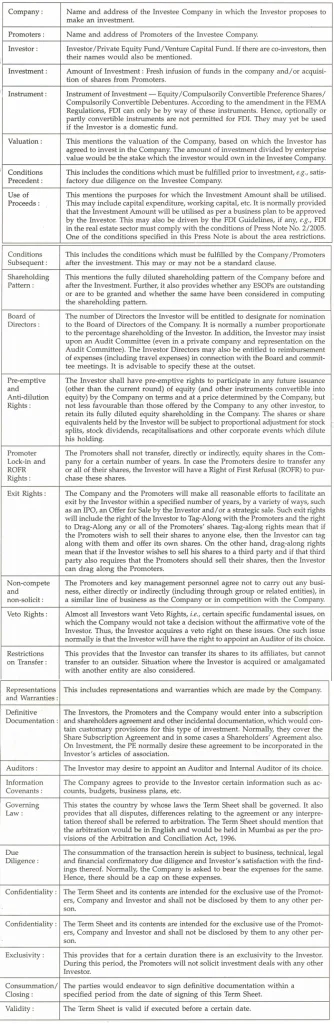
It was a winter morning. My car stopped at a traffic signal below the Kemp’s Corner flyover. I look out of the
window and see 3 poor kids on the pavement. I would put their ages at 7, 5 and
2. The older one was clapping and singing, the middle one was playing ‘music’ on
a tin drum with a stick and the tiny toddler was dancing. A thought crossed my
mind. Happiness dwells (even) on the sidewalks of our city.
Have we not experienced happiness when we offer our seat in a
bus or a train to an elderly person or a lady ? We are in fact exchanging our
comfort for happiness. We do this very naturally. If comfort and happiness were
synonymous we would never do that.
Sometimes giving up comforts yields happiness.
Thinking of happiness took me back to my younger days, when
hiking was my passion. My friend San-jay and I were on a hike to Matheran. Just
outside Neral town, a trek branches off from the pathway to Matheran. It is a
short cut, but it means a steeper climb. After the initial steep climb, the trek
winds through a hamlet, which I call “the village of the barking dogs” as
invariably one is greeted by a chorus of barking dogs. Then the trek starts
climbing up again. Sanjay stopped there for a smoke and spoke something which I
will always remember. He said “On every hike a time comes when I curse myself
for coming on the hike, suffering all this pains and discomfort, these aching
muscles and blisters on the feet, while I could well have been in Bombay,
enjoying a movie in an air-conditioned theatre, or sipping coffee in a cool
place. Yet as soon as I reach the top, all the aches and pains are forgotten. I
am happy to have achieved something and surprisingly am looking forward to the
next hike !”
It made me understand that comfort and happiness do not
necessarily go together.
If comfort was happiness, we would not have had Buddha,
Mahavir and Mahatma Gandhi; we would not have saints like Mirabai, Surdas and
Tulsidas; we would not have people like Albert Schweitzer, Mother Teresa or
Vivekanand. Great
souls have sacrificed
comforts to attain true happiness.
During our freedom movement, many of our freedom fighters
faced lathi charges, tear gas and even bullets — they sacrificed comfort. Bhagat
Singh happily went to the gallows with a song on his lips. This should not leave
room for any doubt that
comfort and happiness are different.
The other day I was watching “Awakening with Brahmakumari” on
TV. Brahmakumari Shivani was explaining the difference between comfort and
happiness. As she explained, acquisition of a Mercedes car will give you comfort
of a smooth ride, but cannot ensure ‘happiness’. Apart from an elated feeling
for a few days, happiness of possessing the Mercedes will not endure — it will
be become another ‘possession’ — for example, when you are rushing in your
Mercedes to the hospital to see a dear friend who has met with a serious
accident, there is no happiness in the ‘Mercedes’ ride. Things bring comfort but
not happiness.
I learnt that comfort comes from outside, while happiness
comes from within.
One recounts the great classic ‘A Tale of Two Cities,’ by
Charles Dickens, a story of the times of the French Revolution. Charles Darney
is awaiting execution at the hands of revolutionaries in the infamous Bastille
Prison. Sydney Carton, a friend of Charles, but a goodfor-nothing person (who
looks exactly like Charles Darney) visits the prison to see Charles, renders
Charles unconscious, lets him be taken out, and takes his place. When Sidney
Carton is lead to the guillotine to be beheaded, his famous words are “It is a
far far better thing that I do, than I have ever done; it is a far far better
rest that I go to, than I have ever known.” He dies happily in place of Charles
Darney. There are times when even death brings happiness.
In heart of our hearts, we understand that comforts do not
necessarily bring happiness. Yet we blindly pursue ‘comfort’ sacrificing
‘happiness’. In pursuit of wealth, we ruin our health, neglect our families,
have no time for our parents or children, let alone for the poor and the
downtrodden. Too late we realise that the ladder of success we were climbing was
put up against the wrong wall. Let us learn to pursue ‘happiness’ even
whilst sacrificing ‘comforts’ to ‘Live happily’.
Our earth is inhabited by billions of people. Though all of us have been given life by the Almighty, Life of each one is different. Out of the billions, for most of the people life is just one day lived many times over. One day is no different from the other. They end their lives where they started. There is no progress.
For making progress one requires a clear purpose, a goal, which will give one a sense of direction. Unless we decide where to go, we will not reach anywhere. We will spend our lives like driftwood tossed around by every wave on the seas of life. Setting of a goal is thus essential for our progress. The first step on the path to progress is to have a clear goal set in our mind. We must be clear about our destination. Setting of goals is clearly the first step . . . . A step which will begin our thousand-mile journey.
When we look at the goals set by people, we find that most of them centre around amassing wealth and material things, getting education and acquiring power. If one examines these things, whether it be wealth, education or power, one finds that these by themselves are neither good nor bad. The use to which these are put determines whether they are good or bad. The second step that we have to take is to ensure that what we acquire is for a good purpose and put to a good use. A shloka in Sanskrit explains this :

Education is for needless debates and arguments, wealth for becoming proud and arrogant, and power for harassing others . . . . that is what an evil person thinks. But truly, education is for real knowledge, for wisdom, wealth for donating, and power for protecting the weak.
Thus whatever we desire as a goal must have a noble purpose attached to it. It must be for good of ourselves and also others. The moment one understands and accepts this, the goals become far more meaningful. They cease to be selfish. In the pursuit of such goals one finds that happiness is a by-product. Happiness just starts flowing in one’s life.
I am not talking of goals like taking sanyasa or laying down one’s life for the country. Such heroic goals are not meant for ordinary people like us. But even in our life, as a householder, a student, a worker, or just anybody, there are numerous opportunities to wipe a tear, to restore a smile and be of some help to people around us.
The second step then, is to ensure that whatever we achieve as our goal is put to good use, a noble use.
But then we come to the third and the final step. It is not difficult to set goals and put them to good use. The third step, which is the most difficult one, is to do good deeds without any pride. This is well expressed in the Bhajan ‘Vaishnav Jana’ by Narsinha Mehta :
“Vaishnava jana to tehne kahiye . . . . . .
Para dukkhe upkaar kare thoye
This is a very difficult test to pass. I have been trying and failing again and again. Yes. A keen desire to help others is always there, but a feeling of ‘doership’ persists. A word of praise gladdens my heart, and non-recognition leaves me with an empty feeling !
I am attempting that there should not be any sense of pride. After all what I am doing is only my duty and natural obligation to return something to the society from which I have received countless benefits. May be some day I will succeed. Till then the struggle continues. I would end with an excerpt from a letter :
“I am glad I was born, glad I suffered so, glad I did make big blunders, glad to enter peace. Whether this body will fall and release me or I enter into freedom in the body, the old man is gone, gone for ever, never to come back again !
Behind my work was ambition, behind my love was personality, behind my purity was fear. Now they are vanishing and I am adrift.”
Can one believe that these are the words of Swami Vivekananda, written shortly before his death ? No wonder the third step of doing away with a sense of doership is not easy for people like us ! However one must not give up. Some goals are so worthy, its glorious even to fail.
Nobody is perfect. We have heard this time and again. Even
the moon has spots on it. Perfection in human beings is only in films and in
romantic novels of bygone days where the hero is faultless and is
personification of goodness and with one hundred percent of goodness in him. On
the other hand, the villain is nothing but evil, bad in every respect without
even an ounce of goodness in him. Let us not forget that roses have thorns and
that thorns too have roses. Hence, everyone has some goodness in his heart. It
is for us to seek that goodness.
In Mahabharat, Duryodhan represents evil. He is a person who
openly says “I know what is Dharma but I cannot follow it, I know what is
Adharma, but my nature prevents me from not following it”. In spite of this, one
finds that Duryodhan also had his good side. He stood by his friend Karna when
Karna was derided in the open court as being a Sarathiputra, a charioteer’s son.
Duryodhan made him the King of Angad. Later after losing the battle at
Kurukhshetra, Duryodhan was running away as a fugitive followed in hot pursuit
by the Pandavas. When he had no other escape left, he with his super powers hid
in the waters of a lake. When challenged by Yudhishthir to come out and fight,
he replied that to expect him to fight against all five of them was totally
unfair. Yudhishthir offered him to come out and fight any one of them with a
weapon of his choice. Duryodhan, who was an expert at fighting with a gada,
came out and selected Bhim ! It was clear that none of the other four Pandavas
was any match for Duryodhan in fighting with the gada. Only Bhim was; and
Duryodhan selected Bhim. He preferred to fight with a worthy adversary and face
death than seek an easy victory by selecting someone who was no match for him.
Recently there was a report of a person named Laxman Gole who
was earlier guilty of 18 offences of extortion from which he had managed to
escape conviction. He was being tried for 3 more offences when he happened to
read the autobiography of Mahatma Gandhi. This completely changed him. He
admitted his guilt in open court and was sentenced to two years of rigorous
imprisonment. While undergoing his prison sentence, he converted a number of
co-prisoners to Gandhian way of thinking. He is released now and is working for
Sarvodaya Mandal and pursuing the noble cause of turning criminals away from
crime to a Gandhian way of life.
I cannot resist sharing this personal story with you. When
Amita and Nandita, my daughters were small children, I used to drop them to the
school on my way to the office. On a day in monsoon when it was raining, I gave
a lift to an Income-tax officer from the bus stop. This man was known for his
bad temper and rude behaviour, and had a habit of shouting at assessees and
practitioners alike. It was a pain to appear before him. I was about to drop the
kids at the gate of the school while it was still raining and ask them to run to
their classrooms. This Income-tax officer, otherwise a terror, chided me, got
out of the car, opened his umbrella and escorted both the kids up to their
classrooms. When he returned he was drenched. My outlook about him changed. It
underwent a ‘paradigm shift’. Such gentleness and soft heartedness was never
expected by me from this man. We also have to understand that people can change
and become roses from thorns. The story of Valmiki who changed from a robber to
a sage and gave us “Ramayana” is known to all of us.
Yes friends, thorns too have roses. It is nobody’s privilege
to be good. It is only that we have to train ourselves to look for the roses. To
be happy, let us seek roses amongst thorns. I conclude by quoting Gurudev
Rabindranath Tagore :
“Every child comes with the message that God is not yet discouraged of Man“.
Capital is one of the four
factors of production. The other three are Land (infrastructure), Labour
(workforce), and Enterprise (business acumen, activity and spirit). Capital is a
very critical input to ensure success of any commercial business venture.
Capital can be divided into
two parts. Equity or ‘own capital’ that is risk bearing and Debt or ‘External
Funds that bear a relatively lower level of risk.
Traditionally debt or
external funds are secured by a charge on the assets of the enterprise and also
enjoy a priority in repayment in case of failure of business or similar
unforeseen eventualities.
Equity capital on the other
hand is the capital that is ‘risk bearing’, but is also entitled to
participate in the returns (profits) of a venture to a greater extent than other
forms of capital.
The essential basis of
capital adequacy and the risk arises from the fact that if an entity uses its
own capital to the exclusion of all other forms of external debt (funding), the
return on its business and
assets would directly determine its return on equity/capital.
After the emergence of joint
stock companies and the separation of ownership and management, professional
managers started tapping external debt/ borrowings as a source of capital as it
was available at a fixed lower rate interest cost than the return on the
business/assets. This enabled these companies to enjoy a high financial leverage
and enjoy a very high rate of return on equity. However the risk lies in a
reverse scenario happening. If the return on assets falls below the cost of
external borrowing, then the multiplier leverage acts in reverse and the equity
capital will have a negative/much lower return than the actual return. It is
essentially this risk/return trade-off that decides the extent of ‘own capital’
and how much leverage a firm/entity should select for its operations.
For business entities,
capital adequacy is decided/ judged by using the debt-equity ratio which is
2 : 1, i.e., for every Rupee of equity of own capital, the debt to be
raised is generally Two Rupees or twice the equity capital.
In case of banks, the Basel
norms prescribe capital adequacy norms. However, these are based on the
risk-weighted assets value and are generally considered at 10% of the value of
such assets.
|
The capital adequacy ratio |
= |
|
|
Assets |
||
|
|
|
|
|
|
|
|
|
|
Risk-weighted |
|
|
|
|
10% |
In the past we had the
office of the Controller of Capital Issues that decided the capital structure of
listed/public companies.
In the present liberalised
deregulated globalised scenario, these decisions are best left to the entities
themselves and market forces. The fact remains that for every entity, depending
on the type of the activity, size, scope and scale of the operations and its
risk profile and the asset/business/investment/ portfolio, there is a minimum
capitalisation level that has to be met. Leverage gives higher returns and
improves financial efficiency, but it needs to be balanced with stability and
risk in order to ensure safety.
Capital adequacy norms for
banks were first introduced in 1989 by the BASEL Accord. It has been over twenty
years yet we had a number of crises after that — the South Asian crisis and
thereafter the major financial meltdown faced the world over.
To answer the question of
why did institutions fail despite capital adequacy norms, one has to look at
three things/areas which still remain substantially uncovered :
1. The norms though
well-accepted in banking have not been adopted for NBFCs and other business
entities.
2. The quality of assets, existence of sub-prime assets, risks associated with off balance sheet exposure, especially derivative instruments is not effectively captured in the capital adequacy norms.
3. The entire approach because of the formula-based working gets reduced to a mechanical exercise and coupled with VAR (Value at Risk) approach gives a feeling of preciseness to an analysis that is at best judgmental. It is essential to keep in our mind that decision-making starts where formulae end, and it is never more true than for issues like capital adequacy.
Business/Industry practices?:
Capital adequacy and capital structure also depends upon industry/business norms and practices. Thus those businesses that are high risk, e.g., construction industry, film and entertainment industry often reveal a paradoxical situation where minimal funding is out of own or structured capital and maximum funding is from private external sources.
One explanation for this phenomenon could be that the owners themselves as well as the formal sources of finance find these ventures too risky. Hence, as a fallout these businesses have to raise external funds at a very high cost even up to 3% per month (36% per annum) to meet and balance the risk return trade-off.
The less risky, more stable and efficient the venture, the lower would be the need for expected return and higher the borrowing capacity.
Case study of the month?:
Tata Motors one of the flagship Indian Corporate multinational companies of the Tata Group was adequately funded, had a good capital adequacy and was generally successful in all its ventures. The business of Tata Motors continues to thrive even today with the success of the Nano and the Manza.
However, a very significant event happened in June 2008 when Tata Motors acquired Jaguar and Land Rover from the US-based Ford Motors for approx. USD $ 2.3 billion. Tata Motors planned to raise Rs. 72 billion through rights issues which did not meet much success as the share market fell on weak global cues and they were available in the market at prices much lower than the offer price. On tak-ing the bridge loan the debt-equity ratio increased to 1.21 from the previous debt-equity ratio of 0.53 in March 2006 and 0.8 in March 2008. The dilemma which an entrepreneur always faces is balancing ‘risk’ and ‘progress’.
During the economic recession the price of its equity share from the high of Rs.750 to Rs.800 per share in January 2008 came down to a level of around Rs.150 in December 2008 and Rs.130 in February 2009. The right issue was priced at Rs.340 per share which naturally found few takers.
Other option to fund the acquisition like divesting stake in group companies or an international GDR/ADR issue were also abandoned due to adverse markets.
The third and final effort of the company was to raise funds by way of private deposits to refund the bridge loan due by June 2009. Even this effort met with limit-ed success and despite repayment of USD 1 billion till 2008, the bridge loan had to be rolled over in part.
As a risk manager, identify the issues and outline additional strategies that could have been attempted in the given scenario.
Solution to the case study?:
The issues are primarily those that deal with the basis of capital budgeting, fund management and planning the capital structure?:
1. The acquisition of JLR was an effort by Tata Motors to stay ahead of the competitors using inorganic growth.
2. The global meltdown and recession in the world economy adversely affected the market putting the company into a tight spot.
3. The availability of funds in the Indian markets shrank due to the meltdown, credit squeeze, withdrawal of FIIs and adverse market sentiment.
The causative factor primarily was the fact that in the heat of the moment and rush of the deal the short-term sources of funds were used for a long-term use of funds — namely, capital acquisition.
As Warren Buffet the legendary investor says, “It is always easier to think clearer and comment in hindsight.”
The way out and that is what Tata Motors tried is to?:
i) Diversify into different segments including small cars
ii) Improve profitability
iii) Raise resources including by way of deposits for company products from customers.
And ultimately wait and watch for the right time to raise long-term funds to replace the short-term sources tapped for the long-term uses and bring back stability to the financial structure of the company.
Ultimately, if the company had maintained capital adequacy throughout the deal and not jumped in using bridge finance, probably the outcome would have been different.
Postscript?: Now, because of the steps taken the price is back to Rs.842 in January 2010 and around Rs.750 in March 2010. Crisil upgraded Tata Motors’ short-term debt to A+ as reported in March 2010. Hence capital adequacy impacts risk ratings and borrowing capacity in the market.
(The case study and solution are not intended to be in the nature of comments on the functioning or management of the companies but represent one of the possible approaches selected by the author for demonstrating the concept and issues of risk management.)
1 Introduction :
The audit-assurance function of the profession is facing a storm because of the Satyam episode. In this article I propose to bring out a few glaring issues dealing with the audit of co-operative societies and the patent unfairness in law, especially in view of a number of complaints filed by the ‘co-operative department’ with the Institute.
2 The reality :
Everybody is aware that in co-operative societies, there is virtually nothing mutual, but what exists is non-cooperation amongst the members and the managing committee. Politics, infighting, ego problems, indifference, indecision, friction and lack of harmony exist in almost every society — small or
big. Therefore, the auditor needs to be extra cautious.
In a housing co-operative society, there is no regular office, no proper record keeping and no competent accountant. Statutory requirements of keeping the registers and documents are very stringent. Fees prescribed for audit are Rs.3 per month per member. Thus, for a 12-member society, the annual audit fee for the onerous work and responsibility is Rs.432.
Even in a society with commercial activity — like consumer society or credit society, the management is often unprofessional, there is lack of competent staff and proper infrastructure.
I am informed that in co-op. credit societies at villages, which are expected to be functioning like a bank, the situation is precarious. There exists a shabby office, poor working environment, no infrastructure, employees who have not even completed school education, probably only one or two graduates — but not necessarily commerce graduates and above all the control is in the hands of local politicians with vested interests. There also exist time and other pressures on auditors.
The auditor dare not give a qualified report though he makes adverse comments. However, managements, quite often, are used to such comments as it does not have any penal impact on them. What finally matters to them is the audit classification. They request that if the class is downgraded — from B to C; or C to D; the society will be virtually closed down; hence downgrading is avoided. The auditor often thinks — or is made to think — that if he does
downgrading, innocent depositors will suffer ! Although certain norms are prescribed, he at times avoids downgrading though he makes comments.
It also at times happens that due to adverse remarks in the report, audit fees are not paid. On top of it, the co-operative department files a disciplinary case on the following grounds :
3. Reasons for unreasonable approach :
In earlier years, audit of co-operative societies was done by departmental staff only. There was no concept of appointing a CA. The law was framed keeping in view that audit function is performed by
Full texts of relevant Notifications, Circulars and Forms are available on the BCAS website : www.bcasonline.org
1. Introduction :
In the February issue of BCA journal, the Ombudsman appointed
for Income-tax matters has written a very nice article which candidly brings out
the limitations imposed on him.
It is a common feeling among taxpayers and professionals that
representations in any revenue department — particularly income tax, sales tax,
service tax — is a nightmare. It is one thing to rake up and make us fight for
important issues of interpretation and also of facts. It is a part of our life.
However, of late, it is experienced that even petty matters consume lot of time
and energy and require intervention at senior level. It often becomes very
irritating and the work suffers. The following are a few such instances.
2. Instances of irritants :
2.1 As mentioned by the Ld. Ombudsman, a simple thing like
giving appeals effect in thousands of VRS cases. It is a question of allowing
relief u/s.89(1) which is more or less a settled position. The same is the case
with giving appeal effect of ITAT orders in respect of exemption u/s.10(10C) of
RBI employees. It never happens automatically. For each and every case, one has
to follow up vigorously. Due to change of wards, jurisdictions and locations (Charni
Road to Bandra), the relevant records are never traceable. It is intriguing that
when something is recoverable from assesses, the record is immediately traced.
(!)
Most of the employees who have taken VRS may not be having
high incomes. They are scattered and not in a position to follow up with the
Income-tax Department. The refunds of subsequent years have been adjusted
against the so-called dues of VRS year — which in fact are non-existent due to
favourable Appellate orders.
Now, for giving appeal effect, they are asking for duplicate
returns, salary certificates and so on. This is only to create hurdles.
2.2 Submissions to ITAT :
Paper-books are required to be submitted one week prior to
the date of hearing. A set meant for the Departmental Representative (DR) is to
be filed at a different location. Even if there is one day’s delay, the staff
refuses to even accept the paper-book. Refusal to accept an inward
correspondence is highly incorrect. The DR may raise objection for delayed
submission and the Members may take a view in the matter. But how can they
refuse to accept the paper-book ?
Further, quite often, the Hon’ble Members direct us to place
on record some documents (e.g., some unreported judgments, etc.) usually
on the same day. Now, it is extremely difficult to ensure that it reaches the
relevant file. There is no acknowledgement. Acceptance with a covering letter is
flatly refused. Then, you are entirely at the mercy of the bench clerk.
The most disturbing feature is that even for submission of
appeal (Form 36), acknowledgement is not issued on the spot. There is a strange
system. The form is to be delivered in good faith. No acknowledgement is given
on your copy; nor even a token receipt is issued. A computerised receipt is to
be collected the next day.
Similarly, your written intimations of change of address are
never acted upon in spite of repeated follow-up. Further, when an adjournment is
sought, it is expected that some responsible person should actually be present
in the Court. The objective is understandable — firstly, to ascertain the
genuineness of reason and also to decide the next date with mutual convenience.
However, in may situations, it is genuinely not possible to remain present. At
least at the time of the first adjournment, when request is filed well in
advance, personal attendance should not be insisted upon.
Nowadays, notices of hearing are often received just 8 to 10
days in advance. How can one submit the paper-books 7 days in advance ?
2.3 Rubber stamp on TDS Certificates :
It is also strange that credit on TDS/TCS certificates is
denied for want of rubber stamp of the issuer. It is extremely cumbersome to
obtain such stamps since the certificates are already filed.
2.4 The returns under the MVAT Act, 2002 are to be submitted
at Mazgaon Office (unlike at decentralised offices at Bandra and Belapur under
the erstwhile BST Act). However, the Sales Tax Offices at Belapur and Bandra are
issuing notices to all the dealers to submit copies of all returns filed under
the MVAT Act, 2002 with effect from 1-4-2005 i.e., the date of
implementation of MVAT. In quite a few cases, even if the dealer is registered
under the MVAT Act just a few months back, the notices require the copies of
returns from April 2005. Notices/reminders to defaulting dealers is
understandable. But taking copies of all returns from the dealers to compile the
list of defaulters is in a way, amounting to shifting of departmental officer’s
duty on dealers and their consultants. Many dealers’ liability under the MVAT
Act being monthly, the dealers have to submit copies of around 30 returns filed
till September’ 2007.
2.5 Under the Income-tax Act, 1961, the assessees are
required to pay advance tax in the previous year itself in 3 or 4 installments
on 15th June, 15th Sep., 15th Dec and 15th March. However, there is one more
practical advance compliance of this advance tax provision. The Departmental
authorities frequently call the consultants on 13th or 14th of the month (i.e.,
a day or two prior to the due date) asking for the advance tax paid or proposed
to be paid by the assessees. Can’t the departmental authorities wait for 4 days
to let the data come from the bankers. Is this duty also cast on the
practitioners ? ? ?
Suggestions :
1. Let there be more co-ordination within the Government
Departments.
2. Let all the procedures be reviewed with sensitivity and
sensibility.
Over 30,000 tax litigations
are pending in the Income-tax Appellate Tribunals across the country, though
most of these appeals are filed by the tax department and not the assessees,
Minister of State for Finance S. S. Palanimanickam said in the Lok Sabha today.
(Source : The Times of India, dated 9-12-2009)
(Compiler’s Note : This is due to repetitive appeals
routinely filed by the department without application of mind and nobody is held
accountable. The ITAT is not able to dispose of the appeals due to frequent
adjournments sought by the DRs.)
Offices of the
sub-registrars of the stamp and registration department will be more
people-friendly now. Many offices in Mumbai, Thane and Pune will be relocated
and operate in two shifts from 7 a.m. to 9 p.m. Besides, 29 new offices will be
opened in the three cities, for which the stamps and registration department is
buying properties.
The number of documents
which come for registration has increased. As a result, 29 new posts of
sub-registrars and 116 staffers have been created. Officials said the department
had purchased 1,01,185 sq.ft. of office space in Mumbai, Thane and Pune, worth
Rs.108 crore.
(Source : The Times of India, dated 25-2-2010)
It so happened, the learned faculty having explained the
niceties on the wall, off the wall between the lines and the sidelines as to the
provisions of S. 80IB(10) dealing with 100% deduction of the profits derived
from the housing project, the learned faculty vehemently emphasised that in
order to avail the deduction, the builder must obtain ‘completion certificate’
from the local authority, and to make his point of view bearable, he cited
precedents of honorable courts as usual. The faculty was about to leave the
podium.
“Excuse me Sir, “confused members of audience about
completion certificate stood up one after another.
‘Yes’ the faculty turned back to the podium with a creased
face. He was very shrewd and declared that he was anticipating queries from the
audience on ‘requirement of obtaining completion certificate from the local
authority’.
“My dear friends, feel free to raise your questions, I will
hear all your questions first, then I will reply at the end.”
A cascade of questions burst in the auditorium, some
practical, some theoretical, some hypothetical, I mean depending upon the IQ
level of the member.
“Sir, what if the project is completed 100% and all units are
sold, but the builder could not obtain the completion certificate from the local
authority within the time limit ?”
“Sir, it appears that the legislative intention is not to
promote housing industry, but to encourage compliance under housing development
laws of the local authority. If completion certificate is mandatory, how do you
react to this ?”
“Sir, what if the builder has received the entire sale
price of all units in the project, but could not obtain completion certificate
from the local authority ?”
“Sir, whether deduction u/s.80IB(10) is qua ‘profit’ derived
from the housing project or qua ‘completion certificate’ of the housing project
from the local authority ?”
“Sir, what if the builder obtains ‘provisional’ completion
for the housing project on hand whether he is eligible to claim deduction
u/s.80IB(10) ?”
“Sir, what if the builder succeeds to obtain part completion
from the local authority within the time limit, whether he can claim the
proportionate deduction ?”
“Sir, deduction u/s.80IB(10) being benevolent provision, is
there a possibility that the Court will take lenient view relaxing the rigor of
obtaining the completion certificate from local authority ?”
“Sir, what if the builder proves with documentary evidence
that he has complied with all statutory formalities for obtaining “completion
certificate” from the local authority, but he fails to obtain completion
certificate within time limit but obtains it within a few days after a deadline,
whether he is eligible to claim deduction u/s.80IB(10) ?”
Having heard all these questions one by one, the learned
faculty began to reply :
“Friends, I hope all of us are aware of a story told by our
grandmother or grandfather in our childhood. I am going to refresh your memory
about that story. It is about a cruel magician who captures a beautiful princess
who was in love with a prince. The prince fights with the magician to free the
princess. But he could not kill the magician, for simple reason that the
magician had stored his ‘soul’ in a parrot beyond seven seas. If the prince
could kill that parrot, the magician would die instantaneously. And the prince
kills the parrot beyond the seven seas and the magician dies. Thus he liberates
his princess from the custody of the magician. So my dear friends, if you wish
to have ‘princess’ I mean 100% deduction u/s.80IB(10), you must capture the
‘parrot’, I mean completion certificate from the local authority.”
Representation
Mr. P. Chidambaram Date 24th March 2008
The Hon’ble Finance Minister
Government of India
North Block, Secretariat, New Delhi-110001.
Dear Sir,
Subject : Suggestions on the proposal in the
Finance Bill, 2008, relating to Direct Taxes
We have seen with interest the fifth consecutive budget
presented by your Honour on behalf of the United Progressive Alliance (UPA)
Government in the Parliament on 29th February 2008 and appreciate your concern
for challenges faced by the country and your efforts to accelerate economic
growth of agriculture sector, industry, infrastructure and exports.
There are certain provisions in the Finance Bill relating
to Income Tax and Wealth Tax, which may need your kind attention, since they
need to be modified or deleted. Some of the present proposals may be prone to
be inequitable and/or may only increase litigation, without real addition to
the net revenue to the Government.
Our suggestions on various topics for rationalisation of
law, rectification of certain anomalies and correction of drafting errors, are
given in the enclosed representation relating to Direct taxes.
We hope that our representation will receive due
consideration. Should a need to explain the recommendation be felt, please let
us know and we shall be more than happy to explain them to you personally.
Thanking you,
We remain,
Yours truly,
For Bombay Chartered Accountants’ Society
Rajesh Kothari Pinakin Desai Rajesh Shah
President Chairman Co-Chairman
Taxation Committee
Mr. P. Chidambaram Date 24th March 2008
The Hon’ble Finance Minister
Government of India
North Block, Secretariat, New Delhi-110001.
Dear Sir,
Subject : Suggestions on the proposal in the
Finance Bill, 2008, relating to Indirect Taxes
We have seen with interest the fifth consecutive budget
presented by your Honour on behalf of the United Progressive Alliance (UPA)
Government in the Parliament on 29th February, 2008 and appreciate your
concern for challenges faced by the country and your efforts to accelerate
economic growth of agriculture sector, industry, infrastructure and exports.
There are certain provisions in the Finance Bill relating
to Indirect Taxes, which may need your kind attention since they need to be
modified or deleted. Some of the present proposals may be prone to be
inequitable and/or may only increase litigation, without real addition to the
net revenue to the Government.
Our suggestions on various topics for rationalisation of
law, rectification of certain anomalies and correction of drafting errors, are
given in the enclosed representation relating to Indirect Taxes.
We hope that our representation will receive due
consideration.
Thanking you,
We remain,
Yours truly,
For Bombay Chartered Accountants’ Society
Rajesh Kothari Pranay Marfatia Govind Goyal
President Chairman Co-Chairman
Indirect Taxes and Allied Laws Committee
Representation
Direct Tax Executive summary
1. Rates of tax :
l
It is suggested that there should be back-up provision for marginal relief to
individuals having income up to Rs.3 lakh including short-term capital gain, who
may end up paying tax @15% on short-term capital gain.
l
It is also suggested that STT which has been paid at the time of purchase of
security should be considered to be the cost of security in computing the
chargeable capital gain.
2. Charitable Trust — S. 2(15) :
l
It is suggested that the amendment should make it clear that the proposed
amendment covers an activity in the nature of trade, commerce or business, which
is ‘for profit’, such that the mere circumstance of receipt of membership fee or
cost recoupment without any profit-making design is not interpreted as an
objectionable activity. The reflection of the words ‘for profit’ as part of the
definition will not only bring out the legislative intent more clearly, but will
also make the definition sound akin to the definition as we had till the year
1992, so that the ratio of judgment of the Supreme Court in the case of Surat
Art Silk is available to the tax-paying community as guideline.
l
It should be clarified that the income of public religious trust is not covered
by the amendment.
The Government of India and
Finland signed a revised Agreement and Protocol for Avoidance of Double Taxation
and the Prevention of Fiscal Evasion with respect to Taxes on Income
(Agreement). As per the revised Agreement, withholding tax rates have been
reduced on dividends from 15 to 10% and on royalties and FTS from 15 or 10% to a
uniform rate of 10%. The intention of lowering the withholding tax is to promote
greater investments, flow of technology and technical services between India and
Finland. The revised Agreement also expands the ambit of the Article concerning
exchange of information to provide effective exchange of information in line
with current international standards. The Article inter alia provides that the
States shall not deny furnishing of the requested information solely on the
ground that it does not have any domestic interest in that information or such
information is held by a bank, etc. An Article for Limitation of Benefits to the
residents of the contracting countries has also been included to prevent misuse
of the Tax Treaty.
(Source :CBDT Press Release
No. 402/92/2006-MC
(03 of 2010), dated 15-1-2010)
George Soros is one of the
world’s most talented currency speculators, the guy who earned a $ 1 billion
profit in 1992 when he made a huge leveraged bet that the British pound would
have to exit the European Exchange Rate Mechanism (ERM) and also the man
Malaysian Prime Minister Mahathir Mohamad had then accused of pulling down the
ringgit in 1997.
So when Soros writes in the
Financial Times that the euro may fall apart, it is but natural that people take
him seriously. The short-term movement of currencies can be a random walk amid a
lot of noise trading, but the trend over the longer term is less unpredictable.
The euro is in a mess, the
yen is the currency of a stagnant nation and the yuan is not convertible. It
seems the dollar will continue to be the preferred global currency.
(Source : Quick Edit-Mint Newspaper, dated 23-2-2010)
Ujjawal Chaudhary, a senior
Income-tax Officer who led the probe into the multicrore Madhu Koda scam, may
have been on the verge of unravelling the link between politicians and hawala
traders when he was abruptly shifted this week.
Sources said the team led by
Chaudhary, who has been taken off the Koda probe and moved to the assessment
wing, had gathered strong evidence linking politicians and others to hawala
operators engaged in laundering black money abroad. Chaudhary was transferred
when raids were on at Chaibasa in Jharkhand.
Koda’s crores :
Raids on hawala traders
yield details of bank
accounts in Switzerland, which seem to belong to politicians I-T raids in
Jharkhand provide disclosures of hundreds of crores in concealed incomes of
bureaucrats and businessmen A Kolkata-based chartered accountant admits to
helping the scamsters fudge accounts payment of Rs.4.6 crore allegedly made by
cheque to functionaries of the Koda administration by an Andhra-based
construction firm. Koda case officer was not due for transfer.
(Source : The Times of India, dated 21-2-2010)
Are your children talking to
you ? It does not seem so. The survey, conducted by the International Institute
for Population Sciences and Population Council and endorsed by the Union Health
Ministry, covered nearly 51,000 married and unmarried young males and females
from six states — Maharashtra, Andhra Pradesh, Bihar, Jharkhand, Rajasthan and
Tamil Nadu. It found that school performance, a non-sensitive topic, was the
most common area of discussion between kids and parents. In contrast, more
touchy topics, such as romantic relationships and reproduction, were rarely
discussed with either parent (only 2% of young men and 6% of young women did
so). In fact, when it came to reproductive issues, children were equally
secretive with both their parents.
The findings also suggest
that parents controlled the social interactions of youngsters, particularly
those involving members of the opposite sex. For example, 69% of young men and
84% of young women expected parental disapproval if they brought home a friend
of the opposite sex.
Among young women, in
contrast, statewise differences were negligible — over 90% of young women in all
the states reported parental disapproval of love marriage. Almost all those who
were interviewed had an arranged marriage. This led to only 30% of young men and
22% of young women being aware of what to expect from their married life.
Friends rather than family
were found to be the major confidants for both young men and women. Only 1% men
were found to confide in their family members while 85% did so in their friends.
In case of women, 20% confided in family and 46% in friends.
(Source : The Times of India, dated 21-2-2010)
US President Barack Obama
has said the US is facing stiff competition from India and cannot succeed if the
country continues to produce more scientists and engineers than America.
“Why is it that every other
country was promoting its tourist industry and America was not doing enough for
its own ?” Obama asked. “That’s just one example of the competition that we’re
facing on everything,” he said. “If China’s producing 40 high-speed rail lines
and we’re producing one, we’re not going to have the infrastructure of the
future,” Obama said. “If India or South Korea are producing more scientists and
engineers than we are, we will not succeed,” said the US President in his Las
Vegas speech.
The President said there was
a need to bring people together and build consensus around reforms. “Because we
know that the country that out-educates us today is going to out-compete us
tomorrow. And we don’t want that future for our young people. We’re not going to
sentence them to a lifetime of lower wages and unfulfilled dreams.”
(Source : The Times of India, dated 21-2-2010)
SEBI has allowed exchanges
to introduce currency futures in three more currencies — euro, yen and pound.
The permitted contract sizes for euro-rupee, pound-rupee and yen-rupee are 1000
euros, 1000 pounds and 1,00,000 yen, respectively. The maximum maturity of the
contract would be 12 months. The contracts would be settled in cash in rupees.
The client-level position limit has been capped at 6% of the total open interest
position.
(Source : Business Standard, dated 20-1-2010)
The Government plans to
introduce a single Foreign Direct Investment (‘FDI’) document by the end of the
financial year. The consolidated FDI document would subsume all 177 press notes
issued so far. The Government also plans to review and update the document rules
every six months. The draft document was kept open for public comments till
January 31, 2009.
(Source : Business Standard, dated 12-1-2010)
The Government has decided
to allow Indian arms of foreign firms to use internal accruals for reinvestment
in downstream sectors, provided they are reckoned as debt and comply with
relevant external commercial borrowing (‘ECB’) norms. The new regime would let
these firms, owned or controlled by foreign companies, to bring in additional
capital without breaching the foreign direct investment (‘FDI’) caps, as the
reinvested funds are not treated as equity capital. The move would ease the cash
flow of foreign companies present in India and enable them to compete with local
firms on a level-playing field.
(Source : The Financial Express, dated 27-1-2010)
The Central Board of Direct
Taxes (CBDT) has set up a committee to formulate rules for the safe harbour
provisions that would enable the Income-tax authorities to accept the transfer
pricing returns without scrutiny. The committee, which is chaired by Director
General of International Taxation, comprises senior tax officials and
representatives of trade and industry as well as Institute of Chartered
Accountants of India. Foremost among the com-mittee’s task is to set an
acceptable margin which would act as a benchmark for the industry and if the
transfer price declared by a company, engaged in that industry, is not less than
the benchmark, then the authorities would accept the return without scrutiny.
The rules, once introduced, will lend an investment-friendly image to India and
will also put an end to the requirement of collecting huge amount of data
regarding transfer pricing transactions, thereby saving time and energy.
(Source : The Economic Times, dated 11-1-2009)
The CBDT is envisaging a
system in which taxpayers do not meet any tax official for routine assessments.
Assessments are proposed to be centralised at a place where a set of officers
would supervise the assessments. Each officer will be specialising in certain
segment of the assessment process, such as giving credit, refunds, etc. Four
such Central Processing Centers (‘CPC’) would be set up soon in four major
cities where the computerised assessment of the returns will take place. Once
the CPCs are in place, the taxpayer will have to meet the Department officials
only when the returns are selected for scrutiny.
(Source : The Economic Times, dated 14-1-2010)
Now ITAT case can also be
tracked online at following site http://itat.nic.in
Click on an option “ITAT
Online” and put the appeal nos.
Maharashtra Chief Minister
Ashok Chavan may well have decreed that Shiv Sena workers would not be allowed
to run riot at cinema halls showing Shahrukh Khan’s movie, My Name is Khan. He
must, however, be resolute and put down such strong-arm tactics with force. What
is under attack is not cinema but the idea of India as a composite democracy. To
allow the attackers any leeway is to fail to defend Indian democracy. After
seemingly endless buckling down to one form of chauvinism or another, at least
one major political leader has dared to call the Shiv Sena’s bluff. The Chief
Minister must deploy the entire might of the state to defend democracy against
chauvinism operating as organised thuggery. If necessary, he must raise the ante
and take the battle directly to the Sena leadership, rather than merely act
against its foot soldiers, who behave as if they have a birthright to run Mumbai
as they like.
The people and government
must collectively show that democracy will prevail over organised violence.
(Source : The Economic Times, dated 11-2-2010)
The Central Board of Direct
Taxes (CBDT) and accounting rule-maker Institute of Chartered Accountants of
India (ICAI) have jointly constituted a study group to identify and address
direct tax issues that will affect convergence of India’s accounting standards
with International Financial Reporting Standards (IFRS).
According to reports, the
Finance Ministry is looking to introduce the DTC in the forthcoming budget
session. Apart from many aspects that are being discussed, one aspect that will
particularly come as a hurdle for IFRS convergence is towards tax treatment of
mark-to market (MTM) provisioning on derivative transactions. MTM or fair value
accounting assigns a value to a position held in a financial instrument based on
the current fair market price for the financial instrument.
(Source : The Economic Times, dated 9-1-2010)
Advances in science and
engineering have spearheaded 50 to 80% of US GDP growth for many decades. The
lack of investment in R&D, education, higher overheads and labour costs are the
new realities with only about 4% of the US workforce consisting of scientists or
engineers. Everybody knows that 20 assembly workers in Vietnam equal the price
of one in the US or that Starbucks spends more on healthcare than on coffee or
General Motors spends more on healthcare than on steel.
A report titled America’s
Competitiveness was presented to the Democratic Steering and Policy Committee of
US House of Representatives last year. It stated that “The more our children are
exposed to our educational system, the worse they perform on international
tests.” The report also found that “The private sector has all but abandoned
basic research due to market pressures to produce next-quarter profits. The
federal government’s investment in the physical sciences has been stagnant for
over twenty years. Investment in the biosciences, after a five-year period of
significant growth, is again declining.”
Alan Greenspan had stated
“If you don’t solve (the K-12 education problem) nothing else is going to matter
all that much.” An exasperated Chairman and CEO of General Electric, Jeffery
Immelt, has said : “We had more sports exercise majors graduate than electrical
engineering grads last year. If you want to be the massage capital of the world,
you’re well on the way.” China’s President Hu Jintao, on the other hand, feels
“The worldwide competition of overall national strength is actually a
competition for talents, especially for innovative talents.”
The bank closures in the US,
unemployment, inability to honour credit card or mortgage payments have turned
Goldilocks into Cinderella. Around 78 million ‘baby boomers’, born in the US
between 1946 and 1964, acquired extravagant spending habits. This “Baby Boomer
Spending” constitutes between 25 and 50% of the consumption in the US, which is
driven by consumer spending. Their divorce rate and inadequate funding for
retirement benefits is going to severely curtail their future spending and,
therefore, US GDP growth. From 2008 onwards, 10,000 additional social security
seekers are being added everyday.
Greenspan and the then
comptroller general David M. Walker had warned before the recession that not
only will US be unable to fulfil promises to retirees but will have to double
federal taxes or cut federal spending by 50%. President George Bush had declared
that social security is “headed towards bankruptcy”. The budget deficits are
likely to increase as, according to pre-recession estimates, in terms of net
present value, medicare was running $ 63 trillion short and social security $ 8
trillion short, with expenditures surpassing payroll tax receipts from 2018
onwards. Ronald Dahl, children’s author, has pointed out that Goldilocks is a
‘brazen little crook’ stealing porridge, breaking chairs and living in a
borrowed home. Cinderella, let us remember, is a hardworking young lady. Her
virtues and hard work are rewarded, even after midnight. The global economy
needs the virtues of yesterday’s Cinderella economies like India — hard work, no
frills, no needless product obsolescence, value delivery at reasonable price,
and even commonsense ethics like truth, which are much needed in preparing
healthy balance sheets of companies and nations.
(Source : The Times of India, dated 15-2-2010)
American President Barack
Obama has once again targeted US companies having their operations in India to
save taxes back home and called such businesses tax-evaders.
Accusing US companies
outsourcing business to India of following unfair business practices, he said
his proposal to tax firms shipping jobs overseas was only intended to provide a
level-playing field.
“If you are a multinational
and you are investing in India, and your workforce is in India, and your plants
and equipment are in India, but your headquarters are here, you are taking
deductions on all the expenses in India, but you are keeping your profits
outside the US, that just doesn’t seem entirely fair,” Obama said. “The same is
true where you have
companies that have 90% of their sales in the US, but are posting 90% of their
profits overseas.” “You get a sense there that the accountants have been busy,”
he said, suggesting that these companies were taking unfair advantage of current
tax laws.
(Source : The Economic Times, dated 12-2-2010)
Recovery sees senior tax
personnel switch to lucrative private sector
Over the past two months, at
least a dozen senior officers of the Income-tax Department, belonging to the
elite Indian Revenue Service (IRS), have opted for voluntary retirement, a
government scheme that allows them to quit before the statutory retirement age.
These officers are likely to end up in the private sector, most likely as
consultants, to get around rules that prevent government employees from working
within a year of quitting.
The senior-most among these
officials is V. K. Mangotra, Chief Commissioner of Income-tax in Ahmedabad.
Before taking up his most recent post, Mr. Mangotra was the Director of the
Mumbai-based transfer pricing division of the Income-tax Department that
exclusively deals with the issue of taxing cross-border transactions involving
multinational companies.
Most officers from the
government’s tax-collecting arms, who have quit in the past, have ended up
consulting for global accounting firms.
Another officer dealing with
transfer pricing, Alpana Saxena, currently based in Mumbai, has also put in her
papers.
According to I-T officials,
the prospect of earning more by consulting for and later joining either
multinational companies or the Indian arms of global accounting firms is
tempting. S. P. Singh, who resigned in 2005 as the Director of International
Taxation, Mumbai, is now a partner with Deloitte India in New Delhi. He joined
the global accounting firm a year after his retirement, having practised as a
freelance consultant in the interim. Mr. Singh told ET, “There is not much
difference between what I was doing in the Department and what I am doing now,
which is to ensure the legal accuracy of the work put out by my team. While in
the Department, I had to work on maximising revenue realisation, in Deloitte, I
have to devise the best tax structure
for the client”.
An I-T Commissioner draws a
gross salary of Rs.80,000 a month, but this shrinks to a take-home of Rs.40,000
after paying tax and other statutory deductions. A Commissioner is entitled to a
chauffeur-driven car and a house in up-market locales like South Mumbai. On the
other hand, a private firm can pay anywhere between Rs.2.5 lakh and Rs.3.5 lakh
per month to an officer who holds the rank of Commissioner.
(Source : The Times of India, dated 11-2-2010)
The Institute of Chartered
Accountants of India has informed that with a view to strengthening the process
of certification being issued by chartered accountants, they have hosted a link
http://220.227.161.82/locm.asp on ICAI website, to enable anyone to seek
confirmation to the effect that certificate received by him has been issued by a
member of the Institute holding full-time Certificate of Practice (i.e., a
member authorised to issue such a certificate). This will ensure that none of
the authorities act on the certificates issued either by non-members or members
not holding Certificate of Practice.
(Source : www.taxguru.in posted on 16-2-2010)
reason should be recorded by the collegium and conveyed to him.
On a day when he publicly
admitted he couldn’t “pretend not to be hurt” on not making it to the SC, the
widely acclaimed judge told TOI, “The systemic problem in the collegium is lack
of transparency. There is too much secrecy. No reasons are recorded for
rejecting any one. The only way the collegium system can be improved is by
making it more
transparent.”
Justice Shah is the author
of two landmark verdicts (on decriminalisation of consensual homosexuality
between adults and applicability of Right to Information Act on the Chief
Justice of India). The SC collegium ignored him for elevation despite his being
one of the senior-most judges in the country. The decision has drawn a lot of
criticism, including from top jurists like Fali S. Nariman and former Chief
Justice J. S. Verma who described him as “one of the finest judges in the
country.”
(Source : The Times of India, dated 12-2-2010)
The US and the UK have moved
‘substantially’ closer to losing their AAA credit ratings, as the cost of
servicing their debt rose, according to Moody’s Investors Service.
The governments of the two
economies must balance bringing down their debt burdens without damaging growth
by removing fiscal stimulus too quickly, Pierre Cailleteau, managing director of
sovereign risk at Moody’s in London, said in a interview.
Under the ratings company’s
so-called baseline scenario, the US will spend more on debt service, as a
percentage of revenue this year than any other top-rated country except the UK,
and will be the biggest spender from 2011 to 2013, Moody’s said in a report.
“We expect the situation to
further deteriorate in terms of the key ratings metrics before they start
stabilising,” Cailleteau said. “This story is not going to stop at the end of
the year. There is inertia in the deterioration of credit metrics.”
The US government will spend
about 7% of its revenue servicing debt in 2010 and almost 11% in 2013, according
to the baseline scenario of moderate economic recovery, fiscal adjustments in
line with government plans and a gradual increase in interest rates, Moody’s
said. Under its adverse scenario, which assumes 0.5% lower growth each year,
less fiscal adjustment and a stronger interest rate shock, the US will be paying
about 15% of revenue in interest payments, more than the 14% limit that would
lead to a downgrade to AA, Moody’s said. The UK is likely to spend 7% of revenue
servicing debt this year and 9% in 2013, rising to almost 12% under the adverse
scenario, Moody’s said. Financing costs above 10% put countries outside of the
AAA category into a so-called debt reversibility band, the size of which depends
on the ability and willingness of nations to reduce their debt burden by raising
taxes or reducing spending.
(Source : The Economic Times, dated 17-3-2010)
The Finance Ministry said it
is awaiting clarification from Department of Industrial Policy and Promotion (DIPP)
on the new foreign direct investment norms issued by it a year back, popularly
called the Press Notes 2 and 3.
“We are still in dialogue
with DIPP (on the issue). It is coming out with a comprehensive draft on the FDI
framework. Before that gets notified, we are hopeful these issues will get
clarified,” said Govind Mohan, Joint Secretary in the Finance Ministry, on
Monday at the inauguration of an e-filing facility for applications to the
Foreign Investment Promotion Board.
DIPP had last year issued
Press Notes 2 and 3 which replaced the earlier proportionate method of computing
foreign indirect equity by the parameter of beneficial ownership and control of
entities at each stage of investment.
It later also issued Press
Note 4 to clarify some of these issues. The Press Note 2 of 2009, issued on
February 13, redefined foreign ownership of Indian companies. An Indian company
means, in the context of Press Note 2, a company incorporated in India.
As per the new policy,
foreign investments of all types — FDI, portfolio or foreign institutional
investments, NRI investments, GDRs and ADRs, foreign currency convertible bonds
and preference shares —are taken into account while determining ownership of an
Indian company.
As per the new guidelines
the ownership of a number of banks such as ICICI Bank, HDFC Bank, Development
Credit Bank came under question, forcing the central bank and Finance Ministry
to seek a clarification. Not only this, there are concerns in various quarters
that the new norms may lead to breach of sectoral caps.
Under the current rules, as
long as an Indian promoter holds at least 51% stake in any operating-cum
investing company, the company would be considered an Indian entity and the
entire investment it makes in a subsidiary would be considered local investment.
This could allow such companies to invest in sectors in excess of sectoral FDI
caps or invest in sectors where foreign investment is not allowed. On the other
hand, the downstream investment of a company that has more than 51% foreign
stake will all be considered foreign investment.
The RBI had also raised the
issue of breach of sectoral FDI caps as foreign investors using a multilayered
structure can easily take their holding to much more than the sectoral cap if
their stake in the operating-cum-investing company is below 49%.
The Finance Ministry had in
December 2009 written to DIPP to clarify some of these contentious issues that
have also been raised by some other ministries. Recently, the Telecom Regulatory
Authority of India had put out a discussion paper on the impact of these new FDI
norms on the broadcasting sector. Puzzling Press Notes 2 & 3 raised questions
regarding the ownership of a number of banks such as ICICI Bank and HDFC Bank.
There are concerns in various quarters that the new norms may lead to breach of
sectoral caps.
(Source : The Economic Times, dated 17-3-2010)
The Central Board of Direct
Taxes (CBDT) today directed its field formation to levy the highest penal rate
of tax on TDS (tax deducted at source) defaulters. Following a sharp shortfall
in revenue from TDS collection, the Income-tax Department has launched a massive
drive across the country to detect and inquire into TDS payments of companies —
especially on payments made and salaries disbursed. Tax searches have revealed
that several small and medium-scale companies deducted tax on various payments,
but failed to deposit the amount with the Department. In such cases, it has been
decided by the Board that the departments can charge the highest level of penal
rate of tax — that is 300%. Besides, the Income-tax Department has disallowed
all expenses incurred by third-party administrator companies (TPAs) across the
board. The existing practice is to deduct the expenses from the total earnings
before arriving at the taxable income. Department officials said the decision to
disallow the expenses have been taken since they do not deduct tax while paying
premium to the insurance companies.
The Department has raised
around Rs.117 crore in TDS amount from six TPAs. The disallowance of expenses
comes u/s.40I(a)(i) of the Income-tax Act, 1961 that is invoked for non-payment
of TDS. Officials said a similar amount has been disallowed as deduction from
income.
(Source : Business Standard, dated 13-3-2010)
Finance Minister Pranab
Mukherjee has asked Indian Revenue Service officials to consider taxpayers as
important stakeholders in nation-building and to administer taxes with a human
approach. He was addressing the 63rd batch of IRS trainees last evening.
Mr. Mukherjee pointed out
that the shift in policy whereby taxpayers are not seen as adversaries has
resulted in a significant growth in tax collection during the past decade. He
asked the trainee officers to imbibe this approach in their daily working.
The Finance Minister said
that direct taxes collection has increased by ten times during the past decade.
He also pointed out that the share of direct taxes is now more than 55%.
The Finance Minister
reminded the officials that it was due to increased tax buoyancy and collection
efforts of Revenue departments that the government was able to waive off the
loans to farmers amounting to Rs.71,000 crores.
(Source : www.taxindiaonline.com dated 12-3-2010)
(Compiler’s Note :
Let us see how much impact this makes on the attitude of the Revenue officials)
1. Introduction :
Service tax has been levied on various services in relation to software by the Finance Act, 2008 with effect from May 16, 2008 by introducing a category under the description ‘Information Technology Software Service’ (ITSS) in Chapter V of the Finance Act, 1994 (the Act).
Many issues and controversies have emerged on account of the manner of drafting of Ss.(zzzze) in S. 65(105) of the Act defining this service especially in the scenario wherein the technology called software is classified as ‘goods’ under various situations for the levy of tax on ‘sale’ (under the VAT laws of the States of India). Further, under the nomenclature ‘Information Technology Software’, a taxing entry No. 8523 also appears in the Central Excise Tariff Act, 1944 (CETA) and the term is defined in almost identical manner as it is defined for the purpose of service tax.
In the scenario, it becomes utmost necessary to primarily study, understand and analyse what software means per se and whether it is possible to identify a particular transaction as one of ‘sale’ or ‘service’ or both simultaneously, given the provisions of law under applicable taxing statues not considering at this moment as to which part of the activity constitutes ‘manufacture’ liable for central excise duty.
2. What is software ?
The meaning of ‘software as examined by the Supreme Court in the following cases is reproduced :
“Software program is essentially a series of commands issued to hardware of the computer that enables a computer to perform in a particular manner.”
[Tata Consultancy Services v. State of Andhra Pradesh, 2004 (178) ELT 22 (SC)]
“Computer programs are the product of intellectual process, but once implanted in a medium, they are widely distributed to computer owners . . . . Similarly, when a professor delivers a lecture, it is not a goods, but when transcribed as a book, it becomes goods.
That a computer program may be copyrightable as intellectual property does not alter the fact that once in the form of a floppy disc or other medium, the program is tangible, movable and available in the market place. The fact that some programs may be tailored for specific purposes need not alter their status as goods because the code definition includes “specially manufactured goods”.
[Quote from Advent Systems Ltd. v. Unisys Corpn., (925 F 29670 (3rd (i.e. 1991) adopted and agreed upon in the case of Associated Cement Companies Ltd. v. Commissioner, 2001 (128) ELT 21 (SC)].
“Computer programs, instructions that make hardware work. Two main types of software (operating systems) which controls the working of computer and applications, such as word processing programs, spread sheets and databases which perform the tasks for which people use computers.”
[CC, Chennai v. Hewlett Packard India, 2007 (215) ELT 484 (SC)]
In terms of the above, software is essentially an intangible asset or a thing that can be used only when it is stored or transferred on a tangible medium like a disc, a CD-ROM or a hard disc, a computer, etc. The application software can further be classified as canned software and customised software. Canned software is one which can be replicated for the use of more than one person with or without modification and is sold ‘off the shelf’ and generally requires routine installation. Thus, substance of a transaction is ‘sale’ of goods when a canned software is sold. This is done either through a tangible medium like a CD or a disc or can also be transmitted electronically. As against a canned or a packaged software, for a customised software, a programme or programmes is/are written or developed for a specific client or a person developing or designing a software writes a programme focussing only on specific requirements of the client. However the set of instructions, which are customised for a client, also needs to be uploaded on a tangible medium of a hard disk of the computer in order that the same could be put to use.
Thus, software is admittedly and undoubtedly an intangible incorporeal intellectual property. However, whether this intangible property is ‘goods’ or ‘service’ was analysed at great length in Tata Consultancy Services v. State of Andhra Pradesh, 2004
(178) ELT 22 (SC) (TCS). According to the Supreme Court in this case, it would pass its test of being considered ‘goods’, if it has the attributes having regard to :
its utility;
capable of being bought and sold; and
capable of being transmitted, transferred, delivered, stored, possessed, etc. and held : “If a software whether customised or noncustomised satisfies these attributes, the same would be goods”. [Tata Consultancy Services v. State of Andhra Pradesh (supra)]. It also held “what is essential for an article to become goods is its marketability.”
In Tata Consultancy Services (supra), it was also observed:
“In our view, the term’ goods’ as used in Article 366(12) of the Constitution of India and as defined under the said Act are very wide and include all types of movable properties whether those properties be tangible or intangible ….. The software and media cannot be split up. What the buyer purchases and pays for is not the disc or the CD. As in the case of painting or books or music or films, the buyer is purchasing the intellectual property and not the media i.e., the paper or cassette or disc or CD. Thus, a transaction sale of computer software is clearly a ‘sale of goods’ within the meaning of the term as defined in the said Act: …. “
It also held “we find no error in the High Court holding the branded software as goods. In both cases, the software is capable of being abstracted, consumed and used. In both cases, software can be transmitted, transferred, delivered, stored, possessed, etc. Even unbranded software when marketed/sold may be goods. We however, are not dealing with this aspect and express no opinion thereon because in case of unbranded software other questions like situs of contract of sale and/ or whether the contract is a service contract may arise.”
Thus, the above benchmark decision, which is widely followed, held branded/ canned software as ‘goods’ and the issue regarding unbranded or customised software whether is ‘goods’ or ‘service’ was not concluded and left open.
3. Software and leviability of VAT:
Following the decision of Tata Consultancy Services (supra), Maharashtra Value Added Tax Act, 2002 (MVAT) notified software packages to be under Entry C-39 vide Notification dated 1-6-2005as goods of intangible or incorporeal nature and made liable for VAT @ 4%. Similarly, software is also liable for VAT in the States of Goa, Karnataka, etc.
Since canned software is determined as ‘goods’ and chargeable to VAT, it cannot be held as ‘service’ at the same time in terms of decision of the Supreme Court in the landmark case of Bharat Sanchar Nigam Ltd. & Anr. v. UOI & Ors., 2006 (2) STR 161 (SC). In para 46, the Court observed,
“The test for deciding whether a contract falls into one category or the other is as to what is the “substance of the contract”. We will for want of a better phrase call this the dominant nature test.”
Similarly, in Imagic Creative Pvt. Ltd. v. Commissioner of Commercial Taxes, 2008 (9) STR 337 (SC) also, exclusivity of sale and service is established. Also in the case of Gujarat Ambuja Cements Ltd. v. UOI, 2005 (182) ELT 33 (SC), it was held “the mutual exclusivity of taxes which has been reflected in Article 246(1) of the Constitution means that taxing entries must be construed so as to maintain exclusivity.” In principle, service tax has never been intended to be levied on sale of goods by the Union Government having regard to the framework defined by the Constitution i.e., to levy tax on an item covered under Article 246 read with List II – State List to Schedule VII of the Constitution of India. This intention is refleeted in CBEC Circular 96/7 /2007-ST of 23-8-2007 at 36.03/23-8-2007 in the context of services of authorised service station. – “Service tax is not leviable on a transaction treated as sale of goods and subject to levy of sales tax / VAT”. Similarly, the Circular /letter D.O.F. No. 334/1/2008 – TRUE, dated 29-2-2008 in the context of new service category of “transfer of right to use tangible goods” the Board clarified – “supply of tangible goods for use and leviable to VAT/ sales tax as deemed sale of goods is not covered under the scope of the proposed service. Whether a transaction involves transfer of possession and control is a question of facts and is to be decided based on the terms of the contract and other material facts. This could be ascertained from the fact whether or not VAT is payable or paid.” (emphasis supplied). Thus, when substance of a transaction is ‘sale’ of a software, it is exigible to VAT and is beyond the scope of service tax.
4. Software: Scenario hitherto in the service tax law:
Till May 16, 2008, when information technology software service got notified as taxable service, the scenario under the service tax law was as follows:
5. Scope of information technology software service under service tax:
5.1 Statutory provisions:
S. 65(53a) of the Act:
‘Information technology software’ means any representation of instructions, data, sound or image, including source code and object code, recorded in a machine-readable form, and capable of being manipulated or providing interactivity to a user, by means of a computer or an automatic data processing machine or any other device or equipment.”
S. 65(105)(zzzze) of the Act:
(zzzze) “Taxable service means any service provided or to be provided to any person, by any other person in relation to information technology software for use in the course, or furtherance, of business or commerce, including, :
(i) development of information technology software,
(ii) study, analysis, design and programming of information technology software,
(iii) adaptation, upgradation, enhancement, implementation and other similar services related to information technology software,
(iv) providing advice, consultancy and assistance on matters related to information technology software, including conducting feasibility studies on implementation of a system, specifications for a database design, guidance and assistance during the start-up phase of a new system, specifications to secure a database, advice on proprietary information technology software,
(v) acquiring the right to use information technology software for commercial exploitation including right to reproduce, distribute and sell information technology software and right to use software components for the creation of and inclusion in other information technology software products,
(vi) acquiring the right to use information technology software supplied electronically.”
5.2 The Ministry in its Circular DOF No.334/1/2008-TRU, dated 29-2-2008 clarified as follows:
“4.1.2 Software consists of carrier medium such as CD, floppy and coded data. Softwares are categorised as ‘normal software’ and ‘specific software’. Normalised software is mass market product generally available in packaged form off the shelf in retail outlets. Specific software is tailored to the specific requirement of the customer and is known as customised software.
4.1.3 Packaged software sold off the shelf, being treated as goods, is leviable to excise duty @ 8%. In this budget, it has been increased from 8% to 12% vide Notification No. 12/2008-CE, dated 1-3-2008.
4.1.4 IT software services provided for use in business or commerce are covered under the scope of the proposed service. The said services provided for use, other than in business or commerce, such as services provided to individuals for personal use, continue to be outside the scope of service tax levy. Service tax paid shall be available as input credit under CENVAT Credit Scheme.
4.1.5 Software and upgrades of software are also supplied electronically, known as digital delivery. Taxation is to be neutral and should not depend on forms of delivery. Such supply of IT software electronically shall be covered within the scope of the proposed service.
4.1.6 With the proposed levy on IT software services, information technology-related services will get covered comprehensively.”
6. Scope and the criteria for taxability :
6.1 Services provided unless used in the course or furtherance of business or commerce are not covered in the scope of taxable service. Thus, software service provided to an individual for personal use remains outside the purview of the levy.
6.2 It is not difficult to interpret and infer that services of study, analysis, design and programming of software (sub-clause ii) are covered within the scope of the ITSS. Similarly, adaptation, upgradation, enhancement, implementation and other similar services relating to software (sub-clause iii) are also enshrined in the definition. Some of these descriptions seem to overlap with each other. Likewise, some of the services covered under other categories like consulting engineer, management or business consultant and even ‘management, maintenance or repair’ service also find place in this definition. For instance, sub-clause (iv) lists services like advice, consultancy and assistance on matters related to software including feasibility studies on implementation of a system, specifications for a database design, guidance and assistance during start-up, etc. The term ‘study’ can include feasibility study also. Further, when the so-called ‘annual maintenance contracts’ for maintenance of software are entered into, more often than not, providing upgradation or assistance in implementation is included along with the services of troubleshooting, debugging, etc. Implementation services are not very different from guidance and assistance during a start-up phase or advice and/or consultancy services. Various words or terms appear to have been used in order not to – allow any ‘escape’ from the scope. Nevertheless, not much difficulty is felt in interpreting these functions as ‘services’.
6.3.1 The issue is whether sub-clause (i) includes the process of development of information technology software as ‘service’ or it covers as a whole only services in relation to development of software. A view has been formed by some professionals that only the services in relation to development of software are covered under this sub-clause and not the development of software per se. Accordingly, it is contended that services may comprise of writing of codes, providing consultancy, pre-implementation .. study, analysis, etc. The coded software is supplied to the client as ‘goods’ – it is either developed on the system of the client or supplied electronically or on a tangible medium such as a disc. If the software is developed by a person on one’s own and is only replicated for various users, such ‘development’ does not amount to ‘service’ and it is transferred on a tangible medium across the counter as ‘packaged goods’ without much or no involvement of any ‘service’, it is ‘sale’ of ‘goods’ and as such, charge-able to VAT as already analysed in para 3 above, following TCS judgment (supra).
6.3.2 However, when software is developed for and on behalf of and as per specifications provided by the client, the question arises whether the fee received for the development of software is wholly chargeable as ‘service’, considering it as. covered under the sub-clause (i) or should the delivery of duly developed software be considered ‘goods’ liable for VAT,considering the test prescribed in the TCS decision (supra) as to determination of ‘goods’ that when software is capable of being transmitted, transferred, delivered, stored/possessed, etc. and even when it is customised, it has all the attributes present in it for being considered ‘goods’ and in such eventuality, only the value of services in relation to development of software be considered exigible to service tax. This is an extremely complex issue and only the facts of each case and the terms of agreement between the designer / developer of software and the user would determine as to whether the ‘contract’ relates to sale of ‘goods’ or ‘services’ or whether both the components are present in a contract. Then in such cases, the issue may arise as to whether the contract is indivisible or both the ingredients i.e., ‘sale’ and ‘service’ are defined separately and the consideration is also stated separately and therefore, the parties to the contract intend separate rights, etc. However, on applying ‘dominant nature test’ [as observed in BSNL’s case (supra) discussed in para 3 above], when the parties did not intend separate rights, there is no ‘sale’ even if the contract could be disintegrated, in a contract where dominant objective is provision of service. Therefore, taking an instance of a lump-sum contract which is focussed on development or designing of a software involves preliminary study and analysis of client’s specific organisational requirement. Thereafter, the process of development begins with services of collection of information and data, study, analysis, consultation, advice, designing systems, writing programs before a final product is designed and delivered and which may also include services of post development implementation, training, troubleshooting, etc. Although in the scenario, the final deliverable may be provided, transferred and installed on a tangible medium such as hard disc, it would be reasonable to view the transaction as one of service as services appear dominant in the entire deliverable which is analogical to illustrations of a hospital’s prescription and dispensing of pills, a lawyer’s preparation of a contract as a stamped document discussed in BSNL’s decision (supra) where dominant objective is ‘service’, although deliverable is provided as ‘tangible goods’. Thus, it may prima facie appear that the entire contract of development of software could be considered a service contract exigible to service tax under sub-clause (i) of ITSS. However, the term ‘service’ per se is not defined in the Finance Act, 1994. In the case of All India Federation of Tax Practitioners v. UOI, 2007 (7) STR 625 (SC), the Supreme Court observed that the word ‘service’ should be understood in contradiction to the word ‘goods’. So far as ‘goods’ is concerned, The Supreme Court in TCS’s case has observed that if an article has attributes having regard to (a) its utility (b) capable of being bought and sold and (c) capable of being transferred, delivered, stored and possessed, it should be goods and thus, converse can be inferred that if it cannot be possessed, stored, delivered or transferred and is not capable of being bought and sold, it should be considered ‘service’. In the context of the above instance of client-specific or a customised software, one has to admit that all the above ingredients are present. Further, distinguishing the transaction of development of software from a lawyer’s preparation of document or a doctor’s prescription is that the service once availed is utilised and consumed instantaneously. It is possible that the benefit therefrom can recur later at different events also. However, it gets consumed whereas the customer-specific software, although developed only for the customer, is deliverable, transferable, storable, usable and capable of being possessed. For instance, the client can claim and register proprietary rights over the customised software developed by the provider thereof to the exclusion of the developer of software.
6.3.3 Software: Dutiable under excise and customs.
Information technology software (canned as well as customised) is excisable goods under Tariff Entry 8523 8020 (earlier 852 49111, 8524 9112 and 85249113).The rate of duty was 12% with effect from March 01, 2008 (increased from 8% and again it attracts 8%). However, software other than canned software was exempted under Notification No. 6/ 2006-CE of 1-3-2006. When classification exists under the excise law, merely by declaring specific item of ‘goods’ as exempt, does the inherent ‘character’ of these goods got transformed into service or vice versa? If ‘customised software’ per se is not ‘goods’ and is ‘service’ only, can it be considered ‘exempted goods’ for the duty of central excise? (Or is this exemption somewhat analogical to exemption for value of goods or material sold by the service provider to the recipient of service under Notification No. 12/2003-Service Tax dated 20-6-2003 which per se cannot be made exigible to service tax ?). Simi-larly, under the customs law also, it is classified under Entry 8524 4011, but it is exempt. However, since excise duty is levied on canned software, while importing canned software, CVD is payable.
The Supreme Court in Gobindram v. Shamji K. & Co., AIR 1961SC 1285 (1290) held that the word ‘exempt’ shows that a person is not beyond the application of law. Thus, having been classified under the excise and customs law is it to be contended that software both canned and customised should be considered ‘goods’ and therefore development of software per se cannot be a service?
6.3.4 It is relevant to note here, a decision of the Karnataka High Court which in the case of Inventa Software India Pvt. Ltd. v. AC Commercial Taxes, (2008) 17 VST 362, relying on the decision of Tata Consultancy Services (supra) held that development of application software in the areas like financial accounting, inventory control, sales analysis, etc. is ‘works contract’ attracting sales tax under Entry 22 of Sixth Schedule of the KST Act, 1957 under ‘programming and providing computer software’. This has generated further controversy mainly for the fact that a transaction of works contract involves ‘transfer of property’ in goods in execution of works contract. For instance, an ordinary illustration of a painting contract or a contract for construction pre-supposes supply of ‘goods’ in the first instance on which some ‘work’ or ‘labour job’ is carried out in order that a composite job is construed ‘works con-tract’ consisting of transfer of property in goods during its execution. It is doubtful in the case of ‘development of a software’ whether there exists any ‘goods’ prior to the execution or development of software. Even if it is assumed to be a ‘composite contract’, it is well accepted that all composite con-tracts are not works contracts. In case of software development, a series of services are combined and embodied in a ‘deliverable’ product, which is finally delivered on a tangible medium. It is comparable only with a musical or dramatic or such creative work on a tangible medium. The entire creative work, which is intangible and intellectual, is embodied on a tangible medium. Its division into ‘service’ and ‘goods’ does not appear a legally tenable proposal unless a ‘deeming fiction’ is enshrined in the law.
The Government appears to be seized with this issue. In the context of ‘video cassettes supplied for broadcasting on Betachem or a similar format – its instruction Dy No. 167/11/08-CX4, dated March OS, 2008 which inter alia inquired:
(1) Whether both service tax and excise duty are payable on the same activity or not?
(2) Whether for both taxes, the same value is considered or different value is considered?
(3) Practice of work adopted by this industry … “.
(Note: The above was provided consequent upon representation by Film and Television Producers’ Guild and others).
6.3.5 In summation, the issue is complex. However, although final product passes the test of being a deliverable, transferable, usable, storable, etc., substantial amount of services are embodied in the finally delivered product or it is even appropriate to contend that the product delivered comprises only ‘service’ ingredient. Further, goods like cooked food also gets consumed immediately or has a short shelf life. However, before it is cooked, the raw material exists and service is embodied in the material to produce the cooked food. While developing software, no material is involved in the process of development and it is an intangible intellectual property. Therefore, the issue is arguable from both the sides and accordingly, terms of contract, dominant nature and intention of parties to the contract only may help determine taxability of a transaction. Yet the area being grey, tremendous amount of litigation can be expected if the Government does not act to resolve the matter.
Nevertheless, a contract pertaining to services provided in relation to development of software certainly would be covered by sub-clause (i).
6.4 Acquiring the right to use software for com-mercial production or supplied electronically (sub-clauses (v) and (vi).
The reading of these clauses to determine liability of service tax (if any) appears a Herculean task. If sub-clauses (v) and (vi) are read in the manner as the other three preceding clauses i.e., the sub-clause itself as a defined ‘taxable service’, it results in absurdity. Plain reading of these clauses along with the head note would mean as follows :
“Interpretation must depend on the text and the context. They are the bases of interpretation. One may well say if the text is the texture, context is what gives the colour. Neither can be ignored. Both are important. The interpretation is best which makes the textual interpretation match the contextual”.
Since service tax law defines ‘taxable service’ u/s. 65(105) of the Act, contextual interpretation that follows is that a service in relation to acquiring of right to use software supplied electronically or to use it for commercial exploitation is sought to be taxed by the inclusion of sub-clauses (v) and (vi). Analysing this from another angle also leads to such contention. Taxing transfer of right to use any goods under Article 366(29A)(d) of the Constitution vests in the States and accordingly is part of the extended definition of ‘sale’ under VAT laws.
As already discussed above in para 3, at least packaged software per se is held as ‘goods’ under the VATlaws, central excise and the customs laws. Similarly, supply of ‘right’ to use software through what is known in business parlance as ‘paper licence’ (a certificate issued by a copyright owner conveying right to use IT software), wherein delivery may be done on a tangible medium or electronically i.e., sent online, being a ‘deemed sale’ is chargeable to VAT.
The question that therefore arises is whether the same can be treated as ‘service’ when a dealer or a distributor acquires right to distribute and sell soft-ware which is a copyrighted product, developed by the developer of the product? Since the transaction is exigible to VAT,it cannot simultaneously attract service tax, as discussed above at para 3 in terms of constitutional limitation decisions of Imagic Creative (P) Ltd. (supra) and Bharat Sanchar Nigam Ltd. (supra) as also Board’s clarifications.
7. Summing up :
7. Software Development vis-à-vis Technical
Inspection and Certification :
Development and testing of software admitted in Revenue’s
cross objection as activities which go hand-in-hand for release of software —
Software development not complete without testing — Prima facie computer
software industry exempted from Service Tax — Strong prima facie case
made out on non-applicability of Service Tax provisions to computer software
industry in which inspection and testing is vital activity — Deposit of Rs.4
lakhs already made — Pre-deposit of balance amount waived and recovery thereof
stayed — S. 65(108) of the Act/S. 35F of CEA as applicable to Service Tax vide
S. 83 of the Act.
[Stag Software Pvt. Ltd. V. CST, (2008) 9 STR 476
(Tri — Bang.)]
8. Technical Testing and Certification as Statutory
Functions :
[Electrical Inspectorate, Govt. of Karnataka v. CST, (2008) 9 STR 494
(Tri — Bang.)]
6. Reimbursements :
(a) Includibility in taxable value — Appellant rendering
Business Auxiliary Service of promotion of loans of client bank — Service Tax
paid without including reimbursements — Service charges collected from bank as
consideration for Business Auxiliary Service constituting the gross amount
charged by service provider for such service — Impugned amounts being
reimbursement of salaries and infrastructural expenses, held as not to be
termed as amounts charged by service provider – Tribunal decisions and C.B.E.
& C. clarifications on non-taxability of reimbursement of expenses, applicable
— Impugned orders set aside — S. 67 of the Act.
[Malabar Management Services Pvt. Ltd. V. CST,
(2008) 9 STR 483 (Tri — Chennai)]
(b) Service Tax demanded on ‘other income’ and
‘write-backs’ — Impugned order holding that actual expenses reimbursed
eligible for abatement, but the same disallowed citing non-production of
documentary evidences — Expenditure incurred on behalf of client and not
directly relatable to service rendered, not liable to Service Tax —
Information and documents produced not examined in impugned order —
Expenditure details mentioned in books of accounts and charge on suppression
of facts not justified — Impugned order containing certain defects and hence,
set aside — Matter remanded for de novo adjudication — S. 67 and
Provision to S. 73 of the Act.
Reimbursement of expenses — It was held that Service Tax
can be charged on amount received for services rendered — Expenditure incurred
on behalf of client and not directly relatable to service rendered, not liable
to Service Tax — S. 67 of the Act.
[GAC Shipping (India) Pvt. Ltd. (2008) 9 STR 524
(Tri — Bang.)]
5. Penalty under Service Tax vis-à-vis Central
Excise :
[Diebold Systems (P) Ltd. V. CST, (2008) 9 STR 546
(Tri — Chennai)]
”
2. Cargo handing :
[Sainik Mining & Allied Services Ltd. V. CCE, (2008)
9 STR 531 (Tri — Kolkata)]
â
This case involved a works contract on turnkey basis, wherein air separation/gas
separation plants were supplied and erection, installation and commissioning of
such plants was undertaken as per impugned contracts — Records indicating major
portion of activity relating to erection of various items of plants — CBE&C
Circular clarifying that erection, installation and commissioning not covered
under Consulting Engineer service — Erection and commissioning services made
taxable from 2003 and not chargeable to Service Tax under Consulting Engineer
during impugned period — Original order dropping demand after relying on
Tribunal decision in Daelim Industrial Co. Ltd. (2006) 3 STR 124 (Tri — Del.)
upheld — Impugned revision order set aside — S. 65(31), S. 65(39a), S.
65(105)(g) and S. 84 of the Finance Act, 1994 (Act).
â
It was held that impugned contracts being works contract, came into Service Tax
net from 2007 only — Works contract not covered under Consulting Engineer
service for period prior to 2007 — Main contract for manufacture of plant and
their supply and erection — Drawing and design for manufacture of plant only and
not rendered directly to clients — Ratio of Tribunal decision in Daelim
Industrial Co. Ltd. Rightly followed in original order — Impugned revision order
set aside — S. 65(31), S. 65(105)(zzzza), S. 73 and S. 84 of the Act.
[Air Liquide Engg. India P. Ltd. V. CCE, (2008) 9
STR 486 (Tri — Bang.)]
The Securities and Exchange
Board of India (SEBI) is considering amendments to regulations with regard to
pledging of shares by promoters of listed firms to include their holding
companies too.
The regulator was examining if
promoters can be asked to disclose pledging of a holding company shares with
banks and non-banking finance companies (NBFCs).
In the aftermath of the Satyam Computers fiasco, Sebi had mandated that
promoters of listed companies disclose the amount of shares they had pledged.
The shares of holding companies were, however, kept out of the purview of this
guideline as holding companies were not listed on exchanges.
Disclosing information about
shares of holding companies involves the risk of divulging vital information
about the monetary value of their shares and the firm’s holding pattern in
subsidiary firms that are listed. Any fall in the valuation of shares of holding
companies, if pledged, would result in lenders asking the promoters to top up
their margins. In case the promoters fail to do so, the lenders may sell the
pledged shares to recover their dues.This raises the hazard of effecting a
change in ownership, and the market regulator has received representations that
such risks need to be communicated to investors. Sebi is currently examining
possibilities and consequences of any such amendment. The issue is quite complex
as holding companies are generally unlisted and, hence, don’t fall under Sebi’s
purview.
(Source : The Business
Standard, 14-3-2009)
Auditors may get powers to
refuse signing a company’s accounts if these are not found to be in order. A
special group constituted by the Institute of Chartered Accountants of India
(ICAI), the statutory body regulating the profession in India, is veering round
to the view that the Institute should push for statutory backing to such a move.
Company balance sheets could
soon acquire a new look, with the Government asking ICAI to suggest ways to
strengthen reporting norms following Satyam Computer Services founder Ramalinga
Raju’s shock confession to long-term financial fraud on January 7. ICAI sources
said the mandate from the Government was to ensure that company managements did
not use notes to accounts as a cover-up for misdemeanors.
Currently, auditors may only
qualify accounts if managements are unwilling to accept the discrepancies they
point out. “If the law mandates that the management has to incorporate the
effects of the qualifications, the situation will be completely different. This
will also help us penalise auditors for lapses,” said an ICAI source privy to
the discussions.
“Over the next few months you
will see steps such as those initiated by the US after the Enron and Worldcom
controversies,” another MCA official said.
(Source : Business Standard,
9-3-2009)
Companies may soon have to get
their financial statements vetted by more than one auditor. The Institute of
Chartered Accountants of India (ICAI), the country’s accounting and auditing
rule-maker, is considering a proposal to make it mandatory for companies to get
their books audited by more than one auditor, so that each of the audit firms
could observe the practices followed by the other. The regulator believes the
move will ensure that auditors do not enter into a cosy arrangement with the
company management.
Joint auditing of financial
statements is a common practice within public sector undertakings (PSUs), due to
the huge volume of data auditors are required to go through. Even as PSUs engage
joint auditors for the reason of a judicious division of their audit work,
private companies are not always in favour of engaging more than one auditor.
Audit in India can be done by CAs whose names are registered with the ICAI.
Auditors of PSUs are selected from a list of chartered accountants whose names
are cleared by the office of the Comptroller and Auditor General of India (CAG).
(Source : The Economic Times,
9-3-2009)